Valorization of Textile Cotton Waste and Textile Sludge into High-Quality Torrefied Biofuel Pellets: Fuel Characteristics and Optimization


 ,
,
Abstract
1. Introduction
2. Materials and Methods
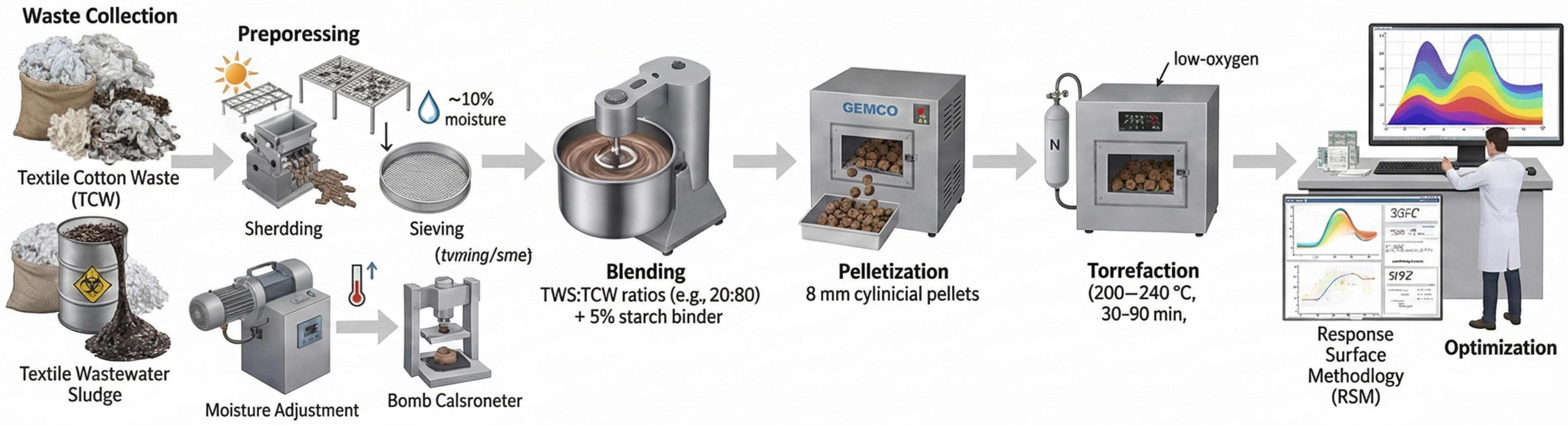
2.1. Sample Collection and Pre-Processing
2.2. Blending and Pelletization
2.3. Torrefaction
2.4. Fuel Characterization and Testing
2.5. Statistical Analysis and Optimization
2.6. Data Analysis
3. Results
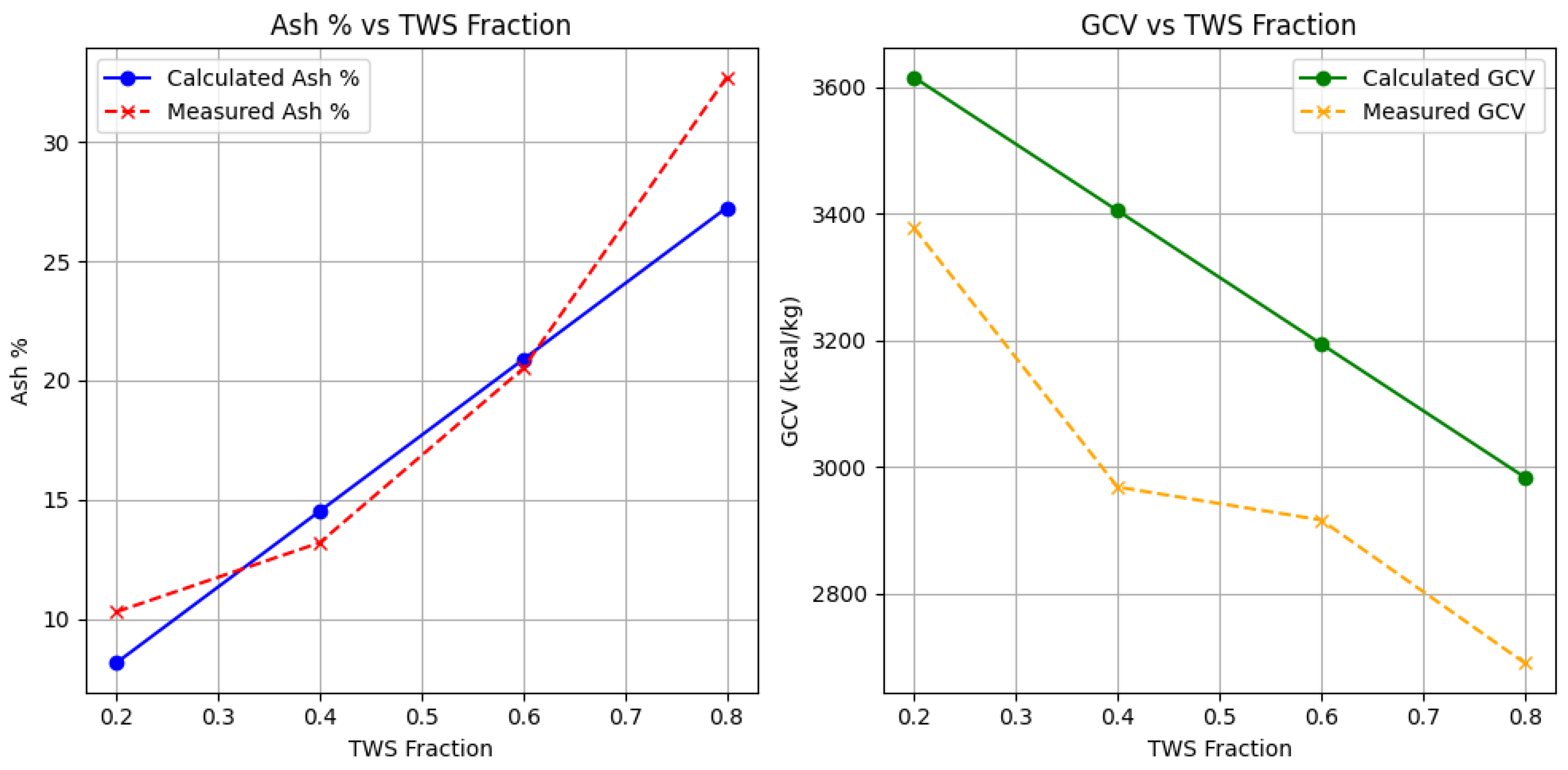
3.1. Fuel Composition (Proximate and Ultimate Analysis)
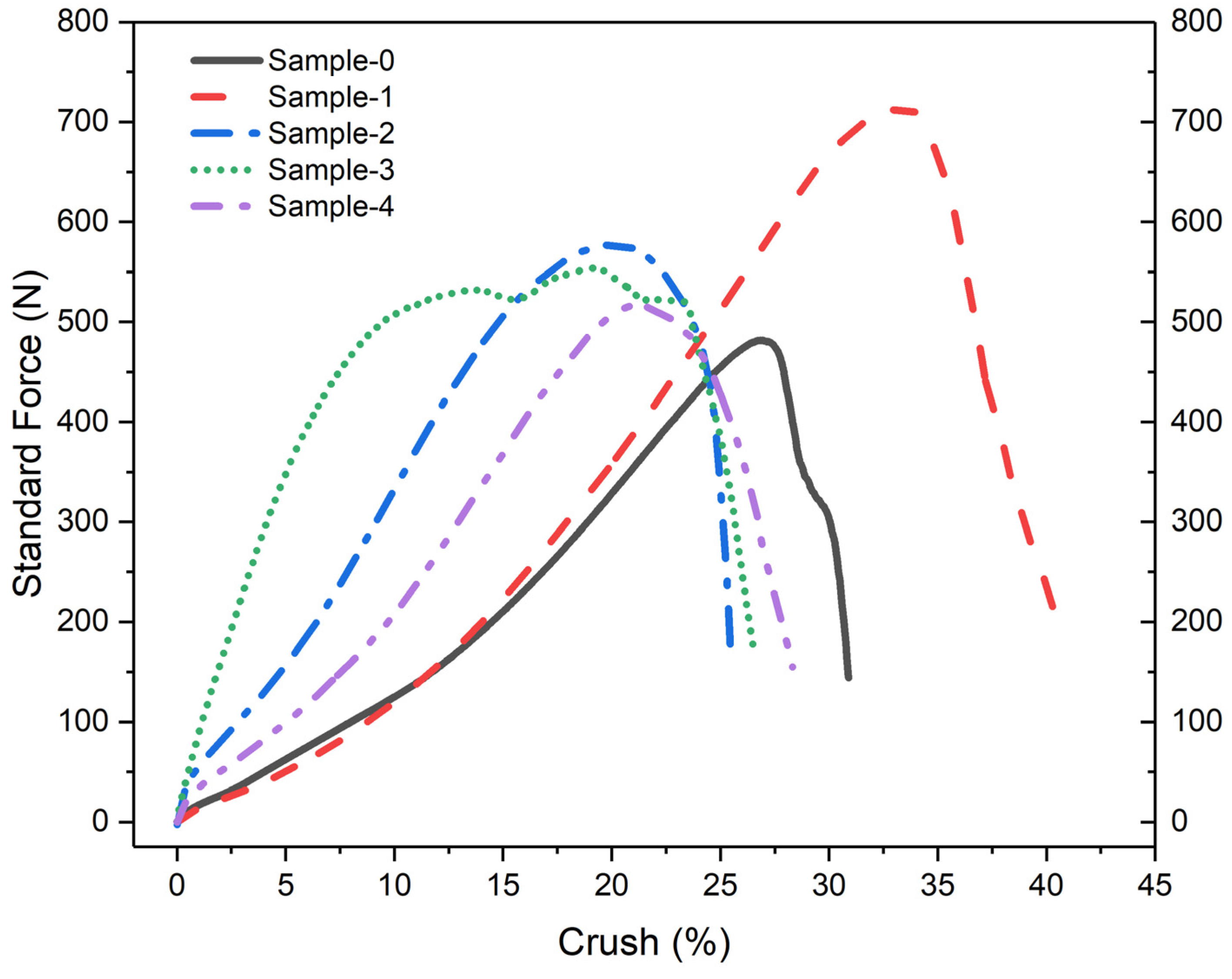
3.2. Mechanical and Physical Properties
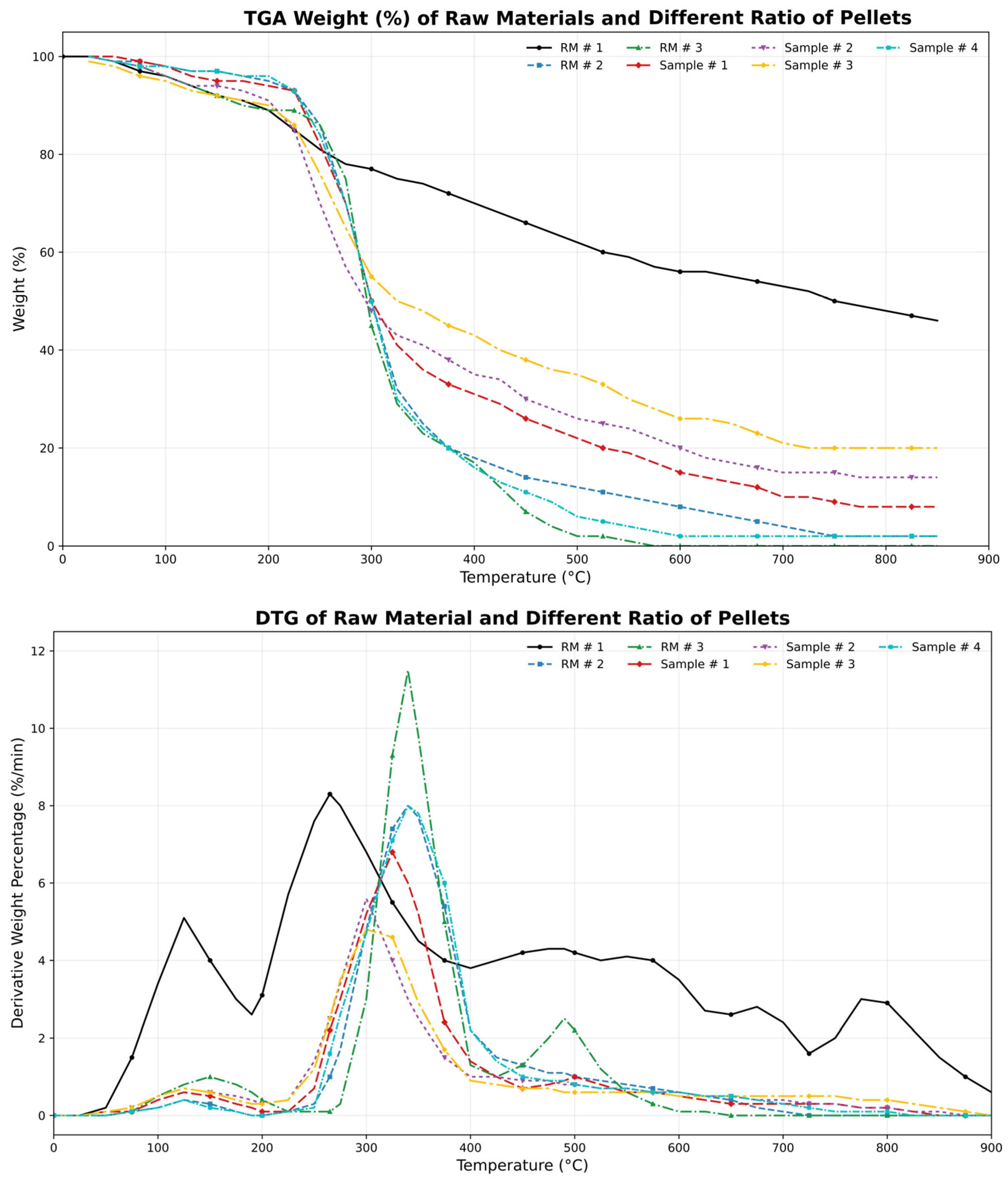
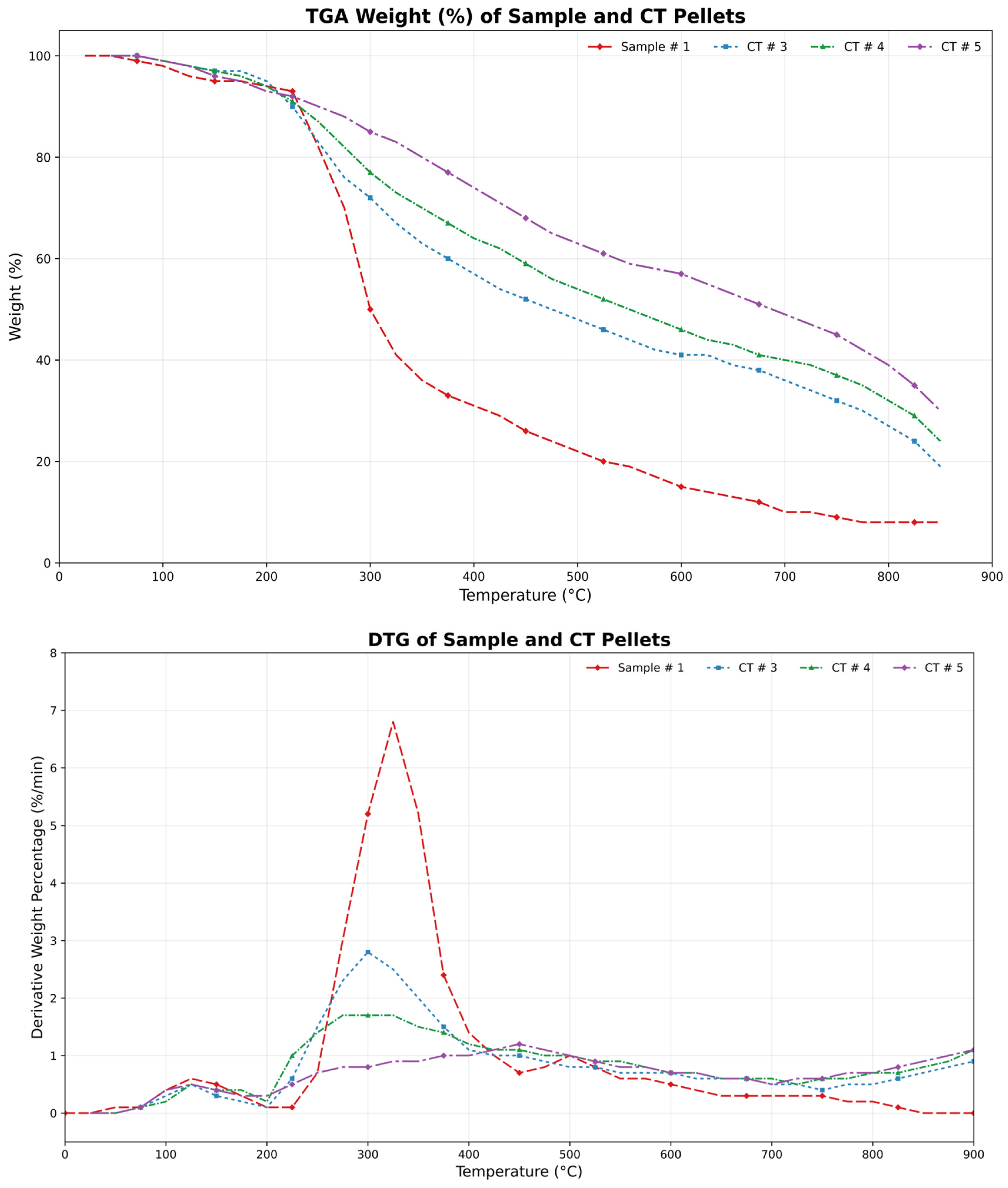
3.3. Thermogravimetric Analysis (TGA–DTG)
3.4. Torrefaction Performance
3.5. Response Surface Modeling and Optimization
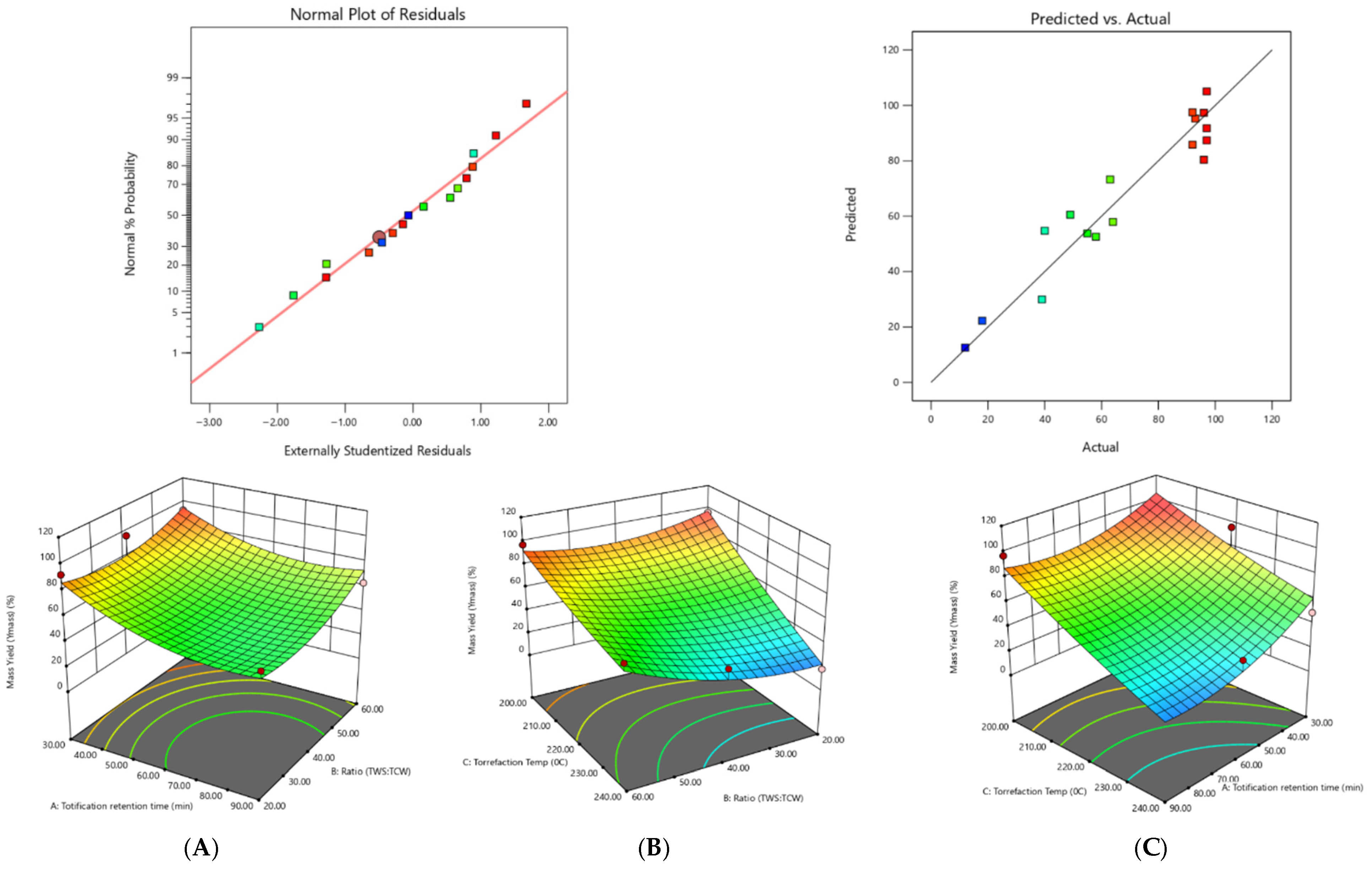
3.5.1. Effect of Process Variables on Mass Yield
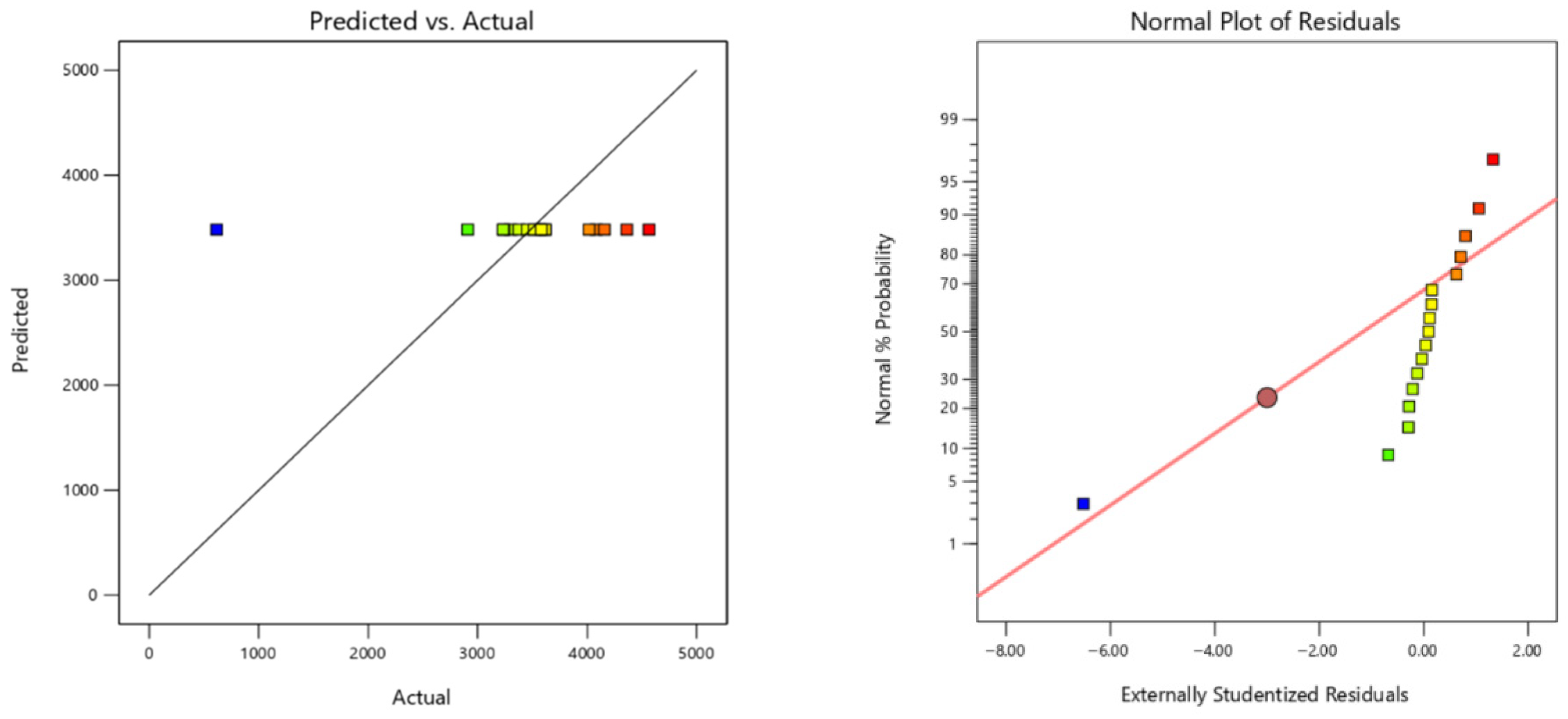
3.5.2. Effect of Process Variables on Gross Calorific Value
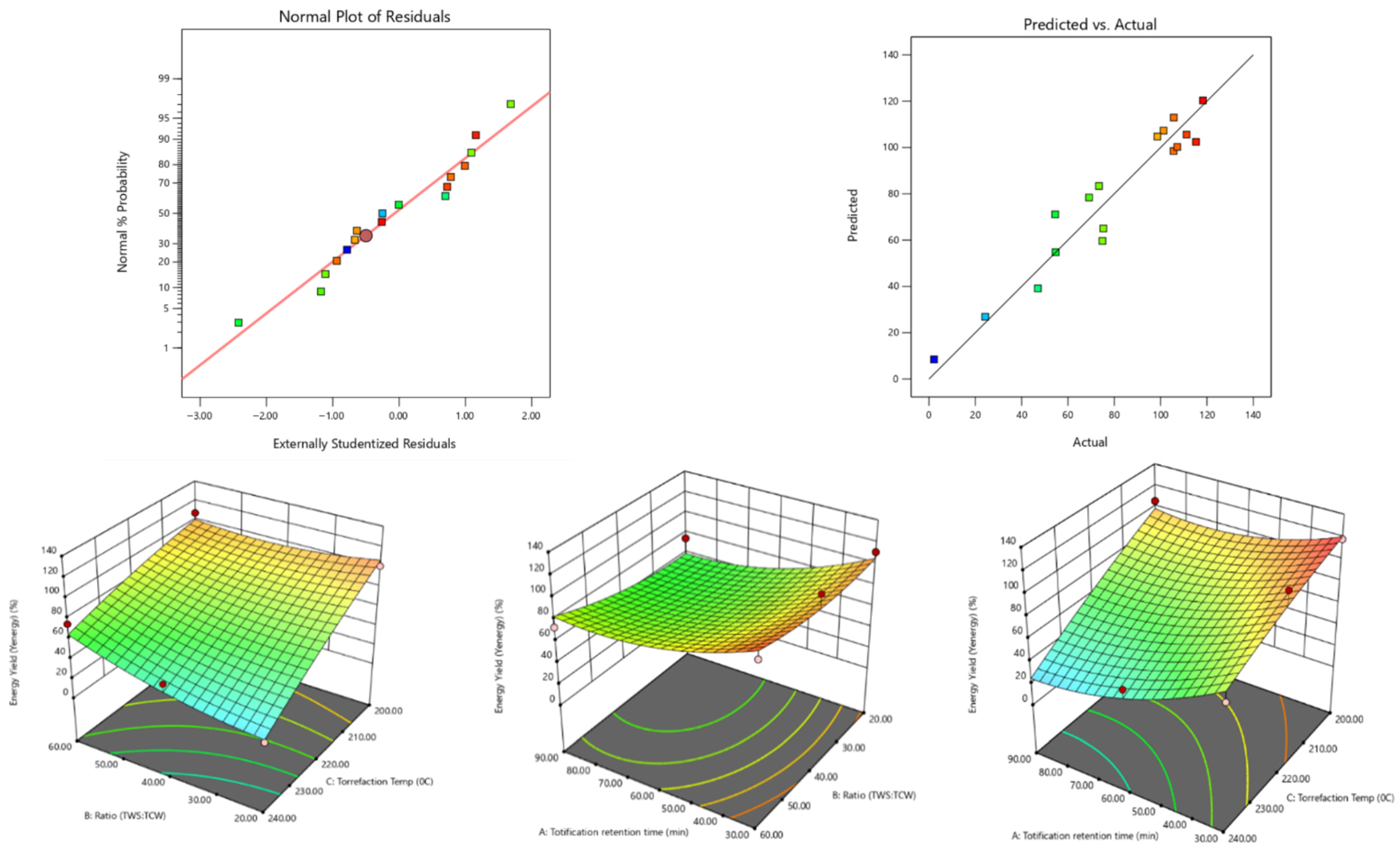
3.5.3. Effect of Process Variables on Energy Yield
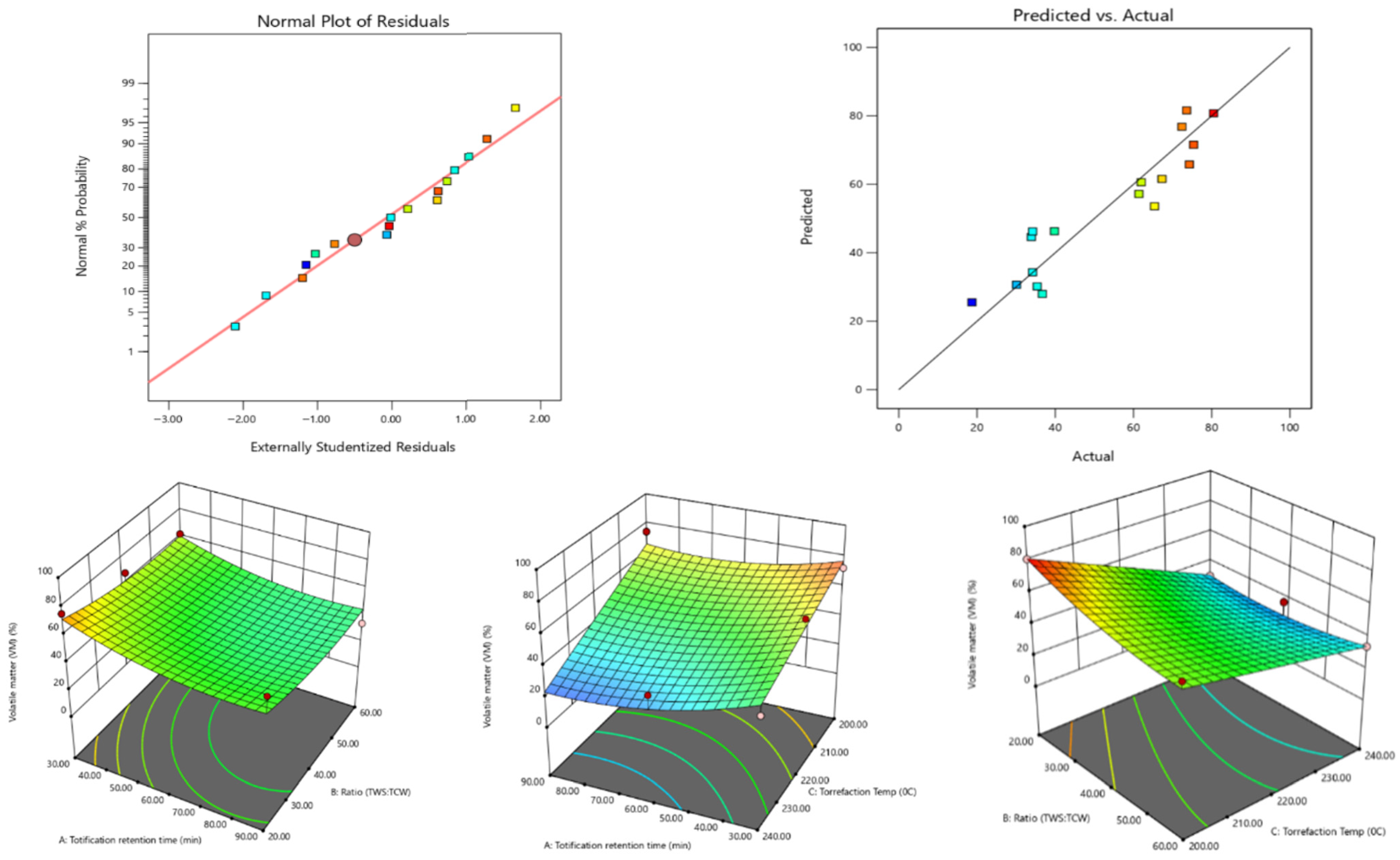
3.5.4. Effect of Process Variables on Volatile Matter
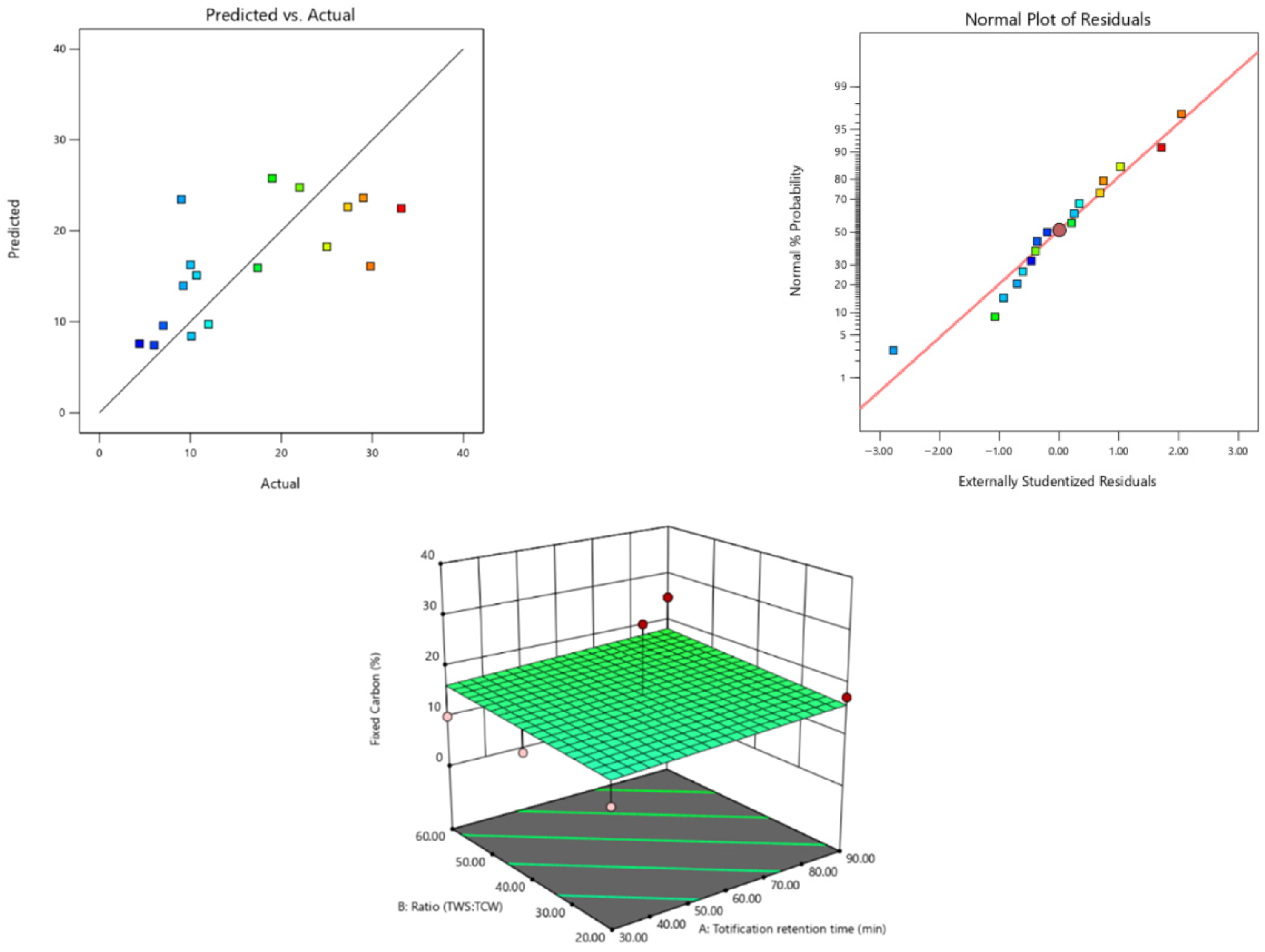
3.5.5. Effect of Process Variables on Fixed Carbon
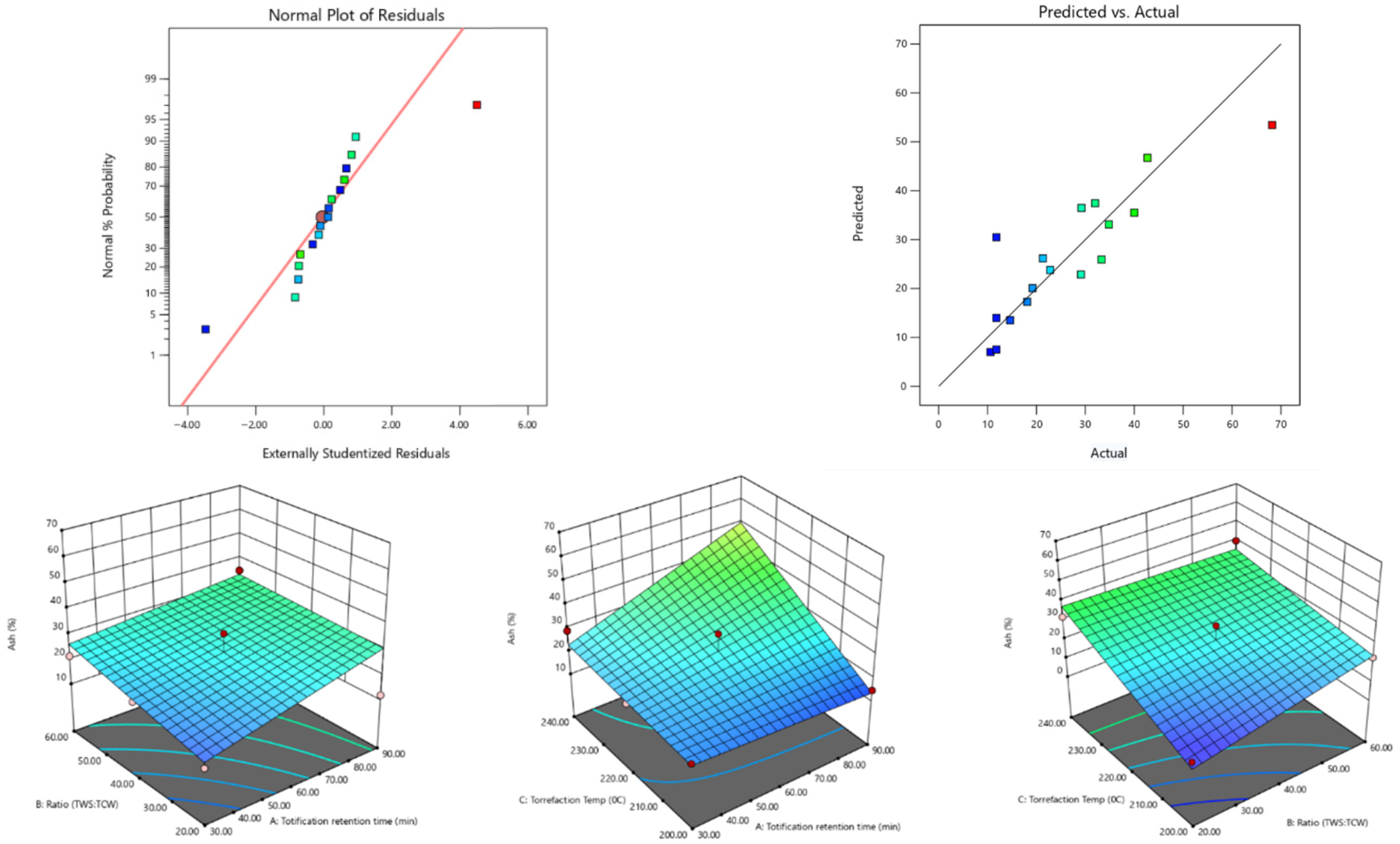
3.5.6. Effect of Process Variables on Ash Content
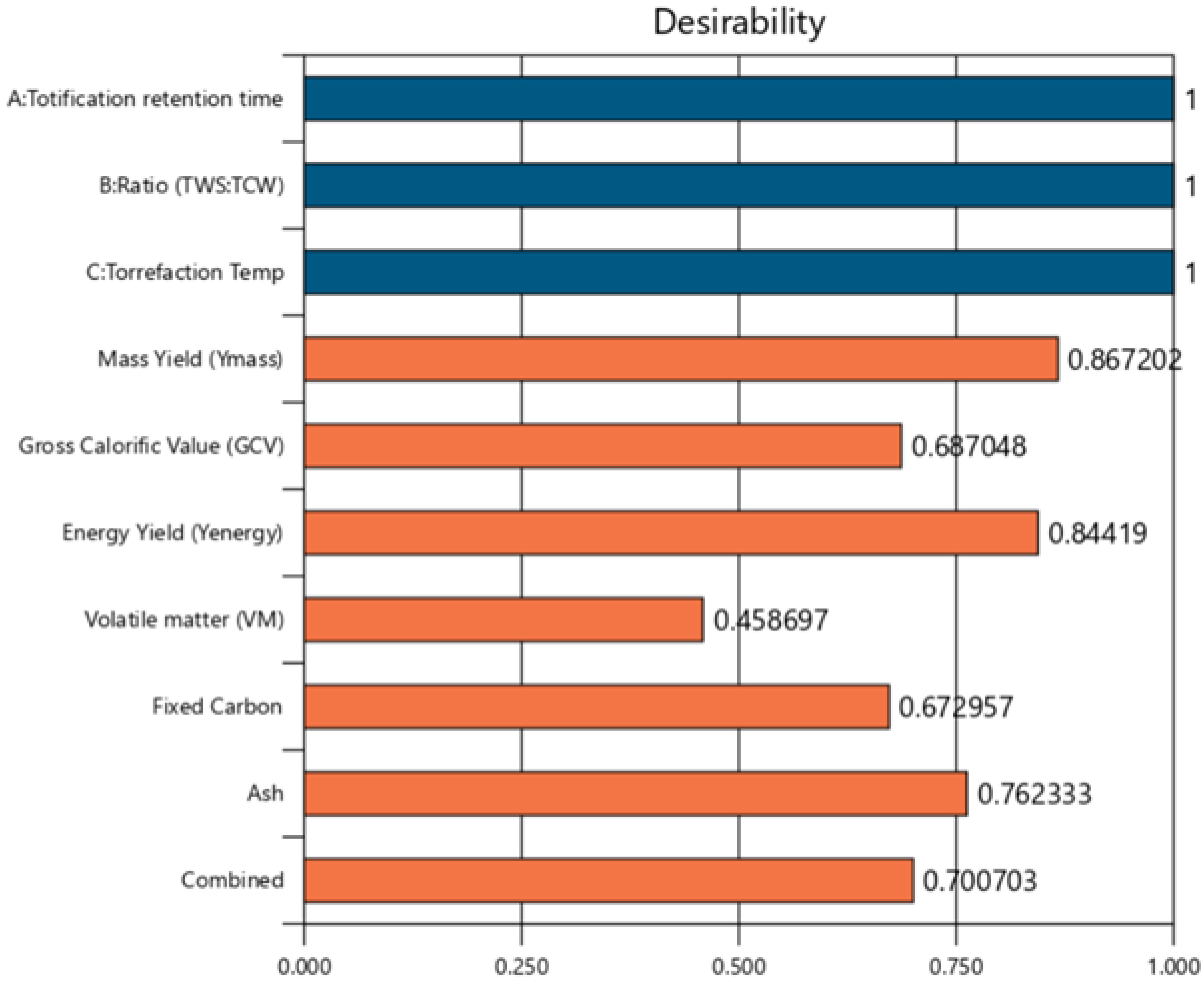
3.5.7. Multi-Objective Numerical Optimization
4. Discussion
5. Conclusions and Recommendations
Author Contributions
Funding
Data Availability Statement
Acknowledgments
Conflicts of Interest
References
- Islam, S.; Bhat, G. Environmentally-friendly thermal and acoustic insulation materials from recycled textiles. J. Environ. Manag. 2019, 251, 109536. [Google Scholar] [CrossRef]
- Almazán-Gómez, M.Á.; Llano, C.; Pérez, J. Putting off the coal in Europe: Socio-economic trade-offs across the European regions. Energy Policy 2024, 195, 114360. [Google Scholar] [CrossRef]
- STICA. 2024 Progress Report for the STICA Company Climate Action Program; Sustainable Fashion Academy: Stockholm, Sweden, 2024. [Google Scholar]
- Khoo, Y.S.; Liang, Y.N.; Hu, X.; Chew, J.W. A greener approach for physical separation of polycotton textile waste. J. Environ. Chem. Eng. 2024, 12, 114281. [Google Scholar] [CrossRef]
- European Environment Agency. Share of Textile Waste Sent to Incineration or Landfill in the EU|Textiles; Circularity Metrics Lab; European Environment Agency: Copenhagen, Denmark, 2025. [Google Scholar]
- Suryawan, I.W.K.; Septiariva, I.Y.; Widanarko, D.U.F.; Qonitan, F.D.; Sarwono, A.; Sari, M.M.; Prayogo, W.; Arifianingsih, N.N.; Suhardono, S.; Lim, J.-W. Enhancing energy recovery from wastewater treatment plant sludge through carbonization. Energy Nexus 2024, 14, 100290. [Google Scholar] [CrossRef]
- Drobniak, A.; Jelonek, Z.; Mastalerz, M.; Jelonek, I.; Widziewicz-Rzońca, K. Quality assessment of biomass pellets available on the market; example from Poland. Environ. Sci. Pollut. Res. 2024, 31, 33942–33959. [Google Scholar] [CrossRef] [PubMed]
- Wang, T.; Liu, B.; Xue, Y.; Wang, W.; Chen, S. Effect of textile waste on incineration behavior of dyeing sludge: Combustion characteristics, gas emissions, kinetics. J. Clean. Prod. 2024, 435, 140619. [Google Scholar] [CrossRef]
- Li, J.; Chen, Y.; Zhang, Y.; Wu, J.; Guo, C.; Jin, Y.; Wang, Y. Effects of alkali and alkaline earth metals on co-combustion of sewage sludge and coal slime. J. Environ. Manag. 2024, 356, 120735. [Google Scholar] [CrossRef]
- Zheng, J.; Cai, C.; Ge, T.; Zhang, M. Effect of potassium on the co-combustion process of coal slime and corn stover. Energies 2024, 17, 5185. [Google Scholar] [CrossRef]
- Muthu, S.S. Assessing the Environmental Impact of Textiles and the Clothing Supply Chain; Woodhead Publishing: Oxford, UK, 2020. [Google Scholar] [CrossRef]
- Özsin, G.; Pütün, A.E. An investigation on pyrolysis of textile wastes: Kinetics, thermodynamics, in-situ monitoring of evolved gasses and analysis of the char residue. J. Environ. Chem. Eng. 2022, 10, 107748. [Google Scholar] [CrossRef]
- Common Wealth Magazine. Taiwan: Pioneering “clothing-to-clothing” recycling. Common Wealth Magazine. Taipei City, Taiwan. 2023. [Google Scholar]
- Sarc, R.; Lorber, K.E.; Pomberger, R.; Rogetzer, M.; Sipple, E.-M. Design and quality assurance of solid recovered fuels for cement industry. Waste Manag. Res. 2014, 32, 565–585. [Google Scholar] [CrossRef]
- Sarker, T.R.; German, C.S.; Borugadda, V.B.; Meda, V.; Dalai, A.K. Techno-economic analysis of torrefied fuel pellet production. Heliyon 2023, 9, e16359. [Google Scholar] [CrossRef] [PubMed]
- Çetinkaya, B.; Erkent, S.; Ekinci, K.; Civan, M.; Bilgili, M.E.; Yurdakul, S. Effect of torrefaction on fuel properties of biopellets. Heliyon 2024, 10, e23989. [Google Scholar] [CrossRef] [PubMed]
- Vaish, S.; Sharma, N.K.; Kaur, G. Review on densification technologies of biomass residues. IOP Conf. Ser. Mater. Sci. Eng. 2022, 1228, 012019. [Google Scholar] [CrossRef]
- Sykorova, V.; Jezerska, L.; Sassmanova, V.; Honus, S.; Peikertova, P.; Kielar, J.; Zidek, M. Biomass pellets with organic binders before and after torrefaction. Renew. Energy 2024, 221, 119771. [Google Scholar] [CrossRef]
- Yang, K.; Wang, M.; Wang, X.; Shan, J.; Zhang, J.; Tian, G.; Yang, D.; Ma, J. Polyester/cotton-blended textile waste fiber separation. ACS Sustain. Chem. Eng. 2024, 12, 4530–4538. [Google Scholar] [CrossRef]
- ISO 17225-2:2021; Solid Biofuels—Fuel Specifications and Classes—Part 2: Graded Wood Pellets. ISO: Geneva, Switzerland, 2021.
- Wu, Y.; Zhang, L.; Liu, M.; Lei, Z.; Li, Z.; Zhang, W.; Ren, S.; Wang, Z.; Shui, H.; Yan, J. Synergistic reduction of NO/SO2 through co-firing municipal sewage sludge with coal gangue. Chem. Eng. J. 2024, 496, 154025. [Google Scholar] [CrossRef]
- Yang, X.; Zhu, W.; Li, Z.; Xu, L.; Zhu, S.; Tian, J.; Wang, Z.; Shen, B. Investigation of combustion and NO/SO2 emission characteristics during the co-combustion process of torrefied biomass and lignite. Molecules 2024, 29, 2728. [Google Scholar] [CrossRef]
- Wang, Y.; Jia, L.; Guo, B.; Li, J.; Bai, T.; Jin, Z.; Jin, Y. Investigation on the interaction mechanism during co-combustion of sewage sludge and coal slime. Sci. Total Environ. 2024, 927, 172419. [Google Scholar] [CrossRef]
- Mhangara, P.; Gidey, E.; Manjoo, R. Analysis of urban sprawl dynamics using machine learning, CA-Markov chain, and the Shannon entropy model: A case study in Mbombela City, South Africa. Environ. Syst. Res. 2024, 13, 17. [Google Scholar] [CrossRef]
- Uyanik, S.; Dogerlioglu Isiksungur, O. How realistic are coal phase-out timeline targets for Turkey? Sustainability 2024, 16, 1649. [Google Scholar] [CrossRef]
- Chang, Y.-C.; Shen, Y.-H. Sustainable energy transition: Converting textile water sludge (TWS) to solid recovered fuel (SRF) in Taiwan. Energies 2025, 18, 774. [Google Scholar] [CrossRef]
- Huang, J.; Liu, T.; Wang, K.; Huang, Z.; Wang, J.; Rokhum, S.L.; Li, H. Room-temperature and carbon-negative production of biodiesel via synergy of geminal-atom and photothermal catalysis. Environ. Chem. Lett. 2024, 22, 1607–1613. [Google Scholar] [CrossRef]
- Li, C.; Zhao, X.; Wang, A.; Huber, G.W.; Zhang, T. Carbon-increasing catalytic strategies for upgrading biomass into energy-intensive fuels and chemicals. ACS Catal. 2018, 8, 148–187. [Google Scholar] [CrossRef]
- Arjona, L.; Martín-Lara, M.Á.; Montero, Á.; Calero, M.; Solís, R.R.; Blázquez, G. Thermogravimetric analysis of textile waste: Kinetic parameters and pyrolytic decomposition mechanisms. Therm. Sci. Eng. Prog. 2025, 65, 103946. [Google Scholar] [CrossRef]
- Guo, Y.; Zheng, J.; Wang, D.; Zhang, P.; Zhang, Y.; Lin, M.; Yuan, S. Research on thermochemical and gas emissions analysis for the sustainable co-combustion of petroleum oily sludge and high-alkali lignite. Sustainability 2025, 17, 6703. [Google Scholar] [CrossRef]
- Castells, B.; Paredes, R.; León, D.; Amez, I. Kinetic and thermodynamic insights into sewage sludge torrefaction: Energetic optimization and safety considerations. Energy Nexus 2025, 17, 100377. [Google Scholar] [CrossRef]
- Ni, Z.; Zhang, Y.; Liu, X.; Shi, H.; Yao, Y.; Tian, J.; Hu, P.; He, L.; Lin, Q.; Liu, L. Co-combustion of sewage sludge with corn stalk based on TG-MS and TG-DSC. Energy 2024, 308, 132747. [Google Scholar] [CrossRef]
- Brandstätter, G.; Fürsatz, K.; Long, A.; Hannl, T.K.; Schubert, T. Exploring the potential of sewage sludge for gasification and resource recovery. Environ. Technol. Innov. 2025, 40, 104346. [Google Scholar] [CrossRef]
- Arjona, L.; Barrós, I.; Montero, Á.; Solís, R.R.; Pérez, A.; Martín-Lara, M.Á.; Blázquez, G.; Calero, M. Pyrolysis of textile waste: A sustainable approach to waste management and resource recovery. J. Environ. Chem. Eng. 2024, 12, 114730. [Google Scholar] [CrossRef]
- Pereira, M.; López-Beceiro, J.; Díaz-Díaz, A.-M.; Álvarez-García, A.; Vázquez, L.S.; Artiaga, R. Thermogravimetry as a tool to evaluate the contribution of different fabric constituents to fibre release. J. Therm. Anal. Calorim. 2024, 149, 10497–10509. [Google Scholar] [CrossRef]
- Nang, S.; Mercl, F.; Košnář, Z.; Pierdonà, L.; Doležal, P.; Paul, C.S.; Tlustoš, P. Torrefaction of sewage sludge: An approach to nutrient recycling and contaminant reduction in agriculture. Environ. Res. 2025, 275, 121409. [Google Scholar] [CrossRef]
- Chen, Y.; Tian, L.; Liu, T.; Huang, Z.; Tian, L.; Huang, Q.; Gao, Y. NOx emissions during oxygen-enriched combustion of sewage sludge and corresponding hydrochar. Sep. Purif. Technol. 2024, 344, 127288. [Google Scholar] [CrossRef]
- Scott, C.; Desamsetty, T.M.; Rahmanian, N. Unlocking power: Impact of physical and mechanical properties of biomass wood pellets on energy release and carbon emissions. Waste Biomass Valorization 2025, 16, 441–458. [Google Scholar] [CrossRef]
- Hyväluoma, J.; Keskinen, R.; Seppänen, A.-M.; Hannula, M.; Ylivainio, K. Characterizing the internal structure of biomass pellets with three-dimensional imaging. Waste Biomass Valorization 2025, 16, 6785–6792. [Google Scholar] [CrossRef]
- Nyashina, G.; Dorokhov, V.; Shvedov, D.; Strizhak, P. Effects of the type and proportion of a binder on the quality and combustion of fuel pellets. Biomass Bioenergy 2025, 199, 107934. [Google Scholar] [CrossRef]
- Dall’Osto, G.; Mombelli, D.; Trombetta, V.; Mapelli, C. Effect of particle size and starch gelatinization on the mechanical and metallurgical performance of jarosite plus blast furnace sludge self-reducing briquettes. J. Sustain. Metall. 2024, 10, 759–774. [Google Scholar] [CrossRef]
- Dissanayake, C.L.W.; Thushara, D.; Gunarathne, D.S. Optimization of combined washing and torrefaction pretreatment for improving fuel properties and combustion performance of rice straw. Biomass Bioenergy 2025, 199, 107937. [Google Scholar] [CrossRef]
- Lamas, G.C.; da Silva Gonzales, T.; Monteiro, S.; de Oliveira Rodrigues, P.P.; Macedo, L.A.; Rodrigues, T.O.; Rousset, P.; de Paula Protásio, T.; Pires, A.C.; Silveira, E.A. Multiparameter optimization of torrefaction for achieving carbon-negative biocoal. Energy Convers. Manag. 2025, 341, 120055. [Google Scholar] [CrossRef]
- Yang, Y.; Song, L.; Yang, M.; Liu, P.; Lei, T. Effect of low-temperature torrefaction pretreatment on the energy–mass co-benefit of corn straws. Energy Sci. Eng. 2025, 13, 2802–2809. [Google Scholar] [CrossRef]
- Ciuffi, B.; Salimbeni, A.; De Vita, E.; Pezzati, N.; Rizzo, A.M.; Chiaramonti, D.; Rosi, L. Slow pyrolysis of mixed textile waste. Waste Manag. 2025, 205, 115013. [Google Scholar] [CrossRef]
- Lee, G.-B.; Ahn, C.-E.; Jeong, W.-G.; Tsang, Y.F.; Baek, K. Environmental impact assessment of pyrolysis and incineration including end-of-life of sewage sludge by-products. Bioresour. Technol. 2025, 435, 132929. [Google Scholar] [CrossRef]
- Urbancl, D.; Hochenauer, C.; Zachl, A.; Fekonja, N.; Petrovic, A.; Goricanec, D.; Simonic, M. Zero-waste strategy of small wastewater treatment plants with integrated thermal treatment of generated solid wastes. Energy 2025, 337, 138740. [Google Scholar] [CrossRef]
- Guo, Z.; Liu, M.; He, H.; Song, F.; Chen, X.; Guo, F.; Chen, J.; Lu, S.; Sang, S.; Wu, J. Co-pyrolysis and co-combustion characteristics of low-rank coal and waste biomass. J. Energy Inst. 2025, 118, 101918. [Google Scholar] [CrossRef]
- Tujjohra, F.; Hoque, E.; Kader, M.A.; Rahman, M.M. Sustainable valorization of textile industry cotton waste through pyrolysis for biochar production. Clean. Chem. Eng. 2025, 11, 100161. [Google Scholar] [CrossRef]
- Ewald, A.; Roeder, G.; Spliethoff, H.; Fendt, S. Pulverized sewage sludge combustion with potassium chloride addition—Fate of phosphorus, potassium, sulfur, and heavy metals. ACS Omega 2025, 10, 25733–25745. [Google Scholar] [CrossRef]
- Chen, H.; Chen, X.; Qiao, Z.; Liu, H. Release and transformation characteristics of K and Cl during straw torrefaction and mild pyrolysis. Fuel 2016, 167, 31–39. [Google Scholar] [CrossRef]
- Niu, Y.; Lv, Y.; Lei, Y.; Liu, S.; Liang, Y.; Wang, D.; Hui, S. Biomass torrefaction: Properties, applications, challenges, and economy. Renew. Sustain. Energy Rev. 2019, 115, 109395. [Google Scholar] [CrossRef]
- Pulka, J.; Manczarski, P.; Stępień, P.; Styczyńska, M.; Koziel, J.A.; Białowiec, A. Waste-to-carbon: Is the torrefied sewage sludge with high ash content a better fuel or fertilizer? Materials 2020, 13, 954. [Google Scholar] [CrossRef]
- Poudel, J.; Ohm, T.-I.; Lee, S.-H.; Oh, S.C. A study on torrefaction of sewage sludge to enhance solid fuel qualities. Waste Manag. 2015, 40, 112–118. [Google Scholar] [CrossRef] [PubMed]
- Saidur, R.; Abdelaziz, E.A.; Demirbas, A.; Hossain, M.S.; Mekhilef, S. A review on biomass as a fuel for boilers. Renew. Sustain. Energy Rev. 2011, 15, 2262–2289. [Google Scholar] [CrossRef]
- Jiang, L.; Yuan, X.; Xiao, Z.; Liang, J.; Li, H.; Cao, L.; Zeng, G. A comparative study of biomass pellet and biomass–sludge mixed pellet: Energy input and pellet properties. Energy Convers. Manag. 2016, 126, 509–515. [Google Scholar] [CrossRef]



| Factor | Symbol | Unit | −1 | 0 | +1 |
|---|---|---|---|---|---|
| Torrefaction Retention time | A | min | 30 | 60 | 90 |
| TWS:TCW Ratio | B | – | 20 | 40 | 60 |
| Torrefaction temperature | C | °C | 200 | 220 | 240 |
| Analysis | Raw Material-1 (TWS) | Raw Material-2 (TCW) | Binder Additive (Starch) | Sample-1 TWS:TCW (20:80 with 5% Starch) | Sample-2 TWS:TCW (40:60) | Sample-3 TWS:TCW (60:80) | Sample-4 TWS:TCW (80:20) | |
|---|---|---|---|---|---|---|---|---|
| Proximate Analysis | Moisture (%) | 6.5 | 4.5 | 8.5 | 10.1 | 9.7 | 11.4 | 9.4 |
| Volatile Matter (%) | 53.2 | 87.2 | 88.3 | 73.1 | 70.7 | 56 | 48.2 | |
| Fixed Carbon (%) | 6.7 | 6.5 | 2.3 | 6.5 | 6.7 | 12.1 | 9.7 | |
| Ash (%) | 33.6 | 1.8 | 0.9 | 10.3 | 13.2 | 20.5 | 32.7 | |
| Ultimate Analysis | Carbon (%) | 28.81 | 42.21 | 39.35 | 39.39 | 37.05 | 34.59 | 21.02 |
| Hydrogen (%) | 4.94 | 6.36 | 6.21 | 6.03 | 5.92 | 5.64 | 3.71 | |
| Nitrogen (%) | 4.83 | 0.55 | 0.62 | 0.48 | 1.35 | 1.54 | 1.89 | |
| Oxygen (%) | 60.39 | 50.83 | 53.81 | 53.92 | 55.31 | 57.72 | 72.61 | |
| Total Sulphur (%) | 1.03 | 0.05 | 0.01 | 0.18 | 0.37 | 0.51 | 0.77 | |
| Bulk Density (kg m−3) | 492 | 160 | 400 | 554 | 569 | 572 | 648 | |
| Gross Calorific Value (kcal kg−1) | 2773 | 3826 | 3557 | 3377 | 2968 | 2916 | 2690 | |
| Analysis | Sample-0 TWS:TCW (20:80) | Sample-1 TWS:TCW (20:80 + 5% Starch) | Sample-2 TWS:TCW (40:60) | Sample-3 TWS:TCW (60:80) | Sample-4 TWS:TCW (80:20) |
|---|---|---|---|---|---|
| Initial Diameter of Specimen (mm) | 8.0 | 7.8 | 7.8 | 7.8 | 7.8 |
| Initial Cross Section Area (mm2) | 50.27 | 47.78 | 47.78 | 47.78 | 47.78 |
| True Density (kg m−3) | 737 | 1159 | 1209 | 1214 | 1244 |
| Pellet Conversion Rate (%) | 70 | 96 | 81 | 83 | 87 |
| Maximum Compressive Strength (N/mm2) | 9.6 | 14.9 | 12.1 | 11.6 | 10.8 |
| Maximum Compressive Strain (%) | 26.9 | 33 | 20 | 19 | 21 |
| Compressive Breaking Stress (MPa) | 2.87 | 4.47 | 3.62 | 3.48 | 3.24 |
| Compressive Breaking Strain (%) | 30.9 | 40.3 | 25.5 | 26.6 | 28.3 |
| Sample Name | Run | Torrefaction Time (Min) | Ratio TWS:TCW | Torrefaction Temp. (°C) | Mass Yield (%) | GCV (kcal kg−1) | Energy Yield (%) | Volatile Matter (%) | Fixed Carbon (%) | Total Ash (%) |
|---|---|---|---|---|---|---|---|---|---|---|
| CT1 | 13 | 60 | Sample-1 (20:80) | 200 | 96 | 3563 | 101.3 | 80.5 | 6 | 10.6 |
| CT2 | 7 | 90 | 200 | 92 | 3619 | 98.6 | 73.6 | 10.1 | 11.8 | |
| CT3 | 11 | 30 | 220 | 92 | 4083 | 111.2 | 75.4 | 9.2 | 11.8 | |
| CT4 | 2 | 90 | 220 | 58 | 4362 | 74.9 | 65.4 | 17.4 | 10.6 | |
| CT5 | 8 | 60 | 240 | 18 | 4565 | 24.3 | 30.1 | 33.2 | 32 | |
| CT6 | 3 | 90 | 240 | 16 | 1220 | 5.9 | 18.7 | 9 | 68.2 | |
| CT7 | 12 | 30 | Sample-2 (40:60) | 200 | 97 | 3614 | 118.3 | 72.4 | 4.4 | 18.1 |
| CT8 | 5 | 90 | 200 | 97 | 3241 | 105.6 | 74.3 | 7 | 14.6 | |
| CT17 | 14 | 30 | 220 | 96 | 3516 | 115.3 | 67.3 | 10.7 | 19.2 | |
| CT11 | 10 | 60 | 240 | 39 | 3581 | 47 | 36.7 | 29 | 29.3 | |
| CT10 | 6 | 30 | 240 | 49 | 4158 | 69.1 | 39.8 | 27.3 | 29.2 | |
| CT9 | 1 | 60 | 220 | 40 | 4017 | 54.5 | 34.2 | 29.8 | 33.3 | |
| CT12 | 9 | 60 | Sample-3 (60:40) | 200 | 97 | 3232 | 107.2 | 61.4 | 12 | 22.8 |
| CT13 | 16 | 30 | 220 | 93 | 3301 | 105.7 | 62 | 10 | 21.3 | |
| CT14 | 4 | 90 | 220 | 63 | 3376 | 73.4 | 33.9 | 25 | 34.8 | |
| CT15 | 17 | 60 | 240 | 64 | 3452 | 75.3 | 34.2 | 22 | 40 | |
| CT16 | 15 | 90 | 240 | 55 | 2909 | 54.7 | 35.4 | 19 | 42.7 |
| Sample Name | Sample Recipe | Carbon (%) | Nitrogen (%) | Sulfur (%) | Hydrogen (%) | Oxygen (%) | GCV (kcal kg−1) | Mass Yield (%) |
|---|---|---|---|---|---|---|---|---|
| Sample-1 (Untorrefied Pellets) | (20:80 with 5% starch) | 39.39 | 0.48 | 0.18 | 6.03 | 53.92 | 3377 | 100 |
| Sample-CT3 (Torrefied Pellets) | 20:80 | 220 °C | 30 min | 47.3 | 0.18 | 0.31 | 5.22 | 46.53 | 4083 | 92 |
| Sample-CT4 (Torrefied Pellets) | 20:80 | 220 °C | 90 min | 49.21 | 1.16 | 0.25 | 4.78 | 44.6 | 4362 | 58 |
| Sample-CT5 (Torrefied Pellets) | 20:80 | 240 °C | 60 min | 51.52 | 1.29 | 0.36 | 3.76 | 43.06 | 4565 | 18 |
| Factor | Coefficient | F-Value | p-Value and Remarks | ||||
|---|---|---|---|---|---|---|---|
| A—Torrefaction Retention Time | −0.40524 | 10.25 | 0.0150 | Significant | |||
| B—Ratio (TWS:TCW) | −7.60482 | 3.31 | 0.1115 | – | |||
| C—Torrefaction Temperature | −4.55956 | 45.73 | 0.0001 | Highly Significant | |||
| A × B Interaction | +0.004673 | 0.28 | 0.6132 | – | |||
| A × C Interaction | −0.008260 | 0.77 | 0.4103 | – | |||
| B × C Interaction | +0.025769 | 4.04 | 0.0483 | Significant | |||
| A2—Quadratic (Torrefaction Retention Time) | +0.013129 | 2.93 | 0.1309 | – | |||
| B2—Quadratic (Ratio TWS:TCW) | +0.025394 | 1.97 | 0.2037 | – | |||
| C2—Quadratic (Torrefaction Temperature) | +0.006053 | 0.12 | 0.7420 | – | |||
| Intercept (Constant) | +876.55008 | – | – | – | |||
| Model (Overall) | – | 8.74 | 0.0046 | Model Significant | |||
| Fit Statistics | R2 | Adjusted R2 | Predicted R2 | Adeq Precision | Mean | Std. Dev. | C.V. % |
| 0.9182 | 0.8131 | 0.5250 | 9.5033 | 68.12 | 12.70 | 18.64 | |
| Factor | Coefficient | F-Value | p-Value and Remarks | ||||
|---|---|---|---|---|---|---|---|
| Intercept (Constant) | 3518.18 | – | – | ||||
| Model (Overall) | – | 0.00 | – | – | |||
| Fit Statistics | R2 | Adjusted R2 | Predicted R2 | Adeq Precision | Mean | Std. Dev. | C.V. % |
| 0.0000 | 0.0000 | −0.1289 | NA | 3518.18 | 737.12 | 20.95 | |
| Factor | Coefficient | F-Value | p-Value and Remarks | ||||
|---|---|---|---|---|---|---|---|
| A—Torrefaction Retention Time | +0.351633 | 16.19 | 0.0050 | Significant | |||
| B—Ratio (TWS:TCW) | −7.59484 | 2.99 | 0.1273 | – | |||
| C—Torrefaction Temperature | +1.59121 | 43.60 | 0.0003 | Highly significant | |||
| A × B Interaction | +0.006802 | 0.5013 | 0.5018 | – | |||
| A × C Interaction | −0.013246 | 1.67 | 0.2376 | – | |||
| B × C Interaction | +0.028231 | 4.10 | 0.0824 | – | |||
| A2—Quadratic (Torrefaction Retention Time) | +0.013847 | 2.75 | 0.1410 | – | |||
| B2—Quadratic (Ratio TWS:TCW) | +0.017059 | 0.7502 | 0.4151 | – | |||
| C2—Quadratic (Torrefaction Temperature) | −0.007661 | 0.1590 | 0.7020 | – | |||
| Intercept (Constant) | +207.44942 | – | – | – | |||
| Model (Overall) | – | 9.87 | 0.0032 | Model significant | |||
| Fit Statistics | R2 | Adjusted R2 | Predicted R2 | Adeq Precision | Mean | Std. Dev. | C.V. % |
| 0.9270 | 0.8330 | 0.5920 | 10.5660 | 78.74 | 13.80 | 17.53 | |
| Factor | Coefficient | F-Value | p-Value and Remarks | ||||
|---|---|---|---|---|---|---|---|
| A—Torrefaction Retention Time | −0.134801 | 5.38 | 0.0355 | Significant | |||
| B—Ratio (TWS:TCW) | −4.94670 | 2.01 | 0.1995 | – | |||
| C—Torrefaction Temperature | −1.27532 | 28.46 | 0.0001 | Highly significant | |||
| A × B Interaction | +0.000820 | 0.0139 | 0.9161 | – | |||
| A × C Interaction | −0.004977 | 0.3853 | 0.5534 | – | |||
| B × C Interaction | +0.017025 | 2.04 | 0.1620 | – | |||
| A2—Quadratic (Torrefaction Retention Time) | −0.007614 | 1.53 | 0.2486 | – | |||
| B2—Quadratic (Ratio TWS:TCW) | +0.0112849 | 0.5376 | 0.4872 | – | |||
| C2—Quadratic (Torrefaction Temperature) | −0.000045 | 0.0001 | 0.9977 | – | |||
| Intercept (Constant) | +403.35027 | – | – | Constant term | |||
| Model (Overall) | – | 5.47 | 0.0178 | Model significant | |||
| Fit Statistics | R2 | Adjusted R2 | Predicted R2 | Adeq Precision | Mean | Std. Dev. | C.V. % |
| 0.8754 | 0.7153 | 0.2636 | 6.7781 | 52.66 | 10.79 | 20.49 | |
| Factor | Coefficient | F-Value | p-Value and Remarks | ||||
|---|---|---|---|---|---|---|---|
| A—Torrefaction Retention Time | +0.033183 | 0.1812 | 0.6773 | – | |||
| B—Ratio (TWS:TCW) | +0.057614 | 0.2406 | 0.6320 | – | |||
| C—Torrefaction Temperature | +0.376117 | 10.33 | 0.0068 | Significant | |||
| Intercept (Constant) | −70.93919 | – | – | – | |||
| Model (Overall) | – | 3.70 | 0.0399 | Model Significant | |||
| Fit Statistics | R2 | Adjusted R2 | Predicted R2 | Adeq Precision | Mean | Std. Dev. | C.V. % |
| 0.4608 | 0.3364 | 0.0842 | 4.9077 | 16.54 | 7.71 | 46.60 | |
| Factor | Coefficient | F-Value | p-Value and Remarks | ||||
|---|---|---|---|---|---|---|---|
| A—Torrefaction Retention Time | −2.48311 | 4.30 | 0.0650 | Marginally significant | |||
| B—Ratio (TWS:TCW) | +2.99637 | 1.54 | 0.2427 | – | |||
| C—Torrefaction Temperature | −0.22055 | 13.21 | 0.0046 | Highly Significant | |||
| A × B Interaction | −0.003981 | 0.39 | 0.5446 | – | |||
| A × C Interaction | +0.012899 | 3.80 | 0.0798 | – | |||
| B × C Interaction | −0.011692 | 1.63 | 0.2306 | – | |||
| Intercept (Constant) | −51.27130 | – | – | – | |||
| Model (Overall) | – | 5.34 | 0.0103 | Model Significant | |||
| Fit Statistics | R2 | Adjusted R2 | Predicted R2 | Adeq Precision | Mean | Std. Dev. | C.V. % |
| 0.7620 | 0.6192 | 0.1479 | 7.8689 | 26.55 | 9.19 | 34.62 | |
| Parameter | Optimal Value |
|---|---|
| Torrefaction retention time (min) | 30.000 |
| TWS:TCW Ratio | 60.000 |
| Torrefaction temperature (°C) | 240.000 |
| Mass Yield (%) | 85.712 |
| Gross Calorific Value (kcal kg−1) | 3518.176 |
| Energy Yield (%) | 100.211 |
| Volatile Matter (%) | 52.153 |
| Fixed Carbon (%) | 23.781 |
| Ash (%) | 24.290 |
| Composite Desirability | 0.701 |
Disclaimer/Publisher’s Note: The statements, opinions and data contained in all publications are solely those of the individual author(s) and contributor(s) and not of MDPI and/or the editor(s). MDPI and/or the editor(s) disclaim responsibility for any injury to people or property resulting from any ideas, methods, instructions or products referred to in the content. |
© 2026 by the authors. Licensee MDPI, Basel, Switzerland. This article is an open access article distributed under the terms and conditions of the Creative Commons Attribution (CC BY) license.
Share and Cite
Ansari, I.; Zaidi, A.A.; Memon, A.H.; Hussain, A.; Haleem, A.B. Valorization of Textile Cotton Waste and Textile Sludge into High-Quality Torrefied Biofuel Pellets: Fuel Characteristics and Optimization. Energies 2026, 19, 1401. https://doi.org/10.3390/en19061401
Ansari I, Zaidi AA, Memon AH, Hussain A, Haleem AB. Valorization of Textile Cotton Waste and Textile Sludge into High-Quality Torrefied Biofuel Pellets: Fuel Characteristics and Optimization. Energies. 2026; 19(6):1401. https://doi.org/10.3390/en19061401
Chicago/Turabian StyleAnsari, Irfan, Asad A. Zaidi, Abdul Hameed Memon, Ahmad Hussain, and Asad Bilal Haleem. 2026. "Valorization of Textile Cotton Waste and Textile Sludge into High-Quality Torrefied Biofuel Pellets: Fuel Characteristics and Optimization" Energies 19, no. 6: 1401. https://doi.org/10.3390/en19061401
APA StyleAnsari, I., Zaidi, A. A., Memon, A. H., Hussain, A., & Haleem, A. B. (2026). Valorization of Textile Cotton Waste and Textile Sludge into High-Quality Torrefied Biofuel Pellets: Fuel Characteristics and Optimization. Energies, 19(6), 1401. https://doi.org/10.3390/en19061401