Article

Digital-Twin-Driven PMSM Inter-Turn Short-Circuit Fault Diagnosis Method

School of Mechatronics and Vehicle Engineering, Chongqing Jiaotong University, Chongqing 400074, China
*
Author to whom correspondence should be addressed.
Energies 2026, 19(5), 1152; https://doi.org/10.3390/en19051152
Submission received: 19 January 2026 / Revised: 11 February 2026 / Accepted: 19 February 2026 / Published: 26 February 2026
(This article belongs to the Special Issue Control, Operation and Stability of PMSM for Electric Vehicles)

Abstract

Under practical operating conditions, intelligent fault diagnosis of permanent magnet synchronous motors (PMSMs) is often hindered by the shortage of effective fault samples. To address this issue, this paper proposes a twin-data-driven transfer learning-based diagnostic method for PMSM inter-turn short-circuit faults. First, a finite element model of the motor is established in Ansys to generate inter-turn short-circuit twin data, thereby enriching the source-domain samples. Second, continuous wavelet transform (CWT) is employed to convert stator current signals into multi-scale time–frequency feature maps, which are then fed into a feature extraction network constructed by integrating a residual network (ResNet) into an efficient channel attention mechanism (ECA) to achieve effective fusion of local and global time–frequency features. Finally, a joint loss function combining multi-kernel maximum mean discrepancy (MK-MMD) and a domain-adversarial neural network (DANN) is introduced to align feature distributions and perform adversarial optimization, enhancing cross-domain invariance and improving fault recognition capability. Experimental results demonstrate that the proposed REDM method achieves higher diagnostic accuracy and robustness than several existing intelligent fault diagnosis approaches.

1. Introduction

Permanent magnet synchronous motors (PMSMs) feature high power density, high efficiency, and excellent dynamic performance, and have, therefore, been widely adopted in new-energy vehicles and related applications [1,2,3]. In long-term operation, however, PMSMs are frequently exposed to harsh conditions such as high temperature, high voltage, and strong vibration, which makes them vulnerable to various mechanical, electrical, and electromagnetic faults [4,5,6]. Among these, inter-turn short-circuit (ITSC) faults are among the most common yet most insidious electrical failures. ITSCs can induce electromagnetic–thermal instability, accelerate performance degradation and aging, and in severe cases threaten personal safety and property. Accordingly, developing high-accuracy intelligent diagnosis methods for PMSM ITSC faults is of substantial engineering significance.
With rapid advances in artificial intelligence and intelligent fault diagnosis, deep learning-based approaches have achieved impressive performance in motor fault diagnosis due to their strong capabilities in automatic feature learning and pattern recognition. For example, [7] proposed and validated a unified two-step open-phase fault (OPF) diagnosis scheme for five-phase PMSM drives, enabling consistent fault detection and localization in both normal and fault-tolerant modes, with strong robustness against speed and load disturbances. In [8], an instantaneous current residual map (ICRM) was developed, and a convolutional neural network (CNN)-based diagnosis method was designed for variable operating conditions using stator current signals. The work in [9] presented a stator-tooth-flux (STF)-based diagnosis framework, which combines a fault indicator extracted from multi-tooth STF features with a multiscale kernel parallel residual CNN to accurately identify four common PMSM faults using limited training data. Moreover, ref. [10] proposed an uncertainty-resilient, model-based incipient ITSC diagnosis method that integrates an improved nonlinear unknown-input observer (NUIO) with least-squares compensation and employs a second-order generalized integrator (SOGI)-based negative-sequence fault indicator to enhance sensitivity and robustness under load and parameter variations. Despite these advances, most deep learning methods still require large quantities of well-labeled fault samples. In practical engineering applications, fault data—especially for early-stage ITSCs—are extremely scarce due to complex operating conditions, safety constraints, and high data acquisition costs, which severely limit the deployment of data-hungry deep models in real-world scenarios.
Transfer learning, an important branch of machine learning, aims to transfer knowledge learned in a source domain to a target domain, thereby improving learning performance when target-domain data are scarce or insufficiently labeled. In PMSM fault diagnosis, transfer learning has shown considerable promise for cross-machine diagnosis under complex real-world operating conditions and across different motor platforms. For instance, ref. [11] developed an intelligent motor fault diagnosis model by combining deep transfer learning (DTL) with infrared thermography (IRT). In [12], a transfer learning-based fault diagnosis approach was proposed that converts combined vibration and stator current signals into images and leverages an ImageNet-pretrained VGG-16 model to accurately classify irreversible demagnetization and bearing faults, even under limited and non-uniform data. In addition, ref. [13] presented a transfer learning-enhanced 1D-CNN for PMSM ITSC identification, which is pre-trained on large-scale simulated datasets and then adapted to small real datasets via L1 regularization and cost-sensitive loss, achieving 98% accuracy with reduced data dependence. In [14], this paper proposes DUDAN, a denoising universal domain-adaptation network for PMSM fault diagnosis that filters noisy source labels via multi-classifier divergence and aligns only the shared label space using one-vs-all learning with entropy minimization to handle cross-domain label-set mismatch. These studies demonstrate that transfer learning can partially mitigate distribution mismatch and improve cross-domain diagnosis. Nevertheless, many transfer learning pipelines still rely on substantial source-domain data and non-negligible target-domain samples during adaptation, which can remain costly and challenging in practice.
With the development of digital twins and high-fidelity simulation technologies, large-scale, controllable, and repeatable fault datasets can be generated by constructing physics-based motor models and conducting multi-condition simulations, thereby alleviating data scarcity. In [15], this study develops and validates four distinct mathematical models in α β and d q frames for analyzing induction motor dynamics during transients, with experimental confirmation on a 3 kW motor. In [16], this review systematically analyzes fault detection and diagnostic techniques for synchronous motors from 2021 to 2025, highlighting a predominant shift toward data-driven methods, especially deep learning models. However, idealized assumptions in simulation models often lead to distribution discrepancies between simulated and measured data. Consequently, increasing attention has been devoted to combining simulated data with transfer learning to enhance fault diagnosis performance under real operating conditions. In [17], a digital twin-based semi-supervised framework was proposed to address motor fault diagnosis under limited labeled samples and was validated using induction motor fault experiments and the corresponding digital twin model. In [18], a simulation-driven transfer diagnosis method for stator and rotor faults in induction motors was proposed, enabling accurate fault identification while reducing dependence on large amounts of real data. In [19], a digital twin and graph convolutional network (GCN) transfer learning framework was developed for intelligent rolling bearing diagnosis, transferring knowledge from simulated to measured data to enable effective diagnosis under limited knowledge. In [20], this study proposes a data-driven permanent-magnet health management framework for PMSMs that uses raw stator-current-based anomaly detection trained only on normal data, ensemble learning and GA-SVM fault classification, and SVDD-derived anomaly scoring (via the Pauta criterion) to autonomously recognize demagnetization states under varying loads. In [21], a digital twin (DT) framework for centrifugal pump fault diagnosis was proposed, where a graph-based transfer learning model was adopted to alleviate the shortcomings of labeled samples and specific fault data. These studies collectively demonstrate that using simulation data as the source domain and integrating transfer learning is an effective approach for fault diagnosis under real-world conditions with limited data availability.
Motivated by the above, this paper investigates PMSM inter-turn short-circuit faults. A finite-element motor model is constructed to generate high-fidelity simulated current data, and continuous wavelet transform (CWT) is employed to convert time-domain current signals into multi-scale time–frequency feature maps. On this basis, a deep feature extraction network is established by integrating a residual network (ResNet) with an efficient channel attention (ECA) mechanism, and joint optimization is performed by incorporating multi-kernel maximum mean discrepancy (MK-MMD) and a domain-adversarial neural network (DANN) to achieve effective alignment between source- and target-domain features. Ultimately, a digital-twin-driven REDM transfer learning diagnosis method is proposed for sample-scarce practical scenarios, demonstrating favorable accuracy, robustness, and generalization performance in PMSM inter-turn short-circuit fault diagnosis.

2. Materials and Methods

2.1. Simulation of PMSM Based on Finite Element Modeling

2.1.1. Inter-Turn Short-Circuit Fault Principle

Inter-turn short-circuit (ITSC) faults are among the most common and earliest electrical failure modes in permanent magnet synchronous motors (PMSMs). If not detected and mitigated promptly, an ITSC fault may further develop into a phase-to-phase short circuit or a ground fault, posing a serious threat to the safety and reliability of electric drive systems. During an ITSC event, a fraction of the turns in the affected phase winding is shorted, forming a localized closed loop. Because the loop resistance is typically very small, variations in the stator flux linkage can induce a large circulating current, which causes rapid local temperature rise and may accelerate insulation degradation or even lead to winding burnout.
Under healthy operating conditions, the PMSM voltage equations in the three-phase stationary reference frame can be written as
v s = R s i s + L s d d t i s + e s
where the three-phase stator voltage and current vectors are given by
v s = ν U ν V ν W T
i s = i U i V i W T
R s = R U 0 0 0 R V 0 0 0 R W
L s = L U M U V M U W M V U L V M V W M W U M W V L W
In these equations, u s denotes the stator voltage vector, R s denotes the stator resistance matrix, i s is the stator current vector, L s is the stator inductance matrix, and e s is the back electromotive force (EMF) vector. U , V , and W represent the three stator phases. M W U denotes the mutual inductance between the W - and U -phase windings, and the remaining mutual inductances are defined in the same manner.
From a modeling standpoint, an ITSC fault can be equivalently described by introducing an additional parallel branch in the affected stator phase. This branch is characterized by a short-circuit resistance R f and a shorted-turn ratio k f = N f / N , where N f is the number of shorted turns and N is the total number of turns in that phase. Accordingly, the PMSM voltage equations can be reformulated under fault conditions as follows:
u s = R s i s + L s d d t i s + Δ u f
Δ u f = k f R f i f + L f d d t i f
where the additional fault-related voltage term Δ u f is expressed as in (7); R f is the resistance of the short-circuit branch; L f is the self-inductance of the shorted portion; and i f is the circulating current in the short-circuit loop.

2.1.2. Simulation of Inter-Turn Short-Circuit Faults

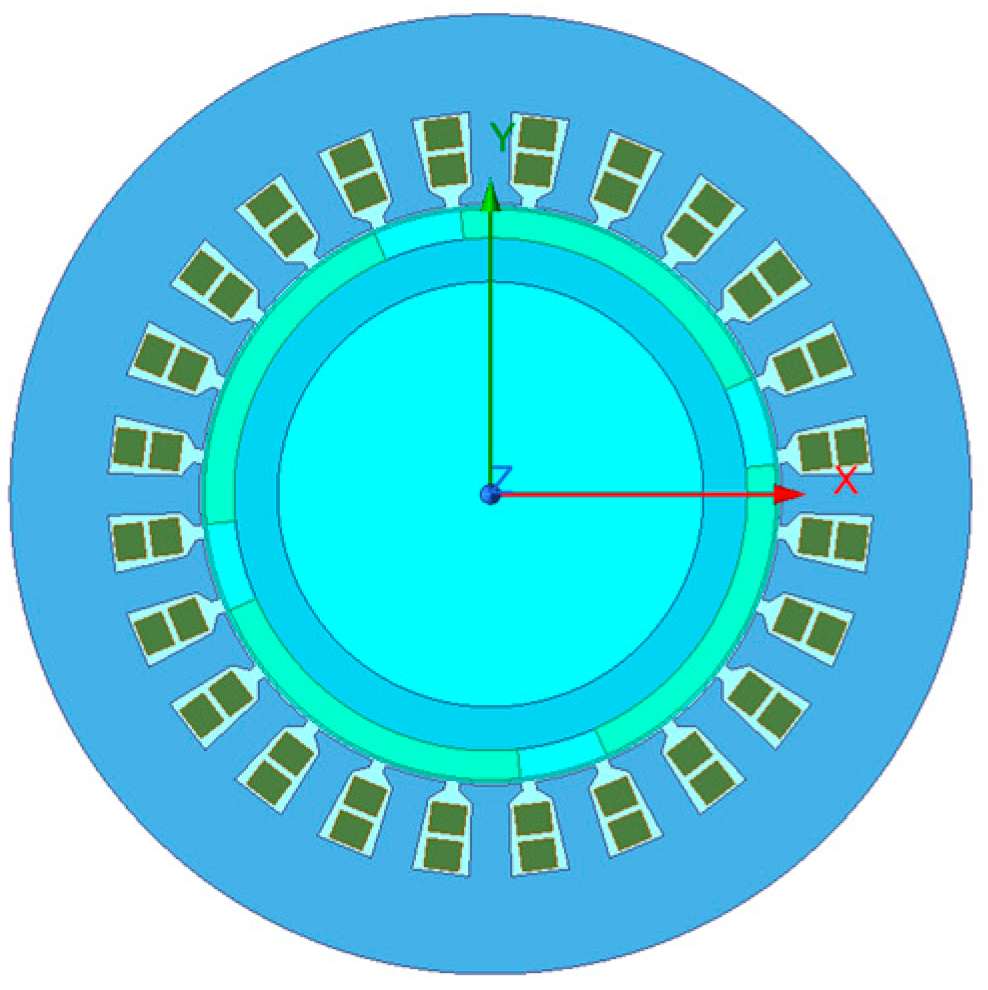
Permanent magnet synchronous motors (PMSMs) can be modeled using analytical formulations or finite-element (FE) models. Owing to its high accuracy and its ability to account for material nonlinearities and complex geometries, the finite-element method (FEM) has been widely used for electromagnetic field analysis of electrical machines. Among the commonly adopted FE tools, Ansys/Maxwell provides high-fidelity solutions for both static and time-varying electromagnetic fields in PMSMs. In this study, a two-dimensional FE model of the PMSM was developed in Maxwell 2D (Figure 1). The time step, load condition, supply voltage, and boundary settings were specified based on the actual motor parameters and operating conditions, providing a reliable foundation for subsequent fault-condition simulations.
Starting from the healthy-operation model, Maxwell can generate corresponding fault models by incorporating the motor material properties, winding topology, and geometric parameters. In this work, inter-turn short-circuit faults in the PMSM were modeled and simulated in Maxwell.
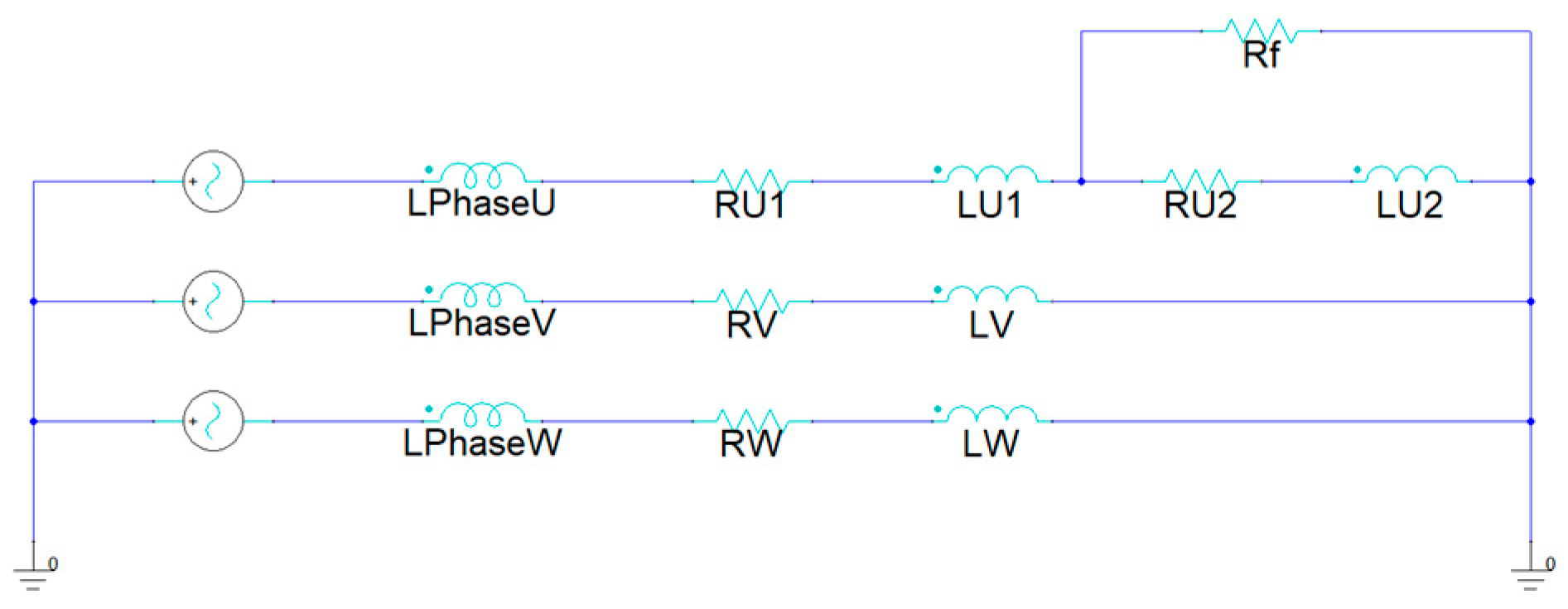
Within the coupled field–circuit co-simulation framework, different ITSC severities can be represented by modifying the equivalent number of turns in the affected winding. In Simplorer, a bypass branch is introduced in parallel with the faulty phase, and a series-connected short-circuit resistance is inserted in the bypass loop to emulate different shorted-turn levels. Figure 2 presents the external equivalent circuit model of the ITSC fault. Fault severity is commonly quantified by the fault ratio (FR), defined as follows:
F R = R D R D + R f × 100 %
where R D denotes the inter-turn resistance of the stator winding and R f denotes the bypass short-circuit resistance.
After constructing the PMSM fault model, batch simulations of inter-turn short-circuit faults were conducted to obtain datasets covering multiple fault severities under various operating conditions. These high-fidelity digital-twin data are used as source-domain samples, providing a sufficient and controllable raw dataset to support the subsequent transfer learning-based intelligent fault diagnosis method.

2.2. Continuous Wavelet Transform and Graphical Sample Construction

To capture the transient dynamics and non-stationary characteristics of stator current signals, the continuous wavelet transform (CWT) [22] was used to convert one-dimensional time-domain currents into two-dimensional time–frequency representations. Specifically, the measured three-phase stator currents were segmented into fixed-length windows, with each window regarded as an individual sample. The window length was determined based on the sampling rate and the motor’s electrical fundamental frequency to ensure that at least one complete electrical cycle was included and that key periodic features were preserved.
By scaling and translating the signal, the CWT decomposes the original signal x ( t ) into wavelet coefficients W ( a , b ) , defined as
W ( a , b ) = 1 a x ( t ) ψ ¯ t b a d t
where a is the scale parameter, b is the translation parameter, and ψ ( ) denotes the mother wavelet. In this study, the Morlet wavelet was selected as the mother wavelet. It consists of a sinusoidal carrier modulated by a Gaussian envelope, offering a favorable balance between time and frequency resolution and thus being well-suited for characterizing the oscillatory behavior of motor current signals.
The obtained wavelet coefficients were then transformed into a time–frequency energy spectrum through energy mapping, which describes how signal energy is distributed over time and frequency. The coefficient magnitudes were subsequently visualized using the viridis colormap, followed by normalization and resizing in order to produce standardized RGB images. In this study, 128 scales were employed to span the 10–2000 Hz frequency range, and each image was resized to 224 × 224 pixels. The processed images were subsequently fed into a residual network (ResNet) for deep feature extraction and fault classification.

2.3. ResNet–ECA

Residual networks (ResNets) [23] are a class of deep models that effectively alleviate training degradation and vanishing-gradient issues in very deep convolutional networks by introducing residual (skip) connections. The key idea is to learn a residual function F ( x ) = H ( x ) x , i.e., the network explicitly fits the difference between the desired mapping H ( x ) and the input x . In this way, ResNet improves trainability and convergence while increasing network depth.
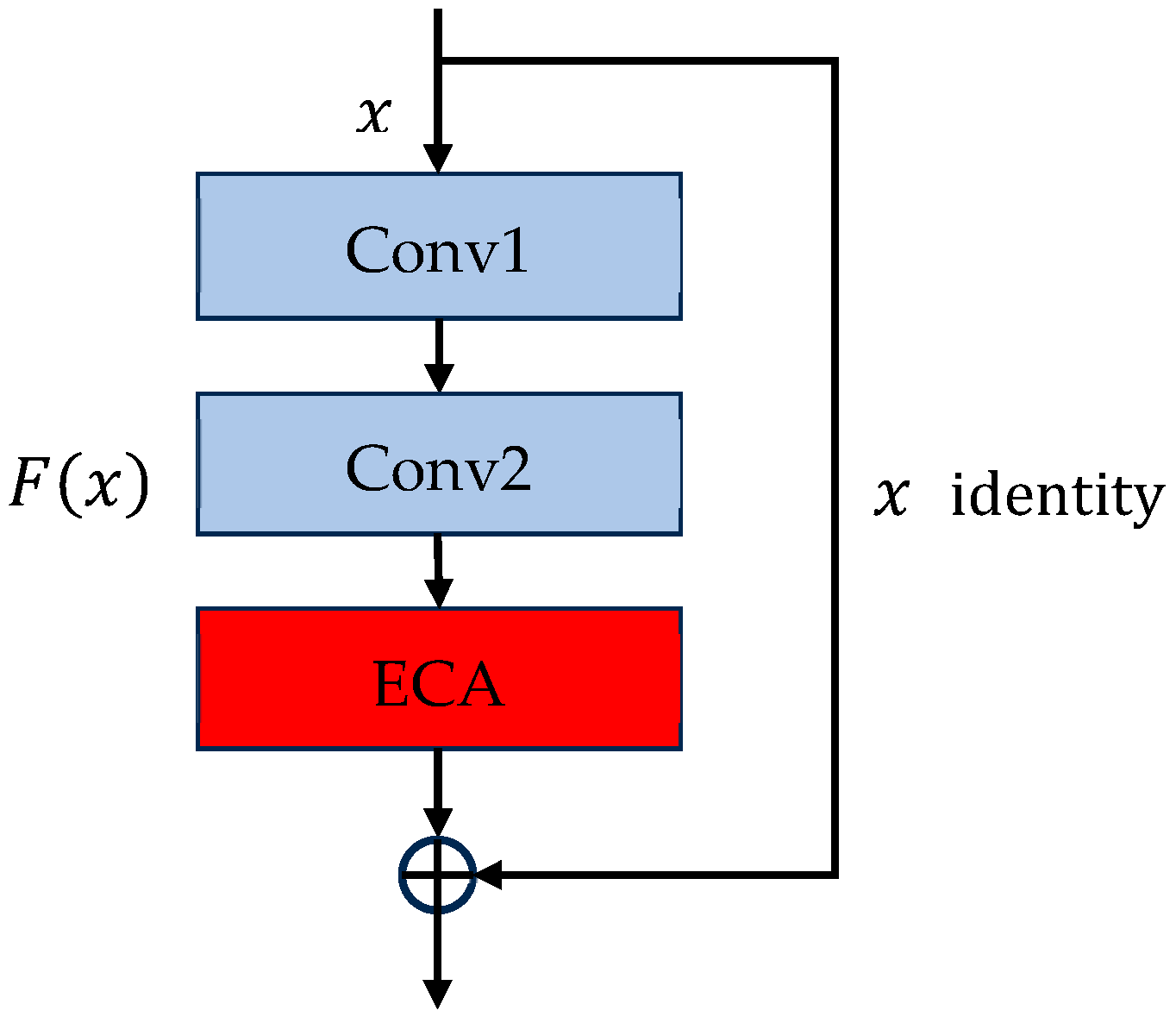
To further strengthen the network’s sensitivity to salient fault-related patterns in the CWT time–frequency maps, an efficient channel attention (ECA) [24] mechanism was integrated into the ResNet backbone to construct a lightweight ResNet–ECA feature extraction module. The residual building block is shown in Figure 3. While conventional ResNet promotes gradient propagation, it typically treats all feature channels uniformly and may therefore fail to highlight the most informative channels. Under noisy or complex operating conditions, critical time–frequency signatures can be obscured. By adaptively re-weighting channel responses, the ECA module encourages the network to focus on fault-relevant high-energy regions, thereby improving diagnostic accuracy and robustness.
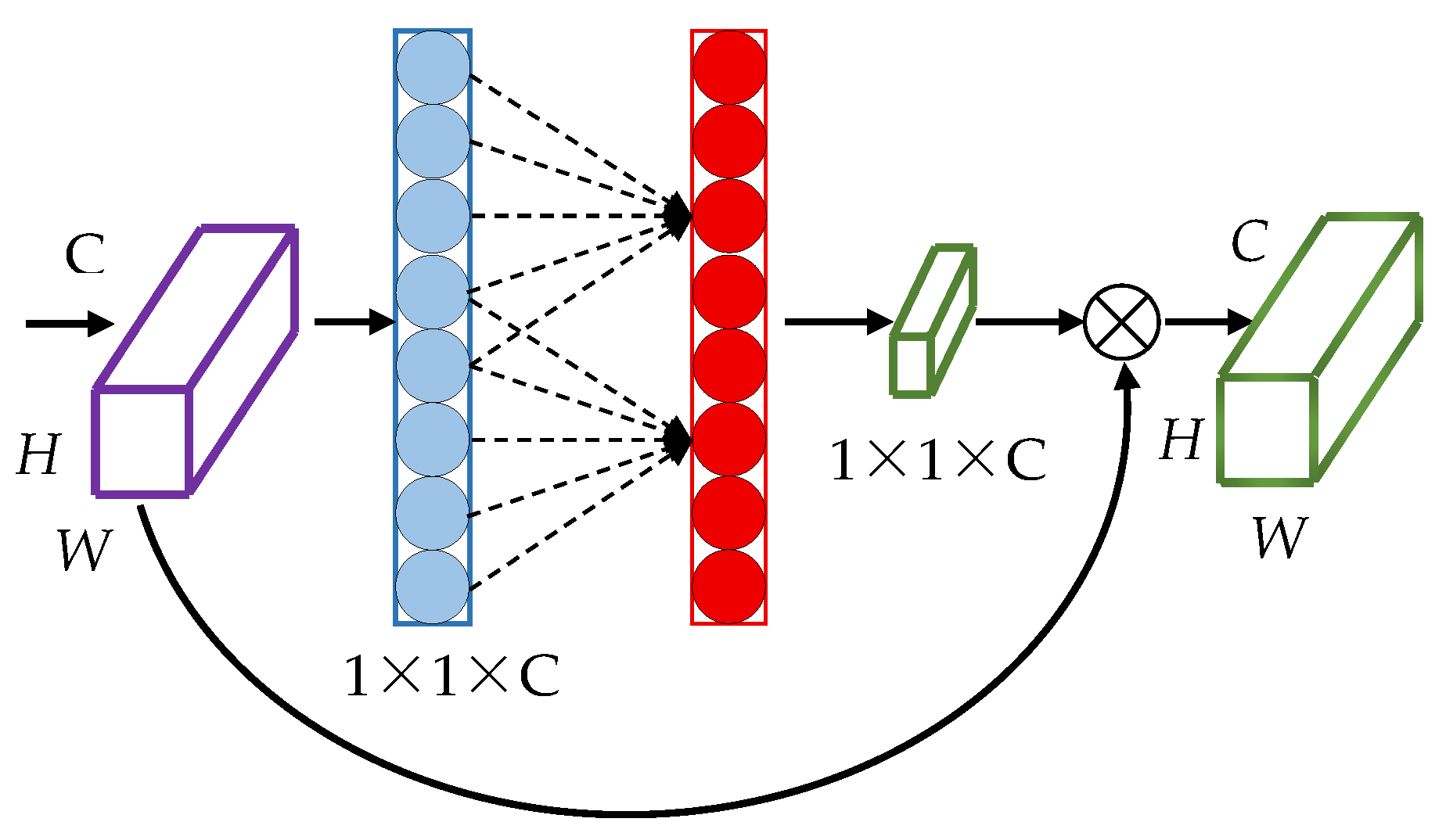
ECA is an improved variant of the squeeze-and-excitation (SE) attention mechanism, as illustrated in Figure 4. Unlike SE, ECA eliminates the use of fully connected layers and dimensionality reduction. Instead, it captures local cross-channel dependencies using a one-dimensional convolution (Conv1D) with a small kernel, resulting in lightweight yet effective feature recalibration. The procedure is summarized as follows.
First, global average pooling is applied to the input feature map X R C × H × W to obtain a channel descriptor:
z c = 1 H × W i = 1 H j = 1 W X c , i , j
Next, a one-dimensional convolution is used to capture local inter-channel interactions:
w = σ ( C o n v 1 D ( z , k ) )
where σ ( ) denotes the Sigmoid function, k is the adaptively determined kernel size of the 1D convolution, and w R C is the resulting channel-weight vector. Finally, the input features are recalibrated via channel-wise re-weighting:
X ^ c , i , j = w c X c , i , j
This design avoids additional fully connected layers, thereby substantially reducing parameter count and computational overhead while still enabling adaptive enhancement of informative channels. By integrating ECA into the deep convolutional backbone of ResNet-18, the proposed ResNet–ECA module can extract more discriminative time–frequency features that are sensitive to inter-turn short-circuit faults, providing a solid feature basis for subsequent transfer learning and fault diagnosis.

2.4. Domain Adversarial Neural Network Based on MK-MMD

In practical industrial scenarios, cross-machine fault diagnosis often results in substantial distribution shifts between source-domain and target-domain data, which can significantly degrade the cross-domain generalization of diagnostic models. To address this challenge, we adopted a domain adaptation strategy that combines multi-kernel maximum mean discrepancy (MK-MMD) [25] with a domain-adversarial neural network (DANN) [26] to jointly align features across domains.
MK-MMD is a distribution discrepancy metric extended from maximum mean discrepancy (MMD), which aims to minimize the distribution gap between the source and target domains in a reproducing kernel Hilbert space (RKHS). Given two probability distributions P and Q , the MK-MMD is defined as
d k 2 ( P , Q ) E P [ ϕ ( X s ) ] E Q [ ϕ ( X t ) ] H k 2
where E denotes the expectation operator, ϕ is the mapping to RKHS, and H k is the norm induced by the kernel function k . The two distributions are identical if and only if d k 2 ( P , Q ) = 0 . The kernel associated with ϕ ( ) can be written as k ( X s , X t ) = ϕ ( X s ) ϕ ( X t ) . In MK-MMD, the kernel is defined as a convex combination of multiple kernels:
K e r { k = m β u k u : m β u = 1 , β u 0 , u }
where β u denotes the weight of the u -th kernel. By leveraging multiple kernels, MK-MMD can adaptively construct a more expressive kernel function, thereby improving the accuracy and robustness of discrepancy measurement.
DANN integrates domain adaptation with adversarial learning and is a representative framework for unsupervised transfer learning. The main idea is to learn domain-invariant representations by adversarially encouraging the feature distributions of source and target samples to be indistinguishable in the feature space. DANN consists of a feature extractor G f , a label predictor G y , and a domain discriminator G d . The feature extractor and domain discriminator are connected via a gradient reversal layer (GRL). Let the labeled source-domain samples be D s ( x s , y s ) and the unlabeled target-domain samples be D t ( x t ) . The source-domain classification loss is defined as
L y ( θ f , θ y ) = n l o g G y ( G f ( x s ) ) y s
where G f is the feature extractor, G y is the label predictor, and θ f and θ y are their corresponding parameters. G y ( G f ( x s ) ) y s denotes the predicted probability of the ground-truth class y s for the source sample.
The domain classification loss is formulated as
L d ( θ f , θ d ) = d i l o g   G d ( G f ( x i ) ) ( 1 d i ) l o g 1 G d ( G f ( x i ) )
where d i { 0,1 } is the domain label (e.g., 0 for the source and 1 for the target), G d is the domain discriminator, and θ d denotes its parameters.
Accordingly, the overall DANN objective is given by
L D A N N = L y ( θ f , θ y ) λ L d ( θ f , θ d )
where λ is a trade-off coefficient balancing the classification objective and the domain adversarial objective.
In the digital-twin-driven transfer learning setting for fault diagnosis, MK-MMD and DANN are integrated to construct a domain-adaptive diagnostic model. On the one hand, an enhanced ResNet is adopted as the feature extractor, and adversarial alignment between source and target features is achieved in a shared subspace via the DANN framework. On the other hand, an MK-MMD regularization term is introduced to further constrain and optimize high-dimensional feature distributions, thereby reducing inter-domain discrepancies from a distribution-matching perspective.
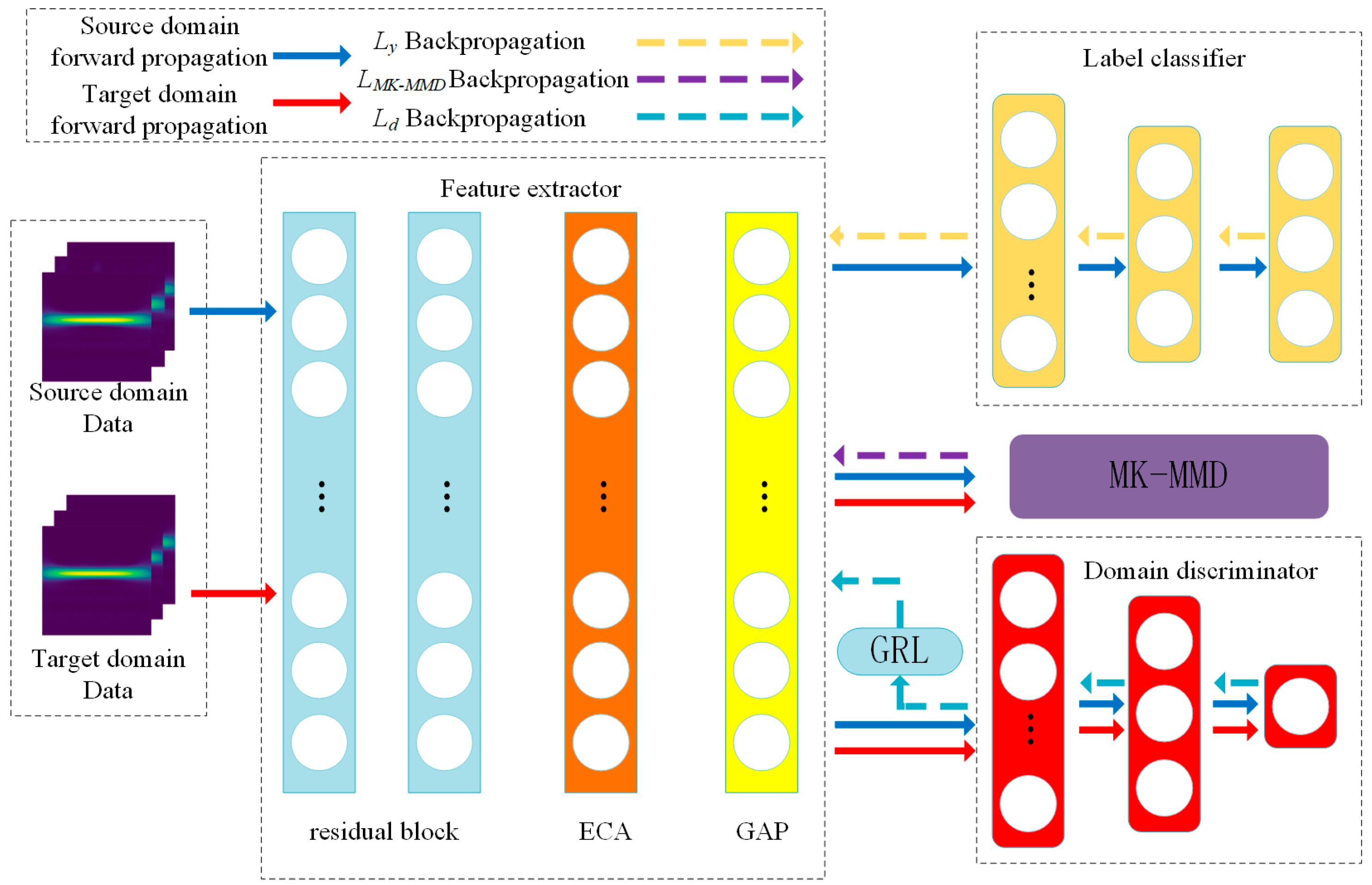
By jointly leveraging DANN-based adversarial learning and MK-MMD-based distribution alignment, the proposed model enables unsupervised transfer while improving convergence behavior, robustness, and cross-domain generalization for fault diagnosis under digital-twin conditions. Figure 5 illustrates the overall architecture of the proposed transfer learning method.

3. Results

3.1. Experimental Data Set and Data Processing

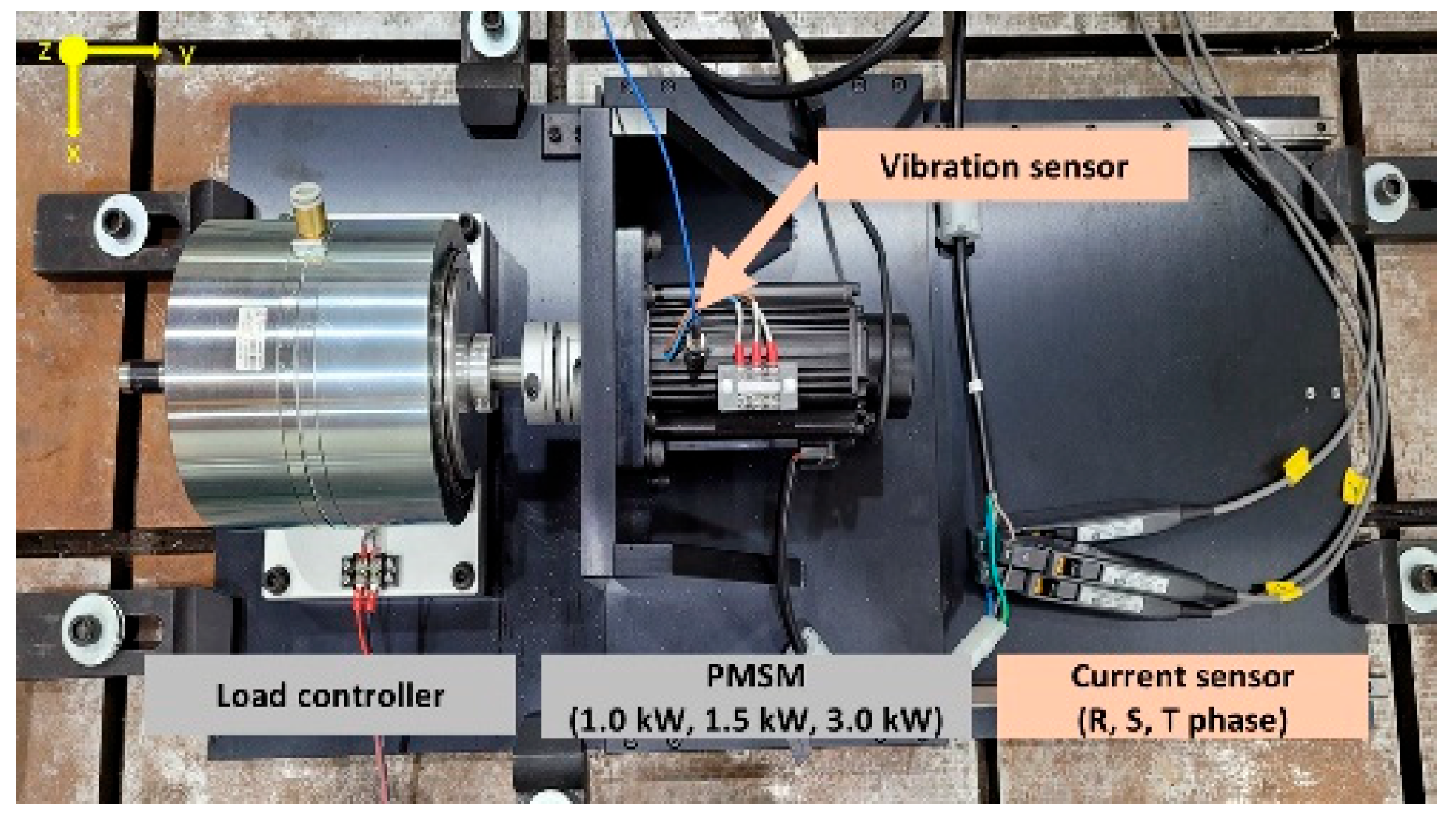
These experiments were conducted using the publicly available permanent magnet synchronous motor (PMSM) dataset released by the Korea Advanced Institute of Science and Technology (KAIST) [27]. The dataset includes three-phase PMSMs with three different rated power levels and provides stator current measurements acquired under eight severity levels of stator winding faults, sampled at 100 kHz. It is primarily intended for intelligent diagnosis of winding faults. In this study, the 1.0 kW PMSM was selected as the test machine. The experimental setup is shown in Figure 6, and the key motor parameters are summarized in Table 1.
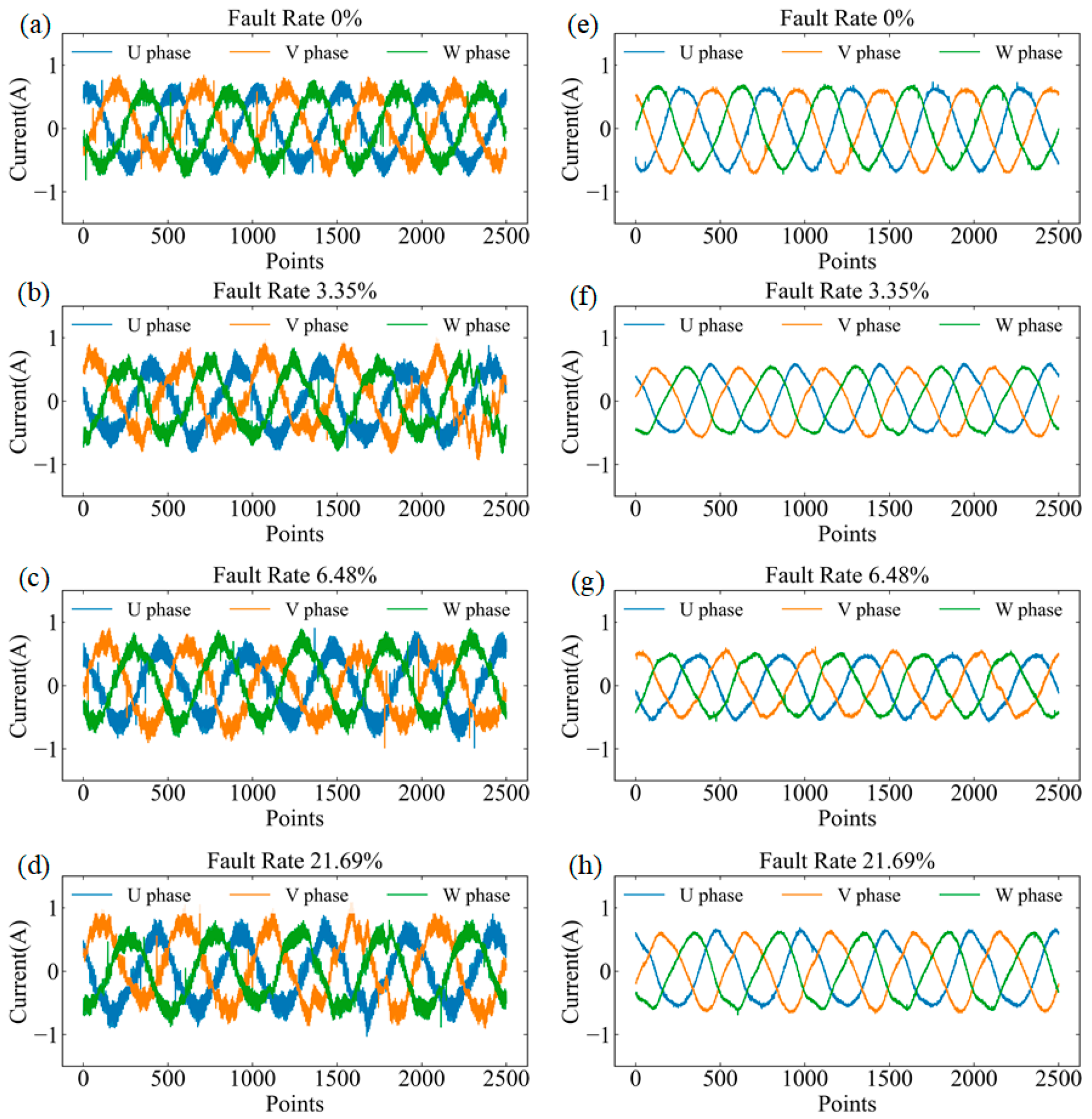
Figure 7 presents stator current waveforms under healthy conditions and several representative ITSC fault conditions. To emulate measurement noise encountered in practical environments and improve the noise robustness of the proposed method, additive white Gaussian noise was injected into the three-phase currents. We considered a signal-to-noise ratio (SNR) range of 0–30 dB, covering severe to mild measurement interference typically observed in motor current acquisition. Based on the final training evaluation, the best performance was achieved at an SNR of 10 dB. The ITSC fault ratios and their corresponding class labels are listed in Table 2. According to different severities of ITSC, the data were divided into eight classes.
To quantify the correlation between digital-twin data and measured data, multiple similarity and error metrics were calculated for the three-phase current signals in both the time and frequency domains, and the results are summarized in Table 3. As shown in Table 3, the U, V, and W phase currents exhibit high similarity across both domains, indicating a strong correspondence between the simulation model and the real system.
In this study, ITSC faults were introduced into the U-phase winding. As fault severity increased, the stator current waveform gradually evolved from a regular shape to a distorted pattern, with more pronounced amplitude fluctuations. Therefore, stator phase current was selected as the primary diagnostic signal, and a transfer learning-based fault diagnosis strategy was developed using time–frequency representations.
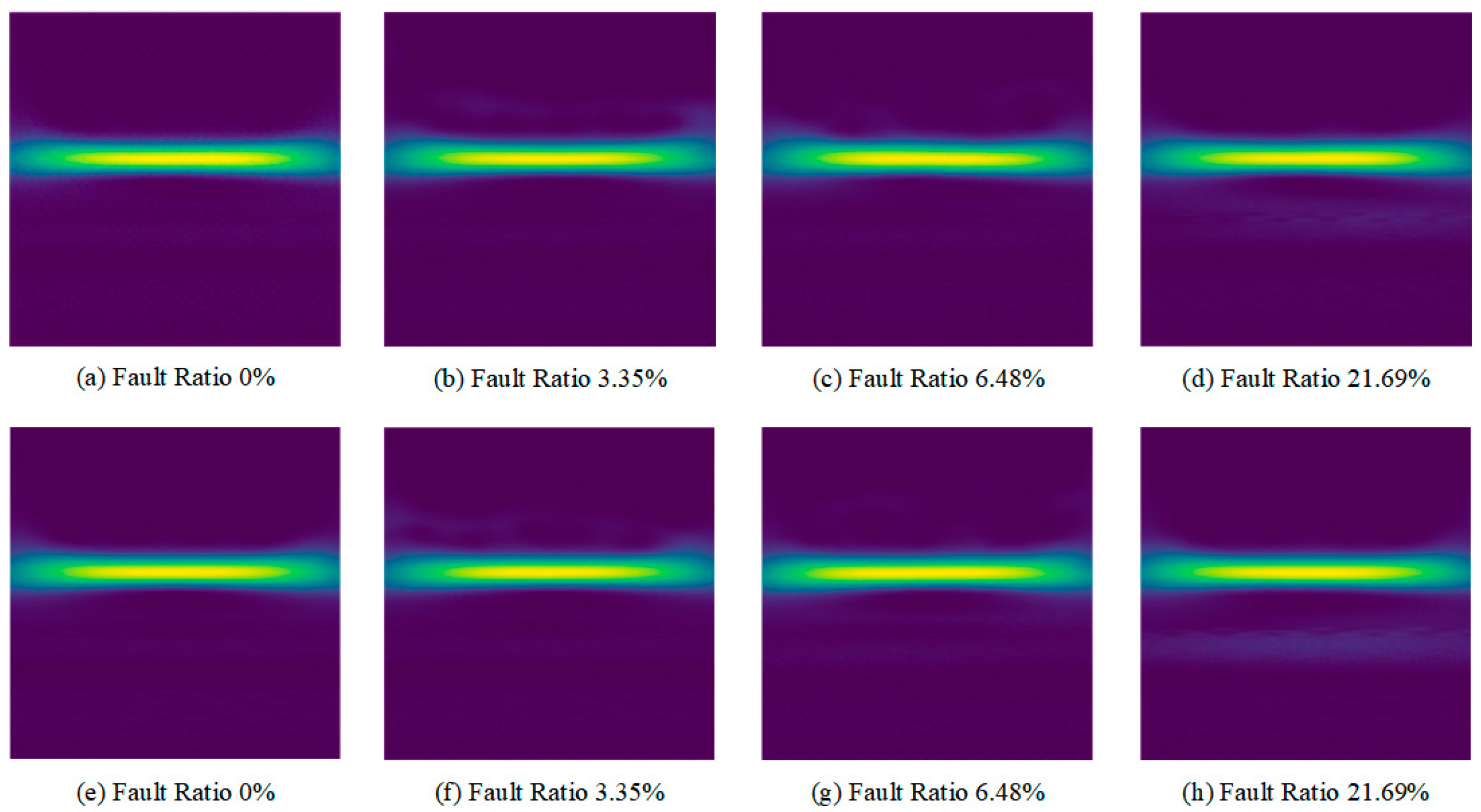
For preprocessing, three-phase stator currents were segmented into fixed-length windows to construct sample sequences. The resulting one-dimensional time-domain samples were then converted into two-dimensional CWT time–frequency images, which were used as inputs to the deep network (Figure 8). Based on these image samples, the proposed transfer learning model was iteratively optimized and trained. The framework was implemented on ResNet-18 with an input size of 224 × 224 and a batch size of 32. AdamW was used as the optimizer (learning rate: 1 × 10⁻³; weight decay: 1 × 10⁻⁴), and training was conducted for 50 epochs. All experiments were performed in PyTorch 2.1.0 with CUDA on a workstation equipped with an NVIDIA RTX 4090 GPU (24 GB), an Intel Core i9-13900K CPU, and 64 GB RAM.

3.2. Model Training and Comparative Experiments

To validate the proposed REDM-based transfer learning method, digital-twin PMSM ITSC data generated via Ansys-based simulation were used as the source-domain dataset, while the publicly available measured PMSM dataset released by the Korea Advanced Institute of Science and Technology served as the target-domain dataset. First, CWT was applied to the three-phase current signals from both domains to generate two-dimensional time–frequency images. The source and target domain samples were then partitioned according to a predefined ratio. Semi-supervised domain adaptation was performed using labeled source-domain data together with partially unlabeled target-domain data. The diagnostic performance of the proposed approach was assessed by comparison with several representative transfer learning methods.
In the experiments, the 1 kW operating condition was considered. The recognition accuracies of the REDM-based method and competing transfer learning approaches under this condition are summarized in Table 4. As shown in Table 4, the proposed REDM model achieved the highest accuracy, reaching 98.61%. This result indicates that REDM can extract more discriminative time–frequency features from ITSC current signals and transfer them more effectively across domains. By contrast, the comparative methods exhibited inferior transfer efficiency and yielded lower diagnostic accuracy. Overall, REDM consistently outperformed the competing approaches and maintained strong stability and robustness under the operating conditions considered.
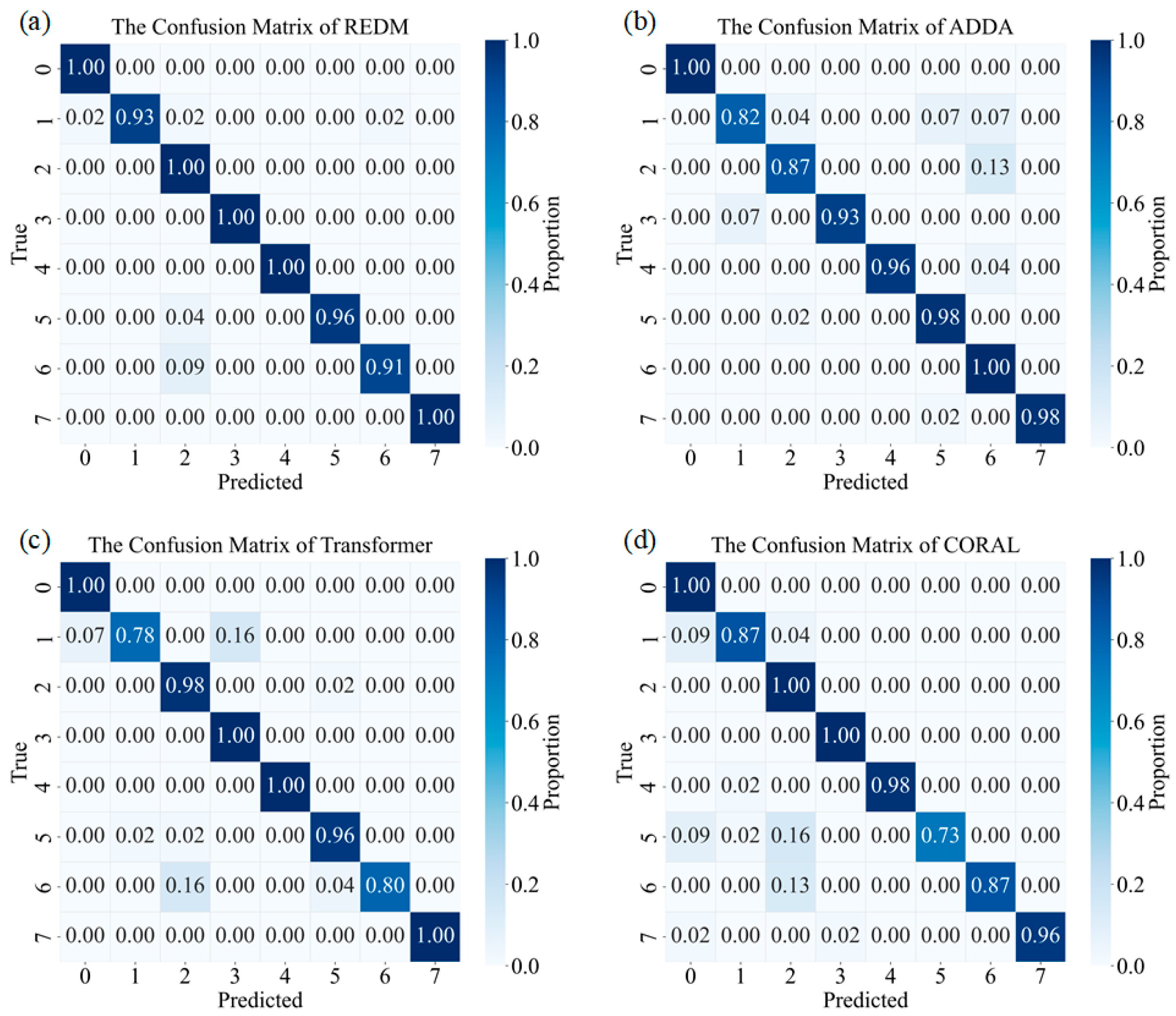
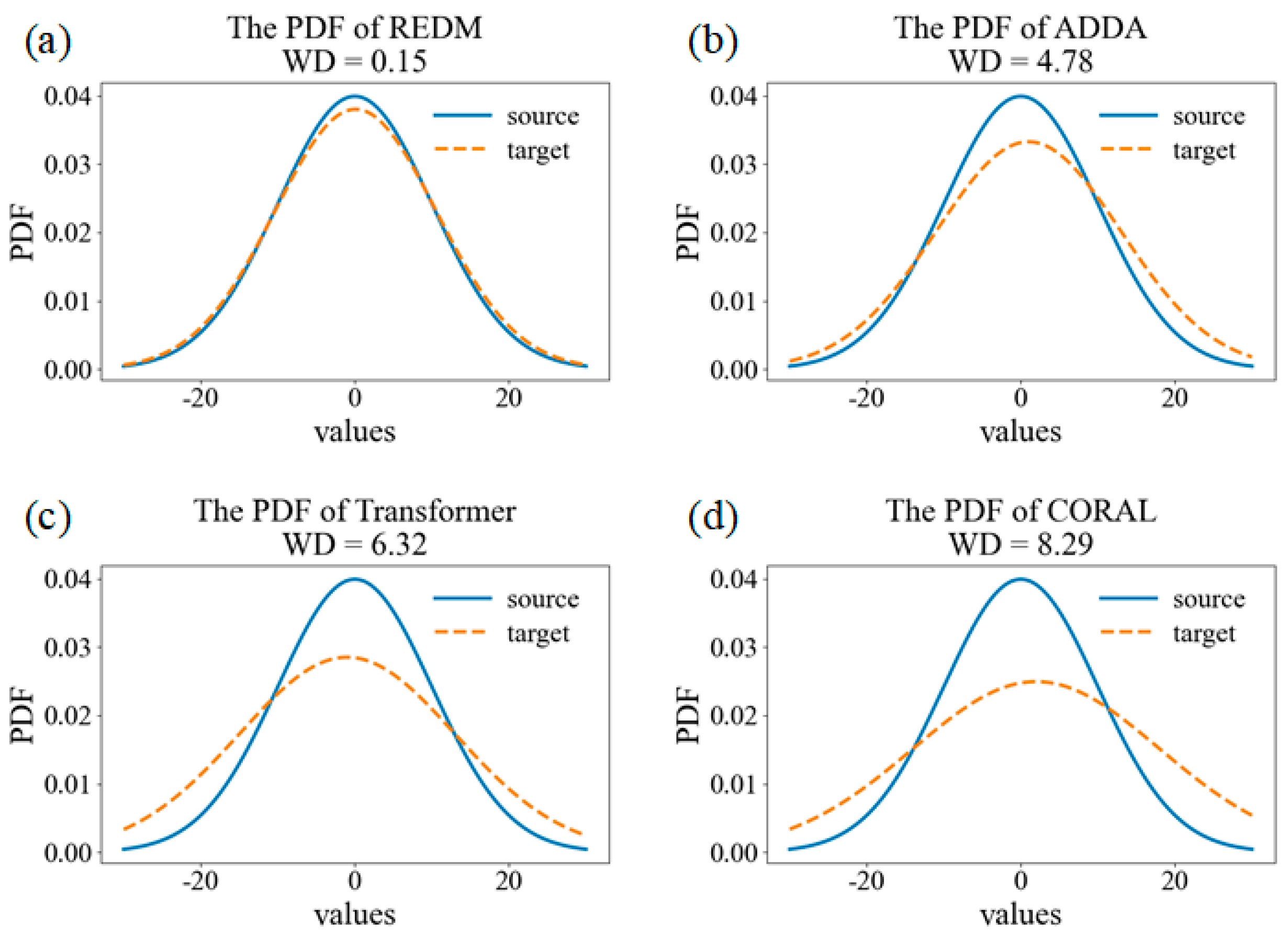
Figure 9 shows the confusion matrices of the proposed method and three benchmark transfer learning methods. As can be seen, the proposed approach achieves higher recognition accuracy across all fault categories, with fewer misclassifications and clearer inter-class separability, indicating superior classification performance for inter-turn short-circuit faults. Figure 10 depicts the probability density function obtained by different methods, where the Wasserstein distance (WD) is used to quantify distribution discrepancies during transfer learning. Compared with the competing approaches, the proposed method yields a lower WD, suggesting the smallest distribution mismatch during training. As a result, the feature representations learned from digital-twin data and measured data become more consistent, leading to improved source–target alignment and, ultimately, higher diagnostic accuracy and robustness.

3.3. Ablation Experiment

To assess the effectiveness of each component in the proposed method, ablation studies were conducted to quantify the contribution of individual modules to the overall performance. As summarized in Table 5, ECA and MK-MMD were separately integrated into the DANN baseline. Incorporating the ECA module increased the classification accuracy by 9.13%, indicating that ECA facilitates adaptive feature learning and strengthens feature extraction. Adding the MK-MMD term further improved the accuracy by 13.62%, suggesting that MK-MMD effectively reduces cross-domain distribution discrepancies and thereby enhances diagnostic performance. When both modules were introduced simultaneously, the accuracy increased by 22.48%. This result demonstrates that jointly improving feature extraction and narrowing the distribution gap between source- and target-domain features leads to greater feature overlap and, consequently, higher diagnostic accuracy. Overall, these findings confirm that the proposed method can effectively mitigate the distribution mismatch between digital-twin data and measured data.
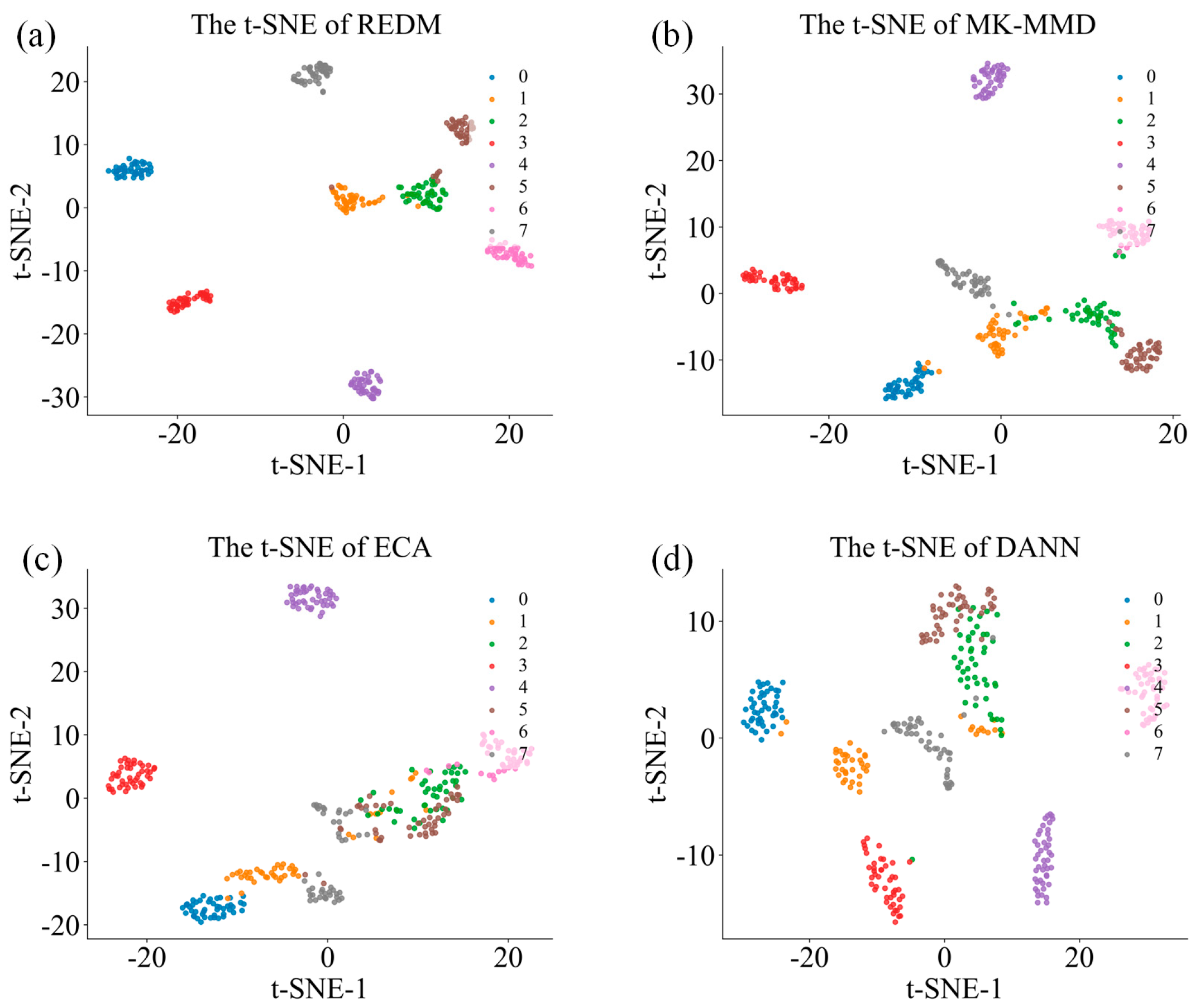
Moreover, to visually examine feature discriminability and domain alignment, t-distributed stochastic neighbor embedding (t-SNE) was employed to project deep features from the source and target domains into a low-dimensional space (Figure 11). The visualization shows that REDM yields clearer inter-class boundaries and more compact intra-class clusters, while achieving a higher degree of alignment between source and target domain feature distributions compared with the baseline methods. This qualitative evidence further corroborates the effectiveness and superiority of the proposed improvements at the feature level.

4. Conclusions

To address the scarcity of PMSM fault data under practical operating conditions, a digital-twin model was developed based on an actual machine to generate a large-scale, high-fidelity fault dataset. Building upon these data, a transfer learning-based fault diagnosis method, termed REDM, was proposed. The main conclusions are summarized as follows:
  • Continuous wavelet transform was first employed to convert one-dimensional three-phase current signals into two-dimensional time–frequency maps, thereby retaining fault-related characteristics in both the time and frequency domains. These maps were then fed into the ResNet–ECA network, where deep discriminative source-domain features were extracted through residual learning and efficient channel attention. Furthermore, a domain-adversarial neural network together with an MK-MMD loss term was introduced to jointly align the marginal and conditional distributions between the source and target domains, markedly improving the model’s generalization capability and domain adaptability, and thereby enhancing diagnostic accuracy.
  • By integrating finite-element simulation, fault mechanism modeling, and transfer learning, the proposed framework enables effective knowledge transfer from digital-twin data to real-world operating data under limited sample availability.
As a result, high-accuracy PMSM fault identification can be achieved with strong robustness and cross-domain generalization. This approach mitigates the shortage of effective fault data in industrial applications and offers a practical pathway for data-driven fault diagnosis. Future work will, therefore, focus on robustness evaluation under broader parameter deviations, enhanced multi-physics twin modeling, and validation across wider real-machine and multi-condition benchmarks to further improve deployment readiness.

Author Contributions

R.C.: Conceptualization, Writing—original draft, Visualization, Validation. S.L.: Supervision, Writing—review and editing. All authors have read and agreed to the published version of the manuscript.

Funding

This research was funded by the National Natural Science Foundation of China (No. 52475548); the Science and Technology Research Project of the Chongqing Education Commission (No. KJZD-M202200701); the Chongqing Natural Science Foundation Innovation and Development Joint Fund (No. CSTB2023NSCQ-LZX0127); the Chongqing Postgraduate Joint Training Base (No. JDLHPYJD2021007); and the Research and Innovation Program for Graduate Students in Chongqing (No. CYS240492).

Data Availability Statement

The original contributions presented in this study are included in the article. Further inquiries can be directed to the corresponding author.

Conflicts of Interest

The authors declare no conflicts of interest.

References

  1. Wardach, M.; Palka, R.; Prajzendanc, P.; Gundabattini, E.; Cierzniewski, K.; Pstrokonski, R.; Cichowicz, M.; Wiszniewski, M.; Pacholski, S.; Rassiah, R.S.; et al. Permanent magnet assisted synchronous reluctance machine for drives of light vehicles. Sustain. Energy Technol. Assess. 2024, 65, 103780. [Google Scholar] [CrossRef]
  2. Zhang, C.; Jasni, J.; Radzi, M.A.M.; Azis, N.; He, X. A comprehensive review of stage-of-the-art subsystems configurations, technical methodologies, advancements, and prospects for new energy electric vehicles. Ionics 2023, 29, 2529–2547. [Google Scholar] [CrossRef]
  3. Feng, X.; Wan, Z.; Duan, J.; Wang, X.; Xie, P.; Xi, R. Design and Analysis of Combining Oil-Cooling Scheme of S-Shaped and End-Spraying Passages for Permanent Magnet Synchronous Motor. Energies 2025, 19, 72. [Google Scholar] [CrossRef]
  4. Ko, Y.; Lee, Y.; Oh, J.; Park, J.; Chang, H.; Kim, N. Current signature identification and analysis for demagnetization fault diagnosis of permanent magnet synchronous motors. Mech. Syst. Signal Process. 2024, 214, 111377. [Google Scholar] [CrossRef]
  5. Baharvand, A.H.; Fard, S.H.B.; Poursaeed, A.H.; Doostizadeh, M. An Optimized Classifier Chains-Based Deep Learning Framework for Inter-Turn Fault Diagnosis in Permanent Magnet Synchronous Motors. Appl. Soft Comput. 2025, 180, 113482. [Google Scholar] [CrossRef]
  6. Li, K.; Bouscayrol, A.; Cui, S.; Cheng, Y. A hybrid modular cascade machines system for electric vehicles using induction machine and permanent magnet synchronous machine. IEEE Trans. Veh. Technol. 2020, 70, 273–281. [Google Scholar] [CrossRef]
  7. Xu, X.; Hang, J.; Cao, K.; Ding, S.; Wang, W. Unified Open Phase Fault Diagnosis of Five-Phase PMSM System in Normal Operation and Fault-Tolerant Operation Modes. IEEE Trans. Transp. Electrif. 2025, 11, 12063–12075. [Google Scholar] [CrossRef]
  8. Park, C.H.; Kim, H.; Suh, C.; Chae, M.; Yoon, H.; Youn, B.D. A health image for deep learning-based fault diagnosis of a permanent magnet synchronous motor under variable operating conditions, Instantaneous current residual map. Reliab. Eng. Syst. Saf. 2022, 226, 108715. [Google Scholar] [CrossRef]
  9. Lv, K.; Wang, D.; Huang, W.; Liu, H.; Jiang, Y.; Hu, J. Multiple fault diagnosis of PMSM based on stator tooth flux and parallel residual convolutional neural network. IEEE Trans. Transp. Electrif. 2024, 10, 9727–9738. [Google Scholar]
  10. Niu, D.; Song, D. Model-based robust fault diagnosis of incipient ITSC for PMSM in elevator traction system. IEEE Trans. Instrum. Meas. 2023, 72, 1–12. [Google Scholar] [CrossRef]
  11. Dos Santos, L.F.D.; dos Santos Canuto, J.L.; De Souza, R.C.T.; Aylon, L.B.R. Thermographic image-based diagnosis of failures in electrical motors using deep transfer learning. Eng. Appl. Artif. Intell. 2023, 126, 107106. [Google Scholar] [CrossRef]
  12. Ullah, Z.; Lodhi, B.A.; Hur, J. Detection and identification of demagnetization and bearing faults in PMSM using transfer learning-based VGG. Energies 2020, 13, 3834. [Google Scholar] [CrossRef]
  13. Fang, Y.; Wang, M.; Wei, L. deep transfer learning in inter-turn short circuit fault diagnosis of PMSM. In Proceedings of the 2021 IEEE International Conference on Mechatronics and Automation (ICMA); IEEE: Piscataway, NJ, USA, 2021; pp. 489–494. [Google Scholar]
  14. Huang, F.; Zhang, X.; Deng, X.; Qin, G.; Xie, J. Denoising Universal Domain Adaptation Method for PMSM Fault Diagnosis Under Category Inconsistency. IEEE Sens. J. 2025, 25, 15642–15652. [Google Scholar] [CrossRef]
  15. Konuhova, M. Induction Motor Dynamics Regimes: A Comprehensive Study of Mathematical Models and Validation. Appl. Sci. 2025, 15, 1527. [Google Scholar] [CrossRef]
  16. Gherghina, I.-S.; Bizon, N.; Iana, G.-V.; Vasilică, B.-V. Recent Advances in Fault Detection and Analysis of Synchronous Motors, A Review. Machines 2025, 13, 815. [Google Scholar] [CrossRef]
  17. Xia, P.; Huang, Y.; Tao, Z.; Liu, C.; Liu, J. A digital twin-enhanced semi-supervised framework for motor fault diagnosis based on phase-contrastive current dot pattern. Reliab. Eng. Syst. Saf. 2023, 235, 109256. [Google Scholar] [CrossRef]
  18. Kumar, N.B.; Babu, A.R.V.; Kumar, M.B.A.; Kumar, T.S.; Babu, V.G. Hybrid digital twin-based fault diagnosis framework for PMSMs in electric vehicle applications. Frankl. Open 2025, 12, 100328. [Google Scholar] [CrossRef]
  19. Feng, K.; Xu, Y.; Wang, Y.; Li, S.; Jiang, Q.; Sun, B.; Zheng, J.; Ni, Q. Digital twin enabled domain adversarial graph networks for bearing fault diagnosis. IEEE Trans. Ind. Cyber-Phys. Syst. 2023, 1, 113–122. [Google Scholar]
  20. Wang, H.; Wang, L.; Wu, Q.; Pei, H.; Diao, L. A data-driven intelligent fault diagnosis framework for permanent magnet in PMSM. Alex. Eng. J. 2025, 113, 331–346. [Google Scholar] [CrossRef]
  21. Xu, Z.; Wang, Z.; Gao, C.; Zhang, K.; Lv, J.; Wang, J.; Liu, L. A digital twin system for centrifugal pump fault diagnosis driven by transfer learning based on graph convolutional neural networks. Comput. Ind. 2024, 163, 104155. [Google Scholar] [CrossRef]
  22. Bazi, S.; Benzid, R.; Bazi, Y.; Nait-Said, M.S.; Al Rahhal, M.M. Detection of Induction Motor Incipient Short Circuit Faults Based on Continuous Wavelet Transform with Higher-Order Statistics. IEEE Access 2025, 13, 182705–182716. [Google Scholar] [CrossRef]
  23. Wei, D.; Liu, K.; Wang, J.; Zhou, S.; Li, K. ResNet-18-based interturn short-circuit fault diagnosis of PMSMs with consideration of speed and current loop bandwidths. IEEE Trans. Transp. Electrif. 2023, 10, 5805–5818. [Google Scholar] [CrossRef]
  24. Wang, Q.; Wu, B.; Zhu, P.; Zuo, L.W.; Hu, Q. ECA-Net, Efficient channel attention for deep convolutional neural networks. In Proceedings of the IEEE/CVF Conference on Computer Vision and Pattern Recognition; IEEE: Piscataway, NJ, USA, 2020; pp. 11534–11542. [Google Scholar]
  25. Wan, L.; Li, Y.; Chen, K.; Gong, K.; Li, C. A novel deep convolution multi-adversarial domain adaptation model for rolling bearing fault diagnosis. Measurement 2022, 191, 110752. [Google Scholar] [CrossRef]
  26. Xiang, S.; Qu, K.; Tian, Y.; Xue, S.; Cao, H. Short-Term Wind Power Forecasting with Small-Sample Datasets Using an Attention-Enhanced Domain-Adversarial Neural Network. Neurocomputing 2025, 654, 131308. [Google Scholar] [CrossRef]
  27. Jung, W.; Yun, S.H.; Lim, Y.S.; Cheong, S.; Park, Y.-H. Vibration and current dataset of three-phase permanent magnet synchronous motors with stator faults. Data Brief 2023, 47, 108952. [Google Scholar] [CrossRef] [PubMed]
Figure 1. Two-dimensional finite-element model of the PMSM. This picture shows the two-dimensional structure of the motor’s x and y axes.
Energies 19 01152 g001
Figure 2. Circuit model of an inter-turn short-circuit fault in phase U.
Energies 19 01152 g002
Figure 3. Residual block with efficient channel attention.
Energies 19 01152 g003
Figure 4. Architecture of the ECA module. Arrows denote the forward flow of features; the side branch produces channel weights that are fed back to the main stream to reweight the input via channel-wise multiplication.
Energies 19 01152 g004
Figure 5. REDM transfer learning network structure diagram.
Energies 19 01152 g005
Figure 6. Experimental setup.
Energies 19 01152 g006
Figure 7. Three-phase stator current waveforms. The measured currents are shown on the left, and the simulated currents are shown on the right.
Energies 19 01152 g007
Figure 8. Continuous wavelet transform graph. The upper part shows the actual current, and the lower part shows the simulated current.
Energies 19 01152 g008
Figure 9. Comparison of confusion matrices of different methods.
Energies 19 01152 g009
Figure 10. Comparison of probability density function of different methods.
Energies 19 01152 g010
Figure 11. Visualization of t-SNE features in different modules.
Energies 19 01152 g011
Table 1. Parameters of the PMSM.
ParameterValueUnit
Rated power1000Watts
Input voltage380AC Voltage
Frequency60Hz
Number of phases3Phase
Number of poles4/
Rated torque3.18Nm
Rated speed3000RPM
Synchronous inductance0H
Magnetic flux400mT
Rotor inertia2.07Kgm2
Inter-turn resistance value0.1385Ohm
Inter-coil resistance value0.0409Ohm
Table 2. Dataset fault classification table.
Fault TypeFault Rate (%)Labels
Inter-turn short circuit00
2.261
2.702
3.353
4.414
6.485
12.176
21.697
Table 3. Validation metrics between twin data and measured data.
PhaseCosine SimilarityRMSETime–Frequency Similarity
U0.7950.1260.728
V0.7620.1470.735
W0.8190.1390.761
Table 4. Accuracy of various transfer learning methods.
MethodAccuracy
REDM98.61%
ADDA89.74%
Transformer85.26%
CORAL77.52%
Table 5. Different model recognition results.
ECAMK-MMDAccuracyImproved
98.61%22.48% ↑
×89.75%13.62% ↑
×85.26%9.13% ↑
××76.13%
√ indicates that the module has been introduced into the model, × indicates that the module has not been added to the model, and ↑ represents the increase in accuracy by how much.
Disclaimer/Publisher’s Note: The statements, opinions and data contained in all publications are solely those of the individual author(s) and contributor(s) and not of MDPI and/or the editor(s). MDPI and/or the editor(s) disclaim responsibility for any injury to people or property resulting from any ideas, methods, instructions or products referred to in the content.