Co-Optimization of Cooperative Adaptive Cruise Control and Energy Management for Plug-in Hybrid Electric Truck Platoons

Abstract
1. Introduction
- (1)
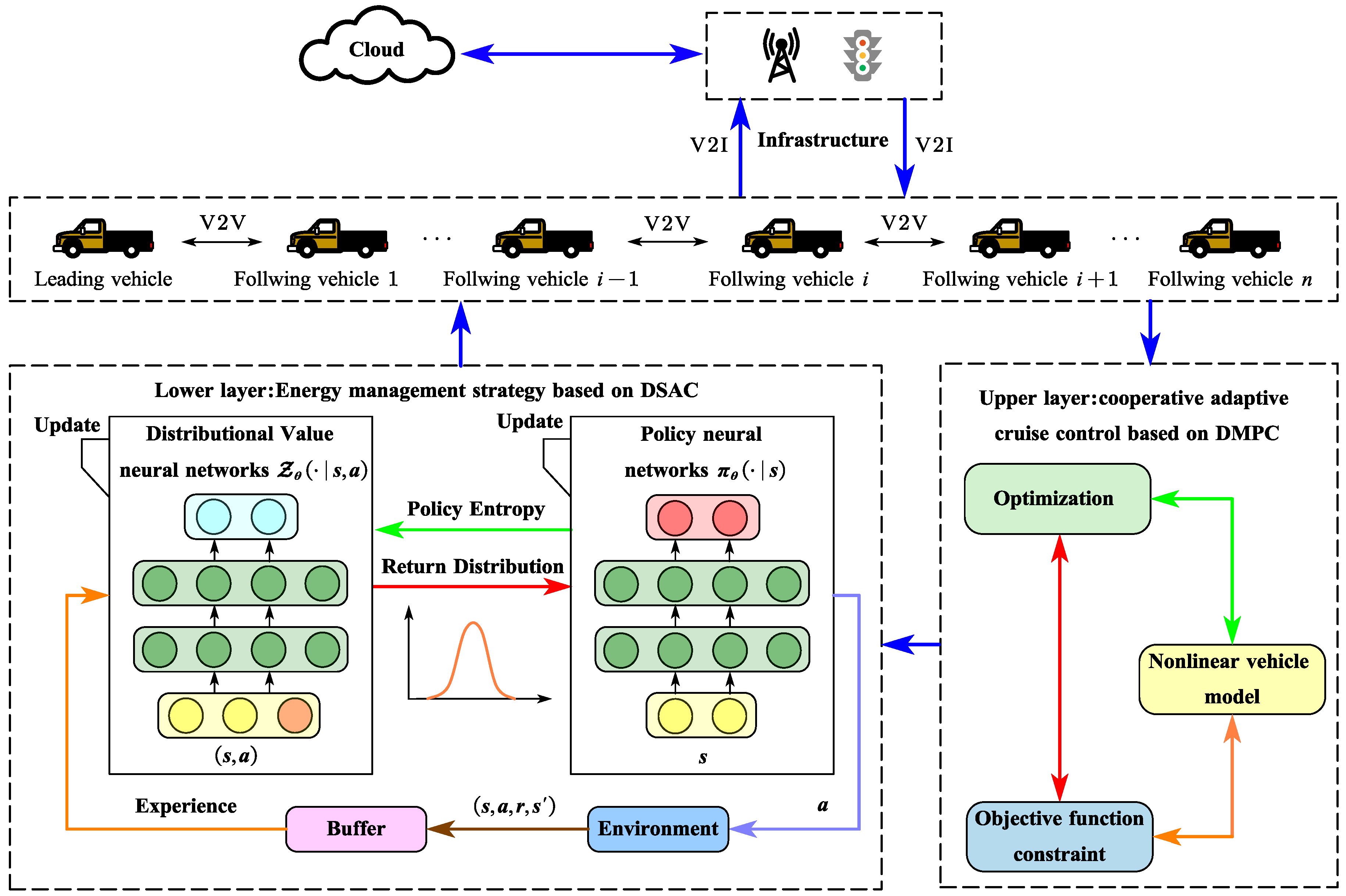
- A distributed hierarchical co-optimization architecture for PHET platoons. We develop a DMPC–DSAC cooperative framework that decouples safety/comfort-constrained platoon motion planning from power-split optimization, enabling coordinated cruise control and energy management without requiring centralized data aggregation.
- (2)
- A distributed MPC layer tailored to platoon motion quality and coordination. The upper-layer DMPC explicitly targets stability and ride comfort while planning the platoon speed trajectory, providing a coordination-aware motion demand profile that supports smooth following and efficient operation under varying driving conditions.
- (3)
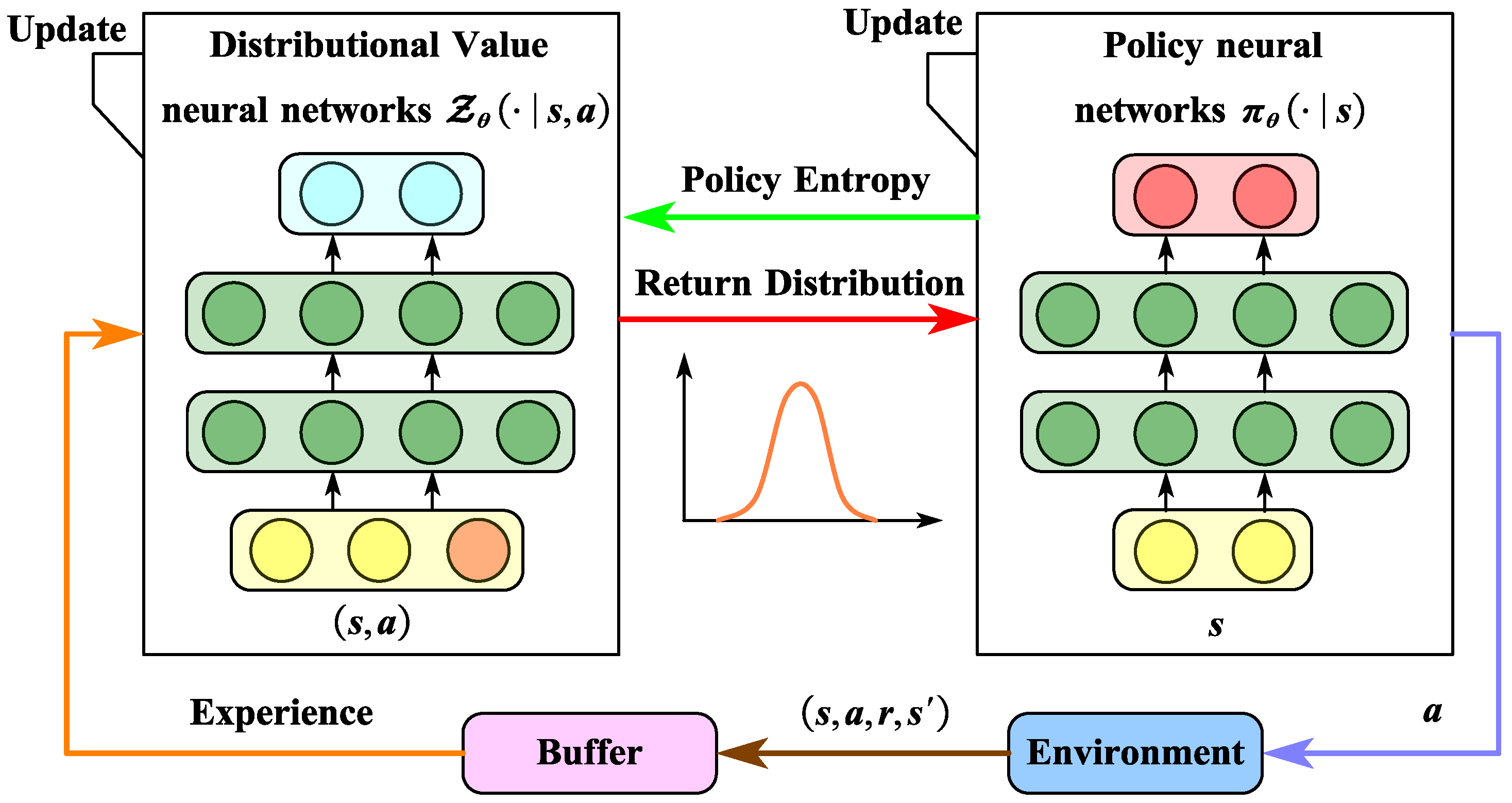
- A distributional RL-based energy management layer with improved learning robustness. The lower-layer DSAC performs continuous power allocation under the planned motion demand and powertrain constraints. By adopting distributional value learning within an entropy-regularized framework, the proposed strategy emphasizes convergence efficiency and training stability, and its effectiveness is validated through comparisons with representative benchmarks across different driving cycles.
2. Modeling of Plug-in Hybrid Electric Trucks Systems
2.1. Truck Platoon Model
2.2. Plug-in Hybrid Electric Truck Powertrain Model
3. Cooperative Optimization Strategy for Adaptive Cruise Control and Energy Management
3.1. Energy Management Framework
3.2. Cooperative Adaptive Cruise Control Model Based on Distributed Model Predictive Control
3.3. Energy Management Strategy Based on Distributional Soft Actor-Critic
3.3.1. DSAC Algorithm
- (1)
- Distributed reinforcement learning frameworks
- (2)
- Principle of reducing overestimation
- (3)
- Design of the DSAC algorithm
| Algorithm 1. DSAC algorithm |
| Initialize parameters , , Initialize target parameters , Initialize learning rate , , , Initialize iteration index For do Select action Observe reward and new state Store transition tuple in buffer B Sample N transitions from B Update soft return distribution if k mod m then Update policy Adjust temperature Update target networks , end if end for |
3.3.2. Energy Management Strategy Based on DSAC
4. Results and Discussion
4.1. Parameter Settings
4.2. Driving Condition Data Collection
4.3. Analysis of Vehicle Following Performance
4.4. Fuel Economy Analysis
4.5. Limitations of Simulation-Only Verification and Practical Considerations
- (1)
- Model fidelity and unmodeled dynamics.
- (2)
- Real-time implementation constraints.
- (3)
- Communication, sensing, and uncertainty factors.
- (4)
- Implications and future validation.
4.6. Practical Implementation Issues: Communication Imperfections, Real-Time Computation, and Scalability
4.6.1. Communication Delays and Packet Loss in V2V/V2I Networks
4.6.2. Real-Time Computational Burden of DMPC and DSAC
4.6.3. Scalability to Larger Platoons
5. Conclusions
- (1)
- A hierarchical cooperative control structure is developed, where the upper-layer DMPC generates the platoon speed trajectory to improve car-following smoothness and ride comfort, and the lower-layer DSAC allocates power based on the planned motion information to enhance fuel economy.
- (2)
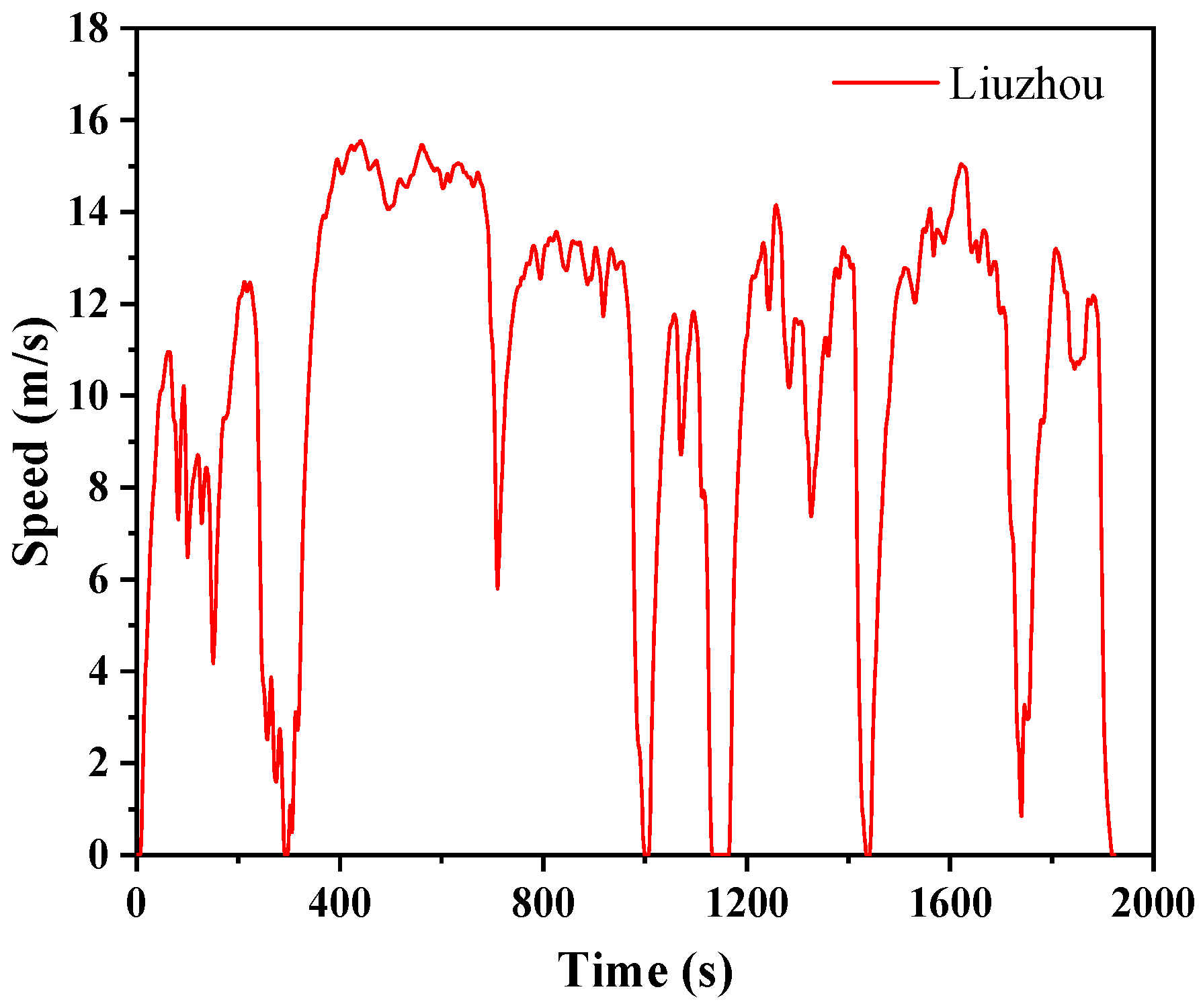
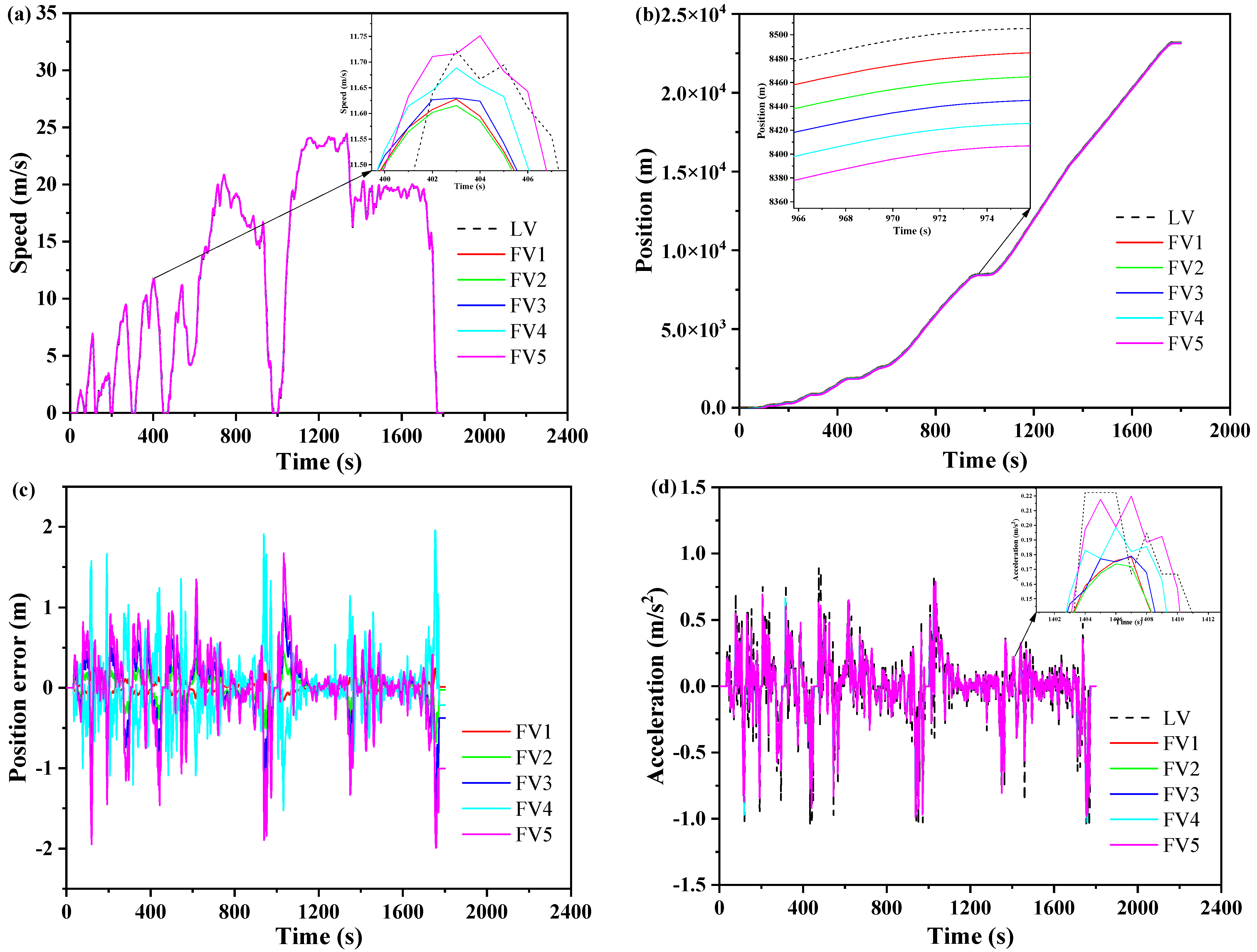
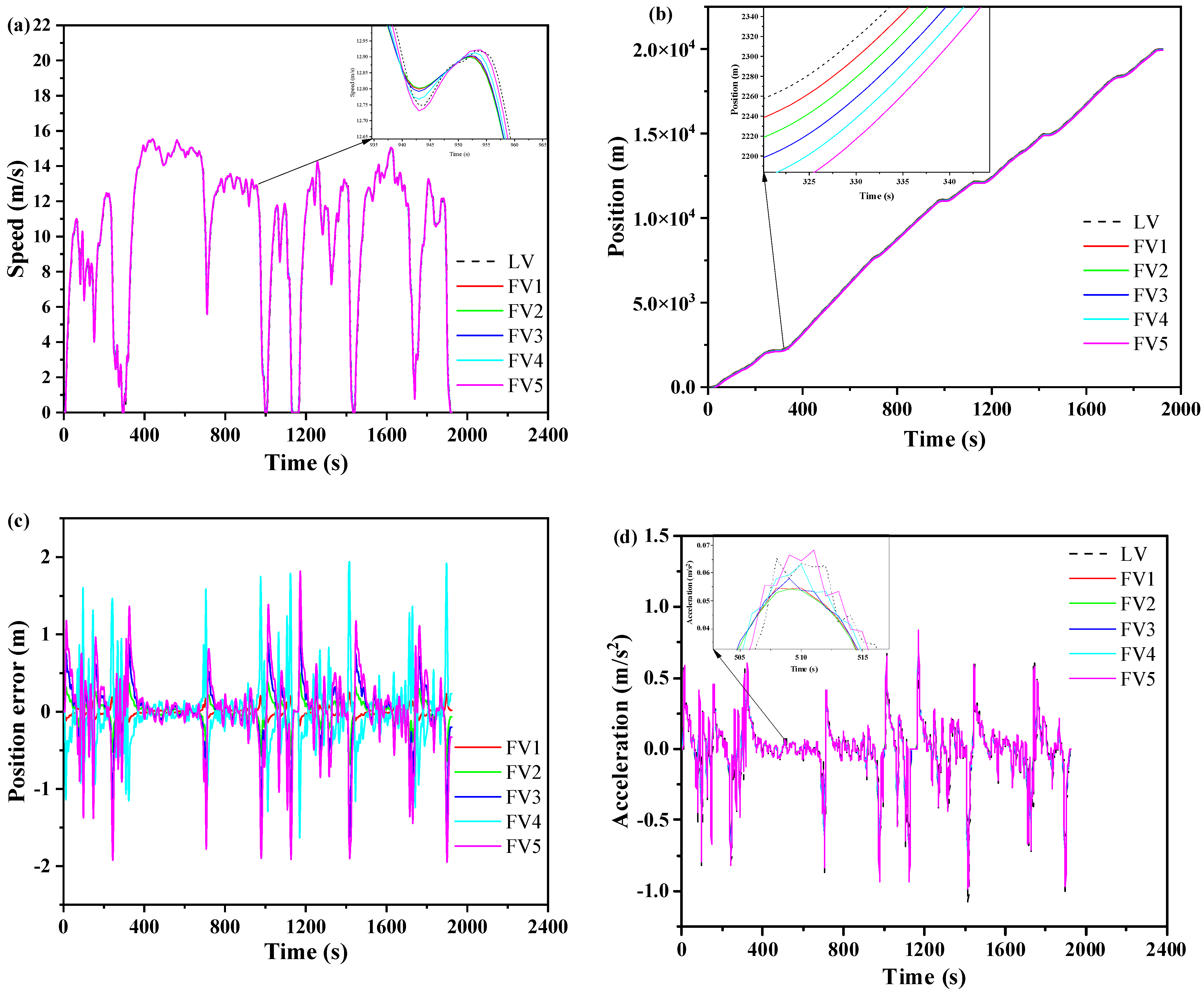
- Under the China heavy-duty commercial vehicle test cycle (CHTC) and the Liuzhou city driving cycle, the DMPC-based cruise control achieves reliable following and spacing performance, maintaining the position error within ±2 m and acceleration within ±1 m/s2, indicating good robustness and driving comfort.
- (3)
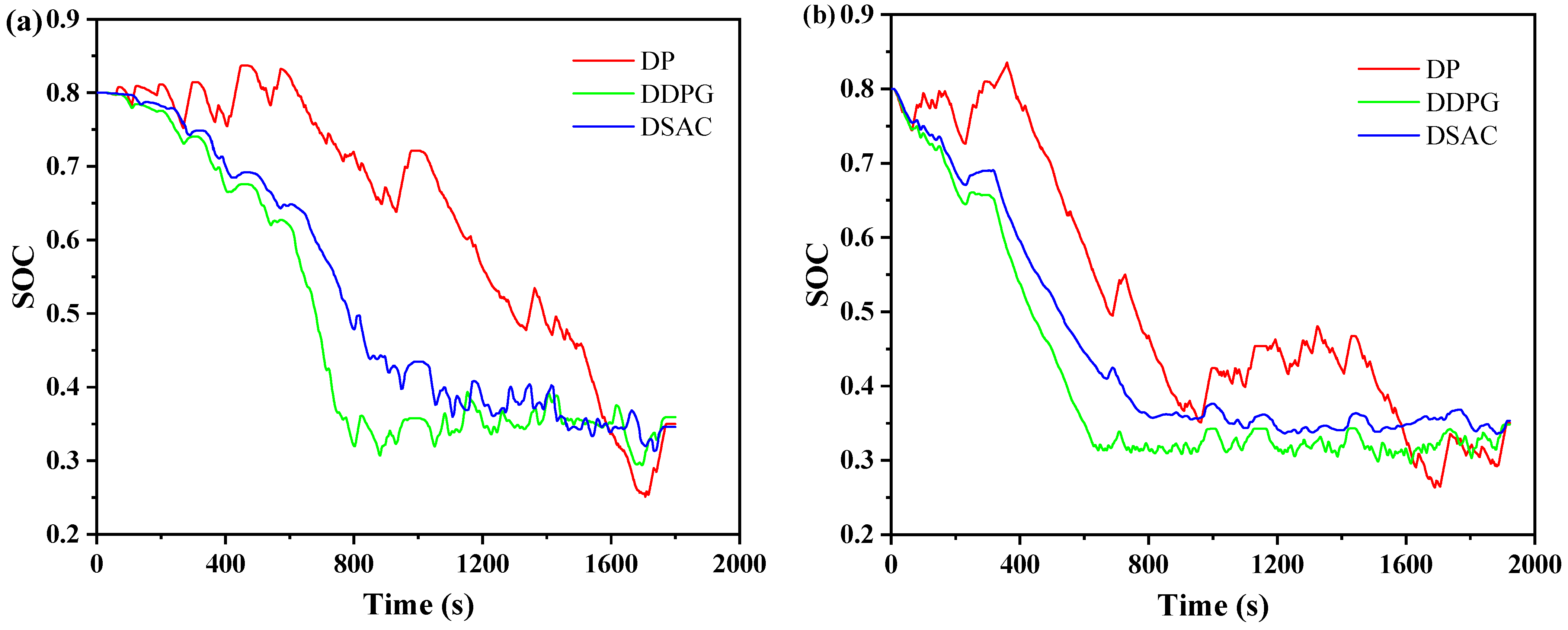
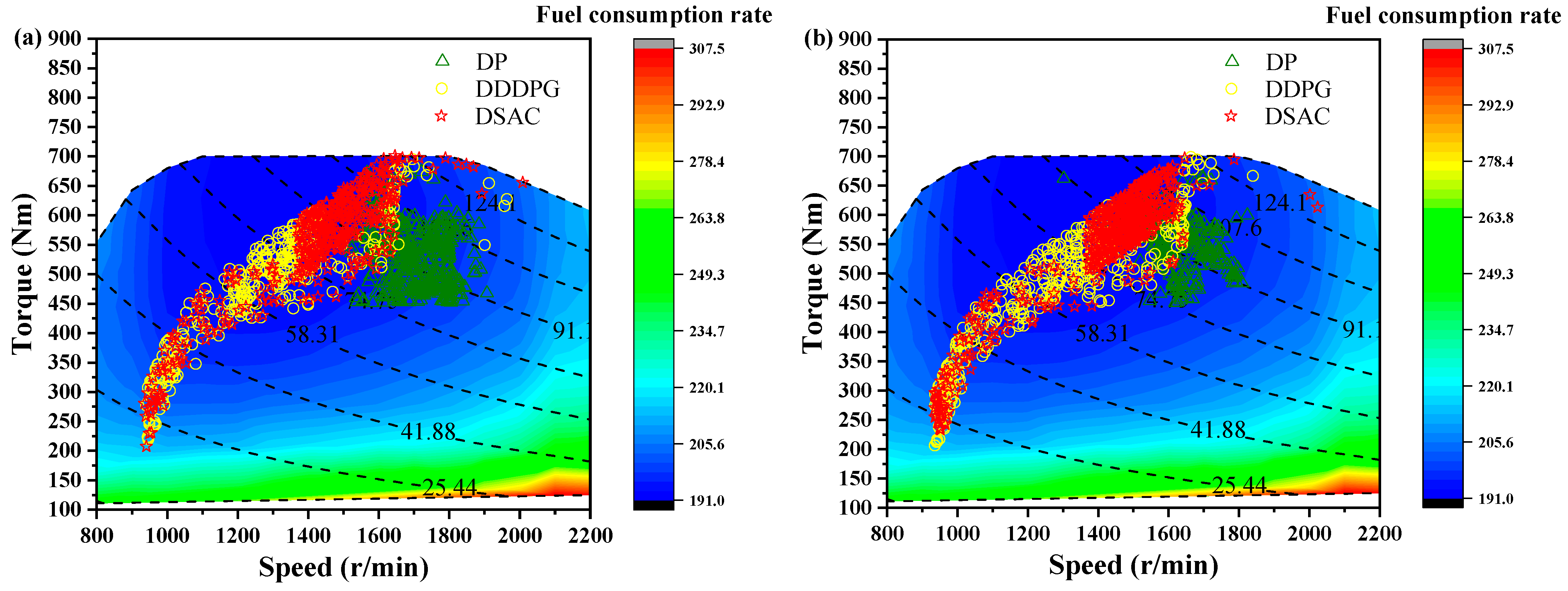
- The DSAC-based energy management strategy demonstrates favorable fuel economy performance, achieving 92.02% fuel efficiency on the CHTC and 93.03% on the Liuzhou cycle, and outperforming the DDPG-based method in the reported comparisons.
- (4)
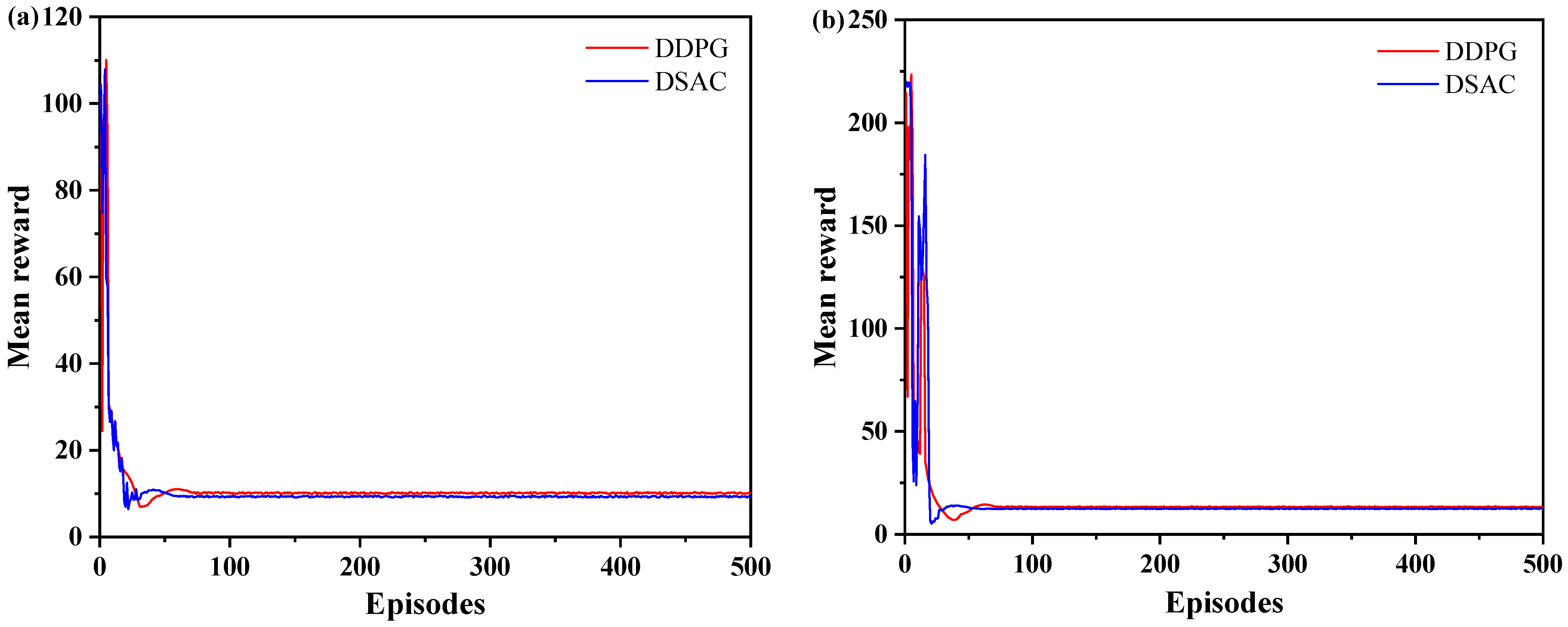
- The training curves show that DSAC converges faster than DDPG under both driving cycles, indicating improved learning efficiency for the studied energy management task.
- (1)
- The framework is evaluated through simulation-based studies, and further verification under more realistic implementation conditions is still needed.
- (2)
- Some deployment-related factors (e.g., communication imperfections, real-time computation constraints, and larger platoon scalability) are not fully covered in the current evaluation.
- (3)
- The current hierarchical interaction follows a feed-forward structure, and the motion planning layer is not adjusted online based on the energy management outcomes.
- (1)
- Conducting more realistic validation and implementation-oriented testing to further assess real-time feasibility and practical performance.
- (2)
- Enhancing robustness under practical uncertainties and extending evaluations to larger platoons and more complex traffic scenarios.
- (3)
- Exploring tighter coordination mechanisms between motion planning and energy management to further improve overall performance.
Author Contributions
Funding
Data Availability Statement
Conflicts of Interest
Abbreviations
| ACC | adaptive cruise control |
| CHTC | China heavy-duty commercial vehicle test cycle |
| DDPG | deep deterministic policy gradient |
| DMPC | distributed model predictive control |
| DP | dynamic programming |
| DRL | deep reinforcement learning |
| DSAC | distributed soft actor-critic |
| ECMS | equivalent consumption minimization strategy |
| GA | genetic algorithms |
| GT | game theory |
| HEVs | hybrid electric vehicles |
| KL | Kullback–Leibler |
| MPC | model predictive control |
| PHET | plug-in hybrid electric truck |
| SOC | state of charge |
| V2I | vehicle-to-infrastructure |
| V2V | vehicle-to-vehicle |
References
- Pan, M.Z.; Cao, S.; Zhang, Z.Q.; Ye, N.Y.; Qin, H.F.; Li, L.L.; Guan, W. Recent progress on energy management strategies for hybrid electric vehicles. J. Energy Storage 2025, 116, 115936. [Google Scholar] [CrossRef]
- Maghfiroh, H.; Wahyunggoro, O.; Cahyadi, A.I. Real-time Energy Management Strategy of Hybrid Electric Vehicle: A Review. Int. J. Eng. 2025, 38, 2887–2901. [Google Scholar] [CrossRef]
- Chen, D.X.; Chen, T.; Li, Z.J.; Liu, Z.X.; Sun, C.Y.; Zhao, H. Energy management strategy for plug-in hybrid electric vehicles based on vehicle speed prediction and limited traffic information. Energy 2025, 326, 136292. [Google Scholar] [CrossRef]
- Wang, J.H.; Du, C.Q.; Yan, F.W.; Zhou, Q.; Xu, H.M. Hierarchical Rewarding Deep Deterministic Policy Gradient Strategy for Energy Management of Hybrid Electric Vehicles. IEEE Trans. Transp. Electrif. 2024, 10, 1802–1815. [Google Scholar] [CrossRef]
- Xu, H.Y.; He, H.W.; Yan, M.; Wu, J.D.; Li, M.L. Hierarchical energy management for fuel cell buses: A graph-agent DRL framework bridging macroscopic traffic flow and microscopic powertrain dynamics. Energy 2025, 332, 137237. [Google Scholar] [CrossRef]
- Li, F.Y.; Gao, L.F.; Zhang, Y.B.; Liu, Y.H. Integrated energy management for hybrid electric vehicles: A Bellman neural network approach. Eng. Appl. Artif. Intell. 2025, 145, 110166. [Google Scholar] [CrossRef]
- Li, S.G.; Sharkh, S.M.; Walsh, F.C.; Zhang, C.N. Energy and Battery Management of a Plug-In Series Hybrid Electric Vehicle Using Fuzzy Logic. IEEE Trans. Veh. Technol. 2011, 60, 3571–3585. [Google Scholar] [CrossRef]
- Zhang, B.J.; Deng, Y.W.; Yu, D.J. An investigation on energy management system of CJY6470 parallel hybrid electric off-road vehicle with fuzzy logic. In VPPC; IEEE: New York, NY, USA, 2008; pp. 1–9. [Google Scholar]
- Liu, Y.G.; Huang, B.; Yang, Y.; Lei, Z.Z.; Zhang, Y.J.; Chen, Z. Hierarchical speed planning and energy management for autonomous plug-in hybrid electric vehicle in vehicle-following environment. Energy 2022, 260, 125212. [Google Scholar] [CrossRef]
- Wang, Y.; Wu, Y.K.; Tang, Y.J.; Li, Q.; He, H.W. Cooperative energy management and eco-driving of plug-in hybrid electric vehicle via multi-agent reinforcement learning. Appl. Energy 2023, 332, 120563. [Google Scholar] [CrossRef]
- Larsson, V.; Johannesson, L.; Egardt, B. Analytic Solutions to the Dynamic Programming Subproblem in Hybrid Vehicle Energy Management. IEEE Trans. Veh. Technol. 2015, 64, 1458–1467. [Google Scholar] [CrossRef]
- Yang, C.; Wang, M.Y.; Wang, W.D.; Pu, Z.S.; Ma, M.Y. An efficient vehicle-following predictive energy management strategy for PHEV based on improved sequential quadratic programming algorithm. Energy 2021, 219, 119595. [Google Scholar] [CrossRef]
- Zhang, Y.J.; Chu, L.; Fu, Z.C.; Guo, C.; Zhao, D.; Li, Y.K.; Lei, X. An improved adaptive equivalent consumption minimization strategy for parallel plug-in hybrid electric vehicle. Proc. Inst. Mech. Eng. Part D J. Automob. Eng. 2019, 233, 1649–1663. [Google Scholar] [CrossRef]
- Ahmadi, S.; Bathaee, S.M.T.; Hosseinpour, A.H. Improving fuel economy and performance of a fuel-cell hybrid electric vehicle (fuel-cell, battery, and ultra-capacitor) using optimized energy management strategy. Energy Convers. Manag. 2018, 160, 74–84. [Google Scholar] [CrossRef]
- Dextreit, C.; Kolmanovsky, I.V. Game Theory Controller for Hybrid Electric Vehicles. IEEE Trans. Control Syst. Technol. 2014, 22, 652–663. [Google Scholar] [CrossRef]
- Wang, C.; Liu, F.C.; Tang, A.H.; Liu, R. A dynamic programming-optimized two-layer adaptive energy management strategy for electric vehicles considering driving pattern recognition. J. Energy Storage 2023, 70, 107924. [Google Scholar] [CrossRef]
- Fu, Y.; Fan, Z.K.; Lei, Y.L.; Wang, X.L.; Sun, X.H. Integrated Optimization of Component Parameters and Energy Management Strategies for A Series-Parallel Hybrid Electric Vehicle. Automot. Innov. 2024, 7, 492–506. [Google Scholar] [CrossRef]
- Zeng, X.R.; Wang, J.M. A Parallel Hybrid Electric Vehicle Energy Management Strategy Using Stochastic Model Predictive Control With Road Grade Preview. IEEE Trans. Control Syst. Technol. 2015, 23, 2416–2423. [Google Scholar] [CrossRef]
- Zhang, Y.J.; Chen, Z.; Li, G.; Liu, Y.G.; Huang, Y.J. A Novel Model Predictive Control Based Co-Optimization Strategy for Velocity Planning and Energy Management of Intelligent PHEVs. IEEE Trans. Veh. Technol. 2022, 71, 12667–12681. [Google Scholar] [CrossRef]
- Han, R.Y.; He, H.W.; Wang, Y.X.; Wang, Y. Reinforcement Learning Based Energy Management Strategy for Fuel Cell Hybrid Electric Vehicles. Chin. J. Mech. Eng. 2025, 38, 66. [Google Scholar] [CrossRef]
- Zhang, Z.; Zhang, T.Z.; Hong, J.C.; Zhang, H.X.; Yang, J.; Jia, Q.X. Double deep Q-network guided energy management strategy of a novel electric-hydraulic hybrid electric vehicle. Energy 2023, 269, 126858. [Google Scholar] [CrossRef]
- Qin, J.H.; Huang, H.Z.; Lu, H.L.; Li, Z.J. Energy management strategy for hybrid electric vehicles based on deep reinforcement learning with consideration of electric drive system thermal characteristics. Energy Convers. Manag. 2025, 332, 119697. [Google Scholar] [CrossRef]
- Wang, H.C.; Fu, T.F.; Du, Y.Q.; Gao, W.H.; Huang, K.X.; Liu, Z.M.; Chandak, P.; Liu, S.; Van Katwyk, P.; Deac, A.; et al. Scientific discovery in the age of artificial intelligence. Nature 2023, 620, 47–60, Erratum in Nature 2023, 621, E33. [Google Scholar] [CrossRef]
- Li, J.; Wu, X.D.; Xu, M.; Liu, Y.G. Deep reinforcement learning and reward shaping based eco-driving control for automated HEVs among signalized intersections. Energy 2022, 251, 123924. [Google Scholar] [CrossRef]
- He, H.W.; Huang, R.C.; Meng, X.F.; Zhao, X.Y.; Wang, Y.; Li, M.L. Papers A novel hierarchical predictive energy management strategy for plug-in hybrid electric bus combined with deep deterministic policy gradient. J. Energy Storage 2022, 52, 104787. [Google Scholar] [CrossRef]
- Qi, C.Y.; Song, C.X.; Wang, D.; Xiao, F.; Jin, L.Q.; Song, S.X. Action Advising and Energy Management Strategy Optimization of Hybrid Electric Vehicle Agent Based on Uncertainty Analysis. IEEE Trans. Transp. Electrif. 2024, 10, 6940–6949. [Google Scholar] [CrossRef]
- Qin, H.Y.; Meng, L.W.; Lu, M.Z.; Xu, E.Y.; Lin, C.B.; Meng, Y.M. Hierarchical energy management strategy of hybrid electric vehicles under multiple uncertainties. Energy Sources Part A Recovery Util. Environ. Eff. 2025, 47, 2551099. [Google Scholar] [CrossRef]
- Tong, H.; Chu, L.; Wang, Z.X.; Zhao, D. Adaptive Pulse-and-Glide for synergistic optimization of driving behavior and energy management in hybrid powertrain. Energy 2025, 330, 136622. [Google Scholar] [CrossRef]
- Fan, Y.; Peng, J.K.; Wu, J.D.; Zhou, J.X.; Yu, S.C.; Ma, C.Y. Eco-Driving Strategy for Series Hybrid Electric Vehicle Based on Multi-Objective Deep Reinforcement Learning. IEEE Trans. Transp. Electrif. 2025, 11, 12381–12392. [Google Scholar] [CrossRef]
- Han, J.; Cui, H.H.; Khalatbarisoltani, A.; Yang, J.; Liu, C.Z.; Hu, X.S. Traffic-aware hierarchical eco-driving approach for connected hybrid electric vehicles at signalized intersections. Energy 2025, 334, 137596. [Google Scholar] [CrossRef]
- Zhang, F.Q.; Qi, Z.C.; Xiao, L.H.; Coskun, S.; Xie, S.B.; Liu, Y.T.; Li, J.C.; Song, Z.Y. Co-optimization on ecological adaptive cruise control and energy management of automated hybrid electric vehicles. Energy 2025, 314, 133542. [Google Scholar] [CrossRef]
- Zhang, H.L.; Peng, J.K.; Dong, H.X.; Tan, H.C.; Ding, F. Hierarchical reinforcement learning based energy management strategy of plug-in hybrid electric vehicle for ecological car-following process. Appl. Energy 2023, 333, 120599. [Google Scholar] [CrossRef]
- Xie, S.B.; Hu, X.S.; Liu, T.; Qi, S.W.; Lang, K.; Li, H.L. Predictive vehicle-following power management for plug-in hybrid electric vehicles. Energy 2019, 166, 701–714. [Google Scholar] [CrossRef]
- Yang, C.; Zha, M.J.; Wang, W.D.; Liu, K.J.; Xiang, C.L. Efficient energy management strategy for hybrid electric vehicles/plug-in hybrid electric vehicles: Review and recent advances under intelligent transportation system. IET Intell. Transp. Syst. 2020, 14, 702–711. [Google Scholar] [CrossRef]
- Chen, B.; Wang, M.B.; Hu, L.; Zhang, R.; Li, H.; Wen, X.J.; Gao, K. A hierarchical cooperative eco-driving and energy management strategy of hybrid electric vehicle based on improved TD3 with multi-experience. Energy Convers. Manag. 2025, 326, 119508. [Google Scholar] [CrossRef]
- Khayyam, H.; Nahavandi, S.; Davis, S. Adaptive cruise control look-ahead system for energy management of vehicles. Expert. Syst. Appl. 2012, 39, 3874–3885. [Google Scholar] [CrossRef]
- Zhang, Y.; Xu, M.F.; Qin, Y.C.; Dong, M.M.; Gao, L.; Hashemi, E. MILE: Multiobjective integrated model predictive adaptive cruise control for intelligent vehicle. IEEE Trans. Ind. Inform. 2023, 19, 8539–8548. [Google Scholar] [CrossRef]
- Peng, J.K.; Chen, W.Q.Q.; Fan, Y.; He, H.W.; Wei, Z.B.; Ma, C.Y. Ecological driving framework of hybrid electric vehicle based on heterogeneous multi-agent deep reinforcement learning. IEEE Trans. Transp. Electrif. 2024, 10, 392–406. [Google Scholar] [CrossRef]
- Fu, Z.M.; Jiang, Z.H.; Gao, S.; Tao, F.Z.; Si, P.J.; Wang, Z.K. Eco-driving strategy of fuel cell hybrid electric vehicle based on improved soft actor-critic algorithm in car-following scenario. J. Power Sources 2025, 652, 237516. [Google Scholar] [CrossRef]
- Fan, P.X.; Yang, J.; Ke, S.; Wen, Y.X.; Li, Y.H.; Xie, L.L. Load frequency control strategy for islanded multimicrogrids with V2G dependent on learning-based model predictive control. IET Gener. Transm. Distrib. 2023, 17, 4763–4780. [Google Scholar] [CrossRef]
- Liberati, F.; Atanasious, M.M.H.; De Santis, E.; Di Giorgio, A. A hybrid model predictive control-deep reinforcement learning algorithm with application to plug-in electric vehicles smart charging. Sustain. Energy Grids Netw. 2025, 44, 101963. [Google Scholar] [CrossRef]
- Mamani, K.M.S.; Romo, A.J.P. Integrating Model Predictive Control with Deep Reinforcement Learning for Robust Control of Thermal Processes with Long Time Delays. Processes 2025, 13, 1627. [Google Scholar] [CrossRef]
- Pan, C.; Wang, A.Q.; Peng, Z.H.; Han, B.; Lyu, G.; Zhang, W.D. Pursuit-evasion game of under-actuated ASVs based on deep reinforcement learning and model predictive path integral control. Neurocomputing 2025, 638, 130045. [Google Scholar] [CrossRef]
- Liu, X.; Shi, G.; Yang, C.; Xu, E.; Meng, Y. Co-Optimization of Speed Planning and Energy Management for Plug-In Hybrid Electric Trucks Passing Through Traffic Light Intersections. Energies 2024, 17, 6022. [Google Scholar] [CrossRef]
- Liu, X.; Yang, C.; Meng, Y.; Zhu, J.; Duan, Y.; Chen, Y. Hierarchical energy management of plug-in hybrid electric trucks based on state-of-charge optimization. J. Energy Storage 2023, 72, 107999. [Google Scholar] [CrossRef]
- Zheng, Y.; Li, S.E.; Li, K.Q.; Borrelli, F.; Hedrick, J.K. Distributed model predictive control for heterogeneous vehicle platoons under unidirectional topologies. IEEE Trans. Control Syst. Technol. 2017, 25, 899–910. [Google Scholar] [CrossRef]
- Duan, J.L.; Guan, Y.; Li, S.E.; Ren, Y.A.; Sun, Q.; Cheng, B. Distributional soft actor-critic: Off-policy reinforcement learning for addressing value estimation errors. IEEE Trans. Neural Netw. Learn. Syst. 2022, 33, 6584–6598. [Google Scholar] [CrossRef] [PubMed]
- Li, L.; Yang, C.; Zhang, Y.H.; Zhang, L.P.; Song, J. Correctional DP-based energy management strategy of plug-in hybrid electric bus for city-bus route. IEEE Trans. Veh. Technol. 2015, 64, 2792–2803. [Google Scholar] [CrossRef]
- Xie, S.B.; Hu, X.S.; Qi, S.W.; Tang, X.L.; Lang, K.; Xin, Z.K.; Brighton, J. Model predictive energy management for plug-in hybrid electric vehicles considering optimal battery depth of discharge. Energy 2019, 173, 667–678. [Google Scholar] [CrossRef]



| Category | Parameters | Symbol | Values | Unit |
|---|---|---|---|---|
| Vehicle body | Gross vehicle mass | 18,000 | kg | |
| Vehicle body | Frontal area | 5.1 | m2 | |
| Vehicle body | Aerodynamic drag coefficient | 0.527 | - | |
| Traction motor | Peak power | 158.3 | kW | |
| Traction motor | Peak torque | 293 | N·m | |
| Traction motor | Maximum speed | 12,000 | rpm | |
| Engine | Peak power | 169.1 | kW | |
| Engine | Peak torque | 734 | N·m | |
| Engine | Nominal speed | 2200 | rpm | |
| Battery pack | Nominal voltage | 560.28 | V | |
| Battery pack | Capacity | 5 | Ah | |
| Battery pack | Nominal power | 78.4 | kW |
| Parameters | Value |
|---|---|
| Number of follower vehicles | 5 |
| Desired inter-vehicle distance | 20 m |
| Prediction horizon | 7 |
| Cost function weights /// | 10/5/10/8 |
| Hyperparameters | Value |
|---|---|
| Optimizer | Adam |
| Number of hidden layers | 5 |
| Number of hidden units per layer | 256 |
| Batch size | 256 |
| Value learning rate | 0.0001 |
| Policy learning rate | 0.0001 |
| Driving Cycle | Time (s) | Distance (km) | Maximum Speed (m/s) | Maximum Acceleration (m/s2) | Average Speed (m/s) |
|---|---|---|---|---|---|
| CHTC | 1800 | 23.22 | 24.44 | 0.81 | 12.90 |
| Liuzhou | 1923 | 20.03 | 15.54 | 0.83 | 10.41 |
| Driving Cycle | Following Vehicle 1 | Following Vehicle 2 | Following Vehicle 3 | Following Vehicle 4 | Following Vehicle 5 |
|---|---|---|---|---|---|
| CHTC | 0.167 m/s | 0.186 m/s | 0.207 m/s | 0.212 m/s | 0.213 m/s |
| Liuzhou | 0.114 m/s | 0.127 m/s | 0.141 m/s | 0.145 m/s | 0.147 m/s |
| Driving Cycle | Following Vehicle 1 | Following Vehicle 2 | Following Vehicle 3 | Following Vehicle 4 | Following Vehicle 5 |
|---|---|---|---|---|---|
| CHTC | 0.032 m | 0.089 m | 0.214 m | 0.257 m | 0.339 m |
| Liuzhou | 0.033 m | 0.093 m | 0.218 m | 0.256 m | 0.337 m |
| Method | SOC Final Value | Fuel Consumption (L/100 km) | Fuel Economy (%) |
|---|---|---|---|
| DP | 0.350 | 12.356 | 100 |
| DDPG | 0.359 | 13.686 | 90.28 |
| DSAC | 0.346 | 13.427 | 92.02 |
| Method | SOC Final Value | Fuel Consumption (L/100 km) | Fuel Economy (%) |
|---|---|---|---|
| DP | 0.350 | 8.647 | 100 |
| DDPG | 0.348 | 9.516 | 90.87 |
| DSAC | 0.353 | 9.295 | 93.03 |
| Driving Cycle | Performance Index | FV1 | FV2 | FV3 | FV4 | FV5 |
|---|---|---|---|---|---|---|
| CHTC | Fuel consumption (L/100 km) | 13.427 | 13.503 | 13.419 | 13.437 | 13.398 |
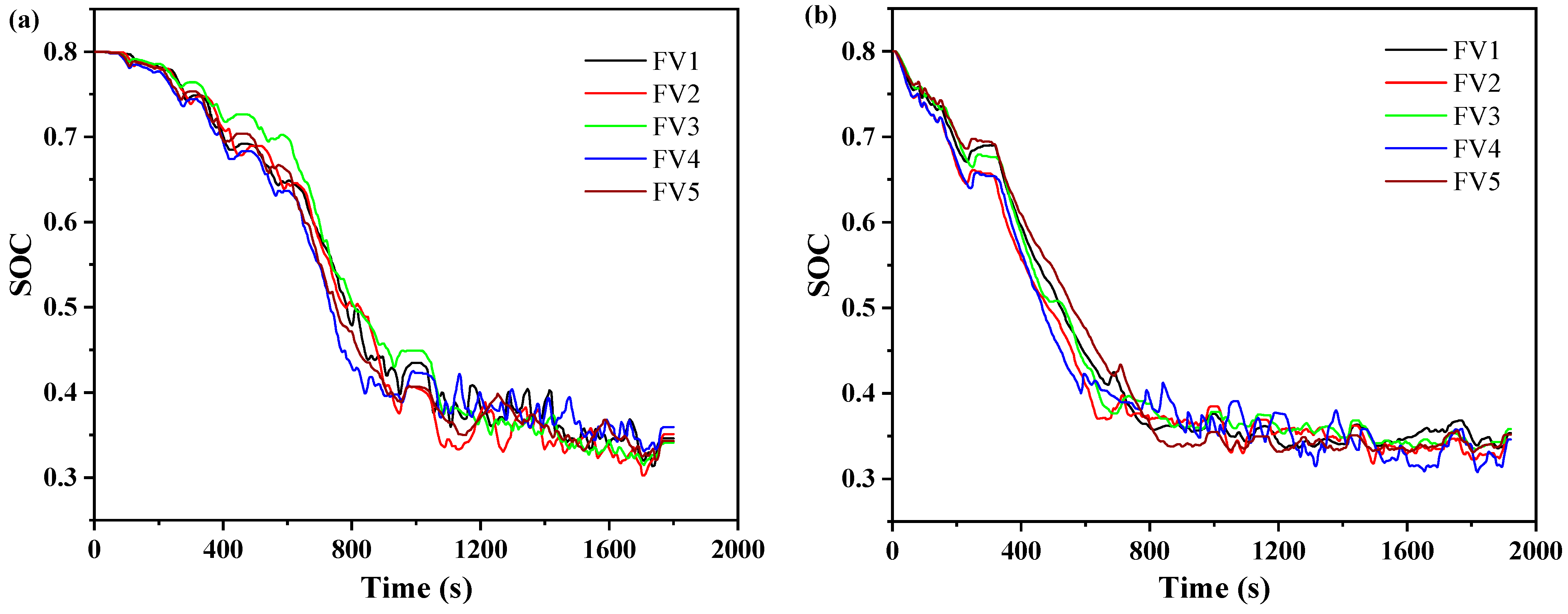
| Liuzhou | Fuel consumption (L/100 km) | 9.295 | 9.224 | 9.343 | 9.251 | 9.304 |
Disclaimer/Publisher’s Note: The statements, opinions and data contained in all publications are solely those of the individual author(s) and contributor(s) and not of MDPI and/or the editor(s). MDPI and/or the editor(s) disclaim responsibility for any injury to people or property resulting from any ideas, methods, instructions or products referred to in the content. |
© 2026 by the authors. Licensee MDPI, Basel, Switzerland. This article is an open access article distributed under the terms and conditions of the Creative Commons Attribution (CC BY) license.
Share and Cite
Liu, X.; Mai, D.; Mao, J.; Zhang, G.; Wu, X.; Meng, Y. Co-Optimization of Cooperative Adaptive Cruise Control and Energy Management for Plug-in Hybrid Electric Truck Platoons. Energies 2026, 19, 935. https://doi.org/10.3390/en19040935
Liu X, Mai D, Mao J, Zhang G, Wu X, Meng Y. Co-Optimization of Cooperative Adaptive Cruise Control and Energy Management for Plug-in Hybrid Electric Truck Platoons. Energies. 2026; 19(4):935. https://doi.org/10.3390/en19040935
Chicago/Turabian StyleLiu, Xin, Dong Mai, Jun Mao, Gang Zhang, Xiangning Wu, and Yanmei Meng. 2026. "Co-Optimization of Cooperative Adaptive Cruise Control and Energy Management for Plug-in Hybrid Electric Truck Platoons" Energies 19, no. 4: 935. https://doi.org/10.3390/en19040935
APA StyleLiu, X., Mai, D., Mao, J., Zhang, G., Wu, X., & Meng, Y. (2026). Co-Optimization of Cooperative Adaptive Cruise Control and Energy Management for Plug-in Hybrid Electric Truck Platoons. Energies, 19(4), 935. https://doi.org/10.3390/en19040935