Article

An Application Concept of a Mobile Micro-Water Turbine for the Recovery of Energy from the River


by
Łukasz Semkło
and
Andrzej Frąckowiak
*
Institute of Thermal Energy, Faculty of Environmental Engineering and Energy, Poznan University of Technology, 61-131 Poznan, Poland
*
Author to whom correspondence should be addressed.
Energies 2026, 19(4), 934; https://doi.org/10.3390/en19040934
Submission received: 5 January 2026 / Revised: 1 February 2026 / Accepted: 9 February 2026 / Published: 11 February 2026

Abstract

This work presents an innovative concept of a mobile micro-water turbine for energy recovery from flood-threatened rivers, combining environmental protection with renewable energy production. In response to the increasing frequency and intensity of floods caused by climate change, the authors propose active utilisation of the kinetic energy of water masses during these events through the installation of mobile water turbines along rivers. Rather than merely mitigating the consequences of floods, the energy from flowing water can be converted into electrical current, and the water can be purified and used for other purposes. The article analyses various solutions for water turbines, including the Kaplan turbine, Banki–Michell turbine, and screw turbine, taking into account their efficiency and ability to adapt to changing flow conditions. For the Biała Lądecka river, it was demonstrated that a mobile micro turbine operating for three days can generate a significant amount of energy for on-site consumption or storage. The key challenge is the development of effective water filtration and treatment systems to remove pollutants brought by floods, as well as mobile platforms enabling rapid assembly and disassembly of turbines at threatened sites. The comparative analysis of turbines conducted makes it possible to determine the optimal choice for mobile systems due to operation at low heads, simple construction facilitating installation, and tolerance for contaminants.

1. Introduction

The motivation for the concept of applying a mobile micro-water turbine came from events related to the flood in Poland in 2024, which were widely commented on and presented in the media, forcing the introduction of a state of natural disaster in the southwestern regions of the country [1]. Events of this type compel reflection on the ongoing climate change [2]. Due to human impacts on the natural environment and their increasingly stronger influence on it, various phenomena are emerging that mutually exclude each other at opposite ends of a common spectrum. A good example is, on one hand, the increase in the frequency of flood occurrence [3], and on the other hand, we are dealing with deepening hydrological drought [4]. Both of these phenomena occur simultaneously in the same area and at the same time. Not long ago, the 1997 flood was referred to as the millennium flood [5]. The current scale of floods is comparable to that from 29 years ago, and moreover, it affects a large area of central Europe. Such phenomena are only the beginning of events that may occur in the near future [6]. Flood water flows from the mountains, carrying away everything it encounters on its way. Due to this, it is heavily contaminated and polluted with substances that cause degradation of the natural environment where it spreads [7]. It should be remembered that flood water carries not only broken trees but also municipal, agricultural, and industrial pollution [8]. All of this mixes together and creates a mixture that is dangerous to the health and lives of people and animals.
In the literature, research authors focus largely on large-scale hydrological installations related to water reservoirs. It is possible to find several publications regarding small hydroelectric power plants and their application for use in rural areas to achieve electrification [9,10,11,12,13]. However, publications related to mobile micro-power plants utilising river flow are scarce. For this reason, this is another argument for the authors to undertake such a topic. The authors posed the question of whether it is possible to construct a mobile micro turbine that could be utilised during floods and in non-electrified areas. In answering such a question, it is necessary to propose a concept for creating such a solution from the moment of water intake, through turbine flow, to the utilisation of accumulated energy. A mobile hydroelectric power plant has many advantages, such as the possibility of system application during a natural disaster or in places where there is no electrical grid infrastructure. Another advantage is periodic operation depending on demand. A mobile micro-hydroelectric power plant can also be utilised to power pumps that serve to transport water to regions affected by drought. The disadvantages of such a solution are the amounts of energy produced, as they may be too small for local demand. In the further parts of this article, various solutions related to micro-water turbines are presented, along with the concept of a mobile micro-water turbine and the possibilities of its use for water purification, storage, or on-site consumption.

2. Materials and Methods

One method to mitigate the consequences caused by floods is the construction of retention reservoirs that serve as a buffer, which allows for the regulation of the height and transit time of the flood wave moving along the river toward its mouth. Retention reservoirs (flood control basins) by design intercept a significant portion of the flood wave volume and prevent its further uncontrolled discharge. The type and size of the reservoir are determined by the area in which it is to be constructed. Reservoirs of this type are essential to maintain the safety of flood-threatened areas. Unfortunately, in addition to the construction of retention reservoirs (flood control basins), the water inflow to such reservoirs must also be taken into account. The primary inflows are rivers protected by embankments. During the occurrence of floods, the sensitivity of society to protecting its property increases. Based on reports presented in the media, it is evident that society, the military, police, and firefighting services were strongly engaged in reinforcing embankments with sandbags. The effort undertaken by all involved individuals is enormous each time and is observed along the entire length of the river. This type of human behaviour compels consideration of comprehensive actions during the passage of a flood wave through successive river sections.
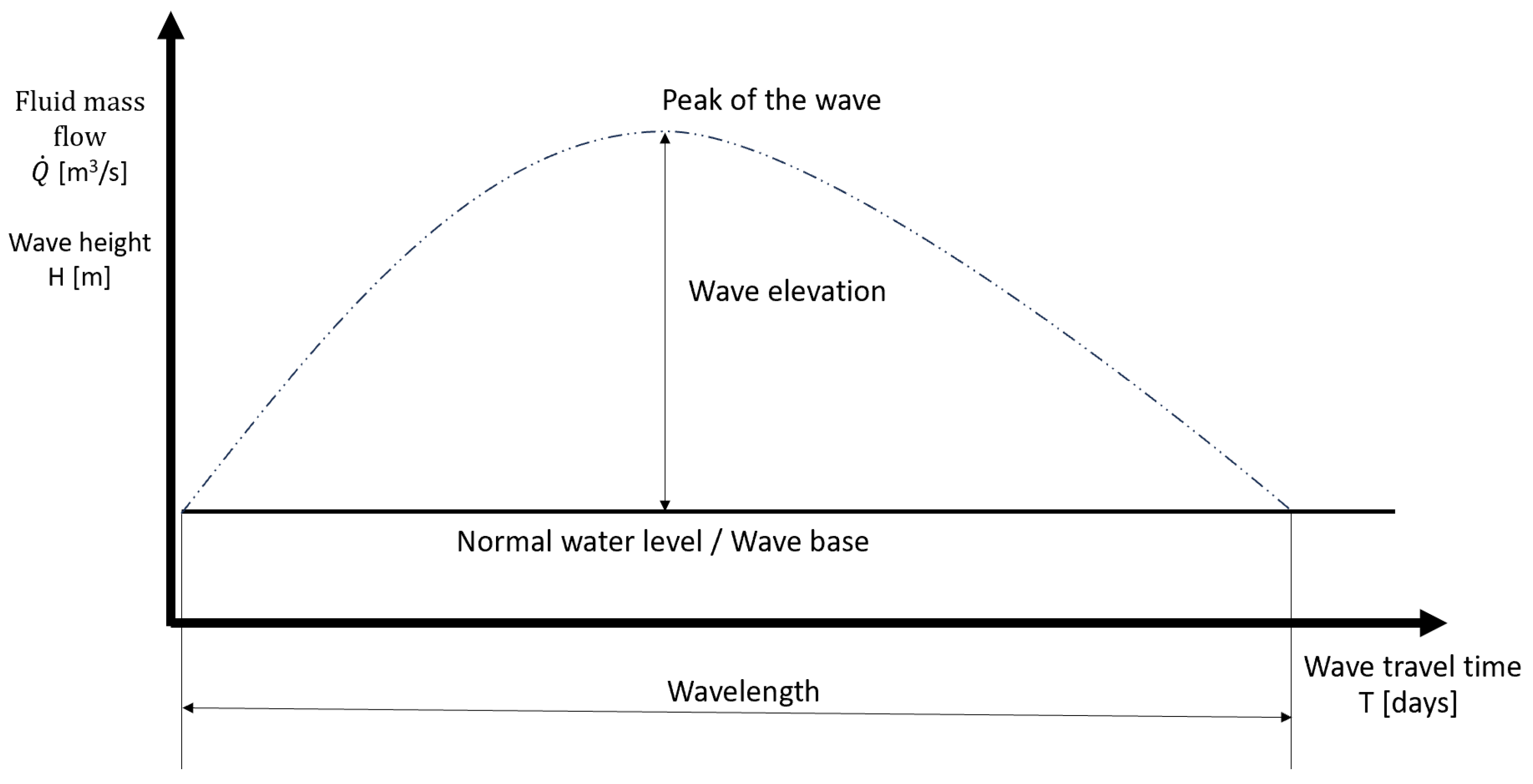
One such comprehensive solution could be an attempt to harness the latent energy in flowing flood water and utilise it as an aid to flood protection. An attempt to extract this energy could bring numerous benefits for the protection of life and property of residents in areas that may be affected by a flood wave in the near future. This wave is a hydrological phenomenon that occurs in watercourses such as rivers or channels as a result of the sudden discharge of enormous water masses caused by heavy rainfall or snowmelt. A flood wave consists of:
The bases of the wave—the state of the water from which a rapid rise in the water table is observed;
Wave elevation—the difference between the culmination of a wave and its base;
Wavelength—the time between the beginning and the end of the wave surge;
Wave velocity—the time of passage of the culminating wave on a specific river length;
Culmination of the wave—the highest level of the water.
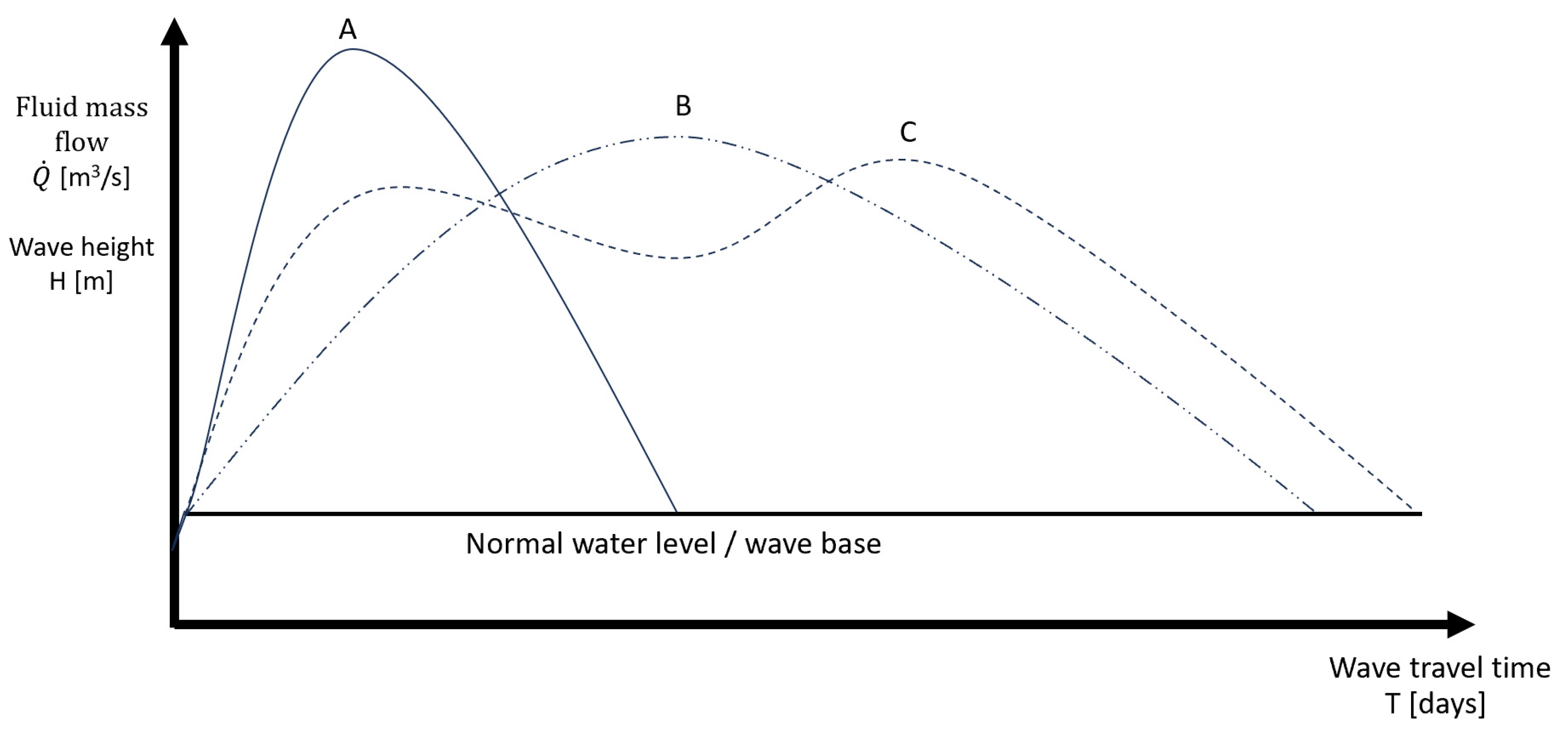
The flood wave can be presented using a graph (Figure 1 and Figure 2).
In Figure 1, we can observe the general nature of the flood wave. In Figure 2, however, we can observe 3 types of flood waves that can occur: A—a rapid short-term surge with one peak of flow intensity; B—a slow long-term surge with one peak of flow rate; C—a double swell with long-term flood flow. What kind of flood wave will occur depends on many environmental factors. The X-axis shows the wave travel time T of the flood in days [days]. The Y-axis shows the volumetric flow rate Q ˙ of the wave in cubic meters per second [m3/s], the wave height H in meters, and, for a more detailed analysis, the wave height H in meters [m] is also included.
Given that there is a hydrosphere on the globe that has a volume of 1,370,106 km3 of water [14]. It is divided into: seas and oceans (97%), groundwater (0.61%), lakes (0.009%), clouds and rains (0.005%), and rivers (0.0001%).
Although rivers do not occupy a leading place in the entire hydrosphere, they still have a very high energy potential. This potential is manifested in the force with which water moves in riverbeds. Taking into account the guidelines of the World Energy Conference, the hydropower potential of rivers is determined with the help of the water power cadastre. The Water and Energy Resources Cadastre is a list of gross resources of water and energy of a watercourse. The World Energy Conference has determined that 100 kW/km of flow is the minimum theoretical limit of energy utility of a river or its section [15]. Hydropower resources are not large and amount to 13.7 TWh/year [16]. Their list for the main rivers occurring in Poland is presented in Table 1.
In order to use the potential of rivers, both large and small hydroelectric power plants are built, which do not differ fundamentally in their principle of operation. In both cases, water should be dammed in order to obtain the highest possible potential energy. This type of principle is also used in the conceptual approach of the authors of this article. The difference is that the damming occurs naturally during the rise in the level of rivers during the period of flooding.
Several types of impellers are used in hydroelectric power plants. Rotors can be both reaction and action. Reaction (pressure) rotors are those in which a pressure higher than atmospheric pressure is used to generate energy. Both water pressure energy and kinetic energy are used here. In this group of turbines, there are both Francis and Kaplan turbines. Action rotors (spray turbines) are those in which water is supplied to the rotor under atmospheric pressure. An example here is the Pelton turbine and the Michell–Banki turbine. The exact classification of turbines with speed indicators is shown in Table 2.
Water turbines are key components in the generation of hydropower, converting the kinetic and potential energy of flowing water into mechanical energy, which is then converted into electrical energy. The design and efficiency of these turbines significantly affect the overall performance of hydroelectric systems, especially in small-scale and low-pressure applications. Depending on the specific conditions of the water source, different types of water turbines are used. For example, the Francis turbine is widely recognised as versatile and efficient over a wide range of water heights. It consists of a rotor, spiral, steering blades and a suction pipe, which allows it to maintain high performance even under changing operating conditions [20]. Backhoe turbines, on the other hand, which operate effectively in low-pressure environments such as irrigation channels, have gained attention for their ability to harness energy from water flow without the need for significant height differences. Research indicates that optimising blade design and slope can increase the efficiency of these turbines, making them more suitable for specific applications [21]. Recent advances in computational fluid dynamics (CFD) have made it easier to design water turbines that can operate efficiently at very low drops. Studies have shown that by using surface vortex models, turbine efficiency can be improved by about 2.6% with optimised design [22]. In addition, the development of new turbine designs, such as the Darrieus Canal Turbine, aims to maximise energy extraction from low-gradient sites, which are often located near urban areas where electricity demand is high [23]. This approach not only meets energy needs but also minimises environmental impact, which is in line with the growing focus on sustainable energy solutions. Integrating hydropower generation with other renewable sources, such as solar energy, can have such a use. Hybrid systems combining hydro and solar energy can increase the reliability and efficiency of power generation, especially in regions with variable water availability [24]. These systems use the storage capacity of the tanks to optimise energy transmission, ensuring a steady supply even during periods of drought [25]. In addition, it has been shown that the implementation of advanced systems for data supervision and control, including SCADA (Supervisory Control and Data Acquisition) systems based on Programmable Logic Controllers (PLCs), improves the operational efficiency of micro-hydropower plants, enabling better management of energy production and distribution [26].
The article focuses on micro-hydroelectric power plants. Micro-hydro turbines, especially in the context of hydropower microsystems, have gained considerable attention due to their potential for sustainable energy production in small-scale applications. These systems are particularly beneficial in remote areas where conventional energy sources are not feasible. The deployment of micro-hydropower plants, such as those using propeller turbines, has been extensively studied. For example, Sudiro discusses the design and testing of a propeller turbine for a micro-hydropower plant, highlighting its components and functionality in a low-gradient environment [27]. This is in line with the findings of Kazakbay and Turalin, who emphasise the usefulness of low-gradient hydropower turbines for small and medium-sized rivers, especially in agricultural conditions in Central Asia [28,29]. The efficiency and design of these turbines are crucial for optimising energy production. Turalina and Bossinov’s research on the optimal parameters of straight-flow turbines shows the importance of blade configuration and flow dynamics in increasing turbine efficiency [30]. In addition, the work of Ramos et al. highlights the role of micro-hydro systems in stabilising energy supply and generating income through clean energy production, which is crucial for the sustainable development of water supply systems [31]. The development of specialised turbines, such as the 100 mm diameter propeller turbine designed for water supply systems, illustrates the ongoing innovation in this field [32]. In addition, the exploration of different types of turbines, including counter-rotating turbines and Savonius turbines, shows a variety of design approaches aimed at improving efficiency and adaptability to different water flow conditions. Shigemitsu et al. have shown that counter-rotating turbines maintain high efficiency over a wide range of flows, which is essential for micro-hydropower applications [33]. Similarly, the Savonius-type turbine has been used effectively in miniature energy collectors to power wireless sensors, indicating its versatility in low-flow environments [34]. The integration of advanced manufacturing techniques such as 3D printing has also opened up new possibilities for the design and manufacture of miniature water turbines. Adamski et al. [35] discuss how 3D printing enables the creation of complex turbine geometries that can increase efficiency in distributed measurement systems. This technological advancement complements traditional designs and enables rapid prototyping and customisation based on specific on-site conditions.
Below are several design solutions for using hydropower to generate energy despite the low flow or low height of the water column.
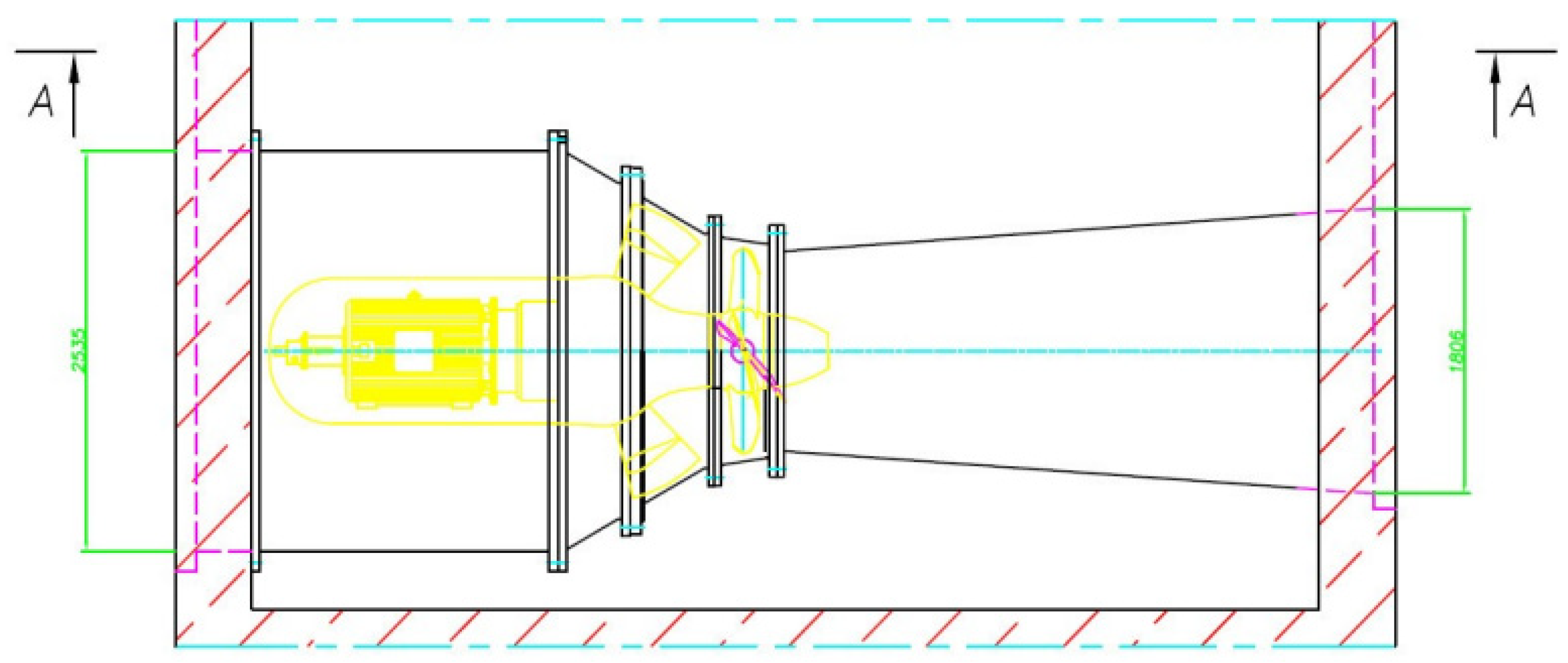
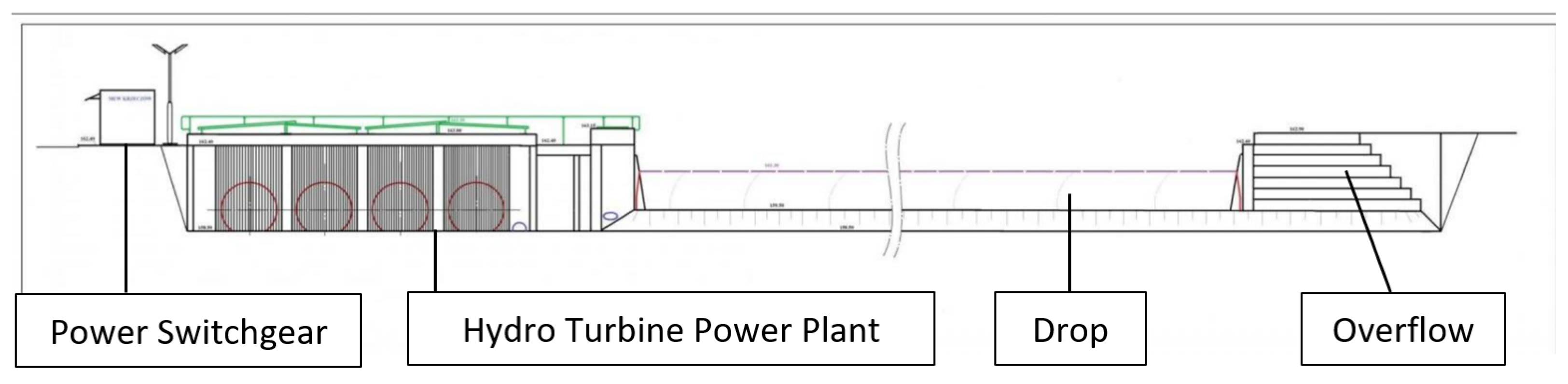
The first example of small-scale power generation is the ModMEW concept shown in Figure 3 and its application in a small modular hydropower plant (Figure 4). The construction was proposed by AQUA-Tech sp. z o. o. [36]. This design is based on the construction of one or several turbosets cooperating with each other. A Kaplan turbine was used here, and its size was planned to be within 750–1800 mm. The power obtained is in the range of 22–120 kW. The concept of the power plant was based on movable weir modules.
The second example of a micro-water turbine that can be considered innovative and conceptual is a hydrodynamic turbine (Figure 5) for small hydropower with a power of up to 20 kW [37]. This turbine can operate in full or only partial immersion. Despite working in partial submersion, it can still obtain about 70% of the nominal power. This type of construction solution was proposed by ABT Accord sp. z o. o. A turbine of this type is mounted on a movable float and can be combined with other turbines.
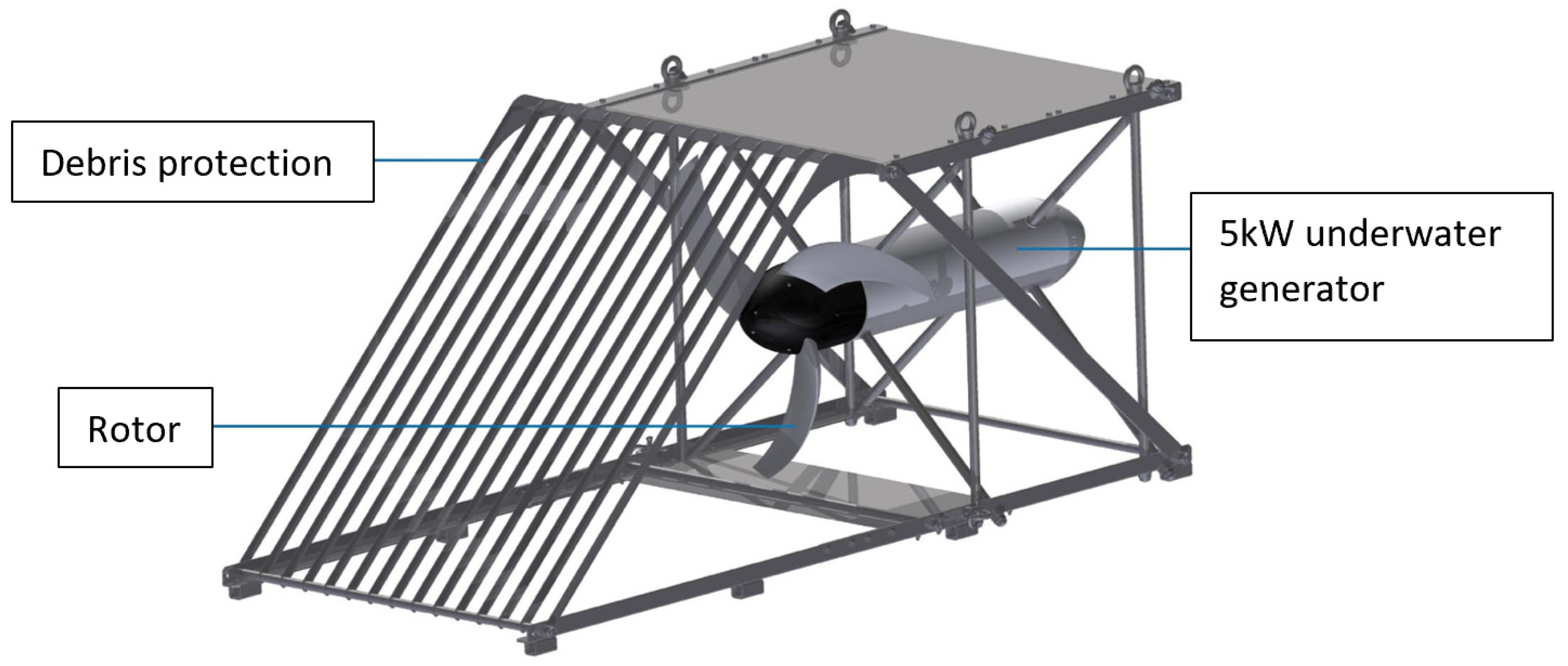
The third example is a micro-water turbine from Smart Hydro Power GmbH. Figure 5 shows a turbine called Smart Free Stream [38], which can be mounted at the bottom of a river or canal. A turbine of this type can achieve a power of up to 5 kW with a rotor diameter of 1 m.
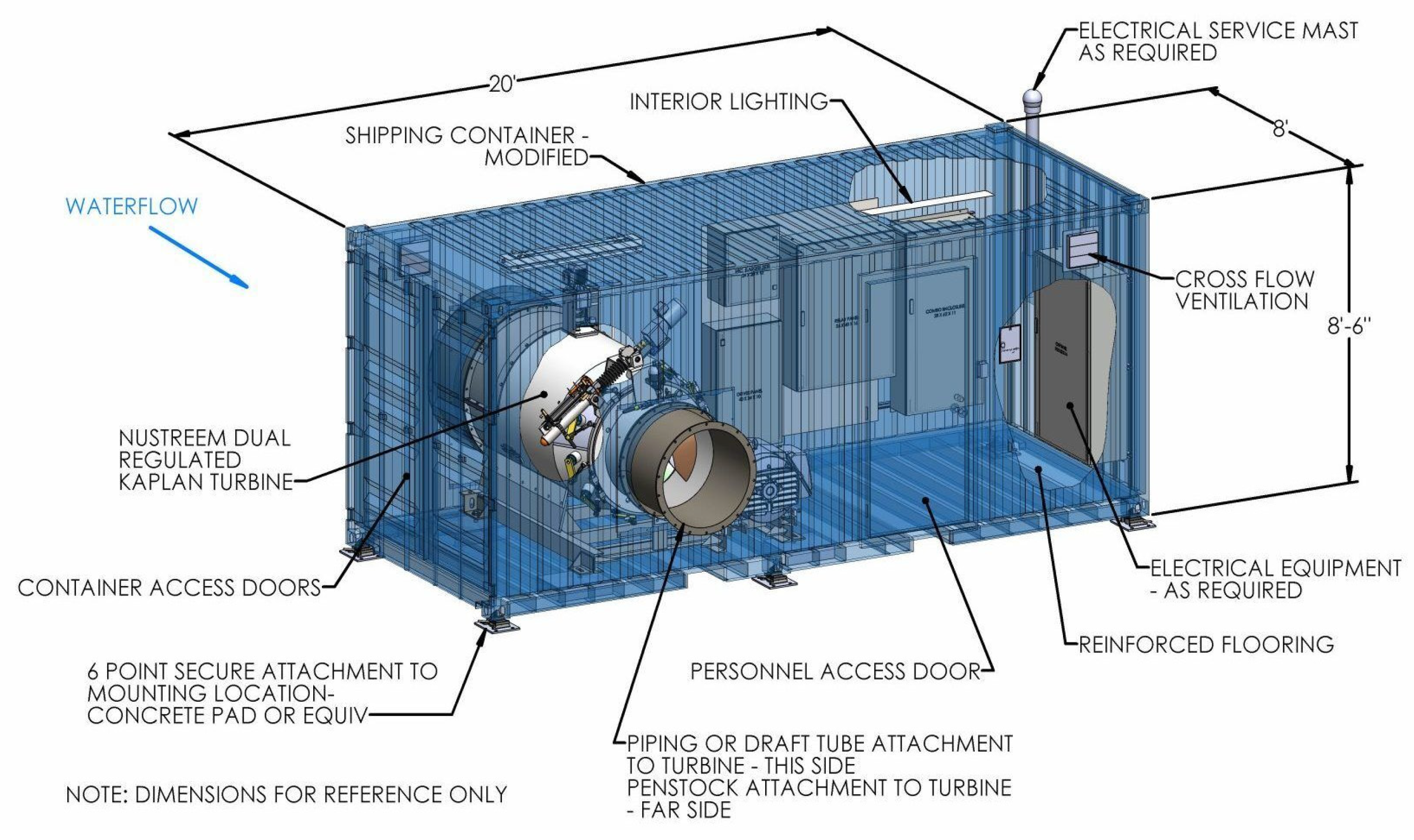
The fourth example comes from Mesa Inc. [39]. This company also proposes the use of a modular water turbine shown in Figure 6, but unlike the other solutions presented, it is not a turbine submerged in the river current, but built into a container. The design is based on a Kaplan turbine, and the power that can be obtained is 75–250 kW.
The water turbine design solutions mentioned above apply to clean water. For Smart Hydro Power GmbH’s solution, we have a truss, but only to protect the water turbine from objects flowing in the river, such as tree branches, etc. The solution proposed by the authors tends to use the resources provided by the river, but is based on the increase in water level as a result of flooding. The authors of the concept want to use the rise in the river level as a natural dam. Unfortunately, in this type of flow, it is necessary to use not only the truss as a cover for the inflow system to the turbine, but also other elements such as sieves or the use of the cyclone effect to clean the water from sand, which can be abrasive and lead to faster wear of the impeller.
Starting from the beginning of the formation of a flood wave, it is worth paying attention to the possibility of generating electricity by using the energy generated by the flowing current. A stable current during a flood is created when floodwater leaves the retention reservoirs during the release of excess water and directs it to the water turbine. As flooding is not a continuous phenomenon, the permanent infrastructure needed to generate electricity from the water discharged from the reservoir should allow for easy and quick installation of water turbines. In the case of conceptual considerations, the construction of permanent elements in the vicinity of the retention reservoir should be taken into account, such as prepared places for a mobile hydroelectric power plant. Such permanent infrastructure elements can also be built not only in the vicinity of the retention reservoir, but also along the river in the event of a flood wave or as an element of infrastructure supporting the prevention of another natural disaster.
The flood wave flowing through successive sections of the river should be used to generate electricity through mobile water turbines that can be moved along with the movement of the flood wave. However, the pollution that floodwater carries should be remembered. The authors take a comprehensive look at floods through the use of mobile hydroelectric power plants. A comprehensive solution is to use the flood wave current and transform it positively in terms of helping people who defend the embankments through their hard work, and the energy provided by a mobile water turbine can help, for example, in the production of electricity to illuminate the embankments while keeping an eye on whether there are any leaks. In addition, a comprehensive approach should include the use of flowing water that flows through the mobile water micro turbine and directs it to irrigate places where hydrological drought occurs. The idea is to slow down the flow in these places so that the underground water reservoirs are saturated, and not just the water flows with the flood wave. Of course, the water must be purified after passing through the mobile micro-water turbine.
In connection with the above-mentioned conceptual assumptions for a mobile micro turbine, measures can be taken to create discharges in newly built or modernised flood embankments with an appropriate shape of the inlet and outlet channel, with the possibility of installing permanent infrastructure for a mobile micro-water turbine that will generate electricity and purified water.
When considering the concept of a mobile water micro turbine, during the passage of a flood wave through a given area, such a mobile micro turbine should be installed on a given section of the river, and the water after passing through the turbine is directed towards the mobile treatment plant. Then, after passing through the treatment plant, the water can be used as drinking or technical water. After the flood wave in a given area, turbines and treatment plants are moved to other sections of the river. With this solution, a mobile micro-water turbine can generate more of the electricity needed to fight floods and can generate the necessary purified water for people, animals or the environment. In a comprehensive solution, we need to look at wastewater treatment. Electricity consumption in wastewater treatment plants is very high and varies from country to country [40]. Italy has almost 1% [41,42] of total domestic consumption, Spain 2–3% [43], and the United States is as high as 4% [44]. Thus, in the case of a water turbine, the use of water flow forces the use of a small wastewater treatment plant with a low electricity requirement. Here we can follow the example of small household sewage treatment plants, where their electricity demand is at the level of 270–350 kWh/year. Thus, the daily consumption is at the level of 1 kWh [45]. The use of a mobile home sewage treatment plant allows meeting the energy demand from a mobile water micro turbine. This solution, in a comprehensive approach, also gives the possibility of using water not only as drinking water, but also to reduce hydrological drought along the entire length of the river and generate electricity for the operation of the devices included in the system. The comprehensive approach to the use of flood wave water proposed above raises the following questions: what must be: the flow of the volume of water flowing through the discharge, the shapes of the channels guiding water to the turbines, the power of the turbines, and the efficiency of the treatment plant; and how many mobile sets must be installed in subsequent sections of the river to ensure optimal use of the flood wave flow.
When designing a mobile micro-water turbine, the principles of mobile hydraulic systems design must be taken into account. The most important aspect is maximum efficiency while maintaining low mass and compact dimensions, which facilitates transportation. Another important aspect is ease of operation through minimisation of the number of connections, which reduces the risk of leaks and facilitates field maintenance. The hydraulic components employed must be characterised by the highest possible power-to-weight ratio. The arrangement of components should be optimised for easy installation [46,47].
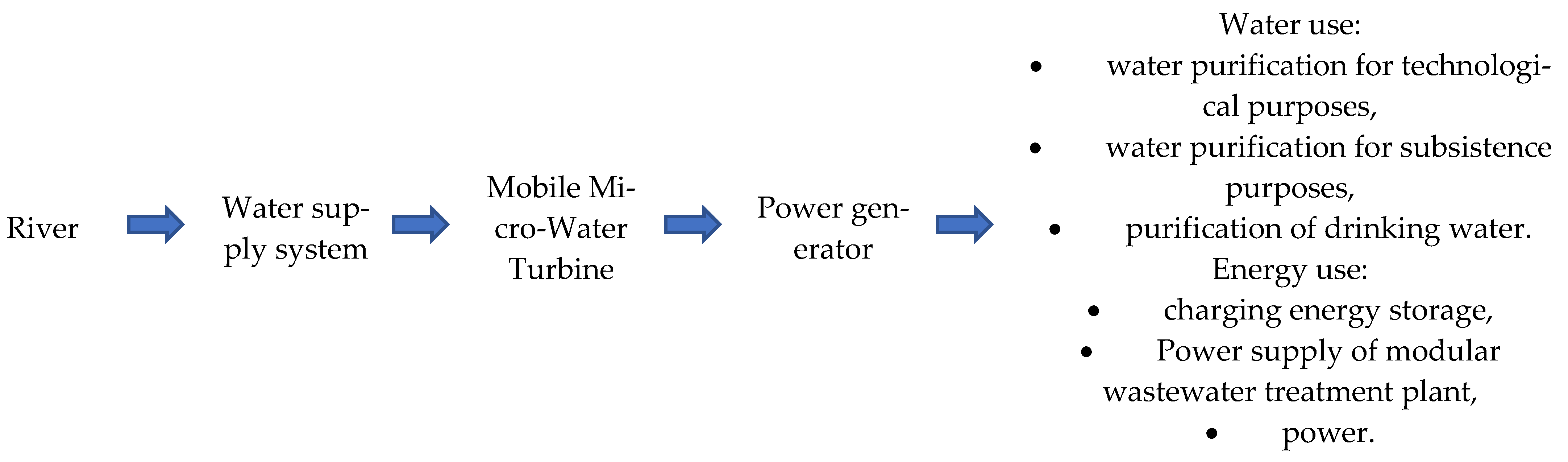
To answer the above questions, a flowchart is created as shown in Figure 7. The diagram presents an ideological distribution of what the system that takes water should look like and how to use it. Two variants of benefits that can be achieved are presented, i.e., the generation of electricity and the use of water.
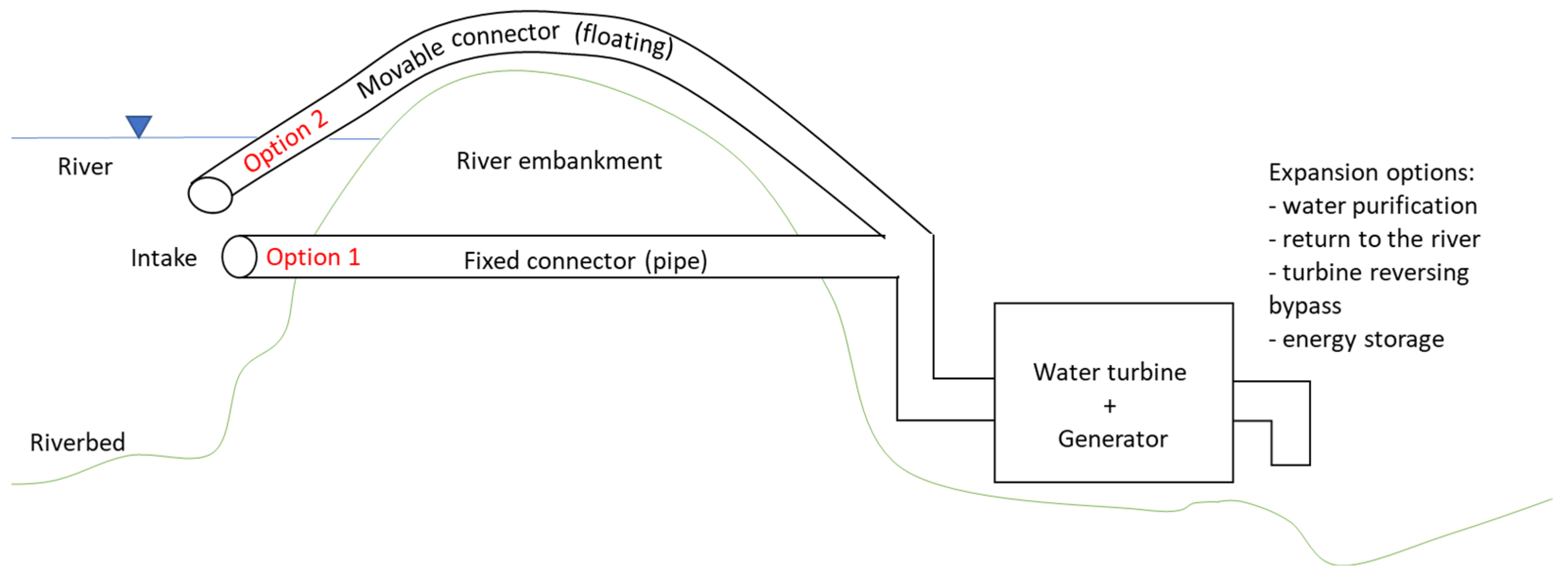
Figure 8 presents the concept of two variants of the installation for obtaining water and supplying it to a mobile micro turbine in order to generate electricity and further use of water for subsistence purposes. Variant 1 presents the possibility of installing the installation passing through the shaft in the form of a connector. This connector is permanently mounted inside the shaft and plugged to prevent it from being inhabited by animals or dirtied by waste. When used in a mobile micro turbine, the connector is opened and connected to the mobile micro turbine. An electric current is generated. Knowing the location of such a connector, you can prepare the ground for the location of a mobile micro turbine. Connectors of this type can be installed as a permanent installation along the river during the construction or modernisation of the embankment. Variant 1 gives the possibility of quick connection, as the black elements are already mounted on site and ready for operation and installation of the mobile micro turbine. In the case of variant 2, we have a solution focused on greater mobility. In this variant, we use a flexible hose that can be put through the embankment anywhere and inserted into the river. This creates an intake that will feed a mobile micro turbine located on the other side of the shaft. The connection to the mobile micro turbine will be the same as to the connector shown in variant 1. To sum up both options, variant 1 is stationary but always ready to work, and variant 2 increases the mobility of the planned solution. In addition, variant 2 can be used wherever there is a damming of a watercourse, or where one will be built. Regardless of the variant chosen, thanks to the fact that we will draw water to the mobile micro turbine, after connecting it, we can choose what benefits we want to achieve, whether electricity and its storage. After connecting to a connector, an assessment is made of which of the previously presented benefits can be obtained.
When planning a mobile micro-hydro turbine, it is important to consider the design principles of mobile hydraulic solutions. The most important aspect is maximum efficiency while maintaining a low weight and compact size, which allows for easy portability. Another important aspect to consider is ease of operation by minimising the number of connections, which reduces leaks and facilitates field maintenance. The hydraulic components used must have the highest possible power per unit of weight. The layout of the components should be optimised for easy installation [48,49].
While conceptual considerations are not required, key technical parameters of water treatment systems should not be overlooked. Each water treatment system depends on flow rate, flow velocity, and HRT (Hydraulic Retention Time). Contaminated water after treatment must meet applicable drinking water standards. Therefore, flow parameters are essential to achieve the best results for: BOD (Biochemical Oxygen Demand), COD (Chemical Oxygen Demand), TSS (Total Suspended Solids), TN (Total Nitrogen), and TP (Total Phosphorus). For quality parameters for raw and treated water, attention should be paid to: pH (reaction), EC (Electrical Conductivity), total hardness, NTU (Nephelometric Turbidity Units), heavy metal concentration, and microbiological indicators. Microbiological indicators include coliform bacteria and Escherichia coli, which determine the selection of technology (coagulation, sedimentation, filtration, biological processes, membrane processes, disinfection) as well as the required reagent doses and aeration intensity. The next group comprises the technical parameters of the treatment system: the volume and height of tanks, the surface area of settling tanks and filters, the specification of the filter bed or biological media, and the characteristics of membranes, compressors, and blowers. The system is also defined by energy parameters, i.e., specific energy consumption per m3 of treated water and pressure losses at individual stages, as well as sludge management. Automation and reliability parameters are also considered [47,48,49]. The process of treating contaminated water is a very complex subject. This is essential when analysing flood-related cases.

3. Results

Case Study

A case study was analysed to better illustrate the benefits. The case of energy recovery of the river current for a wave with a slow and long-lasting surge with one peak of flow intensity was accepted for the analysis (Figure 2 type B). The rationale for the concept of using a mobile micro turbine in the case of only one turbine operation was analysed. At the beginning, it was determined how the water level in the river rose during the flood. The water level as of 14 September 2024, on the Biała Lądecka River in Żelazno was taken into account for the analysis. During the flood, the Biała Lądecka River reached a level of 458 cm, where the river’s alert level is at the level of 140 cm. The average operational level of the river is at the level of 50–75 cm. The average operating flow is 3 m3/s. The data was taken from the website of the Institute of Meteorology and Water Management. The river level in the analysed case rose by almost 4 m. Therefore, assuming that during a flood the flow and the height of the river table increase, a safe flow level of 2.5 m3/s can be assumed for conceptual calculations, the diameter of the pipeline is 0.5 m, and the flow velocity is determined at the level of 3 m/s [50,51]. The analysis takes into account the change in the height of the water table from 1 m to 3 m, with a change in height of 0.5 m. The length of the river section that is taken into account is 1 km. Table 3 below shows the assumptions for the calculation of a mobile micro-water turbine.
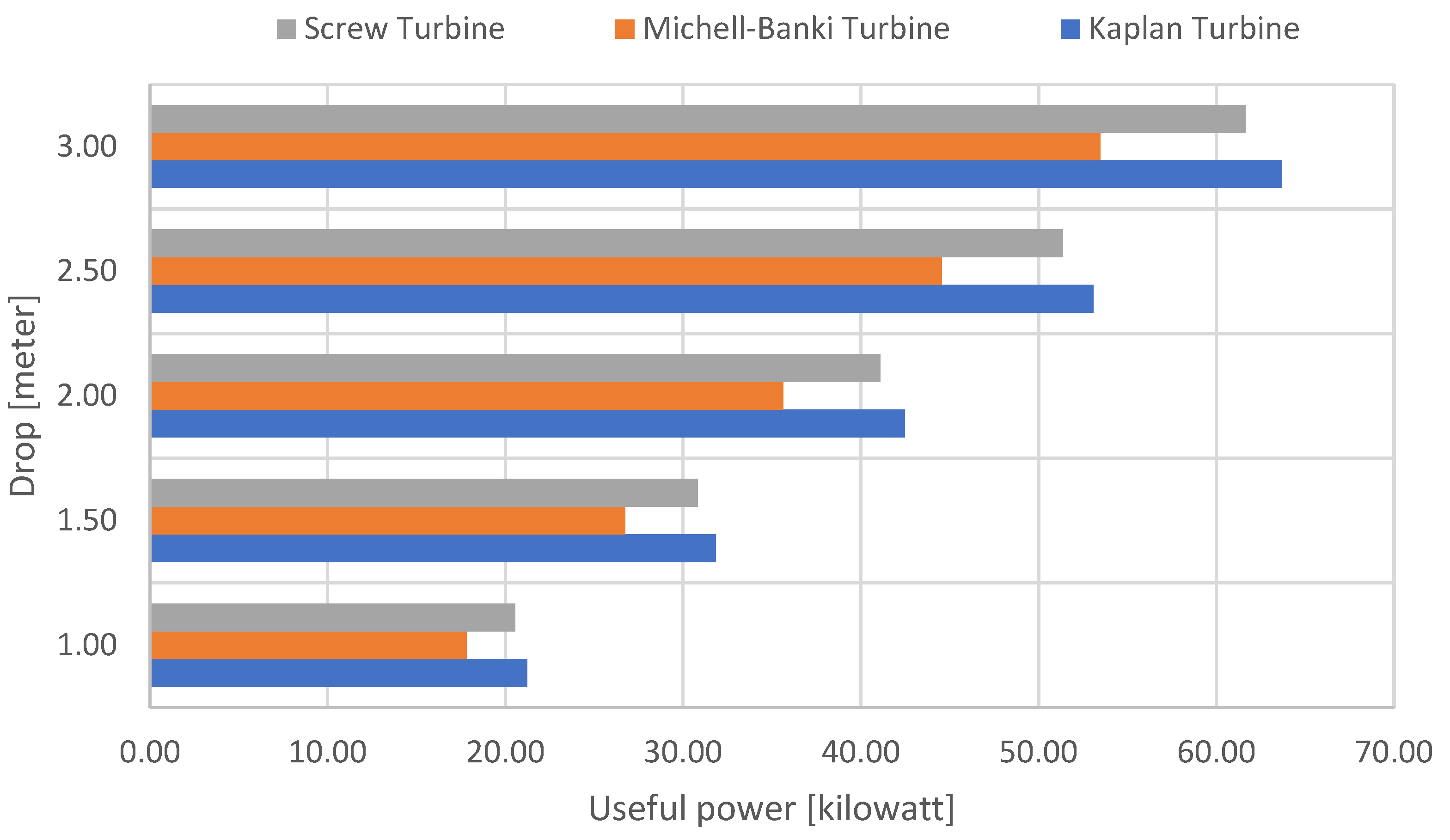
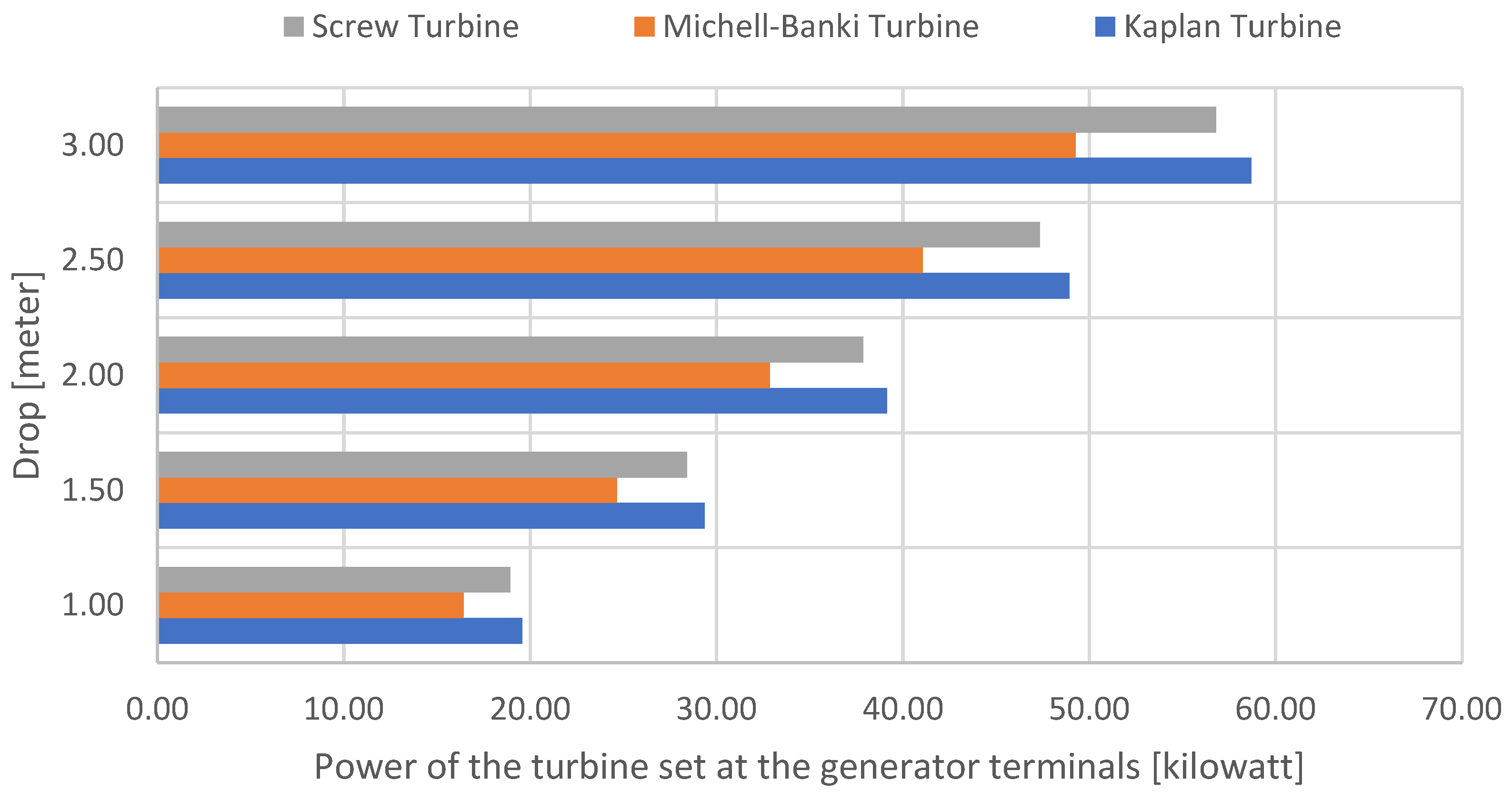
Table 4 shows the power obtained for three types of turbines when used at the analysed site. The Kaplan turbine, the Banki–Michell turbine and the screw turbine were taken into account for the analysis. It can be observed that in the case of the Kaplan turbine, the increase in useful power increased from 21.23 kW with a drop of 1 m to over 63 kW with a drop of 3 m. On the other hand, about the power of the turbine set, taking into account its efficiency at the level of 75%, the increase in power was from 19.57 kW to 58.70 kW. In the case of the Banki–Michella turbine, the increase in useful power increased from 17.82 kW with a drop of 1 m to over 53 kW with a drop of 3 m. On the other hand, about the power of the turbine set, taking into account its efficiency at the level of 75%, the power increased from 16.42 kW to 49.27 kW. The propeller turbine has achieved an increase in useful power from 20.55 kW with a drop of 1 m to over 61.50 kW with a drop of 3 m. On the other hand, about the power of the turbine set, taking into account its efficiency at the level of 75%, the power increased from 18.95 kW to 56.81 kW. A full comparison of turbines is shown in Figure 9 and Figure 10. To calculate the useful power of the turbine Pturbo set, we must determine the useful power of the turbine P itself and the theoretical power of the turbine Pth. Below is the formula for determining the theoretical power of the Pth turbine (1):
P t h = Q ˙ · ρ · g · H
where: Pth—theoretical turbine power in watts [W], Q ˙ —volumetric flow rate of the fluid flowing through the turbine in cubic meters per second [m3/s], ρ —fluid density in kilograms per cubic meter [kg/m3], g—gravity in meters divided by kilograms multiplied by the square of a second (m/kg*·s2), and H—water head in meters [m]. Then, the useful power of the turbine was determined. Efficiencies appropriate for the given turbine were assumed: Kaplan turbine—87%; Banki–Michell turbine—73%; screw turbine—84%. The formula for calculating the useful power P (2) is presented below:
P = P t h · η
where: P—effective power expressed in watts [W], and η—turbine efficiency. The final step was to determine the turbine set’s power Pturbo. The turbine set’s efficiency, ηturbo, had to be assumed, depending on the turbine. The following values were assumed: Kaplan turbine—80%; Banki–Michell turbine—67%; screw turbine—77%. The formula for calculating the turbine set’s power is below (3):
P t u r b o = P · η t u r b o
where: ηturbo—assumed efficiency of the turbine set.
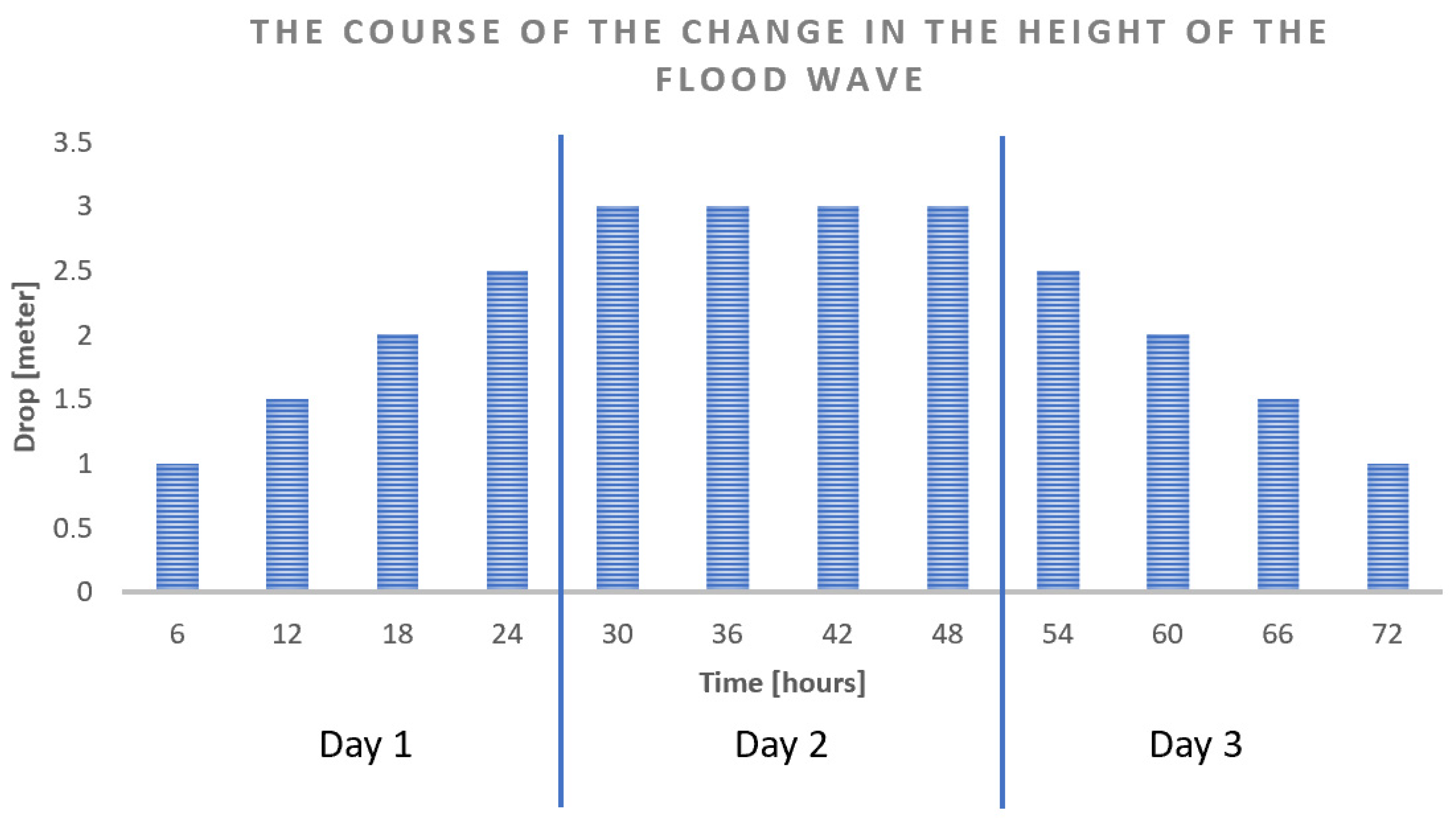
In order to obtain a more detailed analysis of the case study, the time at which the flood wave increases, its peak period, and the fall of the wave were taken into account. The course of the change in height of the flood wave shown in Figure 11. It was assumed that the flood wave increased within 24 h, then maintained its peak for 24 h and decreased for the next 24 h. Thanks to this assumption, it is possible to estimate how much energy a mobile micro turbine is able to generate in total while operating for 72 h. The data from Table 4 were used for the calculation. A minimum slope of 1 m and a maximum of 3 m are taken into account. Thanks to such an estimate, it was determined that the amount of energy obtained is between 2.5 and 3 MW. A detailed breakdown of the energy quantities for each turbine is shown in Table 5. Based on the available literature [44], the average flow speeds of rivers are usually in the range of about 0.2–1.5 m/s, while in swells they can reach 3 m/s. The speed of the swollen river was assumed for the calculations at the level of 3 m/s, and such a speed was assumed in the pipe supplying water to the turbine.

4. Discussion

Traditional energy recovery and flood control schemes are based on stationary turbines integrated with flood embankments or dams, such as Francis or Kaplan turbines, which provide continuous energy production at high efficiency. However, they require expensive modifications to existing hydrotechnical infrastructure, including foundations and intake channels, which generate substantial capital investments. Moreover, permanent installations are vulnerable to degradation during prolonged periods of low water levels and require continuous maintenance. The concept of a mobile micro-water turbine for energy recovery during flood events requires a thoughtful selection of turbine type that will operate optimally under conditions of variable flow and water level parameters. The characteristics of impulse and reaction turbines presented in the article indicate significant technical differences that have direct implications for the suitability of each solution for the proposed application. Impulse turbines, where energy transmitted to the runner derives solely from the kinetic energy of the water jet, offer substantial advantages for mobile systems. First, impulse turbines have fewer moving components, such as buckets, deflectors, and a simple water intake system. This simplicity directly facilitates assembly and disassembly, which is critical for mobile systems that must be installed and removed within short operational intervals. Impulse turbines operating at atmospheric pressure do not require hermetic casing or elaborate sealing systems. This is particularly significant under flood conditions, where water contains suspended solids and can damage precision-sealed equipment. Impulse turbines can also operate at low heads, which is important in areas with gentle river bed gradients. During floods, while water levels rise, this is not always accompanied by significant changes in water column height per unit river length. Unfortunately, their maximum efficiency is not entirely satisfactory. Reaction turbines utilise both the pressure energy and kinetic energy of water. Water completely submerges the runner and flows through the spiral casing and wicket gates. Such a solution offers substantial benefits for many applications. They achieve higher efficiency than impulse turbines. For mobile systems, this means that even a smaller turbine can generate adequate power. Under flood conditions, where the primary energy source is increased discharge rather than head, this characteristic is advantageous. Additionally, through complete submersion of the turbine, the full energy potential of the water can be harnessed. In contrast, the proposed micro-water turbine concept presented with two water intake variants enables rapid installation solely during flood periods, utilising either a permanent connector or a flexible hose passed over the embankment. This solution reduces capital investment costs and eliminates the need for structural intervention in the embankment beyond the connector installation phase. Energy recovery occurs only during elevated river levels, which maximises the unit energy gain from available discharge while minimizing the risk of equipment failure and operational costs. Such flexibility makes the proposed solution particularly attractive for retrofitting existing embankments without requiring extensive earthwork or hydraulic modifications.

5. Conclusions

This article presented an innovative concept of a mobile micro-water turbine as a tool for simultaneously addressing two critical challenges: flood risk management and renewable energy acquisition. The main conclusions from the conducted analysis indicate that the case study for the Biała Lądecka river confirms the substantial energy potential of flood waves, which can be practically utilised. Existing water turbine technologies, in particular the Banki–Michell turbine and modular turbine systems, constitute a sufficient technical basis for implementing the proposed solution. To effectively harness flood energy, the implementation of advanced water filtration and pre-treatment systems is necessary. The mobile micro-water turbine should function as part of a flood management system encompassing water storage, purification, and utilisation. The proposed concept has potential both for flood protection and for powering pump stations in drought-affected areas, enabling efficient utilisation throughout the operational year.
In further research on mobile micro-water turbines, hydrokinetic turbines should be considered, which can extract significant energy from flow velocities as low as 0.5–0.6 m/s. The choice of turbine type depends on site-specific conditions where installation will occur. Selection of an appropriate turbine for low-head applications and variable flow directions is essential. Optimisation of such turbine designs will increase their efficiency and electrical energy production capacity. For mobile micro-hydropower turbine applications, consideration should also be given to operation in remote off-grid areas adjacent to watercourses. The conceptual solution proposed by the authors encompasses multiple elements, each of which requires optimisation in subsequent research efforts, thus opening numerous research directions requiring investigation. Regarding the water intake installation for the turbine, careful attention must be paid to pipe diameter, material selection, installation methodology, and connection techniques. Turbine optimisation requires further research on blade curvature through computational fluid dynamics (CFD) analysis. Selection of auxiliary components for the mobile micro-hydropower turbine—such as water treatment, power conditioning, and energy storage charging systems—must be optimised with respect to the utilisation of generated energy. Optimisation of these elements can be conducted with regard to portability, turbine interface connections, and energy intensity. Further research should examine the feasibility of utilising the mobile micro-water turbine for combating hydrological drought, powering communities along river corridors during normal operational flow, and supplying electricity to remote locations lacking conventional power infrastructure.
Unfortunately, at the present time, the authors are unable to estimate the construction costs of a modular micro-water turbine with regard to its manufacturing and logistical operations.

Author Contributions

Conceptualization, Ł.S. and A.F.; methodology, Ł.S. and A.F.; software, Ł.S. and A.F.; validation, Ł.S. and A.F.; formal analysis, Ł.S. and A.F.; investigation, Ł.S. and A.F.; resources, Ł.S. and A.F.; data curation, Ł.S. and A.F.; writing—original draft preparation, Ł.S.; writing—review and editing, A.F.; visualization, Ł.S. and A.F.; supervision, A.F.; project administration, Ł.S.; funding acquisition, Ł.S. All authors have read and agreed to the published version of the manuscript.

Funding

This research was funded by the Polish Ministry of Science and Higher Education and the Poznan University of Technology’s financial resources for statutory activity. Grant number 0712/SBAD/5297.

Data Availability Statement

The original contributions presented in this study are included in the article. Further inquiries can be directed to the corresponding author.

Conflicts of Interest

The authors declare no conflict of interest.

References

  1. Business Insider. Available online: https://businessinsider.com.pl/wiadomosci/powodz-2024-stan-kleski-zywiolowej-w-polsce-zagrozone-obszary-mapy/y538z2y (accessed on 10 March 2025).
  2. Struzewska, J.; Kaminski, J.W.; Jefimow, M. Changes in Temperature and Precipitation Trends in Selected Polish Cities Based on the Results of Regional EURO-CORDEX Climate Models in the 2030–2050 Horizon. Appl. Sci. 2024, 14, 9. [Google Scholar] [CrossRef]
  3. Koniuch, A. Zmiana Klimatu = Powodzie. Cykl Zderzenie Z Naturą. Available online: https://www.ppoz.pl/czytelnia/ratownictwo-i-ochrona-ludnosci/Zmiany-klimatu-powodzie/idn:2784 (accessed on 16 November 2025).
  4. Baran-Gurgul, K. The Risk of Extreme Streamflow Drought in the Polish Carpathians—A Two-Dimensional Approach. Int. J. Environ. Res. Public Health 2022, 19, 14095. [Google Scholar] [CrossRef] [PubMed]
  5. Włodarczyk, B. The Flood of 1997. The Social and Institutional Dimension. Soc. Contexts 2021, 9, 1. [Google Scholar] [CrossRef]
  6. Pörtner, H.-O.; Roberts, D.C.; Poloczanska, E.S.; Mintenbeck, K.; Tignor, M.; Alegría, A.; Craig, M.; Langsdorf, S.; Löschke, S.; Möller, V.; et al. Zagrożenia, Adaptacja i Wrażliwość. Podsumowanie dla Decydentów. 2022. Available online: https://www.ipcc.ch/report/ar6/wg2/downloads/outreach/Raport_IPCC_cz2_29_11_22_OST.pdf (accessed on 10 March 2025).
  7. Kiryluk, A.; Leszczyński, J.; Łukowski, A.; Miłaszewski, R.; Piekutin, J.; Siemieniuk, A.; Skorbiłowicz, E.; Skorbiłowicz, M.; Szczykowska, J.; Wiater, J.; et al. Źródło zanieczyszczeń wód powierzchniowych i wybrane metody ich oczyszczania. Civ. Environ. Eng. 2014, 5, 49–57. [Google Scholar]
  8. Lenar-Matyas, A.; Poulard, C.; Ratomski, J.; Royet, P. Konstrukcja i działanie suchych zbiorników przeciwpowodziowych o różnej charakterystyce i lokalizacji. Infrastruct. Ecol. Rural. Areas 2009, 9, 115–129. [Google Scholar]
  9. Elbatran, A.; Yaakob, O.; Ahmed, Y.; Shabara, H. Operation, performance and economic analysis of low head micro-hydropower turbines for rural and remote areas: A review. Renew. Sustain. Energy Rev. 2015, 43, 40–50. [Google Scholar] [CrossRef]
  10. Isa, M.A.; Sudjono, P.; Sato, T.; Onda, N.; Endo, I.; Takada, A.; Muntalif, B.S.; Ide, J. Assessing the Sustainable Development of Micro-Hydro Power Plants in an Isolated Traditional Village West Java, Indonesia. Energies 2021, 14, 6456. [Google Scholar] [CrossRef]
  11. Vermaak, H.J.; Kusakana, K.; Koko, S.P. Status of micro-hydrokinetic river technology in rural applications: A review of literature. Renew. Sustain. Energy Rev. 2014, 29, 625–633. [Google Scholar] [CrossRef]
  12. Kong, M.; Ji, R.; Sun, K.; Zhang, J.; Cheng, Y.; Wu, H.; Zhang, Y.; Reabroy, R. Quantifying the pitch-induced response of side-by-side horizontal-axis tidal stream turbines in wave-current interaction. Energy 2026, 342, 139650. [Google Scholar] [CrossRef]
  13. Awandu, W.; Ruff, R.; Wiesemann, J.U.; Lehmann, B. Status of micro-hydrokinetic river technology turbines application for rural electrification in Africa. Energies 2022, 15, 9004. [Google Scholar] [CrossRef]
  14. Klugmann-Radziemska, E.; Lewandowski, W.M. Proekologiczne Odnawialne Źródła Energii. Kompendium; Wydawnictwo Naukowo-Techniczne: Warszawa, Poland, 2017. [Google Scholar]
  15. Gronowicz, J. Niekonwencjonalne Źródła Energii; Wyd. Instytutu Technologii Eksploatacji: Radom, Poland, 2008; ISBN 978-83-7204-671-0. [Google Scholar]
  16. Lewandowski, W.M. Proekologiczne Odnawialne Źródła Energii; Wydawnictwo Naukowo-Techniczne: Warszawa, Poland, 2003. [Google Scholar]
  17. Hoffmann, M. Małe Elektrownie Wodne Poradnik; Nabba Sp. z o.o.: Warsaw, Poland, 1992; ISBN 83-900827-0-5. [Google Scholar]
  18. Jackowski, K. Elektrownie Wodne, Turbozespoły i Wyposażenie; Wydawnictwo Naukowo-Techniczne: Warszawa, Poland, 1971. [Google Scholar]
  19. Krzyżanowski, W. Turbiny Wodne, Konstrukcja i Zasady Regulacji; Wydawnictwo Naukowo-Techniczne: Warszawa, Poland, 1971. [Google Scholar]
  20. Kang, H. Investigation on the effects of volute geometric parameters on the performance of pico Francis turbines used in water pipes. Water 2022, 16, 1722. [Google Scholar] [CrossRef]
  21. Masud, I.; Suwa, Y. Effect of blade inclination angle on the efficiency of a hydrokinetic turbine in an undershoot zero head system. Int. J. Mater. Mech. Manuf. 2018, 6, 388–391. [Google Scholar] [CrossRef]
  22. Subekti, R.A.; Prawara, B.; Susatyo, A.; Fudholi, A.; Wijaya, S.K.; Sudarmaji, A. Design and performance of very low head water turbines using a surface vorticity model algorithm. Int. J. Power Electron. Drive Syst. (IJPEDS) 2022, 13, 1140. [Google Scholar] [CrossRef]
  23. Furukawa, A.; Watanabe, S.; Matsushita, D.; Okuma, K. Development of a ducted Darrieus turbine for low-head hydropower utilisation. Curr. Appl. Phys. 2010, 10, S128–S132. [Google Scholar] [CrossRef]
  24. Apostolopoulou, D.; McCulloch, M. Optimal short-term operation of a cascaded hydro-solar hybrid system: A case study in Kenya. IEEE Trans. Sustain. Energy 2019, 10, 1878–1889. [Google Scholar] [CrossRef]
  25. Vasco, G.J.M.; Silva, J.S.; Canales, F.A.; Beluco, A.; Souza, J.D.; Rossini, E.G. A hydro PV hybrid system for the Laranjeiras dam (in Southern Brazil) operating with storage capacity in the water reservoir. Smart Grid Renew. Energy 2019, 10, 83–97. [Google Scholar] [CrossRef]
  26. Yılmaz, E.N.; Karayel, M. PLC PLC-based SCADA for micro hydroelectric power plants. Int. J. Electr. Energy 2016, 4, 67–70. [Google Scholar] [CrossRef]
  27. Sudiro, R.D.; Halim, L.; Arthaya, B.M. Implementasi dan pengujian prototipe turbin jenis propeller untuk pembangkit listrik tenaga mikrohidro. J. Rekayasa Mesin 2024, 15, 919–936. [Google Scholar] [CrossRef]
  28. Kazakbay, G.; Turalina, D. Research to define the lift and drag forces acting on a hydro turbine blade with a changing attack angle of flow. Int. J. Math. Phys. 2018, 9, 97–102. [Google Scholar] [CrossRef]
  29. Turalina, D.; Kazakbay, G. Research on the purpose of determining the optimal configuration of blades for improving the energy efficiency of direct flow hydro turbine. Eur. J. Tech. 2018, 8, 75–82. [Google Scholar] [CrossRef]
  30. Turalina, D.; Bossinov, D.Z. Theoretical and experimental investigations to define optimal parameters of the straight-flow turbine for a non-dam hydro power station. Eur. J. Tech. 2018, 8, 96–106. [Google Scholar] [CrossRef]
  31. Ramos, H.M.; Mello, M.F.; De, P. Clean power in water supply systems as a sustainable solution: From planning to practical implementation. Water Supply 2010, 10, 39–49. [Google Scholar] [CrossRef]
  32. Caxaria, G.A.; Sousa, D.M.; Ramos, H.M. Small-scale hydropower: Generator analysis and optimisation for water supply systems. Linköping Electron. Conf. Proc. 2011, 57, 1386–1393. [Google Scholar] [CrossRef]
  33. Shigemitsu, T.; Fukutomi, J.; Sonohata, R. Performance and internal flow of contra-rotating small hydro turbine. In Proceedings of the Symposia: Fluid Machinery; Fluid Power; Fluid-Structure Interaction and Flow-Induced Noise in Industrial Application, Hong Kong, China, 20–21 May 2013; Volume 1B. [Google Scholar] [CrossRef]
  34. Lepipas, G.; Holmes, A.S. Miniature water flow energy harvester based on savonius-type microturbine: An experimental study. Smart Mater. Struct. 2024, 33, 025019. [Google Scholar] [CrossRef]
  35. Adamski, K.; Adamski, J.; Dziuban, J.; Walczak, R. Inkjet 3d printed miniature water turbine energy harvester-flow meter for distributed measurement systems. Proceedings 2017, 1, 578. [Google Scholar] [CrossRef]
  36. Smart Hydro. Available online: https://www.smart-hydro.de/renewable-energy-systems/hydrokinetic-turbines-river-canal/ (accessed on 10 March 2025).
  37. Polniak, A. Modułowe Elektrownie Wodne Dla Rzek Nizinnych—AQUA-Tech Sp. z o.o., Energetyka Wodna, 2015. Available online: https://www.cire.pl/pliki/2/moduoweelektrowniewodnedlarzeknizinnych.pdf (accessed on 10 March 2025).
  38. Opatowiecki, J. Turbina Hydrodynamiczna Dla Małej Energetyki Wodnej o Mocy Osiągalnej do 20 kW. Available online: https://polskiprzemysl.com.pl/przemysl-energetyczny/turbina-wodna-rzeczna/ (accessed on 10 March 2025).
  39. Mesa Asociates, Inc. Available online: https://www.mesainc.com/nustreem/nucontainer/ (accessed on 10 March 2025).
  40. Maqsood, Q.; Fatima, F.; Rafaqat, F.; Mehmood, T.; Ali, S.; Hussain, M. Revolutionizing water and wastewater treatment: Data-driven approaches for advanced solutions. Desalination Water Treat. 2025, 324, 101432. [Google Scholar] [CrossRef]
  41. Ion Exchange Global. Available online: https://ionexchangeglobal.com/key-water-quality-parameters-for-industrial-use/ (accessed on 25 January 2026).
  42. Water Quality Control. Part II. Parameters of Water. Available online: https://chem.pg.edu.pl/documents/175289/4237055/WQC_Part2_%20Parameters%20of%20natural%20waters.pdf (accessed on 25 January 2026).
  43. Masłoń, A. Energy Consumption of Selected Wastewater Treatment Plants Located in South-Eastern Poland. Eng. Prot. Environ. 2017, 20, 331–342. [Google Scholar] [CrossRef]
  44. Reinders, M.; Greditgk-Hoffmann, S.; Risse, H.; Lange, M. Solution approaches for energy optimisation in the water sector. In Proceedings of the IWA World Congress on Water, Climate and Energy, Dublin, Ireland, 13–18 May 2012. [Google Scholar]
  45. Faladori, P.; Vaccari, M.; Vitali, F. Energy audit in small wastewater treatment plants: Methodology, energy consumption indicators and lessons learned. Water Sci. Technol. 2015, 72, 1007–1015. [Google Scholar] [CrossRef]
  46. Fundación OPTI. Estudio de Prospectiva, Consumo Energético en el Sector del Agua; Fundación OPTI: Malpica, Spain, 2012. [Google Scholar]
  47. Goldstein, R.; Smith, W. US Electricity Consumption for Water Supply & Treatment—The Next Half Century, Electric Power Research Institute. Water Sustain. 2002, 4. [Google Scholar]
  48. Eko-Bio. Available online: https://oczyszczalnia.net/ile-pradu-pobieraja-przydomowe-oczyszczalnie-sciekow/ (accessed on 10 March 2025).
  49. Kłos, M.; Sierpiński, G. Optimization of Intelligent Transport Systems Planning Energy Efficiency and Environmental Responsibility. Energies 2025, 18, 4518. [Google Scholar] [CrossRef]
  50. Heeger, T.; West, M.; Ericson, L. Comparative analysis of direct-drive and gearbox-coupled electro-hydraulic energy converters. Energy Convers. Manag. 2026, 29, 101463. [Google Scholar] [CrossRef]
  51. Bahmanpouri, F.; Lazzarin, T.; Barbetta, S.; Moramarco, T.; Viero, D. Estimating velocity distribution and flood discharge at river bridges using entropy theory—Insights from computational fluid dynamics flow fields. Hydrol. Earth Syst. Sci. 2024, 28, 3717–3737. [Google Scholar] [CrossRef]
Figure 1. Flood wave construction.
Energies 19 00934 g001
Figure 2. Flood wave.
Energies 19 00934 g002
Figure 3. WODEL turboset [36].
Energies 19 00934 g003
Figure 4. Concept of a small modular hydroelectric power plant for the WODEL hydro set [36].
Energies 19 00934 g004
Figure 5. Water turbine [38].
Energies 19 00934 g005
Figure 6. Water turbine [39].
Energies 19 00934 g006
Figure 7. Flowchart of the proposed concept.
Energies 19 00934 g007
Figure 8. Conceptual application of a water turbine using 2 variants of water supply to the turbine.
Energies 19 00934 g008
Figure 9. Distribution of useful power for individual turbines depending on the gradient.
Energies 19 00934 g009
Figure 10. Distribution of turbine power generated at generator terminals for individual turbines depending on the gradient.
Energies 19 00934 g010
Figure 11. The course of the change in the height of the flood wave.
Energies 19 00934 g011
Table 1. Distribution of hydropower resources in the main rivers of Poland [16].
RiverValue [%]
The Vistula River45.3
Vistula and Oder basins43.6
The Oder River9.8
Table 2. Classification of rotors used in hydropower [17,18,19].
Turbine TypeTurbineRange of High-Speed Distinguishing FeaturesDrop H [m]
Reaction
turbine
Low-speed Kaplan (propeller)350–50070–30
Mid-speed Kaplan (propeller)501–75030–10
High-speed Kaplan (propeller)751–110010 and below
Low-speed Francis50–150500–110
Mid-speed Francis151–250110–50
High-speed Francis251–45050 and below
Action
turbine
Low-speed Pelton2–151800–1000
Mid-speed Pelton16–251000–700
High-speed Pelton26–50700–100
Michell–Banki30–200100–5
Table 3. Assumptions for calculations.
NameIndexValueUnit
FlowQ2.5m3/s
Diameter of the pipe in front of the turbinera0.50m
Water densityρ1 000kg/m3
Earth accelerationg9.81m/s2
Flow velocity upstream of the turbineca3.18m/s
Critical velocityckr3.85m/s
Efficiency of the turbosetηtz0.75-
Table 4. Power calculations for individual turbines.
Kaplan Turbine
DescriptionUnitValue 1
(Drop
= 1.0 m)
Value 2
(Drop
= 1.5 m)
Value 3
(Drop
= 2.0 m)
Value 4
(Drop
= 2.5 m)
Value 5
(Drop
= 3.0 m)
Useful powerkW21.2331.8542.4753.0963.70
Turboset PowerkW19.5729.3539.1448.9258.70
Michell–Banki Turbine
Useful powerkW17.8226.7435.6544.5653.47
Turboset PowerkW16.4224.6432.8541.0649.27
Screw Turbine
Useful powerkW20.5530.8241.1051.3761.65
Turboset PowerkW18.9428.4037.8747.3456.81
Table 5. Breakdown of obtainable electricity for individual types of turbines.
TurbineValueUnitValueUnit
Kaplan Turbine3052.56kW3.05MW
Michell–Banki Turbine2562.21kW2.56MW
Screw Turbine2954.07kW2.95MW
Disclaimer/Publisher’s Note: The statements, opinions and data contained in all publications are solely those of the individual author(s) and contributor(s) and not of MDPI and/or the editor(s). MDPI and/or the editor(s) disclaim responsibility for any injury to people or property resulting from any ideas, methods, instructions or products referred to in the content.