Article

Depth-Dependent Wave-Energy Contribution-Based Parametric Study of Submerged Ramp Design for a Caisson-Type Overtopping Wave Energy Converter: Hydraulic Efficiency and Construction-Economy Assessment

1
Department of Ocean System Engineering, College of Marine Science, Gyeongsang National University, 11-dong, 2, Tongyeonghaean-ro, Tongyeong-si 53064, Republic of Korea
2
Department of Naval Architecture and Ocean Engineering, College of Marine Science, Gyeongsang National University, 11-dong, 2, Tongyeonghaean-ro, Tongyeong-si 53064, Republic of Korea
*
Author to whom correspondence should be addressed.
Energies 2026, 19(4), 926; https://doi.org/10.3390/en19040926
Submission received: 14 January 2026 / Revised: 31 January 2026 / Accepted: 6 February 2026 / Published: 10 February 2026
(This article belongs to the Special Issue Wave Energy: Theory, Methods, and Applications: 2nd Edition)

Abstract

Breakwater-integrated caisson-type overtopping wave energy converters (OWECs) can retrofit port infrastructure with energy recovery, and their performance is strongly influenced by submerged-ramp geometry that governs underwater wave-particle motion, reflection, recirculation, and localized breaking. This study establishes a depth-selection framework based on the cumulative distribution of wave-induced kinetic energy from linear wave theory and applies weakly compressible smoothed particle hydrodynamics (WCSPH) simulations using DualSPHysics under regular waves to quantify how hydraulic efficiency responds to ramp slope and installation depth for single-slope designs. Guided by these trends, a segmented multi-angle ramp is proposed to preserve the upper-slope function required for overtopping while reducing submerged volume and foundation demand. Performance is assessed by combining hydraulic efficiency with construction-quantity-based economy indices. Results show that deeper ramps generally enhance efficiency but with diminishing returns, and that the preferred slope depends on the installation depth. In suitable depth ranges, segmented ramps provide a practical compromise between material savings and retained performance. The proposed procedure supports early-stage geometry screening and robust depth-range selection across site conditions.

1. Introduction

The primary purpose of coastal and harbor structures is to absorb, reflect, and block offshore waves to secure calm conditions in sheltered waters and to support safe berthing and cargo-handling operations. Waves, from the structural design perspective, are external loads that must be dissipated; however, they can also be regarded as recoverable renewable energy resources [1,2]. In particular, in sea areas where large-scale infrastructures such as breakwaters, wharves, and caissons are already installed, integrating marine-energy conversion devices into existing structures can add electricity-generation functionality while minimizing additional infrastructure investment. Recently, beyond retrofitting and strengthening existing structures with auxiliary devices, the concept of multi-functional structures where wave-energy recovery is incorporated at the design stage of new coastal/harbor structures has been proposed [3,4,5,6,7,8,9,10,11].
Marine energy exists in various forms, including tidal range, tidal currents, ocean thermal gradients, salinity gradients, and waves. Among them, wave energy has relatively high energy density but also exhibits variability with seasonal and meteorological conditions. Wave energy converters (WECs) are commonly classified by operating principle into oscillating body systems, oscillating water column systems, and overtopping systems [1,2]. An overtopping-type wave energy converter (OWEC) converts wave kinetic energy into potential energy by allowing incident waves to run up along a front ramp, overtop into a reservoir, and then drive low-head turbines using the stored water head.
Many studies have reported that overtopping devices are structurally simple, enabling stable structural design, and are well-suited for integration with breakwaters [3,12,13]. Breakwater-integrated OWECs can be categorized into rubble-mound types (e.g., OBREC) that utilize the front slope and caisson-based monolithic types (e.g., OBREC-V, SSG) [14,15,16,17,18,19]. Slope-mounted types can be relatively easily linked to existing sloped faces; however, hydraulic and structural design constraints strongly depend on the placement and armor conditions of rubble-mound layers. In contrast, caisson-based monolithic systems offer advantages in standardization and mass production because they are typically fabricated onshore and then towed and installed offshore, and they can be readily integrated with the caisson-type breakwaters widely used in ports. Nevertheless, the front and submerged-slope geometries directly affect not only energy efficiency but also weight, buoyancy, stability, constructability, and fabrication cost [20,21].
A caisson-based OWEC inevitably includes submerged structural components (a submerged ramp and front underwater geometry). Overtopping discharge is governed by incident-wave conditions and the run-up process at the front, while the submerged geometry influences the underwater velocity and pressure fields, front reflection, wave deformation, localized breaking, and recirculation-zone formation, and can therefore affect energy efficiency. Despite this, existing studies on slope geometry have tended to focus on design parameters above or near the free surface, and submerged ramps have often been examined only in limited forms such as simple extensions, single-slope changes, or curvature modifications [21,22]. In particular, systematic studies linking ramp installation depth and geometry to the depth-dependent kinetic-energy distribution of waves remain relatively limited [23,24].
Wave-particle motion decays with depth, and the decay characteristics depend on wave period and water depth. For the same wave height, long-period and deep-water conditions can maintain velocity influence at relatively deeper levels, whereas short-period and shallow-water conditions tend to concentrate energy near the surface. Therefore, if the required submerged-ramp depth is uniformly set as the full water depth, unnecessary increases in structural volume may result; conversely, overly shallow design may reduce overtopping discharge or induce unfavorable reflection/recirculation. Moreover, for caisson-type OWECs fabricated onshore and installed offshore, expansion of submerged structures increases concrete volume and self-weight, leading to higher transportation/installation difficulty and increased construction cost. Thus, the submerged-ramp installation depth and geometry simultaneously control power-generation performance and fabrication/transport/installation and foundation costs, and shape optimization to minimize structure size while meeting target overtopping performance is a key design task.
Despite the growing literature on OWECs, submerged-ramp design has often been treated only through simple extensions or single-slope modifications, and the rationale for selecting the installation depth has rarely been linked to the depth-decaying distribution of wave-induced kinetic energy. Moreover, systematic parametric maps that jointly quantify efficiency sensitivity to both installation depth and ramp slope for caisson-type OWECs remain limited. To address these gaps, this study proposes a kinetic-energy-contribution-based depth-selection procedure and performs simulations to support early-stage geometry screening of single-slope and segmented submerged-ramp designs using combined efficiency–economy indices.
This study quantitatively evaluates how submerged-ramp design parameters (installation depth and slope angle) affect hydraulic efficiency and economy in a caisson-type OWEC while keeping the previously validated upper overtopping–storage geometry fixed. First, under the design-wave condition, linear wave theory is used to compute the normalized cumulative depth distribution of kinetic energy, which is used as a baseline for selecting installation depth. Then, under regular-wave conditions, WCSPH-based DualSPHysics simulations are performed while systematically varying the slope angle and installation depth of a single-slope submerged ramp to compare efficiency sensitivity. Based on the single-slope results, representative depth ranges with strong efficiency contribution are identified, and a three-segment multi-angle ramp geometry is designed to assess material-reduction potential compared with the single-slope configuration. Finally, hydraulic efficiency is evaluated together with construction-quantity-based cost proxy indices and the cost per unit hydraulic power to compare overall performance from an efficiency–economy balance perspective. Because marine construction cost is strongly affected by constructability (e.g., formwork, segment joints, and underwater installation), material-volume reduction alone may not translate into lower total cost for a multi-segment ramp. Thus, this study uses a quantity-based CAPEX proxy (submerged area and foundation-rock length) for early-stage relative screening, and the economic results should be interpreted as comparative indicators rather than absolute cost conclusions. The results are intended to provide practice-oriented criteria applicable to early-stage geometry design and submerged-ramp design-range selection for bottom-fixed caisson-type OWECs in sea areas with similar wave conditions.
The remainder of this paper is organized as follows. Section 2 defines the depth-dependent cumulative kinetic-energy distribution based on linear wave theory and presents the WCSPH-based DualSPHysics simulation setup and performance metrics (hydraulic efficiency, cost proxy, and cost per unit hydraulic power). Section 3 compares and analyzes hydraulic efficiency and economy for single-slope and multi-segment (three-segment) submerged ramps. Section 4 summarizes the main conclusions and future research needs.

2. Methods and Theoretical Background

This section presents the theoretical background and numerical workflow used to quantify how the submerged-ramp geometry of a caisson-type overtopping wave energy converter (OWEC) influences wave-energy utilization and structural scale. The installation depth is parameterized using a depth-dependent cumulative distribution of wave-induced kinetic energy derived from linear wave theory, and systematic simulations are conducted under regular waves using DualSPHysics (WCSPH) while varying ramp slope and depth. Hydraulic efficiency based on the overtopping-stored potential energy, together with construction-economy indices reflecting submerged quantities and foundation demand, is defined to enable an integrated efficiency–economy comparison.

2.1. Depth-Dependent Kinetic-Energy Contribution Framework

2.1.1. Linear Wave Theory and Kinetic-Energy Distribution

To quantify the kinetic-energy distribution in the submerged region under the design-wave condition, linear wave theory was applied [25,26,27]. The coordinate system is defined such that the wave propagation direction is x and the vertical upward direction is z. The still water level (SWL) is z = 0, and the seabed is z = −d. The free-surface elevation of a regular wave is:
η x , t = H 2 cos k x ω t
where H is wave height, T is wave period, ω = 2 π / T is angular frequency, and k is wavenumber. The velocity potential ϕ is:
ϕ x , z , t = g H 2 ω cosh k z + d cosh k d sin k x ω t
and k satisfies the dispersion relationship:
ω 2 = g k tanh k d
Velocity components are obtained by differentiating ϕ . The horizontal component u and vertical component w are:
u = g H k 2 ω cosh k z + d cosh k d cos k x ω t
w = g H k 2 ω sinh k z + d cosh k d sin k x ω t
The kinetic-energy density per unit volume at depth z is:
e k z = 1 2 ρ u 2 + w 2
To directly link e k z to the structural design variable (installation depth), the vertical distribution was reformulated into a normalized contribution function and its cumulative distribution. Let D = z be the depth measured downward from the free surface 0     D     d . The normalized contribution function f D is defined as:
f D = 2 k cosh 2 k d D sinh 2 k d
Thus, f D represents the relative contribution of the vicinity of depth D to the total kinetic energy. The cumulative distribution F D becomes:
F D = 0 D f D d D = 1 sinh 2 k d D sinh 2 k d
with boundary conditions F 0 = 0 and F d = 1 . Therefore, F D is defined as the cumulative fraction of kinetic energy from the free surface down to depth D .

2.1.2. Design Wave Conditions

The target sea area is set to the wave environment near Ulleungdo Island in the East Sea (Republic of Korea), which has been adopted and discussed as a relevant candidate condition for OWEC applications in a previous study [28]. In the present work, this site condition is used as a representative design-wave reference to enable relative comparisons and early-stage screening of submerged-ramp design variables (installation depth and slope angle), rather than to validate absolute field performance. The prototype design wave is defined as T p = 7.37   s , H s = 2.8   m , and d = 18   m . Because the present work uses regular-wave simulations, the significant wave height H s is treated as the representative regular-wave height H , and wave height is henceforth denoted as H . The representative period uses the spectral peak period T p .
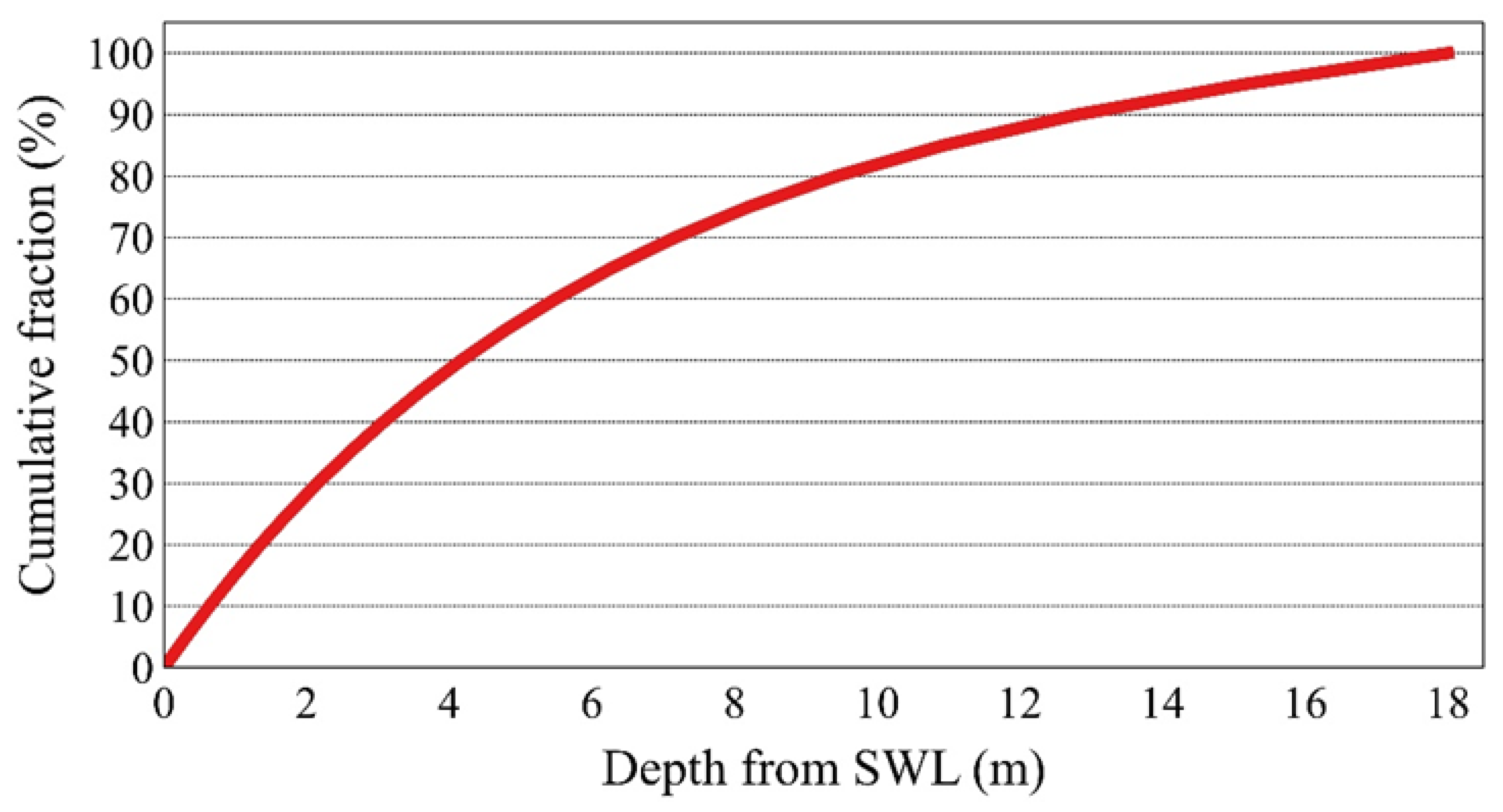
Numerical simulations were conducted at model scale with Froude similarity (1/20 scale). The scaled design-wave parameters are H m = 0.14   m , T m = 1.648   s , and d m = 0.9   m (Table 1). Using Equation (8), the depth D corresponding to specific cumulative kinetic-energy ratios was computed and summarized in Figure 1 and Table 2.

2.2. OWEC Model Configuration and Design Variables

2.2.1. Caisson-Type OWEC Model

The upper geometry of the caisson-type multi-level overtopping OWEC used in this study was adopted from a previously validated reference model [28]. This choice minimizes performance variations associated with the upper overtopping–storage mechanism so that efficiency differences caused by submerged-ramp geometry changes—the key focus of this study—can be isolated and interpreted. The submerged structure consists of a ramp connected to the caisson foundation, and it directly influences wave deformation, reflection, and localized breaking patterns by modifying the underwater velocity and pressure fields.
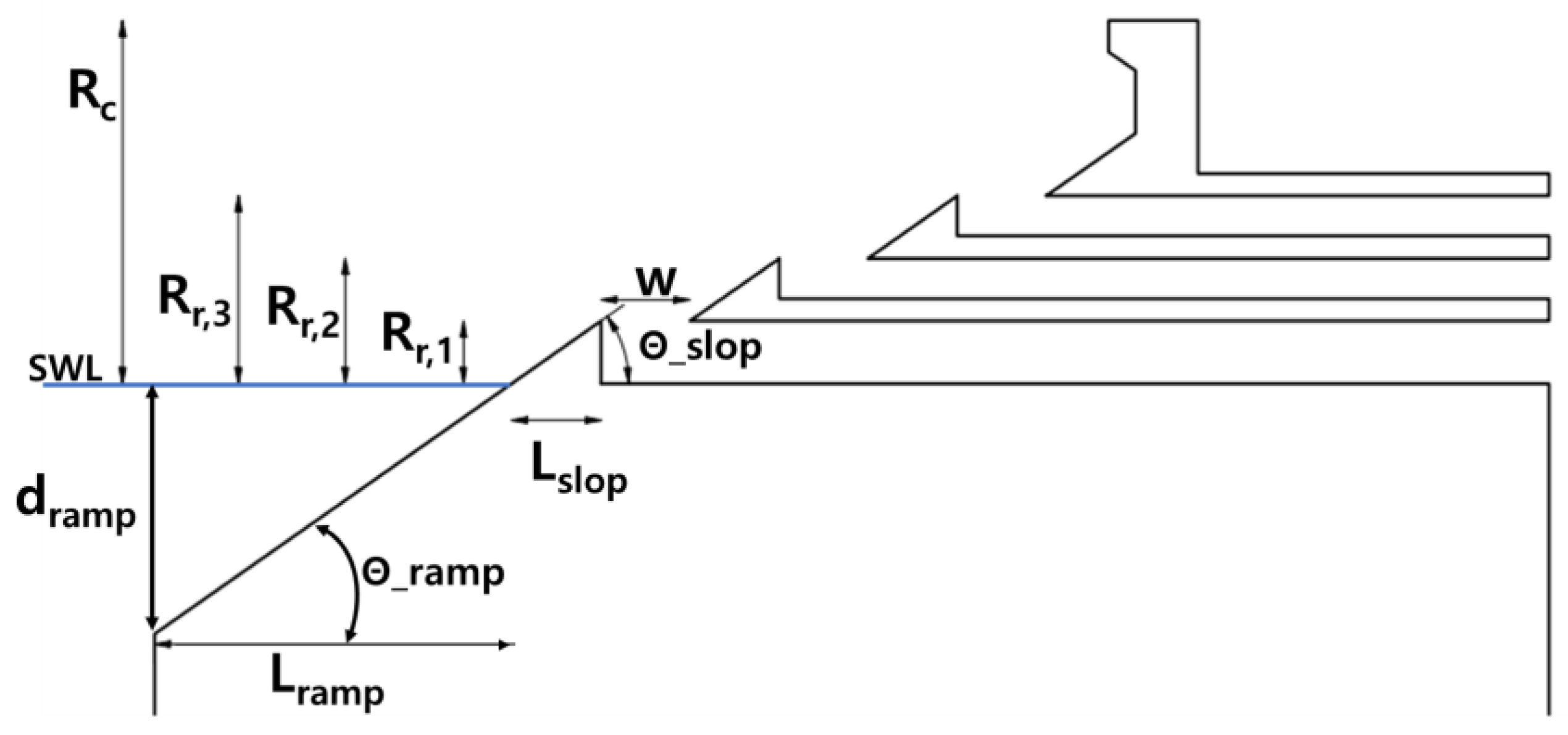
In particular, the submerged ramp slope angle θ r a m p   and the submerged toe depth d r a m p are key geometric parameters that simultaneously change the submerged volume (material quantity) and the seabed contact length. Therefore, they can strongly affect hydraulic efficiency sensitivity. In this study, the upper slope and reservoir dimensions were fixed, while only θ r a m p and d r a m p were systematically varied. In addition, because ramp length L r a m p and the submerged slope area changes with these variables, geometric indices representing structural scale were also computed to enable economy-oriented comparisons. The geometry and parameter definitions are shown in Figure 2, and key dimensions are listed in Table 3.

2.2.2. Parametric Cases for Single-Slope Submerged Ramps

To analyze the influence of submerged-ramp geometry on energy efficiency, the slope angle θ r a m p and installation depth d r a m p were selected as the primary design variables. The slope angle θ r a m p changes the run-up path length and flow components (especially vertical velocity) in front of the structure, thereby affecting overtopping initiation, localized breaking, and recirculation formation. Previous studies on overtopping devices and similar coastal structures suggested an applicable slope-angle range of approximately 19–35° [29]. Therefore, this study adopted a range of 20–35° and discretized it at 5° intervals (20°, 25°, 30°, 35°) to screen efficiency sensitivity without excessively increasing the number of cases.
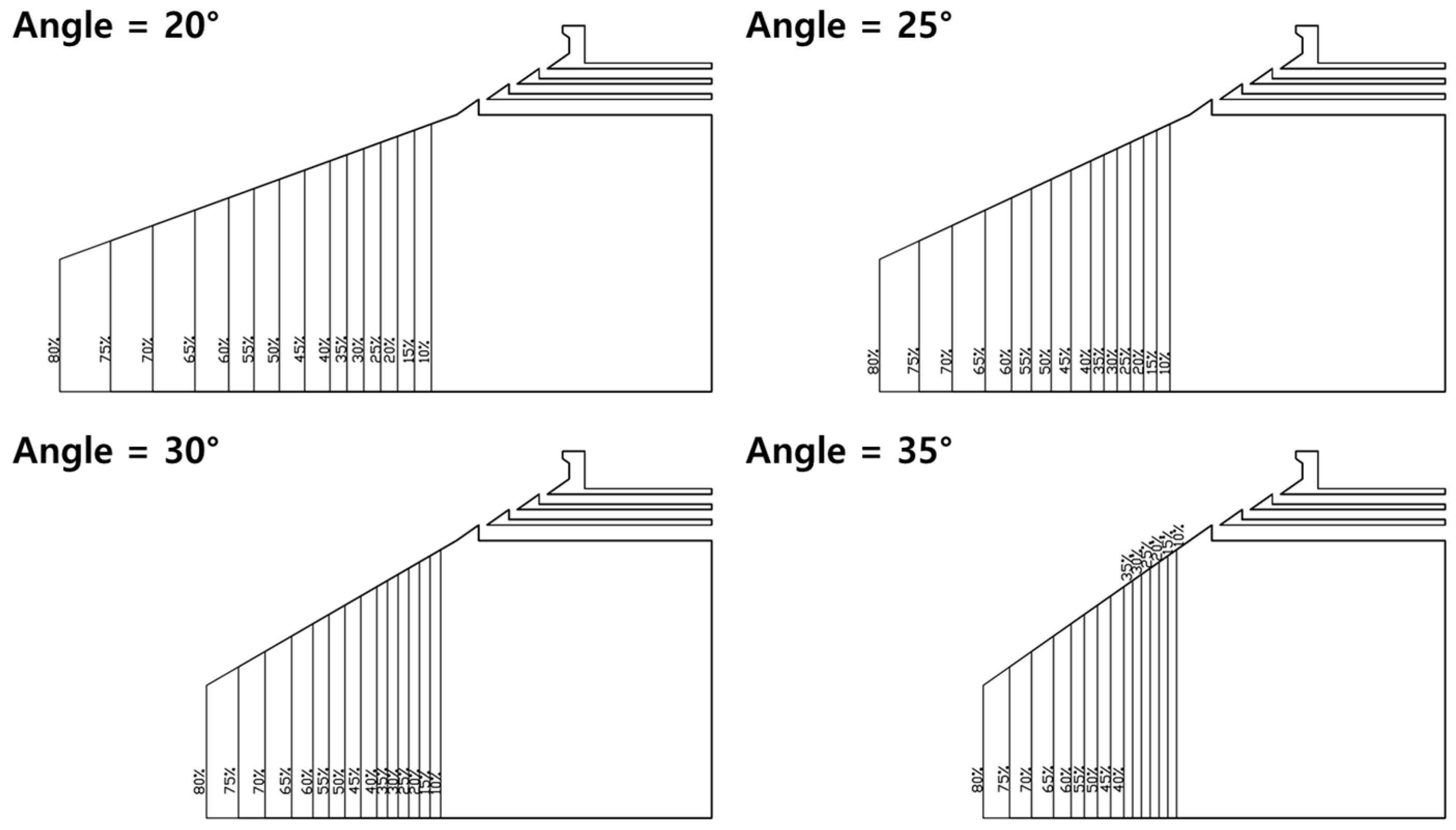
The installation depth d r a m p was defined using the cumulative kinetic-energy ratio F D so that the depth-decay characteristics of wave kinetic energy are explicitly reflected. The exploration range was set to 10~80%. Ratios below 10% correspond to very shallow depths immediately below the surface, where submerged effects may excessively overlap with the upper overtopping process; ratios above 80% require extending the structure into depths with relatively small energy contribution, resulting in large structural-scale increases relative to efficiency gain. This study defined 15 depth levels at 5% increments and combined them with the four angles to form 60 single-slope cases. Each case was assigned an identifier in the form a _ θ _ per _ F D (e.g., a _ 20 _ per _ 10 ). The full case list is provided in Appendix A.1, and a schematic is shown in Figure 3.

2.3. WCSPH Numerical Simulations Settings

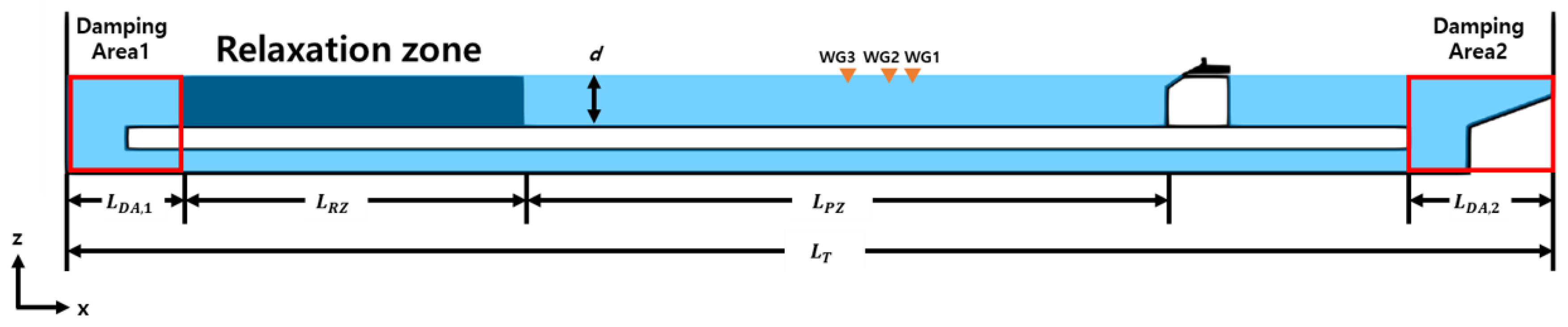
Numerical simulations were conducted using DualSPHysics v5.4, an open-source solver based on WCSPH [30]. The modeling setup and computational parameters follow a previously validated numerical environment [28], applying the same numerical wave-tank concept and procedures (Figure 4). Simulations were performed using a two-dimensional (x–z) model representing a vertical section along the wave-propagation direction.
The initial particle spacing was set to d p = 0.005 m to adequately resolve flow gradients near boundaries and overtopping flow. The smoothing length was defined as h = c o e f h d p , and c o e f h   =   1.4 was used to balance interaction radius and numerical stability. Seawater density was set to ρ = 1025 kg/m3 and gravitational acceleration to g = 9.81 m/s2. Other detailed parameters—such as the equation of state for pressure, time-integration algorithm, boundary treatment, viscosity and density-diffusion terms—follow the validated settings in the previous work [28]. This ensures that performance changes obtained in this study can be mainly attributed to changes in submerged-ramp design variables.
The numerical wave tank is a two-dimensional recirculating tank (Figure 4). The total tank length is L T = 26 m, and the water depth is fixed at d = 0.9 m. Wave generation and reflected-wave control were implemented using DualSPHysics relaxation zones, enabling simultaneous wave generation and active absorption [31,32]; the relaxation-zone length is L R Z = 6 m. The structure front was placed 11 m downstream of the relaxation zone to secure a sufficient wave-development distance. Damping areas 1 and 2 were placed at the front and rear of the tank to suppress numerical reflections and nonphysical vortices at the recirculation-channel boundaries.
To prevent particle-number reduction in the main tank due to reservoir accumulation of overtopped water, the rear of the structure was idealized as a drainable condition, and a circulation path was included so that drained particles re-enter the main tank through the recirculation channel. Overtopping discharge was measured using the DualSPHysics FlowTool, which counts the volume of particles passing through reservoir control sections and converts it into cycle-averaged discharge.

2.4. Performance Metrics

To compare and evaluate optimization results, both hydraulic-efficiency and economy-related indices were employed. Hydraulic efficiency, a representative performance index for OWECs, was used, and economy was quantified using a construction-cost proxy based on structural quantities and a cost-per-unit-hydraulic-power index. All indices were computed from regular-wave simulation results obtained using DualSPHysics (WCSPH).

2.4.1. Definition of Hydraulic Efficiency

Hydraulic efficiency η h y d is defined as the ratio of the potential-energy flux stored by overtopping P c r e s t to the incident wave-energy flux per unit width P w a v e [16,17,18,33]:
η h y d = P c r e s t P w a v e
For a multi-level OWEC, P c r e s t is computed by summing the potential-energy contributions from overtopping discharge into each reservoir:
P c r e s t = j = 1 n ρ g q j ¯ R c , j  
where ρ is seawater density, g is gravitational acceleration, q j ¯ is the cycle-averaged overtopping discharge into the j-th reservoir, and R c , j is the vertical distance from SWL to the reservoir inlet. The cycle-averaged discharge is computed from the instantaneous discharge Q t measured by DualSPHysics FlowTool:
q ¯ = 1 B T t 0 t 0 + T max Q t , 0 d t
In this study, the cycle-averaged overtopping discharge was evaluated by averaging over 20 wave periods under regular-wave conditions. The incident wave-energy flux per unit width at the structure front is:
P w a v e = 1 8 ρ g H 2 C g
where C g is group velocity, given by the product of celerity C and group coefficient n :
C g = n C = 1 2 1 + 2 k d sinh 2 k d ω k
Here ω , k , and d denote angular frequency, wavenumber, and water depth, respectively, with k obtained from the dispersion relation (3) and Table 1 values.

2.4.2. Construction-Cost Proxy and Cost per Unit Hydraulic Power

Economic evaluation of WECs is typically performed using unit-cost metrics such as LCOE (Levelized Cost of Energy), which divides life-cycle cost by energy production [1,3,5]. However, at the geometry-optimization stage, accurate LCOE estimation is difficult due to large uncertainties in PTO (turbine/generator), grid connection, OPEX, installation, offshore construction conditions, etc. Therefore, this study defines a cost proxy (CAPEX proxy) using structural-quantity indicators directly dependent on geometry changes (submerged area and foundation-rock length) and combines it with hydraulic efficiency to build relative screening indices for economic comparison.
The construction-cost proxy C p r o x y is defined using the average submerged ramp cross-sectional area A R a m p (idealized as concrete) and the required foundation-rock length L R a m p . Since construction cost is generally estimated as quantity × unit price [33], the concrete portion is estimated as c r c A R a m p B , and the foundation-rock portion is approximated as c r o c k k s e c L R a m p B , where k s e c = 1.0 m is a representative sectional factor. Thus:
C p r o x y = c r c A R a m p B + c r o c k k s e c L R a m p B
where B is the unit width ( B   =   1 in this study). Because the focus is on relative comparisons, common geometry components among cases were excluded from metric calculations. The unit-cost coefficients c r c and c r o c k were set based on data from the Ministry of Oceans and Fisheries of Korea [34]. The coefficients are interpreted as relative cost weights rather than absolute construction-cost predictions.
Because candidate geometries change both hydraulic performance and structural/foundation quantities, the cost per unit hydraulic power index C I P is defined to mitigate the limitations of comparing designs solely by efficiency ratios:
C I P = C p r o x y P c r e s t = c r c A R a m p B + c r o c k k s e c L R a m p B η h y d P w a v e
Under identical regular-wave conditions, P w a v e is constant across all designs; therefore,
C I P c r c A R a m p + c r o c k k s e c L R a m p η h y d

3. Results

This section compares the hydraulic-efficiency distributions associated with variations in installation depth and ramp slope for single-slope submerged ramps, identifying depth ranges with strong sensitivity and angle-dependent performance trends. Based on the selected representative depth regions, the submerged ramp is reconfigured into a segmented multi-angle geometry, and its ability to retain overtopping performance while reducing submerged volume and foundation demand is evaluated. Finally, design candidates are ranked using combined efficiency and economy indices, providing practical criteria for early-stage geometry screening and design-range selection.

3.1. Performance of Single-Slope Ramp

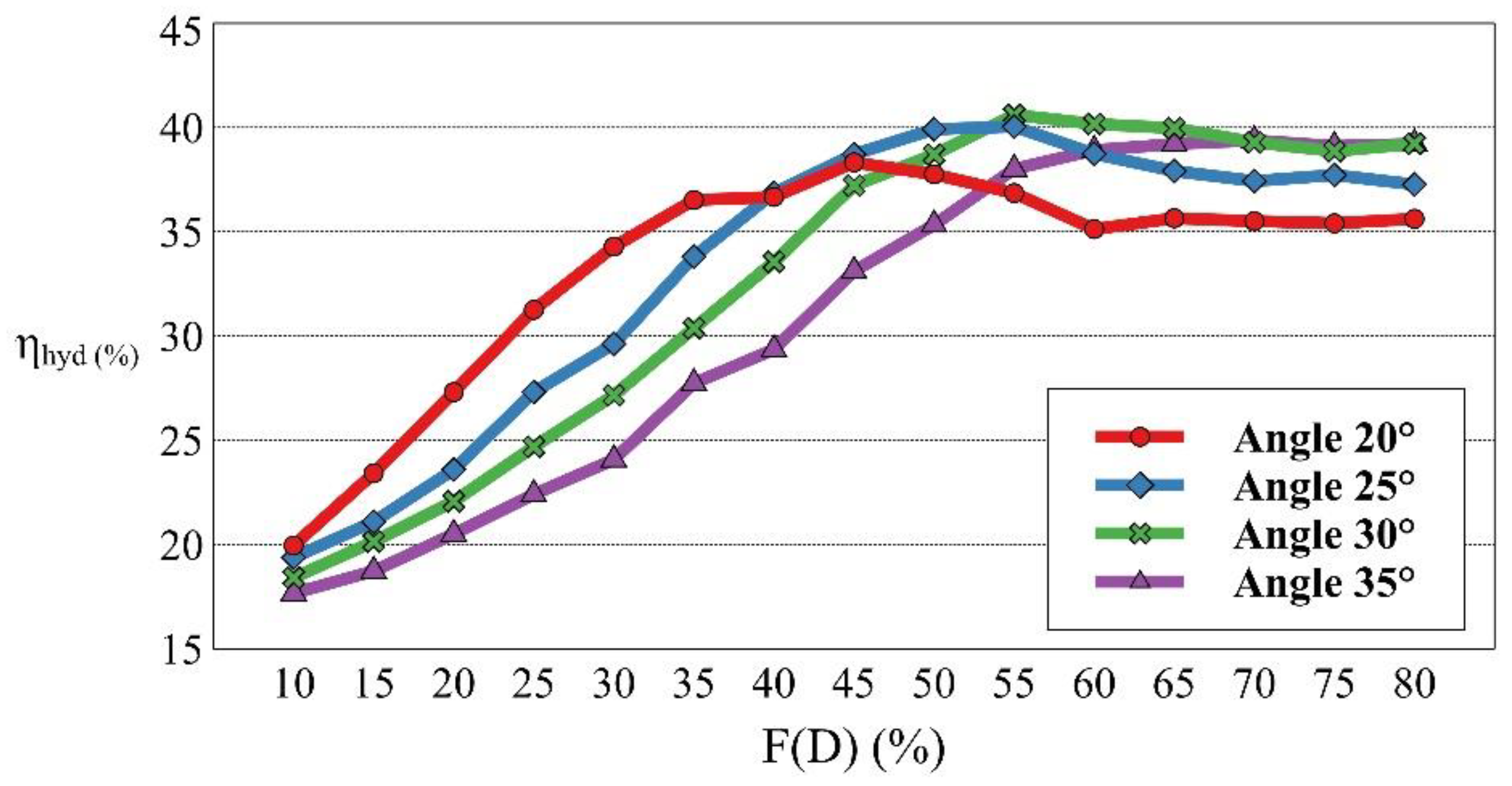
Table 4 and Figure 5 show hydraulic-efficiency results for the single-slope submerged ramp as a function of kinetic-energy cumulative depth percentage F D and slope angle. Hydraulic efficiency generally increases as F D increases, and the increase is particularly steep in the range F D = 10–35%. For example, for θ = 20 ° , efficiency increases from η h y d = 19.95 % at F D = 10 % to 34.29% at F D = 30 % , indicating that efficiency can recover substantially even within relatively shallow depth ranges.
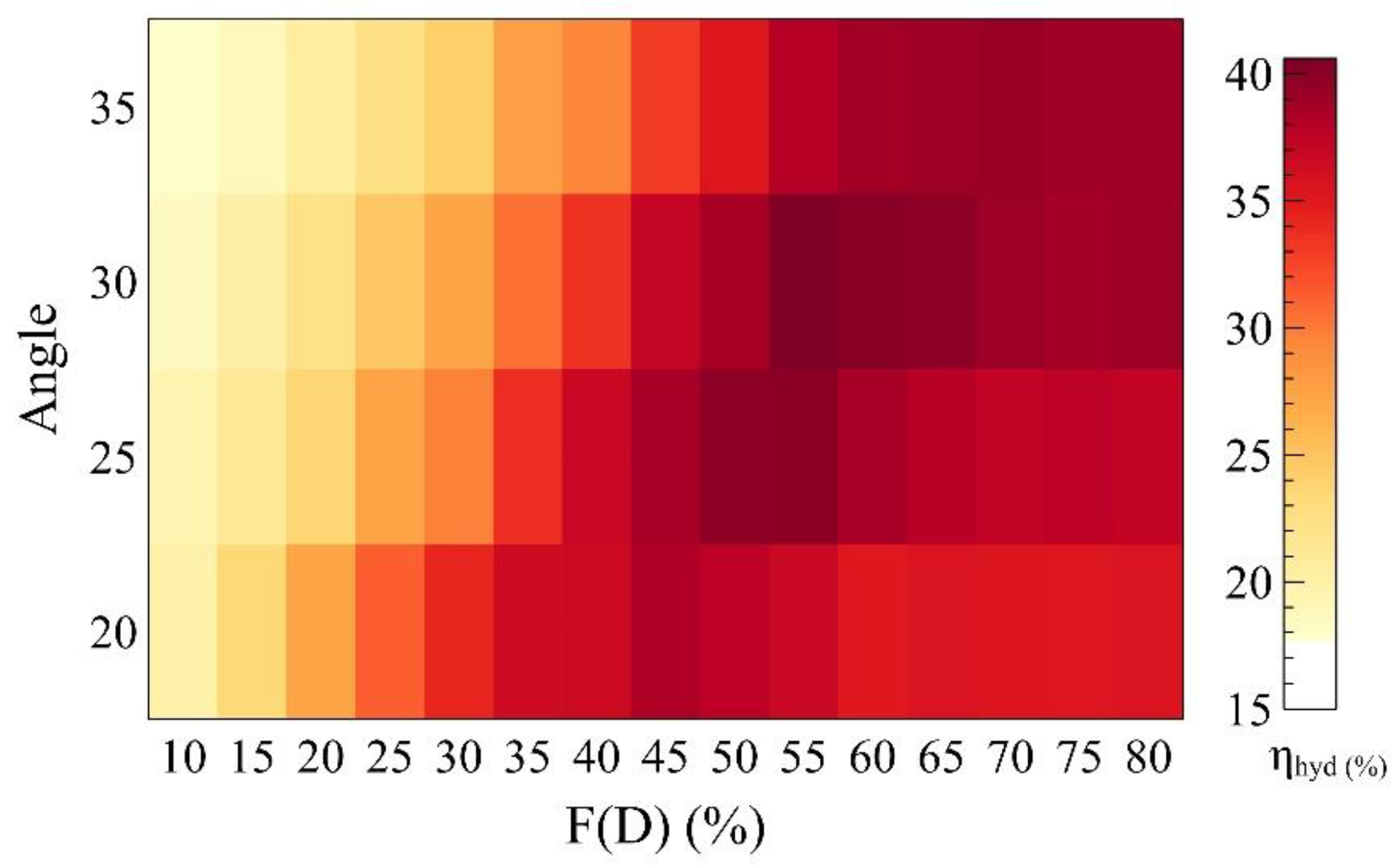
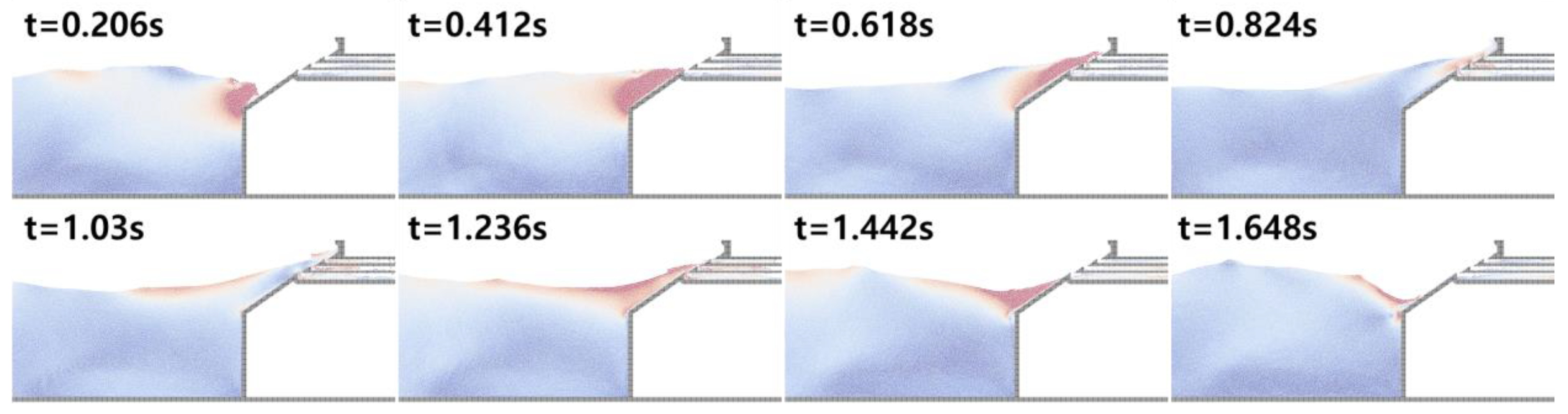
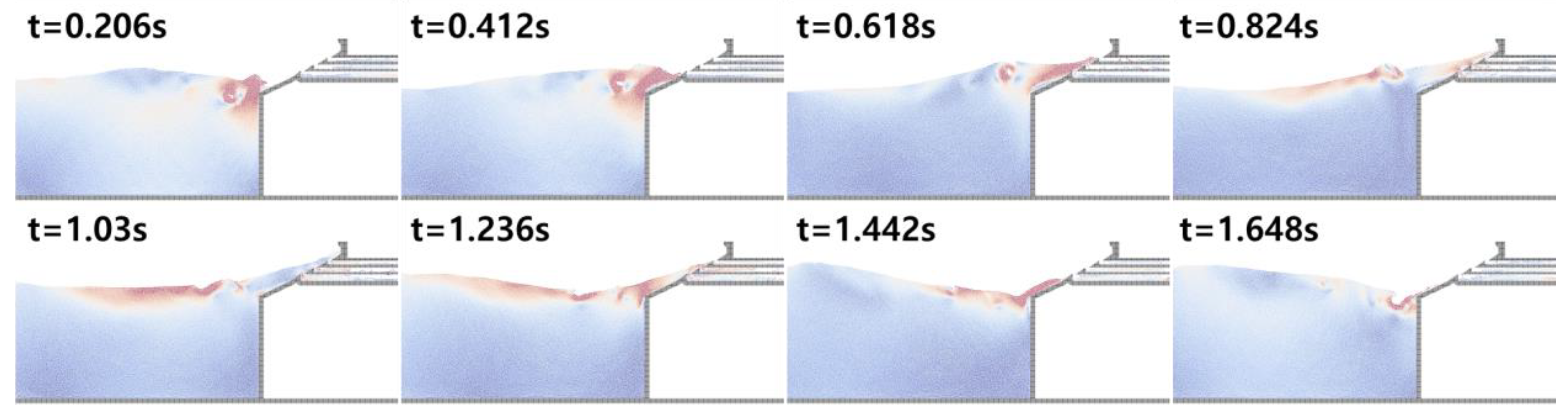
Angle-dependent dominance varies with F D . In the range F D = 10 35 % , 20 ° consistently yields the highest efficiency among all angles. However, at F D = 40 % , 25 ° (36.87%) slightly exceeds 20 ° , indicating a transition in the angle–efficiency trend. At F D = 55 % , 30 ° reaches the maximum efficiency (40.61%), showing that as the cumulative-energy depth becomes deeper, larger slope angles become advantageous over wider ranges. The heatmap in Figure 6 also shows broad high-efficiency regions around F D = 45 65 % and 25 35 ° , and efficiency tends to saturate rather than increase indefinitely with F D . This is interpreted as a diminishing-benefit characteristic: as depth increases, the additional kinetic-energy fraction included decreases, and efficiency recovery benefits from structural expansion become limited. To provide a physical interpretation of the depth- and angle-dependent efficiency trends, the time evolution of the air–water interface and velocity contours for a representative single-slope case is presented in Appendix A.2 Figure A1. The snapshots over one wave period illustrate the sequence of run-up, overtopping, and recirculation near the ramp, supporting the mechanistic explanation of the efficiency variations summarized in Table 4 and Figure 5 and Figure 6.
Based on the single-slope results, representative design depth regions for subsequent multi-angle (three-segment) designs were set to F D = 30 % ,   40 % ,   55 % .

3.2. Performance of Multi-Segment Submerged Ramps

3.2.1. Model Design

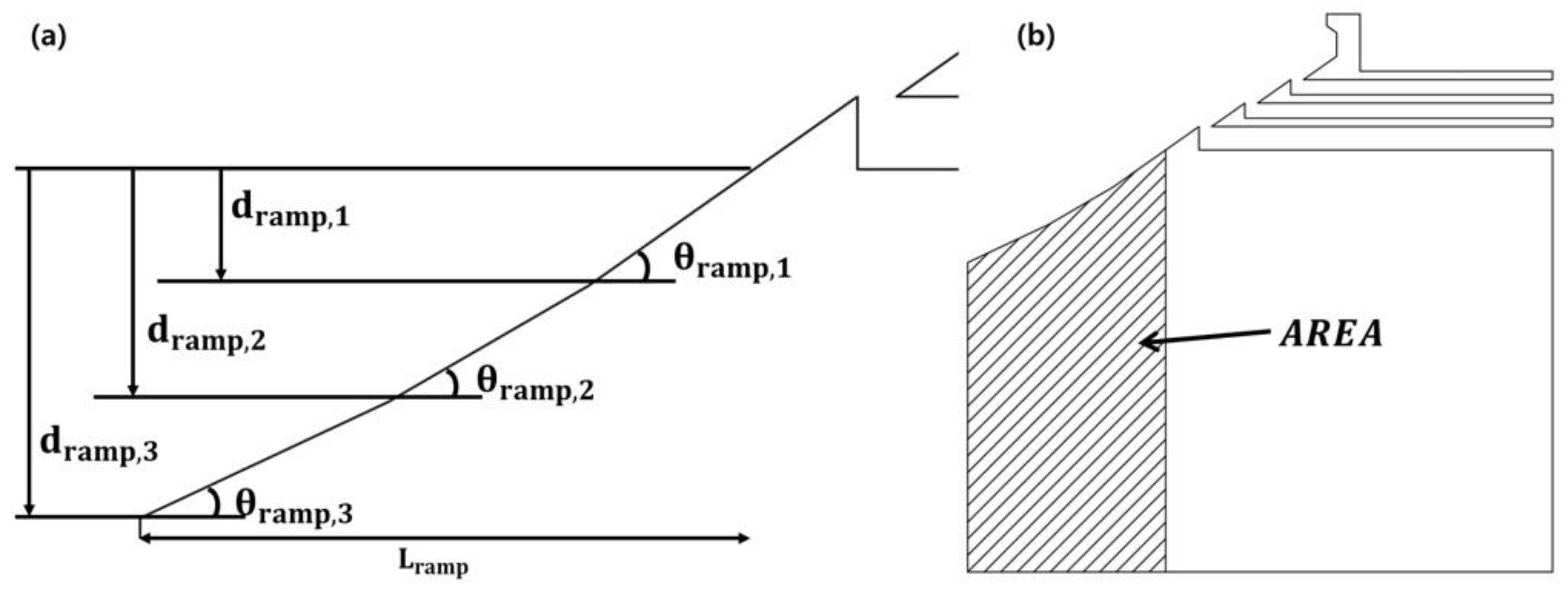
Multi-angle (three-segment) ramps were defined by dividing the submerged ramp into three segments and assigning different slopes to each segment while maintaining the same overall F D (Figure 7). Segment division depths ( d r a m p , 1 ~ d r a m p , 3 ) were fixed to represent each design depth region, and only the combination of segment slope angles ( θ r a m p , 1 ~ θ r a m p , 3 ) was varied. Based on single-slope results, three angles showing relatively good performance under the corresponding F D condition were selected, and six permutations were generated. For F D = 30% and 40%, the 20°–25°–30° set was used; for F D = 55 % , the 25°–30°–35° set was used. The geometric definitions ( d r a m p , θ r a m p , L r a m p , A R E A ) and case IDs are listed in Table 5.
The key intent of applying multi-segment geometry is to maintain the function of the upper slope that is critical for overtopping formation while reducing submerged volume and seabed contact length, thereby improving constructability and economy. Comparisons were performed using hydraulic performance as well as cost-weighted indices based on submerged area and foundation-rock length, and the cost per unit hydraulic power index.

3.2.2. Performance at F D = 30%

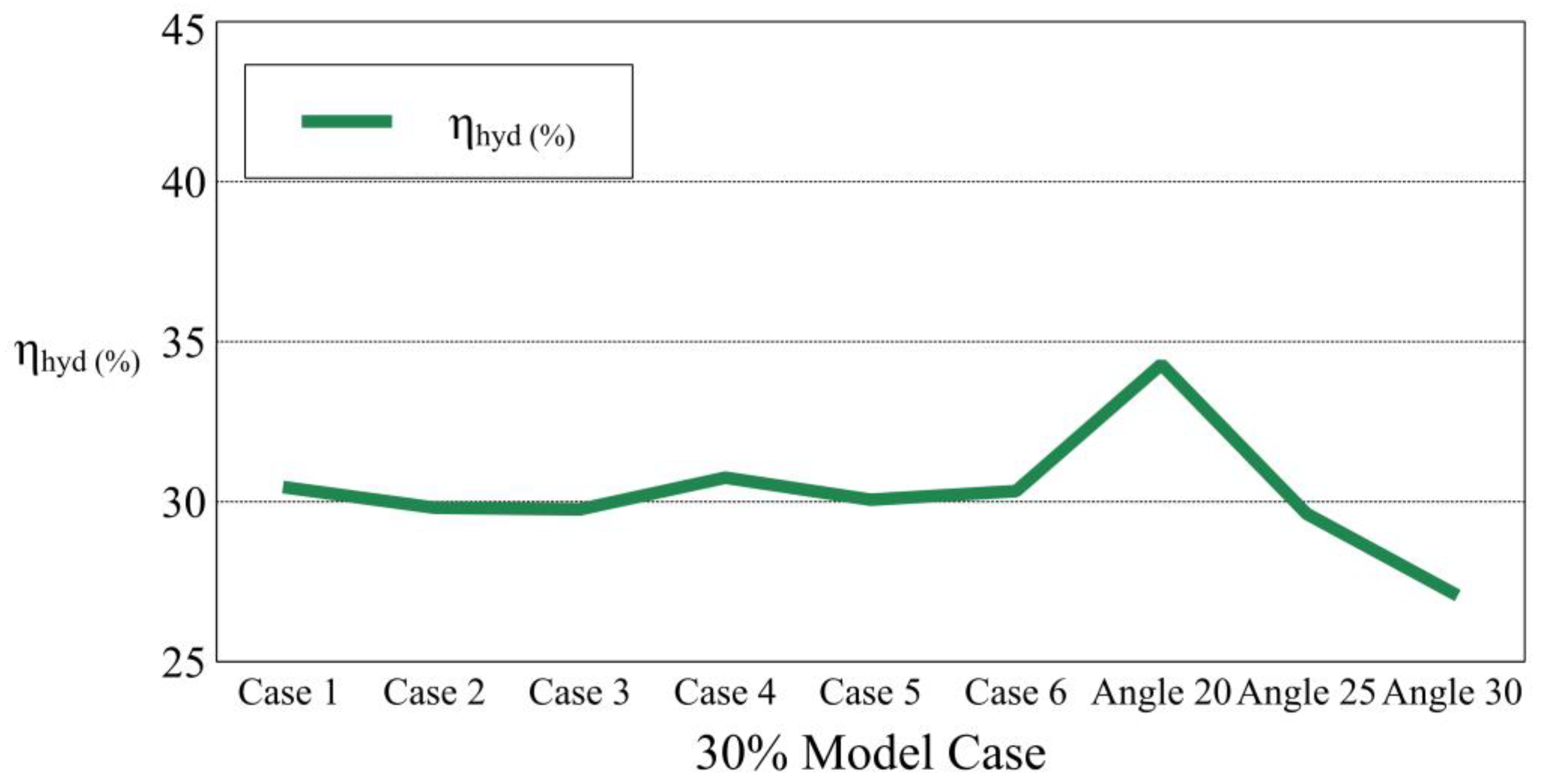
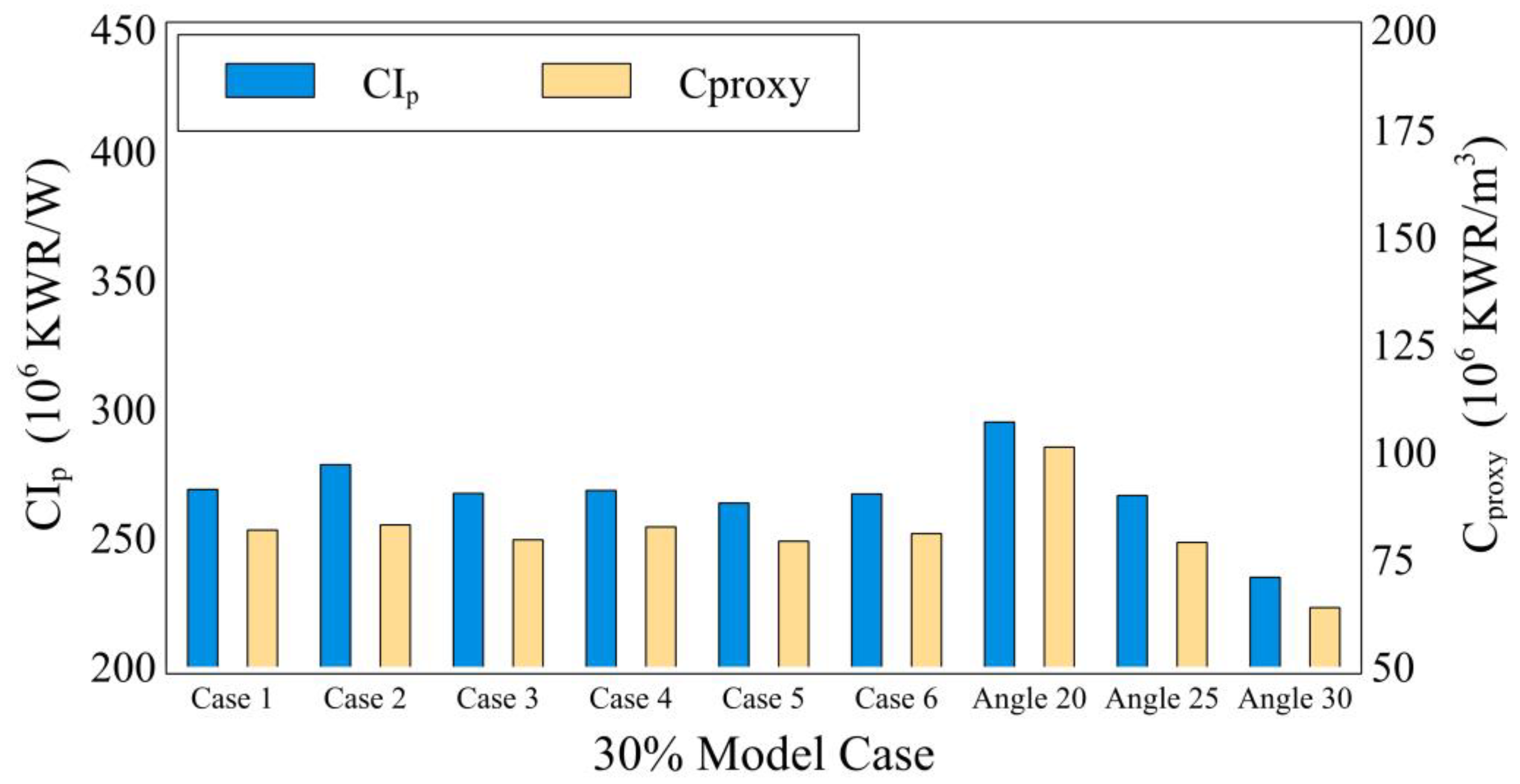
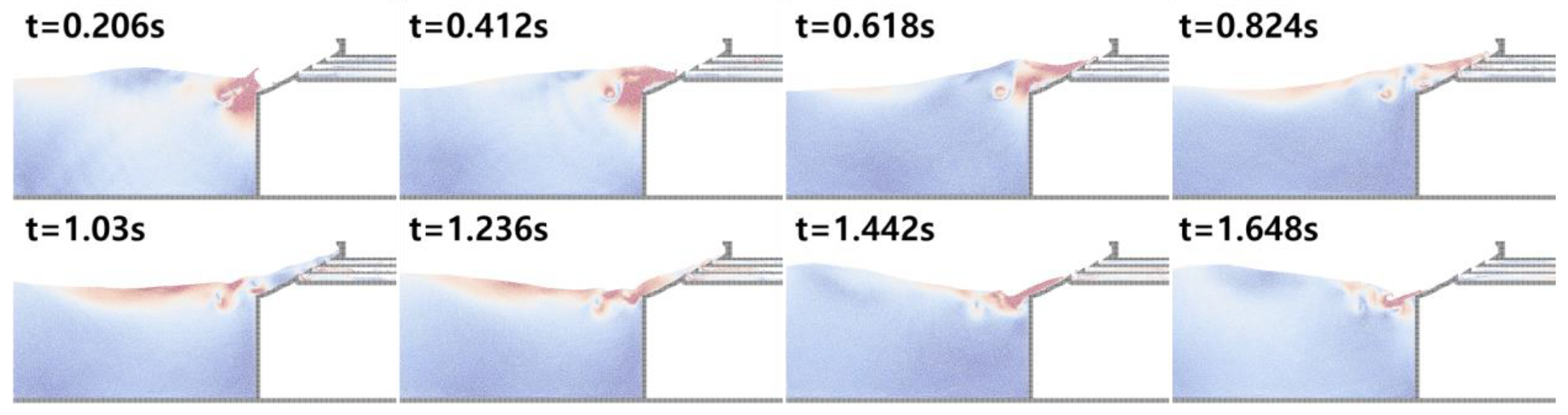
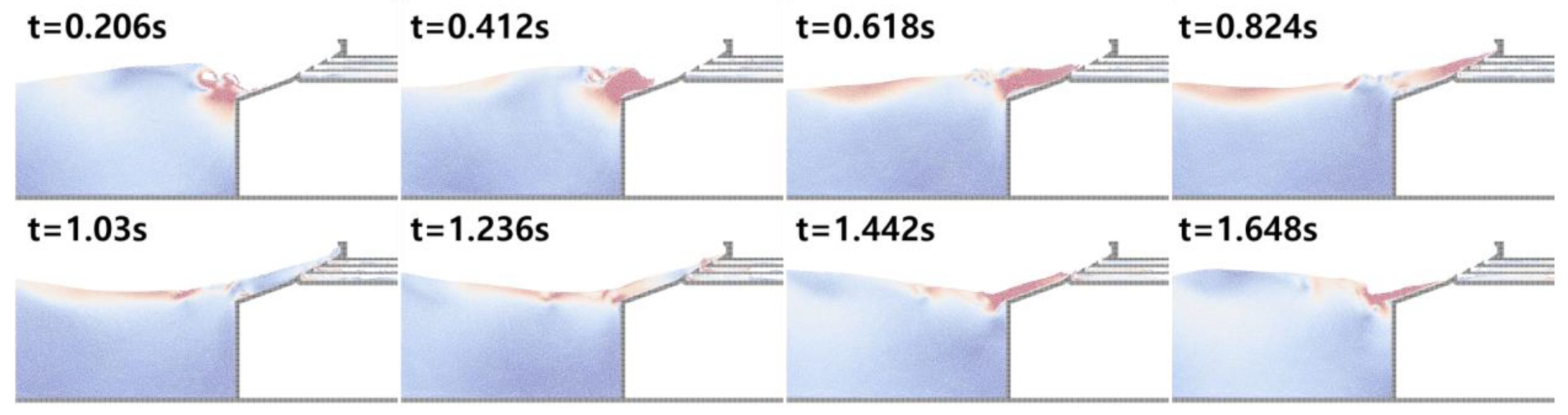
Results for the F(D) = 30% design depth region are summarized in Figure 8 and Figure 9 and Table 6, and representative time-series SPH snapshots illustrating the free-surface evolution and overtopping process are provided in Appendix A.2 (Figure A2 and Figure A3). For the six multi-segment cases, η h y d ranged from 29.76% to 30.75%, and case-to-case variation was limited to ~1 percentage point. Case 4 showed the maximum efficiency of 30.75%, indicating that the ordering of segment slopes (upper–middle–lower) can contribute to efficiency improvement to some extent even under the same F D condition.
However, among single-slope reference cases at the same F D , Angle_20 yielded 34.29%, confirming that a single-slope ramp can be more favorable for overtopping formation. Multi-segment cases exhibited ~3–4% lower efficiency than Angle_20, but they also offer potential economy improvement through reduced structural scale. In Table 6, multi-segment cases showed C p r o x y 79.19 82.99   unit :   10 6 KWR / m 3 and C I P 263.46 278.35   unit :   10 6   KRW / W . In contrast, Angle_20 had C p r o x y = 101.09 and C I P = 294.85, indicating higher cost indices, consistent with the tendency that higher efficiency is accompanied by larger submerged quantities.
From an economic perspective, Case 5 yielded the lowest C I P = 263.46, providing an advantage in cost–efficiency balance, although its efficiency (30.06%) was lower than Case 4. Therefore, under F D = 30 % , Angle_20 is dominant in maximum efficiency, but multi-segment cases can be competitive when the economy is included.

3.2.3. Performance at F D = 40%

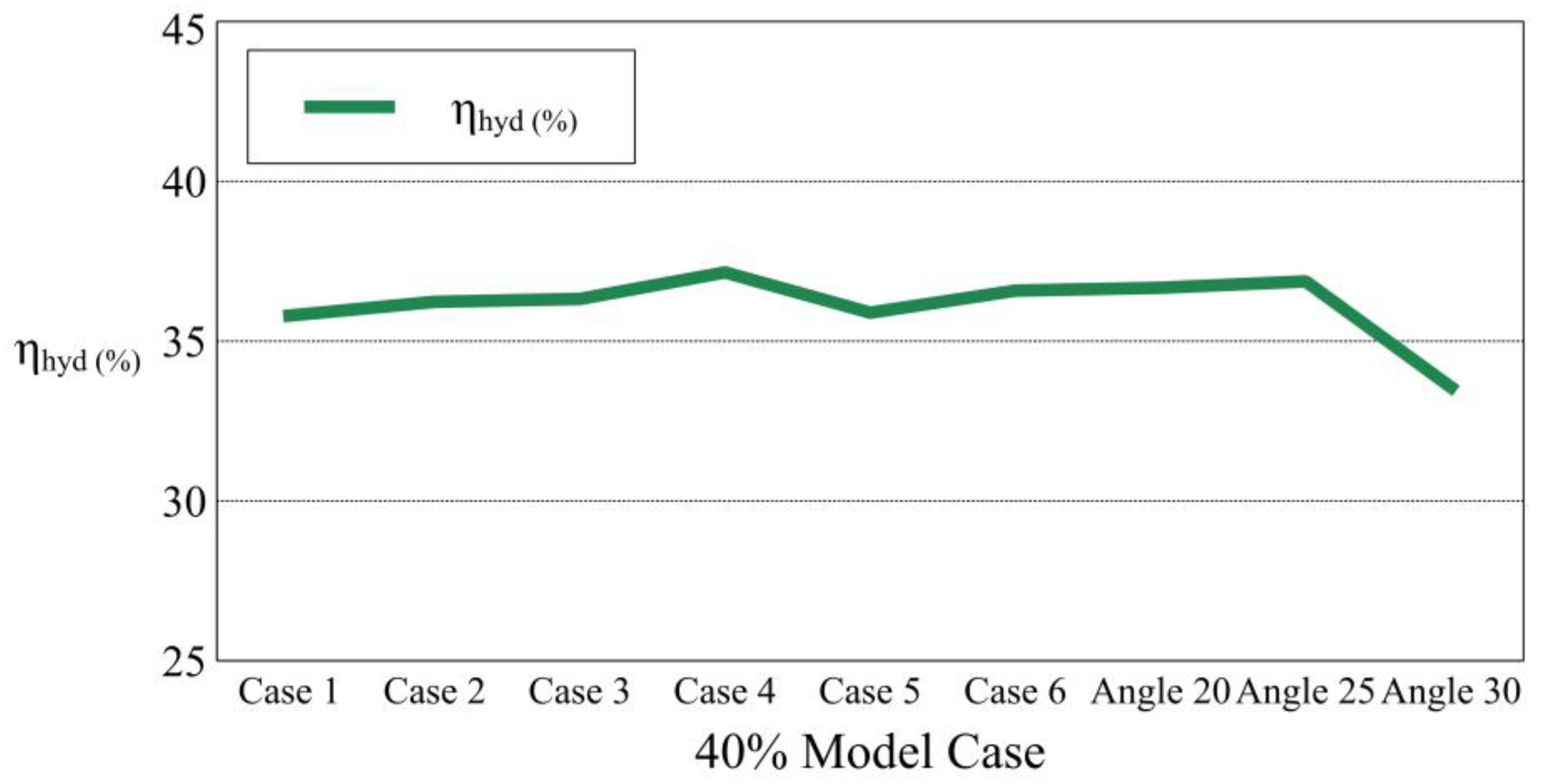
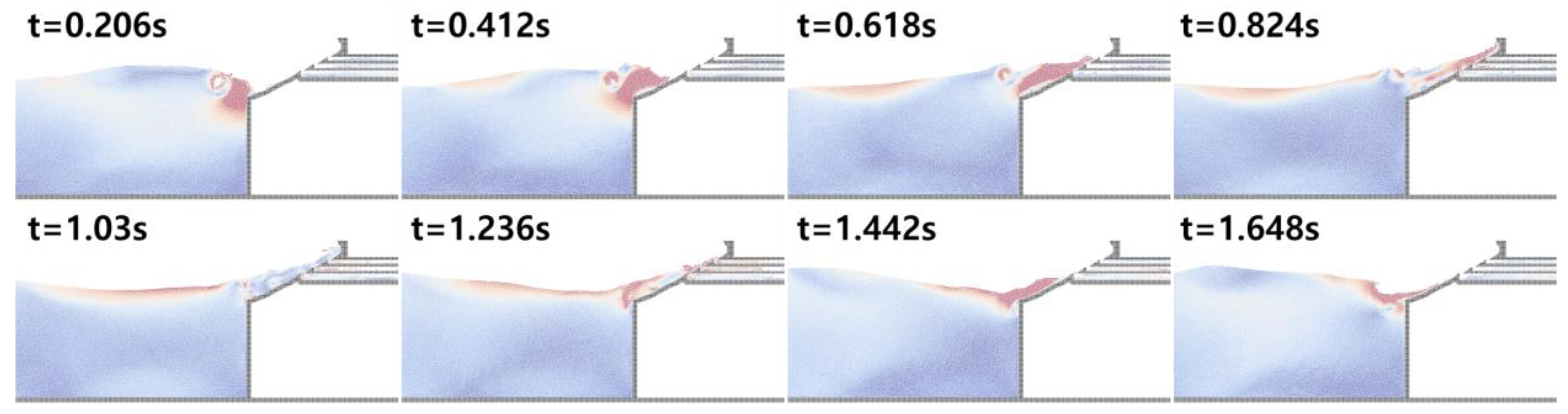
Results for F D = 40 % are summarized in Figure 10 and Figure 11 and Table 7, and representative time-series SPH snapshots illustrating the free-surface evolution and overtopping process are provided in Appendix A.2 (Figure A4 and Figure A5). Multi-segment cases showed η h y d = 35.80–37.15% with a ~1.35% p variation. Case 4 exhibited the maximum efficiency (37.15%), while Case 1 showed the minimum (35.80%), indicating that segment slope combinations influence run-up and overtopping formation even under the same depth condition.
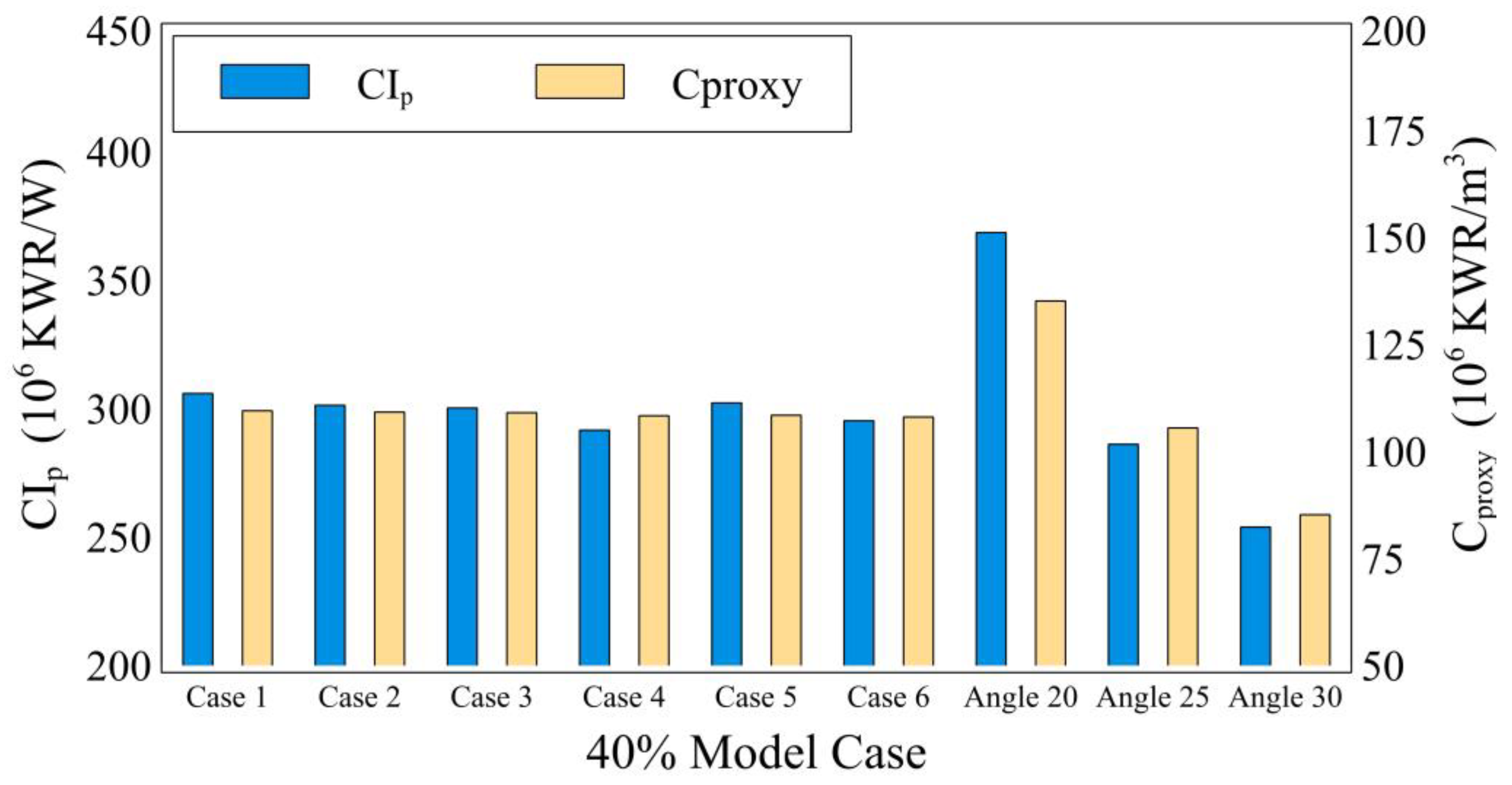
For economy indices, C p r o x y ranged from 108.03 to 109.49, showing only small differences, whereas C I P ranged from 291.59 to 305.88, producing a clearer relative ranking. In particular, Case 4 achieved both the highest efficiency (37.15%) and the lowest C I P , making it an excellent candidate from an efficiency–economy balance perspective.
Among single-slope references, Angle_25 showed high efficiency (36.87%) and good economy ( C I P = 286.11); Angle_30 had lower efficiency (33.56%) but the lowest cost index ( C I P = 253.86). In contrast, Angle_20 had relatively high efficiency (36.67%) but very highcost burden ( C p r o x y = 135.14, C I P = 368.55), indicating that maximizing efficiency alone does not guarantee rational design.
Notably, multi-segment Case 4 reduced C p r o x y and C I P to approximately 20% lower than Angle_20 while maintaining equal or higher efficiency, demonstrating the practical value of multi-segment designs under real constraints where submerged quantities strongly affect feasibility. It was also confirmed that the arrangement of segment slopes can influence AREA and L r a m p , thereby controlling cost indices. Thus, under F D = 40 % , combinations exist that simultaneously increase η h y d and decrease C I P , and Case 4 was selected as the key candidate in this study.

3.2.4. Performance at F D = 55%

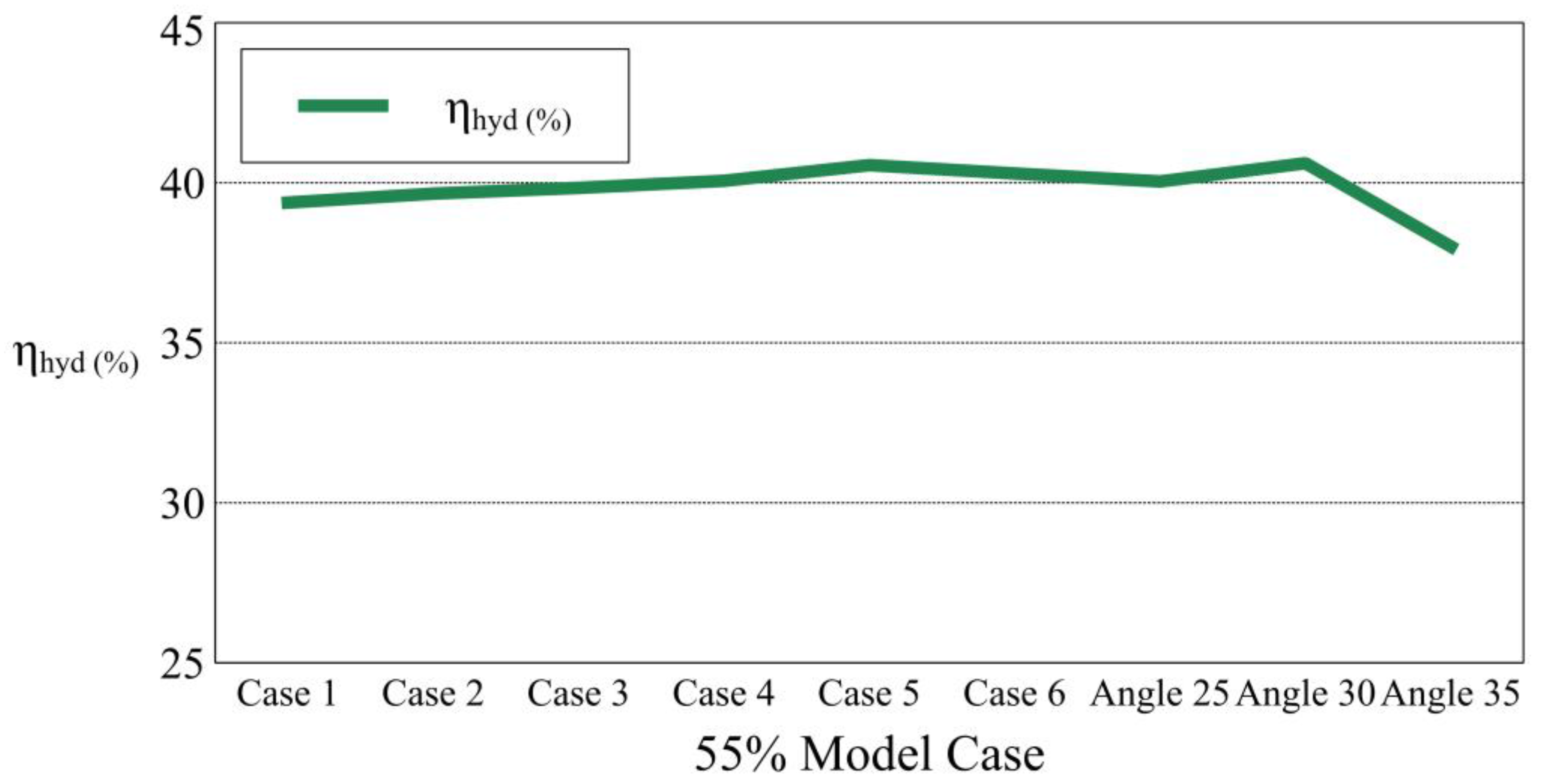
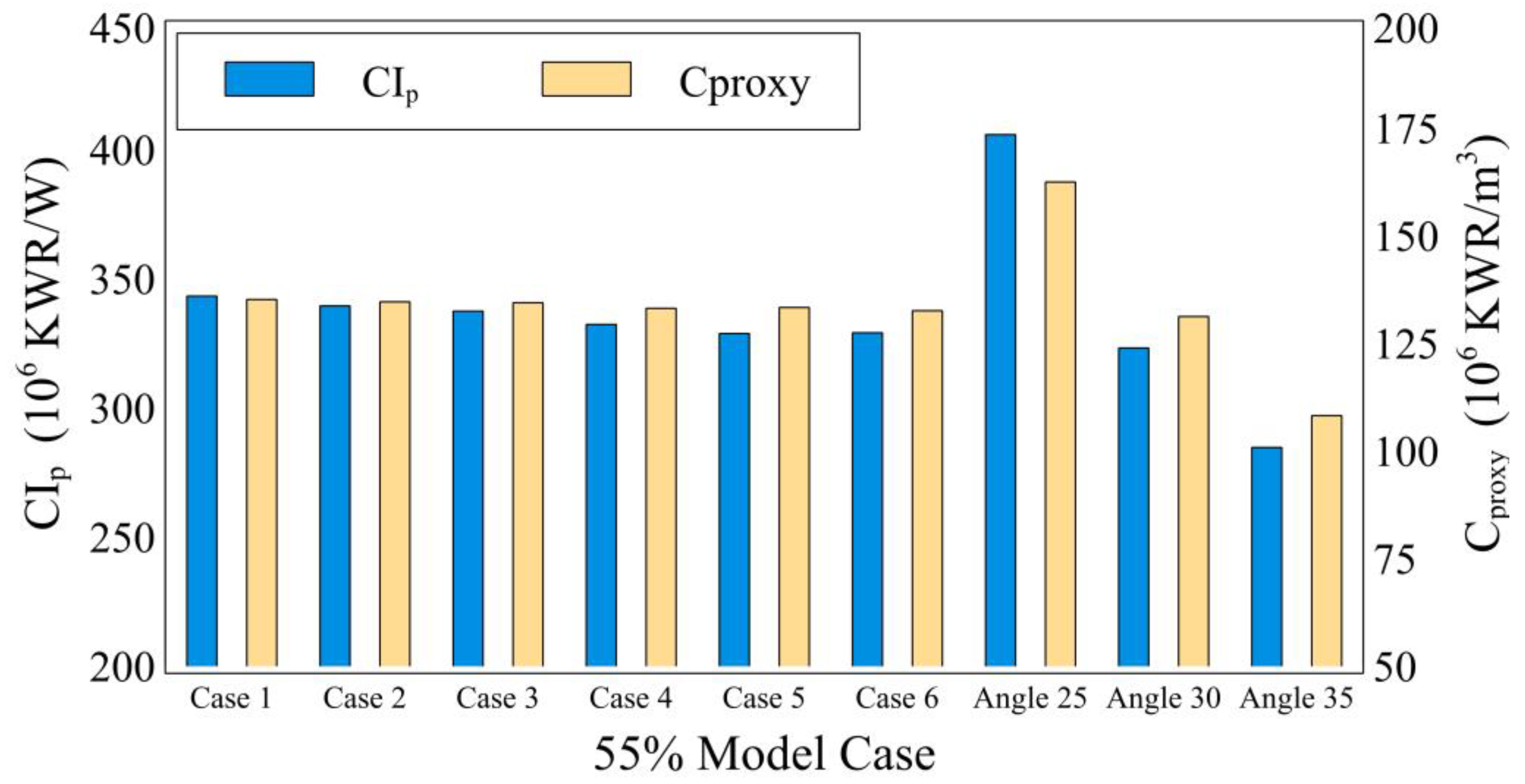
For F D = 55 % , η h y d , C p r o x y , and C I P were computed and summarized in Figure 12 and Figure 13 and Table 8, and representative time-series SPH snapshots illustrating the free-surface evolution and overtopping process are provided in Appendix A.2 (Figure A6 and Figure A7). Multi-segment cases achieved η h y d = 39.38–40.55%, indicating a generally high efficiency level around 40%. Case 5 showed the maximum efficiency (40.55%), while Case 1 showed the minimum (39.38%), with a case-to-case variation of ~1.17% p. For economy, C p r o x y = 132.59–135.20 and C I P = 328.83–343.31, confirming that both efficiency and cost indices vary simultaneously. Case 5 provided a favorable high-efficiency–low- C I P combination within the multi-segment set.
Among single-slope references, Angle_30 exhibited the highest efficiency (40.61%) and also good economy ( C I P = 323.22). Angle_35 showed low-cost indices ( C p r o x y = 108.22, C I P = 284.70) but reduced efficiency (38.01%), implying economy improvement accompanied by efficiency loss. Angle_25 achieved high efficiency (40.04%) but large cost indices ( C p r o x y = 162.50, C I P = 405.84), demonstrating that even at similar efficiency levels, increased quantities can constrain design selection.
Overall, multi-segment cases formed an alternative set that can approach the single-slope high-efficiency conditions while partially alleviating quantity burdens through slope arrangement. Therefore, at F D = 55 % , the optimal choice can vary depending on whether the design goal prioritizes maximum η h y d or minimum C I P , and this study quantitatively illustrates the selection structure through within-percent comparisons.

4. Conclusions

This study investigated a submerged-ramp design for a caisson-type overtopping wave energy converter (OWEC). Under the design-wave (representative regular-wave) condition, installation depth was quantified based on the depth-dependent cumulative kinetic-energy distribution, and both hydraulic efficiency and construction economy were evaluated for single-slope and multi-segment (three-segment) ramp geometries. Numerical simulations were performed using DualSPHysics, a WCSPH-based solver capable of reproducing strong free-surface deformation and overtopping/breaking processes. Performance metrics included hydraulic efficiency ( η h y d ), a construction-cost proxy based on construction quantities ( C p r o x y ), and the cost per unit hydraulic power index ( C I P ). For readability, economy indices were presented in units of 106 KRW, and unit-cost coefficients were interpreted as relative comparison weights rather than absolute cost predictions.
From the single-slope ramp results, the submerged geometry in an overtopping OWEC is not merely a factor determining structural scale; it effectively defines the depth range of wave kinetic energy that can be utilized under the design wave, acting as a key design variable. When installation depth is normalized using the cumulative kinetic-energy distribution, the method provides high design applicability because it can consistently identify the depth range with effective energy contribution even under different site conditions. The design-depth regions selected in this study ( F D = 30 % ,   40 % ,   55 % ) were determined based on ranges where both efficiency sensitivity and structural-scale change are prominent. In shallow ranges, even small geometry changes can significantly affect the overtopping contribution. In intermediate ranges, the angle-dependent efficiency trend shifts, implying design flexibility to reduce submerged quantities while maintaining performance. In deeper ranges, high efficiency can be achieved, but it is accompanied by increased structural scale, indicating that design suitability cannot be determined from efficiency alone.
The proposed multi-segment submerged ramp maintains the upper-slope characteristics critical for overtopping formation while reducing submerged volume and foundation quantities. Therefore, it can serve as a meaningful alternative from an efficiency–economy balance perspective when jointly considering η h y d , C p r o x y , and C I P . In the representative design-depth regions, multi-segment configurations enabled selection of optimal alternatives not solely by maximizing efficiency but by balancing efficiency and economy; specifically, under F D = 40 % , Per_40_Case 4 was identified as the best overall geometry. In summary, this study presents a design framework that directly links submerged design variables (installation depth and slope geometry) to the wave-energy distribution and supports decision-making at the early-stage geometry design of caisson-type OWECs by jointly evaluating η h y d , C p r o x y , and C I P .
Because this study is based on two-dimensional WCSPH simulations under regular-wave conditions, future work should validate performance under irregular waves and long-term wave climates and assess three-dimensional effects (lateral flow, localized turbulence, and air entrainment). In particular, a targeted sensitivity study with modest variations in wave period and height around the design condition should be conducted to assess the robustness and generality of the proposed F D -based depth-selection framework. In addition, if C p r o x y and C I P are further refined by coupling with realistic construction processes, unit-cost systems, and integrated constraints, including PTO and structural/constructability limitations, the field applicability and decision-support value of the proposed geometries are expected to improve.


Author Contributions

Conceptualization, S.-H.A. and J.-H.L.; methodology, S.-H.A.; software, S.-H.A.; validation, S.-H.A. and J.-H.L.; formal analysis, S.-H.A. and J.-H.L.; investigation, S.-H.A.; resources, S.-H.A.; data curation, S.-H.A.; writing—original draft preparation, S.-H.A. and J.-H.L.; writing—review and editing, S.-H.A., S.-Y.H., S.O., T.-K.L. and J.-H.L.; visualization, S.-H.A.; supervision, S.-Y.H., S.O., T.-K.L. and J.-H.L.; project administration, J.-H.L. All authors have read and agreed to the published version of the manuscript.

Funding

This work was supported by the National R&D Program through the National Research Foundation of Korea (NRF), funded by the Korean government (Ministry of Science and ICT) (No. 2021R1I1A3057230).

Data Availability Statement

The original contributions presented in this study are included in the article. Further inquiries can be directed to the corresponding author.
Acknowledgments

During the preparation of this manuscript, the authors used ChatGPT 5.2 Pro for data collection, research design, and software coding. The authors reviewed and edited the content generated by this tool and take full responsibility for the content of this publication.

Conflicts of Interest

The authors declare no conflicts of interest.

Appendix A

Appendix A.1. Detailed Case List for Single-Slope Submerged Ramps

Table A1 presents the case identifiers for all simulations included in the single-slope submerged-ramp parametric study, and summarizes, for each case, the ramp slope angle ( θ r a m p ) and installation depth ( d r a m p ) together with the corresponding ramp length ( L r a m p ) and submerged cross-sectional area (AREA). This table provides the geometric input values used to compute the hydraulic efficiency ( η h y d ) and the economy indices ( C p r o x y and C I P ) reported in the main text, thereby supporting traceability and reproducibility of the simulation conditions.
Table A1. Detailed single-slope ramp cases.
Case ID θ r a m p (°) d r a m p (m) L r a m p (m) A R E A (m2)
a_20_per_10200.030.08240.0729
a_20_per_150.050.13740.1203
a_20_per_200.070.19230.1666
a_20_per_250.090.24730.2118
a_20_per_300.110.30220.2557
a_20_per_350.130.35720.2983
a_20_per_400.150.41210.3392
a_20_per_450.180.49450.4006
a_20_per_500.210.57700.4592
a_20_per_550.240.65940.5144
a_20_per_600.270.74180.5658
a_20_per_650.310.85170.6330
a_20_per_700.360.98910.7130
a_20_per_750.411.12650.7828
a_20_per_800.471.29130.8577
a_25_per_10250.030.06430.0569
a_25_per_150.050.10720.0939
a_25_per_200.070.15010.1300
a_25_per_250.090.19300.1653
a_25_per_300.110.23590.1996
a_25_per_350.130.27880.2328
a_25_per_400.150.32170.2648
a_25_per_450.180.38600.3127
a_25_per_500.210.45030.3584
a_25_per_550.240.51470.4015
a_25_per_600.270.57900.4416
a_25_per_650.310.66480.4941
a_25_per_700.360.77200.5565
a_25_per_750.410.87920.6110
a_25_per_800.471.00790.6695
a_30_per_10300.030.05200.0459
a_30_per_150.050.08660.0758
a_30_per_200.070.12120.1050
a_30_per_250.090.15590.1335
a_30_per_300.110.19050.1612
a_30_per_350.130.22520.1880
a_30_per_400.150.25980.2138
a_30_per_450.180.31180.2525
a_30_per_500.210.36370.2895
a_30_per_550.240.41570.3243
a_30_per_600.270.46770.3567
a_30_per_650.310.53690.3990
a_30_per_700.360.62350.4495
a_30_per_750.410.71010.4935
a_30_per_800.470.81410.5407
a_35_per_10350.030.04280.0379
a_35_per_150.050.07140.0625
a_35_per_200.070.10000.0866
a_35_per_250.090.12850.1101
a_35_per_300.110.15710.1329
a_35_per_350.130.18570.1550
a_35_per_400.150.21420.1763
a_35_per_450.180.25710.2082
a_35_per_500.210.29990.2387
a_35_per_550.240.34280.2674
a_35_per_600.270.38560.2941
a_35_per_650.310.44270.3290
a_35_per_700.360.51410.3706
a_35_per_750.410.58550.4069
a_35_per_800.470.67120.4458

Appendix A.2. Flow-Field Snapshots for a Representative

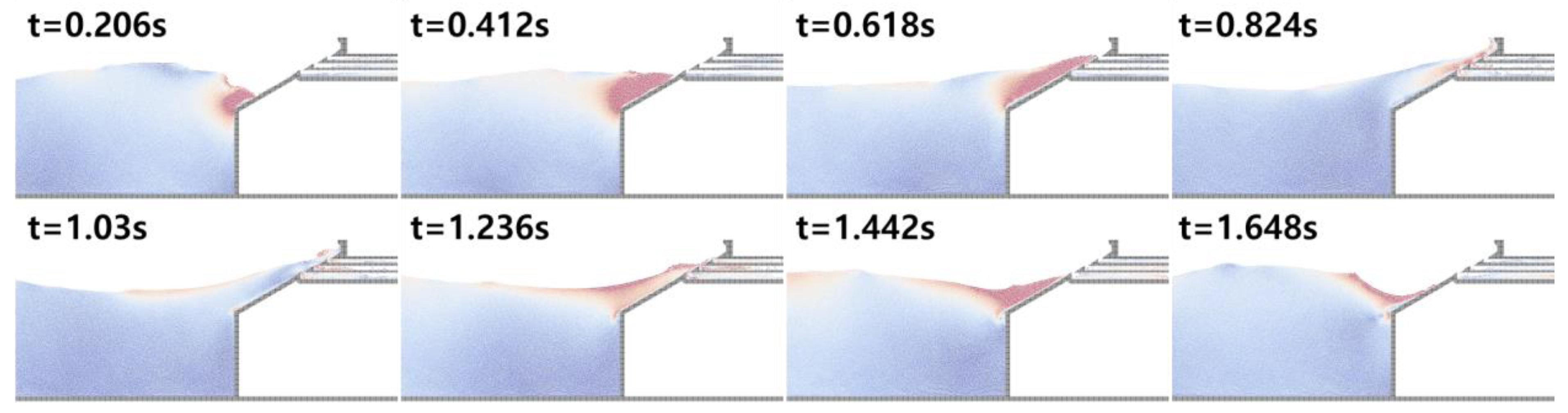
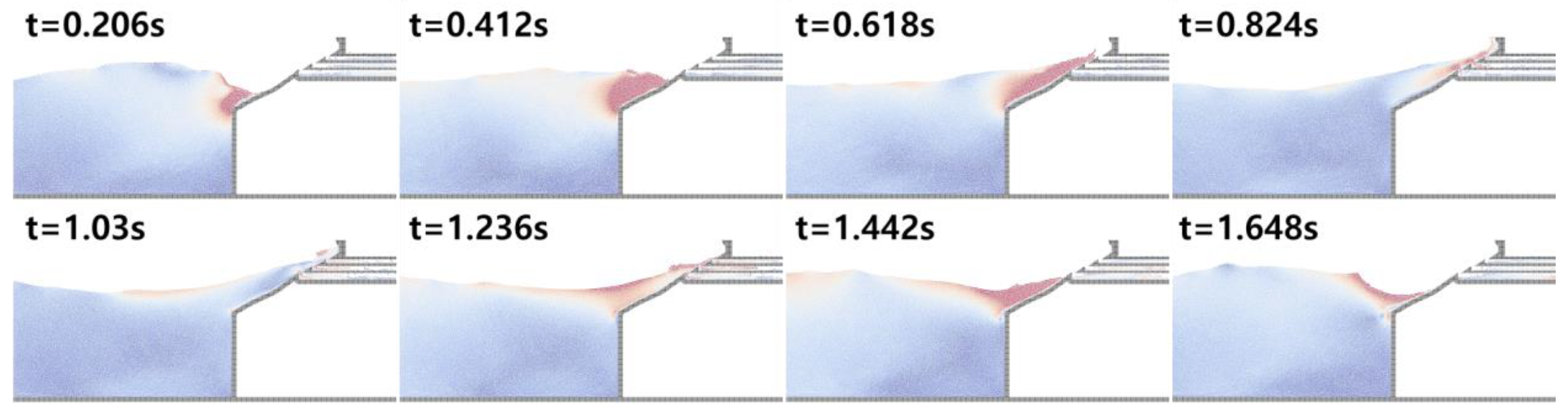
Appendix A.2 provides representative DualSPHysics (WCSPH) snapshots to visualize the time evolution of the air–water interface and velocity-magnitude contours during the overtopping process under the design regular-wave condition (Table 1). In addition to the single-slope reference case a_35_per_55 (Figure A1), three depth-region comparisons at F D = 30%, 40%, and 55% are presented by pairing single-slope angle cases (a_25_per_30, a_20_per_40, and a_30_per_55) with the selected multi-segment cases (Per_30_Case 4, Per_40_Case 4, and Per_55_Case 5) (Figure A2, Figure A3, Figure A4, Figure A5, Figure A6 and Figure A7). All figures show eight snapshots (t = nT/8 (n = 1–8)) over one model-scale wave period (T = 1.648 s).
Figure A1. Time evolution of the air–water interface and velocity-magnitude contours for the single-slope case a_35_per_55. (Snapshots are shown at t = nT/8 (n = 1–8) over one model-scale wave period (T = 1.648 s).
Energies 19 00926 g0a1
Figure A2. Time evolution of the air–water interface and velocity-magnitude contours for the single-slope case a_25_per_30. (Snapshots are shown at t = nT/8 (n = 1–8) over one model-scale wave period (T = 1.648 s).
Energies 19 00926 g0a2
Figure A3. Time evolution of the air–water interface and velocity-magnitude contours for the multi-segment case Per_30_Case 4. (Snapshots are shown at t = nT/8 (n = 1–8) over one model-scale wave period (T = 1.648 s).
Energies 19 00926 g0a3
Figure A4. Time evolution of the air–water interface and velocity-magnitude contours for the single-slope case a_20_per_40. (Snapshots are shown at t = nT/8 (n = 1–8) over one model-scale wave period (T = 1.648 s).
Energies 19 00926 g0a4
Figure A5. Time evolution of the air–water interface and velocity-magnitude contours for the multi-segment case Per_40_Case 4. (Snapshots are shown at t = nT/8 (n = 1–8) over one model-scale wave period (T = 1.648 s).
Energies 19 00926 g0a5
Figure A6. Time evolution of the air–water interface and velocity-magnitude contours for the single-slope case a_30_per_55. (Snapshots are shown at t = nT/8 (n = 1–8) over one model-scale wave period (T = 1.648 s).
Energies 19 00926 g0a6
Figure A7. Time evolution of the air–water interface and velocity-magnitude contours for the multi-segment case Per_55_Case 5. (Snapshots are shown at t = nT/8 (n = 1–8) over one model-scale wave period (T = 1.648 s).
Energies 19 00926 g0a7

References

  1. Wave Energy Technology Brief About Irena. 2014. Available online: https://www.irena.org/-/media/Files/IRENA/Agency/Publication/2014/Wave-Energy_V4_web.pdf (accessed on 14 January 2026).
  2. Lian, J.; Wang, X.; Wang, X.; Wu, D. Research on Wave Energy Converters. Energies 2024, 17, 1577. [Google Scholar] [CrossRef]
  3. Mustapa, M.A.; Yaakob, O.B.; Ahmed, Y.M.; Rheem, C.-K.; Koh, K.K.; Adnan, F.A. Wave Energy Device and Breakwater Integration: A Review. Renew. Sustain. Energy Rev. 2017, 77, 43–58. [Google Scholar] [CrossRef]
  4. Vicinanza, D.; Lauro, E.D.; Contestabile, P.; Gisonni, C.; Lara, J.L.; Losada, I.J. Review of Innovative Harbor Breakwaters for Wave-Energy Conversion. J. Waterw. Port Coast. Ocean Eng. 2019, 145, 03119001. [Google Scholar] [CrossRef]
  5. Calheiros-Cabral, T.; Rosa-Santos, P.; Taveira-Pinto, F.; Lara, J.L. Harnessing Wave Energy through Breakwater Integration: A Review of Technologies, Deployment Strategies and an Open-Access Database. Renew. Sustain. Energy Rev. 2025, 223, 115975. [Google Scholar] [CrossRef]
  6. Darma, Y.Y.E.; Rahmawati, S.; Rosyid, D.M.; Pratama, R.H.; Kusuma, A.I. Overview of Advancements in Overtopping Breakwater for Wave Energy Conversion (OBREC): Harnessing Coastal Power for Renewable Energy and Enhanced Coastal Protection. Renew. Sustain. Energy Rev. 2025, 226, 116399. [Google Scholar] [CrossRef]
  7. Lacasa, M.C.; Esteban, M.D.; López-Gutiérrez, J.S.; Negro, V.; Zang, Z. Feasibility Study of the Installation of Wave Energy Converters in Existing Breakwaters in the North of Spain. Appl. Sci. 2019, 9, 5225. [Google Scholar] [CrossRef]
  8. Moretti, G.; Malara, G.; Scialò, A.; Daniele, L.; Romolo, A.; Vertechy, R.; Fontana, M.; Arena, F. Modelling and Field Testing of a Breakwater-Integrated U-OWC Wave Energy Converter with Dielectric Elastomer Generator. Renew. Energy 2020, 146, 628–642. [Google Scholar] [CrossRef]
  9. Koutrouveli, T.I.; Di Lauro, E.; das Neves, L.; Calheiros-Cabral, T.; Rosa-Santos, P.; Taveira-Pinto, F. Proof of Concept of a Breakwater-Integrated Hybrid Wave Energy Converter Using a Composite Modelling Approach. J. Mar. Sci. Eng. 2021, 9, 226. [Google Scholar] [CrossRef]
  10. Ibarra-Berastegi, G.; Sáenz, J.; Ulazia, A.; Serras, P.; Esnaola, G.; Garcia-Soto, C. Electricity Production, Capacity Factor, and Plant Efficiency Index at the Mutriku Wave Farm (2014–2016). Ocean Eng. 2018, 147, 20–29. [Google Scholar] [CrossRef]
  11. Hall, S.; Peterson, K.; Gjestvang, K.; McGilton, B. GIS Supported Optimal Site Selection for Coastal Structure Integrated Wave Energy Converters. In Zenodo (CERN European Organization for Nuclear Research); University Marine Energy Research Community: Washington, DC, USA, 2024. [Google Scholar] [CrossRef]
  12. Cao, D.; He, J.; Chen, H. Empirical Predictions on Wave Overtopping for Overtopping Wave Energy Converters: A Systematic Review. Processes 2024, 12, 1940. [Google Scholar] [CrossRef]
  13. Iuppa, C.; Contestabile, P.; Cavallaro, L.; Foti, E.; Vicinanza, D. Hydraulic Performance of an Innovative Breakwater for Overtopping Wave Energy Conversion. Sustainability 2016, 8, 1226. [Google Scholar] [CrossRef]
  14. Iuppa, C.; Cavallaro, L.; Musumeci, R.E.; Vicinanza, D.; Foti, E. Empirical Overtopping Volume Statistics at an OBREC. Coast. Eng. 2019, 152, 103524. [Google Scholar] [CrossRef]
  15. Kralli, V.-E.; Theodossiou, N.; Karambas, T. Optimal Design of Overtopping Breakwater for Energy Conversion (OBREC) Systems Using the Harmony Search Algorithm. Front. Energy Res. 2019, 7, 80. [Google Scholar] [CrossRef]
  16. Cavallaro, L.; Iuppa, C.; Castiglione, F.; Musumeci, R.E.; Foti, E. A Simple Model to Assess the Performance of an Overtopping Wave Energy Converter Embedded in a Port Breakwater. J. Mar. Sci. Eng. 2020, 8, 858. [Google Scholar] [CrossRef]
  17. Margheritini, L.; Vicinanza, D.; Frigaard, P. SSG Wave Energy Converter: Design, Reliability and Hydraulic Performance of an Innovative Overtopping Device. Renew. Energy 2009, 34, 1371–1380. [Google Scholar] [CrossRef]
  18. Vicinanza, D.; Margheritini, L.; Kofoed, J.P.; Buccino, M. The SSG Wave Energy Converter: Performance, Status and Recent Developments. Energies 2012, 5, 193–226. [Google Scholar] [CrossRef]
  19. Contestabile, P.; Vincenzo, F.; Di Lauro, E.; Vicinanza, D. Full-Scale Prototype of an Overtopping Breakwater for Wave Energy Conversion. Coast. Eng. Proc. 2017, 1, 12. [Google Scholar] [CrossRef]
  20. Martins, J.C.; Fragassa, C.; Goulart, M.M.; dos Santos, E.D.; Isoldi, L.A.; das Neves Gomes, M.; Rocha, L.A.O. Constructal Design of an Overtopping Wave Energy Converter Incorporated in a Breakwater. J. Mar. Sci. Eng. 2022, 10, 471. [Google Scholar] [CrossRef]
  21. Paiva, M.d.S.; Mocellin, A.P.G.; Oleinik, P.H.; dos Santos, E.D.; Rocha, L.A.O.; Isoldi, L.A.; Machado, B.N. Geometrical Evaluation of an Overtopping Wave Energy Converter Device Subject to Realistic Irregular Waves and Representative Regular Waves of the Sea State That Occurred in Rio Grande—RS. Processes 2025, 13, 335. [Google Scholar] [CrossRef]
  22. Liu, Z.; Shi, H.; Cui, Y.; Kim, K. Experimental Study on Overtopping Performance of a Circular Ramp Wave Energy Converter. Renew. Energy 2016, 104, 163–176. [Google Scholar] [CrossRef]
  23. Hubner, R.G.; Fragassa, C.; Paiva, M.D.S.; Oleinik, P.H.; Gomes, M.D.N.; Rocha, L.A.; Santos, E.D.D.; Machado, B.N.; Isoldi, L.A. Numerical Analysis of an Overtopping Wave Energy Converter Subjected to the Incidence of Irregular and Regular Waves from Realistic Sea States. J. Mar. Sci. Eng. 2022, 10, 1084. [Google Scholar] [CrossRef]
  24. Cisco, L.A.; Maciel, R.P.; Oleinik, P.H.; dos Santos, E.D.; Gomes, M.N.; Rocha, L.A.O.; Isoldi, L.A.; Machado, B.N. Numerical Analysis of the Available Power in an Overtopping Wave Energy Converter Subjected to a Sea State of the Coastal Region of Tramandaí, Brazil. Fluids 2022, 7, 359. [Google Scholar] [CrossRef]
  25. Dean, R.G.; Dalrymple, R.A. Water Wave Mechanics for Engineers and Scientists; World Scientific: Singapore, 2009. [Google Scholar]
  26. Holthuijsen, L.H.; Cambridge University Press. Waves in Oceanic and Coastal Waters; Cambridge University Press: Cambridge, UK, 2015. [Google Scholar]
  27. Mei, C.C.; Stiassnie, M.A.; Yue, D.K.P. Theory and Applications of Ocean Surface Waves; World Scientific Publishing Company: Singapore, 2005. [Google Scholar]
  28. An, S.-H.; Lee, J.-H. Hydraulic Design Optimization of a Multi-Stage Overtopping Wave Energy Converter Using WCSPH Methodology under Site-Specific Wave Conditions. J. Mar. Sci. Eng. 2026, 14, 127. [Google Scholar] [CrossRef]
  29. EurOtop. Overtopping Manual. Available online: https://www.overtopping-manual.com/manual.html (accessed on 14 January 2026).
  30. Crespo, A.J.C.; Domínguez, J.M.; Rogers, B.D.; Gómez-Gesteira, M.; Longshaw, S.; Canelas, R.; Vacondio, R.; Barreiro, A.; García-Feal, O. DualSPHysics: Open-Source Parallel CFD Solver Based on Smoothed Particle Hydrodynamics (SPH). Comput. Phys. Commun. 2015, 187, 204–216. [Google Scholar] [CrossRef]
  31. Altomare, C.; Tagliafierro, B.; Dominguez, J.M.; Suzuki, T.; Viccione, G. Improved relaxation zone method in SPH-based model for coastal engineering applications. Appl. Ocean. Res. 2018, 81, 15–33. [Google Scholar] [CrossRef]
  32. Verbrugghe, T.; Domínguez, J.M.; Altomare, C.; Tafuni, A.; Vacondio, R.; Troch, P.; Kortenhaus, A. Non-linear wave generation and absorption using open boundaries within DualSPHysics. Comput. Phys. Commun. 2019, 240, 46–59. [Google Scholar] [CrossRef]
  33. Kofoed, J.P.; Frigaard, P.; Friis-Madsen, E.; Sørensen, H.C. Prototype Testing of the Wave Energy Converter Wave Dragon. Renew. Energy 2006, 31, 181–189. [Google Scholar] [CrossRef]
  34. Ministry of Oceans and Fisheries (MOF). Ministry of Oceans and Fisheries. Official Korean Website. Available online: https://www.mof.go.kr/doc/ko/selectDoc.do?docSeq=64273&listUpdtDt=2025-07-14++10%3A00&menuSeq=375&bbsSeq=9 (accessed on 14 January 2026).
Figure 1. Cumulative distribution of wave-induced kinetic energy with depth.
Energies 19 00926 g001
Figure 2. OWEC geometry and definition of geometric parameters [28].
Energies 19 00926 g002
Figure 3. Schematic of single-slope ramp configurations.
Energies 19 00926 g003
Figure 4. Numerical wave tank configuration [28].
Energies 19 00926 g004
Figure 5. Hydraulic efficiency of single-slope ramp cases as a function of F D .
Energies 19 00926 g005
Figure 6. Heatmap of hydraulic efficiency over slope angle and F D .
Energies 19 00926 g006
Figure 7. Definition of the multi-segment ramp geometry, where (a) represents the ramp angle, segment division depth, and ramp length, and (b) represents the submerged area of the ramp.
Energies 19 00926 g007
Figure 8. Hydraulic efficiency for F D = 30 % cases.
Energies 19 00926 g008
Figure 9. Cost proxy and cost-efficiency index for F D = 30 % cases.
Energies 19 00926 g009
Figure 10. Hydraulic efficiency for F D = 40 % cases.
Energies 19 00926 g010
Figure 11. Cost proxy and cost-efficiency index for F D = 40 % cases.
Energies 19 00926 g011
Figure 12. Hydraulic efficiency for F D = 55 % cases.
Energies 19 00926 g012
Figure 13. Cost proxy and cost-efficiency index for F D = 55 % cases.
Energies 19 00926 g013
Table 1. Wave conditions used in the study [19].
T p (s) H (m) d (m)
Prototype7.372.818
Scaled (1/20)1.6480.140.9
Table 2. Water depth corresponding to the cumulative kinetic-energy ratio F D .
F (D) (%) D p r o t o t y p e (m) D s c a l e d (m) D /d
00.00000.000.0000
50.31030.020.0172
100.63710.030.0354
150.98240.050.0546
201.34820.070.0749
251.73730.090.0965
302.15280.110.1196
352.59830.130.1443
403.07860.150.1710
453.59940.180.2000
504.16810.210.2316
554.79410.240.2663
605.48990.270.3050
656.27240.310.3485
707.16510.360.3981
758.20160.410.4556
809.43170.470.5240
8510.93030.550.6072
9012.80630.640.7115
9515.17820.760.8432
10018.00000.901.0000
Table 3. Key dimensions of the OWEC model [28].
SymbolPrototypeScaled (1/20)Description
L r a m p (m)15.680.784Horizontal length of the submerged ramp
d r a m p (m)4.00.2Depth of the submerged ramp
θ r a m p (°)3535Slope angle of the submerged ramp
L s l o p (m)1.420.071Horizontal length of the upper slope
θ s l o p (°)3535Slope angle of the upper slope
w (m)0.540.027Slot horizontal length
R c (m)5.800.29Crest freeboard
R r , 1 (m)1.00.05Elevation of reservoir 1
R r , 2 (m)2.00.1Elevation of reservoir 2
R r , 3 (m)3.00.15Elevation of reservoir 3
Table 4. Hydraulic efficiency for single-slope submerged ramps as a function of slope angle and cumulative kinetic-energy ratio F D .
F (D) (%)Angle = 20°Angle = 25°Angle = 30°Angle = 35°
1019.95%19.37%18.40%17.66%
1523.42%21.09%20.14%18.73%
2027.31%23.59%22.07%20.50%
2531.25%27.31%24.69%22.40%
3034.29%29.62%27.16%24.07%
3536.52%33.81%30.37%27.73%
4036.67%36.87%33.56%29.35%
4538.32%38.72%37.21%33.11%
5037.75%39.92%38.70%35.34%
5536.85%40.04%40.61%38.01%
6035.12%38.74%40.17%38.91%
6535.65%37.91%39.97%39.21%
7035.51%37.43%39.29%39.39%
7535.40%37.72%38.86%39.10%
8035.62%37.27%39.22%39.21%
Table 5. Geometry of multi-segment ramp cases.
CaseID F (D) d r a m p , 1 d r a m p , 2 d r a m p , 3 θ r a m p , 1 θ r a m p , 2 θ r a m p , 3 L r a m p A R E A
Per_30_Case 1300.040.070.112025300.2440.207
Per_30_Case 22030250.2480.210
Per_30_Case 32520300.2370.201
Per_30_Case 42530200.2480.208
Per_30_Case 53020250.2370.200
Per_30_Case 63025200.2440.204
Per_40_Case 1400.050.10.152025300.3310.276
Per_40_Case 22030250.3310.275
Per_40_Case 32520300.3310.274
Per_40_Case 42530200.3310.272
Per_40_Case 53020250.3310.272
Per_40_Case 63025200.3310.271
Per_55_Case 1550.080.160.242530350.4240.335
Per_55_Case 22535300.4240.333
Per_55_Case 33025350.4240.333
Per_55_Case 43035250.4240.328
Per_55_Case 53525300.4240.329
Per_55_Case 63530250.4240.326
Table 6. Performance metrics for F D = 30 % cases.
Case η h y d c r c A R a m p c r o c k k s e c L R a m p C p r o x y C I P
Case 130.43%58.8622.9281.78268.73
Case 229.81%59.6823.3182.99278.35
Case 329.76%57.1722.3579.52267.21
Case 430.75%59.2023.3182.51268.33
Case 530.06%56.8422.3579.19263.46
Case 630.33%58.0522.9280.97266.98
Angle_2034.29%72.6528.45101.09294.85
Angle_2529.62%56.7022.2078.91266.36
Angle_3027.16%45.8017.9363.73234.65
Table 7. Performance metrics for F D = 40 % cases.
Case η h y d c r c A R a m p c r o c k k s e c L R a m p C p r o x y C I P
Case 135.80%78.3231.17109.49305.88
Case 236.23%78.0031.17109.18301.3
Case 336.32%77.8731.17109.04300.23
Case 437.15%77.1531.17108.32291.59
Case 535.89%77.2831.17108.45302.21
Case 636.58%76.8531.17108.03295.28
Angle_2036.67%96.3538.79135.14368.55
Angle_2536.87%75.2130.28105.48286.11
Angle_3033.56%60.7424.4585.2253.86
Table 8. Performance metrics for F D = 55 % cases.
Case η h y d c r c A R a m p c r o c k k s e c L R a m p C p r o x y C I P
Case 139.38%95.2639.94135.2343.31
Case 239.66%94.7039.94134.65339.52
Case 339.84%94.5139.94134.45337.49
Case 440.06%93.2039.94133.15332.34
Case 540.55%93.4039.94133.34328.83
Case 640.29%92.6539.94132.59329.11
Angle_2040.04%114.0648.44162.5405.84
Angle_2540.61%92.1239.12131.24323.22
Angle_3038.01%75.9632.26108.22284.7
Disclaimer/Publisher’s Note: The statements, opinions and data contained in all publications are solely those of the individual author(s) and contributor(s) and not of MDPI and/or the editor(s). MDPI and/or the editor(s) disclaim responsibility for any injury to people or property resulting from any ideas, methods, instructions or products referred to in the content.