1. Introduction
In response to climate crises, the international community has been accelerating efforts to decrease carbon emissions by increasing the proportion of renewable energy sources. Wind power has played a major role in these efforts [
1]. Over the past few decades, wind energy has attracted increasing attention as a sustainable energy source, and its use has continuously grown worldwide, driven by technological maturity and improved cost-effectiveness [
2]. According to Ashraf et al. [
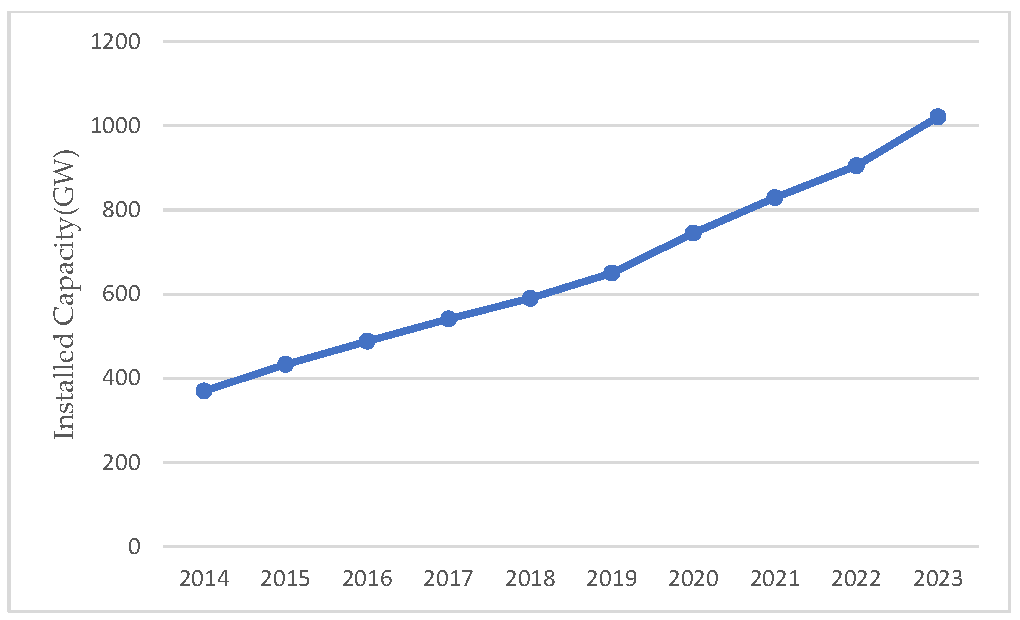
3], the cumulative installed capacity of the global wind industry exceeded 1 TW by 2023, with onshore wind power accounting for most of the total installed capacity.
Figure 1 presents growth of global cumulative installed wind power capacity [
3].
To increase wind power generation, a large number of turbines should be installed, mostly in limited areas, to form wind farms. Location is an important factor affecting the success of wind power generation. Unfortunately, many countries, including South Korea, face difficulties because of limited land area; for instance, approximately two-thirds of the land area in Korea is complex mountainous terrain. Further attention should be paid to the installation of wind farms under different conditions.
In the context of multiple turbines installed densely, wake effects occur because of turbine-to-turbine interactions, which reduce the total energy production of the farm [
4]. When an upstream turbine intercepts wind, the wind speed reaching the turbines behind it decreases with the generation of turbulence, which, in turn, decreases their performance. This is referred to as the wake effect. In practice, wake interactions are among the main causes of power loss in wind farms and must be carefully considered for efficient operation [
5].
To minimize such wake losses, attention should be paid to determining the most suitable locations for wind turbines instead of improving the turbines themselves. Decision-making for wind turbine positioning is, thus, important for increasing the total energy production of wind farms and decreasing generation costs [
6,
7]. Extensive research has been conducted to optimize wind turbine layouts. Establishing an optimal layout for mitigating wake effects is critical in the planning and design stages of wind farms [
8].
This paper presents a case study of wind power generation on complex mountainous terrain in Yeongdeok, Korea, where the hub heights of wind turbines can be varied to minimize wake loss and maximize power generation. In this case study, we examined how various combinations of turbine heights were influenced by wake effects under actual local wind conditions and topography and sought optimal layout strategies for efficient power generation. Several previous studies have already explored wind farm layouts with mixed or multiple hub heights and have shown that vertical staggering can reduce wake interference and improve energy yield or land-use efficiency. However, most of these works have been conducted on idealized flat terrain or simplified virtual sites, often relying on research-oriented codes and idealized inflow conditions. As a result, the applicability of mixed hub-height strategies to real complex mountainous wind farms, based on long-term measured data and industry-standard design tools, remains insufficiently validated. In this context, this study applies mixed hub-height strategies to an actual onshore wind farm site in Yeongdeok, South Korea, characterized by steep and highly complex terrain. By combining long-term corrected wind data, WAsP flow modeling, and the commercial WindPRO platform, we systematically compared single- and mixed-hub-height layouts under different site-area scenarios. The turbine layout strategies derived through this approach provide actionable insights that extend beyond purely theoretical models and can be directly applied to real-world projects. In particular, this study demonstrates under which conditions mixed layouts using different hub heights can effectively reduce wake losses while maintaining comparable energy production in mountainous terrains, thereby offering practical guidelines for the design of onshore wind farms in regions like Korea.
2. Literature Review
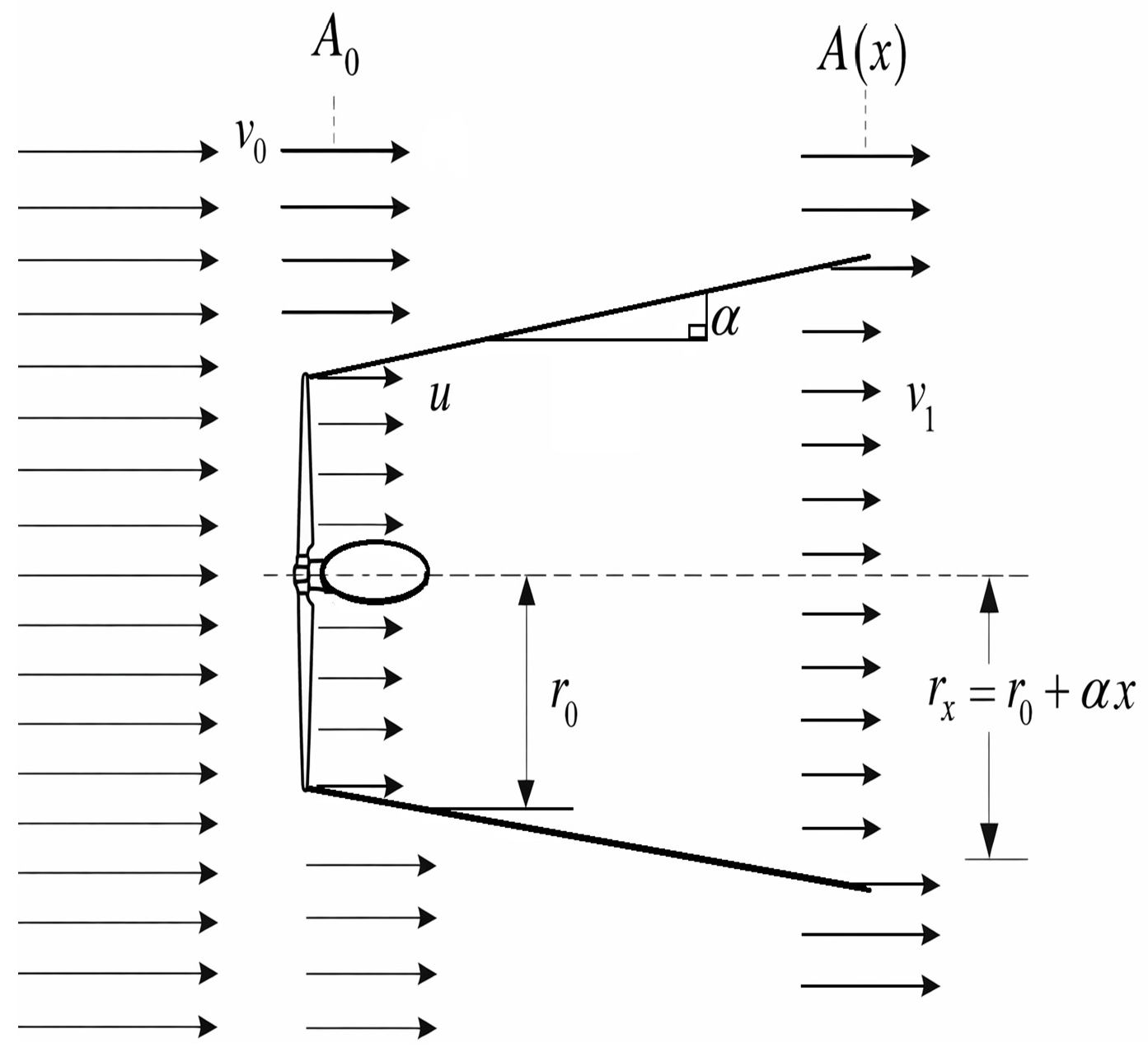
The wake generated by a wind turbine reduces the inflowing wind speed to downstream turbines, significantly affecting power generation. Various wake models have been developed to predict these effects. The Jensen wake model is the most representative, which assumes that the velocity deficit in the wake cross-section is uniform with a top-hat profile [
9]. Later, Katic extended this model to develop the Park–Wake model for the theoretical estimation of wind farm outputs [
10]. In this model, constant velocity loss occurs inside the wake, whereas outside the wake, the loss is zero, and the width is predicted to expand linearly.
In recent years, more advanced wake models have been proposed to better represent the near-wake structure and turbulence, particularly under conditions relevant for large wind farms. Several studies have shown that the near-wake region can exhibit a double-Gaussian velocity deficit profile, and corresponding double-Gaussian wake models have been developed and applied to wind farm layout optimization. Hu et al. [
11] proposed a double-Gaussian yawed wake model and validated it against both CFD simulations and wind tunnel measurements for single and multiple yawed turbines. Compared with several existing yawed wake models, the double-Gaussian formulation in Hu et al. [
11] significantly reduced RMSE and MAE in wake prediction and highlighted the importance of wake superposition methods for multi-turbine arrays. Furthermore, Hu et al. [
12] combined CFD-based flow modeling in complex terrain with an improved genetic algorithm and particle swarm optimization (IGA-PSO) framework, explicitly considering different wake and cost models to enhance wind farm layout optimization performance.
These developments indicate that advanced wake formulations and high-fidelity flow simulations can provide more accurate predictions of wake behavior and improve the robustness of layout optimization compared with classical engineering models such as the Jensen (PARK) model. In the present study, however, we employ the widely used Jensen model as implemented in the commercial WindPRO software, with a focus on demonstrating the relative impact of mixed hub-height layouts in complex mountainous terrain. Incorporating double-Gaussian or other high-fidelity wake models, potentially coupled with more advanced optimization frameworks, into the design of mixed hub-height wind farms in complex terrain is left as an important topic for future research.
Wind-farm layout optimization (WFLO) is a complex problem that aims to minimize wake losses and maximize power generation profits. Global optimization methods are widely used to solve this problem. Among them, the genetic algorithm (GA) is one of the most representative. Mosetti et al. [
13] conducted a pioneering study that optimized the positions of wind turbines using the GA and Jensen models. Since then, several studies have reported performance improvements by optimization with GA to decrease the levelized cost of electricity (LCOE) or increase the amount of power generated by wind farms [
13]. Recently, PSO has been widely used for complex layout problems owing to its high computational efficiency and rapid convergence. Yeghikian et al. [
14] utilized PSO to determine the optimal layouts for wind farms in Iran and analyzed the wake effects. In addition, the random search algorithm was introduced to explore the solution space more broadly, thereby overcoming the local optimum limitations of traditional methods. Feng and Shen [
7] employed a random search to solve large-scale layout problems and achieved maximum power generation. Furthermore, various optimization algorithms, such as Monte Carlo simulations and evolution strategies, have been applied to designing wind farm layouts. Recent studies have also investigated hybrid algorithms and progressive optimization methodologies that combine the strengths of different approaches.
Table 1 summarizes representative studies on wind farm layout optimization.
Deploying turbines with different hub heights within the same wind farm is attracting growing interest as a strategy to reduce wake loss.
Some studies have demonstrated that mixed heights can reduce wake interference and improve land-use efficiency in virtual flat terrains or simplified topographies. For example, Chen et al. [
28] introduced two hub heights to a small-scale wind farm optimization study using the GA. By fixing the wind speed and direction over a limited 2 × 2 km site, they compared single- and mixed-height layouts. They found that combining turbines of different heights improved both the energy yield and revenue compared with uniform height configurations [
28]. This was the first case to demonstrate the feasibility of designing a wind farm using height difference. However, their study was based on a small virtual wind farm with fixed wind speed and direction over a 2 × 2 km flat site and did not consider complex terrain effects or long-term measured wind conditions. Stanley et al. (2019) applied the FLORIS Gaussian wake model and different analytical optimization techniques to optimize layouts involving two hub height combinations [
29]. Their results demonstrated that, when the shear exponent of the wind speed was low, employing two different hub heights significantly reduced the LCOE compared with single-height layouts. This demonstrates that mixed-height strategies can enhance economic performance in low-shear environments. However, their analysis was conducted under idealized inflow conditions on a simplified terrain. Chatterjee and Peet [
30] conducted an LES-based simulation of a multiscale wind farm in which large, medium, and small turbines were mixed. It has been reported that the larger the difference in height (and scale) between turbines, the smaller the wake interference, and the larger the total amount of power generation; however, the addition of a medium-sized turbine may cause complex vortex interference and some power generation loss [
30]. Therefore, the turbine combination should be carefully designed even when using a height difference, because the wake interaction varies depending on turbine height and size configuration.
In recent years, field case studies applying a height-mixed arrangement to wind farms have emerged. Yeghikian et al. [
14] investigated the optimal layout of the Manjil wind farm in Iran using the Jensen wake model and PSO. They demonstrated that the mixed hub height reduced wake effects and improved total power generation. Similarly, El Jaadi et al. [
31] studied a wind farm in Morocco and optimized its layout by varying hub height. By replacing the original single-height arrangement with a mixed-height configuration, they reported an increase in total energy output and a decrease in wake losses. This is one of the first successful applications of commercially available turbines at multiple hub heights for enhancing the efficiency of an existing wind farm, offering a practical alternative for minimizing wake losses at sites with limited land availability. While this work represents an important step toward practical applications of mixed hub heights, it focused on a specific existing wind farm and did not systematically compare different site-area scenarios or assess the sensitivity of mixed hub-height benefits to complex mountainous terrain characteristics.
Overall, these previous studies demonstrate that mixed or multiple hub heights can be beneficial, but they also reveal an important gap: most of the existing work is based on idealized flat terrains, simplified inflow conditions, or single specific sites, and does not systematically address strongly complex mountainous terrain under realistic long-term wind conditions. In particular, there is still limited quantitative understanding of how mixed hub-height strategies perform relative to single-height layouts when terrain-induced elevation differences, spatial constraints, and wake interactions are considered together in real projects.
This study is novel in the following ways. First, although several previous works have investigated wind farm layouts with mixed or multiple hub heights, most of them have been conducted on idealized flat terrain or virtual case studies and have not explicitly addressed real complex mountainous sites. In contrast, in this study, we adopted an empirical approach by analyzing actual complex mountainous terrain sites in South Korea, in which turbines of varying hub heights are mixed within each wind farm. Second, the practical applicability of the research results was increased by applying industry-verified modeling techniques using WindPRO, a commercial software package.
The turbine layout strategies derived through this approach provide actionable insights that extend beyond theoretical models and can be directly applied to real-world projects. In particular, this study demonstrated that mixed layouts using different hub heights could reduce wake losses and improve power generation efficiency in mountainous terrains, thereby suggesting a new direction for the design of wind farms with complex topographies.
5. Discussion
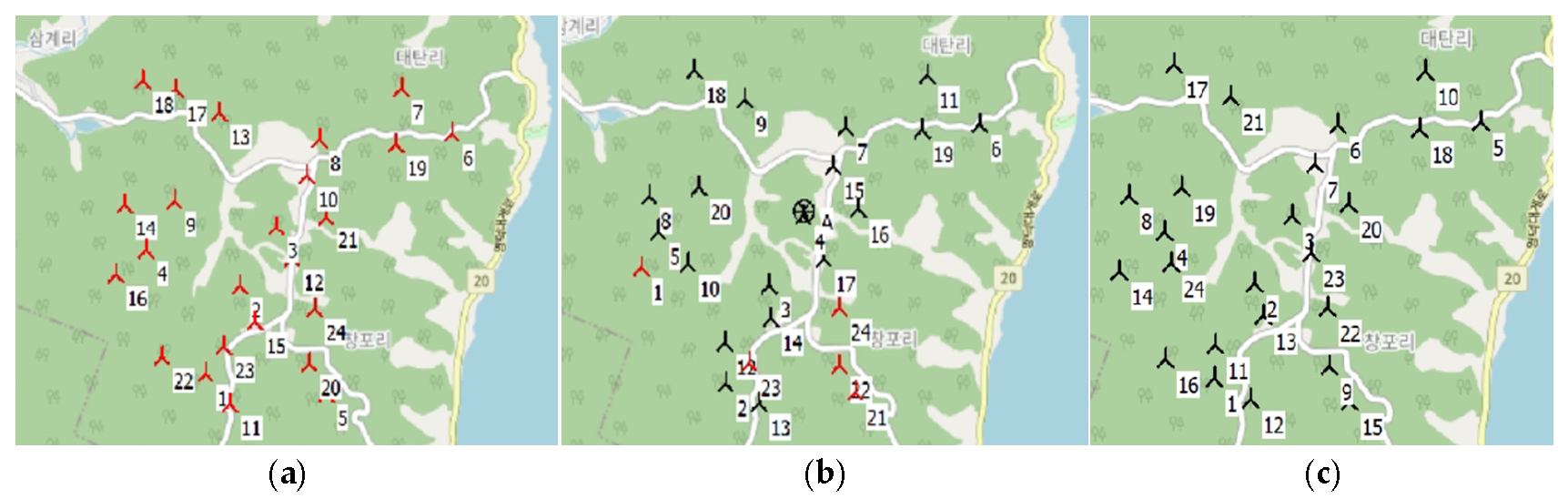
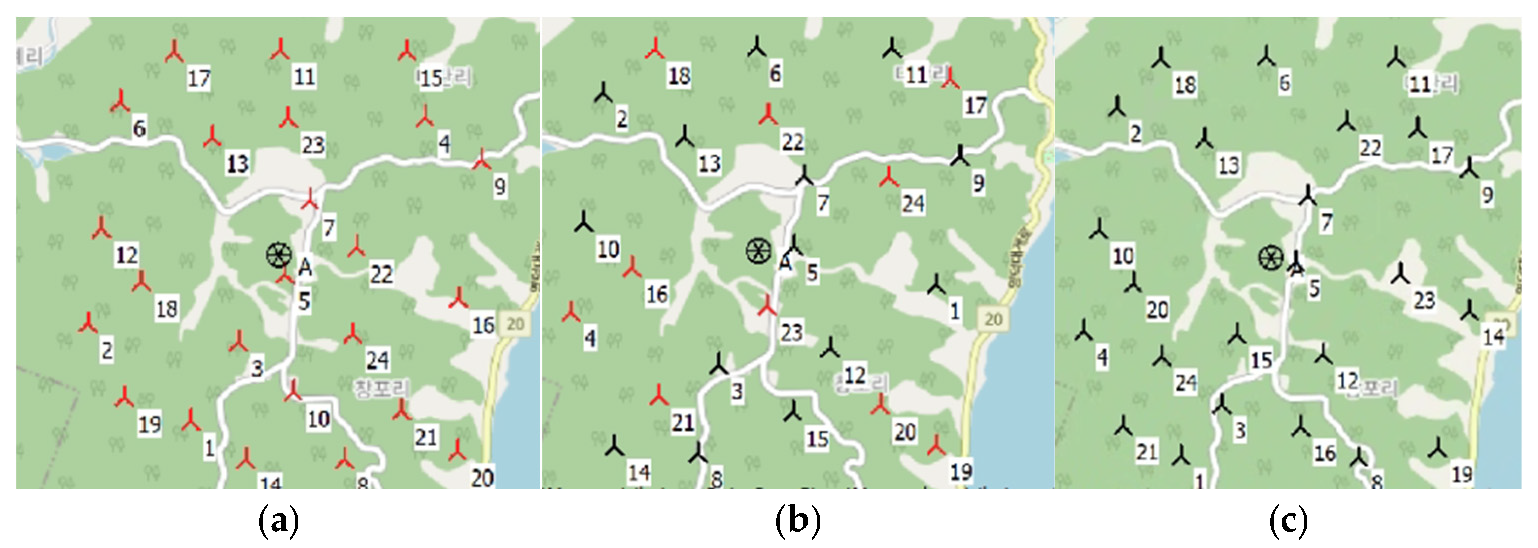
In this study, we analyzed the variations in wake loss rate and power generation performance when wind turbines with different hub heights were deployed in a mixed layout within the same site on the complex mountainous terrain of Yeongdeok.
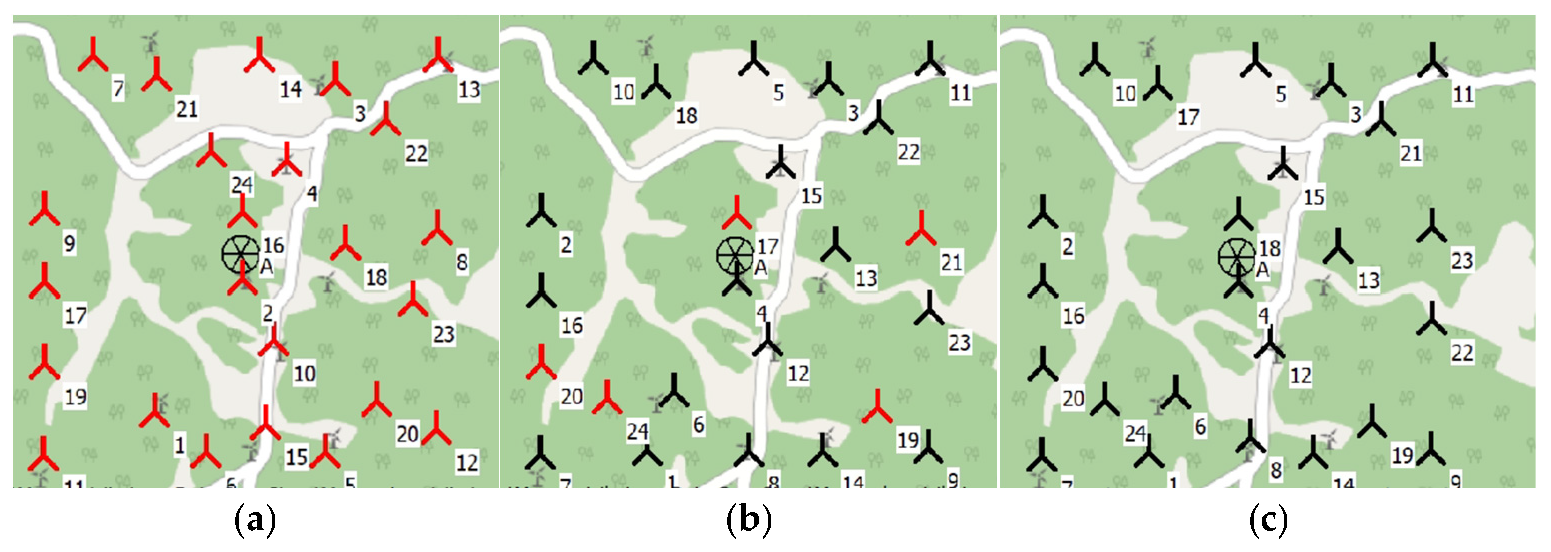
In the mixed-layout cases, a noticeable improvement in efficiency was observed owing to the reduced wake interference, even within the same site area, which can be attributed to the utilization of the natural elevation differences among the turbines caused by mountainous topography. The results demonstrated that both turbine types exhibited a reduction in wake losses when arranged in mixed configurations. For the V-82 turbine, the wake loss rate for the single-height layout using only the highest hub height (80 m) was approximately 14%. When some turbines were replaced with those with lower hub heights (59 m), wake loss decreased to approximately 13.7%. The total AEP in the mixed layout reached approximately 146.5 GWh/yr, which was only 0.8 GWh/yr lower than that with a uniform height layout. That is, while individual low-hub-height turbines generated slightly less power, the mitigation of wake interference compensated for the overall efficiency loss, allowing the total energy output of the wind farm to remain nearly constant.
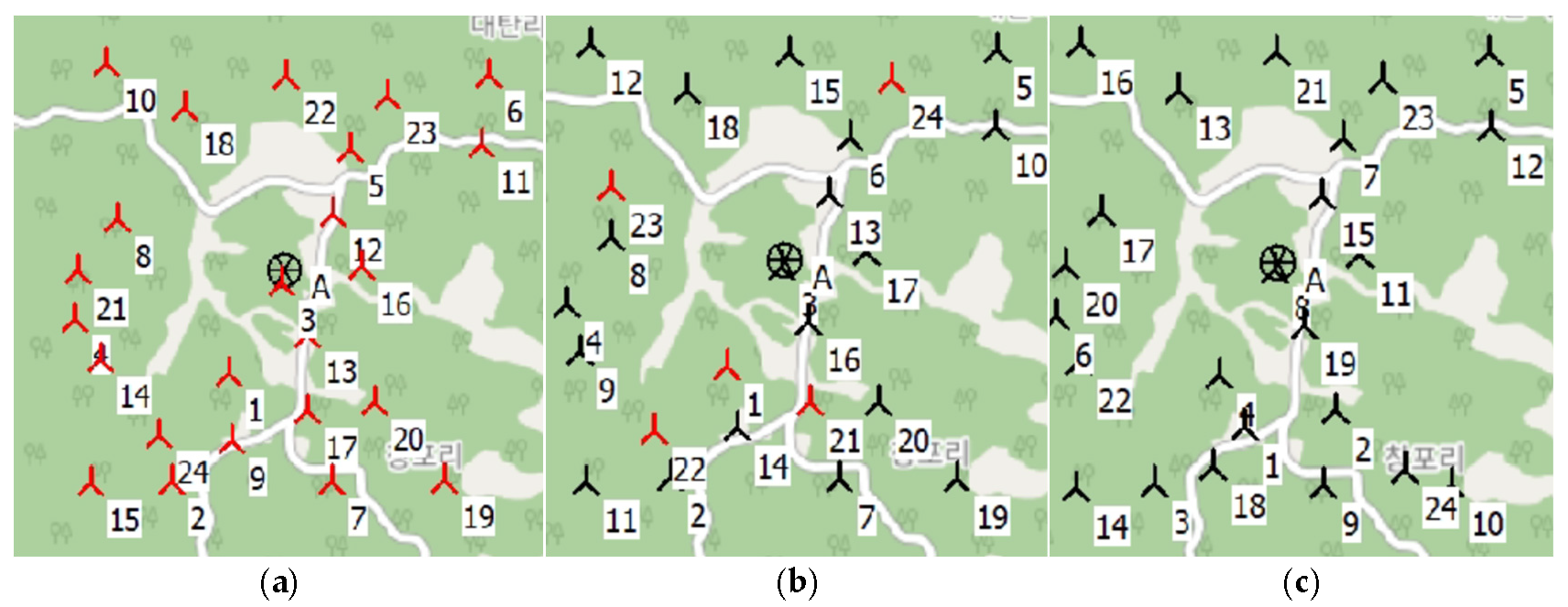
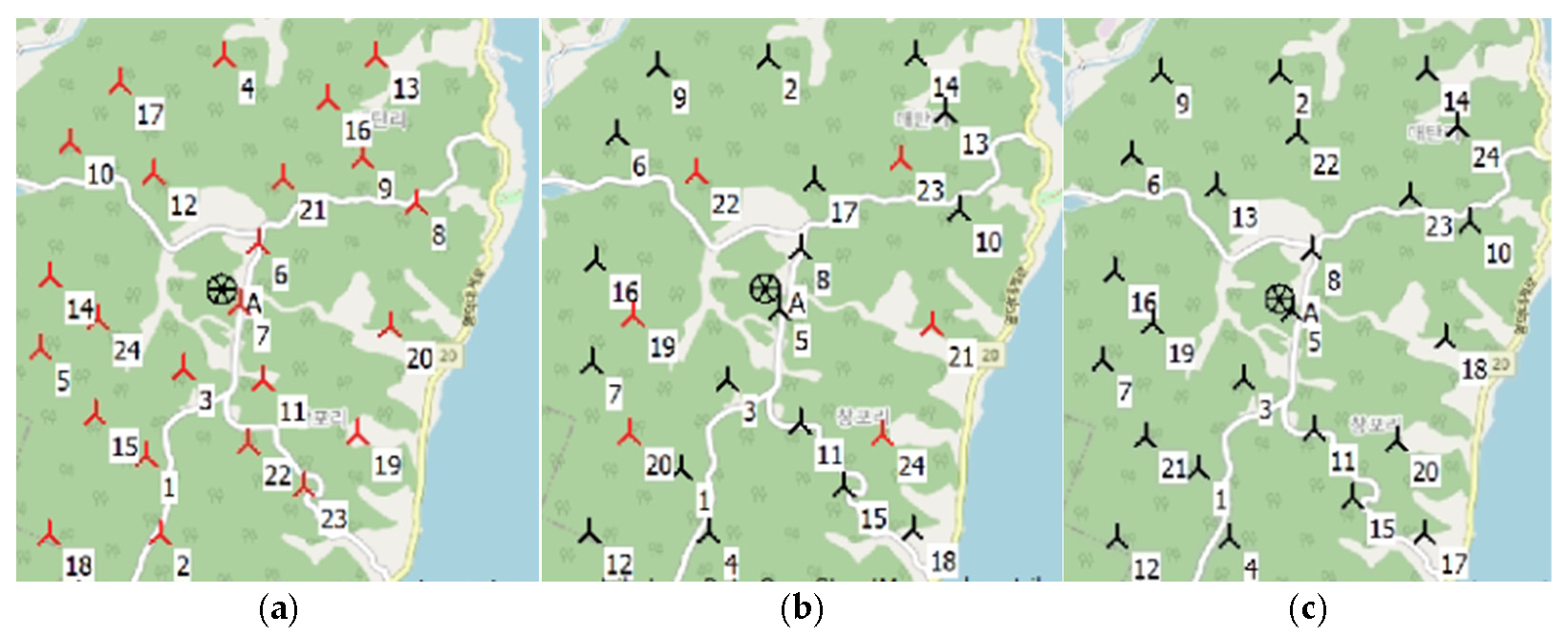
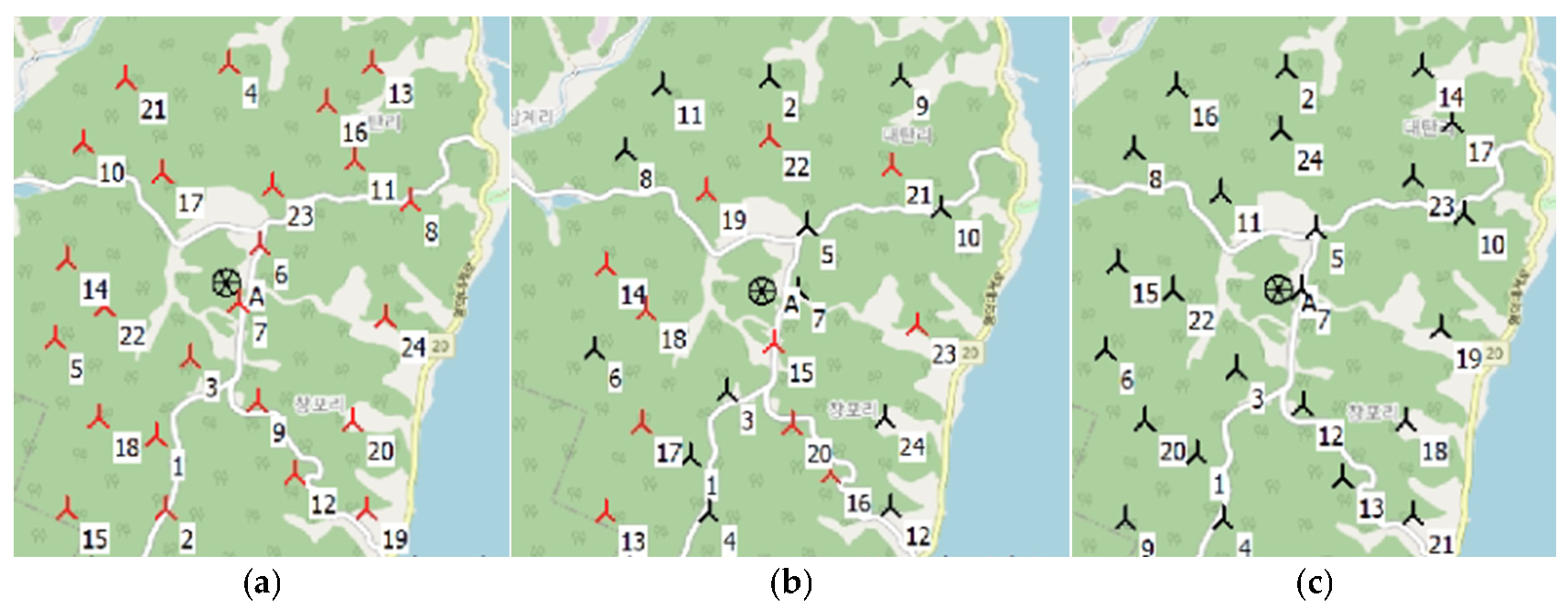
A similar trend was observed for the V-162 large-scale turbines. For the uniform layout using only a taller hub height (169 m), the wake loss rate was approximately 12.2%, whereas in the mixed layout alternating with shorter hub heights (119 m), the wake loss decreased to approximately 11.6%. The annual energy production in the mixed configuration was approximately 642.3 GWh/yr, only 2.1 GWh/yr lower than that of the single-height layout. The CF also exhibited negligible differences between the mixed and uniform layouts within 0.1–0.4%, demonstrating that the mixed configuration maintained, or even slightly enhanced, the overall efficiency.
It should be noted that, in all scenarios investigated, the layouts composed exclusively of the larger turbine models with higher hub heights and rated powers yielded the highest AEP. This outcome is physically consistent because the larger turbines capture more energy per unit, and our optimization does not impose explicit constraints on the number of large turbines, the total installed capacity, or structural and permitting limits. Therefore, when AEP alone is considered as the objective, and no additional practical constraints are imposed, an all-large turbine layout is expected to provide the maximum theoretical AEP. However, real onshore wind farm projects in complex mountainous terrain rarely aim to maximize AEP in this unconstrained sense. Site developers typically face severe limitations on usable land area, allowable turbine locations, visual impact, forest clearance, and foundation or grid connection costs. Under such conditions, simply replacing all turbines with the largest possible model is often infeasible or economically suboptimal. In this context, mixed height layouts provide an additional degree of freedom: by combining high and low hub turbines, developers can reduce wake losses and utilize the vertical extent of the boundary layer more effectively, while maintaining nearly the same AEP as all large configurations within a fixed and spatially constrained site. Our results show that, in the densest layouts, mixed height configurations reduced wake losses by approximately 0.3–1.7% while keeping the total AEP within about 0.5–1.5% of the all-large layout. In other words, a portion of the large turbines can be replaced by lower hub units without sacrificing overall farm-level energy yield, provided that the layout is optimized to exploit terrain elevation and vertical separation.
As the area of the complex increased, the effect of additional efficiency provided by hub-height mixing tended to decrease. This is because, with sufficient separation distance between turbines, the wake interference first decreases, and the wake reductions achieved due to height mixing shrink. These findings empirically demonstrate that utilizing hub height variations within complex terrain can effectively mitigate wake losses by reducing turbine-to-turbine interference, even within the same site. In mountainous areas, where the actual effective hub height varies owing to uneven topography, combining high- and low-hub turbines reduces the overlap of wake zones and enables more uniform wind resource utilization compared with that in single-type layouts. The impact of mixed hub height was particularly noticeable when the site area was small. Therefore, mixing turbine heights can effectively secure vertical separation without increasing the horizontal space between turbines. This strategy can reduce the influence of wake, even at a small site. It is also important to note that the Yeongdeok site already exhibits substantial natural elevation differences between turbine locations owing to its complex mountainous topography. As a result, the effective hub height variation caused by the terrain itself is relatively large, even for nominally single-height layouts. In such conditions, the incremental vertical separation obtained by adding a second hub height (e.g., 59 m vs. 80 m, or 119 m vs. 169 m) becomes less dominant compared with the terrain-induced height differences. This partly explains why the additional AEP gain and wake loss reduction from height mixing remained modest in our results: a significant portion of the potential vertical staggering effect is already provided by the elevation differences in the complex terrain.
Our analysis revealed that both the wake loss rate and energy production were strongly influenced by the turbine layout density; that is, by the available area of the wind farm. According to the optimization results, expanding the site area, thereby increasing the spacing between turbines, led to a significant decrease in wake interference and consequently increased the total power generation. When a wind farm composed solely of V-82 turbines was optimized within a 1 × 1 km area, the AEP was approximately 146,541.7 MWh/yr. When the site area was expanded to 2 × 2 km, the output increased to a maximum of 158,144.6 MWh/yr. Correspondingly, the average wake loss rate decreased markedly from 13.7 to 15% to 8.1–8.9%, whereas the CF improved from 36.1 to 38.2% to 39.7–41.1%. Similarly, for the larger V-162 turbines, the annual energy production increased from 642,287 MWh/yr at 2 × 2 km to 648,910.5 MWh/yr at 3 × 3 km, with wake losses decreasing from 11.6 to 13.3% to 10.6–11.6%. The capacity factor also increased from 42.9 to 44.5% to 43.7–45.2%, indicating that greater spatial flexibility increased the turbine-level performance across the farm. However, as the site area increased, the marginal benefits of the mixed-hub-height configuration tended to diminish. This was because increased space between the turbines decreased wake interference, thereby limiting the additional advantages gained from hub height diversification. In this study, the performance difference between the mixed- and single-height V-82 turbine layouts was noticeable only under dense arrangements. Beyond 2 × 2 km, both layouts exhibited nearly identical performance levels.
The same pattern was observed for the V-162 model. Although the mixed configuration reduced wake losses in the 2 × 2 km area, the difference became marginal in areas of 2.5 × 2.5 km or larger, where wake losses were already approximately 10%. These results suggest that mixed hub height strategies are most effective under spatially constrained conditions, whereas sufficient horizontal spacing alone can achieve comparable efficiency levels at larger sites.
From a wake-dynamics perspective, these trends can be interpreted as follows. In the densest layouts, turbine spacing in prevailing wind directions is sufficiently small that that wakes from upstream turbines strongly impinge on downstream rotors, producing large velocity deficits and increased turbulence intensity. Under such conditions, introducing a second hub height effectively reduces the geometric overlap between wake cores and downstream rotor disks, particularly along the dominant inflow directions constrained by the mountainous topography. This vertical staggering mitigates the strongest part of the wake deficit and leads to the observed 0.3–1.7% reduction in wake losses for mixed-height configurations compared with single-height layouts. As the site area increases, both horizontal spacing and terrain-induced elevation differences become large enough that wakes have more distance and time to recover before reaching downstream turbines. In this weak-interacting regime, the dominant mechanism for wake mitigation is increased horizontal separation rather than additional vertical offset. Consequently, the incremental benefit of hub-height mixing diminishes, and mixed and single-height layouts converge to nearly identical wake loss rates and AEP when the average wake losses are already around 10%. The mixed-hub-height layouts leverage these combined horizontal and vertical separations, but their advantage becomes marginal once the dominant wakes have sufficiently recovered before reaching downstream turbines.
The generalizability of the present findings beyond the Yeongdeok site should be considered with care. The quantitative benefits of hub-height mixing reported here are specific to the complex mountainous topography, wind climate, and turbine models (V-82 and V-162) investigated. In particular, the substantial terrain-induced elevation differences among turbine locations already create effective hub-height variation, which tends to reduce the incremental advantage of adding a second hub height. For other sites, the effectiveness of hybrid hub-height layouts will depend on the combination of terrain complexity, wind shear and turbulence characteristics, and rotor size and hub-height options. In flatter terrain with strong vertical wind speed gradients, larger wake loss reductions might be achievable, whereas in low-shear or highly constrained environments, the benefits may be more limited. Moreover, potential cost reductions associated with hub-height mixing are indirect and site-specific; a full techno-economic analysis is required to quantify the economic impact for different turbine mixes and project conditions.
Hub-height selection is also closely linked to cost. Taller towers generally incur higher capital expenditures due to increased material requirements, more stringent structural design, and potentially more demanding transportation and installation logistics, especially in mountainous terrain. Conversely, shorter towers can be less expensive but may suffer from lower energy yield because of reduced wind speeds and stronger shear and turbulence near the ground. As a result, hybrid hub-height configurations may offer a cost–performance compromise, where a portion of taller, more expensive turbines is combined with a portion of shorter, less expensive turbines, rather than deploying only the most expensive high towers across the entire site. In such cases, even a modest net AEP gain on the order of 0.3–1.7% relative to an all-high layout could be economically attractive if it is accompanied by a non-negligible reduction in average tower cost. However, a quantitative assessment of this trade-off requires detailed supplier- and project-specific cost data, which is beyond the scope of the present study.
Although this study focuses on elucidating the performance benefits of mixed-hub-height layouts, several limitations remain and should be addressed in future work.
First, an explicit economic feasibility-based analysis should be incorporated into future optimization frameworks to assess how reductions in wake losses and increases in energy yield are directly transformed into economic gains. In the present study, we deliberately restricted the objective function to technical performance indicators because detailed, project-specific cost data for different tower heights were not available. As a result, the layouts reported here should be interpreted as technically optimal with respect to AEP under the given spatial and terrain constraints, rather than as fully techno-economic optima. It would therefore be particularly interesting in future work to couple the mixed hub-height strategies analyzed here with cost-related metrics, such as levelized cost of energy (LCOE), return on investment, and tower-height-dependent cost functions, in order to evaluate the overall economic feasibility of hub-height mixing and identify under which cost and market conditions the relatively modest AEP gains justify the additional design and logistical complexity.
Second, this study relies on a simplified engineering wake model (the Jensen/PARK model) with linear superposition of wake deficits, including its implicit extension to vertical wake interference between turbines of different hub heights. While such models are widely used in commercial design tools due to their simplicity and computational efficiency, they do not fully capture three-dimensional wake structures, stability-dependent turbulence, or nonlinear wake–wake interactions in complex mountainous terrain. Consequently, the absolute values of wake losses and AEP should be interpreted as approximate estimates, although the relative comparison between single-height and mixed-height layouts is expected to remain qualitatively robust. Future work should validate the predicted wake interaction patterns and performance gains using higher-fidelity approaches, such as RANS/LES CFD or field measurements.
Finally, combining individual turbine hub height optimization with next-generation wake mitigation and control techniques could further deepen our understanding of aerodynamic interactions in complex terrains and contribute to the cost-effective expansion of renewable energy in the future.
6. Conclusions
Wind power has become common worldwide. We should now focus on improving the overall output of wind farms, which consist of multiple wind turbines instead of individual ones. From this perspective, complex mountainous terrain and wake effects are the most important issues that should be considered simultaneously in decision-making. This study focuses on optimizing the layout of multiple wind turbines over complex mountainous terrain by changing turbine heights. Considering the large number of turbines in a wind farm, hub height poses potential for optimization at a huge scale. Furthermore, it is computationally challenging to address wind power generation with the existence of wake effects between turbines during optimization. In this study, we employed WindPRO, a commercially used software in industry, instead of a small conceptual software package, to validate the necessary data and wind power generation.
Some of the key findings are worth mentioning. First, wind turbines (V-82 and V-162) with different hub heights were mixed and arranged at different heights in the same complex to reduce the wake loss of a wind farm located on mountainous terrain. The placement strategy with mixed turbine heights decreased the wake loss by approximately 0.3–1.7% from that of cases with uniform turbine heights. Thus, the AEP and power generation efficiency of the complex were maintained at nearly the same level, despite the inclusion of lower-hub-height turbines. Although the improvement was not large, this study confirmed that, if the height difference between turbines is utilized in farms on complex mountainous terrain, the total power generation can be increased by partially mitigating wake interference. Therefore, it is suggested that mixing hub heights is a realistic strategy that can promote performance improvement, even under limited site conditions.
The findings of this study have several important implications for wind farm design and policy. First, if turbines of different heights are mixed in farms on mountainous terrain, power generation can be increased by utilizing vertical spaces without securing wide horizontal gaps. In other words, wind energy can be collected at various heights, and mutual interference can be reduced by varying turbine heights, even in a topologically complex area. Second, this height-mixing strategy can be used to increase the output of existing wind farms or maximize site-use efficiency when planning new wind farms. If the turbine height configuration is optimized within the same site, the power generation density may be increased without requiring additional sites to be secured. Therefore, development in harmony with environmental considerations, such as minimizing forest damage, may be possible. Finally, policymakers and licensing authorities must flexibly allow and encourage the inclusion of various types of turbines in wind power plant design standards. Previously, turbines of the same type and height were commonly installed. The findings of this study numerically illustrate that a mixed arrangement is technically valid and beneficial. Our findings are expected to contribute to utilizing topographic richness and maximizing the amount of renewable energy generation in particular areas.