1. Introduction
With the rapid development of distributed energy resources (DERs), including solar photovoltaics, wind power, battery energy storage, and electric vehicles, the previously centralized and unidirectional power system is evolving into a more flexible and decentralized structure. These heterogeneous energy resources are often geographically dispersed and exhibit diverse operating characteristics and response times, which makes it increasingly difficult for traditional scheduling and management methods to maintain both efficiency and stability. To achieve higher levels of coordination and optimization, new control paradigms are emerging. Among them, virtual power plants (VPPs) have gained significant attention as a promising model that aggregates heterogeneous DERs into a unified, centrally managed entity capable of participating in electricity markets and supporting grid stability [
1].
1.1. Evolution and Deployment of VPPs
According to the Scholarly Community Encyclopedia [
2], the concept of VPPs was introduced by Dr. Shimon Awerbuch in 1997 with the term “virtual utility” [
3]. Early European research established the fundamental principles of distributed energy aggregation and system-level coordination, which were subsequently validated through EU-funded pilot projects, most notably the FENIX program (2005–2009) [
4,
5]. Subsequent studies have indicated that the VPP concept, originating from these European initiatives, has progressively evolved into a commercially viable energy management framework that integrates small-scale generators, energy storage systems, and controllable loads via advanced information and communication technologies [
6,
7].
Nowadays, the total aggregated capacity operating under VPP frameworks globally has surpassed approximately 35 GW [
8], with major deployments in Germany, the United States, Australia, and China. In the United States, federal and state-level initiatives have accelerated the integration of distributed energy resources into grid operations. Programs such as the Department of Energy’s Grid Modernization Initiative and the Inflation Reduction Act (IRA, 2022) have introduced strong policy and financial incentives for DER aggregation and market participation [
9]. In Europe, regulatory frameworks including the EU Clean Energy for All Europeans Package and national-level flexibility markets have facilitated the participation of aggregated DERs in balancing, ancillary services, and wholesale electricity markets [
10]. Germany, in particular, has emerged as a leading VPP market, supported by early liberalization of ancillary service markets and strong incentives for renewable and storage integration [
11]. Australia [
12] has also been at the forefront of VPP deployment, driven by high rooftop PV penetration and regulatory sandboxes such as the Australian Energy Market Operator’s VPP demonstration programs, which have enabled and evaluated the participation of aggregated residential batteries in frequency control and energy markets. In China [
13], VPP development has been advanced through distributed energy pilot programs in multiple regions. These pilots emphasize demand-side response, aggregation of distributed generation, and enhanced grid flexibility to support power system operation under increasing renewable energy penetration.
Collectively, these efforts illustrate the growing maturity of VPPs as a foundational component of the global transition toward distributed, intelligent, and market-driven energy coordination.
1.2. Technological Foundations Enabling AI-Driven VPPs
In recent years, the rapid evolution of communication networks and computing infrastructure has provided key technical support for the large-scale application of AI in VPPs. With the maturity of 4G/5G cellular networks, various industrial IoT protocols, and cloud–edge collaborative architectures, distributed energy devices can achieve more stable, low-latency, and secure data exchange. At the same time, from edge computing modules such as NVIDIA Jetson and Orin to GPU cloud servers with powerful parallel computing capabilities, improvement in computing hardware performance has significantly enhanced the feasibility of real-time data processing and AI reasoning.
Meanwhile, low-Earth-orbit (LEO) satellite Internet systems, exemplified by Starlink developed by SpaceX [
14], have begun to play an important role in practical VPP deployments by providing a relatively independent communication medium for remote areas with limited connectivity. Hybrid communication architectures that combine terrestrial networks with satellite links enable VPP assets located in off-grid or communication-constrained regions to maintain essential data connectivity and control access.
Although these technological advancements have not altered the fundamental concept of VPPs, they have substantially expanded the scale and depth of AI-based coordination and control. Leveraging these infrastructures, intelligent computing can be deployed closer to the energy assets themselves, thereby shortening response paths, enabling localized optimization, and enhancing the scalability and resilience of the overall system.
1.3. The Role of Artificial Intelligence in VPPs
The operation of VPPs inherently involves uncertainty, heterogeneity, and dynamic interactions. Renewable energy generation is stochastic, demand patterns fluctuate, and real-time market conditions change rapidly.
To address these challenges, artificial intelligence (AI) has emerged as a critical enabling technology. Machine learning (ML) and deep learning (DL) techniques support high-precision forecasting of renewable generation, load demand, and market prices, while reinforcement learning (RL) and multi-agent optimization methods facilitate adaptive scheduling, dispatch, and bidding strategies. Through these AI-based approaches, VPPs are evolving from static, rule-based systems into autonomous, data-driven, and self-optimizing networks.
In recent years, industrial and research initiatives such as AutoGrid Flex [
15], Siemens Grid Edge [
16], and Schneider Electric’s EcoStruxure distributed energy resource management (DERMS) platform [
17] have demonstrated the feasibility and value of AI-integrated VPP operations, yielding enhanced forecasting accuracy, more efficient dispatch optimization, and more intelligent market participation.
1.4. Motivation and Structure of This Review
While the application of AI in VPPs has garnered significant attention, existing research remains fragmented, primarily focusing on specific applications such as prediction, optimization, or bidding, lacking a comprehensive understanding of how different AI paradigms collectively enhance VPP performance.
Particularly noteworthy is the fact that most research emphasizes the contributions of individual algorithms, failing to establish a unified perspective on how AI technologies collectively improve prediction accuracy, operational efficiency, market adaptability, and system robustness. Representative examples include [
18,
19,
20,
21,
22,
23,
24] and further related works.
This paper presents a comprehensive, algorithm-centric review of AI applications in VPPs. We systematically analyze the applications of ML, DL, and RL algorithms in key VPP functional modules, including prediction, scheduling, aggregation, and market participation, and analyze how these technologies interact to form an intelligent control ecosystem.
Furthermore, we examine how advances in computing hardware (e.g., edge AI processors, GPU clusters) and increasingly mature communication infrastructures (e.g., 5G and satellite networks) provide the technological foundation for the large-scale deployment of these AI models. Although these developments are not the primary focus of this paper, they are recognized as key enablers for practical VPP implementations.
Finally, this paper also identifies key challenges and research opportunities, including the need for interpretable models, scalable multi-agent coordination, and hybrid AI frameworks that integrate prediction, optimization, and decision-making to build the next generation of smart VPPs.
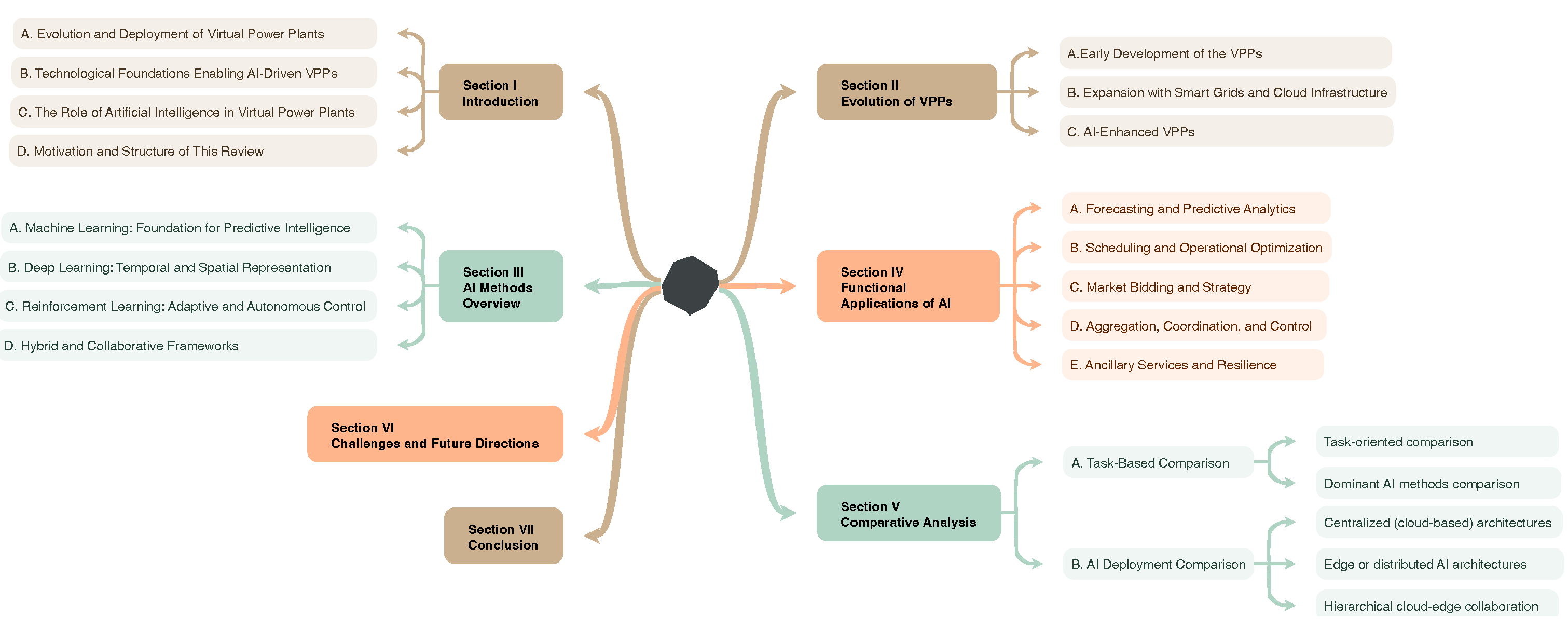
To provide a clear structural overview of how this review is organized and how the different AI paradigms, functional modules, and comparative analyses are interconnected,
Figure 1 presents the taxonomy and overall conceptual structure of the paper.
2. Evolution of VPPs: From Concept to Intelligence
The development of VPPs is the result of the ongoing interaction between communication technologies, computational intelligence, and energy system architecture. Each of the past few decades has brought a paradigm shift, from the early vision of coordinating distributed generation to the rise of autonomous, AI-driven energy networks today. This section traces the evolution and conceptual development of VPPs, highlighting the technological breakthroughs and representative research of each stage.
2.1. Early Development of the VPP Concept
In 1997, Awerbuch introduced the precursor to modern VPPs, termed the ’virtual utility’ [
3]. In 2002, Kirsten and Müller [
25] were among the first to formally introduce the term “Virtual Power Plant”, describing a system that aggregates decentralized generators through information and communication technology-based coordination. Early European demonstration projects, such as the E-Energy Initiative (2008), embodied this vision by linking small-scale combined heat and power (CHP) units, wind farms, and controllable loads via Supervisory Control and Data Acquisition (SCADA) systems and industrial Ethernet networks.
Building on this foundation, European research programs such as the EU-funded
FENIX project (2005–2009) demonstrated practical aggregation of distributed generators and controllable loads across Spain and the United Kingdom [
4,
5]. In parallel, Pudjianto, Ramsay, and Strbac [
1] provided one of the first formal academic definitions of VPPs, emphasizing its potential to enhance distributed generation integration and improve system flexibility.
At this stage, VPPs operated under centralized, rule-based control schemes, with fixed schedules and limited adaptability. Communication relied on wired networks and early 2G/3G mobile systems, restricting scalability and real-time responsiveness. Nonetheless, these early projects established a fundamental idea: that distributed energy resources could be orchestrated to behave as a single, flexible power entity.
2.2. Expansion with Smart Grids and Cloud Infrastructure
The following decade marked a pivotal transformation, with smart grids and cloud computing beginning to reshape power systems. The widespread deployment of smart meters and IoT-level sensors enabled continuous and granular data collection from distribution networks and end users [
26,
27]. During this period, cloud-based demand response and DERMS optimization architectures were proposed, most notably the cloud-based demand response framework introduced by Kim, Yang, and Thottan [
28], together with household-level optimization methods such as the three-step demand-side management approach presented by Bakker et al. [
29].
Utilities then began experimenting with cloud-hosted VPP or DERMS control centers capable of executing real-time demand response and distributed scheduling, leveraging the growing body of work on cloud computing for smart grids [
27,
30]. Meanwhile, the rise of machine learning-based forecasting significantly improved short-term load prediction. Hong’s tutorial overview [
31] demonstrated how regression and neural network models could be organized into a practical forecasting workflow applicable to power systems.
At the communications level, infrastructure evolved from 3G to 4G/LTE, providing lower latency and higher bandwidth for advanced metering and control applications [
32,
33]. In parallel, the adoption of open protocols such as MQTT [
34] and Modbus TCP [
35] reduced vendor lock-in and enabled interoperable, globally scalable communication frameworks for VPPs.
2.3. The Emergence of Electric Vehicles as Dynamic DERs
With the ongoing electrification of the transportation sector, electric vehicles (EVs) are no longer viewed solely as passive electricity loads. Instead, they are increasingly regarded as one of the most dynamic and flexible resources within virtual power plants (VPPs). The development of vehicle-to-grid (V2G) technologies has enhanced grid flexibility, while at the same time raising practical concerns related to system stability and battery degradation [
36]. Compared with stationary energy storage systems, large-scale EV integration introduces additional spatial and temporal uncertainties, as vehicle availability and charging behaviors are inherently variable. As a result, VPP scheduling strategies must balance economic objectives with the ability to handle stochastic charging and discharging patterns [
37].
From a control perspective, research efforts have gradually shifted from isolated charging stations toward coordinated management of large EV fleets. Hierarchical control frameworks based on mixed-integer linear programming (MILP) have been shown to effectively coordinate EV participation in frequency regulation services [
38]. In parallel, approaches combining model predictive control with virtual synchronous generator concepts enable charging stations to provide virtual inertia support [
39]. Multi-layer intelligent control strategies have also been proposed to address energy balancing challenges in multi-regional power systems with high EV penetration [
40].
At the market level, interactions between EVs and VPPs increasingly involve both competition and cooperation. Stackelberg game-based models have been used to analyze profit allocation between aggregators and EV owners under coupled green certificate and spot market mechanisms [
41]. When integrated with bi-level multi-energy scheduling frameworks [
42], coordinated optimization of EVs alongside wind, solar, hydro, and storage resources can improve operational flexibility and bidding performance under competitive market conditions. Overall, these developments indicate that EV participation is steadily reshaping the operational scope of VPPs, pushing them toward more adaptive and resilient energy management systems.
2.4. Emergence of AI-Enhanced VPPs
The period from 2016 to 2020 marked a crucial turning point in the development of AI, during which AI evolved from an auxiliary analytical tool into a core technology enabling the operation of VPPs. Early applications of deep learning demonstrated the potential of neural networks in renewable energy generation. Gensler et al. [
43] applied long short-term memory (LSTM) networks to solar power generation forecasting, achieving significant improvements compared to traditional regression-based methods.
Meanwhile, RL also gained widespread attention as a dynamic scheduling and market participation strategy. Zhang et al. [
44] constructed a real-time scheduling model for VPPs based on deep reinforcement learning, while Glavic and Fonteneau [
45] provided a comprehensive review of reinforcement learning applications in power system operation and control. Together, these studies demonstrated that AI achieved a degree of autonomous and adaptive decision-making under market and grid uncertainties.
The rise of edge computing and GPU-accelerated embedded platforms, such as NVIDIA’s Jetson TX2 and Xavier, enabled inference tasks to be executed closer to data sources [
46,
47]. This technological shift gave rise to a hierarchical control model: local edge nodes performed initial data processing and anomaly detection, while cloud controllers conducted global optimization.
Commercial deployments validated these advancements. AutoGrid Flex [
15] in the United States and Next Kraftwerke [
48] in Germany successfully integrated predictive analytics and automated bidding into real-world market operations. Taken together, these developments marked a shift from centralized coordination to intelligent decentralized coordination and signaled the emergence of AI-enhanced VPPs.
2.5. Convergence Toward Intelligent and Autonomous VPPs
Since 2020, the lines between energy management, AI, and telecommunications have become increasingly blurred. The advent of 5G wireless networks with latency below 10 ms and massive device connectivity technically enabled the real-time coordination of thousands of distributed assets [
49]. As highlighted by recent studies on 5G-enabled smart grids [
50,
51], 5G communication networks provided the reliability, ultra-low-latency, and scalability required for next-generation distributed energy management and VPP applications.
At the same time, multi-agent reinforcement learning (MARL) began to redefine the control architecture of complex energy ecosystems. For instance, a residential-microgrid MARL framework demonstrated that autonomous agents negotiated local schedules and balanced system-wide objectives with user-level autonomy [
20]. More broadly, Charbonnier et al. [
52] presented a scalable coordination method in which centralized training enabled decentralized execution across distributed assets, indicating a viable pathway for next-generation VPPs to self-organize and adapt under dynamic grid and market conditions.
The integration of edge–cloud orchestration frameworks powered by containerized deployments (e.g., Kubernetes and its edge variants such as KubeEdge) and distributed time-series databases (e.g., TimescaleDB, Apache Cassandra) further enhanced scalability, resilience, and cyber-physical flexibility. Feng et al. [
53] reviewed edge computing architectures and use cases in smart grids, highlighting cloud–edge coordination patterns that enabled low-latency analytics and control. For the data layer, Pinheiro et al. [
54] implemented a Cassandra-based SMACK stack (Spark, Mesos, Akka, Cassandra, Kafka) in a real microgrid, illustrating scalable storage for high-rate telemetry. Complementarily, Li et al. [
55] described edge–cloud computing systems for smart grids and the evolution from centralized clouds to hybrid edge–fog–cloud architectures.
Li et al. [
56] investigated resource orchestration in a hybrid cloud–edge architecture for smart grid fault detection systems, focusing on cross-layer computation and communication scheduling. Pan [
57] examined a demand response-oriented edge–cloud collaborative control framework, exploring how cloud, fog, and edge layers jointly performed energy management tasks within the ubiquitous power Internet-of-Things (UPIoT) paradigm. The study outlined the system architecture, deployment models, and technical challenges of implementing hierarchical control in which edge nodes executed low-latency responses while cloud platforms handled large-scale optimization in smart grid applications. Kempf et al. [
58] refactored the open-source energy platform VOLTTRON into a cloud-native Kubernetes microservice architecture, demonstrating the scalability and flexible deployment capabilities of the EMS/VPP functionality in a containerized environment. Kim et al. [
59] proposed a Kubernetes-based solution for modernizing the real-time front-end processor of a SCADA system, validating the applicability of container orchestration in power grid monitoring infrastructure. At the hardware level, edge processors dedicated to artificial intelligence, such as NVIDIA Jetson Orin and Google Coral Edge TPU, enhanced local decision-making and near-real-time inference capabilities [
60,
61].
Moreover, LEO satellite constellations and other non-terrestrial networks (NTNs) were increasingly leveraged to complement terrestrial 5G infrastructure, thereby extending VPP connectivity to remote and rural regions. Alam et al. [
62] presented a satellite-based data collection architecture tailored for VPPs in rural areas, demonstrating the technical feasibility of integrating satellite links into VPP communications.
In summary, these advancements have transformed modern VPPs from centralized aggregators into self-learning ecosystems capable of continuous optimization and self-healing operation.
2.6. Timeline Overview and Convergence Analysis
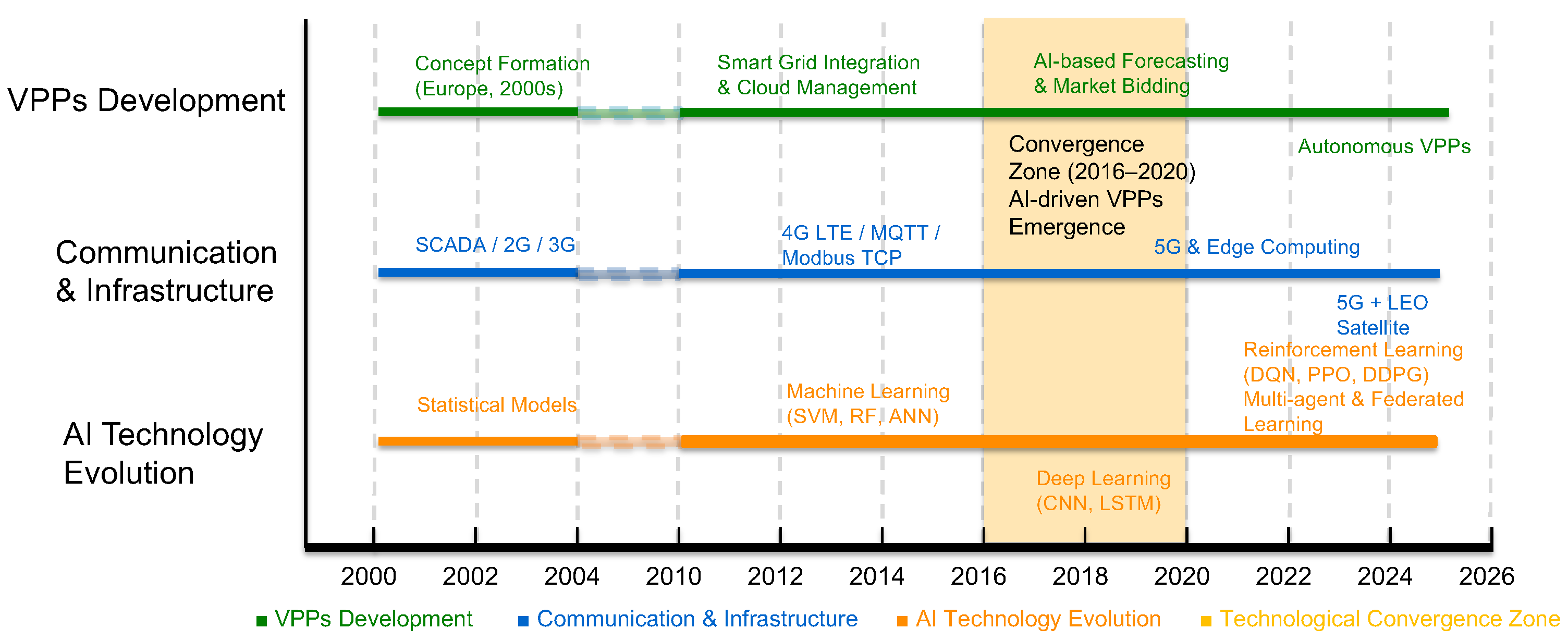
Across two decades, three technological trajectories have converged to define the contemporary landscape of VPPs, as shown in
Figure 2:
- 1.
VPP development: from early market-based aggregation concepts to AI-enabled forecasting, optimization, and autonomous VPPs;
- 2.
Communication and infrastructure evolution: from SCADA/2G/3G systems to 5G, edge computing, and LEO satellite integration;
- 3.
AI technology evolution: from statistical models to ML, DL, and RL frameworks supporting intelligent, adaptive VPP operation.
The intersection of these trajectories, particularly during the period from 2016 to 2020, marks a critical inflection point at which AI-driven VPPs became both technically feasible and economically viable, laying the foundation for the intelligent, decentralized energy ecosystems observed today.
3. Overview of AI Paradigms for VPPs
AI is steadily transforming how VPPs are modeled, predicted, and operated. Early VPPs’ implementations relied heavily on deterministic or rule-based optimization, which performed well under predictable conditions but proved inadequate in the face of increasing uncertainty and market volatility in renewable energy generation. As distributed energy systems become more dynamic, adaptive intelligence becomes crucial. AI provides a suite of computational tools that enable VPPs to learn from data, adapt to changing environments, and make coordinated decisions across multiple spatiotemporal scales.
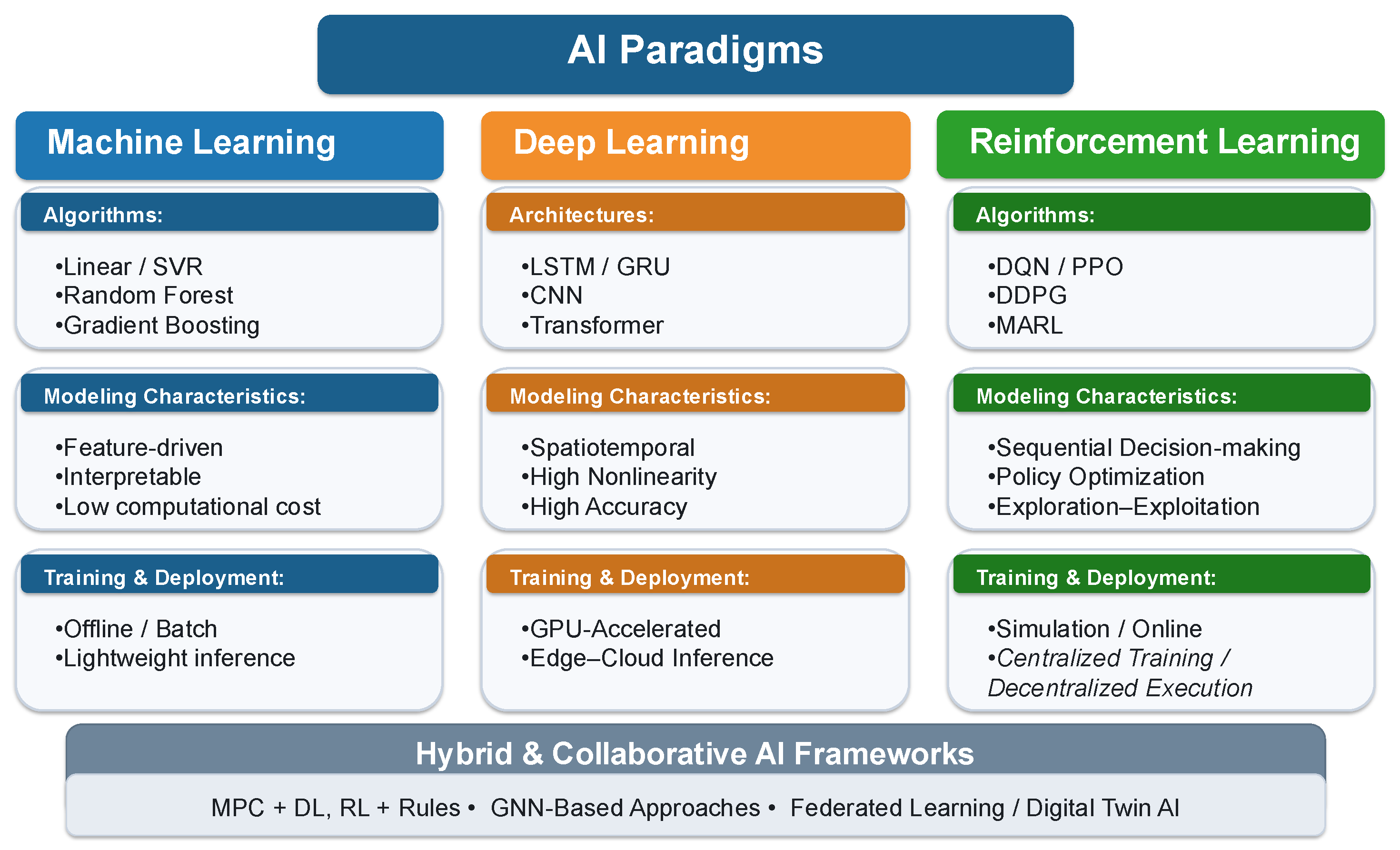
The main branches of AI used in VPPs can be categorized into four types: ML for data-driven prediction, DL for extracting complex spatiotemporal patterns, RL for autonomous decision-making, and hybrid frameworks integrating multiple learning and control paradigms. These paradigms, summarized in
Figure 3, collectively form the foundation of modern intelligent VPPs.
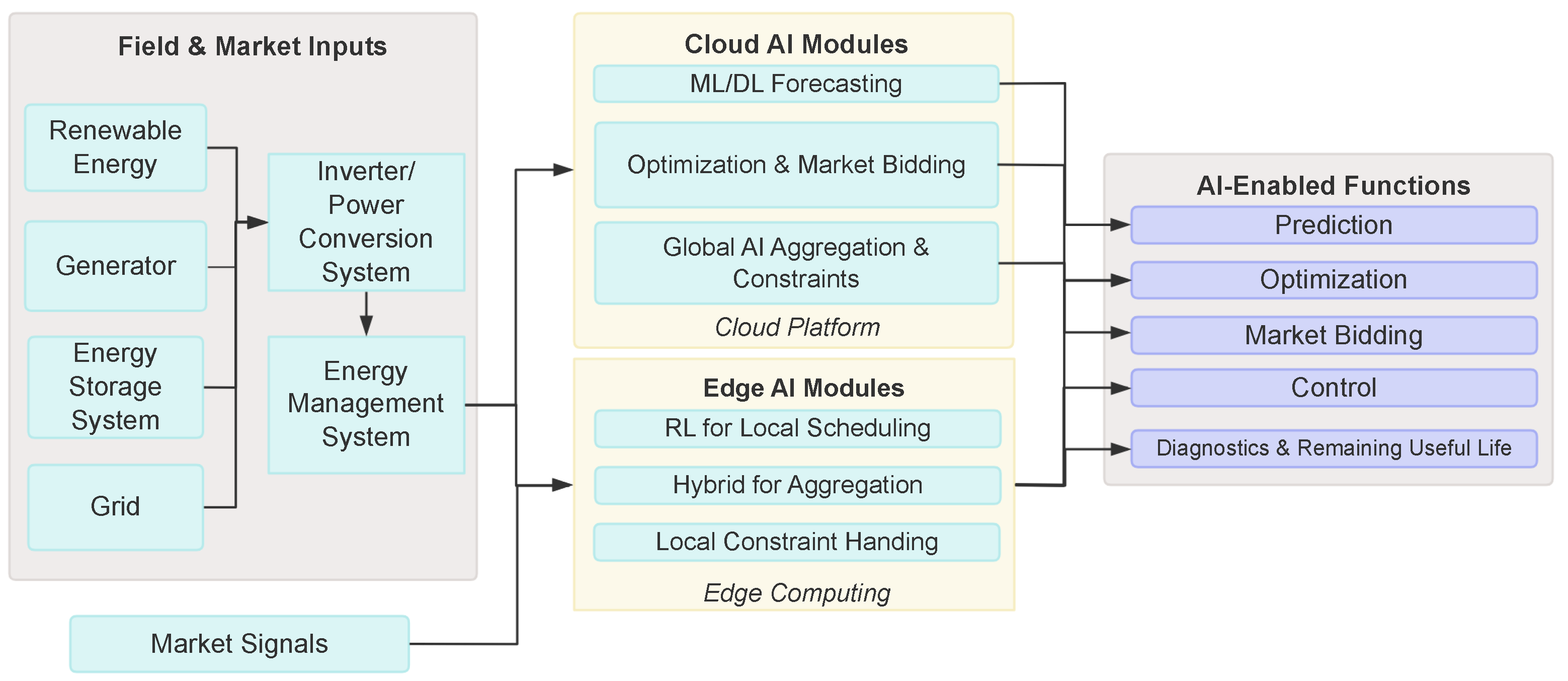
Figure 4 illustrates the overall framework of AI-driven VPPs, showing how field and market data flow through cloud and edge AI modules to enable forecasting, optimization, bidding, control, and diagnostic functions.
3.1. Machine Learning: Foundation for Predictive Intelligence
Machine learning forms the first layer of intelligence in VPPs. Its advantage lies in its ability to mine patterns from large datasets, transforming historical measurements of power generation, demand, and weather into actionable forecasts. Classic machine learning models, such as linear regression, support vector machines, random forests, and gradient boosting trees, are commonly used to predict short-term load or renewable energy generation, or to estimate electricity prices. These methods typically rely on carefully designed input features, such as temperature, solar irradiance, or time metrics, reflecting the domain knowledge of the system operator.
Due to their efficiency and transparency, machine learning models are highly attractive for operational forecasting and online control, especially where interpretability and accuracy are equally important. However, they often rely on manually designed features and can be insufficient in capturing the nonlinear, highly dynamic patterns in renewable energy-dominated grids [
63,
64]. This limitation naturally prompts researchers to adopt deep learning methods, which can automatically extract such patterns without explicit feature design.
3.2. Deep Learning: Temporal and Spatial Representation
DL has expanded the analytical capabilities of VPPs by enabling models to learn complex nonlinear relationships directly from data. Recurrent Neural Networks (RNNs), particularly architectures like LSTM and GRU, excel at capturing temporal dependencies, enabling efficient load, wind, and solar power forecasting across multiple time scales [
65,
66]. Convolutional Neural Networks (CNNs) and attention-based architectures, such as the Transformer [
67,
68,
69,
70], further extend this capability by learning spatial dependencies between distributed assets or weather fields.
In recent years, deep learning has also been applied to fault detection, anomaly identification, and energy storage diagnostics, helping operators predict problems before they impact system stability. With increasingly distributed computing resources, lightweight neural network models can even be deployed on edge devices to provide real-time intelligence and reduce reliance on centralized servers. Despite these advancements, deep networks also have their trade-offs: they require significant computational resources and are often considered “black boxes”. This has spurred ongoing research into model compression, interpretability, and hybrid architectures that combine the expressive power of deep learning with classical control and optimization techniques.
3.3. Reinforcement Learning: Adaptive and Autonomous Control
While ML and DL focus on modeling and predicting patterns, RL goes a step further by learning how to act. In the context of VPPs, RL allows systems to discover optimal control strategies through trial and error and to adapt their behavior as operating conditions evolve. This paradigm is particularly effective for tasks such as energy storage scheduling, demand-side management, and market bidding, where real-time decisions must balance multiple, often conflicting objectives, including cost, reliability, and equipment health.
A significant advantage of RL is its ability to operate under uncertainty without requiring precise environmental models. Recent research has explored multi-agent RL, where DERs or subsystems act as autonomous agents, collaborating toward a common goal. This distributed perspective aligns well with the decentralized nature of VPPs, enabling flexible resource coordination while maintaining scalability. However, RL still faces several challenges. Its training process can be unstable, heavily depends on how the reward function is designed, and often demands significant computational resources. To overcome these limitations, researchers are increasingly exploring hybrid reinforcement learning approaches that blend data-driven learning with rule-based control or supervised pre-training, aiming to strike a better balance between adaptability and reliability.
3.4. Hybrid and Collaborative Frameworks: Toward Integrated Intelligence
The future of artificial intelligence in VPPs lies in integration. Since no single paradigm can fully address the complexities of real-world power systems, researchers are beginning to fuse prediction, optimization, and control into hybrid intelligent frameworks. For example, the fusion of deep learning and model predictive control leverages neural networks to provide fast predictions for the model predictive control (MPC) optimizer, enabling real-time use [
71]. Another emerging direction is federated learning (FL), which allows multiple microgrids or sub-VPPs to share knowledge without exposing private data, a significant step toward achieving large-scale data privacy and collaboration.
Other promising tools include graph neural networks, which can capture spatial relationships between DERs and network nodes, and RL based on digital twins, which uses high-fidelity simulations to securely train and validate control policies before practical application. In summary, these approaches represent a shift from centralized control to distributed collaborative intelligence, where the cloud, edge, and device layers can continuously learn from each other. This hierarchical ecosystem enables faster adaptability, greater resilience, and more transparent coordination across the entire VPP infrastructure.
3.5. Summary
Over the past two decades, AI methods for VPPs have evolved from basic statistical predictors to fully integrated and adaptive learning frameworks. ML lays the foundation for data-driven modeling; DL enhances the ability to represent complex spatiotemporal dependencies; RL enables autonomous and sequential decision-making; and the emergence of hybrid frameworks unifies these paradigms to form a coherent, multi-level intelligent system. These methods together form the core computational toolbox that supports the design of modern intelligent VPPs. A concise comparison of the major AI paradigms and their input requirements, strengths, and limitations in VPP applications is summarized in
Table 1.
These developments collectively redefine the concept of a VPP; it is no longer merely a coordinated collection of distributed assets, but a self-optimizing, data-driven entity capable of intelligently responding to dynamic changes in the power grid and markets. The following sections will build upon this foundation to explore how these AI approaches are applied to specific functions of VPPs, such as prediction, scheduling and optimization, market bidding, aggregation, and ancillary service management.
4. Functional Roles of AI in VPPS
Building upon the algorithmic foundations discussed in
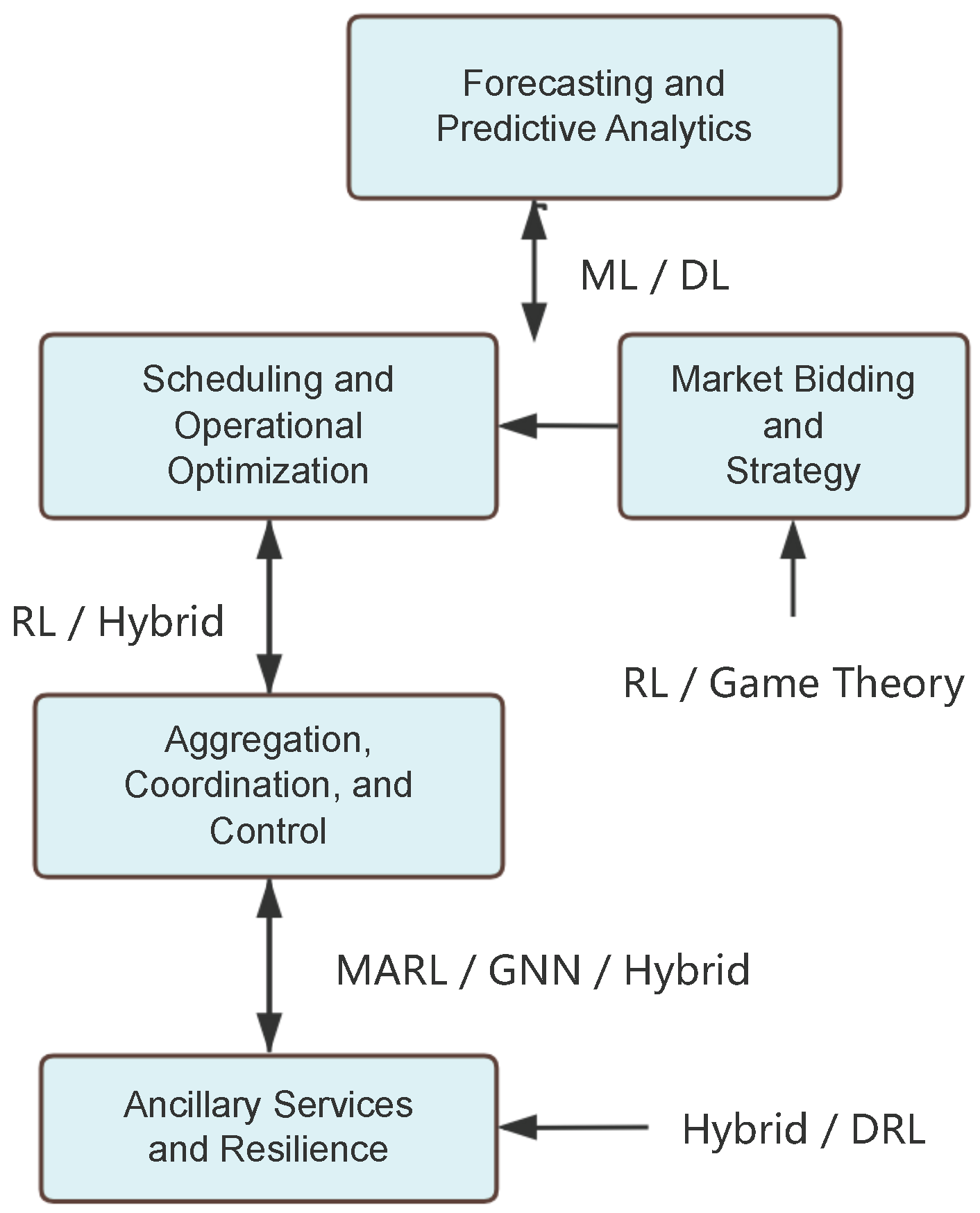
Section 3, we now turn to how AI actually powers the daily operations of VPPs. The core operations of intelligent VPPs revolve around five key modules: forecasting, scheduling and optimization, market bidding, aggregation and coordination, and ancillary services. Across these modules, AI has driven a transition from static, centralized control schemes to data-driven, adaptive, and cooperative decision-making systems.
Figure 5 illustrates the interaction mechanism between AI paradigms and core VPP functional modules, highlighting how predictive and decision-making intelligence is integrated into the VPP operational workflow.
4.1. Forecasting and Predictive Analytics
Forecasting is central to the operation of VPPs, impacting dispatch, market bidding, and reserve capacity planning. The integration of AI has significantly improved the accuracy and adaptability of forecasting models, enabling the utilization of heterogeneous datasets incorporating meteorological, market, and user behavior information. ML algorithms such as Support Vector Regression (SVR) and random forest (RF) remain effective for short-term forecasting of photovoltaic (PV) generation and total load demand [
72,
73]. However, their ability to model complex nonlinear relationships and time dependencies is limited, leading to a growing shift toward more expressive DL architectures.
Zhu et al. [
74] proposed a BiLSTM–self-attention–Kolmogorov–Arnold Network (KAN) hybrid model for VPP load forecasting, achieving a coefficient of determination
and RMSE of 141.4 MW in a mid-sized aggregated system. Similarly, Sarathkumar et al. [
18] applied an Adam-optimized LSTM (AOLSTM) model to predict generation and storage behavior within a day-ahead VPP market framework. Compared with baseline models such as random forest and gradient boosting, the proposed model reduced the mean absolute error (MAE) by about 12.8% and achieved a lower root mean square error (RMSE), thereby enhancing overall prediction accuracy and bidding efficiency. Piotrowski et al. [
72] proposed a hybrid ensemble forecasting framework for two-day-ahead wind power generation. The study showed that the combined ML–DL model achieved higher accuracy than individual approaches, with the RMSE and MAE values reduced by approximately 8% compared to the best single-model baseline. Li et al. [
75] proposed an AI-based method for VPP load forecasting and scheduling, combining forecasting with scheduling optimization to improve operational efficiency. Zhou et al. [
19] introduced a Transformer-based spatiotemporal graph neural network for short-term multi-energy load forecasting. Their model achieved 10–15% lower MAE and RMSE compared to conventional deep learning baselines, and significantly improved the correlation between electricity, heating, and cooling load predictions. In addition, Krstevska et al. [
76] developed an analytical intelligent forecasting framework that combines artificial intelligence models with optimization strategies to improve the performance and interpretability of VPPs.
Beyond methodological advancements, numerous studies [
30,
53,
57] highlighted the importance of multi-source data fusion in improving forecast robustness. For example, meteorological sensor data, satellite imagery, and IoT-based asset data were jointly used to construct spatiotemporal learning frameworks, thereby providing more stable forecasts for geographically distributed resources.
At the industrial scale, Next Kraftwerke [
77] applied AI-enhanced solar and wind energy forecasting technology to coordinate over 10 gigawatts of DERs in real time, demonstrating the practical value of intelligent forecasting in large-scale portfolio management.
Despite these advancements, the forecasting accuracy of VPPs remained limited by data quality, latency, and the propagation of forecast uncertainty to downstream decision-making modules. Prior work showed that missing data, noisy sensor measurements, asynchronous sampling intervals, and network-induced delays degraded both forecasting performance and subsequent optimization or scheduling processes [
19,
27,
55]. These limitations underscored the need for more resilient data pipelines, uncertainty-aware learning models, and robust edge–cloud coordination mechanisms.
4.2. Scheduling and Operational Optimization
Scheduling and real-time operation optimization are central to the efficient operation of VPPs. VPPs must dynamically coordinate DERs to meet load demand, participate in the electricity market, and ensure system reliability under all cost and uncertainty constraints. Traditional control strategies, such as mixed-integer linear programming (MILP) and model predictive control, face challenges in the typical high-dimensional stochastic environment of modern VPPs. This has led to an increasing adoption of AI, particularly RL, for adaptive, scalable, and data-driven decision-making.
Recent research demonstrated the growing maturity of RL-based scheduling frameworks. Fang et al. [
20] proposed a MARL framework for residential microgrids, in which distributed agents coordinated through a balance selection mechanism. Their method outperformed single-agent baselines in both fairness and cost minimization. Guo and Gong [
78] further improved this approach by integrating priority experience replay into a hybrid advanced RL architecture for multi-microgrid management, achieving faster convergence and better inter-grid node cooperation. Zhang et al. [
21] designed a deep reinforcement learning-based scheduling strategy for energy hub clusters, achieving significant cost reductions and greater resilience under operational uncertainty. Extending this trajectory, Li et al. [
79] introduced a Physically Informed Deep Reinforcement Learning (PI-DRL) architecture that directly integrated system physical characteristics into the reward structure, thereby improving the interpretability and robustness of agent scheduling decisions under diverse distributed energy resource conditions.
Beyond pure reinforcement learning methods, hybrid AI optimization approaches emerged as a promising paradigm. These frameworks combined the adaptability of learning-based policies with the structure and reliability of traditional control strategies. For example, Conte et al. [
80] proposed a hybrid AI management system for renewable energy communities that combined reinforcement learning with a constraint-based solver to achieve optimal scheduling while incorporating social and economic considerations. Alabi et al. [
81] developed a hybrid non-exact optimal scheduling framework tailored for VPPs, integrating heuristic algorithms and optimization procedures to address uncertainties in demand response and renewable generation. Similarly, Panahazari et al. [
82] designed a hybrid deep learning optimization algorithm with network resilience for distributed energy resource control, effectively addressing both physical disruptions and cyber threats.
These advances collectively represent a shift toward truly adaptive VPP systems: architectures capable of learning and adapting in real time, leveraging both historical and real-time data, and coordinating complex assets without requiring explicit full-system modeling.
4.3. Market Bidding and Trading Strategies
Participating in the electricity market requires VPPs to develop optimal bidding and trading strategies to balance profit maximization, risk management, and system reliability in a volatile market environment. AI technology has become a powerful driving force in this field, enabling VPPs to predict market prices, assess operational risks, and autonomously adjust their bidding behavior.
Early research primarily relied on ML regression models to predict market clearing prices, forming the basis of rule-based bidding frameworks. For example, Sun et al. [
22] developed a price-prediction-assisted bidding strategy for day-ahead markets, in which a gradient boosting regression model predicted hourly prices and guided subsequent optimization, significantly reducing imbalance penalties compared to static bidding schemes. However, such data-driven but static models often failed to capture the dynamic feedback between market decisions and participant interactions.
To address this limitation, RL was widely adopted for adaptive bidding and trading. Stanojev et al. [
23] applied a safety reinforcement learning framework to strategic bidding for VPPs in the day-ahead market, enabling participants to learn bidding strategies that maximized returns while explicitly limiting risk exposure and avoiding violations. Similarly, Mao et al. [
83] proposed a joint market rolling bidding strategy that utilized deep reinforcement learning to coordinate trading decisions across multiple time spans, thereby improving return stability and responsiveness to market volatility.
Beyond individual learning agents, game theory and cooperative AI models were also used to capture the competitive behavior of multiple VPPs or market entities. Liu et al. [
84] used cooperative game theory to construct a coalition-based bidding model for VPPs participating in the joint electricity–carbon market, demonstrating that the model improved profits and achieved a fair cost–benefit allocation among distributed energy participants. Complementary approaches, such as the robust bidding model proposed by Nemati et al. [
85], utilized AI-assisted optimization through probabilistic and distributed robustness formulations to hedge against uncertainties in renewable energy and markets.
Despite these advances, several challenges remain, especially those related to data privacy, the interpretability of AI-based bidding strategies, and adherence to regulatory requirements. Future research is expected to focus on explainable learning architectures, privacy-preserving joint bidding, and multi-agent market simulation environments, all of which will enhance strategic transparency while ensuring fair and secure market participation.
4.4. Aggregation, Coordination, and Control
Aggregation is central to the functionality of a VPP, enabling the integration of heterogeneous DERs, including photovoltaic systems, battery banks, and flexible loads, into a single, dispatchable virtual entity. Achieving this requires not only real-time visibility and control but also intelligent coordination across different devices, subsystems, and network layers.
Recent advances in MARL facilitated the development of decentralized coordination, in which each agent (e.g., an inverter, energy storage node, or microgrid) learned its own control strategy while collectively optimizing system objectives. For example, Li and Mohammadi [
86] proposed a MARL-based distributed coordination scheme that incorporated a centralized critic with decentralized actor networks, demonstrating robust convergence across 50 DER agents under stochastic market signals.
To further leverage the physical topology of energy networks, graph-based artificial intelligence models, particularly graph neural networks (GNNs), were introduced. Zhang et al. [
87] constructed a GNN architecture that achieved state estimation at the VPP level by modeling energy and voltage relationships between nodes. In a test case with 118 nodes, their method reduced estimation error by 15% compared to the traditional Kalman filter. Complementing this, Yu et al. [
88] proposed a power system state estimation framework based on distributed Graph Convolutional Networks (GCNs), demonstrating that GNNs learned complex spatial correlations between nodes even under sparse or noisy measurement conditions, which was crucial for distributed VPP architectures.
Additionally, privacy and communication constraints sparked interest in FL frameworks for VPPs. Taheri [
24] proposed a multi-task fuzzy logic method in which distributed energy clusters independently trained local models for power prediction and control while sharing only encrypted gradients. In an experimental environment with 20 devices, the fuzzy logic method outperformed centralized training in protecting data privacy without sacrificing control accuracy.
Overall, these technologies mark a shift from traditional SCADA-based architectures to edge–cloud collaborative ecosystems. In such ecosystems, intelligence is increasingly embedded at the edge for real-time response, while central nodes are responsible for long-term planning and optimization. This type of architecture is crucial for extending VPP control to thousands of devices across geographical, market, and ownership boundaries.
4.5. Ancillary Services, Fault Detection, and System Resilience
Ancillary services (such as frequency regulation, reactive power control, and fault detection) are crucial for maintaining the stability and reliability of power systems, especially with the increasing integration of intermittent DERs into VPPs. AI technologies, particularly RL and DL, have shown great potential in enabling VPPs to autonomously provide these services in real time.
Lou et al. [
89] proposed a deep reinforcement learning (DRL)-based control framework for reactive power and voltage support in VPPs. Their strategy dynamically adjusted the reactive power output of DERs, thereby stabilizing the local voltage curve and outperforming traditional voltage/reactive power (Volt/VAR) methods in both convergence speed and regulation accuracy. Similarly, Li et al. [
90] developed a multi-agent DRL model for community VPPs to provide primary and secondary frequency regulation services, exhibiting improved adaptability and coordination under varying load and generation conditions.
Beyond AI control, robust optimization techniques were also explored. Vafa et al. [
91] constructed a robust dispatch model for renewable energy VPPs participating simultaneously in both energy and ancillary service markets. This model considered uncertainties in renewable generation and achieved reliable dispatch of both active and reactive power. Complementing this, Liu et al. [
92] proposed a reinforcement learning-based decision-making architecture for urban VPPs, enhancing their ability to provide ancillary services while addressing environmental uncertainties.
Fault detection and system resilience were also critical components. Prakash et al. [
93] surveyed battery storage systems used for ancillary services and emphasized the importance of early fault identification and health-aware dispatch. While traditional rule-based systems often lacked adaptability, AI-enhanced digital twins and predictive maintenance frameworks were used to detect anomalous operating conditions. These methods included autoencoder-based anomaly detection in DERs and voltage pattern recognition based on LSTM models [
93].
In summary, these studies highlighted the shift of VPPs toward greater intelligence, autonomy, and resilience, enabling them to provide ancillary services in complex and dynamic environments. Several challenges remained, including the integration of AI strategies with physical system constraints, the assurance of cyber-physical security, and compliance with evolving grid regulations.
4.6. VPP Operation Under Extreme and Disruptive Conditions
In addition to conventional optimization, ensuring the operational flexibility of VPPS during extreme weather events and large-scale disturbances has become a key research frontier. The traditional rule-based management framework is often difficult to adapt to the rapid nonlinear decline in asset performance or sudden communication interruption during such interruption. Recent research has increasingly turned to AI, especially robust reinforcement learning and risk perception optimization, to provide the necessary adaptability to maintain basic services and prevent cascading failures.
Fan et al. [
94] studied the management of flexible power systems, especially the management of forest fire risk, and emphasized the future transformation to people-oriented, safe and reliable operation. By integrating real-time risk indicators (such as thermal sensor data and environmental variables) into the dispatching logic, VPPs can actively manage power outages and give priority to power supply to local critical loads. Although the auxiliary service capability of VPPs has been fully demonstrated, vafa et al. [
91] further extended this research and proposed a robust VPP framework based on renewable energy, which can maintain active and reactive power support under severe environmental uncertainty even under extreme weather conditions. This ensures that when the main power generation system becomes highly unstable, VPPs can still be used as a stable grid support.
In addition, the complexity of the urban environment during disasters has brought unique challenges to the coordinated response. The research of Liu et al. [
92] shows that reinforcement learning can effectively support the decision-making of virtual power plants (VPPs) in this complex environment, because unpredictable grid conditions require independent and rapid adaptability. Combined with the battery energy storage management strategy discussed by Prakash et al. [
93], these AI-driven frameworks enable virtual power plants to go beyond the simple market participation mode. On the contrary, they can be used as resilient units that can run autonomously and quickly restore the system, ensuring service continuity even under the most destructive conditions.
4.7. Cybersecurity and Privacy Protection in AI-Driven VPPs
As AI-driven virtual power plants (VPPs) evolve toward highly decentralized and data-intensive architectures, cybersecurity and privacy protection have become core cornerstones for ensuring reliable system operation. Because VPPs rely on public networks and massive distributed energy resources (DERs) for real-time bidirectional communication, their attack surface is significantly expanded, including false data injection attacks (FDIAs) and denial-of-service (DoS) attacks. Singh et al. [
95] proposed a deep learning scheme based on unsupervised autoencoders specifically designed to detect intrusions in VPP communication networks. By learning the normal representation of power data, it effectively identifies abnormal interference targeting dispatch commands. Fan et al. [
96] developed a decentralized resilient control framework based on multi-agent reinforcement learning (MARL) to address DoS attacks against energy storage systems (ESSs), ensuring frequency stability even when communication links are partially disabled through an adaptive weight allocation mechanism. Furthermore, Rao et al. [
97] provided a systematic review of the security challenges of VPPs, emphasizing the central role of AI in addressing complex network attacks and proposing a defense architecture that integrates identity authentication and real-time monitoring, providing theoretical guidance for system resilience when dealing with high penetration of DERs.
In terms of data privacy protection and compliance, VPPs face significant data sovereignty challenges when aggregating sensitive information. Fan et al. [
96] addressed the privacy risks in the VPP aggregation process by proposing an Adaptive Privacy-Preserving Federated Learning framework and applying it to attack detection. This framework allows participating parties to collaboratively train models without uploading raw private data, maintaining high accuracy while ensuring privacy compliance. Yang et al. [
98] further explored the application of federated reinforcement learning in collaborative scheduling of multiple virtual power plants, achieving cross-regional scheduling optimization through the introduction of privacy protection mechanisms, effectively preventing attackers from inferring the internal operating status or trade secrets of individual VPPs through model parameters. Meanwhile, Achuthan et al. [
99] analyzed the dual role of AI in enhancing cybersecurity and privacy, highlighting the potential of differential privacy and federated computing in ensuring the security of large-scale data.
In summary, integrating AI-driven resilient defense and privacy protection frameworks is crucial for protecting virtual power plants from evolving cyber threats while also ensuring data sovereignty. By balancing proactive defense and secure distributed computing, these technologies lay the necessary foundation of trust and stability for the large-scale commercial deployment of intelligent energy ecosystems.
4.8. Discussion
The increasing prevalence of AI in the core functions of VPPs reflects a broader transformation in how distributed energy systems are managed and optimized. Modern VPPs are no longer confined to static or rule-based scheduling, but are evolving into intelligent, adaptive entities capable of handling the complexities of real-world grid environments.
This shift benefits from AI models’ ability to capture nonlinear relationships, learn from heterogeneous and time-varying data sources, and generate control strategies that address supply and demand uncertainties. Whether predicting renewable energy output, coordinating large DER clusters, or participating in dynamic electricity markets, AI enables more proactive and responsive operating models.
Importantly, the integration of various artificial intelligence technologies from DL and RL to graph and federated frameworks marks the development of AI towards integrated system-level intelligence. These developments foreshadow the emergence of VPPs in the future, which can not only aggregate resources but also autonomously reason, learn, and act, thereby combining operational efficiency with resilience and market responsiveness.
Table 2 summarizes these findings and illustrates the dominant AI methods used for each core VPP function, along with representative works and key achievements.
5. Comparative Analysis and Discussion
This section provides a comprehensive comparison of the major AI methods, examining their evaluation metrics, operational characteristics, and implementation trade-offs. By combining quantitative benchmarks with insights from published case studies, the analysis aims to present a clear and unified view of how different AI frameworks perform under real-world VPP operating conditions.
5.1. Evaluation Dimensions
To enable a consistent and meaningful comparison across different AI-based strategies in VPPs, six core evaluation dimensions are commonly used. These dimensions capture not only technical performance but also practical considerations in deployment and operation.
Predictive Accuracy: Accurate forecasting of renewable generation, load demand, and market prices is essential for reliable VPP operation. Performance is typically evaluated using statistical metrics such as MAE or RMSE. Forecasting errors propagate through subsequent control layers, making model choice and temporal resolution critical.
Operational Performance: This dimension reflects how well a control policy meets real-world objectives. Metrics include total cost reduction, renewable integration rates, and compliance with operational constraints. In learning-based systems, additional indicators like reward convergence or constraint violation frequency may also be used.
Robustness and Uncertainty Handling: Real-world systems are exposed to noisy inputs, unpredictable events, and missing data. Robust control architectures should maintain performance under such conditions, often by incorporating probabilistic models or hybrid learning structures that can adapt in real time.
Scalability and Distributed Capability: As the number of connected DERs grows, scalable architectures become critical. Decentralized coordination strategies such as multi-agent systems or federated learning can alleviate centralized bottlenecks while preserving local autonomy, albeit at the cost of added communication complexity.
Computational and Deployment Cost: Practical deployment requires AI models to be efficient. This includes manageable training cost, low inference latency, and compatibility with edge devices. Lightweight architectures or model compression techniques are often employed to meet these constraints.
Interpretability and Operability: In market-regulated or safety-critical applications, transparency is essential. Models, which offer insight into their decisions through interpretable layers, rule constraints, or human-readable outputs, enhance operator trust and facilitate manual intervention when needed.
5.2. Task-Based Comparison
The cross-functional analysis of prediction, scheduling, bidding, aggregation, and ancillary services reveals different patterns in the selection and effectiveness of artificial intelligence methods. It is best to solve Forecasting tasks through a hybrid deep learning model that integrates spatiotemporal data sources. Its spatiotemporal generalization ability, combined with the architecture of the Transformer and graph neural network, demonstrates desirable performance in multi-energy prediction scenarios. Scheduling and dispatch tasks increasingly rely on RL, especially hybrid reinforcement learning model predictive control methods. These combinations provide higher adaptability and network resilience for dynamic environments. Market bidding adopts cooperative and risk-aware learning strategies. Methods such as secure reinforcement learning and game theory learning frameworks are particularly suitable for real-time bidding under fluctuating conditions, including coupled electricity markets. Scalable artificial intelligence architecture facilitates aggregation and coordination. Multi-agent reinforcement learning, federated learning, and graph neural networks can achieve decentralized control and coordination of large-scale DER clusters, while ensuring data privacy and reducing communication overhead. Deep reinforcement learning, digital twin frameworks, and fault diagnosis algorithms enhance ancillary services and system resilience. These technologies support predictive maintenance, autonomous frequency and voltage regulation, and real-time disturbance response, thereby improving the reliability of the power grid.
In summary, the comparative results indicate that no AI method can be universally applied to all VPP functions. On the contrary, the best choice is achieved by adjusting AI technology for specific tasks, and these adjustments should follow the evaluation dimensions outlined in
Section 5.1.
Table 3 provides a comprehensive evaluation for each task. This highlights the importance of modular and context-aware AI system design in developing intelligent and flexible VPPs. While
Table 3 provides a task-oriented comparison, it is also essential to evaluate the AI paradigms themselves.
Table 4 summarizes the horizontal comparison of dominant AI methods used in VPP research across the same six evaluation dimensions. This cross-method analysis highlights the trade-offs between interpretability, computational efficiency, and scalability among machine learning, deep learning, reinforcement learning, and hybrid frameworks.
5.3. Centralized vs. Distributed AI Deployment
The architectural design of an AI deployment plays a decisive role in the performance, scalability, and resilience of a VPP. Based on the location of computation and learning, three main paradigms can be distinguished in research prototypes and industrial implementations: centralized architecture, distributed architecture, and layered architecture.
In centralized (cloud-based) architectures, all computational tasks, including model training and inference, are performed in a data center or cloud environment. Such architectures have access to complete historical and real-time datasets, enabling large-scale deep learning models with superior predictive accuracy and global optimization capabilities. However, they suffer from inherent limitations such as communication latency and dependence on network bandwidth, which restricts their application in environments with sub-second control loops and where communication reliability cannot be guaranteed.
In contrast, edge or distributed AI architectures delegate model inference (and in some cases, local retraining) to controllers located near DERs. By reducing communication dependencies, these architectures enable low-latency operation and increased resilience under intermittent connectivity conditions, especially when combined with 5G or LEO satellite networks. However, the limited compute and storage capacity of edge devices restricts model complexity and requires frequent parameter synchronization to maintain global model consistency.
To reconcile the complementary advantages of these two paradigms, hierarchical cloud–edge collaboration has emerged as a promising hybrid approach. In this architecture, the cloud layer performs global model training, prediction, and day-ahead optimization, while the edge layer performs real-time inference, local corrections, and autonomous decision-making. Such designs have been applied to commercial energy management platforms such as AutoGrid Flex and Siemens Grid Edge, achieving end-to-end scheduling latency of less than 100 ms and striking a good balance between accuracy, responsiveness, and reliability.
To provide a clearer comparative view of these architectural paradigms, including centralized, distributed, hybrid, and emerging cloud-native frameworks,
Table 5 summarizes their data flow structures, communication technologies, and respective advantages and limitations.
Overall, the evolution from centralized to hierarchical architectures is a key step in building a scalable, resilient, and intelligent VPP ecosystem capable of operating efficiently on heterogeneous communication and compute infrastructures.
In practice, we are increasingly seeing the emergence of hybrid strategies. Cloud-based predictive models utilize large datasets and powerful processors for long-term planning, with control and scheduling logic utilized for edge processing, using models optimized for speed and robustness. This hierarchical approach acknowledges that different parts of the VPP ecosystem have different needs, and the most effective solution comes from matching appropriate tools with appropriate tasks.
6. Challenges and Future Directions
Although the application of AI in VPPs is becoming increasingly common, achieving large-scale, reliable, and intelligent deployment still faces significant challenges.
One of the major issues is the fragmentation, inconsistency, and difficulty in accessing data. VPPs rely on data streams from various sources such as solar inverters, batteries, building loads, market prices, and more. However, due to these different data sources, their formats and temporal dimensions are often inconsistent. Data standardization greatly increases the difficulty of integration, while privacy restrictions also hinder data sharing among stakeholders. Even with the most advanced models, reliability will be greatly compromised without clean, representative, and sufficient data support.
In addition to data limitations, algorithms also face many challenges. DL and RL provide powerful modeling tools, but their black-box nature has raised concerns about accuracy. Operators and regulatory agencies are unwilling to hand over control of critical tasks to a “black-box” system. Despite the rapid development of AI technology, its application in the field of power systems is still immature. More fundamentally, models trained within a single geographic region or regulatory framework are often unable to generalize to other regions. Solving this problem requires not only algorithmic innovations such as transfer learning and secure reinforcement learning, but also more powerful pre-deployment testing and simulation environments, such as digital twin technology. Therefore, the importance of digital twin technology is becoming increasingly prominent.
Another key challenge is balancing model performance and computational complexity. In the operations of large VPPs, high-performance architectures such as Transformer-based predictive networks, MARL, and digital-twin-assisted control can provide excellent accuracy and adaptability, but their resource requirements often exceed real-time operational capabilities. Long training cycles, high inference latency, and expensive hardware remain obstacles to actual deployment. In contrast, lightweight models that combine deep learning with model predictive control (MPC) or heuristic rules are more suitable for industrial applications. These systems sacrifice some modeling complexity in exchange for faster response times and better interpretability—features that are crucial in daily control and market scheduling. In environments where data is scarce or resources are limited, traditional machine learning and rule-based methods are still feasible because reliability and transparency are often more important than small precision improvements. In practice, many modern VPPs adopt a layered or hybrid architecture: cloud-based predictive models are responsible for long-term planning, while edge controllers are optimized for speed and robustness. This hierarchical approach fully considers the diversity of computing and operational requirements in the VPP ecosystem and emphasizes that effectiveness depends on matching appropriate tools to appropriate tasks.
Scalability further compounds these challenges. As the number of distributed units in VPPs increases from tens to thousands, each device has its unique response time, constraints, and communication latency. How to coordinate these assets in real time without consuming too much bandwidth or compromising security, as well as how to implement a reasonable cloud–edge architecture and intelligent allocation, is a challenge we must face. Cloud servers excel at long-term prediction and optimization, but edge nodes must quickly process local decisions with limited computing power. The hybrid approach of training in the cloud and deploying compressed models to the edge is becoming increasingly common, while edge-native learning methods represent a promising frontier.
In addition, the rapid development of large-scale language models (LLMs) and multi-modal basic models provides a transformation path to solve the inherent limitations of the current VPP AI framework [
100]. Although the traditional algorithm is good at numerical optimization, the integration of artificial intelligence makes up the gap between fragmented “black-box” data and human-centered decision-making by realizing complex semantic reasoning and natural language interaction [
101]. Recent studies have shown that LLM-based multi-agent systems (such as grid agents) can effectively coordinate distributed assets by interpreting unstable market rules and generating real-time operation strategies [
102]. In addition, the emergence of time-series basic models (such as timesfm or Chronos) enables VPPs to use zero-snapshot learning ability, significantly reduce the data dependency of new site deployment, and enhance versatility across different geographical regions [
103]. The transition from “narrow AI” for specific tasks to “general AI with reasoning ability” represents a key future direction for building resilient and adaptive energy management ecosystems.
These challenges also bring new opportunities. Reasonable utilization of models can help fill data gaps and create richer training scenarios. Graph-based methods have shown great potential in capturing the relational structure of power networks. Federated learning and privacy protection frameworks can unleash collaborative intelligence between utility companies without centralizing sensitive data. At the same time, advances in 5G and satellite communication technology will expand the geographic coverage of VPPs, especially in rural or underserved areas.
With the continuous development of artificial intelligence, building truly intelligent and resilient VPPs requires not only better algorithms but also a holistic effort that combines infrastructure, interpretable models, deployment, and continuous learning.
7. Conclusions
Over the past two decades, VPPs have shifted from centralized, rule-based coordination to a distributed, intelligent, and data-driven model. The progress of artificial intelligence, communication infrastructure, and computing hardware has provided strong support for this transformation.
This review comprehensively analyzes many studies that link AI methods with the functional and operational requirements of VPPs. The third section of this paper briefly describes the classification of AI, ML, DL, RL, and hybrid or emerging frameworks, and focuses on how each method meets the specific challenges of prediction, control, and optimization.
Section 4 reviews the articles that map these AI methods to VPPs, from forecasting, scheduling, market bidding, and aggregation to ancillary services. The results show that deep learning is superior in prediction accuracy, while reinforcement learning and hybrid reinforcement learning dominate in adaptive control and decision-making, and hybrid frameworks achieve the best balance between performance, interpretability, and scalability.
Section 6 identifies the remaining challenges and presents the authors’ view of the future development directions of VPPs according to these challenges.
Despite the significant progress, several critical limitations remain in the current “narrow AI” framework for VPPs. First, existing models exhibit high sensitivity to data quality and suffer from a “black-box” nature, which hinders transparency in regulated utility sectors. Second, traditional AI often fails to interpret complex, unstructured information, such as shifting market regulations or maintenance reports. Finally, the data dependency of site-specific models limits the rapid scalability of VPPs across different geographical regions.
Analysis of these gaps suggests that the field is at a transition point where pure data-driven approaches must reconcile with the physical realities of the grid. The dominance of hybrid frameworks, as observed in recent studies, indicates a growing recognition that no single algorithm can achieve the required balance of performance, interpretability, and scalability. The integration of AI into VPPs is no longer just an algorithmic challenge but a systemic one, involving the seamless fusion of cyber-intelligence with physical infrastructure.
Accordingly, future research should prioritize the following five strategic directions:
Physics-Informed AI: Developing hybrid models that embed power system physical laws into the neural network architecture to ensure safe and feasible control actions.
Explainable and Trustworthy AI: Advancing interpretability frameworks to provide transparent justifications for AI-driven market bidding and dispatch, building trust for grid operators and regulators.
Collaborative Edge–Cloud Intelligence: Designing task-aware architectures that optimize the trade-off between local processing latency at the edge and global coordination within the cloud.
Privacy-Preserving Federated Learning: Exploring decentralized training protocols that allow multiple VPP participants to collaborate and improve models without compromising sensitive consumer data.
Foundation Models and LLM-driven Ecosystems: Leveraging LLMs and multi-modal foundation models to transition from “narrow AI” to “general AI.” This includes using LLM-based multi-agents (grid agents) for complex semantic reasoning and adopting time-series foundation models (e.g., TimesFM) to achieve zero-shot learning capabilities for rapid cross-regional deployment.
Multi-Energy Complementarity and Cross-Domain Integration: Extending the electricity-centric VPP paradigm toward multi-energy systems (e.g., integrating hydrogen, heat, and gas). Future research should focus on cross-sector coordination and co-optimization to leverage the flexibility provided by different energy carriers, supporting deeper decarbonization across diverse infrastructure levels.
In summary, the future architecture of VPPs will evolve toward a multi-layer, task-aware artificial intelligence ecosystem, where prediction, optimization, and control modules interact through collaborative intelligence distributed across both edge devices and cloud platforms. The integration of AI with 5G/satellite communication, edge computing, and secure data infrastructures will accelerate the deployment of large-scale, autonomous VPPs, even in remote regions. As a result, next-generation digital power systems will increasingly depend on the seamless fusion of advanced AI algorithms with the underlying energy network infrastructure.