Article

Progress in the Energy Transition Process in EU Countries—A Sustainable Multi-Criteria Assessment

1
Institute of Management, University of Szczecin, 70-453 Szczecin, Poland
2
AZIT Ltd., 71-118 Szczecin, Poland
3
Faculty of Computer Science and Telecommunications, Maritime University of Szczecin, 70-500 Szczecin, Poland
*
Author to whom correspondence should be addressed.
Energies 2026, 19(4), 1045; https://doi.org/10.3390/en19041045
Submission received: 24 November 2025 / Revised: 6 February 2026 / Accepted: 9 February 2026 / Published: 16 February 2026

Abstract

The energy transition process encompasses the transformation of traditional energy systems towards more sustainable energy sources. It is recognized that a well-executed energy transition plays a key role in achieving sustainable development. It should, among other things, minimize environmental impact, support economic growth, ensure equal access to energy, and so on. The energy transition process affects most countries in Europe and around the world, but the pace and scope of these changes vary significantly. Therefore, a significant research issue is assessing the progress of energy transition in EU countries and forecasting this progress by analysing the impact of these transition processes on the environment, economy, and society. The scientific contribution of this article includes the use of an advanced methodological approach, which yields reliable results for assessing and forecasting the progress of energy transition. The study utilized a multi-criteria decision analysis methodology based on the PROSA-G method, enabling a native assessment of the progress of energy transition in accordance with a strong sustainability paradigm. The results indicate that Sweden, Denmark, Estonia, and Finland are the leading countries, with Greece and Cyprus trailing behind. In the coming years, Malta may join the ranks, while Spain and Poland will also be among the outsiders if they do not change their current energy policies.

1. Introduction

According to research, the economic development of countries is closely linked to energy consumption. Of course, the strength and direction of this relationship may vary depending on countries’ income levels [1] and development levels [2]. However, the most common is the bidirectional causality between economic growth and energy consumption. This causality is evident in many countries [3,4], and clearly proves that one of the necessary conditions for a country’s economic development is meeting its energy needs, and vice versa. This conclusion is particularly important in the context of energy transitions. Meanwhile, according to research, the energy transition process has a negative impact on economic growth in the short term because it limits industries with traditionally high energy consumption [5]. However, it is recognized that in the long term, energy transitions towards RESs (Renewable Energy Sources) may have positive impacts on the economy [6].
Energy transition involves transforming traditional energy systems towards more sustainable energy sources. Implementing an energy transition based on RESs makes it possible to reduce pollutant emissions, which have been the main cause of environmental degradation in recent decades [7]. It is estimated that proper implementation of energy transitions could lead to a 90% reduction in CO2 emissions, with average annual emissions falling by 3.8% by 2050 [8]. In addition to environmental benefits, energy transitions in many European countries are institutionally reinforced by membership in the EU (European Union) [9]. EU membership is linked to the need to implement its climate policy, which requires replacing coal-fired units with RESs [10]. This policy is defined by the European Green Deal and the Fit for 55 package. The Green Deal aims to achieve climate neutrality in the EU by 2050 and create a sustainable economy [11]. Fit for 55 specifies that by 2030, EU countries should reduce GHG (greenhouse gas) emissions by 55%, increasing the use of RESs [12]. It should be noted that the EU’s climate policy goals are consistent with the United Nations SDGs (sustainable development goals) dedicated to the environment and climate change [13]. The EU’s climate policy, the Green Deal goals, and the SDGs emphasize the importance of energy transition and replacing fossil fuel energy with RESs [14]. It is recognized that a well-executed energy transition plays a key role in achieving sustainable development. It should minimize environmental impact and support economic growth [8]. Furthermore, it should enable energy security, equitable access to energy, and, above all, environmental sustainability in line with the SDGs [7]. The energy transition process itself affects most countries in Europe and around the world, but the pace and scope of these changes vary greatly [10]. Moreover, depending on the geographic location and climate of the region, different RESs are used as part of the energy transition. However, the transition should proceed in each country in such a way as to ultimately achieve an optimal energy mix, based as much as possible on RESs [9]. In this context, the research question arises: which EU countries are leading the energy transition process, and which countries will dominate in this regard in the future?
Answering this question requires collecting relevant data from individual EU countries and analysing it using appropriate scientific tools. It should be noted that assessing and forecasting the progress of energy transition in countries is a complex problem, encompassing numerous economic, social, and environmental factors. There is little research on this topic in the literature [15]. Unfortunately, available studies are usually based on methods and indices that do not implement a strong sustainability paradigm, as is the case with sustainability assessments in the energy sector [16]. Moreover, available studies most often assess only the past or current state. There is a visible shortage of studies that use advanced scientific methods to forecast the future state of the energy transition process in countries compared to others. This research gap is addressed in this article.
The practical goal of this study is to assess the energy transition of EU countries and forecast their progress by examining the impact of the transition process on the environment, economy, and society. The scientific contribution of this article includes the use of an advanced methodological approach, which will allow for obtaining reliable assessment and forecasting results. This approach is based on an MCDA (multi-criteria decision analysis) method called PROSA-G (PROMETHEE for Sustainability Assessment) [17]. It is dedicated to sustainability-related problems where the balance between economic, environmental, and social factors is crucial. In other words, PROSA-G supports the assessment of alternatives within a strong sustainability paradigm by significantly reducing the trade-offs between economic, environmental, and social dimensions. The specific nature of the PROSA-G method determines its application in assessing and forecasting the progress of energy transitions. The methodology used must, of course, be closely tailored and adapted to the problem of assessing and forecasting energy transitions in countries.

2. Literature Review

Assessments of the energy transition process at a national level are relatively rare in the literature. Among current studies on this topic, there are few studies comparing EU countries or other countries worldwide. Brodny et al. [18] conducted an empirical study assessing the efficiency of the energy transition process in the EU-27 countries in the years 2013–2023. Their assessment was based on the study of dynamic changes in selected indicators (criteria) relevant to the energy transition. A multidimensional analysis of the transformation was carried out using a specially developed energy transition efficiency index, which used the AHP (Analytic Hierarchy Process) and PCA (Principal Component Analysis) methods. Soto et al. [19] analysed the relationship between various variables related to the energy transition process. In particular, they focused on energy productivity and the low-carbon economy in the context of renewable energy penetration in the EU-27 countries from 2004 to 2022. Estimation was conducted using FMOLS (fully modified ordinary least squares) and CCR (canonical cointegrating regression) methods. Ziemba and Zair [20] conducted a temporal analysis of the energy transition process towards RESs and reducing the use of fossil fuels in energy production. They examined the 27 EU countries from 2004 to 2021, assessing each country’s progress year by year using an MCDA method called PROMETHEE II (Preference Ranking Organization Method for Enrichment Evaluation), and measuring aggregate progress over the entire 18-year period using the Temporal PROSA method. Siksnelyte-Butkiene et al. [21] developed a methodological framework for assessing energy poverty in the EU-28. This framework is based on the goals of a low-emission energy transition and building a sustainable, carbon-neutral society. The developed solution utilized MCDA methods called TOPSIS (Technique for Order of Preference by Similarity to Ideal Solution) and WASPAS (Weighted Aggregated Sum Product Assessment), and the study was conducted for 2010 and 2018. Pietrzak et al. [22] examined the ability of individual EU countries to achieve energy transition. They assessed countries from two perspectives: energy system efficiency and economic potential, taking into account indicators derived from selected SDGs. They conducted the study using Ward’s method, an approach to hierarchical cluster analysis. Finally, Li et al. [23] quantitatively assessed the global (88 countries) energy transition from 1990 to 2020. They focused on the characteristics of the transition process in individual countries and its trends over time. For this study, they used point estimates aggregated using the power mean method.
In addition to studies directly related to energy transition, the literature also includes analyses on related topics. These include studies assessing energy security and energy sustainability, which are indirectly related to energy transition. Ziemba [24] developed a framework for dynamic multi-criteria energy security assessments, enabling evaluation based on the current state, past data, and future forecasts. This solution was based on the Fuzzy SAW (Simple Additive Weighting) and NEAT F-PROMETHEE (New Easy Approach To Fuzzy PROMETHEE) methods and was applied to assess selected countries worldwide based on data from 2015–2018 and a forecast for 2025. Brodny et al. [25] developed the Sustainable Energy Security Index to assess sustainable energy security and the effectiveness of energy policies in Central and Eastern Europe countries over the period 2007–2021. MCDA methods were used to determine the index value, including CRITIC (Criteria Importance Through Intercriteria Correlation), COPRAS (Complex Proportional Assessment), EDAS (Evaluation Based on Distance from Average Solution), MAIRCA (Multi-Attributive Ideal-Real Comparative Analysis) and the Hurwicz criterion. Ziemba et al. [26] developed a methodology for assessing current and future energy security issues based on a composite security index supported by MCDA methods. Forecasts were generated using Holt’s method, based on data from 1980 to 2015, covering the period 2020–2030. Two fuzzification methods and the Fuzzy WSM (Weighted Sum Method) were used to aggregate the forecasts. Madurai Elavarasan et al. [27] developed a novel Energy Sustainability Composite Index to assess energy sustainability performance in the context of SDG 7. The index was based on the AHP method and arithmetic and geometric mean. It was applied to assess 40 European countries based on data from 2018. Wang et al. [28] assessed 42 countries worldwide in terms of their renewable energy production potential. They used a hybrid methodology combining DEA (Data Envelopment Analysis) and Fuzzy TOPSIS. Data from 2010–2019 were used to assess the countries studied. Wątróbski et al. [29] assessed the sustainable management of RESs in 30 European countries based on data from 2019. In their study, they used an MCDA method called VIKOR-COMET (VlseKriterijumska Optimizacija I Kompromisno Resenje—Characteristic Objects METhod). Bączkiewicz and Kizielewicz [30] assessed sustainable energy consumption in selected European countries in the industrial sector and identified the leaders in this area. They compared the results of four MCDA methods: TOPSIS, VIKOR, COMET, and PROMETHEE II. The study used Eurostat data from 2018. Siksnelyte-Butkiene et al. [31] developed a set of indicators and an evaluation tool for assessing the sustainability of the heating sector at the national level. They based this tool on an MCDA approach, specifically the TOPSIS method. They applied the developed methodology to assess selected Northern European countries based on data from 2018.
All studies cited are summarized in Table 1, which includes the research problem, geographic area, period studied, methods used, and the number of countries considered and their assessment criteria.
Of the fourteen studies listed in Table 1, five publications cover the EU, three publications cover European countries beyond the EU, and two have a more regional scope (Central and Eastern Europe, and Northern Europe). The remaining studies are global in nature, encompassing countries from various continents. Of all the studies in Table 1, only six specifically address the topic of assessing energy transition. The remaining studies are indirectly related to energy transition. Among them, three address the assessment of energy security, and five others address energy sustainability in a broad sense.
It is recognized that the technical, economic, environmental, and social elements of new energy systems can be captured using MCDA methods, supporting the complex process of making strategic energy decisions [32]. An analysis of the studies presented in Table 1 also reveals that MCDA methods are often used in energy transition assessment and related problems. However, these methods, such as AHP, PROMETHEE II, TOPSIS, SAW, etc., are typically characterized by a high degree of criterion compensation and thus do not meet a strong sustainability paradigm [17]. Furthermore, all studies in the area of energy transition, and almost all others, employ assessments based solely on past data. Only two publications [24,26] developed forecasts of values describing the future state, but these are studies in the area of energy security assessment and do not specifically address energy transition. The above observations confirm that the research questions and gaps outlined in the introduction were correctly identified. Therefore, it is worthwhile to examine which EU countries are leading the energy transition process and which countries will dominate in this regard in the future.
When developing the methodology for our research goal, i.e., assessing and forecasting the energy transition of EU countries, we recognized the high applicability and usefulness of MCDA methods in a variety of energy-related problems. At the same time, we considered that most MCDA methods do not meet a strong sustainability paradigm. Therefore, in this study, we used the MCDA method from the PROSA family, which, unlike many other MCDA methods, allows for the assessment of alternatives taking into account strong sustainability. It also meets many other requirements for decision-making problems in the area of energy and sustainability, including enabling full ranking of alternatives, numerical definition of expected sustainability strength, sensitivity analysis, and interpretation of assessment results based on graphical analysis [17]. In particular, the PROSA-G variant of this method is the only MCDA method that allows for the native assessment of alternatives from the perspective of various sustainability dimensions (economic, social, and environmental), as this perspective is inherent to PROSA-G.

3. Materials and Methods

3.1. Criteria for Assessing Countries’ Energy Transition

Many criteria for assessing energy transition can be found in the literature. Most often, these criteria concern:
Analysing the aforementioned criteria, it is easy to notice that some criteria are interdependent (e.g., productivity and energy intensity). Furthermore, criteria are sometimes used with different names in different studies, but with the same meaning according to the authors’ intentions (e.g., ‘Energy use per capita’ and ‘Electric power consumption per capita’). According to Roy’s coherent criterion family paradigm, redundant criteria should not be used in the decision-making process [33]. Therefore, applying all criteria encountered in the literature without proper analysis would be a fundamental methodological error. This means, in particular, avoiding duplicating criteria with the same importance or that are directly dependent on each other, and instead choosing independent and unique criteria based on primary data, not derived data that are merely the result of transforming other variables in the set. Another type of redundant criteria does not differentiate between alternatives (countries). An example of such a criterion is access to electricity, as in all EU countries 100% of the population has this access. Such redundant criteria should also be avoided.
A set of criteria should describe the decision-making problem, but data availability is a significant limitation. For example, it is difficult to obtain data for all EU countries on buildings that do not meet specific energy efficiency standards, as many countries have not yet collected such data. Therefore, for this indicator, researchers typically use the similar criterion ‘Households living in energy inefficient dwellings’ or the equivalent ‘Population living in a dwelling with a leaking roof, damp walls, etc.’. Such omissions and substitutions are acceptable because we are dealing with a decision-making model, which is only an approximation of reality, not a perfect representation of it [34].
Among the essential requirements for criteria, it is also important to note comparability of alternatives across criteria. Due to differences in population between countries, some criteria with absolute values are unsuitable. An example is the criterion related to a country’s energy consumption, as it is obvious that countries with larger populations will consume more energy. Therefore, per capita energy consumption should be compared, rather than absolute consumption values. Similarly, in the case of energy productivity, countries should be compared in terms of PPS (purchasing power standard), not based on the chain-linked volumes to the reference year.
Another important aspect of evaluation criteria is that they should be interrelated. This means they should be consistent and coherent in their meaning. For example, if the criterion ‘Share of RES in gross final energy consumption’ is used, the criterion ‘Primary energy consumption’ should not be used alongside it, but rather ‘Final energy consumption’.
It is also worth noting that the problem of assessing energy transition is closely linked to sustainability, and the assessment criteria should reflect this relationship. Therefore, in accordance with the sustainability paradigm, it is advisable to divide the criteria into economic, social, and environmental criteria. Based on the above assumptions, a set of criteria for assessing energy transitions was defined, consisting of economic, social, and environmental criteria. These criteria are presented in Table 2.
‘C1—Final energy consumption’ describes energy consumption by end users, such as households, transport, agriculture, industry, etc. This indicator ignores energy losses during distribution and processing, as well as energy consumption within the energy sector itself. It also does not take into account energy carriers used for purposes other than energy generation (e.g., the use of natural gas in chemical production) [35]. Energy consumption is calculated per capita to enable comparisons between countries with different population sizes. The use of this indicator in the study of energy transition shows a country’s energy needs scaled per capita.
‘C2—Energy import’ shows the percentage share of energy imported from other countries in a given country’s energy consumption. It is calculated by using the energy trade balance (import minus export) divided by the gross available energy [36]. In our study, this criterion indicates the share of a given country’s energy needs not met by the national energy system.
‘C3—Energy productivity’ measures the amount of economic output per unit of gross energy [37]. This indicator shows how effectively a given country’s economy converts energy into economics goods. Energy productivity is expressed in PPS, which eliminates the impact of price differences between countries on the result. Consequently, using PPS allows for a reliable direct comparison of countries with different GDP.
‘C4—GDP’ describes the value of the total final production of goods and services produced by the economy during the period under review [38]. This indicator is expressed relative to the average population in a given year to eliminate the influence of population size on GDP. The use of this indicator in the study aims to capture the potential impact of energy sources used on the economy and to verify the observation made in the Introduction regarding the relationship between GDP and energy consumption.
‘C5—Electricity prices for medium-sized households’ shows energy prices for end users, which are households consuming between 2500 to 5000 kWh (the so-called DC band—an average household, 2 adults and 2 children). These are average national prices from the second half of each year, taking into account all taxes and levies [39]. Prices are expressed in terms of the PPS to reduce the impact of price differences across countries.
‘C6—Electricity prices for medium-sized non-household consumers’ covers energy prices for end users other than households. Specifically, these are prices for consumers consuming between 500 to 2000 MWh (the so-called IC band—medium-sized enterprises, e.g., large workshops, small production plants, etc.). As with ‘Electricity prices for medium-sized households’, these are average national prices from the second half of each year, taking into account all taxes and levies [40]. To facilitate comparisons across countries, prices are expressed in terms of the PPS. The purpose of using the C5 and C6 energy price indices in this study is to examine the potential impact of energy sources on energy prices.
‘C7—Population unable to keep home adequately warm by poverty status’ measures the share of the population unable to maintain the required temperature at home due to high energy prices. According to Eurostat, data for this criterion are collected based on a survey as part of the European Union Statistics on Income and Living Conditions. These data are used to monitor poverty and social inclusion in the EU [41]. Applying this criterion allows us to verify society’s ability to meet its heating needs.
‘C8—Population living in buildings with low energy efficiency’ is based on data on the number of people living in buildings with high energy consumption. This particularly applies to apartments with leaking roofs, damp walls, floors or foundations, or rot in window frames or floors [42]. This criterion is important because higher energy intensity translates into higher energy demand and the need to generate more energy to heat the building. Energy savings are a key element of the energy transition.
‘C9—Households with energy bill arrears’ determines the percentage of households that were in arrears with utility bills at least once in a given year, including with respect to particular energy bills (electricity, heat, gas, etc.) [43]. This criterion allows us to verify society’s ability to meet its energy needs.
‘C10—Share of RESs in gross final energy consumption’ shows the percentage share of renewable energy in the total energy consumed by end users, including grid losses and power plant self-consumption [44]. The purpose of this criterion is to determine the degree of advancement of the crude energy transition, or simply the degree of transition of the energy system from conventional sources to RESs.
‘C11—Domestic net GHG emissions’ measures total GHG emissions, including carbon dioxide, methane, nitrous oxide, and the so-called F-gases. This indicator includes emissions from sectors covered and not covered by the ETS system (Emissions Trading System) [45]. Only emissions from international aviation and maritime transport, as well as emissions related to LULUCF (land use, land use change and forestry), are omitted, as they are not country-specific (international transport) or a consequence of energy production (LULUCF). Emissions are expressed in CO2 equivalent per capita, allowing for comparisons between countries with different populations. This criterion partially captures the potential impact of energy sources used on environmental pollution.
Criteria C1–C6 are economic in nature. These are indicators related to finances, economic production, and energy consumption. These criteria are important in the context of examining the impact of the energy transition on the economy, the economics, and the energy system of a given country. An improperly managed energy transition, without investment in modernizing transmission grids and building energy storage facilities, can result in a loss of energy system stability due to the irregular nature of energy generated from RESs. In turn, the lack of stability in the energy system can negatively impact the economy. If the energy transition process is implemented correctly and thoughtfully, the economy should also thrive in the long term.
Criteria C7–C9 explicitly address the potential occurrence of energy poverty related to the inability to meet energy needs. The EU’s energy transition process is linked, among other things, to significant investments in renewable energy production, the costs of the ETS system, and the taxation of conventional energy sources. All this results in high energy prices for consumers and causes consumers living in energy-intensive buildings to face the phenomenon of energy exclusion, which is a consequence of an improperly conducted energy transition process.
Criteria C10–C11, in turn, describe the potential benefits of the transition for the environment. The consumption of conventional sources, such as fossil fuels, causes high GHG emissions and the depletion of non-renewable resources. In turn, the level of GHG emissions directly impacts environmental pollution. Therefore, a greater share of RESs in energy production and consumption is beneficial from an environmental perspective, and a properly implemented energy transition should bring positive environmental effects and reduce pollution.

3.2. Data Sources and Pre-Processing Methods

Data on EU countries corresponding to individual assessment criteria were taken from the Eurostat database [35,36,37,38,39,40,41,42,43,44,45]. Most of the data included in the study are classified by Eurostat as sustainable development goals indicators (C1–C3, C7, C10, C11), which emphasizes the importance of these data in assessing the energy transition in the context of SDG implementation. After collection, the data were appropriately processed into a time series covering the years 2013–2024. The starting year was the date of accession to the EU by the most recent country (Croatia), while the ending year was determined by the availability of the most recent data. It should be noted that for criteria C1–C3, C8, C10, and C11, the latest available data related to 2023. Therefore, for these criteria, the dynamics of the 2013–2023 time series were examined and a forecast was generated in the form of a new time series for the years 2024–2027. For the remaining data extending to 2024, the dynamics of change in the 2013–2024 period were examined, and a forecast was generated for 2025–2027. This hybrid approach maximized the availability of the most up-to-date data for forecasting purposes. A special case was criterion C8, for which data for all countries were missing for 2021 and 2022. To maintain the completeness of the 2013–2023 time series for this criterion, data for 2021–2022 were generated based on linear interpolation from data from 2020 and 2023.
Time series for forecasts were generated using chain measures of dynamics. They capture changes in the level of a given phenomenon in a given period compared to the previous period [46]. The dynamics of change between individual annual periods were determined as the ratio of the phenomenon’s values in two consecutive years using (1):
d c i = y t y t 1
where d c i i -th dynamic chain index; y t —value in year t ; and y t 1 —value in the preceding year. In this way, k = n 1 indices were obtained for n periods (years). The change dynamics were then averaged into a composite index by calculating the geometric mean of the k indices according to Formula (2):
d c ¯ = i = 1 k d c i 1 / k
The average dynamics of change was the basis for calculating forecasts for subsequent periods of time (years), in accordance with Formula (3):
y n + i = y n d c i ¯
In addition, confidence intervals were determined to assess the forecast reliability. For this purpose, the sample standard deviation d c i was calculated according to Formula (4):
σ = i = 1 k d c i d c ¯ 2 k 1
Then, based on the average dynamics of change adjusted for the standard deviation, the optimistic and pessimistic forecast variants were determined according to Formula (5):
y n + i   p o s / n e g = y n d c ¯ ± ( σ z α ) i
where z α denotes the z-score (standard score) for a confidence level of 1 α . It should be noted that the symbol ‘ ± ’ denotes the use of the ‘minus’ (−) operator for the optimistic forecast variant and preferences towards ‘min’, as well as for the pessimistic forecast and preferences towards ‘max’. In the case of an optimistic forecast and preferences towards the ‘max’, as well as for a pessimistic forecast and preferences towards ‘min’, the ‘plus’ (+) operator was used. The optimistic and pessimistic forecast variants constituted the boundaries of the confidence intervals.
The development of forecasting time series allowed for the projection of the future progress of the energy transition in EU countries for 2027. In turn, relying on the most up-to-date dataset for 2023 allowed for a current assessment of the energy transition. Therefore, both the 2023 data and the 2027 forecasts were used as the criteria for assessing the energy transition. The assessment covered 27 EU countries, and the tool used was an MCDA method called PROSA-G.

3.3. PROSA-G MCDA Methodology

The PROSA-G method is an MCDA method belonging to the PROSA family of methods, based on the classic PROMETHEE method. The entire PROSA family is used to analyse discrete decision-making problems where a set A = { a , b , c , , m } of M alternatives is considered. Alternatives are considered in terms of n criteria belonging to the set C = c 1 , c 2 , , c n . Furthermore, in the PROSA-G method, criteria belonging to set C are assigned to K groups, which introduces a hierarchical relationship between the k -th group and the j -th criterion. The PROSA-G procedure consists of 7 stages:
  • Determining deviations based on pairwise comparisons.
  • Application of preference functions.
  • Calculation of single criterion net flows.
  • Calculation of net outranking flows.
  • Analysis of the sustainability/compensation relationship of criterion groups.
  • Determining weighted mean absolute deviations for criterion groups.
  • Calculating PROSA-G net sustainable values.
Steps 1–4 were taken directly from the PROMETHEE II method, based on a single criterion net flow [47]. In turn, steps 5–7 expand the method toward more sustainable solutions, maintaining a greater balance between the individual sustainability dimensions (economic, social, environmental). In essence, PROSA-G, like other PROSA methods, rewards consistency in assessments and preferences between criterion groups and penalizes inconsistencies and outliers. It also allows for adjusting the balance between groups, influencing the expected degree of sustainability of the solution [48].
  • Determining deviations based on pairwise comparisons.
    In this step, all alternatives from set A are compared pairwise with respect to the subsequent criterion c j , and for each such comparison, the deviation d j is determined according to Formula (6):
    d j a , b = c j a c j b ,     a , b A ,     j = 1 , , n
    where c j a   denotes the evaluation/performance of the alternative a with respect to criterion c j .
  • Application of preference functions.
    For each j -th criterion, preference functions F j are selected and used according to the PROMETHEE method. They allow for transforming the deviation d j into the normalized preference value P j 0,1 , according to Formula (7):
    P j a , b = F j d j a , b ,     a , b A ,     j = 1 , , n
  • Calculation of single criterion net flows.
    Based on the preference value P j , for each alternative—with respect to each criterion—a single criterion net flow is calculated using Formula (8):
    ϕ j a = 1 M 1 i = 1 M P j a , b i P j b i , a ,     a , b i A ,     j = 1 , , n  
    where ϕ j a denotes the preference flow of alternative a over every other alternative for the j -th criterion, and M denotes the number of alternatives. The values ϕ j allow us to rank the alternatives separately for each criterion.
  • Calculating net outranking flows.
    Net outranking flow for each alternative is determined based on Formula (9):
    ϕ n e t a = j = 1 n ϕ j a   w j ,     a A
    where w j is the weight of the j -th criterion, with the weights being normalized ( j = 1 n w j = 1 ). Weight normalization is performed according to Formula (10):
    w j = w j i = 1 n w i       , j = 1 , , n
    The obtained ϕ n e t values are also the final solution according to the PROMETHEE II method.
  • Analysis of the sustainability/compensation relationship of criterion groups.
    In the PROSA-G method, at the beginning of this stage, it is necessary to calculate the efficiency of the criterion groups by normalizing the given group, according to Formula (11):
    ϕ g k a = j = 1 l k ϕ j a   w j j = 1 l k   w j   ,     a A ,     k = 1 , , K
    where K denotes the number of criterion groups, ϕ g k a denotes the net flow of alternative a calculated for the k -th criterion group, and l k denotes the number of criteria in the k -th group. Based on the value of ϕ g k a , the sustainability/compensation of individual criterion groups can be determined.
    • The relation of being sustainable () takes place when ϕ g k a ϕ n e t a and means that alternative a is sustainable with respect to the k -th group of criteria.
    • The relation of being compensated (Cd) takes place when ϕ g k a ϕ n e t a and means that the low performance of the criteria contained in the k -th group is compensated by another group/groups ( ϕ g k a : ϕ g k a C d   ϕ g k a ).
    • The compensating relation (Cs) takes place when ϕ g k a ϕ n e t a and means that the high performance of the criteria contained in the k -th group compensates the lower performance of other groups ( ϕ g k a : ϕ g k a C s   ϕ g k a ).
  • Determining the weighted mean absolute deviations for criterion groups.
    The mean absolute deviation value describes the balance of alternative a with respect to individual criterion groups. This value is determined according to Formula (12):
    W M A D g a = k = 1 K ϕ n e t a ϕ g k a w g k s g k   ,     a A
    where s g k is the sustainability/compensation coefficient for the k -th group of criteria, taking the values s g k [ 0 ,   1 ] . A larger value of the s g k coefficient favours alternatives that are strongly balanced with respect to the k -th group of criteria, thus reducing the degree of compensation for this group. In turn, w g k is the weight of the k -th group of criteria, calculated as the sum of the weights of all criteria belonging to the k -th group, according to Formula (13):
    w g k = j = 1 l k w j   ,     k = 1 , , K
  • Calculation of PROSA-G net sustainable values.
    PROSA-G net sustainable value is calculated using Formula (14) [17]:
    P S V g n e t a = ϕ n e t a W M A D g a , a A
As mentioned earlier, PROSA methods (including PROSA-G) are dedicated to solving decision-making problems in the context of sustainability. This is achieved by incorporating a strong sustainability paradigm into the method’s algorithm. Steps 5–7 are specifically responsible for this. Step 5 of the PROSA-G method allows for determining the sustainability/compensation relationship and the balance between the economic, social, and environmental dimensions of the decision-making problem. In step 6, the deviation of individual sustainability dimensions from the overall score is determined. Furthermore, in this step, the sustainability/compensation coefficient s g k is applied, which determines the strength of the impact of a given dimension’s sustainability on the overall score of the alternatives. Finally, in step 7, based on the weighted sum of deviations from individual sustainability dimensions, the PROMETHEE method score is adjusted and the final assessment of the alternatives—the so-called PROSA sustainable value—is calculated.


4. Results

As noted earlier, the study involved a current assessment of the energy transition of EU countries and an assessment of their projected future progress. Therefore, the study used two datasets. The first dataset included the most current actual data (criterion values for 2023 or 2024). The second dataset included forecast criterion values for 2027. The datasets are presented together in Supplementary File S1. Although the study used two datasets, the study was based on a single preference model, common to both datasets. The preference model assumed equal weights for all criteria ( w j = 1   , j = 1 , , n ). Similarly, the same preference function ( F j ) was used for all criteria, and thresholds were defined in the same way. The preference function used was a pseudo-criterion (criterion with linear preference and indifference area). For each evaluation criterion, the indifference threshold was defined as half the population standard deviation ( q j = 0.5 σ j ) of all values of a given criterion in the dataset. The preference threshold was twice the population standard deviation for a given criterion ( p j = 2 σ j ). The sustainability/compensation threshold values for each criterion group were s g k = 0.5 . Details of the model used, such as standardized criteria weights, preference directions, and preference functions, are presented in Table 3.

4.1. Current Assessment of Energy Transition

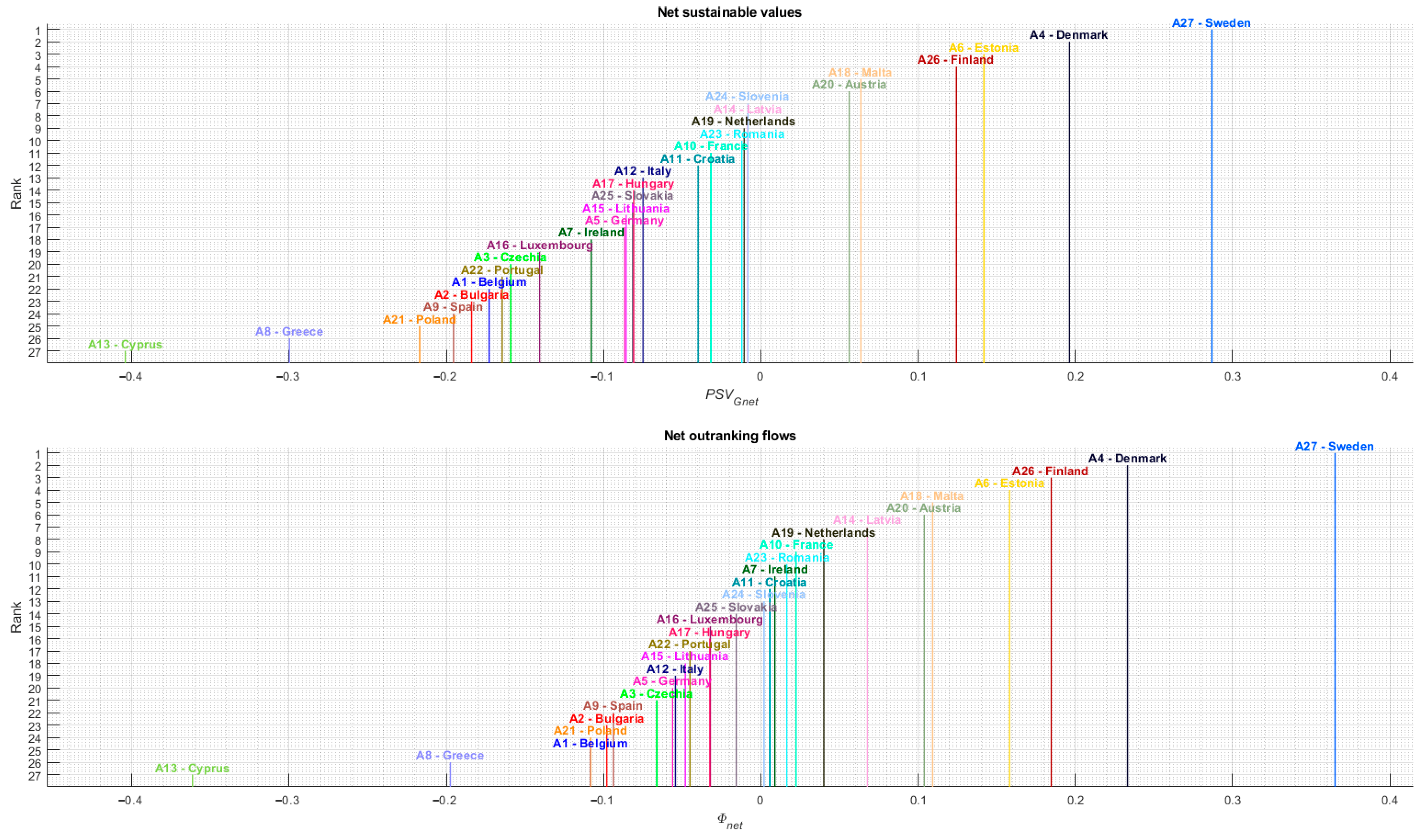
The assessment of the energy transition of EU countries was based on actual data from 2023 (see: Appendix A, Table A1). Using the preference model presented in Table 3 and the PROSA-G method resulted in a country ranking with an aggregated numerical score, presented in Table 4. For comparison purposes, Table 4 also presents the ranking obtained using the classic PROMETHEE II method, which does not support a strong sustainability paradigm and cannot natively capture the various dimensions of sustainability. Additionally, Figure 1 presents the assessment results graphically to facilitate their analysis and interpretation.
The results of the PROSA-G method, presented in Table 4 and Figure 1, show that Sweden is the most advanced country in terms of energy transition, significantly outperforming Denmark, Estonia, and Finland. Malta and Austria rank 5 and 6 in the ranking, with similar scores. Four countries with very similar scores follow: Slovenia, Latvia, Netherlands, and Romania. France and Croatia are next, again with similar scores. The next group of countries with very similar scores consists of Italy, Hungary, Slovakia, Lithuania, and Germany. Following them are Ireland and Luxembourg. The final group of countries with similar scores is the Czechia, Portugal, Belgium, Bulgaria, and Spain group. Poland follows them, with the last two places in the ranking, with significant losses with respect to the previous countries, occupied by Greece and Cyprus.
Comparing the PROSA-G and PROMETHEE II results reveals some changes in the rankings. The changes in the top six positions are very minor, with Estonia and Finland merely swapping the third and fourth places. However, there are also cases where the changes are much more significant: Ireland rose from the 18th place in the PROSA-G ranking to the 11th in the PROMETHEE II ranking, Italy fell from the 13th to 19th, and Slovenia fell from the seventh to 13th. There are also some smaller changes in the rankings, such as a four-place move up for Luxembourg (from 19th to 15th) and Portugal (from 21st to 17th), a three-place drop for Belgium (from 22nd to 25th) and Germany (from 17th to 20th), and two-place changes for Spain (from 24th to 22nd), France (from 11th to ninth), Lithuania (from 16th to 18th), and Hungary (from 14th to 16th). The remaining countries occupy the same position in both rankings or have changed their position by at most one place.
These differences show that the native capture of sustainability in the PROSA-G method renders perceived alternatives differently than the PROMETHEE method, which forms the basis for PROSA-G. In particular, the limitation of compensation between the sustainability dimensions means that better-balanced alternatives may achieve better rankings in the PROSA-G ranking than in the PROMETHEE ranking. This is confirmed by the W M A D g values of the alternatives, presented in Table 5. For example, Slovenia’s W M A D g value is only 0.01, the lowest among all alternatives. Therefore, Slovenia is the best-balanced country across all criteria groups. As a result, it ranks significantly higher in the PROSA-G ranking compared to the PROMETHEE ranking (seventh and 13th, respectively). A similar situation occurs in the case of Italy, whose W M A D g is 0.02. Thanks to its good balance, its PROSA-G ranking is six places higher than in the PROMETHEE ranking (13th and 19th, respectively). A similar effect, to a lesser extent, can also be observed in the case of several other alternatives, including Germany, Estonia, and Lithuania.
On the other hand, alternatives with poorer balance may rank lower in the PROSA-G ranking than in the PROMETHEE ranking. Referring again to Table 5, we can cite the example of Ireland and Portugal, which have the highest W M A D g of all countries, at around 0.12. The strong imbalance of these alternatives causes their PROSA-G ranking to be much worse than in the PROMETHEE ranking (lower by seven and four positions, respectively). A similar effect, with varying degrees of severity, can also be observed in the case of countries such as Spain, Luxembourg, and Latvia. Czechia may seem to be an exception to this rule. Despite its high W M A D g value, it ranked higher in the PROSA-G ranking than in the PROMETHEE ranking. However, comparing these two rankings reveals that in the PROSA-G ranking, Czechia was only ahead of Portugal, which is even more imbalanced than Czechia, compared to the PROMETHEE ranking. Moreover, Czechia did not lose its position in the PROSA-G ranking to the following countries (Belgium, Bulgaria, Spain, Poland), as their imbalance level was similar to Czechia’s and their ϕ n e t score was too low.
Analysis of Table 5 allows us to determine which countries are implementing their energy transition in the most balanced manner (taking into account each sustainability dimension) and which countries are not maintaining a balance between the individual sustainability dimensions. The first group includes the previously mentioned Slovenia, Estonia, and Italy. Each of these countries achieves low W M A D g values and similar values for individual sustainability dimensions. Ireland, Portugal, Poland, Luxembourg, and Spain are the main countries in the opposition in terms of sustainability. Ireland and Luxembourg clearly prioritize economic issues related to the energy transition. They are less concerned with social well-being and completely ignore the negative impact of the energy system on the environment. In turn, Portugal and, to a lesser extent, Spain prioritize environmental factors, placing less emphasis on economic aspects. However, in their case, the energy transition is largely being implemented at the expense of society. In contrast, Poland places the greatest emphasis on social issues, at the expense of both the economy and the environment. Among the ranking leaders, there are also some noticeable deviations and uneven development in terms of individual sustainability dimensions. Sweden performs excellently in every dimension of sustainability, but in its case, environmental factors are prioritized over social and economic ones. Denmark’s good environmental and economic results from the energy transition are, to some extent, achieved at the expense of society. In the case of Finland, Malta, and Austria, good results in terms of social and environmental dimensions were paid for by worse results in the economic dimension.

4.2. Energy Transition Progress Forecast

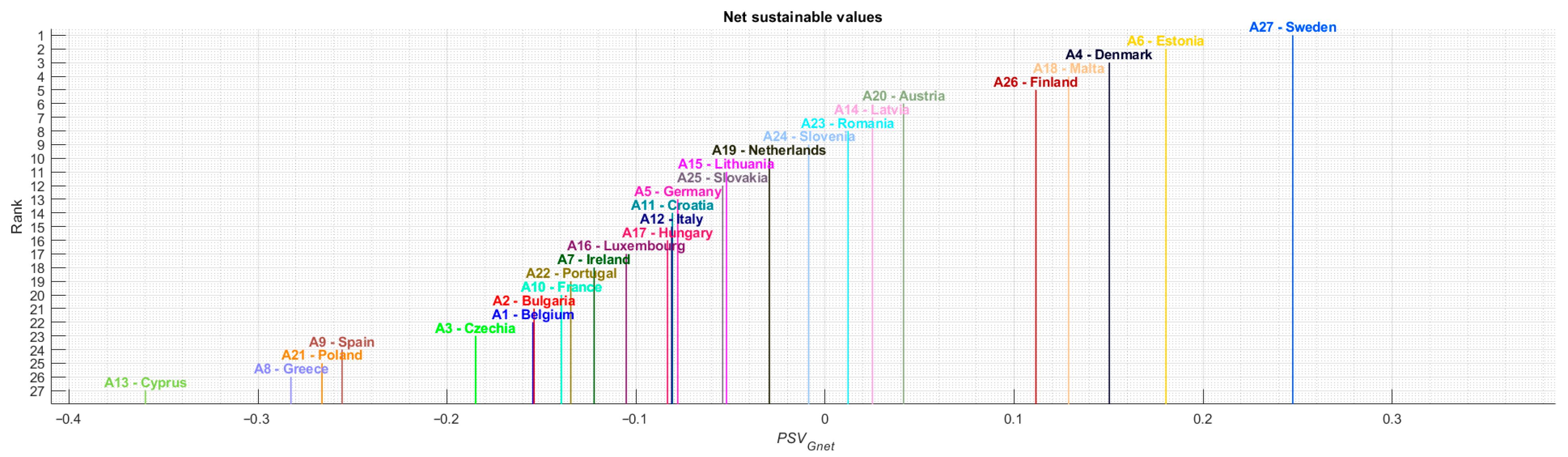
As noted earlier, an energy transition progress forecast was developed based on chain indices. These were used to generate the projected values of the criteria for 2027, presented in Appendix A, Table A2. Based on the criteria values and the PROSA-G method, a ranking of countries, their projected numerical scores, and the projected W M A D g values for 2027 were developed. These values are presented in Table 6 and Figure 2.
A comparison of PROSA-G assessments from 2023 and 2027 indicates that if individual countries do not change their energy policy directions and related social, economic, and environmental policies, Sweden’s advantage over the other countries will increase slightly, despite the country’s lower quantitative result in 2027. However, according to the forecast, in 2027, Estonia will occupy second place, overtaking Denmark. Malta, in turn, will overtake Finland and Austria. Austria will lose a significant portion of its lead over the next-place countries in the ranking: Latvia and Romania. It should be noted that, according to the 2027 forecast, Romania will overtake Slovenia and the Netherlands, which rank higher than Romania in the 2023 ranking. The next countries in the 2027 ranking are Lithuania and Slovakia, which will gain an advantage over Germany, Croatia, Italy, and Hungary, which will equal or surpass them in 2023. Meanwhile, Poland and Spain will join Cyprus and Greece in the group of countries least progressing in their energy transition.
Comparing the 2023 ranking with the 2027 forecast, it should be noted that the most significant improvements are projected for Lithuania, Germany, and Slovakia, rising by five, four, and three positions, respectively. However, it should be noted that in the case of Germany, this advancement is projected despite the lack of a significant change in their numerical rating and is rather due to the weakness of other countries that occupy higher positions in the 2023 ranking (Croatia, France, Italy, Hungary). In turn, the projected significant increase in Cyprus’s numerical rating will not translate into any advancement in the country rankings, and in the case of Malta, it may only allow for a single position advancement. This is due to the significant gap between these countries and their predecessors in the 2023 ranking. Comparing the 2023 ranking with the 2027 forecast also highlights a potential decline for France, which, according to the forecast, will be overtaken by nine countries, losing as much as 0.1 of their numerical rating. In the case of countries such as Spain, Poland, and Sweden, the significant drop in their numerical ratings will not translate into any changes in their rankings. In the case of Sweden, this is due to its significant advantage over the others. Poland and Spain, on the other hand, will not lose their position in the ranking, as they are only followed by Greece and Cyprus. It should also be noted that the projected decline in the rating of France and Spain is related to a relatively large increase in the value of W M A D g for these countries, and therefore to a deterioration in the balance between the sustainability dimensions in the period 2023–2027.

4.3. Stability Analysis of the Solutions

To verify the stability of the obtained ratings and forecasts, additional analyses were conducted using the PROSA-G method and alternative assessment models. The evaluation results for the alternative criterion weighting method were examined, the sensitivity of the solutions to changes in the weights of the criterion groups and changes in the group balance/compensation coefficient values were analysed, and the confidence intervals for the forecasts for 2027 were examined.

4.3.1. Alternative Criteria Weighting Scheme

The first study aimed to examine how changes in the weighting of criteria and groups affected the assessments and rankings of countries. The results obtained in Section 4.1 and Section 4.2 were based on a weighting scheme in which all criteria were assigned equal weights of 0.09 (see: Table 3). However, the varying number of criteria in each group meant that the total weight of a given group of criteria depended on the number of criteria contained within it. Therefore, the weight of the economic criteria group was 0.54 (6 × 0.09), the social criteria group was 0.27 (3 × 0.09), and the environmental criteria group was 0.18 (2 × 0.09). To eliminate the implicit bias toward economic criteria, an alternative weighting scheme was used, in which equal weights were assigned to individual groups, and then this weighting was distributed equally across individual criteria within a given group. Therefore, in the alternative weighting scheme, the weights of the groups and criteria were as shown in Table 7.
The assessment results and ranking of countries, obtained using the PROSA-G method and an alternative weighting scheme (equal weights for criterion groups), are presented in Table 8. These results are compared with the results obtained in the basic scenario (PROSA-G and equal weights for criteria), presented previously in Table 4.
Table 8 shows that, with the change in the weighting of the criteria, the ranking of nine countries remained unchanged, the ranking of eight countries changed by one position, and for another six countries, the ranking changed by two or three positions. Only the Netherlands saw a seven-place change in the ranking (from nine to 16), while Ireland and Luxembourg saw a six-place change (from 18 to 24 and from 19 to 25, respectively). Moreover, Croatia moved up four places (from 12 to eight). The changes occurred mainly in the middle of the rankings, where the differences between countries were the smallest and the density of individual scores was highest. However, both the bottom positions in the ranking (Greece and Cyprus) and the top positions (Sweden, Denmark, Estonia, Finland, Malta, Austria) remained stable, with only one position swap between Estonia and Finland. Furthermore, the Spearman rank correlation coefficient between both rankings was ρ s = 0.94 , indicating a high degree of similarity between the rankings. This suggests that changes in criterion weights do not significantly affect the overall ranking of countries or the assessment conclusions. However, to ultimately verify this hypothesis, a sensitivity analysis of the solutions to changes in criterion weights was conducted.

4.3.2. Sensitivity Analysis of the Solution to Changes in the Weights of the Criteria Groups in Terms of w g k

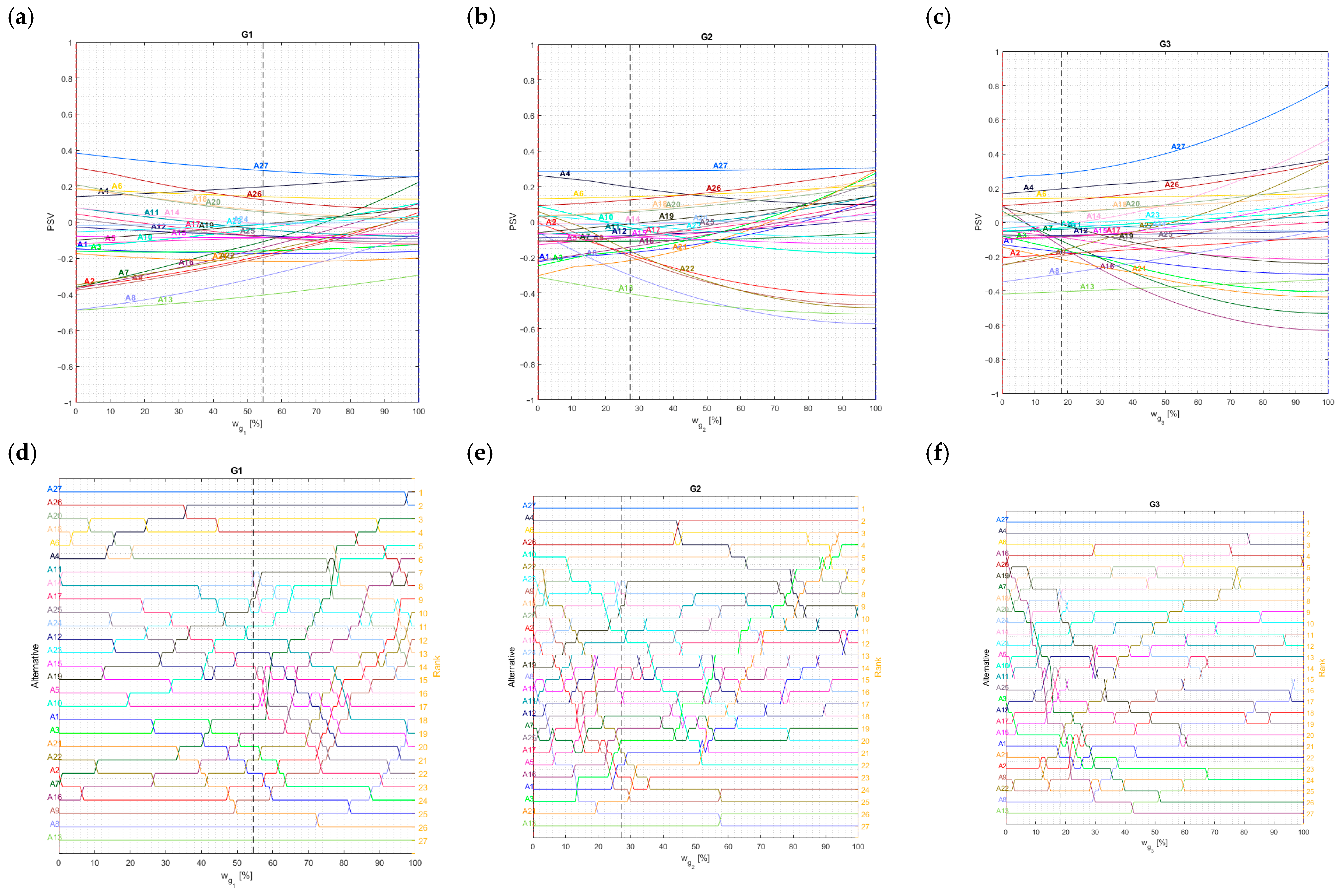
Sensitivity analysis was based on a linear change in the weight of a given criterion group w g k within the range [0, 1] (from 0% to 100%) and adjusting the weights of individual criteria w j within that group. Depending on these changes, the weights of the remaining groups and the criteria within them were linearly adjusted. The initial weights for each group were 0.54 (economic criteria group), 0.27 (social criteria group) and 0.18 (environmental criteria group). Within each group, the criteria had equal weights (initially 0.09) (see: Table 3). Therefore, if, for example, the weight of the economic criteria group was set to 0, then the weights of the other groups increased proportionally, reaching 0.6 for the social criteria group and 0.4 for the economic criteria group (0.2 for each criterion within a given group). The results of the sensitivity analysis of the solution obtained using the PROSA-G method to changes in the criterion group weights are presented in Figure 3.
The results presented in Figure 3 confirm the hypothesis presented in Section 4.3.1 that the ranking of countries does not change significantly with changes in the weighting of the criterion groups and the criteria included within them. Changes occur primarily in the central part of the country rankings, where most countries have similar scores and the differences between ratings are smallest. The positions of countries at the extremes of the ranking remain relatively stable. A27—Sweden almost always occupies first place, while A26—Finland, A6—Estonia, A4—Denmark, A18—Malta, and A20—Austria usually also occupies the top positions. Meanwhile, the bottom positions are usually occupied by A13—Cyprus, A8—Greece, A21—Poland, A9—Spain, and A2—Bulgaria.
Furthermore, the sensitivity analysis demonstrates the importance of considering all three dimensions of sustainability in the assessment. This is clearly illustrated by the example of countries with poor balance between individual criteria groups. For example, A16—Luxembourg, taking into account only economic and social criteria, would rank fourth in the ranking. However, gradually increasing the weight of environmental criteria causes this country to systematically fall lower in the ranking, and a weight of 43% for the environmental criteria group causes it to occupy last place. The opposite is true for A22—Portugal, which, as the weighting of environmental criteria increases, moves up from position 25 to position four. In the case of A21—Poland, the increased importance of social criteria resulted in a rise from position 26 to as much as third place. These are just a few examples of countries for which sensitivity analysis revealed significant changes in ranking position following a significant change in the weighting of one of the criterion groups. This effect, with varying intensity, is also visible for many other countries in the ranking, including A2—Bulgaria, A3—Czechia, A7—Ireland, A10—France, A17—Hungary, A19—Netherlands, etc. Therefore, omitting any of the sustainability dimensions in the assessment could significantly change the country ranking.

4.3.3. Sensitivity Analysis of the Solution to Changes in the Compensation (Sustainability) Coefficient Value of Criteria Groups in Terms of s g k

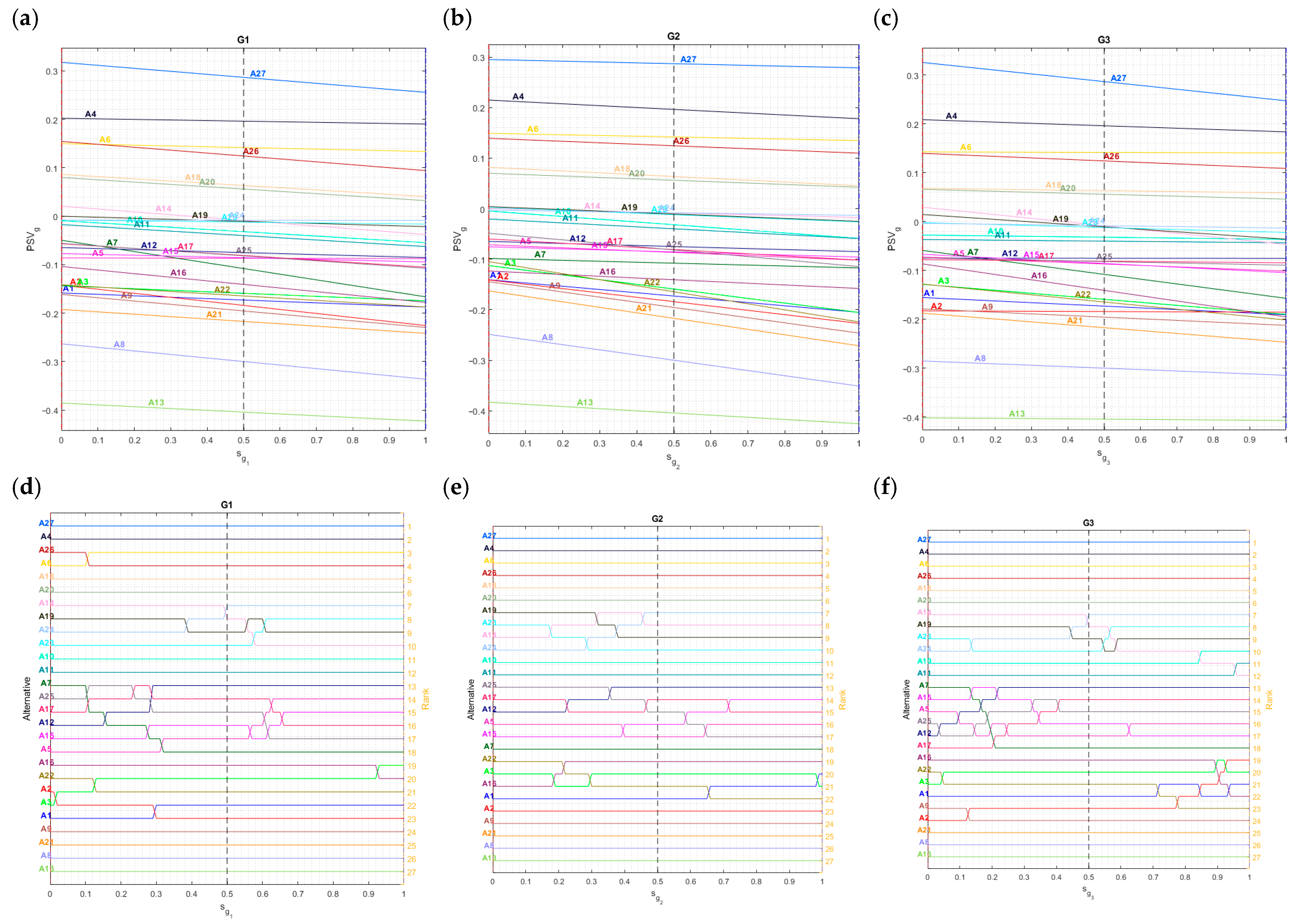
The sensitivity analysis of the solution to changes in the value of the sustainability/compensation coefficient of the criterion groups was based on a linear modification of the value of coefficient s g k in the interval [0, 1]. Therefore, the study was based on a methodology similar to the sensitivity analysis in terms of changes in the weights of criterion groups (see: Section 4.3.2). However, in this case, only the value of the compensation/sustainability coefficient of a given criterion group was changed linearly, leaving the coefficients s g k of the other groups unchanged. The initial values of the compensation coefficients were s g k = 0.5 for each criterion group. The results of the sensitivity analysis of the solution obtained using the PROSA-G method to changes in the values of the s g k coefficients are presented in Figure 4.
Analysis of the sensitivity of the solution to changes in the values of the s g k coefficients indicates that the rankings are relatively stable and insensitive to changes in the compensation/sustainability coefficients for individual criterion groups. The largest changes occur in the case of A7—Ireland and the compensation coefficient for the economic and environmental criteria groups (in each case, a change of up to five places in the ranking), as well as in A2—Bulgaria and A14—Latvia for the environmental criteria group (by five places). In the case of countries such as A5—Germany for economic criteria, A25—Slovakia for economic and social criteria, as well as A12—Italy, A15—Lithuania and A17—Hungary for environmental criteria, the changes in the ranking reach four positions. Countries A3—Czechia, A12—Italy, A14—Latvia, and A17—Hungary for economic criteria, A15—Lithuania, A22—Portugal, and A24—Slovenia for social criteria, and A16—Luxembourg, A24—Slovenia, and A25—Slovakia for environmental criteria change in the ranking by three positions. For the remaining countries and criterion groups, only minimal changes occur, amounting to a maximum of two positions in the ranking. Regardless of changes in the s g k value for any criterion group, the rankings of the following countries remain unchanged: A27—Sweden (position one), A4—Denmark (two), A18—Malta (five), and A20—Austria (six), as well as A21—Poland (25), A8—Greece (26), and A13—Cyprus (27). Furthermore, A6—Estonia and A26—Finland swap positions (by one position—in places three and four) only for the economic criteria group, while A9—Spain changes its ranking by at most one position (from 24 to 23) for the environmental criteria group. Therefore, the resulting ranking in the most sensitive part of the top (1–6) and bottom (23–27) places remains almost completely stable and insensitive to changes in the compensation/sustainability coefficient value.

4.3.4. Confidence Interval Analysis of 2027 Forecasts

Determining confidence intervals for forecasts allowed, to some extent, for the assessment of the reliability of the estimated criteria values and the credibility of the forecast of energy transition progress for 2027. For each country, confidence intervals were determined for the criteria, defining optimistic and pessimistic variants of the values of each criterion in the forecast. The optimistic and pessimistic variants corresponded to the upper and lower values of the confidence interval, respectively, for criteria with a preference for the ‘max’ and, vice versa, for criteria with a preference for the ‘min’. A confidence level of 90% was used in the study, so the z-score was z α = 1.645 . The pessimistic and optimistic forecasted values of the criteria for individual countries are presented in Appendix A, Table A3 and Table A4, respectively. Table 9 presents the percentage change in the criteria values for individual countries in the pessimistic and optimistic variants in relation to the basic forecast (see: Appendix A, Table A2).
Analysis of the values presented in Table 9 indicates a relatively high potential for forecast inaccuracy. It turns out that for criteria C6, C7, and C9, the deviation of the pessimistic and optimistic forecasts from the baseline forecast exceeds 50% for most countries. Similarly, for criteria C2, C5, and C8, for most countries, the deviation of the pessimistic forecast from the baseline forecast also exceeds 50%. Slightly less frequently, but still relatively frequently, deviations exceeding 50% of the baseline forecast occur for criteria C2, C5, C8, C10 and the optimistic forecast variant. Moreover, for criteria C6, C7, C9 and the pessimistic forecast, for most countries, the deviation from the baseline forecast exceeds even 100%. Furthermore, the value of the pessimistic and optimistic forecasts for criterion C2 in the case of A6—Estonia is highly questionable. In this case, the obtained sample standard deviation value σ was significantly greater than the composite index d c ¯ . As a result, the pessimistic and optimistic forecasts showed significant deviations from the baseline forecast. The deviation of the pessimistic forecast (upper value of the confidence interval) was over 28,000%, while in the case of the optimistic forecast (lower value of the confidence interval), it was necessary to limit its value to 0. This is due to the specific nature of criterion C2, as it is assumed that the value of the ‘Energy import’ variable cannot be negative. Regarding the criteria for which forecasts are most reliable, i.e., the criteria for which the deviation from the baseline forecast is the smallest, these include primarily C4, as well as C1, C3, and C11.
In the context of analysing the potential accuracy of forecasts, it is worth considering the case of criterion C8. As mentioned in Section 3.2, for this criterion, there were missing data for the years 2021–2022. Therefore, these data were interpolated linearly based on the years 2020 and 2023. The use of linear interpolation had a significant impact on the values of the dynamic chain indices d c i for the periods 2020/2021, 2021/2022, and 2022/2023. Consequently, the values of d c i changed monotically and linearly over the given periods. This is not a significant problem for data that actually exhibit such a trend. However, if the data are not linear, and even more so, nonmonotonic, the use of linear interpolation can significantly distort the forecast results by underestimating the variability (standard deviation). In such a situation, the confidence intervals for criterion C8 may be artificially narrowed, resulting in an overestimation of the reliability of the C8 estimates and an overestimation of the forecast.
Confidence intervals and the resulting projected pessimistic and optimistic criteria values were used to develop alternative country rankings. These rankings are presented in Table 10, compared to the ranking based on the baseline forecast. Additionally, Table 10 includes the sample standard deviation calculated based on the rank of each country in a given forecast version.
A comparison of the forecasts presented in Table 10 shows that some countries demonstrate significant stability in their rankings, regardless of the forecast version. These are primarily A14—Latvia, A2—Bulgaria, A4—Denmark, A13—Cyprus, as well as A27—Sweden, for which the sample standard deviation rank value is less than two, and the difference between ranks is a maximum of 2–3 positions. The positions occupied by A15—Lithuania, A7—Ireland, A12—Italy, A20—Austria, and A25—Slovakia can also be considered relatively stable. For these countries, the sample standard deviation is in the range [2, 3.5], and the difference between ranks is at most six places. Moderately variable are the positions occupied by countries A1—Belgium, A3—Czechia, A5—Germany, A8—Greece, A9—Spain, A10—France, A11—Croatia, A16—Luxembourg, A17—Hungary, A18—Malta, A19—Netherlands, A21—Poland, and A26—Finland. In the case of these countries, there are already clear differences in the positions occupied in individual rankings (differences of 7–12 places), and the sample standard deviation is in the range of (3.5, 7). Rankings of A6—Estonia, A22—Portugal, A23—Romania, and A24—Slovenia should be considered highly unstable. These countries exhibit significant differences in their positions in the individual rankings. Typically, these countries occupy top positions in one ranking and bottom positions in another. An extreme example is A6—Estonia, which occupies second place in the baseline ranking, first in the optimistic ranking, and last in the pessimistic ranking.
When assessing the credibility of the 2027 energy transition progress forecast, it should be noted that only four countries exhibit highly unstable rankings based on the baseline, pessimistic, and optimistic forecasts. However, the vast majority of countries for which forecasts were developed have stable, relatively stable, or moderately variable rankings. To assess the overall similarity of individual rankings, Spearman’s rank correlations were examined. While the correlation between the pessimistic and optimistic rankings is ρ s = 0.17 , indicating essentially no relationship between them, the remaining correlations indicate moderate or strong relationships between the rankings. Specifically, the correlation between the pessimistic and baseline rankings is 0.554, indicating moderate agreement, while the correlation between the baseline and optimistic rankings is 0.771, which can be interpreted as strong agreement. Both the stability analysis of the rankings and the correlation analysis allow us to consider the forecasts as moderately reliable.

5. Discussion

The data collected for this study is valuable not only for assessing the energy transition of individual countries but also for analysing potential relationships between criteria. These relationships indicate significant implications for sustainable energy management. The study used the Pearson coefficient to analyse correlations based on the numerical criteria values for individual countries. For the 2023 data, the correlation matrix presented in Table 11 was obtained. Correlation coefficients significant at p < 0.05 are indicated in bold.
Among the correlations highlighted in Table 11, for ‘C1—Final energy consumption’, a positive correlation can be identified with ‘C4—GDP’ and ‘C11—Domestic net GHG emissions’. Both correlations seem intuitively plausible. The first confirms the observation made in the Introduction about the relationship between GDP and energy consumption. The second correlation indicates that higher energy consumption is usually associated with higher pollutant emissions. This correlation indirectly suggests that most EU countries still underuse the so-called “clean” energy sources. This thesis is supported by the case of Sweden, which has a large share of RESs in energy consumption and for which there is no correlation between C1 and C11. Furthermore, ‘C1—Final energy consumption’ is negatively correlated with ‘C6—Electricity prices for medium-sized non-household consumers’ and ‘C7—Population unable to keep home adequately warm by poverty status’. The second of these correlations naturally highlights the fact that maintaining an appropriate temperature in a home requires the consumption of energy resources. The correlation between C1 and C6 seems to suggest that higher energy consumption leads to lower prices for businesses. However, this is a spurious correlation, determined by three countries: Luxembourg, Finland, and Sweden. The correlation between C1 and C6, excluding Luxembourg and Finland, is much lower, at only −0.31, and is not statistically significant. Furthermore, after removing Sweden, the correlation drops even further, to −0.16.
Criterion ‘C2—Energy import’ is positively correlated with ‘C8—Population living in buildings with low energy efficiency’ and negatively correlated with ‘C10—Share of RES in gross final energy consumption’. The first correlation can be explained by the simple statement that low energy efficiency in buildings structurally determines higher energy needs, which must be met using available resources. In this context, the second relationship is particularly interesting, indicating that the lower the share of RESs, the more energy a given country imports. The reason for this relationship can be traced to the high tax costs (including the ETS) associated with energy production from fossil fuels. For countries with a low share of RESs, importing energy produced by neighbouring countries with highly developed renewable energy sectors may be financially more advantageous than producing energy from fossil fuels themselves. Of course, this is not about constant imports, but rather situations where weather conditions cause significant overproduction of energy from RESs in countries with highly developed renewable energy sectors. Then its import becomes more profitable than its own production from conventional sources.
The criterion ‘C3—Energy productivity’ is positively correlated with ‘C4—GDP’, which is largely related to the stringent energy efficiency standards applied in developed countries. Furthermore, ‘C4—GDP’ is positively correlated with ‘C11—Domestic net GHG emissions’ and negatively correlated with ‘C6—Electricity prices for medium-sized non-household consumers’ and ‘C7—Population unable to keep home adequately warm by poverty status’. The latter correlation indicates that in more developed countries, people are typically wealthier and more able to meet their home heating needs. However, the correlation between C4 and C11 appears to be spurious, as in reality, more developed countries in the EU are moving away from fossil fuels more quickly and should therefore emit less pollution than countries with lower GDP levels. Indeed, upon closer analysis, it turned out that this relationship is determined by two outliers: Ireland and Luxembourg, which combine high GDP and high pollutant emissions, thus distorting the results. Without their contribution, the correlation between C4 and C11 is only 0.02. The negative correlation between C4 and C6 may seem debatable, but it could not be confirmed as accidental. In fact, this correlation is determined by two groups of countries. Countries such as Hungary, Cyprus, Romania, Croatia, Poland, and Slovakia (and, to a lesser extent, Bulgaria, Czechia, and Slovenia) have lower GDP and higher energy prices for businesses. Countries such as Finland, Sweden, and Denmark, on the other hand, have significantly higher GDP and lower energy prices. A certain structural relationship is evident here, as the first group of countries are former Soviet bloc countries, also characterized by a low share of RESs in the energy mix, while the second group of countries are Scandinavian countries, with a very high share of RESs. This observation is somewhat confirmed by the subsequent negative correlation between the criterion ‘C6—Electricity prices for medium-sized non-household consumers’ and ‘C10—Share of RESs in gross final energy consumption’. Here, too, as in the case of the correlation between C4 and C6, two groups of countries can be distinguished. The first group includes Hungary, Poland, Cyprus, Romania, Croatia, and Slovakia. The second group includes Sweden, Finland, Denmark, as well as Latvia, Estonia, and Portugal. These are therefore similar groups of countries as in the case of the correlation between C4 and C6. The correlation between C6 and C10 of −0.5 seems to suggest that countries with high energy prices are also characterized by a low share of RESs in the energy mix. In other words, a high share of RESs ensures lower energy prices for businesses. However, a closer look at the correlation between C6 and C10 revealed that two Scandinavian countries, Sweden and Finland, are largely responsible for this correlation. After excluding them from the analysis, the correlation between C6 and C10 is −0.25 and is no longer statistically significant. Sweden and Finland, on the other hand, are countries where RESs are largely based on hydropower (in Sweden, hydropower plants account for approximately 40% of energy production, and in Finland, approx. 20%). Hydropower, on the other hand, is a relatively cheap RES, cheaper than, for example, offshore wind, geothermal, and bioenergy [49]. What is more, in Sweden and Finland, the cost of this energy is even lower due to the fact that the appropriate infrastructure (e.g., hydroelectric dams) was built several decades ago. These facts may have a significant impact on the correlation between C6 and C10.
In the social context, however, ‘C7—Population unable to keep home adequately warm by poverty status’ is positively correlated with ‘C9—Households with energy bill arrears’. In essence, these two criteria complement each other, and complement each other with respect to the concept of energy poverty. If a household has overdue energy bills, it means they are struggling to meet their home heating needs. Finally, ‘C10—Share of RESs in gross final energy consumption’ is negatively correlated with ‘C11—Domestic net GHG emissions’, which is also a natural and expected relationship.
Correlations were examined similarly for the data projected for 2027. The results of this study are presented in Table 12. Correlation coefficients significant at p < 0.05 are indicated in bold.
Analysis of Table 12 indicates that, compared to 2023, some correlations remain in the projected data for 2027, some have disappeared, and new correlations have also emerged. In the case of the criterion ‘C1—Final energy consumption’, only a positive correlation with ‘C4—GDP’ and a negative one with ‘C7—Population unable to keep home adequately warm by poverty status’ remained, which indicates the persistent, systemic nature of these relationships. However, the disappearance of the significant correlation between C1 and ‘C11—Domestic net GHG emissions’ may indicate that by 2027, most EU countries will significantly reduce energy production from fossil fuels, which will have a positive impact on the reduction in pollutant emissions. Similarly, the disappearance of the correlation between ‘C2—Energy import’ and ‘C8—Population living in buildings with low energy efficiency’ may suggest that in 2027 the energy efficiency of buildings will improve in many countries and they will no longer determine such significant energy needs as in 2023. In turn, the maintenance of a significant negative correlation between C2 and ‘C10—Share of RESs in gross final energy consumption’ indicates that also in 2027 a certain systemic dependence will be maintained, consisting in the need to import energy from RESs.
For the criterion ‘C3—Energy productivity’, a significant positive correlation with ‘C4—GDP’ remained, and two new positive correlations emerged: ‘C8—Population living in buildings with low energy efficiency’ and ‘C11—Domestic net GHG emissions’. As a result of in-depth analysis, it was determined that the correlations between C3 and C8, as well as C3 and C11, are spurious and determined by Ireland. Without Ireland’s participation, the correlation between C3 and C8 is 0.28, and between C3 and C11, only 0.13. Therefore, both correlations are statistically insignificant, and Ireland is a clear outlier.
It is worth noting that for the projected data for 2027, no significant correlations were detected for ‘C4—GDP’ (except for the correlation between C3 and C4 discussed earlier). However, the correlation between ‘C6—Electricity prices for medium-sized non-household consumers’ and ‘C10—Share of RESs in gross final energy consumption’ has been significantly strengthened. This means that in 2027, energy prices will be even more dependent on the share of RESs in the energy mix (which is consistent, for example, with the planned introduction of the ETS2 system in 2027 and the trend of reducing energy costs from RESs [49]).
In the social sphere, the correlation between ‘C7—Population unable to keep home adequately warm by poverty status’ and ‘C9—Households with energy bill arrears’ was maintained, and a significant positive correlation emerged between C7 and ‘C8—Population living in buildings with low energy efficiency’. Both correlations are fully rational, as both financial difficulties and low energy efficiency of buildings are the main causes of heat retention problems. The fundamental, negative relationship between ‘C10—Share of RESs in gross final energy consumption’ and ‘C11—Domestic net GHG emissions’ is also maintained.

6. Conclusions

This study attempted to answer the question of which EU countries are leading the energy transition process and which will dominate in this regard in the future. The study was based on an analysis of actual economic, social, and environmental data from the last dozen or so years. Data from 2023 was used to assess the current state of energy transition in individual EU countries. Data from 2013–2023 (and partially 2024) were used to generate forecasts of energy transition progress until 2027.
The results of the study indicate that the countries most successfully implementing the energy transition are Sweden, Denmark, Estonia, and Finland. Greece and Cyprus round out the list. In the coming years, Malta may join the leading countries, while Spain and Poland may also join Greece among the outsiders. All of this assumes that EU countries maintain their current energy policy directions. Among the countries conducting the energy transition in the most balanced manner, meaning without favouring one dimension of sustainability over another, Estonia stands out. It occupies a high position in the ranking, making significant progress in transitioning to RESs while addressing not only environmental aspects but also economic and social considerations. On the other hand, the countries leading the transition in the least balanced manner are primarily Ireland, Portugal, Poland, Luxembourg, and Spain. These countries demonstrate the greatest differences in the economic, social, and environmental aspects of their energy transition.
Based on the study’s results, several recommendations can be made regarding EU energy policy. The dominance of Sweden, Finland, Denmark, and Estonia demonstrates the importance of countries independently meeting their own energy needs, as all of these countries are characterized by low energy imports (criterion C2). They also dominate in terms of energy productivity (C3), meaning the ability to effectively convert energy into economic goods, as well as in terms of the share of RESs in energy consumption (C10). Sweden and Finland, thanks to their high share of hydropower plants, also perform well in terms of energy prices, both for households (C5) and non-household consumers (C6). In these respects, the countries cited can serve as role models and guidelines for others. Of course, not all of these aspects are solely the result of political decisions; for example, the large share of hydropower plants in Sweden and Finland is primarily due to geographic and geological conditions. In turn, low energy imports and high energy productivity, and consequently, the high ranking of these countries, are largely a consequence of previous investments, including investments in hydropower. Countries that received lower ratings in terms of energy transition, but are also committed to achieving positive transition outcomes, may be recommended to increase investment in this area. However, it is crucial that investments in energy sources developed in a given country are aligned with its RESs. For example, Sweden and Finland rely heavily on hydropower, while Denmark and Estonia primarily invest in wind energy and biomass, as they have the greatest potential in these renewable energy areas [50,51,52]. Another recommendation concerns pursuing a balanced transition. Some countries invest heavily in only selected dimensions of sustainability, i.e., individual pillars of the energy transition. For example, Poland devotes significant resources to social support for the transformation process, at the expense of funds for investments in energy infrastructure development. Portugal, for example, completely neglects the social aspects of the transition, exposing the entire process to low public acceptance. Meanwhile, the leading countries are conducting a relatively balanced transition process, which positively impacts all sustainability dimensions and the overall assessment of their energy transition.
Analysis of the source data allowed us to examine the energy transition process from the perspective of the EU as a whole. In this area, the study revealed that most EU countries still underutilize RESs, which results in pollutant emissions. On the other hand, high tax costs (e.g., the ETS) mean that in countries with a high share of fossil fuels in energy production, importing energy produced by neighbouring RESs is often more advantageous than producing it domestically. Moreover, the large share of RESs in energy production ensures lower energy prices for businesses. The forecasts suggest that by 2027, most EU countries will significantly reduce energy production from fossil fuels, which will positively impact pollutant emissions. Energy prices, however, will become even more dependent on the share of RESs in the energy mix (this is related, among other things, to the introduction of ETS2), and import dependence linked to the availability of RESs will continue.
The conducted study has certain limitations related to the selection of evaluation criteria and the forecasting method used. Based on a literature review, we selected 12 criteria for assessing energy transitions, reflecting three dimensions of sustainability. These criteria are frequently used in this type of research, but they do not reflect all possible aspects related to energy transitions and their consequences in a decision-making model. Chain indices, on the other hand, generate a simplified forecasting model based on time series describing only a certain segment of the past. Regarding both limitations, it should be noted that excessive data volume in a model is not recommended, as it can lead to a loss of operability (the possibility of reliable comparisons) [53]. Therefore, when building a model, the analyst is usually forced to introduce simplifications, omissions, and transformations that comprise model richness and readability to maintain comparability [54]. In this context, it should be emphasized that despite the use of certain simplifications in the assessment and forecasting models, reasonable and reliable assessments, forecasts, and analytical conclusions were obtained.
Another research limitation is the use of deterministic data in forecasting. Forecasts are typically characterized by a certain degree of uncertainty and imprecision. Therefore, fuzzy sets can be used in forecasting. On the other hand, across the entire spectrum of MCDA methods, there are no fuzzy methods natively supporting sustainability dimensions and dedicated to this type of task. Therefore, future research will focus on fuzzy extensions of the PROSA family of methods.

Supplementary Materials

The following supporting information can be downloaded at https://www.mdpi.com/article/10.3390/en19041045/s1: Supplementary File S1.xlsx. The supplementary file contains the source data, i.e., criterion values for individual countries in subsequent periods and forecasts based on chain indices.

Author Contributions

Conceptualization, P.Z.; methodology, P.Z.; software, P.Z.; validation, P.Z. and A.Z.; formal analysis, A.Z.; investigation, A.Z.; resources, A.W.; data curation, A.Z.; writing—original draft preparation, P.Z. and A.Z.; writing—review and editing, P.Z.; visualization, P.Z. and A.W.; supervision, P.Z.; project administration, A.Z.; funding acquisition, A.W. All authors have read and agreed to the published version of the manuscript.

Funding

This research received no external funding.

Data Availability Statement

Data are contained within the article.

Conflicts of Interest

Author Abdullah Zair was employed by the company AZIT Ltd., Szczecin, Poland. The remaining authors declare that the research was conducted in the absence of any commercial or financial relationships that could be construed as a potential conflict of interest.

Appendix A

Table A1. Data for the energy transition assessment criteria for 2023.
CountryC1 [TOE/cap]C2 [%]C3 [PPS/KGOE]C4 [€/cap]C5 [PPS/kWh]C6 [PPS/kWh]C7 [%]C8 [%]C9 [%]C10 [%]C11 [TOE/cap]
A1—Belgium2.6676.0979.4840,3300.33760.23406.014.43.814.7418.3
A2—Bulgaria1.4939.7189.0788500.19770.271120.78.417.822.5497.0
A3—Czechia2.0841.6769.8818,2600.38680.26706.18.51.918.5869.4
A4—Denmark2.2538.86817.3053,2300.26730.19746.915.04.744.3966.6
A5—Germany2.2566.38014.3739,9900.35930.23878.216.05.421.5628.1
A6—Estonia1.903.4719.4518,2000.26070.21004.110.54.640.9507.9
A7—Ireland2.2677.90129.2584,5600.31910.23547.221.27.615.25310.3
A8—Greece1.5175.59911.8918,8000.28150.236619.213.532.925.2696.9
A9—Spain1.6768.41813.1225,7400.25170.197020.823.09.624.8525.6
A10—France1.9044.87411.6635,4400.23720.232112.121.17.522.2835.5
A11—Croatia1.8455.72212.7414,9800.21970.39156.25.611.628.0516.6
A12—Italy1.8474.81315.2630,8600.34880.27569.517.14.119.5946.5
A13—Cyprus1.9592.20512.2628,2200.37870.357717.132.18.620.2138.9
A14—Latvia2.0732.72710.9614,6400.34650.22936.618.87.043.2235.3
A15—Lithuania1.8568.04413.0516,9000.29550.260220.08.66.531.9266.2
A16—Luxembourg5.2790.61616.2594,8300.15230.18982.118.04.814.35511.7
A17—Hungary1.7562.06411.3514,7600.17130.51497.112.67.317.1175.7
A18—Malta1.3097.5547.1730,0700.14260.16526.87.24.915.0774.1
A19—Netherlands2.2970.44711.8845,9300.21280.21247.115.41.217.4208.0
A20—Austria2.6561.05413.2141,9100.24480.26413.910.55.540.8447.5
A21—Poland1.9048.02411.5015,2900.33490.40364.75.74.016.5649.5
A22—Portugal1.6366.86614.2620,2000.27270.167920.829.03.835.1635.0
A23—Romania1.2227.86318.5311,1200.34350.367712.57.513.625.7825.4
A24—Slovenia2.1149.26712.1623,2300.24900.29433.618.56.625.0667.0
A25—Slovakia1.6857.7329.1217,3700.24500.35268.15.87.216.9906.7
A26—Finland3.9829.5666.6640,9300.19380.08852.65.37.450.7507.4
A27—Sweden2.8726.3889.7248,3500.18760.09685.94.83.366.3934.2
Table A2. Projected values of the energy transition assessment criteria for 2027.
CountryC1 [TOE/cap]C2 [%]C3 [PPS/KGOE]C4 [€/cap]C5 [PPS/kWh]C6 [PPS/kWh]C7 [%]C8 [%]C9 [%]C10 [%]C11 [TOE/cap]
A1—Belgium2.4875.40411.6741,6280.37650.26845.713.13.619.1427.5
A2—Bulgaria1.6140.29411.4498600.20220.299116.47.114.924.2006.8
A3—Czechia2.0349.15912.5619,2750.44410.30575.78.01.720.8608.5
A4—Denmark2.1561.56021.5055,5470.28840.20697.214.44.854.0295.5
A5—Germany2.1068.03718.1540,7870.38330.26168.617.35.925.8087.0
A6—Estonia1.801.95813.0619,1030.27920.22254.38.63.949.6055.9
A7—Ireland2.2273.04341.62101,7870.33380.27105.924.86.320.2399.5
A8—Greece1.5681.97214.1019,8060.31060.268917.013.332.130.8646.1
A9—Spain1.6567.79615.5627,0080.25600.205925.726.110.030.3485.2
A10—France1.7543.68614.2836,2790.28250.284514.225.88.026.9284.9
A11—Croatia1.9759.42815.3416,6780.22090.47585.04.08.328.0556.9
A12—Italy1.8074.05718.1631,9610.38270.30147.715.23.120.8676.1
A13—Cyprus1.9890.70314.7230,9370.40540.380914.032.56.528.6818.8
A14—Latvia2.1326.42113.3115,8140.38710.23744.416.15.145.9785.3
A15—Lithuania1.9665.25315.8818,7400.31120.264017.56.14.836.6006.0
A16—Luxembourg4.5588.14520.4794,5750.15760.22662.619.25.225.2629.3
A17—Hungary1.7967.60313.5316,2030.15360.62245.69.35.217.4965.6
A18—Malta1.3295.0388.3433,7870.12750.14695.05.93.926.2763.4
A19—Netherlands2.06108.85015.1047,7190.21580.25509.115.31.129.4426.9
A20—Austria2.4960.97215.7442,4440.25670.30944.39.85.744.6636.8
A21—Poland2.0261.14514.1917,1010.36570.48193.44.52.719.1999.2
A22—Portugal1.6864.43717.0221,3220.28440.172417.827.93.239.8624.6
A23—Romania1.2832.95324.8612,4250.36640.407611.55.511.226.5825.2
A24—Slovenia2.0250.00315.6825,0910.25750.34453.215.94.925.8726.4
A25—Slovakia1.6157.46710.5918,6140.23770.38489.15.27.320.8926.3
A26—Finland3.8124.0317.5941,5330.22630.08953.25.37.457.8206.2
A27—Sweden2.7224.18911.6449,6390.20140.10388.94.03.174.2773.7
Table A3. Projected values of the energy transition assessment criteria for 2027, according to confidence intervals in the pessimistic scenario.
CountryC1 [TOE/cap]C2 [%]C3 [PPS/KGOE]C4 [€/cap]C5 [PPS/kWh]C6 [PPS/kWh]C7 [%]C8 [%]C9 [%]C10 [%]C11 [TOE/cap]
A1—Belgium3.42113.9577.3036,3970.73750.574111.617.07.310.7169.6
A2—Bulgaria2.0656.9517.0688810.26710.904118.310.220.112.52813.1
A3—Czechia2.7669.3619.5216,7291.35981.180222.612.16.316.75712.0
A4—Denmark2.79398.50516.5051,3400.91810.519217.323.714.324.8047.2
A5—Germany2.5687.40813.4836,1130.51650.346267.727.314.220.9649.3
A6—Estonia2.25554.7306.3115,4560.61690.834912.315.910.729.20515.5
A7—Ireland2.89124.05821.7169,3740.43960.630719.948.117.27.71512.4
A8—Greece2.20121.22310.6116,0010.50481.238025.618.455.621.9538.5
A9—Spain2.4094.12111.6521,5320.52300.474853.077.620.919.6327.7
A10—France2.4972.07910.5630,7220.41490.608939.478.313.922.0686.5
A11—Croatia2.6291.94811.3313,4110.28681.71947.36.510.719.7968.3
A12—Italy2.5694.29513.1125,7240.79231.005211.743.49.714.9268.5
A13—Cyprus3.07108.26811.1426,0920.98661.181316.265.59.114.27611.2
A14—Latvia2.7163.93410.1913,6830.86430.63669.326.79.738.5106.6
A15—Lithuania2.6377.11410.3717,0010.75921.612427.510.17.427.8887.4
A16—Luxembourg6.7793.32813.4482,6070.19840.509520.338.927.14.44914.1
A17—Hungary2.42151.5359.1513,7560.19192.330615.014.97.310.4057.4
A18—Malta2.39116.4684.8026,9450.15220.194816.311.010.315.4756.3
A19—Netherlands2.79343.48210.3941,7080.64610.445839.825.95.49.6359.1
A20—Austria3.28171.91311.3635,6400.32260.551913.719.125.727.6829.1
A21—Poland2.66105.1259.6815,7900.58270.89846.913.44.28.65612.7
A22—Portugal2.3198.80012.2917,6390.45910.314523.449.19.727.9686.8
A23—Romania1.6574.78317.2010,6771.40402.641224.29.085.321.9216.4
A24—Slovenia2.7679.20011.5221,6920.32050.875710.224.87.118.4468.3
A25—Slovakia2.42138.5346.9016,8200.33951.007325.310.617.07.5999.1
A26—Finland5.0544.8825.8537,8550.41690.160210.59.214.744.4368.5
A27—Sweden3.1565.8758.7245,1670.36210.318636.66.610.063.2694.9
Table A4. Projected values of the energy transition assessment criteria for 2027, according to confidence intervals in the optimistic variant.
CountryC1 [TOE/cap]C2 [%]C3 [PPS/KGOE]C4 [€/cap]C5 [PPS/kWh]C6 [PPS/kWh]C7 [%]C8 [%]C9 [%]C10 [%]C11 [TOE/cap]
A1—Belgium1.7647.57517.7647,7200.10710.05581.210.01.631.7705.7
A2—Bulgaria1.2427.59017.5811,5330.15540.045412.14.710.442.5873.1
A3—Czechia1.4533.72916.2822,5080.08990.03610.15.00.525.6745.8
A4—Denmark1.631.65527.5563,5040.05390.07240.48.20.5103.6404.2
A5—Germany1.7052.08023.9345,1660.26330.21860.010.41.331.4475.2
A6—Estonia1.410.00024.1722,9730.07540.01480.54.11.679.1861.6
A7—Ireland1.6839.66072.84145,2890.14960.08200.111.22.343.9967.2
A8—Greece1.0753.12618.3725,2620.17970.018010.39.415.242.2474.2
A9—Spain1.1047.42320.3834,8240.11890.05766.05.83.944.9493.3
A10—France1.1924.64418.9243,2210.23900.06022.75.54.832.5503.6
A11—Croatia1.4536.40920.3221,9830.16170.04231.62.33.338.6645.7
A12—Italy1.2357.26724.5539,6790.11810.03843.73.70.728.4264.3
A13—Cyprus1.2175.36719.1037,5980.09470.04658.513.93.551.9396.8
A14—Latvia1.658.48417.1018,4650.07880.05350.79.02.054.4824.2
A15—Lithuania1.4254.81523.3421,5700.06890.00118.03.50.947.2094.9
A16—Luxembourg2.9383.18229.97105,1330.12560.05150.28.20.084.4585.8
A17—Hungary1.2924.56519.3119,2170.09610.02200.75.53.327.7114.2
A18—Malta0.6676.71113.5644,7310.10690.09401.12.81.141.9371.6
A19—Netherlands1.4821.56921.2754,7350.02120.11600.48.40.370.4315.1
A20—Austria1.8514.99221.2848,9600.15010.08380.74.40.268.4675.0
A21—Poland1.4932.66420.1219,6970.22880.16340.41.00.937.2956.5
A22—Portugal1.1939.92823.0125,9860.23200.12136.814.50.855.1963.0
A23—Romania0.9711.74334.8314,6010.02390.00042.83.10.031.9494.2
A24—Slovenia1.4529.73520.8829,6140.17570.05500.39.73.335.3424.7
A25—Slovakia1.0218.56915.5921,3380.12490.05922.12.21.546.8024.3
A26—Finland2.8111.4599.6845,1190.14950.03170.52.84.074.0214.4
A27—Sweden2.346.33515.2254,9440.11350.01320.02.20.786.6622.7

References

  1. Ozturk, I.; Aslan, A.; Kalyoncu, H. Energy Consumption and Economic Growth Relationship: Evidence from Panel Data for Low and Middle Income Countries. Energy Policy 2010, 38, 4422–4428. [Google Scholar] [CrossRef]
  2. Mutascu, M. A Bootstrap Panel Granger Causality Analysis of Energy Consumption and Economic Growth in the G7 Countries. Renew. Sustain. Energy Rev. 2016, 63, 166–171. [Google Scholar] [CrossRef]
  3. Kasperowicz, R. Electricity Consumption and Economic Growth: Evidence from Poland. JOIS 2014, 7, 46–57. [Google Scholar] [CrossRef]
  4. Bildirici, M.E.; Kayıkçı, F. Economic Growth and Electricity Consumption in Former Soviet Republics. Energy Econ. 2012, 34, 747–753. [Google Scholar] [CrossRef]
  5. Ding, W.; Du, J.; Kazancoglu, Y.; Mangla, S.K.; Song, M. Financial Development and the Energy Net-Zero Transformation Potential. Energy Econ. 2023, 125, 106863. [Google Scholar] [CrossRef]
  6. Khan, A.; Chenggang, Y.; Hussain, J.; Kui, Z. Impact of Technological Innovation, Financial Development and Foreign Direct Investment on Renewable Energy, Non-Renewable Energy and the Environment in Belt & Road Initiative Countries. Renew. Energy 2021, 171, 479–491. [Google Scholar] [CrossRef]
  7. Sokołowska, E.; Wiśniewski, J.W. Sustainable Energy Consumption—Empirical Evidence of a Household in Poland. Energy Strategy Rev. 2024, 53, 101398. [Google Scholar] [CrossRef]
  8. Tiwari, S.; Sharif, A. A Step toward Sustainable Development: Role of Energy Transition, Eco-Innovation and Environmental Policy Stringency. Gondwana Res. 2025, 152, 129–141. [Google Scholar] [CrossRef]
  9. Igliński, B.; Pietrzak, M.B.; Kiełkowska, U.; Skrzatek, M.; Kumar, G.; Piechota, G. The Assessment of Renewable Energy in Poland on the Background of the World Renewable Energy Sector. Energy 2022, 261, 125319. [Google Scholar] [CrossRef]
  10. Rusin, A.; Wojaczek, A. Changes in the Structure of the Polish Energy Mix in the Transition Period to Ensure the Safety and Reliability of Energy Supplies. Energy 2023, 282, 128831. [Google Scholar] [CrossRef]
  11. Manni, M.; Aghaei, M.; Sizkouhi, A.M.M.; Kumar, R.R.R.; Stølen, R.; Steen-Hansen, A.E.; Di Sabatino, M.; Moazami, A.; Völler, S.; Jelle, B.P.; et al. Solar Energy in the Built Environment. In Reference Module in Earth Systems and Environmental Sciences; Elsevier: Amsterdam, The Netherlands, 2023. [Google Scholar]
  12. Tutak, M.; Brodny, J. Renewable Energy Consumption in Economic Sectors in the EU-27. The Impact on Economics, Environment and Conventional Energy Sources. A 20-Year Perspective. J. Clean. Prod. 2022, 345, 131076. [Google Scholar] [CrossRef]
  13. Kluza, K.; Ziolo, M.; Postula, M. Climate Policy Development and Implementation from the Sustainable Development Goals Perspective. Evidence from the European Union Countries. Energy Strategy Rev. 2024, 52, 101321. [Google Scholar] [CrossRef]
  14. Zastempowski, M. Analysis and Modeling of Innovation Factors to Replace Fossil Fuels with Renewable Energy Sources—Evidence from European Union Enterprises. Renew. Sustain. Energy Rev. 2023, 178, 113262. [Google Scholar] [CrossRef]
  15. Kaviti Musango, J. Energy Technology Assessment in Managing Sustainable Energy Transitions: A Bibliometric Analysis. Sustain. Energy Technol. Assess. 2024, 72, 104021. [Google Scholar] [CrossRef]
  16. Ziemba, P.; Becker, A.; Becker, J. Models and Indices of Sustainability Assessment in the Energy Context. Energies 2022, 15, 9465. [Google Scholar] [CrossRef]
  17. Ziemba, P. Towards Strong Sustainability Management—A Generalized PROSA Method. Sustainability 2019, 11, 1555. [Google Scholar] [CrossRef]
  18. Brodny, J.; Tutak, M.; Grebski, W.W. Empirical Evaluation of the Energy Transition Efficiency in the EU-27 Countries over a Decade—A Non-Obvious Perspective. Energies 2025, 18, 3367. [Google Scholar] [CrossRef]
  19. Soto, G.H.; Nghiem, X.-H.; Martinez-Cobas, X. Analyzing the Role of Main Energy Transition Policies upon Renewable Energy Penetration in the EU: An Assessment of Energy Productivity and Low Carbon Economies. Environ. Sustain. Indic. 2025, 25, 100573. [Google Scholar] [CrossRef]
  20. Ziemba, P.; Zair, A. Temporal Analysis of Energy Transformation in EU Countries. Energies 2023, 16, 7703. [Google Scholar] [CrossRef]
  21. Siksnelyte-Butkiene, I.; Streimikiene, D.; Balezentis, T. Addressing Sustainability Issues in Transition to Carbon-Neutral Sustainable Society with Multi-Criteria Analysis. Energy 2022, 254, 124218. [Google Scholar] [CrossRef]
  22. Pietrzak, M.B.; Olczyk, M.; Kuc-Czarnecka, M.E. Assessment of the Feasibility of Energy Transformation Processes in European Union Member States. Energies 2022, 15, 661. [Google Scholar] [CrossRef]
  23. Li, Z.; Niu, S.; Wang, J.; Tan, Y.; Wang, Z. Multidimensional Assessment of Energy Transition and Policy Implications. Renew. Energy 2025, 238, 121870. [Google Scholar] [CrossRef]
  24. Ziemba, P. Energy Security Assessment Based on a New Dynamic Multi-Criteria Decision-Making Framework. Energies 2022, 15, 9356. [Google Scholar] [CrossRef]
  25. Brodny, J.; Tutak, M.; Grebski, W.W. A Holistic Assessment of Sustainable Energy Security and the Efficiency of Policy Implementation in Emerging EU Economies: A Long-Term Perspective. Energies 2025, 18, 1767. [Google Scholar] [CrossRef]
  26. Ziemba, P.; Becker, A.; Becker, J. Forecasting and Assessment of the Energy Security Risk in Fuzzy Environment. Energies 2021, 14, 5934. [Google Scholar] [CrossRef]
  27. Madurai Elavarasan, R.; Pugazhendhi, R.; Irfan, M.; Mihet-Popa, L.; Campana, P.E.; Khan, I.A. A Novel Sustainable Development Goal 7 Composite Index as the Paradigm for Energy Sustainability Assessment: A Case Study from Europe. Appl. Energy 2022, 307, 118173. [Google Scholar] [CrossRef]
  28. Wang, C.-N.; Dang, T.-T.; Tibo, H.; Duong, D.-H. Assessing Renewable Energy Production Capabilities Using DEA Window and Fuzzy TOPSIS Model. Symmetry 2021, 13, 334. [Google Scholar] [CrossRef]
  29. Wątróbski, J.; Bączkiewicz, A.; Sałabun, W. New Multi-Criteria Method for Evaluation of Sustainable RES Management. Appl. Energy 2022, 324, 119695. [Google Scholar] [CrossRef]
  30. Bączkiewicz, A.; Kizielewicz, B. Towards Sustainable Energy Consumption Evaluation in Europe for Industrial Sector Based on MCDA Methods. Procedia Comput. Sci. 2021, 192, 1334–1346. [Google Scholar] [CrossRef]
  31. Siksnelyte-Butkiene, I.; Streimikiene, D.; Balezentis, T. Multi-Criteria Analysis of Heating Sector Sustainability in Selected North European Countries. Sustain. Cities Soc. 2021, 69, 102826. [Google Scholar] [CrossRef]
  32. Barney, A.; Petersen, U.R.; Polatidis, H. Energy Scenarios for the Faroe Islands: A MCDA Methodology Including Local Social Perspectives. Sustain. Futures 2022, 4, 100092. [Google Scholar] [CrossRef]
  33. Roy, B. Coherent Criterion Family and Decision Aiding in the Description Problematic. In Multicriteria Methodology for Decision Aiding; Roy, B., Ed.; Nonconvex Optimization and Its Applications; Springer: Boston, MA, USA, 1996; pp. 215–235. [Google Scholar]
  34. Roy, B. Main Sources of Inaccurate Determination, Uncertainty and Imprecision in Decision Models. Math. Comput. Model. 1989, 12, 1245–1254. [Google Scholar] [CrossRef]
  35. Eurostat Final Energy Consumption; European Commission: Brussels, Belgium, 2025; No. 2197. [CrossRef]
  36. Eurostat Energy Import Dependency by Products; European Commission: Brussels, Belgium, 2024; No. 4004. [CrossRef]
  37. Eurostat Energy Productivity; European Commission: Brussels, Belgium, 2024; No. 1779. [CrossRef]
  38. Eurostat Real GDP Per Capita; European Commission: Brussels, Belgium, 2025; No. 898. [CrossRef]
  39. Eurostat Electricity Prices for Household Consumers—Bi-Annual Data (from 2007 Onwards); European Commission: Brussels, Belgium, 2025; No. 63360. [CrossRef]
  40. Eurostat Electricity Prices for Non-Household Consumers—Bi-Annual Data (from 2007 Onwards); European Commission: Brussels, Belgium, 2025; No. 77064. [CrossRef]
  41. Eurostat Population Unable to Keep Home Adequately Warm by Poverty Status; European Commission: Brussels, Belgium, 2025; No. 2265. [CrossRef]
  42. Eurostat Total Population Living in a Dwelling with a Leaking Roof, Damp Walls, Floors or Foundation, or Rot in Window Frames or Floor; European Commission: Brussels, Belgium, 2025; No. 287352. [CrossRef]
  43. Eurostat Arrears on Utility Bills; European Commission: Brussels, Belgium, 2025; No. 40256. [CrossRef]
  44. Eurostat Share of Renewable Energy in Gross Final Energy Consumption by Sector; European Commission: Brussels, Belgium, 2025; No. 3108. [CrossRef]
  45. Eurostat Domestic Net Greenhouse Gas Emissions; European Commission: Brussels, Belgium, 2025; No. 6504. [CrossRef]
  46. Forsyth, F.G.; Fowler, R.F. The Theory and Practice of Chain Price Index Numbers. R. Stat. Soc. J. Ser. A Gen. 1981, 144, 224–246. [Google Scholar] [CrossRef]
  47. Brans, J.-P.; De Smet, Y. PROMETHEE Methods. In Multiple Criteria Decision Analysis: State of the Art Surveys; Greco, S., Ehrgott, M., Figueira, J.R., Eds.; International Series in Operations Research & Management Science; Springer: New York, NY, USA, 2016; pp. 187–219. [Google Scholar]
  48. Ziemba, P.; Piwowarski, M.; Nermend, K. Remote Work in Post-Pandemic Reality—Multi-Criteria Evaluation of Teleconferencing Software. Sustainability 2023, 15, 9919. [Google Scholar] [CrossRef]
  49. Osman, A.I.; Chen, L.; Yang, M.; Msigwa, G.; Farghali, M.; Fawzy, S.; Rooney, D.W.; Yap, P.-S. Cost, Environmental Impact, and Resilience of Renewable Energy under a Changing Climate: A Review. Environ. Chem. Lett. 2023, 21, 741–764. [Google Scholar] [CrossRef]
  50. Igliński, B.; Kiełkowska, U.; Mazurek, K.; Drużyński, S.; Pietrzak, M.B.; Kumar, G.; Veeramuthu, A.; Skrzatek, M.; Zinecker, M.; Piechota, G. Renewable Energy Transition in Europe in the Context of Renewable Energy Transition Processes in the World. A Review. Heliyon 2024, 10, e40997. [Google Scholar] [CrossRef]
  51. Berg, T.L.; Apostolou, D.; Enevoldsen, P. Analysis of the Wind Energy Market in Denmark and Future Interactions with an Emerging Hydrogen Market. Int. J. Hydrogen Energy 2021, 46, 146–156. [Google Scholar] [CrossRef]
  52. Tomson, T. Renewable Electricity Generation in Estonia. In Proceedings of the 2010 Electric Power Quality and Supply Reliability Conference, Kuressaare, Estonia, 16–18 June 2010; pp. 87–92. [Google Scholar]
  53. Roy, B. Comparing Actions and Developing Criteria. In Multicriteria Methodology for Decision Aiding; Nonconvex Optimization and Its Applications; Springer: Boston, MA, USA, 1996; pp. 163–210. [Google Scholar]
  54. Bouyssou, D. Modelling Inaccurate Determination, Uncertainty, Imprecision Using Multiple Criteria. In Proceedings of the Improving Decision Making in Organisations, Manchester, UK, 21–26 August 1988; Lockett, A.G., Islei, G., Eds.; Springer: Berlin/Heidelberg, Germany, 1989; pp. 78–87. [Google Scholar]
Figure 1. Visualization of the results of the assessment of EU countries’ energy transitions.
Energies 19 01045 g001
Figure 2. Visualization of the assessment of the projected progress of EU countries’ energy transition in 2027.
Energies 19 01045 g002
Figure 3. Sensitivity analysis of the PROSA-G solution to linear changes in the weights of criterion groups. PSV values (ac) and country ranking (df) depending on the weights of the following criteria: (a,d) economic, (b,e) social, and (c,f) environmental.
Energies 19 01045 g003
Figure 4. Analysis of the sensitivity of the solution to linear changes in the compensation/sustainability coefficient. PSV values (ac) and country ranking (d–f) depending on the compensation coefficient for the following criteria groups: (a,d) economic, (b,e) social, (c,f) environmental.
Energies 19 01045 g004
Table 1. Studies with respect to the assessment of energy transitions and related topics.
Decision-Making ProblemLocationNo. of CriteriaNo. of AlternativesMethods AppliedPeriodRefs.
Assessment of the effectiveness of energy transitionEuropean Union727AHP, PCA2013–2023[18]
Assessment of the role of main energy transition policies upon renewable energy penetrationEuropean Union627FMOLS, CCR2004–2022[19]
Temporal assessment of the energy transition process European Union1127PROMETHEE II, Temporal PROSA2004–2021[20]
Energy poverty assessment considering energy transition and the creation of a sustainable societyEuropean Union828TOPSIS, WASPAS-VL2010, 2018[21]
Assessment of the feasibility of energy transitionEuropean Union1624Ward’s method2019[22]
Assessment of energy transitionGlobal1388Geometric mean1990–2020[23]
Assessment of energy security based on current, past, and future statesGlobal2925Fuzzy SAW, NEAT F-PROMETHEE2015–2018, 2025[24]
Assessment of sustainable energy security and the efficiency of policyCentral and Eastern Europe1711CRITIC, COPRAS, EDAS, MAIRCA, Hurwicz criterion2007–2021[25]
Complex assessment and forecasting of energy securityGlobal2926Fuzzy WSM1980–2015, 2020–2030[26]
Assessment of energy sustainability performanceEurope1140AHP, arithmetic mean, geometric mean2018[27]
Evaluation of renewable energy production potentialGlobal542DEA, Fuzzy TOPSIS2010–2019[28]
Assessment of the sustainable management of RESsEurope1530VIKOR-COMET2019[29]
Evaluation of sustainable energy consumption for the industrial sectorEurope717TOPSIS, VIKOR, COMET, PROMETHEE II2018[30]
Sustainability assessment of the heating sectorNorthern Europe137TOPSIS2018[31]
Abbreviations: AHP—Analytic Hierarchy Process; PCA—Principal Component Analysis; FMOLS—Fully Modified Ordinary Least Squares; CCR—Canonical Cointegrating Regression; PROMETHEE—Preference Ranking Organization Method for Enrichment Evaluation; PROSA—PROMETHEE for Sustainability Assessment; TOPSIS—Technique for Order of Preference by Similarity to Ideal Solution; WASPAS-VL—Weighted Aggregated Sum Product Assessment-Value; SAW—Simple Additive Weighting; NEAT F-PROMETHEE—New Easy Approach To Fuzzy PROMETHEE; CRITIC—Criteria Importance Through Intercriteria Correlation; COPRAS—Complex Proportional Assessment; EDAS—Evaluation Based on Distance from Average Solution; MAIRCA—Multi-Attributive Ideal-Real Comparative Analysis; WSM—Weighted Sum Method; DEA—Data Envelopment Analysis; VIKOR-COMET—VlseKriterijumska Optimizacija I Kompromisno Resenje-Characteristic Objects METhod.
Table 2. Criteria used in the study for assessing energy transitions.
No.CriterionUnitGroup
C1Final energy consumptionTOE per capitaEconomic
C2Energy import%Economic
C3Energy productivityPPS per KGOEEconomic
C4GDPEuro per capitaEconomic
C5Electricity prices for medium-sized households (consumption 2.5–5 MWh)PPS per kWhEconomic
C6Electricity prices for medium-sized non-household consumers (consumption 0.5–2 GWh)PPS per kWhEconomic
C7Population unable to keep home adequately warm by poverty status%Social
C8Population living in buildings with low energy efficiency%Social
C9Households with energy bill arrears%Social
C10Share of RESs in gross final energy consumption%Environmental
C11Domestic net GHG emissionsTOE per capitaEnvironmental
Abbreviations: KGOE—kilogram of oil equivalent; PPS—purchasing power standard; TOE—tonnes of equivalent.
Table 3. Preference model for assessing and forecasting the progress of energy transition.
No.CriterionGroupWeightPreference DirectionPreference Function
C1Final energy consumptionEc0.09MinPseudo-criterion:
P j a , b = 0 f o r   d j a , b q j d j a , b q j p j q j f o r   q j < d j a , b p j 1 f o r   d j a , b > p j
C2Energy importEc0.09Min
C3Energy productivityEc0.09Max
C4GDPEc0.09Max
C5Electricity prices for medium-sized householdsEc0.09Min
C6Electricity prices for medium-sized
non-household consumers
Ec0.09Min
C7Population unable to keep home adequately
warm by poverty status
So0.09Min
C8Population living in buildings with low
energy efficiency
So0.09Min
C9Households with energy bill arrearsSo0.09Min
C10Share of RESs in gross final energy consumptionEn0.09Max
C11Domestic net GHG emissionsEn0.09Min
Abbreviations: Ec—economic; So—social; En—environmental.
Table 4. Results of the assessment of the energy transition of EU countries.
No.CountryPROSA-G MethodPROMETHEE II Method
P S V g n e t Rank ϕ n e t Rank
A1Belgium−0.172922−0.108425
A2Bulgaria−0.184023−0.098023
A3Czechia−0.159020−0.066121
A4Denmark0.196320.23322
A5Germany−0.086717−0.056120
A6Estonia0.141830.15824
A7Ireland−0.1079180.008911
A8Greece−0.299926−0.197526
A9Spain−0.195424−0.093722
A10France−0.0318110.02239
A11Croatia−0.0399120.005612
A12Italy−0.075013−0.054319
A13Cyprus−0.404327−0.361527
A14Latvia−0.008580.06787
A15Lithuania−0.085616−0.048018
A16Luxembourg−0.140719−0.032115
A17Hungary−0.080914−0.032516
A18Malta0.063550.10935
A19Netherlands−0.010690.04008
A20Austria0.056260.10396
A21Poland−0.217025−0.108324
A22Portugal−0.164521−0.045117
A23Romania−0.0120100.016510
A24Slovenia−0.008270.002013
A25Slovakia−0.081715−0.015714
A26Finland0.124440.18463
A27Sweden0.286710.36521
Table 5. W M A D g values, as well as country performance and rankings for criteria groups.
No.Country W M A D g EconomicSocialEnvironmental
ϕ g k Rank ϕ g k Rank ϕ g k Rank
A1Belgium0.0644−0.1619250.127911−0.302422
A2Bulgaria0.08600.05469−0.413323−0.082918
A3Czechia0.0929−0.1235240.27444−0.404924
A4Denmark0.03690.255210.0978130.37033
A5Germany0.0306−0.0588170.055915−0.216220
A6Estonia0.01630.128240.210570.16957
A7Ireland0.11680.22303−0.059819−0.530426
A8Greece0.1023−0.063618−0.572827−0.036315
A9Spain0.10170.031212−0.4667240.090911
A10France0.05420.10555−0.1763220.070812
A11Croatia0.0455−0.0778190.147490.043113
A12Italy0.0206−0.0922210.019817−0.052117
A13Cyprus0.0427−0.293127−0.518326−0.331523
A14Latvia0.0762−0.0397160.0030180.48712
A15Lithuania0.0376−0.079720−0.1225210.15879
A16Luxembourg0.10860.103660.094414−0.629227
A17Hungary0.0484−0.1213230.1207120.004014
A18Malta0.04570.0254130.243150.16008
A19Netherlands0.05070.079470.147110−0.238521
A20Austria0.04780.0163140.205680.21406
A21Poland0.1087−0.1988260.29013−0.434825
A22Portugal0.11930.038810−0.4827250.35944
A23Romania0.02860.031811−0.0883200.128110
A24Slovenia0.01020.0010150.039516−0.050816
A25Slovakia0.0660−0.1095220.22616−0.097019
A26Finland0.06030.074280.292520.35425
A27Sweden0.07850.251620.304710.79671
Table 6. Projected progress of the EU energy transition in 2027.
No.CountryPROSA-G Method
P S V g n e t Rank W M A D g
A1Belgium−0.1546220.0644
A2Bulgaria−0.1540210.0783
A3Czechia−0.1849230.0948
A4Denmark0.150430.0484
A5Germany−0.0780130.0183
A6Estonia0.180420.0342
A7Ireland−0.1222180.1337
A8Greece−0.2827260.0940
A9Spain−0.2556240.1319
A10France−0.1396200.0890
A11Croatia−0.0808140.0634
A12Italy−0.0812150.0344
A13Cyprus−0.3597270.0410
A14Latvia0.025170.0553
A15Lithuania−0.0522110.0232
A16Luxembourg−0.1052170.0853
A17Hungary−0.0834160.0598
A18Malta0.128840.0422
A19Netherlands−0.0295100.0237
A20Austria0.041560.0469
A21Poland−0.2663250.1222
A22Portugal−0.1346190.1069
A23Romania0.012180.0178
A24Slovenia−0.008790.0258
A25Slovakia−0.0542120.0420
A26Finland0.111550.0641
A27Sweden0.247410.0892
Table 7. Alternative criteria weighting scheme.
No.CriterionGroupGroup WeightCriterion Weight
C1Final energy consumptionEc0.330.055
C2Energy importEc 0.055
C3Energy productivityEc 0.055
C4GDPEc 0.055
C5Electricity prices for medium-sized householdsEc 0.055
C6Electricity prices for medium-sized non-household consumersEc 0.055
C7Population unable to keep home adequately warm by poverty statusSo0.330.111
C8Population living in buildings with low energy efficiencySo 0.111
C9Households with energy bill arrearsSo 0.111
C10Share of RESs in gross final energy consumptionEn0.330.166
C11Domestic net GHG emissionsEn 0.166
Abbreviations: Ec—economic; So—social; En—environmental.
Table 8. Results of the assessment of the energy transition of EU countries using the PROSA-G method and the basic and alternative criteria weighting scheme.
No.CountryPROSA-G Method—Equal Criterion WeightsPROSA-G Method—Equal Group Weights
P S V g n e t Rank ϕ n e t Rank
A1Belgium−0.172922−0.192219
A2Bulgaria−0.184023−0.235922
A3Czechia−0.159020−0.204420
A4Denmark0.196320.19332
A5Germany−0.086717−0.120817
A6Estonia0.141830.15574
A7Ireland−0.107918−0.258424
A8Greece−0.299926−0.340426
A9Spain−0.195424−0.232121
A10France−0.031811−0.058712
A11Croatia−0.039912−0.00098
A12Italy−0.075013−0.061913
A13Cyprus−0.404327−0.426727
A14Latvia−0.008580.03787
A15Lithuania−0.085616−0.072215
A16Luxembourg−0.140719−0.305525
A17Hungary−0.080914−0.039711
A18Malta0.063550.10375
A19Netherlands−0.01069−0.082216
A20Austria0.056260.10236
A21Poland−0.217025−0.249323
A22Portugal−0.164521−0.179718
A23Romania−0.012010−0.01359
A24Slovenia−0.00827−0.019310
A25Slovakia−0.081715−0.066714
A26Finland0.124440.18493
A27Sweden0.286710.33581
Table 9. Changes [%] in the projected criteria values for 2027 for individual countries in the pessimistic and optimistic scenarios, relative to the baseline forecast.
AltC1[%]C2[%]C3[%]C4[%]C5[%]C6[%]C7[%]C8[%]C9[%]C10[%]C11[%]
PesOptPesOptPesOptPesOptPesOptPesOptPesOptPesOptPesOptPesOptPesOpt
A138−2951−37−3752−131596−72114−79103−7929−24103−55−446629−24
A228−2341−32−3854−101732−23202−8512−2644−3335−30−487694−55
A336−2941−31−2430−1317206−80286−88295−9852−37273−70−202341−32
A429−24547−97−2328−814218−81151−65140−9464−43195−90−549231−25
A522−1928−23−2632−111135−3132−16688−10057−40140−77−192233−26
A625−2128,231−100−5285−1920121−73275−93184−8885−52174−58−4160164−72
A730−2470−46−4875−324332−55133−70235−9894−55174−63−6211730−25
A841−3148−35−2530−192863−42360−9351−3938−3074−53−293739−30
A945−3439−30−2531−2029104−54131−72106−77197−78109−61−354850−36
A1042−3265−44−2632−151947−15114−79178−81204−7973−40−182133−26
A1133−2655−39−2632−203230−27261−9144−6963−4329−60−293820−17
A1242−3227−23−2835−2024107−69234−8752−52185−76209−78−283638−30
A1355−3919−17−2430−1622143−77210−8816−39101−5740−46−508128−23
A1427−23142−68−2328−1317123−80168−77110−8566−4489−62−161825−21
A1534−2718−16−3547−915144−78511−10057−5564−4356−82−242922−19
A1649−366−6−3446−131126−20125−77673−93102−58419−99−8223452−37
A1735−28124−64−3243−151925−37274−96168−8759−4141−36−415832−26
A1881−5023−19−4263−203219−1633−36226−7786−52161−71−416088−53
A1935−28216−80−3141−1315199−9075−55339−9569−45381−73−6713932−26
A2032−26182−75−2835−161526−4278−73216−8395−55350−97−385334−27
A2132−2672−47−3242−81559−3786−66106−87196−7758−67−559438−30
A2238−2953−38−2835−172261−1882−3032−6276−48204−74−303848−35
A2329−24127−64−3140−1418283−93548−100111−7664−43662−100−182023−20
A2436−2958−41−2733−141824−32154−84217−8956−3945−32−293731−25
A2551−37141−68−3547−101543−47162−85178−77103−58133−80−6412444−33
A2633−2687−52−2328−9984−3479−65223−8473−47100−45−232836−29
A2716−14172−74−2531−91180−44207−87310−9966−44221−76−151733−26
Min16−506−100−5228−32919−9332−10012−10029−7929−100−821720−72
Max81−1428,231−6−2385−843283−15548−16688−26204−24662−30−15234164−17
Mean37−281136−47−3141−151990−51188−75188−7789−50168−66−386243−31
Table 10. Projected energy transition progress of EU countries in 2027 based on pessimistic, baseline, and optimistic forecasts.
No.CountryPessimistic ForecastBaseline ForecastOptimistic ForecastStandard Deviation
P S V g n e t Rank P S V g n e t Rank P S V g n e t Rank
A1Belgium−0.050711−0.154622−0.1347216.08
A2Bulgaria−0.123320−0.154021−0.2444221.00
A3Czechia−0.205325−0.184923−0.0707174.16
A4Denmark0.052550.150430.184221.53
A5Germany−0.063313−0.078013−0.3174256.93
A6Estonia−0.2363270.180420.2129114.73
A7Ireland−0.063914−0.122218−0.0919203.06
A8Greece−0.117819−0.282726−0.3812274.36
A9Spain−0.234926−0.255624−0.0610165.29
A10France−0.147821−0.139620−0.0558143.79
A11Croatia−0.011210−0.080814−0.0840184.00
A12Italy−0.00319−0.081215−0.0304113.06
A13Cyprus−0.184524−0.359727−0.3420261.53
A14Latvia0.011070.025170.032670.00
A15Lithuania−0.081616−0.052211−0.0524132.52
A16Luxembourg−0.174123−0.105217−0.0399125.51
A17Hungary−0.080115−0.0834160.014193.79
A18Malta0.076130.128840.0071103.79
A19Netherlands−0.098017−0.0295100.085056.03
A20Austria0.090820.041560.025883.06
A21Poland−0.110718−0.266325−0.2760243.79
A22Portugal0.01486−0.134619−0.2719238.89
A23Romania−0.1680220.012180.161639.85
A24Slovenia0.06924−0.00879−0.0907197.64
A25Slovakia−0.056812−0.0542120.051063.46
A26Finland0.001680.11155−0.0564155.13
A27Sweden0.116210.247410.118941.73
Table 11. Correlations between the criteria values for individual countries for 2023.
CriterionC2C3C4C5C6C7C8C9C10C11
C10.070.030.73−0.30−0.41−0.52−0.01−0.290.190.53
C2 0.220.34−0.030.080.220.420.04−0.620.23
C3 0.520.290.090.050.380.02−0.190.33
C4 −0.21−0.45−0.390.24−0.29−0.020.51
C5 0.220.170.29−0.03−0.160.26
C6 0.03−0.080.15−0.500.11
C7 0.380.51−0.10−0.33
C8 −0.05−0.210.13
C9 −0.07−0.12
C10 −0.42
Table 12. Correlations between the projected values of the criteria for 2027.
CriterionC2C3C4C5C6C7C8C9C10C11
C1−0.020.020.63−0.21−0.33 *−0.440.01−0.220.310.38 *
C2 0.170.33−0.090.130.140.36 *0.03−0.520.30
C3 0.590.250.09−0.010.39 ^ 0.00−0.200.38 ^
C4 −0.16−0.37 *−0.29 *0.35−0.200.080.38 *
C5 0.110.070.25−0.03−0.180.37
C6 −0.14−0.150.04−0.620.34
C7 0.40 ^ 0.45−0.03−0.29
C8 0.00−0.160.17
C9 −0.08−0.07
C10 −0.47
* correlations present in the 2023 data that disappeared in the 2027 forecast; ^ new significant correlations with p < 0.05 that did not occur in the 2023 data.
Disclaimer/Publisher’s Note: The statements, opinions and data contained in all publications are solely those of the individual author(s) and contributor(s) and not of MDPI and/or the editor(s). MDPI and/or the editor(s) disclaim responsibility for any injury to people or property resulting from any ideas, methods, instructions or products referred to in the content.