Article

Coordinated Optimal Scheduling of Transmission Grid and Multi-Parks Considering Source-Load Uncertainties with Multi-Spatial–Temporal Scales

1
College of Electrical Engineering and New Energy, China Three Gorges University, Yichang 443002, China
2
School of Mechanical & Electrical Engineering, Lianyungang Technical College, Lianyungang 222006, China
*
Author to whom correspondence should be addressed.
Energies 2026, 19(4), 1033; https://doi.org/10.3390/en19041033
Submission received: 10 January 2026 / Revised: 9 February 2026 / Accepted: 11 February 2026 / Published: 15 February 2026
(This article belongs to the Section F1: Electrical Power System)

Abstract

With the ongoing transformation of energy systems and the expanding scale of multi-park integrated energy systems, this paper proposes a novel multi-spatiotemporal scale scheduling framework that integrates robust optimization with distributed coordination to address the challenges of complex spatiotemporal coupling and significant uncertainties in the coordinated operation of transmission grids and multi-park integrated energy systems under high renewable energy penetration. The proposed framework establishes a hierarchical optimization model encompassing day-ahead, intra-day rolling, and real-time scheduling stages, incorporating multi-energy coupling constraints and accounting for load uncertainty. Robust optimization is employed to effectively manage source-load fluctuations arising from renewable intermittency. For solution implementation, the analytical target cascading (ATC) method is adopted to enable distributed collaborative optimization between the transmission system and individual park-level systems. Simulation results demonstrate that the proposed approach significantly enhances both the economic efficiency and operational reliability of the integrated energy system.

1. Introduction

With the transformation of the energy structure and the development of the park economy, the scale of multi-park integrated energy systems (MPIESs) has been continuously expanding. They are gradually evolving from passive energy consumption to active engagement in the operation of the power system. The emergence of high-penetration renewable energy and a substantial number of distributed resources and energy storage devices, along with the autonomous operation of parks, has rendered the interaction between the transmission grid and multi-parks more frequent and intricate [1,2]. The coordinated scheduling of the transmission grid and multi-parks holds the promise of enhancing the economic viability, reliability, and flexibility of the system through the optimized allocation of cross-domain resources. However, the attendant increase in uncertainties and the spatiotemporal coupling characteristics pose new challenges to scheduling and decision-making [3,4].
To address uncertainties in complex system variables, robust optimization can be employed to define an uncertainty set that characterizes the potential variation range of decision parameters. This approach transforms the original stochastic problem into a deterministic robust counterpart, ensuring that the optimal solution remains feasible under all admissible realizations of uncertain parameters. References [5,6] construct a polyhedral uncertainty set to accurately capture the fluctuation behavior of wind power generation on both sides of the transmission and distribution networks, thereby guaranteeing dispatch feasibility across all plausible wind power scenarios. Reference [7] proposes a coordinated robust unit commitment scheme based on bilevel programming and adaptive robust optimization, significantly improving both the economic performance and operational robustness of power systems. Reference [8] introduces a two-stage robust optimization framework integrating mobile energy storage systems with demand response, effectively enhancing the resilience of distribution systems during islanded operation and ensuring uninterrupted power supply under extreme off-grid conditions. Reference [9] develops a two-stage online scheduling framework using a hybrid robust and stochastic model predictive control approach, which improves computational efficiency and economic benefits in microgrid operations by incorporating multi-granularity models to address uncertainties in renewable generation and load demand. Furthermore, Reference [10] proposes a hierarchical robust optimization framework leveraging local energy markets and flexibility markets to coordinate virtual power plants and distribution system operators, thereby enhancing voltage stability and optimizing economic outcomes for market participants. Despite these advancements, existing studies have largely overlooked the impact of uncertainties in inter-system coupling variables on coordinated dispatching decisions.
Coordinated dispatch of transmission grids and multi-park systems must simultaneously account for the coupled characteristics across multiple temporal and spatial scales. To address this complexity, existing studies have adopted multi-scale modeling and collaborative optimization frameworks to reduce computational burden while maintaining solution accuracy. References [11,12,13] integrate multi-time-scale scheduling with multi-agent-based cooperative optimization mechanisms to improve system stability and responsiveness. Reference [14] proposes a spatiotemporal multi-scale energy system engineering methodology, demonstrating its effectiveness in optimizing system design and planning. References [15,16,17] further incorporate spatial interdependency constraints to formulate a distributed optimization model with explicit spatiotemporal coupling, achieving a balance between computational efficiency and the economic robustness of multi-park coordinated operations. Reference [18] develops a rolling multi-time-scale decision-making framework for integrated electricity–heat systems, enabling dynamic tracking of source-load uncertainties through receding horizon optimization. Reference [19] investigates the electro-thermal coupling mechanism and innovatively introduces a coordination strategy that accounts for the differing response times of various energy carriers. Reference [20] proposes a hybrid time-scale reinforcement learning-based dispatch model, establishing a multi-objective optimization framework that jointly minimizes economic cost and carbon emissions, thereby enhancing both economic and environmental performance. Reference [21] presents a hybrid-resolution modeling framework that enables spatiotemporal co-optimization of dynamic processes in multi-energy networks by employing variable time-step resolutions across different subsystems.
Globally, the transmission–distribution coordination mechanism of power grids has been extensively investigated in academic research. References [22,23] explicitly elaborate on the pivotal role of multi-level flexibility markets, while Reference [24] validates the efficacy of robust optimization in multi-energy coupled systems and its superior performance in tackling uncertainty-related challenges. Furthermore, Reference [25] substantiates the advantages of the ATC distributed algorithm in solving complex network problems.
Beyond these spatiotemporal considerations, the recent literature has shed light on the broader evolution of renewable energy grid integration and the latest advancements in system operation strategies. Reference [26] provides quantitative evidence that climate change-induced high temperatures significantly accelerate the degradation of global rooftop photovoltaic (PV) systems, necessitating a re-evaluation of asset reliability and long-term costs. Regarding operational paradigms, Reference [27] proposes an adaptive multi-agent reinforcement learning framework to manage the dynamic participation of multi-energy buildings. Collectively, these studies indicate that optimal scheduling must account not only for multi-scale coupling but also for evolving physical risks and the dynamic engagement of distributed resources.
From the algorithmic perspective, the coordinated dispatch problem between transmission grids and multi-park systems is typically formulated as a high-dimensional, non-convex optimization problem involving multiple objectives, nonlinear dynamics, mixed-integer variables, and numerous operational constraints. As system scale increases, centralized solution approaches become computationally prohibitive and inherently vulnerable to privacy disclosure due to the need for full information sharing. Consequently, hierarchical decomposition and distributed optimization algorithms have emerged as prominent research directions. Methods such as the Alternating Direction Method of Multipliers (ADMM), Karush–Kuhn–Tucker (KKT)-based decomposition techniques, Analytical Target Cascading (ATC), and the Column-and-Constraint Generation (C&CG) algorithm within two-stage robust optimization frameworks have been widely adopted to enable effective problem decomposition, parallel computation, and robustness assurance [28,29,30,31,32]. Among these, the ADMM exhibits strong convergence properties in handling distributed formulations with coupled constraints, while ATC leverages hierarchical objective decomposition and bidirectional coordination, making it particularly well-suited for systems with clearly defined organizational hierarchies. Nevertheless, poorly designed decomposition strategies may result in suboptimal solutions or convergence issues. Moreover, current studies remain limited in their systematic modeling and evaluation of how uncertainties in inter-system coupling variables influence the decomposition and coordination process.
This paper proposes a multi-spatiotemporal scale collaborative optimization scheduling framework based on the coupled system model of transmission grids and multiple industrial parks and further develops a distributed solution scheme. The main contributions are as follows: First, a scheduling model is established that integrates spatial coupling relationships and hierarchical time-scale characteristics, explicitly defining the coupling variables and interactive constraints between the transmission grid and multi-park systems to achieve cross-domain coordinated modeling. Second, an uncertainty set combined with a scenario-based processing mechanism is introduced, and a two-stage robust optimization approach is employed to balance the trade-off between solution conservativeness and economic efficiency, thereby enhancing the system’s resilience to uncertainties such as renewable energy fluctuations. Third, leveraging Analytical Target Cascading (ATC) technology, a distributed solution algorithm featuring a bidirectional coordination mechanism is designed to ensure consistent convergence across hierarchical subsystems during iterative computation and maintain overall coordination performance. Finally, the effectiveness and superiority of the proposed framework in reducing operational costs and improving system robustness are demonstrated through comprehensive numerical simulations under multiple scenarios.

2. The Multi-Time and Space Scale Architecture of the Transmission Grid–Multi-Park System

The power transmission within the transmission grid–multi-park collaborative system can be categorized into two distinct levels: the bidirectional power exchange between the transmission grid and individual parks, and the lateral power sharing among interconnected parks. The transmission grid serves as the upper-level dispatching authority, treating each park as a controllable “load aggregation unit,” and ensures a system-wide balance of supply and demand through centralized resource allocation. Each park, functioning as a lower-level autonomous entity, operates under internal multi-energy coupling constraints and provides feedback on its adjustable power range and response capabilities to the upper-level dispatcher, thereby actively participating in global optimization. This hierarchical structure enables a coordinated dispatching paradigm that integrates multi-energy complementarity and cross-entity power interchange, facilitating unified modeling and holistic optimization of the entire system.
According to the existing literature, load forecasting in power systems is typically categorized into two temporal scales: short-term day-ahead forecasting and ultra-short-term intra-day forecasting [18,33].
(1)
Short-term day-ahead forecasting refers to the prediction of electrical load over a 24 to 48 h horizon, with a temporal resolution commonly set at hourly or half-hourly intervals.
(2)
Ultra-short-term intra-day forecasting involves high-resolution load predictions for time frames ranging from several minutes to a few hours ahead, with time steps as fine as 5 or 15 min, or even shorter.
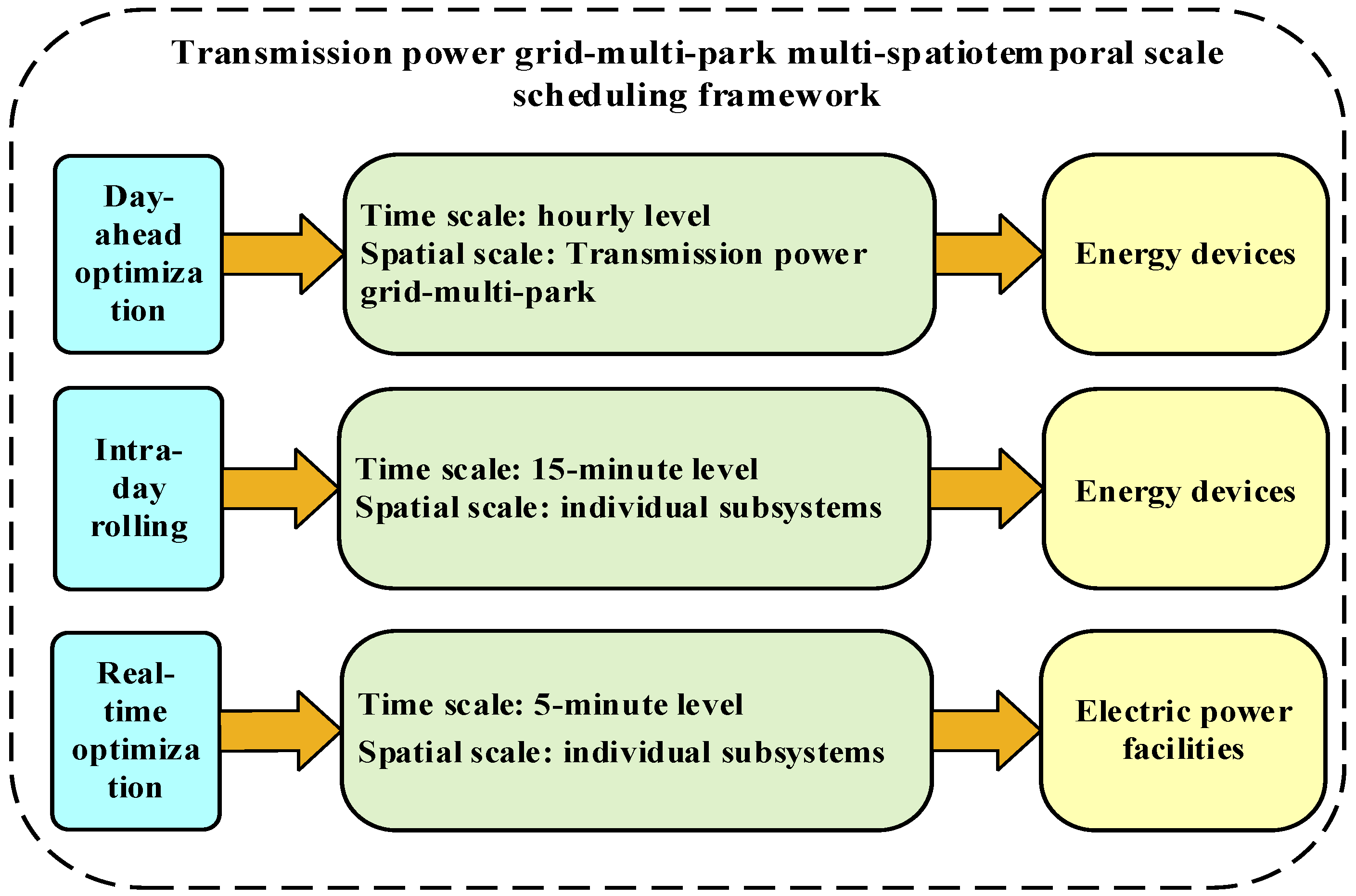
In this paper, a hierarchical scheduling strategy is designed by integrating the results of these two types of predictions. A multi-time and space scale scheduling approach is employed to improve economic efficiency and scheduling flexibility while ensuring system security. The detailed architecture is presented in Figure 1.
The day-ahead scheduling is configured at the hourly scale, with a scheduling cycle of 24 h. Regulation and control are carried out every hour, and the scheduling objective encompasses all energy-supplying equipment within the transmission grid–multi-park system.
The intra-day rolling scheduling is set at the minute scale, featuring a scheduling cycle of 2 h. Regulation and control are executed every 15 min, and a scheduling plan for the upcoming 2 h is formulated. The scheduling target is all the energy-supplying equipment of each subsystem.
Real-time scheduling is also set at the minute scale, and a scheduling plan is developed every 5 min. Given the relatively long response time during this stage, the scheduling objective for this stage is the electrical equipment of each subsystem.
By implementing hierarchical regulation and control based on temporal and spatial differences, the efficient operation of multi-energy collaboration within the complex system can be realized.
In the spatial dimension, the transmission grid–multi-park collaborative system establishes a networked architecture integrating vertical centralized dispatch and horizontal distributed mutual support. As the upper-level coordinating entity, the transmission grid conducts bidirectional power exchange with individual parks to realize global resource integration. Meanwhile, parks engage in direct peer-to-peer (P2P) power sharing via interconnection lines, forming a distributed energy mutual support network. The core of this architecture lies in the integrated modeling and collaborative optimization of spatial coupling relationships between vertical transmission and horizontal interaction. Beyond reflecting geographical dispersion, it achieves efficient cross-regional resource allocation and multi-energy complementarity through a hybrid hierarchical–networked dispatch paradigm, thereby providing structural support for the system to address uncertainties associated with high-penetration renewable energy.

3. Transmission Grid–Multi-Park Multi-Temporal and Spatial Scale Model

3.1. Day-Ahead Scheduling

3.1.1. Objective Function

In this section, the goal is to minimize the operating cost of the transmission grid–multi-park collaborative system. This operating cost encompasses the operating cost C TG of the transmission grid and the total operating cost C K of the parks.
In this study, the term “subsidy” denotes an economic compensation mechanism designed to incentivize user participation in multi-energy demand responses (DRs). As a critical price signal within the dispatch model, it regulates electricity, natural gas, and thermal load adjustments. By providing compensation for integrated energy DR programs—including peak electricity tariff subsidies and interruptible load compensation—this mechanism leverages economic incentives to guide users in modifying their energy consumption behaviors, thereby enhancing the system’s resilience to renewable energy output fluctuations.
(1)
Operating cost of the transmission grid
min C TG = t = 1 N T g = 1 G T ( a P g , t 2 + b P g , t + c )
In the equation: N T denotes the scheduling period; G T represents the set of thermal power generation units in the transmission grid; P g , t denotes the power output of thermal unit g in the transmission grid at time t; and a , b and c are the corresponding cost coefficients of the thermal units.
(2)
The integrated operating costs of multiple parks
The total operating cost C K of the park is partitioned into the power grid operating cost C e , k , the natural gas network operating cost C g , k , the district heating network operating cost C h , k , and the subsidy revenue C D R P from electricity–gas–heat coupling. It can be explicitly expressed as
min C K = k = 1 K ( C e , k + C g , k + C h , k ) C D R P
Among these, the specific expression for the subsidy revenue C D R P from electricity–gas–heat interactions is
C DRP = C DRPe + C DRPg + C DRPh C DRPe = k = 1 K t = 1 N T ( P t , k shift _ out c shifte , t + P t , k cut c cute , t ) C DRPg = k = 1 K t = 1 N T ( G t , k shift _ out c shiftg , t + G t , k cut c cutg , t ) C DRPh = k = 1 K t = 1 N T ( H t , k shift _ out c shifth , t + H t , k cut c cuth , t )
In the equation: N T represents the scheduling period; K is the set of parks participating in demand response; C DRPe , C DRPg and C DRPh are the subsidy benefits for electricity, natural gas, and heat loads participating in the demand response, respectively; P t , k shift _ out , G t , k shift _ out and H t , k shift _ out are the electricity, natural gas, and heat loads transferred out by park k in period t, respectively; P t , k cut , G t , k cut and H t , k cut are the electricity, natural gas, and heat loads cut by park k in period t, respectively; c shifte , t , c shiftg , t and c shifth , t are the subsidy unit prices for electricity, natural gas, and heat load transfer in period t for park k, respectively; and c cute , t , c cutg , t and c cuth , t are the subsidy unit prices for electricity, natural gas, and heat load reduction in period t for park k, respectively.
These subsidy parameters essentially represent incentive prices paid by the system operator to users in exchange for their load regulation capacity. This transaction enables the global optimization of system operation costs by aligning user-side flexibility with the system’s need for real-time balance and efficiency.
The operating cost of the power grid encompasses the operation and maintenance costs of generating units and the costs associated with carbon trading. It can be expressed as
C e , k = t = 1 N T ( d g = 1 G k C d g , t , k + P B , t , k w B + C CO 2 , t , k )
In the equation, for park k during the t time period, the definitions of the symbols are as follows: G k represents the number of thermal power units; C d g , t , k represents the output of thermal power units; P B , t , k represents the output of thermal power unit B; and C CO 2 , t , k represents the carbon trading cost.
The operating cost of the natural gas network is the gas purchasing cost, and it can be expressed as
C g , k = t = 1 N T u = 1 U k G u , t , k gas c gas , t
In the equation: U k denotes the set of natural gas sources in park k; c gas , t represents the unit price of natural gas procurement; and G u , t , k gas represents the gas flow rate of source u in park k during time interval t.
The operation cost of the heat network consists of the output cost of the heat source and is expressed as follows:
C h , k = t = 1 N T ( H CHPh , t , k + H GBh , t , k ) c heat , t
In the equation: c and H GBh , t , k denote the combined heat and power (CHP) and gas boiler (GB) thermal output of park k at time t, and c heat , t is the unit price of the heat source output cost.

3.1.2. Constraints

(1)
Constraints of the transmission power grid
Transmission network constraints: power balance constraint; node power balance constraint; line power flow constraint; phase angle constraint; generator output constraint; generator ramping constraint; and generator start-up and shut-down time constraint.
P o w e r   b a l a n c e : g = 1 G T P g , t k = 1 K P t , k GD = P TGload , t N o d e   p o w e r   b a l a n c e : . J G ( P g , t P t , k GD P TGload , t + f i j , t f j i , t ) = 0 L i n e   p o w e r   f l o w : f i j , t = J ij θ i , t θ j , t , F i j max f i j , t F i j max P h a s e   a n g l e :   π θ i , t π , θ refb , t = 0
In the equation: P t , k GD represents the power transmitted from the transmission grid to industrial park k during time period t; P TGload , t denotes the electrical load of the transmission grid during time period t; i and j denote the starting and ending nodes of line i j ; . J G denotes the set of objects connected to the same node; f i j , t and F i j max represent the transmission power and its upper limit for line i j during time period t; J ij , θ i , t and θ j , t denote the admittance of line i j and the phase angles of nodes i and j during time period t, and θ refb , t denotes the relaxation node phase angle.
Thermal   power   unit   output : 0 P g , t P g max Unit   ramping   up : P g , t P g , t 1 r g up u g , t 1 + P g max 1 u g , t 1             P g , t 1 P g , t r g dn u g , t + P g max 1 u g , t
In the equation, let P g , t denote the output of unit g during time period t, where P g max represents the upper limit of the output, r g up and r g dn denote the upper and lower ramp rates of unit g, and u g , t denotes the state variable of unit g during time period t.
(2)
Multi-park constraints
① Power grid constraints: power balance constraint; node power balance constraint; line power flow constraint; phase angle constraint; generator output constraint; genera-tor ramping constraint; and transmission power constraint.
P o w e r   b a l a n c e : d g = 1 G k P d g , t , k + P CHPe , t , k + P pv , t , k + P wind , t , k + P Edis , t , k +           P t , k GD + + k = 1 , n = 1 k n K P t , m , k D = P DRload , t , k + P Ech , t , k + k = 1 , m = 1 k m K P t , k , n D N o d e   p o w e r   b a l a n c e : . J ( P d g , t , k + P CHPe , t , k + P wind , t , k + P pv , t , k + P Edis , t , k +             P t , k GD + + P t , m , k D P t , k , n D P Ech , t , k P DRload , t , k + f a b , t , k f b a , t , k ) = 0 L i n e   p o w e r   f l o w : f a b , t , k = J a b , k ( θ a , t , k θ b , t , k ) , F a b , k max f a b , t , k F a b , k max P h a s e   a n g l e :   π θ a , t , k π , θ refb , t , k = 0
In the equation: P CHPe , t , k , P pv , t , k , P wind , t , k , P Ech , t , k , and P Edis , t , k represent the output power of CHP, photovoltaic power generation, and wind power, as well as the charging and discharging power of stored energy in park k during time period t; P t , k GD + denotes the power transmitted to park k from the transmission grid during time period t.
Here, P t , m , k D represents the power transmitted from park m to park k in period t, and P t , k , n D represents the power transmitted from park k to park n in period t. These two parameters denote the lateral energy exchange among different parks ( k , m , n ), and they are also the key physical basis for realizing the “multi-space” collaboration in this model.
Parameters a and b denote the sending-end and receiving-end nodes of line a b respectively; . J represents the set of objects connected to the same node; f a b , t , k and F a b , k max denote the transmission power and its upper limit of line a b in park k during time period t; J a b , k , θ a , t , k and θ b , t , k denote the admittance of line a b and the phase angles of nodes a and b in park k during time period t; and θ refb , t , k denotes the relaxation phase angle of park k during time period t.
Thermal   power   unit   d g   output : 0 P d g , t , k P d g , k max Thermal   power   unit   B   output : 0 P B , t , k P B , k max Unit   ramping   up : P d g , t , k P d g , t 1 , k r d g , k up u d g , t 1 , k + P d g , k max ( 1 u d g , t 1 , k )             P d g , t 1 , k P d g , t , k r d g , k dn u d g , t , k + P d g , k max ( 1 u d g , t , k )             P B , t , k P B , t 1 , k r B , k up u B , t 1 , k + P B , k max ( 1 u B , t 1 , k )             P B , t 1 , k P B , t , k r B , k dn u B , t , k + P B , k max ( 1 u B , t , k )
In the formulation, P d g , t , k denotes the power output of thermal generating unit dg, while P B , t , k denotes the power output of thermal generating unit B. P d g , k max and P B , k max represent the respective upper generation capacity limits of unit dg and unit B in park k. The parameters r d g , k up and r d g , k dn denote the upward and downward ramping rates of unit dg in park k, respectively, whereas r B , k up and r B , k dn correspond to the upward and downward ramping rates of unit B in the same park. The state variables u d g , t , k and u B , t , k indicate the operational status of unit dg and unit B in park k at time period t.
② Natural gas network constraints: node flow balance constraints; gas source capacity constraints; pipeline flow constraints; and node pressure constraints.
N o d e   f l o w   b a l a n c e : u = 1 U G u , t , k gas = G DRload , t , k + G CHP , t , k + G GB , t , k G a s   s o u r c e   c a p a c i t y : G u , k min G u , t , k gas G u , k max P i p e l i n e   f l o w : G c d , k min G c d , t , k G c d , k max N o d e   p r e s s u r e : p c , k min p c , t , k p c , k max
In the formulation, G CHP , t , k and G GB , t , k denote the natural gas consumption of the CHP unit and GB in park k during time period t, respectively. G u , t , k gas denotes the output of the gas source in park k, with G u , k max and G u , k min representing its upper and lower generation limits, respectively. G c d , t , k refers to the gas flow rate through pipeline cd in park k during period t, constrained by its corresponding upper and lower bounds G c d , k max and G c d , k min . p c , t , k represents the gas pressure at node c in park k during time period t, which is subject to the minimum and maximum allowable pressure limits, denoted as p c , k max and p c , k min , respectively.
③ Thermal network constraints: thermal power balance constraints and inlet and outlet temperature constraints for supply and return pipelines.
T h e r m a l   p o w e r   b a l a n c e : H CHPh , t , k + H GBh , t , k = H DRload , t , k N o d e   t e m p e r a t u r e : T o , k s , min T o , t , k s T o , k s , max , T o , k r , min T o , t , k r T o , k r , max
In the equation, H CHPh , t , k and H GBh , t , k denote the thermal power outputs of the CHP unit and GB, respectively, in park k during time period t. T o , t , k s , T o , k s , max and T o , k s , min represent the temperature of the supply pipeline at node o in park k during period t, along with its upper and lower bounds. Similarly, T o , t , k r , T o , k r , max and T o , k r , min denote the temperature of the return pipeline at node o in park k during the same period, subject to their respective minimum and maximum allowable limits.
(3)
Transmission power constraints
Transmission power constraints mainly include two aspects: constraints on the power transmitted from the transmission grid to the park and constraints on the power transmitted between parks.
P t , k GD P t , k GD + = 0 , 0 P t , k GD P t , k GD , max P t , m , k D P t , m , k D + = 0 , 0 P t , m , k D P t , m , k D , max P t , k , n D P t , k , n D + = 0 , 0 P t , k , n D P t , k , n D , max
In the equation, P t , m , k D + denotes the active power delivered from park m to park k during time period t, with P t , m , k D , max representing its corresponding upper bound. P t , k , n D + denotes the power exported from park k to park n in period t, and P t , k , n D , max is its maximum allowable limit. P t , k GD , max represents the upper limit on the power transmitted from the main transmission grid to park k in period t.
(4)
Electricity–Gas–Heat Load Constraints
The relationship of loads before and after the response is as follows:
P DRload , t , k = P load , t , k P t , k shift _ out + P t , k shift _ in P t , k cut G DRload , t , k = G load , t , k G t , k shift _ out + G t , k shift _ in G t , k cut H DRload , t , k = H load , t , k H t , k shift _ out + H t , k shift _ in H t , k cut
For park k, let P load , t , k , G load , t , k and H load , t , k denote the electricity, gas, and heat loads prior to the response during time period t, respectively. And let P DRload , t , k , G DRload , t , k and H DRload , t , k represent the electricity, gas, and heat loads after the response during time period t, respectively. P t , k shift _ in , G t , k shift _ in and H t , k shift _ in respectively represent the electricity, gas, and heat loads transferred in during period t; P t , k shift _ out , G t , k shift _ out and H t , k shift _ out represent the electricity, gas, and heat loads transferred out during period t; and P t , k cut , G t , k cut and H t , k cut represent the electricity, gas, and heat loads reduced during period t.
0 P t , k shift _ out ( P t , k shift _ in ) P shift , k max , 0 P t , k cut P cut , k max 0 G t , k shift _ out ( G t , k shift _ in ) G shift , k max , 0 G t , k cut G cut , k max 0 H t , k shift _ out ( H t , k shift _ in ) H shift , k max , 0 H t , k cut H cut , k max
In the formula, P shift , k max , G shift , k max and H shift , k max represent the upper limits of the transferred power, gas, and heat loads. P cut , k max , G cut , k max and H cut , k max represent the upper limits of the reduced electricity, gas and heat loads.
c shifte min c shifte , t c shifte max , c cute min c cute , t c cute max c shiftg min c shiftg , t c shiftg max , c cutg min c cutg , t c cutg max c shifth min c shifth , t c shifth max , c cuth min c cuth , t c cuth max
In the formula, let c shifte max , c shifte min , c shiftg max , c shiftg min , c shifth max and c shifth min denote the upper and lower bounds of the unit subsidy rates for transferred electrical, gas, and thermal loads, respectively. Let c cute max , c cute min , c cutg max , c cutg min , c cuth max and c cuth min denote the upper and lower bounds of the unit subsidy rates for reduced electrical, gas, and thermal loads, respectively.
The total quantity of the transferred-out load is equal to that of the transferred-in load:
t = 1 N T P t , k shift _ out = t = 1 N T P t , k shift _ in t = 1 N T G t , k shift _ out = t = 1 N T G t , k shift _ in t = 1 N T H t , k shift _ out = t = 1 N T H t , k shift _ in

3.2. Intra-Day Dispatching

During the intra-day and real-time rolling dispatching stages, the on/off status of thermal power units is directly inherited from the day-ahead dispatching results and is not subject to re-optimization. Therefore, the minimum up/down time constraints are only incorporated in the day-ahead stage, while the intra-day model primarily focuses on enforcing ramp rate constraints (Equation (10)) and active power output bounds under the pre-determined unit status.

3.2.1. Load Uncertainty

The time scale of the intra-day rolling dispatch is set to 15 min, and the dispatch cycle is 2 h. A dispatch plan is formulated for the upcoming 2 h period. Shortening the dispatch cycle can mitigate the prediction deviation of source-load uncertainty. This makes the probability distribution of the uncertainty more distinct, and it follows a normal distribution. To address this, scenario generation and reduction techniques can be applied to the source load. By doing so, uncertainty can be transformed into certainty.

3.2.2. Objective Function

During the intra-day rolling phase, with the spatial scale being a single park, the objective is to minimize the operating cost of the park. This cost encompasses the operating costs of the power grid, gas network, and heat network within the single park. The model is formulated as follows:
min C TGn Kn = C TGn + k = 1 K C en , k + C gn , k + C hn , k C TGn = p n = 1 N p n p s n t = t n T ne g = 1 G T C g , t , p n C en , k = p n = 1 N p n p s n t = t n T ne ( d g = 1 G C d g , t , k , p n + P B , t , k , p n w B + C CO 2 , t , k , p n ) C gn , k = p n = 1 N p n p s n t = t n T ne u = 1 U G u , t , k , p n gas c gas , t C hn , k = p n = 1 N p n p s n t = t n T ne ( H CHPh , t , k , p n + H GBh , t , k , p n ) c heat , t
In the formulation, T n e denotes the total number of intra-day dispatch intervals; t n represents the initial time period for rolling optimization; N p n refers to the number of scenarios considered; p s n signifies the occurrence probability of scenario p n ; C TGn Kn represents the aggregate cost of the transmission grid and multiple industrial parks; C TGn denotes the operational cost of the transmission grid under scenario p n at time period t; and C en , k , C gn , k and C hn , k denote the electricity, gas, and heating network costs, respectively, for park k under scenario p n at time period t. C g , t , p n and C d g , t , k , p n denote the operational costs of thermal power units in the transmission grid and park k, respectively, under time period t and scenario p n ; P B , t , k , p n denotes the generation output of unit B in park k under the same time period and scenario p n . C CO 2 , t , k , p n denotes the carbon emissions of park k under time period t and scenario p n ; G u , t , k , p n gas denotes the gas supply output from the gas source for park k under the same period and scenario p n ; and H CHPh , t , k , p n and H GBh , t , k , p n denote the thermal energy outputs of the CHP unit and the GB in park k, respectively, under identical conditions.

3.2.3. Constraints

During the intra-day rolling phase, the unit equipment within the park is required to respond within 15 min. Apart from the difference in dispatching time, the constraints to be satisfied are identical to those of the multi-park system. For detailed constraints, refer to Section 3.1 of this paper, as no further elaboration will be provided herein.

3.3. Real-Time Scheduling

3.3.1. Load Uncertainty

The time scale of real-time scheduling is set to 5 min. During this stage, the prediction deviation of the source-load uncertainty is further diminished. The scenario method is also employed to address this issue. For the specific approach, refer to Reference [34]. No further elaboration will be provided herein.

3.3.2. Objective Function

During the real-time scheduling phase, with the spatial scale being a single park, the objective is to minimize the operational cost of the park’s power grid. The model can be formulated as follows:
min C TGe - Ke = p i = 1 N p i p s i t = t s T shi g = 1 G T C g , t , p i + p i = 1 N p i p s i k = 1 K t = t s T shi ( d g = 1 G C d g , t , k , p i + P B , t , k , p i w B + C CO 2 , t , k , p i )
In the formula: T s h i represents the total number of real-time scheduling periods and t s represents the starting period for real-time optimization. N p i stands for the number of scenes. p s i is the probability of scene p i and C TGe Ke is the total cost of multi-park power grids. C d g , t , k , p i represents the cost of thermal power units in the park k during the t period in scenario p i . P B , t , k , p i denotes the output of unit B in scenario p i at time t in park k and C CO 2 , t , k , p i denotes the carbon emissions in scenario p i at time t in park k.

3.3.3. Constraints

During the real-time scheduling phase, the power equipment in the park is required to respond within 5 min. The constraint conditions only take into account the grid constraints. For the specific constraints, refer to Section 3.1 of this paper. No detailed description will be provided herein.

3.4. Model Solution

In this section, the Analytical Target Cascading (ATC) method, renowned for its strong robustness, is utilized to decouple the transmission grid and the park system. The ATC approach decomposes the global optimization problem of a complex system into a series of local optimization problems of multiple subsystems. By hierarchically transferring objectives and constraints, the overall system can achieve distributed and efficient solutions while ensuring coordination and consistency [29,30,31,32].
In practical applications, the transmission grid and the park system exhibit intricate coupling relationships among variables and constraints. Traditional centralized optimization methods encounter challenges including large computational scales, complex problem structures, and limited robustness. ATC realizes modular processing and iterative coordination of the system by establishing a coordination mechanism for the objective functions and coupled variables of subsystems at each level. This approach not only enhances the solution efficiency of the model but also bolsters the system’s resilience in the face of uncertainties and disturbances.
In order to effectuate this decoupling procedure, Lagrange multipliers λ 1 and λ 2 and penalty factors μ 1 and μ 2 are introduced. These are employed to formulate the consistency constraints and penalty terms for the coupled variables. The Lagrange multipliers serve to quantify the sensitivity of the coupled variables in the event of violations of the consistency constraints. Meanwhile, the penalty factors are utilized to modulate the severity of the penalties imposed for constraint violations during the optimization process.
In the proposed ATC framework, the set of coupling variables acts as the bridge for two spatial dimensions: the transmission grid–park power exchange P G D and the inter-park lateral power exchange P D . Through the introduction of Lagrange multipliers ( λ 1 and λ 2 ) and penalty terms ( μ 1 and μ 2 ), consistency constraints for both coupling types are rigorously calibrated. Consequently, the iterative optimization harmonizes vertical hierarchical interactions with horizontal peer-to-peer support, achieving a robust multi-spatial collaborative scheduling scheme.
It is noteworthy that the distributed optimization framework based on the Analytical Target Cascading (ATC) method developed in this study aligns in both structure and solution mechanism with the logic of coordinated operation in liberalized electricity markets. The upper- and lower-level optimization problems in the model correspond respectively to the transmission system operator (TSO) and distributed resource aggregators (such as virtual power plants) in a market setting. The Lagrange multipliers (λ) updated iteratively during the solution process are equivalent to economic shadow prices, and the coordination procedure simulates the price-based market clearing and coordination mechanism. Therefore, this model can also serve as a methodological reference for investigating multi-agent coordinated scheduling problems in a market-oriented environment.
By means of iterative updates of these multipliers and penalty factors, the coupling relationships among subsystems are harmonized, thereby ensuring the convergence and consistency of the ultimate solution. The specific expressions are presented as follows:
min C TG + t = 1 T k = 1 K λ 1 v P t , k GD s P t , k GD + s + t = 1 T k = 1 K μ 1 v P t , k GD s P t , k GD + s 2 2 + min C K + t = 1 T k = 1 K λ 1 s P t , k GD s P t , k GD + s + t = 1 T k = 1 K μ 1 s P t , k GD s P t , k GD + s 2 2 + t = 1 T k = 1 K λ 2 s P t , k , m D s P t , k , m D + s + t = 1 T k = 1 K μ 2 s P t , k , m D s P t , k , m D + s 2 2 + t = 1 T k = 1 K λ 2 s P t , k , m D s P t , k , m D + s + t = 1 T k = 1 K μ 2 s P t , k , m D s P t , k , m D + s 2 2 λ 2 s + 1 = λ 2 s + 2 μ 2 s 2 P t , k , m D * s P t , k , m D + s λ 1 s + 1 = λ 1 s + 2 μ 1 s 2 P t , k GD * s P t , k GD + s μ 2 s + 1 = δ μ μ 2 s , μ 1 s + 1 = δ μ μ 1 s s . t .   E q u a t i o n s   7   t o   17
In the formula: P t , k G D * , P t , k G D + * , P t , k , m D * and P t , k , m D + * are the coupled variables after optimization, and s is the number of iterations. δ μ represents accelerated convergence, and its value ranges from 2 to 3.
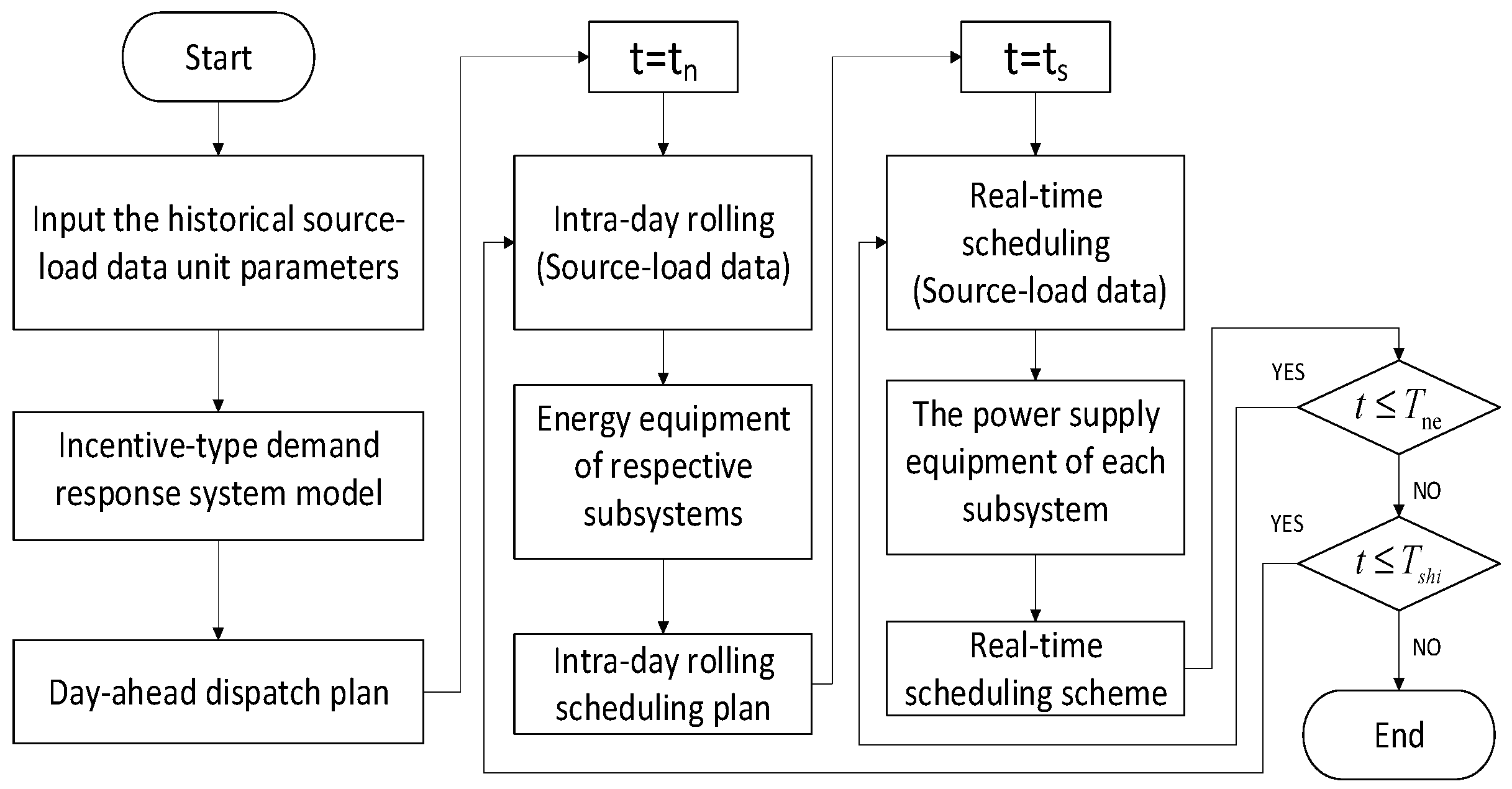
The solution steps of the model developed in this section are as follows:
  • Step 1: Solve the day-ahead scheduling model of the transmission grid–multi-park system. Subsequently, transfer the results to the intra-day scheduling model.
  • Step 2: Initialize the ATC iteration count s = 1 , read the predicted values of wind and solar power, set the initial values of λ 1 , λ 2 , μ 1 and μ 2 to 1, and start the loop.
  • Step 3: Consider the predicted values as the most adverse scenario. Substitute them into the master problem to obtain the initial values of the coupling variables and the unit state variables. Set P t , k G D and P t , k , m D equal to P t , k G D * and P t , k , m D * , respectively, and then substitute them into the sub-problem.
  • Step 4: In the process of one iteration, update P t , k G D * , P t , k G D + * , P t , k , m D * and P t , k , m D + * alternately.
  • Step 5: Judge the loop termination condition: specify sufficiently small convergence thresholds ε T 1 and ε T 2 . If the inequalities P t , k G D * ( w + 1 ) P t , k G D * ( w ) ε T 1 and P t , k G D * ( w + 1 ) P t , k G D * ( w ) ε T 2 hold, then terminate the ATC iteration and output the final optimization result. Otherwise, return to Step 3 and update λ 1 s + 1 , λ 2 s + 1 , μ 1 s + 1 and μ 2 s + 1 .
  • Step 6: Solve the intra-day rolling scheduling model of the single-park system and transmit the results to the intra-day real-time scheduling model.
  • Step 7: Solve the intra-day real-time scheduling model of the single-park system to acquire the intra-day real-time scheduling plans for each park.
  • Step 8: Determine whether the real-time optimization period lies within the scheduling cycle of the current intra-day rolling stage. If so, continue to execute Step 7; otherwise, proceed to Step 9.
  • Step 9: Determine whether the real-time optimization period is within the full-day scheduling cycle. If it is, output the scheduling results. If not, shift the scheduling period to the next rolling cycle and then continue to execute Step 3.
The solution flowchart is presented in Figure 2.
It is important to note that, according to ATC theory, the algorithm is guaranteed to converge to a Karush–Kuhn–Tucker (KKT) point provided the following conditions are met:
(1)
The objective functions of each sub-problem are convex, and the constraint sets define convex feasibility regions;
(2)
The system-level coupling constraints are linear;
(3)
The penalty factor μ is sufficiently large (here, an adaptive growth strategy μ s + 1 = δ μ μ s is adopted, where δ [ 2 , 3 ] ).
In the proposed framework, the objective functions for each subsystem (transmission grid and parks) aim for cost minimization and are inherently convex. Furthermore, the operational constraints, such as power balance and equipment capacity limits, form convex sets. The inclusion of the quadratic penalty term μ in Equation (20) further enhances the strict convexity of the problem, ensuring the existence and uniqueness of the global optimal solution. Consequently, the proposed model fully satisfies the aforementioned rigorous conditions, thereby theoretically guaranteeing the algorithm’s convergence.

4. Case Analysis

4.1. Parameter Settings

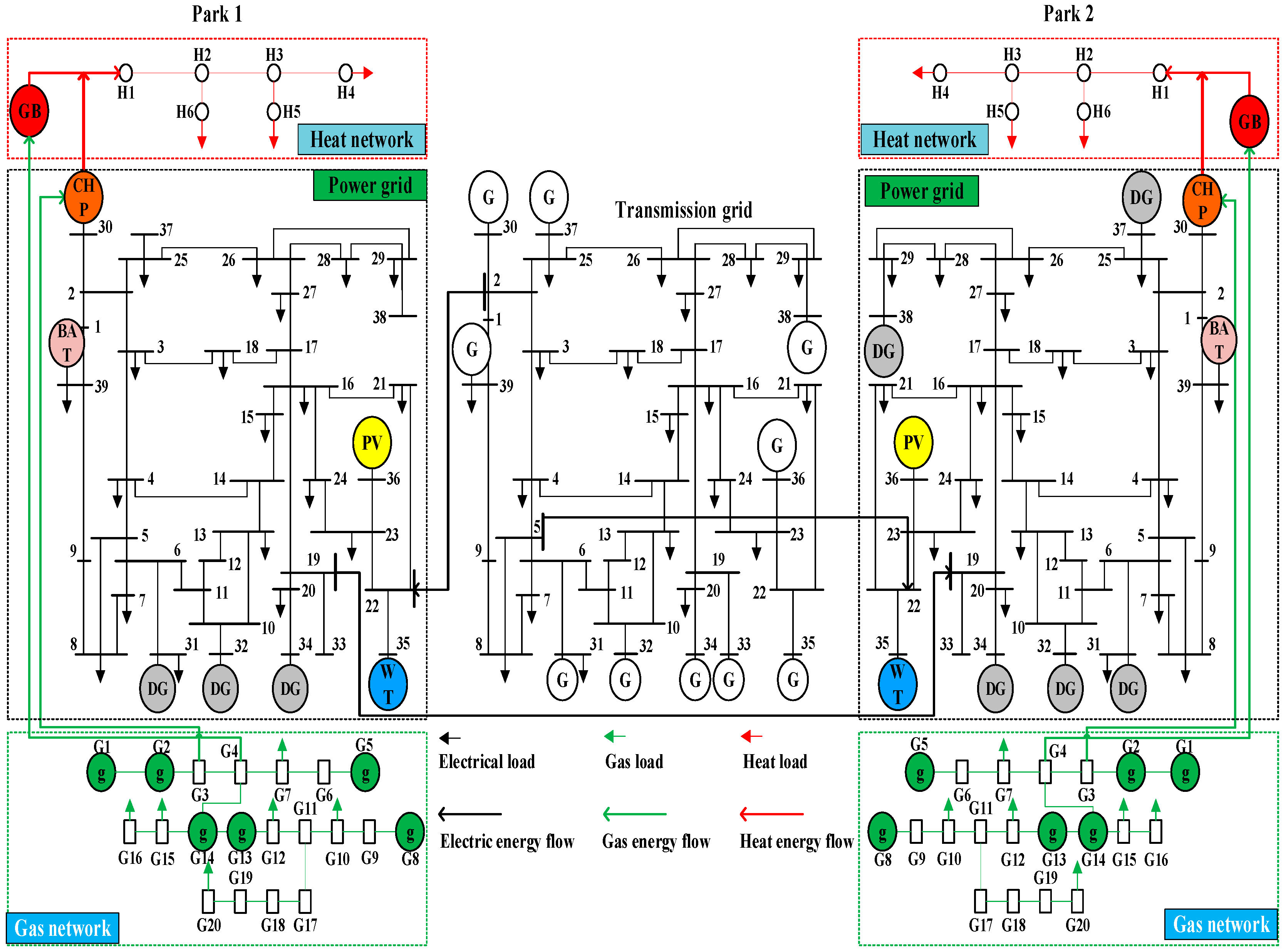
The topological structure of the coordinated operation system of the transmission grid and multi-parks is presented in Figure 3.
In Figure 3, G and DG denote thermal power units; CHP stands for combined heat and power (CHP) systems; WT represents wind turbines for power generation; PV refers to photovoltaic power generation systems; BAT represents battery energy storage systems; and g represents the gas source.
In this section, the IEEE-39-bus power grid is employed as the transmission grid. For Park 1, an integrated energy park is established, which consists of an IEEE-39-bus power grid, a 20-node gas network, and a 6-node heat network. Accordingly, a coordinated operation system of the transmission grid and multiple parks is constructed.
The transmission grid system encompasses thermal power units and electrical loads. In this part, Park 1 utilizes the IEEE-6-bus power grid as a photovoltaic park, incorporating photovoltaic arrays, wind power generation facilities, electrical energy storage devices, and electrical loads. Park 2 consists of the IEEE-39-bus power grid, 20-node gas network, and 6-node heat network as an integrated energy park. Its power grid system involves thermal power units, wind turbines, photovoltaic arrays, electrical energy storage, gas turbines, and electrical loads. The gas network system is composed of gas sources and gas loads. The heat network system consists of gas boilers and heat loads.
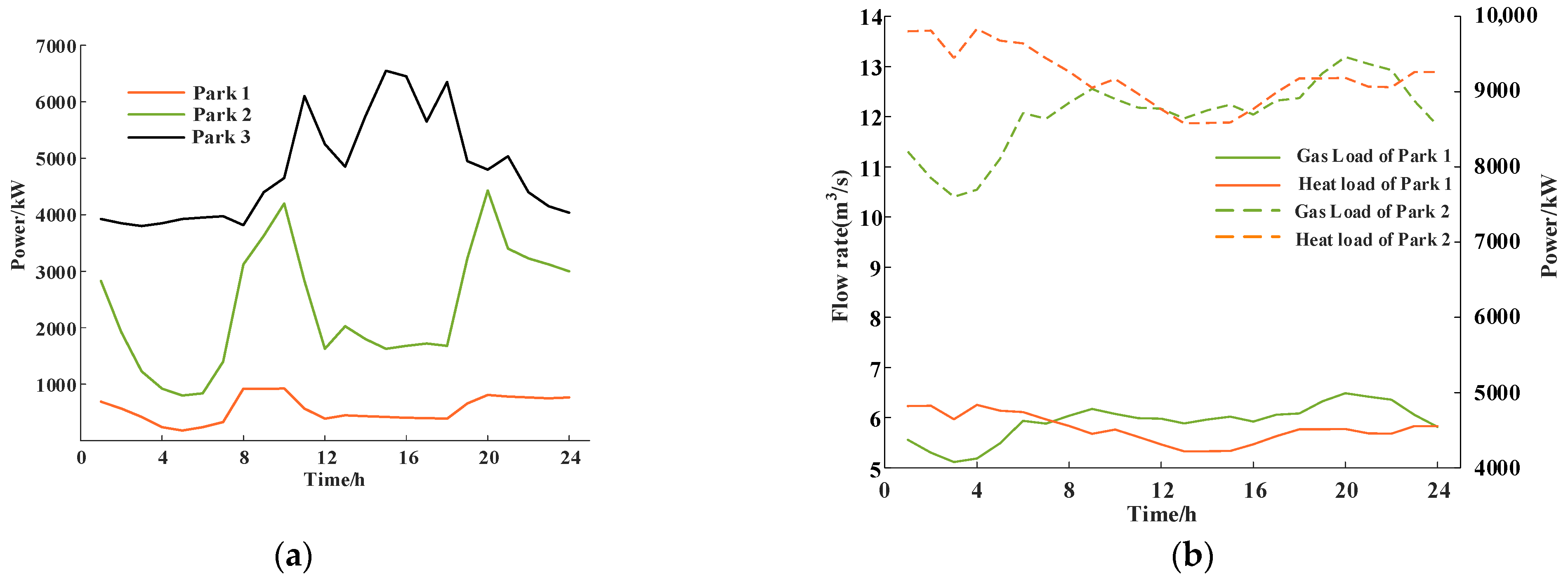
The parameters of the units are presented in Table 1. The detailed parameters of the thermal power units, gas network pipelines, and heat network pipelines can be referred to in Reference [35]. The load prediction values are depicted in Figure 4. The simulation is carried out using Matlab R2021b with the call of Yalmip (version: 20210331), and the Gurobi (version: 9.5.1) solver is adopted for problem-solving.

4.2. Analysis of Day-Ahead Results

To validate the effectiveness of the multi-time-scale scheduling for the transmission grid–multi-park system, two scenarios are designed for analysis:
Scheme 1: Day-ahead Optimization Model Without Considering Demand Response.
Scheme 2: Day-ahead Optimization Model Considering Demand Response.
The scheduling results are presented in Table 2.
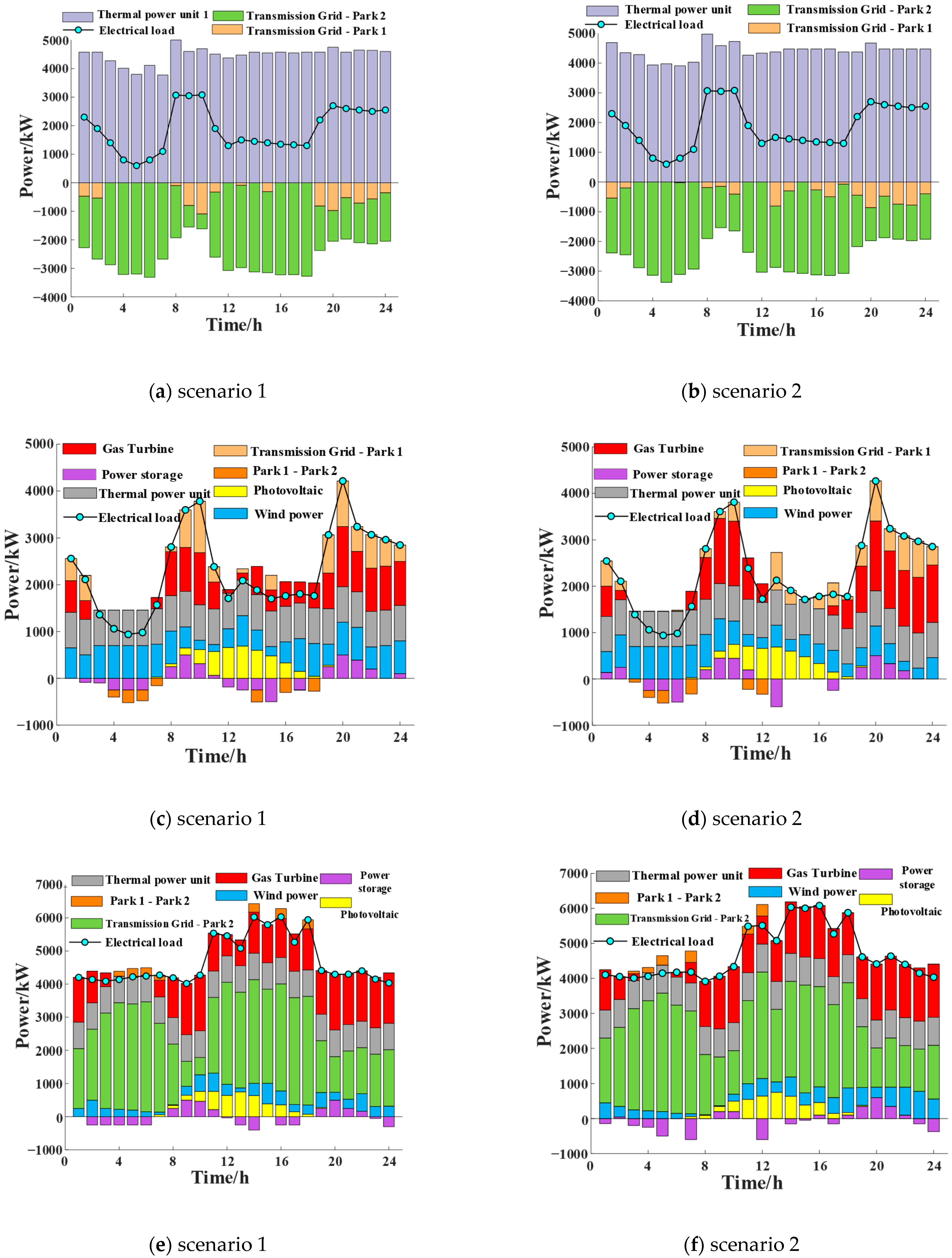
The scheduling results of power supply balance are presented in Figure 5.
As evident from Table 2 and Figure 5, the total cost of the transmission grid–multi-park collaborative system under Scheme 2 is decreased by 1475 yuan in comparison to Scheme 1. This indicates that the day-ahead two-layer optimization model can effectively enhance the dispatching economy of the transmission grid–multi-park collaborative system. The detailed analysis of the specific reasons is as follows:
Under Scheme 1, the compensation mechanism of demand response is utilized to narrow the load gap between peak and off-peak periods in Park 1 and Park 2. This not only alleviates the power supply pressure of the transmission grid to the parks during peak hours but also, in conjunction with the iterative solution of the robust model, optimizes the power output of generating units. As a result, the energy supply costs of the electricity, gas, and heat networks in various scenarios of Park 1 and Park 2 are all reduced.
Plan 2 utilizes the residual natural gas retained in the pipeline as a supplementary gas source, thereby reducing natural gas procurement costs and effectively harnessing the synergistic benefits across multiple energy systems. This approach reduces power transmission demands from the main grid to Park 1 and Park 2, enhancing the distributed autonomy and operational independence of individual subsystems.

4.3. Analysis of Intra-Day Rolling Results

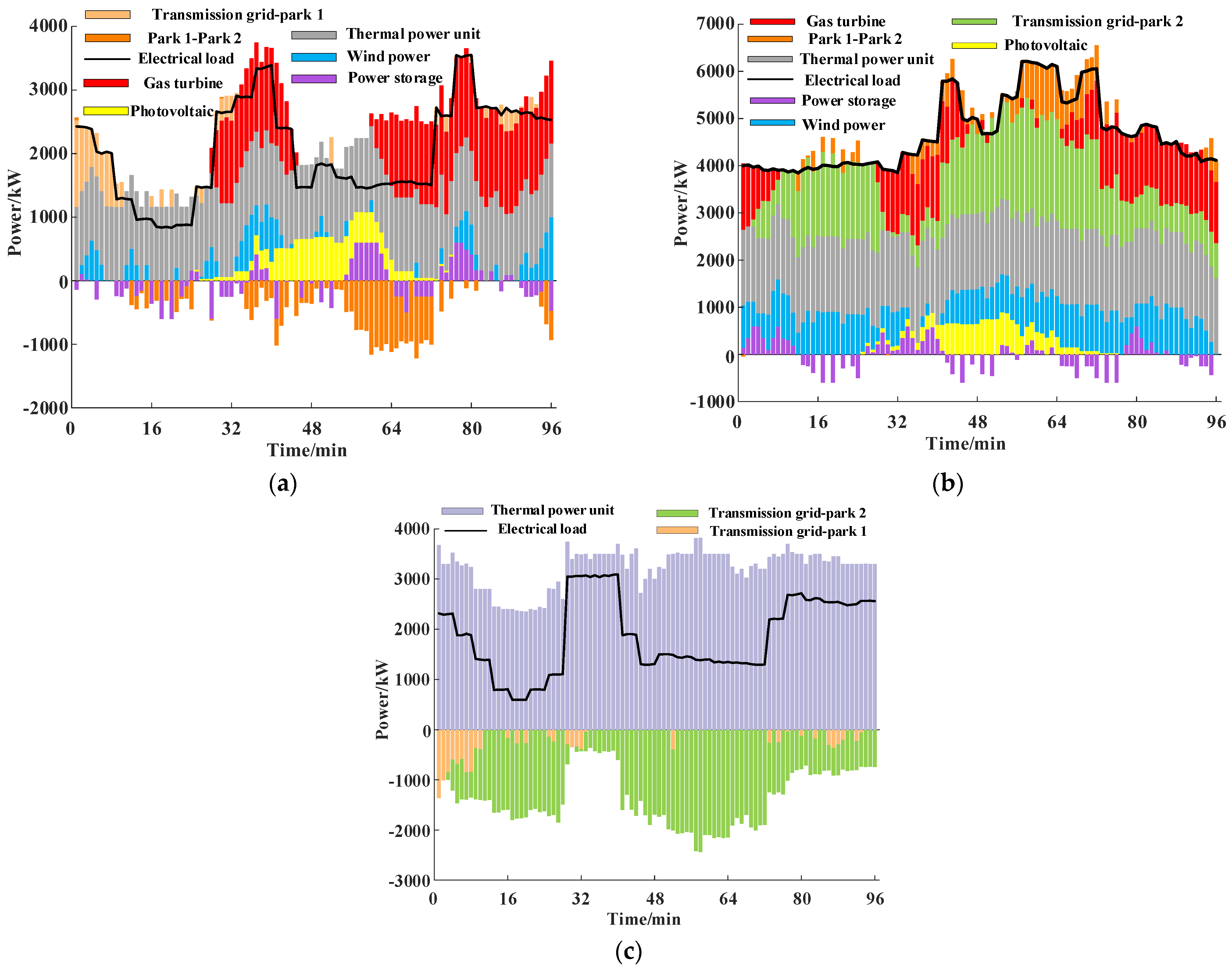
The power supply and heat supply balances of the transmission grid, Park 1, and Park 2, along with the output of the CHP units and the flow variations at the respective nodes, are depicted in Figure 6.
The day-ahead scheduling results are employed as the boundaries of the decision variables for the intra-day rolling period, serving as a benchmark for the intra-day rolling scheduling plan. Specifically, although there are discrepancies in the supply–demand balance relationships of each park, the scheduling plans during the day-ahead phase, the output of CHP units, and the flow changes at the nodes, the general distribution trends remain largely consistent.
Furthermore, the output of the generating units in each time period exceeds the heat load. Evidently, during the intra-day rolling scheduling stage, the system can effectively accommodate real-time changes. This enables the system to represent the uncertainties of the sources and loads, thereby further optimizing the output of the generating units.

4.4. Analysis of Intra-Day Real-Time Results

The scheduling results for the intra-day real-time phase are presented in Table 3.
As can be gleaned from Table 3, all costs during the intra-day rolling scheduling phase are lower than those in the day-ahead phase, with the total cost decreasing by 3832 yuan. This is attributed to the fact that as the scheduling time interval shrinks, the scenario-based method improves the accuracy of source-load forecasting. Consequently, the impact of uncertain factors is mitigated, and the energy supply–demand balance is further optimized. During the real-time scheduling phase, building upon the intra-day rolling scheduling plan, the scenario-based method is employed to further reduce the influence of uncertain factors. This optimization of the unit output leads to a slight increase in the power supply operation cost and the total system cost compared to the intra-day rolling phase. Specifically, the increases are merely 0.6% and 0.1% respectively. This clearly demonstrates that the adoption of a multi-time-scale approach can reasonably take into account the economic efficiency of system scheduling.

5. Discussion

(1) The multi-temporal and spatial scale scheduling framework proposed in this study employs differentiated modeling approaches tailored to the uncertainty characteristics and scheduling requirements inherent in distinct time-scale stages. During the day-ahead stage, given the extensive prediction horizon and broad error margins, a robust optimization method is adopted. Here, the potential fluctuation ranges of wind–solar power output and load demand are delineated by uncertainty sets, with the aim of deriving a scheduling plan that is both feasible and robust across all plausible scenarios.
Conversely, in the intra-day real-time stage, the scheduling cycle is short (5 min), imposing extremely stringent demands on the real-time computational performance of the model. Simultaneously, the accuracy of ultra-short-term forecasting is significantly enhanced, and the stochastic distribution features of uncertainties are more prominent. To obtain executable scheduling instructions within the constrained time frame, this study shifts to a scenario-based stochastic optimization approach. Representative scenarios are generated leveraging the probability distribution of prediction errors, in pursuit of decisions that optimize the expected cost.
The day-ahead robust layer provides safety guarantees for the system, while the real-time stochastic layer enables an economic response to high-frequency fluctuations.
(2) To preserve the solvability of the model and focus on the multi-level, multi-spatiotemporal coordination optimization problem, this paper simplifies the modeling of thermal power units (e.g., coal-fired power plants) by assuming that the thermal power units in the model exhibit greater operational flexibility than actual physical equipment. Linear ramping constraints of the units are incorporated into the mathematical model, while nonlinear ramping characteristics are temporarily omitted. Future research will address these detailed physical constraints of the units to develop dispatch strategies that more closely align with real-world operational boundaries.

6. Conclusions

To further improve the matching degree between the energy production side and the demand side, an optimization scheduling method for the transmission grid–multi-park system at multiple time and space scales, taking into account dynamic characteristics, is proposed. Through case study analysis, the following conclusions can be drawn:
(1)
By taking into consideration the load time-series characteristics at different time and space scales and the spatial distribution characteristics of parks, and by using an incentive-type demand response and the scenario method to represent sources and loads, the potential for collaborative optimization of different energy sources in both temporal and spatial dimensions can be fully explored. This can further enhance the economic efficiency and reliability of the system operation.
(2)
Analytical Target Cascading (ATC) was employed to achieve the distributed collaborative solution of the transmission grid and multi-park systems. This approach not only enhances the efficiency of model solution but also effectively guarantees coordination and consistency among different system levels. Moreover, it strengthens the system’s resilience to uncertainties.
(3)
The core of this work resides in the development and preliminary validation of the proposed methodological framework. As a framework-centric study, the primary objective of the case analysis is to demonstrate the operational viability of this integrated framework. A detailed quantitative comparison with centralized optimization or other state-of-the-art distributed algorithms constitutes a critical direction for future research.

Author Contributions

Conceptualization, Z.T.; methodology and manuscript writing, Z.T. and F.W.; formal analysis, J.W. All authors have read and agreed to the published version of the manuscript.

Funding

This research received no external funding.

Data Availability Statement

The original contributions presented in this study are included in the article. Further inquiries can be directed to the corresponding author.

Conflicts of Interest

The authors declare no conflicts of interest.

References

  1. Feng, J.; Hu, Z.; Duan, X.; Cai, S.; Zhang, P. A Multi Stage DRO-SDDP Approach for Planning Multi-Type Energy Storage Systems and Flexible Resources in High-Penetration Renewable Power Systems. IEEE Trans. Ind. Appl. 2025, 61, 5853–5867. [Google Scholar] [CrossRef]
  2. Chen, M.; Lu, H.; Chang, X.; Liao, H. An optimization on an integrated energy system of combined heat and power, carbon capture system and power to gas by considering flexible load. Energy 2023, 273, 127203. [Google Scholar] [CrossRef]
  3. Cruz, R.M.; Fitiwi, D.Z.; Santos, S.F. Multi-flexibility option integration to cope with large-scale integration of renewables. IEEE Trans. Sustain. Energy 2020, 11, 48–60. [Google Scholar] [CrossRef]
  4. Wang, D.; Wang, C.; Lei, Y. Prospects for key technologies of new-type urban integrated energy system. Glob. Energy Interconnect. 2019, 2, 403–413. [Google Scholar] [CrossRef]
  5. Huang, X.; Liu, M.; Lin, S.; Zhu, J. Distributed Algorithm for Robust Economic Dispatch of Integrated Transmission and Distribution System Considering Wind Power Uncertainty. Autom. Electr. Power Syst. 2025, 49, 165–177. [Google Scholar] [CrossRef]
  6. Zhao, D.; Wang, H.; Tao, R. Decentralized Coordination Robust Optimal Scheduling Model for Transmission and Distribution Networks Based on Improved Alternating Direction Method of Multipliers. Power Syst. Technol. 2023, 47, 1138–1151. [Google Scholar] [CrossRef]
  7. Mahmoud, H.A.; Abdelgawad, A.E. A robust unit commit-based TSO-DSO coordination scheme for optimal generation scheduling. Electr. Power Syst. Res. 2025, 243, 111512. [Google Scholar] [CrossRef]
  8. Wang, W.; Xiong, X.; He, Y.; Chen, H. Robust survivability-oriented scheduling of separable mobile energy storage and demand response for isolated distribution systems. IEEE Trans. Power Deliv. 2022, 37, 3521–3535. [Google Scholar] [CrossRef]
  9. Jiao, F.; Zou, Y.; Zhang, X.; Zhang, B. Online optimal dispatch based on combined robust and stochastic model predictive control for a microgrid including EV charging station. Energy 2022, 247, 123220. [Google Scholar] [CrossRef]
  10. Diekerhof, M.; Peterssen, F.; Monti, A. Hierarchical distributed robust optimization for demand response services. IEEE Trans. Smart Grid 2017, 9, 6018–6029. [Google Scholar] [CrossRef]
  11. Huang, W.; Liu, W. Multi-energy Complementary Based Coordinated Optimal Planning of Park Integrated Energy Station-Network. Autom. Electr. Power Syst. 2020, 44, 20–28. [Google Scholar] [CrossRef]
  12. Huang, W.; Liu, S.; YE, B. Station-Network Cooperative Optimization of Integrated Energy System for Park Considering Source-Load Interaction. Autom. Electr. Power Syst. 2020, 44, 44–53. [Google Scholar] [CrossRef]
  13. Liu, H.; Zheng, N.; Ge, S.; Liu, J. Station and Network Coordinated Planning of Integrated Energy Systems Considering Complementation of Load Characteristic. Proc. CSEE 2021, 41, 52–66. [Google Scholar] [CrossRef]
  14. Wang, D.; Meng, Z.; Jia, H. Research and Prospect of Key Technologies for Energy Interconnection System Planning for New-type Towns. Autom. Electr. Power Syst. 2019, 43, 16–28. [Google Scholar] [CrossRef]
  15. Bao, M.; Ding, Y.; Chang, Z. A multi-state model for reliability assessment of integrated gas and power systems utilizing universal generating function techniques. IEEE Trans. Smart Grid 2019, 10, 6271–6283. [Google Scholar] [CrossRef]
  16. Bao, M.; Ding, Y.; Sang, M.; Liang, Z. Research on Energy Capacity Planning of Electricity-gas Systems Considering Multi-objective Coordination. Proc. CSEE 2021, 41, 7551–7563. [Google Scholar] [CrossRef]
  17. Lei, Y.; Wang, D.; Jia, H.; Chen, J.; Li, J.; Song, Y.; Li, J. Multi-objective stochastic expansion planning based on multi-dimensional correlation scenario generation method for regional integrated energy system integrated renewable energy. Appl. Energy 2020, 276, 115395. [Google Scholar] [CrossRef]
  18. Gao, Z.; Han, L. Multi-Time scale rolling economic dispatch for integrated electricity-heating systems based on improved variational mode decomposition. Electr. Power Syst. Res. 2020, 187, 106468. [Google Scholar] [CrossRef]
  19. Pan, Z.; Gao, Q.; Sun, H. Interactions of district electricity and heating systems considering time-scale characteristics based on quasi-steady multi-energy flow. Appl. Energy 2016, 167, 230–243. [Google Scholar] [CrossRef]
  20. Peng, C.; Chen, S.; Xu, J.; Sun, H. Low Carbon Economic Scheduling for Integrated Energy Systems with Mixed Timescale & Multi-objective Reinforcement Learning. Power Syst. Technol. 2022, 46, 4914–4925. [Google Scholar] [CrossRef]
  21. Gu, W.; Lu, S.; Yao, S.; Zhuang, W. Hybrid time-scale operation optimization of integrated energy system. Electr. Power Autom. Equip. 2019, 39, 203–213. [Google Scholar] [CrossRef]
  22. Minniti, S.; Haque, N.; Nguyen, P.; Pemen, G. Local Markets for Flexibility Trading: Key Stages and Enablers. Energies 2018, 11, 3074. [Google Scholar] [CrossRef]
  23. Najibi, F.; Apostolopoulou, D.; Alonso, E. TSO-DSO Coordination Schemes to Facilitate Distributed Resources Integration. Sustainability 2021, 13, 7832. [Google Scholar] [CrossRef]
  24. Gabrielli, P.; Fürer, F.; Mavromatidis, G.; Mazzotti, M. Robust and optimal design of multi-energy systems with seasonal storage through uncertainty analysis. Appl. Energy 2019, 238, 1192–1210. [Google Scholar] [CrossRef]
  25. Mühlpfordt, T.; Dai, X.; Engelmann, A.; Hagenmeyer, V. Distributed pow-er flow and distributed optimization—Formulation, solution, and open source implementation. Sustain. Energy Grids Netw. 2021, 26, 100471. [Google Scholar] [CrossRef]
  26. Wu, H.; Kong, Q.; Huber, M.; Sun, M.; Craig, M.T. Climate change will increase high-temperature risks, degradation, and costs of rooftop photovoltaics globally. Joule 2025, 10, 102218. [Google Scholar] [CrossRef]
  27. Wu, H.; Qiu, D.; Zhang, L.; Sun, M. Adaptive multi-agent reinforcement learning for flexible resource management in a virtual power plant with dynamic participating multi-energy buildings. Appl. Energy 2024, 374, 123998. [Google Scholar] [CrossRef]
  28. Xu, Y.; Zhang, S.; Zhang, T. Cooperative Optimal Operation of Multi-microgrids Based on Hybrid Two-staged Robustness. Power Syst. Technol. 2024, 48, 247–267. [Google Scholar] [CrossRef]
  29. Zheng, Z.; Chen, G.; Shen, Z. Interval-Partitioned and Correlated Uncertainty Set Based Robust Optimization of Microgrid. IEEE Syst. J. 2024, 18, 1516–1527. [Google Scholar] [CrossRef]
  30. Zhang, X.; Zhang, Y.; Ji, X. Synergetic Optimized Scheduling of Transmission and Distribution Network with Electricity-gas-heat Integrated Energy System. Power Syst. Technol. 2022, 46, 4256–4270. [Google Scholar] [CrossRef]
  31. Zhang, Y.; Zhang, X.; Ji, X. Synergetic Unit Commitment of Transmission and Distribution Network Considering Dynamic Characteristics of Electricity-gas-heat Integrated Energy System. Proc. CSEE 2022, 42, 8576–8592. [Google Scholar] [CrossRef]
  32. Zhao, Z.; Guo, J.; Lai, C.; Xiao, H.; Zhou, K.; Lai, L. Distributed model predictive control strategy for islanded multi-microgrids based on noncooperative game. IEEE Trans. Ind. Inform. 2021, 17, 3803–3814. [Google Scholar] [CrossRef]
  33. Pan, C.; Fan, H.; Zhang, R.; Sun, J. An improved multi-time scale coordinated control strategy for an integrated energy system with a hybrid energy storage system. Appl. Energy 2023, 343, 121137. [Google Scholar] [CrossRef]
  34. Wang, J.; Zhang, T.; Liu, W. Robust Two-Stage Optimization Scheduling of TG-IES Considering Gas Thermal Dynamics. Processes 2025, 13, 1836. [Google Scholar] [CrossRef]
  35. Jiang, T.; Deng, H.; Bai, L. Optimal energy flow and nodal energy pricing in carbon emission-embedded integrated energy systems. CSEE J. Power Energy Syst. 2018, 4, 179–187. [Google Scholar] [CrossRef]
Figure 1. Schematic diagram of the scheduling system architecture.
Energies 19 01033 g001
Figure 2. Flowchart for solution.
Energies 19 01033 g002
Figure 3. Schematic of the system topology.
Energies 19 01033 g003
Figure 4. Predicted values of the load: (a) predicted values of electric load; (b) predicted values of gas and heat loads.
Energies 19 01033 g004
Figure 5. Power supply equilibrium of the system.
Energies 19 01033 g005
Figure 6. Scheduling results of the intra-day rolling stage. (a) Power supply equilibrium of Park 1. (b) Power supply equilibrium of Park 2. (c) Power supply equilibrium of the transmission grid.
Energies 19 01033 g006
Table 1. Parameters of the equipment.
Carbon Trading ParametersValue (kg/kWh)Carbon Trading ParametersValue (kg/kWh)Equipment TitleConversion EfficiencyMaintenance FactorRated Output Upper Limit (kW)
δe0.798hc(tons)2000GB0.80.02112000
δh0.385ψc0.25CHP
(electricity/heat)
0.35
0.45
0.0212000/
3000
ωe1.08uc0.2ESS0.80.021600
ωh0.39cg(yuan)150wind turbine/photovoltaic/0.0212000
Table 2. Results of day-ahead scheduling optimization.
ModesParksPower Supply Cost (Yuan) Gas Procurement Cost (Yuan)Heating Cost (Yuan)Carbon Trading Cost (Yuan)Cost of the Park (Yuan)Subsidy Cost (Yuan)Transmission Grid Cost (Yuan)Total Cost (Yuan)
1154,72515,87535,676−5221101,055\442,215734,974
296,64531,91668,351−5208191,704\
2151,96915,87335,436−5275100,3432340442,169733,499
292,68331,90267,432−5262190,9874232
Table 3. Results of the real-time scheduling optimization within a day.
Time
Dimension
ParksPower Supply Cost (Yuan)Gas Procurement Cost
(Yuan)
Heat Supply Cost (Yuan)Carbon Trading Cost (Yuan)Transmission Grid Cost (Yuan)Total System Cost (Yuan)
Day-ahead151,39815,86835,929−5316441,910732,936
292,13131,89867,851−5305
Intra-day148,43115,76135,826−5419440,375729,104
289,16431,79967,748−5408
Real-time149,00215,75835,817−5426440,157729,997
289,73531,78367,745−5415
Disclaimer/Publisher’s Note: The statements, opinions and data contained in all publications are solely those of the individual author(s) and contributor(s) and not of MDPI and/or the editor(s). MDPI and/or the editor(s) disclaim responsibility for any injury to people or property resulting from any ideas, methods, instructions or products referred to in the content.