Coordinated Optimal Scheduling of Transmission Grid and Multi-Parks Considering Source-Load Uncertainties with Multi-Spatial–Temporal Scales

Abstract
1. Introduction
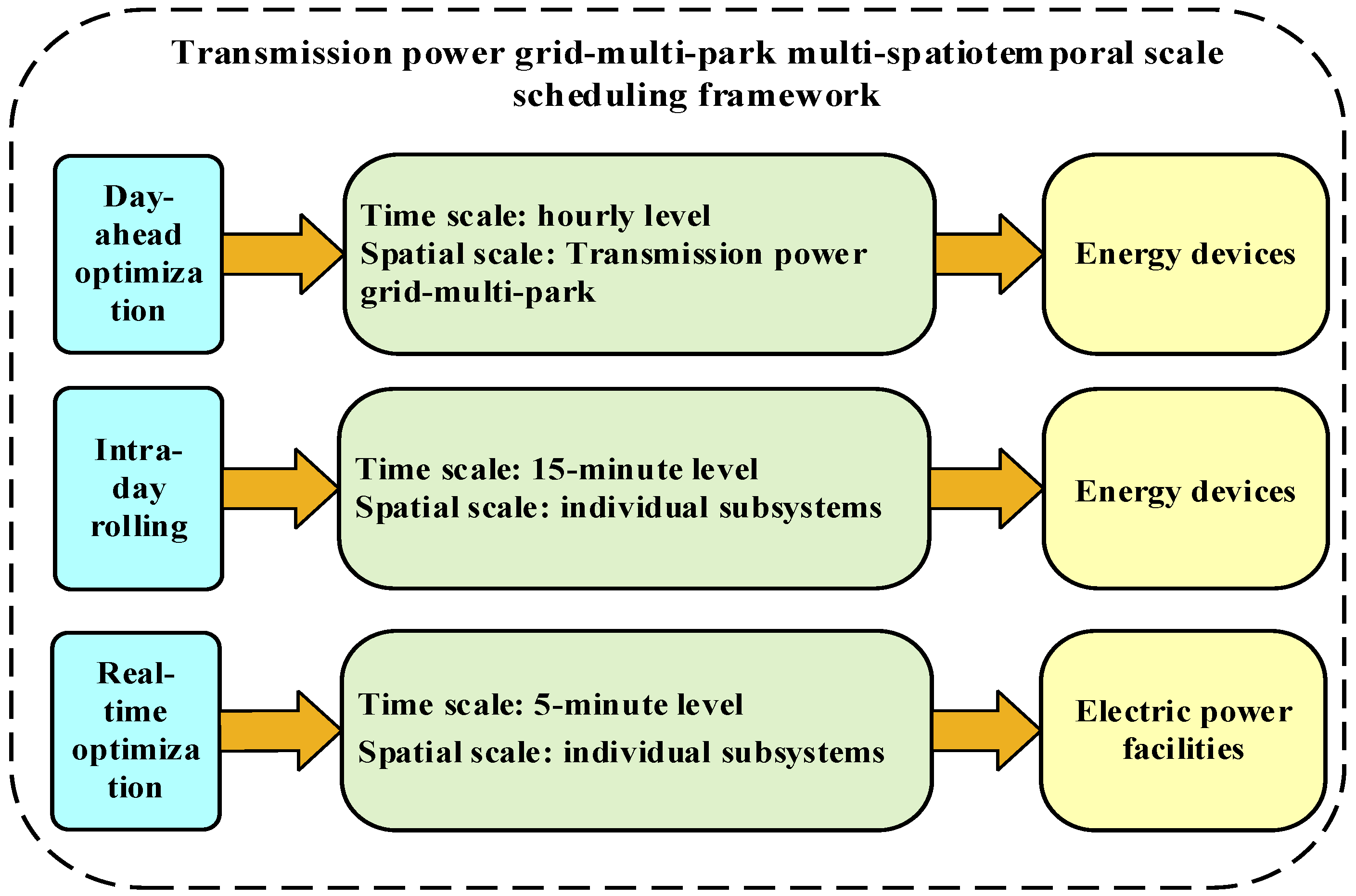
2. The Multi-Time and Space Scale Architecture of the Transmission Grid–Multi-Park System
- (1)
- Short-term day-ahead forecasting refers to the prediction of electrical load over a 24 to 48 h horizon, with a temporal resolution commonly set at hourly or half-hourly intervals.
- (2)
- Ultra-short-term intra-day forecasting involves high-resolution load predictions for time frames ranging from several minutes to a few hours ahead, with time steps as fine as 5 or 15 min, or even shorter.
3. Transmission Grid–Multi-Park Multi-Temporal and Spatial Scale Model
3.1. Day-Ahead Scheduling
3.1.1. Objective Function
- (1)
- Operating cost of the transmission grid
- (2)
- The integrated operating costs of multiple parks
3.1.2. Constraints
- (1)
- Constraints of the transmission power grid
- (2)
- Multi-park constraints
- (3)
- Transmission power constraints
- (4)
- Electricity–Gas–Heat Load Constraints
3.2. Intra-Day Dispatching
3.2.1. Load Uncertainty
3.2.2. Objective Function
3.2.3. Constraints
3.3. Real-Time Scheduling
3.3.1. Load Uncertainty
3.3.2. Objective Function
3.3.3. Constraints
3.4. Model Solution
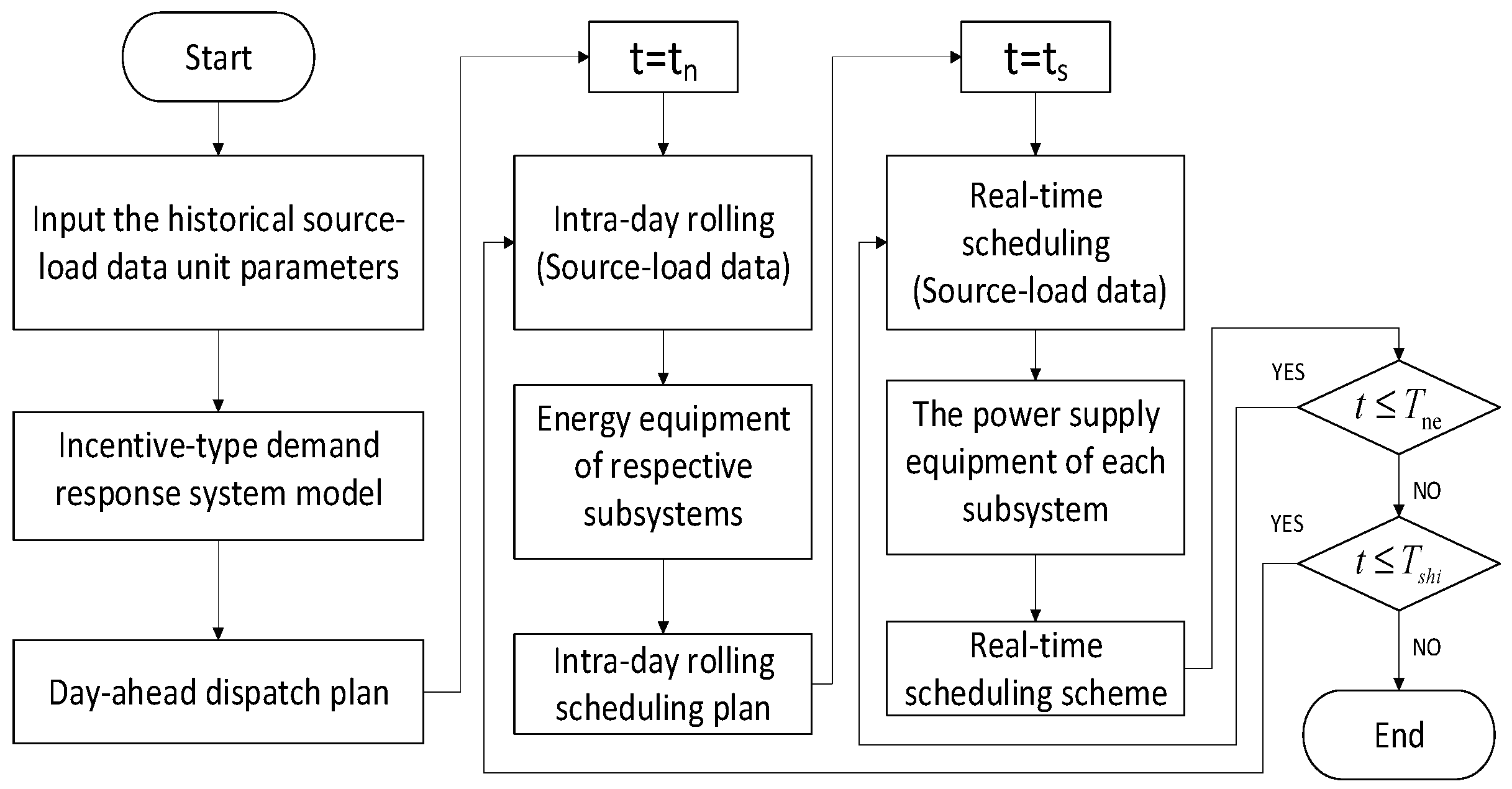
- Step 1: Solve the day-ahead scheduling model of the transmission grid–multi-park system. Subsequently, transfer the results to the intra-day scheduling model.
- Step 2: Initialize the ATC iteration count , read the predicted values of wind and solar power, set the initial values of , , and to 1, and start the loop.
- Step 3: Consider the predicted values as the most adverse scenario. Substitute them into the master problem to obtain the initial values of the coupling variables and the unit state variables. Set and equal to and , respectively, and then substitute them into the sub-problem.
- Step 4: In the process of one iteration, update , , and alternately.
- Step 5: Judge the loop termination condition: specify sufficiently small convergence thresholds and . If the inequalities and hold, then terminate the ATC iteration and output the final optimization result. Otherwise, return to Step 3 and update , , and .
- Step 6: Solve the intra-day rolling scheduling model of the single-park system and transmit the results to the intra-day real-time scheduling model.
- Step 7: Solve the intra-day real-time scheduling model of the single-park system to acquire the intra-day real-time scheduling plans for each park.
- Step 8: Determine whether the real-time optimization period lies within the scheduling cycle of the current intra-day rolling stage. If so, continue to execute Step 7; otherwise, proceed to Step 9.
- Step 9: Determine whether the real-time optimization period is within the full-day scheduling cycle. If it is, output the scheduling results. If not, shift the scheduling period to the next rolling cycle and then continue to execute Step 3.
- (1)
- The objective functions of each sub-problem are convex, and the constraint sets define convex feasibility regions;
- (2)
- The system-level coupling constraints are linear;
- (3)
- The penalty factor is sufficiently large (here, an adaptive growth strategy is adopted, where ).
4. Case Analysis
4.1. Parameter Settings
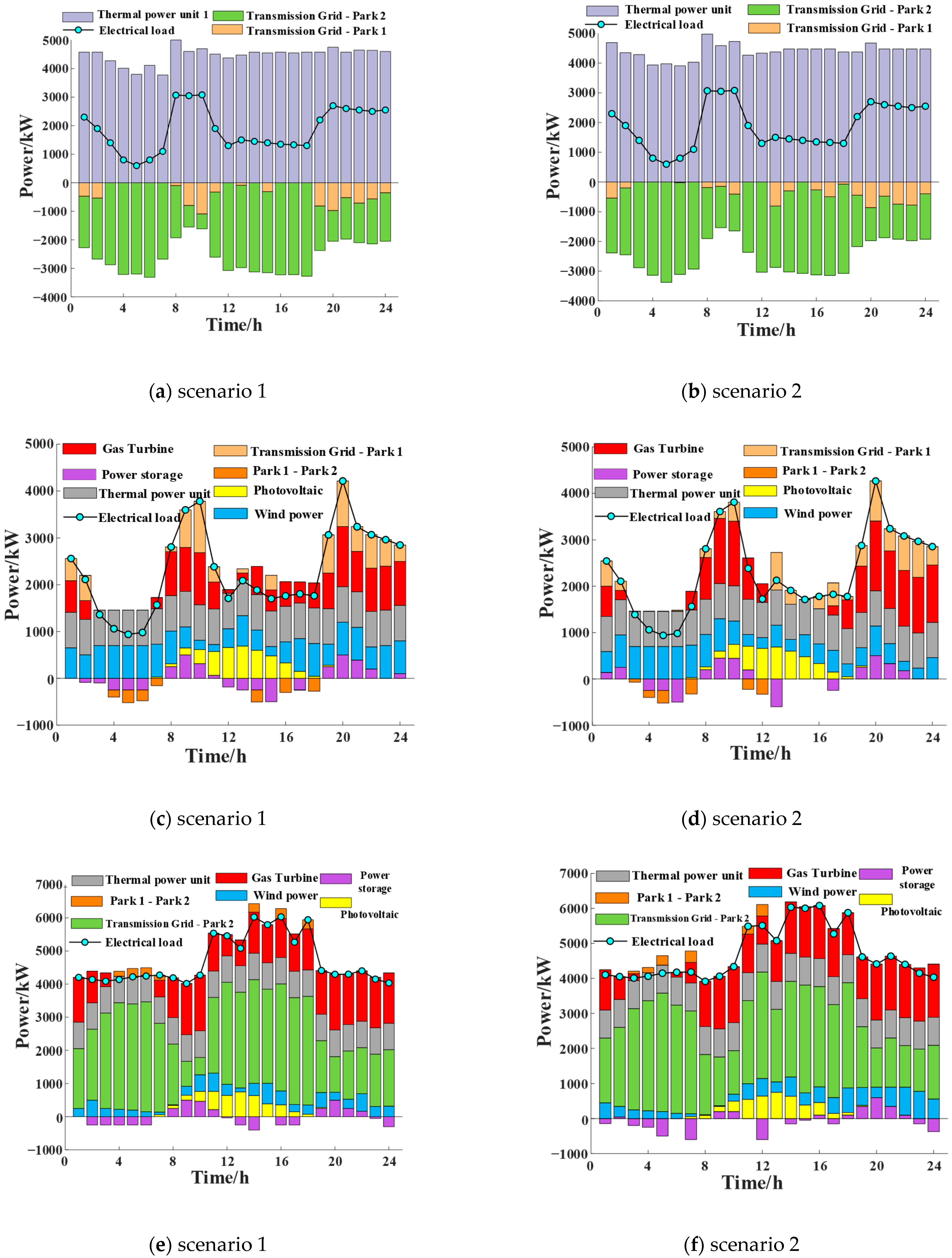
4.2. Analysis of Day-Ahead Results
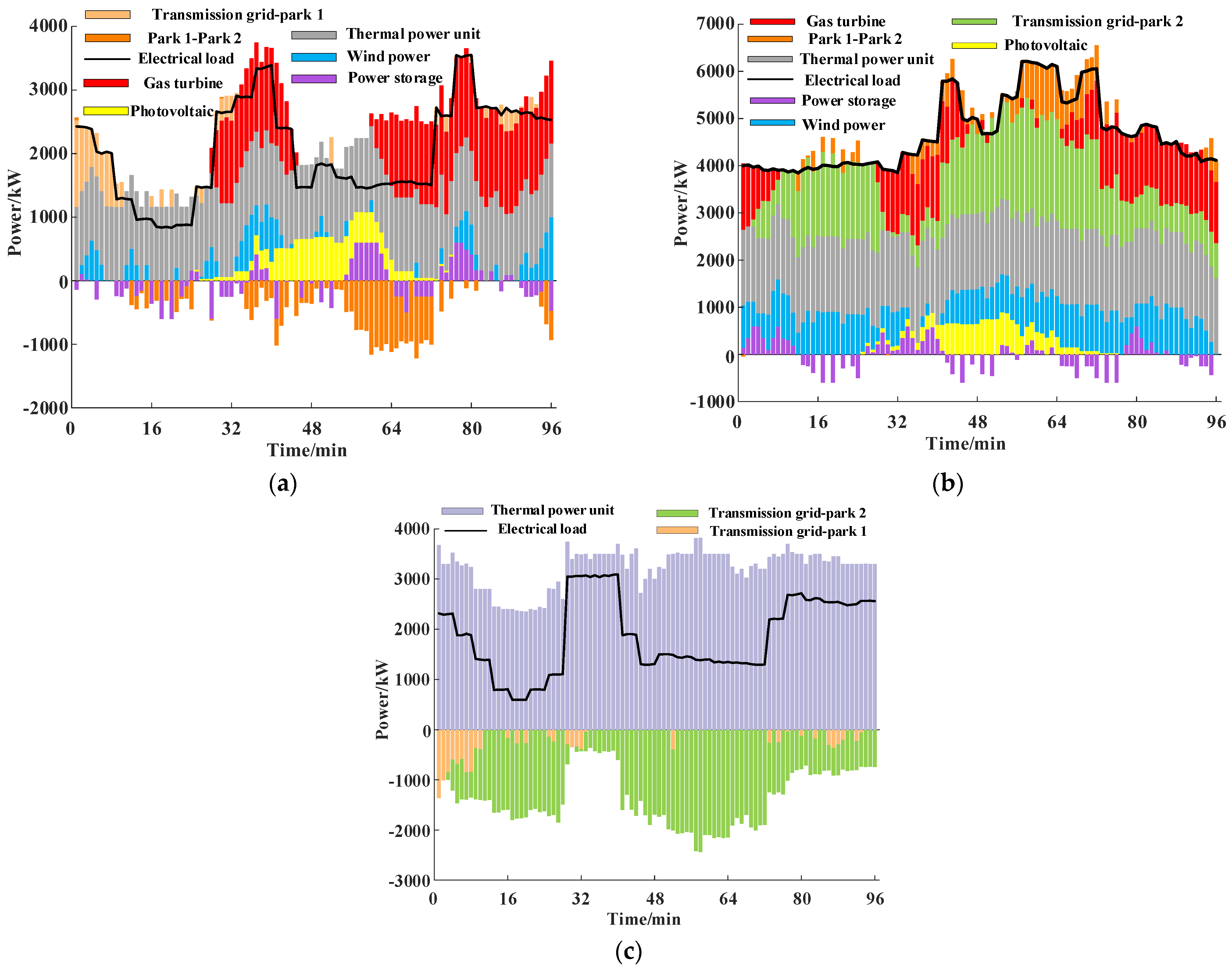
4.3. Analysis of Intra-Day Rolling Results
4.4. Analysis of Intra-Day Real-Time Results
5. Discussion
6. Conclusions
- (1)
- By taking into consideration the load time-series characteristics at different time and space scales and the spatial distribution characteristics of parks, and by using an incentive-type demand response and the scenario method to represent sources and loads, the potential for collaborative optimization of different energy sources in both temporal and spatial dimensions can be fully explored. This can further enhance the economic efficiency and reliability of the system operation.
- (2)
- Analytical Target Cascading (ATC) was employed to achieve the distributed collaborative solution of the transmission grid and multi-park systems. This approach not only enhances the efficiency of model solution but also effectively guarantees coordination and consistency among different system levels. Moreover, it strengthens the system’s resilience to uncertainties.
- (3)
- The core of this work resides in the development and preliminary validation of the proposed methodological framework. As a framework-centric study, the primary objective of the case analysis is to demonstrate the operational viability of this integrated framework. A detailed quantitative comparison with centralized optimization or other state-of-the-art distributed algorithms constitutes a critical direction for future research.
Author Contributions
Funding
Data Availability Statement
Conflicts of Interest
References
- Feng, J.; Hu, Z.; Duan, X.; Cai, S.; Zhang, P. A Multi Stage DRO-SDDP Approach for Planning Multi-Type Energy Storage Systems and Flexible Resources in High-Penetration Renewable Power Systems. IEEE Trans. Ind. Appl. 2025, 61, 5853–5867. [Google Scholar] [CrossRef]
- Chen, M.; Lu, H.; Chang, X.; Liao, H. An optimization on an integrated energy system of combined heat and power, carbon capture system and power to gas by considering flexible load. Energy 2023, 273, 127203. [Google Scholar] [CrossRef]
- Cruz, R.M.; Fitiwi, D.Z.; Santos, S.F. Multi-flexibility option integration to cope with large-scale integration of renewables. IEEE Trans. Sustain. Energy 2020, 11, 48–60. [Google Scholar] [CrossRef]
- Wang, D.; Wang, C.; Lei, Y. Prospects for key technologies of new-type urban integrated energy system. Glob. Energy Interconnect. 2019, 2, 403–413. [Google Scholar] [CrossRef]
- Huang, X.; Liu, M.; Lin, S.; Zhu, J. Distributed Algorithm for Robust Economic Dispatch of Integrated Transmission and Distribution System Considering Wind Power Uncertainty. Autom. Electr. Power Syst. 2025, 49, 165–177. [Google Scholar] [CrossRef]
- Zhao, D.; Wang, H.; Tao, R. Decentralized Coordination Robust Optimal Scheduling Model for Transmission and Distribution Networks Based on Improved Alternating Direction Method of Multipliers. Power Syst. Technol. 2023, 47, 1138–1151. [Google Scholar] [CrossRef]
- Mahmoud, H.A.; Abdelgawad, A.E. A robust unit commit-based TSO-DSO coordination scheme for optimal generation scheduling. Electr. Power Syst. Res. 2025, 243, 111512. [Google Scholar] [CrossRef]
- Wang, W.; Xiong, X.; He, Y.; Chen, H. Robust survivability-oriented scheduling of separable mobile energy storage and demand response for isolated distribution systems. IEEE Trans. Power Deliv. 2022, 37, 3521–3535. [Google Scholar] [CrossRef]
- Jiao, F.; Zou, Y.; Zhang, X.; Zhang, B. Online optimal dispatch based on combined robust and stochastic model predictive control for a microgrid including EV charging station. Energy 2022, 247, 123220. [Google Scholar] [CrossRef]
- Diekerhof, M.; Peterssen, F.; Monti, A. Hierarchical distributed robust optimization for demand response services. IEEE Trans. Smart Grid 2017, 9, 6018–6029. [Google Scholar] [CrossRef]
- Huang, W.; Liu, W. Multi-energy Complementary Based Coordinated Optimal Planning of Park Integrated Energy Station-Network. Autom. Electr. Power Syst. 2020, 44, 20–28. [Google Scholar] [CrossRef]
- Huang, W.; Liu, S.; YE, B. Station-Network Cooperative Optimization of Integrated Energy System for Park Considering Source-Load Interaction. Autom. Electr. Power Syst. 2020, 44, 44–53. [Google Scholar] [CrossRef]
- Liu, H.; Zheng, N.; Ge, S.; Liu, J. Station and Network Coordinated Planning of Integrated Energy Systems Considering Complementation of Load Characteristic. Proc. CSEE 2021, 41, 52–66. [Google Scholar] [CrossRef]
- Wang, D.; Meng, Z.; Jia, H. Research and Prospect of Key Technologies for Energy Interconnection System Planning for New-type Towns. Autom. Electr. Power Syst. 2019, 43, 16–28. [Google Scholar] [CrossRef]
- Bao, M.; Ding, Y.; Chang, Z. A multi-state model for reliability assessment of integrated gas and power systems utilizing universal generating function techniques. IEEE Trans. Smart Grid 2019, 10, 6271–6283. [Google Scholar] [CrossRef]
- Bao, M.; Ding, Y.; Sang, M.; Liang, Z. Research on Energy Capacity Planning of Electricity-gas Systems Considering Multi-objective Coordination. Proc. CSEE 2021, 41, 7551–7563. [Google Scholar] [CrossRef]
- Lei, Y.; Wang, D.; Jia, H.; Chen, J.; Li, J.; Song, Y.; Li, J. Multi-objective stochastic expansion planning based on multi-dimensional correlation scenario generation method for regional integrated energy system integrated renewable energy. Appl. Energy 2020, 276, 115395. [Google Scholar] [CrossRef]
- Gao, Z.; Han, L. Multi-Time scale rolling economic dispatch for integrated electricity-heating systems based on improved variational mode decomposition. Electr. Power Syst. Res. 2020, 187, 106468. [Google Scholar] [CrossRef]
- Pan, Z.; Gao, Q.; Sun, H. Interactions of district electricity and heating systems considering time-scale characteristics based on quasi-steady multi-energy flow. Appl. Energy 2016, 167, 230–243. [Google Scholar] [CrossRef]
- Peng, C.; Chen, S.; Xu, J.; Sun, H. Low Carbon Economic Scheduling for Integrated Energy Systems with Mixed Timescale & Multi-objective Reinforcement Learning. Power Syst. Technol. 2022, 46, 4914–4925. [Google Scholar] [CrossRef]
- Gu, W.; Lu, S.; Yao, S.; Zhuang, W. Hybrid time-scale operation optimization of integrated energy system. Electr. Power Autom. Equip. 2019, 39, 203–213. [Google Scholar] [CrossRef]
- Minniti, S.; Haque, N.; Nguyen, P.; Pemen, G. Local Markets for Flexibility Trading: Key Stages and Enablers. Energies 2018, 11, 3074. [Google Scholar] [CrossRef]
- Najibi, F.; Apostolopoulou, D.; Alonso, E. TSO-DSO Coordination Schemes to Facilitate Distributed Resources Integration. Sustainability 2021, 13, 7832. [Google Scholar] [CrossRef]
- Gabrielli, P.; Fürer, F.; Mavromatidis, G.; Mazzotti, M. Robust and optimal design of multi-energy systems with seasonal storage through uncertainty analysis. Appl. Energy 2019, 238, 1192–1210. [Google Scholar] [CrossRef]
- Mühlpfordt, T.; Dai, X.; Engelmann, A.; Hagenmeyer, V. Distributed pow-er flow and distributed optimization—Formulation, solution, and open source implementation. Sustain. Energy Grids Netw. 2021, 26, 100471. [Google Scholar] [CrossRef]
- Wu, H.; Kong, Q.; Huber, M.; Sun, M.; Craig, M.T. Climate change will increase high-temperature risks, degradation, and costs of rooftop photovoltaics globally. Joule 2025, 10, 102218. [Google Scholar] [CrossRef]
- Wu, H.; Qiu, D.; Zhang, L.; Sun, M. Adaptive multi-agent reinforcement learning for flexible resource management in a virtual power plant with dynamic participating multi-energy buildings. Appl. Energy 2024, 374, 123998. [Google Scholar] [CrossRef]
- Xu, Y.; Zhang, S.; Zhang, T. Cooperative Optimal Operation of Multi-microgrids Based on Hybrid Two-staged Robustness. Power Syst. Technol. 2024, 48, 247–267. [Google Scholar] [CrossRef]
- Zheng, Z.; Chen, G.; Shen, Z. Interval-Partitioned and Correlated Uncertainty Set Based Robust Optimization of Microgrid. IEEE Syst. J. 2024, 18, 1516–1527. [Google Scholar] [CrossRef]
- Zhang, X.; Zhang, Y.; Ji, X. Synergetic Optimized Scheduling of Transmission and Distribution Network with Electricity-gas-heat Integrated Energy System. Power Syst. Technol. 2022, 46, 4256–4270. [Google Scholar] [CrossRef]
- Zhang, Y.; Zhang, X.; Ji, X. Synergetic Unit Commitment of Transmission and Distribution Network Considering Dynamic Characteristics of Electricity-gas-heat Integrated Energy System. Proc. CSEE 2022, 42, 8576–8592. [Google Scholar] [CrossRef]
- Zhao, Z.; Guo, J.; Lai, C.; Xiao, H.; Zhou, K.; Lai, L. Distributed model predictive control strategy for islanded multi-microgrids based on noncooperative game. IEEE Trans. Ind. Inform. 2021, 17, 3803–3814. [Google Scholar] [CrossRef]
- Pan, C.; Fan, H.; Zhang, R.; Sun, J. An improved multi-time scale coordinated control strategy for an integrated energy system with a hybrid energy storage system. Appl. Energy 2023, 343, 121137. [Google Scholar] [CrossRef]
- Wang, J.; Zhang, T.; Liu, W. Robust Two-Stage Optimization Scheduling of TG-IES Considering Gas Thermal Dynamics. Processes 2025, 13, 1836. [Google Scholar] [CrossRef]
- Jiang, T.; Deng, H.; Bai, L. Optimal energy flow and nodal energy pricing in carbon emission-embedded integrated energy systems. CSEE J. Power Energy Syst. 2018, 4, 179–187. [Google Scholar] [CrossRef]



| Carbon Trading Parameters | Value (kg/kWh) | Carbon Trading Parameters | Value (kg/kWh) | Equipment Title | Conversion Efficiency | Maintenance Factor | Rated Output Upper Limit (kW) |
|---|---|---|---|---|---|---|---|
| δe | 0.798 | hc(tons) | 2000 | GB | 0.8 | 0.021 | 12000 |
| δh | 0.385 | ψc | 0.25 | CHP (electricity/heat) | 0.35 0.45 | 0.021 | 2000/ 3000 |
| ωe | 1.08 | uc | 0.2 | ESS | 0.8 | 0.021 | 600 |
| ωh | 0.39 | cg(yuan) | 150 | wind turbine/photovoltaic | / | 0.021 | 2000 |
| Modes | Parks | Power Supply Cost (Yuan) | Gas Procurement Cost (Yuan) | Heating Cost (Yuan) | Carbon Trading Cost (Yuan) | Cost of the Park (Yuan) | Subsidy Cost (Yuan) | Transmission Grid Cost (Yuan) | Total Cost (Yuan) |
|---|---|---|---|---|---|---|---|---|---|
| 1 | 1 | 54,725 | 15,875 | 35,676 | −5221 | 101,055 | \ | 442,215 | 734,974 |
| 2 | 96,645 | 31,916 | 68,351 | −5208 | 191,704 | \ | |||
| 2 | 1 | 51,969 | 15,873 | 35,436 | −5275 | 100,343 | 2340 | 442,169 | 733,499 |
| 2 | 92,683 | 31,902 | 67,432 | −5262 | 190,987 | 4232 |
| Time Dimension | Parks | Power Supply Cost (Yuan) | Gas Procurement Cost (Yuan) | Heat Supply Cost (Yuan) | Carbon Trading Cost (Yuan) | Transmission Grid Cost (Yuan) | Total System Cost (Yuan) |
|---|---|---|---|---|---|---|---|
| Day-ahead | 1 | 51,398 | 15,868 | 35,929 | −5316 | 441,910 | 732,936 |
| 2 | 92,131 | 31,898 | 67,851 | −5305 | |||
| Intra-day | 1 | 48,431 | 15,761 | 35,826 | −5419 | 440,375 | 729,104 |
| 2 | 89,164 | 31,799 | 67,748 | −5408 | |||
| Real-time | 1 | 49,002 | 15,758 | 35,817 | −5426 | 440,157 | 729,997 |
| 2 | 89,735 | 31,783 | 67,745 | −5415 |
Disclaimer/Publisher’s Note: The statements, opinions and data contained in all publications are solely those of the individual author(s) and contributor(s) and not of MDPI and/or the editor(s). MDPI and/or the editor(s) disclaim responsibility for any injury to people or property resulting from any ideas, methods, instructions or products referred to in the content. |
© 2026 by the authors. Licensee MDPI, Basel, Switzerland. This article is an open access article distributed under the terms and conditions of the Creative Commons Attribution (CC BY) license.
Share and Cite
Tu, Z.; Wang, F.; Wang, J. Coordinated Optimal Scheduling of Transmission Grid and Multi-Parks Considering Source-Load Uncertainties with Multi-Spatial–Temporal Scales. Energies 2026, 19, 1033. https://doi.org/10.3390/en19041033
Tu Z, Wang F, Wang J. Coordinated Optimal Scheduling of Transmission Grid and Multi-Parks Considering Source-Load Uncertainties with Multi-Spatial–Temporal Scales. Energies. 2026; 19(4):1033. https://doi.org/10.3390/en19041033
Chicago/Turabian StyleTu, Zhenghong, Fangzong Wang, and Jin Wang. 2026. "Coordinated Optimal Scheduling of Transmission Grid and Multi-Parks Considering Source-Load Uncertainties with Multi-Spatial–Temporal Scales" Energies 19, no. 4: 1033. https://doi.org/10.3390/en19041033
APA StyleTu, Z., Wang, F., & Wang, J. (2026). Coordinated Optimal Scheduling of Transmission Grid and Multi-Parks Considering Source-Load Uncertainties with Multi-Spatial–Temporal Scales. Energies, 19(4), 1033. https://doi.org/10.3390/en19041033