Article

A Neural Network Integration of Virtual Synchronous Motor-Based EV Charging Stations Control Performance and Plant Stability Enhancement

by
Kabir Momoh
1,
Shamsul Aizam Zulkifli
1,*,
Mohammed F. Allehyani
2,
Husam S. Samkari
2,3,*,
Abdulgafor Alfares
4,
Petr Korba
5,
Mohd Zamri Che Wanik
6 and
Muhamad Syazmie Sepeeh
7
1
Department of Electrical Power Engineering, Universiti Tun Hussein Onn Malaysia, Batu Pahat 86400, Malaysia
2
Department of Electrical Engineering, University of Tabuk, Tabuk 47512, Saudi Arabia
3
Artificial Intelligence and Sensing Technologies Research Center, University of Tabuk, Tabuk 47512, Saudi Arabia
4
Department of Electrical Engineering, College of Engineering, University of Hafr Al Batin, Hafr Al Batin 39524, Saudi Arabia
5
School of Engineering, ZHAW Zurich University of Applied Sciences, Technikumstrasse 9, 8401 Winterthur, Switzerland
6
Qatar Environment and Energy Research Institute, Hamad Bin Khalifa University, Doha 34110, Qatar
7
Department of Electrical and Electronic Engineering, Universiti Pertahanan Nasional Malaysia, Sungai Besi 57000, Malaysia
*
Authors to whom correspondence should be addressed.
Energies 2026, 19(3), 864; https://doi.org/10.3390/en19030864
Submission received: 15 December 2025 / Revised: 24 January 2026 / Accepted: 3 February 2026 / Published: 6 February 2026
(This article belongs to the Special Issue Advances in Power Distribution Systems: 2nd Edition)

Abstract

Control techniques for neural-network-based charging stations (CSs) are attracting attention worldwide. This popularity is due to the emergent need for alternative intelligent and adaptive control solutions for attaining a CS with stabilized power transfer and voltage control at the point of common coupling. This paper demonstrates novel neural-network-based improved virtual synchronous motor (NN-i-VSM) control through the mechanism of the charging voltage feedback in conjunction with a trained neural network model to adaptively produce field excitation (MN) that mimics a virtual flux model. The MN adaptively generates an electromotive force based on the trained NN output to control the rectifying converter response of the CS for power quality enhancement during multiple-CS operation. Simulation results in the scenario of multiple CSs at 750 kW (5 × 150 kW) with varying capacities showed significant improvement in voltage variable tracking capacity of up to 500 V as well as power response overshot reduction and grid voltage response tracking improvement compared with an i-VSM-based CS model. A comprehensive CS efficiency assessment and plant stability analysis, including Bode plot evaluation, further confirmed the superior dynamic response performance and robustness of the NN-i-VSM model over the i-VSM model. The proposed model offers scalable applicability in smart mobility and wireless CS integration, signifying a new control advancement for future generations of multiple-grid-friendly charging infrastructure for penetration of batteries at varying capacities.

1. Background

In the face of the rapidly expanding electric vehicle (EV) market [1,2,3,4], the proliferation of higher-rated charging stations (CSs) above 100 kW has exacerbated challenges associated with grid stability [5], particularly in terms of voltage and power instabilities due to CS activities related to different-rated EV batteries [6]. The surge in the demand for multiple-CS infrastructure poses a significant strain on existing power grid systems [7], leading to disruptions and fluctuations in voltage and power levels due to rapid changes in power consumption during the multiple-charging process [8]. The interaction between a CS and a power grid introduces resonance and current harmonics [9]. Resonance often amplifies voltage fluctuations [10], while harmonics can distort the sinusoidal waveform of grid current [11], both of which contribute to instability during CS operation [12]. This is because CSs are designed to deliver a significant amount of charging power to EV batteries concurrently [13], but the charging process involves dynamic load fluctuations [14], as EV batteries reach different states of charge (SOC) [15], especially when multiple EVs are being fast charged simultaneously [16].

2. Introduction

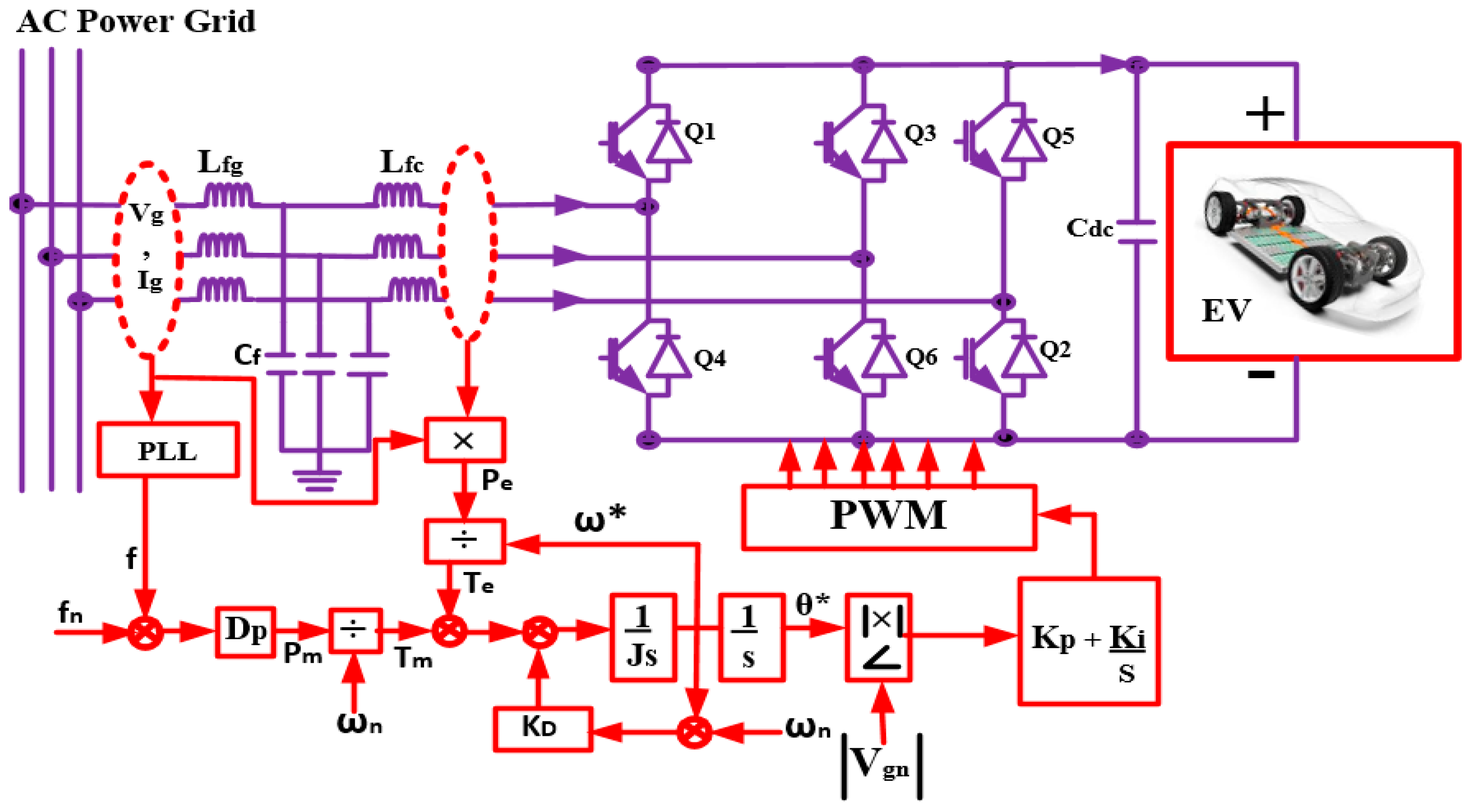
The variation in the charging rate and SOC of a battery can result in rapid changes in power demand absorption from the grid [17], affecting the ability of a CS controller to maintain stability of grid voltage [18], power, and frequency response [19]. However, a recent evolution in the CS control approach, which is the single-stage-converter control (SSCC) of proportional-integral controllers based on the virtual synchronous motor (VSM-PI-SSCC), as shown in Figure 1 [17,18,19,20], has emerged as a promising solution for improvements of dynamic response and frequency stability [20]. The VSM is applied at the rectifying converter stage in the CS [21] to regulate the power flow between the grid and EV batteries [22]. With VSM-based control algorithms, the rectifier actively participates in grid frequency and power decoupling [23] through the utilization of the motor’s inertia ( J ), the magnitude of the grid voltage ( V g ), virtual speed ( ), the difference between the reference virtual angular frequency ( * ) and nominal angular frequency ( n ), the droop constant ( D p ), electrical torque ( T e ), and mechanical torque ( T m ) [23].
Unlike traditional CSs with converters, which operate independently of the grid [24], VSM-based CS systems actively synchronize with the grid’s frequency ( f ) and voltage source, behaving as if they are synchronous motors [25]. This integration enables superior grid stability and power quality control by dynamically adjusting the CS rectifier’s output to match the grid’s voltage and power variation [26]. Additionally, VSM-based CSs with a rectifier offer ancillary power grid-enhancement functions [26], such as frequency regulation; however, they lack the capacity to independently ensure reactive power compensation and accurate tracking of the source’s voltage parameter [21,26], especially under the condition of multiple-battery charging. Therefore, bolstering reactive power injection and voltage control for overall grid-side stability and reliability during multiple-battery charging [24,26] remains an emerging technological limitation in CS control’s architectural design [27].
The most recent control strategy for reactive power compensation and voltage regulation in CSs was introduced in [27,28]. This technique enables virtual amplitude compensation (VAC) at the rectifying converter stage, as described in [29]. To fast-track power regulation during the EV battery charging process, the VSM controller maintains the voltage amplitude at an acceptable setpoint or margin [27,28]. Regardless of the state of the grid, it guarantees the management of the reactive power flow by adjusting the reference current vector’s amplitude in accordance with the CS’s power rating [24,29]. Additionally, the demonstration in [30] introduced a concept of virtually varying the effective line impedance at the harmonic frequency (VHI) to reduce the problem of mismatched line impedances at nonlinear CS loads [31]. This strategy limits losses while impersonating the behavior of real impedance [32] but [28,29,30] lacks dynamic response and frequency synchronizing capacity under changing charging requirements.
The control technique described in [33] implemented the virtual flux compensation (VFC) method at the rectifying stage of CS control via direct power control [34] through the direct quadrature ( d q ) and alpha-beta-zero ( α β 0 )-PI concept [35]. This concept regulates the power factor, current harmonics, and DC-link output voltage by controlling the instantaneous power input exchange [34], thereby aiding the swift synchronization of the CS rectifier frequency to the power source frequency [33,35]. Contrarily, d q / α β 0 -PI strategies are constrained by limited dynamic response and sensitivity to unbalanced charging loads. The most recent discussion in [36,37] solved the problem of dynamic response through an SOC charging-voltage feedback flux model (i-VSM). Table 1 shows the comparison detailing various properties of existing VSM-PI-SSCC techniques in CSs, as reviewed from the literature [27,28,29,30,31,32,33,34,35,36,37].
Despite some fundamental contributions observed from the VSM-PI-SSCC technique, as outlined in Table 1 [27,28,29,30,31,32,33,34,35,36,37], the output of the i-VSM control structure is often constrained by its inability to accurately track a CS’s charging voltage above 470 V [36] as well as issues of power tracking accuracy [38]. These limitations are caused by i-VSM control’s dependency on the rectifier’s output and the line impedance [38], with a complicated control response coordination between the power grid and the rectifying converter’s DC output stage [38], resulting in a high-power overshoot. Interestingly, the high initial overshoot in power response is largely caused by the delay in the control loop response [39] and SOC estimation [40], thereby resulting in mismatches between reactive power demand and supply [41].
Mitigating these response issues requires advanced predictive control techniques. In the absence of predictive control, i-VSM-based CSs may exhibit sluggish voltage tracking control, causing deviations in grid voltage during multiple charging. The reactive power regulation becomes complex in response, leading to higher voltage fluctuation and instability. This is because the variation in voltage amplitude is closely aligned to reactive power control at the grid in a multiple-CS scenario [42]. Furthermore, inconsistencies in power response exchange may be compounded due to poor inertia emulation [43], affecting the grid’s capacity to balance demand and generation. In most cases, the controller’s response continuously lags, reducing its ability to manage transient disturbances and subsequently increasing the risk of the instability of voltage [44], power, or frequency response in weak-grid scenarios [45].
Due to the existing limitations of excessive power response overshoot and dynamic response issues in the control design of i-VSM-based CSs [46], it is pertinent to re-evaluate the dependency nature of i-VSM-based CS control on predefined mathematical models as a major constraint inhibiting its adaptability to a high charging rate and charging voltage. In a multiple-CS scenario, a mitigation controller plant’s instability and excessive power overshoot become increasingly complex, particularly for high-power-rating CSs exceeding 100 kW. This complexity may arise due to instantaneous alterations in the line impedance caused by the significant voltage demand of such CS loads [47], which often introduces phase imbalances and current harmonics at the point of common coupling (PCC) [48].
These challenges could compromise grid stability [49], especially in terms of the ability of the controller to accurately track a higher reference charging voltage [50] and grid voltage and power responses [51] during multiple charging of batteries at varying capacities. Maintaining balanced plant stability and grid parameter setpoints during multiple charging is critical [52]. Invariably, a robust neural-network-based grid inertia reinforcement controller is urgently required for precise control of charging voltage dynamics and intelligent reactive power compensation during grid-connected CS operation.
The neural network (NN) represents an emerging computational concept increasingly applied in control systems with a CS rectifying converter [53] for its ability to instantaneously learn, generalize, and adapt complex nonlinear relationships [54]. NN-based control in CSs offers the benefit of improved decision-making capabilities by processing vast amounts of input data, such as charging voltage, grid voltage, and frequency, to optimize power flow and minimize disturbances [55]. The advantage of NN-integrated control compared with traditional VSM-PI-SSCC control includes the data-driven architecture, which improves the predictive ability of the controller [56], enabling it to dynamically respond to grid response fluctuations with high accuracy [57]. NN-based controllers could provide dynamic adaptability to load changes, enabling swift and efficient responses to fluctuations in power demand. In contrast, conventional VSM-PI-SSCC controllers often exhibit oscillatory power instability and slower response times under the multiple-CS condition. However, the implementation of NN-based VSM charging systems has not yet been thoroughly investigated or demonstrated by any previous research.
Alternatively, some instability mitigation techniques for NN-based CSs’ response control, such as Antlion-optimization-based sliding mode control (ALO-SMC), have been reported to improve the transient response of CSs within a three-phase Vienna rectifier by reducing settling time [58]. The particle swarm optimization (PSO) and fuzzy sliding mode control (FSMC) control scheme help to optimize PI controllers [11,50,53] in voltage-oriented control schemes for CSs [59]. Regrettably, ALO-SMC, PSO, and FSMC controllers are constrained by computational complexity [60] and parameter dependency [38], and they struggle with adaptability issues during multiple-battery charging and under nonlinear grid conditions [61]. Table 2 shows the merits, drawbacks, and control properties of the most recent instability mitigation techniques for NN-based control in CSs.
Recent concerns reported in [62] clearly describe the limitations as emergent challenges of control response for NN-based controllers within a single-stage rectifying converter [63]. These challenges include limited grid-inertia emulation [64] and poor frequency synchronization due to the sensitivity of the phase-locked-loop (PLL) phase detection process to sudden grid load disturbances [61,63]. Another problem worthy of mention is voltage instability under nonlinear load changes as well as reduced adaptability to battery SOC variation during charging [63,64]. Similarly, more recent studies in [65,66] have shown that the FT-SMC-based technique can deliver swift convergence to the sliding surface and faster transient response but are constrained by its sensitivity to initial states. In contrast, the observation in [67,68] clearly indicated that the FT-SMC-ADRC-based rectifier control ensures convergence irrespective of initial conditions, though it has a major limitation of control complexity due to multiple-layer tuning issues.
Without NN, i-VSM-based CSs may lack insight into the batteries’ real-time charging energy demands, leading to inefficient power allocation and inaccurate tracking of the variable signal of the reference DC voltage. Furthermore, in the absence of NN incorporation, an i-VSM-based CS cannot effectively mimic a synchronous motor’s behavior, making it less resilient to grid disturbances. As a result, the configuration may compromise grid stability and efficiency of EV charging performance during multiple charging of batteries with varying capacities.
Thus, there exists a knowledge gap in this regard due to the lack of existing research that considers the variable nature of battery charging voltage with a neural network mechanism as an input feedback parameter to the i-VSM control algorithm for CSs. This study extends the existing research in i-VSM-based rectifier output voltage control. In this regard, the implication of charging voltage variability could result in an unstable duty cycle and continuous oscillatory or large reluctant power over a longer period of time in the multiple-battery charging scenario [36,37], thereby impeding the plant stability, the dynamic response performance of the controller, and the controller’s ability to accurately track and adapt the CS’s DC voltage variable response, grid power, and voltage response required for charging rate stability and grid-side parameter control.
Building upon this control foundation, the scientific aim of the proposed research work incorporates the NN into an i-VSM-based CS control technology (NN-i-VSM). This concept introduces an enhanced level of intelligence beyond the state of the art in grid-to-vehicle (G2V) control technologies. Through this strategy, the NN-i-VSM architecture could emulate the inertia and damping characteristics of a synchronous motor and also learn and adapt in real time to the conditions of varying grid voltage and battery charging voltage. This could result in superior grid synchronization, plant stability enhancement, reactive power management, and more accurate tracking of DC variable voltage response and reference power, particularly in CSs with a high-power-rated single-stage converter.
It is imperative to note that the charging voltage of an EV battery directly influences the charging rate and has a significant effect on grid power stability. In [36,48], i-VSM control was introduced to improve a CS’s dynamic performance and maintain a stable frequency at the grid side regardless of varying battery SOCs through a droop mechanism that adjusted the virtual inertia based on the battery’s SOC. However, this technique showed limited capacity for tracking voltage variable response beyond 470 V [37,48] and induced high initial power overshoot, particularly in the single-battery charging scenario, thereby compromising the overall CS efficiency [48]. These limitations underscore the urgent need for predictive control, adaptive tuning, real-time optimization, and an intelligent control framework.
The objective of this paper is to demonstrate an improved NN-i-VSM-based CS controller with outer-loop charging voltage feedback control during multiple charging of batteries with varying capacities. The novelty and subject of the proposed NN-VSM research concept entail leveraging the neural network framework to intelligently map a CS’s reference voltage, grid parameters at the PCC, and battery-derived charging voltage into the existing i-VSM architecture, thereby improving real-time variable response control and power grid response stability during multiple charging of batteries with varying capacities. The proposed NN-i-VSM control technique is intended to incorporate plant stability verification and comparative evaluation to ascertain NN-i-VSM control’s ability to precisely track reference system parameters, thereby solving the key issues of oscillatory dynamic variable response and critical grid response stability challenges associated with existing i-VSM-based CS control strategies.
The contribution of this research paper is fully demonstrating an NN-i-VSM-based CS controller with a single-stage rectifier that integrates the NN as an input parameter to i-VSM control under the charging scenario of multiple batteries at varying capacities. Specifically, NN-i-VSM control was proposed to be adapted to a higher value of the charging voltage (500 V) at any SOC of the battery while ensuring grid power and voltage response tracking and stability regardless of the different EV battery SOCs. This paper brings a new look to the existing literature in the following control engineering aspects:
(1)
NN-driven VSM technology: Incorporating NN into the i-VSM architecture to enable adaptive nonlinear control and faster dynamic response under varying EV battery charging characteristics.
(2)
Disturbance-resilient control framework: This study advances a rectifier-based control technique with a simple single-layer NN structure that improves plant stability while maintaining low computational complexity.
(3)
SOC-based NN reactive power tracking: Utilizing real-time SOC feedback to intelligently adjust reactive power in response to charging voltage errors, enhancing grid stability during multiple charging operations.
This research paper is structured as follows: the modeling of the proposed NN-based i-VSM controller is discussed in Section 3, and the simulations and the results of the model are described in Section 4, while Section 5 entails the concluding part of this paper.

3. Proposed Neural Network Integration into Virtual Motor Control

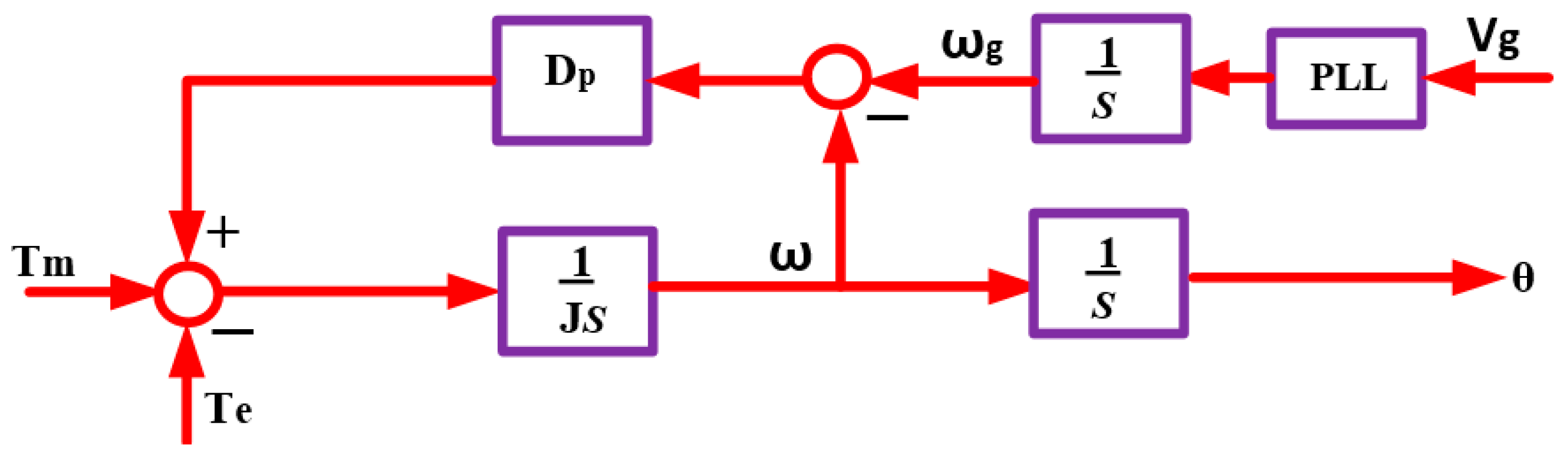
The proposed NN-i-VSM controller was modeled by first assuming that the active power frequency loop of the VSM, as shown in Figure 2, represents the rotor dynamics ( J d ω / d t ) of the synchronous motor model [36]. This is because the rotation of the rotor is synchronized with the frequency of the applied voltage, as demonstrated in [37]. Consequently, any slight voltage changes often affect the rotor angle ( θ ), thereby influencing electrical torque, denoted as T e ( T e = M f i f i , sin θ ) [48]. The dot product i , sin θ indicates the relationship between θ and grid current (i), whereas the field excitation ( M f i f ) is described as the product of the field mutual inductance ( M f ) and field current ( i f ), such that the value of i f is chosen as a constant value to ensure grid response stability at the setpoint [44]. Conventionally, M f represents the product of the coupling coefficient ( k ) and magnetization inductance ( L m ) divided by the number of poles of the VSM ( M f = k     L m / P ) [37,48].
The frequency control section emulates the inertia ( J ) response of a synchronous motor by comparing T e , mechanical torque ( T m ), and the reference grid frequency ( ω g ) obtained from the virtual PLL, scaled by the feedback gain of the active frequency loop ( D p ). The resulting signal is further scaled by J based on the virtual motor profile, and it is subsequently integrated to generate ω , ensuring an error-free model at the steady state and enabling dynamic adjustment to the frequency deviation. Parameter D p is obtained by dividing J by a time constant ( τ ). Therefore, the frequency of an NN-i-VSM-based CS within a single-stage rectifying converter is synchronized with the grid frequency using the VSM torque expression described in (1) [48]:
J   d / d t = T e T m D p g d θ / d t =                                                                                      
This clearly indicates that any change in the controller’s virtual angular frequency (where ω is the rotor speed) is dependent on the balance between T e , T m , and damping effects. The value of J must be carefully chosen to be within the range of 0.1 to 0.9. Choosing a J value within this margin ensures a faster and adaptable dynamic response and grid power stability during multiple-battery charging or a sudden change in the charging characteristic [44,48].
Therefore, if T m is set at 0, the external torque reference needed is eliminated in the G2V charging process. This enables ω to be aligned with θ , such that, whenever ω deviates from ω g , the damping term D p ( g ) is activated to return the system to synchronization. Parameter ω is synchronized to the power grid by comparing it with ω g . This completes the description of the proposed NN-i-VSM-based CS’s frequency loop. The primary novelty of this paper is the incorporation of the neural network into the i-VSM configuration as a novel input parameter via the reactive-power–voltage loop (Q − V = change error approach), where the detailed modeling procedure is outlined in the subsequent subsection.

3.1. Incorporation of NN-Based Control as New Input Parameter for NN-i-VSM Model

NN-based control is integrated into a virtual motor model through the change-error technique, as discussed in [36,37]. Through this approach, the electrical part of the i-VSM-based CS is assumed to represent the Q-V regulation loop of the NN-i-VSM-based CS. Firstly, the Q-V loop emulates the electromagnetic interaction between the virtual stator field and the rotor during the charging process. Invariably, Q-V injection is directly proportional to the virtual motor’s excitation dynamics at the SOC ( M f i f s o c ) with respect to the CS’s feedback charging voltage ( V d c f b ) [37,48]. This is because Q injection is influenced by M f i f s o c produced by the NN-i-VSM-based CS, which controls the rectifier’s output to regulate the charging voltage during battery charging. Similarly, the electromotive force at the SOC ( e s o c ) needed to generate the switching signal to control the rectifying converter’s output of the CS [36], as described in [37], can be derived as follows:
e s o c   = (     M f i fsoc     i ,   sin θ )
The term ω     M f i f s o c represents the virtual motor’s component, linking the i-VSM’s rotational speed with output power and reactive power ( Q ) regulation. Parameter M f i f s o c functions as the required virtual flux model, which directly influences V d c f b to deliver the appropriate charging power at the initial SOC of the battery. The dot product ( . , . ) indicated by vertical bars is a conventional notational representation for a three-phase VSM system, illustrating vector interactions in control dynamics [37,44,48]. If i signifies the grid current, the M f i f s o c expression needed to match Q injection and precise tracking of the controller’s variable response of the charging voltage during the charging process can be written as in (3) [37]:
M f i f s o c = 1 / K q s Q r e f Q +   K v V d c r e f V d c f b                                 + K i / s V d c r e f V d c f b                           Q = M f i f i , cos θ                                                                                                              
Parameter K q represents the virtual motor gain constant, chosen based on stability and dynamic response criteria of the proposed controller, while Q r e f is the reference reactive power of the controller. In this case, Q r e f is set at 0 kW to ensure a close to unitary power factor by limiting excessive Q exchange at the grid during the charging process. Parameter V d c r e f represents the CS’s reference DC output voltage, often chosen based on the voltage requirement of the CS. Parameter K v signifies the voltage regulation constant, whose value can be chosen between 0.1 and 0.9. Nonetheless, some basic modifications are fundamentally required for M f i f s o c and e s o c , as formulated in (2) and (3), to account for NN control’s relationship. This modification is devised as a link to the i-VSM topology, fast-tracking dynamic tuning of the reactive power setpoint based on the error generated through the change error techniques, thereby accommodating variable voltage response stability in the G2V scenario.
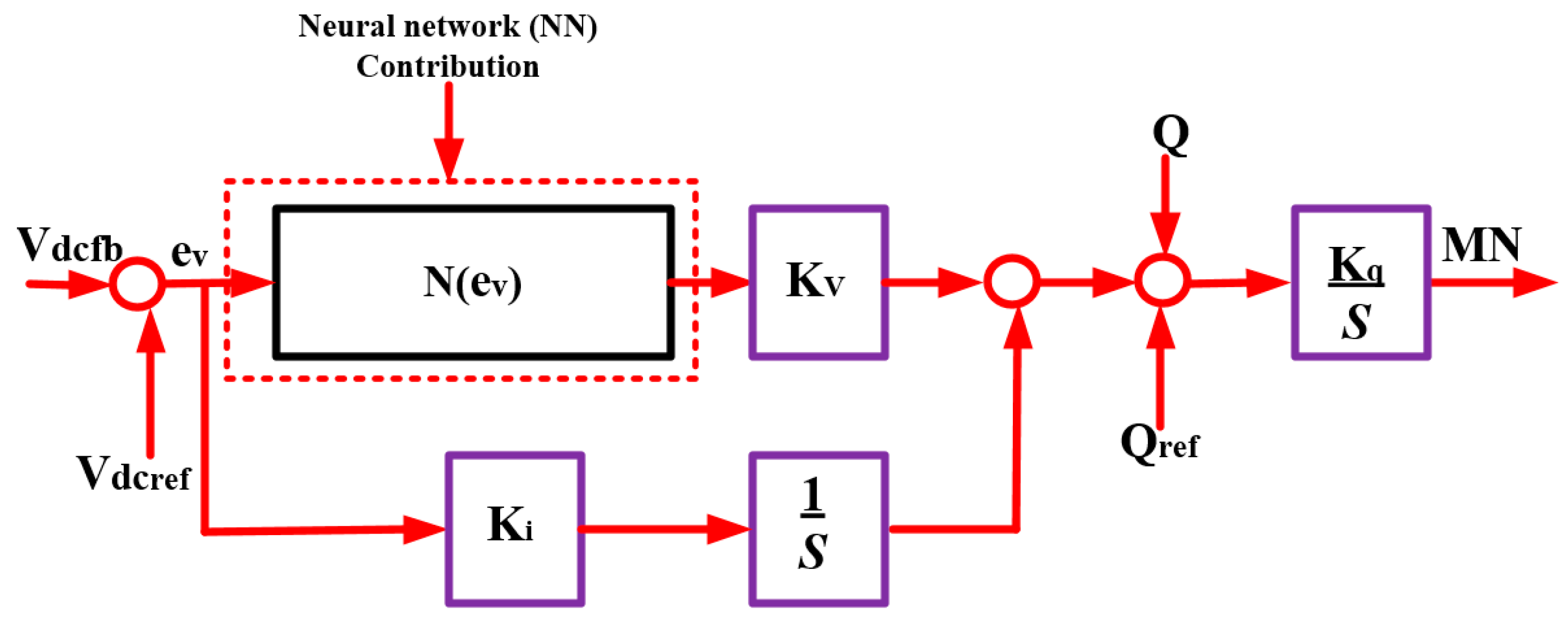
Secondly, the proposed NN-based control’s virtual flux structure in Figure 3 is envisioned to both intelligently and dynamically track the reference voltage parameter while controlling Q injection based on real-time voltage error. The basic idea of the proposed concept is to generate neural-network-based field excitation (MN), which serves as the virtual flux model for the proposed NN-i-VSM model’s charging system. Conversely, the NN’s real-time voltage error compensation expression can be written by referring to the input fed to the NN as the DC voltage error ( e v ), represented as the difference between V d c r e f and V d f b ( e v = V d c r e f V d f b ).
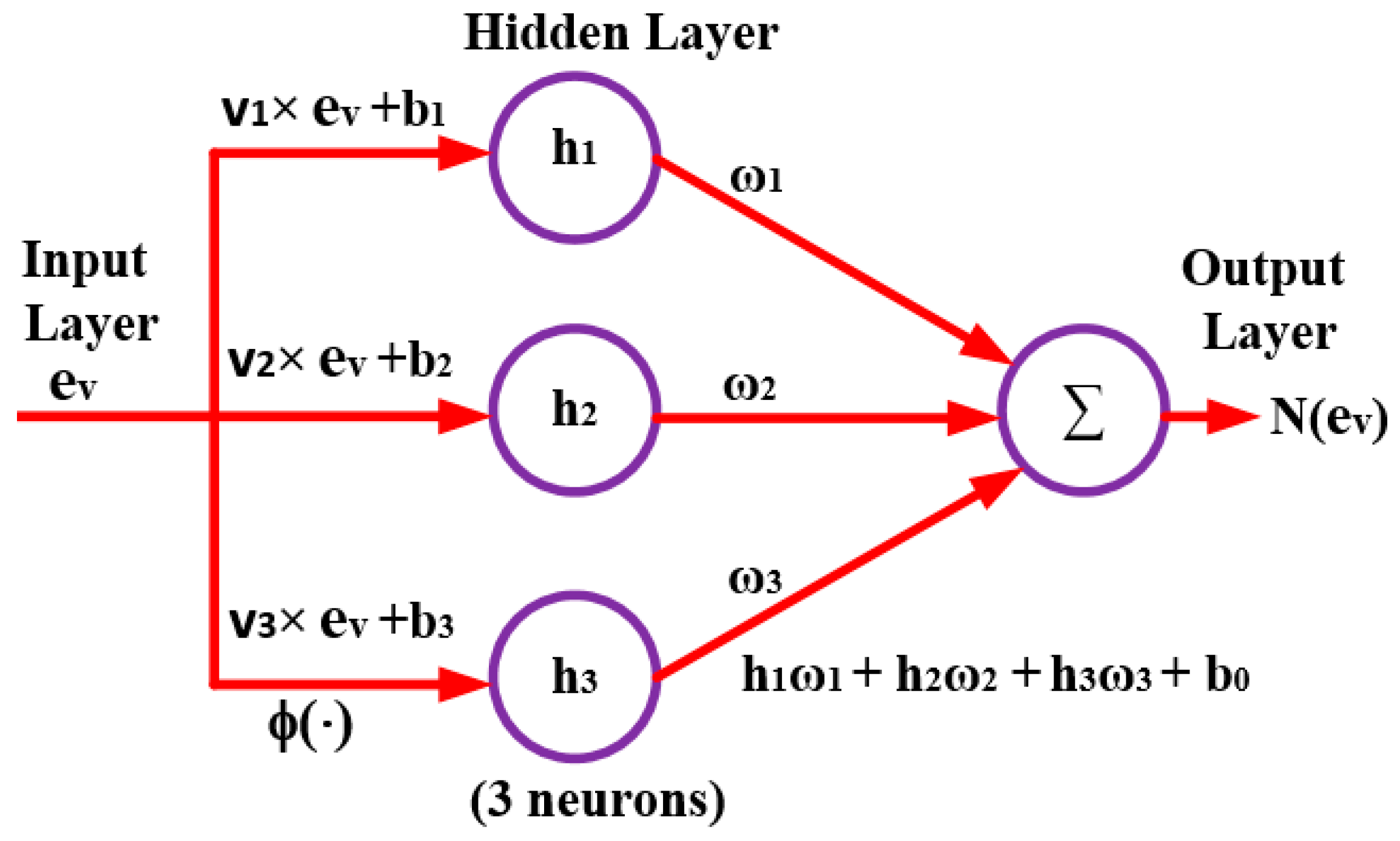
However, for the purpose of simplifying the control modeling while maintaining the nonlinear approximation capacity for adaptive voltage error correction, a simple single-layer NN with n neurons, as shown in Figure 4, is assumed in this paper. By utilizing the nonlinear activation function ϕ ( · ) , the NN’s output processing signal ( N ( e v ) can be formulated as a voltage control characteristic in a manner that reflects the basic electrical property of a real synchronous motor, as formulated in (4). If n refers to the number of neurons within the hidden layers ( h i ) of the model ( n = i n p u t   n u m b e r s + o u t p u t   n u m b e r s / 2 ), for this model, three neurons were chosen ( n = 3 ) due to the requirement for mapping the dynamics of e v as a single input to a nonlinear output signal termed as MN [69]. The choice of three neurons was made to fast-track an optimal balance between swift convergence and reduced computational complexity and tracking accuracy. The individual h i is biased and updated during training through the gradient descent technique or backpropagation to minimize the loss function (L = 1 2 e v 2 ), as follows [53,56]:
      N e v = i = 1,2 , 3 n   ( ω i       ϕ     v i     e v + b i + b 0 )           v i = v i *     Π     δ L / δ v i * = v i v i * Π δ L δ v i *                             ω i = ω i *     Π     δ L / δ ω i     = ω i ω i * Π δ L δ ω i *                     b i = b i *     Π     δ L / δ b i * = b i b i * Π δ L δ b i *                                 b 0 = b 0 *     Π     δ L / δ b 0 *   =   b 0 b 0     Π δ L δ b 0 *                         h i = ϕ v i     e v + b i                                                                                                                
The choice of a smaller n helps to balance between simplicity [69] and approximate continuous functional adequacy, as discussed in [70]. The term v i is the weight of the input to the i^th neuron, initialized through the random-distribution iterative method and updated during model training to reduce L [64,70]. The term ω i is the value of output weight, b i indicates the bias term that forms the input to the activation function ( ϕ ( · ) ), Π indicates the learning rate, while δ L / δ b 0 * refers to the partial derivative of the L with respect to b 0 * [69]. The terms v i * , ω i * , b i * , and b 0 * are all small random reference values chosen between 1 / n and 1 / n at the initial stage before training the network [70]. The single-layer NN, indicating h i = 1,2 , 3 used to compute the contribution of the NN-based output, N e v , is presented in Figure 4.
Figure 4. Structure of proposed NN-based integration as input parameter to NN-i-VSM model.
Energies 19 00864 g004
The voltage regulation path is controlled by multiplying or scaling the output of the N e v signal by gain K V and subsequently added to complement the integrator path K i to form an adaptive-PI-look-alike voltage control structure. The Q control feedback error path is added to generate the control signal from the difference between Q and Q r e f to eliminate the Q mismatch, aligning with the motor’s T e emulation requirement. The resulting signal is integrated and scaled with Kq to aid dynamic response tuning. If Q is set at 0, such that V d c f b equals the charging voltage at the SOC, the field excitation developed (MN) due to the NN integration into the i-VSM control can accurately learn and adapt the charging voltage response regardless of multiple-battery charging. Therefore, by making an adjustment to (3) with respect to Figure 3, the MN model can be derived as follows:
M N = K q / s K V     i = 1,2 , 3 n   ω i         ϕ     v i     e v + b i + b 0 + K i       1 / s e v + Q r e f Q
Similarly, the electromotive force generated by the NN-i-VSM control due to incorporating NN as the new input parameter to the i-VSM control ( e N N ) can be obtained by adjusting and substituting M f i f s o c = M N into (2). The e N N formulation, as outlined in (6), accounts for intelligently learning and adapting neurons in the NN-i-VSM control’s hidden layer based on the charging voltage change error technique. Likewise, the e N N signal is fed to the pulse generator to generate the switching signal to control the rectifying converter based on the charging history, unlike the traditional i-VSM concept, which requires the resulting e S O C signal to be fed to a PI controller. Parameter e N N dynamically controls and adjusts the charging parameters in accordance with real-time battery dynamics and grid conditions, thereby aiding in the prediction of future charging power trajectories and adjustment of the charging rate using the expression as follows:
e N N =     K q / s K V     i = 1,2 , 3 n   ω i         ϕ     v i     e v + b i + b 0 + K i     1 / s e v + Q r e f Q     i ,   sin θ
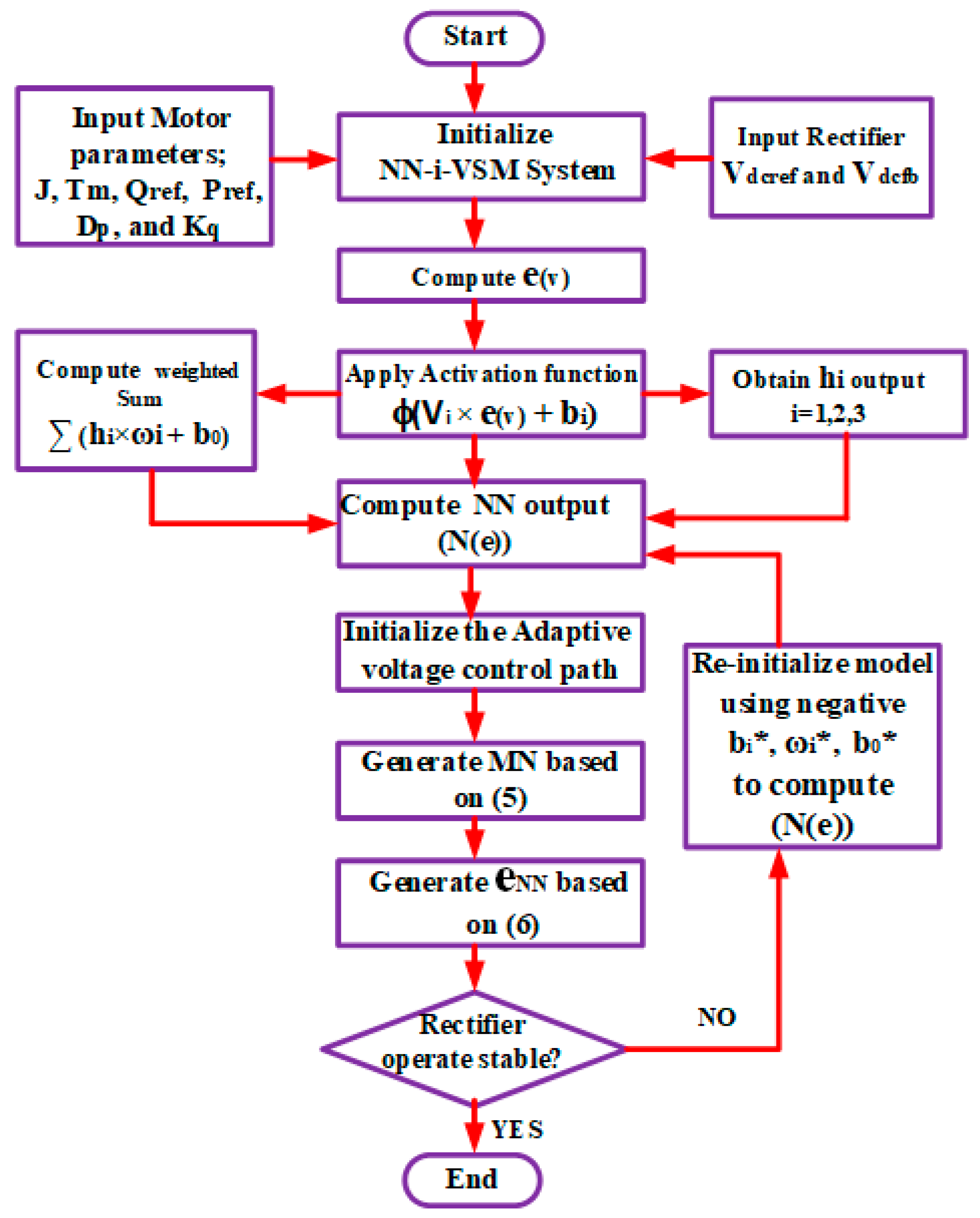
Through this approach, the NN-i-VSM-based CS preemptively could anticipate power overshoot and adjust the control to match the change in e v using the tanh(.) activation. This could allow for accurate charging parameter tracking at the setpoint by optimizing Q injection to maintain plant stability. The NN-i-VSM control could actively adapt to any sudden change in the charging power flow from the CS rectifier to the battery regardless of battery SOC variations, maintaining a stable Q flow at the PCC during multiple charging. The flowchart of the detailed architecture of the NN-i-VSM control is shown in Figure 5.
By introducing the NN structure into the i-VSM control, this research paper fills an important gap. The concept aims to effectively allow for coordinated charging of multiple EV batteries by mimicking the dynamic response of a conventional synchronous motor. It adaptively controls the generated MN signal based on grid frequency, voltage, and power fluctuations. This sought to ensure a stabilized rectifying output response and synchronized power response at the PCC. The proposed NN-i-VSM control strategy goes beyond the state of the art, addressing plant stability drawbacks inherent in an open-loop structure of i-VSM-based CS control techniques. The procedure for plant stability considerations is discussed in the ensuing subsection to ascertain an NN-i-VSM CS’s response reliability under the multiple-charging condition of batteries with varying capacities.

3.2. Plant Control Stability Analysis of Proposed NN-I-VSM Model

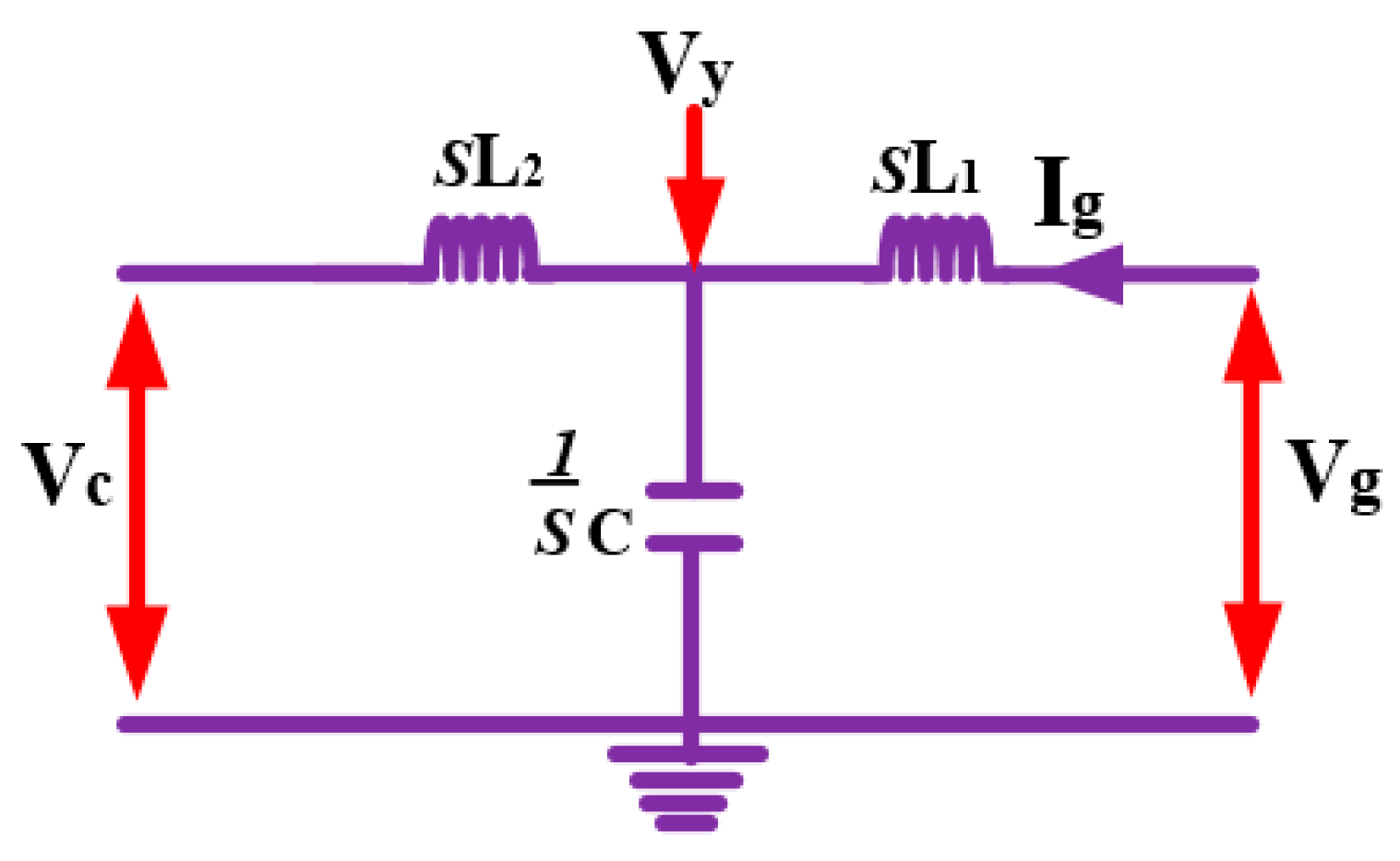
The plant dynamics of the proposed model were derived from the LCL-filter-based converter structure and components [71]. In this case, the grid current (Ig ) was not assumed to be equal to zero, unlike the demonstration in [37]. This was because of the need to accurately model the dynamic response interactions and analysis between the CS converter [72] and the power grid during operation. Therefore, the plant stability of the NN-i-VSM-based CS with a rectifying converter was examined by evaluating the equivalent LCL filter circuit layout in the s-domain [73]. The equivalent circuit structure in Figure 6 encompasses the rectifier-side inductance ( L 1 ), grid-side inductance ( L 2 ) , and filter capacitance (C) [74].
If the input voltage to the LCL filter (Vy) equals the grid voltage (Vg), V c is indicated as the rectifier voltage. To balance the rectifier impedance on both the networks, L 1 must equal L 2 [37,74], ensuring stability of the rectifier ( L 1 = L 2 = L ). Assuming that the power grid impedance is significantly larger than the rectifier-side dynamics, such as in the case of CS operation, Figure 6 can be used to derive the fundamental transfer function (P(s)) expression by considering the rectifier node and capacitor node to the grid side using Kirchhoff’s voltage and current law, as follows [37]:
V c = V y + s L   I g + s C V y = V y + s L I g + s 2 L C V y   = V y 1 + s 2 L C + s L I g                                                                               V y = V g +   s L I g                                                                                                                           V c = V g +   s L I g 1 + s 2 L C + s L I g                                                 V c = V g 1 + s 2 L C + s L I g 1 + s 2 L C + s L I g                 = V g 1 + s 2 L C + s L I g 2 + s 2 L C                               P s = V g V c = 1 + s 2 L C 1 + s 2 L C + s L I g / V g     2 + s 2 L C                                                         = 1 + s 2 L C 1 + s 2 L C = s 2 L C 1 + s 2 L C                                                                                
From the derived P s in (7), the open-loop ( G s ) and closed-loop ( H s ) transfer functions can be derived by assuming negligible Kp, K v , and K i dynamics in the adaptive-PI-look-alike loop of the NN-i-VSM model, as expressed in (8). Parameters gain ( G m ) and phase margin ( P m ) describe stability dynamics, such that J c indicates the magnitude of the G s of the system. This paper assumes the inner loop dynamic behavior of the proposed NN-VSM-based controller is neglected due to its faster response, while the controller gains are retained in the system model, ensuring consistency between the assumed parameters and subsequent derivations.
G s = K p + K i s     s 2 L C 1 + s 2 L C H s = K p + K i s     s 2 L C 1 + s 2 L C 1 + K p + K i s     s 2 L C 1 + s 2 L C G m = 1 G J c                                                   P m = φ M 180 0                  
Consequently, the plant stability of the proposed NN-i-VSM model was compared with the performance of the i-VSM model using the mathematical functions described in [37], the details of which are not discussed in this paper. The various performance results are presented in the subsequent sections.

4. Simulations and Results

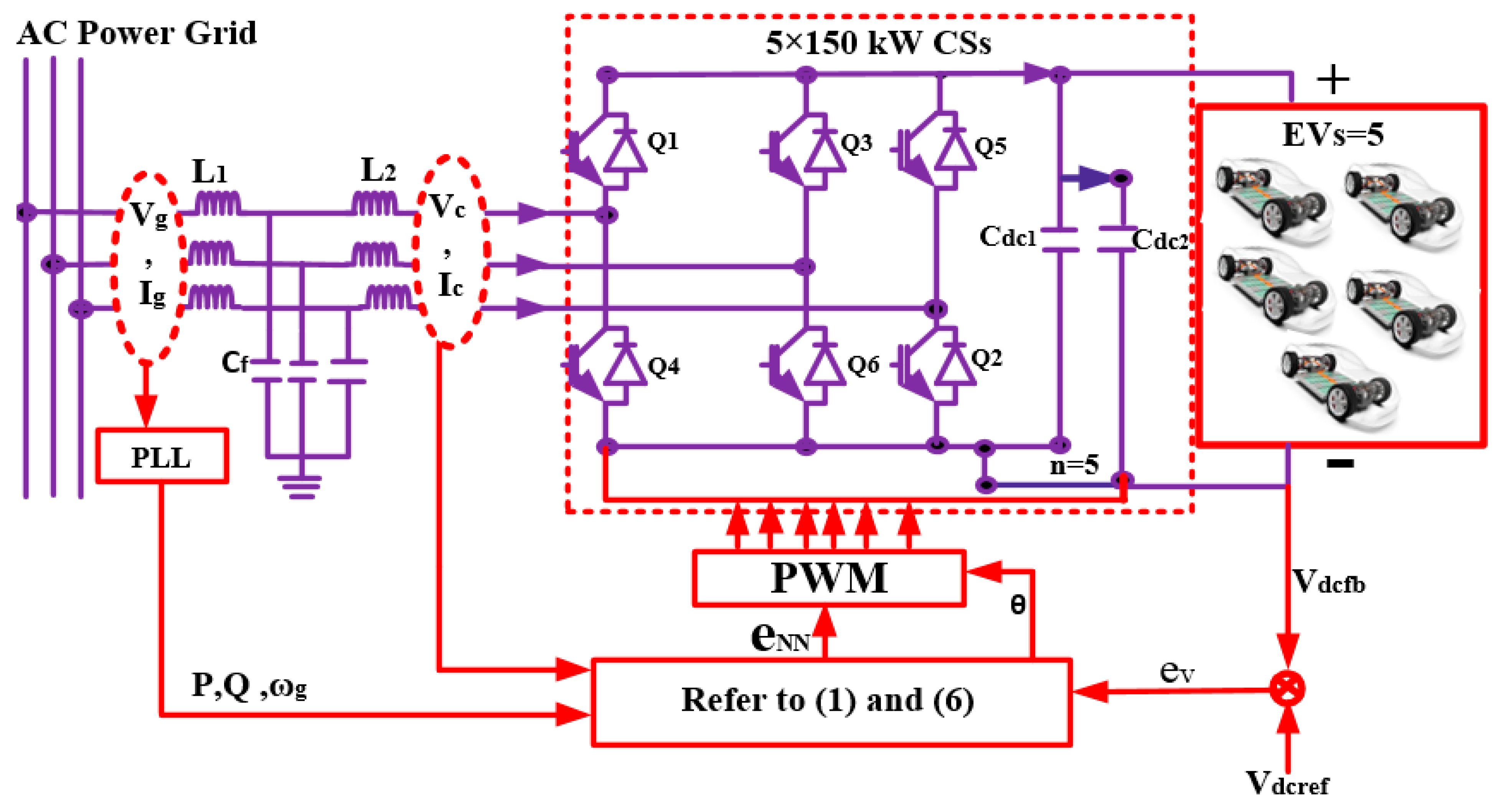
The effectiveness of the NN-i-VSM control algorithm was demonstrated in MATLAB/Simulink R2023a using the schematic described in Figure 7 through the ode23t solver, with a relative tolerance of 10−3 and a maximum step size of 10 μs. The NN-i-VSM-based CS entailed insulated-gate bipolar transistors ( Q 1 to Q 6 ), coupled with various parameters presented in Table 3. These parameters were modified from the i-VSM-based CS topology described in [36,37] to showcase the possibility of using this innovative NN-based CS control strategy for charging multiple lithium-ion EV batteries at varying capacities (i.e., 100 Ah, 120 Ah, 130 Ah, 140 Ah, and 150 Ah) in Simulink.

4.1. NN-i-VSM Model’s Neuron Contribution and Training Data Control Response

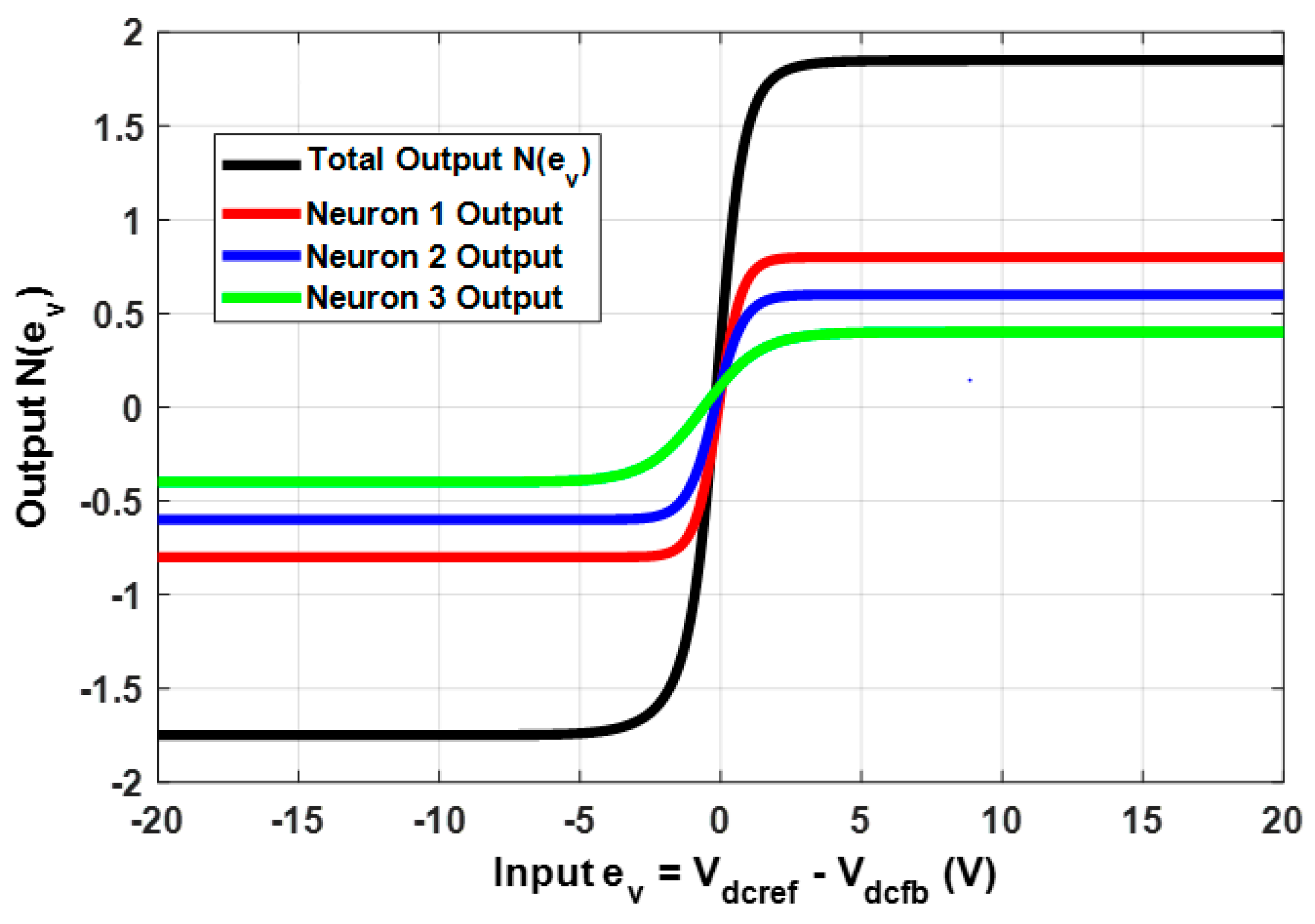
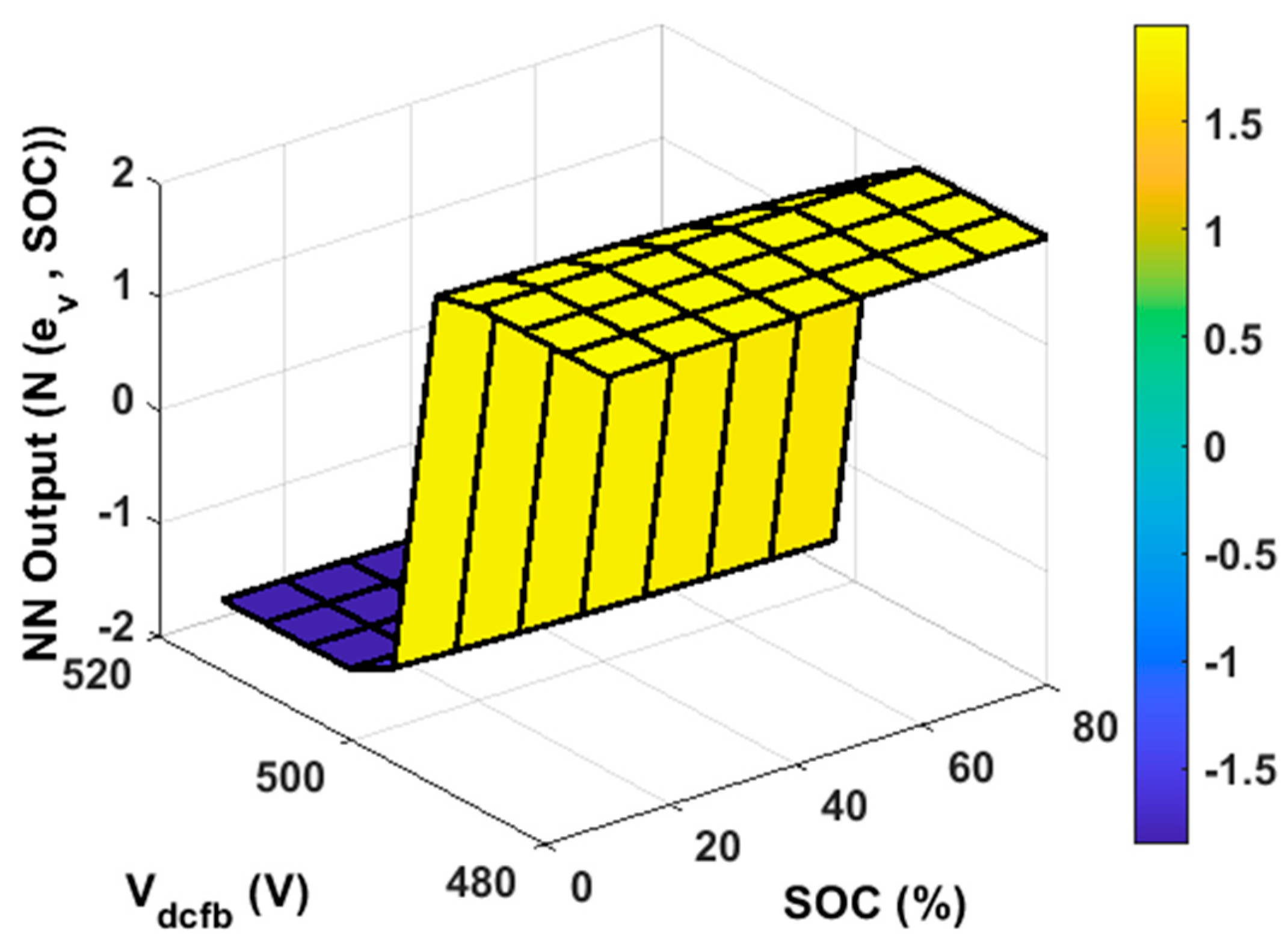
In this segment, the analysis of the neurons’ contribution to the integrated output response N e v to the NN-i-VSM-based CS and the trained data response’s surface characteristics in the CS architecture are presented. These were achieved by evaluating the NN-i-VSM-based charging system’s output with simulated ranges of SOC values between 10% and 80%. The controller was trained using V d c f b values between 480 V and 520 V (less than ±5%) with a fixed V d c r e f value of 500 V. This setpoint aligned closely with IEEE Std. 1159-2019 has mentioned the setpoint is between ±5% of normal/steady state condition and at for a tolerable voltage limit [71], thereby allowing for an effective examination of the NN-i-VSM model’s trained response during CS operation. Figure 8 demonstrates the N e v response within the voltage error range of ±5% of V d c r e f values (−20 V to +20 V) with respect to the contribution of individual neurons to the adaptive and nonlinear mapping for accurate voltage regulation.
The demonstrated result in Figure 9 illustrates the learning dynamic property of the NN-i-VSM structure when examined at varying SOCs and V d c f b values at constant V d c r e f . The NN-i-VSM model adapted its response across various input domains while maintaining a stabilized and responsive surface, signifying a smooth generalization and precise learning performance. This result validated the proposed model’s capacity to adapt a nonlinear characteristic between the SOC and voltage error signal, thereby enhancing a robust control decision during multiple charging of batteries with varying capacities. The z-axis denotes the controller’s output, where control actions were computed based on the CS’s voltage error generated with respect to a battery’s initial SOC. The surface shape illustrated how the integrated NN in the NN-i-VSM model reacted to diverse combinations of V d c f b values at various battery SOCs. The smooth gradient showed an adaptive learning process. Also, the steep region indicated the region where the NN-i-VSM model adjusted more swiftly due to sensitivity. The flat region illustrated the area where the error was already low, and hence, minimal control signal adjustment was required for tracking the reference parameters. The tracking characteristic of the proposed model is discussed in subsequent subsections.

4.2. Control Parameter Tracking Performance of Proposed NN-I-VSM Model

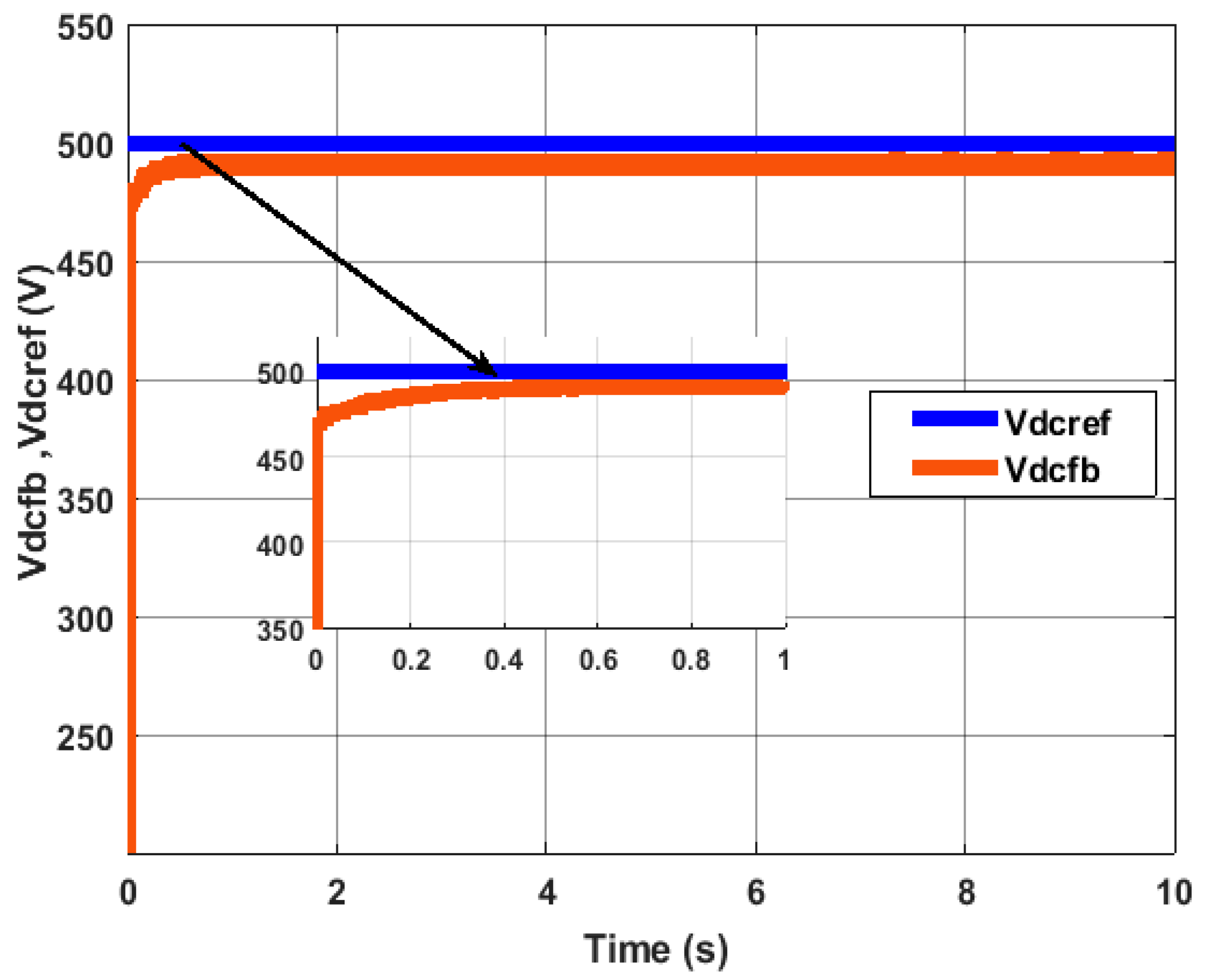
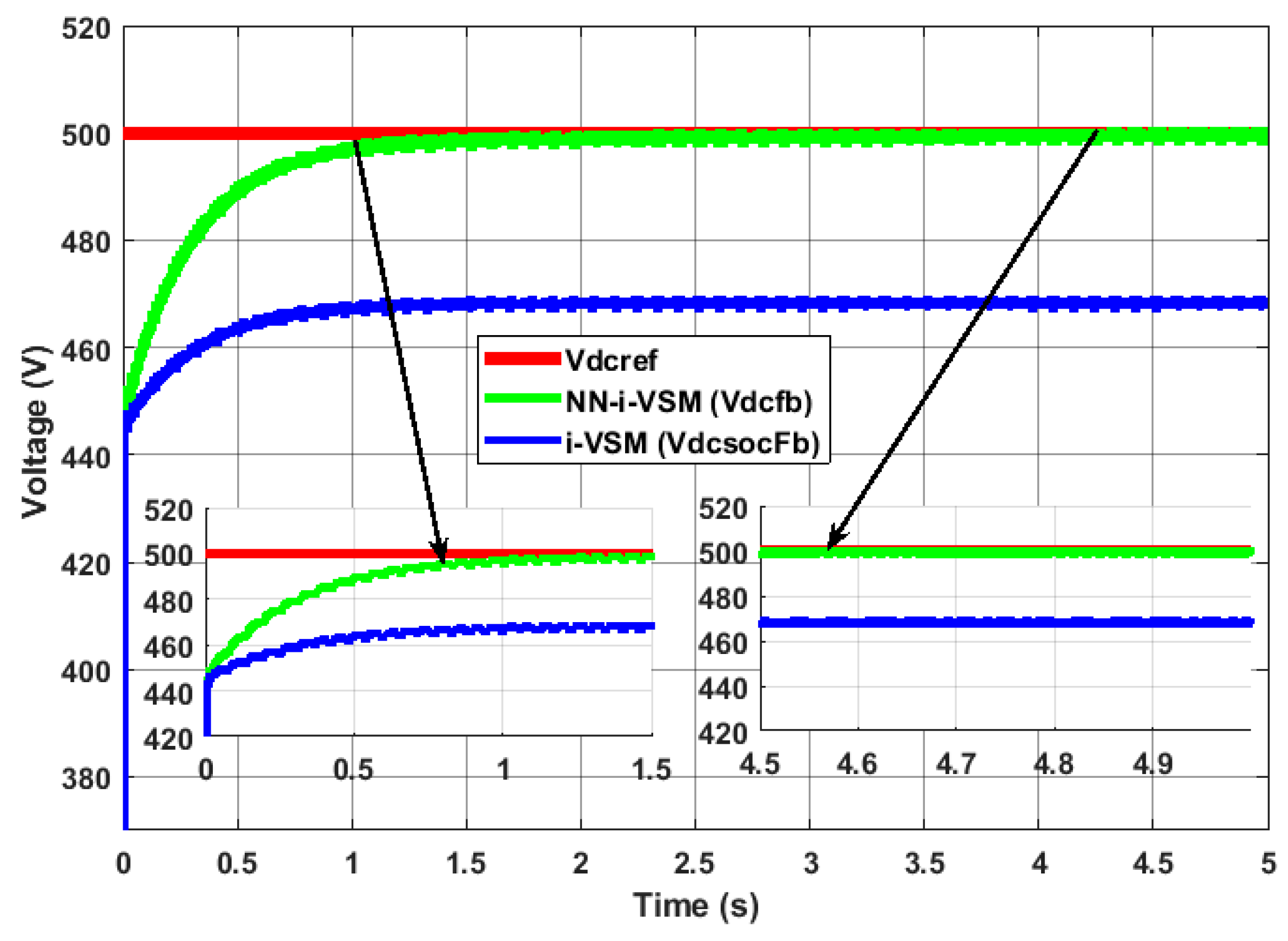
The developed NN-i-VSM-based CS’s tracking capabilities were tested in Simulink using a 150 Ah lithium-ion battery fixed with a 2 s response time and an initial SOC of 50%. Figure 10 shows that the DC voltage ( V d c f b ) accurately and consistently tracked the fixed reference voltage ( V d c r e f ) trajectory of 500 V at exactly 0.4 s. This indicated an efficient responsiveness to maintaining the output voltage at the set value.
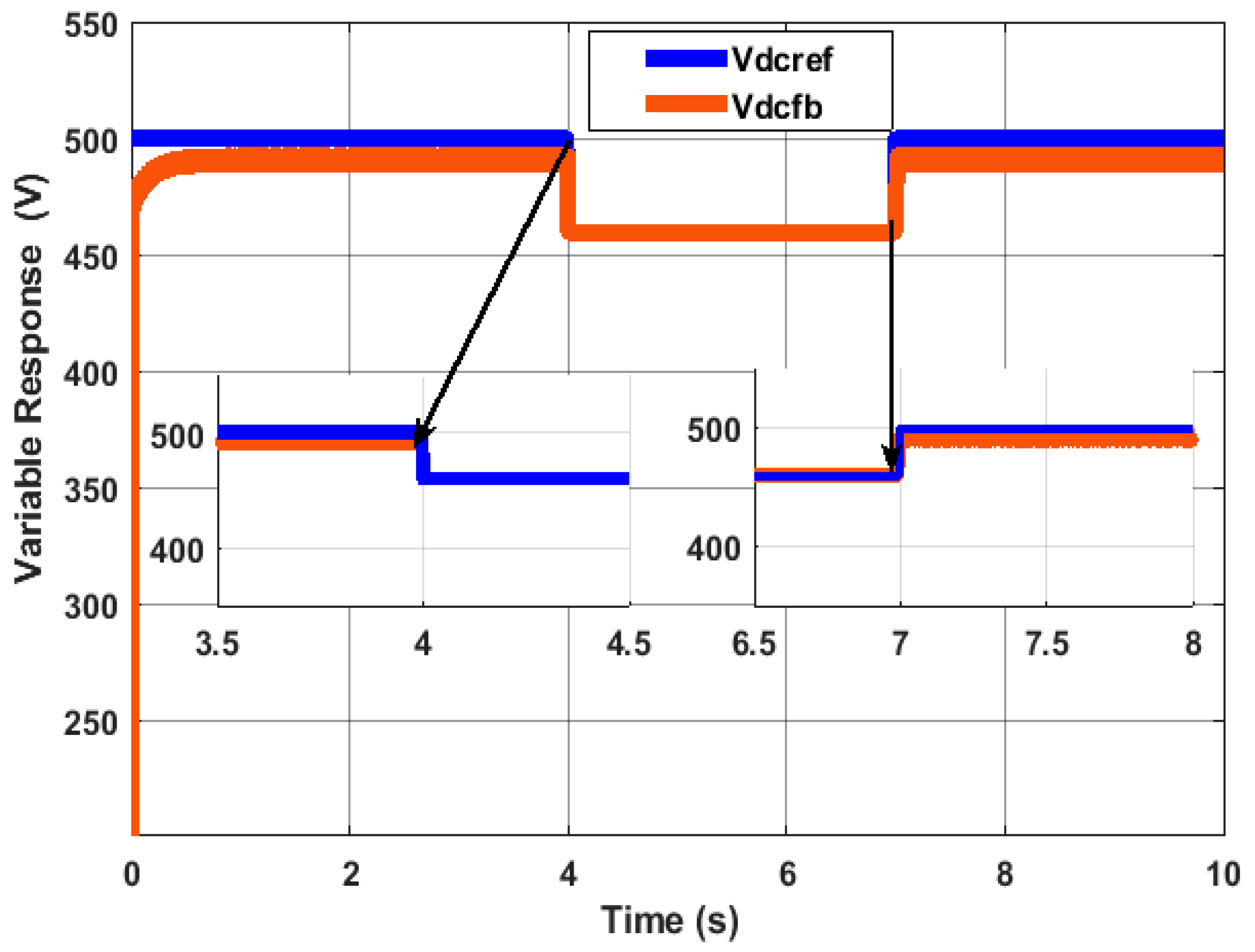
In addition, the tracking performance of the NN-i-VSM model’s variable-step response at varying V d c r e f was evaluated using a 150 Ah battery with an initial SOC of 50%. Figure 11 shows that, between 0 and 4 s, V d c f b precisely tracked V d c r e f at 500 V. Also, between 4 s and 7 s, when V d c r e f was changed to 460 V, the NN-i-VSM model quickly adapted and accurately followed the new value of V d c r e f . Similarly, from 7 s to 10 s, as V d c r e f was reset back to 500 V, the NN-i-VSM model again smartly responded by accurately tracking the adjustment. This performance clearly signified the proposed model’s responsiveness to dynamic step responses.
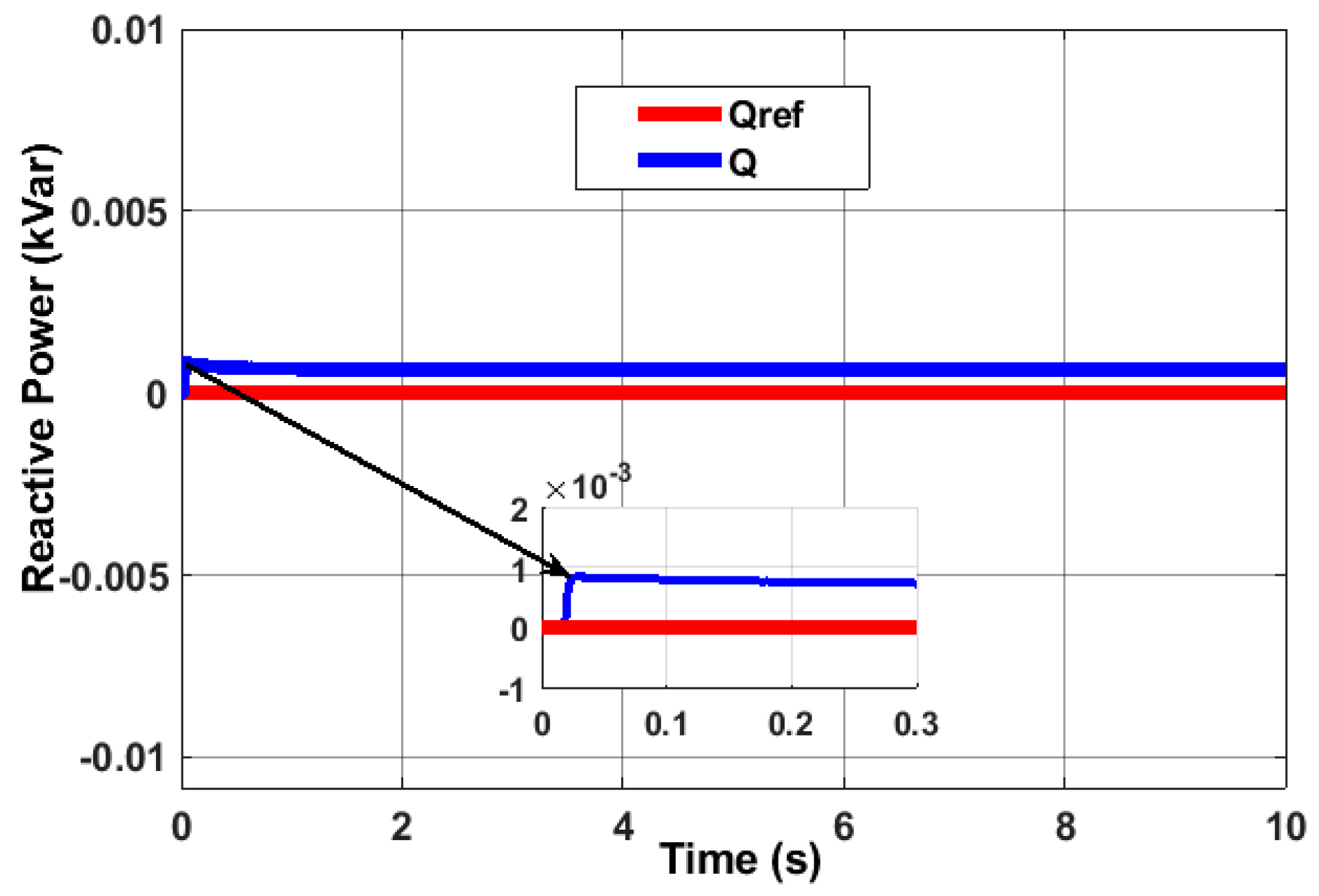
The Q regulation of the developed NN-i-VSM model was examined to investigate its capacity to accurately track Q r e f at the setpoint value of 0 kVar. Figure 12 clearly illustrates the NN-i-VSM model’s performance in maintaining Q as close as possible to 0 kVar (at 0.001 kVar) during battery charging. This result indicated the superior ability of the NN-i-VSM model in ensuring a balance of Q injection at the PCC to maintain the stability of battery charging operation, thereby aiding the control of grid voltage response at the reference value during multiple-battery charging.

4.3. Stability Performance of Proposed Model

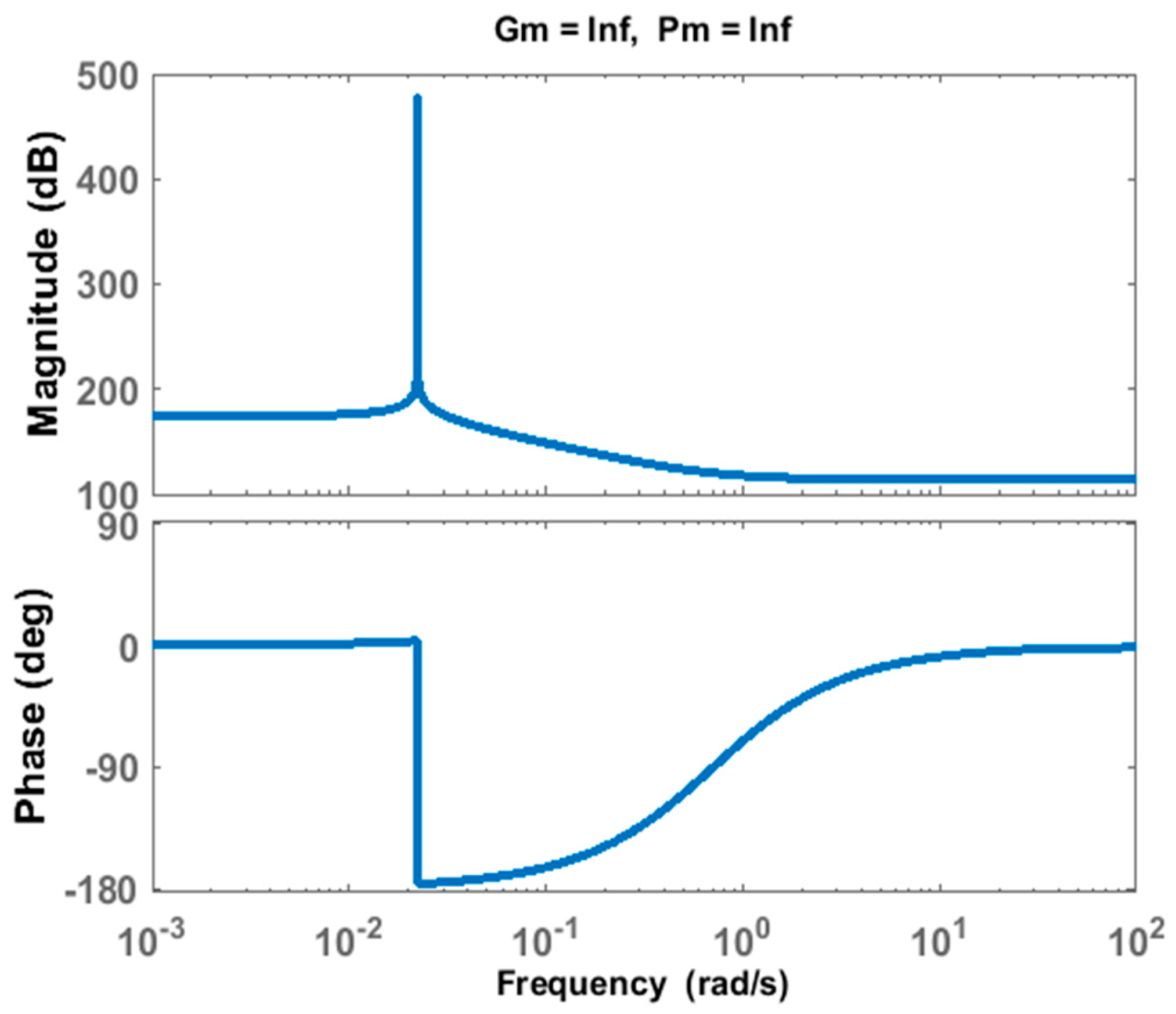
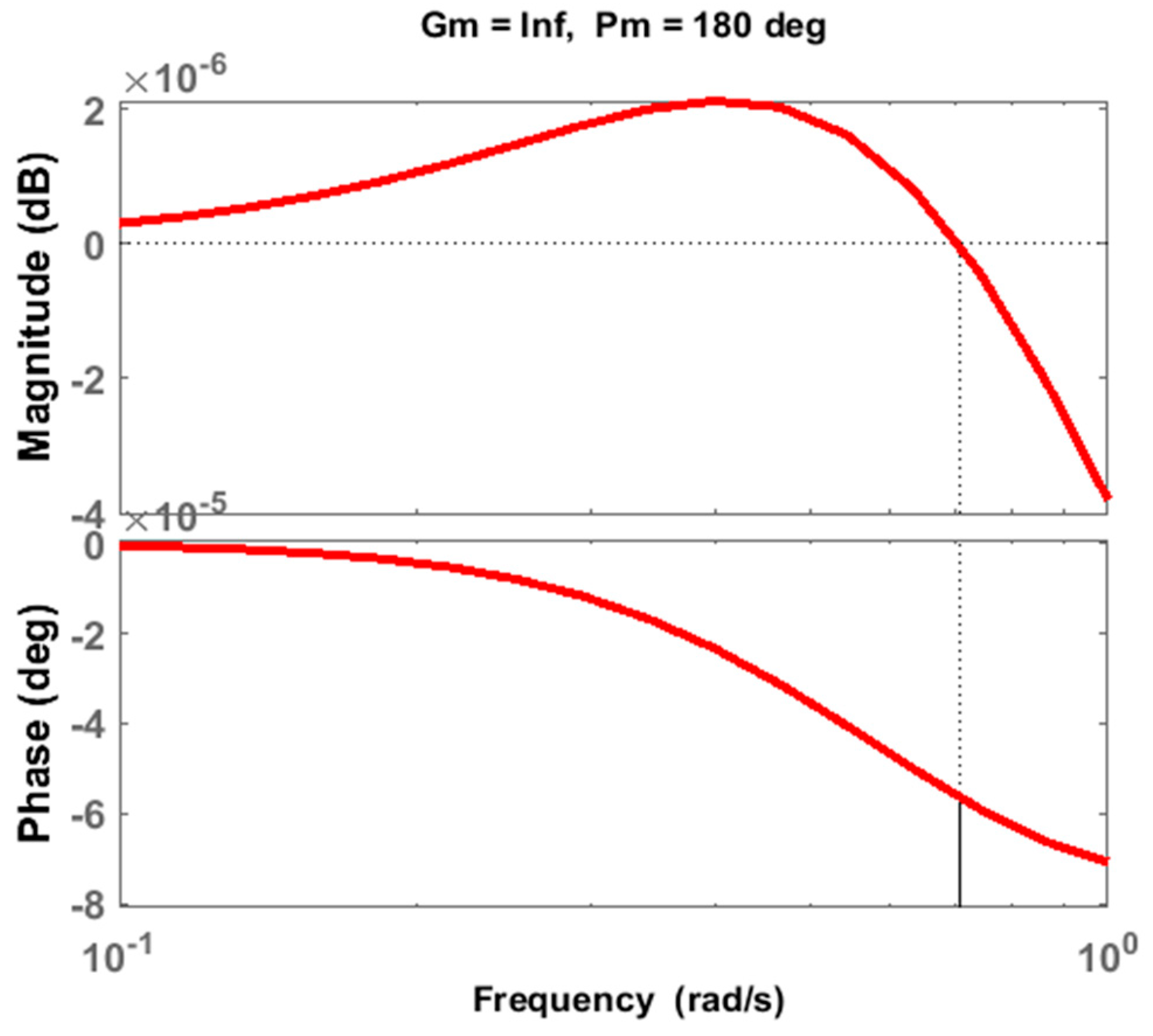
Plant stability analysis of the NN-i-VSM model was performed using frequency domain characteristics. The analysis examined the system’s G m and P m robustness in open-loop and closed-loop scenarios. The open-loop stability evaluation of the proposed NN-i-VSM plant, as observed in Figure 13, indicated a Bode plot with a G m and a P m of infinity. This signified a highly robust model with no possibility of instability during linear perturbations. On the other hand, the closed-loop transfer function of the NN-i-VSM plant attained an infinite G m and a P m of 180°, signifying a stable system without gain crossover frequency, as shown in Figure 14. This suggested that the NN-i-VSM model remained adaptive under gain variation.

4.4. NN-i-VSM Model’s Charging Rate and Grid Response During Multiple Charging of Varying EV Batteries

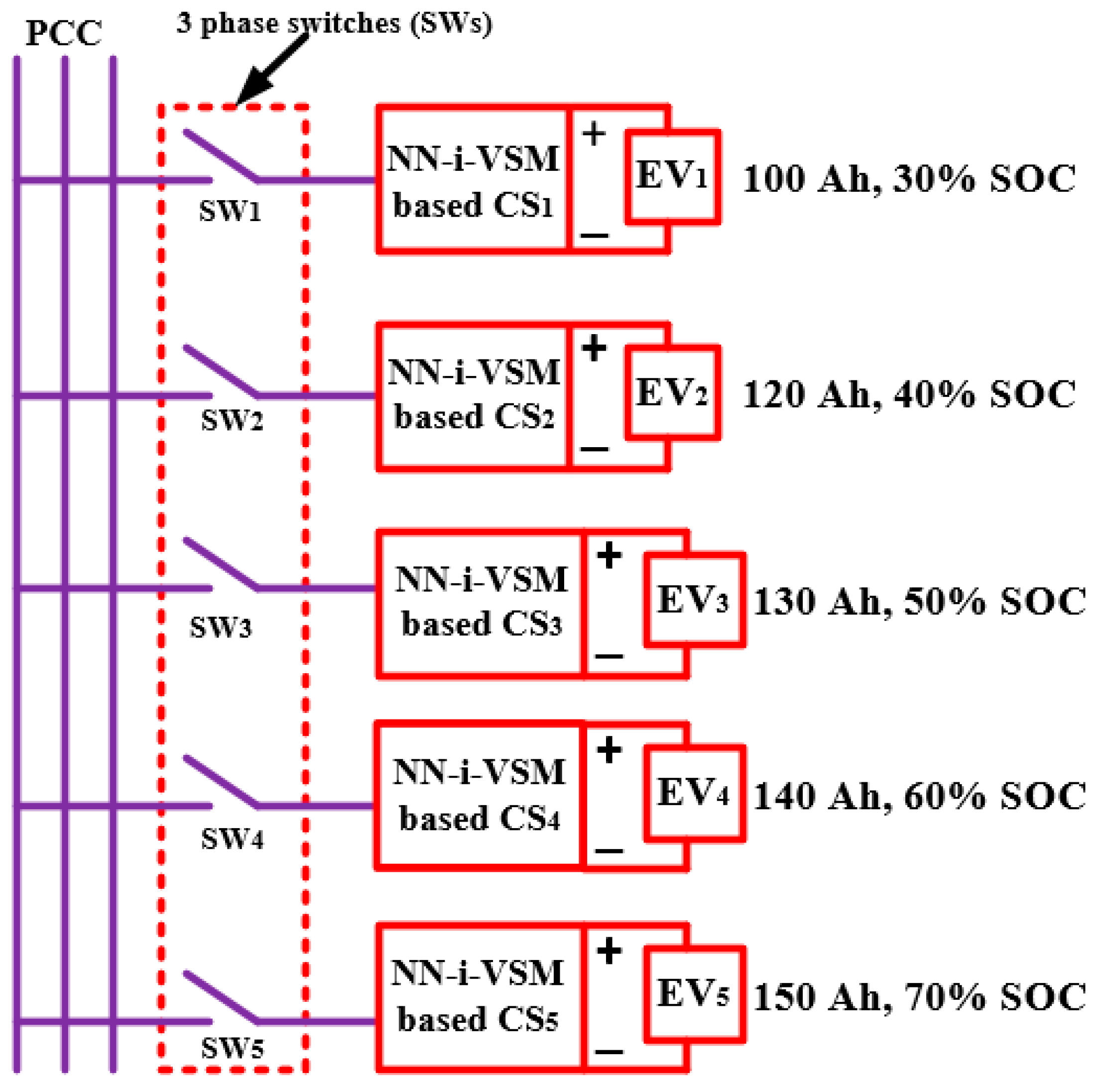
Figure 15 illustrates a scenario demonstrated in MATLAB/Simulink involving five NN-i-VSM-based CSs with varying EV battery capacities and initial SOCs (100 Ah, 120 Ah, 130 Ah, 140 Ah, and 150 Ah batteries maintained at initial SOCs of 30%, 40%, 50%, 60%, and 70%, respectively) connected at the PCC. The EV batteries were tested in two distinct modes. The first mode was the simultaneous mode (Case 1), where all batteries were connected at the same time.
The second configuration was the by-step mode (Case 2), where the batteries were connected in stages. Both modes were simulated to evaluate the NN-i-VSM controller’s performance in managing consistent SOC response and grid response control at the setpoint at the PCC during the charging of batteries with varying capacities and initial SOCs.
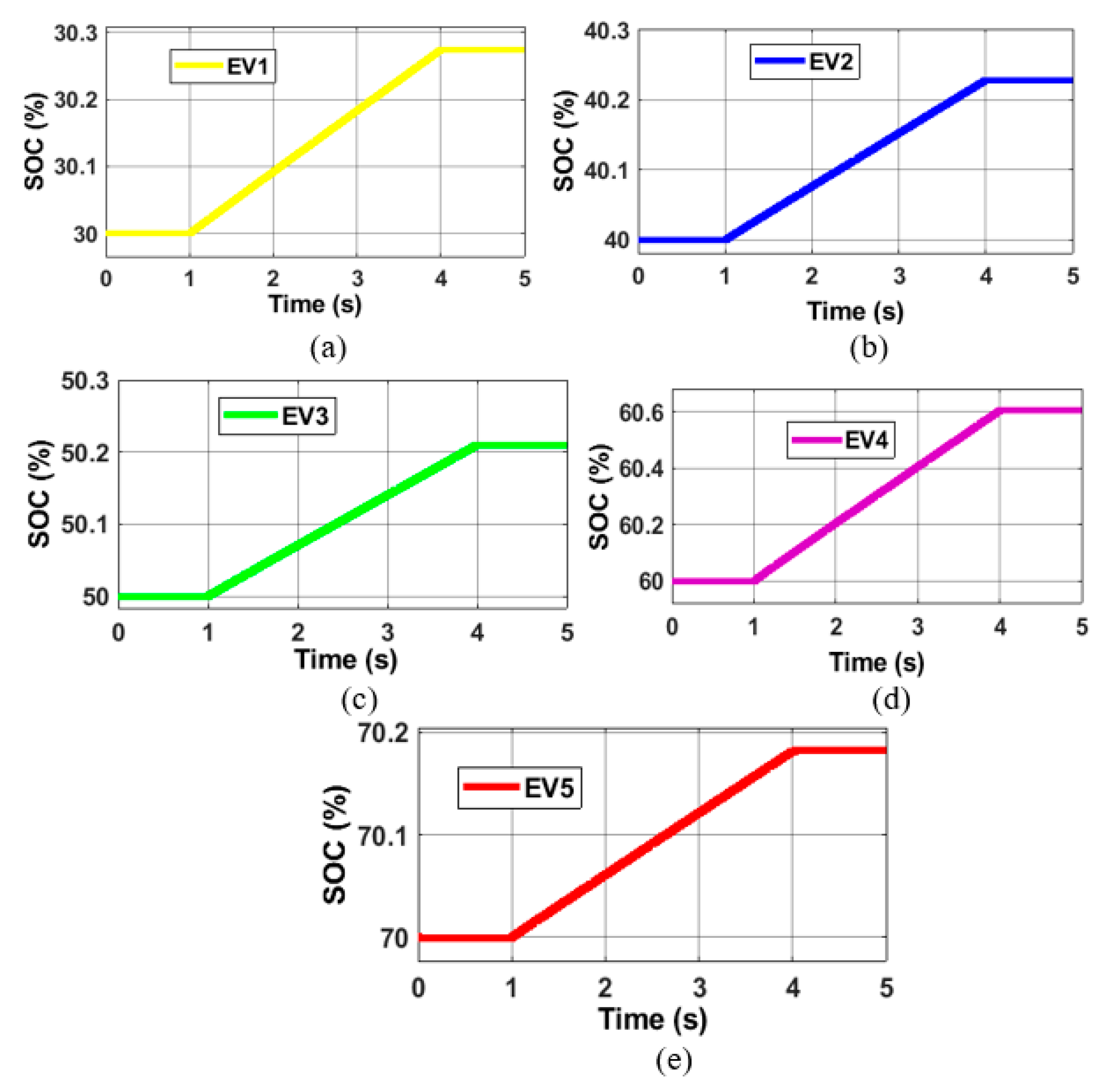
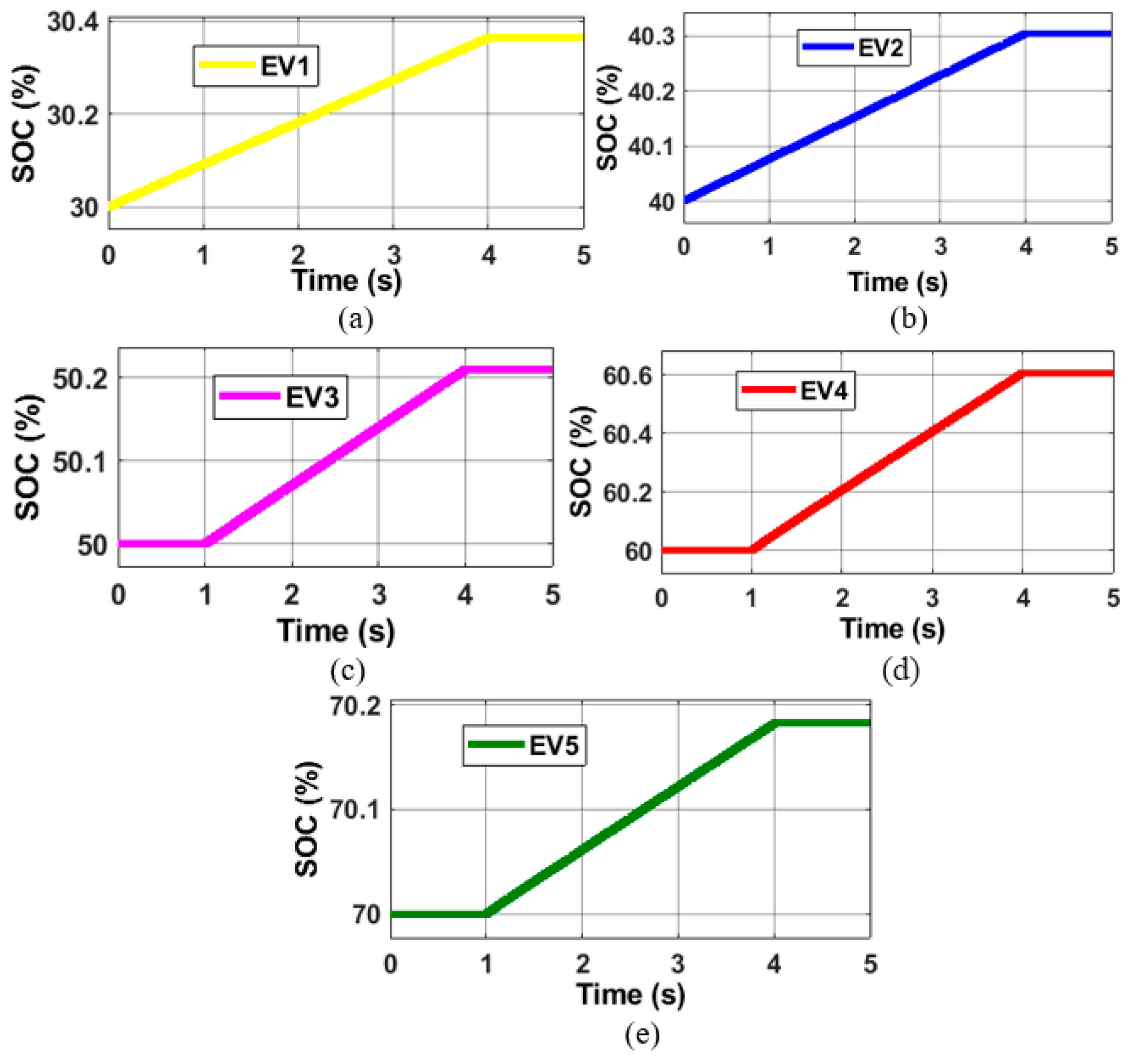
In the simultaneous mode, as shown in Figure 16, the switches (SW1 to SW5) were set to 1 s for a 4 s charging cycle for all EV batteries (EV1 to EV5). Battery response at 2 s and a simulation time of 5 s were applied for the five batteries. The NN-i-VSM controller displayed excellent capacity in controlling the SOC responses of the five EV batteries simultaneously. The 100 Ah battery commenced with 30% SOC at 1 s and resulted in an increased SOC of 30.27% at 4 s, as shown in Figure 16a. The 120 Ah battery, starting with 40% SOC, attained an SOC of 40.23% at the end of the charging cycle of 4 s, as illustrated in Figure 16b.
The 130 Ah battery started with 50% SOC at 1 s and increased to 50.21% SOC at 4 s, as depicted in Figure 16c. The 140 Ah battery, which commenced with 60% SOC, achieved an SOC of 60.61%, as shown in Figure 16d. The 150 Ah battery, which started with a 70% SOC at 1 s, resulted in a 70.18% SOC and was maintained throughout the simulation, as illustrated in Figure 16e. These results demonstrate the NN-i-VSM controller’s ability to deliver a controlled and steady charging rate to multiple EV batteries with different capacities and initial SOCs.
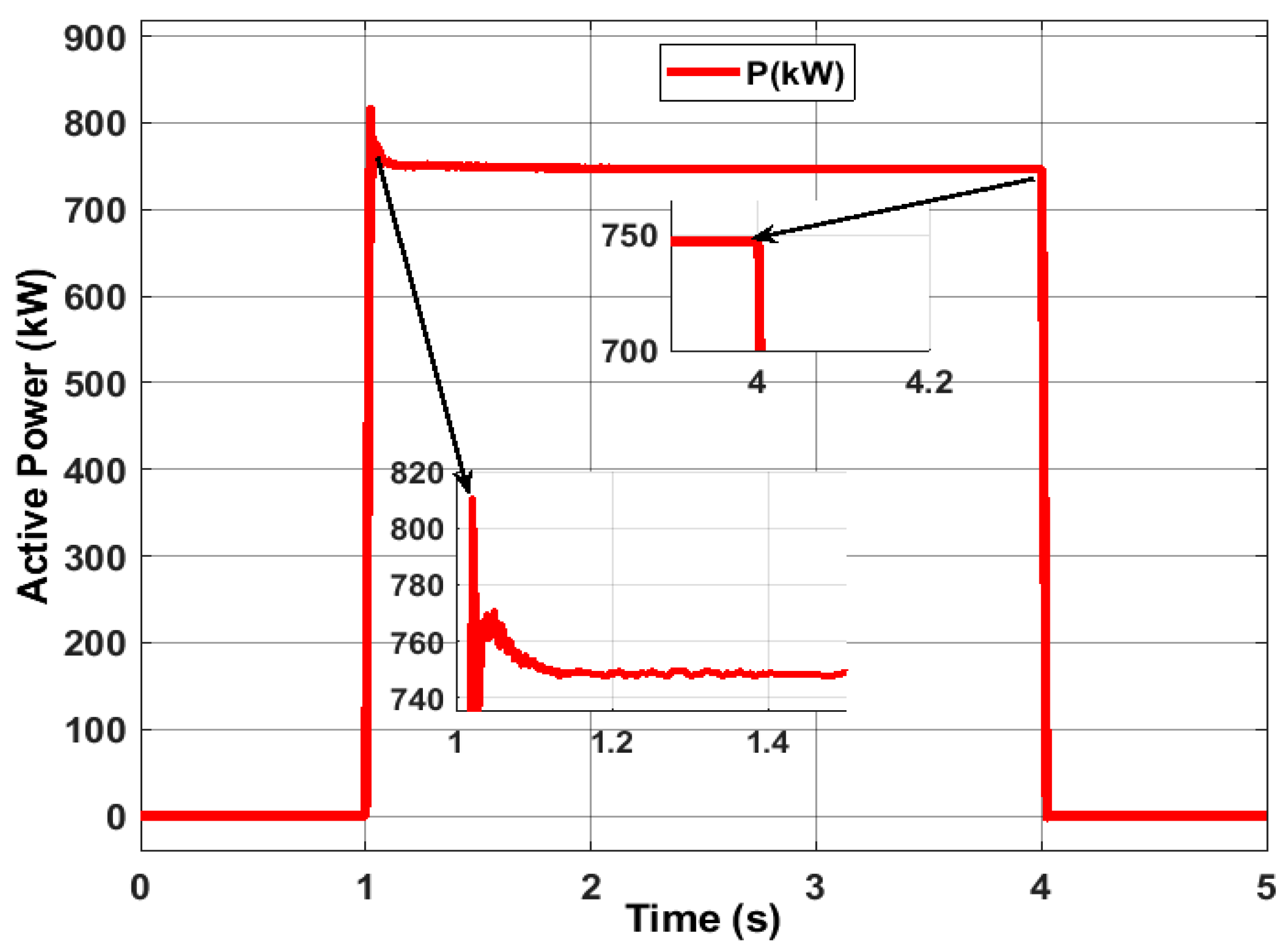
The grid power response of the NN-i-VSM-based CSs in the simultaneous mode, as shown in Figure 17, depicted a stable and regulated active power response. When the five NN-i-VSM-based CSs (5 × 150 kW) were applied at 1 s, the active power delivered increased steadily from 0 kW to 750 kW throughout the 4 s charging cycle. The transient response duration was 0.05 s, with a peak value of 818 kW. This was followed by a quick power response stabilization to 750 kW at 0.1 s of settling time. After 4 s, the power response returned to 0 kW, as there was no CS load connection at the PCC between 4 s and 5 s.
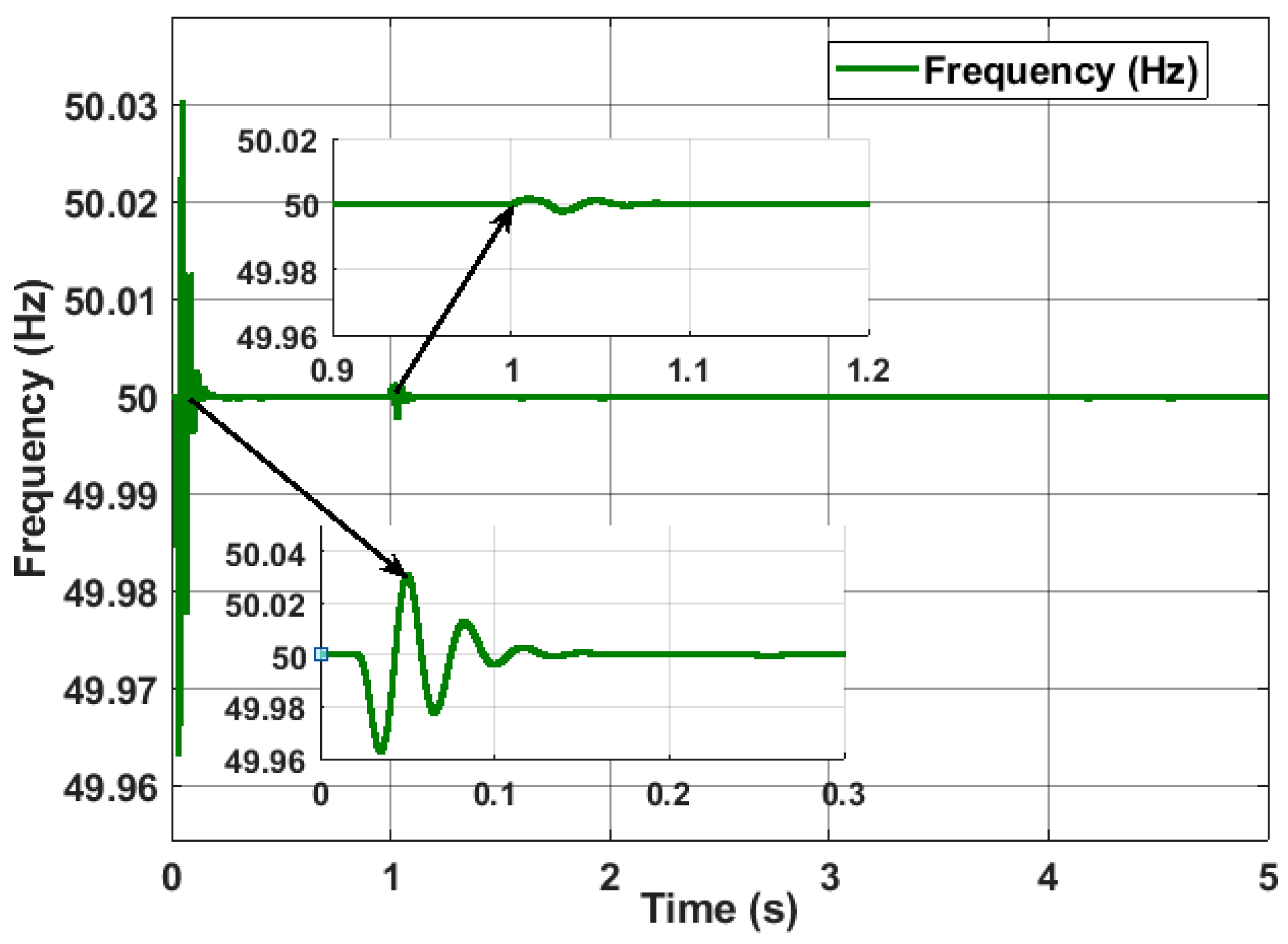
Figure 18 demonstrates the regulated grid frequency adaptability control under the influence of the proposed NN-i-VSM controller with minimal fluctuations during the charging cycle of the five NN-i-VSM-based CSs. At 0 s, a transient peak value of 50.03 Hz was recorded within 0.1 s of transient response duration. The frequency quickly stabilized at the nominal setpoint with 0.2 s of settling time. At 1 s in the simultaneous mode, when the five EV batteries were applied, the frequency transient response was quickly controlled at less than 0.05 s, and the frequency remained within the rated 50 Hz value with minimal oscillation beyond the charging cycle of 4 s.
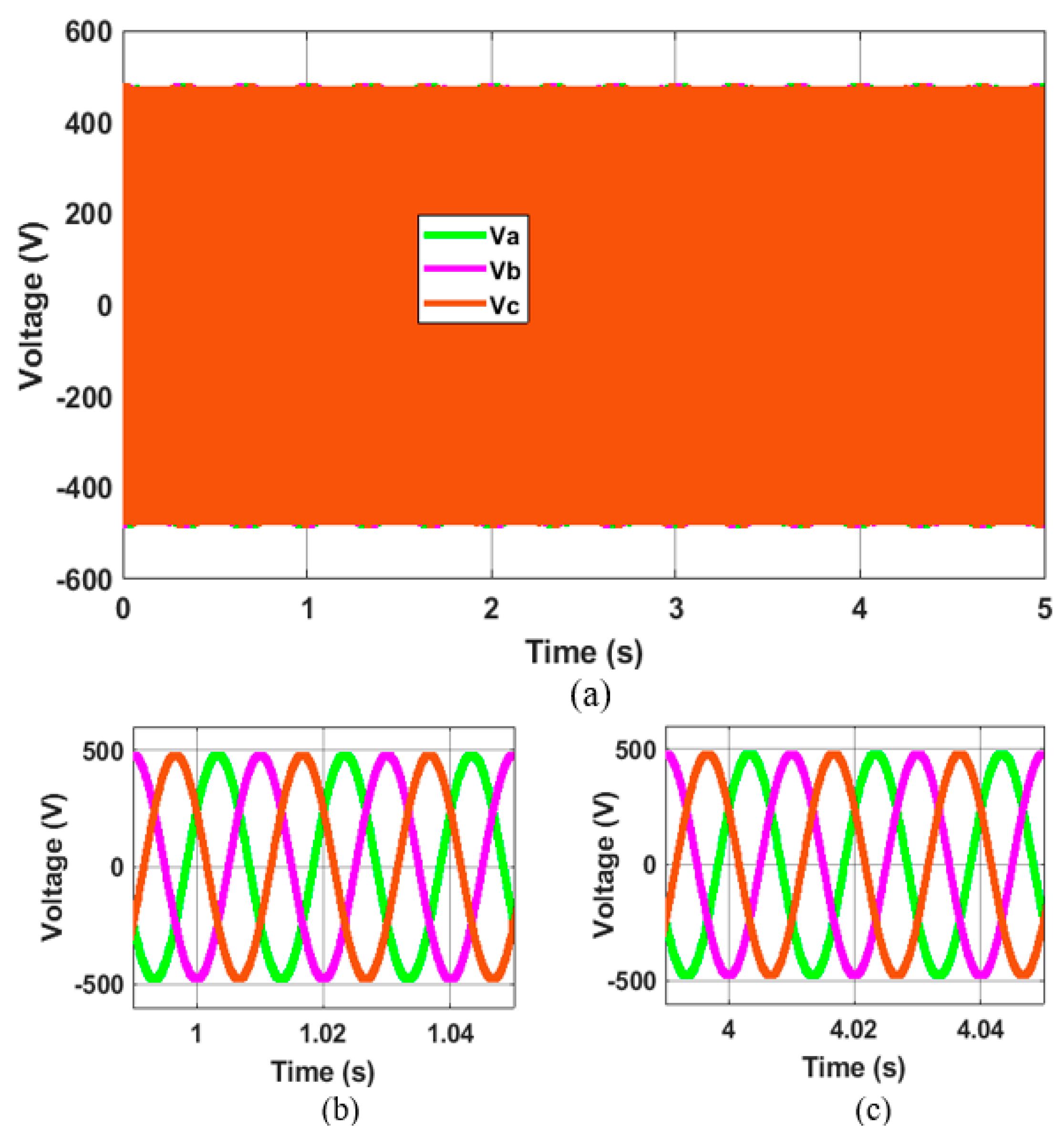
Figure 19 shows a well-regulated grid voltage waveform at the rated value in the simultaneous mode of the charging process of the five EV batteries with varying capacities and initial SOCs. The three-phase grid voltage profile (Va in green, Vb in purple, and Vc in brown) signified a consistent and synchronized amplitude and phase displacement at the PCC during charging. Figure 19a shows the voltage response waveform during the entire simulation duration of 5 s. Figure 19b illustrates the zoomed-in voltage response at the PCC when the five batteries were applied simultaneously at 1 s. Figure 19c demonstrates the zoomed-in grid response at the PCC beyond the charging cycle of 4 s. The proposed control concept prevented voltage sags, ensuring voltage stability at the PCC in the simultaneous charging mode.
In the by-step mode (Case 2), as presented in Figure 20, SW1 and SW2 for 100 Ah and 120 Ah batteries maintained at 30% and 40% initial SOCs, respectively, were connected at 0 s for a 4 s charging cycle with 5 s simulation time. EV1 and EV2 attained 30.36% and 40.30% respectively. At 1 s, SW3, SW3, and SW5 for 130 Ah, 140 Ah, and 150 Ah batteries maintained at initial SOCs of 50%, 60%, and 70%, respectively, were connected during the 4 s charging cycle. EV3 to EV5 attained the same SOCs as those in the case of the simultaneous mode. Figure 20 shows the excellent ability of the proposed controller in independently controlling and adapting the SOC responses of the five EV batteries in the by-step mode.
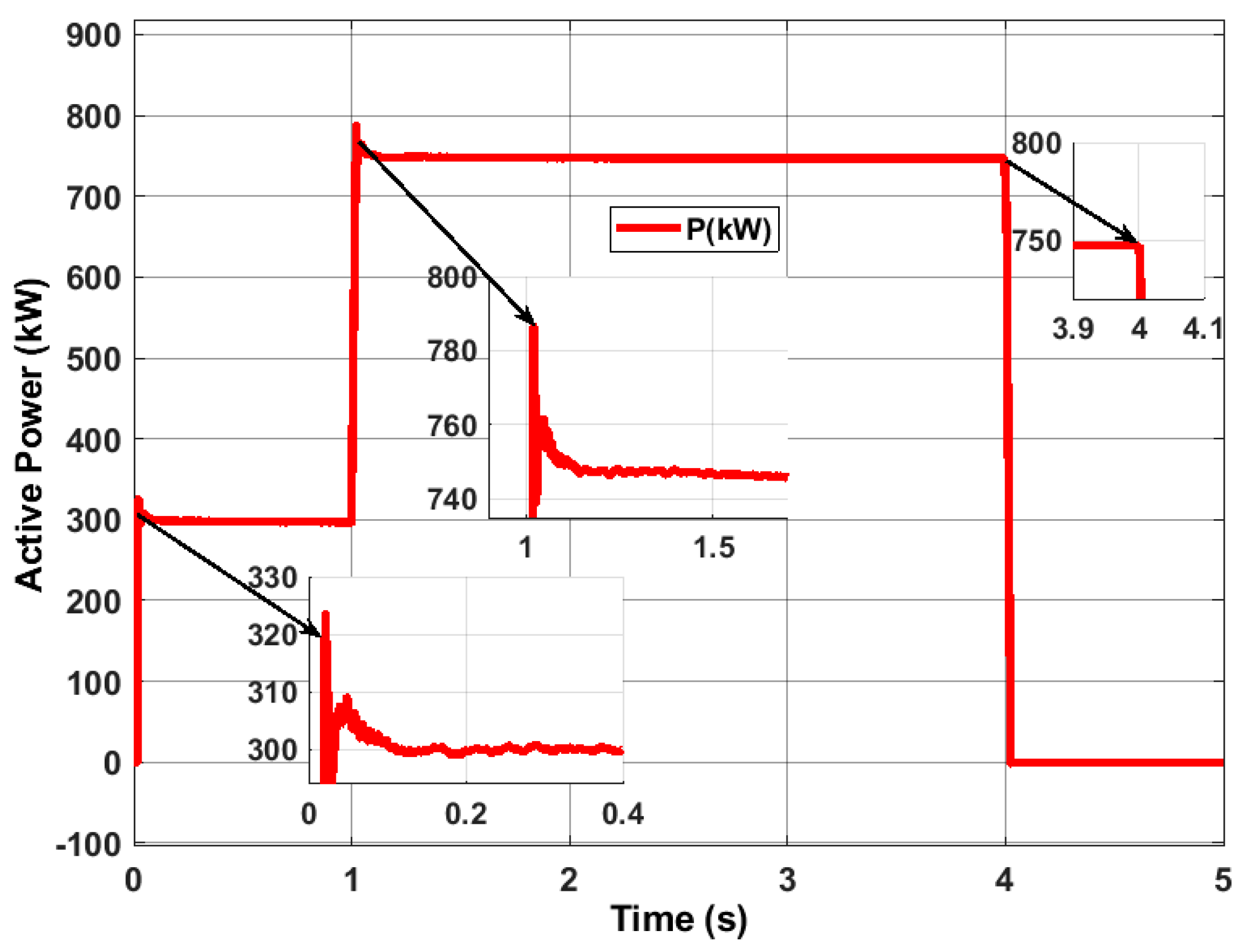
Figure 21 depicts the grid power response in the by-step mode (Case 2). The proposed NN-i-VSM model maintained a stabilized and controlled active power exchange response when two AI-i-VSM-based CSs (100 Ah and 120 Ah batteries) were applied at 0 s for the charging cycle of 4 s with 5 s of simulation time. The active power increased to 300 kW. In comparison, in the simultaneous mode, a peak value of 325 kW was recorded, while the transient response duration was less than 0.05 s and the active power swiftly stabilized to 300 kW at a settling time of 0.1 s. At 1 s, when three additional NN-i-VSM-based CSs were applied (130 Ah, 140 Ah, and 150 Ah batteries), the power response increased steadily from 300 kW to 750 kW with limited oscillation. A peak value of 785 kW was attained within a 0.05 s transient response duration. The power response swiftly adjusted to the steady-state value of 750 kW at a settling time of 0.1 s. At the end of the charging cycle at 4 s, the power response steadily returned to 0 kW to show no other connection of NN-i-VSM-based CSs at the PCC beyond 4 s.
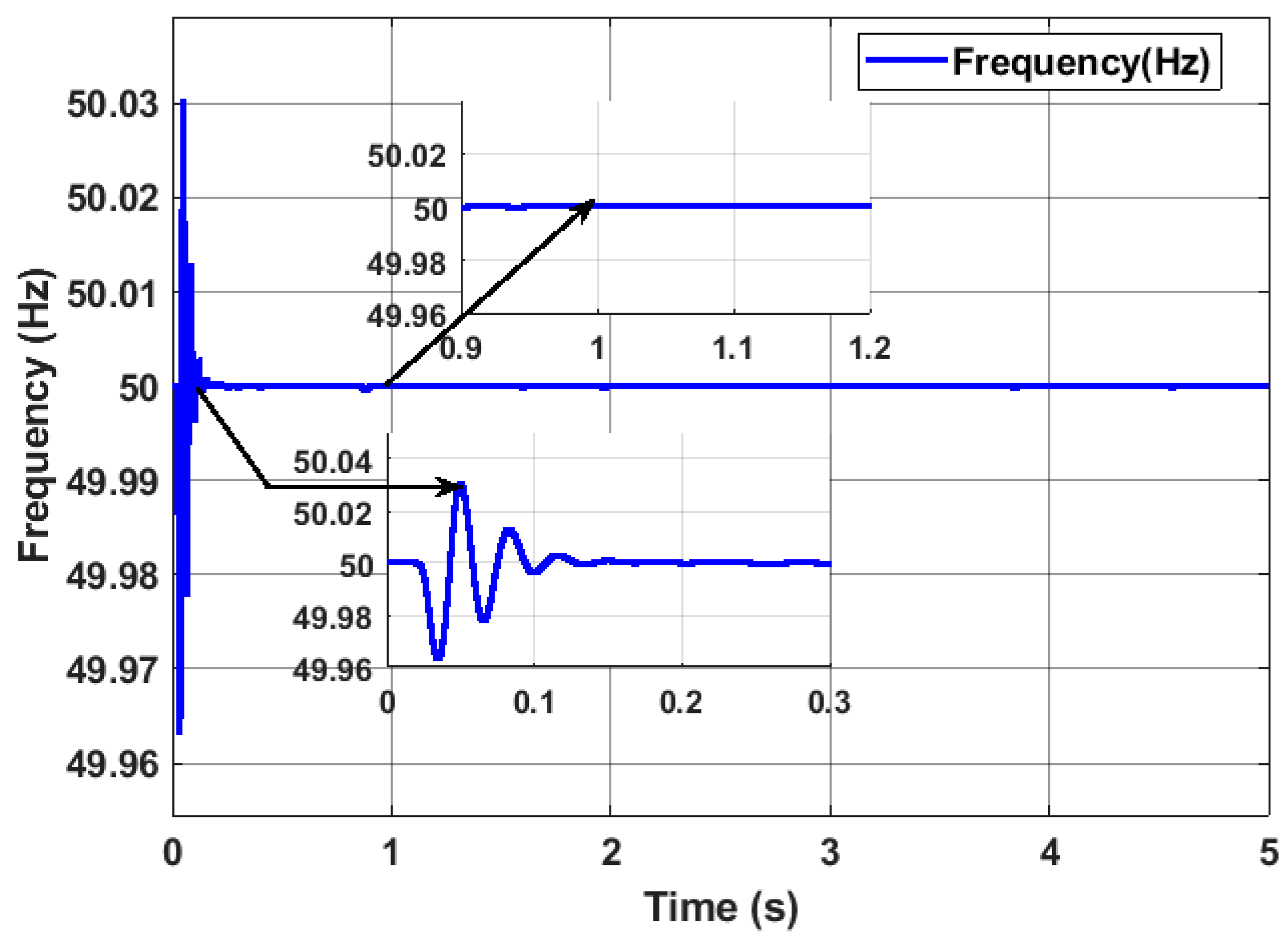
Figure 22 depicts the ability of the proposed controller to ensure controlled grid frequency regulation with minimal oscillation during multiple charging at varying EV battery capacities and initial SOCS. At 0 s, when two NN-i-VSM-based CS loads were applied, a peak value of 50.03 Hz was attained at 0.05 s of the transient response phase. The frequency response stabilized to 50 Hz at 0.1 s of settling time. At 1 s, when three NN-i-VSM-based CSs were applied, the frequency response remained within the rated value with minimal oscillation, indicating a highly robust system.
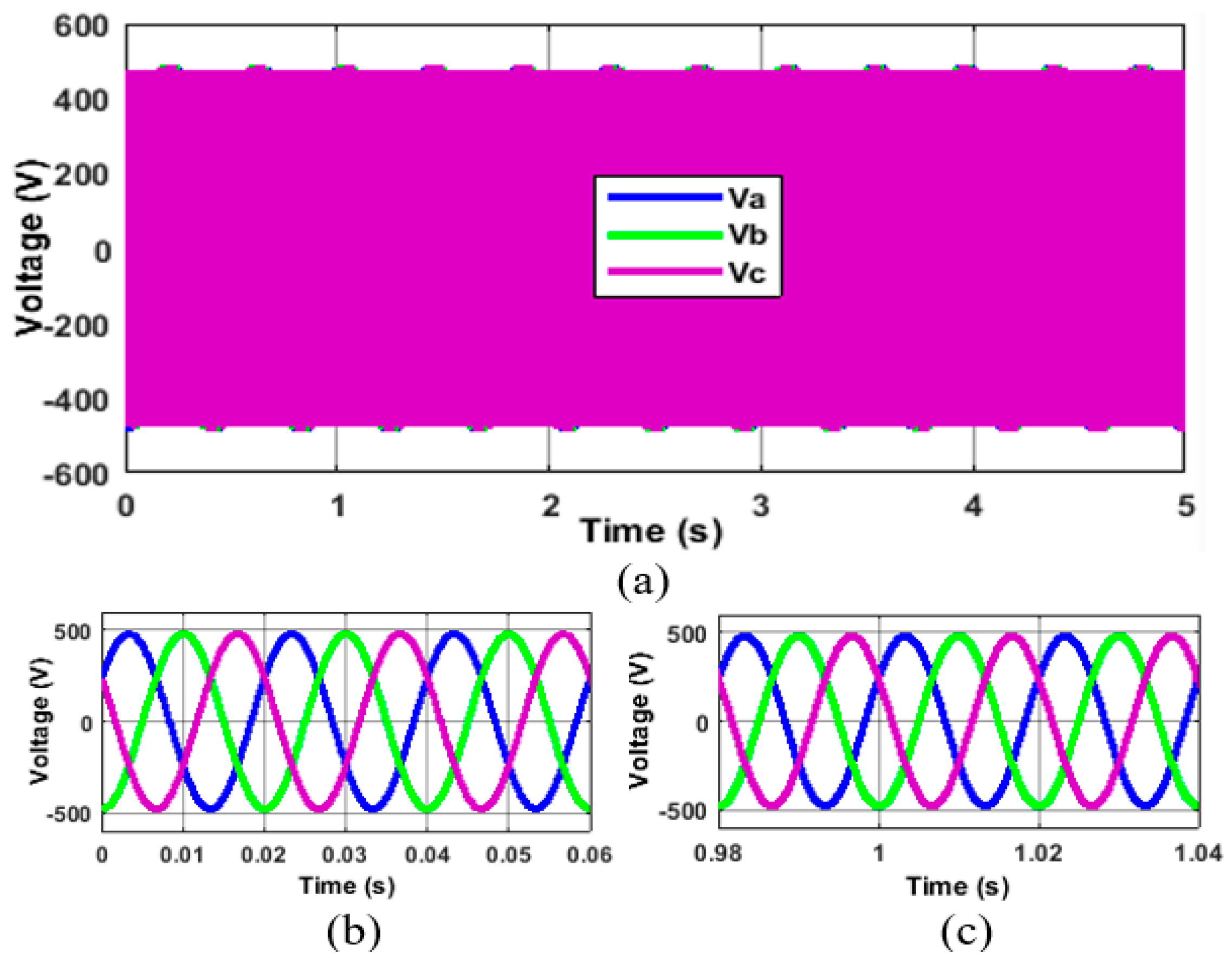
As shown in Figure 23, the proposed NN-i-VSM controller ensured a controlled grid voltage output at the rated values across the three-phase voltage profile in the by-step mode of charging five EV batteries with varying capacities and initial SOCs.
Figure 23a depicts the voltage response waveforms for the 5 s simulation period. Figure 23b,c show the zoomed-in voltage responses at 0 s and 1 s when the five NN-i-VSM-based CSs were applied at the PCC in the by-step mode of the charging configuration. The grid voltage profile (Va in blue, Vb in green, and Vc in purple) indicated a stable amplitude and phase displacement during the charging process. This proposed concept maintained voltage stability at the PCC during the by-step charging process.
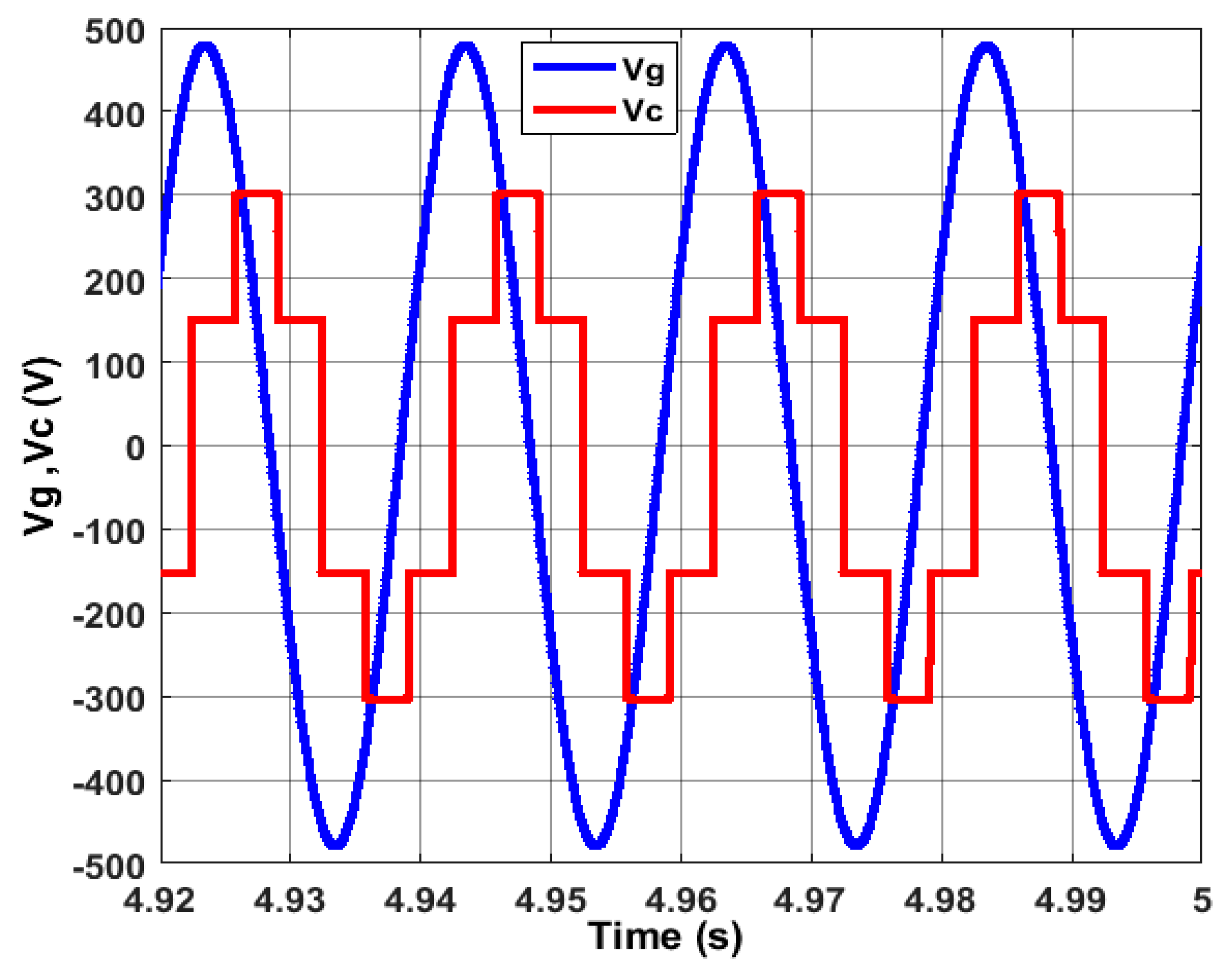
Figure 24 describes the power flow characteristics of Vg and Vc displayed by the NN-i-VSM-based CSs between 4.92 s and 5 s of the charging cycle. The waveform patterns indicated a synchronized relationship between Vg and Vc, revealing a consistent pattern in the G2V charging mode. The blue line (representing grid voltage) and the red line (representing CS rectifier voltage) showed a phase alignment, suggesting that the CS rectifier effectively processed the incoming AC power. This synchronization ensured minimal power loss, which is a desirable feature in battery charging systems to maximize charging efficiency and energy conservation. Table 4 substantiates the effectiveness of the NN-i-VSM controller in adapting charging voltage and current based on varying SOCs of EV batteries. Simulations were conducted at various initial SOC levels ranging from 10% to 80% during the multiple charging of 150 Ah EV batteries.
Consequently, the parameters in Table 4 illustrate the dynamic capacity of the NN-i-VSM controller in delivering the appropriate charging voltage and current in line with the battery SOC parameter while maintaining a power factor above 0.9 for all investigated scenarios, in conformity with the recommended standard outlined in [75,76]. The simulated multiple-charging scenarios clearly indicate the robustness of the proposed model, which attained efficiency values of between 94.64% and 98.99% for all simulated scenarios.

4.5. Benchmarking of SOC and Grid Response Stability: NN-i-VSM Versus i-VSM Controllers

The output voltage response comparison of the proposed NN-i-VSM and the i-VSM controllers is illustrated in Figure 25. The NN-i-VSM controller’s output response ( V d c f b ) attained a swift dynamic response and accurately tracked the reference CS voltage ( V d c r e f ) of 500 V at exactly 1 s. In contrast, the i-VSM controller could not precisely track V d c r e f but commenced at 440 V and settled at an output voltage of 470 V (at 1.5 s) during the charging cycle.
Comparatively, the NN-i-VSM control, aided by its adaptive learning capability, demonstrated superior voltage response tracking accuracy in providing robust control and an effective charging solution, highlighting its improvement of 30 V (6%) over the i-VSM control in CS applications.
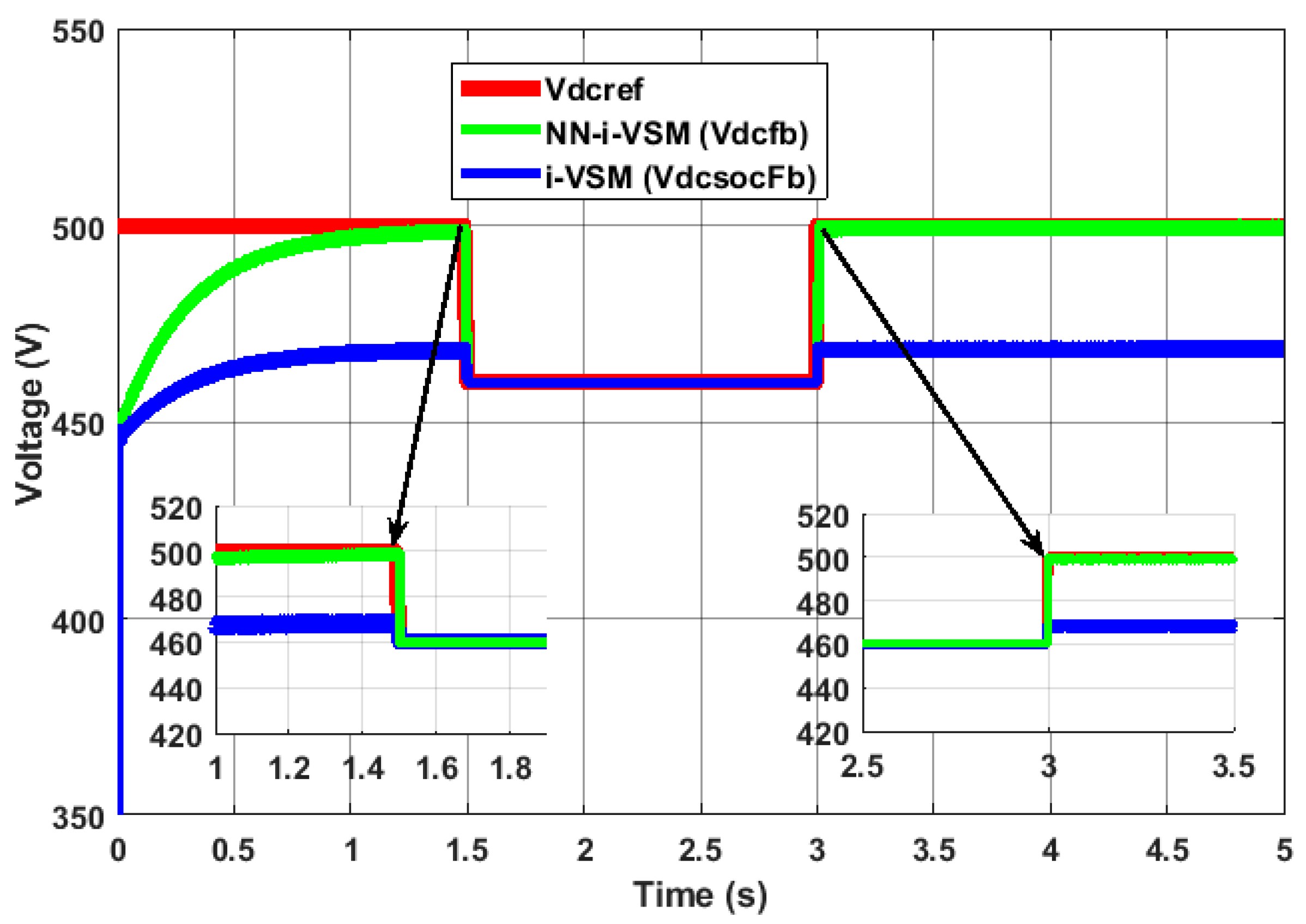
The dynamic step response capabilities of the NN-i-VSM and i-VSM controllers are illustrated in Figure 26. Both models were investigated for their ability to adapt to varying levels of reference DC output voltage. The result demonstrated the superior performance of the NN-i-VSM controller’s capacity to swiftly track V d c r e f at the initial set value of 500 V within 1 s, unlike the i-VSM controller, which showed a poor tracking capacity of 470 V. At 1.5 s, as V d c r e f was reduced to 460 V, the NN-i-VSM and i-VSM controllers promptly readjusted to the new voltage level with minimal fluctuation.
At 3 s, as V d c r e f was set back to 500 V, the NN-i-VSM controller quickly displayed its adaptive features by accurately tracking the new value of V d c r e f at 500 V. The NN-i-VSM controller’s variable response performance showed novel robustness to abrupt changes in voltage step response, affirming its capacity for sustaining performance at varying high-voltage levels during battery charging.
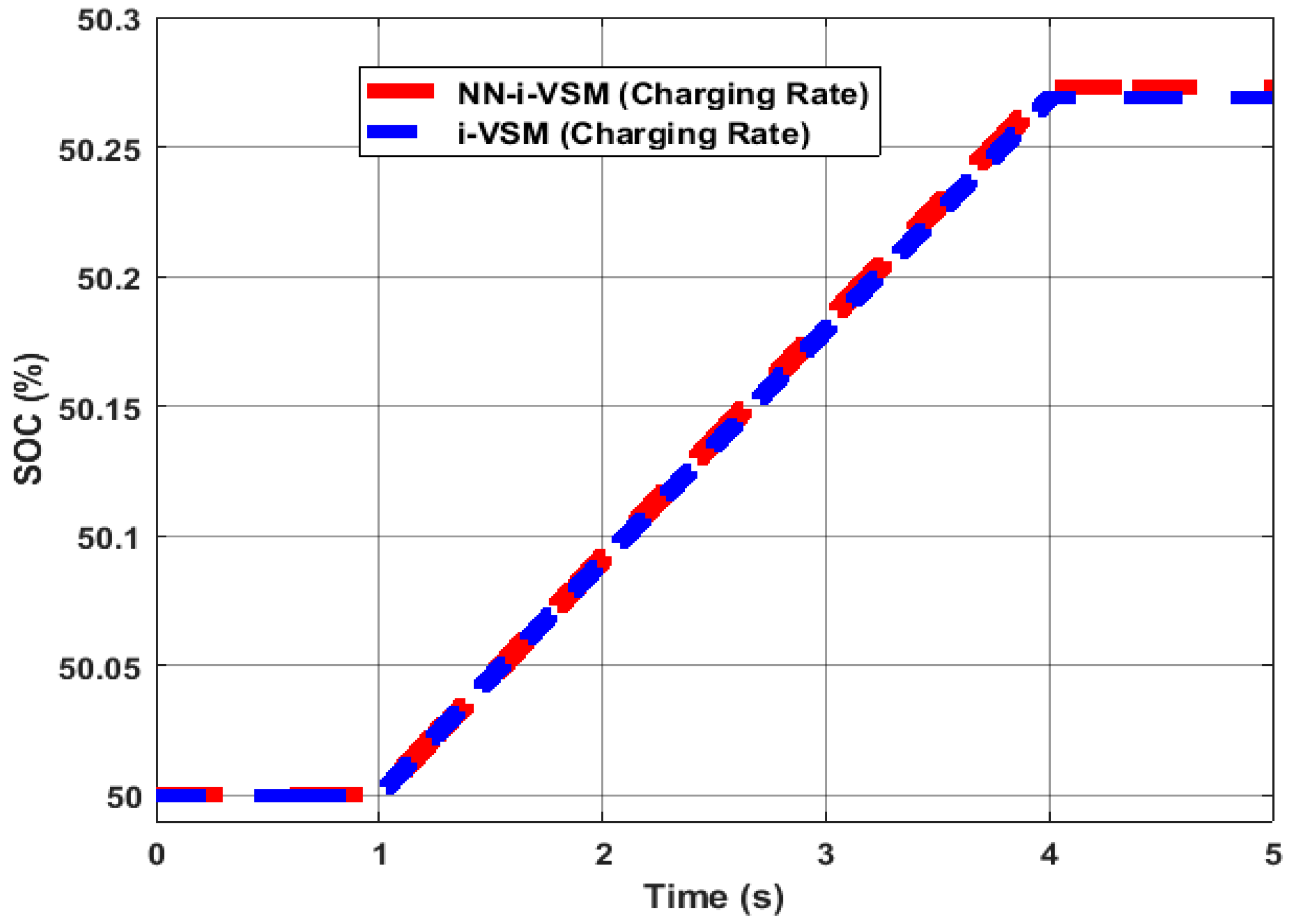
The charging rate comparison of the NN-i-VSM-based and i-VSM-based CSs is demonstrated in Figure 27. Both models used a 150 Ah battery initialized at SOCs of 50% for a charging cycle of 4 s with 5 s of simulation time. At 1 s, both batteries were connected to their respective CSs. The NN-i-VSM-based CS attained a charging rate of 50.27% as compared with i-VSM-based CS, which achieved a cumulative SOC progression of 50.26% at the end of the 4 s charging cycle. Beyond 4 s, both CSs maintained their charging rate profile, as there was no further charging required. The result indicates a superior charging characteristic of the proposed model over the i-VSM model in the G2V charging mode.
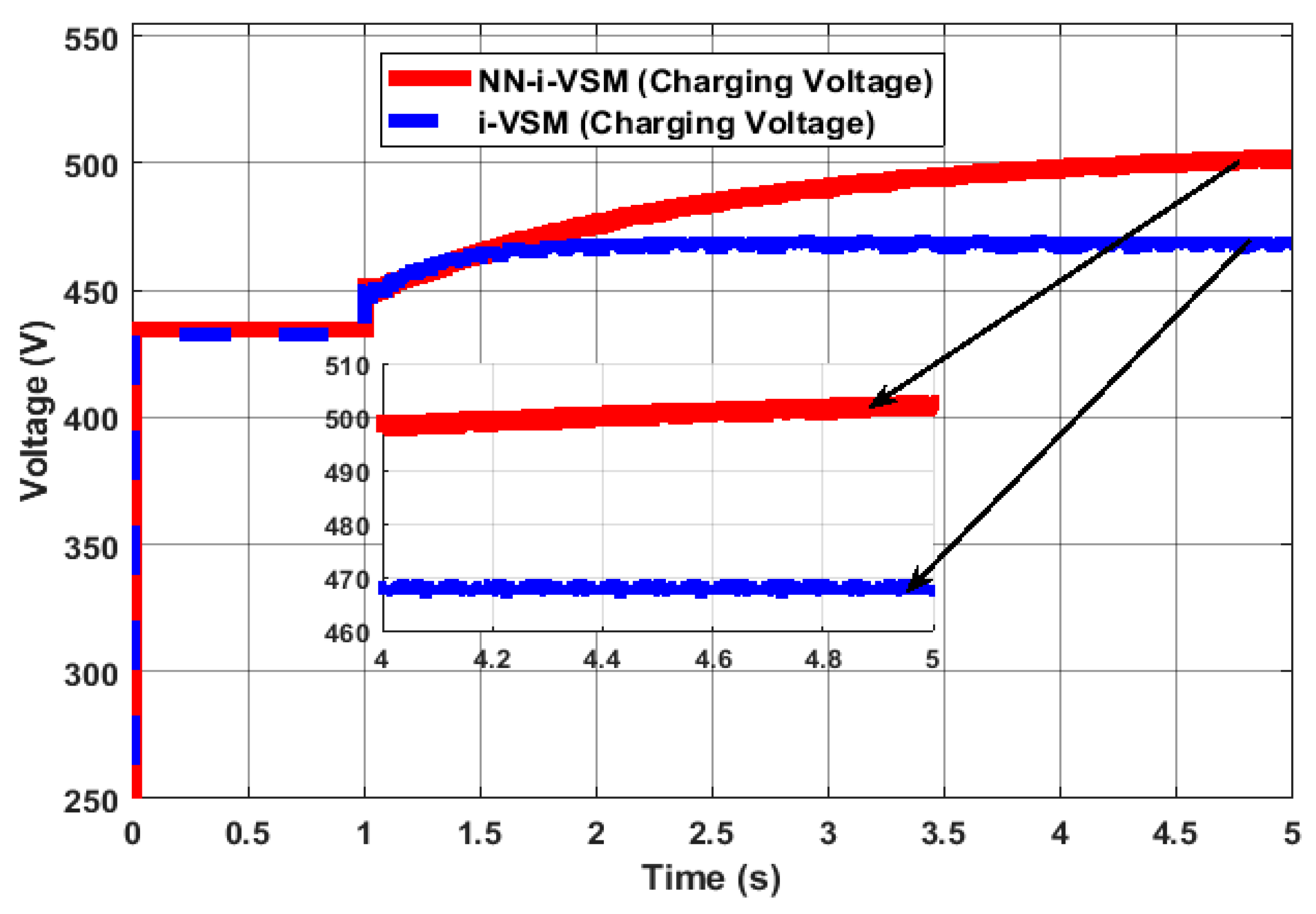
Figure 28 shows the charging voltage comparison of the proposed model and the i-VSM-based CS model. Both models were initialized at 1 s during the 5 s simulation of the charging process.
The NN-i-VSM model attained and maintained its charging voltage of 500 V at 3.5 s, whereas the i-VSM model could only remain within a maximum voltage of 470 V throughout the charging cycle. The proposed model exhibited a superior capacity to deliver a higher charging voltage, which is an essential requirement for optimizing a charging application. This superiority is due to the incorporation of the NN into the NN-based i-VSM structure, fast-tracking real-time optimization, and adaptive control learning, thereby improving the proposed model’s capacity to precisely deliver high charging voltage.
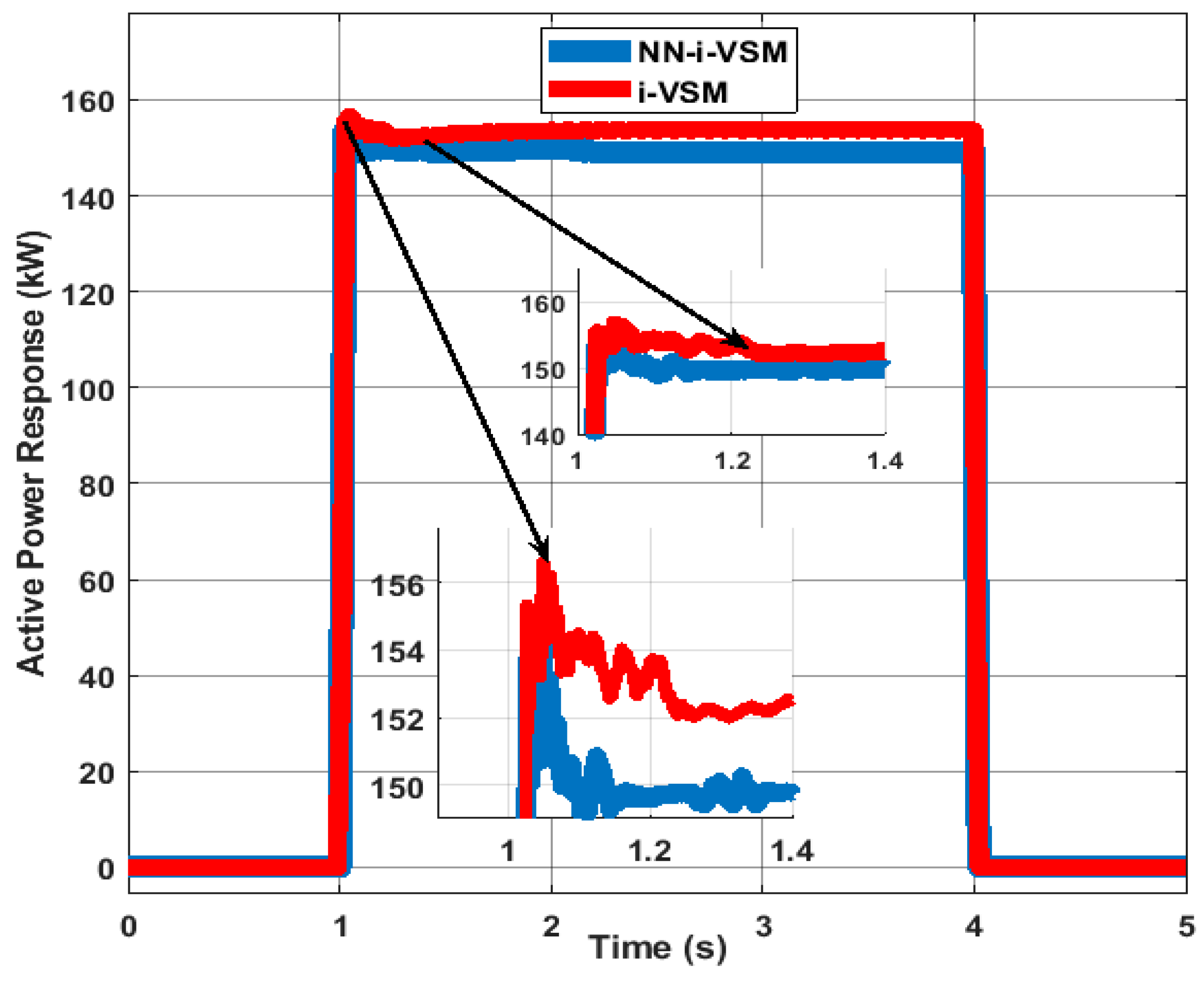
Figure 29 displays the comparison of the power response characteristics of the developed model and the i-VSM model applied at 1 s for a charging cycle of 4 s with 5 s of simulation time. The NN-i-VSM model maintained a consistent power profile at the targeted value of 150 kW within an initial peak value of 154.1 kW at a transient duration of 0.05 s. The NN-i-VSM model’s power response quickly settled at the targeted value at 0.1 s. However, the i-VSM model attained a peak value of 156.6 kW within a transient response duration of 0.3 s and struggled to settle close to the targeted value of 150 kW at 0.5 s of the charging process. Between 4 s and 5 s, both models’ power responses attained 0 kW, resulting from no CS connection at the PCC.
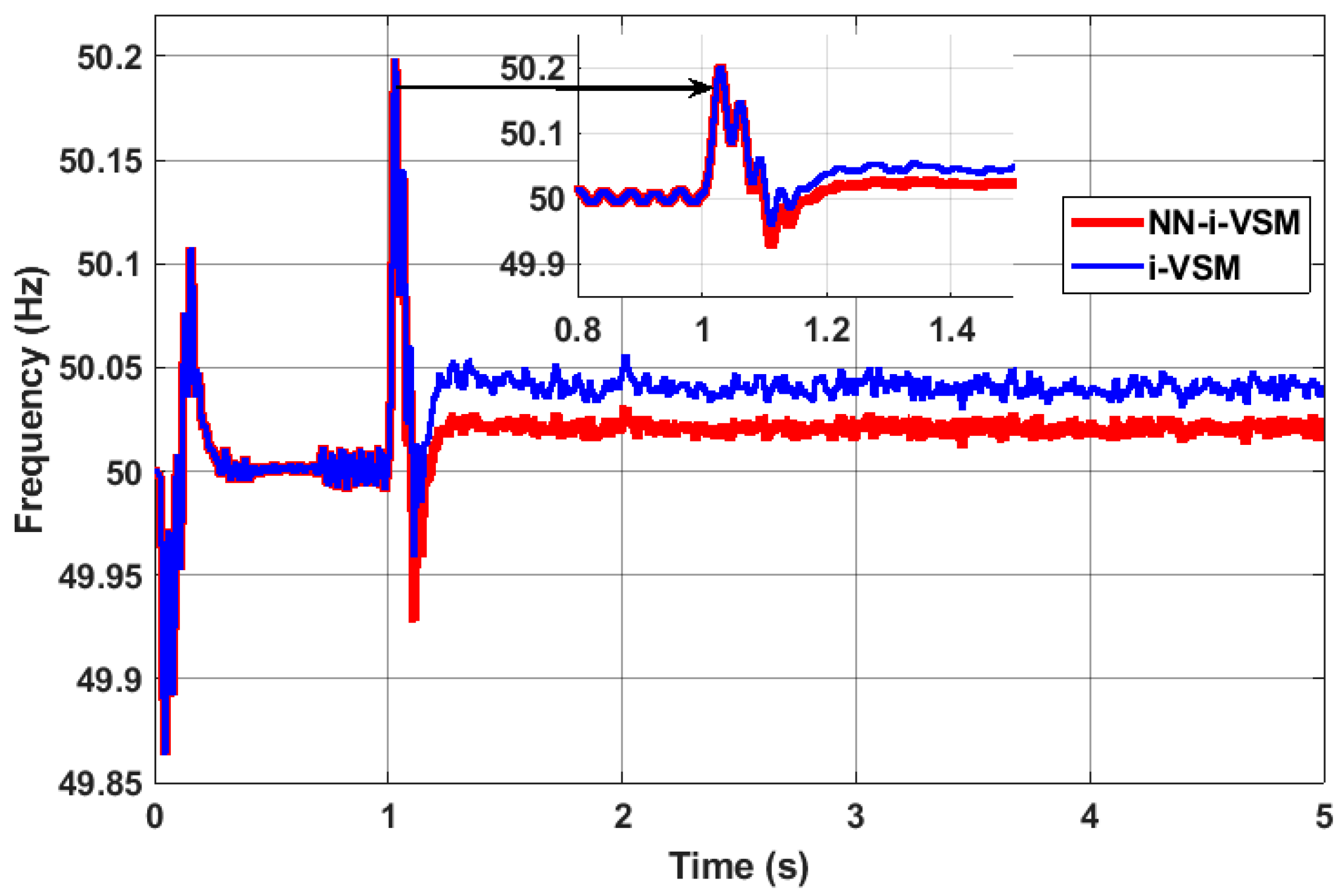
More importantly, despite the numerical parameters of the comparison appearing marginal, these small differences have substantial implications for active power response tracking and plant stability. The result suggests the proposed model outperformed the i-VSM model in swift overshoot reduction and reference parameter tracking in battery charging applications. The frequency response comparison of the proposed NN-i-VSM model and the i-VSM models is shown in Figure 30. At 1 s, both controllers displayed the capacity to adapt frequency fluctuations during charging, but the proposed model exhibited superior stability and faster response in tracking the nominal frequency.
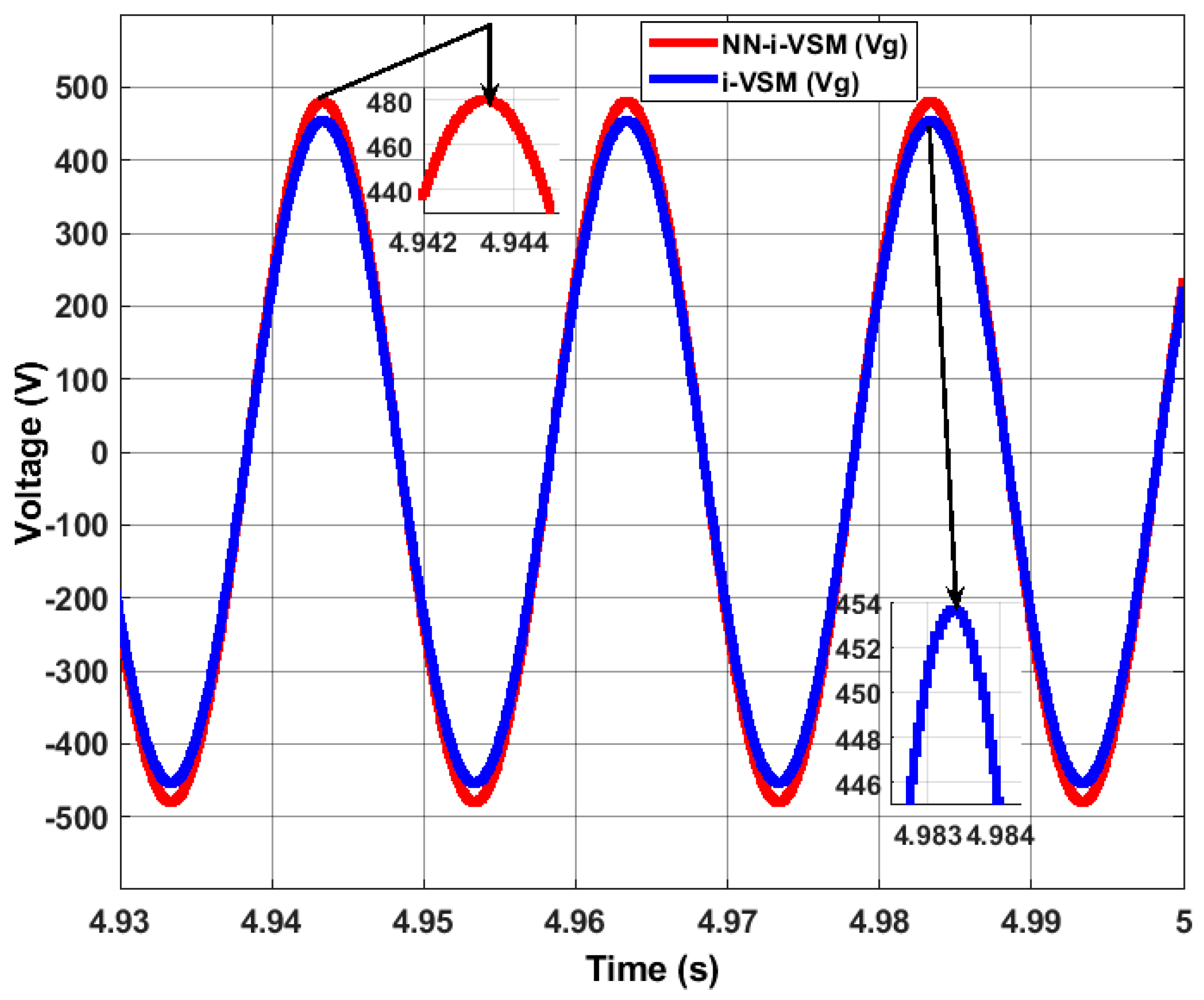
Figure 31 illustrates the comparison of voltage responses at the PCC for the proposed model and the i-VSM model. The waveforms indicated the superior performance of the NN-i-VSM model in accurately tracking and maintaining the voltage response at the setpoint of 480 V. In contrast, the i-VSM model only attained a maximum voltage tracking value of 454 V throughout the charging cycle. The performance of the NN-i-VSM model clearly demonstrated its adaptive and nonlinear learning capacity, a desirable property in modern multiple-battery charging applications.
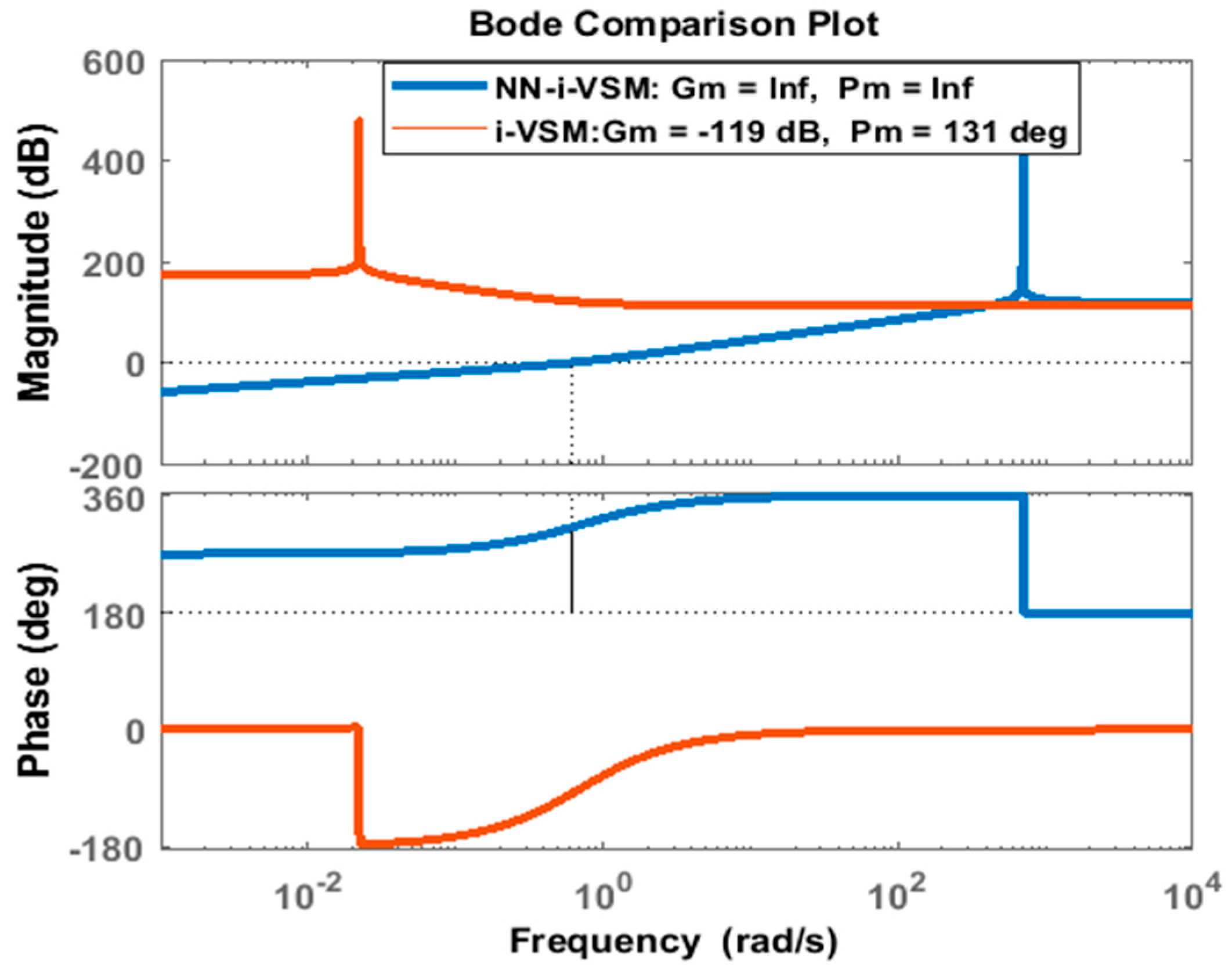
The plant comparison illustrated in Figure 32 shows the open-loop transfer functions of the plant model for both the NN-i-VSM and i-VSM models. The Bode plots indicated a clear stability distinction between the controllers. The proposed NN-i-VSM model exhibited a more robust G m of infinity and a P m of 180°, indicating a highly versatile model capable of resisting variations in gain across frequencies. This demonstrated the novelty and advantage of integrating NN into the i-VSM control architecture.
The plant response performance exhibited in the i-VSM model shows a G m of −119 dB and P m of 131°, illustrating a significant oscillatory characteristic during the multiple-CS operation. These values strongly suggested that the NN-i-VSM controller outperformed the i-VSM controller in terms of plant stability. The NN-i-VSM controller provided a more adaptive and learning-based control system for stability enhancement in a multiple-CS structure, where robust control is germane. Table 5 displays the significant parameters and findings of this paper, which clearly support the superior tracking, charging voltage, percentage improvement in settling time, percentage improvement in overshoot and plant performance of the NN-i-VSM model over the i-VSM model. In this research paper, the settling time and overshoot parameters are based on ±2% steady-state tolerance band and evaluated over a fixed 5 s simulation window of the reported metrics.
The comparison of the proposed NN-i-VSM model with the i-VSM model was performed due to the limited number of i-VSM models available in the literature, which are the primary controller used in existing single-converter-based CS infrastructure. This focused comparison enabled a clear evaluation of the advantages offered by the NN-i-VSM controller while establishing a relevant benchmark for performance assessment. The proposed NN-i-VSM controller robustly addressed the most fundamental variable-voltage response tracking issue at 500 V. In terms of grid stability challenges, including reference voltage tracking, the proposed controller improved overshoot power response reduction by 2.5 kW and also improved dynamic battery adaptation. By leveraging the NN-based charging voltage feedback and real-time inertia control, the NN-i-VSM controller enabled dynamic and swift response and robust plant stability across varying SOCs during multiple charging. The proposed model proffers improved CS efficiency under a multiple-charging condition. Its capacity for scalability and intelligent control makes the proposed model an ideal control strategy in enhancing power stability in future renewable energy and smart grid integrations, thereby enhancing power grid resilience and efficiency under varying-EV penetration.

5. Conclusions

In summary, this research paper introduces an NN-i-VSM-based CS controller that utilizes the CS’s voltage-based change error as the input to the NN-based virtual model. Comparatively, the developed model offers an adaptive and intelligent learning strategy for addressing key issues of the control tracking drawbacks of variable responses in existing i-VSM approaches in CSs. This concept serves as an emerging solution for optimizing higher charging voltage and enhancing plant stability and dynamic response, specifically attaining a higher efficiency of 98.99% as compared with the i-VSM-based CS, which recorded 91.5% efficiency. The results highlighted the NN-i-VSM-based CS’s ability to improve the balance of voltage tracking and power exchange tracking at the PCC, offering a novel panacea to G2V-induced grid response instability. This paper advances modern research in the virtual ancillary technique for plant stability enhancement. This research technique suggests an emerging pathway for future NN-i-VSM-driven V2G applications, coupled with a possible integration in autonomous control systems of smart mobility.

Author Contributions

Conceptualization, S.A.Z.; methodology, K.M., S.A.Z. and M.F.A.; software, K.M., A.A. and M.S.S.; validation, K.M., S.A.Z., M.F.A. and M.Z.C.W.; formal analysis, K.M.; investigation, K.M., A.A., P.K. and M.Z.C.W.; resources, K.M., P.K. and M.Z.C.W.; data curation, S.A.Z. and H.S.S.; writing—original draft preparation, K.M.; writing—review and editing, S.A.Z., M.F.A., H.S.S., P.K. and M.Z.C.W.; visualization, A.A. and M.S.S.; supervision, S.A.Z., M.F.A. and M.Z.C.W.; project administration, M.F.A., H.S.S. and M.S.S.; funding acquisition, S.A.Z., M.F.A. and H.S.S. All authors have read and agreed to the published version of the manuscript.

Funding

This research was funded by Universiti Tun Hussein Onn Malaysia (UTHM) through Tier 1 (VOT Q365), Artificial Intelligence and Sensing Technologies (AIST) Research Center, University of Tabuk, Saudi Arabia.

Data Availability Statement

No new data were created or analyzed in this study.

Acknowledgments

The research was supported by Universiti Tun Hussein Onn Malaysia (UTHM) through Tier 1 (VOT Q365), Artificial Intelligence and Sensing Technologies (AIST) Research Center, University of Tabuk, Saudi Arabia, with special appreciation to Zurich University of Applied Sciences through the Research Partnership Grant ASEAN 2022 (Grant RPG_ASEAN_0702022_13) as well as the Malaysian International Scholarship the technical support and, lastly, for Advanced Control in Power Converter research (ACPC) group at UTHM for their management and moral support.

Conflicts of Interest

The authors declare no conflicts of interest.

References

  1. Li, D.; Leung, M.F.; Tang, J.; Wang, Y.; Hu, J.; Wang, S. Generative Self-Supervised Learning for Cyberattack-Resilient EV Charging Demand Forecasting. IEEE Trans. Intell. Transp. Syst. 2025, 1–10. [Google Scholar] [CrossRef]
  2. Lewicki, W.; Coban, H.H.; Wróbel, J. Integration of Electric Vehicle Power Supply Systems—Case Study Analysis of the Impact on a Selected Urban Network in Türkiye. Energies 2024, 17, 3596. [Google Scholar] [CrossRef]
  3. Coban, H.H.; Lewicki, W.; Sendek-Matysiak, E.; Łosiewicz, Z.; Drożdż, W.; Miśkiewicz, R. Electric Vehicles and Vehicle–Grid Interaction in the Turkish Electricity System. Energies 2022, 15, 8218. [Google Scholar] [CrossRef]
  4. Li, D.; Tang, J.; Zhou, B.; Cao, P.; Hu, J.; Leung, M.F.; Wang, Y. Toward Resilient Electric Vehicle Charging Monitoring Systems: Curriculum Guided Multi-Feature Fusion Transformer. IEEE Trans. Intell. Transp. Syst. 2024, 25, 21356–21366. [Google Scholar] [CrossRef]
  5. Ferraz, R.S.; Ferraz, R.S.; Rueda-Medina, A.C.; Fardin, J.F. Novel variable charging pricing strategy applied to the multi-objective planning of integrated fast and slow electric vehicle charging stations and distributed energy resources. Electr. Power Syst. Res. 2025, 241, 111293. [Google Scholar] [CrossRef]
  6. Eldoromi, M.; Birjandi, A.A.M.; Dehkordi, N.M. Anti-windup control strategy for interlinking converters in hybrid AC/DC microgrids with EV charging stations. Electr. Power Syst. Res. 2025, 247, 111800. [Google Scholar] [CrossRef]
  7. Alam, B.; Mekhilef, S.; Mubin, M.; Soon Tey, K.; Wahyudie, A. Improved Power Transfer Efficiency Using a Dual Transmitter Receiver Design With Integrated Decoupling Coils for IPT EV Charging. IEEE Access 2025, 13, 91362–91373. [Google Scholar] [CrossRef]
  8. Momoh, K.; Zulkifli, S.A.; Korba, P.; Sevilla, F.R.S.; Afandi, A.N.; Velazquez-Ibañez, A. State-of-the-Art Grid Stability Improvement Techniques for Electric Vehicle Fast-Charging Stations for Future Outlooks. Energies 2023, 16, 3956. [Google Scholar] [CrossRef]
  9. Sarkhosh, M.; Fattahi, A. Network-aware electric vehicle charging/discharging scheduling for grid load management in a hierarchical framework. Comput. Electr. Eng. 2025, 121, 109903. [Google Scholar] [CrossRef]
  10. Tang, M.; Jiang, Y.; Yu, S.; Qiu, J.; Li, H.; Sheng, W. Non-dominated sorting WOA electric vehicle charging station siting study based on dynamic trip chain. Electr. Power Syst. Res. 2025, 244, 111532. [Google Scholar] [CrossRef]
  11. Shi, J.; Zhang, W.; Bao, Y.; Gao, D.W.; Fan, S.; Wang, Z. A risk-based procurement strategy for the charging station operator in electricity markets considering multiple uncertainties. Electr. Power Syst. Res. 2025, 241, 111381. [Google Scholar] [CrossRef]
  12. Fusic, J.; Shunmathi, M.; Sitharthan, R.; OV, G.S.; Ramesh, H.; Kumar, A. Efficient power factor correction in single phase AC–DC boost converter for retrofitted electric bicycle battery charging: A finite element analysis approach. Comput. Electr. Eng. 2024, 119, 109549. [Google Scholar] [CrossRef]
  13. Muttaqi, K.M.; Isac, E.; Mandal, A.; Sutanto, D.; Akter, S. Fast and random charging of electric vehicles and its impacts: State-of-the-art technologies and case studies. Electr. Power Syst. Res. 2024, 226, 109899. [Google Scholar] [CrossRef]
  14. Saba, I.; Alobaidi, A.H.; Alghamdi, S.; Tariq, M. Digital Twin and TD3-Enabled Optimization of xEV Energy Management in Vehicle-to-Grid Networks. IEEE Access 2025, 13, 92495–92506. [Google Scholar] [CrossRef]
  15. Ahmed, I.; Adnan, M.; Hassan, W. A Bidirectional interactive electric vehicles PV grid connected framework for vehicle-to-grid and grid-to-vehicle stability enhancement using hybrid control strategies. Comput. Electr. Eng. 2024, 122, 109983. [Google Scholar] [CrossRef]
  16. Janovec, M.; Straka, M.; Kohani, M.; Buzna, L. Novel Aggregation Framework for Electric Bus Fleet Scheduling. IEEE Access 2025, 13, 86256–86276. [Google Scholar] [CrossRef]
  17. Li, J.; Noto, M.; Zhang, Y.; Guo, J. Joint Optimization of Wireless Charging Station Location and Operation Scheduling for Electric Buses Under Uncertain Demand. IEEE Access 2025, 13, 91765–91776. [Google Scholar] [CrossRef]
  18. Hema, R.; Venkatarangan, M.J. Advancing sustainable development: Introducing a novel fast charging technique for Li-ion batteries with supercapacitor integration. Comput. Electr. Eng. 2024, 120, 109810. [Google Scholar] [CrossRef]
  19. Yılmaz, M.; Çinar, E.; Yazıcı, A. Federated Learning-Based State of Charge Estimation in Electric Vehicles Using Federated Adaptive Client Momentum. IEEE Access 2025, 13, 72128–72141. [Google Scholar] [CrossRef]
  20. Dmitrievskii, V.; Paramonov, A.; Kazakbaev, V.; Prakht, V. Computer-aided Experimental Identification of Line-start Permanent-magnet Synchronous-motor Parameters Based on Dynamic Electrical Processes. Chin. J. Electr. Eng. 2025, 11, 206–217. [Google Scholar] [CrossRef]
  21. Song, P.; Wu, L.; Wang, T. Stability Analysis and Parameter Design of Virtual-Winding-Based Harmonic Current Controller for Permanent Magnet Synchronous Machines. IEEE Trans. Power Electron. 2025, 40, 7668–7680. [Google Scholar] [CrossRef]
  22. Shafiei, M.; Ghasemi-Marzbali, A. Fast-charging station for electric vehicles, challenges and issues: A comprehensive review. J. Energy Storage 2022, 49, 104136. [Google Scholar] [CrossRef]
  23. Iannuzzi, D.; Franzese, P. Ultrafast charging station for electrical vehicles: Dynamic modelling, design and control strategy. Math. Comput. Simul. 2021, 184, 225–243. [Google Scholar] [CrossRef]
  24. Oladigbolu, J.; Mujeeb, A.; Li, L. Optimization and energy management strategies, challenges, advances, and prospects in electric vehicles and their charging infrastructures: A comprehensive review. Comput. Electr. Eng. 2024, 120, 109842. [Google Scholar] [CrossRef]
  25. Deb, N.; Singh, R.; Brooks, R.R.; Bai, K. A review of extremely fast charging stations for electric vehicles. Energies 2021, 14, 7566. [Google Scholar] [CrossRef]
  26. Wu, X.; Huang, H.; Chen, J.; Tong, X.; Tong, N.; Lai, L. Consensus Algorithm Based Two-stage Frequency Regulation Strategy with EVs Participating as VSMs. IEEE Trans. Smart Grid 2025, 16, 1562–1574. [Google Scholar] [CrossRef]
  27. Sang, W.; Guo, W.; Dai, S.; Tian, C.; Yu, S.; Teng, Y. Virtual Synchronous Generator, a Comprehensive Overview. Energies 2022, 15, 6148. [Google Scholar] [CrossRef]
  28. Mandrile, F.; Cittanti, D.; Mallemaci, V.; Bojoi, R. Electric vehicle ultra-fast battery chargers: A boost for power system stability? World Electr. Veh. J. 2021, 12, 16. [Google Scholar] [CrossRef]
  29. Muftau, B.; Fazeli, M. The Role of Virtual Synchronous Machines in Future Power Systems: A Review and Future Trends. Electr. Power Syst. Res. 2022, 206, 107775. [Google Scholar] [CrossRef]
  30. Roldán-Pérez, J.; Rodríguez-Cabero, A.; Prodanovic, M. Harmonic virtual impedance design for a synchronverter-based battery interface converter. In Proceedings of the 6th International Conference on Renewable Energy Research Application (ICRERA), San Diego, CA, USA, 5–8 November 2017. [Google Scholar]
  31. Gernandt, H.; Severino, B.; Zhang, X.; Mehrmann, V.; Strunz, K. Port-Hamiltonian modeling and control of electric vehicle charging stations. IEEE Trans. Transp. Electrif. 2025, 11, 2897–2907. [Google Scholar] [CrossRef]
  32. Shin, D.; Lee, J.P.; Yoo, D.W.; Kim, H.J. Stability Improvement of Interleaved Voltage Source Inverters Employing Coupled Inductors for Grid-Connected Applications. IEEE Trans. Ind. Electron. 2015, 62, 6014–6023. [Google Scholar] [CrossRef]
  33. He, P.; Li, Z.; Jin, H.; Zhao, C.; Fan, J.; Wu, X. An adaptive VSG control strategy of battery energy storage system for power system frequency stability enhancement. Int. J. Electr. Power Energy Syst. 2022, 49, 109039. [Google Scholar] [CrossRef]
  34. Yusoff, N.A.; Razali, A.M.; Karim, K.A.; Sutikno, T.; Jidin, A. A concept of virtual-flux direct power control of three-phase AC-DC converter. Int. J. Power Electron. Drive Syst. 2017, 8, 1776–1784. [Google Scholar] [CrossRef]
  35. Hasabelrasul, H.; Cai, Z.; Sun, L.; Suo, X.; Matraji, I. Two-Stage Converter Standalone PV-Battery System Based on VSG Control. IEEE Access 2020, 10, 39825–39832. [Google Scholar] [CrossRef]
  36. Momoh, K.; Zulkifli, S.A.; Korba, P.; Sevilla, F.R.S.; Afandi, A.N.; Velazquez-Ibañez, A. Implementation of Virtual Synchronous Machine Control Using EV Battery’s SOC for Single-Stage Converter During Battery Charging. Int. J. Renew. Energy Res. 2025, 15, 30–41. [Google Scholar]
  37. Momoh, K.; Zulkifli, S.A.; Korba, P.; Sevilla, F.R.S.; Afandi, A.N.; Velazquez-Ibañez, A. Virtual synchronous machine-based controller for multiple fast charging stations in grid stability support. e-Prime Adv. Electr. Eng. Electron. Energy 2025, 11, 100925. [Google Scholar] [CrossRef]
  38. Zhang, J.; Wu, H.; Akbari, E.; Bagherzadeh, L.; Pirouzi, S. Eco-power management system with operation and voltage security objectives of distribution system operator considering networked virtual power plants with electric vehicles parking lot and price-based demand response. Comput. Electr. Eng. 2025, 121, 109895. [Google Scholar] [CrossRef]
  39. Mazumdar, D.; Biswas, P.K.; Sain, C.; Ustun, T.S. GAO Optimized Sliding Mode Based Reconfigurable Step Size Pb&O MPPT Controller with Grid Integrated EV Charging Station. IEEE Access 2023, 12, 10608–10620. [Google Scholar] [CrossRef]
  40. Pournazarian, B.; Sangrody, R.; Saeedian, M.; Lehtonen, M.; Pouresmaeil, E. Simultaneous Optimization of Virtual Synchronous Generators (VSG) Parameters in Islanded Microgrids Supplying Induction Motors. IEEE Access 2021, 9, 124972–124985. [Google Scholar] [CrossRef]
  41. Tao, L.; Zha, X.; Tian, Z.; Sun, J. Optimal Virtual Inertia Design for VSG-based Motor Starting Systems to Improve Motor Loading Capacity. IEEE Trans. Energy Convers. 2022, 37, 1726–1738. [Google Scholar] [CrossRef]
  42. Mallemaci, V.; Mandrile, F.; Rubino, S.; Mazza, A.; Carpaneto, E.; Bojoi, R. A comprehensive comparison of Virtual Synchronous Generators with focus on virtual inertia and frequency regulation. Electr. Power Syst. Res. 2021, 201, 107516. [Google Scholar] [CrossRef]
  43. Sun, X.; Li, T.; Tian, X.; Zhu, J. Fault-Tolerant Operation of a Six-Phase Permanent Magnet Synchronous Hub Motor Based on Model Predictive Current Control with Virtual Voltage Vectors. IEEE Trans. Energy Convers. 2022, 37, 337–346. [Google Scholar] [CrossRef]
  44. Yan, X.; Qin, F.; Jia, J.; Zhang, Z.; Li, X.; Sun, Y. Virtual synchronous motor based-control of Vienna rectifier. Energy Rep. 2020, 6, 953–963. [Google Scholar] [CrossRef]
  45. Fang, J.; Li, X.; Li, H.; Tang, Y. Stability Improvement for Three-Phase Grid-Connected Converters Through Impedance Reshaping in Quadrature-Axis. IEEE Trans. Power Electron. 2018, 33, 8365–8375. [Google Scholar] [CrossRef]
  46. Roslan, N.F. Control Strategy of Grid Connected Power Converter Based on Virtual Flux Approach. Ph.D. Thesis, Universitat Politècnica De Catalunya, Barcelona, Spain, September 2021. [Google Scholar]
  47. Yan, X.; Huang, S.; Li, R.; Jia, J.; Han, L.; Dong, X. Harmonic voltage compensation and harmonic current sharing strategy of grid-forming inverter. Electr. Power Syst. Res. 2025, 238, 111115. [Google Scholar] [CrossRef]
  48. Momoh, K.; Zulkifli, S.A.; Korba, P.; Sevilla, F.R.S.; Afandi, A.N. Single-FCS Based VSM With SOC Voltage Feedback Controller for Future E-Mobility Network. In Proceedings of the IEEE International Conference Power Energy (PECon2024), Kuala Lumpur, Malaysia, 4–5 November 2024. [Google Scholar]
  49. Gallo, R.; Monopoli, T.; Zampolli, M.; Jaboeuf, R.J.P.; Tosco, P.; Patti, E.; Aliberti, A.T. A novel procedure for real-time SOH estimation of EV battery packs based on Time Series Extrinsic Regression. IEEE Access 2024, 13, 326–340. [Google Scholar] [CrossRef]
  50. Shwetha, B.; Babu, G.S.; Mallesham, G. Intelligent Solar PV Grid Connected and Standalone UPQC for EV Charging Station Load. Results Control Optim. 2023, 15, 100420. [Google Scholar] [CrossRef]
  51. Xie, Y.; Jiang, D.; Li, W.; Duan, Y.; He, J.; Luo, Y.; Zhang, Y. An Improved Fast-Charging Strategy for Batteries Integrating Lithium Plating Detection and Online Optimization. IEEE Trans. Transp. Electrif. 2025, 11, 10136–10154. [Google Scholar] [CrossRef]
  52. Rajendran, G.; Vaithilingam, C.A.; Naidu, K.; Alsakati, A.A.; Oruganti, K.S.P.; Fauzan, M.F. Dynamic Voltage Stability Enhancement in Electric Vehicle Battery Charger Using Particle Swarm Optimization. IEEE Access 2022, 10, 97767–97779. [Google Scholar] [CrossRef]
  53. Li, L.; Du, C.; Gongye, X.; Wang, J. ECMS-based MPC Strategy for Multi-mode Hybrid Electric Trucks. IEEE Access 2025, 13, 53241–53253. [Google Scholar] [CrossRef]
  54. How, D.N.T.; Hannan, M.A.; Lipu, M.S.H.; Sahari, K.S.M.; Ker, P.J.; Muttaqi, K.M. State-of-Charge Estimation of Li-Ion Battery in Electric Vehicles: A Deep Neural Network Approach. IEEE Trans. Indust. Appl. 2020, 56, 5565–5574. [Google Scholar] [CrossRef]
  55. Manoharan, A.; Sooriamoorthy, D.; Begam, K.M.; Aparow, V.R. Electric vehicle battery pack state of charge estimation using parallel artificial neural networks. J. Energy Storage 2023, 72, 108333. [Google Scholar] [CrossRef]
  56. Dini, P.; Paolini, D. Exploiting Artificial Neural Networks for the State of Charge Estimation in EV/HV Battery Systems: A Review. Batteries 2025, 11, 107. [Google Scholar] [CrossRef]
  57. Gilbert Zequera, R.A.; Rassõlkin, A.; Vaimann, T.; Kallaste, A. Charge Diagnostics and State Estimation of Battery Energy Storage Systems Through Transformer Models. IEEE Access 2025, 13, 17733–17744. [Google Scholar] [CrossRef]
  58. Iqubal, M.; Pratap, B.; Stonier, A.A.; Vanaja, D.S.; Peter, G.; Arun, V. A modular multiport Landsman converter-driven hybrid EV charging station with adaptive power management system. Comput. Electr. Eng. 2024, 118, 109422. [Google Scholar] [CrossRef]
  59. Vishvanath, M.; Venkadesan, A.; Sakthivel, S.S. Design and analysis of bridgeless zeta-derived power factor correction converter with reduced magnetic components. Comput. Electr. Eng. 2025, 123, 110017. [Google Scholar]
  60. Israr, M.; Samuel, P. High-performance front end PFC controller design for light electric vehicle charger application. Comput. Electr. Eng. 2024, 120, 109822. [Google Scholar] [CrossRef]
  61. Mahmood, O.T.; Hasan, W.Z.W.; Ismail, L.I.; Ramli, H.R.H.; Azis, N.; Norsahperi, N.M.H. Sliding Mode Controller Optimization-Based Three-Phase Rectifier: Review Study. IEEE Access 2024, 12, 101457–101483. [Google Scholar] [CrossRef]
  62. Rajendran, G.; Vaithilingam, C.A.; Naidu, K.; Alsakati, A.A.; Ahmad, H. PSO-Based PI Controller for Voltage-Oriented Controller based Vienna Rectifier for Electric Vehicle Charging Stations. In Proceedings of the 19th IEEE Student Conference on Research and Development (SCOReD), Kota Kinabalu, Malaysia, 23–25 November 2021. [Google Scholar]
  63. Zhang, X.; Wang, Y.; Liu, G.; Yuan, X. Robust Regenerative Charging Control Based on T-S Fuzzy Sliding-Mode Approach for Advanced Electric Vehicle. IEEE Trans. Transp. Electrif. 2016, 2, 52–65. [Google Scholar] [CrossRef]
  64. Lin, H.; Liu, J.; Shen, X.; Leon, J.I.; Vazquez, S.; Alcaide, A.M.; Franquelo, L.G. Fuzzy Sliding-Mode Control for Three-Level NPC AFE Rectifiers: A Chattering Alleviation Approach. IEEE Trans. Power Electron. 2022, 37, 11704–11715. [Google Scholar] [CrossRef]
  65. Shen, X.; Liu, J.; Liu, G.; Zhang, J.; Leon, J.I.; Wu, L.; Franquelo, L.G. Finite-Time Sliding Mode Control for NPC Converters with Enhanced Disturbance Compensation. IEEE Trans. Circuits Syst. 2025, 72, 1822–1831. [Google Scholar] [CrossRef]
  66. Fu, C.; Zhang, C.; Zhang, G.; Zhang, C.; Su, Q. Finite-Time Command Filtered Control of Three-Phase AC/DC Converter under Unbalanced Grid Conditions. IEEE Trans. Ind. Electron. 2023, 70, 6876–6886. [Google Scholar] [CrossRef]
  67. Shen, X.; Liu, G.; Liu, J.; Gao, Y.; Leon, J.I.; Wu, L.; Franquelo, L.G. Fixed-Time Sliding Mode Control for NPC Converters with Improved Disturbance Rejection Performance. IEEE Trans. Ind. Inform. 2025, 21, 4476–4487. [Google Scholar] [CrossRef]
  68. Shen, X.; Liu, G.; Song, S.; Xu, R.; Liu, J. Fixed-Time Active Disturbance Rejection-Based Sliding Mode Control for NPC Converters. In Proceedings of the 49th Annual Conference of the IEEE Industrial Electronics Society (IECON 2023), Singapore, 16–19 October 2023. [Google Scholar]
  69. Zhang, Y.; Li, T.; Yan, G.; Wang, P.; Zhang, M.; Gao, F.; Li, Q. A PI Self-Tuning Method for Three-Phase PWM Rectifiers Based on Stability-and-Dynamics-Constrained Fuzzy Backpropagation Neural Network. IEEE Trans. Power Electron. 2024, 40, 2419–2428. [Google Scholar] [CrossRef]
  70. Zhang, Y.; Diao, L.; Pei, H.; Xu, C. A Multi-Mode Coordinated Control Framework of Vehicular Hybrid Power System Based on Energy Storage System. IEEE Trans. Veh. Technol. 2024, 74, 5784–5798. [Google Scholar] [CrossRef]
  71. Leon, A.E.; Jorge, S.G.; Busada, C.A.; Solsona, J.A. Model-Matching Control for Low Switching Frequency Converters Unifying Different Performance Requirements. IEEE Trans. Ind. Electron. 2024, 71, 1125–1134. [Google Scholar] [CrossRef]
  72. Miao, Z.; Tong, H.; Jin, X.; Yao, W.; Lu, Z.; Ma, Z. DQ-Frame Zero-Crossing Effect Modeling and Current Distortion Compensation Method for Vienna Rectifier. IEEE Trans. Power Electron. 2020, 35, 7612–7623. [Google Scholar] [CrossRef]
  73. Huang, M.; Zhang, Z.; Wu, W.; Yao, Z. An Improved Three-Level Cascaded Control for LCL-Filtered Grid-Connected Inverter in Complex Grid Impedance Condition. IEEE Access 2022, 10, 65485–65495. [Google Scholar] [CrossRef]
  74. Houari, A.; Renaudineau, H.; Martin, J.P.; Nahid-Mobarakeh, B.; Pierfederici, S.; Meibody-Tabar, F. Large-signal stabilization of AC grid supplying voltage-source converters with LCL-filters. IEEE Trans. Ind. Appl. 2015, 51, 702–711. [Google Scholar] [CrossRef]
  75. Ranjith Kumar, R.; Bharatiraja, C.; Udhayakumar, K.; Devakirubakaran, S.; Sekar, K.S.; Mihet-Popa, L. Advances in Batteries, Battery Modeling, Battery Management System, Battery Thermal Management, SOC, SOH, and Charge/Discharge Characteristics in EV Applications. IEEE Access 2023, 11, 105761–105809. [Google Scholar] [CrossRef]
  76. Li, Z.; Sun, H.; Xue, Y.; Li, Z.; Jin, X.; Wang, P. Resilience-oriented asynchronous decentralized restoration considering building and E-bus co-response in electricity-transportation networks. IEEE Trans. Transp. Electrif. 2025, 11, 11701–11713. [Google Scholar] [CrossRef]
Figure 1. Schematic illustration of existing VSM-PI-SSCC-based CS encompassing control structure and EV battery pack [13,14,15,16].
Energies 19 00864 g001
Figure 2. Frequency control loop of the proposed NN-i-VSM control.
Energies 19 00864 g002
Figure 3. Proposed NN-i-VSM model’s field excitation (MN) control loop (virtual flux model).
Energies 19 00864 g003
Figure 5. Flowchart diagram of NN-i-VSM control structure.
Energies 19 00864 g005
Figure 6. Equivalent circuit representation of LCL filter in s-domain.
Energies 19 00864 g006
Figure 7. Complete structure at PCC of proposed NN-i-VSM-based CS with three-phase PWM single-stage rectifying converter (n = 5).
Energies 19 00864 g007
Figure 8. Output response versus neurons’ contributions to proposed NN-i-VSM model.
Energies 19 00864 g008
Figure 9. NN-i-VSM model’s trained output characteristic with respect to varying SOCs and charging voltage feedbacks at CS’s reference voltage output.
Energies 19 00864 g009
Figure 10. NN-i-VSM-based CS’s output voltage responsiveness to tracking at CS reference voltage value.
Energies 19 00864 g010
Figure 11. NN-i-VSM-based CS’s output voltage responsiveness to tracking at CS reference voltage value with changes in Vdcref.
Energies 19 00864 g011
Figure 12. NN-i-VSM-based CS’s output voltage responsiveness to tracking Qref at CS reference voltage value.
Energies 19 00864 g012
Figure 13. Open-loop transfer function for NN-i-VSM plant model.
Energies 19 00864 g013
Figure 14. Closed-loop transfer function for NN-i-VSM plant model.
Energies 19 00864 g014
Figure 15. Connection at PCC of NN-i-VSM-based CSs (5 × 150 kW) with varying EV battery capacities and initial SOCs.
Energies 19 00864 g015
Figure 16. SOC responses at varying battery capacities and initial SOCs in simultaneous mode: (a) 100 Ah at 30% initial SOC, (b) 120 Ah at 40% initial SOC, (c) 130 Ah at 50% initial SOC, (d) 140 Ah at 60% initial SOC, and (e) 150 at 70% initial SOC.
Energies 19 00864 g016
Figure 17. Active power response at varying EV battery capacities and initial SOCs in simultaneous mode.
Energies 19 00864 g017
Figure 18. Frequency response control at varying EV battery capacities and initial SOCs in simultaneous mode.
Energies 19 00864 g018
Figure 19. Voltage response regulation at PCC during charging with varying EV battery capacities and initial SOCs in simultaneous mode: (a) voltage waveform for 5 s, (b) zoomed-in voltage waveform at 1 s when five batteries were connected simultaneously, and (c) zoomed-in voltage waveform at 4 s at end of charging cycle.
Energies 19 00864 g019
Figure 20. SOC responses during charging with varying battery capacities and initial SOCs in by-step mode: (a) 100 Ah at 30% initial SOC, (b) 120 Ah at 40% initial SOC, (c) 130 Ah at 50%, (d) 140 Ah at 60% initial SOC, and (e) 150 Ah at 70% initial SOC.
Energies 19 00864 g020
Figure 21. Active power response during charging with varying EV battery capacities at different initial SOCs when batteries were applied at 0 s and 1 s.
Energies 19 00864 g021
Figure 22. Frequency response control at PCC during charging of five EV batteries with varying capacities and initial SOCs in by-step mode applied at 0 s and 1 s.
Energies 19 00864 g022
Figure 23. (a) Frequency response control at PCC during charging of five EV batteries with varying capacities and initial SOCs in by-step mode (b) Zoomed version of frequency response at 0 s when the batteries were applied (c) Zoomed version of frequency response when the batteries were connected at 1 s for by-step mode.
Energies 19 00864 g023
Figure 24. Power flow characteristic comparison of grid voltage and rectifier voltage responses between 4.92 s and 5 s towards end of charging cycle.
Energies 19 00864 g024
Figure 25. Comparison of NN-i-VSM-based and i-VSM-based CSs’ voltage output responses with respect to reference CS voltage response during charging process.
Energies 19 00864 g025
Figure 26. Comparison of NN-i-VSM-based and i-VSM-based CSs’ output voltage variable-step responses.
Energies 19 00864 g026
Figure 27. SOC rate comparison of NN-i-VSM and i-VSM controllers during charging at 50% SOC of 150 Ah battery.
Energies 19 00864 g027
Figure 28. Charging voltage comparison of NN-i-VSM and i-VSM controllers during charging.
Energies 19 00864 g028
Figure 29. Power response comparison of NN-i-VSM and i-VSM controllers during charging.
Energies 19 00864 g029
Figure 30. Frequency response comparison of NN-i-VSM and i-VSM controllers when connected at 1 s.
Energies 19 00864 g030
Figure 31. Voltage responses tracking comparison at the PCC for the proposed NN-i-VSM and the i-VSM model.
Energies 19 00864 g031
Figure 32. Bode plot comparison of open-loop transfer functions of NN-i-VSM and i-VSM models.
Energies 19 00864 g032
Table 1. Comparison of recent VSM-PI-SSCC techniques in CSs.
S/NRefs.VSM
Technique
Control ConceptContributionsDrawbacksControl Complexity
1[27]Based on synchronous generatorVAC-PIAccurately simulated electromagnetic characteristic of SG; required no frequency-derivative synchronizationWeak resistance to interference due to voltage open-loop control; numerous instability issuesVery high
2[28,29]Based on swing equationVAC-PIFrequency adaptability to sudden changes in load profileExcitation control issues; prone to synchronous resonance; weak stability in multiple-FCS operationSimple
3[30,31]Based on droop controlVHI-PIAdaptable to changes in a single FCS load; enhanced stability of systemPower sharing accuracy depended on rectifier output and line impedanceSimple
4[32]Based on frequency-power responseVHI-PIConfigurable output impedance; highly suitable for weak-grid operationStability margins reduced with higher values of virtual resistance; hard to regulate dynamicsVery high
5[33,34]Based on frequency-power responseVFC-PIProvides fast response and frequency support in single CS loadDrift and saturation effect due to DC offset in integrated signals lagged voltage by 90° in phase shiftSimple
6[36,37]VSM droop control based on SOCi-VSMAdaptability to EV battery SOC; fast transient response; decoupling of active and reactive powers; frequency and voltage regulation at point of common coupling (PCC)High initial power response overshoot, which can affect stability during varying EV battery load fast transientsSimple
7ProposedNN-based VSM controlNN-i-VSMImprove plant stability, less initial power response overshoot, improved voltage variable response and adaptive tracking of high charging voltage, active powers, and voltage response at PCCComplex structureHigh
Table 2. Most recent neural network control techniques in CS structure.
S/NRefs.Control ConceptMeritsDrawbacksControl Complexity
1[39,61]Antlion-Optimization-Based Sliding Mode Control (ALO-SMC)Enhanced robustness and transient performance.Susceptible to frequency variation, and it has limited adaptability to EV load changes.Highly complex because it requires continuous system tuning.
2[52,62]Particle Swarm Optimization (PSO) for PI Controller TuningImproves initial PI gain selection due to simple implementation.Poor frequency synchronization, and it requires consistent retuning of control parameters.Very complex and lacks adaptive intelligence.
3[50,63,64]Fuzzy Sliding Mode Control (FSMC)Enhances system adaptability to load uncertainties compared with conventional techniques.It requires manual fuzzy rule of tuning, and it increases power losses due to high frequency switching.Very high complexity due to fuzzy inference system.
4[65,66]Finite-Time Sliding Mode Control (FT-SMC)Fast response and improved convergence of system states; high robustness to control uncertainties and power tracking capacity.Model convergence is dependent on initial conditions and requires high sampling frequency to maintain system stability.Slightly complex structure due to finite-time convergence formulation.
5[67,68]Fixed-Time Sliding Mode Control with an Active Disturbance Rejection Control (FT-SMC-ADRC)High system convergence within a fixed time and enhanced disturbance rejection with improved dynamic response.Higher design complexity due to combined tuning issues for both ADRC and SMC parameters.Highly complex due to dual-layer structure of ADRC + SMC.
Table 3. Simulation parameters of the proposed model.
Type of ParametersParameterValueType of ParametersParameterValue
Filter parameterFilter inductor (L)1400 μHVSM control parameterVSM inertia coefficient (J)0.01 kg·m2
Filter capacitor (C)16 μFMechanical torque (Tm)0
Grid   voltage   ( V g )480 VPole pair value1
Switching frequency for rectifier5 kHz Voltage   regulation   constant   ( K V )0.6
CS parameterDC link capacitor (Cdc)1700 μFVSM gain constant (Kq)115
CS   reference   output   voltage   ( V d c r e f )500 Vdc Reference   active   power   ( P r e f )150 kW
Rated frequency 50 Hz Reference   reactive   power   ( Q r e f )0 Var
Battery parameterNominal voltage400 V VSM   integral   constant   ( K i )0.5
Battery rated capacity100 Ah to 150 AhVSM stator inductance (LS)0.0048 H
Battery response time2 sVSM stator resistance (RS)0.2 Ω
Initial SOC range10–80% Magnetizing   inductance   ( L m ) 0.003 H
Parameters   for   neural   network   model   incorporation   ( i = 1 ,   2 ,   3 ) Neurons   ( n )3 Parameters   for   neural   network   model   incorporation   ( i = 1 ,   2 ,   3 ) Bias   term   at   output   layer   ( b 0 ) 0.05
Output   weights   ( ω i ) (0.9, −0.4, 0.6) Bias   values   of   hidden   neurons   ( b i )(0.2, −0.1, 0.3)
Input   weights   ( v i )(1.2, −0.8, 0.5) Activation   ( ϕ )tanh(x)
Table 4. Simulation results of multiple battery charging using different cases of initial SOCs.
S/NInitial SOC (%)CC (A)CV (Vdc)PFEfficiency of FCS (ղ) (%)SOC at 5 s (%)
EV1 at 0 sEV2 at 1 sEV1 at 5 sEV2 at 5 s
11020298.5486.20.978294.6410.4520.43
22030299.8487.70.975195.0520.4530.43
33040305.7489.30.963496.0730.4540.43
44040309.8493.60.957897.6440.4540.43
53050309.9495.50.936895.9030.4550.43
65050319.6496.60.927998.1850.4550.43
75070322.8497.30.915497.9650.4570.43
86070325.6498.20.913498.7860.4570.43
97080325.5499.70.912998.9970.4580.43
CC: charging current, CV: charging voltage, PF: power factor (PF   =   R e a l   p o w e r ( P ) A p p r e n t   p o w e r ( P 2 + Q 2 ) = W a t t V o l t A m p s ), ղ = C C     C V     P F ( F C S   r a t e d   p o w e r )     100 % , [36,37,48].
Table 5. Performance comparison of NN-i-VSM and i-VSM models’ parameters during charging.
ModelV (V)f (Hz)Pref (kW)ղ (%)Plant
Stability
Maximum CS VoltageMinimum Overshoot (kW) ST (s)PIST (%)PIO (%)
NN-i-VSM48050.0115098.99infinityinfinity500 V154.10.1 66.7 37.9
i-VSM [32,33]45450.0515091.5–119 dB131°470 V156.60.3
V: voltage, f: frequency, Pref: reference active power, ղ: efficiency, dB: decibel, ST: settling time, s: seconds, PIST: percentage improvement in settling time, PIO: percentage improvement in overshoot.
Disclaimer/Publisher’s Note: The statements, opinions and data contained in all publications are solely those of the individual author(s) and contributor(s) and not of MDPI and/or the editor(s). MDPI and/or the editor(s) disclaim responsibility for any injury to people or property resulting from any ideas, methods, instructions or products referred to in the content.