


Abstract
The transition to renewable energy systems and electric mobility depends on the effectiveness, reliability, and durability of lithium-ion battery technology. Accurate modeling and control of battery systems are essential to ensure safety, efficiency, and cost-effectiveness in electric vehicles and grid storage. In engineering and materials science, battery models depend on physical parameters such as capacity, energy, state of charge (SOC), internal resistance, power, and self-discharge rate. These parameters are affected by measurement uncertainty. Despite the widespread use of lithium-ion cells, few studies quantify how measurement uncertainty propagates to derived battery parameters and affects predictive modeling. This study quantifies how uncertainty in voltage, current, and temperature measurements reduces the accuracy of derived parameters used for simulation and control. This work presents a comprehensive uncertainty analysis of 18650 format lithium-ion cells with nickel cobalt aluminum oxide (NCA), nickel manganese cobalt oxide (NMC), and lithium iron phosphate (LFP) cathodes. It applies the law of error propagation to quantify uncertainty in key battery parameters. The main result shows that small variations in voltage, current, and temperature measurements can produce measurable deviations in internal resistance and SOC. These findings challenge the common assumption that such uncertainties are negligible in practice. The results also highlight a risk for battery management systems that rely on these parameters for control and diagnostics. The results show that propagated uncertainty depends on chemistry because of differences in voltage profiles, kinetic limitations, and temperature sensitivity. This observation informs cell selection and testing for specific applications. Improved quantification and control of measurement uncertainty can improve model calibration and reduce lifetime and cost risks in battery systems. These results support more robust diagnostic strategies and more defensible warranty thresholds. This study shows that battery testing and modeling should report and propagate measurement uncertainty explicitly. This is important for data-driven and physics-informed models used in industry and research.
1. Introduction
Lithium-ion batteries (LIBs) are essential for electric vehicles, consumer electronics, and stationary storage systems [1,2,3,4]. Battery manufacturers aim to maximize efficiency and durability through improved materials, manufacturing control, and qualification protocols [5,6]. Energy storage system design is strongly influenced by cell-to-cell mismatches in capacity, energy, SOC, internal resistance, power, and self-discharge rate. These parameters are derived from measurements of voltage, current, temperature, and time. However, these measures are subject to uncertainty. This affects the reliability of the calculated battery parameters. These mismatches, often resulting from manufacturing tolerances and varying operating conditions, can lead to uneven current distribution between cells. This uneven distribution worsens the aging process and decreases the overall performance of the battery system.
To mitigate these issues, testing must control for and report measurement uncertainty to ensure accurate performance assessment and robust quality control. Measurement uncertainties can obscure the true characteristics of cells, leading to incorrect assessments of manufacturing tolerances and potentially resulting in the production of cells that do not meet desired specifications. This can increase mismatch and reduce the efficiency and reliability of battery-based power systems.
In this context, battery manufacturers have the responsibility to adopt measurement practices aligned with guidelines established by international standards organizations, such as the International Electrotechnical Commission (IEC) and the International Organization for Standardization (ISO), which develop specific standards for performance, life cycle, and safety testing of cells and modules [4,7,8]. These standards not only establish standardized testing methodologies but also define permissible error limits and metrological validation criteria. Managing measurement uncertainty remains challenging because most studies emphasize external sources such as test equipment and environment. Few studies quantify internal sources linked to electrochemical and thermal cell behavior. This gap between actual cell behavior and test protocols highlights the need for closer collaboration between manufacturers and regulatory bodies to update existing protocols based on more representative and realistic empirical data [9].
Given this scenario, this paper seeks to fill a critical gap in the literature by investigating how intrinsic cell properties, such as initial voltage, state of charge (SOC), and thermal behavior, directly impact uncertainty in determining fundamental battery parameters. Although these variables are inherent to the electrochemical functioning of cells, they are often neglected in uncertainty analyses, which can compromise the accuracy of simulation and control models. Failure to consider these effects can result in overestimation or underestimation of critical parameters, leading to system oversizing, premature battery replacements, and failure to meet performance requirements. These deviations not only reduce efficiency and increase operating costs but also have significant safety implications, especially for electric vehicle manufacturers and energy storage system integrators [10].
This paper investigates the uncertainty of battery parameters, which should include both external measurement conditions and cell-specific internal effects. The novelty of this work lies in the quantification of how different chemical compositions and initial states of the battery affect the uncertainty in battery parameters such as capacity, energy, SOC, internal resistance, power, and self-discharge rate. This contribution is significant because it provides a more realistic basis for the design of battery systems and improves the accuracy of battery models used in practice.
The objective of this work is to analyze and quantify the propagation of uncertainty in capacity, energy, internal resistance, and discharge power of lithium-ion batteries of three different chemical compositions (NCA, NMC, and LFP), considering both the measurement conditions and cell-specific factors. All tests follow the IEC 62660-1 [11,12] and ISO12405-4 [13] standards. This approach provides improved guidance for battery system design, performance modeling, and standardization efforts.
The rest of this paper is organized as follows. Section 2 presents a literature review and a comparison with existing work. Section 3 explains the methodology used for the uncertainty analysis. Section 4 discusses the results for each battery parameter. Section 5 concludes the study and suggests directions for future work.
2. Literature Review
Accurate parameter identification supports modeling, diagnostics, and performance optimization in lithium-ion cells and packs. Electric mobility and renewable storage require precise measurements of capacity, internal resistance, and SOC for reliable design and control. These parameters carry uncertainty that propagates through models and reduces predictive accuracy [14,15,16]. Despite the relevance of measurement accuracy, few studies have systematically addressed the sources, propagation, and implications of measurement uncertainties in the determination of battery parameters.
One of the first structured investigations of measurement uncertainty in battery systems appeared in a two-volume study from the Idaho National Engineering and Environmental Laboratory (INEEL) [12]. The first volume defined a framework for uncertainty estimation on battery test platforms that separates direct from indirect measurements. It supplied formulas usable across similar measurement strategies given access to instrument specifications, cell construction data, and compliance tests. The second volume quantified uncertainties on high-performance lithium-ion cells under operational INEEL test setups. The work linked platform characteristics to uncertainty propagation but emphasized equipment contributions and did not quantify intrinsic cell variability.
Taylor et al. [10] conducted a complementary, empirical study to assess how experimental configuration and operator-related factors influence measurement uncertainty. Their findings highlight the importance of the number and type of electrical contact points, variability in test-chamber conditions, and human involvement in test execution. Mitigations such as standardized connections and tighter thermal control reduce uncertainty but do not capture cell behavior across varying thermal states and states of charge.
More recently, Paul et al. [17] investigated variability in initial capacity and internal resistance in more than twenty thousand lithium iron phosphate cells and emphasized how small initial variations can lead to substantial divergence after aging. Accelerated aging on ninety-six cells yielded capacity losses from fourteen to twenty-five percent with a mean of eighteen percent. The spread was attributed to manufacturing tolerances and nonuniform operation, including uneven thermal loads and heterogeneous state-of-charge distribution. The results confirm that cell-level variability strongly shapes long-term performance and must be included in uncertainty assessments.
In addition, Kowal et al. [18] explored the dynamics of thermal stabilization in lithium-ion cells. The authors reported that casing equilibrium with the environment provides a reliable proxy for internal temperature. This implies that internal temperature gradients can be inferred under steady conditions, which simplifies thermal modeling. The study did not connect these thermal dynamics to parameter uncertainty under transient testing. Evidence indicates that uncertainty arises from external factors, including equipment, environment, and operators and from intrinsic properties, including chemistry, manufacturing variance, and thermodynamic response. A critical gap remains since few studies quantify how intrinsic properties such as initial voltage, usable state-of-charge range, and thermal reactivity contribute to uncertainty in derived parameters.
This omission weakens modeling frameworks and can drive imprecise design choices, including premature replacement and overly conservative safety margins. There is an urgent need for comprehensive experiments that quantify how specific cell properties govern the propagation of measurement uncertainty. Such evidence can inform improved protocols, calibration methods, and uncertainty-aware models and can bridge academic insight with industrial practice.
3. Method
This section details the experimental platform used for lithium-ion cell characterization. It introduces the cells selected for testing and their nominal specifications, followed by the experimental protocols used for data acquisition and for determining the temperature coefficient of the self-discharge rate, the Peukert exponent, and the temperature sensitivities of capacity and delivered energy. A complementary identification routine estimates coefficients that describe the dependence of internal resistance and power on temperature and state of charge and the dependence of internal resistance on current. Measurement programs, instrumentation settings, and data processing steps are documented to ensure reproducibility. Finally, a quantitative estimate of measurement uncertainty in cell characterization is presented through a case study, establishing a basis for comparative analyses and parameter-informed modeling.
3.1. Description of the Test Setup
The test bench utilizes two Neware BTS4000-5V6A model from Neware company (Shenzhen, China) battery cell analyzers. Each analyzer offers eight independent channels operating from 25 mV to 5 V, with a maximum current of 6 A and a per-channel power limit of 30 W. These specifications allow for parallel testing under controlled electrical loads. Voltage accuracy and stability are specified as 0.05% of the measurement range, and current accuracy and stability are also specified as 0.05% of the measurement range. These specifications establish symmetric bounds on instrumental error for both quantities. The source stage provides three discrete current ranges, and the 3 A to 6 A range uses a cut-off current of 12 mA, which defines the termination threshold for current-controlled steps. This cut-off current is included in the uncertainty budget so that termination behavior does not bias estimated parameters. The minimum sampling interval is 100 milliseconds, which corresponds to 10 Hz and sets the temporal resolution for event detection and data reduction. Integrated temperature sensors report an accuracy of 1 degree Celsius, which bounds thermal measurement error for temperature-dependent coefficients. This configuration provides a uniform instrumentation baseline across all experiments.
Cells are conditioned in an ACS DY250 BT climate chamber to the target test temperature and held to thermal equilibrium before measurements. Active cooling is not applied because IEC 62660-1 [13] and ISO 12405-4 [18] do not require it for these conditions. The battery cell analyzer is placed outside the chamber, and the cells are connected by leads terminated with alligator clips. Surface temperature sensors are mounted at the midline on the lateral surface of the cylindrical cells. Sensor placement follows the IEC 62660-1 specification for cylindrical cells. The experimental setup employs two-point (alligator-clip) connections, which can introduce minor additional contact resistance and small voltage offsets, particularly at higher current rates, and are therefore not ideal for the most precise voltage or internal resistance measurements. Although this configuration remains acceptable for the scope of the present cell-level comparative study, four-point (Kelvin) connections would further reduce measurement uncertainty by separating current-carrying and voltage-sensing paths, improving the accuracy of both voltage readings and derived resistance metrics. The same two-point configuration was applied uniformly across all tested chemistries (e.g., NCA, NMC, LFP, and other cell types included in this work), such that any residual bias is expected to be systematic rather than chemistry-specific, thereby preserving the validity of the cross-chemistry comparisons. This limitation is explicitly acknowledged in the uncertainty discussion and reflected in the reported error bounds..
The temperature coefficient of self-discharge is determined by storing precharged cells at an elevated temperature to accelerate self-discharge to a measurable level. Cells were stored in Memmert UF160plus universal cabinets (Memmert GmbH + Co. KG) [19] set to 50 °C and 60 °C to maintain stable thermal conditions throughout the observation period.
3.2. Investigated Lithium-Ion Cell Types
Lithium-ion cells vary in form factor, electrode design, and electrolyte formulation. This work examines cylindrical cells with cathodes based on lithium nickel manganese cobalt oxide (NMC), lithium nickel cobalt aluminum oxide (NCA), or lithium iron phosphate (LFP). These chemistries were selected because they are widely used in battery packs from original equipment manufacturers (OEMs). All experiments use commercially available cylindrical cells in the 18650 format. Table 1 summarizes the nominal specifications and operating limits adopted in this work. For the NCA cell, the discharge cut-off voltage is 2.8 V, and this limit is applied in all tests. The LFP datasheet specifies charge and discharge voltage limits but does not define current profiles. All cells are charged using a Constant Current–Constant Voltage (CC-CV) protocol. For the NMC cell, the constant-voltage phase ends when the current decreases to 0.02 C.
Table 1.
Characteristics of the lithium-ion cells used.
From an electrochemical perspective, the three cathode chemistries NCA, NMC, and LFP exhibit distinct thermodynamic and kinetic signatures that explain the uncertainty trends reported in Section 4. NCA and NMC are layered oxide cathodes that operate at higher average redox potentials of about 3.6 to 3.7 V versus the lithium metal reference electrode (Li/Li+). Their transition metal redox couples such as Ni2+/Ni4+ and Co3+/Co4+ enable high energy density, but they typically show larger voltage hysteresis and sharper local features in dV/dQ, which is the differential voltage with respect to capacity, particularly at high c-rate and near high SOC. In these layered systems, small voltage offsets or polarization shifts can propagate into larger dispersion in capacity estimates and energy estimates. In contrast, LFP has a lower nominal potential of about 3.3 V and a characteristic two-phase Fe2+/Fe3+ plateau that reduces voltage sensitivity over a broad SOC window. However, its olivine framework constrains Li+ transport and has lower intrinsic electronic conductivity. Particle engineering and carbon coating mitigate this limitation in practical cells. These transport constraints can increase the relative impact of temperature-dependent kinetics and diffusion on performance dispersion. Together, chemistry-specific differences in redox potential profiles, hysteresis, lithium-ion transport, and electronic conductivity explain why the reported uncertainties reflect underlying electrochemical mechanisms rather than purely statistical variation.
3.3. Test Conditions
The charging and discharging conditions and test programs for determining the coefficients and battery parameters should be based on international standards for the characterization of lithium-ion cells for electric vehicles. This ensures an understandable and standardized testing procedure. In addition, the ultimately determined measurement uncertainties and the method for determining them are representative of the standards. The test description in ISO 12405-4 [13] is more precise and exhaustive, which is why the test programs depend strongly on the ISO standard. However, when defining test parameters, IEC 62660-1 and ISO 12405-4 are compared. The ISO 12405-4 Standard Cycle (SC) is adopted for charging and discharging. This provides a current rate of C/3 for charging and discharging high-energy battery packs and systems. This current rate corresponds to the standard current of one-third. IEC specifies it for battery-powered vehicles.
The current rate, which is identically defined for all cells, also facilitates the comparison of cell chemistries. The one-hour rest period after charging is explicitly defined by ISO and is therefore adopted. For the discharge, however, there is a half-hour rest period or time to attain thermal equilibrium. To ensure thermal stabilization following discharge, a two-hour rest period is specified for the experiments. Table 2 shows the standard cycle defined for the evaluations and specified by ISO 12405-4.
Table 2.
Definition of the standard cycle (SC).
The cut-off limits are defined according to the cell manufacturer’s specifications. To ensure methodological consistency, all cell-level performance tests were primarily aligned with IEC 62660-1:2018, which defines standardized procedures for secondary lithium-ion cells used in electric road vehicles. In addition, selected elements of the ISO 12405-4:2018 Standard Cycle (SC), originally formulated for pack- and system-level testing—were adapted to the single-cell level. This adaptation was motivated by the more detailed prescriptions in ISO 12405-4 for charge/discharge rest periods and thermal stabilization, aspects that are only partially specified in IEC 62660-1. The adopted procedures were implemented under metrological equivalence while keeping the current rate, voltage cut-off limits, and temperature ranges consistent with IEC 62660-1, so that no deviations from the IEC performance requirements were introduced. Deviations from ISO 12405-4 are limited to the omission of electrical isolation and communication tests, which are only meaningful at pack/system level, and the replacement of system-level power cycling by constant-current/constant-voltage cycling at C/3 for single cells. The complete test program is therefore fully traceable to IEC 62660-1:2018, with explicitly justified procedural borrowings from ISO 12405-4:2018 to enhance reproducibility and comparability across chemistries.
3.4. Preconditioning
The charge and discharge conditions and test programs used to estimate key coefficients and derived cell parameters were defined according to International Electrotechnical Commission IEC 62660-1 and International Organization for Standardization (ISO) 12405-4 for lithium-ion cells used in electric road vehicles. This alignment provides a transparent and standardized testing procedure that supports reproducibility and cross-laboratory comparability. ISO 12405-4 [14] provides the most detailed prescriptions for cycle definition and rest periods, so it was used as the primary source for structuring the test program. Key test parameter values were cross-checked against IEC 62660-1 to ensure consistency with cell-level performance testing requirements. The ISO 12405-4 Standard Cycle (SC) was adopted for charging and discharging. This provides a current rate of C/3 for charging and discharging high-energy battery packs and systems. This current rate corresponds to the standard current of one-third. IEC specifies it for battery-powered vehicles.
The preconditioning consists of three consecutive discharge–charge cycles at a room temperature of 25 °C. Five lithium-ion cells were tested for each cathode chemistry. The cells were discharged at C/3, where 1 C corresponds to a full discharge in 1 h, as specified by the applicable standard cycle. Charging was standardized across all cell models to enable a controlled comparison among chemistries. This approach differs from manufacturer-specific charging prescriptions, which vary across the tested cells. Because of this, a uniform charging current of C/3 was used for all cells in this work to guarantee comparability between the different chemical compositions and maintain consistency with the standard cycle.
According to ISO 12405-4, the cells can be considered preconditioned if the discharge capacity does not change by more than 3% of the nominal capacity in two consecutive discharges [13]. The cells were not fully charged at the beginning of the three discharge and charge cycles, which is why Table 3 only shows the discharge capacities of the second and third cycles. Between the last two cycles, the discharge capacity of the NCA, NMC, and LFP cells has changed by less than 0.5% of the nominal capacity.
Table 3.
Discharge capacities measured during preconditioning (second and third discharge cycles) for the investigated NCA, NMC, and LFP cells, and the relative difference between the two consecutive discharges.
All cells used can therefore be considered preconditioned according to the standard after three discharge/charge cycles. As can be seen in Table 3, the discharge capacities measured during the preconditioning of the NCA cells deviate greatly from the nominal capacity of 3400 mAh given in the datasheet. However, this difference in capacity cannot be attributed solely to the applied C/3 charge and discharge rate versus the 0.2 C charge and discharge rate given in the datasheet. The dependence of the capacity on the discharge current described in subchapter 4.1.3 is too small for lithium-ion cells to explain the difference in capacity that occurred in the tests. However, since the change in discharge capacity of the NCA cells between the second and third cycle meets the requirements of ISO 12405-4, the NCA cells were also considered to be preconditioned, and further tests were carried out.
The uncertainty analysis for all derived parameters and for all three chemistries (NCA, NMC, and LFP) follows the metrological framework of the Guide to the Expression of Uncertainty in Measurement (GUM) [20]. All input quantities were classified as Type A (statistical, evaluated from repeated measurements) or Type B (non-statistical, derived from instrument specifications or reference data). For each battery parameter and chemistry, the combined standard uncertainty was obtained by Root-Sum-Of-Squares (RSS) propagation of the individual standard uncertainties, assuming uncorrelated input quantities as recommended by the GUM for independently acquired signals. The expanded uncertainty was then computed as with , corresponding to an approximate 95% coverage probability. Table 4 reports a representative GUM-style uncertainty budget for the capacity determination of the NCA cell, including Type A and Type B contributors, sensitivity coefficients, and their contributions to . Analogous uncertainty budgets were established for NMC and LFP cells and for the other key parameters (energy, internal resistance, state of charge, and discharge power) using the same GUM-compliant procedure; the resulting combined uncertainties for all chemistries are summarized in Section 4 (see Table 4).
Table 4.
Uncertainty budget for NCA cell capacity measurement based on the GUM framework (JCGM 100:2008).
4. Results
To complement the statistical uncertainty evaluation, representative voltage–state-of-charge (V–SOC) profiles for NCA, NMC, and LFP were analyzed to correlate uncertainty trends with electrochemical behavior. The steeper potential slopes of NCA/NMC near full charge amplify propagated voltage uncertainties, whereas the flat LFP plateau reduces voltage sensitivity but increases the relative impact of temperature variations. Although Electrochemical Impedance Spectroscopy (EIS) data were not directly collected in this study, the literature spectra [19,20] support the observed differences in charge-transfer and diffusion resistances that underscore the uncertainty variations among chemistries.
In the previous chapters, the factors influencing the measurement uncertainties of the battery parameters were explained and approaches were developed to estimate the resulting measurement uncertainties for lithium-ion cells. The coefficients necessary for the estimation were determined by the experimental characterization of the cells. On this basis, the measurement uncertainties of the battery parameters for the cells examined are now estimated. For each battery parameter, the determination of the measurement uncertainties is shown using cell chemistry as an example. The results of all three cell chemistries examined are then presented.
Capacity
The discharge capacity of the NCA, NMC, and LFP cells was determined by constant-current discharging. Although Peukert’s law was originally formulated for lead–acid batteries, prior Li-ion studies indicate that a fitted, chemistry-specific exponent can approximate rate-dependent capacity variation over narrow current windows. In this work, the Peukert relation is therefore used strictly as a sensitivity descriptor rather than a mechanistic model of transport or polarization. The exponent was fitted separately for each chemistry (NCA, NMC, and LFP) using nonlinear least-squares regression of the experimental discharge dataset within the tested current range (centered on the standard C/3 condition), and 95% confidence intervals were derived from the regression residuals. The resulting values were , , and , confirming the weak rate dependence typical of Li-ion cells under the present test window. The uncertainty associated with these fitted exponents was propagated as an additional regression-based contribution within the GUM framework to bound the impact of rate sensitivity on the capacity estimates across all three chemistries.
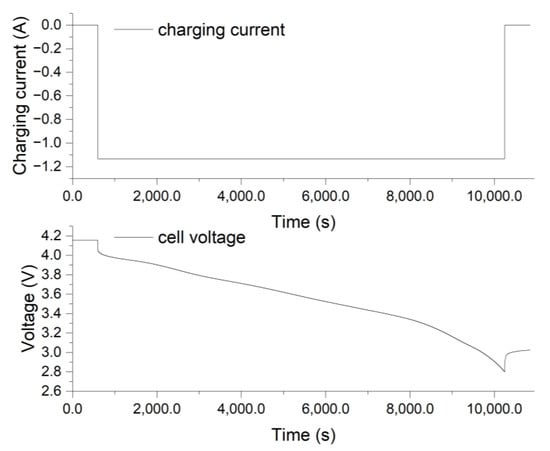
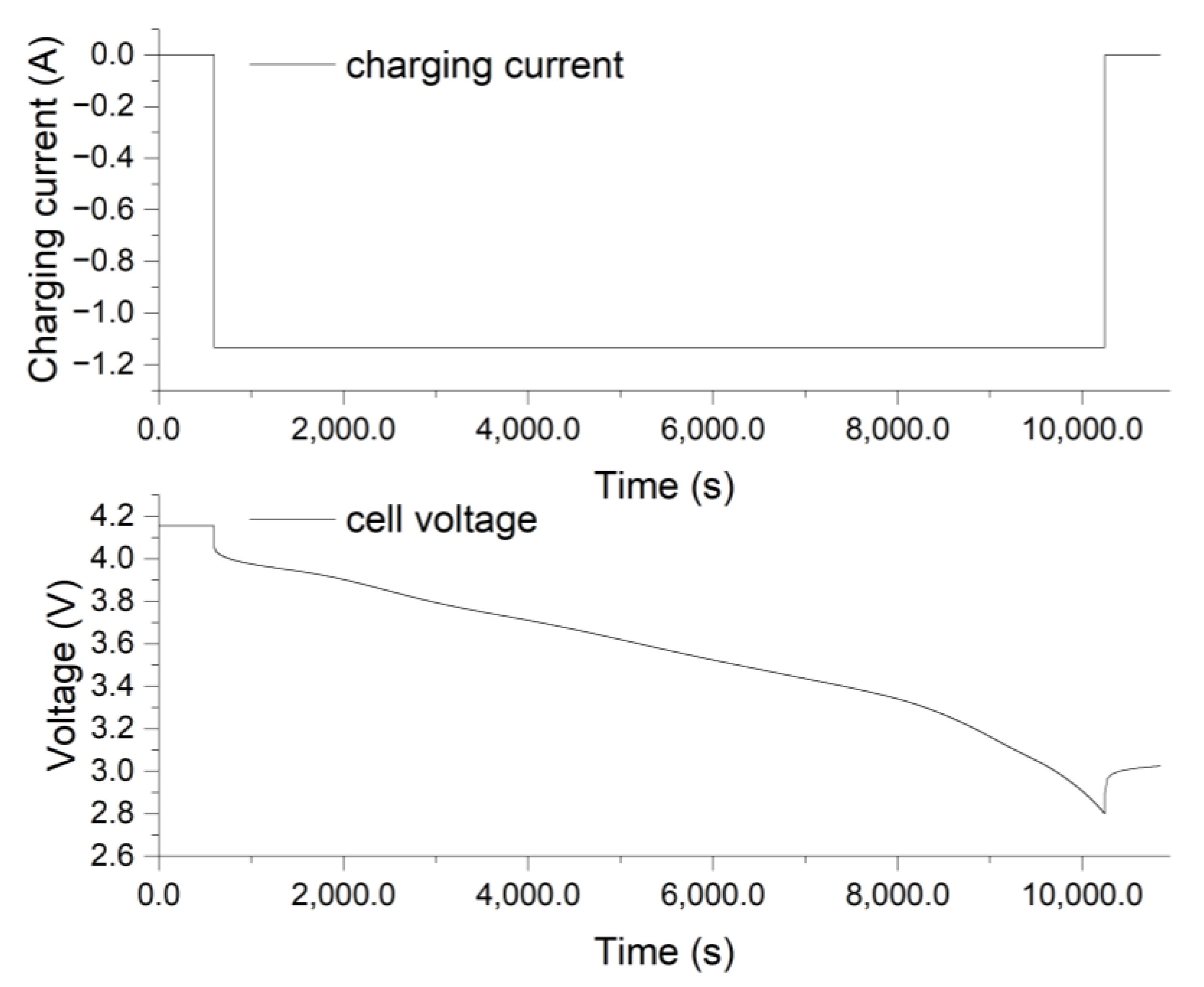
Using the NCA cell, the measurement uncertainty for capacity determination is estimated as follows The discharge current rate for each of the three cell chemistries is defined as C/3, which corresponds to −1.133 A for the NCA cell. As soon as the lower voltage limit of the NCA cell, 2.8 V, is achieved, the discharge ceases. For the NCA cell, the capacitance measurement uncertainty is evaluated using the discharge performed in subchapter 5.6, step 2.1. This discharge lasted for 9644.0 s, resulting in a discharge capacity of 3.04 Ah. Figure 1 depicts the discharge voltage and current curves of the NCA cell at 25 °C.
Figure 1.
I and U course of the NCA cell when determining the capacity.
Equation (1) is used to compute the contribution of the time-base uncertainty to the discharge capacity uncertainty, ∆Qt,D. The discharge capacity is computed as , where and denote the start and end time stamps of the discharge (i.e., the first and last sampled data points used for capacity integration). Therefore, and , and a conservative worst-case propagation (absolute-sum) is adopted. The time-stamp uncertainty is dominated by the tester sampling time base, thus . Using the discharge current I = -1.133 A and a time measurement uncertainty of 0.1 s associated with the tester sampling rate.
Incorporating the measured discharge capacity of 3.04 Ah and the discharge time of 9644.0 s into Equation (2), a uniform self-discharge rate of 2% per month was adopted for all chemistries as a conservative, literature-based reference at room temperature. In Equation (2), denotes the fractional self-discharge rate (i.e., loss per unit time normalized by , with units of ). Accordingly, the self-discharge contribution is modeled as , where s converted to the time unit of the experiment (seconds) before evaluation. While self-discharge can depend on cell chemistry, electrolyte formulation, and SEI/CEI stability, the objective here is not to resolve chemistry-specific self-discharge mechanisms, but to ensure a consistent uncertainty framework across the compared cells. Importantly, within the present test duration, the corresponding self-discharge contribution is negligible compared with the dominant uncertainty drivers (notably current, temperature, and starting-voltage-related effects), and a self-discharge rate deviating from 2% per month would not meaningfully change the estimated capacity uncertainty or the comparative conclusions across NCA, NMC, and LFP. Therefore, this assumption is treated as a robust sensitivity-bound approximation for short-term characterization rather than a chemistry-specific descriptor. Future work may incorporate independently measured self-discharge rates for each chemistry to refine absolute long-term projections.
The direct effect of the current measurement on the discharge-capacity uncertainty can be estimated using Equation (3) by multiplying the discharge duration by the battery cell tester’s current measurement uncertainty . This results in the current measurement’s direct uncertainty contribution, , as shown in Equation (3). Due to the Peukert effect, capacitance is current-dependent.
Due to the Peukert effect, the measured capacity is current-dependent. In the next stage, the uncertainty resulting from this current dependence is estimated using Equation (4), considering the discharge current , its uncertainty , the discharge duration , and the Peukert exponent of the NCA cell .
The uncertainty of the temperature chamber and the temperature inhomogeneities within it are not considered for the direct effect of temperature. Temperature deviations between the ambient temperature and the cell temperature can only be approximated to a limited degree due to factors such as the discharge current rate and the chemistry of the cell. Therefore, the average cell temperature measured during discharge is factored into the uncertainty of temperature measurement.
Although the thermal chamber ensured stable ambient control, radial internal–external temperature gradients on the order of ~3–5 °C have been reported for 18650-format cells at comparable moderate rates (including ~C/3), indicating that surface-mounted thermocouples may underestimate the core temperature, particularly for chemistries with higher ohmic and polarization contributions such as LFP. Consistent with these experimental observations, this work treats the potential internal heating mismatch as a systematic contributor in the uncertainty framework by adopting a conservative effective temperature band that combines the sensor uncertainty (±1 K) with an additional estimated radial gradient term (≈2 K). This approach does not resolve the full transient thermal field inside the jelly roll, but it bounds the plausible internal–external offset in a way that is chemistry-aware and therefore prevents over-interpreting small inter-chemistry differences. Importantly, because the present comparisons are performed under the same controlled chamber conditions and modest C-rate, any residual internal–surface deviation is expected to remain within this expanded uncertainty envelope and is therefore unlikely to alter the main comparative trends reported across NCA, NMC, and LFP cells.
During discharge, the average temperature of the NCA cell was measured to be 26.9 °C. To quantify the temperature-related capacity uncertainty, we consider two conservative temperature-uncertainty contributions: (i) the temperature sensor measurement ambiguity, , and (ii) an additional test-related temperature uncertainty, , accounting for spatial/temporal temperature variations during the discharge. The combined conservative temperature uncertainty is therefore . Using Equation (5) together with the capacity temperature coefficient and the measured discharge capacity , the temperature-induced capacity uncertainty contribution is estimated.
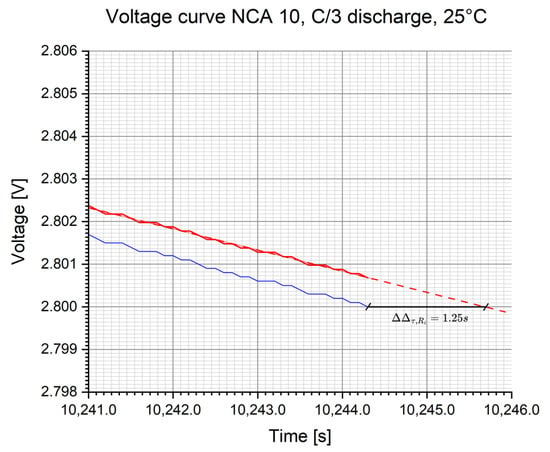
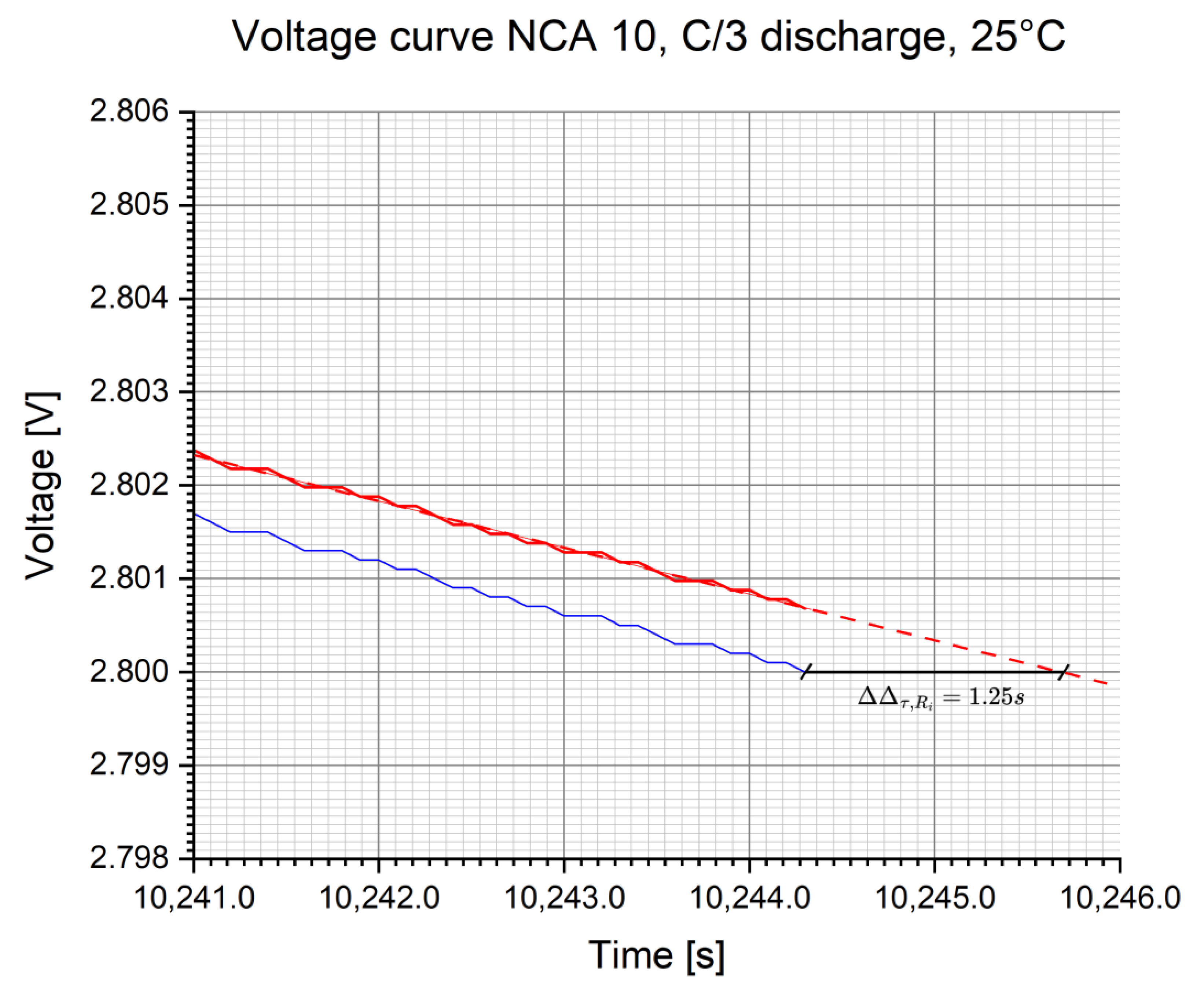
For the temperature uncertainty , which results from the temperature-related change in the internal resistance, it is necessary to calculate the modified discharge voltage profile. Due to the +1.9 °C temperature deviation between the cell and the ambient temperature in the climatic chamber, the cell’s internal resistance decreases, and its voltage rises. Using internal resistance at 25 °C, the temperature coefficient of internal resistance, the deviation in cell temperature, and the discharge current, it is possible to calculate the temperature-related increase in cell voltage. Due to the increased voltage of the cell, the lower voltage limit is reached later. Consequently, both the discharge time and discharge capacity are increased.
Figure 2 depicts the voltage curve when the minimum voltage threshold is achieved. Orange represents the calculated voltage curve for the measured cell temperature. By extrapolating the voltage curve beyond the voltage limit, an uncertainty of 1.25 s in the discharge time can be determined due to the temperature deviation.
Figure 2.
Voltage curve of the NCA cell at the lower voltage limit.
The uncertainty is estimated using the temperature-related time uncertainty and the discharge current, as shown in Equation (6).
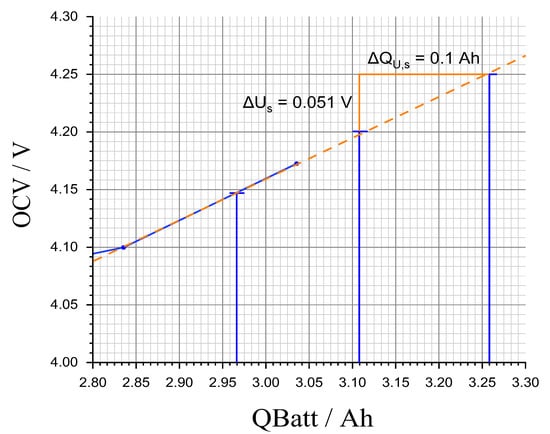
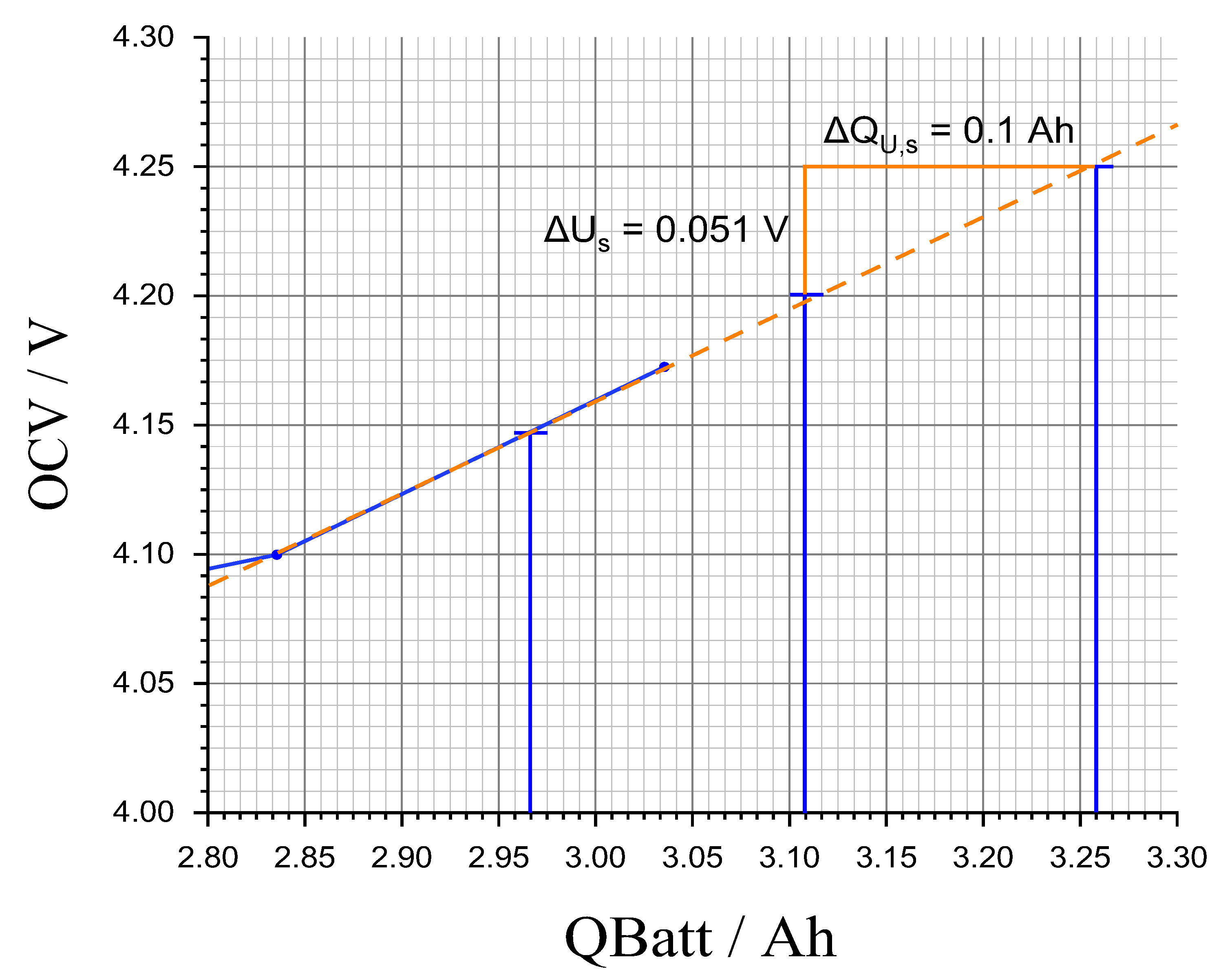
The battery cell analyzer measures the starting voltage with a measurement uncertainty of 0.005 V. The voltage uncertainty is equal to 0.046 V, which is the difference between the NCA cell’s upper voltage limit of 4.2 V and the off-load voltage before discharge of 4.154 V. Equation (7), based on two values calculated from 0.051 V, provides the voltage uncertainty of the starting voltage .
For the uncertainty of the starting voltage, the Q-OCV curve can be extrapolated to determine the uncertainty of the capacity. Figure 3 depicts the Q-OCV curve for NCA cells. The slope of the final two sites is depicted in orange. For the voltage uncertainty of 0.051 V, a starting voltage uncertainty of 0.14 Ah is determined for the NCA cell based on the slope.
Figure 3.
Determination of the uncertainty through the starting voltage of the NCA cell.
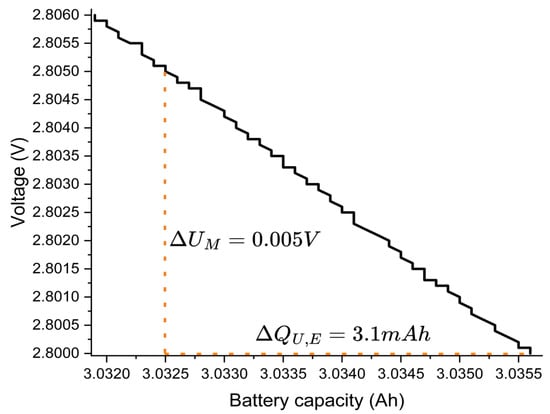
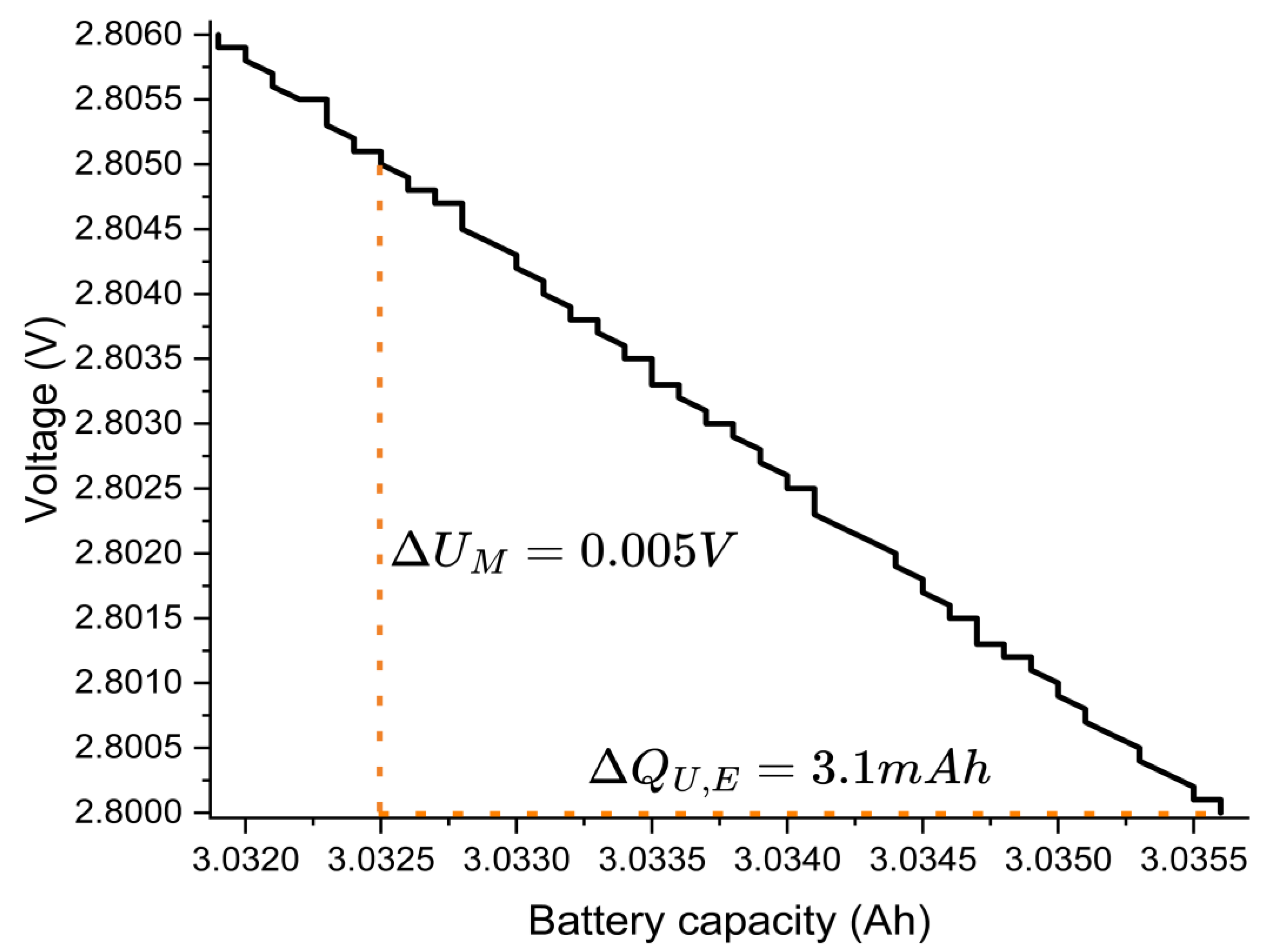
In addition to the 0.005 V voltage measurement uncertainty of the cell analyzer, the determination of the end of discharge introduces an additional uncertainty because the test is terminated when the measured voltage reaches the lower cutoff voltage. From the discharge capacity-voltage curve, the voltage uncertainty of the capacity caused by the final voltage can be determined. This results in an uncertainty of 3.1 mAh for the NCA cell (see Figure 4).
Figure 4.
Discharge capacity versus voltage curve of the NCA cell.
While this study focused on 18650-format cells, the uncertainty-propagation methodology itself is chemistry-agnostic and can, in principle, be transferred to other Li-ion chemistries (e.g., NCA, NMC, LFP, LMO) and form factors provided that geometry- and format-specific inputs are updated. Extending the analysis to CR2032 coin cells or small pouch cells would require recalculating key terms that scale with current density, surface-to-volume ratio, electrode thickness, tab/fixture resistance, and heat dissipation pathways. Coin cells typically operate at lower absolute currents with a different mechanical stack and fixture-dependent contact interfaces, which may reduce internal thermal gradients but increase the relative importance of contact/fixture-related voltage and resistance uncertainties. Conversely, small pouch cells can exhibit stronger spatial temperature and current nonuniformities due to electrode area, tab placement, and cooling boundary conditions, potentially shifting the dominant uncertainty contributions compared with cylindrical cells. Thus, we expect our qualitative conclusions on how measurement, thermal, and rate-dependent terms propagate to remain valid, but the quantitative hierarchy of uncertainty sources may differ across formats unless these format-specific factors are explicitly incorporated. The results shown in this work contribute to improving the experimental characterization of lithium-ion cells.
In practical terms, a 5–10% deviation in measured capacity translates into an approximately proportional uncertainty in cell-level usable energy, because the delivered energy scales with the integral of voltage over charge. For the 18650 cells studied here, this implies that for high-energy NCA and NMC chemistries (nominal voltages of 3.7 and 3.65 V, respectively), a 5–10% capacity difference can reasonably be interpreted as a similar-order deviation in usable energy and thus in pack-level energy density and range projections, particularly when series-string performance is constrained by the lowest-capacity cells. This magnitude is also consistent with the upper envelope of the capacity and energy uncertainty ranges quantified in this work (3.6–6.7% for capacity; 4.9–10.0% for energy), underscoring that such deviations can materially influence warranty thresholds and performance validation for these chemistries. For LFP cells (nominal voltage 3.2 V), the same 5–10% capacity deviation has a slightly different practical emphasis: beyond reducing absolute energy, it can disproportionately impact controllability of the usable SOC window in multi-cell strings, intensify balancing requirements, and increase the risk that pack runtime is limited earlier by the weakest-cell cut-off, given the flatter voltage profile typical of LFP systems.
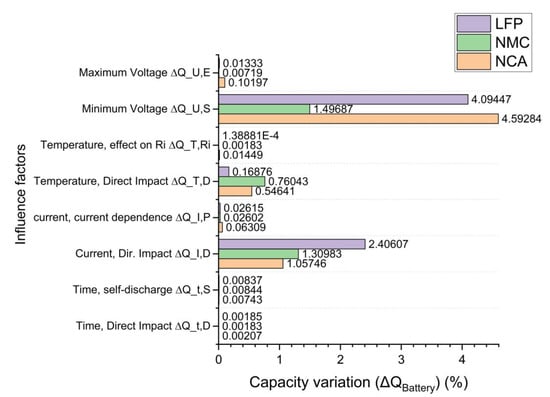
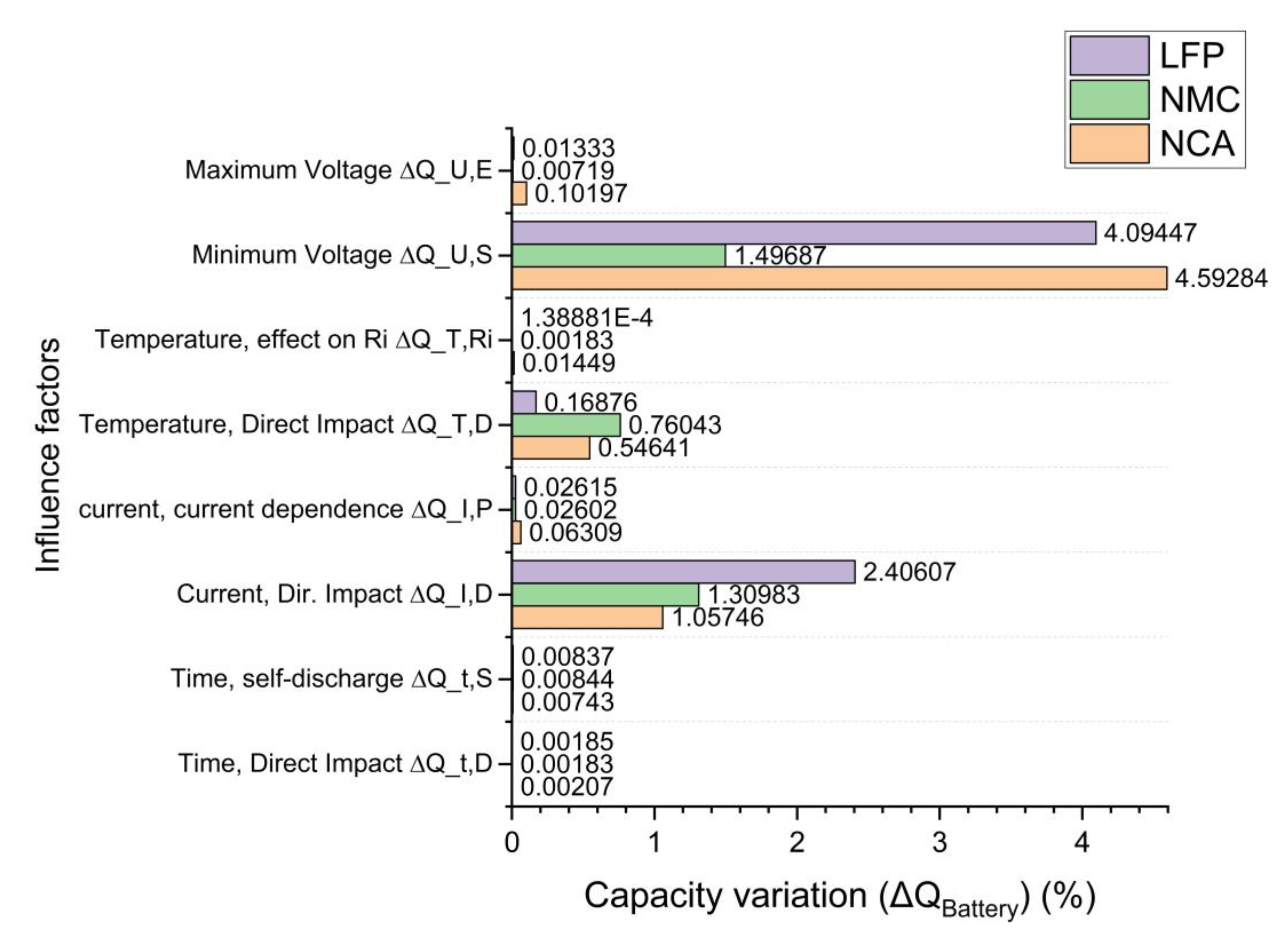
The uncertainties for the NMC and LFP cells are calculated using the same method. Based on the measured capacity, Figure 5 shows the estimated uncertainty contributions of all considered influencing factors for the three cell chemistries. The main contributors to the capacity measurement uncertainty are the direct effect of the current uncertainty and the direct effect of the time measurement uncertainty.
Figure 5.
Uncertainties in capacity in percentage temperature uncertainty, and the initial voltage uncertainty.
When examining the uncertainties for NCA, NMC, and LFP cells in Figure 5, it is important to note that factors other than cell chemistry influence the estimated uncertainties. The charging conditions and discharge currents determined based on the nominal capacities of the cells vary. Consequently, disparities in probabilities are not solely attributable to cell chemistry. The LFP cell has substantially less uncertainty due to the direct temperature effect than the NMC and NCA cells. This is due to the reduced measured temperature coefficient of the capacitance and the lower average temperature deviation of the cell during measurement. In the case of uncertainty caused by the beginning voltage, it must also be considered that the Q-OCV curves of the examined cells follow distinct paths. In the data documents for the three cell types, the cut-off current for CC-CV charging is specified with distinct values. This also influences the gap between the off-load voltage before discharge and the maximal cell voltage, which results in an effect on the capacitance’s uncertainty. In all estimations, the monthly rate of self-discharge was deemed to be 2% based on the literature. A measured self-discharge rate that deviates from this has a negligible effect on the capacitance measurement uncertainty, as demonstrated by the results.
Table 5 shows the measured capacities and the estimated measurement uncertainties for the NCA, NMC, and LFP cells. The maximum uncertainty of the measured capacity is between 3.6% and 6.7% for the three cells examined. The most relevant influencing factors for the capacity are the direct effects of the current measurement and temperature, as well as the uncertainty caused by the starting voltage.
Table 5.
Measured capacities and estimated measurement uncertainties.
5. Conclusions
This work develops a comprehensive, chemistry-aware framework to quantify and propagate measurement uncertainties for key lithium-ion battery parameters, demonstrating that uncertainty is an interpretable electrochemical and system-level variable rather than a purely instrumental artifact. For the 18650 NCA, NMC, and LFP cells evaluated under internationally standardized procedures, the maximum relative uncertainties span 3.6–6.7% for capacity, 4.9–10.4% for delivered energy, 5.6–10.0% for the set SOC at 50%, 4.9–8.8% for internal resistance (100 ms current-step method), and 1.0–1.7% for 10 s discharge power. These ranges provide a quantitative benchmark for interpreting inter-cell and inter-lab variability, and they are large enough to influence model calibration quality, performance qualification, and the definition of design and warranty margins when comparing chemistry and manufacturers.
A key practical implication is that a 5–10% deviation in measured capacity translates into an approximately proportional uncertainty in cell-level usable energy because delivered energy scales with the integral of voltage over charge. For high-energy NCA and NMC chemistries (nominal voltages 3.7 and 3.65 V), this capacity-derived uncertainty aligns with the upper envelope of the experimentally quantified ranges for both capacity and energy, indicating that such deviations can meaningfully shift pack-level energy density, range projections, and series-string-limited performance in real applications. For LFP cells (nominal voltage 3.2 V), the same magnitude of capacity deviation carries an additional system-level penalty: the flatter voltage profile amplifies operational sensitivity to weakest-cell cut-offs, narrows the practically controllable usable SOC window in strings, and increases the balancing demand, effects that are not adequately captured when uncertainty is treated as chemistry-neutral.
Mechanistically, the uncertainty budget reveals a clear hierarchy of dominant contributors across parameters. For capacity and energy, current metrology, temperature uncertainty (including temperature-driven cell response), and the starting-voltage condition are the principal drivers, whereas time-related effects, Peukert-type contributions under present conditions, and self-discharge during the measurement remain negligible. Energy uncertainty further emphasizes the non-trivial role of voltage measurement and end-voltage definition, highlighting that energy is more sensitive than capacity to voltage-related metrology and boundary conditions. Internal resistance uncertainty is dominated by temperature and voltage uncertainty, with meaningful second-order contributions from current uncertainty and the SOC-/current-dependence of Ri, underscoring that fast-pulse resistance metrics are intrinsically coupled to both metrology and cell state. For 10 s discharge power, the combined uncertainties of current, voltage, temperature, and SOC dominate the overall budget, reinforcing that power qualification requires a multi-variable uncertainty treatment rather than single-instrument specifications.
Importantly, by applying the same protocols to all cells, this study shows that differences in uncertainty magnitudes cannot be attributed solely to chemistry; manufacturer-defined charge/discharge conditions and current levels also modulate the ranking and magnitude of contributions. This finding challenges a common simplification in the literature that standardized test protocols alone yield comparable uncertainty profiles across cell types. The limitation of this assumption becomes most striking in SOC determination: while OCV-based approaches yield low uncertainty for NCA and NMC at mid-SOC (≤1%), they become unsuitable for the analyzed LFP cells (≈33%) due to the flat mid-SOC OCV slope. This highlights a chemistry-specific methodological boundary that should be explicitly stated whenever SOC metrics are compared across cell families.
From a recommendation’s standpoint, the most impactful and immediately actionable route to reducing uncertainty across all evaluated parameters is to improve current sensing accuracy and stabilize/actively manage cell temperature during standardized testing. In addition, mid-SOC OCV-based SOC determination should be avoided for LFP unless complemented by alternative methods or revised protocols that account for the intrinsic OCV insensitivity in this regime. Looking forward, the framework should be extended to larger cell populations and aged cells to separate measurement uncertainty from manufacturing scatter and degradation-induced variability and to test transferability across additional formats (pouch, prismatic, coin) and operating envelopes. Such extensions will be particularly relevant for building robust multi-chemistry datasets, improving the credibility of digital-twin parameterization, and enabling more reliable comparisons of performance and lifetime claims across manufacturers and applications.
Author Contributions
H.-G.S. proposed the concept and was the supervisor of the work. He was responsible for project administration and funding acquisition. T.H. and C.A.R.J. wrote the first draft of this manuscript. T.S.P., T.M., J.N., R.P., S.D., H.-G.S. and A.V. co-wrote the manuscript. All authors participated in data analysis and manuscript discussion. All authors have read and agreed to the published version of the manuscript.
Funding
C.A.R.J. and H.-G.S. would like to thank the Bavarian Ministry of Economic Affairs, Regional Development, and Energy in the program BayVFP Digitalisierung, grant number DIK0384/02 for their financial support. We acknowledge and are grateful for the support of the Open Access Publication Fund from Technische Hochschule Ingolstadt (THI).
Data Availability Statement
The data presented in this study are available on request from the corresponding author.
Conflicts of Interest
The authors declare no conflicts of interest.
References
- Ziegler, M.S.; Song, J.; Trancik, J.E. Determinants of Lithium-Ion Battery Technology Cost Decline. Energy Environ. Sci. 2021, 14, 6074–6098. [Google Scholar] [CrossRef] [Scilit]
- Hossain, M.H.; Chowdhury, M.A.; Hossain, N.; Islam, M.A.; Mobarak, M.H. Advances of Lithium-Ion Batteries Anode Materials—A Review. Chem. Eng. J. Adv. 2023, 16, 100569. [Google Scholar] [CrossRef] [Scilit]
- Nitta, N.; Wu, F.; Lee, J.T.; Yushin, G. Li-Ion Battery Materials: Present and Future. Mater. Today 2015, 18, 252–264. [Google Scholar] [CrossRef] [Scilit]
- Rufino Júnior, C.A.; Riva Sanseverino, E.; Gallo, P.; Koch, D.; Kotak, Y.; Schweiger, H.-G.; Zanin, H. Towards a Business Model for Second-Life Batteries—Barriers, Opportunities, Uncertainties, and Technologies. J. Energy Chem. 2023, 78, 507–525. [Google Scholar] [CrossRef] [Scilit]
- Wang, Y.; Liu, B.; Li, Q.; Cartmell, S.; Ferrara, S.; Deng, Z.D.; Xiao, J. Lithium and Lithium Ion Batteries for Applications in Microelectronic Devices: A Review. J. Power Sources 2015, 286, 330–345. [Google Scholar] [CrossRef] [Scilit]
- Rufino Júnior, C.A.; Sanseverino, E.R.; Gallo, P.; Amaral, M.M.; Koch, D.; Kotak, Y.; Diel, S.; Walter, G.; Schweiger, H.-G.; Zanin, H. Unraveling the Degradation Mechanisms of Lithium-Ion Batteries. Energies 2024, 17, 3372. [Google Scholar] [CrossRef] [Scilit]
- Morrison, J.L.; Hunt, G.L.; Marts, D.J.; Motloch, C.G. Uncertainty Study of INEEL EST Laboratory Battery Testing Systems Volume 1: Background and Derivation of Uncertainty Relationships; Idaho National Engineering and Environmental Laboratory: Idaho Falls, ID, USA; Bechtel BWXT Idaho, LLC: Idaho Falls, ID, USA, 2001. [Google Scholar]
- Rufino Júnior, C.A.; Sanseverino, E.R.; Gallo, P.; Koch, D.; Diel, S.; Walter, G.; Trilla, L.; Ferreira, V.J.; Pérez, G.B.; Kotak, Y.; et al. Towards to Battery Digital Passport: Reviewing Regulations and Standards for Second-Life Batteries. Batteries 2024, 10, 115. [Google Scholar] [CrossRef] [Scilit]
- Leuthner, S. Übersicht Zu Lithium-Ionen-Batterien; Korthauer (Hg.), R., Ed.; Springer: Berlin/Heidelberg, Germany, 2013. [Google Scholar]
- Taylor, J.; Barai, A.; Ashwin, T.R.; Guo, Y.; Amor-Segan, M.; Marco, J. An Insight into the Errors and Uncertainty of the Lithium-Ion Battery Characterisation Experiments. J. Energy Storage 2019, 24, 100761. [Google Scholar] [CrossRef] [Scilit]
- IEC 62660-1; Secondary Lithium-Ion Cells for the Propulsion of Electric Road Vehicles—Part 1: Performance Testing. International Electrotechnical Commission (IEC): Geneva, Switzerland, 2010.
- ISO 12405-4:2018; Electrically Propelled Road Vehicles—Test Specification for Lithium-Ion Traction Battery Packs and Systems—Part 4: Performance Testing. International Organization for Standardization (ISO): Geneva, Switzerland, 2018.
- Rodrigues, L.F.A.; Monteiro, H.L.M.; Ferreira, D.D.; Barbosa, B.H.G.; Rufino Junior, C.A.; Duque, C.A. Sample by Sample Power Quality Disturbance Classification Based on Sliding Window Recursive Discrete Fourier Transform. Electr. Power Syst. Res. 2024, 235, 110607. [Google Scholar] [CrossRef] [Scilit]
- Antônio Rufino Júnior, C.; Carrasco Carpio, R.; dos Santos Sousa, V. Software for Calculating the Fuel Flow and Optimization of the Mixture of Raw Materials and Fuels a Calcination Process. In Proceedings of the XXXVI Iberian Latin American Congress on Computational Methods in Engineering, ABMEC Brazilian Association of Computational Methods in Engineering, Rio de Janeiro, Brazil, 23–26 November 2014. [Google Scholar]
- Antônio Rufino Júnior, C.; Sanseverino, E.R.; Gallo, P.; Koch, D.; Schweiger, H.-G.; Zanin, H. Blockchain Review for Battery Supply Chain Monitoring and Battery Trading. Renew. Sustain. Energy Rev. 2022, 157, 112078. [Google Scholar] [CrossRef] [Scilit]
- Paul, S.; Diegelmann, C.; Kabza, H.; Tillmetz, W. Analysis of Ageing Inhomogeneities in Lithium-Ion Battery Systems. J. Power Sources 2013, 239, 642–650. [Google Scholar] [CrossRef] [Scilit]
- Kowal, J.; Arzberger, A.; Blanke, H.; Sauer, D.U. How to Determine the Time for Temperature Equalisation in Batteries and Supercaps for Reliable Laboratory Measurements. J. Energy Storage 2015, 4, 113–120. [Google Scholar] [CrossRef] [Scilit]
- Memmert GmbH + Co. KG Product Specification Universal Cabinet UF160plus. Available online: https://www.memmert.com/de/produkte/waerme-trockenschraenke/universalschrank/UF160plus/ (accessed on 15 December 2022).
- Baccouche, I.; Jemmali, S.; Manai, B.; Nikolian, A.; Omar, N.; Essoukri Ben Amara, N. Li-ion Battery Modeling and Characterization: An Experimental Overview OnNMCbattery. Int. J. Energy Res. 2022, 46, 3843–3859. [Google Scholar] [CrossRef] [Scilit]
- Stroe, D.-I.; Swierczynski, M.; Stroe, A.-I.; Knudsen Kær, S. Generalized Characterization Methodology for Performance Modelling of Lithium-Ion Batteries. Batteries 2016, 2, 37. [Google Scholar] [CrossRef] [Scilit]

Disclaimer/Publisher’s Note: The statements, opinions and data contained in all publications are solely those of the individual author(s) and contributor(s) and not of MDPI and/or the editor(s). MDPI and/or the editor(s) disclaim responsibility for any injury to people or property resulting from any ideas, methods, instructions or products referred to in the content. |
© 2026 by the authors. Licensee MDPI, Basel, Switzerland. This article is an open access article distributed under the terms and conditions of the Creative Commons Attribution (CC BY) license.