1. Introduction
As the global energy landscape evolves, understanding electricity consumption patterns has become critical for sustainable energy planning and policy formulation [
1,
2,
3]. In recent decades, electricity consumption has shown distinct trends between advanced and emerging economies [
4]. While electricity demand in OECD countries has stabilized or even declined due to structural shifts and efficiency improvements, emerging economies continue to exhibit strong growth driven by industrialization, urbanization, and income rise. Analyzing these diverging dynamics is essential for designing effective decarbonization strategies and anticipating the future trajectory of global power systems [
5].
In many advanced economies, such as the United States, residential electricity consumption per capita has stopped growing and in some cases has even declined in recent years. For example, per-capita residential electricity use in the U.S. fell by about 5% since 2010 [
6]. This trend is linked to structural changes such as a shift from electricity-intensive manufacturing to services, widespread adoption of energy-efficient appliances and lighting, and the saturation of household equipment ownership. The implication is that in mature electricity markets, growth in electricity demand is not simply a function of economic growth, but is mediated by efficiency improvements and technology saturation.
In the European Union and comparable high-income regions, overall electricity demand has plateaued, despite ongoing efforts to electrify heating, cooling, and transport. According to the International Energy Agency (IEA), this stagnation reflects multiple interacting dynamics: industrial restructuring away from heavy, electricity-intensive sectors; mandatory energy-efficiency regulations for buildings and appliances; and the increasing share of less energy-intensive services in the economy [
7].
While developed countries have experienced stabilization or even a decline in demand—driven by gains in energy efficiency, structural economic changes, and the adoption of renewable energy—developing nations continue to record accelerated growth. However, detailed studies on consumption behavior in emerging economies, such as Brazil, remain scarce, leaving a significant gap in understanding energy dynamics in these contexts.
This study analyzes Brazil’s electricity consumption trends from 2004 to 2024, focusing on the structural growth slowdown observed since 2013. Rather than developing a forecasting tool, the primary objective is to characterize asymmetric behaviors and structural shifts triggered by economic disruptions and policy interventions. To achieve this, we integrate segmented regression with an Interrupted Time Series (ITS) framework and SARIMA errors. This approach allows for the endogenous identification of breakpoints and the quantification of growth rate changes (Step and Ramp effects), providing a robust assessment of how public policies and technological advancements have reshaped the long-term consumption trajectory. In this sense, the main contributions of this paper are twofold:
This study provides an evidence-based understanding of electricity consumption dynamics in Brazil, supporting energy planning and policy design in a context strongly influenced by hydroelectric dependence and climatic variability, including droughts and El Niño events.
It contributes to the global debate on the energy transition by demonstrating the value of flexible time-series modeling approaches—such as segmented regression, ITS, and SARIMA—that can capture regional and sectoral heterogeneity in consumption patterns.
The article is organized as follows:
Section 2 provides a contextualization of global and Brazilian energy trends, highlighting key policies and technological advancements.
Section 3 describes the methodology.
Section 4 presents the results, focusing on consumption trends by sector and region. Finally,
Section 5 discusses the implications of the findings and offers recommendations for future research and energy policies.
2. Contextualization
Over the past few decades, global electricity consumption patterns have shown significant divergence between advanced and emerging economies. In developed countries, electricity demand has stabilized or even declined, driven by improvements in energy efficiency, structural economic changes, and the adoption of renewable energy sources. For instance, between 2010 and 2017, 18 of the 30 member countries of the International Energy Agency (IEA) recorded a reduction in electricity demand, largely due to energy efficiency measures. In contrast, emerging economies have experienced rapid growth in electricity consumption, fueled by industrialization, urbanization, and expanding access to electricity. The advancement of more efficient technologies, growing awareness of sustainable consumption, the adoption of renewable energy, and changes in consumption patterns have been key factors in this slowdown. Energy efficiency has played a central role, with initiatives since 2000 saving around 1800 TWh by 2017—approximately 20% of the current total electricity consumption [
7].
A relevant example is the United States, which historically exhibited an annual growth rate of 4% in residential electricity consumption between 1950 and 2010. However, starting in 2012, 48 of the 50 states reported a reduction in consumption, even during the subsequent economic recovery. This significant decline in per capita electricity consumption can be attributed to energy efficiency measures, such as the installation of 450 million LED bulbs, which resulted in a reduction equivalent to 50 million MWh/year [
6].
Additional studies corroborate the trend of slowing growth in electricity consumption in the United States. A study by [
8] highlights that electricity consumption peaked in 2007, with a sharp decline between 2008 and 2009 due to the economic recession. Despite a recovery in 2010, the downward trend persisted. For example, retail electricity sales in 2012 were 1.9% lower than in 2007. In the first ten months of 2013, there was an additional reduction of 0.7% compared to the same period in 2012.
In 2019, the growth rate of electricity consumption in OECD countries decreased by 1.1% compared to the previous year. This reduction was attributed to factors such as energy efficiency policies, changes in consumption patterns, and a significant increase in the use of renewable energy. On the other hand, in non-OECD countries, final electricity consumption reached 13,176 TWh, representing an increase of 3.8% compared to 2018. These data indicate a slowdown in consumption in advanced economies, while emerging economies continue to experience faster growth [
9].
On 10 October 2023, the European Union officially implemented a new Energy Efficiency Directive, aiming to reduce final energy consumption by 11.7% by 2030 compared to the projected use for that year, based on the 2020 reference scenario. This represents a target for primary energy consumption of 992.5 million tons [
10].
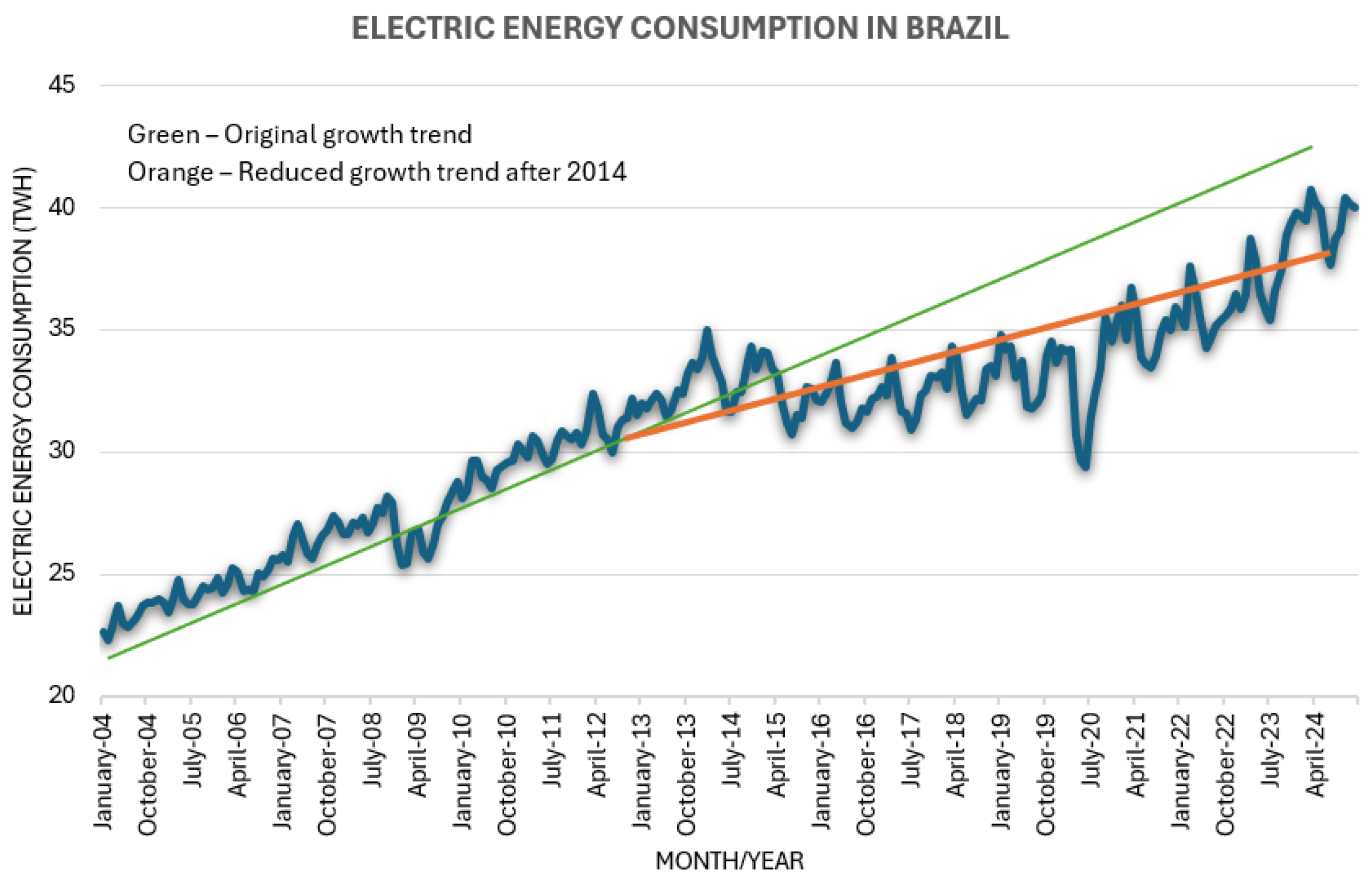
Despite Brazil being considered an emerging economy, the same trend has been visible over the years. Over the last 10 years, the electricity demand has grown steadily; however, when compared with a larger temporal dataset, the growth rate has diminished as illustrated in
Figure 1.
According to publicly available data, it is evident that the most significant regional electricity submarkets in Brazil have reduced their consumption in various sectors over the past two years, particularly in residential and industrial sectors, while other regions have experienced a small increase [
11].
Most studies primarily focus on short- and medium-term analyses, leaving a significant gap in long-term perspectives. This lack of a broader approach makes it difficult to gain a more comprehensive view, especially in contexts where cumulative impacts and structural changes are relevant.
Trotter et al. [
12] presented a methodology that calibrates an electricity demand model using daily demand data from the Brazilian Interconnected System. The study employs a multiple linear regression approach to assess the impact of climate change on electricity demand in Brazil. A novel method is proposed to incorporate climate uncertainty into long-term forecasts, utilizing a high-resolution demand model and climate simulations to generate probabilistic projections from 2016 to 2100. The findings include annual demand projections for three socioeconomic scenarios (SSP1, SSP2, and SSP5), revealing an increase in demand until 2060, followed by a decline—except in the SSP2-RCP4.5 scenario, where the reduction occurs after 2070. Electricity demand is largely influenced by population growth, while climate uncertainty contributes to fluctuations of up to 400 TWh (±17% of the mean). The study highlights GDP as the main factor driving demand expansion, whereas the decline in population after 2040 plays a significant role in reducing consumption after 2060. Although weather variables exert a limited yet steady influence on demand, their role in increasing uncertainty is more pronounced than their effect on long-term trends.
In [
13], the authors analyzed and predicted residential electricity consumption in Brazil until 2050 using Pegels’ exponential smoothing techniques. The research utilized historical data from 1995 to 2013, as well as official projections from PDE 2014–2023 and PNE 2050. Different smoothing methods were applied, including Holt’s linear trend method, standard Pegels, and Damped Pegels, with hyperparameter optimization to improve the accuracy of the forecasts. The results indicated that the models fit well with historical data, with Damped Pegels standing out as the most effective, except in 2001, when energy rationing impacted the estimates. The study concluded that this approach could be useful not only for the residential sector but also for other areas of the energy sector, suggesting that future research should explore additional techniques to refine official projections.
The reasons behind a possible slowdown in energy demand growth are multifaceted and complex, making a comprehensive analysis of this issue beyond the scope of this study. Therefore, the focus of this work is to determine the most effective approach to modeling this behavior using mathematical tools, with an emphasis on ITS.
3. Methodology
The data used in this study were obtained from the Energy Research Office (EPE) and encompass monthly electricity consumption records from January 2004 to December 2024 [
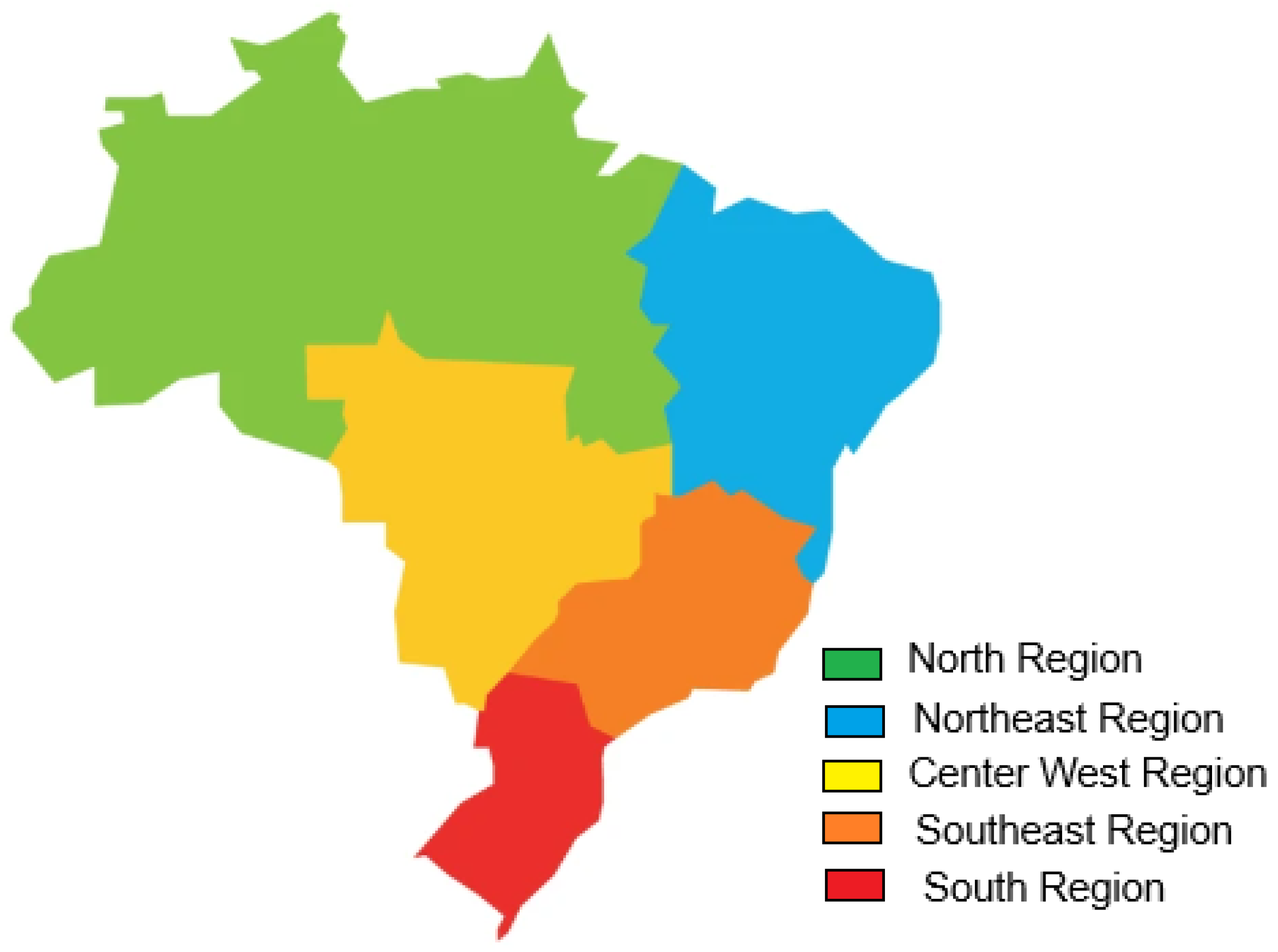
14]. The dataset includes consumption data for four main sectors—residential, commercial, industrial, and others—as well as total consumption. Additionally, the data were categorized by region, covering the North, Northeast, Southeast/Central-West, and South subsystems of Brazil, as illustrated in
Figure 2. The historical series consisted of 252 monthly observations, providing a robust basis for identifying long-term trends and structural changes.
Prior to analysis, the data underwent a rigorous pre-processing phase to ensure consistency and quality. This included addressing missing values, correcting inconsistencies, and identifying and addressing outliers that could skew the results. The cleaned dataset was then structured into a format suitable for statistical analysis using R software version 4.3.2, which was chosen for its robustness and extensive library of time series modeling packages. Next, a segmented regression technique was employed to identify structural breakpoints in the consumption trends of electricity.
3.1. Identification of Structural Breakpoints (Segmented Regression)
To avoid the arbitrary selection of intervention dates, this study initially employed segmented regression. This method allows for the endogenous identification of moments when the time series trend undergoes a significant change. The algorithm operates by minimizing the Sum of Squared Residuals (SSR) across various candidate points (), enabling the model to estimate the breakpoint parameter where the change in slope is statistically most robust. This procedure ensures that the interventions analyzed in the subsequent ITS model correspond to real phenomena of structural change within the residential, commercial, and industrial sectors.
This technique allowed for the detection of points where significant changes in consumption growth rates occurred, signaling potential impacts from policy interventions, economic shifts, or technological advancements. The segmented regression model was defined as outlined in Equation (
1), following the approach described in [
15].
where:
represents electricity consumption at time t.
intercepted before intervention.
: time trend before intervention.
: change in level after intervention (Step).
: change in trend after intervention (Ramp).
is the random error term.
3.2. Interrupted Time Series (ITS)
Once the breakpoints were identified, ITS modeling was applied to assess the impact of interventions on consumption trends.
ITS analysis is widely used to model abrupt changes in data over time, comparing the behavior of a time series before and after an intervention, such as public policies, social programs, or significant events, to assess their impact [
16]. Initially, the intervention point is defined, dividing the series into “before” and “after” periods. Stationarity tests are then applied to determine whether differentiation is required, and if seasonality is present, a SARIMA model can be used [
17].
As illustrated in
Table 1, exogenous variables were incorporated to capture different temporal patterns of variation. These include
ramp,
step,
ramp gradual, and
ramp + step functions, which enable the identification of both gradual and abrupt transitions in the historical time series. The selection of these variables is guided by the expected effects of the intervention [
18]. The parameters of the ARIMA/SARIMA models, together with the exogenous variables, are estimated using maximum likelihood methods, ensuring an adequate model fit. Subsequently, residual diagnostics are performed to assess model adequacy, where white-noise residuals indicate a satisfactory fit [
19]. This methodology was applied to evaluate reductions in the electricity consumption growth rate, improving the detection of structural changes in trends through the explicit inclusion of exogenous variables.
Some modifications could be made to these exogenous variables depending on the nature of the problem, for the particular problem of modeling a gradual growth over time a gradual ramp could be used with Log representations.
To evaluate model performance, several widely used error metrics were employed, including the Root Mean Square Error (RMSE), which measures the average squared deviation between observed and predicted values; the Mean Absolute Scaled Error (MASE), which assesses model accuracy relative to a benchmark model; and the Mean Absolute Percentage Error (MAPE), which expresses the prediction error as a percentage of the observed values. The model with the lowest predictive error was selected as the most suitable for each sector and region. In addition, sensitivity analyses were conducted by varying the break points to test the robustness of the results.
3.3. ITS-SARIMA Integration and Estimation Procedure
Due to the strong seasonal component and the inherent autocorrelation in monthly electricity data, the errors () from the ITS equation are not independent. To address this violation of linear regression assumptions, the model was integrated into a SARIMA structure.
The modeling process followed the Hyndman–Khandakar algorithm, implemented in R software. The procedure included:
Stationarity Tests: Application of the Kwiatkowski–Phillips–Schmidt–Shin (KPSS) test to determine the need for seasonal () and non-seasonal () differencing.
Automatic Selection: Minimization of the Akaike Information Criterion (AIC) to select the optimal autoregressive () and moving average () orders.
Diagnostics: Validation of residual whiteness using the Ljung–Box test, ensuring that the final model successfully captured all systematic dynamics of the series.
Finally, SARIMA models were applied to account for seasonality and autocorrelation in the data. These models were particularly effective in capturing monthly variations and long-term trends, with structures such as
and
being the most prevalent. These models were further enhanced by incorporating exogenous variables to improve their predictive accuracy. Algorithm 1 summarizes the complete ITS–SARIMA modeling pipeline adopted in this study, detailing the steps for structural break detection, variable construction, model identification, estimation, and validation for each consumer sector and region.
| Algorithm 1 ITS–SARIMA modeling pipeline for each consumer sector and region |
Require: Monthly electricity consumption time series , for Ensure: Final estimated model
- 1:
Structural break detection: - 2:
Apply segmented regression on to minimize the sum of squared residuals () - 3:
Identify the optimal breakpoint - 4:
Variable construction: - 5:
Define - 6:
Define if , otherwise - 7:
Define if , otherwise - 8:
Stationarity check: - 9:
Perform the KPSS test on - 10:
if
then - 11:
Apply non-seasonal differencing () and seasonal differencing () - 12:
end if - 13:
Model identification and estimation: - 14:
Search for SARIMA orders that minimize the Akaike Information Criterion (AIC) - 15:
Estimate intervention coefficients for () and () - 16:
Validation: - 17:
Perform the Ljung–Box test on residuals - 18:
Check coefficient significance using the criterion - 19:
Output: Final model
|
4. Results
4.1. Data
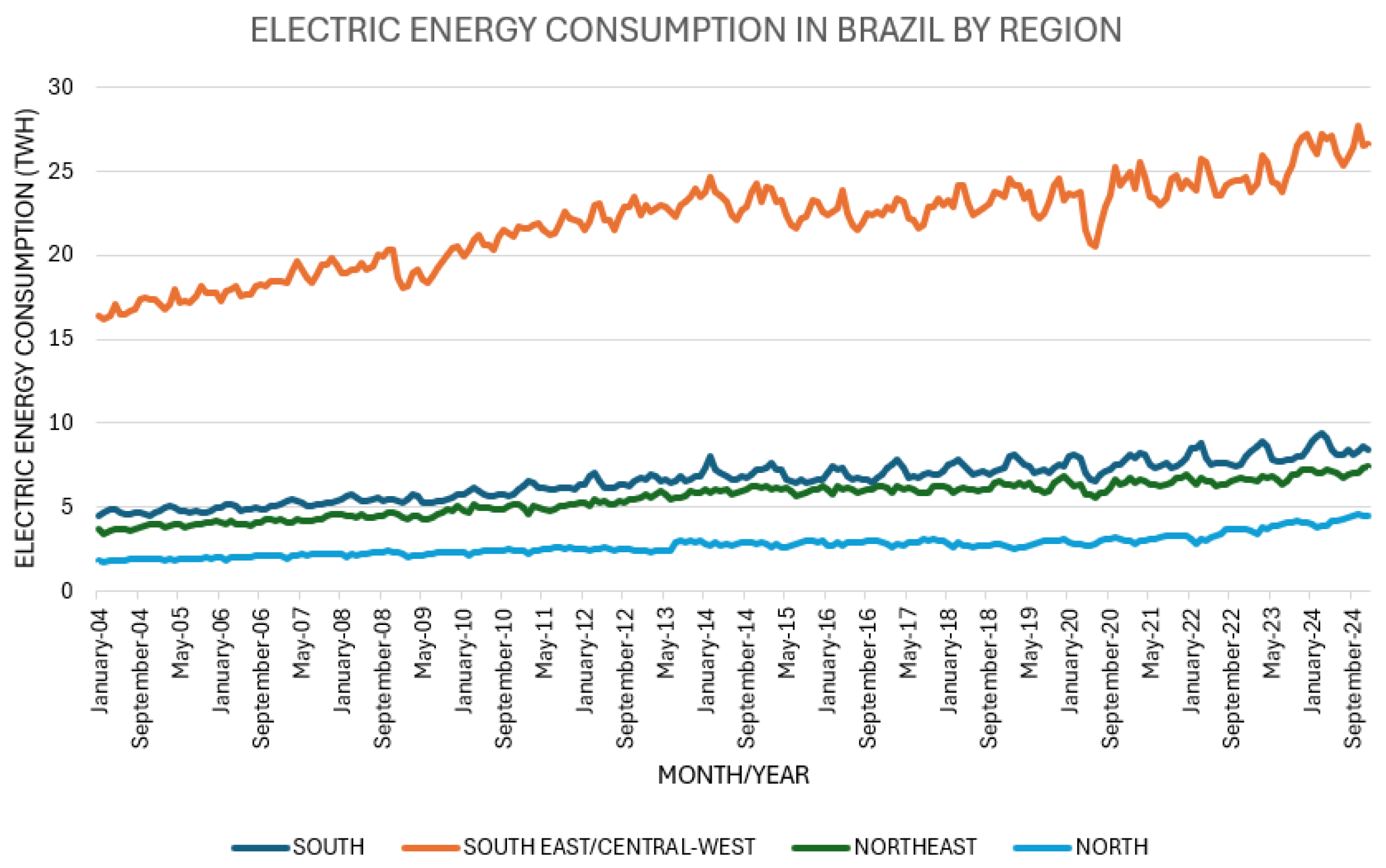
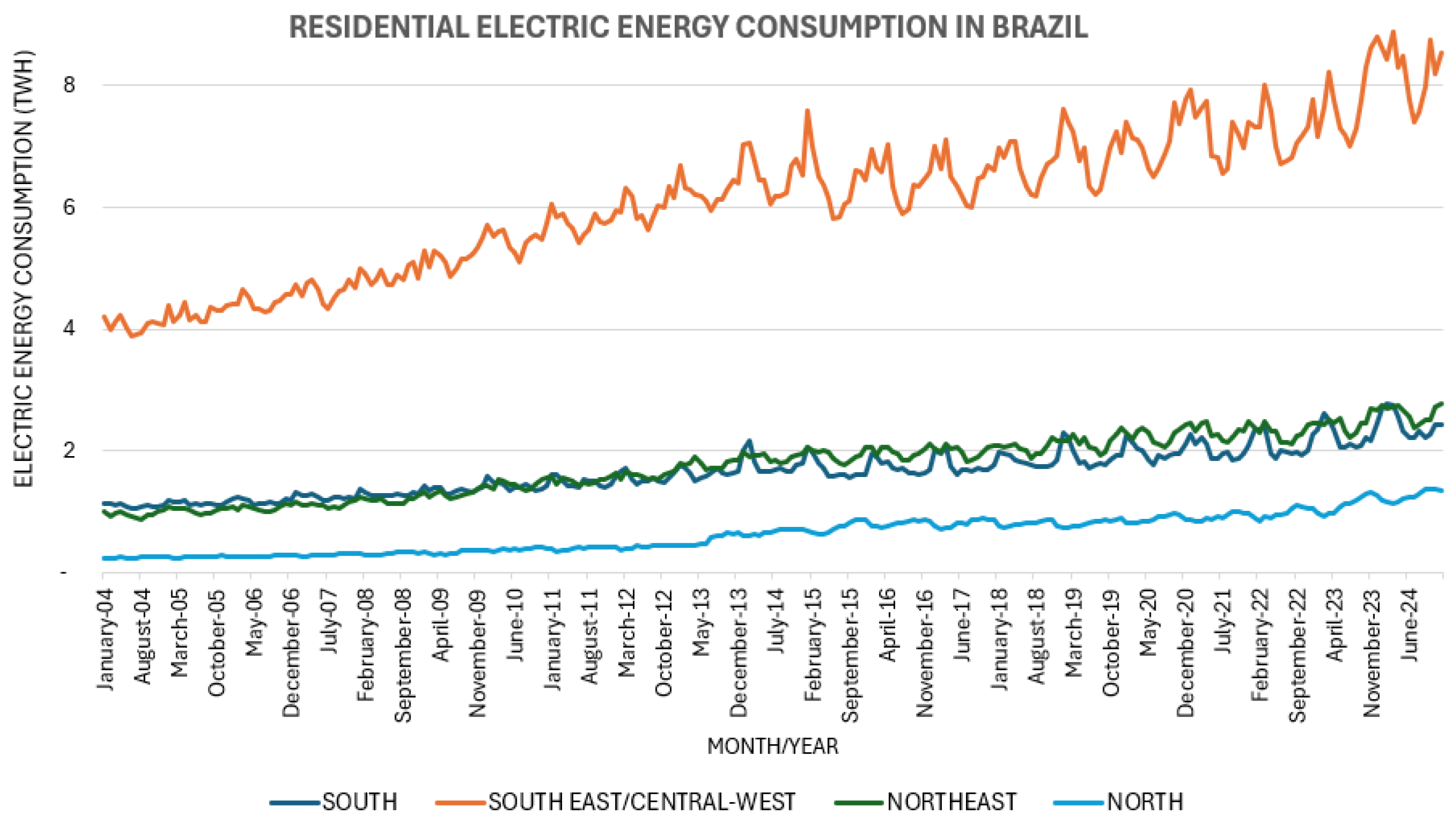
The energy consumption data were categorized into four sectors: total (
Figure 3), residential (
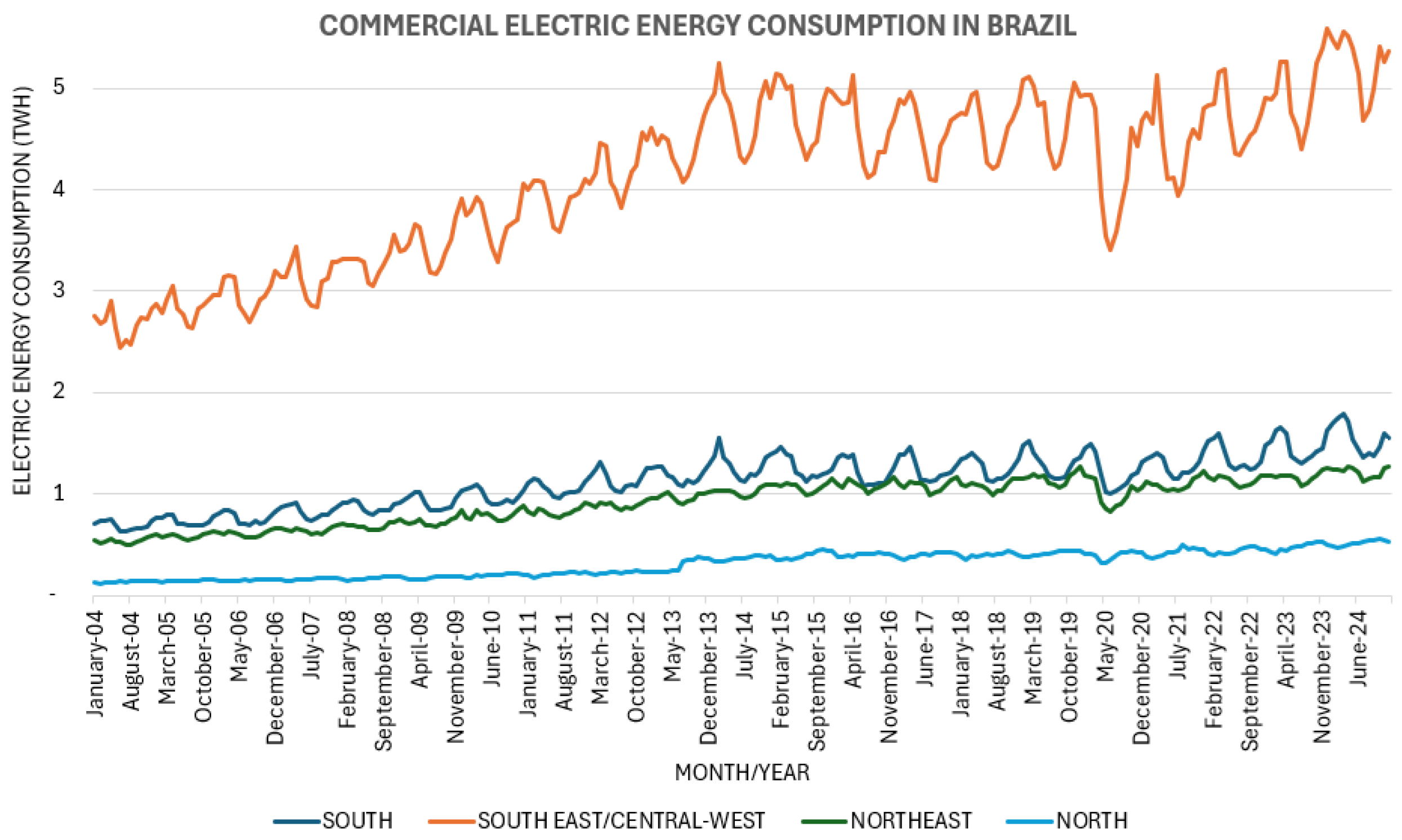
Figure 4), commercial (
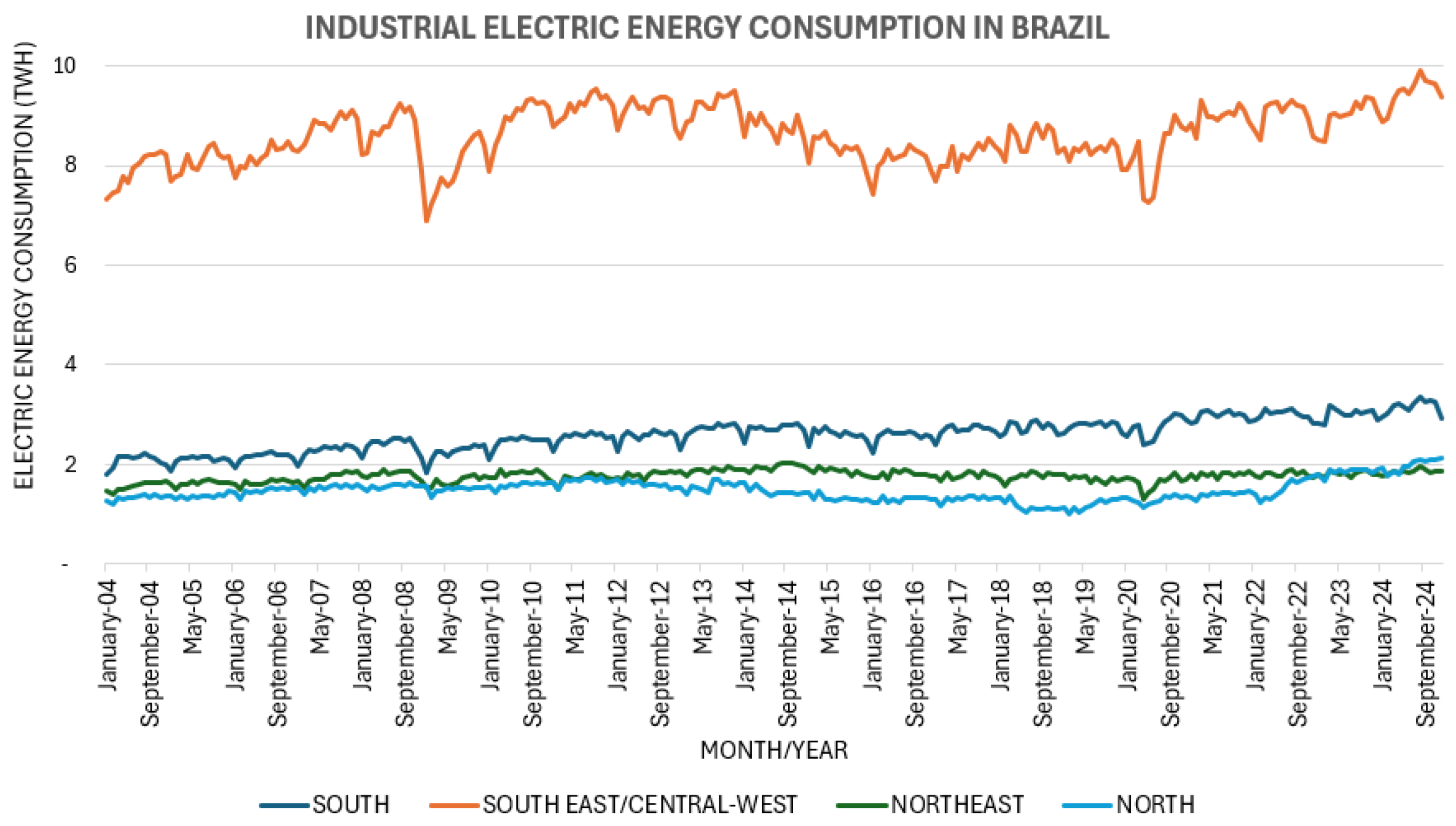
Figure 5), and industrial (
Figure 6), as well as by region, namely South, North, Northeast, and Southeast/Central-West. The historical series consisted of 252 monthly observations, covering the period from 2004 to 2024.
The data were pre-processed to remove missing values and potential errors that could distort the analysis. The final dataset was organized into a format suitable for statistical analysis using the R software. Some important factors can be identified in these datasets. The Southeast region stands out as the largest energy consumer, reflecting its economic concentration. The industrial sector, despite its historical relevance, has remained almost unchanged for more than two decades. This stagnation is in line with the premature process of deindustrialization that accelerated in the late 2000s, coinciding with the persistent overvaluation of the Brazilian real, except for brief periods of depreciation in 2008, 2013 and 2015. Meanwhile, the North and Northeast regions show steady growth in energy consumption, although their absolute values remain relatively low compared to the national total. Perhaps this pattern highlights structural disparities in energy demand, shaped by broader economic transformations [
20].
4.2. Identification of Breakpoints
Most of the identified breakpoints occurred around 2013 in the residential and commercial sectors. However, in the industrial sector, breakpoints varied across regions due to macroeconomic factors and distinct policy implementations in Brazil. For each sector, the identified breakpoints are summarized in
Table 2 and
Table 3.
The analysis of the variation in the growth rate of electricity consumption by region and sector reveals significant patterns. In the residential sector, the Northeast experienced more moderate growth after the 2000s. The energy crisis of 2001–2002 led to a nearly 13% reduction in residential consumption, and pre-rationing levels were only restored in 2006. Additionally, factors such as the adoption of more restrictive consumption habits and the expansion of electricity access through the Luz para Todos (Light for Everyone) program influenced this trend. Between 2004 and 2008, the program enabled 936,000 new connections in the region, but since most beneficiaries were low-income families, the impact on consumption growth was limited. Thus, although electricity access expanded, average residential consumption remained stable, reflecting the lower growth rate of the sector in the region [
21].
In the commercial sector, significant declines in electricity consumption were recorded across all regions, particularly between 2014 and 2016. No studies were found during the research to explain this reduction, but factors such as the closure of physical establishments and the shift to online commerce may have contributed to this decline.
In the industrial sector, there were substantial contractions, especially in the Southeast Central-West from 1.6% to 0.21% and Northeast from 1.4% to 0.6% yearly. This decline suggests a premature deindustrialization process in the country, posing challenges to scientific and technological development. Technology-intensive subsectors, which are critical for innovation, have lost 40% of their share in GDP since 1980 [
22], restricting economic growth and increasing production costs over the years [
23].
The only exception was the North region, where industrial consumption grew from 0.7% to 5.4% yearly in 2021. This increase is related to the entry of large energy-consuming industries, such as mining and metallurgy, which require high energy consumption for their operations. However, the values are small when compared with total consumption.
4.3. Modeling the Time Series with ITS
The SARIMA structures were identified following the Box–Jenkins methodology. First, stationarity was ensured through seasonal and non-seasonal differencing, supported by the inspection of ACF and PACF plots. The final orders were selected based on the minimization of the Akaike Information Criterion (AIC).
To confirm the adequacy of the selected models, we performed the Ljung–Box test on the residuals to ensure they behave as white noise. For the national models (Brazil Total), the results were as follows:
Residential sector: AIC ; Ljung–Box test (lag ) p-value .
Commercial sector: AIC ; Ljung–Box test (lag ) p-value .
Industrial sector: AIC ; Ljung–Box test (lag ) p-value .
Since all p-values are greater than , we fail to reject the null hypothesis of independence in the residuals, confirming that the models successfully captured the dynamics of the series.
The Autoregressive (AR) component represents inertia or memory in the series, that is, the extent to which current electricity consumption is influenced by its own past values. The Moving Average (MA) component represents the persistence of short-term shocks, such as atypical climatic events or sudden economic shifts. In this case, the disappearance of AR components (where ) in several regions and sectors—such as the industrial sector in the Southeast/Midwest with a SARIMA specification, and the commercial sector in the North with a SARIMA specification—indicates that, after accounting for the structural break and seasonal adjustment, the consumption trajectory no longer follows a self-sustaining momentum. Instead, it becomes primarily driven by:
Seasonal cycles, reflected in strong P, D, and Q components; and
External shocks, captured by the MA term, suggesting that consumption reacts more strongly to immediate external factors (such as price changes or supply constraints) than to its own historical baseline.
Conversely, the presence of an AR component in the residential sector, characterized by a SARIMA specification, suggests a stronger habit effect or persistence in domestic consumption patterns, whereby usage levels are more closely anchored to behavior observed in previous months.
The SARIMA model structure, diagnostic tests, and intervention parameters are summarized in
Table 4. In this case
indicates statistical significance at the 5% level (*), and
indicates statistical significance at the 1% level (**). All Ljung–Box tests were performed with 24 lags;
confirms the absence of residual autocorrelation (white noise).
4.3.1. Brazil
Several tests were conducted to examine the relationship between exogenous variables and the growth rate of electricity consumption.
Table 5 summarizes the results of these tests, reporting the errors obtained according to the criteria defined in the Methodology section for Brazil. The analysis considers 2013 as the structural break point and includes four tests, each incorporating the variables described in the interrupted time series section and the corresponding exogenous variables (EVs) used in each case.
For the national level (Brazil Total), the ITS-SARIMA model identified the following estimates for the intervention variables.
For the step intervention, the estimated coefficient is with a standard error of . The absolute value of the test statistic, computed as , exceeds the critical value of , indicating statistical significance at the level.
For the ramp intervention, the estimated coefficient is with a standard error of . The corresponding absolute test statistic is , indicating high statistical significance ().
These results confirm that both the immediate drop in electricity consumption and the sustained slowdown in growth are statistically significant.
Thus, it was concluded that the optimal model identified was SARIMA, incorporating the ramp variable. Based on the test conducted for Brazil, it was replicated for other regions such as the South, North, Northeast, and Southeast-Central West. These studies were also applied to different sectors, yielding the following results:
4.3.2. South Region
The results of the models for different sectors of electricity consumption highlight the importance of the chosen exogenous variables and the identified breakpoints (
Table 6). In the commercial sector, the breakpoint occurred in 2014, and the Ramp variable played a crucial role in modeling consumption. In the industrial sector, a significant change occurred in 2013, with the combination of Step and Ramp variables being decisive for the model’s accuracy. In the residential sector, the breakpoint was also in 2014, and the Ramp variable stood out as a relevant factor in the observed changes in energy consumption.
4.3.3. North Region
For the North region (
Table 7), the breakpoint identified was the year 2013. In the commercial sector, the model
, with the Ramp variable, achieved the best performance. In the industrial sector, the combination of the Step and Ramp variables in the model
resulted in an RMSE of 49,053.04 and a MAPE of 2.50%, reflecting an abrupt transition followed by a gradual adjustment. In the residential sector, the model
, using the Gradual Ramp variable, proved to be a better fit, showing a smooth and continuous transition in the consumption pattern.
4.3.4. Northeast Region
For the Northeast region (
Table 8), the breakpoint identified also occurred in 2013. In the commercial sector, the model
, with the Ramp variable, showed good performance. In the industrial sector, the model
, using the Ramp variable, indicated a significant adjustment in consumption. For both sectors, the
part was selected, suggesting the need for an autoregressive term, with no differencing and no moving average. In the residential sector, the combination of Step and Ramp in the model
reflected a gradual, yet steady, transition in consumption patterns.
4.3.5. Southeast/Central-West Region
In the Southeast/Central-West region (
Table 9), the breakpoints were identified in 2014 for the commercial and residential sectors, and in 2012 for the industrial sector. For the commercial sector, the model
, with the Ramp variable, performed well. In the industrial sector, the model
, using the Step and Ramp variables, indicated a significant adjustment in consumption, capturing the gradual adaptation to market changes. In the residential sector, the model
also combined the Step and Ramp variables.
The results reinforce the need for flexible models to capture the dynamics of electricity consumption across different sectors and regions. The presence of the step and ramp variables was crucial in many cases, suggesting that potential interventions significantly impact consumption patterns.
The similarity of the series values across different sectors and regions may be associated with the nature of the electricity consumption time series, which exhibit seasonal patterns and relatively homogeneous trends. The choice of SARIMA models with autoregressive (AR) terms equal to zero in most residential series suggests that temporal dependence in energy consumption is better explained by differencing and seasonal components rather than a strong direct correlation between past values of the series.
4.4. Potential Drivers of Consumption Slowdown
The identified breakpoints in electricity consumption growth (2013–2016) align with several policy, economic, and technological shifts in Brazil. While causality cannot be definitively established, four key factors emerge as plausible contributors:
The main contributions of this work are presented as follows:
- 1.
Energy Efficiency Policies The phased ban on incandescent bulbs (2005–2016) and PROCEL efficiency programs likely reduced residential demand. Though the 2016 sales prohibition postdates most breakpoints [
24], early adoption of efficient lighting (e.g., LEDs) after initial restrictions (2010) may explain the 2013 residential sector inflection [
25]. This may be one of the reasons behind the slowdown in the residential energy consumption growth rate, which decreased from 5.1% to 1.3% after the breakpoint.
- 2.
Distributed mini and micro generation Solar energy and small-scale distributed generation began to be implemented in Brazil in 2011. By 2024, their installed capacity surpassed 50,000 MW, representing around 20% of the country’s electricity matrix. However, until 2021, their impact remained relatively insignificant. Therefore, while some of the reduction in load growth may be attributed to behind-the-meter consumption, this does not explain the changes observed from the identified breakpoints onward. Still, the timing of the deceleration in load growth and the initial deployment of this technology presents an interesting coincidence [
26].
- 3.
Economic Recession (2014–2016) GDP contraction during this period (from the last quarter of 2014 to the last quarter of 2016) reached −8.6% over 11 quarters, and rising unemployment directly suppressed industrial and commercial demand. Notably, the observed breaking points in the industrial sector (2010–2013) preceded the recession, suggesting that structural decline—marked by deindustrialization—may have exacerbated the crisis [
27]. Structural Economic Shifts
Current data cannot isolate individual factor impacts.
5. Conclusions
This study demonstrates that the slowdown in Brazil’s electricity consumption observed since 2013 cannot be attributed to a single factor, but rather to the combined effects of structural changes, macroeconomic shocks, and long-term policy interventions. Using segmented regression and interrupted time series (ITS) modeling, three distinct phases in the evolution of electricity demand were identified.
The deindustrialization phase (2007–2013) represents the initial structural shift, during which growth in industrial electricity consumption stagnated. This trend reflects a loss of global competitiveness in manufacturing and the adoption of domestic economic policies that favored commodity exports over industrial production, leading to a sustained reduction in energy-intensive activities.
The economic crisis period (2014–2016) intensified this slowdown, causing an abrupt decline in commercial and residential electricity demand as unemployment increased and business activity contracted. Importantly, the subsequent economic recovery did not reinstate pre-crisis demand growth rates, as improvements in energy efficiency partially offset the rebound in economic activity.
The policy-driven efficiency phase (2013–2025) introduced structural changes with long-lasting effects on electricity consumption. Energy efficiency measures, particularly PROCEL’s large-scale lighting replacement programs, along with the accelerated adoption of distributed solar generation in later years, permanently reduced demand growth trajectories. The expansion of solar distributed generation after 2020 further decoupled economic activity from grid-supplied electricity consumption, especially in commercial and industrial sectors.
No single factor explains the full slowdown. Instead, their interplay created a compounding effect: deindustrialization reduced baseline demand, the crisis accelerated declines, and efficiency policies institutionalized lower growth.
The application of SARIMA models allowed for a detailed examination of seasonal variations and long-term trends, demonstrating their effectiveness in forecasting electricity consumption. The findings underscore the importance of flexible modeling approaches in capturing the complexities of electricity consumption across different sectors and regions. Seasonal models, such as and , were the most prevalent, emphasizing the critical role of monthly seasonality in consumption patterns. Autoregressive terms, including and , highlighted the strong influence of past consumption behavior on future predictions, reinforcing the need to account for long-term trends in energy planning.
Among the exogenous variables analyzed, the ramp variable proved to be the most effective, reflecting the gradual nature of consumption changes over time. This suggests that interventions, or the confluence of causes, led to a smooth transition rather than abrupt shifts in consumption patterns. In contrast, the step variable was less effective, as it is better suited for capturing sudden changes, which were not observed in this context.
These insights are not only relevant for Brazil but also for other emerging economies facing similar challenges. This research provides valuable guidance for policymakers and energy planners, emphasizing the need for adaptive strategies that account for regional and sectoral differences in consumption patterns. Future studies should explore the integration of additional variables, such as economic indicators and climate data, macroeconomic modeling, and net metering effects of DG.
Future work may explore variations in demand and generation sources, especially by including photovoltaic systems in the network. This requires stochastic approaches to expand the applicability of the proposed model.
Author Contributions
Conceptualization, A.B.B.R. and E.M.C.-F.; methodology, A.B.B.R. and E.M.C.-F.; software, A.B.B.R. and E.M.C.-F.; validation, A.B.B.R., E.M.C.-F., J.M.L.-L. and N.M.-G.; formal analysis, A.B.B.R. and E.M.C.-F.; investigation, A.B.B.R., E.M.C.-F., J.M.L.-L. and N.M.-G.; resources, A.B.B.R., E.M.C.-F., J.M.L.-L. and N.M.-G.; data curation, A.B.B.R. and E.M.C.-F.; writing—original draft preparation, A.B.B.R. and E.M.C.-F.; writing—review and editing, A.B.B.R., E.M.C.-F., J.M.L.-L. and N.M.-G.; visualization, A.B.B.R., E.M.C.-F. and J.M.L.-L.; supervision, E.M.C.-F., J.M.L.-L. and N.M.-G.; project administration, A.B.B.R., E.M.C.-F., J.M.L.-L. and N.M.-G.; funding acquisition, E.M.C.-F., J.M.L.-L. and N.M.-G. All authors have read and agreed to the published version of the manuscript.
Funding
This work was funded by Brazil National Council for Scientific and Technological Development (CNPq) PIBPG-2022, Process 131077/2023-6.
Data Availability Statement
The original contributions presented in this study are included in the article. Further inquiries can be directed to the corresponding author.
Acknowledgments
The authors would like to acknowledge Department of Electrical and Computer Engineering, UNIOESTE; and the Department of Electrical Engineering at University of Antioquia (UdeA).
Conflicts of Interest
The authors declare no conflicts of interest.
References
- Wang, Y.; Jia, M.; Gao, N.; Von Krannichfeldt, L.; Sun, M.; Hug, G. Federated clustering for electricity consumption pattern extraction. IEEE Trans. Smart Grid 2022, 13, 2425–2439. [Google Scholar] [CrossRef]
- Misra, U.; Ranjan Sahoo, G.; Prakash, S.; Srivastava, M. Unraveling power consumption pattern using multidimensional scaling and clustering analysis. IEEE Access 2025, 13, 13573–13583. [Google Scholar] [CrossRef]
- Botman, L.; Soenen, J.; Theodorakos, K.; Yurtman, A.; Bekker, J.; Vanthournout, K.; Blockeel, H.; De Moor, B.; Lago, J. A scalable ensemble approach to forecast the electricity consumption of households. IEEE Trans. Smart Grid 2023, 14, 757–768. [Google Scholar] [CrossRef]
- Ugbehe, P.O.; Diemuodeke, O.E.; Aikhuele, D.O.; Okedu, K.E.; Kalnoor, G. Estimation and forecasting of Nigeria’s residential, commercial, and industrial electricity demands. IEEE Access 2025, 13, 112081–112101. [Google Scholar] [CrossRef]
- Weber, C. Achievements and challenges in European energy markets. J. Mod. Power Syst. Clean Energy 2023, 11, 698–704. [Google Scholar] [CrossRef]
- Davis, L.W. Evidence of a decline in electricity use by U.S. households. Econ. Bull. 2017, 37, 1098–1105. [Google Scholar]
- Case of Disappearing Electricity Demand. Available online: https://www.iea.org/commentaries/the-mysterious-case-of-disappearing-electricity-demand (accessed on 25 October 2024).
- Nadel, S.; Young, R. Why Is Electricity Use No Longer Growing? American Council for an Energy-Efficient Economy: Washington, DC, USA, 2014; pp. 1–3. [Google Scholar]
- Electricity Consumption—Electricity Information: Overview—Analysis. Available online: https://www.iea.org/reports/electricity-information-overview/electricity-consumption (accessed on 20 October 2024).
- Energy Efficiency Directive. Available online: https://energy.ec.europa.eu/topics/energy-efficiency/energy-efficiency-targets-directive-and-rules/energy-efficiency-directive_en (accessed on 11 October 2024).
- Statistical Yearbook of Electric Energy 2023. Available online: https://www.epe.gov.br/sites-pt/publicacoes-dados-abertos/publicacoes/PublicacoesArquivos/publicacao-160/topico-168/anuario-factsheet.pdf (accessed on 12 November 2025).
- Trotter, M.; Bolkesjo, T.F.; Féres, J.G.; Hollanda, L. Climate change and electricity demand in Brazil: A stochastic approach. Energy 2016, 102, 596–604. [Google Scholar] [CrossRef]
- Maçaira, P.M.; Souza, R.C.; Oliveira, F.L.C. Modelling and Forecasting the Residential Electricity Consumption in Brazil with Pegels Exponential Smoothing Techniques. Procedia Comput. Sci. 2015, 55, 328–335. [Google Scholar] [CrossRef]
- Monthly Electricity Consumption by Class (Regions and Subsystems). Available online: www.epe.gov.br/pt/publicacoes-dados-abertos/publicacoes/consumo-de-energia-eletrica (accessed on 15 November 2024).
- Penfold, R.B.; Zhang, F. Use of Interrupted Time Series Analysis in Evaluating Health Care Quality Improvements. Acad. Pediatr. 2013, 13, S38–S44. [Google Scholar] [CrossRef] [PubMed]
- Linden, A. Conducting interrupted time-series analysis for single- and multiple-group comparisons. Stata J. Promot. Commun. Stat. Stata 2015, 15, 480–500. [Google Scholar]
- Forecasting: Principles and Practice. Available online: https://otexts.com/fpp2/ (accessed on 10 November 2024).
- Box, G.E.; Jenkins, G.M. Time Series Analysis: Forecasting and Control, 5th ed.; John Wiley & Sons: Hoboken, NJ, USA, 2008; pp. 154–196. [Google Scholar]
- Brockwell, P.J.; Davis, R.A. Introduction to Time Series and Forecasting, 3rd ed; Springer: New York, NY, USA, 2013. [Google Scholar]
- Nassif, A.; Feijó, C.; Araújo, E. The case for reindustrialization in developing countries: Towards the connection between the macroeconomic regime and the industrial policy in Brazil. Camb. J. Econ. 2017, 42, 355–381. [Google Scholar] [CrossRef]
- Achão, C.; Schaeffer, R. Decomposition analysis of the variations in residential electricity consumption in Brazil for the 1980–2007 period: Measuring the activity, intensity and structure effects. Energy Policy 2009, 37, 5208–5220. [Google Scholar] [CrossRef]
- Morceiro, P.C.; Guilhoto, J.J.M. Sectoral Deindustrialization and Long-Run Stagnation of Brazilian Manufacturing. Braz. J. Political Econ. 2023, 43, 418–441. [Google Scholar]
- Annual Industrial Survey. Available online: https://www.ibge.gov.br/estatisticas/economicas/industria/9042-pesquisa-industrial-anual.html?=&t=series-historicas (accessed on 10 January 2025).
- Burini Junior, E.C.; Martinez Melero, J.C.; Santos, E.R. Performance from SSL Lamps Used in the Brazilian Residential Sector. In Proceedings of the 11th International Conference on Energy Efficiency in Domestic Appliances and Lighting (EEDAL’21), Toulouse, France, 24 February 2023; pp. 547–563. [Google Scholar]
- Braga, M.F.; Mota, J.F.B.; Theodoro, T.S.; de Oliveira, Y.C.L.; Junior, C.L.S.; Braga, H.A.C. 60W incandescent lamp alternatives found in Brazilian market. In Proceedings of the 2014 11th IEEE/IAS International Conference on Industry Applications, Juiz de Fora, Brazil, 7–10 December 2014; pp. 1–8. [Google Scholar]
- Brazilian Association of Photovoltaic Solar Energy (ABSOLAR), “Infographic”. Available online: www.absolar.org.br/mercado/infografico/ (accessed on 5 March 2025).
- De, H.; Garbe, S. The Brazilian Economic Crisis during the Period 2014–2016: Is There Precedence of Internal or External factors? J. Int. Glob. Econ. Stud. 2019, 12, 66–86. [Google Scholar]
| Disclaimer/Publisher’s Note: The statements, opinions and data contained in all publications are solely those of the individual author(s) and contributor(s) and not of MDPI and/or the editor(s). MDPI and/or the editor(s) disclaim responsibility for any injury to people or property resulting from any ideas, methods, instructions or products referred to in the content. |




 ,
,