Article

Understanding Hydropower Generation Across Countries Through Innovation Diffusion Models

Department of Statistical Sciences, University of Padua, 35121 Padua, Italy
*
Author to whom correspondence should be addressed.
Energies 2026, 19(3), 606; https://doi.org/10.3390/en19030606 (registering DOI)
Submission received: 4 December 2025 / Revised: 9 January 2026 / Accepted: 21 January 2026 / Published: 24 January 2026

Abstract

The world is increasingly confronted with interconnected challenges such as energy shortages and climate change. Fossil fuels, including coal, oil, and natural gas, remain the dominant global energy sources, yet they are major contributors to greenhouse gas emissions and growing geopolitical instability. In response to energy insecurity and environmental pressures, many countries are expanding their use of renewable energy sources, including hydropower, solar, wind, and geothermal. Hydropower currently generates more electricity than all other renewable technologies combined and is expected to remain the largest source of renewable electricity through the 2030s. This paper analyzes the role of hydropower in national energy transitions by applying innovation diffusion models. Using an innovation diffusion framework, via the Bass Model, we examine the dynamics of hydropower generation across multiple countries and find that this approach effectively captures the mean nonlinear trajectory of most countries. We complete the analysis by evaluating the effect of rainfall on hydropower generation and show that this helps capture the residual variability not modeled by the Bass Model.

1. Introduction

The conflicts in the Middle East and Ukraine have exposed persistent vulnerabilities in global energy security. While the immediate impacts of the global energy crisis began to ease in 2023, the likelihood of renewed disruptions remains substantial. These events have demonstrated how quickly energy dependencies can evolve into structural weaknesses. This insight extends to clean energy supply chains as well, which are frequently characterized by high market concentration. As highlighted in the International Energy Agency’s (IEA) annual report [1], both conventional and clean energy markets are becoming increasingly fragmented. This fragility underscores the continued significance of energy security and reinforces the need for cleaner, more resilient, and more efficient energy systems.
The global transition to clean energy has accelerated in recent years, driven not only by climate policies but also by economic and social pressures. Consequently, the future energy landscape is growing more complex and challenging to navigate. In this evolving setting, the IEA identifies several prominent trends [1]: (i) mounting geopolitical tensions are intensifying competition among energy technologies; (ii) the pace of the clean energy transition remains uncertain; and (iii) electricity demand is rising rapidly, though future growth trajectories remain difficult to predict.
Navigating these uncertainties is both demanding and crucial for a comprehensive understanding of the global energy transition. A defining feature of this transition is the uneven rate at which renewable energy technologies (RETs) are adopted and integrated into national energy mixes. Countries such as Germany and Denmark exemplify effective policy execution and strong societal backing for clean energy, whereas many others continue to face significant barriers, due, for example to strong dependence from fossil fuels, which generates the so-called carbon lock-in phenomenon [2], lack of adequate incentive measures or governmental support, giving rise to financial difficulties as private citizens or local authorities cannot afford the high initial costs of the transition [3], weak social awareness and public acceptance of the need to reduce carbon emissions, and decrease the reliance on oil, coal, and gas.
RETs, including solar, wind, hydro, and biomass, are central to building low-carbon energy systems, which are essential for mitigating climate change and strengthening energy security. The electricity sector plays a particularly important role in this transformation, with recent rapid growth in solar photovoltaic and wind installations, supported by adequate policy frameworks and national targets.
In this context, predicting the diffusion of RETs is crucial for effective energy planning and target-setting. However, limited time-series observations and pronounced nonlinear patterns reduce the effectiveness of traditional forecasting approaches such as ARIMA models. An alternative that has shown strong performance in modeling energy system dynamics is innovation diffusion modeling, which captures the nonlinear and evolving nature of technology adoption. Building on the pioneering work of [4,5], a growing body of research has applied diffusion models to energy transitions. These models treat energy technologies as innovations that must gain market acceptance through collective decision-making influenced by factors such as prices, incentives, and tariffs. See, for example [6,7]. Other pioneering works that employed growth curve models to predict or explain the diffusion of renewable energy are those by [3,8,9,10,11]. However, this literature has predominantly examined renewable technologies such as solar and wind, whereas hydropower has received little to no attention.
A central premise for the usage of these models is that societies act as learning systems, where information flows, social influence, and knowledge diffusion facilitate adoption. This process is well described by frameworks such as the Bass Model (BM) by [12]. Nevertheless, the adoption of RETs often encounters barriers, including technological complexity, high upfront costs, and administrative burdens. As emphasized by [13], characteristics typical of renewable technologies, such as low capacity factors, storage requirements, and decentralized deployment, introduce structural disadvantages. In [3], the authors further contend that many RETs are not financially viable without targeted policy support.
To mitigate these challenges, policy mechanisms like feed-in tariffs have been implemented to stimulate market uptake. The Generalized Bass Model (GBM), introduced by [14], has been instrumental in assessing the effects of such policies. The model accounts for the initial hesitation of early adopters and demonstrates how incentives can substantially accelerate diffusion. Additionally, the GBM improves forecasting accuracy by capturing the nonlinear adoption paths typical of renewable technologies.
Recent developments in the field further extend diffusion modeling to consider competition between renewable and conventional technologies. Multivariate approaches, such as those proposed by [15], deepen understanding of energy market interactions and enhance the predictive capabilities of adoption models.
The literature on innovation diffusion in energy markets has predominantly focused on renewable sources such as solar and wind power, given their remarkable expansion in recent years. For reviews on the usage of this methodology in renewable energy markets, see [13,16].
In contrast, comparatively little attention has been directed toward more traditional renewable sources like hydropower. Yet, as reported by the IEA [17], hydropower currently produces more electricity than all other renewable technologies combined and is expected to remain the world’s largest source of renewable electricity well into the 2030s. Consequently, it will continue to play a vital role in decarbonizing the electricity sector and enhancing system flexibility. At the same time, without substantial policy intervention, global hydropower development is projected to slow throughout this decade, largely due to project delays in China, Latin America, and Europe. Conversely, expansion in Asia-Pacific, Africa, and the Middle East is expected to partly offset these declines. Moreover, increasingly unpredictable rainfall patterns linked to climate change are disrupting hydropower generation in many regions.
Motivated by these observations, this study aims to analyze the role of hydropower in national energy transitions through the lens of innovation diffusion models. Research applying diffusion models to energy growth processes has expanded substantially in recent years, with attention devoted both to explaining and forecasting the uptake of renewables and the competitive pressures they exert on fossil-based technologies. For an overview, see [18]. In this paper, however, our objective is not to conduct specific case studies or produce forecasts. Instead, we employ diffusion modeling as a general descriptive tool to explore patterns in hydropower development and identify emerging regularities.
Although the diffusion approach is practical for modeling the nonlinear mean dynamics of hydropower generation, our analysis also aims to account for the potential effect of rainfall, by accounting for it in the residual analysis.
The remainder of the paper is structured as follows: Section 2 provides an overview of hydropower’s role and the challenges associated with its use. Section 3.1 and Section 3.3 describe the modeling framework and the data underlying our analyses. Section 4 presents the results and the insights derived from them. A Discussion of results is provided in Section 5, whereas concluding remarks are offered in Section 6.

2. Background

As emphasized by [19,20], hydropower remains the world’s largest source of renewable electricity, complementing other renewables such as solar and wind by providing stable baseload generation with relatively low operational costs and emissions. However, the sector is becoming increasingly vulnerable to climate change, which directly affects surface water flows essential to hydropower output. The impacts of climate change on hydropower are complex, varied, and context-specific, driven by changes in glacier and snowpack storage, precipitation regimes, evaporation rates, and water demand [19]. Such variability complicates forecasting and planning, necessitating localized assessments and ongoing monitoring to support adaptive reservoir operations and optimize electricity production [19].
Environmental and social considerations in hydropower development have received growing attention over the past few decades. In [21,22] the author argues that although hydropower has long served as an “energy bridge” during periods of rapid electricity demand growth, concerns about ecological disruption, population displacement, and insufficient stakeholder involvement have affected public acceptance. Modern hydropower projects increasingly incorporate environmentally sensitive technological innovations and adopt holistic system analyses that integrate ecological, political, and economic factors to strengthen viability and social legitimacy [22].
Sustainability assessment practices in the hydropower sector are evolving, with life-cycle-based methodologies such as Life Cycle Assessment (LCA) becoming increasingly prominent for systematically evaluating environmental impacts [23]. However, the research landscape remains imbalanced: ecological impacts are extensively studied, while social and economic assessments such as Social Life Cycle Assessment (S-LCA) and Life Cycle Costing (LCC) are comparatively underrepresented. Geographic biases persist as well, with much of the literature focused on Asia and limited evidence available from regions like sub-Saharan Africa, revealing significant gaps in global sustainability evaluations [23].
The relationship between hydropower consumption and economic growth further highlights hydropower’s importance. In [24], the authors identify bidirectional causality between hydroelectricity use and GDP per capita in major consuming nations after 1988, suggesting a mutually reinforcing dynamic in which hydropower supports economic growth while economic development facilitates hydropower expansion. This pattern underscores hydropower’s role in sustainable development, but it also calls for governance structures that guide responsible growth.
Hydropower development across transboundary rivers introduces additional governance and equity challenges. As discussed by [25], dams located on shared waterways often generate uneven distributions of benefits and costs among neighboring countries. Effective transboundary governance and equitable benefit-sharing arrangements are essential to prevent disputes and promote sustainable outcomes, yet these dimensions remain inadequately addressed in current research.
Competition for water between hydropower and irrigation represents another pressing challenge, particularly as demand for both is projected to rise substantially by 2050 [26]. Addressing this tension requires exploring alternative water storage strategies and renewable energy solutions to avoid intensifying socio-ecological pressures.
Despite hydropower’s established advantages, in [27] the author warns that future outputs are uncertain due to climatic impacts, environmental constraints, and social resistance. Although hydropower’s long lifetimes and high energy return on investment position it favorably within low-carbon energy portfolios, ensuring sustainable development will require carefully balancing ecological integrity with societal well-being [27].
Finally, public perceptions play a decisive role in hydropower project development. According to [28], local support or opposition is shaped primarily by perceived environmental impacts, socio-economic effects, and the inclusiveness of consultation processes. Strengthening communication strategies and adopting participatory policymaking are therefore essential for addressing public concerns and building project acceptance.
The role of communication and social acceptance has been explicitly accounted for in the work by [29], which applies innovation diffusion models to examine and forecast hydropower generation in multiple countries from 1965 to 2023. Using the Bass Model (BM) and the Guseo–Guidolin Model (GGM), and comparing their performance with traditional time-series methods such as ARIMA models [30] and the more recent Prophet model [31], the authors evaluate the capacity of diffusion-based approaches to capture hydropower’s technological evolution. Their findings show that diffusion models particularly the GGM generally deliver more accurate forecasts by effectively modeling the nonlinear growth and saturation patterns characteristic of renewable energy development. Through a cross-country comparison, the study identifies variations in diffusion stages, with countries like Norway and Canada appearing mature, while many developing regions remain in expansion phases. The authors conclude that innovation diffusion models provide a conceptually grounded and comparatively simple framework for long-term hydropower forecasting. Ref. [32] employs the Bass Model to analyze hydropower generation across 43 countries (1965–2023) and documents that most follow an s-shaped diffusion trajectory. Their results show that developed countries exhibit higher innovation parameters (p). In contrast, developing countries exhibit stronger imitation effects (q), which may be partly associated with socio-economic factors such as GDP levels and political stability. Their study further demonstrates the usefulness of diffusion modeling in understanding hydropower development and cross-country energy transitions. The present paper extends and refines the preliminary results described in [32].

3. Materials and Methods

3.1. Innovation Diffusion: The Bass Model

The Bass model (BM) characterizes the life cycle of an innovation by describing its stages of introduction, expansion, maturity, and decline. Originally proposed in the field of marketing to model the adoption dynamics of new products, the BM has subsequently been applied to the analysis of energy technology diffusion. This extension is motivated by the analogy between energy technologies and consumer products, both of which are adopted over time within a market context. From this viewpoint, individual decision-makers play a crucial role in shaping the diffusion of new energy sources and their associated technologies. The model is based on the assumption that adoption decisions are influenced by two primary information channels: external influences, such as mass media and institutional promotion, and internal influences, including imitation and social learning. A key strength of the BM lies in its ability to capture the early diffusion phase, which is primarily driven by the presence of innovators.
Formally, the BM is described by the following first-order differential equation:
z ( t ) = p + q z ( t ) m m z ( t ) , t > 0 .
In this formulation, z ( t ) represents the rate of adoption at time t, while z ( t ) denotes the cumulative level of diffusion. The parameter m corresponds to the market potential, or carrying capacity, representing the maximum attainable level of adoption. The remaining market potential, m z ( t ) , is scaled by the innovation and imitation coefficients, p and q, respectively. The parameter p captures the impact of external communication channels, whereas q reflects endogenous social interactions. The latter effect is weighted by the fraction z ( t ) / m , which gives rise to the word-of-mouth mechanism. Consequently, diffusion processes with a relatively large value of p are typically driven by innovators, while higher values of q indicate a dominant role of social contagion and word-of-mouth effects. The closed-form solution of the BM, which is commonly employed for parameter estimation, is given by
z ( t ) = m 1 e ( p + q ) t 1 + q p e ( p + q ) t , t > 0 .
The parameters p and q determine the shape of the diffusion trajectory, whereas the market potential m serves as a scale factor. Estimation of the BM parameters is typically carried out using nonlinear least squares (NLS) methods [33]. A general nonlinear regression model can be expressed as
w ( t ) = η ( β , t ) + ε ( t ) ,
where w ( t ) denotes the observed variable, η ( β , t ) is the systematic component depending on the parameter vector β and time t, and ε ( t ) is a stochastic error term. In the context of the BM, either the cumulative adoption function z ( t ) or the instantaneous adoption rate z ( t ) may be used as the deterministic component. The error term ε ( t ) is typically assumed to follow a white noise process, WN ( 0 , σ 2 ) , characterized by constant variance V a r ( ε ( t ) ) = σ 2 and zero serial correlation, C o v ( ε ( t ) , ε ( t ) ) = 0 for t t . Under these assumptions, the residuals obtained from the regression should display white-noise behavior, particularly the absence of autocorrelation [18]. Nevertheless, empirical applications of nonlinear diffusion models frequently violate this assumption, with residuals often exhibiting positive serial dependence, as documented in [18]. Such patterns can be identified using formal tests, such as the Durbin–Watson statistic, or through visual inspection of residual plots and autocorrelation functions. When autocorrelation is present, forecasting accuracy may be enhanced by modeling the residuals using an ARMAX specification, which explicitly accounts for serial dependence and allows the inclusion of exogenous explanatory variables.

3.2. ARMAX Models

In this section, we briefly describe the ARMAX approach used in our analysis. First, however, we provide an overview of the general ARMA methodology on which ARMAX models are based. For stationary time series—that is, series that do not exhibit trends or seasonal patterns—ARMA (Autoregressive Moving Average) models are a widely used approach to time-series forecasting. These models are designed to capture and describe the autocorrelation structure present in the data [30].
Following [34], an ARMA ( h , k ) model can be defined as
y t = ϕ 1 y t 1 + + ϕ h y t h θ 1 z t 1 θ k z t k + z t ,
where y t denotes the time series of interest, modeled as a linear combination of its past values y t 1 , , y t h and past forecast errors z t 1 , , z t k . The term z t is assumed to be a white-noise process.
An ARMAX model extends the ARMA specification by including an exogenous term λ x t , yielding
y t = λ x t + ϕ 1 y t 1 + + ϕ h y t h θ 1 z t 1 θ k z t k + z t ,
where x t is a covariate observed at time t and λ is its associated coefficient. In the context of innovation diffusion modeling, this approach has been employed to improve short-term predictions by using, as a plug-in covariate x t , the predicted values f ( β ^ , t ) obtained from a diffusion model, such as the BM. For a review of this method, see [18]. Note that in all these cases, ARMAX models are fitted to the residuals generated by the nonlinear regression modeling.
The order of an ARMA or ARMAX model, i.e., the number of parameters associated to the lagged values y t 1 , , y t h and past forecast errors z t 1 , , z t k , indicating the complexity of the model, can be selected by using a suitable criterion, such as the Akaike’s Information Criterion (AIC) [35]. The AIC is a widely used measure for model selection that balances goodness of fit with model complexity. It is defined as
A I C = 2 l o g ( L ) + 2 r
where L is the likelihood of the data, that is the probability of the observed data coming from the estimated model, and r is the number of estimated parameters in the model. Among a set of competing models fitted to the same data, the model with the lowest AIC is preferred, as it is expected to achieve the best trade-off between explanatory power and parsimony. The AIC will be used in Section 4 as a selection criterion for a set of possible models.

3.3. Data Description

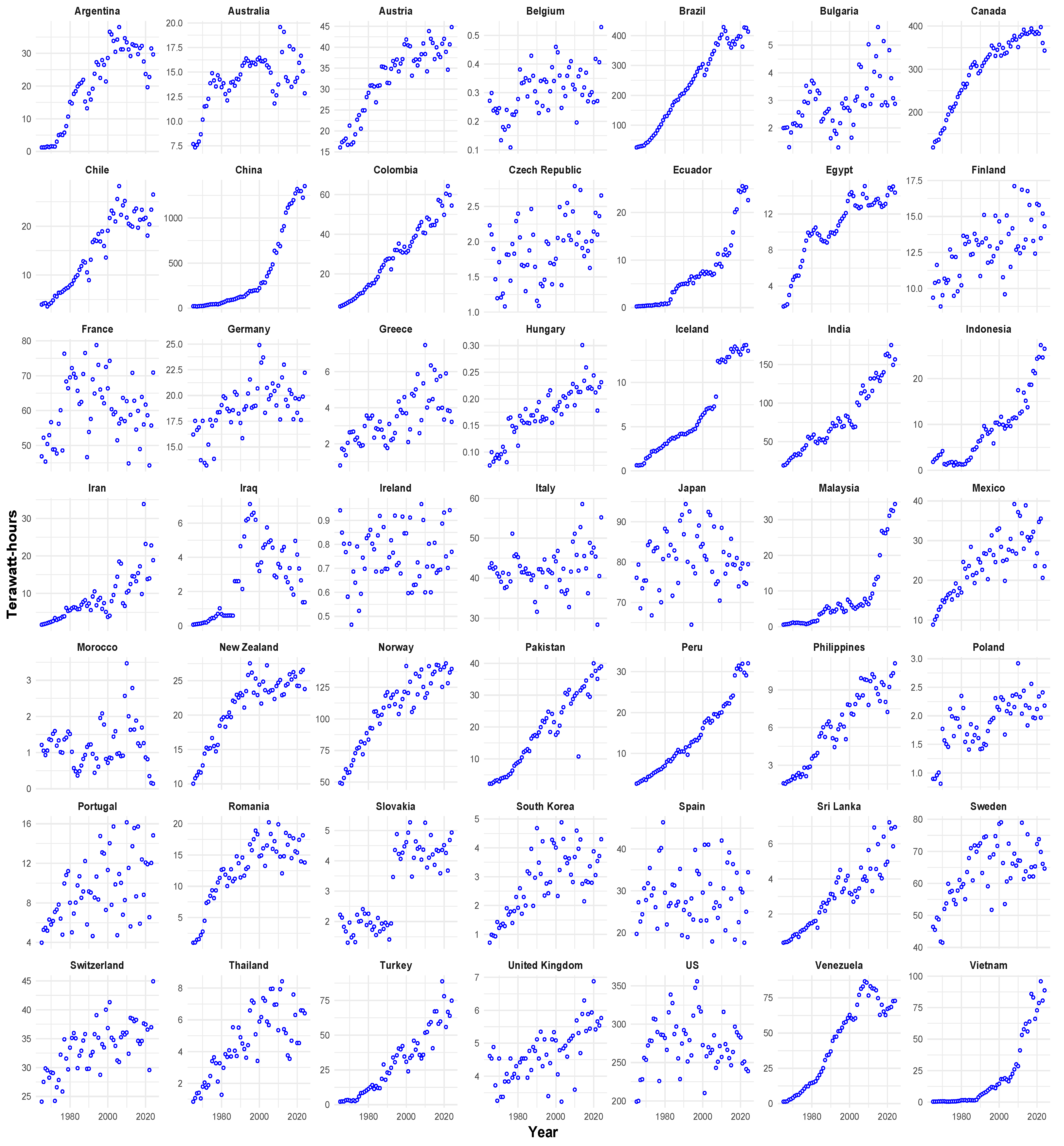
Data on hydroelectric electricity generation, in TWh, were obtained from the Energy Institute [36] for the period 1965–2024, covering 49 countries, as shown in the top panel of Figure 1. According to the Energy Institute’s methodology, the data refer to gross electricity generation and therefore reflect the actual energy produced rather than the installed or potential production capacity of hydroelectric power plants. Cross-border electricity flows are not accounted for. Total energy supply is defined as the physical energy content of the gross electrical output of hydropower facilities. The dataset does not distinguish between different types of hydropower plants and does not provide information on the end use of the generated electricity. Consequently, it was not possible to assess the role of technological progress or to differentiate electricity used for household consumption from electricity serving other purposes in the power system.
A first inspection of the available time series in Figure 1 reveals that the scale of hydroelectric generation varies considerably depending on a country’s size and the availability of natural resources.
In the Americas, the United States remains the leading electricity producer throughout the entire period, with a sharp increase in the late 20th century followed by more gradual growth and periods of stabilization in the 21st century. Canada consistently ranks second in the region, with steady increases over time. Brazil exhibits one of the most significant growth trajectories, particularly since the 1990s, reflecting substantial investments in hydroelectric and other power infrastructure. Other Latin American countries, such as Mexico, Argentina, Colombia, Chile, Peru, Ecuador, and Venezuela, also demonstrate positive trends, albeit at lower absolute levels. These patterns indicate a broader regional shift toward increased electrification and industrial capacity. In Europe, major economies in our dataset have experienced strong growth from the 1960s through the early 2000s, followed by plateaus or moderate declines in recent years, likely due to energy transitions, efficiency improvements, and diversification toward other renewable sources.
The Asian region shows the most dramatic growth over the period. China leads the global surge in electricity generation, particularly since the early 2000s, with a sharp and sustained rise that outpaces that of all other countries. India also shows substantial and consistent growth, particularly in the 21st century, driven by rapid economic development and population growth. Other notable examples include Japan, South Korea, Indonesia, Malaysia, Pakistan, the Philippines, Sri Lanka, Thailand, and Vietnam, each of which has demonstrated substantial increases over the decades.
Finally, the other countries analyzed are located in the Middle East and Oceania. Iran has exhibited strong growth since the 1980s, reflecting economic development and diversification. In contrast, Iraq has experienced a noticeable decline in hydropower generation. Australia and New Zealand have experienced steady growth but are now showing preliminary signs of decline.
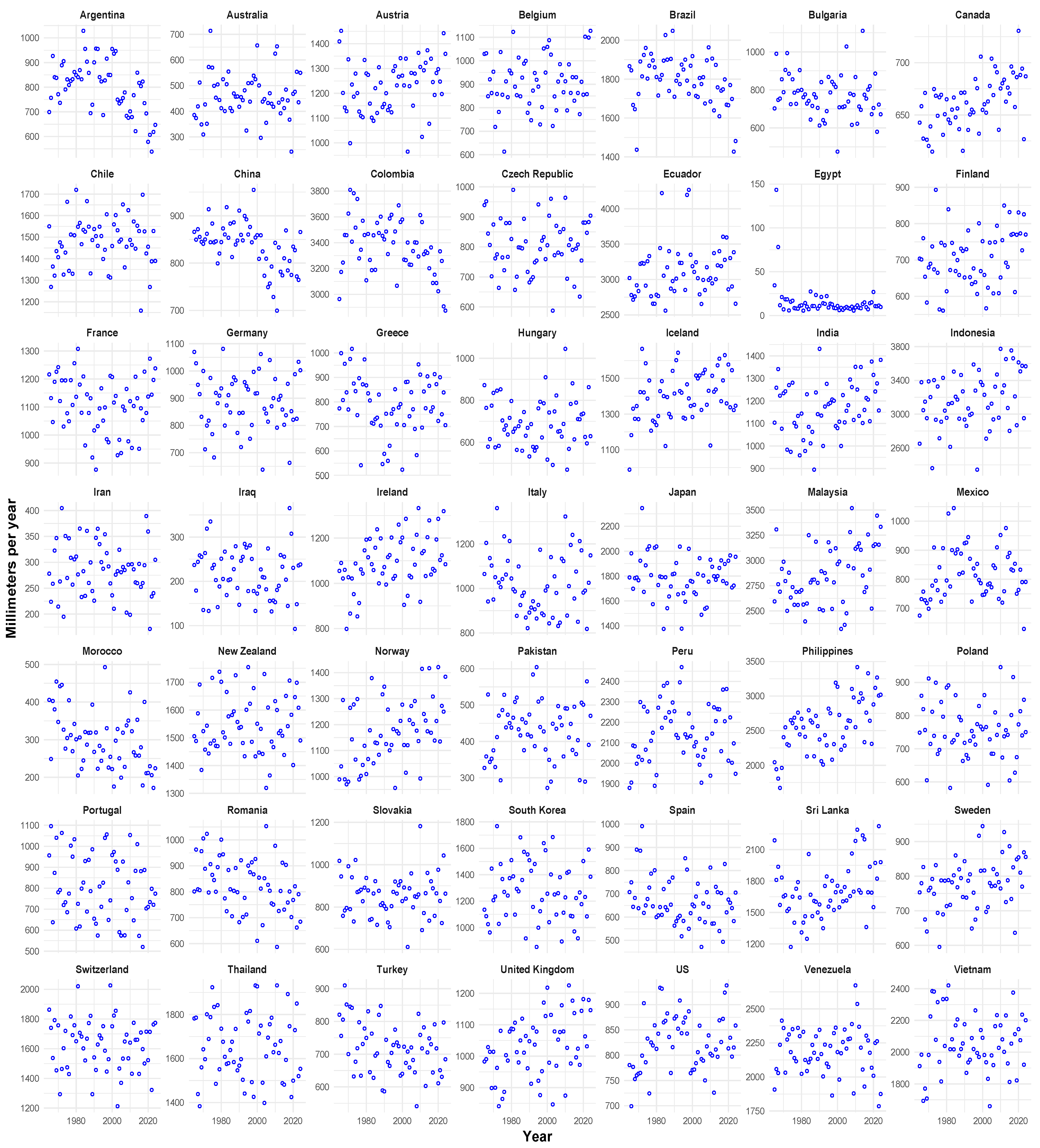
In addition to hydropower data, we also consider annual precipitation as an external climatic variable. This precipitation dataset is displayed in Figure 2. The dataset is sourced from modified Copernicus Climate Change Service information [37]. According to the methodology indicated by the data provider, total annual precipitation (rain and snow) is calculated as the sum of daily averages, reported as the depth of water falling to Earth’s surface, excluding fog and dew. This precipitation data provides long-term, globally consistent climate information suitable for capturing variability in water availability that may influence hydropower generation.
In summary, for each country considered, we have time series data on hydropower generation and annual precipitation spanning the period from 1965 to 2024. According to our modeling proposal, for each country we model hydropower generation using a suitable innovation diffusion model and subsequently use precipitation data to capture any residual variability in the data that is not explained by the diffusion model alone. In proposing this type of analysis, we selected the largest possible sample of countries for which complete data on both hydropower generation and precipitation were available. Our purpose in selecting these countries is to provide an overview of the historical evolution of hydropower across a broad set of countries using a relatively parsimonious and general modeling approach, which allows for comparability across countries while capturing key long-term dynamics.

4. Results

4.1. BM Fit

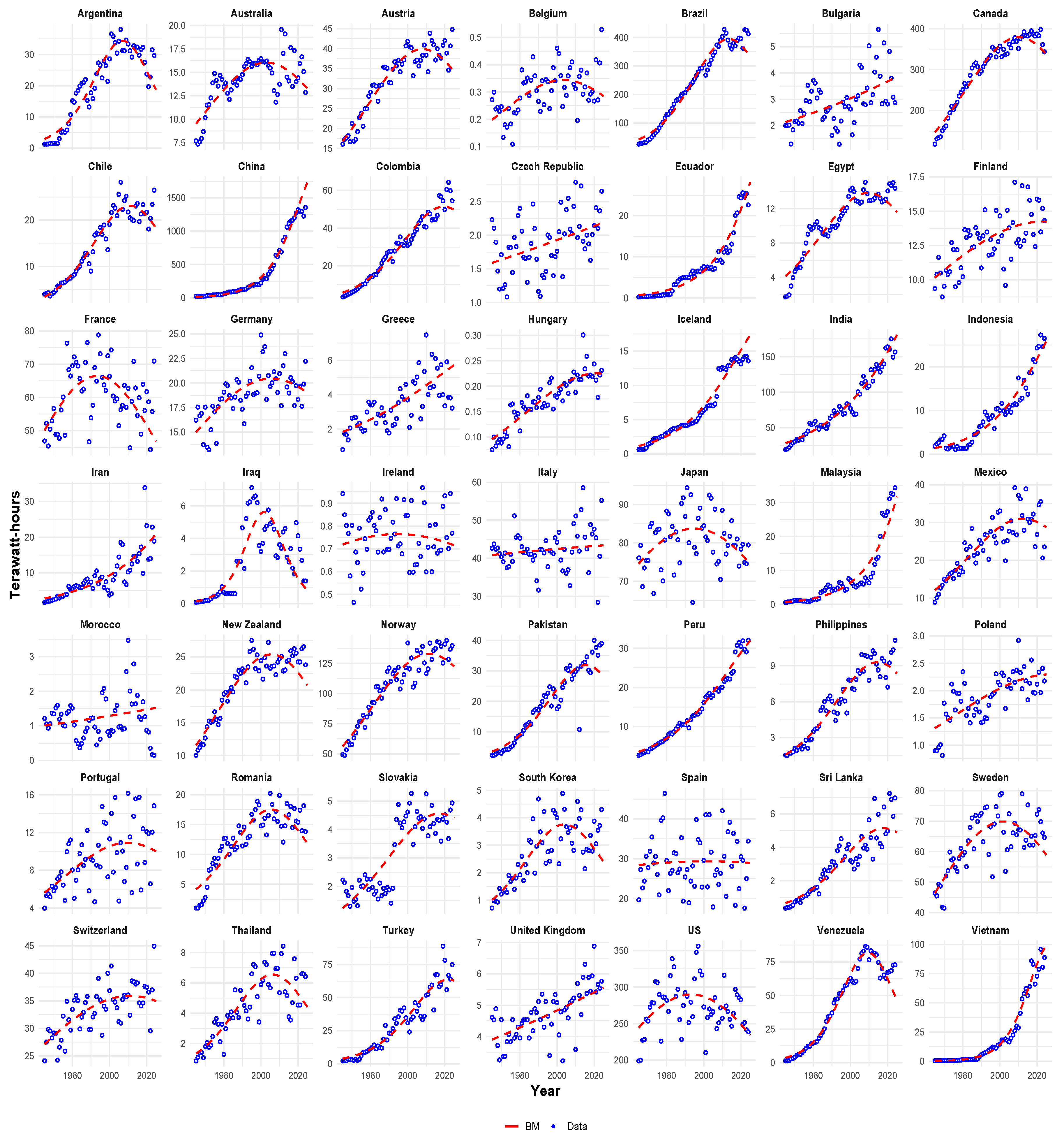
The BM was applied to available data to evaluate the goodness-of-fit of this innovation diffusion model for hydropower generation, showing that it adequately describes the dynamics in the majority of countries. The overall model-fit results are presented in Figure 3 and Table 1. This analysis highlights the heterogeneous patterns of hydropower development across countries. It is also important to note that although the BM captures the main trends in most regions, it has limitations in specific cases. These deviations point to the need for region-specific modeling strategies that incorporate local characteristics, including socio-economic conditions, resource constraints, or competition from other electricity sources. Examining the model’s predictions further confirms that the BM provides a reasonable degree of accuracy relative to the observed data, supporting its suitability for representing historical hydropower trajectories. Nevertheless, in a few instances, the final stages of the fitted curve diverge from actual values, resulting in slight underestimation, as in the case of Brazil, or overestimation, as observed for China. We stress, however, that the objective of this study is to explain past diffusion dynamics rather than forecast future values. From these results, three main diffusion patterns can be identified: (i) countries exhibiting an exponentially increasing trend such as China, India, and Indonesia; (ii) countries that appear to have surpassed their maximum production peak and subsequently entered a decline phase, such as Argentina and Canada; and (iii) countries characterized by greater variability and a relatively flat trend over time, including Italy and Spain.

4.2. Analysis of BM Parameters

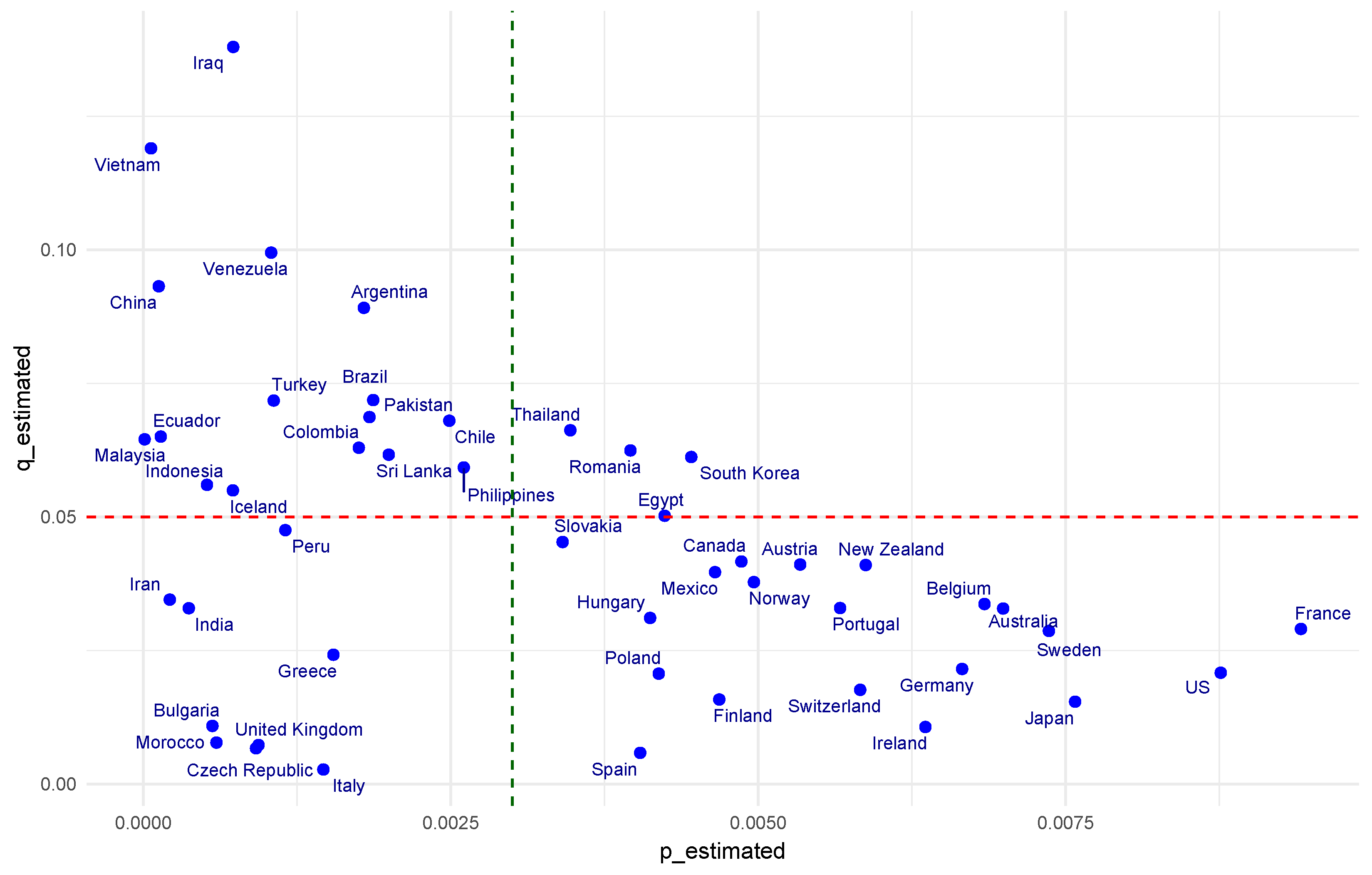
After examining the fit of the BM to the available series, we analyze the estimated parameters. Our primary interest lies in the parameters that determine the speed and shape of the diffusion, i.e., p and q. Figure 4 displays the estimated innovation parameter p against the imitation parameter q for each country, suggesting a negative correlation between the two. The visualization helps illustrate the relative influence of growth driven by innovation versus imitative processes across different regions: in general, countries with a high innovation coefficient tend to have low values of the q parameter, and vice versa. Analyzing the figure in more detail, we note that countries in the upper-right quadrant exhibit higher values of p and q, indicating strong independent growth and social influence, suggesting a balanced growth pattern. However, as shown in the figure, this case is sporadic. In contrast, countries in the lower-left quadrant have low values for both p and q, indicating that growth in these regions is weak and may rely on targeted interventions to stimulate both the innovation and imitation components. In this group, we notice Italy, whose series is almost not captured by the BM. The upper-left quadrant shows countries with high q but low p, where growth is likely driven more by imitation than by independent decisions, making these regions ideal for strategies that leverage social influence. Finally, the lower-right quadrant represents countries with high p but low q, suggesting a greater tendency for independent growth, which appears to be dominant in European and Western countries. Overall, this figure provides a clear visual interpretation of how p and q vary across countries, highlighting areas where hydropower growth is most evident.
In general, we observe that developed countries tend to have high p values and low q values. In contrast, developing countries typically exhibit lower values of the innovation parameter p but higher values of the q parameter.
This raises an interesting question about the determinants of these coefficients. A first hypothesis of this analysis suggests that socio-economic variables, such as GDP, social and political stability, as well as sociocultural factors, could explain these differences across countries. We tested this hypothesis with some linear regression models, and found that GDP has a significant role in explaining both p and q parameters. Specifically, using the per capita GDP data for the year 2023 from [38] we found that the GDP is positively correlated with parameter p ( β ^ = 7.016 × 10 8 , p-value = 5.63 × 10 7 ), while it exhibits a significant negative relationship with parameter q ( β ^ = 6.162 × 10 7 , p-value = 0.000203). This result is consistent with our expectation that countries with a stronger economic base are characterized by higher levels of innovativeness, whereas countries with weaker economies tend to act as followers, having a higher level of imitation q.
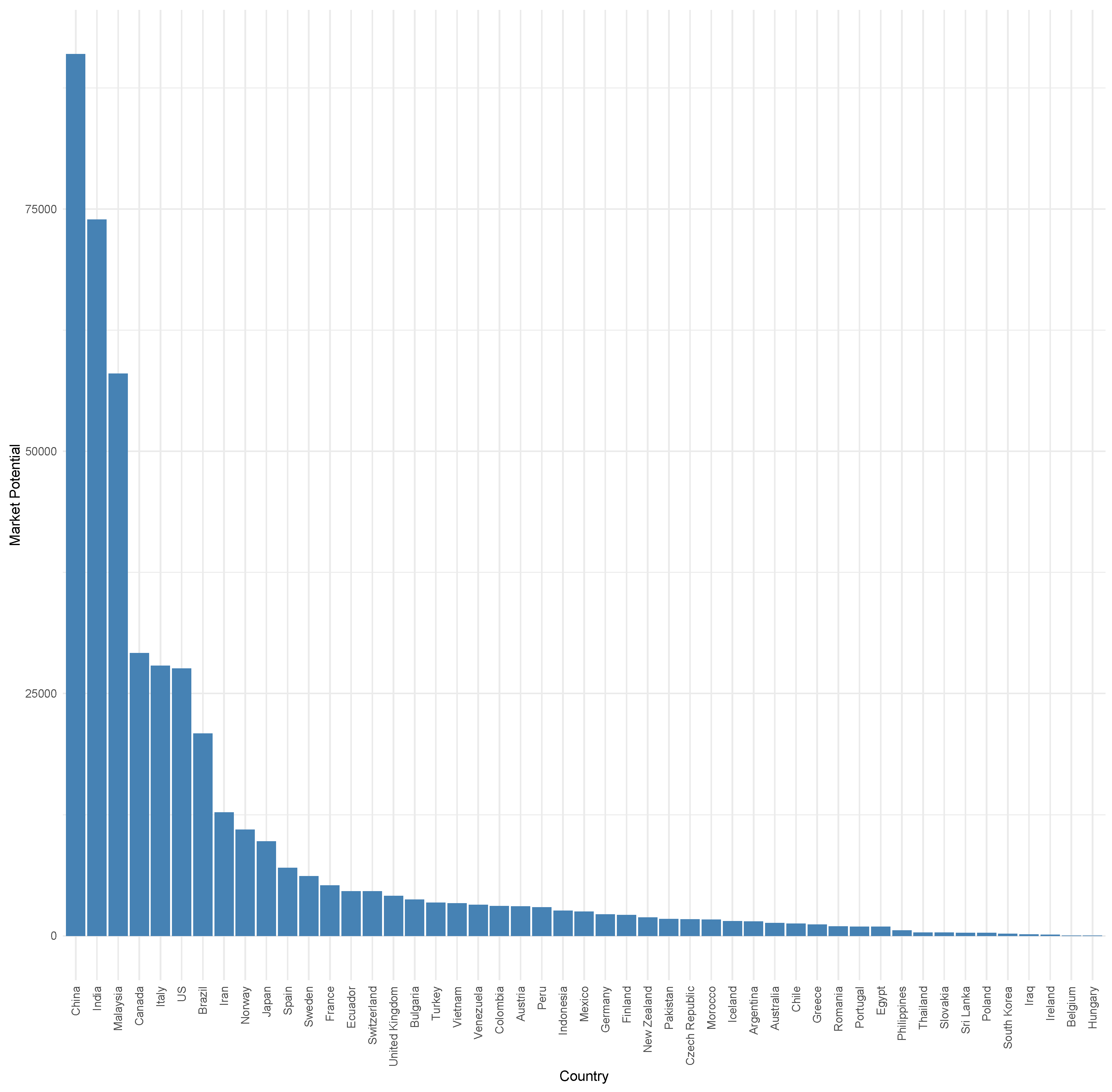
Finally, in Figure 5, we display the estimated market potential for the 49 countries. As can be observed, the countries with the highest market potential are China and India, which is largely due to their size. More interestingly, smaller countries such as Malaysia, Italy, and Norway also occupy top positions. We note that the interpretation of the m parameter requires caution. Within our modeling framework, market potential (or carrying capacity) acts as a scale parameter representing the maximum size of the process, and its estimate is derived from and therefore consistent with historically observed data.
We also examined the potential relationship between parameter m and per capita GDP, but found no evidence of a statistically significant association.

4.3. ARMAX Adjustment

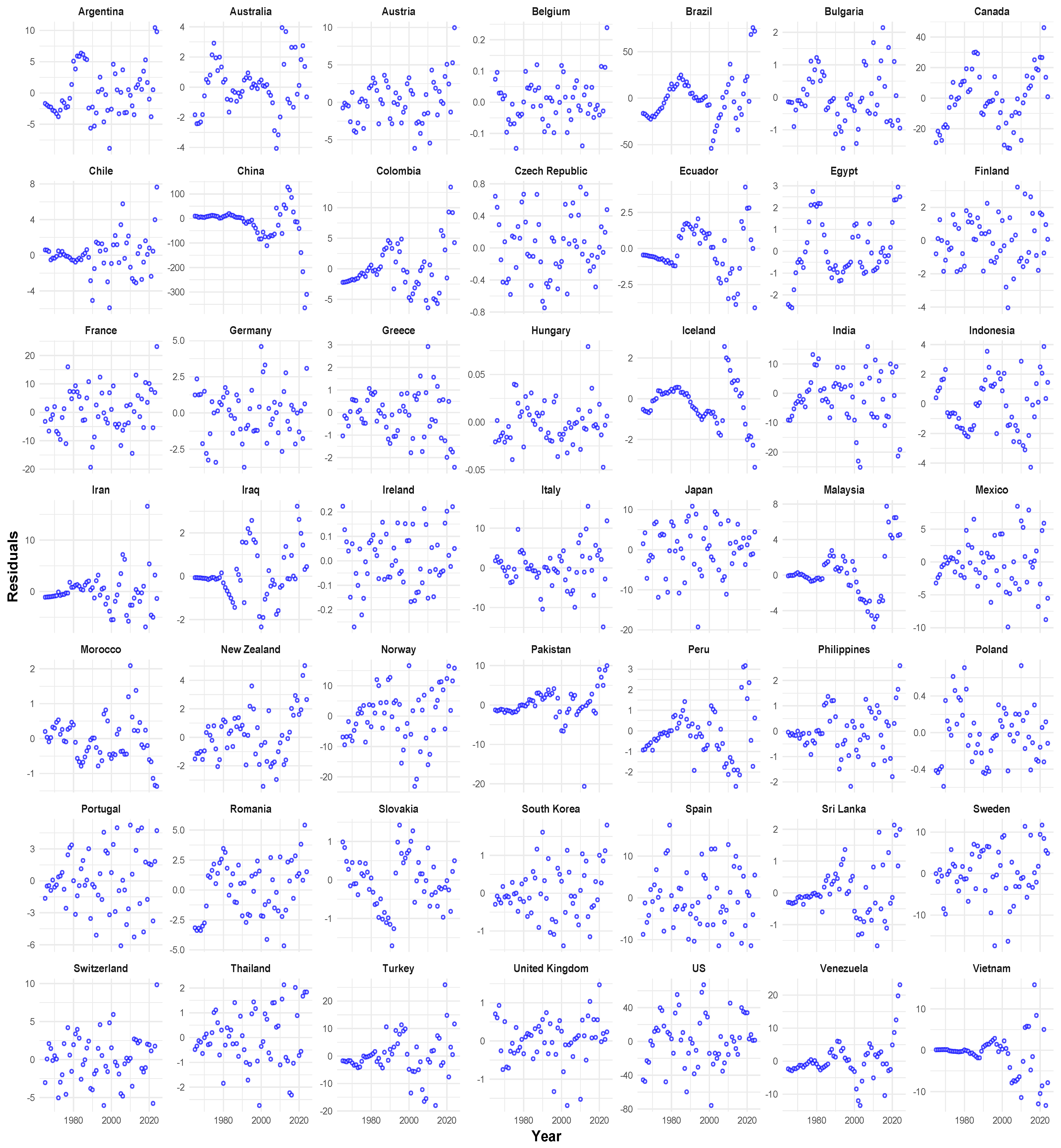
The analysis of the BM residuals, shown in Figure 6, indicates that some data variability remains unexplained by the nonlinear model, highlighting the need for further investigation. To capture this residual structure and possibly improve our model fit, we adopt the modeling approach described in Section 3.2, which accounts for residual autocorrelation and incorporates the potential influence of rainfall dynamics on changes in hydropower generation. In Table 2 we report the output in terms of AIC of two models applied to the residuals of the BM. The first model relies solely on the ARMA model, while the second incorporates rainfall as an additional explanatory variable within an extended ARMAX framework. We have adopted this strategy, comparing ARMA and ARMAX model to verify in how many cases the inclusion of the external variable implied a performance gain in the results. Our findings show that, across 31 countries, precipitation data significantly improved model fit, indicating that rainfall plays an essential role in explaining fluctuations in hydropower generation. In the remaining 18 countries (i.e., Argentina, Australia, Brazil, Canada, Chile, China, Colombia, Egypt, Hungary, Iceland, India, Iraq, Malaysia, Pakistan, Thailand, Turkey, US, and Vietnam) including rainfall, did not substantially improve the model’s performance, and the simpler ARMA model could be sufficient. These findings suggest that, while rainfall is a key driver of hydropower variability in most regions of the world, its influence is not uniform across countries. Interestingly, inspection of Figure 3 shows that these countries exhibit a generation pattern that is already efficiently captured by the simple BM, which is consistent with the fact that the adjustment of the residuals is less relevant in these cases.
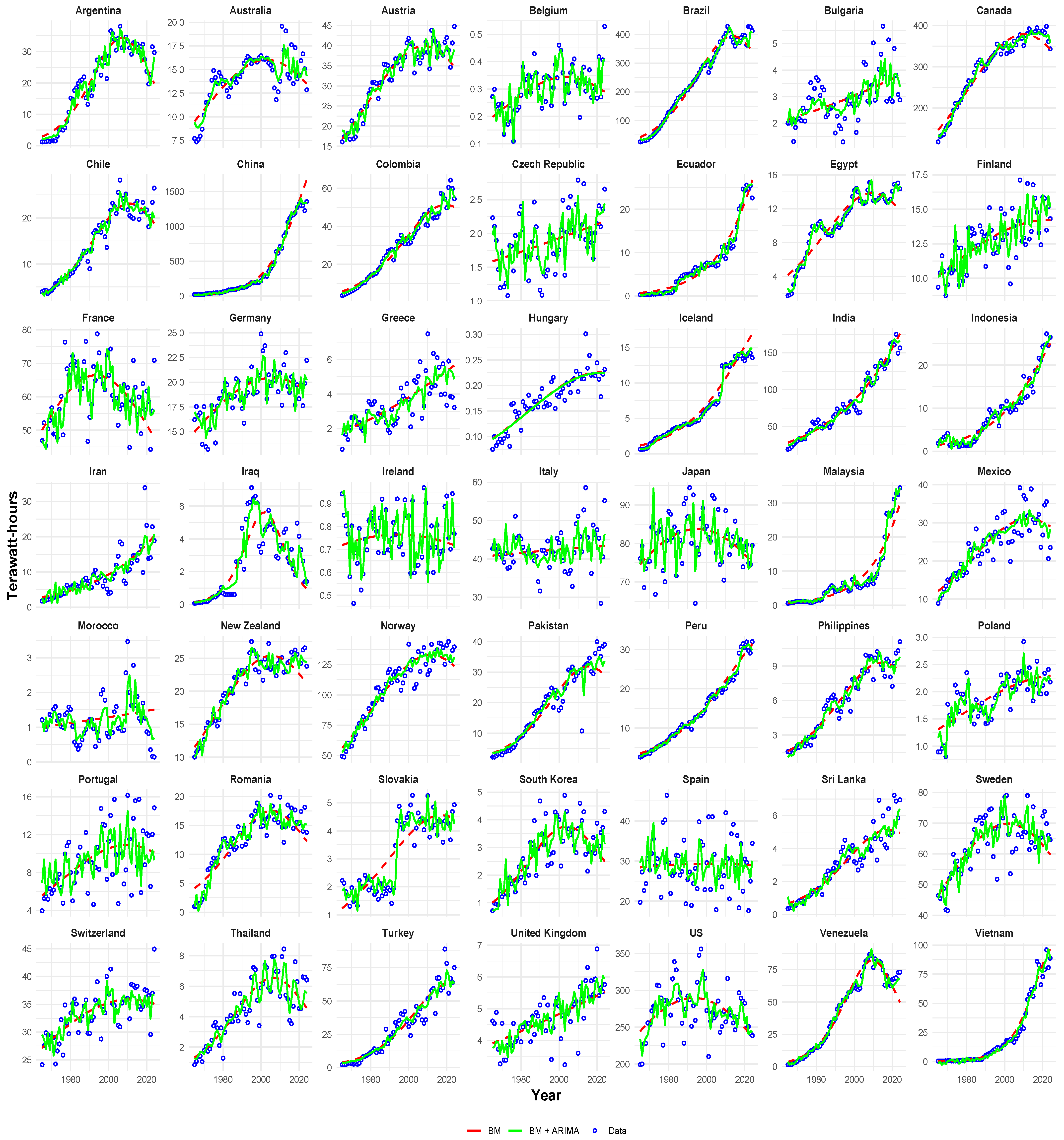
The final fitted model, obtained by combining the BM fit with an ARMAX or ARMA adjustment applied to the residuals, which we refer to as BMA (BM + adjustment), is shown in Figure 7. As can be observed, the adjustment introduced with the BMA allows the model to capture the variability around the mean behavior of the data, thereby completing the analysis in an efficient manner.

5. Discussion

In this paper, we have examined the applicability of innovation diffusion theory to model the growth of hydropower generation. By using insights from innovation diffusion theory, we propose a modeling framework for analyzing the long-term dynamics of hydropower deployment. This study gives a contribution by extending diffusion modeling—widely applied in energy transition research—to a renewable energy sector that has remained relatively underexplored in this context. Hydropower has probably received less research attention than solar photovoltaic and wind energy, mainly because it is perceived as a mature and less innovative technology. Nonetheless, our analysis demonstrates that hydropower continues to play an important role in the energy mix of many countries. This finding underscores the importance of considering both emerging and established renewable energy technologies when designing strategies for sustainable energy development.
We have employed diffusion models to investigate hydropower generation, focusing on understanding long-term dynamics rather than producing short-term forecasts. Favoring an explanatory view, the Bass model proved particularly effective at capturing generation patterns across the majority of countries in our dataset. The application of the Bass model allowed us to show the contributions of innovation-driven and imitation-driven growth, providing a deeper understanding of the processes underlying hydropower deployment. Our results revealed some heterogeneity across countries: in several developed economies, over time hydropower has been playing a less important role, as reflected in the declining generation share. On the other hand, in many developing countries, hydropower remains central to electricity generation, often constituting a primary renewable energy source. These divergent trajectories highlight the need for context-specific energy policies and investment strategies that account for differing stages of technology adoption, resource availability, and infrastructure maturity. Parameter estimates derived from the BM provide further insights into these dynamics. Developed countries generally exhibit a high innovation coefficient (p) and a relatively lower imitation coefficient (q), suggesting that growth in hydropower capacity has been primarily driven by the introduction of new technologies and early adoption. In contrast, less developed countries exhibit a dominant imitation component, suggesting that hydropower expansion often follows the adoption patterns set by early movers. This distinction emphasizes the role of social, institutional, and technological learning mechanisms in shaping the diffusion pathways of hydropower technologies.
Overall, our analysis highlighted that the role of hydropower within the energy system is dynamic and context-dependent. Additionally, the introduction of an ARMAX model in the BM residuals’ analysis has enriched our insights by demonstrating that rainfall significantly influences hydropower trajectories in many countries. In the majority of cases analyzed, including precipitation data improved model performance, highlighting that, while hydropower generally follows diffusion patterns, interannual variability is strongly affected by climatic conditions. This suggests that integrating environmental variables into diffusion models can improve our understanding of hydropower dynamics.
On the other hand, as a limitation of our study, we should acknowledge that other geographical conditions other that precipitation, such as large river systems, or mountainous terrain have not been explicitly accounted in our analysis. Clearly these factors are a great source of heterogeneity between countries and singificantly influence the potential for hydropower. Such heterogeneity has been implicitly captured thorugh country-specific parameters of the innovation diffusion model and through residual variation associated with precipitation.

6. Conclusions

Despite the ability to use a unified modeling framework for a large set of countries—confirming that some general patterns characterize all regions considered—our analysis also reveals a highly diverse scenario. Some countries appear to be disinvesting in hydropower, while others remain strongly reliant on it. This contrasts with other renewable energy sources, whose recent trends show steady growth in nearly all countries worldwide. One key factor likely influencing the evolution of hydropower is public-sector involvement, which has historically played a crucial role in supporting its expansion, as noted by the IEA [17]. However the IEA reports that, over the past two decades, renewable energy policies have predominantly focused on accelerating the deployment and reducing the costs of wind and solar PV through instruments such as capacity targets, financial incentives, and long-term power purchase agreements. While more than 100 countries have introduced policies to support wind and solar PV, fewer than 30 have implemented comparable frameworks for new or existing hydropower projects. Given the longer pre-development, construction, and operational timelines associated with hydropower, these projects face heightened investment risks.
This underscores the need for targeted policy instruments and coherent long-term planning to ensure the sustained development of hydropower resources. For hydropower to continue contributing meaningfully to global energy transitions, it must remain fully integrated into renewable energy strategies. This requires recognizing sustainably developed hydropower plants—both large and small—as renewable energy sources and incorporating them into national energy plans, long-term deployment targets, and incentive schemes.

Author Contributions

Conceptualization, M.G. and F.A.; methodology, M.G.; software, F.A.; validation, M.G.; data curation, F.A.; writing—original draft preparation, M.G. and F.A.; visualization, F.A.; supervision, M.G.; funding acquisition, M.G. All authors have read and agreed to the published version of the manuscript.

Funding

This research was funded by University of Padua grant number GUID BIRD24 01.

Data Availability Statement

The data presented in this study are openly available at: https://www.energyinst.org/statistical-review, accessed on 10 June 2025; https://ourworldindata.org/grapher/average-precipitation-per-year, accessed on 3 October 2025; https://ourworldindata.org/economic-growth, accessed on 30 December 2025.

Conflicts of Interest

The authors declare no conflicts of interest.

References

  1. IEA. Renewables 2024; IEA: Paris, France, 2024. Available online: https://www.iea.org/reports/renewables-2024 (accessed on 17 July 2025).
  2. Unruh, G.C. Understanding carbon lock-in. Energy Policy 2000, 28, 817–830. [Google Scholar] [CrossRef]
  3. Meade, N.; Islam, T. Modelling European usage of renewable energy technologies for electricity generation. Technol. Forecast. Soc. Change 2015, 90, 497–509. [Google Scholar] [CrossRef]
  4. Marchetti, C. Primary energy substitution models: On the interaction between energy and society. Technol. Forecast. Soc. Change 1977, 10, 345–356. [Google Scholar] [CrossRef]
  5. Marchetti, C. Society as a learning system: Discovery, invention, and innovation cycles revisited. Technol. Forecast. Soc. Change 1980, 18, 267–282. [Google Scholar] [CrossRef]
  6. Guidolin, M.; Mortarino, C. Cross-country diffusion of photovoltaic systems: Modelling choices and forecasts for national adoption patterns. Technol. Forecast. Soc. Change 2010, 77, 279–296. [Google Scholar] [CrossRef]
  7. Dalla Valle, A.; Furlan, C. Forecasting accuracy of wind power technology diffusion models across countries. Int. J. Forecast. 2011, 27, 592–601. [Google Scholar] [CrossRef]
  8. Davies, S.W.; Diaz-Rainey, I. The patterns of induced diffusion: Evidence from the international diffusion of wind energy. Technol. Forecast. Soc. Change 2011, 78, 1227–1241. [Google Scholar] [CrossRef]
  9. Huh, S.Y.; Lee, C.Y. Diffusion of renewable energy technologies in South Korea on incorporating their competitive interrelationships. Energy Policy 2014, 69, 248–257. [Google Scholar] [CrossRef]
  10. Islam, T. Household level innovation diffusion model of photo-voltaic (PV) solar cells from stated preference data. Energy Policy 2014, 65, 340–350. [Google Scholar] [CrossRef]
  11. Lee, C.Y.; Huh, S.Y. Forecasting the diffusion of renewable electricity considering the impact of policy and oil prices: The case of South Korea. Appl. Energy 2017, 197, 29–39. [Google Scholar] [CrossRef]
  12. Bass, F.M. A new product growth for model consumer durables. Manag. Sci. 1969, 15, 215–227. [Google Scholar] [CrossRef]
  13. Rao, K.U.; Kishore, V.V.N. A review of technology diffusion models with special reference to renewable energy technologies. Renew. Sustain. Energy Rev. 2010, 14, 1070–1078. [Google Scholar] [CrossRef]
  14. Bass, F.M.; Krishnan, T.V.; Jain, D.C. Why the Bass model fits without decision variables. Mark. Sci. 1994, 13, 203–223. [Google Scholar] [CrossRef]
  15. Guidolin, M.; Alpcan, T. Transition to sustainable energy generation in Australia: Interplay between coal, gas and renewables. Renew. Energy 2019, 139, 359–367. [Google Scholar] [CrossRef]
  16. Petropoulos, F.; Apiletti, D.; Assimakopoulos, V.; Babai, M.Z.; Barrow, D.K.; Taieb, S.B.; Bergmeir, C.; Bessa, R.J.; Bijak, J.; Boylan, J.E.; et al. Forecasting: Theory and practice. Int. J. Forecast. 2022, 38, 705–871. [Google Scholar] [CrossRef]
  17. IEA. Electricity 2025; IEA: Paris, France, 2025. Available online: https://www.iea.org/reports/electricity-2025 (accessed on 28 August 2025).
  18. Guidolin, M. Innovation Diffusion Models: Theory and Practice; John Wiley & Sons: Hoboken, NJ, USA, 2023. [Google Scholar]
  19. Wasti, A.; Ray, P.; Wi, S.; Folch, C.; Ubierna, M.; Karki, P. Climate change and the hydropower sector: A global review. Wiley Interdiscip. Rev. Clim. Change 2022, 13, e757. [Google Scholar] [CrossRef]
  20. Moran, E.F.; Lopez, M.C.; Moore, N.; Müller, N.; Hyndman, D.W. Sustainable hydropower in the 21st century. Proc. Natl. Acad. Sci. USA 2018, 115, 11891–11898. [Google Scholar] [CrossRef]
  21. Sternberg, R. Hydropower: Dimensions of social and environmental coexistence. Renew. Sustain. Energy Rev. 2008, 12, 1588–1621. [Google Scholar] [CrossRef]
  22. Sternberg, R. Hydropower’s future, the environment, and global electricity systems. Renew. Sustain. Energy Rev. 2010, 14, 713–723. [Google Scholar] [CrossRef]
  23. Mwakangale, J.; Cook, D.; Ogmundarson, O.; Davidhsdottir, B. A systematic review on the application of lifecycle-based approaches in assessing sustainability of hydropower. Renew. Sustain. Energy Rev. 2025, 219, 115841. [Google Scholar] [CrossRef]
  24. Apergis, N.; Chang, T.; Gupta, R.; Ziramba, E. Hydroelectricity consumption and economic growth nexus: Evidence from a panel of ten largest hydroelectricity consumers. Renew. Sustain. Energy Rev. 2016, 62, 318–325. [Google Scholar] [CrossRef]
  25. Llamosas, C.; Sovacool, B.K. The future of hydropower? A systematic review of the drivers, benefits and governance dynamics of transboundary dams. Renew. Sustain. Energy Rev. 2021, 137, 110495. [Google Scholar] [CrossRef]
  26. Schmitt, R.J.P.; Rosa, L. Dams for hydropower and irrigation: Trends, challenges, and alternatives. Renew. Sustain. Energy Rev. 2024, 199, 114439. [Google Scholar] [CrossRef]
  27. Moriarty, P.; Honnery, D. An uncertain future for global hydropower. In Energy and Climate Change; Elsevier: Amsterdam, The Netherlands, 2025; pp. 279–298. [Google Scholar]
  28. Mayeda, A.; Boyd, A. Factors influencing public perceptions of hydropower projects: A systematic literature review. Renew. Sustain. Energy Rev. 2020, 121, 109713. [Google Scholar] [CrossRef]
  29. Ahmad, F.; Finos, L.; Guidolin, M. Forecasting Hydropower with Innovation Diffusion Models: A Cross-Country Analysis. Forecasting 2024, 6, 1045–1064. [Google Scholar] [CrossRef]
  30. Box, G.E.; Jenkins, G.M.; Reinsel, G.C.; Ljung, G.M. Time Series Analysis: Forecasting and Control; John Wiley & Sons: Hoboken, NJ, USA, 2015. [Google Scholar]
  31. Taylor, S.J.; Letham, B. Forecasting at scale. Am. Stat. 2018, 72, 37–45. [Google Scholar] [CrossRef]
  32. Ahmad, F.; Guidolin, M. Explaining Hydropower Generation Through Innovation Diffusion Modeling. In Proceedings of the Scientific Meeting of the Italian Statistical Society; Springer: Berlin/Heidelberg, Germany, 2025; pp. 7–12. [Google Scholar]
  33. Seber, G.; Wild, C. Nonlinear Regression; Wiley: New York, NY, USA, 1989. [Google Scholar]
  34. Hyndman, R.J.; Athanasopoulos, G. Forecasting: Principles and Practice; OTexts: Melbourne, Australia, 2018. [Google Scholar]
  35. Akaike, H. Akaike’s information criterion. In International Encyclopedia of Statistical Science; Springer: Berlin/Heidelberg, Germany, 2025; pp. 41–42. [Google Scholar]
  36. Statistical Review of World Energy. 2024. Available online: https://www.energyinst.org/statistical-review (accessed on 10 June 2025).
  37. Ritchie, H.; Rosado, P.; Samborska, V. Climate Change. Our World in Data. 2024. Available online: https://ourworldindata.org/grapher/average-precipitation-per-year (accessed on 3 October 2025).
  38. Roser, M.; Rohenkohl, B.; Arriagada, P.; Hasell, J.; Ritchie, H.; Ortiz-Ospina, E. Economic Growth. Our World in Data. 2023. Available online: https://ourworldindata.org/economic-growth (accessed on 30 December 2025).
Figure 1. Hydropower generation data for 49 countries from 1965 to 2024.
Energies 19 00606 g001
Figure 2. Precipitation data for 49 countries from 1965 to 2024.
Energies 19 00606 g002
Figure 3. Observed data and estimated BM in 49 countries.
Energies 19 00606 g003
Figure 4. Estimated p and q coefficients for 49 countries.
Energies 19 00606 g004
Figure 5. Estimated m coefficient for 49 countries.
Energies 19 00606 g005
Figure 6. Residuals of BM fit in 49 countries.
Energies 19 00606 g006
Figure 7. Observed data, BM (red line), and BMA (green line) in 49 countries.
Energies 19 00606 g007
Table 1. Estimated BM parameters (m, p, and q) by country.
Countrympq
Argentina1482.640.001790.08914
Australia1328.040.006990.03285
Austria3040.920.005340.04109
Belgium28.220.006840.03370
Brazil20,882.320.001870.07188
Bulgaria3764.500.000560.01088
Canada29,176.070.004860.04166
Chile1265.920.002490.06801
China90,999.420.000130.09318
Colombia3089.250.001750.06295
Czech Republic1722.810.000920.00670
Ecuador4615.320.000140.06504
Egypt938.240.004240.05022
Finland2143.500.004680.01582
France5218.870.009410.02903
Germany2215.320.006660.02154
Greece1161.810.001550.02421
Hungary22.600.004120.03109
Iceland1513.860.000730.05498
India73,927.010.000370.03291
Indonesia2595.860.000520.05601
Iran12,736.660.000220.03452
Iraq161.260.000730.13798
Ireland112.560.006360.01068
Italy27,857.700.001460.00272
Japan9767.710.007580.01541
Malaysia58,023.060.000010.06453
Mexico2507.730.004650.03967
Morocco1684.370.000590.00776
New Zealand1895.970.005870.04100
Norway10,985.510.004970.03780
Pakistan1758.010.001840.06870
Peru2939.920.001150.04753
Philippines575.660.002610.05926
Poland307.960.004190.02067
Portugal964.800.005670.03295
Romania991.690.003960.06245
Slovakia348.160.003410.04531
South Korea213.170.004460.06122
Spain7021.560.004040.00584
Sri Lanka313.290.001990.06165
Sweden6173.870.007360.02866
Switzerland4599.960.005830.01764
Thailand357.460.003470.06622
Turkey3440.320.001060.07179
United Kingdom4141.570.000940.00730
United States27,579.320.008760.02083
Venezuela3220.970.001040.09948
Vietnam3377.800.000060.11901
Table 2. AIC values for ARMA (without rainfall) and ARMAX (with rainfall) models.
CountryAIC (ARMA)AIC (ARMAX)
Argentina295.42297.41
Australia215.17216.87
Austria289.39259.42
Belgium−153.53−211.64
Brazil495.83497.66
Bulgaria132.57131.27
Canada466.11467.16
Chile243.36243.40
China594.31601.22
Colombia298.21300.18
Czech Republic44.657.76
Ecuador186.34184.21
Egypt94.1194.49
Finland217.52171.81
France419.89387.82
Germany236.96197.07
Greece168.93161.87
Hungary−287.04−285.18
Iceland109.31109.56
India422.27422.53
Indonesia220.32208.88
Iran321.48314.15
Iraq161.41163.40
Ireland−87.17−161.21
Italy361.45350.02
Japan389.91347.89
Malaysia197.76198.33
Mexico331.94326.74
Morocco83.5081.12
New Zealand214.08182.72
Norway429.82428.10
Pakistan334.12335.57
Peru163.47160.58
Philippines142.46128.26
Poland−18.42−34.15
Portugal293.56276.94
Romania254.95218.32
Slovakia95.4566.46
South Korea122.7094.81
Spain401.68388.21
Sri Lanka135.72134.64
Sweden390.10366.37
Switzerland304.79287.40
Thailand166.85168.84
Turkey404.93406.93
United Kingdom104.3283.91
US560.63560.72
Venezuela322.92317.51
Vietnam351.90352.15
Disclaimer/Publisher’s Note: The statements, opinions and data contained in all publications are solely those of the individual author(s) and contributor(s) and not of MDPI and/or the editor(s). MDPI and/or the editor(s) disclaim responsibility for any injury to people or property resulting from any ideas, methods, instructions or products referred to in the content.