Article

The Influence of Injection Modes on CO2 Flooding and Storage in Low-Permeability Reservoirs

Exploration and Development Research Institute, Shengli Oilfield Company, SINOPEC, Dongying 257015, China
Energies 2026, 19(2), 480; https://doi.org/10.3390/en19020480 (registering DOI)
Submission received: 17 December 2025 / Revised: 4 January 2026 / Accepted: 13 January 2026 / Published: 18 January 2026

Abstract

Low-permeability reservoirs have poor reservoir properties and are difficult to develop by conventional water flooding. CO2 flooding can significantly improve oil recovery while achieving carbon storage, and is widely recognized as an effective solution for the development of low-permeability oil reservoirs. In order to address the lack of a comparative quantitative analysis of the tradeoff between oil recovery factor, CO2 storage rate, and total CO2 storage volume for the main injection modes in low-permeability reservoirs, this study systematically evaluated the performance of CO2-enhanced oil recovery (EOR) and geological storage under different pressures and injection modes through core flooding experiments. The results indicate that displacement pressure and injection strategy significantly influence the CO2 flooding performance. Continuous miscible flooding (30 MPa) substantially reduced the displacement pressure differential (maximum 6.1 MPa) and achieved the highest oil recovery (78.96%) and the greatest CO2 storage capacity (5916 cm3). Miscible WAG flooding effectively delayed gas breakthrough (extended to 1.90 pore volumes), homogenized the displacement front, and yielded the best overall outcome: the highest ultimate oil recovery (83.8%) coupled with the optimal CO2 storage rate (89.1%). The study further reveals that the pre-breakthrough stage is critical for contributing to oil recovery and achieving efficient storage, regardless of the injection modes. These findings clarify the technical characteristics and applicable conditions of different injection modes, providing crucial theoretical insights and practical guidance for optimizing CO2 EOR and storage projects in low-permeability reservoirs.

1. Introduction

China possesses abundant low-permeability oil and gas resources [1,2,3], accounting for 46% of the nation’s total oil and gas resources. According to statistics from the Ministry of Land and Resources, the proven geological reserves of low-permeability oil and gas in China exceed 14 billion tons [4], making them a major area for increasing reserves and production in the oil and gas industry. Efficient development of low-permeability reservoirs is of great significance for ensuring national energy security. Low-permeability reservoirs are characterized by low porosity and permeability, exhibiting poor fluid flow capacity. Production under natural energy is low [5], and conventional water flooding faces technical challenges such as “difficulty in water injection [6] and low productivity from production wells [7,8],” resulting in low oil recovery and production rate [9]. CO2 has low viscosity [10] and is easy to inject [11,12,13,14]. Under high-pressure conditions, through multiple contacts with crude oil, it continuously extracts the light components from the oil [15], eventually achieving miscibility with the crude oil [16], thereby significantly enhancing oil recovery [17,18,19]. Moreover, while displacing crude oil, CO2 can be permanently stored underground through mechanisms such as oil displacement, dissolution in oil and water, and mineralization reactions. Thus, CO2 flooding offers a dual benefit of carbon emission reduction [20] and enhanced oil production [17,21,22,23], serving as a key technology for the green and low-carbon transformation of the fossil energy industry.
Based on the relationship between reservoir pressure and the minimum miscibility pressure (MMP) of CO2-crude oil systems, CO2 flooding can be classified into three continuous gas injection modes: miscible flooding, near-miscible flooding, and immiscible flooding. Depending on variations in the injected medium, CO2 flooding can also be divided into continuous gas injection and water-alternating-gas (WAG) injection. Numerous studies have been conducted by researchers on the oil displacement effectiveness of different CO2 flooding modes. Physical simulation studies have shown that within a certain range, higher continuous CO2 injection pressure leads to higher oil recovery. Separately, it has been demonstrated that water-alternating-gas (WAG) injection yields better recovery than continuous gas injection under the same pressure conditions [24,25]. Researchers conducted a study that involved both physical and numerical simulations to explore how CO2 interacts with crude oil under different pressures [26] and the subsequent differences in oil displacement efficiency [27,28,29,30]. They found that there was no significant diffusion mass transfer at a pressure of 10 MPa; when the pressure rises to 14 MPa, there was a slight extraction effect of CO2 on light components. As the pressure further increases, this interaction gradually strengthens. When the pressure reaches 25 MPa, the mutual mass transfer becomes very strong, and it can be observed that the light components of crude oil were vigorously extracted by CO2. This indicates that as the pressure increases, the mass transfer diffusion effect in the initial contact stage gradually increases, and the molecular weight of the crude oil components that CO2 can extract gradually increases.
Regarding CO2 flooding for enhanced oil recovery, extensive research has been conducted by previous scholars. In terms of injection methods, continuous gas flooding often leads to premature gas breakthrough and low wave propagation efficiency due to CO2’s low viscosity and high flowability [31]. To improve flow control, water-alternating-gas (WAG) injection has been widely adopted. This technique injects water plugs to suppress gas breakthrough, thereby enhancing macroscopic sweep efficiency [32,33]. Studies indicate that WAG injection mobilizes more crude oil from medium and small pores, achieving superior oil displacement [34,35]. Additionally, some research has explored periodic gas injection patterns (e.g., “pulsing”) and found that under specific conditions, these may outperform continuous gas flooding and WAG injection [34]. Regarding displacement mechanisms, while achieving complete miscibility represents the ideal state for enhancing micro-scale oil recovery efficiency [17], extensive research confirms that near-miscible pressure conditions can yield recovery rates approaching those of miscible displacement through key mechanisms such as crude oil swelling and viscosity reduction [36].
In summary, although extensive research has explored the mechanisms and patterns of CO2-enhanced oil recovery [37,38], significant variations exist in displacement methods and experimental conditions across studies. There remains a lack of systematic, comprehensive comparative analysis of recovery and sequestration behaviors under unified conditions for different injection patterns. Particularly as the integration of CO2-enhanced oil recovery (EOR) with carbon capture, utilization, and storage (CCUS) emerges as a developmental trend [39,40,41], the patterns and mechanisms of CO2 sequestration under different injection methods demand urgent in-depth investigation [42].
This study systematically investigates the effects of different injection modes on CO2 displacement and storage performance through long-core experiments. It reveals the influence patterns of injection modes on key parameters characterizing CO2 flooding and storage, aiming to provide fundamental guidance for designing CO2 flooding and storage projects as well as formulating development strategies for low-permeability reservoirs.

2. CO2 Flooding and Storage Experiments

To clarify the impact of different injection modes on CO2 flooding and storage effects, experiments of CO2 immiscible flooding, near-miscible flooding, miscible flooding, and WAG flooding were carried out. The variation laws of key parameters such as pressure difference, gas–oil ratio (GOR), oil recovery, storage capacity, and storage rate during CO2 flooding and storage were analyzed.

2.1. Experimental Samples and Equipment

2.1.1. Core Samples

The sandstone core samples used in the experiments were all taken from a typical low-permeability reservoir with a permeability of 10–20 mD and a porosity of 15–20%, buried at a depth of about 3200 m [43]. The cores were washed with solvents such as toluene and then dried [44,45]. It should be noted that the focus of this study is to clarify the influence of injection modes on CO2 flooding and storage. Therefore, the selected core samples are from the same region and same layer to minimize the influence of the geo-logical heterogeneity [46,47]. The short cores were sequentially spliced into a long core following the harmonic mean principle. The physical properties of the cores are presented in Table 1.

2.1.2. Experimental Fluids

Oil sample: The simulated oil sample in the experiments was prepared based on degassed crude oil of typical low-permeability oil reservoirs according to the crude oil composition and the GOR. The saturation pressure of the oil sample is 14.2 MPa, the solution GOR is 69.6 m3/m3, the density under reservoir conditions is 0.78 g/cm3, and the viscosity is 1.31 mPa·s. Long tube displacement tests show the MMP between the oil sample and CO2 is 29.8 MPa.
Water sample: CaCl2-type formation water with a salinity of 61,390.50 mg/L was prepared according to the composition shown in Table 2.

2.1.3. Experimental Equipment

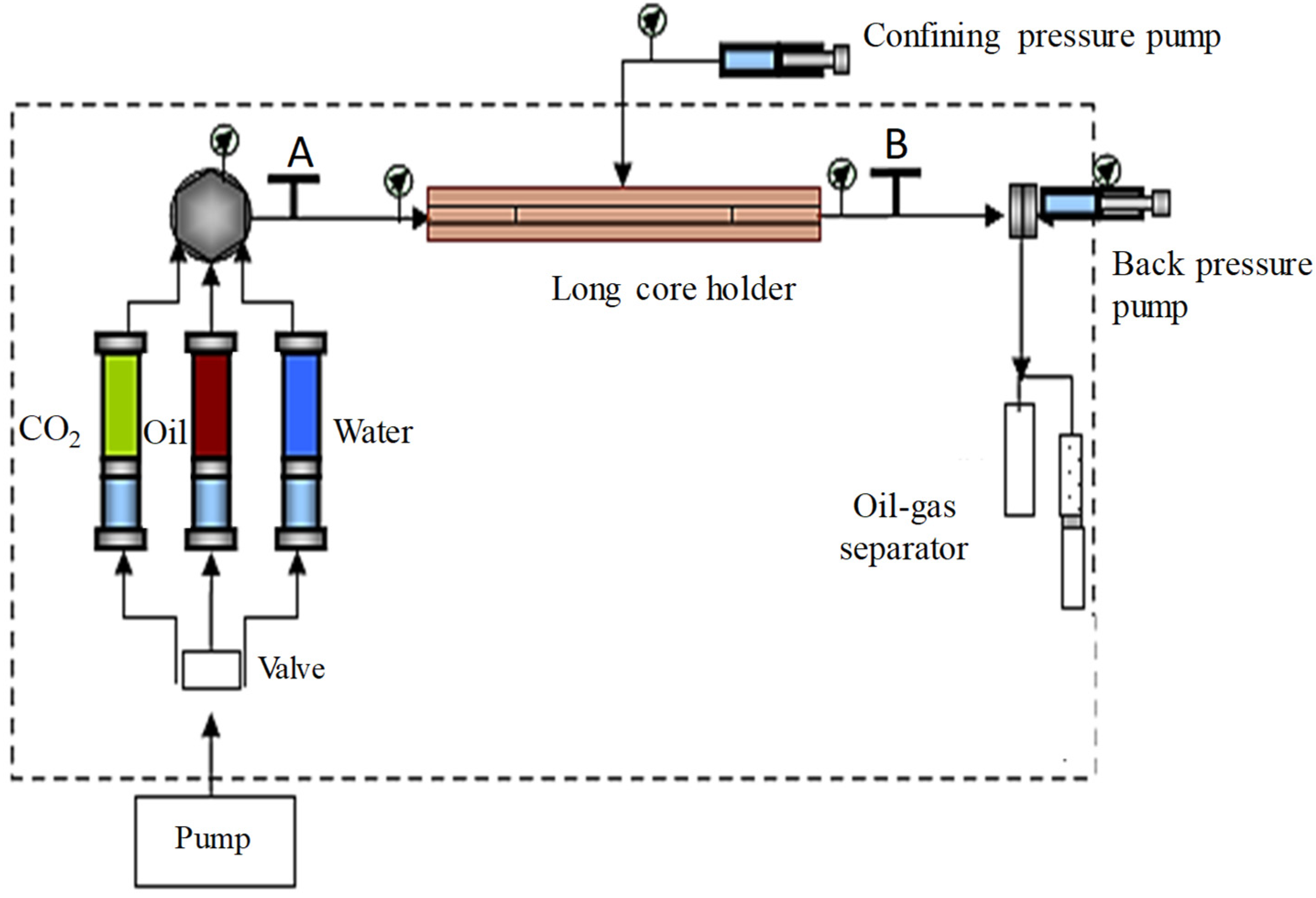
The CO2 flooding and storage experiments were conducted using a high-temperature, high-pressure long-core flooding system manufactured in Hai’an County, Jiangsu Province, China. It mainly consists of a high-precision micro-injection pump, fluid container, core holder, confining pressure system, backpressure system, produced fluid measurement system, and constant temperature system. A schematic diagram of the apparatus is shown in Figure 1.

2.2. Experimental Methods

All CO2 flooding and storage experiments were conducted at the reservoir temperature of 126 °C. In the experiments, the backpressure for immiscible flooding, near-miscible flooding [21], miscible flooding, and WAG flooding was set to 20 MPa, 25 MPa, 30 MPa, and 30 MPa, respectively. The main experimental steps are as follows:
(1)
Preparation of simulated oil and simulated formation water based on the composition of the reservoir crude oil and formation water.
(2)
The long core was placed into the core holder and vacuumed to saturate the simulated formation water, followed by oil flooding to establish irreducible water saturation. The system was then aged at constant temperature for 24 h.
(3)
Conducting CO2 flooding and storage experiments under different schemes:
For immiscible, near-miscible, and miscible flooding: Back pressures were set at 20 MPa, 25 MPa, and 30 MPa, respectively. CO2 was injected at a rate of 0.05 mL/min until oil production ceased at the core outlet.
For miscible WAG flooding: The back pressure was set at 30 MPa. CO2 and water slugs were injected alternately at a rate of 0.05 mL/min with an interval of 0.1 pore volume (PV) until oil production ceased at the core outlet.
It is worth noting that due to the low-permeability of core samples, if the injection rate is high, it will lead to a sharp increase in upstream injection pressure. The rate of 0.05 mL/min is a relatively reasonable value obtained through multiple tests before the experiments.
During the experiments, the inlet pressure, outlet pressure, back pressure, and volumes of produced oil/gas/water were recorded. The crude oil recovery, CO2 storage rate, and storage capacity were calculated. The formula for calculating storage rate is shown in Equation (1):
S t o r a g e   r a t e ( % ) = V i n j e c t i o n V p r o d u c t i o n V i n j e c t i o n
where Vinjection and Vproduction are the injected volume and produced volume of CO2 (under standard conditions), respectively. The final storage capacity under different injection modes are defined as the CO2 storage capacity corresponding to the cessation of oil production.

3. Results and Discussion

3.1. CO2 Immiscible Flooding and Storage

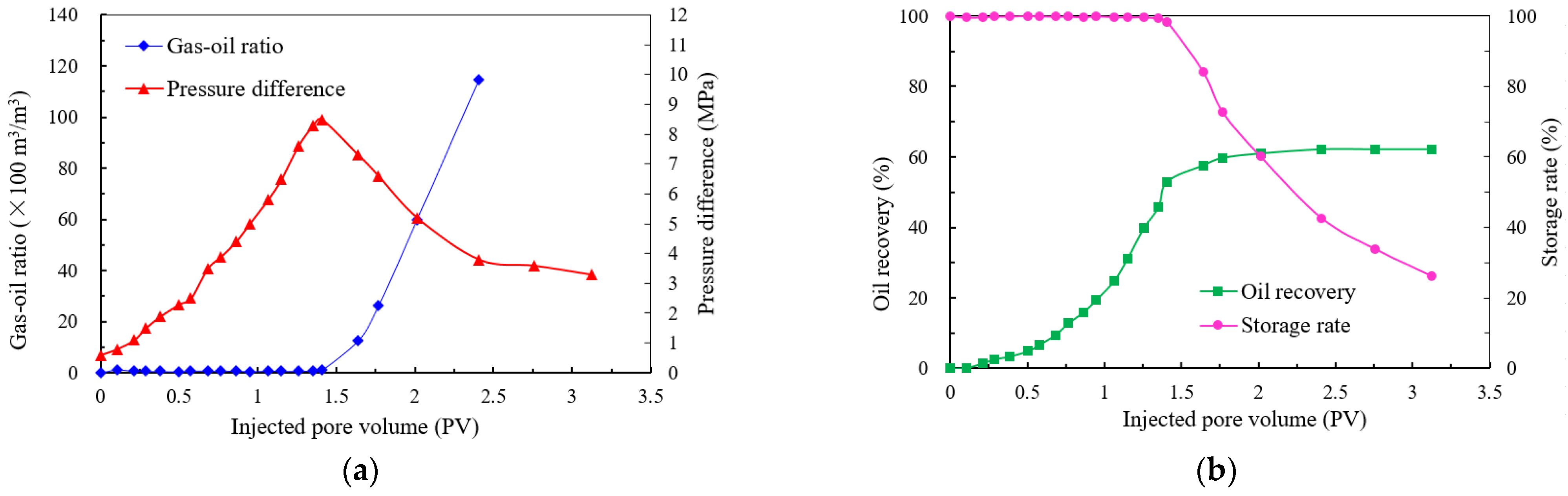
The injection-production performance curve for the CO2 immiscible flooding and storage experiment at 20 MPa is shown in Figure 2. At the initial stage of gas injection, CO2 gradually dissolves in the crude oil while displacing it. This process reduces the viscosity of the crude oil and causes its volume to expand, while also lowering the interfacial tension between oil and water to reduce displacement resistance. Due to the weak occupation effect of CO2 on pore space during the dissolution process, the injection and production pressure difference increases slowly. As oil production began at the outlet, the oil recovery increased slowly. During this stage, the produced GOR remained stable, equal to the initial solution GOR of the crude oil, and all injected CO2 was stored within the core, resulting in a storage efficiency of 100%.
When the injected volume reached approximately 0.6 pore volumes (PV), the dissolution of CO2 into the oil within the swept zone approached saturation. At this point, the displacement effect of CO2 became stronger than its dissolution effect, leading to a rapid increase in both the pressure differential and the oil recovery. When the cumulative CO2 injection reached 1.41 PV, CO2 was on the verge of breaking through the core. The pressure differential peaked at 8.5 MPa, corresponding to an oil recovery of 52.97%. After exceeding 1.41 PV of CO2 injection, a gas channel formed within the core due to the significant viscosity difference between CO2 and crude oil, reducing CO2 flow resistance. Consequently, the pressure differential decreased rapidly. Significant CO2 production was observed at the outlet, causing the GOR to rise sharply. The increase in oil recovery became marginal, and the CO2 storage efficiency gradually declined. The final oil recovery was 62.13%, which is lower than the 70.2% oil recovery of CO2 immiscible flooding in the high-permeability reservoir of Palogue Oilfield in Sudan. This may be attributed to differences in reservoir properties [48,49,50]; the permeability of Palogue Oilfield reaches 700–9600 mD, while the permeability of the core used in this experiment is 11–17 mD, which restricts the improvement of displacement efficiency [51,52]. However, the CO2 storage rate of 42.7% in this experiment is comparable to the values reported for CO2 storage in tight sandstones [53,54,55]. Therefore, the contribution of CO2 immiscible flooding to both oil recovery and storage rate is primarily realized during the production stage before gas breakthrough. After CO2 breakthrough, even substantial additional gas injection is ineffective in further significantly enhancing oil recovery.

3.2. CO2 Near-Miscible Flooding and Storage

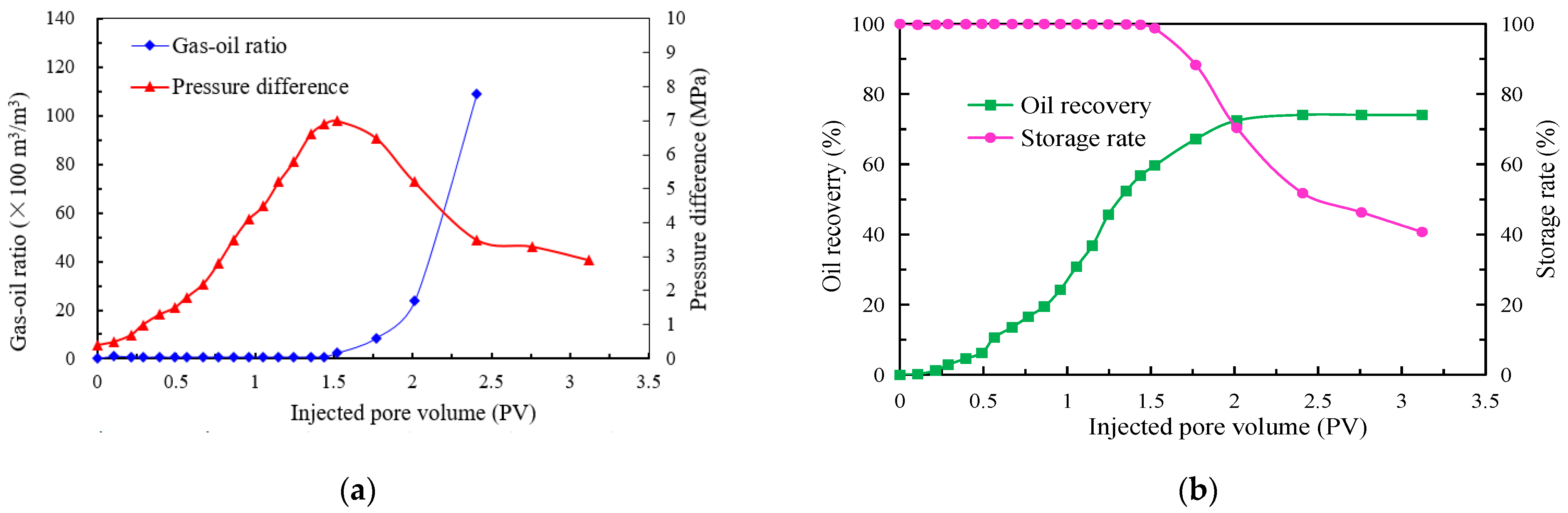
The injection-production performance curve for CO2 near-miscible flooding and storage at 25 MPa is shown in Figure 3. The pressure of 25 MPa is close to the MMP of CO2 and crude oil. At this condition, the displacement mechanism shows transitional characteristics, retaining the dissolution and viscosity reduction effect of non-miscible flooding while beginning to exhibit the advantage of a sharp reduction in interfacial tension of near-miscible flooding. Similarly to the immiscible flooding behavior, CO2 initially primarily dissolved into the crude oil after injection began, resulting in a relatively slow increase in the displacement pressure differential. The produced GOR equaled the solution GOR of the crude oil, and all injected CO2 was stored at this stage.
As CO2 injection continued, its dissolution in the oil near the injection end gradually approached saturation. Subsequently, the displacement effect of CO2 strengthened, leading to a rapid rise in both the pressure differential and the oil recovery. When the cumulative CO2 injection reached 1.52 pore volumes (PV), the CO2 front arrived at the core outlet. At this point, the pressure differential peaked at 7.0 MPa, corresponding to an oil recovery of 59.65%.
Upon further CO2 injection, gas breakthrough occurred at the production end, causing the GOR to increase rapidly. Consequently, the pressure differential and CO2 storage efficiency decreased significantly, while the oil recovery continued to increase only slightly until oil production ceased. The final oil recovery and CO2 storage rate were 74.9% and 51.7%, respectively, indicating a clear improvement in both displacement and storage performance compared to immiscible flooding. This is consistent with the research conclusion of Lei et al. [56], whose study shows that when the pressure is close to MMP, the recovery rate of CO2 flooding can be increased by 10% to 15% compared with non-miscible flooding.

3.3. CO2 Miscible Flooding and Storage

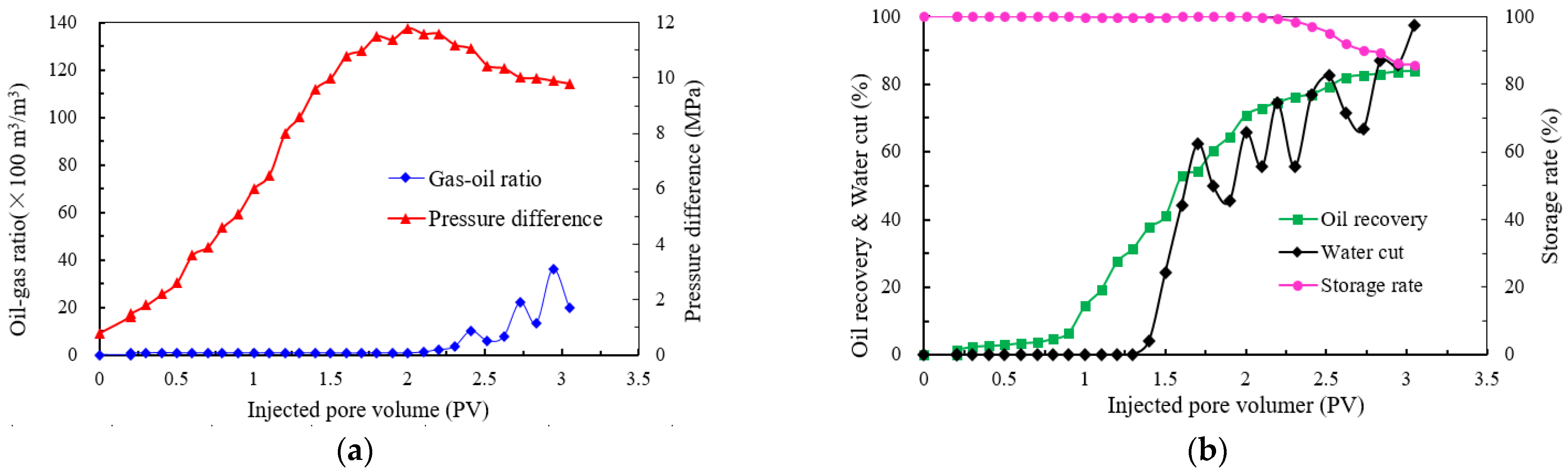
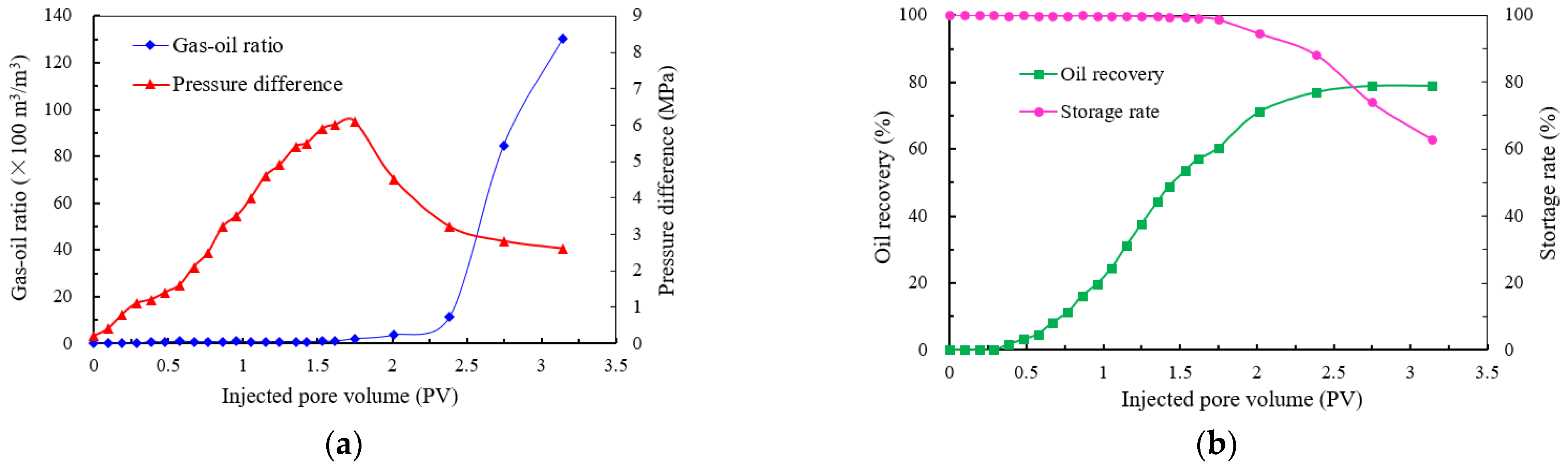
During the CO2 miscible flooding, a miscible zone between CO2 and crude oil is formed, and the interfacial tension between oil and CO2 is almost completely eliminated. Meanwhile, CO2 can extract a large amount of hydrocarbon components from crude oil, significantly improving the fluidity of crude oil. The injection-production performance curve for CO2 miscible flooding and storage at 30 MPa is shown in Figure 4. The results indicate that during the initial stage of CO2 miscible flooding, the higher injection pressure enhances the dissolution capacity of CO2 in the crude oil, resulting in a lower initial injection-production pressure differential compared to immiscible and near-miscible flooding. As CO2 injection continued, the pressure differential first increased slowly and then rose rapidly. Prior to CO2 breakthrough in the core, the GOR remained stable, oil recovery continued to increase, and all injected CO2 was stored.
When the cumulative CO2 injection reached 1.75 pore volumes (PV), CO2 broke through at the core outlet. At this point, the pressure differential peaked at 6.1 MPa, corresponding to an oil recovery of 60.3%. Subsequently, a gas channel formed within the core, leading to significant gas production at the outlet, a sharp decline in the pressure differential, and a rapid increase in GOR. Nevertheless, due to the continuous extraction of residual oil by the miscible zone, the oil recovery continued to rise, ultimately reaching a final recovery of 78.96%—a greater increase compared to near-miscible and immiscible flooding-while the CO2 storage rate gradually decreased to 74.1%.
Compared with the studies of the same type of oil reservoirs, the final recovery rate of the miscible flooding in this experiment (78.96%) is slightly lower than the predicted recovery rate of CO2 miscible flooding in Karamay Oilfield, which may be related to the limitation of the experimental core size. However, the CO2 storage rate (74.1%) was significantly higher than that of non-miscible flooding and near-miscible flooding, which is in line with the conclusion proposed by Lei et al. that the CO2 retention capacity is enhanced under miscible conditions [56]. Their research shows that after eliminating the influence of CH4 and N2, the storage rate of miscible flooding can be increased by more than 20%.

3.4. CO2 Water-Alternating-Gas Miscible Flooding and Storage

The injection-production performance curve for WAG miscible flooding and storage at 30 MPa is shown in Figure 5. The results show that during the initial injection stage, with the increase in CO2 and water injection volumes, the injection-production pressure differential exhibited minor fluctuations while rising rapidly overall. This is attributed to the lower viscosity and higher compressibility of CO2, which provides better injectability compared to water, leading to a smaller pressure increase during CO2 injection than during water injection, and thus minor fluctuations in the pressure differential. Concurrently, the alternating injection of gas and water created multiple gas–liquid interfaces within the pores, generating the Jamin effect and enhancing fluid flow resistance, raising the overall injection pressure, and gradually enlarging the pressure differential. During this stage, oil recovery increased slowly.
When the cumulative injection of CO2 and water reached approximately 1.4 pore volumes (PV), water production began at the outlet, with the water cut gradually increasing. At a total injection volume of about 1.90 PV, the CO2 front reached the production end, and the pressure differential peaked at 11.8 MPa, corresponding to an oil recovery of 63.5%. Subsequently, CO2 broke through at the outlet, causing a gradual decrease in the pressure differential, a marked increase in the GOR, and a reduction in CO2 storage rate. However, due to the alternating production of CO2 and water—where gas production is accompanied by less water, and water production is accompanied by lower gas output—both the water cut and GOR exhibited fluctuating increases, with the overall rise in GOR being relatively moderate. This indicates that WAG injection effectively controls gas channeling. In the later stages of flooding, the decline in the pressure differential slowed, and oil recovery continued to increase, ultimately reaching a final recovery of 83.8% and a CO2 storage rate of 89.1%.

3.5. Comparative Analysis of CO2 Flooding and Storage Under Different Injection Modes

The aforementioned results indicate that while the production performance curves of CO2 immiscible, near-miscible, miscible, and WAG flooding exhibit similar trends, their displacement and storage rate differ significantly. To further quantitatively investigate the influence of flooding schemes on CO2 displacement and storage, this section systematically compares and analyzes the variations and differences in production characteristic parameters—such as displacement pressure differential, gas breakthrough time, and GOR—as well as development evaluation parameters, including oil recovery, storage rate, and storage capacity, under the four flooding schemes. This analysis aims to provide guidance for optimizing CO2 flooding and storage strategies in low-permeability reservoirs.

3.5.1. Influence on Production Characteristic Parameters

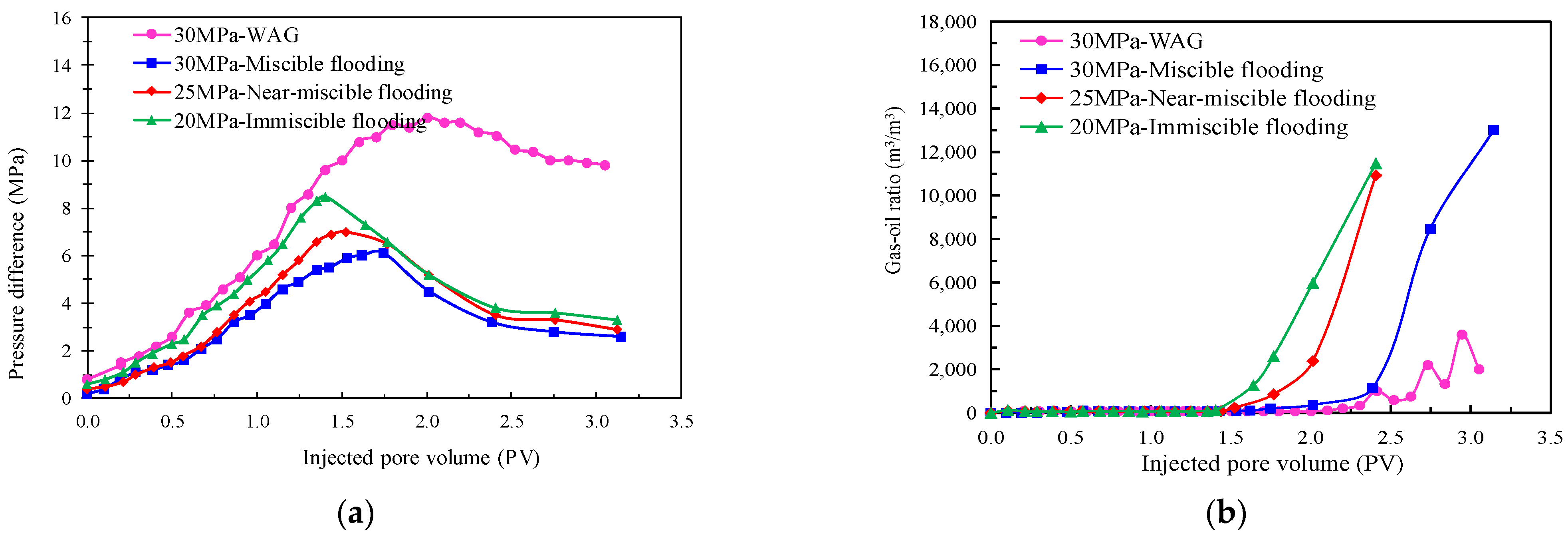
The variation curves of displacement pressure differential and GOR under different flooding schemes are shown in Figure 6. The results show that for continuous gas injection, a higher pressure level corresponds to a lower displacement pressure differential. The peak displacement pressure differential for CO2 miscible flooding at 30 MPa was 6.1 MPa, whereas for immiscible flooding at 20 MPa it reached 8.5 MPa. This difference arises because, under immiscible conditions, the interfacial tension between CO2 and crude oil increases flow resistance, while under miscible conditions, thorough contact between CO2 and oil reduces interfacial tension to nearly zero, significantly lowering flow resistance and thus resulting in a lower pressure differential compared to immiscible and near-miscible flooding. In WAG flooding, alternating gas and water injection creates multiple gas–liquid interfaces within the pores. Due to interfacial tension effects, fluid flow resistance is higher than in continuous gas injection, enabling WAG flooding to maintain a higher displacement pressure differential and thereby mobilize oil from smaller pores.
From the GOR variation curves under different flooding schemes, it can be observed that significant GOR increases occurred at injection volumes of approximately 1.41 PV, 1.52 PV, 1.75 PV, and 1.90 PV for immiscible, near-miscible, miscible, and WAG flooding, respectively. This indicates that for continuous gas injection, lower reservoir pressure levels lead to earlier gas breakthrough and faster gas channeling. In WAG flooding, water preferentially enters larger, well-connected pores, making it less likely for CO2 to form dominant flow channels along these pores. This delays gas breakthrough, and due to the alternating production of gas and water, the GOR remains at a relatively low level, which facilitates the more efficient utilization and storage of CO2.

3.5.2. Influence on Oil Displacement Efficiency

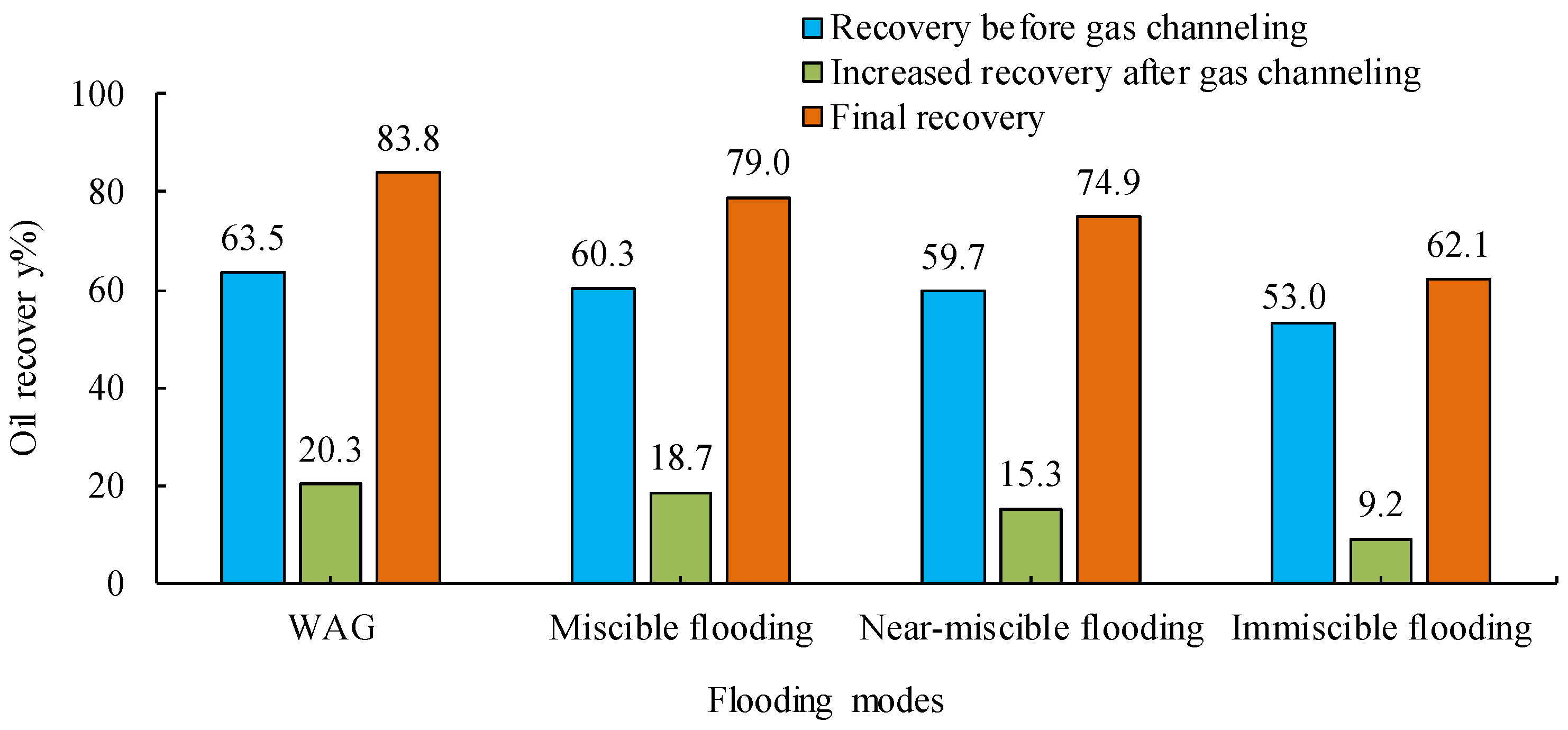
A comparison of the oil recovery under different displacement schemes is shown in Figure 7. The results indicate that prior to gas breakthrough, the oil recovery ranged from 53.0% to 63.5% across the different CO2 flooding methods, ranked from high to low as follows: WAG miscible flooding, miscible flooding, near-miscible flooding, and immiscible flooding. After gas breakthrough, the incremental recoveries for WAG, miscible, near-miscible, and immiscible flooding were 20.3%, 18.7%, 15.3%, and 9.2%, respectively. This demonstrates that WAG flooding outperforms continuous gas injection both before and after gas breakthrough. This is attributed to the fact that during continuous gas injection, CO2 preferentially displace oil in larger pores. Once the injected CO2 volume reaches a certain threshold, the interconnected larger pores gradually form dominant flow channels for CO2, leading to premature gas breakthrough and channeling. In WAG flooding, the alternating injection of CO2 and water allows water to first enter the larger pores, and due to its higher flow resistance, subsequently injected CO2 is diverted into medium and small pores to mobilize otherwise hard-to-recover oil. Consequently, WAG flooding effectively homogenizes the displacement front and controls gas channeling, resulting in superior displacement efficiency compared to other methods. However, regardless of the flooding scheme, the incremental oil recovery achieved after gas breakthrough is significantly lower than the cumulative recovery before breakthrough. Therefore, optimizing the displacement scheme and injection-production parameters to prevent premature gas breakthrough is key to enhancing the effectiveness of CO2 flooding.

3.5.3. Influence on Storage Rate

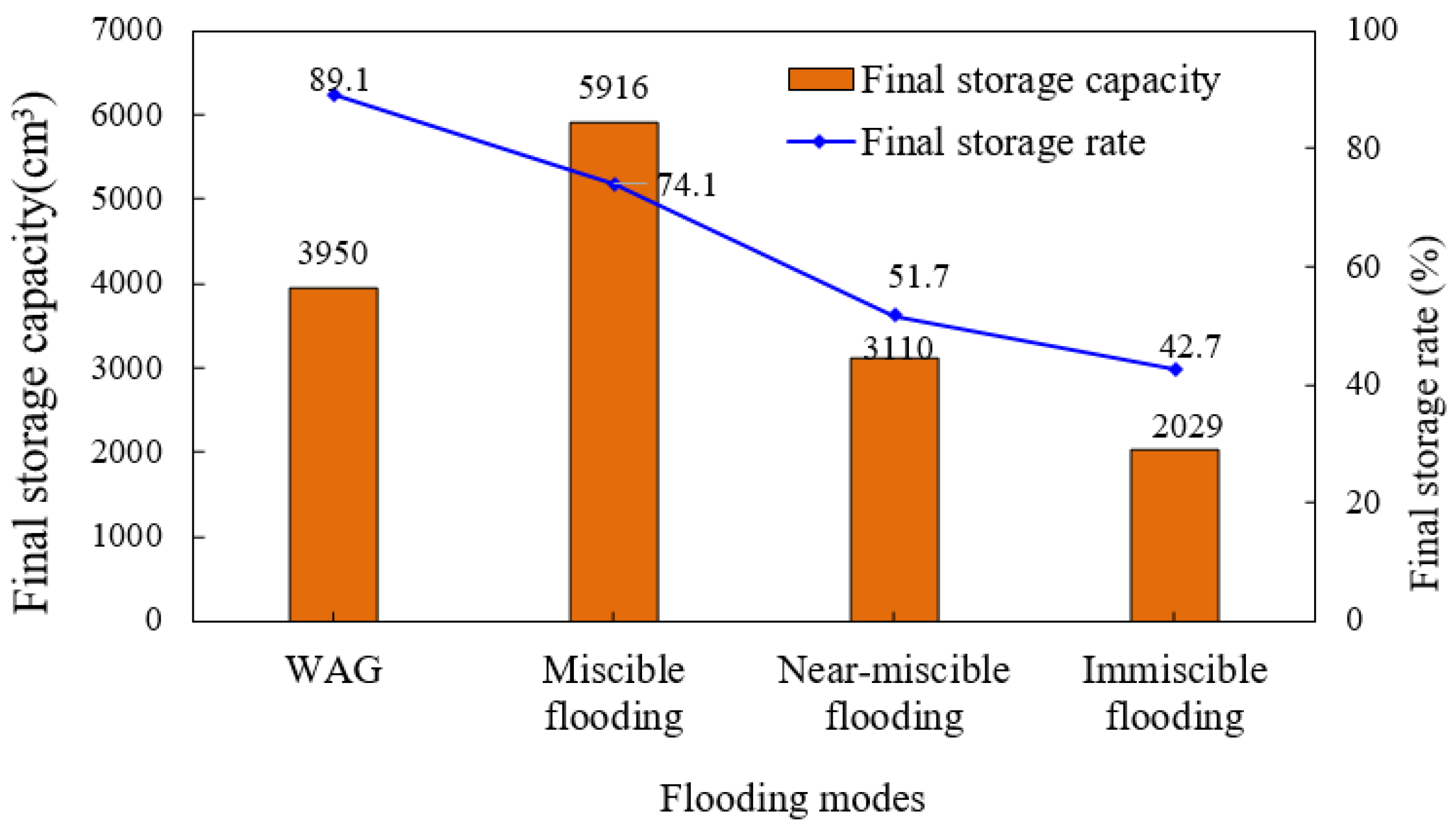
The final storage capacity and storage rate of CO2 at the point of ceased oil production under different displacement schemes are compared in Figure 8. The results show that CO2 miscible flooding achieved the highest storage capacity, reaching 5916 cm3. This is attributed to the high-pressure level associated with miscible flooding, which allows for a greater cumulative volume of compressed CO2 to be injected. Despite some CO2 being produced along with oil after gas breakthrough, the overall amount sequestered remains the highest, with a storage efficiency of 74.1%. WAG flooding ranks second in terms of final storage capacity. Although the cumulative CO2 injected in WAG flooding is relatively lower, the alternating water and CO2 slugs effectively suppress channeling by mutually inhibiting flow. This significantly delays gas breakthrough, allowing the injected CO2 to be more fully utilized for oil displacement with minimal production, thereby resulting in a high storage capacity and a storage rate of 89.1%. In contrast, near-miscible and immiscible flooding involve relatively larger volumes of injected CO2. However, earlier gas breakthrough and severe channeling in later stages lead to substantial CO2 production, consequently resulting in lower storage capacity and rate.
In summary, CO2 miscible flooding yields the optimal result in terms of final storage capacity, while WAG flooding achieves the highest storage rate. In practical applications, the choice of an appropriate CO2 flooding scheme should be determined by comprehensively considering factors such as the degree of enhanced oil recovery, CO2 storage rate, storage capacity, and economic viability.
Although the linear core model employed in this study differs from actual heterogeneous reservoirs in terms of geometric configuration, boundary conditions, and physical property simplification, it enables effective control of variables and successfully reveals the fundamental mechanisms and key behavioral patterns of CO2 flooding under varying pressures and injection modes. The findings regarding the influence of pressure on miscibility, the role of injection modes in controlling gas channeling, and the distinct contributions of pre- and post-breakthrough stages to oil recovery and CO2 storage possess significant mechanistic universality. These insights provide a theoretical basis for the design of CO2-enhanced oil recovery and storage programs and offer practical guidance for optimizing injection parameters and defining development stages in field applications. Subsequent studies may further extend these understandings to more complex geological conditions through numerical and physical simulations.

4. Conclusions

This study conducted long-core experiments on CO2 immiscible, near-miscible, miscible, and WAG flooding in low-permeability reservoirs. The effects of different injection modes on CO2 flooding performance characteristics, oil recovery rate, and storage rate were compared and analyzed. The main conclusions are as follows:
(1)
The injection modes significantly impact CO2 flooding efficiency. Miscible WAG injection achieved the highest oil recovery (83.8%), followed by miscible flooding (79.0%), near-miscible flooding (74.9%), and immiscible flooding (62.1%). WAG injection effectively enhanced oil displacement both before and after CO2 breakthrough by homogenizing the displacement front and suppressing gas channeling.
(2)
CO2 storage rate is closely related to the injection modes and CO2 breakthrough time. Miscible WAG injection, with water slugs effectively inhibiting CO2 channeling, achieved the highest storage rate (89.1%). In contrast, high-pressure miscible flooding yielded the greatest absolute storage capacity (5916 cm3) due to a larger cumulative injected volume. For continuous gas injection, higher pressure and later breakthrough correlate with higher storage rate.
(3)
Production performance characteristics vary distinctly. Under continuous gas injection, higher pressure reduces interfacial tension between CO2 and crude oil, leading to lower flow resistance and a consequently lower maximum displacement pressure differential (6.1 MPa for miscible vs. 8.5 MPa for immiscible). WAG injection exhibited the highest flow resistance and maintained a higher displacement pressure differential due to multiple gas–liquid interfaces formed, enabling the mobilization of oil from smaller pores.
(4)
Controlling gas channeling is crucial for optimizing both oil recovery and storage. For all injection modes, the incremental oil recovery after CO2 breakthrough was significantly lower than the cumulative recovery before CO2 breakthrough. Both WAG injection and high-pressure miscible flooding substantially improved pre-breakthrough displacement efficiency by delaying CO2 breakthrough (to 1.90 PV and 1.75 PV, respectively), laying a foundation for subsequent storage.

Funding

This research was funded by the Dongying City Natural Science Foundation Project of Shandong Province [grant number: 2024ZR028] and the Postdoctoral Research Station Project of Shengli Oilfield [grant number: YKB2306].

Data Availability Statement

The experimental data generated during this study (including core property tables, fluid composition parameters, and displacement performance curves) are not publicly available due to proprietary constraints but can be made available upon reasonable request to the corresponding author.

Conflicts of Interest

Author Wencheng was employed by the company Exploration and Development Research Institute, Shengli Oilfield Company, SINOPEC. The author declare that the research was conducted in the absence of any commercial or financial relationships that could be construed as a potential conflict of interest.

References

  1. Dou, L.; Wen, Z.; Wang, J.; Wang, Z.; He, Z.; Liu, X.; Zhang, N. Analysis of the World Oil and Gas Exploration Situation in 2021. Pet. Explor. Dev. 2022, 49, 1195–1209. [Google Scholar] [CrossRef]
  2. Li, N.; Zhu, S.; Li, Y.; Zhao, J.; Long, B.; Chen, F.; Wang, E.; Feng, W.; Hu, Y.; Wang, S.; et al. Fracturing-Flooding Technology for Low Permeability Reservoirs: A Review. Petroleum 2024, 10, 202–215. [Google Scholar] [CrossRef]
  3. Zhao, L.; Li, D.; Guo, X.; Xue, J.; Wang, C.; Sun, W. Cooperation Risk of Oil and Gas Resources Between China and the Countries Along the Belt and Road. Energy 2021, 227, 120445. [Google Scholar] [CrossRef]
  4. Yuan, S.; Ma, D.; Li, J.; Zhou, T.; Ji, Z.; Han, H. Progress and Prospects of Carbon Dioxide Capture, EOR-Utilization and Storage Industrialization. Pet. Explor. Dev. 2022, 49, 955–962. [Google Scholar] [CrossRef]
  5. Chowdhury, S.; Shrivastava, S.; Kakati, A.; Sangwai, J.S. Comprehensive Review on the Role of Surfactants in the Chemical Enhanced Oil Recovery Process. Ind. Eng. Chem. Res. 2022, 61, 21–64. [Google Scholar] [CrossRef]
  6. Wang, L.; Ma, C. Experimental Study on CO2 Foam Flooding System in High Temperature and Low-Permeability Reservoirs. ACS Omega 2025, 10, 34801–34810. [Google Scholar] [CrossRef]
  7. Li, X.; Yang, Z.; Li, S.; Huang, W.; Zhan, J.; Lin, W. Reservoir Characteristics and Effective Development Technology in Typical Low-Permeability to Ultralow-Permeability Reservoirs of China National Petroleum Corporation. Energy Explor. Exploit. 2021, 39, 1713–1726. [Google Scholar] [CrossRef]
  8. Wang, M.; Yang, S.; Li, M.; Wang, S.; Yu, P.; Zhang, Y.; Chen, H. Influence of Heterogeneity on Nitrogen Foam Flooding in Low-Permeability Light Oil Reservoirs. Energy Fuels 2021, 35, 4296–4312. [Google Scholar] [CrossRef]
  9. Chen, Z.; Su, Y.-L.; Li, L.; Meng, F.-K.; Zhou, X.-M. Characteristics and Mechanisms of Supercritical CO2 Flooding Under Different Factors in Low-Permeability Reservoirs. Pet. Sci. 2022, 19, 1174–1184. [Google Scholar] [CrossRef]
  10. Wakerley, D.; Lamaison, S.; Wicks, J.; Clemens, A.; Feaster, J.; Corral, D.; Jaffer, S.A.; Sarkar, A.; Fontecave, M.; Duoss, E.B.; et al. Gas Diffusion Electrodes, Reactor Designs and Key Metrics of Low-Temperature CO2 Electrolysers. Nat. Energy 2022, 7, 130–143. [Google Scholar] [CrossRef]
  11. Bai, G.; Su, J.; Zhang, Z.; Lan, A.; Zhou, X.; Gao, F.; Zhou, J. Effect of CO2 Injection on CH4 Desorption Rate in Poor Permeability Coal Seams: An Experimental Study. Energy 2022, 238, 121674. [Google Scholar] [CrossRef]
  12. Chen, H.; Liu, X.; Zhang, C.; Tan, X.; Yang, R.; Yang, S.; Yang, J. Effects of Miscible Degree and Pore Scale on Seepage Characteristics of Unconventional Reservoirs Fluids due to Supercritical CO2 Injection. Energy 2022, 239, 122287. [Google Scholar] [CrossRef]
  13. Niu, Q.; Cao, L.; Sang, S.; Wang, W.; Zhou, X.; Yuan, W.; Ji, Z.; Chang, J.; Li, M. Experimental Study on the Softening Effect and Mechanism of Anthracite with CO2 Injection. Int. J. Rock Mech. Min. Sci. 2021, 138, 104614. [Google Scholar] [CrossRef]
  14. Wang, Z.; Fu, X.; Pan, J.; Deng, Z. Effect of N2/CO2 Injection and Alternate Injection on Volume Swelling/Shrinkage Strain of Coal. Energy 2023, 275, 127377. [Google Scholar] [CrossRef]
  15. Liu, J.; Pi, Y.; Liu, L.; Gu, X.; Li, Z.; Dai, Z. Effect of Water Saturation on CO 2 Minimum Miscibility Pressure and Oil Displacement Performance. J. Dispers. Sci. Technol. 2024, 45, 1793–1803. [Google Scholar] [CrossRef]
  16. Hartono, K.F.; Permadi, A.K.; Siagian, U.W.R.; Hakim, A.L.L.; Paryoto, S.; Resha, A.H.; Adinugraha, Y.; Pratama, E.A. The Impacts of CO2 Flooding on Crude Oil Stability and Recovery Performance. J. Pet. Explor. Prod. Technol. 2024, 14, 107–123. [Google Scholar] [CrossRef]
  17. Kumar, N.; Sampaio, M.A.; Ojha, K.; Hoteit, H.; Mandal, A. Fundamental Aspects, Mechanisms and Emerging Possibilities of CO2 Miscible Flooding in Enhanced Oil Recovery: A Review. Fuel 2022, 330, 125633. [Google Scholar] [CrossRef]
  18. Liu, B.; Lei, X.; Feng, D.; Ahmadi, M.; Wei, Z.; Chen, Z.; Jiang, L. Nanoconfinement Effect on the Miscible Behaviors of CO2/Shale Oil/Surfactant Systems in Nanopores: Implications for CO2 Sequestration and Enhanced Oil Recovery. Sep. Purif. Technol. 2025, 356, 129826. [Google Scholar] [CrossRef]
  19. Lv, Q.; Zheng, R.; Guo, X.; Larestani, A.; Hadavimoghaddam, F.; Riazi, M.; Hemmati-Sarapardeh, A.; Wang, K.; Li, J. Modelling Minimum Miscibility Pressure of CO2-Crude Oil Systems Using Deep Learning, Tree-Based, and Thermodynamic Models: Application to CO2 Sequestration and Enhanced Oil Recovery. Sep. Purif. Technol. 2023, 310, 123086. [Google Scholar] [CrossRef]
  20. Liu, Y.; Rui, Z. A Storage-Driven CO2 EOR for a Net-Zero Emission Target. Engineering 2022, 18, 79–87. [Google Scholar] [CrossRef]
  21. Chen, X.; Zhang, Q.; Trivedi, J.; Li, Y.; Liu, J.; Liu, Z.; Liu, S. Investigation on Enhanced Oil Recovery and CO2 Storage Efficiency of Temperature-Resistant CO2 Foam Flooding. Fuel 2024, 364, 130870. [Google Scholar] [CrossRef]
  22. Phukan, R.; Saha, R. Low Salinity Surfactant Alternating Gas/CO2 Flooding for Enhanced Oil Recovery in Sandstone Reservoirs. J. Pet. Sci. Eng. 2022, 212, 110253. [Google Scholar] [CrossRef]
  23. Zhu, D.; Li, B.; Chen, L.; Zhang, C.; Zheng, L.; Chen, W.; Li, Z. Experimental Investigation of CO2 Foam Flooding-Enhanced Oil Recovery in Fractured Low-Permeability Reservoirs: Core-Scale to Pore-Scale. Fuel 2024, 362, 130792. [Google Scholar] [CrossRef]
  24. Kong, D.; Gao, Y.; Sarma, H.; Li, Y.; Guo, H.; Zhu, W. Experimental Investigation of Immiscible Water-Alternating-Gas Injection in Ultra-High Water-Cut Stage Reservoir. Adv. Geo-Energy Res. 2021, 5, 139–152. [Google Scholar] [CrossRef]
  25. Massarweh, O.; Abushaikha, A.S. A Review of Recent Developments in CO2 Mobility Control in Enhanced Oil Recovery. Petroleum 2022, 8, 291–317. [Google Scholar] [CrossRef]
  26. Li, L.; Chen, Z.; Su, Y.-L.; Fan, L.-Y.; Tang, M.-R.; Tu, J.-W. Experimental Investigation on Enhanced-Oil-Recovery Mechanisms of Using Supercritical Carbon Dioxide as Prefracturing Energized Fluid in Tight Oil Reservoir. SPE J. 2021, 26, 3300–3315. [Google Scholar] [CrossRef]
  27. Eyinla, D.S.; Leggett, S.; Badrouchi, F.; Emadi, H.; Adamolekun, O.J.; Akinsanpe, O.T. A Comprehensive Review of the Potential of Rock Properties Alteration During CO2 Injection for EOR and Storage. Fuel 2023, 353, 129219. [Google Scholar] [CrossRef]
  28. Kudapa, V.K.; Krishna, K.S. Heavy Oil Recovery Using Gas Injection Methods and Its Challenges and Opportunities. Mater. Today Proc. 2024, 102, 247–256. [Google Scholar] [CrossRef]
  29. Tang, X.-C.; Li, Y.-Q.; Liu, Z.-Y.; Zhang, N. Nanoparticle-Reinforced Foam System for Enhanced Oil Recovery (EOR): Mechanistic Review and Perspective. Pet. Sci. 2023, 20, 2282–2304. [Google Scholar] [CrossRef]
  30. Tian, C.; Pang, Z.; Liu, D.; Wang, X.; Hong, Q.; Chen, J.; Zhang, Y.; Wang, H. Micro-Action Mechanism and Macro-Prediction Analysis in the Process of CO2 Huff-N-Puff in Ultra-Heavy Oil Reservoirs. J. Pet. Sci. Eng. 2022, 211, 110171. [Google Scholar] [CrossRef]
  31. Fang, P.; Zhang, Q.; Zhou, C.; Yang, Z.; Yu, H.; Du, M.; Chen, X.; Song, Y.; Wang, S.; Gao, Y.; et al. Chemical-Assisted CO2 Water-Alternating-Gas Injection for Enhanced Sweep Efficiency in CO2-EOR. Molecules 2024, 29, 3978. [Google Scholar] [CrossRef]
  32. Chen, B.; Reynolds, A.C. Ensemble-Based Optimization of the Water-Alternating-Gas-Injection Process. SPE J. 2016, 21, 786–798. [Google Scholar] [CrossRef]
  33. Kulkarni, M.M.; Rao, D.N. Experimental investigation of miscible and immiscible Water-Alternating-Gas (WAG) process performance. J. Pet. Sci. Eng. 2005, 48, 1–20. [Google Scholar] [CrossRef]
  34. Han, X.; Song, Z.; Deng, S.; Li, B.; Li, P.; Lan, Y.; Song, Y.; Zhang, L.; Zhang, K.; Zhang, Y. Multiphase Behavior and Fluid Flow of oil–CO2–Water in Shale Oil Reservoirs: Implication for CO2-Water-Alternating-Gas Huff-N-Puff. Phys. Fluids 2024, 36, 063310. [Google Scholar] [CrossRef]
  35. Yang, Y.; Zhang, S.; Cao, X.; Lyu, Q.; Lyu, G.; Zhang, C.; Li, Z.; Zhang, D.; Zheng, W. CO2 High-Pressure Miscible Flooding and Storage Technology and Its Application in Shengli Oilfield, China. Pet. Explor. Dev. 2024, 51, 1247–1260. [Google Scholar] [CrossRef]
  36. Perera, M.S.A.; Gamage, R.P.; Rathnaweera, T.D.; Ranathunga, A.S.; Koay, A.; Choi, X. A Review of CO2-Enhanced Oil Recovery with a Simulated Sensitivity Analysis. Energies 2016, 9, 481. [Google Scholar] [CrossRef]
  37. Zhang, J.; Zhang, H.X.; Ma, L.Y.; Liu, Y.; Zhang, L. Performance Evaluation and Mechanism with Different CO2 Flooding Modes in Tight Oil Reservoir with Fractures. J. Pet. Sci. Eng. 2020, 188, 106950. [Google Scholar] [CrossRef]
  38. Han, L.; Gu, Y. Optimization of Miscible CO2 Water-Alternating-Gas Injection in the Bakken Formation. Energy Fuels 2014, 28, 6811–6819. [Google Scholar] [CrossRef]
  39. Al-Ghnemi, M.; Ozkan, E.; Amini, K.; Kazemi, H. Numerical Modeling Assessment of CO2-EOR and Sequestration Potential in a Light-Oil Carbonate Reservoir. In Proceedings of the SPE Improved Oil Recovery Conference, Tulsa, OK, USA, 22–25 April 2024. [Google Scholar]
  40. Dutta, R.; Kundu, G.; Mirkalaei, S.M.M.; Chakraborty, R.; Yomdo, S.; Mandal, A. Evaluation of Potential of CO2-Enhanced Oil Recovery (EOR) and Assessment of Capacity for Geological Storage in a Mature Oil Reservoir within Upper Assam Basin, India. Energy Fuels 2024, 38, 14096–14118. [Google Scholar] [CrossRef]
  41. Ji, M.; Kwon, S.; Choi, S.; Kim, M.; Choi, B.; Min, B. Numerical Investigation of CO2-Carbonated Water-Alternating-Gas on Enhanced Oil Recovery and Geological Carbon Storage. J. CO2 Util. 2023, 74, 102544. [Google Scholar] [CrossRef]
  42. Li, Z.; Su, Y.; Li, L.; Hao, Y.; Wang, W.; Meng, Y.; Zhao, A. Evaluation of CO2 Storage of Water Alternating Gas Flooding Using Experimental and Numerical Simulation Methods. Fuel 2022, 311, 122489. [Google Scholar] [CrossRef]
  43. Wei, G.; Zhang, R.; Yu, C.; Zhang, K.; Wang, K. Coupled Relationships Between Overburden Stress and Ultra-Deep Sandstone Brittle Deformation Properties Based on in Situ CT Scanning. J. Struct. Geol. 2023, 173, 104905. [Google Scholar] [CrossRef]
  44. Liu, W.; Xu, S.; Lai, H.; Liu, W.; He, F.; Zhu, X. Near-Infrared All-Fused-Ring Nonfullerene Acceptors Achieving an Optimal Efficiency-Cost-Stability Balance in Organic Solar Cells. CCS Chem. 2023, 5, 654–668. [Google Scholar] [CrossRef]
  45. Zhao, Y.; Yang, F.; Zhang, W.; Li, Q.; Wang, X.; Su, L.; Hu, X.; Wang, Y.; Wang, Z.; Zhuang, L.; et al. High-Performance Ru 2 P Anodic Catalyst for Alkaline Polymer Electrolyte Fuel Cells. CCS Chem. 2022, 4, 1732–1744. [Google Scholar] [CrossRef]
  46. Kou, Z.; Wang, H.; Alvarado, V.; McLaughlin, J.F.; Quillinan, S.A. Impact of Sub-Core Scale Heterogeneity on CO2/Brine Multiphase Flow for Geological Carbon Storage in the Upper Minnelusa Sandstones. J. Hydrol. 2021, 599, 126481. [Google Scholar] [CrossRef]
  47. Radwan, A.A.; Abdelwahhab, M.A.; Nabawy, B.S.; Mahfouz, K.H.; Ahmed, M.S. Facies Analysis-Constrained Geophysical 3D-Static Reservoir Modeling of Cenomanian Units in the Aghar Oilfield (Western Desert, Egypt): Insights into Paleoenvironment and Petroleum Geology of Fluviomarine Systems. Mar. Pet. Geol. 2022, 136, 105436. [Google Scholar] [CrossRef]
  48. Niu, Y.-B.; Cheng, M.-Y.; Zhang, L.-J.; Zhong, J.-H.; Liu, S.-X.; Wei, D.; Xu, Z.-L.; Wang, P.-J. Bioturbation Enhanced Petrophysical Properties in the Ordovician Carbonate Reservoir of the Tahe oilfield, Tarim Basin, NW China. J. Palaeogeogr. 2022, 11, 31–51. [Google Scholar] [CrossRef]
  49. Wang, H.; Shi, K.; Ma, Y.; Liu, B.; Song, X.; Ge, Y.; Liu, H.; Hoffmann, R.; Immenhauser, A. Control of Depositional and Diagenetic Processes on the Reservoir Properties of the Mishrif Formation in the AD oilfield, Central Mesopotamian Basin, Iraq. Mar. Pet. Geol. 2021, 132, 105202. [Google Scholar] [CrossRef]
  50. Zhao, W.-B.; Hu, S.-Y.; Deng, X.-Q.; Bai, B.; Tao, S.-Z.; Sun, B.; Wang, Q.-R.; Cheng, D.-X. Physical Property and Hydrocarbon Enrichment Characteristics of Tight Oil Reservoir in Chang 7 Division of Yanchang Formation, Xin’anbian oilfield, Ordos Basin, China. Pet. Sci. 2021, 18, 1294–1304. [Google Scholar] [CrossRef]
  51. Fang, Y.; Yang, E.; Guo, S.; Cui, C.; Zhou, C. Study on Micro Remaining Oil Distribution of Polymer Flooding in Class-II B Oil Layer of Daqing Oilfield. Energy 2022, 254, 124479. [Google Scholar] [CrossRef]
  52. Zhong, H.; He, Y.; Yang, E.; Bi, Y.; Yang, T. Modeling of Microflow During Viscoelastic Polymer Flooding in Heterogenous Reservoirs of Daqing Oilfield. J. Pet. Sci. Eng. 2022, 210, 110091. [Google Scholar] [CrossRef]
  53. Ramadhan, R.; Promneewat, K.; Thanasaksukthawee, V.; Tosuai, T.; Babaei, M.; Hosseini, S.A.; Puttiwongrak, A.; Leelasukseree, C.; Tangparitkul, S. Geomechanics Contribution to CO2 Storage Containment and Trapping Mechanisms in Tight Sandstone Complexes: A Case Study on Mae Moh Basin. Sci. Total. Environ. 2024, 928, 172326. [Google Scholar] [CrossRef]
  54. Yue, P.; Liu, F.; Yang, K.; Han, C.; Ren, C.; Zhou, J.; Wang, X.; Fang, Q.; Li, X.; Dou, L. Micro-Displacement and Storage Mechanism of CO2 in Tight Sandstone Reservoirs Based on CT Scanning. Energies 2022, 15, 6201. [Google Scholar] [CrossRef]
  55. Zhao, E.; Jin, Z.; Li, G.; Zhang, K.; Zeng, Y. Numerical Simulation of CO2 Storage with Enhanced Gas Recovery in Depleted Tight Sandstone Gas Reservoirs. Fuel 2024, 371, 131948. [Google Scholar] [CrossRef]
  56. Lei, Y.; Wang, C.; Xu, S.; Shi, L.; Jin, X.; Fu, W. A Study on the Miscibility Mechanisms and Patterns of High CO2 Content Associated Gas Reinjection. Sci. Rep. 2025, 15, 30336. [Google Scholar] [CrossRef]
Figure 1. High-temperature and high-pressure long-core CO2 flooding system.
Energies 19 00480 g001
Figure 2. Production curves of immiscible CO2 flooding. (a) Gas–oil ratio and pressure difference. (b) Recovery rate and storage rate.
Energies 19 00480 g002
Figure 3. Production curves of near-miscible CO2 flooding. (a) Gas–oil ratio and pressure difference. (b) Recovery rate and storage rate.
Energies 19 00480 g003
Figure 4. Production curves of miscible CO2 flooding. (a) Gas–oil ratio and pressure difference. (b) Recovery rate and storage rate.
Energies 19 00480 g004
Figure 5. Production curves of water alternating gas miscible flooding. (a) Gas–oil ratio and pressure difference. (b) Recovery rate, water cut, and storage rate.
Energies 19 00480 g005
Figure 6. Comparison of production curves with different CO2 flooding modes. (a) Displacement pressure difference. (b) Gas–oil ratio.
Energies 19 00480 g006
Figure 7. Comparison of oil recovery with different CO2 flooding modes.
Energies 19 00480 g007
Figure 8. Comparison of final CO2 storage capacity and storage rate with different flooding modes.
Energies 19 00480 g008
Table 1. Physical properties of the cores used in the experiments.
Core No.Length (cm)Diameter (cm)Porosity (%)Permeability (mD)
F14.212.52616.30 17.71
F24.192.52216.68 16.96
F33.282.52616.9815.58
F44.412.52615.75 15.21
F53.752.52416.63 11.45
Table 2. Ionic composition of formation water used in the experiments.
IonsNa+ + K+Ca2+Mg2+HCO3SO42−ClTotal
Composition/(mg/L)13,130.138987.94729.30610.2090.0637,842.8861,390.50
Gas sample: CO2 gas with a purity of 99.99%.
Disclaimer/Publisher’s Note: The statements, opinions and data contained in all publications are solely those of the individual author(s) and contributor(s) and not of MDPI and/or the editor(s). MDPI and/or the editor(s) disclaim responsibility for any injury to people or property resulting from any ideas, methods, instructions or products referred to in the content.