A Three-Dimensional Analytical Model for Wind Turbine Wakes from near to Far Field: Incorporating Atmospheric Stability Effects


Abstract
1. Introduction
2. Proposal of a New Wake Model Considering Atmospheric Stability
2.1. Fundamentals of Atmospheric Stability
2.2. Previous Wake Models with Atmospheric Stability
2.3. Hypotheses, Boundary Conditions, and Accuracy Assessment Method of the Proposed Analytical Wake Model
- Model hypotheses
- (1)
- Steady-state, incompressible flow: Wake evolution is modeled under a quasi-steady assumption, considering time-averaged flow fields. This approach is typical for engineering-scale wake predictions.
- (2)
- Far-wake dominance by turbulent diffusion: In the far-wake region (), wake recovery is primarily governed by turbulent mixing between the wake and the ambient flow, rather than by deterministic vortex structures from the near-wake.
- (3)
- Empirical closure for stability effects: The complex, nonlinear effects of atmospheric stability on wake turbulence are parameterized through a stability sign parameter S and a stability-corrected wake expansion term, . This approach provides a simplified yet physically interpretable closure scheme.
- Boundary conditions
- (1)
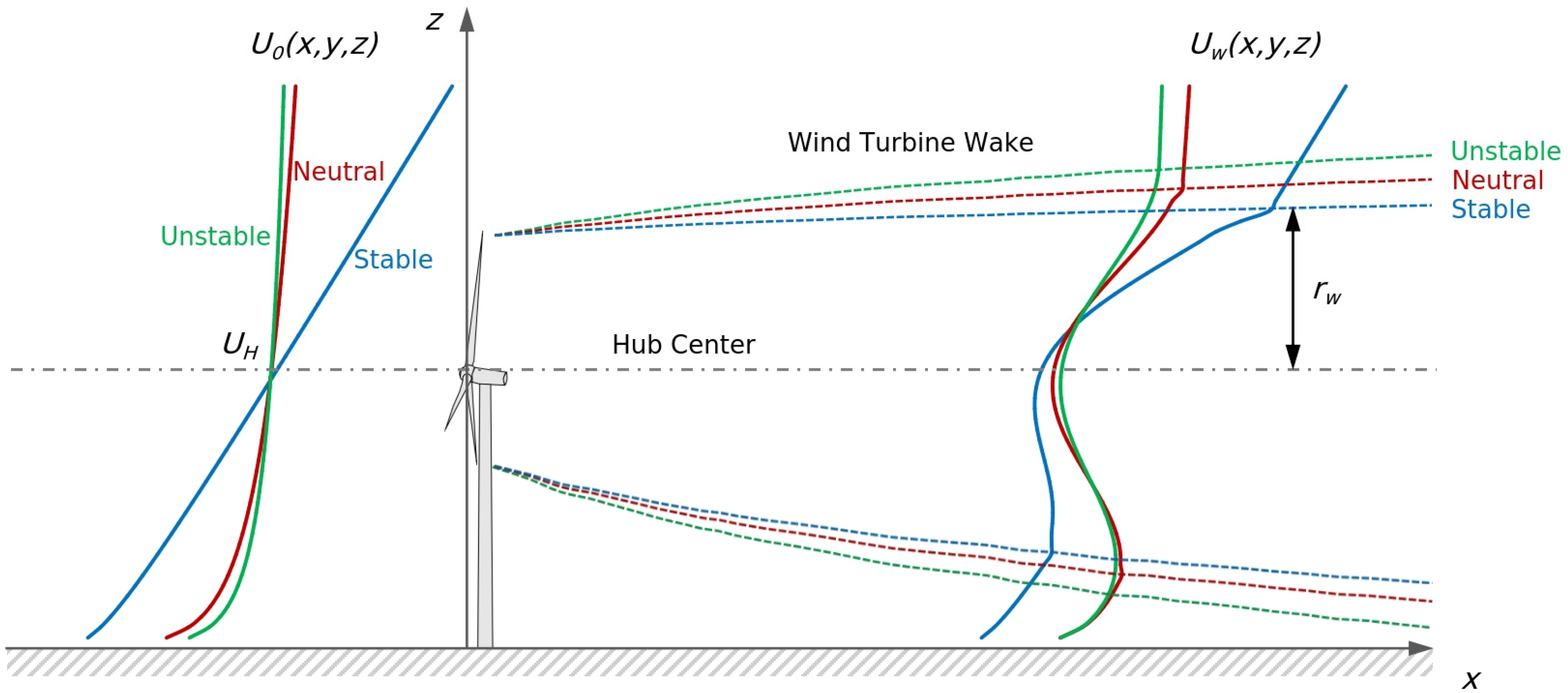
- Inflow boundary condition: Downstream of the rotor plane (at x = 0 in Figure 1), the inflow is prescribed by the vertical profiles of wind speed, U0(z), and turbulence intensity, I0(z), given by Equations (5) and (6). These profiles incorporate the influence of atmospheric stability via the Obukhov length, L.
- (2)
- Lateral and vertical boundary conditions: At distances sufficiently far from the wake centerline in the lateral (y) and vertical (z) directions, the wake flow approaches the free-stream conditions, characterized by U → U0(z) and I → I0(z).
- (3)
- Ground boundary condition: A standard no-slip condition at the ground is implicitly considered within the logarithmic profile of the incoming flow, U0(z) and I0(z), which accounts for the surface roughness length, z0.
- 3.
- Turbulence modeling rational
- 4.
- Accuracy assessment method
2.4. Proposal of New Wake Model with Atmospheric Stability
3. Performance Assessment of the Present Wake Model
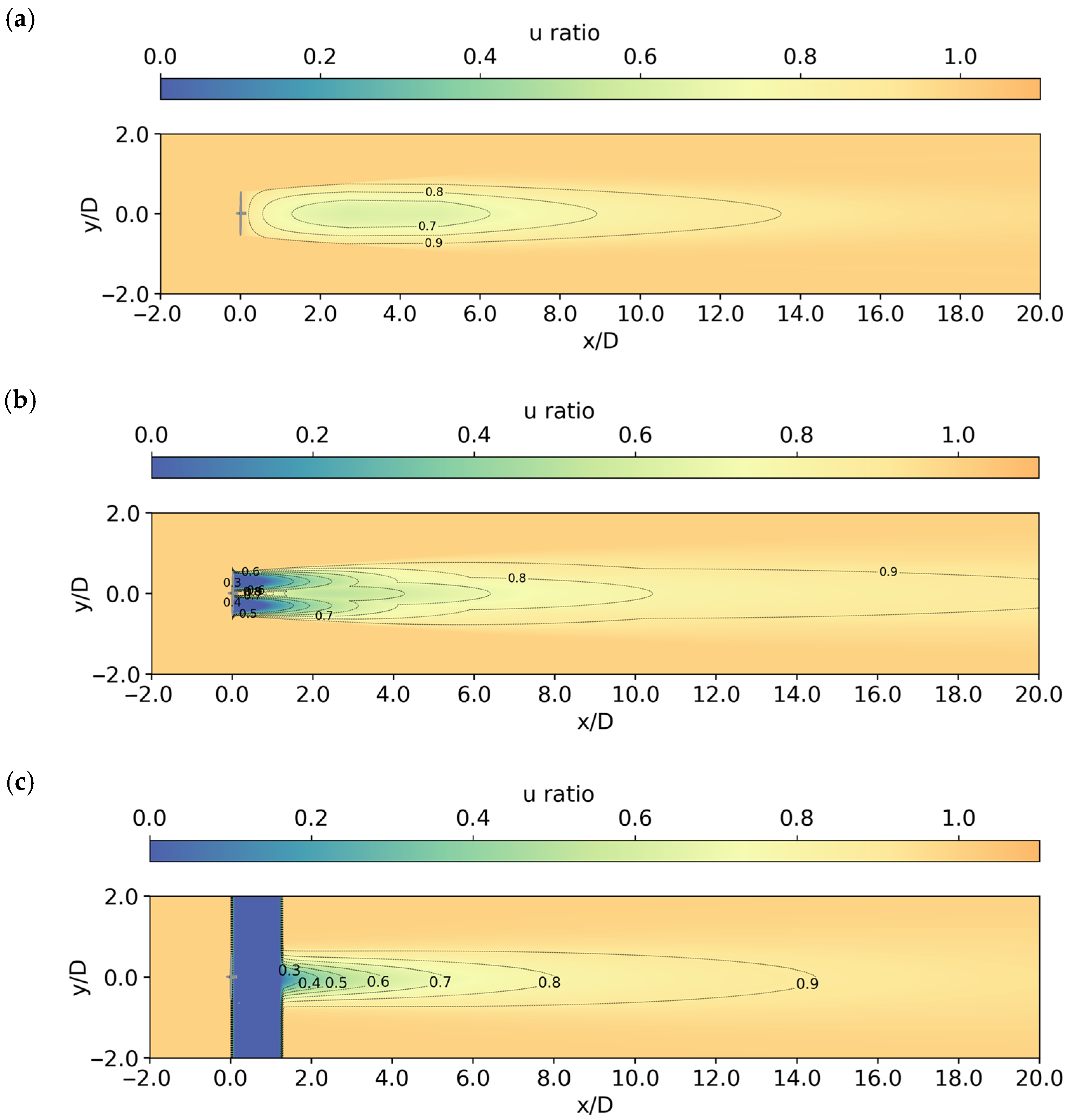
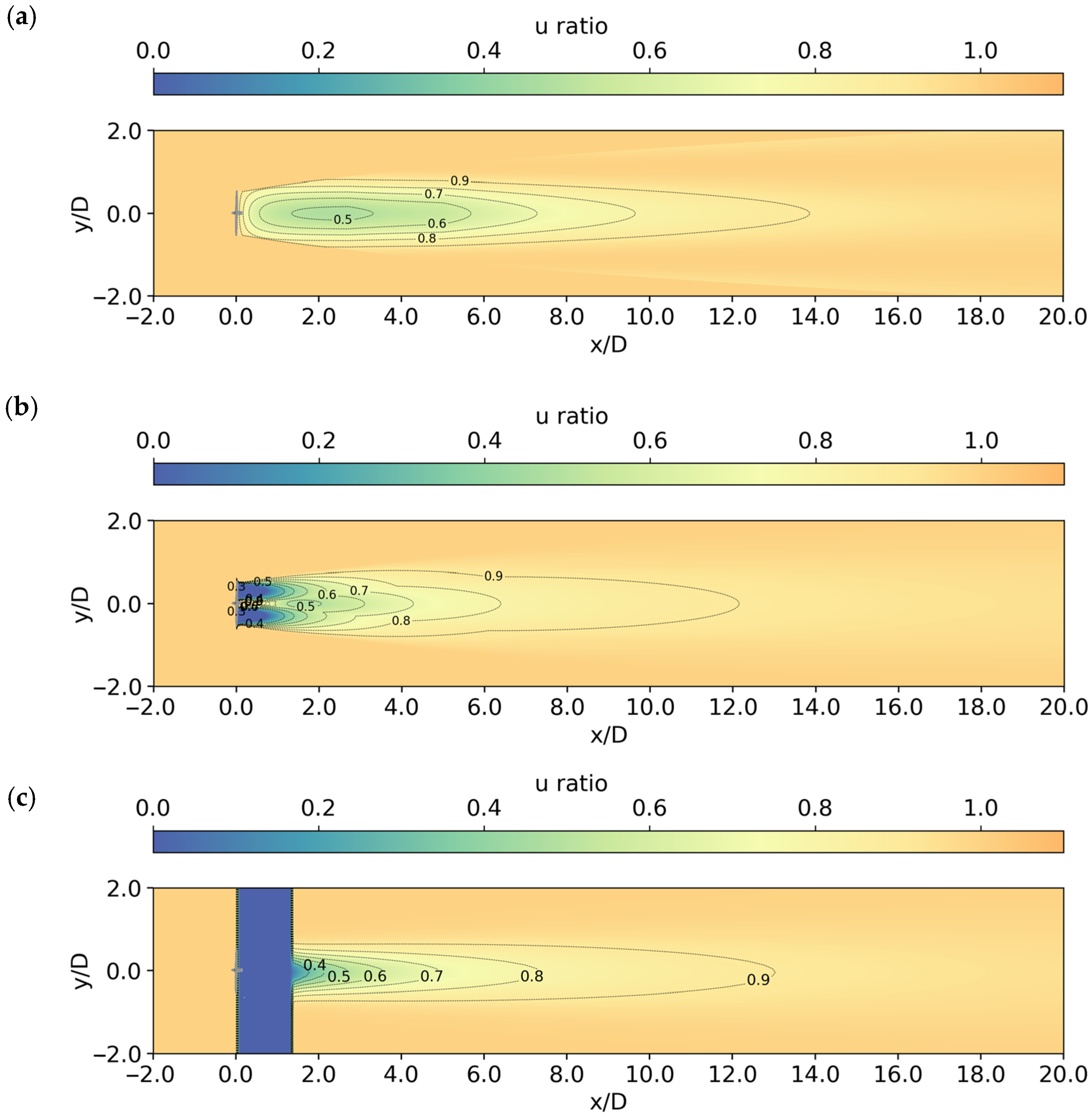
3.1. Case 1: Vestas V27 Wind Turbine
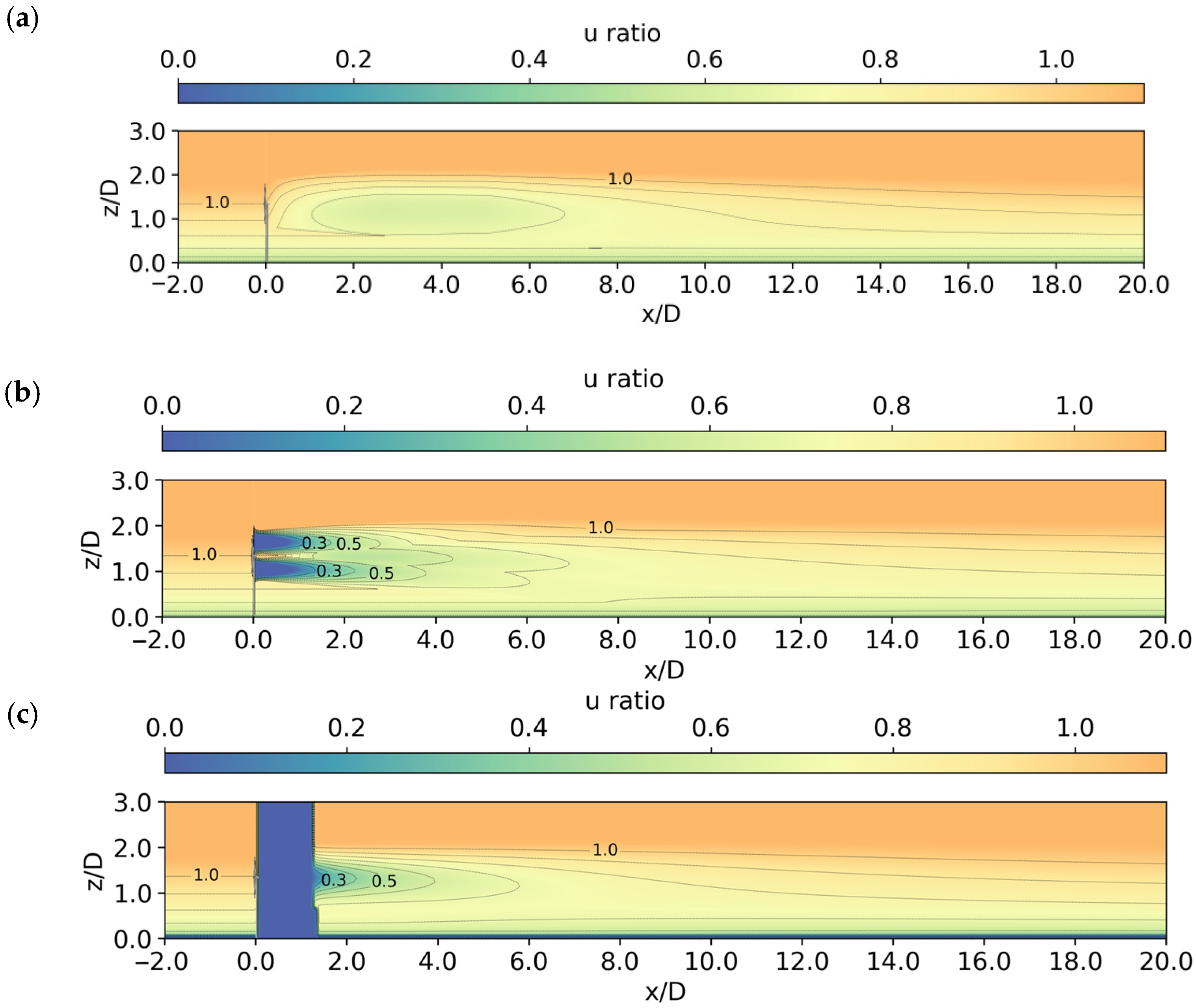
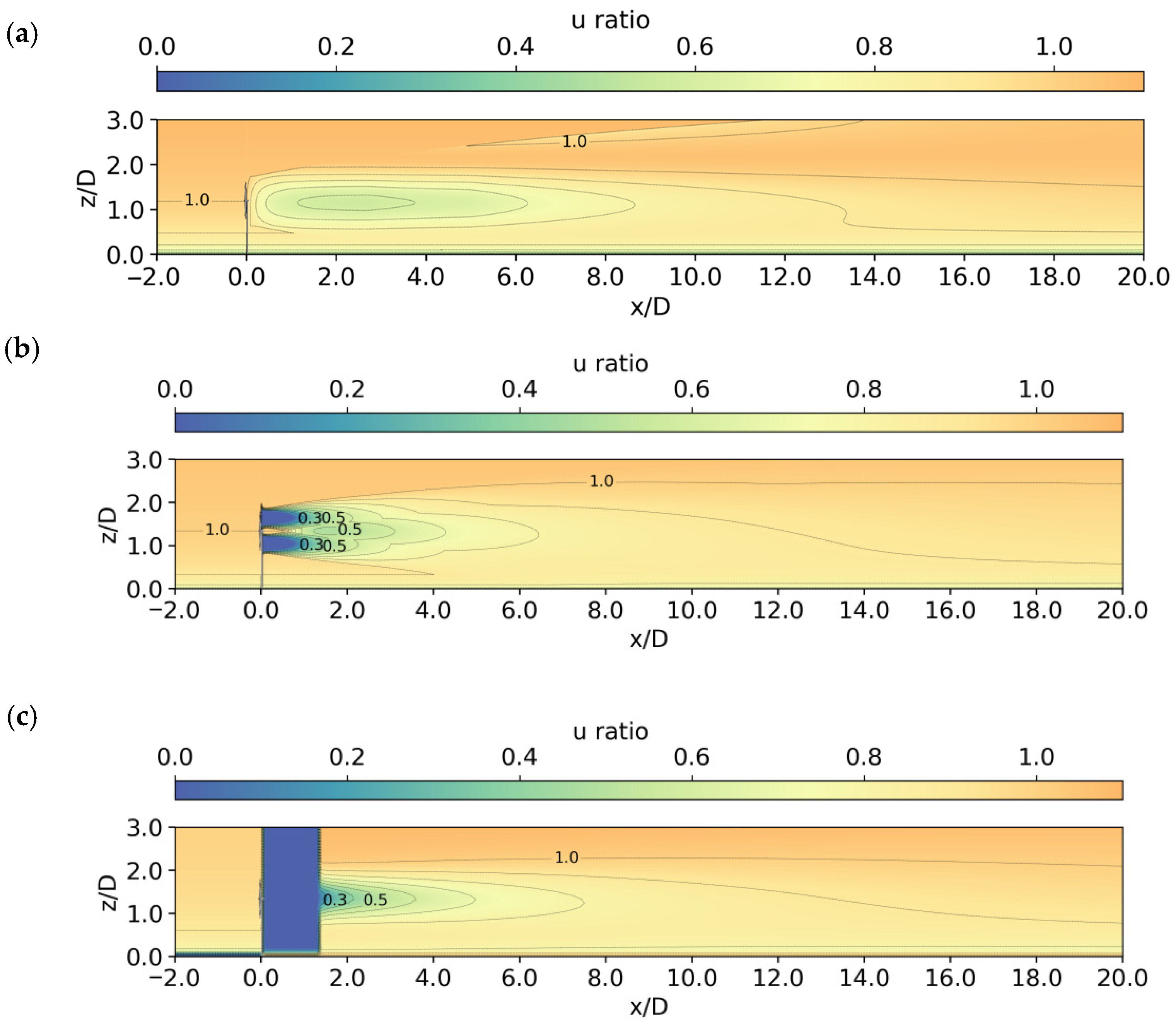
3.2. Case 2: Danwin 180 kW Wind Turbine
4. Conclusions
- (1)
- By incorporating a stability-dependent turbulence expansion term including the square of a cosine function and the stability sign parameter, a wake model framework capable of dynamically responding to atmospheric stability has been established. This framework overcomes the limitation of traditional models that rely on neutral atmospheric assumptions, achieving a physically consistent description of turbulence suppression under stable conditions and convective enhancement under unstable conditions.
- (2)
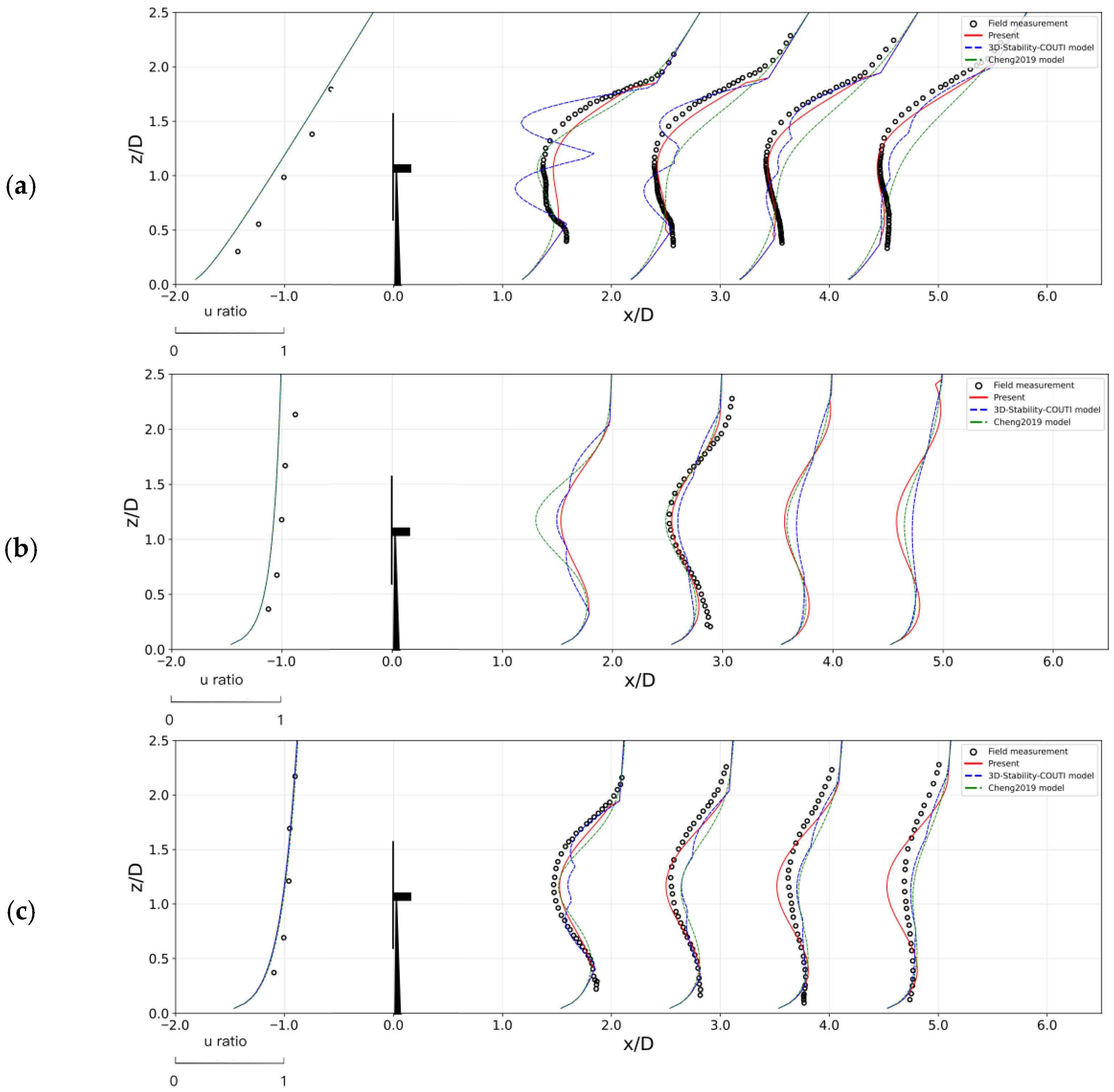
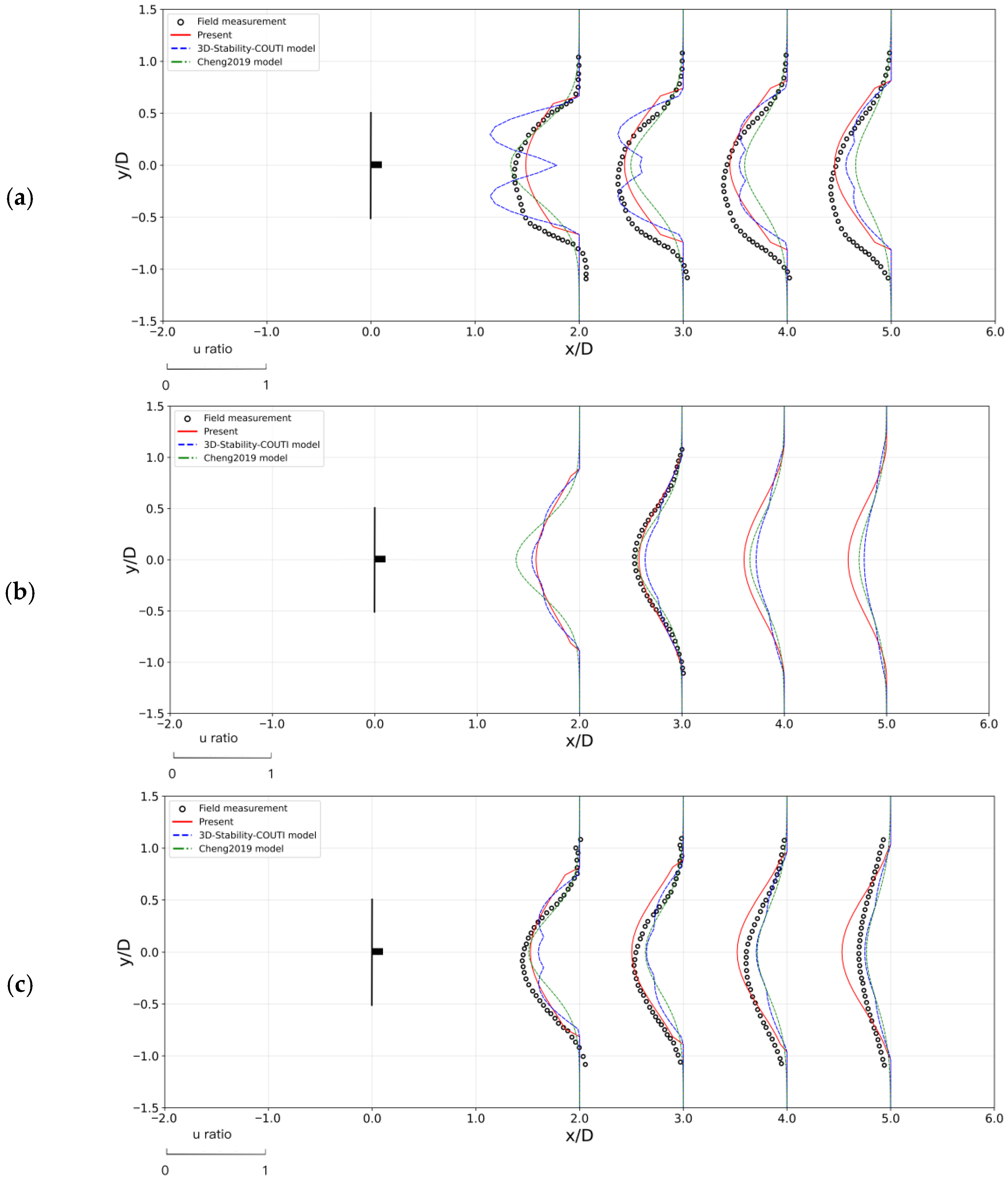
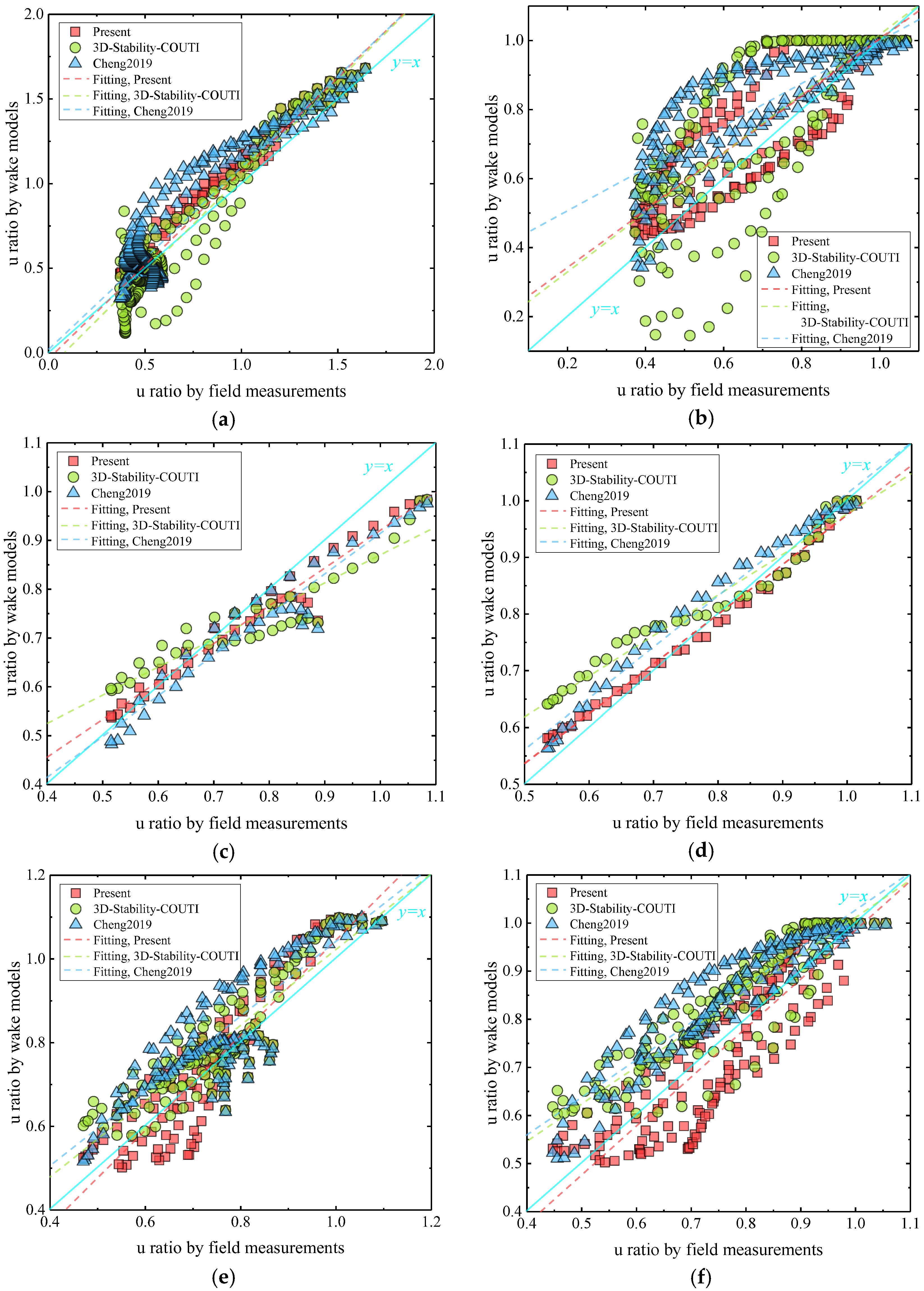
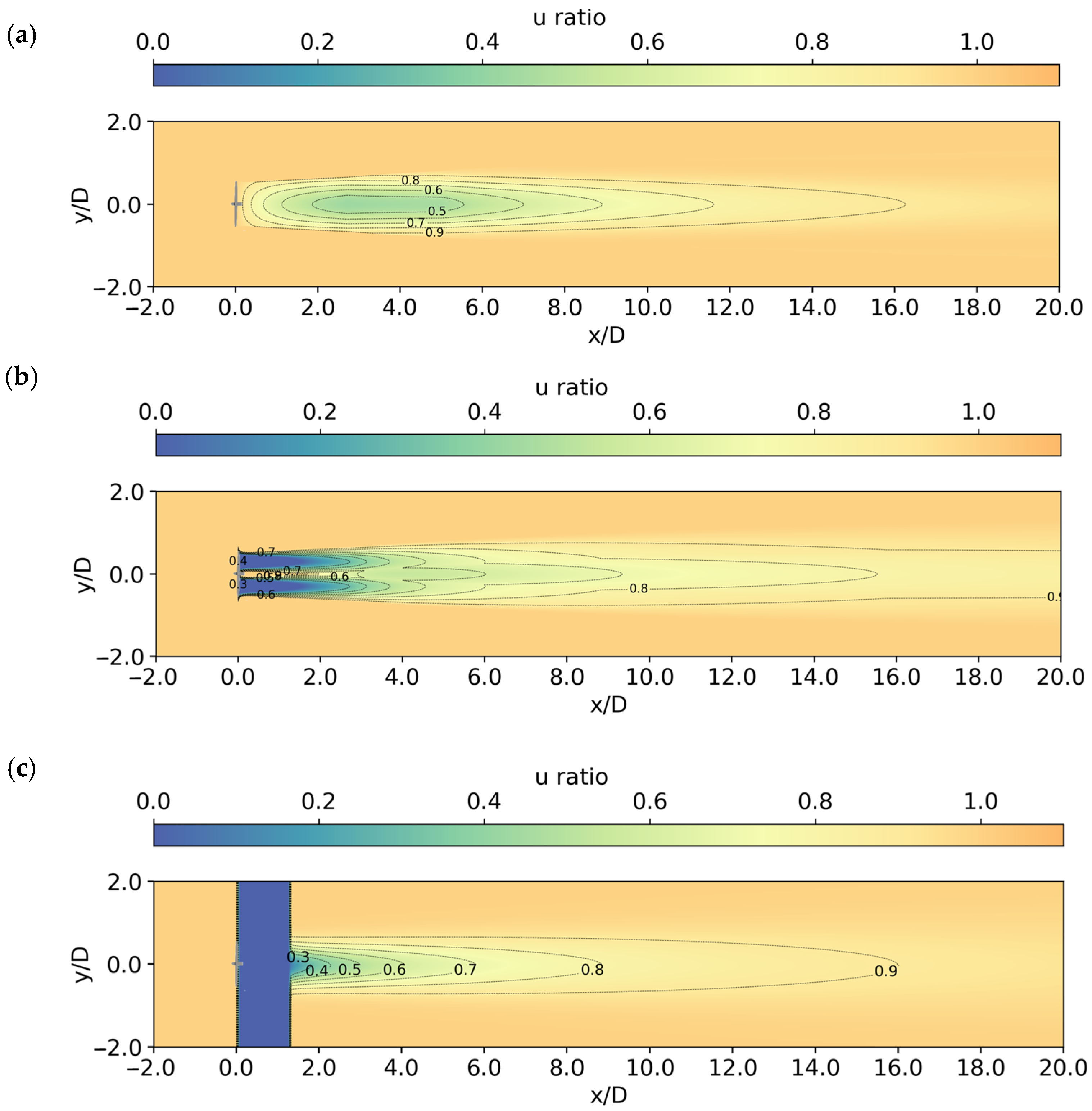
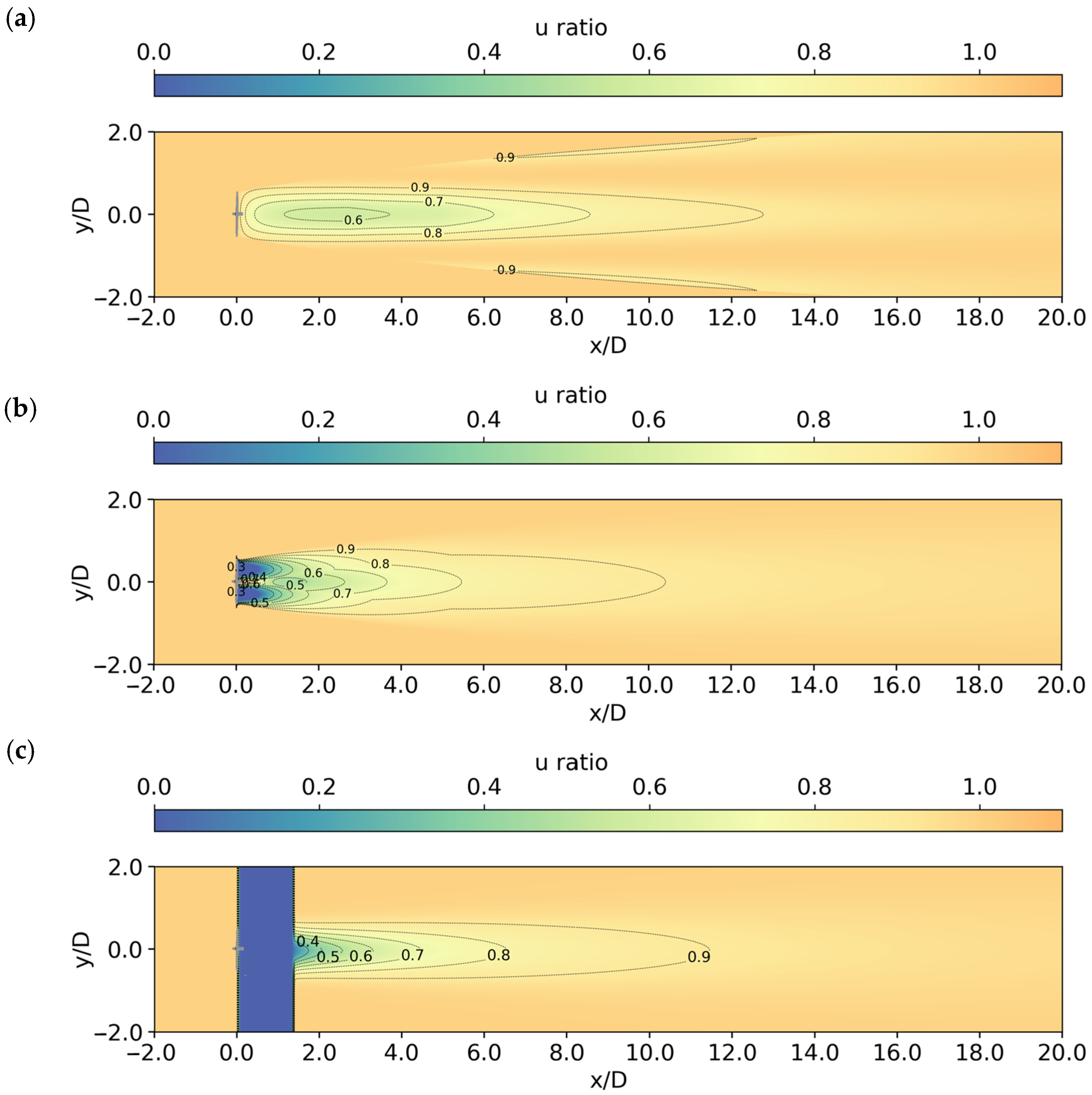
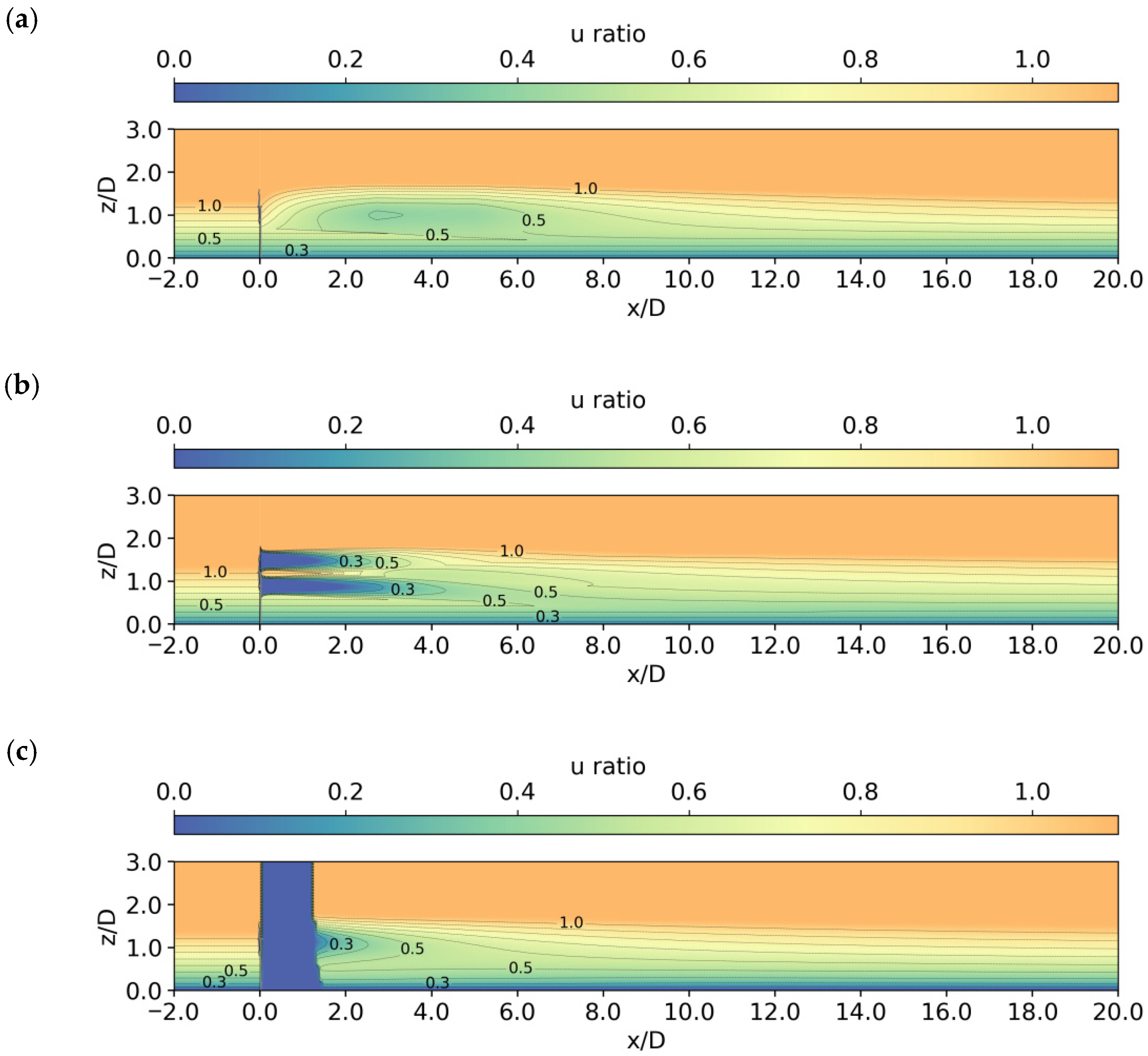
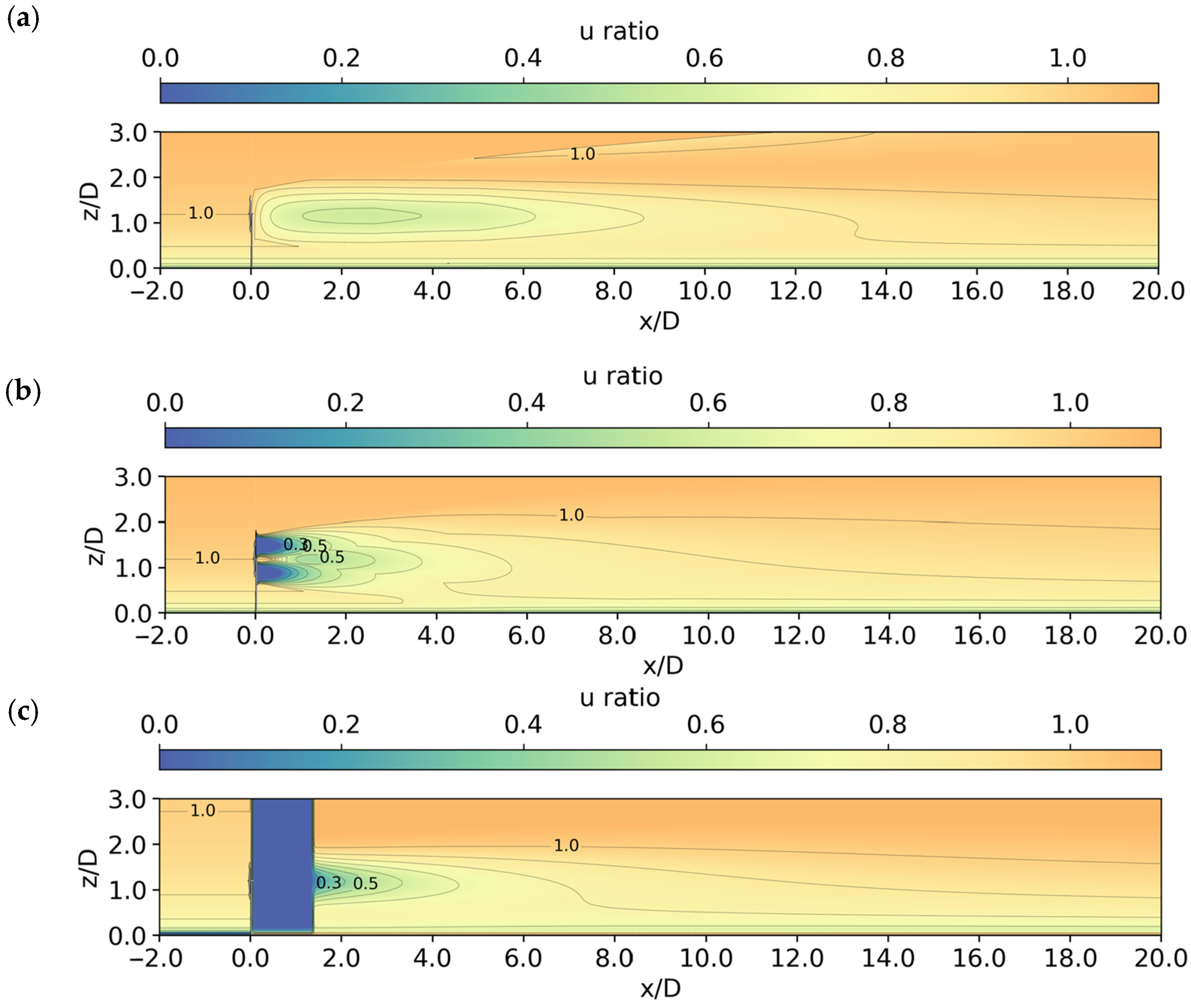
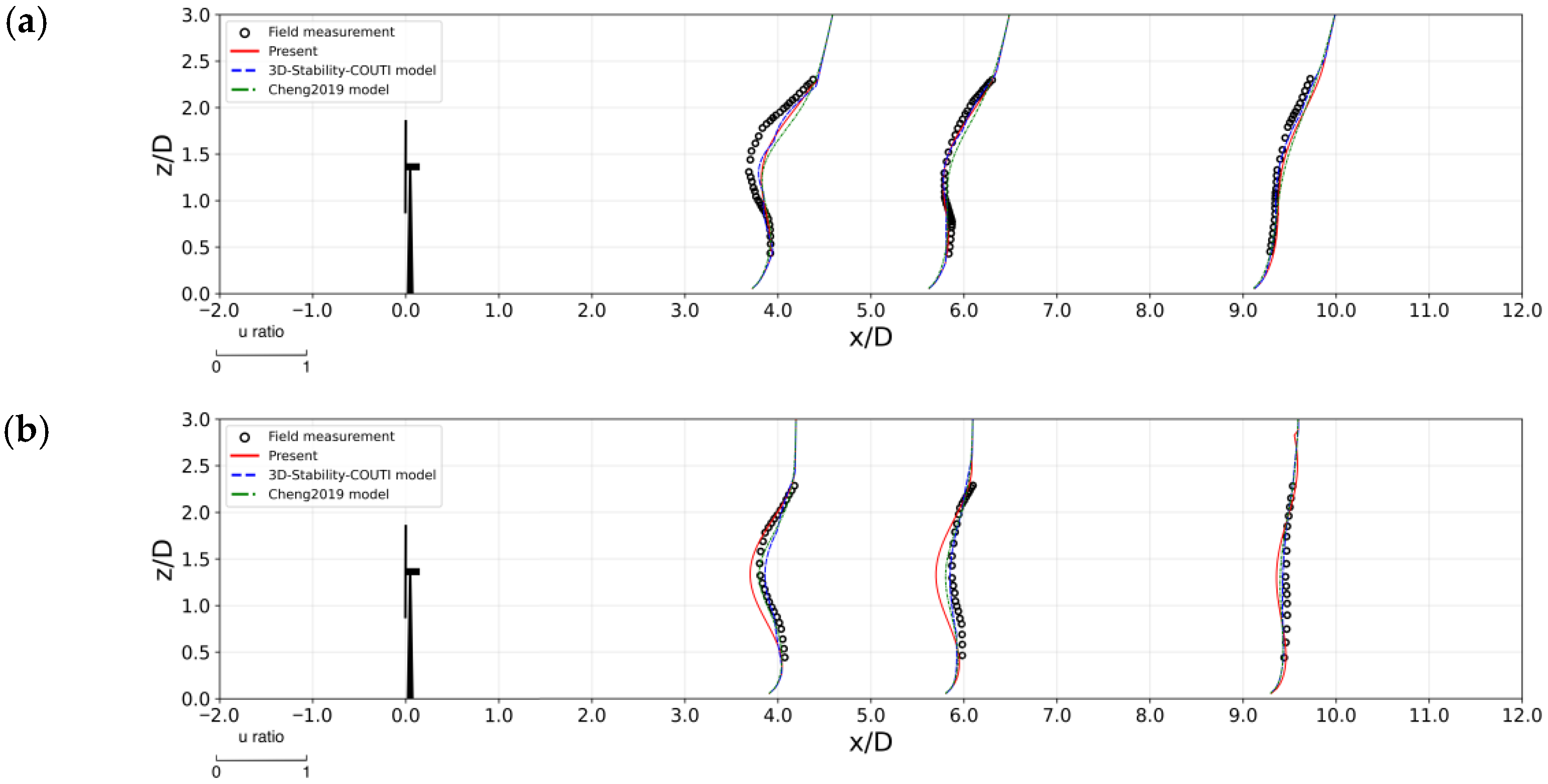
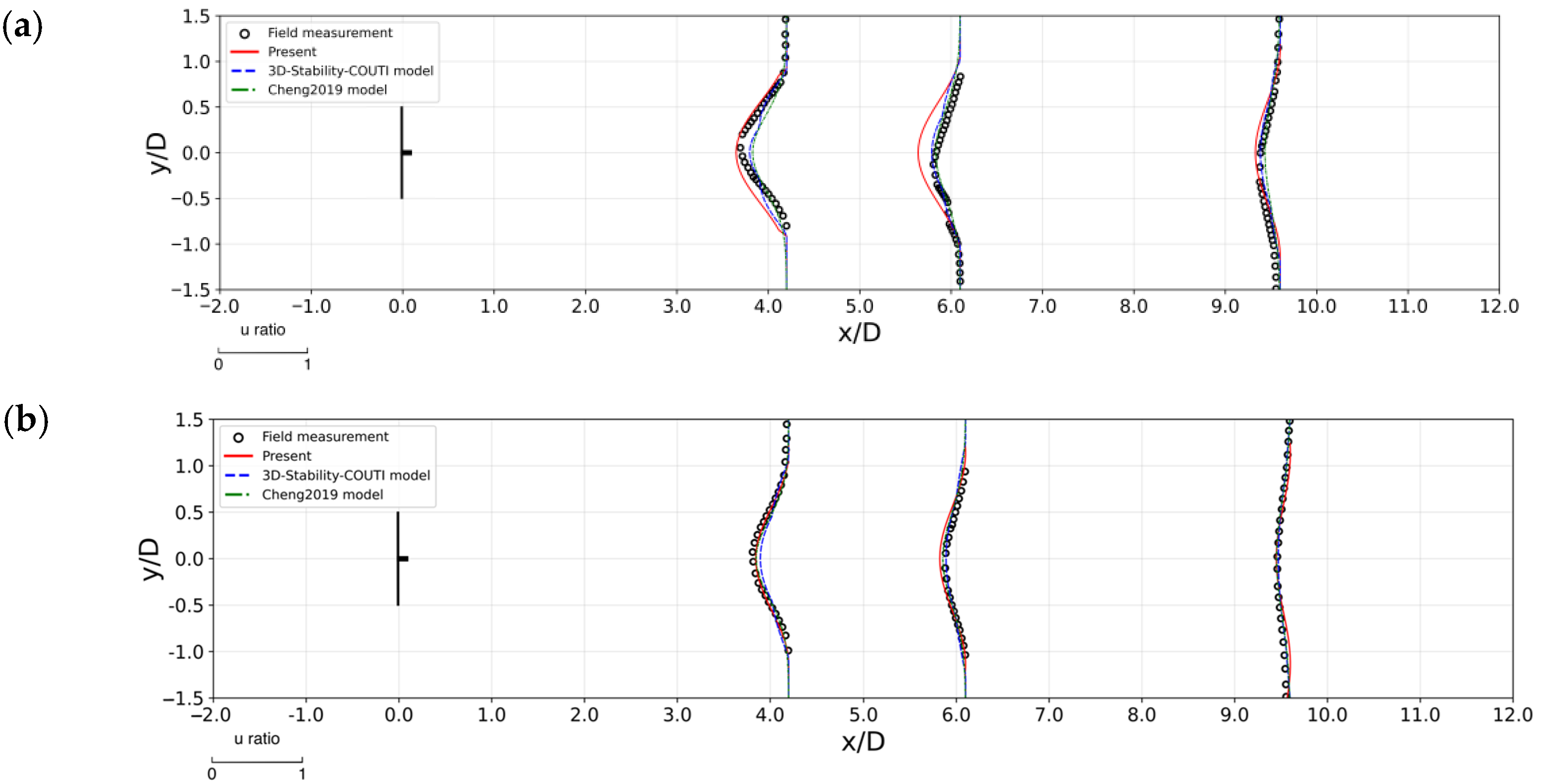
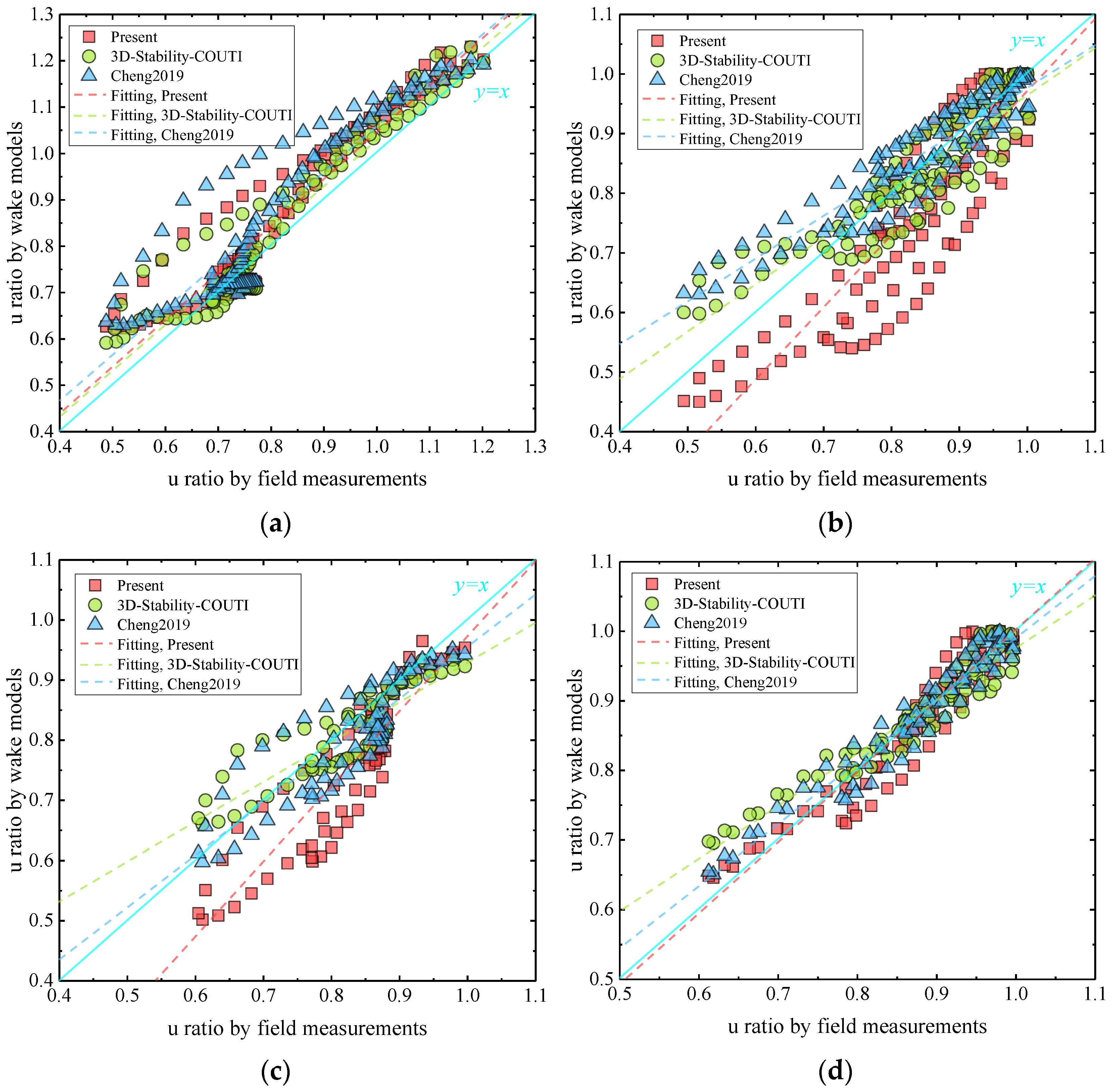
- A newly proposed far-field decay function effectively adjusts the wake development at the near-wake region and the far-wake region, maintaining computational efficiency while significantly improving the prediction accuracy under complex atmospheric stability conditions. Validation results demonstrate that the Present model exhibits optimal overall performance in predicting wake velocity distributions on both vertical and horizontal planes.
- (3)
- The Present model integrates atmospheric stability parameters into its core algorithm, enabling continuous predictions across all stability conditions—neutral, stable, and unstable. Validated against field data from the SWiFT facility and the Alsvik wind farm, the model demonstrates strong adaptability. It offers a reliable tool for optimizing turbine layout and predicting power output under complex atmospheric conditions.
Author Contributions
Funding
Data Availability Statement
Conflicts of Interest
References
- Archer, L.C.; Vasel-Be-Hagh, A.; Yan, C.; Wu, S.C.; Pan, Y.; Brodie, F.J.; Maguire, A.E. Review and evaluation of wake loss models for wind energy applications. Appl. Energy 2018, 226, 1187–1207. [Google Scholar] [CrossRef]
- Cermak, J.E.; Cochran, L.S. Physical modelling of the atmospheric surface layer. J. Wind Eng. Ind. Aerod. 1992, 41–44, 935–946. [Google Scholar] [CrossRef]
- Global Wind Report 2025. Available online: https://www.gwec.net/reports/globalwindreport (accessed on 26 May 2025).
- Zhang, J.; Wang, H. Development of offshore wind power and foundation technology for offshore wind turbines in China. Ocean Eng. 2022, 266, 113256. [Google Scholar] [CrossRef]
- Tabrizi, A.B.; Whale, J.; Lyons, T.; Urmee, T. Extent to which international wind turbine design standard, IEC61400-2 is valid for a rooftop wind installation. J. Wind Eng. Ind. Aerod. 2015, 139, 50–61. [Google Scholar] [CrossRef]
- Albornoz, C.P.; Soberanis, M.A.E.; Rivera, V.R.; Rivero, M. Review of atmospheric stability estimations for wind power applications. Renew. Sustain. Energy Rev. 2022, 163, 112505. [Google Scholar] [CrossRef]
- Du, B.W.; Ge, M.W.; Zeng, C.J.; Cui, G.X.; Liu, Y.Q. Influence of atmospheric stability on wind turbine wakes with a certain hub-height turbulence intensity. Phys. Fluids 2021, 33, 055111. [Google Scholar] [CrossRef]
- Cao, J.F.; Chen, Y.H.; Shen, X.; Gao, X.; Ke, S.T. Impact of atmospheric stability on wake interactions and power performance of offshore wind farm clusters. Energy Convers. Manag. 2025, 346, 120421. [Google Scholar] [CrossRef]
- Angelou, N.; Sjöholm, M.; Mikkelsen, T.K. Experimental characterization of complex atmospheric flows: A wind turbine wake case study. Sci. Adv. 2025, 11, eadw8524. [Google Scholar] [CrossRef] [PubMed]
- Du, B.W.; Ge, M.W.; Liu, Y.Q. A physical wind-turbine wake growth model under different stratified atmospheric conditions. Wind Energy 2022, 25, 1812–1836. [Google Scholar] [CrossRef]
- Alvestad, B.P.L.; Fevang-Gunn, L.; Panjwani, B.; Bracchi, T.K. Effect of atmospheric stability on meandering and wake characteristics in wind turbine fluid dynamics. Appl. Sci. 2024, 14, 8025. [Google Scholar] [CrossRef]
- Xie, S.B.; Archer, C.L. A numerical study of wind-turbine wakes for three atmospheric stability conditions. Bound.-Layer Meteorol. 2017, 165, 87–112. [Google Scholar] [CrossRef]
- Zhan, L.; Letizia, S.; Lungo, G.V. LiDAR measurements for an onshore wind farm: Wake variability for different incoming wind speeds and atmospheric stability regimes. Wind Energy 2019, 23, 501–527. [Google Scholar] [CrossRef]
- Breedt, H.J.; Craig, K.J.; Jothiprakasam, V.D. Monin-Obukhov similarity theory and its application to wind flow modelling over complex terrain. J. Wind Eng. Ind. Aerod. 2018, 182, 308–321. [Google Scholar] [CrossRef]
- Pérez, C.; Rivero, M.; Escalante, M.; Ramirez, V.; Guilbert, D. Influence of atmospheric stability on wind turbine energy production: A case study of the coastal region of Yucatan. Energies 2023, 16, 4134. [Google Scholar] [CrossRef]
- Peña, A.; Réthoré, P.E.; van der Laan, M.P. On the application of the Jensen wake model using a turbulence-dependent wake decay coefficient: The Sexbierum case. Wind Energy 2015, 19, 763–776. [Google Scholar] [CrossRef]
- Cheng, W.C.; Porté-Agel, F. A simple physically-based model for wind-turbine wake growth in a turbulent boundary layer. Bound.-Layer Meteorol. 2018, 169, 1–10. [Google Scholar] [CrossRef]
- Vahidi, D.; Porté-Agel, F. A physics-based model for wind turbine wake expansion in the atmospheric boundary layer. J. Fluid Mech. 2022, 943, A49. [Google Scholar] [CrossRef]
- Bastankhah, M.; Porté-Agel, F. A new analytical model for wind-turbine wakes. Renew. Energy 2014, 70, 116–123. [Google Scholar] [CrossRef]
- Niayifar, A.; Porté-Agel, F. Analytical modeling of wind farms: A new approach for power prediction. Energies 2016, 9, 741. [Google Scholar] [CrossRef]
- Ishihara, T.; Qian, G.W. A new Gaussian-based analytical wake model for wind turbines considering ambient turbulence intensities and thrust coefficient effects. J. Wind Eng. Ind. Aerod. 2018, 177, 275–292. [Google Scholar] [CrossRef]
- Kale, B.; Buckingham, S.; van Beeck, J.; Cuerva-Tejero, A. Implementation of a generalized actuator disk model into WRF v4.3: A validation study for a real-scale wind turbine. Renew. Energy 2022, 197, 810–827. [Google Scholar] [CrossRef]
- Kale, B.; Buckingham, S.; van Beeck, J.; Cuerva-Tejero, A. Comparison of the wake characteristics and aerodynamic response of a wind turbine under varying atmospheric conditions using WRF-LES-GAD and WRF-LES-GAL wind turbine models. Renew. Energy 2023, 216, 119051. [Google Scholar] [CrossRef]
- Nygaard, N.G.; Poulsen, L.; Svensson, E.; Pedersen, J.G. Large-scale benchmarking of wake models for offshore wind farms. J. Phys. Conf. Ser. 2022, 2265, 022008. [Google Scholar] [CrossRef]
- Emeis, S. A simple analytical wind park model considering atmospheric stability. Wind Energy 2010, 13, 459–469. [Google Scholar] [CrossRef]
- Abkar, M.; Porté-Agel, F. Influence of atmospheric stability on wind-turbine wakes: A large-eddy simulation study. Phys. Fluids 2015, 27, 035104. [Google Scholar] [CrossRef]
- Han, X.X.; Wang, T.G.; Ma, X.D.; Xu, C.; Fu, S.F.; Zhang, J.M.; Xue, F.F.; Cheng, Z. A nonlinear wind turbine wake expansion model considering atmospheric stability and ground effects. Energies 2024, 17, 4503. [Google Scholar] [CrossRef]
- Cheng, Y.; Zhang, M.M.; Zhang, Z.L.; Xu, J.Z. A new analytical model for wind turbine wakes based on Monin-Obukhov similarity theory. Appl. Energy 2019, 239, 96–106. [Google Scholar] [CrossRef]
- Xiao, P.C.; Tian, L.L.; Zhao, N.; Song, Y.L.; Wang, Z.M.; Lu, X.Y. An integrated model for predicting wind turbine wake velocity and turbulence intensity under different atmospheric stability regimes. Renew. Energy 2026, 256, 123904. [Google Scholar] [CrossRef]
- Monin, A.; Obukhov, A. Basic laws of turbulent mixing in the surface layer of the atmosphere. Tr. Akad. Nauk SSSR Geofiz. Inst. 1954, 24, 163–187. [Google Scholar]
- Obukhov, A. Turbulence in an Atmosphere with a non-uniform temperature. Bound.-Layer Meteorol. 1946, 2, 7–29. [Google Scholar] [CrossRef]
- Foken, T. 50 years of the monin–obukhov similarity theory. Bound.-Layer Meteorol. 2006, 119, 431–447. [Google Scholar] [CrossRef]
- Kumar, P.; Sharan, M. An Analysis for the Applicability of Monin–Obukhov Similarity Theory in Stable Conditions. J. Atmos. Sci. 2012, 69, 1910–1915. [Google Scholar] [CrossRef]
- Paulson, C. The mathematical representation of wind speed and temperature profiles in the unstable atmospheric surface layer. J. Appl. Meteorol. 1970, 9, 857–861. [Google Scholar] [CrossRef]
- Businger, J.A.; Wyngaard, J.C.; Izumi, Y.; Bradley, E.F. Flux-profile relationships in the atmospheric surface layer. J. Atmos. Sci. 1971, 28, 181–189. [Google Scholar] [CrossRef]
- Dyer, A. A review of flux-profile relationships. Bound.-Layer Meteorol. 1974, 7, 363–372. [Google Scholar] [CrossRef]
- Stull, R.B. Chapter 1: Mean Boundary Layer Characteristics. In An Introduction to Boundary Layer Meteorology, 1st ed.; Reidel, D., Nijhoff, M., Junk, W., Eds.; Kluwer Academic Publishers: Dordrecht, The Netherlands, 1988; Volume 1, pp. 1–27. [Google Scholar]
- Chen, X.Y.; Ishihara, T. A study of gust wind speed using a novel unsteady Reynolds-Averaged Navier-Stokes model. Build. Environ. 2025, 267, 112323. [Google Scholar] [CrossRef]
- Chen, X.Y.; Ishihara, T. Numerical study of turbulent flows over complex terrain using an unsteady Reynolds-averaged Navier-Stokes model with a new method for turbulent inflow generation. J. Wind Eng. Ind. Aerod. 2025, 257, 105991. [Google Scholar] [CrossRef]
- Herges, T.G.; Maniaci, D.C.; Naughton, B.; Mikkelsen, T.; Sjöholm, M. High resolution wind turbine wake measurements with a scanning lidar. J. Phys. Conf. Ser. 2017, 854, 012021. [Google Scholar] [CrossRef]
- Herges, T.; Keyantuo, P. Robust Lidar data processing and quality control methods developed for the SWiFT wake steering experiment. J. Phys. Conf. Ser. 2019, 1256, 012005. [Google Scholar] [CrossRef]
- Petru, T.; Thiringer, T. Modeling of wind turbines for power system studies. IEEE Power Eng. Rev. 2002, 17, 1132–1139. [Google Scholar]
- Yen, P.; Yu, W.; Scarano, F.; Li, Y. Near wake behavior of an asymmetric wind turbine rotor. Wind Energy Sci. 2025, 10, 1775–1805. [Google Scholar] [CrossRef]
- Machefaux, E.; Larsen, G. Chapter 1: Introduction. In Multiple Turbine Wakes, 1st ed.; Technical University of Denmark: Roskilde, Denmark, 2015. [Google Scholar]
- Dong, Y.H.; Tang, G.Y.; Jia, Y.; Wang, Z.K.; Rong, X.M.; Cai, C.; Li, Q.G.; Yang, Y.J. Review on research about wake effects of offshore wind turbines. Energy Eng. 2022, 119, 1341–1360. [Google Scholar] [CrossRef]
- Doubrawa, P.; Quon, E.W.; Martinez-Tossas, L.A.; Shaler, K.; Debnath, M.; Hamilton, N.; Herges, T.G.; Maniaci, D.; Kelley, C.L.; Hsieh, A.S.; et al. Multimodel validation of single wakes in neutral and stratified atmospheric conditions. Wind Energy 2020, 23, 2027–2055. [Google Scholar] [CrossRef]
- Wang, L.; Dong, M.; Yang, J.; Wang, L.; Chen, S.F.; Duic, N.; Joo, Y.H.; Song, D.R. Wind turbine wakes modeling and applications: Past, present, and future. Ocean Eng. 2024, 309, 118508. [Google Scholar] [CrossRef]
- Magnusson, M.; Smedman, A.S. Influence of atmospheric stability on wind turbine wakes. Wind Eng. 1994, 18, 139–152. [Google Scholar]



| Wake Model Considering Atmospheric Stability | Present Wake Model | 3D-Stability-COUTI Model [29] | Cheng2019 Model [28] | |
|---|---|---|---|---|
| Wind turbine | Rotor diameter, | ○ | ○ | ○ |
| Hub height, | ○ | ○ | ○ | |
| Thrust coefficient curve, | ○ | ○ | ○ | |
| Atmospheric inflow | Monin–Obukhov length, | ○ | ○ | ○ |
| Wind speed at hub height, | ○ | ○ | ○ | |
| Turbulence intensity at hub height, | ○ | ○ | ○ | |
| Terrain | Surface roughness length, | ○ | ○ | ○ |
| Angle of latitude, | × | × | ○ | |
| Wake Model Considering Atmospheric Stability | Proposed Wake Model | 3D-Stability-COUTI Model [29] | Wake Model Based on Monin–Obukhov Similarity Theory [28] | ||
|---|---|---|---|---|---|
| Inflow | Incoming flow | ||||
| Wake model | Wake geometry | ; | |||
| Wake velocity | ; | ||||
| Atmospheric Stability | Stable | Unstable | Neutral |
|---|---|---|---|
| Rotor diameter, D (m) | 27 | 27 | 27 |
| Hub height, zH (m) | 32.1 | 32.1 | 32.1 |
| Wind turbine location, Φ (°) | 33.60795 | 33.60795 | 33.60795 |
| Surface roughness height, z0 (m) | 0.0275 | 0.0275 | 0.0275 |
| Thrust coefficient, Ct | 0.83 | 0.81 | 0.70 |
| Wind speed at hub height, UH | 4.8 | 6.7 | 8.7 |
| Turbulence intensity at hub height, IH | 0.034 | 0.126 | 0.107 |
| Obukhov length, L (m) | 8.69 | −112.36 | 2500 |
| Hit Rate | Atmospheric Stability | Plane | Present Model | 3D-Stability-COUTI [29] | Cheng2019 [28] |
|---|---|---|---|---|---|
| stable | XOZ | 0.94 | 0.83 | 0.73 | |
| XOY | 0.73 | 0.59 | 0.65 | ||
| unstable | XOZ | 0.97 | 0.97 | 0.97 | |
| XOY | 1.00 | 1.00 | 1.00 | ||
| neutral | XOZ | 0.98 | 0.99 | 0.87 | |
| XOY | 0.96 | 0.95 | 0.87 | ||
| stable | XOZ | 0.99 | 0.91 | 0.82 | |
| XOY | 0.87 | 0.69 | 0.74 | ||
| unstable | XOZ | 1.00 | 1.00 | 1.00 | |
| XOY | 1.00 | 1.00 | 1.00 | ||
| neutral | XOZ | 1.00 | 1.00 | 1.00 | |
| XOY | 1.00 | 1.00 | 1.00 |
| Atmospheric Stability | Plane | Statistics of Fitting Line | Present Model | 3D-Stabiliy-COUTI [29] | Cheng2019 [28] |
|---|---|---|---|---|---|
| Stable | XOZ | Slope | 1.11 | 1.14 | 1.08 |
| R-Square | 0.96 | 0.90 | 0.86 | ||
| XOY | Slope | 0.82 | 0.86 | 0.62 | |
| R-Square | 0.76 | 0.59 | 0.69 | ||
| Unstable | XOZ | Slope | 0.78 | 0.58 | 0.83 |
| R-Square | 0.96 | 0.88 | 0.94 | ||
| XOY | Slope | 0.88 | 0.71 | 0.91 | |
| R-Square | 0.99 | 0.97 | 0.98 | ||
| Neutral | XOZ | Slope | 1.13 | 0.90 | 0.89 |
| R-Square | 0.84 | 0.82 | 0.76 | ||
| XOY | Slope | 1.02 | 0.78 | 0.78 | |
| R-Square | 0.81 | 0.84 | 0.88 |
| Atmospheric Stability | Stable | Unstable |
|---|---|---|
| Rotor diameter, D (m) | 23 | 23 |
| Hub height, zH (m) | 31 | 31 |
| Wind turbine location, Φ (°) | 57.47467 | 57.47467 |
| Surface roughness height, z0 (m) | 0.0005 | 0.0005 |
| Thrust coefficient, Ct | 0.82 | 0.82 |
| Wind speed at hub height, UH | 8.0 | 8.0 |
| Turbulence intensity at hub height, IH | 0.085 | 0.085 |
| Obukhov length, L(m) | 35 | 100 |
| Hit Rate | Atmospheric Stability | Plane | Present Model | 3D-Stability-COUTI [29] | Cheng2019 [28] |
|---|---|---|---|---|---|
| stable | XOZ | 0.93 | 0.97 | 0.89 | |
| XOY | 0.83 | 1.00 | 0.99 | ||
| unstable | XOZ | 0.90 | 1.00 | 1.00 | |
| XOY | 1.00 | 1.00 | 1.00 | ||
| stable | XOZ | 1.00 | 1.00 | 0.93 | |
| XOY | 0.93 | 1.00 | 1.00 | ||
| unstable | XOZ | 1.00 | 1.00 | 1.00 | |
| XOY | 1.00 | 1.00 | 1.00 |
| Atmospheric Stability | Plane | Statistics of Fitting Line | Present Model | 3D-Stabiliy-COUTI [29] | Cheng2019 [28] |
|---|---|---|---|---|---|
| Stable | XOZ | Slope | 1.01 | 1.00 | 0.98 |
| R-Square | 0.89 | 0.91 | 0.84 | ||
| XOY | Slope | 1.21 | 0.80 | 0.72 | |
| R-Square | 0.80 | 0.82 | 0.87 | ||
| Unstable | XOZ | Slope | 1.25 | 0.67 | 0.87 |
| R-Square | 0.82 | 0.79 | 0.77 | ||
| XOY | Slope | 1.01 | 0.76 | 0.89 | |
| R-Square | 0.91 | 0.91 | 0.94 |
Disclaimer/Publisher’s Note: The statements, opinions and data contained in all publications are solely those of the individual author(s) and contributor(s) and not of MDPI and/or the editor(s). MDPI and/or the editor(s) disclaim responsibility for any injury to people or property resulting from any ideas, methods, instructions or products referred to in the content. |
© 2026 by the authors. Licensee MDPI, Basel, Switzerland. This article is an open access article distributed under the terms and conditions of the Creative Commons Attribution (CC BY) license.
Share and Cite
Chen, X.; Zhang, H.; Zhang, Z.; Shao, Z.; Ying, R.; Liu, X. A Three-Dimensional Analytical Model for Wind Turbine Wakes from near to Far Field: Incorporating Atmospheric Stability Effects. Energies 2026, 19, 467. https://doi.org/10.3390/en19020467
Chen X, Zhang H, Zhang Z, Shao Z, Ying R, Liu X. A Three-Dimensional Analytical Model for Wind Turbine Wakes from near to Far Field: Incorporating Atmospheric Stability Effects. Energies. 2026; 19(2):467. https://doi.org/10.3390/en19020467
Chicago/Turabian StyleChen, Xiangyan, Hao Zhang, Ziliang Zhang, Zhiyong Shao, Rui Ying, and Xiangyin Liu. 2026. "A Three-Dimensional Analytical Model for Wind Turbine Wakes from near to Far Field: Incorporating Atmospheric Stability Effects" Energies 19, no. 2: 467. https://doi.org/10.3390/en19020467
APA StyleChen, X., Zhang, H., Zhang, Z., Shao, Z., Ying, R., & Liu, X. (2026). A Three-Dimensional Analytical Model for Wind Turbine Wakes from near to Far Field: Incorporating Atmospheric Stability Effects. Energies, 19(2), 467. https://doi.org/10.3390/en19020467