Article

Reservoir Characteristics and Productivity Controlling Factors of the Wufeng–Longmaxi Formations in the Lu203–Yang101 Well Block, Southern Sichuan Basin, China

1
Institute of Geological Exploration and Development of CNPC Chuanqing Drilling Engineering Co., Ltd., Chengdu 610051, China
2
Sichuan Hengyi Petroleum Technology Service Co., Ltd., Chengdu 610051, China
3
School of Geoscience and Technology, Southwest Petroleum University, Chengdu 610500, China
4
Intelligent Perception and Control Key Laboratory of Sichuan Province, Sichuan University of Science and Engineering, Yibin 644000, China
*
Authors to whom correspondence should be addressed.
Energies 2026, 19(2), 444; https://doi.org/10.3390/en19020444
Submission received: 22 November 2025 / Revised: 22 December 2025 / Accepted: 27 December 2025 / Published: 16 January 2026

Abstract

The Wufeng–Longmaxi (WF–LMX) shale gas reservoirs at depths > 3500 m in the Lu203–Yang101 well block, southern Sichuan Basin, possess great exploration potential, but their reservoir characteristics and high-production mechanisms remain unclear. In this study, we employed multi-scale analyses—including core geochemistry, X-ray diffraction (XRD), scanning electron microscopy (SEM), low-pressure N2 adsorption, and nuclear magnetic resonance (NMR)—to characterize the macro- and micro-scale characteristics of these deep shales. By comparing with shallower shales in adjacent areas, we investigated differences in pore structure between deep and shallow shales and the main controlling factors for high gas-well productivity. The results show that the Long 11 sub-member shales are rich in organic matter, with total organic carbon (TOC) content decreasing upward. The mineral composition is dominated by quartz (averaging ~51%), which slightly decreases upward, while clay content increases upward. Porosity ranges from 1% to 7%; the Long11-1-3 sublayers average 4–6%, locally >6%. Gas content correlates closely with TOC and porosity, highest in the Long11-1 sublayer (6–10 m3/t) and decreasing upward, and the central part of the study area has higher gas content than adjacent areas. The micro-pore structure exhibits pronounced stratigraphic differences: the WF Formation top and Long11-1 and Long11-3 sublayers are dominated by connected round or bubble-like organic pores (50–100 nm), whereas the Long11-2 and Long11-4 sublayers contain mainly smaller isolated organic pores (5–50 nm). Compared to shallow shales nearby, the deep shales have a slightly lower proportion of organic pores, smaller pore sizes with more isolated pores, inorganic pores of mainly intraparticle types, and more developed microfractures, confirming that greater burial depth leads to a more complex pore structure. Type I high-quality reservoirs are primarily distributed from the top of the WF Formation to the Long11-3 sublayer, with a thickness of 15.6–38.5 m and a continuous thickness of 13–23 m. The Lu206–Yang101 area has the thickest high-quality reservoir, with a cumulative thickness of Type I + II exceeding 60 m. Shale gas-well high productivity is jointly controlled by multiple factors: an oxygen-depleted, stagnant deep-shelf environment, with deposited organic-rich, biogenic siliceous shales providing the material basis for high yields; abnormally high pore-fluid pressure with preserved abundant large organic pores and increased free gas content; and effective multi-stage massive fracturing connecting a greater reservoir volume, which is the key to achieving high gas-well production. This study provides a scientific basis for evaluating deep marine shale gas reservoirs in southern Sichuan and understanding the enrichment patterns for high productivity.

1. Introduction

Marine organic-rich mud shales are the material basis for shale gas formation and accumulation. In South China, the Upper Ordovician Wufeng (hereafter WF) and Lower Silurian Longmaxi (hereafter LMX) Formations are widespread, and contain high organic matter content with appropriate maturity, holding enormous shale gas resource potential [1,2,3]. To date, shale gas exploration in China has focused mainly on strata shallower than 3500 m, with significant success in developing fields such as Fuling, Zhaotong, and Weiyuan. However, even deeper strata (>3500 m) still host abundant shale gas resources awaiting development [4,5,6]. Deeply buried shales, having undergone long-term burial, face higher temperature and pressure and more intense compaction, which lead to a more complex pore structure in the reservoir. Our understanding of gas occurrence mechanisms and enrichment patterns in deep shale gas reservoirs is still insufficient. In particular, shale gas production is closely related to its occurrence mode: the higher the proportion of free gas, the greater the well productivity. Free gas resides mainly in larger pores and fractures, but under deep burial conditions, the pore structure may evolve significantly [7,8,9,10]. Therefore, studying the microscopic pore structure of deep shale reservoirs is crucial for guiding deep shale gas exploration and development.
In recent years, extensive research on shale reservoir pore characteristics has been conducted worldwide, yielding a variety of reservoir characterization techniques. These include direct observations of nano-micron scale pores using SEM, TEM, and CT imaging, as well as indirect measurements of pore size distribution and volume via low-pressure N2/CO2 adsorption, high-pressure mercury intrusion (MIP), NMR, etc. Building on these techniques, many researchers have explored how pore structure affects the proportion of adsorbed vs. free gas in shales [11,12,13,14]. For example, Ross et al. (2008) pointed out that greater porosity leads to higher free gas content [15], and Guo et al. (2014) suggested that high-yield shale gas reservoirs are often dominated by free gas [16].
However, comprehensive studies on marine shale reservoirs buried at depths greater than 3500 m, as well as systematic comparisons with shallower counterparts, remain limited. In this study, building upon previous methodologies and research insights, we selected the Lu203–Yang101 well block in the Luzhou area of the southern Sichuan Basin to investigate the reservoir characteristics and productivity-controlling factors of the WF–LMX Formations, with particular emphasis on the Long 11 sub-member. Based on detailed core observations and a suite of laboratory analyses, abundant data were obtained to characterize both the macro-scale reservoir properties (e.g., TOC, mineral composition, and porosity) and the micro-scale features (including pore types, pore size distribution, and pore connectivity). Furthermore, the characteristics of the deep shale reservoir were systematically compared with those of a nearby shallower well, revealing significant differences in pore structure. By integrating the reservoir evaluation results with well test data, we further identified and analyzed the key geological factors controlling high productivity in deep shale gas wells. This study provides new data on pore structure and production performance in deep shale reservoirs and reveals several features that differ markedly from those of shallow shale reservoirs. For example, abnormally high pore-fluid pressure effectively preserves a portion of the nanopores in deep shale, thereby maintaining a relatively high content of free gas—an observation that has not been reported in adjacent shallow shale reservoirs. Overall, this study offers new insights into the enrichment mechanisms of shale gas reservoirs at greater burial depths and contributes to a more comprehensive understanding of deep shale gas systems.

2. Geological Setting

The study area is located in the southeast of the Sichuan Basin in the southern Sichuan low-fold belt, which is a transitional zone between the southern flank slope of the Central Sichuan Paleo-uplift and the southeastern Sichuan depression-fold belt. The area is characterized by a complex fold structure with en echelon comb-like anticlines and broad gentle synclines [17,18,19]. The dominant structural trend is NE, with local N–S and E–W structures superimposed, resulting in strong fold deformation (Figure 1). To the west, the area is bounded by the Huayingshan deep fault, adjacent to the Central Sichuan paleo-uplift (Leshan–Longnvsi uplift). To the east, it is bordered by the Nanchuan–Zunyi fault zone, adjoining the Jiangnan–Xuefeng orogenic belt. Further south, via the Xingwen–Gulin and Qiyaoshan faults, it transitions into the northern Yunnan–Guizhou depression. Multi-phase tectonic superposition has produced a complex pattern of alternating anticlines and synclines, with local faults developed along some anticline axes. The present-day deep burial and high-pressure conditions of the study area offer an ideal natural laboratory for investigating deep, overpressured shale gas reservoirs.
During the Late Ordovician (WF Formation), a marine transgression flooded the Yangtze craton basin. The basin was partially enclosed by peripheral paleo-uplifts, creating an oxygen-deficient, stagnant deep-water shelf environment [20]. In this setting, the WF Formation was deposited as a stable-thickness sequence of deep-water black shale, rich in siliceous organisms such as graptolites and radiolarians. The top of the WF Formation is marked by a thin shell limestone layer (the “Guanyinqiao Bed”), only a little over 10 cm thick, indicating a regression hiatus at the end of the Ordovician. In the Early Silurian (LMX period), the Qianzhong and Central Sichuan paleo-uplifts continued to rise, and the basin persisted as a restricted marine (subaqueous shelf) environment, continuously depositing black carbonaceous mud shale [21,22,23].
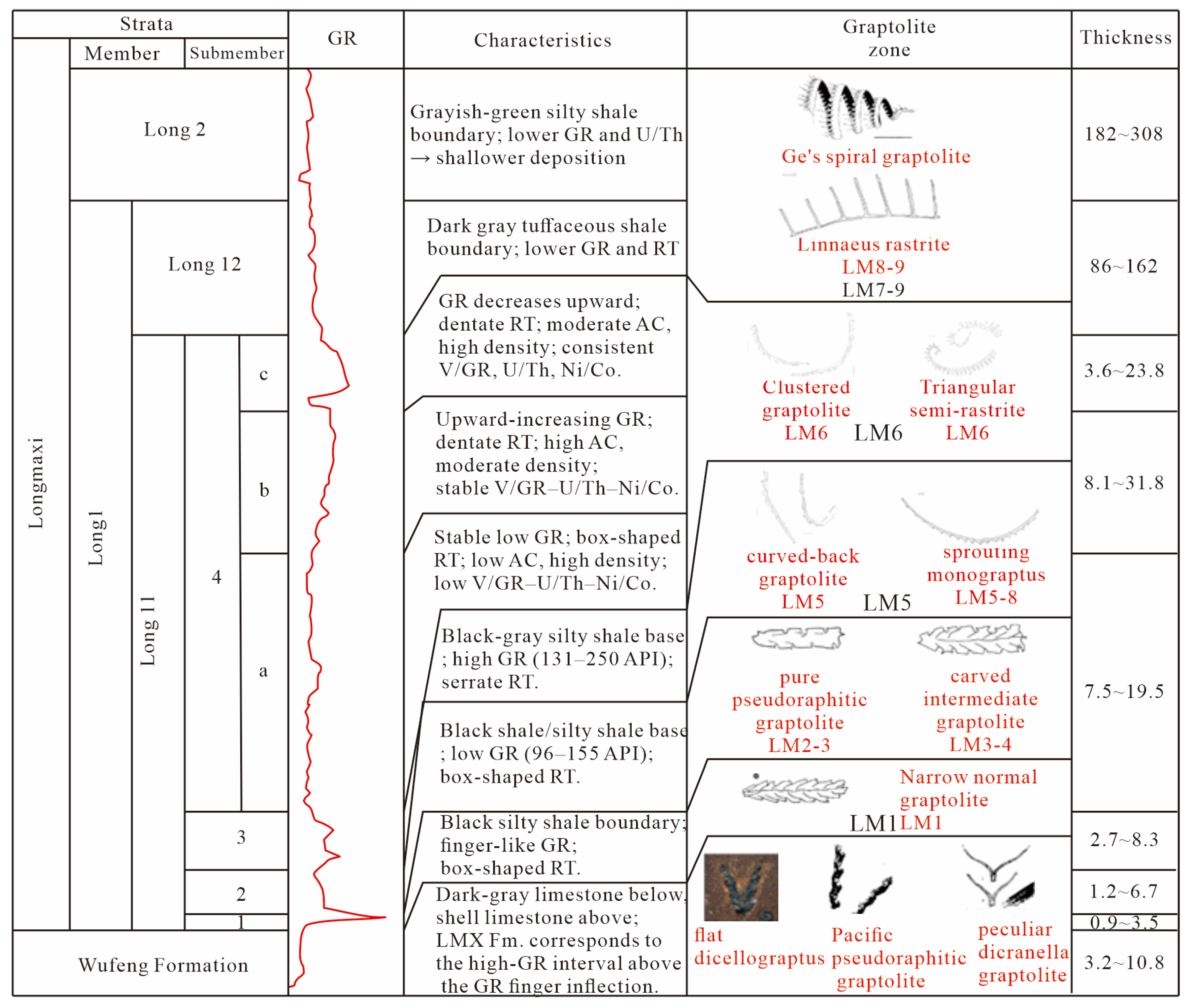
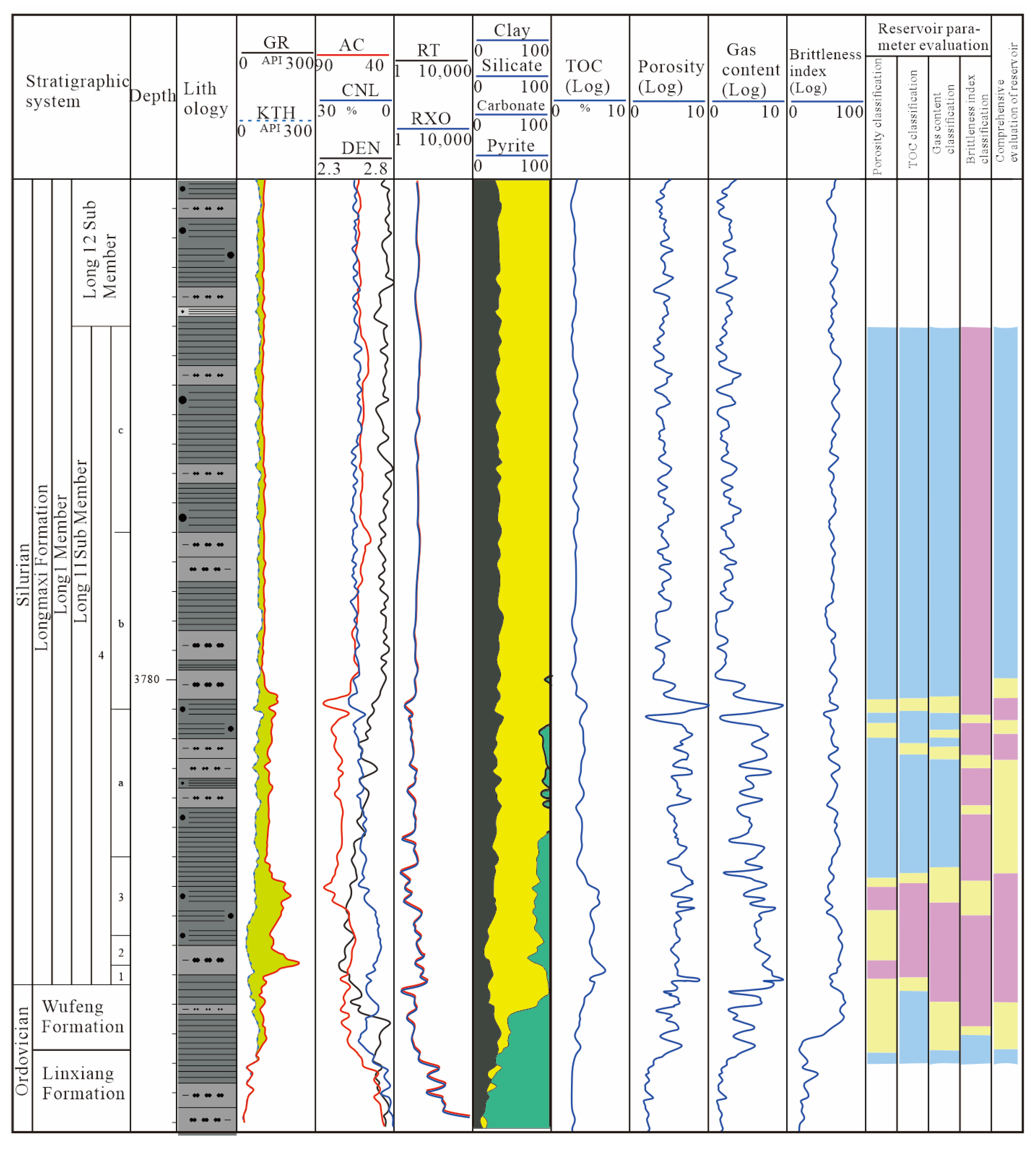
The study area is located in the southern part of the Luzhou low-fold belt. Compared with the extensively developed shale gas blocks such as Fuling and Weiyuan, it is characterized by greater burial depths (generally >3700 m) and higher formation pressures, with pressure coefficients ranging from 1.8 to 2.3. Previous studies have mainly focused on shale gas reservoirs of the Longmaxi Formation at burial depths shallower than 3500 m. In contrast, this study provides a comparative investigation of shale reservoir characteristics under deep-burial conditions, highlighting differences associated with greater burial depth. The target interval in this study includes the WF Formation and the lower part of the LMX Formation (Long 11 sub-member). The Long 11 sub-member is subdivided into four sublayers (numbered 1, 2, 3, and 4 from bottom to top), and the fourth sublayer is further divided into three segments (a, b, c). Core, well log, and fossil evidence allow identification of each sublayer’s depositional features: the Long11-1 sublayer is a thick, organic-rich black shale with high natural gamma (GR) readings and abundant graptolites; the Long11-2 sublayer is gray-black mud shale interbedded with silty bands, with moderate to lower GR; the Long11-3 sublayer is black shale alternating with thin silty shale, with second-highest GR; the Long11-4 sublayer is overall gray-black shale grading upward into turbiditic siltstone, with the lowest GR values, and at the base of segment “a”, a graptolite zone is visible that diminishes upward (Figure 2). The WF shale thickness is generally 10–20 m, with high TOC and densely distributed graptolites. The total thickness of the Long 11 sub-member is 50–80 m. Sublayers 1–3 are organically rich and lithologically pure (high mud content), representing the main gas-generating intervals; sublayer 4 contains more silty interbeds and shows an upward transition toward a more proximal, shallower water facies [24,25,26]. Long11-1 to Long11-3 sublayers are characterized by high organic-matter content and a homogeneous mudstone lithofacies (indicating high clay content). In the study area, the latest Silurian Hanjiadian Formation is absent, and the Permian Liangshan Formation lies directly and unconformably on the LMX Formation, indicating that after the Late Silurian, the area underwent structural uplift and erosion.

3. Samples and Methods

3.1. Samples

This study examined nearly 300 core samples from four appraisal wells (Lu205, Lu206, Yang101H2-7, Yang101H3-8) in the Luzhou block, covering the WF Formation top and all four sublayers of the Long 11 sub-member. Of these, wells Lu205 and Lu206 are in the Lu203 area, with burial depths of 3700–3800 m; wells Yang101H2-7 and Yang101H3-8 are in the Yang101 area, with burial depths of 4100–4200 m. The core samples encompass different lithofacies types and a range of organic matter abundances to allow a comprehensive characterization of reservoir properties.
In addition, two nearby shale gas wells with relatively shallower burial depths—Wei204 and Huang202—were selected for comparative analysis. These wells are located in the Weiyuan and Jiangjin blocks, respectively, with burial depths of approximately 3400–3520 m, slightly shallower than 3500 m, and can be regarded as representative of conventionally buried WF–LMX shale reservoirs. They were used for a quantitative comparison of pore structure characteristics with those of the deep shale reservoirs investigated in this study. The Wei204 well has a burial depth of 3520 m and an initial pressure coefficient of approximately 1.2, whereas the Huang202 well has a burial depth of 3400 m and a pressure coefficient of 1.3. Shale gas production from the Longmaxi Formation in both wells has already reached commercial levels.

3.2. Methods

3.2.1. TOC

Samples were first pulverized to 200 mesh. TOC was measured using a LECO CS-230 carbon–sulfur analyzer (LECO Corporation, St. Joseph, MI, USA). Before testing, samples were treated with dilute HCl to remove inorganic carbonates, then washed, neutralized, dried, and combusted at high temperature. The CO2 released was detected by infrared and converted to a TOC value, with a precision of 0.01%. The TOC results are used to evaluate the organic matter abundance of the shales.

3.2.2. Mineral Composition Testing

X-ray diffraction (XRD) was used to determine mineral constituents and contents of the samples. Powdered samples (<40 μm) were analyzed with a Bruker D8 Advance XRD instrument for whole-rock diffraction. Quantitative phase analysis was performed to calculate major mineral contents (±2% error). In addition, thin sections of selected samples were examined under a polarizing microscope and cathodoluminescence to observe mineral grain characteristics, and field-emission SEM was used to further identify mineral types, aiding in determining the origin of quartz.

3.2.3. Pore Structure Observation

Direct Observation
Representative shale samples from each sublayer were selected. An Ion Mill argon ion polishing system was used to polish sample surfaces, and then a field-emission SEM (FE-SEM) was employed under high vacuum and high accelerating voltage to acquire microscopic images. SEM observations at magnifications ranging from 50× to 50,000× allowed qualitative identification of reservoir pore types and morphologies. Typical images were further processed by ImageJ 1.8.0 software for binary segmentation and quantitative analysis, calculating area proportions of organic pores, inorganic pores, and microfractures, which were used to compare pore development among different samples. However, it must be acknowledged that two-dimensional cross-sections may fail to fully capture the complex connectivity networks present in three-dimensional space [27]. For example, the work by Li et al. (2017) demonstrates that three-dimensional imaging techniques can often reveal heterogeneous fluid-distribution patterns overlooked in two-dimensional analyses [28]. Therefore, the inferences drawn above require further validation through future three-dimensional in situ experiments.
Indirect Characterization
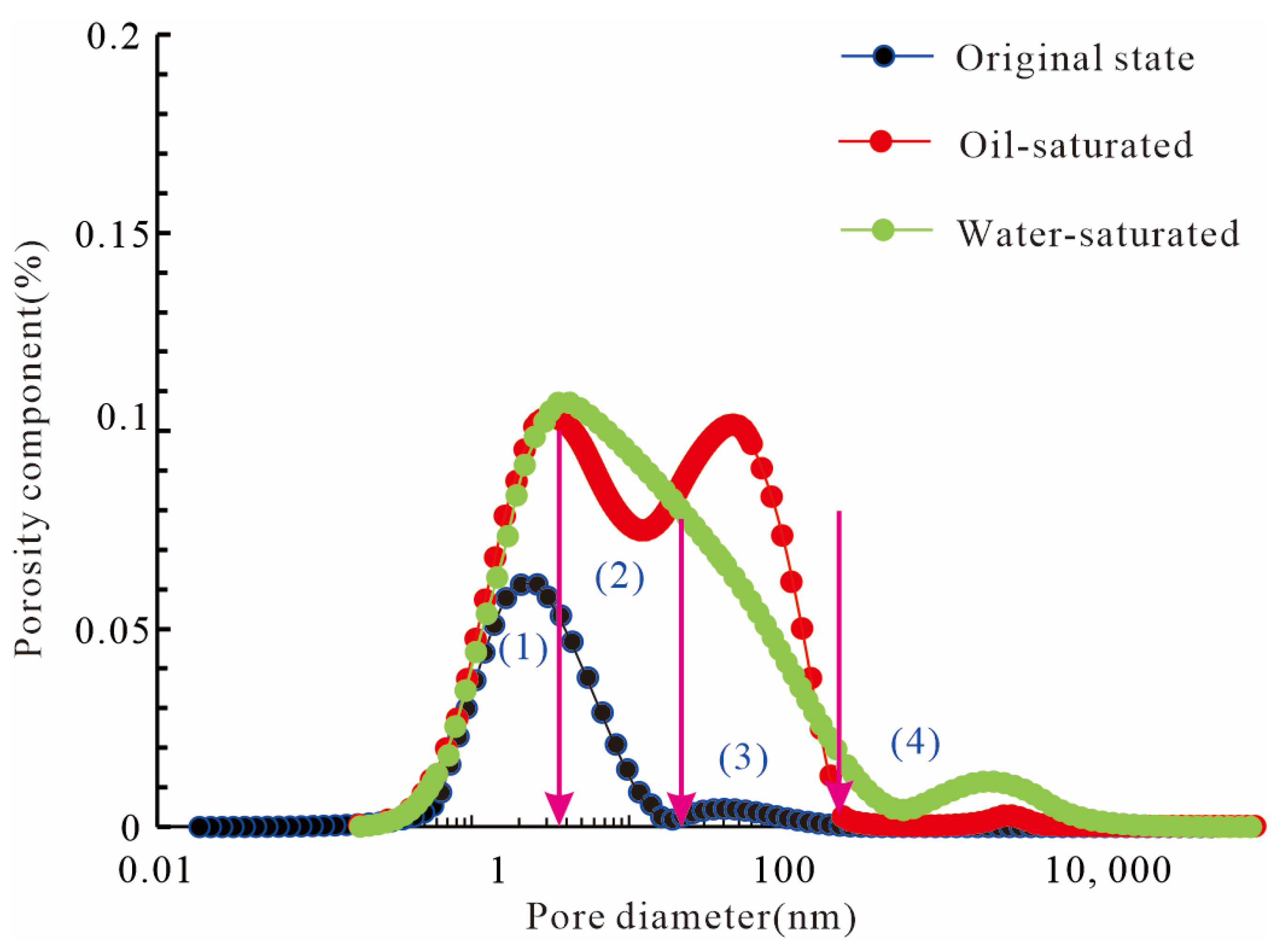
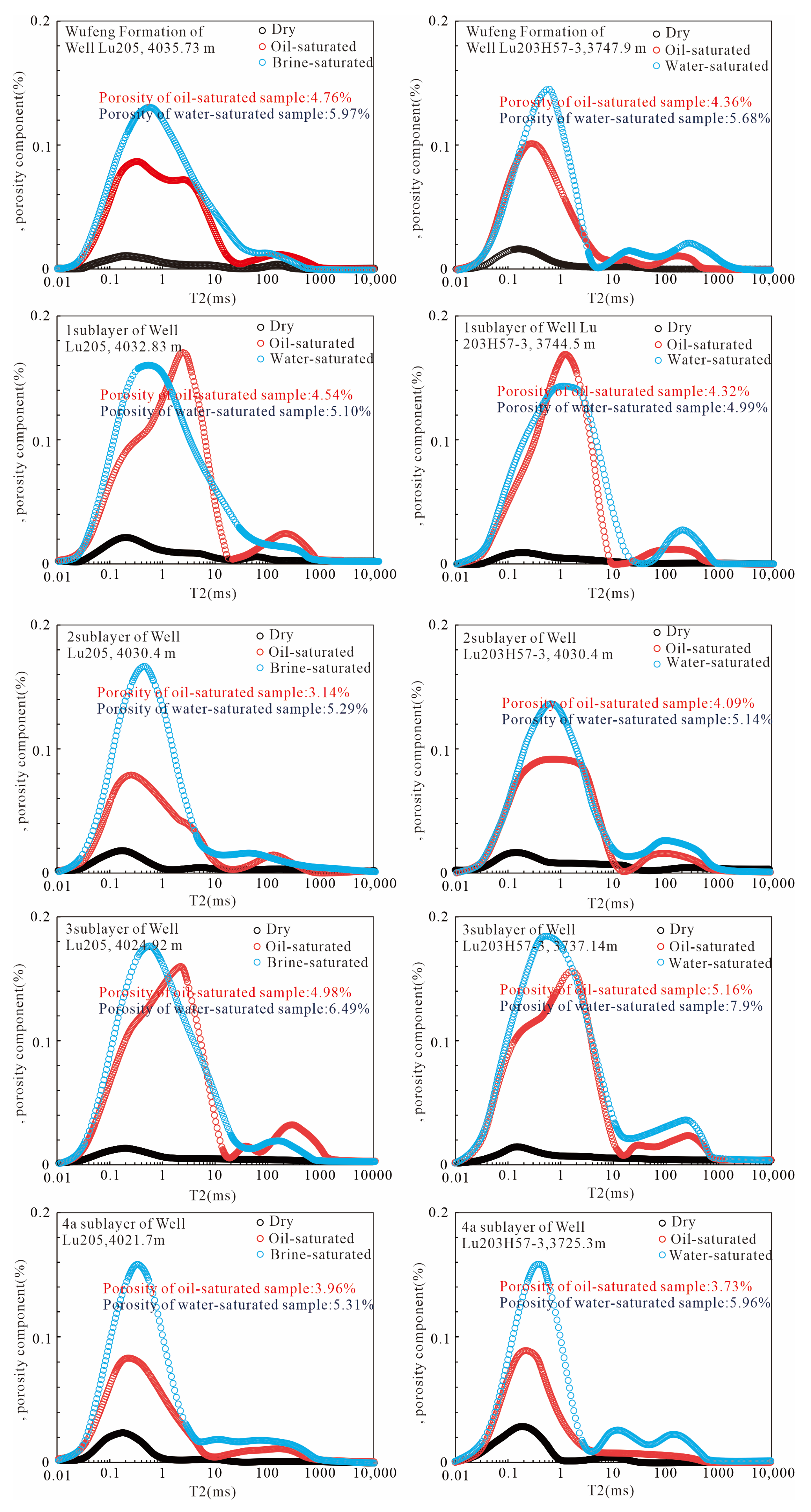
First, low-temperature N2 adsorption at 77K was conducted to obtain the specific surface area and pore size distribution of the samples. Using a Micromeritics ASAP 2460 surface area and porosity analyzer, powdered samples (20–35 mesh) degassed under vacuum were analyzed over a relative pressure (P/P0) range of 0.01–0.995 to record adsorption/desorption isotherms. BET theory was applied to calculate specific surface area, and the BJH method was used to derive mesopore (2–50 nm) size distribution [29,30,31,32,33]. For micropores (<2 nm), complementary CO2 adsorption at 273 K was performed, and the Dubinin–Radushkevich (D–R) model was used to estimate micropore surface area and volume. Second, NMR T2 spectrum analysis on core plugs, combined with capillary pressure imbibition and drainage experiments, was carried out to evaluate pore connectivity and the lower limit of effective pore size. Dried core samples were sequentially saturated with simulated formation fluids (brine and crude oil), and then T2 relaxation spectra were measured. By comparing T2 spectra under water-saturated vs. oil-saturated conditions, oil-wet (primarily organic pore) versus water-wet (inorganic pore) pore fractions were identified, and their proportions calculated by formula (Figure 3). Finally, combining NMR with nitrogen adsorption results, a joint inversion method was applied to extend the quantitative pore size characterization of the T2 spectrum, yielding a continuous pore-size distribution curve over a wide range (0.001–100 μm) [34]. This continuous distribution was used to compare pore size characteristics across different stratigraphic intervals.

4. Results

4.1. Macroscopic Reservoir Characteristics

4.1.1. Organic Matter Abundance

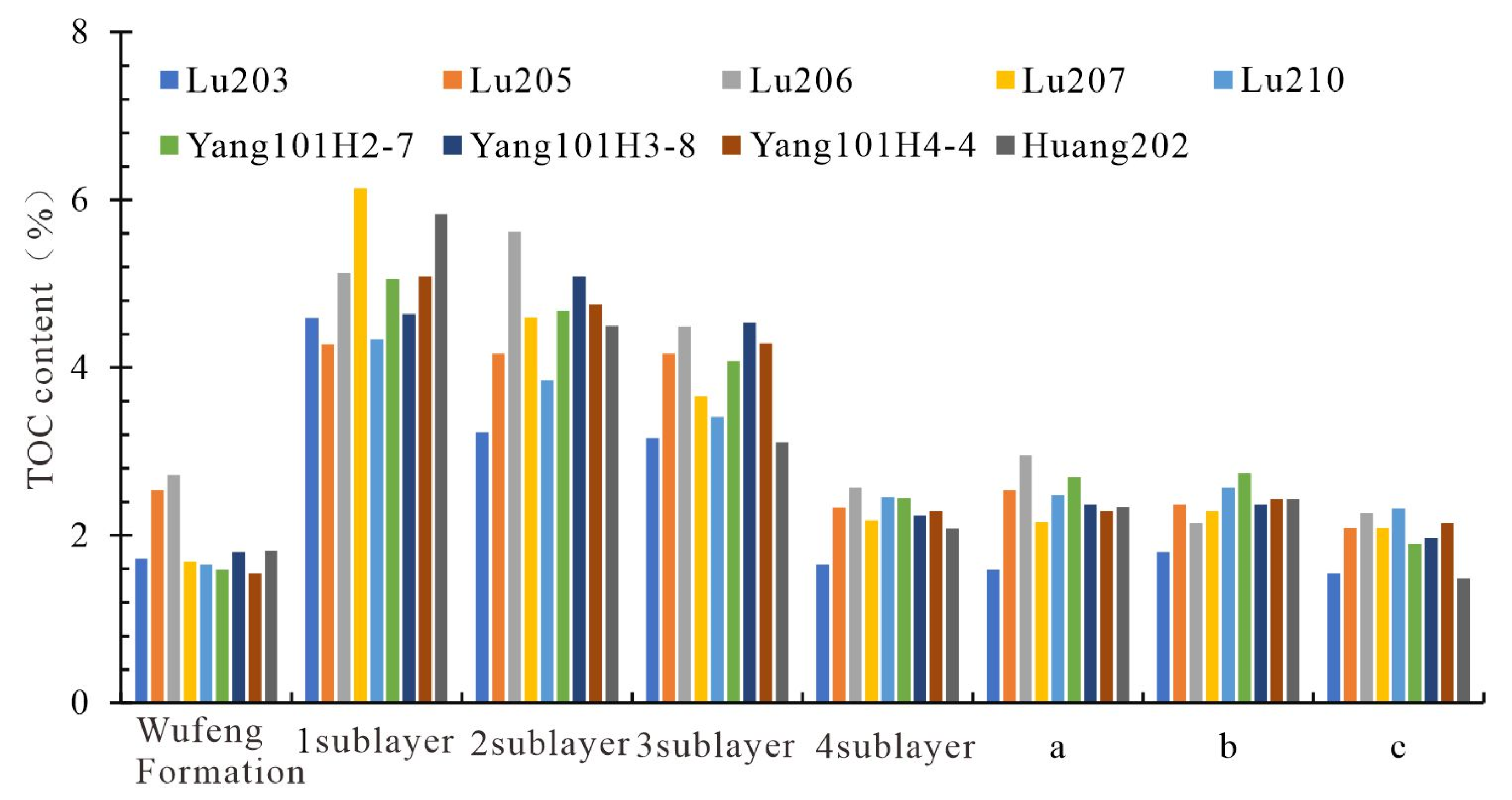
The WF–Long 11 sub-member shales in the study area have relatively high organic carbon content, with a clear vertical differentiation (Figure 4). In the WF Formation, TOC at the base (black shales) ranges from 0.1 to 5.1%, increasing toward the top (near the Guanyinqiao limestone) to an average of around 2%. The Long 11 sub-member overall has TOC from 0.1% up to 7.3%. The Long11-1 and Long11-2 sublayers are highest in TOC (average > 4% in each sublayer per well); Long11-3 is next, averaging 3.5–4.5%; Long14 is lowest, at only 0.3–1.9% (mean ~2%). Notably, within Long11-4, segment 4b has slightly higher TOC than 4a and 4c, averaging over 2%. The reason is that the underlying Long11-1 and 2 sublayers correspond to the peak transgression of the Early Silurian, when the deep, anoxic conditions favored organic preservation, resulting in high organic carbon; in contrast, the upper Long11-4 sublayer was deposited in shallower conditions with increased oxidation, reducing organic preservation. Laterally, TOC in the study area shows a slight increase from NE toward SW, with the Luzhou block overall higher than the adjacent Huanggua Mountain block. For example, in well Lu207, the Long11-1 sublayer averages 6% TOC, significantly higher than ~4% in well Huang202, indicating the study area has an advantage in organic richness.

4.1.2. Mineral Composition

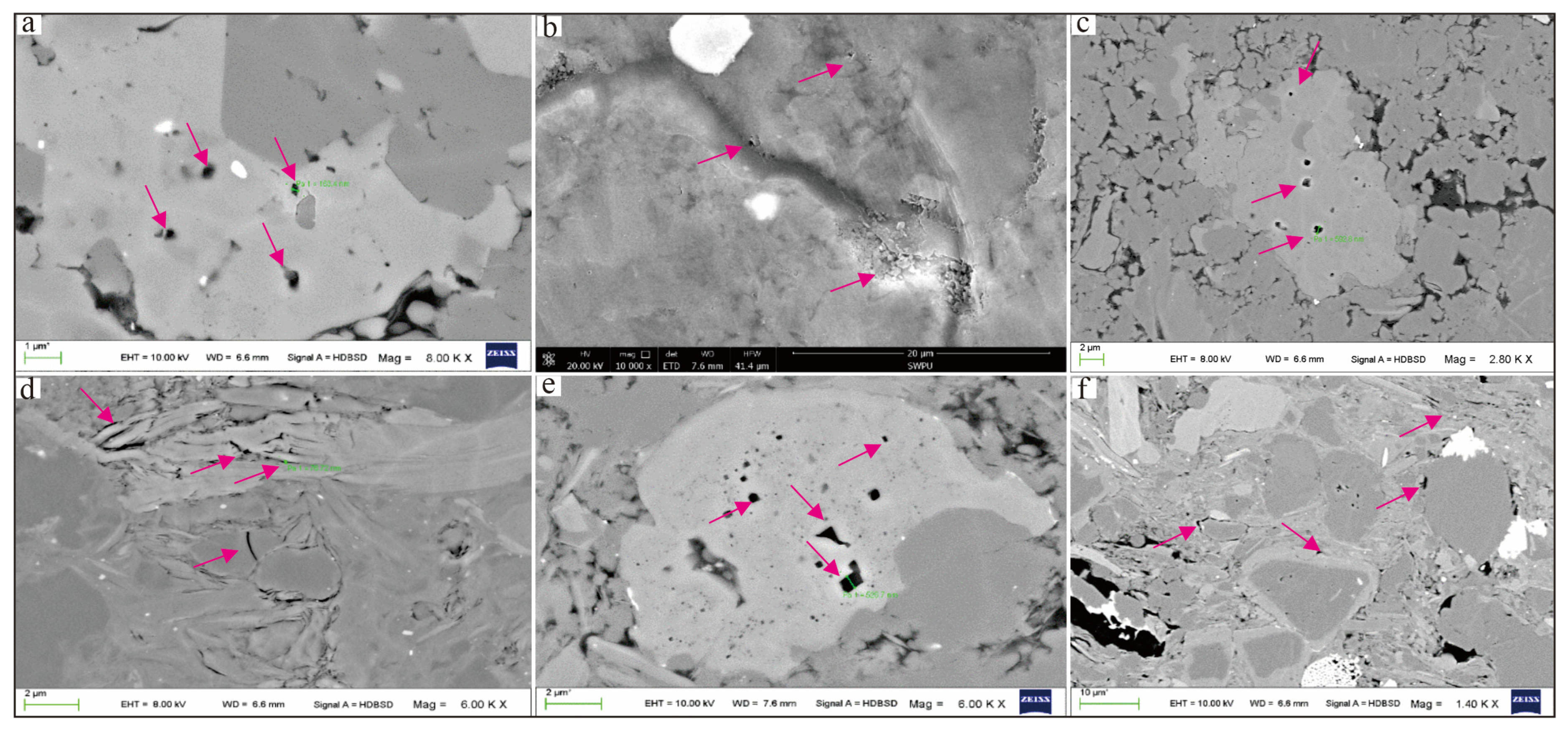
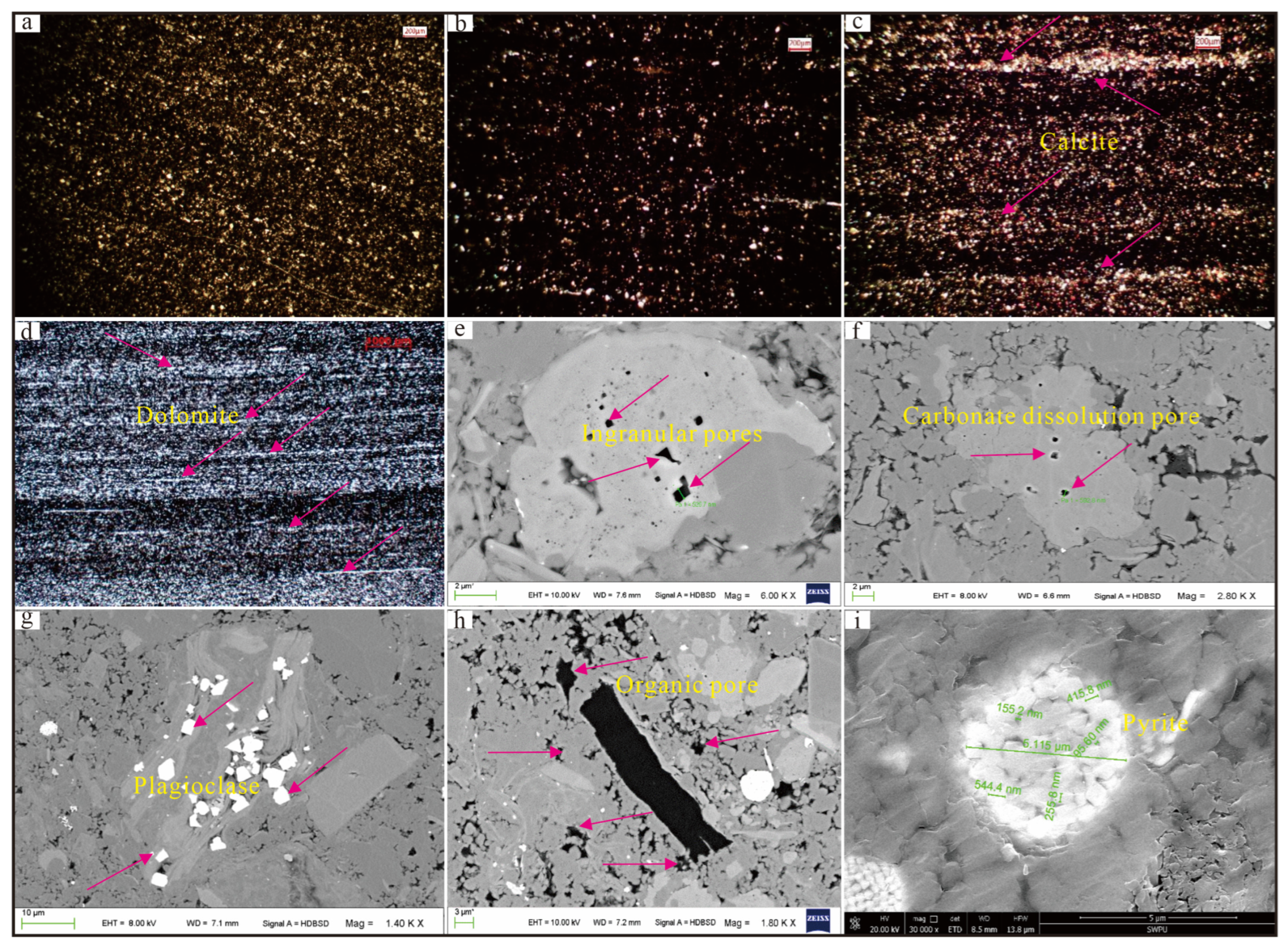
The shales have diverse mineral compositions, mainly quartz, clay minerals, and carbonates, followed by feldspar, pyrite, minor dolomite, mica, etc. XRD results show WF shale contains 24–88% quartz (avg. 47%); the Long 11 sub-member contains 16–70% quartz (avg. 51.4%). Overall, quartz content slightly decreases upward. Microscopic and SEM observations indicate the quartz is predominantly biogenic (derived from siliceous radiolarians, sponge spicules, and other biogenic debris), with lesser amounts of diagenetic authigenic quartz and minor terrigenous quartz. Biogenic quartz is most concentrated at the base of the Long11 sub-member, associated with high-TOC layers, and diminishes upward; conversely, terrigenous quartz increases upward (especially in sublayer 4), appearing as silt-grade grains with rough surfaces and undulatory extinction (Figure 5a,b). Total clay content ranges from 9 to 66% (avg. 37%), dominated by illite with minor illite–smectite mixed layers and chlorite; kaolinite is absent. Clay content increases noticeably upward, peaking in the Long11-4 sublayer, where clay becomes the major component. Carbonate minerals vary between well blocks: in the Lu203 area, calcite dominates (stained thin sections show as red, Figure 5c), whereas in the Yang101 area, dolomite prevails (staining shows as blue-green, Figure 5d). Overall carbonate content is low (<15%), with slight enrichment in the lower part of sublayer 4; dissolution of these carbonates has created intraparticle secondary pores (Figure 5e,f). Feldspar averages 6%, mainly plagioclase; it is not obvious in the thin section but appears as lath-shaped grains under SEM (Figure 5g). Feldspar is unstable and prone to dissolution or alteration to clay; dissolved feldspar often exhibits intragranular pores, some of which are filled by late-stage solid bitumen (Figure 5h). Pyrite is widespread in organic-rich shales, occurring disseminated, as aggregates, or laminae; under SEM, it commonly appears in framboidal clusters (spherical aggregates 5–20 μm composed of tiny crystals, Figure 5i). The presence of pyrite confirms anoxic, reducing depositional conditions.

4.1.3. Porosity and Gas Content

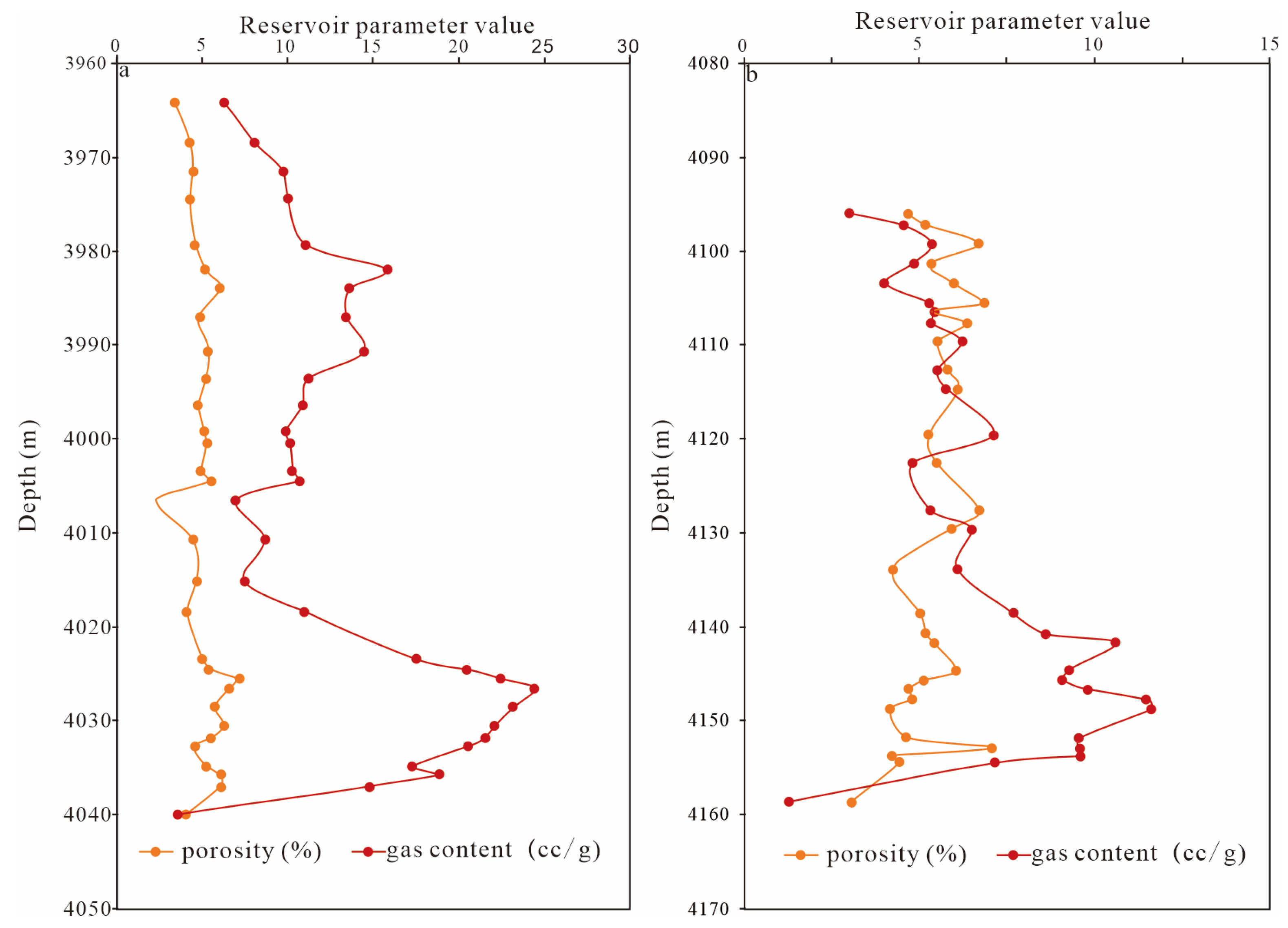
Overall, the deep shale reservoir in the study area has low petrophysical properties, but with significant differences between layers. Based on measurements of >400 samples from seven cored wells, porosity ranges from 0.99% to 7.14%, averaging 4%. The Long11-1 and 3 sublayers have the highest porosities, with each well averaging 4–6+%, and some samples >7%. Long14 is next (average 4–4.5%), and the WF shale is most compact (mostly 1–3% porosity). Specifically, in Long11-1: porosity 1.8–6.1%, with all well averages >4%; Long11-2: 1.5–6.3%, mean 4–6%; Long11-3: 1.8–6.1%, mean >4% (notably wells Lu202 and Lu205 average >6%); Long11-4: 1.2–7.1%, mean 4–4.5%, with segment 4b slightly higher (avg. 4–6%) and 4c slightly lower (avg. 4%).
Shale gas total content varies vertically, in tandem with TOC and porosity. The Long11-1 sublayer averages 6–10 m3/t, the highest of the interval; Long11-2 and Long11-3 follow with 4–8 m3/t; Long11-4 is slightly lower, at 4–5 m3/t, on average (segment 4b a bit higher than 4c); the basal WF is lowest, with some samples only 1–3 m3/t. Laterally, total gas content in the study area is generally higher than in adjacent areas, with a gas-rich center around the Yang101 well region. The magnitude of gas content is controlled by multiple factors—organic carbon and porosity are fundamental, but they do not linearly dictate producibility. It should be noted that shale gas occurs in two forms: adsorbed gas and free gas. Desorption tests indicate that about 50–80% of the total gas in our shale samples can be desorbed, with the remainder being residual adsorbed gas and minor lost gas, suggesting that free gas constitutes an important portion in these deep shale reservoirs. This is similar to characteristics of shallow high-yield areas like Fuling, where high-productivity shale gas reservoirs typically have a high proportion of free gas. In summary, from a macroscopic standpoint, the deep shale reservoir in the study area exhibits a ‘good-at-base, poor-at-top’ vertical quality pattern (i.e., higher quality in lower intervals and poorer quality towards the top): the lower layers are richer in organic matter, more brittle, and have higher porosity and gas content, whereas the upper layers have lower organic content, less free gas, and overall poorer reservoir quality.

4.1.4. Brittleness and Fracability

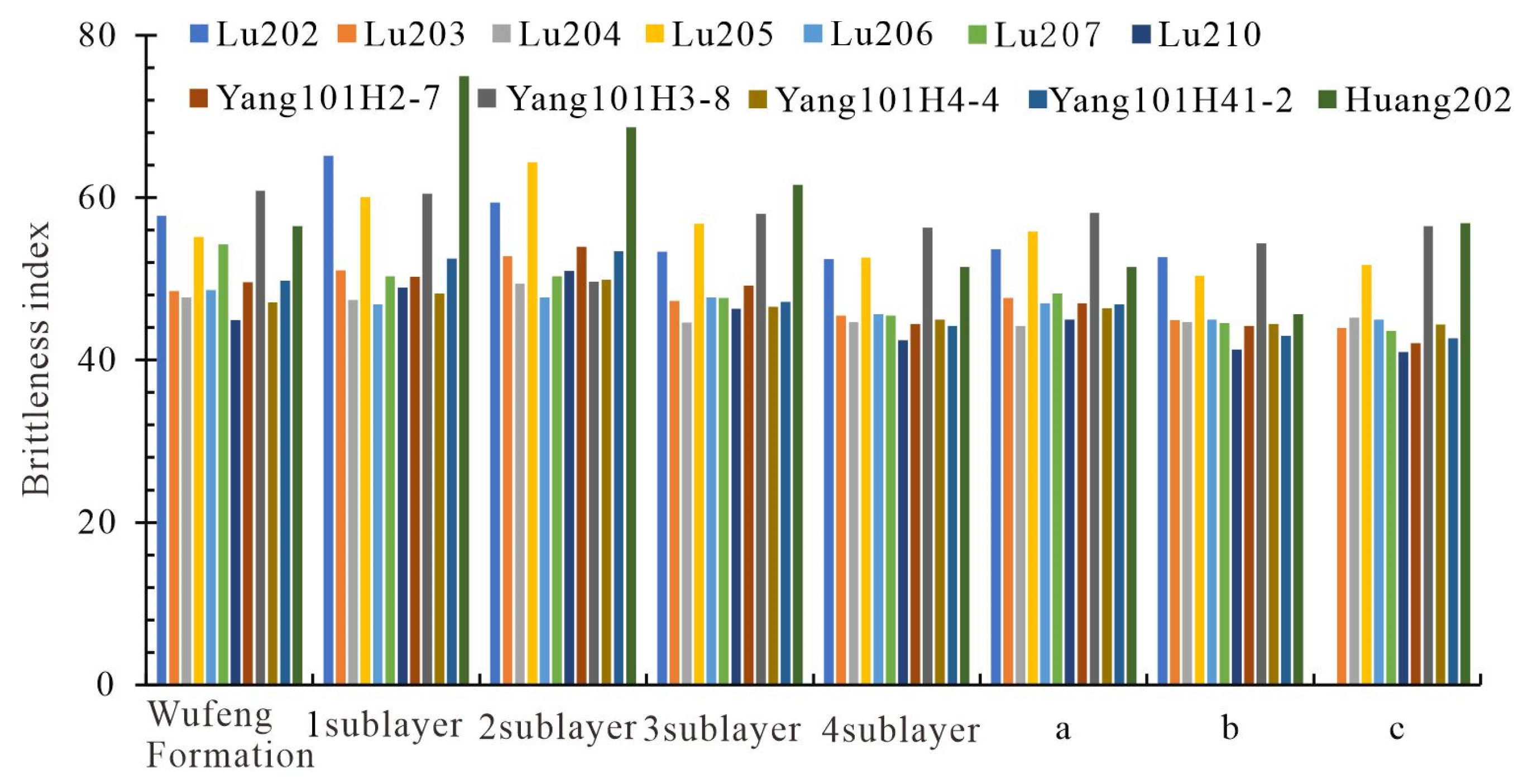
Shale brittleness influences the formation of hydraulic fracture networks and is a key parameter indicating the ease of reservoir stimulation [35,36,37,38,39]. The mineral brittleness index calculated from XRD mineralogy shows that the WF and Long11-1–3 sublayers have brittleness indices of 50–65%, clearly higher than the Long11-4 sublayer’s 35–50%. On average, the Long11-1 sublayer in each well has >50% brittleness index and Long11-2 and Long11-3 are about 50–60%, whereas Long11-4 segments a and b are only 40–55%, and segment c is the lowest, under 40% (Figure 6). Vertically, brittleness decreases upward, consistent with decreasing quartz and increasing clay content. Spatially, the Lu203 area has slightly higher brittleness than the Yang101 area, because the former’s shales contain slightly more carbonates and pyrite and less clay; the Yang101 area’s higher clay content lowers its brittleness. Compared to shallow Huangguashan shales (>60% brittleness index), the deep shales in the study area are overall less brittle (Figure 6). Lower brittleness implies more difficulty in fracturing stimulation—higher pumping pressures and more proppant would be required to effectively stimulate the reservoir.

4.2. Microscopic Reservoir Characteristics

4.2.1. Types and Characteristics of Reservoir Space

By genesis, reservoir pore space in the shales can be categorized into three main types: organic pores, inorganic pores, and microfractures. Inorganic pores are further subdivided into interparticle pores and intraparticle pores [40,41,42,43]. Direct SEM observation reveals significant differences in pore structure between different stratigraphic layers.
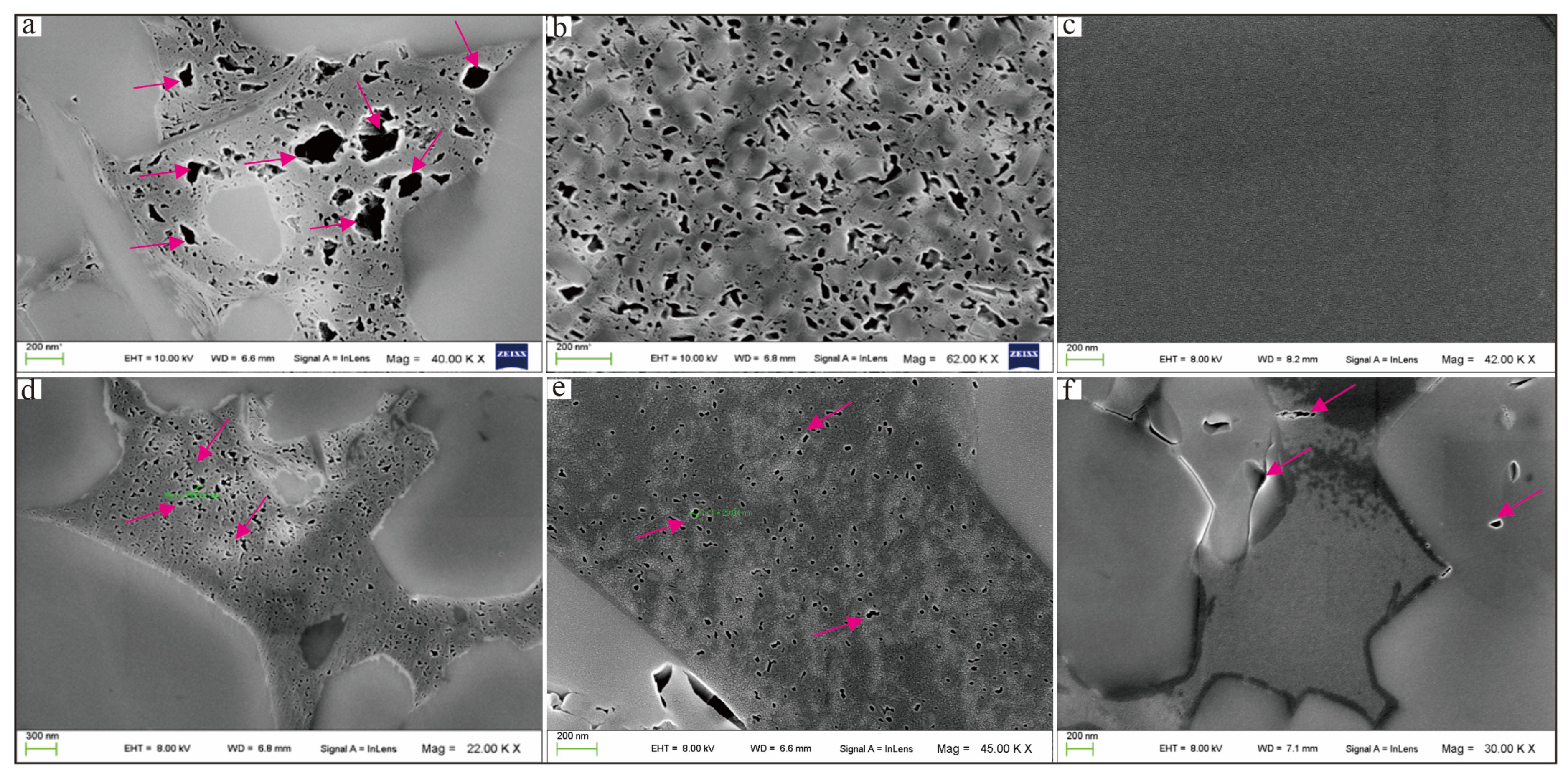
Organic pores are pores within or at the edges of solid organic matter (kerogen residues or bitumen) [44,45,46,47]. Organic pores are present in both the WF and Long 11 sub-member shales of the study area, but their abundance and morphology vary by layer and well. The WF Formation top, which is an organic-rich shale, has the most developed organic pores: in samples from wells Lu205 and Lu203, one can see abundant, mutually connected circular pores, mostly 50–200 nm in diameter, with some reaching several hundred nanometers (Figure 7a). Well Lu207’s WF samples have slightly fewer and smaller organic pores (50 nm, Figure 7b). In contrast, the WF samples from wells Yang101H2-7 and H3-8 show relatively few organic pores (Figure 7c). This suggests that in the relatively shallower burial (3500 m) Lu203 area, the micro-pores generated by hydrocarbon generation in organic matter are better preserved, whereas in the deeper Yang101 area WF, higher thermal maturity and nearly exhausted organics have resulted in fewer organic pores.
Upwards into the Long 11 sub-member, the development of organic pores fluctuates. In the lowermost Long11-1 sublayer, organic pores are abundant in almost all wells. Notably, the Yang101H3-8 sample is riddled with foam-like, round organic pores ranging from 50 to 500 nm, interconnected in a network (Figure 7d). The Yang101H2-7 sample has a few larger bubble-like pores (up to 200–300 nm), but fewer in number compared to the former (Figure 7e). Wells Lu205 and Lu203H57-3 also show well-developed organic pores in Long11-1, tens to a few hundred nm in size, predominantly as interconnected circular voids, though slightly less impressive than in the Yang101 wells. Wells Lu207 and Huang203 have comparatively fewer organic pores in this layer, often mingled with clays. In the Long11-2 sublayer, organic pores decrease markedly. In samples from Lu205, Lu203H57-3, and Yang101H3-8, only a small number of connected tiny organic pores (mainly 20–50 nm) are observed, far fewer than in Long11-1; and in Yang101H2-7 and Huang203, virtually no organic pores develop in Long11-2 (Figure 7f). This “deterioration in the middle” might relate to reduced organic input during Long11-2 deposition or later thermal evolution, causing pore closure. In the Long11-3 sublayer, organic pore development improves again. Wells Lu205, Lu203H57-3, Yang101H2-7, and H3-8 all show numerous circular to oval organic pores in this sublayer, many exhibiting a “pores within pores” structure (small pores lining the walls of larger pores), with diameters of 50–200 nm and good interconnectivity. In summary, vertically, the development of organic-matter pores is high at both bottom and middle, but poor in between—best in the WF and Long11-1, Long11-3 sublayers, and poorer in Long11-2 and Long11-4. This correlates with the TOC distribution, reflecting that organic pore development is mainly controlled by organic richness and maturity. Laterally, the Lu203 well block has more developed organic pores compared to the Yang101 block (especially in the WF and Long4b interval, where the Lu203H57-3 sample shows up to 45% area occupied by organic pores), whereas the Yang101 block has a higher proportion of microfractures (exceeding 10%).
Inorganic pores include interparticle and intraparticle pores. Interparticle pores refer to voids between rigid grains (e.g., quartz, feldspar, pyrite) and the soft matrix (clay, organic matter), whereas intraparticle pores are voids within particles created by dissolution or within crystal structures [48,49]. In shallower shales, interparticle pores are relatively well developed, forming a connected pore network, but deep-burial compaction causes many interparticle pores to collapse or deform. In these deep shales, primary interparticle pores in pure mudstone fabric are difficult to observe, except where small remnants persist around clusters of rigid grains. In contrast, pores formed by later-stage dissolution of particles are common, and constitute the main type of inorganic pore in deep shales. SEM observations frequently show inorganic pores such as cavities left after carbonate grain dissolution, dissolved feldspar intragranular pores, intercrystalline pores inside pyrite aggregates, and cleavages between clay or mica layers (Figure 8). For example, in a sample from the Long11-2 sublayer of well Yang101H2-7, many intraparticle dissolution pores (10–100 nm) are observed within partially dissolved feldspar remnants or along calcite crystal edges; these pores have irregular shapes, but are spatially adjacent, which facilitated minor bitumen infill (some asphalt is seen coating them). Overall, inorganic porosity in the study area’s deep shales is dominated by intraparticle dissolution pores, with only a few residual interparticle pores surviving in localized clusters of brittle grains. Compared to shallow shales, the deep samples have smaller and more isolated inorganic pores, though features like the interior of framboidal pyrite (“berry clusters”) still preserve tens-of-nanometers scale intercrystalline pores that may contribute to free-gas storage.
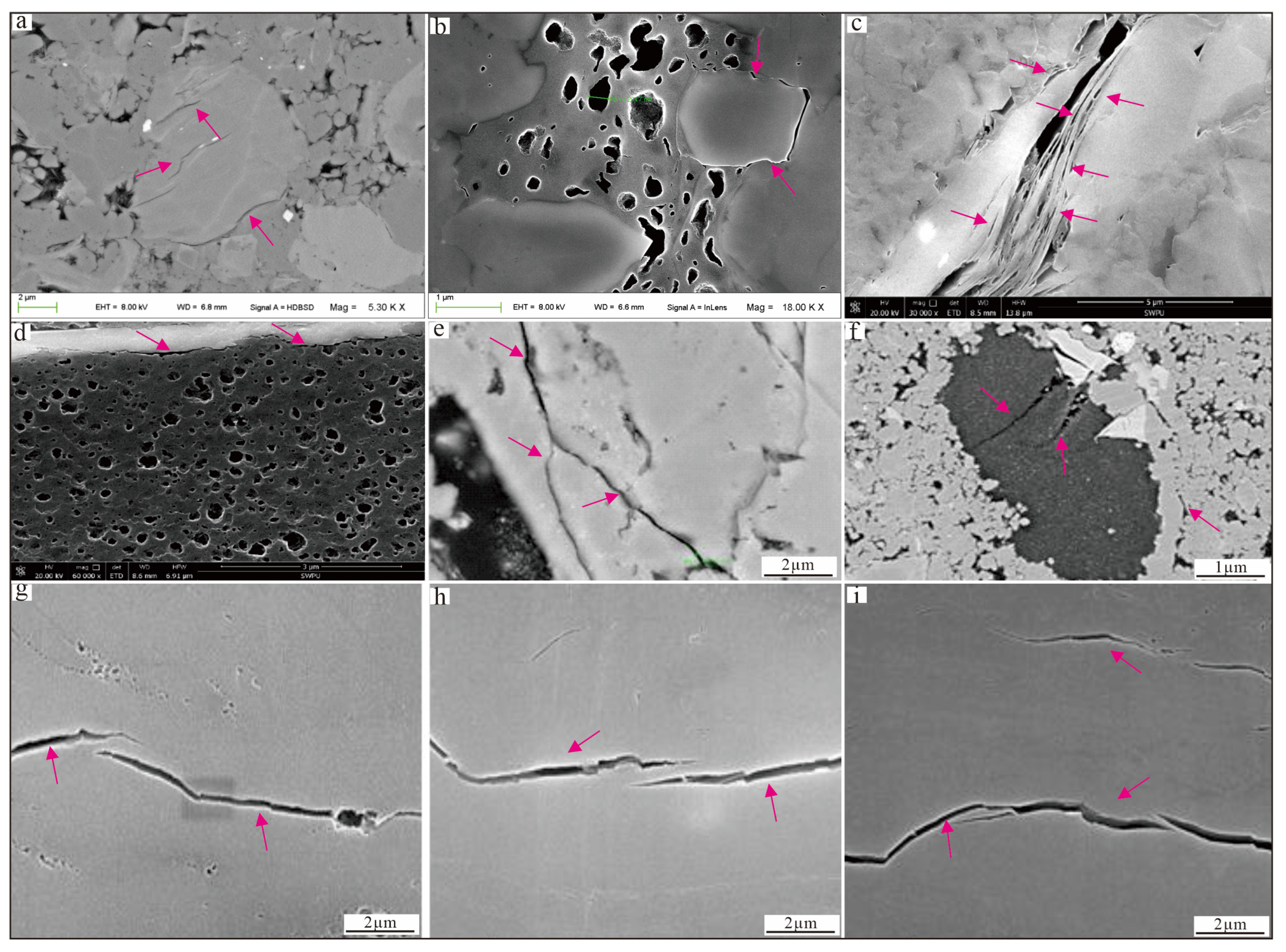
Microfractures are not ubiquitous in the samples, but do occur locally, and have a significant impact on reservoir permeability [50,51,52,53,54]. By origin, they can be divided into two types: (1) hydrocarbon-generation overpressure fractures, which appear as networks of short, irregular cracks, mostly in organic-rich layers (Figure 9a–f). These form when organic matter generates hydrocarbons and fluid expulsion is impeded, causing localized overpressure that brittly cracks the organic matter, producing a microfracture network. Under SEM, these cracks are usually <2 μm wide, filled with bitumen or quartz, and have random orientations. They are especially common in WF and Long11-1 and Long11-3 sublayer samples from the Lu203 area (often associated with abundant organic pores). (2) Diagenetic shrinkage fractures, including layer-parallel fractures from clay dewatering shrinkage and edge fractures from volume contraction of organic matter during maturation/solidification. These fractures are straighter, extending along bedding, with widths < 5 μm, and often filled with authigenic calcite or quartz. Such fractures occur mostly in intervals with lower TOC and higher clay (e.g., Long11-4), and tend to be planar. Microfractures are relatively rare in shallow shales (high organic-pore proportion, fracture < 6%), but in deep shales their proportion increases slightly to ~8–10%. These fractures enhance deep-reservoir permeability and aid gas migration and inter-well connectivity. On the other hand, excessive fractures could degrade preservation conditions, allowing free gas to escape.

4.2.2. Quantitative Pore Characterization and Pore Size Distribution

By combining NMR T2 spectra with low-pressure gas adsorption, we can quantitatively analyze the pore size distribution. The experimental results show systematic differences in pore size distribution among different layers (Figure 10). In well Lu205, the Long11-1 and Long11-3 sublayers have pore diameters mainly in the 10–100 nm range, with relatively well-developed larger pores, whereas the WF and Long11-2 sublayers have pores concentrated in the 0–50 nm range, lacking larger pores. The Long11-4a and 4b segments show a roughly even distribution of pore sizes, from 0–100 nm, with pores across various scales present in certain proportions. A similar trend is observed in well Lu203H57-3 and well Yang101H3-8: the deeper high-quality intervals (sublayers 1 and 3) contain more pores >50 nm, whereas poorer intervals (WF base, sublayer 2) are dominated by smaller pores <50 nm.
In the Long11-4 sub-member in the Lu203H57-3 well, a slight increase in the proportion of pores larger than 50 nm was observed. One possible explanation is the relatively higher clay-mineral content in this interval. During diagenetic compaction, clay minerals undergo dehydration and shrinkage, leading to the development of interlayer microfractures (Figure 9c,d). These microfractures are classified as inorganic pores, and typically exceed 50 nm in size, thereby contributing to an increased proportion of large pores in this sub-member. In the shallow shale reservoir of Well Wei 204, the microfractures are primarily clay interlamination fractures, while organic-matter edge fractures and rigid-mineral edge fractures are less developed (Figure 9g–i). In contrast, the microfractures in the study area are mainly those formed by compaction and clay interlamination fractures, with organic-matter edge fractures locally developed. This indicates that a high clay content promotes the formation of microfractures, rather than clay minerals themselves inherently possessing large pore sizes. In general, the pore size spectrum of deep shales is shifted towards smaller pores compared to shallow shales, but a suitable fraction of large pores (>50 nm) still plays an important role in boosting free gas content and connectivity. Further analysis with NMR gas saturation–desaturation experiments reveals stark differences in the desorbable (recoverable) gas fraction from pores of different sizes: in ultra-small pores <5 nm (mostly organic micropores), gas is predominantly adsorbed and the recovery factor is only 45%; in macropores >300 nm (mostly inorganic pores and microfractures), gas is mainly free, and recovery can be 90%, though the total gas volume in these big pores is limited; for intermediate mesopores of 5–100 nm, both free and adsorbed gas are present, with a recovery factor of 75–80%, and these pores play a key role in maintaining reservoir pressure during production. Therefore, the development of intermediate-size pores (tens of nanometers) is critical to sustained shale gas production. This is exactly a characteristic of the deep high-quality intervals like Long11-1 and Long11-3: they have not only a certain number of large pores, but are also filled with numerous medium-size organic and inorganic pores (SEM observations show “nested pore” structures), ensuring high free-gas content and dynamic adsorbed-/free-gas interchange capacity.
Using the above approach, the microscopic pore size distributions for each sublayer in each well were obtained, as follows:
Well Lu205: in the Long11-1 and Long11-3 sublayers, pores are mainly 10–100 nm, with well-developed larger pores; in the WF and Long11-2 sublayers, pore sizes concentrate in 0–50 nm; the Long11-4a and 4b segments have a relatively uniform pore-size distribution across 0–100 nm.
Well Lu203H57-3: in the Long11-1 and Long11-3 sublayers, pores concentrate in 10–100 nm, with relatively abundant large pores; in the WF and Long11-2 sublayers, pore sizes are mainly 5–50 nm; the Long11-4a and 4b segments show a more uniform distribution, with generally smaller pores and few large pores.
Well Yang101H3-8: in the Long11-1 and Long11-3 sublayers, pores are primarily 10–100 nm, with well-developed large pores; in the WF Formation, pores are mainly 2–50 nm; the Long11-4a and 4b segments have relatively uniform pore-size distributions, with an increase in larger pores, possibly due to higher clay content and thus more inorganic pore development.
NMR T2 spectrum desorption experiments indicate that the gas recoverability of pores smaller than 5 nm is only approximately 45%, whereas pores larger than 300 nm exhibit a recoverability of up to 90%. In the study area, the Long 11-1 and 11-3 sub-layers are characterized by an abundance of mesopores in the 10–100 nm range, which not only contribute approximately 20% of the total pore volume, but also correspond to gas recoverability of 75–80%, playing a critical role in sustaining production capacity. Therefore, the development of pores with intermediate sizes (in the order of several tens of nanometers) is crucial for achieving and maintaining high and stable production in deep shale reservoirs. This issue will be further discussed in conjunction with production performance data in the following sections.

4.3. Shale Reservoir Distribution

4.3.1. Vertical Distribution of Reservoirs

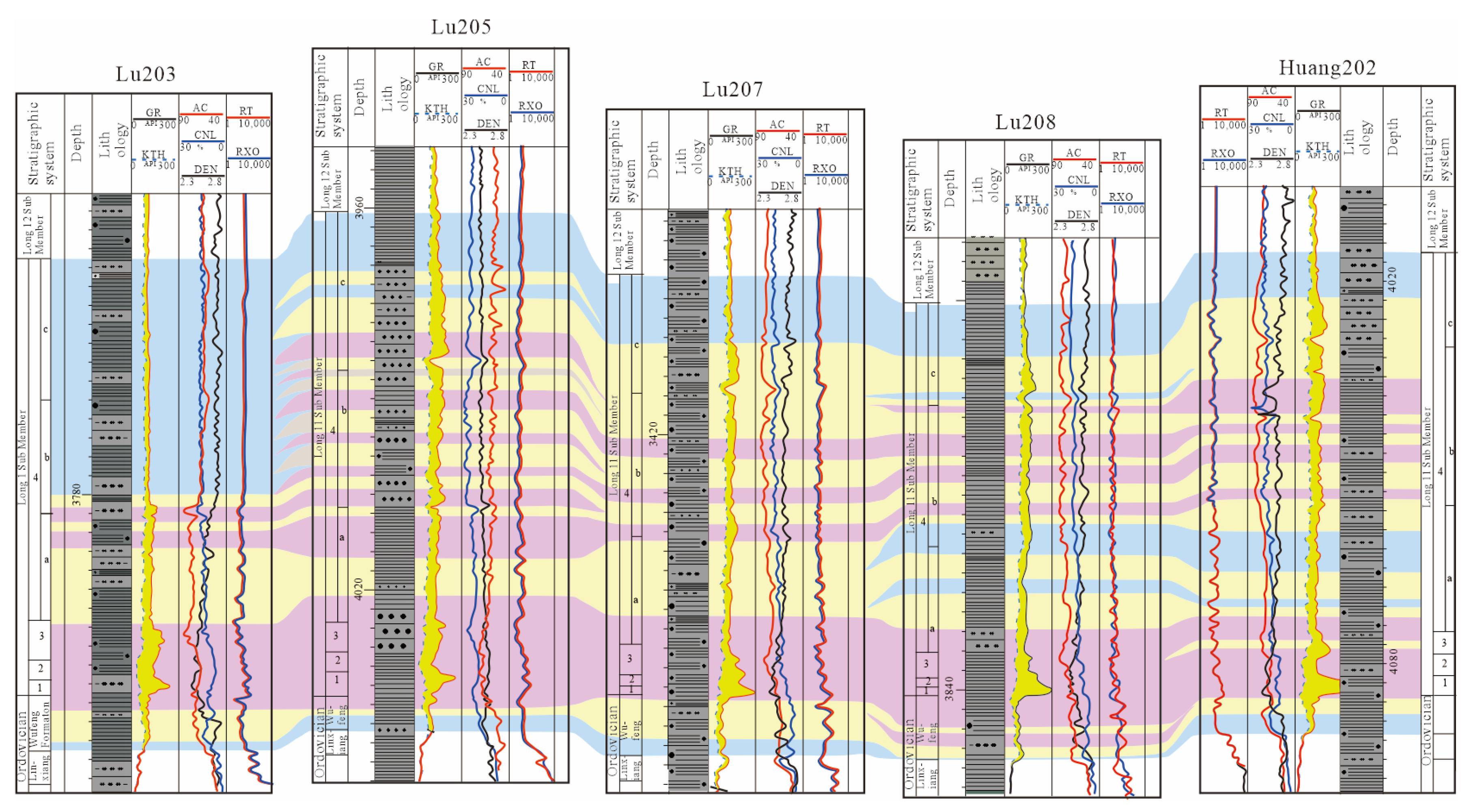
Using shale reservoir evaluation criteria, we classified the WF–Long 11 interval in each well into three reservoir quality grades (I, II, III) and tallied their vertical thickness. Type I reservoirs are the high-quality intervals with the best parameters (TOC, porosity, gas content, etc.) and the highest comprehensive evaluation scores; Type II are second-best; Type III are poorer intervals. The results show that in each well, Type I reservoirs are mainly concentrated from the top of the WF Formation through the Long11-3 sublayer, whereas the Long11-4 sublayer and the basal WF are mostly Type II or III. For example, in well Lu203, the total thickness of high-quality (Type I + II) shale is 36.8 m, of which Type I accounts for 15.6 m (with a continuous interval of 13.3 m), and Type II for 21.1 m; because the upper Long11-4 became highly silty, that portion contains no Type I or II reservoir (Figure 11). In well Lu205, Type I totals 33.9 m (continuous 17.4 m), mainly in the Long11-1–Long11-3 sublayers, with also a thin Type I layer in the upper Long11-4a and another in the lower part of Long 11-4c. This well’s Type II totals 30.6 m, concentrated in the Long11-4 sublayer, and Type III appears only at the very top of Long11-4c and at the base of WF. Well Lu206 has 34.7 m of Type I (continuous 16.3 m), distributed similarly to Lu205. Well Yang101H2-7 has 32.8 m of Type I (continuous 15.1 m); besides Long11-1 3, it also shows localized thin Type I layers in the WF and upper Long11-4a. Well Yang101H3-8 has 29.7 m of Type I (continuous 22.2 m); Type I occurs mainly in Long111-–3, with a single continuous interval up to 22 m thick. Other wells (Yang101H4-4, Yang101H41-2, Lu207, Lu208, etc.) show similar patterns: Type I reservoirs almost exclusively occur in Long11-1, Long11-2, Long11-3, with only sporadic thin Type I layers in the top of Long11-4a or within WF; Type II reservoirs are widespread through the entirety of Long11-4; Type III reservoirs appear only sporadically, for example, in thin interbeds near the unconformity contact. In summary, vertically, the high-quality reservoirs of the study area are predominantly developed in the uppermost Late Ordovician (WF top) and the early Silurian LMX deposition (lower-middle Long 11 sub-member). These intervals are thick, highly organic-rich, and have good porosity and gas content, constituting the “sweet spot” layers for shale gas enrichment. The Long11-4 sublayer, due to increased terrigenous input (lower brittleness) and lower organic carbon, has overall reduced reservoir quality; however, within it, the top of 4a and the middle of 4b can locally inherit some favorable conditions, forming small high-quality “sweet spots.”

4.3.2. Lateral Distribution of Reservoirs

Correlation of reservoirs between wells was analyzed using cross-section profiles. A west–east profile across the northern part of the area (wells Lu203–Lu205–Lu207–Lu208–Huang202) shows that Type I reservoirs appear mainly from the WF top to the Long11-3 sublayer in each well, consistent with the single-well results. In the Long11-4a top and mid-4b, some wells have thin Type I layers, but moving eastward to well Huang202, Type I nearly disappears, indicating the high-quality interval pinches out toward the eastern margin (Figure 12). Along a NW–SE profile (wells Lu205–Gulin202–H1–Yang101H2-7–Yang101H3-8–Lu210), it is observed that, moving from Lu205 southeastward, the thickness of Type I slightly decreases, reaching only 13.7 m at Lu210, and the continuous thickness shrinks. This suggests that toward the southeast (toward the paleo-uplift), the depositional shallowing limited the development of thick, high-quality shale. Along a SW–NE profile (Lu206–Yang101H4-4–Yang101H2-7–Yang101H41-2–Huang202), we see that well Lu206 has Type I thickness up to 36 m, but northeastward to Huang202 it drops to 21.8 m, with clearly a thinning of the high-quality interval. Overall, laterally, the thickness of Type I reservoirs in the Luzhou block tends to thin from the central area toward the periphery. The Lu203/206 area and the Yang101 area lie at the center of high-quality reservoir thickness, whereas toward the paleo-uplift (northeast and southeast) or toward the basin (northwest), the Type I interval thins, or even locally pinches out.

4.3.3. Planar Distribution of Reservoirs

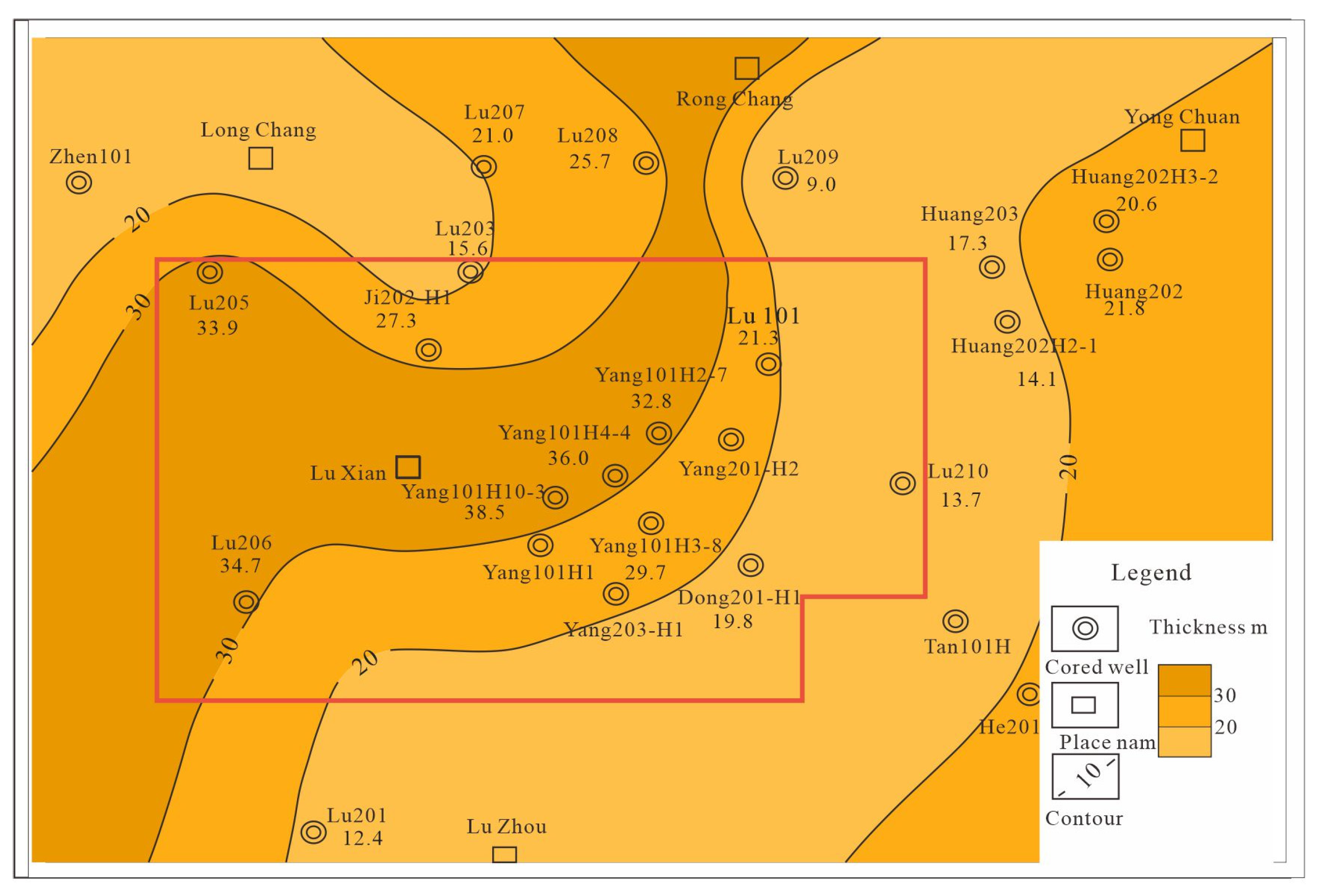
Using the thickness data for each well, isopach maps were contoured to show the areal distribution of high-quality reservoirs. The total thickness of Type I + II reservoirs (cumulative thickness of favorable shale) in the study area ranges from 36.8 to 69.4 m, averaging 55 m. The thickest zone (>60 m) is around the Lu206–Yang101 well block, thinning toward the northeast and southern margins. The thickness of Type I (best quality) reservoirs ranges from 15.6 to 38.5 m, with the maximum around well Lu206 (38.5 m); well Yang101H4-4 also has 36 m, together forming a NE–SW trending thick zone (Figure 13). The Lu203 area to the north has slightly lower Type I thickness (~25 m), whereas the southeastern edge (toward well Huang202) drops below 20 m. The continuous Type I thickness (uninterrupted by non-reservoir interbeds) ranges from 5.7 to 23.2 m, again maximized > 15 m around Lu206–Yang101. Clearly, the high-quality shale reservoirs are unevenly distributed in the plane: they are concentrated around the Yang101 platform and near well Lu206, thinning outward. This reflects the fact that the distribution of quality shale is controlled by depositional facies belts. Combined with the sedimentary background, the thick high-quality zone corresponds to the early Silurian deep-water depocenter of the basin, where anoxia persisted, and organic matter accumulated and was preserved in large quantities, leading to thick, organic-rich and brittle shale development.

5. Discussion

5.1. A Comparison of Deep vs. Shallow Shale-Reservoir Pore Structure

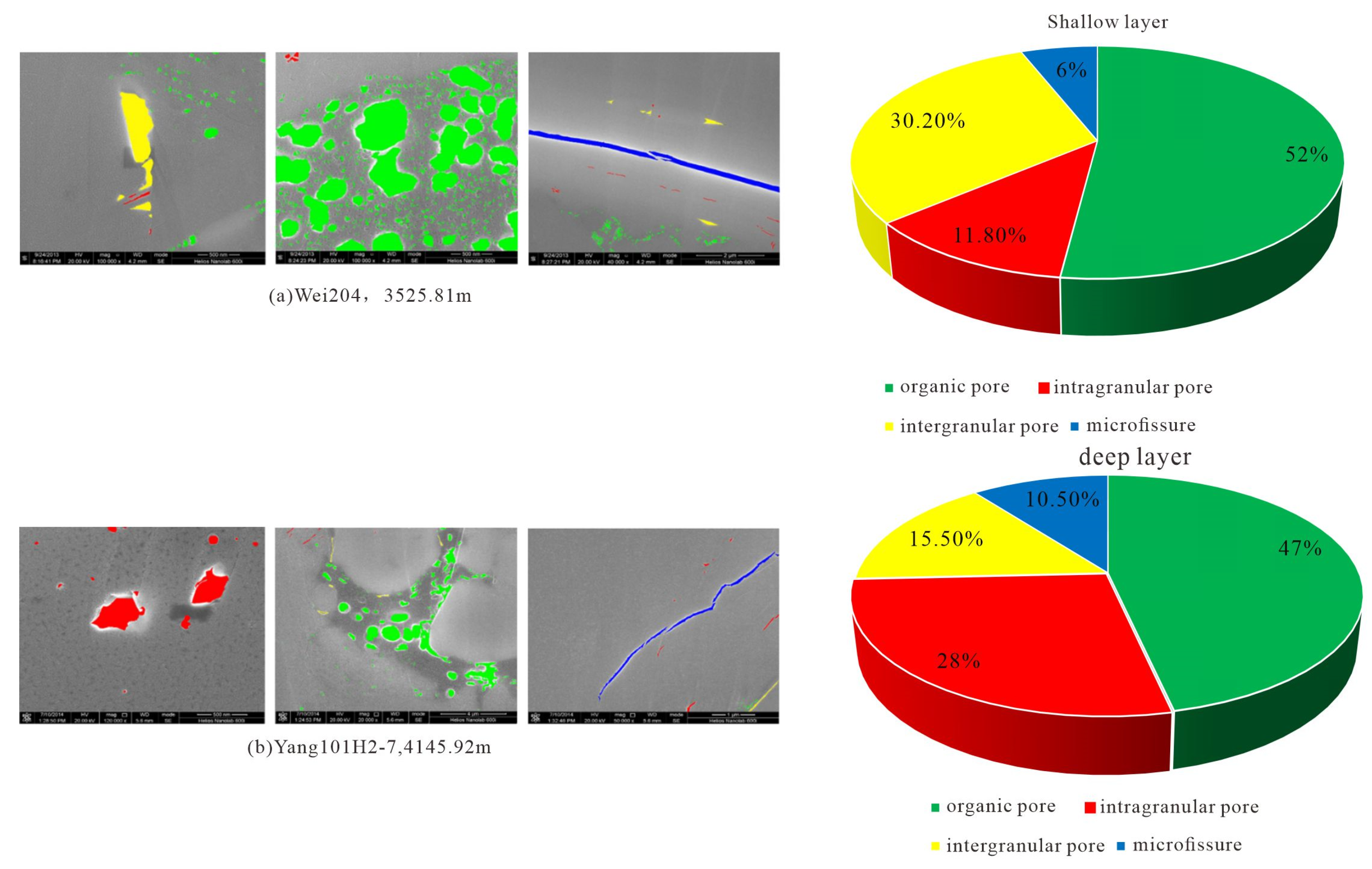
To investigate the effect of burial depth on shale reservoir micro-pore structure, we compared a nearby shallow-shale gas well, Wei204 (3500 m depth, Weiyuan area), with the deep well Yang101H2-7, from our area. Both wells target the WF–LMX black shales, but their thermal maturity and burial histories differ. Quantitative statistics of pore types and sizes for the two reservoirs reveal significant differences (Figure 14): in the shallow Wei204 shale, organic-matter pores constitute >50% of total pore volume, inorganic pores 42% (with interparticle pores 30%, intraparticle 12%), and microfractures only 6%. In contrast, the deep Yang101H2-7 shale has organic pores 47%, inorganic 43% (with interparticle and intraparticle comparable), and microfractures nearly 10%. The proportion of organic pores in the deep shale is approximately 5–8 percentage points lower than that in the shallow shale, whereas the proportion of microfractures increases by about 4 percentage points. This indicates that increasing burial depth leads to a slight reduction in the contribution of organic pores, accompanied by an enhanced contribution from small-scale inorganic pores and microfractures. Further statistical analysis shows that, in the shallow Wei204 well, interparticle pores account for 30.2% and intraparticle pores for 11.8%, whereas in the deep Yang101H2-7 well, interparticle pores decrease markedly to 15.5% while intraparticle pores increase to 28%. In deep shale, inorganic pores are dominated by intraparticle dissolution pores, which account for approximately two-thirds of the inorganic pore volume, whereas interparticle pores are dominant in the shallow shale.
This indicates that in deeper shales, the contribution of organic pores is relatively reduced, while microfractures are slightly increased. The reasons are the following: shallow shales have not over-matured, so the large pores generated by hydrocarbon generation are well preserved, and weaker compaction allows some interparticle pores to remain; deep shales, having experienced stronger compaction and later-stage organic evolution, have many large organic pores collapsed into smaller pores, and most interparticle pores are obliterated or converted to intraparticle secondary pores. Meanwhile, although the high-pressure deep-burial environment helped preserve some organic pores, the overall pore size distribution shifted to smaller pores: the cumulative pore-size curve for the shallow shale shows macropores >300 nm contributing the majority of pore volume, whereas in the deep shale, the main pore sizes are 100–200 nm. Notably, the deep shale in the study area is subjected to an abnormally high-pressure regime, with pressure coefficients reaching up to 2.3, which, to some extent, retards pore compaction and closure. Consequently, although most large pores tend to collapse under deep-burial conditions, the elevated pressure favors the preservation of a portion of organic pores, allowing a certain proportion of pores larger than 100 nm to be retained in the pore-size distribution of the deep shale. In shallow-shale SEM images, “pore-in-pore” structures are common (large organic pores whose walls are lined with micropores), and such hierarchical pore connectivity favors free-gas occurrence and migration; in deep shale, isolated dispersed small pores are more common, with slightly poorer connectivity, necessitating microfractures forming networks. Nevertheless, the slightly higher abundance of microfractures in deep shale partly compensates for the reduced pore connectivity, enhancing permeability. On the other hand, in shallow shale, inorganic pores are mainly interparticle, providing a well-supported framework and strong connectivity; in deep shale, inorganic pores are predominantly intraparticle dissolution pores, each small and isolated, but very numerous, which, to some extent, still provide storage for gas. In summary, the pore structure of shallow-shale reservoirs can be summarized as “dominant organic pores, larger pores that are multi-tiered and interconnected, with few microfractures,” whereas deep shale exhibits “slightly fewer organic pores, mostly small pores, well-developed intraparticle pores, and a slight increase in fractures.” [55,56,57,58] Consequently, the proportion of free gas and the flow mechanisms in deep-shale gas reservoirs may differ from shallow ones, relying more on adsorption–desorption and diffusion in nano-pores. This poses challenges for developing deep shale gas—for example, production regimes must be carefully controlled to prevent rapid reservoir energy depletion. In fracturing deep-shale gas wells, stimulation measures should be optimized for their pore structure, such as creating an extensive fracture network to connect abundant small pores, and using slow drawdown so that adsorbed gas can continuously desorb, thereby achieving stable and high production.

5.2. Main Controlling Factors for High Productivity in Shale Gas Wells

The Lu203–Yang101 area, as an important deep-shale gas exploration block in southern Sichuan, has seen success both with high-yield wells and cases of lower-than-expected production. Synthesis of data from this and adjacent areas indicates that whether or not a shale gas well achieves high production depends on both geological factors and engineering measures. Geological conditions determine the inherent reservoir quality, while engineering stimulation dictates the degree to which it is realized.

5.2.1. Deep-Water Stagnant Deposition as the Foundation for Quality Shale and High Productivity

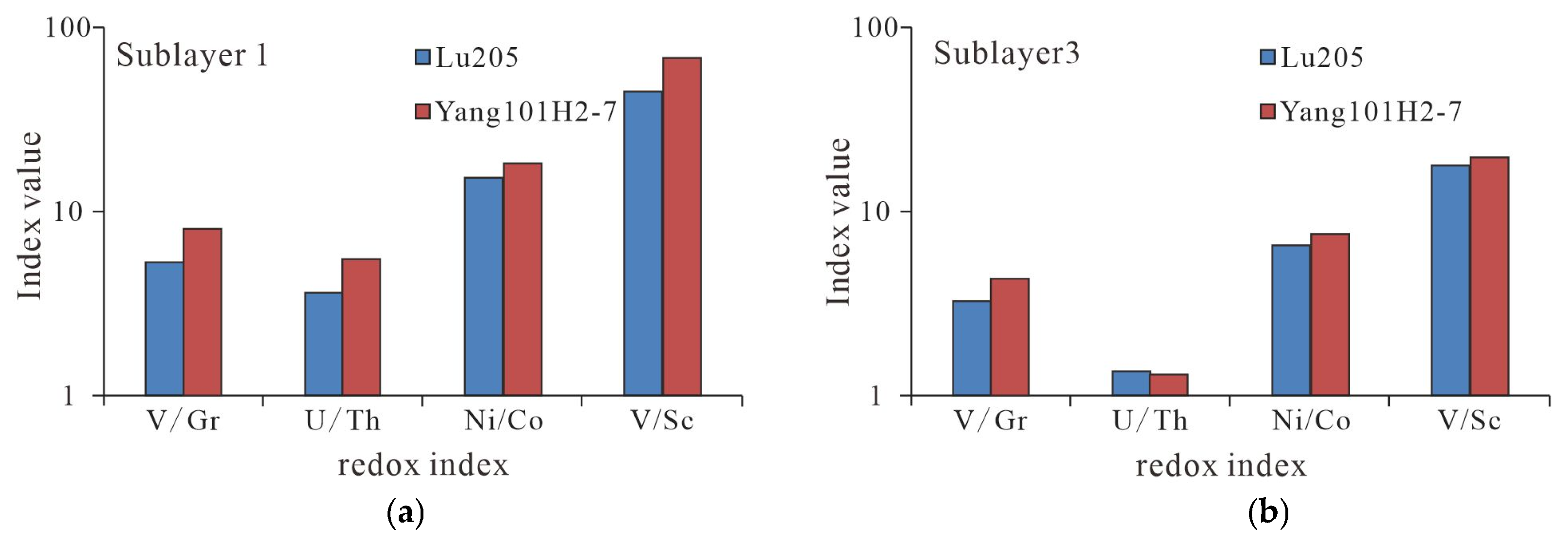
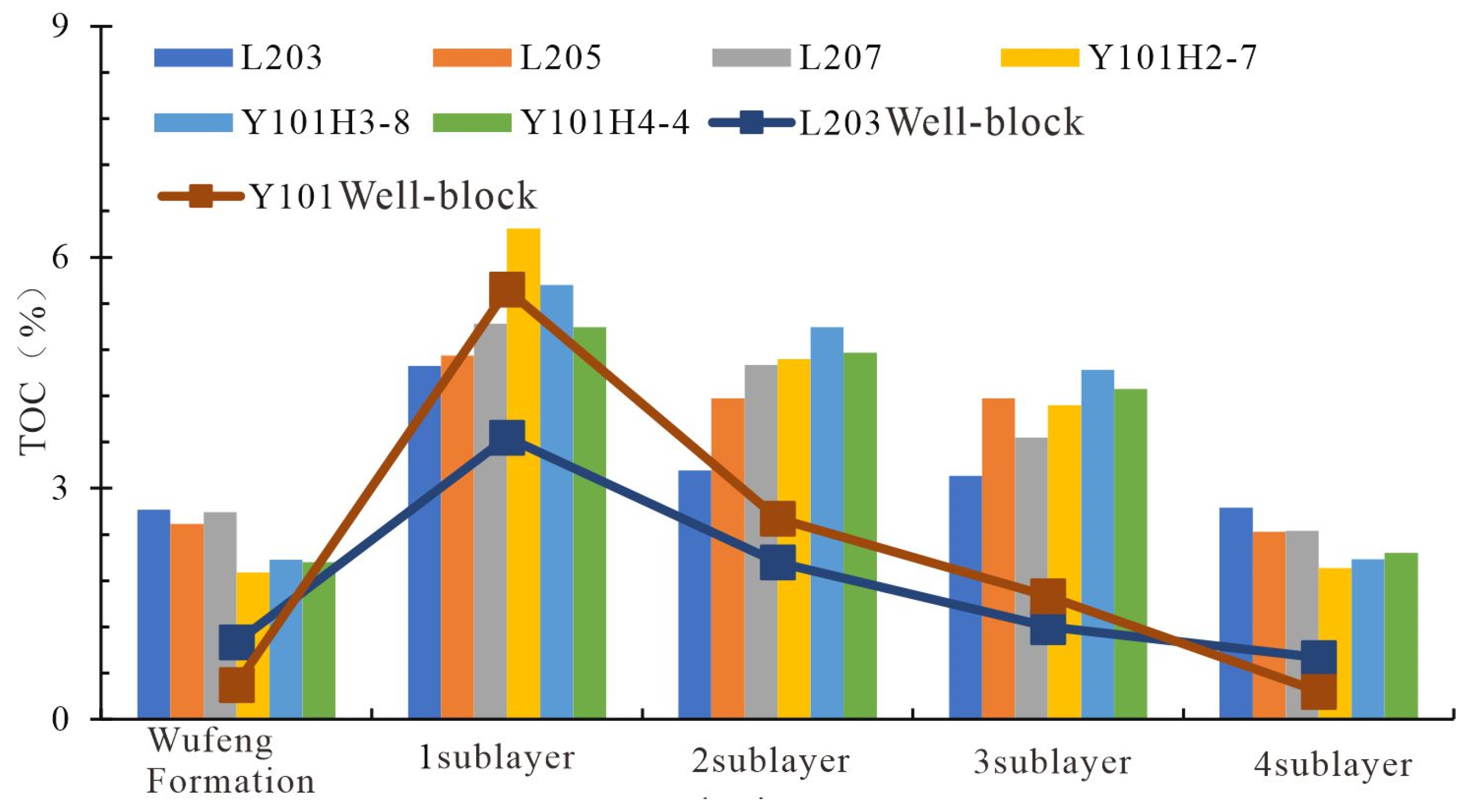
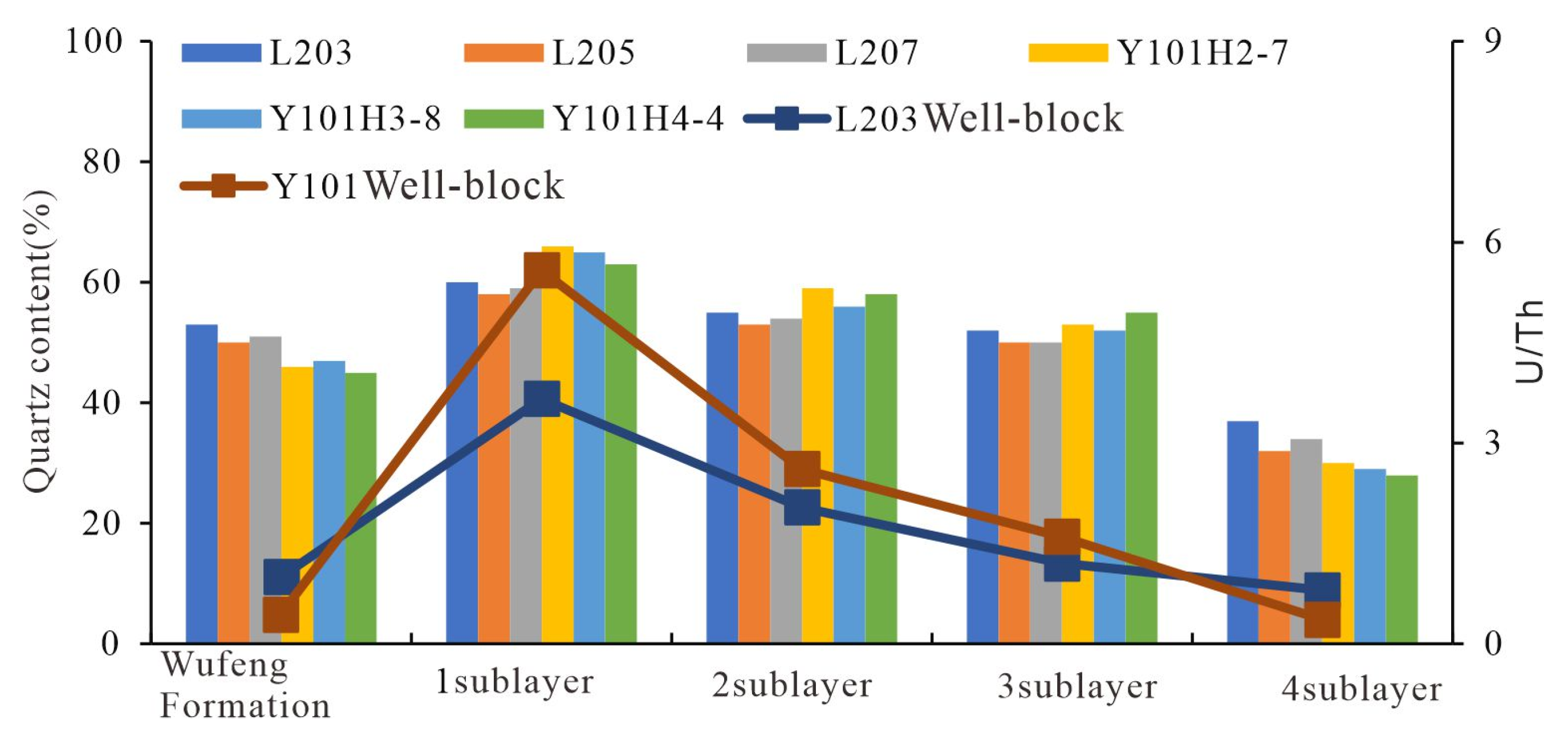
The depositional environment directly affects organic-matter enrichment and preservation, as well as the input of biogenic silica, thereby determining source-rock quality and reservoir brittleness. The WF–Long 11 sub-member in the study area was deposited in a deep-water shelf setting; however, paleo-water depth varied between sublayers. Geochemical redox indices (e.g., V/Cr, U/Th, Ni/Co, V/Sc) quantitatively characterize the paleo-oxic conditions: higher values indicate more anoxic, deeper water [59,60,61]. A comparison between well Lu205 and well Yang101H2-7 shows that in the Long11-1 and Long11-3 sublayers, Yang101H2-7 has markedly higher V/Cr, U/Th, etc., than Lu205 (Figure 15), implying that the Yang101 area had deeper, more strongly anoxic water during deposition of those layers. Correspondingly, the TOC and biogenic-quartz contents of sublayers 1–3 in Yang101 are higher than in Lu205 (Figure 16 and Figure 17), indicating that a deep, anoxic setting promoted organic-matter accumulation and the preservation of abundant siliceous biogenic debris. These high-TOC, high-quartz shale intervals are the material basis of high-quality reservoirs and high gas production. On one hand, high organic content provides ample hydrocarbon generation potential and adsorbed gas capacity; on the other, high quartz content increases brittleness, favoring later fracture network formation. Therefore, the deeper the water and the longer the water mass stagnation (“strongly retained”), the more likely the formation of thick, organic-rich shales with good fracability—thus laying the groundwork for high shale-gas productivity. In the study area, the Yang101 platform sits in a deeper sub-basin center during Long 11 deposition, so its reservoir quality is slightly superior to that in the slope area near the Central Sichuan uplift (Lu203 block). The average tested production of multiple horizontal wells deployed on the Yang101 platform reaches 34.97 × 10⁴ m3/d, which is significantly higher than that of wells in the adjacent, shallower synclinal area of the same region (with an average production of approximately 20 × 104 m3). This production disparity is closely related to the development of thick shale intervals deposited under deep-water, organic-rich, and brittle-mineral-rich sedimentary conditions, as discussed above. Similarly, previous studies have demonstrated a positive correlation between water-body residence time and shale thickness, as well as production capacity in the Nanchuan–Fuling area. Therefore, sedimentary indicators—including TOC, quartz content, and shale thickness—exhibit a strong correlation with ultimate gas production.

5.2.2. Abnormally High Pressure and High Gas Content as Guarantees of High Production

Shale gas reservoirs are self-sourced and self-stored, so formation pressure has a major impact on gas accumulation and deliverability. Experience from WF–LMX shale gas wells in the Sichuan Basin shows a positive correlation between bottomhole pressure coefficient and single-well production: higher pressure favors higher output. A comparison of data from multiple evaluation wells in the study area indicates that an increase in the pressure coefficient by 0.1–0.2 corresponds to an increase in the tested absolute open flow rate, although the magnitude of the increase varies among wells. Similarly, an increase in gas content by 1 m3/t is generally associated with higher production; however, the increment in production is difficult to quantify precisely, due to the combined influence of multiple controlling factors. The study by Li et al. (2024) also confirmed that high formation pressure is conducive to shale gas enrichment and high productivity [5]. Deep shales are often in an abnormally high-pressure state (pressure coefficients 1.8–2.3 in this area), which not only elevates reservoir energy, but is crucial for pore preservation. Actual drilling comparisons show that shale organic-pore morphology varies systematically under different pressure conditions: in the high-pressure well Lu205 (pressure coefficient 2.24), organic pores are mostly large (hundreds of nm) round pores; in well Lu203 (1.96), they are primarily elliptical, flattened pores; in well Lu201 (1.89), they evolve further into irregular angular pores < 200 nm; and in the low-pressure well Huang203 (1.64), almost only irregular nano-pores < 100 nm remain. This illustrates that, as preservation conditions worsen, organic pore size gradually shrinks—high pressure is critically important for preserving large organic pores. Overall, in ultra-high-pressure wells with pressure coefficients exceeding 2.2, organic pores are predominantly preserved as rounded, large pores. In contrast, in wells with pressure coefficients lower than 1.9, organic pores are mainly flattened, reflecting compression-induced reduction in pore height. These observations indicate that abnormally high pressure effectively “supports” the three-dimensional structure of organic pores and mitigates the effects of compaction. The comparison of Lu205 vs. Yang101H2-7 further confirms this: the two wells have similar burial depth, but Lu205’s pressure coefficient (2.24) is higher than Yang101H2-7’s (1.94). As a result, shales in the Long 11 sub-member of Lu205 generally have higher gas content than those in Yang101, especially in the lower 4b segment, where Lu205 shows a significantly greater proportion of 50–100 nm pores, providing more “mixed pores” capable of storing both free and adsorbed gas, and yielding a total gas content far exceeding that of Yang101 (Figure 18). Both wells have TOC > 2% and similar porosities, indicating that the high pressure enhanced gas saturation by preserving larger pores, thereby ensuring higher gas in place and productivity. It should be noted, however, that during long-term production, progressive depletion of formation pressure will weaken the pore-pressure support effect. This may lead to partial pore closure and a reduction in free-gas deliverability, an issue that should be explicitly considered in production forecasting.
Statistical analysis further shows that tested gas production per well correlates positively with total gas content and pressure coefficient, but only weakly with TOC or porosity. This means high gas content and high pressure are the direct factors for achieving high shale-gas well output: high gas content ensures sufficient gas supply, and high pressure not only aids gas flow, but also improves post-frac flowback. In production, free gas in high-gas zones is produced first, and abnormal high pressure helps rapidly expel fracturing fluid (higher flowback recovery), minimizing fracture “water lock” and thus enhancing deliverability.

5.2.3. Effective Fracturing as the Key to High Production

Even with excellent geological conditions, inadequate fracturing stimulation can prevent a well from achieving commercial production. The ultralow permeability of shale reservoirs dictates that hydraulic fracturing must create artificial fractures to connect the pore system and establish a flow network. Fracturing-treatment parameters (fluid volume, proppant volume, pump rate, stage length, etc.) and reservoir response (fracture geometry, conductivity) directly influence the final production. Microseismic monitoring can provide data on the number of fracture events and affected radius; generally, more events and a larger affected area suggest more effective stimulation. However, actual data in our area show that the single-stage and total stimulated reservoir volume (SRV) estimated by microseismics have only a weak correlation with production, possibly because the SRV does not distinguish between effectively propped major fractures and ineffective microcracks, and thus it may not fully represent the effective flow capacity. This phenomenon suggests that not all fractures generated during volumetric stimulation are effective flow conduits. Wu et al. (2025) reported that under the high-stress conditions characteristic of deep-shale reservoirs, hydraulic fracturing tends to generate more complex fracture networks; however, the number of effective conductive pathways may actually decrease, highlighting the need for optimized fracturing strategies [62]. Experimental results by Chen et al. (2025) further demonstrate that rock creep and fracture closure become more pronounced under high-temperature conditions [63]. Consequently, even when a large fracture volume is created, long-term fracture conductivity may still deteriorate if adequate proppant support is not maintained.
Therefore, we introduced fracturing flowback-fluid geochemical and isotopic analysis as an auxiliary criterion for fracturing effectiveness. After injection, fracturing fluid mixes with formation water and partially remains in the reservoir; during flowback, the total dissolved solids (TDS, salinity) and isotopic composition of the returning fluid change over time, reflecting the proportion of formation water involved. If fracturing is confined near the wellbore, the flowback-fluid composition remains close to the original injected fluid, with little salinity change; conversely, if the fracture network extends deep into the formation and mobilizes significant native formation water, the flowback-fluid salinity will rise and gradually approach the characteristics of formation water.
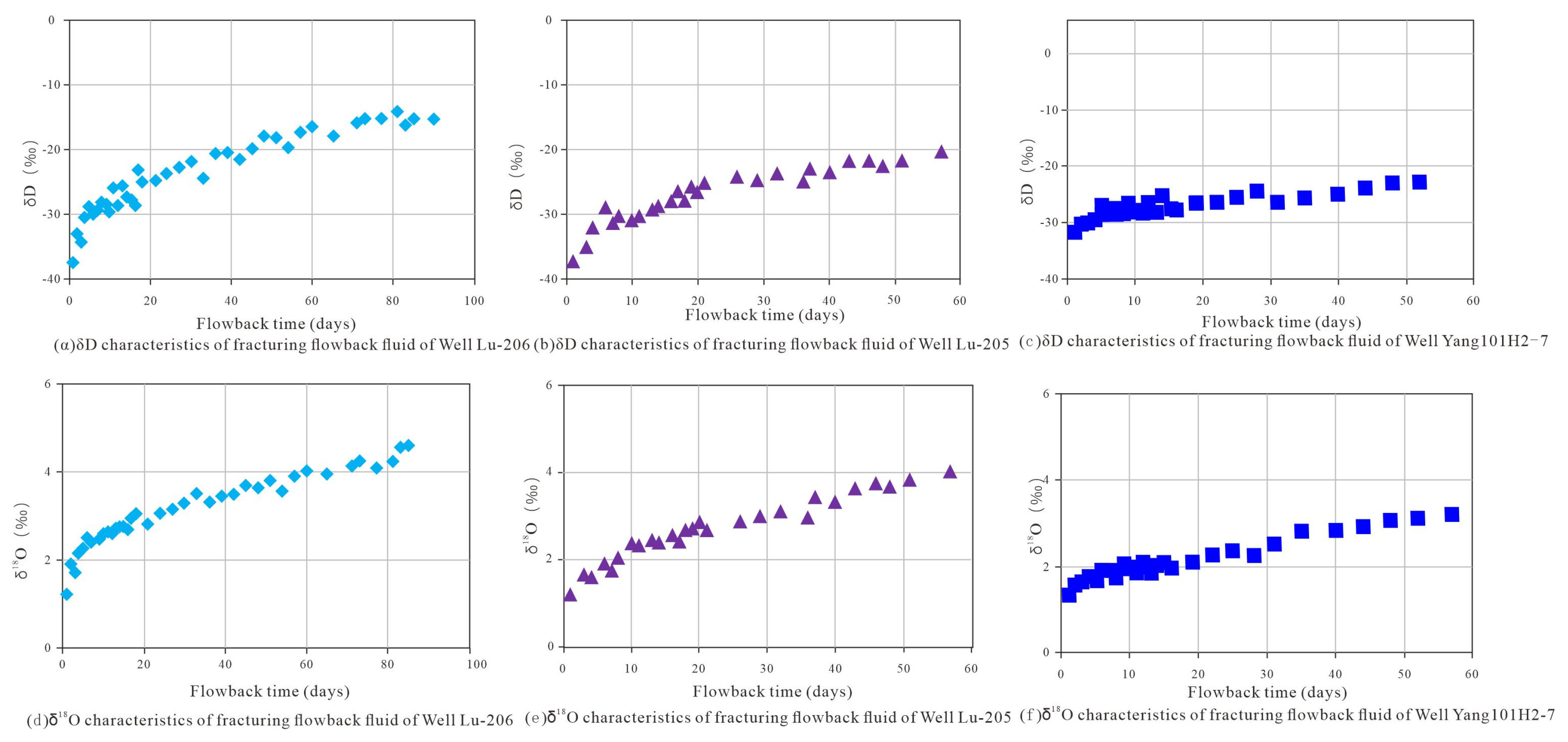
Long-term monitoring of wells Lu205, Lu206, and Yang101H2-7 shows that in all three wells, the total salinity of flowback fluid correlates positively with flowback time (with slightly poorer correlation in Yang101H2-7). The final stabilized salinity in each case is 20,000 mg/L. The injected frac fluid had relatively low salinity; the fact that flowback TDS is several times higher indicates formation water is being produced. Stable isotope measurements (δD and δ18O) of the flowback fluid reveal that in all three wells, the isotopic values increase with time and show a strong positive correlation, confirming mixing of formation water into the flowback. The isotopic values in Yang101H2-7 are lower than those in Lu206 and Lu205, implying a higher fraction of injected water remaining and less formation water being released during flowback (Figure 19). In terms of production, Lu205 and Lu206 are high-yield wells, whereas Yang101H2-7 has only moderate-to-low output. This indicates that Lu205/206 had fracture networks that extended sufficiently to contract much more reservoir volume (hence more formation water in flowback), whereas Yang101H2-7’s fracturing was relatively conservative/limited. Although the Yang101 area has excellent geology, the less extensive fracturing resulted in underperformance of its potential. Therefore, achieving high production requires meticulous fracturing design optimization to maximize stimulation coverage of the reservoir. Future optimization of hydraulic fracturing designs requires further investigation into the long-term conductivity of proppants under high closure stress and high-temperature conditions [63], as well as evaluation of fracture evolution through long-term field monitoring. Building upon these approaches, subsequent stages of this study will integrate these methods to enhance stimulation effectiveness and improve production performance in deep shale gas wells.

6. Conclusions

This study conducted a comprehensive reservoir characterization and analysis of productivity-controlling factors for the deep shale in the Long 11 sub-member of the WF–LMX Formations in the Lu203–Yang101 well block, southern Sichuan Basin. The main conclusions are the following:
  • Significant macroscopic reservoir heterogeneity with quality intervals concentrated at the bottom. The shales in the study area are overall organic-rich, but vertically, the organic content decreases upward, with the Long11-1 and Long11-2 sublayers having the highest TOC. Porosity and gas content show a similar distribution: the Long11-1-3 sublayers have an average porosity of 4–6% and total gas content of 6–10 m3/t, significantly better than the overlying Long11-4 and basal WF. Brittle minerals (quartz, carbonates, etc.) are more abundant in the lower part, giving Long11-1–11-3 brittleness indices generally >50%, whereas Long11-4 is below 40%. Therefore, the WF top and the lower-middle Long 11 sub-member shales constitute the best reservoir “sweet spots” in this area, characterized by high TOC, high porosity, high gas content, and high brittleness.
  • Large inter-layer differences in microscopic pore structure, which control free gas occurrence and flow capacity. SEM and pore size analyses reveal that the Long11-1 and Long11-3 sublayers develop abundant, well-connected organic-matter pores; inorganic pores are mainly intraparticle dissolution pores with a certain proportion >100 nm, and these larger pores provide the main space for free gas. In contrast, the Long11-2 and Long11-4 sublayers have sparse organic pores, mostly <50 nm; inorganic pores are a mix of inter- and intraparticle, but generally small; microfractures are relatively more common. Compared to shallow shale, deep shale has a lower proportion of large organic pores and interparticle pores, resulting in poorer pore connectivity and more gas in the adsorbed state; however, slightly more microfractures in deep shale help with some degree of connectivity. Intervals with well-developed medium-to-large pores have high efficiency of adsorbed-/free-gas conversion, and can sustain gas supply during production, manifesting as stable high output, whereas intervals dominated by tiny pores have little free gas and limited desorption, leading to weak gas production.
  • Deep shale reservoirs have more complex pore structures than shallow ones: a shift toward smaller pores but with microfractures partially compensating for permeability. Compared to shallow shale, the deep shale in this area shows a slight decrease in organic pore fraction, pore sizes mostly under 100 nm, inorganic pore dominance shifting from interparticle to intraparticle, and microfracture fraction increasing from <6% to 10%. Deep high-pressure conditions have preserved some organic pores, to an extent, but overall compaction led the pore system to evolve towards smaller scales. The presence of microfractures improves fluid flow pathways and facilitates gas migration, although too many fractures could jeopardize gas retention.
  • High shale-gas-well productivity is determined by a synergy of multiple factors: a deep-water anoxic depositional environment, high pressure and high gas content, and sufficient effective reservoir stimulation are all indispensable. A deep, anoxic shelf depositional setting resulted in organic-rich, silica-rich shales (high free-gas potential + high brittleness), providing the geological premise for high productivity. Abnormally high formation pressure effectively preserves organic pores and supports high gas content; together, high gas in place and high pressure directly supply the material and energy conditions for high output. Finally, only through effective volumetric fracturing that fully stimulates the high-quality reservoir and connects a large volume of pores and free gas can those favorable geological conditions be translated into actual high gas flow. Future research will focus on developing quantitative models integrated with long-term monitoring to simulate the temporal evolution of reservoir pore structure and production performance under hydraulic-fracturing development conditions, thereby guiding more effective exploitation of deep shale gas resources.
  • The understanding of pore structure and its impact on seepage obtained in this study is primarily based on statistical analysis of two-dimensional cross-sections. Future work will integrate advanced three-dimensional characterization techniques, such as high-pressure high-temperature in situ micro-CT experiments, to more realistically reveal the dynamic microstructure of reservoirs under deep conditions, thereby validating, supplementing, and deepening the conclusions of this research.

Author Contributions

Conceptualization, H.L. and K.Z.; methodology, Z.G.; software, Z.G., T.T., C.Y.; validation, Z.G., and J.L.; formal analysis, Z.G., Y.W. (Yijia Wu), Y.W. (Ying Wang), K.Z., H.L.; investigation, C.Y., J.L., Y.W. (Yijia Wu); resources, Z.G., Y.W. (Yijia Wu); data curation, T.T., J.R., Y.X.; writing—original draft preparation, Z.G., H.L., K.Z.; writing—review and editing, H.L., K.Z. and Y.W. (Ying Wang); visualization, Z.G.; supervision, J.L.; project administration, Z.G.; funding acquisition, H.L., K.Z. All authors have read and agreed to the published version of the manuscript.

Funding

This research was supported by the National Natural Science Foundation of China (Grant No. 42572176).

Data Availability Statement

The original contributions presented in this study are included in the article. Further inquiries can be directed to the corresponding author.

Conflicts of Interest

Authors Z.G., T.T, C.Y., Y.W. were employed by the Institute of Geological Exploration and Development of CNPC Chuanqing Drilling Engineering Company Limited, and Sichuan Hengyi Petroleum Technology Service Company Limited. J.L. was employed by the Institute of Geological Exploration and Development of CNPC Chuanqing Drilling Engineering Company Limited. All the authors declare that the research was conducted in the absence of any commercial or financial relationships that could be construed as potential conflicts of interest.

References

  1. Wen, L.; Dang, L.; Xie, J.; Zhang, B.; Lu, J.; Sun, H.; Ming, Y.; Ma, H.; Chen, X.; Xu, C.; et al. Enrichment and Exploration Potential of Shale Gas in the Permian Wujiaping Formation, Northeastern Sichuan Basin. Energies 2025, 18, 4506. [Google Scholar] [CrossRef]
  2. Zou, C.N.; Yang, Z.; Zhang, G.S.; Zhu, R.K.; Tao, S.Z.; Yuan, X.J.; Hou, L.H.; Dong, D.Z.; Guo, Q.L.; Song, Y.; et al. Theory, Technology and Practice of Unconventional Petroleum Geology. J. Earth Sci. 2023, 34, 951–965. [Google Scholar] [CrossRef]
  3. Ren, G.; Guo, W.; Yuan, L. Quantitative Assessment of Shale Gas Preservation in the Longmaxi Formation: Insights from Shale Fluid Properties. J. Geo-Energy Environ. 2025, 1, 8–22. [Google Scholar] [CrossRef]
  4. Yang, X.; Chang, C.; Cheng, Q.; Xie, W.; Hu, H.; Zhang, Z. Experimental Study on Two-Phase Gas–Water Flow in Self-Supported Fractures of Shale Gas Reservoir. J. Min. Strata Control Eng. 2025, 7, 136–152. [Google Scholar]
  5. Li, H.; He, S.; Radwand, A.E.; Xie, J.; Qin, Q. Quantitative Analysis of Pore Complexity in Lacustrine organic-Rich Shale and Comparison to Marine Shale: Insights from Experimental Tests and Fractal Theory. Energy Fuel. 2024, 38, 16171–16188. [Google Scholar] [CrossRef]
  6. Wang, H.; Shi, Z.; Zhou, T.; Zhao, Q.; Sun, S.; Qi, L.; Liang, P. Types and Characteristics of Sweet Spots of Marine Black Shale and Significance for Shale Gas Exploration: A Case Study of Wufeng–Longmaxi in Southern Sichuan Basin. Energy Geosci. 2023, 3, 152–163. [Google Scholar]
  7. Kolawole, O.; Oppong, F. Assessment of Inherent Heterogeneity Effect on Continuous Mechanical Properties of Shale via Uniaxial Compression and Scratch Test Methods. Rock Mech. Bull. 2023, 2, 100065. [Google Scholar] [CrossRef]
  8. Tuzingila, R.M.; Kong, L.; Kasongo, R.K. A Review on Experimental Techniques and Their Applications in the Effects of Mineral Content on Geomechanical Properties of Reservoir Shale Rock. Rock Mech. Bull. 2024, 3, 100110. [Google Scholar] [CrossRef]
  9. Cui, Q.; Zhao, Y.; Zhang, L.; Chen, M.; Gao, S.; Chen, Z. A Semianalytical Model of Fractured Horizontal Well with Hydraulic Fracture Network in Shale Gas Reservoir for Pressure Transient Analysis. Adv. Geo-Energy Res. 2023, 8, 193–205. [Google Scholar] [CrossRef]
  10. Lin, D.; Wang, J.; Yuan, B.; Shen, Y. Review on Gas Flow and Recovery in Unconventional Porous Rocks. Adv. Geo-Energy Res. 2017, 1, 39–53. [Google Scholar] [CrossRef]
  11. Liu, J.; Wei, J.; Dai, J.; Xue, F.; Wang, L.; Tang, Y.; Yang, J. Fluid-Driven Effects and Seismic Characteristics in Southern Sichuan Shale Gas Development Area: Insights from the Changning and Weiyuan Fields. J. Min. Strata Control Eng. 2025, 7, 41–53. [Google Scholar]
  12. Guo, Y.; Sima, L.; Wang, L.; Tang, S.; Li, J.; Jin, W.; Liu, B.; Li, B. Quantitative Assessment of Free and Adsorbed Shale Oil in Kerogen Pores Using Molecular Dynamics Simulations and Experiment Characterization. Energies 2025, 18, 5695. [Google Scholar] [CrossRef]
  13. Onwumelu, C.; Kolawole, O.; Nordeng, S.; Olorode, O. Analyzing Thermal Maturity Effect on Shale Organic Matter via PeakForce Quantitative Nanomechanical Mapping. Rock Mech. Bull. 2024, 3, 100128. [Google Scholar] [CrossRef]
  14. Huang, Z.; Wang, X.; Yang, X.; Zhu, R.K.; Cui, J.W.; Lu, Y.Z.; Li, Y. Constraints of Sedimentary Environment on Organic Matter Accumulation in Shale: A Case Study in Southern Sichuan Basin. Energy Geosci. 2021, 2, 631–644. [Google Scholar]
  15. Ross, D.J.K.; Bustin, R.M. The Importance of Shale Composition and Pore Structure upon Gas Storage Potential of Shale Gas Reservoirs. Mar. Pet. Geol. 2008, 25, 55–61. [Google Scholar] [CrossRef]
  16. Guo, X.; Hu, D.; Wen, Z.; Liu, R. Main Controlling Factors for Marine Shale Gas Enrichment and High Productivity in the Lower Paleozoic of the Sichuan Basin. Geol. China 2014, 41, 893–901. [Google Scholar]
  17. Hu, Z.; Liu, Z.; Du, W.; Bai, Z.; Wang, R.; Sun, C.; Feng, D. Key Geological Factors Governing Sweet Spots in the Wufeng–Longmaxi Shales of the Sichuan Basin. Energy Geosci. 2024, 5, 100268. [Google Scholar] [CrossRef]
  18. Li, S.; Sun, W.; Li, Y.; Gao, J.; Liu, Z.; Feng, X. Hydrocarbon Accumulation Conditions and Exploration Targets of the Sinian Dengying Formation in Southeastern Sichuan Basin. Energy Geosci. 2023, 4, 100154. [Google Scholar] [CrossRef]
  19. Liu, J.; He, X.; Xue, F.; Dai, J.J.; Yang, J.X.; Huang, H.Y.; Hou, Z.M. Influence of Natural Fractures of Multi-Feature Combination on Seepage Behavior in Shale Reservoirs. J. Min. Strata Control Eng. 2024, 6, 131–140. [Google Scholar]
  20. Wang, Y.; Gui, H.; Su, S.; Zhou, Q. Sedimentary Environment and Paleoclimate Geochemical Characteristics of Shale in the Wufeng and Longmaxi Formations, Northern Yunnan–Guizhou Area. Energy Geosci. 2022, 2, 653–666. [Google Scholar]
  21. Zhang, B.; Liu, L.; Zheng, A.; Yan, D.; Wang, X.; Wang, J.; Li, K.; Yi, Y. Enhanced Understanding of Carbonate-Rich Shale Heterogeneity through Multifractal Characterization Based on N2 Adsorption Data: A Case Study of the Permian Wujiaping Formation in the Sichuan Basin. Energy Geosci. 2025, 6, 100426. [Google Scholar] [CrossRef]
  22. Zhou, X.; Zhao, J.; Yan, B.; Zhu, Z.; Yang, N.; Liang, P.; Guo, W. Deep-Water Traction Current Sedimentation in the Lower Silurian Longmaxi Formation Siliceous Shales, Weiyuan Area, Sichuan Basin, China. Minerals 2025, 15, 723. [Google Scholar] [CrossRef]
  23. Wang, P.; He, X.; Chen, Y.; Xu, C.; Cao, Q.; Yang, K.; Zhang, B. Mechanisms of Reservoir Space Preservation in Ultra-Deep Shales: Insights from the Wufeng–Longmaxi Formation, Eastern Sichuan Basin. Minerals 2024, 14, 1046. [Google Scholar] [CrossRef]
  24. Chen, Y.; Li, W.; Wang, X.; Wang, Y.; Fu, L.; Wu, P.; Wang, Z. Research and Application of Geomechanics Using 3D Model of Deep Shale Gas in Luzhou Block, Sichuan Basin, Southwest China. Geosciences 2025, 15, 65. [Google Scholar] [CrossRef]
  25. Zhao, L.; Mao, W.; Liu, Z.; Cheng, S. Research on the Differential Tectonic–Thermal Evolution of Longmaxi Shale in the Southern Sichuan Basin. Adv. Geo-Energy Res. 2023, 7, 152–163. [Google Scholar] [CrossRef]
  26. Yang, F.; Guo, C.; Ma, C.; Gong, X.; Zhao, H. Current Status and Development Prospects of Carbon Capture, Utilization, and Storage (CCUS) in China: Technical, Policy, and Market Perspectives. J. Geo-Energy Environ. 2025, 1, 23–31. [Google Scholar] [CrossRef]
  27. Iglauer, S.; Lebedev, M. High pressure-elevated temperature x-ray micro-computed tomography for subsurface applications. Adv. Colloid Interface Sci. 2018, 256, 393–410. [Google Scholar] [CrossRef]
  28. Li, J.; Jiang, H.; Wang, C.; Zhao, Y.; Gao, Y.; Pei, Y.; Wang, C.; Dong, H. Pore-scale investigation of microscopic remaining oil variation characteristics in water-wet sandstone using CT scanning. J. Nat. Gas Sci. Eng. 2017, 48, 36–45. [Google Scholar] [CrossRef]
  29. Jiao, X.; He, W.; Tian, Z.; Zhou, S.; Wang, H.; Xia, Y. Characterization of Water Micro-Distribution Behavior in Shale Nanopores: A Comparison between Experiment and Theoretical Model. Adv. Geo-Energy Res. 2025, 15, 79–86. [Google Scholar] [CrossRef]
  30. Zheng, M.; Chen, Y.; Tang, T.; Wu, Y.; Chen, Y.; Chen, J.; Peng, S.; Zhang, J. Multiscale Characterization of Pore Structure and Heterogeneity in Deep Marine Qiongzhusi Shales from Southern Basin, China. Minerals 2025, 15, 515. [Google Scholar] [CrossRef]
  31. Li, B.; Guo, Y.; Hu, X.; Wang, T.; Wang, R.; Chen, X.; Fan, W.; Deng, Z. Pore Structure and Heterogeneity Characteristics of Deep Coal Reservoirs: A Case Study of the Daning–Jixian Block on the Southeastern Margin of the Ordos Basin. Minerals 2025, 15, 116. [Google Scholar] [CrossRef]
  32. Wang, T.; Tian, F.; Deng, Z.; Hu, H. The Characteristic Development of Micropores in Deep Coal and Its Relationship with Adsorption Capacity on the Eastern Margin of the Ordos Basin, China. Minerals 2023, 13, 302. [Google Scholar] [CrossRef]
  33. Srivastava, M.K.; Kishor, K.; Singh, A.K.; Kumar, A.; Mustapha, K.A.; Saxena, A. Multi-Analytical Assessment of Shale Gas Potential in the West Bokaro Basin, India: A Clean Energy Prospect. Energy Geosci. 2025, 6, 100434. [Google Scholar] [CrossRef]
  34. Huang, W.; Guo, Y.; Qin, J.; Ba, Z.; Zhang, Z.; Bai, L.; Li, H. Fluid Identification and Tight Oil Layer Classification for the Southwestern Mahu Sag, Junggar Basin Using NMR Logging-Based Spectrum Decomposition. Energy Geosci. 2024, 5, 100253. [Google Scholar] [CrossRef]
  35. Liu, Z.; Zhao, G.; Meng, X.; Gu, Q.; Qin, Z. Study on Aging Characteristics of Creep Strain Energy Density Evolution and Damage Constitutive Model of Rock. J. Min. Strata Control Eng. 2025, 7, 157–170. [Google Scholar]
  36. Wang, Y.; Xu, G.; Chen, F.; Lu, Y.; Li, Y.; Sun, X.; Liu, N. Mining Pressure Weakening Mechanism by Ground Fracturing and Fracturing Evaluation of Hard Rock Strata. J. Min. Strata Control Eng. 2022, 4, 023027. [Google Scholar]
  37. Wei, Y.; Feng, Y.; Tan, Z.; Yang, T.; Yan, S.; Li, X.; Deng, J. Simultaneously Improving ROP and Maintaining Wellbore Stability in Shale Gas Well: A Case Study of Luzhou Shale Gas Reservoirs. Rock Mech. Bull. 2024, 3, 100124. [Google Scholar] [CrossRef]
  38. Li, H.; Gao, X.D.; Radwan, A.E.; Wang, H.J.; Yin, S. Geomechanics and Engineering Evaluation of Fractured Oil and Gas Reservoirs: Progress and Perspectives. Energies 2025, 18, 2623. [Google Scholar] [CrossRef]
  39. Li, H.; Tang, H.; Qin, Q.; Wang, Q.; Zhong, C. Effectiveness Evaluation of Natural Fractures in Xujiahe Formation of Yuanba Area, Sichuan Basin, China. Arab. J. Geosci. 2019, 12, 194. [Google Scholar] [CrossRef]
  40. Zhao, L.; Zhao, Y.; Yan, D.; Zhu, J.; Cai, J. Integrated Rock Physics Characterization of Unconventional Shale Reservoir: A Multidisciplinary Perspective. Adv. Geo-Energy Res. 2024, 14, 86–89. [Google Scholar] [CrossRef]
  41. Li, P.; Gong, H.; Jiang, Z.; Zhang, F.; Liang, Z.; Wang, Z.; Wu, Y.; Shao, X. Characteristics and Influencing Factors of Multi-Scale Pore Structure Heterogeneity of Lacustrine Shale in the Gaoyou Sag, Eastern China. Minerals 2023, 13, 359. [Google Scholar] [CrossRef]
  42. Li, H.; Xu, Z.Q.; Gao, X.D.; Xie, J.T.; Qin, Q.R.; Wang, H.J.; He, S. Pore Structure Evolution and Geological Controls in Lacustrine Shale Systems with Implications for Marine Shale Reservoir Characterization. Sci. Rep. 2025, 15, 17702. [Google Scholar] [CrossRef]
  43. Zhang, X.; Zhao, X.; Ge, J.; Li, S.; Zhang, T. Karst Topography Paces the Deposition of Lower Permian, Organic-Rich, Marine–Continental Transitional Shales in the Ordos Basin, Northwestern China. AAPG Bull. 2024, 108, 849–875. [Google Scholar] [CrossRef]
  44. Zhang, Y.; He, Z.; Lu, S.; Xiao, D.; Li, Y.; Liu, Y. Organic Pore Heterogeneity and Its Impact on Absorption Capacity in Shale Reservoirs in the Wufeng and Longmaxi Formations, South China. Energy Geosci. 2025, 6, 100427. [Google Scholar] [CrossRef]
  45. Song, D.; Wu, C.; Tuo, J. Relationships between Organic Structure Carbonization and Organic Pore Destruction at the Overmatured Stage: Implications for the Fate of Organic Pores in Marine Shales. Energy Fuels 2022, 36, 6906–6921. [Google Scholar] [CrossRef]
  46. Yang, Y.; Wei, J.; Liu, Y.; Zeng, Q.; Lin, J.; Li, J. Experimental Study on the Influence of External Fluids on the Pore Structure of Carbonaceous Shale. Geomech. Geophys. Geo-Energy Geo-Resour. 2024, 10, 84. [Google Scholar] [CrossRef]
  47. Liu, Z.; Ma, H.; Wang, Z.; Liu, G.; Guo, Y. Study on the Pore Evolution of Xinjiang Oil Shale under Pyrolysis Based on Joint Characterization of LNTA and MIP. Geomech. Geophys. Geo-Energy Geo-Resour. 2023, 9, 154. [Google Scholar] [CrossRef]
  48. Mo, F.; Qi, Z.; Yan, W.; Huang, X.; Li, J. Influence of Water on Gas Transport in Shale Nanopores: Pore-Scale Simulation Study. Energy Fuels 2020, 34, 8239. [Google Scholar] [CrossRef]
  49. Su, H.; Zhang, K.; Nie, H.; Guo, S.; Li, P.; Sun, C. High-Quality Reservoir Space Types and Controlling Factors of Deep Shale Gas Reservoirs in the Wufeng–Longmaxi Formation, Sichuan Basin. Energy Fuels 2025, 39, 1106. [Google Scholar] [CrossRef]
  50. Cao, H.; Zhang, J.; Sun, P.; Gao, Q.; Bao, T. Time-dependent damage characteristics of shale induced by fluid–shale interaction: A lab-scale investigation. Geomech. Geophys. Geo-Energy Geo-Resour. 2024, 10, 142. [Google Scholar] [CrossRef]
  51. Yin, S.; Radwan, A.E.; Xiao, F.; Xie, G.; Lai, P. Developmental Characteristics of Vertical Natural Fracture in Low-Permeability Oil Sandstones and Its Influence on Hydraulic Fracture Propagation. Geomech. Geophys. Geo-Energy Geo-Resour. 2024, 10, 165. [Google Scholar] [CrossRef]
  52. Zhang, Y.; Shang, Q.; Zhang, D.; Pan, J.; Xi, X.; Wang, P.; Cai, M. A Negative Value of the Non-Darcy Flow Coefficient in Pore–Fracture Media under Hydro-Mechanical Coupling. Minerals 2023, 13, 373. [Google Scholar] [CrossRef]
  53. He, S.; Tan, W.; Li, H.; Wang, Y.; Niu, P.; Qin, Q. Mineralogical and lithofacies controls on gas storage mechanisms in organic-rich marine shales. Energy Fuels 2025, 39, 3846–3858. [Google Scholar] [CrossRef]
  54. Gong, X.; Jin, Z.; Ma, X.; Liu, Y. Numerical Simulation of the Effect of Shale Lamination Structure on Hydraulic Fracture Propagation Behavior. Geomech. Geophys. Geo-Energy Geo-Resour. 2025, 11, 51. [Google Scholar] [CrossRef]
  55. Chen, Y.; Tang, S.; Tang, H.; Xi, Z.; Zhao, N.; Sun, S.; Zhou, T.; Zhao, S. Pore Structure Heterogeneity of Deep Marine Shale in Complex Tectonic Zones and Its Implications for Shale Gas Exploration. Energy Fuels 2024, 38, 1891–1905. [Google Scholar] [CrossRef]
  56. Yan, M.; Kang, Y.; Chen, M.; You, L.; Liu, H.; Jiang, W.; Feng, S.; Xin, X.; Li, P. Adsorbed and Free Methane Production Behaviors of Deep Shale Reservoirs in Aqueous-Saturated Conditions. Energy Fuels 2025, 39, 22191–22204. [Google Scholar] [CrossRef]
  57. Wang, Y.; Li, W.; Wu, X.; Dong, B. A Review of the Recent Advances in CH4 Recovery from CH4 Hydrate in Porous Media by CO2 Replacement. Energies 2025, 18, 5683. [Google Scholar] [CrossRef]
  58. Xu, W.; Cheng, Y.; Xu, W.; Pan, C. Unloading Damage Mechanism and Pore Structure Evolution Characteristics of Different Coal and Rocks. Geomech. Geophys. Geo-Energy Geo-Resour. 2025, 11, 104. [Google Scholar] [CrossRef]
  59. Li, H.; Duan, H.T.; Qin, Q.R.; Zhao, T.; Fan, C.; Luo, J. Characteristics and distribution of tectonic fracture networks in low permeability conglomerate reservoirs. Sci. Rep. 2025, 15, 5914. [Google Scholar] [CrossRef]
  60. Tan, J.; Ma, X.; Hua, S.; Ma, X.; Wang, B.; Zhang, B.; Tian, W.; Jiang, S.; Hu, R. Influence of Sedimentary Environments on Organic-Matter Enrichment in Marine–Continental Transitional Shale: A Case Study of the Upper Permian Longtan Formation in the Central Hunan Depression, China. Energy Fuels 2024, 38, 14262–14277. [Google Scholar] [CrossRef]
  61. Liu, W.; Qiao, Y.; Wu, W.; Mou, C.; Chen, L. Geochemistry of the Wufeng–Longmaxi Black Shales in the NW Middle Yangtze Basin: Implications for Provenance, Paleoenvironment, and Heterogeneity of Organic Matter. Geomech. Geophys. Geo-Energy Geo-Resour. 2025, 11, 102. [Google Scholar] [CrossRef]
  62. Wu, M.; Chang, X.; Guo, Y.; Liu, J.; Yang, C.; Suo, Y. Advances, challenges, and opportunities for hydraulic fracturing of deep shale gas reservoirs. Adv. Geo-Energy Res. 2025, 15, 1–4. [Google Scholar] [CrossRef]
  63. Chen, S.; Wei, S.; Jin, Y.; Xia, Y. Study on the long-term influence of proppant optimization on the production of deep shale gas fractured horizontal well. Appl. Sci. 2025, 15, 2365. [Google Scholar] [CrossRef]
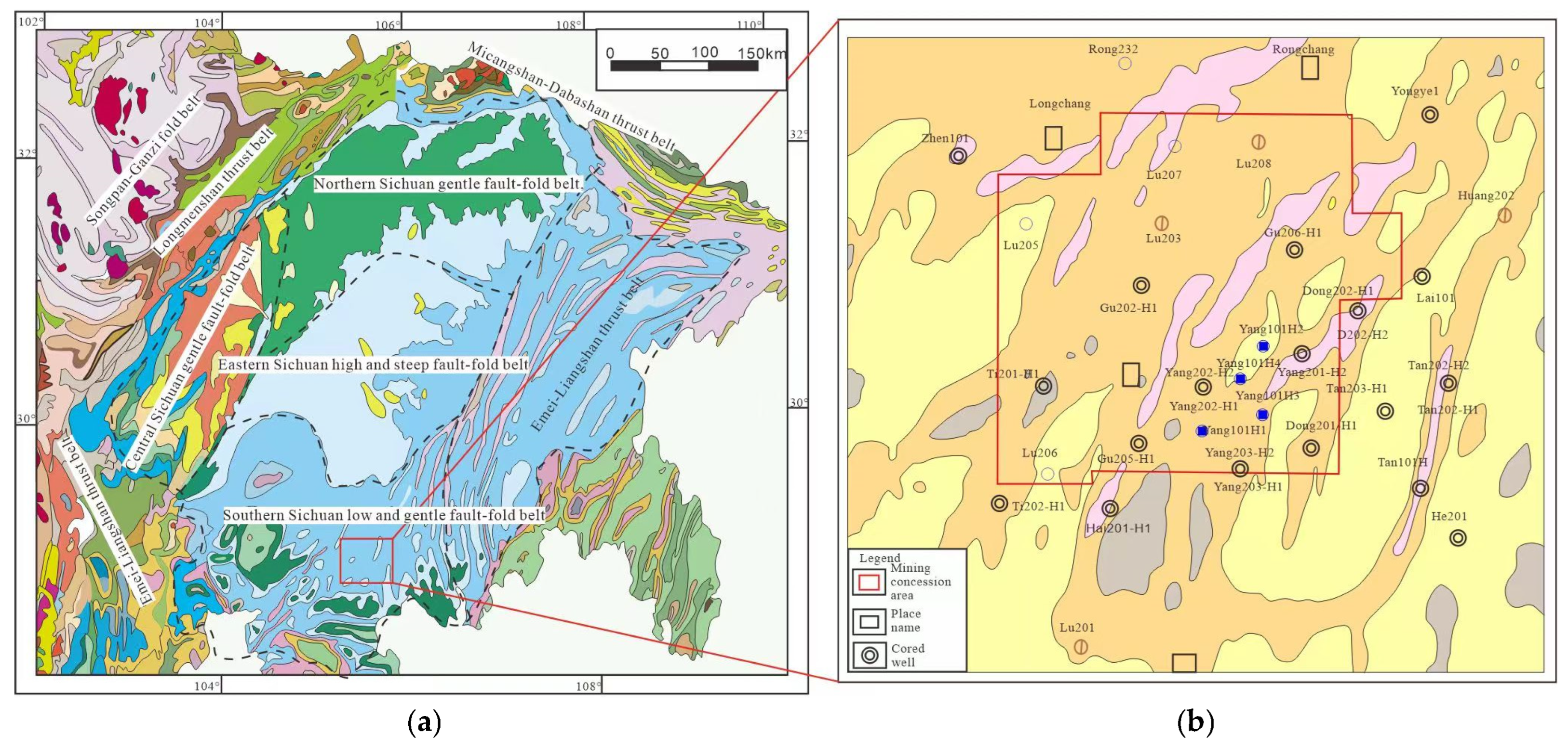
Figure 1. Geological background of the study area. (a) Tectonic location of the study area; (b) structural features of the study area.
Energies 19 00444 g001
Figure 2. Subdivision of LMX Formation sublayers and lithological features in the study area.
Energies 19 00444 g002
Figure 3. Schematic diagram for calculating the proportion of organic-matter pores.
Energies 19 00444 g003
Figure 4. TOC content comparison by sublayer for wells in the study area vs. adjacent area.
Energies 19 00444 g004
Figure 5. Microscopic characteristics showing differences in mineral components of the WF–LMX shales in the study area. (a) Well Yang101H2-7, 4110.20 m, biogenic quartz-rich interval, quartz is white; (b) Well Lu205, 3977.71 m, biogenic quartz-rich interval, quartz is white; (c) Well Lu205, 4032.13 m, calcite identified in thin section, stained red; (d) Well Yang101H41-2, 4068.69 m, dolomite identified, stained blue-green; (e) Well Lu205, 4024.62 m, ingranular pore from carbonate dissolution; (f) Well Yang101H3-8, 3782.95 m, carbonate dissolution pore; (g) Well Yang101H2-7, 4137.71 m, elongate plagioclase grain visible; (h) Well Lu205, 4032.53 m, feldspar dissolved and subsequently filled by liquid hydrocarbons, forming organic pore; (i) Well Lu203H57-3, 3744.43 m, framboidal pyrite aggregate.
Energies 19 00444 g005
Figure 6. Brittleness index comparison by interval for wells in the study area and the adjacent area.
Energies 19 00444 g006
Figure 7. Development of organic pores in the WF–LMX shales of the study area. (a) Lu205, 4035.43 m; (b) Lu207, 3461.03 m; (c) Huang203, 3757.8 m; (d) Yang101H3-8, 3787.57 m; (e) Yang101H2-7, 4154.72 m; (f) Huang203, 3749.14 m.
Energies 19 00444 g007
Figure 8. Inorganic pore development in different sublayers of the study area. (a) Lu205, 4035.43 m; (b) Yang101H3-8, 3787.57 m; (c) Yang101H3-8, 3782.95 m; (d) Yang101H2-7, 4145.92 m; (e) Lu205, 4024.62 m; (f) Lu205, 3983.1 m.
Energies 19 00444 g008
Figure 9. Microfracture development and the contrast characteristics between the deep and shallow layers. (a) Yang101H3-8, 3787.57 m; (b) Yang101H3-8, 3782.95 m; (c) Lu203H57-3, 3740.81 m; (d) Lu203H57-3, 3736.47 m; (e) Lu205, 4030.36 m; (f) Lu205, 4024.62 m; (g) Wei204, 3525.81; (h) Wei204, 3524.54; (i) Wei204, 3521.55.
Energies 19 00444 g009
Figure 10. NMR T2 spectra for different layers in representative wells of the study area.
Energies 19 00444 g010
Figure 11. Comprehensive reservoir columnar evaluation for the WF–Long 11 interval in well Lu203.
Energies 19 00444 g011
Figure 12. Correlation of comprehensive reservoir evaluation across wells Lu203, Lu205, Lu207, Lu208, and Huang202.
Energies 19 00444 g012
Figure 13. Planar distribution of Type I reservoir thickness in the WF–Long 11 interval of the study area.
Energies 19 00444 g013
Figure 14. Proportion of pore types in shallow- vs. deep-shale reservoirs. (a) Wei204 well, 3525.81 m (shallow-shale pore characteristics); (b) Yang101H2-7 well, 4145.92 m (deep-shale pore characteristics).
Energies 19 00444 g014
Figure 15. Redox indices for sublayers 1 and 3 in well Lu205 (a) versus well Yang101H2-7 (b).
Energies 19 00444 g015
Figure 16. Comparison of TOC content by sublayer between the Lu203 block and the Yang101 block.
Energies 19 00444 g016
Figure 17. Comparison of quartz content by sublayer between the Lu203 block and the Yang101 block.
Energies 19 00444 g017
Figure 18. Comparison of porosity and gas-bearing capacity between well Lu205 and well Yang101H2-7.
Energies 19 00444 g018
Figure 19. Relationship between stable isotopes (δD, δ18O) of flowback fluid and flowback time for wells Lu205, Lu206, and Yang101H2-7.
Energies 19 00444 g019
Disclaimer/Publisher’s Note: The statements, opinions and data contained in all publications are solely those of the individual author(s) and contributor(s) and not of MDPI and/or the editor(s). MDPI and/or the editor(s) disclaim responsibility for any injury to people or property resulting from any ideas, methods, instructions or products referred to in the content.