Review

Problems with Intake Air Filtration in Piston and Turbine Combustion Engines Used in Conditions of High Air Dust Content

Faculty of Mechanical Engineering, Military University of Technology, 2 Gen. Sylwester Kaliski Street, 00-908 Warsaw, Poland
Energies 2026, 19(2), 388; https://doi.org/10.3390/en19020388
Submission received: 5 November 2025 / Revised: 21 December 2025 / Accepted: 8 January 2026 / Published: 13 January 2026
(This article belongs to the Section I2: Energy and Combustion Science)

Abstract

The operating conditions of engines in motor vehicles used in conditions of high air dustiness resulting from sandy ground and helicopters using temporary landing sites were analyzed. The impact of mineral dust on accelerated abrasive and erosive wear of components and assemblies of piston and turbine engines was presented. Attention was drawn to the formation of dust deposits on turbine engine components. Possibilities for minimizing abrasive wear through the use of two-stage intake air filtration systems in motor vehicle engines were presented. Three forms of protection for helicopter engines against the intake of dust-laden air and for extending their service life are presented: intake barrier filters (IBF), tube separators (VTS), and particulate separators (IPS) called Engine Air Particle Separation (EAPS). It has been shown that pleating the filter bed significantly increases the filtration area. It has been shown that increasing the suction flow from inertial filters increases separation efficiency and flow resistance. IPS are characterized by a compact design, low external resistance, and no need for periodic maintenance, but it has a lower separation efficiency (86–91%) than VTS and IBF systems (up to 99.3–99.9%). The tested “cyclone-partition filter” filtration system achieves a filtration efficiency of 99.9%, reaching the acceptable pressure drop value four times slower than if it were operating without a cyclone. Two-stage filtration systems ensure high friction durability at the lowest possible energy costs.

1. Introduction

Atmospheric air is the basic component of the working medium in piston and turbine combustion engines. The air flow sucked in by the engine is proportional to the engine power. From the unit flow (1 kg/s–2800 m3/h) of air needed for complete fuel combustion, an average of 700 kW of power is obtained in piston engines and approximately 200 kW in turbine engines. The significantly higher air demand per unit of power in turbine engines results from high air excess coefficients, which are necessary to limit the exhaust gas temperature affecting the strength of the turbines.
The air flow sucked in by an internal combustion engine depends on many design factors, including the engine displacement Vss, the crankshaft speed n, and the cylinder filling ratio ηυ, which depends on the presence of an intercooler. For passenger car engines, the air intake ranges from 150 to 400 m3/h, while for truck engines the values are significantly higher, at 900 to 2000 m3/h. The highest values of volumetric air demand (3500–6000 m3/h) are found in compression ignition engines (CI), which are the power units of special vehicles (tanks, transporters) characterized by high power. Turbine engines used to power helicopters are characterized by the fact that, in order to operate properly, they draw large amounts of air from the atmosphere, on average 1.7–5.0 kg/s (5000–14,500 m3/h) of air [1,2]. Similar intake air flow rates are supplied to the Abrams tank engine, where the power unit is a turbine that requires 5.36 kg/s (15,500 m3/h) of air for proper operation [3].
The atmosphere contains various solid, gaseous, chemical, and biological pollutants that are emitted into the atmosphere by natural and artificial sources. The main component of air pollution is mineral dust, which settles on the ground and is lifted by passing vehicles or by the wind. Particularly large amounts of dust are found in the air when vehicles are used on dry, unpaved terrain (off-road), sandy and desert terrain, and when helicopters are operated on temporary landing sites.
Along with the air intake, engines suck in significant amounts of solid pollutants from the atmosphere, mainly mineral dust. The engine of a tracked vehicle with a power of 700 kW and an air flow of 3400 m3/h, which is used on sandy roads (dust concentration s = 1 g/m3), absorbs over 170 kg of dust, or about 0.057 kg per minute, along with the air during 50 h of operation at maximum load (1000 km mileage). A helicopter with an engine air requirement of 5.9 kg/s (approximately 17,000 m3/h) and an airborne dust concentration of 2.5 g/m3 sucks in approximately 0.7 kg of dust per minute along with the air [4].
When the dust mass concentration exceeds 1.177 g per cubic meter of air, this condition is known as a “brownout” [5], although the term is more generally used for all situations where a dust cloud forms. Based on this figure, an unprotected engine with a mass flow of 12.5 kg/s could absorb approximately 7 kg of particulate matter in ten minutes in such a dust cloud and could lose one percent of its power.
For example, the Boeing CH-47/Chinook1 helicopter is powered by two turbine engines, each with a rated power of 3750 hp at the shaft (2800 kW). To generate this power, an intake air flow of 11 m3/s (3900 m3/h) is required. With an average dust concentration in the air of 2.5 g/m3, the engine sucks in approximately 1.65 kg of dust per minute along with the air [6].

2. The Impact of Mineral Dust on the Operation of Internal Combustion Engines

The main effect of dust particles entering combustion engines with the intake air stream is accelerated abrasive and erosive wear of individual parts and entire structural assemblies of piston and turbine engines, as well as the formation of dust deposits on turbine engine components. Both effects simultaneously cause a deterioration in power characteristics, fuel consumption, and oil consumption.

2.1. Mineral Dust Parameters

Dusts found in the terrestrial environment, including mineral dust, are polydisperse dusts with widely varying physical and chemical properties. Dusts comprise a macroscopic fraction with particle sizes ranging from 1 µm to 1000 µm and a colloidal fraction with grain sizes ranging from 0.001 to 1 µm [7]. Dusts in atmospheric air, due to their varying mass, shape, and volume, fall gravitationally to the ground at different speeds, resulting from the interrelationship between gravity and air resistance. Therefore, the residence time of solid particles in the air varies. Solid particles with diameters less than 0.1 µm move randomly, subject to Brownian motion. Solid particles with sizes ranging from 0.1 to 1 µm fall at low speeds. Dust grains larger than 20 µm fall at high speeds. According to the authors of [7,8], the settling velocity of particles with a density of 1000 kg/m3 and a grain diameter of 0.1 µm reaches a settling velocity of υp = 4 × 10⁻⁷ m/s. For particles with a size of 1 µm, the settling velocity is υp = 4 × 10⁻⁵ m/s. The settling velocity of υp = 3 × 10⁻³ m/s is attributed to dust particles with a diameter of 10 µm. High settling velocities of the order of υp = 3 × 10⁻¹ m/s are characteristic for solid particles with diameters of about 100 µm [7,8]. According to the author of [9], silica grains with diameters of dp = 10 µm, 50 µm and 100 µm and density of 2650 kg/m3 fall at an increasing speed of 0.08 m/s, 0.19 m/s and 0.7 m/s, respectively. For comparison, silica dust grains with a diameter of dp = 1 mm have a falling velocity of υp = 8 m/s [9].
The low settling velocity of dust particles with diameters dp = (2–10) µm means that they remain suspended in the air for a long time [7]. For this reason, they are found in the air sucked in by air filter intakes and transported to the engine cylinders through the engine intake system. Particulate matter with diameters in the range of dp = 10–50 µm is found in the atmosphere under conditions of high dust concentration in the air, for example, when vehicles are used on dirt roads, and is then sucked in by running engines. Dust particles with sizes not exceeding dp = 50–80 µm are found in dust clouds created by moving tracked vehicles on training grounds, during work in quarries, on construction sites, or on roads. Mineral dust grains with diameters greater than dp = 50 µm are found in dust clouds during helicopter takeoffs and landings at temporary landing sites [9].
The air intakes of internal combustion engines suck in pollutants from the environment, the main component of which is mineral dust, whose grains usually do not exceed dp = (80–100) µm in size. It is widely believed that all dust particles with a diameter greater than dp = 1 µm cause accelerated wear of the friction surfaces of internal combustion engines and machines [10]. For this reason, they must be removed from the intake air to engines with maximum efficiency (99.5%) and accuracy above 2–5 µm. This task is performed by air filters, which are selected for the engine depending on the conditions of use of the vehicle and the engine power.
Dust, including mineral dust, is characterized by the following parameters: chemical composition, hardness, particle size distribution, density, particle shape, concentration in the air, and tendency to coagulate [11].
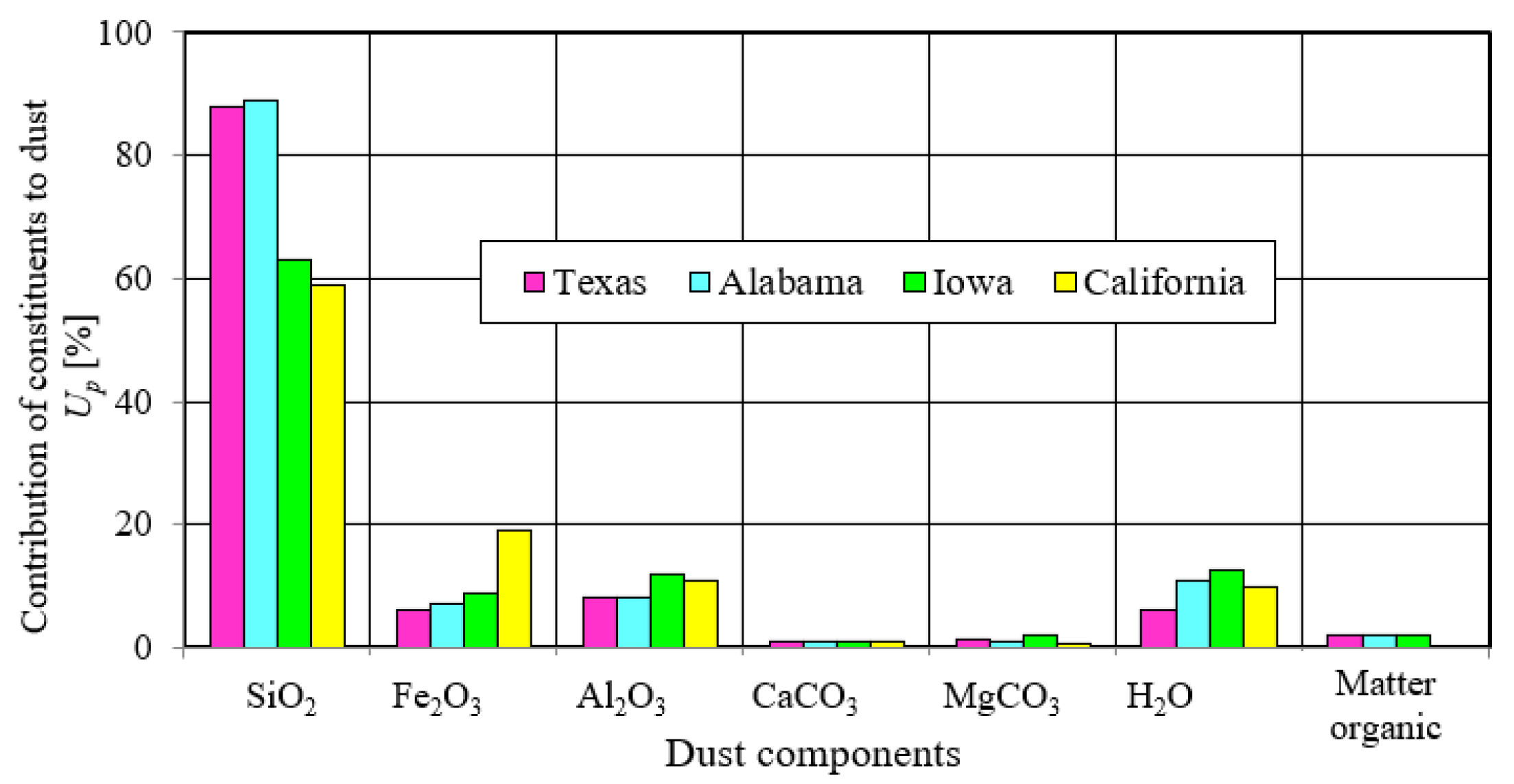
The chemical composition shows the main components of dust and their share in the total dust mass. Silica is the basic component of road dust. Its share in the total dust mass varies depending on the composition and type of substrate and usually ranges from 60 to 95% [12,13]. Oxides of various metals (aluminum oxide, iron oxide, calcium oxide, magnesium oxide) account for 4–19%. The dust contains small amounts of organic components and moisture (Figure 1). Silica occurs in nature in three forms: crystalline, amorphous, and cryptocrystalline [14]. In its pure form, silica occurs as quartz and sand (approximately 12%), as well as in the form of mineral compounds, e.g., aluminosilicates, which together constitute approximately 50% of the Earth’s crust.
Figure 1 shows the chemical composition of dust from four different substrates originating from different US states [12]. The mass fraction of individual components in dust originating from substrates from different regions varies significantly. For example, the mass content of silica in dust from a substrate in Texas is 88%, while in dust from a substrate in California it is only 58%.
The chemical composition of dust particles determines their hardness, which is measured using the Mohs scale of mineral hardness. According to this scale, talc has a hardness of 1 and diamond has a hardness of 10, while silica has a hardness of seven and corundum has a hardness of 9 [15]. Silica and corundum are minerals whose total content in the total mass of dust reaches 95%. However, the hardness of both these minerals is significantly greater than the hardness of materials commonly used in the construction of internal combustion engines.
The density of the main components of road dust varies greatly and depends on the material from which they are made. For example, the density of quartz grains is ρ = 2650 kg/m3, corundum ρ = 3990 kg/m3, and iron (III) oxide ρ = 5240 kg/m3 [10]. The density of dust is an important characteristic when designing methods and processes for its filtration.
Dust grains have a very irregular shape. They are most often polyhedrons with many sharp edges. Dust particles can also be conical, dendritic, fibrous, granular, and modular (round, irregular shape) [16,17].
Due to the lack of geometric regularity of dust grains, it is difficult to determine their dimensions. Most often, a substitute diameter is used to assess grain dimensions, which is defined depending on the method of its determination. Most often, the substitute grain diameter dp means “the diameter of a sphere made of a material with the density of a given mineral and exhibiting (in still air at a pressure of 1010.8 hPa, a temperature of 293 K, and a relative humidity below 50%) under the influence of gravity a falling velocity equal to the laminar falling velocity of a given dust particle” [9].
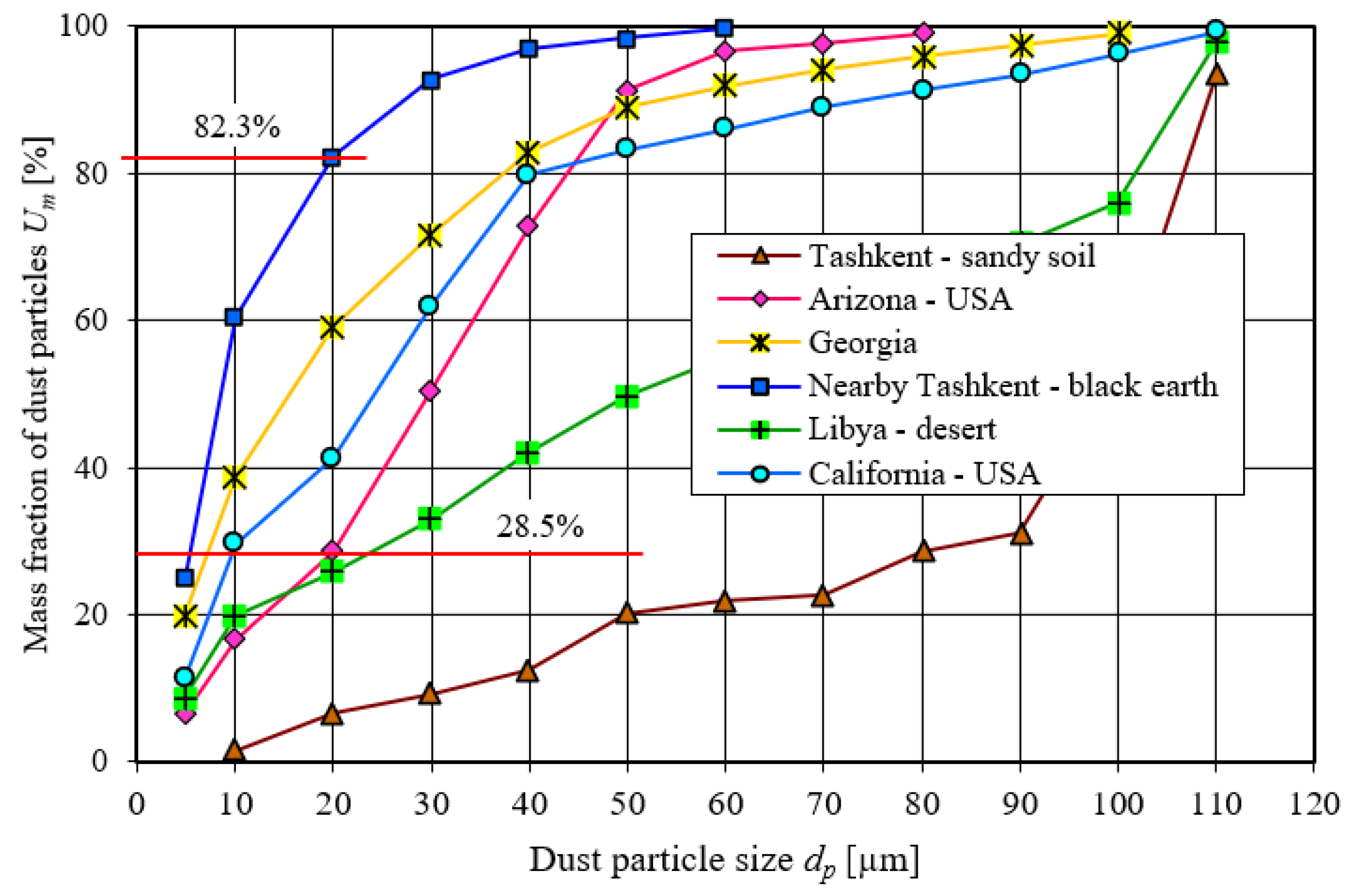
The granulometric composition of dust, which is an indicator of particle size heterogeneity in dust, refers to the division of particles into fractions of different sizes [18,19]. The granulometric composition of dust can be presented in the form of a graph (Figure 2), which shows the relative proportion of particles smaller or larger than a given dimension dp in the total mass of dust [18]. The granulometric composition of dust is greatly influenced by the type of substrate, its location, as well as the height above the ground and the falling velocity of the particles. The characteristics shown in Figure 2 indicate that the granulometric composition of dust from substrates in different regions of the world varies significantly. For example, in dust from the Tashkent area, approximately 82% of the total dust mass consists of particles smaller than dp = 20 µm, while in dust from the Libyan desert, only 28.5% consists of dust grains in the range (0–20) µm. The granulometric composition of dust is an important parameter when designing and selecting air filters for internal combustion engines.
The concentration of dust in the air is an important characteristic used in the design and selection of air filters for internal combustion engines, especially when vehicles are used in dusty conditions. Dust concentration is the mass of dust (in grams or milligrams) contained in 1 m3 of atmospheric air. The concentration of dust in the air depends on many factors, mainly the type of surface (sandy, grassy, rocky), vehicle speed, type of drive system (wheeled or tracked), traffic of other vehicles, single vehicle or convoy. The concentration of dust is influenced by environmental conditions, including the season, wind speed and direction, type and duration of precipitation, and height above ground level [10,20].
These conditions cause dust concentration values in the air to vary greatly. For example, dust concentration near rural buildings is around s = 0.01 mg/m3, while when a column of tracked vehicles moves across desert terrain, the concentration reaches around 20 g/m3 [21]. According to the author of the study [22], dust concentrations in the air can range from 0.001 to 10 g/m3. A few meters away from a sandy road used by off-road vehicles, the concentration of dust in the air varied greatly, ranging from 0.05 to 10 g/m3 [23]. The dust concentration on highways is low but varies widely from 0.0004 to 0.1 g/m3 [24]. When a convoy of wheeled vehicles travels on sandy terrain, the dust concentration ranges from 0.03 to 8 g/m3 [24]. Based on his research, the author of [25] concludes that the concentration of dust in the air behind a moving column of trucks, armored personnel carriers, or tracked vehicles depends on the type of ground, vehicle speed, wind speed, and chassis type. A few meters behind a column of tanks moving at speeds of 30 and 10 km/h on dry ground, the dust concentration reached a maximum value of 1.17 and 0.48 g/m3, respectively. The authors [26,27] report that the dust concentration in close proximity to the armor of a tracked vehicle moving on sandy terrain increases with driving speed and at a speed of 18 km/h ranges from 2.1 to 3.8 g/m3. At the air filter inlet, the dust concentration is significantly lower, ranging from 0.8 to 1 g/m3.
High dust levels in the air occur during ground flights of helicopters, especially during operations in desert or sandy terrain. During takeoff or landing of a CH-53 helicopter on desert terrain, the dust concentration in the air at the tip of the propeller (0.5 m above the ground) can reach a value of s = 3.33 g/m3 [4]. Dust can also occur at high altitudes as a result of volcanic eruptions. A cloud of volcanic dust can remain in the atmosphere for up to several weeks, depending on the size of the eruption. Dry dust can be present in the atmosphere as a result of sandstorms occurring in desert regions around the world, mainly in North America, the Arabian Peninsula, the Gobi Desert in Mongolia, the Sahara, and other desert areas around the world. Dust particles can not only spread over hundreds of kilometers but can also rise to heights of over 3000 m [28].
According to the authors of the study [29], dust content in the air of 0.6–0.7 g/m3 causes a significant reduction in visibility. At a concentration of approximately 1.5 g/m3, visibility is reduced to zero, which adversely affects driving or helicopter piloting safety. Limited visibility of the horizon can cause helicopter accidents related to human factors during military operations.

2.2. The Impact of Mineral Dust on the Wear of Components and the Operation of Piston Engines

Large amounts of dust sucked in from the environment along with the intake air into the engines cause accelerated wear of engine components and dust accumulation in the intake ducts of turbine engines. In the case of piston engines, abrasive wear has a negative impact on their performance in the form of reduced power and increased fuel consumption. In the case of turbine engines, erosive wear of the blades and significant amounts of dust accumulated in the flow ducts result in a decrease in power and even immobilization of the helicopter engine, leading to a crash. The negative impact of dust on piston and turbine engine components varies due to their different designs.
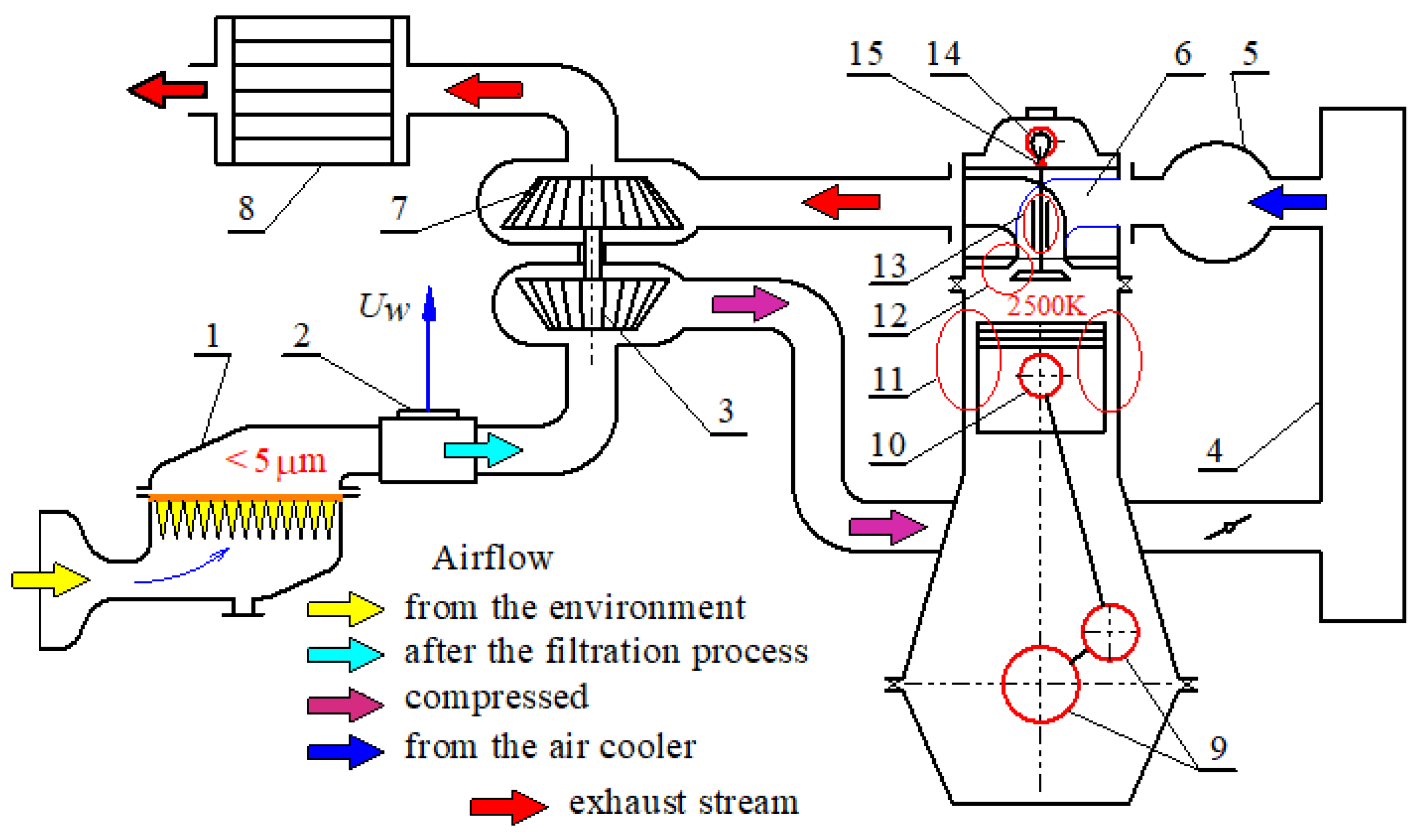
Dust particles in the air intake to the piston engine and in the oil of the engine lubrication system have a detrimental effect on engine components in different ways (Figure 3), consisting of:
  • the formation of a layer of dust and other contaminants on the measuring element of the flow meter, which, due to its insulation properties, limits heat exchange with the flowing air stream and generates an incorrect signal,
  • erosive wear of the compressor and turbine blades of the supercharger,
  • abrasive wear of the P-PR-C components performing reciprocating motion,
  • abrasive wear of the “valve stem-guide” components performing reciprocating motion,
  • erosive wear of the seats and poppets of the intake and exhaust valves,
  • abrasive wear of the sliding bearing components (journal-bearing shell) of the crankshaft, camshaft, and turbocharger shaft,
  • abrasive wear of other friction-operated assemblies supplied with lubricating oil cam-valve disk, valve levers,
  • formation of a layer of molten dust particles on the catalytic surface of reactors, resulting in reduced efficiency.
Dust, whose main components are silica SiO2 and corundum Al2O3, has a destructive effect on both piston and turbine engine parts after entering the engine. However, the mechanism of interaction between dust particles and piston engine components is completely different from that of turbine engines. In a piston engine, the harmful effect of dust particles contained in the air entering the engine is complex, due to their varying size and hardness and the thickness of the oil film. Particles smaller than the thickness of the oil film should not damage the surface, but they can weaken the oil film [30] and cause oil thickening [31]. The dynamic thickness of the oil film ranges from 0.1 to 50 µm [30,32], but may approach 0 at the top of the cylinder [30,33]. Typically, the oil film thickness is usually greater than 1 µm, and most dynamic clearances are in the range of 0–20 µm [31].
In the first stage, hard mineral grains that have entered the engine’s piston space with the air stream and then settled on the cylinder walls penetrate between the mating surfaces of the P-PR-C association, where the piston with rings performs a reciprocating motion in a stationary cylinder, and in the case of a thin oil film, they cause abrasive wear. When abrasive particles pass between two surfaces, they can tear off metal chips or become deposited in the outer layer of the engine part. In addition, during engine operation, the particles can be crushed into smaller ones. The movement of the piston towards the bottom dead center (BDC) causes some of the oil to be scraped into the oil pan along with the dust, from where the oil pump draws and then transports the oil under pressure along with the dust to many friction pairs in the engine (main and connecting rod bearings of the crankshaft, camshaft bearings, valve stems and rocker arms, valve guides, valve cams, turbocharger shaft slide bearings), which require continuous lubrication. The dust particles contained in the oil and delivered in this way to the engine’s friction points cause accelerated wear. This is the second stage of the harmful effect of dust particles delivered with the air intake to the engine. Dust particles can also enter the engine oil directly from the environment, for example, through the crankcase ventilation system during maintenance work (oil change), but these quantities are negligible. Individual engine components are subject to different loads, have different clearances and lubrication requirements.
Abrasive wear of engine component surfaces caused by the presence of dust between two frictionally interacting components depends on dust parameters, including grain size, hardness, and shape. Abrasive wear is significantly influenced by the clearances between the interacting components, the engine design and operating parameters, and the mechanical properties of the materials from which the engine components are made [34].
Dust that is transported with the air into the engine cylinders has the most dangerous effect on the first piston ring, the piston, and the upper part of the cylinder. A significant portion of the dust particles settle on the surface of the cylinder liner and then, as a result of the piston movement, penetrate the space between the cylinder surface and the piston rings. When these surfaces come into physical contact with the sharp edges of hard dust particles, abrasive wear occurs in the form of scratching, grooving, or micro-cutting, causing material loss, which leads to changes in the dimensions and texture of the mating surfaces [35,36,37].
Numerous studies have shown that P-PR-C friction pair components and the associated valve seat contact surfaces are subject to the greatest wear, causing increased clearance, which is the cause of a decrease in the tightness of the piston crown space. The increased clearance resulting from excessive wear leads to increased blow-by of the compressed medium into the oil pan, which causes a loss of charge and a drop in compression pressure, resulting in a decrease in engine power and an increase in specific fuel consumption [38,39]. In addition, increasing clearance in the P-PR-C combination causes a systematic flow of hot exhaust gases, which increases the temperature of the lubricating oil, reduces its viscosity, and increases wear on the rings and cylinder [40]. The exhaust gases flowing into the oil pan contain soot, which is a natural by-product of combustion, as well as carbon deposits and sludge, which contaminate the oil and can cause a sharp increase in oil viscosity, increased friction of engine components, accelerated wear, seizure, and gelation of the engine oil [41,42,43].
Excessive wear of the “bearing journal-bearing shell” friction pairs cause a drop in lubrication pressure, which results in a reduction in the thickness of the oil film and increased wear, up to and including engine seizure.
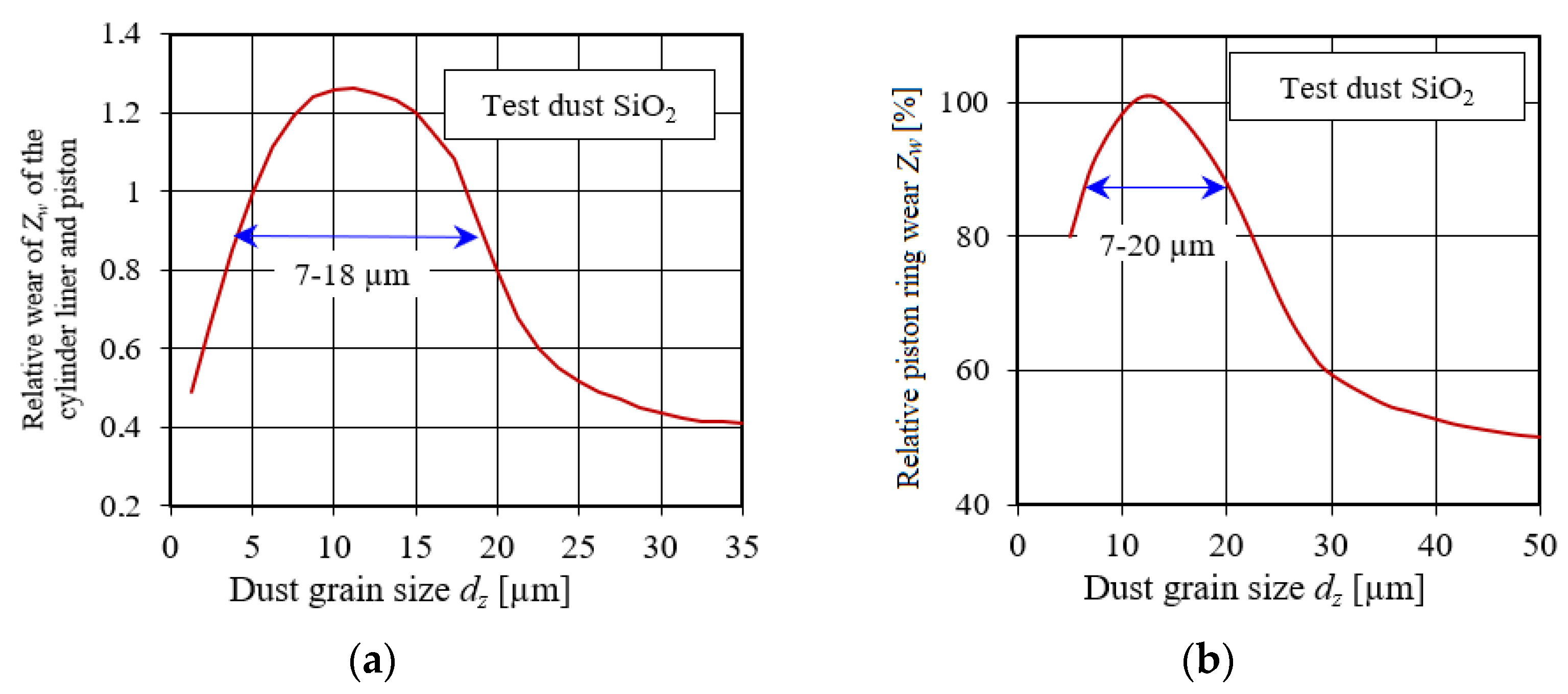
Research by the author of the study [44] shows that there is a close relationship between the size of SiO2 silica particles in the air entering the engine and the wear of the cylinder liner and piston friction pairs. Figure 4a shows that all dust particles larger than 1 µm cause accelerated wear of friction pairs and should therefore be removed from the air. However, the greatest abrasive wear is caused by dust particles in the 7–18 µm range. Dust particles larger than 18 µm cause abrasive wear comparable to that caused by small (less than 7 µm) dust particles. This phenomenon can be explained by the fact that dust particles with large diameters (greater than the thickness of the oil film) do not initially penetrate the area between the mating surfaces. However, after some time, because of their fragmentation into smaller particles, they contribute to accelerated wear.
Similar wear characteristics, but for the upper piston ring of a diesel engine, were obtained by the author of [45]. These are shown in the graph in Figure 4b. The highest abrasive wear of the piston ring was found for grains in the size range of 7–20 µm. The same wear value is caused by small dust grains (below 7 µm) and large grains above 20 µm.
However, it is believed that due to the minimal thickness of the oil film (on average 0.5–20 µm) that occurs in engine assemblies, all dust particles larger than 1 µm cause accelerated abrasive wear of its components, and therefore air filters should operate with such accuracy. There is a view that dust particles smaller than 1 µm are also dangerous because their effect is similar to that of polishing paste on the cylinder surface. Oil particles do not adhere to the polished cylinder surface, which hinders the formation of an oil film and leads to accelerated wear. It is believed that the abrasiveness of dust decreases significantly when the dust particles are smaller than 5 µm [46].
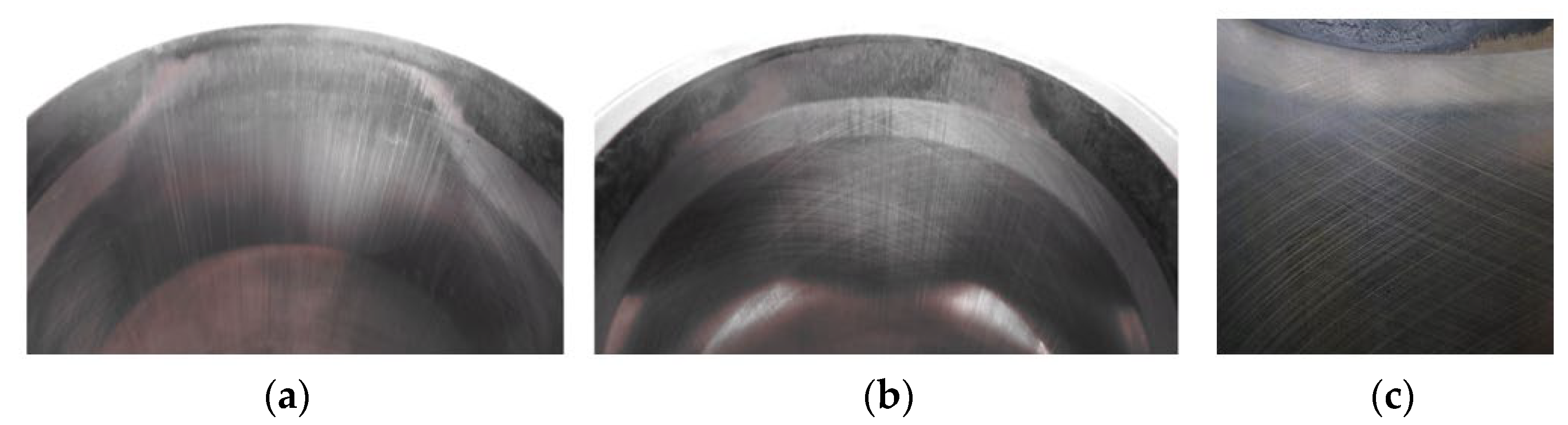
Accelerated cylinder liner wear can also be the result of operating an engine with a faulty intake air filtration system. Figure 5 shows an example of cylinder liner wear in a truck engine operating with a faulty filtration system.
Accelerated abrasive wear of the cylinder liner is visible in the upper zone of the cylinder liner (approximately 1/5 of the circumference) in the form of parallel, continuous scratches densely arranged along the cylinder liner (Figure 5a). The scratches are deep and intense and obscure any traces of surface treatment of the cylinder liner–honing, as shown in Figure 5c. Research presented in [47] shows that the scratches were caused by the abrasive action of hard and large dust particles. Figure 5b shows significantly less wear on the cylinder liner, which is clearly visible in the form of individual scratches against the background of surface treatment marks.
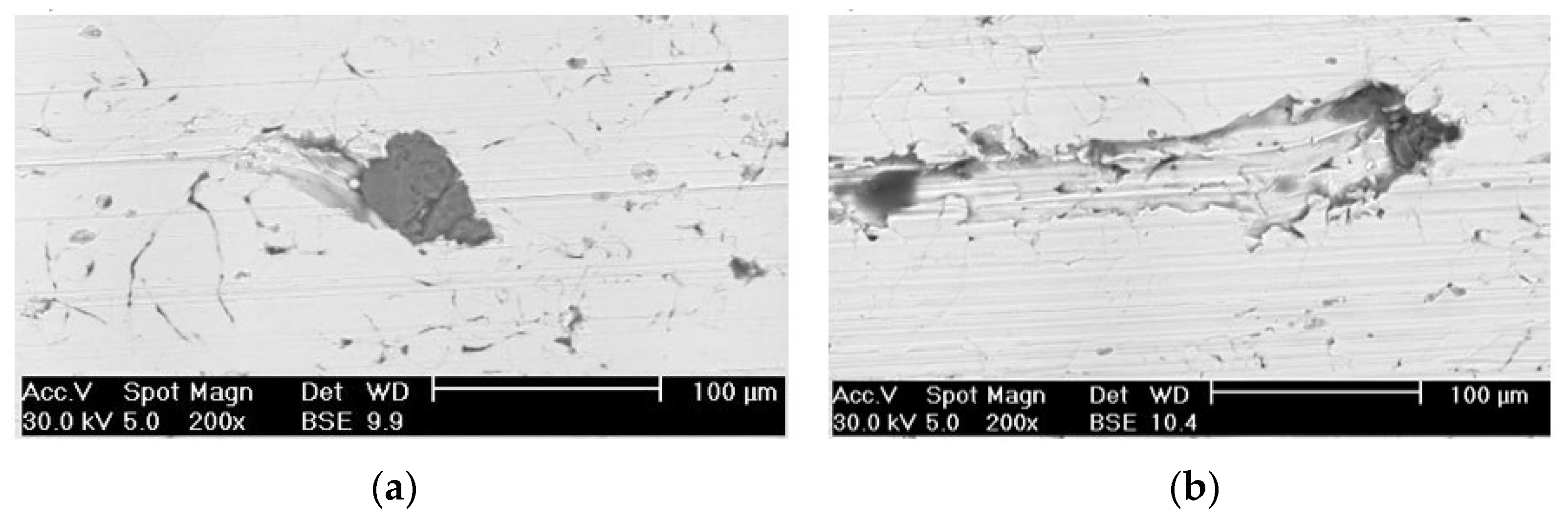
Intensive wear caused by high-hardness particles is confirmed by the image of the same cylinder liner, as shown in Figure 6. The research shows that a particle approximately 50 µm in size became stuck in a depression over 100 µm wide and, during movement, caused a depression in the cylinder surface [47].
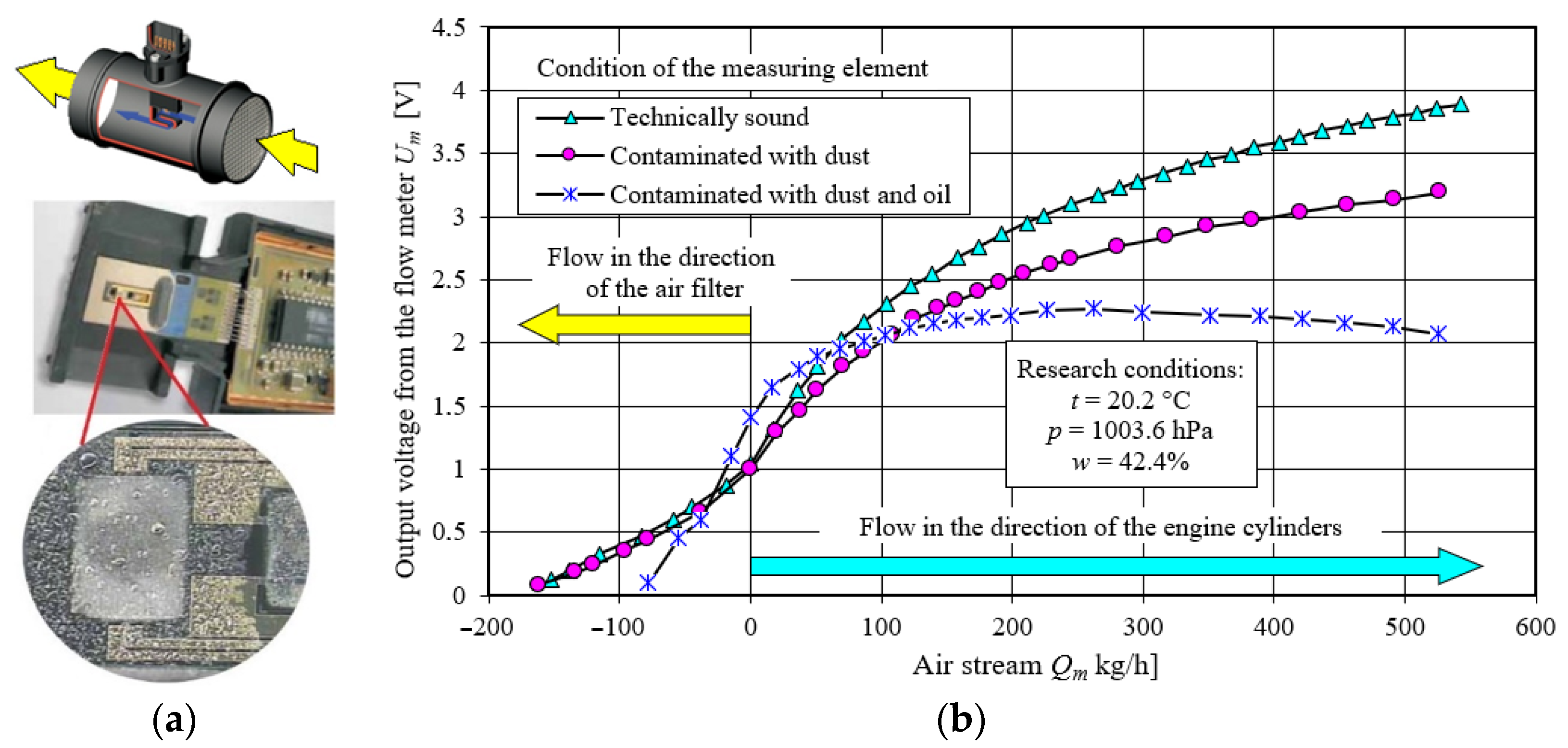
Dust particles in the air entering a piston combustion engine have a detrimental effect on the operation of the air flow meter, which is a sensor measuring the mass flow of air into the engine. The basic component of the flow meter is a measuring element (platinum wire or plate) located in a cylindrical tube. The element is heated and the temperature is kept at a constant level. The flowing air stream cools the measuring element, and a higher current flow is required to maintain the temperature at a constant level, which causes a greater voltage to drop across the thermistor [48]. The voltage value generated by the measuring element is a measure of the mass of air flowing through the measuring element.
Contaminants in the flowing air, including mineral dust particles, form a layer of contamination on the measuring element of the flow meter, which, due to its insulating properties, limits the heat exchange between the measuring element and the flowing air stream, resulting in the generation of an incorrect signal.
Figure 7 shows the results of the author’s research in the form of Uw = f(Qm) characteristics of the air flow meter. The characteristics were performed on a special test bench for various contaminants (test dust and engine oil) present in the air entering the engine. As the air flow Qm increases, the voltage Uw generated by the flow measuring system also increases. The obtained characteristics have a similar course but differ in terms of the voltage values generated by the flow meter. The tested air flow meter with a laminar anemometer HFM5 records the air flow in two directions: towards the engine and away from the engine cylinders. In Figure 7, these values are marked as negative Qm < 0. A characteristic feature of the HFM5 flow meters is the absence of voltage (Uw0 = 1) in the absence of air flow Qm = 0, which is a sign of the efficiency of the flow meters. Air flow towards the engine cylinders causes the voltage Uw to rise above 1. Due to different types of contamination on the measuring element, the voltage values obtained are also varied and, at the same time, lower than the voltage generated by a functional flow meter. In the case of contamination of the measuring element with test dust, there was a significant (approximately 12%) drop in the output voltage Uw across the entire operating range of the flow meter (Figure 7). A layer of dust, whose main component is silica SiO2, which is a good thermal insulator, covers the measuring resistors, reducing their cooling intensity. This results in a lower current value needed to maintain a constant temperature difference between them. As a result, there is a decrease in the output voltage Uw in relation to the output signal of a functional flow meter. The on-board computer interprets this as a lower mass air flow value and, as a result, delivers less fuel, which causes a drop in power and vehicle dynamics.
Dust particles in the intake air stream of a piston combustion engine have a destructive effect on the compressor rotor blades. This phenomenon is due to the high peripheral speeds of the compressor rotor blades in the turbocharger, resulting from the high rotational speed of up to 200,000 rpm at full engine load, causing a high impact force when they come into contact with dust particles flowing at a speed of approximately 100 m/s in the air stream [49]. As a result, metal microparticles are torn off the surface of the blades (erosive wear), which damages their surface structure and changes their geometric shape. This reduces the efficiency of the turbocharger (less filling of the engine cylinders) and, consequently, reduces engine power.
A similar phenomenon of erosion wear occurs when the tips of the turbine rotor blades, which have a circumferential speed of approximately 800 m/s, come into contact with dust particles moving with the exhaust gases at a high speed of approximately 300 m/s. These are mineral dust particles that have entered the exhaust system from the supercharged space along with the exhaust gases. According to the authors of [30,50] approximately 20–30% of the dust particles supplied with the intake air to the engine cylinders leave the combustion chamber together with the exhaust gas stream to the engine exhaust system.
Some (approximately 10–20%) of the airborne contaminants that enter the engine cylinders settle on the cylinder liner walls, some are removed with the exhaust gases, and some of the dust undergoes thermal processes, such as melting. At high temperatures (2300–2800 K), the mixture of clay raw materials, sand with the addition of sodium and potassium compounds, as well as iron, forms glaze-like alloys of varying composition, which can settle on the surfaces of engine components and on the surface of the reactor’s catalytic layer. The catalytic layer is made of platinum, palladium (oxidants) or rhodium (reducers), whose task is to facilitate and accelerate the chemical transformation of toxic exhaust components: CO, CH, NOx, covered with such glaze, reduces or even loses its catalytic properties and does not fulfill its intended role.
This is due to the fact that each of the polymorphic varieties of SiO2 quartz (tridymite and cristobalite) is stable within a certain temperature range. At a temperature of 1600 °C, quartz melts to form quartz glass [51]. Tridymite is stable in the range of 870–1470 °C and melts at 1670 °C when heated. Cristobalite α is stable in the range of 1470–1710 °C and then melts to form glass.

2.3. The Impact of Mineral Dust on Component Wear and Turbine Engine Operation

In turbine engines, due to the absence of reciprocating parts, the mechanism of dust particle impact on engine components is different than in piston engines. The main impact of dust particles entering turbine engines with the inlet air stream is the erosive wear of high-pressure compressor and turbine blades and the formation of dust deposits in air flow channels.
The turbine assembly wears much more slowly than the compressor, due to the significant fragmentation of the particles that have passed through the compressor and combustion chamber, as well as the greater erosion resistance of the materials used in the turbine parts, especially the turbine blade guides. Contamination of the axial compressor is caused by fine particles adhering to the surface of the blades, which increases the roughness of the blades and, as a result, changes the shape of the profile. Despite the presence of filters in the inlet duct, particles can reach the axial compressor due to their small diameter, which is generally less than 2–10 μm [52]. Typically, these particles can be removed by proper cleaning of the compressor.
High air flow velocities (150–250 m/s) and exhaust gas velocities (over 300 m/s), high peripheral speeds of rotor assemblies (200–500 m/s) cause dust particles, especially large ones, to have significant kinetic energy when they come into contact with the surfaces of turbine engine components, resulting in high impact force [53,54]. This results in accelerated wear due to the removal of metal microparticles from the surface of the parts, increased roughness, and damage to their surface structure and geometric shapes. As a consequence, the efficiency and durability of the engine are reduced.
An increase in roughness causes a decrease in air mass flow to the engine due to additional blockage, accompanied by a decrease in pressure ratio and efficiency. Literature reports indicate efficiency and power output losses ranging from 2% for mild roughness to 15–20% for highly rough blade surfaces [52,55]. Therefore, continuous operation, during which particles enter the engine inlet, reduces its performance, shortens the service life of components, and affects their reliability [56]. The authors of [57] presented an overview of the deterioration of turbine machines and described the relationship between the condition of the blade surfaces and the deterioration of engine performance. Changes in the geometry of compressor blades caused by erosion occur in several forms. In compressors, erosion increases the clearance at the blade tips, shortens the blade chord, increases the roughness of the pressure surface, blunts the leading edge, and sharpens the trailing edge. Particles are spun off after the first impact with the rotor, which limits erosion damage to the outer areas in subsequent stages. Increased clearance at the tips and changes in the shape of the rotor blade profile caused by erosion result in a deterioration in their performance. Inertial impacts at high speeds of particles larger than a few micrometers in diameter on the leading edges of the profile and pressure surfaces can cause erosion or deposition, depending on the balance between hard and molten particles. The deposition of smaller particles on the suction surfaces of the profile is associated with turbulent diffusion/vortex impact. Deposition is expected to be more significant in the early stages of hot turbine section operation, as turbine inlet temperatures increase due to the higher proportion of molten particles. Engine performance deterioration, including increased fuel consumption, decreased efficiency, throughput, and reduced power reserves, is attributed to fan and compressor erosion.
The most intense wear occurs on the inlet stages of compressors and fans of bypass engines, less on turbines, and least on combustion chambers. According to the authors of [30], the compressor is the most intensively worn component in turbine propeller and helicopter engines. It is estimated that compressor contamination is typically responsible for 70% to 85% of the total loss of gas turbine efficiency during continuous operation [57]. Radial compressors are more resistant to wear, with the most intensive wear occurring on the impeller blades and diffusers. This type of compressor is commonly used in devices for supercharging piston combustion engines.
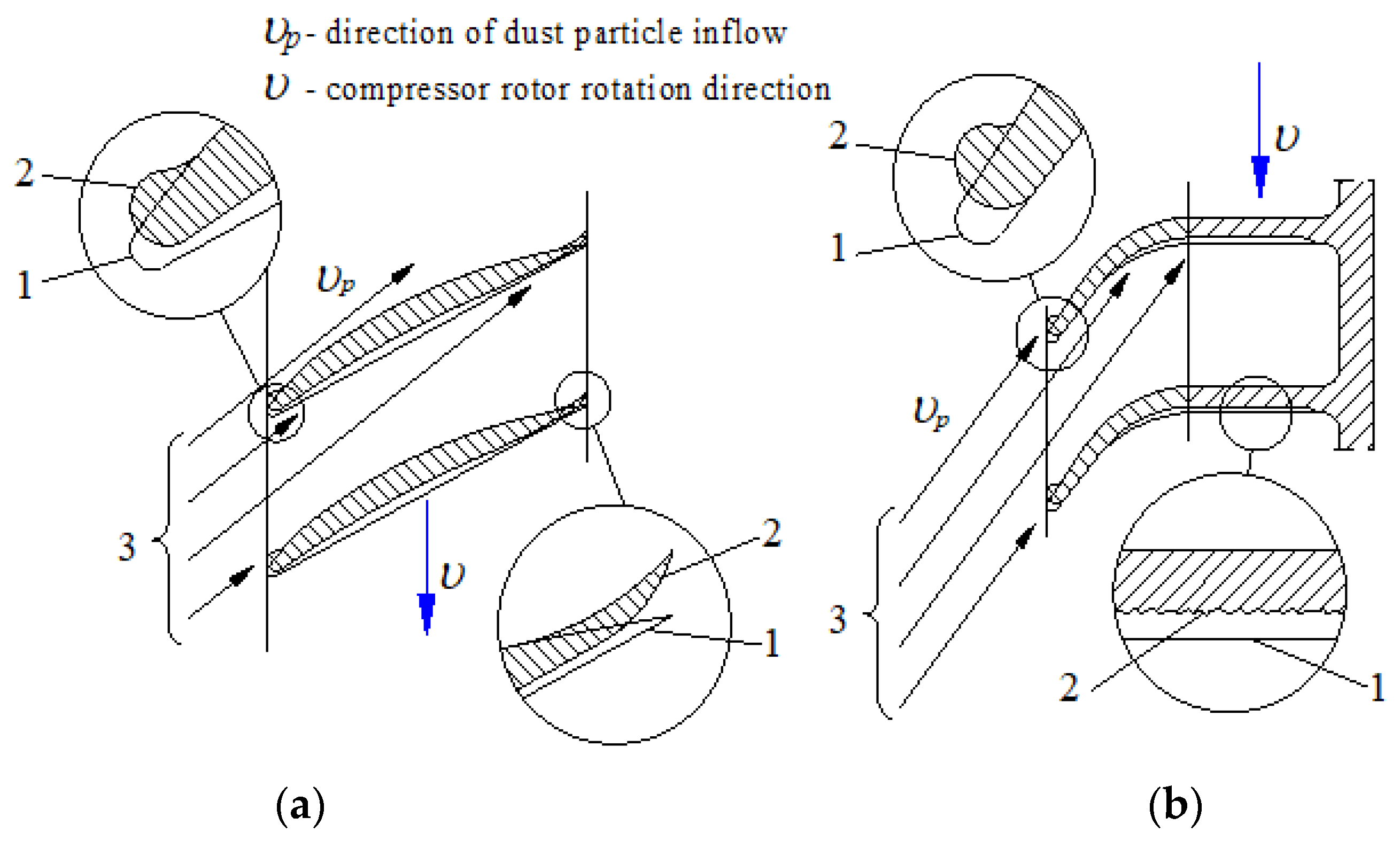
Figure 8 shows the areas of wear on the rotor blades of axial compressors and radial compressors, with the paths of dust particles moving in the compressor flow channels marked [58]. Large dust particles with significant energy can cause erosive wear in the form of permanent deformation: blunting of the leading and trailing edges of the rotor blades of axial compressors, reduction in the chord of the blades, and increased roughness of the surface and leading edges of the blades of radial compressors. The effect of solid particles in the form of erosion of the front and rear edges of turbine engine compressor blades is shown in Figure 8.
Smaller and lighter grains cause abrasion and tear out particles of material from the surface of these blades, damaging the top layer and changing the shape of the aerodynamic profiles of the blades, which leads to a deterioration in compressor efficiency and a tendency to unstable operation at ranges close to operating ranges.
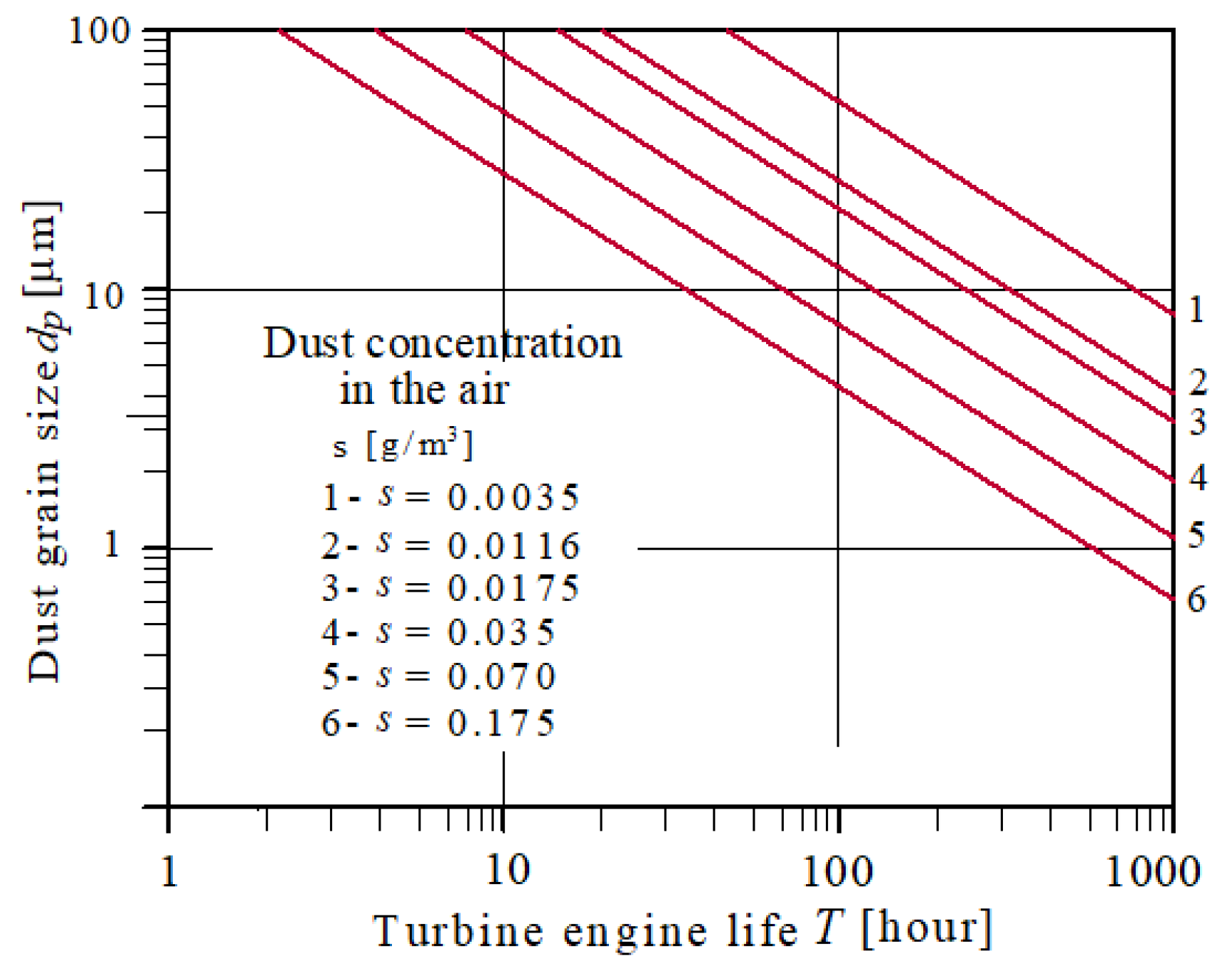
The amount of dust sucked into the engine’s flow channel is determined by the concentration of dust in the air and the operating time in a dusty environment. Since, as a result of impact erosion, each dust particle causes metal loss only at the point of impact, the amount of wear is proportional to the number of particles in the stream, i.e., directly proportional to the dust concentration and the operating time in the sucked air [58]. As the size of the dust particles and the concentration of dust in the air increase, the intensity of wear on the engine components increases and, consequently, the durability of the engine decreases (Figure 9).
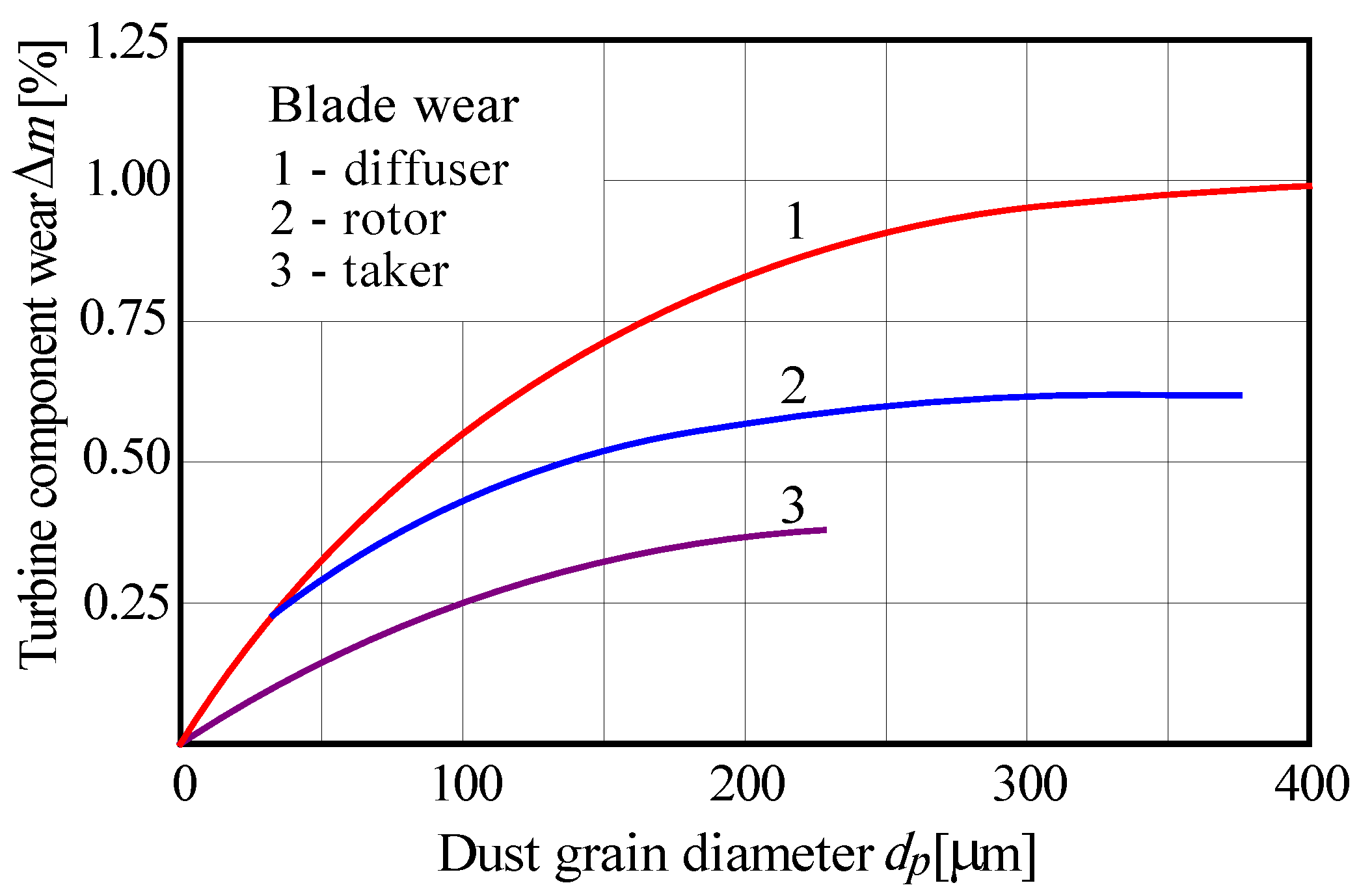
The intensity of wear is determined by hard dust particles with irregular sharp edges, especially SiO2 and Al2O3, and the size of the dust particles, although this relationship is not linear (Figure 10) [53]. Although large dust particles accelerate wear, studies show that even fine dust particles (with diameters of 5.7 µm) cause sufficiently rapid wear, leading to a reduction in the inter-repair durability of compressors and a deterioration in their efficiency and compression parameters (efficiency and compression).
Abrasive erosion is typical for centrifugal compressor rotor blades. It is caused by dust particles which, when moving along the interclade channels with the air stream, are pressed against the working surfaces of the blades by aerodynamic and inertial forces.
Erosion wear caused by dust entering turbine engines has proven to be a dangerous phenomenon when operating helicopters in conditions of high air dust content. This leads to a reduction in the reliability of the power unit, especially in the case of helicopters. Experience gained during field operations in Vietnam shows that 40–60% of all causes of premature (before the end of the guaranteed service life) return of helicopter engines for repair were related to the harmful effects of a dusty atmosphere. These engines very often did not even reach 30% of their normal service life. Some engines had to be taken out of service after less than 100 h of use [59,60]. During the first Gulf War, unfiltered CH-47 Chinook helicopters with Lycoming T-53 engines required repairs after only 25 h of operation [61]. Similarly, during Operations Desert Storm and Desert Shield in the early 1990s, GET-64 engines had to be replaced after approximately 120 h of operation [53].
The Russians gained extensive experience in this area by operating TW3-117 engines in Afghanistan. As a result of operating in such difficult conditions, only 50–60% of Mi-24 helicopters were able to meet the imposed overhaul intervals, and in the case of the Mi-8 helicopter, this level was lower, at 40–50% [62].
In the channels of the turbine nozzle rings, however, dust deposits bound by combustion products as a binder are formed. This applies only to the corners of the walls formed by the control vanes and their shelves or feet, or the walls of the hulls or control vane mounting rings. The formation of dust deposits results from the tendency of fine dust particles to settle on the surfaces of compressor and turbine casings, combustion chamber covers, axial compressor blade rings (mainly the last ones) and turbine nozzle rings (mainly the first stages). The tendency to form dust deposits is increased by sticky admixtures in the gas stream, e.g., exhaust gases, oil mist, etc.
Dust deposits in compressors do not have a hard structure, while in combustion chambers and turbines they occur in the form of brittle hard layers composed mainly of inorganic substances. There are also certain characteristic engine operating ranges where dust deposit formation is most intense.
Layers of dust deposits do not form structures permanently bonded to the substrate (walls), so they can be removed by periodically adding mechanical agents (e.g., nut shells) or softening agents to the inlet stream. Sometimes, a rapid change in the engine’s operating range is sufficient to destroy the sediment structure.
The process of dust deposition and accumulation is very rapid. Dust deposits do not cause wear on engine components, but only change their geometric dimensions, which leads to modifications in the flow path, changes in surface smoothness, and deterioration of heat exchange processes. In addition, a significant amount of absorbed silicate-based dust melts at high temperatures (1150–1250 °C) and forms deposits known as CMAS (calcium-alumina-magnesium-silicate) glass on the first stage of the NGV [63].
CMAS deposits can cause long-term thermal corrosion of the barrier coating. The rapid temperature increase caused by this phenomenon is believed to be the cause of rapid loss of turbine efficiency and power. This is particularly important for heat exchange channels. The thickness of the layer of dust deposits formed depends on the mass of dust sucked in by the engine, i.e., as in the case of erosion, on the concentration of dust in the air and the operating time of the engine in a dusty environment.
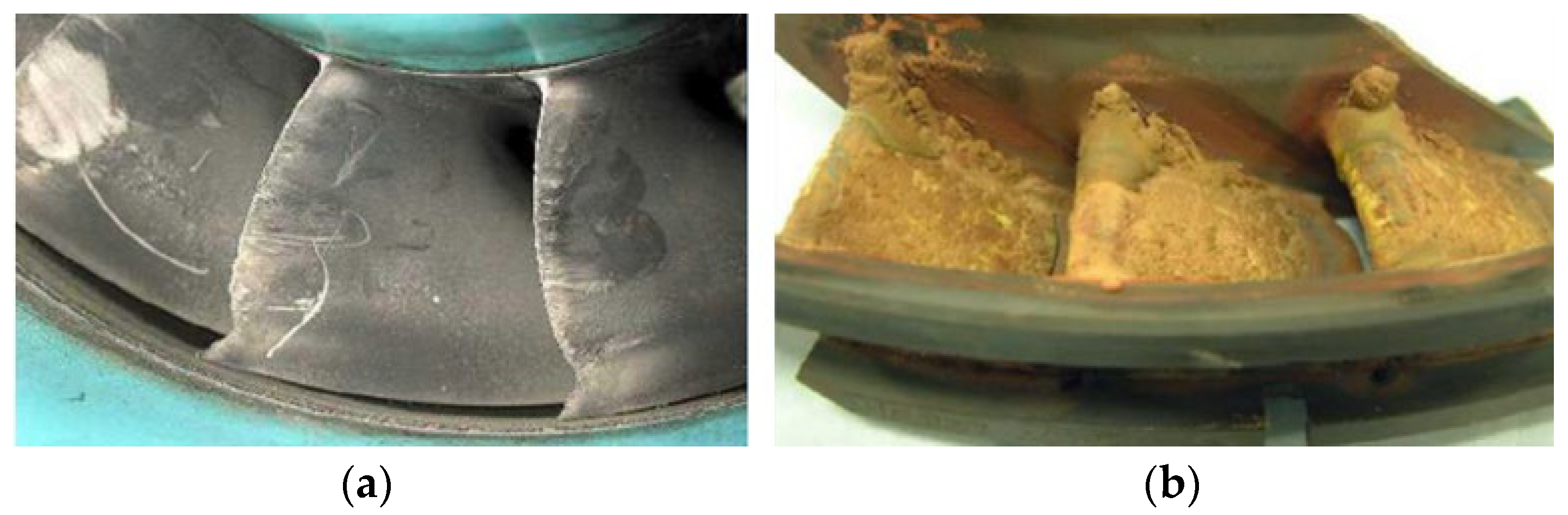
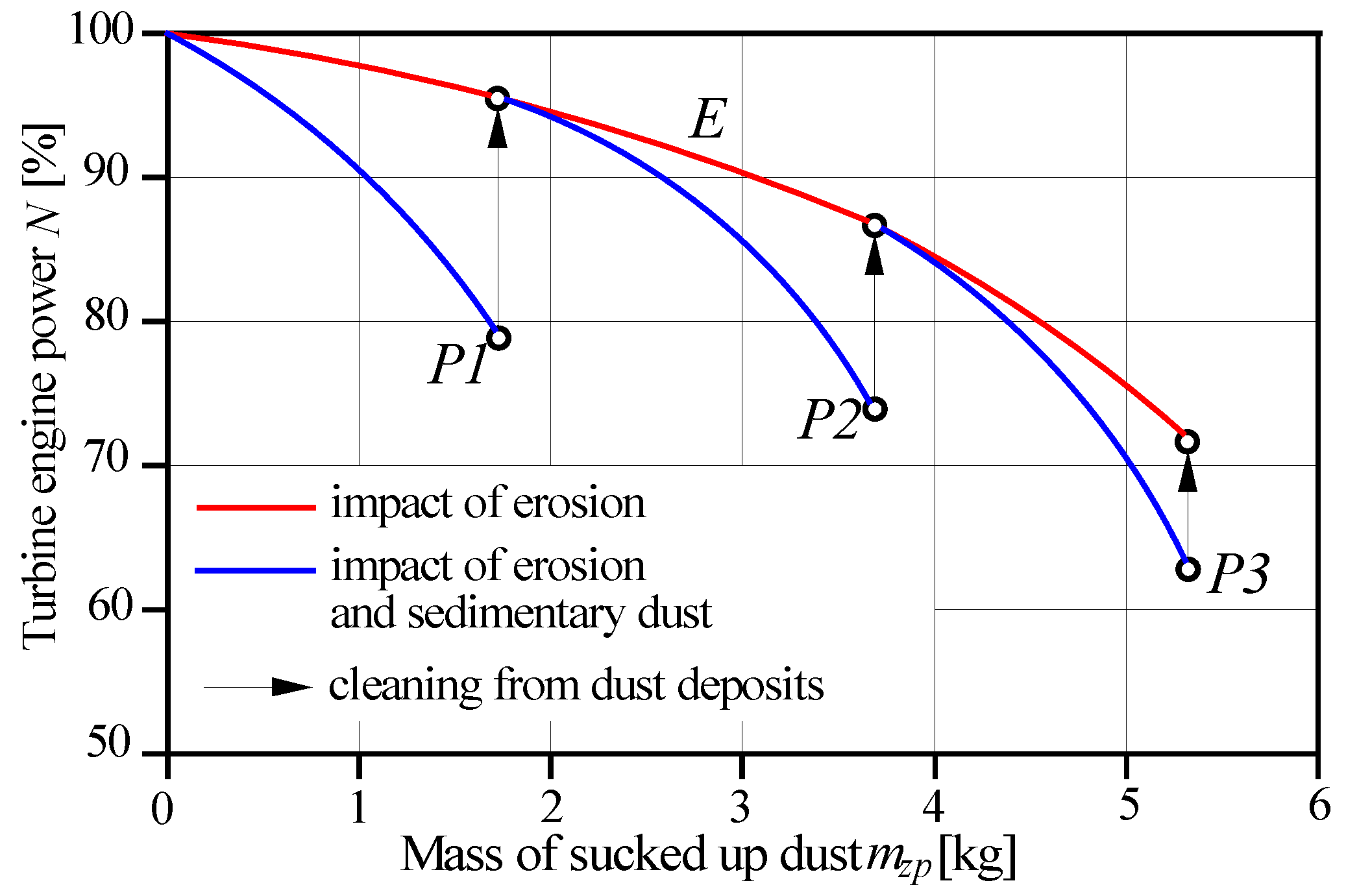
The main effect of dust particles entering turbine engines with the intake air stream is accelerated wear of individual parts and entire engine assemblies, as well as the formation of dust deposits (Figure 11) [64]. Both effects simultaneously cause a deterioration in power characteristics, fuel consumption, and oil consumption (Figure 12). Although CMAS can cause long-term thermal corrosion of the barrier coating, it is believed that the rapid increase in this case was caused by a rapid loss of turbine efficiency.
The graph in Figure 12 shows the change in turbine engine power (caused by both erosion and dust deposits) as a function of the mass of dust sucked in [65]. It shows that the impact of both factors (erosion and deposits) is comparable. The decrease in engine power increases in proportion to the mass of dust sucked in by the engine. Periodic removal of dust deposits allows for a separate quantitative assessment of the effects of erosion and sedimentation.
The works [59,60,66] present examples of the harmful effects of dust on military vehicle turbine engines resulting from excessive dust concentration in the intake air, which, in the absence of an adequate filtration system, causes the absorption of large amounts of dust that accumulates on the turbine blades.
This causes disturbances in air flow and fuel combustion, sudden engine throttling, power loss, and turbine shutdown, resulting in helicopter crashes. Similar problems with the proper operation of turbine engines as a result of mineral dust accumulation on their components have occurred in passenger aircraft that have encountered volcanic dust clouds at altitudes of 7000–12,000 m [67,68].

3. Filtration of Air Intake for Motor Vehicle Engines

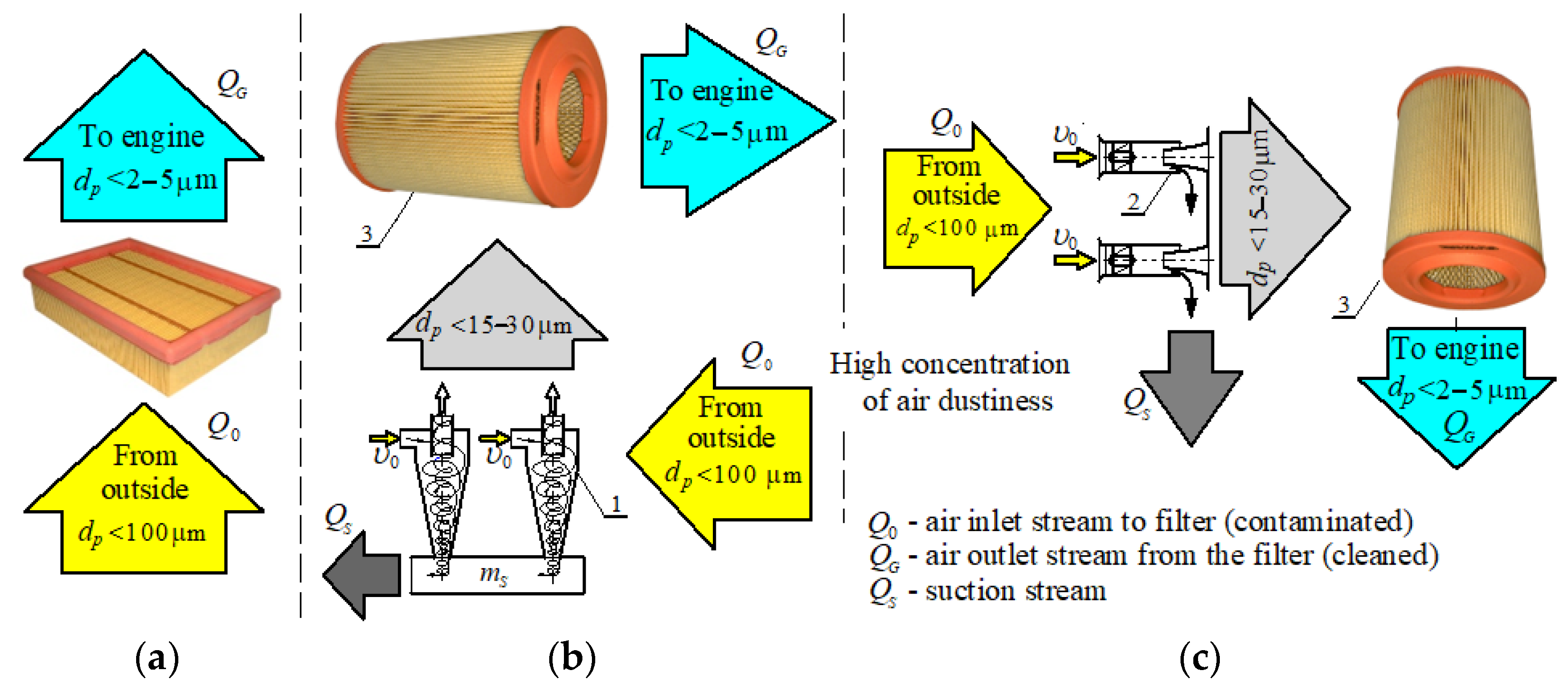
The only effective and active method of purifying intake air, and thus also eliminating the harmful effects of dust on the components of internal combustion engines of motor vehicles used in highly dusty air, is the use of sufficiently effective air filters, which are required to have a filtration efficiency of 99.5–99.9% for dust particles larger than 2–5 µm and long service intervals. For this reason, the engines of trucks, special vehicles, including military vehicles and work machines, are equipped with filters with a two-stage filtration system (Figure 13).

3.1. The Beginnings of Intake Air Filtration in Motor Vehicle Engines

In the early days of motoring, car engines were not equipped with any devices to protect the engine cylinders from atmospheric contaminants. The first air filters used in engine intake systems were primitive in design. In a 1901 Oldsmobile engine, the filter element was a partition made of two layers of perforated sheet metal with 3 mm diameter holes. In a 1901 Adler car, the filter partition was a sleeve made of several layers of rolled metal mesh [69].
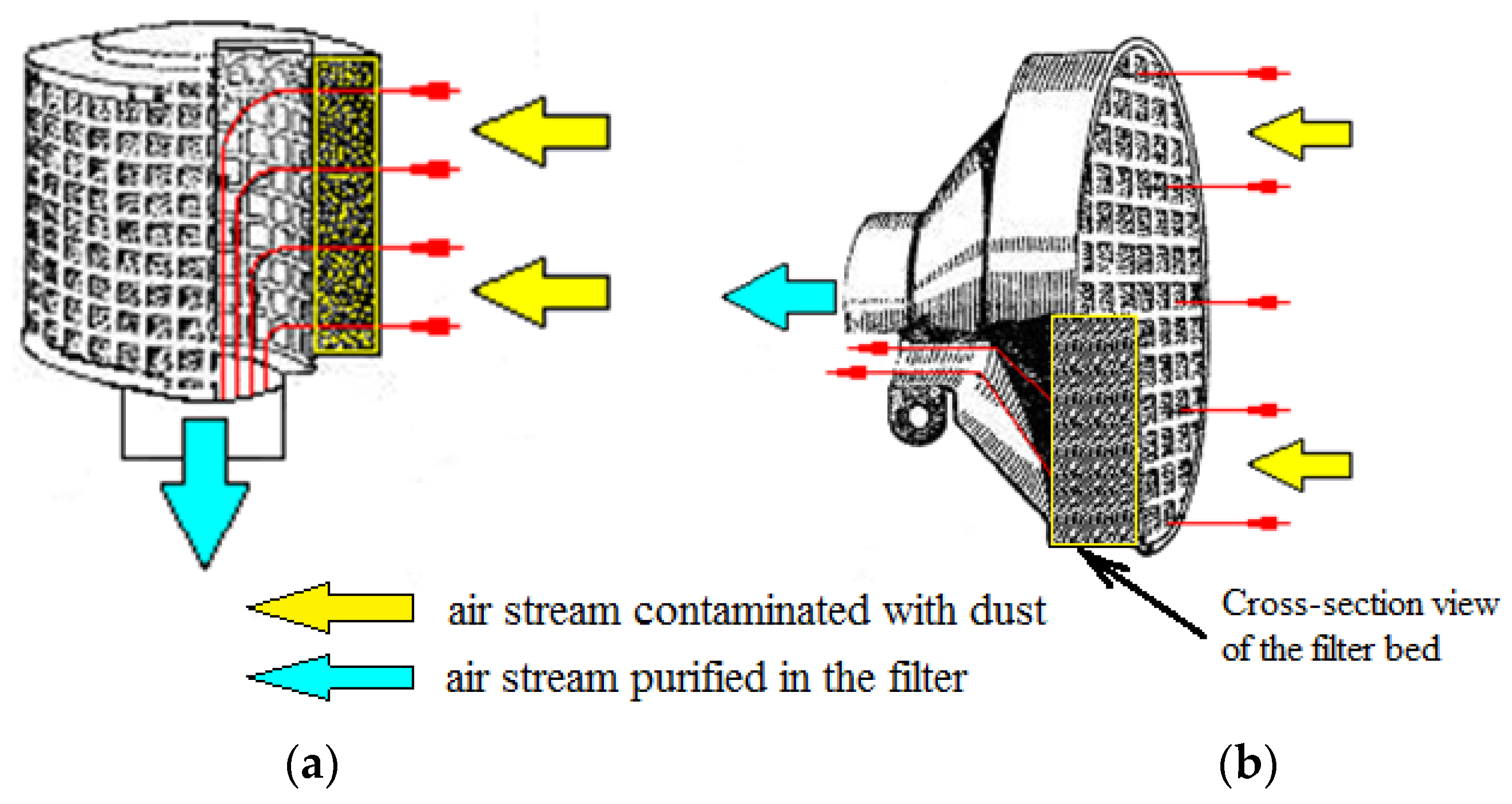
Cylindrical mesh filters soaked in oil with radial air inlets (Figure 14a) were characterized by relatively high absorbency and relatively low flow resistance. This type of design has survived to this day and is used, among other things, on motorcycles (Figure 14b).
It was not until before World War II that serious efforts were made to develop a system for filtering the air sucked in by engines. An air filter in the form of a tin can with a filter partition made of oil-moistened metal wool was used, which increased the filtration efficiency, but still did not exceed 70%.
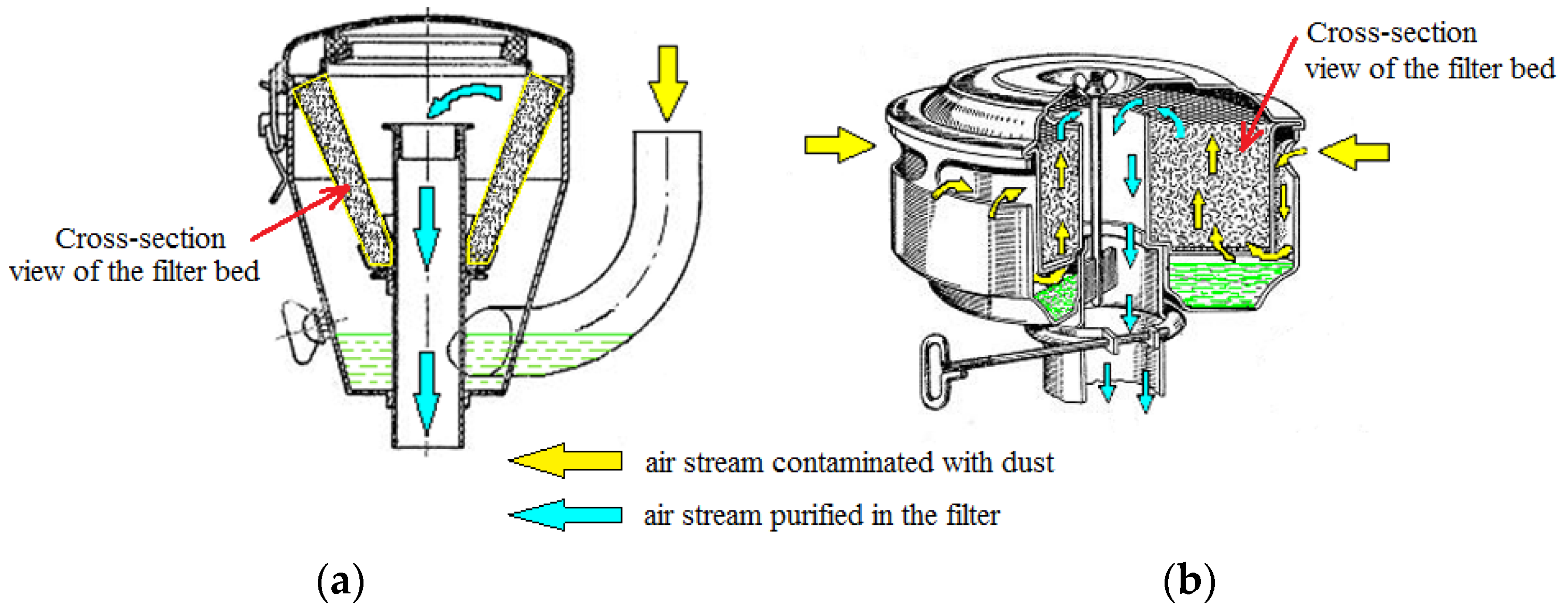
Only the design of an oil bath air filter made it possible to achieve filtration efficiency of over 90%. The principle of operation was based on air flowing through oil, where contaminants settled. Figure 14a shows a version of the filter where the air stream was fed tangentially into a conical filter vessel partially filled with oil, which was swirling [70]. The oil swirling in the vessel rises along the surface of the cone and completely covers the air inlet to the filter. The sucked-in air must pass through the wall of swirling oil, where dust particles are trapped. Oil droplets carried by the air stream are thrown by inertia onto the wall of the vessel or settle on a partition made of irregularly arranged and compressed metal wire or labyrinth plates.
This method of air filtration was improved by eliminating the passage of air through the oil and feeding it perpendicularly to the oil surface (Figure 15b) [71]. The incoming aerosol changes its direction of flow rapidly above the oil surface. The largest and heaviest contaminants fall into the oil as a result of inertia and are retained there. The air, now free of contaminants, flows through a moistened cartridge, where smaller and lighter contaminants are trapped. The purified air is sucked by the engine into the intake system. The air carries oil particles from the bath, which are retained on the lower part of the metal filter cartridge and then fall together with the contaminants under the influence of gravity. This causes continuous rinsing of the lower part of the cartridge, which prevents it from becoming blocked by retained contaminants.
Trapping dust particles in an oil bath increases the density of the oil, causing it to lose its ability to capture contaminants. Therefore, filters of this type required fairly frequent and cumbersome maintenance. Periodically, it had to be removed, the filter cartridge washed, the oil in the housing replaced, and then the cartridge moistened with fresh oil and reinstalled. During the operation of the wash-out filter, the amount of oil in the filter housing decreased as a result of the evaporation of the lightest oil fractions.
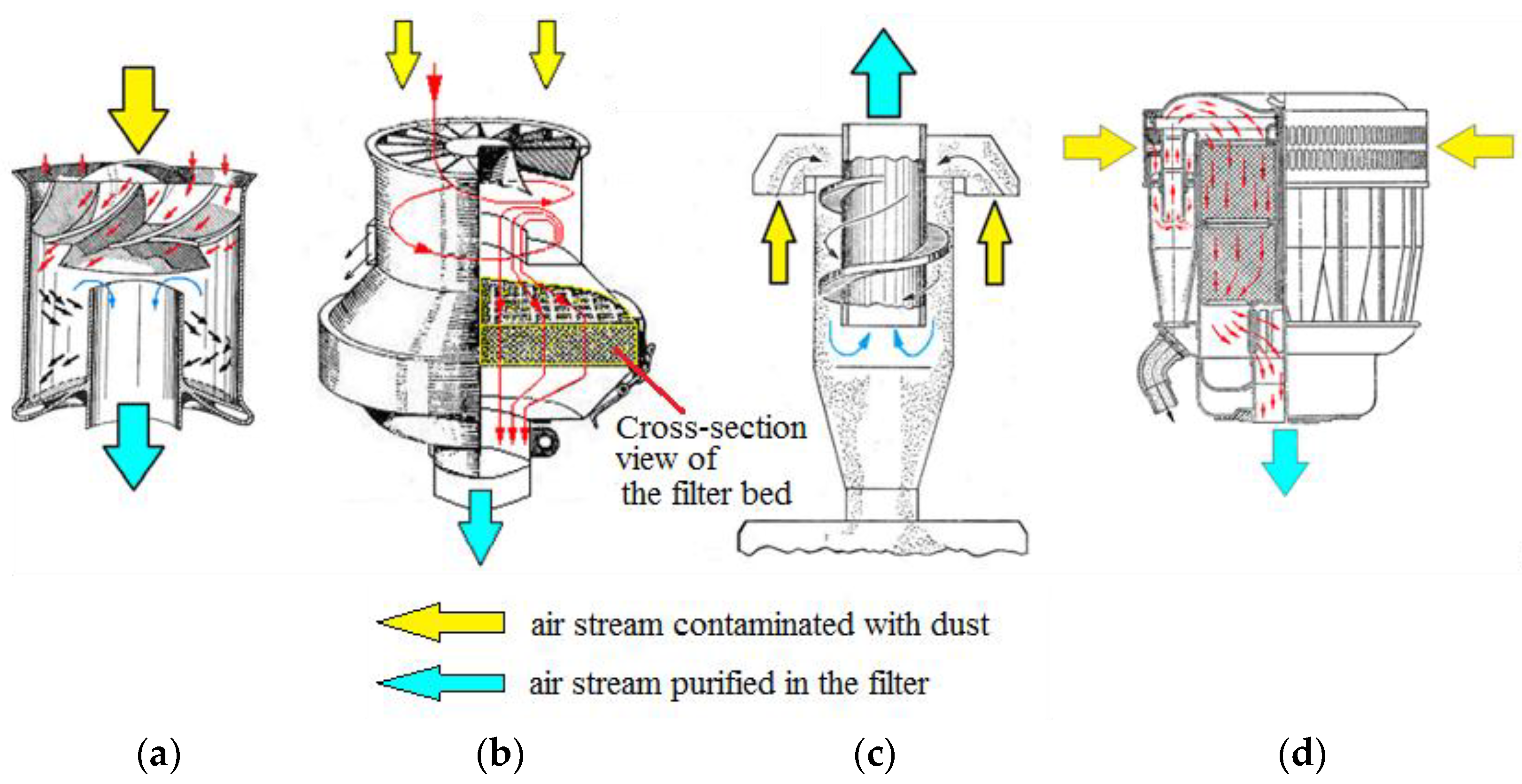
The period of efficient operation of the wash-out filter was extended by the use of an additional centrifugal pre-filter. This filter works by imparting a centrifugal motion to the air stream flowing through the filter. This gives the dust particles inertial force, as a result of which they are separated from the air and then removed to the outside or collected in a special sedimentation tank. The rotational movement of the air is caused by stationary blades inclined at the inlet (Figure 16a). An example of the application of such a solution is shown in (Figure 16b). A centrifugal filter in the form of a ring with inclined blades causes a helical turbulence of air, as a result of which larger and heavier contaminants are thrown by inertia against the inner wall of the housing, where they lose speed and fall by gravity to the bottom of the cylindrical housing, from where they are removed to the outside through a narrow slot located in its lower part. A circular filter partition in the form of oil-moistened metal wool, arranged in series behind the ring, is the second stage of air filtration [70].
The filter partition in the form of oil-moistened metal wool is the second stage of air filtration in the filter shown in Figure 16d. The first stage of filtration here is a battery of reverse cyclones with an axial inlet (multicyclone) arranged side by side around the circular partition.
A breakthrough in air filtration did not occur until the early 1950s, after the development of a special type of porous paper that replaced oil-soaked metal mesh [69]. The main raw material used in the production of filter paper is processed wood pulp, which is obtained from deciduous or coniferous trees and consists of elongated cellulose plant cells (vessels or coils). Examples of deciduous (vascular) trees used for the production of filter paper include birch, aspen, maple, beech, eucalyptus, and acacia. Examples of coniferous (tracheary) trees include pine, spruce, cedar, larch, and Douglas fir [72].
These cells are arranged along the axis of the tree trunk and form a system for transporting nutrients and water to the living tree. The structure of these cells forms a natural composite material. In the pulp production process, this natural structure is destroyed by heat and chemical treatment, and only the necessary components are extracted.
In order to produce filter material with strictly defined filtration parameters, it is necessary to have knowledge of the properties of wood fibers. The most critical parameters of the fibers are their length, which affects their strength, and their roughness, which determines the absorbency and filtration efficiency of the material. Deciduous trees (such as eucalyptus, birch, and aspen) provide shorter fibers than coniferous wood.
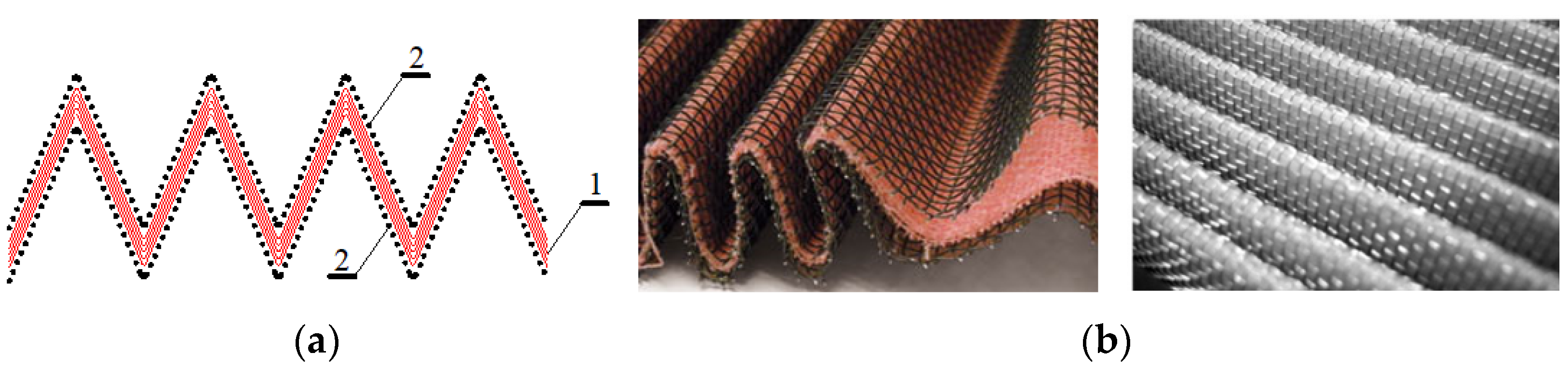
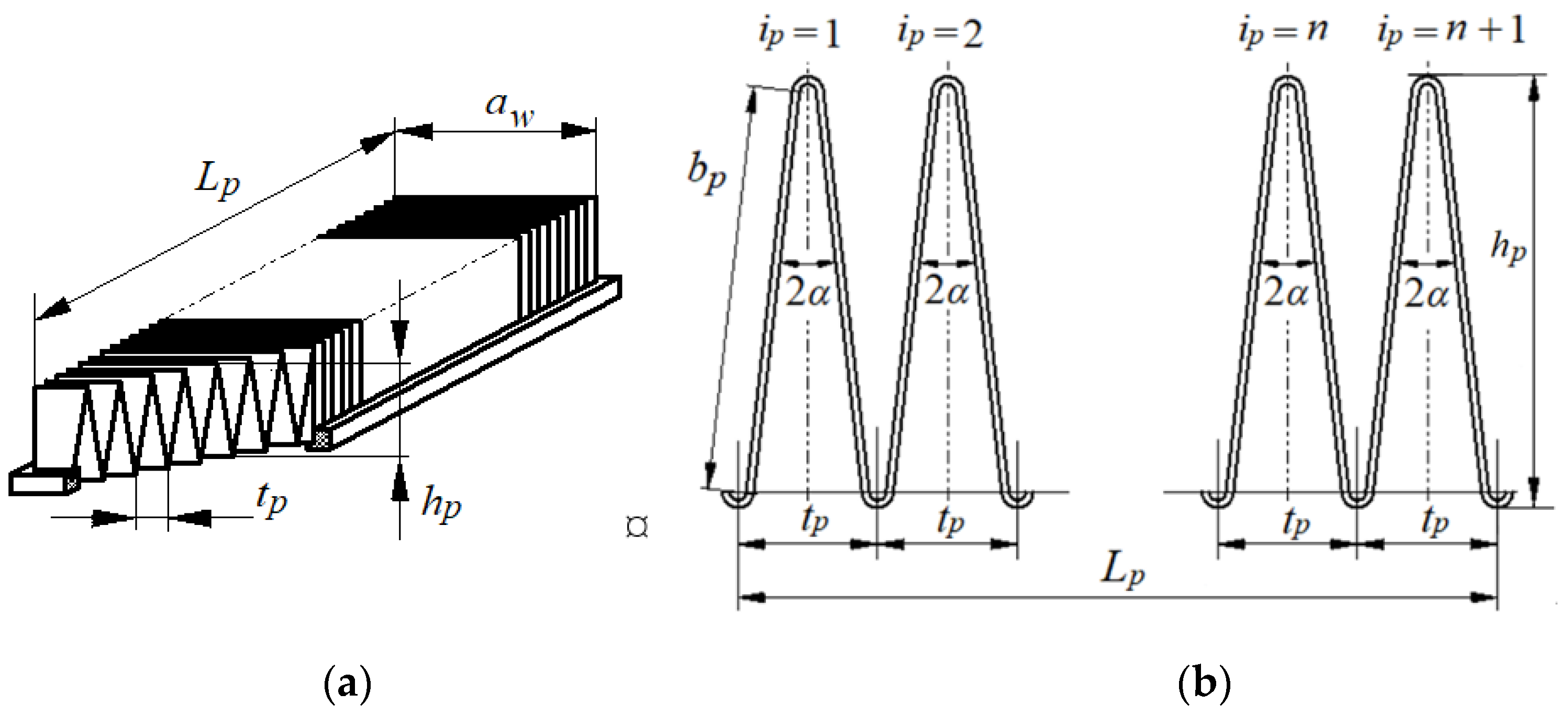
In 1957, Knecht Filter Werke introduced and patented filter cartridges made of pleated filter paper with an increased filtration area, which are still known today [69]. Air filters with pleated paper filter cartridges are more practical and easier to use (replacing the filter cartridge with a new one), and above all, they are lighter and cheaper.
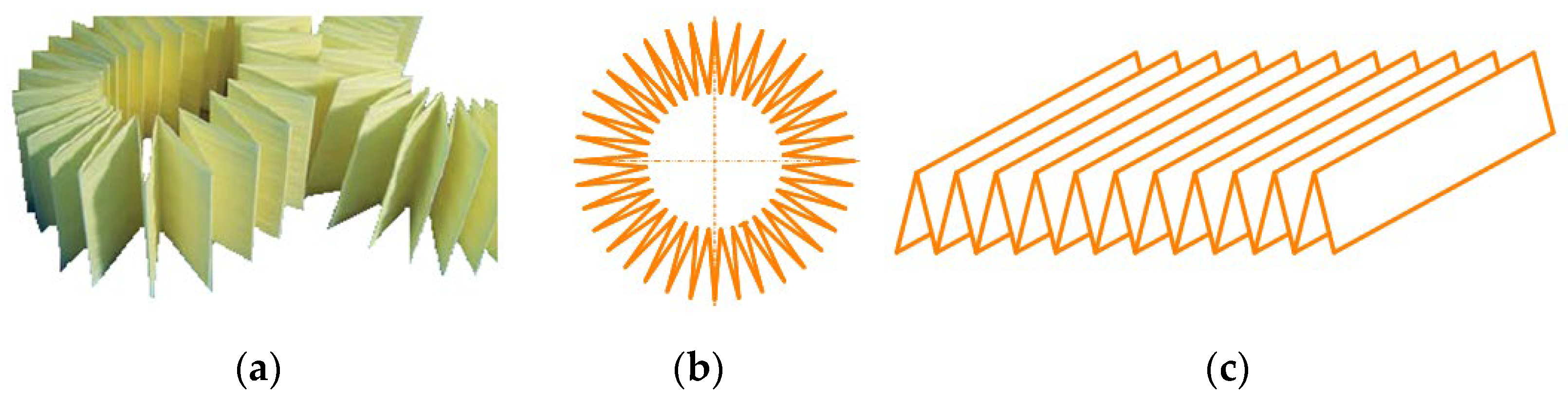
Currently, this solution, in addition to the introduction of increasingly advanced filter materials such as nanofibers, polyester, glass fiber, composite beds, and the addition of an acceptable resistance sensor, is still widely used in the production of panel filter cartridges for passenger cars and cylindrical cartridges, which are the second stage of intake air filtration in trucks and special vehicles. Filter papers are currently the basic filtration material for motor vehicle operating fluids. They are produced in the form of pleated tape, which is then formed into a multi-arm star or panel (Figure 17). The result is cylindrical or panel filter cartridges.
Filter papers are characterized by high efficiency (above 99.5%) and high filtration accuracy (below 2–5 µm), but low dust absorption (approximately 250 g/m2), which results in rapid increases in flow resistance and, consequently, short service intervals.
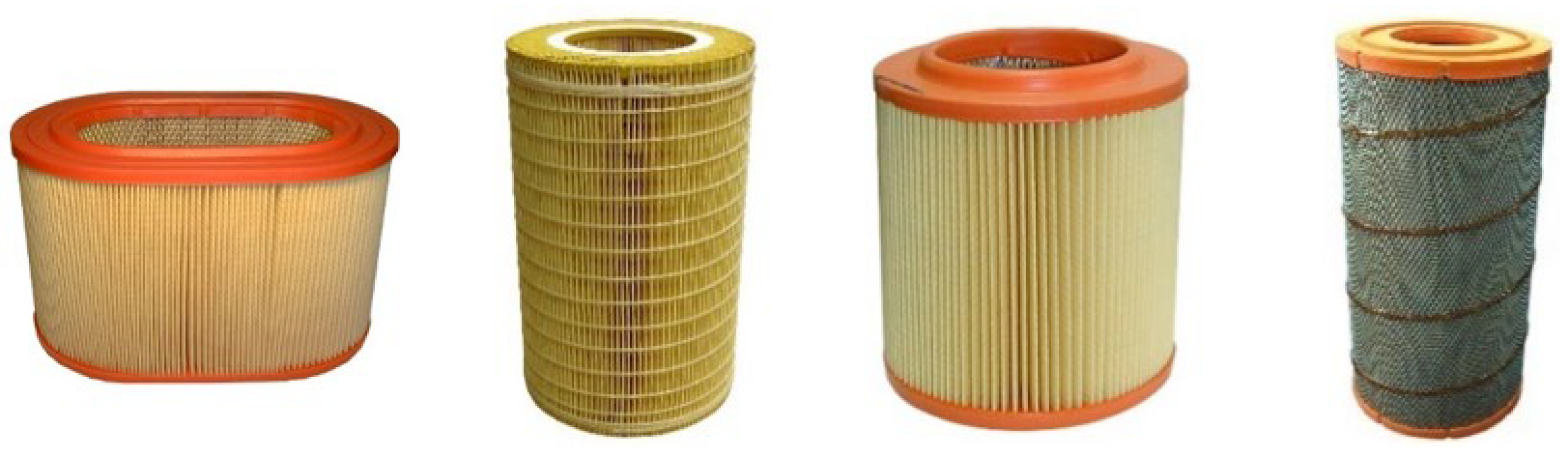
Typical filter cartridges for passenger cars are shown in Figure 18.
At the same time, the instability of pleats when filled with dust and the need to reinforce them, as well as the need to meet small size requirements while maintaining the required efficiency and accuracy of engine intake air filtration, led to the development of a new technology for manufacturing filter cartridges and a different filter design. A characteristic feature of these filters is the axial air flow, which avoids turbulence and allows air to flow directly to the filter outlet, thus minimizing pressure drop.
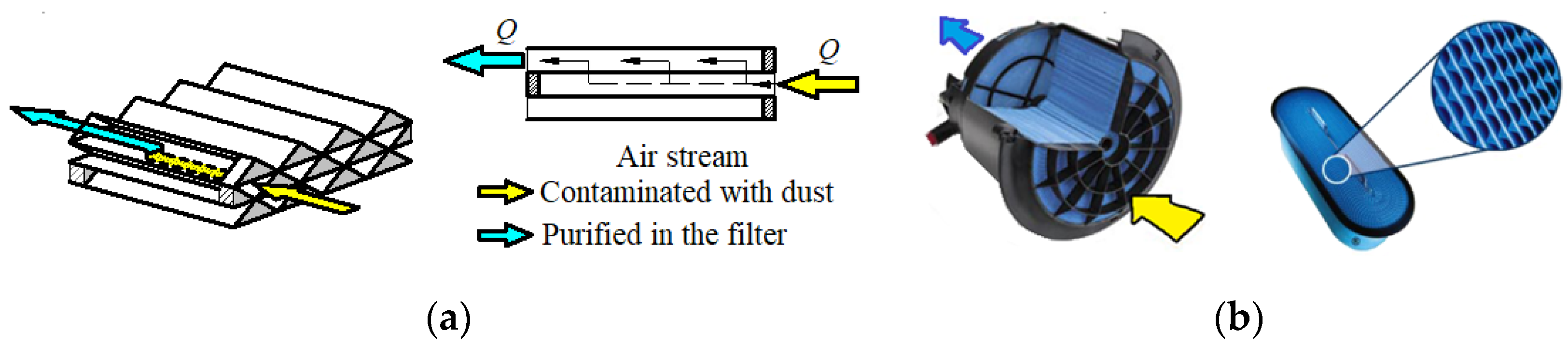
An example of such a solution is the filter cartridge known as PowerCore by Donaldson (Figure 19). PowerCore filter cartridges have a core design consisting of alternating layers of smooth and corrugated paper. Thus, the filter cartridge occupies the entire space allocated for the filter. The channels created in this way are alternately blocked. If a given channel has a free inlet, it is blocked on the outlet side and vice versa. This design forces air to flow into the adjacent channel through the side surface, which is the filter material [73,74].
Filters manufactured using PowerCore technology (at the same air flow rate) take up 2–3 times less space than filters with traditional pleated paper cartridges and are more efficient (φf = 99.99%) than the average conventional filter, which achieves an efficiency of (φf = 99.85%) [74,75]. The greater dust capacity of the filter means a longer filter life, which means fewer filter cartridge replacements and thus lower operating costs.
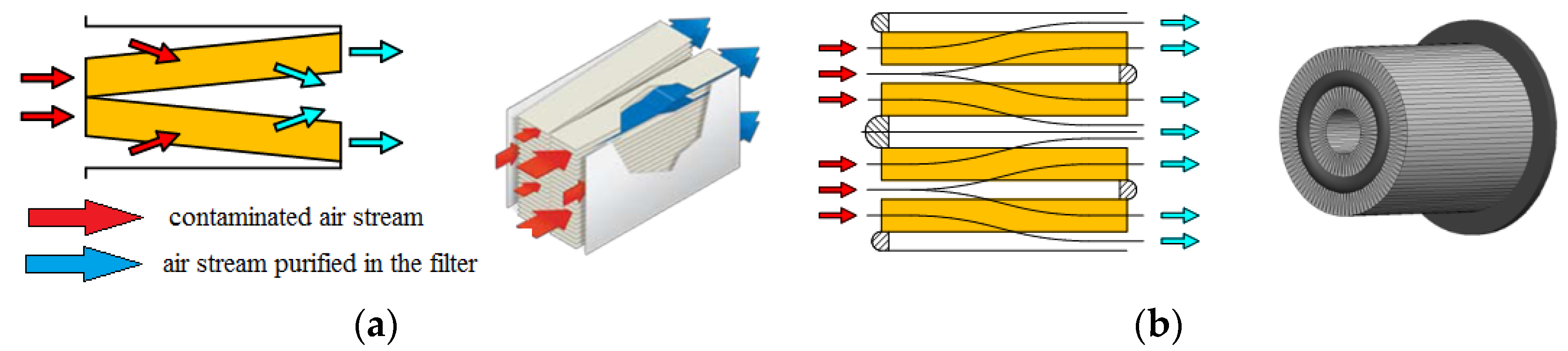
Another solution for a filter with axial air flow, allowing flow directly towards the filter outlet, is provided by the Direct Flow filter cartridge manufactured by Cummins (Figure 20). The filter cartridge consists of two panel cartridges set at a slight angle (Figure 20a) or two cylinders set coaxially (Figure 20b). Each panel is made of traditional pleats forming channels alternately sealed on the shorter sides [76,77,78]. This design forces air to flow through the pleats from the front and along the longer sides and out on the opposite side, minimizing the flow resistance of the cartridge.
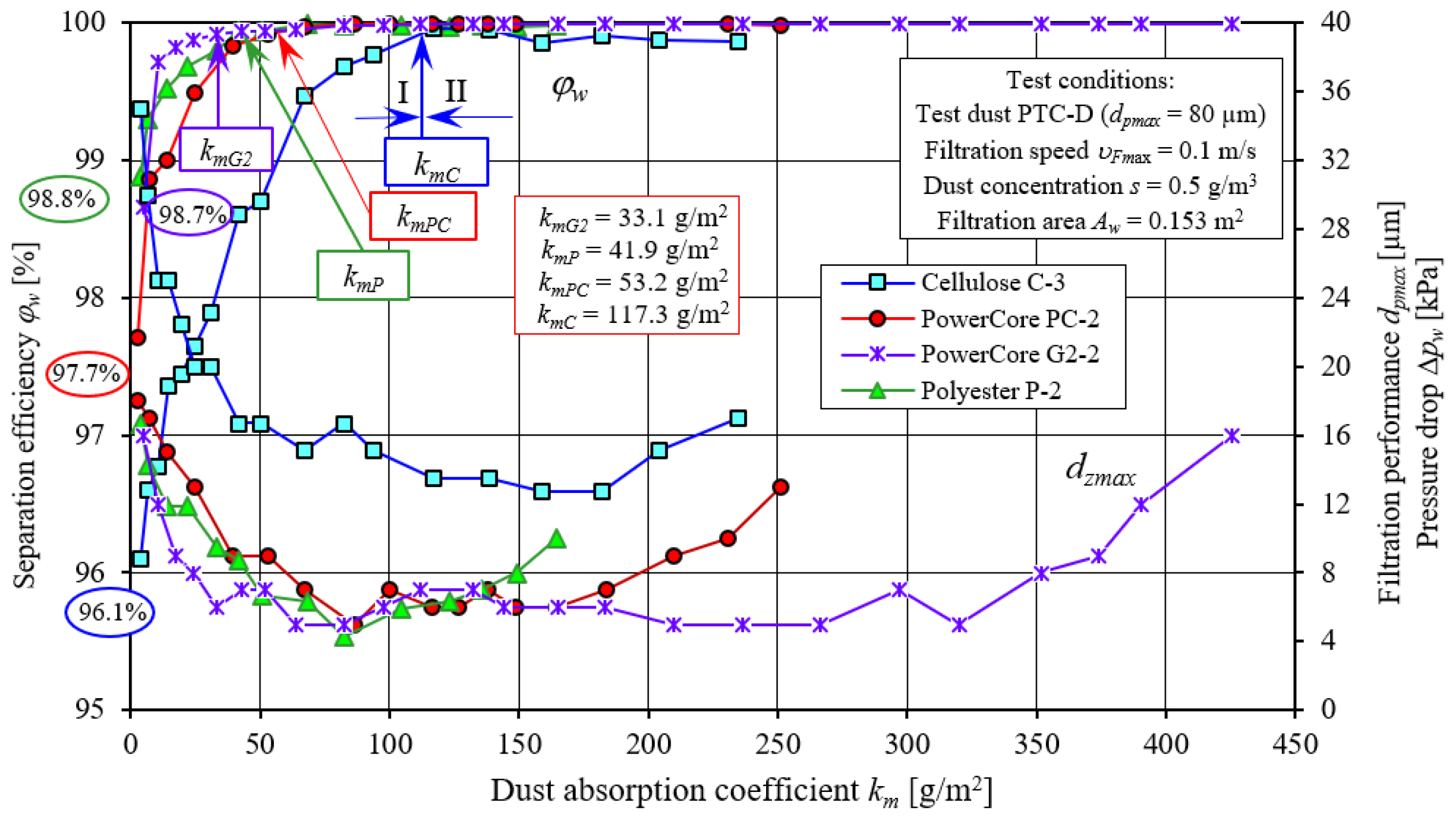
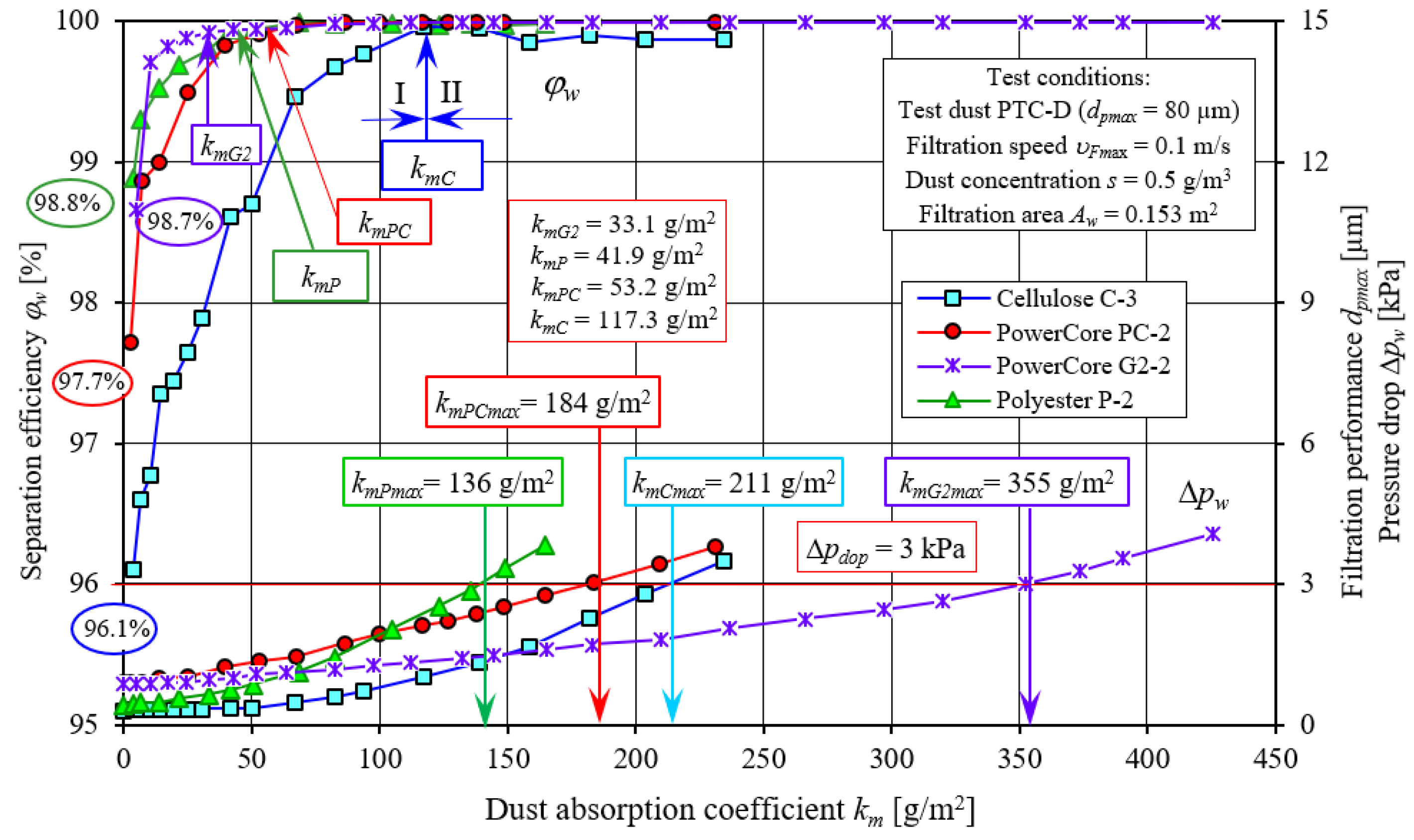
Comparative studies of the filtration properties of PowerCore filter cartridges and cylindrical cartridges with cellulose and polyester filter media were presented by the author in [73]. The characteristics of filtration efficiency and accuracy, as well as the pressure drop of two PowerCore filters and filters with cellulose and polyester filter media, were performed as a function of the dust absorption coefficient (km). The km coefficient was defined as the mass of dust in grams retained on one square meter of filter material until a set flow resistance was reached. The tested filters (Figure 21) were marked as follows: PowerCore filter elements (PC, G2) and cylindrical elements (cellulose—C and polyester—P). The results of the comparative tests in the form of filtration efficiency characteristics φw = f(km), filtration accuracy dpmax = f(km), and pressure drop Δpw = f(km) are presented in Figure 22 and Figure 23.
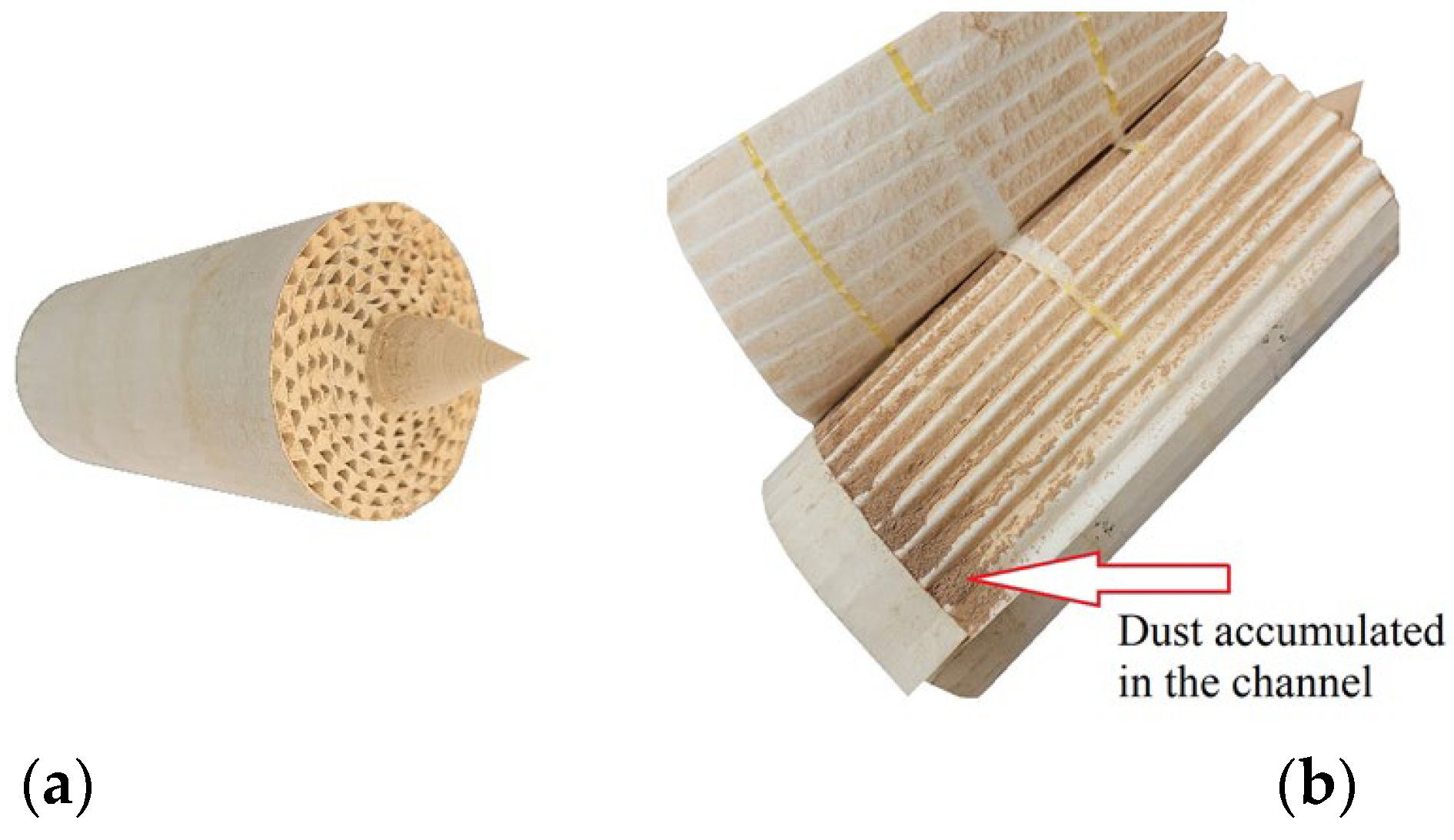
The characteristics of the four PowerCore cartridges (PC, G2), cellulose (C), and polyester (P), which differ in terms of filter material, are similar in terms of their progression, but differ significantly in terms of their values. There are particularly large differences between the characteristics obtained for the C (cellulose) cartridge and those for the PowerCore cartridges. The lowest initial filtration efficiency value (φw0C = 96.1%) was recorded for the filter cartridge made of filter material C (cellulose). PowerCore and P cartridges have higher initial filtration efficiency values, respectively: φw0P = 97.7%, φw0PC = 98.8% (Figure 22). The largest dust particle sizes (dpmax = 35 μm) were recorded behind the C (cellulose) filter, and the smallest, dpmax = 16–18 μm, behind the PowerCore G2 and P (polyester) filters, which is closely related to the filtration properties of the filter material. The intensity of pressure drop increase Δpw = f(km) is lowest for the PowerCore G2 filter, which means that the operating time of this filter to reach the assumed value of permissible resistance Δpwdop = 3 kPa is the longest, and the mass of dust accumulated in the filter bed is the highest, amounting to km = 355 g/m2. The high dust absorption capacity of PowerCore G2 filters may also result from the fact that these filters collect dust not only in the filter bed, but also inside the channels, the outlet of which is sealed (Figure 24).
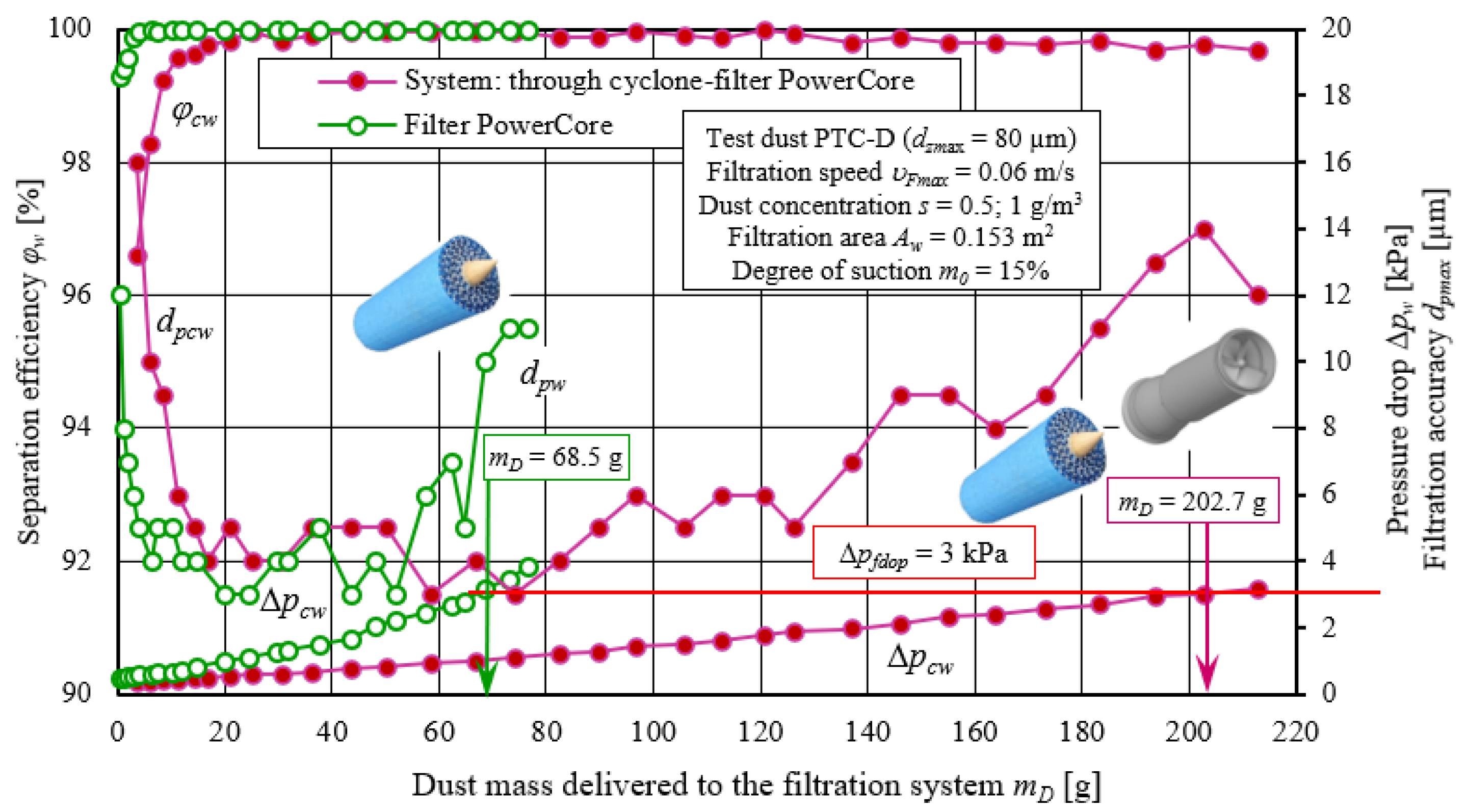
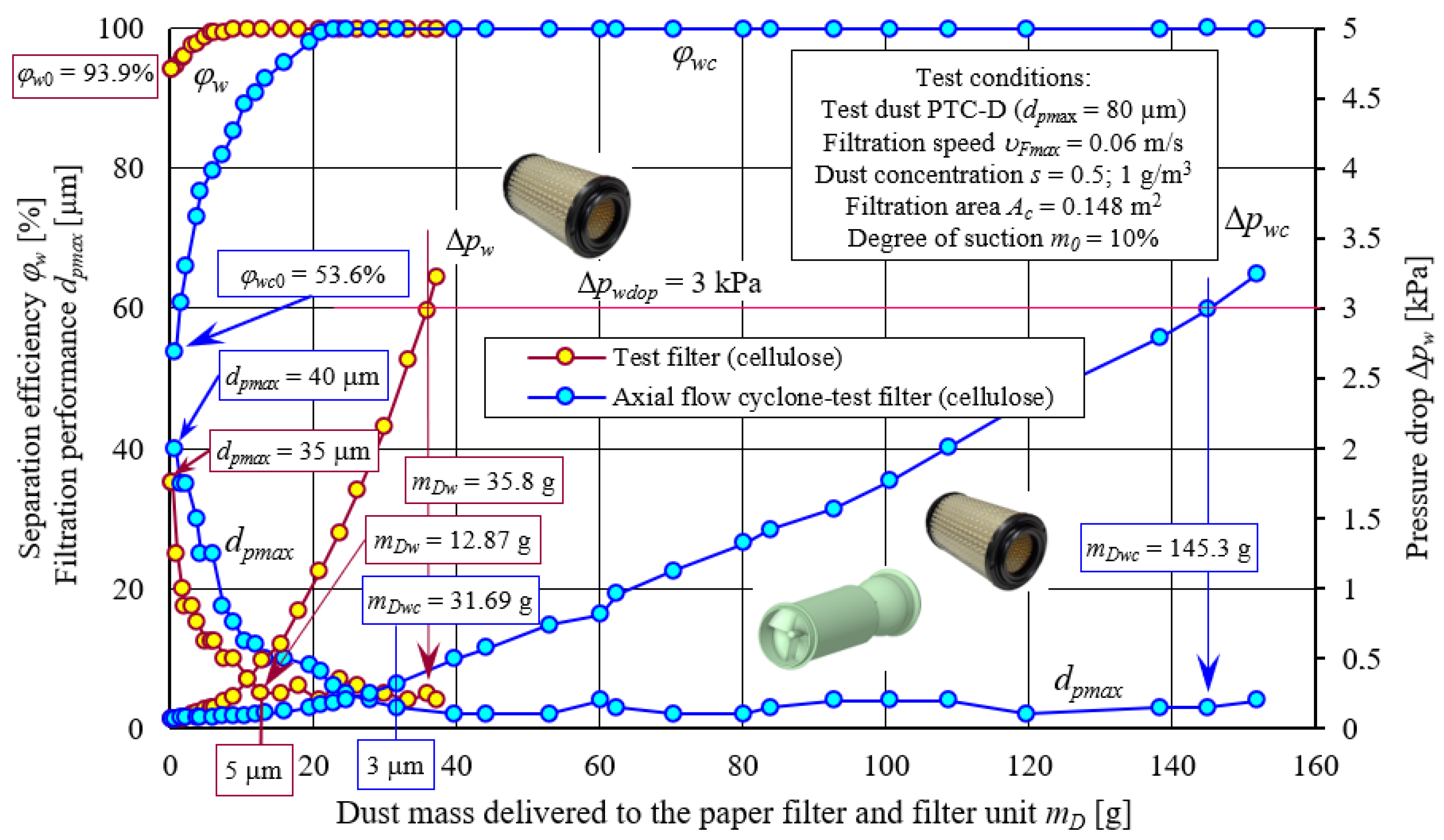
PowerCore filters are ideal for use in the intake systems of combustion engines in trucks, special vehicles, and agricultural tractors as a second stage of filtration (after a multicyclone). The author presented research on filtration characteristics, filtration efficiency and accuracy, and pressure drop of a PowerCore filter operating as a second stage of filtration after an axial inlet cyclone without a cyclone in his work [79]. On a special test bench, using an original methodology, a unit consisting of a single cyclone and a PowerCore test filter with a suitably selected filter material surface area was tested. During the tests, conditions corresponding to the actual conditions of vehicle use and air filter operation were maintained, including filtration speed and dust concentration in the air. The results of the tests of separation efficiency characteristics φw = f(mD), pressure drop Δpw = f(mD) and filtration accuracy dpmax = f(mD) as a function of dust mass mD supplied to the “cyclone filter” filtration system and directly to the PowerCore test filter are shown in Figure 25.
The characteristics presented show that the acceptable resistance of 3 kPa is achieved by the test filter operating in the “cyclone-test filter” system after 202.7 g of dust has been supplied to the system. When the test filter operates individually, it achieves a pressure drop of 3 kPa after only 68.5 g of dust is supplied. This has a significant impact on the performance of the vehicle, especially when it is operated in conditions of high dust concentration in the air. Reaching permissible resistance is a prerequisite for servicing the filter, i.e., replacing the filter cartridge with a new one. In the case of a two-stage filtration system, servicing is performed 2–3 times less frequently. This is because if the first stage of intake air filtration is an inertial filter (multicyclone) and the second stage is a filter cartridge made of fibrous material, then most (about 85–90%) of the dust delivered to the system is retained by the multicyclone. In the case of the tested “cyclone-PowerCore filter” set, the cyclone’s efficiency was approximately 84.6%. Thus, only 15% of the dust mass introduced into the “multicyclone-filter” filtration system reached the filter cartridge. The dust retained by the cyclones accumulates in a sedimentation tank, from where it is continuously removed. During the tests, ejection (continuous) removal of dust from the cyclone sedimentation tank was used, with a suction rate of m0 = 15%.

3.2. Filtration of Air Intake for Motor Vehicle Engines in Inertial Filters-Cyclones

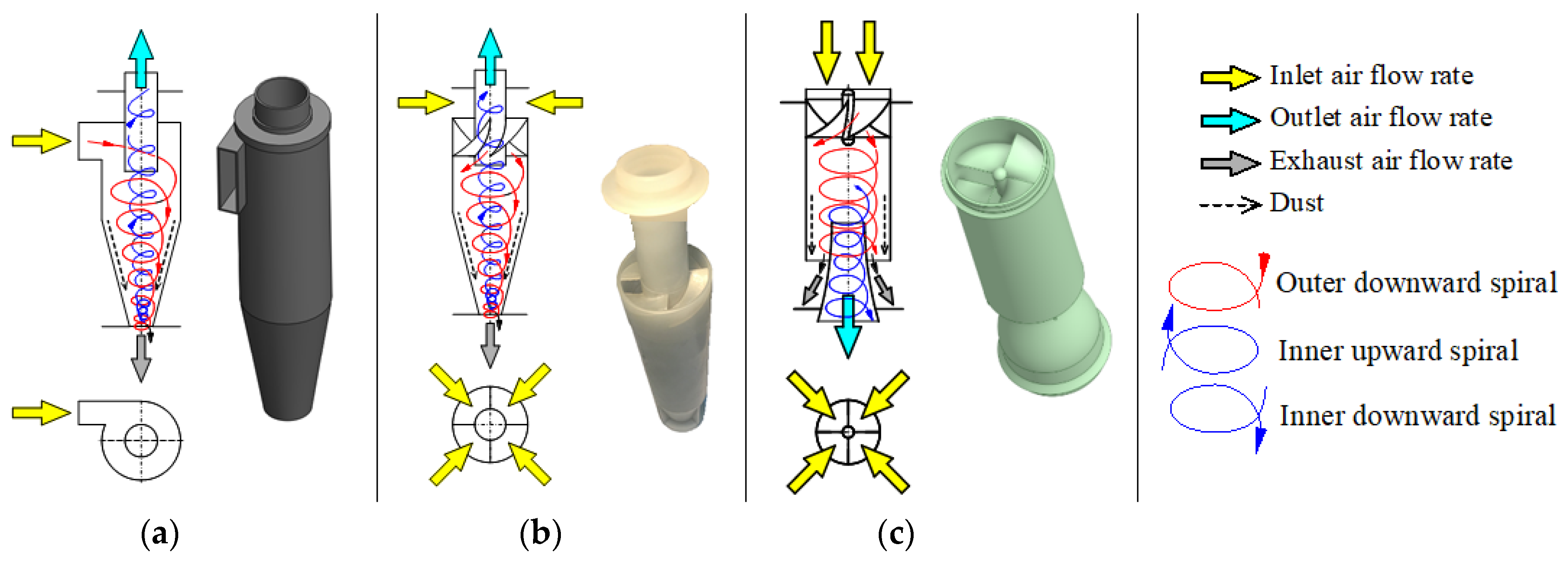
The essence of the two-stage filter operation is to combine two different air filtration processes occurring in two separate devices, whose operation is different, which makes these devices complement each other. The first stage of filtration is a multicyclone, which is a set of several dozen (several hundred) identical, side-by-side reverse or straight-through cyclones with internal diameters not exceeding D = 40 mm (Figure 26), which uses centrifugal force to separate solids or liquids from gas.
Dust particles in the air stream are set in a helical motion (external vortex) when tangentially fed into the cylindrical part of the cyclone or axially fed onto the rotor blades located at the cyclone inlet, as a result of which they acquire a centrifugal force described by the following relationship:
F B = m z · u s 2 r
where mz—mass of the dust particle, us—tangential component of the grain velocity (approximately equal to the tangential component of the gas velocity υs), and r—distance of the dust grain from the axis of rotation.
Centrifugal force causes the grain to move towards the inner wall of the cyclone at a speed of ur, while performing a spiral motion with an increasing radius. The movement of the dust grain is slowed down by the resistance force FR, determined by the following relationship:
F R = λ · A p · u r 2 2 · ρ g
where Ap—projection area of the dust particle, ur—radial motion component of the particle, ρg—gas density, and λ—friction coefficient depending on the shape of the particle and the Reynolds number.
Particles with a large mass and particles with a smaller mass but which simultaneously achieve a high velocity obtain a centrifugal force large enough to overcome the force of air resistance and follow a spiral motion towards the inner wall of the cyclone. The equation of motion of dust particles resulting from the balance of forces will then take the form [80]:
m z d u r d t = F R + F B + F M + F C + F G
where FR—air resistance force, FB—inertia force, FM—Magnus force (generated by the rotation of particles in the force flow field), FC—force between particles and the cyclone wall, as well as the force resulting from collisions between particles, and FG—gravitational force.
The shape of the spiral path along which the dust particles move will then depend on the mutual relationship between the values of forces FB and FR. The value of both forces depends on the size and material of the dust particles (density), which determine the mass and value of the centrifugal force, as well as the size, shape of the dust particles and the type of gas flowing, which affect the resistance force of the medium. After several rotations around the cyclone axis, the dust particle reaches the surface of the cyclone wall, which results in a reduction in its speed, and then, spinning along the cyclone wall, it moves to the collection chamber and then to the sedimentation tank, which means that it is separated from the air stream.
During this time, the particles are driven mainly by the spiral flow of air and to a lesser extent by the force of gravity. This applies to dust particles of a certain mass and diameter greater than a certain dimension dpg, defined as the limit particle diameter, for which the condition FR < FB applies. On the other hand, dust particles with diameters smaller than the dpg dimension, for which FR > FB, will move along a spiral line, but will be directed by the internal air vortex to the center of the cyclone and then towards the cyclone outlet pipe.
Individual cyclones of the same diameter, which usually does not exceed 40 mm, are placed parallel to each other, and their ends are tightly fixed in a common top and bottom plate, forming a multicyclone consisting of several dozen (several hundred) filter elements.
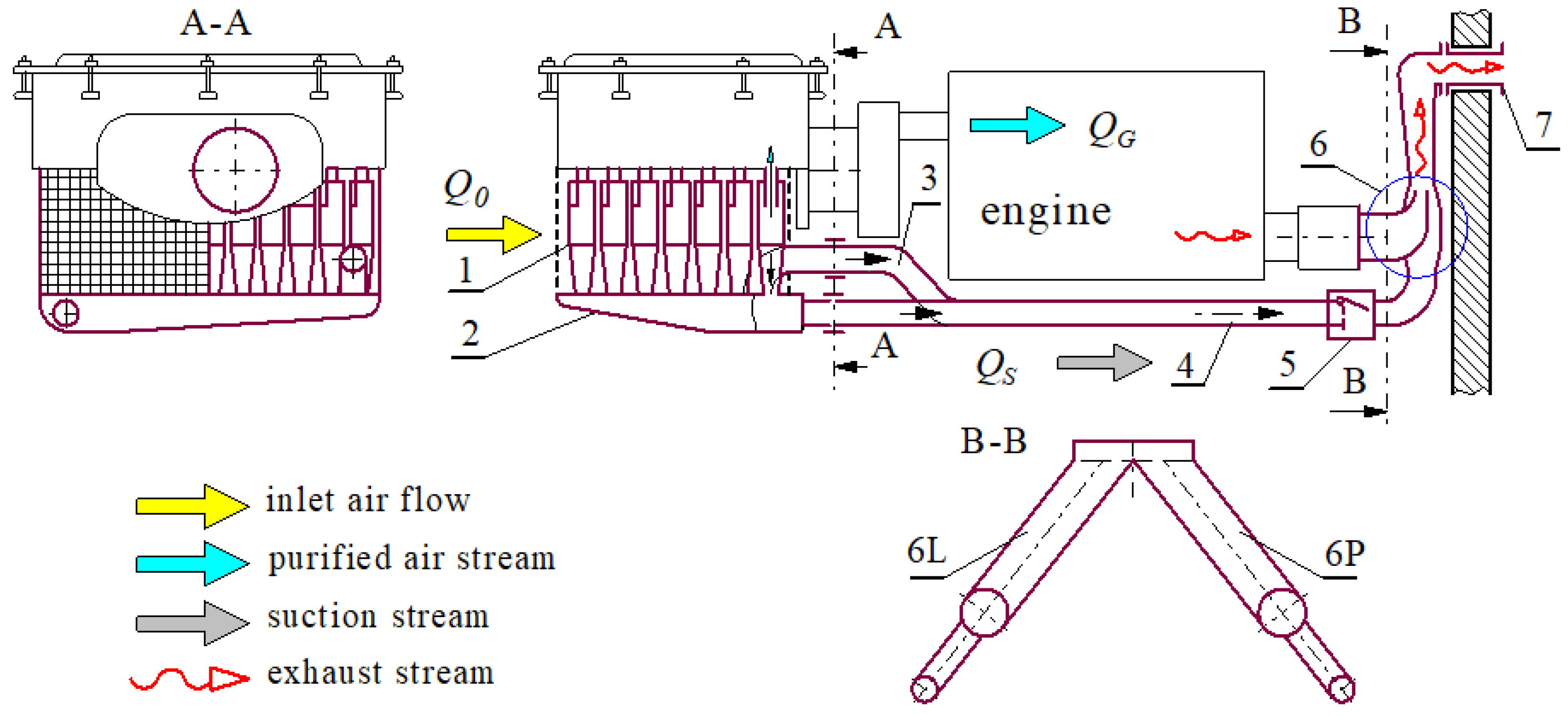
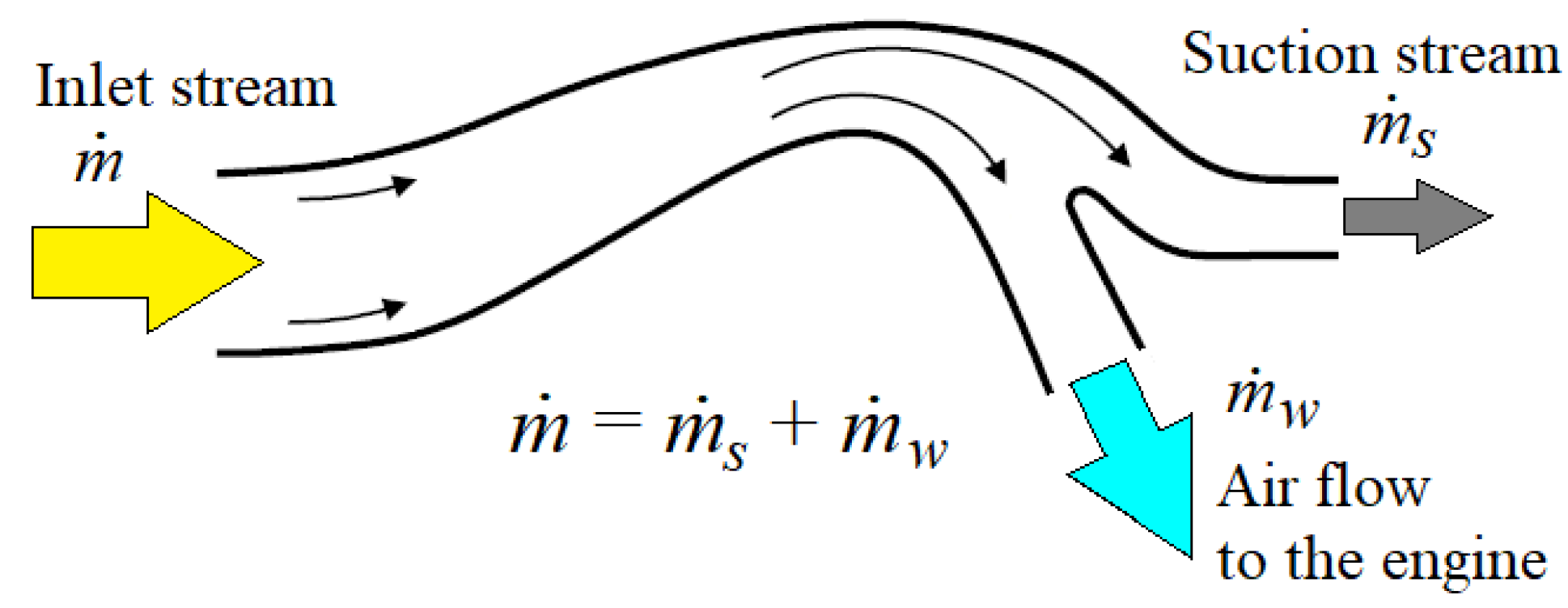
Contaminants stored in the multicyclone sedimentation tank should be removed. This operation is performed periodically during filter maintenance. In filters of vehicles used in conditions of high air dustiness, the dust collected in the multicyclone sedimentation tank is removed on an ongoing basis (outside the vehicle) thanks to the creation (using the phenomenon of ejection) of a suction stream QS, which is part of the inlet stream (contaminated) Q0 to the multicyclone.
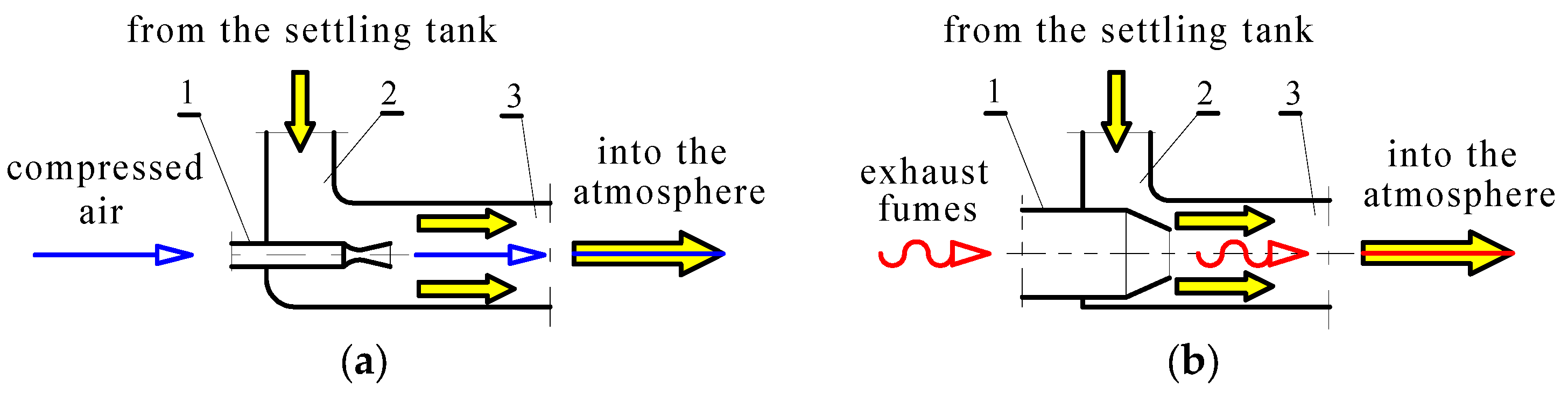
To generate the suction stream, appropriate ejectors (Figure 27) are used as flow-forcing devices, utilizing the energy of the compressed air stream or the energy of the exhaust gases flowing out of the engine exhaust system [81,82,83,84]. Special fans or blowers are also used to generate the suction stream.
Of the ejector configurations shown above, the configuration shown in Figure 27b is more practical and more commonly used in exhaust systems. It is characterized by a much simpler design and lower weight, which is important in the case of exhaust systems that are usually subject to vibration. This ejector configuration is found in the ejection system for removing contaminants from the air filter sedimentation tanks of tanks and special vehicles built on the chassis of these tanks (Figure 28).
The ejector is characterized by a very simple design, a small number of components, and no moving parts. It requires minimal operational supervision, which boils down to periodic visual inspection of the technical condition of the ejector and the tightness of the connecting pipe to the sedimentation tank. On the other hand, however, the use of an ejector requires an increase in the energy used to generate suction flow.

3.3. Filtration of Air Intake for Motor Vehicle Engines in Barrier Filters

The second stage of filtration is a cylindrical filter cartridge made of pleated filter paper or a multi-layer bed composed of various materials, such as cellulose-polyester-nanofiber, cellulose-polyester, polyester-glass microfiber-cellulose. Such filter beds are characterized by low thickness (0.6–0.9 mm) and low absorbency (200–250 g of dust per m2), but high efficiency (99.5–99.9%) and accuracy of filtration of dust particles above 2–5 µm.
Filter papers are made from wood pulp obtained from softwood (coniferous trees: pine, spruce, fir, cedar) and hardwood (deciduous trees: birch, aspen, maple, beech, eucalyptus, acacia) wood, which consists of elongated cellulose plant cells (vessels or tracheid). These cells are arranged along the axis of the tree trunk and form a system for transporting nutrients and water to the living tree. In the pulp extraction process, this natural structure is destroyed by heat and chemical treatment, and only the necessary components are extracted.
The properties of the filter material depend strictly on the parameters of the wood fibers, which are determined by: length, diameter, wall thickness, stiffness, shape, and roughness. In the production of filter media, the most important parameters of wood pulp determining its properties are fiber length and diameter. Fiber length determines strength properties, while fiber diameter determines the absorbency of the medium and filtration efficiency. Wood pulp obtained from soft wood yields fibers with a length of 2–5 mm and a diameter of 30–45 µm, while wood pulp obtained from hard wood yields fibers with a length of 0.5–1.5 mm and a diameter of 20–40 µm. The thickness of the filter papers ranges from 0.3 to 0.9 mm.
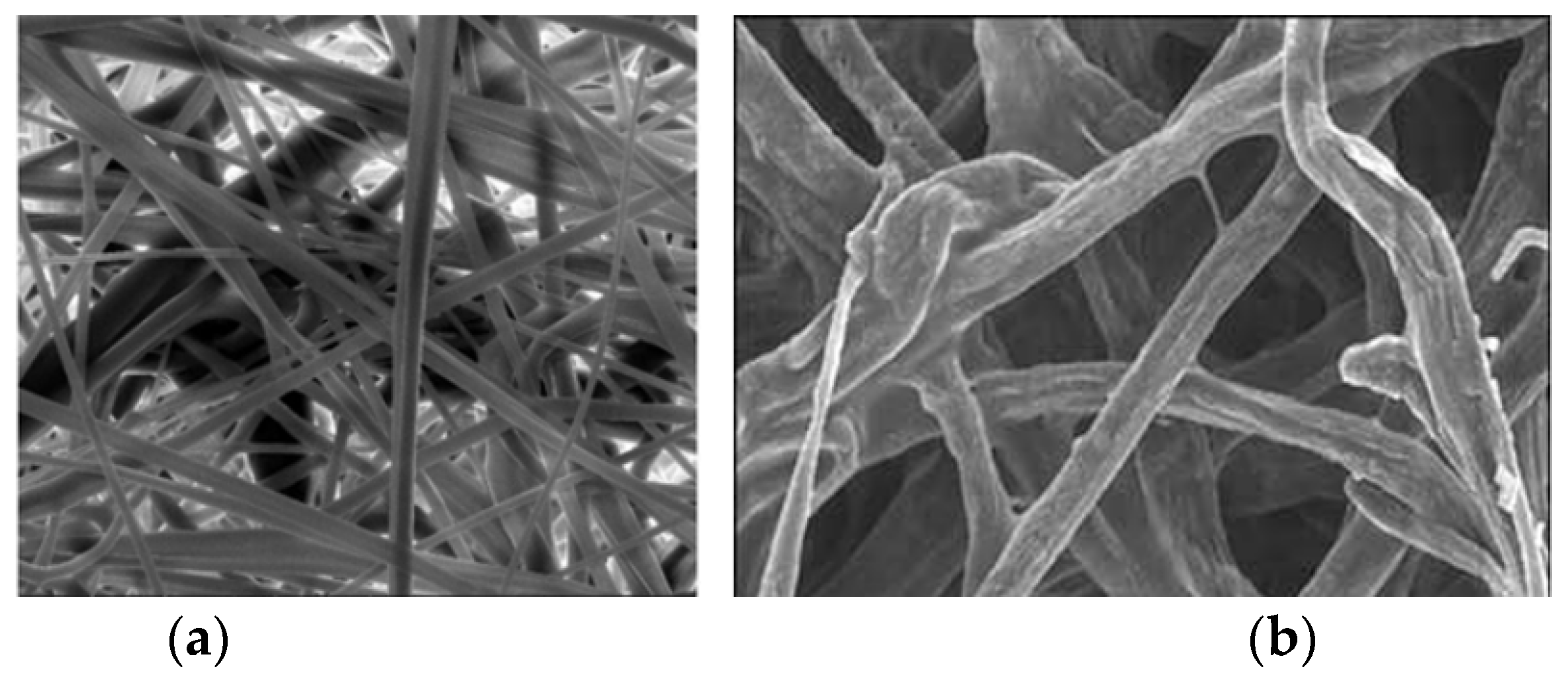
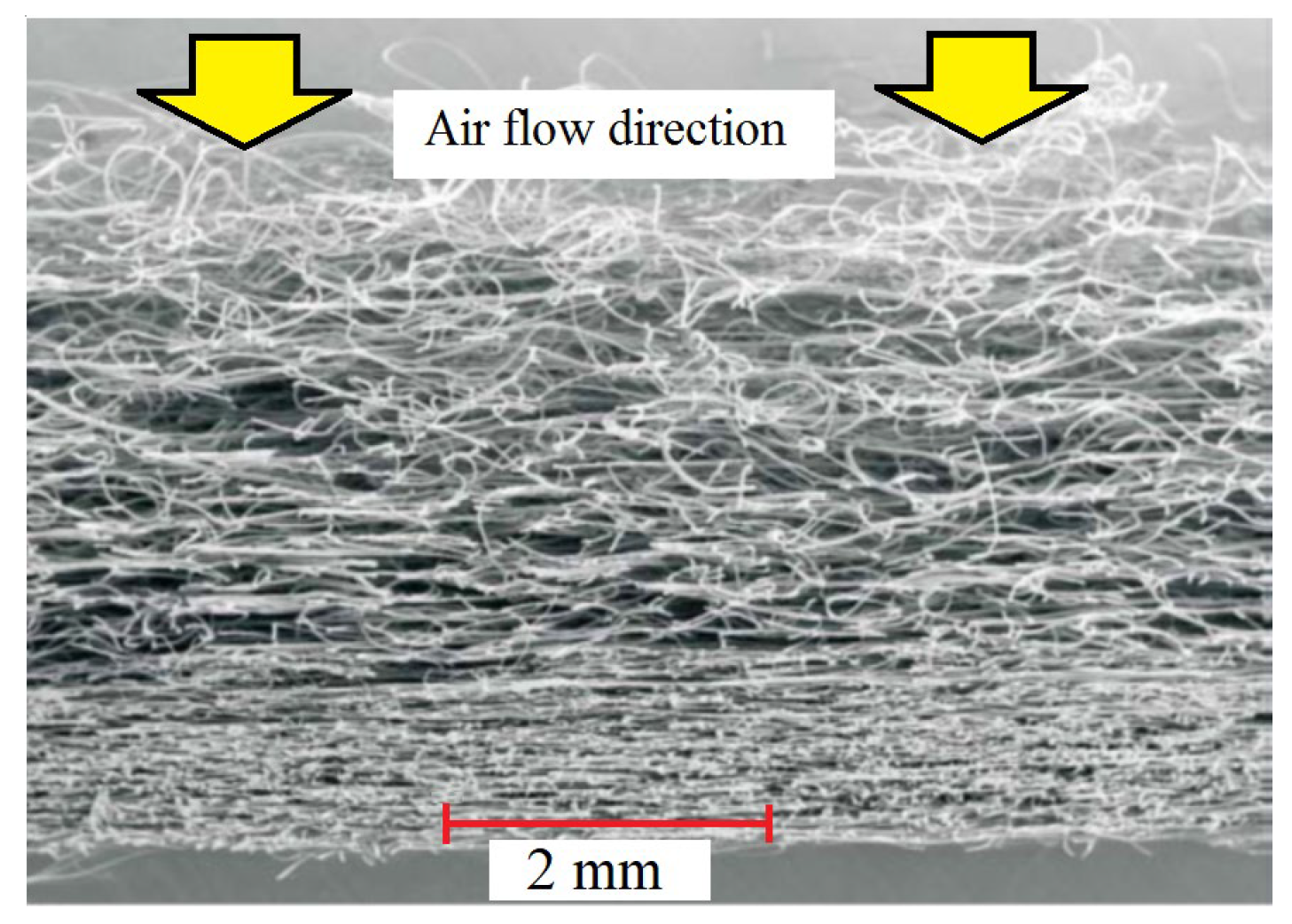
The structure of the filter bed is a three-dimensional, disordered structure consisting of filter material fibers. An image of the structure of filter materials obtained using a scanning electron microscope of polypropylene microfiber and cellulose filter material is shown in Figure 29.
Filter materials are characterized by the following basic parameters provided by the manufacturer: weight, thickness, average pore size, fiber diameter, contaminant absorption, air permeability, tear strength, maximum or average pore diameter, and resin content. The thickness of filter papers does not exceed 1 mm and is usually in the range of 0.5–0.9 mm, with the diameter of cellulose fibers ranging from 1520 µm. The average pore diameter ranges from 4090 µm.
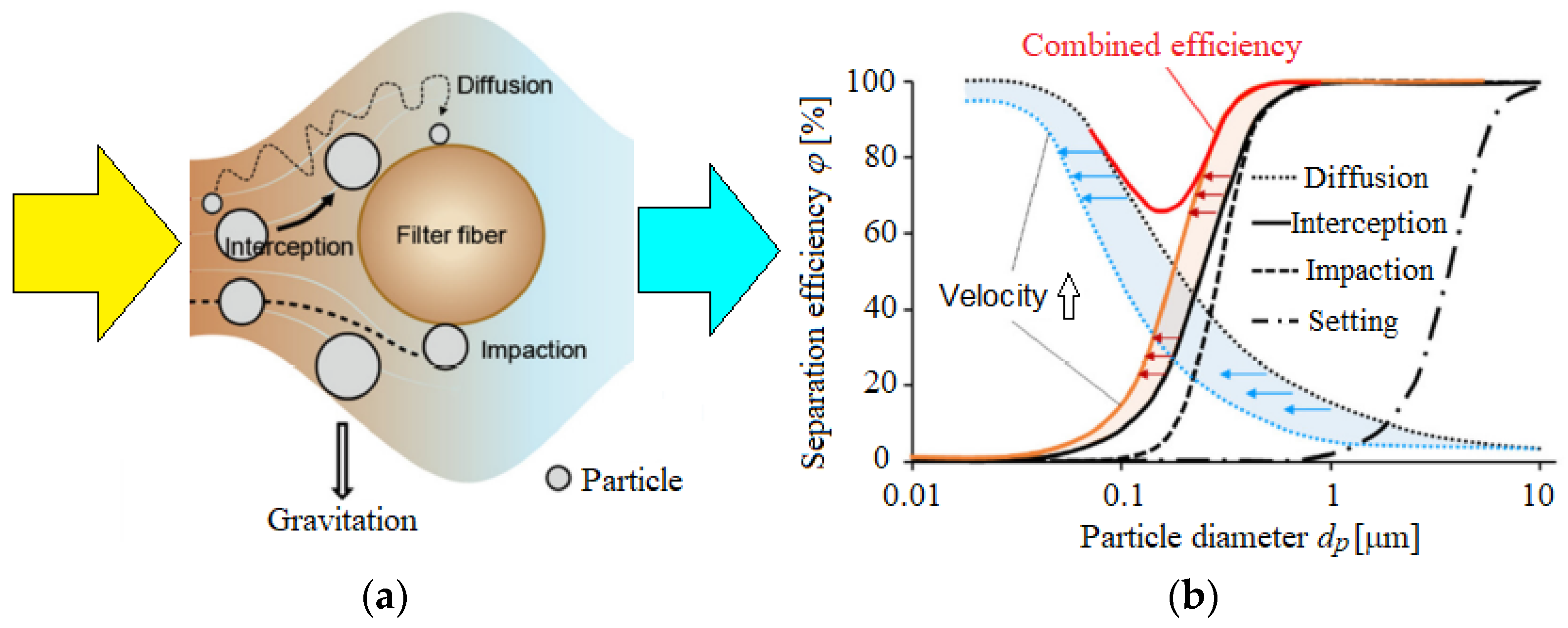
In the filter bed, dust particles moving in line with the flow of the medium are retained and collected on individual fibers as a result of several filtration mechanisms acting simultaneously [86,87,88], such as gravitational settling, inertial impact, interception, diffusion, and electrostatic forces (Figure 30). The first four are known as mechanical mechanisms. Gravitational settling is of lesser importance for most particle sizes, as the contribution of gravity to the filtration process appears to be minimal. Gravitational sedimentation can be completely ignored if the particle size is less than 0.5 µm [87].
Inertial impact occurs when a particle, due to its inertia, moves away from the initial gas streamline and hits the fiber. The trapping mechanism occurs when a particle has a finite size and begins to settle when it is one particle radius away from the fiber surface. For particles smaller than 0.1 µm, diffusion may be strong enough to move them from their original streamlines to the fiber due to the random motion of the particles. Electrostatic forces occur when particles or fibers carry electrical charges or when an external electric field is applied to the medium. There are several different types of electrostatic forces, the most important of which is the Coulomb force, which expresses the interaction between a charged particle and a unipolar or bipolar charged fiber in a fibrous medium. Other electrostatic forces include image and polarization forces, which are defined as interactions between a charged particle and a neutral fiber or between a charged fiber and a neutral particle. Essentially, diffusion plays a key role for particles smaller than 0.1 µm, interception is the dominant mechanism for capturing particles with a diameter of 0.1–1 µm, while inertial collision is an effective mechanism for capturing particles larger than 0.3–1 µm. Meanwhile, electrostatic forces are generally useful for improving the capture of particles with a diameter of 0.15–0.5 µm [87]. The largest dust particles that do not fit between adjacent fibers can be retained by a sieving mechanism, whose effect in the initial phase of the filtration process is relatively small.
The efficiency of a single fiber is the quotient of the number of settled particles per unit length of the fiber surface perpendicular to the air flow. This is the total efficiency of all deposition mechanisms and is expressed by a general relationship [88,89].
φ Σ = 1 ( 1 φ M ) ( 1 φ E )
where φM is the efficiency of a single fiber resulting from mechanical mechanisms:
φ M =   1 ( 1 φ D ) ( 1 φ R ) ( 1 φ D R ) ( 1 φ I )
where φE is the total efficiency of a single fiber resulting from electrostatic mechanisms:
φ E =   1 ( 1 φ I M ) ( 1 φ P ) ( 1 φ C )
where φD, φR, φI,—efficiency resulting from the diffusion, capture, and inertia mechanisms, respectively, φP, φC, φIM—efficiency resulting from polarization force, Coulomb force, and image force, respectively, φDR—efficiency resulting from the capture of particles subject to diffusion.
The equation for the total efficiency of a single fiber is an approximation based on the assumption that all separate filtration mechanisms are independent if they are all significantly less than unity [90,91]. The efficiency of a single fiber is the ratio of the number of settled particles to the unit length of the fiber surface perpendicular to the air flow. It is based on all separate deposition mechanisms and thus overestimates the overall efficiency, as captured particles may be counted more than once.
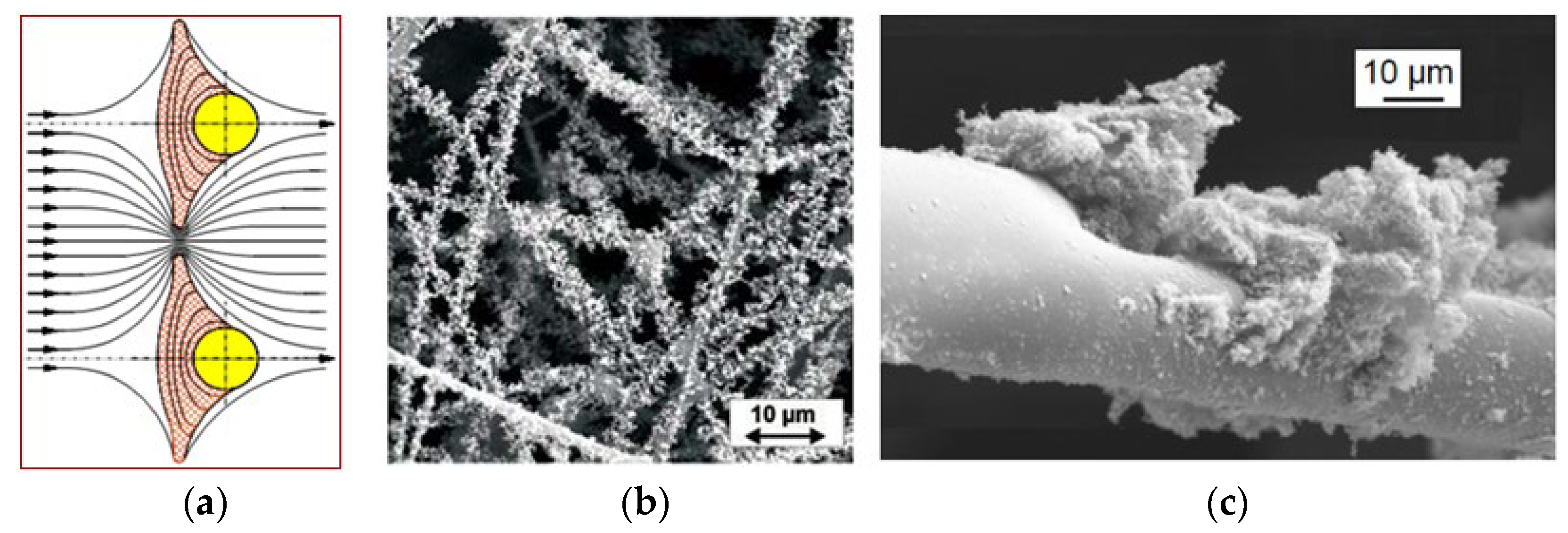
The effect of the filtration mechanisms in the filter bed is the systematic retention and accumulation of dust particles on the side surface of the fibers. Further dust particles accumulate on the retained and previously deposited particles, resulting in the formation of large, complex dendritic structures (agglomerates) that fill the free spaces between the fibers (Figure 31). This hinders the flow of aerosols through the bed, resulting in increased pressure drop, which is greater the more dust mass is retained on the fibers. In real-world motor vehicle operation, this involves the periodic replacement of filter cartridges when a predetermined permissible resistance value Δpfdop is reached, which ranges from 4 to 7 kPa for truck engines [92] and 9 to 12 kPa [93] or special vehicle engines.
The effectiveness and accuracy of intake air filtration in internal combustion engines can be improved by using multi-layer (composite) filter media, for example: (polyester + glass microfiber + cellulose), (cellulose–polyester–nanofiber) [95,96,97].
One of the significant advances in improving separation efficiency and filtration accuracy in filter beds is the use of nanofibers made of polymers with diameters smaller than 1 µm. The diameters of standard cellulose fibers range from 15 to 20 µm.
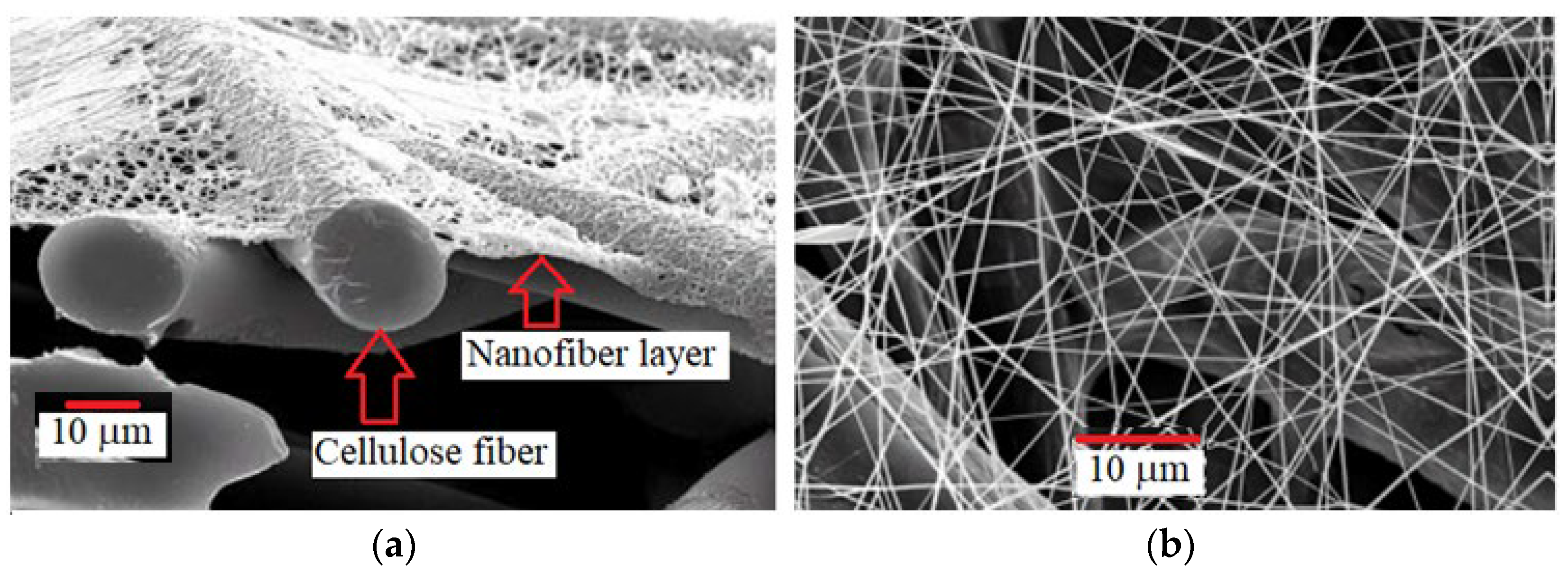
Nanofibers are produced from various polymers using the electrospinning method, which uses an electric field to draw molten polymer or polymer solution from the tip of a capillary to a collector. By selecting the appropriate combination of polymers and solvents, nanofibers with diameters ranging from 40 to 2000 nm (0.04–2 microns) can be obtained [98]. An additional layer of nanofibers with a thickness of 1–5 µm and fiber diameters of 300–800 nm is applied to a substrate made of conventional filter materials such as cellulose, nylon, glass microfiber, or polyester, which are characterized by greater thickness and strength. Figure 32 is a photomicrograph of commercially available nanofibers electrospun onto a cellulose substrate for air filtration applications [98]. The nanofiber diameter is approximately 250 nanometers, as compared to the cellulosic fiber structure, with diameters exceeding ten microns. This composite filter media structure has been successfully pleated on high-speed rotary pleating equipment with minimal damage to the nanofiber layer.
According to information provided by Mann + Hummel [99], nanofibers are not visible to the naked eye and have an average diameter of 0.15 μm, or 150 nm. The result is a significant increase in the surface area on which dust particles can settle, thereby increasing the efficiency of the filter. A filter material covered with a mesh of nanofibers with a diameter of 700 nm retained up to 99.98% of dust particles, while a standard filter material (without nanofibers) retained 40% of particles of this size.
The separation efficiency, filtration performance, and pressure drop of filter materials with an additional layer of nanofibers depend on the substrate structure (type of material) and the thickness of the nanofiber layer. The paper [100] presents the results of filtration efficiency tests on four samples made of different filter materials. The novel nanofiber composites were applied on four different cloth structures: (1) nonwoven substrate composed of cellulose-based fibers and polymeric binders 50 g/m2; and three polyamide substrates: (2) knitted fabric with interlock structure 120 g/m2; (3) plain weave woven fabric 140 g/m2; and (4) charmeuse knitted lining 50–55 g/m2. The separation efficiency of the material for samples 1, 2, 3, 4 (without a nanofiber layer) is very low and does not exceed 10% for dust particles smaller than 2 μm. Even a small layer of nanofibers (g = 0.02 g/m2) applied to a filter bed made of these samples increases the separation efficiency of particles smaller than 2 μm to over 60%.
The use of nanofibers as an additional layer applied to standard filter materials for air filters used in motor vehicles significantly increases the efficiency and accuracy of filtration, especially of small dust particles (below 5 µm). Figure 33 shows a clean cellulose bed with a layer of nanofibers with diameters ranging from 100 to 400 nm and a view of the dust particles remaining on this bed [101].
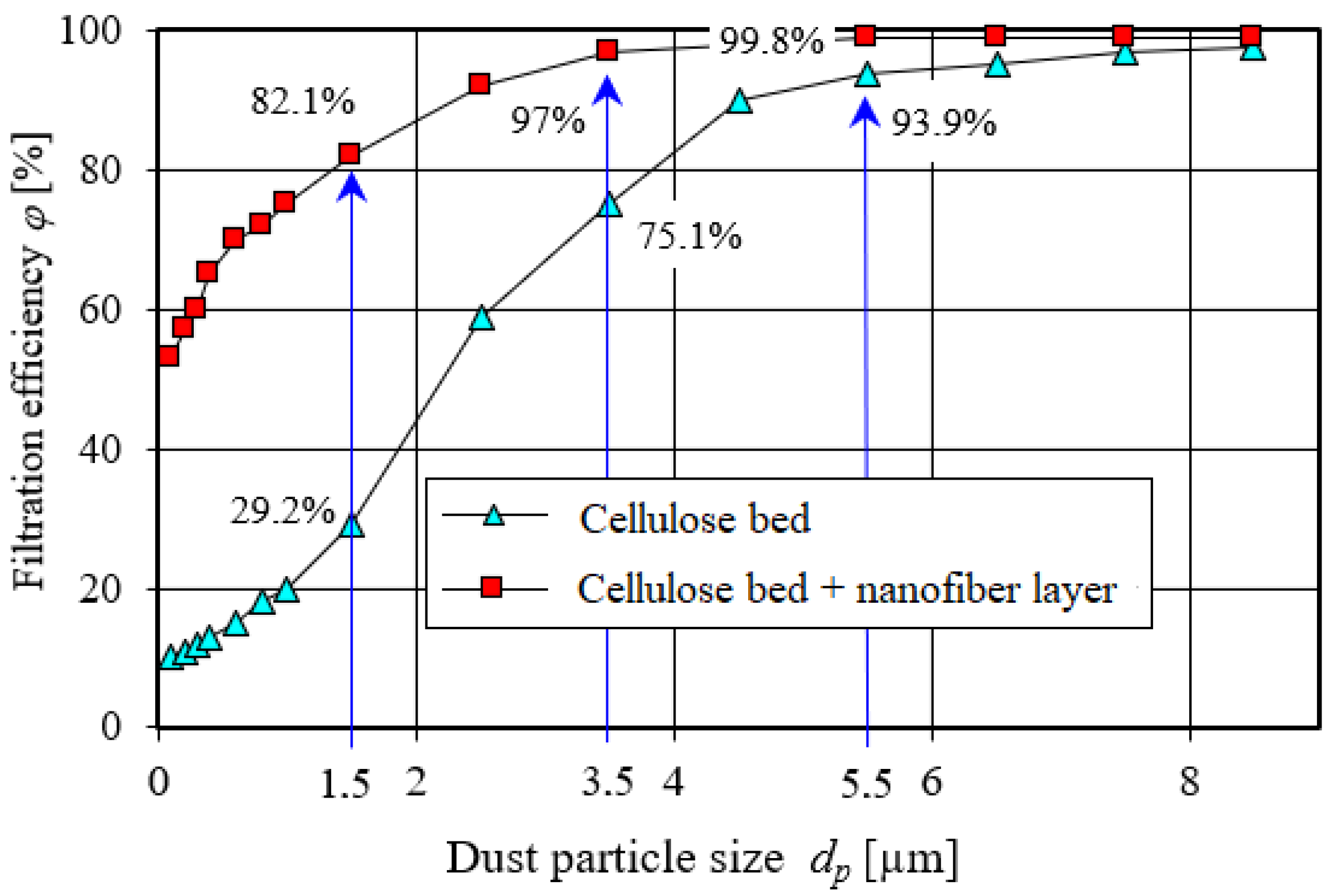
Figure 34 shows changes in filtration efficiency depending on dust particle size for a cellulose fiber bed (standard) and a bed with an additional layer of nanofibers applied to the cellulose bed. A significant increase in the filtration efficiency of dust particles below 5 µm can be seen. For dust particles smaller than dp = 3.5 µm, the filtration efficiency increased from φ = 75.15% to 97% for the bed with a layer of nanofibers. For dust particles smaller than dp = 1.5 µm, there is a significant increase in filtration efficiency from φ = 29.2% to 82.1%.
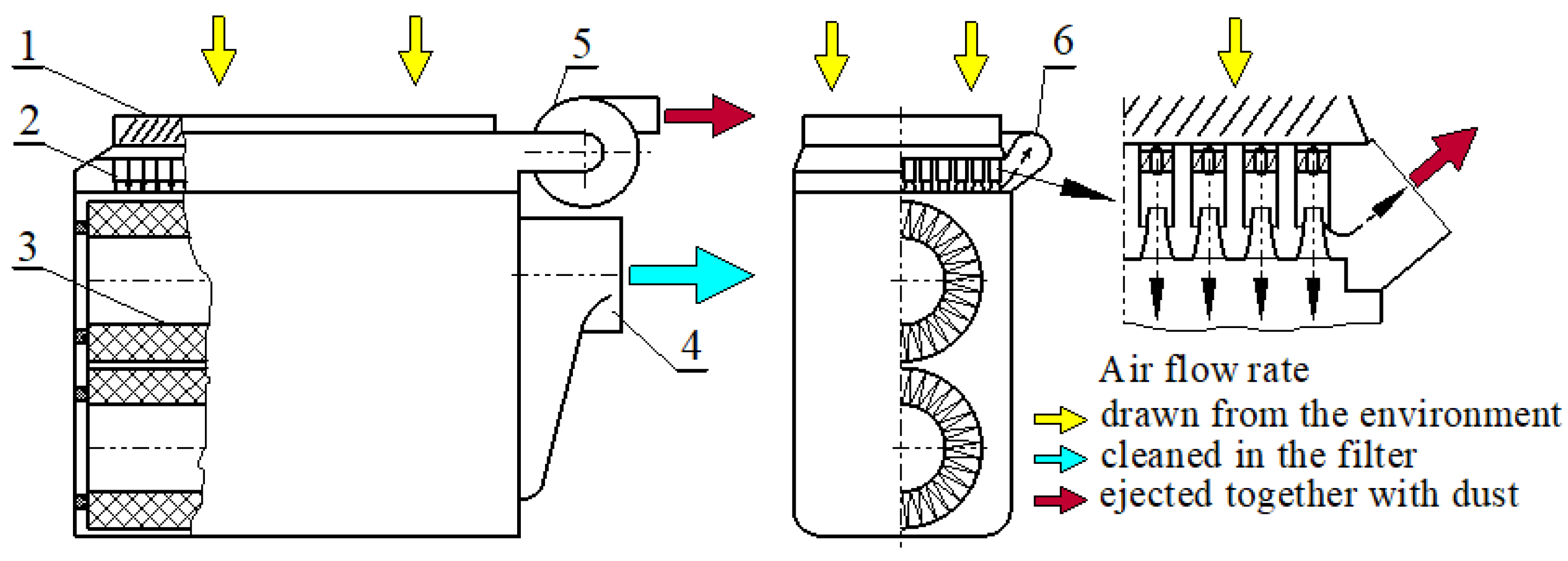
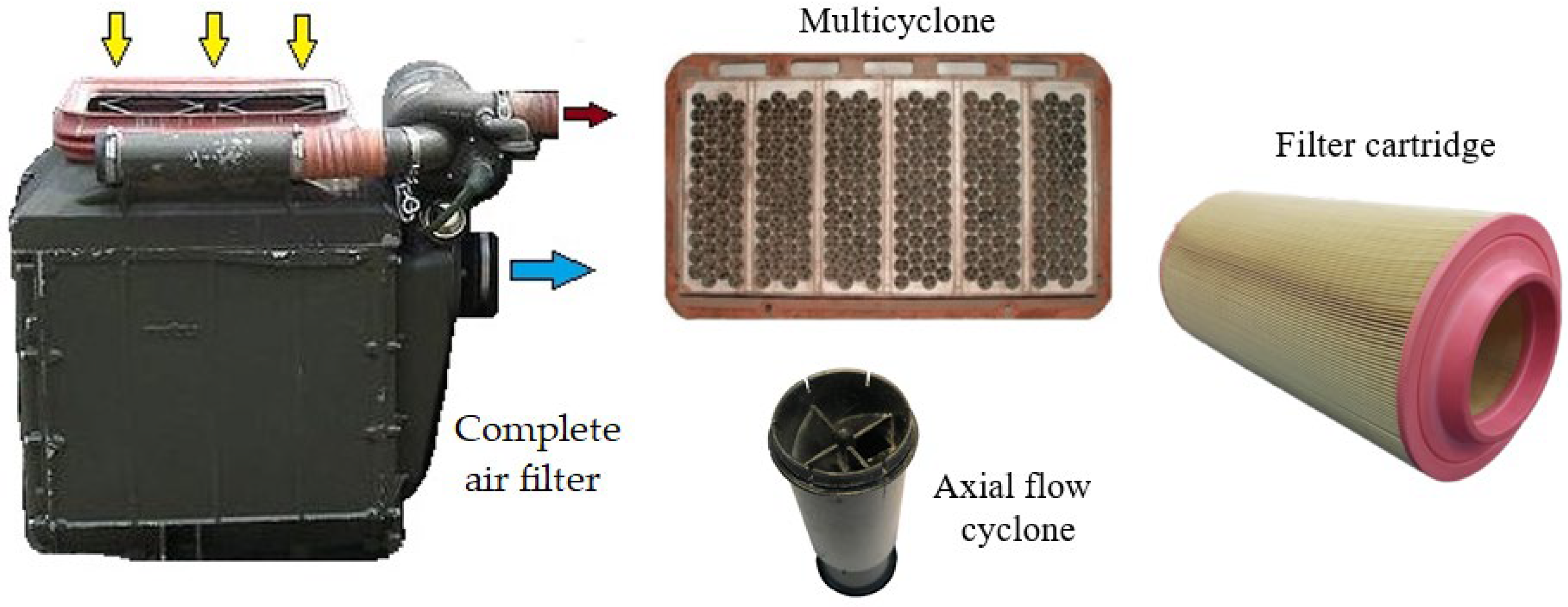
Figure 35 shows a functional diagram of the Leopard 2 tank air filter operating in a two-stage “multicyclone-porous partition” filtration system. The multicyclone consists of 288 through-flow cyclones with axial inlet. The porous barrier consists of two cylindrical filter cartridges made of pleated paper, each with an area of 22 m2 (Figure 36). The filtration of the intake air to the Leopard 2 tank engine is ensured by two identical filters located in the intake duct of the right and left cylinder banks. The dust retained by the cyclones is collected in a dust collector, from where it is systematically removed outside the vehicle by an air stream generated by a special fan.
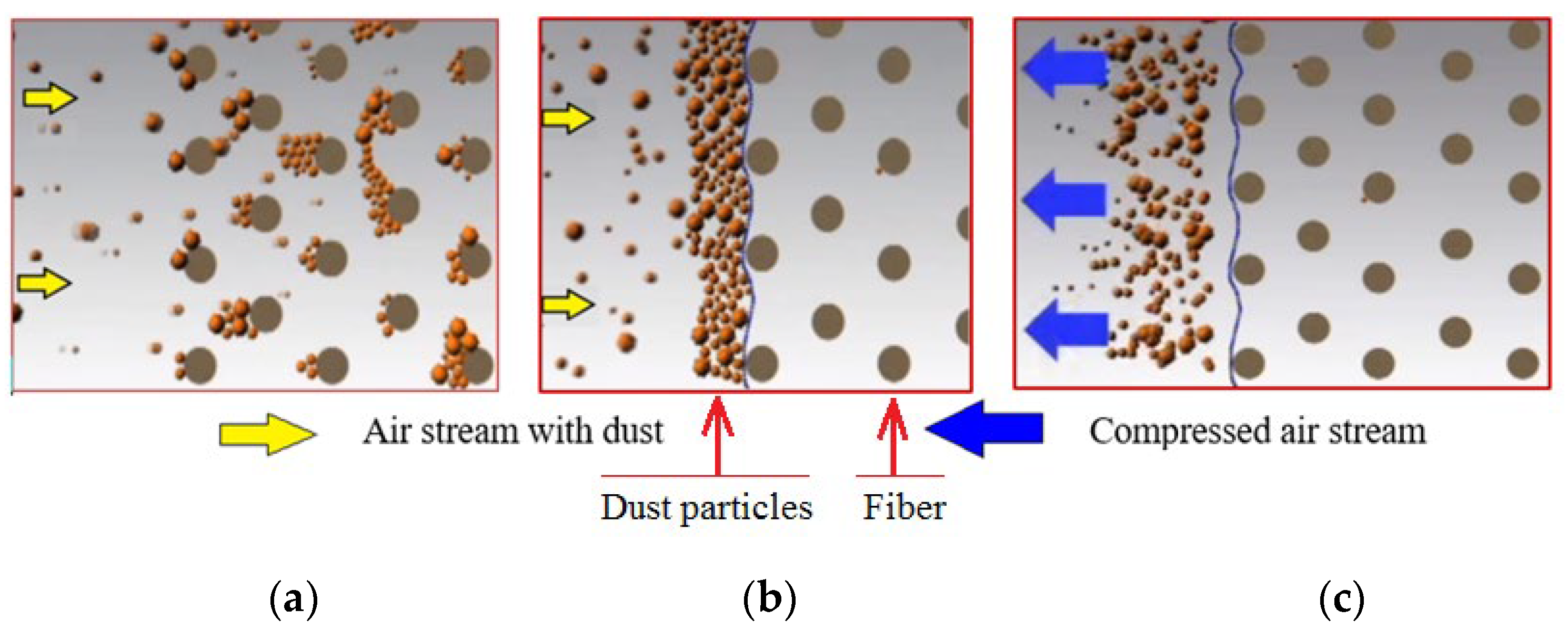
Nanofiber-coated filter media provide high filtration efficiency and accuracy, but their dust absorption and service life are low due to the accumulation of a substantial amount of dust on the media surface and airflow obstruction. The rapid increase in flow resistance and the rapid achievement of the allowable flow resistance Δpdop limits the service life of nanofiber media. One typical technology enabling filter reuse is reverse pulse jet cleaning (Figure 37). For the regeneration of dust-filled filter elements, reverse pulse jet cleaning is currently the most popular and effective method used in industry [103,104,105,106,107] and the automotive industry [102,108]. When the flow resistance Δpdop is reached, the filter media is purged with a pulse of compressed air, which extends the service life of the filtration system.
However, in practice, uniform cleaning of filter media is not an easy task, resulting in uneven cleaning of media and loss of effective filtration area [109,110].
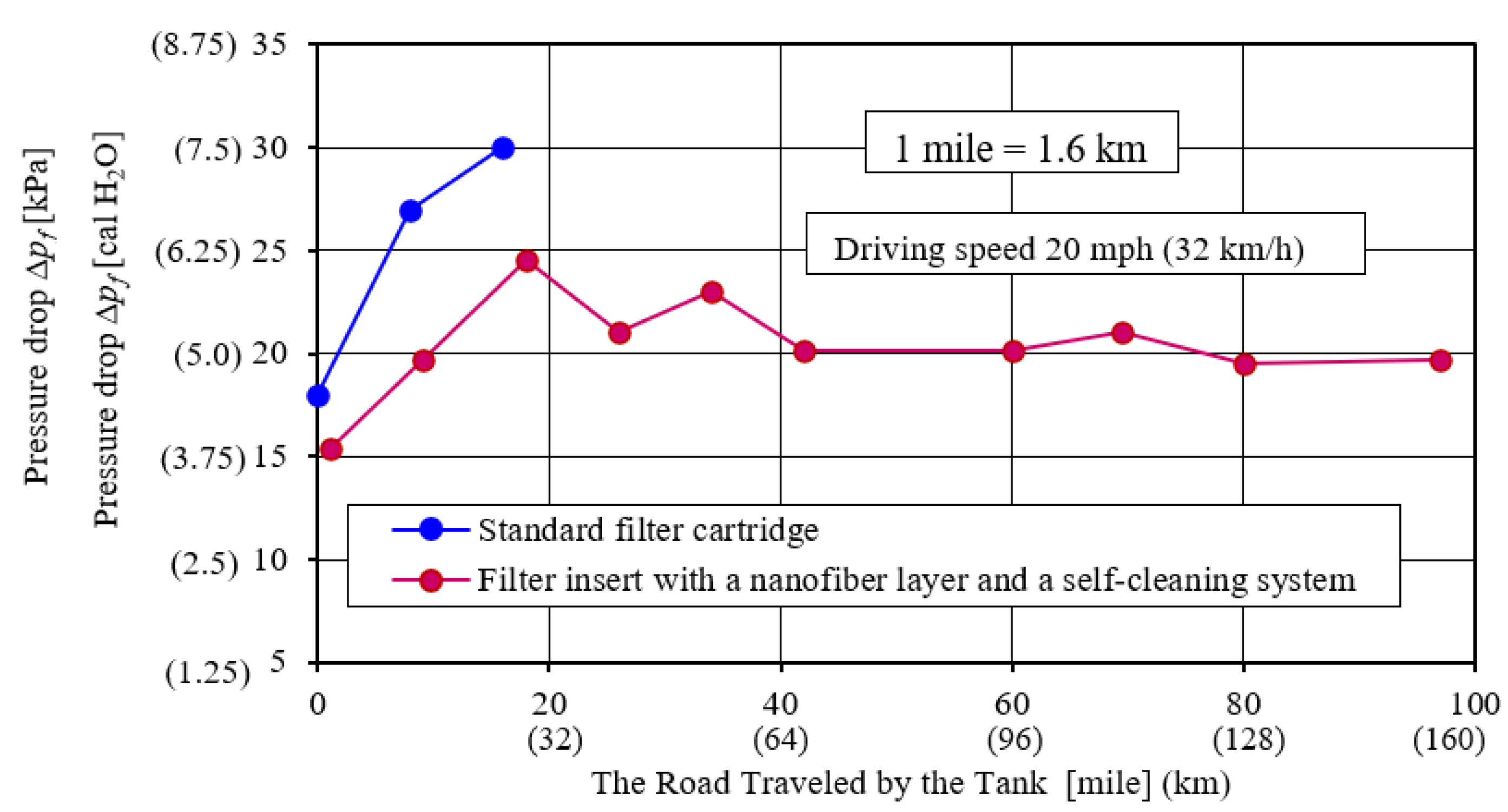
There are known design solutions for vehicle intake air filters (Abrams M1) that utilize a nanofiber filter element and the PJCA (Pulse Jet Air Cleaner) automatic pulse-cleaning system [102]. This system ensures several times longer air filter life, and therefore vehicle life, without requiring maintenance. The PJCA system operates by generating a compressed air pulse at a pressure of 0.4–0.6 MPa for a period of 0.1–0.35 s. Flowing in the opposite direction to the airflow during the filtration process, the compressed air blows dust particles from the filter element surface, which then fall into the dust collector [78]. Figure 38 shows that a standard filter element installed in the engine intake system of a tank traveling in a convoy in desert conditions reached its allowable flow resistance, ∆pdop = 7.5 kPa (30 in. H2O), after traveling approximately 25 km (16 miles). When the nanofiber filter element equipped with the automatic pulse purge system reaches its maximum flow resistance of approximately 6.3 kPa (25 in. H2O), the pulse purge system is activated, and the flow resistance decreases to approximately 5 kPa (20 in. H2O).
For a fiber filter, the key criteria for assessing its filtration performance are filtration efficiency, pressure drop, dust holding capacity, and service life. Filtration efficiency and pressure drop reflect the air purification efficiency and energy consumption of the fiber filter, respectively. Dust holding capacity is defined as the total mass of particles collected by the fiber filter when the pressure drop across the fiber filter reaches twice the initial pressure drop. Filter service life is closely related to dust holding capacity, which depends on particle size and the microstructure of the fiber material. Depending on the particle separation method, fiber filtration processes are typically classified into two categories: surface filtration (cake filtration) and depth filtration.
Experimental studies show that most fiber filters are typically used for a period of time, during which time particulate matter accumulates in the filter element until the target service life, defined by the allowable resistance, is reached. Therefore, despite its high efficiency, filter element replacement is necessary. A high-performance fiber filter must be characterized by high filtration efficiency and fineness, low pressure drops, and high dust holding capacity to extend its service life, reduce energy consumption, and avoid frequent filter element replacement. Gradient fiber media meet these requirements. These are innovative filter media characterized by varying fiber packing density or fiber diameter along the airflow direction. Their primary goal is to optimize the filtration process by improving dust holding capacity (absorption capacity) while simultaneously reducing air flow resistance.
These filters typically consist of several layers. The initial layers (air inflow side) have a looser structure with larger pores and thicker fibers, allowing for the capture of larger particulates. Subsequent layers (air outflow side) are increasingly denser, with smaller pores and thinner fibers (often nanometric), effectively retaining smaller particles. Thanks to this structure, contaminants of varying sizes are captured by the filtration mechanisms evenly at appropriate depths within the filter (depth filtration), not just on the surface, preventing rapid filter clogging and extending its service life. Figure 39 shows an example of a gradient filter bed used for filtering the intake air of motor vehicle engines [111].
The authors of [112] presented an optimization of the mass distribution of polydisperse particles deposition within fibrous filter media by modifying the fiber packing density distribution along the bed depth. The transport and deposition characteristics of polydisperse atmospheric aerosol particles were studied in three fibrous media with different spatial distributions (uniform, linear, and exponential) along the flow direction. The mass distribution of particles deposition within the fibrous filter media was analyzed.
Simulation results indicate that gradient filter media enable the transport and deposition of a larger number of particles within the filter media, improving the uniformity of the particle deposition distribution along the filter depth. There is an optimal fiber packing density distribution coefficient for gradient filter media, which minimizes the non-uniformity of the mass distribution of polydisperse particles deposition along the filter depth. This achieves a uniform particle distribution along the flow direction, optimizing the fiber packing density distribution, which contributes to the optimal design of fibrous filter microstructures.
In [113], composite membranes made of Nylon-6 micronanofibers with a three-dimensional (3D) uniform gradient structure were prepared by air jet spinning. The prepared material was characterized by a uniform gradual gradient of pores from large to small, ensuring PM0.25 capture. The Nylon-6 FCM structure exhibited high tensile strength, good moisture permeability, and excellent filtration performance. The material with a uniform, gradual pore gradient achieved optimal filtration performance with high (99.99%) filtration efficiency and low (144 Pa) flow resistance, as well as good moisture transport capacity for ultrafine aerosol particles (≤0.25 µm) at an airflow velocity of 0.0315 m∙s−1.
The authors [114] designed a new gradient PPS-based filter material with high efficiency and low flow resistance. The surface layer structure was created by combining numerical simulation, high-temperature melt-blowing, and lamination technology with PPS micronanofiber membranes. Utilizing the three-dimensional porous network structure formed by the staggered fiber arrangement in mPPS, the PPS-25/NF-5 filter material was designed, demonstrating excellent filtration performance, low flow resistance, and long service life. Compared with commercial PTFE-laminated membrane filters, the average cleaning cycle of mPPS-25/NF-5 was shortened by 188.13 s, and the average residual resistance was reduced by 41.84 Pa.
In [115], multi-scale fibers (80–800 nm) produced by multi-jet electrospinning were combined with melt-blown nonwoven fabrics to form a three-dimensional, gradient-hierarchical filter material (3D-MNFG), which is characterized by a layered structure with a pore size gradient varying from 1832 μm to 0.5–2.4 μm and 0.3–0.4 μm. At an initial pressure drop of 90 Pa, the material achieves a high filtration efficiency of 97% and a quality factor of 0.038 Pa–1. The produced novel material overcomes the limitations of existing submicron fiber membranes, providing a dust retention capacity of 22.02 g/m2. Filtration tests showed that at high air velocity (28 m/s), the flow resistance gradually increased, reaching the permissible value of 450 Pa after 29 days of operation.

3.4. The Effect of Air Filter Pressure Drop on Engine Performance

A characteristic feature of partition filters is that during operation, as a result of the deposition and accumulation of dust particles in the filter bed, the filter pressure drops Δpf, defined as the static pressure drop behind the filter, systematically increases in value. The intensity of the increase in filter resistance depends on the conditions in which the vehicle is operated, mainly on the concentration of dust in the air and the operating time of the vehicle (engine) [116]. The higher the concentration of dust in the air sucked into the engine, the faster the filter reaches the value Δpfdop. The dust retention process is strongly dependent on the size of the incoming particles [117,118]. As the fraction of fine particles increases, the cake consists of a larger number of fine particles, which have a larger surface area per unit mass than large particles. For this reason, as the mass fraction of fine particles in the mass of the sucked-in dust increases, the pressure drop of the filter media increases rapidly, and the filter’s service life, limited by the achievement of the Δpfdop value, becomes shorter and shorter [119,120].
When the dust absorption capacity of the filter cartridge is exhausted, there is a sharp increase in the pressure drop of the air filter, and the pressure drop Δpf at which this phenomenon occurs is called the permissible resistance Δpfdop. It is difficult to find a sufficiently complete picture of the impact of air filter pressure drop on engine performance in the available literature, particularly on its operating characteristics, such as power, specific fuel consumption, or increased exhaust emissions. It is not very common to find relationships that clearly define the nature of changes in engine power loss as a function of increasing air filter pressure drop. The available literature contains few experimental results on the impact of filter flow pressure drop on the operating parameters of carburetor engines or engines with a classic injection system [121,122,123,124,125,126].
The author’s research is presented in [121,122] presents the author’s research aimed at assessing the impact of air filter flow pressure drop Δpf on the characteristics of the filling coefficient ηυ = f(n), power Ne = f(n) and torque Mo = f(n) of a six-cylinder naturally aspirated engine with a classic injection system. At an engine speed of n = 2800 rpm, the filter flow pressure drop had the following values:
  • Δpf = Δpfo = 2.3 kPa (air filter pressure drop with a clean filter cartridge),
  • Δpf = Δpfdop = 6 kPa (permissible air filter pressure drop),
  • Δpf = 2Δpfdop = 12 kPa.
With increasing engine speed, regardless of the air filter pressure drop value, the filling factor takes on almost constant values for lower and medium engine speeds (Figure 40). For higher rotational speeds, there is a slight decrease in ηυ, resulting from increasing flow pressure caused by the increasing air flow velocity. This is therefore a typical filling characteristic curve ηυ = f(n) for a naturally aspirated Diesel engine CI. As the air filter flow pressure drop increases from Δpfo = 2.3 kPa to Δpfdop = 6 kPa, and then to Δpf = 2Δpfdop = 12 kPa, the filling characteristics ηυ = f(n) shift almost parallel towards lower values of ηυ (Figure 40). At an engine speed of n = 2800 rpm, the filling coefficient takes the following values: ηυ = 0.785, 0.695, 0.583. An increase in air filter pressure drops by 1 kPa causes a decrease in the filling coefficient by an average of 2.65%.
A decrease in the filling coefficient ηυ causes a deterioration in engine performance: a decrease in torque M0 and power Ne, and an increase in specific fuel consumption ge. The characteristics M0 = f(n), Ne = f(n) and ge = f(n) for flow pressure drops values: Δpfo = 2.3 kPa, Δpfdop = 6 kPa, 2Δpfdop = 12 kPa are shown in Figure 41.
An increase in air filter pressure drop in the range of 2.3–12 kPa, when the engine is running at a speed of n = 2800 rpm and 100% load, causes a decrease in the filling coefficient by 25.7%, power by 7.16%, and an increase in specific fuel consumption by 8.49%. An increase in air filter pressure drop of 1 kPa causes an average decrease in the filling coefficient by 2.65%, power by 0.739%, and an increase in specific fuel consumption by 0.876% (Figure 42).
The reduction in ηυ, and thus the mass of air supplied to the engine cylinders at the same fuel dose (n = const, Ge = const), resulted in a decrease in the air excess coefficient λ from 1.36 at Δpf0 = 2.3 kPa to λ = 0.96 (at Δpf = 12 kPa). For an CI engine operating under rated conditions (the tested engine operated under such conditions), this ratio should have a value of λ = 1.3. With this value of λ, the conditions in the engine cylinders are favorable for mixture preparation, ignition initiation, combustion, and heat release, and thus the engine achieves maximum power. An increase in air filter pressure drop disrupts these processes. A lack of air prevents the fuel from burning completely, resulting in a decrease in engine efficiency and, consequently, a decrease in torque M0 and power Ne.
The paper [123] presents the author’s research aimed at assessing the impact of air filter flow pressure drop Δpf on the external characteristics of effective power Ne and specific fuel consumption ge of a twelve-cylinder (V-type) naturally aspirated engine with a displacement of 38.8 dm3 and a rated power of 430 kW (580 hp) at n = 2000 rpm, with a classic injection system and a multi-range speed controller. The following pressure drop values were used during the tests: Δpf = 6 kPa, Δpf = 13.3 kPa, Δpf = 26.7 kPa, Δpf = 30.7 kPa and without a filter. An increase in air filter resistance causes a significant drop in engine power and an increase in specific fuel consumption, as well as an almost parallel shift in the external characteristics of power and specific fuel consumption towards lower values of power Ne and fuel consumption ge, with a simultaneous shift towards lower rotational speeds. For a pressure drop of Δpf = 26.7 kPa, the power drops ΔNe take the following values: 11.75% at 2000 rpm, 20.6% at n = 1400 rpm, and 32.7% at 1200 rpm.
The paper [124] presents experimental studies of the influence of air pressure drop Δpf on the filling coefficient ηυ and exhaust smoke of a turbocharged, six-cylinder (Vss = 6 dm3) engine with a classic injection system. The influence of four technical conditions of the air filter, differing in flow resistance, was examined: Δpf = 3.1 kPa (filter with a clean paper cartridge), Δpf = 11 kPa, 18.7 kPa, 24.7 kPa (filter paper cartridges with varying degrees of contamination). As the pressure drop of the filter increases, the filling degree decreases, respectively: ηυ ≈ 0.90; 0.81; 0.75. An increase in resistance Δpf by 1 kPa therefore causes a decrease in the degree of filling by an average of 1.49%, 1.29%, 1.23%. An eightfold increase in resistance Δpf above the initial resistance value Δpf0 causes a twofold increase in smoke emission from the tested engine CI (increase in light absorption coefficient) to k = 0.81 m−1. The permissible value of the increase in the light absorption coefficient for this type of engine is kmax = 3.0 m−1.
The study [125] presents research on exhaust emissions during the operation of a carburettor engine with and without an air filter. The operation of the engine without an air filter is characterized by a higher percentage of CO2 and NOx in the exhaust gases. When the engine is operating at a constant load in the speed range of 1500–2000 rpm (without a filter), the volume fraction of CO2 in the exhaust gases is only 7.7% and 12% higher than when operating with an air filter. At 2500 rpm, this is 25% more. This is because, due to the lack of an air filter, a greater mass of air flows into the engine cylinders. The excess air causes complete and thorough fuel combustion, resulting in more CO2 being produced. At the same time, when the engine is operating at a constant load at speeds of 1500, 2000, and 2500 rpm (without a filter), the volume fraction of NOx in the exhaust gases is 51.7%, 8.1%, and 20.2% higher, respectively, than when operating with an air filter. The formation of NOx in the engine is influenced by the maximum temperature and pressure of the combustion process. Without an air filter, the combustion process is more efficient, which leads to higher temperatures and pressures of the gases produced during this process. Higher temperatures and pressures in the cylinder, which are caused by more efficient combustion, promote the formation of more NOx.
The above information shows that in the engines tested, the mass of fuel supplied to the engine cylinders was not adjusted with the air flow, the value of which decreased with increasing air filter resistance. For this reason, there was an excess of fuel in relation to the air supplied to the engine cylinders. As a result, fuel combustion was incomplete and imperfect, leading to a decrease in power and an increase in specific fuel consumption.
In modern spark ignition engines, electronically controlled multipoint gasoline injection systems are used to prepare the mixture, allowing for precise control of the fuel dose and the start of injection. This, together with information from the air flow meter, makes it possible to determine the stoichiometric composition of the fuel mixture and, as a result, reduce the emission of toxic exhaust components. Passenger cars commonly use spark ignition engines with direct fuel injection and electronic control. Truck engines, on the other hand, are equipped with electronically controlled injection systems, which include high-pressure injection systems, such as the Common Rail injection system, and mechanically or hydraulically driven pump injectors. The microprocessor of the on-board computer controls all variables affecting the torque produced by the engine, while meeting the requirements for exhaust emissions and fuel consumption throughout the entire service life of the vehicle.
In a modern engine air supply system, there is a flow meter (HFM laminar flow meter or HLM wire flow meter) that determines the mass of air taken in by the engine and transmits the corresponding voltage signal to the on-board computer. The exhaust system, on the other hand, has a λ probe that continuously monitors the amount of oxygen in the exhaust gases.
The author presented research on engines with modern fuel and air supply systems in his work [126]. The aim of the research was to experimentally assess the impact of air filter pressure drop Δpf on the operating parameters of a modern truck engine with a compression ignition system. The subject of the research was a six-cylinder Volvo engine with a maximum power of 338 kW. According to the approval documents, the tested engine meets the requirements of the EURO V standard.
Four technical conditions differing in the pressure drop value of the same air filter were tested.
  • Δpf1 = 0.580 kPa (filter with a clean, brand new paper air filter element),
  • Δpf2 = 0.604 kPa (air filter with a filter element covering approximately 33% of the active filter surface),
  • Δpf3 = 0.757 kPa (air filter with a filter cartridge that has approximately 66% of its active filtration surface area covered),
  • Δpf4 = 2.024 kPa (air filter with filter cartridge, approximately 90% of the active filtration surface area covered).
With the increase in the pressure drop in the air filter Δpf, the filling characteristics ηυ = (n), in the rotational speed range n = 1000–1900 rpm, shift almost in parallel towards lower values (Figure 43). The increase in the pressure drop in the air filter from the value Δpf = 0.580 kPa (technical condition “New”) to Δpf = 2.024 kPa (C-90) causes a decrease in the maximum value of the filling factor from ηυ = 2.5 to ηυ = 2.39, i.e., by 4.5%.
The highest exhaust opacity was recorded in the engine speed range n = 1000–1100 rpm (Figure 44). However, as engine speed increases, exhaust opacity, regardless of the technical condition of the air filter, decreases rapidly. It remains constant in the engine speed range n = 1100–1700 rpm, then increases slightly. However, increasing air filter pressure drop does not significantly change the exhaust opacity level compared to the permissible value specified in the technical conditions for vehicle approval for this type of vehicle at 1.5 m−1 [126].
Figure 45 shows the effect of four air filter technical conditions (New, A-33, B-66, C-90), differing in pressure drop, on the effective power characteristics Ne = f(n) and specific fuel consumption ge = f(n) of a Volvo engine [126]. With increasing engine speed, the effective engine power Ne, regardless of the technical condition of the air filter, increases rapidly until the engine reaches an engine speed of n = 1400 rpm, and then decreases slightly until it reaches an engine speed of n = 1900 rpm, after which it loses its value rapidly. The use of an air filter Δpf with increasingly higher-pressure drop-in accordance with the technical conditions (A-33, B-66, C-90) causes a shift in the Ne = f(n), characteristics in the engine speed range of n = 1400–1900 rpm, almost in parallel towards lower engine power values.
As the engine speed increases, the specific fuel consumption ge, regardless of the technical condition of the air filter, slowly increases until the engine reaches a speed of n = 1900 rpm, and then increases significantly. When 33% of the active surface area of the cartridge is covered, no significant differences (more than 1%) in the change in net power Ne and specific fuel consumption ge were found. A further increase in the pressure drop of the air filter (B-66, C-90) has a significant impact on the decrease in power and a slight impact on the increase in specific fuel consumption (Figure 45). At a rotational speed of n = 1900 rpm, the decrease in power caused by the increasing pressure drop of the air filter (A-33, B-66, C-90) takes the following values, respectively: 0.029%, 2.31%, 9.31%. At the same rotational speed, the increase in specific fuel consumption takes the following values: 0.39%, 1.74%, 2.52%.
Thomas et al. [127] studied the effect of air filter pressure drop on changes in exhaust emissions of three truck diesel engines. The test results for a Dodge Ram 2500 Truck-6.7 L (2007) with a 6.7 dm3 inline six-cylinder engine with a variable geometry turbocharger, a diesel particulate filter (DPF) and a NOx emission control system (LNT) are shown in Figure 46. An increase in air filter resistance from 0.3 kPa to 3.9 kPa and then to 7.6 kPa causes a slight increase in CO, HC and fuel consumption and a slight decrease in CO2 and NOx. A significant (from 0.3 to 7.6 kPa) increase in air filter pressure drop causes slight changes in exhaust emissions, which is caused by the devices equipped with this vehicle, namely: turbocharging, which ensures the appropriate air flow, a diesel particulate filter (DPF) and a NOx emission control system.
To protect the engine against excessive power loss and increased exhaust emissions caused by increased air filter pressure drop, special permissible pressure drops sensors Δpfdop are installed in the intake system [128,129]. When the sensor reaches the manufacturer’s specified pressure drop value at the maximum air flow rate for a given engine, it is a signal to service the air filter–replace the filter element. For trucks and special vehicles, the Δpfdop values are assumed to be approximately 6.25–7.5 kPa above the pressure drop of a clean air filter [130]. The permissible pressure drops Δpfdop for passenger car engines is 2.5–4.0 kPa, for truck engines 4–7 kPa [131], and 9–12 kPa for special-purpose vehicle engines [132].

4. Filtration of Air Intake for Helicopter Turbine Engines

The need for filtered intake air for helicopter engines was first proven during the Vietnam War. The authors of [133,134] demonstrated on CH-54A and CH-53A helicopters that engine life can be significantly extended by using filters on the air intakes. In 1969, the JFTD-12-4A turboshaft engine in the CH-54 helicopter was replaced due to sand abrasion after flying in Southeast Asia for less than 60 h. The average replacement time for this type of engine was only about 80 h. After installing a particulate separator, its service life increased to 800 h, a tenfold increase. Similar studies were conducted on the OH-58A light observation helicopter. Problems with turbine engines that occurred during the 1991 Gulf War indicate that it is necessary to use devices to prevent engine erosion caused by dust sucking in from the environment. The authors of [64] state that if the separation efficiency of the intake system increases from 94% to 95%, the expected engine life will be doubled, and if the efficiency increases to 97%, the expected life will be doubled again.
Various forms of air intake protection for helicopters have been proposed to filter the air intake for helicopter turbine engines, protect engine components from mineral dust, and extend their service life, such as intake barrier filters (IBF), tube separators (VTS), and particulate separators (IPS). All these forms of protection are referred to in technical literature as Engine Air Particle Separation (EAPS), which are commonly divided into three categories [135,136,137,138,139]:
(b) Vortex Tube Separators (VTS)—use of the centrifugal force of solid particles generated by axial inlet cyclone systems.
(c) Inlet Barrier Filters (IBF)—use of barrier beds made of filter materials with protective screens at the inlet.
(d) Inertial Particle Separators (IPS) use of the inertial force of solid particles during a sudden change in the curvature of the inlet geometry.
  • Vortex Tube Separators (VTS)
Vortex Tube Separators (VTS) are axial inlet cyclones, components that are also used in two-stage multicyclones for intake air filters in motor vehicles operating in dusty conditions. VTS cyclones consist of three main components: a cylindrical body, a stationary impeller located centrally inside the cyclone body, and an outlet pipe, usually conical in shape, whose cross-sectional area increases towards the outlet (Figure 47). The outlet pipe is inserted into the cylindrical part of the VTS at section a, forming a ring channel with a height of b, called the dust collection chamber, which connects to the dust collector where the contaminants are stored. The area of the cylindrical part along the length lm (between the rotor and the inlet pipe opening) is called the particle separation area.
The VTS rotor is usually constructed of four blades (guides) with a helical (screw) surface (Figure 47) symmetrically attached to the central core. The blades are inclined at an angle αk, defined as the inclination of the rotor blade at the cyclone wall relative to the normal cyclone axis. The angle β between the leading and trailing edges of the blade is called the blade twist angle. The rotor core extends beyond the edges of the vanes into the separation area, which is important for gas flow in the cyclone. In the inlet section of the rotor, the core has a streamlined shape, most often in the form of a hemisphere, which causes a radial distribution of the air flow around the rotor and directs the air flow towards the guide vanes. This gives the dust particles an initial radial momentum towards the wall of the cylindrical section.
The VTS cyclone operates by utilizing the centrifugal force FB generated by dust particles in the air stream set in motion by a screw (external vortex) during axial inflow to the rotor blades. The centrifugal force causes the dust particles to move toward the inner wall of the cyclone. This movement is counteracted by the medium resistance force FR. Dust particles that currently meet the condition FB > FR overcome the air resistance force and follow a spiral motion towards the inner wall of the cyclone, where they are slowed down and directed to the collection chamber and then to the sedimentation tank. The shape of the path along which the dust particles move will depend mainly on the mutual relationship between the values of FB and FR. Dust particles of smaller size and mass, for which the condition FB < FR applies, are carried away by the stream flowing towards the outlet pipe.
The contaminants stored in the settling tank are continuously discharged to the outside by an additional air stream called the suction stream. During this time, the particles are driven mainly by the spiral air flow and to a lesser extent by the force of gravity.
Individual VTS cyclones with the same diameter, which usually do not exceed 40 mm, are arranged parallel to each other. The ends of the cylindrical part are tightly fixed in a common top plate, and the ends of the outlet pipe in a common bottom plate. The bottom and top plates are tightly connected by side walls, forming a multicyclone consisting of several dozen (several hundred) filter elements.
The dust separated by the multicyclone is collected in a settling tank, from where it is continuously removed to the outside by generating (using the ejection phenomenon) a suction stream QS, which is part of the inlet (contaminated) stream Q0 to the multicyclone. To generate suction stream, appropriate ejectors using the energy of a compressed air stream (Figure 48) [140,141,142] and special fans or blowers (Figure 49) are used as flow-forcing devices.
Air intake filtration systems for Mi-17/Mi-8MT, Ch-47 Chinook, and Mi-8/17 helicopters equipped with VTS devices are discussed in [143,144,145,146]. Figure 50 shows the intake air filtration system for the Mi-17/Mi-8MT helicopter engine with a VTS device installed.
The intake air filtration system for helicopter engines equipped with a VTS device has several advantages. The device does not require maintenance due to the use of a system for the continuous removal of dust from the sedimentation tank, which significantly reduces maintenance costs. Air pressure drop in the VTS is low due to the even distribution of airflow. In addition to protection against dust and sand, it provides protection against ice, snow, heavy rain, and salt spray. The VTS device also has disadvantages. It requires an additional air stream (suction stream) to remove dust from the multicyclone sedimentation tank, amounting to 5–10% of the mainstream [145,147,148]. A compressed air bleed or a fan that requires electrical power is used to generate suction flow. The VTS generates high pressure drop during flight because it is an externally mounted device and requires a large area to accommodate the appropriate number of cyclones and provide the required minimum inlet velocity.
Typically, IPS systems are more integrated with the aircraft engine, resulting in a more compact design, less flow obstruction, and better pressure drop characteristics. It has been found that a VTS system may require up to 5 times more surface area than an IPS system to achieve the same airflow, which is a clear disadvantage in terms of aerodynamic drag. IPS systems exhibit a lower separation efficiency of 86.25% than VTS and IBF systems, which exhibited 98% and 99%, respectively [149].
  • Inlet Barrier Filter (IBF)
The term Inlet Barrier Filter (IBF) applies to a device that consists of both a panel-shaped barrier (barrier) filter and IBF mounting components for the aircraft. In addition, the IBF includes a cover that replaces an existing section of the airframe, a frame with mounting points, and a hydraulically operated bypass (safety) valve to allow air to flow freely to the engine in the event of filter contamination or failure. The IBF is installed at the helicopter engine inlet to filter all engine-related air. In larger helicopters, such as the UH-60 Black Hawk, these devices may be installed as an add-on. In smaller helicopter models, such as the Eurocopter AS 350, they are designed into the airframe as a fully integrated device.
A barrier filter is a panel where the filter medium is usually a multi-layer cotton or cotton-synthetic nonwoven fabric. In the case of cotton, the filter bed consists of three to six overlapping layers arranged in a grid pattern. The filter bed is impregnated with a special oil-like preparation, which not only increases the efficiency and accuracy of the filtered air, but also acts as a good indicator of wear, changing color from red or green to brown or black as contamination increases. The use of oil also gives the filter the ability to repel water, which helps prevent absorption and extends its service life. The layered nonwoven fabric is reinforced with metal mesh on both sides to strengthen the structure (Figure 51).
The filter bed constructed in this way is pleated, which is intended to increase the filtration area without increasing the front area, whereby the geometry of the filter bed is of great importance here (Figure 52). In addition to increasing the effective filter area, pleating has the additional advantage of ensuring structural rigidity inside the filter element.
The pleated filter bed is then formed into panel filter elements of various shapes depending on the design of the helicopter housing. IBF panels of various shapes in the housing are presented in [150].
The barrier filter should be selected appropriately to allow air to flow into the engine in sufficient quantity and purity with the lowest possible pressure drop. Continuous accumulation of dust on the filter element increases the efficiency and accuracy of separation, but at the same time increases pressure drop. Excessive pressure drops across the filter reduces the air flow to the engine. When the pressure drop reaches a predetermined acceptable value, a bypass (safety) valve opens, allowing air to flow to the engine, but then the engine is exposed to solid contaminants sucked in with the ambient air, which may be present in the air at an emergency landing site. In marine environments, the engine may be susceptible to corrosion and flame out as a result of salt water ingestion. In vegetated areas such as grass fields, leaves can clog the air intake duct, causing flow distortion and high-pressure losses; and in most operations, foreign objects such as rock fragments, birds, and pieces of ice can destroy the compressor blade, causing serious problems for the engine.
For this reason, the filter cartridge is designed to achieve the largest possible filter surface area with a minimum cartridge volume, while maintaining the maximum permissible air flow velocity through the filter bed–the filtration velocity υFdop. To ensure an adequate filtration process in the filter bed, it has been experimentally determined that the permissible filtration velocity should not exceed υFdop = 0.06–0.12 m/s [151,152,153]. The filtration velocity is defined as the quotient of the volumetric air flow rate Qwmax drawn by the engine at nominal speed and the effective filtration area Aw.
v F = Q w m a x A w × 3600   [ m / s ]
The effective surface area Aw of a partition filter (panel) depends on its geometry (Figure 50) and is determined by the following relationship:
A w = 2 b p · a p · i p [ m 2 ] ,
where ip—number of pleats determined from the relationship:
i p = L p t p ,
The number of pleats per unit length is called density. Typical pleat height ranges from 25.4 to 76.2 mm (1 to 3 inches), and pleat spacing can range from 12 to 24 pleats per meter (3 to 6 pleats per inch) [61]. Filter elements are typically sized so that the total filtration area Aw is six times greater than the face area Ac. The filtration area Aw can be selected by changing the pleat height, the spacing between pleats, or the shape of the panel within the opening, for example, by bending the surface.
The author of [154] showed that in order to achieve optimal service life, the filter should be selected so that the average air velocity approaching the filter element at nominal power is less than 9.1 m/s (30 ft/s), and preferably between approximately 4.57 m/s (15 ft/s) and 7.62 m/s (25 ft/s). The inflow air velocity is determined as the quotient of the volumetric air flow rate Qwmax drawn by the motor at nominal speed and the effective projected filter area Ac—the front surface area.
However, pleating introduces a second source of pressure loss, caused by flow contraction and subsequent shear layer formation in the triangular pleat channels. This source increases with the number of pleats, resulting in a U-shaped pressure drop curve, giving the optimal design point for the IBF, i.e., the number of pleats for minimum pressure drop [155,156]. This phenomenon is known as optimal pleat density. Pleat density is usually determined by a given inlet velocity or volumetric flow rate per unit of inlet area. According to the authors of [155], the minimum pressure drop in a pleated filter increases as the pleat height decreases and shifts toward increasing pleat density.
For a given pleat height, there is an optimal number of pleats corresponding to the minimum pressure drop. With fewer pleats (or a smaller filter area), the filtration speed in the filter material will be higher, resulting in a greater pressure drop. With more pleats (or a larger filter area), the pressure drops caused by viscous resistance in the spaces between the pleats becomes more significant, resulting in a greater pressure drop. The optimal number of pleats therefore occurs when the combination of viscous resistance and medium resistance is minimal. For a given pleat height and material characteristics, the optimal number of pleats corresponding to the minimum pressure drop can be predicted.
Pleat geometry is a key design parameter when selecting a filter. The pleating process allows airflow over an area larger than the projected surface area of the filter, which reduces the velocity perpendicular to the filter surface, known as the surface velocity or filtration velocity. Reducing the velocity generally reduces the pressure drop, but it can also negatively affect the filtration capacity of the bed. Pleating creates a channel that narrows the air flow. While the air on the walls of the channel (or the surface of the filter medium) slows down and then penetrates the medium, the core of the air stream in the channel accelerates. This causes shear layers to form in the fluid, similar to a boundary layer, which causes a pressure drop due to viscous resistance. The narrower the pleat channel (higher pleat density), the greater the pressure loss. Therefore, the benefits of pleating in terms of reducing pressure loss through the filter medium decrease as the number of pleats per length increases.
Filtration efficiency and accuracy, pressure drop, and durability are the basic parameters of pleated filter media [157,158,159]. These parameters are mostly regulated by two factors: the properties of the filter material, including the characteristics of the fibers [115,160] and filter structure [161,162,163], and the parameters of the pleated filter material, including pleat height (hp), pleat width (tp), pleat angle (α), and pleat factor (kp–the ratio of pleat height to width) [164,165,166,167,168,169,170,171,172,173] (Figure 50).
In another study [164], the authors optimized the pleat geometry using the filtration quality factor q, taking into account separation efficiency and filter pressure drop. In this regard, they examined eight pleated filter beds with different numbers of pleats (4, 6, 8, 10, 15, 21, 25, 30 folds), pleat heights and widths of 29 mm and 105 mm, respectively. It was shown that for the same air flow rate for filters with more than 21 pleats, the pressure drop increased with a greater number of pleats. This phenomenon can be explained by the increased filtration rate resulting from the reduction in the effective filter area. The highest filtration quality factor, q = 5.8, was obtained for a filter with a pleat height of 29 mm.
In [165], the air purification efficiency of pleated PTFE membrane filters was examined in relation to different pleat spacings and pleat heights in order to determine the optimal pleat geometry for a stable and efficient air purification system. It was found that a PTFE membrane filter with pleats spaced 3 mm apart and 55 mm high has higher filtration efficiency and lower resistance than a conventional filter with the same pleat geometry. In addition, the PTFE membrane filter with pleats has high solid particle efficiency, which resulted in low solid particle concentrations (below 10 μg·m−3) in the exhaust air during 90 days of filtration.
The paper [166] presents experimental studies of several samples of pleated filter beds and their optimization aimed at minimizing flow resistance. The angle between the pleats, their length, and number were varied. For this purpose, a dimensionless pleating coefficient was defined as the quotient of the pleat height and the distance between the vertices of successive pleats. The highest filtration efficiency was achieved when this coefficient reached a value of 1.48. After exceeding this value, a systematic increase in filter pressure drop was recorded.
The authors of [167] optimized the filtration process using a pleated bed onto which dust was dozed. They proved that the optimal pleating density in a clean filter bed can result in a greater pressure drop during the filtration process involving dust. This is associated with greater energy losses.
In [168], the CFD–DEM coupling method was used to study the characteristics of particle deposition in pleated air filter materials. A model of a V-shaped pleated air filter material was constructed, with a pleat height of 50 mm, a pleat thickness of 4 mm, and a pleat angle of 3.7°. Based on a test rig compliant with ISO-16890/EN779 [169], a pressure drop test was performed on an actual single pleat sample (the pleat height of the medium is 50 mm, and the pleat thickness is 4 mm). The relationship between pressure drops and dust retention was examined. A parabolic relationship between dust retention and pressure drop was obtained.
Article [170] presents the results of numerical studies of cellulose filters of various shapes (flat, W-shaped, and corrugated). It was shown that a filter bed with a sinusoidal pleat shape is characterized by a lower pressure drop, a more uniform flow field distribution, and a smaller space, which was considered the optimal solution. Experimental studies have shown that an engine equipped with such a filter element is characterized by lower fuel consumption compared to operation with a pleated filter element, lower exhaust gas temperature at the same engine torque, and longer service life. The dust retention capacity of the optimized filter element is 16.2 g higher than that of the pleated filter element.
The experimental and numerical studies presented in [171] concerned a filter bed with pleats of various parameters. The aim of the studies was to optimize the pressure drop and thus improve the efficiency of a diesel engine. The influence of several filter bed parameters was examined: the height and shape of the pleats and the spacing between them, the thickness of the filter bed, as well as the influence of filtration speed and dust load on engine performance parameters, including rotational speed, torque, and fuel consumption. The lowest pressure drop was obtained for a filter with corrugated pleats, and the highest for a bed with flat pleats. The reduced spacing between the pleats resulted in an additional increase in pressure drop (by about 18%), while the increased height or thickness of the pleats resulted in a reduction in pressure drop by about 43% and 10%, respectively. The dust-contaminated filter bed caused a greater pressure drop and thus higher fuel consumption at the same torque and engine speed values. The engine equipped with an optimized filter had a lower exhaust gas temperature (218 °C) compared to the exhaust gas temperature of the engine running with a standard filter (233 °C). The highest exhaust gas temperature (250 °C) was recorded for the engine operating with a contaminated air filter.
The authors of [172] conducted a numerical and experimental study of the effect of pleat height and width on the pressure drop of pleated filter material in dust-free conditions. It was shown that the geometric configuration of the pleats changes the velocity distribution in the internal flow field. There is an optimal pleat geometry that can minimize the pressure drop. In contrast, study [173] showed that the pressure drop of the pleated filter bed initially decreased and then increased with increasing angle between the pleats, indicating the existence of a pleated angle value at which the pressure drop is minimal. In addition, changing the pleat angle also affected the process of particle deposition on the fibers of the filter bed. The influence of pleat height and pleat factor (α), expressed as the ratio of pleat height to width, on the filtration efficiency of pleated material was investigated in [174]. It was shown that both factors affect the pressure drop and filtration efficiency, and the optimal pleating geometry was observed when the value of the α coefficient was between 6 and 8. In addition to studying the effect of the structure of clean pleats on pressure drop, it was shown that the efficiency of pleated filter media changes with particle retention and accumulation.
The authors of [175] demonstrated that the rate of pressure drop increase in pleated filter media decreased with increasing pleat width. It was found that triangular pleats cause a smaller pressure to drop. A high pleating factor (α) resulted in higher flow velocities in the pleat channels, which led to greater unevenness in dust deposition on the pleats. This effect is less pronounced when the pleats are triangular in shape. The authors of [176] studied the effect of pleat shape, number of pleats, filter porosity, fiber diameter, flow velocity, aerosol concentration, and particle diameter, as well as the effect of particle loading of different sizes on the dust filtration efficiency of pleated filter media. The study of the filtration efficiency of a bed with 2 and 4 pleats per inch when exposed to polydisperse particles with a diameter of 1 to 10 μm and monodisperse particles with a diameter of 1 or 10 μm with the same mass flow, showed a shorter bed life for polydisperse aerosols. When examining small-scale pleated structures (pleat height 20 mm), the authors of [177] observed that as the pleating coefficient (α) increases, the pressure drop decreases and then increases, with the optimal pleating geometry occurring in the range of 1.15–1.59.
The pressure drops across the dust cake at varying pleat ratios was mainly dependent on the effective filtration area, which decreased with increasing pleat ratio at the same filtration velocities. Numerical studies presented in [178] indicate that, regardless of the orientation of the fibers in the plane, there is an optimal number of pleats in clean filters for which the pressure drop reaches a minimum. It has been shown that triangular pleats cause a smaller pressure to drop. The presence of dust particles in the filter bed causes the intensity of the pressure drop to decrease with an increase in the number of pleats. A larger number of pleats causes a higher flow velocity inside the pleat channels, which results in greater heterogeneity of dust deposition on the pleats. This effect is less pronounced when the pleats are triangular in shape.
However, the authors of [179], conducting numerical studies aimed at minimizing pressure drop and achieving maximum efficiency of various filter beds, showed that air filters with rectangular pleats can provide better performance than their triangular counterparts under high dust loads. These conclusions apply to the operation of filters in both depth and surface filtration regimes with particles of 1, 5, and 10 µm in diameter and a filtration speed range of 0.5–5 m/s. The authors of [180] investigated, using fine dust ISO 12103 A2 [181], the influence of pleat geometry (pleat heights: 10, 20, and 30 mm, pleat spacings 2.5, 3.0, 3.5, 4.5, and 5.5 mm) on filtration efficiency. It was found that the spacing between pleats and their height play an important role in determining filtration efficiency, pressure drop, and dust retention capacity. The optimal pleat geometry was achieved with a pleat height of 30 mm and a pleat spacing of 4.5 mm. After oil application, the pleated filter element with optimal pleat geometry showed a significant increase in dust holding capacity at the expense of a slight increase in pressure drop. Compared to the unmoistened pleated filter, the oil-moistened pleated filter exhibited higher filtration efficiency at higher velocities.
By changing the depth and pitch of the pleats, the filter can be optimized for minimum pressure drop and maximum particle capture capacity for a given set of constraints. For this reason, IBF systems have low initial pressure drop and very high filtration efficiency, which, depending on the filter material used, ranges from 99.3 to 99.9% [4,98,144]. The accumulation of dust in the IBF bed causes a systematic increase in pressure drop, which limits the air flow into the engine and can cause a drop in power. When the pressure drop limit is reached, a safety valve opens to allow contaminated air to flow into the engine. This also requires subsequent maintenance of the IBF bed. This is the main disadvantage of the Inlet Barrier Filter System (IBF) [182].
  • Inertial Particle Separators (IPS)
The term “Inertial Particle Separators (IPS)” refers to a device integrated into the turbine engine by the original equipment manufacturer. Mounted at the inlet, it is designed to filter inlet air containing solid particles [183,184,185,186,187,188]. Among the devices protecting the air intake of helicopters, particle separators (IPS) have become the most popular and widely used system for separating dust particles from the air due to their simple design, low total pressure loss, and low maintenance costs. Despite these advantages, IPS has several disadvantages. It requires electricity to power the cleaning fan and has lower separation efficiency compared to VTS and IBF. In 1969, the JFTD-12-4A turbine engine in a CH-54 helicopter was replaced due to wear caused by mineral dust sucked into the engine after less than 60 h of flight in Southeast Asia. The average life expectancy of this type of engine was only about 80 h. After installing an IPS particle separation device, its service life increased to 800 h, i.e., ten times [183].
A schematic diagram of the IPS operation is shown on Figure 53. The contaminated air stream enters the ring inlet, where, as a result of the appropriate geometry and inertia of the particles, it is separated into a clean air stream to the engine and a heavily contaminated stream directed to the outside.
Air filtration devices (IPS) consist of a central body (K) coaxial with the motor, surrounded by a cover, and a distributor placed in order to divide the air flow into a contaminated flow and a clean flow (Figure 54) [138]. The central body (K) directs the intake air through a ring channel (H) with a decreasing cross-sectional area. The shape of the central body is such that the radius of the ring channel increases with the axial distance from the inlet point and then decreases rapidly to the engine inlet at the point marked with the number (h). This shape creates a hump (G) where the air stream makes a sharp turn, remaining attached to the inner surface of the annular channel by viscous forces.
The IPS device works by imparting a radial velocity component to the high-speed inlet air flowing into the engine. As the air flows around the hump, it undergoes a sharp turn, which causes dust particles and other solid contaminants with high inertia to deviate from the direction of the air flow due to their inertia. This allows the particles to be easily separated from the core air stream by the ring separator. The highly concentrated particle stream is directed, together with 10% to 30% of the air stream, to an additional channel, from where the suction stream captures them and discharges them into the atmosphere (Figure 52). Small and light dust particles, which have less inertia, are directed along with the air along the inner wall of the central body to the motor. In addition to the forward-facing inlet, vortex blades are often used to give the flow a tangential velocity component and further improve separation. The suction (blow) flow, which is part of the inlet flow, is obtained by means of an electrically driven fan. The ratio of the mass flow rate in the suction channel m ˙ s to the total inlet mass flow rate, which is the sum of the mass flow rates in the channel to the engine m ˙ w and the suction channel m ˙ s , is defined as the suction ratio β and described by the relationship [135].
β = m ˙ s m ˙ s + m ˙ w
Increasing the suction rate β increases the suction flow and thus the separation efficiency. According to research presented in [135], the separation efficiency of IPS depends significantly on the suction flow rate and reaches 88% for β = 0.1, 92% for β = 0.16, and 94% for β = 0.2. However, this requires increased electricity consumption for the fan, which places a significant load on the power generation system. IPS is an integrated turbine engine system and has several advantages, such as compact design, low external resistance, low and constant pressure drop during operation with high separation efficiency, and no periodic maintenance due to continuous ejection of dust. Despite these advantages, IPS has several disadvantages. It requires electricity to drive the cleaning fan and has lower separation efficiency compared to VTS and IBF. According to the authors of [61], IPS systems have a lower separation efficiency of 86.25% than VTS and IBF systems, which showed 98% and 99%, respectively.
The design of combat helicopter drives is dominated by axially symmetrical radial dust collectors. Although it is not characterized by high separation efficiency (65–75%), it effectively eliminates larger dust particles (above 10 µm) from the inlet air stream, which can cause intense erosion of compressor rotor blades. In addition, this type of dust collector is characterized by moderate pressure drop at flow speeds of 60–100 m/s [65]. It is believed that the pressure drop of dust collectors should not exceed 1–1.5 kPa in turbine engines, with each 1 kPa drop in inlet pressure in helicopter turbine engines causing a decrease in power by about 1% and an increase in specific fuel consumption by about 0.7%.
Figure 55 shows a diagram of a spatial variant of an axially symmetrical, radial inertial dust collector for filtering inlet air intended for turbine engines of combat and transport helicopters. Separate contaminants are ejected using compressed air taken from an air compressor [189]. In Poland, radial dust collectors were introduced for use on Mi-2 and W-3 Sokół helicopters. They are also used on Mi-17 transport helicopters and Mi-24 combat helicopters [190].
The effectiveness of this type of dust collector depends on the air flow velocity and the proportion of the suction stream that discharges the separate dust mass into the atmosphere. As the flow velocity increases, the filtration efficiency increases, initially rapidly and then with less intensity, and at the same time there is a parabolic increase in pressure drop, which is a function of the flow velocity to the second power. The operation of the dust collector is a technical compromise between the acceptable pressure drop value and satisfactory filtration efficiency. A comparative overview of the relationships between these parameters in the form of optimal flow velocity values is presented in the graphs in Figure 56.
The graphs in Figure 56 illustrate nature, course, and ranges of the numerical values obtained for dust removal efficiency for the flow velocities and mass flow rates through the dust collector used in practice [189]. The axial cyclone dust collector achieves significantly higher dust removal efficiency values for lower flow velocity ranges (υ = 0–20 m/s) than the radial dust collector (υ = 40–120 m/s). This is due to the higher inertial forces obtained by dust particles in cyclones (internal diameter D = 45 mm) than in radial dust collectors, where the radius of curvature is several times greater and amounts to R ≅ 200 mm.
Studies in the literature indicate a decrease in IPS separation efficiency when the particle diameter falls below 20 microns. For this reason, IPS is ineffective in environments where the primary pollutant is fine-grained dust. The granulometric composition of mineral dust in different regions of the world varies significantly, as shown in Figure 2 [12]. The mass fraction of dust particles originating from the Arizona desert is Um = 28.5%, while in dust originating from the Tashkent region, this fraction is significantly higher, at Um = 82.3% (Figure 2). It follows that an IPS filter will be three times less effective in this region. In addition, the chemical composition of dust (the proportion of individual components in dust) varies and depends on the region and type of substrate (Figure 1).
The main component of mineral dust is silica SiO2, which accounts for 60–95% of the dust and has a hardness of 7 on the ten-point Mohs scale. The remainder consists of oxides of various metals: corundum Al2O3 (hardness on the Mohs scale is 9) and Fe2O3, whose share in the dust reaches 12.5% and 19%, respectively. In addition, dust contains smaller amounts, not exceeding 3% of oxides: MgO, CaO, K2O, Na2O, TiO2, NiO, SO2, and organic components [191,192,193].
Despite the engines being equipped with IPS devices, significant amounts of dust particles smaller than 20 µm and with high hardness, sucked in along with the air, caused numerous helicopter engine failures [66]. This necessitated the installation of new engine intake air filters. Work is underway on two-stage filters, which consist of two filters with different operating principles connected in series. A two-stage filter combining the advantages of the IBF baffle filter and the VTS inertial separator was presented in [139]. The first stage of filtration consists of VTS cyclones, which retain approximately 86% of larger and heavier dust particles, which means that approximately 14% of small dust particles are directed to the second stage of filtration. As a result, the IBF partition filter bed, which is the second stage of filtration, exhibits a less intense increase in pressure drop, which extends the service life of the filtration system. The authors modified the particle size distribution of the AFRL 02 test dust and achieved a separation efficiency of up to 90.6%. However, the use of two stages of filters increases the weight of the helicopter.
To increase separation efficiency, ref. [135] proposed an innovative design of a hybrid particulate air filter (HEAPS) that combines a tube separator (VTS) with an inertial particulate separator (IPS). A comparative simulation of the hybrid filter and the VTS filter was performed using commercial ANSYS Fluent software. The separation efficiency was analyzed for various particles ranging in size from 2 μm to 80 μm, inlet velocities in the range of υ0 = 2.5–15 m/s, and for mass flow ratios in the suction channel and in the main engine channel in the range of β = 2%, 6%, and 10%. Figure 57 shows the filtration efficiency of IPS and the HEAPS hybrid filter as a function of inlet velocity for different dust extraction rates β and for particle sizes of 2 µm and 20 µm [135].
The filtration efficiency increases with increasing inlet velocity υ0 and dust extraction levels β. The results indicate that the separation efficiency of the HEAPS hybrid filter is higher than that of the VTS filter. For particles with a diameter of 2 μm, the HEAPS filter achieves a separation efficiency of φ = 55% to φ = 99% at higher velocities, while the separation efficiency of the VTS filter is very low, ranging from φ = 3% to φ = 12% at a velocity of υ0 = 15 m/s. The improvement in filtration efficiency of the HEAPS filter compared to the VTS filter is significant, and the same trend is observed for particles with a diameter greater than 20 μm (Figure 58).
The data shown in Figure 58 indicate that both IPS filters and the HEAPS hybrid filter achieve maximum filtration efficiency (99%) at a low velocity υ0 = 2.5 m/s, but as the inlet velocity increases, the filtration efficiency gradually decreases, with a greater decrease occurring for the VTS filter. At a velocity of υ0 = 15 m/s, the filtration efficiency of the VTS and HEAPS filters are 86% and 96%, respectively. This phenomenon is caused by the resistance force (FR) of the medium prevailing over the centrifugal force (FB) of the particles and is also likely due to the phenomenon of large dust particles rebounding from the inner wall of the cyclone, because of which these particles are carried away by the air stream existing the filter. The HEAPS filter is less susceptible to this phenomenon than the VTS filter, probably due to the curved shape of its cover. For particles with a diameter of dp = 20 μm to dp = 80 μm, the VTS-IPS hybrid filter consistently shows higher efficiency compared to the VTS filter, with both filters achieving an efficiency of over 95%.
Increasing the suction rate β results in higher filtration efficiency due to the suction of a greater mass of air and dust through the suction channel. However, increasing the suction flow rate increases pressure drop, which leads to a loss of engine power, as demonstrated in [137,138]. Therefore, the suction flow in practical applications is limited to 10%.
Figure 59 shows a comparison of filtration efficiency as a function of particle size for different inlet speeds of VTS and Hybrid VTS-IPS devices. Both devices show a dependence of efficiency on particle size. In the case of very fine particles with diameters of 2 μm and 5 μm, the hybrid filter achieved a separation efficiency of 57–99%, depending on the speed, while the VTS filter achieved a maximum value of 28% for these particle diameters. At low speeds υ0 ≤ 7.5 m/s, the maximum filtration efficiency of the VTS filter for particles with diameters of 20 μm and 25 μm was 88% and 95%, respectively, while the efficiency of the hybrid filter reached 99%.
Figure 60 shows the results of experimental studies conducted by the author. The aim of the study was to demonstrate the advantages of a filtration assembly composed of cyclones and a porous membrane in terms of increased filtration efficiency and flow rate. The subject of the study was a model of a two-stage filtration system consisting of a single VTS axial flow cyclone and a downstream test filter, whose filter bed consisted of pleated paper with a suitably selected surface area. The presented research methodology is the author’s original work. During the tests, the filtration process conditions for a two-stage filter were maintained: dust concentration in the air, cyclone inlet velocity, and filtration velocity in the filter bed.
The study was conducted with constant airflow, ensuring maximum cyclone filtration efficiency of φ = 86%. The cyclone’s task is to shape the appropriate (actual) particle size distribution of dust, which is fed onto the filter material of the second filtration stage. The filter paper surface area was selected so that the filtration velocity did not exceed the permissible value of υF = 0.06 m/s. For this two-stage filtration system, maintaining the appropriate conditions for a two-stage filtration process, its basic characteristics were determined: filtration efficiency φw = f(mD), pressure drop Δpw = f(mD), and filtration accuracy dpmax = f(mD) as a function of the mass of supplied dust mD. For comparison, the same characteristics were determined on the same test stand and using the same methodology, but only for a test filter of the same design. The tests were conducted on a laboratory stand enabling the determination of filtration efficiency using the gravimetric method, which involves measuring the mass of dust fed and retained on the filter, and the ability to extract dust from the cyclone’s settling chamber. This original, simple, and less expensive method allows for the characterization of any cyclone and filter material configuration.
The experimental results of a single research filter and the “axial flow cyclone-research filter” assembly are presented in Figure 60. Significant differences are visible in the course and values of the obtained characteristics of the “single cyclone-research filter” filter assembly and the research filter operating without a cyclone. However, regardless of which element was tested, it is clear that with the amount of dust retained by the filter paper, there is an initial systematic and rapid increase in bed filtration efficiency, stabilizing at 99.9%. The increase in filtration efficiency in the initial period is more dramatic when the filter operates alone. Simultaneously, there is an increase in pressure drop, with the intensity of the increase being significantly smaller for the filter assembly, and after mDwc = 145.3 g of dust is fed to the assembly, the filter pressure drop reaches 3 kPa. The research filter, to which dust is directly fed, achieves the same pressure drop value at mDw = 35.8 g, i.e., four times faster.
With the increase in filtration efficiency, there is an increase in filtration accuracy, which is defined as Maximum particle size dpmax in the air downstream of the filter. The dpmax value decreases with the amount of dust mass retained by the filter paper, while the maximum dust grain values in the air downstream of the filter tested without a cyclone are lower. After a dust mass of mD = 12.87 g is supplied to the filter, the particle size stabilizes at dpmax = 4–6 µm (Figure 60). For the paper filter operating in a system with a cyclone, the particle size stabilization occurs after a longer period, after reaching mD = 31.69 g, and at a lower level of dpmax = 2–5 µm.
These phenomena can be explained by the fact that dust particles with sizes above dpmax = 15–35 µm are retained in the cyclones, and then the second filtration stage (paper filter) receives dust particles of small size and mass, which are more difficult to retain in the filter bed by the inertial mechanism and direct attachment. Furthermore, the particles Small-sized dust particles form dendrites on the fibers more slowly and fill the spaces between the fibers more slowly. In a fibrous bed, however, dust is retained and accumulated on the fibers because of the basic filtration mechanisms: inertial, direct attachment, and diffusion, which create dendritic structures. Tree-like dendrites fill the empty spaces between the fibers, resulting in impeded aerosol flow, which increases pressure drop with increasing mass of the dust trapped by the filter. Growing dendrites trap increasingly smaller dust particles, which explains the continuous improvement in filtration efficiency and accuracy.
After the first measurement cycle, dust grains with a maximum size of dpmax = 40 µm were found in the air downstream of the paper filter tested in the cyclone system (Figure 60). For the paper filter tested without a cyclone, the dust grain size in the air was dpmax = 35 µm. However, as the mass of the injected dust (mD) increased, the dust grain diameters (dpmax) in the air downstream of the filter became smaller, with a more rapid decrease in diameter for the filter tested without a cyclone (Figure 60). After a dust mass of mD = 12.87 g was supplied to the filter, the grain size stabilized at dpmax = 4–6 µm (Figure 60). For the paper filter operating in the cyclone system, the dust grain size stabilized after a longer period, after reaching mD = 31.69 g, and at a lower level of dpmax = 2–5 µm.
The presented research (Figure 60) shows that as the mass of dust retained in the filter bed increases, its efficiency and accuracy increase, minimizing abrasive wear and extending engine life. However, this also increases pressure drop. Excessive pressure drop adversely affects engine performance, resulting in reduced power and increased exhaust emissions. Therefore, the air filter has a design-defined allowable pressure drop, which requires filter servicing (replacing the filter element with a new one) despite its high efficiency and filtration accuracy. In vehicle and machinery operation, the porous filter process is therefore a technical compromise between high filtration efficiency and accuracy, which minimizes abrasive wear, and the lowest possible pressure drop.
  • Directions for further research into the filtration of intake air for engines.
Increasing demands on air filters, in particular the need to improve the filtration of intake air for engines from dust particles smaller than 5 µm, have led to the development of technologies for the production of filter materials and the development of modern filtration methods and filter designs. These requirements set the direction for further research into improving the efficiency of the intake air filtration process in engines:
  • Filtration technologies in porous barriers are being developed towards the use of composite beds consisting of layers of filter paper, glass microfiber, polyester, and nanofibers.
  • Filtration technologies in partition filters are being developed towards the use of impulse cleaning of the filter bed from dust with a stream of air in the opposite direction to the flow of the stream during operation, which extends the service life of the filtration system without the need for servicing.
  • Filtration technologies in inertial filters are being developed towards increasing the filtration efficiency of axial inlet cyclones by modifying their design.
  • Filtration technologies are being developed in two-stage “cyclone-porous filter bed” filters, which ensure the long service life required for the filter and vehicle until the permissible resistance is reached.
  • Work is underway on the use of the ejector suction phenomenon for the ongoing removal of separated dust from the cyclone (multicyclone) sedimentation tank.


5. Conclusions

  • Special vehicles (wheeled and tracked) are operated in sandy and off-road areas, where airborne dust concentrations are particularly high, often exceeding 1 g/m3. Helicopters, during takeoff (landing) on a random landing site in sandy terrain, create a dust cloud with dust concentrations reaching up to 3.5 g/m3, significantly reducing visibility and impeding control, potentially leading to disaster.
  • Turbine engines, for proper operation, draw in large airflows (Boeing CH-47-39,600 m3/h), and therefore dust—1.65 kg of dust per minute at an airborne dust concentration of 2.5 g/m3. The intake airflow for a 700 kW tracked vehicle engine is 3500 m3/h, while the dust mass drawn in with the air is several times smaller, at approximately 0.057 kg per minute.
  • Mineral dust grains are characterized by high hardness (7–9 on the Mohs scale) and irregular shapes, which have a destructive effect on engine components, causing accelerated wear. Silica SiO2 and corundum Al2O3 grains are particularly dangerous, with their mass fraction in the dust reaching 60–95%. This reduces the engine’s operating efficiency and limits its durability and reliability.
  • In piston engines, excessive abrasive wear caused by mineral dust primarily affects the T-PR-C connection, which results in increased leakage in the piston head space, and consequently, a decrease in filling and engine power, as well as an increase in specific fuel consumption and exhaust opacity.
  • In turbine engines, the primary effect of dust grains is accelerated erosive wear of individual parts and entire engine assemblies due to the high peripheral speeds of the rotor assemblies (200–500 m/s) and the deposition of dust deposits (molten contaminants) on the combustion chamber walls and turbine blades. Both effects simultaneously result in a deterioration of power, fuel consumption, and oil consumption characteristics.
  • Erosive wear is a long-term phenomenon, while the accumulation of deposits on the first-stage engine blades and combustion chamber walls is a sudden phenomenon caused by high dust concentrations in the air intake despite the short duration of engine operation under such conditions. The cross-sectional area of the duct decreases, resulting in reduced airflow and engine stalling. This situation is common in helicopter engines during takeoff or landing on an unavoidable landing site, as well as in passenger aircraft that may come into contact with a volcanic ash cloud. There have been reports of tragic helicopter engine failures caused by ingesting excessive amounts of ash.
  • Internal combustion engines of motor vehicles are protected from the harmful effects of mineral dust contained in the intake air by using two-stage filtration systems. The first filtration stage is a set of tangential or through-flow cyclones, and the second is a series-arranged porous barrier in the form of a pleated filter paper insert. The two-stage system ensures extended service life but is limited by achieving permissible pressure drop and high accuracy (above 2–5 µm) of the engine intake air.
  • To protect helicopter engines from ingesting contaminated air and extending their service life, pipe separators (VTS), inlet barrier filters (IBF), and particle separators (IPS) are used. These devices, collectively referred to as Engine Air Particle Separation (EAPS), can be used individually or in a two-stage system, significantly increasing filtration efficiency and accuracy.
  • Tubular separators (VTS) are constructed from several hundred individual cyclones with an axial inlet of uniform diameter, typically no more than 40 mm, arranged parallel to each other offer many advantages, including: low pressure drop, maintenance-free due to automatic (ejector) dust removal, and protection against ice, snow, heavy rain, and salt spray. The VTS device generates additional pressure drop during flight because it is an externally installed device and requires a large surface area to accommodate the appropriate number of cyclones and ensure the required minimum inlet velocity. The VTS device itself provides low pressure drop and filtration efficiency ranging from 86 to 91%.
  • The basic element of the filter system (IBF) is a panel, where the filter medium is a multi-layer pleated cotton or cotton-synthetic nonwoven fabric impregnated with special preparation and reinforced with metal mesh on both sides. The IBF ensures low pressure drop and very high filtration efficiency, ranging from 99.3% to 99.9%. Optimizing pleat geometry to reduce pressure drop is crucial.
  • Dust accumulation on the filter element causes a continuous pressure to drop, which reduces the airflow to the engine. When the pressure drop reaches a predetermined limit during flight, the bypass (safety) valve opens, allowing air to flow into the engine. However, the engine is then exposed to solid mineral contaminants drawn in from the ambient air.
  • The IPS filtration system is an air filtration system integrated with the turbine engine. It is characterized by a compact design, low external resistance, and requires no periodic maintenance. However, it has lower separation efficiency (approximately 75–86%) than the VTS and IBF systems. Improved filtration efficiency is achieved through the use of hybrid VTS-IPS and VTS-IBF devices, which achieve efficiency of up to 99% for particles with a diameter exceeding 20 μm and ensure a less pronounced increase in pressure drop, extending the service life of the filtration system.

Funding

This research received no external funding.

Data Availability Statement

No new data were created or analyzed in this study.

Conflicts of Interest

The author declares no conflicts of interest.

Abbreviations

The following abbreviations are used in this manuscript:
P-PR-CPiston-Piston Rings-Cylinder
BDCBottom Dead Center
EAPSEngine Air Particle Separation
VTSVortex Tube Separators
IBFInlet Barrier Filters
IPSInertial Particle Separators

References

  1. Van der Walt, J.P.; Nurick, A. Erosion of dust-filtered helicopter turbine engines part I: Basic theoretical considerations. J. Aircr. 1995, 32, 106–111. [Google Scholar] [CrossRef]
  2. Van der Walt, J.P.; Nurick, A. Erosion of dust-filtered helicopter turbine engines part II: Erosion reduction. J. Aircr. 1995, 32, 112–117. [Google Scholar] [CrossRef]
  3. Honeywell AGT1500—Archived 3/2009. Available online: https://www.forecastinternational.com/archive/disp_pdf.cfm?DACH_RECNO=180 (accessed on 5 September 2025).
  4. Bojdo, N. Rotorcraft Engine Air Particle Separation. Ph.D. Thesis, University of Manchester, Manchester, UK, 2012. Available online: https://pure.manchester.ac.uk/ws/portalfiles/portal/38538381/FULL_TEXT.pdf (accessed on 5 September 2025).
  5. Taslim, M.E.; Spring, S. A Numerical study of sand particle distribution, density, and shape effects on the scavenge efficiency of engine inlet particle separator system. J. Am. Helicopter Soc. 2010, 55, 022006. [Google Scholar] [CrossRef]
  6. Stallard, P. Helicopter engine protection. Perfusion 1997, 12, 263–267. [Google Scholar] [CrossRef]
  7. Juda-Rezler, K.; Toczko, B. Pyły Drobne w Atmosferze. Kompendium Wiedzy o Zanieczyszczeniu Powietrza Pyłem Zawieszonym w Polsce; Biblioteka Monitoringu Środowiska: Warszawa, Poland, 2016. (In Polish) [Google Scholar]
  8. Su, W.-H. Dust and atmospheric aerosol. Resources. Conserv. Recycl. 1996, 16, 1–14. [Google Scholar] [CrossRef]
  9. Dziubak, T. Experimental Investigation of Possibilities to Improve Filtration Efficiency of Tangential Inlet Return Cyclones by Modification of Their Design. Energies 2022, 15, 3871. [Google Scholar] [CrossRef]
  10. Baczewski, K.; Hebda, M. Filtracja Płynów Eksploatacyjnych; MCNEMT: Radom, Poland, 1991; p. 92. (In Polish) [Google Scholar]
  11. Juda, J. Pomiary Zapylenia i Technika Odpylania; WNT: Warszawa, Poland, 1968. (In Polish) [Google Scholar]
  12. Summers, C.E. The physical characteristics of road and field dust. SAE Trans. 1925, 20, 178–197. [Google Scholar] [CrossRef]
  13. Smialek, L.S. The Chemistry of Saudi Arabian Sand: A Deposition Problem on Helicopter Turbine Airfoils. In Proceedings of the Gordon Conference on Corrosion, New London, NH, USA, 14 July 1991. [Google Scholar]
  14. Maciejewska, A. Krzemionka krystaliczna: Kwarc i krystobalit—Frakcja respirabilna. Podstawy Metod. Oceny Sr. Pr. 2014, 4, 67–128. Available online: https://m.ciop.pl/CIOPPortalWAR/file/75268/20150527112518&5.krzemionka.pdf (accessed on 23 July 2025).
  15. Skala Twardości Mohsa. Available online: https://pl.wikipedia.org/wiki/Skala_twardo%C5%9Bci_Mohsa (accessed on 25 September 2025).
  16. Woronko, B.; Żurawek, R. Mikromorfologia powierzchni ziaren eolicznego pyłu kwarcowego z pokryw stokowych Ślęży (Przedgórze Sudeckie). Przegląd Geol. 2004, 52, 321–324. [Google Scholar]
  17. Niwa, M.; Shimada, K.; Aoki, K.; Ishimaru, T. Microscopic features of quartz and clay particles from fault gouges and infilled fractures in granite: Discriminating between active and inactive faulting. Eng. Geol. 2016, 210, 180–196. [Google Scholar] [CrossRef]
  18. Jaroszczyk, T. Air Filtration in Heavy-Duty Motor Vehicle Applications. In Proceedings of the Dust Symposium III, Vicksburg, MS, USA, 15–17 September 1987. [Google Scholar]
  19. Cowherd, C. Sandblaster 2 Support of See-Through Technologies for Particulate Brownout. Task 5 Final Technical Report. MRI Project No. 110565.1.001 31 October 2007. Available online: https://apps.dtic.mil/sti/tr/pdf/ADA504965.pdf (accessed on 25 September 2025).
  20. Dziubak, T.; Szwedkowicz, S. Operating properties of non-woven fabric panel filters for internal combustion engine inlet air in single and two-stage filtration systems. Eksploat. Niezawodn. Maint. Reliab. 2015, 17, 519–527. [Google Scholar] [CrossRef]
  21. Schaeffer, J.W.; Olson, L.M. Air Filtration Media for Transportation Applications. Filtr. Sep. 1998, 35, 124–129. [Google Scholar]
  22. Jaroszczyk, T.; Pardue, B.A.; Heckel, S.P.; Kallsen, K.J. Engine air cleaner filtration performance—Theoretical and experimental background of testing. In Proceedings of the AFS Fourteenth Annual Technical Conference and Exposition, Tampa, FL, USA, 1 May 2001. Included in the Conference Proceedings (Session 16). [Google Scholar]
  23. Pinnick, R.G.; Fernandez, G.; Hinds, B.D.; Bruce, C.W.; Schaefer, K.W.; Pendelton, J.D. Dust Generated by Vehicular Traffic on Unpaved Roadways: Sizes and Infrared Extinction Characteristics. Aerosol Sci. Technol. 1985, 4, 99–121. [Google Scholar] [CrossRef]
  24. Barbolini, M.; Di Pauli, F.; Traina, M. Simulation of air filtration for the determination of filter elements. MTZ Mot. Z. 2016, 5, 24–28. [Google Scholar] [CrossRef]
  25. Dziubak, T. Zapylenie powietrza wokół pojazdu terenowego. Wojsk. Przegląd Tech. 1990, 3, 154–157. (In Polish) [Google Scholar]
  26. Burda, S.; Chodnikiewicz, Z. Konstrukcja i badania pyłowe filtrów powietrza silnika czołgowego. Biul. WAT 1962, 3, 12–34. (In Polish) [Google Scholar]
  27. Rybak, P.; Hryciów, Z.; Michałowski, B.; Wiśniewski, A. Assessment of the Impact of Wear and Tear of Rubber Elements in Tracked Mechanism on the Dynamic Loads of High-Speed Tracked Vehicles. Acta Mech. Autom. 2023, 17, 85–97. [Google Scholar] [CrossRef]
  28. Vogel, A.; Diplas, S.; Durant, A.J.; Azar, A.S.; Sunding, M.F.; Rose, W.I.; Sytchkova, A.; Bonadonna, C.; Krüger, K.; Stohl, A. Reference data set of volcanic ash physicochemical and optical properties. J. Geophys. Res. Atmos. 2017, 122, 9485–9514. [Google Scholar] [CrossRef]
  29. Szczepankowski, A.; Szymczak, J.; Przysowa, R. The Effect of a Dusty Environment Upon Performance and Operating Parameters of Aircraft Gas Turbine Engines. In Proceedings of the Specialists’ Meeting—Impact of Volcanic Ash Clouds on Military Operations NATO AVT-272-RSM-047, Vilnius, Lithuania, 15–17 May 2017. [Google Scholar] [CrossRef]
  30. Thomas, G.; Culbert, R. Ingested Dust, Filters, and Diesel Engine Ring Wear; SAE Technical Paper 680536; SAE International: Warrendale, PA, USA, 1968. [Google Scholar] [CrossRef]
  31. Needelman, W.M.; Madhaven, P.V. Review of Lubricant Contamination and Diesel Engine Wear; SAE Technical Paper 881827; SAE International: Warrendale, PA, USA, 1988; pp. 1–15. [Google Scholar] [CrossRef]
  32. Diesel Engine Air Filtration; Pall Aerospace: Hampshire, UK, 1999.
  33. Dziubak, T.; Dziubak, S.D. A Study on the Effect of Inlet Air Pollution on the Engine Component Wear and Operation. Energies 2022, 15, 1182. [Google Scholar] [CrossRef]
  34. Rao, X.; Sheng, C.; Guo, Z.; Yuan, C. A review of online condition monitoring and maintenance strategy for cylinder liner-piston rings of diesel engines. Mech. Syst. Signal Process. 2022, 165, 108385. [Google Scholar] [CrossRef]
  35. Khorshid, E.A.; Nawwar, A.M. A review of the effect of sand dust and filtration on automobile engine wear. Wear 1991, 141, 349–371. [Google Scholar] [CrossRef]
  36. Richardson, D.E. Review of Power Cylinder Friction for Diesel Engines. J. Eng. Gas Turbines Power 2000, 122, 506–519. [Google Scholar] [CrossRef]
  37. Addison, J.A.; Needelman, W.M. Diesel Engine Lubricant Contamination and Wear. Pall Corporation. USA. Available online: https://p2infohouse.org/ref/31/30453.pdf (accessed on 25 September 2025).
  38. Koszałka, G.; Suchecki, A. Changes in performance and wear of small diesel engine during durability test. Combust. Engines 2015, 162, 34–40. [Google Scholar] [CrossRef]
  39. Fitch, J. Clean Oil Reduces Engine Fuel Consumption. Practicing Oil Analysis Magazine. 12 November 2002. Available online: https://www.machinerylubrication.com/Read/401/oil-engine-fuel-consumption (accessed on 2 January 2025).
  40. Alfadhli, A.; Alzemi, A.; Khorshid, E. Numerical minimisation of abrasive-dust wear in internal combustion engines. Int. J. Surf. Sci. Eng. 2020, 14, 68–78. [Google Scholar] [CrossRef]
  41. Ziółkowska, M. Influence of the soot on the gelation process of the engine oil. Nafta-Gaz 2019, 3, 178–184. [Google Scholar] [CrossRef]
  42. McGeehan, J.; Rynbrandt, J.; Hansel, T. Effect of Oil Formulations in Minimizing Viscosity Increase and Sludge Due to Diesel Engine Soot; SAE Technical Paper 841370; SAE International: Warrendale, PA, USA, 1984. [Google Scholar] [CrossRef]
  43. Jakóbiec, J.; Budzik, G. Czynniki mające wpływ na stopień degradacji oleju silnikowego w okresie eksploatacji. Arch. Motoryz. 2007, 3, 209–216. (In Polish) [Google Scholar]
  44. Nagy, J. Filtrowanie a żywotność silnika. Silniki Spalinowe 1973, 3, 43–47. (In Polish) [Google Scholar]
  45. Jaroszczyk, T.; Fallon, S.L.; Liu, Z.G.; Heckel, S.P. Development of a Method to Measure Engine Air Cleaner Fractional Efficiency; SAE Technical Paper 1999-01-0002; SAE International: Warrendale, PA, USA, 1999. [Google Scholar]
  46. Kosmider, K.; Scott, J. Polymeric Nanofibres Exhibit an Enhanced Air Filtration Performance. Filtr. Sep. 2002, 39, 20–22. [Google Scholar] [CrossRef]
  47. Dziubak, T.; Wysocki, T. Analiza Wpływu Konstrukcji Wkładu Filtra Powietrza na Wystąpienie Uszkodzeń w Postaci Zarysowań Wzdłużnych Gładzi Tulei Cylindrowych w Silniku Ciągnika Siodłowego MAN F19; Opinia Techniczna; WAT: Warszawa, Poland, 2009. (In Polish) [Google Scholar]
  48. Gajek, A.; Juda, Z. Mechatronika Samochodowa; Czujniki; WKŁ: Warszawa, Poland, 2008. (In Polish) [Google Scholar]
  49. Dziubak, T.; Karczewski, M. Operational malfunctions of turbochargers—Reasons and consequences. Combust. Engines 2016, 164, 13–21. [Google Scholar] [CrossRef]
  50. Long, J.; Tang, M.; Sun, Z.; Liang, Y.; Hu, J. Dust Loading Performance of a Novel Submicro-Fiber Composite Filter Medium for Engine. Materials 2018, 11, 2038. [Google Scholar] [CrossRef]
  51. Bojdo, N.; Filippone, A. Simple Model to Assess the Role of Dust Composition and Size on Deposition in Rotorcraft Engines. Aerospace 2019, 6, 44. [Google Scholar] [CrossRef]
  52. Kurz, R.; Brun, K. Degradation of Gas Turbine Performance in Natural Gas Service. J. Nat. Gas Sci. Eng. 2009, 1, 95–102. [Google Scholar] [CrossRef]
  53. Szczeciński, S. Odpylanie powietrza wlotowego. Wojsk. Przegląd Tech. 1983, 5–6, 236–241. [Google Scholar]
  54. Melino, F.; Morini, M.; Peretto, A.; Pinelli, M.; Spina, P.R. Compressor fouling modeling: Relationship between computational roughness and gas turbine operation time. J. Eng. Gas Turbines Power 2012, 134, 052401. [Google Scholar] [CrossRef]
  55. Alqallaf, J.; Teixeira, J.A. Numerical study of effects of solid particle erosion on compressor and engine performance. Results Eng. 2022, 15, 100462. [Google Scholar] [CrossRef]
  56. Tabakoff, W.; Hamed, A.; Shanov, V. Blade deterioration in a gas turbine engine. Int. J. Rotating Mach. 1998, 4, 233–241. [Google Scholar] [CrossRef]
  57. Hamed, A.; Tabakoff, W.C.; Wenglarz, R.V. Erosion and deposition in turbomachinery. J. Propul. Power 2006, 22, 350–360. [Google Scholar] [CrossRef]
  58. Dzierżanowski, P.; Kordziński, W.; Otyś, J.; Szczeciński, S.; Wiatrek, R. Napędy Lotnicze. In Turbinowe Silniki Śmigłowe i Śmigłowcowe; WKŁ: Warszawa, Poland, 1985. [Google Scholar]
  59. Bojdo, N.; Filippone, A. Operational Performance Parameters of Engine Inlet Barrier Filtration Systems for Rotorcraft. In Proceedings of the American Helicopter Society 67th Annual Forum, Virginia Beach, VA, USA, 3–5 May 2011; Available online: https://www.researchgate.net/publication/266087797 (accessed on 11 September 2025).
  60. Corsini, A.; Marchegiani, A.; Rispoli, F.; Venturini, P.; Sheard, A.G. Predicting Blade Leading Edge Erosion in an Axial Induced Draft Fan. J. Eng. Gas Turbines Power 2012, 134, 042601. [Google Scholar] [CrossRef]
  61. Filippone, A.; Bojdo, N. Turboshaft Engine Air Particle Separation. Prog. Aerosp. Sci. 2010, 46, 224–245. [Google Scholar] [CrossRef]
  62. Kozakiewicz, A. Analiza uszkodzeń turbinowych silników odrzutowych. Pr. Inst. Lotnictwa 2011, 213, 224–234. [Google Scholar]
  63. Liu, Y.; Su, H.; Shen, Z.; Zhao, D.; Guo, Y.; Li, X.; Jiang, H.; Dong, D.; Yang, C. High temperature calcium-magnesium-alumina-silicate (CMAS) corrosion behavior of directionally solidified Al2O3/YAG eutectic ceramic. J. Mater. Sci. Technol. 2023, 65, 66–74. [Google Scholar] [CrossRef]
  64. Dziubak, T.; Kowalski, M. Problems of operating internal combustion engines in dusty conditions. J. KONBiN 2025, 55, 61–82. [Google Scholar] [CrossRef]
  65. Balicki, W.; Chachurski, R.; Kozakiewicz, A.; Głowacki, P.; Szczeciński, J.; Szczeciński, S. Problematyka filtracji powietrza wlotowego do turbinowych silników śmigłowych. Pr. Inst. Lotnictwa 2009, 199, 25–30. [Google Scholar]
  66. Fatal MV-22 Crash in Hawaii Linked to Excessive Debris Ingestion. Available online: https://www.flightglobal.com/news/articles/fatal-mv-22-crash-in-hawaii-linked-to-excessivedebr-419484/ (accessed on 28 November 2024).
  67. Tabakoff, W.; Hamed, A. Installed engine performance in dust-laden atmosphere. In Proceedings of the Aircraft Design Systems and Operations Meeting, San Diego, CA, USA, 31 October–2 November 1984. [Google Scholar] [CrossRef]
  68. Przedpelski, Z.J.; Casadevall, T.J. Impact of Volcanic Ash from 15 December 1989 Redoubt Volcano Eruption on GE CF6-80C2 Turbofan Engines. In Volcanic Ash and Aviation Safety: Proceedings of the First International Symposium on Volcanic Ash and Aviation Safety, U.S. Geological Survey Bulletin; U.S. Geological Survey: Reston, VA, USA, 1994; Volume 2047, pp. 129–135. Available online: https://www.researchgate.net/publication/237216295 (accessed on 15 September 2025).
  69. Filtracja i filtry w pojazdach. In AUTO-Technika Motoryzacyjna, nr 4; Auto Samochodowa Technika: Warsaw, Poland, 1998. (In Polish)
  70. Motyliński, S. Poradnik Mechanika Samochodowego; PWT: Warszawa, Poland, 1955. (In Polish) [Google Scholar]
  71. Kordziński, C.; Środulski, T. Układy Dolotowe Silników Spalinowych; WKiŁ: Warszawa, Poland, 1968. (In Polish) [Google Scholar]
  72. Materiały informacyjne firmy PROTON, Piotrowski, Marcinkowski Sp.J. KOSOWO 53. GOSTYŃ, Poland. Available online: https://proton-filters.pl/kontakt/ (accessed on 30 September 2025).
  73. Dziubak, T. Experimental Studies of PowerCore Filters and Pleated Filter Baffles. Materials 2022, 15, 7292. [Google Scholar] [CrossRef] [PubMed]
  74. Genuine PowerCore® Air Filter Technology. Available online: https://www.donaldson.com/content/dam/donaldson/engine-hydraulics-bulk/literature/north-america/air/f111632-eng/Genuine-PowerCore.pdf (accessed on 29 September 2025).
  75. Engine Air Filtration for Light, Medium, & Heavy Dust Conditions. Available online: https://www.donaldson.com/content/dam/donaldson/engine-hydraulics-bulk/catalogs/air-intake/north-america/F110027-ENG/Air-Intake-Systems-Product-Guide.pdf (accessed on 5 September 2025).
  76. Fleetguard Direct Flow™. Air Filtration Solutions: Performance and Versatility for a Changing World. Available online: https://boschrexroth.africa/public/front_end/pdfs/products/d87431247a985c8500a37deb4796d719.pdf (accessed on 25 September 2025).
  77. Mann+Hummel PicoFlex® the New Compact Air Cleaner for Highest Requirements. Available online: http://www.airnowsupply.com/BACKUP/catalogs/M+H%20PICOFLEX%20BROCHURE.PDF (accessed on 23 September 2024).
  78. Jaroszczyk, T.; Petrik, S.; Donahue, K. Recent development in heavy duty engine air filtration and the role of nanofiber filter media. J. KONES Powertrain Transp. 2009, 16, 207–216. [Google Scholar]
  79. Dziubak, T. Experimental Study of a PowerCore Filter Bed Operating in a Two-Stage System for Cleaning the Inlet Air of Internal Combustion Engines. Energies 2023, 16, 3802. [Google Scholar] [CrossRef]
  80. Chen, X.; Yu, J.; Zhang, Y. The use of axial cyclone separator in the separation of wax from natural gas: A theoretical approach. Energy Rep. 2021, 7, 2615–2624. [Google Scholar] [CrossRef]
  81. Dziubak, S.; Małachowski, J.; Dziubak, T.; Tomaszewski, M. Numerical studies of an axial flow cyclone with ongoing removal of separated dust by suction from the settling tank. Chem. Eng. Res. Des. 2024, 208, 29–51. [Google Scholar] [CrossRef]
  82. Dziubak, T. Problems of dust removal from multi-cyclones of engine air cleaners in cross-country motor vehicles. Arch. Automot. Eng. Arch. Motoryz. 2017, 76, 37–62. [Google Scholar] [CrossRef]
  83. Dzierżanowski, P.; Dziubak, T. Możliwości wykorzystania strumienia spalin wylotowych silnika tłokowego do odsysających układów ejekcyjnych odpylaczy bezwładnościowych powietrza wlotowego. In Proceedings of the Międzynarodowa Konferencja KONES ’96, Zakopane, Poland, 11–14 September 1996. [Google Scholar]
  84. Dziubak, T. Problemy odsysania pyłu z multicyklonu filtru powietrza silnika pojazdu mechanicznego eksploatowanego w warunkach dużego zapylenia powietrza. Zagadnienia Eksploat. Masz. 2001, 36, 157–178. (In Polish) [Google Scholar]
  85. Teng, G.; Shi, G.; Zhu, J.; Qi, J. A numerical simulation method for pressure drop and normal air velocity of pleated filters during dust loading. PLoS ONE 2023, 18, e0282026. [Google Scholar] [CrossRef]
  86. Jung, S.; Kim, J. Advanced Design of Fiber-Based Particulate Filters: Materials, Morphology, and Construction of Fibrous Assembly. Polymers 2020, 12, 1714. [Google Scholar] [CrossRef] [PubMed]
  87. Zhu, M.; Han, J.; Wang, F.; Shao, W.; Xiong, R.; Zhang, Q.; Pan, H.; Yang, Y.; Samal, S.K.; Zhang, F.; et al. Electrospun Nanofibers Membranes for Effective Air Filtration. Macromol. Mater. Eng. 2017, 302, 1600353. [Google Scholar] [CrossRef]
  88. Abdolghader, P.; Brochot, C.; Haghighat, F.; Bahloul, A. Airborne nanoparticles filtration performance of fibrous media: A review. Sci. Technol. Built Environ. 2018, 24, 648–672. [Google Scholar] [CrossRef]
  89. Tennal, K.B.; Mazumder, M.K.; Siag, A.; Reddy, R.N. Effect of loading with AIM oil aerosol on the collection efficiency of an electret filter. Part. Sci. Technol. 1991, 9, 19–29. [Google Scholar] [CrossRef]
  90. Lee, K.; Liu, B. Theoretical study of aerosol filtration by fibrous filters. Aerosol Sci. Technol. 1982, 1, 147–161. [Google Scholar] [CrossRef]
  91. Payet, S.; Boulaud, D.; Madelaine, G.; Renoux, A. Penetration and pressure drop of a HEPA filter during loading with submicron liquid particles. J. Aerosol Sci. 1992, 23, 723–735. [Google Scholar] [CrossRef]
  92. Fleetguard. Air Filtration. Available online: https://spareco.com.au/wp-content/uploads/2021/12/air-filtration-plus-parts-catalogue.pdf (accessed on 5 September 2025).
  93. Dziubak, T. Wpływ Filtru na Napełnienie Tłokowego Silnika Spalinowego. Ph.D. Thesis, WAT, Warszawa, Poland, 1991. (In Polish) [Google Scholar]
  94. Trautmann, P.; Durst, M.; Pelz, A.; Moser, N. High Performance Nanofibre Coated Filter Media for Engine Intake Air Filtration. In Proceedings of the AFS 2005 Conference and Expo, Rosemont, IL, USA, 10–13 April 2005; Available online: https://www.researchgate.net/publication/292649030_High_performance_nanofibre_coated_filter_media_for_engine_intake_air_filtration (accessed on 18 September 2025).
  95. Dziubak, T. Experimental Dust Absorption Study in Automotive Engine Inlet Air Filter Materials. Materials 2024, 17, 3249. [Google Scholar] [CrossRef]
  96. Guo, Y.; Guo, Y.; He, W.; Zhao, Y.; Shen, R.; Liu, J.; Wang, J. PET/TPU nanofiber composite filters with high interfacial adhesion strength based on one-step co-electrospinning. Powder Technol. 2021, 387, 136–145. [Google Scholar] [CrossRef]
  97. Shim, E.; Jang, J.-P.; Moon, J.-J.; Kim, Y. Improvement of Polytetrafluoroethylene Membrane High-Efficiency Particulate Air Filter Performance with Melt-Blown Media. Polymers 2021, 13, 4067. [Google Scholar] [CrossRef]
  98. Grafe, T.; Graham, K. Polymeric Nanofibers and Nanofiber Webs: A New Class of Nonwovens. In Proceedings of the INTC 2002: International Nonwovens Technical Conference (Joint INDA—TAPPI Conference), Atlanta, GA, USA, 24–26 September 2002. [Google Scholar]
  99. Mann-Hummel—Wysokowydajne Filtry z Nanowłókien. Available online: https://truckfocus.pl/nowosci/7520/mann-filter-wprowadza-wysokowydajne-filtry-z-nanowlokien (accessed on 21 July 2025).
  100. Heikkilä, P.; Sipilä, A.; Peltola, M.; Harlin, A. Electrospun PA-66 Coating on Textile Surfaces. Text. Res. J. 2007, 77, 864–870. [Google Scholar] [CrossRef]
  101. Jaroszczyk, T.; Liu, Z.G.; Schwartz, S.W.; Holm, C.E.; Badeau, K.M.; Janikowski, E. Direct flow air filters—A new approach to high performance Engine filtration. In Proceedings of the Filtech 2005, Wiesbaden, Germany, 11–13 October 2005; Volume II, pp. 235–243. [Google Scholar]
  102. Grafe, T.; Googins, M.; Barris, M.; Schaefer, J.; Canepa, R. Nanofibers in Filtration Applications in Transportation. In Proceedings of the Filtration 2001 International Conference and Exposition, Chicago, IL, USA, 3–5 December 2001. [Google Scholar]
  103. Qian, Y.; Bi, Y.; Zhang, Q.; Chen, H. The optimized relationship between jet distance and nozzle diameter of a pulse-jet cartridge filter. Powder Technol. 2014, 266, 191–195. [Google Scholar] [CrossRef]
  104. Lo, L.M.; Chen, D.R.; Pui, D.Y.H. Experimental study of pleated fabric cartridges in a pulse-jet cleaned dust collector. Powder Technol. 2010, 197, 141–149. [Google Scholar] [CrossRef]
  105. Li, J.; Xie, W.; Wu, Q.; Chen, D.R.; Shi, D.; Chen, Q.; Ma, Z.; Wu, D. Improved Pulsed-Jet Cleaning of Pleated Cone Filter Cartridges Using a Diffusion Nozzle. Aerosol Air Qual. Res. 2022, 23, 220324. [Google Scholar] [CrossRef]
  106. Yan, C.; Zhang, M.; Lin, L. On-line pulse-jet cleaning of pleated fabric cartridge filters for collecting pesticides. RSC Adv. 2015, 5, 48086–48093. [Google Scholar] [CrossRef]
  107. Chen, L.; Sun, W.; Qian, F.; Fang, C.; Zheng, Z.; Zhuang, Q.; Yunlong Han, Y.; Jinli Lu, J. An Experimental and Numerical Study on the Cleaning of Pleated Bag Filters Using Low-Pressure Pulsed-Jets. Fluid Dyn. Mater. Process. 2022, 18, 41–56. [Google Scholar] [CrossRef]
  108. Donaldson Self-CleaningAir Cleaner. Available online: https://pdf.directindustry.com/viewerCatalog/donaldson/donaldson-self-cleaning-air-cleaner/6182-829899.html#open (accessed on 20 September 2025).
  109. Yan, C.; Liu, G.; Chen, H. Effect of induced airflow on the surface static pressure of pleated fabric filter cartridges during pulse jet cleaning. Powder Technol. 2013, 249, 424–430. [Google Scholar] [CrossRef]
  110. Lo, L.M.; Hu, S.C.; Chen, D.R.; Pui, D.Y.H. Numerical study of pleated fabric cartridges during pulse-jet cleaning. Powder Technol. 2010, 198, 75–81. [Google Scholar] [CrossRef]
  111. Sanders, R.; Bühler, A.; Durst, M.; Moser, N.; Pelz, A. Effiziente Motorluftfiltration durch den Einsatz von Nanofasern. MTZ Mot. Z. 2007, 68, 112–118. [Google Scholar] [CrossRef]
  112. Yang, H.; Zhu, H.; Liu, C.; Chen, Y.; Wu, S.; Chen, S. Design and optimization of gradient fibrous media using the method of moments. Chem. Eng. Sci. 2024, 299, 120534. [Google Scholar] [CrossRef]
  113. Zhang, L.; Zheng, Q.; Ge, X.; Chan, H.; Zhang, G.; Fang, K.; Liang, Y. Preparation of Nylon-6 micro-nanofiber composite membranes with 3D uniform gradient structure for high-efficiency air filtration of ultrafine particles. Sep. Purif. Technol. 2023, 308, 122921. [Google Scholar] [CrossRef]
  114. You, J.; Zhang, H.; Li, Y.; Wang, W.; Liu, L.; Chen, H.; Huang, J.; Wu, Z.; Wu, M.; Zhang, B.; et al. PPS Gradient Filter Material with High Efficiency and Excellent Dust Removal Capacity for Industrial Flue Gas Treatment by Integrating Numerical Modeling and Melt-Blown-Lamination Technology. Environ. Sci. Technol. 2025, 59, 10368–10379. [Google Scholar] [CrossRef]
  115. Zhao, X.; Bai, Y.; Fan, G.; Guo, H.; Shi, P.; Cui, W.; Jin, X.; Liu, Y.; Wang, R.; He, J. Large-Scale Fabrication of 3D Gradient Hierarchical Fibrous Filter Materials with Micro-Submicro-Nanofibers for Efficient and Long-Duration Air Filtration. Sep. Purif. Technol. 2025, 362, 131867. [Google Scholar] [CrossRef]
  116. Dziubak, T.; Boruta, G. Experimental and Theoretical Research on Pressure Drop Changes in a Two-Stage Air Filter Used in Tracked Vehicle Engine. Separations 2021, 8, 71. [Google Scholar] [CrossRef]
  117. Poon, W.; Liu, B. Dust Loading Behavior of Engine and General Purpose Air Cleaning Filters; SAE Technical Paper 970676; SAE International: Warrendale, PA, USA, 1997. [Google Scholar] [CrossRef]
  118. Tian, X.; Ou, Q.; Liu, J.; Liang, Y.; Pui, D.Y.H. Particle Loading Characteristics of a Two-Stage Filtration System. Sep. Purif. Technol. 2019, 215, 351–359. [Google Scholar] [CrossRef]
  119. Payen, J.; Vroman, P.; Lewandowski, M.; Perwuelz, A.; Callé-Chazelet, S.; Thomas, D. Influence of fiber diameter, fiber combinations and solid volume fraction on air filtration properties in nonwovens. Text. Res. J. 2012, 82, 1948–1959. [Google Scholar] [CrossRef]
  120. Dziubak, T. Performance characteristics of air intake pleated panel filters for internal combustion engines in a two-stage configuration. Aerosol Sci. Technol. 2018, 52, 1293–1307. [Google Scholar] [CrossRef]
  121. Dziubak, T.; Karczewski, M. Experimental Study of the Effect of Air Filter Pressure Drop on Internal Combustion Engine Performance. Energies 2022, 15, 3285. [Google Scholar] [CrossRef]
  122. Dziubak, T. Analiza wpływu oporu przepływu filtru powietrza na napełnienie tłokowego silnika spalinowego. Zesz. Nauk. Politech. Szczecińskiej 1992, 19, 33–40. [Google Scholar]
  123. Dziubak, T. Diagnostics of military vehicle engine air filters. Bull. Mil. Univ. Technol. 1998, 10, 73–89. [Google Scholar]
  124. Dziubak, T.; Trawiński, G. The experimental Research of the air filter flow drag influence on the T359E engine operation parameters. Bull. Mil. Univ. Technol. 2001, 4, 135–149. [Google Scholar]
  125. Abdullah, N.R.; Shahruddin, N.S.; Mamat, A.M.I.; Kasolang, S.; Zulkifli, A.; Mamat, R. Effects of Air Intake Pressure to the Fuel Economy and Exhaust Emissions on a Small SI Engine. Procedia Eng. 2013, 68, 278–284. [Google Scholar] [CrossRef]
  126. Dziubak, T.; Karczewski, M. Experimental Studies of the Effect of Air Filter Pressure Drop on the Composition and Emission Changes of a Compression Ignition Internal Combustion Engine. Energies 2022, 15, 4815. [Google Scholar] [CrossRef]
  127. Thomas, J.; West, B.; Huff, S. Effect of Air Filter Condition on Diesel Vehicle Fuel Economy; SAE Technical Paper 2013-01-0311; SAE International: Warrendale, PA, USA, 2013. [Google Scholar] [CrossRef]
  128. Bugli, N.; Dobert, S.; Flora, S. Investigating Cleaning Procedures for OEM Engine Air Intake Filters; SAE Technical Paper 2007-01-1431; SAE International: Warrendale, PA, USA, 2007. [Google Scholar] [CrossRef]
  129. Bugli, N. Automotive Engine Air Cleaners—Performance Trends; SAE Technical Paper 2001-01-1356; SAE International: Warrendale, PA, USA, 2001. [Google Scholar] [CrossRef]
  130. Norman, K.; Huff, S.; West, B. Effect of Intake Air Filter Condition on Vehicle Fuel Economy; U.S. Department of Energy (DOE): Washington, DC, USA, 2009.
  131. Barris, M.A. Total FiltrationTM: The Influence of Filter Selection on Engine Wear, Emissions and Performance; SAE Technical Paper 952557; SAE International: Warrendale, PA, USA, 1995. [Google Scholar] [CrossRef]
  132. Bugli, N.; Green, G. Performance and Benefits of Zero Maintenance Air Induction Systems; SAE Technical Paper 2005-01-1139; SAE International: Warrendale, PA, USA, 2005. [Google Scholar] [CrossRef]
  133. Stephenson, C.D.; Shohet, H.N.; Speiden, E.F. CH-54A and CH-53A Engine Air Particle Separator (EAPS) Development. In Proceedings of the Seventh Annual National Conference on Environmental Effects on Aircraft and Propulsion Systems, Princeton, NJ, USA, 25–27 September 1967. Paper No. 67-ENV-7. [Google Scholar]
  134. Stephenson, C.D. CH-54A Engine Air Particle Separator-3 1/2 Years of Successful Operation. In Proceedings of the ASME Gas Turbine Conference & Products Show, Brussels, Belgium, 24–28 May 1970. [Google Scholar]
  135. Ghodbane, S.; Beniaiche, A.; Belkallouche, A.; Janssens, B. Numerical Investigation on Separation Efficiency of a Novel Hybrid Engine Air-Particle Separator. J. Appl. Fluid Mech. 2023, 16, 1704–1716. [Google Scholar] [CrossRef]
  136. Daldal, A.B. Investigation of Inertial Particle Separator from a Broader Perspective. Master’s Thesis, Middle East Technical University, Ankara, Türkiye, 2023. Available online: https://open.metu.edu.tr/handle/11511/101932 (accessed on 24 July 2025).
  137. Bojdo, N.; Filippone, A. Comparative Study of Helicopter Engine Particle Separators. J. Aircr. 2014, 51, 1030–1042. [Google Scholar] [CrossRef]
  138. Acharya, A.S.; Lowe, K.T.; Ng, W.F. Mean Flow Characteristics Downstream of a Vortex Tube Separator Array. AIAA J. 2023, 61, 4990–5008. [Google Scholar] [CrossRef]
  139. Bojdo, N.; Filippone, A. Conceptual and Preliminary Design of a Hybrid Dust Filter for Helicopter Engines. Conference Paper September 2017. Available online: https://www.researchgate.net/publication/320734248 (accessed on 2 November 2025).
  140. Engine Air Intake Protection; PALL Corporation: Port Washington, NY, USA, 2010; Available online: https://www.pall.com/content/dam/pall/aerospace-defense/literature-library/non-gated/Mil_Mi_Centrisep_Brochure_AEMILMIENb_.pdf (accessed on 24 July 2025).
  141. Li, W.; Dai, S.; Wang, H.; Zhao, J. Numerical study on the performance of swirl tube based on orthogonal design. Adv. Powder Technol. 2022, 33, 103620. [Google Scholar] [CrossRef]
  142. Mao, Y.; Pu, W.; Zhang, H.; Zhang, Q.; Song, Z.; Chen, K.; Han, D. Orthogonal experimental design of an axial flow cyclone separator. Chem. Eng. Process. Process Intensif. 2019, 144, 107645. [Google Scholar] [CrossRef]
  143. Pall Centrisep® Dust Protection Device for Mi-17/Mi-8MT Helicopters. Available online: http://www.pall.com/pdfs/Aerospace-Defense-Marine/AEMI17SRU.pdf (accessed on 25 September 2025).
  144. PUREair System Designed for CH-47 Chinook Helicopters. Available online: https://www.pall.com/content/dam/pall/aerospace-defense/literature-library/non-gated/AECH47SEN.pdf (accessed on 25 September 2025).
  145. PA120 PUREair System for Mi-8/17 Helicopters. Available online: https://shop.pall.com/us/en/aerospace/military-rotary-wing/engine-protection-2/zidgri78lj2 (accessed on 25 September 2025).
  146. Dziubak, T. Research into a Two-Stage Filtration System of Inlet Air to the Internal Combustion Engine of a Motor Vehicle. Energies 2024, 17, 6295. [Google Scholar] [CrossRef]
  147. Dziubak, S.; Dziubak, T. Experimental study of an axial flow cyclone with ongoing dust removal from a settling tank. Chem. Eng. Process. Process Intensif. 2025, 209, 110167. [Google Scholar] [CrossRef]
  148. Dziubak, T.; Dziubak, S.; Tomaszewski, M. Numerical study of the effect of axial cyclone inlet velocity and geometrical parameters on separation efficiency and pressure drop. Powder Technol. 2023, 427, 118692. [Google Scholar] [CrossRef]
  149. Wolf, J.B.; Shelley, E.; Stralka, D. Design of an Engine Air Particle Separator for Unmanned Aerial Vehicle Applications. In Proceedings of the 54th AIAA Aerospace Sciences Meeting, San Diego, CA, USA, 4–8 January 2016. [Google Scholar]
  150. Air Intake Filtration Solutions for Helicopters—Inlet Barrier Filter. Available online: https://nedaero.com/inlet-barrier-filters-overview/ (accessed on 1 November 2025).
  151. Erdmannsdörfer, H. Trocklenluftfilter für Fahrzeugmotoren-Auslegungs—Und Leistungsdaten. MTZ-Mot. Z. 1982, 43, 311–318. [Google Scholar]
  152. Taufkirch, G. Papierluftfilter in der Einsatzpraxis von Nutzfahrzeugen. MTZ-Mot. Z. 1997, 58, 230–234, 236–238. [Google Scholar]
  153. Braun, R.; Sauter, H.; Seggern, J.; Enderich, A. Engine air filtration. MTZ-Mot. Z. 2006, 67, 18–21. [Google Scholar] [CrossRef]
  154. Scimone, M.J. Aircraft Engine Air Filter and Method. U.S. Patent 6,595,742, 22 July 2003. [Google Scholar]
  155. Chen, D.R.; Pui, D.Y.H.; Liu, B.Y.H. Optimization of Pleated Filter Designs Using a Finite-Element Numerical Model. Aerosol Sci. Technol. 1995, 23, 579–590. [Google Scholar] [CrossRef]
  156. Rebai, M.; Prat, M.; Meireles, M.; Schmitz, P.; Baclet, R. A semi-analytical model for gas flow in pleated filters. Chem. Eng. Sci. 2010, 65, 835–2846. [Google Scholar] [CrossRef]
  157. Guo, C.; Kang, J.; Wang, D.; Liang, Y.; Wang, L.; Xu, G.; Wang, H.; Tang, M. Experimental and Simulation Study of Particle Deposition Characteristics and Pressure Drop Evolution in Pleated Filter Media. Processes 2025, 13, 975. [Google Scholar] [CrossRef]
  158. Dziubak, T.; Dziubak, S.D. Experimental Study of Filtration Materials Used in the Car Air Intake. Materials 2020, 13, 3498. [Google Scholar] [CrossRef]
  159. Jin, H.; Li, S.; He, S.; Hu, S.; Yuan, L.; Zhou, F. The Pressure Drop of Fibrous Surface Filters for Gas Filtration: Modeling and Experimental Studies. Sep. Purif. Technol. 2024, 350, 127981. [Google Scholar] [CrossRef]
  160. Lin, X.; Sun, W.; Lin, M.; Chen, T.; Duan, K.; Lin, H.; Zhang, C.; Qi, H. Bicomponent Core/Sheath Melt-Blown Fibers for Air Filtration with Ultra-Low Resistance. RSC Adv. 2024, 14, 14100–14113. [Google Scholar] [CrossRef]
  161. Liao, J.; Nie, J.; Sun, B.; Jiao, T.; Zhang, M.; Song, S. A Cellulose Composite Filter with Multi-Stage Pores Had High Filtration Efficiency, Low Pressure Drop, and Degradable Properties. Chem. Eng. J. 2024, 482, 148908. [Google Scholar] [CrossRef]
  162. Sawatdee, S.; Botalo, A.; Noinonmueng, T.; Posoknistakul, P.; Intra, P.; Pongchaikul, P.; Charnnok, B.; Chanlek, N.; Laosiripojana, N.; Wu, K.C.W.; et al. Fabrication of Multilayer Cellulose Filters Isolated from Natural Biomass for Highly Efficient Air Filtration for Replacement of Synthetic HEPA Filters. Process Saf. Environ. Prot. 2025, 194, 216–230. [Google Scholar] [CrossRef]
  163. Chagas, P.A.M.; Lima, F.A.; Yamanaka, V.; Medeiros, G.B.; Guerra, V.G.; Oliveira, W.P.; Aguiar, M.L. Short Cellulose Acetate Nanofibers: A Novel and Scalable Coating for Enhancing Nanoparticles Filtration Efficiency of Filter Media. Sep. Purif. Technol. 2025, 358, 130315. [Google Scholar] [CrossRef]
  164. Kwon, M.-S.; Kim, Y.-L.; Kim, M.-S.; Hong, J.-H.; Lee, M.-H.; Lee, W.-K. Effect of Pleating Ratio on Quality Factor of Pleated Filter in Air Purifier. J. Korean Soc. Atmos. Environ. 2020, 36, 119–127. [Google Scholar] [CrossRef]
  165. Wu, J.; Lin, B.; Zhou, H.; Rao, Y.; Xu, C.; Zhou, Q.; Feng, S.; Zhong, Z.; Xing, W. Effect of Pleat Structure on the Air Purification Performance of a Polytetrafluoroethylene/Poly(Ethylene Terephthalate) Composite Membrane Filter. Ind. Eng. Chem. Res. 2023, 62, 16048–16057. [Google Scholar] [CrossRef]
  166. Park, B.H.; Lee, M.-H.; Jo, Y.M.; Kim, S.B. Influence of Pleat Geometry on Filter Cleaning in PTFE/Glass Composite Filter. J. Air Waste Manag. Assoc. 2012, 62, 1257–1263. [Google Scholar] [CrossRef]
  167. Feng, Z.; Long, Z. Modeling Unsteady Filtration Performance of Pleated Filter. Aerosol Sci. Technol. 2016, 50, 626–637. [Google Scholar] [CrossRef]
  168. Cheng, K.; Zhu, J.; Qian, F.; Cao, B.; Lu, J.; Han, Y. CFD–DEM Simulation of Particle Deposition Characteristics of Pleated Air Filter Media Based on Porous Media Model. Particuology 2023, 72, 37–48. [Google Scholar] [CrossRef]
  169. International Standard ISO 16890-1. Air Filters for General Ventilation—Part 1: Technical Specifications, Requirements and Classification System Based upon Particulate Matter Efficiency (ePM). ISO 16890-1:2016(E). Available online: https://cdn.standards.iteh.ai/samples/57864/6eb2e63c2e3f433bac0e01ae3982dab7/ISO-16890-1-2016.pdf (accessed on 25 September 2025).
  170. Gao, Q.; Guo, X.; Du, D.; Sun, C.; Zhao, Y. A Novel Air Filter Element from Wood Fiber Capable of Improving Engine Performance—Parameters Optimization and Experimental investigation. Water Air Soil Pollut. 2022, 233, 227. [Google Scholar] [CrossRef]
  171. Allam, S.; Elsaid, A.M. Parametric study on vehicle fuel economy and optimization criteria of the pleated air filter designs to improve the performance of an I.C diesel engine: Experimental and CFD approaches. Sep. Purif. Technol. 2020, 241, 116680. [Google Scholar] [CrossRef]
  172. Théron, F.; Joubert, A.; Le Coq, L. Numerical and Experimental Investigations of the Influence of the Pleat Geometry on the Pressure Drop and Velocity Field of a Pleated Fibrous Filter. Sep. Purif. Technol. 2017, 182, 69–77. [Google Scholar] [CrossRef]
  173. Shu, Z.; Qian, F.; Fang, C.; Zhu, J. Numerical Simulation of Particle Spatial Distribution and Filtration Characteristic in the Pleated Filter Media Using Open FOAM. Indoor Built Environ. 2021, 30, 1159–1172. [Google Scholar] [CrossRef]
  174. Kim, Y.; Kwon, M.; Lee, M. Optimized Pleat Geometry at Specific Pleat Height in Pleated Filters for Air Purification. Indoor Air 2022, 32, e13135. [Google Scholar] [CrossRef]
  175. Fotovati, S.; Hosseini, S.A.; Vahedi Tafreshi, H.; Pourdeyhimi, B. Modeling Instantaneous Pressure Drop of Pleated Thin Filter Media during Dust Loading. Chem. Eng. Sci. 2011, 66, 4036–4046. [Google Scholar] [CrossRef]
  176. Saleh, A.M.; Fotovati, S.; Vahedi Tafreshi, H.; Pourdeyhimi, B. Modeling Service Life of Pleated Filters Exposed to Poly-Dispersed Aerosols. Powder Technol. 2014, 266, 79–89. [Google Scholar] [CrossRef]
  177. Li, S.; Hu, S.; Xie, B.; Jin, H.; Xin, J.; Wang, F.; Zhou, F. Influence of Pleat Geometry on the Filtration and Cleaning Characteristics of Filter Media. Sep. Purif. Technol. 2019, 210, 38–47. [Google Scholar] [CrossRef]
  178. Fotovati, S.; Tafreshi, H.V.; Pourdeyhimi, B. A macroscopic model for simulating pressure drop and collection efficiency of pleated filters over time. Sep. Purif. Technol. 2012, 98, 344–355. [Google Scholar] [CrossRef]
  179. Saleh, A.M.; Vahedi Tafreshi, H. A simple semi-numerical model for designing pleated air filters under dust loading. Sep. Purif. Technol. 2014, 137, 94–108. [Google Scholar] [CrossRef]
  180. ISO 12103-1:2016; Road Vehicles—Test Contaminants for Filter Evaluation—Part 1: Arizona Test Dust. International Standard ISO: Geneva, Switzerland, 2016. Available online: https://cdn.standards.iteh.ai/samples/63386/9a1bcaa0d6df4330b7b4dd7af9cbda75/ISO-12103-1-2016.pdf (accessed on 25 September 2025).
  181. Maddineni, A.K.; Das, D.; Damodaran, R.M. Oil-treated pleated fibrous air filters for motor vehicle engine intake application. Proc. Inst. Mech. Eng. Part D J. Automob. Eng. 2019, 234, 702–713. [Google Scholar] [CrossRef]
  182. Dziubak, T. Experimental Testing of Filter Materials for Two-Stage Inlet Air Systems of Internal Combustion Engines. Energies 2024, 17, 2462. [Google Scholar] [CrossRef]
  183. Inlet Barrier Filter System for Airbus H125/AS350 Series Helicopters (Single Hydraulic). Available online: https://www.donaldson.com/content/dam/donaldson/aerospace-defense/literature/north-america/rotorcraft/f112242/Airbus-AS350-Overview.pdf (accessed on 12 September 2025).
  184. Du, Z.; Ma, Y.; Xu, Q.; Wu, F. Sand Discharge Simulation and Flow Path Optimization of a Particle Separator. Entropy 2023, 25, 147. [Google Scholar] [CrossRef]
  185. Bojdo, N.; Filippone, A. Design Guidelines for Inertial Particle Separators. ASME J. Turbomach. 2025, 147, 101013. [Google Scholar] [CrossRef]
  186. Castaldi, M.; Mayo, I.; Demolis, J.; Eulitz, F. Analysis of the Bifurcating Duct of an Inlet Particle Separator in Transonic Flow Conditions. ASME J. Turbomach. 2024, 146, 111004. [Google Scholar] [CrossRef]
  187. Connolly, B. Inertial Particle Separators: Experiments, Simulations, and Design Insights. Ph.D. Thesis, University of Virginia, Charlottesville, VA, USA, 27 July 2020. [Google Scholar] [CrossRef]
  188. Barone, D.; Loth, E.; Snyder, P. A 2-D inertial particle separator research facility. In Proceedings of the 28th Aerodynamic Measurement Technology, Ground Testing, and Flight Testing Conference, New Orleans, LA, USA, 25–28 June 2012. [Google Scholar] [CrossRef]
  189. Balicki, W.; Chachurski, R.; Głowacki, P.; Godzimirski, J.; Kawalec, K.; Kozakiewicz, A.; Pągowski, Z.; Rowiński, A.; Szczeciński, J.; Szczeciński, S. Lotnicze Silniki Turbinowe. Konstrukcja-Eksploatacja-Diagnostyka, Część I; Biblioteka Naukowa Instytutu Lotnictwa: Warszawa, Poland, 2010. [Google Scholar]
  190. Śmigłowiec W-3 Sokół. Available online: https://www.pzlswidnik.pl/pl/produkty/komercjalne-parapubliczne/pzl-w3a (accessed on 25 September 2025).
  191. Liu, Y.; Shao, L.; Wang, W.; Chen, J.; Zhang, H.; Yang, Y.; Hu, B. Study on Fugitive Dust Control Technologies of Agricul-tural Harvesting Machinery. Agriculture 2022, 12, 1038. [Google Scholar] [CrossRef]
  192. Bojdo, N.; Filippone, A. Effect of desert particulate composition on helicopter engine degradation rate. In Proceedings of the 40th European Rotorcraft Forum, Southampton, UK, 2–5 September 2014; Conference Paper. Available online: https://www.researchgate.net/publication/265556798 (accessed on 15 November 2025).
  193. Smialek, J.L.; Archer, F.A.; Garlick, R.G. Turbine Airfoil Degradation in the Persian Gulf War. J. Miner. Met. Mater. Soc. (TMS) 1994, 46, 39–41. [Google Scholar] [CrossRef]
Figure 1. Mass fraction of components in road dust from different regions of the USA. Figure prepared by the author based on data from [12].
Energies 19 00388 g001
Figure 2. Granulometric composition of mineral dust in various regions of the world. Figure prepared by the author based on data from [18].
Energies 19 00388 g002
Figure 3. Main components of the intake and lubrication system of a motor vehicle combustion engine that are subject to harmful effects of mineral dust: 1—air filter, 2—air flow meter, 3—compressor impeller, 4—intercooler, 5—intake manifold, 6—intake port in the cylinder head, 7—turbine impeller, 8—catalytic converter, 9—plain bearings (main and connecting rod journals), 10—sliding connection (pin–piston hub), 11—connection (piston-piston rings-cylinder P-PR-C), 12—connection (valve head-seat), 13—connection (valve stem-guide), 14—camshaft plain bearings, 15—connection (camshaft cam-valve tappet).
Energies 19 00388 g003
Figure 4. Effect of SiO2 dust particle size on relative wear: (a) cylinder liner and piston [44], (b) piston ring [45].
Energies 19 00388 g004
Figure 5. View of wear on the cylinder liner of a truck engine operated with a faulty and a functional air filtration system: (a) distinct scratch marks without honing marks, (b) visible individual scratches against a background of surface treatment marks, (c) functional air filtration system [47].
Energies 19 00388 g005
Figure 6. Particles embedded in the cylinder finish coat and the resulting depression: (a) Al2O3 grain, (b) SiO2 grain [47].
Energies 19 00388 g006
Figure 7. Impact of air pollution on the technical condition of the measuring element: (a) deposits on the measuring element, (b) characteristics of the Bosch HFM5 air flow meter Uw = f(Qm) in a passenger car engine for different technical conditions.
Energies 19 00388 g007
Figure 8. Areas of wear on compressor rotor blades: (a) axial compressor, (b) radial compressor: 1—shape before damage, 2—shape of damaged blades, 3—dust particle tracks [58].
Energies 19 00388 g008
Figure 9. Relationship between the inter-repair durability of a turbine engine and grain diameter and dust concentration (single-rotor engine with a 33-kW centrifugal compressor) [58].
Energies 19 00388 g009
Figure 10. Relationship between the wear Δm of centrifugal compressor parts and dust particle diameter: 1—near the leading edge of the diffuser blade, 2—rotor blades at the outer diameter, 3—impeller blades at the outer diameter [53].
Energies 19 00388 g010
Figure 11. Impact of solid particles on turbine engine components: (a) erosion of the front and rear edges of compressor blades, (b) agglomeration of molten contaminants on turbine blades [64].
Energies 19 00388 g011
Figure 12. Impact of erosion and dust deposits on engine power: E—impact of erosion, P—total impact (erosion + deposits). P1, P2, and P3—successive periodic dust removal from the engine passages [65].
Energies 19 00388 g012
Figure 13. Air filtration systems in motor vehicles: (a) single-stage system in passenger cars, (b) two-stage air filtration system in trucks (reverse cyclones with tangential inlet—porous partition), (c) two-stage air filtration system (axial flow cyclones—porous partition).
Energies 19 00388 g013
Figure 14. Filter with a moistened metal mesh insert: (a) automotive, (b) motorcycle Drawings made by the author based on data from the work [70].
Energies 19 00388 g014
Figure 15. Wet air filter: (a) with turbulence [70], (b) absorbent-flushing. Drawings made by the author based on data from the work [71].
Energies 19 00388 g015
Figure 16. Examples of early designs of engine intake air filters: (a,c) centrifugal [49], (b) two-stage air filter “monocyclone-porous partition (moistened mesh bed)” [70], (d) two-stage air filter “multicyclone-porous partition (moistened mesh bed)”. Drawings made by the author based on data from the work [71].
Energies 19 00388 g016
Figure 17. Shaping filter paper: (a) paper after pleating, (b) shaping into a multi-pointed star, (c) shaping into a panel.
Energies 19 00388 g017
Figure 18. Various solutions of cylindrical filter cartridges working as a second stage after the inertial filter (photos taken by the author).
Energies 19 00388 g018
Figure 19. PowerCore filter cartridge: (a) principle of operation of the filter cartridge, (b) air flow through the cartridge [73].
Energies 19 00388 g019
Figure 20. Principle of operation of Direct Flow filter cartridge: (a) panel, (b) cylindrical [76].
Energies 19 00388 g020
Figure 21. Test filters prepared for testing: (a) PowerCore filter—PC, (b) PowerCore G2 filter—G2, (c) filter with cellulose bed—C, (d) filter with polyester bed—P (photos taken by the author).
Energies 19 00388 g021
Figure 22. Characteristics of separation efficiency (φw) and filtration performance (dpmax) depending on the dust absorption coefficient (km) of the tested PC, G2, C and P filters [73].
Energies 19 00388 g022
Figure 23. Characteristics of separation efficiency (φw) and pressure drop depending on the dust absorption coefficient (km) of the tested PC, G2, C and P filter cartridges [73].
Energies 19 00388 g023
Figure 24. PowerCore filter after testing: (a) inlet view, (b) view of exposed channels [73].
Energies 19 00388 g024
Figure 25. Characteristics: separation efficiency φw = f(mD), pressure drop Δpw = f(mD) and filtration accuracy dpmax = f(mD) as a function of the mass of dust mD delivered to the two-stage system “cyclone filter research PowerCore and the single-stage system (directly to the research filter PowerCore) [79].
Energies 19 00388 g025
Figure 26. Types of cyclones used for air filtration in motor vehicles: (a) reverse cyclone with tangential inlet, (b) reverse cyclone with axial inlet, (c) axial flow cyclone (tubular vortex separators).
Energies 19 00388 g026
Figure 27. Ejector configurations used in suction systems to force the ejection stream: (a) compressed air, (b) exhaust gases: 1—active stream inlet channel, 2—passive stream inlet channel, 3—mixing chamber [84].
Energies 19 00388 g027
Figure 28. Ejector system for removing contaminants from the multicyclone air filter of the PT 91 tank: 1—multicyclone, 2—dust separator, 3, 4—right and left suction pipes, 5—shut-off valve, 6—ejector (6L—left, 6P—right), 7—exhaust pipe.
Energies 19 00388 g028
Figure 29. SEM image of filter material: (a) polypropylene microfiber at 1000× magnification, (b) cellulose [85].
Energies 19 00388 g029
Figure 30. Illustration of particle retention mechanisms. (a) Particle retention on a single fiber: (b) combined effect of particle retention mechanisms on overall filtration efficiency. Drawing made by the author based on data from the work [86].
Energies 19 00388 g030
Figure 31. Accumulation of dust particles on filter bed fibers: (a) diagram of successive layers building up on the fibers, (b) structure of the filter bed with visible agglomerates formed by dust grains settling on the fibers, (c) view of agglomerates on a single fiber. Drawing made by the author based on data from the work [94].
Energies 19 00388 g031
Figure 32. Additional layer of nanofibers on a cellulose substrate: (a) cross-sectional view of the nanofiber layer on the cellulose substrate, (b) top view of the nanofiber layer. Drawing made by the author based on data from the work [98].
Energies 19 00388 g032
Figure 33. Nanofibers on a cellulose substrate: (a) clean bed, (b) dust cake on a layer of nanofibers [101].
Energies 19 00388 g033
Figure 34. Filtration efficiency depending on dust particle size for a cellulose fiber bed (standard) and a bed with added nanofibers. Drawing made by the author based on data from the work [102].
Energies 19 00388 g034
Figure 35. Functional diagram of the Leopard 2 tank air filter: 1—air inlet, 2—multicyclone, 3—filter cartridges, 4—purified air outlet, 5—fan extracting dust from the multicyclone sedimentation tank, 6—dust sedimentation tank.
Energies 19 00388 g035
Figure 36. Components of the Leopard 2 tank air filter.
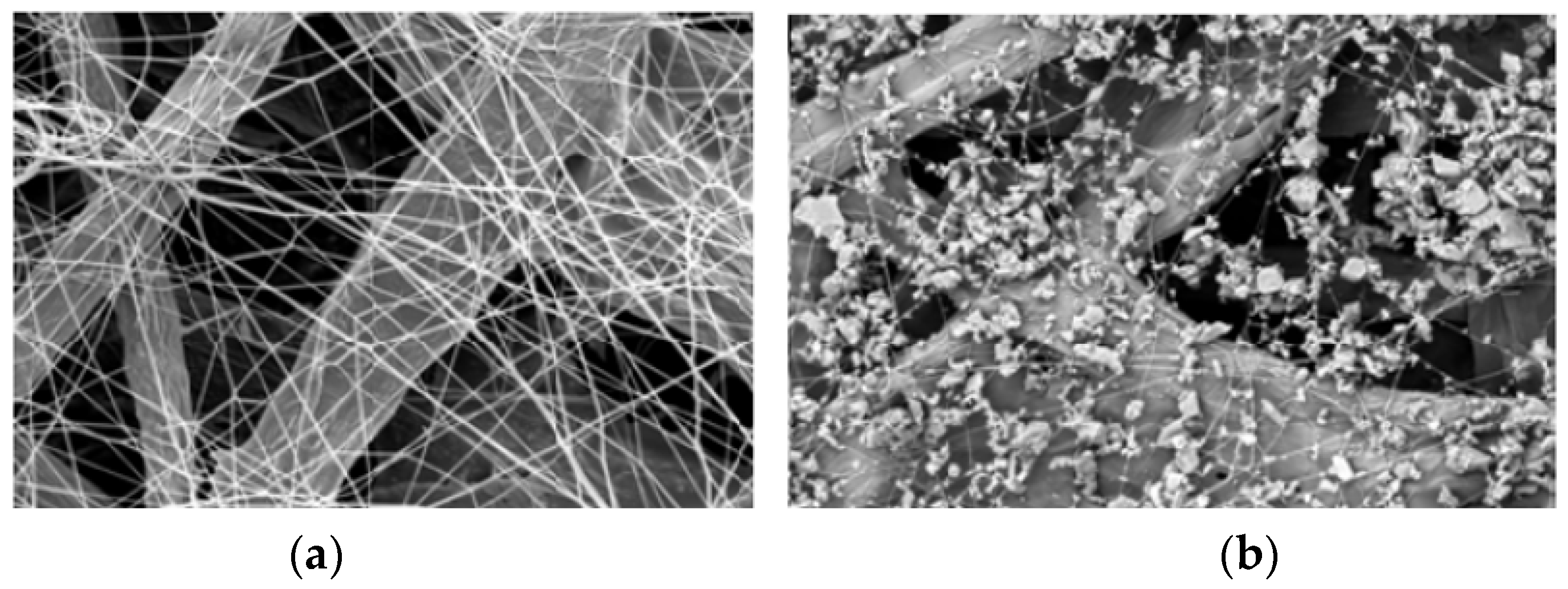
Energies 19 00388 g036
Figure 37. Filtration process: (a) depth filtration, (b) surface filtration with a layer of nanofibers, (c) during cleaning of the bed from nanofibers.
Energies 19 00388 g037
Figure 38. Change in the pressure drop of the air filter with a standard filter element and a filter element with a nanofiber layer and an automatic cleaning system depending on the distance traveled by the vehicle in the desert. Drawing made by the author based on data from the work [102].
Energies 19 00388 g038
Figure 39. REM (electron microscope) image of a high-performance nonwoven fabric with a gradient structure. Drawing prepared by the author based on data from [111].
Energies 19 00388 g039
Figure 40. Relationship between the filling coefficient and power of a naturally aspirated 359M Diesel engine with a classic injection system for different air filter flow pressure drop values. Drawing made by the author based on data from the work [121].
Energies 19 00388 g040
Figure 41. External characteristics of a naturally aspirated 359M engine CI and a classic injection system for different air filter pressure drops (at a constant speed of n = 2800 rpm). Drawing made by the author based on data from the work [121].
Energies 19 00388 g041
Figure 42. Impact of the air filter pressure drop of a naturally aspirated 359M CI engine with a classic injection system on its operating parameters. Drawing made by the author based on data from the work [121].
Energies 19 00388 g042
Figure 43. Filling coefficient ηυ of the VOLVO DC13C460 engine as a function of engine speed n for various air filter conditions: New, A-33, B-66, C-90 [126].
Energies 19 00388 g043
Figure 44. Exhaust gas opacity of the VOVLO DC13C460 engine–light absorption coefficient k (absorption) as a function of engine speed n for various technical conditions of the air filter: New, A-33, B-66, C-90 [126].
Energies 19 00388 g044
Figure 45. Effective engine power Ne and specific fuel consumption ge of the VOVLO DC13C460 engine as a function of speed n for different air filter states New, A-33, B-66, C-90 [126].
Energies 19 00388 g045
Figure 46. Influence of air filter pressure drop on: (a) change in exhaust emissions: CO, CO2, NOx and fuel consumption for the Dodge Ram 2500 Truck-6.7 L engine, (b) air filter pressure drops values. Figure prepared by the authors based on data from [127].
Energies 19 00388 g046
Figure 47. The main components of Vortex Tube Separators (VTS): 1—rotor, 2—cylindrical body of the cyclone, 3—dust collection chamber, 4—purified air outlet tube, 5—rotor core.
Energies 19 00388 g047
Figure 48. Ejector system for extracting contaminants from a helicopter air filter multicyclone using compressed air: 1—suction pipe, 2—ejector, 3—dust collector, 4—lower mounting plate, 5—multicyclone, 6—upper cyclone mounting plate [140].
Energies 19 00388 g048
Figure 49. Ejector system for removing contaminants from the helicopter air filter multicyclone using a fan: 1—fan, 2—ejector, 3—dust collector, 4—lower cyclone mounting plate, 5—multicyclone, 6—upper mounting plate [140].
Energies 19 00388 g049
Figure 50. PURE air intake air filtration system for the multi-purpose Mi-17/Mi-8MT helicopter engine: (a) filter location, (b) view of the multicyclone constructed from VTS cyclones [146].
Energies 19 00388 g050
Figure 51. IBF bed: (a) structural diagram (1—nonwoven fabric, 2—protective mesh), (b) view of the bed after pleating.
Energies 19 00388 g051
Figure 52. Filter bed geometry: (a) panel cartridge, (b) pleat geometry. Lp—cartridge length, aw—pleat width, hp—pleat height, bp—pleat side height, tp—pleat pitch (pleat width), α—angle of inclination of half pleat.
Energies 19 00388 g052
Figure 53. Principle of operation of the IPS inertial particle separator.
Energies 19 00388 g053
Figure 54. Schematic diagram of the geometry of the IPS inertial particle separator. Drawing made by the author based on data from the work [138].
Energies 19 00388 g054
Figure 55. Filtration of intake air to the W-3 Sokół helicopter engine in a radial dust collector with a compressed air jet ejection system for removing contaminants: (a) functional diagram, 1—internal surface of the air intake duct, 2—external surface of the duct–oil tank wall, 3—dust discharge pipe, 4—ejector, 5—jet distributor. Figure prepared by the author based on data from [189], (b) W-3 Sokół helicopter with a radial inlet air dust collector [190].
Energies 19 00388 g055
Figure 56. Effectiveness of inertial filters (multi-cyclone axial flow cyclones, radial filter) depending on (a), (b) flow velocity, (c) percentage mass fraction of the extracted stream mS in the inlet stream to the filter mw. Figure created by the author based on data from [189].
Energies 19 00388 g056
Figure 57. Filtration efficiency of IPS and HEAPS hybrid filter depending on inlet velocity υ0 for different dust extraction rates β: (a) for particles with a size of 2 µm, (b) for particles with a size of 20 µm. Figure created by the author based on data from [135].
Energies 19 00388 g057
Figure 58. Filtration efficiency of IPS and HEAPS hybrid filter depending on inlet velocity υ0 for different dust extraction rates β: (a) for particles with a size of 50 µm, (b) for particles with a size of 80 µm. Figure created by the author based on data from [135].
Energies 19 00388 g058
Figure 59. Filtration efficiency as a function of particle size for various inlet velocities of VTS and Hybrid VTS-IPS devices. Figure created by the author based on data from [135].
Energies 19 00388 g059
Figure 60. Characteristics: filtration efficiency φw = f(mD), pressure drop Δpw = f(mD), filtration accuracy dpmax = f(mD) as a function of dust mass mD of the supplied test filter (cellulose) and the “axial flow cyclone-test filter (cellulose)” set.
Energies 19 00388 g060
Disclaimer/Publisher’s Note: The statements, opinions and data contained in all publications are solely those of the individual author(s) and contributor(s) and not of MDPI and/or the editor(s). MDPI and/or the editor(s) disclaim responsibility for any injury to people or property resulting from any ideas, methods, instructions or products referred to in the content.