Probabilistic Forecasting of Household Energy Self-Sufficiency Rate Using Pre-Trained Time-Series Foundation Models with Monte Carlo Simulation


Abstract
1. Introduction
2. Related Work
2.1. ZEH Evaluation and the Performance Gap
2.2. Time-Series Forecasting Research for Energy Supply and Demand
2.3. Probabilistic Evaluation Approaches and Monte Carlo Method
3. Forecasting Models
3.1. Dataset
3.2. Experiment 1: Experimental Setup for Forecasting Model Validation
3.2.1. Forecasting Model and Baseline
3.2.2. Experimental Setup and Evaluation Metrics
3.3. Experiment 2: Methodology for Probabilistic ESSR Simulation
- Generate a correlated random vector from a multivariate normal distribution .
- Transform into a correlated uniform random vector using the standard normal CDF .
- Substitute into the inverse CDF to obtain the sample value .
4. Results
4.1. Experiment 1: Results of Forecasting Model Performance Validation
4.1.1. Overall Forecasting Accuracy (Quantitative Evaluation)
4.1.2. Calibration Evaluation of Probabilistic Forecasts
4.1.3. Forecasting Results for the Representative Household
4.2. Experiment 2: Results of Probabilistic ESSR Simulation
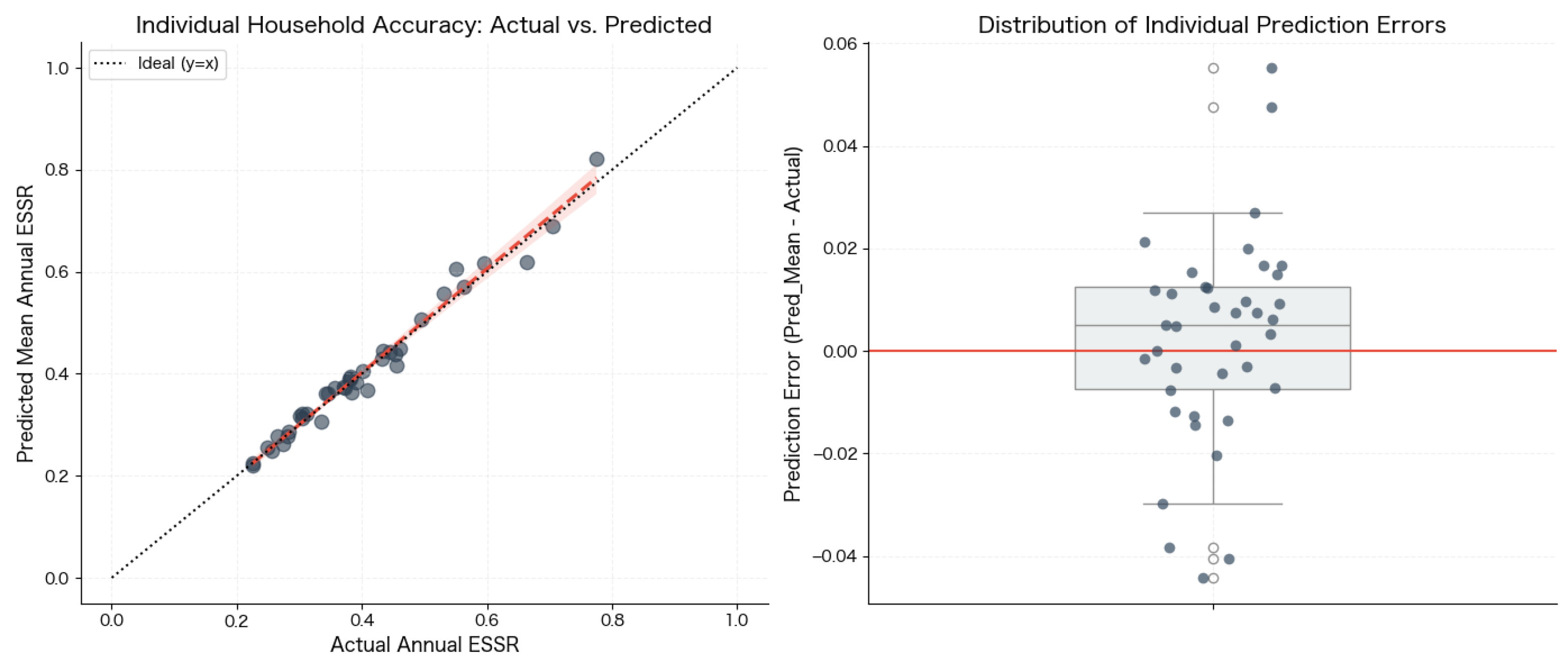
4.2.1. Annual ESSR Distribution for All Households
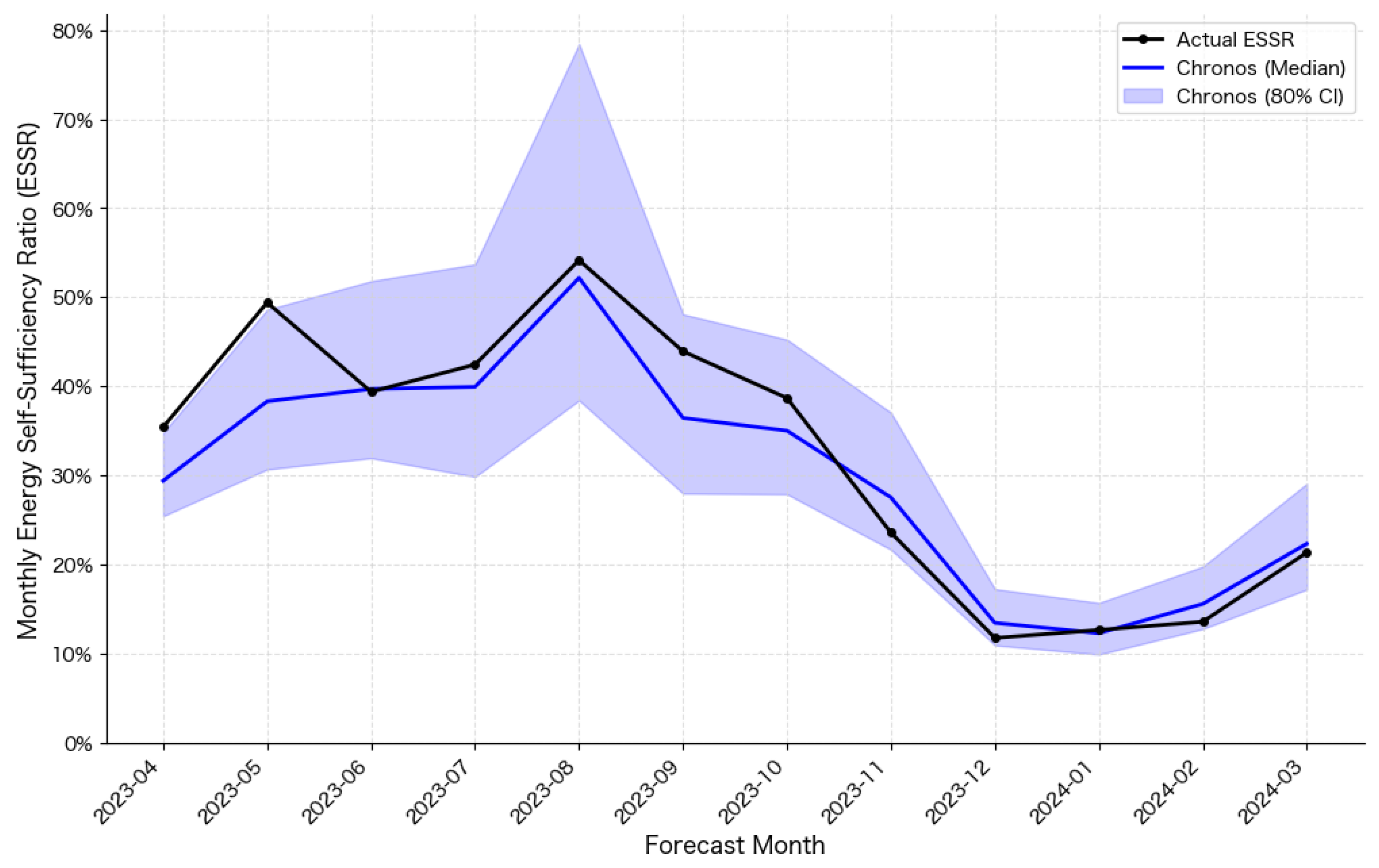
4.2.2. Monthly ESSR Distribution for the Representative Household
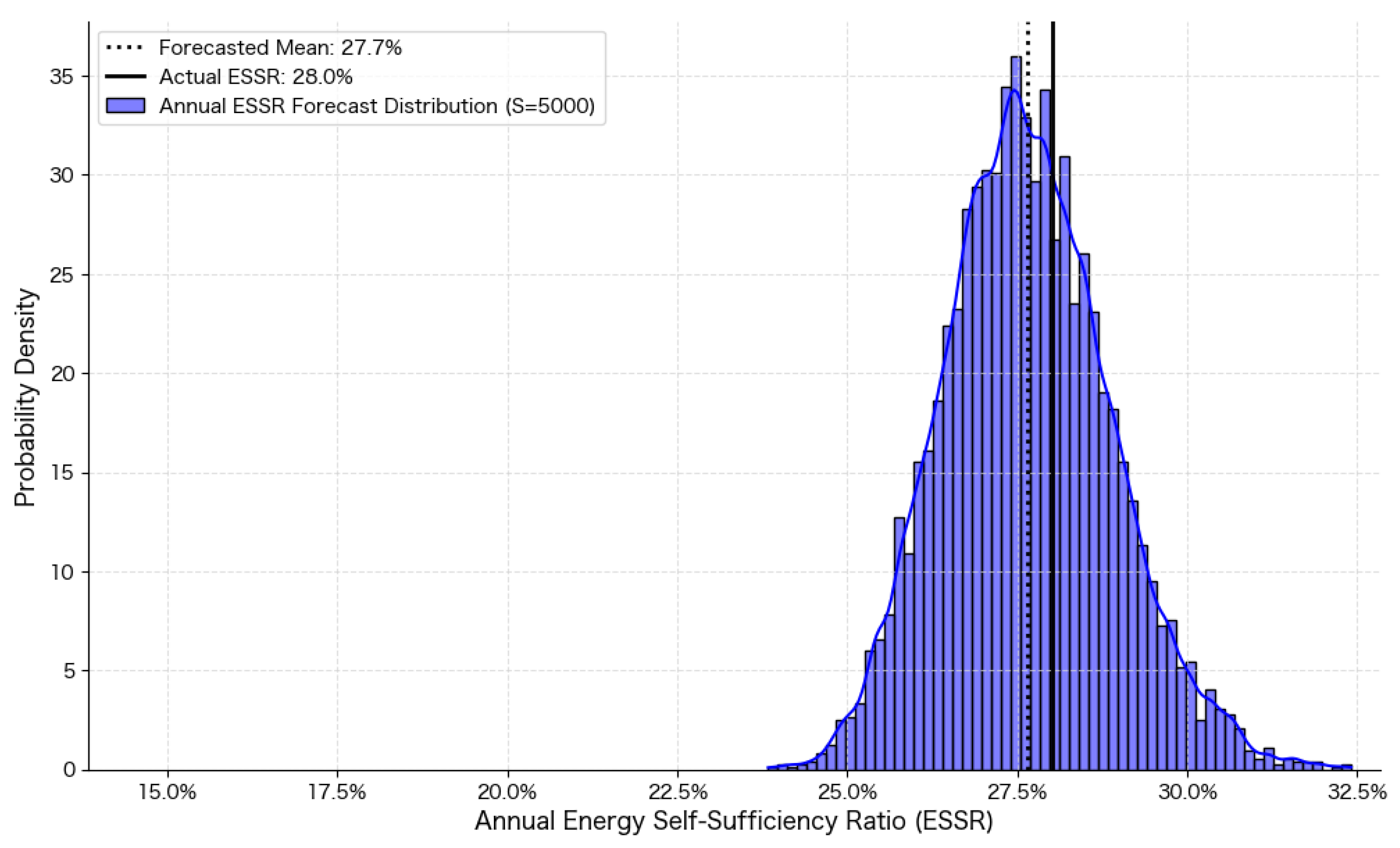
4.2.3. Annual ESSR Distribution for the Representative Household
5. Discussion
5.1. Data Efficiency and Foundation Models
5.2. Reliability of Probabilistic Risks and Copula-Based Integration
5.3. Value of Probabilistic Information for Decision-Making
5.4. Generalization and Future Outlook
6. Conclusions
Author Contributions
Funding
Data Availability Statement
Acknowledgments
Conflicts of Interest
Abbreviations
| ESSR | Energy Self-Sufficiency Rate |
| ZEH | Net-Zero Energy House |
| PV | Photovoltaic |
| HEMS | Home Energy Management System |
| MCS | Monte Carlo Simulation |
| MAE | Mean Absolute Error |
| RMSE | Root Mean Square Error |
| MASE | Mean Absolute Scaled Error |
| SN | Seasonal Naive |
| CDF | Cumulative Distribution Function |
| CRediT | Contributor Roles Taxonomy |
| MJ | Megajoules |
References
- Ürge-Vorsatz, D.; Khosla, R.; Bernhardt, R.; Chan, Y.C.; Vérez, D.; Hu, S.; Cabeza, L.F. Advances toward a net-zero global building sector. Annu. Rev. Environ. Resour. 2020, 45, 227–269. [Google Scholar] [CrossRef]
- Camarasa, C.; Mata, É.; Navarro, J.P.J.; Reyna, J.; Bezerra, P.; Angelkorte, G.B.; Feng, W.; Filippidou, F.; Forthuber, S.; Harris, C.; et al. A global comparison of building decarbonization scenarios by 2050 towards 1.5–2 C targets. Nat. Commun. 2022, 13, 3077. [Google Scholar] [CrossRef] [PubMed]
- Yamaura, K.; Xu, S.; Sugiyama, M.; Ju, Y. Public perceptions on net zero energy houses in Japan. Sustain. Sci. 2025, 20, 373–384. [Google Scholar] [CrossRef]
- Oota, M.; Iwafune, Y.; Ooka, R. Estimation of self-sufficiency rate in detached houses using home energy management system data. Energies 2021, 14, 975. [Google Scholar] [CrossRef]
- Nguyen, T.H.; Take, K.; Take, K. Reviewing of the net-zero energy buildings and housings in Japan. IOP Conf. Ser. Earth Environ. Sci. 2024, 1402, 012004. [Google Scholar] [CrossRef]
- Wilberforce, T.; Olabi, A.; Sayed, E.T.; Elsaid, K.; Maghrabie, H.M.; Abdelkareem, M.A. A review on zero energy buildings–Pros and cons. Energy Built Environ. 2023, 4, 25–38. [Google Scholar] [CrossRef]
- Menezes, A.C.; Cripps, A.; Bouchlaghem, D.; Buswell, R. Predicted vs. actual energy performance of non-domestic buildings: Using post-occupancy evaluation data to reduce the performance gap. Appl. Energy 2012, 97, 355–364. [Google Scholar] [CrossRef]
- Zou, P.X.; Wagle, D.; Alam, M. Strategies for minimizing building energy performance gaps between the design intend and the reality. Energy Build. 2019, 191, 31–41. [Google Scholar] [CrossRef]
- Kim, D.; Jang, Y.; Choi, Y. Comparative analysis of estimated and actual power self-sufficiency rates in energy-sharing communities with solar power systems. Energies 2023, 16, 7941. [Google Scholar] [CrossRef]
- Belaïd, F.; Ranjbar, Z.; Massié, C. Exploring the cost-effectiveness of energy efficiency implementation measures in the residential sector. Energy Policy 2021, 150, 112122. [Google Scholar] [CrossRef]
- Ansari, A.F.; Shchur, O.; Küken, J.; Auer, A.; Han, B.; Mercado, P.; Rangapuram, S.S.; Shen, H.; Stella, L.; Zhang, X.; et al. Chronos-2: From Univariate to Universal Forecasting. arXiv 2025. [Google Scholar] [CrossRef]
- Singh, N.K.; Nagahara, M. LightGBM-, SHAP-, and Correlation-Matrix-Heatmap-Based Approaches for Analyzing Household Energy Data: Towards Electricity Self-Sufficient Houses. Energies 2024, 17, 4518. [Google Scholar] [CrossRef]
- Wang, Z.; Luther, M.B.; Horan, P.; Matthews, J.; Liu, C. On-site solar PV generation and use: Self-consumption and self-sufficiency. Build. Simul. 2023, 16, 1835–1849. [Google Scholar] [CrossRef]
- Van Dronkelaar, C.; Dowson, M.; Burman, E.; Spataru, C.; Mumovic, D. A review of the energy performance gap and its underlying causes in non-domestic buildings. Front. Mech. Eng. 2016, 1, 17. [Google Scholar] [CrossRef]
- Yan, D.; O’Brien, W.; Hong, T.; Feng, X.; Gunay, H.B.; Tahmasebi, F.; Mahdavi, A. Occupant behavior modeling for building performance simulation: Current state and future challenges. Energy Build. 2015, 107, 264–278. [Google Scholar] [CrossRef]
- Baetens, R.; Saelens, D. Modelling uncertainty in district energy simulations by stochastic residential occupant behaviour. J. Build. Perform. Simul. 2016, 9, 431–447. [Google Scholar] [CrossRef]
- Hu, M.; Xiao, F. Quantifying uncertainty in the aggregate energy flexibility of high-rise residential building clusters considering stochastic occupancy and occupant behavior. Energy 2020, 194, 116838. [Google Scholar] [CrossRef]
- Kampelis, N.; Gobakis, K.; Vagias, V.; Kolokotsa, D.; Standardi, L.; Isidori, D.; Cristalli, C.; Montagnino, F.; Paredes, F.; Muratore, P.; et al. Evaluation of the performance gap in industrial, residential & tertiary near-Zero energy buildings. Energy Build. 2017, 148, 58–73. [Google Scholar] [CrossRef]
- Zhang, X.; Schildbach, G.; Sturzenegger, D.; Morari, M. Scenario-based MPC for energy-efficient building climate control under weather and occupancy uncertainty. In Proceedings of the 2013 European Control Conference (ECC), Zurich, Switzerland, 17–19 July 2013; IEEE: Piscataway, NJ, USA, 2013; pp. 1029–1034. [Google Scholar]
- Wang, L.; Mathew, P.; Pang, X. Uncertainties in energy consumption introduced by building operations and weather for a medium-size office building. Energy Build. 2012, 53, 152–158. [Google Scholar] [CrossRef]
- Verhaeghe, C.; Audenaert, A.; Verbeke, S. Assessing performance regret of residential energy-flexibility measures under uncertainty: An ex-ante analysis of techno-economic implications. Energy Build. 2025, 305, 115857. [Google Scholar] [CrossRef]
- Im, P.; Jackson, R.; Bae, Y.; Dong, J.; Cui, B. Probabilistic reliability assessment and case studies for predicted energy savings in residential buildings. Energy Build. 2020, 209, 109658. [Google Scholar] [CrossRef]
- Xu, L.; Wang, S.; Tang, R. Probabilistic load forecasting for buildings considering weather forecasting uncertainty and uncertain peak load. Appl. Energy 2019, 237, 180–195. [Google Scholar] [CrossRef]
- Chong, A.; Lam, K.P.; Pozzi, M.; Yang, J. Bayesian calibration of building energy models with large datasets. Energy Build. 2017, 154, 343–355. [Google Scholar] [CrossRef]
- Chaturvedi, S.; Rajasekar, E.; Natarajan, S.; McCullen, N. A comparative assessment of SARIMA, LSTM RNN and Fb Prophet models to forecast total and peak monthly energy demand for India. Energy Policy 2022, 168, 113097. [Google Scholar] [CrossRef]
- Olu-Ajayi, R.; Alaka, H.; Sulaimon, I.; Sunmola, F.; Ajayi, S. Building energy consumption prediction for residential buildings using deep learning and other machine learning techniques. J. Build. Eng. 2022, 45, 103406. [Google Scholar] [CrossRef]
- Cai, M.; Pipattanasomporn, M.; Rahman, S. Day-ahead building-level load forecasts using deep learning vs. traditional time-series techniques. Appl. Energy 2019, 236, 1078–1088. [Google Scholar] [CrossRef]
- Taieb, S.B.; Huser, R.; Hyndman, R.J.; Genton, M.G. Forecasting uncertainty in electricity smart meter data by boosting additive quantile regression. IEEE Trans. Smart Grid 2016, 7, 2448–2455. [Google Scholar] [CrossRef]
- Wan, C.; Lin, J.; Wang, J.; Song, Y.; Dong, Z.Y. Direct quantile regression for nonparametric probabilistic forecasting of wind power generation. IEEE Trans. Power Syst. 2016, 32, 2767–2778. [Google Scholar] [CrossRef]
- Meyer, M.; Zapata, D.; Kaltenpoth, S.; Müller, O. Benchmarking time series foundation models for short-term household electricity load forecasting. arXiv 2024. [Google Scholar] [CrossRef]
- Park, Y.J.; Germain, F.; Liu, J.; Wang, Y.; Koike-Akino, T.; Wichern, G.; Azizan, N.; Laughman, C.; Chakrabarty, A. Probabilistic Forecasting for Building Energy Systems using Time-Series Foundation Models. Energy Build. 2025, 348, 116446. [Google Scholar] [CrossRef]
- Sun, S.; Kensek, K.; Noble, D.; Schiler, M. A method of probabilistic risk assessment for energy performance and cost using building energy simulation. Energy Build. 2016, 110, 1–12. [Google Scholar] [CrossRef]
- Sun, Y. Closing the Building Energy Performance Gap by Improving Our Predictions. Ph.D. Thesis, Georgia Institute of Technology, Atlanta, GA, USA, 2014. [Google Scholar]
- Virote, J.; Neves-Silva, R. Stochastic models for building energy prediction based on occupant behavior assessment. Energy Build. 2012, 53, 183–193. [Google Scholar] [CrossRef]
- Zhang, S.; Sun, Y.; Cheng, Y.; Huang, P.; Oladokun, M.O.; Lin, Z. Response-surface-model-based system sizing for Nearly/Net zero energy buildings under uncertainty. Appl. Energy 2018, 228, 1020–1031. [Google Scholar] [CrossRef]
- International Energy Agency (IEA) and Organisation for Economic Co-operation and Development (OECD). Energy Statistics Manual; IEA/OECD: Paris, France, 2005; Available online: https://iea.blob.core.windows.net/assets/67fb0049-ec99-470d-8412-1ed9201e576f/EnergyStatisticsManual.pdf (accessed on 10 November 2025).
- Saibu Gas Co., Ltd. General Gas Supply Conditions. Available online: https://www.saibugas.co.jp/home/rates/provision/pdf/ippan_fk_202308.pdf (accessed on 10 November 2025). (In Japanese).



| Item | Description |
|---|---|
| Data Source | Kitakyushu, Japan |
| Collection Period | 1 January 2021–31 March 2024 |
| Temporal Resolution | 1 Month |
| Number of Households | 39 (after preprocessing) |
| Analysis Unit | Megajoules (MJ) |
| Target Variables | |
| Power Consumption (MJ) | |
| Gas Consumption (MJ) | |
| PV Generation (MJ) | |
| Covariates | |
| Power Purchase (MJ), | |
| Power Sale (MJ), | |
| FC Generation (MJ) | |
| Average Temperature (°C), | |
| Average Wind Speed (m/s), | |
| Average Relative Humidity (%) | |
| Total Precipitation (mm), | |
| Total Global Radiation () |
| Target Variable | Model | MAE | RMSE | MASE | Test_SD |
|---|---|---|---|---|---|
| PV Gen. (MJ) | Chronos | 105.8 | 136.0 | 0.61 | 451.7 |
| SN | 173.9 | 234.9 | 1.00 | ||
| Elec. Cons. (MJ) | Chronos | 169.1 | 212.0 | 0.68 | 371.3 |
| SN | 261.0 | 343.7 | 1.00 | ||
| Gas Cons. (MJ) | Chronos | 401.4 | 475.5 | 0.91 | 1345.8 |
| SN | 484.6 | 623.8 | 1.00 |
| Target Variable | Actual (%) | Difference (%) |
|---|---|---|
| PV Generation | 70.94 | −9.06 |
| Electricity Consumption | 82.69 | +2.69 |
| Gas Consumption | 90.60 | +10.60 |
Disclaimer/Publisher’s Note: The statements, opinions and data contained in all publications are solely those of the individual author(s) and contributor(s) and not of MDPI and/or the editor(s). MDPI and/or the editor(s) disclaim responsibility for any injury to people or property resulting from any ideas, methods, instructions or products referred to in the content. |
© 2026 by the authors. Licensee MDPI, Basel, Switzerland. This article is an open access article distributed under the terms and conditions of the Creative Commons Attribution (CC BY) license.
Share and Cite
Yamasaki, H.; Wu, L.; Nagahara, M. Probabilistic Forecasting of Household Energy Self-Sufficiency Rate Using Pre-Trained Time-Series Foundation Models with Monte Carlo Simulation. Energies 2026, 19, 362. https://doi.org/10.3390/en19020362
Yamasaki H, Wu L, Nagahara M. Probabilistic Forecasting of Household Energy Self-Sufficiency Rate Using Pre-Trained Time-Series Foundation Models with Monte Carlo Simulation. Energies. 2026; 19(2):362. https://doi.org/10.3390/en19020362
Chicago/Turabian StyleYamasaki, Hiroki, Libei Wu, and Masaaki Nagahara. 2026. "Probabilistic Forecasting of Household Energy Self-Sufficiency Rate Using Pre-Trained Time-Series Foundation Models with Monte Carlo Simulation" Energies 19, no. 2: 362. https://doi.org/10.3390/en19020362
APA StyleYamasaki, H., Wu, L., & Nagahara, M. (2026). Probabilistic Forecasting of Household Energy Self-Sufficiency Rate Using Pre-Trained Time-Series Foundation Models with Monte Carlo Simulation. Energies, 19(2), 362. https://doi.org/10.3390/en19020362