Article

Operational Degradation of Flooded Lead–Acid Storage Under Frequency Containment Reserve: Long-Term Evidence from a Hybrid Multi-Technology BESS


by
Sebastian Zurmühlen
1,2,3,4,*,
Lucas Koltermann
1,2,3,4 and
Dirk Uwe Sauer
1,2,3,4,5
1
Institute for Power Electronics and Electrical Drives (ISEA), RWTH Aachen University, Campus-Boulevard 89, 52074 Aachen, Germany
2
Center for Aging, Reliability and Lifetime Prediction of Electrochemical and Power Electronic Systems (CARL), RWTH Aachen University, Campus-Boulevard 89, 52074 Aachen, Germany
3
Institute for Power Generation and Storage Systems (PGS), E.ON Energy Research Center, RWTH Aachen University, Mathieustr. 10, 52074 Aachen, Germany
4
JARA-Energy, Jülich Aachen Research Alliance, 52425 Jülich, Germany
5
Helmholtz Institute Münster (HI MS), IMD-4, Forschungszentrum Jülich, 52425 Jülich, Germany
*
Author to whom correspondence should be addressed.
Energies 2026, 19(17), 4141; https://doi.org/10.3390/en19174141
Submission received: 14 July 2026 / Revised: 27 August 2026 / Accepted: 28 August 2026 / Published: 2 September 2026
(This article belongs to the Section D: Energy Storage and Application)

Abstract

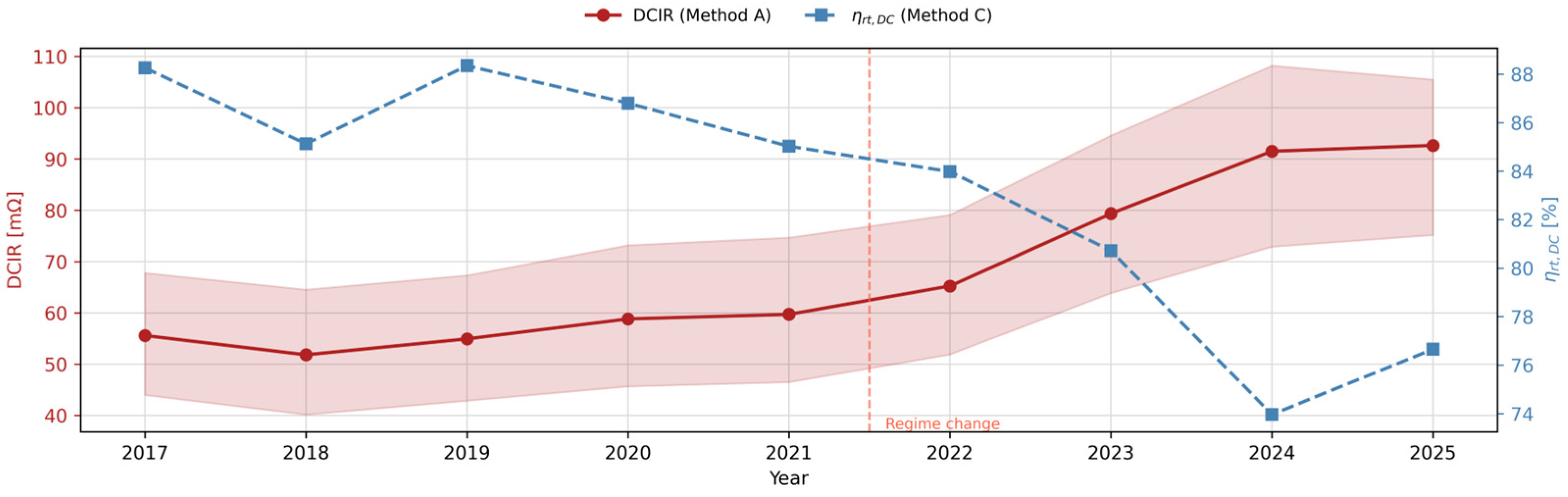
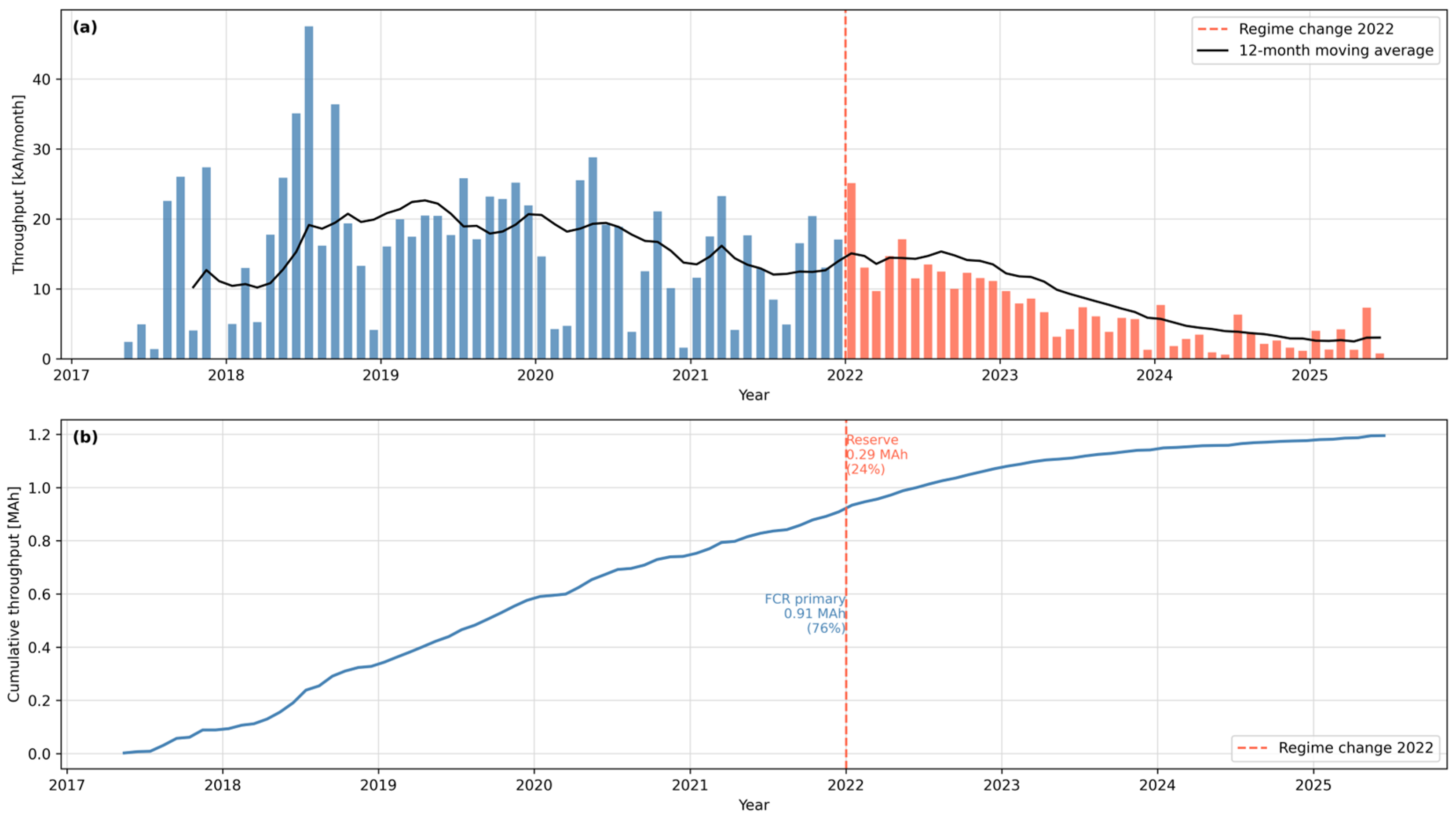
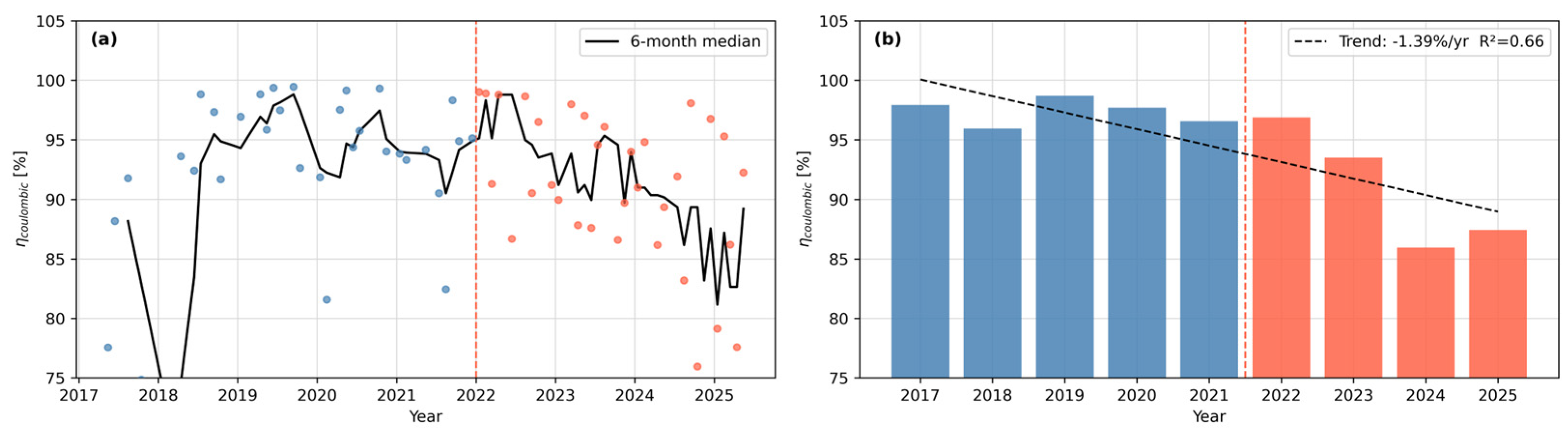
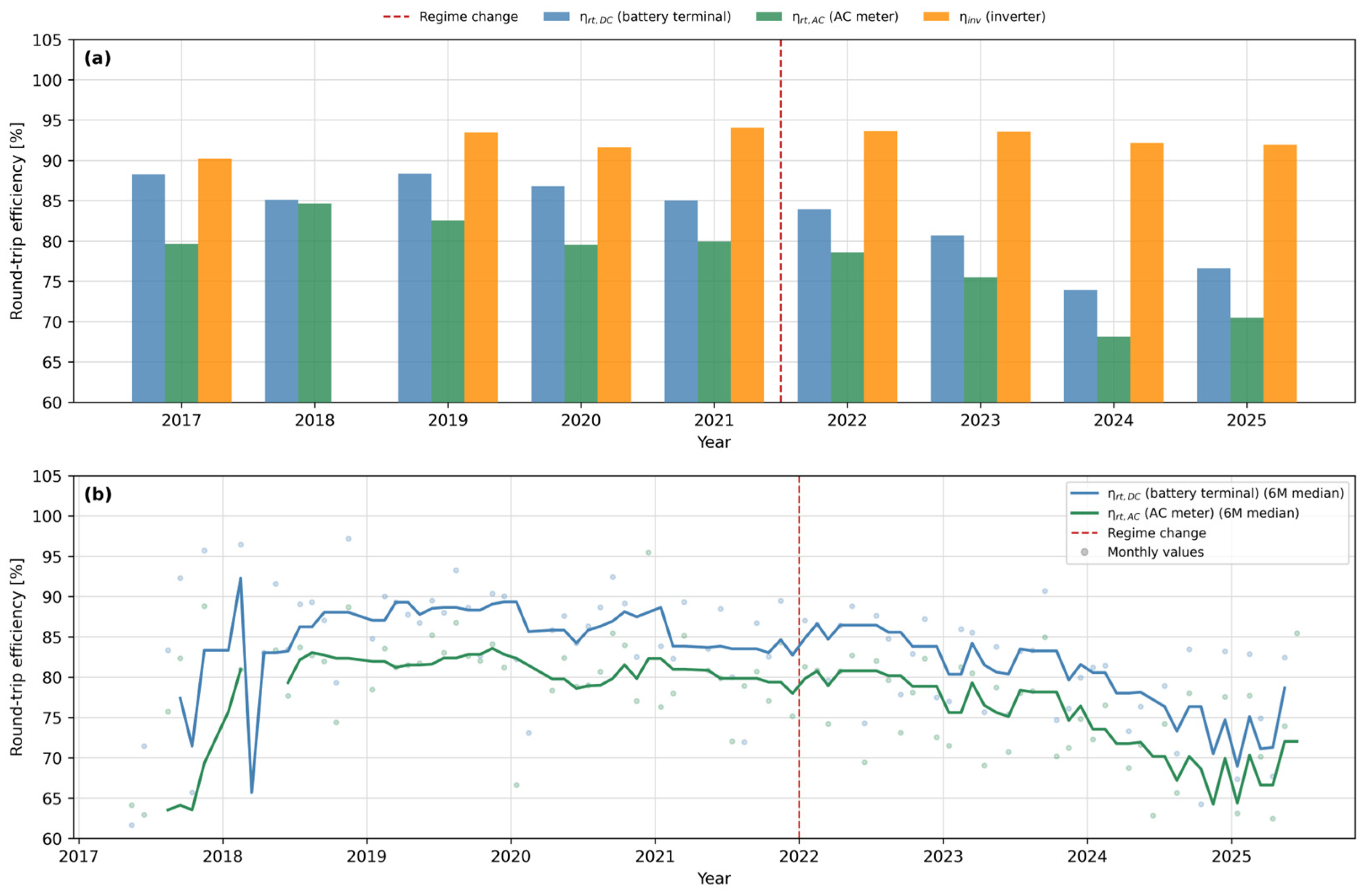
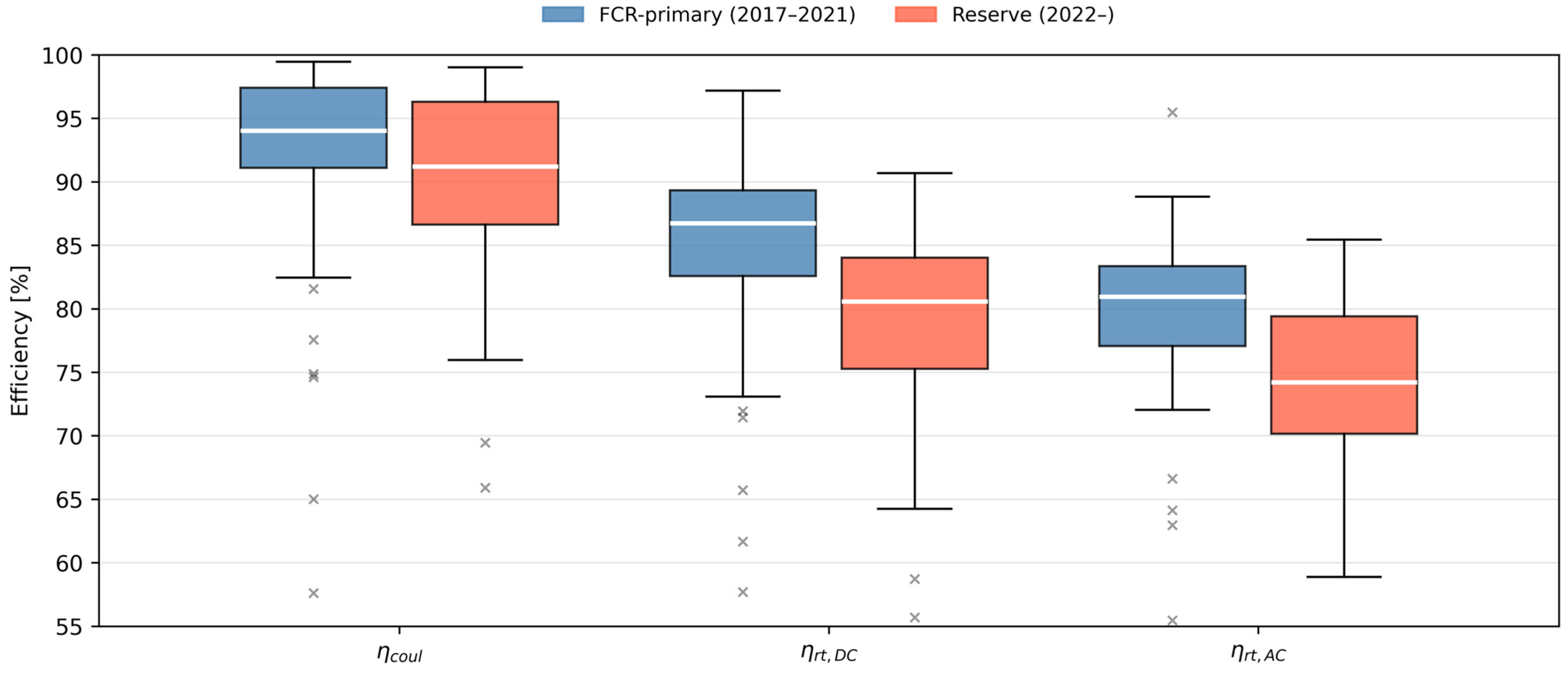
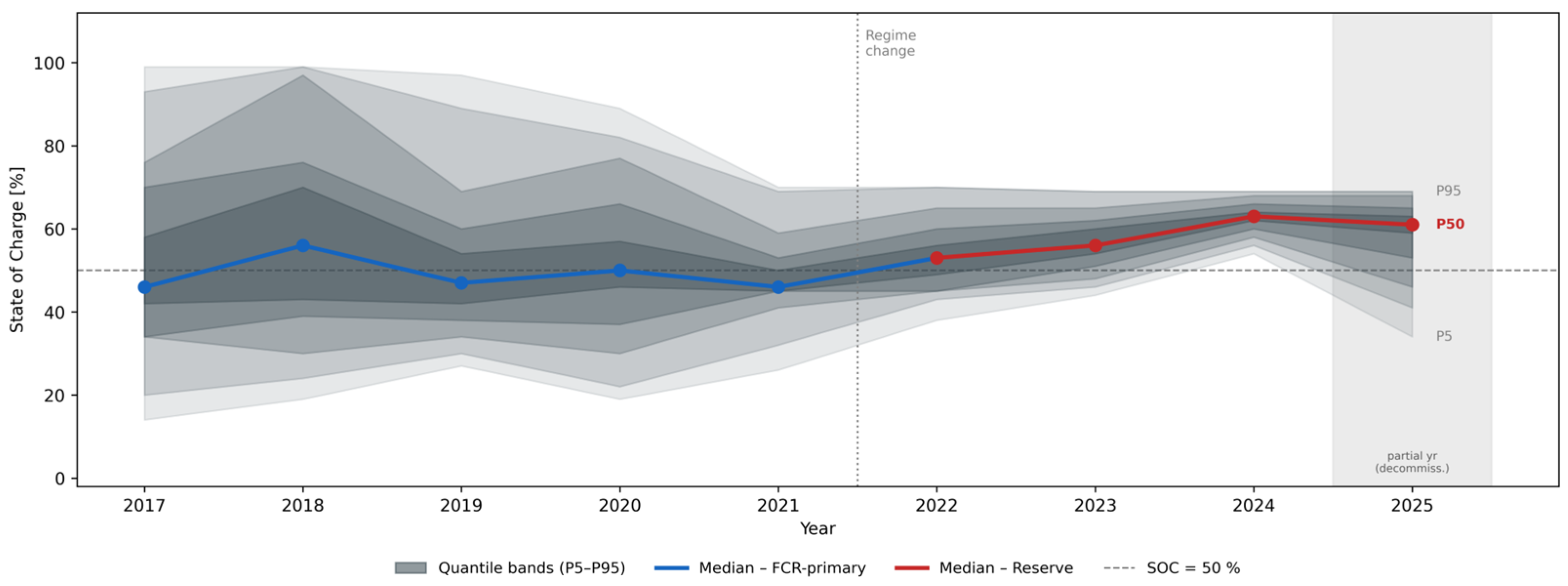
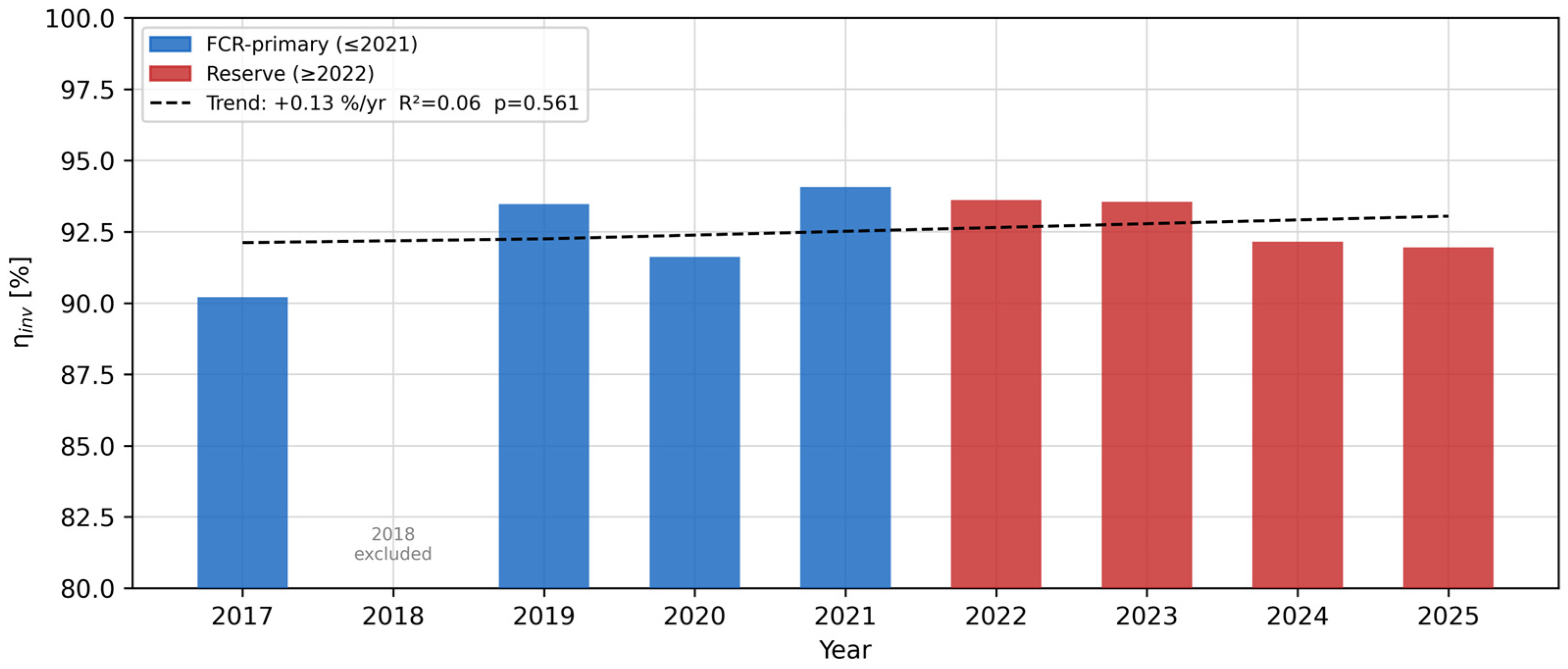
Flooded lead–acid batteries continue to operate in utility-scale battery energy storage systems (BESSs), yet their long-term degradation under grid-frequency regulation remains poorly characterized by field evidence. This paper presents an eight-year, multi-indicator degradation analysis of a flooded Ortsfeste Kupferstreckmetall (OCSM) lead–acid string at the M5BAT hybrid BESS facility (RWTH Aachen University), covering five years of active Frequency Containment Reserve (FCR) operation (2017–2021) followed by three years of low-utilization reserve operation (2022–2025). Four complementary health indicators are derived from a shared one-second-resolution operational dataset: DC internal resistance (DCIR), DC and AC round-trip efficiency, coulombic efficiency, and inverter efficiency. Five years of continuous FCR service produced no statistically detectable degradation across any indicator. In contrast, the transition to prolonged high-state-of-charge, low-throughput standby coincided with a pronounced increase in DCIR and a decline of about 14 percentage points in DC round-trip efficiency (from about 88% in the FCR phase to 74.0% in 2024). Consistent trends across all indicators, together with stable inverter efficiency, attribute the observed deterioration to the electrochemical system rather than the power electronics. These findings indicate that prolonged standby operation, rather than active FCR cycling, coincided with the onset of accelerated aging in this flooded lead–acid string. The published open-access dataset provides a valuable basis for future benchmarking and cross-technology comparisons for stationary battery storage.
Keywords: lead–acid battery; battery energy storage system; operational degradation; long-term field study; operational data lead–acid battery; battery energy storage system; operational degradation; long-term field study; operational data