Power Flow Methods for Efficient Analysis of Modern Distribution Networks—Review




Abstract
1. Introduction
1.1. Contribution
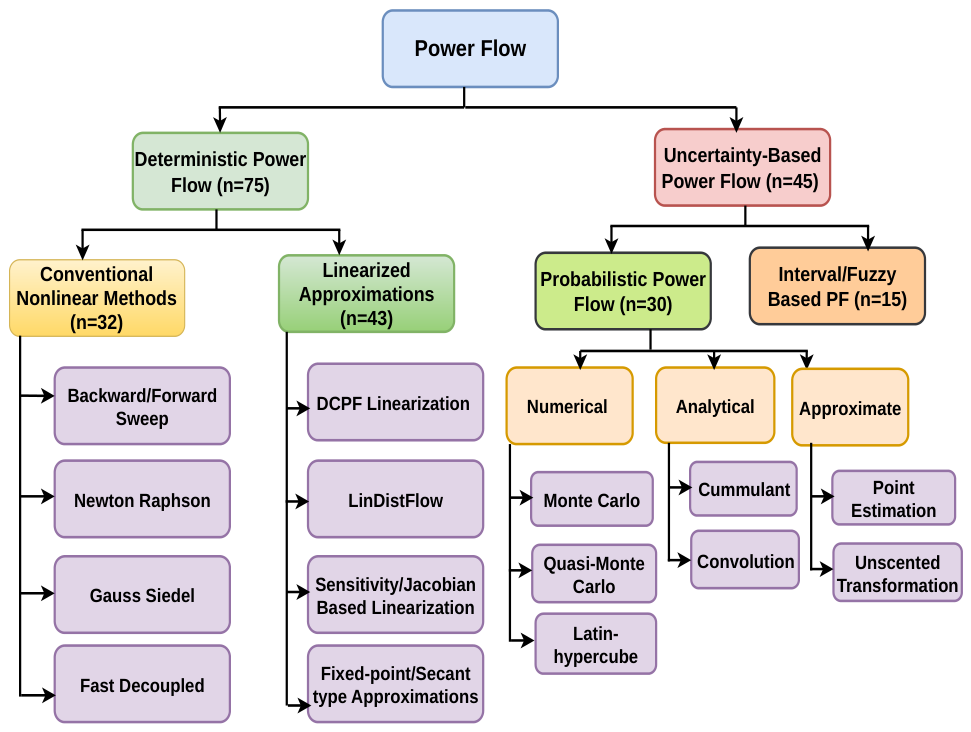
- A unified classification of distribution-oriented power flow methods is presented, covering conventional nonlinear methods and linearized approximations and comparing their main assumptions, applicability, advantages, and limitations.
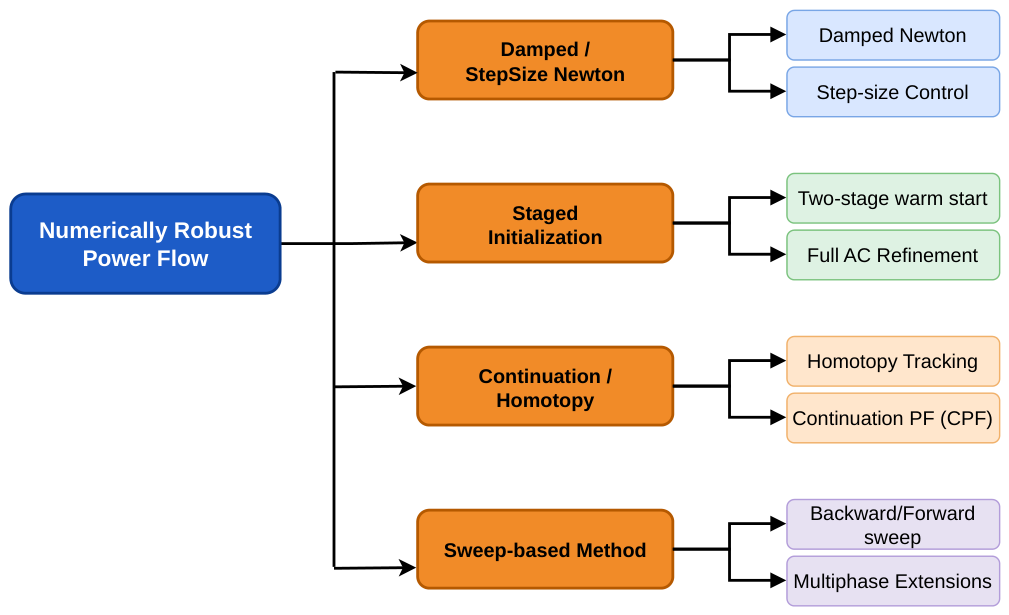
- Robust power flow methods are examined with emphasis on improved numerical performance and consistent convergence under stressed and ill-conditioned operating conditions.
- Uncertainty-based power flow formulations are reviewed, including probabilistic power flow methods with numerical, analytical, and approximate techniques, as well as interval and fuzzy power flow models for bounded and imprecise uncertainty representations.
- Acceleration strategies for repeated power flow evaluation are surveyed, including sparse numerical techniques, topology-based updates, and surrogate-based approaches, with emphasis on physical consistency and scalability for large time series and scenario sets.
- The review also provides practical method-selection guidance by relating network characteristics and operating conditions to the accuracy, convergence, and computational requirements of different PF formulations, and it identifies research gaps related to model validity, uncertainty handling, and computational scalability in modern distribution networks.
1.2. Review Methodology and PRISMA-Based Study Selection
1.2.1. Systematic Search Strategy
1.2.2. Inclusion and Exclusion Criteria
1.2.3. Literature Selection Process

| Ref | Year | Conventional PF | Linearized PF | Numerical Robustness | Uncertainty Based-PF | Acceleration Strategies | Pros | Cons |
|---|---|---|---|---|---|---|---|---|
| [1] | 2005 | ✓ | Provides a broad baseline summary of classical distribution load flow formulations and practical modeling considerations. | The discussion is largely descriptive, with limited comparison of accuracy, convergence, and computational effort across methods. | ||||
| [2] | 2005 | ✓ | Provides an overview of distribution load flow techniques and common assumptions for radial networks. | Limited discussion of uncertainty-aware PF and no unified taxonomy across deterministic and uncertainty-based PF. | ||||
| [3] | 2010 | ✓ | Summarizes the evolution of distribution load flow methods and motivates specialized solvers for feeders. | Less emphasis on uncertainty-aware PF and recent acceleration trends. | ||||
| [7] | 2011 | ✓ | ✓ | Reviews distribution PF with distributed resources and highlights three-phase/unbalanced modeling aspects. | Limited emphasis on formal uncertainty-quantification frameworks and acceleration strategies. | |||
| [8] | 2015 | ✓ | General review of classical load flow solution families. | Does not focus on modern distribution challenges (DER controls, probabilistic PF, acceleration). | ||||
| [9] | 2016 | ✓ | Reviews multiple distribution load flow methods and compares applicability for radial feeders. | Comparisons are mostly qualitative with limited emphasis on stressed-condition robustness. | ||||
| [11] | 2020 | ✓ | Reviews probabilistic load flow approaches for distribution networks including PV and EV charging uncertainties. | Less emphasis on deterministic PF convergence behavior under stressed and ill-conditioned regimes. | ||||
| [26] | 2023 | ✓ | ✓ | Distribution-focused probabilistic load flow review with a clear classification of uncertainty modeling. | Does not cover linearized PF and provides limited discussion of acceleration approaches. | |||
| [28] | 2024 | ✓ | Provides an overview of probabilistic load flow methods for distribution-network planning under photovoltaic uncertainty. | Does not examine deterministic PF solution methods or computational acceleration strategies. | ||||
| [29] | 2019 | ✓ | Clearly explains Newton-based load flow fundamentals and Jacobian-based iterations. | Mainly focuses on Newton-type methods and does not address uncertainty or acceleration. | ||||
| [30] | 2012 | ✓ | ✓ | Highlights behavior under well-conditioned and ill-conditioned cases and discusses convergence concerns. | Does not cover linearized PF, uncertainty-based PF, or acceleration strategies in a dedicated manner. | |||
| [24] | 2022 | ✓ | ✓ | Discusses constrained-network PF under operational limits and includes probabilistic PF aspects. | Does not discuss linearized PF, numerical robustness techniques, or acceleration strategies. | |||
| [31] | 2017 | ✓ | Structured review of probabilistic load flow with emphasis on PV/renewable uncertainty. | Emphasizes probabilistic frameworks, with limited discussion of deterministic solver robustness and distribution-specific PF methods. | ||||
| [20] | 2023 | ✓ | ✓ | Reviews OPF formulation, power flow models, and optimization methods, including machine learning. | Briefly discusses linearized PF methods within OPF formulation, without detailed classification and assumptions. | |||
| [25] | 2008 | ✓ | Surveys probabilistic techniques and uncertainty handling in PF studies. | Limited coverage of robustness mechanisms and acceleration methods for large-scale repeated evaluations. | ||||
| [32] | 2014 | ✓ | Reviews probabilistic and possibilistic uncertainty assessment for PF. | Does not discuss conventional and linearized PF families in depth. | ||||
| [33] | 2025 | ✓ | Provides a detailed review of linear power flow approximations and their applications in power-system analysis. | Limited emphasis on numerical robustness and acceleration strategies for repeated evaluations. | ||||
| [34] | 2025 | ✓ | ✓ | Reviews load flow methods in electric distribution networks and includes modern computational approaches. | Does not cover linearized PF and provides limited discussion of data-driven PF methods. | |||
| [17] | 2025 | ✓ | Compact review for distribution systems with dispersed generation. | Limited depth on uncertainty-based PF and robustness-oriented solver design. | ||||
| This paper | 2026 | ✓ | ✓ | ✓ | ✓ | ✓ | First paper to provide an integrated distribution-focused review covering conventional PF, linearized PF, robustness under stressed operation, and acceleration for time-series/scenario studies, with emphasis on method-selection guidance. | Focuses on power flow analysis and does not provide a detailed review of application-level optimization and market layers that build on power flow models. |
2. Significance and Applications of Power Flow Analysis
2.1. Key Applications of Power Flow Analysis
- Operating point evaluation and network feasibility validation: Power flow is used to compute bus voltages and branch flows for a given loading and generation condition, enabling feasibility verification against voltage bounds and equipment thermal limits in distribution networks [35].
- Uncertainty and scenario-based evaluation: Probabilistic and scenario-based power flow studies quantify the impact of uncertain injections on voltages and flows through repeated evaluations across samples or scenarios, including Monte Carlo-style assessments used in renewable integration studies [10,25,26].
2.2. Power Flow Methods in Grid Applications
3. Classification of Power Flow Methods
3.1. Conventional Power Flow Methods
3.1.1. Backward/Forward Sweep Method
3.1.2. Newton-Raphson Method
3.1.3. Gauss–Seidel Method
3.1.4. Fast Decoupled Load Flow Method
3.2. Linearized Power Flow Methods
3.2.1. DC Power Flow Linearization
3.2.2. LinDistFlow/Linear Branch-Flow-Based Models
3.2.3. Sensitivity/Jacobian-Based Linearized Models
3.2.4. Fixed-Point/Secant Type Approximations
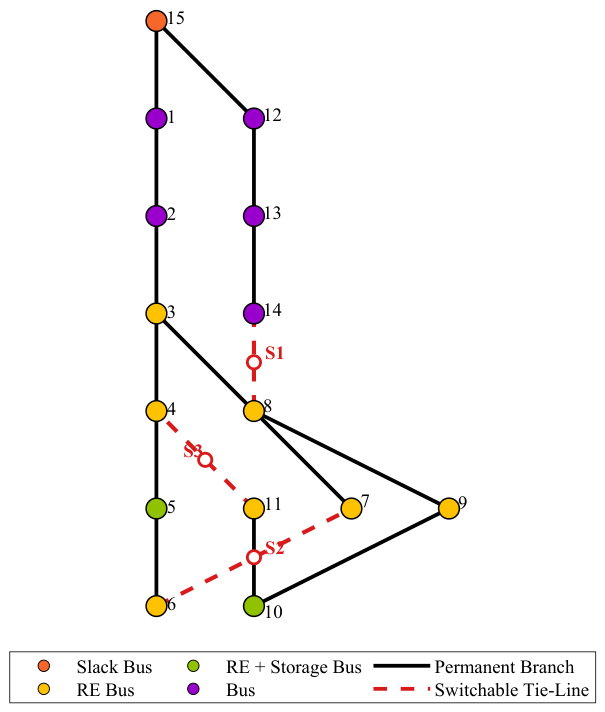
3.3. Illustrative Power Flow Analysis on a Distribution Network
| Ref | Method | Network | Validity Range | Contribution |
|---|---|---|---|---|
| [81] | LinDistFlow | Radial and meshed | Accuracy is highest near the selected linearization point; it decreases as operating conditions depart. | Proposes a generalized LinDistFlow model for multiphase networks with generic topologies, improving voltage-magnitude estimation relative to common linear baselines. |
| [87] | LinDistFlow | Radial | Most reliable in radial feeders where loss terms are not dominant | Uses DistFlow-style feeder power flow equations to represent radial distribution networks and formulates capacitor placement within the framework. |
| [89] | LinDistFlow | Radial with extensions to weakly meshed and unbalanced three-phase | Designed for feeders where line shunt charging effects are non-negligible; validity is tied to the model’s linearization assumptions and neighboring-node voltage differences | Proposes an enhanced LinDist model that incorporates line-shunt effects into the voltage-drop equations, and extends the framework to handle ZIP loads, weakly meshed networks, and unbalanced three-phase feeders. |
| [90] | LinDistFlow | Typically radial feeders | Valid over the operating range captured by the tuning data, with accuracy depending on the representativeness of the sampled loading conditions. | Tunes LinDistFlow parameters to reduce approximation error across multiple operating points, improving voltage estimates compared with fixed-parameter LinDistFlow. |
| [91] | LinDistFlow | Radial distribution test feeders | Valid over a wide range of operating points targeted by the learned parameter and designed to remain accurate under varying loading levels | Introduces a parameterized linear PF model with a system-specific learned parameter to improve voltage accuracy over simplified DistFlow and other linear models. |
| [39] | Branch-flow model | Radial | Valid as a modeling framework for radial branch-flow representations; used for tractable relaxations rather than local linear accuracy | Develops branch-flow model relaxations/convexification foundations that enable tractable analysis and optimization using branch-flow variables. |
| [82] | Lossy DistFlow | Radial, single, and multiphase | Intended for radial feeders where loss modeling is important; validity follows the DistFlow assumptions and feeder structure | Provides a lossy DistFlow formulation for single-phase and multiphase radial feeders to improve representation of losses and voltage behavior. |
| [13] | Jacobian-based linear method | Radial | Valid around the operating conditions used for linearization and device-mode assumptions; evaluated across multiple operating conditions | Extends a constrained Jacobian-based linear PF method to include common voltage control devices and DER controls, using a non-iterative solution procedure for discrete device actions. |
| [14] | Jacobian-based | Meshed | Local around the linearization point | Develops a unified formulation of linear power flow models via first-order Taylor expansion and provides theoretical error analysis, including how variable choice affects linearization error. |
| [94] | Jacobian-based | Radial and meshed | Broad across typical operating conditions without rebuilding the Jacobian each time | Proposes a state-independent linear model that estimates voltage magnitudes accurately while avoiding repeated Jacobian reconstruction for time-series studies. |
| [41] | Sensitivity-based | Radial | Local around a base operating point, extended to multiphase unbalanced networks | Derives analytical voltage and line-current sensitivity coefficients as functions of nodal injections and tap positions using a sparse compound admittance matrix, validated on IEEE 13- and 34-node feeders. |
| [43] | Jacobian-based | Meshed | Local, updated online from measurements | Estimates the power flow Jacobian from synchronized phasor measurements using a data-driven approach so the Jacobian can adapt to operating point and topology changes. |
| [44] | Jacobian-based | Radial | Maintains accuracy over time by updating parameters through online feedback. | Proposes an online feedback-based linearized power flow model that updates linearization parameters from measurements to maintain accuracy in time-varying unbalanced distribution networks. |
| [98] | Fixed-point linear approximation | Radial and meshed | Valid when voltages and loading remain within the operating region assumed by the fixed-point approximation, so the no-load-based linearization remains accurate. | Provides solvability conditions and a linear approximation of the PF solution for distribution networks. |
| [102] | Fixed-point method | Radial and meshed | Valid within the region where existence and uniqueness hold and the Z-bus fixed-point map remains contractive. | Develops multiphase existence, uniqueness, and non-singularity conditions using a Z-bus fixed-point formulation and derives associated linear models. |
| [101] | Fixed-point method | Radial and meshed | Valid within the contraction region defined by the model, where Z-bus iterations converge to a unique solution under ZIP load representation. | Proves convergence of Z-bus for three-phase distribution PF with ZIP loads and characterizes a convergence region. |
| [105] | Fixed-point method | Radial and meshed | Valid when higher-order terms remain bounded over the relevant operating range, so accuracy improves beyond first-order approximations. | Develops higher-order approximate PF solutions to improve accuracy compared with first-order linear models. |
| [109] | Secant-type region | Radial and meshed | Valid over the sampled operating region used to fit the surrogate, with accuracy that depends on how well samples cover the intended operating range. | Develops sample-based piecewise linear PF approximations using second-order sensitivities to improve region-wide accuracy. |
| [36] | Secant-type conservative linear approximation | Radial and meshed | Valid over the operating range represented by the selected samples and designed to remain conservative for the fitted quantities. | Proposes a sample-based approach to compute conservative linear power flow approximations through constrained fitting over an operating region. |
| [110] | Secant-type conservative biased approximation | Radial and meshed | Valid over the operating range used for training, with conservativeness enforced through bias design in the approximation. | Develops conservative biased linear power flow approximations and demonstrates their use in unit commitment to reduce infeasible decisions. |
4. Modern PF Evolution
4.1. Robust Power Flow
4.2. Robust Solution Approaches
5. Uncertainty-Based Power Flow
5.1. Probabilistic Power Flow
5.1.1. Numerical Methods
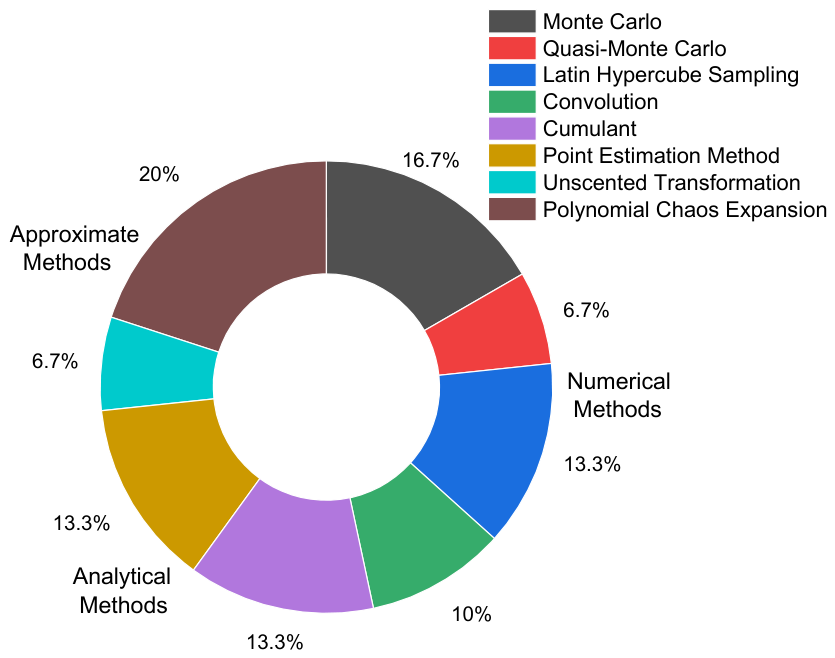
- Monte Carlo Sampling:Monte Carlo simulation evaluates probabilistic power flow by generating random samples of uncertain inputs from their probability distributions, solving a deterministic load flow for each sample, and estimating the output statistics and distributions from the ensemble of solutions [25,31]. Because it relies on repeated deterministic solutions, it is often used as an accuracy benchmark and can represent uncertainty in both load demand and renewable generation [31,32]. Applications in distribution networks have used Monte Carlo-based probabilistic power flow to evaluate voltage and branch-flow variation under photovoltaic uncertainty [126] and time-series-based renewable and load uncertainty using realistic input samples [127]. These studies show that Monte Carlo simulation provides flexible uncertainty representation, although its computational burden increases with the number of samples, uncertain variables, and time periods.The main limitation of Monte Carlo simulation is the large number of deterministic load flow runs needed to achieve reliable accuracy, particularly when low-probability events must be captured, which can make large networks and multi-period studies computationally expensive [12,32]. This has motivated improved Monte Carlo-style formulations that reduce computational cost while maintaining acceptable accuracy. For example, the multi-linear Monte Carlo method in [128] combines random sampling with a multi-linear approximation to accelerate probabilistic assessment in distribution systems with wind and photovoltaic generation. However, such acceleration depends on the accuracy of the adopted approximation, while standard Monte Carlo remains more general but computationally demanding. The high computational cost of standard Monte Carlo has also motivated alternative uncertainty-propagation techniques, including polynomial-based expansions and other approximate approaches when many scenarios must be evaluated [12].
- Quasi-Monte Carlo Sampling:Quasi-Monte Carlo sampling replaces random sampling with deterministic sequences designed to sample the input space more uniformly than standard Monte Carlo. This typically reduces the number of deterministic load flow simulations needed to reach a similar level of accuracy, making it a practical acceleration of Monte Carlo in probabilistic load flow studies [24,25,31,32]. Common sequences include Sobol and Halton. Sobol sequences are widely used because they often provide reliable convergence with fewer samples, while Halton sequences can lose uniformity as the dimension increases [129]. The main trade-off is that quasi-Monte Carlo requires more careful sequence generation and distribution mapping, and its advantage can decrease in high-dimensional problems [129]. In probabilistic power flow applications, quasi-Monte Carlo has been combined with distribution transformations and correlation handling, while Sobol samples have shown improved efficiency relative to Latin hypercube sampling at the same sample size [130]. This advantage remains dependent on the dimensionality of the uncertainty space and the treatment of correlated inputs.
- Latin-hypercube Sampling:Latin hypercube sampling evaluates probabilistic power flow by selecting input samples in a stratified manner, so each uncertain input is sampled more evenly across its probability distribution than under simple random sampling. Each input distribution is divided into N equal probability intervals, one value is selected from each interval, and the selected values are combined across the inputs through a permutation step [24,32]. This sampling structure typically reduces the number of simulations needed to reach comparable accuracy, leading to lower computational effort than standard Monte Carlo. Latin hypercube sampling is straightforward for independent inputs, but additional steps are required when correlations among inputs must be preserved [24,32].Applications have used Latin hypercube sampling to reduce the number of simulations in probabilistic carbon-emission analysis [131] and have combined it with multiple linear regression to preserve dependence among correlated inputs [132]. These extensions improve sampling efficiency and correlation representation, but repeated deterministic solutions are still required, and performance remains sensitive to sample size, dependence modeling, and system nonlinearity [24,32,131].
5.1.2. Analytical Methods
- 1.
- Convolution Method:
- 2.
- Cumulant Method:
5.1.3. Approximate Methods
- 1.
- Point Estimation Method:
- 2.
- Unscented Transformation Method:
- 3.
- Polynomial Chaos Expansion:
5.2. Interval Power Flow
5.3. Fuzzy Power Flow
6. Power Flow Acceleration Methods
6.1. Fast PF Using Numerical Linear Algebra and Network Structure
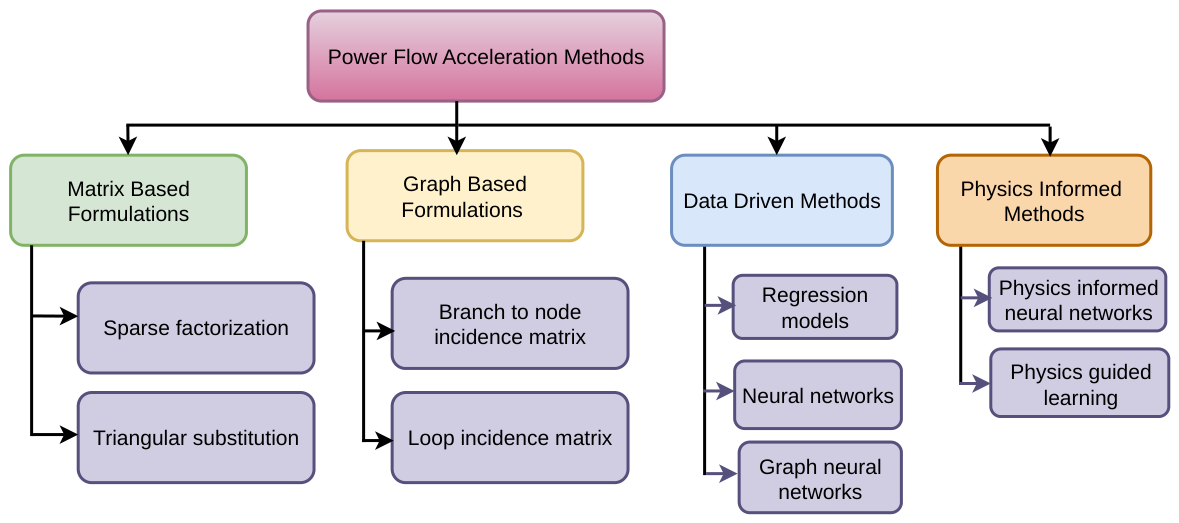
- Matrix-based formulations:Matrix-based formulations are attractive in distribution networks because they express repeated evaluations as sparse linear solves whose structure is determined by network topology. For a fixed network configuration, the sparse system matrix can be factorized once, and the stored factors can be reused efficiently as injections vary across time steps or scenarios, thereby reducing total computation in large time-series and probabilistic studies. This relies on classical sparse triangular factorization techniques with careful ordering that keeps the factors sparse and limits extra nonzero terms, improving both runtime and memory requirements for large network equation sets [113,177].In distribution feeders, several formulations construct constant network matrices directly from feeder connectivity so that the same matrices can be applied repeatedly as operating conditions change. For radial networks, an upper triangular branch-to-node mapping derived from the connectivity avoids explicit matrix inversion, leading to faster computation and reduced memory usage [178]. Radial DC resistive grids with constant-power loads further exploit this structure through a triangular formulation and a primitive impedance representation that avoids costly inversions inside the iteration [179]. For LVDC distribution grids, Laplacian and connectivity matrices support efficient repeated solutions in radial and weakly meshed networks under stated convergence and uniqueness conditions [180]. A related formulation for unbalanced three-phase feeders builds constant matrices that link bus injections to branch currents and branch currents to bus voltages [181]. Each iteration therefore relies mainly on matrix multiplication instead of repeated Jacobian or admittance factorization. Beyond connectivity-driven matrix constructions, implicit linearization of the power flow manifold yields a structure-preserving linear approximant whose sparsity pattern follows the network [182]. Although these formulations use different network representations, each improves repeated evaluations through the reuse of constant or sparse matrices. Their efficiency decreases when frequent topology changes, stronger meshing, or ill-conditioning require matrix updates, additional iterations, or damping [113,177,181].
- Graph-based formulations:Graph-based formulations model a distribution network as a sparse graph and use branch-to-node incidence information to assemble the power flow equations directly from connectivity. Their main advantage is computational efficiency in probabilistic studies, since most operations involve sparse graph traversals and structured matrix-vector products rather than repeated Jacobian or admittance factorization. The balanced formulation in [183] derives a unified current–voltage relationship for both radial and meshed feeders, avoiding mesh breaking and special node-layering rules. For unbalanced feeders, the incidence-matrix formulation in [21] develops a compact power flow model in the frame using KCL and KVL with embedded transformer modeling. Compared with the balanced formulation, it provides a more detailed representation of phase unbalance, but requires additional transformation and device modeling.For weakly meshed networks, loop information is added to represent tie lines and mesh paths while preserving the connectivity-based structure. The method in [184] uses active and reactive branch-power flows with tree labeling to reduce mismatch calculations in large weakly meshed networks. Graph-based methods are therefore suitable for radial, unbalanced, and weakly meshed feeders, but their computational benefit depends on network topology. Switching actions and reconfiguration may require rebuilding incidence and loop structures, while stronger meshing increases loop handling and can slow convergence [183,184].
6.2. Data-Driven and Physics-Informed PF Methods
- (1)
- Data-driven and regression-based PF surrogates:Data-driven power flow surrogates reduce the computational cost of repeated evaluations by learning a direct mapping from operating conditions to power flow outputs. They are particularly useful for time-series simulation, probabilistic analysis, and uncertainty-based studies, where repeated iterative solutions can become computationally demanding. However, their accuracy and physical consistency depend on the quality and representativeness of the training data. Their performance may therefore deteriorate under measurement noise, unseen operating conditions, or topology changes.Several studies develop linear or piecewise linear regression models for repeated power flow evaluation [168,186,187,188,189,190]. The framework in [168] applies forward and inverse regression, while partial least squares and Bayesian linear regression improve numerical conditioning and reduce overfitting. The noise-aware method in [186] introduces Jacobian-guided constraints to reduce sensitivity to errors in injections and voltage measurements. Generalization bounds in [187] further relate estimation error to sample size and model complexity. To represent wider operating ranges, the model in [188] applies improved K-plane regression to three-phase stochastic power flow. Other studies combine regression with physical information to improve accuracy and robustness. Hybrid formulations retain a physical linear model and learn only its residual error, improving branch-flow accuracy while preserving network structure [189,191]. When training data are incomplete, the model-aided approach in [190] incorporates parameter information and distributionally robust chance constraints. Regression-based models offer low computational cost and good interpretability, but a single linear mapping may lose accuracy over wide nonlinear operating ranges. Piecewise and hybrid formulations improve accuracy under changing conditions, although they require additional training and model design.
- (2)
- Graph neural network-based PF surrogates:Graph neural networks use bus and branch connectivity directly, making them suitable for topology-dependent and multiphase power flow relationships. For unbalanced three-phase distribution grids, the model in [192] estimates network states with lower computational time than iterative power flow methods. Deep neural networks have also been applied to probabilistic power flow acceleration and multiple network configurations [169,193]. The multigraph neural network in [194] represents phase and branch coupling in unbalanced three-phase networks. More recent graph-based methods use multi-fidelity training or physics-guided message passing to improve topology transferability and probabilistic power flow accuracy [172,173]. Compared with regression-based models, graph and neural-network surrogates can represent stronger nonlinearities and network dependencies. Their main limitations are higher data requirements and weaker interpretability. Their generalization also depends on whether the training data represent the expected operating conditions and topology changes.
- (3)
- Physics-informed and hybrid AI approaches:Physics-informed and hybrid power flow surrogates aim to retain the speed of learned models while improving physical consistency. They embed network equations or physical constraints into the learning process. These methods are particularly relevant when purely data-driven models are affected by unseen operating conditions or strong nonlinearities [185,195]. Recent developments also include physics-informed neural networks with adaptive activation that incorporate power flow residuals and partial topology information [176]. These approaches can improve generalization and reduce physically infeasible predictions. However, their performance depends on the formulation and weighting of the physical constraints.The physics-guided deep learning model in [170] combines voltage prediction with power-mismatch regularization, reducing overfitting and improving out-of-sample performance. The physics-embedded graph convolution method in [171] incorporates a linearized power flow model to improve prediction under uncertain injections and topology variations. The graph-based surrogate in [185] assigns adaptive weights to neighboring nodes and penalizes violations of Kirchhoff’s laws. The loss function in [195] combines nodal power imbalance with real-power-loss terms to preserve meaningful voltage profiles under unseen conditions. These methods use different forms of physical information, but all aim to improve consistency beyond purely data-driven training. Their main limitation is the additional design and training complexity required to represent network equations effectively.Hybrid AI approaches combine learned models with physical information to reduce data requirements and improve adaptability under changing operating conditions. The framework in [196] uses physical constraints and data augmentation when training data are limited. The transfer-learning method in [174] embeds power-balance equations in the fine-tuning loss and adapts to new configurations using unlabeled data. Self-supervised methods also use unlabeled operating points through physical-consistency objectives [175]. For probabilistic power flow acceleration, the method in [173] incorporates AC power flow sensitivities into a graph neural network and applies the trained surrogate within Monte Carlo sampling. Transfer and self-supervised approaches are particularly useful when labeled data are limited or the network configuration changes. Their reliability still depends on the quality of the physical constraints and the coverage of the available operating data.
| Ref | Study Type | Surrogate Category | Approach | Limitations |
|---|---|---|---|---|
| [168] | Deterministic PF | Regression-based | Forward and inverse regression to learn linear PF relations, with partial least squares and Bayesian linear regression to reduce overfitting | Accuracy depends on the operating range represented in the data, and a single linear mapping can degrade under large regime shifts. |
| [186] | Deterministic PF | Regression-based | Data-driven linearization with Jacobian-guided constraints, solved via constrained quadratic programming to reduce sensitivity to measurement noise | Requires consistent noisy samples and careful constraint scaling, and performance can drop under unseen regimes. |
| [187] | Deterministic PF | Regression-based | Generalization error bounds for regression-based steady-state models, linking error behavior to sample size and model complexity | Bounds can be conservative and depend on assumptions on the data and model class. |
| [188] | Stochastic/ probabilistic PF | Regression-based | Improved K-plane regression for piecewise linearization in three-phase stochastic PF, enabling fast evaluation in sampling loops | Piecewise partitioning requires careful regime selection, and complexity increases with operating diversity. |
| [189] | Deterministic PF | Hybrid physics-guided regression surrogate | Physical linear baseline retained with regression-based residual correction to improve branch-flow accuracy | Benefit depends on baseline quality and residual structure. |
| [190] | Deterministic PF | Hybrid physical-model-aided regression | Physical-model-aided linear surrogate with parameter guidance and distributionally robust chance constraints to address limited training data | Requires partial parameter knowledge and tuning of chance constraints, which can affect conservativeness. |
| [171] | Deterministic PF | Physics-embedded graph neural network | Graph convolution surrogate with embedded linearized PF representation to improve robustness under uncertainty and topology variation | Training still depends on scenario diversity, and generalization can degrade under strongly unseen topology patterns. |
| [170] | Deterministic PF | Physics-guided deep neural network | Deep neural network trained with voltage prediction loss and power mismatch regularization to improve consistency and generalization | Performance depends on the weighting between data loss and physics regularization, and training can be sensitive to tuning. |
| [169] | Probabilistic PF | Deep neural network with physics-based loss | Model-based deep learning for probabilistic PF with branch-flow physics embedded in the training objective to accelerate Monte Carlo evaluation | Requires representative probabilistic training scenarios. |
| [193] | Probabilistic PF | Deep neural network | Surrogate extended across multiple topology configurations through learned mappings and transfer across configurations | Needs diverse topology states in training, and accuracy depends on topology representation quality. |
| [172] | Deterministic PF | Graph neural network | Multi-fidelity training combining low-fidelity and high-fidelity data to reduce labeling costs while retaining accuracy | Requires careful design and alignment of fidelity levels, and depends on the quality of high-fidelity reference data. |
| [173] | Probabilistic PF | Physics-guided graph neural network | Physics-guided graph learning using sensitivity guidance, with the surrogate deployed inside Monte Carlo sampling for fast probabilistic PF | Sensitivity guidance and training distribution influence robustness, and performance can drop under unseen uncertainty structure. |
| [185] | Deterministic PF | Physics-informed graph-based model | Graph-based physics-informed surrogate with adaptive neighbor weighting and Kirchhoff consistency penalty to support inductive generalization | Constraint penalty calibration is needed for stable learning, and generalization still depends on training diversity. |
| [195] | Deterministic PF | Physics-informed neural model | Improved physics-informed loss with nodal mismatch and line-loss terms to preserve voltage profiles under unseen conditions | Effectiveness depends on loss formulation and scaling, and optimization stability can be sensitive to tuning. |
| [176] | Deterministic PF | Physics-informed neural network | Adaptive activation with power flow residuals and partial topology information for PF prediction across systems of different sizes | Performance depends on training-data coverage, physics-loss design, and the available network information. |
| [174] | Deterministic PF | Physics-informed transfer learning | Unsupervised physics-informed transfer learning using power-balance residual in the fine-tuning loss to adapt to new configurations without labels | Adaptation quality depends on initialization and tuning of the physics-loss strength. |
6.3. Computational Platforms and Specialized Network Applications
- GPU-based PF computation: GPU implementations accelerate PF by assigning repeated numerical operations or independent PF cases to multiple parallel processing units. A Chebyshev-preconditioned conjugate-gradient solver is implemented for linearized DC PF in [197], while an OpenCL implementation evaluates Monte Carlo samples concurrently for probabilistic PF in [198]. Batched Newton–Raphson calculations are parallelized across CPUs and GPUs in [45], where reusable sparse structures reduce the computation required for time-series, contingency, and probabilistic studies. These implementations are particularly useful when large numbers of PF cases must be evaluated repeatedly.
- Cloud-based PF computation: Cloud environments distribute PF data and calculations across remote or clustered computing resources. The InterPSS Cloud Edition in [199] provides remotely accessible load flow, contingency-analysis, and network-data services through Google App Engine. The Spark-based framework in [200] stores network data in resilient distributed datasets and organizes Newton–Raphson operations through a directed acyclic graph, reducing repeated data transfer and improving scalability for large-scale PF calculations.
- PF for isolated microgrids: Isolated microgrids require PF formulations that determine voltage and frequency without support from an upstream slack bus. A modified backward–forward sweep method represents islanded radial operation in [59], while a direct-sweep-based formulation incorporates droop-controlled sources in AC microgrids in [60]. Newton-based PF for DC microgrids is examined in [4], with emphasis on convergence under converter-controlled sources and constant-power devices. Uncertainty in unbalanced three-phase islanded microgrids is further represented through an unscented probabilistic PF formulation in [145].
- PF for hybrid AC/DC networks: Hybrid AC/DC systems require coordinated solution of the AC and DC subsystems through converter models and control equations. Newton–Raphson and Gauss–Seidel methods are applied to a hybrid AC/DC system in [201], while the sequential unbalanced formulation in [202] couples three-phase AC equations with DC-network, voltage-source converter (VSC), and DC/DC converter models under different control modes.
- Real-time state estimation and situational awareness: PF models support distribution-system state estimation by reconstructing voltages and branch flows from available measurements. These estimates provide the network states required for real-time situational awareness. Digital-twin deployment studies show that reliable operation depends on measurement quality, network-model accuracy, and bad-data handling, in addition to PF solution speed [47]. End-to-end latency must also include data acquisition, communication, synchronization, topology processing, and estimator execution. Mixed-frequency distributed estimation can reduce the computational and communication burden associated with heterogeneous measurement rates [203]. Learning-based state estimation can improve network visibility when only limited real-time measurements are available [204]. Power-flow-informed learning models further support state estimation in partially observable distribution networks by embedding network physics into the estimation process [205]. The PF or surrogate model should therefore be completed within the measurement-update interval, leaving sufficient time for data processing and subsequent operator or control actions.
7. Discussion and Future Research Directions
7.1. Synthesis and Method-Selection Criteria
7.2. Limitations and Open Research Gaps
7.2.1. Lack of Standardized Benchmarking and Comparative Evaluation
7.2.2. Limited Validity Assessment of Linearized Models
7.2.3. Robustness Under DER-Rich and Stressed Operating Conditions
7.2.4. Computational Burden in Uncertainty-Based Power Flow
7.2.5. Generalization of Data-Driven and Physics-Informed Surrogates
7.3. Future Research Directions
- Validity assessment of linearized power flow models: A major unresolved challenge is the lack of a reliable criterion for identifying when changes in loading, topology, or voltage-control conditions make a linearized PF model inaccurate [44,90,108]. Future work should establish computable error indicators that compare the estimated approximation error with a specified tolerance and initiate model recalibration when this tolerance is exceeded. Conservative formulations should also be extended to optimization problems so that approximation errors do not produce infeasible operating decisions [110].
- Power flow under changing control states: The interaction of inverter controls with tap changers and capacitor switching can alter the governing equations during the solution process and lead to discontinuities or convergence difficulties [13,22,54]. Future formulations should update the relevant equations when control modes change while preserving numerical stability throughout the solution. Their performance should also be examined when several control actions occur sequentially. Self-adaptive methods developed for changing power flow directions provide a useful basis for this direction [35].
- Scalable treatment of correlated uncertainty: Representing dependence among uncertain injections becomes increasingly difficult when many resources and time periods are considered [135,154,155]. Simplified dependence models may distort voltage-risk and branch-loading estimates, whereas detailed formulations can require excessive computation. Future research should develop reduced representations that preserve the dominant correlation structure and retain critical voltage or loading outcomes while limiting repeated PF evaluations. Sparse polynomial-chaos formulations [148], correlation-based expansions [149], and reproducible correlation-aware frameworks [151] provide relevant foundations for this development.
- Reliable surrogates beyond the training domain: A data-driven surrogate may produce a plausible output even when the current operating condition is poorly represented by the training data [170,171,173,195]. Future research should develop methods for assessing prediction reliability and detecting operating conditions outside the training range before surrogate outputs are used in operational studies. A correction stage should also restore nodal power balance and branch-flow consistency when the predicted state violates the network equations. Transfer learning [174], self-supervised training [175], and adaptive-activation physics-informed models [176] provide relevant directions for improving adaptability and consistency.
- Real-time power flow in digital-twin applications: A key unresolved issue is preserving the consistency of the digital model with the physical network when measurements are delayed or received at different rates [46,47]. Changes in topology or device status can further reduce model accuracy between successive updates. Future work should integrate fast PF calculation with systematic model correction and define when the network model must be updated using new measurements. The complete analysis time should also be evaluated against the available measurement interval, since solver speed alone does not determine real-time applicability [45,200].
8. Conclusions
Author Contributions
Funding
Data Availability Statement
Conflicts of Interest
Nomenclature
| Abbreviations | |
| CPF | Continuation power flow |
| CPU | Central processing unit |
| DCPF | DC power flow |
| DER | Distributed energy resources |
| DG | Distributed generation |
| FBS | Backward/forward sweep |
| FDLF | Fast decoupled load flow |
| GPU | Graphics processing unit |
| KCL | Kirchhoff’s current law |
| KVL | Kirchhoff’s voltage law |
| NR | Newton–Raphson |
| OPF | Optimal power flow |
| Probability density function | |
| PF | Power flow |
| PMU | Phasor measurement unit |
| PQ bus | Constant-power bus |
| PV bus | Voltage-controlled bus |
| STATCOM | Static synchronous compensator |
| VSC | Voltage-source converter |
| Sets and Indices | |
| Set of children buses downstream of bus j | |
| Bus indices and branch direction | |
| m | Child-bus summation index |
| k | Iteration index |
| N | Number of buses |
| Parameters | |
| Branch resistance and reactance | |
| Branch impedance | |
| Line susceptance | |
| Bus susceptance matrix | |
| Constant matrices for FDLF | |
| Resistance-to-reactance ratio | |
| Surrogate intercept coefficient | |
| Surrogate coefficient vector | |
| Variables | |
| Bus voltage at iteration k | |
| Voltage angle | |
| Squared voltage magnitude | |
| Current injection at iteration k | |
| Branch current at iteration k | |
| Complex power injection | |
| Specified injections | |
| Calculated injections | |
| Power mismatches | |
| Branch power flow | |
| Net injection at bus j | |
| p | Nodal active-power injection vector |
| Squared current magnitude | |
| Element of the bus-admittance matrix | |
| J | Jacobian matrix |
| Newton update step | |
| Angle and voltage updates | |
| Stacked mismatch vectors | |
| Sensitivity matrices | |
| x | State-variable vector |
| Base-point state vector | |
| u | Input vector |
| w | No-load voltage profile |
| Z | Impedance-type matrix |
References
- Lal, N.K.; Mubeen, S.E. A review on load flow analysis. Int. J. Innov. Res. Dev. 2014, 3, 337–341. [Google Scholar]
- Stott, B. Review of load-flow calculation methods. Proc. IEEE 2005, 62, 916–929. [Google Scholar]
- Mishra, S.; Das, D. Evolution of distribution system load flow methods: A bibliographic review. J. Inst. Eng. India Electr. Eng. Div. 2010, 91, 42–48. [Google Scholar]
- Garcés, A. On the convergence of Newton’s method in power flow studies for DC microgrids. IEEE Trans. Power Syst. 2018, 33, 5770–5777. [Google Scholar] [CrossRef] [Scilit]
- Liu, Z.; Zhang, X.; Su, M.; Sun, Y.; Han, H.; Wang, P. Convergence analysis of Newton-Raphson method in feasible power-flow for DC network. IEEE Trans. Power Syst. 2020, 35, 4100–4103. [Google Scholar] [CrossRef] [Scilit]
- Liu, Z.; Liu, R.; Zhang, X.; Su, M.; Sun, Y.; Han, H.; Wang, P. Further results on Newton-Raphson method in feasible power-flow for DC distribution networks. IEEE Trans. Power Deliv. 2021, 37, 1348–1351. [Google Scholar] [CrossRef] [Scilit]
- Martinez, J.A.; Mahseredjian, J. Load flow calculations in distribution systems with distributed resources: A review. In Proceedings of the 2011 IEEE Power and Energy Society General Meeting; IEEE: New York, NY, USA, 2011; pp. 1–8. [Google Scholar]
- Kumar, R.J.R.; Jain, A. Load flow methods in distribution systems with dispersed generations: A brief review. In Proceedings of the 2015 1st Conference on Power, Dielectric and Energy Management at NERIST (ICPDEN); IEEE: New York, NY, USA, 2015; pp. 1–4. [Google Scholar]
- Madhav, M.K.; Bajpai, R.S. Comparison of Different Techniques for Distribution System Load Flow Analysis—A Review. IJSRD-Int. J. Sci. Res. Dev. 2016, 3, 731–735. [Google Scholar]
- Aien, M.; Ramezani, R.; Ghavami, S.M. Probabilistic load flow considering wind generation uncertainty. Eng. Technol. Appl. Sci. Res. 2011, 1, 126–132. [Google Scholar] [CrossRef] [Scilit]
- Ramadhani, U.H.; Shepero, M.; Munkhammar, J.; Widén, J.; Etherden, N. Review of probabilistic load flow approaches for power distribution systems with photovoltaic generation and electric vehicle charging. Int. J. Electr. Power Energy Syst. 2020, 120, 106003. [Google Scholar] [CrossRef] [Scilit]
- Gruosso, G.; Maffezzoni, P.; Zhang, Z.; Daniel, L. Probabilistic load flow methodology for distribution networks including loads uncertainty. Int. J. Electr. Power Energy Syst. 2019, 106, 392–400. [Google Scholar] [CrossRef] [Scilit]
- Di Fazio, A.R.; Perna, S.; Russo, M.; De Santis, M. Linear power flow method for radial distribution systems including voltage control devices. IEEE Trans. Ind. Appl. 2024, 60, 4749–4761. [Google Scholar] [CrossRef] [Scilit]
- Yang, Z.; Xie, K.; Yu, J.; Zhong, H.; Zhang, N.; Xia, Q. A general formulation of linear power flow models: Basic theory and error analysis. IEEE Trans. Power Syst. 2018, 34, 1315–1324. [Google Scholar] [CrossRef] [Scilit]
- Babiker, A.; Ahmad, S.S.; Ahmed, I.; Khalid, M.; Abido, M.A.; Al-Ismail, F.S. Optimal power flow: A review of state-of-the-art techniques and future perspectives. IEEE Access 2025, 13, 60012–60039. [Google Scholar] [CrossRef] [Scilit]
- Risi, B.G.; Riganti-Fulginei, F.; Laudani, A. Modern techniques for the optimal power flow problem: State of the art. Energies 2022, 15, 6387. [Google Scholar] [CrossRef] [Scilit]
- Nyingu, B.T.; Masike, L.; Mbukani, M.W.K. Multi-objective optimization of load flow in power systems: An overview. Energies 2025, 18, 6056. [Google Scholar] [CrossRef] [Scilit]
- Abdi, H.; Beigvand, S.D.; Scala, M.L. A review of optimal power flow studies applied to smart grids and microgrids. Renew. Sustain. Energy Rev. 2017, 71, 742–766. [Google Scholar] [CrossRef] [Scilit]
- Sun, Y.; Yang, C.; Cui, H.; Wu, M.; Shao, J.; Zhao, B.; He, K. Optimization methods for optimal power flow problems in distribution networks: A brief review. In Proceedings of the Asia Conference on Power and Electrical Engineering, Hangzhou, China, 7 April–9 April 2023; pp. 1400–1406. [Google Scholar]
- Yang, C.; Sun, Y.; Zou, Y.; Zheng, F.; Liu, S.; Zhao, B.; Wu, M.; Cui, H. Optimal Power Flow in Distribution Network: A Review on Problem Formulation and Optimization Methods. Energies 2023, 16, 5974. [Google Scholar] [CrossRef] [Scilit]
- Arboleya, P.; González-Morán, C.; Coto, M. Unbalanced Power Flow in Distribution Systems with Embedded Transformers Using the Complex Theory in αβ0 Stationary Reference Frame. IEEE Trans. Power Syst. 2014, 29, 1012–1022. [Google Scholar] [CrossRef] [Scilit]
- Colombari, L.F.S.; Kuiava, R.; Peric, V.; Ramos, R.A. Continuation Load Flow Considering Discontinuous Behaviors of Distribution Grids. IEEE Trans. Power Syst. 2019, 34, 3476–3483. [Google Scholar] [CrossRef] [Scilit]
- Baran, M.; Wu, F.F. Optimal sizing of capacitors placed on a radial distribution system. IEEE Trans. Power Deliv. 2002, 4, 735–743. [Google Scholar]
- de Bruyn, J.; Bekker, B.; Dalton, A. A review of load flow methodologies for constrained networks: A South African case study. In Proceedings of the 2022 International Conference on Electrical, Computer, Communications and Mechatronics Engineering (ICECCME); IEEE: New York, NY, USA, 2022; pp. 1–6. [Google Scholar]
- Chen, P.; Chen, Z.; Bak-Jensen, B. Probabilistic load flow: A review. In Proceedings of the 2008 Third International Conference on Electric Utility Deregulation and Restructuring and Power Technologies; IEEE: New York, NY, USA, 2008; pp. 1586–1591. [Google Scholar]
- Abbasi, A.R.; Mohammadi, M. Probabilistic load flow in distribution networks: An updated and comprehensive review with a new classification proposal. Electr. Power Syst. Res. 2023, 222, 109497. [Google Scholar] [CrossRef] [Scilit]
- Page, M.J.; McKenzie, J.E.; Bossuyt, P.M.; Boutron, I.; Hoffmann, T.C.; Mulrow, C.D.; Shamseer, L.; Tetzlaff, J.M.; Akl, E.A.; Brennan, S.E.; et al. The PRISMA 2020 Statement: An Updated Guideline for Reporting Systematic Reviews. BMJ 2021, 372, n71. [Google Scholar] [CrossRef] [Scilit] [PubMed]
- Wohlfart, P.; Renner, H. Probabilistic Load Flow Analysis for Evaluation of Photovoltaic Grid Connection Applications. E I Elektrotechnik Informationstechnik 2024, 141, 468–475. [Google Scholar] [CrossRef] [Scilit]
- Karimi, M.; Shahriari, A.; Aghamohammadi, M.R.; Marzooghi, H.; Terzija, V. Application of Newton-based load flow methods for determining steady-state condition of well and ill-conditioned power systems: A review. Int. J. Electr. Power Energy Syst. 2019, 113, 298–309. [Google Scholar] [CrossRef] [Scilit]
- Shahriari, A.; Mokhlis, H.; Bakar, A. Critical reviews of load flow methods for well, ill and unsolvable condition. J. Electr. Eng. 2012, 63, 144. [Google Scholar] [CrossRef] [Scilit]
- Prusty, B.R.; Jena, D. A critical review on probabilistic load flow studies in uncertainty constrained power systems with photovoltaic generation and a new approach. Renew. Sustain. Energy Rev. 2017, 69, 1286–1302. [Google Scholar] [CrossRef] [Scilit]
- Aien, M.; Rashidinejad, M.; Fotuhi Firuzabad, M. On possibilistic and probabilistic uncertainty assessment of power flow problem: A review and a new approach. Renew. Sustain. Energy Rev. 2014, 37, 883–895. [Google Scholar] [CrossRef] [Scilit]
- Pijarski, P.; Jakus, D.; Belowski, A.; Sarajcev, P.; Przepiórka, D. Linear Approximations of Power Flow Equations in Electrical Power System Modelling—A Review of Methods and Their Applications. Appl. Sci. 2025, 15, 12399. [Google Scholar] [CrossRef] [Scilit]
- El-Fergany, A.A. Reviews on load flow methods in electric distribution networks. Arch. Comput. Methods Eng. 2025, 32, 1619–1633. [Google Scholar] [CrossRef] [Scilit]
- Razavi, S.M.; Sebtahmadi, S.S.; Momeni, H.R.; Haghifam, M.R.; Shafie-khah, M.; Siano, P. A self-adaptive modified backward forward sweep method: Application to dynamic flow direction changes. Int. J. Electr. Power Energy Syst. 2025, 166, 110567. [Google Scholar] [CrossRef] [Scilit]
- Buason, P.; Misra, S.; Molzahn, D.K. A sample-based approach for computing conservative linear power flow approximations. Electr. Power Syst. Res. 2022, 212, 108579. [Google Scholar] [CrossRef] [Scilit]
- Thukaram, D.; Wijekoon Banda, H.M.; Jerome, J. A robust three phase power flow algorithm for radial distribution systems. Electr. Power Syst. Res. 1999, 50, 227–236. [Google Scholar] [CrossRef] [Scilit]
- Zhang, Y.; Lan, T.; Li, C.; Cai, W.; Lin, Z. A holomorphic embedding power flow method based on dynamic power restart. Int. J. Electr. Power Energy Syst. 2025, 171, 110923. [Google Scholar] [CrossRef] [Scilit]
- Farivar, M.; Low, S.H. Branch flow model: Relaxations and convexification—Part I. IEEE Trans. Power Syst. 2013, 28, 2554–2564. [Google Scholar] [CrossRef] [Scilit]
- Zhang, Z.; Ochoa, L.F.; Valverde, G. A novel voltage sensitivity approach for the decentralized control of DG plants. IEEE Trans. Power Syst. 2017, 33, 1566–1576. [Google Scholar] [CrossRef] [Scilit]
- Christakou, K.; LeBoudec, J.Y.; Paolone, M.; Tomozei, D.C. Efficient computation of sensitivity coefficients of node voltages and line currents in unbalanced radial electrical distribution networks. IEEE Trans. Smart Grid 2013, 4, 741–750. [Google Scholar] [CrossRef] [Scilit]
- Li, P.; Su, H.; Yu, L.; Liu, Z.; Wang, C.; Wu, J. Voltage control method of distribution networks using PMU based sensitivity estimation. Energy Procedia 2019, 158, 2707–2712. [Google Scholar] [CrossRef] [Scilit]
- Chen, Y.C.; Wang, J.; Domínguez-García, A.D.; Sauer, P.W. Measurement-based estimation of the power flow Jacobian matrix. IEEE Trans. Smart Grid 2015, 7, 2507–2515. [Google Scholar] [CrossRef] [Scilit]
- Cheng, R.; Wang, Z.; Guo, Y. An online feedback-based linearized power flow model for unbalanced distribution networks. IEEE Trans. Power Syst. 2021, 37, 3552–3565. [Google Scholar] [CrossRef] [Scilit]
- Wang, Z.; Wende-von Berg, S.; Braun, M. Fast parallel Newton–Raphson power flow solver for large number of system calculations with CPU and GPU. Sustain. Energy Grids Netw. 2021, 27, 100483. [Google Scholar] [CrossRef] [Scilit]
- Bragatto, T.; Bucarelli, M.A.; Carere, F.; Cresta, M.; Gatta, F.M.; Geri, A.; Maccioni, M.; Paulucci, M.; Poursoltan, P.; Santori, F. Near real-time analysis of active distribution networks in a Digital Twin framework: A real case study. Sustain. Energy Grids Netw. 2023, 35, 101128. [Google Scholar] [CrossRef] [Scilit]
- Deakin, M.; Vanin, M.; Fan, Z.; Van Hertem, D. Smart energy network digital twins: Findings from a UK-based demonstrator project. Int. J. Electr. Power Energy Syst. 2024, 162, 110302. [Google Scholar] [CrossRef] [Scilit]
- Zimmerman, R.D.; Murillo-Sánchez, C.E.; Thomas, R.J. MATPOWER: Steady-State Operations, Planning, and Analysis Tools for Power Systems Research and Education. IEEE Trans. Power Syst. 2011, 26, 12–19. [Google Scholar] [CrossRef] [Scilit]
- Thurner, L.; Scheidler, A.; Schäfer, F.; Menke, J.H.; Dollichon, J.; Meier, F.; Meinecke, S.; Braun, M. pandapower—An Open-Source Python Tool for Convenient Modeling, Analysis, and Optimization of Electric Power Systems. IEEE Trans. Power Syst. 2018, 33, 6510–6521. [Google Scholar] [CrossRef] [Scilit]
- Guerra, G.; Martinez-Velasco, J.A. Evaluation of MATPOWER and OpenDSS Load Flow Calculations in Power Systems Using Parallel Computing. J. Eng. 2017, 2017, 195–204. [Google Scholar] [CrossRef] [Scilit]
- Karmaker, A.K.; Du, Y.; Yang, J.; Jacob, M. Challenges and Applications of Hosting Capacity Analysis in DER-Rich Power Systems. Appl. Energy 2026, 407, 127323. [Google Scholar] [CrossRef] [Scilit]
- Gómez-Ramírez, G.A.; Mora-Jiménez, G.; Meza, C. Simulation of the Central American Interconnected Electrical System Using ETAP. Rev. Tecnol. Marcha 2023, 36, 50–58. [Google Scholar]
- Shirmohammadi, D.; Hong, H.W.; Semlyen, A.; Luo, G.X. A compensation-based power flow method for weakly meshed distribution and transmission networks. IEEE Trans. Power Syst. 1988, 3, 753–762. [Google Scholar] [CrossRef] [Scilit]
- Ju, Y.; Wu, W.; Zhang, B.; Sun, H. An extension of FBS three-phase power flow for handling PV nodes in active distribution networks. IEEE Trans. Smart Grid 2017, 5, 1547–1555. [Google Scholar]
- Rajičić, D.; Dimitrovski, A. A new method for handling PV nodes in backward/forward power flow for radial and weakly meshed networks. In Proceedings of the 2001 IEEE Porto Power Tech Proceedings; IEEE: New York, NY, USA, 2001; Volume 3. [Google Scholar]
- Suchite-Remolino, A.; Ruiz-Paredes, H.F.; Torres-García, V. A new approach for PV nodes using an efficient backward/forward sweep power flow technique. IEEE Lat. Am. Trans. 2020, 18, 992–999. [Google Scholar] [CrossRef] [Scilit]
- Zhu, Y.; Tomsovic, K. Adaptive power flow method for distribution systems with dispersed generation. IEEE Trans. Power Deliv. 2002, 17, 822–827. [Google Scholar] [CrossRef] [Scilit]
- Chang, G.W.; Chu, S.Y.; Wang, H.L. An improved backward/forward sweep load flow algorithm for radial distribution systems. IEEE Trans. Power Syst. 2007, 22, 882–884. [Google Scholar] [CrossRef] [Scilit]
- Hameed, F.; Al Hosani, M.; Zeineldin, H.H. A modified backward/forward sweep load flow method for islanded radial microgrids. IEEE Trans. Smart Grid 2017, 10, 910–918. [Google Scholar] [CrossRef] [Scilit]
- Díaz, G.; Gómez-Aleixandre, J.; Coto, J. Direct backward/forward sweep algorithm for solving load power flows in AC droop-regulated microgrids. IEEE Trans. Smart Grid 2015, 7, 2208–2217. [Google Scholar] [CrossRef] [Scilit]
- Tinney, W.F.; Hart, C.E. Power Flow Solution by Newton’s Method. IEEE Trans. Power Appar. Syst. 1967, PAS-86, 1449–1460. [Google Scholar] [CrossRef] [Scilit]
- Sereeter, B.; Vuik, C.; Witteveen, C. On a comparison of Newton-Raphson solvers for power flow problems. J. Comput. Appl. Math. 2019, 360, 157–169. [Google Scholar] [CrossRef] [Scilit]
- Tostado-Véliz, M.; Matos, M.A.; Peças Lopes, J.A.; Jurado, F. An Improved Version of the Continuous Newton’s Method for Efficiently Solving the Power-Flow in Ill-Conditioned Systems. Int. J. Electr. Power Energy Syst. 2021, 124, 106389. [Google Scholar] [CrossRef] [Scilit]
- Tate, J.E.; Overbye, T.J. A comparison of the optimal multiplier in polar and rectangular coordinates. IEEE Trans. Power Syst. 2005, 20, 1667–1674. [Google Scholar] [CrossRef] [Scilit]
- Lima-Silva, A.; Freitas, F.D. Dynamical Homotopy Transient-Based Technique to Improve the Convergence of Ill-Posed Power Flow Problem. Int. J. Electr. Power Energy Syst. 2024, 155, 109436. [Google Scholar] [CrossRef] [Scilit]
- Zhang, F.; Cheng, C.S. A modified Newton method for radial distribution system power flow analysis. IEEE Trans. Power Syst. 1997, 12, 389–397. [Google Scholar] [CrossRef] [Scilit]
- Yang, N.C.; Chen, H.C. Three-Phase Power Flow Calculations for Unbalanced Radial Distribution Networks: recDQNR Method. Sustain. Energy Grids Netw. 2025, 44, 101995. [Google Scholar] [CrossRef] [Scilit]
- Le Nguyen, H. Newton-Raphson method in complex form [power system load flow analysis]. IEEE Trans. Power Syst. 1997, 12, 1355–1359. [Google Scholar] [CrossRef] [Scilit]
- Carmona-Pardo, R.; Rodríguez del Nozal, Á.; Romero-Ramos, E.; Gómez-Expósito, A. Enlarged Current Injection Model for the Power Flow Solution of Unbalanced Distribution Networks. Int. J. Electr. Power Energy Syst. 2025, 165, 110495. [Google Scholar] [CrossRef] [Scilit]
- Acha, E.; Kazemtabrizi, B. A new STATCOM model for power flows using the Newton–Raphson method. IEEE Trans. Power Syst. 2013, 28, 2455–2465. [Google Scholar] [CrossRef] [Scilit]
- Jiang, T.; Hou, H.; Feng, Z.; Chen, C. A Two-Part Alternating Iteration Power Flow Method Based on Dynamic Equivalent Admittance. Int. J. Electr. Power Energy Syst. 2024, 159, 110064. [Google Scholar] [CrossRef] [Scilit]
- Lyu, W.; Cai, L.; Huang, D. Compressed Newton-Raphson method for power flow analysis in DC traction network. IEEE Trans. Power Syst. 2022, 38, 1783–1786. [Google Scholar] [CrossRef] [Scilit]
- Akinbulire, T.O.; Oluseyi, P.O.; Udoakam, G.A.; Babatunde, O.M. Comparative Load Flow Analysis of UNILAG Power Distribution Network Using Newton Raphson and Gauss Seidel Methods. Niger. Res. J. Eng. Environ. Sci. 2019, 4, 268–281. [Google Scholar]
- Hussain, M.D.; Rahman, M.H.; Ali, N.M. Investigation of Gauss-Seidel Method for Load Flow Analysis in Smart Grids. Sch. J. Eng. Technol. 2024, 5, 169–178. [Google Scholar] [CrossRef] [Scilit]
- Teng, J.H. A modified Gauss–Seidel algorithm of three-phase power flow analysis in distribution networks. Int. J. Electr. Power Energy Syst. 2002, 24, 97–102. [Google Scholar] [CrossRef] [Scilit]
- Ochi, T.; Yamashita, D.; Koyanagi, K.; Yokoyama, R. The development and the application of fast decoupled load flow method for distribution systems with high R/X ratios lines. In Proceedings of the 2013 IEEE PES Innovative Smart Grid Technologies Conference (ISGT); IEEE: New York, NY, USA, 2013; pp. 1–6. [Google Scholar]
- Fonseca, A.G.; Tortelli, O.L.; Lourenço, E.M. A reconfiguration analysis tool for distribution networks using fast decoupled power flow. In Proceedings of the 2015 IEEE PES Innovative Smart Grid Technologies Latin America (ISGT LATAM); IEEE: New York, NY, USA, 2015; pp. 182–187. [Google Scholar]
- Portelinha, R.K.; Tortelli, O.L. Three phase fast decoupled power flow for emerging distribution systems. In Proceedings of the 2015 IEEE PES Innovative Smart Grid Technologies Latin America (ISGT LATAM); IEEE: New York, NY, USA, 2015; pp. 81–86. [Google Scholar]
- Al-Anbarri, K.A. A New Fast Decoupled-Like Algorithm for Radial Distribution Power Flow Problem by Using Rectangular Coordinates. IEEE Access 2024, 12, 65543–65554. [Google Scholar] [CrossRef] [Scilit]
- Hernández-Fuentes, H.E.; Soto, F.J.Z.; Martínez-Ramos, J.L. A fast non-decoupled algorithm to solve the load flow problem in meshed distribution networks. Sustain. Energy Grids Netw. 2022, 32, 100895. [Google Scholar] [CrossRef] [Scilit]
- Huang, J.; Cui, B.; Zhou, X.; Bernstein, A. A generalized LinDistFlow model for power flow analysis. In Proceedings of the 2021 60th IEEE Conference on Decision and Control (CDC); IEEE: New York, NY, USA, 2021; pp. 3493–3500. [Google Scholar]
- Schweitzer, E.; Saha, S.; Scaglione, A.; Johnson, N.G.; Arnold, D. Lossy DistFlow formulation for single and multiphase radial feeders. IEEE Trans. Power Syst. 2019, 35, 1758–1768. [Google Scholar] [CrossRef] [Scilit]
- Stott, B.; Jardim, J.; Alsaç, O. DC power flow revisited. IEEE Trans. Power Syst. 2009, 24, 1290–1300. [Google Scholar] [CrossRef] [Scilit]
- Simpson-Porco, J.W. Lossy DC power flow. IEEE Trans. Power Syst. 2017, 33, 2477–2485. [Google Scholar] [CrossRef] [Scilit]
- Dvijotham, K.; Molzahn, D.K. Error bounds on the DC power flow approximation: A convex relaxation approach. In Proceedings of the 2016 IEEE 55th Conference on Decision and Control (CDC); IEEE: New York, NY, USA, 2016; pp. 2411–2418. [Google Scholar]
- Fatemi, S.M.; Abedi, S.; Gharehpetian, G.B.; Hosseinian, S.H.; Abedi, M. Introducing a novel DC power flow method with reactive power considerations. IEEE Trans. Power Syst. 2014, 30, 3012–3023. [Google Scholar] [CrossRef] [Scilit]
- Baran, M.E.; Wu, F.F. Optimal capacitor placement on radial distribution systems. IEEE Trans. Power Deliv. 1989, 4, 725–734. [Google Scholar] [CrossRef] [Scilit]
- Cespedes, R.G. New method for the analysis of distribution networks. IEEE Trans. Power Deliv. 1990, 5, 391–396. [Google Scholar] [CrossRef] [Scilit]
- Lin, H.; Shen, X.; Guo, Y.; Ding, T.; Sun, H. A linear DistFlow model considering line shunts for fast calculation and voltage control of power distribution systems. Appl. Energy 2024, 357, 122467. [Google Scholar] [CrossRef] [Scilit]
- Taheri, B.; Gupta, R.K.; Molzahn, D.K. Optimizing parameters of the LinDistFlow power flow approximation for distribution systems. IEEE Trans. Smart Grid 2026, 17, 1029–1042. [Google Scholar] [CrossRef] [Scilit]
- Marković, M.; Hodge, B.M. Parameterized linear power flow for high fidelity voltage solutions in distribution systems. IEEE Trans. Power Syst. 2022, 38, 4391–4403. [Google Scholar] [CrossRef] [Scilit]
- Alzaareer, K.; Saad, M.; Mehrjerdi, H.; Al-Masri, H.M.; Al-Shetwi, A.Q.; Asber, D.; Lefebvre, S. New voltage sensitivity analysis for smart distribution grids using analytical derivation: ABCD model. Int. J. Electr. Power Energy Syst. 2022, 137, 107799. [Google Scholar] [CrossRef] [Scilit]
- Talkington, S.; Grijalva, S.; Reno, M.J.; Azzolini, J.A.; Peppanen, J. Localized structure in secondary distribution system voltage sensitivity matrices. Electr. Power Syst. Res. 2024, 226, 109788. [Google Scholar] [CrossRef] [Scilit]
- Yang, J.; Zhang, N.; Kang, C.; Xia, Q. A state-independent linear power flow model with accurate estimation of voltage magnitude. IEEE Trans. Power Syst. 2016, 32, 3607–3617. [Google Scholar] [CrossRef] [Scilit]
- Di Fazio, A.R.; Russo, M.; Valeri, S.; De Santis, M. Linear method for steady-state analysis of radial distribution systems. Int. J. Electr. Power Energy Syst. 2018, 99, 744–755. [Google Scholar] [CrossRef] [Scilit]
- Liu, K.; Wang, C.; Wang, W.; Chen, Y.; Wu, H. Linear power flow calculation of distribution networks with distributed generation. IEEE Access 2019, 7, 44686–44695. [Google Scholar] [CrossRef] [Scilit]
- Wang, H.; Zhou, N.; Zhang, Y.; Liao, J.; Tan, S.; Liu, X.; Guo, C.; Wang, Q. Linearized Power Flow Calculation of Bipolar DC Distribution Network with Multiple Flexible Equipment. Int. J. Electr. Power Energy Syst. 2024, 155, 109568. [Google Scholar] [CrossRef] [Scilit]
- Bolognani, S.; Zampieri, S. On the existence and linear approximation of the power flow solution in power distribution networks. IEEE Trans. Power Syst. 2015, 31, 163–172. [Google Scholar] [CrossRef] [Scilit]
- Wang, C.; Bernstein, A.; Le Boudec, J.Y.; Paolone, M. Explicit conditions on existence and uniqueness of load-flow solutions in distribution networks. IEEE Trans. Smart Grid 2016, 9, 953–962. [Google Scholar] [CrossRef] [Scilit]
- Wang, C.; Bernstein, A.; Le Boudec, J.Y.; Paolone, M. Existence and uniqueness of load-flow solutions in three-phase distribution networks. IEEE Trans. Power Syst. 2016, 32, 3319–3320. [Google Scholar] [CrossRef]
- Bazrafshan, M.; Gatsis, N. Convergence of the Z-bus method for three-phase distribution load-flow with ZIP loads. IEEE Trans. Power Syst. 2017, 33, 153–165. [Google Scholar] [CrossRef] [Scilit]
- Bernstein, A.; Wang, C.; Dall’Anese, E.; Le Boudec, J.Y.; Zhao, C. Load flow in multiphase distribution networks: Existence, uniqueness, non-singularity and linear models. IEEE Trans. Power Syst. 2018, 33, 5832–5843. [Google Scholar] [CrossRef] [Scilit]
- Bernstein, A.; Dall’Anese, E. Linear power-flow models in multiphase distribution networks. In Proceedings of the 2017 IEEE PES Innovative Smart Grid Technologies Conference Europe (ISGT-Europe); IEEE: New York, NY, USA, 2017; pp. 1–6. [Google Scholar]
- Ahmadi, H.; Martí, J.R.; von Meier, A. A linear power flow formulation for three-phase distribution systems. IEEE Trans. Power Syst. 2016, 31, 5012–5021. [Google Scholar] [CrossRef] [Scilit]
- Jabr, R.A. High-order approximate power flow solutions and circular arithmetic applications. IEEE Trans. Power Syst. 2019, 34, 5053–5062. [Google Scholar] [CrossRef] [Scilit]
- Sulaimon, W.O.; Habiballah, I.O.; Khalid, M.; Al-Ismail, F.S. Achieving Accurate and Efficient Load Flow Model in Distribution Networks Using Hybrid Linearization Approach. IEEE Access 2024, 12, 174193–174203. [Google Scholar] [CrossRef] [Scilit]
- Chen, X.; Dall’Anese, E.; Zhao, C.; Li, N. Aggregate power flexibility in unbalanced distribution systems. IEEE Trans. Smart Grid 2019, 11, 258–269. [Google Scholar] [CrossRef]
- Buason, P.; Misra, S.; Watson, J.P.; Molzahn, D.K. Adaptive Power Flow Approximations with Second-Order Sensitivity Insights. IEEE Trans. Power Syst. 2024, 40, 2648–2660. [Google Scholar] [CrossRef] [Scilit]
- Buason, P.; Misra, S.; Molzahn, D.K. Sample-Based Piecewise Linear Power Flow Approximations Using Second-Order Sensitivities. In Proceedings of the 2025 IEEE Kiel PowerTech; IEEE: New York, NY, USA, 2025; pp. 1–7. [Google Scholar]
- Buason, P.; Misra, S.; Molzahn, D.K. Sample-Based Conservative Bias Linear Power Flow Approximations. In Proceedings of the 2024 IEEE/IAS Industrial and Commercial Power System Asia (I&CPS Asia), Chengdu, China, 9 July–11 July 2024; pp. 1–6. [Google Scholar]
- Misra, S.; Molzahn, D.K.; Dvijotham, K. Optimal adaptive linearizations of the AC power flow equations. In Proceedings of the 2018 Power Systems Computation Conference (PSCC); IEEE: New York, NY, USA, 2018; pp. 1–7. [Google Scholar]
- Barsali, S. Benchmark Systems for Network Integration of Renewable and Distributed Energy Resources; Technical Report Technical Brochure 575; CIGRE: Paris, France, 2014. [Google Scholar]
- Tinney, W.F.; Walker, J.W. Direct Solutions of Sparse Network Equations by Optimally Ordered Triangular Factorization. Proc. IEEE 1967, 55, 1801–1809. [Google Scholar] [CrossRef] [Scilit]
- Castro, C.A.; Braz, L.M.C.; Murari, C.A.F. A critical evaluation of step size optimization based load flow methods. IEEE Trans. Power Syst. 2000, 15, 202–207. [Google Scholar] [CrossRef]
- Dilek, M.; De León, F.; Broadwater, R.; Lee, S. A robust multiphase power flow for general distribution networks. IEEE Trans. Power Syst. 2010, 25, 760–768. [Google Scholar] [CrossRef] [Scilit]
- Ju, Y.; Wu, W.; Zhang, B.; Sun, H. Loop-analysis-based continuation power flow algorithm for distribution networks. IET Gener. Transm. Distrib. 2014, 8, 1284–1292. [Google Scholar] [CrossRef] [Scilit]
- Tang, K.; Dong, S.; Shen, J.; Zhu, C.; Song, Y. A Robust and Efficient Two-Stage Algorithm for Power Flow Calculation of Large-Scale Systems. IEEE Trans. Power Syst. 2019, 34, 5012–5022. [Google Scholar] [CrossRef] [Scilit]
- Nirbhavane, P.S.; Corson, L.; Rizvi, S.M.H.; Srivastava, A.K. TPCPF: Three-Phase Continuation Power Flow Tool for Voltage Stability Assessment of Distribution Networks with Distributed Energy Resources. IEEE Trans. Ind. Appl. 2021, 57, 5425–5436. [Google Scholar] [CrossRef] [Scilit]
- Pandey, A.; Jereminov, M.; Wagner, M.R.; Bromberg, D.M.; Hug, G.; Pileggi, L. Robust Power Flow and Three-Phase Power Flow Analyses. IEEE Trans. Power Syst. 2019, 34, 616–626. [Google Scholar] [CrossRef] [Scilit]
- Bijwe, P.R.; Kelapure, S.M. Nondivergent fast power flow methods. IEEE Trans. Power Syst. 2003, 18, 633–638. [Google Scholar] [CrossRef]
- Tostado-Véliz, M.; Kamel, S.; Jurado, F. A Robust Power Flow Algorithm Based on Bulirsch-Stoer Method. IEEE Trans. Power Syst. 2019, 34, 3081–3089. [Google Scholar] [CrossRef] [Scilit]
- Suresh, A.; Hasan, M.S.; Kamalasadan, S.; Paudyal, S. A Distributed Energy Resources Integrated Transmission and Distribution Continuation Power Flow Model with Sequence Component Approach. IEEE Trans. Ind. Appl. 2025, 61, 5637–5648. [Google Scholar] [CrossRef] [Scilit]
- Zhang, X.P.; Ju, P.; Handschin, E. Continuation three-phase power flow: A tool for voltage stability analysis of unbalanced three-phase power systems. IEEE Trans. Power Syst. 2005, 20, 1320–1329. [Google Scholar] [CrossRef] [Scilit]
- Dukpa, A.; Venkatesh, B.; El-Hawary, M. Application of continuation power flow method in radial distribution systems. Electr. Power Syst. Res. 2009, 79, 1503–1510. [Google Scholar] [CrossRef] [Scilit]
- Zhang, X.P. Continuation power flow in distribution system analysis. In Proceedings of the 2006 IEEE PES Power Systems Conference and Exposition; IEEE: New York, NY, USA, 2006; pp. 613–617. [Google Scholar]
- Conti, S.; Raiti, S. Probabilistic load flow using Monte Carlo techniques for distribution networks with photovoltaic generators. Sol. Energy 2007, 81, 1473–1481. [Google Scholar] [CrossRef] [Scilit]
- Constante Flores, G.E.; Illindala, M.S. Data driven probabilistic power flow analysis for a distribution system with renewable energy sources using Monte Carlo simulation. IEEE Trans. Ind. Appl. 2019, 55, 174–181. [Google Scholar] [CrossRef] [Scilit]
- Carpinelli, G.; Caramia, P.; Varilone, P. Multi linear Monte Carlo simulation method for probabilistic load flow of distribution systems with wind and photovoltaic generation systems. Renew. Energy 2015, 76, 283–295. [Google Scholar] [CrossRef] [Scilit]
- Singhee, A.; Rutenbar, R.A. Why Quasi Monte Carlo is Better Than Monte Carlo or Latin Hypercube Sampling for Statistical Circuit Analysis. IEEE Trans. Comput.-Aided Des. Integr. Circuits Syst. 2010, 29, 1763–1776. [Google Scholar] [CrossRef] [Scilit]
- Fang, S.; Cheng, H.; Xu, G.; Yao, L.; Zeng, P. A stochastic power flow method based on polynomial normal transformation and quasi Monte Carlo simulation. In Proceedings of the 2014 International Conference on Power System Technology; IEEE: New York, NY, USA, 2014; pp. 75–82. [Google Scholar]
- Xue, C.; Bai, X. Probabilistic carbon emission flow calculation of power system with Latin Hypercube Sampling. Energy Rep. 2025, 14, 751–765. [Google Scholar] [CrossRef] [Scilit]
- Xu, X.; Yan, Z. Probabilistic load flow evaluation with hybrid Latin Hypercube Sampling and multiple linear regression. In Proceedings of the 2015 IEEE Power & Energy Society General Meeting; IEEE: New York, NY, USA, 2015; pp. 1–5. [Google Scholar]
- Aien, M.; Hajebrahimi, A.; Fotuhi-Firuzabad, M. A comprehensive review on uncertainty modeling techniques in power system studies. Renew. Sustain. Energy Rev. 2016, 57, 1077–1089. [Google Scholar] [CrossRef] [Scilit]
- Kabir, M.N.; Mishra, Y.; Bansal, R.C. Probabilistic load flow for distribution systems with uncertain PV generation. Appl. Energy 2016, 163, 343–351. [Google Scholar] [CrossRef] [Scilit]
- Wang, Y.; Zhang, N.; Chen, Q.; Yang, J.; Kang, C.; Huang, J. Dependent Discrete Convolution Based Probabilistic Load Flow for the Active Distribution System. IEEE Trans. Sustain. Energy 2017, 8, 1000–1009. [Google Scholar] [CrossRef] [Scilit]
- Zhang, P.; Lee, S.T. Probabilistic Load Flow Computation Using the Method of Combined Cumulants and Gram Charlier Expansion. IEEE Trans. Power Syst. 2004, 19, 676–682. [Google Scholar] [CrossRef] [Scilit]
- Hong, Y.Y.; Lin, F.J.; Lin, Y.C.; Hsu, F.Y. Chaotic PSO Based VAR Control Considering Renewables Using Fast Probabilistic Power Flow. IEEE Trans. Power Deliv. 2014, 29, 1666–1674. [Google Scholar] [CrossRef] [Scilit]
- Prusty, B.R.; Jena, D. Sequence operation theory based probabilistic load flow assessment with photovoltaic generation. In Proceedings of the Michael Faraday IET International Summit 2015; IET: London, UK, 2015; pp. 164–169. [Google Scholar]
- Morales, J.M.; Pérez Ruiz, J. Point Estimate Schemes to Solve the Probabilistic Power Flow. IEEE Trans. Power Syst. 2007, 22, 1594–1601. [Google Scholar] [CrossRef] [Scilit]
- Verbic, G.; Canizares, C.A. Probabilistic Optimal Power Flow in Electricity Markets Based on a Two Point Estimate Method. IEEE Trans. Power Syst. 2006, 21, 1883. [Google Scholar] [CrossRef] [Scilit]
- Zhang, L.; Cheng, H.; Zhang, S.; Zeng, P.; Yao, L.; Bazargan, M. A novel point estimate method for probabilistic power flow considering correlated nodal power. In Proceedings of the 2014 IEEE PES General Meeting|Conference & Exposition; IEEE: New York, NY, USA, 2014; pp. 1–5. [Google Scholar]
- Li, G.; Zhang, X.P. Modeling of Plug-in Hybrid Electric Vehicle Charging Demand in Probabilistic Power Flow Calculations. IEEE Trans. Smart Grid 2012, 3, 492–499. [Google Scholar] [CrossRef] [Scilit]
- Aien, M.; Fotuhi Firuzabad, M.; Aminifar, F. Probabilistic Load Flow in Correlated Uncertain Environment Using Unscented Transformation. IEEE Trans. Power Syst. 2012, 27, 2233. [Google Scholar] [CrossRef] [Scilit]
- Oke, O.A.; Thomas, D.W.; Asher, G.M.; de Menezes, L.R. Probabilistic load flow for distribution systems with wind production using unscented transform method. In Proceedings of the ISGT 2011; IEEE: New York, NY, USA, 2011; pp. 1–7. [Google Scholar]
- Peres, W. A Probabilistic Load Flow for Unbalanced Three-Phase Islanded Microgrids Using Unscented Transformation. Int. J. Electr. Power Energy Syst. 2024, 155, 109554. [Google Scholar] [CrossRef] [Scilit]
- Wu, H.; Zhou, Y.; Dong, S. Probabilistic Load Flow Based on Generalized Polynomial Chaos. IEEE Trans. Power Syst. 2017, 32, 820–821. [Google Scholar] [CrossRef] [Scilit]
- Ni, F.; Nguyen, P.H.; Cobben, J.F.G. Basis-Adaptive Sparse Polynomial Chaos Expansion for Probabilistic Power Flow. IEEE Trans. Power Syst. 2017, 32, 694–704. [Google Scholar] [CrossRef] [Scilit]
- Sun, X.; Tu, Q.; Chen, J.; Zhang, C.; Duan, X. Probabilistic Load Flow Calculation Based on Sparse Polynomial Chaos Expansion. IET Gener. Transm. Distrib. 2018, 12, 2735–2744. [Google Scholar] [CrossRef] [Scilit]
- Wang, G.; Xin, H.; Wu, D.; Ju, P.; Jiang, X. Data-Driven Arbitrary Polynomial Chaos-Based Probabilistic Load Flow Considering Correlated Uncertainties. IEEE Trans. Power Syst. 2019, 34, 3274–3276. [Google Scholar] [CrossRef] [Scilit]
- Iwamura, K.; Katagiri, Y.; Nakanishi, Y.; Takano, S.; Suzuki, R. Arbitrary Polynomial Chaos Based Simulation of Probabilistic Power Flow Including Renewable Energies. IFAC-PapersOnLine 2020, 53, 12145–12150. [Google Scholar] [CrossRef] [Scilit]
- Guerra, J.; Recalde, G.; Gavilanez, J.; Cuenca, D. A Reproducible and Correlation-Aware Polynomial Chaos Framework for Probabilistic AC Power Flow in Renewable-Rich Distribution Networks. Energies 2026, 19, 2777. [Google Scholar] [CrossRef] [Scilit]
- Wang, Z.; Alvarado, F.L. Interval arithmetic in power flow analysis. IEEE Trans. Power Syst. 1992, 7, 1341–1349. [Google Scholar] [CrossRef] [Scilit] [PubMed]
- Guo, X.; Bao, H.; Xiao, J.; Chen, S. A Solution of Interval Power Flow Considering Correlation of Wind Power. IEEE Access 2021, 9, 78915–78923. [Google Scholar] [CrossRef] [Scilit]
- Vidović, P.M.; Sarić, A.T. A novel correlated intervals based algorithm for distribution power flow calculation. Int. J. Electr. Power Energy Syst. 2017, 90, 245–255. [Google Scholar] [CrossRef] [Scilit]
- Liu, K.; Liao, X.; Wang, W.; Liao, J. An Affine Arithmetic Based Model of Interval Power Flow with the Correlated Uncertainties in Distribution System. IEEE Access 2020, 8, 66295–66309. [Google Scholar] [CrossRef] [Scilit]
- Cao, Y.; Liu, L.; Li, X.; Wang, W.; Zhao, J. A Computational Attractive Interval Power Flow Approach with Correlated Uncertain Power Injections. IEEE Trans. Power Syst. 2020, 35, 521–532. [Google Scholar] [CrossRef] [Scilit]
- Phebe, A.S.; Satayanarayana, B.S.M. Comparison of general and fuzzy set load estimation in radial distribution network power flow. In Proceedings of the 2012 International Conference on Advances in Power Conversion and Energy Technologies (APCET); IEEE: New York, NY, USA, 2012; pp. 1–5. [Google Scholar]
- Matos, M.A.; Gouveia, E.M. The Fuzzy Power Flow Revisited. IEEE Trans. Power Syst. 2008, 23, 213–218. [Google Scholar] [CrossRef] [Scilit]
- Aghili, S.J.; Saghafi, H.; Hajian Hoseinabadi, H. Uncertainty Analysis Using Fuzzy Transformation Method: An Application in Power Flow Studies. IEEE Trans. Power Syst. 2020, 35, 42–52. [Google Scholar] [CrossRef] [Scilit]
- Bijwe, P.R.; Hanmandlu, M.; Pande, V.N. Fuzzy power flow solutions with reactive limits and multiple uncertainties. Electr. Power Syst. Res. 2005, 76, 145–152. [Google Scholar] [CrossRef] [Scilit]
- Bijwe, P.R.; Raju, G.K.V. Fuzzy distribution power flow for weakly meshed systems. IEEE Trans. Power Syst. 2006, 21, 1645–1652. [Google Scholar] [CrossRef]
- Mohd Saad, N.; Mat Yusuf, M.A.; Abas, M.F.; Pebrianti, D.; Jaalam, N.; Ab. Ghani, S. A Novel Fuzzy–Backward/Forward Sweep Power Flow for Uncertainty Management in Radial Distribution Network with Photovoltaic Generation. Energy Storage Sav. 2025, 4, 485–499. [Google Scholar] [CrossRef] [Scilit]
- Wu, H.; Dong, P.; Liu, M. Random fuzzy power flow of distribution network with uncertain wind turbine, PV generation, and load based on random fuzzy theory. IET Renew. Power Gener. 2018, 12, 1180–1188. [Google Scholar] [CrossRef] [Scilit]
- Guo, X.; Gong, R.; Bao, H.; Wang, Q. Hybrid stochastic and interval power flow considering uncertain wind power and photovoltaic power. IEEE Access 2019, 7, 85090–85097. [Google Scholar] [CrossRef] [Scilit]
- Liao, X.; Zhang, Y.; Li, Z.; Wei, H.; Ding, H. Probabilistic interval power flow calculation method for distribution networks considering the correlation of distributed wind power output. Int. J. Electr. Power Energy Syst. 2024, 157, 109827. [Google Scholar] [CrossRef] [Scilit]
- Wang, C.; Ao, X.; Fu, W.B. Three-phase power flow calculation considering probability and interval uncertainties for power distribution systems. IET Gener. Transm. Distrib. 2019, 13, 3334–3345. [Google Scholar] [CrossRef] [Scilit]
- Luo, J.; Shi, L.; Ni, Y. Uncertain Power Flow Analysis Based on Evidence Theory and Affine Arithmetic. IEEE Trans. Power Syst. 2018, 33, 1113–1115. [Google Scholar] [CrossRef] [Scilit]
- Liu, Y.; Zhang, N.; Wang, Y.; Yang, J.; Kang, C. Data-driven power flow linearization: A regression approach. IEEE Trans. Smart Grid 2019, 10, 2569–2580. [Google Scholar] [CrossRef] [Scilit]
- Yang, Y.; Yang, Z.; Yu, J.; Zhang, B.; Zhang, Y.; Yu, H. Fast calculation of probabilistic power flow: A model-based deep learning approach. IEEE Trans. Smart Grid 2020, 11, 2235–2244. [Google Scholar] [CrossRef] [Scilit]
- Hu, X.; Hu, H.; Verma, S.; Zhang, Z.L. Physics-guided deep neural networks for power flow analysis. IEEE Trans. Power Syst. 2021, 36, 2082–2092. [Google Scholar] [CrossRef] [Scilit]
- Gao, M.; Yu, J.; Yang, Z.; Zhao, J. Physics Embedded Graph Convolution Neural Network for Power Flow Calculation Considering Uncertain Injections and Topology. IEEE Trans. Neural Netw. Learn. Syst. 2023, 35, 15467–15478. [Google Scholar] [CrossRef] [Scilit] [PubMed]
- Taghizadeh, M.; Khayambashi, K.; Hasnat, M.A.; Alemazkoor, N. Multi-fidelity graph neural network surrogate for power flow analysis. Electr. Power Syst. Res. 2024, 237, 111014. [Google Scholar] [CrossRef] [Scilit]
- Yang, M.; Qiu, G.; Liu, T.; Liu, J.; Liu, K.; Li, Y. Probabilistic power flow based on physics-guided graph neural networks. Electr. Power Syst. Res. 2024, 235, 110864. [Google Scholar] [CrossRef] [Scilit]
- Nazari, D.; Srikantha, P.; Zaman, M.; Upadhyay, D. Unsupervised Physics-Informed Transfer Learning for Power Flow. In Proceedings of the 2025 IEEE International Conference on Communications, Control, and Computing Technologies for Smart Grids (SmartGridComm); IEEE: New York, NY, USA, 2025; pp. 1–6. [Google Scholar]
- Zhu, Y.; Zhou, Y.; Wei, W.; Li, P.; Huang, W. GNNs’ Generalization Improvement for Large-Scale Power System Analysis Based on Physics-Informed Self-Supervised Pre-Training. IEEE Trans. Power Syst. 2025, 40, 4145–4157. [Google Scholar] [CrossRef] [Scilit]
- Kaseb, Z.; Orfanoudakis, S.; Vergara, P.P.; Palensky, P. Physics-informed neural network with adaptive activation for power flow. Int. J. Electr. Power Energy Syst. 2026, 174, 111525. [Google Scholar] [CrossRef] [Scilit]
- Tinney, W.; Meyer, W. Solution of Large Sparse Systems by Ordered Triangular Factorization. IEEE Trans. Autom. Control 1973, 18, 333–346. [Google Scholar] [CrossRef] [Scilit]
- Aravindhababu, P.; Ganapathy, S.; Nayar, K.R. A Novel Technique for the Analysis of Radial Distribution Systems. Int. J. Electr. Power Energy Syst. 2001, 23, 167–171. [Google Scholar] [CrossRef] [Scilit]
- Montoya, O.D.; Grisales-Noreña, L.F.; Gil-González, W. Triangular Matrix Formulation for Power Flow Analysis in Radial DC Resistive Grids with CPLs. IEEE Trans. Circuits Syst. II Express Briefs 2019, 67, 1094–1098. [Google Scholar] [CrossRef] [Scilit]
- Javid, Z.; Karaagac, U.; Kocar, I.; Chan, K.W. Laplacian Matrix-Based Power Flow Formulation for LVDC Grids with Radial and Meshed Configurations. Energies 2021, 14, 1866. [Google Scholar] [CrossRef] [Scilit]
- Teng, J. A Direct Approach for Distribution System Load Flow Solutions. IEEE Trans. Power Deliv. 2003, 18, 882–887. [Google Scholar] [CrossRef] [Scilit]
- Bolognani, S.; Dörfler, F. Fast Power System Analysis via Implicit Linearization of the Power Flow Manifold. In Proceedings of the 2015 53rd Annual Allerton Conference on Communication, Control, and Computing (Allerton); IEEE: New York, NY, USA, 2015; pp. 402–409. [Google Scholar]
- Shen, T.; Li, Y.; Xiang, J. A Graph-Based Power Flow Method for Balanced Distribution Systems. Energies 2018, 11, 511. [Google Scholar] [CrossRef] [Scilit]
- Luo, G.X.; Semlyen, A. Efficient Load Flow for Large Weakly Meshed Networks. IEEE Trans. Power Syst. 1990, 5, 1309–1316. [Google Scholar] [CrossRef] [Scilit]
- Jeddi, A.B.; Shafieezadeh, A. A physics-informed graph attention-based approach for power flow analysis. In Proceedings of the 2021 20th IEEE International Conference on Machine Learning and Applications (ICMLA); IEEE: New York, NY, USA, 2021; pp. 1634–1640. [Google Scholar]
- Liu, Y.; Wang, Y.; Zhang, N.; Lu, D.; Kang, C. A data-driven approach to linearize power flow equations considering measurement noise. IEEE Trans. Smart Grid 2020, 11, 2576–2587. [Google Scholar] [CrossRef] [Scilit]
- Liu, Y.; Xu, B.; Botterud, A.; Zhang, N.; Kang, C. Bounding regression errors in data-driven power grid steady-state models. IEEE Trans. Power Syst. 2021, 36, 1023–1033. [Google Scholar] [CrossRef] [Scilit]
- Chen, J.; Wu, W.; Roald, L.A. Data-driven piecewise linearization for distribution three-phase stochastic power flow. IEEE Trans. Smart Grid 2022, 13, 1035–1048. [Google Scholar] [CrossRef] [Scilit]
- Tan, Y.; Chen, Y.; Li, Y.; Cao, Y. Linearizing power flow model: A hybrid physical model-driven and data-driven approach. IEEE Trans. Power Syst. 2020, 35, 2475–2478. [Google Scholar] [CrossRef] [Scilit]
- Shao, Z.; Zhai, Q.; Guan, X. Physical-model-aided data-driven linear power flow model: An approach to address missing training data. IEEE Trans. Power Syst. 2023, 38, 2970–2973. [Google Scholar] [CrossRef] [Scilit]
- Chung, S.; Zhang, Y.; Zhang, Y. Knowledge-Inspired Data-Aided Robust Power Flow in Distribution Networks with ZIP Loads and High DER Penetration. IEEE Trans. Ind. Appl. 2025, 61, 1523–1532. [Google Scholar] [CrossRef] [Scilit]
- Tiwari, D.; Jabbari Zideh, M.; Talreja, V.; Verma, V.; Khushalani Solanki, S.; Solanki, J. Power Flow Analysis Using Deep Neural Networks in Three-Phase Unbalanced Smart Distribution Grids. IEEE Access 2024, 12, 29959–29970. [Google Scholar] [CrossRef] [Scilit]
- Xiang, M.; Yu, J.; Yang, Z.; Yang, Y.; Yu, H.; He, H. Probabilistic power flow with topology changes based on deep neural network. Int. J. Electr. Power Energy Syst. 2020, 117, 105650. [Google Scholar] [CrossRef] [Scilit]
- Ghamizi, S.; Cao, J.; Ma, A.; Rodriguez, P. PowerFlowMultiNet: Multigraph Neural Networks for Unbalanced Three-Phase Distribution Systems. IEEE Trans. Power Syst. 2025, 40, 1148–1151. [Google Scholar] [CrossRef] [Scilit]
- Eeckhout, V.; Fani, H.; Hashmi, M.U.; Deconinck, G. Improved physics-informed neural network based AC power flow for distribution networks. In Proceedings of the 2024 IEEE PES Innovative Smart Grid Technologies Europe (ISGT EUROPE); IEEE: New York, NY, USA, 2024; pp. 1–6. [Google Scholar]
- Parodi, G.; Oneto, L.; Ferro, G.; Zampini, S.; Robba, M.; Anguita, D.; Coraddu, A. Physics informed data driven techniques for power flow analysis. In Proceedings of the 2023 IEEE Symposium Series on Computational Intelligence (SSCI); IEEE: New York, NY, USA, 2023; pp. 33–40. [Google Scholar]
- Li, X.; Li, F. GPU-based power flow analysis with Chebyshev preconditioner and conjugate gradient method. Electr. Power Syst. Res. 2014, 116, 87–93. [Google Scholar] [CrossRef] [Scilit]
- Abdelaziz, M. GPU-OpenCL accelerated probabilistic power flow analysis using Monte-Carlo simulation. Electr. Power Syst. Res. 2017, 147, 70–72. [Google Scholar] [CrossRef] [Scilit]
- Huang, Q.; Zhou, M.; Zhang, Y.; Wu, Z. Exploiting Cloud Computing for Power System Analysis. In Proceedings of the 2010 International Conference on Power System Technology; IEEE: New York, NY, USA, 2010; pp. 1–6. [Google Scholar]
- Wang, D.; Zhou, F.; Li, J. Cloud-based parallel power flow calculation using resilient distributed datasets and directed acyclic graph. J. Mod. Power Syst. Clean Energy 2019, 7, 65–77. [Google Scholar] [CrossRef] [Scilit]
- Nur, A.; Kaygusuz, A. Load flow analysis with Newton–Raphson and Gauss–Seidel methods in a hybrid AC/DC system. IEEE Can. J. Electr. Comput. Eng. 2021, 44, 529–536. [Google Scholar] [CrossRef] [Scilit]
- Chen, D.; Ji, X.; Yu, Y.; Bai, X.; Liu, J. Unbalanced power flow algorithm for AC&DC hybrid distribution network with diverse-controlled VSC-MTDC converters. J. Eng. 2019, 2019, 1918–1925. [Google Scholar] [CrossRef] [Scilit]
- Tian, S.; Zhu, F.; Shen, J.; Yang, X.; Fu, Y.; Mi, Y.; Ling, P. Distributed State Estimation of Active Distribution Network Considering Mixed-Frequency Measurement Data Hierarchical Encryption. Appl. Energy 2025, 388, 125661. [Google Scholar] [CrossRef] [Scilit]
- De la Varga, J.G.; Pineda, S.; Morales, J.M.; Porras, A. Learning-Based State Estimation in Distribution Systems with Limited Real-Time Measurements. Electr. Power Syst. Res. 2025, 241, 111268. [Google Scholar] [CrossRef] [Scilit]
- Liu, X.; Zeng, L.; Chiang, H.D.; Wang, S. Bayesian State Estimation for Partially Observable Distribution Networks via Power Flow-Informed Neural Networks. Int. J. Electr. Power Energy Syst. 2025, 170, 110886. [Google Scholar] [CrossRef] [Scilit]
- Purchala, K.; Meeus, L.; Van Dommelen, D.; Belmans, R. Usefulness of DC Power Flow for Active Power Flow Analysis. In Proceedings of the 2005 IEEE Power Engineering Society General Meeting; IEEE: New York, NY, USA, 2005; Volume 1, pp. 454–459. [Google Scholar]


| Method | Description | Typical Applicability | Convergence Behavior | Computational Profile | Advantage | Disadvantage |
|---|---|---|---|---|---|---|
| Backward/Forward Sweep | A branch-oriented iterative method that performs an upstream current aggregation followed by a downstream voltage update along the feeder. | Primarily used in distribution networks, especially radial feeders; weakly meshed cases require additional loop handling. | Generally reliable on radial feeders, but convergence can degrade under stressed loading and PV-bus enforcement without dedicated handling. | Low memory demand and low per-iteration cost dominated by simple sweep updates. | Avoids Jacobian construction and factorization, which makes it computationally attractive for radial distribution studies. | Meshed topology and voltage-controlled buses typically require extra modeling steps to preserve convergence and feasibility. |
| Newton–Raphson | A Jacobian-based method that solves the nonlinear PF equations by iteratively linearizing power mismatches and updating voltage magnitudes and angles. | Widely used for transmission PF and also applied to distribution networks with careful modeling and suitable initialization. | Exhibits local quadratic convergence when the initial point is close to a feasible solution; performance deteriorates under ill-conditioning or poor initialization. | Higher per-iteration cost due to Jacobian assembly and sparse factorization. | Provides strong local convergence and supports detailed device models within a unified nonlinear formulation. | In distribution feeders with high ratios and stressed operation, convergence reliability can weaken and computational effort per iteration remains significant. |
| Gauss–Seidel | A sequential fixed-point iteration that updates bus voltages one at a time using the latest available values while keeping the slack-bus voltage as reference. | Used in both transmission and distribution mainly as a baseline solver for deterministic PF. | Typically slow with linear convergence and sensitive to initialization; reliability decreases in large-scale or stressed feeders. | Very low per-iteration cost, often offset by a large number of iterations. | Simple implementation without Jacobian construction, which makes it convenient for baseline PF calculations. | Slow convergence and sensitivity to conditioning reduce practicality for large or heavily loaded distribution networks. |
| Fast Decoupled Load Flow | A Newton-derived method that decouples active-power and reactive-power updates using constant-matrix approximations solved repeatedly. | Common in transmission PF; applied in distribution only when decoupling assumptions remain adequate or when adapted formulations are used. | Converges quickly when decoupling is valid, but accuracy and robustness can degrade in high feeders with stronger coupling. | Moderate per-iteration cost with matrices typically formed once and reused across iterations. | Reduces computational effort relative to full Newton–Raphson by reusing constant matrices, often achieving faster convergence than Gauss–Seidel. | In distribution feeders, weakened decoupling assumptions can reduce robustness and may require adapted formulations to remain reliable. |
| Method | Family | Topology | Min. (p.u.) | Max. (deg.) | Max. (MW) | Max. (MVAr) | Runtime (s) | Solution/ Convergence |
|---|---|---|---|---|---|---|---|---|
| Newton–Raphson [61] | Conventional nonlinear PF | Radial | 0.984555 | 0.430135 | 16.2843 | 3.5327 | 0.110 | Iterative |
| Branch-flow linearization [39] | Branch-flow | Radial | 0.983687 | 0.339822 | 16.2600 | 3.6900 | 0.00234 | Non-iterative |
| Fixed-point linear approximation [98] | Fixed-point approximation | Radial | 0.984892 | 0.431590 | 16.2583 | 3.4711 | 0.00195 | Non-iterative |
| Newton–Raphson [61] | Conventional nonlinear PF | Meshed | 0.990252 | 0.311754 | 15.9020 | 3.3699 | 0.132 | Iterative |
| Branch-flow linearization [39] | Branch-flow | Meshed | 0.989570 | 0.251166 | 15.8893 | 3.4798 | 0.0021 | Non-iterative |
| Fixed-point linear approximation [98] | Fixed-point approximation | Meshed | 0.990378 | 0.313021 | 15.8902 | 3.3213 | 0.00183 | Non-iterative |
| Period | Key Development | Main Advantage | Main Limitation | Research Trend |
|---|---|---|---|---|
| 1960s–1970s | Newton-based solution and sparse factorization established the computational basis for large-scale nonlinear power flow analysis [61,113]. | Accurate solution with rapid local convergence. | Sensitive to initialization and Jacobian conditioning. | Research focused on improved conditioning and more reliable nonlinear solution procedures. |
| 1980s–1990s | Sweep-and-branch-flow formulations adapted power flow analysis to radial distribution feeders [53,87]. | Low computational burden and direct use of feeder topology. | Meshing, unbalance, and voltage-controlled buses required additional treatment. | Later studies extended these formulations to weakly meshed and unbalanced networks. |
| 2000–2009 | Modified sweep, continuation, and step-control methods improved convergence under difficult operating conditions [55,57,114]. | Greater numerical reliability than basic iterative methods. | Performance still depended on initialization and network condition. | Research progressed toward systematic robust and multiphase formulations. |
| 2010–2015 | Sensitivity-based and fixed-point formulations enabled faster evaluation of detailed distribution-network models [41,115,116]. | Supported unbalanced analysis, solvability assessment, and rapid local evaluation. | Accuracy remained dependent on the reference operating point and model assumptions. | Research moved toward generalized linear models with wider validity regions. |
| 2016–2020 | Generalized linearizations and robust nonlinear formulations improved repeated evaluation and stressed-condition analysis [14,104,117]. | Reduced computational effort with broader network applicability. | Linear-model accuracy decreased outside the selected operating region. | This limitation encouraged adaptive and online-updated approximations. |
| 2021–present | Secant-based, sample-based, and conservative approximations expanded model validity across wider operating regions [36,44,108]. | Improved regional accuracy with low online computational cost. | Performance depends on calibration data and operating-region coverage. | Current research emphasizes validity monitoring, feasibility guarantees, and automatic recalibration. |
| Method | Uncertainty Input | Strength | Limitation |
|---|---|---|---|
| Monte Carlo simulation | Probability density functions for uncertain loads and DER injections | General and widely accepted benchmark when a sufficiently large number of samples are required | High computational cost due to a large number of deterministic power flow runs |
| Quasi Monte Carlo sampling | Probability density functions mapped to low-discrepancy sequences such as Sobol or Halton | Often achieves comparable accuracy with fewer simulations than random Monte Carlo | Sequence generation and distribution mapping must be handled properly, and efficiency can degrade in high-dimensional problems |
| Latin hypercube sampling | Stratified sampling of each input probability distribution with a permutation-based combination | Improved space filling typically reduces variance relative to simple random sampling | Correlation handling requires additional processing, and repeated deterministic runs remain necessary |
| Convolution method | Input probability distributions, often discretized for a tractable combination | Avoids repeated sampling when the uncertainty dimension is small | Computational effort grows quickly with the number of uncertain inputs, and correlation modeling is challenging |
| Cumulant method | Input statistics and cumulants propagated through linearized relations with series-based reconstruction | Lower computational effort than sampling-based methods and suitable for repeated evaluation | Accuracy depends on the linearization quality and the truncation used in the distribution approximation |
| Point estimation methods | Limited input statistics represented through weighted representative points | Requires only a small number of deterministic evaluations | Accuracy can deteriorate under strong nonlinearity, non-Gaussian inputs, or complex dependence |
| Unscented transformation | Input mean and covariance represented through sigma points | Captures nonlinearity more effectively than simple cumulant-based approximations with few evaluations | Tail behavior and rare events may be missed due to a limited set of points being propagated |
| Interval power flow | Bounded intervals for uncertain inputs without assuming probability distributions | Does not require probability models and can operate with limited statistical data | Can be conservative due to bound widening and dependence issues as the number of uncertain inputs grows |
| Fuzzy power flow | Fuzzy numbers for imprecise inputs propagated through -cut-based interval calculations | Appropriate when inputs are imprecise and statistical characterization is not credible | Computational burden increases with the number of fuzzy inputs, and overestimation can arise from repeated interval operations |
| Period | Key Development | Main Advantage | Main Limitation | Research Trend |
|---|---|---|---|---|
| 1980s–1990s | Cumulant- and interval-based formulations established analytical and bounded representations of uncertain PF inputs and outputs [152]. | Reduced dependence on repeated random simulations and enabled uncertainty bounds. | Accuracy depended on linearization assumptions, while interval estimates could become conservative. | Improved uncertainty propagation and more accurate representation of correlations among uncertain variables. |
| 2000s | Monte Carlo, point-estimation, and fuzzy methods expanded uncertainty analysis using probabilistic samples, representative points, and imprecise input descriptions [126,136,139,160]. | Supported different forms of uncertainty with simple implementation. | Monte Carlo required many PF evaluations, while approximate and fuzzy methods could lose accuracy or widen output ranges. | Structured sampling and reduced-evaluation techniques to lower the computational burden. |
| 2010–2015 | Quasi-Monte Carlo, Latin hypercube, and unscented transformation improved probabilistic PF efficiency [130,132,143,144]. | Required fewer deterministic evaluations than conventional Monte Carlo. | Performance remained sensitive to dimensionality, correlations, and nonlinear operating behavior. | Sparse expansions and correlation-aware models for high-dimensional uncertainty analysis. |
| 2016–2020 | Sparse polynomial-chaos and correlation-aware models improved uncertainty representation [147,148,155], while data-driven mappings supported faster PF evaluation [164,168]. | Improved scalability and representation of correlated uncertainty. | Model construction required representative data, suitable basis functions, or information on variable dependence. | Adaptive surrogate models and physics-guided learning for improved scalability and reliability. |
| 2021–2023 | Deep-learning models reduced online PF computation, while GPU-based platforms enabled parallel evaluation of large scenario sets [45,169,170,171]. | Provided rapid evaluation and efficient parallel processing. | Reliability depended on training coverage and available computational resources. | Greater integration of physical constraints and network-topology information into accelerated PF models. |
| 2024–present | Graph-based and physics-informed models improved adaptation to changing operating conditions and network structures [172,173,174,175,176]. | Improved generalization with less dependence on extensive labeled data. | Performance remains sensitive to unseen conditions and topology changes. | Current research seeks reliable real-time PF models that remain physically feasible under changing operating conditions and network topologies. |
| Selection Criterion | Recommended Method | Accuracy and Performance | Complexity and Scalability |
|---|---|---|---|
| Radial feeder under normal operation | Backward/forward sweep | Provides detailed AC solutions with reliable convergence; loops and voltage-controlled buses require additional treatment. | Low cost and memory demand; highly scalable for radial feeders. |
| Meshed, unbalanced, or component-detailed network | Newton-type or multiphase nonlinear PF | Retains voltage, reactive-power, loss, and phase-coupling detail, but requires suitable initialization and may be affected by ill-conditioning. | Jacobian formation and factorization increase computation and memory demand; scalability is moderate. |
| Large-scale planning and repeated time-series or scenario analysis | Linearized PF | Accuracy and feasibility may deteriorate outside the validity range. Detailed guidance is given in Table 10. | Low solution cost and high scalability within the intended operating range. |
| Stressed or ill-conditioned network | Robust PF technique | Improves convergence under difficult operating conditions but requires algorithmic tuning. | Damping, continuation, or homotopy steps increase cost and reduce scalability for large scenario sets. |
| Probability-based uncertainty | Probabilistic PF | Provides statistical information on voltages and flows, with accuracy depending on the uncertainty model. | Computational effort increases with the number of samples, uncertain variables, and time steps. |
| Bounded or imprecise uncertainty | Interval or fuzzy PF | Interval PF gives bounded ranges, whereas fuzzy PF represents graded imprecision without complete probability distributions. | Complexity and conservativeness increase with the number of uncertain inputs and their correlations. |
| Real-time screening or repeated evaluation | PF acceleration strategy or physics-informed surrogate | Reliability depends on physical consistency, training-data coverage, and generalization. | Low online cost and high scalability, but offline training and validation may be significant. |
| Method | Reported Threshold, Range, or Condition | Selection Guidance | Computational Profile |
|---|---|---|---|
| Conventional DCPF | An indicative boundary of was associated with an average active-flow error of about [206]. | Use for predominantly inductive networks with nearly flat voltages. Avoid for high- feeders. | Very low solution cost and high scalability due to its sparse linear formulation. |
| Classical LinDistFlow | Tested for , minimum voltages of – p.u., loads up to , and power factors of – [81]. | Use for radial feeders near the reference condition. Validate under heavy loading, low voltages, or reverse flow. | Very low solution cost and good scalability for radial feeders. |
| Calibrated or optimized LinDistFlow | Parameterized models were tested over wide loading ranges [91]. Optimized parameters reduced - and -norm voltage errors by up to and [90]. | Use when representative calibration scenarios are available. Recalibrate after major changes in the operating range or topology. | Low online cost, with additional offline calibration or parameter optimization. |
| Sensitivity/ Jacobian-based | Online parameters were updated using measurements from the preceding operating point [44]. | Use near the current operating point. Increase the update frequency when operating conditions vary rapidly. | Low online cost after sensitivity computation, but repeated updates may be required. |
| Fixed-point linearization | A practical solution is guaranteed when , with an explicit approximation-error bound [98]. | Use within the stated solvability region. Revalidate under stressed loading or near voltage limits. | Low evaluation cost after constructing the fixed-point mapping. |
| Sample-based adaptive | For loads from to of nominal values, rational approximations reduced voltage errors by – relative to linear approximations [108]. | Use within the sampled range. Extend the samples when the expected operating range changes. | Low online cost, with additional offline sampling and model fitting. |
| Gap Theme | Key Research Gap | Relevance to PF Studies | Priority |
|---|---|---|---|
| Benchmarking and comparison | Existing studies use different feeders, loading levels, DER scenarios, solver settings, and performance metrics. | Fair comparison among power flow methods remains limited by differences in benchmark systems, operating scenarios, and reporting criteria. | High |
| Validity of linearized PF | Linearized models are often tested within limited operating ranges and selected loading conditions, with less consistent assessment in OPF and uncertainty-based applications. | Accuracy may deteriorate under high R/X ratios, unbalance, topology changes, voltage-control actions, and stressed loading. | High |
| Robust convergence | Robustness is often evaluated without consistently reporting initialization sensitivity, device-control switching, and solver failure behavior. | Practical reliability under DER-rich and ill-conditioned operation remains uncertain. | High |
| Uncertainty representation | Correlation, rare events, mixed uncertainty types, and dependency among uncertain variables remain difficult to model. | Voltage-risk and branch-loading estimates may be under- or over-estimated when uncertain injections are not represented realistically. | Medium–High |
| Computational scalability | Scenario-based and probabilistic methods often require many repeated PF evaluations. | Large feeders, three-phase models, and long time-series studies can become computationally expensive. | High |
| Surrogate generalization | Data-driven and physics-informed PF models may not generalize when training data do not cover unseen loading regimes, topology changes, rare operating conditions, or noisy measurements. | Fast predictions may lose accuracy or feasibility outside the training domain. | High |
| Physical feasibility | Some learning-based models may violate power balance, voltage limits, branch-flow consistency, or loss relationships. | Operational use becomes difficult without feasibility checks, correction layers, or physics-based constraints. | High |
Disclaimer/Publisher’s Note: The statements, opinions and data contained in all publications are solely those of the individual author(s) and contributor(s) and not of MDPI and/or the editor(s). MDPI and/or the editor(s) disclaim responsibility for any injury to people or property resulting from any ideas, methods, instructions or products referred to in the content. |
© 2026 by the authors. Licensee MDPI, Basel, Switzerland. This article is an open access article distributed under the terms and conditions of the Creative Commons Attribution (CC BY) license.
Share and Cite
Ayesha; Mosaico, G.; Silvestro, F. Power Flow Methods for Efficient Analysis of Modern Distribution Networks—Review. Energies 2026, 19, 3902. https://doi.org/10.3390/en19163902
Ayesha, Mosaico G, Silvestro F. Power Flow Methods for Efficient Analysis of Modern Distribution Networks—Review. Energies. 2026; 19(16):3902. https://doi.org/10.3390/en19163902
Chicago/Turabian StyleAyesha, Gabriele Mosaico, and Federico Silvestro. 2026. "Power Flow Methods for Efficient Analysis of Modern Distribution Networks—Review" Energies 19, no. 16: 3902. https://doi.org/10.3390/en19163902
APA StyleAyesha, Mosaico, G., & Silvestro, F. (2026). Power Flow Methods for Efficient Analysis of Modern Distribution Networks—Review. Energies, 19(16), 3902. https://doi.org/10.3390/en19163902