Condition-Aware Performance Health Index and Multi-Source Signal Mapping for Degradation Trend Identification in Hydropower Units



Abstract
1. Introduction
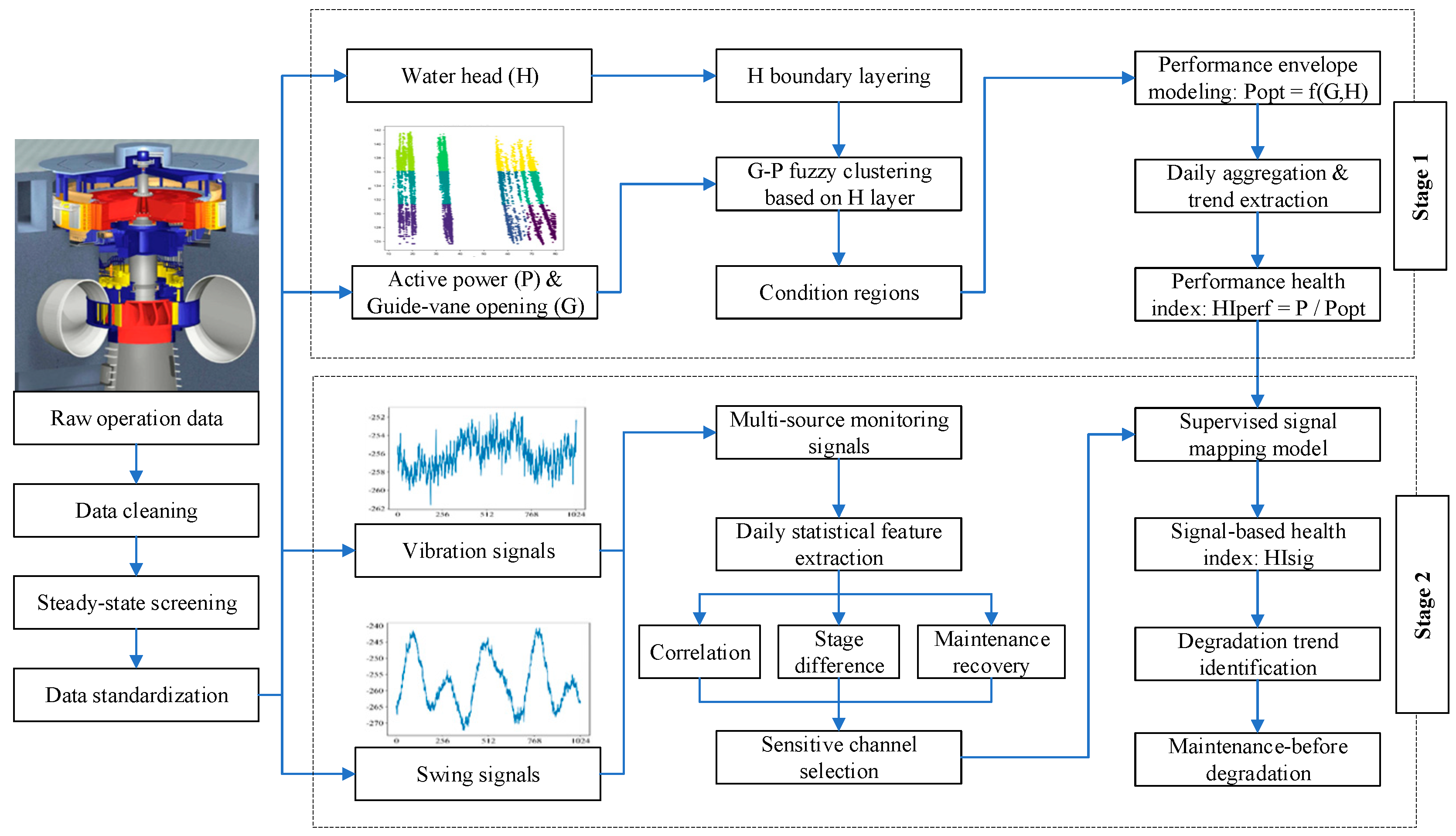
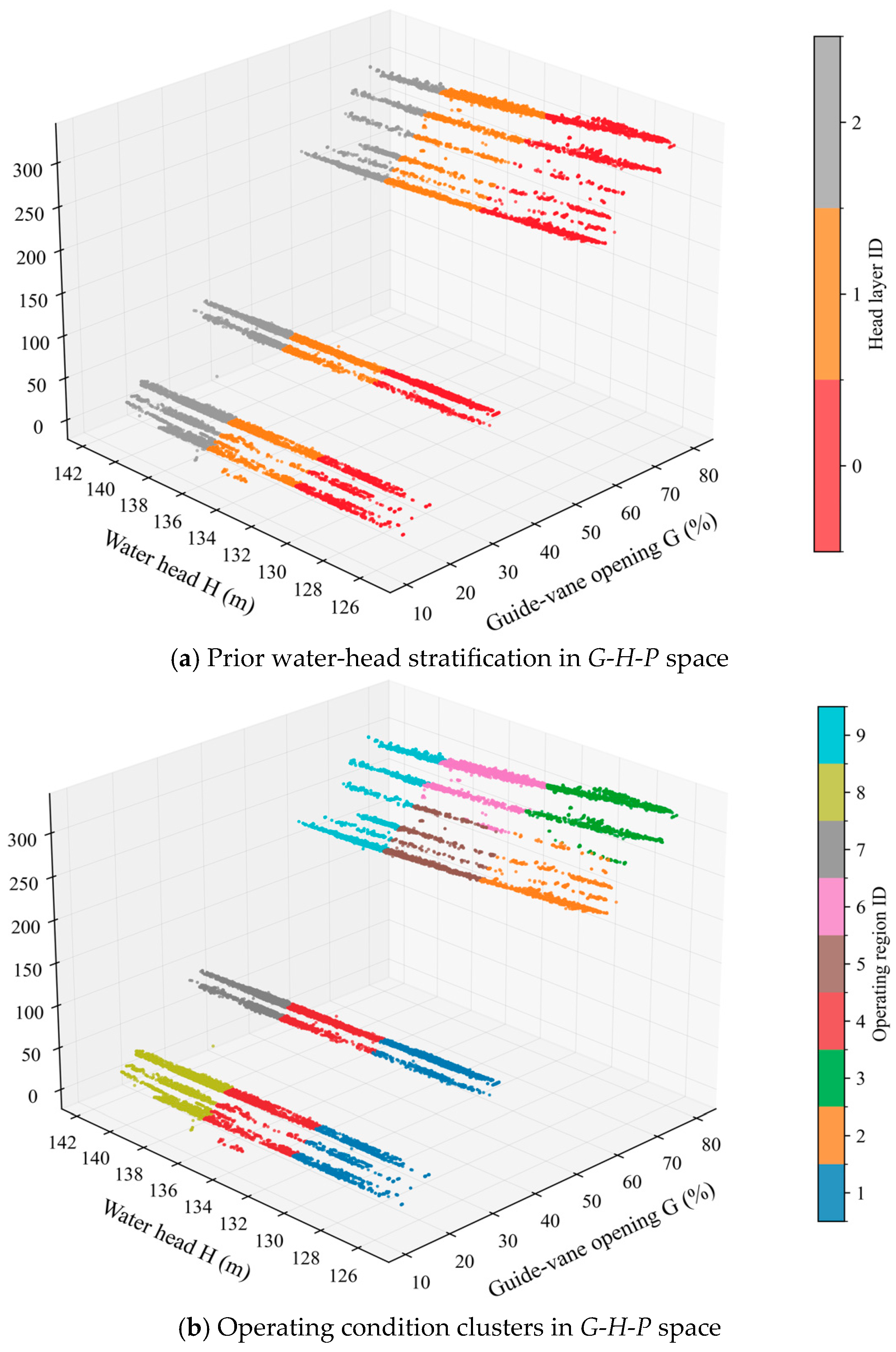
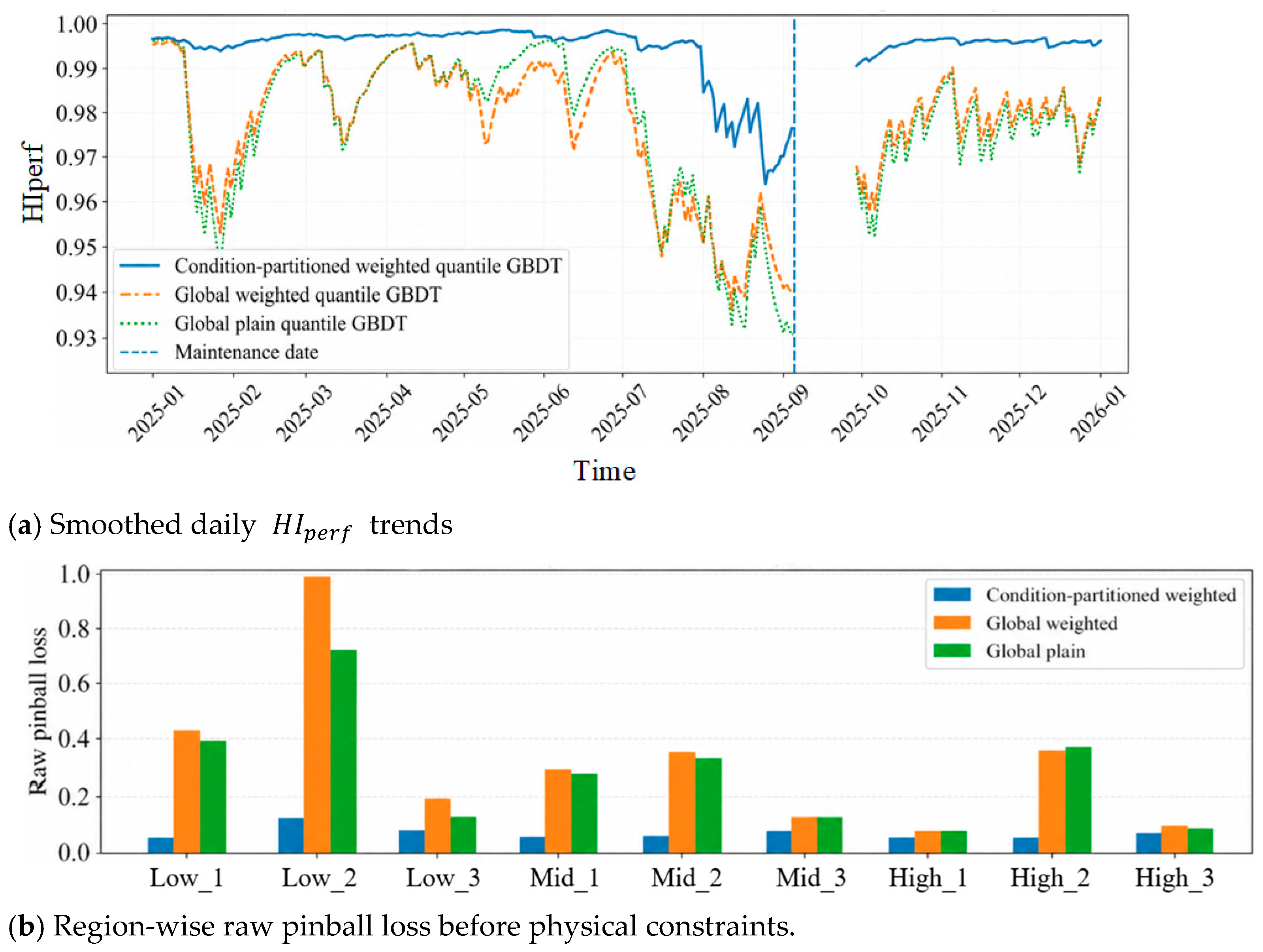
- A hydraulic-boundary-guided operating condition partitioning method is proposed. Water head is used as a prior constraint to separate the hydraulic boundary, and FCM clustering is further performed within each head layer to identify load-related operating regions. This strategy improves the comparability of samples under complex operating conditions and reduces the influence of condition mixing on health assessment.
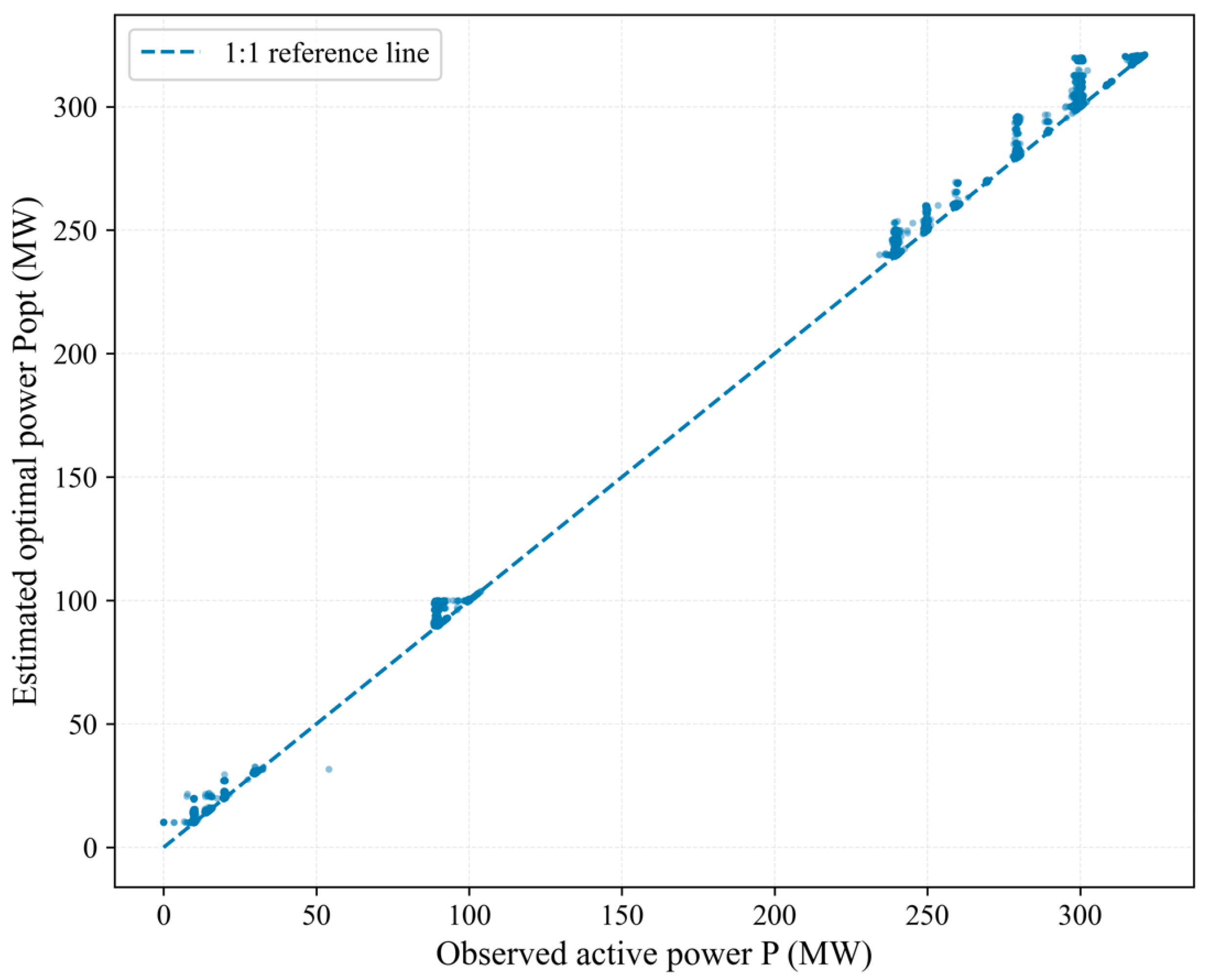
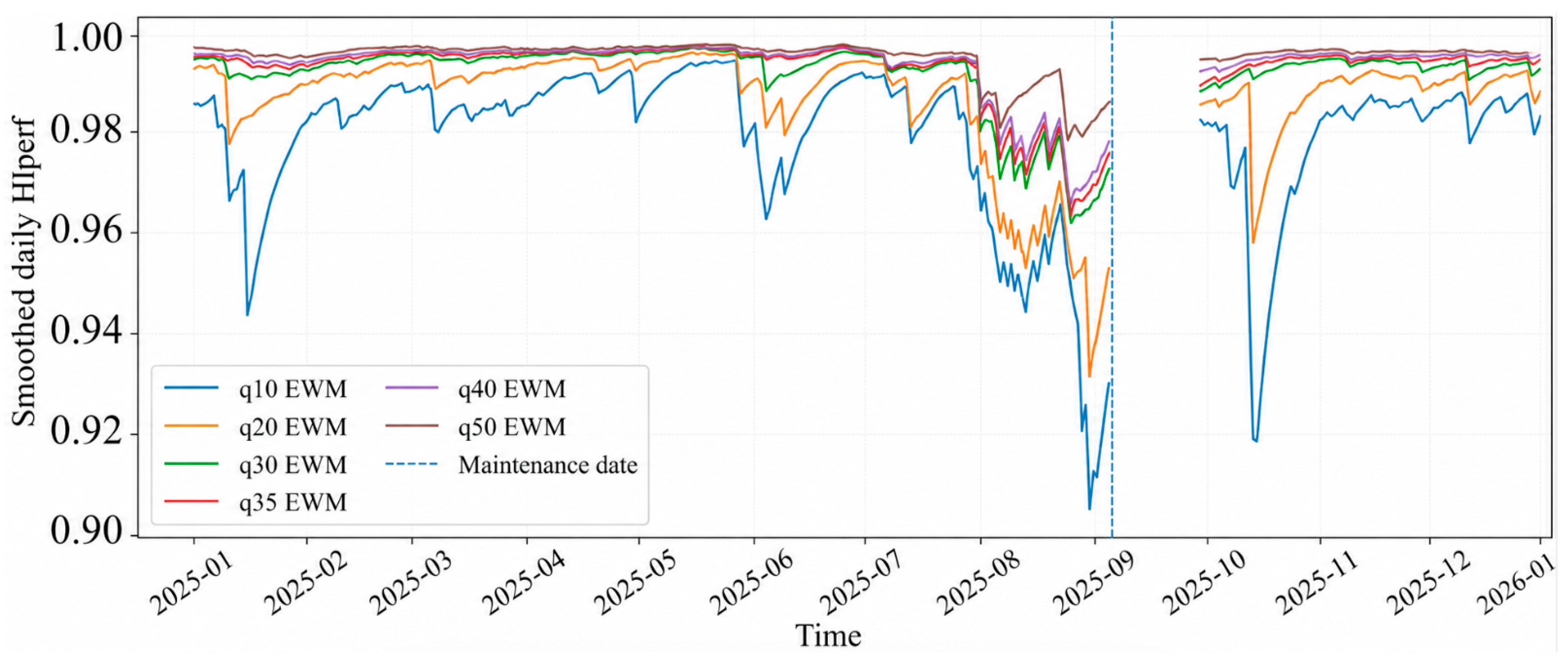
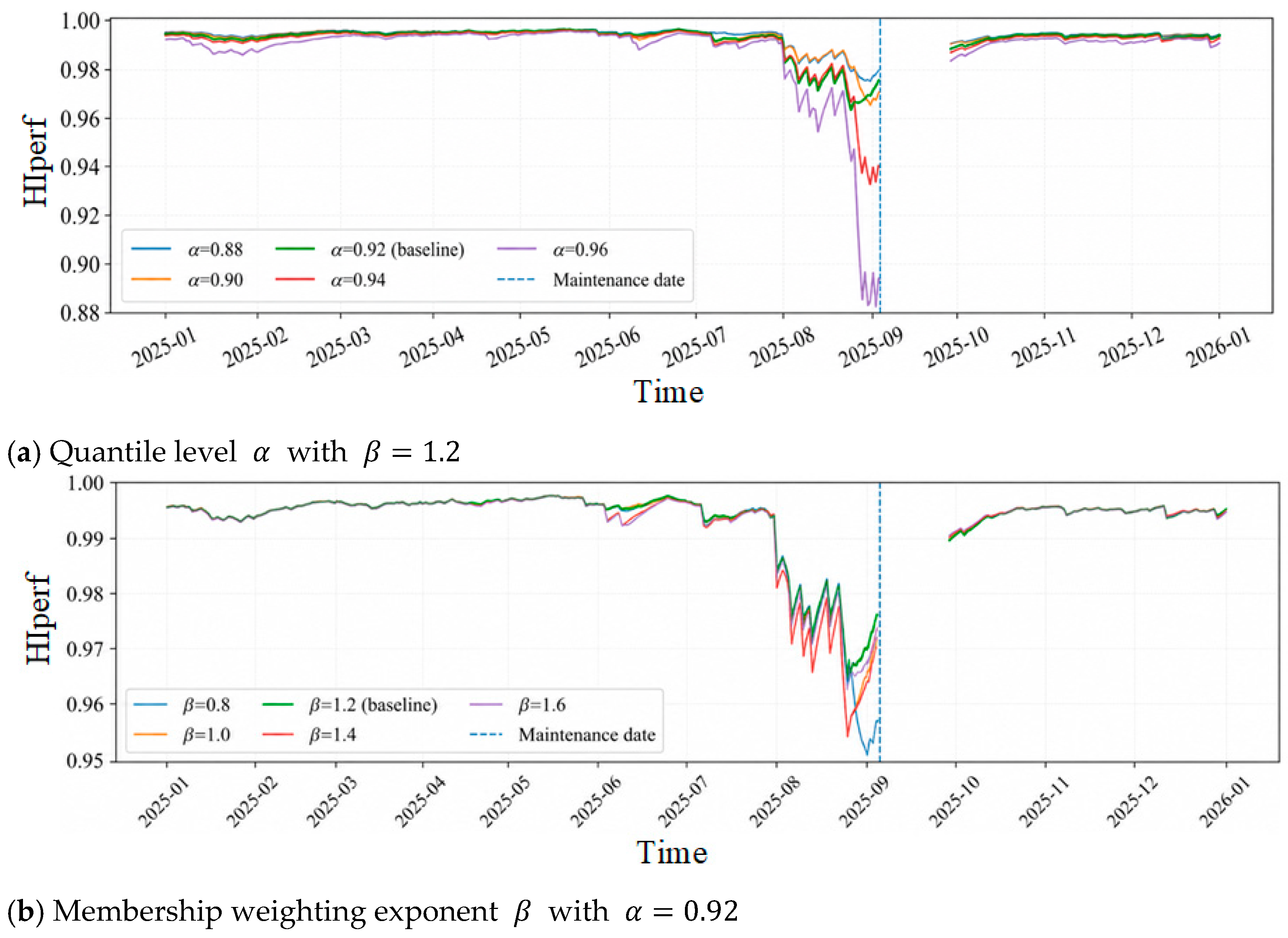
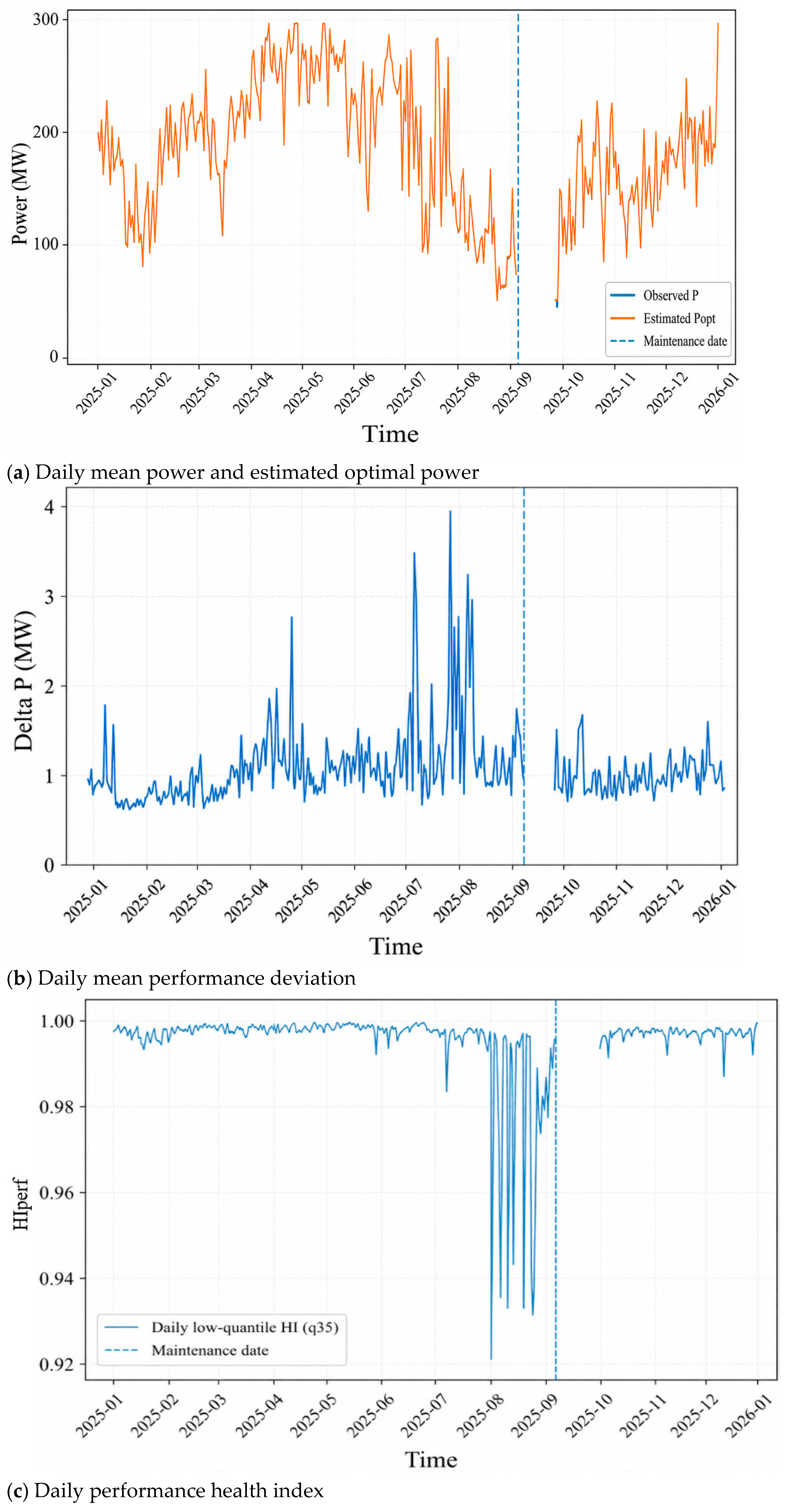
- A condition-comparable performance health index () is developed. The high-performance output boundary under similar operating conditions is modeled by combining high-quantile regression with fuzzy membership weighting. The actual active power is then compared with the optimal power benchmark to construct a dimensionless health index, enabling degradation-related performance loss to be quantified across different water heads, guide-vane openings, and load levels.
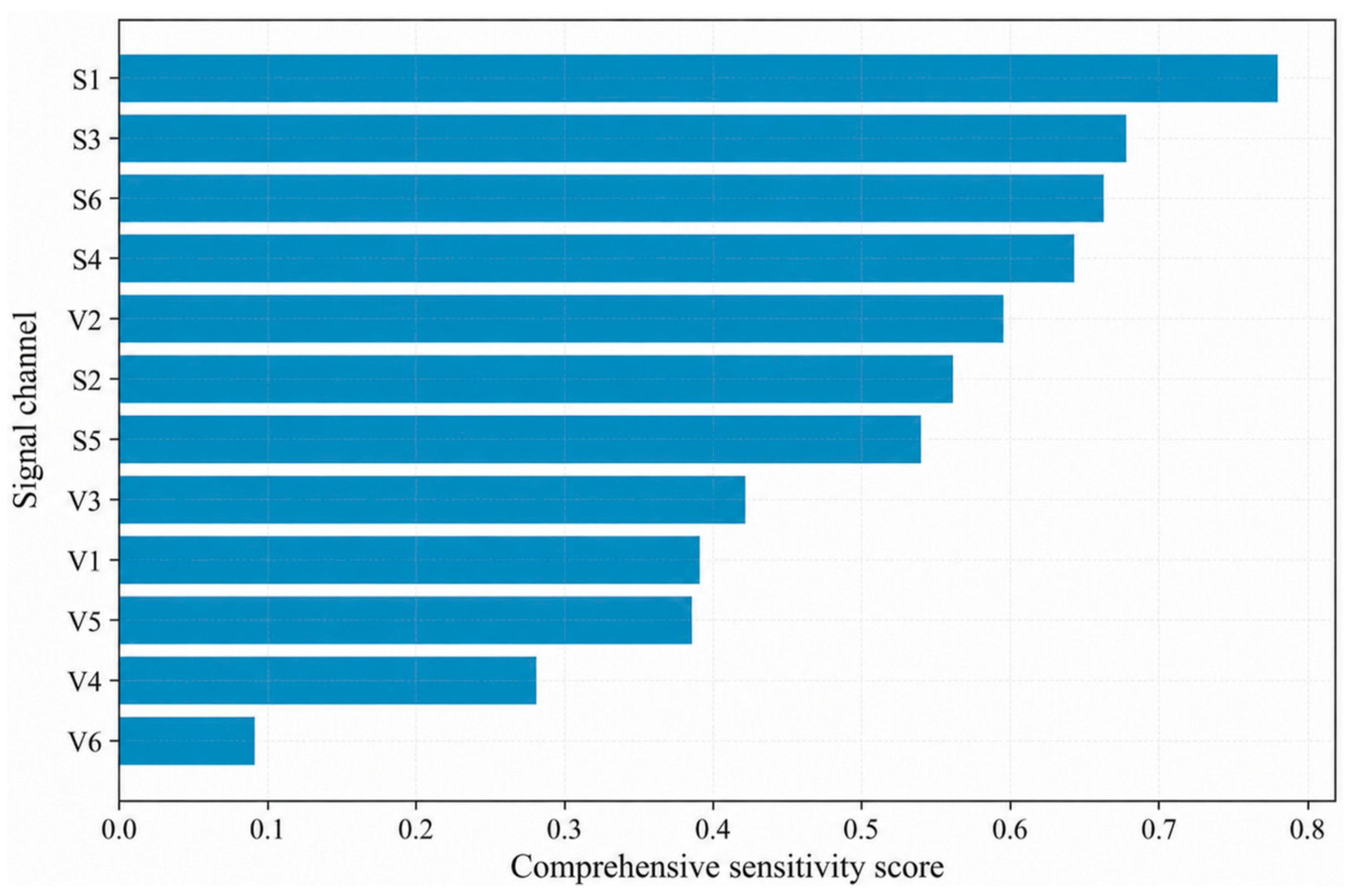
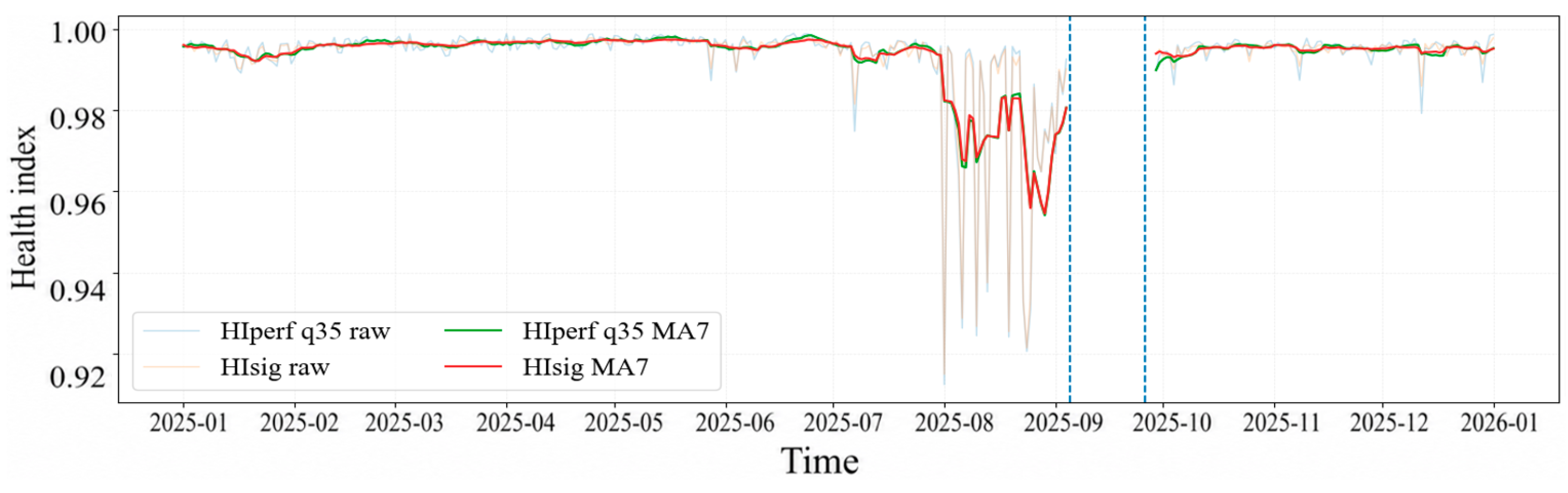
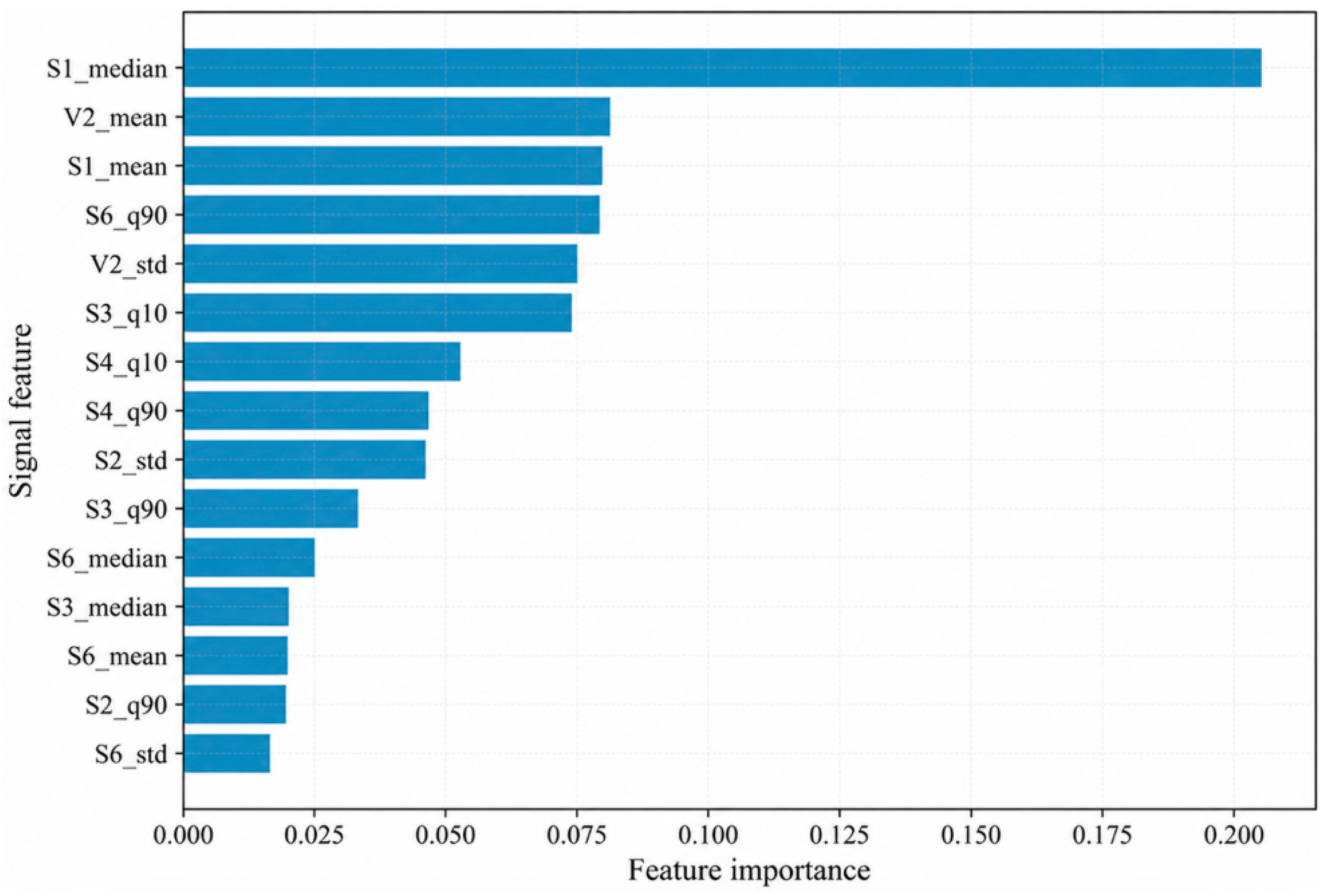
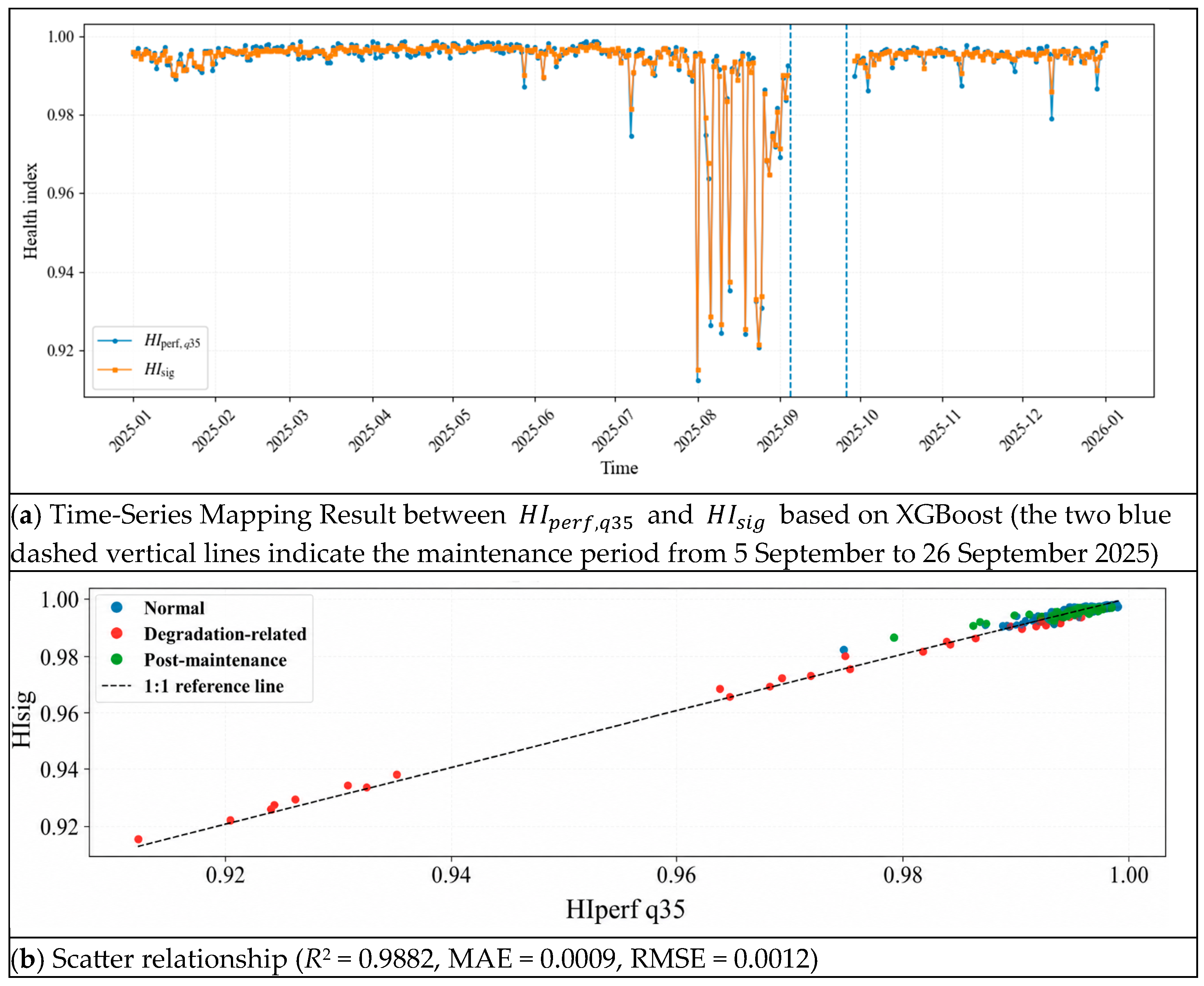
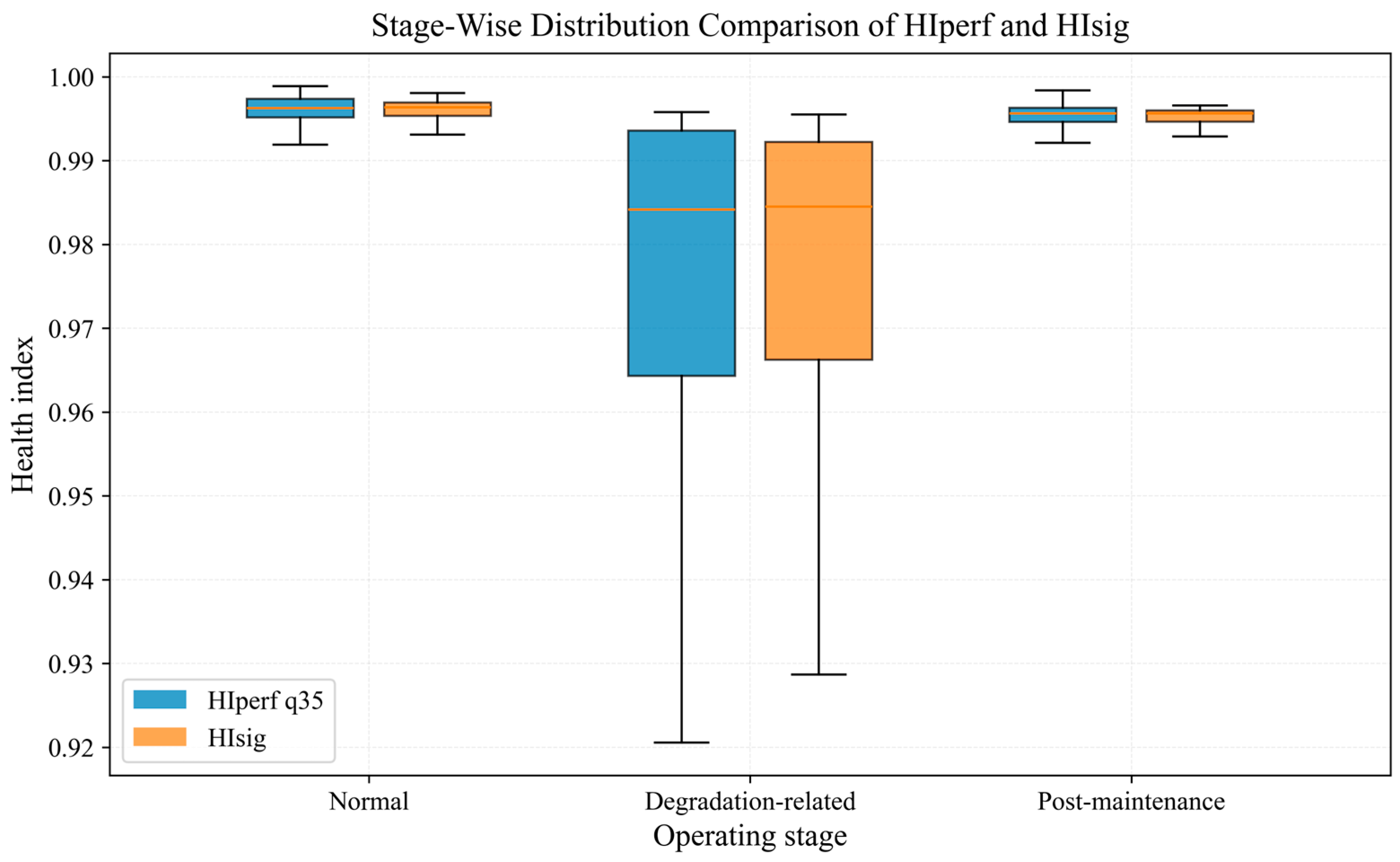
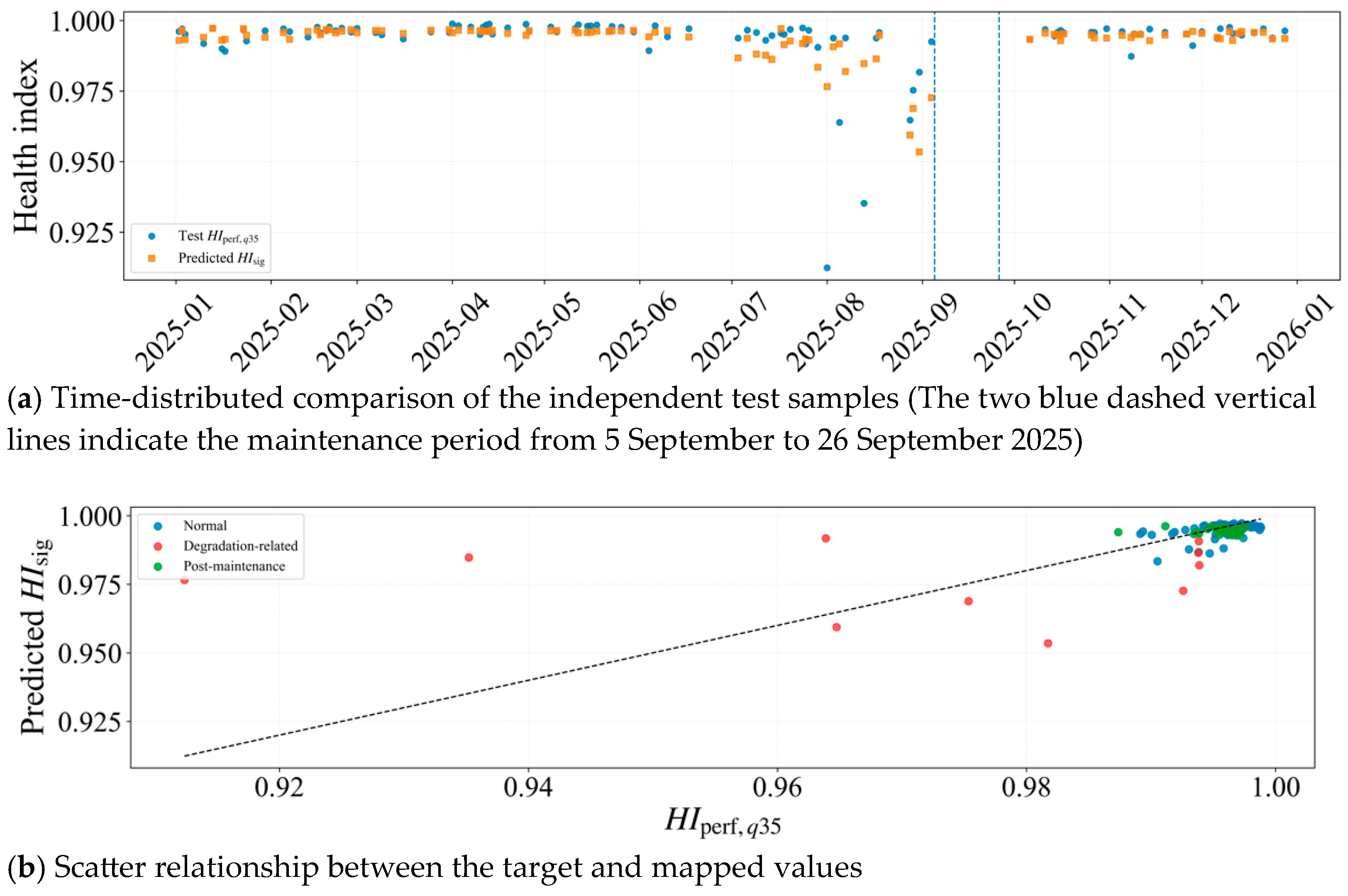
- A multi-source signal-mapping method is introduced to characterize the dynamic response associated with performance degradation. The performance-side health index is first aggregated at the daily scale to obtain a degradation-oriented supervision target. Then, vibration and shaft-swing features are mapped to this target to construct a signal-based health indicator (). This mapping establishes the relationship between performance loss and mechanical response characteristics, thereby providing additional evidence for degradation trend identification.
2. Related Work
2.1. Fault Diagnosis and Condition Monitoring
2.2. Degradation Trend Assessment
3. Methodology
3.1. Overview of the Proposed Framework
3.2. Data Preprocessing and Steady-State Screening
3.3. Condition-Aware Operating Region Partitioning
3.4. Performance Envelope and Health Index Construction
3.5. Multi-Source Signal Mapping
4. Results and Discussion
4.1. Data Description
4.2. Data Preprocessing and Operating Condition Partitioning
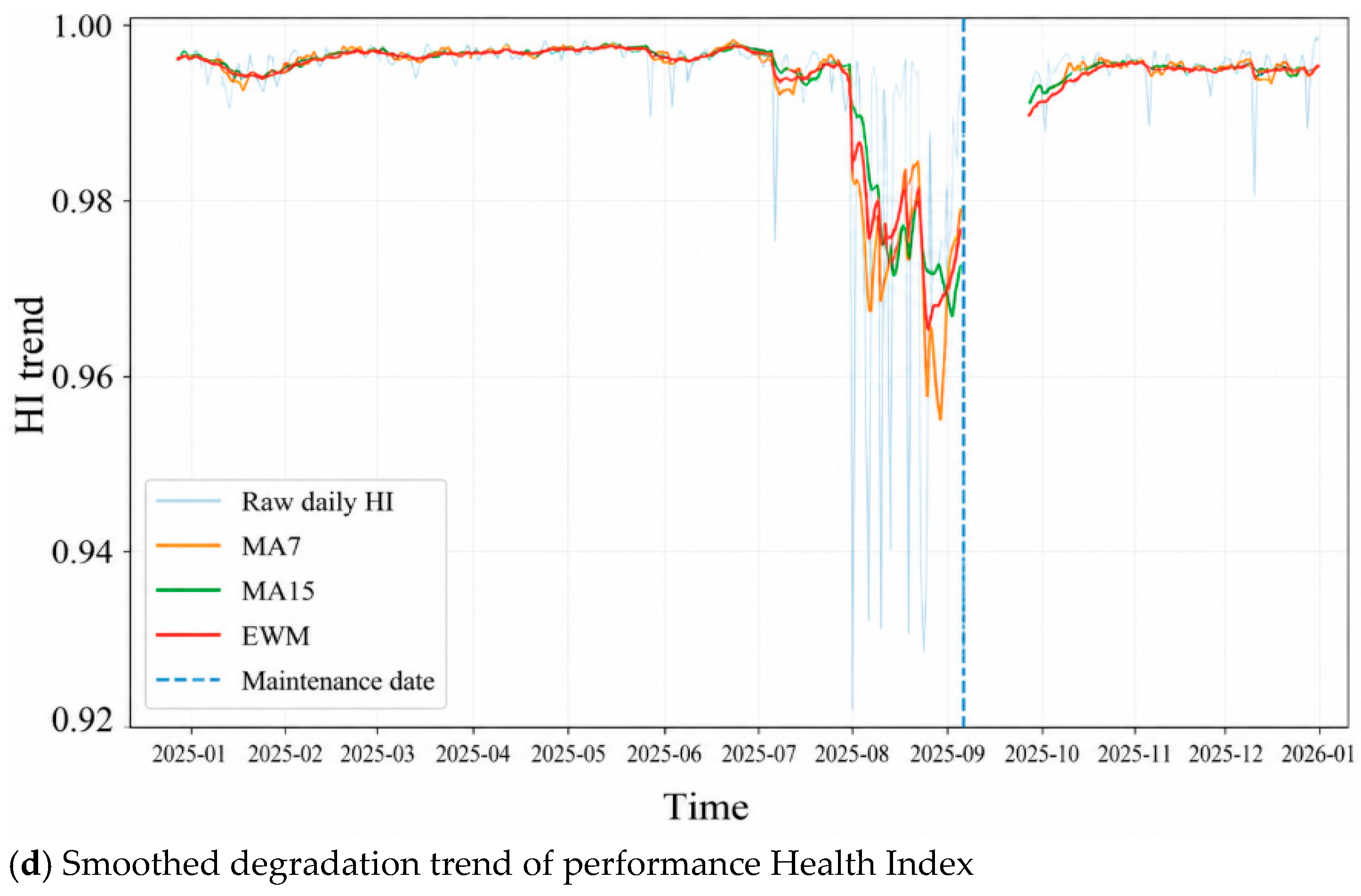
4.3. Performance Envelope Modeling and Degradation Trend
4.4. Signal-Mapping Results
5. Conclusions
Author Contributions
Funding
Data Availability Statement
Conflicts of Interest
Nomenclature
| P | Actual active power |
| G | Guide-vane opening |
| H | Water head |
| Pnorm | Normalized active power |
| Popt | Estimated optimal active power |
| ΔP | Performance deviation between Popt and P |
| HIperf | Performance health index |
| HIperf,q35 | Daily 35% quantile of HIperf |
| HIsig | Signal-based health index |
| uic | Membership degree of sample i in cluster c |
| m | Fuzzy weighting exponent in FCM |
| zi | Input feature vector of sample i |
| vc | Center of cluster c |
| Ei | Fuzzy entropy of sample i |
| ri | Dominant operating region of sample i |
| α | Quantile level of the envelope model |
| β | Membership weighting exponent |
| wi | Overall sample weight |
| wp,i | Power-level weight |
| xd | Daily signal feature vector on day d |
| F(·) | Nonlinear signal-mapping function |
| Nl | Number of samples in the current water-head layer |
| C | Number of FCM clusters |
| Lα | Quantile loss function |
| ei | Residual between actual and estimated optimal power |
| FCM | Fuzzy C-means |
| GBDT | Gradient Boosting Decision Tree |
| XGBoost | Extreme Gradient Boosting |
| BPNN | Backpropagation Neural Network |
| KELM | Kernel Extreme Learning Machine |
| CNN | Convolutional Neural Network |
| LSTM | Long Short-Term Memory |
| MAE | Mean Absolute Error |
| RMSE | Root Mean Square Error |
| EWM | Exponentially Weighted Moving Average |
| HI | Health Index |
References
- Shi, L.; Duanmu, C.; Wu, F.; He, S.; Lee, K.Y. Optimal allocation of energy storage capacity for hydro-wind-solar multi-energy renewable energy system with nested multiple time scales. J. Clean. Prod. 2024, 446, 141357. [Google Scholar] [CrossRef] [Scilit]
- Zhao, Z.; Ding, X.; Behrens, P.; Li, J.; He, M.; Gao, Y.; Liu, G.; Xu, B.; Chen, D. The importance of flexible hydropower in providing electricity stability during China’s coal phase-out. Appl. Energy 2023, 336, 120684. [Google Scholar] [CrossRef] [Scilit]
- Jin, X.; Liu, B.; Liao, S.; Cheng, C.; Zhang, Y.; Jia, Z. Assessing hydropower capability for accommodating variable renewable energy considering peak shaving of multiple power grids. Energy 2024, 305, 132283. [Google Scholar] [CrossRef] [Scilit]
- Wang, Y.; Liu, Y.; Li, X.; Wang, T.; Xu, Z.; Guo, P.; Liao, B. Intelligent recognition for operation states of hydroelectric generating units based on data fusion and visualization analysis. Int. J. Intell. Syst. 2025, 1, 8850566. [Google Scholar] [CrossRef] [Scilit]
- Liu, Y.; Xu, Z.; He, Y.; Guo, P.; Mu, K. Acoustic fault diagnosis method for rotating machinery based on improved spectral subtraction and CNN-TCN model. Measurement 2025, 256, 118482. [Google Scholar] [CrossRef] [Scilit]
- Bai, J.; Che, C.; Liu, X.; Wang, L.; He, Z.; Xie, F.; Dou, B.; Guo, H.; Ma, R.; Zou, H. Fault diagnosis of pumped storage units-a novel data-model hybrid-driven strategy. Processes 2024, 12, 2127. [Google Scholar] [CrossRef] [Scilit]
- Vashishtha, G.; Kumar, R. Autocorrelation energy and aquila optimizer for MED filtering of sound signal to detect bearing defect in Francis turbine. Meas. Sci. Technol. 2021, 33, 015006. [Google Scholar] [CrossRef] [Scilit]
- Zhao, W.; Presas, A.; Egusquiza, M.; Valentín, D.; Egusquiza, E.; Valero, C. Increasing the operating range and energy production in Francis turbines by an early detection of the overload instability. Measurement 2021, 181, 109580. [Google Scholar] [CrossRef] [Scilit]
- Bharathi, B.M.R.; Mohanty, A.R. Time delay estimation in reverberant and low SNR environment by EMD based maximum likelihood method. Measurement 2019, 137, 655–663. [Google Scholar] [CrossRef] [Scilit]
- Robert, G.; Besançon, G. Fault detection in hydroelectric generating units with trigonometric filters. In Proceedings of the 21st IFAC World Congress, Berlin, Germany, 11–17 July 2020; pp. 11686–11691. [Google Scholar]
- Xu, B.; Chen, D.; Zhang, H.; Li, C.; Zhou, J. Shaft mis-alignment induced vibration of a hydraulic turbine generating system considering parametric uncertainties. J. Sound Vib. 2018, 435, 74–90. [Google Scholar] [CrossRef] [Scilit]
- Melani, A.H.A.; Silva, J.M.; de Souza, G.F.M.; Silva, J.R. Fault diagnosis based on Petri Nets: The case study of a hydropower plant. IFAC-PapersOnLine 2016, 49, 1–6. [Google Scholar] [CrossRef] [Scilit]
- Chen, F.; Zhao, Z.; Hu, X.; Liu, D.; Kang, Z.; Ma, Z.; Xiao, P.; Yin, X.; Yang, J. Enhancing the safety of hydroelectric power generation systems: An intelligent identification of axis orbits based on a nonlinear dynamics method. Energy 2025, 324, 135864. [Google Scholar] [CrossRef] [Scilit]
- Lan, C.; Li, S.; Chen, H.; Zhang, W.; Li, H. Research on running state recognition method of hydro-turbine based on FOA-PNN. Measurement 2021, 169, 108498. [Google Scholar] [CrossRef] [Scilit]
- Dao, F.; Zen, Y.; Qian, J. A novel denoising method of the hydro-turbine runner for fault signal based on WT-EEMD. Measurement 2023, 219, 113306. [Google Scholar] [CrossRef] [Scilit]
- Li, X.; Xu, Z.; Wang, Y. PSO-MCKD-MFFResnet based fault diagnosis algorithm for hydropower units. Math. Biosci. Eng. 2023, 20, 14117–14135. [Google Scholar] [CrossRef] [Scilit] [PubMed]
- Dao, F.; Zeng, Y.; Qian, J. Fault diagnosis of hydro-turbine via the incorporation of Bayesian algorithm optimized CNN-LSTM neural network. Energy 2024, 290, 130326. [Google Scholar] [CrossRef] [Scilit]
- Zhang, L.; Zhou, B.; Wang, S.; Sun, N.; Zheng, H. Wind turbine blade health state assessment based on fuzzy evaluation. J. Phys. Conf. Ser. 2024, 2882, 012041. [Google Scholar] [CrossRef] [Scilit]
- Sonthalia, A.; Femilda Josephin, J.S.; Varuvel, E.G.; Chinnathambi, A.; Subramanian, T.; Kiani, F. A deep learning multi-feature based fusion model for predicting the state of health of Lithium-Ion batteries. Energy 2025, 317, 134569. [Google Scholar] [CrossRef] [Scilit]
- Xue, B.; Yu, Y.; Fu, H.; Zhu, J.; Xu, Z. Advanced prognostics techniques for machinery under time-varying operating conditions: A review. Appl. Intell. 2025, 55, 1066. [Google Scholar] [CrossRef] [Scilit]
- Shan, Y.; Liu, J.; Xu, Y.; Zhou, J. A combined multi-objective optimization model for degradation trend prediction of pumped storage unit. Measurement 2021, 169, 108373. [Google Scholar] [CrossRef] [Scilit]
- Wang, Y.; Xiao, Z.; Liu, D.; Chen, J.; Liu, D.; Hu, X. Degradation trend prediction of hydropower units based on a comprehensive deterioration index and LSTM. Energies 2022, 15, 6273. [Google Scholar] [CrossRef] [Scilit]
- Fu, W.; Wang, K.; Zhang, C.; Tan, J. A hybrid approach for measuring the vibrational trend of hydroelectric unit with enhanced multi-scale chaotic series analysis and optimized least squares support vector machine. Trans. Inst. Meas. Control 2019, 41, 4436–4449. [Google Scholar] [CrossRef] [Scilit]
- Xiong, L.; Liu, J.; Song, B.; Dang, J.; Yang, F.; Lin, H. Deep learning compound trend prediction model for hydraulic turbine time series. Int. J. Low-Carbon Technol. 2021, 16, 725–731. [Google Scholar] [CrossRef] [Scilit]
- Li, X.; Xu, Z.; Guo, P. Swing trend prediction of main guide bearing in hydroelectric units based on MFS-DCGNN. Sensors 2024, 24, 3551. [Google Scholar] [CrossRef] [Scilit] [PubMed]
- Ke, Y.; Wang, Q.; Xiao, H.; Luo, Z.; Li, J. Hydropower unit health assessment based on a combination weighting and improved fuzzy comprehensive evaluation method. Front. Energy Res. 2023, 11, 1242968. [Google Scholar] [CrossRef] [Scilit]
- Wang, W.; Wang, X.; Wang, Z.; Ni, M.; Yang, C. Analysis of internal flow characteristics of a startup pump turbine at the lowest head under no-load conditions. J. Mar. Sci. Eng. 2021, 9, 1360. [Google Scholar] [CrossRef] [Scilit]
- Sun, L.; Liu, L.; Xu, Z.; Guo, P. Numerical investigation of no-load startup in a high-head Francis turbine: Insights into flow instabilities and energy dissipation. Phys. Fluids 2024, 36, 035142. [Google Scholar] [CrossRef] [Scilit]



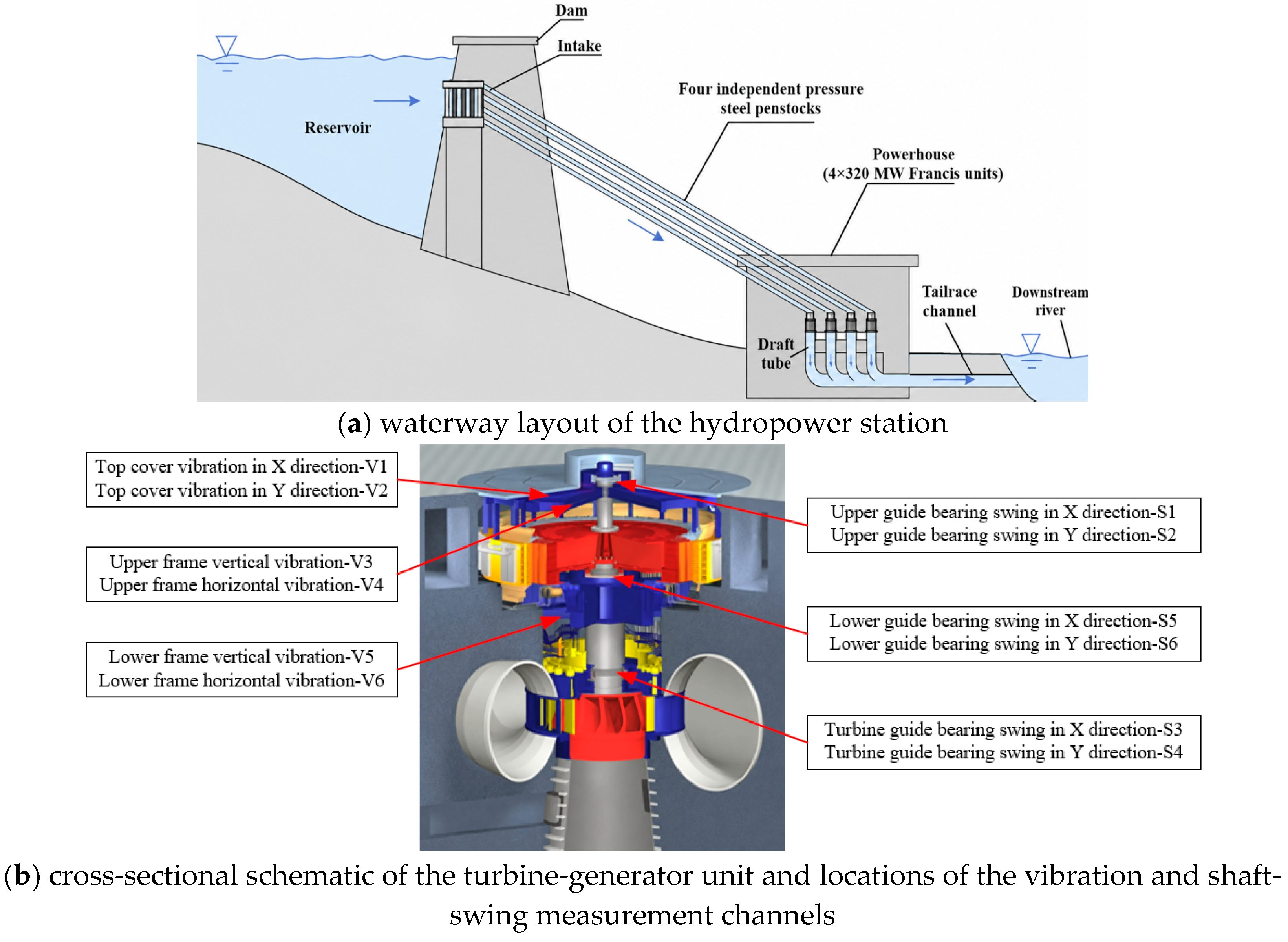
| Data Type | Signal Description | Symbol |
|---|---|---|
| Operating variable | Active power | P |
| Water head | H | |
| Guide-vane opening | G | |
| Vibration signal | Top-cover vibration in X-direction | V1 |
| Top-cover vibration in Y-direction | V2 | |
| Upper-frame vertical vibration | V3 | |
| Upper-frame horizontal vibration | V4 | |
| Lower-frame vertical vibration | V5 | |
| Lower-frame horizontal vibration | V6 | |
| Shaft-swing signal | Upper guide-bearing swing in X-direction | S1 |
| Upper guide-bearing swing in Y-direction | S2 | |
| Turbine guide-bearing swing in X-direction | S3 | |
| Turbine guide-bearing swing in Y-direction | S4 | |
| Lower guide-bearing swing in X-direction | S5 | |
| Lower guide-bearing swing in Y-direction | S6 |
| Zone | Samples | H Range (m) | G Range (%) | P Range (MW) | Mean Membership | Mean Entropy |
|---|---|---|---|---|---|---|
| Low_1 | 58,471 | 125.59–131.51 | 13.76–37.01 | 3.07–102.05 | 0.9101 | 0.3138 |
| Low_2 | 16,356 | 125.53–131.51 | 56.97–68.83 | 234.93–281.08 | 0.9599 | 0.1027 |
| Low_3 | 68,901 | 125.55–131.51 | 68.00–80.00 | 278.18–321.24 | 0.9651 | 0.1129 |
| Mid_1 | 49,746 | 131.51–136.37 | 10.93–35.77 | 0.01–103.78 | 0.9182 | 0.2975 |
| Mid_2 | 25,534 | 131.51–136.37 | 55.59–65.00 | 234.31–280.89 | 0.9464 | 0.1142 |
| Mid_3 | 68,456 | 131.51–136.37 | 64.33–75.12 | 278.44–321.25 | 0.9741 | 0.0760 |
| High_1 | 50,343 | 136.37–141.76 | 30.22–35.18 | 87.31–103.98 | 0.9952 | 0.0269 |
| High_2 | 55,503 | 136.37–141.75 | 11.14–24.18 | 0.01–54.09 | 0.9871 | 0.0625 |
| High_3 | 37,873 | 136.37–141.47 | 54.77–72.61 | 235.41–320.99 | 0.9452 | 0.2173 |
| Zone | Samples | R2 | MAE (MW) | P Range (MW) |
|---|---|---|---|---|
| Low_1 | 58,471 | 0.9995 | 0.4677 | 3.07–102.05 |
| Low_2 | 16,356 | 0.9549 | 1.1582 | 234.93–281.08 |
| Low_3 | 68,901 | 0.9427 | 0.9076 | 278.18–321.24 |
| Mid_1 | 49,746 | 0.9985 | 0.5434 | 0.01–103.78 |
| Mid_2 | 25,534 | 0.9909 | 0.5238 | 234.31–280.89 |
| Mid_3 | 68,456 | 0.9650 | 0.8720 | 278.44–321.25 |
| High_1 | 50,343 | 0.9334 | 0.4607 | 87.31–103.98 |
| High_2 | 55,503 | 0.9810 | 0.4489 | 0.01–54.09 |
| High_3 | 37,873 | 0.9982 | 0.8111 | 235.41–320.99 |
| Model | R2 | MAE | RMSE |
|---|---|---|---|
| XGBoost | 0.9882 | 0.0009 | 0.0012 |
| GBDT | 0.9852 | 0.0009 | 0.0014 |
| Random Forest | 0.8519 | 0.0017 | 0.0044 |
Disclaimer/Publisher’s Note: The statements, opinions and data contained in all publications are solely those of the individual author(s) and contributor(s) and not of MDPI and/or the editor(s). MDPI and/or the editor(s) disclaim responsibility for any injury to people or property resulting from any ideas, methods, instructions or products referred to in the content. |
© 2026 by the authors. Licensee MDPI, Basel, Switzerland. This article is an open access article distributed under the terms and conditions of the Creative Commons Attribution (CC BY) license.
Share and Cite
Li, X.; Xu, Z.; Guo, P.; Mu, K.; Mu, T. Condition-Aware Performance Health Index and Multi-Source Signal Mapping for Degradation Trend Identification in Hydropower Units. Energies 2026, 19, 3780. https://doi.org/10.3390/en19163780
Li X, Xu Z, Guo P, Mu K, Mu T. Condition-Aware Performance Health Index and Multi-Source Signal Mapping for Degradation Trend Identification in Hydropower Units. Energies. 2026; 19(16):3780. https://doi.org/10.3390/en19163780
Chicago/Turabian StyleLi, Xu, Zhuofei Xu, Pengcheng Guo, Kaidi Mu, and Tianhaoyue Mu. 2026. "Condition-Aware Performance Health Index and Multi-Source Signal Mapping for Degradation Trend Identification in Hydropower Units" Energies 19, no. 16: 3780. https://doi.org/10.3390/en19163780
APA StyleLi, X., Xu, Z., Guo, P., Mu, K., & Mu, T. (2026). Condition-Aware Performance Health Index and Multi-Source Signal Mapping for Degradation Trend Identification in Hydropower Units. Energies, 19(16), 3780. https://doi.org/10.3390/en19163780