Article

Predicting Failure in Carbon Steel Pipeline Hydrogen–Methane Blend Transporting

by
Hossein Moradi
,
Maria Francesca Milazzo
*,
Elpida Piperopoulos
and
Edoardo Proverbio
Department of Engineering, University of Messina, Contrada di Dio, 98166 Messina, Italy
*
Author to whom correspondence should be addressed.
Energies 2026, 19(14), 3449; https://doi.org/10.3390/en19143449
Submission received: 19 June 2026 / Revised: 10 July 2026 / Accepted: 16 July 2026 / Published: 22 July 2026

Abstract

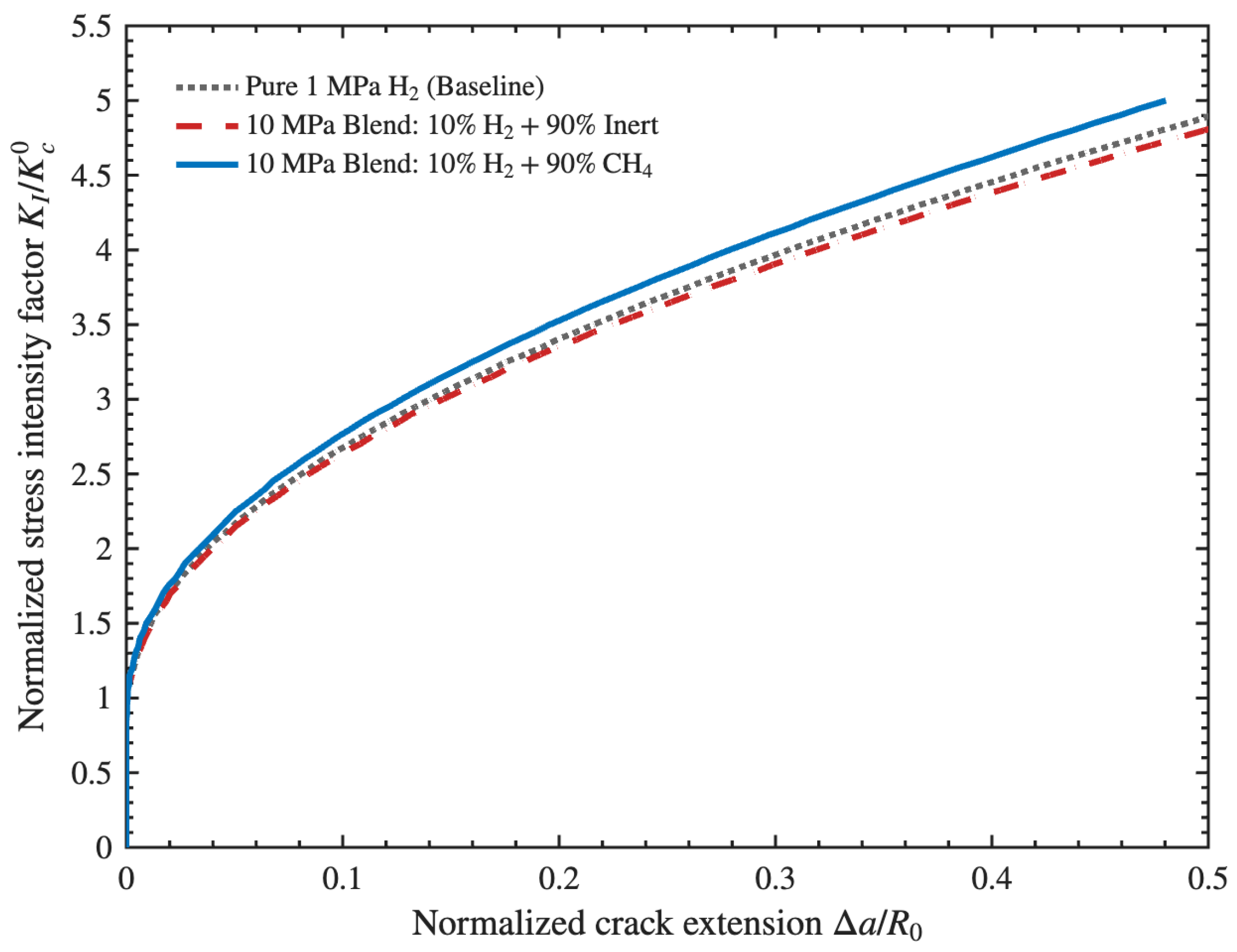
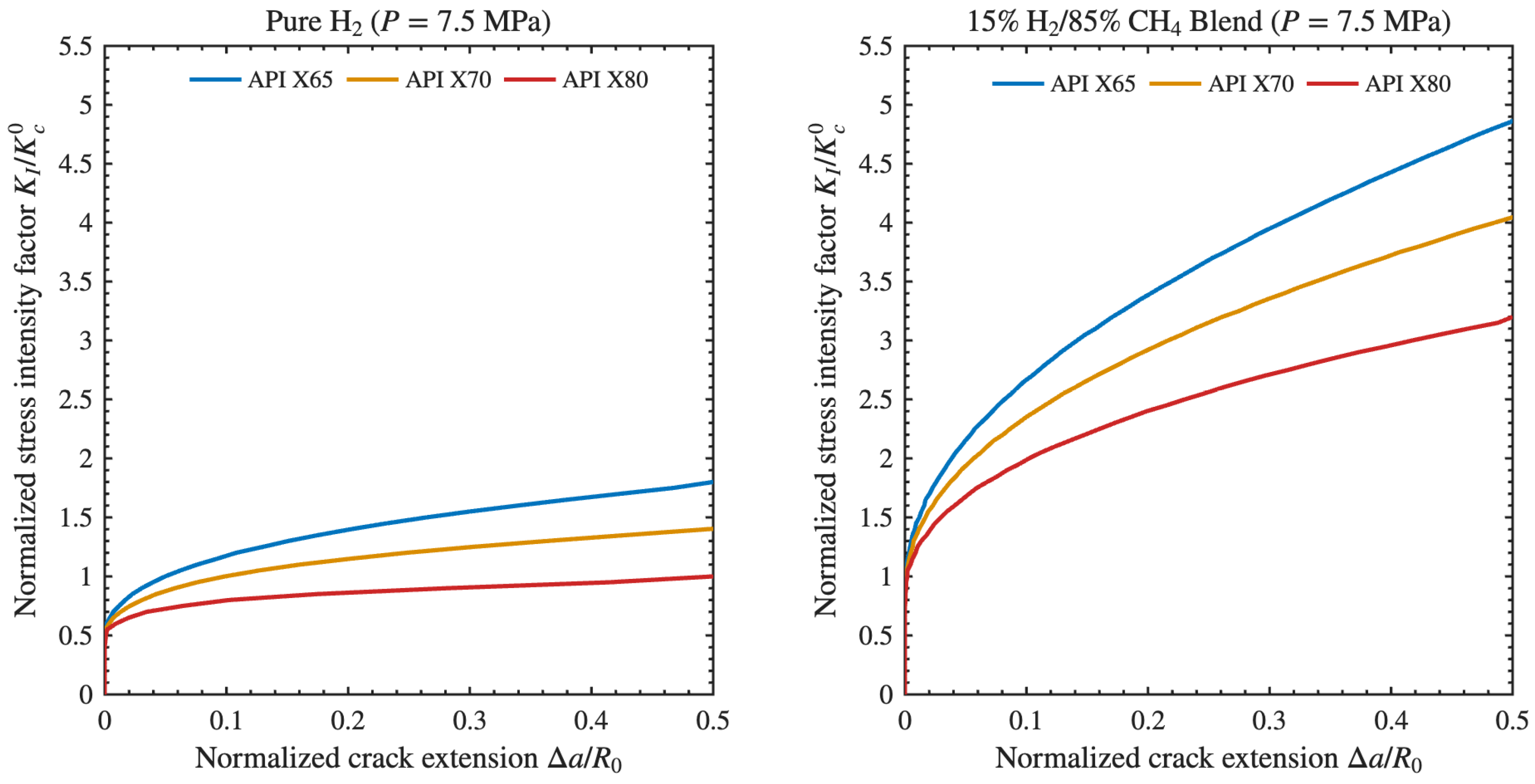
The transition to a decarbonized energy infrastructure relies on repurposing existing pipelines for hydrogen–methane mixtures, which introduces significant concerns regarding hydrogen embrittlement. Accordingly, a coupled Multiphysics phase-field model was developed to predict hydrogen-assisted failure in elastic–plastic solids. This framework is numerically implemented via the finite element method to predict the structural integrity of pipeline steel strength classes representative of API 5L X65, X70, and X80 by explicitly accounting for elastoplastic deformation, hydrogen trapping effects, and stress-driven diffusion. By computing crack growth resistance curves across various scenarios, it has been demonstrated the capability of the model to capture material sensitivities by varying hydrogen–methane blend compositions, operational pressures, and the elastoplastic deformation behavior of different strength grades. The investigation revealed that methane limits surface hydrogen coverage, thereby mitigating the crack-tip decohesion mechanism. Furthermore, the model indicates that at a pressure of 7.5 MPa, a 15 vol% hydrogen–methane blend enables these materials to retain 80–90% of their fracture toughness and exhibit ductile failure. Finally, higher-strength steel classes (representative of X80) demonstrate greater susceptibility to hydrogen embrittlement under these conditions due to yield stress-amplified hydrostatic stress, whereas lower-strength steels exhibit greater defect tolerance for the hydrogen-blend transition.
Keywords: hydrogen embrittlement; phase field method; hydrogen–methane blends; hydrogen trapping; safety hydrogen embrittlement; phase field method; hydrogen–methane blends; hydrogen trapping; safety