Review

Energy Performance Analysis and Optimization in Liquid Carton Packaging Manufacturing

by
George Ernest Omondi Ouma
1,*,
Moses Jeremiah Barasa Kabeyi
2,* and
Oludolapo Akanni Olanrewaju
2
1
Department of Mechanical and Manufacturing, University of Nairobi, Nairobi P.O. Box 30197, Kenya
2
Industrial Engineering Department, Durban University of Technology, Durban P.O. Box 1334, South Africa
*
Authors to whom correspondence should be addressed.
Energies 2026, 19(14), 3390; https://doi.org/10.3390/en19143390 (registering DOI)
Submission received: 21 May 2026 / Revised: 14 July 2026 / Accepted: 15 July 2026 / Published: 17 July 2026

Abstract

The global packaging industry is highly energy intensive, with liquid carton packaging facing growing pressure to improve sustainability through energy efficiency. The objective of this review is to synthesize and critically evaluate existing literature on energy performance metrics, energy auditing practices, optimization frameworks, and renewable energy integration in liquid carton packaging manufacturing. Unlike previous studies that focus on individual aspects of industrial energy management, the review adopts an integrated system-level perspective that combines process-level energy analysis, auxiliary utility systems, energy performance indicators, digital monitoring approaches, optimization tools, and renewable energy integration. This holistic approach provides a more comprehensive understanding of energy performance improvement opportunities within liquid carton packaging manufacturing. The study examines global energy trends, system inefficiencies, and best practices in implementing energy management systems, modeling tools, and solar photovoltaic adoption. A qualitative approach was applied, analyzing peer-reviewed articles, industry reports, and case studies to identify key themes and comparative strategies. Findings indicate that energy-intensive processes such as extrusion coating and flexographic printing dominate consumption, while auxiliary systems contribute significantly to non-process energy use. Despite advancements in monitoring and renewable integration, gaps persist in standardized performance metrics, real-time data utilization, and regional representation, particularly in Africa, Latin America, and other developing regions where packaging manufacturing systems remain underrepresented in the literature. The findings provide a practical reference guide for energy managers, manufacturing engineers, and sustainability practitioners seeking to implement ISO 50001-based energy management systems, real-time energy monitoring frameworks, and renewable energy integration strategies within packaging manufacturing facilities. The review further highlights the need for standardized performance metrics and region-specific studies to support sustainable and energy-efficient packaging operations.

1. Introduction

The world faces stringent energy and environmental challenges including depletion of fossil fuel reserves, volatile energy prices and concerns about energy security and global warming. The role of energy conservation and management is becoming extremely important in a changing global energy environment as the world’s industrial energy consumption is anticipated to increase by 30% by 2050 [1]. In this regard, sustainable manufacturing has become a central theme in global industry, especially as energy use accounts for a significant portion of operational costs and greenhouse gas emissions [2].
Packaging industry is an important component of many facets of modern consumption in that it has become part of the delivery system for products, and it is generally seen to fulfil four key functions, namely to ‘preserve and protect the product’, to communicate brand image’, to ‘convey information’, and ‘offer convenience’ [2]. The role of packaging in the safe delivery and transportation of products across the food chain cannot be overemphasized. To prevent food waste and loss, a good food package should ensure that food quality and safety is maintained from transportation through to storage of the product [3]. At the same time packaging materials require the use of a wide range of natural resources whose disposal has a direct impact on the environment and widespread concerns have been expressed about the negative environmental impact of packaging systems [4]. In the packaging industry, particularly in liquid carton packaging, the demand for electricity is driven by both continuous and batch processes that rely heavily on machinery and support systems. This paper reviews existing literature to understand how energy optimization strategies have evolved in the context of packaging manufacturing, with a special focus on the role of technology, audits, and renewable energy sources.
Despite the growing emphasis on sustainable manufacturing and industrial energy efficiency, several important research gaps remain in understanding and optimizing energy performance within liquid carton packaging manufacturing. The packaging industry faces high operational costs and environmental impact due to inefficient energy use, outdated systems, and limited adoption of renewable technologies [5].
In liquid packaging manufacturing, these challenges are further intensified by the presence of energy-intensive processes and continuous production requirements. However, despite growing research on industrial energy efficiency, there is a lack of detailed process-level analysis in liquid packaging manufacturing systems. Existing studies tend to focus on general manufacturing environments without adequately addressing key energy-intensive operations such as flexographic printing and extrusion coating [4,6,7,8,9,10,11,12].
In addition, auxiliary systems such as compressed air and chilled water, which contribute significantly to total energy consumption, are often analyzed independently rather than as part of an integrated production system [13,14]. Furthermore, most studies are concentrated in developed regions [15,16,17], with limited representation from developing economies where energy infrastructure and operational conditions differ significantly. In many developing economies, these differences are influenced not only by technological constraints but also by financial and institutional factors. Aging production equipment, restricted access to capital investment, and shortages of specialized technical expertise can hinder the implementation of effective energy management practices. As a result, improving industrial energy performance requires both technological modernization and capacity-building initiatives. Similar observations have been reported in circular economy studies conducted in emerging and transition economies, where progress toward sustainability objectives depends not only on technological advancements but also on supportive policy frameworks, institutional capacity, innovation ecosystems, and stakeholder engagement. These findings suggest that region-specific factors play a critical role in determining the effectiveness of energy efficiency and sustainability initiatives and reinforce the need for greater geographical diversity in packaging manufacturing research [18]. The application of advanced energy monitoring systems and real-time data analytics in packaging manufacturing also remains limited, with many studies relying on historical or estimated data. In the context of this review, real-time data analytics refers not only to continuous data acquisition through smart meters, sensors, and energy monitoring platforms, but also to advanced analytical approaches that transform operational data into actionable insights. These approaches include predictive analytics, machine learning techniques, and emerging Digital Twin technologies that enable simulation, forecasting, and optimization of industrial energy systems. Although Digital Twins are not yet widely adopted in packaging manufacturing, they are increasingly recognized as a promising means of integrating information from multiple production, utility, and monitoring systems, thereby reducing data fragmentation and supporting data-driven decision-making.
Moreover, there is a lack of standardized energy performance metrics such as Specific Energy Consumption (SEC) and Energy Performance Index (EPI), making cross-study comparisons difficult. Life cycle assessments are also often incomplete, excluding end-of-life scenarios and renewable energy interactions. As a result, energy optimization efforts are fragmented, and opportunities for holistic performance improvement are not fully realized.
The objective of this review is to examine global energy consumption trends in packaging manufacturing, evaluate key performance metrics and energy audit tools, assess modeling and simulation approaches for energy optimization, examine the integration of renewable energy systems, and identify research gaps and future directions for improving energy efficiency and sustainability in packaging production systems.
This review is motivated by the need for a comprehensive and integrated review of energy performance in liquid packaging manufacturing systems. This study is motivated by the need to bridge the gap between existing theoretical approaches and their practical application by combining insights from process-level analysis, utility system optimization, and digital energy monitoring.
By synthesizing existing literature on energy consumption patterns, optimization strategies, and renewable energy integration, this review provides a structured understanding of energy use in packaging manufacturing. It also aims to support the development of standardized performance metrics and promote the adoption of data-driven and integrated energy management approaches. Furthermore, the study highlights the need for increased research in underrepresented regions and the incorporation of real-time monitoring and lifecycle perspectives in future investigations.
The methodology adopted in this review comprised a structured qualitative literature review to synthesize existing knowledge on energy performance analysis, energy management, and optimization strategies in liquid carton packaging manufacturing. The review aimed to identify, evaluate, and integrate published research related to energy consumption, manufacturing processes, energy performance assessment, utility systems, renewable energy integration, digital energy management, and modelling approaches applicable to packaging manufacturing. Rather than performing a statistical meta-analysis, the review adopted a thematic synthesis approach to provide a comprehensive understanding of current research trends, technological developments, knowledge gaps, and future research opportunities.
The literature search was undertaken using major scientific databases, including Scopus, Web of Science, and Google Scholar, which collectively provide extensive coverage of peer-reviewed engineering, manufacturing, and energy research. Additional references were identified from authoritative books, international standards, technical reports, and conference proceedings where they provided relevant industrial or methodological information. The review primarily considered publications published between 2010 and 2025, while a limited number of earlier seminal publications were retained where they provided important theoretical foundations for energy performance assessment, manufacturing processes, or industrial energy management.
The search strategy combined keywords related to packaging manufacturing, industrial energy systems, and energy optimization using boolean search operators. Representative search terms included “liquid carton packaging”, “packaging manufacturing”, “energy consumption”, “energy efficiency”, “Specific Energy Consumption (SEC)”, “Energy Performance Index (EPI)”, “flexographic printing”, “extrusion coating”, “compressed air systems”, “chilled water systems”, “renewable energy”, “solar photovoltaic”, “energy monitoring”, “Energy Management Systems”, “ISO 50001”, “RETScreen”, “HOMER Pro”, “MATLAB/Simulink”, and “Life Cycle Assessment (LCA)” [19]. These keywords were used individually and in combination to identify literature relevant to the objectives of this review.
The inclusion criteria focused on peer-reviewed journal articles, conference papers, industrial case studies, technical reports, international standards, and authoritative books that addressed energy performance, manufacturing processes, utility systems, renewable energy integration, energy monitoring, modelling techniques, or sustainability within packaging manufacturing and related industrial sectors. Studies from closely related manufacturing industries were included where they provided transferable knowledge applicable to liquid carton packaging manufacturing, particularly for auxiliary utility systems, industrial energy management practices, and energy optimization methodologies.
Studies were excluded if they focused exclusively on unrelated manufacturing sectors without transferable industrial relevance, consumer packaging behaviour, packaging waste management without manufacturing considerations, purely material characterization studies with no energy performance context, or publications lacking sufficient technical detail. Duplicate publications and studies with limited relevance to the objectives of the review were also excluded following title, abstract, and full-text assessment.
The selected literature was subsequently organized into thematic categories corresponding to the objectives and structure of this review. These themes emerged from recurring topics identified during the literature search and screening process and included liquid carton packaging manufacturing processes, energy consumption patterns, energy performance indicators, energy auditing approaches, auxiliary utility systems, energy monitoring and digital technologies, renewable energy integration, modelling and optimization tools, implementation challenges, and future research directions. Approximately 190 relevant references were ultimately synthesized to develop a comprehensive and integrated assessment of energy performance in liquid carton packaging manufacturing.
The collected literature was critically analyzed by comparing research objectives, methodologies, key findings, limitations, and industrial applicability rather than simply summarizing individual studies. Particular emphasis was placed on identifying interactions between manufacturing processes, auxiliary utility systems, digital energy monitoring, renewable energy integration, and modelling approaches to establish a system-level understanding of energy performance. This thematic synthesis also enabled the identification of current research gaps, benchmarking opportunities, and future directions for improving energy efficiency and sustainability in liquid carton packaging manufacturing.
The principal contribution of this review is a structured synthesis of energy optimization practices in packaging manufacturing, highlighting best practices, challenges, and opportunities for innovation. It also introduces a comparative framework for selecting appropriate audit and modeling tools.
The novelty of this review lies in providing a comprehensive system-level synthesis of energy performance in packaging manufacturing. To further contextualize the research gap in energy performance analysis within packaging manufacturing, several studies addressing energy consumption, efficiency improvement, and sustainability in industrial systems are reviewed and compared. Existing literature on packaging and related manufacturing sectors has primarily focused on specific aspects such as process-level energy analysis, energy performance metrics, life cycle assessment, sustainability, energy monitoring, and renewable energy integration. However, these topics have been investigated independently. Consequently, the existing literature provides limited synthesis of the interactions between energy-intensive manufacturing processes, auxiliary utility systems, energy performance assessment, digital monitoring technologies, and renewable energy integration within liquid carton packaging manufacturing. This fragmentation highlights the need for a comprehensive system-level synthesis that integrates these interconnected themes within a unified analytical framework.
For instance, studies on process-level energy consumption have examined energy-intensive operations such as extrusion and printing. Abeykoon et al. [20,21,22] investigated the relationship between processing parameters and energy consumption in polymer extrusion systems, highlighting the dominance of thermal and mechanical energy demands. Similarly, Estrada et al. [23] evaluated specific energy consumption in extrusion processes, demonstrating the influence of operational conditions on system efficiency. In the context of printing, Abusaq et al. [24] applied lean manufacturing and artificial intelligence techniques to optimize energy use in flexographic printing, achieving measurable reductions in energy consumption.
At a broader system level, Ladha-Sabur et al. [25] conducted energy mapping studies in food manufacturing, identifying key energy-consuming processes and their contributions to overall consumption. In parallel, studies on energy performance indicators have provided standardized approaches for evaluating industrial energy efficiency. Lawrence et al. [26] and Boyd [27] explored the application of specific energy consumption (SEC) and energy performance indices (EPI) for benchmarking industrial systems, although these approaches are often not tailored to packaging-specific operations.
Life cycle assessment (LCA) has also been widely applied to evaluate the environmental impact of packaging systems. Ingarao et al. [28] demonstrated the usefulness of LCA in assessing material and environmental performance; however, such studies often focus on environmental impacts without integrating real-time operational energy performance. In addition, renewable energy integration studies, such as Fluch et al. [29], have highlighted the potential of combining energy efficiency measures with renewable energy systems in industrial applications, though these studies typically lack detailed process-level integration.
Auxiliary systems, which play a significant role in industrial energy consumption, have been investigated in separate studies. For example, compressed air systems have been analyzed by Eret et al. [30] and Benedetti et al. [31], while chilled water and cooling systems have been studied by Zou et al. [32] and Jia et al. [33], focusing on efficiency improvements through optimization and control strategies. Furthermore, the role of energy monitoring systems has been emphasized by Akhtar et al. [34] and O’Rielly and Jeswiet [35], who highlighted the importance of real-time data acquisition for improving energy management.
To provide a structured comparison of these studies, Table 1 summarizes key contributions and limitations across different research areas.
As shown in Table 1, existing studies have made significant contributions to understanding energy consumption in packaging and related manufacturing systems. However, these contributions are largely fragmented, focusing on individual components such as specific processes, auxiliary systems, or evaluation metrics rather than adopting a comprehensive system-level perspective. Table 1 further indicates that relatively few studies provide benchmark Specific Energy Consumption (SEC) values suitable for industrial comparison, with most research emphasizing process optimization, environmental assessment, renewable energy integration, or monitoring approaches. This limitation highlights the need for standardized energy performance metrics and benchmarking frameworks to facilitate cross-study comparison and support evidence-based energy management decisions within packaging manufacturing.
Process-level studies primarily address individual operations such as extrusion and printing without integrating supporting utility systems. Similarly, studies on energy performance metrics and life cycle assessment provide valuable evaluation frameworks but lack direct linkage to real-time operational data and system-wide optimization strategies. In addition, auxiliary systems such as compressed air and chilled water, which can account for a substantial portion of total energy consumption, are often analyzed independently of core production processes.
Furthermore, although energy monitoring systems have been recognized as essential for improving industrial energy efficiency, their integration with process optimization and decision-making frameworks remains limited. The interaction between energy-intensive processes, auxiliary systems, and renewable energy integration is therefore insufficiently addressed in the existing literature.
This review addresses these limitations by providing a comprehensive and integrated synthesis of energy performance in packaging manufacturing. Unlike previous studies that focus on isolated aspects, this work combines process-level energy analysis, auxiliary system optimization, energy performance metrics, digital monitoring approaches, and renewable energy integration within a unified framework. By emphasizing system-level interactions and the role of data-driven energy management, the study offers a structured perspective for improving energy efficiency and sustainability in packaging manufacturing systems.
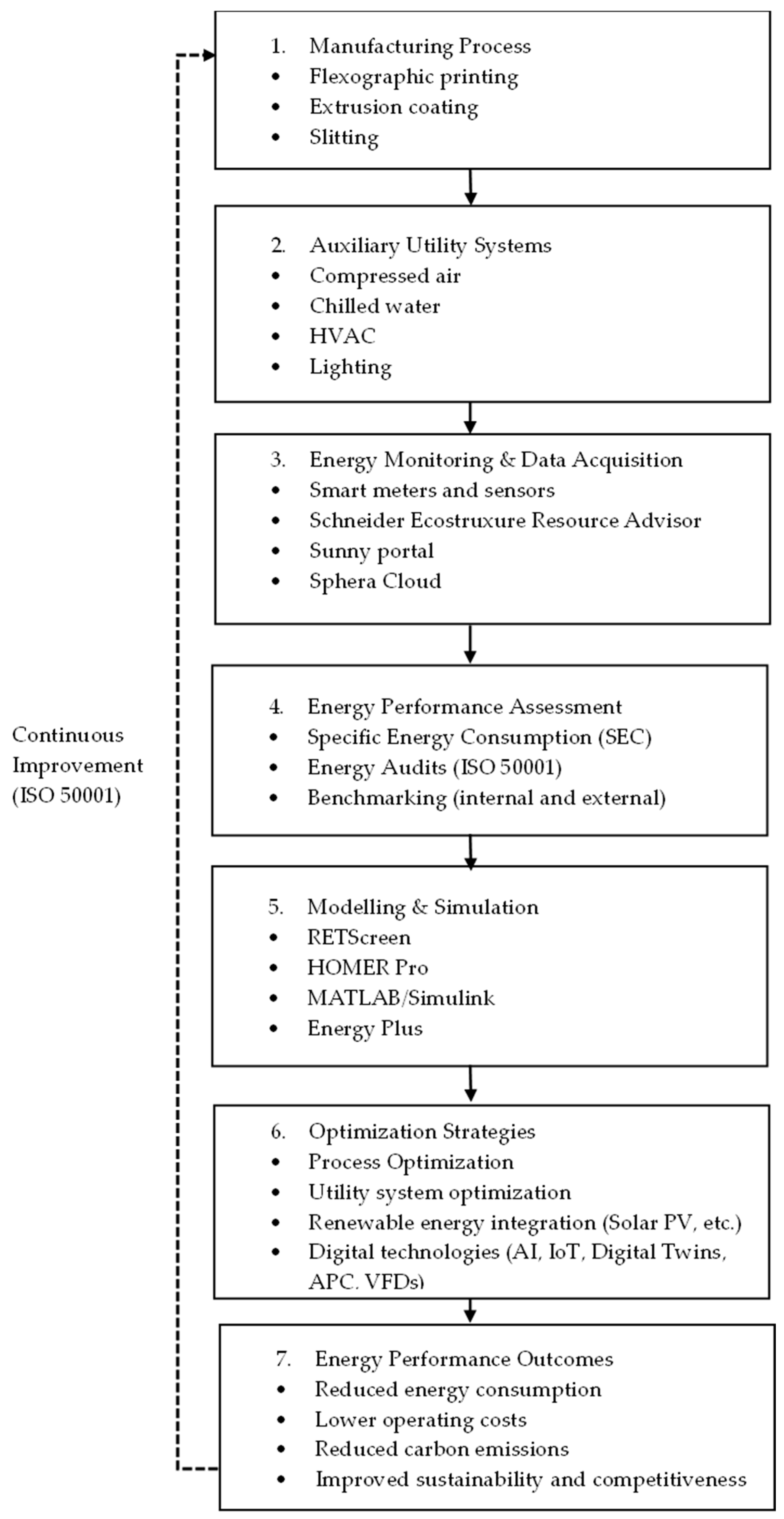
Figure 1 illustrates the unified analytical framework developed from the synthesis of the reviewed literature. The framework synthesizes the principal themes identified throughout literature and demonstrates how manufacturing processes, auxiliary utility systems, energy monitoring and data acquisition, energy performance assessment, modelling and simulation, optimization strategies, and continuous improvement interact within a system-level approach to improving energy performance in liquid carton packaging manufacturing.
The scope of this review is limited to English-language sources and focuses primarily on electricity consumption. It does not include detailed economic modeling or lifecycle cost analysis, which are recommended for future research.

2. Literature Review

2.1. Introduction

The global packaging industry is undergoing a transformative shift driven by the dual imperatives of sustainability and energy efficiency [2,36]. As environmental concerns intensify and regulatory frameworks tighten, manufacturers are increasingly compelled to adopt cleaner and more efficient production practices [37,38]. For energy-intensive manufacturing industries, cleaner production has become an important strategy for improving resource efficiency, reducing environmental impacts, and enhancing competitiveness while supporting sustainable development objectives [39]. Among the various segments of the packaging sector, liquid carton packaging which is widely used for beverages, dairy products, and liquid foods presents a unique intersection of material complexity, energy intensity, and sustainability potential [37,39,40,41].
Liquid carton packaging typically comprises a multilayer structure of paperboard, polyethylene, and aluminum foil, each contributing to the package’s barrier properties, mechanical strength, and printability [11,42]. However, the manufacturing processes involved such as flexographic printing, extrusion coating, and slitting are highly energy intensive [20,21,23,24]. These processes demand precise thermal control, high-speed mechanical operations, and auxiliary systems like compressed air and chilled water plants, all of which contribute significantly to the overall energy footprint of production facilities [43]. From an energy perspective, these activities can be categorized into conversion processes and auxiliary systems. Conversion processes, including flexographic printing, extrusion coating, lamination, and slitting, directly consume energy to transform raw materials into finished packaging products. In contrast, auxiliary systems such as compressed air plants and chilled water systems support production activities without directly contributing to material transformation. Although often less visible within production lines, auxiliary systems can account for a substantial proportion of total facility energy consumption and therefore play a critical role in overall energy performance.
The energy performance of liquid carton packaging manufacturing depends not only on the efficiency of individual conversion processes or auxiliary utility systems, but also on the interactions between them. Table 2 illustrates representative examples of these interdependencies and their influence on process performance, product quality, and overall energy performance.
Recent studies have highlighted that the food and beverage packaging sector accounts for about 30% of total manufacturing energy use globally, with carton-based systems being among the most resource demanding [43,44,45]. Moreover, packaging-related activities are associated with significant global greenhouse gas emissions, underscoring the urgent need for energy optimization in this domain [46]. Carbon footprint is being used to influence companies throughout the supply chain to reduce GHG emissions [47]. Sustainable energy is widely recognized as a fundamental enabler of environmental sustainability, economic development, and social well-being. Several Sustainable Development Goals (SDGs) support sustainable energy transitions, particularly SDG 7 (Affordable and Clean Energy) and SDG 13 (Climate Action) [48,49,50,51,52,53]. Together, these goals promote climate change mitigation while encouraging universal access to reliable, affordable, sustainable, and modern energy services. Achieving these goals requires coordinated action at the international, national, and local levels.
At the factory level, progress toward these sustainability objectives is monitored using operational Key Performance Indicators (KPIs), commonly implemented as Energy Performance Indicators (EnPIs) under ISO 50001. These include Specific Energy Consumption (SEC), expressed as energy consumed per unit of production, renewable energy contribution, and greenhouse gas emissions. Together, these indicators translate global sustainability objectives into measurable operational targets, enabling manufacturers to evaluate energy performance, identify improvement opportunities, and support continual improvement in energy management.
In response, packaging industry leaders have initiated ambitious sustainability programs, deployment of renewable energy technologies, particularly solar photovoltaic (PV) systems, deployment of real-time energy monitoring systems, and adoption of ISO 50001 compliant energy management frameworks [29,54,55,56,57]. These efforts are complemented by academic and industrial research exploring life cycle assessment (LCA), specific energy consumption (SEC) metrics, and energy performance indices (EPI) to benchmark and improve operational efficiency [25,26,27,58,59,60].
Despite these advancements, there remains a significant gap in knowledge in energy performance analysis specific to liquid carton packaging. While numerous studies have examined energy use in broader food packaging contexts, few have systematically reviewed the methodologies, tools, and outcomes relevant to this critical segment [8,28,61,62].
Although studies from broader food packaging sectors provide valuable insights into individual manufacturing processes and energy management practices, their findings cannot always be directly transferred to liquid carton packaging manufacturing because of fundamental differences in manufacturing complexity. Liquid carton packaging is produced through a sequence of tightly integrated energy-intensive conversion processes, including flexographic printing, extrusion coating, multilayer lamination, and slitting, which together transform multiple material layers into a single composite packaging structure. Unlike many packaging systems where individual conversion processes can often be evaluated independently, the overall energy performance of liquid carton packaging manufacturing depends on the interactions among these interconnected processes and their supporting auxiliary utility systems. Consequently, energy optimization strategies developed for other packaging sectors require careful adaptation before application to liquid carton packaging manufacturing, thereby justifying the need for a dedicated system-level review.
This review paper addresses the existing knowledge gaps by synthesizing existing literature on energy performance in liquid carton packaging manufacturing. Specifically, the study examines the evolution of energy auditing and monitoring practices, evaluates the role of modelling and simulation tools such as RETScreen, MATLAB, and HOMER Pro in energy optimization, analyzes the integration of renewable energy systems within packaging manufacturing, and assesses the comparative energy performance of different packaging technologies. By consolidating findings from diverse studies, the review provides a comprehensive reference for researchers, engineers, and policymakers working to improve energy efficiency and sustainability in packaging production systems.

2.2. Overview of Liquid Carton Packaging

Liquid carton packaging is a widely adopted solution for storing and distributing beverages and liquid foods such as milk, juice, and soups [63]. Its popularity stems from its lightweight design, extended shelf-life capabilities, and relatively low environmental impact compared to plastic or glass alternatives [63]. The typical liquid carton is a multi-layer composite made up of paperboard (70–80%), polyethylene (15–25%), and aluminum foil (5–10%), each serving a specific function: structural integrity, moisture resistance, and light/oxygen barrier, respectively [11,64]. Recent developments in liquid carton packaging have increasingly focused on material substitution to improve sustainability and recyclability. Current trends include reducing or eliminating the aluminum foil layer in selected liquid carton packaging structures and replacing conventional fossil-based polyethylene with bio-based polyethylene derived from renewable feedstocks. While these innovations offer potential environmental and sustainability benefits, they also influence manufacturing energy requirements because changes in material properties may require adjustments to extrusion coating temperatures, lamination conditions, cooling requirements, and other process parameters to maintain product quality. Consequently, material substitution should be evaluated not only from an environmental perspective but also with respect to its implications for manufacturing energy performance and process optimization [65,66,67]. In this review, the term “liquid carton packaging” is used as the broader category encompassing paperboard-based packaging systems for liquid products. Where studies specifically address aseptic carton systems, this distinction is explicitly stated because packaging structures, barrier requirements, and material compositions may differ from those of other liquid carton packaging formats.

3. Processes in the Packaging Industry

Packaging manufacturing involves a sequence of integrated production operations that convert raw materials into functional packaging products while meeting requirements for product protection, quality, and sustainability [64]. The production sequence generally comprises prepress preparation, printing, coating or lamination, slitting, and downstream operations including filling, sealing, labeling, inspection, and final packaging [6,68].
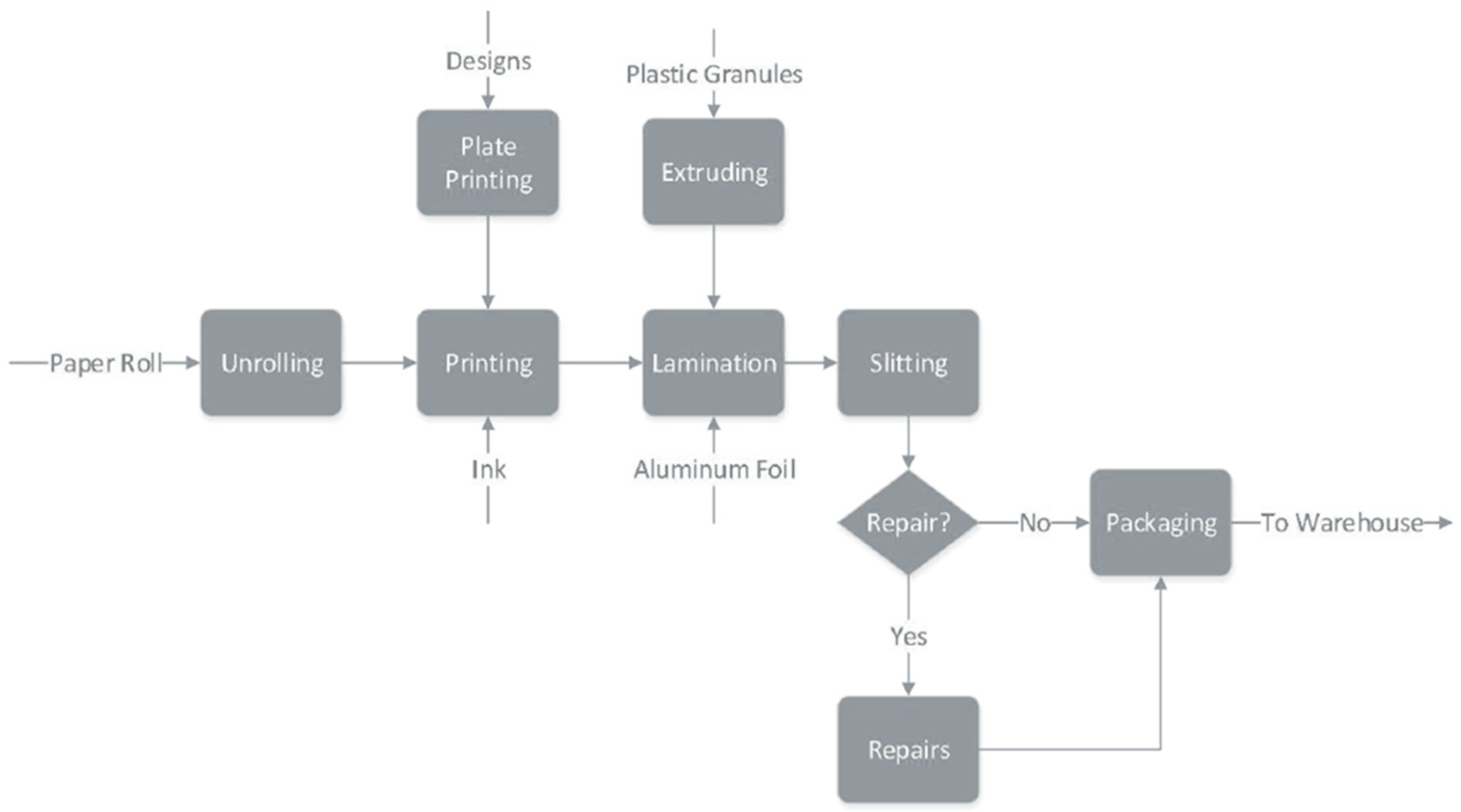
Figure 2 illustrates the overall production process showing the sequence from plate making to printing, coating, slitting and downstream conversion stages.
As shown in Figure 2, packaging production commonly begins with prepress activities, followed by printing, coating or lamination, and slitting. These upstream operations establish the structural characteristics and functional performance of the packaging material. The downstream processes including filling, sealing, labeling, inspection, and final packaging ensure product integrity, traceability, and readiness for distribution. Together, these stages influence both product performance and the overall energy consumption of the packaging process.
The production process begins with designing the artwork, preparing printing plates or cylinders, and executing various printing techniques. Flexographic printing is widely used for flexible packaging, cartons, and labels because it combines high production speeds with good print quality, economical operation, and compatibility with a wide range of packaging substrates. It is used to apply branding and product information onto the paperboard. It requires precise ink transfer and drying systems, often powered by electric heaters or UV lamps [6]. Improving energy efficiency remains one of the principal operational challenges in flexographic printing [24]. Gravure printing, known for its high-quality output, is often applied in flexible packaging, while offset printing is common for paperboard cartons. Digital printing, although primarily used for small batches, provides customization and short run production benefits [47].

3.1. Plate Making Process

Plate making is the first step in preparing for flexographic printing. It involves creating polymer plates that carry the image for ink transfer.
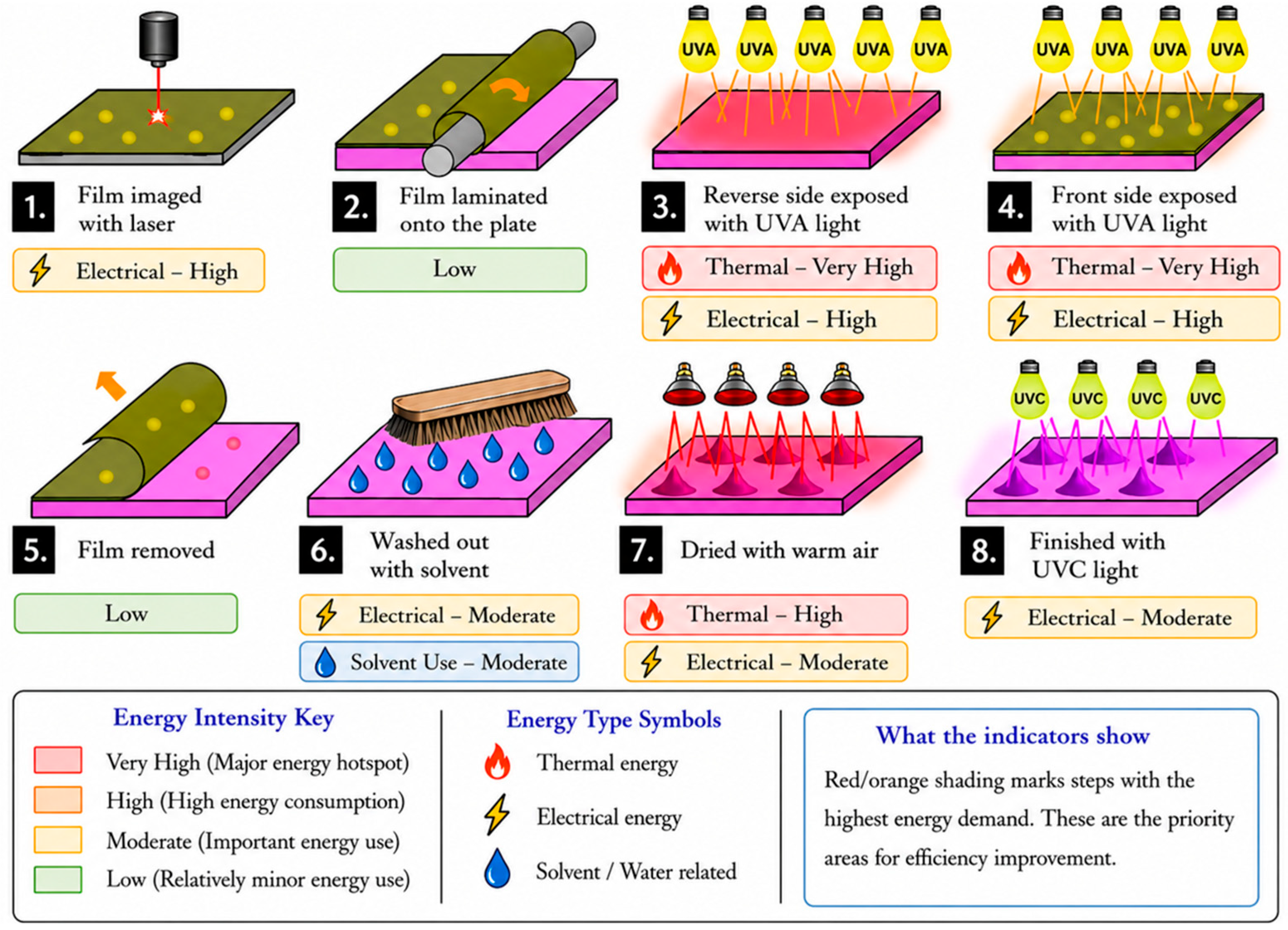
Figure 3 illustrates the plate making process, including UV exposure, washing, drying, and mounting stages.
As shown in Figure 3, a light-sensitive polymer plate is exposed through a film negative using ultraviolet light. The polymer hardens where light passes through the film, while unexposed areas are removed during washing. The plate is then dried and mounted for printing.
This process is energy intensive due to the operation of electrically driven laser imaging systems, high-intensity UV exposure units, solvent circulation pumps, heated-air drying systems, ventilation equipment, and, where applicable, solvent recovery units. The principal energy intensity drivers during plate preparation include UV exposure duration, drying temperature, ventilation airflow, and solvent recovery requirements. Optimizing these operating parameters reduces electricity consumption while maintaining plate quality, process stability, and production reliability. Although plate preparation consumes less energy than subsequent manufacturing processes, improving the efficiency of exposure and drying systems contributes to reducing overall production energy requirements.

3.2. Flexographic Printing

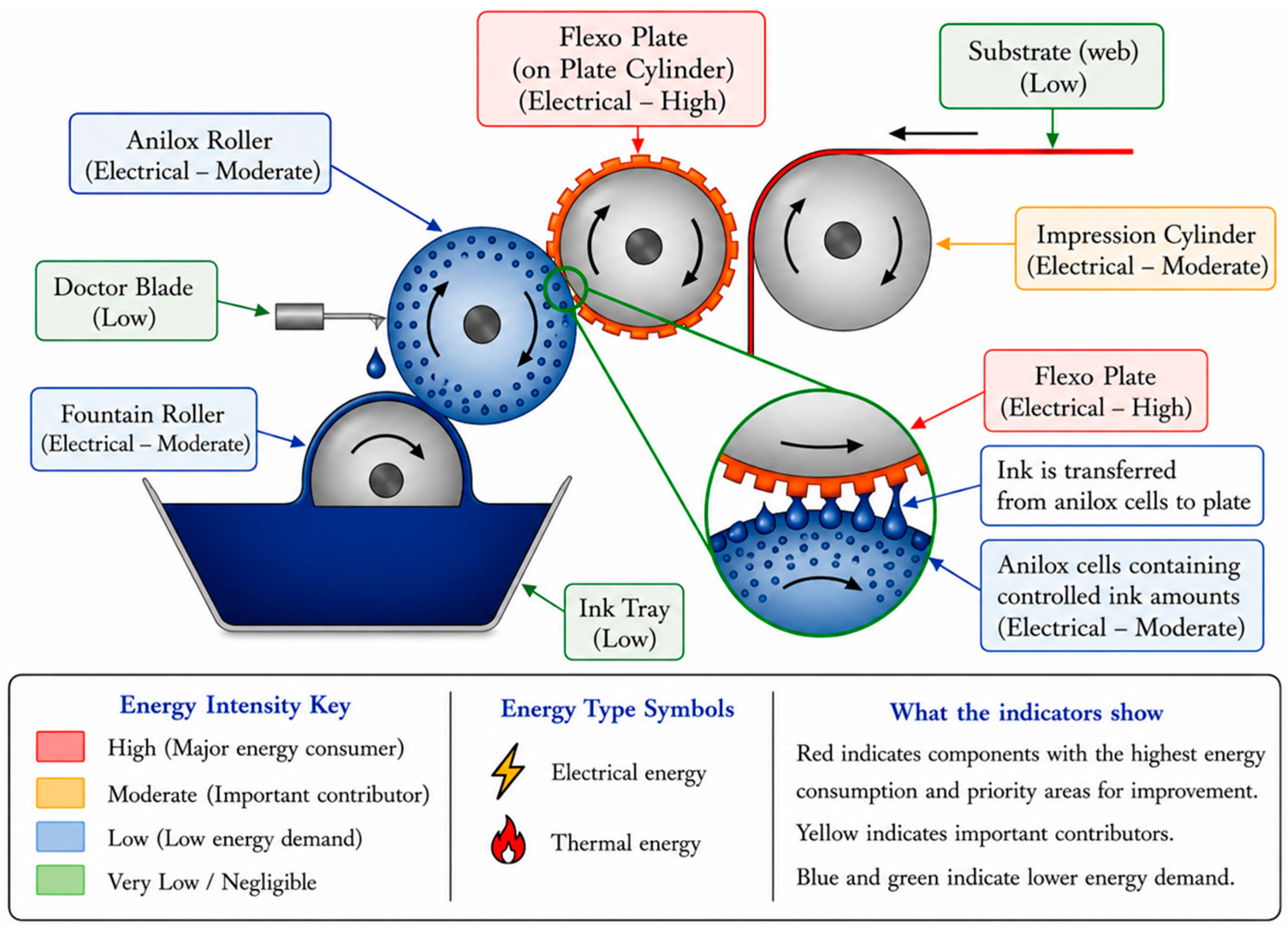
Flexographic printing involves transferring ink from the ink system to the substrate through a series of rollers. Figure 3 illustrates the ink transfer mechanism, showing how ink is metered and transferred from the anilox roller to the printing plate and then onto the substrate.
As shown in Figure 4, ink is transferred from the ink roll to the anilox roller, which meters a controlled amount of ink using micro-cells. The doctor blade removes excess ink before transferring to the printing plate. The substrate is pressed between the plate and the impression cylinder, after which it passes through a drying unit [24].
This process requires significant electrical energy to operate printing motors, ink circulation pumps, compressed air systems, drying units, and associated process control equipment. Among these, the drying systems represent the largest energy demand because maintaining stable drying temperatures is essential for solvent evaporation and print quality. Consequently, the principal energy intensity drivers include drying temperature, airflow control, compressed air demand, and the operation of multiple drive systems. Optimizing these operating parameters minimizes energy losses associated with process interruptions and product rejects while improving overall energy performance [24].

3.3. Extrusion Coating and Lamination

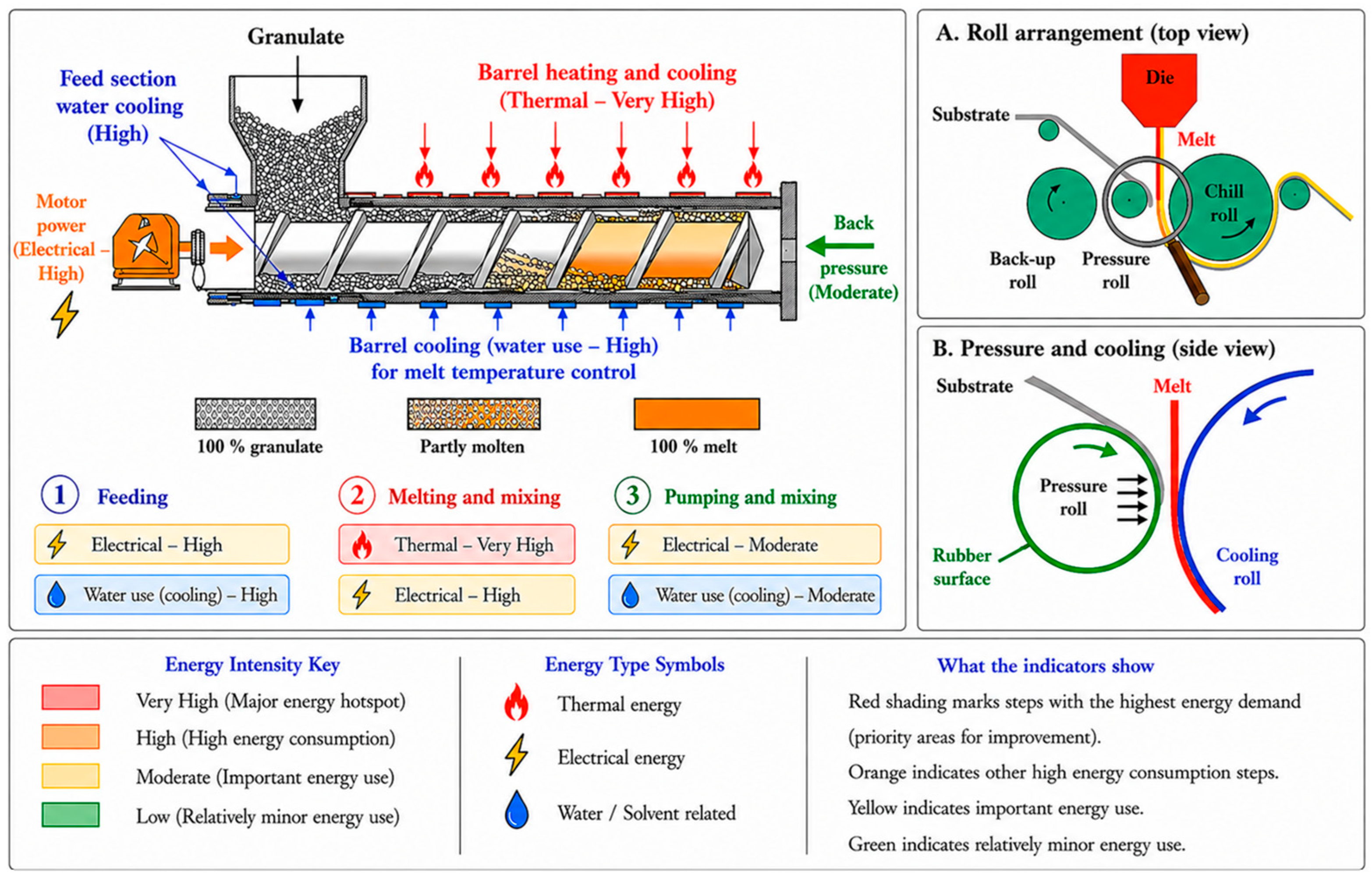
Extrusion coating is a critical process that enhances the functional properties of packaging materials by applying protective layers. Figure 5 illustrates the extrusion coating process, showing how molten polymer is applied to a moving substrate and rapidly cooled.
As shown in Figure 5, extrusion coating and lamination involve applying plastic layers, such as polyethylene, onto paper, aluminum, or film substrates to improve barrier properties and durability. Extrusion coating is a critical step where molten polyethylene is applied to the paperboard to provide moisture resistance. This process operates at temperatures exceeding 300 °C and consumes significant thermal and electrical energy. Extrusion is among the most energy-intensive manufacturing operations because polymeric materials must be continuously melted, conveyed, shaped, and cooled at high production rates. Consequently, improving energy efficiency while maintaining stable melt conditions is essential for achieving consistent product quality and economical production [20,21,22,69]. Polymer pellets are converted into finished products through three principal stages: melting, forming, and cooling, with the melting stage accounting for the highest energy demand. Electricity consumption in extrusion systems is dominated by the barrel heating elements and drive motors. Sfeir investigated the replacement of conventional alternating current (AC) motors with direct current (DC) motors on an extrusion line and reported that AC motors could achieve significant energy savings compared with DC motors [70]. Although AC motors require a higher initial investment, replacing older DC motors with modern vector-controlled AC drive systems can provide substantial long-term operational and energy-efficiency benefits. The improved energy performance of modern AC drive systems is largely achieved through the application of Variable Frequency Drives (VFDs), a key technology that enables motor speed to be regulated according to process demand. Unlike fixed-speed operation, VFDs reduce unnecessary energy consumption during partial-load conditions, improve process control, minimize mechanical stress during start-up, and maintain stable operating conditions throughout the extrusion process. Consequently, the combination of high-efficiency AC motors and VFD technology provides greater energy-saving potential than motor replacement alone. In addition to motor efficiency, considerable energy losses occur within the heating system [22]. As production throughput increases, higher flow rates generate additional heat that must be transferred through the barrel cooling system and ultimately dissipates to the surrounding environment. Consequently, conventional extrusion processes may experience significant thermal energy losses, reducing overall process efficiency [71,72,73,74,75]. Blown film and cast film extrusion techniques are essential for producing flexible plastic films used in food and beverage packaging. Additionally, lamination is crucial for combining multiple material layers to create high-barrier packaging that protects products from moisture, oxygen, and light exposure. Aluminum foil is laminated onto the coated board to provide a barrier against oxygen and light, essential for aseptic packaging [11,68].
From an energy performance perspective, the principal energy intensity drivers in extrusion coating and lamination include melt temperature stability, extrusion temperature, polymer throughput, barrel heating efficiency, and cooling effectiveness. Maintaining stable thermal conditions generally has a greater influence on energy efficiency than maximizing production speed because temperature fluctuations increase heat losses through convection and radiation, increase cooling demand, and raise the likelihood of material rejects.

3.4. Slitting, Inspection and Finishing Operations

Following printing, extrusion coating, and lamination, the packaging material undergoes slitting and finishing operations to prepare it for storage, transportation, and delivery to customers for subsequent package conversion and filling operations. The principal finishing operations include slitting, reel inspection, roll wrapping, palletizing, and warehousing prior to shipment.
Slitting is the first finishing operation, in which large parent reels are cut into reels of the required width while maintaining dimensional accuracy and minimizing material waste. Precise web handling, tension control, and cutting accuracy are essential to ensure that the finished reels satisfy customer specifications for subsequent package conversion and filling operations.
Following slitting, the finished reels undergo quality inspection to verify print quality, coating integrity, dimensional tolerances, reel dimensions, and the absence of surface defects. Defective reels are removed before packaging to prevent downstream quality issues and unnecessary material losses. Where defects are identified during inspection, the affected reels may undergo a repair (reprocessing) operation before final packaging. This typically involves rewinding the material through dedicated doctoring equipment, where defective sections are identified, removed, or corrected to restore product quality. Although this operation reduces customer rejects and improves overall product quality, it requires additional machine operation, material handling, and operator intervention, resulting in additional energy consumption compared with first-pass production. Consequently, minimizing upstream process defects through effective process control remains the most energy-efficient manufacturing strategy.
Accepted reels are subsequently wrapped using protective packaging materials to prevent moisture ingress, dust contamination, and mechanical damage during storage and transportation. The wrapped reels are then palletized to facilitate safe handling and efficient logistics before being transferred to the warehouse for storage and distribution.
Although slitting, inspection, rewinding, roll wrapping, palletizing, and warehouse handling generally consume less energy than printing and extrusion coating, their energy demand is primarily associated with electrically driven slitter motors, inspection systems, rewind drives, and material handling equipment. The principal energy intensity drivers include motor loading, rewinding frequency, inspection throughput, and material handling efficiency. Minimizing unnecessary rewinding, defect reprocessing, and material handling improves overall energy efficiency while maintaining product quality.
Table 3 summarizes the principal thermal and electrical energy consumers associated with each stage of liquid carton packaging manufacturing together with the corresponding energy intensity drivers. The comparison highlights the relative contribution of each process to overall energy demand and identifies the principal operational parameters influencing manufacturing energy performance.

4. Energy Consumption and Performance Analytics

4.1. Energy Demand and Environmental Impact in the Packaging Industry

The packaging industry is a major consumer of energy worldwide [76,77]. Energy demand is driven by energy intensive production processes like paper and cardboard production, printing, extrusion and converting. Energy supply varies by region and is influenced by grid infrastructure, renewable energy adoption and sustainable policies. The packaging industry is primarily powered by coal, natural gas and grid electricity which includes a mix of fossil fuels, hydro, geothermal and other renewable energy sources. The composition of this energy mix varies depending on regional infrastructure, energy policies, and the availability of local energy resources. Different packaging materials have varying energy demands with plastic generally requiring more energy to produce compared to paper board options.
Carton packaging is widely used for liquid products, particularly within the food and beverage industry [4,8,11,63,68]. The process of producing carton packages involves various stages such as paperboard production, printing, coating, and forming. Each of these stages requires significant energy input, particularly in the flexo printing, extrusion coating, and slitting processes, which are energy intensive [26,36,39,43]. The materials used in liquid packaging cartons, such as paper, aluminum, and polyethylene are also energy intensive in their production, which adds to the overall energy consumption [28]. Energy consumption is driven by the need for precision in printing, polyethylene extrusion coating, and the power required for slitting machines [25]. Several studies further indicate that energy consumption is not uniformly distributed across packaging manufacturing processes. Extrusion coating and associated drying operations are consistently reported as the largest energy consumers, in some cases accounting for up to 60% of total process energy use [20,21,69,70,71,72,73,74]. The actual energy contribution of extrusion coating varies according to polymer properties, coating thickness, production throughput, line configuration, and operating conditions. Thicker polymer coatings generally require greater thermal energy for melting and coating, while differences in polymer properties may influence processing temperatures and overall energy demand. Similarly, higher production throughput generally requires greater thermal input and higher motor power to maintain stable melt conditions, line configuration influences the efficiency of heat transfer, cooling systems, and material handling, and operating conditions such as extrusion temperature, screw speed, and cooling rates directly affect overall process energy consumption. Flexographic printing also represents significant energy demand due to drying systems, motors, pumps, and compressed air requirements [24]. In addition, auxiliary systems such as compressed air plants and chilled water systems can contribute a substantial share of total facility electricity consumption [13,30,31,32,33,78,79,80,81]. These findings suggest that extrusion operations, printing systems, and major utility services should be prioritized when developing energy efficiency improvement strategies.
Carton packaging is widely recognized for its renewable paperboard content, biodegradability, and recyclability, which are important environmental attributes [12,42]. However, the overall sustainability of packaging materials should be evaluated using a Life Cycle Assessment (LCA) approach, which considers environmental impacts across the entire life cycle, including raw material extraction, manufacturing, transportation, use, and end-of-life management. Consequently, the relative sustainability of carton and plastic packaging depends on the specific application, material composition, manufacturing processes, and waste management practices. Many plastic packaging products have a relatively short service life and are discarded soon after use. Combined with the large quantities of packaging waste generated and the limited recycling capacity in many regions, this contributes substantially to solid waste accumulation and environmental pollution, particularly where waste collection and recycling systems are inadequate [82]. However, carton packaging still involves considerable energy use in the manufacturing processes [36]. Enhancing energy efficiency throughout carton manufacturing processes plays a key role in reducing environmental impacts while lowering operating costs [29,83]. Energy optimization strategies in the liquid packaging industry, such as improving thermal efficiency and leveraging renewable energy sources, can help mitigate these challenges and support sustainability goals [84].
The energy demand in liquid carton manufacturing is influenced by several factors:
Product mix: Aseptic cartons (e.g., Tetra Brik Aseptic) require higher manufacturing energy inputs due to the incorporation of additional barrier layers, including aluminum foil and polymer laminates, which increase material processing requirements [42].
Production scale and automation: Larger, more automated facilities tend to have better energy efficiency due to economies of scale and optimized process control [66].
Auxiliary systems: Compressed air systems, chilled water plants, and HVAC contribute significantly to non-process energy consumption in packaging manufacturing facilities [13,30,31,33,78,80]. These utility systems support critical production functions including pneumatic operations, process cooling, drying processes, temperature control, and indoor environmental conditions. Their energy demand varies depending on production scale, facility design, operating conditions, and climate requirements. Consequently, utility systems represent an important component of overall facility energy consumption and should be considered when evaluating energy performance in packaging manufacturing.

4.2. Global Trends in Energy Use in Packaging Industry

The packaging industry is a significant consumer of energy globally, with its energy footprint shaped by material choices, production technologies, and regional energy policies [11,21,72]. As sustainability becomes a central concern for governments, industries, and consumers, the focus on energy efficiency and carbon reduction in packaging has intensified [40,77,85].

4.2.1. Industry Trends

The industry is increasingly adopting sustainable practices to reduce energy consumption and environmental impact, these include;
  • Use of renewable energy (e.g., solar PV installations at manufacturing sites) [29,84,86].
  • Real-time energy monitoring using platforms like Schneider EcoStruxure and Sphera Cloud [87,88].
  • Material innovation, such as bio-based polymers and recyclable mono-material cartons [89,90].
  • Circular economy initiatives, including take-back schemes and improved recyclability of multi-layer cartons [12,42].

4.2.2. Energy Consumption Patterns

Worldwide, the packaging industry is estimated to account for approximately 30% of total manufacturing energy consumption, with food and beverage packaging ranking among the most energy-intensive segments [39,44,91]. Production processes including flexographic printing, extrusion coating, and slitting are particularly demanding due to their reliance on thermal and mechanical energy [20,22,24,71]. In addition, auxiliary utility systems including compressed air and chilled water plants contribute significantly to non-process energy consumption [30,31,32,78]. This has prompted a global push toward energy audits, renewable energy integration, and smart energy management systems.

4.2.3. Regional Trends and Policies

Europe: The EU’s Green Deal, which is the European Union’s long-term strategy for achieving climate neutrality by 2050 and Circular Economy Action Plan have accelerated the adoption of energy-efficient technologies and recyclable packaging materials [92,93,94,95].
Asia: Rapid industrialization in China, India, and Southeast Asia has led to increased energy demand in packaging. However, countries are investing in solar and biomass energy and adopting ISO 50001 standards to improve energy performance [96,97].
Africa: While energy efficiency in packaging is still emerging, countries like Kenya and South Africa are making strides through solar PV adoption, energy audits, and public–private partnerships. Kenya’s reliance on hydro and geothermal energy offers a relatively low-carbon grid, but grid instability and high electricity tariffs remain challenges [98,99].
The transferability of energy-efficient technologies across regions is influenced by differences in economic, regulatory, and infrastructure conditions. Although advanced technologies such as renewable energy systems, digital energy monitoring platforms, waste heat recovery, and high-efficiency motor-drive systems have demonstrated significant energy-saving potential, their adoption in many developing regions is often constrained by high initial investment costs, limited access to financing, and technical capacity. Conversely, relatively high industrial electricity tariffs can improve the economic attractiveness and return on investment (ROI) of energy efficiency projects by increasing potential energy cost savings. However, uncertainties associated with grid reliability, financing, and implementation capacity may offset these economic benefits. Consequently, successful technology transfer requires not only proven technologies but also supportive policy frameworks, financing mechanisms, and local technical expertise.

5. Energy Challenges and Optimization Strategies

5.1. Global Energy Challenges in Liquid Packaging Manufacturing

5.1.1. Rising Energy Demand and Volatility

The global packaging industry relies heavily on energy intensive processes such as paperboard production, extrusion coating, lamination, printing, and converting [25]. As the demand for aseptic and liquid food packaging grows rapidly in emerging markets, mainly Asia and Africa, energy consumption in the sector has also surged correspondingly [1,97,98]. However, global energy markets remain volatile, with fluctuating electricity tariffs, unstable fossil fuel prices, and regional power shortages significantly affecting operational costs and competitiveness [100,101,102].

5.1.2. Dependence on Non-Renewable Energy Sources

Most liquid packaging manufacturers still depend on grid electricity and fossil fuel-based thermal systems for process heating and utilities (air compressors, chillers, boilers) [25].
Globally, much industrial energy remains largely dependent on non-renewable energy sources including coal, oil and natural gas contributing to high carbon footprints and exposure to fuel supply disruptions [103,104]. In developing regions, grid instability compels factories to rely on diesel gensets, which are inefficient and emit large quantities of CO2 which worsens sustainability performance [105,106].

5.1.3. Energy Inefficiency in Process Operations

The liquid carton packaging line (e.g., Tetra Pak or SIG Combibloc systems) comprises several energy intensive sub processes. Extrusion coating requires precise temperature control for polymer melting and adhesion [20,22,71]. Flexographic printing which involves high-speed ink drying using hot air [24]. Chilled water and compressed air systems which consume significant auxiliary energy for cooling, drying, and pneumatic operations [30,31,32,33,78]. Industrial compressed air systems (CASs) are frequently identified as one of the least energy-efficient utility systems in manufacturing facilities. Studies have noted that compressed air is often treated as a low-cost utility during plant design, resulting in limited consideration of energy efficiency during process planning and system configuration [13,31,32,83]. Consequently, significant energy losses may occur through air leaks, inappropriate pressure settings, oversized equipment, and inefficient compressor operation. These inefficiencies contribute substantially to avoidable electricity consumption and increased operating costs. Similarly, chilled water systems represent a major auxiliary energy consumer in facilities requiring process cooling and environmental control. Central chilled water plants can account for a substantial proportion of facility electricity consumption, with energy use influenced by chiller efficiency, cooling load variation, control strategies, and system design [33,81]. Inefficient operation, poor equipment sequencing, and inadequate control optimization can increase energy consumption and reduce overall system performance. Therefore, compressed air and chilled water systems are frequently identified as priority areas for energy efficiency improvement and operational optimization in industrial facilities. Studies indicate that over 30% of total energy use in packaging plants is non-productive, energy is lost through leaks, heat waste, or inefficient motors [30,78,107]. Many facilities also operate with suboptimal load factors due to variable production demand [108,109].

5.1.4. Limited Integration of Renewable Energy

Advances in technology, supportive government policies, innovative financing mechanisms, declining technology costs, and increased public awareness have accelerated the global adoption of renewable energy. At the same time, a growing number of countries and businesses have committed to achieving net-zero emissions. By September 2023, net-zero commitments covered more than 85% of global energy-related emissions and almost 90% of global GDP [107,110].
Recent projections indicate that solar PV and wind power generation are expected to expand significantly by 2030, mainly due to the following factors;
Policy support for solar PV and wind energy has expanded considerably over the past decade. More than 140 countries have implemented policies that encourage renewable energy deployment, while major markets including China, the European Union, India, Japan, and the United States have strengthened their regulatory frameworks to accelerate investment and deployment [107].
Between 2010 and 2022, the cost of electricity generated from solar PV declined by approximately 90%, while onshore and offshore wind costs fell by about 70% and 60%, respectively [107].
Recent IEA projections indicate that rapid expansion of clean energy manufacturing capacity has outpaced deployment in some sectors, creating favorable conditions for further growth, particularly in solar PV production and installation [107].
Although renewable energy projects are generally capital intensive, financing costs have declined because of supportive policy instruments and regulatory mechanisms that improve investor confidence. Long-term contractual arrangements have also contributed to lower financing risks and reduced project costs [107].
Collectively, these developments have supported the continued expansion of solar PV and wind power worldwide, leading to sustained growth in annual deployment. Nevertheless, further integration of renewable energy into industrial systems remains challenging because of technical, economic, regulatory, and operational constraints. Although solar PV and biomass boilers have been increasingly adopted in modern plants, renewable integration remains below potential.

5.2. Energy Optimization Strategies in Liquid Packaging Manufacturing

5.2.1. Process Optimization and Energy Efficiency Improvements

Process optimization and equipment upgrades represent some of the most effective approaches to reducing energy consumption in liquid packaging manufacturing. Key energy-intensive processes such as flexographic printing and extrusion coating can be improved through better temperature control, optimized machine settings, and efficient motor systems. The use of variable speed drives (VSDs) in motors and pumps enables energy savings by matching power consumption to actual process demand. In extrusion processes, improvements in screw design, heating systems, and thermal insulation can significantly reduce heat losses and improve process efficiency. Additionally, waste heat recovery from dryers and extrusion systems can be utilized to preheat incoming materials or support auxiliary processes, thereby reducing overall energy demand.
Energy optimization opportunities in liquid carton packaging manufacturing extend beyond individual equipment upgrades and require coordinated improvements across manufacturing processes, auxiliary utility systems, digital energy management, and renewable energy integration. To provide a comparative overview of the principal energy systems discussed in the literature, Table 4 summarizes their primary energy functions, representative optimization measures, renewable energy integration opportunities, expected benefits, and implementation challenges.
Table 4 demonstrates that energy optimization should be approached from a system-level perspective rather than through isolated process improvements. While extrusion coating and flexographic printing remain the most energy-intensive manufacturing operations, auxiliary systems such as compressed air and chilled water also present substantial opportunities for energy savings. The comparison further shows that digital energy management systems and renewable energy integration are complementary strategies that support continuous performance improvement and long-term sustainability. Moreover, these strategies are inherently interdependent; for example, energy monitoring systems establish performance baselines and provide the operational data required to identify opportunities, quantify the benefits of equipment-level interventions such as Variable Speed Drives (VSDs) and waste heat recovery, and support continual improvement within ISO 50001 energy management systems. These optimization measures provide the technical foundation for the performance assessment, energy auditing, monitoring, and modelling approaches discussed in the subsequent sections.

5.2.2. Performance Analysis in the Liquid Packaging Industry

In energy optimization, performance analysis refers to the evaluation of how efficient energy is utilized in the various stages of the production process. Evaluating the energy performance of equipment, manufacturing processes, and production facilities provides the foundation for effective industrial energy management. It also enables organizations to monitor progress toward established energy-efficiency objectives [77]. In the liquid packaging industry, performance analysis is carried out through energy audits and the monitoring of energy usage data in real time. Performance analysis allows companies to identify areas where energy consumption exceeds the expected levels and where inefficiencies occur, enabling them to implement targeted measures for improvement.
Energy performance indices (EPI) are often used as a benchmarking tool in the performance analysis of manufacturing processes. The EPI compares actual energy use against a baseline or industry standard, providing an objective assessment of energy performance [19]. For instance, an EPI can be used to assess the performance of the flexo printing or extrusion coating machines and determine if there are opportunities for process optimization or if certain systems are operating sub-optimally. Identifying such inefficiencies is essential for driving energy conservation initiatives and ensuring the overall efficiency of manufacturing operations.
Key Energy Performance Indicators
To evaluate energy performance in packaging manufacturing, several quantitative indicators that relate energy output to production output, cost or environmental impact are used. Energy KPIs support continuous monitoring of energy performance and facilitate the identification of improvement opportunities. Monitoring energy KPIs enables organizations to evaluate their energy performance and quantify the benefits achieved through improvement initiatives [111,112]. ISO 50001 recommends the selection of appropriate energy performance indicators (EnPIs) to support the monitoring and evaluation of organizational energy performance [19]. These indicators should be reviewed periodically and benchmarked against the organization’s established reference values. To support compliance with these requirements, ISO 50006 provides guidance on the establishment, implementation, and maintenance of energy KPIs [112,113]. A certification of ISO 50001 also requires that the company carries out internal communication of its energy performance. In addition, ISO 50001 requires organizations to communicate energy performance internally, while EN 16247-1:2022 recommends that energy performance indicators be evaluated as part of the energy audit process [114].
Total energy consumption (E); measures total electrical and thermal energy used within a given period.
Specific Energy Consumption (SEC); Represents the amount of energy required to produce a unit of output. SEC is widely recognized as a key energy performance indicator because it enables organizations to evaluate energy efficiency, benchmark operational performance, and identify opportunities for process improvement. Consequently, SEC is frequently used in both industrial practice and the literature to assess and compare energy performance across manufacturing systems [26].
Energy Performance Index (EPI); Compares actual energy use to a benchmark or baseline. It is used to track improvements over time or compare across facilities.
Load Factor; The ratio of average electrical demand to peak demand over a specified period. It is commonly used to assess how effectively installed capacity is utilized, with higher values indicating improved utilization of the available capacity [108,109,115].
Power Factor: The ratio of real power to apparent power, representing how efficiently electrical power is being used. Ideal value is close to 1.0; lower values suggest reactive power losses [116].
Traditionally, energy performance indicators were derived from periodic meter readings and manual data collection. However, the emergence of Industry 4.0 technologies has transformed energy performance assessment through continuous digital monitoring and automated data analytics. Smart meters, Internet of Things (IoT) sensors, supervisory control systems, and cloud-based energy management platforms enable the real-time acquisition and processing of energy data across manufacturing operations. These technologies support the automated calculation and visualization of key indicators such as SEC, EPI, load factor, and power factor, allowing manufacturers to identify inefficiencies, benchmark performance, and support data-driven energy optimization initiatives. EMS platforms further integrate data from multiple sources into centralized dashboards, enabling real-time performance tracking, automated reporting, and continuous improvement of energy performance.
While Energy Performance Indicators (EnPIs), such as Specific Energy Consumption (SEC), Energy Performance Index (EPI), load factor, and power factor, provide valuable measures of operational energy performance, they do not by themselves provide a complete assessment of environmental sustainability. For example, a manufacturing process may exhibit low SEC while relying on electricity generated from carbon-intensive energy sources. Consequently, EnPIs should be interpreted alongside complementary sustainability indicators, such as carbon dioxide (CO2) emissions per unit of production, renewable energy contribution, and other environmental performance metrics. Integrating energy performance and sustainability indicators provides a more comprehensive framework for evaluating the overall environmental performance of liquid carton packaging manufacturing.

5.2.3. Energy Audits in the Liquid Packaging Industry

An energy audit provides the foundation for improving energy performance in energy-intensive manufacturing industries, including packaging production [117]. It involves systematic assessment of energy use to identify opportunities for improving efficiency, reducing environmental impacts, and lowering operating costs [118].
Energy audits are crucial tools for assessing energy consumption and identifying opportunities for energy savings in manufacturing settings. Achieving sustainable and energy efficient manufacturing requires regular energy audits together with continuous monitoring of industrial equipment and production processes [118]. In the liquid packaging industry, energy audits typically focus on the production line and key systems such as printing, coating, slitting, and auxiliary services like compressed air and chilled water plants. Energy audits provide insights into energy usage patterns and highlight system inefficiencies, helping companies pinpoint areas where energy consumption can be reduced [119].
An energy audit generally involves collecting data on energy use, analyzing energy consumption patterns, and evaluating the performance of key systems through direct observation and data logging. Energy audits are often guided by standards such as ISO 50001, which establishes the requirements for an energy management system [19]. The audit results can then be used to develop a list of recommended actions, including upgrading machinery, improving insulation, or adopting energy efficient technologies. Furthermore, energy audits enable companies to track improvements over time and adjust their strategies to ensure continuous energy savings [19]. Types of energy audits include preliminary audit, detailed audit and investment grade audit.
Preliminary audit; Also referred to as a walk-through or screening audit, is the simplest form of energy audit. It generally consists of a facility inspection, discussions with operating personnel, a review of utility consumption data, and a preliminary assessment of plant operations to identify obvious sources of energy waste and potential opportunities for improvement [117,120,121,122].
Detailed audit (Comprehensive/General Audit); A detailed audit builds upon the preliminary audit by providing a more comprehensive evaluation of facility energy performance. It includes in-depth discussions with operating personnel to identify major energy-consuming systems and understand both short- and long-term energy consumption patterns. Historical utility data, typically covering 12 to 24 months, is reviewed to evaluate trends in energy demand and consumption. The audit also involves field measurements of key energy parameters, technical assessments to identify energy-saving opportunities, financial evaluation of proposed measures based on implementation costs and expected savings, and the preparation of a comprehensive energy audit report [120,121,122].
Investment grade audit; An investment-grade audit extends the scope of a detailed audit by providing the technical and financial information required to support investment decisions. It involves comprehensive assessments of major energy-consuming systems, detailed analysis of historical utility data, and extensive field measurements to establish accurate energy demand and consumption profiles. The audit also includes technical evaluation of proposed energy conservation measures, financial assessment based on implementation costs, projected operating cost savings, customer investment criteria, and life-cycle considerations. The findings are documented in a comprehensive report that supports investment planning and project implementation [120,121,122].
While both Detailed Audits and Investment Audits involve comprehensive energy assessment, they differ in their intended application and level of analytical rigor. Detailed Audits are primarily used to identify and evaluate energy saving opportunities through detailed measurements and analysis of energy consuming systems. In contrast, Investment Audits are conducted when organizations require high confidence technical and financial evaluations to support capital expenditure decisions. Consequently, Investment Audits typically involve more extensive data collection, detailed engineering analysis, and financial assessments to reduce uncertainty and improve investment decision making.

5.2.4. Life Cycle Assessment (LCA) in Packaging

Life Cycle Assessment (LCA) is a systematic approach for evaluating the environmental impacts associated with a product throughout its entire life cycle, from raw material extraction and manufacturing to product use, recycling, and final disposal. Within liquid carton packaging, LCA provides a comprehensive framework for assessing energy consumption, carbon emissions, and resource efficiency across the packaging life cycle.
Life Cycle Assessment has been widely applied to evaluate the environmental performance of packaging systems for several decades, resulting in a substantial body of published research [123,124,125]. LCA findings support policy development and assist manufacturers in designing more sustainable packaging solutions. They also provide valuable information for understanding environmental performance from both industrial and consumer perspectives [17].
The ISO 14040 and ISO 14044 standards establish the principles and framework for conducting LCAs [126,127]. These standards ensure consistency, transparency, and comparability across studies, making LCA a critical tool for sustainability benchmarking in the packaging industry.
Recent LCA studies have shown that liquid carton packaging generally exhibits lower environmental impacts than plastic and glass alternatives, particularly when renewable materials (e.g., FSC-certified paperboard) are used, recycling infrastructure is available and renewable energy powers the manufacturing process [75]. However, the inclusion of aluminum foil in aseptic cartons increases the energy intensity of production and complicates recycling. Innovations such as aluminum-free barrier layers and mono-material cartons are being explored to address this issue [59,90].

5.2.5. Technological Innovations in Energy Efficiency

The packaging industry is undergoing a digital transformation, often referred to as Packaging 4.0, driven by the convergence of automation, data analytics, and sustainability mandates. These innovations are enabling manufacturers to optimize energy use, reduce waste, and improve operational efficiency across the value chain [128,129]. Recent Packaging 4.0 developments indicate a progression from conventional real-time monitoring systems toward predictive and prescriptive approaches, including predictive maintenance and Digital Twin technologies. These innovations leverage Internet of Things (IoT) connectivity, advanced analytics, and machine learning to support proactive decision-making, energy optimization, and improved operational reliability.
Here are key technologies enhancing energy efficiency;
  • Artificial Intelligence (AI) and Machine Learning is being used to predict energy demand and optimize load scheduling, detect anomalies in energy consumption patterns and enable predictive maintenance of energy-intensive equipment like compressors and chillers [130,131,132,133].
  • Internet of Packaging (IoP) and IoT Sensors provide real-time data on equipment energy usage, temperature and humidity control and compressed air and HVAC system performance. These insights allow for dynamic energy management and automated control systems [16,134,135,136].
  • Advanced Process Control (APC) Systems use feedback loops and real-time data to minimize energy spikes during printing and coating, optimize drying temperatures and airflow in flexographic printing and reduce overcooling in chilled water systems.
  • Heat Recovery Systems; Innovative heat exchangers and recovery units are now integrated into extrusion coating lines, drying ovens, air compressors. These systems capture waste heat and repurpose it for preheating or space heating, reducing overall energy demand
  • Variable Frequency Drives (VFDs) are increasingly used in Pumps, Fans, Compressors. They adjust motor speed based on real-time demand, significantly reducing energy consumption during partial load conditions [137,138].
  • Smart LED Lighting are integrated with motion and daylight sensors to reduce lighting energy by up to 70%.
  • Building Envelope Improvements; Enhanced insulation, energy-efficient windows, and zoned HVAC systems reduce heating and cooling loads
  • Digital Twins: Virtual replicas of packaging lines simulate energy flows and test optimization strategies before implementation [139,140].
Simulation platforms such as MATLAB/Simulink are frequently used to develop virtual representations of manufacturing systems and energy processes. While these models can be used for offline analysis and scenario evaluation, they become Digital Twins when continuously synchronized with real-time operational data obtained from sensors, monitoring systems, and energy management platforms. Such integration enables dynamic performance monitoring, predictive analysis, and real-time optimization of manufacturing operations.
Although Artificial Intelligence (AI) and Digital Twin technologies offer considerable potential for improving energy performance, predictive maintenance, and operational decision making, their implementation in many developing-country manufacturing facilities remains challenging. Effective deployment requires substantial investment in digital infrastructure, reliable real-time operational data, interoperable communication systems, and personnel with expertise in industrial automation, data analytics, and system integration. The adoption of Packaging 4.0 technologies should therefore be viewed as a progressive digital maturity pathway rather than a single-step implementation. Consequently, manufacturers operating under capital and technical capacity constraints may achieve greater near-term benefits by first strengthening foundational capabilities such as energy monitoring systems, smart metering, and workforce training, followed by integrated Energy Management Systems (EMS), predictive analytics, AI-enabled analytics, and ultimately fully integrated Digital Twin technologies as digital capabilities mature.

5.2.6. Energy Optimization in Manufacturing

Optimizing an energy system is a complex problem, and difficulties begin well before the optimization stage is reached. The question of what is to be considered as optimal must be addressed very early on [141]. Manufacturing industries are faced with the challenge of reducing energy usage without negatively impacting profits and productivity. Determining and understanding energy use at every stage of the manufacturing process is critical for optimizing manufacturing processes and facility management to reduce energy consumption [142].
Energy optimization is critical to improving operational efficiency in industrial manufacturing, particularly in energy-intensive sectors like packaging. In the packaging industry, printing, coating, and slitting processes require substantial energy input, making energy management an essential component of operational cost control and sustainability efforts. Energy saving measures such as process optimization, equipment upgrades, and system monitoring can lead to significant energy savings. Energy audits have proven to be a valuable tool in identifying inefficiencies in manufacturing plants [119]. Through audits, companies can uncover hidden inefficiencies, such as unnecessary energy consumption or outdated equipment, and implement solutions that reduce energy use while maintaining production quality.
Challenges and Barriers to Energy Optimization in Packaging Manufacturing
Despite the growing awareness and adoption of energy-efficient technologies in the packaging industry, several technical, financial, organizational, and regulatory barriers continue to hinder the full realization of energy optimization potential. These challenges are particularly pronounced in developing regions, where infrastructure limitations and capital constraints are more acute [143]. Based on the reviewed studies, the uneven adoption of energy efficiency measures, renewable energy systems, and other green manufacturing practices appears to be influenced by both technological and economic-policy factors. Technological factors include limited access to advanced energy-efficient equipment, real-time monitoring systems, digital energy management platforms, renewable energy technologies, and the technical expertise required for their implementation and maintenance. Economic and policy factors include capital investment requirements, financing constraints, energy pricing structures, and variations in regulatory support and renewable energy incentive mechanisms. The interaction of these factors contributes to differences in the adoption of green practices across industrial sectors and geographical regions.
Technical Challenges
Outdated Equipment: Many packaging plants still operate with outdated machinery that lacks modern energy efficient technologies such as variable frequency drives (VFDs), smart sensors, or real-time monitoring systems. Retrofitting or replacing such equipment often requires significant downtime and capital investment. In addition, equipment obsolescence can significantly increase operating costs over the lifetime of a facility because replacement components and manufacturer support may become unavailable. As equipment ages, maintaining system reliability becomes increasingly difficult, resulting in a greater risk of unplanned downtime, reduced operational flexibility, and delays in adopting newer energy efficient technologies [144].
Process Complexity: Packaging lines involve multiple interdependent systems including printing, coating, slitting, compressed air, and chilled water making it difficult to isolate and optimize individual energy streams without affecting overall productivity [6,22,30,31,33,72].
Power Quality Issues: High harmonic distortion, voltage fluctuations, and poor power factors common in facilities with non-linear loads can reduce equipment efficiency and lifespan. These issues require specialized mitigation strategies such as harmonic filters and capacitor banks [116,145].
Financial and Economic Barriers
High Initial Investment: Historically, significant reductions in industrial energy consumption have often been achieved through major infrastructure upgrades. However, these improvements usually require substantial capital expenditure and may disrupt production during installation [141]. Energy-efficient technologies and renewable energy systems often involve high upfront costs, which can deter investment, especially in small and medium-sized enterprises (SMEs). Although these investments often provide long-term economic benefits, limited access to financing remains a major barrier.
Uncertain ROI: Investment decisions for energy optimization projects are generally based on the expected return on investment (ROI), which compares the anticipated financial benefits with the required capital expenditure. In practice, organizations are more likely to implement projects that demonstrate clear economic viability. However, accurately estimating ROI can be challenging because it depends on factors such as future energy prices, production variability, product revenues, and the availability of reliable historical data for forecasting. These uncertainties may discourage investment in energy efficiency projects, particularly where decision-makers adopt risk-averse investment strategies [146]. Furthermore, the economic viability of energy optimization measures may vary considerably across regions due to differences in electricity pricing structures, feed-in tariff mechanisms, net-metering policies, and renewable energy incentives. For example, solar photovoltaic (PV) systems generally achieve shorter payback periods and higher returns on investment in regions with favorable feed-in tariffs, net-metering arrangements, or high industrial electricity tariffs. Conversely, restrictive grid export regulations, limited policy incentives, and lower electricity prices may reduce the financial attractiveness of renewable energy investments despite their technical benefits. These considerations highlight the importance of evaluating energy optimization strategies within the context of local regulatory and market conditions.
Organizational and Human Factors
Lack of Skilled Personnel: Energy management requires specialized knowledge in data analytics, process engineering, and energy modeling. Many facilities lack trained personnel to implement and maintain energy optimization systems [147,148].
Resistance to Change: Operational inertia and resistance from staff accustomed to traditional practices can slow down the adoption of new technologies or energy-saving protocols. Behavioral change management is often overlooked in energy strategies [149,150].
Regulatory and Policy Barriers
Inconsistent Incentives: Government subsidies and tax incentives for energy efficiency vary widely across regions and are often unpredictable or short-lived [150].
Lack of Enforcement: Even where energy efficiency standards exist (e.g., ISO 50001), enforcement mechanisms are weak [151,152,153].
Grid Instability
In regions like Sub-Saharan Africa, frequent power outages and voltage instability complicate the integration of renewable energy and energy management systems [143].
Collectively, these technical, financial, organizational, and regulatory challenges demonstrate that energy optimization strategies in developing countries should be adapted to local industrial conditions rather than relying solely on advanced technology adoption. In many cases, practical measures such as energy audits, preventive maintenance, operator training, process optimization, and phased implementation of energy management systems provide more immediate and cost-effective improvements than large-scale investments in advanced digital technologies. In addition, low-cost operational measures, including compressed air leak detection and repair, steam and hot water pipe insulation where applicable, pressure optimization, and routine maintenance, can deliver significant energy savings with minimal capital investment, making them particularly suitable for small and medium-sized enterprises (SMEs). As technical capacity, energy infrastructure, and financial resources improve, these foundational measures can subsequently be complemented by renewable energy systems and advanced digital solutions to achieve sustained improvements in energy performance.
The technical, financial, organizational, and regulatory barriers discussed in the preceding sections should not be considered independently of the corresponding energy optimization strategies. Rather, effective energy management requires matching specific challenges with appropriate technological and managerial interventions. Table 5 summarizes the principal barriers identified in the literature together with the corresponding energy optimization strategies, providing a practical framework for prioritizing energy efficiency improvements in liquid carton packaging manufacturing.
The mapping presented in Table 5 demonstrates that sustainable improvements in energy performance require complementary rather than isolated interventions. Technical barriers are primarily addressed through process optimization, equipment upgrades, digital monitoring, and renewable energy integration, whereas financial, organizational, and regulatory barriers require appropriate management practices, workforce development, supportive policies, and strategic investment planning. Consequently, effective energy optimization in liquid carton packaging manufacturing depends on an integrated approach that combines technological innovation with organizational and institutional support.

5.2.7. Integration of Renewable Energy Systems

Renewable energy has become a key focus in manufacturing, driven by cost considerations and environmental goals. As energy costs rise and the push for sustainability intensifies, many companies, including those in the packaging industry, are turning to renewable energy solutions like solar, wind, and biomass. Solar PV systems have gained traction in manufacturing facilities due to their scalability and long-term cost benefits. Solar PV, for example, has the potential to reduce dependency on the national grid and improve the sustainability of energy supply, especially in regions with high solar irradiance [41]. However, the initial investment costs, along with the need for reliable energy storage solutions, remain challenges for widespread adoption. Nonetheless, the liquid packaging industry is increasingly exploring hybrid energy systems, where grid electricity is supplemented by renewable energy, to balance energy costs and environmental impact.
Energy demand and sustainability are critical issues in the global packaging industry, particularly in the food and beverage sector where energy intensive manufacturing processes are integral to product safety and convenience. The packaging sector consumes approximately 30% of global manufacturing energy [107]. According to the International Energy Agency, the packaging industry is responsible for about 4% of greenhouse gas emissions worldwide, largely because of energy-intensive means of production [107,154]. As consumer demand for packaged beverages and ready-to-eat products rises, so too does the environmental impact of production. In response, companies are increasingly pressured to adopt energy-efficient technologies and integrate renewable energy solutions.
Solar photovoltaic (PV) systems are the most widely adopted renewable energy solution in packaging manufacturing due to their scalability, declining costs, and compatibility with daytime production schedules.
Benefits of Renewable Integration
Cost Savings: Long-term reduction in electricity bills and exposure to tariff volatility [155].
Carbon Reduction: Solar PV systems can reduce GHG emissions by up to 40–60% depending on the grid mix [85].
Energy Independence: Reduces vulnerability to grid outages and fuel price fluctuations [105].
Brand Value: Enhances corporate image and meets ESG reporting requirements [143].
Challenges and Barriers
Despite the benefits, several challenges hinder widespread adoption:
Technical Integration; requires synchronization with existing grid and backup systems [156,157,158,159,160,161].
Policy and Incentives; Inconsistent regulatory support across regions [147,150,159].
Wind and Solar power variability; Much of the variation in solar energy output during the course of the day and the year is highly predictable, because the movement of the sun is very well understood. However, less predictable source of variability is the presence of clouds that can pass over solar power plants and limit generation for short periods of time. Cloud cover can result in very rapid changes in the output of individual PV systems. The impacts on the electric grid are minimized when solar projects are spread out geographically so that they are not impacted by clouds at the same time though this is not possible for small plants in packaging factories. Sometimes wind generation will increase as load increases, but in cases in which renewable generation increases when load levels fall or vice versa, additional actions to balance the system are needed [156].
Limited roof space or structural load capacity for large PV arrays; many facilities lack enough roof space or structural capacity to put up large PV arrays [162]. Rooftop or ground space may be limited in urban or compact facilities [86,162].
High upfront capital costs: Solar photovoltaic (PV) systems typically have long operational lifetimes, require minimal maintenance, and no fuel costs during operation. However, their deployment is constrained by substantial upfront capital requirements, meaning that the overall cost of solar-generated electricity is largely determined by the financing of the initial investment rather than ongoing operating expenses [155].
Intermittency of solar generation and lack of robust energy storage; Renewable electricity generation from solar energy is inherently variable because it depends on weather conditions and environmental factors such as solar irradiance, temperature, wind conditions, and seasonal changes [163]. This variability can increase reliance on complementary generation sources and raise system operating costs. However, the effects of intermittency can be reduced when solar generation is distributed across wider geographical areas or integrated with complementary energy resources and storage technologies [164].
Inadequate grid feed-in regulations; In some regions, limited grid infrastructure and regulatory constraints continue to restrict the effective integration of renewable energy. The variable nature of wind speed and solar irradiance presents operational and protection challenges for electricity networks, particularly when appropriate grid management measures are not implemented. As renewable energy penetration increases, maintaining power quality, system reliability, and grid stability become increasingly dependent on adequate transmission capacity, operational flexibility, supportive market mechanisms, and enabling policies. Where these conditions are not met, renewable energy generation may be curtailed despite the availability of renewable resources. As a result, renewable energy contributes less than 10–15% of total energy supply in most packaging plants worldwide [157,158,159,160].
Weak Energy Monitoring and Data Analytics; Limited energy monitoring infrastructure remains a major barrier to effective energy management in packaging manufacturing facilities. Successful implementation of energy efficiency initiatives depends on the availability of accurate and continuous energy consumption data. Modern energy monitoring and data logging systems provide real-time information, historical trends, and analytical reports that support informed decision-making and the identification of energy-saving opportunities. However, many manufacturing facilities continue to rely on manual meter readings and isolated monitoring systems, limiting their ability to perform real-time performance assessment and fault diagnosis [34]. Although energy efficiency offers substantial opportunities to reduce operating costs, improve productivity, and minimize environmental impacts, many organizations, particularly small and medium-sized enterprises (SMEs), face challenges related to limited technical expertise, inadequate financial resources, and low adoption of advanced energy management practices. Consequently, energy consumption is often insufficiently monitored, making it difficult to identify inefficiencies and prioritize improvement measures [35].
Where monitoring tools exist (e.g., Schneider EcoStruxure, Sphera Cloud, or Sunny Portal), data integration across different utilities electricity, compressed air, water, and steam remain fragmented [87,88,165]. This hinders data-driven optimization and predictive maintenance. Interoperability standards such as Open Platform Communications Unified Architecture (OPC UA) can help address this challenge by enabling standardized and secure communication between equipment, sensors, control systems, and energy management platforms. By facilitating data exchange across heterogeneous devices and software environments, OPC UA supports centralized monitoring, improved data accessibility, and more effective real-time energy performance analysis [166].
Carbon Reduction and Sustainability Pressures; With global decarbonization targets tightening, packaging manufacturers face mounting regulatory and corporate sustainability obligations, including:
  • Net-zero pledges by 2050 or earlier.
  • EU Emissions Trading System (ETS) costs.
  • ISO 50001 energy management system compliance.
  • Corporate ESG reporting requirements.
Achieving these goals requires reducing both direct (Scope 1) and indirect (Scope 2) emissions while maintaining product quality and safety standards. Balancing sustainability with profitability remains a major industrial dilemma.
Technology and Retrofitting Barriers; Transitioning to energy-efficient motors, variable speed drives (VSDs), heat recovery units, and LED systems involves high capital investment and downtime.
Legacy equipment: especially in older plants, were not designed with energy optimization in mind. Many developing-country facilities face difficulty justifying retrofits due to limited financing mechanisms and long payback periods.
Water–Energy nexus; Liquid packaging manufacturing also faces challenges related to the water–energy nexus. Chilled water systems, cleaning-in-place (CIP), and process cooling require large water volumes, while water treatment itself consumes energy. As discussed previously, chilled water systems represent one of the largest auxiliary energy consumers in liquid carton packaging manufacturing. Consequently, optimizing chilled water production, distribution, and process cooling not only improves cooling efficiency and reduces electricity consumption but also enhances water utilization efficiency. Integrating chilled water optimization with broader water management strategies therefore provides a holistic approach to facility resource management by simultaneously reducing energy demand, water consumption, and operating costs. Rising water scarcity and wastewater discharge regulations increase operational complexity and costs.
Skills and Awareness Gaps; Globally, there is a shortage of qualified energy managers and maintenance specialists trained in industrial efficiency, renewable integration, and energy analytics. This human-capacity gap delays adoption of best practices such as ISO 50001 energy management, compressed air auditing, and energy performance benchmarking.
Supply Chain and Lifecycle Impacts; Sustainability in liquid packaging extends beyond factory energy use to upstream paperboard and polymer production and downstream recycling logistics. Each of these stages has significant energy implications, making life cycle energy accounting complex but increasingly necessary for full sustainability reporting.

5.2.8. Energy Monitoring and Digital Systems

Energy monitoring and digitalization play a crucial role in improving energy performance in manufacturing systems. Advanced monitoring platforms enable real-time tracking of energy consumption across different processes, allowing operators to identify inefficiencies and optimize performance. Industrial energy management systems integrate sensors, data analytics, and control systems to provide insights into energy usage patterns, equipment performance, and process deviations. These systems support predictive maintenance, reduce downtime, and enhance decision-making. The integration of digital tools such as IoT-based monitoring and cloud platforms further improves visibility and control of energy flows within the plant.

5.2.9. Energy Management and Policy Frameworks

In addition to technological solutions, structured energy management practices are essential for achieving sustained improvements in energy efficiency. Standards such as ISO 50001 provide a systematic approach for organizations to establish energy policies, set performance targets, and implement continuous improvement strategies. Energy audits, benchmarking, and performance indicators such as Specific Energy Consumption (SEC) are commonly used to evaluate and track energy performance. Policy measures, financial incentives, and regulatory frameworks also play a critical role in promoting the adoption of energy-efficient technologies and renewable energy systems in industrial sectors.
Overall, the literature indicates that an integrated approach combining process optimization, digital energy monitoring, and renewable energy integration offers the greatest potential for improving energy efficiency in liquid packaging manufacturing. While renewable energy provides long-term sustainability benefits, process level improvements and monitoring systems deliver immediate and cost-effective energy savings. However, the successful implementation of these solutions depends on overcoming technical, financial, and organizational barriers.
To provide a structured comparison of the key energy optimization strategies identified in the literature, Table 6 summarizes the major approaches, their application areas, benefits, and associated limitations. This comparison highlights the complementary nature of different strategies and their role in improving overall energy performance in liquid packaging manufacturing systems.
As shown in Table 6, energy optimization in packaging manufacturing requires a combination of technological and managerial strategies. Process-level improvements such as variable speed drives and waste heat recovery provide immediate and measurable reductions in energy consumption, particularly in energy-intensive operations such as extrusion and drying. In contrast, renewable energy integration, such as solar photovoltaic systems, offers long-term sustainability benefits through reduced reliance on grid electricity and lower carbon emissions. Energy monitoring systems and structured management frameworks, such as ISO 50001, play a critical enabling role by supporting data-driven decision-making and continuous improvement. Therefore, the most effective approach to energy optimization is not based on a single solution but on the integration of multiple complementary strategies.

6. Modelling Tools and Optimization of Energy Use in Packaging Manufacturing

Modelling and simulation approaches play a critical role in advancing energy performance analysis in industrial systems. In packaging manufacturing, where energy consumption is driven by complex interactions between production processes, auxiliary systems, and operational conditions, modelling tools provide a structured framework for evaluating energy use, optimizing system performance, and supporting data-driven decision-making. These approaches complement empirical methods such as energy audits and performance metrics by enabling scenario analysis, predictive optimization, and system-level integration of energy resources.

6.1. Role of Modelling in Energy Performance Analysis

Energy performance analysis in packaging manufacturing is commonly based on indicators such as Specific Energy Consumption (SEC) and Energy Performance Index (EPI), as well as data obtained from energy audits and monitoring systems. While these methods provide valuable insights into current system performance, they are often limited to static or historical analysis.
Modelling techniques extend this capability by enabling dynamic analysis of energy systems under varying operational conditions. They allow the simulation of production scenarios, evaluation of system responses to load variations, and identification of optimal operating conditions. In addition, modelling facilitates the integration of renewable energy systems and supports decision-making related to system design, energy management, and process optimization.
In packaging manufacturing, modelling is particularly useful for analyzing interactions between energy-intensive processes such as extrusion and printing and supporting systems such as compressed air and chilled water plants. By capturing these interactions, modelling tools provide a more comprehensive understanding of energy use and enable identification of system-level optimization opportunities.

6.2. Energy Modelling Tools for Industrial Applications

Several modelling tools have been applied in industrial energy analysis to evaluate system performance and identify optimization opportunities. These tools differ in their capabilities, ranging from feasibility analysis to detailed system simulation.

6.2.1. OseMOSYS

OSeMOSYS (Open-Source Energy Modelling System) is a freely available optimization framework designed for long-term energy system planning and analysis. It enables users to evaluate alternative energy supply scenarios while minimizing system costs under specified technical and policy constraints. As an open-source platform, it eliminates licensing costs and provides researchers, students, and analysts with an accessible tool for developing and evaluating energy planning models [167,168]. Although OSeMOSYS is primarily designed for long-term energy system planning rather than factory-level optimization, it can support strategic decision-making for organizations operating multiple manufacturing facilities. For example, the tool can be used to evaluate long-term renewable energy deployment strategies, energy transition pathways, and portfolio-level sustainability planning across geographically distributed manufacturing sites.

6.2.2. RETScreen

RETScreen Expert is a clean energy management software platform developed to assess the technical, economic, and environmental performance of energy efficiency, renewable energy, and cogeneration projects. The software supports feasibility analysis, energy performance monitoring, and portfolio management for industrial facilities, commercial buildings, and power generation systems. Developed by the Government of Canada in collaboration with international partners, RETScreen is also widely used for research, education, and professional training [169,170,171].

6.2.3. HOMER Pro

HOMER stands for Hybrid Optimization Model for Electric Renewables. It was developed by National Renewable Energy Laboratory (NREL) of United States. It is used to help in designing various power plant configurations. It has different built-in components in it such as PV panels, wind turbines, utility loads of various kinds, generators, converters and battery backup. It is used to simulate various schematics of power plants and then those schematics are simulated to find most optimized power plant configuration with respect to operating cost, net present cost (NPC), gases emission and economic comparison [172,173,174]. Although most packaging manufacturing facilities currently operate as grid-connected industrial plants, increasing deployment of rooftop solar photovoltaic (PV) systems, energy storage technologies, and backup power systems has created interest in evaluating alternative energy supply configurations. Consequently, HOMER Pro can be useful for assessing solar PV expansion, battery energy storage integration, backup power strategies, and long-term energy cost optimization within manufacturing facilities.

6.2.4. EnergyPlus

EnergyPlus is a simulation program developed by the U.S. Department of Energy to help engineers, architects, and researchers understand how buildings use energy. It is used to model both energy consumption for heating, cooling, ventilation, lighting, plug and process loads and water use in buildings. It calculates heat transfers and energy loads in real-time, making it highly accurate for modeling complex buildings and industrial spaces. It is widely used in research and real-world projects, from designing net-zero buildings to optimizing energy use in factories [175,176,177,178].

6.2.5. MATLAB and Simulink

MATLAB and Simulink are widely used by researchers and engineers for energy system modelling, performance evaluation, system design, and process optimization. In the energy sector, they support feasibility studies, grid integration analysis, large-scale data acquisition and processing, development of optimization algorithms using machine learning and deep learning techniques, energy trading and risk management applications, and deployment of control algorithms to embedded and real-time systems [179,180,181,182,183].
Table 7 summarizes the principal modelling tools, their input and output parameters, strengths, limitations, and suitability for energy performance analysis in liquid carton packaging manufacturing.
Regardless of the modelling platform selected, the quality and availability of input data remain critical determinants of model accuracy and usefulness. Advanced simulation tools such as MATLAB/Simulink typically require high-resolution operational datasets obtained from sensors, data loggers, and integrated monitoring systems to accurately represent process dynamics and control strategies. In contrast, tools such as RETScreen can provide valuable techno-economic and energy performance assessments using more generalized facility, production, utility, and climatic data. However, industrial datasets frequently require data cleaning and preprocessing to address missing values, sensor drift, communication interruptions, outliers, and inconsistent timestamps before they can be reliably used for modelling and optimization. Consequently, the effectiveness of energy optimization and modelling efforts depends not only on the availability of reliable monitoring infrastructure, energy management systems, and digital data acquisition platforms, but also on robust data validation and preprocessing procedures capable of providing accurate, consistent, and high-quality operational data.

6.3. Application of Modelling Tools in Energy Optimization

Modelling tools are widely applied in evaluating renewable energy integration and optimizing industrial energy systems. In packaging manufacturing, tools such as HOMER Pro and RETScreen enable analysis of hybrid energy configurations, load matching, and system sizing under varying operational conditions. In addition, simulation platforms such as MATLAB and EnergyPlus support process-level optimization, including control of extrusion temperatures, drying systems, and auxiliary utilities. These capabilities allow scenario-based analysis and contribute to improved energy efficiency and system performance.

7. Summary, Discussion and Recommendations

7.1. Summary of Key Findings

This review examined energy performance in liquid packaging manufacturing by analyzing process-level operations, utility systems, energy monitoring approaches, and optimization strategies. The findings indicate that energy consumption in packaging manufacturing is dominated by a combination of energy-intensive processes and supporting utility systems. Among the core processes, extrusion coating and flexographic printing account for a significant proportion of total energy use due to their high thermal and electrical demands.
In addition to process energy, auxiliary systems such as compressed air and chilled water contribute substantially to overall energy consumption. These systems are often overlooked in traditional analyses despite their critical role in maintaining production conditions. Furthermore, the review highlights the importance of energy performance indicators such as Specific Energy Consumption (SEC), Energy Performance Index (EPI), load factor, and power factor in evaluating system efficiency.
The study also identified a wide range of energy optimization strategies, including process improvements, equipment upgrades, energy monitoring systems, and renewable energy integration. While these approaches offer significant potential for reducing energy consumption and emissions, their implementation remains uneven across different regions and industrial contexts.

7.2. Discussion of Findings

The findings of this review demonstrate that energy performance in packaging manufacturing cannot be effectively improved through isolated interventions. Instead, a systems-level approach is required, integrating process optimization, utility management, and digital monitoring technologies.
Process-level improvements, particularly in extrusion coating and flexographic printing, offer immediate opportunities for energy savings through better temperature control, efficient motor systems, and waste heat recovery. However, these improvements must be complemented by optimization of auxiliary systems such as compressed air and chilled water, which can account for a significant share of total plant energy consumption.
The increasing availability of digital energy monitoring systems provides new opportunities for real-time performance tracking and data-driven decision-making. These technologies enable the identification of inefficiencies, predictive maintenance, and dynamic optimization of energy use. However, their adoption in packaging manufacturing remains limited, particularly in developing regions, due to cost, technical complexity, and lack of expertise.
Renewable energy integration, particularly solar photovoltaic systems, presents a viable pathway for reducing reliance on grid electricity and lowering carbon emissions. However, the variability of renewable energy sources and their integration with continuous industrial processes pose technical and operational challenges. Therefore, hybrid energy systems and energy storage solutions are critical for ensuring reliability and performance.
Overall, the literature suggests that the most effective energy optimization strategies are those that combine technological, operational, and managerial approaches. This integrated perspective is essential for achieving sustainable and long-term improvements in energy performance.

7.3. General Recommendations for Industry

Improving energy performance in packaging manufacturing requires a structured and phased approach that balances operational priorities, investment requirements, and technological maturity. Based on the findings of this review, a practical roadmap for energy optimization in packaging manufacturing is proposed to assist industrial managers in prioritizing improvement initiatives and allocating resources effectively. Although the proposed roadmap is presented as a three-phase framework for clarity, implementation does not necessarily follow a strictly sequential process. Depending on organizational priorities, available resources, and operational requirements, some activities may be undertaken concurrently. For example, low-cost “quick-win” measures, such as compressed air leak detection and repair, routine preventive maintenance, and operational set-point optimization, can often be implemented during the initial audit and monitoring phase while more comprehensive technology retrofit and digitalization initiatives are being planned. This flexible implementation approach enables organizations to realize early energy savings while progressively advancing toward long-term energy optimization objectives.
  • Phase 1: Audit and Monitoring (Short Term)
The first priority should be establishing a clear understanding of current energy performance through comprehensive energy audits and baseline assessments. Key performance indicators such as total energy consumption (kWh), Specific Energy Consumption (SEC), Energy Performance Index (EPI), maximum demand (kW), load factor (%), power factor, renewable energy contribution (%), and carbon emissions intensity (kgCO2e/MSP) should be monitored and benchmarked. Standardized reporting of these indicators would facilitate comparison across facilities, support global benchmarking initiatives, and improve identification of best practices in energy management. Energy monitoring and data acquisition systems should be implemented to improve visibility of electricity consumption, compressed air usage, chilled water performance, and other utility systems. Reliable operational data is essential for identifying inefficiencies and supporting informed decision-making.
  • Phase 2: Technology Retrofit and Process Optimization (Medium Term)
Following the establishment of a reliable performance baseline, organizations should implement energy efficiency measures targeting major energy consumers. Priority should be given to extrusion coating, flexographic printing, compressed air systems, and chilled water plants. Improvement measures may include process optimization, efficient motors, variable frequency drives (VFDs), waste heat recovery systems, compressed air leak reduction programs, and chilled water plant optimization. Renewable energy integration, particularly solar photovoltaic systems, should also be evaluated. Modelling tools such as RETScreen, HOMER Pro, EnergyPlus, and MATLAB/Simulink can support technical and economic assessment of alternative improvement scenarios and investment decisions.
  • Phase 3: Digital Integration and Advanced Optimization (Long Term)
The final stage focuses on advanced digitalization and continuous improvement. Energy Management Systems (EMS), advanced monitoring platforms, predictive analytics, and Digital Twin technologies can be integrated to support real-time performance monitoring, predictive maintenance, and dynamic optimization of manufacturing operations. Where sufficient operational data is available, modelling platforms can be linked with monitoring infrastructure to create continuously updated digital representations of manufacturing systems. This approach supports data-driven decision-making, enhances operational resilience, and facilitates long-term sustainability and energy performance improvement.
The successful implementation of this roadmap requires a combination of technological investment, management commitment, workforce capability development, and continuous performance evaluation. Organizations that progressively implement these complementary phases, whether sequentially or concurrently as appropriate, are better positioned to achieve sustainable reductions in energy consumption, operating costs, and environmental impact.

7.4. Recommendations for Future Research

Future research should focus on advancing energy performance analysis and optimization in packaging manufacturing through integrated, data-driven, and region-specific approaches. Despite the growing body of literature, important scientific knowledge gaps remain. These include the limited integration of process-level optimization with auxiliary utility systems, the lack of standardized energy performance benchmarking across packaging facilities, insufficient availability of high-resolution operational datasets for advanced modelling and validation, and the limited availability of region-specific industrial case studies, particularly in developing economies. Addressing these knowledge gaps will improve the scientific basis for developing integrated and practically applicable energy optimization strategies.
One key area of focus is the need for regional and facility-level case studies, particularly in underrepresented regions such as Sub-Saharan Africa, South Asia, and Latin America. Industrial environments in these regions differ significantly in terms of energy infrastructure, regulatory frameworks, and production conditions. Developing localized benchmarks for performance indicators such as Specific Energy Consumption (SEC) and Energy Performance Index (EPI) would improve the relevance and applicability of energy efficiency strategies across different contexts.
In addition, future studies should explore the integration of digital technologies and data-driven approaches for real-time energy monitoring and optimization. The use of sensors, advanced metering infrastructure, and software platforms can enhance visibility into system performance. Furthermore, machine learning and predictive analytics offer significant potential for forecasting energy demand, detecting inefficiencies, and optimizing load scheduling in dynamic manufacturing environments.
Another important research direction is the development of holistic and integrated Life Cycle Assessment (LCA) frameworks. Existing LCA studies often focus on environmental impacts but may not fully capture operational energy dynamics. Future research should expand LCA methodologies to include end-of-life scenarios, transportation impacts, and consumer use phases, while also incorporating renewable energy integration and power quality considerations. In addition, there is a need to transition from traditional static LCA approaches, which rely on generic databases, average emission factors, and fixed operating assumptions, toward dynamic LCA frameworks that utilize real-time operational data. The integration of data obtained from sensors, energy monitoring systems, Energy Management Systems (EMS), and renewable energy platforms can improve the accuracy and temporal relevance of environmental performance assessments. This will provide a more comprehensive evaluation of both environmental and energy performance while supporting continuous sustainability improvement and data-driven decision-making.
There is also a need for standardization of energy performance metrics and alignment with policy frameworks. Collaboration between researchers, industry stakeholders, and standardization bodies is essential to establish universally accepted benchmarks for energy performance in packaging manufacturing. Aligning research with national energy policies, carbon reduction strategies, and environmental, social, and governance (ESG) frameworks will further support the adoption of energy-efficient technologies and sustainable practices.
Furthermore, future research should leverage cross-sectoral learning and innovation by adopting best practices from industries such as automotive, pharmaceutical, and electronics manufacturing, where energy optimization techniques are more mature. The development of hybrid packaging solutions that combine conventional carton materials with flexible or biodegradable alternatives also presents opportunities for improving both energy efficiency and environmental sustainability.
Finally, there is significant potential in the application of advanced modelling and optimization techniques, including digital twins, predictive modelling, and integrated simulation platforms. These approaches can enable scenario-based analysis, improve system design, and support real-time optimization of energy use. Future research should focus on developing integrated frameworks that combine process-level analysis, utility system optimization, and digital monitoring to enhance overall energy performance in packaging manufacturing systems.

8. Conclusions

The liquid carton packaging industry stands at a critical intersection of sustainability, energy efficiency, and technological innovation. As global demand for packaged beverages and liquid foods continues to rise, so does the urgency to reduce the environmental and energy footprint of packaging manufacturing processes.
This review has synthesized findings from recent literature, industry reports, and case studies to provide a comprehensive overview of the energy performance landscape in liquid carton packaging. Key insights include:
  • Energy-intensive processes such as flexographic printing, extrusion coating, and slitting are major contributors to operational energy use.
  • Specific Energy Consumption (SEC) and Energy Performance Index (EPI) are essential metrics for benchmarking and guiding energy optimization.
  • Life Cycle Assessment (LCA) studies consistently show that liquid cartons have a lower environmental impact than plastic or glass alternatives, particularly when renewable energy is integrated into production.
  • Technological innovations are transforming how energy is monitored, managed, and optimized in real time.
  • Renewable energy integration, especially solar PV, is gaining traction as a viable strategy for reducing grid dependency and carbon emissions.
Despite progress, significant challenges remain, including high capital costs, lack of skilled personnel, and limited data availability especially in emerging markets. Beyond these technical and financial constraints, the development of a data-driven organizational culture remains a critical challenge. Effective energy management depends not only on the availability of monitoring technologies and analytical tools but also on the ability of organizations to systematically collect, interpret, and utilize operational data to support decision-making and continuous improvement. Without strong data management practices and organizational commitment to data-driven performance optimization, the benefits of advanced monitoring, analytics, and digital energy management systems may not be fully realized. Ultimately, successful digital transformation in industrial energy management depends not only on the deployment of advanced technologies but also on organizational commitment, workforce engagement, and a managerial culture that embraces data-driven decision-making and continuous improvement. Technology alone cannot deliver sustained improvements in energy performance without corresponding changes in organizational practices and management commitment.
The case of a liquid carton packaging factory in Kenya illustrates both the opportunities and challenges of energy optimization in a real-world setting. While the factory has made strides in solar integration and energy monitoring, issues such as low load factor, high harmonic distortion, and underutilized auxiliary systems highlight the need for continued investment and innovation. The case also demonstrates that the success of industrial energy transition initiatives depends not only on actions undertaken within manufacturing facilities but also on external factors such as grid reliability, energy infrastructure, renewable energy regulations, and the stability of national energy policies. These broader conditions influence the feasibility and effectiveness of energy efficiency improvements, renewable energy integration, and long-term decarbonization efforts. Consequently, industry leadership should actively engage with policymakers, utilities, and regulatory authorities to support grid stability and the development of enabling policy and incentive frameworks needed to facilitate renewable energy integration and the broader industrial energy transition.
Looking ahead, future research should focus on region-specific studies, real-time energy modeling, and the development of standardized performance benchmarks. Collaboration between academia, industry, and policymakers will be essential to drive the transition toward low-carbon, energy-efficient packaging systems that align with global climate goals and circular economy principles.

Author Contributions

Conceptualization, G.E.O.O.; methodology, G.E.O.O. and M.J.B.K.; software, G.E.O.O.; validation, G.E.O.O. and M.J.B.K.; formal analysis, G.E.O.O.; investigation, G.E.O.O.; resources, G.E.O.O.; data curation, G.E.O.O.; writing—original draft preparation, G.E.O.O.; writing—review and editing, G.E.O.O., M.J.B.K. and O.A.O.; visualization, G.E.O.O.; supervision, M.J.B.K. and O.A.O.; project administration, M.J.B.K. and O.A.O.; funding acquisition, O.A.O. All authors have read and agreed to the published version of the manuscript.

Funding

This work was supported in part by the National Research Foundation of South Africa (Grant number: 131604).

Data Availability Statement

No new datasets were generated or analyzed in this study. All data supporting the findings of this review are contained within the cited published literature.

Conflicts of Interest

The authors declare no conflicts of interest.

Abbreviations

The following abbreviations are used in this manuscript:
ACAlternating Current
AIArtificial Intelligence
APCAdvanced Process Control
CACompressed Air
CASCompressed Air System
CO2Carbon Dioxide
DCDirect Current
ETotal Energy Consumption
EMSEnergy Management System
EnPIEnergy Performance Indicator
EPIEnergy Performance Index
ESGEnvironmental, Social and Governance
ETSEmissions Trading System
EUEuropean Union
FFSForm-Fill-Seal
FSCForest Stewardship Council
GDPGross Domestic Product
GHGGreenhouse Gas
HVACHeating, Ventilation and Air Conditioning
IECInternational Electrotechnical Commission
IEAInternational Energy Agency
IoPInternet of Packaging
IoTInternet of Things
IRRInternal Rate of Return
ISOInternational Organization for Standardization
KPIKey Performance Indicator
LCALife Cycle Assessment
LEDLight Emitting Diode
MATLABMatrix Laboratory
MLMachine Learning
NPVNet Present Value
NRELNational Renewable Energy Laboratory
OSeMOSYSOpen Source Energy Modeling System
PVPhotovoltaic
RETScreenRenewable Energy Technologies Screen
ROIReturn on Investment
SECSpecific Energy Consumption
SDGSustainable Development Goal
SMESmall and Medium Enterprise
TWhTerawatt-hour
UVUltraviolet
VFDVariable Frequency Drive
VSDVariable Speed Drive

References

  1. EIA Projects Nearly 50% Increase in World Energy Usage by 2050, Led by Growth in Asia—U.S. Energy Information Administration (EIA). Available online: https://www.eia.gov/todayinenergy/detail.php?id=41433 (accessed on 11 October 2025).
  2. Hillier, D.; Comfort, D.; Jones, P. The Packaging Industry and Sustainability. Athens J. Bus. Econ. 2017, 3, 405–426. [Google Scholar] [CrossRef]
  3. Otto, S.; Strenger, M.; Maier-Nöth, A.; Schmid, M. Food Packaging and Sustainability—Consumer Perception vs. Correlated Scientific Facts: A Review. J. Clean. Prod. 2021, 298, 126733. [Google Scholar] [CrossRef]
  4. Oloyede, O.O.; Lignou, S. Sustainable Paper-Based Packaging: A Consumer’s Perspective. Foods 2021, 10, 1035. [Google Scholar] [CrossRef] [PubMed]
  5. Daramola, O.M.; Apeh, C.E.; Basiru, J.O.; Onukwulu, E.C.; Paul, P.O. Sustainable packaging operations: Balancing cost, functionality, and environmental concerns. Int. J. Soc. Sci. Except. Res. 2025, 4, 79–97. [Google Scholar] [CrossRef]
  6. Tuttle, D. Flexographic Printing Presses. In Chemistry and Technology of Water Based Inks; Springer: Dordrecht, The Netherlands, 1997; pp. 43–110. [Google Scholar] [CrossRef]
  7. Dziadowiec, D.; Matykiewicz, D.; Szostak, M.; Andrzejewski, J. Overview of the Cast Polyolefin Film Extrusion Technology for Multi-Layer Packaging Applications. Materials 2023, 16, 1071. [Google Scholar] [CrossRef] [PubMed]
  8. Marsh, K.; Bugusu, B. Food packaging—Roles, materials, and environmental issues. J. Food Sci. 2007, 72, R39–R55. [Google Scholar] [CrossRef] [PubMed]
  9. Kaiser, K.; Schmid, M.; Schlummer, M. Recycling of Polymer-Based Multilayer Packaging: A Review. Recycling 2018, 3, 1. [Google Scholar] [CrossRef]
  10. Schmidt, J.; Grau, L.; Auer, M.; Maletz, R.; Woidasky, J. Multilayer Packaging in a Circular Economy. Polymers 2022, 14, 1825. [Google Scholar] [CrossRef] [PubMed]
  11. Marttila, E. Material Design and Technology of Cartonboard Packaging. Bachelor’s Thesis, Tampere University of Applied Sciences, Tampere, Finland, 2012. [Google Scholar]
  12. Mäki-Tulokas, S. Recycling of Plastics from Liquid Carton Packaging. Master’s Thesis, Tampere University, Tampere, Finland, 2021. [Google Scholar]
  13. Saidur, R.; Rahim, N.A.; Hasanuzzaman, M. A Review on Compressed-Air Energy Use and Energy Savings. Renew. Sustain. Energy Rev. 2010, 14, 1135–1153. [Google Scholar] [CrossRef]
  14. Foo, D.C.Y.; Ng, D.K.S.; Leong, M.K.Y.; Chew, I.M.L.; Subramaniam, M.; Aziz, R.; Lee, J.Y. Targeting and Design of Chilled Water Network. Appl. Energy 2014, 134, 589–599. [Google Scholar] [CrossRef]
  15. The Future of Global Flexible Packaging to 2026|Market Report|Smithers. Available online: https://www.smithers.com/services/market-reports/packaging/flexible-packaging-to-2024 (accessed on 2 December 2025).
  16. Ramakrishnan, R.; Gaur, L. Application of Internet of Things (IoT) for Smart Process Manufacturing in Indian Packaging Industry. Adv. Intell. Syst. Comput. 2016, 435, 339–346. [Google Scholar] [CrossRef]
  17. Boesen, S.; Bey, N.; Niero, M. Environmental Sustainability of Liquid Food Packaging: Is There a Gap between Danish Consumers’ Perception and Learnings from Life Cycle Assessment? J. Clean. Prod. 2019, 210, 1193–1206. [Google Scholar] [CrossRef]
  18. Stoenoiu, C.E.; Jäntschi, L. Circular Economy Similarities in a Group of Eastern European Countries: Orienting towards Sustainable Development. Sustainability 2024, 16, 1593. [Google Scholar] [CrossRef]
  19. ISO 50001:2018; Energy Management Systems. ISO: Geneva, Switzerland, 2018.
  20. Abeykoon, C.; Kelly, A.L.; Vera-Sorroche, J.; Brown, E.C.; Coates, P.D.; Deng, J.; Li, K.; Harkin-Jones, E.; Price, M. Process Efficiency in Polymer Extrusion: Correlation between the Energy Demand and Melt Thermal Stability. Appl. Energy 2014, 135, 560–571. [Google Scholar] [CrossRef]
  21. Abeykoon, C.; Kelly, A.L.; Brown, E.C.; Coates, P.D. The Effect of Materials, Process Settings and Screw Geometry on Energy Consumption and Melt Temperature in Single Screw Extrusion. Appl. Energy 2016, 180, 880–894. [Google Scholar] [CrossRef]
  22. Abeykoon, C.; Kelly, A.L.; Brown, E.C.; Vera-Sorroche, J.; Coates, P.D.; Harkin-Jones, E.; Howell, K.B.; Deng, J.; Li, K.; Price, M. Investigation of the Process Energy Demand in Polymer Extrusion: A Brief Review and an Experimental Study. Appl. Energy 2014, 136, 726–737. [Google Scholar] [CrossRef]
  23. Estrada, O.; Ortiz, J.C.; Hernández, A.; López, I.; Chejne, F.; del Pilar Noriega, M. Experimental Study of Energy Performance of Grooved Feed and Grooved Plasticating Single Screw Extrusion Processes in Terms of SEC, Theoretical Maximum Energy Efficiency and Relative Energy Efficiency. Energy 2020, 194, 116879. [Google Scholar] [CrossRef]
  24. Abusaq, Z.; Zahoor, S.; Habib, M.S.; Rehman, M.; Mahmood, J.; Kanan, M.; Mushtaq, R.T. Improving Energy Performance in Flexographic Printing Process through Lean and AI Techniques: A Case Study. Energies 2023, 16, 1972. [Google Scholar] [CrossRef]
  25. Ladha-Sabur, A.; Bakalis, S.; Fryer, P.J.; Lopez-Quiroga, E. Mapping Energy Consumption in Food Manufacturing. Trends Food Sci. Technol. 2019, 86, 270–280. [Google Scholar] [CrossRef]
  26. Lawrence, A.; Thollander, P.; Andrei, M.; Karlsson, M. Specific Energy Consumption/Use (SEC) in Energy Management for Improving Energy Efficiency in Industry: Meaning, Usage and Differences. Energies 2019, 12, 247. [Google Scholar] [CrossRef]
  27. Boyd, G.A. Comparing the Statistical Distributions of Energy Efficiency in Manufacturing: Meta-Analysis of 24 Case Studies to Develop Industry-Specific Energy Performance Indicators (EPI). Energy Effic. 2017, 10, 217–238. [Google Scholar] [CrossRef]
  28. Ingarao, G.; Licata, S.; Sciortino, M.; Planeta, D.; Di Lorenzo, R.; Fratini, L. Life Cycle Energy and CO2 Emissions Analysis of Food Packaging: An Insight into the Methodology from an Italian Perspective. Int. J. Sustain. Eng. 2017, 10, 31–43. [Google Scholar] [CrossRef]
  29. Fluch, J.; Brunner, C.; Grubbauer, A. Potential for Energy Efficiency Measures and Integration of Renewable Energy in the European Food and Beverage Industry Based on the Results of Implemented Projects. Energy Procedia 2017, 123, 148–155. [Google Scholar] [CrossRef]
  30. Eret, P.; Harris, C.; O’Donnell, G.; Meskell, C. A Practical Approach to Investigating Energy Consumption of Industrial Compressed Air Systems. Proc. Inst. Mech. Eng. Part A J. Power Energy 2012, 226, 28–36. [Google Scholar] [CrossRef]
  31. Benedetti, M.; Bonfà, F.; Introna, V.; Santolamazza, A.; Ubertini, S. Real Time Energy Performance Control for Industrial Compressed Air Systems: Methodology and Applications. Energies 2019, 12, 3935. [Google Scholar] [CrossRef]
  32. Zou, W.; Sun, Y.; Gao, D.C.; Zhang, X. Globally Optimal Control of Hybrid Chilled Water Plants Integrated with Small-Scale Thermal Energy Storage for Energy-Efficient Operation. Energy 2023, 262, 125469. [Google Scholar] [CrossRef]
  33. Jia, L.; Liu, J.; Wei, S. Optimal Chiller Loading in Dual-Temperature Chilled Water Plants for Energy Saving. Energy Build. 2021, 252, 111425. [Google Scholar] [CrossRef]
  34. Akhtar, T.; Rehman, A.U.; Jamil, M.; Gilani, S.O. Impact of an Energy Monitoring System on the Energy Efficiency of an Automobile Factory: A Case Study. Energies 2020, 13, 2577. [Google Scholar] [CrossRef]
  35. O’Rielly, K.; Jeswiet, J. The Need for Better Energy Monitoring within Industry. Procedia CIRP 2015, 29, 74–79. [Google Scholar] [CrossRef]
  36. Kong, L.; Hasanbeigi, A.; Price, L. Assessment of Emerging Energy-Efficiency Technologies for the Pulp and Paper Industry: A Technical Review. J. Clean. Prod. 2016, 122, 5–28. [Google Scholar] [CrossRef]
  37. Wubben, E.F.M. The Dynamics of Eco-Efficient Economy: Environmental Regulation and Competitive Advantage; Edward Elgar Publishing: Cheltenham, UK, 2001; 160p, Available online: https://www.e-elgar.com/shop/gbp/the-dynamics-of-the-eco-efficient-economy-9781840645620.html (accessed on 11 October 2025).
  38. Dechezleprêtre, A.; Sato, M. The Impacts of Environmental Regulations on Competitiveness. Rev. Environ. Econ. Policy 2017, 11, 183–206. [Google Scholar] [CrossRef]
  39. Ma, S.; Ding, W.; Liu, Y.; Zhang, Y.; Ren, S.; Kong, X.; Leng, J. Industry 4.0 and Cleaner Production: A Comprehensive Review of Sustainable and Intelligent Manufacturing for Energy-Intensive Manufacturing Industries. J. Clean. Prod. 2024, 467, 142879. [Google Scholar] [CrossRef]
  40. Moya, R.J.A.; Pavel, C. Energy Efficiency and GHG Emissions: Prospective Scenarios for the Pulp and Paper Industry; Publications Office of the European Union: Luxembourg, 2018. [Google Scholar] [CrossRef] [PubMed]
  41. Olsmats, C.; Nilsson, B.; Pousette, S. Perceptions of Sustainability and Functional Aspects on Liquid Carton Board Packaging Materials versus Competing Materials for Juice Applications in Sweden. Beverages 2015, 1, 194–203. [Google Scholar] [CrossRef]
  42. Robertson, G. Recycling of Aseptic Beverage Cartons: A Review. Recycling 2021, 6, 20. [Google Scholar] [CrossRef]
  43. Szymańska, E.J.; Mroczek, R. Energy Intensity of Food Industry Production in Poland in the Process of Energy Transformation. Energies 2023, 16, 1843. [Google Scholar] [CrossRef]
  44. Corigliano, O.; Algieri, A. A Comprehensive Investigation on Energy Consumptions, Impacts, and Challenges of the Food Industry. Energy Convers. Manag. X 2024, 23, 100661. [Google Scholar] [CrossRef]
  45. Perone, C.; Romaniello, R.; Leone, A.; Berardi, A.; Tamborrino, A. Towards Energy Efficient Scheduling in the Olive Oil Extraction Industry: Comparative Assessment of Energy Consumption in Two Management Models. Energy Convers. Manag. X 2022, 16, 100287. [Google Scholar] [CrossRef]
  46. Hansen, A.D.; Kuramochi, T.; Wicke, B. The Status of Corporate Greenhouse Gas Emissions Reporting in the Food Sector: An Evaluation of Food and Beverage Manufacturers. J. Clean. Prod. 2022, 361, 132279. [Google Scholar] [CrossRef]
  47. Coles, R.; Kirwan, M. Food and Beverage Packaging Technology, 2nd ed.; John Wiley & Sons: Hoboken, NJ, USA, 2011; pp. 1–342. [Google Scholar] [CrossRef]
  48. Küfeoğlu, S. SDG-7 Affordable and Clean Energy; Springer: Cham, Switzerland, 2022; pp. 305–330. [Google Scholar] [CrossRef]
  49. Gebara, C.H.; Laurent, A. National SDG-7 Performance Assessment to Support Achieving Sustainable Energy for All within Planetary Limits. Renew. Sustain. Energy Rev. 2023, 173, 112934. [Google Scholar] [CrossRef]
  50. He, X.; Khan, S.; Ozturk, I.; Murshed, M. The Role of Renewable Energy Investment in Tackling Climate Change Concerns: Environmental Policies for Achieving SDG-13. Sustain. Dev. 2023, 31, 1888–1901. [Google Scholar] [CrossRef]
  51. Campbell, B.M.; Hansen, J.; Rioux, J.; Stirling, C.M.; Twomlow, S.; Wollenberg, E. Urgent Action to Combat Climate Change and Its Impacts (SDG 13): Transforming Agriculture and Food Systems. Curr. Opin. Environ. Sustain. 2018, 34, 13–20. [Google Scholar] [CrossRef]
  52. Küfeoğlu, S. SDG-13: Climate action. In Emerging Technologies: Value Creation for Sustainable Development; Springer: Cham, Switzerland, 2022; pp. 429–451. [Google Scholar] [CrossRef]
  53. Katila, P.; Colfer, C.J.P.; de Jong, W.; Galloway, G.; Pacheco, P.; Winkel, G. (Eds.) Sustainable Development Goals: Their Impacts on Forests and People; Cambridge University Press: Cambridge, UK, 2019. [Google Scholar] [CrossRef]
  54. Rout, M.K.; Badgayan, N.D.; Pattnaik, S.K.; Rout, M.K. An Empirical Study on Energy Management Standard (ISO 50000): Effectiveness Performance Evaluation for Steel Plants and Comparison with ISO 9000, ISO 14000, ISO 18000 & ISO. Int. J. Eng. Res. Technol. 2013, 2, 1329–1341. [Google Scholar]
  55. Jovanović, B.; Filipović, J. ISO 50001 Standard-Based Energy Management Maturity Model—Proposal and Validation in Industry. J. Clean. Prod. 2016, 112, 2744–2755. [Google Scholar] [CrossRef]
  56. Oluseyi, P.; Adeagbo, J.; Dinakin, D.; Babatunde, O. Implementation of Control Strategy for Predicting Energy Consumption Management in a Food and Beverage Industry Using Regression Analysis. Iran. J. Electr. Electron. Eng. 2020, 17, 1649. [Google Scholar]
  57. Tetra Pak Solar Installation Project, Kenya|Turner & Townsend. Available online: https://www.turnerandtownsend.com/outcomes/tetra-pak-solar-installation-project-kenya/ (accessed on 8 October 2025).
  58. Kuta, C.C.; Koch, D.G.; Hildebrandt, C.C.; Janzen, D.C. Improvement of Products and Packaging through the Use of Life Cycle Analysis. Resour. Conserv. Recycl. 1995, 14, 185–198. [Google Scholar] [CrossRef]
  59. Joachimiak-Lechman, K.; Selech, J.; Kasprzak, J. Eco-Efficiency Analysis of an Innovative Packaging Production: Case Study. Clean Technol. Environ. Policy 2019, 21, 339–350. [Google Scholar] [CrossRef]
  60. Youssef, M.I.; Youssef, M.A.; Amano, R.S. Exploring the Correlation Between Energy Intensity and Specific Energy Consumption in Food and Kindred Industry for the Midwest States. Int. J. Energy A Clean. Environ. 2025, 26, 1–16. [Google Scholar] [CrossRef]
  61. Canning, P.N. Energy Use in the U.S. Food System; USDA: Washington, DC, USA, 2010. Available online: https://www.ers.usda.gov/publications/46377 (accessed on 11 October 2025).
  62. Aggarwal, A.; Schmid, M.; Patel, M.K.; Langowski, H.C. Function-Driven Investigation of Non-Renewable Energy Use and Greenhouse Gas Emissions for Material Selection in Food Packaging Applications: Case Study of Yoghurt Packaging. Procedia CIRP 2018, 69, 728–733. [Google Scholar] [CrossRef]
  63. Sarkar, S.; Aparna, K. Food packaging and storage. In Research Trends in Home Science and Extension; AkiNik Publications: New Delhi, India, 2020; Volume 3, pp. 27–51. [Google Scholar]
  64. Rose, M. Packaging and Sustainability: A Study of a Liquid Paperboard Pack; University of Cape Town: Cape Town, South Africa, 2013. [Google Scholar]
  65. Jha, S.; Akula, B.; Enyioma, H.; Novak, M.; Amin, V.; Liang, H. Biodegradable Biobased Polymers: A Review of the State of the Art, Challenges, and Future Directions. Polymers 2024, 16, 2262. [Google Scholar] [CrossRef] [PubMed]
  66. Siracusa, V.; Blanco, I. Bio-Polyethylene (Bio-PE), Bio-Polypropylene (Bio-PP) and Bio-Poly(Ethylene Terephthalate) (Bio-PET): Recent Developments in Bio-Based Polymers Analogous to Petroleum-Derived Ones for Packaging and Engineering Applications. Polymers 2020, 12, 1641. [Google Scholar] [CrossRef] [PubMed]
  67. Szabó, A.M.; Koltai, L.; Fodor, L. Comparative Analysis of Aluminum and Aluminum Free Recycled Multilayered Beverage Carton Packaging. J. Graph. Eng. Des. 2013, 4, 13–19. [Google Scholar] [CrossRef]
  68. Handbook of Printing Packaging and Laminations. Available online: https://www.researchgate.net/publication/277405099_Hand_Book_of_Printing_Packaging_and_Laminations (accessed on 11 October 2025).
  69. Mallouk, R.S.; McKelvey, J.M. Power Requirements of Melt Extruders. Ind. Eng. Chem. 1953, 45, 987–989. [Google Scholar] [CrossRef]
  70. Sfeir, R.A. Measured Savings of DC to AC Drive Retrofit in Plastic Extrusion; Energy Systems Laboratory: Bryan, TX, USA, 2008. [Google Scholar]
  71. Jinescu, C.V. Minimizing Energy Consumption in Polymer Extrusion. Mat. Plast 2014, 51, 235–240. [Google Scholar]
  72. Bovo, E.; Pieressa, A.; Sorgato, M.; Lucchetta, G. The Influence of Material Properties and Process Parameters on Energy Consumption during Extrusion of Flexible PVC. Sustain. Mater. Technol. 2024, 39, e00782. [Google Scholar] [CrossRef]
  73. Reichel, H.; Krause, R. Investigation and Prognosis of Waste Heat Occurrence during the Extrusion Process of Tubular Profiles. Appl. Mech. Mater. 2017, 856, 209–216. [Google Scholar] [CrossRef]
  74. Vera-Sorroche, J.; Kelly, A.; Brown, E.; Coates, P.; Karnachi, N.; Harkin-Jones, E.; Li, K.; Deng, J. Thermal Optimisation of Polymer Extrusion Using In-Process Monitoring Techniques. Appl. Therm. Eng. 2013, 53, 405–413. [Google Scholar] [CrossRef]
  75. Ncube, L.K.; Ude, A.U.; Ogunmuyiwa, E.N.; Zulkifli, R.; Beas, I.N. An Overview of Plastic Waste Generation and Management in Food Packaging Industries. Recycling 2021, 6, 12. [Google Scholar] [CrossRef]
  76. Compton, M.; Willis, S.; Rezaie, B.; Humes, K. Food Processing Industry Energy and Water Consumption in the Pacific Northwest. Innov. Food Sci. Emerg. Technol. 2018, 47, 371–383. [Google Scholar] [CrossRef]
  77. May, G.; Barletta, I.; Stahl, B.; Taisch, M. Energy Management in Production: A Novel Method to Develop Key Performance Indicators for Improving Energy Efficiency. Appl. Energy 2015, 149, 46–61. [Google Scholar] [CrossRef]
  78. Hernandez-Herrera, H.; Silva-Ortega, J.I.; Martínez Diaz, V.L.; García Sanchez, Z.; González García, G.; Escorcia, S.M.; Zarate, H.E. Energy savings measures in compressed air systems. Int. J. Energy Econ. Policy 2020, 10, 414–422. [Google Scholar] [CrossRef]
  79. Li, D.H.W.; Yang, L.; Lam, J.C. Zero Energy Buildings and Sustainable Development Implications—A Review. Energy 2013, 54, 1–10. [Google Scholar] [CrossRef]
  80. Yang, L.; Yan, H.; Lam, J.C. Thermal Comfort and Building Energy Consumption Implications—A Review. Appl. Energy 2014, 115, 164–173. [Google Scholar] [CrossRef]
  81. Dino, G.E.; Palomba, V.; Nowak, E.; Frazzica, A. Experimental Characterization of an Innovative Hybrid Thermal-Electric Chiller for Industrial Cooling and Refrigeration Application. Appl. Energy 2021, 281, 116098. [Google Scholar] [CrossRef]
  82. Kan, M.; Miller, S.A. Environmental Impacts of Plastic Packaging of Food Products. Resour. Conserv. Recycl. 2022, 180, 106156. [Google Scholar] [CrossRef]
  83. Shabbir, I.; Mirzaeian, M.; Sher, F. Energy Efficiency Improvement Potentials through Energy Benchmarking in Pulp and Paper Industry. Clean. Chem. Eng. 2022, 3, 100058. [Google Scholar] [CrossRef]
  84. Verma, V.; Thangavel, S.; Dutt, N.; Kumar, A.; Weerasinghe, R. Highly Efficient Thermal Renewable Energy Systems: Design, Optimization and Applications; CRC Press: Boca Raton, FL, USA, 2024; pp. 1–346. [Google Scholar] [CrossRef]
  85. Islam, R.; Faruque Shirsha, S.; Faruk, A.; Monjur E-Elahi, Q. Sustainability In FMCG: Energy Efficiency & Green Packaging As Transformative Practices. In 7th IEOM Bangladesh International Conference on Industrial Engineering and Operations Management; IEOM Society: Southfield, MI, USA, 2024. [Google Scholar] [CrossRef]
  86. Kumar Sahu, B. A Study on Global Solar PV Energy Developments and Policies with Special Focus on the Top Ten Solar PV Power Producing Countries. Renew. Sustain. Energy Rev. 2015, 43, 621–634. [Google Scholar] [CrossRef]
  87. Corporate Sustainability Software|Sphera. Available online: https://sphera.com/solutions/environment-health-safety-sustainability/corporate-sustainability-software/ (accessed on 7 August 2025).
  88. Energy Management Software|Schneider Electric Global. Available online: https://www.se.com/ww/en/work/services/sustainability-business/energy-and-sustainability-software/energy-management-software-resource-advisor.jsp (accessed on 15 June 2025).
  89. Johansson, F. Polymer Packages for Food-Materials, Concepts and Interactions: A Literature Review; Chalmers University of Technology: Gothenburg, Sweden, 1993. [Google Scholar]
  90. Hu, S.; Han, L.; Yu, C.; Pan, L.; Tu, K. A Review on Replacing Food Packaging Plastics with Nature-Inspired Bio-Based Materials. Foods 2025, 14, 1661. [Google Scholar] [CrossRef] [PubMed]
  91. Pulp & Paper—IEA. Available online: https://www.iea.org/energy-system/industry/paper (accessed on 8 October 2025).
  92. Verdicchio, K. The European Union in Promoting the Circular Economy; Università Politecnica delle Marche: Ancona, Italy, 2022. [Google Scholar]
  93. Cameron, M.; Hartzenberg, T.; Fundira, T.; Hattingh, E.; Monaisa, L.; Montmasson-Clair, G.; Wood, C. The European Green Deal: Context, Challenges and Opportunities for South African SMEs Operating in the Green Economy; TIPS: Pretoria, South Africa, 2021. [Google Scholar]
  94. Marelli, L.; Trane, M.; Barbero, V.G.; Gastaldi, C.; Guerreiro, M.M.; Delgado, C.L.; Borchardt, S.; Mancini, L.; Sanye, M.E.; Gourdon, T.; et al. Delivering the EU Green Deal—Progress Towards Targets; Publications Office of the European Union: Luxembourg, 2025; Volume 151. [Google Scholar] [CrossRef]
  95. Hafner, M.; Raimondi, P.P. Priorities and Challenges of the EU Energy Transition: From the European Green Package to the New Green Deal. Russ. J. Econ. 2020, 6, 374–389. [Google Scholar] [CrossRef]
  96. Healy, C.; Marchand, T. Sea Change: Delivering a Zero Carbon Economy in Southeast Asia; E3G: London, UK, 2022. [Google Scholar]
  97. Sharvini, S.R.; Noor, Z.Z.; Chong, C.S.; Stringer, L.C.; Yusuf, R.O. Energy Consumption Trends and Their Linkages with Renewable Energy Policies in East and Southeast Asian Countries: Challenges and Opportunities. Sustain. Environ. Res. 2018, 28, 257–266. [Google Scholar] [CrossRef]
  98. Aliyu, A.K.; Modu, B.; Tan, C.W. A Review of Renewable Energy Development in Africa: A Focus in South Africa, Egypt and Nigeria. Renew. Sustain. Energy Rev. 2018, 81, 2502–2518. [Google Scholar] [CrossRef]
  99. Akoth Okwako, J. Assessing Implementation of Energy Efficiency Practices and Industrial Energy Management: A Case Study of Kenyan Industries; Pan African University Institute of Water and Energy Sciences: Tlemcen, Algeria, 2018. [Google Scholar]
  100. Dong, S.; Li, H.; Wallin, F.; Avelin, A.; Zhang, Q.; Yu, Z. Volatility of Electricity Price in Denmark and Sweden. Energy Procedia 2019, 158, 4331–4337. [Google Scholar] [CrossRef]
  101. Muğaloğlu, E.; Kılıç, E.; Keskin, H.; Buğra Selçuklu, S. Dynamics of Electricity Price Volatility and Its Impacts on Energy Investments. Renew. Energy 2026, 256, 124383. [Google Scholar] [CrossRef]
  102. Taghizadeh-Hesary, F.; Rasoulinezhad, E.; Yoshino, N. Energy and Food Security: Linkages through Price Volatility. Energy Policy 2019, 128, 796–806. [Google Scholar] [CrossRef]
  103. Aquilas, N.A.; Ngangnchi, F.H.; Mbella, M.E. Industrialization and Environmental Sustainability in Africa: The Moderating Effects of Renewable and Non-Renewable Energy Consumption. Heliyon 2024, 10, e25681. [Google Scholar] [CrossRef] [PubMed]
  104. Salim, R.A.; Hassan, K.; Shafiei, S. Renewable and Non-Renewable Energy Consumption and Economic Activities: Further Evidence from OECD Countries. Energy Econ. 2014, 44, 350–360. [Google Scholar] [CrossRef]
  105. Bassey, J.B.; Odesola, I.F. Effect of grid instability on power generation system’s reliability. J. Eng. Res. Rep. 2020, 11, 27–37. [Google Scholar] [CrossRef]
  106. Fadaeenejad, M.; Saberian, A.M.; Fadaee, M.; Radzi, M.A.M.; Hizam, H.; Abkadir, M.Z.A. The Present and Future of Smart Power Grid in Developing Countries. Renew. Sustain. Energy Rev. 2014, 29, 828–834. [Google Scholar] [CrossRef]
  107. Energy Efficiency 2023—Analysis—IEA. Available online: https://www.iea.org/reports/energy-efficiency-2023 (accessed on 14 October 2025).
  108. Sen, T. Electrical and Production Load Factors; Texas A&M University: College Station, TX, USA, 2010. [Google Scholar]
  109. Cerna, F.V.; Coêlho, J.K.; Fantesia, M.P.; Naderi, E.; Marzband, M.; Contreras, J. Load Factor Improvement of the Electricity Grid Considering Distributed Energy Resources Operation and Regulation of Peak Load. Sustain. Cities Soc. 2023, 98, 104802. [Google Scholar] [CrossRef]
  110. Renewable Energy: Global Challenges. Available online: https://www.e-ir.info/2016/05/27/renewable-energy-global-challenges/ (accessed on 16 October 2025).
  111. Andersson, E.; Thollander, P. Key Performance Indicators for Energy Management in the Swedish Pulp and Paper Industry. Energy Strategy Rev. 2019, 24, 229–235. [Google Scholar] [CrossRef]
  112. ISO 50006:2023; Energy Management Systems—Evaluating Energy Performance Using Energy Performance Indicators and Energy Baselines. Available online: https://www.iso.org/standard/79367.html (accessed on 16 October 2025).
  113. Fichera, A.; Volpe, R.; Cutore, E. Energy Performance Measurement, Monitoring and Control for Buildings of Public Organizations: Standardized Practises Compliant with the ISO 50001 and ISO 50006. Dev. Built Environ. 2020, 4, 100024. [Google Scholar] [CrossRef]
  114. EN 16247-1:2022; Energy Audits—Part 1: General Requirements. European Committee for Standardization: Brussels, Belgium, 2022. Available online: https://standards.iteh.ai/catalog/standards/cen/3fbb3fd5-0106-42d0-8b9f-cb546db8465a/en-16247-1-2022?srsltid=AfmBOorSge5aa-qNSiGonq7xywy0yTprR8r115ZtHpVfj9n1pWG3EY73 (accessed on 17 October 2025).
  115. Gumilar, L.; Afandi, A.N.; Sapto Nugroho, W.; Sholeh, M. Load Factor Improvement on Daily Load Curve Using Pump Storage to SavingProduction Cost. In Proceedings of the ICoSTA 2020: 2020 International Conference on Smart Technology and Applications: Empowering Industrial IoT by Implementing Green Technology for Sustainable Development, Surabaya, Indonesia, 20 February 2020. [Google Scholar] [CrossRef]
  116. Cividino, L. Power Factor, Harmonic Distortion; Causes, Effects and Considerations. In Proceedings of the INTELEC, International Telecommunications Energy Conference, Washington, DC, USA, 4–8 October 1992; pp. 506–513. [Google Scholar] [CrossRef]
  117. Tanasić, N.; Jankes, G.; Stamenić, M.; Nikolić, A.; Trninić, M.; Simonović, T. Potentials for Reducing Primary Energy Consumption through Energy Audit in the Packaging Paper Factory. In Proceedings of the 3rd International Symposium on Environment Friendly Energies and Applications (EFEA 2014), Paris, France, 19–21 November 2014. [Google Scholar] [CrossRef]
  118. Dongellini, M.; Marinosci, C.; Morini, G.L. Energy Audit of an Industrial Site: A Case Study. Energy Procedia 2014, 45, 424–433. [Google Scholar] [CrossRef]
  119. Hasanbeigi, A.; Price, L. Industrial Energy Audit Guidebook: Guidelines for Conducting an Energy Audit in Industrial Facilities; Lawrence Berkeley National Laboratory: Berkeley, CA, USA, 2010; Available online: https://escholarship.org/uc/item/4rw140wk (accessed on 7 August 2025).
  120. Sharma, P.; Salkuti, S.R.; Kim, S.C. Energy audit: Types, scope, methodology and report structure. Indones. J. Electr. Eng. Comput. Sci. 2021, 22, 45–52. [Google Scholar] [CrossRef]
  121. Patravale, P.; Tardekar, S.S.; Dhole, N.Y.; Morbale, S.S.; Datar, R.G. Industrial Energy Audit. Int. Res. J. Eng. Technol. 2018, 5, 2021–2025. [Google Scholar]
  122. Baechler, M.C.; Strecker, C.; Shafer, J. A Guide to Energy Audits; Pacific Northwest National Laboratory (PNNL): Richland, WA, USA, 2011. [Google Scholar] [CrossRef] [PubMed]
  123. Cappiello, G.; Aversa, C.; Genovesi, A.; Barletta, M. Life Cycle Assessment (LCA) of Bio-Based Packaging Solutions for Extended Shelf-Life (ESL) Milk. Environ. Sci. Pollut. Res. 2022, 29, 18617–18628. [Google Scholar] [CrossRef] [PubMed]
  124. Arena, U.; Mastellone, M.L.; Perugini, F. Life Cycle Assessment of a Plastic Packaging Recycling System. Int. J. Life Cycle Assess. 2003, 8, 92–98. [Google Scholar] [CrossRef]
  125. Verghese, K.; Lockrey, S.; Clune, S.; Sivaraman, D. Life Cycle Assessment (LCA) of Food and Beverage Packaging. In Emerging Food Packaging Technologies; Woodhead Publishing: Cambridge, UK, 2012; pp. 380–408. [Google Scholar] [CrossRef]
  126. ISO 14044:2006; Environmental Management—Life Cycle Assessment—Requirements and Guidelines. ISO: Geneva, Switzerland, 2006. Available online: https://www.iso.org/standard/38498.html (accessed on 20 October 2025).
  127. ISO 14040:2006; Environmental Management—Life Cycle Assessment—Principles and Framework. ISO: Geneva, Switzerland, 2006. Available online: https://www.iso.org/standard/37456.html (accessed on 20 October 2025).
  128. Caricato, P.; Grieco, A. An Application of Industry 4.0 to the Production of Packaging Films. Procedia Manuf. 2017, 11, 949–956. [Google Scholar] [CrossRef]
  129. Chen, M.; Sinha, A.; Hu, K.; Shah, M.I. Impact of Technological Innovation on Energy Efficiency in Industry 4.0 Era: Moderation of Shadow Economy in Sustainable Development. Technol. Forecast. Soc. Change 2021, 164, 120521. [Google Scholar] [CrossRef]
  130. Mehmood, M.U.; Chun, D.; Zeeshan; Han, H.; Jeon, G.; Chen, K. A Review of the Applications of Artificial Intelligence and Big Data to Buildings for Energy-Efficiency and a Comfortable Indoor Living Environment. Energy Build. 2019, 202, 109383. [Google Scholar] [CrossRef]
  131. Mhlanga, D. Artificial Intelligence and Machine Learning for Energy Consumption and Production in Emerging Markets: A Review. Energies 2023, 16, 745. [Google Scholar] [CrossRef]
  132. Aderibigbe, A.O.; Ani, E.C.; Ohenhen, P.E.; Ohalete, N.C.; Daraojimba, D.O. Enhancing energy efficiency with ai: A review of machine learning models in electricity demand forecasting. Eng. Sci. Technol. J. 2023, 4, 341–356. [Google Scholar] [CrossRef]
  133. Farzaneh, H.; Malehmirchegini, L.; Bejan, A.; Afolabi, T.; Mulumba, A.; Daka, P.P. Artificial Intelligence Evolution in Smart Buildings for Energy Efficiency. Appl. Sci. 2021, 11, 763. [Google Scholar] [CrossRef]
  134. Yun Yee, W.; Chang Choon, C.; Chee Siong, T.; Ambar, R.; Helmy Abd Wahab, M. IoT-Based Production Output Monitoring System for Plastic Packaging Manufacturing Process. IOP Conf. Ser. Mater. Sci. Eng. 2020, 864, 012087. [Google Scholar] [CrossRef]
  135. Reichardt, A.; Murawski, M.; Bick, M. The Use of the Internet of Things to Increase Energy Efficiency in Manufacturing Industries. Int. J. Energy Sect. Manag. 2025, 19, 369–388. [Google Scholar] [CrossRef]
  136. Luntovskyy, A.; Shubyn, B. Energy Efficiency for IoT. Stud. Comput. Intell. 2021, 976, 199–215. [Google Scholar] [CrossRef]
  137. Khalid, N. Efficient Energy Management: Is Variable Frequency Drives the Solution. Procedia Soc. Behav. Sci. 2014, 145, 371–376. [Google Scholar] [CrossRef]
  138. Birdar, A.; Patil, R.G. Energy conservation using variable frequency drive. Int. J. Emerg. Trends Electr. Electron. 2013, 2, 85–91. [Google Scholar]
  139. Sghiri, A.; Gallab, M.; Merzouk, S.; Assoul, S. Leveraging digital twins for enhancing building energy efficiency: A literature review of applications, technologies, and challenges. Buildings 2025, 15, 498. [Google Scholar] [CrossRef]
  140. Cespedes-Cubides, A.S.; Jradi, M. A Review of Building Digital Twins to Improve Energy Efficiency in the Building Operational Stage. Energy Inform. 2024, 7, 11. [Google Scholar] [CrossRef]
  141. Swanepoel, J.A.; Mathews, E.H.; Vosloo, J.; Liebenberg, L. Integrated Energy Optimisation for the Cement Industry: A Case Study Perspective. Energy Convers. Manag. 2014, 78, 765–775. [Google Scholar] [CrossRef]
  142. Yusuf, L.A.; Popoola, K.; Musa, H. A Review of Energy Consumption and Minimisation Strategies of Machine Tools in Manufacturing Process. Int. J. Sustain. Eng. 2021, 14, 1826–1842. [Google Scholar] [CrossRef]
  143. Falcone, P.M. Sustainable Energy Policies in Developing Countries: A Review of Challenges and Opportunities. Energies 2023, 16, 6682. [Google Scholar] [CrossRef]
  144. Memuletiwon, D.T.; Zimughan, J.T.; Nwajiuba, C.U.; Alayerogun, A.A.; Etukudoh, B.I.; Eruvbetine, A.V. Obsolescence Management: Adopting a Risk-Based Approach to Optimizing Equipment Availability and Asset Lifecycle Extension. Proc. Annu. Offshore Technol. Conf. 2017, 6, 4482–4496. [Google Scholar] [CrossRef]
  145. Arranz-Gimon, A.; Zorita-Lamadrid, A.; Morinigo-Sotelo, D.; Duque-Perez, O. A Review of Total Harmonic Distortion Factors for the Measurement of Harmonic and Interharmonic Pollution in Modern Power Systems. Energies 2021, 14, 6467. [Google Scholar] [CrossRef]
  146. Akbari, K.; Nasiri, M.M.; Jolai, F.; Ghaderi, S.F. Optimal Investment and Unit Sizing of Distributed Energy Systems under Uncertainty: A Robust Optimization Approach. Energy Build. 2014, 85, 275–286. [Google Scholar] [CrossRef]
  147. Reddy, A.K.N. Barriers to Improvements in Energy Efficiency. Energy Policy 1991, 19, 953–961. [Google Scholar] [CrossRef]
  148. Sucic, B.; Lah, P.; Visocnik, B.P. An Education and Training Program for Energy Managers in Slovenia—Current Status, Lessons Learned and Future Challenges. J. Clean. Prod. 2017, 142, 3360–3369. [Google Scholar] [CrossRef]
  149. Monferdini, L.; Bottani, E. How Do Businesses Utilize Change Management for Process Optimization? A Cross-Analysis among Industrial Sectors. Bus. Process Manag. J. 2024, 30, 371–414. [Google Scholar] [CrossRef]
  150. Leinauer, C.; Schott, P.; Fridgen, G.; Keller, R.; Ollig, P.; Weibelzahl, M. Obstacles to Demand Response: Why Industrial Companies Do Not Adapt Their Power Consumption to Volatile Power Generation. Energy Policy 2022, 165, 112876. [Google Scholar] [CrossRef]
  151. Anjanappa, J.; Samant, S.M. The Enforcement Chasm: Analysing Value Chain Inefficiencies and Prioritizing Action for Energy Efficiency in Formal Building Sector; Elsevier: Amsterdam, The Netherlands, 2025. [Google Scholar] [CrossRef]
  152. McGarity, T.O. When Strong Enforcement Works Better Than Weak Regulation: The EPA/DOJ New Source Review Enforcement Initiative. Md. Law. Rev. 2012, 72, 1204. [Google Scholar]
  153. Gowri, K.; Williams, J. Streamlining the energy code compliance process to reduce enforcement challenges and harvest real energy savings. In Proceedings of the ACEEE 2014 Summer Study on Energy Efficiency in Buildings, Washington, DC, USA, 7–8 November 2014. [Google Scholar]
  154. Executive Summary—World Energy Outlook 2023—Analysis—IEA. Available online: https://www.iea.org/reports/world-energy-outlook-2023/executive-summary (accessed on 16 October 2025).
  155. Singh, P.P.; Singh, S. Realistic Generation Cost of Solar Photovoltaic Electricity. Renew. Energy 2010, 35, 563–569. [Google Scholar] [CrossRef]
  156. Bird, L.; Milligan, M.; Lew, D. Integrating Variable Renewable Energy: Challenges and Solutions; National Renewable Energy Laboratory (NREL): Golden, CO, USA, 2013. [Google Scholar] [CrossRef] [PubMed]
  157. Mateo, C.; Frías, P.; Cossent, R.; Sonvilla, P.; Barth, B. Overcoming the Barriers That Hamper a Large-Scale Integration of Solar Photovoltaic Power Generation in European Distribution Grids. Sol. Energy 2017, 153, 574–583. [Google Scholar] [CrossRef]
  158. Ye, L.C.; Rodrigues, J.F.D.; Lin, H.X. Analysis of Feed-in Tariff Policies for Solar Photovoltaic in China 2011–2016. Appl. Energy 2017, 203, 496–505. [Google Scholar] [CrossRef]
  159. Ahmad, S.; Tahar, R.M.; Muhammad-Sukki, F.; Munir, A.B.; Rahim, R.A. Role of Feed-in Tariff Policy in Promoting Solar Photovoltaic Investments in Malaysia: A System Dynamics Approach. Energy 2015, 84, 808–815. [Google Scholar] [CrossRef]
  160. Ruf, H. Limitations for the Feed-in Power of Residential Photovoltaic Systems in Germany—An Overview of the Regulatory Framework. Sol. Energy 2018, 159, 588–600. [Google Scholar] [CrossRef]
  161. Ayora, E.; Munji, M.; Kaberere, K.; Thomas, B. Performance analysis of 600 kWp grid-tied rooftop solar photovoltaic systems at strathmore university in Kenya. Results Eng. 2023, 19, 101302. [Google Scholar] [CrossRef]
  162. Goel, M. Solar Rooftop in India: Policies, Challenges and Outlook. Green Energy Environ. 2016, 1, 129–137. [Google Scholar] [CrossRef]
  163. Engeland, K.; Borga, M.; Creutin, J.D.; François, B.; Ramos, M.H.; Vidal, J.P. Space-Time Variability of Climate Variables and Intermittent Renewable Electricity Production—A Review. Renew. Sustain. Energy Rev. 2017, 79, 600–617. [Google Scholar] [CrossRef]
  164. Wu, C.; Zhang, X.P.; Sterling, M. Solar Power Generation Intermittency and Aggregation. Sci. Rep. 2022, 12, 1363. [Google Scholar] [CrossRef] [PubMed]
  165. Sunny Portal Powered by EnnexOS|SMA Solar. Available online: https://www.sma.de/en/products/energy-management/sunny-portal (accessed on 15 June 2025).
  166. González, I.; Calderón, A.J.; Figueiredo, J.; Sousa, J.M.C. A Literature Survey on Open Platform Communications (OPC) Applied to Advanced Industrial Environments. Electronics 2019, 8, 510. [Google Scholar] [CrossRef]
  167. Gardumi, F.; Shivakumar, A.; Morrison, R.; Taliotis, C.; Broad, O.; Beltramo, A.; Sridharan, V.; Howells, M.; Hörsch, J.; Niet, T.; et al. From the development of an open-source energy modelling tool to its application and the creation of communities of practice: The example of OSeMOSYS. Energy Strategy Rev. 2018, 20, 209–228. [Google Scholar] [CrossRef]
  168. Howells, M.; Rogner, H.; Strachan, N.; Heaps, C.; Huntington, H.; Kypreos, S.; Hughes, A.; Silveira, S.; DeCarolis, J.; Bazillian, M.; et al. OSeMOSYS: The open source energy modeling system: An introduction to its ethos, structure and development. Energy Policy 2011, 39, 5850–5870. [Google Scholar] [CrossRef]
  169. Mehmood, A.; Shaikh, F.A.; Waqas, A. Modeling of the solar photovoltaic systems to fulfill the energy demand of the domestic sector of Pakistan using RETSCREEN software. In Proceedings of the 2014 International Conference and Utility Exhibition on Green Energy for Sustainable Development (ICUE), Pattaya, Thailand, 19–21 March 2014; pp. 1–7. [Google Scholar]
  170. Ganoe, R.; Stackhouse, P.W., Jr.; DeYoung, R. Retscreen Plus Software Tutorial; NASA: Washington, DC, USA, 2014. [Google Scholar]
  171. Thevenard, D.; Leng, G.; Martel, S. The RETScreen model for assessing potential PV projects. In Proceedings of the Twenty-Eighth IEEE Photovoltaic Specialists Conference, Anchorage, AK, USA, 15–22 September 2000. [Google Scholar]
  172. Khalil, L.; Liaquat Bhatti, K.; Arslan Iqbal Awan, M.; Riaz, M.; Khalil, K.; Alwaz, N. Optimization and Designing of Hybrid Power System Using HOMER Pro. Mater. Today Proc. 2021, 47, S110–S115. [Google Scholar] [CrossRef]
  173. Deshmukh, M.K.; Singh, A.B. Modeling of Energy Performance of Stand-Alone SPV System Using HOMER Pro. Energy Procedia 2019, 156, 90–94. [Google Scholar] [CrossRef]
  174. Rahmat, M.A.A.; Abd Hamid, A.S.; Lu, Y.; Ishak, M.A.A.; Suheel, S.Z.; Fazlizan, A.; Ibrahim, A. An Analysis of Renewable Energy Technology Integration Investments in Malaysia Using HOMER Pro. Sustainability 2022, 14, 13684. [Google Scholar] [CrossRef]
  175. Crawley, D.B.; Lawrie, L.K.; Pedersen, C.O.; Winkelmann, F.C.; Witte, M.J.; Strand, R.K.; Liesen, R.J.; Buhl, W.F.; Huang, Y.J.; Henninger, R.H.; et al. EnergyPlus: An Update. In Proceedings of the SimBuild 2004, IBPSA-USA National Conference, Boulder, CO, USA, 4–6 August 2004. [Google Scholar]
  176. Ellis, P.; Torcellini, P.; Crawley, D. Simulation of Energy Management Systems in EnergyPlus. In Proceedings of the Building Simulation 2007: 10th Conference of IBPSA, Beijing, China, 27–30 July 2008. [Google Scholar]
  177. Zhang, Y. Parallel: Energyplus and the development of a parametric analysis tool. In Proceedings of the Building Simulation 2009; IBPSA: Wakefield, MA, USA, 2009. [Google Scholar]
  178. Nouidui, T.; Wetter, M.; Zuo, W. Functional Mock-up Unit for Co-Simulation Import in EnergyPlus. Taylor Fr. 2014, 7, 192–202. [Google Scholar] [CrossRef]
  179. Messner, B.; Tilbury, D.; Hill, A.R. Control Tutorials for Matlab and Simulink; Prentice Hall: Hoboken, NJ, USA, 1999. [Google Scholar]
  180. Schwartz, C.; Gran, R. Describing function analysis using MATLAB and Simulink. IEEE Control Syst. Mag. 2001, 21, 19–26. [Google Scholar]
  181. Chaturvedi, D.K. Modeling and Simulation of Systems Using MATLAB and Simulink; CRC Press: Boca Raton, FL, USA, 2017. [Google Scholar]
  182. R2018a, I.G. Mathworks, Undefined; 1996, Undefined MATLAB® & Simulink®. Available online: https://www.eecs.yorku.ca/~jr/res/m/LT/matlabInstallGuide.pdf (accessed on 17 October 2025).
  183. Klee, H.; Allen, R. Simulation of Dynamic Systems with MATLAB® and Simulink®; CRC Press: Boca Raton, FL, USA, 2018. [Google Scholar]
Figure 1. Unified analytical framework for the integrated assessment of energy performance in liquid carton packaging manufacturing.
Energies 19 03390 g001
Figure 2. Production process flow for liquid carton packaging manufacturing, illustrating the major production stages and associated energy-intensive operations.
Energies 19 03390 g002
Figure 3. Plate-making process for flexographic printing, showing the principal stages requiring UV exposure, washing, and drying. Arrows indicate the direction of process progression, material handling, and UVA/UVC exposure during the plate-making process.
Energies 19 03390 g003
Figure 4. Flexographic printing ink transfer mechanism illustrating ink metering, transfer, and drying operations. Arrows indicate the direction of roller rotation, substrate movement, and ink transfer during the flexographic printing process.
Energies 19 03390 g004
Figure 5. Extrusion coating process illustrating polymer melting, coating, and cooling stages associated with high thermal energy demand. Arrows indicate the principal material, mechanical, and thermal flow directions during the extrusion coating and lamination process.
Energies 19 03390 g005
Table 1. Summary of key studies on energy performance in packaging and related industries.
ReferencesAuthor(s)Focus AreaMethodologyKey
Contribution
LimitationBenchmark
SEC Data
[24]Abusaq et al.Flexographic printing energy optimizationCase study (Lean + AI)Demonstrated energy savings in printing processesFocus limited to printing stage onlyNo
[20,21,22]Abeykoon et al.Polymer extrusion energy consumptionExperimental + analytical studiesEstablished relationship between process parameters and energy demandFocus on extrusion only; lacks system integrationPartial
[23]Estrada et al.Extrusion energy performanceExperimental analysisEvaluated SEC and efficiency in extrusion systemsLimited to specific process conditionsYes
[25]Ladha-Sabur et al.Energy mapping in food manufacturingProcess-level analysisIdentified major energy-consuming processesLimited integration with optimization strategiesNo
[26]Lawrence et al.Specific Energy Consumption (SEC)Conceptual + analytical reviewStandardized interpretation of SEC in industryDoes not address sector-specific variabilityYes
[27]BoydEnergy performance indicators (EPI)Meta-analysisDeveloped benchmarking approaches for industryLimited applicability to packaging-specific systemsYes
[28]Ingarao et al.Life Cycle Assessment (LCA) in packagingLCA methodologyEvaluated environmental impact of packaging systemsDoes not integrate operational energy performanceNo
[29]Fluch et al.Renewable energy in food industryCase-based analysisDemonstrated potential of energy efficiency and renewable integrationLacks process-level integrationNo
[30,31]Eret et al.; Benedetti et al.Compressed air systemsExperimental + monitoringIdentified inefficiencies in auxiliary systemsOften studied independently of core processesNo
[32,33]Zou et al.; Jia et al.Chilled water systemsOptimization + modelingImproved efficiency of cooling systemsLimited linkage to full production systemsNo
[34,35]Akhtar et al.; O’Rielly & JeswietEnergy monitoring systemsCase study + conceptualHighlighted importance of real-time monitoringLimited integration with decision-making frameworksNo
Table 2. Interdependence between conversion processes and auxiliary utility systems in liquid carton packaging manufacturing.
Conversion ProcessSupporting Auxiliary SystemInterdependence and Influence on Energy Performance
Flexographic printingCompressed air and chilled waterCompressed air supplies dancer roll systems for web tension control, pneumatic braking systems, and automation cylinders. Stable air pressure is essential for maintaining web alignment and accurate print registration, while excessive pressure losses or leakage increase compressor energy consumption. Chilled water maintains impression cylinder temperatures, improving print stability and product quality
Extrusion coatingChilled waterChilled water cools the chill rolls immediately after molten polyethylene (typically 300–320 °C) is applied to the paperboard, enabling rapid solidification and maintaining coating quality. Insufficient cooling may reduce line speed, affect coating adhesion, increase reject rates, and increase energy demand
SlittingCompressed air and chilled waterCompressed air supports pneumatic actuators, web handling mechanisms, and braking systems, while chilled water removes heat generated in slitter braking systems. Stable operation improves cutting accuracy, machine reliability, and overall energy efficiency
Table 3. Comparative summary of major energy consumers and energy intensity drivers in liquid carton packaging manufacturing.
Manufacturing ProcessMajor Thermal Energy ConsumersMajor Electrical Energy ConsumersPrincipal Energy Intensity DriversRelative Energy Demand
Plate makingUV exposure units, heated air dryersUV lamps, solvent pumps, ventilation systemsUV exposure duration, drying temperature, ventilation airflow, solvent recovery requirementsModerate
Flexographic printingDrying unitsDrive motors, ink pumps, compressed air systemsDrying temperature, compressed air demand, web tension control, print registration stabilityHigh
Extrusion coating and laminationBarrel heating system, extrusion die heatingExtruder drive motor, chilled water circulation pumps, auxiliary drivesMelt temperature stability, polymer throughput, barrel heating efficiency, cooling effectivenessVery high
Slitting and finishing operationsMinimal (localized heating where applicable)Drive motors, pneumatic systems, material handling equipmentWeb tension control, cutting accuracy, compressed air demand, equipment utilizationModerate
Table 4. Comparative summary of major energy systems, optimization measures, renewable energy integration opportunities, and implementation challenges in liquid carton packaging manufacturing.
Manufacturing Process/Utility SystemPrimary Energy FunctionRepresentative Energy Optimization MeasuresRenewable Energy Integration OpportunityExpected BenefitsKey Implementation Challenges
Flexographic printingElectricity for drying systems, blower fans, printing motors, ink circulation pumps, and compressed airHigh-efficiency motors, Variable Speed Drives (VSDs), optimized dryer temperature and airflow control, waste heat recovery, preventive maintenanceSolar PV to offset electrical demandReduced electricity consumption, improved drying efficiency, lower operating costsMaintaining print quality while reducing drying energy consumption; variable production loads
Extrusion coatingElectricity and thermal energy for extruder drive motors, barrel and die heaters (polymer melt 300–320 °C), and chilled water cooling of chill rolls (12–15 °C)Optimized barrel temperature profiles, improved heater insulation, efficient extruder drive operation, chilled water optimization, VSDs for pumps, preventive maintenanceSolar PV to offset electrical demandReduced electrical and thermal energy consumption, improved coating stability, lower production costsHigh thermal demand, precise temperature control, high cooling requirements, production quality constraints
Slitting and finishingElectricity for slitter motors, rewind drives, vacuum extraction systems, and auxiliary equipmentHigh-efficiency motors, VSDs, optimized tension control, preventive maintenanceSolar PV to offset electrical demandReduced electricity consumption, improved equipment reliabilityLower energy-saving potential compared with upstream manufacturing processes
Compressed air systemElectricity for compressed air generation and distributionLeak detection and repair, pressure optimization, VSD compressors, heat recovery, preventive maintenanceIndirect benefit through reduced plant electrical demandSignificant electricity savings, improved system reliability, reduced operating costsAir leakage, inappropriate operating pressures, poor maintenance practices
Chilled water systemElectricity for chillers, chilled water pumps, and cooling towers supplying process coolingChiller sequencing, optimized chilled water temperature set-points, VSD pumps, predictive maintenance, condenser optimizationSolar PV to offset electrical demandImproved cooling efficiency, reduced electricity demand, increased equipment lifeVariable process cooling loads, aging equipment, high capital cost of upgrades
Energy Monitoring and Management System (EMS)Real-time monitoring, analysis, and optimization of facility energy performanceSmart metering, automated reporting, predictive analytics, ISO 50001 implementation, OPC UA-enabled interoperabilityOptimizes utilization of renewable energy and plant energy resourcesImproved energy visibility, continuous performance improvement, data-driven decision-makingData fragmentation, interoperability challenges, limited technical expertise, investment cost
Solar PV integrationRenewable electricity generation to supplement plant electrical demandOptimized PV sizing, inverter optimization, load matching, real-time EMS integration, performance monitoringDirect renewable electricity generationReduced grid dependency, lower electricity costs, reduced Scope 2 carbon emissionsGrid constraints, export limitations, PV curtailment, policy uncertainty, return on investment (ROI)
Table 5. Mapping of key energy optimization barriers to corresponding energy optimization strategies in liquid carton packaging manufacturing.
BarrierImpact on Energy PerformanceRecommended Strategy
Outdated equipmentIncreased electricity consumption, reduced equipment efficiency, higher maintenance requirementsHigh-efficiency motors, VFDs, preventive maintenance
Process complexityDifficulty optimizing interconnected processes and utility systemsProcess optimization, APC, Digital Twins
Compressed air leaksIncreased compressor energy demandLeak detection, pressure optimization, VSD compressors
Inefficient chilled water operationHigher cooling energy consumptionChiller sequencing, optimized set-points, VSD pumps
Limited energy monitoringPoor visibility of energy lossesEMS, IoT sensors, Schneider EcoStruxure
Lack of skilled personnelIneffective implementation of energy initiativesISO 50001, workforce training
Financial constraintsDelayed investment in energy-efficient technologiesEnergy audits, phased implementation, ROI analysis
Grid instabilityReduced reliability of energy systemsHybrid systems, solar PV, energy storage
Policy uncertaintySlower adoption of renewable technologiesPolicy incentives, regulatory support
Table 6. Energy optimization strategies in packaging manufacturing.
StrategyApplication AreaKey BenefitsLimitationsReferences
Solar PV integrationPower SupplyReduces electricity cost and emissionsHigh initial capital cost[155]
Variable Speed Drives (VSDs)Motors, pumps, fansMatches energy use to demand, reduces lossesRequires investment and system compatibility[137]
Waste heat recoveryExtrusion, drying systemsReuses thermal energy, improves efficiencyRetrofit complexity[1,73]
Energy monitoring systemsPlant-wideEnables real-time optimization and controlData integration challenges[88]
ISO 50001 energy managementOrganizational levelStructured continuous improvementRequires expertise and implementation effort[54]
Table 7. Various modelling tools description, input and output parameters, limitations and their suitability for this study.
Modeling ToolDescriptionInput ParametersOutput ParametersStrengthsLimitationsSuitability for This Study
OSeMOSYS (Open-Source Energy Modeling SystemLong-term energy system optimization model. Designed for energy planning and policy analysis.Energy demand, fuel prices, technology costs, capacity factors, efficiency levels, emission factors.Energy generation mix, system costs, emissions, optimal capacity expansion paths.Open source, transparent, flexible, long-term system planning.Complex for factory-level; more suited for national/regional system-level studies.Can assess long-term renewable energy deployment and energy transition scenarios at corporate, multifacility, or regional planning levels, including evaluation of future renewable energy expansion pathways.
RETScreenClean energy project analysis tool. Evaluates energy production, savings, and emission reductions.Energy consumption data, equipment specs, climate data, costs, financial variables.Energy savings, emission reductions, financial viability (NPV, IRR, payback period).User-friendly, financial and environmental evaluation integrated, includes renewable energy evaluationLimited optimization capabilities.Suitable for assessing solar PV system performance and evaluating energy efficiency project feasibility.
HOMER ProMicrogrid optimization tool. Used to design hybrid renewable energy systems.Load profiles, solar/wind resource data, equipment specs, fuel costs.Optimal system configuration, lifecycle costs, fuel consumption, emissionsOptimizes hybrid systems, considers grid reliability and renewables.High licensing cost may exceed scope if factory’s focus is not microgrids.Useful for solar PV expansion, energy storage assessment, and hybrid energy planning.
EnergyPlusBuilding energy simulation tool. Models energy consumption based on thermodynamics and control systems.Building geometry, HVAC specs, weather data, occupancy schedules.Energy demand, indoor comfort levels, system performance.Highly detailed, dynamic simulations, suitable for HVAC systems.Steep learning curve, building focused.Applicable to chilled water plant and HVAC systems.
MATLAB/SimulinkComputational modeling environment. Used to develop custom energy performance and optimization models.Custom input (load data, process variables, energy prices).Custom output (energy use patterns, system efficiency, cost analysis).High flexibility, can integrate control systems.Requires programming knowledge.Suitable for custom performance analysis and process optimization.
Disclaimer/Publisher’s Note: The statements, opinions and data contained in all publications are solely those of the individual author(s) and contributor(s) and not of MDPI and/or the editor(s). MDPI and/or the editor(s) disclaim responsibility for any injury to people or property resulting from any ideas, methods, instructions or products referred to in the content.