Article

Horizon Scanning and Research Frontier Detection of Nuclear Power Technologies

1
BIT Libraries, Beijing Institute of Technology, Beijing 100081, China
2
Institutes of Science and Development, Chinese Academy of Sciences, Beijing 100190, China
3
China Academy of Information and Communications Technology, Beijing 100095, China
4
Center for Energy and Environmental Policy Research, Beijing Institute of Technology, Beijing 100081, China
5
School of Management, Beijing Institute of Technology, Beijing 100081, China
6
Beijing Key Lab of Energy Economics and Environmental Management, Beijing 100081, China
*
Author to whom correspondence should be addressed.
Energies 2026, 19(14), 3325; https://doi.org/10.3390/en19143325
Submission received: 12 June 2026 / Revised: 7 July 2026 / Accepted: 8 July 2026 / Published: 14 July 2026
(This article belongs to the Special Issue Advanced Low-Carbon Energy Technologies)

Abstract

Nuclear power technology plays a vital role in the global low-carbon energy transition. Horizon scanning and research frontier detection of nuclear power technology help accurately grasp the development trend, thereby optimizing its strategic layout. However, the quantitative studies on the development trend of nuclear power technology over the last decade are limited. A data-driven, integrated framework for quantitative evaluation is proposed in the study, integrating descriptive statistics, co-word analysis, network analysis, and coupling analysis to reveal research advances, the conceptual structure, international cooperation, the research frontier, and the research evolution of nuclear power technology. The results indicate a slow growth trend in research on nuclear power technology. The research’s conceptual structure is primarily focused on radioactivity from nuclear power accidents. Germany and the United States are the most important in the international cooperation network (with Degree Centrality of 0.675 and 0.663, respectively). Furthermore, seven research frontiers in global nuclear power technology are identified, with a focus on radioactivity related to nuclear power plant accidents. In addition, the research evolution findings suggest that we should strengthen frontier exploration in the fields of ocean diffusion of radionuclides (ODR), migration of nuclear contamination (MNC), and radioactivity control and immobilization (RCI).

1. Introduction

As the world’s second-largest source of low-carbon electricity production, nuclear power technology in the past 50 years reduced about 60 billion tons of CO2 emissions related to energy combustion [1], equivalent to 1.6 times the global CO2 emissions associated with energy combustion in 2022 [2]. Nuclear power generation accounts for approximately 10% of global electricity production, with 437 nuclear reactors in operation worldwide, totaling 389.5 GW of the installed capacity as of 31 December 2021 [3]. Advancements in nuclear power technology play a vital role in building a diverse global energy system. Nuclear power technology can also be instrumental in transitioning from a conventional energy system to one primarily dominated by renewable energy sources. However, the research trend in nuclear power technology remains undetermined.
In analyzing trends in energy technology research, horizon scanning is often used to reveal the overall pattern of technology development [4,5]. In addition, research frontier detection is often used to reveal the development trends of technology in the field, especially to identify the most cutting-edge emerging technologies to optimize the strategic layout of future technologies [6,7].
However, the quantitative analysis of research trends in nuclear power technology needs strengthening (especially trends over the last decade), and integrated methodological tools for horizon scanning and frontier detection need to be developed.
This study aims to address two main questions: (1) How can we develop an integrated methodological tool that can perform horizon scanning and research frontier detection? (2) What are the research advances, conceptual structure, and international cooperation in the realm of nuclear power technology? Moreover, what are the research frontiers of nuclear power technology, and how do these frontiers evolve? To answer these questions, we will use publication data from the nuclear power technology literature over the past 10 years. We will integrate descriptive statistics, co-word analysis, network analysis, and coupling analysis to conduct the horizon scanning of nuclear power technology, identify potential research frontiers, and trace its evolution.
This study offers a systematic tool for analyzing the trends in nuclear power technology. It helps identify research and development directions for nuclear power technology and provides quantitative decision support for its development strategy.
The remainder of the paper is as follows. The second section presents the methodology, including the research framework, data collection and processing, and methods. The third part presents the results and discussion, and, lastly, the main conclusions and policy implications are proposed.

2. Methodology

2.1. Research Framework

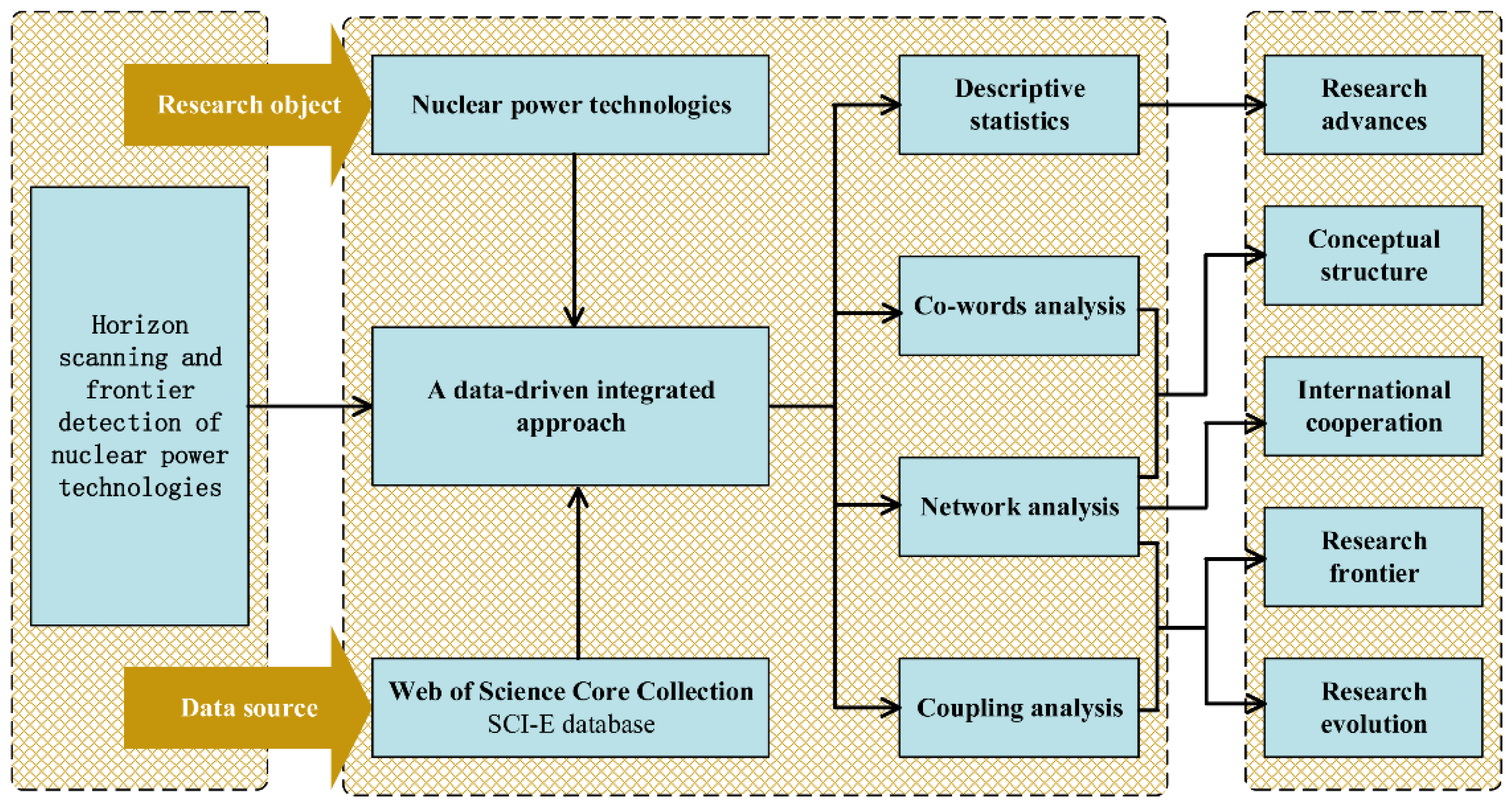
The research framework for this paper is illustrated in Figure 1. Using publication data on nuclear power technology, we have developed integrated methods incorporating descriptive statistics, co-word analysis, network analysis, and coupling analysis to uncover research advances, conceptual structures, international collaborations, research frontiers, and the evolution of nuclear power technology. The R software was used for the computation in the research.

2.2. Data Collection and Processing

The study is based on the SCI-E database from the Web of Science Core Collection. The data was extracted on 23 November 2023, and only articles published between 2013 and 2022 were considered. Based on previous research [8,9] and an exploratory search, in accordance with the objectives of this study, while balancing the principles of Completeness and Accuracy, the search term “nuclear power” was used, and the title and keywords were used in a joint search to gather results. After the retrieval operation, the preliminary search results show 4828 articles.
After the data screening, 4767 publication data on nuclear power technology research were obtained. Data sets corresponding to the sliding windows “2013–2017”, “2014–2018”, “2015–2019”, “2016–2020”, “2017–2021”, and “2018–2022” were compiled to identify the research frontiers and evolutionary paths of the last decade.

2.3. Methods

Horizon scanning is a widely used tool for analyzing technological developments and research trends. In this study, we propose an integrated method for horizon scanning that incorporates descriptive statistics [10] and co-word analysis [11,12], network analysis [13,14], and coupling analysis [6,15]. This method reveals the research trend of nuclear power technology and provides a quantitative basis for future development decisions. The specific analysis steps are as follows:
Step 1. Use descriptive statistics to showcase research advances in nuclear power technology and the characteristics of its international distribution.
Step 2. Construct a co-occurrence matrix of high-frequency words using the co-word analysis method. Then, the co-occurrence matrix will be visualized as a network structure using network analysis to identify the conceptual structure of nuclear power technology.
Step 3. Construct a co-occurrence matrix for countries/regions with high publication volume. Then, network analysis will be used to present the co-occurrence matrix as a network structure to identify international cooperation in nuclear power technology research.
Step 4. Use the coupling analysis method to extract the closely related literature, construct the coupling strength matrix, and then use network analysis to visualize the matrix as a network structure to identify the nuclear power technology research frontier. Building on the author’s previous research [6], this study defines research frontiers as a category of research characterized by high bibliographic coupling strength. This method for detecting research frontiers can effectively identify global trends in nuclear power technology research and reflect the “true” direction of these frontiers; however, these data-driven findings may not always align perfectly with popular science or common knowledge. Furthermore, patent mining [16] of nuclear power technology may, to some extent, help explain this discrepancy.
Step 5. Identify the research frontiers of nuclear power technology using six sliding windows in this study. Then, the research frontiers of six sliding windows will be compared and analyzed chronologically. According to the classification rules for research frontiers by Upham and Small [17], the research frontiers of nuclear power technology are divided into five categories: emerging, growing, stable, shrinking, and exiting, thereby revealing the evolution of nuclear power technology.

3. Results and Discussion

3.1. Research Advances in Nuclear Power Technology

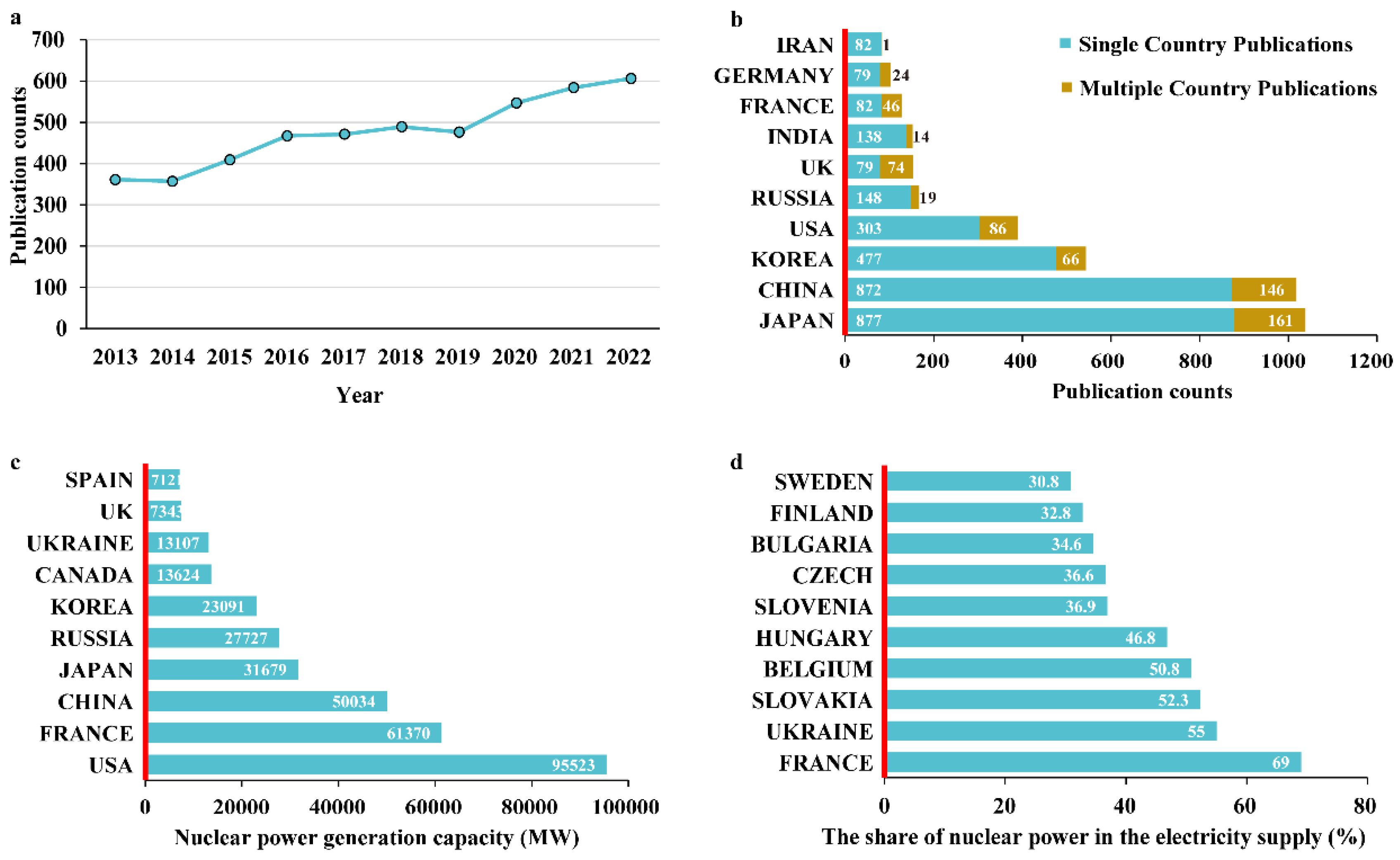
In the past decade, the number of research publications on nuclear power technology has increased from 361 in 2013 to 606 in 2022 (Figure 2a), with average annual growth rates of about 4% between 2013 and 2019 and 6% between 2019 and 2022. Japan has the highest number of publications in this field, accounting for 21.97%, followed by China at 21.95% and Korea at 11.49% (Figure 2b). Collectively, these three countries account for over 55% of the world’s total publications in this field. In comparison, the remaining individual countries and regions each contribute less than 10%. Iran and India have a lower co-publication rate (less than 10%), and the UK has a higher co-publication rate (close to 50%). Countries with higher nuclear power generation capacity tend to publish more papers on nuclear power technology (Figure 2c). However, among the top 10 countries by global nuclear power generation capacity, Spain, Ukraine, and Canada did not rank among the top countries for publications. Most countries with a high proportion of nuclear power in their energy supply structure do not perform well in the research and publication of nuclear power technology (Figure 2d). Only France has the highest number of publications among the top 10 countries in the global nuclear power supply (in power supply structure). In 2021, France’s nuclear power supply will account for nearly 70% (ranking first globally). However, France ranks only eighth in publications on nuclear power technology.

3.2. Conceptual Structure of Nuclear Power Technology

To investigate the research focus of nuclear power technology, this study analyzes the conceptual structure of highly publishing countries and compares the research differences among leading countries.
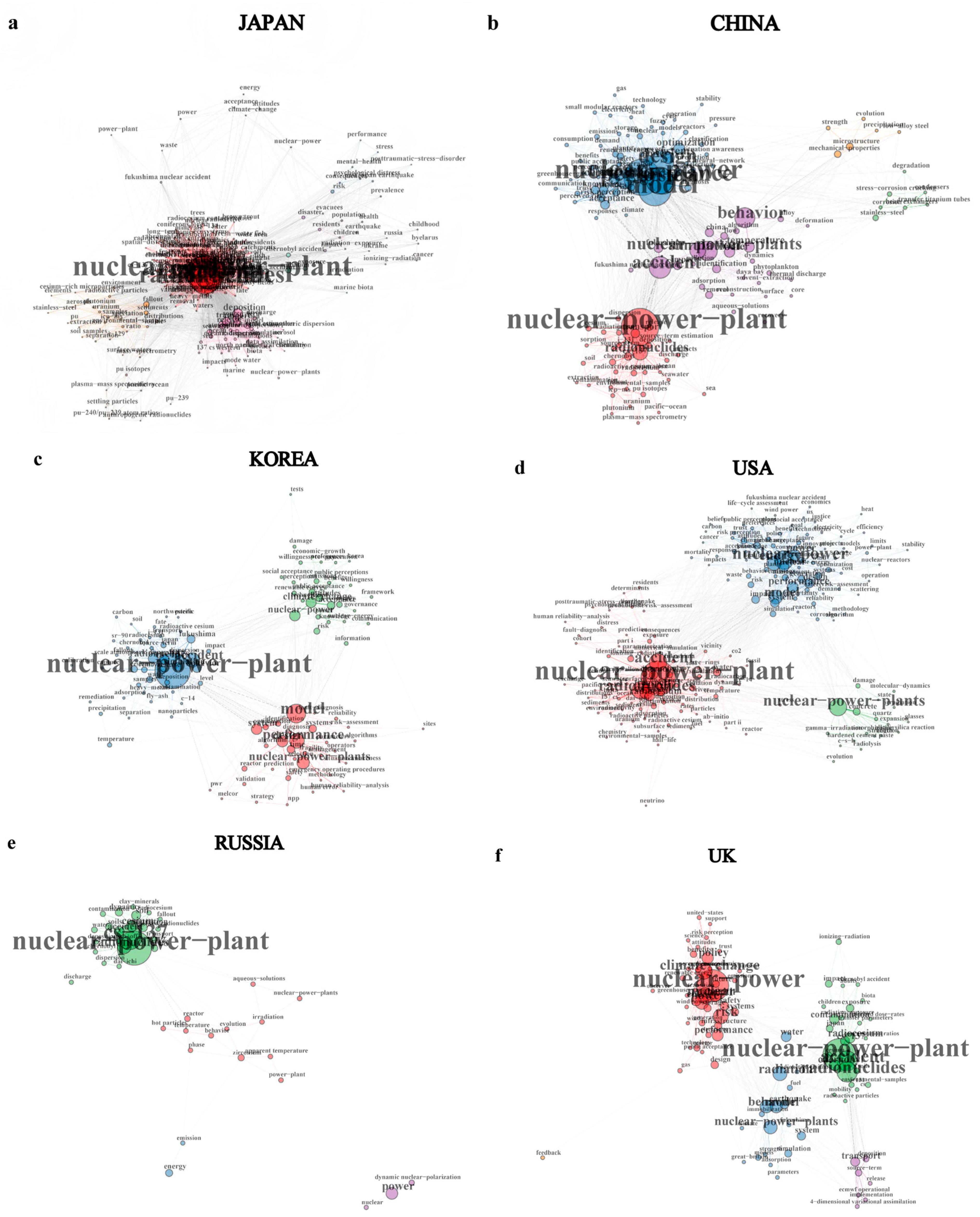
Japan’s nuclear power technology research has three main conceptual structures (Figure 3a): nuclear accident radioactivity, radioactive deposits, and radioactive ocean diffusion simulation. The keywords for “nuclear accident radioactivity” are accident, nuclear-power-plant, and radionuclides; the keywords for “radioactive deposits” are fallout, sediments, and radioactive particles; the keywords for “radioactive ocean diffusion simulation” are radioactivity, oceanic dispersion, and simulation.
China’s nuclear power technology research has three main conceptual structures (Figure 3b): radioactive marine pollution, system optimization management, and identification and elimination of nuclear accident effects. The keywords for “radioactive marine pollution” are radionuclides, contamination, and ocean. The keywords for “system optimization management” are system, optimization, and management. The main keywords of “identification and elimination of nuclear accident effects” are accident, identification, and removal.
Korea’s nuclear power technology research has three main conceptual structures (Figure 3c): system optimization management, radioactive contamination remediation, risk perception and public acceptance. The keywords for “system optimization management” are system, optimization, and management. The keywords for “radioactive pollution remediation” are radionuclides, removal, and remediation. The keywords for “risk perception and public acceptance” are risk, perceptions, and public acceptance.
There are three main conceptual structures for nuclear power technology research in the United States (Figure 3d): nuclear accident radioactivity, energy system optimization, and silicate molecular dynamics under nuclear radiation damage. The main keywords of “nuclear accident radioactivity” are nuclear-power-plant, accident, and radiation. The critical keywords of “energy system optimization” are energy, system, and optimization. The keywords for “silicate molecular dynamics under nuclear radiation damage” are damage, gamma-irradiation, molecular-dynamics, and alkali-silica reaction.
There are two main conceptual structures for nuclear power technology research in Russia (Figure 3e), including the evolution behavior of strong radioactive particles and nuclear radiation pollution. The main keywords for “the evolution behavior of strong radioactive particles” are hot particles, evolution, and behavior. The keywords in “nuclear radiation pollution” are radionuclides, contamination, and migration.
There are three main conceptual structures for nuclear power technology research in the UK (Figure 3f): systemic risk and public acceptance, seismic radiation behavior, and radionuclide contamination. The keywords for “systemic risk and public acceptance” are risk, systems, and public acceptance. The keywords for “seismic radiation behavior” are radiation, earthquake, and behavior. The main keywords of “radionuclide contamination” are radionuclides, contamination, and exposure.

3.3. International Cooperation in Nuclear Power Technology

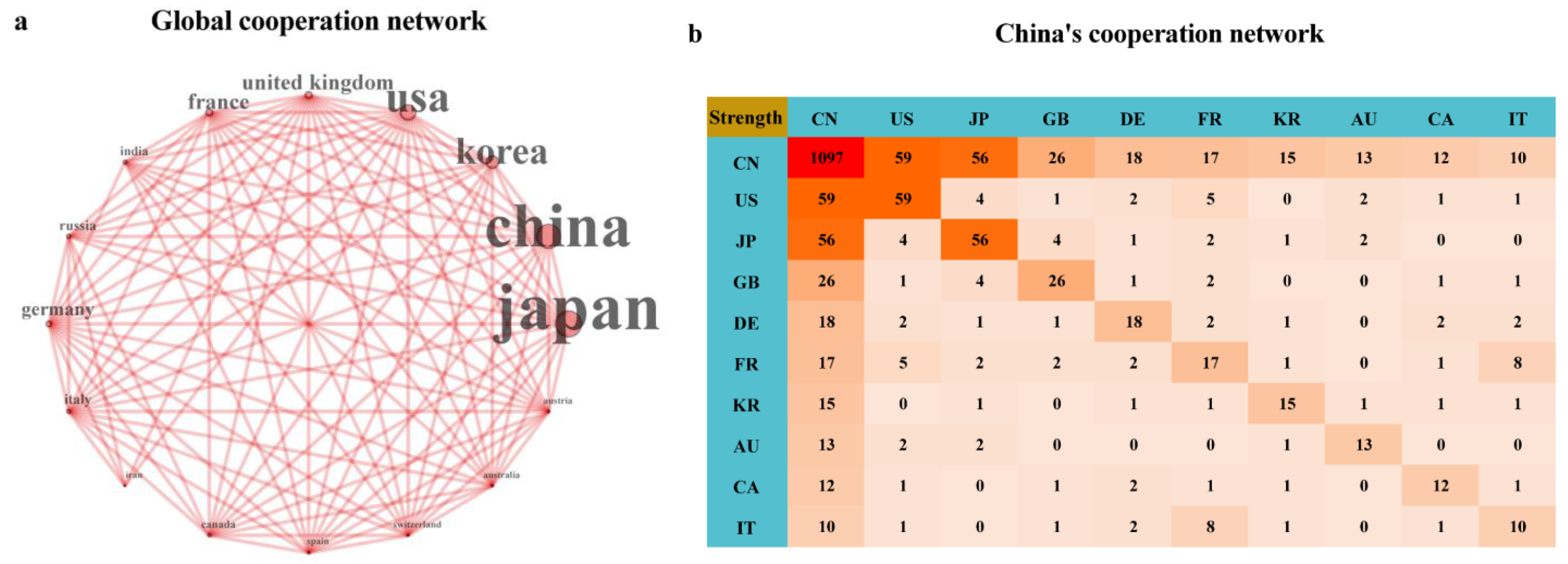
China and Japan are the leading countries in publishing research on nuclear power technology and play a significant role in the global nuclear power technology research network. Japan has the highest number of connections and extensive international cooperation, with a Degree Centrality of 0.542 and high importance in the international cooperation network (as shown in Figure 4a). China ranks second with a Degree of 0.926, and its importance in the international cooperation network, with a Degree Centrality of 0.614, is higher than Japan’s. Germany and the United States are the most critical countries in international cooperation networks, with Degree Centralities of 0.675 and 0.663, respectively. However, Germany ranks seventh (Degree = 0.214), and the United States ranks third (Degree = 0.596) in terms of the breadth of cooperation. The ranking of publication volume in some countries is inconsistent with the importance in the network. For instance, Korea, which ranks third in the number of publications, ranks 14th in the importance in the research network (Degree Centrality = 0.337). Similarly, Russia ranks fifth by number of publications but 20th in importance within the research network (Degree Centrality = 0.301). In contrast, Austria ranks 26th in the number of publications but ranks 6th in importance in the research network (Degree Centrality = 0.542).
China is the third-most significant country in the global research network, with a Degree Centrality of 0.614, following Germany and the United States. Despite this, China’s publication volume is approximately ten times more than Germany’s and three times more than the United States’. In China’s nuclear power technology research cooperation network (Figure 4b), the primary collaborators are the United States, Japan, the United Kingdom, Germany, and France, with cooperation intensity decreasing. Furthermore, China’s primary collaborators do not have a solid cooperative relationship.

3.4. Research Frontier of Nuclear Power Technology

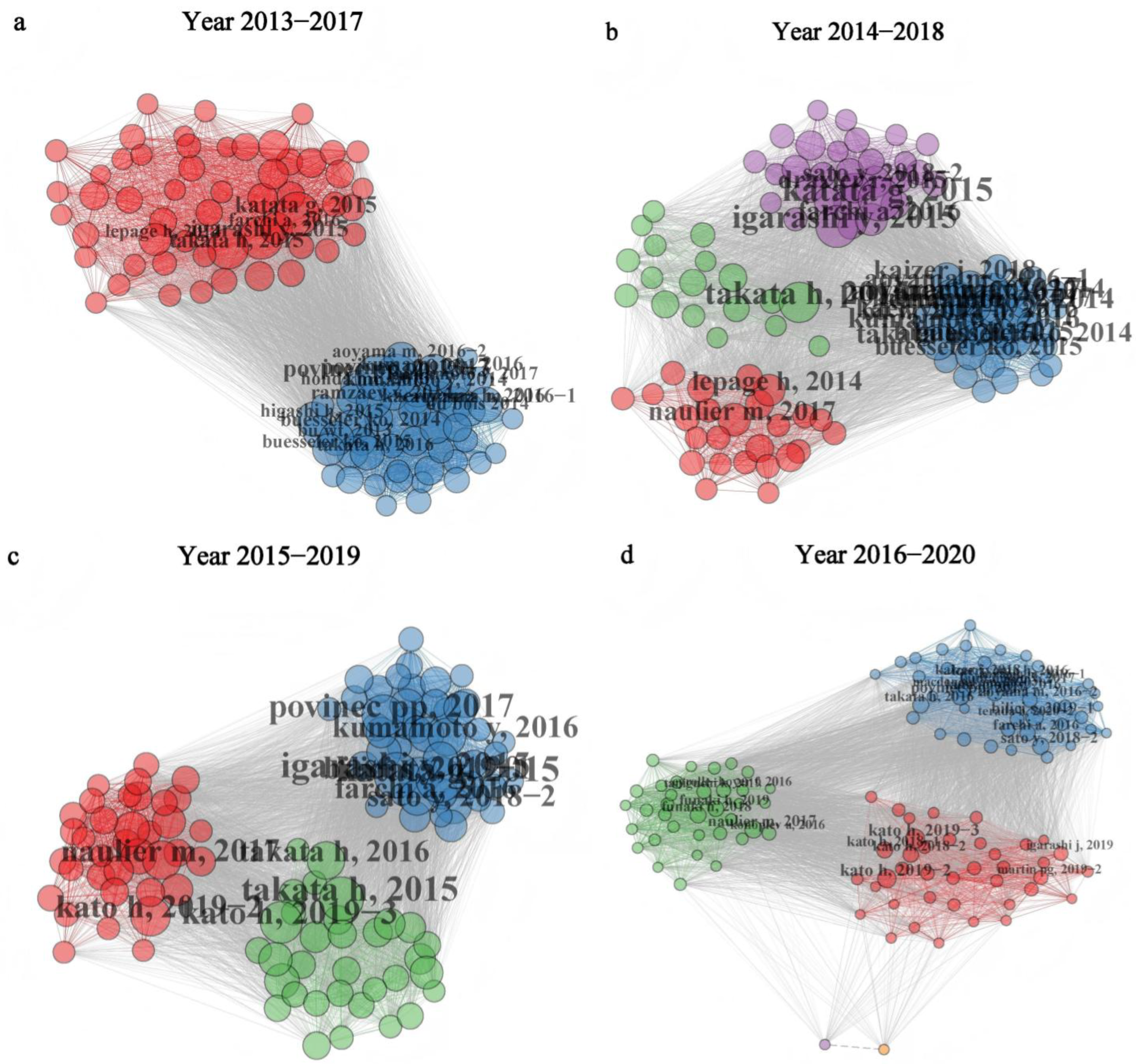
There are two research frontiers from 2013 to 2017 (Figure 5a), including radionuclide diffusion [18,19,20] and radioactive effects of nuclear power plant accidents [21,22,23]. Among them, “radionuclide diffusion” includes 54 articles, accounting for about 53%; and “radioactive effects of nuclear power plant accidents” has 48 articles, accounting for about 47%.
There are four research frontiers from 2014 to 2018 (Figure 5b), including migration of nuclear contamination [24,25,26], ocean diffusion of radionuclides [21,23,27], radiological effects of nuclear power plant accidents [20,28,29] and atmospheric diffusion of radionuclides [18,19,30]. Among them, “migration of nuclear contamination” includes 25 articles, accounting for about 23%; “ocean diffusion of radionuclides” has 35 articles, accounting for about 32%; there are 18 articles on “radiological effects of nuclear power plant accidents” accounting for about 17%; and “atmospheric diffusion of radionuclides” has 30 articles, accounting for about 28%.
There are three research frontiers from 2015 to 2019 (Figure 5c), including nuclear contaminated sediments [31,32,33], atmospheric diffusion of radionuclides [18,30,34] and radioactive effects of nuclear power plant accidents [20,23,35]. Among them, “nuclear contaminated sediment” includes 36 articles, accounting for about 31%; “atmospheric diffusion of radionuclides” includes 46 articles, accounting for about 40%; and “radioactive effects of nuclear power plant accidents” includes 33 articles, accounting for about 29%.
There are three research frontiers between 2016 and 2020 (Figure 5d), including radioactive effects of nuclear power plant accidents [29,35,36], atmospheric diffusion of radionuclides [23,30,37] and nuclear contaminated sediment [33,38,39]. Among them, “radioactive effects of nuclear power plant accidents” includes 39 articles, accounting for about 33%; “atmospheric diffusion of radionuclides” includes 44 articles, accounting for about 37%; and “nuclear contaminated sediment” includes 35 articles, accounting for about 30%.
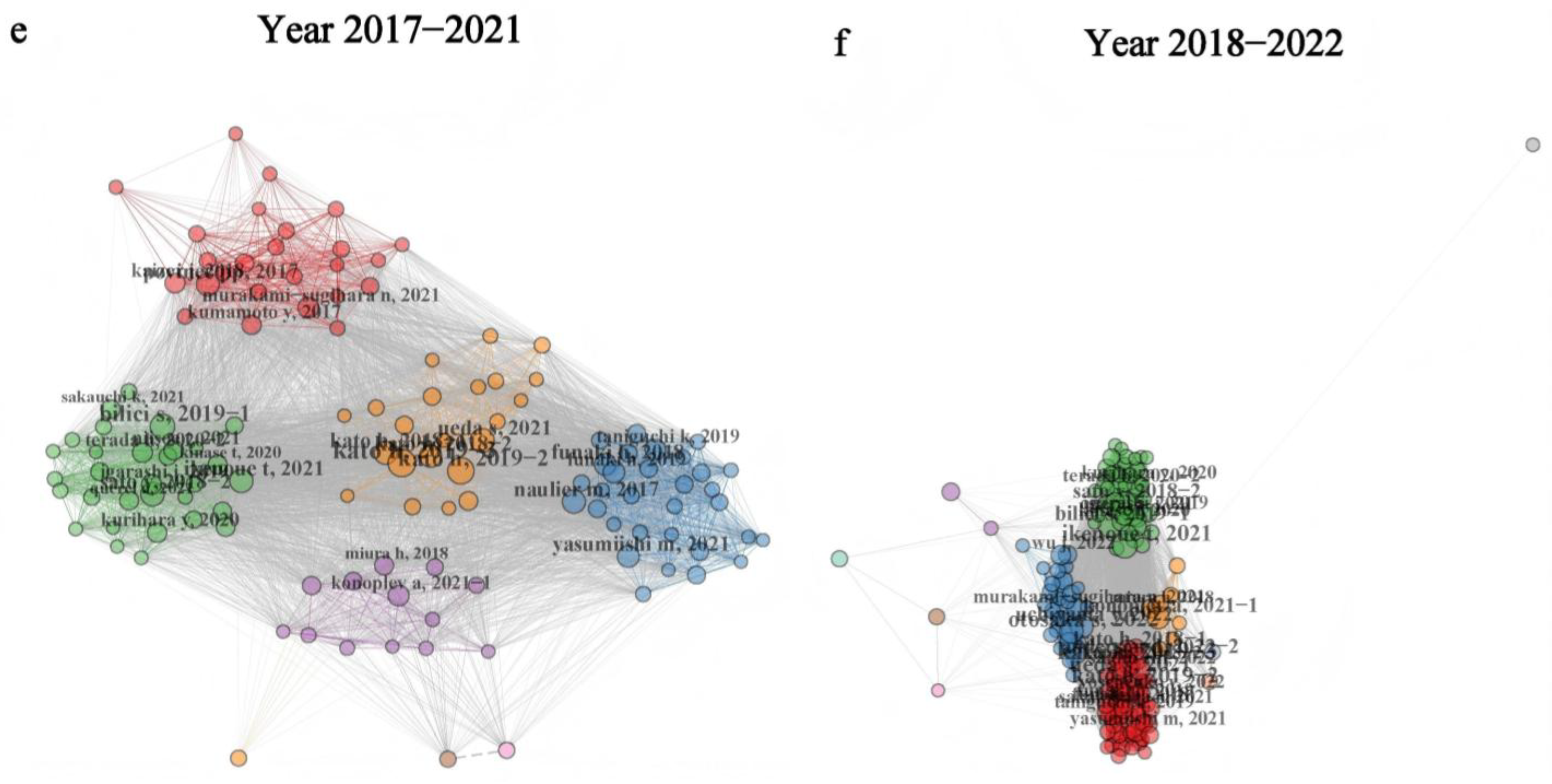
There are five research frontiers from 2017 to 2021 (Figure 5e), including ocean diffusion of radionuclides [40,41,42], nuclear contaminated sediment [33,43,44], migration of nuclear contamination [45,46,47], radioactivity control and immobilization [48,49,50], and radioactive effects of nuclear power plant accidents [35,51,52]. Among them, “ocean diffusion of radionuclides” includes 25 articles, accounting for about 20%; “nuclear contaminated sediment” includes 31 articles, accounting for about 25%; “migration of nuclear contamination” includes 31 articles, accounting for about 25%; “radioactivity control and immobilization” includes 13 articles, accounting for about 11%; and “radioactive effects of nuclear power plant accidents” has 23 articles, accounting for about 19%.
There are three research frontiers for 2018–2022 (Figure 5f), including radioactive effects of nuclear power plant accidents [35,52,53], ocean diffusion of radionuclides [36,54,55] and migration of nuclear contamination [45,47,56]. Among them, “radioactive effects of nuclear power plant accidents” includes 45 articles, accounting for about 39%; “ocean diffusion of radionuclides” includes 28 articles, accounting for about 24%; and “migration of nuclear contamination” includes 42 articles, accounting for about 37%.

3.5. Research Evolution of Nuclear Power Technology

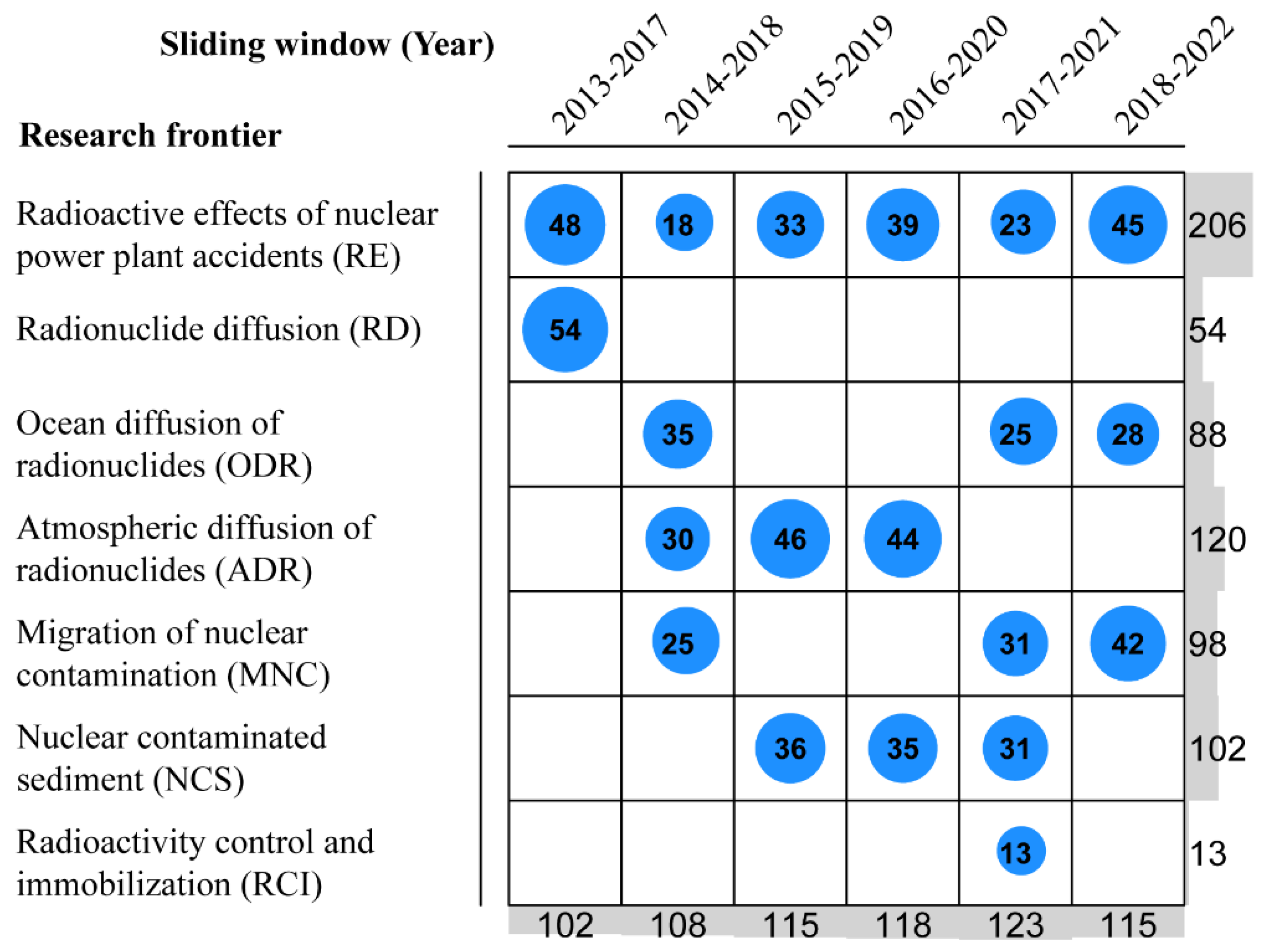
Based on the research frontier classification rules proposed by Upham and Small [17], the research frontiers of nuclear power technology from 2013 to 2022 exhibit distinct changes, as depicted in Figure 6. There are seven existing research frontiers. The radioactive effects of nuclear power plant accidents (RE) belong to the stable frontier, consistently appearing in every window. The number of articles remains similar, averaging approximately 34, indicating that comprehensive research on the radiological impact of nuclear power accidents is a steady focus of nuclear power technology and contributes to its safe and stable development. Radionuclide diffusion (RD) is an exiting frontier, appearing only in the first window and then splitting into two research frontiers: ocean diffusion of radionuclides (ODR) and atmospheric diffusion of radionuclides (ADR), suggesting that research on radionuclide diffusion focuses more on the two media of the ocean and the atmosphere. ADR is a stable frontier, appearing in the second, third, and fourth windows, with an equal number of articles in each window. On the other hand, ODR is an emerging frontier that appears in the second window, disappears temporarily, and reappears in the fifth and sixth windows. Compared with ADR and ODR, the research frontier of radionuclide diffusion has shifted from atmospheric diffusion to ocean diffusion. Research on ODR has received more attention in recent years. Migration of nuclear contamination (MNC) is also an emerging frontier, showing a change like ODR. Furthermore, the number of articles on MNC has increased, indicating that nuclear contamination migration is gradually becoming a research focus. Nuclear contaminated sediment (NCS) is a stable frontier, appearing in the third, fourth, and fifth windows, and the number of articles in each window remains similar, highlighting that the study of nuclear contaminated sediment is a relatively stable concern in the field of nuclear power technology. Radioactivity control and immobilization (RCI) is an emerging frontier, appearing only in the fifth window with a relatively small number of articles (only 13), which suggests that the field of nuclear power technology has given more attention to radioactivity control and immobilization in recent years, which contributes to promoting nuclear power technology and preventing potential accidents.

3.6. Further Discussion Beyond Data-Driven Results

The data-driven methodologies may overemphasize technologies related to nuclear accidents, driven by the specific context of the last decade (the Fukushima accident). Although we need to accept and acknowledge objective, data-driven results, the reality beyond the data may overshadow other vital research areas of nuclear power technology, such as advanced reactor designs (e.g., SMRs), hybrid nuclear–renewable systems, and grid stabilization. In addition, other developments in nuclear power technology worth noting include innovations such as fusion power, digital twins, and AI applications in nuclear energy.
Based on the latest research from supplementary searches, we can see that technologies in the following areas cannot be overlooked in future R&D efforts, including: reactor design (Gen III+, SMRs, Gen IV); fuel cycles and waste reprocessing; safety systems, materials, and thermal hydraulics; and construction, operation, or economics of nuclear plants. For more details on this section, please refer to Supplementary Materials [57,58,59,60,61,62,63,64,65,66,67,68,69,70,71,72,73,74].

4. Conclusions and Policy Implications

4.1. Conclusions

The main conclusions of this study are as follows:
(1) The growth rate of nuclear power technology research has been slow, with Japan, China, and Korea being the most prominent research countries in this field. Between 2013 and 2019, the average annual growth rate of publications on nuclear power technology was around 4%. Japan published approximately 21.97% of the world’s nuclear power technology literature, while China accounted for 21.95% and Korea for 11.49%, ranking second and third, respectively.
(2) Based on the data-driven evidence, the research on nuclear power technology primarily focuses on nuclear power accident radioactivity. In Japan, the main areas of research in nuclear power technology include nuclear accident radioactivity, radioactive deposits, and radioactive ocean diffusion simulation. In China, research focuses on radioactive marine pollution, systems optimization and management, and the identification and elimination of nuclear accident effects. Korea’s research focuses on system optimization management, radioactive contamination remediation, risk perception, and public acceptance. In the United States, the main areas of research include nuclear accident radioactivity, energy system optimization, and silicate molecular dynamics under nuclear radiation damage. Russia’s research focuses on the evolution behavior of strong radioactive particles and nuclear radiation pollution. In the UK, the research areas include systemic risk and public acceptance, seismic radiation behavior, and radionuclide contamination.
(3) Germany and the United States are crucial players in the global cooperation network for nuclear power technology. Germany and the United States are the most significant partners in international cooperation networks, with a Degree Centrality of 0.675 and 0.663, respectively. Japan has the highest node degree and the most extensive international cooperation, while China has the second-highest node degree (0.926). Furthermore, China’s primary partners in its cooperation network include the United States, Japan, the United Kingdom, Germany, and France, with cooperation intensity decreasing. However, the leading partners in China’s network have no solid collaborative relationship.
(4) There are seven research frontiers in global nuclear power technology research, focusing on areas related to nuclear power plant accident radioactivity. Emerging frontiers include ocean diffusion of radionuclides (ODR), migration of nuclear contamination (MNC), and radioactivity control and immobilization (RCI). Stable frontiers include radioactive effects of nuclear power plant accidents (RE), atmospheric diffusion of radionuclides (ADR), and nuclear contaminated sediment (NCS). In addition, radionuclide diffusion (RD) belongs to the exiting frontier.

4.2. Policy Implications

The study has practical policy implications, which are as follows:
(1) China needs to increase its efforts in researching radioactive marine pollution and take steps to identify and eliminate the effects of nuclear accidents. While China’s nuclear power technology research primarily focuses on defensive measures against nuclear radiation, it should also consider conducting radionuclide diffusion simulation studies, particularly in atmospheric and ocean diffusion pathways. Moreover, China can enhance the optimization of its nuclear power system by collaborating with the United States and Korea. It can also improve risk perception and public acceptance by collaborating with the United Kingdom and Korea.
(2) Advancing the sustainability of nuclear power technology requires global coordination in international research and supply networks. It is worth noting that nuclear power technology has not developed uniformly across all countries and regions. For instance, despite ranking among the world’s top 10 in the share of nuclear power in their energy mix, Ukraine, Slovakia, and Belgium have not reached the global forefront in nuclear power generation capacity and research output. Leading countries and regions should strategically leverage their status as major nuclear powers and promptly provide nuclear power technology while safeguarding their technological reserves. Furthermore, coordinated global efforts should be encouraged to share diverse green energy technologies and contribute to the sustainable development of nuclear power technology worldwide.
(3) It is imperative to advance research on the latest research frontiers of nuclear power technology and explore new possibilities in the areas of ocean diffusion of radionuclides (ODR), migration of nuclear contamination (MNC), and radioactivity control and immobilization (RCI). Based on horizon scanning and the frontier detection of nuclear power technology over the past ten years, seven research frontiers have been identified, including emerging ones in ODR, MNC, and RCI. It is vital to intensify research and development in these areas and take proactive measures to address risks, such as the spread of radioactive materials into the ocean from nuclear power accidents. We must strive to mitigate the global impact of nuclear pollution migration and excel in controlling and neutralizing radioactivity in nuclear power technology. These efforts will further promote the green, safe, and sustainable development of nuclear power technology.
This study still has some limitations. While data-driven results can effectively reduce the subjectivity of human judgment regarding research frontiers, this study may have certain limitations in the field of nuclear power technology. There is little (or no) equivalent to the impact of a single (punctual) event when analyzing trends in energy technology research in fields other than nuclear power. In future research, building on a data-driven foundation, it will be necessary to integrate additional expert consultation, literature reviews, and patent mining to more comprehensively identify trends in nuclear power technology innovation. Additionally, horizon scanning and frontier detection could be conducted specifically for particular nuclear power technologies, such as advanced reactor designs (e.g., SMRs) or hybrid nuclear–renewable systems, to conduct data-driven research in these subfields and more comprehensively reveal patterns of technological development.

Supplementary Materials

The following supporting information can be downloaded at: https://www.mdpi.com/article/10.3390/en19143325/s1.

Author Contributions

J.-W.W.: Conceptualization, methodology, formal analysis, investigation, data curation, software, visualization, writing—original draft, writing—review and editing, project administration, and funding acquisition. X.-X.H.: Data curation, writing—original draft, writing—review & editing, and funding acquisition. J.L.: Software, visualization, and writing—original draft. All authors have read and agreed to the published version of the manuscript.

Funding

This work was funded by the National Natural Science Foundation of China (72404026), the Fundamental Research Funds for the Central Universities (XSQD-6120250014), and the Beijing Institute of Technology Library Research Project (BITlib202608). The views expressed here are those of the authors and do not necessarily reflect the views of the donor or the authors’ institution.

Data Availability Statement

The original contributions presented in this study are included in the article. Further inquiries can be directed to the corresponding author.

Conflicts of Interest

The authors declare that they have no known competing financial interests or personal relationships that could have appeared to influence the work reported in this paper.

References

  1. International Energy Agency. Nuclear Power in a Clean Energy System. 2019. Available online: https://www.iea.org/reports/nuclear-power-in-a-clean-energy-system (accessed on 25 November 2024).
  2. International Energy Agency. CO2 Emissions in 2022. 2023. Available online: https://www.iea.org/reports/co2-emissions-in-2022 (accessed on 25 November 2024).
  3. International Atomic Energy Agency. Nuclear Power Reactors in the World. 2022. Available online: https://www.iaea.org/publications/15211/nuclear-power-reactors-in-the-world (accessed on 25 November 2024).
  4. Vega, M.; Marín, P.E.; Ushak, S.; Shire, S. Research trends and gaps in experimental applications of phase change materials integrated in buildings. J. Energy Storage 2024, 75, 109746. [Google Scholar] [CrossRef] [Scilit]
  5. Zhang, D.; Jiang, M.; Li, G.; Tang, Y. An advanced bibliometric analysis and future research insights on safety of hydrogen energy. J. Energy Storage 2024, 77, 109833. [Google Scholar] [CrossRef] [Scilit]
  6. Wei, Y.-M.; Wang, J.-W.; Chen, T.; Yu, B.-Y.; Liao, H. Frontiers of low-carbon technologies: Results from bibliographic coupling with sliding window. J. Clean. Prod. 2018, 190, 422–431. [Google Scholar] [CrossRef] [Scilit]
  7. Wu, T.; Wang, J.-W.; Qu, S.; Mi, Z.; Wei, Y.-M. Frontiers of energy storage technologies. Int. J. Energy Res. 2023, 7138669. [Google Scholar] [CrossRef] [Scilit]
  8. Kostoff, R.N.; Tshiteya, R.; Pfeil, K.M.; Humenik, J.A.; Karypis, G. Power source roadmaps using bibliometrics and database tomography. Energy 2005, 30, 709–730. [Google Scholar] [CrossRef] [Scilit]
  9. Wang, Q.; Li, R.; He, G. Research status of nuclear power: A review. Renew. Sustain. Energy Rev. 2018, 90, 90–96. [Google Scholar] [CrossRef] [Scilit]
  10. Peatman, J.G. Descriptive and Sampling Statistics; Harper: New York, NY, USA, 1947. [Google Scholar]
  11. Callon, M.; Courtial, J.P.; Laville, F. Co-word analysis as a tool for describing the network of interactions between basic and technological research: The case of polymer chemsitry. Scientometrics 1991, 22, 155–205. [Google Scholar] [CrossRef] [Scilit]
  12. He, Q. Knowledge discovery through co-word analysis. Libr. Trends 1999, 48, 133–159. Available online: https://www.proquest.com/scholarly-journals/knowledge-discovery-through-co-word-analysis/docview/220452924/se-2 (accessed on 25 November 2024).
  13. Madani, F.; Weber, C. The evolution of patent mining: Applying bibliometrics analysis and keyword network analysis. World Pat. Inf. 2016, 46, 32–48. [Google Scholar] [CrossRef] [Scilit]
  14. Scott, J. Social network analysis. Sociology 1988, 22, 109–127. [Google Scholar] [CrossRef] [Scilit]
  15. Kessler, M.M. Bibliographic coupling between scientific papers. J. Assoc. Inf. Sci. Technol. 1963, 14, 10–25. [Google Scholar] [CrossRef] [Scilit]
  16. Wang, J.W.; Li, J. Patent mining and diversity assessment of nuclear power technologies. Nucl. Eng. Technol. 2025, 57, 103272. [Google Scholar] [CrossRef] [Scilit]
  17. Upham, S.P.; Small, H. Emerging research fronts in science and technology: Patterns of new knowledge development. Scientometrics 2010, 83, 15–38. [Google Scholar] [CrossRef] [Scilit] [PubMed]
  18. Igarashi, Y.; Kajino, M.; Zaizen, Y.; Adachi, K.; Mikami, M. Atmospheric radioactivity over Tsukuba, Japan: A summary of three years of observations after the FDNPP accident. Prog. Earth Planet. Sci. 2015, 2, 44. [Google Scholar] [CrossRef] [Scilit]
  19. Katata, G.; Chino, M.; Kobayashi, T.; Terada, H.; Ota, M.; Nagai, H.; Kajino, M.; Draxler, R.; Hort, M.C.; Malo, A.; et al. Detailed source term estimation of the atmospheric release for the Fukushima Daiichi Nuclear Power Station accident by coupling simulations of an atmospheric dispersion model with an improved deposition scheme and oceanic dispersion model. Atmos. Chem. Phys. 2015, 15, 1029–1070. [Google Scholar] [CrossRef] [Scilit]
  20. Takata, H.; Hasegawa, K.; Oikawa, S.; Kudo, N.; Ikenoue, T.; Isono, R.S.; Kusakabe, M. Remobilization of radiocesium on riverine particles in seawater: The contribution of desorption to the export flux to the marine environment. Mar. Chem. 2015, 176, 51–63. [Google Scholar] [CrossRef] [Scilit]
  21. Aoyama, M.; Kajino, M.; Tanaka, T.Y.; Sekiyama, T.T.; Tsumune, D.; Tsubono, T.; Hamajima, Y.; Inomata, Y.; Gamo, T. 134Cs and 137Cs in the North Pacific Ocean derived from the March 2011 TEPCO Fukushima Dai-Ichi nuclear power plant accident, Japan. Part Two: Estimation of 134Cs and 137Cs Inventories in the North Pacific Ocean. J. Oceanogr. 2016, 72, 67–76. [Google Scholar] [CrossRef] [Scilit]
  22. Povinec, P.P.; Aoyama, M.; Biddulph, D.; Breier, R.; Buesseler, K.; Chang, C.C.; Golser, R.; Hou, X.L.; Jeskovsky, M.; Jull, A.J.T.; et al. Cesium, iodine and tritium in NW Pacific waters—A comparison of the Fukushima impact with global fallout. Biogeosciences 2013, 10, 5481–5496. [Google Scholar] [CrossRef] [Scilit]
  23. Takata, H.; Kusakabe, M.; Inatomi, N.; Ikenoue, T.; Hasegawa, K. The contribution of sources to the sustained elevated inventory of 137Cs in offshore waters east of Japan after the Fukushima Dai-Ichi nuclear power station accident. Environ. Sci. Technol. 2016, 50, 6957–6963. [Google Scholar] [CrossRef] [Scilit] [PubMed]
  24. Lepage, H.; Evrard, O.; Onda, Y.; Patin, J.; Chartin, C.; Lefevre, I.; Bonte, P.; Ayrault, S. Environmental mobility of 110mAg: Lessons learnt from Fukushima accident (Japan) and potential use for tracking the dispersion of contamination within coastal catchments. J. Environ. Radioact. 2014, 130, 44–55. [Google Scholar] [CrossRef] [Scilit] [PubMed]
  25. Martin, P.G.; Payton, O.D.; Yamashiki, Y.; Richards, D.A.; Scott, T.B. High-resolution radiation mapping to investigate FDNPP derived contaminant migration. J. Environ. Radioact. 2016, 164, 26–35. [Google Scholar] [CrossRef] [Scilit] [PubMed]
  26. Sakaguchi, A.; Tanaka, K.; Iwatani, H.; Chiga, H.; Fan, Q.; Onda, Y.; Takahashi, Y. Size distribution studies of 137Cs in river water in the Abukuma riverine system following the Fukushima Dai-Ichi nuclear power plant accident. J. Environ. Radioact. 2015, 139, 379–389. [Google Scholar] [CrossRef] [Scilit] [PubMed]
  27. Bu, W.; Fukuda, M.; Zheng, J.; Aono, T.; Ishimaru, T.; Kanda, J.; Yang, G.; Tagami, K.; Uchida, S.; Guo, Q.; et al. Release of Pu isotopes from the Fukushima Daiichi nuclear power plant accident to the marine environment was negligible. Environ. Sci. Technol. 2014, 48, 9070–9078. [Google Scholar] [CrossRef] [Scilit] [PubMed]
  28. Kambayashi, S.; Zhang, J.; Narita, H. Spatial assessment of radiocaesium in the largest lagoon in Fukushima after the TEPCO Fukushima Dai-ichi Nuclear Power Station accident. Mar. Pollut. Bull. 2017, 122, 344–352. [Google Scholar] [CrossRef] [Scilit] [PubMed]
  29. Shigenobu, Y.; Ambe, D.; Ono, T.; Fujimoto, K.; Morita, T.; Ichikawa, T.; Watanabe, T. Radiocesium contamination of aquatic organisms in the estuary of the Abukuma river flowing through Fukushima. Fish. Oceanogr. 2017, 26, 208–220. [Google Scholar] [CrossRef] [Scilit]
  30. Farchi, A.; Bocquet, M.; Roustan, Y.; Mathieu, A.; Querel, A. Using the Wasserstein distance to compare fields of pollutants: Application to the radionuclide atmospheric dispersion of the Fukushima-Daiichi accident. Tellus Ser. B-Chem. Phys. Meteorol. 2016, 68, 31682. [Google Scholar] [CrossRef] [Scilit]
  31. Chartin, C.; Evrard, O.; Laceby, J.P.; Onda, Y.; Ottle, C.; Lefevre, I.; Cerdan, O. The impact of typhoons on sediment connectivity: Lessons learnt from contaminated coastal catchments of the Fukushima Prefecture (Japan). Earth Surf. Process. Landf. 2017, 42, 306–317. [Google Scholar] [CrossRef] [Scilit]
  32. Kitamura, A.; Kurikami, H.; Sakuma, K.; Malins, A.; Okumura, M.; Machida, M.; Mori, K.; Tada, K.; Tawara, Y.; Kobayashi, T.; et al. Redistribution and export of contaminated sediment within eastern Fukushima Prefecture due to typhoon flooding. Earth Surf. Process. Landf. 2016, 41, 1708–1726. [Google Scholar] [CrossRef] [Scilit]
  33. Naulier, M.; Eyrolle-Boyer, F.; Boyer, P.; Metivier, J.-M.; Onda, Y. Particulate organic matter in rivers of Fukushima: An unexpected carrier phase for radiocesiums. Sci. Total Environ. 2017, 579, 1560–1571. [Google Scholar] [CrossRef] [Scilit] [PubMed]
  34. Sato, Y.; Takigawa, M.; Sekiyama, T.T.; Kajino, M.; Terada, H.; Nagai, H.; Kondo, H.; Uchida, J.; Goto, D.; Quelo, D.; et al. Model intercomparison of atmospheric 137Cs from the Fukushima Daiichi nuclear power plant accident: Simulations based on identical input data. J. Geophys. Res. 2018, 123, 11748–11765. [Google Scholar] [CrossRef] [Scilit]
  35. Kato, H.; Onda, Y.; Gao, X.; Sanada, Y.; Saito, K. Reconstruction of a Fukushima accident-derived radiocesium fallout map for environmental transfer studies. J. Environ. Radioact. 2019, 210, 105996. [Google Scholar] [CrossRef] [Scilit] [PubMed]
  36. Takata, H.; Inatomi, N.; Kudo, N. The contribution of 137Cs export flux from the Tone river Japan to the marine environment. Sci. Total Environ. 2020, 701, 134550. [Google Scholar] [CrossRef] [Scilit] [PubMed]
  37. Kinase, T.; Adachi, K.; Sekiyama, T.T.; Kajino, M.; Zaizen, Y.; Igarashi, Y. Temporal variations of 90Sr and 137Cs in atmospheric depositions after the Fukushima Daiichi nuclear power plant accident with long-term observations. Sci. Rep. 2020, 10, 21627. [Google Scholar] [CrossRef] [Scilit] [PubMed]
  38. Konoplev, A.; Golosov, V.; Laptev, G.; Nanba, K.; Onda, Y.; Takase, T.; Wakiyama, Y.; Yoshimura, K. Behavior of accidentally released radiocesium in soil-water environment: Looking at Fukushima from a Chernobyl perspective. J. Environ. Radioact. 2016, 151, 568–578. [Google Scholar] [CrossRef] [Scilit] [PubMed]
  39. Yamasaki, S.; Imoto, J.; Furuki, G.; Ochiai, A.; Ohnuki, T.; Sueki, K.; Nanba, K.; Ewing, R.C.; Utsunomiya, S. Radioactive Cs in the estuary sediments near Fukushima Daiichi nuclear power plant. Sci. Total Environ. 2016, 551, 155–162. [Google Scholar] [CrossRef] [Scilit] [PubMed]
  40. Kumamoto, Y.; Aoyama, M.; Hamajima, Y.; Nagai, H.; Yamagata, T.; Kawai, Y.; Oka, E.; Yamaguchi, A.; Imai, K.; Murata, A. Fukushima-derived radiocesium in the western North Pacific in 2014. J. Radioanal. Nucl. Chem. 2017, 311, 1209–1217. [Google Scholar] [CrossRef] [Scilit] [PubMed]
  41. Miki, S.; Fujimoto, K.; Shigenobu, Y.; Ambe, D.; Kaeriyama, H.; Takagi, K.; Ono, T.; Watanabe, T.; Sugisaki, H.; Morita, T. Concentrations of 90Sr and 137Cs/90Sr activity ratios in marine fishes after the Fukushima Dai-Ichi nuclear power plant accident. Fish. Oceanogr. 2017, 26, 221–233. [Google Scholar] [CrossRef] [Scilit]
  42. Murakami-Sugihara, N.; Shirai, K.; Tazoe, H.; Mizukawa, K.; Takada, H.; Yamagata, T.; Otosaka, S.; Ogawa, H. Spatiotemporal change of cesium-137 in the Pacific coast of Tohoku, Japan: The mussel watch approach. Mar. Pollut. Bull. 2021, 168, 112413. [Google Scholar] [CrossRef] [Scilit] [PubMed]
  43. Shizuma, K.; Nursal, W.I.; Sakurai, Y. Long-term monitoring of radiocesium concentration in sediments and river water along five rivers in Minami-Soma city during 2012-2016 following the Fukushima Dai-ichi nuclear power plant accident. Appl. Sci. 2018, 8, 1319. [Google Scholar] [CrossRef] [Scilit]
  44. Taniguchi, K.; Onda, Y.; Smith, H.G.; Blake, W.; Yoshimura, K.; Yamashiki, Y.; Kuramoto, T.; Saito, K. Transport and redistribution of radiocesium in Fukushima fallout through rivers. Environ. Sci. Technol. 2019, 53, 12339–12347. [Google Scholar] [CrossRef] [Scilit] [PubMed]
  45. Bilici, S.; Kulahci, F.; Bilici, A. Spatial modelling of Cs-137 and Sr-90 fallout after the Fukushima nuclear power plant accident. J. Radioanal. Nucl. Chem. 2019, 322, 431–454. [Google Scholar] [CrossRef] [Scilit]
  46. Cao, L.; Ishii, N.; Zheng, J.; Kagami, M.; Pan, S.; Tagami, K.; Uchida, S. Vertical distributions of Pu and radiocesium isotopes in sediments from Lake Inba after the Fukushima Daiichi Nuclear Power Plant accident: Source identification and accumulation. Appl. Geochem. 2017, 78, 287–294. [Google Scholar] [CrossRef] [Scilit]
  47. Ikenoue, T.; Takehara, M.; Morooka, K.; Kurihara, E.; Takami, R.; Ishii, N.; Kudo, N.; Utsunomiya, S. Occurrence of highly radioactive microparticles in the seafloor sediment from the pacific coast 35 km northeast of the Fukushima Daiichi nuclear power plant. Chemosphere 2021, 267, 128907. [Google Scholar] [CrossRef] [Scilit] [PubMed]
  48. Ishida, M.; Yamazaki, H. Radioactive contamination in the Tokyo metropolitan area in the early stage of the Fukushima Daiichi Nuclear Power Plant (FDNPP) accident and its fluctuation over five years. PLoS ONE 2017, 12, e0187687. [Google Scholar] [CrossRef] [Scilit] [PubMed]
  49. Miura, H.; Kurihara, Y.; Sakaguchi, A.; Tanaka, K.; Yamaguchi, N.; Higaki, S.; Takahashi, Y. Discovery of radiocesium-bearing microparticles in river water and their influence on the solid-water distribution coefficient (Kd) of radiocesium in the Kuchibuto River in Fukushima. Geochem. J. 2018, 52, 145–154. [Google Scholar] [CrossRef] [Scilit]
  50. Rosenberg, B.L.; Ball, J.E.; Shozugawa, K.; Korschinek, G.; Hori, M.; Nanba, K.; Johnson, T.E.; Brandl, A.; Steinhauser, G. Radionuclide pollution inside the Fukushima Daiichi exclusion zone, part 1: Depth profiles of radiocesium and strontium-90 in soil. Appl. Geochem. 2017, 85, 201–208. [Google Scholar] [CrossRef] [Scilit]
  51. Kato, H.; Onda, Y.; Saidin, Z.H.; Sakashita, W.; Hisadome, K.; Loffredo, N. Six-year monitoring study of radiocesium transfer in forest environments following the Fukushima nuclear power plant accident. J. Environ. Radioact. 2019, 210, 105817. [Google Scholar] [CrossRef] [Scilit] [PubMed]
  52. Ueda, S.; Hasegawa, H.; Ohtsuka, Y.; Ochiai, S.; Tani, T. Ten-year radiocesium fluvial discharge patterns from watersheds contaminated by the Fukushima nuclear power plant accident. J. Environ. Radioact. 2021, 240, 106759. [Google Scholar] [CrossRef] [Scilit] [PubMed]
  53. Anderson, D.; Kato, H.; Onda, Y. Mode of atmospheric deposition in forests demonstrates notable differences in initial radiocesium behavior. Environ. Sci. Technol. 2022, 56, 15541–15551. [Google Scholar] [CrossRef] [Scilit] [PubMed]
  54. Tanaka, K.; Nagao, S.; Kitade, Y.; Niki, M.; Katsumata, T.; Miyama, T.; Yoshinari, H. Spread of Fukushima-derived radiocesium over the coastal ocean in response to typhoon-induced flooding in September 2011. Limnol. Oceanogr. 2022, 67, 1184–1193. [Google Scholar] [CrossRef] [Scilit]
  55. Uchiyama, Y.; Tokunaga, N.; Aduma, K.; Kamidaira, Y.; Tsumune, D.; Iwasaki, T.; Yamada, M.; Tadeda, Y.; Ishimaru, T.; Ito, Y.; et al. A storm-induced flood and associated nearshore dispersal of the river-derived suspended 137Cs. Sci. Total Environ. 2022, 816, 151573. [Google Scholar] [CrossRef] [Scilit] [PubMed]
  56. Imamura, N.; Katata, G.; Kajino, M.; Kobayashi, M.; Itoh, Y.; Akama, A. Fogwater deposition of radiocesium in the forested mountains of East Japan during the Fukushima Daiichi Nuclear Power Plant accident: A key process in regional radioactive contamination. Atmos. Environ. 2020, 224, 117339. [Google Scholar] [CrossRef] [Scilit]
  57. Hussein, E.M.A. Generation modular reactors: A framework. Nucl. Eng. Des. 2024, 417, 112809. [Google Scholar] [CrossRef] [Scilit]
  58. Sam, R.; Sainati, T.; Hanson, B.; Kay, R. Licensing small modular reactors: A state-of-the-art review of the challenges and barriers. Prog. Nucl. Energy 2023, 164, 104859. [Google Scholar] [CrossRef] [Scilit]
  59. Mignacca, B.; Tassone, F.; Dei, G.; Lorenzi, S.; Locatelli, G.; Ricotti, M.E.; Trucco, P. Small modular reactors: Economic, safety, and environmental aspects. In Energy and Climate Change; Letcher, T.M., Fthenakis, V.M., Eds.; Academic Press: San Diego, CA, USA, 2025; pp. 475–501. [Google Scholar] [CrossRef] [Scilit]
  60. Eom, S.; Riznic, J.; Nitheanandan, T.; Kirkhope, K. Chapter 22—Regulatory and licensing challenges with Generation-IV nuclear energy systems. This book has a companion website hosting complementary materials. In Handbook of Generation IV Nuclear Reactors, 2nd ed.; Pioro, I.L., Ed.; Woodhead Publishing Series in Energy; Woodhead Publishing: London, UK, 2023; pp. 837–864. [Google Scholar] [CrossRef] [Scilit]
  61. Taller, S.; Chen, Y.; Song, R.; Chen, W.-Y.; Jokisaari, A. An approach to combine neutron and ion irradiation data to accelerate material qualification for nuclear reactors. J. Nucl. Mater. 2025, 603, 155385. [Google Scholar] [CrossRef] [Scilit]
  62. Malerba, L.; Al Mazouzi, A.; Bertolus, M.; Cologna, M.; Efsing, P.; Jianu, A.; Kinnunen, P.; Nilsson, K.-F.; Rabung, M.; Tarantino, M. Materials for Sustainable Nuclear Energy: A European Strategic Research and Innovation Agenda for All Reactor Generations. Energies 2022, 15, 1845. [Google Scholar] [CrossRef] [Scilit]
  63. Kuteev, B.V.; Shpanskiy, Y.S.; Ananiev, S.S.; Glebova, A.A.; Golubeva, A.V.; Dlougach, E.D.; Demidov, D.N.; Dnestrovskij, A.Y.; Ivanov, B.V.; Klischenko, A.V.; et al. Fusion-fission hybrid system development and integration into Russia’s nuclear power engineering. Probl. At. Sci. Technol. Ser. Thermonucl. Fusion 2021, 44, 836–847. [Google Scholar] [CrossRef] [Scilit]
  64. Kuteev, B.V.; Goncharov, P.R. Fusion–Fission Hybrid Systems: Yesterday, Today, and Tomorrow. Fusion Sci. Technol. 2020, 76, 836–847. [Google Scholar] [CrossRef] [Scilit]
  65. Aksenova, N. Legal Issues of Fusion Technologies. J. Nucl. Eng. Radiat. Sci. 2024, 11, 012203. [Google Scholar] [CrossRef] [Scilit]
  66. Battye, M.I.; Perinpanayagam, S. Digital Twins in Fusion Energy Research: Current State and Future Directions. IEEE Access 2025, 13, 75787–75821. [Google Scholar] [CrossRef] [Scilit]
  67. Lindley, B.; Roulstone, T.; Locatelli, G.; Rooney, M. Can fusion energy be cost-competitive and commercially viable? An analysis of magnetically confined reactors. Energy Policy 2023, 177, 113511. [Google Scholar] [CrossRef] [Scilit]
  68. Browning, J.; Slaughter, A.; Kunz, R.; Hansel, J.; Rolston, B.; Wilsdon, K.; Pluth, A.; McCardell, D. Foundations for a Fission Battery Digital Twin. Nucl. Technol. 2022, 208, 1089–1101. [Google Scholar] [CrossRef] [Scilit]
  69. Qi, B.; Xiao, X.; Liang, J.; Zhou, H.; Wu, W.; Zhang, X. Synergistic AI for Nuclear Safety: PINNs, XAI, DTs, and LLMs in Fault Diagnosis. Nucl. Technol. 2026, 1–18. [Google Scholar] [CrossRef] [Scilit]
  70. Barik, K.; Misra, S.; Thunem, H.P.-J. Achieving SDGs Using AI Techniques and Digital Twins for Nuclear Power Plants: A Review. In Artificial Intelligence of Things for Achieving Sustainable Development Goals; Misra, S., Siakas, K., Lampropoulos, G., Eds.; Springer Nature: Cham, Switzerland, 2024; pp. 81–98. [Google Scholar] [CrossRef] [Scilit]
  71. Zubair, M.; Akram, Y. Enhancement in the safety and reliability of Pressurized Water reactors using Machine Learning approach. Ann. Nucl. Energy 2024, 201, 110448. [Google Scholar] [CrossRef] [Scilit]
  72. Ke, J.-H. Microstructure modeling of nuclear structural materials: Recent progress and future directions. Comput. Mater. Sci. 2023, 230, 112503. [Google Scholar] [CrossRef] [Scilit]
  73. Miller, Z.; Johnson, L.; Alzate-Vargas, L.; Rizk, J.; Matthews, C.; Cooper, M.W.D.; Mehta, V.; Andersson, D.A.; Craven, G.T.; Fratoni, M.; et al. First Results for Uranium Nitride Fuel Characterization Using an Accelerated Fuel Qualification Process. Nucl. Sci. Eng. 2026, 200, S741–S753. [Google Scholar] [CrossRef] [Scilit]
  74. Dub, A.V.; Rudskoi, A.I. New Materials for Nuclear Power. Her. Russ. Acad. Sci. 2021, 91, 292–296. [Google Scholar] [CrossRef] [Scilit]
Figure 1. Research framework.
Energies 19 03325 g001
Figure 2. Research advances of nuclear power technology. Notes: (a) represents the year-by-year change in the number of published articles on nuclear power technology research. (b) indicates the top 10 countries regarding the number of articles published on nuclear power technology (countries with corresponding authors), where the blue bar represents a single-country publication, and the yellow bar represents a multiple-country publication. (c) represents the top 10 countries regarding nuclear power generation capacity in 2021, according to data from the International Atomic Energy Agency (IAEA). (d) denotes the top 10 countries by share of nuclear power supply in 2021, according to data from the International Atomic Energy Agency (IAEA).
Energies 19 03325 g002
Figure 3. The conceptual structure of nuclear power technology in leading countries. (a) denotes the conceptual structure of nuclear power technology in Japan. (b) denotes the conceptual structure of nuclear power technology in China. (c) denotes the conceptual structure of nuclear power technology in Korea. (d) denotes the conceptual structure of nuclear power technology in USA. (e) denotes the conceptual structure of nuclear power technology in Russia. (f) denotes the conceptual structure of nuclear power technology in UK. Notes: The size of a node indicates its degree, and nodes of different colors represent various research concepts.
Energies 19 03325 g003
Figure 4. International cooperation network on nuclear power technology. Notes: (a) represents the global cooperation network of nuclear power technology, and the size of the nodes represents their degree. The size of the node’s label is also proportional to the node’s degree. In this study, “Degree” is defined as the normalized value that represents the number of a node’s neighbors after eliminating multiple edges. This metric reflects the extent of a node’s collaborative reach within the network. Conversely, “Degree Centrality” refers to the normalized centrality metric of the original collaborative network, which retains multiple edges, and indicates a node’s significance within the overall network structure. (b) denotes China’s cooperation network; the darker the grid, the stronger the cooperation. The abbreviations for countries or regions are as follows: China (CN), USA (US), Japan (JP), United Kingdom (GB), Germany (DE), France (FR), Korea (KR), Australia (AU), Canada (CA), and Italy (IT).
Energies 19 03325 g004
Figure 5. Research frontiers of nuclear power technology from 2013 to 2022. (a) denotes the research frontiers of nuclear power technology from 2013 to 2017. (b) denotes the research frontiers of nuclear power technology from 2014 to 2018. (c) denotes the research frontiers of nuclear power technology from 2015 to 2019. (d) denotes the research frontiers of nuclear power technology from 2016 to 2020. (e) denotes the research frontiers of nuclear power technology from 2017 to 2021. (f) denotes the research frontiers of nuclear power technology from 2018 to 2022. Notes: Only nodes with the top 5% degree in the actual network are shown in the figure. In this study, the coupling strength threshold was set based on experience, and a similar setting can be found in the authors’ previous publications [6]. While varying the threshold introduces some uncertainty into network construction, the study’s conclusions remain consistent and demonstrate robustness. Furthermore, different threshold settings correspond to different resolutions of the network results; depending on the research objectives, specific thresholds can be adjusted to obtain and interpret results under varying resolution conditions. The size of nodes is proportional to their degree. Nodes with different colors represent different research frontiers.
Energies 19 03325 g005aEnergies 19 03325 g005b
Figure 6. Research evolution of nuclear power technology (2013–2022). Notes: The figure displays counts of articles related to specific research frontiers, reflecting the intensity of research in each.
Energies 19 03325 g006
Disclaimer/Publisher’s Note: The statements, opinions and data contained in all publications are solely those of the individual author(s) and contributor(s) and not of MDPI and/or the editor(s). MDPI and/or the editor(s) disclaim responsibility for any injury to people or property resulting from any ideas, methods, instructions or products referred to in the content.