Article

Thermo-Mechanical Analysis of Femtosecond Laser Processing of Two-Layer Metal Materials

1
School of Energy and Power Engineering, University of Shanghai for Science and Technology, Shanghai 200093, China
2
School of Energy and Environment, Southeast University, Nanjing 210096, China
*
Author to whom correspondence should be addressed.
Energies 2026, 19(13), 3094; https://doi.org/10.3390/en19133094
Submission received: 23 May 2026 / Revised: 21 June 2026 / Accepted: 24 June 2026 / Published: 30 June 2026
(This article belongs to the Special Issue Advances in Micro-/Nanoscale Flow and Phase-Change Heat Transfer)

Abstract

In modern precision manufacturing systems, multilayer metal structures are key to achieving high-performance devices. However, during actual processing, they are highly prone to interlayer thermal stress concentration and defects such as interface delamination. To thoroughly elucidate and address this stress evolution issue, this study proposes a two-temperature model based on thermomechanical coupling. A thorough analysis of the thermal–mechanical coupling behavior of copper/aluminum two-layer metal films under femtosecond laser irradiation was conducted, investigating non-equilibrium heat transfer within the two-layer material and the resulting stress evolution. The results indicate that stress waves dynamically modulate the temperature distribution, revealing the critical role of thermo-mechanical coupling in energy transfer. Further studies show that stress waves undergo reflection and transmission at material interfaces, with their phases influenced by the acoustic impedance of the materials. When stress waves propagate from a medium with high acoustic impedance to one with low acoustic impedance, the phase of the transmitted wave remains unchanged, while the phase of the reflected wave reverses. Stress unloading occurs during the phase transition; tensile stress at the interface due to reflection can induce delamination, while horizontal stress tends to initiate cracks. This work contributes to the analysis of stress evolution during laser processing of multilayer metals.

1. Introduction

Multilayer metal materials have become a key choice in fields such as aerospace, integrated circuits, and high-end equipment due to their tunable layered structure and interfacial synergy effects [1,2,3,4,5]. Although multilayer metal materials hold broad application prospects, there are significant differences in the physical properties of the individual metal layers, such as thermal conductivity, melting point, and coefficient of thermal expansion [6,7,8,9], which pose significant challenges for their precision fabrication and microscale processing. Furthermore, conventional processing methods are prone to causing metal films to tear under mechanical stress, resulting in structural damage and performance degradation [10]. Femtosecond laser processing technology, with its advantages of ultrashort pulses, high power density, and localized thermal effects, minimizes thermal effects and recast layers, providing an effective solution for the microscale precision processing of multilayer metal materials [11,12].
Femtosecond laser processing technology has garnered attention in the machining of multilayer metallic materials, and the two-temperature model has become an important tool for studying electron–phonon non-equilibrium heat transport in laser-metal interactions [13]. Elsaye et al. [14] conducted experimental studies on the interaction between pulsed lasers and copper films, observing non-equilibrium characteristics in electron and lattice temperatures, thereby confirming the validity of the two-temperature model. Brorson et al. [15] used a two-temperature model to simulate ultrafast laser processing of gold films, marking the beginning of research into the application of ultrafast lasers to gold films. Du et al. [16] used the two-temperature model to theoretically analyze the thermalization dynamics of dual-pulse femtosecond lasers on two-layer metal films, demonstrating that the heat transfer processes at the surface and interface can be optimized by adjusting the pulse interval and energy ratio. Since the beginning of this century, researchers have further extended the two-temperature model to two-layer material structures. Rebegea et al. [17] investigated the processing characteristics of multilayer metallic materials via laser ablation experiments, the results showed that a transition-metal layer increases the ablation threshold of the upper metal layer. Tunç et al. [18] investigated the thermalization dynamics of various two-layer gold films under femtosecond laser irradiation. They found that substrates with high electron–phonon coupling coefficients can significantly reduce the temperature of the gold film and increase the damage threshold. While existing research has achieved significant progress in the field of multilayer metal material processing, most studies still overlook the role of interfacial thermal resistance between layers.
In the process of non-equilibrium thermo-mechanical coupling induced by femtosecond lasers, interfacial thermal resistance is a key parameter that governs heat transfer across interfaces and its spatial distribution. Its presence hinders efficient energy transport, leading to localized heat accumulation near the interface, which may subsequently cause interface overheating, structural damage, or even interface failure. Research by Giri et al. [19] indicates that mismatched electron–phonon coupling amplifies interfacial thermal resistance, leading to an anomalous increase in thermal conductivity in systems such as copper/gold alloys. In laser heating, interfacial thermal resistance can regulate thermal diffusion to prevent local overheating. Farid et al. [12] incorporated the interfacial thermal resistance effect into molybdenum/aluminum multilayer ablation experiments, revealing that it promotes selective peeling of molybdenum without melting the aluminum, thereby highlighting the role of thermal resistance in electromechanical forces. Tsai et al. [20] simulated the influence of interfacial thermal resistance on the thermoelastic behavior of multilayer films and found that even minute thermal resistance can induce interfacial peeling.
As a core physical mechanism in the thermal–mechanical coupling process, thermal stressing directly affects the structural integrity and processing quality of materials through its rapid generation and dynamic propagation. Particularly under the influence of ultrashort pulses, this can lead to interfacial delamination, crack propagation, and residual stress accumulation. Lian et al. [21] investigated the regulatory role of interfacial thermal resistance at the gold/titanium interface on stress evolution during phase transformation. Their study demonstrated that interfacial thermal resistance modulates stress transfer during phase transformation by influencing the expansion kinetics of titanium vapor, thereby regulating the ablation process. Wang et al. [22] revealed that short-pulse lasers induce stronger thermal stress waves, which may lead to delayed surface displacement and interfacial crack propagation in multilayer metallic materials. Building on this, Wang et al. [23] used molecular dynamics simulations of picosecond laser interactions to observe the cooperative propagation of thermal stress waves and temperature waves, which may trigger phase transitions and redeposition in multilayer metallic systems. Shen et al. [24] found that thermal electron blast forces significantly influence thermal stress waves, underscoring the importance of thermal stress control in multilayer thin-film processing. Additionally, McDonald et al. [25] measured residual stresses in copper/nickel multilayer materials using pump-probe and XRD techniques, with results showing that thermal stresses increase as layer thickness decreases. Nakhoul et al. [26] studied ultrafast laser-impacted aluminum alloys and observed that thermal stress drives microstructural evolution and increases dislocation density. Zhao et al. [27] used simulations to elucidate the mechanism of thermal stress-induced cracking in porous aluminum oxide. However, the dynamic propagation and evolution mechanisms of stress waves induced by non-equilibrium heat transfer during femtosecond laser processing of multilayer metals still require further investigation.
Therefore, this study established a two-temperature model for coupled thermal–mechanical behavior, taking into account the influence of interfacial thermal resistance on heat transport across interfaces, to investigate heat transfer and stress evolution within two-layer materials under femtosecond laser irradiation. The study examined heat transfer mechanisms and dynamic stress responses at metal interfaces under varying laser fluence conditions. Using numerical simulation methods, it systematically revealed the generation and propagation mechanisms of laser-induced stress waves, as well as their dynamic response behavior at different material interfaces. This study focuses on the Cu/Al two-layer system, primarily due to its widespread application in microelectronics and power devices, as well as the significant differences between the two materials in terms of melting point, electron–phonon coupling coefficient, and acoustic impedance. This combination of differences can be effectively utilized to analyze the heat conduction behavior and stress evolution patterns during femtosecond laser processing of two-layer materials.

2. Models and Methods

2.1. Physical Modelling

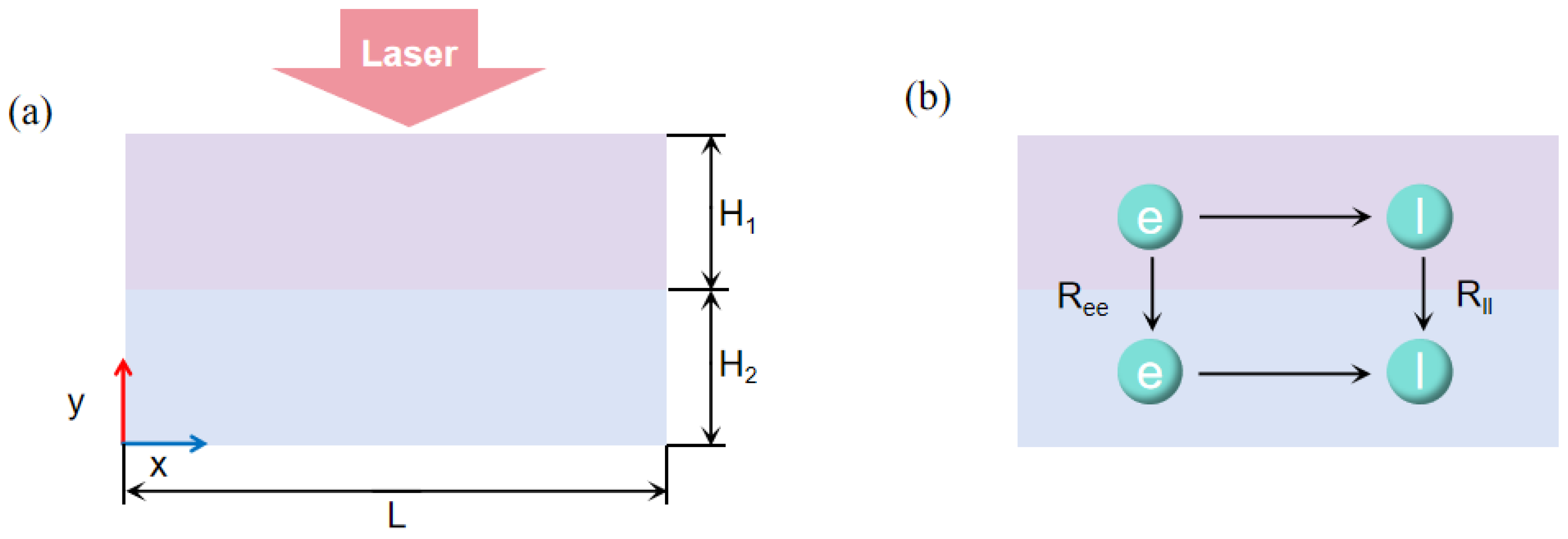
The physical model for this study is depicted in Figure 1. A Gaussian laser was employed, with the processing material comprising a bilayer metallic structure of copper and aluminum. The upper layer consists of copper, while the lower layer comprises aluminum. The material width L is 3000 nm, with the copper layer thickness H1 of 200 nm and the aluminum layer thickness H2 of 100 nm.
The following are some assumptions made during the modeling process:
(1)
Assuming the laser fluence distribution follows a Gaussian distribution and the laser fluence output is stable.
(2)
Copper and aluminum are isotropic materials and make good contact.
(3)
Neglecting convective heat transfer and thermal radiation between materials and the environment.

2.2. TTM Model

During femtosecond laser irradiation of metallic materials, a two-temperature model is typically employed to describe the temperature evolution of the electron and phonon systems. Laser photons first transfer energy to the electron subsystem, rapidly raising the electron temperature. Subsequently, high-energy electrons transfer their energy to the phonon system via the electron–phonon coupling mechanism, causing the phonon temperature to gradually rise. Ultimately, achieving electron–phonon temperature equilibrium within the picosecond timescale. In double-layer metallic materials, the thermal transport pathways are more complex. During the initial phase of laser pulse exposure, energy is primarily deposited at the surface of the upper copper layer and is first absorbed by its electron system. Subsequently, a portion of the energy is transferred to the phonon system in the copper layer via an electron–phonon coupling mechanism. Another portion is transferred to the electron system in the underlying aluminum layer via electron-electron thermal conduction. Henceforth, the phonon system in the copper layer will also transmit energy to the phonons in the aluminum layer via phonon-phonon interactions, as illustrated in Figure 1b. The model also accounts for thermoelastic damping’s influence on temperature. The electronic temperature (Te) and phonon temperature (Tl) may be described by the following formulae [28,29]:
C e T e t = ( k e T e ) G ( T e T l ) + Q
C l T l t = ( k l T l ) + G ( T e T l ) + F l
where Ce and Cl represent the thermal capacities of electrons and phonons, respectively; ke and kl represent the thermal conductivities of electrons and phonons, respectively; G is the electron–phonon coupling coefficient; Q is the laser source; and Fl is the thermoelastic damping. Since the thermal conductivity of phonons is much lower than that of electrons, it can be neglected.
The electronic heat capacity is linearly related to the electronic temperature [30]:
C e = γ T e
where γ is the thermal capacity of an electron at room temperature, and Te is the electron temperature.
When the electron temperature is below the Fermi temperature, the thermal conductivity of electrons can be approximated as a linear function of temperature [31]:
k e = k e 0 T e T l
where ke0 is the electron thermal conductivity at room temperature. When the electron temperature exceeds the Fermi temperature, it can be approximated as follows [32]:
k e = χ θ e 2 + 0.16 5 / 4 θ e 2 + 0.44 θ e θ e 2 + 0.092 1 / 2 θ e 2 + η θ l
where χ is a material-dependent coefficient, and η is a dimensionless constant. Where the thermal conductivity of copper is 377 W/(m·K), θe = Te/Tf, and θl = Tl/Tf, where Tf is the Fermi temperature.
The electron–phonon coupling coefficient is a function of temperature and can be approximated as:
G = G 0 A e B l ( T e + T l ) + 1
where G0 is the electron–phonon coupling coefficient at room temperature, and Ae and Bl are material coefficients.
A laser heat source (Q) with a Gaussian distribution can be expressed as [20]:
Q = 4 ln 2 π ( 1 R ) × F t p ( δ + δ b ) ( 1 e H / ( δ + δ b ) ) exp [ y ( δ + δ b ) 4 ln 2 ( t 2 t p t p ) 2 2 x 2 w 0 2 ]
In the equation, R represents the reflectivity of the material, F represents the laser fluence, tp represents the laser pulse width, and δ represents the optical penetration depth. Since the material is relatively thin, the ballistic diffusion depth must be taken into account; δb represents the ballistic diffusion depth, H represents the material thickness, and w0 represents the spot radius. Laser parameters can be seen in Table 1.
Thermoelastic damping is essentially caused by non-uniform, irreversible heat conduction resulting from mechanical deformation. The thermoelastic damping in Equation (2) can be expressed as [29]:
F l = 3 K α T l ε k k t
where K is the bulk modulus, K = E/3(1 − 2v), α is the coefficient of thermal expansion, and εkk is the volumetric strain. Material property parameters can be seen in Table 2.

2.3. Thermal Resistance at the Interface

The interfacial thermal resistance at metal interfaces is a major factor affecting energy transfer across interfaces. Even when two metal blocks are in full contact, the temperature distribution at their interface remains discontinuous. During energy transfer, both heat conduction between electrons in the upper and lower layers and phonon-phonon interactions are significantly affected by the interfacial thermal resistance. This further leads to localized heat accumulation and temperature jumps near the interface. The Kapitza resistance at the interface can be expressed as [12]:
R i = Δ T i Q i
where Ri is the Kapitza thermal resistance at the interface, Qi is the heat flux transferred across the metal interface, and ΔTi is the temperature difference at the interface.
In multilayer metallic materials, the contribution of electrons to the Kapitza thermal resistance is significantly greater than that of phonons. Therefore, only the effect of the electronic thermal resistance is considered. After simplification, the following expression is obtained:
1 R e e = Z 1 Z 2 4 ( Z 1 + Z 2 )
The parameters Z1 and Z2 represent the material parameters of the upper and lower layers, respectively, where Z = γTevf and vf is the Fermi velocity. Since the electron thermal capacitance Ce = γTe, this can be expressed as Z = Cevf. It should be noted that the Kapitza thermal resistance used in Equation (10) is based on the ideal interface approximation. In practice, heat conduction at the Cu/Al interface is also influenced by factors such as contact mass, surface roughness, and intermetallic compound layers. These factors alter the interfacial thermal resistance by introducing additional phonon scattering channels. Since this study focuses primarily on the initial ultrafast dynamics and stress evolution on the picosecond timescale, the use of a simplified interfacial thermal resistance is a reasonable approximation.

2.4. Solid Mechanics Model

Within the framework of continuum mechanics, the equations of motion for an isotropic elastic solid that accounts for thermal expansion can be expressed as [37]:
ρ 2 u t 2 = E 2 ( 1 + ν ) 2 u + E 2 ( 1 + ν ) ( 1 2 ν ) ( u ) E 3 ( 1 2 ν ) α T l T l 0 + F E L
where ρ is the density of the material, u is the displacement of the material, E is the Young’s modulus of the material, v is the Poisson’s ratio, and α is the coefficient of linear expansion. Meanwhile, the model accounts for the hot-electron explosion force (FEL) driven by non-equilibrium electron interactions. Electron explosion force refers to a physical process in which transient mechanical shocks generated by Coulombic repulsion, along with accompanying quantum effects, collectively drive non-equilibrium lattice deformation on an ultrafast timescale within high-energy electron systems. It can be calculated as FEL = ∇Pe, where Pe is the electron pressure. When the electron temperature exceeds one-tenth of the Fermi temperature, FEL = 2/3∇(CeTe) [38].
The Navier–Stokes equations describe the mechanisms of mass and momentum transport and conservation in fluids. In the theoretical model established in this study, these conservation mechanisms have been incorporated into the elastic constitutive equation framework adopted. Mass conservation is maintained through the continuity of material elements during deformation, while momentum conservation is reflected in the stress balance relationships inherent in the governing equations. This approach allows the elastic equations to consistently describe the dynamic response of materials ranging from solids to fluids by adjusting the parameters so that the shear modulus G approaches zero and the Poisson’s ratio ν converges to 0.5 [39].

2.5. Boundary Conditions

To simplify the model and focus on the energy transfer process within the laser-affected zone, this study assumes no heat loss at the lateral boundaries (the left and right boundaries between copper and aluminum). It applies adiabatic boundary conditions to both the electron and phonon systems. These conditions are expressed as:
T e , C u y | x = L / 2 = T e , A l y | x = L / 2 = T l , C u y | x = L / 2 = T l , A l y | x = L / 2 = 0
During laser heating, heat is transferred from the upper copper layer to the lower aluminum layer. At the interface, this heat transfer is affected by Kapitza resistance, leading to a discontinuity in temperature. The thermal boundary conditions at the interface are expressed as:
k e , C u T e , C u x | y = H 1 = k e , A l T e , A l x | y = H 1 = T e , C u T e , A l R e e | y = H 1
The boundary conditions at the bottom of the material are expressed as:
T e , A l x | y = H 1 H 2 = T l , A l x | y = H 1 H 2 = 0

2.6. Mesh Independence

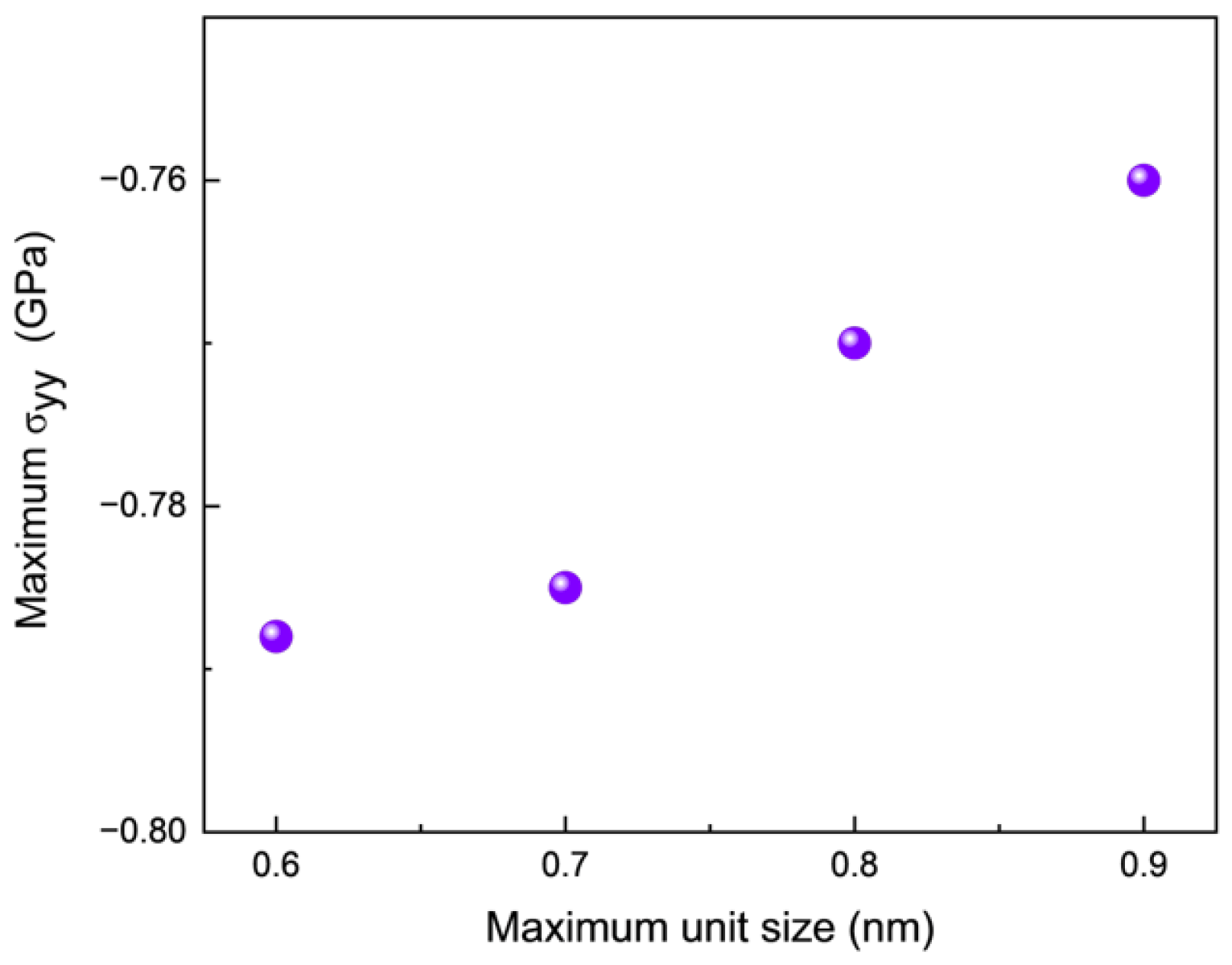
In this work, a finite element method is used to solve the defined governing equations, and the developed computational model is solved using COMSOL Multiphysics. To balance computational accuracy and solution stability, this paper employs a mapping mesh combined with a non-uniform meshing strategy, performing local mesh refinement in the laser-irradiated region while maintaining a conventional mesh density in the remaining areas. This approach ensures accuracy in critical regions while controlling the overall computational scale. To verify the independence of the simulation results from the mesh configuration, three mesh models with different element sizes were constructed, with maximum element sizes in the laser-irradiation region of 0.9 nm, 0.8 nm, 0.7 nm, and 0.6 nm, respectively. Using the maximum stress at 0.1 ps as the monitoring criterion, Figure 2 compares the peak compressive stresses obtained from the four mesh models. The results show that the peak compressive stresses are relatively similar across different mesh sizes, with a maximum error of 3.68%, satisfying the mesh independence requirement. Therefore, all subsequent simulations were performed using a refined mesh with a maximum cell size of 0.7 nm.

3. Results and Discussion

3.1. Model Validation

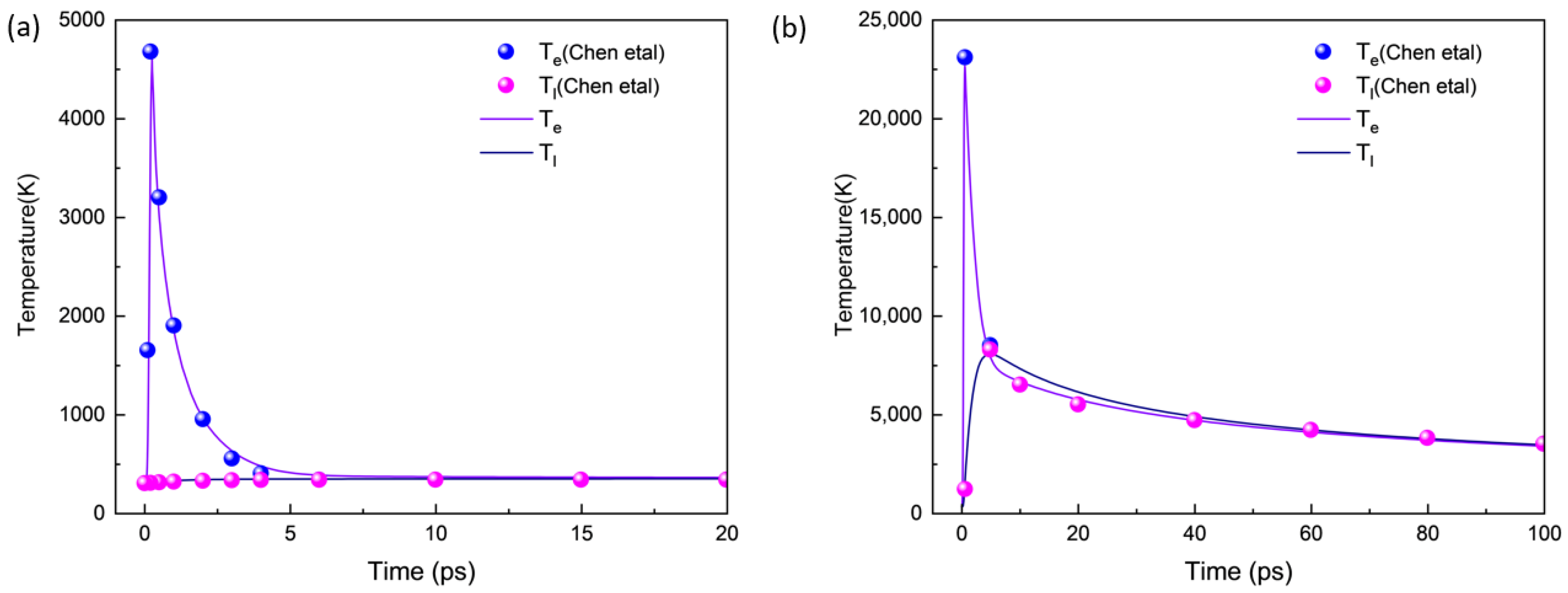
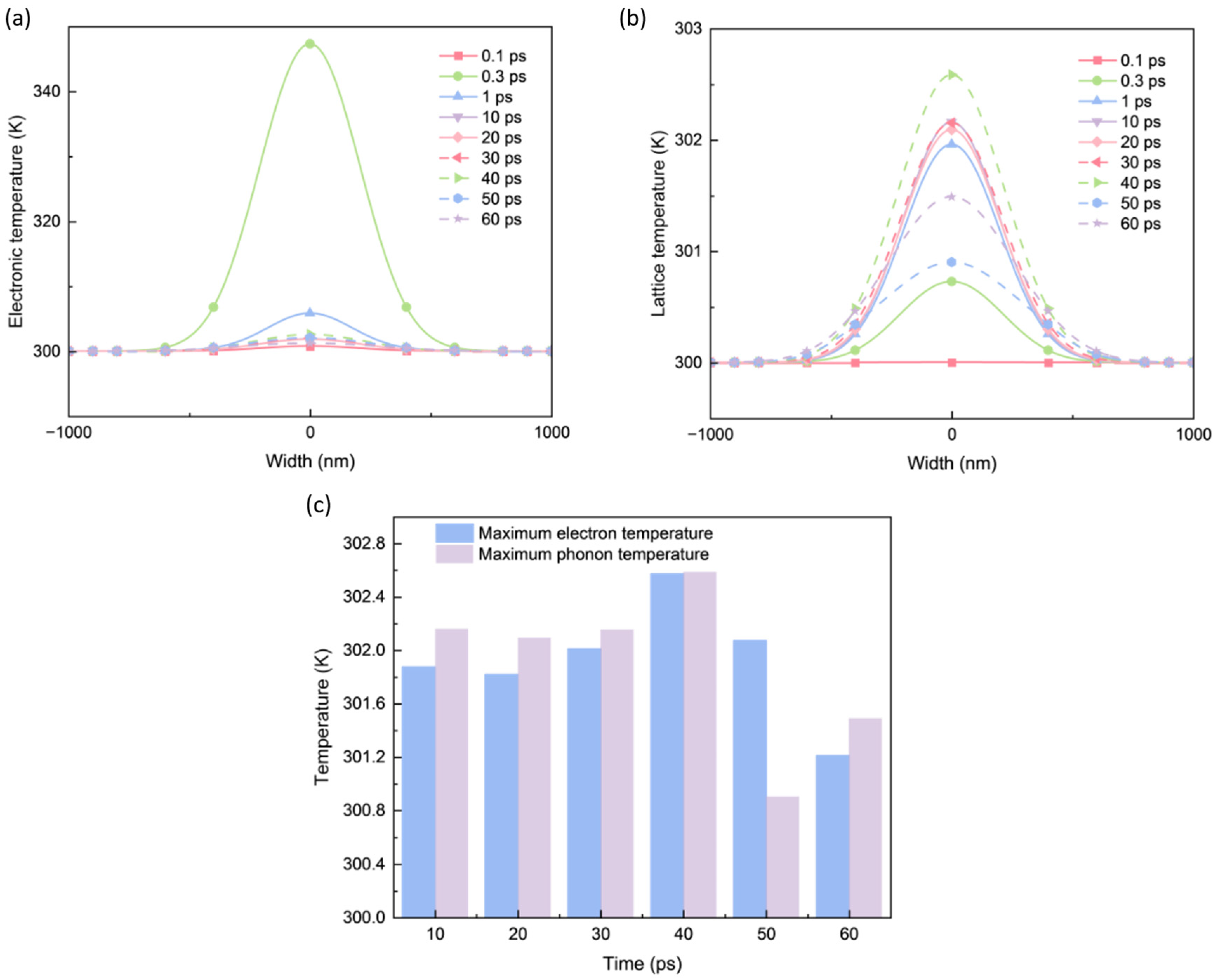
To verify the accuracy of the model, we simulated the evolution of electron and phonon temperatures at the center of an Au/Cu two-layer material under a laser fluence of 0.1 J/cm2, as well as the evolution of electron and phonon temperatures at the center of an aluminum material under a laser fluence of 0.7171 J/cm2, and compared these results with those reported in the literature [10,40]. Figure 3 compares the simulated values from this study with literature data. As shown in Figure 3, the two exhibit consistent trends in terms of temperature rise, peak positions, and the relaxation phase, particularly demonstrating good performance in the rapid rise in the electron temperature and the electron–phonon energy transfer process. This indicates that the coupled model developed can accurately reflect the nonlinear increase in thermal response as the laser fluence increases. The calculation results show that the error between the two remains within 5%, further confirming the reliability of this model in describing the non-equilibrium heat conduction behavior during the interaction between femtosecond lasers and metals, and providing a reliable model foundation for subsequent thermal–mechanical coupling analyses of multilayer structures.

3.2. Analysis of Heat Transfer Properties in Two-Layer Materials

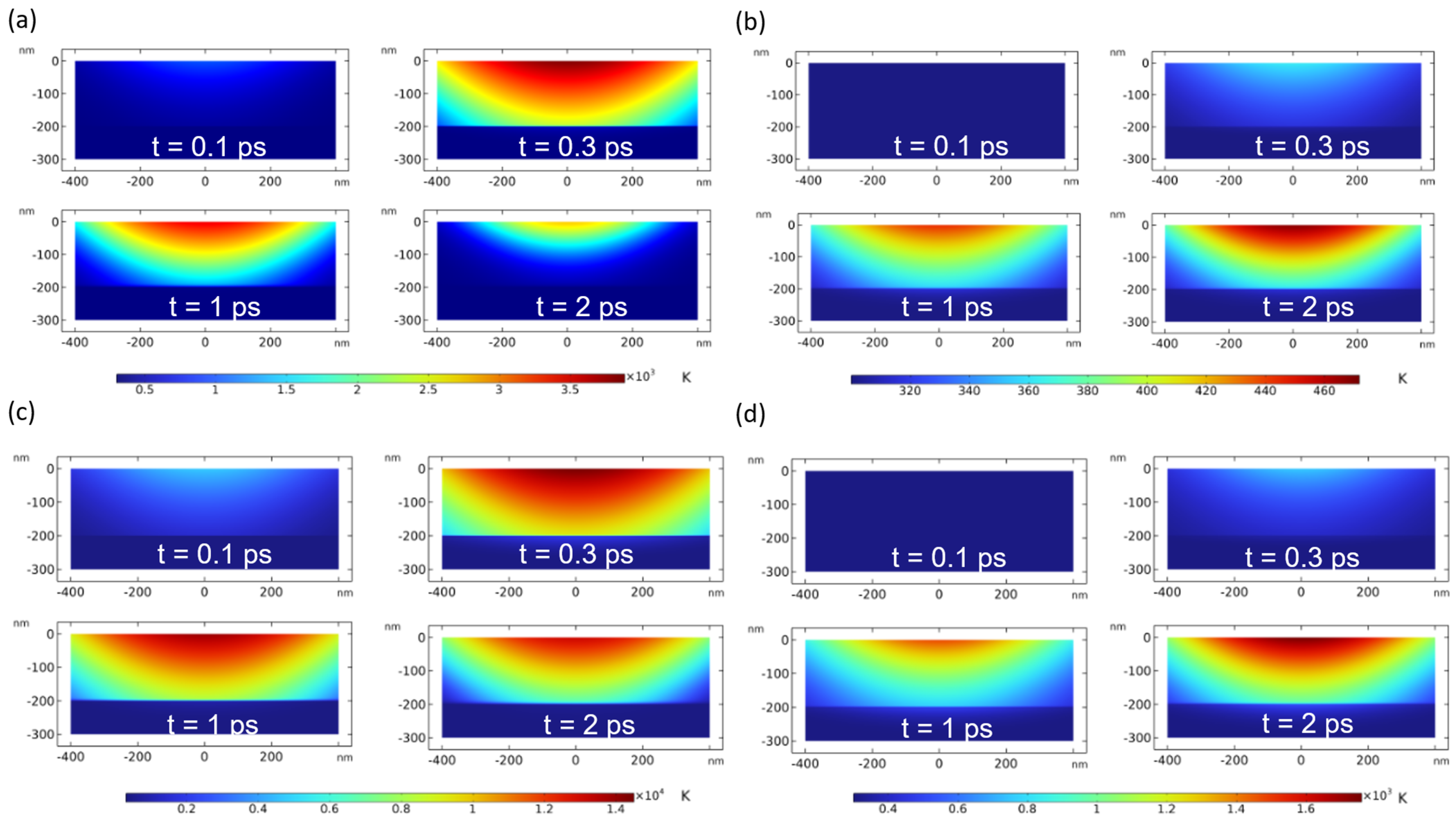
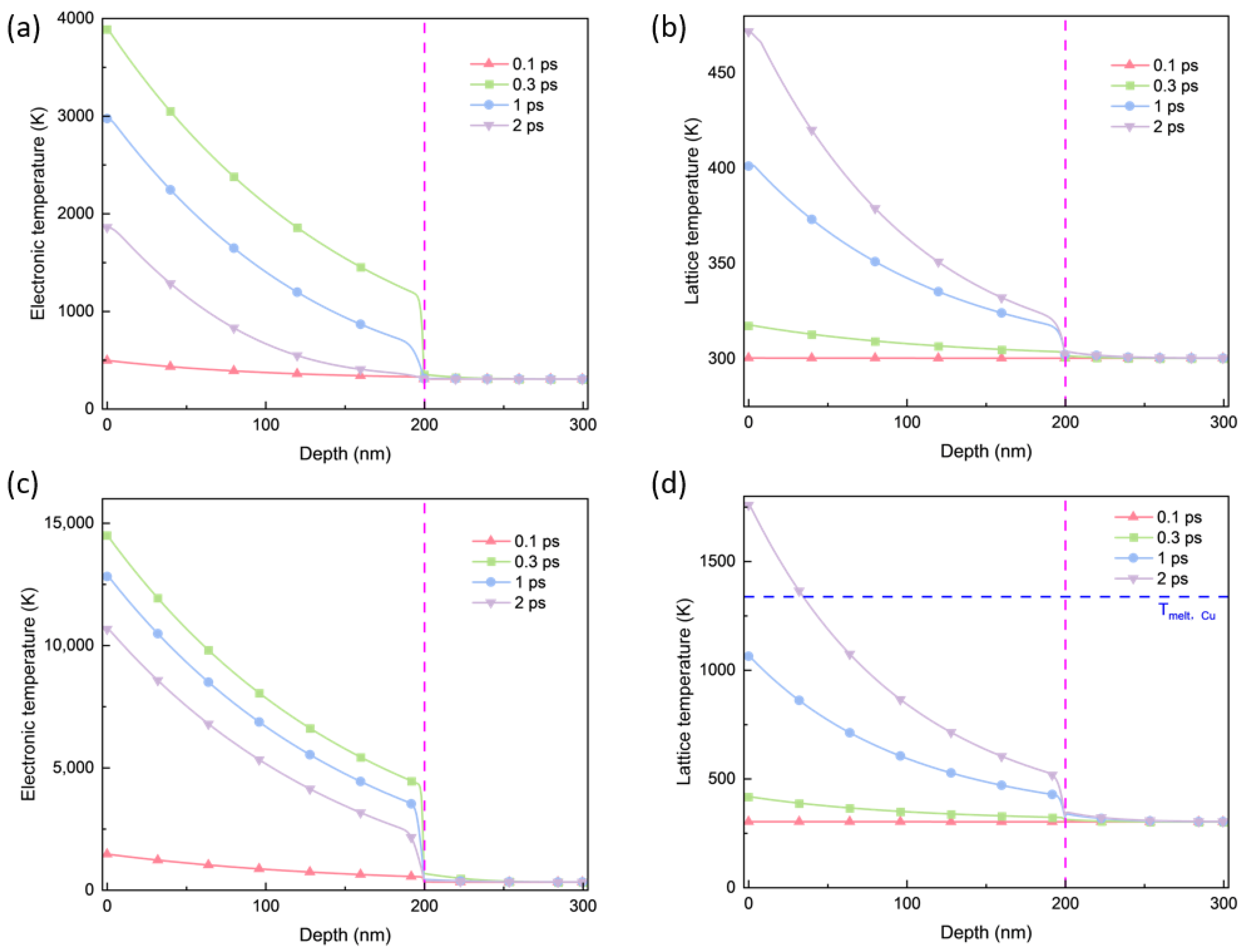
Figure 4 shows the distributions of electron and phonon temperatures at laser fluences of 0.15 J/cm2 and 2 J/cm2, with the copper/aluminum interface at a depth of 200 nm. It can be seen that, during the initial stage of the laser pulse, the free electrons in the material’s surface layer absorb energy, and the electron temperature rapidly rises to its peak within 0.3 ps. Since electron–phonon coupling has not yet fully developed within this extremely short time scale, the phonon temperature remains relatively low at this point. Over time, electrons transfer energy to phonons through collisions, causing the electronic system to cool down, while the phonon temperature gradually rises and spreads into the interior of the material. It is worth noting that a distinct truncation in the temperature distribution was observed along the depth. On the ultrashort timescale of 2 ps, heat accumulated in the upper layer of the material, while no significant temperature rise was observed in the lower layer. This phenomenon is not only attributed to the extremely short thermal diffusion time of the ultrashort pulse but also indicates the presence of thermal resistance at the interface between the two layers.
Figure 5 shows the spatiotemporal evolution of the electron and phonon temperatures with depth along the laser centerline (x = 0) for laser fluences of 0.15 J/cm2 and 2 J/cm2, where the copper/aluminum interface is located at a depth of 200 nm. It is worth noting that at a laser fluence of 2 J/cm2, the material’s surface temperature exceeds the melting point of copper, leading to a phase transition. At the same time, due to differences in thermal conductivity and heat capacity between copper and aluminum, the upper and lower layers exhibit distinct temperature trends, with a marked change in temperature distribution particularly evident at the bottom of the copper layer. Furthermore, under both laser fluence conditions, a sharp drop in temperature was observed at the interface, and the temperature difference varied dynamically over time. This result indicates that the interface thermal resistance impedes heat transfer from the upper to the lower layer, leading to heat accumulation in the upper layer. The dynamic variation in the interface temperature difference over time further confirms the discontinuous nature of heat transport at the interface and its inhibitory effect on overall heat transfer.
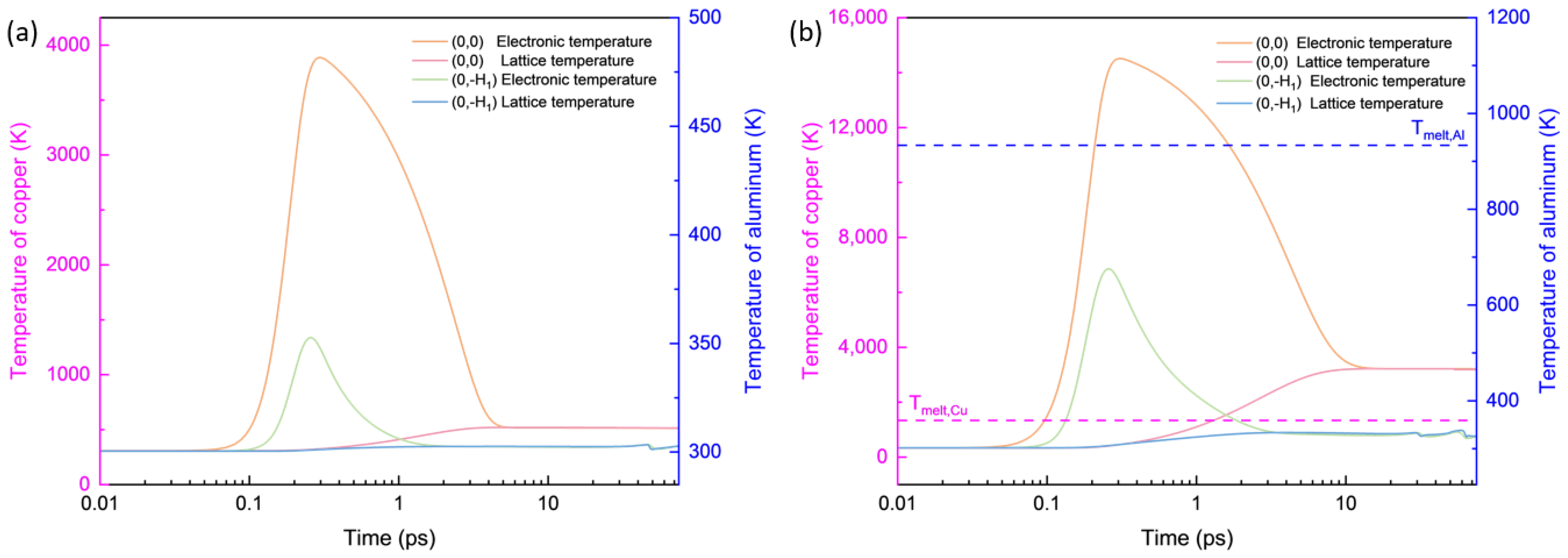
When a femtosecond laser is directed at the surface of a material, the material’s electronic system is rapidly heated. Figure 6 shows the time evolution of the electron and phonon temperatures at the center of the surface for the upper copper layer and the lower aluminum layer under laser fluences of 0.15 J/cm2 and 2 J/cm2. As shown in Figure 6a, at 0.1 ps, the electron temperatures of both copper and aluminum begin to rise, while their phonon temperatures remain essentially unchanged at this point. When reaching 0.3 ps, the electron temperature peaks, with a maximum value of 3885.6 K for copper and 352.4 K for aluminum. Due to the electron–phonon coupling mechanism, electrons gradually transfer energy to phonons, causing the electron temperature to decrease and the phonon temperature to increase. It is worth noting that no phase transition occurred in the material at a laser fluence of 0.15 J/cm2, whereas melting was observed at 2 J/cm2. As shown in Figure 6b, at 1.6 ps, the phonon temperature of copper reaches the melting point, at which point the material begins to melt. In contrast, the phonon temperature of aluminum never reaches the melting point. Further analysis indicates that, because aluminum has a higher electron–phonon coupling coefficient than copper, its electron and phonon systems reach thermal equilibrium earlier. In Figure 6a, the electron and phonon temperatures in aluminum become consistent at approximately 1.6 ps, whereas copper requires approximately 5 ps. In Figure 6b, aluminum achieves electron–phonon temperature equilibrium at approximately 4.6 ps, whereas copper does not reach this equilibrium until approximately 16 ps.
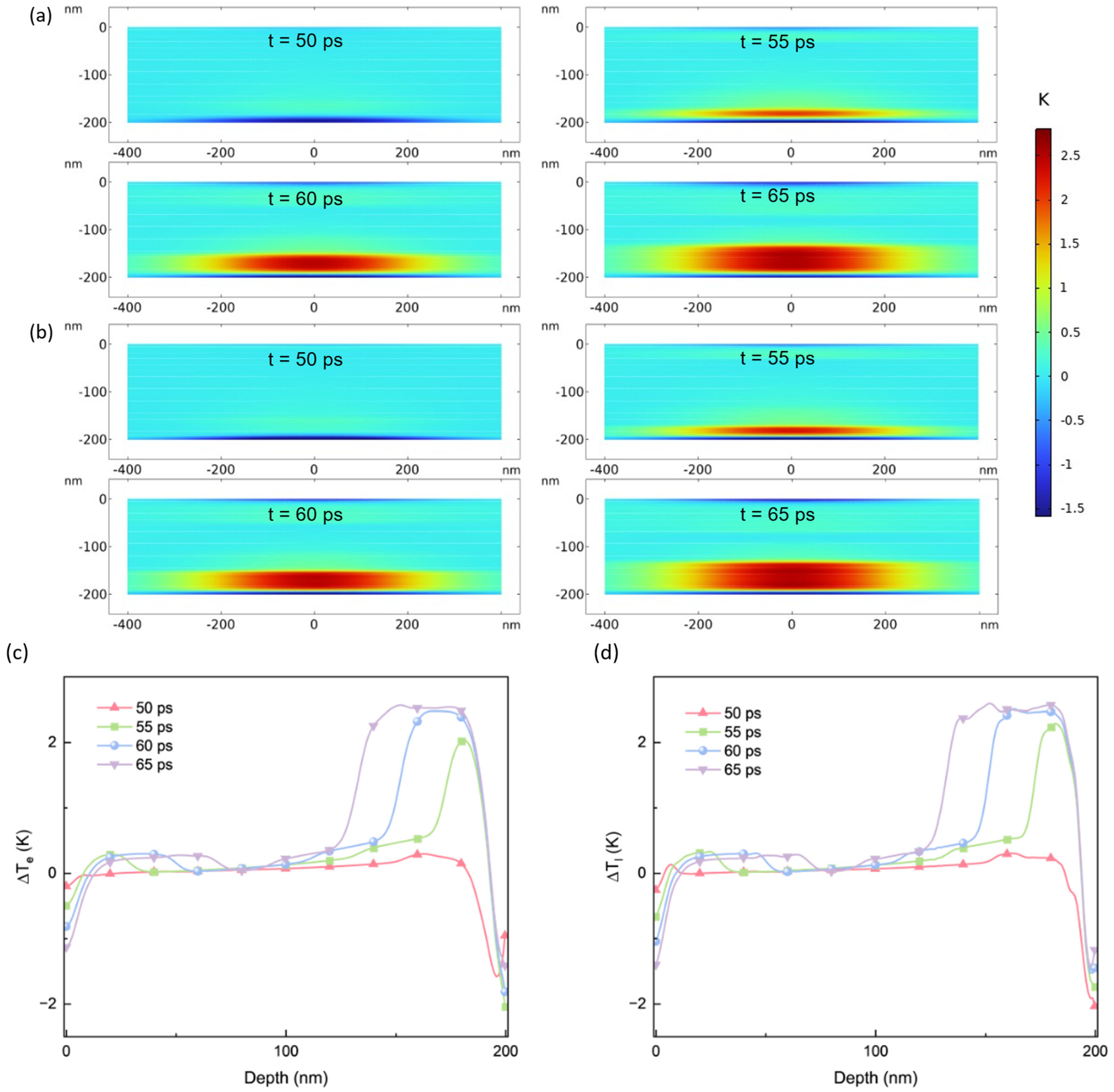
When a femtosecond pulsed laser is applied to a material’s surface, it triggers a significant thermo-mechanical coupling response, and changes in the temperature field induce thermal stresses, which in turn modulate the spatial distribution of the temperature. At a laser fluence of 0.15 J/cm2, the stress front reaches the material interface at 47 ps. Define the temperature distribution of the copper at the laser centerline (x = 0) at this moment as the reference temperature; the temperature difference ΔT is obtained by subtracting this value from the temperatures at subsequent time points, where ΔT = TtT47. Figure 7 shows the distribution of temperature differences within the copper layer along the depth axis at different times. Since copper reaches electron–phonon equilibrium at approximately 5 ps, the temperature gradients of electrons and phonons exhibit consistent trends. Moreover, within the theoretical framework for thermo-acoustic coupling (Equation (2)), thermoelastic damping acts directly on the phonon system, modulating the phonon temperature. Thereafter, through electron–phonon coupling mechanisms, this modulation effect is further transmitted to the electron system, thereby enabling indirect control of the electron temperature. In the depth range of 0–10 nm, the temperature difference is negative, and its absolute value increases gradually, indicating that the temperature in this region decreases over time, primarily due to thermal diffusion. In the 100–170 nm range, the temperature difference becomes positive and widens, indicating that the temperature increases gradually. The reason is that when stress waves encounter the interface, some are reflected, forming reflected waves that affect the temperature distribution. To ensure the conservation of energy, tensile stress cools the material, while compressive stress increases its temperature [41]. The leading edge of the rebound wave consists of tensile stress, which raises temperature, and as the wave propagates, the region of rising temperature gradually expands. In the range of 170–200 nm, the temperature difference changes from positive to negative. This change stems from the fact that the stress wave propagates in a bipolar form, alternating between tensile and compressive stress. The trailing edge of the wave is under compressive stress, thereby decreasing the temperature in that region.
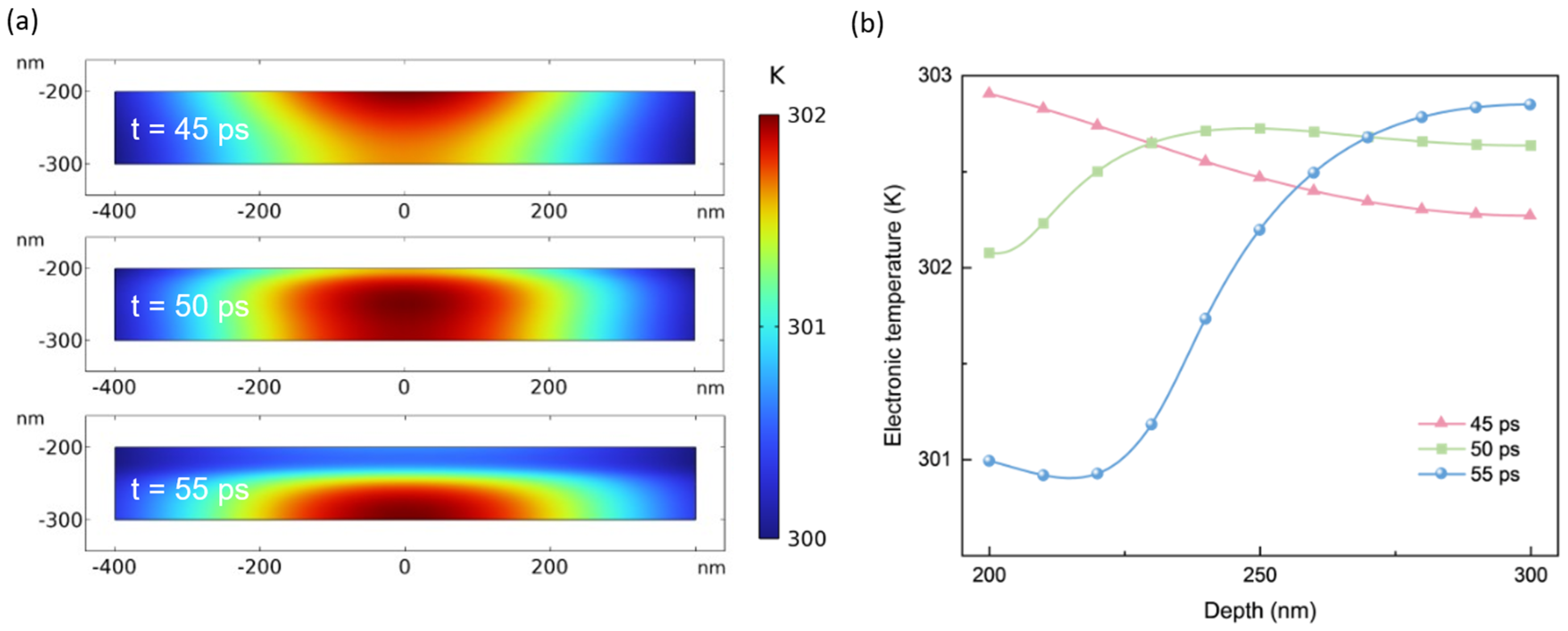
Figure 8 shows the evolution of the electron temperature in the aluminum layer with depth over time under a laser fluence of 0.15 J/cm2. As shown in the figure, the electron temperature decreases monotonically with depth at 45 ps. By 50 ps, the temperature distribution evolves into a non-monotonic pattern, first rising and then falling. Then at 55 ps, it transitions to a distribution pattern that first falls and then rises. The evolution of this temperature distribution pattern is closely related to the propagation of stress waves within the material. Before the stress waves reach the interface, the temperature of the aluminum layer is primarily governed by thermal conduction and generally decreases. Once the stress waves cross the interface and enter the aluminum layer, thermoelastic effects become the primary mechanism driving temperature changes. The transmitted compression wave causes a local increase in temperature, while the subsequent tension wave causes a decrease in temperature. At 50 ps, the compression wave has propagated to a depth of approximately 230 nm, while the tensile wave has just begun to propagate; consequently, the temperature is lower at 200 nm and higher at 230 nm, and the temperature curve transitions from a monotonically decreasing trend to one that first rises and then falls. By 55 ps, as the stress wave propagates deeper, the tensile wave region expands, causing the temperature to drop further and enlarging the region of decreasing temperature; the temperature curve subsequently evolves into a pattern of first decreasing and then increasing. These results indicate that the propagation of the stress wave and its transmission behavior at the interface dynamically modulate the temperature field, revealing the influence of thermal–mechanical coupling on energy transfer in multilayer materials.
Figure 9 shows the evolution of the horizontal electron and phonon temperatures at the interface (y = −H1) over time. At 0.1 ps, hot electrons reach the copper/aluminum interface, and the aluminum layer begins to heat up. At this point, the phonon system has not yet acquired sufficient energy, and the temperature remains virtually unchanged. At 0.3 ps, the electron temperature at the interface reaches its peak (approximately 350 K), and the hot electrons at the interface gradually transfer energy to the phonon system through electro-phonon coupling, causing the phonon temperature to rise gradually. By 10 ps, thermal equilibrium has begun to establish at the interface, marking the effective transfer of heat from the upper copper layer to the lower aluminum layer in the interface region. After 20 ps, the electron and phonon temperature curves largely coincide, indicating that the system has reached local thermal equilibrium. It is worth noting that the temperature evolution at the center of the interface during this stage does not follow the monotonic decay law of simple heat conduction, but rather exhibits a non-monotonic characteristic of first rising and then falling. Specifically, at 40 ps, the temperature exhibits an anomalous rise and reaches its peak for this stage. Combined with stress propagation analysis, it is evident that this moment corresponds to the arrival of the compressional shock wave at the interface. The intense compressive stress induces adiabatic compression of the material, resulting in a localized transient temperature increase. Subsequently, at 55 ps, as the compressional wavefront passes and the tensile wave arrives, the adiabatic cooling effect becomes dominant, leading to a rapid drop in temperature. This phenomenon fully confirms that, on an ultrafast timescale, stress wave propagation significantly modulates the temperature field. The figure reveals the complex energy dynamics within the bilayer structure, which is initially dominated by electron–phonon coupling. Although the later stage involves heat diffusion toward the cold substrate, it is modulated by stress wave propagation.

3.3. Stress Analysis in Two-Layer Materials

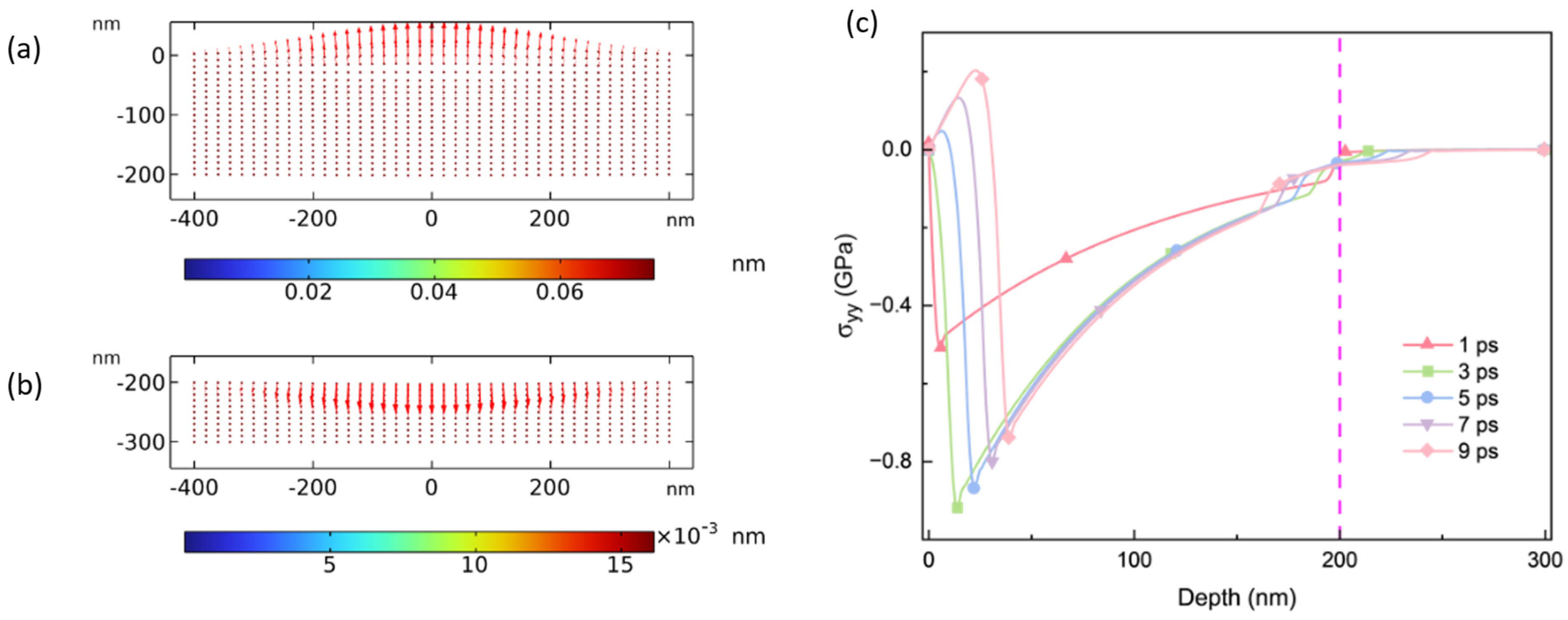
When a femtosecond pulsed laser acts on a material surface, in addition to causing non-equilibrium heat transport in the electronic and phonon systems, it also excites a significant thermal–mechanical coupling response, thereby inducing the generation and propagation of dynamic thermal stresses. Figure 10 shows the distribution of stress evolution over time and the displacement changes along the laser centerline (x = 0) under a laser fluence of 0.15 J/cm2. As shown in Figure 10a,b, at 10 ps, an upward displacement occurs on the surface of the upper material layer. In contrast, the surface of the lower material layer exhibits a downward displacement. Analysis indicates that during the initial phase of laser irradiation (1–3 ps), compressive stress forming and continuously intensifying in the surface layer of the material dominates. By approximately 5 ps, the stress field evolves into a bipolar propagation mode, characterized by the coexistence of compressive and tensile stresses, which persists thereafter. The mechanism underlying the generation of this bipolar stress stems from the extreme temperature gradient induced by the laser. Specifically, the temperature in the heated region of the copper rises sharply, causing significant thermal expansion. In contrast, the adjacent unirradiated regions heat up slowly by thermal conduction and remain at relatively low temperatures, thereby constraining the thermal expansion of the material as a whole. This non-uniform thermal expansion compresses the heated region, thereby generating compressive stress. During the cooling phase following the laser pulse, the heated region contracts as its temperature decreases. However, its deformation is mechanically constrained by the surrounding low-temperature regions, causing the previously accumulated compressive stress to gradually release and transform into tensile stress, ultimately forming a bipolar stress structure characterized by compressive stress followed by tensile stress. It is worth noting that stress exhibits distinct oscillatory behavior at approximately 200 nm. This is attributed to differences in physical properties, such as thermal conductivity and thermal expansion coefficients, between the materials on either side of the interface. These differences impede the transport of thermal energy at the interface, resulting in a non-uniform distribution of thermal stress. The complex process of reflection and transmission of stress waves at the interface ultimately manifests as the oscillatory waveform shown in Figure 10c. This phenomenon reveals the influence of material interfaces on the generation of stress waves during thermal–mechanical coupling.
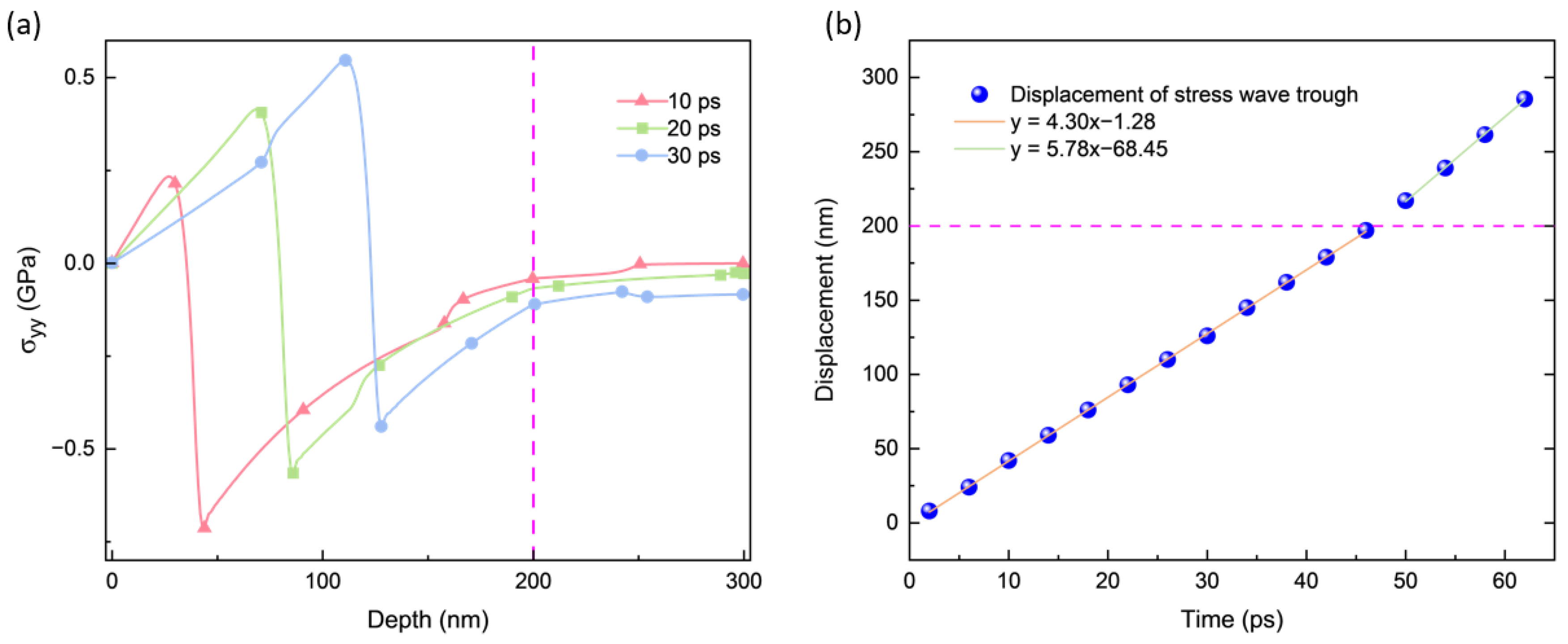
The propagation of stress within a material follows the mechanism of elastic waves. Local deformations caused by thermal stress propagate through the material in the form of elastic waves via interactions between phonons. Figure 11 illustrates the propagation behavior of the stress wave over time along the laser centerline. Analysis shows that at both 10 ps and 30 ps, the stress wave consistently exhibits bipolar propagation, with compression and tension within the medium. To further analyze wave behavior, Figure 10b shows the variation in peak compressive stress over time. By performing a linear fit of this data sequence, the slope corresponds to the stress wave’s propagation velocity. It is worth noting that at a depth of 200 nm, the fitted slope changes significantly; this position corresponds to the copper/aluminum interface. Since the elastic wave velocity is directly related to the material’s elastic modulus and density, differences in acoustic impedance between materials cause the propagation characteristics of stress waves to change as they cross the interface. This is manifested in the fitting results as a distinct inflection in the slope, reflecting the abrupt change in wave velocity at the inter-material interface. The longitudinal wave velocity CL in a solid is expressed as [42]:
C L = E ( 1 v ) ρ ( 1 + v ) ( 1 2 v )
According to the calculation results, the propagation velocity of stress waves in copper is 4.30 km/s, and in aluminum it is 5.78 km/s. Compared with the theoretical wave velocities of the two materials, the errors in the fitted propagation velocities are 5.79% and 4.98%, respectively, both of which fall within a reasonable margin of error. These results further validate the reliability and accuracy of the model established in this paper in describing the propagation behavior of stress waves in different materials.
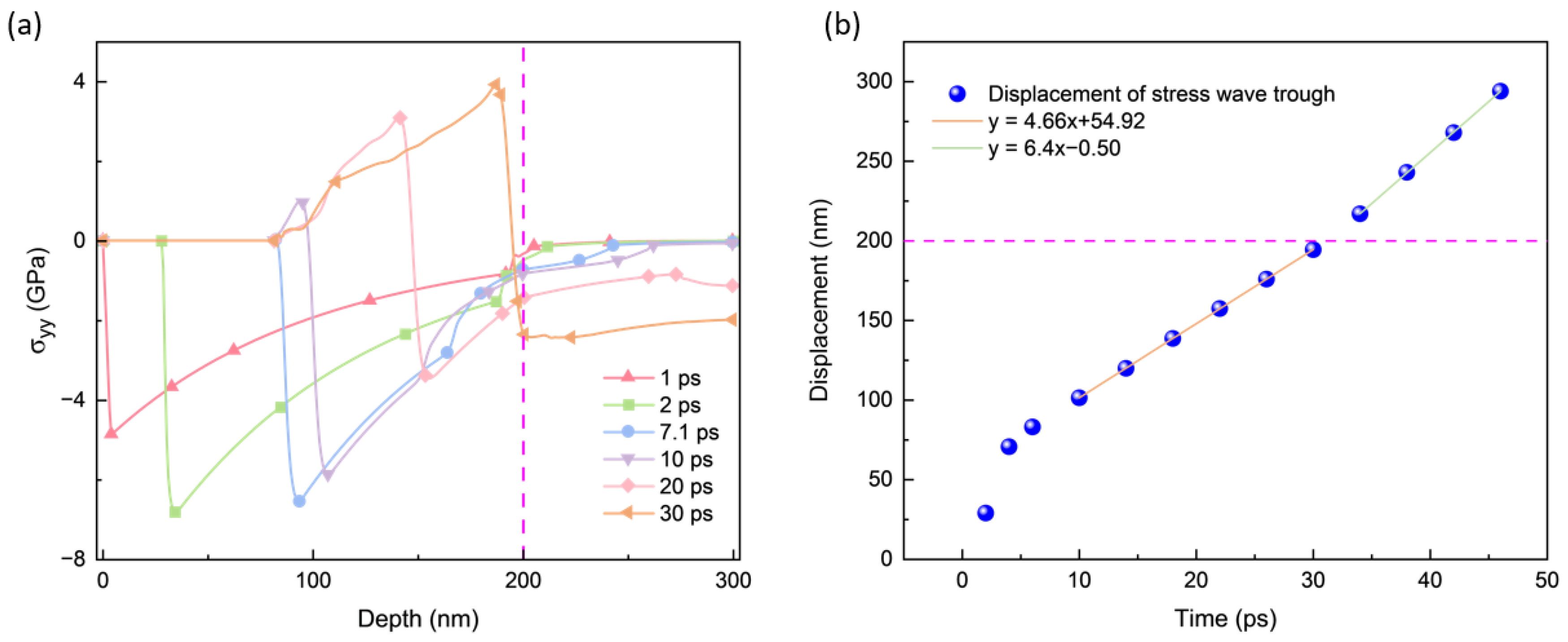
When the laser fluence increases to a level sufficient to trigger a phase transition in the material, the stress evolution of the material changes accordingly. Figure 12 shows the evolution of the longitudinal stress (σyy) as a function of time and depth under a laser fluence of 2 J/cm2. As shown in Figure 12a, at 0.1 ps, compressive stress develops in the material due to thermal expansion. By 2 ps, the stress drops to 0 GPa within the 0–20 nm depth range, and this zero-stress zone gradually expands over time, stabilizing after 7.1 ps. During the 10–30 ps phase, the stress evolves into a bipolar distribution of compression and tension, maintaining this structure as it continues to propagate. As can be seen from the analysis in Figure 6, the upper layer of material begins to melt at 1.6 ps. Since the liquid region cannot withstand shear stress, the accumulated thermal stress is released, resulting in a stress distribution that approaches zero at the corresponding location in the figure. Figure 12b further shows that, during the first few picoseconds of the phase transition, the propagation of the stress wave exhibits distinct instabilities. This is due to the high pressure generated within the molten layer by melting, which forces the molten material at the surface to displace the underlying solid material, causing a compressional wave to propagate inward and gradually evolve from a conventional sound wave into a strong shock wave. Furthermore, compared to a laser fluence of 0.15 J/cm2, higher laser fluence levels generate greater stress values. Although melting occurs in the surface layer as early as 1.6 ps, the resulting compressional disturbance rapidly reverts to a stress wave propagating at the material’s intrinsic sound speed in slightly deeper regions, reflecting the temporal and spatial coupling between the melting process and stress wave propagation.
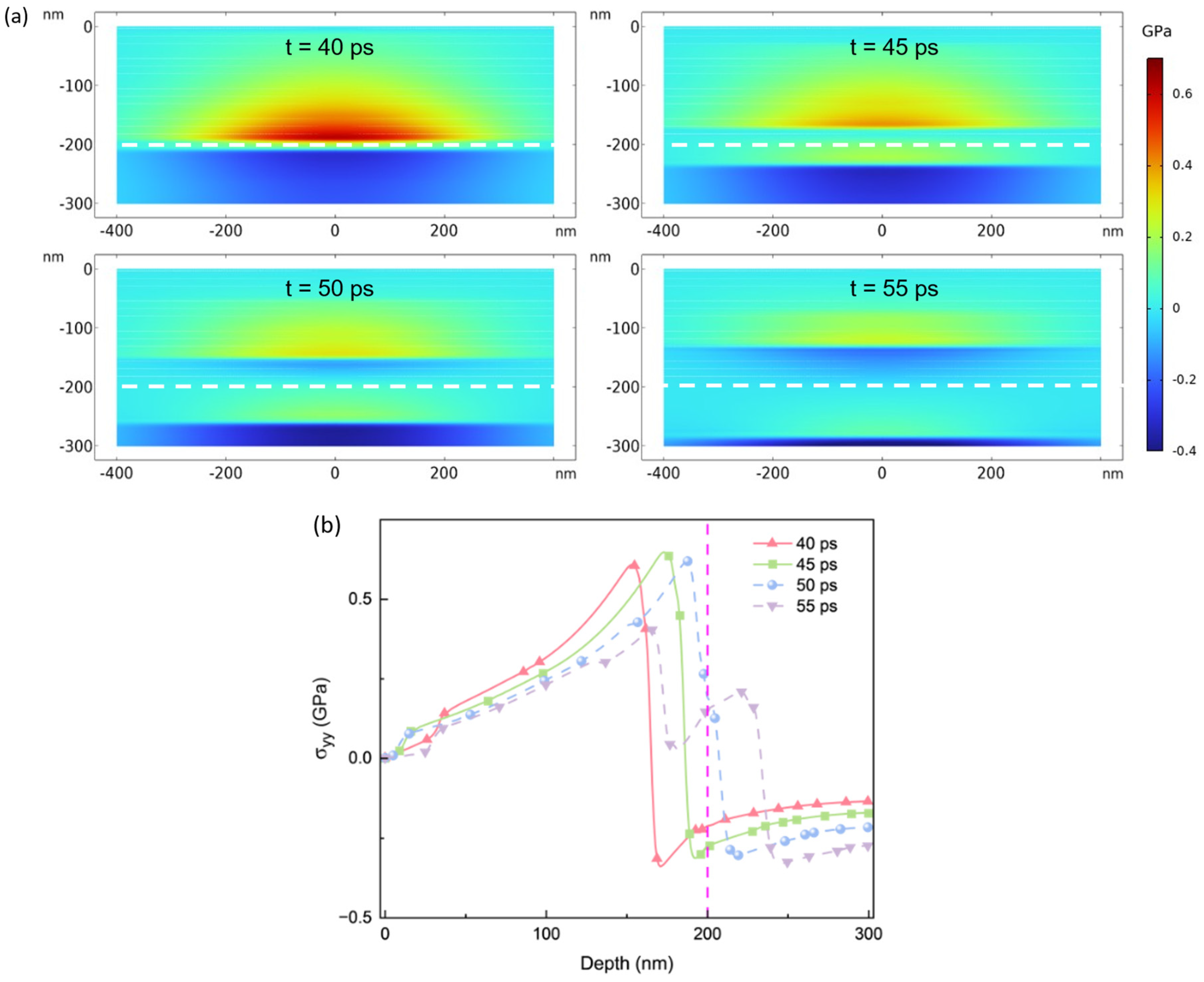
The wave behavior of stress waves propagating through a material is affected by abrupt changes in material properties at interfaces. Figure 13 illustrates the reflection and transmission behavior of a stress wave along the laser centerline (x = 0) at the copper/aluminum interface under a laser fluence of 0.15 J/cm2. Prior to reaching the interface, the stress wave propagates in a compressional-tensile bipolar mode. Upon reaching the interface, its propagation mode undergoes a significant change. As shown in the figure, at 40 ps, the peak compressive stress propagates to the vicinity of the interface; at this point, a small region of negative stress appears in the aluminum layer to the right of the interface, corresponding to the trailing edge of the compression wave that previously penetrated the aluminum. At 45 ps, the stress amplitude to the right of the interface increases significantly, indicating that the main peak of the compression wave is crossing the interface. Between 50 ps and 55 ps, the original high tensile stress peak on the copper side decays significantly, with some local regions even showing a downward trend, while a distinct positive stress region appears on the aluminum side, corresponding to the tensile wave transmitted into the aluminum. Stress waves undergo both reflection and transmission at the interface. The transmitted wave continues to propagate forward in the aluminum, in an alternating compression-tension pattern along its original direction of propagation. The reflected wave, however, propagates back into the copper medium in the opposite direction, with its stress phase inverting from the original compression-then-tension sequence to a tension-then-compression sequence. The behavior is attributed to acoustic impedance mismatch between the materials [43]. When stress waves propagate from a high-acoustic-impedance medium (copper) to a low-acoustic-impedance medium (aluminum), the phase of the transmitted wave remains unchanged, while the phase of the reflected wave is reversed. This phase reversal mechanism effectively disperses the stress energy flow at the interface, thereby alleviating stress concentration and demonstrating the wave adaptation characteristics of elastic waves at material interfaces. Notably, if the tensile stress caused by interface reflection exceeds the interlaminar bond strength of the material, it may lead to delamination at the interface or even material detachment. Understanding this mechanism is crucial for comprehending the failure behavior of multilayer structures under dynamic loading.
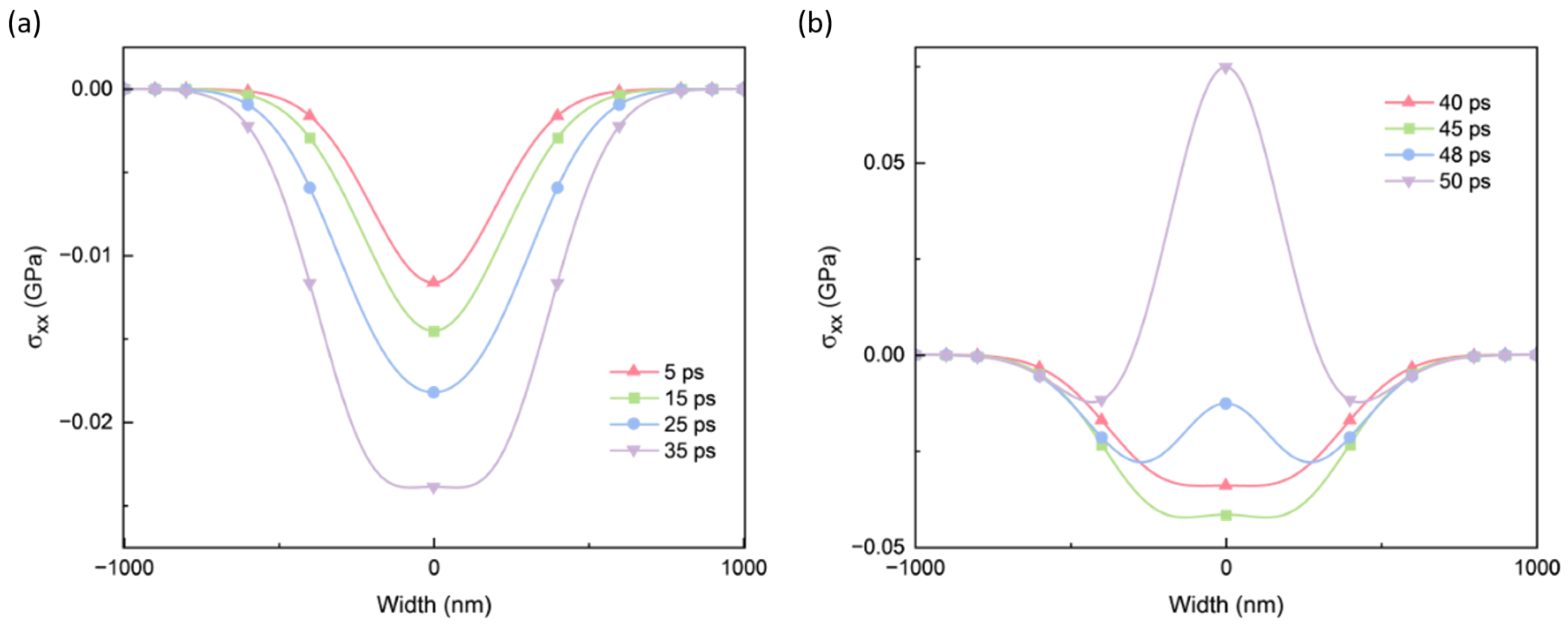
The evolution of the transverse stress distribution further reveals the multidimensional coupling in stress wave propagation within the material. Figure 14 shows the evolution of the electron temperature and the horizontal stress (σxx) over time at the material interface (y = −H1). Before the longitudinally propagating stress wave reaches the interface, σxx at the interface is negative and gradually increases with time, indicating that compressive stress dominates during this stage. At 48 ps, the stress in the central region of the interface rapidly increases from a negative value and gradually approaches zero, while the regions near the laser irradiation edge remain under compressive stress. By 50 ps, the stress in the central region undergoes a polarity reversal, exhibiting a significant peak of positive stress (tensile stress). Wave dynamics and the mechanism of coupled constrained deformation can explain this evolution. When a longitudinal (perpendicular to the interface) compressional wave acts on the material, it induces a tendency for lateral expansion due to the Poisson effect. However, constrained by the geometry of the surrounding material, this expansion is suppressed, thereby generating a compressive stress field in the horizontal direction. At 48 ps, the longitudinal compression wave traverses the interface. It enters the aluminum layer, while the tensile wave front reaches the interface, creating a local superposition of compressive and tensile stresses that causes the net stress in the central region to approach zero. By 50 ps, the tensile wave fully dominates the stress state at the interface, completing the transition from compressive to tensile stress polarity. The stress reversal phenomenon reveals the mechanism of dynamic stress redistribution at material interfaces driven by stress waves. Particularly noteworthy is that horizontal tensile stress at the interface is a major cause of interfacial cracking. In regions of stress concentration, it is especially likely to lead to permanent structural damage or fracture. Although the laser spot diameter is comparable to the layer depth, the simulation results show that the amplitude of σxx is much smaller than that of σyy, indicating that the initial thermomechanical response is primarily dominated by the longitudinal temperature gradient and exhibits quasi-one-dimensional strain characteristics. Furthermore, since the width of the computational domain is much larger than the spot size, the interference of lateral unloading waves on the stress in the central region is extremely limited within 50 ps. Therefore, a two-dimensional model is sufficient to efficiently capture the core physical mechanisms underlying interfacial delamination. However, for lattice cooling and stress evolution over longer time scales, a three-dimensional model must be introduced to accurately describe the diffusion processes of radial heat flux and spherical stress waves.

4. Conclusions

The present study simulates the thermo-mechanical coupling behavior of a two-layer metal film under the influence of a femtosecond laser using a two-temperature model that accounts for the effect of interfacial thermal resistance on heat transport across the interface. The spatiotemporal evolution of temperature and stress fields was systematically analyzed for different laser fluence conditions, both in the absence of phase transitions and during melting and vaporization. The study revealed that the non-equilibrium heat conduction behavior of different metals exhibits significant material-dependent characteristics, and that the temperature difference at the interface evolves dynamically, confirming the discontinuity of interfacial heat transport and its inhibitory effect on the overall heat transfer process. At the same time, the study revealed the transition from a non-equilibrium heat-dominated temperature distribution to a stress-dominated one. It was demonstrated that the propagation of stress waves dynamically modulates the temperature field, elucidating the significant role of thermomechanical coupling mechanisms in heat transfer within bilayer materials. Further analysis of the generation, propagation, and dynamic evolution of stress at material interfaces under different laser fluence conditions revealed that a distinct stress unloading phenomenon occurs during phase transitions. Stress waves undergo reflection and transmission at the interfaces, and their phase evolution is closely related to material properties (such as acoustic impedance). The tensile stress induced by interface reflection can cause delamination, while the horizontal stress at the interface is a major cause of crack initiation. These mechanisms help analyze the stress evolution process during laser processing of multilayer metals.

Author Contributions

Conceptualization, C.M., L.L. and D.Y.; Methodology, C.M., X.Y., L.L. and Z.H.; Software, C.M. and X.Y.; Investigation, C.M., X.Y. and Z.H.; Resources, C.M.; Data curation, C.M. and Z.H.; Writing–original draft, C.M.; Writing–review & editing, C.M., L.L., Z.H. and D.Y.; Supervision, L.L. and D.Y.; Project administration, L.L.; Funding acquisition, L.L. All authors have read and agreed to the published version of the manuscript.

Funding

The authors gratefully acknowledge the financial support from National Natural Science Foundation of China under Grant No. 52476156.

Data Availability Statement

The datasets generated and analyzed during the current study are available from the corresponding author on reasonable request.

Conflicts of Interest

The authors declare that they have no known competing financial interests or personal relationships that could have appeared to influence the work reported in this paper.

References

  1. Reimer, U.; Nikitsina, E.; Janßen, H.; Müller, M.; Froning, D.; Beale, S.B.; Lehnert, W. Design and modeling of metallic bipolar plates for a fuel cell range extender. Energies 2021, 14, 5484. [Google Scholar] [CrossRef]
  2. Esposito, S.; D’angelo, A.; Diletto, C.; Rossi, G.; Volpe, R.; Guglielmo, A.; Mauro, A.D.G.D.; Prestigiacomo, C.; Lanchi, M. Solar Selective Absorber Coating with Ag Infrared Reflector for Receiver Tubes Operating at 550 °C. Energies 2025, 18, 880. [Google Scholar] [CrossRef]
  3. De Maio, D.; D’alessandro, C.; Caldarelli, A.; De Luca, D.; Di Gennaro, E.; Russo, R.; Musto, M. A selective solar absorber for unconcentrated solar thermal panels. Energies 2021, 14, 900. [Google Scholar] [CrossRef]
  4. Wang, X.; Chen, F.; Liu, H.; Liang, W.; Yang, Q.; Si, J.; Hou, X. Fabrication of micro-gratings on Au–Cr thin film by femtosecond laser interference with different pulse durations. Appl. Surf. Sci. 2009, 255, 8483–8487. [Google Scholar]
  5. Khatibi, H.; Hassan, E.; Frisone, D.; Amiriyan, M.; Farahati, R.; Farhad, S. Recycling and reusing copper and aluminum current-collectors from spent lithium-ion batteries. Energies 2022, 15, 9069. [Google Scholar]
  6. Yuan, W.-B.; Yu, N.; Li, L.-Y.; Fang, Y. Heat transfer analysis in multi-layered materials with interfacial thermal resistance. Compos. Struct. 2022, 293, 115728. [Google Scholar] [CrossRef]
  7. Chang, T.-L.; Chen, Z.-C.; Chen, W.-Y.; Han, H.-C.; Tseng, S.-F. Patterning of multilayer graphene on glass substrate by using ultraviolet picosecond laser pulses. Microelectron. Eng. 2016, 158, 1–5. [Google Scholar] [CrossRef]
  8. Lutey, A.H.A. Modeling of Thin-Film Single and Multilayer Nanosecond Pulsed Laser Processing. J. Manuf. Sci. Eng. 2013, 135, 061003. [Google Scholar] [CrossRef]
  9. Li, A.; Qiu, K.; Lu, F.; Shuai, K.; Wu, B.; Liu, X.; Zhao, Y.; Hong, Y. Modeling thermal responses and evaluation of femtosecond laser damage in multi-layer gold-coated fused silica gratings. Opt. Mater. 2025, 159, 116540. [Google Scholar]
  10. Chen, A.M.; Xu, H.F.; Jiang, Y.F.; Sui, L.Z.; Ding, D.J.; Liu, H.; Jin, M.X. Modeling of femtosecond laser damage threshold on the two-layer metal films. Appl. Surf. Sci. 2010, 257, 1678–1683. [Google Scholar] [CrossRef]
  11. Qian, Z.; Li, Y.; Rao, Z. Thermal performance of lithium-ion battery thermal management system by using mini-channel cooling. Energy Convers. Manag. 2016, 126, 622–631. [Google Scholar]
  12. Farid, N.; Sharif, A.; Gupta, P.D.; O’Connor, G.M. Selective laser ablation of molybdenum from aluminium in a multi-layered thin film system. Surf. Interfaces 2021, 26, 101438. [Google Scholar] [CrossRef]
  13. Anisimov, S.I.; Kapeliovich, B.L.; Perel’Man, T.L. Electron emission from metal surfaces exposed to ultrashort laser pulses. Sov. Phys. JETP 1974, 39, 375–377. [Google Scholar]
  14. Elsayed-Ali, H.E.; Norris, T.B.; Pessot, M.A.; Mourou, G.A. Time-resolved observation of electron-phonon relaxation in copper. Phys. Rev. Lett. 1987, 58, 1212–1215. [Google Scholar] [PubMed]
  15. Brorson, S.D.; Fujimoto, J.G.; Ippen, E.P. Femtosecond electronic heat-transport dynamics in thin gold films. Phys. Rev. Lett. 1987, 59, 1962–1965. [Google Scholar] [CrossRef] [PubMed]
  16. Du, G.; Yang, Q.; Chen, F.; Wu, Y.; Ou, Y.; Lu, Y.; Hou, X. Ultrafast thermalization dynamics in two-layer metal films excited by temporally shaped femtosecond laser. Int. J. Heat Mass Transf. 2015, 87, 341–346. [Google Scholar] [CrossRef]
  17. Rebegea, S.A.; Thomas, K.; Chawla, V.; Michler, J.; Kong, M.C. Laser ablation of a Cu–Al–Ni combinatorial thin film library: Analysis of crater morphology and geometry. Appl. Phys. A 2016, 122, 1074. [Google Scholar]
  18. Tunç, K.M.M.; Günay, M.E.; Bayata, F. Analysis of the thermalization dynamics of two-layer thin films irradiated by femtosecond laser. Optik 2020, 208, 164137. [Google Scholar] [CrossRef]
  19. Giri, A.; Tokina, M.V.; Prezhdo, O.V.; Hopkins, P. Electron–phonon coupling and related transport properties of metals and intermetallic alloys from first principles. Mater. Today Phys. 2020, 12, 100175. [Google Scholar] [CrossRef]
  20. Tsai, T.W.; Lee, Y.M. Analysis of microscale heat transfer and ultrafast thermoelasticity in a multi-layered metal film with nonlinear thermal boundary resistance. Int. J. Heat Mass Transf. 2013, 62, 87–98. [Google Scholar] [CrossRef]
  21. Lian, Y.; Jiang, L.; Sun, J.; Tao, W.; Chen, Z.; Lin, G.; Ning, Z.; Ye, M. Ultrafast dynamics and ablation mechanism in femtosecond laser irradiated Au/Ti bilayer systems. Nanophotonics 2023, 12, 4461–4473. [Google Scholar] [CrossRef] [PubMed]
  22. Wang, X.; Yue, Y.; Xu, X. Thermoelastic Waves Induced by Pulsed Laser Heating. In Encyclopedia of Thermal Stresses; Springer: Dordrecht, The Netherland, 2014; pp. 5808–5826. [Google Scholar]
  23. Wang, X.; Xu, X. Molecular dynamics simulation of thermal and thermomechanical phenomena in picosecond laser material interaction. Int. J. Heat Mass Transf. 2003, 46, 45–53. [Google Scholar] [CrossRef]
  24. Shen, Y.; Gan, Y.; Qi, W.; Shen, Y.; Chen, Z. Effect of the hot electron blast force on ultrafast laser ablation of nickel thin film. Appl. Opt. 2015, 54, 1737–1742. [Google Scholar] [CrossRef]
  25. McDonald, I.G.; Moehlenkamp, W.M.; Arola, D.; Wang, J. Residual stresses in Cu/Ni multilayer thin films measured using the Sin2ψ method. Exp. Mech. 2019, 59, 111–120. [Google Scholar]
  26. Nakhoul, A.; Rudenko, A.; Sedao, X.; Peillon, N.; Colombier, J.P.; Maurice, C.; Blanc, G.; Borbély, A.; Faure, N.; Kermouche, G. Energy feedthrough and microstructure evolution during direct laser peening of aluminum in femtosecond and picosecond regimes. J. Appl. Phys. 2021, 130, 015104. [Google Scholar] [CrossRef]
  27. Zhao, W.; Mei, X.; Yang, Z. Simulation and experimental study on group hole laser ablation on AL2O3 ceramics. Ceram. Int. 2022, 48, 4474–4483. [Google Scholar] [CrossRef]
  28. He, Z.; Yang, D.; Zhang, M.; Liao, J.; Liu, Y.; Li, L. Coupling effect of evaporation-plasma shielding and its influence on femtosecond laser ablation. Appl. Phys. A 2024, 130, 935. [Google Scholar] [CrossRef]
  29. Kinra, V.K.; Milligan, K.B. A second-law analysis of thermoelastic damping. J. Appl. Mech. 1994, 61, 71–76. [Google Scholar] [CrossRef]
  30. Wang, X.; Huang, Y.; Li, C.; Xu, B. Numerical simulation and experimental study on picosecond laser ablation of stainless steel. Opt. Laser Technol. 2020, 127, 106150. [Google Scholar] [CrossRef]
  31. Yang, D.; He, Z.; Zhang, M.; Liu, Y.; Li, L. Molecular dynamics investigation of femtosecond laser ablation of Inconel 718 alloy. J. Manuf. Process. 2024, 131, 984–1000. [Google Scholar] [CrossRef]
  32. Chen, J.K.; Tzou, D.Y.; Beraun, J.E. A semiclassical two-temperature model for ultrafast laser heating. Int. J. Heat Mass Transf. 2006, 49, 307–316. [Google Scholar] [CrossRef]
  33. Aeaby, C.D.; Ray, A. Two-temperature model for ultrafast melting of Au-based bimetallic films interacting with single-pulse femtosecond laser: Theoretical study of damage threshold. Phys. Rev. B 2023, 107, 195402. [Google Scholar]
  34. Li, Y.; Li, J.; Zhang, W.; Jin, G. Application of pulsed laser ablation thermal model in nanosecond pulsed laser removal of the epoxy resin paint film. Opt. Laser Technol. 2024, 175, 110806. [Google Scholar] [CrossRef]
  35. Ren, Y.; Qin, K.; Chen, Y.; Lin, Q.; Xu, D.; Xin, Z.; Ni, J.; Ge, L. Thermomechanical response of copper films irradiated by femtosecond-pulsed lasers with dynamic optical properties. Appl. Opt. 2019, 58, 871–878. [Google Scholar] [CrossRef] [PubMed]
  36. Du, G.; Chen, F.; Yang, Q.; Si, J.; Hou, X. Ultrafast temperature relaxation evolution in Au film under femtosecond laser pulses irradiation. Opt. Commun. 2010, 283, 1869–1872. [Google Scholar] [CrossRef]
  37. Redka, D.; Vollmann, J.; Winter, J.; Schmidt, M.; Minár, J.; Huber, H.P.; Schmid, P. Improving FEM-based solid mechanics simulations for ultrashort pulse laser ablation by integrating an equation of state and material separation. Int. J. Heat Mass Transf. 2025, 241, 126714. [Google Scholar] [CrossRef]
  38. Liu, J.; Liu, C.; Gao, L.; Liu, S. Energy dissipation mechanism of femtosecond laser ablation of DLC/Ti/TiN multilayer heterogeneous films. Int. Commun. Heat Mass Transf. 2025, 169, 109822. [Google Scholar]
  39. Winter, J.; Rapp, S.; Schmidt, M.; Huber, H.P. Ultrafast laser processing of copper: A comparative study of experimental and simulated transient optical properties. Appl. Surf. Sci. 2017, 417, 2–15. [Google Scholar] [CrossRef]
  40. Chen, Z.; Xu, G.; Cao, Q.; Ruan, M.; Liu, S.; Pan, H.; Liu, L. Deformation measurement in Al thin films at elevated temperatures by digital image correlation with speckles prepared by femtosecond laser. Opt. Laser Technol. 2022, 155, 108339. [Google Scholar] [CrossRef]
  41. Xu, S.; Wang, X. Stress waves in laser-material interaction: From atomistic understanding to nanoscale characterization. J. Therm. Stress. 2023, 46, 464–491. [Google Scholar] [CrossRef]
  42. Tokumi, K.; Hattori, J.; Sun, H.; Ren, G.; Sugita, N.; Ito, Y. Three-dimensional shear stress measurement of stress waves in silica glass induced by a femtosecond laser. Opt. Lett. 2025, 50, 2522–2525. [Google Scholar] [CrossRef] [PubMed]
  43. Hiremath, N.; Kumar, V.; Motahari, N.; Shukla, D. An overview of acoustic impedance measurement techniques and future prospects. Metrology 2021, 1, 17–38. [Google Scholar] [CrossRef]
Figure 1. Schematic diagram of the model (a) schematic diagram of the material geometry (b) schematic diagram of heat transfer in a multilayer material.
Energies 19 03094 g001
Figure 2. Peak compressive stress under different mesh sizes.
Energies 19 03094 g002
Figure 3. Evolution of surface electron and phonon temperatures (a) Evolution of electron and phonon temperatures at the center of a gold/copper bilayer under a laser fluence of 0.1 J/cm2 (b) Evolution of electron and phonon temperatures at the center of an aluminum sample under a laser fluence of 0.7171 J/cm2 [40].
Energies 19 03094 g003
Figure 4. Electron and phonon temperature distributions (a,b) electron and phonon temperature distributions at 0.15 J/cm2 (c,d) electron and phonon temperature distributions at 2 J/cm2.
Energies 19 03094 g004
Figure 5. Distribution of electron and phonon temperatures (a,b) depth-dependent distribution curves of electron and phonon temperatures at x = 0 for an irradiance of 0.15 J/cm2 (c,d) depth-dependent distribution curves of electron and phonon temperatures at x = 0 for an irradiance of 2 J/cm2. (The pink dashed line in the picture is the material interface.).
Energies 19 03094 g005
Figure 6. Evolution of electron and phonon temperatures (a) laser fluence at 0.15 J/cm2 (b) laser fluence at 2 J/cm2.
Energies 19 03094 g006
Figure 7. Evolution of temperature differences over time (a,b) electron and phonon temperature differences (c,d) depth-dependent distribution of electron and phonon temperature differences along the laser axis (x = 0).
Energies 19 03094 g007
Figure 8. Evolution of the electron temperature in the lower layer over time (a) electron temperature (b) evolution of the electron temperature over time at the laser centerline (x = 0).
Energies 19 03094 g008
Figure 9. Horizontal temperature evolution across the interface (a) electron temperature at y = −H1 (b) phonon temperature at y = −H1 (c) maximum temperature on the interface.
Energies 19 03094 g009
Figure 10. Evolution of σyy (a) displacement of the upper material at 10 ps (b) displacement of the lower material at 10 ps (c) time evolution of stress at the laser centerline (x = 0) (where compressive stress is defined as negative and tensile stress as positive).
Energies 19 03094 g010
Figure 11. Schematic illustration of σyy propagation along the laser centerline (x = 0) (a) evolution of stress over time (b) propagation of the peak compressive stress.
Energies 19 03094 g011
Figure 12. Evolution of σyy under a laser fluence of 2 J/cm2 (a) time evolution of stress at the laser centerline (x = 0) (b) propagation of the peak compressive stress.
Energies 19 03094 g012
Figure 13. Reflection and penetration of σyy at the interface (a) σyy distribution map (b) evolution of σyy reflection and penetration at the interface along the laser centerline (x = 0) (in the figure, solid lines represent stress waves propagating in the same direction (from left to right), while dashed lines indicate opposite propagation directions on either side of the interface, with propagation continuing from left to right on the right side, and in the opposite direction (from right to left) on the left side. White dashed lines represent material interface).
Energies 19 03094 g013
Figure 14. Evolution of σxx at the interface (a,b) σxx at y = −H1 under a laser fluence of 0.15 J/cm2.
Energies 19 03094 g014
Table 1. Laser parameters.
Parameter TypeNumerical Value
Laser pulse width (tp, fs)100
Laser wavelength (λ, nm)800
Laser radius (w0, um)0.4
Laser fluence (F, J/cm2)0.15, 2.0
Table 2. Material property parameters [32,33,34,35,36].
Parameter TypeParameterCopperAluminum
Thermal-physical parametersDensity (ρ, g/cm3)8.942.7
Heat capacity coefficient (γ, J/(m3·K2))97134.5
Electronic heat capacity at room temperature (ke0, W/(m·K))377238
Electron–phonon coupling coefficient at room temperature (G0, W/(m3·K))1 × 10175.69 × 1017
Coefficient of thermal expansion (α, 1/K)17.5 × 10−62.275 × 10−5
Melting point (Tm, K)1358933.5
Phonon heat capacity (Cl, J/(m3·K))3.5 × 1062.43 × 106
Mechanical parametersYoung’s modulus (E, GPa)12169.2
Poisson’s ratio (v)0.340.33
Disclaimer/Publisher’s Note: The statements, opinions and data contained in all publications are solely those of the individual author(s) and contributor(s) and not of MDPI and/or the editor(s). MDPI and/or the editor(s) disclaim responsibility for any injury to people or property resulting from any ideas, methods, instructions or products referred to in the content.