Research on the Comprehensive Energy Management Model for Ports with Land-Based Traffic Consideration



Abstract
1. Introduction
2. Literature Review
2.1. Port Vehicle Operation Dispatch Management
2.2. Ship Self-Energy Dispatch Management
2.3. Port Microgrid Energy Management
3. Model Mechanism Analysis and Related Model Design
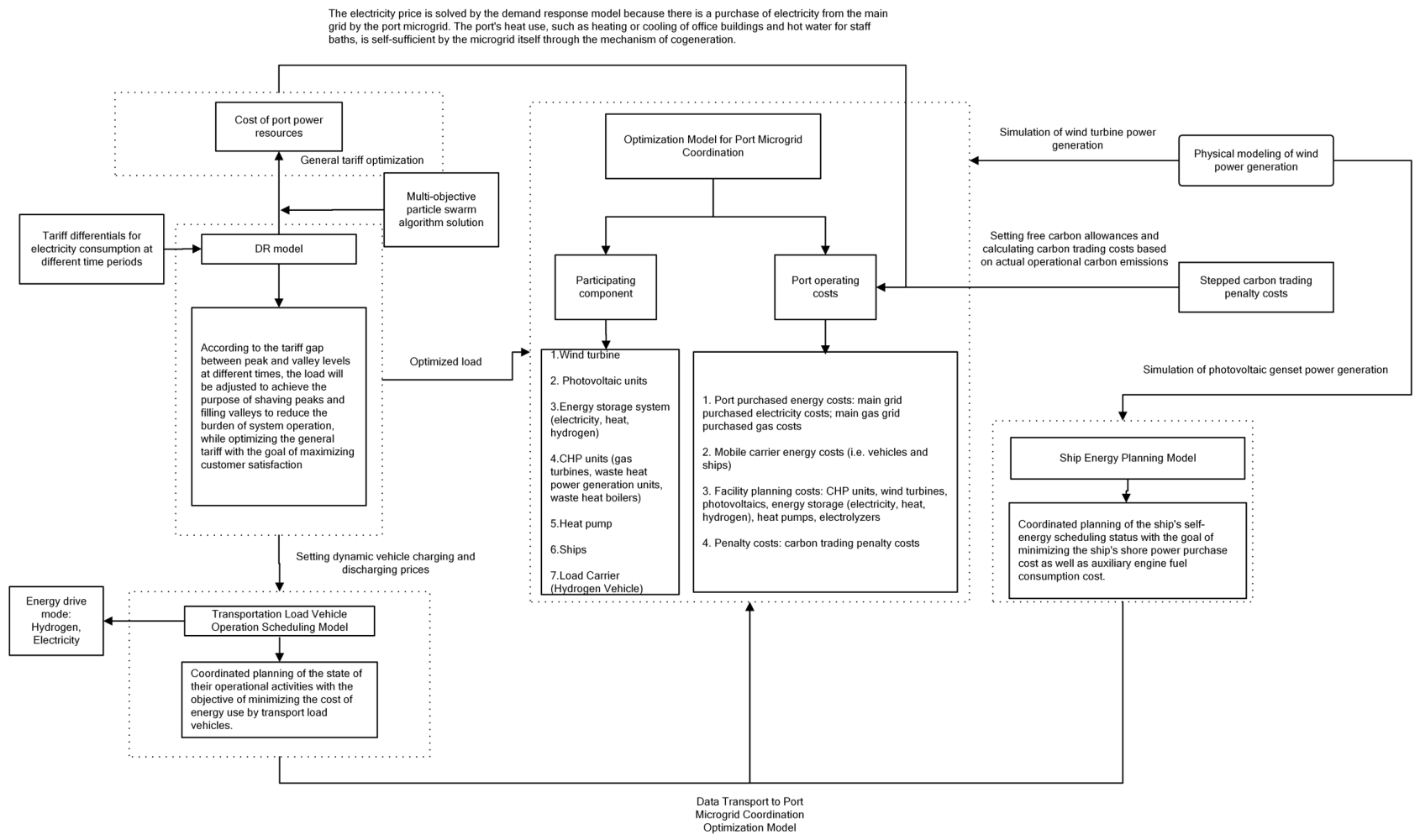
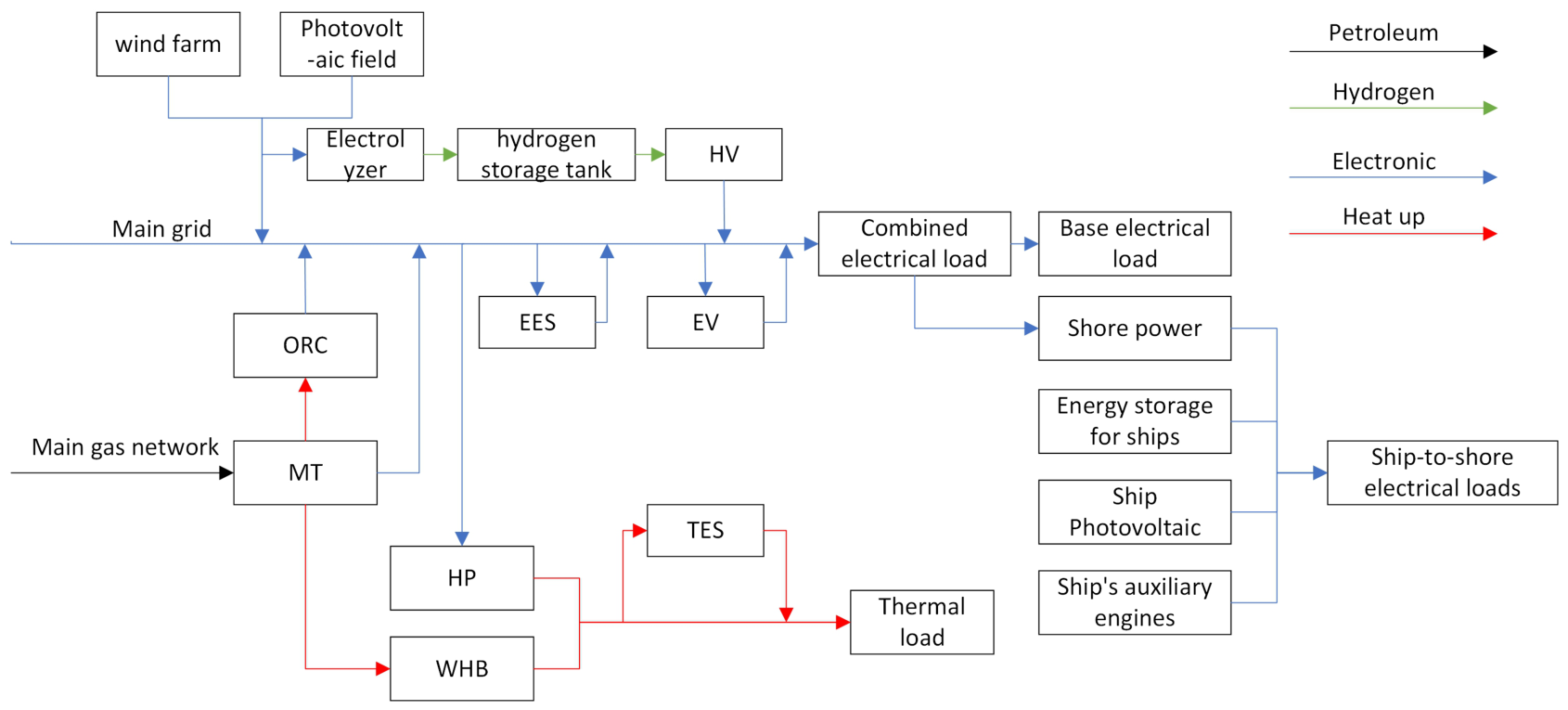
3.1. Model Mechanism Analysis
3.2. Related Models
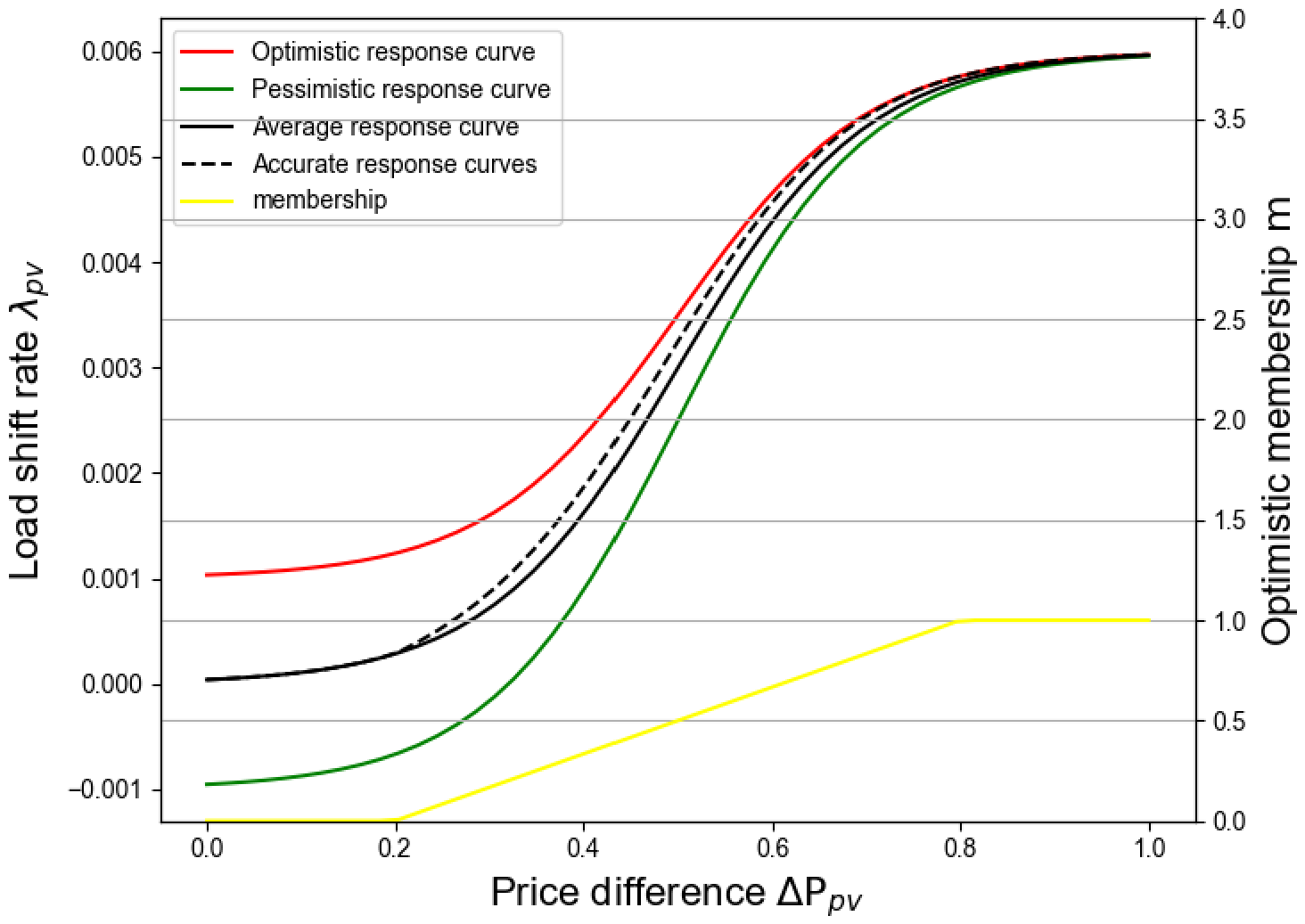
3.2.1. Demand Response Model
3.2.2. Physical Model of Wind and Solar Power Generation Units
3.2.3. Berth Ship Model
3.2.4. Dynamic Programming Model for Port Heavy-Duty Transport Vehicles
3.2.5. Tiered Carbon Trading Penalty Model
4. Port Microgrid Coordinated Optimization Model
4.1. Total Port Operation Cost Composition
4.1.1. Purchasing Costs
- (1)
- Cost of Purchasing Electricity from the Main Power Grid
- (2)
- Cost of Purchasing Gas from the Main Gas Network
4.1.2. Carbon Penalty Cost
4.1.3. Mobility Vehicle Energy Scheduling Cost
- (1)
- Energy Scheduling Cost for Hydrogen Heavy Transport Vehicles
- (2)
- Electric Heavy-Duty Truck Energy Scheduling Costs
- (3)
- Ship Energy Scheduling Costs
4.1.4. Port Equipment Usage Costs
4.2. Constraints
4.2.1. Storage System Constraints
4.2.2. Energy Supply Device Constraints
- (1)
- Electrical Supply Device Constraints
- (2)
- Heating Device Constraints
- (3)
- Hydrogen Energy Device Constraints
4.2.3. Energy Balance Constraints
- (1)
- Electrical Load Balance Constraint
- (2)
- Thermal Load Balance Constraint
5. Simulation Analysis and Discussion
5.1. Model Parameters
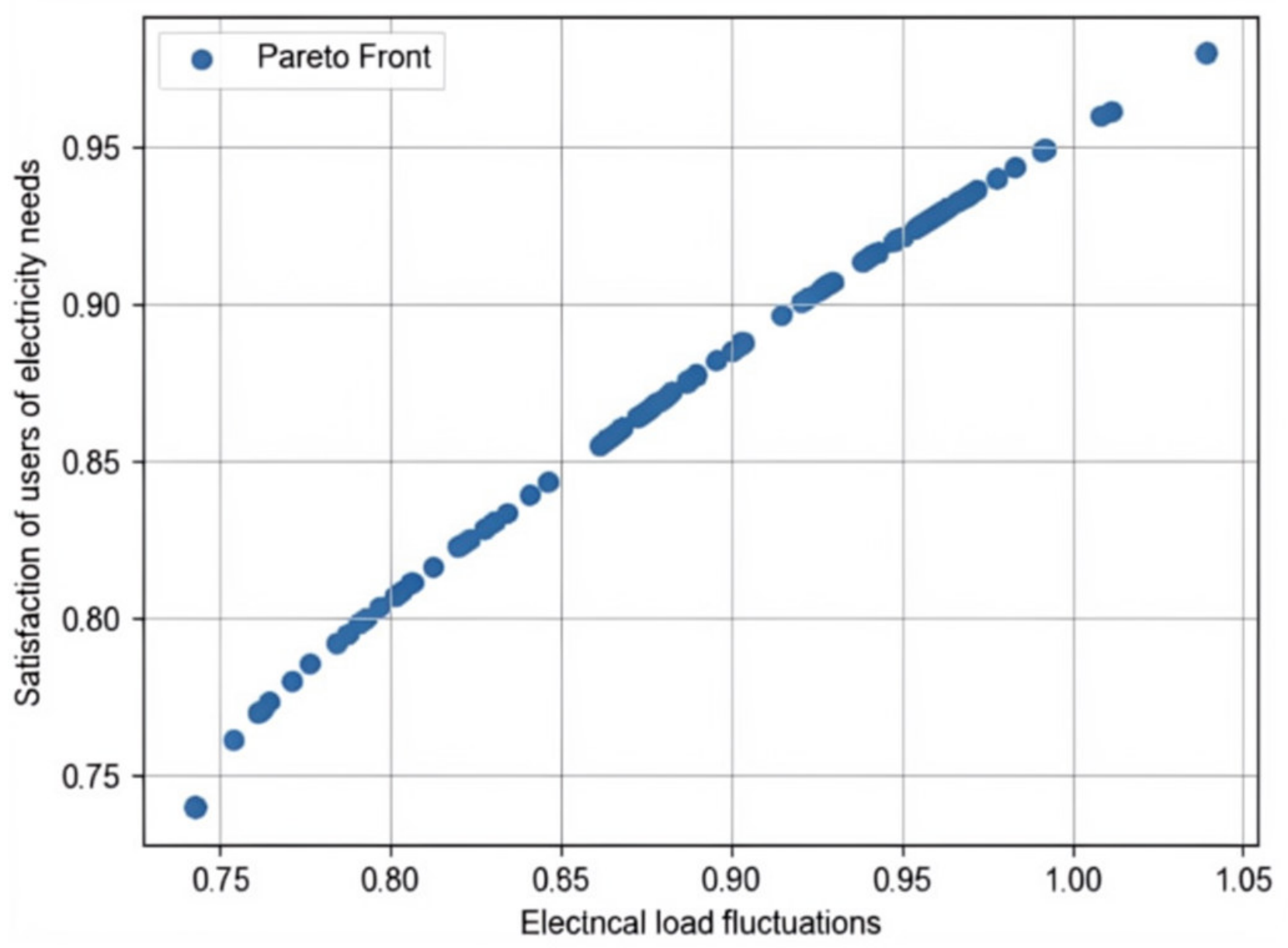
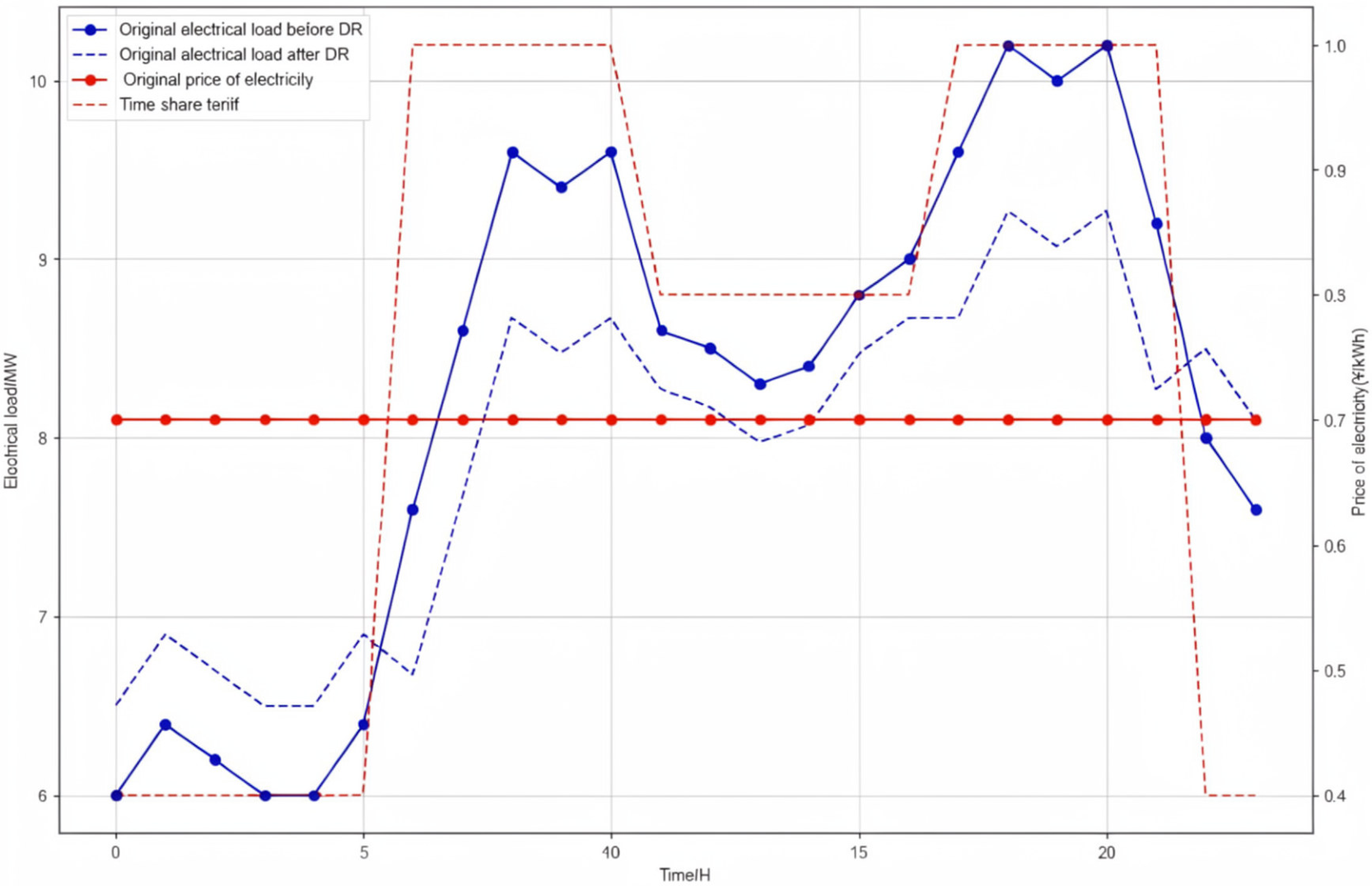
5.2. Solving the DR Model Using Multi-Objective Particle Swarm Optimization
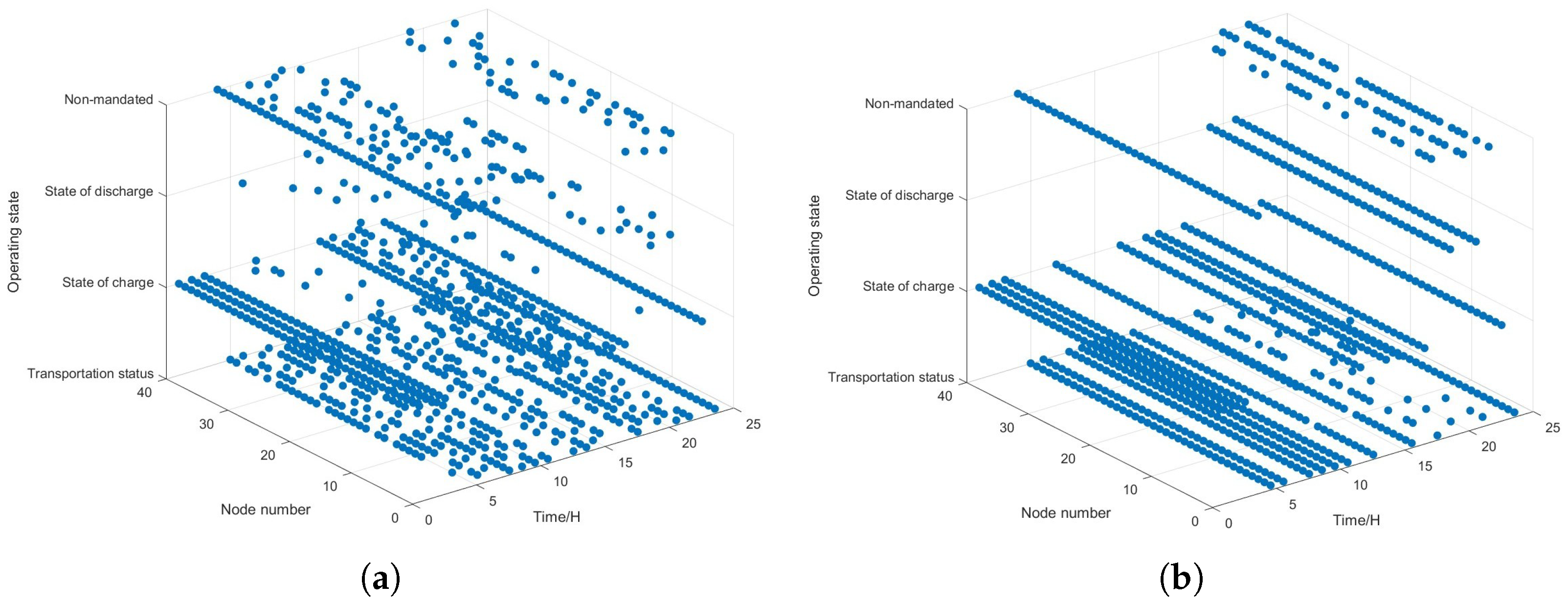
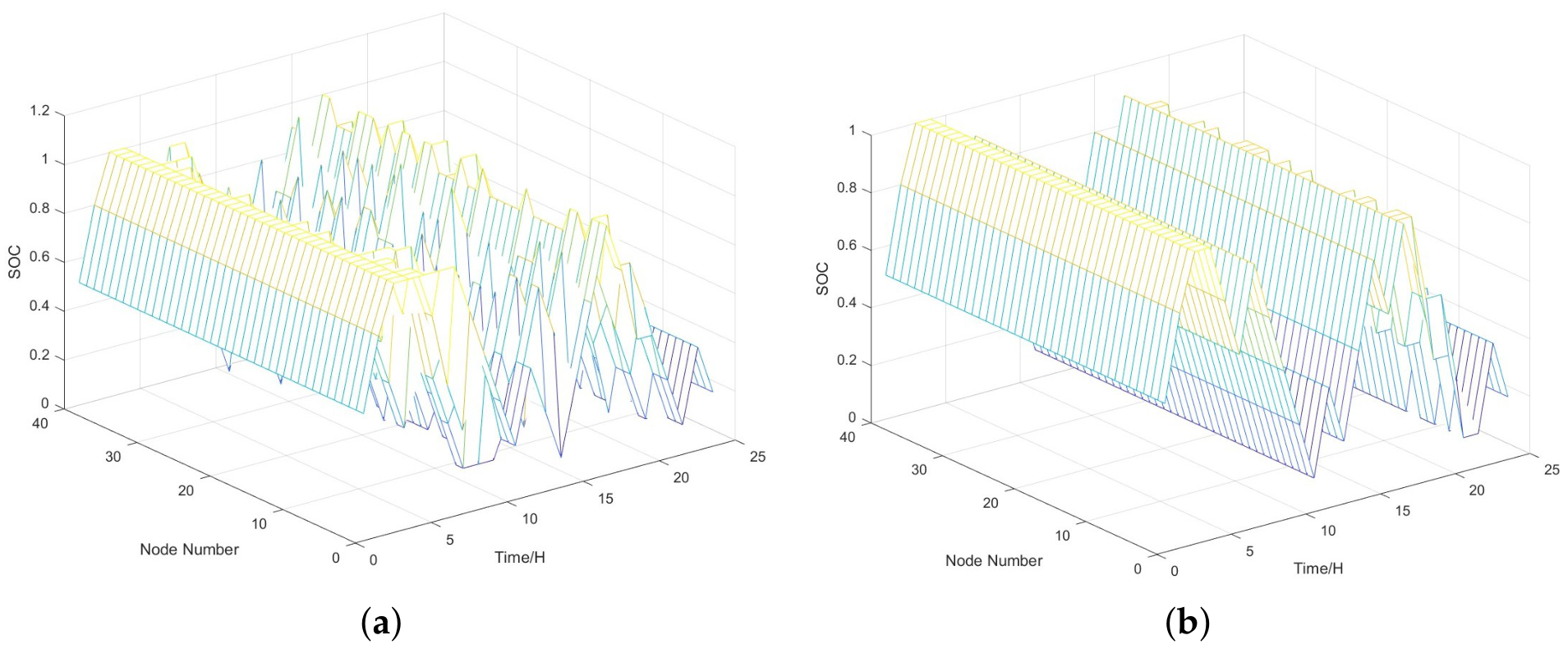
5.3. Dynamic Programming Model Solution for Heavy Transport Vehicles
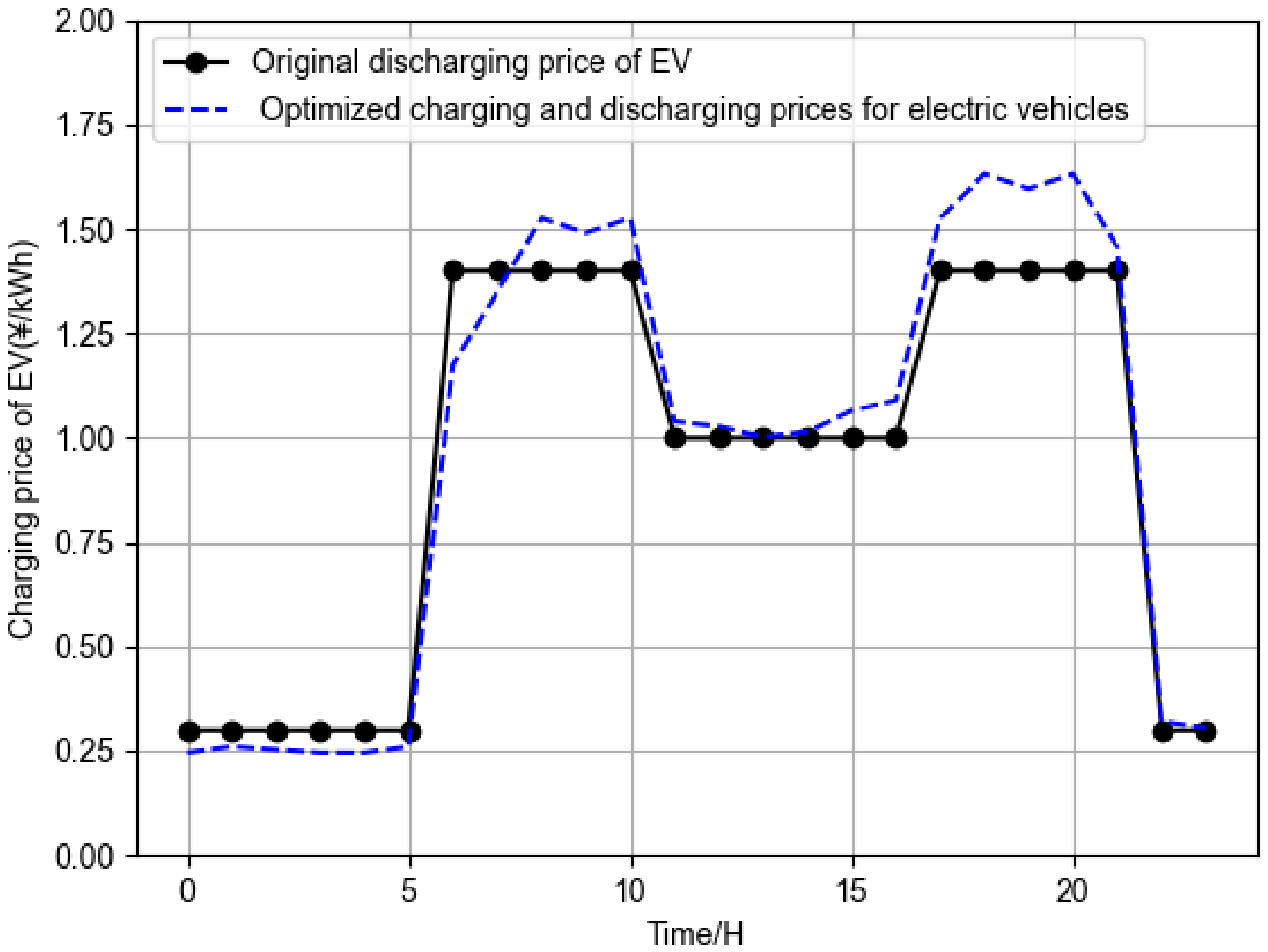
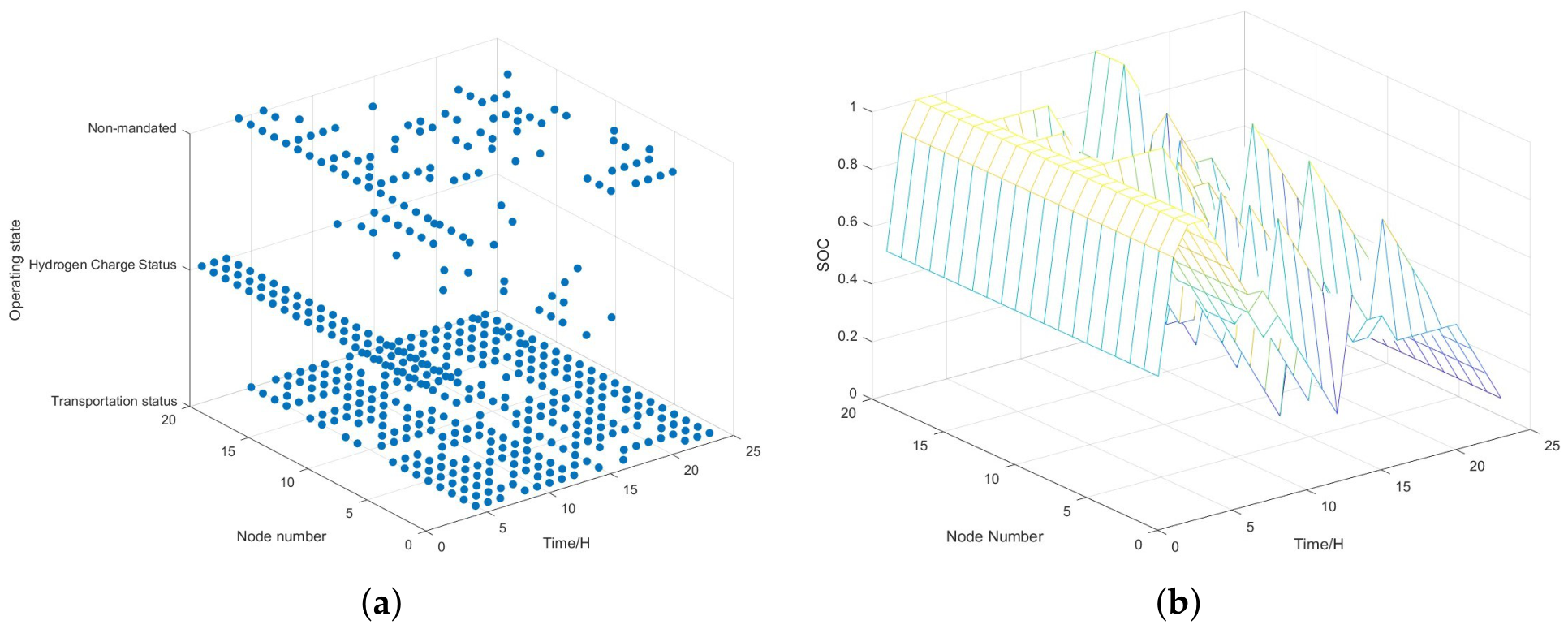
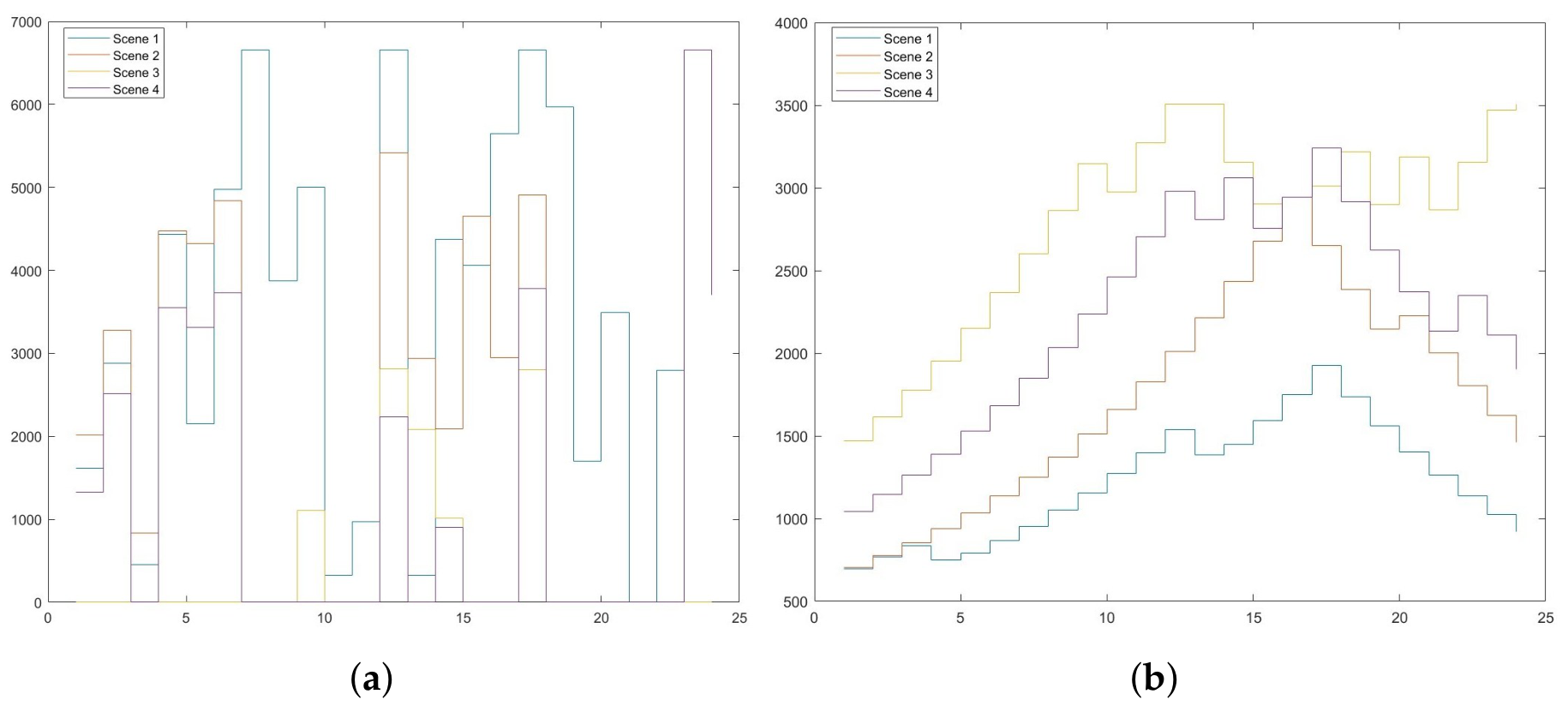
5.3.1. Impact of Optimizing Charging and Discharging Price Strategies on the Cost of Electric Vehicle Usage
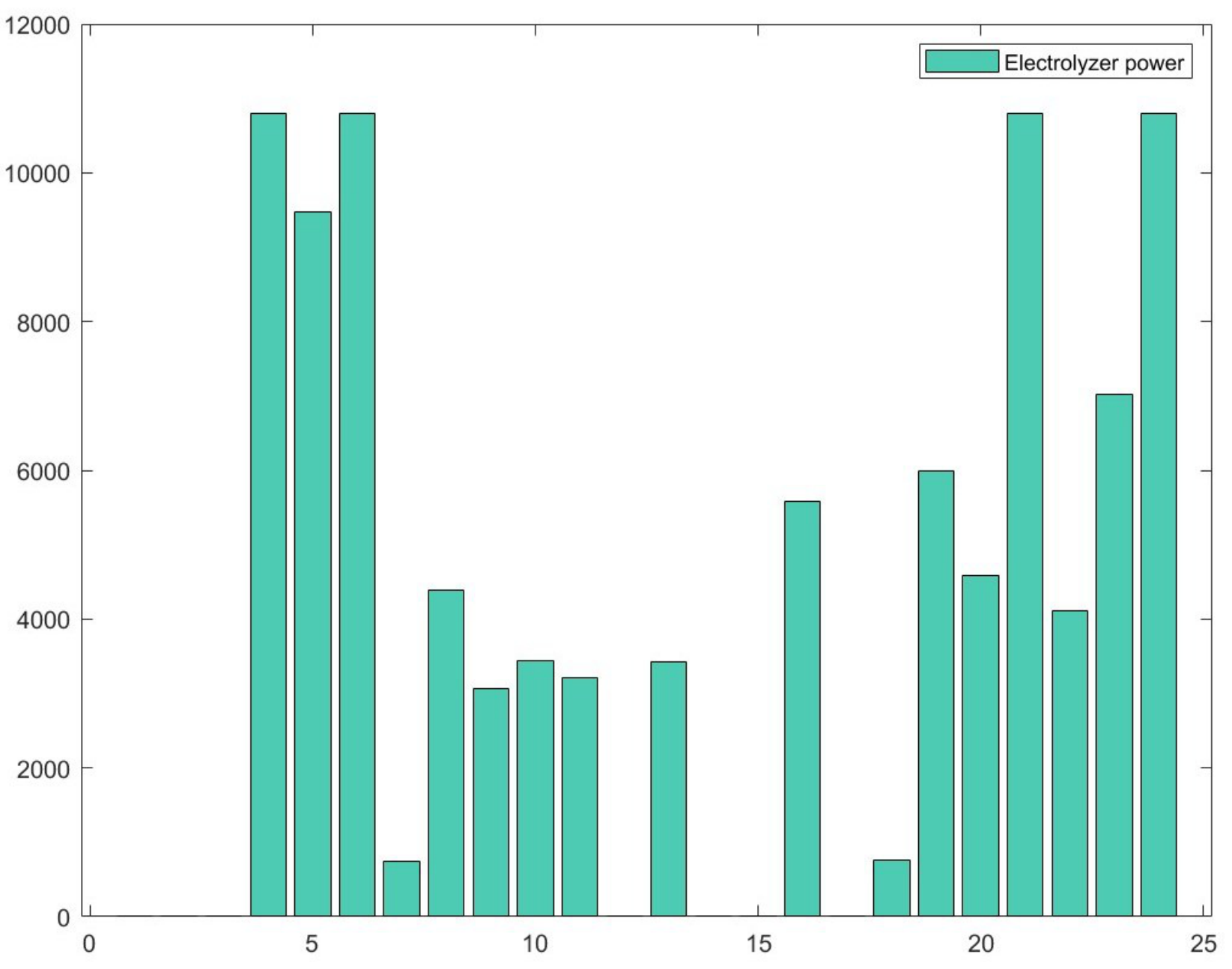
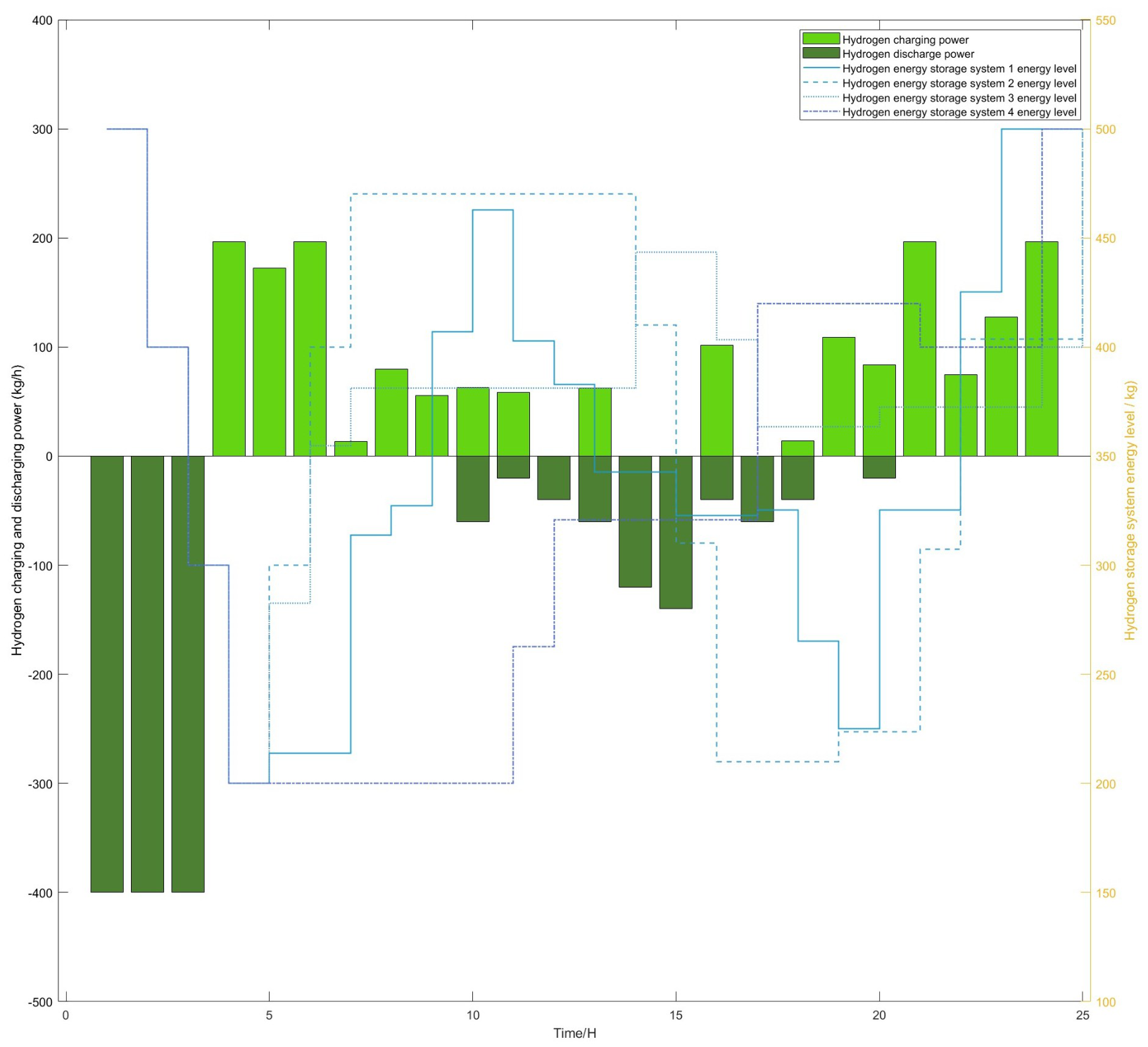
5.3.2. Interaction Between Ports and Hydrogen Vehicles
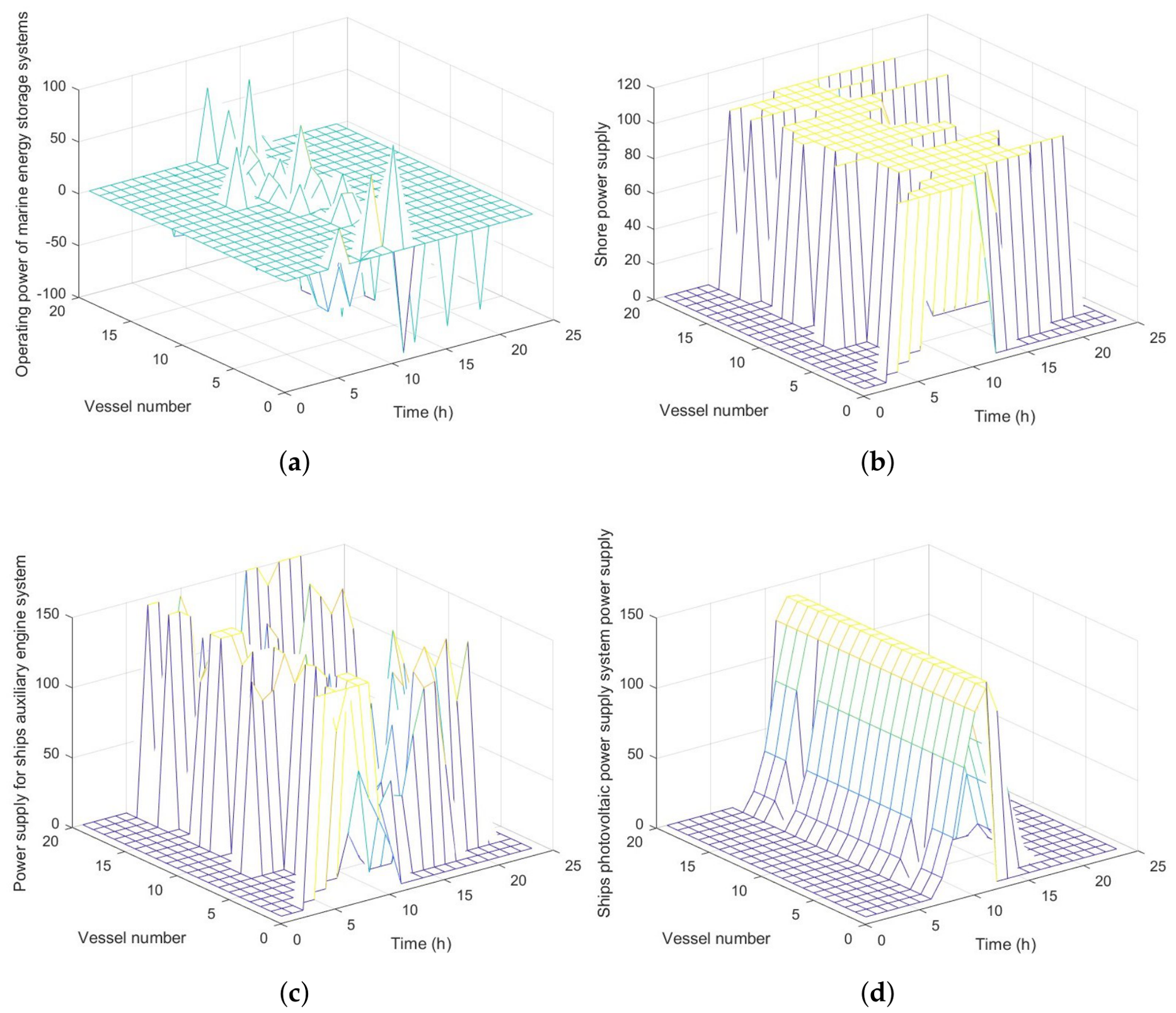
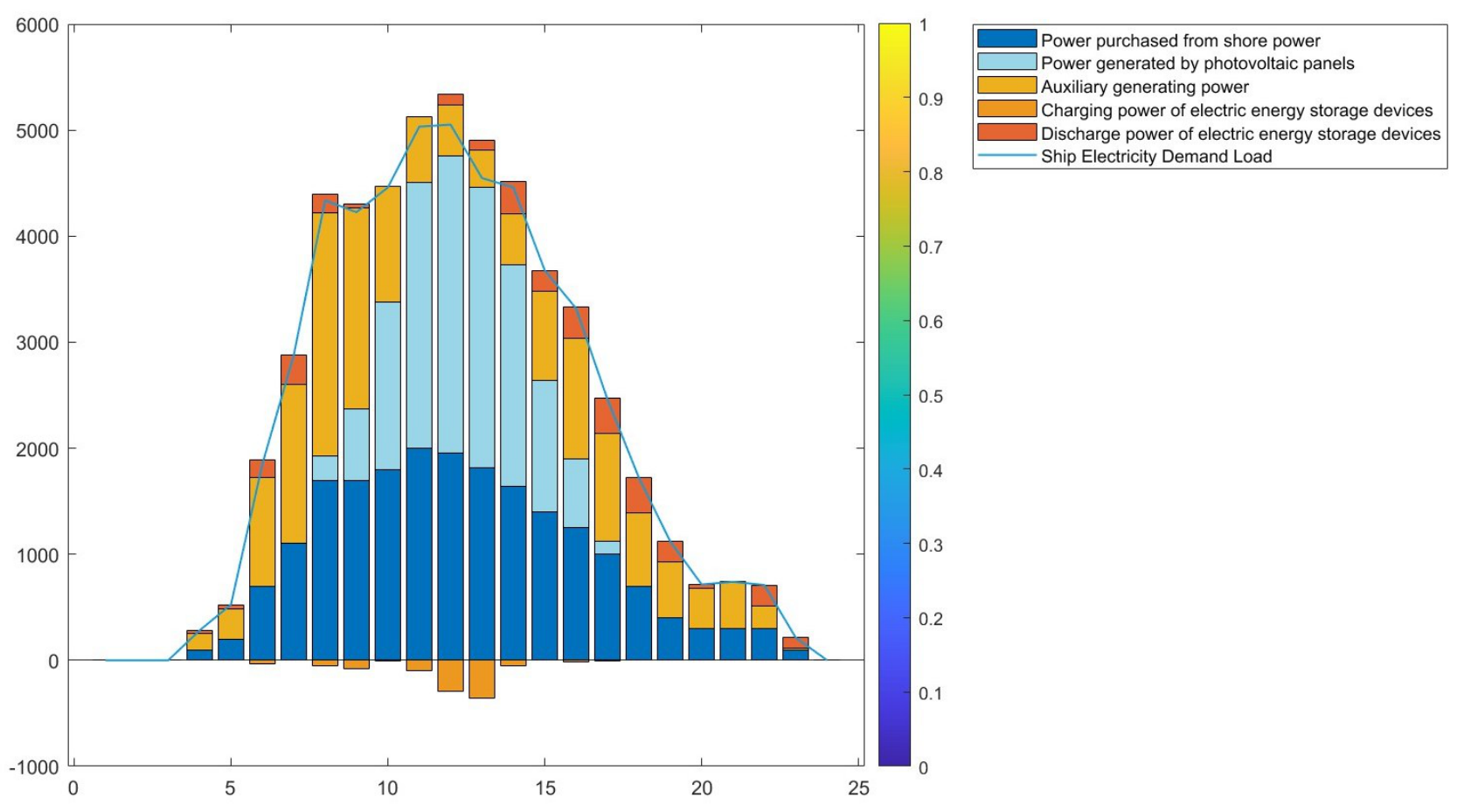
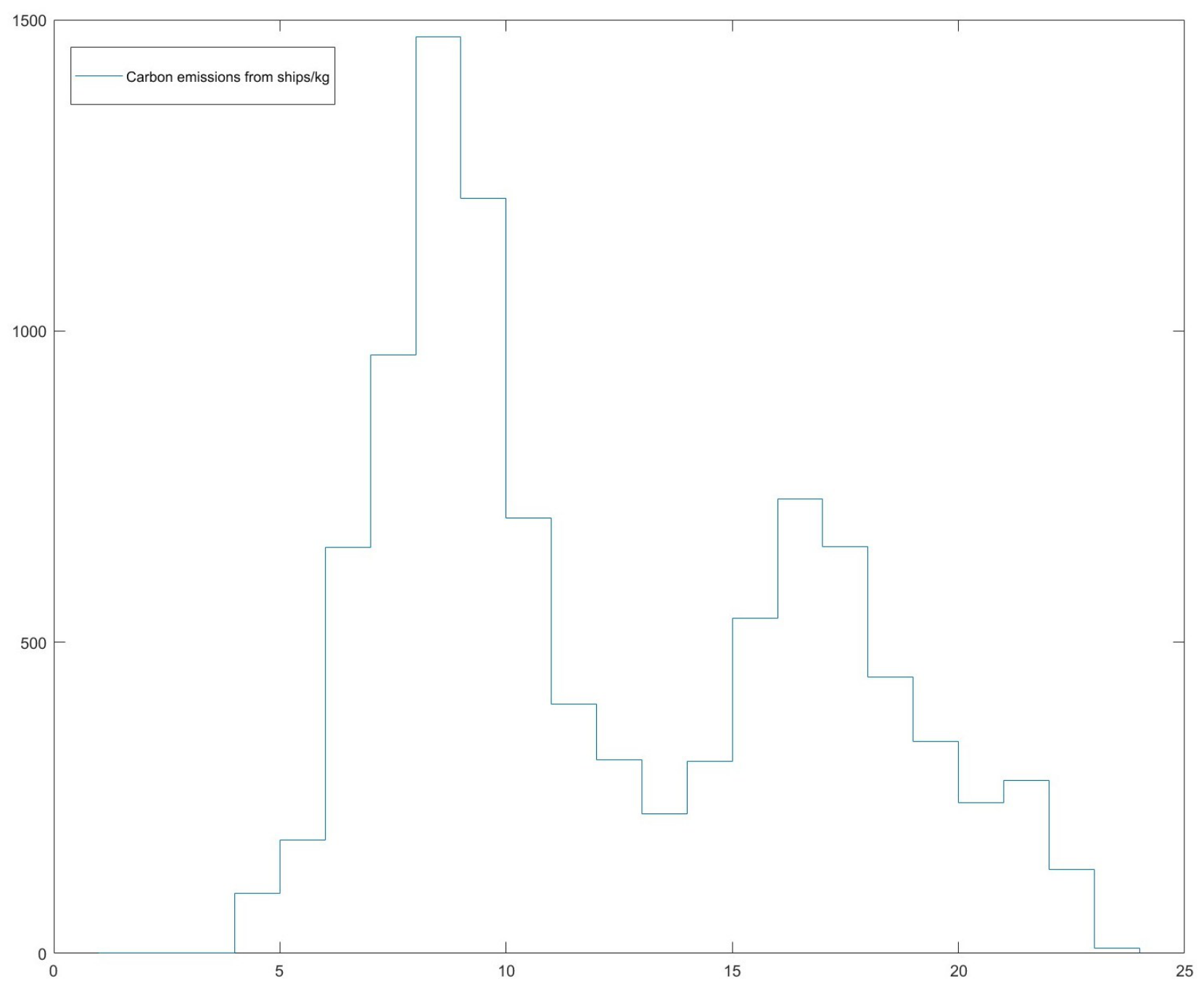
5.4. Comprehensive Energy Planning Model for Vessels at Berths
5.5. Impact of Five-Tier Carbon Trading Penalty Mechanism Parameters on System Low-Carbon Dispatching
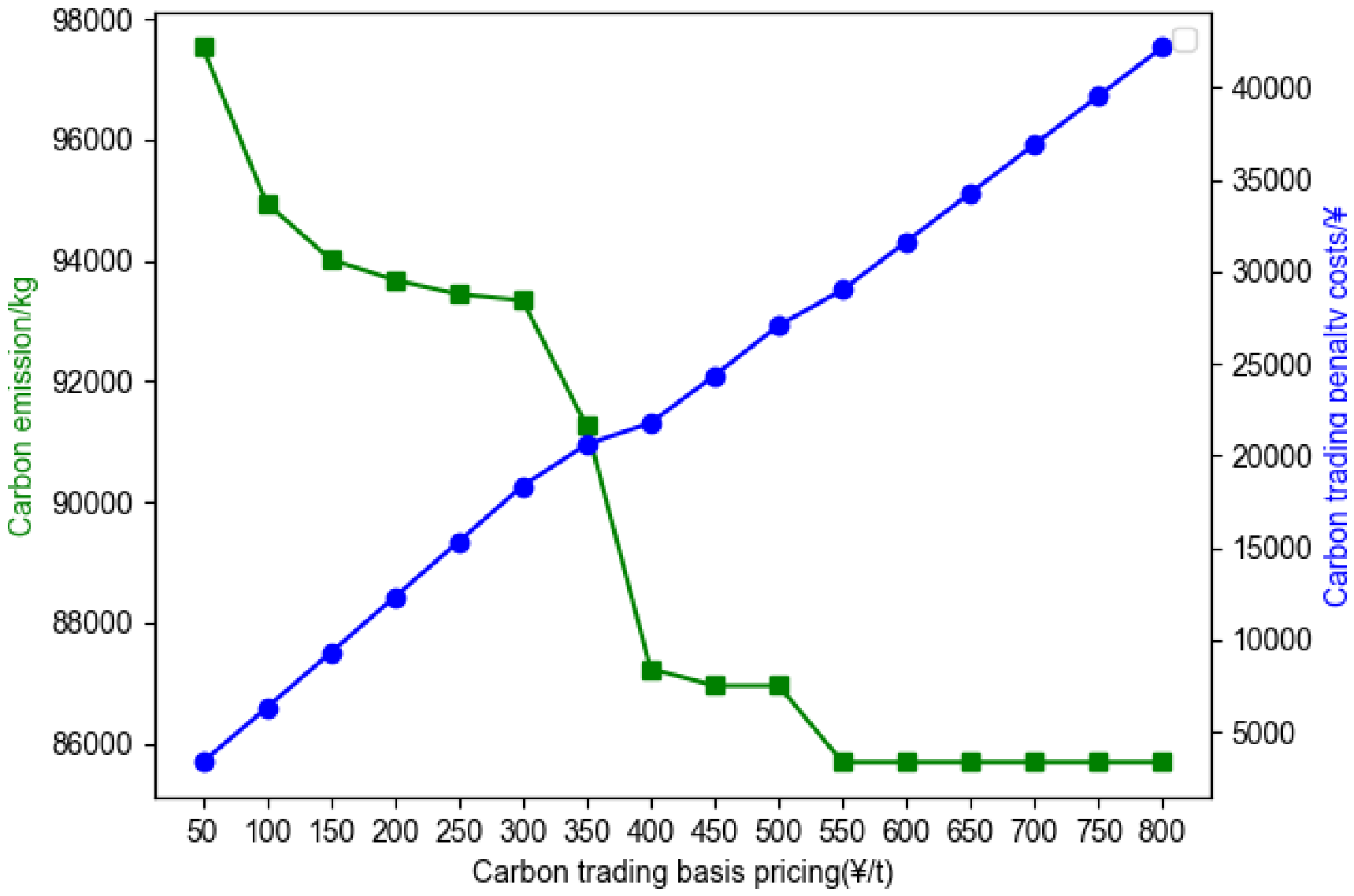
5.5.1. Analysis of the Impact of Carbon Trading Base Prices on the System
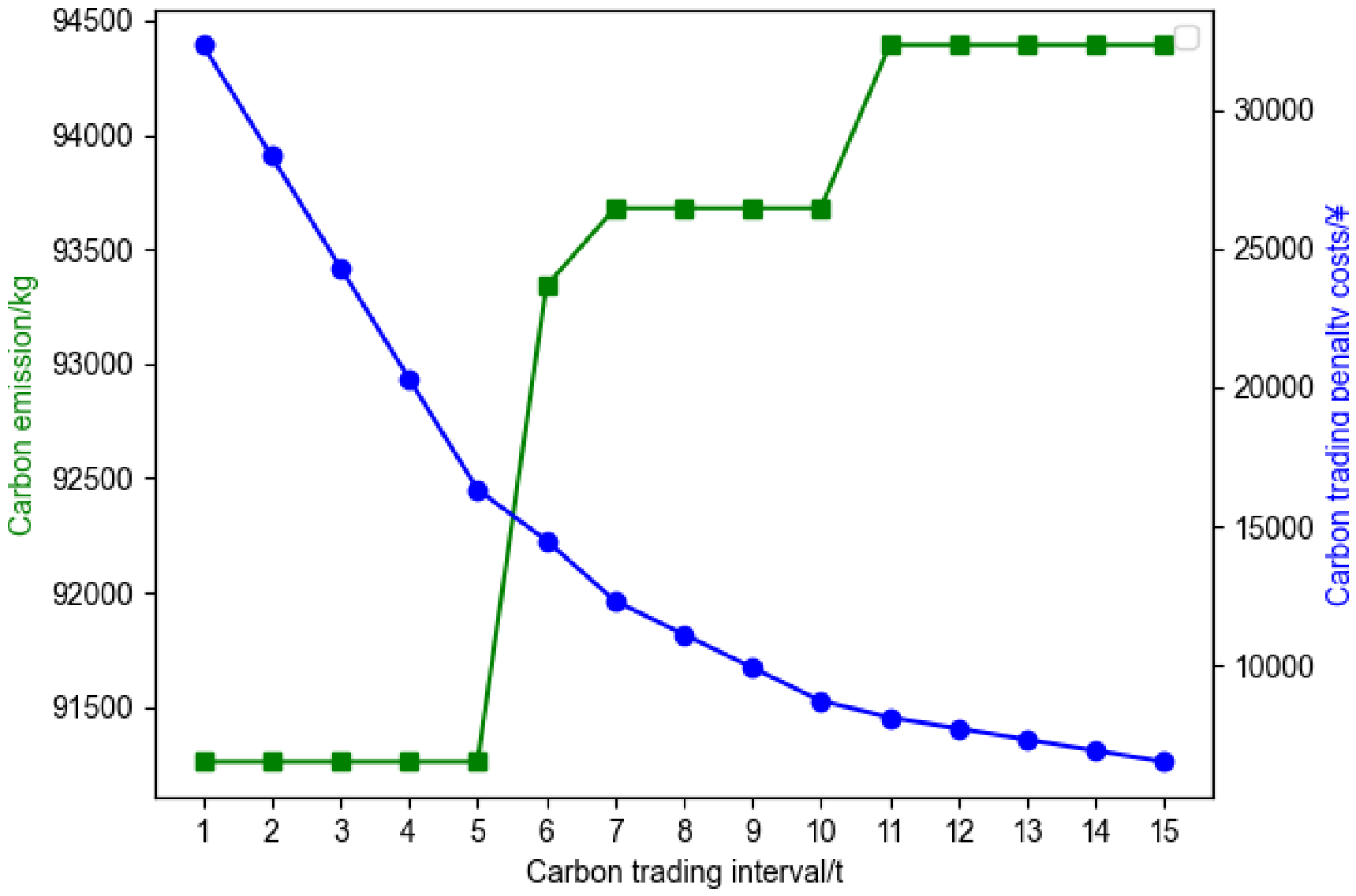
5.5.2. Impact Analysis of Changes in Tiered Trading Interval Lengths
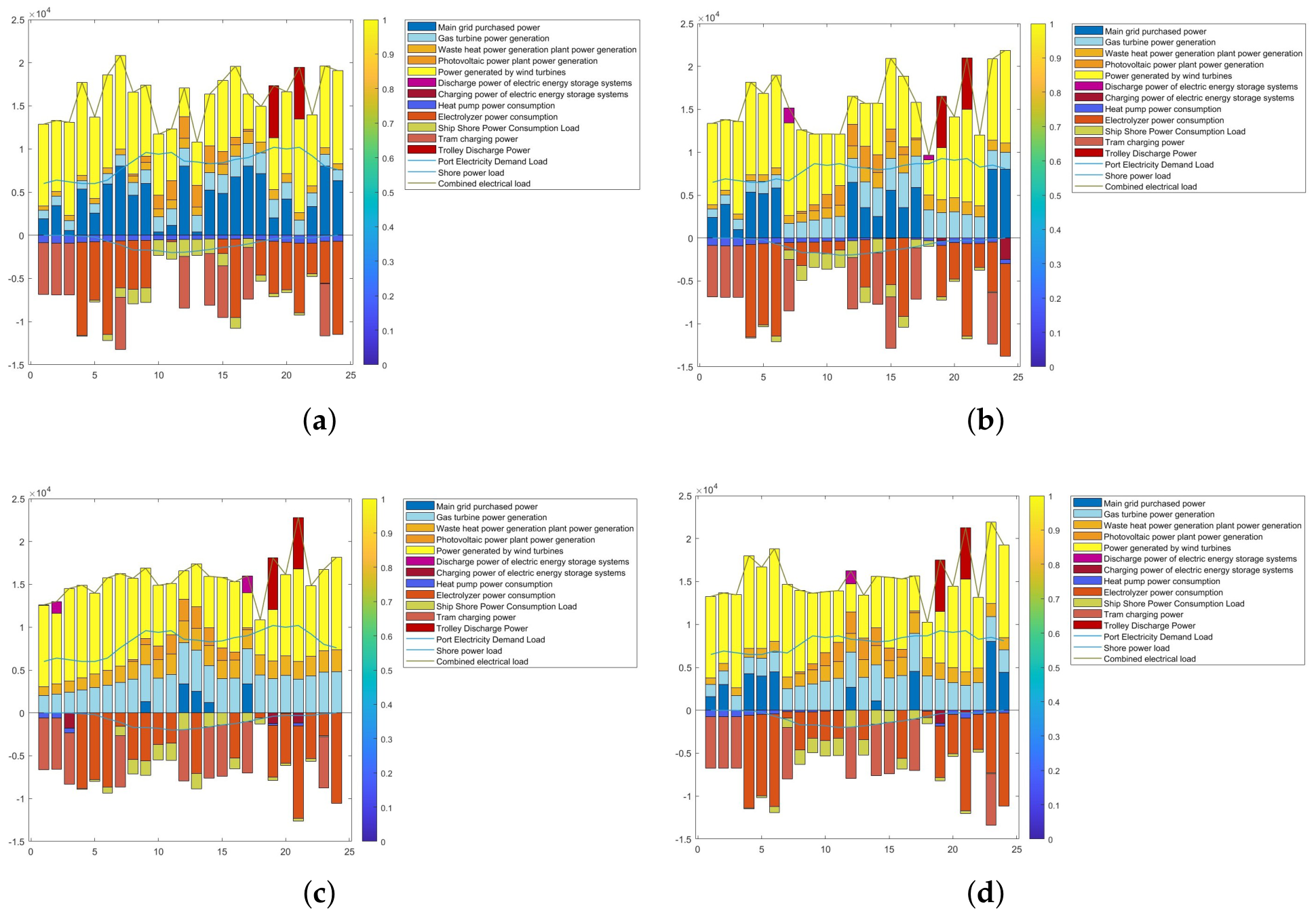
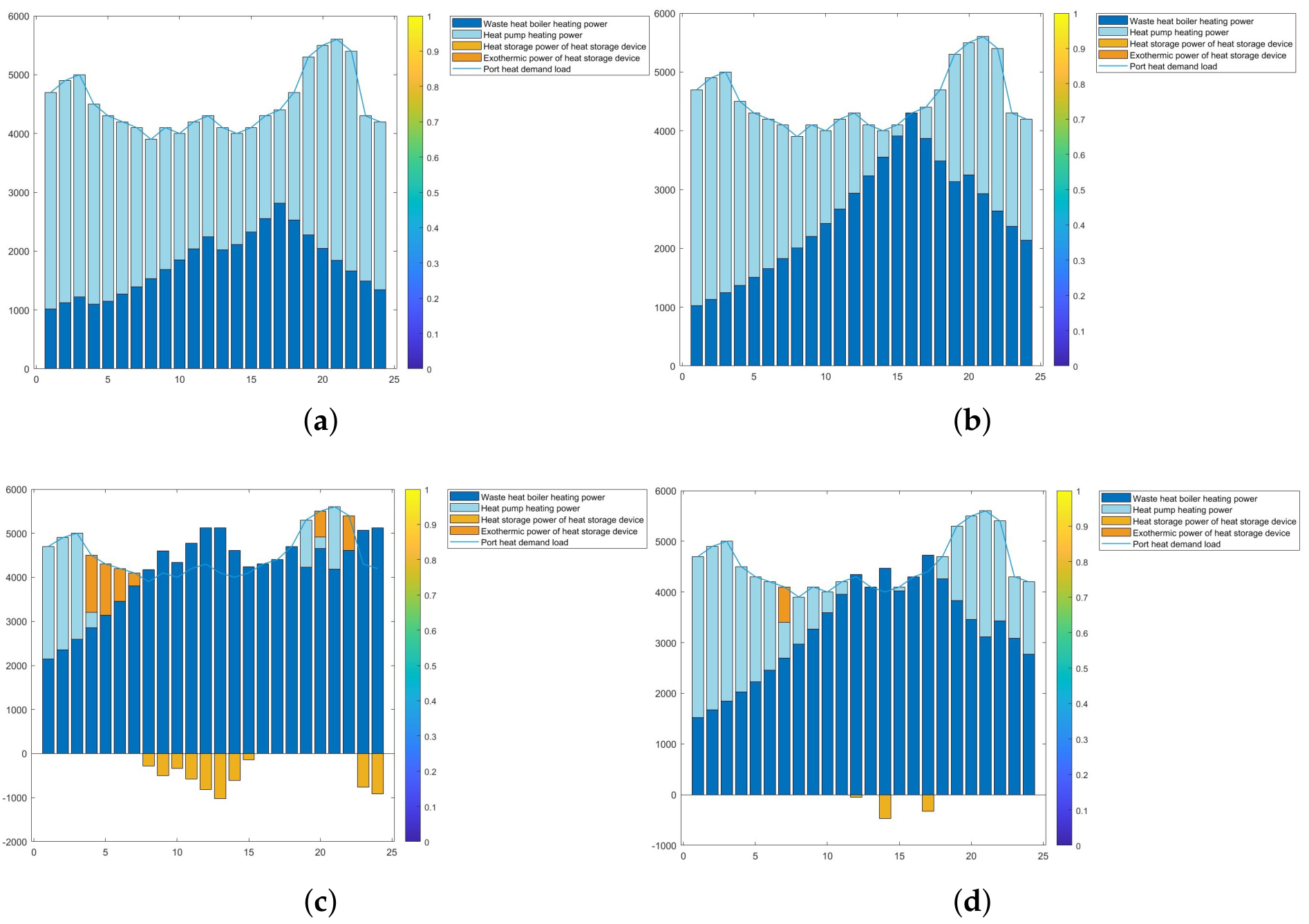
5.6. Comparative Analysis of ADN Schedule Operation Plans Under Different Scenarios
6. Results Summary and Validation
7. Conclusions
- A Logistic-function-based demand response model is developed for price optimization. With user satisfaction and load fluctuation as the two objectives, multi-objective particle swarm optimization identifies feasible trade-off solutions and links them with dynamic charging/discharging prices for electric heavy-duty vehicles.
- A hydrogen production–storage–use framework is constructed for port-area hydrogen demand. Renewable electricity is converted into hydrogen through electrolysis, stored, and supplied to hydrogen heavy-duty vehicles, supporting cleaner vehicle operation and increasing renewable-energy utilization.
- Free carbon allowances are assigned using the baseline method, and actual emissions are calculated from dispatch results. The tiered carbon-trading penalty then guides the system toward lower-emission energy use while maintaining economic feasibility.
Author Contributions
Funding
Institutional Review Board Statement
Informed Consent Statement
Data Availability Statement
Conflicts of Interest
Abbreviations
| ADN | Active Distribution Network |
| CHP | Combined Heat and Power |
| CI | Cold Ironing |
| DR | Demand Response |
| EES | Electrical Energy Storage |
| HES | Hydrogen Energy Storage |
| HP | Heat Pump |
| MT | Micro Turbine |
| ORC | Organic Rankine Cycle |
| PV | Photovoltaic |
| SOC | State of Charge |
| TES | Thermal Energy Storage |
| WHB | Waste Heat Boiler |
| WT | Wind Turbine |
References
- Parvasi, S.P.; Panagakos, G.; Barfod, M.B.; Lam, J.S.L. Ports as Energy Hubs: Renewable Energy Integration and Distribution. In Proceedings of the 25th DNV Nordic Maritime Universities Workshop, Kgs. Lyngby, Denmark, 30 January 2025. [Google Scholar]
- Peng, S.-T.; Qi, Z.-Y.; Liu, Y.-Y.; Liu, Z.-F.; Li, L.-L. Improving the energy efficiency and economic benefits of port integrated energy systems: A multi-objective optimization model for wind-storage-charging-discharging power stations with green efficiency factors-driven multilateral response strategy. Energy 2025, 339, 138939. [Google Scholar]
- Tang, D.; Ge, P.; Yuan, C.; Ren, H.; Zhong, X.; Dong, M.; Agundis-Tinajero, G.D.; Diaz-Londono, C.; Guerrero, J.M.; Zio, E. Optimal management of coupled hydrogen-electricity energy systems at ports by multi-time scale scheduling. Appl. Energy 2025, 391, 125885. [Google Scholar]
- Lv, W.; Ye, Y.; Cui, T.; Chen, S.; Xu, D.; Yu, W.; Huang, D.; Liu, Z.; Zhu, J.; Li, T.; et al. Sustainable electrified seaports: A coordinated energy and logistics scheduling approach for future maritime hubs. Appl. Energy 2025, 401, 126645. [Google Scholar] [CrossRef]
- Zhang, Y.; Liang, C.; Shi, J.; Lim, G.; Wu, Y. Optimal Port Microgrid Scheduling Incorporating Onshore Power Supply and Berth Allocation Under Uncertainty. Appl. Energy 2022, 313, 118856. [Google Scholar] [CrossRef]
- Chen, X.; Bai, R.; Qu, R.; Dong, H.; Chen, J. A data-driven genetic programming heuristic for real-world dynamic seaport container terminal truck dispatching. In Proceedings of the 2020 IEEE Congress on Evolutionary Computation (CEC), Glasgow, UK, 19–24 July 2020; pp. 1–8. [Google Scholar]
- Chen, X.; Bai, R.; Qu, R.; Dong, H. Cooperative double-layer genetic programming hyper-heuristic for online container terminal truck dispatching. IEEE Trans. Evol. Comput. 2022, 27, 1220–1234. [Google Scholar]
- Xu, B.; Wang, Y.; Li, J. Optimization of port emergency materials dispatch with time windows constraints under uncertainties. Discret. Dyn. Nat. Soc. 2021, 2021, 3977984. [Google Scholar] [CrossRef]
- Li, H.; Li, J.; An, L.; Zhang, X.; Xu, Z.; Hu, J. A dispatching method for automated container terminals: What is next when precise execution is available? In Proceedings of the 2023 IEEE 26th International Conference on Intelligent Transportation Systems (ITSC), Bilbao, Spain, 24–28 September 2023; pp. 2434–2439. [Google Scholar]
- Deng, Y.; Chen, Y.; Huang, J.; Zhang, D.; Zhao, J. A two-stage routing optimization model for yard trailers in container terminals under stochastic demand. Evol. Intell. 2023, 16, 1853–1863. [Google Scholar]
- Hsu, H.-P.; Chou, C.-C.; Wang, C.-N. Heuristic/metaheuristic-based simulation optimization approaches for integrated scheduling of yard crane, yard truck, and quay crane considering import and export containers. IEEE Access 2022, 10, 64650–64670. [Google Scholar]
- Zhen, L.; Lv, W.; Tan, Z.; Dong, B. Container transportation scheduling between port yards and the hinterland in Yunfeng. Inf. J. Appl. Anal. 2022, 52, 250–266. [Google Scholar] [CrossRef]
- Hou, J.; Song, Z.; Hofmann, H.; Sun, J. Adaptive model predictive control for hybrid energy storage energy management in all-electric ship microgrids. Energy Convers. Manag. 2019, 198, 111929. [Google Scholar] [CrossRef]
- Li, Z.; Xu, Y.; Wu, L.; Zheng, X. A risk-averse adaptively stochastic optimization method for multi-energy ship operation under diverse uncertainties. IEEE Trans. Power Syst. 2020, 36, 2149–2161. [Google Scholar]
- Edrington, C.S.; Ozkan, G.; Papari, B.; Gonsoulin, D.E.; Perkins, D.; Vu, T.V.; Vahedi, H. Distributed energy management for ship power systems with distributed energy storage. J. Mar. Eng. Technol. 2020, 19, 31–44. [Google Scholar]
- Hein, K.; Yan, X.; Wilson, G. Multi-objective optimal scheduling of a hybrid ferry with shore-to-ship power supply considering energy storage degradation. Electronics 2020, 9, 849. [Google Scholar]
- Xu, L.; Wen, Y.; Luo, X.; Lu, Z.; Guan, X. A modified power management algorithm with energy efficiency and GHG emissions limitation for hybrid power ship system. Appl. Energy 2022, 317, 119114. [Google Scholar] [CrossRef]
- Hein, K. Emission-aware and data-driven many-objective voyage and energy management optimization of solar-integrated all-electric ship. Electr. Power Syst. Res. 2022, 213, 108718. [Google Scholar]
- Wang, Z.; Ma, Y.; Sun, Y.; Tang, H.; Cao, M.; Xia, R.; Han, F. Optimizing energy management and case study of multi-energy coupled supply for green ships. J. Mar. Sci. Eng. 2023, 11, 1286. [Google Scholar] [CrossRef]
- Li, Z.; Xu, Y.; Fang, S.; Wang, Y.; Zheng, X. Multiobjective coordinated energy dispatch and voyage scheduling for a multienergy ship microgrid. IEEE Trans. Ind. Appl. 2019, 56, 989–999. [Google Scholar] [CrossRef]
- Taheri, S.I.; Vieira, G.G.T.T.; Salles, M.B.C.; Avila, S.L. A trip-ahead strategy for optimal energy dispatch in ship power systems. Electr. Power Syst. Res. 2021, 192, 106917. [Google Scholar] [CrossRef]
- Wen, S.; Zhao, T.; Tang, Y.; Xu, Y.; Zhu, M.; Fang, S.; Ding, Z. Coordinated optimal energy management and voyage scheduling for all-electric ships based on predicted shore-side electricity price. IEEE Trans. Ind. Appl. 2020, 57, 139–148. [Google Scholar]
- Huang, W.; Yu, M.; Li, H.; Tai, N. Energy Management of Integrated Energy System in Large Ports; Springer Nature: Singapore, 2023. [Google Scholar]
- Iris, Ç.; Lam, J.S.L. Optimal energy management and operations planning in seaports with smart grid while harnessing renewable energy under uncertainty. Omega 2021, 103, 102445. [Google Scholar] [CrossRef]
- Wang, X.; Huang, W.; Wei, W.; Tai, N.; Li, R.; Huang, Y. Day-ahead optimal economic dispatching of integrated port energy systems considering hydrogen. IEEE Trans. Ind. Appl. 2021, 58, 2619–2629. [Google Scholar] [CrossRef]
- Lasseter, R.; Akhil, A.; Marnay, C.; Stephens, J.; Dagle, J.; Guttromson, R.; Meliopoulous, A.; Yinger, R.; Eto, J. The CERTS microgrid concept. White Pap. Transm. Reliab. Program Off. Power Technol. U.S. Dep. Energy 2002, 2, 30. [Google Scholar]
- Parra, D.; Norman, S.A.; Walker, G.S.; Gillott, M. Optimum community energy storage system for demand load shifting. Appl. Energy 2016, 174, 130–143. [Google Scholar] [CrossRef]
- Krishnamurthy, D.; Uckun, C.; Zhou, Z.; Thimmapuram, P.R.; Botterud, A. Energy storage arbitrage under day-ahead and real-time price uncertainty. IEEE Trans. Power Syst. 2017, 33, 84–93. [Google Scholar]
- Das, C.K.; Bass, O.; Mahmoud, T.S.; Kothapalli, G.; Mousavi, N.; Habibi, D.; Masoum, M.A.S. Optimal allocation of distributed energy storage systems to improve performance and power quality of distribution networks. Appl. Energy 2019, 252, 113468. [Google Scholar] [CrossRef]
- Rajamand, S.; Shafie-khah, M.; Catalão, J.P.S. Energy storage systems implementation and photovoltaic output prediction for cost minimization of a microgrid. Electr. Power Syst. Res. 2022, 202, 107596. [Google Scholar] [CrossRef]
- Kavousi-Fard, A.; Khorram-Nia, R.; Rostami, M.; Abbasi, A. An smart stochastic approach to model plug-in hybrid electric vehicles charging effect in the optimal operation of micro-grids. J. Intell. Fuzzy Syst. 2015, 28, 835–842. [Google Scholar] [CrossRef]
- Pimm, A.J.; Cockerill, T.T.; Taylor, P.G. The potential for peak shaving on low voltage distribution networks using electricity storage. J. Energy Storage 2018, 16, 231–242. [Google Scholar] [CrossRef]
- Fang, S.; Wang, C.; Liao, R.; Zhao, C. Optimal power scheduling of seaport microgrids with flexible logistic loads. IET Renew. Power Gener. 2022, 16, 2711–2720. [Google Scholar] [CrossRef]
- Tao, Y.; Qiu, J.; Lai, S.; Sun, X.; Zhao, J. Flexible voyage scheduling and coordinated energy management strategy of all-electric ships and seaport microgrid. IEEE Trans. Intell. Transp. Syst. 2022, 24, 3211–3222. [Google Scholar] [CrossRef]
- Ban, Z.; Teng, F.; Zhang, H.; Li, S.; Xiao, G.; Guan, Y. Distributed fixed-time energy management for port microgrid considering transmissive efficiency. Mathematics 2023, 11, 3674. [Google Scholar] [CrossRef]
- Bakar, N.N.A.; Guerrero, J.M.; Vasquez, J.C.; Bazmohammadi, N.; Othman, M.; Rasmussen, B.D.; Al-Turki, Y.A. Optimal configuration and sizing of seaport microgrids including renewable energy and cold ironing—The Port of Aalborg case study. Energies 2022, 15, 431. [Google Scholar] [CrossRef]
- Teng, F.; Wang, J.; Luo, H.; Zhang, Q.; Shen, C. Distributed low-carbon energy management method for port microgrid based on we-energies under polymorphic network. Front. Energy Res. 2022, 10, 952396. [Google Scholar]
- Shan, Q.; Song, J.; Xu, Q.; Xiao, G.; Yu, F. Polymorphic distributed energy management for low-carbon port microgrid with carbon capture and carbon storage devices. Front. Energy Res. 2022, 10, 951192. [Google Scholar] [CrossRef]
- Song, J.; Shan, Q.; Zou, T.; Hu, J.; Teng, F. Distributed energy management for zero-carbon port microgrid. Int. Trans. Electr. Energy Syst. 2022, 2022, 2752802. [Google Scholar] [CrossRef]
- Wu, H.; Qiu, D.; Zhang, L.; Sun, M. Adaptive multi-agent reinforcement learning for flexible resource management in a virtual power plant with dynamic participating multi-energy buildings. Appl. Energy 2024, 374, 123998. [Google Scholar]
- Zhang, Z.; Yu, D. RBF-NN based short-term load forecasting model considering comprehensive factors affecting demand response. Proc. CSEE 2018, 38, 1631–1638. [Google Scholar]
- Ma, M.; Wei, W.; Li, L. Two-stage robust optimal scheduling of a microgrid with a stepped carbon trading mechanism. Power Syst. Prot. Control 2023, 51, 22–33. [Google Scholar]
- Saint-Drenan, Y.-M.; Besseau, R.; Jansen, M.; Staffell, I.; Troccoli, A.; Dubus, L.; Schmidt, J.; Gruber, K.; Simões, S.G.; Heier, S. A parametric model for wind turbine power curves incorporating environmental conditions. Renew. Energy 2020, 157, 754–768. [Google Scholar] [CrossRef]
- Huang, X.; Chen, J.; Xie, Q.; Cao, Y.; Yang, H. The influence of users’ charging selection on charging schedule of power grid. Trans. China Electrotech. Soc. 2018, 33, 3002–3011. [Google Scholar]
- Gao, H.; Liu, J.; Shen, X.; Xu, R. Optimal power flow research in active distribution network and its application examples. Proc. CSEE 2017, 37, 1634–1644. [Google Scholar]



| Equipment Name | Fundamental Parameter Name | Value | Economic Parameter (RMB/kWh) |
|---|---|---|---|
| MT | Power output limits/kW Electric efficiency Thermal efficiency Ramp rate limits | 4800/0 0.3 0.6 0.1/−0.1 | 0.15 |
| ORC | Power output limits/kW Electric efficiency | 3200/0 0.8 | 0.25 |
| WHB | Power output limits/kW Thermal efficiency | 6400/0 0.8 | 0.28 |
| HP | Power output limits/kW Conversion factor | 900/0 4.2 | 0.15 |
| EES | Capacity/kWh Power output limits/kW | 9600 3200/−3200 | 0.11 |
| TES | Capacity/kWh Power output limits/kW | 5200 1300/−1300 | 0.12 |
| HES | Capacity/kWh Power output limits/kW | 1500 300/−300 | 0.26 |
| PV | Power output limits/kW | 10,800/0 | 0.20 |
| WT | Power output limits/kW | 3600/0 | 0.13 |
| Ele | Efficiency | 0.6 | 0.25 |
| CI | Upper and lower limits of unit output/kW | 100/0 | / |
| Installations | Parameters | Numerical Value |
|---|---|---|
| AG | Power output limits/kW Unit price (RMB/kg) | 150/0 1.172 |
| PV | Power output limits/kW | 200/0 |
| EES | Capacity/kWh Power output limits/kW | 5000 100/−100 |
| Name | Numerical Value | Unit |
|---|---|---|
| Capacity | 50 | kg |
| Maximum and minimum state of charge | 0.9/0.1 | / |
| Number of hydrogen vehicles | 20 | vehicle |
| Total carrying capacity | 300 | TEUs |
| Operational state | 3 | / |
| Name | Numerical Value | Unit |
|---|---|---|
| Capacity | 500 | kg |
| Maximum and minimum state of charge | 0.9/0.1 | / |
| Number of electric vehicles | 40 | vehicle |
| Total carrying capacity | 400 | TEUs |
| Operational state | 4 | / |
| State | Customer Satisfaction | Load Volatility |
|---|---|---|
| Before demand response | 1.00 | 1.35 |
| After demand response | 0.87 | 0.91 |
| Availability of Tariff Optimization Strategies | Charging Cost/RMB | Discharge Proceeds/RMB | Total Energy Use Cost/RMB |
|---|---|---|---|
| Not available | 35,700 | 12,900 | 22,800 |
| Available | 38,390.597 | 19,578.13 | 18,812.44 |
| Scenario | Energy Purchase | Carbon Penalty | Equipment Usage Cost | Vessel | Vehicle | Total Cost |
|---|---|---|---|---|---|---|
| 1 | 106,896.33 | 44,459.37 | 129,602.29 | 36,103.58 | 65,218.49 | 382,280.05 |
| 2 | 86,070.95 | 85,648.48 | 137,336.33 | 36,103.58 | 66,332.44 | 411,491.77 |
| 3 | 86,236.12 | 20,420.97 | 154,025.18 | 36,103.58 | 65,218.49 | 362,004.33 |
| 4 | 80,391.01 | 25,315.58 | 144,215.47 | 36,103.58 | 66,332.44 | 352,358.09 |
| Scenario | Main Grid Power Purchase | Purchase of Gas | Total Cost of Energy Purchased |
|---|---|---|---|
| 1 | 73,149.91 | 33,746.41 | 106,896.33 |
| 2 | 37,983.72 | 48,087.23 | 86,070.95 |
| 3 | 8271.16 | 77,964.96 | 86,236.12 |
| 4 | 18,575.01 | 61,816.00 | 80,391.01 |
| Scenario | Total Cost of Energy Purchased/RMB | Actual Carbon Emissions/kg |
|---|---|---|
| 1 | 44,459.37 | 126,058.61 |
| 2 | 85,648.48 | 107,577.80 |
| 3 | 20,420.97 | 87,238.83 |
| 4 | 25,315.58 | 95,143.18 |
Disclaimer/Publisher’s Note: The statements, opinions and data contained in all publications are solely those of the individual author(s) and contributor(s) and not of MDPI and/or the editor(s). MDPI and/or the editor(s) disclaim responsibility for any injury to people or property resulting from any ideas, methods, instructions or products referred to in the content. |
© 2026 by the authors. Licensee MDPI, Basel, Switzerland. This article is an open access article distributed under the terms and conditions of the Creative Commons Attribution (CC BY) license.
Share and Cite
Yuan, G.; Ni, H.; Wang, R.; Pu, D.; He, H. Research on the Comprehensive Energy Management Model for Ports with Land-Based Traffic Consideration. Energies 2026, 19, 2970. https://doi.org/10.3390/en19132970
Yuan G, Ni H, Wang R, Pu D, He H. Research on the Comprehensive Energy Management Model for Ports with Land-Based Traffic Consideration. Energies. 2026; 19(13):2970. https://doi.org/10.3390/en19132970
Chicago/Turabian StyleYuan, Guanghui, Haobo Ni, Rui Wang, Dongping Pu, and Huaiyu He. 2026. "Research on the Comprehensive Energy Management Model for Ports with Land-Based Traffic Consideration" Energies 19, no. 13: 2970. https://doi.org/10.3390/en19132970
APA StyleYuan, G., Ni, H., Wang, R., Pu, D., & He, H. (2026). Research on the Comprehensive Energy Management Model for Ports with Land-Based Traffic Consideration. Energies, 19(13), 2970. https://doi.org/10.3390/en19132970