1. Introduction
The global energy system is evolving towards a structure characterised by a high proportion of renewable energy and high levels of electrification, placing greater demands on the flexibility, robustness and spatio-temporal coordination capabilities of power system operation [
1]. In recent years, the rapid deployment of wind and photovoltaic generation has reshaped the spatial and temporal characteristics of power supply. Renewable energy resources are often concentrated in remote northern and western regions, whereas major load centres are located in economically developed eastern and central regions. Taking China as a representative example, large-scale renewable energy bases and West-to-East power transmission projects have led to substantial long-distance power flows through high-voltage direct-current (HVDC) and ultra-high-voltage direct-current (UHVDC) transmission corridors. Although these DC transmission corridors improve the ability to deliver renewable electricity across regions, they also introduce new operational challenges, including renewable-output uncertainty, inter-regional power-flow volatility, local transmission congestion, source–load temporal mismatch and increased requirements for flexible regulation resources. Against this background, the rapid expansion of artificial intelligence infrastructure is transforming the energy demand profile of data centres, gradually making them a significant new load within the power system that cannot be ignored [
2].
Data centres are characterised not only by high power density and long continuous operating times, but also possess the potential for task scheduling, location planning and coordination with the energy system. Takci et al. point out that data centres can provide flexibility to the power system through demand response, workload regulation and auxiliary energy resources [
3]. Riepin et al. further demonstrate that the spatio-temporal shifting of computational tasks can enhance the hourly level matching of clean electricity [
4]. Consequently, data centres should no longer be simplistically treated as inflexible, rigid loads, but rather modelled as networked flexible resources capable of participating in renewable energy integration, grid regulation and computing resource allocation.
Firstly, the internal composition of data centre loads is highly heterogeneous, making it difficult for a single flexible load model to describe the scheduling boundaries of different computing tasks. Online inference tasks are typically governed by strict latency constraints, whereas AI training tasks place greater emphasis on daily throughput, continuity and stability of resource utilisation. Wang et al. noted, with regard to large language model workloads, that load flexibility can be unlocked by reshaping the power curve without significantly compromising the performance of computing services [
5]. Han et al. conducted a joint modelling of computing task response mechanisms and hybrid energy storage within data centre energy systems, demonstrating that differences between tasks directly influence system scheduling outcomes [
6]. However, existing research has rarely integrated fixed real-time tasks, online inference, AI training, and opportunistic elastic tasks into the coordinated constraints of power flow and energy storage. If task type differences are ignored, optimisation models tend to overestimate the adjustability of data centre loads and underestimate the constraints imposed by service-level agreements on the feasible domain of power dispatch.
Secondly, decisions regarding the spatial relocation of data centres to alternative locations depend not only on electricity prices or average carbon intensity, but are also influenced by a combination of grid topology, the location of renewable energy integration, data centre energy efficiency, and energy storage capacity. Naoi et al. demonstrated that combining data centre siting with spatio-temporal workload migration helps to improve the efficiency of matching renewable energy supply and demand [
7]. Zeng et al. investigated the impact of demand-side flexibility in cloud data centres on planning decisions from an electricity–carbon market perspective [
8]. Han et al. considered the coordinated optimisation of computational load and renewable energy uncertainty in geographically distributed data centres [
9]. Xue et al. proposed an online energy-saving scheduling method for geographically distributed data centres that combines data-driven and knowledge-driven approaches [
10]. However, existing migration signals primarily rely on electricity prices, carbon intensity or the proportion of renewable energy, making it difficult to explain “why a particular node is more suitable for hosting flexible computing power”. Therefore, it is necessary to construct an interpretable green migration mechanism that simultaneously reflects grid topological distance, renewable energy availability, PUE advantages and energy storage regulation capacity.
Thirdly, the high proportion of renewable energy integration transforms curtailment from a minor disturbance in the average sense into tail losses in a few extreme scenarios. Kachirayil et al. point out that modelling local integrated energy systems requires simultaneous attention to flexibility resources and robustness challenges [
11]. Lin et al. introduced CVaR into campus-level integrated energy system planning to characterise risk exposure under extreme energy price scenarios [
12]. Liu et al. utilised CVaR to investigate risk-averse optimisation of integrated electricity–gas systems under uncertainties in wind, solar and power-to-gas generation [
13]. Wang et al. employed a two-stage robust optimisation approach to address generation and load uncertainties in integrated energy systems, thereby enhancing the robustness of low-carbon operations [
14]. However, research on electricity–computing coordination for off-site data centre operators still primarily focuses on expected costs or average renewable energy integration, with insufficient characterisation of the tail-end curtailment risk resulting from the combined effects of high renewable energy output, low load, and local line congestion. If the dispatch model lacks tail risk constraints, flexible computing power may perform well under average conditions but may struggle to support the robustness of renewable energy integration under extreme scenarios.
In response to the challenges outlined above, existing research has explored approaches such as integrated energy systems, data centre energy efficiency management, geographically distributed workload migration, and graph-based power grid modelling. Sánchez Diéguez et al. emphasise that high-temporal-resolution modelling is of significant importance for analysing the low-carbon transition of industrial energy systems [
15]. Yuan et al. reviewed the role of data centre waste heat recovery technologies in improving energy efficiency and reducing environmental impact [
16]. Monsalves et al. analysed the impact of flexible cooling and waste heat recovery in data centres on systems with a high proportion of renewable energy [
17]. Zhang et al. investigated the scheduling and design of data centre energy storage systems participating in smart grid services under conditions of incremental load growth [
18]. Figini et al. proposed a method for configuring photovoltaic and energy storage capacity to support schedulable operation in data centres [
19]. Guo et al. combined workload management with data centre energy system optimisation, revealing the impact of workload shifting on energy flexibility [
20]. Li et al. proposed a graph attention convolutional network for real-time power flow calculation that accounts for grid uncertainty [
21]. Zhang et al. validated the application potential of graph neural networks in identifying grid operation risks [
22]. Wu et al. further applied the topological graph attention mechanism to multi-energy flow calculations in integrated energy systems [
23]. Although recent multi-factor graph optimisation methods have shown strong potential in tasks such as sensor selection, feature representation and heterogeneous-data partitioning, their optimisation targets are different from the cross-node migration problem considered in this paper. The graph-attention-inspired green affinity prior proposed here is not designed to select sensors, partition data samples or learn a general graph representation. Instead, it maps physically meaningful operational factors, including renewable energy availability, electrical distance to renewable energy nodes, data-centre PUE and energy-storage regulation capacity, into interpretable migration signals for geographically dispersed data centres. In this way, graph-based affinity is used to guide flexible computing workloads towards nodes with higher green-computing value, whilst the final migration decision remains constrained by power flow, branch capacity, task SLAs and storage operation. Lin et al. systematically summarised the application of green-aware data centre management technologies in task scheduling, resource allocation and energy consumption optimisation [
24]. Mytton et al. pointed out that data centre energy consumption estimates still face issues of inconsistent data sources and differences in statistical methodologies [
25]. Yuan et al. discussed the potential of data centre waste heat utilisation for energy system synergy from the perspective of district heating [
26]. Wang et al. investigated the optimisation of carbon-conscious data centre site selection and configuration [
27]. Cao et al. modelled data centre clusters as non-line replacement resources, demonstrating that they can participate in the power-balancing market through spatio-temporal load dispatch [
28].
However, some adaptive energy-aware scheduling studies still describe data-centre loads as a single adjustable source, where the overall computing load can be shifted or migrated without explicitly distinguishing the service boundaries of different task types. The multi-tiered task model proposed in this paper advances beyond this aggregated-load representation by decomposing data-centre demand into fixed real-time tasks, online inference tasks, long-duration AI training tasks and opportunistic elastic tasks. These task classes are not simply descriptive categories; they correspond to different SLA constraints, including latency tolerance, daily completion requirements, time-shifting capability, training continuity and migration smoothness. Therefore, the proposed model prevents the optimiser from treating all computing demand as equally flexible and enables power-computing coordination to be performed within more realistic task-level feasibility boundaries.
To highlight the differences between this study and existing research, this paper compares representative studies with the methodology of this study across five dimensions, as shown in
Table 1. Compared with general multi-factor optimisation or adaptive graph partitioning methods, the green affinity prior proposed in this paper is not intended to optimise an abstract graph structure, perform data clustering, or select representative features. Its role is to construct a physically interpretable migration signal for cross-regional data-centre scheduling. Specifically, renewable energy availability reflects the green supply potential of candidate nodes; electrical distance describes the topological proximity between data centres and renewable energy injection points; PUE characterises the energy-efficiency advantage of data-centre operation; and energy-storage regulation capacity represents the local ability to buffer renewable fluctuations and network stress. By mapping these factors into attention-like affinity weights, the proposed prior explains why a flexible computing task is encouraged to migrate to a particular node or time period. Therefore, its novelty lies in embedding physically meaningful graph-based affinity mapping into the power–computing–network–storage scheduling model, rather than applying a generic multi-factor optimisation or graph partitioning algorithm.
It should be further clarified that the proposed task taxonomy and green-migration rule extend, rather than simply repeat, conventional energy-aware SLA minimisation. For example, Zhou et al. reduced power consumption and SLA violation in cloud data centres through adaptive VM deployment, where application types, CPU utilisation and memory utilisation are considered at the host and VM levels [
29]. In contrast, the four-tier taxonomy in this paper is defined at the computing-service level and is directly coupled with power system dispatch. Fixed real-time tasks, online inference tasks, long-duration AI training tasks and opportunistic elastic tasks are not merely different workload labels; they correspond to different feasible scheduling boundaries, including latency tolerance, completion requirements, time-shifting capability, migration smoothness and training continuity. Similarly, the proposed green-migration rule is not only an IT-side energy-saving rule, but a grid-aware migration signal. It guides flexible computing tasks according to renewable energy availability, electrical distance to renewable energy nodes, PUE and energy-storage support, so that workload migration contributes to renewable energy absorption under network constraints.
To address the aforementioned shortcomings, this paper proposes a risk-aware coordinated optimisation scheduling method for power–computing–network–storage coupled systems in geographically dispersed data centres, based on graph-attention-inspired green affinity and CVaR. The main contributions of this study are threefold: first, a multi-tiered computing-task classification model is developed for operators of geographically dispersed data centres, in which fixed real-time tasks, online inference tasks, long-duration AI training tasks and opportunistic elastic tasks are modelled separately, with task-specific constraints on hourly service windows, daily throughput, latency limits, training continuity and migration smoothness, thereby transforming the electrical load of data centres from an exogenous curve into an endogenous variable jointly determined by task SLAs and grid constraints; second, a graph-attention-inspired green-affinity prior is constructed by incorporating grid topological distance, renewable energy availability, data-centre PUE and energy-storage regulation capacity into the green-migration evaluation function, generating a verifiable and interpretable signal for computing-power allocation and improving the physical interpretability of cross-regional data-centre scheduling results; finally, a CVaR-based stochastic optimisation model is developed to address the tail risk of renewable energy curtailment by embedding a CVaR auxiliary variable and its linear upper-bound constraint into a multi-scenario optimisation framework, thereby mitigating curtailment risk caused by the combined effects of high renewable energy generation and local grid congestion whilst simultaneously satisfying DC power flow, unit operation, energy-storage dynamics and task SLAs.
2. Materials and Methods
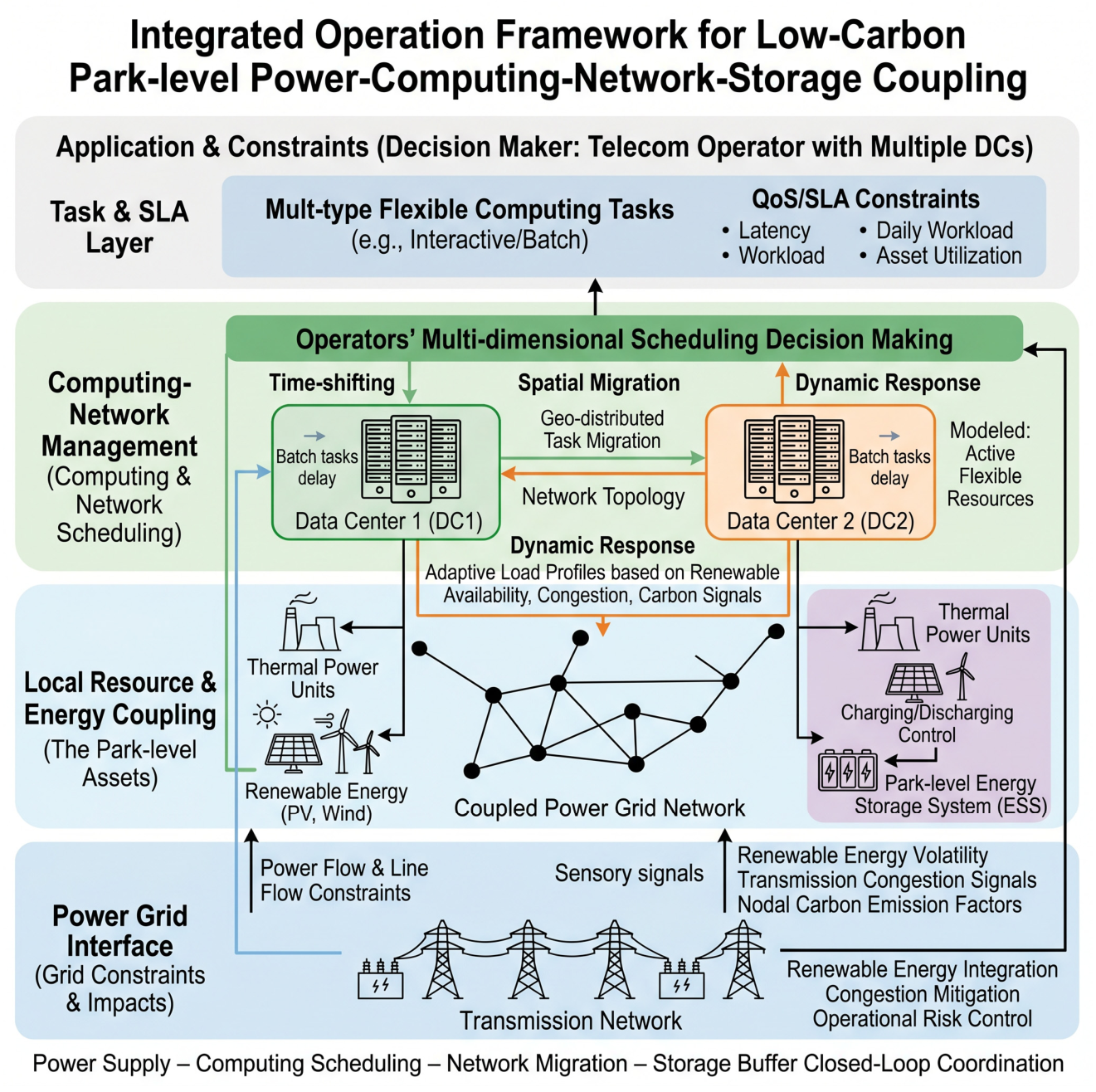
The coupled system studied in this paper takes an operator with multiple data centre assets in different locations as the decision-maker, as shown in
Figure 1. Each data centre is connected to different nodes of the power grid, and their electrical power is coupled with thermal power units, renewable energy stations and on-site energy storage via power flow; simultaneously, flexible computing tasks can be shifted in time and space between data centre nodes according to task categories, subject to quality-of-service agreements, forming a closed-loop synergy of “power supply—computing dispatch—network migration—energy storage buffering”. Within this framework, data centres are no longer regarded as isolated, inflexible loads, but are instead modelled as networked flexible resources capable of actively sensing fluctuations in renewable energy, transmission congestion and carbon emission signals. By coordinating the temporal and spatial scheduling of diverse computing tasks with the charging and discharging of on-site energy storage, operators achieve the coordinated optimisation of renewable energy integration, network congestion mitigation and operational risk control, whilst meeting constraints on latency, daily throughput and asset utilisation.
2.1. Integrated Model of Power–Computing–Networking–Storage
This chapter establishes an optimisation model based on a framework for the coupled operation of power generation, computing, grid and energy storage. Unlike traditional approaches that treat data centres as fixed loads, this paper integrates flexible computing tasks, PUE, campus energy storage and grid power flows into a single stochastic optimisation model. The model adopts a “Stage 1 computing power planning–Stage 2 power allocation” structure: Stage 1 variables describe the task service plans determined by the operator on a day-ahead basis, whilst Stage 2 variables describe the thermal power output, renewable energy utilisation, power flow, energy storage and safety feasibility compensation under various wind–solar–load scenarios.
2.2. Dispatcher Sets, Random Structures, and Coupled Interfaces
Before presenting the mathematical formulation, the units and dimensions of the main variables are clarified. In this paper, MWIT denotes the IT-side service power of computing tasks, namely the power consumed by servers and IT equipment before considering cooling systems and auxiliary infrastructure overheads. Accordingly, MWIT·h represents the time-integrated service volume of IT workload, analogous to MWh on the electrical energy side; for example, 1 MWIT·h means that 1 MWIT of IT load is continuously served for 1 h. Unless otherwise stated, electrical power variables, including thermal generation, renewable energy utilisation, branch power flow, data-centre electrical power and storage charging/discharging power, are measured in MW. Energy-related variables, including renewable energy curtailment, storage state of charge and CVaR-related loss variables, are measured in MWh. Network latency is measured in ms, whilst PUE, green affinity, scenario probabilities, task completion ratios and CVaR confidence levels are dimensionless.
Let the set of scheduling time slots be
, the set of grid nodes be
, the set of branches be
, the set of thermal power units be
, the set of renewable energy sources be
, the set of data centres be
, the set of flexible tasks be
, and the set of uncertainty scenarios be
. The set of scenario probabilities is denoted by
, satisfying
. In this paper, the day-ahead task allocation
for data centres is formulated as a scenario-independent single-stage decision, whilst
,
,
,
,
,
and
are formulated as scenario-dependent two-stage back-up decisions.
Equation (1) reflects the basic logic of two-stage stochastic scheduling: computing capacity plans are determined in advance and remain consistent across all scenarios, whilst power system operational variables are updated based on different wind, solar, and load scenarios. This structure aligns with the engineering realities of data centre operators, where computing service plans are subject to advance commitments, whilst power generation, power flow, and energy storage operations can be dynamically adjusted in response to fluctuations in renewable energy output and load.
Equation (2) represents the core coupling interface between computing tasks and data centre power consumption, where is the fixed real-time IT load, is the time-varying energy efficiency, and is the service power of Class flexible tasks in data centre . Equation (3) maps the data centre’s power to its grid node , thereby enabling the task scheduling results to directly influence the node’s power balance and line power flow.
In Equations (1)–(3), computing-task service power is measured in MWIT, whilst data-centre electrical power after considering PUE is measured in MW. PUE and the node–data-centre mapping parameter are dimensionless. This distinction clarifies the conversion from IT-side workload to grid-side electrical load.
2.3. DC Power Flow in Power Grids, New Energy Utilisation, and Safety and Feasibility Constraints
On the grid side, DC power flow approximations are used to model active power balance and line transmission constraints. For each scenario
, time period
and node
, the power injected into the node consists of power from thermal power plants, renewable energy sources, energy storage discharge and emergency supply, whilst the load at the node consists of base load, data centre power consumption, energy storage charging and emergency absorption.
Equation (4) represents the node power balance constraint, where
denotes the elements of the node admittance matrix; Equation (5) represents the branch DC power flow and line capacity constraints; Equation (6) fixes the phase angle at the reference node. Through these constraints, computational power migration not only alters the data centre’s total electricity consumption but also changes the load distribution across different nodes, thereby affecting line congestion and the capacity to integrate renewable energy.
Equations (7) and (8) represent the upper and lower limits of thermal power unit output and the ramping constraint, respectively, ensuring that conventional power sources operate within their capacity and regulation speed limits. Equation (9) ensures that the actual power utilised from renewable sources does not exceed the available power for the scenario. Equation (10) defines the total curtailment volume
under Scenario
; this variable is used both in the expected curtailment penalty and as the stochastic loss in the CVaR risk measure.
Equation (11) defines the boundary for the safety feasibility layer. and represent emergency supply and emergency absorption under extreme conditions, respectively, and are assigned penalty terms that are significantly higher than the costs of normal operation. This layer is used solely to prevent the linear programming problem from becoming numerically infeasible under extreme scenarios; in the results of the case study, both types of variables are 0, indicating that the normal physical resources are already sufficient to satisfy the balancing constraints.
2.4. Multi-Type Computing Tasks and SLA Constraints
This paper classifies data centre workloads into fixed real-time tasks and three categories of flexible tasks. Fixed real-time tasks include basic platform services, storage access and non-migratable services, and their workload curve
is excluded from the optimisation process. Flexible tasks include high-concurrency online inference, long-duration AI training and opportunistic elastic tasks. As these three categories of tasks differ in terms of hourly service windows, daily throughput, network latency and continuity requirements, separate SLA constraints must be established for each.
Equation (12) defines the time-shift deviation of the kth task class relative to the original arrival curve
, where
and
denote the upward and downward adjustments to the service volume, respectively. Equation (13) defines the hourly SLA service window, preventing the optimiser from over-concentrating tasks into a few time slots. Equation (14) sets the daily completion constraints: the completion rate for online inference and AI training is set at 100%, whilst opportunistic elastic tasks are permitted to be completed within the range of 95–110%, reflecting their high degree of elasticity.
Equation (15) represents the weighted average network latency constraint, where
denotes the service latency of data centre
and
denotes the upper limit on the latency of task
. Equation (16) represents the AI training continuity constraint, which prevents abrupt changes in training tasks between adjacent time slots. Equation (17) defines the migration smoothing variable
, which is used to penalise unnecessary rapid migrations in the objective function, thereby ensuring that the scheduling results are more consistent with the engineering execution logic of the data centre’s business scheduling platform.
Equation (18) represents the data centre IT capacity constraint, ensuring that the sum of real-time and flexible tasks does not exceed the rack and power supply capacity. Equation (19) represents the daily data centre asset utilisation share constraint, which accounts for rack leases, operators’ multi-site asset utilisation requirements and regional service commitments, thereby preventing the optimiser from leaving other strategic site assets completely idle simply because a particular site has a higher short-term green affinity.
2.5. Energy Storage Model for the Industrial Park
The energy storage system is located at the data centre node, enabling it to charge during periods of surplus renewable energy and low electricity prices, and to discharge during peak demand, grid congestion or periods of concentrated data centre workloads. Together, energy storage and flexible computing capacity form a buffer for renewable energy integration, though their mechanisms differ: energy storage transfers electrical energy, whilst flexible computing capacity transfers computing services.
Equation (20) represents the dynamic equation for energy storage; and denote the charging and discharging efficiencies, respectively. Equations (21) and (22) represent the constraints on charging and discharging power limits, energy capacity limits, and the consistency of the state of charge between the start and end of the day, respectively. The start–end consistency constraint prevents the optimiser from achieving spurious economic gains by depleting the energy storage, thereby ensuring that results are comparable across different scenarios.
2.6. Graph-Attention-Inspired Green Affinity Prior
To ensure the interpretability of computing power migration decisions, this paper constructs a graph-attention-inspired green affinity prior. Rather than relying on black-box training, this prior explicitly maps grid topology distance, renewable energy availability, PUE advantages and energy storage regulation capacity to the green value of a data centre in hosting flexible computing power.
Equation (23) defines the electrical affinity between data centre
and renewable energy node
, where
is the shortest path distance based on the network topology and
is the distance attenuation coefficient. Equation (24) defines the relative availability
of renewable energy, representing the expected available output level of renewable energy node
during time slot
.
Equations (25) and (26) draw on the concept of softmax weights from graph attention to derive the green attention weight of data centre towards renewable energy node . Equation (27) combines renewable energy attention, PUE advantage and energy storage flexibility to obtain the spatial green affinity ; Equation (28) derives the system-level temporal green signal . Here, addresses the question of “where to compute”, whilst addresses “when to compute”. This prior appears in the objective function as a reward term, and the higher the task flexibility, the greater the reward weight.
It should be noted that the proposed green affinity prior differs from recent graph-based multi-factor optimisation methods in both purpose and coupling mechanism. Methods such as ParallelGraphNet mainly use graph learning to optimise multi-sensor selection for equipment fault diagnosis [
30], whilst adaptive graph partitioning methods focus on improving clustering performance for heterogeneous-density datasets [
31]. In contrast, the graph-attention-inspired prior in this paper is not designed for sensor selection, feature fusion or data clustering. Its role is to construct an interpretable migration signal for geographically dispersed data centres under coupled power–network constraints. Specifically, electrical distance, renewable energy availability, data-centre PUE and energy-storage regulation capacity are mapped into attention-like affinity weights, which then guide flexible computing tasks towards nodes and time periods with higher green-computing value. Therefore, the novelty of this prior lies not in replacing existing graph neural network or graph partitioning algorithms, but in embedding physically meaningful graph-based affinity mapping into a power–computing–network–storage optimisation model, where the final migration decision is jointly constrained by power flow, branch capacity, task SLAs and storage operation.
2.7. Uncertainty Scenarios and CVaR Risk Measurement
This paper employs a 3 × 3 wind–solar–load combination scenario tree to describe uncertainty. Renewable energy levels are categorised into low, normal and high, whilst load levels are also categorised into low, normal and high; time-dependent disturbances are then superimposed to generate nine typical scenarios. Expected operating costs are calculated based on the probability of actual scenarios, whilst the risk component focuses on tail risk scenarios involving curtailment losses.
Equation (29) defines the CVaR of random curtailment losses, where denotes the VaR auxiliary variable and denotes the tail loss exceeding in scenario . Equations (30) and (31) provide linear upper-bound expressions for CVaR, which can be directly incorporated into a linear programming model. Unlike simply minimising expected curtailment, the CVaR term mitigates tail-end curtailment under conditions of high renewable energy generation and high congestion, thereby enhancing the risk robustness of the dispatch plan.
In Equations (29)–(31), the scenario-wise curtailment loss, the VaR auxiliary variable and the excess-loss auxiliary variable are measured in MWh, whilst the CVaR confidence level and scenario probabilities are dimensionless. Therefore, the resulting CVaR curtailment risk is measured in MWh.
2.8. Computational Implementation and Software
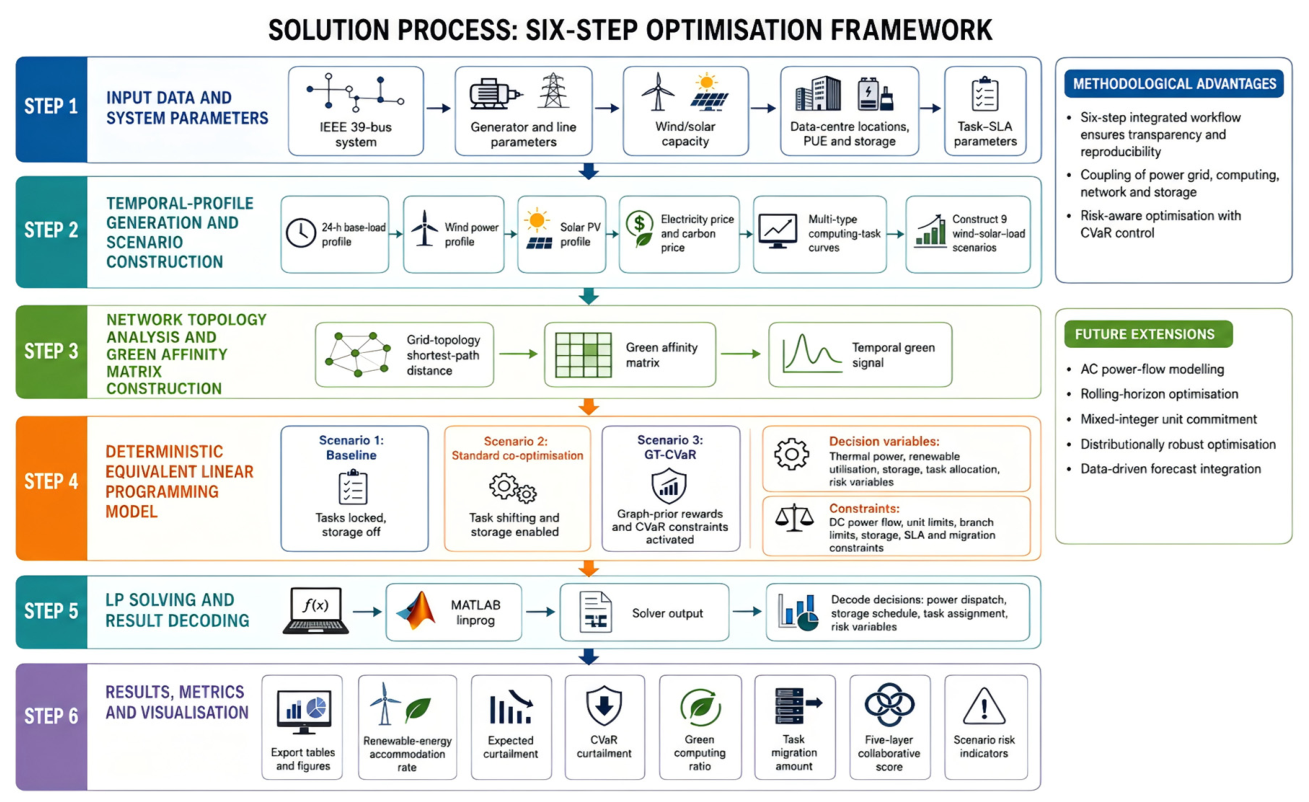
This study is a computational modelling and optimisation study; therefore, no laboratory instruments or chemical reagents were used. All numerical simulations, scenario generation, linear programming optimisation, data processing and visualisation were implemented in MATLAB R2025a with the Optimization Toolbox R2025a (The MathWorks, Inc., Natick, MA, USA). The deterministic equivalent linear programming models were solved using the linprog function in the MATLAB Optimization Toolbox. The MATLAB and Optimization Toolbox product information is available at
https://www.mathworks.com/products/matlab.html and
https://www.mathworks.com/products/optimization.html, respectively; both websites were accessed on 17 January 2026. The custom MATLAB scripts used in this study are available from the corresponding author upon reasonable request.
4. Results
4.1. Test System and Input Data
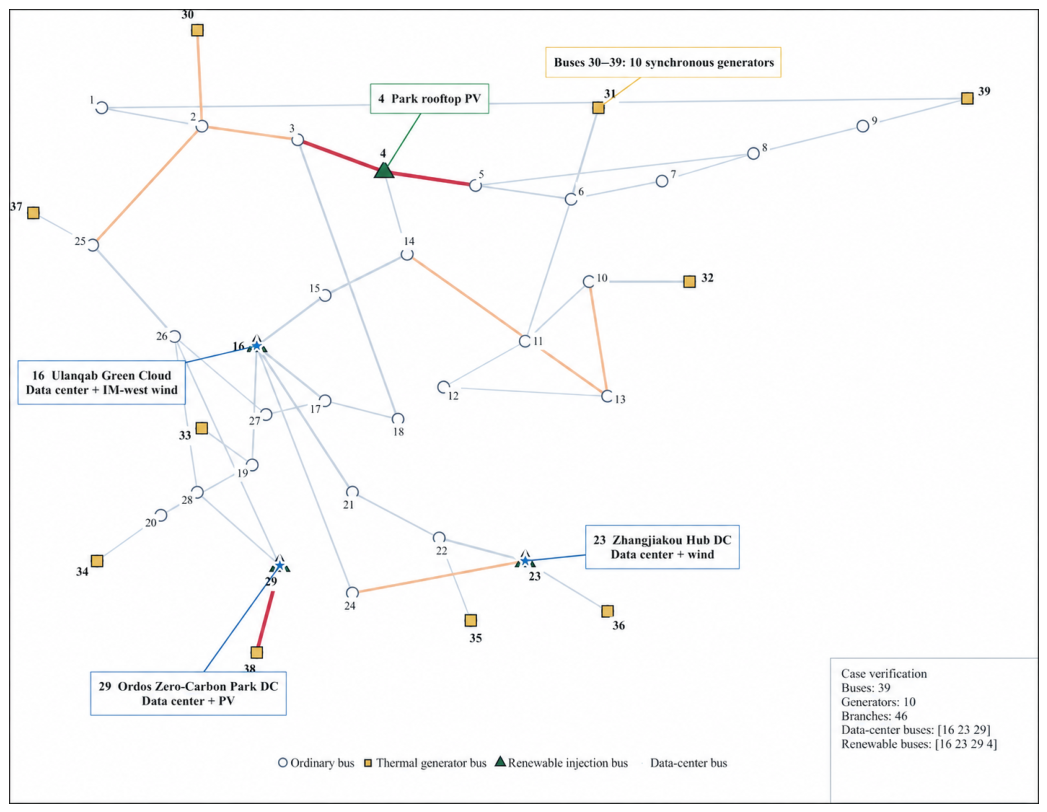
To validate the proposed graph-attention-based green affinity and CVaR method for the coordinated optimisation of power–computing–network–storage dispatch in remote data centres, this paper employs the IEEE 10-generator, 39-node system to construct a case study of coordinated power-computing dispatch in a low-carbon industrial park in northern China. The system comprises 39 grid nodes, 46 transmission feeder lines and 10 thermal power units, with the thermal power units connected at nodes 30–39. To depict a scenario of coordinated development between wind and solar-rich areas in Northern China and computing infrastructure, this paper establishes four renewable energy feed-in points and three remote data centre assets. Specifically, the renewable energy connection nodes are 4, 16, 23 and 29, corresponding respectively to rooftop PV in the industrial park, wind power in Western Inner Mongolia, wind power in Zhangjiakou and PV in Ordos; the data centres are connected to nodes 16, 23 and 29, corresponding to the Ulanqab Green Cloud Base, the Zhangjiakou Computing Hub and the Ordos Zero-Carbon Industrial Park Data Centre.
Figure 3 shows the results of the topological verification for the IEEE 10-machine, 39-node system. In the figure, conventional busbars, thermal power plant nodes, renewable energy nodes and data centre nodes are distinguished by different identifiers, clearly demonstrating that the case study in this paper is indeed based on the IEEE 39-node system rather than a simplified equivalent network. The line width and colour in the figure reflect the expected maximum load factor of the branch under the GT-CVaR scenario; thicker or darker lines indicate that the branch is closer to the capacity limit during certain time periods. As can be seen from the figure, data centre nodes 16, 23 and 29 are all located near renewable energy integration zones; however, their electrical distances from renewable energy nodes, the carrying capacity of the surrounding network, and branch congestion conditions are not entirely identical. Consequently, even though all three data centres are situated within the Northern Green Computing scenario, their marginal value in undertaking flexible computing tasks still varies. This provides a physical basis for the subsequent introduction of graph-aware green affinity priors.
The simulation has a 24 h scheduling cycle and a 1 h time resolution. The base load is derived from the original IEEE 39-node load scaled by a factor of 0.68, superimposed with a typical daily load curve for northern China during winter and spring. Wind power output is higher in the evening and at night, whilst solar power output is concentrated at midday, reflecting the characteristic of wind–solar complementary power generation in northern China with pronounced temporal fluctuations. Data centre load consists of fixed real-time tasks and three types of flexible tasks: fixed real-time tasks are not included in the optimisation; high-concurrency online inference, long-duration AI training and opportunistic elastic tasks may be time-shifted and migrated across nodes subject to SLA, latency, capacity and migration smoothing constraints. As defined in
Section 2.2, MWIT denotes the IT-side service power of computing tasks, namely the power consumed by servers and IT equipment before considering cooling systems and auxiliary infrastructure overheads. MWIT·h represents the time-integrated service volume of IT workload, analogous to MWh on the electrical energy side. Specifically, 1 MWIT·h means that 1 MWIT of IT load is continuously served for 1 h. The nominal daily task volumes for online inference, AI training and opportunistic elastic tasks are 7440, 10,080 and 4560 MWIT·h, respectively.
The PUE settings for the data centres reflect the advantages of natural cooling in northern China. The Ulanqab Green Cloud Base benefits from proximity to wind power and a low PUE; the Zhangjiakou Computing Hub combines wind power resources with network gateway capabilities; whilst the Ordos Zero-Carbon Park data centre offers synergies between photovoltaic power and energy storage. Key economic parameters include: a carbon price of 95 CNY/tCO2, a curtailment penalty of 580 CNY/MWh, a lost-load penalty of 150,000 CNY/MWh, an energy-storage cycling cost of 28 CNY/MWh, a green-affinity reward of 48 CNY/(MWIT·h), a time-of-use green-signal incentive of 58 CNY/(MWIT·h), a demand-response incentive of 34 CNY/(MWIT·h), a CVaR risk weight of 1350 CNY/MWh, and a CVaR confidence level of 0.85. All the above parameters are embedded within a single MATLAB script, ensuring the reproducibility of the simulation results.
To account for the uncertainty in renewable energy and load, this paper constructs 3 × 3 wind–solar–load combination scenarios, comprising a total of nine typical scenarios. Renewable energy levels are categorised into low, normal and high, whilst load levels are also categorised into low, normal and high. Each scenario employs not only proportional disturbances but also superimposes time-dependent disturbances to prevent all scenarios from being represented merely as simple multiplicative relationships.
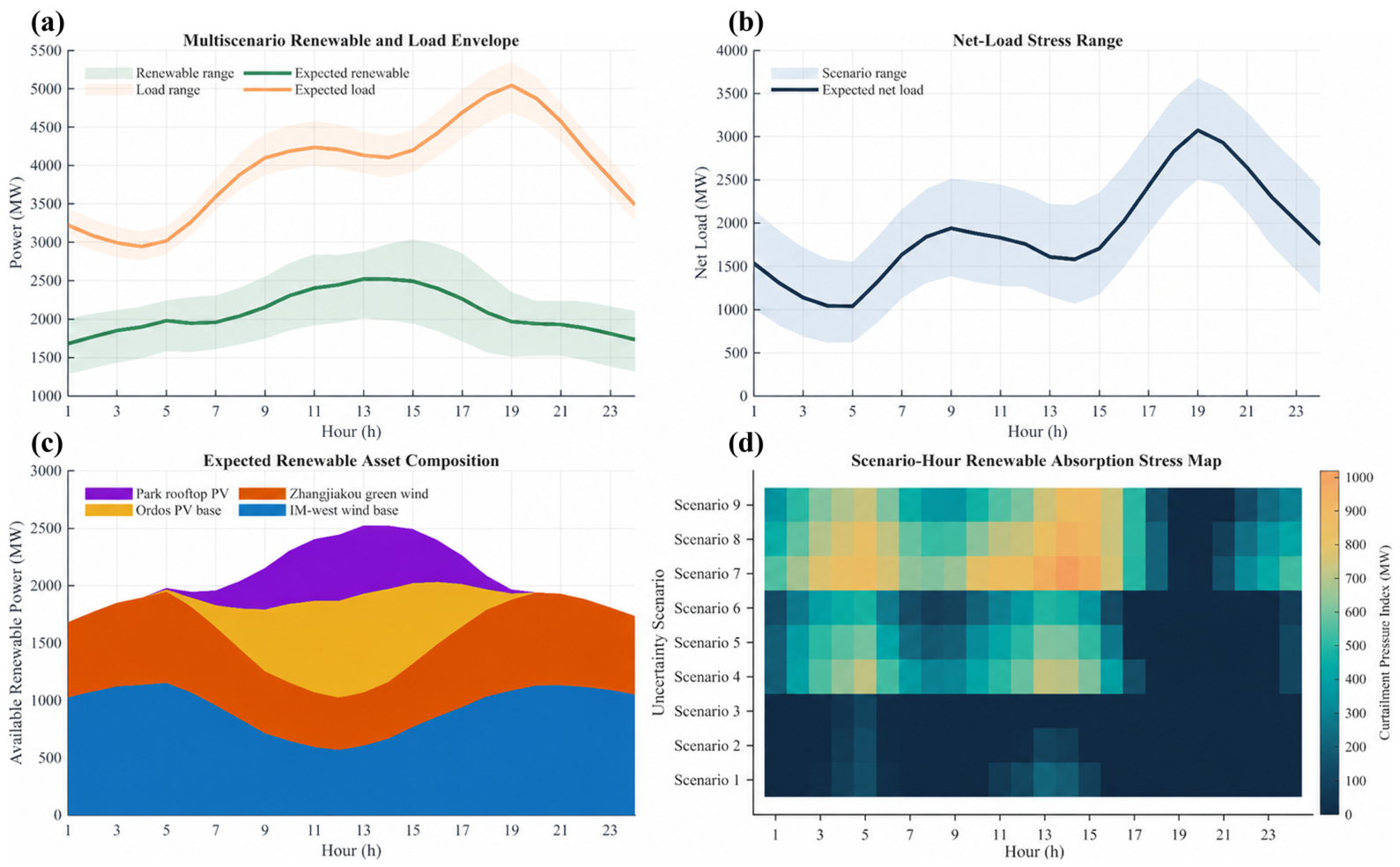
Figure 4 illustrates the temporal distribution of renewable energy, load and net load across multiple scenarios. The renewable energy and load envelopes in the figure reflect the range of uncertainty, whilst the net load pressure range is used to identify periods with high system regulation requirements; the composition of renewable energy output demonstrates the complementary relationship between wind and solar power within a single day. It can be observed that during certain periods in the early morning and midday, the system experiences relatively abundant renewable energy output coupled with low native load. If data centres maintain a fixed electricity consumption curve, this situation is likely to result in curtailed wind and solar power; conversely, if flexible computing capacity can be shifted to these time periods and nodes, the renewable energy that would otherwise be difficult to absorb can be converted into green computing services.
This paper sets out three types of comparative scenarios:
BASE_FIXED: Fixed base load scenario. Flexible tasks within the data centre are allocated according to a static ratio; cross-node migration and significant time-shifting are not permitted, and the campus energy storage system is switched off. This scenario is used to characterise the level of renewable energy integration and the operational pressure on the grid when a traditional data centre acts as a passive load.
EC_STANDARD: Standard electricity-computing synergy scenario. This scenario allows for temporal shifting, spatial relocation and energy storage response within the park for flexible computing tasks, but does not incorporate graph-based green affinity rewards or CVaR tail risk terms. It is used to assess the fundamental role of general electricity-computing synergy mechanisms in improving the integration of renewable energy.
EC_GT_CVAR: Graph-based attention–CVaR risk-aware electricity-computing coordination scenario. Building upon the standard coordination framework, this scenario further incorporates a graph-aware green affinity prior, temporal green signals, and a curtailment CVaR risk term. This scenario is used to validate the incremental value of the proposed method in terms of green computing power matching quality, tail risk control, and overall coordination performance.
It should be noted that the hierarchical scenario design adopted in this paper is intended to separate the effects of general flexibility mechanisms from those of the proposed graph-aware and risk-aware optimisation components. BASE_FIXED represents a conventional non-adaptive operating mode in which data-centre workloads remain fixed and no active energy-aware coordination is performed. EC_STANDARD is conceptually closer to adaptive energy-aware coordination approaches reported in the literature, such as in Zhou et al.’s work [
29], as it already enables workload migration, temporal load shifting and storage-assisted coordination. Therefore, the performance improvement from BASE_FIXED to EC_STANDARD mainly reflects the value of general flexibility-enabled coordination. In contrast, the additional improvement from EC_STANDARD to EC_GT_CVAR isolates the incremental contribution of the graph-attention-inspired green-affinity prior and the CVaR-based risk-control mechanism. This scenario hierarchy allows the benefits of flexibility, topology awareness and tail risk management to be evaluated separately.
4.2. Comparison of Overall Operational Performance
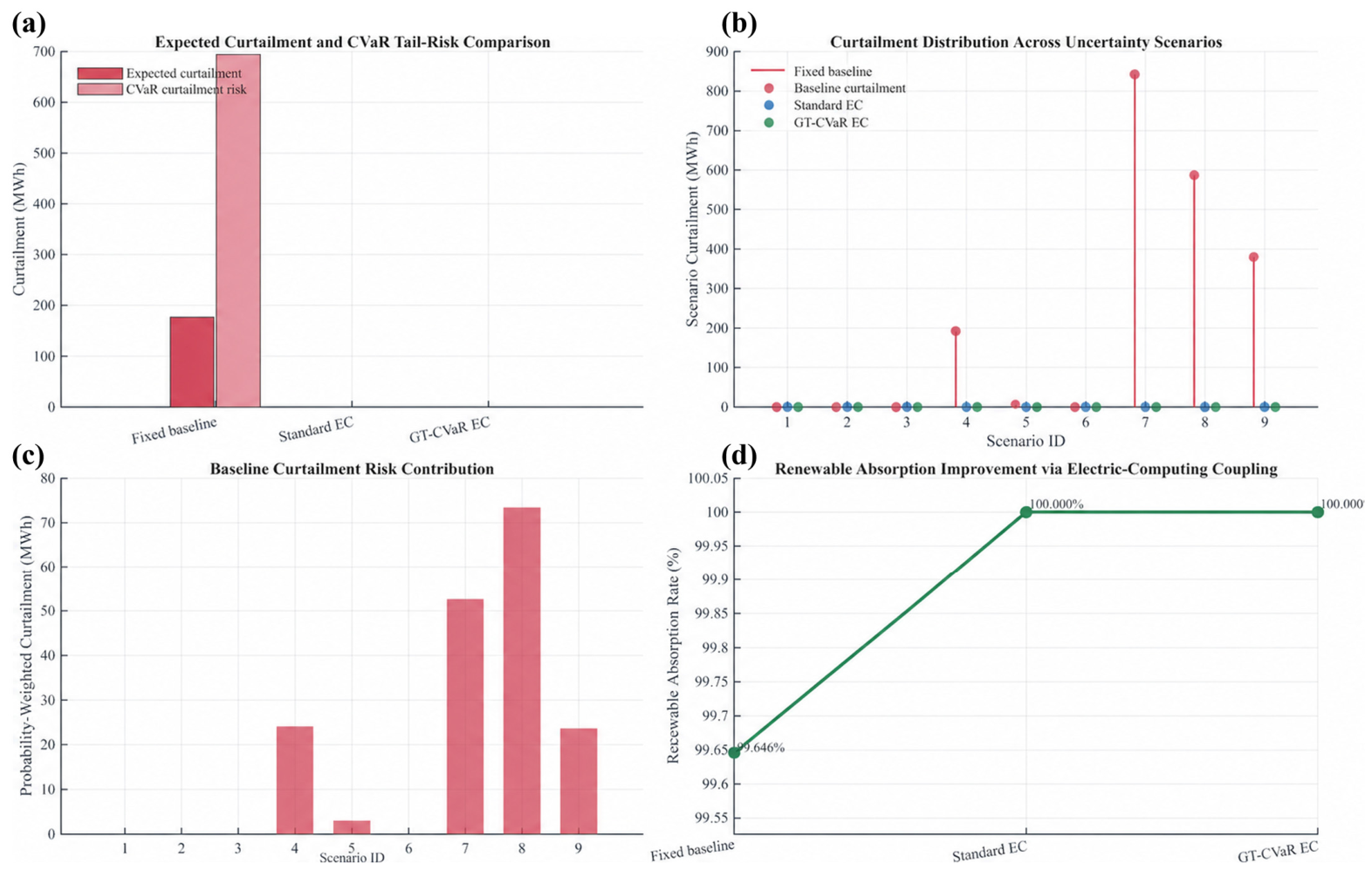
Table 4 presents the key operational indicators for the three scenarios. In the fixed-load baseline scenario, the expected curtailment volume is 176.939 MWh, the CVaR curtailment risk is 694.085 MWh, and the renewable energy absorption rate is 99.646%. This indicates that when data centres do not participate in coordinated dispatching, although the system’s overall renewable energy absorption rate is already high, significant curtailment still occurs due to the combined effects of high renewable energy output, low load and local transmission constraints. After applying time-shifting, spatial relocation and energy storage response to the standard power-computing coordination task, the expected curtailment is reduced to 0 MWh and the renewable energy absorption rate is increased to 100%. The GT-CVaR scenario similarly achieves both zero expected curtailment and zero CVaR risk, indicating that the coordination of flexible computing power and energy storage can effectively absorb surplus renewable energy in tail-end scenarios.
In terms of low-carbon benefits, the expected carbon emissions under the GT-CVaR scenario are 60.962 ktCO2, representing a reduction of approximately 1.129% compared to the fixed-load baseline. This reduction should not be overstated, as thermal power still provides base load supply and supports grid security in the IEEE 39-node system; the flexible scheduling of data centres primarily alters the spatio-temporal distribution of load and the locations where renewable energy is absorbed, rather than completely replacing thermal power. Nevertheless, this result still indicates that power-computing synergy can reduce the demand for fossil fuel generation to some extent whilst ensuring the completion of computing tasks.
In terms of the proportion of green computing power, the baseline scenario stands at 61.696%, the standard electricity-computing coordination scenario increases this to 67.830%, and the GT-CVaR scenario further increases it to 70.978%. Compared with the baseline scenario, the proportion of green computing power in the GT-CVaR scenario increases by 9.283 percentage points; compared with the standard coordination scenario, it increases by 3.148 percentage points. This indicates that once the expected curtailment has been eliminated by standard coordination, the primary role of the proposed graph prior and CVaR risk terms is no longer to further reduce the volume of curtailment, but rather to improve the quality of green computing power allocation—specifically, determining where tasks are assigned, when they are completed, and at what level of risk exposure.
More specifically, EC_STANDARD can be regarded as a conventional multi-factor optimisation method, in which workload migration decisions are jointly influenced by renewable energy availability, energy-storage flexibility, PUE performance and task–SLA constraints. Whilst this mechanism is sufficient to eliminate average curtailment in the studied system, it does not explicitly distinguish whether a renewable-rich node is also favourable from the perspective of grid topology. By contrast, the graph-attention-inspired green-affinity prior in EC_GT_CVAR introduces electrical-distance awareness into the migration signal, thereby improving the spatial matching between renewable energy supply and computing demand. In addition, the CVaR term explicitly accounts for high-curtailment tail scenarios caused by the combined effects of renewable-output uncertainty and network congestion. Therefore, the incremental gain from EC_STANDARD to EC_GT_CVAR lies not in further increasing the average renewable energy absorption rate, but in achieving higher-quality green matching and more robust tail risk control.
Figure 5 illustrates the differences between the three scenarios from four perspectives: expected curtailment, CVaR tail risk, distribution of curtailment across scenarios, and renewable energy absorption rate. The top-left sub-figure shows that the fixed-load baseline scenario exhibits both average and tail curtailment risks, whereas both types of coordination scenarios reduce these to zero. The top-right sub-figure further demonstrates that curtailment in the baseline scenario is not evenly distributed across all scenarios, but is concentrated in certain scenarios with high renewable energy penetration. The lower-left sub-figure presents the probability-weighted contribution to curtailment, revealing that tail-end scenarios contribute significantly to system risk. The lower-right sub-figure indicates that although the power-calculation synergy only increases the renewable energy absorption rate from 99.646% to 100%, its significance lies in eliminating exposure to curtailment in local extreme scenarios, rather than simply pursuing a modest increase in the average absorption rate.
Figure 5 further verifies that renewable energy curtailment in the fixed-load benchmark is not mainly an average-condition problem, but is concentrated in several tail scenarios with high renewable generation and relatively weak local absorption capability. After flexible computing tasks and park-level energy storage are introduced, both the expected curtailment and the CVaR curtailment risk are eliminated, indicating that the proposed coordination mechanism can reshape demand in response to renewable energy surplus. The comparison also shows that the improvement in the renewable energy absorption rate is numerically small but operationally important, because it removes high-impact curtailment events under stressed scenarios. Therefore, the CVaR-based indicator provides additional information beyond the expected curtailment value and helps evaluate the robustness of the dispatch strategy.
4.3. Scenario Risks and Mechanisms for Integrating Renewable Energy
Table 5 presents the scenario-wise curtailment volume and renewable energy absorption rate under the fixed-load benchmark scenario. In the fixed-load reference scenario, curtailment is primarily concentrated in the normal low-load scenario and the high-renewable-energy scenario. For example, power curtailment in the REN2_LOAD1 scenario was 192.627 MWh, whilst in the REN3_LOAD1 scenario it reached 842.844 MWh; in the REN3_LOAD2 and REN3_LOAD3 scenarios, power curtailment was 587.829 MWh and 379.554 MWh respectively. These results indicate that the curtailment issue is not caused by an insufficient average share of renewable energy in the system, but rather by a tail event triggered by a combination of high renewable energy output, low load demand and local transmission bottlenecks.
As shown in
Table 5, renewable energy curtailment in the fixed-load benchmark scenario is concentrated in a limited number of high-renewable-energy and low-load scenarios. In particular, REN3_LOAD1, REN3_LOAD2, and REN3_LOAD3 contribute most of the curtailment risk, indicating that renewable energy curtailment is primarily a tail-event problem rather than an average-operating-condition issue. This observation provides the motivation for introducing risk-aware coordination and CVaR-based optimisation in the proposed framework. The overall curtailment reduction and CVaR risk-control performance of the coordinated dispatch strategies are reported in
Table 4 and
Figure 5.
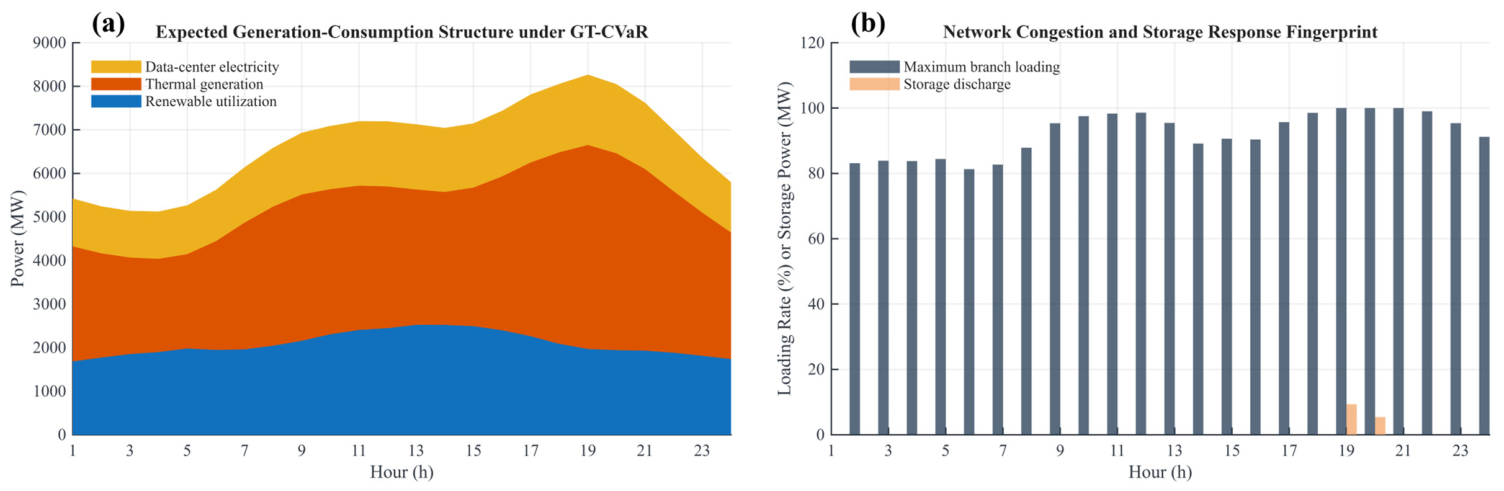
Figure 6 illustrates the expected generation and consumption structure, as well as the characteristics of grid congestion and energy storage response, under the GT-CVaR scenario. The left-hand panel shows the superimposed time-series relationship between data centre electricity consumption, thermal power output and renewable energy utilisation over a 24 h period. It can be seen that, under GT-CVaR dispatch, data centre electricity consumption—as part of the system’s adjustable load—together with thermal power output and renewable energy utilisation, forms the intraday power balance structure; during the midday to the early evening period, the utilisation level of renewable energy and the total system power supply rise in tandem, indicating that flexible computing loads can absorb a portion of renewable energy output whilst meeting task SLAs and grid constraints, thereby mitigating the curtailment issues that might arise under a fixed-load model. The right-hand figure further illustrates the temporal relationship between the maximum branch load factor and energy storage discharge power. The results show that, during certain periods, the maximum branch load factor approaches the thermal limit, indicating that the simulation is not based on the assumption of a “flat grid” without network constraints, but rather achieves coordinated dispatch under conditions where transmission bottlenecks exist; energy storage discharge primarily occurs during periods of high network pressure or strong system regulation demands, serving to maintain power balance in conjunction with flexible computing loads and conventional power-generation units. Overall, in the GT-CVaR scenario, the improvement in renewable energy integration does not rely on simply increasing data centre loads, but is achieved through the coordinated adjustment of thermal power, renewable energy, data centre loads, the transmission network and energy storage responses.
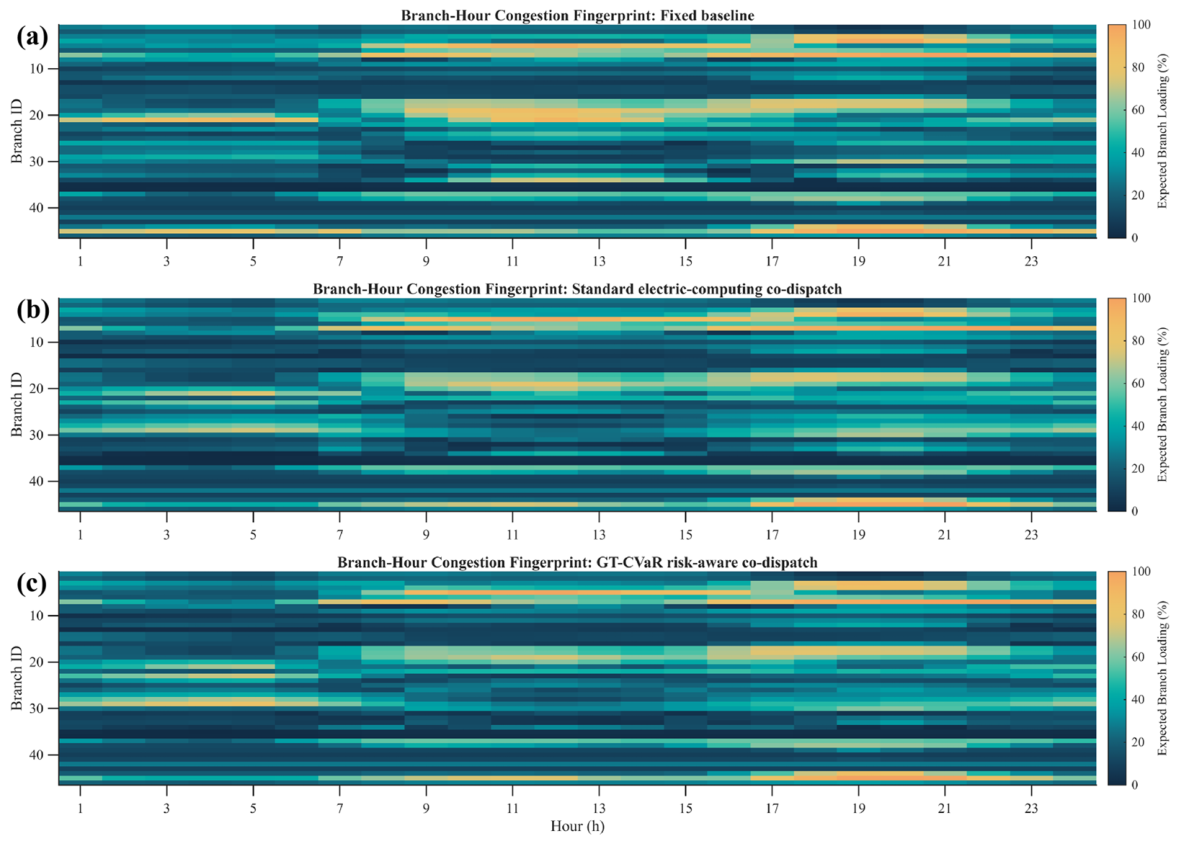
Figure 7 shows the branch-hour congestion heatmaps for the three scenarios. It can be seen that the maximum line load factor reaches 100% in all three scenarios, indicating that the case study deliberately retained network bottlenecks to test the regulation capability of the power-computing coordination under transmission constraints. If network constraints were ignored, data centre tasks might simply be relocated to the node with the highest renewable energy output; however, in the model presented in this paper, flexible computing migration must simultaneously satisfy both node power balance and feeder capacity constraints. Therefore, the enhancement of new energy consumption is not achieved in an unconstrained “copper grid”, but rather through the joint implementation of task space migration, time shifting, and energy storage response under the condition of actual transmission bottlenecks.
4.4. Computing Power Task Migration and Evidence of Green Affinity
To further illustrate the mechanism of action of the power–IT synergy,
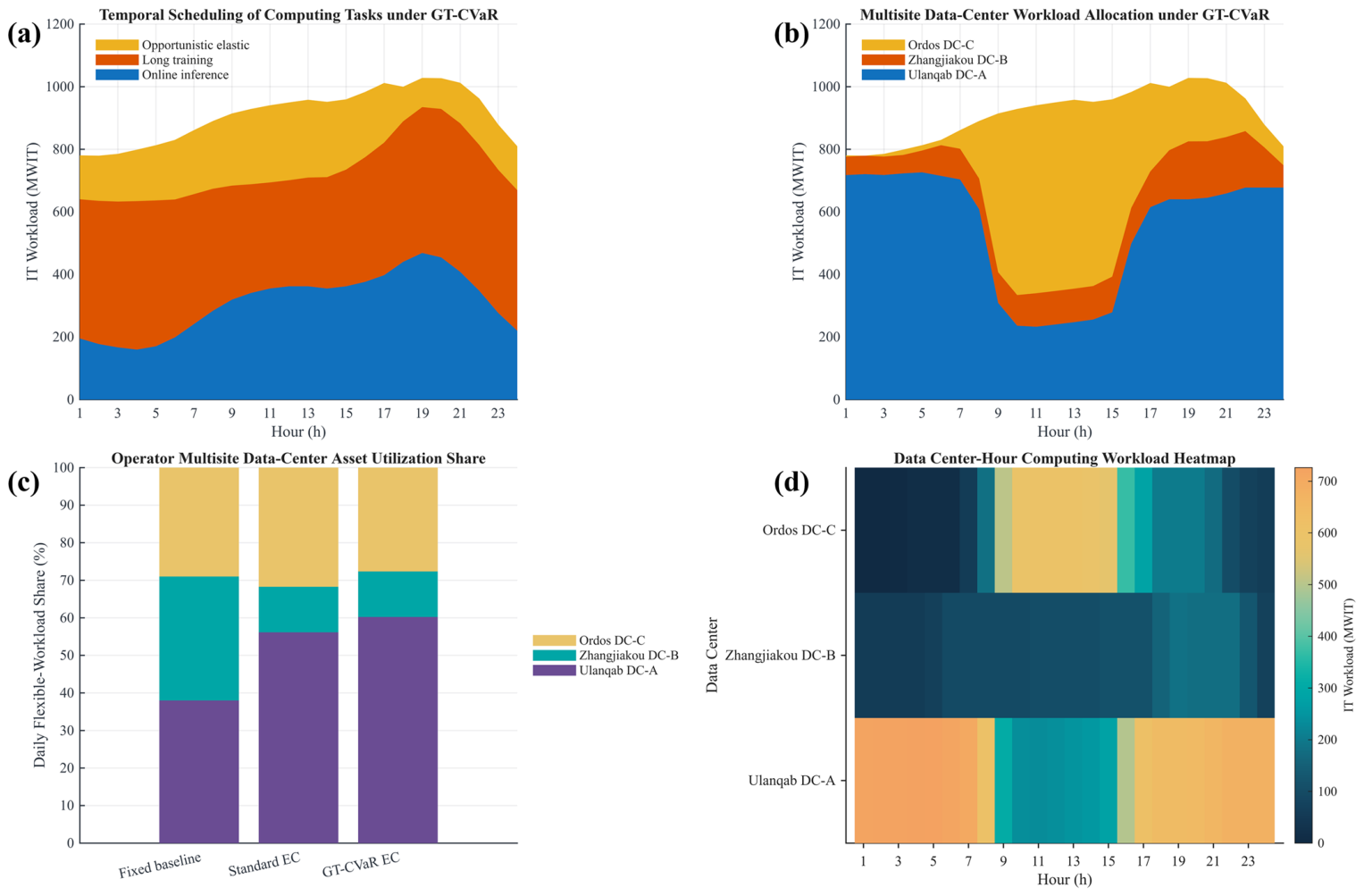
Table 6 presents the volume of flexible tasks undertaken by each data centre across three scenarios. In the baseline fixed-load scenario, the three data centres undertake tasks according to their static shares, with the flexible IT task volumes for Ulanqab, Zhangjiakou and Ordos amounting to 8390.4, 7286.4 and 6403.2 MWIT·h respectively. When task migration is enabled in the standard power-computing synergy scenario, tasks shift significantly towards Ulanqab and Ordos, with the task volume in Zhangjiakou falling to 2649.6 MWIT·h. The GT-CVaR scenario further reinforces the green prior in the figure, resulting in Ulanqab undertaking 13,161.3 MWIT·h, Zhangjiakou undertaking 2649.6 MWIT·h, and Ordos undertaking 6041.1 MWIT·h.
In terms of task categories, high-concurrency online inference and long-duration AI training tasks in all three scenarios completed their nominal daily task volumes, amounting to 7440 and 10,080 MWIT·h respectively. Opportunistic elastic tasks completed 4332 MWIT·h in the collaborative scenario, equivalent to 95% of the nominal task volume of 4560 MWIT·h, thereby satisfying the 95–110% completion ratio constraint set in the model. This result highlights the necessity of hierarchical modelling for multi-type computing tasks: online inference and AI training are core tasks that must be completed, whilst opportunistic elastic tasks can serve as a buffer to absorb surplus renewable energy during periods of excess supply.
Figure 8 illustrates the results of temporal scheduling and spatial migration for tasks with varying computational demands under the GT-CVaR scenario. The task flow diagram in the figure reflects changes in service intensity across different task types over a 24 h period, whilst the spatial migration diagram shows the redistribution of tasks amongst three geographically dispersed data centres. It can be observed that the model does not simply concentrate all tasks at a single node, but instead strikes a balance between data centre capacity, PUE, network latency, asset utilisation share and green affinity. Ulanqab, owing to its abundance of wind power and low PUE, undertakes a greater proportion of flexible tasks; Ordos, relying on the synergy between photovoltaic power and energy storage, retains a certain volume of tasks; Zhangjiakou, however, sees a relative decline in its task share due to network or green affinity constraints during certain periods. This demonstrates that the proposed method embodies the principle of “computing power following green electricity”, yet does not pursue green electricity without constraints; rather, it achieves feasible migration within the constraints of grid security and service quality.
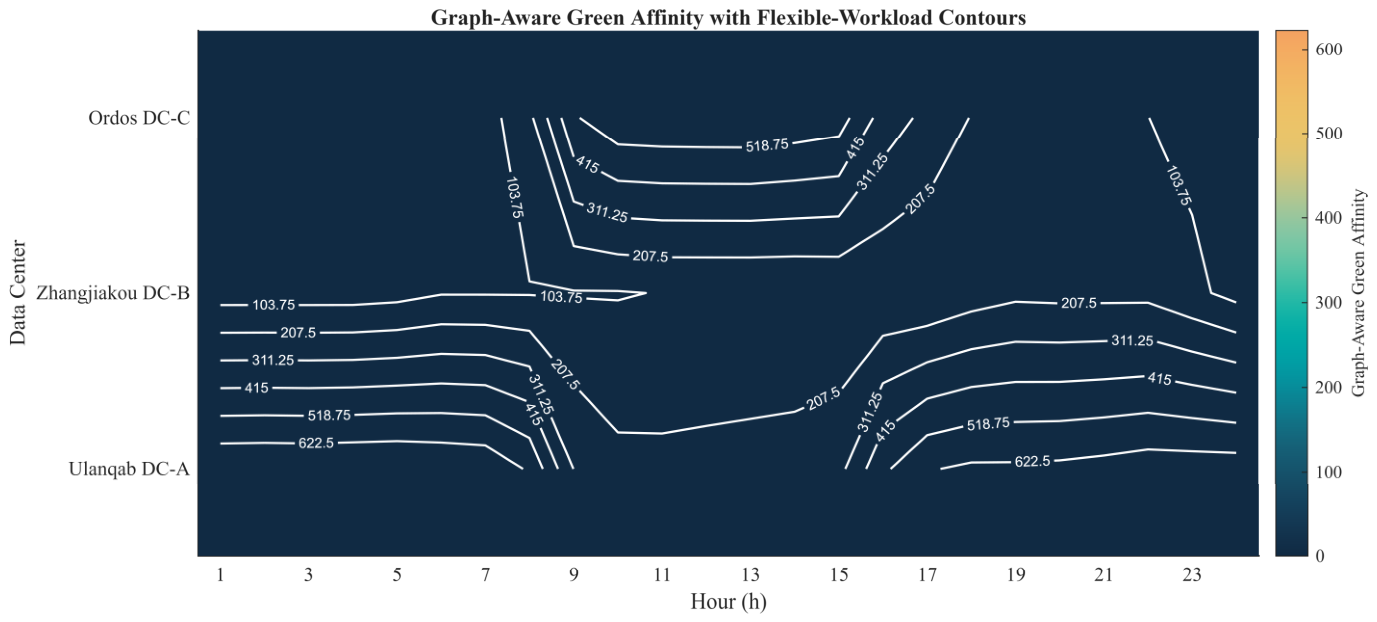
Figure 9 further illustrates the relationship between green affinity and flexible computing load. The background colour in the figure represents the perception of green affinity, whilst the contour lines or overlaid curves represent the results of flexible computing allocation. It can be observed that, under the GT-CVaR scenario, flexible tasks are more likely to be distributed across data centres and time slots with higher green affinity; the system-weighted green affinity increases from 0.619 in the baseline scenario to 0.740, whilst the standard collaborative scenario yields a value of 0.699. These results demonstrate that the graph-aware green affinity prior can transform grid topology distance, renewable energy availability, PUE advantages and energy storage regulation capacity into interpretable task migration signals, thereby improving the quality of green computing power matching.
It should be noted the task transfer volume in the GT-CVaR scenario is 2570.205 MWIT·h, which is higher than the 1631.974 MWIT·h in the standard collaborative scenario. This indicates that, following the introduction of graph priors and risk terms, the optimiser proactively increased task reallocation across data centres in exchange for a higher proportion of green computing power and a lower risk of tail-end curtailment. At the same time, the average latency proxy remains at 0.005 h, indicating that the migration has not significantly compromised the quality-of-service constraints.
4.5. Energy Storage Response, Market Signals, and Overall Benefits
Both energy storage and flexible computing capacity within the park can be used to enhance the integration of renewable energy, but their mechanisms of action differ. Energy storage absorbs surplus renewable energy by transferring electricity across time periods, whilst flexible computing capacity converts renewable electricity into computing products by adjusting task service times and locations.
Table 4 shows that in the baseline scenario, energy storage is switched off and the energy storage throughput is 0; in the standard coordination scenario, energy storage throughput is 138.731 MWh; and in the GT-CVaR scenario, energy storage throughput is 44.319 MWh. Although energy storage throughput in the GT-CVaR scenario is lower than in the standard coordination scenario, the proportion of green computing power is higher, indicating that the graph-based prior shifts part of the responsibility for absorbing renewable energy from energy storage to the flexible computing tasks themselves.
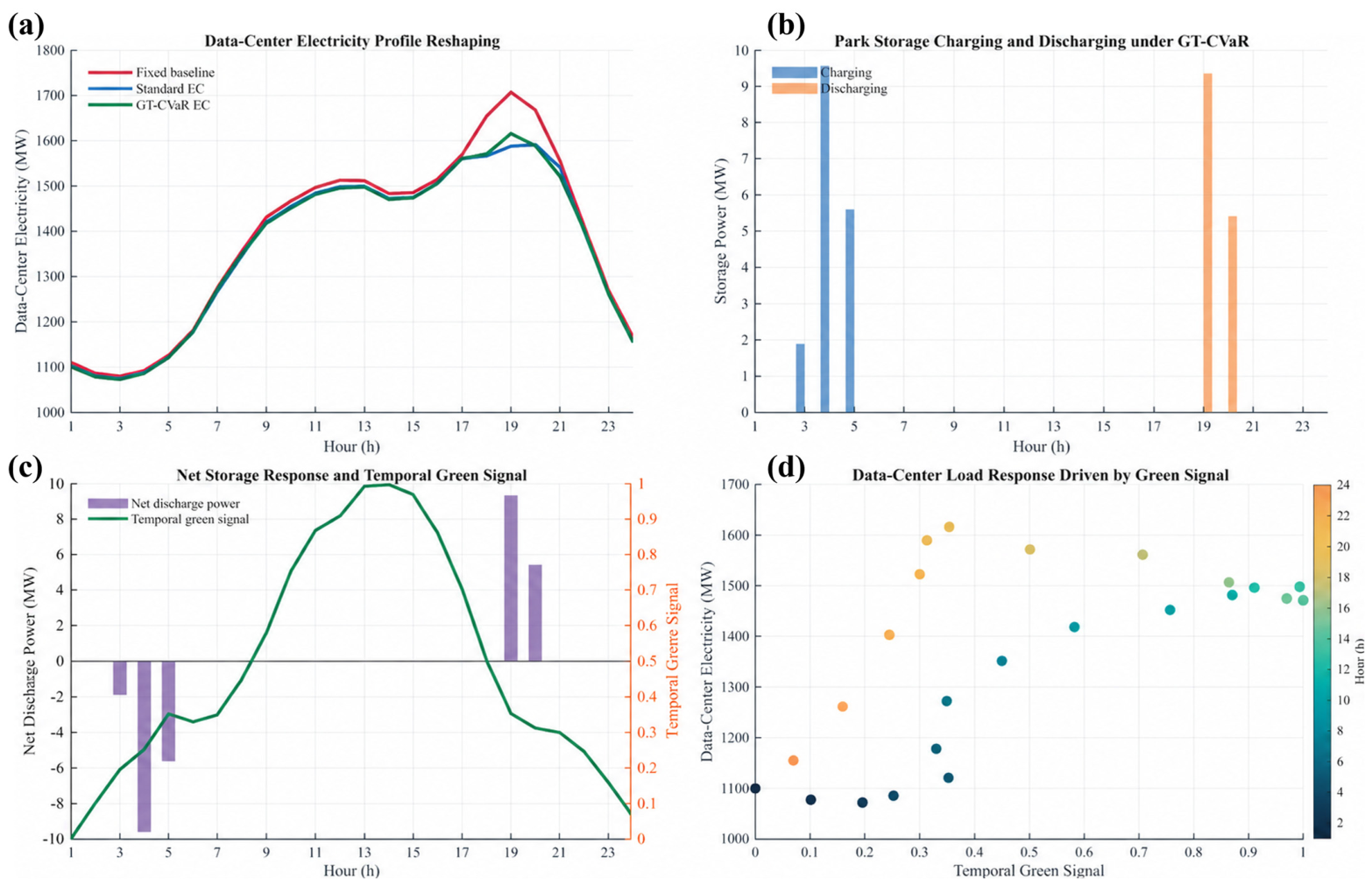
Figure 10 illustrates the response of the park’s energy storage and data centre load to the green time signal. The data centre electricity consumption curve in the figure demonstrates the load reshaping effect under different scenarios; the energy storage charge–discharge graph reflects the operational logic in the GT-CVaR scenario, where energy storage charges during periods of low electricity prices or renewable energy surplus and discharges during periods of high load or network pressure; the scatter plot shows the relationship between the green time signal and data centre electricity consumption. It can be observed that when the green time signal is strong, data centre electricity consumption is more likely to shift to earlier time slots, indicating that flexible computing capacity can respond to renewable energy surpluses and market incentives; however, this shift is constrained by SLAs, capacity and network limitations, and therefore the curve does not follow the green signal in a perfectly linear manner.
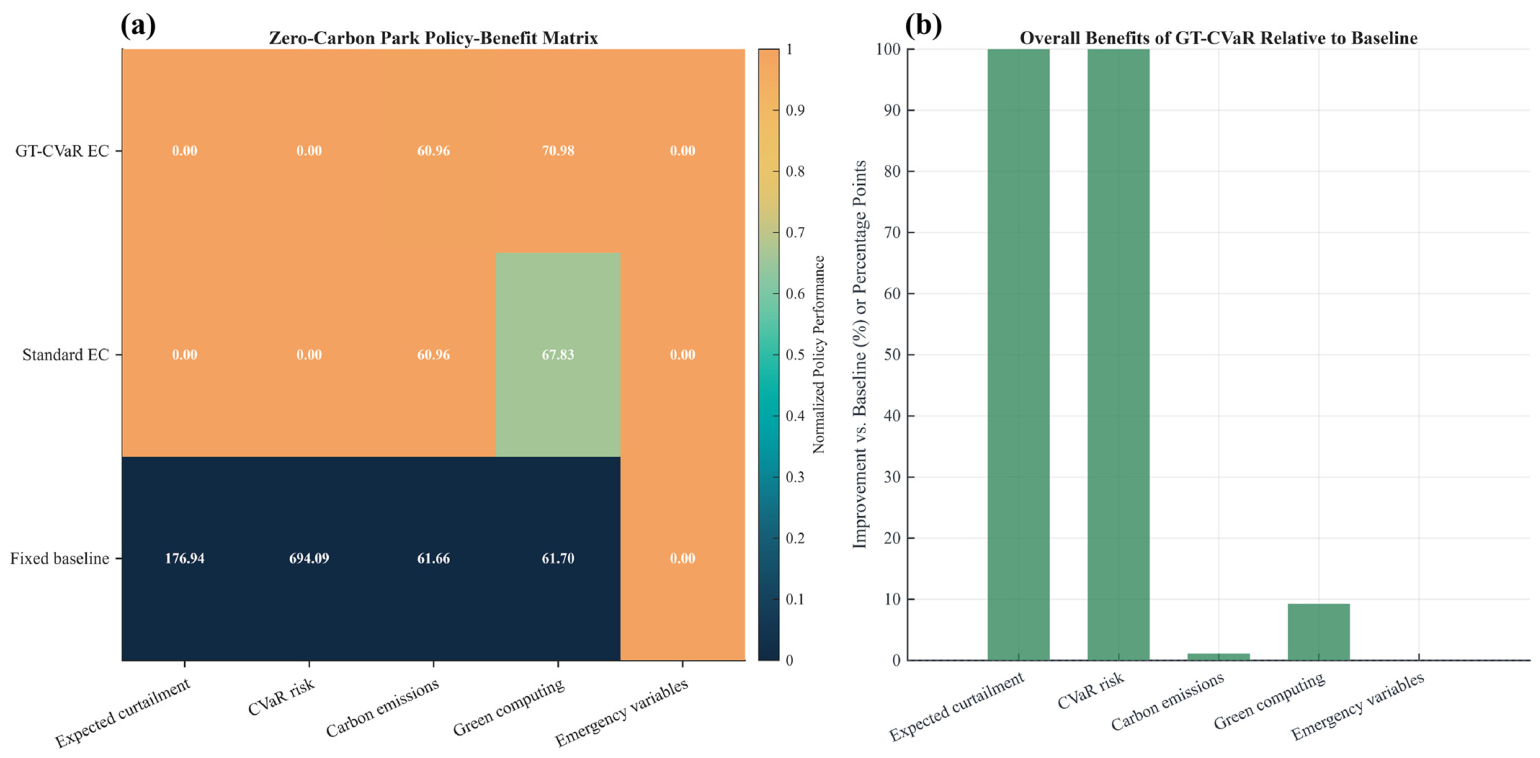
Figure 11 illustrates the policy benefit matrix for low-carbon industrial parks. This figure normalises and compares indicators such as expected curtailment, CVaR risk, carbon emissions, the proportion of green computing power, and contingency variables, to evaluate different dispatch strategies from both policy and engineering perspectives. The results of the matrix indicate that the GT-CVaR scenario performs superiorly in terms of curtailment reduction, risk control, enhancement of green computing power, and safety feasibility. Compared to the fixed-load baseline, the GT-CVaR scenario reduces both expected curtailment and CVaR curtailment risk by 100%, increases the proportion of green computing power by 9.283 percentage points, and sets both the emergency supply and emergency absorption variables to 0. This indicates that the results are not achieved through the use of virtual relaxation variables, but are realised under the constraints of actual power-generation units, renewable energy, the grid, energy storage and computing tasks.
4.6. Discussion of Key Findings
This chapter presents a computational case study on the coordinated dispatch of remote data centres within a zero-carbon industrial park in northern China, based on the IEEE 10-machine, 39-node system. The results indicate that, under scenarios of high renewable energy output and local grid constraints, fixed data centre loads still result in significant curtailment, with an expected curtailment volume of 176.939 MWh and a CVaR curtailment risk of 694.085 MWh. This demonstrates that static computing loads struggle to actively match the fluctuations of wind and solar power and the grid’s transmission constraints. Following the introduction of flexible computing tasks, park-level energy storage and cross-node migration, both standard power-computing coordination and GT-CVaR coordination were able to reduce expected curtailment and CVaR risk to zero, whilst increasing the renewable energy absorption rate to 100%. This validates the effectiveness of embedding flexible computing as an adjustable load pool within grid power flow constraints. Furthermore, the primary advantage of GT-CVaR over standard coordination lies not in further reducing curtailment—which is already at zero—but in improving the quality of green computing-load matching and the interpretability of risks: The proportion of green computing power increased to 70.978%, representing an improvement of 9.283 percentage points over the fixed-load baseline and 3.148 percentage points over standard coordination, with the total score for the five-layer coordination rising from 66.408 to 71.293. These results demonstrate that the graph-attention-inspired green affinity prior can transform grid topology, renewable energy availability, PUE and energy storage support capacity into interpretable computing power migration signals, whilst the CVaR risk term enhances the ability to constrain tail-end curtailment scenarios. Furthermore, the maximum branch load factor in the case study reached 100%, indicating that the improvement in renewable energy integration was achieved under network conditions where transmission bottlenecks were retained, rather than as an idealised result under the unconstrained copper-plate grid assumption. Overall, operators of remote data centres can, through the coordinated dispatch of power, computing, network and storage, transform data centres from passive power-consuming loads into flexible resources that promote renewable energy integration, increase the proportion of green computing power and support the operation of the new power system; in subsequent engineering applications, further calibration is required by incorporating real-world business queues, network latency, measured PUE curves, AC power flow and rolling dispatch mechanisms.
5. Conclusions
This paper addresses the collaborative operational requirements of remote data centre operators in low-carbon industrial parks in northern China by proposing a risk-aware collaborative optimisation and scheduling method for power–computing–network–storage coupled systems. This method extends data centres from rigid electrical loads to flexible resources capable of task time-shifting, spatial migration, delay constraints, PUE variation and energy storage coordination, and establishes a multi-scenario stochastic linear optimisation model in the IEEE 10-machine, 39-node system. The results of the case studies indicate that fixed data centre loads exhibit significant curtailment under high renewable energy scenarios, with an expected curtailment of 176.939 MWh and a CVaR curtailment risk of 694.085 MWh; both standard power-computing coordination and GT-CVaR coordination can reduce the expected curtailment and CVaR risk to zero, verifying the fundamental value of flexible computing power and energy storage coordination in promoting the consumption of renewable energy. Furthermore, the GT-CVaR risk-aware coordination improves the quality of green computing power matching. Compared to the fixed-load baseline, the proportion of green computing power increased by 9.283 percentage points, and the total score for the five-layer coordination improved by 4.885 points; compared to standard coordination, the proportion of green computing power increased by a further 3.148 percentage points, indicating that the graph-attention-inspired green affinity prior can direct computing tasks to data centre nodes with abundant green electricity, lower PUE, and favourable energy storage support conditions.
This paper still has certain limitations, and future research could be further expanded in the following areas. Firstly, this paper employs DC power flow and linearised energy storage models, and has not yet characterised AC power flow, dynamic reactive power constraints, distribution network voltage security, or the non-linear characteristics of data centre cooling systems. In the future, a more fine-grained integrated safety constraint model for generation, transmission, load and storage could be developed. Secondly, the graph attention prior used in this paper is an interpretable engineering prior and has not yet been trained end-to-end using historical operational data. Future work could combine graph-neural network forecasting, rolling model predictive control and distributed robust optimisation to construct an online risk-aware scheduling framework for large-scale computing power networks. Finally, whilst the case studies in this paper are based on synthetic wind and solar power outputs and computing load curves, future work could incorporate real-world data centre service queues, communication network latency, measured PUE curves, and electricity market transaction data to further enhance the model’s engineering applicability in actual low-carbon campuses and “East Data, West Computing” scenarios.