


Abstract
Fractured coal in the residual-strength stage is a primary medium for gas migration and drainage in deep mining areas. To investigate the hydro–mechanical seepage response of post-peak fractured coal under constant-pressure-difference conditions, triaxial CO2 seepage tests were conducted on coal specimens collected from the Xinyuan Coal Mine. A Weibull-based damage constitutive model was established to characterize the confining-pressure-induced hysteresis in the damage-evolution path. The flow-rate evolution and Reynolds number analysis indicated that gas flow remained within the linear Darcy regime. A controlled-variable analysis was used to examine the competing effects governing permeability evolution. Mechanical compaction induced an exponential decrease in permeability, whereas the decrease in permeability with increasing pore pressure was interpreted, within the proposed model framework, as the combined effect of possible adsorption-induced matrix swelling and weakened gas slippage. To address the limitations of conventional constant-slip-factor models, a pressure-dependent slip modulation coefficient was introduced into a composite permeability equation incorporating effective stress, adsorption-related deformation, and dynamic gas slippage. Global nonlinear fitting yielded R2 = 0.97 and an RMSE of 0.1909, with the residuals generally distributed around zero, supporting the fitting reliability of the model within the investigated stress–pressure range. Response-surface analysis identified mechanical compaction as the dominant controlling mechanism, while adsorption-related deformation and gas slippage acted as secondary correction mechanisms. The proposed framework provides a quantitative basis for distinguishing the mechanical and fluid-related effects governing permeability evolution in post-peak fractured coal.
1. Introduction
Despite the global transition towards renewable energy, coal remains a major component of the global energy supply. As shallow coal resources are progressively depleted, deep coal mining has become an important development trend. Deep coal seams are commonly subjected to high in situ stress and elevated gas pressure, both of which strongly influence permeability evolution during mining [1,2]. Effective gas drainage under controlled negative pressure is essential for improving mine safety and gas-resource recovery [3]. At the engineering scale, system-based assessment and mathematical modeling have also been applied to evaluate the technical condition of mines and underground structures and to improve ventilation-related safety and operational efficiency [4]. However, under the influence of complex stress distributions and cyclic mining-induced dynamic loading, the multi-field coupling mechanisms governing gas flow within coal seams become highly intricate [5,6]. Low-frequency disturbance tests on sandstone from coal-bearing strata further showed that strength deterioration and fracture evolution depend strongly on the static pre-stress level [7]. Furthermore, variations in water content and shear-induced fracture dilation during close-range mining fundamentally alter local gas migration pathways [8,9].
During the advancement of the working face, intact coal subjected to severe stress unloading rapidly transitions into a fractured state. Consequently, post-peak fractured coal in the residual-strength stage becomes an important medium for gas migration and drainage. Recent studies on the energy evolution and mechanical responses of intact and fractured coal under progressive true-triaxial stress paths have revealed the distinctive structural behavior of fractured coal networks [10,11]. Fractal characterization of permeability evolution and sensitivity analyses under dynamic loading further elucidate these complex responses [12,13]. Moreover, experimental investigations have detailed the damage characteristics and permeability evolution laws of coal under cyclic loading–unloading and water-based ultrasonic cavitation treatments [14,15]. Studies involving cryogenic freezing and coupled rockburst–outburst conditions have also highlighted the importance of fractured coal surrounding coalbed methane drainage boreholes [16,17].
To accurately capture the progressive structural deterioration of the coal skeleton and its subsequent impact on fluid flow, traditional linear elastic models are insufficient. Consequently, statistical damage constitutive models based on the Weibull distribution have been widely implemented to evaluate the mechanical properties of coal under complex multifield conditions [18]. These frameworks have been extended to account for temperature and moisture effects when describing damage evolution [19,20]. Furthermore, such constitutive equations have been extended to accommodate cyclic freeze–thaw environments and varying strain rates [21,22]. These statistical damage models provide a link between macroscopic mechanical responses and microscopic damage evolution under complex loading conditions [23,24].
During the middle and late stages of negative pressure gas drainage, the decrease in pore pressure enhances gas slippage, while adsorption-related matrix deformation remains an important coupled factor affecting fracture conductivity. Integrating damage heterogeneity, adsorption swelling, and Klinkenberg effects is therefore imperative for developing an accurate apparent permeability model [25]. The interactive mechanisms among effective stress, adsorption, and the dynamic Klinkenberg effect have been extensively analyzed to clarify the sensitivity of gas flow in anisotropic coal [26,27]. Experimental and numerical investigations into fluid–solid coupling control mechanisms offer critical insights into reservoir pressure sensitivity and anisotropic permeability modeling [28,29]. Accurate evaluations of two-phase seepage and deep CBM production capacity necessitate a comprehensive integration of these multi-scale effects within porous media [30,31,32].
However, existing permeability models still have several limitations when applied to post-peak fractured coal under constant-pressure-difference conditions. Effective-stress-based models mainly describe fracture compaction induced by external stress, whereas they generally do not explicitly incorporate adsorption-induced matrix swelling. In contrast, classical Klinkenberg correction models usually assume a constant slip factor and a relatively stable pore–fracture structure, under which the contribution of gas slippage can be separated from structural deformation in the measured apparent permeability. For post-peak fractured coal in the residual strength stage, the seepage channels consist of primary fractures, secondary fractures, and residual pores, whose apertures are dynamically adjusted by confining-pressure compaction, pore-pressure support, CO2 adsorption swelling, and gas slippage. Therefore, the measured apparent permeability under a constant-confining-pressure and variable-pore-pressure path cannot be interpreted using a single effective stress model or a constant-slip-factor Klinkenberg model. This limitation motivates the development of a composite permeability model that couples effective stress, adsorption swelling, and dynamic gas slippage in a unified framework.
To address these theoretical gaps, triaxial CO2 seepage tests were conducted on post-peak fractured coal under constant-pressure-difference conditions, with negative pressure gas drainage considered as the engineering background. A Weibull-based damage constitutive model was formulated to characterize post-peak damage hysteresis and dilatancy. A composite permeability equation was then developed by accounting for the competing effects of mechanical compaction, adsorption-related matrix deformation, and gas slippage. The results provide a quantitative basis for interpreting the coupled mechanical and fluid-flow responses of fractured coal.
2. Materials and Methods
2.1. Coal Sample Source and Experimental Conditions
Coal samples were collected from the No. 3 coal seam of the Xinyuan Coal Mine in Shanxi Province, China. The coal seam occurs at a depth of 500–800 m and is characterized by high in situ stress, elevated gas pressure, and low permeability.
The basic coal-quality and reservoir parameters were obtained from laboratory tests on the No. 3 coal-seam samples and from mine geological records, as summarized in Table 1.
Table 1.
Basic coal-quality and reservoir parameters of the No. 3 coal seam.
To characterize the seepage behavior of fractured coal under different stress and pressure conditions, the following experimental conditions were selected:
- Considering the release and redistribution of lateral constraint stress of coal in mining failure areas, five confining-pressure levels of 3, 5, 6, 8 and 10 MPa were set up in the experiment to simulate the mechanical environment of coal from strong unloading failure state to deep constraint state.
- Because CO2 is strongly adsorbed by coal and can induce pronounced matrix swelling, it was selected as the test gas to highlight the coupled effects of adsorption-related deformation and gas flow at the laboratory scale.
- The steady-state seepage test was carried out using a constant-pressure-difference method. Five inlet pressure levels of 0.3, 0.5, 0.7, 1.0, and 1.5 MPa were applied, while the outlet was maintained at atmospheric pressure. These inlet–outlet pressure differences were used to measure the apparent permeability of post-peak fractured coal under controlled pressure-gradient conditions. The test was designed to characterize the seepage response related to pressure-driven gas drainage, rather than to reproduce the absolute negative pressure boundary around a field drainage borehole.
Negative pressure gas drainage was taken as the engineering background of this study. However, because of the boundary-control characteristics of the triaxial seepage apparatus, the laboratory permeability was directly measured using a constant-pressure-difference method.
2.2. Conceptual Framework of Competing Multiphysics Mechanisms
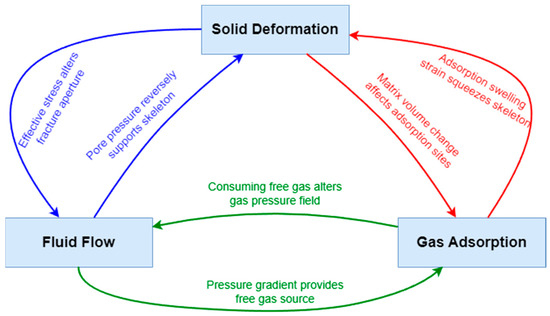
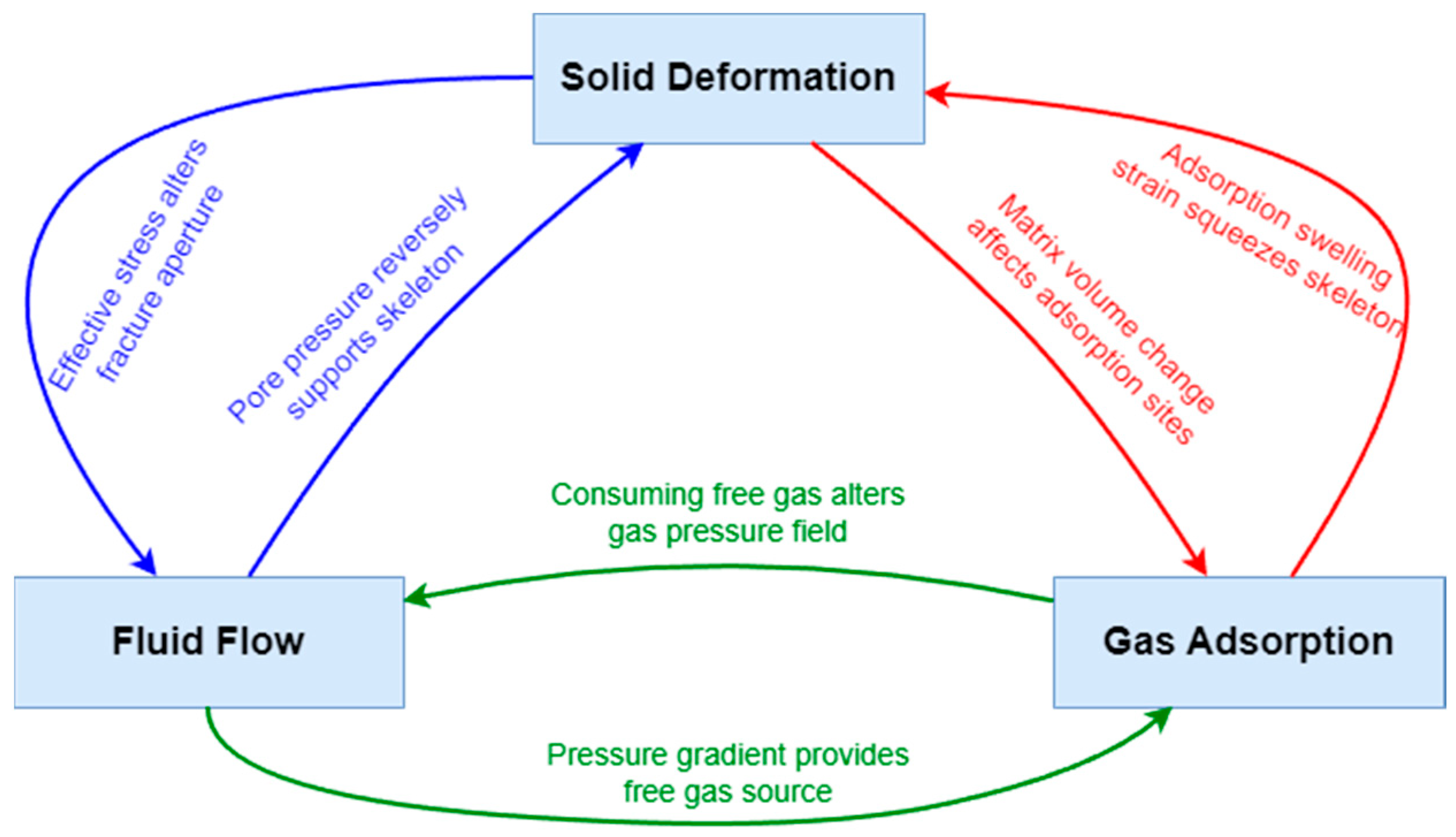
The permeability evolution of fractured coal is essentially controlled by the dynamic adjustment of fracture aperture. During CO2 seepage driven by a pressure difference, fracture conductivity is governed by the following mechanisms:
- The external confining pressure tends to compress the fracture, and the average pore pressure reduces the effective stress acting on the coal skeleton and thereby promotes fracture opening.
- With the increase in pore pressure, the amount of CO2 adsorption increases and the volume expansion of the matrix is induced. Under the triaxial constraint, the deformation is mainly released by compressing the adjacent fracture space, thereby weakening the conductivity of the fracture.
- In the low pore-pressure range, the slip flow of gas molecules makes the measured apparent permeability deviate from the intrinsic permeability of the medium.
As shown in Figure 1, the competition among mechanical compaction, pore-pressure support, adsorption-induced fracture compression, and gas slippage provides the physical basis for the composite permeability model developed below.
Figure 1.
Diagram of the multi–physics competition mechanism.
2.3. Experimental Equipment and Specimen Pretreatment
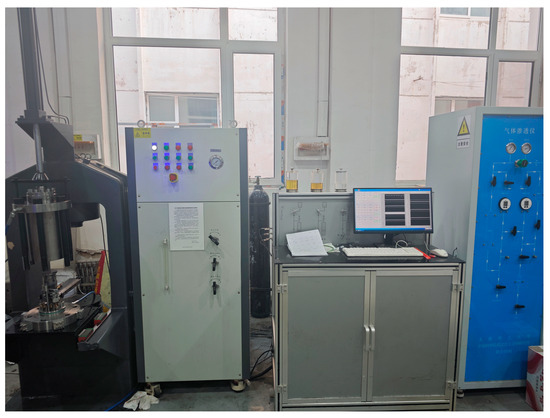
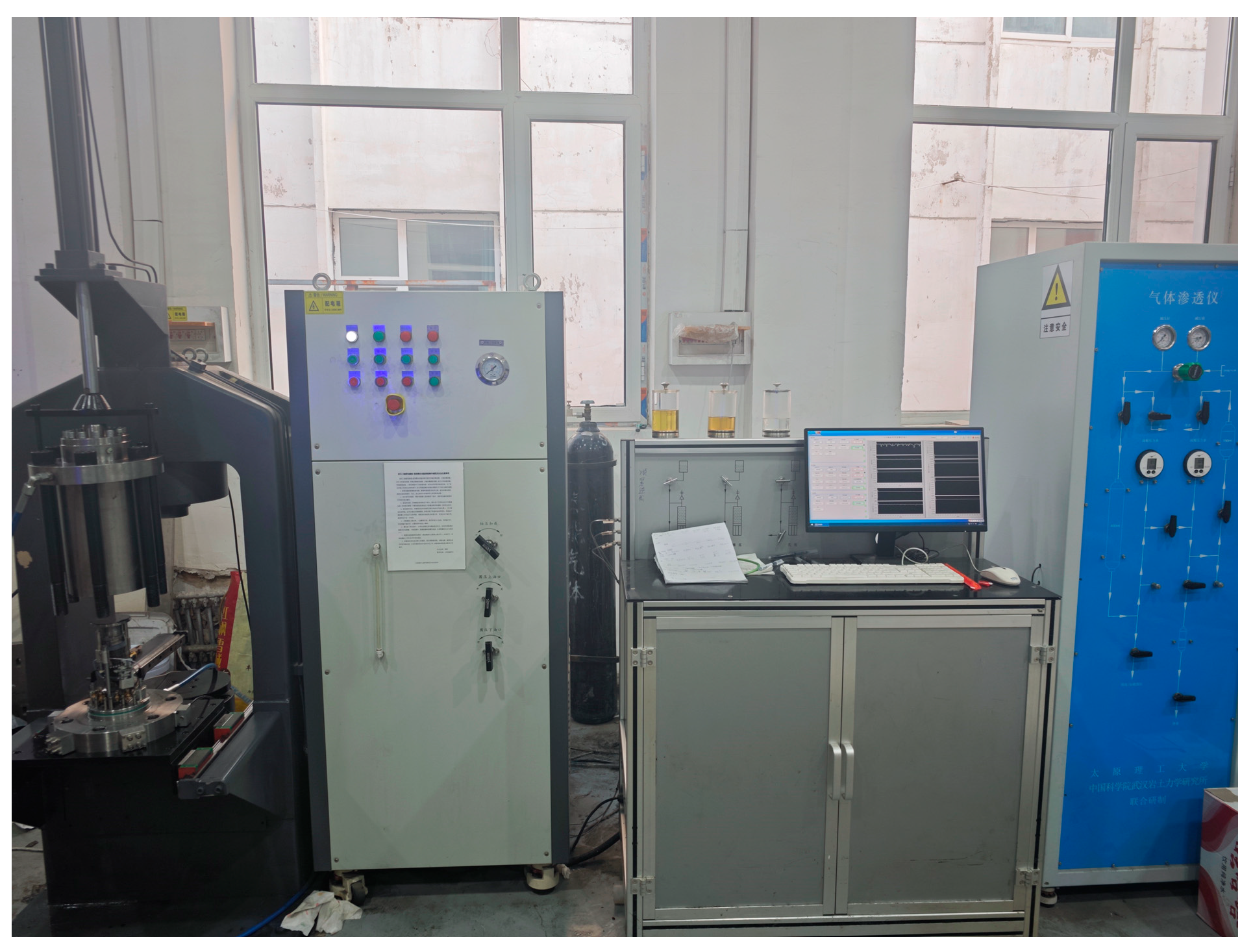
The experiments were conducted using an RC–30 rock triaxial rheometer developed by the Institute of Rock and Soil Mechanics, Chinese Academy of Sciences (Wuhan, China). The system consisted of a high-pressure triaxial cell, an axial servo-loading system, a confining-pressure servo-loading system, a high-precision displacement-monitoring system, and a gas-permeability measurement system. Due to equipment limitations and experimental requirements, an AFM1710H00 gas mass flowmeter manufactured by Guangzhou Aosong Electronics Co., Ltd. (Guangzhou, China) was installed at the outlet of the pressure chamber. The electronic unit is connected to the outlet end of the pressure chamber. The complete experimental system is shown in Figure 2.
Figure 2.
Schematic of the experimental system.
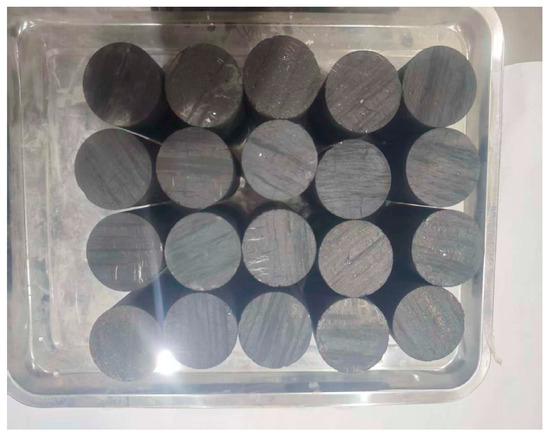
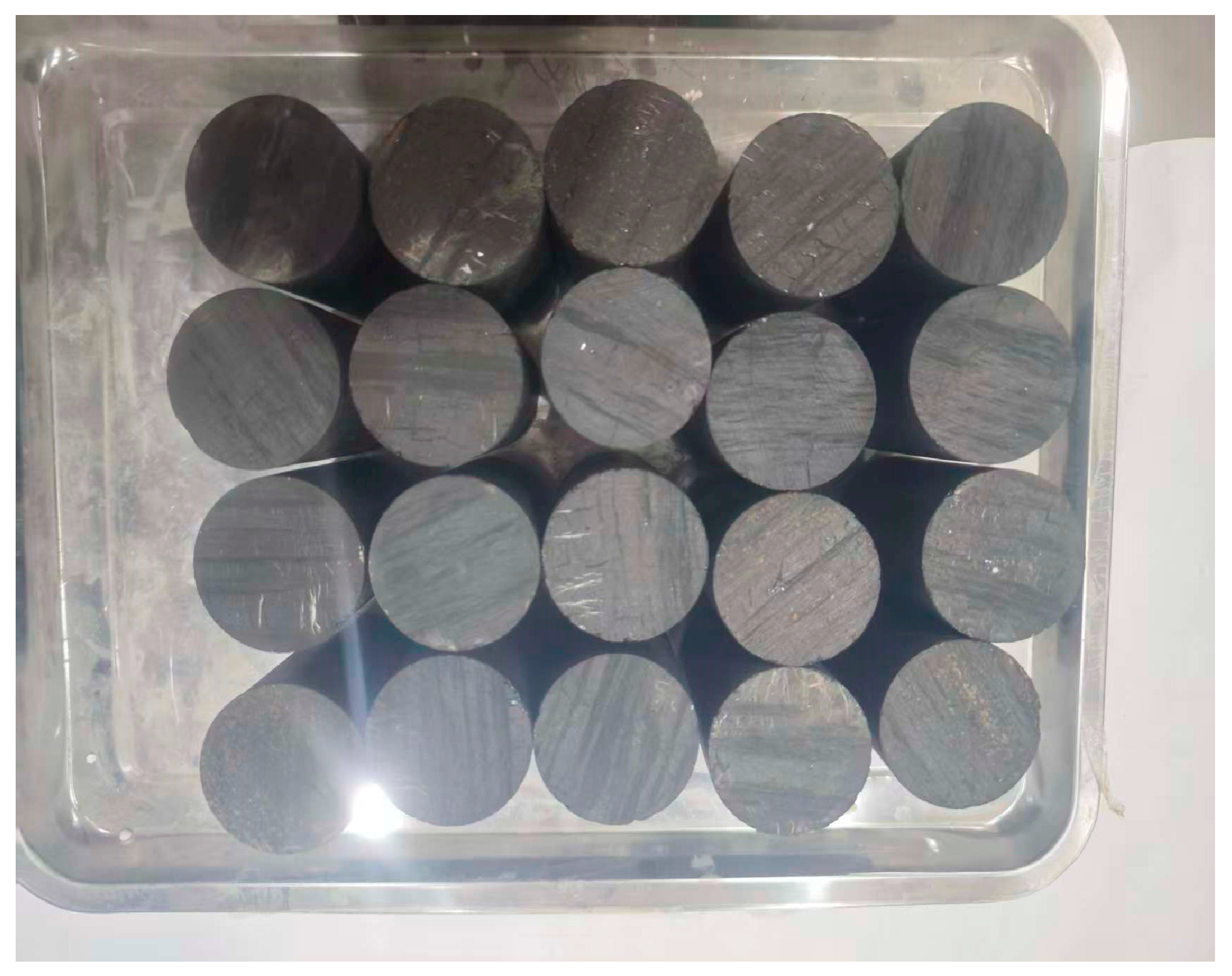
The coal samples were collected from the No. 3 coal seam of the Xinyuan Coal Mine. According to the relevant standards of ISRM, the coal was processed into a standard cylindrical specimen of Ф50 mm × 100 mm. The non-parallelism of the two ends is less than 0.05 mm as the test specimen. After being dried at a constant temperature, each specimen was placed in a sealed container and exposed to the test gas under static conditions to establish a preliminary adsorption state, as shown in the Figure 3.
Figure 3.
Coal specimen used in the laboratory tests.
2.4. Triaxial Seepage Test Scheme
In order to explore the fracture development, damage evolution, and permeability characteristics in fractured coal during mining, CO2 with a volume fraction of 99.99% was used as the test gas. Due to the original rock of the coal seam geographical environment studied, in order to better simulate the real occurrence environment of the coal sample, the confining pressure is made in the stress loading. The specific steps of the test are as follows:
- Installation of the specimen: the test sample is sheathed with a heat shrinkable tube, and the heat-shrinkable tube is uniformly heated by a hot air gun to close to the coal sample, and then the upper and lower ends of the specimen are hooped with a metal hoop. Finally, each equipment used in the test is connected in turn, according to the connection order.
- After the installation is completed, the three-axis pressure chamber and the gas pipeline are checked for gas path sealing. Firstly, the confining pressure was loaded to the target value (3, 5, 6, 8, 10 MPa) at a rate of 0.5 MPa/s and kept constant, and then the axial load was applied at a loading rate of 0.03 mm/min until the coal sample was fractured.
- After post-peak failure, the axial stress decreased from the peak level and gradually entered a residual load-bearing plateau. Further axial loading was then stopped, the confining pressure was maintained at the target value, and CO2 seepage testing was conducted under this post-peak residual load-bearing state. It should be clarified that stopping further axial loading does not mean that the axial stress, axial displacement, and pore–fracture structure remained completely unchanged. For post-peak fractured coal, slow sliding, local compaction, and dilatancy adjustment may still occur between fractured surfaces. Therefore, the seepage stage in this study was defined as a quasi-stable residual-strength state under constant confining pressure, rather than a completely static mechanical state.
- Under this quasi-stable residual state, staged inlet gas pressures of 0.3, 0.5, 0.7, 1.0, and 1.5 MPa were applied, while the outlet end was connected to the atmosphere. This inlet–outlet boundary produced a controlled pressure difference across the coal specimen. Therefore, the experiment was defined as a constant-pressure-difference seepage test rather than an equivalent negative pressure boundary test. The boundary condition was used to evaluate the seepage response of post-peak fractured coal under pressure-gradient driving, rather than to exactly reproduce the absolute negative pressure boundary in mine drainage.
- The gas flow rate was continuously recorded after gas injection. Each pressure level was maintained for approximately 20 min. The initial transient data after pressure switching were not used for permeability calculation, and the steady-state flow value was obtained by averaging the data from the last 5 min of each pressure step.
- After the steady-state flow values at all pressure levels had been obtained, the specimen was replaced, and Steps 1–4 were repeated for the other confining-pressure conditions. Each group of working conditions was repeated three times to reduce the discrete deviation in the test process.
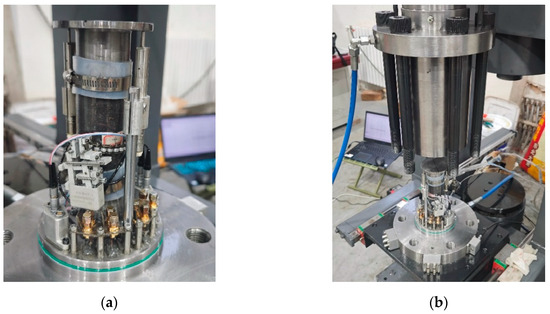
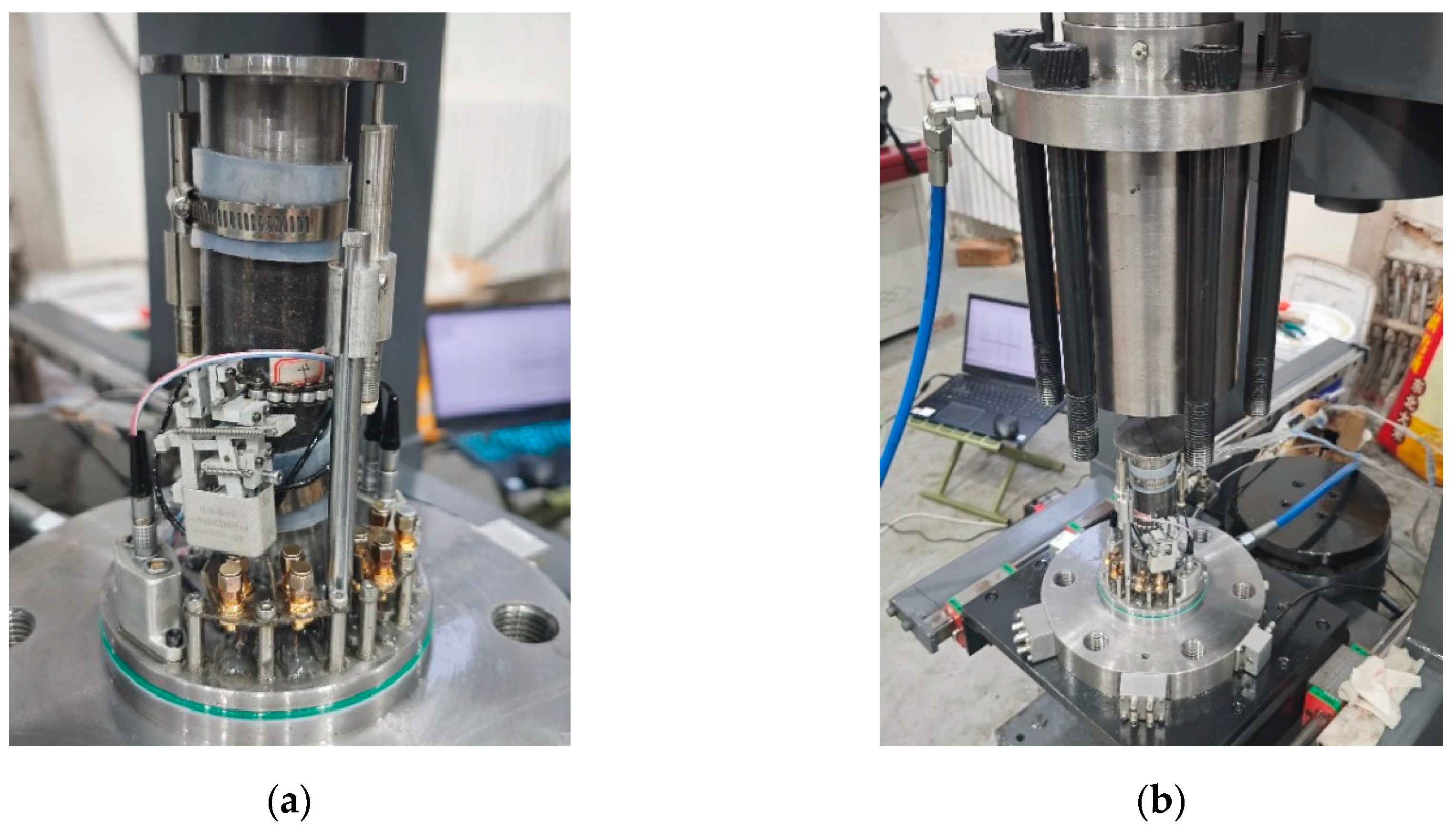
The specific test installation is shown in Figure 4.
Figure 4.
Sample installation process: (a) specimen sealing and lower-platen assembly; (b) specimen installed in the triaxial pressure chamber.
According to the flow rate measured by the experiment, the permeability of the sample in the steady state is calculated by Darcy’s law.
3. Macroscopic Mechanical Response and Damage-Evolution Characteristics of Post-Peak Fractured Coal
3.1. Full-Process Deformation Characteristics and Dilation Inflection Point Identification of Fractured Coal
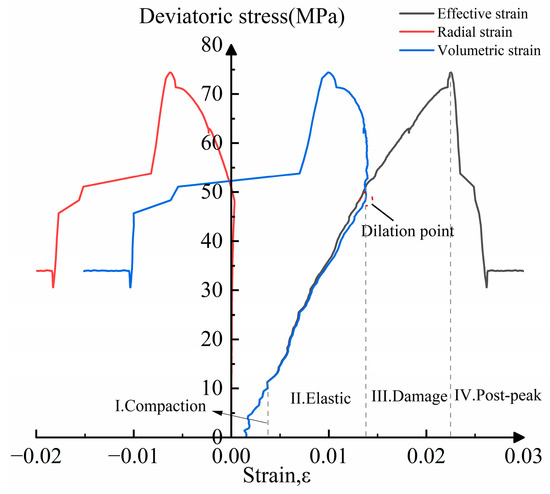
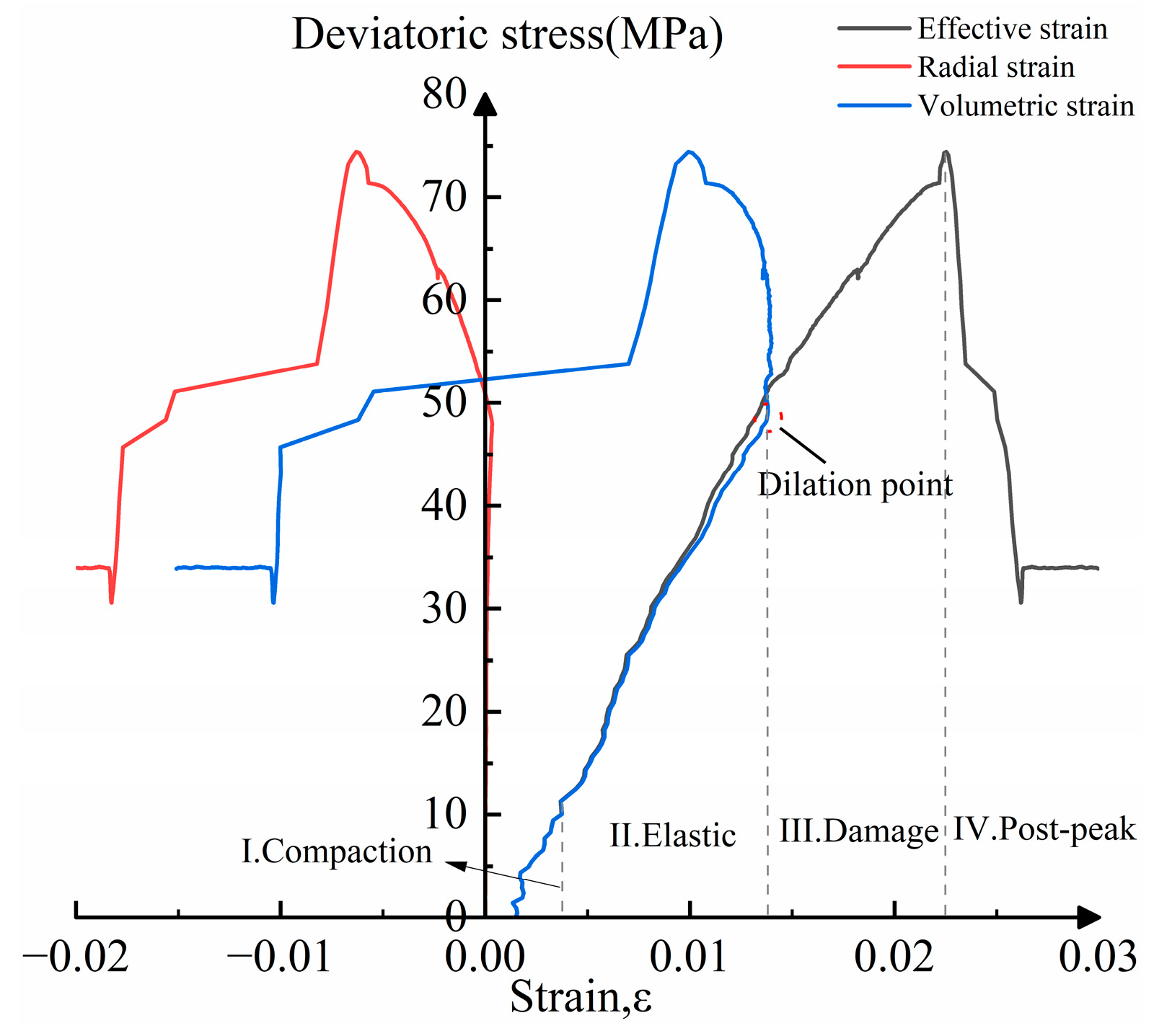
The 8 MPa high confining-pressure group was selected as the representative, and the evolution of deviatoric stress, axial strain, radial strain, and volumetric strain throughout the entire process was analyzed. The full-process stress-strain response under a confining pressure of 8 MPa is shown in Figure 5.
Figure 5.
The full-process stress–strain curve under a confining pressure of 8 MPa.
- In the yield-failure stage, as the stress approached the yield limit, the volumetric-strain curve exhibited a distinct dilatancy onset. At this time, the microcracks were violently initiated and connected to each other under the shear stress, and the radial expansion rate began to exceed the axial compression rate, marking the critical state of the coal body from the overall compaction to the macroscopic fracture.
- After the peak stress, the coal specimen showed obvious post-peak ductility. The deviatoric stress decreased from the peak level and entered a residual load-bearing plateau of approximately 34 MPa. This plateau indicates that the specimen had shifted from rapid post-peak instability to residual load bearing, and the connected macroscopic fracture network had already been formed.
- The residual-strength stage does not mean that specimen deformation completely stopped. After entering the residual stage, the axial strain and volumetric strain still developed slowly and gradually became gentle. This indicates that fracture-surface sliding, frictional interlocking, and local dilatancy adjustment still occurred inside the post-peak fractured coal. Therefore, the specimen during seepage testing should be understood as a quasi-stable residual load-bearing structure, rather than a mechanically invariant pore–fracture structure.
3.2. The Strengthening Effect of Confining Pressure on Brittle–Ductile Transition and Shear Strength
3.2.1. Confining-Pressure Strengthening and Brittle–Ductile Transition Mechanism
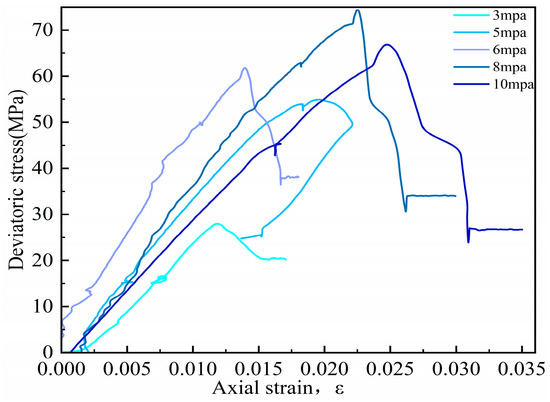
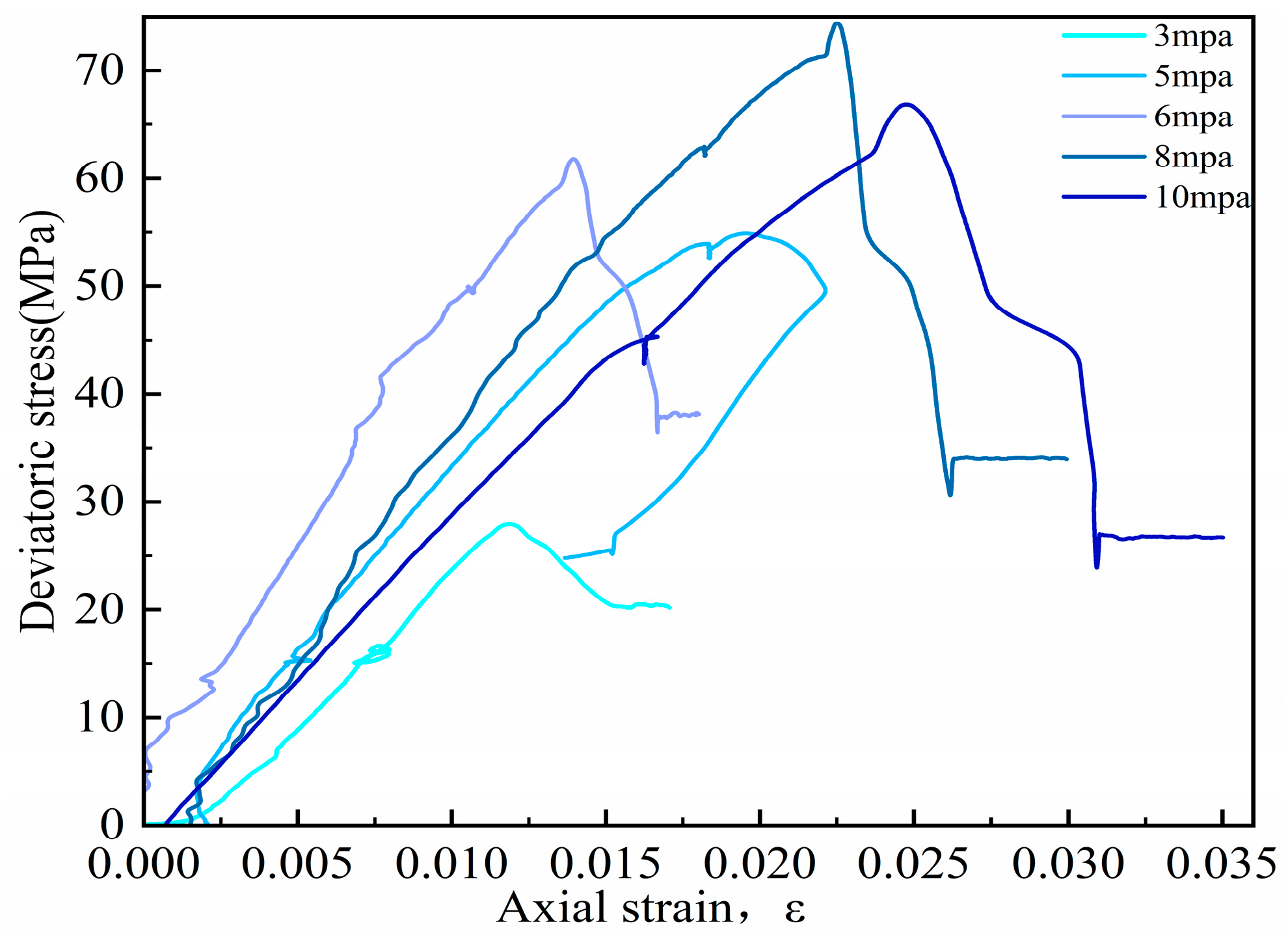
By enhancing the lateral constraint of coal, the confining pressure significantly improves its ability to resist shear failure. The stress-strain curves obtained under different confining pressures are shown in Figure 6.
Figure 6.
Stress–strain curves under different confining pressures.
It can be seen from the diagram that under the low confining-pressure environment, the bearing structure rapidly loses stability after the crack penetrates, and the brittleness characteristics are significant, showing a steep stress drop; with the increase in confining pressure, the strong lateral constraint limits the rapid opening of the fracture surface, which promotes the frictional interlocking between the fracture surfaces. The bearing mechanism is smoothly transformed from the cohesion of the internal skeleton of the sample to the friction sliding bearing of the fracture, and the mechanical response is transformed into ductility.
3.2.2. Characterization of Residual Stability Based on Mohr–Coulomb Criterion
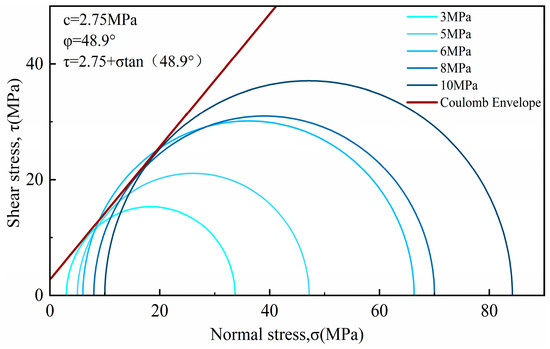
In order to quantitatively analyze the failure mechanism of coal and rock samples from peak to residual, the Mohr–Coulomb strength criterion is introduced to fit the ultimate stress state. The corresponding Mohr circles and fitted strength envelope are shown in Figure 7.
Figure 7.
Mohr circles and fitted strength envelope.
The fitting results are as follows:
According to the shear strength envelope equation obtained by least square fitting:
where a is the slope of the fitting line, and b is the intercept of the envelope on the τ–axis.
Combined with Equation (1), it can be seen that the slope of the fitted line satisfies , and the intercept satisfies b = c.
Based on this, the macroscopic shear strength parameters of coal samples can be further obtained. The above parameters reflect the macroscopic shear strength characteristics of post-peak failure coal samples under triaxial constraints, and also provide a mechanical basis for the subsequent analysis of the stability of fracture structure and seepage boundary conditions in the residual stage.
3.3. Damage-Evolution Mechanism and Confining-Pressure Hysteresis Effect of Fractured Coal
3.3.1. Construction and Validation of the Damage Constitutive Model Based on the Weibull Distribution
Aiming at the heterogeneous characteristics of deep fractured coal, based on the assumptions of continuum damage mechanics and Lemaitre’s strain equivalence principle, the coal sample is regarded as a statistical evolution system composed of numerous micro-elements, and the strength of the coal micro-elements is assumed to follow a Weibull distribution. The corresponding probability density function can be expressed as:
where εeff is the axial strain, m is the damage shape parameter, and α is the damage scale parameter.
According to statistical damage theory, the damage variable D is defined as the ratio of the number of failed micro-elements to the total number of micro-elements. Therefore, the damage variable can be directly obtained from the cumulative distribution function of the Weibull distribution as follows:
where D is the damage variable, ∈ [0, 1].
According to the Lemaitre strain equivalence principle, the expression of damage variable D is substituted into the above formula, and the damage constitutive equation of coal sample under triaxial compression condition is obtained:
where σ1–σ3 is the deviatoric stress; E is initial elastic modulus; εeff is axial strain; m is the damage shape parameter; and α is the damage scale parameter.
The parameters are inverted by using the analytical boundary conditions of the peak point.
By substituting the above extreme boundary conditions into the constitutive evolution equation and simplifying the derivation, the theoretical analytical formula of the parameters for calculating the damage variable can be obtained:
Parameters such as peak deviatoric stress, peak strain, and elastic modulus, obtained from the mechanical tests under different confining-pressure conditions, are substituted into the above formula to obtain the Weibull damage parameters m and α of coal and rock samples under various confining-pressure conditions, as shown in Table 2.
Table 2.
Damage parameters.
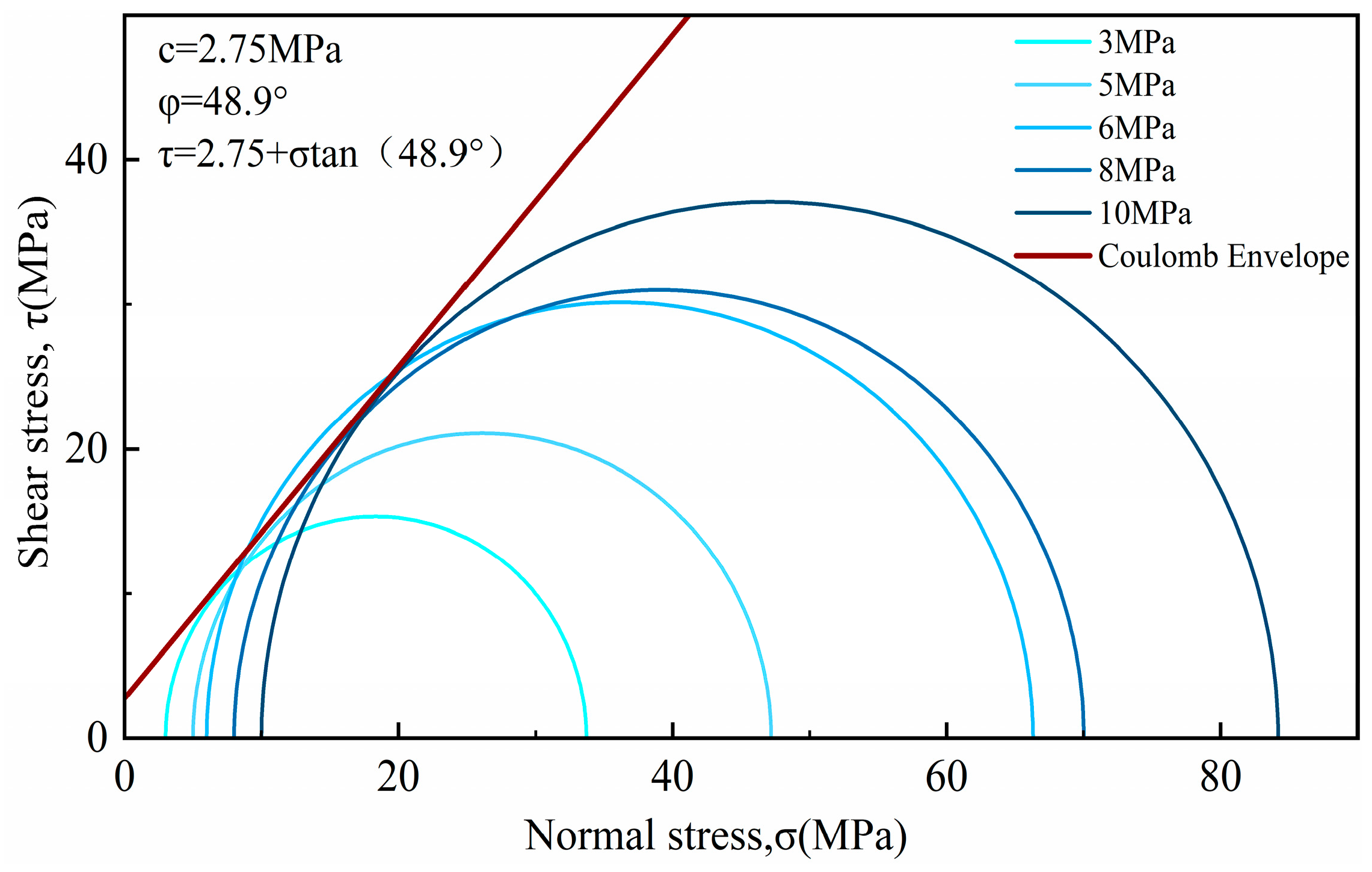
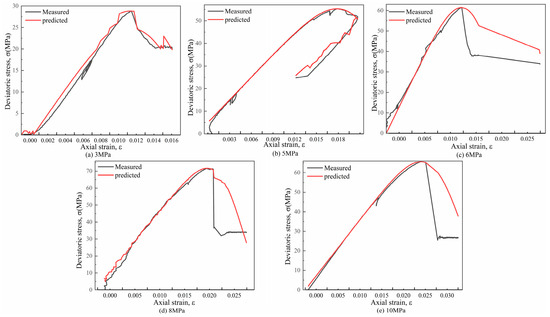
Using the elastic modulus and Weibull damage parameters listed in Table 2, the axial strain data under different confining pressures were substituted into Equation (2) to calculate the predicted deviatoric stress. The predicted results were then compared with the measured stress–strain curves, as shown in Figure 8.
Figure 8.
Comparison between the measured and predicted deviatoric stress–axial strain curves under different confining pressures.
As shown in Figure 8, the calculated curves reproduce the overall evolution in which the deviatoric stress increases with axial strain and subsequently reaches the peak value under different confining pressures. The predicted and measured curves generally exhibit good agreement in terms of the pre-peak evolution trend, peak stress, and strain corresponding to the peak stress. At a confining pressure of 3 MPa, the relatively weak lateral constraint results in more pronounced compaction of pre-existing pores and fractures, and the measured curve still exhibits some fluctuations during the initial loading stage. Nevertheless, the predicted curve reasonably reproduces the subsequent load-bearing and damage-development processes.
After peak failure, the measured deviatoric stress decreases rapidly and gradually enters the residual load-bearing stage, whereas the model prediction exhibits continuous and smooth softening. This discrepancy is mainly related to the change in the dominant load-bearing mechanism before and after peak failure. Equation (2) primarily describes the continuous degradation of load-bearing capacity caused by statistical micro-element damage accumulation. After macroscopic fracture formation, however, the residual strength is mainly maintained by frictional sliding, local interlocking, and dilatancy adjustment along the fracture surfaces. Consequently, a certain discrepancy exists between the post-peak predictions and the measured residual-strength plateaus. This discrepancy indicates the applicability boundary of the Weibull statistical damage model in the residual frictional load-bearing stage but does not affect its description of pre-peak damage-evolution and peak failure characteristics.
To quantitatively evaluate the agreement between the calculated and measured pre-peak responses during the pre-peak stage, the coefficient of determination R2 and the RMSE were calculated from the measured and predicted deviatoric stresses, as listed in Table 3.
Table 3.
Statistical evaluation of the Weibull damage-model fit.
As shown in Table 3, the R2 values range from 0.9717 to 0.9915, whereas the RMSE values range from 1.3935 to 2.0315 MPa under different confining pressures. The relatively high R2 values indicate good agreement between the predicted and measured results, while the relatively low RMSE values demonstrate that the overall prediction errors remain limited. The R2 value at 3 MPa is slightly lower than those obtained for the other confining-pressure groups, mainly because of the more pronounced initial compaction of pores and fractures and the associated stress fluctuations under low confining pressure. At confining pressures of 5–10 MPa, all R2 values exceed 0.985, indicating that the enhanced lateral constraint produces a more continuous pre-peak stress–strain response and improves the stability of the model in describing the deviatoric-stress evolution and peak characteristics.
The predicted peak stresses are generally consistent with the measured peak values, indicating that the local residuals do not substantially affect the overall predictive performance. The combined curve comparison and statistical evaluation demonstrate that the Weibull damage model can reasonably characterize the pre-peak load-bearing response, damage development, and peak failure of the coal specimens under different confining pressures.
3.3.2. Coupled Evolution of Stress, Damage, and Load-Bearing Structure
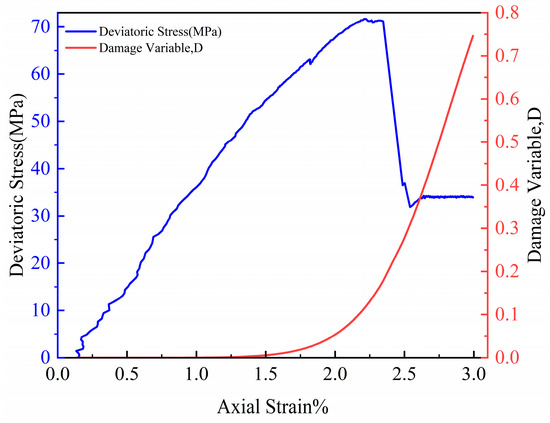
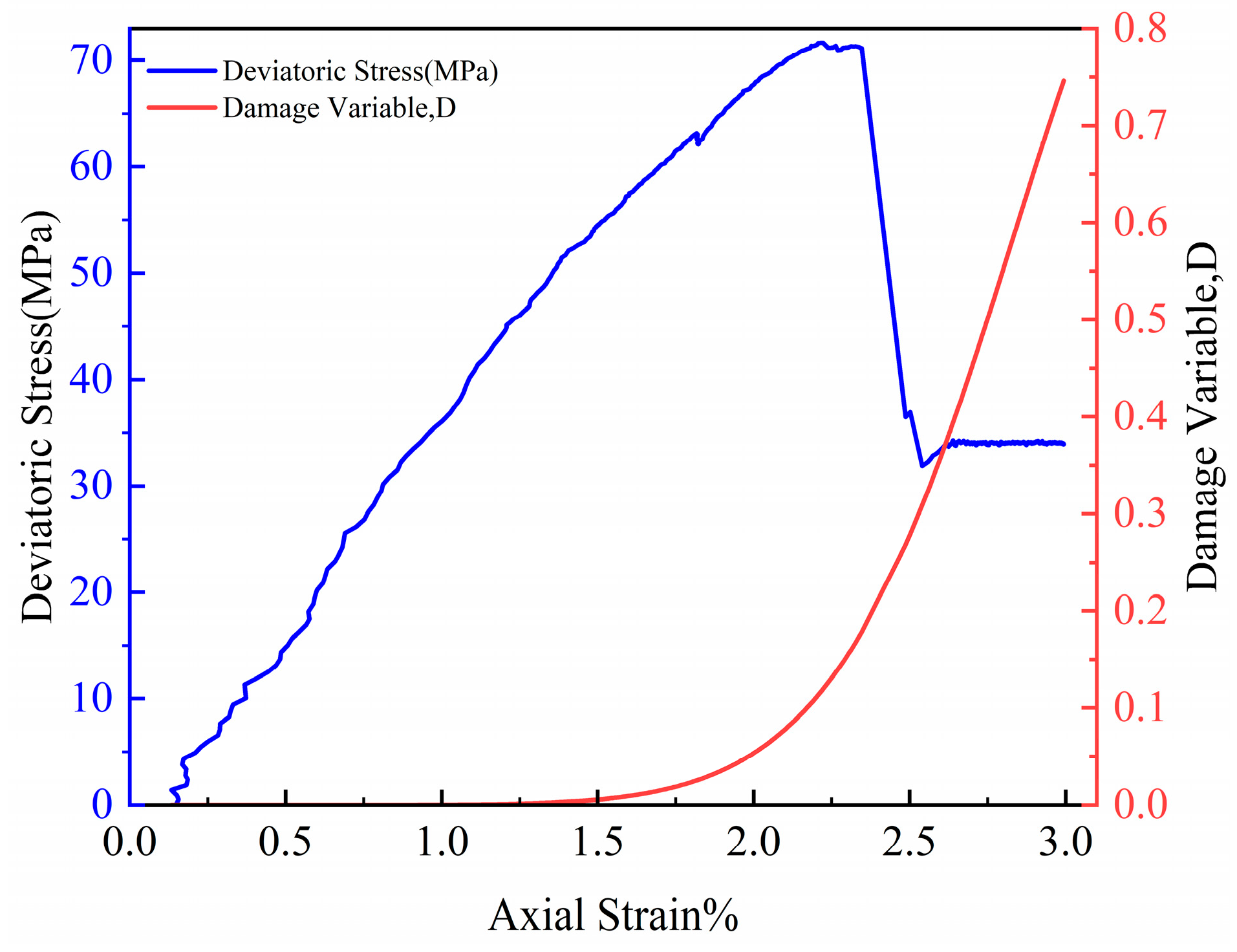
In order to further reveal the relationship between micro-damage accumulation and macro-mechanical response in coal samples, the co-evolution characteristics of the stress–strain curve and damage variable D are analyzed in this paper, using the 8 MPa confining-pressure group taken as a representative sample.
As shown in Figure 9, the damage-evolution and macroscopic mechanical characteristics of fractured coal show a high degree of physical correlation:
Figure 9.
Diagram of the stress-damage mechanism throughout the 8 MPa process.
- In the linear elastic stage, the damage variable D is close to 0, indicating that the energy is mainly absorbed by the elastic skeleton, and the new damage has not yet been generated in scale.
- Near the peak, the slope of the damage variable increases sharply, and the microcrack evolves from dispersion to penetration. At the peak time D < 1, it shows that the macroscopic instability is not the failure of all the elements, and the fracture mechanics of the local key stress zone leads to the collapse of the overall bearing system.
- As approaches 1, the cohesive bearing structure basically fails. At this time, the deviatoric stress does not disappear but maintains the residual strength through the friction interlocking and relative slip between the fracture surfaces. This transformation from cohesion to friction bearing enables the post-peak specimen to retain connected residual flow paths, which provides the necessary physical structure for gas seepage.
3.3.3. Hysteresis Effect of Confining Pressure on Damage-Evolution Path
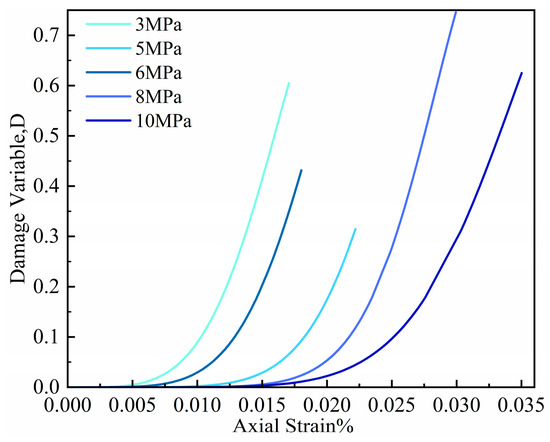
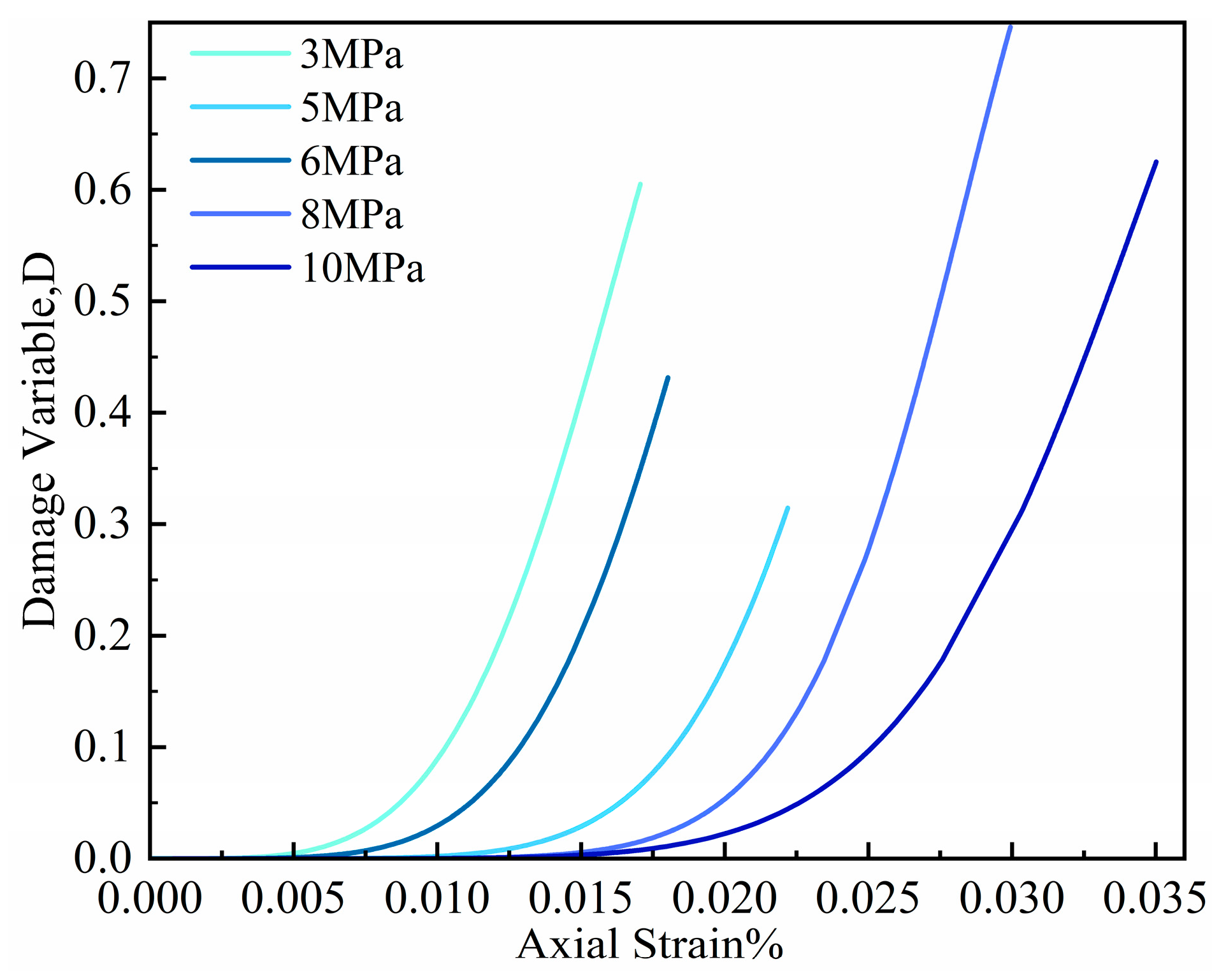
Figure 10 shows the evolution curve of the damage variable as a function of effective strain throughout the entire process under confining pressures of 3~10 MPa. It was found that, with increasing confining pressure, the damage-evolution curve as a whole shows a significant hysteresis effect that shifts to the higher-strain zone.
Figure 10.
Evolution of the damage variable under different confining pressures.
The deep mechanism of this hysteresis phenomenon is that the high level of lateral restraint significantly increases the energy barrier needed to overcome crack initiation and shear slip. The confining pressure not only inhibits the lateral expansion of microcracks, but also delays the nucleation process of the main fracture surface. This mechanism is macroscopically manifested as the enhancement of plastic deformation ability of coal samples and the decrease in post-peak softening rate, and it helps explain why a connected residual fracture network can persist under relatively high confinement after peak failure.
4. Permeability Evolution Law and Composite Constitutive Model of Post-Peak Fractured Coal
4.1. Steady-State Identification of Seepage Data and Darcy Flow Pattern Determination
4.1.1. Compressibility Correction of Steady-State Seepage Model
Due to the significant compressibility of the test medium CO2, the gas density and volume evolve dynamically with the pressure gradient during the internal migration of the fractured coal. In order to improve the physical accuracy of permeability measurement, permeability was therefore calculated using the steady-state compressible–gas form of Darcy’s law rather than the incompressible-flow form, and quantitatively characterizes the permeability ka strictly according to the steady-state Darcy seepage relationship of compressible gas, so as to account for the variation in gas density and volumetric flow rate along the pressure gradient.
4.1.2. Temporal Characteristics and Steady-State Identification of Flow Dynamic Evolution
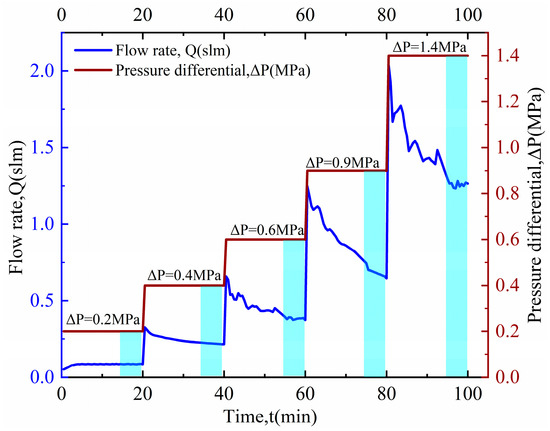
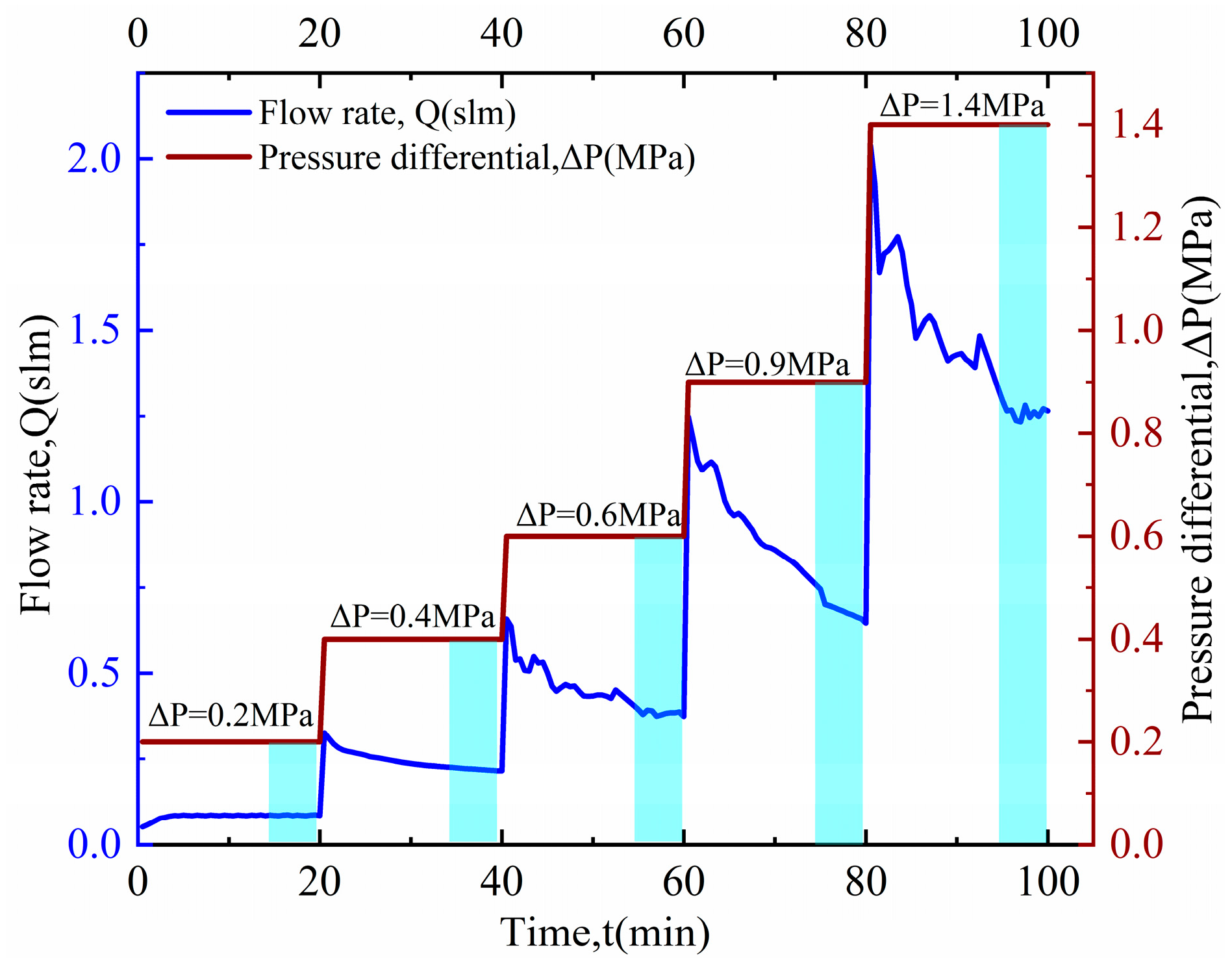
Whether the flow field reaches steady state is the core premise for ensuring the accuracy of permeability calculation. Figure 11 records the dynamic evolution process of CO2 flow rate with time t under constant pressure difference. This study found that the flow evolution presents a significant two-stage behaviour.
Figure 11.
Flow-rate time history at a confining pressure of 8 MPa.
- Transient disturbance and pressure redistribution stage.
At the beginning of the switching pressure, the flow rate fluctuates violently. Its physical essence is that after the high-pressure gas enters, due to the strong heterogeneity of the pore structure inside the coal sample, the displacement of the injected gas to the residual gas and the difference in the connection state between the fissures jointly induce the redistribution of the pore-fluid pressure gradient. Macroscopically, this is manifested as unsteady fluctuation in the flow field.
- 2.
- Dynamic equilibrium stage.
As the gas injection process continues, the internal seepage channel gradually stabilizes, and the flow change rate approaches zero. At this stage, the internal flow of the sample reaches a dynamic equilibrium, and this interval represents the effective range for calculating the steady-state permeability.
The equilibrium discussed here refers to the dynamic equilibrium of the flow field, characterized by a stable flow rate under a constant pressure difference. It does not imply that complete thermodynamic adsorption equilibrium of CO2 in the coal matrix was fully achieved at each pressure step. Therefore, the possible influence of adsorption disequilibrium was reduced by excluding the transient stage and using only the stabilized flow interval, but it cannot be completely eliminated in a stepwise pressure-increase test.
4.1.3. Reynolds Number and Darcy Flow Determination
In order to ensure the theoretical applicability of permeability calculation, it is necessary to confirm that the migration of CO2 in fractured coal is in the linear seepage range. In this paper, the Reynolds number Re is used to quantitatively determine the flow pattern of the whole process. The calculation results show that the Re of the test under all working conditions is distributed between 0.01 and 0.85.
According to the theory of fluid mechanics for porous media, the Reynolds number Re obtained in this experiment is much lower than the critical threshold for the transition from linear to nonlinear flow, indicating that the gas flow is dominated by viscous force and that the nonlinear inertial effect of Forchheimer can be ignored. This conclusion supports the applicability of Darcy’s law in describing the seepage behavior of post-peak fractured coal and provides a reliable hydrodynamic premise for the in-depth analysis of the subsequent permeability evolution mechanism.
4.2. Analysis of Seepage Characteristic Response and Multi–Field Competition Response of Post-Peak Fractured Coal Mass
4.2.1. Treatment Principle of Gas Slip and Multi-Field Effect Coupling
According to the Klinkenberg slip theory, the apparent permeability measured using gas is generally higher than the intrinsic permeability because gas molecules exhibit tangential slippage along the walls of pores and microfractures. For coal specimens in the residual-strength stage, the internal flow channels consist of primary fractures, secondary fractures, and residual pores. This heterogeneous fracture flow structure exhibits strong scale dependence. Therefore, the contribution of gas slippage under different pressure conditions must be evaluated before determining whether the conventional Klinkenberg correction is applicable.
For conventional gas flow through porous media, the intrinsic permeability k∞ can be determined from the linear relationship between the apparent permeability ka and the reciprocal average pore pressure 1/pm. According to the classical Klinkenberg equation, the intercept of the ka−1/pm regression represents k∞, whereas the slope represents k∞b. Therefore, the slip factor b can be determined from the ratio of the slope to the intercept, allowing the apparent permeability to be corrected stepwise.
This conventional correction assumes that the pore–fracture structure remains relatively stable during the change in pore pressure, so that the variation in apparent permeability can be attributed mainly to gas slippage. However, previous studies have shown that the Klinkenberg effect in coal is controlled not only by gas properties but also by effective stress, adsorption-related deformation, and pore–fracture structure evolution [26]. Coal-permeability models considering both gas slippage and gas-sorption-induced strain further indicate that gas slippage and adsorption-induced matrix deformation jointly affect apparent permeability [33]. Therefore, the constant-slip-factor assumption is more suitable for porous media with relatively stable pore–fracture structures, in which the slippage contribution can be separated from structural deformation.
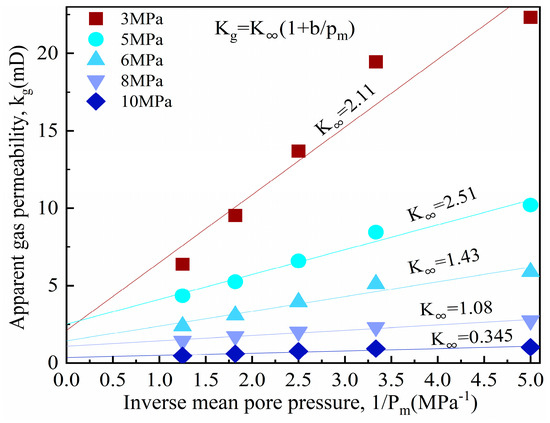
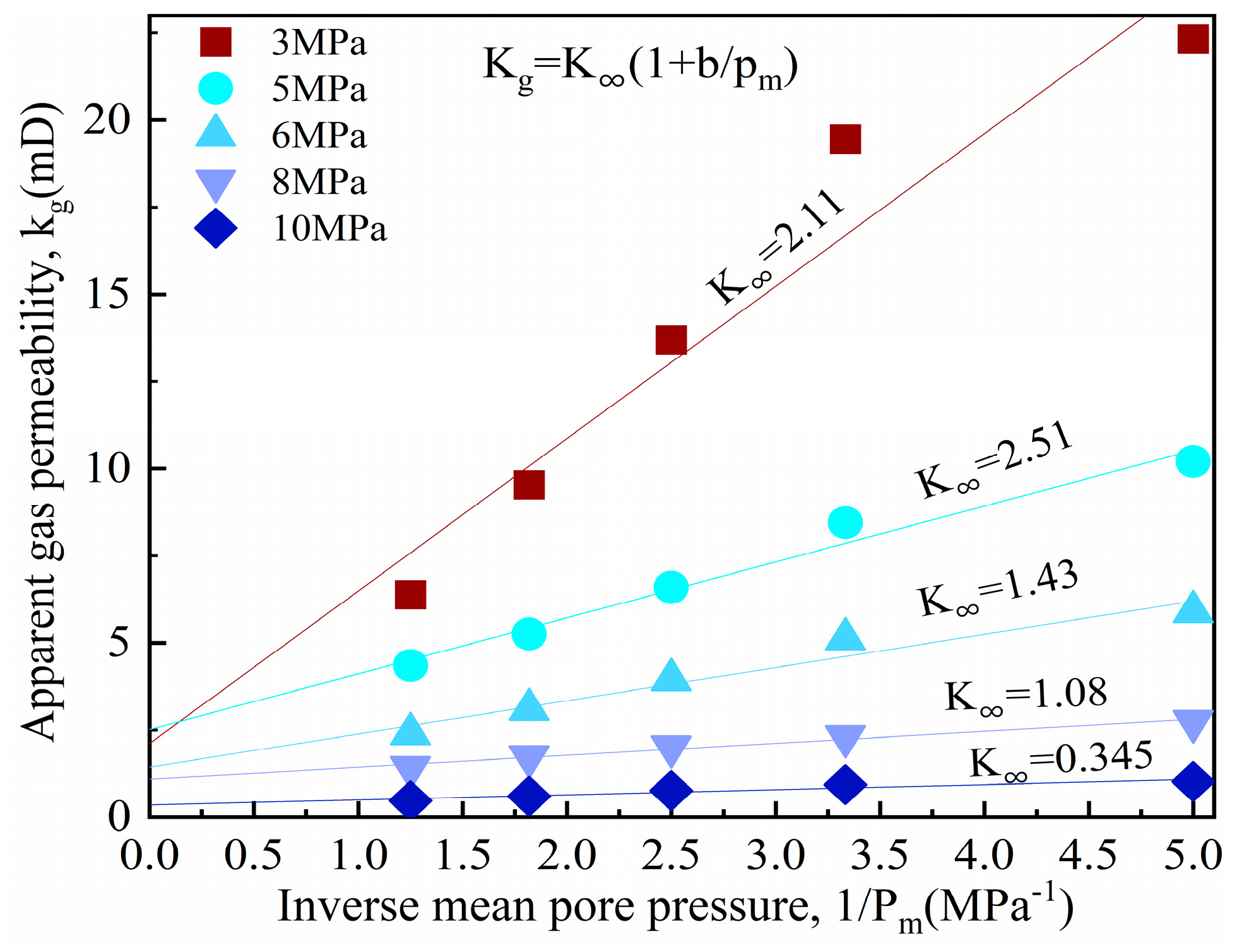
Figure 12 presents the linear fitting results between the apparent permeability ka and the reciprocal average pore pressure 1/pm under different confining pressures.
Figure 12.
Linear relationships between apparent permeability and reciprocal average pore pressure under different confining pressures.
Under constant confining pressure, the apparent permeability increased with increasing 1/pm, indicating that the gas-slippage effect became more pronounced as the average pore pressure decreased. Correspondingly, as the inlet pressure difference increased, the average pore-pressure pm increased, while the apparent permeability generally decreased. At higher pore pressures, the molecular mean free path decreased relative to the characteristic dimensions of the flow channels, thereby weakening the gas-slippage effect and reducing its contribution to the apparent permeability.
The present experiments were conducted under a constant-confining-pressure and variable-pore-pressure path. The tested post-peak fractured coal contained primary fractures, secondary fractures, and residual pores. During CO2 seepage, the fracture aperture was affected simultaneously by confining-pressure constraint, pore-pressure support, possible adsorption-induced matrix deformation, and gas slippage. Therefore, the variation in ka with 1/pm cannot be attributed solely to the gas-slippage effect; it also reflects changes in fracture conductivity caused by pressure-dependent structural adjustment.
Consequently, the intercept and slope obtained from the ka−1/pm linear regression contain the combined influences of gas slippage and pore–fracture structural deformation. They therefore do not retain the single physical meanings assumed in the conventional Klinkenberg correction. In particular, the intercept cannot be uniquely interpreted as a constant intrinsic permeability, while the slip factor calculated from the slope and intercept would represent an equivalent parameter containing both slippage and structural-deformation effects.
Therefore, for post-peak fractured coal in the residual-strength stage under the constant-confining-pressure and variable-pore-pressure path, it is inappropriate to directly apply a conventional stepwise correction based on a single constant slip factor. The classical Klinkenberg correction with a constant b is insufficient as an independent correction method for the present fractured-coal system. For this reason, a pressure-dependent dynamic slip correction was introduced into the composite permeability model.
4.2.2. Competitive Dominant Mechanism of Confining Pressure and Pressure Difference on Seepage Capacity
The evolution of internal seepage capacity of fractured coal is the result of the combined action of external confining pressure and internal pore-fluid pressure. The external confining pressure reduces the fracture opening by enhancing the normal compaction of the fracture wall, thus weakening the effective connectivity of the internal diversion channel of the specimen. The increase in pore-fluid pressure weakens the compaction effect between fracture surfaces, increases the fracture opening to a certain extent, and then improves the seepage capacity of the medium. It can be seen that the effects of confining pressure and pore pressure on fracture deformation and conductivity are not consistent, and the two jointly determine the evolution state of the seepage channel in fractured coal.
Through the analysis of the control variable method, it is found that the conductivity of fractured coal is controlled by the complex competition between external compaction and internal multi-physical effects:
- Mechanical closure effect controlled by confining pressure
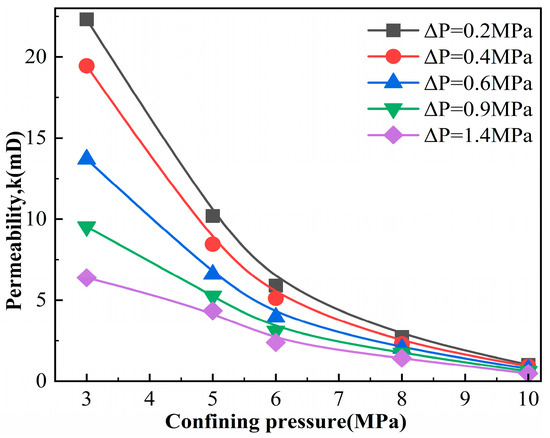
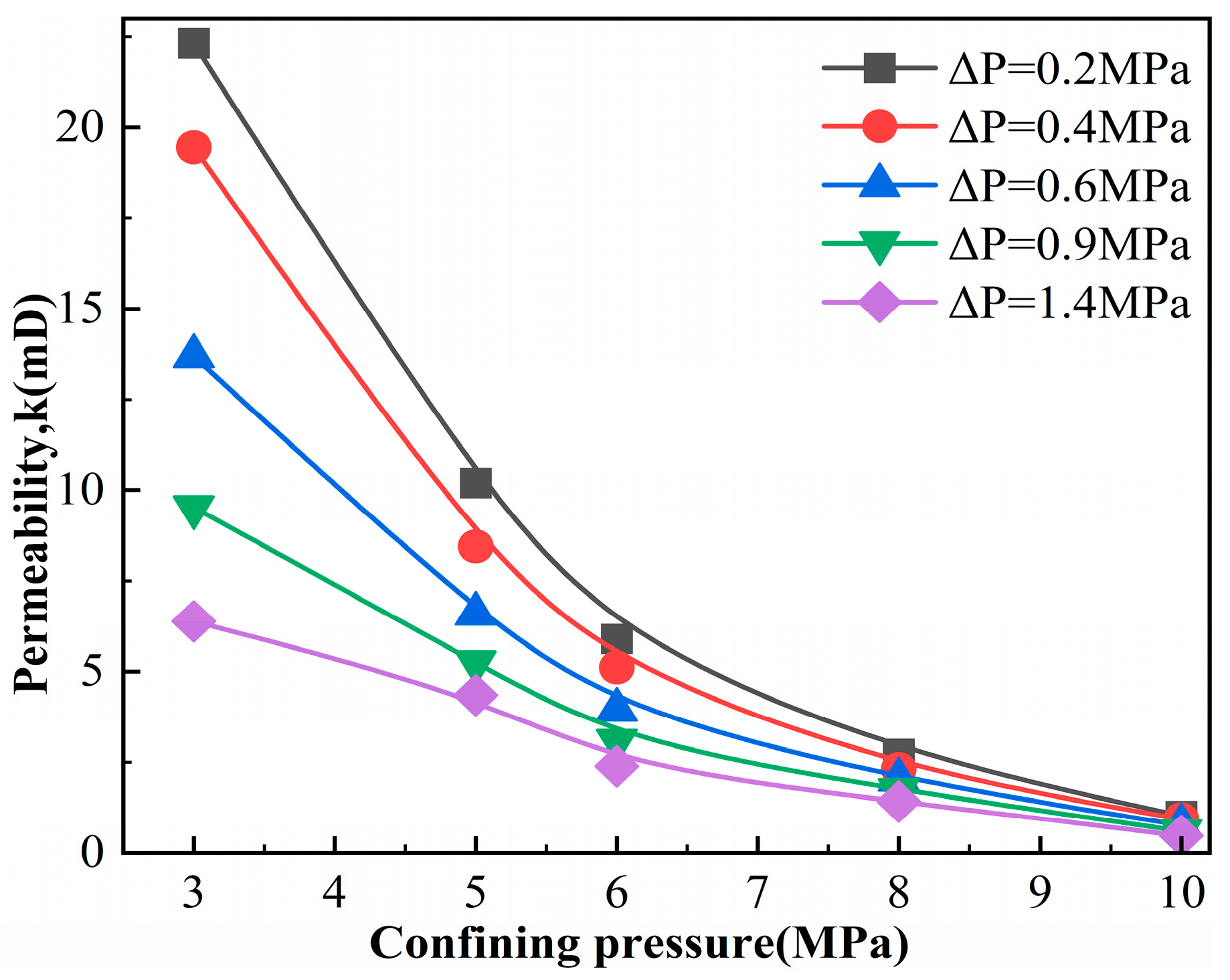
Figure 13 shows the variation of post-peak residual permeability with confining pressure under different pressure conditions. At each pressure gradient, the permeability shows a significant nonlinear attenuation with the increase in confining pressure. This indicates that the residual fracture network of post-peak fractured coal still has strong compressibility, and the increase in confining pressure aggravates the normal compression of fracture, resulting in the contraction of effective diversion section. When the confining pressure exceeds 8 MPa, due to the saturation of the contact degree of the fracture surface, the compression sensitivity weakens, and the decrease in the curve gradually slows down.
Figure 13.
Variation of permeability with confining pressure under different pressure differences.
The different pressure difference curves keep stable sorting in the whole confining-pressure range, and the curve spacing gradually decreases under high confining-pressure conditions. This feature shows that with the increase in confining pressure, the control of mechanical compaction on post-peak conductivity is further enhanced, and the adjustment space of pressure difference on seepage capacity is obviously compressed. In other words, in the post-peak residual stage, the confining pressure not only determines the basic conductivity of the fracture network but also weakens the seepage response differentiation caused by the difference of fluid pressure at higher stress levels.
- Multi-effect competitive response driven by differential pressure
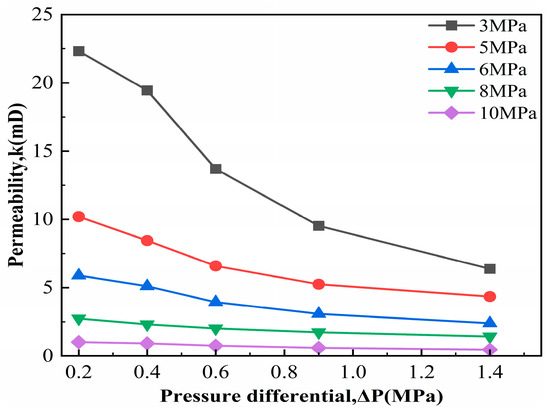
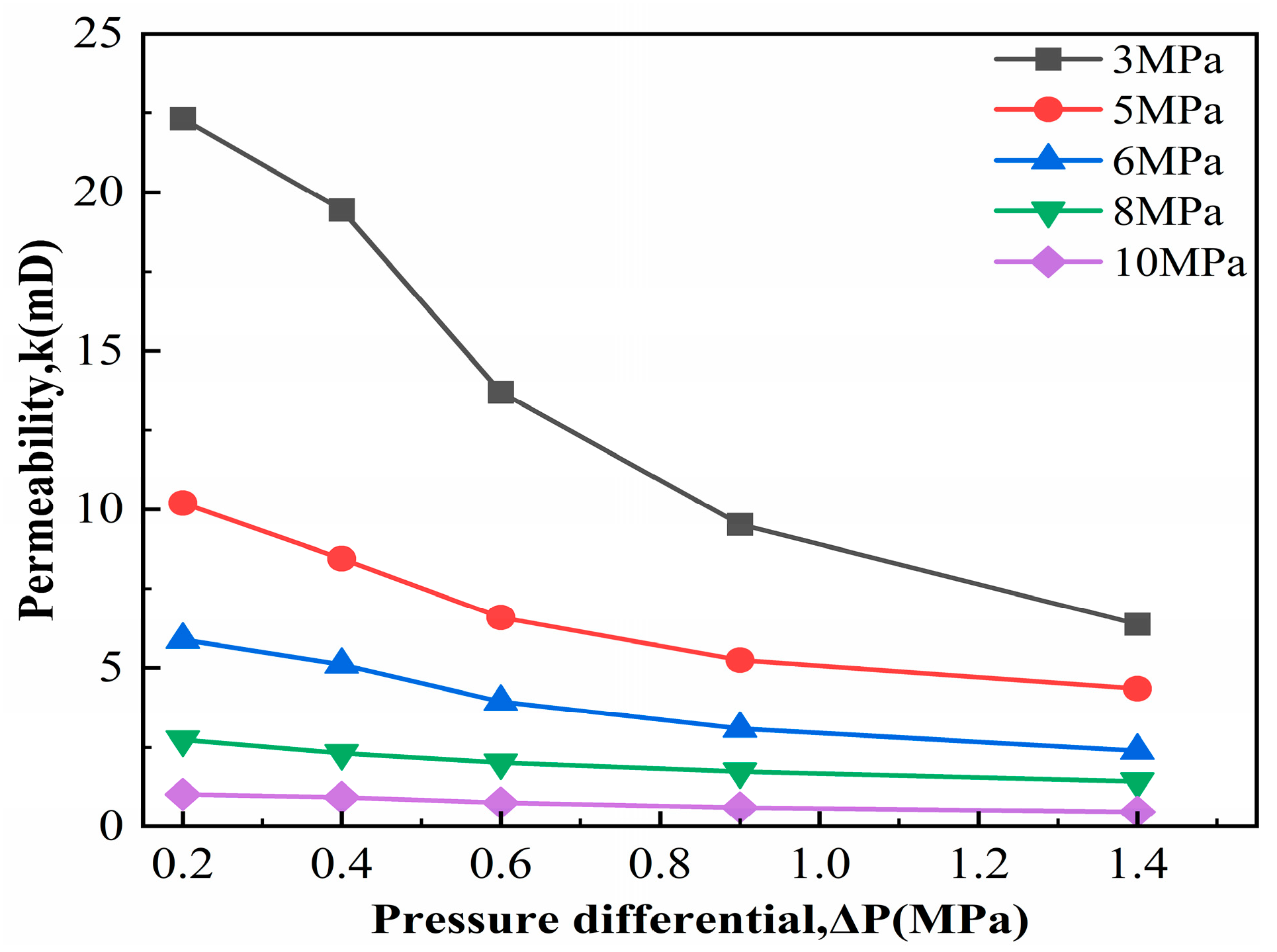
Under the condition of constant confining pressure, the measured permeability decreases continuously with the increase in pressure difference, as shown in the Figure 14.
Figure 14.
Variation of permeability with pressure difference under different confining pressures.
From the mechanical point of view, the increase in pressure difference is accompanied by the increase in fluid pressure in the fracture, which will weaken the effective compression effect of the fracture surface to a certain extent, so that the fracture channel has the possibility of local opening recovery. Therefore, the associated increase in pore pressure tends to promote local fracture opening.
The results in the figure do not show that the permeability increases with the increase in pressure difference, indicating that under the experimental conditions, the structural expansion effect caused by the increase in pore pressure does not dominate the post-peak seepage response. Although the increase in pressure difference has the mechanical trend of weakening fracture compaction, its seepage enhancement effect is not enough to offset the control of other inhibitory factors on seepage capacity.
Combined with the test medium of CO2, the increase in pressure difference not only changes the pressure gradient but also increases the average pore pressure in the fracture. Considering that CO2 is a strongly adsorbing gas, the increase in average pore pressure may enhance adsorption-related matrix swelling and reduce the effective hydraulic aperture of residual fractures. At the same time, the increase in pore-pressure weakens the gas slippage effect. Therefore, the decrease in permeability with increasing pressure difference is interpreted as the combined result of adsorption-related matrix swelling and weakened gas slippage. Since adsorption-induced swelling strain was not directly measured in this study, this explanation should be regarded as a model-based interpretation consistent with the observed permeability trend and the Langmuir-type adsorption term adopted in the model.
The distribution pattern of different confining-pressure curves from low confining pressure to high confining pressure shows that the confining pressure determines the basic conductivity of the post-peak fracture network, and the pressure difference is the further adjustment of the seepage state under the structural constraints. Under the condition of low confining pressure, the fracture aperture is larger and the connectivity is better. The influence of slippage effect change and adsorption on apparent permeability is more likely to be manifested, so the curve decreases more obviously. Under the condition of high confining pressure, the fracture system is in a strong compaction state, and the number and scale of residual channels are limited. The adjustment range of seepage capacity caused by the change of pressure difference is relatively limited.
The properties of coal also affect the permeability. The ash yield and mineral composition can affect the pore–fracture connectivity, and the volatile matter can be used as an indirect indicator of coal rank. In this study, all samples were taken from the same coal seam and prepared according to the same process. Therefore, under the same coal quality background, the change of permeability mainly reflects the influence of confining pressure, pore pressure, CO2 adsorption expansion and gas slippage effect.
4.2.3. Seepage Evolution Model Based on Comprehensive Effective Stress Characterization
Under deep in situ reservoir conditions, confining-pressure constraint and pore-pressure changes usually occur simultaneously and jointly control the evolution of fracture structure and its conductivity. If the effects of confining pressure and pore pressure are considered separately, it is difficult to characterize the coupling relationship between fractured coal skeleton deformation and fluid migration under the unified mechanical framework. To address this issue, this paper introduces the comprehensive effective stress parameters to uniformly characterize the post-peak seepage response under the combined action of external stress constraints and internal fluid pressure.
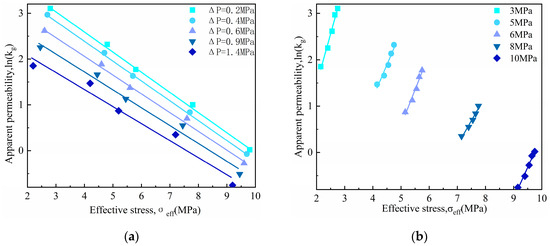
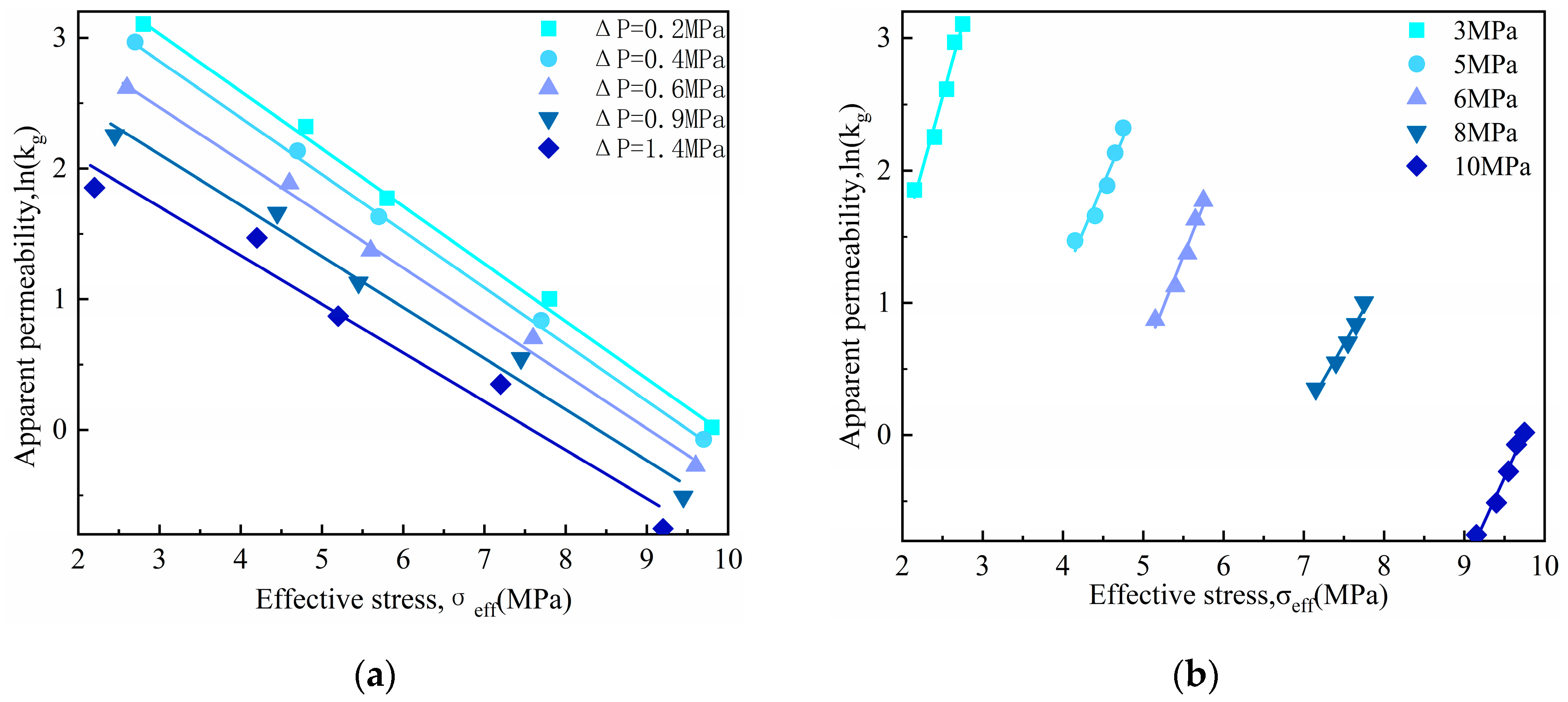
According to the effective-stress theory for porous media, the experimental data were grouped according to constant confining pressure and constant pressure difference. The calculated comprehensive effective stress σeff was used as the independent variable, and the natural logarithm of permeability lnka was used as the dependent variable. The relationship between logarithmic permeability and effective stress was drawn, as shown in Figure 15. Through processing, the evolution law of post-peak seepage response of fractured coal under the combined action of external stress constraint and internal fluid pressure can be analyzed under the unified variable system.
Figure 15.
(a) Variation of permeability with confining pressure under different pressure differences; (b) variation of permeability with pressure difference under different confining pressures.
By observing the scatter distribution and fitting curve shape in Figure 15, it can be found that under the two stress paths of constant pressure difference and constant confining pressure, the natural logarithm of fractured coal permeability lnka decreases with the increase in generalized effective stress σeff, and the two show a good linear negative correlation. The results show that, regardless of whether the change of effective stress comes from the increase in external confining pressure or the decrease in internal pore pressure, its control effect on the conductivity of post-peak residual fracture network has a consistent mechanical direction.
From the perspective of the fracture development mechanism, the increase in effective stress directly increases the normal compressive effect on both sides of the fracture surface and promotes a decrease in the physical opening of the main fracture and its associated fractures. For post-peak residual fractured coal, conductivity is mainly controlled by the fracture network, and changes in fracture aperture strongly affect permeability. Therefore, the near-linear relationship between lnka and σeff essentially reflects the continuous compaction process of the fracture-conductivity structure under effective stress. It can be seen that in the post-peak residual stage, although the external confining pressure and internal pore pressure have different sources, they all adjust the fracture opening and conductivity by changing the effective stress state.
4.3. Development of a Stress–Adsorption–Slippage Coupled Permeability Model
The previous analysis shows that the seepage evolution of post-peak fractured coal under constant-pressure-difference seepage conditions is jointly controlled by confining-pressure compaction, pore pressure support, matrix adsorption expansion, and gas slippage. A single effective-stress model or a conventional constant–slip–factor correction cannot independently represent the coupled contributions of mechanical deformation, adsorption-related deformation, and gas slippage under this test path.
Based on these findings, in this paper, the measured permeability ka is used as a unified response parameter. On the basis of retaining the coupling characteristics of the original test data, combined with the fracture mechanical deformation, Langmuir adsorption theory and Klinkenberg slip theory, a permeability composite constitutive equation suitable for the post-peak coal and rock CO2 seepage process is established.
The above post-peak mechanical response indicates that the residual-stage specimen has already formed a dominant seepage fracture network, but the conductivity of this fracture network is not a fixed constant. After further axial loading was terminated, the residual fracture structure could still be regulated by confining pressure, mean pore pressure, and effective-stress variation. Therefore, the proposed composite permeability model does not assume that the mechanical structure of the residual specimen remains completely unchanged. Instead, the mechanical compression term is retained to describe the continuous change in fracture conductivity within the quasi-stable residual stage.
The conductivity of fractured coal essentially depends on the geometric state of the residual fracture network. If the post-peak residual fracture system is represented by an equivalent parallel-fracture network, according to the fracture seepage theory, its conductivity shows obvious nonlinear characteristics with the change of fracture opening. Taking the residual benchmark permeability kres in the reference state as the starting point, the exponential form is used to characterize the effect of effective fracture deformation on intrinsic conductivity. The formula is:
where k∞ is the equivalent permeability without considering the slippage effect, and ∆εe is the effective strain that controls the change of fracture conductivity.
In the process of CO2 injection, the evolution of fracture diversion structure is mainly controlled by two factors: one factor is the mechanical compression effect caused by the change of effective stress, and the other is the matrix expansion effect caused by gas adsorption. Therefore, the comprehensive effective strain can be expressed as:
- 1.
- Mechanical compressive strain under effective stress control
Under conditions of constant confining pressure and variable pore pressure, the effective compaction of the fractured coal skeleton can be characterized by the difference between confining pressure C and average pore pressure pm. If the normal deformation in the post-peak residual stage is approximately regarded as an equivalent linear response, the mechanical compressive strain is:
where Cm is the fracture compression coefficient to reflect the sensitivity of the effective stress change corresponding to the residual fracture structure.
- 2.
- Matrix swelling strain controlled by adsorption
It should be noted that adsorption-induced swelling strain was not directly measured in this study. Therefore, the adsorption-related strain term in Equation (9) is introduced as a model-based representation of the possible influence of CO2 adsorption on fracture closure, and Ca is treated as a fitted adsorption-related correction coefficient rather than an independently measured swelling parameter. The adsorption-induced strain can be expressed as:
where PL is Langmuir pressure constant, and Ca is the fitted adsorption-related strain coefficient representing the possible influence of adsorption-induced matrix deformation on fracture closure.
- 3.
- Intrinsic permeability kernel equation
By substituting the above two types of strains into the intrinsic permeability expression, the equivalent intrinsic permeability model of post-peak fractured coal under the combined action of ‘mechanical compression–adsorption expansion’ can be obtained:
It can be obtained from Equation (12) that an increase in effective stress caused by an increase in confining pressure, together with matrix expansion caused by the increase in CO2 adsorption, leads to a decrease in intrinsic conductivity through the shrinkage of the fracture structure.
- 4.
- Construction of permeability constitutive equation with dynamic slip correction
According to Klinkenberg theory, after considering the slippage effect, the relationship between permeability ka and intrinsic permeability k∞ can be written as:
where k∞ is the intrinsic permeability of the medium, reflecting the conductivity of the coal skeleton structure itself, m2; pm is the average pore pressure, Pa; and b is the slip factor.
For conventional non-adsorbing media, b is often regarded as an empirical constant; however, for strong adsorption fractured coal, under the condition of CO2 injection, the pore–fracture structure dynamically adjusts with the change of adsorption and stress state, so the strength of slippage effect may also change with the change of pore pressure. In order to reflect this trend at the model level, this paper introduces a pressure-related equivalent slip parameter, which is expressed in the form of a saturated function coordinated with the adsorption response:
where b0 is the basic slip parameter in the reference state, and χ is the modulation coefficient of the adsorption-structure coupling effect on the slip parameters.
Substituting Formula (12) and Formula (14) into Formula (13), the final coal–rock permeability composite constitutive equation can be obtained:
The introduction of χ is based on the dynamic correction of the Klinkenberg slip factor. In the classical Klinkenberg model, the slip factor b is usually treated as an empirical constant. However, for CO2–bearing coal, gas adsorption can induce matrix swelling and pore–fracture structure adjustment, causing the slippage effect to vary with pore pressure and adsorption state. Therefore, b is expressed as a pressure-dependent form coordinated with the Langmuir-type adsorption response in this study. The coefficient χ is used to characterize the modulation degree of adsorption–structure coupling on the slip factor. It is not an independently measured material constant directly calculated from adsorption capacity, porosity, or fracture roughness, but a physically motivated equivalent coupling parameter. Its value is determined together with the other model parameters through the global nonlinear fitting of the composite permeability model.
4.4. Response-Surface Characteristics and Competing Control Mechanisms
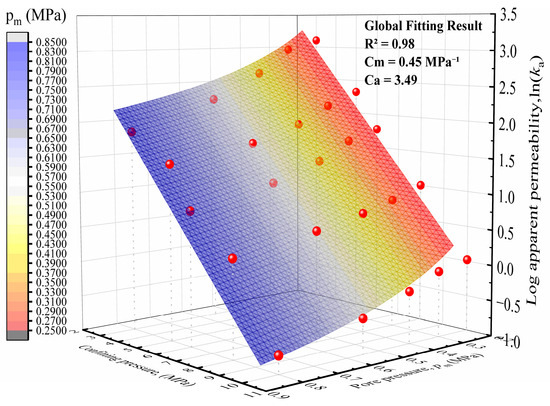
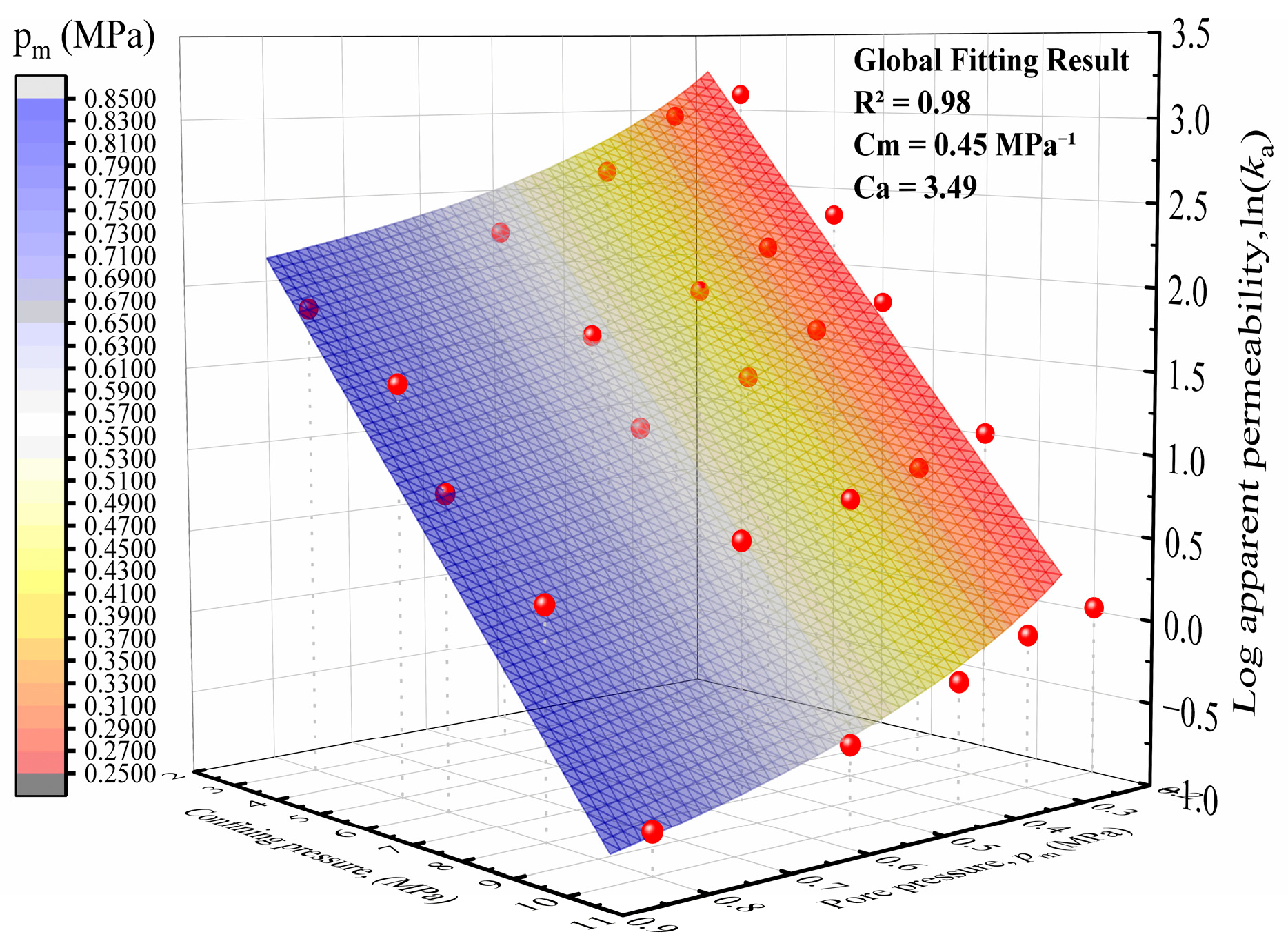
To evaluate the fitting performance of the composite constitutive equation, the complete experimental dataset was fitted globally using nonlinear regression, as shown in Figure 16. The global fitting yielded R2 = 0.97. Because the coefficient of determination alone cannot fully characterize the magnitude and distribution of the fitting errors, the RMSE and residual statistics were further calculated in the same lnka space, as listed in Table 4.
Figure 16.
Verification of the composite constitutive equation.
Table 4.
Statistical evaluation of the composite permeability model.
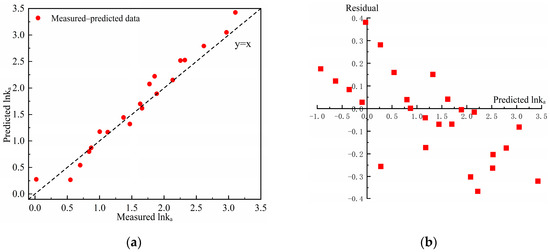
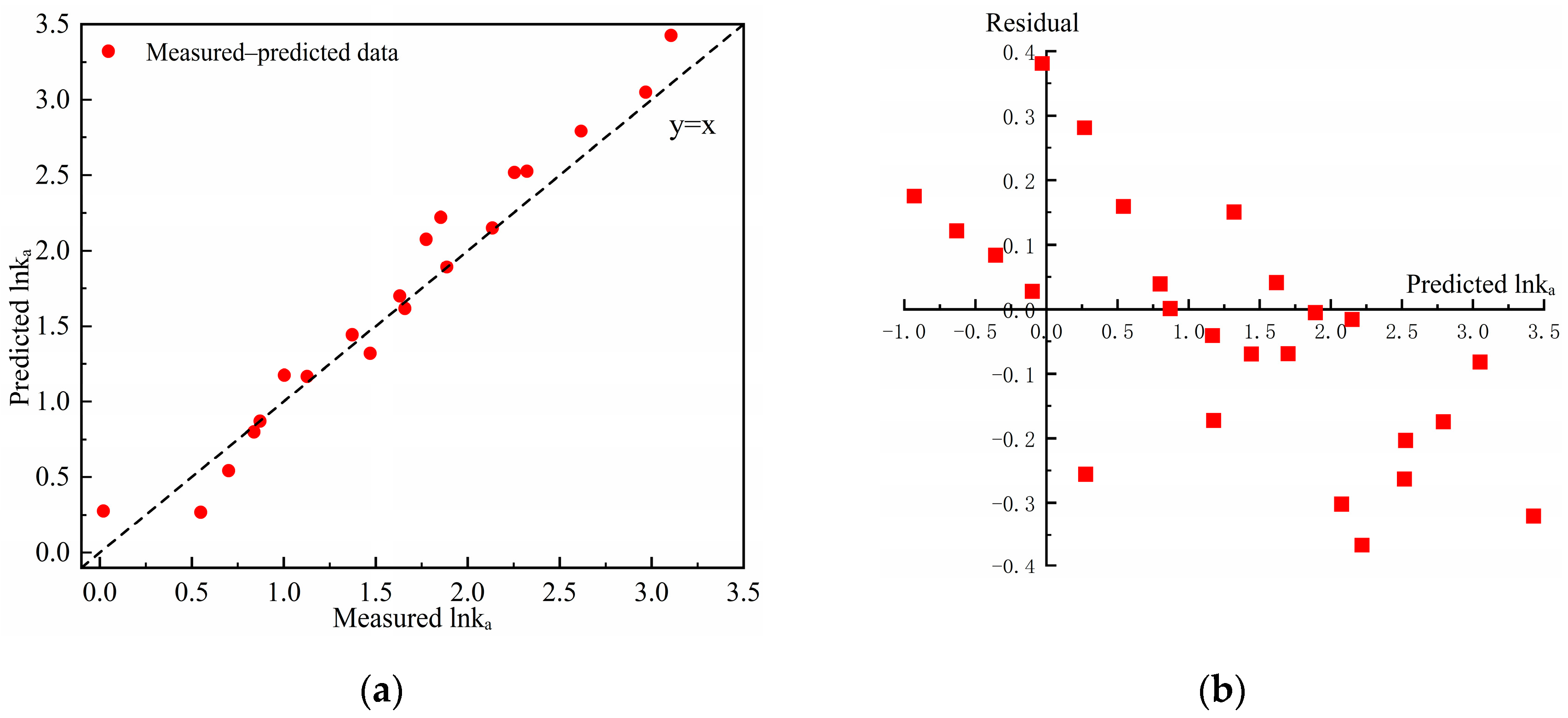
As shown in Table 4, the RMSE is 0.1909, indicating that the overall difference between the measured and predicted values remains limited. The mean residual is −0.0351, which is close to 0, while the residuals range from −0.3661 to 0.3810. These results indicate that the model does not exhibit an evident overall tendency toward overestimation or underestimation.
The agreement between the measured and predicted values and the corresponding residual distribution are further presented in Figure 17.
Figure 17.
Statistical evaluation of the composite permeability model: (a) measured versus fitted values of ; (b) residuals versus fitted values of .
Figure 17a shows that the measured and predicted values are generally distributed near the 1:1 reference line, confirming good agreement between the experimental data and the model predictions. Figure 17b shows that positive and negative residuals are distributed on both sides of the zero line, without a persistent monotonic variation with the predicted values. Although local deviations remain under several boundary conditions, they do not alter the overall description of permeability evolution under the full set of experimental conditions. The combined results of R2, RMSE, and residual analysis therefore support the fitting reliability of the composite constitutive equation within the investigated confining-pressure and average-pore-pressure ranges.
The results show that in the stress–pressure interval covered by the test in this paper, the evolution of post-peak coal–rock permeability does not show a segmented mutation or mechanism jump but maintains a continuous change process under the same residual fracture diversion system.
When viewed along the direction of confining pressure, the fitting surface is inclined downward overall, indicating that lnka continues to decrease with the increase in confining pressure. After the confining pressure increases, the degree of contact between the fracture walls increases, the rough convex body is further compressed, the effective opening of the main fracture and its associated fractures decreases, and the local diversion section shrinks, which is macroscopically manifested as a decrease in permeability. The results show that after the coal sample enters the post-peak residual stage, although the fracture network has formed, its normal deformation capacity does not disappear, and the confining pressure is still the main external factor controlling the attenuation of the conductivity.
When viewed along the direction of the average pore pressure, the response surface does not show the continuous uplift characteristics dominated by pore-pressure support alone, but generally reflects the response trend of lnka decreasing with the increase in average pore pressure in the current test interval. This phenomenon shows that although the increase in pore-fluid pressure has a mechanical tendency to weaken the effective compaction of the fracture surface, the local decompression effect is not enough to dominate the overall seepage response of residual coal samples after peak. In contrast, the decrease in gas slippage and the possible adsorption-related matrix swelling associated with the increase in average pore pressure provide a reasonable explanation for the observed permeability attenuation. Therefore, the geometric changes along the direction in the diagram are interpreted as the combined response of fracture stress adjustment, adsorption-related deformation, and gas slippage within the proposed model framework.
The fitted parameters of the composite permeability model are listed in Table 5.
Table 5.
Composite equation fitting parameter table.
5. Conclusions
This study investigated the mechanical and seepage responses of post-peak fractured coal under constant-pressure-difference conditions. Triaxial mechanical-seepage tests were conducted, and a composite permeability model incorporating effective stress, adsorption-related deformation, and dynamic gas slippage was developed. The main conclusions are as follows:
- Under triaxial loading, the coal specimens exhibited pronounced post-peak ductility and dilatancy. The Weibull-based damage model indicated that increased confining pressure enhanced the load-bearing capacity and delayed damage evolution, as reflected by the shift of the damage-evolution curves toward higher strain. After macroscopic failure, the dominant load-bearing mechanism changed from cohesive resistance within the coal skeleton to frictional sliding and interlocking along the fracture surfaces. The resulting residual fracture network provided connected flow paths for the subsequent seepage tests, although continued local compaction and structural adjustment could still occur.
- The calculated Reynolds numbers ranged from 0.01 to 0.85, indicating that CO2 flow remained within the low-velocity linear Darcy regime under all investigated conditions. Permeability evolution was governed by the competition among confining-pressure-induced fracture compaction, pore-pressure support, possible adsorption-induced matrix swelling, and gas slippage. Increasing confining pressure caused an exponential decrease in permeability. Along the pore-pressure loading path, the observed permeability decrease was interpreted, within the proposed model framework, as the combined influence of possible adsorption-related matrix swelling and weakened gas slippage; it should not be regarded as direct evidence of independently measured adsorption swelling.
- A composite apparent-permeability model was developed by introducing a pressure-dependent slip factor coupled with a Langmuir-type adsorption term. Global fitting yielded R2 = 0.97 and an RMSE of 0.1909, and the residuals were generally distributed around zero. These results support the in-sample fitting performance of the model within the investigated confining-pressure and pore-pressure ranges. The response surface showed no abrupt transition in the dominant permeability control regime within this range. Mechanical compaction was the dominant controlling mechanism, whereas adsorption-related deformation and gas slippage acted as secondary correction mechanisms.
Moreover, since the test samples were taken from the same coal seam, the model parameters need to be recalibrated using the corresponding experimental data for coals with different lithologic composition, ash content, or metamorphic grade.
Author Contributions
Conceptualization, W.Z. and Q.L.; methodology, W.Z.; validation, W.Z. and Q.L.; formal analysis, W.Z.; investigation, W.Z.; resources, Q.L.; data curation, W.Z.; writing—original draft preparation, W.Z.; writing—review and editing, Q.L.; supervision, Q.L.; project administration, Q.L.; funding acquisition, Q.L. All authors have read and agreed to the published version of the manuscript.
Funding
This research was funded by Shanxi Xinyuan Coal Industry Company Limited, Grant Number RH2300004731. The APC was funded by Shanxi Xinyuan Coal Industry Company Limited.
Data Availability Statement
The original contributions presented in this study are included in the article; further inquiries can be directed to the corresponding author.
Conflicts of Interest
The authors declare that this study received funding from Shanxi Xinyuan Coal Industry Company Limited. The funder was not involved in the study design; the collection, analysis, or interpretation of data; the writing of the manuscript; or the decision to submit the manuscript for publication.
References
- Liu, J.; Song, Z.; Yang, C.; Li, B.; Ren, J.; Chen, S. Changing law of permeability of coal reservoirs under variable pressure conditions and its influence on extraction efficiency of coalbed methane. Processes 2023, 11, 2455. [Google Scholar] [CrossRef] [Scilit]
- Zhao, L.; Hao, T.; Wang, D.; Wei, J.; Du, Y.; Nie, B.; Chen, J.; Li, Z.; Tang, Y.; Zhang, F. Modelling and analysis of coalbed methane drainage quality in penetrating–strata boreholes considering air leakage. Geomat. Nat. Hazards Risk 2025, 16, 2445628. [Google Scholar] [CrossRef] [Scilit]
- Cheng, X.; Cheng, C.; Wang, H.; Xiao, L.; Ma, X. Research and Application of Gas Drainage Negative Pressure Regulation Method Considering Permeability Differences. Processes 2025, 13, 1236. [Google Scholar] [CrossRef] [Scilit]
- Ilyushin, Y.; Talanov, N. Development of Methods and Models for Assessing Technical Condition of Mines and Underground Structures. Int. J. Eng. Trans. A Basics 2025, 38, 1659–1666. [Google Scholar] [CrossRef] [Scilit]
- Zhang, C.; Feng, X. Four–Zone Distribution of Coal Seam Stress in Hard–Roof Working Faces and Its Influence on Gas Flow. Processes 2025, 13, 3585. [Google Scholar] [CrossRef] [Scilit]
- Xue, J.; Li, K.; Shi, Y. Study on permeability characteristics of gas bearing coal under Cyclic load. Sustainability 2022, 14, 11483. [Google Scholar] [CrossRef] [Scilit]
- Wen, X.; Feng, G.; Guo, J.; Qian, R.; Feng, W.; Bai, J.; Liu, K.; Zhang, X.; Dias, D. Strength Deterioration Mechanism of Sandstone Subjected to Low–Frequency Dynamic Disturbance Under the Varying Static Pre–stress Levels. Rock. Mech. Rock. Eng. 2026, 59, 1297–1318. [Google Scholar] [CrossRef] [Scilit]
- Pan, H.; Zhang, Y.; Zhang, L.; Cao, Y.; Chu, Y.; Yang, S. Permeability characteristics of combined coal with different water contents. Energies 2025, 18, 200. [Google Scholar] [CrossRef] [Scilit]
- Li, C.; Liu, Y.; Wei, M.; Zhang, J. Permeability Enhancement Induced by Fracture Shear Dilation During Close–Range Coal Seam Mining. Appl. Sci. 2024, 14, 10639. [Google Scholar] [CrossRef] [Scilit]
- Liu, Y.; Zhao, D.; Yin, S.; Zhang, L. Comparison of energy evolution characteristics of intact and fractured coal under true triaxial progressive stress loading. Sustainability 2023, 15, 14796. [Google Scholar] [CrossRef] [Scilit]
- Liu, Y.; Wang, E.; Li, M.; Song, Z.; Zhang, L.; Zhao, D. Mechanical response and gas flow characteristics of pre–drilled coal subjected to true triaxial stresses. Gas. Sci. Eng. 2023, 111, 204927. [Google Scholar] [CrossRef] [Scilit]
- Du, Y.; Zhu, Z.; Xie, J.; Gao, M.; Liu, M.; Qu, S.; Nie, S.; Ren, L. Fractal Characterization of Permeability Evolution in Fractured Coal Under Mining–Induced Stress Conditions. Appl. Sci. 2025, 15, 11794. [Google Scholar] [CrossRef] [Scilit]
- Liu, Z.; Liu, Y.; Wang, Z.; Huang, W. Evolution of permeability and sensitivity analysis of gas–bearing coal under cyclic dynamic loading. Appl. Sci. 2024, 14, 8373. [Google Scholar] [CrossRef] [Scilit]
- Li, B.; Wang, J.; Liang, Y.; Li, Y.; Mao, Z. Study on the Permeability Evolution Laws and Damage Characteristics of Gas–Bearing Coal Under Different Cyclic Loading–Unloading Conditions. Appl. Sci. 2025, 15, 12102. [Google Scholar] [CrossRef] [Scilit]
- Guo, X.; Liu, Y.; Li, Y.; Deng, C.; Zhang, L.; Zhang, Y. Mechanical Damage to Coal and Increased Coal Permeability Caused by Water–Based Ultrasonic Cavitation. Energies 2024, 17, 3626. [Google Scholar] [CrossRef] [Scilit]
- Wei, G.; Ma, L.; Wen, H.; Yi, X.; Deng, J.; Liu, S.; Li, Z.; Zhang, D. Deformation–Failure Characteristics of Coal with Liquid CO2 Cryogenic–Freezing Process: An Experimental and Digital Study. Energies 2023, 16, 6126. [Google Scholar] [CrossRef] [Scilit]
- Zhang, L.; Yang, S.; Pan, H.; Zhang, T. Permeability of broken coal around CBM drainage boreholes with the compound disaster of the rockburst and outburst. Appl. Sci. 2025, 15, 3439. [Google Scholar] [CrossRef] [Scilit]
- Ju, F.; Wang, D.; Wang, Z.; Xiao, M.; He, Z.; Ning, P.; Wang, T.; Zhou, C.; Zhang, Y.; Li, L. Research on mechanical properties and damage constitutive model of water–bearing coal. Appl. Sci. 2022, 12, 8811. [Google Scholar] [CrossRef] [Scilit]
- Lu, T.; Wu, H.; Yin, S.; Xu, X. Study of rock damage constitutive model considering temperature effect based on Weibull distribution. Appl. Sci. 2024, 14, 3766. [Google Scholar] [CrossRef] [Scilit]
- Sun, Z.; Zhang, Q.; Zhang, J.; Zhang, Y.; Wang, P. A study of constitutive model of rock damage under the joint effect of load and moisture. Appl. Sci. 2023, 13, 1224. [Google Scholar] [CrossRef] [Scilit]
- Yang, H.; Wu, L.; Li, X. Mechanical Behavior and Damage Mechanisms of Saturated Coal–Rock Under Cyclic Freeze–Thaw Conditions with Different Cold Conditions. Processes 2025, 13, 3675. [Google Scholar] [CrossRef] [Scilit]
- Wen, G.; Gong, P.; Zhao, T.; Yi, K.; Ma, J.; Zhang, W.; Zhu, Y.; Li, P.; Bai, L. Study on the Mechanical Properties and Microscopic Damage Constitutive Equation of Coal–Rock Composites Under Different Strain Rates. Appl. Sci. 2026, 16, 579. [Google Scholar] [CrossRef] [Scilit]
- Wang, X.; Zhang, L. Experimental Study on Permeability Evolution of Deep Coal Considering Temperature. Sustainability 2022, 14, 14923. [Google Scholar] [CrossRef] [Scilit]
- Tan, Z.; Feng, Z.; Gao, Q.; Liu, S.; Zhang, Z. Study on Seepage Characteristics of Different Rank Coals After CO2 Adsorption Saturation and Its Implications for Coal Seam Sequestration. Appl. Sci. 2026, 16, 3798. [Google Scholar] [CrossRef] [Scilit]
- Liu, C.; Zhang, C.; Zhang, L.; Zhang, X. Apparent Permeability Model for Hydraulically Fractured Coal Seams: Integrating Damage Heterogeneity, Adsorption Swelling, and Klinkenberg Effects. Energy Fuels 2026, 40, 3538–3550. [Google Scholar] [CrossRef] [Scilit]
- Wang, M.; Yang, Y.; Zhou, Y.; Shi, H.; Huang, J. The influence mechanism of effective stress, adsorption effect and Klinkenberg effect on coal seam permeability. Front. Energy Res. 2023, 10, 979117. [Google Scholar] [CrossRef] [Scilit]
- Li, B.; Yuan, Y.; Liang, Y.; Qin, Z. Influences of Different Factors and Sensitivity Analysis of Permeability of Gassy Coal. Appl. Sci. 2025, 15, 808. [Google Scholar] [CrossRef] [Scilit]
- Xu, X.; Xin, Y.; Li, Q.; Zhang, S.; Tian, L.; Xue, Z. Experimental Investigation of Permeability Sensitivity of Coal Reservoir to Reservoir Pressure and Its Fluid–Solid Coupling Control Mechanism. Energies 2026, 19, 2132. [Google Scholar] [CrossRef] [Scilit]
- Wang, L.; Li, Z.; Zeng, J.; Chen, B.; Li, J.; Jia, H.; Wang, W.; Zhang, J.; Wang, Y.; Zhao, Z. Modeling Anisotropic Permeability of Coal and Shale with Gas Rarefaction Effects, Matrix–Fracture Interaction, and Adsorption Hysteresis. Processes 2025, 13, 3304. [Google Scholar] [CrossRef] [Scilit]
- Liu, Z.; Li, Y.; Cui, C.; Yan, Z. Numerical Simulation of Gas–Water Two–Phase Seepage During Coalbed Methane Development in ZhengZhuang Block: A Case Study of Well Z29. Processes 2025, 13, 3593. [Google Scholar] [CrossRef] [Scilit]
- Hu, A.; Li, K.; Yao, C.; Zhu, X.; Chang, H.; Mao, Z.; Ma, H.; Ma, X. Research and Application of Deep Coalbed Gas Production Capacity Prediction Models. Processes 2025, 13, 3149. [Google Scholar] [CrossRef] [Scilit]
- Hołaj–Krzak, J.T.; Dybek, B.; Szymenderski, J.; Koniuszy, A.; Wałowski, G. Unconventional Fossil Energy Carrier Assessment of the Influence of the Gas Permeability Coefficient on the Structure of Porous Materials: A Review. Energies 2025, 18, 870. [Google Scholar] [CrossRef] [Scilit]
- Wang, M.; Zou, J. A Novel Permeability Model of Coal Considering Gas Slippage and Gas Sorption–Induced Strain. Energies 2022, 15, 6036. [Google Scholar] [CrossRef] [Scilit]

Disclaimer/Publisher’s Note: The statements, opinions and data contained in all publications are solely those of the individual author(s) and contributor(s) and not of MDPI and/or the editor(s). MDPI and/or the editor(s) disclaim responsibility for any injury to people or property resulting from any ideas, methods, instructions or products referred to in the content. |
© 2026 by the authors. Licensee MDPI, Basel, Switzerland. This article is an open access article distributed under the terms and conditions of the Creative Commons Attribution (CC BY) license.