Review

Trends in Li/Na-Ion Battery Applications of Carbon-Based Anode Materials Derived from Biomass Recycling

1
Department of Materials Science and Engineering, Sungshin Women’s University, 55 Dobong-ro 76 ga-gil, Gangbuk-gu, Seoul 01133, Republic of Korea
2
School of Chemistry and Energy, Sungshin Women’s University, 55 Dobong-ro 76 ga-gil, Gangbuk-gu, Seoul 01133, Republic of Korea
3
Center for NanoBio Applied Technology, Sungshin Women’s University, 55 Dobong-ro 76 ga-gil, Gangbuk-gu, Seoul 01133, Republic of Korea
*
Authors to whom correspondence should be addressed.
Energies 2026, 19(12), 2869; https://doi.org/10.3390/en19122869
Submission received: 29 May 2026 / Revised: 11 June 2026 / Accepted: 15 June 2026 / Published: 17 June 2026

Abstract

Biomass-derived carbons are promising sustainable anode materials for lithium-ion batteries (LIBs) and sodium-ion batteries (SIBs) because biomass is renewable, abundant, low-cost, and naturally diverse in composition and morphology. Lignocellulosic frameworks, intrinsic heteroatoms, and biomass-derived inorganic species can be converted through carbonization, activation, graphitization, and doping into carbon architectures with tunable porosity, carbon ordering, and surface chemistry. This review first summarizes the compositional and structural features of biomass precursors and explains how processing conditions convert them into carbon frameworks. Recent advances in biomass-derived carbon anodes are then discussed by comparing the distinct design requirements for LIBs and SIBs. For LIBs, accessible surface area, hierarchical porosity, heteroatom-derived active sites, and improved electronic conductivity are generally beneficial for enhancing Li+ storage and rate capability. In contrast, SIB hard carbons require controlled surface exposure, expanded turbostratic spacing, and closed or latent pores to improve Na+ storage reversibility and initial Coulombic efficiency. These comparisons emphasize that biomass-derived carbon anodes should be designed according to system-specific storage mechanisms rather than a universal carbon design strategy.

1. Introduction

Lithium-ion batteries have powered portable electronics and electric vehicles (EVs) for more than three decades, and their demand in grid-scale energy storage continues to grow. Their high energy density, long cycle life, and mature manufacturing infrastructure make LIBs the benchmark technology for electrochemical energy storage [1]. However, the rapid increase in LIB demand has raised concerns over lithium resource availability, cost, and supply stability. These concerns are becoming increasingly important as electrified transportation and stationary storage systems continue to expand. In parallel, the energy-density ceiling of conventional electrode chemistries has intensified the search for alternative materials and battery systems that can provide higher performance, lower cost, and improved sustainability. These factors have motivated broad interest in battery chemistries based on more earth-abundant elements and renewable material platforms.
Sodium-ion batteries are among the most technologically mature alternatives to LIBs. Sodium is abundant, inexpensive, and widely distributed, and SIBs share similar electrochemical principles with LIBs, which can facilitate the transfer of existing cell design and manufacturing concepts [2]. Although the energy density of SIBs is generally lower than that of LIBs, SIBs offer a favorable balance between cost, resource availability, and electrochemical performance. This balance makes them particularly relevant for stationary storage, low-speed transportation, and other applications where cost and sustainability are prioritized over maximum energy density [3].
Anode development is a key bottleneck in both LIBs and SIBs. Graphite, the standard commercial LIB anode, stores lithium through a well-defined intercalation reaction but has a theoretical capacity of only 372 mAh g−1, which leaves limited room for further energy density gains [1]. Fast charging can also induce Li plating on graphite surfaces, leading to capacity fading and potential safety risks associated with dendrite growth and internal short circuits [4]. For SIBs, graphite presents a more fundamental challenge. The larger size of Na+ relative to Li+ makes the formation of stable Na–graphite intercalation compounds thermodynamically unfavorable under standard electrolyte conditions, effectively ruling out graphite as a viable SIB anode [2,5]. Beyond this thermodynamic incompatibility, the larger ionic radius of Na+ also leads to slower solid-state diffusion kinetics and greater structural strain in host materials, placing more demanding requirements on anode design for SIBs [2]. These limitations point to the need for carbon anodes with greater structural flexibility than graphite. Disordered and porous carbons are therefore attractive because their interlayer spacing, defect density, pore architecture, and surface chemistry can be independently tuned to meet the distinct storage requirements of Li+ and Na+ [1].
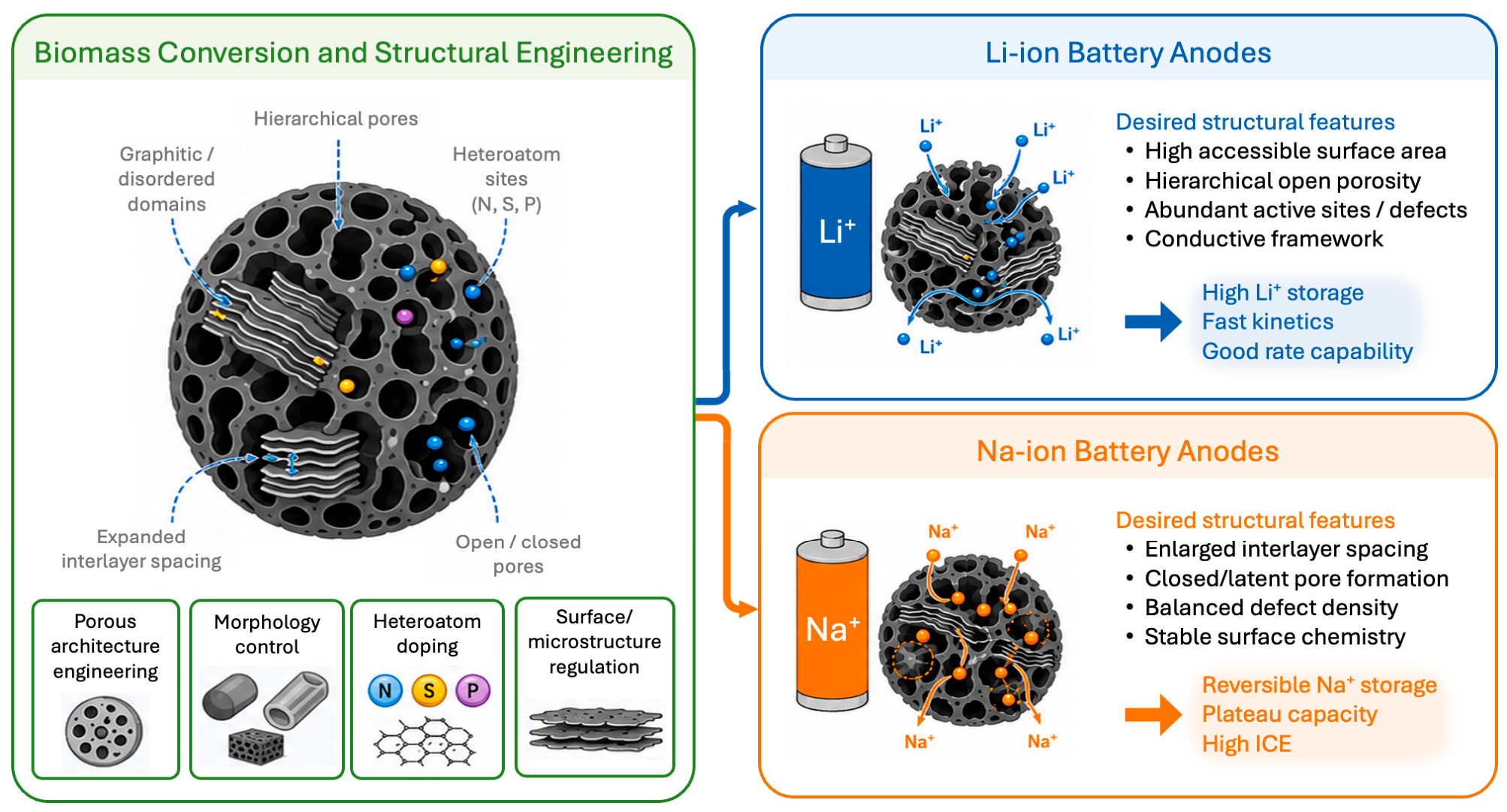
Biomass is a sustainable and structurally versatile source of functional carbon materials. Agricultural residues, forestry byproducts, food-processing wastes, and other biomass resources are abundant, renewable, and inexpensive carbon sources [5]. Their conversion into functional carbon materials not only lowers feedstock cost but also adds value to waste streams that would otherwise require disposal, combustion, or low-value utilization. Biomass precursors decompose through different pathways during pyrolysis and influence carbon yield, pore formation, local ordering, and defect chemistry [3,6]. In addition, many biomass precursors naturally contain heteroatoms such as N, O, S, and P, which are retained during carbonization, offering a route to intrinsically doped carbon anodes without separate doping steps [5]. Owing to these structural and chemical advantages, biomass-derived carbons have been widely explored in diverse applications, including environmental remediation, adsorption, catalysis, gas storage, supercapacitors, and rechargeable batteries [5,7,8]. Among these applications, their use as anode materials for secondary batteries is particularly attractive, as their tunable porous structures, defect-rich frameworks, and surface functionalities provide favorable ion-storage sites and transport pathways (Figure 1).
In LIBs and SIBs, these structural features are directly associated with improved anode performance. Hierarchical porosity facilitates electrolyte infiltration, enlarges the electrode/electrolyte interface, and shortens ion-diffusion pathways [9,10]. Meanwhile, abundant defects and heteroatom-containing functional groups provide additional active sites for Li+ and Na+ storage [5]. These combined structural and chemical attributes make biomass-derived carbon materials a promising anode platform for both LIBs and SIBs.
Research on biomass-derived carbon materials has expanded steadily [5,7,8]. In particular, recent studies published from 2023 to 2026 have explored various strategies involving porous structure engineering, heteroatom doping, and surface-chemistry regulation. Therefore, this review specifically focuses on recent research articles published between 2023 and 2026 on biomass-derived carbon anodes prepared from waste biomass resources for LIBs and SIBs. To maintain a clear materials scope, this review focuses on biomass-derived carbons with reported porous or hard-carbon architectures and quantified surface-area/porosity data, with most selected studies reporting Brunauer–Emmett–Teller (BET) surface areas above 100 m2 g−1.
Unlike previous reviews, which have generally examined lithium- or sodium-ion carbon anodes in isolation [1,2] or surveyed biomass-derived carbons broadly across many applications [5,7,8], this review places the two systems side by side. Its central argument is that biomass-derived anodes for LIBs and SIBs require fundamentally different carbon architectures, so that recent progress is best understood by contrasting their design requirements rather than treating biomass-derived carbon as a single generic material. This comparative framing allows the review to derive system-specific design guidelines for each ion.
This review is organized as follows. Section 2 introduces the principal strategies used to convert biomass into porous carbon anodes. Section 3 and Section 4 discuss recent LIB and SIB studies, respectively, with emphasis on structural engineering and heteroatom/surface-chemistry modification. Section 5 consolidates the structure–performance relationships across both systems. Section 6 addresses remaining challenges and future directions.

2. Preparation Strategies of Biomass-Derived Carbon Anodes

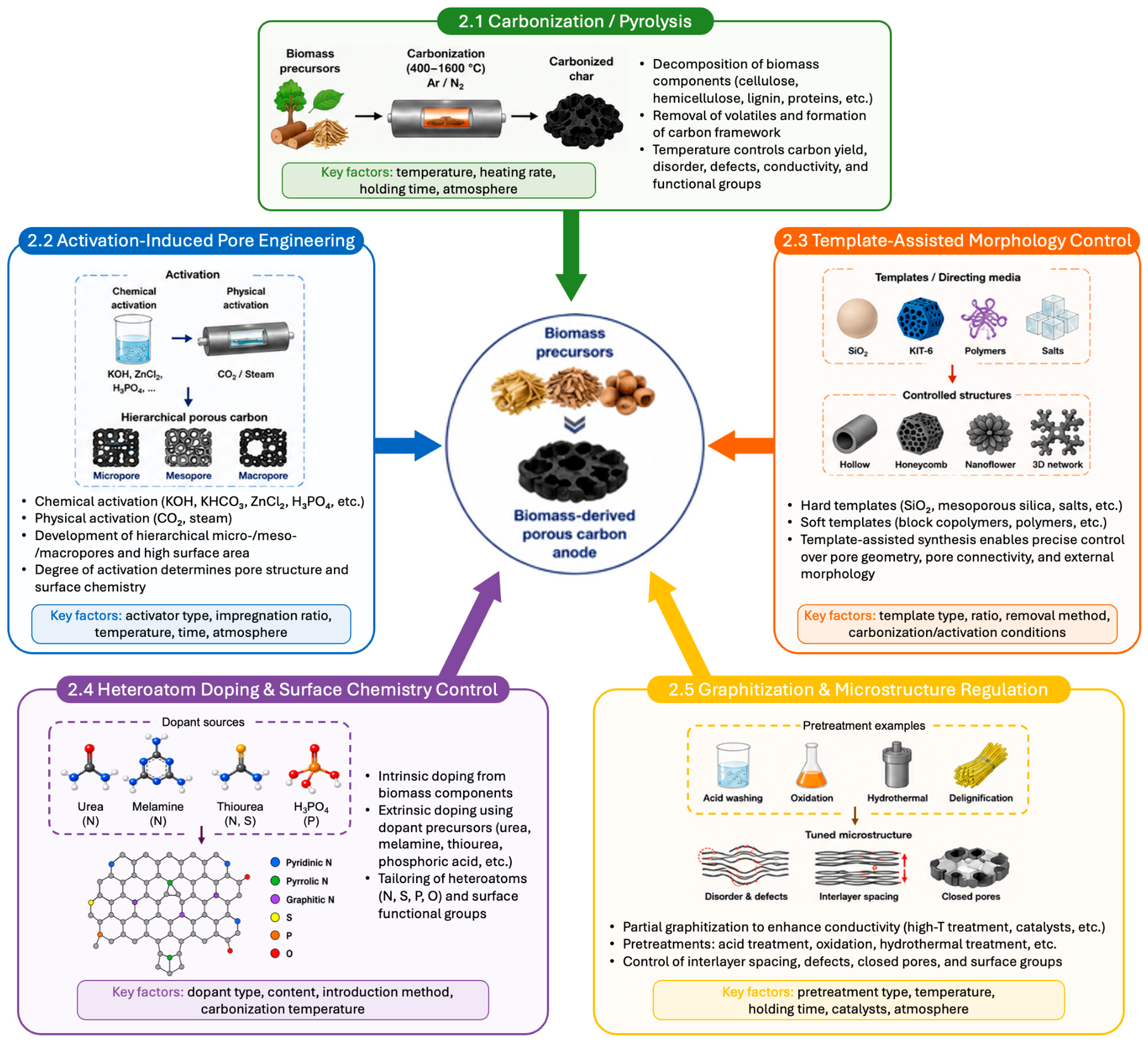
Converting biomass into a functional carbon anode requires a sequence of thermal and chemical processing steps, each of which shapes a distinct structural attribute of the final material. Carbonization establishes the basic carbon framework; subsequent activation, templating, doping, and surface treatment progressively refine pore architecture, heteroatom content, electronic structure, and surface chemistry. Because LIBs and SIBs impose different structural requirements on their anodes, the combination and intensity of these processing steps must be tailored accordingly. The major preparation strategies discussed in this section are summarized schematically in Figure 2.

2.1. Carbonization and Pyrolysis as the Basic Conversion Step

Pyrolysis under an inert atmosphere is the foundational step in converting any biomass precursor into a carbon material. During heating, volatile components, including water, CO2, CO, and low-molecular-weight organics, are progressively released, leaving behind a carbon-rich, structurally reorganized solid [3,6]. The three principal lignocellulosic components, namely cellulose, hemicellulose, and lignin, decompose over different temperature ranges and contribute distinct microstructural features to the resulting carbon: cellulose promotes ordered turbostratic layer stacking, hemicellulose generates defect-rich disordered domains at lower temperatures, and lignin contributes aromatic cross-links that resist full graphitization [6].
Carbonization temperature is among the most consequential processing variables. At lower temperatures (600–900 °C), the carbon retains abundant surface functional groups, high defect density, and wide interlayer spacing, but suffers from limited electronic conductivity [2,11]. As temperature increases toward 1000–1600 °C, structural ordering improves, heteroatom content declines, and graphitic domain dimensions grow; simultaneously, open pores partially collapse into closed nanopores whose volume increases with temperature [2,12]. Carbonization is more than a heat-treatment step. It establishes the baseline carbon framework before any further pore, defect, or surface engineering is applied.

2.2. Chemical and Physical Activation for Pore Development

Activation is the primary route for transforming dense biomass char into porous carbon with high ion-accessible surface area. Two general approaches are used. Physical activation exposes pre-carbonized char to oxidizing gases, most commonly CO2 or steam, at elevated temperatures. The carbon surface is gradually etched through gasification, generating pores while preserving a relatively simple processing route [7,13]. Chemical activation involves mixing the biomass precursor or pre-carbonized char with an activating agent before or during pyrolysis. It is more widely used in the studies covered in this review because it usually provides higher pore-forming efficiency and requires lower treatment temperatures than physical activation [7].
Among chemical activating agents, KOH is the most widely used. During thermal treatment, KOH reacts with the carbon framework through coupled redox, gasification, and intercalation processes. These reactions etch the carbon matrix, generate gas species that expand pores, and introduce metallic K species between graphitic layers. Subsequent washing removes K-containing species and leaves abundant micropores and enlarged interlayer spacings [12,14]. Under optimized conditions, KOH activation can produce biomass-derived carbons with BET surface areas above 2000 m2 g−1 [7]. KHCO3 follows a related but milder activation pathway. Its decomposition releases CO2 and K-containing species at lower temperatures, providing gentler etching than KOH [15]. This feature is useful when preserving native morphology or heteroatom content is important [15].
Other activating agents provide different pore-forming environments. ZnCl2 mainly promotes dehydration of the biomass matrix and can also act as an in situ structure-directing agent [7]. Zinc species occupy space within the carbonizing precursor and are removed by acid washing, leaving mesopore-rich and often interconnected porous frameworks [16]. This mechanism is useful for constructing three-dimensional or honeycomb-like carbon architectures [16]. H3PO4 acts under milder conditions and promotes cross-linking and esterification reactions during carbonization [7]. The resulting carbons often contain interconnected micro/mesopores and residual phosphorus-containing surface functionalities, which can contribute additional electrochemically active sites [7].
Regardless of the activating agent, the activator-to-carbon ratio and activation temperature must be carefully optimized. Insufficient activation produces poorly developed pores and limited ion accessibility. Excessive activation, however, can over-etch the carbon framework, collapse pore walls, reduce mechanical integrity, and generate excessive open surface area [14,16]. This trade-off has different implications for LIBs and SIBs. In LIBs, high surface area and hierarchical pore distribution are generally favorable because they increase Li+-accessible active sites and facilitate electrolyte penetration under high-current operation [1]. In SIBs, excessive open porosity can promote irreversible electrolyte decomposition and Na+ consumption during solid–electrolyte interphase (SEI) formation, leading to low initial Coulombic efficiency (ICE) [2]. Therefore, activation should be optimized not only to increase BET surface area but also to control pore hierarchy, open/closed pore distribution, and surface chemistry.

2.3. Template-Assisted and Morphology-Preserving Strategies

When pore geometry and morphology require more precise control than activation alone can provide, template-assisted synthesis offers a complementary route. Unlike activation, which mainly develops pores through chemical or physical etching, templating defines pore size, pore connectivity, and external morphology using a sacrificial or self-assembled structure. Two major approaches are commonly used: hard templating and soft templating. In both cases, the template is introduced prior to or during carbonization and later removed to leave behind a defined pore structure.
Hard templates use rigid scaffolds, such as SiO2 nanoparticles, ordered mesoporous silica, MgO, or inorganic salts, to direct carbon formation around a predefined geometry [4]. After carbonization, the template is removed by acid etching or high-temperature calcination, leaving a porous carbon framework that partially replicates the template morphology [4]. This strategy is useful for producing hollow, mesoporous, or interconnected carbon structures with more controlled pore architectures than those obtained by direct activation. SiO2-based templates are especially relevant for lignin-derived carbons because silanol groups on silica can interact with hydroxyl-rich lignin through hydrogen bonding, promoting more uniform precursor coating [17]. In combined templating–activation strategies, the compatibility between the template and activating agent is also important. Alkaline activators such as KOH can react with SiO2 at elevated temperatures to form silicate byproducts, whereas ZnCl2 does not react with SiO2 under these conditions and is therefore used preferentially in combined templating–activation strategies [17]. In such systems, the template controls the external morphology, while activation develops the internal pore network, producing hierarchical carbons with both defined shape and high surface area [17].
Soft templating relies on the self-assembly of amphiphilic molecules, most commonly block copolymers such as Pluronic F-127, PIB-b-PEO, or PEO-b-PHA [18]. During evaporation-induced self-assembly, the carbon precursor organizes around micellar domains, and subsequent polymerization and pyrolysis convert this organic–inorganic arrangement into an ordered mesoporous carbon framework [18]. Compared with hard templating, soft templating avoids solid-template removal and offers tunable mesopore dimensions by changing the block length or composition of the copolymer. For lignin-derived mesoporous carbons, pore sizes in the range of approximately 5–50 nm have been reported using different block copolymer templates [18]. However, soft templates can decompose during pyrolysis and may limit the accessible carbonization temperature. In addition, templating can suppress graphitic ordering relative to non-templated carbons, which should be considered when high electronic conductivity is required [18].
A simpler route is to preserve or exploit the native morphology of biomass precursors. Many plant-derived materials contain cellular channels, vascular networks, fibrous bundles, layered structures, or honeycomb-like architectures. These features can survive or be reconstructed during carbonization and activation, producing interconnected porous carbons without external templates [6,10]. This morphology-preserving strategy is attractive because it reduces synthetic complexity and avoids template removal. It is also well aligned with biomass recycling, as the natural architecture of low-value waste is directly converted into functional electrode morphology. However, the resulting pore structure depends strongly on precursor type, growth conditions, and pretreatment history, which can make systematic control and reproducibility more challenging.
Template-assisted and morphology-preserving approaches represent two complementary routes to porous carbon design. Hard and soft templates provide higher structural precision but require additional reagents, processing steps, and removal procedures. Native morphology preservation is simpler and potentially more scalable but offers less independent control over pore size and connectivity. The choice between these approaches therefore reflects a trade-off between structural tunability and synthetic practicality. For biomass-derived carbon anodes, this trade-off is important because pore architecture must be optimized not only for high surface area but also for ion transport, electrode stability, and compatibility with either LIB or SIB storage requirements.

2.4. Heteroatom Doping and Surface Functionalization

Introducing heteroatoms into the carbon framework is a widely used strategy for modifying electronic structure, surface chemistry, and ion-storage kinetics beyond what pore engineering alone can achieve. Two doping routes are generally distinguished. Self-doping relies on heteroatoms naturally present in the biomass feedstock, mainly N, O, S, and P from proteins, amino acids, inorganic minerals, and other biomass components. These heteroatoms can be partially retained after pyrolysis, producing doped carbon frameworks without additional dopant reagents [5]. Exogenous doping introduces external dopant precursors before or during carbonization. Typical examples include urea, melamine, and ammonium salts for nitrogen; thiourea or elemental sulfur for sulfur; and ammonium phosphate or H3PO4 for phosphorus [5,19].
Nitrogen is the most extensively studied dopant for biomass-derived carbon anodes. In carbon frameworks, nitrogen is commonly present as pyridinic-N, pyrrolic-N, and graphitic-N, also referred to as quaternary-N [2]. Pyridinic-N is located at the edge of graphitic domains and is often associated with defect-rich sites. Pyrrolic-N is incorporated in five-membered ring structures, while graphitic-N substitutes carbon atoms within the conjugated carbon lattice. These configurations affect electrochemical behavior in different ways. Pyridinic-N and pyrrolic-N can provide additional ion-adsorption sites and increase surface polarity, whereas graphitic-N can improve electronic conductivity by modulating the π-electron system [2,4,19]. The relative distribution of nitrogen species depends strongly on carbonization temperature. As the temperature increases, the total nitrogen content generally decreases, while less stable nitrogen configurations can transform into more thermally stable pyridinic- or graphitic-N species [2].
The role of N doping differs somewhat between LIBs and SIBs. In LIBs, N-doped sites can increase the density of Li+-accessible active sites, improve wettability, and enhance pseudocapacitive contributions, thereby supporting higher capacity and better rate capability [19]. In SIBs, pyridinic-N and pyrrolic-N are often considered beneficial because they create polar and defect-rich environments that can promote Na+ adsorption and facilitate charge transfer. In some cases, N-induced defects and local structural distortion can also contribute to enlarged interlayer spacing and improved Na+ diffusion kinetics [4].
Sulfur and phosphorus doping provide complementary structural and electronic effects. Because sulfur has a larger atomic radius than carbon, S incorporation can distort the local carbon lattice and widen interlayer spacing, which is useful for accommodating larger alkali ions, especially Na+ [19]. Sulfur-containing groups can also modify surface polarity and introduce additional ion-interaction sites. Phosphorus incorporation forms C–P or P–O bonding environments that perturb the local electron density of neighboring carbon atoms. This can generate additional defects, expand interlayer spacing, and enhance surface-driven charge-storage behavior [4,20].
Dual-element doping, particularly N,S and N,P co-doping, has attracted growing interest because two heteroatoms can regulate the carbon framework through complementary effects. In N,S co-doped systems, nitrogen can improve surface wettability, electronic conductivity, and ion adsorption, while sulfur can expand interlayer spacing and introduce additional electroactive sites. Their combined effects can increase both capacitive and diffusion-controlled contributions to ion storage [19]. N,P co-doping follows a similar design principle. Nitrogen mainly contributes to conductivity and active-site formation, whereas phosphorus promotes structural distortion and interlayer expansion. These effects can improve rate capability and cycling stability in LIB and SIB configurations [20].
The benefits of heteroatom doping must be balanced against several trade-offs. Excessive dopant concentrations can disrupt local carbon ordering, increase defect density, and raise charge-transfer resistance [4]. In SIBs, highly defective surfaces and abundant oxygen-containing functional groups can also promote irreversible Na+ consumption during initial SEI formation, lowering ICE [2]. Therefore, heteroatom doping should be optimized together with carbonization temperature, pore structure, and surface functionality. The aim is to balance active-site density, electronic conductivity, structural order, and first-cycle reversibility rather than to maximize dopant content.

2.5. Graphitization, Pretreatment, and Microstructure Regulation

Beyond pore formation and heteroatom doping, the degree of graphitic ordering and the bulk microstructure of biomass-derived carbon must be controlled to meet the requirements of the target battery system. Graphitization mainly regulates electronic conductivity, local ordering, and interlayer structure, whereas precursor pretreatment controls the chemical composition and structural evolution of biomass before carbonization. These strategies are especially important because LIBs and SIBs require different carbon microstructures.
For LIBs, partial graphitization within a disordered porous carbon framework is useful for improving electronic conductivity and charge-transfer kinetics [1]. Direct thermal graphitization of biomass-derived carbons usually requires temperatures above 2000 °C, which is energy-intensive and difficult to implement at large scale [1]. Catalytic graphitization offers a lower-temperature route. Transition metal species, including Fe, Ni, Co, and Co–Mo alloys, can be introduced into biomass precursors before carbonization to promote the rearrangement of disordered carbon into locally ordered graphitic domains [21,22]. This process generally involves carbon dissolution into the metal catalyst, structural rearrangement, and precipitation of graphitic layers during cooling [21]. Non-metal catalysts such as boron have also been used to facilitate C–C bond rearrangement during pyrolysis, enabling pseudo-graphitic structures at lower temperatures [22]. Such partial graphitization can reduce charge-transfer resistance and improve rate capability while retaining pore structures and defect sites needed for additional Li+ storage [22].
For SIBs, the design priority is different. Excessive graphitization can narrow the interlayer spacing toward graphite-like values and reduce the structural flexibility needed for Na+ storage [2,12]. Therefore, SIB-oriented hard carbons are usually designed to retain turbostratic disorder, expanded interlayer spacing, moderate defect density, and suitable open/closed pore distributions [2,12]. In this context, precursor pretreatment is often more important than post-carbonization graphitization. Pretreatment changes the biomass composition before pyrolysis and thereby affects carbon yield, surface functionality, pore formation, and the development of closed nanopores during high-temperature carbonization.
Hydrothermal pretreatment is a representative strategy. Treating biomass in hot compressed water before pyrolysis can partially decompose hemicellulose, remove soluble components, and homogenize the precursor structure [2,12]. It can also introduce or redistribute oxygen-containing functional groups, which influence cross-linking and microstructure evolution during subsequent carbonization. Acid pretreatment provides a complementary route. Dilute H2SO4, HCl, or H3PO4 can remove mineral impurities and selectively degrade amorphous components such as hemicellulose and part of lignin [6]. By changing the relative contents of cellulose, hemicellulose, and lignin, acid treatment can regulate turbostratic ordering, pore formation, and surface chemistry in the final hard carbon [6,12].
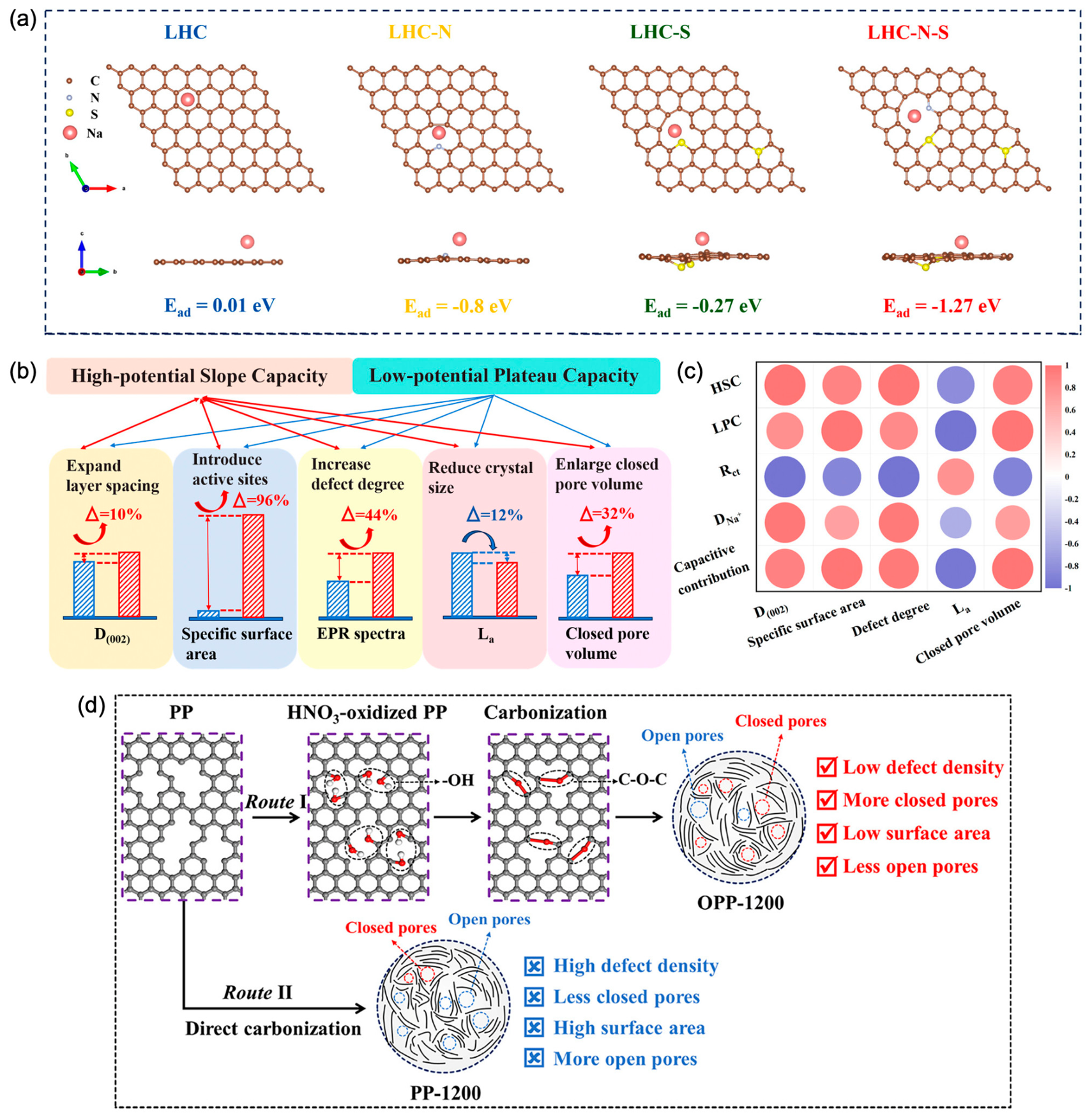
Liquid-phase oxidation offers a more targeted approach to surface and pore regulation. Oxidants such as dilute HNO3 can introduce oxygen-containing groups into the biomass precursor before carbonization [23]. During pyrolysis, these groups can promote dehydration, condensation, and cross-linking reactions, which suppress excessive volatilization and influence the evolution of open and closed pores [23]. As a result, oxidized precursors can yield hard carbons with lower open surface area, more controlled pore structures, and improved first-cycle reversibility compared with directly carbonized samples. In addition, precursor composition control, such as partial delignification or hemicellulose removal, provides another way to tune the balance between local ordering, defect density, and pore development [24,25].
Overall, the strategies discussed in Section 2.1, Section 2.2, Section 2.3, Section 2.4 and Section 2.5 show that biomass-derived carbon anodes result from sequential structure design. For LIBs, preparation generally emphasizes high surface accessibility, hierarchical pore networks, conductive frameworks, heteroatom-rich active sites, and partial graphitization. For SIBs, the focus shifts toward controlled hard-carbon microstructures, enlarged interlayer spacing, balanced defect density, closed-pore formation, and stable surface chemistry. These system-dependent design principles provide the basis for the recent LIB and SIB studies discussed in the following sections.

3. Biomass-Derived Porous Carbon Anodes for Lithium-Ion Batteries

The limited theoretical capacity of commercial graphite anodes, 372 mAh g−1, together with their insufficient rate response under high-current operation, has motivated the development of alternative carbonaceous anodes for LIBs [1]. Beyond carbonaceous anodes, high-capacity alloying materials such as silicon have also been extensively investigated to increase LIB energy density. Silicon offers a much higher theoretical capacity than graphite, but its practical implementation is still limited by large volume changes during cycling, unstable SEI formation, electrode pulverization, and the need for complex composite designs [26]. Biomass-derived carbons are not expected to surpass silicon in theoretical capacity. They do, however, offer practical advantages in terms of renewable and low-cost feedstocks, structural tunability, relatively stable carbon frameworks, and compatibility with conventional carbon-electrode processing. Therefore, biomass-derived carbon anodes should be considered complementary to silicon-based anodes, particularly for applications where cost, sustainability, rate capability, and cycling durability are prioritized.
The accessible surface area, hierarchical pore networks, surface functional groups, and defect-rich structures of biomass-derived porous carbons can provide storage environments that differ from those of conventional graphite. In these materials, Li+ storage generally involves several overlapping processes, including surface adsorption on pore walls and defect sites, pore filling in confined nanospaces, and insertion into graphitic or pseudo-graphitic domains [1,20]. The balance among these storage modes depends strongly on pore architecture, carbon ordering, and surface chemistry. Therefore, both structural engineering and heteroatom modification are central to improving the reversible capacity, rate capability, and cycling stability of biomass-derived carbon anodes. The following sections summarize the structural and chemical design strategies reported in the 21 LIB-related studies considered in this review.

3.1. Porous Structure and Morphology Engineering

3.1.1. Template-Assisted Pore Engineering

Template-assisted synthesis offers a high level of control over pore geometry and external morphology, allowing the construction of carbon shells, ordered channels, and interconnected mesoporous frameworks that are difficult to obtain by direct activation alone.
Wang et al. reported a combined SiO2 hard-template/ZnCl2 activation strategy to convert waste lignin into hierarchical porous carbon shells [17]. In this process, lignin was first deposited on the SiO2 surface through interactions between hydroxyl-rich silica and polar functional groups in lignin. ZnCl2 was then introduced as an activating agent because it could promote pore formation without destroying the SiO2 template during thermal treatment. After carbonization, acid washing and HF etching removed the activating residues and silica scaffold, producing interconnected porous carbon shells with a BET surface area of 1545.7 m2 g−1. The optimized carbon shell electrode retained 1064 mAh g−1 after 100 cycles at 0.1 A g−1, indicating that the shell-like architecture and internal pore network effectively supported Li+ storage and electrolyte access. The large pseudo-capacitive contribution observed at different scan rates further suggests that much of the pore surface participated in charge storage rather than remaining electrochemically inactive [17].
Using lignin as the same biomass precursor, Wang et al. adopted nano-silica spheres as structure-directing templates together with K2CO3 activation to prepare honeycomb-like porous carbon [27]. The nano-silica framework guided the formation of channel-type carbon structures, while K2CO3 contributed to the development of smaller internal pores. The resulting honeycomb-like porous carbon electrode retained 483.8 mAh g−1 after 100 cycles at 100 mA g−1 [27]. Although its capacity was lower than that of the SiO2/ZnCl2-derived carbon shell in [17], this example shows that template-controlled channel structures can provide continuous pathways for electrolyte infiltration and ion migration within the electrode.
A more ordered hard-template approach was demonstrated using KIT-6 mesoporous silica for pinecone-derived carbon [28]. The KIT-6 scaffold generated a three-dimensionally connected mesoporous carbon framework, whereas chemically activated pinecone carbons prepared with H3BO3, K2CO3, or KOH showed less favorable performance under comparable testing conditions. The KIT-6-templated pinecone carbon electrode delivered 822.8 mAh g−1 after 500 cycles at 100 mA g−1, clearly exceeding the capacities of the chemically activated counterparts [28]. Controlled mesopore organization can improve electrolyte accessibility, facilitate Li+ transport, and enhance the electrochemical utilization of biomass-derived carbon frameworks.

3.1.2. Morphology-Directed and 3D Porous Architectures

In addition to hard templates, the intrinsic morphology of biomass can be preserved or reconstructed to form three-dimensional porous electrodes. Such morphology-directed strategies are particularly useful when the precursor contains interconnected cellular structures or can be converted into open frameworks before carbonization.
Ding et al. prepared apple-derived 3D porous carbon by combining freeze-drying with a staged KOH activation process, where initial carbonization preserved the carbon framework and subsequent activation generated interconnected pores [10]. Freeze-drying helped preserve the open cellular framework of the apple precursor, while the subsequent two-step thermal treatment first stabilized the carbon skeleton and then developed an interconnected pore network through high-temperature KOH activation. This structure shortened Li+ diffusion distances and improved electrolyte access throughout the electrode. As a result, the optimized material delivered more than 900 mAh g−1 after 100 cycles at 0.2 A g−1 and maintained over 500 mAh g−1 after 500 cycles [10]. This case demonstrates how morphology preservation and staged activation can be combined to improve both capacity and long-term cycling.
Zeng et al. reported a different morphology-driven strategy using walnut shells and a molten-salt medium [29]. During synthesis, the molten salt promoted pore formation and structural reconstruction, while an additional carbon coating generated a conductive core/shell-type carbon interface. The resulting carbon-coated walnut shell-derived porous carbon exhibited a three-dimensional nanoflower-like morphology, providing an electrolyte-accessible porous framework and improved Li+ diffusion behavior. Compared with the uncoated counterpart, the carbon-coated electrode showed an 11.93% increase in initial Coulombic efficiency and retained 99.3% of its initial capacity after 900 cycles at 3 C. These results suggest that coupling porous nanoflower morphology with a conductive carbon coating can improve both initial reversibility and long-term cycling stability [29]. Morphology-directed porous carbon design enhances Li+ transport, electrolyte accessibility, and structural durability without relying on hard templates.

3.1.3. Catalytic Graphitization

While a highly porous and defective framework can increase Li+ storage sites, excessive disorder often limits electronic conductivity. Catalytic graphitization addresses this issue by introducing short-range graphitic domains into biomass-derived carbon at lower temperatures than conventional graphitization.
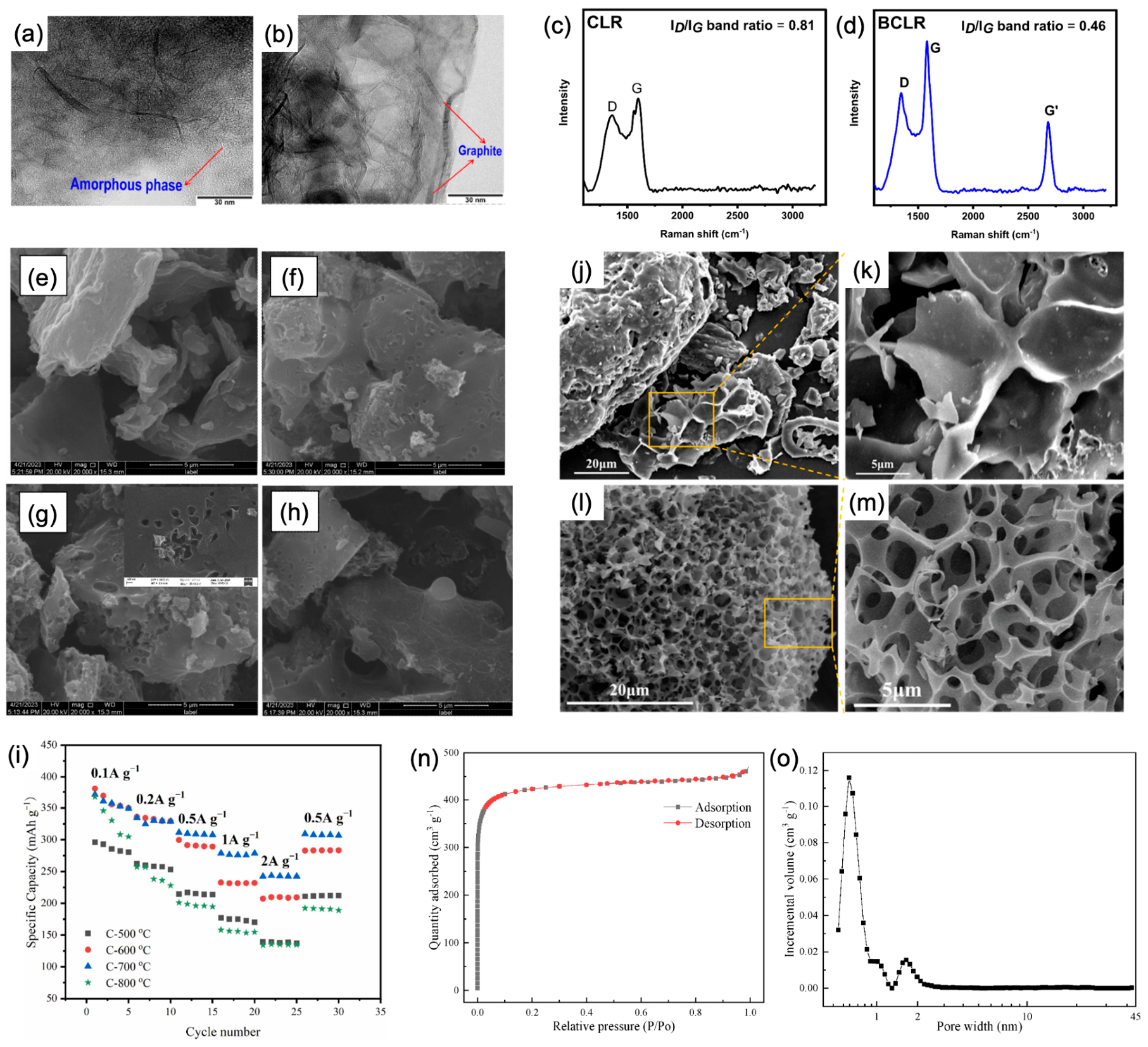
Sruthy E. S. et al. used pure boron as a non-metal catalyst to promote graphitization of pine logging residue-derived carbon (Figure 3a–d) [22]. The synthesis involved carbonization with boron followed by KOH activation at 900 °C, which is much lower than the temperature generally required for direct graphitization of biomass carbon. Boron facilitated carbon rearrangement during pyrolysis, producing a porous graphitic carbon with enhanced structural ordering and a BET surface area of 2645 m2 g−1. As a LIB anode, the boron-catalyzed logging residue-derived carbon delivered 505 mAh g−1 at 1 C after 200 cycles, whereas the carbon prepared without boron retained 386 mAh g−1 under the same conditions [22]. This improvement indicates that local graphitic ordering can enhance charge transport while the activated pore structure maintains sufficient Li+ accessibility. Therefore, catalytic graphitization is particularly useful for balancing conductivity and porosity in biomass-derived carbon anodes.

3.1.4. Chemical Activation-Derived Porous Carbons

Direct chemical activation remains one of the most practical routes for preparing porous biomass-derived carbon anodes. Unlike template-assisted methods, chemical activation does not require a removable scaffold, but the resulting pore structure is highly sensitive to the activating agent, activation ratio, and carbonization temperature. KOH, KHCO3, H3PO4, and combined chemical/physical activation systems have been used to reconstruct carbon frameworks, generate micro/mesopores, and introduce surface defects that improve electrolyte infiltration and Li+ transport.
As a baseline example of KOH activation, Feng et al. prepared plane tree leaf-derived porous carbons by applying KOH treatment followed by carbonization at 500–800 °C (Figure 3e–i) [30]. The carbon obtained at 700 °C showed the best electrochemical performance, indicating that carbonization temperature critically determines the balance between pore development and carbon framework stability in chemically activated biomass carbons [30].
Beyond KOH, KHCO3 has been used as a relatively mild activating agent to generate hierarchical porous structures while avoiding excessive framework etching. Waste tea leaves activated with KHCO3 produced carbon with high surface area, enlarged interlayer spacing, abundant defects, and a developed micro/mesoporous network [15]. The optimized electrode delivered 553 mAh g−1 at 0.1 A g−1 and showed stable cycling over 2000 cycles [15].
A related KHCO3-based example was reported for bamboo shoot-derived carbon (Figure 3j–o) [31]. In this case, bamboo shoot acted as both the carbon source and intrinsic nitrogen source, while KHCO3 treatment created a hierarchical pore structure with a surface area of 1475.5 m2 g−1. The resulting electrode maintained 436.1 mAh g−1 after 300 cycles at 0.1 A g−1, showing that one-step activation of nitrogen-containing biomass can simultaneously provide ion-transport pathways and heteroatom-associated storage sites [31]. Given its dominant role in KHCO3-assisted pore construction, this work is discussed here, while its self-doping aspect is revisited in Section 3.2.1.
Deng et al. used waste banana bract-derived porous carbon to examine the relationship between activation-derived porosity and Li+ storage behavior [32]. KOH activation and carbonization at 700–900 °C produced a porous framework with heteroatom-containing surface sites and interconnected ion-transport channels. The optimized electrode stored Li+ through a combined adsorption–pore-filling–insertion mechanism, showing that chemically generated pores can support multiple storage pathways rather than merely increasing surface area [32].
The work by Alouiz et al. represents a more moderate case of direct chemical activation [33]. They used H3PO4 activation followed by calcination under different atmospheres to prepare porous carbon anodes from olive pomace biomass. Among the tested atmospheres, argon treatment gave the best electrochemical response, which was associated with more favorable porous morphology and charge-transfer behavior [33]. However, its cycling capacity remained lower than those of more optimized KOH- or KHCO3-activated carbons, indicating that activation-induced porosity alone does not guarantee high LIB performance. The resulting surface chemistry, pore accessibility, and carbon framework stability must also be controlled.
This limitation becomes more apparent in furfural biorefinery residue-derived carbon activated by KOH and steam [34]. Although the activated carbon initially delivered a discharge capacity above 1000 mAh g−1, the capacity rapidly declined to approximately 250 mAh g−1 within 100 cycles. The performance decay was attributed to the highly disordered amorphous framework, unstable SEI formation, irreversible Li+ trapping by oxygen-containing functional groups, and structural changes during cycling [34]. Thus, this study provides a useful counterexample: increasing surface area and defect density can raise the initial capacity, but excessive disorder and uncontrolled surface functionality may accelerate irreversible reactions and capacity fading.
Porous biomass-derived carbon anodes require more than aggressive pore generation. High surface area and hierarchical porosity are beneficial only when they are balanced with suitable carbon ordering, accessible ion-transport pathways, controlled surface functionality, and sufficient framework stability. Direct activation is a practical and scalable route, but its electrochemical benefit depends strongly on how the activation chemistry and thermal treatment regulate both pore structure and surface reactivity.

3.2. Heteroatom Doping and Surface-Chemistry Engineering

Heteroatom doping is a major strategy for modifying the electronic structure, surface polarity, and ion-storage behavior of biomass-derived carbon anodes. Among the studies reviewed here, nitrogen doping is the most common approach. Because N is more electronegative than C, N incorporation can redistribute local charge density, create Li+-affinitive sites, improve electrolyte wettability, and increase electronic conductivity depending on its bonding configuration. Pyridinic N and pyrrolic N are generally associated with defect-related storage sites, while graphitic N contributes more strongly to conductivity and charge transfer [1,35]. Sulfur and phosphorus can provide complementary effects by enlarging interlayer spacing, introducing additional defects, and altering the local electronic environment [19,20]. Based on the source of dopants, the studies are classified into self-doping, exogenous N-doping, and dual heteroatom co-doping.

3.2.1. Self-Doping from Biomass Precursors

Self-doping relies on heteroatoms already present in the biomass precursor, avoiding additional nitrogen-containing chemicals and often enabling more homogeneous dopant distribution. This strategy is particularly attractive for nitrogen-rich biomass, although the final dopant content and bonding configuration remain strongly dependent on carbonization conditions.
Wang et al. demonstrated a self-doping strategy using chlorella, a nitrogen-containing microalga, together with oyster shell powder [36]. During pyrolysis, CaCO3 in oyster shell decomposed to CaO, which served multiple functions: it acted as a removable inorganic component, promoted pore formation, and facilitated the conversion of disordered carbon into short-range pseudo-graphitic domains. At an optimized chlorella/oyster shell ratio of 1:3, the resulting self-doped porous carbon retained 8.83 at% nitrogen and exhibited partial graphitic ordering, as indicated by the distinct (002) diffraction feature. This combination of autogenous N-doping, hierarchical porosity, and pseudo-graphitic conductivity produced an initial Coulombic efficiency of 77%, a reversible capacity of 1384.9 mAh g−1 at 0.1 A g−1 after 150 cycles, and 737.6 mAh g−1 at 1.0 A g−1 after 1000 cycles [36]. The performance of this material indicates that self-doping can be highly effective when coupled with structural ordering and controlled pore generation.
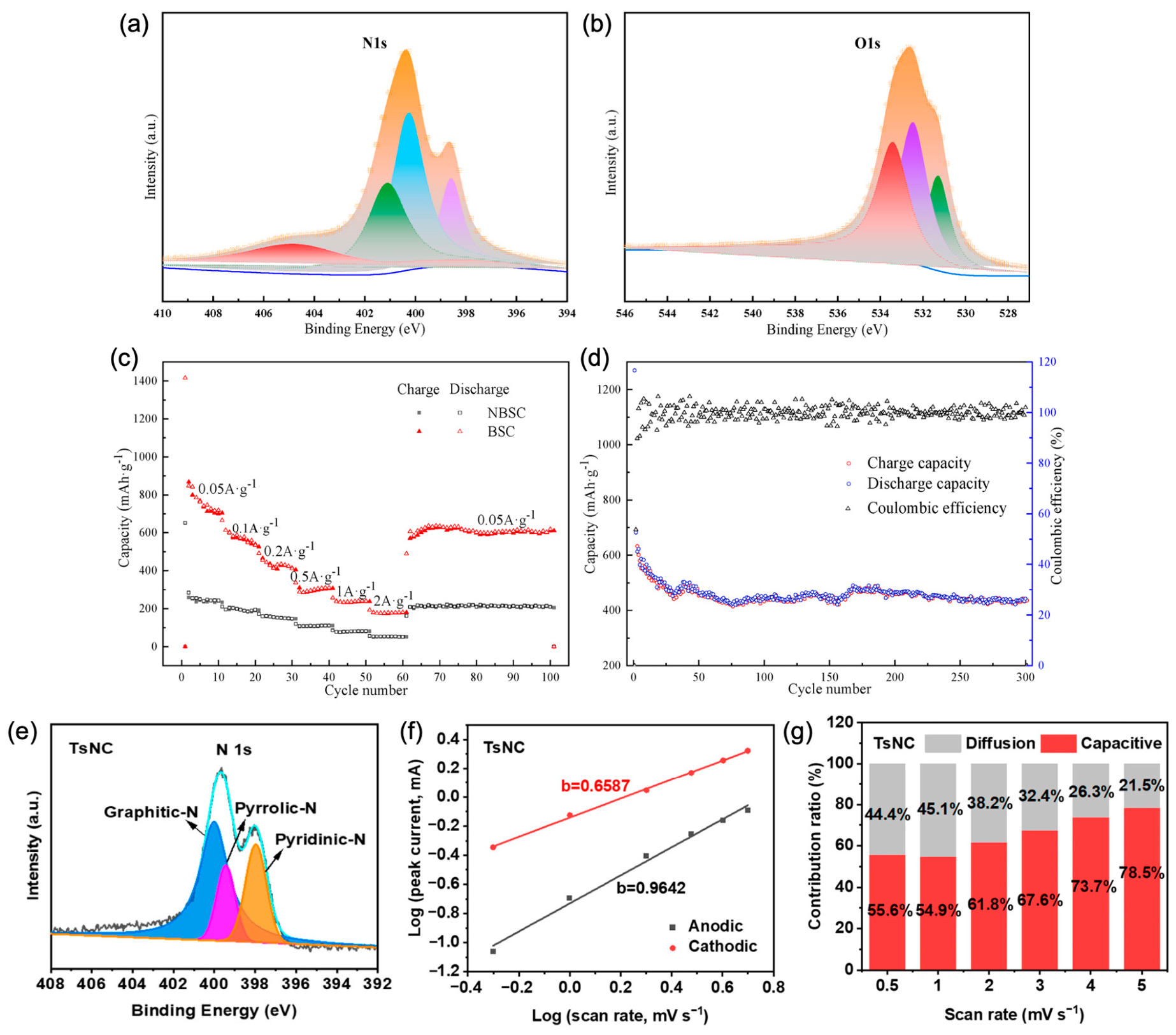
Bamboo shoot-derived carbon also illustrates the value of intrinsic nitrogen utilization (Figure 4a–d) [31]. Nitrogen-bearing components in bamboo shoot were partially retained during carbonization, allowing N-doped porous carbon to be obtained without an external nitrogen source. When combined with the KHCO3-induced hierarchical porosity discussed in Section 3.1.4, these intrinsic N species provided additional Li+ storage sites and supported ion transport. Self-doping is most effective when the intrinsic heteroatoms of biomass are coupled with controlled pore formation or partial carbon ordering, rather than relying on heteroatom retention alone.

3.2.2. Exogenous Nitrogen Doping

Exogenous N-doping introduces external nitrogen sources such as urea or melamine during precursor treatment or carbonization. Compared with self-doping, this method allows more direct control over nitrogen supply, but it also introduces additional variables. Excess nitrogen precursor can block pores, alter carbonization behavior, or destabilize the carbon framework, so dopant concentration must be optimized together with activation and thermal treatment.
Agar-derived N-doped porous carbon is a representative case in which exogenous N-doping was combined with homogeneous pore formation [38]. Agar, KOH, and urea were co-pyrolyzed through a one-pot process, where the gel-forming nature of agar helped distribute the activating agent and nitrogen source throughout the precursor. The optimized agar-derived carbon exhibited a high surface area of 2914 m2 g−1 and 2.84 at% nitrogen, delivering 1019 mAh g−1 at 0.1 A g−1 with 87% capacity retention after 5000 cycles at 10 A g−1. The temperature comparison further indicated that 750 °C provided the best balance between activation and structural stability, whereas lower temperature led to insufficient pore development and 900 °C caused over-etching and pore degradation [38]. This case highlights the importance of homogeneous precursor mixing and temperature control in achieving effective exogenous N-doping.
Corncob-derived nitrogen-doped hierarchical porous carbon was prepared by one-step KOH/urea co-activation [35]. The optimized carbon contained 5.26 at% nitrogen and exhibited a high surface area of 2394 m2 g−1, delivering 700 mAh g−1 after 100 cycles at 100 mA g−1. This improvement was attributed to the combined contribution of N-induced Li+ storage sites, enhanced electrode wettability, and hierarchical porosity that facilitated ion transport [35]. Low-cost agricultural residues can yield competitive N-doped carbon anodes when pore formation and dopant incorporation are achieved simultaneously.
Melamine-assisted N-doping was applied to both coffee grounds- and ginkgo shell-derived carbons, but the two studies highlight different optimization issues. In coffee grounds-derived carbon, melamine and KOH were used in a two-step carbonization process, and the best performance was obtained at an intermediate carbonization temperature [39]. Excessive thermal treatment damaged the N-doped porous framework, whereas insufficient temperature limited pore development. The optimized coffee grounds-derived carbon retained 509.53 mAh g−1 after 200 cycles at 200 mA g−1, indicating that N-doping is effective only when the carbon framework maintains suitable porosity and structural integrity [39]. Similarly, ginkgo shell-derived carbon prepared using melamine and ZnCl2 showed that higher nitrogen loading does not necessarily lead to better electrochemical performance [9]. The optimized carbon contained 13.73% nitrogen and retained 678.05 mAh g−1 after 200 cycles at 100 mA g−1, but further increasing the melamine content disrupted pore development and reduced electrochemical accessibility [9]. These two studies emphasize that exogenous N-doping has an optimal processing window governed by nitrogen content, pore formation, and carbon framework stability.
Melamine doping was also applied to tobacco straw- and oil palm empty fruit bunch-derived carbons (Figure 4e–g) [37]. In tobacco straw-derived carbon, pyridinic, pyrrolic, and graphitic N species promoted surface-controlled Li+ storage, leading to 475.9 mAh g−1 after 500 cycles at 60 mA g−1. This interpretation was supported by kinetic analysis, where the capacitive contribution increased with scan rate, indicating enhanced surface-controlled Li+ storage at N-containing sites [37]. In oil palm empty fruit bunch-derived activated carbon, melamine improved capacity and Coulombic efficiency compared with the undoped carbon, but the overall performance remained more limited [40]. N incorporation must be accompanied by well-developed porosity and accessible active sites to produce competitive LIB anodes.
Performance is controlled by how nitrogen incorporation is coupled with precursor structure, activation chemistry, pore development, and carbonization temperature. Precursors that enable homogeneous mixing or simultaneous pore formation and dopant incorporation tend to produce more effective N-doped carbon anodes than systems relying on poorly controlled nitrogen addition.

3.2.3. Dual Heteroatom Co-Doping

Dual heteroatom co-doping extends the role of single N-doping by introducing complementary structural and electronic effects into biomass-derived carbon frameworks. Here, N,S and N,P co-doped carbons are discussed as examples of how co-dopants can jointly regulate active sites, interlayer spacing, and transport kinetics.
Zhou et al. prepared N,S co-doped three-dimensional honeycomb-like porous carbon from pinecone using ZnCl2 molten-salt treatment and thiourea as an exogenous N,S co-dopant source [19]. ZnCl2 promoted interconnected pore formation, whereas thiourea introduced N and S species into the carbon framework. Control experiments confirmed that the combination of hierarchical porosity and N,S co-doping was essential for high lithium-storage performance. The resulting honeycomb-like carbon delivered 827.6 mAh g−1 at 1 A g−1 after 200 cycles and retained 445.2 mAh g−1 even at 10 A g−1, indicating that co-doping and pore connectivity jointly improved active-site accessibility and high-rate charge transport [19].
Lotus root-derived N,P co-doped porous carbon spheres provide another example of dual-dopant regulation [20]. The material was synthesized by hydrothermal treatment with urea and H3PO4 followed by carbonization, using urea as the exogenous N source and H3PO4 as the P source and pore-forming agent. Compared with the single-doped counterparts, the dual-doped carbon showed higher capacity and better rate capability, reflecting the complementary roles of N and P in lithium storage. Nitrogen provided additional surface-active sites, while phosphorus introduced structural defects and modified the local electronic environment through C–P bonding. The resulting N,P co-doped carbon retained 739.6 mAh g−1 at 0.1 A g−1 after 100 cycles and 599.16 mAh g−1 at 0.5 A g−1 after 215 cycles, and the proposed adsorption–pore-filling/intercalation mechanism suggests diversified Li+ storage pathways [20].
Dual heteroatom incorporation is most effective when it is integrated with a well-developed porous framework. The added dopants can increase active-site density, tune local electronic structure, and modify interlayer or defect environments, but these effects must be supported by accessible ion-transport pathways. Therefore, co-doping is best understood as a coupled strategy for regulating both carbon chemistry and pore architecture rather than as the addition of more heteroatoms.
Across the 21 LIB studies reviewed here, electrochemical performance is governed by the combined control of pore architecture, carbon ordering, and surface chemistry. Template-assisted and morphology-directed structures enhance electrolyte accessibility and Li+ transport, while chemical activation offers a practical route to porous carbon anodes when activation severity is properly controlled. Catalytic graphitization improves conductivity-related charge transport, and heteroatom doping introduces additional active sites for surface-controlled Li+ storage. High capacity and rate performance require accessible porosity, sufficient electronic conductivity, and optimized surface chemistry. This design logic differs from that of sodium-ion hard-carbon anodes, where interlayer spacing, closed-pore formation, and initial Coulombic efficiency become more critical, as discussed in the following section.

4. Biomass-Derived Hard-Carbon Anodes for Sodium-Ion Batteries

The larger ionic radius of Na+ and the instability of sodium–graphite intercalation compounds rule out graphite as a practical SIB anode and place hard carbon at the center of SIB anode development [2,12]. Hard carbon is a non-graphitizable carbon in which small, randomly oriented pseudo-graphitic domains are cross-linked into a turbostratic framework. This structure provides three features central to sodium storage: interlayer spacing wider than that of graphite, edge and vacancy defects together with residual heteroatoms, and closed or poorly accessible nanopores generated between misaligned domains. Because these features evolve together and depend sensitively on precursor chemistry and carbonization history, Na+ storage in hard carbon is structurally more heterogeneous than the well-defined Li+ intercalation in graphite. This complexity underlies both the characteristic sloping–plateau voltage profile and the continuing debate over the Na+ storage mechanism [2,12].
The galvanostatic profile of hard carbon generally contains two regions: a sloping region above approximately 0.1 V versus Na+/Na and a low-potential plateau below this voltage. The origin of each region remains under active discussion. One model assigns the sloping region to Na+ insertion between graphitic layers and the plateau to nanopore filling. Another interpretation attributes the sloping region mainly to adsorption at defects, edges, and heteroatom-containing sites, while assigning part of the plateau to Na+ insertion into pseudo-graphitic domains, supported by observations of interlayer expansion near low potentials. Other studies emphasize the role of closed nanopores, where Na filling or clustering can generate low-voltage plateau capacity. A combined adsorption–intercalation–pore-filling model is therefore often used to reconcile these interpretations: surface adsorption contributes predominantly to the slope, whereas both interlayer insertion and closed-pore filling can contribute to the plateau [2,12]. The persistence of these competing interpretations reflects the structural complexity of turbostratic carbon and suggests that the dominant storage pathway may vary with precursor chemistry, carbonization history, and pore accessibility.
Despite this mechanistic complexity, the key structure–performance relationships are relatively clear. Expanded interlayer spacing, often discussed in the range of 0.37–0.40 nm, facilitates Na+ accommodation between pseudo-graphitic layers, whereas spacings close to that of graphite are too narrow for efficient Na+ storage. Edge defects, vacancy defects, and residual heteroatoms generate polar or electron-deficient sites that bind Na+ and contribute to the sloping region. In excess, however, these sites increase the accessible surface area, accelerate electrolyte decomposition, and lower the ICE [12]. Closed or latent nanopores provide confined volume for low-potential Na storage while limiting direct electrolyte exposure. These structural features are also associated with different kinetic responses. The sloping region often shows a stronger surface-controlled or capacitive contribution, which can be evaluated by cyclic voltammetry and b-value analysis, whereas the plateau generally involves slower diffusion-limited or confinement-related processes [2]. Maximizing reversible capacity therefore requires expanded interlayer spacing and sufficient closed-pore volume while minimizing excessive open surface area.
This design logic differs sharply from that of porous carbons used for Li+ storage in Section 3. In LIB anodes, surface adsorption, pore filling, and insertion can operate in parallel, and high accessible surface area with hierarchical open porosity often improves capacity and rate capability by increasing available storage sites and shortening transport pathways. In SIB hard carbons, however, the same open surface area can become detrimental when it increases electrolyte decomposition and irreversible Na+ consumption during SEI formation. Reversible Na+ storage must therefore be built from a different structural balance: enlarged interlayer spacing, sufficient closed or latent pore volume, controlled defect density, and limited external surface exposure. A carbon optimized for Li+ storage is therefore unlikely to be directly optimal for Na+ storage, which is the central reason this review treats the two systems separately.
The 15 papers reviewed in this section address these challenges through two main strategies: engineering the carbon microstructure through carbonization conditions, precursor selection, and structural design (Section 4.1), and modifying surface chemistry through heteroatom doping and functional group engineering (Section 4.2). Most studies focus on hard-carbon architectures specifically designed for SIBs, while Ref. [41] is treated as a distinct porous-carbon/co-doping case because of its high-surface-area architecture and dual application in supercapacitors and SIBs.

4.1. Microstructure and Precursor Engineering

4.1.1. Carbonization Temperature- and Precursor-Dependent Microstructure

Carbonization temperature is a primary processing variable that determines the microstructure of biomass-derived hard carbon. During carbonization, the degree of carbon-layer ordering, interlayer spacing, defect density, and pore evolution change simultaneously, thereby affecting the balance between slope- and plateau-region Na+ storage. In general, increasing temperature promotes the rearrangement of turbostratic carbon layers and reduces highly defective surface sites, while excessive thermal treatment can narrow interlayer spacing or collapse favorable pore structures. Therefore, optimal carbonization balances expanded interlayer spacing, closed-pore formation, controlled defects, and sufficient structural stability rather than maximizing ordering alone [2,12].
This temperature dependence was systematically examined using rice husk as a biomass precursor [42]. Li et al. treated rice husks with NaOH before carbonization to remove silica-containing impurities and modify the lignocellulosic framework, followed by carbonization at 600–1400 °C. The native tubular architecture of rice husk was largely preserved up to 1200 °C, providing ion-accessible channels, while the interlayer spacing gradually decreased from 0.402 nm at 600 °C to 0.375 nm at 1400 °C. The carbon obtained at 1200 °C showed the best balance between carbon-layer ordering and retention of the porous tubular structure, delivering 328.4 mAh g−1 after 100 cycles at 25 mA g−1 [42].
Precursor identity also strongly affects the final hard-carbon structure. A comparative study using three invasive alien plant species, Spartina alterniflora, Solidago canadensis, and Erigeron canadensis, showed that direct carbonization at 1200 °C produced hard carbons with similar interlayer spacings of approximately 0.37 nm but different morphologies and sodium-storage behaviors [43]. Among them, Spartina alterniflora-derived carbon exhibited the highest reversible capacity of 245.3 mAh g−1 at 50 mA g−1 and retained 141.6 mAh g−1 after 1000 cycles at 200 mA g−1. The differences among the three carbons were attributed to variations in native biomass composition and the resulting carbon morphology, highlighting that precursor selection can influence Na+ diffusion and cycling stability even under identical carbonization conditions [43]. This study also emphasizes the sustainability benefit of converting invasive plant biomass into functional SIB anodes.
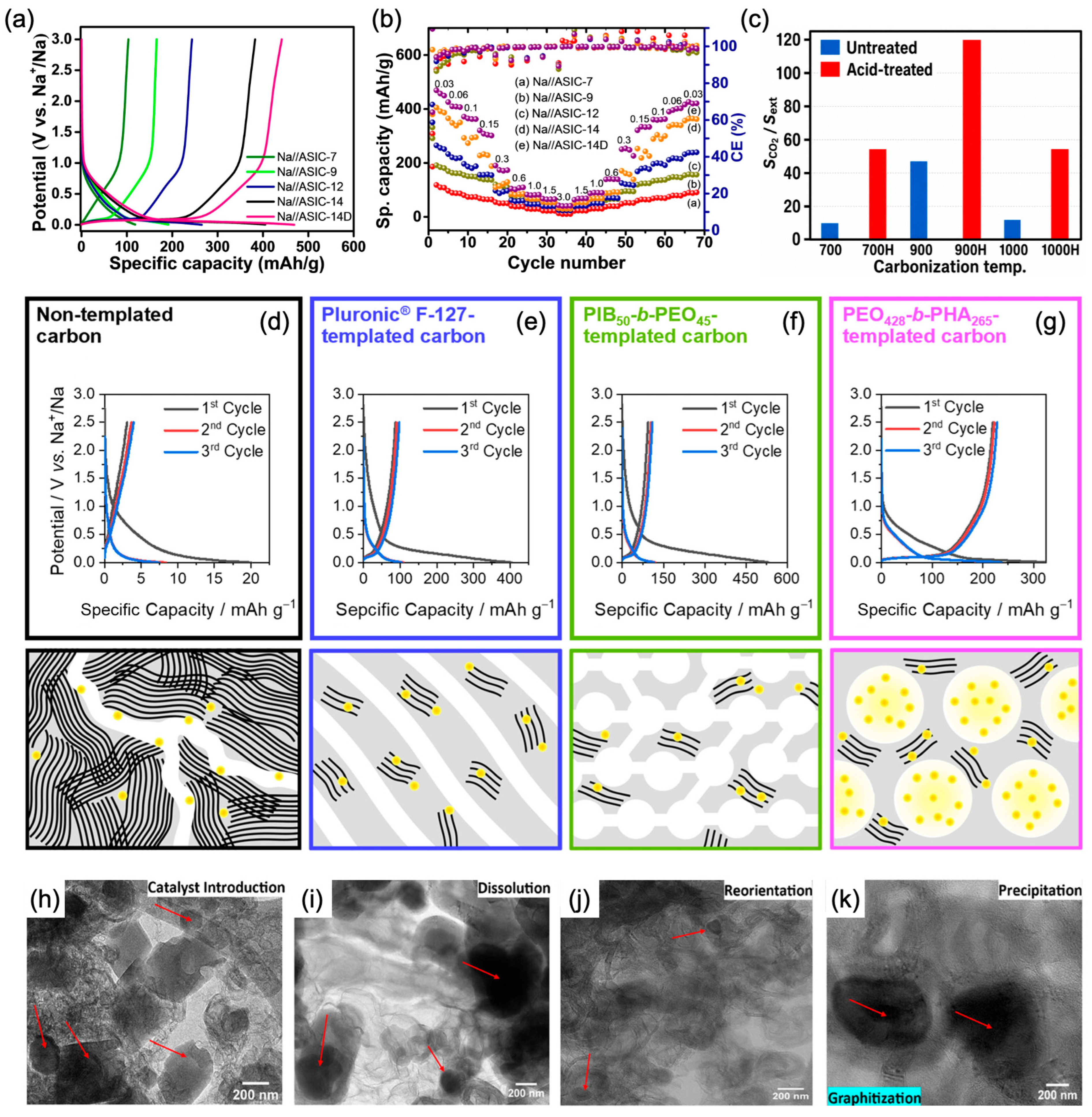
The contrast between LIB and SIB design requirements was directly illustrated using Areca catechu sheath-derived carbons. Naik et al. carbonized the agricultural biomass at 700–1400 °C and compared its behavior in both lithium- and sodium-ion cells [44]. The carbon obtained at 900 °C, which had a higher surface area and smaller lateral crystallite size, showed more favorable LIB performance (Figure 5a,b). In contrast, the carbon obtained at 1400 °C exhibited higher structural ordering and lower defect concentration, leading to better SIB performance with stable cycling and high Coulombic efficiency [44]. This divergence confirms that LIBs benefit more from defect-rich and surface-accessible carbon structures, whereas SIBs require a more ordered hard-carbon microstructure with suitable interlayer geometry.
Almond shell-derived hard carbon provides another example of temperature-dependent optimization [11]. Meghnani et al. prepared carbons at 600, 800, and 1000 °C and showed that the 1000 °C carbon achieved the best balance among porosity, graphitic disorder, and structural robustness. Although lower-temperature carbons retained more disordered features, the carbonized sample at 1000 °C provided more favorable Na+ diffusion and cycling stability. It delivered an initial discharge capacity of ~204 mAh g−1 at 20 mA g−1 and maintained stable cycling over 3000 cycles [11].
Carbonization temperature and precursor chemistry must be optimized together for biomass-derived hard-carbon anodes. The optimal temperature window depends on the native composition, inorganic content, morphology, and thermal evolution of each biomass precursor. Rather than pursuing either maximum disorder or maximum graphitization, SIB hard-carbon design requires a controlled intermediate structure that combines expanded interlayer spacing, stable carbon domains, appropriate defect density, and pore structures capable of supporting reversible Na+ storage.

4.1.2. Pretreatment-Driven Closed-Pore Engineering

Pretreatment before carbonization provides an effective route to tune the internal structure of biomass-derived hard carbon. Unlike direct carbonization, which often reflects the native complexity of biomass, pretreatment can selectively remove inorganic impurities, adjust the relative fractions of cellulose, hemicellulose, and lignin, and modify the molecular packing of the precursor. These changes influence the formation of interlayer spacing, open pores, and closed nanopores during subsequent carbonization. In the studies discussed here, alkaline, acid, and ionic-liquid-based pretreatments were used to regulate precursor composition and promote microstructures favorable for Na+ storage.
Alkaline treatment represents a simple route for modifying the lignocellulosic composition of biomass. In wheat straw-derived carbon, NaOH pretreatment removed part of the hemicellulose and lignin while leaving the cellulose-rich framework relatively intact [46]. After carbonization at 700 °C, the treated precursor formed a porous flake-like carbon with enlarged interlayer spacing, which facilitated Na+ transport and intercalation. The resulting electrode delivered 322 mAh g−1 after 300 cycles at 0.2 C and retained 183 mAh g−1 after 600 cycles at 5 C [46]. Selective component removal reshapes biomass-derived carbon from a dense lignocellulosic precursor into a more ion-accessible layered morphology.
In acorn-derived carbon, H2SO4 washing was used to reduce inorganic residues and tune the balance between external surface area and latent micropores (Figure 5c) [45]. Rather than increasing total porosity, this treatment raised the fraction of pores detected by CO2 adsorption relative to the external surface area measured from N2 adsorption. Such latent or closed pores are beneficial for SIB hard carbons because they can store Na+ while limiting excessive electrolyte exposure. The acid-treated carbon prepared at 900 °C delivered 310 mAh g−1, highlighting the role of acid washing in reducing impurity-related irreversibility and promoting latent or closed pores for Na+ storage [45].
A more composition-focused acid pretreatment was demonstrated with bamboo-derived hard carbon [24]. By varying the H2SO4 concentration, the authors adjusted the relative amounts of cellulose, hemicellulose, and lignin before carbonization. At the optimized acid concentration, hemicellulose was substantially removed, cellulose crystallinity was retained, and lignin became relatively enriched. This precursor balance promoted the formation of microporous hard carbon with reduced defect density and favorable closed-pore characteristics after high-temperature carbonization. The optimized electrode delivered 326.5 mAh g−1 at 50 mA g−1, showed 93.3% capacity retention after 300 cycles at 500 mA g−1 [24]. Acid pretreatment can be used not only for impurity removal but also for controlling the compositional pathway by which biomass converts into hard carbon.
Ramie-derived hard carbon further illustrates how precursor-level molecular interactions can be tuned before carbonization [25]. An ionic liquid/H2O cosolvent system reorganized hydrogen bonding in ramie fibers, selectively removing amorphous components while reshaping cellulose-rich domains. After carbonization, the optimized carbon contained thin-walled closed pores, enlarged interlayer spacing, and carbonyl-containing surface groups, leading to a high ICE of 88.5% and a reversible capacity of 329.5 mAh g−1 at 30 mA g−1 [25]. Molecular pretreatment simultaneously regulates closed-pore formation and surface chemistry.
These examples position pretreatment as a precursor-level strategy for directing pore evolution during carbonization, well beyond impurity removal. By altering biomass composition, mineral content, and molecular interactions before thermal treatment, pretreatment influences the formation of interlayer spacing, latent pores, closed nanopores, and surface functional groups in the final hard carbon. Such precursor-level control is particularly important for SIB anodes because closed or latent pores are directly related to plateau capacity and initial Coulombic efficiency.

4.1.3. Pore Architecture Engineering and Composite Design

Beyond temperature control and precursor pretreatment, several studies have engineered hard-carbon architecture by introducing external structure-directing components. These approaches include soft templating, catalytic structuring, activation-assisted micropore formation, and composite interface design. Unlike the strategies discussed above, which mainly rely on the intrinsic evolution of biomass during carbonization, this group of studies uses additional structural or chemical agents to guide pore geometry, carbon ordering, or interfacial organization.
Glatthaar et al. used self-assembled block copolymer soft templates to prepare lignin-derived mesoporous carbons with controlled pore size and pore accessibility [18]. By comparing carbons containing isolated mesopores with those containing interconnected open channels, the study clarified how pore accessibility affects the voltage profile of Na+ storage (Figure 5d–g). Closed mesopores contributed more strongly to the low-voltage plateau, whereas open channels mainly increased sloping-region capacity and promoted irreversible reactions associated with large accessible surface area [18]. This work therefore provides a mechanistic basis for distinguishing between pores that support reversible Na storage and pores that mainly increase electrolyte exposure.
A different architecture-control strategy was demonstrated using MIL-100(Fe), an Fe-based metal–organic framework (MOF), as an external structure-regulating and graphitization-promoting component in sawdust-derived carbon [21]. When combined with TEMPO (2,2,6,6-tetramethylpiperidine-1-oxyl)-oxidized cellulose, the Fe-containing framework promoted local graphitic ordering during pyrolysis (Figure 5h–k). The resulting carbon–MOF-derived hard carbon showed an electrical conductivity of 28 S cm−1, a moderate surface area of 312 m2 g−1, and stable cycling over 600 cycles [21]. MOF-assisted catalytic structuring can improve charge transport without relying on excessive surface area.
Yanilmaz et al. used waste cotton as a precursor for microporous carbon through hydrothermal carbonization followed by KOH activation and pyrolysis [14]. The hydrothermal step first converted cotton into a more uniform hydrochar, which then underwent more controlled chemical activation. Compared with direct activation, this sequence produced a microporous carbon with a surface area of 808 m2 g−1 and improved sodium-storage behavior. The optimized electrode delivered 330 mAh g−1 at 0.1 A g−1 and retained 280 mAh g−1 after 400 cycles at 1 A g−1 [14]. In addition to electrochemical performance, this study also addresses process-level considerations such as KOH recovery, wastewater treatment, and cost competitiveness, which are often overlooked in biomass-derived carbon studies.
Composite hard-carbon design provides another route to tune the internal carbon structure beyond single-precursor systems. Liang et al. combined sugarcane bagasse-derived carbon with asphalt-derived carbon through pretreatment and pre-oxidation cross-linking, producing a carbon–carbon composite with two different interlayer environments [47]. The coexistence of wider and narrower layer spacings was designed to support Na+ access and stable insertion, while the interfacial coupling between the two carbon components promoted pore-filling kinetics. The optimized composite delivered 368.1 mAh g−1 at 50 mA g−1 with an ICE of 88.4% and retained 251.3 mAh g−1 after 1000 cycles at 1 A g−1 [47].
These examples broaden the scope of microstructure engineering beyond precursor selection and pretreatment. Soft templating clarifies the role of pore accessibility, metal–organic-framework-assisted structuring improves conductivity and carbon ordering, hydrothermal carbonization combined with activation generates controlled microporosity, and biomass/asphalt compositing introduces interfacial regulation. Collectively, these strategies regulate pore geometry, charge transport, and carbon-domain organization in biomass-derived hard-carbon anodes.

4.2. Heteroatom Doping and Surface-Chemistry Engineering

4.2.1. Exogenous Dual Heteroatom Co-Doping

Heteroatom doping in SIB hard carbons involves a delicate balance between creating additional Na+-affinitive sites and limiting irreversible surface reactions. Dopant-derived defects and polar functional groups can enhance Na+ adsorption and charge-transfer behavior, but excessive surface reactivity may increase electrolyte decomposition and reduce initial Coulombic efficiency. The two studies discussed here illustrate different ways of using dual heteroatom doping to regulate carbon chemistry and structure.
Zou et al. prepared N,P co-doped carbon from sugarcane bagasse using melamine and NaH2PO4 as exogenous N and P sources, together with hydrothermal pretreatment, KOH activation, and carbonization [41]. The resulting carbon had a highly porous framework with a very large surface area of 2803.2 m2 g−1 and interconnected ion-transport pathways. As a SIB anode, it delivered 365.2 mAh g−1 at 25 mA g−1 and retained 225.7 mAh g−1 after 1000 cycles at 500 mA g−1 [41]. N,P co-doping can improve sodium storage in activated porous carbons, although the high accessible surface area may limit first-cycle reversibility.
Loofah-derived N,S co-doped hard carbon represents a more surface-area-controlled doping strategy [48]. In this material, N contributed to local charge regulation and Na+ adsorption, while S helped adjust interlayer spacing and pore geometry (Figure 6a–c). The N,S co-doped hard carbon delivered 317.5 mAh g−1 at 0.1 C and retained 76% of its capacity after 2000 cycles. Full-cell testing with a Na3V2(PO4)3 cathode further supported its practical relevance [48]. Compared with the highly activated N,P co-doped carbon, this example highlights the value of combining dopant chemistry with a hard-carbon framework that avoids excessive open surface area.
Dual heteroatom co-doping is most useful when dopant chemistry is coupled with an appropriate carbon architecture. For SIB anodes, the goal is to regulate Na+ adsorption, interlayer accessibility, charge transport, and interfacial stability within a structure that maintains acceptable initial reversibility.

4.2.2. Surface Functional Group Engineering and SEI Chemistry

Another route to surface-chemistry control is the regulation of oxygen-containing functional groups before carbonization. Unlike heteroatom co-doping, this strategy modifies the precursor surface and its carbonization behavior, thereby influencing pore evolution, defect formation, and SEI stability.
Luo et al. used HNO3 liquid-phase oxidation to modify pine wood powder before carbonization [23]. The oxidation introduced hydroxyl and carboxyl groups onto the precursor, which promoted dehydration and condensation reactions during subsequent thermal treatment (Figure 6d). As a result, the carbon framework evolved toward a lower-surface-area structure with fewer open pores and a larger fraction of closed nanopores. Compared with directly carbonized pine wood powder, the oxidized precursor-derived carbon showed a higher initial Coulombic efficiency, increasing from 42.5% to 66.1%, along with an improved reversible capacity of 227.1 mAh g−1 at 20 mA g−1 [23]. These improvements were linked to both structural and interfacial effects: closed-pore formation increased reversible Na+ storage, while the regulated oxygen chemistry helped form a more stable SEI.
Surface functional group engineering can guide hard-carbon formation before the carbonization step. Liquid-phase oxidation changes the reactivity of the biomass precursor rather than adding dopants to the carbon lattice, offering a practical route to improve initial reversibility in low-cost biomass-derived hard carbon.
Across the 15 SIB studies reviewed here, several closely connected design principles recur. Carbonization temperature and precursor composition govern interlayer spacing, defect density, and pore evolution, while pretreatment can further direct the formation of closed or latent pores. Pore architecture engineering, catalytic structuring, and composite design improve ion transport, electronic conductivity, and cycling stability. Heteroatom doping and surface functional group engineering add another level of control over Na+ adsorption and interfacial chemistry, but excessive surface reactivity can compromise initial Coulombic efficiency. SIB-oriented hard-carbon design requires coordinated control of carbon microstructure, closed-pore contribution, and surface chemistry. The following section consolidates the structure–performance relationships across both the LIB and SIB studies, and the remaining challenges for practical implementation are addressed thereafter.

5. Structure–Performance Relationships

Section 3 and Section 4 examined biomass-derived carbon anodes through individual LIB and SIB case studies. The major structure–performance relationships can now be consolidated across both systems. Table 1 summarizes how key structural variables, including carbon ordering, pore-size distribution, hierarchical porosity, defect density, heteroatom doping, and co-doping, affect Li+ and Na+ storage. A consistent trade-off emerges from this comparison. In LIB porous carbons, high accessible surface area, open hierarchical porosity, abundant defects, and heteroatom-derived active sites generally increase Li+ storage capacity and rate capability by providing more accessible storage sites and shorter transport pathways. In SIB hard carbons, however, the same features can become detrimental when they enlarge the electrolyte-exposed surface area and increase irreversible Na+ consumption during SEI formation. Several structural parameters therefore have different optimal ranges in the two systems. Open hierarchical porosity is often beneficial for LIBs but must be limited in SIBs, whereas Na+ storage requires expanded turbostratic spacing, sufficient closed or latent pore volume, and a balanced defect density. Excessive graphitization can reduce Na+ accessibility by narrowing the interlayer spacing, while excessive disorder can suppress ICE by accelerating side reactions. The structure–performance relationship thus resolves into two system-specific design maps rather than a single universal optimization. This divergence provides the basis for the practical challenges and future directions discussed in Section 6.

6. Challenges and Perspectives

Despite the progress summarized in the preceding sections, translating these laboratory-scale advances into practical battery systems remains challenging because biomass-derived carbons are strongly affected by precursor variability, processing history, interfacial chemistry, and cell configuration.
A first challenge is feedstock heterogeneity and structural reproducibility. Natural biomass varies in cellulose, hemicellulose, lignin, moisture, mineral content, and intrinsic heteroatom composition depending on plant species, growth environment, harvest season, and tissue type. Because these factors influence carbon yield, pore evolution, interlayer spacing, defect density, and heteroatom retention, nominally similar synthetic procedures can produce carbons with different microstructures and electrochemical behavior. Future studies should therefore report feedstock composition more systematically, including ash content, moisture level, and lignocellulosic composition, and should develop standardized pretreatment protocols that reduce batch-to-batch variability. Beyond standardized protocols, reducing this variability will also require quality-control metrics tied to electrochemically relevant parameters such as interlayer spacing, closed-pore volume, external surface area, defect density, and heteroatom content, as well as feedstock pre-sorting or blending to narrow compositional variation. Without such measures, the consistency required for industrial cell manufacturing will remain difficult to achieve.
A second issue is initial Coulombic efficiency and SEI control. Biomass-derived carbons often contain open pores, edge defects, and oxygen-containing surface groups that promote electrolyte decomposition during the first cycle. This is especially problematic for SIB full cells, where irreversible Na+ consumption directly limits usable capacity. Although high-temperature carbonization, acid or alkaline pretreatment, and surface oxidation can reduce accessible surface area or regulate functional groups, these strategies must be balanced against the need to preserve reversible storage sites. Practical approaches such as pre-sodiation, artificial interfacial coatings, electrolyte additive engineering, and controlled carbon-shell formation should be evaluated together with biomass processing routes rather than treated as separate post-treatments.
For SIB hard carbons, the Na+ storage mechanism remains insufficiently resolved. Sloping-region capacity is generally associated with adsorption at defects, heteroatom sites, and disordered carbon layers, whereas the low-voltage plateau has been linked to interlayer insertion, pore filling, and Na clustering within closed nanopores. However, the relative contribution of each process depends strongly on pore accessibility, interlayer spacing, defect chemistry, and carbonization history. This uncertainty makes it difficult to define universal structural targets for biomass-derived hard carbons. Operando techniques such as small-angle X-ray scattering, synchrotron X-ray scattering, solid-state 23Na nuclear magnetic resonance (NMR), and in situ Raman spectroscopy will be important for connecting structural evolution with Na+ storage pathways during cycling.
For LIB porous carbon anodes, the main limitation is maintaining long-term stability while preserving high capacity. High surface area, abundant defects, and oxygen-rich surface groups can increase Li+ storage beyond the theoretical capacity of graphite, but they also accelerate SEI growth, irreversible Li+ trapping, and structural degradation. The activated furfural-derived carbon discussed in Section 3.1.4 illustrates this trade-off, showing high initial capacity but rapid capacity decay upon cycling. Future LIB-oriented biomass carbons should therefore avoid excessive activation and instead combine accessible porosity with improved carbon-framework rigidity, partial graphitic ordering, and stabilized electrode/electrolyte interfaces.
A further barrier is scalability and cell-level validation. Most studies still evaluate biomass-derived carbons in half cells using Li or Na metal counter electrodes, which can overestimate practical performance. More meaningful assessment requires full-cell testing with realistic cathodes, practical areal loading, controlled electrode thickness, and reporting of energy density, cycle life, and Coulombic efficiency under application-relevant conditions. Processing factors also require closer attention. KOH activation, acid washing, and high-temperature carbonization can generate chemical waste, energy demand, and cost burdens that partially offset the sustainability advantage of biomass precursors. Process-level strategies such as reagent recovery, wastewater treatment, heat integration, and regional feedstock selection should therefore be incorporated into future material development.
Techno-economic feasibility should also be considered more explicitly when assessing biomass-derived carbon anodes. The cost of these materials is determined mainly by conversion rather than by the biomass feedstock itself. Although waste biomass is inexpensive and widely available, carbonization, activation, and the washing steps required to remove residual reagents are energy- and reagent-intensive. Low carbon yield further compounds this issue, because pyrolysis and aggressive activation can leave only a limited amount of usable carbon per unit mass of precursor. Once the full processing chain is considered, biomass-derived carbon may not necessarily offer a clear cost advantage over mined natural graphite or high-temperature synthetic graphite. Therefore, techno-economic analysis linking feedstock cost, reagent consumption, energy input, carbon yield, and electrochemical output should accompany electrochemical evaluation, rather than be considered only after performance optimization.
The eco-friendliness of biomass-derived carbon should be interpreted with caution. Although biomass is renewable, its conversion into carbon is not emission-free: carbonization can release CO2, CO, and CH4, while high-temperature treatment, activation reagents, washing, and waste management add further energy and chemical burdens. However, biomass-derived carbon can still provide environmental benefits in two important ways. First, biomass carbon is biogenic and originates from recently fixed atmospheric CO2, unlike the fossil-derived precursors commonly used for synthetic graphite. Second, agricultural and forestry residues are often burned, landfilled, or left to decompose, where they can release CO2 and CH4 without generating high-value materials. Diverting these residues toward carbon synthesis can therefore reduce emissions associated with such disposal pathways while adding value to waste biomass. Consistent with this view, life-cycle assessments have reported that biomass-derived hard carbon can lower the global warming potential of anode production by approximately 20–30% relative to commercial graphite, although the magnitude of the benefit depends strongly on the energy source, carbon yield, and production scale [49]. Therefore, the environmental advantage of biomass-derived carbon is conditional rather than intrinsic and should be evaluated over the full process pathway.
Finally, the comparison between LIBs and SIBs highlights the need for system-specific carbon design. LIB anodes often benefit from high surface area, open hierarchical porosity, and abundant surface-accessible sites, whereas SIB hard carbons require lower external surface area, expanded turbostratic spacing, and closed or latent pores to improve plateau capacity and initial Coulombic efficiency. A carbon structure optimized for Li+ storage is therefore unlikely to be directly optimal for Na+ storage. Future research should move beyond general claims of “battery-grade biomass carbon” and instead establish separate design maps for LIB and SIB anodes, linking precursor chemistry, processing conditions, pore architecture, surface chemistry, and storage mechanism to the requirements of each ion.
Looking forward, progress will depend on integrating mechanistic characterization, data-driven synthesis, electrode engineering, and sustainability assessment. High-throughput carbonization combined with machine learning-guided precursor screening could accelerate the identification of processing windows that produce targeted microstructures. Operando characterization should be used to validate whether these structures support the intended storage mechanism. At the electrode level, higher areal loading, lower inactive-material content, and electrolyte compatibility must be addressed to approach practical cell performance. At the process level, life-cycle assessment should be introduced early so that the environmental benefit of converting biomass waste into carbon anodes can be evaluated alongside electrochemical performance. These efforts will be essential for moving biomass-derived carbon anodes from promising laboratory materials toward reliable components in sustainable energy storage systems.


Author Contributions

Conceptualization, C.C.; literature survey, Y.L.; data curation, Y.L., S.H. and J.K.; writing—original draft preparation, Y.L., S.H. and J.K.; writing—review and editing, M.S. and C.C.; supervision, M.S. and C.C. All authors have read and agreed to the published version of the manuscript.

Funding

This work was supported by the Sungshin Women’s University Research Grant of H20230046.

Data Availability Statement

No new data were created or analyzed in this study.

Acknowledgments

During the preparation of this manuscript, the authors used ChatGPT (GPT-5.5, OpenAI) for the limited purpose of generating some small illustrative icon elements embedded within Figure 1 and Figure 2. The conceptual design, scientific content, layout, arrangement, labeling, and final editing of Figure 1 and Figure 2 were carried out entirely by the authors. The prompts used were requests to generate small schematic-style icon elements representing biomass precursors, porous carbon particles, carbonization/pyrolysis processes, activation, template-assisted morphology control, heteroatom dopants and surface chemistry, graphitic/disordered carbon domains, and Li-ion/Na-ion battery-related illustrative components for use in scientific figures. The authors reviewed, selected, modified, arranged, and edited the AI-generated outputs and take full responsibility for the content of this publication.

Conflicts of Interest

The authors declare no conflicts of interest.

References

  1. Lin, W.; Zhao, S.; Lu, B.; Jiang, F.; Lu, Z.; Xu, Z. Structures, performances and applications of green biomass derived carbon in lithium-ion batteries. Energy Mater. 2024, 4, 400078. [Google Scholar] [CrossRef]
  2. Thompson, M.; Xia, Q.; Hu, Z.; Zhao, X.S. A review on biomass-derived hard carbon materials for sodium-ion batteries. Mater. Adv. 2021, 2, 5881–5905. [Google Scholar] [CrossRef]
  3. Nour Eddine, S.; Daoudi, H.; Kasbaji, M.; Chari, A.; Alami, J.; Dahbi, M.; El Achaby, M.; Kassab, Z. From Biomass to Energy Storage: A Review on Lignocellulosic Biomass-Derived Hard Carbon Anodes for Sodium-Ion Batteries. Energy Fuels 2025, 39, 17112–17154. [Google Scholar] [CrossRef]
  4. Kitchamsetti, N.; Kim, K.-H.; Han, H.; Mhin, S. Biomass-derived hard carbon anodes for sodium-ion batteries: Recent advances in synthesis strategies. Nanomaterials 2025, 15, 1554. [Google Scholar] [CrossRef] [PubMed]
  5. Yan, M.; Qin, Y.; Wang, L.; Song, M.; Han, D.; Jin, Q.; Zhao, S.; Zhao, M.; Li, Z.; Wang, X. Recent advances in biomass-derived carbon materials for sodium-ion energy storage devices. Nanomaterials 2022, 12, 930. [Google Scholar] [CrossRef] [PubMed]
  6. Zhang, T.; Zhang, T.; Wang, F.; Ran, F. Pretreatment Process Before Heat Pyrolysis of Plant-based Precursors Paving Way for Fabricating High-Performance Hard Carbon for Sodium-Ion Batteries. ChemElectroChem 2023, 10, e202300442. [Google Scholar] [CrossRef]
  7. Haghighi Poudeh, L.; Berktas, I.; Ali, H.Q.; Saner Okan, B.; Yıldız, M. Toward next-generation carbon-based materials derived from waste and biomass for high-performance energy applications. Energy Technol. 2020, 8, 2000714. [Google Scholar] [CrossRef]
  8. Bai, Y.L.; Zhang, C.C.; Rong, F.; Guo, Z.X.; Wang, K.X. Biomass-derived carbon materials for electrochemical energy storage. Chem.-Eur. J. 2024, 30, e202304157. [Google Scholar] [CrossRef] [PubMed]
  9. Mo, J.; Yuan, P.; Chang, S.; Xiao, L.; Chen, G. Nitrogen-doped porous carbon materials based on ginkgo shells for the lithium-ion batteries. J. Energy Storage 2026, 141, 119383. [Google Scholar] [CrossRef]
  10. Ding, R.; Chen, L.; Li, N.; Zhou, Q.; Zhang, X. Biomass-based three-dimensional network porous carbon anodes derived from discontinuous activation for high performance Li-ion batteries. Diam. Relat. Mater. 2024, 150, 111676. [Google Scholar] [CrossRef]
  11. Meghnani, D.; Patel, A.; Singh, R.K. Porosity and Graphitic Disorder Engineering in Bio-Derived Hard Carbon for Superior Sodium-Ion Diffusion and Energy Storage. Mater. Chem. Phys. 2026, 348, 131751. [Google Scholar] [CrossRef]
  12. Cui, J.; Su, P.; Li, W.; Wang, X.; Zhang, Y.; Xiao, Z.; An, Q.; Chen, Z. Advanced Cellulose-Derived Hard Carbon as Anode for Sodium-Ion Batteries: Mechanisms, Optimization, and Challenges. Adv. Energy Mater. 2025, 15, 2404604. [Google Scholar] [CrossRef]
  13. Shrivastava, K.; Gill, F.S.; Juyal, S.; Lal, M.; Jain, A. Green Carbon for Clean Energy: Biomass-Derived Hierarchical Structures in Energy Storage. Wiley Interdiscip. Rev. Energy Environ. 2025, 14, e70007. [Google Scholar] [CrossRef]
  14. Yanilmaz, M.; Temel, B.; Bayram, E.; Tosun, M.; Topcu, I.; Kim, J. Sustainable biowaste conversion into microporous carbons for efficient energy storage solutions in sodium-ion batteries. J. Environ. Chem. Eng. 2025, 13, 118559. [Google Scholar] [CrossRef]
  15. Xie, L.; Shen, G.; Li, B.; Zhou, J.; Zhu, L.; Han, Q.; Qiu, X.; Cao, X. Porous carbon materials derived from waste tea leaves as high-capacity anodes for lithium/sodium ion batteries. J. Energy Storage 2024, 100, 113598. [Google Scholar] [CrossRef]
  16. Ramakrishnan, A.; Swaminathan, S.; Mayandi, J. Simple and Scalable Green Approach for Synthesizing Hierarchically Porous Hexagonal Shaped 3D Carbon Structure for Sodium-Ion Storage. ChemistrySelect 2023, 8, e202303098. [Google Scholar] [CrossRef]
  17. Wang, M.; Yang, B.; Liu, J.; Zhu, Y.; Yu, Z.; Ning, W.; Wang, X. Lignin-derived porous carbon shells for high-capacity lithium-ion battery anode. J. Power Sources 2026, 666, 239192. [Google Scholar] [CrossRef]
  18. Glatthaar, C.; Wang, M.; Wagner, L.Q.; Breckwoldt, F.; Guo, Z.; Zheng, K.; Kriechbaum, M.; Amenitsch, H.; Titirici, M.-M.; Smarsly, B.M. Lignin-derived mesoporous carbon for sodium-ion batteries: Block copolymer soft templating and carbon microstructure analysis. Chem. Mater. 2023, 35, 10416–10433. [Google Scholar] [CrossRef] [PubMed]
  19. Zhou, J.-Y.; Han, L.; Xu, H.-T.; Lu, J.-F.; Li, K.-C.; Lei, F.-H.; Wang, T.; Qi, W.; Wen, Y.-X. N, S co-doping three-dimensional honeycomb-like porous carbon for lithium ion battery and supercapacitor. Int. J. Hydrogen Energy 2024, 79, 423–433. [Google Scholar] [CrossRef]
  20. Li, J.; Deng, W.; Li, H.; Chen, L.; Zhang, Y.; Li, J.; Song, Y.; Duan, H. Biomass-derived N–P double-doped porous carbon spheres and their lithium storage mechanism. Int. J. Hydrogen Energy 2024, 56, 828–836. [Google Scholar] [CrossRef]
  21. Hegazy, S.; Subramaniyam, C.M.; Abdelrahim, A.; Sliz, R.; Hu, T.; Tuomikoski, S.; Lassi, U.; García-Alvarado, F.; Srivastava, V. Optimized Carbonization of Biomass-Derived Carbon Anodes for Stable and Long-Cycle Sodium-Ion Battery Performance. ChemElectroChem 2025, 12, e202500195. [Google Scholar] [CrossRef]
  22. Sruthy, E.; Grimm, A.; Paul, M.; Cherian, C.T.; Thyrel, M.; Molaiyan, P.; Lassi, U.; Petnikota, S.; Dos Reis, G.S. Low-temperature highly graphitized porous biomass-based carbon as an efficient and stable electrode for lithium-ion batteries and supercapacitors. Chem. Eng. J. Adv. 2025, 22, 100762. [Google Scholar] [CrossRef]
  23. Luo, X.; Li, H.; Peng, J.; Wang, F.; Zheng, H.; Du, B.; Lai, W.; Chen, Y. Liquid-Phase Oxidation Engineering of Pine Wood Powder-Derived Hard Carbon for Low-Cost Sodium-Ion Batteries. ACS Appl. Mater. Interfaces 2026, 18, 8337–8349. [Google Scholar] [CrossRef] [PubMed]
  24. Li, X.; Zhang, C.; Chang, G.; Wang, J.; Dong, W.; Wang, C.; Guo, Y.; Hong, X.; Zhang, X.; Shen, D. Acid-mediated compositional regulation in biomass-derived hard carbon: Engineering precursor microstructure toward enhanced sodium storage performance. J. Energy Storage 2026, 141, 119442. [Google Scholar] [CrossRef]
  25. Li, J.; Li, X.; Lan, N.; Yang, T.; Zeng, L.; Du, D.; He, H.; Zhang, C. Hydrogen bond reconfiguration for closed pore and surface chemistry dual-optimization in biomass hard carbon for high-rate sodium storage. Carbon 2026, 254, 121532. [Google Scholar] [CrossRef]
  26. Feyzi, E.; MR, A.K.; Li, X.; Deng, S.; Nanda, J.; Zaghib, K. A comprehensive review of silicon anodes for high-energy lithium-ion batteries: Challenges, latest developments, and perspectives. Next Energy 2024, 5, 100176. [Google Scholar] [CrossRef]
  27. Wang, M.; Zhu, Y.; Chen, Y.; Zhao, S.; Li, G.; Yu, Z.; Ning, W.; Liu, J.; Wang, X. Lignin-derived honeycomb-like porous carbon for high-performance lithium-ion battery anodes. Diam. Relat. Mater. 2025, 155, 112297. [Google Scholar] [CrossRef]
  28. Saikia, D.; Deka, J.R.; Lu, B.-J.; Chen, Y.-C.; Lian, J.-W.; Kao, H.-M.; Yang, Y.-C. Pinecone-derived biomass carbons as anodes for lithium and sodium-ion batteries by template-assisted and chemically activated approaches. J. Power Sources 2023, 580, 233329. [Google Scholar] [CrossRef]
  29. Zeng, L.-H.; You, J.; Li, Z.; Yang, B.; Zhang, H.; Zhang, N. Synthesis and electrochemical performance of carbon-coated three-dimensional porous carbon nanoflowers derived from walnut shells for lithium-ion battery applications. Diam. Relat. Mater. 2025, 159, 112845. [Google Scholar] [CrossRef]
  30. Feng, D.; Li, Y.; Qin, X.; Zheng, L.; Guo, B.; Dai, W.; Song, N.; Liu, L.; Xu, Y.; Tang, Z. Biomass derived porous carbon anode materials for lithium-ion batteries with high electrochemical performance. Int. J. Electrochem. Sci. 2024, 19, 100488. [Google Scholar] [CrossRef]
  31. Mi, B.; Yuan, J.; Li, H.; Hu, W.; Jiang, C.; Liu, X.; Lei, Y.; Liu, Z. One-step synthesis of nitrogen-doped porous carbon derived from biomass for lithium-ion battery. Coatings 2023, 13, 1960. [Google Scholar] [CrossRef]
  32. Deng, W.; Chen, L.; Li, H.; Tang, X.; Zhang, K.; Teng, J.; Li, J.; Chen, Q.; Zhang, H.; Duan, H. Waste banana bract-derived porous carbon as anode for lithium/sodium-ion batteries with hybrid adsorption-pore filling/insertion mechanism. J. Power Sources 2025, 654, 237813. [Google Scholar] [CrossRef]
  33. Alouiz, I.; Aqil, M.; Dahbi, M.; Amarouch, M.Y.; Mazouzi, D. Performance of high-energy storage activated carbon derived from olive pomace biomass as an anode material for sustainable lithium-ion batteries. Resour. Chem. Mater. 2025, 4, 100086. [Google Scholar] [CrossRef]
  34. Hosseinzadeh, J.; Mahdavi, S.; Ashori, A.; Spitsyn, A. Synthesis and characterization of hierarchically porous carbon anodes from furfural biorefinery residues for sustainable lithium-ion batteries. J. Anal. Appl. Pyrolysis 2024, 182, 106691. [Google Scholar] [CrossRef]
  35. Wang, S.; Yang, S.; Li, M.; Liu, K.; Liang, S.; Wang, X.; Li, N.; Sun, Z.; An, H. A hierarchical porous structure and nitrogen-doping jointly enhance the lithium-ion storage capacity of biomass-derived carbon materials. Int. J. Hydrogen Energy 2024, 68, 1229–1239. [Google Scholar] [CrossRef]
  36. Wang, X.; Yao, X.; Sun, J.; Zhuo, J.; Tao, X.-S.; Li, X.; Sha, J. All biomass-derived autogenous nitrogen-doped porous carbon with pseudo-graphitic structure for advanced lithium-ion battery anodes. J. Power Sources 2025, 629, 235980. [Google Scholar] [CrossRef]
  37. Shang, H.; Zhou, Y.; Li, H.; Peng, J.; Hao, X.; Guo, L.; Sun, B. Solanaceous Crops-Derived Nitrogen-Doped Biomass Carbon Material as Anode for Lithium-Ion Battery. Nanomaterials 2025, 15, 1357. [Google Scholar] [CrossRef] [PubMed]
  38. Wang, T.; Sha, J.; Wang, W.; Ji, Y.; Zhang, Z.-M. Agar-derived nitrogen-doped porous carbon as anode for construction of cost-effective lithium-ion batteries. Chin. Chem. Lett. 2023, 34, 107929. [Google Scholar] [CrossRef]
  39. Yuan, P.; Mo, J.; Sha, X.; Liu, X.; Xiao, L.; Chen, G. Temperature-modulated nitrogen-doped porous carbon derived from coffee grounds as an anode for high-performance lithium-ion batteries. Diam. Relat. Mater. 2025, 152, 111921. [Google Scholar]
  40. Chitraningrum, N.; Gunawan, F.; Farma, R.; Subyakto, S.; Subhan, A.; Fudholi, A.; Rajani, A.; Apriyani, I.; Manurung, K.S.; Ramadhan, F.A. Nitrogen-doped activated carbon derived from oil palm empty fruit bunch (OPEFB) for sustainable lithium-ion battery. Biomass Convers. Biorefin. 2025, 15, 13845–13860. [Google Scholar]
  41. Zou, X.; Dong, C.; Jin, Y.; Wang, D.; Li, L.; Wu, S.; Xu, Z.; Chen, Y.; Li, Z.; Yang, H. Engineering of N, P co-doped hierarchical porous carbon from sugarcane bagasse for high-performance supercapacitors and sodium ion batteries. Colloids Surf. A Physicochem. Eng. Asp. 2023, 672, 131715. [Google Scholar] [CrossRef]
  42. Li, L.; Sun, M.; Xu, Z.; Wang, Z.; Liu, K.; Chen, Y.; Wang, Z.; Chen, H.; Yang, H. Hierarchical porous hard carbon derived from rice husks for high-performance sodium ion storage. Colloids Surf. A Physicochem. Eng. Asp. 2023, 661, 130927. [Google Scholar] [CrossRef]
  43. Wei, H.; Cheng, H.; Yao, N.; Li, G.; Du, Z.; Luo, R.; Zheng, Z. Invasive alien plant biomass-derived hard carbon anode for sodium-ion batteries. Chemosphere 2023, 343, 140220. [Google Scholar] [CrossRef] [PubMed]
  44. Naik, P.B.; Reddy, N.S.; Nataraj, S.; Maiti, U.N.; Beere, H.K.; Thippeswamy, P.; Jung, H.Y.; Ghosh, D. Optimizing hard carbon anodes from agricultural biomass for superior lithium and sodium ion battery performance. ChemSusChem 2025, 18, e202400970. [Google Scholar] [PubMed]
  45. Medina, A.; Rubio, S.; Lavela, P.; Tirado, J.L.; Alcántara, R. From acorn to microporous carbon for sustainable sodium-ion battery. J. Electroanal. Chem. 2025, 980, 118988. [Google Scholar] [CrossRef]
  46. Wang, P.; Wang, H.; Liang, C.; Yu, K. Two-dimensional porous flake biomass carbon with large layer spacing as an anode material for sodium ion batteries. Diam. Relat. Mater. 2023, 131, 109601. [Google Scholar] [CrossRef]
  47. Liang, J.; Fu, Q.; Dai, S.; Liu, P.; Wang, F.; Liu, W.; Liu, D.; Deng, J. Interface-engineered biomass/asphalt-derived hard carbon composites toward enhanced sodium storage. J. Power Sources 2026, 667, 239290. [Google Scholar] [CrossRef]
  48. Long, Q.; Zhang, F.; Qu, J.; Li, S.; Cheng, R.; Zhao, Y.; Guo, D.; Zhu, Z.; Zhang, H. Unraveling Synergistic Regulation Mechanism in Nitrogen/Sulfur Co-Doped Biomass-Derived Hard Carbon Toward Durable Sodium-Ion Battery Anodes. Energy Environ. Mater. 2025, e70276. [Google Scholar] [CrossRef]
  49. Liu, H.; Xu, Z.; Guo, Z.; Feng, J.; Li, H.; Qiu, T.; Titirici, M. A life cycle assessment of hard carbon anodes for sodium-ion batteries. Philos. Trans. R. Soc. A Math. Phys. Eng. Sci. 2021, 379, 2209. [Google Scholar] [CrossRef] [PubMed]
Figure 1. Schematic overview of biomass-derived carbon design for LIB and SIB anodes. The left panel shows the key structural features and preparation strategies used to engineer biomass-derived carbons. The right panels contrast the desired structural attributes and electrochemical outcomes for each battery system, illustrating that LIB and SIB anodes require fundamentally different carbon architectures.
Energies 19 02869 g001
Figure 2. Overview of the preparation strategies for biomass-derived porous carbon anodes. (2.1) Carbonization and pyrolysis: Thermal treatment converts biomass components into a carbon-rich framework; temperature, heating rate, holding time, and atmosphere govern the resulting carbon yield, disorder, defect density, and surface functionality. (2.2) Activation-induced pore engineering: Chemical and physical activation generate hierarchical micro-/meso-/macropore networks, with the degree of activation determining pore architecture and surface chemistry. (2.3) Template-assisted synthesis: Hard and soft templates enable controlled carbon morphologies such as hollow, honeycomb, nanoflower, and 3D network structures. (2.4) Heteroatom doping and surface-chemistry control: Intrinsic (biomass-derived) and extrinsic doping introduce pyridinic-N, pyrrolic-N, graphitic-N, S, P, and O functionalities to modulate electronic structure and active-site density. (2.5) Graphitization and microstructure regulation: Partial graphitization and pretreatments regulate interlayer spacing, defect density, closed-pore volume, and surface chemistry.
Energies 19 02869 g002
Figure 3. Structural engineering of biomass-derived porous carbon anodes for LIBs. (a) Transmission electron microscopy (TEM) image of pine logging residue-derived carbon without boron treatment and (b) TEM image of boron-treated pine logging residue-derived carbon, showing the structural changes associated with boron-assisted catalytic graphitization. (c) Raman spectrum of the non-boron-treated carbon and (d) Raman spectrum of the boron-treated carbon, showing the D and G bands associated with carbon disorder and graphitic ordering (reproduced from Ref. [22] under a CC BY 4.0 license). (e) Scanning electron microscopy (SEM) image of KOH-activated plane tree leaf-derived carbon carbonized at 500 °C, (f) 600 °C, (g) 700 °C, and (h) 800 °C, illustrating temperature-dependent pore evolution. (i) Rate capability of the corresponding KOH-activated carbons, showing the effect of optimized carbonization temperature on high-rate performance (reproduced from Ref. [30] under a CC BY-NC-ND 4.0 license). (j,k) SEM images of directly carbonized bamboo shoot-derived carbon and (l,m) SEM images of KHCO3-activated bamboo shoot-derived carbon, highlighting the morphology change after chemical activation. (n) N2 adsorption–desorption isotherm and (o) pore-size distribution of KHCO3-activated bamboo shoot-derived carbon, confirming activation-induced hierarchical porosity (reproduced from Ref. [31] under a CC BY 4.0 license).
Energies 19 02869 g003
Figure 4. Heteroatom doping and surface-controlled Li+ storage in biomass-derived carbon anodes for LIBs. (a) N 1s X-ray photoelectron spectroscopy (XPS) spectrum and (b) O 1s XPS spectrum of bamboo shoot-derived carbon, showing intrinsic N/O-containing functional groups retained from the biomass precursor. In (a), the red, green, cyan/blue, and purple peaks correspond to N-oxide, quaternary N, pyrrolic N, and pyridinic N, respectively. In (b), the green, purple, and red peaks correspond to C=O, O-C-O, and O=C-O, respectively. (c) Rate capability and (d) cycling performance of directly carbonized and KHCO3-activated bamboo shoot-derived carbons, demonstrating the improved electrochemical performance of the self-doped porous carbon (reproduced from Ref. [31] under a CC BY 4.0 license). (e) N 1s XPS spectrum of melamine-assisted N-doped tobacco straw-derived carbon, identifying pyridinic, pyrrolic, and graphitic N species. (f) b-value analysis and (g) capacitive contribution analysis of the N-doped tobacco straw-derived carbon, indicating enhanced surface-controlled Li+ storage kinetics (reproduced from Ref. [37] under a CC BY 4.0 license).
Energies 19 02869 g004
Figure 5. Microstructure and precursor engineering of biomass-derived hard-carbon anodes for SIBs. (a) Galvanostatic charge–discharge profiles of Areca catechu-derived carbons, showing the carbonization-temperature-dependent change in slope and plateau contributions during Na+ storage. (b) Rate capability of the corresponding carbons, comparing the Na-cell performance of samples carbonized at different temperatures (Reproduced with permission from Ref. [44]. Copyright 2024 Wiley-VCH GmbH). (c) Ratio of CO2-derived equivalent surface area to N2-derived external surface area, redrawn from Table 3 of Ref. [45], highlighting the increased latent micropore contribution relative to external surface exposure after acid washing. (redrawn from data in Ref. [45] under a CC BY 4.0 license). (dg) Galvanostatic charge–discharge profile and pore-structure schematic of (d) non-templated lignin-derived carbon, (e) Pluronic F-127-templated carbon, (f) PIB-b-PEO-templated carbon, and (g) PEO-b-PHA-templated carbon, illustrating how pore accessibility and pore morphology regulate slope- and plateau-region Na+ storage (reproduced from Ref. [18] under a CC BY 4.0 license). (hk) High-resolution TEM images showing the proposed catalytic graphitization process in MIL-100(Fe)-assisted sawdust-derived carbon: (h) catalyst introduction, (i) carbon dissolution, (j) reorientation of carbon domains, and (k) graphite precipitation (reproduced from Ref. [21] under a CC BY 4.0 license).
Energies 19 02869 g005
Figure 6. Heteroatom doping and surface-chemistry engineering of biomass-derived hard-carbon anodes for SIBs. (a) Density functional theory (DFT)-calculated Na adsorption behavior and charge redistribution for N/S co-doped carbon, showing the strengthened Na affinity induced by dual heteroatom doping. (b) Comparison of structural parameters in pristine and N/S co-doped loofah-derived hard carbons, including active sites, defect degree, interlayer spacing, and closed-pore volume. (c) Correlation heatmap between structural parameters and electrochemical metrics, highlighting the coupled effects of defect chemistry and closed-pore structure on SIB performance (reproduced from Ref. [48] under a CC BY 4.0 license). (d) Schematic illustration of HNO3 preoxidation-induced structural evolution in pine wood-derived hard carbon, showing how oxygen-containing functional groups guide carbonization toward a closed-pore-rich structure with reduced open porosity (Reproduced with permission from Ref. [23]. Copyright 2026 American Chemical Society).
Energies 19 02869 g006
Table 1. Summary of structure–performance relationships in biomass-derived carbon anodes for LIBs and SIBs.
Structural FactorEffect on Li+ StorageEffect on Na+ StorageMain Trade-Off/
Design Implication
Graphitization/carbon orderingImproves electronic conductivity and rate capability; excessive graphitization may reduce defect-related storageGreater ordering than in LIBs reduces defects and surface area and supports charge transport, but excessive ordering narrows the interlayer spacingLIBs favor partial graphitization, whereas SIBs need greater but non-graphitic ordering that preserves expanded spacing
Pore size
distribution
Micro-/mesopores increase storage sites and electrolyte accessClosed or latent nanopores support plateau capacity; excessive open micropores lower ICELIBs favor accessible pores; SIBs favor closed/poorly accessible pores with limited external surface
Hierarchical porosityImproves electrolyte infiltration and shortens Li+ diffusion pathwaysConnected channels can aid Na+ transport, but open hierarchical porosity increases SEI formation and irreversible Na+ lossOpen porosity is beneficial for LIB rate performance but must be controlled for SIB reversibility
Defect
density
Provides Li+ adsorption sites and pseudo-capacitance; excess raises resistance and trappingProvides Na+ adsorption sites in the slope region but lowers ICE if excessiveDefect density should be balanced against interfacial stability, with a narrower tolerance in SIBs
Heteroatom dopingIncreases active sites, wettability, and conductivity depending on dopant configurationEnhances Na+ adsorption and charge transfer but can increase surface reactivityDoping should add active sites and conductivity without raising irreversible surface reactivity, and its useful window is narrower in SIBs than in LIBs
Co-dopingCombines active-site generation, conductivity improvement, and surface polarity controlCan combine adsorption-site formation with spacing/pore regulationSynergy is useful only when dopants do not excessively increase irreversible reactions
Disclaimer/Publisher’s Note: The statements, opinions and data contained in all publications are solely those of the individual author(s) and contributor(s) and not of MDPI and/or the editor(s). MDPI and/or the editor(s) disclaim responsibility for any injury to people or property resulting from any ideas, methods, instructions or products referred to in the content.