Article

Performance Research of a Thermal-Transpiration-Effect-Based Circulating-Flow Gas Separator Applied to CH4-H2 Mixture Separation at Slip Flow Regime

School of Mechanical Engineering, Guangxi University, Nanning 530004, China
*
Author to whom correspondence should be addressed.
Energies 2026, 19(12), 2831; https://doi.org/10.3390/en19122831 (registering DOI)
Submission received: 11 May 2026 / Revised: 9 June 2026 / Accepted: 11 June 2026 / Published: 13 June 2026
(This article belongs to the Section A5: Hydrogen Energy)

Abstract

To address hydrogen separation from hydrogen-blended natural gas, this work develops a mathematical model for a novel thermal-transpiration-effect-based circulating-flow gas separator according to the Navier–Stokes equations, following the joint modification with velocity-slip and temperature-jump boundary conditions, and a binary gas diffusion model derived from the Maxwell–Stefan equations. The model is then used to investigate the component transport and flow of a CH4-H2 mixture at the slip flow regime. The average hydrogen mole fraction in the component enrichment zone increases monotonically as the temperature difference increases, reaching 0.429 at a hot channel temperature of 400 K. An optimum inlet gas velocity of 0.93 m/s is identified to achieve the maximum average hydrogen mole fraction in the enrichment zone. In addition, decreasing the microchannel diameter enhances the hydrogen enrichment performance, with the average hydrogen mole fraction reaching 0.578 at a microchannel diameter of 1 μm whereas increasing the microchannel diameter improves the product gas flow rate, indicating a trade-off between separation performance and processing capacity. These insights provide guidance for understanding the component transport mechanism and for the preliminary design of this type of gas separator for hydrogen separation applications.

1. Introduction

Currently, hydrogen energy, a clean and carbon-free secondary energy source, has attracted considerable attention. Large-scale utilization of hydrogen energy largely depends on convenient and efficient transportation and distribution. Blending hydrogen into existing natural gas pipelines represents a practical approach for hydrogen transportation [1]. Although hydrogen-enriched natural gas can be directly combusted at end-use points [2], hydrogen must be separated and purified from the mixture before it can be used in non-combustion applications such as fuel cells [3], metallurgical reduction [4], large-scale green hydrogen storage [5], and the utilization of clean hydrogen to produce alternative fuels [6]. Currently, predominant hydrogen separation and purification technologies, including pressure swing adsorption (PSA) [7], cryogenic distillation [8], metal hydride separation [9], and membrane separation [10], generally have been widely developed for hydrogen separation and purification applications [11]. In parallel with these technologies, gas separation based on the thermal transpiration effect has emerged as a potential alternative approach [12]. The process is driven by temperature gradients and may be associated with low-grade heat sources such as waste heat or solar thermal energy [13].
In microchannels (or micropores), when the characteristic dimension of the microchannel is comparable to or smaller than the mean free path of gas molecules with a tangential temperature gradient along the wall, gas molecules near the wall spontaneously migrate from the cold end toward the hot end. This phenomenon of temperature-driven flow in rarefied gas is known as the thermal transpiration effect [14]. If the thermal transpiration effect occurs in a gas mixture, different gas components show distinct molecular velocities under the same operating conditions due to their different mean free paths. Macroscopically, this results in the separation of the mixture components [15].
The thermal transpiration effect has therefore been investigated as a potential mechanism for gas mixture separation in microchannels. Accordingly, extensive research has been conducted in this area. Takata et al. [16] first explored the feasibility of gas separation by a Knudsen pump. They established a hydrodynamic model based on kinetic theory, and confirmed its effectiveness by numerical simulations. Subsequently, using the Knudsen pump as a prototype, various configurations of thermal-transpiration-effect-based gas separators have been developed. Sugimoto et al. [17] proposed a parallel counterflow separator model and analyzed its separation performance by the Direct Simulation Monte Carlo (DSMC) method. Their results demonstrated that the lighter-molecular-weight component of a gas mixture is largely enriched downstream of the hot channel, and this counterflow configuration achieves higher separation than co-flow designs at the same temperature difference. While separation performance improves with an increasing temperature difference, the capacity of a single-stage separator remains limited. Nakaye et al. [18] employed the “pipenet method” to simulate a counterflow separator, followed by experimental validation. Using a prototype that was 110 μm-thick and 3 × 3 cm in size, they increased the helium mole concentration in a He-Ar mixture by 15% at a 45 K temperature difference.
The concept of molecular exchange flow, first defined by Sugimoto and Hibino [17], refers to a special flow phenomenon in microchannels induced jointly by thermal transpiration and pressure-driven flow, where under appropriate pressure and temperature gradients the lighter-molecular-weight component flows from the cold channel to the hot channel while the same number of heavier-molecular-weight component molecules flow in the opposite direction. Subsequently, Kosyanchuk et al. [19] numerically studied the gas separator using a multi-scale approach and demonstrated that it can achieve nearly 100% purity with a temperature difference of only 30 K. Meng et al. [20] systematically studied the construction conditions and influencing factors for negative/ideal/positive molecular exchange flows, implying that molecular exchange flow could intensify gas separation since it realizes the opposite flow between lighter-molecular-weight and heavier-molecular-weight components. In contrast to this mechanism, the thermal transpiration effect often leads to differences in the flow speed of different components in a gas mixture without requiring them to flow in opposite directions. Furthermore, Su et al. [21] proposed a novel gas separator based on molecular exchange flow, and investigated the influences of temperature difference, Knudsen number, and inlet gas velocity on energy use and thermal efficiency. However, gas separators based on molecular exchange flow face inherent limitations in processing capacity due to the need for precise coupling between reverse pressure and temperature gradients. This complicates high-throughput operation and limits operational flexibility. By contrast, separation relying solely on the thermal transpiration effect induced only by a temperature gradient offers greater robustness for various scenarios.
These studies provide a useful basis for the practical application of the thermal transpiration effect in gas separation. It is noteworthy that gas separators based on the thermal transpiration effect are typical microfluidic devices, whose working principles and internal flow characteristics are closely related to gas rarefaction effects. According to the Knudsen number (Kn), the flow regime can be divided into the continuum flow regime (Kn < 0.01), the slip flow regime (0.01 < Kn < 0.1), the transition flow regime (0.1 < Kn < 10), and the free molecular flow regime (Kn > 10) [22]. The thermal transpiration effect can occur in the last three non-continuum flow regimes, with its intensity progressively increasing from the slip flow regime to the transition flow regime and further to the free molecular flow regime. Correspondingly, the gas separation performance becomes more pronounced. However, the most significant challenge is the geometrically progressive decline in gas flow rate [23]. Therefore, applying the thermal transpiration effect to gas separation in practical applications requires a careful balance between separation efficiency and processing capacity. Depending on the specific scenario, the thermal transpiration effect in each of the three non-continuum flow regimes holds potential applicability. Given that separating hydrogen from hydrogen-enriched natural gas typically involves processing large gas volumes, CH4-H2 separation in the slip flow regime is of practical relevance, because this regime allows the thermal transpiration effect to be utilized while avoiding excessive pressure drops and the severe reduction in gas flow rate associated with higher rarefaction regimes [24]. Moreover, modular and parallel integration of micro-separation units may offer a route for increasing the overall processing capacity of such devices [25,26].
Previous studies have mainly focused on molecular exchange flow-based gas separation under relatively restrictive operating conditions. However, the separation characteristics induced by the thermal transpiration effect itself and the influence of component flow characteristics on separation performance require further clarification. For the separation of hydrogen from hydrogen-enriched natural gas, a mathematical model for the thermal-transpiration-effect-based circulating-flow separator of CH4-H2 mixtures, following the work by Su et al. [21], is proposed to describe the flow characteristics within both the continuum and slip flow regimes. Unlike conventional molecular exchange flow models based on flux decomposition, where separation is evaluated from net fluxes obtained from the decomposition of thermal transpiration and Poiseuille flow contributions in the microchannel, the present model directly solves the velocity fields of the two gas components and determines the separation from their velocity differences. Based on this model, the flow characteristics of a CH4-H2 mixture in the separator are analyzed, and the changes in separation performance with different influencing factors are subsequently investigated. This study aims primarily to clarify the physical mechanism of thermal-transpiration-induced separation, supported by the proposed component-resolved model. The findings may provide preliminary guidance for the application of such gas separators in hydrogen recovery from hydrogen-enriched natural gas.

2. Modeling of the Thermal-Transpiration-Effect-Based Circulating-Flow Separator

In this work, a two-dimensional numerical model of the circulating-flow gas separator is established using COMSOL Multiphysics 6.1 with a slip flow formulation. The slip flow model is constructed based on the modified boundary conditions of the Navier–Stokes equations. The PARDISO solver (COMSOL Inc., Burlington, MA, USA) is employed for computation because of its high computational efficiency and low memory consumption. In addition, the software integrates all physical fields as well as the complete workflow from modeling and simulation to post-processing and optimization within a unified interface, facilitating model setup, solution, and post-processing.

2.1. Physical Model

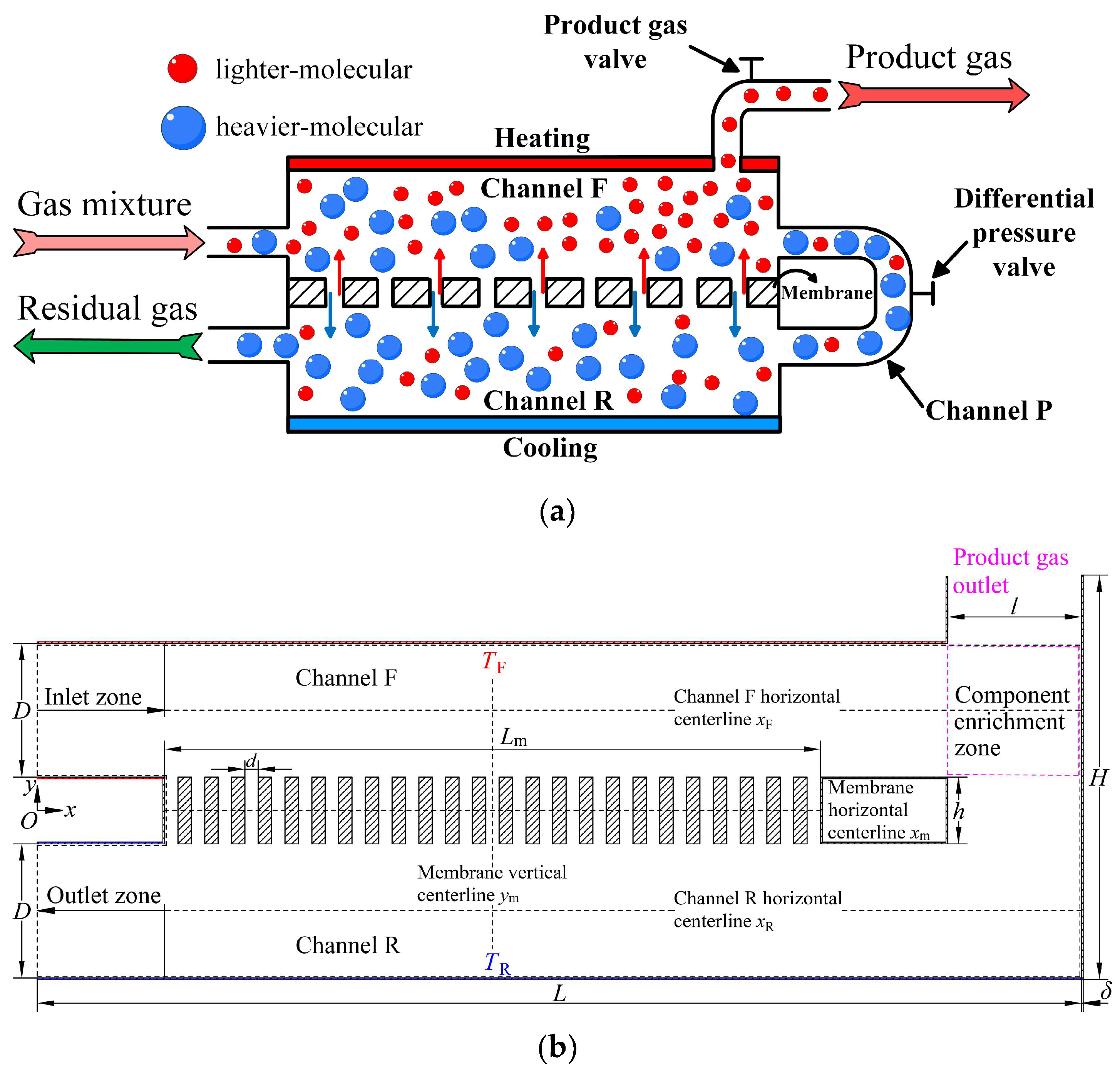
Since molecular exchange flow is a special type of thermal transpiration effect, that is, molecular exchange flow can be regarded as a specific manifestation of the thermal transpiration effect, the gas separator that works on the principle of molecular exchange flow is governed by the same thermal transpiration mechanism. We take the novel gas membrane separator based on molecular exchange flow proposed by Su et al. [21] as a research reference. As illustrated in Figure 1a, the separator comprises channels F, R and P (equipped with a flow control valve), a differential pressure valve, a target component (product gas) collection outlet, and a porous membrane. The separator chamber is divided into two parallel main flow channels (channels F and R) by the porous membrane. The channel F outlet is connected to the channel R inlet through a U-bend channel (channel P). Channel F serves as a hot channel heated by a heating module to maintain a relatively high temperature, and channel R serves as a cold channel cooled by a cooling module to maintain a relatively low temperature. The separator is configured to operate within the slip flow regime by adjusting parameters such as temperature, pressure, and membrane microchannel size. Owing to the temperature difference between channels F and R, the thermal transpiration effect occurs within the porous membrane, thereby separating the gas-mixture components. As a result, the target component (lighter-molecular-weight component) migrates through the membrane from channel R to channel F and becomes highly concentrated in the component enrichment zone of channel F downstream.
According to the control volume method, a two-dimensional geometric model for this separator is simplified as shown in Figure 1b, where the shaded area represents the solid domain and the unshaded region denotes the fluid domain. The flow of the gas mixture in channels F and R is a conventional continuum flow, while the migration of components in the microchannels of the membrane is a discontinuous flow. The horizontal centerlines of channels F and R are xF and xR, respectively, while the horizontal centerline of the microchannel is xm. Furthermore, the membrane vertical centerline ym is the vertical centerline of the whole membrane.

2.2. Mathematical Equations

2.2.1. Main Flow in Channels F and R

The flow of gas mixture in channels F and R is treated as a continuum flow and governed by the conventional Navier–Stokes equations, where the complete description is presented as Equations (1)–(3):
ρ t + ρ u = 0
ρ u t + ρ u u = p I + K + F
ρ c p T g t + u T g = q + K S T g ρ ρ T g p g ρ t + u p + Q
where ρ is the density of gas phase, kg/m3; t is the time, s; u is the velocity vector, m/s; pg is the pressure of gas phase; I is the identity matrix; K is the viscous stress tensor, Pa; F is the volume force vector, N/m3; Tg is the absolute temperature of gas phase, K; S is the strain-rate tensor, 1/s; q is the heat flux vector, W/m2, and Q contains the heat sources, W/m3.

2.2.2. Migration of Components of Gas Mixture in Microchannels

The conventional Navier–Stokes equations, which are used to calculate the continuum flow, are also applicable to rarefied gas flow at the slip flow regime when they are modified by the velocity-slip and wall temperature-jump conditions [27]. Based on previous studies by Lockerby et al. [28], the wall slip velocity is written as Equation (4):
u slip = σ s λ μ τ n n T τ n n + σ T μ ρ T g T j n T j n
with
σ s = 2 a v a v
where uslip is the wall slip velocity, m/s; λ is the average molecular free path, m; μ is the viscosity of gas phase, Pa·s; n is the boundary normal; τ is the viscous stress tensor, N/m3; σs is the viscous slip coefficient; av is the tangential momentum accommodation coefficient, which is set to 0.9 [29]; σT is the temperature slip coefficient, which is set to 0.75 [30]; and Tj is the wall jump temperature, K, which can be expressed as Equation (6):
T j = T g ζ T λ n T g
with
ζ T = 2 σ s κ γ μ c p γ + 1
where ζT a is the temperature-jump coefficient; γ is the specific heat ratio of gas phase; κ is the thermal conductivity of gas phase, W/(m·K), and cp is the specific heat capacity of gas phase at constant pressure, J/(kg·K). The slip and temperature-jump coefficients used in this study originate from kinetic theory-based formulations for idealized gas–surface interaction models, typically developed for simplified systems such as monatomic hard-sphere gases. In the slip flow regime, they are widely treated as first-order boundary parameters reflecting gas–surface momentum and energy accommodation effects. Although this approximation may introduce deviations for multicomponent polyatomic mixtures, it is expected to capture the leading-order transport behavior and preserve the qualitative trends within the investigated slip flow regime.
The degree of gas rarefaction inside microchannels is commonly characterized by the Kn, which is defined as Equation (8) [31]:
K n = λ d
with
λ = k B T g 2 d avg 2 p g
where d is the characteristic length of the microchannel, m; kB is the Boltzmann constant with a value of 1.381 × 10⁻²³ J/K; and davg is the average molecular diameter of the gas phase, m. In a binary gas mixture, the diffusive velocity of one of the components can be determined by solving the matrix of diffusion coefficients derived from the Maxwell–Stefan equations. The binary diffusion coefficients within this matrix are typically defined as Equation (10) by the Chapman–Enskog theory [32,33]:
ρ i u i u = ρ i ω i k = 1 N D i k d k D i T T g T g
where ρi is the density of component i, kg/m3; ui is the absolute velocity of component i, m/s; ωi is the mass fraction of component i; N is the number of components; Dik is the multicomponent Fick diffusivities, m2/s; dk is the diffusional driving force, 1/m; and D i T is the thermal diffusion coefficient of component i, kg/(m·s).
Since the gas separator in this study is designed to purify the lighter-molecular-weight component from the gas mixture, the average mole fraction of the lighter-molecular-weight component (specifically, hydrogen) in the component enrichment zone is adopted as the performance parameter for evaluating the separator, which is defined as follows in Equation (11) [18]:
χ ¯ = A χ d x d y A
with
χ = n H 2 n H 2 + n C H 4
where χ ¯ is the average hydrogen mole fraction in the component enrichment zone; χ is the mole fraction of hydrogen at any point of the component enrichment zone; A is the area of the component enrichment zone, which is defined as A = D × l, m2; n H 2 is the number density of hydrogen at any point of the component enrichment zone, m−3; and n C H 4 is the number density of methane at any point of the component enrichment zone.

2.3. Calculation Conditions

As shown in Figure 1b, the geometry parameters of thermal-transpiration-effect-based circulating-flow gas separator are shown in Table 1. The flow state of the fluid inside the separator is a steady-state flow and the boundaries of a control volume are chosen within the dotted line, as illustrated in Figure 1b. The wall at the junction of channels F and R is assumed to be adiabatic. The temperature TR of channel R is fixed at 300 K, while the temperature TF of channel F can be raised beyond 300 K. The temperatures inside channel F and channel R remain constant, and the temperature difference only appears between channel F and channel R. Additionally, the initial pressure p0 of gas mixture entering the separator is set to 1 atm. In the microchannels of membrane, the migration direction of gas components is defined as positive when they migrate from the cold channel (channel R) to the hot channel (channel F), otherwise it is negative. The absolute value of the migration velocity of gas components indicates the magnitude of migration. According to the technical analysis by Quintino et al. [34], no modification to existing natural gas pipeline infrastructure is required when the hydrogen mole fraction in the CH4-H2 mixture does not exceed 20%. Therefore, the mole fractions of CH4 and H2 at the separator inlet are set to 80% and 20%, respectively. Considering the relatively low thermal conductivity of silicon-based materials, which helps maintain the temperature gradient along the microchannel wall and favors the thermal transpiration effect, the solid domain is specified as silicon-based material. The boundary conditions of velocity slip and temperature jump are applied to all gas–solid interfaces in the microchannels, which account for the temperature discontinuity induced by the thermal transpiration effect. For the operating conditions considered in this study, the microchannel diameter varies from 1 μm to 7 μm, while the gas temperature ranges from 300 K to 400 K at an inlet pressure of approximately 1 atm. According to Equations (8) and (9), the calculated Kn ranges from 0.01 to 0.095. The corresponding values for different microchannel diameters are summarized in Table 2. As shown in Table 2, all investigated cases fall within the slip flow regime (0.01 < Kn < 0.1). Therefore, the first-order velocity-slip and temperature-jump boundary conditions adopted in this study are expected to provide a reasonable approximation of the rarefaction effects under the investigated operating conditions.

2.4. Grid Partitioning and Verification of Grid Independence

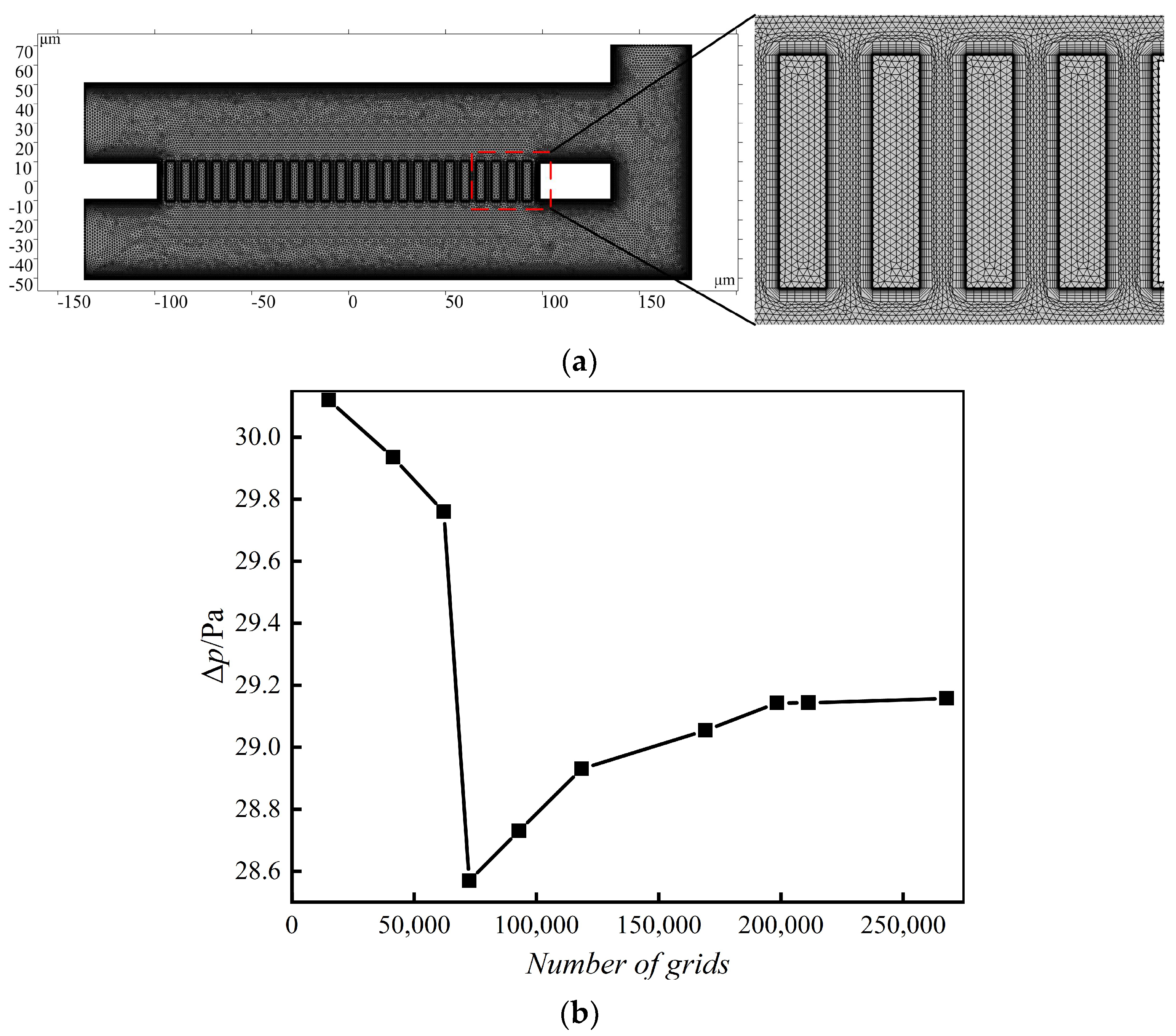
The mesh generation for the geometric model of the thermal-transpiration-effect-based circulating-flow gas separator is shown in Figure 2a. An unstructured triangular mesh is used to discretize the model, with the boundary-layer mesh refinement applied to the solid-fluid interfaces of main flow channels and microchannels.
Numerical simulation is performed at the operating conditions with channel F temperature TF = 400 K and inlet gas velocity U0 = 1 m/s. After the solution reaches steady convergence, grid independence is verified by examining the gas pressure difference Δp, defined as the difference between the gas pressure at the upper end of channel F and that at the lower end of channel R along the membrane vertical centerline ym. As shown in Figure 2b, the value of Δp gradually stabilizes as the number of grid elements increases. When the grid count increases from 198,416 to 267,818, the maximum change in the pressure difference is only 0.047%. Therefore, to conserve computational resources while ensuring simulation accuracy, a grid size of 198,416 elements is adopted for the subsequent calculations.

2.5. Validation of the Mathematical Model

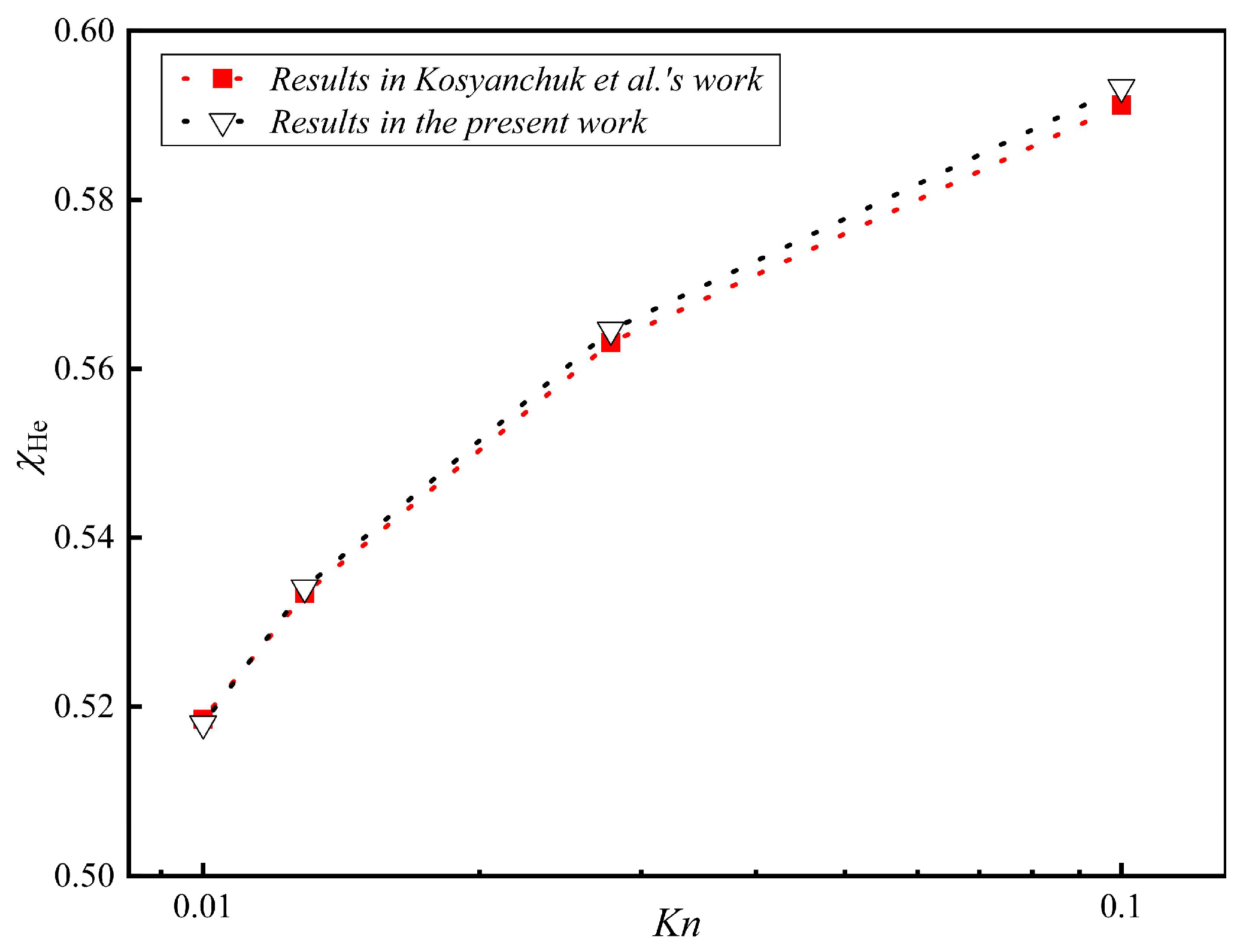
To evaluate the applicability of the established mathematical model for thermal-transpiration-driven binary gas separation in the slip flow regime, a benchmark comparison was conducted with the results reported by Kosyanchuk et al. [19]. In their study, a multi-scale approach combining low-Mach-number Navier–Stokes equations and a McCormack-based linearized Boltzmann formulation was employed to simulate rarefied gas separation in microchannels. The simulated gas mixture consisted of helium and argon with equal mole fractions of 50%, and the imposed temperature difference was set to 30 K. Although the benchmark employed a He-Ar mixture instead of the CH4-H2 mixture considered in the present study, it belongs to the same class of thermal-transpiration-driven binary gas separation in microchannels, thereby providing a reasonable engineering-oriented model assessment of the present slip flow formulation.
As shown in Figure 3, the present results are in good agreement with those reported by Kosyanchuk et al. [19], with a maximum deviation of approximately 0.355%. This agreement, together with the observed deviation at higher Kn, further highlights the differences in model hierarchy and rarefaction treatment between the two approaches. The present model adopts a continuum-based slip flow description with first-order velocity-slip and temperature-jump boundary conditions, in contrast to the multi-scale formulation of Kosyanchuk et al. [19], which couples low-Mach-number Navier–Stokes equations with a McCormack-based linearized Boltzmann treatment. The deviation becomes more pronounced at higher Kn due to the increasing importance of higher-order rarefaction and non-equilibrium effects not captured by the first-order slip formulation. Despite this limitation, the present model provides a computationally efficient framework for parametric studies, as it avoids the complexity of multi-scale kinetic-continuum coupling while still capturing the main trends of thermal-transpiration-driven gas separation.

3. Results and Discussion

3.1. Effect of Channel F Temperature TF on Separator Performance

The temperature difference between the two ends of the microchannel connecting the main channels F and R is one of the key factors governing hydrogen separation. Beyond the above-specified structural parameters of the separator, the inlet gas velocity U0 was fixed at 1 m/s, while the microchannel diameter d was fixed at 4 μm. On this basis, the effect of channel F temperature TF on hydrogen separation was systematically examined.
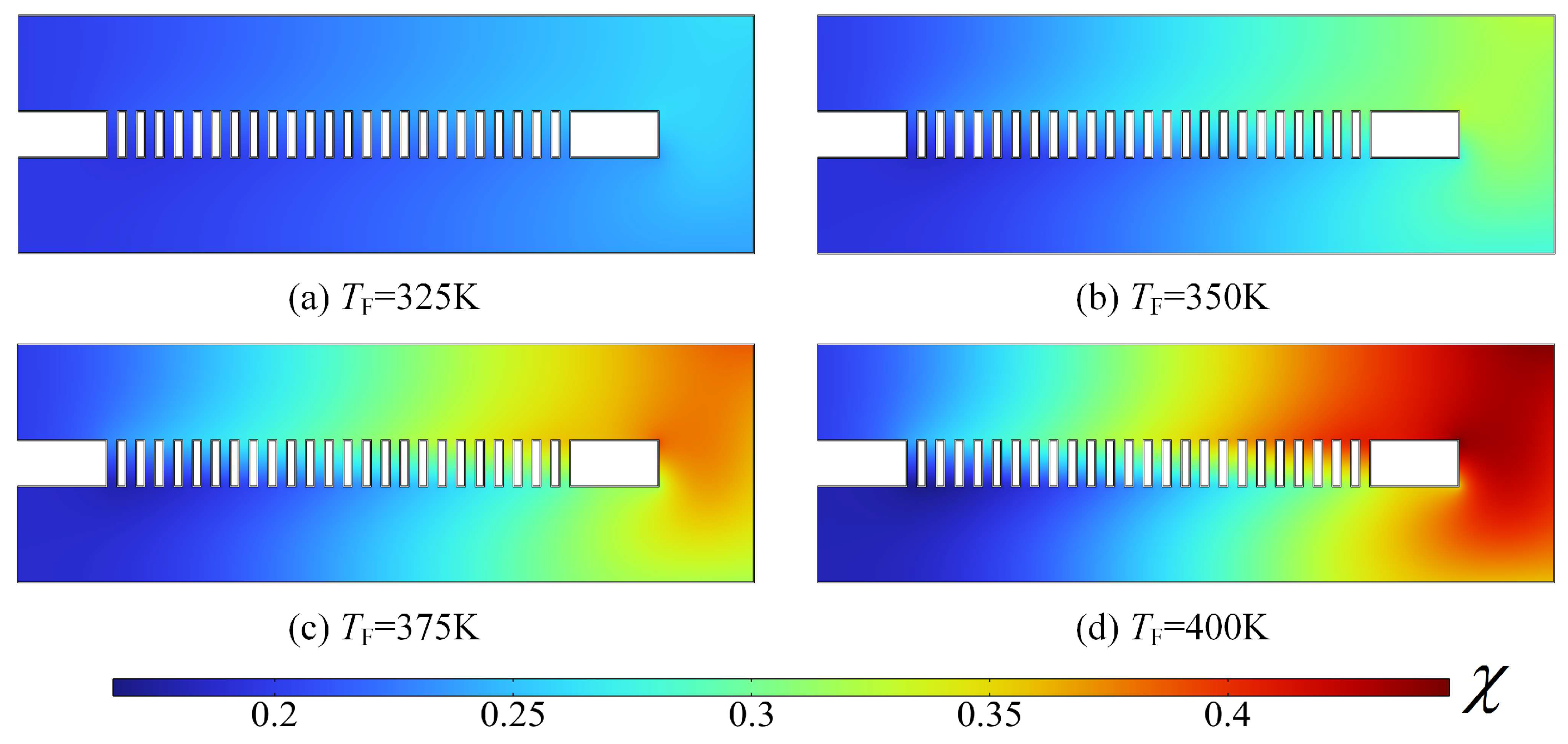
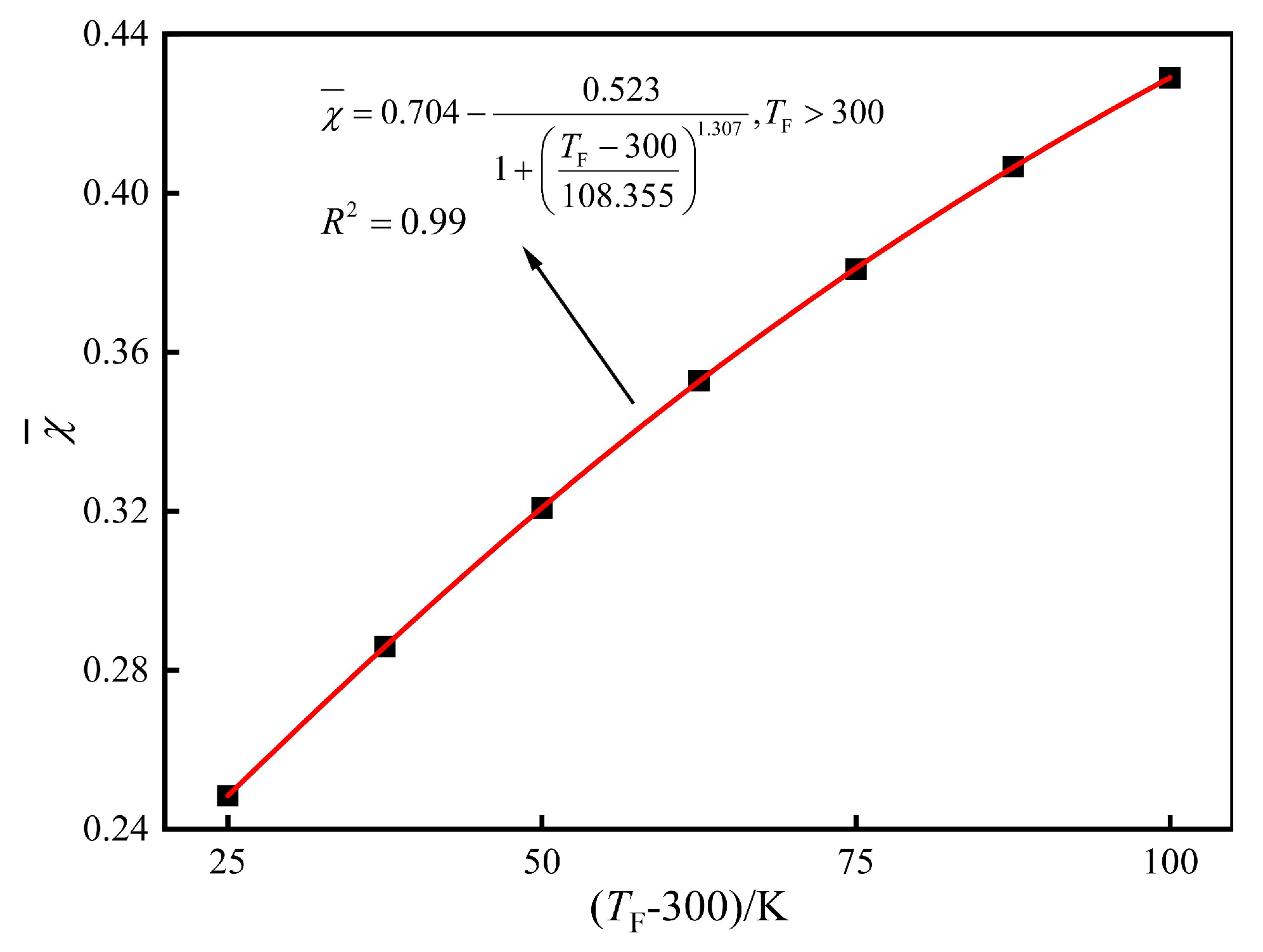
Referring to Figure 4, an obvious hydrogen separation phenomenon can be observed especially at higher channel F temperature TF, with hydrogen enriched in the component enrichment zone. The hydrogen mole fraction increases as the temperature difference between channels F and R increases. When channel F temperatures TF are set to 325 K, 350 K, 375 K, and 400 K, the corresponding average hydrogen mole fractions χ ¯ are 0.248, 0.321, 0.381, and 0.429, respectively. It should be noted that these observations are valid for the investigated operating conditions, in which TR was fixed at 300 K while TF varied from 325 K to 400 K. The influence of different absolute temperature levels was not considered in the present study.
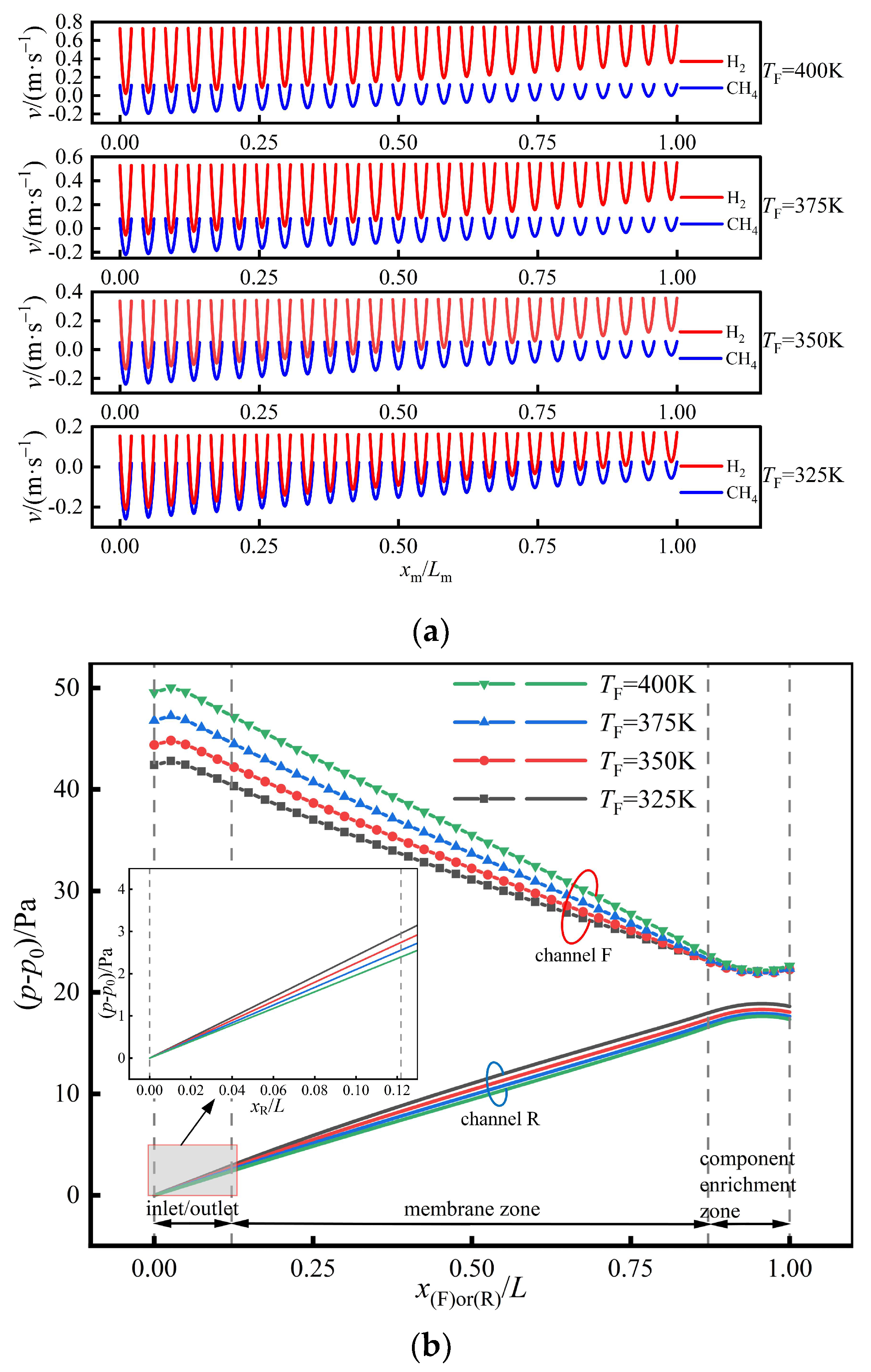
As illustrated in Figure 5a, the tangential velocity v(y) of both components along the axes of the microchannels exhibits a parabolic profile with a maximum at the microchannel wall and a minimum at the microchannel center. This distribution results from the temperature gradient induced by the temperature difference between the two ends of the microchannel. The thermal transpiration effect drives gas molecules near the wall to move from the cold end toward the hot end, forming a thermal transpiration flow. Meanwhile, the velocity in the microchannel center remains influenced by the pressure gradient, which drives a Poiseuille flow. The coupling of these two flow mechanisms leads to the observed parabolic tangential velocity profile. As the channel F temperature TF increases, the thermal transpiration effect strengthens, thereby increasing the tangential velocities of both components. Compared with methane, hydrogen shows a faster increase in tangential velocity. Consequently, the increase in the velocity difference between the two components leads to a corresponding rise in the hydrogen mole fraction in the component enrichment zone. According to the Chapman–Enskog theory, the dynamic viscosity scales as μ = m /(dHS)2, where m is the molecular mass and dHS is the collision diameter. From standard gas property data at the same temperature, the viscosity ratio μH2/μCH4 is approximately 0.54, confirming that hydrogen has a significantly lower dynamic viscosity than methane. This difference stems mainly from the much lower dynamic viscosity of hydrogen, which makes it more sensitive to temperature gradients and enhances its thermal transpiration response. This tangential velocity difference in tangential velocity of the two components caused by the dynamic viscosity difference that enables the separation of the gas mixture, ultimately enriching hydrogen in the downstream of channel F.
As shown in Figure 5b, the pressure in channel F gradually decreases when the mixed gas flows through the separator inlet along the horizontal centerline xF of channel F; conversely, the pressure in channel R gradually increases when mixed gas advances toward the interior of the separator along the horizontal centerline xR of channel R. This indicates the presence of pressure drop inside the separator. The pressure drop in channels F and R attenuates the influence of the Poiseuille flow on the motion of gas mixture within the microchannels, resulting in a lower tangential velocity in the upstream microchannels compared with the downstream ones, as observed in Figure 5a. As channel F temperature TF increases, the pressure in channel F rises while that in channel R decreases, which enhances gas separation due to the strengthened thermal transpiration effect.
Figure 6 shows the fitted curve obtained by nonlinear regression, indicating that the average hydrogen mole fraction increases monotonically but at a gradually decreasing rate, indicating a saturating trend as the channel F temperature TF rises. While a larger temperature gradient enhances the thermal transpiration effect and promotes hydrogen migration from channel R toward channel F through the microchannels, it also intensifies this effect on methane molecules at the microchannel center. This, in turn, shifts their tangential velocity from negative toward positive values, thereby moderating the improvement in separation efficiency (see Figure 5a). From an engineering application perspective, this implies that relying solely on the increase of hot channel (channel F) temperature to achieve higher separation efficiency will lead to diminishing returns. Therefore, a system design employing coupled multistage separators and graded utilization of available thermal resources may be considered, allowing each stage to operate at a suitable temperature and thereby improving the overall utilization of the temperature gradient. Additionally, any temperature increase requires consideration of the long-term thermal resistance of the microchannel materials to avoid material failures induced by excessively high temperature.

3.2. Effect of Inlet Gas Velocity U0 on Separator Performance

The tangential velocity of the gas along the axes of microchannels is jointly influenced by the thermal transpiration flow near the walls and the Poiseuille flow in the microchannel center. From a dimensionless perspective, the relative importance of these two transport mechanisms can be qualitatively interpreted using the normalized temperature-gradient term (hTg/Tm) and the normalized pressure-gradient term (hpg/pm), which are associated with thermal transpiration flow and Poiseuille flow, respectively. Here, h is the microchannel length, while Tm and pm denote the average temperature and pressure in the microchannel, respectively. Although the present model directly solves the resultant velocity distribution rather than separately decomposing it into thermal-transpiration and Poiseuille-flow components, the competition between these two mechanisms can still be understood in terms of the relative dominance of the corresponding thermal and pressure driving effects. The intensity of the Poiseuille flow is directly related to the internal pressure distribution of the separator. In this study, the outlet pressure is maintained as constant, while the inlet gas velocity is treated as a variable parameter. As the inlet gas velocity varies, the internal pressure distribution in the separator is adjusted accordingly to satisfy the fixed outlet pressure boundary condition, which can affect gas separation performance. Therefore, the inlet gas velocity has a significant influence on the performance of the separator. Under the conditions of channel F temperature TF at 400 K and the microchannel diameter d at 4 μm, the influence of different inlet gas velocities on the hydrogen separation was systematically investigated.
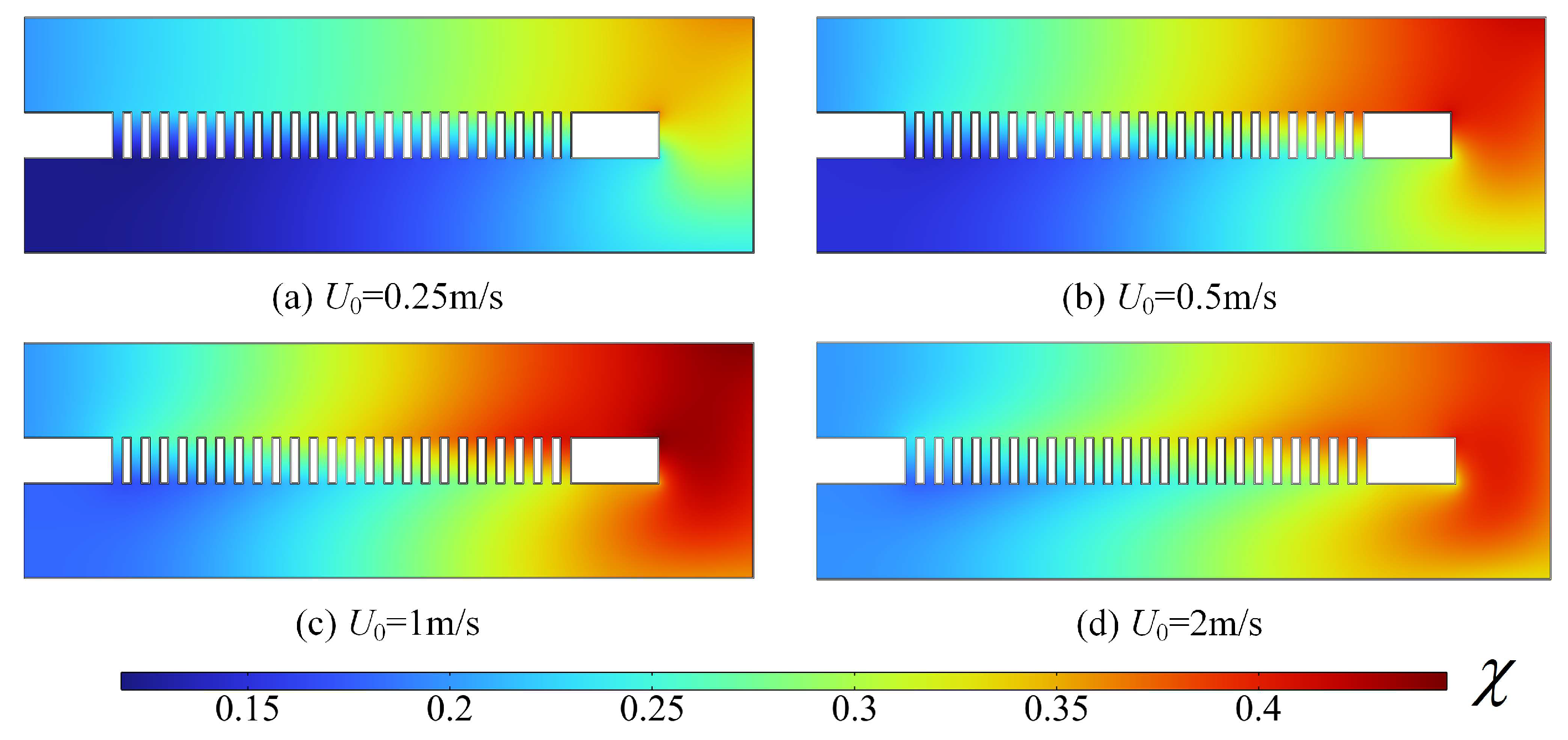
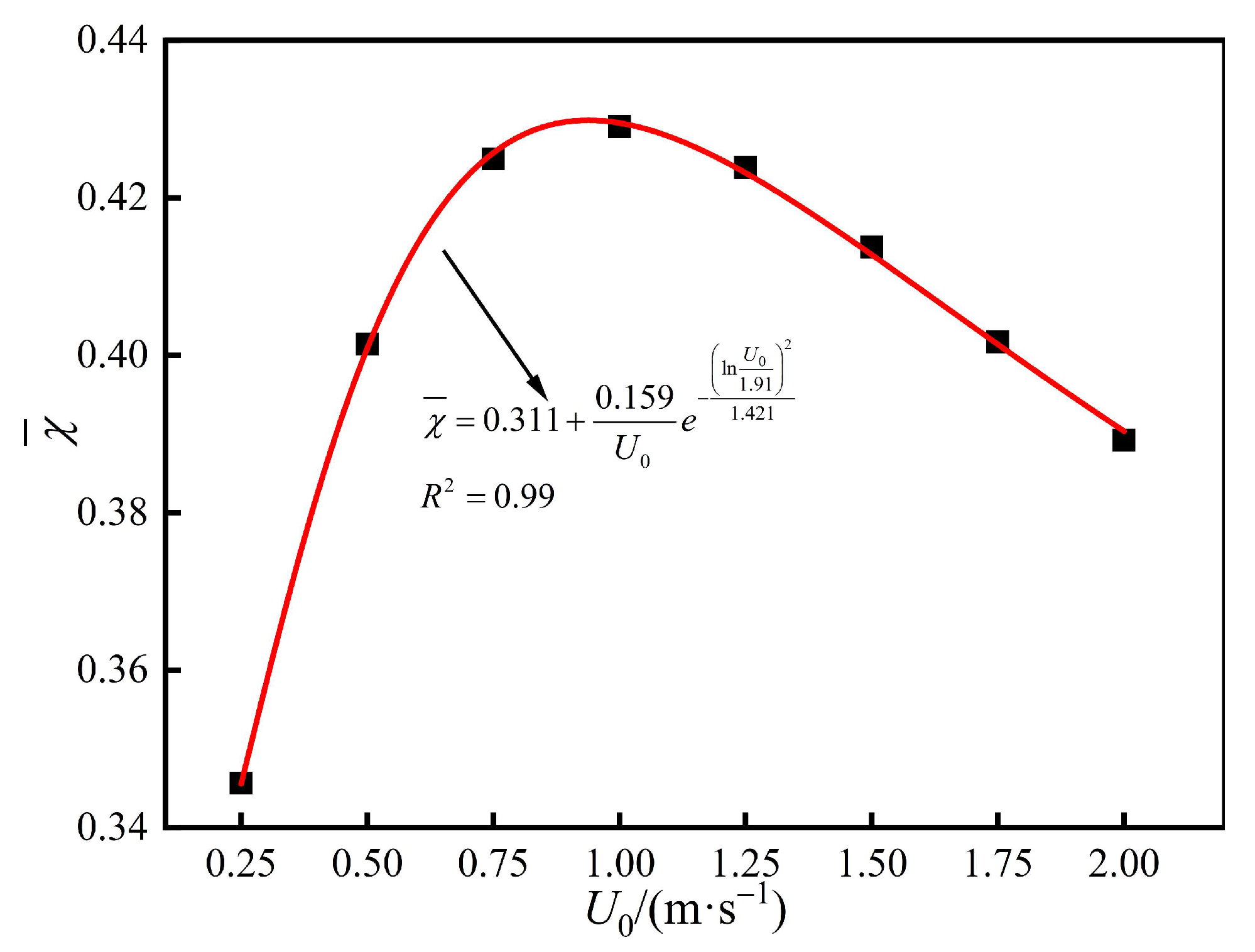
As presented in Figure 7, the hydrogen mole fraction within the component enrichment zone initially increases and then decreases as the inlet gas velocity rises. When inlet gas velocities U0 are set to 0.25 m/s, 0.5 m/s, 1 m/s and 2 m/s, the corresponding average hydrogen mole fractions χ ¯ are 0.346, 0.401, 0.429 and 0.389, respectively.
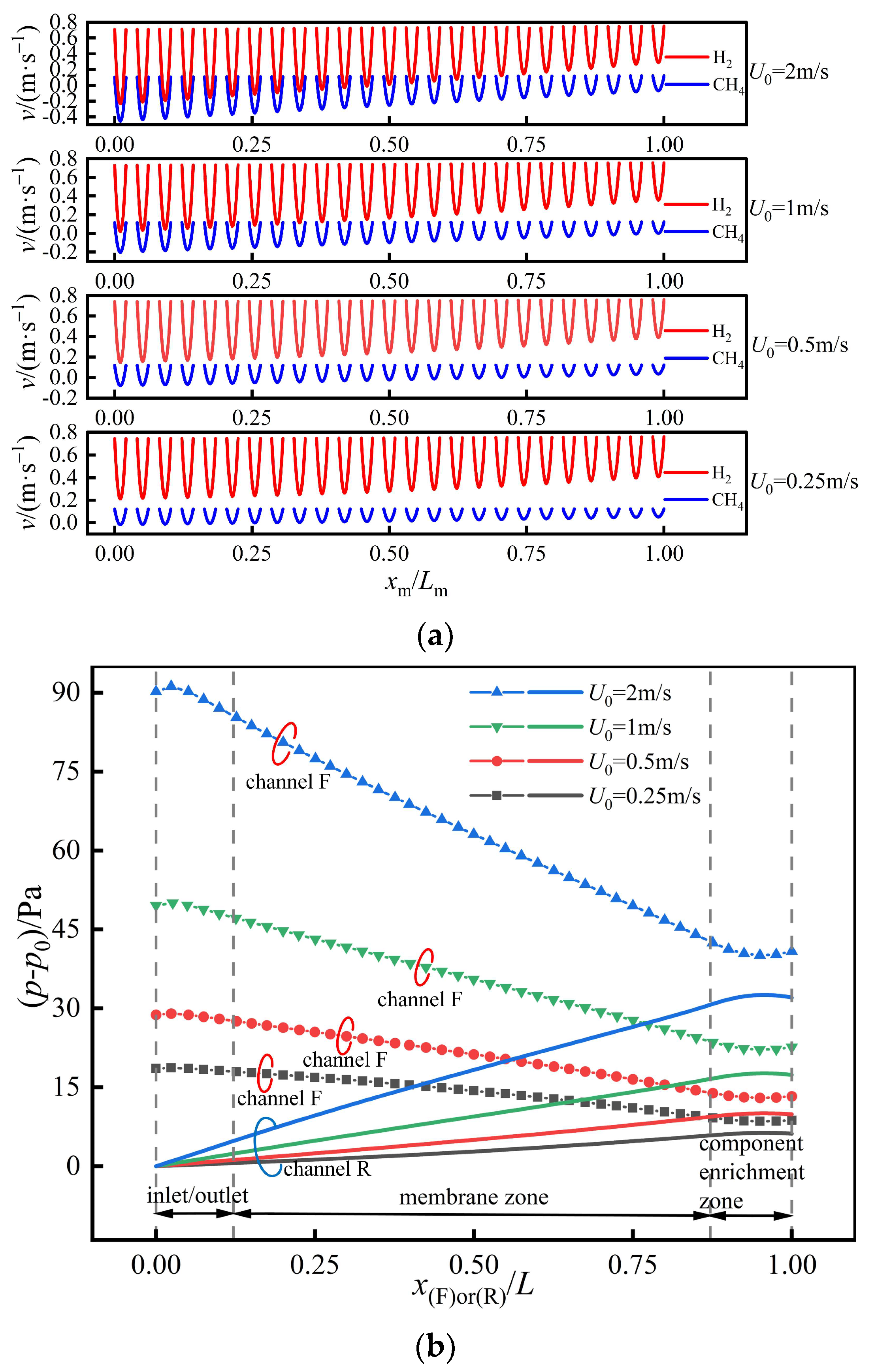
As seen from Figure 8a, as the inlet gas velocity increases, the tangential velocity of both components near the microchannel walls changes only slightly, whereas that at the microchannel center decreases gradually. When inlet gas velocity U0 is 0.25 m/s, 0.5 m/s, and 1 m/s, the proportion of the region where methane exhibits a negative tangential velocity gradually increases, indicating that the fraction of methane migrating from the cold channel (channel R) to the hot channel (channel F) through the microchannels progressively decreases. This partly raises the mole fraction of hydrogen in the hot channel (channel F), which enhances the separation of hydrogen from the methane-hydrogen mixture and consequently increases the hydrogen mole fraction in the component enrichment zone. However, when the inlet gas velocity U0 increases to U0 = 2 m/s, the tangential velocity of hydrogen in some microchannels also becomes negative, indicating that a portion of hydrogen molecules begins to migrate from the hot channel (channel F) back to the cold channel (channel R) through those microchannels. This behavior partly reduces the mole fraction of hydrogen in the hot channel (channel F) and leads to a decline in the hydrogen mole fraction in the component enrichment zone. Together, these changes cause the hydrogen mole fraction in the component enrichment zone to exhibit a single-peak (first increases then decreases) trend with the increase in inlet gas velocity U0. As discussed in Section 3.1, hydrogen has a significantly lower dynamic viscosity than methane. In the microchannel center zone dominated by the Poiseuille-flow mechanism, the lower viscosity makes hydrogen more sensitive to the pressure gradient, which leads to a greater attenuation of its tangential velocity.
As shown in Figure 8b, both the pressures in channels F and R increase with the rise in inlet gas velocity, and the pressure difference between channels F and R along xF and xR also increases. This is because the inlet is specified as a variable velocity boundary condition, while the outlet is defined as a fixed pressure boundary condition. To maintain the specified inlet gas velocity against the significantly increased viscous resistance, the overall pressure level throughout channels F and R must be raised. Figure 8b shows an upward shift in the pressure distribution curves under different inlet gas velocities, indicating that the inlet gas velocity directly determines the global pressure required to drive macroscopic flows in channels F and R. The elevated pressure strengthens the Poiseuille flow, which also explains why the tangential velocities of both components at the microchannel center zone decrease as the inlet gas velocity increases (see Figure 8a). Furthermore, when the inlet gas velocity is excessively high, the hydrogen molecules enriched in the component enrichment zone become diluted by the mainstream flow, which also contributes to the decline in hydrogen mole fraction in the component enrichment zone.
Figure 9 exhibits a pronounced single-peak distribution pattern of the average hydrogen mole fraction as a function of inlet gas velocity. Nonlinear fitting and extremum analysis reveal that within the investigated parameter range, the inlet gas velocity corresponding to the maximum average hydrogen mole fraction is approximately 0.93 m/s. From an engineering application perspective, this optimum velocity provides a clear reference point for balancing the competition of thermal transpiration flow and Poiseuille flow within the separator. Deviating above or below this optimum velocity disrupts the equilibrium between the two types of flow, leading to reduced hydrogen enrichment. Therefore, this optimum inlet gas velocity is the optimal for the theoretical separation performance predicted by the present model within the present model, serving as a critical benchmark for subsequent parameter studies and model refinement.

3.3. Effect of Microchannel Diameter d on Separator Performance

The microchannel diameter, which can determine the molecular mean free path, is an important factor affecting the thermal transpiration flow. In this regard, the length of the membrane region Lm is kept constant, and only the microchannel diameter d is varied to isolate its influence on the separation behavior. Although the wall thickness varies with d, it primarily serves to maintain the temperature gradient along the microchannels and is not expected to significantly affect the temperature distribution under the present operating conditions. Therefore, under the conditions of the channel F temperature TF at 400 K and the inlet gas velocity U0 at 1 m/s, the influence of different microchannel diameters on the hydrogen separation was systematically investigated.
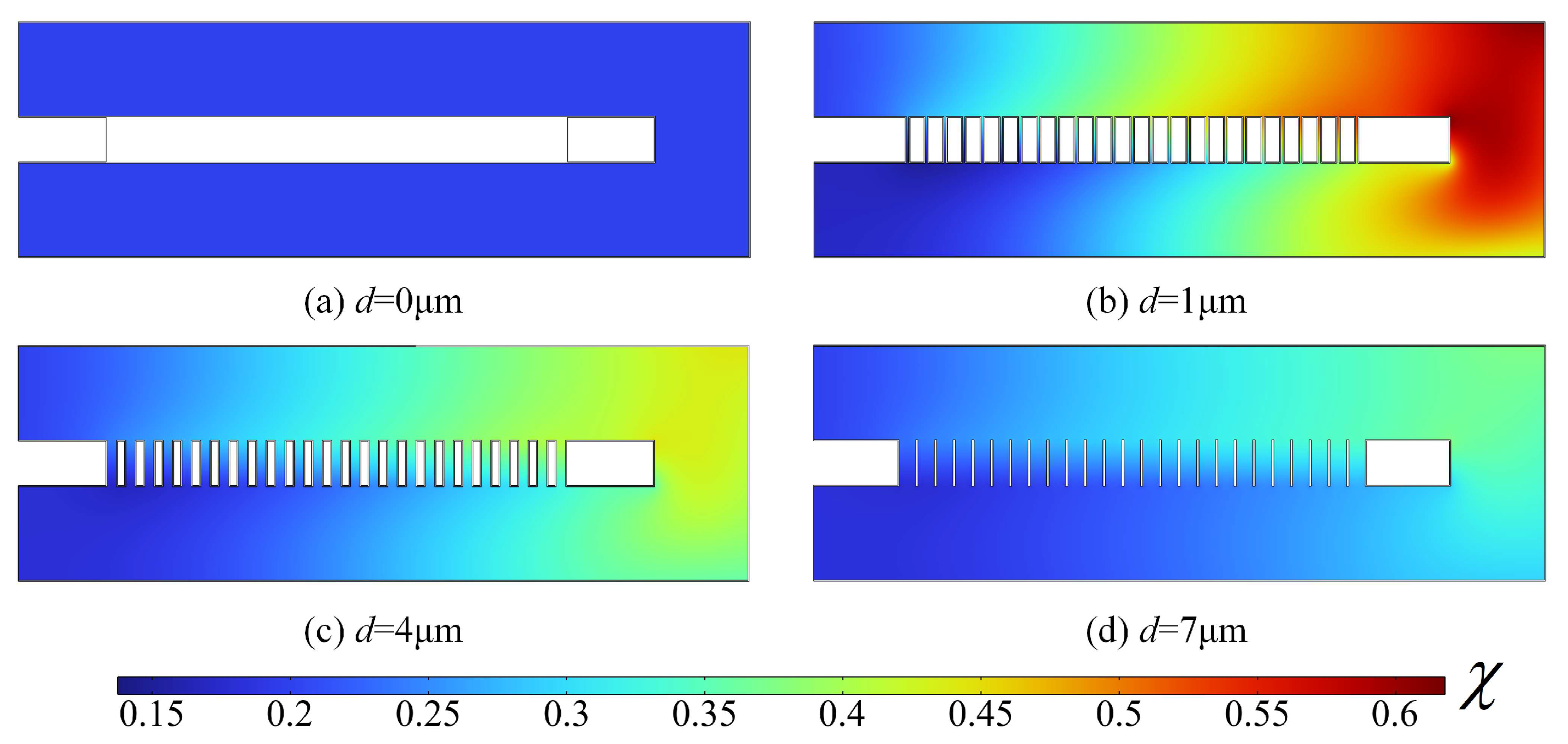
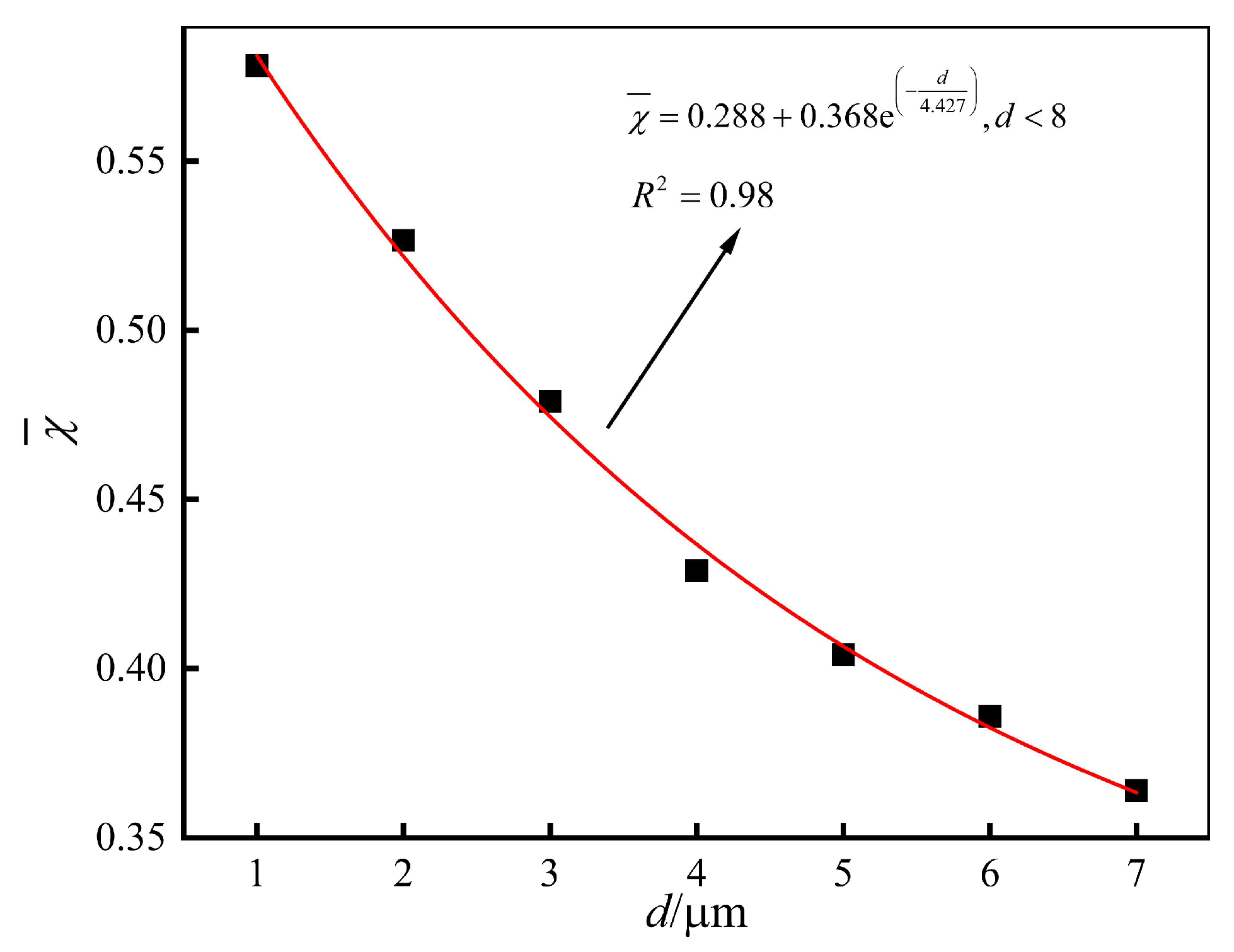
As presented in Figure 10, the hydrogen mole fraction in the case of no microchannels (d = 0 μm) remains at the inlet value of 0.2, indicating the absence of separation. This is attributed to the lack of confined microchannel structures required for the development of thermal transpiration and wall-induced gas–surface interactions. For configurations with microchannels, the hydrogen mole fraction increases significantly and then decreases with increasing microchannel diameter. When the microchannel diameters d are 1 μm, 4 μm, and 7 μm, the corresponding average hydrogen mole fractions χ ¯ are 0.578, 0.429, and 0.364, respectively.
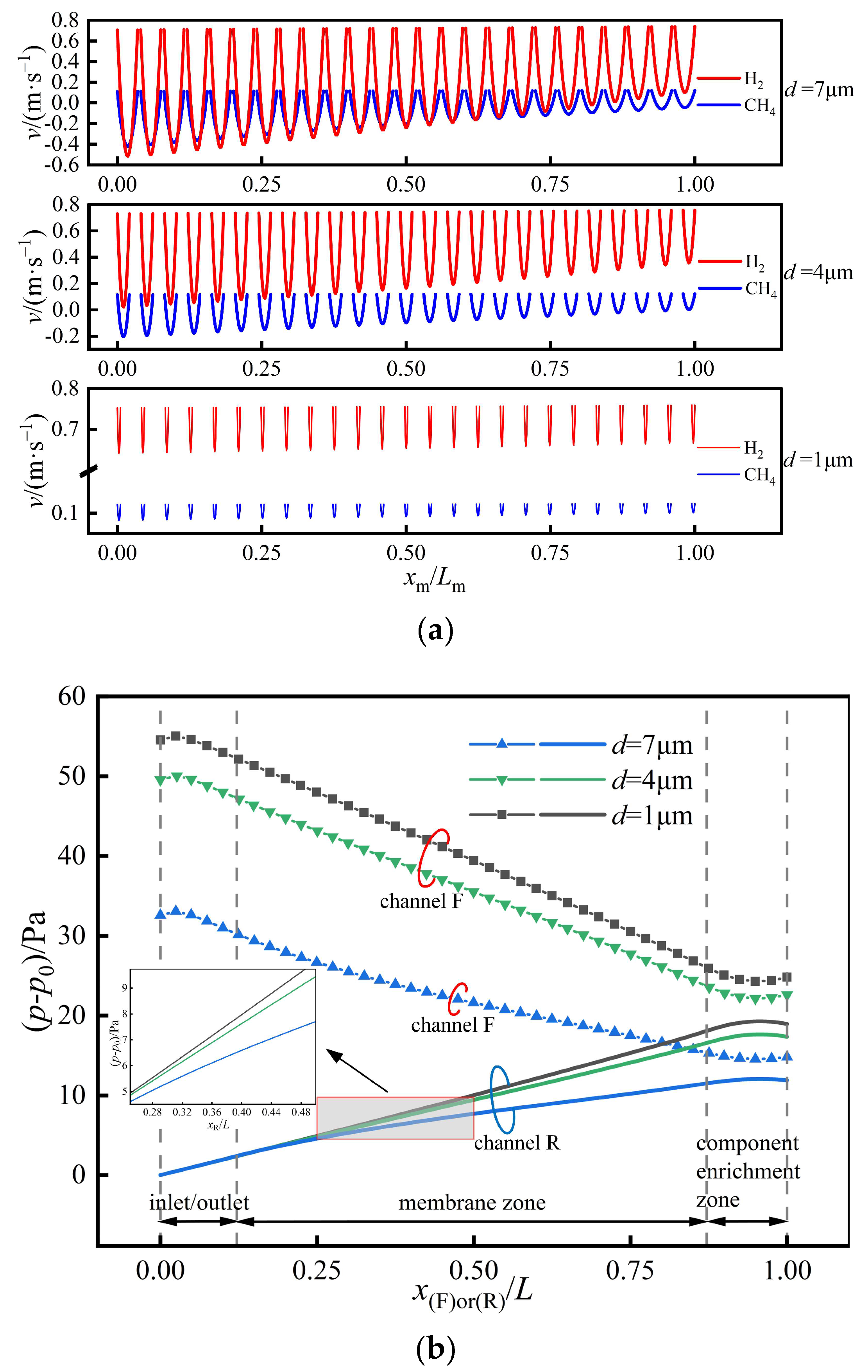
Since d = 0 corresponds to the absence of microchannel structures, the tangential velocity within the microchannels is not defined for this case, although the pressure distribution in the main channel still exists. Therefore, only cases with d > 0 are considered for consistent comparison. As illustrated in Figure 11a, when the microchannel diameter is small, the collision frequency between gas molecules and the channel walls increases significantly, causing the thermal transpiration effect to dominate the entire microchannel. Its influence is therefore not limited to the near-wall region but can also extend to the microchannel center zone. Consequently, at d = 1 μm, both components still maintain relatively high positive tangential velocities at the microchannel center, indicating that thermal transpiration governs the overall flow field and drives the gas molecules to migrate from the cold channel (channel R) toward the hot channel (channel F). Since hydrogen has a lower dynamic viscosity and higher molecular mobility, it is more strongly driven by the thermal transpiration effect and can therefore migrate more easily toward the hot end and become enriched in the hot channel. As the microchannel diameter gradually increases, the influence of the wall effect on the microchannel center region weakens, whereas the Poiseuille flow becomes increasingly significant. Under the enhanced pressure-gradient-driven effect, the tangential velocities of both components at the microchannel center decrease, among which hydrogen exhibits a more pronounced reduction because of its lower dynamic viscosity and higher sensitivity to the variations in Poiseuille flow. As a result, the average velocity difference between hydrogen and methane generated by the thermal transpiration effect gradually decreases, weakening the selective transport capability between the two components and thereby reducing the preferential migration of hydrogen from the cold end to the hot end. When the microchannel diameter further increases to d = 7 μm, the tangential velocity of hydrogen in some regions even becomes lower than that of methane, leading to a further reduction in the net hydrogen flux from the cold channel to the hot channel. Consequently, the hydrogen enrichment capability in the hot channel declines. Overall, increasing the microchannel diameter strengthens the suppressive effect of the Poiseuille flow on thermal transpiration and simultaneously reduces the average velocity difference between the two gas components, thereby weakening the hydrogen separation performance of the separator.
As shown in Figure 11b, the increase in microchannel diameter makes the pressures in both channels F and R decrease, and the pressure difference between channels F and R along xF and xR also diminishes. This is primarily due to the reduced flow resistance resulting from a larger microchannel diameter, which lowers the overall pressure level of the separator. Although the decreased pressure drop across the microchannels linearly weakens the intensity of the Poiseuille flow, the increase in microchannel diameter has a more dominant effect, which is proportional to the square of the diameter. Therefore, as illustrated in Figure 11a, the tangential velocity at the microchannel center zone decreases as the microchannel diameter increases—a consequence of the square-law enhancement overpowering the linear reduction in pressure difference.
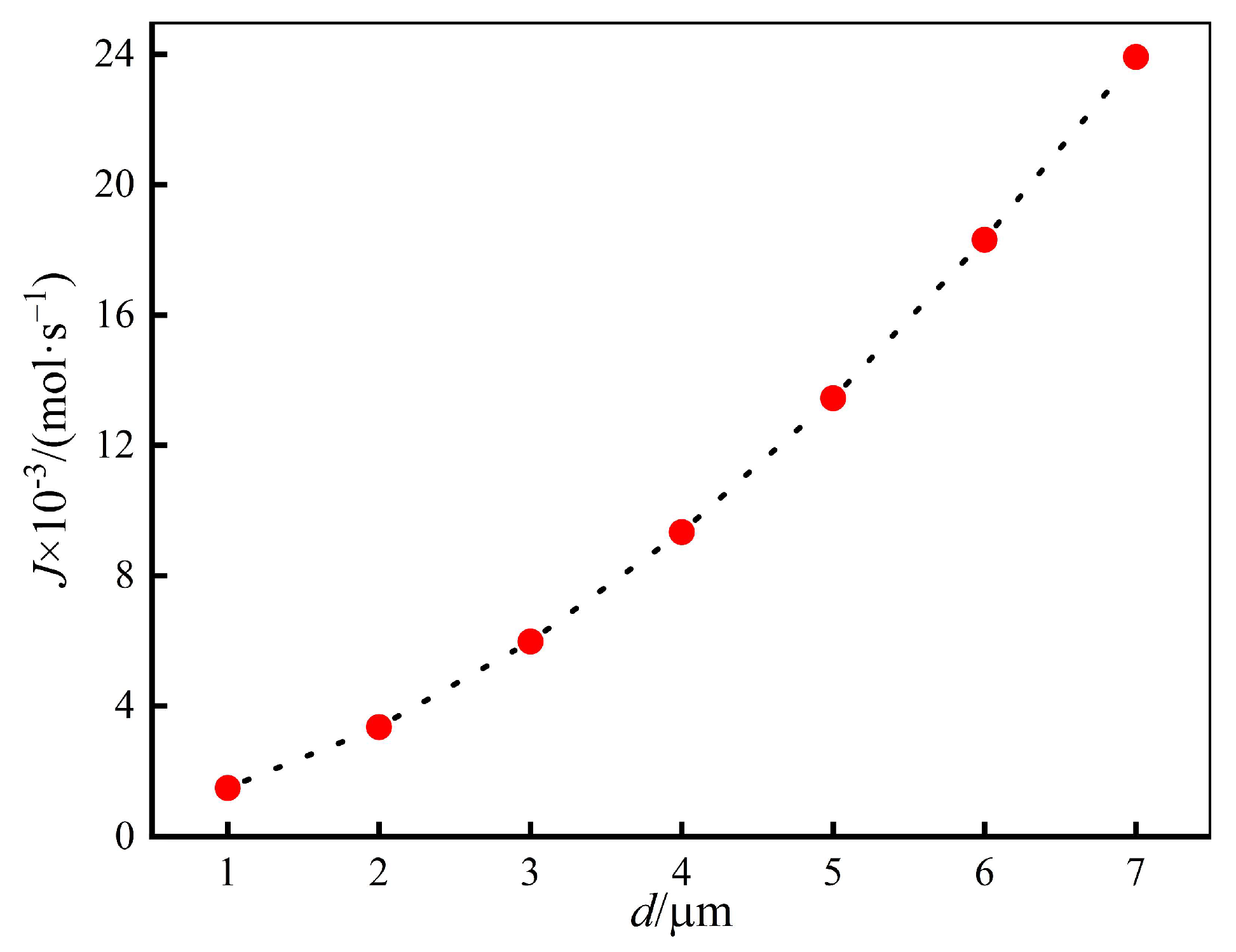
According to Figure 12, the fitted curve obtained by nonlinear regression shows that the average hydrogen mole fraction decreases monotonically with increasing microchannel diameter d, indicating that smaller microchannel diameters are more favorable for hydrogen enrichment. Combined with Figure 13, it can be observed that the product gas flow rate J from the separator increases gradually as the microchannel diameter increases. This indicates that although a smaller microchannel diameter can produce a more hydrogen-enriched product gas, it also increases the gas flow resistance, thereby reducing the outlet flow rate of the product gas. In contrast, a larger microchannel diameter enhances the gas transport capability and outlet flow rate, but weakens the selective transport ability induced by the thermal transpiration effect between different gas components, resulting in a decline in enrichment performance. Therefore, from an engineering application perspective, the design of the microchannel diameter requires a comprehensive trade-off between hydrogen purity and product gas flow rate. When the microchannel diameter is excessively small, although a relatively high hydrogen mole fraction can be achieved, the large flow resistance limits the system’s processing capacity and gas production efficiency. Conversely, when the microchannel diameter is excessively large, although the product gas flow rate is improved, the reduced separation performance lowers the hydrogen quality. Consequently, in the practical design of the separator, the microchannel diameter should be reasonably optimized according to the target operating conditions and application requirements, so as to achieve a balance between hydrogen purity and product gas flow rate, thereby achieving stable and efficient separation performance.
The above results also indicate an important practical limitation for scale-up. Although reducing the microchannel diameter can enhance hydrogen enrichment, this improvement is obtained at the expense of increased flow resistance and reduced product gas flow rate. Therefore, at the present stage, the proposed separator remains a preliminary concept requiring further scale-up-oriented evaluation. Practical design should instead balance enrichment performance, pressure-drop control, and processing capacity through the coordinated optimization of microchannel geometry and module arrangement. Moreover, implementation of this separator requires further assessment of thermal-energy utilization for maintaining the imposed temperature difference, fabrication tolerance and uniformity of micron-scale channels, long-term resistance to fouling or blockage, and process-level competitiveness compared with established hydrogen separation technologies.


4. Conclusions

This paper proposes a mathematical model for a thermal-transpiration-effect-based circulating-flow gas separator within the slip flow regime. The model is formulated based on the continuum Navier–Stokes equations with first-order velocity-slip and temperature-jump boundary conditions, which may provide reasonable approximations for the Kn range considered (0.01–0.095), although higher-order rarefaction effects are not fully captured and the slip and temperature-jump coefficients are treated as effective parameters based on kinetic theory-based gas–surface interaction models, which may introduce uncertainty associated with species dependence. It should also be acknowledged that the present validation remains confined to comparisons with previously reported numerical studies, and the predictive reliability of the model for CH4-H2 separation warrants further confirmation through dedicated experimental investigations. Within this modeling framework, the model is applied to the separation of a CH4-H2 mixture under slip flow conditions. The influences of hot channel temperature, inlet gas velocity, and membrane microchannel diameter on separation performance are examined, which helps clarify the relationship between flow characteristics and separation behavior and may offer guidance for hydrogen recovery from hydrogen-enriched natural gas. The conclusions are summarized as follows:
(1)
With the channel R (cold channel) temperature fixed at 300 K, the temperature difference, which is represented by the channel F (hot channel) temperature, has a significant positive impact on hydrogen separation performance. As the temperature difference between the hot and cold mainstream channels increases, the hydrogen mole fraction in the component enrichment zone increases monotonically, but shows a gradually saturating trend. However, the fitted simulation data indicate that as the temperature difference further increases, the growth rate of the hydrogen mole fraction gradually slows down, indicating that relying solely on increasing the temperature difference leads to diminishing returns. Thus, multistage separators can be considered or graded utilization of available thermal resources can be employed to maintain effective separation performance under practical operating conditions.
(2)
The inlet gas velocity has a non-monotonic effect on separation performance and exhibits an optimum value. The hydrogen mole fraction in the component enrichment zone first increases and then decreases as inlet gas velocity increases, reaching a peak value at U0 = 0.93 m/s. When the inlet gas velocity is too low, the weak Poiseuille flow limits the separation effect. However, when the inlet gas velocity is too high, component back-mixing and dilution are intensified, reducing the degree of enrichment. The results indicate a competing mechanism between the thermal transpiration flow and the Poiseuille flow within the microchannel, and an appropriate balance between the two is required to maximize separation efficiency.
(3)
The microchannel diameter has a significant influence on the separation performance. As the microchannel diameter increases, the hydrogen mole fraction in the component enrichment zone decreases gradually, whereas the outlet flow rate of the product gas increases continuously. When the microchannel diameter is small, the thermal transpiration effect dominates the entire microchannel and enhances the migration and enrichment of hydrogen toward the hot channel. However, as the microchannel diameter increases, the Poiseuille flow becomes increasingly significant, reducing the average velocity difference between hydrogen and methane and weakening the selective transport capability induced by thermal transpiration, thereby lowering the hydrogen enrichment performance. Therefore, the microchannel diameter is a key structural parameter affecting the balance between hydrogen purity and product gas flow rate in the separator.
(4)
From an engineering perspective, the proposed separator remains a preliminary concept requiring further scale-up-oriented evaluation. The results reveal a trade-off between hydrogen enrichment and product gas flow rate, indicating that microchannel geometry, pressure-drop control, and module arrangement should be optimized simultaneously. Future studies should further assess thermal energy utilization, fabrication tolerance and uniformity of micron-scale channels, long-term resistance to fouling or blockage, and process-level competitiveness compared with established hydrogen separation technologies.

Author Contributions

Data curation, modeling, software, writing—original draft preparation and writing—review, D.Y.; investigation, formal analysis, and editing, Q.J.; conceptualization, methodology, resources, funding acquisition, supervision, W.L. All authors have read and agreed to the published version of the manuscript.

Funding

This work is supported by the Guangxi Natural Science Foundation (Grant No. 2026GXNSFDA00640017) and the National Natural Science Foundation of China (Grant No. 52066002). The authors acknowledge the Guangxi Natural Science Foundation and the National Natural Science Foundation of China.

Data Availability Statement

The original contributions presented in this study are included in the article. Further inquiries can be directed to the corresponding author.

Conflicts of Interest

The authors declare no conflicts of interest.

Abbreviations

The following abbreviations are used in this manuscript:
PSApressure swing adsorption
DSMCDirect Simulation Monte Carlo
Eq.Equation
KnKnudsen number

References

  1. Das, P.; Mohtasim, M.S.; Mishuk, N.J.; Rowe, A.; Shuvo, K.A. A review of natural gas transportation pipeline optimization and progress towards hydrogen injection: Challenges and advances. Int. J. Hydrogen Energy 2025, 124, 102–122. [Google Scholar] [CrossRef]
  2. Chen, Y.Y.; Wang, Z.M.; Liu, W.; Long, L.; Huang, T.; Sun, Y. Experimental analysis and modeling on the blending limit of domestic burner with porous media for hydrogen enriched natural gas. Int. J. Hydrogen Energy 2024, 88, 1321–1331. [Google Scholar] [CrossRef]
  3. Eikeng, E.; Makhsoos, A.; Pollet, B.G. Critical and strategic raw materials for electrolysers, fuel cells, metal hydrides and hydrogen separation technologies. Int. J. Hydrogen Energy 2024, 71, 433–464. [Google Scholar] [CrossRef]
  4. Li, W.B.; Zhang, X.L.; Wang, H.; Han, Y.; Li, Y.; Han, W. A zero-carbon emission approach for the reduction of refractory iron ores: Mineral phase, magnetic property and surface transformation in hydrogen system. Int. J. Hydrogen Energy 2024, 89, 531–540. [Google Scholar] [CrossRef]
  5. Ma, N.; Zhou, H.Q.; Zhao, W.; Wang, W.; Li, X. Large scale of green hydrogen storage: Opportunities and challenges. Int. J. Hydrogen Energy 2024, 50, 379–396. [Google Scholar] [CrossRef]
  6. Goren, A.Y.; Dincer, I.; Gogoi, S.B.; Boral, P.; Patel, D. Recent developments on carbon neutrality through carbon dioxide capture and utilization with clean hydrogen for production of alternative fuels for smart cities. Int. J. Hydrogen Energy 2024, 79, 551–578. [Google Scholar] [CrossRef]
  7. Zhang, N.; Bénard, P.; Chahine, R.; Yang, T.; Xiao, J. Optimization of pressure swing adsorption for hydrogen purification based on Box-Behnken design method. Int. J. Hydrogen Energy 2021, 46, 5403–5417. [Google Scholar] [CrossRef]
  8. Aasadnia, M.; Mehrpooya, M.; Ghorbani, B. A novel integrated structure for hydrogen purification using the cryogenic method. J. Clean. Prod. 2021, 278, 123872. [Google Scholar] [CrossRef]
  9. Fujisawa, A.; Miura, S.; Mitsutake, Y.; Monde, M. Simulation study of hydrogen purification using metal hydride. J. Alloys Compd. 2013, 580, S423–S426. [Google Scholar] [CrossRef]
  10. Cardoso, S.P.; Azenha, I.S.; Lin, Z.; Portugal, I.; E Rodrigues, A.; Silva, C.M. Inorganic membranes for hydrogen separation. Separ. Purif. Rev. 2018, 47, 229–266. [Google Scholar] [CrossRef]
  11. Lider, A.; Kudiiarov, V.; Kurdyumov, N.; Lyu, J.; Koptsev, M.; Travitzky, N.; Hotza, D. Materials and techniques for hydrogen separation from methane-containing gas mixtures. Int. J. Hydrogen Energy 2023, 48, 28399–28411. [Google Scholar] [CrossRef]
  12. Wang, X.; Su, T.; Zhang, W.; Zhang, Z.; Zhang, S. Knudsen pumps: A review. Microsyst. Nanoeng. 2020, 6, 26. [Google Scholar] [CrossRef] [PubMed]
  13. Akhlaghi, H.; Roohi, E.; Stefanov, S. A comprehensive review on micro- and nano-scale gas flow effects: Slip-jump phenomena, Knudsen paradox, thermally-driven flows, and Knudsen pumps. Phys. Rep. 2023, 997, 1–60. [Google Scholar] [CrossRef]
  14. Sone, Y. Flows induced by temperature fields in a rarefied gas and their ghost effect on the behavior of a gas in the continuum limit. Annu. Rev. Fluid Mech. 2000, 32, 779–811. [Google Scholar] [CrossRef]
  15. Sharipov, F.; Kalempa, D. Separation phenomena for gaseous mixture flowing through a long tube into vacuum. Phys. Fluids. 2005, 17, 127102. [Google Scholar] [CrossRef]
  16. Takata, S.; Sugimoto, H.; Kosuge, S. Gas separation by means of the Knudsen compressor. Eur. J. Mech. B Fluids. 2007, 26, 155–181. [Google Scholar] [CrossRef]
  17. Sugimoto, H.; Hibino, M. Numerical analysis on gas separator with thermal transpiration in micro channels. N. Y. Am. Inst. Phys. 2012, 1501, 794–801. [Google Scholar]
  18. Nakaye, S.; Sugimoto, H.; Gupta, N.K.; Gianchandani, Y.B. Thermally enhanced membrane gas separation. Eur. J. Mech. B Fluids. 2015, 49, 36–49. [Google Scholar] [CrossRef]
  19. Kosyanchuk, V.; Kovalev, V.; Yakunchikov, A. Multiscale modeling of a gas separation device based on effect of thermal transpiration in the membrane. Sep. Purif. Technol. 2017, 180, 58–68. [Google Scholar] [CrossRef]
  20. Meng, S.D.; Lu, W.; Zeng, C.; Qin, R.; Xu, Z. Construction and analyses of molecular exchange flow for gas mixtures in microchannels. Chem. Pap. 2022, 76, 3185–3199. [Google Scholar] [CrossRef]
  21. Su, X.H.; Lu, W.; Ke, J.K.; Xie, Z.A.; Lu, J.; Tang, G.; Meng, S. Thermodynamic analysis of a novel gas separator based on molecular exchange flow. Chem. Eng. Res. Des. 2024, 208, 599–610. [Google Scholar] [CrossRef]
  22. Karniadakis, G.; Beskok, A.; Aluru, N. Microflows and Nanoflows: Fundamentals and Simulation, 1st ed.; Springer Science Press: New York, NY, USA, 2005. [Google Scholar]
  23. Kunze, S.; Besser, B.; Thöming, J.; Perrier, P.; Groll, R.; Varoutis, S.; Lüttge, A.; Graur, I. Rarefied gas flow in functionalized microchannels. Sci. Rep. 2024, 14, 8559. [Google Scholar] [CrossRef]
  24. Maria, C.B. Effect of transition from slip to free molecular flow on gas transport in porous media. J. Appl. Phys. 2007, 102, 074905. [Google Scholar] [CrossRef]
  25. Song, Z.Y.; Ju, S.H. Micro-reactors for nanomaterial synthesis:0 Manufacturing techniques, current applications and future prospects. Mater. Sci. Semicond. Process. 2026, 203, 110246. [Google Scholar] [CrossRef]
  26. Wilhite, B.A. Unconventional microreactor designs for process intensification in the distributed reforming of hydrocarbons: A review of recent developments at Texas A&M University. Curr. Opin. Chem. Eng. 2017, 17, 100–107. [Google Scholar] [CrossRef]
  27. Zahmatkesh, I.; Alishahi, M.M.; Emdad, H. New velocity-slip and temperature-jump boundary conditions for Navier–Stokes computation of gas mixture flows in microgeometries. Mech. Res. Commun. 2011, 38, 417–424. [Google Scholar] [CrossRef]
  28. Lockerby, D.A.; Reese, J.M.; Emerson, D.R.; Barber, R.W. Velocity boundary condition at solid walls in rarefied gas calculations. Phys. Rev. E 2004, 70, 017303. [Google Scholar] [CrossRef] [PubMed]
  29. Sharipov, F. Data on the velocity slip and temperature jump on a gas-solid interface. J. Phys. Chem. Ref. Data. 2011, 40, 023101. [Google Scholar] [CrossRef]
  30. Ye, J.; Shao, J.; Xie, J.; Zhao, Z.; Yu, J.; Zhang, Y.; Salem, S. The hydrogen flow characteristics of the multistage hydrogen Knudsen compressor based on the thermal transpiration effect. Int. J. Hydrogen Energy 2019, 44, 22632–22642. [Google Scholar] [CrossRef]
  31. Huang, D.G. A new turbulence analysis method based on the mean speed and mean free path theory of the molecule thermal motion. Phys. A 2019, 523, 66–74. [Google Scholar] [CrossRef]
  32. Chapman, S.; Cowling, T.G. The Mathematical Theory of Non-Uniform Gases, 3rd ed.; Cantab. Press: Cambridge, UK, 1969. [Google Scholar]
  33. Bird, R.B.; Stewart, W.E.; Lightfoot, E.N. Transport Phenomena, 2nd ed.; Wisconsin-Madison University Press: Madison, WI, USA, 2002. [Google Scholar]
  34. Quintino, F.M.; Nascimento, N.; Fernandes, E.C. Aspects of hydrogen and biomethane introduction in natural gas infrastructure and equipment. Hydrogen 2021, 2, 301–318. [Google Scholar] [CrossRef]
Figure 1. Model of the gas separator. (a) Two-dimensional schematic of the operating principle of the novel membrane gas separator [21]; (b) two-dimensional geometric model for the thermal-transpiration-effect-based circulating-flow gas separator.
Energies 19 02831 g001
Figure 2. Meshing of model and grid independence verification. (a) Meshing of geometric model for the separator; (b) grid independence verification for the numerical simulation.
Energies 19 02831 g002
Figure 3. Comparison of the present model with the results of Kosyanchuk et al. [19] for a He-Ar mixture under a temperature difference of 30 K.
Energies 19 02831 g003
Figure 4. Hydrogen mole fraction distributions at different TF (U0 = 1 m/s, d = 4 μm).
Energies 19 02831 g004
Figure 5. Flow characteristics of hydrogen and methane at different TF (U0 = 1 m/s, d = 4 μm). (a) Tangential velocity v(y) profiles of methane and hydrogen along the axes of the microchannels uniformly arranged on the xm at different TF; (b) pressure distributions along xF and xR at different TF.
Energies 19 02831 g005
Figure 6. Influence of TF on the average hydrogen mole fraction χ ¯ (U0 = 1 m/s, d = 4 μm).
Energies 19 02831 g006
Figure 7. Hydrogen mole fraction distribution at different U0 (TF = 400 K, d = 4 μm): (a) U0 = 0.25 m/s; (b) U0 = 0.5 m/s; (c) U0 = 1 m/s; and (d) U0 = 2 m/s.
Energies 19 02831 g007
Figure 8. Flow characteristics of hydrogen and methane at different U0 (TF = 400 K, d = 4 μm). (a) Tangential velocity, v(y), profiles of methane and hydrogen along the axes of the microchannels uniformly arranged along xm at different U0; (b) pressure distributions along xF and xR at different U0.
Energies 19 02831 g008
Figure 9. Influence of U0 on the average hydrogen mole fraction χ ¯ (TF = 400 K, d = 4 μm).
Energies 19 02831 g009
Figure 10. Hydrogen mole fraction distributions at different d (TF = 400 K, U0 = 1 m/s).
Energies 19 02831 g010
Figure 11. Flow characteristics of hydrogen and methane at different d (TF = 400 K, U0 = 1 m/s). (a) Tangential velocity v(y) profiles of methane and hydrogen along the axes of the microchannels uniformly arranged on xm for different d; (b) pressure distributions along xF and xR for different d.
Energies 19 02831 g011
Figure 12. Influence of d on the average hydrogen mole fraction χ ¯ (TF = 400 K, d = 4 μm).
Energies 19 02831 g012
Figure 13. Influence of d on the outlet flow rate J of the separator product gas (TF = 400 K, U0 = 1 m/s).
Energies 19 02831 g013
Table 1. Geometry parameters of separator.
ParameterSymbolValue
Length of channels F and R/μmL312
Length of membrane region/μmLm196
Thickness of membrane (Length of microchannel)/μmh20
Length of product gas outlet/μml40
Width of Separator/μmH101
Width of channels F and R/μmD40
Diameter of microchannel/μmd4
Thickness of separator wall/μmδ0.5
Table 2. Calculated Kn range under the investigated operating conditions.
Microchannel Diameter dKn
1 μm0.070–0.095
4 μm0.017–0.024
7 μm0.010–0.014
Disclaimer/Publisher’s Note: The statements, opinions and data contained in all publications are solely those of the individual author(s) and contributor(s) and not of MDPI and/or the editor(s). MDPI and/or the editor(s) disclaim responsibility for any injury to people or property resulting from any ideas, methods, instructions or products referred to in the content.