Article

Fault Recovery in Distribution Cyber–Physical Systems via UAV-Assisted Emergency Communication

1
School of Electrical and Electronic Engineering, North China Electric Power University, Baoding 071000, China
2
State Grid Zhejiang Electric Power Co., Ltd., Quzhou Power Supply Company, Quzhou 324300, China
*
Author to whom correspondence should be addressed.
Energies 2026, 19(12), 2811; https://doi.org/10.3390/en19122811
Submission received: 18 April 2026 / Revised: 8 June 2026 / Accepted: 8 June 2026 / Published: 12 June 2026

Abstract

The escalating frequency of extreme weather events poses severe threats to power system security, often resulting in catastrophic economic and societal consequences. As modern information and communication technologies (ICTs) integrate deeply with power grids, post-disaster communication failures and electrical faults become increasingly interdependent, complicating the restoration of distribution cyber–physical systems (CPSs). To bridge the gap where conventional Unmanned Aerial Vehicle (UAV)-enabled emergency communication ignores coordination with power system restoration, this paper proposes a coordinated recovery method featuring a two-stage UAV deployment strategy. First, a coupled cyber–physical model is established to characterize the cross-layer interaction mechanisms. On this basis, a bi-level optimization framework is developed: the upper level formulates a dynamic two-stage UAV deployment strategy to minimize the mobilization of resources, while the lower level executes network topology reconfiguration to maximize weighted load restoration, constrained by the recovered communication coverage. Simulation results on a modified IEEE 33-bus system demonstrate that the proposed method significantly enhances restoration efficiency. Compared with conventional schemes, the cumulative load loss rate is reduced by 15.75% and 2.42% across different scenarios; the two-stage UAV deployment method achieves a time reduction of 67.23%, 21.40% and 71.56%, validating the superior performance of the coordinated recovery strategy in disaster-stricken CPS.

1. Introduction

In recent years, the increasing frequency of extreme weather events worldwide has led to large-scale power outages, resulting in significant economic losses and societal impacts [1]. After such disasters, communication links and power lines are often simultaneously damaged, and the coupled failures of these two networks substantially increase the complexity and difficulty of distribution system restoration [2]. With the rapid development of new-type power systems dominated by renewable energy, large-scale integration of distributed generation (DG) and energy storage systems provides strong support for sustaining power supply to critical loads. Meanwhile, advances in emergency communication technologies have enabled UAVs equipped with wireless communication modules to become an effective means for communication restoration in distribution networks, thereby mitigating the adverse impacts of extreme disasters. However, most existing studies focus on a single network perspective and lack a systematic characterization of the coordinated recovery mechanism between the cyber and physical layers. Therefore, how to optimally allocate emergency resources across both layers, achieve coordinated restoration of communication and power networks, and develop effective fault repair and critical load recovery strategies have become critical issues that urgently need to be addressed.
With the large-scale integration of DG and the development of microgrid technologies, important technical support has been provided for rapid post-disaster power system restoration [3]. Existing studies [4] have systematically reviewed resilience enhancement methods for power systems under natural disasters, highlighting the key roles of DG and microgrids in restoration. Based on this, studies in [5,6] combine islanding strategies and network reconfiguration to maximize load restoration using intelligent optimization algorithms, while [7,8] incorporate fault repair strategies into mixed-integer programming models to optimize restoration schemes. In addition, reinforcement learning-based approaches have been explored in [9,10] to improve computational efficiency. However, most of these studies assume an ideal and fully functional communication system, neglecting the large-scale communication failures that commonly occur after disasters. As a result, the obtained restoration strategies may be infeasible or ineffective in practical scenarios, making them insufficient to support coordinated recovery in distribution CPS.
Meanwhile, emergency communication technologies play a crucial role in recovery of CPS communication [11]. In UAV-assisted communication network deployment, existing studies focus mainly on optimization of base station placement, trajectory planning, and coverage maximization. For example, ref. [12] proposes an adaptive UAV deployment strategy that jointly optimizes flight trajectories and communication resources to construct UAV-assisted emergency communication networks. In [13], the deployment of UAV-based communication networks is investigated using evolutionary algorithms to optimize the locations of the base station. Furthermore, refs. [14,15,16] consider dynamic user distribution and communication constraints to develop UAV deployment optimization models to maximize coverage. However, these studies focus primarily on the restoration of public communication networks and pay limited attention to the operational and control requirements of power systems, making them difficult to apply directly to communication recovery in distribution CPSs.
In addition, UAVs have been widely applied in fault assessment and repair in power systems, significantly enhancing situational awareness. In terms of fault location, refs. [17,18] employ UAVs to address insufficient communication coverage of fault indicators in distribution networks. In UAV control and optimization, ref. [19] utilizes deep reinforcement learning to achieve multi-objective optimization considering coverage, fairness, energy consumption, and connectivity, while [20] proposes a multi-UAV coordination model to alleviate power capacity constraints. Moreover, studies such as [21] explore UAV-assisted vehicular networks for reliable data transmission. Nevertheless, most of these works treat UAVs as independent tools for inspection or communication relaying, lacking a unified modeling and optimization framework that jointly considers communication restoration and power network reconfiguration in CPS fault scenarios, thereby failing to fully exploit the potential of UAVs in coordinated cyber–physical recovery.
To address the aforementioned challenges, this paper proposes a coordinated recovery method for distribution CPS based on a two-stage UAV deployment strategy. Unlike conventional approaches that treat communication restoration and recovery of the power system separately, the proposed method dynamically integrates UAV-assisted emergency communication into the restoration process of the power grid. Furthermore, a feedback mechanism from distribution network reconfiguration to UAV deployment is introduced, enabling bidirectional coordination between the cyber layer and the physical layer. Specifically, a coupled model of the communication network and the power network is first established to characterize the interaction between the cyber layer and the physical layer. On this basis, a bi-level optimization model for distribution CPS recovery is developed. In the upper level, a two-stage dynamic deployment strategy is employed to minimize the number of deployed UAVs. In the lower level, the reconfiguration of the distribution network is performed under communication accessibility constraints to maximize the weighted load restoration. Finally, simulations are conducted on a modified IEEE 33-bus distribution system. The results demonstrate that, compared to conventional recovery strategies, the proposed method significantly reduces load shedding and improves restoration efficiency, thus validating the effectiveness of the coordinated recovery strategy for post-disaster distribution CPS. The contributions of this paper are summarized as follows:
(1) A two-stage UAV deployment strategy is proposed to support emergency communication recovery in distribution CPS, enabling efficient utilization of limited UAV resources.
(2) A bi-level coordinated recovery model is developed by integrating UAV-assisted communication restoration and distribution network reconfiguration, explicitly capturing the interactions between the communication and power layers.
(3) The proposed coordinated recovery framework effectively improves the post-disaster restoration performance of the distribution CPS. Case studies on the IEEE 33-bus system show that the proposed method reduces the cumulative load loss rate by 15.75% and 2.42%, respectively, compared with two benchmark recovery schemes.
Section 2 introduces the coupled modeling framework of the distribution CPS and the interaction between the power and communication layers. Section 3 develops the coordinated fault recovery model integrating UAV-assisted communication recovery and distribution network reconfiguration. Section 4 presents the overall solution procedure of the proposed strategy. Section 5 provides case studies and comparative analyses to verify the effectiveness of the proposed method. Finally, Section 6 concludes the paper and discusses future research directions.

2. Coupling Framework of Distribution CPS

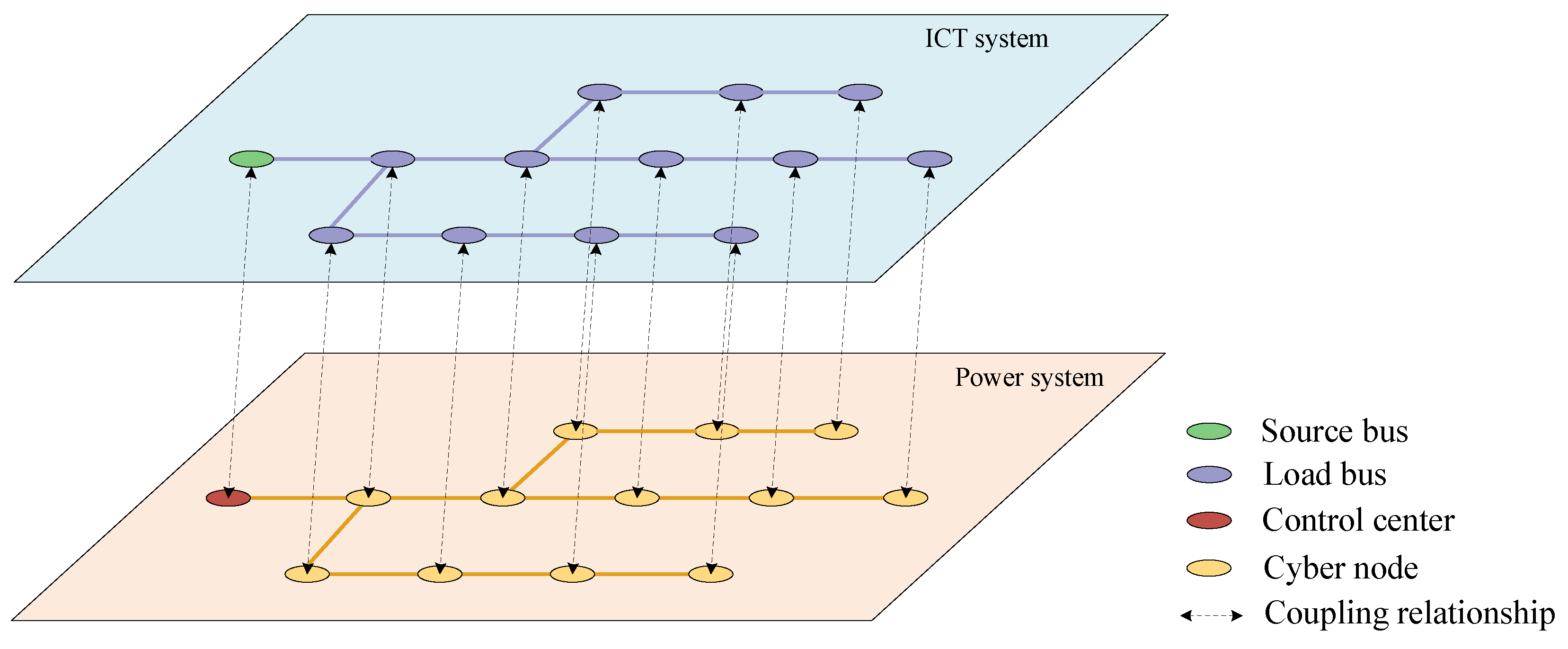
The distribution CPS is a typical multidimensional complex system integrating physical infrastructure with communication networks [22]. To facilitate analysis, the physical components and topological structures of both the power and communication layers are simplified and modeled as graphs. Specifically, the power network is represented as an undirected graph G p = ( V p , E p ) , where V p and E p denote the sets of nodes and power lines, respectively. The corresponding adjacency matrix is defined as A p = [ a i j p ] n × n , where n is the number of nodes. If nodes i and j are connected, then a i j p = 1 ; otherwise, a i j p = 0 . Similarly, the communication network is modeled as an undirected graph G c = ( V c , E c ) , where V c and E c represent the sets of communication nodes and links, respectively. Its adjacency matrix is given by A c = [ a i j ] n × n , where n denotes the number of communication nodes. If nodes i and j are connected, then a i j = 1 ; otherwise, a i j = 0 . The coupling relationships between the two layers are illustrated in Figure 1.
For research simplification, this paper assumes a direct coupling relationship between communication nodes and power nodes, where each communication node is powered by its corresponding power node following a one-to-one dependency [23]. Furthermore, each critical communication node is equipped with a temporary low-power backup module, whose capacity is only sufficient to report fault status immediately after failure occurrence.

2.1. Power Supply Model

Based on the above analysis, this section analyzes the operating states of communication nodes and their dependence on the control and monitoring functions of power systems from the perspective of the connection relationship between communication nodes and power nodes. The normal operation of a communication node relies on the power supply provided by its corresponding power node. Specifically, a communication node can be activated only when the restored power capacity of the associated power node meets its energy demand [24]. The corresponding constraints are formulated as follows:
v i t Y i t + δ m , i t , i N C
v j t v i t , i ζ ( i ) v 0 t = 1
where v i t denotes the operating state of communication node i at time period t; Y i t is a binary variable indicating whether power node i is restored at time t; δ m , i t is a binary variable indicating whether communication node i is served by UAV m at time t; ζ ( i ) represents the set of upstream communication nodes of communication node i ; and v 0 t indicates the operating state of the control center at time period t.
Equation (1) ensures that each communication node can function when it is either connected to a power node or covered by a UAV. Equation (2) ensures that all communication nodes remain connected to the control center or their upstream nodes, while guaranteeing that the control center always operates in a normal state.

2.2. Information Control Model

This section focuses on the monitoring and control of power equipment such as electrical loads and distributed generators by communication nodes. The failure of a communication node will render its corresponding power node unobservable and uncontrollable. The corresponding constraints are presented as follows:
0 P load , i t v i t P load , i max 0 P DG , i t v i t P DG , i max i N , i N C
where P load , i t is the restored active power of node at time t; P l o a d , i max denotes the rated active power load at node i; P DG , i t are the active output power of distributed generators at node i; P DG , i max denote the maximum active power limits of distributed generators; and N denotes the set of all nodes in the distribution network.
Equation (3) restricts the active power of loads and distributed generators at the power nodes to operate within the allowable ranges only when the corresponding communication nodes are available.

3. Bi-Level Recovery Model of Distribution Cyber–Physical Systems

To realize the rapid emergency response of a distribution CPS after disasters, this paper constructs a post-disaster load scheduling model consisting of two layers: a cyber layer and a physical layer. At the cyber layer, an emergency deployment model for UAVs is established to rapidly restore critical communication links when communication node failures occur. At the physical layer, a fault recovery optimization model for the distribution network is formulated to reconfigure power supply paths on the premise of available communication coverage. Through collaborative modeling and joint optimization of the cyber layer and the physical layer, dynamic construction of power supply paths for distribution networks is realized under bi-level constraints of communication and power systems. This method effectively improves the resilience and fault restoration efficiency of distribution CPS. The above recovery process is implemented in a step-by-step manner, including communication restoration, power network reconfiguration, and iterative coordination between the cyber and physical layers.

3.1. UAV Emergency Deployment Model

In a distribution CPS, failures in the cyber layer directly degrade the remote control and state monitoring of switching devices in the physical layer. Therefore, the recovery of the cyber layer is essential for maintaining the stable operation of distribution networks [25]. To address cyber layer faults in distribution CPSs, existing studies mainly adopt communication maintenance, routing management and emergency communication strategies for fault recovery. Compared with conventional approaches, UAVs equipped with wireless emergency communication modules feature flexible deployment and high mobility. They can rapidly construct temporary communication networks to provide emergency communication coverage for damaged areas, thereby satisfying the requirements for fast fault restoration in distribution networks.
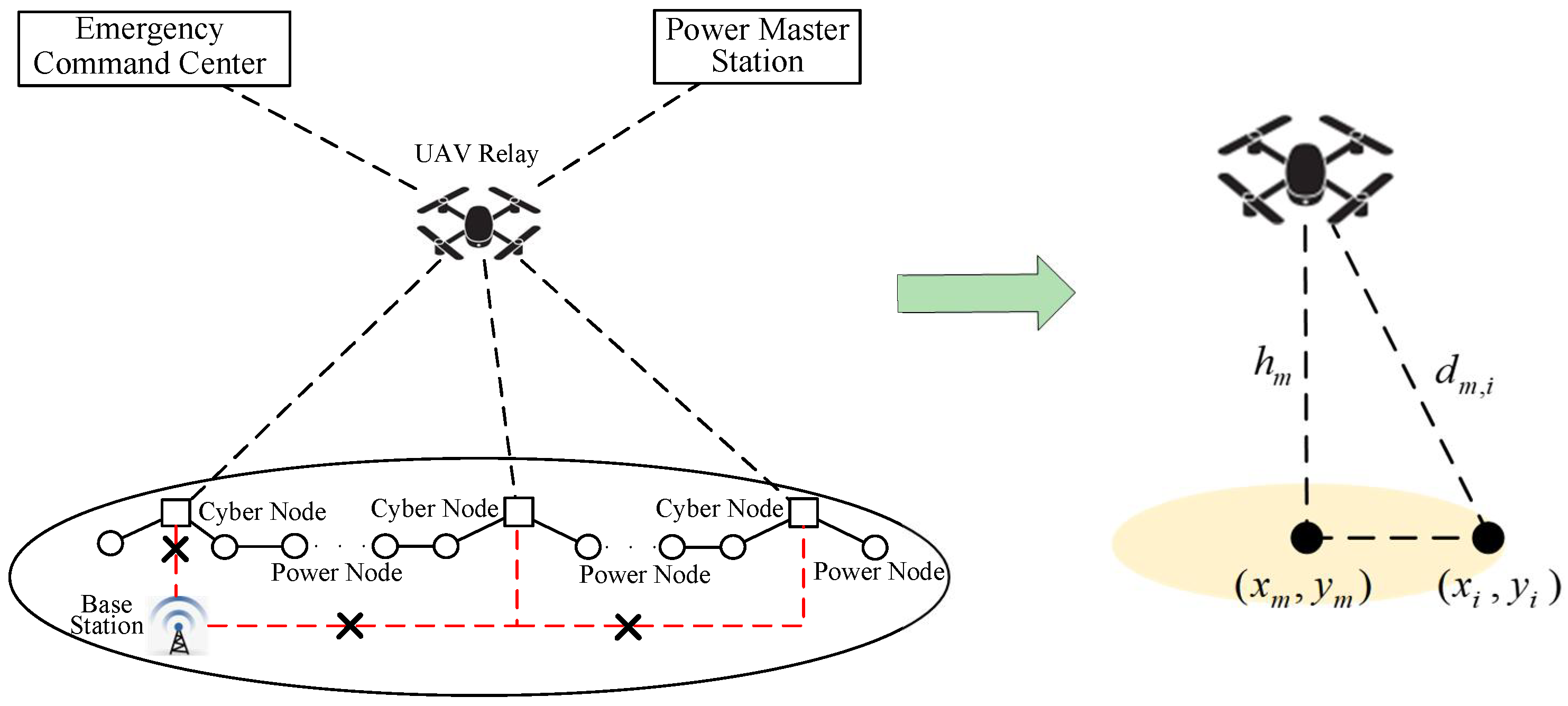
In UAV emergency communication modeling, the influence of flight altitude on communication coverage must be considered. In general, the channel gain received by communication nodes gradually decreases as the UAV flight altitude increases [26]. Moreover, given a fixed flight altitude, the effective communication coverage radius of each UAV can be determined. In addition, communication delays and packet loss may have certain impacts on the coordinated recovery process of the distribution CPS. For example, communication delays may result in lagged state information updates and delayed transmission of control commands, while packet loss may lead to incomplete local node information, thereby affecting the timeliness and accuracy of fault isolation, network reconfiguration, and load restoration decisions. Considering that this paper mainly focuses on the supporting role of UAV-assisted communication recovery in enhancing distribution network service restoration capability, and that post-disaster recovery is generally a minute-level scheduling process rather than a millisecond-level real-time control process, the influence of moderate communication delays on the overall recovery strategy is relatively limited. Therefore, this paper mainly emphasizes communication coverage capability and communication connectivity constraints, while assuming that the emergency communication links established by UAVs can satisfy the basic information interaction requirements during the recovery process. The corresponding coverage relationship is illustrated in Figure 2. In the figure, x and y represent the two-dimensional geographic coordinates respectively. h m is the flight altitude of the UAV, and d m , i is the distance between them.
Based on the coupling relationship between power systems and communication networks, this paper analyzes the dependency mechanism between physical nodes and communication nodes in distribution networks. When communication links are interrupted or communication nodes fail, the corresponding power nodes become unobservable and uncontrollable, and remote regulation cannot be implemented. For recoverable communication nodes, communication functions can be restored after UAV coverage is completed, thereby re-establishing control over relevant power equipment. Nevertheless, during distribution network restoration, partial power outages may still persist due to the capacity limitations and operational constraints of distributed generators. Accordingly, this paper proposes a dynamic UAV deployment strategy. By sequentially covering critical failed communication nodes, communication interaction links can be recovered to guarantee the continuity and effectiveness of the distribution network restoration process [14].
In distribution automation systems, remote monitoring and control of line switches rely on the communication functions of field terminal devices. Specifically, feeder terminal units (FTUs) undertake line monitoring and remote control tasks. When the failed communication nodes corresponding to FTUs within fault areas are effectively covered, communication capability is regarded as recovered, providing support for the restoration and reconfiguration of power networks.

3.1.1. Objective Function

To achieve efficient emergency response under limited communication resources, an optimization model for the cyber layer is established with the objective of minimizing the number of deployed UAVs. This objective minimizes resource consumption and improves the overall system recovery efficiency while satisfying the coverage requirements of critical communication nodes. The detailed formulation is presented as follows:
f 1 = min t m Ψ δ m t
where t [ 1 , T ] ; Ψ denotes the set of UAVs involved in emergency deployment; and δ m t is a binary variable representing the deployment state of UAV m at time period t.

3.1.2. UAV Deployment Constraints

Under extreme disaster conditions, communication nodes may fail due to power outages or link damage, rendering relevant power nodes unobservable and uncontrollable. To restore cyber layer functions, UAVs are introduced to construct temporary aerial communication links and provide emergency coverage for faulty communication nodes. Considering the limitations on UAV quantity, communication capability and deployment space, constraints regarding deployment scale, service relationships, transmit power and spatial ranges are formulated to ensure engineering feasibility and physical rationality.
(1) UAV quantity constraints: The number of available UAVs for post-disaster emergency scheduling is limited. Meanwhile, each UAV has an upper limit on the number of communication nodes it can access simultaneously. Without appropriate restrictions, the model may generate impractical deployment schemes exceeding actual resource capacity. Therefore, the following constraints on UAV quantity and service states are established:
m Ψ δ m t W
i N e δ m , i t W , m Ψ
m Ψ δ m , i t = 1 , i N e
where t [ 1 , T ] ; W represents the total number of UAVs available for post-disaster emergency deployment; W is the maximum number of communication nodes that a single UAV can serve; and N e denotes the set of faulty communication nodes in the distribution network.
Equation (5) limits the total number of deployed UAVs to the available resource W. Equation (6) restricts the maximum number of communication nodes served by each UAV according to its communication access capacity. Equation (7) ensures that each faulty communication node is covered by exactly one UAV at each time period.
(2) UAV power constraints: UAVs provide signal coverage for multiple faulty communication nodes via wireless transmitting modules, and the total power consumption depends on the power allocation for each served node. Restricted by onboard energy storage and the rated output of communication modules, each UAV is subject to a maximum transmit power threshold. Exceeding this threshold will degrade communication quality or cause link failure. The corresponding constraints are formulated as follows:
i N m ( t ) P i P m max , m Ψ
where P i denotes the required transmit power of communication node i ; P m max is the maximum transmit power allowable from a UAV m; and N m ( t ) represents the set of faulty communication nodes served by UAV m at time t.
Equation (8) guarantees that the total transmit power of each UAV at any time does not exceed its rated limit, maintaining stable communication quality and avoiding link interruption.
(3) Spatial deployment constraints of UAV: In practical engineering applications, UAVs’ flight and hovering positions must comply with airspace management regulations and geographical boundaries. Hence, spatial range constraints are imposed on UAV deployment:
x min x m x max y min y m y max z min z m z max
where ( x m , y m , z m ) denotes the three-dimensional coordinate of UAV m and ( x max , y max , z max ) and ( x min , y min , z min ) represent the upper and lower bounds of the allowable deployment space, respectively.
Equation (9) confines the positions of the UAV within the permitted airspace to ensure the practicality of the deployment schemes.

3.1.3. Path Loss Model

To accurately calculate the communication power requirement for each faulty communication node, signal attenuation is evaluated using a path loss model. Traditional free-space path loss models and logarithmic distance models cannot precisely characterize complex air–ground channel features. Therefore, the air-to-ground (ATG) channel model is adopted to estimate the average path loss of wireless links. This model effectively reflects signal attenuation characteristics in air-ground propagation environments and calculates the transmit power required to satisfy data rate demands [14]. Consequently, the node power in Equation (8) is calculated as follows:
i N m ( t ) P i = i N m ( t ) 2 R b · | N m ( t ) | B 1 × P L , i
P L , i ( dB ) = P LOS , i · L LOS , i + P NLOS , i · L NLOS , i
L LOS , i = 20 log 4 π f c d m , i c + η LOS , i
L NLOS , i = 20 log 4 π f c d m , i c + η NLOS , i
P LOS , i = 1 1 + a · exp b 180 π θ a
P NLOS , i = 1 P LOS , i
where R b is the minimum data transmission rate of communication nodes; B denotes the channel bandwidth for UAV emergency communication; P L , i represents the path loss of communication node i ; P LOS , i and P NLOS , i are the occurrence probabilities of LOS and NLOS links, respectively; L LOS , i and L NLOS , i denote the path losses of LOS and NLOS links; η LOS , i and η NLOS , i are the additional environmental losses for LOS and NLOS propagation; c is the speed of light; f c represents the carrier frequency; d m , i is the distance between UAV m and communication node i ; θ denotes the elevation angle between UAV m and communication node i ; and a and b are environmental correlation coefficients.

3.2. Cyber–Physical Cooperative Recovery Model

Based on the above UAV deployment model, a lower-layer post-disaster cooperative restoration model for distribution networks is further constructed within the CPS framework [27]. With the objective of maximizing weighted load restoration and considering node importance coefficients, the model realizes rapid recovery through orderly reconfiguration of the physical network.

3.2.1. Objective Function

To improve system restoration efficiency, the fault restoration problem of the distribution CPS is formulated as a post-disaster load optimization problem aiming to maximize restored power. Weight coefficients reflecting node importance are introduced to distinguish critical levels among different load nodes, forming the optimization objective of maximizing total weighted restored load:
f 2 = max t i N ω i t Y i t P load , i t , i N
where t [ 1 , T ] and ω i t represents the weight coefficient reflecting the importance level of load node i at time t.

3.2.2. Fault Restoration Constraints for Distribution Networks

(1) Branch state constraints: To maintain a reliable network topology after disasters, binary variables are defined to represent the operating states of distribution branches. Corresponding constraints ensure that power flow can only circulate within closed and available branches, conforming to practical operational principles and avoiding unreasonable power flow through disconnected branches:
Y i j t X i j t , ( i , j ) E
where t [ 1 , T ] ; E represents the set of all branches; Y i j t is a binary variable denoting the operational state of branch ( i , j ) at time t; and X i j t indicates the physical availability of branch ( i , j ) at time t.
Equation (17) ensures that power flow only exists within available and closed branches to maintain a reasonable post-disaster topology.
(2) Branch power flow constraints: To enhance model tractability and reduce computational complexity, the following power flow constraints are simplified by neglecting high-order loss terms while preserving key physical characteristics. Meanwhile, the big-M method is adopted to reformulate the power flow constraints as follows:
( j , i ) E P j i t ( i , j ) E P i j t + P DG , i t = Y i t · P load , i t ( j , i ) E Q j i t ( i , j ) E Q i j t + Q DG , i t = Y i t · Q load , i t i N
U i t U j t 2 ( r i j P i j t + x i j Q i j t ) M ( 1 Y i j t ) U i t U j t 2 ( r i j P i j t + x i j Q i j t ) + M ( 1 Y i j t ) ( i , j ) E
0 P DG , i t P DG , i max 0 Q DG , i t Q DG , i max i N
( P i j t ) 2 + ( Q i j t ) 2 Y i j t · ( S i j max ) 2 , ( i , j ) E
U i , min U i t U i , max , i N
where t [ 1 , T ] ; Q load , i t denotes the reactive load power of node i at time t; P i j t and Q i j t represent the active and reactive power flow on branch ( i , j ) at time t; Q DG , i t is the reactive output power of distributed generators at node i; Q DG , i max denotes the maximum reactive power limits of distributed generators; S i j max represents the maximum apparent power capacity of branch ( i , j ) ; U i t is the squared voltage magnitude at node i during period t; and U i , min and U i , max are the lower and upper bounds of squared node voltage magnitude.
Equation (18) enforces active and reactive power balance at each node. Equation (19) describes the relationship between branch power flow and node voltage drop. Equation (20) restricts the DG output within rated limits. Equation (21) ensures that the power flow of restored branches does not exceed capacity constraints. Equation (22) maintains node voltage within the allowable operational range.
(3) Topology constraints: In practical operation, the distribution network must maintain a radial topology to ensure the selectivity of relay protection and the safety and reliability of system operation. Therefore, in the modeling and analysis of distribution networks, it is necessary to mathematically represent this radial topology, and the corresponding constraints can be expressed as follows [28]:
Z i j t + Z j i t = Y i j t , ( i , j ) E
( j , i ) E Z j i t = Y i t 1 , i N
where Z i j t and Z j i t are directional power flow variables on branches at time t. Equation (23) ensures the consistency of power flow direction along each line, while Equation (24) restricts each node to have at most one upstream branch, thereby guaranteeing a radial topology for the distribution network.
(4) Coupling constraints: As analyzed in Section 2, the coupling between the cyber layer and the physical layer significantly affects the fault restoration performance. After a short period of weak power support, the system enters the cyber–physical interactive stage. In this stage, the physical layer provides continuous power supply to communication devices, ensuring the operation of the information system, while the cyber layer, relying on real-time monitoring and communication networks, transmits control commands and optimized operational strategies to regulate the operation of the power system. Through this bidirectional interaction, the cyber and physical layers achieve coordinated operation. The coupling relationship is transformed into mathematical constraints formulated in Equations (1)∼(3).
(5) Other constraints: In practical UAV-assisted communication recovery scenarios, UAV operations are subject to multiple practical constraints, including limited battery energy, weather-induced performance degradation, and communication latency. These factors jointly affect the feasible service duration, coverage capability, and operational reliability of UAV-based communication support. In this study, instead of explicitly introducing a high-dimensional stochastic model, these practical factors are incorporated in a simplified yet tractable manner. Specifically, UAV energy limitation is reflected through service time and deployment feasibility constraints, ensuring that each UAV can only support a limited operational horizon. Weather and environmental effects are indirectly captured by the communication coverage radius constraint, which bounds the effective service range under non-ideal propagation conditions.
This modeling formulation preserves the essential operational characteristics of UAV-assisted communication while avoiding excessive computational complexity in the joint optimization of cyber–physical recovery.

4. Bi-Level Recovery Process for Distribution CPS

4.1. Bi-Level Recovery Process

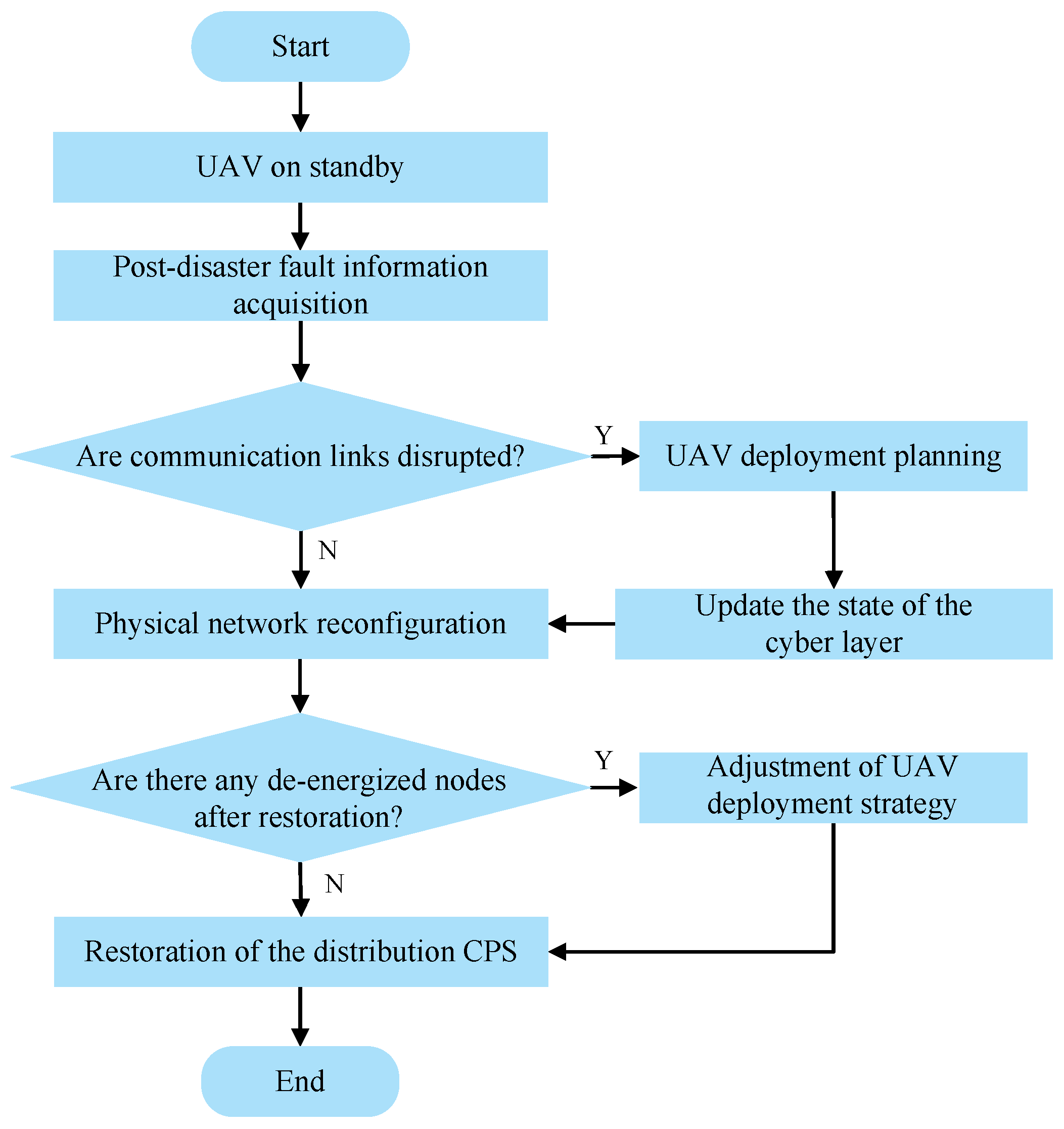
To enhance the rapid response capability of the distribution CPS under extreme disaster scenarios, this chapter proposes an effective load scheduling method for distribution CPS based on UAV emergency communication. The post-disaster restoration process is formulated as a bi-level collaborative optimization model, where the upper level corresponds to communication restoration and the lower level refers to power network reconfiguration. A closed-loop optimization framework is established through continuous information interaction, thereby enabling coordinated and efficient decision-making between communication recovery and network reconfiguration. To improve clarity, the proposed methodology is organized into three stages as follows. The overall solution flowchart is illustrated in Figure 3.
Stage 1: First, at the upper communication restoration stage, parameter initialization and communication fault identification are carried out based on post-disaster monitoring data [29]. When communication link damage is detected, a communication coverage optimization model is constructed to minimize the number of deployed UAVs. The optimal UAV deployment scheme is then determined and dynamically adjusted according to time-varying communication requirements during the restoration process, so as to provide reliable and essential communication support for power network restoration at the physical layer.
Stage 2: On this basis, a network reconfiguration model is established at the lower layer with the objective of maximizing the weighted load restoration. Subject to the communication conditions provided by the upper layer, this model achieves fault isolation, load transfer, and distributed generation output optimization through network reconfiguration [30]. If insufficient communication support is encountered during the reconfiguration process, the relevant information is fed back to the upper layer to update the UAV deployment strategy in a timely manner. Through iterative interaction and information exchange between the two layers, collaborative optimization is ultimately achieved.
During the fault co-restoration process, the upper-level model optimizes UAV deployment based on the damage status of the communication network. An improved Binary Particle Swarm Optimization (BPSO) algorithm is employed to obtain the UAV deployment scheme [8]. Considering the binary nature of decision variables in UAV deployment and distribution network reconfiguration, the improved BPSO algorithm is adopted in this study. Compared with other metaheuristic methods such as Genetic Algorithm, Simulated Annealing, and Ant Colony Optimization, Improved BPSO is more suitable for the considered combinational optimization problem due to its simple structure, fewer control parameters, and efficient search capability in large-scale discrete spaces. Therefore, BPSO is selected as the optimization method for the proposed model. The communication accessibility constraints are then updated according to the UAV deployment results, and subsequently used to guide the distribution network reconfiguration. The lower-level distribution network reconfiguration model is formulated as an MISOCP problem, which can be efficiently solved using commercial solvers, thereby ensuring that loads with higher importance are restored with priority.

4.2. Complexity Analysis of the Bi-Level Optimization Model

The computational complexity of the proposed improved BPSO algorithm mainly depends on particle fitness evaluation and particle position updating during the iterative optimization process. In each iteration, the fitness value of every particle is calculated based on the corresponding network recovery scheme. Assuming that the population size is N p and the problem dimension is D, the fitness evaluation process requires approximately O ( N p D ) computations. In addition, the velocity and position of each particle are updated according to the particle swarm optimization rules, which also involves O ( N p D ) operations. Therefore, for a maximum iteration number of N i t , the overall computational complexity of the proposed improved BPSO algorithm can be expressed as O ( N i t · N p D ) . Since the proposed strategy adopts an improved binary encoding mechanism and heuristic initialization method, the convergence speed is enhanced and the number of required iterations can be effectively reduced in practical applications.
The lower-level distribution network recovery is modeled as an MISOCP problem. Its complexity is determined by binary variables, second-order cone constraints and network scale. As an NP-hard problem with discrete variables, it is solved via branch-and-bound and interior-point methods in commercial solvers. Transforming nonlinear power flow constraints into convex second-order cones effectively improves the solvability and efficiency for medium-scale distribution networks.

5. Case Study

To verify the effectiveness of the proposed load scheduling method for a distribution CPS based on UAV emergency communication, simulation tests are conducted on an improved IEEE 33-node distribution network test system. The simulation environment is configured as follows: the CPU is an Intel Core i7; the proposed algorithm is implemented in MATLAB 2019b using the YALMIP (version 20230622) toolbox; and the Gurobi 12.0.0 solver is adopted for optimization.

5.1. Case Parameters

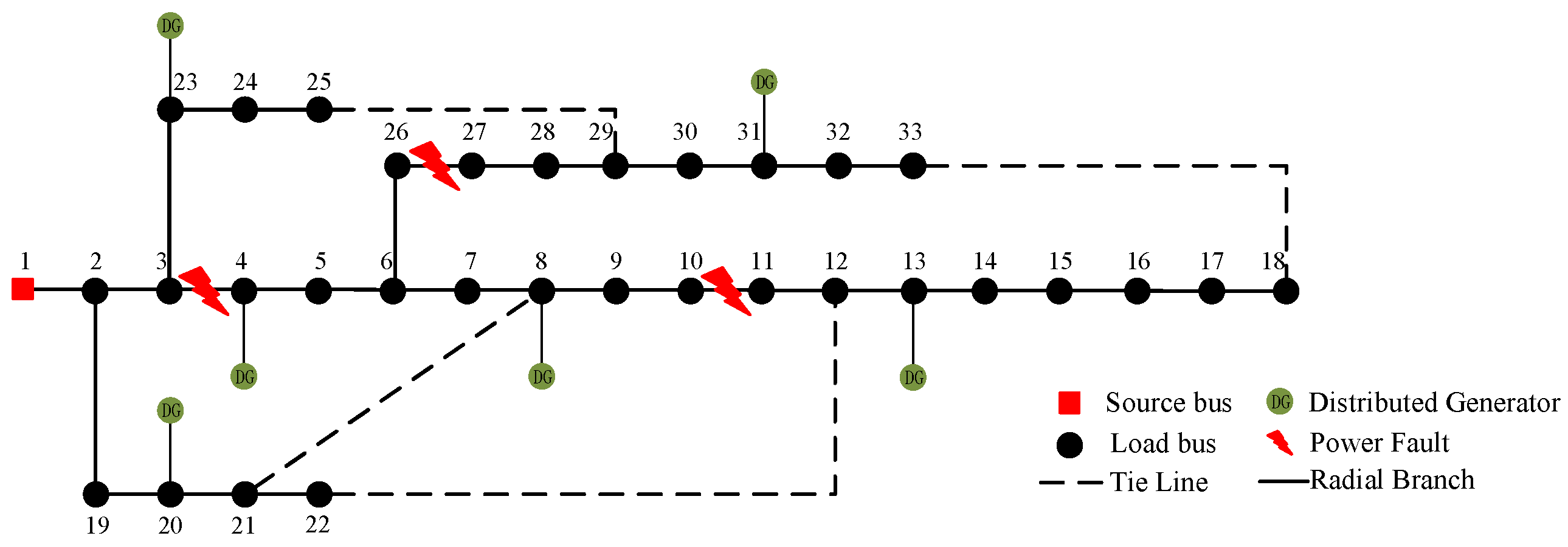
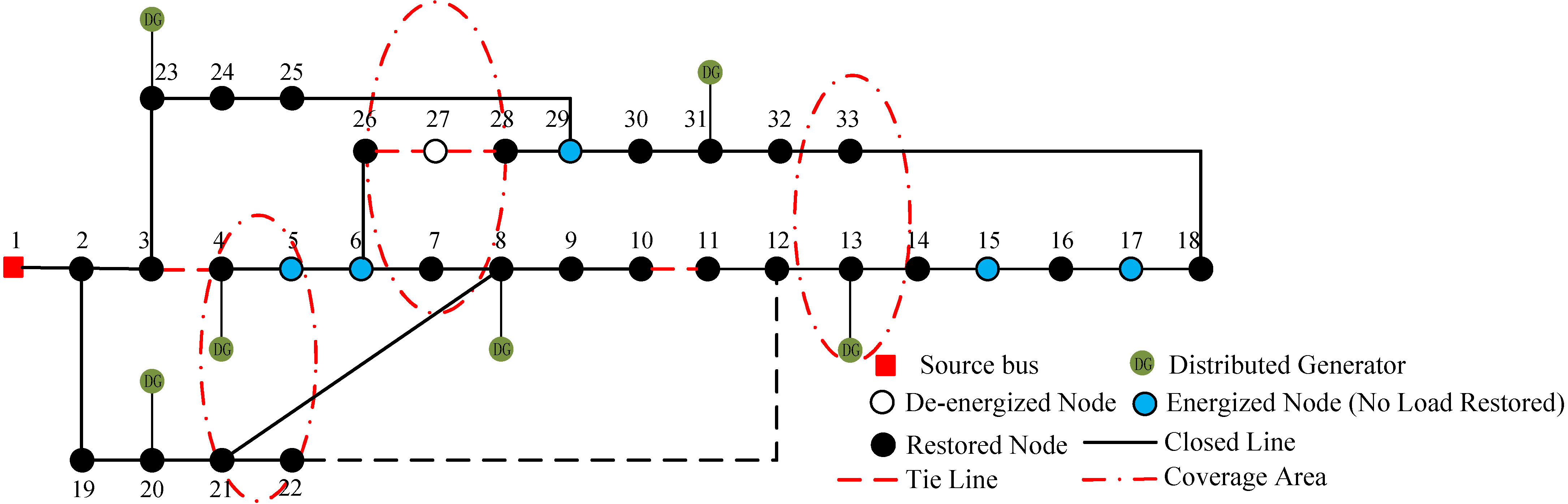
Based on the IEEE 33-node distribution system, distributed generators including photovoltaic units and wind turbine units are integrated to construct an improved network topology. Meanwhile, power lines 8–21, 9–15, 12–22, 18–33 and 25–29 are set as tie lines. The detailed structure is illustrated in Figure 4 [31].
To reflect the difference in importance among various loads, the concept of the importance weight of the node is introduced in the model. All nodes are classified into three load levels: primary load, secondary load and tertiary load, with corresponding weights set to 10, 2 and 1, respectively. These weights are incorporated into the objective function to explicitly represent load prioritization. Considering both network connectivity and the priority restoration of critical loads, which is guided by the objective function design rather than the mathematical formulation itself, the proposed model allows partial low-priority nodes to be connected to the power network without immediate load recovery, thereby reserving feasible power supply paths for high-priority loads. The load levels, weights, and corresponding nodes are summarized in Table 1.
According to the practical requirements of post-disaster restoration, multiple types of DGs are configured in the test case. Photovoltaic units are connected at node 20, wind turbine units are installed at node 23, and micro gas turbine units are integrated at nodes 4, 8, 13 and 32. Different DGs possess distinct output characteristics and can provide local power support during post-disaster recovery. The installation locations and rated capacities of all DGs are presented in Table 2 [32].
In practical power systems, renewable energy generation and electricity demand exhibit significant stochastic fluctuations. Such uncertainties can alter power flow distributions and supply capabilities of the distribution network, thereby affecting load restoration schemes and UAV deployment strategies. To ensure the consistency of case analysis and the comparability of simulation results, the load parameters of the IEEE 33-node system are uniformly set, and all loads are assumed to remain stable without temporal variation during the restoration process. Under this assumption, the influence of load fluctuations is neglected to better evaluate the effectiveness of the proposed method. The detailed load data of each node are listed in Table 3.
Finally, to simulate the simultaneous damage of power and communication networks under extreme disaster scenarios, all DG nodes are modeled as PV nodes in this case. Power lines 3–4, 10–11, 26–27 and communication links 13–14, 20–21, 32–33 are set to fault states.

5.2. Simulation Result Analysis

(1) UAV deployment and system restoration
The proposed UAV-based emergency communication scheduling method is adopted to optimize post-disaster restoration, realizing orderly recovery of faulty communication nodes and efficient reconfiguration of power supply paths. The detailed restoration scheme, including UAV deployment positions, communication coverage ranges and network reconfiguration paths, is presented in Figure 5, which provides fundamental data for subsequent performance evaluation and method verification.
As shown in Figure 5, UAVs are deployed at key positions according to the proposed deployment model, which effectively guarantees the connectivity of the communication network. Supported by the recovered communication system, the power network completes load restoration through topology reconfiguration.
(2) The node voltage distribution analies
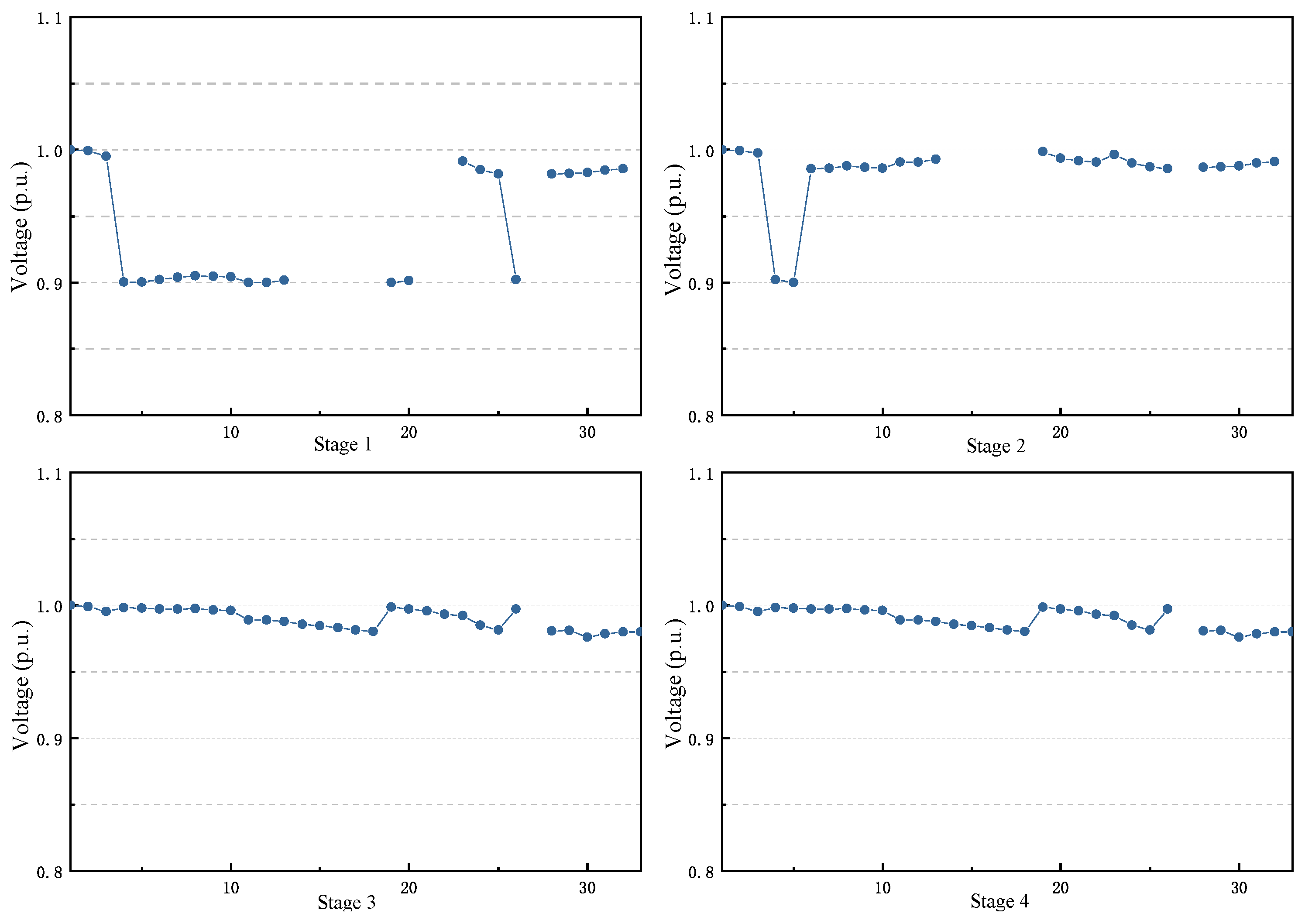
Furthermore, to evaluate the voltage stability of the proposed method, the node voltage distribution is analyzed at different restoration stages. Figure 6 illustrates the voltage profile per-unit after restoration using the proposed strategy.
It can be observed that after communication recovery and network reconfiguration, the node voltages at all stages remain within the allowable range, ensuring satisfactory voltage stability and operational security. Furthermore, the voltage deviation of critical nodes is gradually reduced during the restoration process, indicating that the proposed coordinated recovery strategy effectively improves the voltage regulation capability of the distribution system. Compared with the fault condition, the post-restoration voltage profiles show smaller fluctuations and better voltage stability, demonstrating that the recovered network topology can support load restoration while maintaining stable system operation.
(3) Load recovery performance for nodes with different importance levels
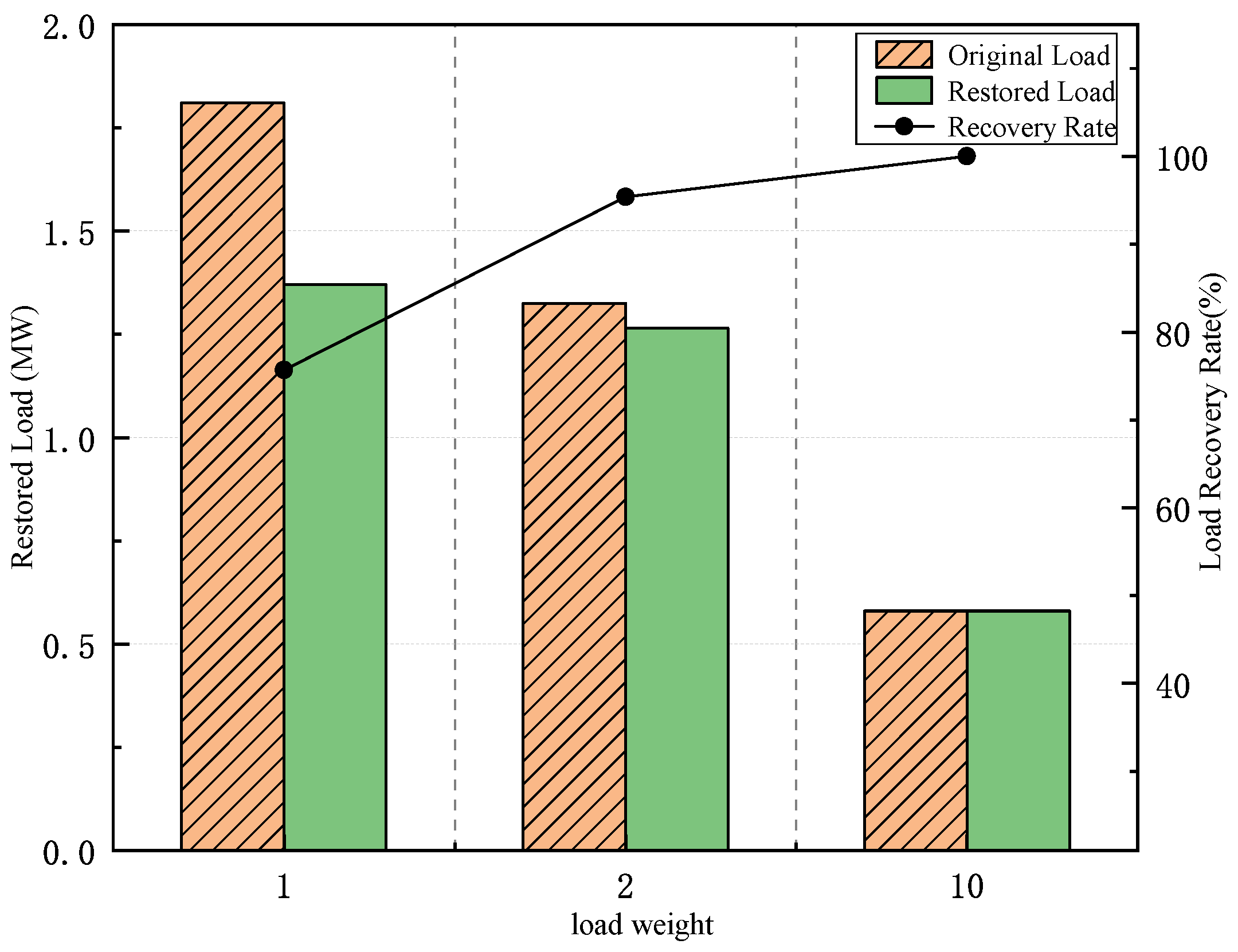
In addition, to compare the restoration performance for loads with different importance levels, statistical analysis is conducted on load recovery results. Figure 7 demonstrates the original load magnitude, restored load capacity and recovery ratio for nodes with different importance weights in the final restoration stage, which verifies the effectiveness of the load priority strategy.
It is obvious from Figure 7 that the proposed method prioritizes the power supply of primary and secondary critical nodes during restoration, which fully validates the advantages of priority scheduling. Specifically, the recovery ratio of primary loads reaches 100%, which is significantly higher than that of secondary and tertiary loads. The results indicate that the proposed method can guarantee reliable power supply for critical loads, realize hierarchical restoration of distribution networks, and effectively enhance the resilience of distribution CPS after disasters.
(4) Performance Comparison under Different Fault Scenarios and System Scales
To further validate the effectiveness and scalability of the proposed method, comparative simulations are conducted under different system scales and fault scenarios. Three representative fault scenarios are considered to reflect different levels of system damage, and two distribution network test systems with different sizes are used to evaluate the scalability of the proposed approach. Different metaheuristic algorithms are compared in terms of restored load, computational efficiency, and convergence performance.
As shown in Table 4, the proposed method achieves satisfactory load restoration across various faults and system scales. Its performance declines slightly as faults become more severe, yet the overall restoration rate stays stable. Moreover, the IEEE 69-bus system outperforms the 33-bus system, since its richer topology offers more options for network reconfiguration and power supply rerouting.
(5) Robustness Evaluation across Different Operating Conditions
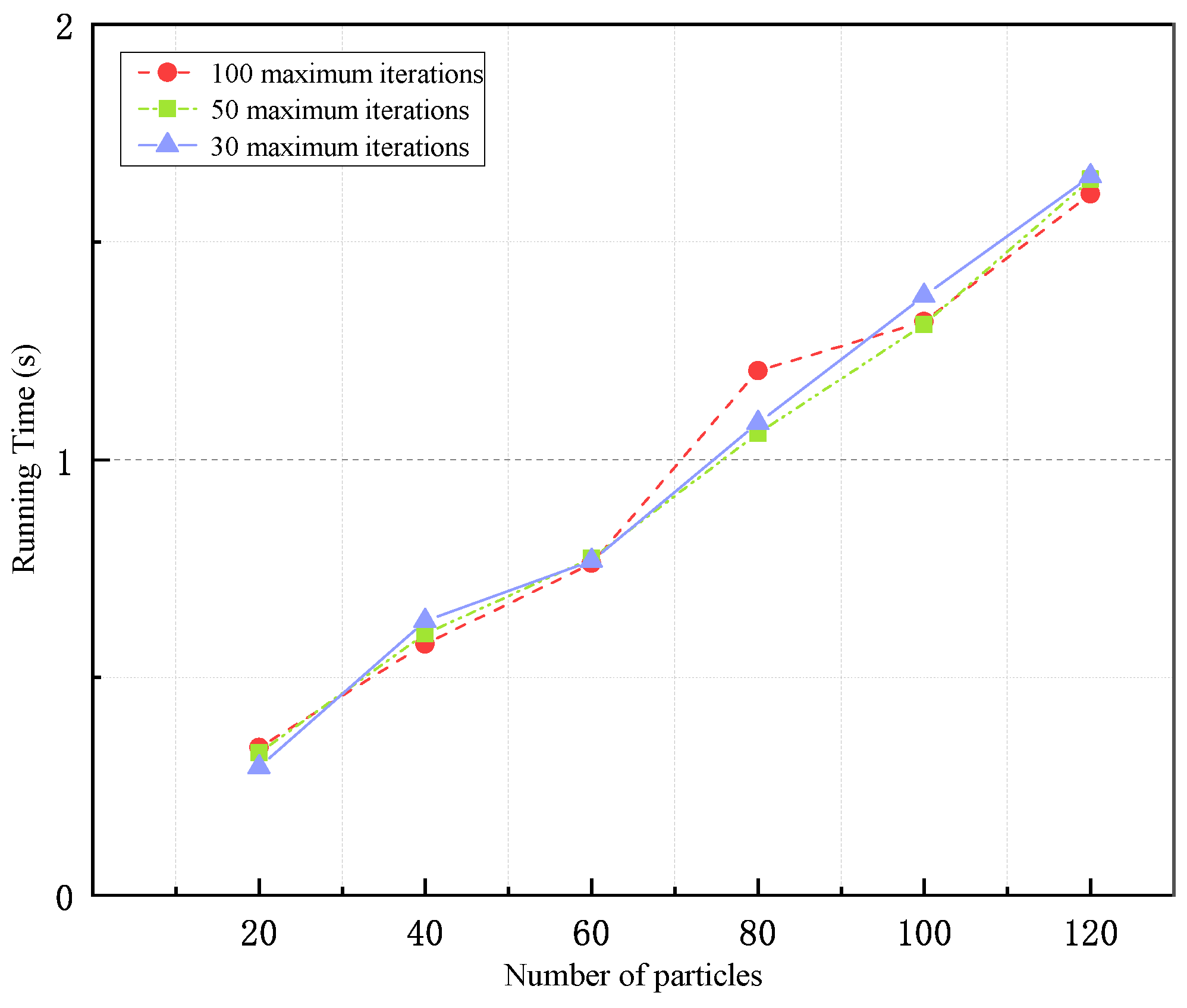
To further investigate the robustness of the proposed method, a sensitivity analysis is conducted based on the improved BPSO algorithm. Specifically, key parameters including population size, inertia weight, and load priority weighting factors are varied within a reasonable range to evaluate their impact on the final restoration performance. The main parameter settings of the improved BPSO algorithm are given as follows: the population size is set to 100, the maximum iteration number is 50, the inertia weight varies from 0.4 to 0.9, and both learning factors are set to 1.5. The results are illustrated in Figure 8.
As shown in Figure 8, the proposed method maintains stable performance in terms of restored load under different parameter settings. Although slight variations can be observed when adjusting population size and inertia weight, the overall trend remains consistent. This indicates that the improved BPSO-based recovery model is not highly sensitive to parameter tuning and exhibits good robustness and practical applicability in CPS coordinated recovery problems.

5.3. Comparison with Different Recovery Algorithms

To further verify the effectiveness of the selected algorithm, a comparative analysis between improved BPSO and other representative metaheuristic algorithms is conducted under the same fault scenario.
As shown in Table 5, all compared algorithms achieve the same final load restoration ratio because the communication fault scale in the studied scenario is relatively small and can be fully covered by all optimization methods. However, the proposed improved BPSO algorithm converges with significantly fewer iterations and lower computation time compared with GA, GWO, and the DRL-based method [33]. This demonstrates that the proposed method provides better optimization efficiency and convergence performance for UAV-assisted CPS recovery problems.

5.4. Comparative Analysis

To further verify the superiority and effectiveness of the proposed UAV emergency communication-based load restoration method, three typical restoration strategies are selected for comprehensive comparison and numerical evaluation. The detailed schemes are described as follows:
Scheme 1: Post-disaster communication restoration is neglected. Only the residual communication network is utilized for network reconfiguration to achieve load restoration as much as possible.
Scheme 2: Both power line faults and communication link failures are considered. A single static UAV deployment model is established to cover faulty communication nodes, where UAV positions and flight trajectories are determined offline according to disaster scenarios [34].
Scheme 3: Considering the power supply limitation of distributed generators, the proposed collaborative restoration strategy with dynamic two-stage UAV deployment is adopted to realize load recovery of distribution CPS.
(1) Comparison under different disaster scenarios
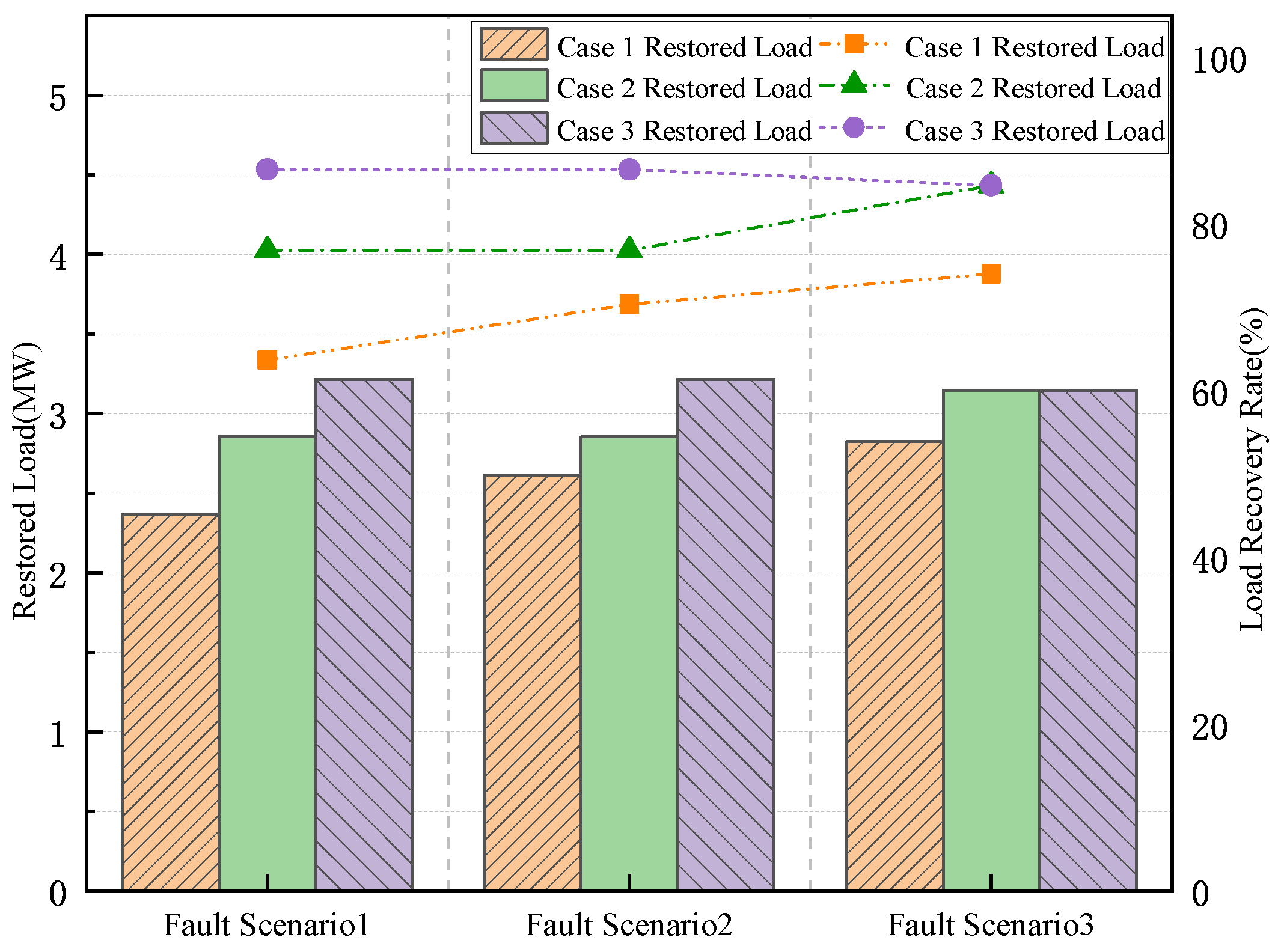
Simulation tests are carried out to compare the restoration performance of the three schemes under various fault conditions. The total restored load capacity and overall recovery ratio are evaluated with different damaged nodes and communication links. Figure 9 shows the final restoration state of each scheme, which reflects the adaptability and power guaranty capability under diverse post-disaster operating conditions.
The simulation results reveal that the proposed collaborative restoration method remarkably improves the total load recovery level. Under three typical fault scenarios, the load recovery ratios reach 86.54%, 84.66% and 86.54%, respectively, which are much higher than those of Scheme 1 and Scheme 2. Scheme 1 suffers from severe recovery limitations due to the lack of communication restoration; Scheme 2 adopts static UAV placement and presents lower restoration efficiency. By adopting dynamic UAV deployment, the proposed method realizes fast coverage of critical communication nodes and high-efficiency load restoration, which fully demonstrates its superiority in improving post-disaster recovery performance.
(2) Comparison with different quantities of communication faults
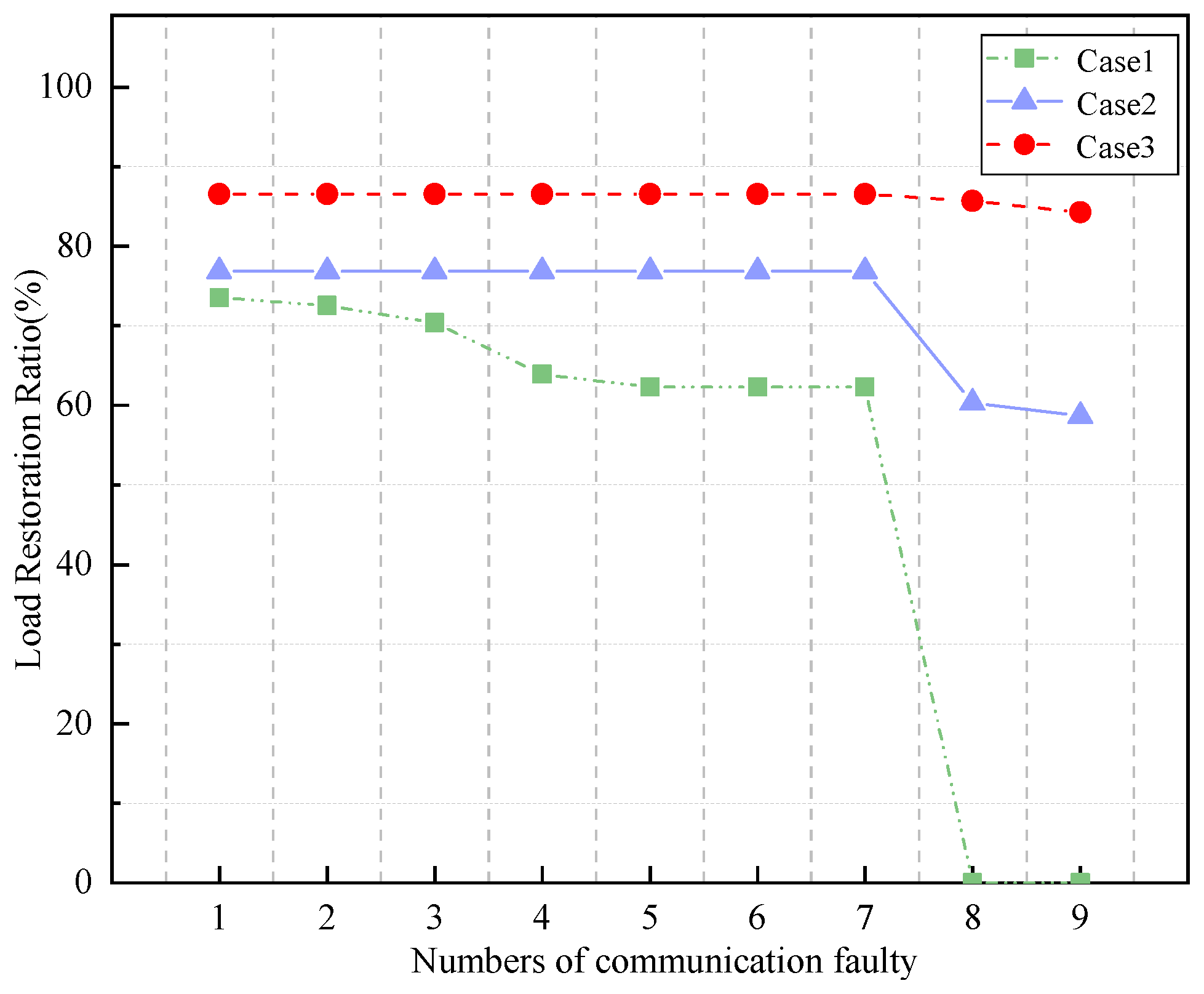
To validate the robustness of the proposed method under varying communication damage scales, multiple test cases are designed with different numbers of faulty communication links while the power line faults are kept unchanged. Different damage degrees of the communication network were constructed to evaluate the adaptability of each scheme. The corresponding results are shown in Figure 10.
The comparison results indicate that the scale of communication faults exerts distinct influences on different schemes. Scheme 1 is completely dependent on residual communication resources, and its restoration performance continuously decreases as the number of faults increases; once the fault scale exceeds a threshold, an effective network reconfiguration cannot be performed. By contrast, Scheme 2 and Scheme 3 adopt emergency UAV coverage and maintain stable performance under slight communication damage. However, their recovery ratios decrease gradually with the further expansion of faults due to the limitation of available UAV quantities. In all test cases, Scheme 3 with dynamic deployment achieves optimal restoration performance and robustness.
(3) Comparison of cumulative load loss
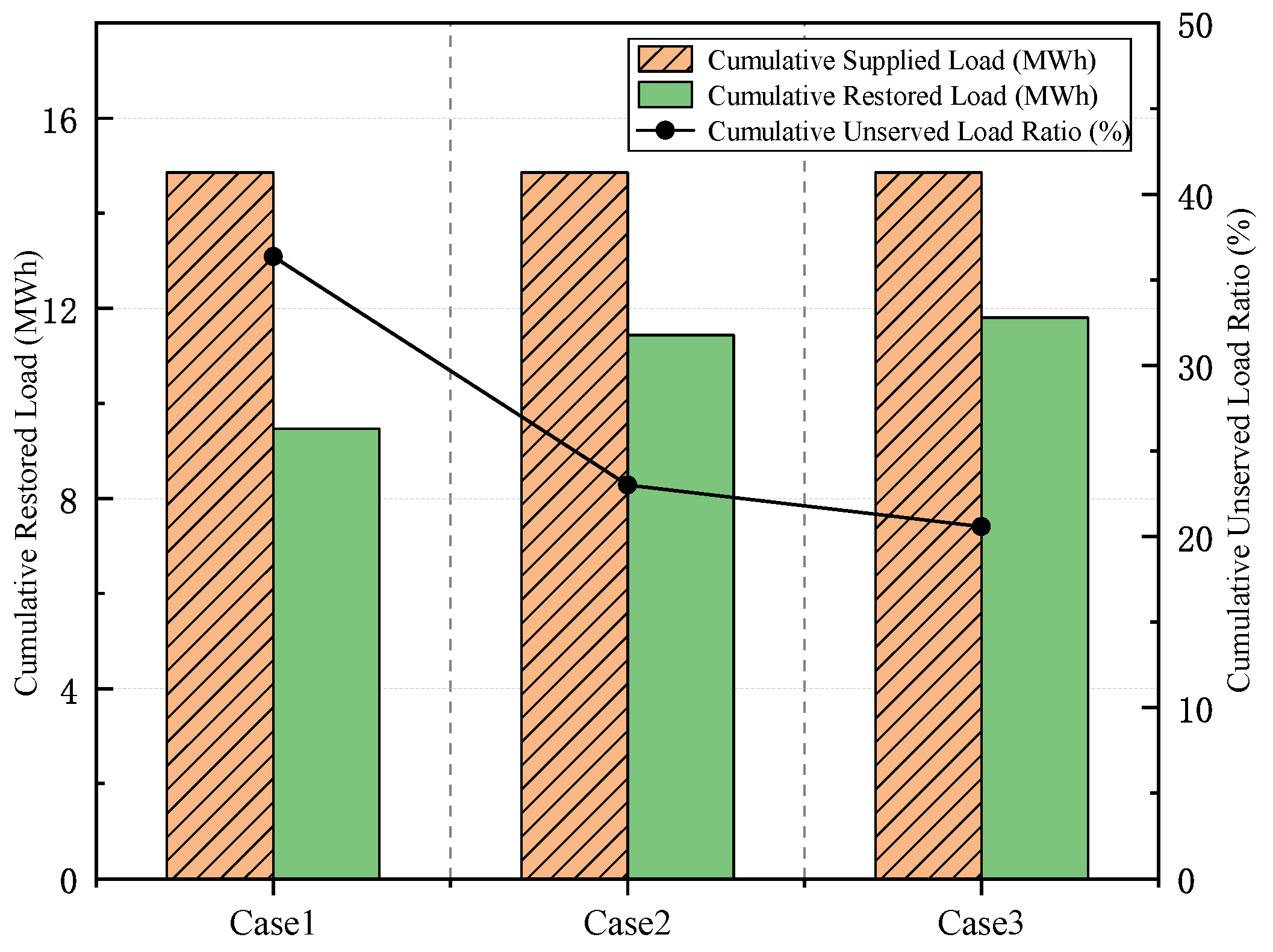
To comprehensively evaluate the overall performance during the entire restoration process, cumulative unsupplied energy of different schemes is analyzed. The cumulative load loss ratio is adopted as a key index to quantify the reliability and efficiency of the power supply; a lower ratio indicates faster and more sufficient load recovery after disasters. The comparison results of the cumulative load loss ratios are illustrated in Figure 11.
As demonstrated in the figure, the cumulative load loss ratio of the proposed method is 20.59%, which is obviously lower than the 36.34% of Scheme 1 and 23.01% of Scheme 2. Compared to static strategies, the dynamic UAV deployment adjusts communication coverage according to real-time fault distribution and delivers rapid response to critical nodes. The results confirm that the proposed collaborative restoration strategy effectively reduces power supply loss during post-disaster recovery and enhances the overall reliability of distribution CPS.

6. Conclusions

This paper addresses the problem of coordinated failures in distribution power systems and communication networks under extreme disasters and proposes a CPS-based load scheduling method with UAV-assisted deployment. By constructing a coupled cyber–physical network model and integrating a graph-theory-based power path reconfiguration mechanism, the proposed method achieves joint optimization of the cyber and physical layers. On this basis, a novel dynamic deployment and adjustment strategy for UAVs is designed: in the initial stage, the direct fault nodes of the communication structure are repaired to restore the core communication links; meanwhile, the deployment of UAVs is dynamically optimized to cover communication nodes that fail due to power supply interruptions during reconfiguration, thereby ensuring reliable transmission and execution of control commands. Simulation studies on the modified IEEE 33-bus distribution system demonstrate that the proposed method outperforms conventional recovery strategies in terms of total load restoration, priority supply of critical loads, voltage stability, and distributed generation utilization efficiency. Specifically, the overall load restoration rate and cumulative load loss rate reach 86.54% and 20.59%, respectively, which are significantly better than those of the benchmark strategies. These results verify the practicality and effectiveness of the proposed approach in post-disaster scenarios. The contributions of this work provide an effective technical pathway for enhancing the resilience and recovery capability of distribution networks under extreme disasters and offer valuable insights for advancing disaster-response mechanisms in cyber–physical integrated systems. Unlike static recovery methods, this approach not only rapidly restores core infrastructure links in the initial stage, but also dynamically eliminates continuous cyber-blindness caused by supply interruptions during physical reconfiguration, thereby offering valuable insights for advancing real-time disaster-response mechanisms in cyber–physical integrated systems.
However, its practical application still faces several challenges, including the idealized modeling of communication channels under extreme weather conditions, the lack of explicit consideration of uncertainties associated with renewable generation and time-varying load demands, computational scalability for large-scale distribution networks, and the simplified treatment of UAV logistical and endurance constraints. Therefore, future research will focus on incorporating detailed UAV energy consumption models and failure scenarios into the restoration framework, validating the proposed method on larger-scale systems and hardware-in-the-loop simulation platforms, and investigating stochastic fault and operational scenarios to further improve the robustness and practical applicability of the proposed strategy.


Author Contributions

Conceptualization, H.J.; writing—original draft preparation, W.W.; data curation, H.X.; writing—review and editing, H.J., C.F. and Y.W.; software, W.W.; supervision, C.F.; project administration, Y.W.; funding acquisition, H.J., H.X., C.F. and Y.W. All authors have read and agreed to the published version of the manuscript.

Funding

This research was supported by the Science and Technology Project of State Grid Zhejiang Electric Power Co., Ltd. (Project No. 5211QZ250005).

Data Availability Statement

The data supporting the findings of this study are available from the corresponding author upon reasonable request. No new datasets were publicly generated or deposited.

Acknowledgments

The authors would like to thank all contributors for their valuable support during this study.

Conflicts of Interest

Authors Hongquan Xu, Chao Fang and Yipeng Wu were employed by the company State Grid Zhejiang Electric Power Co., Ltd., Quzhou Power Supply Company. The remaining authors declare that the research was conducted in the absence of any commercial or financial relationships that could be construed as a potential conflict of interest. The authors declare that this study received funding from State Grid Zhejiang Electric Power Co., Ltd. The funder was not involved in the study design, data collection, analysis, interpretation of data, manuscript preparation, or the decision to submit the manuscript for publication.

Abbreviations

The following abbreviations are used in this manuscript:
ICT Information and Communications Technology
CPS Cyber–Physical System
UAV Unmanned Aerial Vehicle
IEEE Institute of Electrical and Electronics Engineers
DG Distributed Generation
FTU Feeder Terminal Unit
PV Power–Voltage
GA Genetic Algorithm
GWO Grey Wolf Optimization
DQN Deep Q-Network
DRL Deep Reinforcement Learning
LOS Line-of-Sight
NLOS Non-Line-of-Sight
ATG Air-to-Ground
BPSO Binary Particle Swarm Optimization
MISOCP Mixed-Integer Second-Order Cone Programming

References

  1. Yan, H.; Wang, J.H.; Fan, X.L.; Wang, N. Power supply restoration model for active distribution networks after disasters based on user power outage loss assessment. Autom. Electr. Power Syst. 2022, 46, 31–42. [Google Scholar]
  2. Liu, X.; Chen, B.; Chen, C.; Jin, D. Electric power grid resilience with interdependencies between power and communication networks—A review. IET Smart Grid 2020, 3, 182–193. [Google Scholar] [CrossRef]
  3. Sun, K.; Liu, J.; Qin, C.; Chen, X. A Method for Optimal Allocation of Distribution Network Resources Considering Power–Communication Network Coupling. Energies 2025, 18, 644. [Google Scholar] [CrossRef]
  4. Hamidieh, M.; Ghassemi, M. Microgrids and resilience: A review. IEEE Access 2022, 10, 106059–106080. [Google Scholar] [CrossRef]
  5. Tang, Y.D.; Wu, Z.; Gu, W.; Yu, P.; Du, J.Q. Unified model of reconfiguration and island partitioning for fault recovery of active distribution networks. Power Syst. Technol. 2020, 44, 2731–2740. [Google Scholar]
  6. Wang, H.; Chen, Z.; Zhao, H.; Yue, Y.J. Distribution network fault restoration strategy considering wind-solar-load uncertainty. Power Syst. Technol. 2022, 46, 4356–4363. [Google Scholar]
  7. Liang, Y.; Xu, Z.; Li, H.; Wang, G.; Xu, Z.P.; Zhang, S.J.; Cheng, K.; Li, J. Full-period uncertainty optimization method for distribution network fault restoration based on stochastic response surface method. Proc. Chin. Soc. Electr. Eng. 2024, 44, 9200–9213. [Google Scholar]
  8. Xu, Y.; Zhang, H.; Ma, T.; Yao, J.M. Emergency restoration and repair coordination strategy for distribution networks with distributed generation. Autom. Electr. Power Syst. 2021, 45, 38–46. [Google Scholar]
  9. Dan, Y.; Zhong, H.; Wang, C.; Wang, J.; Fei, Y.; Yu, L. A Graph Deep Reinforcement Learning-Based Fault Restoration Method for Active Distribution Networks. Energies 2025, 18, 4420. [Google Scholar] [CrossRef]
  10. Zhang, P.; Chen, Y.; Wang, G.; Li, X.Y. Fault restoration decision of distribution networks based on graph reinforcement learning. Autom. Electr. Power Syst. 2024, 48, 151–158. [Google Scholar]
  11. Lin, H.; Chen, C.; Wang, J.; Qi, J.; Jin, D.; Kalbarczyk, Z.T.; Iyer, R.K. Self-healing attack-resilient PMU network for power system operation. IEEE Trans. Smart Grid 2018, 9, 1551–1565. [Google Scholar] [CrossRef]
  12. Aljalaud, F.; Alohali, Y. Optimizing Autonomous Multi-UAV Path Planning for Inspection Missions: A Comparative Study of Genetic and Stochastic Hill Climbing Algorithms. Energies 2025, 18, 50. [Google Scholar] [CrossRef]
  13. Kosmerl, J.; Vilhar, A. Base stations placement optimization in wireless networks for emergency communications. In Proceedings of the 2014 IEEE International Conference on Communications Workshops (ICC Workshops), Sydney, NSW, Australia, 10–14 June 2014; pp. 200–205. [Google Scholar]
  14. Sawalmeh, A.; Othman, N.S.; Liu, G.; Khreishah, A.; Alenezi, A.; Alanazi, A. Power-efficient wireless coverage using minimum number of UAVs. Sensors 2021, 21, 223. [Google Scholar] [CrossRef] [PubMed]
  15. Ali, K.; Nguyen, H.X.; Vien, Q.T.; Shah, P.; Raza, M. Deployment of drone-based small cells for public safety communication system. IEEE Syst. J. 2020, 14, 2882–2891. [Google Scholar] [CrossRef]
  16. Klaine, P.V.; Nadas, J.P.B.; Souza, R.D.; Imran, M.A. Distributed drone base station positioning for emergency cellular networks using reinforcement learning. Cogn. Comput. 2018, 10, 790–804. [Google Scholar] [CrossRef]
  17. Derakhshandeh, S.Y.; Mobini, Z.; Mohammadi, M.; Nikbakht, M. UAV-assisted fault location in power distribution systems: An optimization approach. IEEE Trans. Smart Grid 2018, 10, 4628–4636. [Google Scholar] [CrossRef]
  18. Zhang, H.C.; Chen, C.; Zhong, J.; Bie, Z.H.; Liu, G.W. UAV-Assisted Fault Location Coordinated Strategy for Resilient Distribution Systems. IET Gener. Transm. Distrib. 2025, 19, e70097. [Google Scholar] [CrossRef]
  19. Liu, C.H.; Chen, Z.Y.; Tang, J.; Xu, J.; Piao, C.Z. Energy-efficient UAV control for effective and fair communication coverage: A deep reinforcement learning approach. IEEE J. Sel. Areas Commun. 2018, 36, 2059–2070. [Google Scholar] [CrossRef]
  20. Wang, C.W.; Deng, D.H.; Xu, L.X.; Wang, W.D. Resource scheduling based on deep reinforcement learning in UAV assisted emergency communication networks. IEEE Trans. Commun. 2022, 70, 3834–3848. [Google Scholar] [CrossRef]
  21. Oubbati, O.S.; Lakas, A.; Lagraa, N.; Yagoubi, M.B. UVAR: An intersection UAV-assisted VANET routing protocol. In Proceedings of the 2016 IEEE Wireless Communications and Networking Conference, Doha, Qatar, 3–6 April 2016; pp. 1–6. [Google Scholar]
  22. Liu, R.; Chen, C.; Liu, F.; Bie, Z.H. Resilience enhancement strategies for power systems under extreme natural disasters considering cyber–physical coupling: Technical analysis and research prospects. J. Electr. Mach. Control 2022, 26, 9–23. [Google Scholar]
  23. Ti, B.; Li, G.; Wang, J.; Zhang, C.Y.; Liu, J.F.; Wu, Z.Y.; Huang, Z.Y. Identification method of key transmission lines in cyber–physical power systems considering monitoring and control functions. Proc. CSEE 2022, 42, 2556–2566. [Google Scholar]
  24. Zhu, X.; Si, Y. Multi-period dynamic restoration strategy of distribution networks considering coupling among physical, information, and transportation networks. Trans. China Electrotech. Soc. 2023, 38, 3306–3320. [Google Scholar]
  25. Zhong, J.; Chen, C.; Zhang, H.; Bie, Z.H.; Liu, G.W. Fast restoration strategy for cyber–physical coupled faults in distribution networks under extreme weather. Autom. Electr. Power Syst. 2025, 49, 99–112. [Google Scholar]
  26. Tian, M.; Zhu, Z.Y.; Dong, Z.C.; Zhao, L.; Yao, H.T. Resilience enhancement of cyber–physical distribution systems via mobile power sources and unmanned aerial vehicles. Reliab. Eng. Syst. Saf. 2025, 254, 110603. [Google Scholar] [CrossRef]
  27. Sekhavatmanesh, H.; Cherkaoui, R. Distribution network restoration in a multiagent framework using a convex OPF model. IEEE Trans. Smart Grid 2019, 10, 2618–2628. [Google Scholar] [CrossRef]
  28. Ma, C.X.; Liu, Y.; Xu, L.X.; Zhang, X.; Li, Y.; Wang, H. Fault restoration strategy for distribution networks considering islanding and reconfiguration simultaneously. Electr. Power Constr. 2018, 39, 128–136. [Google Scholar]
  29. Zhang, H.; Chen, C.; Zhong, J.; Bie, Z.; Liu, G. A Joint Communication-Load Restoration Strategy Based on UAVs for Resilient Distribution System. IEEE Trans. Power Syst. 2025, 40, 4797–4809. [Google Scholar] [CrossRef]
  30. Zhang, H.; Chen, C.; Zhong, J.; Bie, Z.; Ren, Y.; Li, Y. Cyber-physical coordinated restoration strategy for distribution systems based on UAV-aided relay communication system. In IEEE PES General Meeting; IEEE: New York, NY, USA, 2025. [Google Scholar]
  31. Yang, Q.M.; Li, G.F.; Bie, Z.H.; Wu, J.Y.; Ji, C.L.; Liu, D.F. Resilience enhancement strategy for urban distribution networks based on V2G under typhoon disasters. Autom. Electr. Power Syst. 2022, 46, 130–139. [Google Scholar]
  32. Peng, J.S.; Wen, Y.F.; Liang, X.R.; Zhang, H.Y.; Dong, X.; Yang, Y.H. Cooperative optimization method of distribution network reconfiguration and fault repair based on resilience coefficient. Autom. Electr. Power Syst. 2025, 49, 88–95. [Google Scholar]
  33. Wang, S.L.; Yang, X.C.; Huang, X.D.; Zhang, J.H.; Luan, S.Y. Q-learning-based resilience assessment of weakly coupled cyber-physical power systems. IEEE Trans. Reliab. 2024, 74, 2968–2982. [Google Scholar] [CrossRef]
  34. Liu, R.H.; Chen, C.; Ye, Z.G.; Zhong, J.; Bie, Z.H.; Liu, G.W. Cyber-physical cooperative recovery strategy for distribution networks after disasters based on UAV emergency communication. Power Syst. Technol. 2023, 47, 1218–1230. [Google Scholar]
Figure 1. Cyber–physical coupling diagram of the distribution network.
Energies 19 02811 g001
Figure 2. Schematic diagram of UAV emergency deployment.
Energies 19 02811 g002
Figure 3. Flowchart of cooperative restoration for distribution CPS based on UAV emergency communication.
Energies 19 02811 g003
Figure 4. Improved IEEE 33-node distribution system.
Energies 19 02811 g004
Figure 5. Schematic diagram of UAV deployment and system restoration.
Energies 19 02811 g005
Figure 6. Dynamic voltage distribution of distribution network after disaster.
Energies 19 02811 g006
Figure 7. Load recovery performance for nodes with different importance levels.
Energies 19 02811 g007
Figure 8. Sensitivity analysis of key parameters on restoration performance.
Energies 19 02811 g008
Figure 9. Comparison of load restoration performance under different disaster scenarios.
Energies 19 02811 g009
Figure 10. Load recovery performance under different fault quantities.
Energies 19 02811 g010
Figure 11. Comparison of cumulative load loss performance among different schemes.
Energies 19 02811 g011
Table 1. Load levels, weights and corresponding nodes of distribution network.
Load LevelWeightNode Number
Primary load102, 10, 28, 31, 32
Secondary load24, 11, 12, 16, 18, 19, 21, 22, 25, 30, 33
Tertiary load13, 5∼9, 13∼15, 17, 20, 23, 24, 26, 27, 29
Table 2. Installation locations and rated capacities of distributed generators.
Connection NodeActive Power Capacity/kWConnection NodeActive Power Capacity/kW
427020260
841023420
1355032350
Table 3. Load parameters of each node in the distribution network.
NodeActive Power/kWReactive Power/kvarNodeActive Power/kWReactive Power/kvar
100189040
210060199040
39040209040
412080219040
56030229040
66020239050
720010024420200
820010025420200
96020266025
106020276025
114530286020
1260352912070
13603530200600
14120803115070
15601032210100
166020336040
176020
Table 4. Load Restoration Performance under 2 × 3 System Scale and Fault Scenario Matrix.
System ScaleScenario 1 (%)Scenario 2 (%)Scenario 3 (%)
IEEE 3386.5486.5484.66
IEEE 6994.8493.2093.20
Table 5. Comparison of Different Recovery Algorithms.
AlgorithmRestored Rate (%)Computation Time (s)Iterations
GA86.543.924060
GWO86.541.636060
DQN86.544.5213
Improved BPSO86.541.285922
Disclaimer/Publisher’s Note: The statements, opinions and data contained in all publications are solely those of the individual author(s) and contributor(s) and not of MDPI and/or the editor(s). MDPI and/or the editor(s) disclaim responsibility for any injury to people or property resulting from any ideas, methods, instructions or products referred to in the content.