Article

Hydrodynamic and Thermal Characterization of Steady MHD Flow in Channels and Pipes Considering Viscous Dissipation and Joule Heating


by
Zaid Salah Al-Haydri
1,
Konstantin V. Osintsev
2,
Sergei V. Aliukov
2,*,
Pavel A. Drogovoz
2,
Evgeny V. Solomin
3,
Nikita A. Pshenisnov
2 and
Elena N. Fedorenko
4
1
Ministry of Electricity, General Company for Electric Power Production Medial Region, Baghdad 10069, Iraq
2
Department of Business Informatics, Bauman Moscow State Technical University, Moscow 105005, Russia
3
Department of Electric Power Generation Stations, Network and Supply-Systems, South Ural State University (National Research University), Chelyabinsk 454080, Russia
4
Department of Electrical Equipment and Industrial Electronics, Moscow Polytechnic University, Moscow 107023, Russia
*
Author to whom correspondence should be addressed.
Energies 2026, 19(12), 2779; https://doi.org/10.3390/en19122779
Submission received: 6 April 2026 / Revised: 14 May 2026 / Accepted: 16 May 2026 / Published: 9 June 2026
(This article belongs to the Section J: Thermal Management)

Abstract

This study presents a comparative sensitivity analysis of the Hartmann number (Ha) and Brinkman number (Br) on magnetohydrodynamic (MHD) flow in rectangular channels and circular pipes. Normalized sensitivity coefficients quantify the response of key metrics, including velocity, wall shear stress, temperature, and convective heat transfer, with validation against recent experimental and numerical studies. The system equations were solved through a coupled analytical–numerical method coded in Python 3.14; velocity field was solved analytically whereas temperature field was discretized using a finite differences scheme and solved numerically using the Thomas algorithm. The entire code was written by the authors. The results show that Ha predominantly governs hydrodynamics, inducing velocity suppression, flow flattening, and enhanced wall shear stress. Rectangular channels experience stronger Hartmann layer effects, while circular pipes exhibit smoother velocity profiles. Conversely, Br primarily controls thermal behavior, with higher values intensifying internal heat generation and elevating centerline temperature, potentially attenuating the average Nusselt number at high Br levels. Nonlinear Ha–Br interactions define distinct operational regimes, from heat transfer enhancement to thermal degradation. Optimal performance windows are identified: Ha ≈ 8–12 and Br ≈ 0.05–0.3 for channels, and Ha ≈ 10–15 and Br ≈ 0.1–0.4 for pipes, balancing thermal and hydraulic efficiency. Deviations from benchmark studies remain within ±5%, confirming predictive reliability. This work provides practical design guidance for advanced MHD thermal systems and establishes a foundation for future studies on temperature-dependent properties, three-dimensional effects, and complex flow regimes.

1. Introduction

Magnetohydrodynamic (MHD) flow represents an interdisciplinary field coupling fluid mechanics and electromagnetism, with critical applications in nuclear engineering (fusion reactor cooling), continuous metal casting processes, magnetohydrodynamic lubrication, and advanced thermal management systems. In such systems, the interaction between the fluid’s electrical conductivity and an applied magnetic field generates a retarding Lorentz force, fundamentally altering both hydrodynamic and thermal transport characteristics [1,2,3,4].
The influence of magnetic fields on heat transfer enhancement and flow control has attracted considerable attention over the past decades. Early investigations demonstrated that magnetic forces can significantly alter velocity distributions and suppress hydrodynamic instabilities in channel flows [4,5]. More recent studies have focused on the coupled effects of viscous dissipation and Joule heating, which become increasingly important in high-temperature and high-conductivity applications. Investigations [1] are analytically investigated mixed-convection MHD generator flows and showed that Joule heating and viscous dissipation strongly influence temperature distributions and entropy generation. Similar observations were reported by results in the paper [6], investigations [7] and demonstrated that thermal transport characteristics are highly sensitive to internal heat generation mechanisms [8,9,10].
Recent developments in microchannel heat transfer systems have further highlighted the importance of MHD effects under confined geometries. In the paper [2] is experimentally verified the influence of microchannel design on thermal performance, while results in the paper [11] are shown entropy generation and heat transfer in differentially heated MHD microchannels subjected to viscous dissipation and Joule heating. Also of interest are works on this topic in which the authors obtained new scientific results [12,13,14,15]. Their results indicated that thermal irreversibilities increase substantially with increasing Brinkman number and that conventional Nusselt number formulations may underestimate local heat transfer behavior within the thermal entrance region. The scientific papers will be useful to researchers in the field of electrophysics [16,17,18]. Scientific paper [17] is shown these investigations to asymmetrically heated MHD microchannels and demonstrated that increasing Hartmann number enhances thermal transport while simultaneously distorting temperature profiles due to magnetic damping effects.
Several studies have also examined the influence of magnetic fields on nanofluid and non-Newtonian fluid systems. Paper [14] is reviewed numerical simulations of MHD nanofluid heat transfer and concluded that magnetic-field-induced suppression of fluid motion significantly alters convective transport characteristics. In the paper [8] is shown the response surface methodology to investigate MHD mixed convection in a Bingham nanofluid enclosure and identified a strong sensitivity of the average Nusselt number to variations in Hartmann number. Likewise, paper [12] is analyzed Jeffrey nanofluid flow with viscous dissipation and Joule heating effects and reported considerable reductions in velocity accompanied by enhanced thermal gradients under stronger magnetic fields.
Recent investigations have further emphasized the importance of energy dissipation mechanisms in MHD thermal systems. Investigation [16] are numerically studied Couette–Hartmann nanoliquid flow in an asymmetric channel and demonstrated that Joule heating and viscous dissipation significantly influence thermal boundary layer development and temperature distributions. In addition, paper [15] is reported that transport phenomena involving complex fluids are highly sensitive to thermal source terms and geometrical effects, highlighting the need for accurate thermal modelling in advanced flow systems.
For internal flow configurations, paper [10] has investigated magneto-natural convection in concentric annuli and demonstrated that both magnetic intensity and internal heat absorption substantially influence local heat transfer rates. Analytical studies by [4,5] similarly confirmed that magnetic forcing can significantly modify velocity distributions, wall shear stress, and thermal boundary layer development in channel flows. In the paper [17] is provided one of the earliest analytical treatments of MHD Couette flow with heat transfer and established benchmark solutions that remain widely used for validation purposes.
Despite these advances, several important gaps remain in the available literature. First, most existing investigations focus on either rectangular channels or circular conduits independently, making direct comparison between geometries difficult. Second, many studies consider Hartmann and Brinkman number effects separately, while their coupled influence on thermal performance remains insufficiently quantified. Third, comprehensive sensitivity analyses covering broad operating ranges of Hartmann and Brinkman numbers under identical boundary conditions are scarce. Finally, the majority of available studies focus on a single geometry and therefore do not provide practical design guidelines for selecting optimal MHD thermal system configurations.
To address these limitations, the present work develops a unified mathematical framework for steady fully developed MHD flow with heat transfer in both rectangular channels and circular pipes. Analytical solutions are derived for the velocity field, while numerical solutions are obtained for the energy equation including viscous dissipation and Joule heating effects. The influence of Hartmann number (Ha) and Brinkman number (Br) on velocity profiles, temperature distributions, and heat transfer characteristics is systematically evaluated. Furthermore, a normalized sensitivity coefficient is introduced to quantify the coupled effects of magnetic damping and internal heat generation on system performance. The results provide geometry-dependent performance maps and practical operating windows for MHD thermal systems, contributing to the development of improved thermal management and energy conversion technologies.
The primary objectives of this investigation are:
1.
To formulate a unified mathematical model for steady fully developed MHD flow with heat transfer in both rectangular and axisymmetric geometries.
2.
To derive analytical solutions for the velocity field and numerical solutions for the temperature field.
3.
To investigate the influence of Hartmann number (Ha) and Brinkman number (Br) on velocity and temperature distributions.
4.
To evaluate Nusselt number (Nu) variations and compare heat transfer performance in rectangular channels and circular pipes.
5.
To validate the obtained results against published benchmark studies and establish practical design recommendations for MHD thermal systems.
The novelty of the present study lies in the systematic comparative analysis of rectangular and circular geometries under identical operating conditions while simultaneously accounting for viscous dissipation and Joule heating effects. Unlike previous investigations, the proposed methodology provides geometry-resolved sensitivity maps and identifies optimal Ha–Br operating regions that can support future design and optimization of advanced MHD heat transfer devices [1,5,11,19,20].

2. Mathematical Formulation and Physical Model

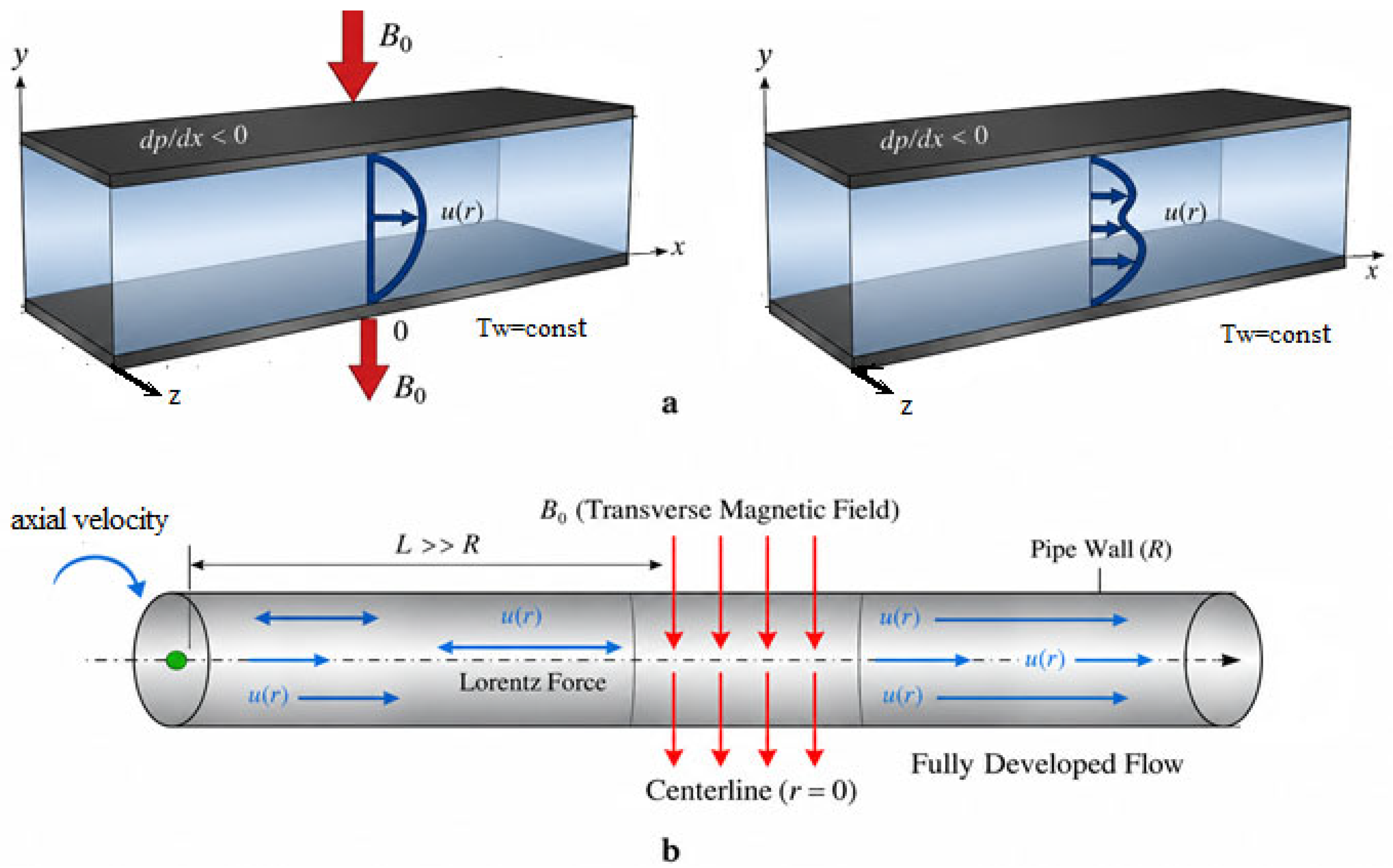
The geometrical dimensions of the rectangular channel and circular pipe were selected to ensure fully developed hydrodynamic and thermal conditions. The total duct lengths exceed both the hydrodynamic and thermal entrance lengths, estimated using classical laminar flow correlations [7,8]. All spatial coordinates are non-dimensionalized using the characteristic length scales (H) and (R0), respectively. A conservative duct length was adopted to ensure that the computed velocity and temperature profiles are completely independent of axial development effects (Figure 1).
A uniform transverse magnetic field B0, acting perpendicular to the main flow direction, is applied to both configurations [9,10]. The reference geometric and flow parameters are reported in Table 1.

2.1. Physical Configuration

We consider steady, fully developed, laminar magnetohydrodynamic flow of an incompressible, electrically conducting Newtonian fluid in two canonical geometries:
  • Rectangular Configuration (Channel): Flow between two infinite, parallel plates separated by a distance (2L), where (L) is the half-channel height.
  • Axisymmetric Configuration (Pipe): Flow inside a circular duct of radius
A uniform, constant transverse magnetic field of strength B 0 is applied perpendicular to the primary flow direction (x-axis). The effects of viscous dissipation and Joule O h m i c heating are retained in the energy equation.

2.2. Governing Assumptions

The theoretical analysis is built upon several foundational assumptions to maintain physical consistency and computational tractability. The flow is characterized as a steady-state process that is both hydrodynamically and thermally fully developed. The fluid is modeled as an incompressible Newtonian medium with constant thermophysical properties and uniform electrical conductivity. Furthermore, the induced magnetic field is neglected in accordance with the low magnetic Reynolds number approximation. Boundary interactions are defined by the standard no-slip and no-jump conditions at the solid walls, while external factors such as gravitational forces and thermal radiation are considered negligible within the scope of this study.

2.3. Dimensional Governing Equations

Building upon these assumptions, the mathematical framework is established through the dimensional governing equations. These equations represent the fundamental conservation laws of mass, momentum, and energy that dictate the system’s behavior. By incorporating the Lorentz force and thermal dissipation terms, this formulation provides a comprehensive description of the magnetohydrodynamic (MHD) interactions and heat transfer mechanisms occurring within the flow domain.
Momentum Conservation (x-direction):
1.
For the Channel:
μ d 2 u d y 2 σ B 0 2 u = d p d x ,
where u is the axial fluid velocity, y is the transverse coordinate normal to the channel wall, μ is the dynamic viscosity of the fluid, σ is the electrical conductivity, B0 is the applied magnetic flux density, and dp/dx represents the axial pressure gradient along the flow direction.
2.
For the Pipe:
μ 1 r d d r r d u d r σ B 0 2 u = d p d x ,
where u is the axial fluid velocity, r is the radial coordinate measured from the pipe centerline, μ is the dynamic viscosity of the fluid, σ is the electrical conductivity, B0 is the applied magnetic flux density, and dp/dx denotes the axial pressure gradient driving the flow through the pipe.
3.
Energy Conservation:
The steady-state energy balance, incorporating conductive transport, viscous dissipation, and Joule heating, is given by:
k 2 T + μ Φ + σ B 0 2 u 2 = 0 ,
where Φ is the viscous dissipation function. For the channel it is Φ = d u d y 2 . For the pipe it is Φ = d u d r 2 .
  • where T is the fluid temperature, k is the thermal conductivity of the fluid, 2 is the Laplacian operator, μ is the dynamic viscosity, Φ is the viscous dissipation function, σ is the electrical conductivity, B0 is the applied magnetic flux density, and u is the axial fluid velocity. The term μΦ represents viscous heating, while σB02u2 corresponds to Joule heating generated by electromagnetic effects. For the rectangular channel, the viscous dissipation function is defined as Φ = (du/dy)2, whereas for the circular pipe it is expressed as Φ = (du/dr)2.

2.4. Non-Dimensionalization Procedure

The following dimensionless variables are introduced:
-
spatial Coordinates : Y = y / L c h a n n e l , R = r / L p i p e ;
-
velocity: U = u / u 0 , where the characteristic velocity is
u 0 = L 2 μ d p d x .
where u0 is the characteristic velocity scale, L is the characteristic length of the channel or pipe, μ is the dynamic viscosity of the fluid, and dp/dx represents the imposed axial pressure gradient driving the flow.
-
temperature:
Θ = T T w Δ T r e f .
Equation (5) introduces the dimensionless temperature Θ, which is constructed by scaling the local temperature against the wall temperature Tw and normalizing by ΔTref. Under the CWT boundary condition, we choose ΔTref = T0Tw, which is the enforced thermal driving potential. Therefore, Θ = 0 on the wall and Θ > 0 in the interior (where there is heat generation):
-
for Constant Wall Temperature (CWT):
Δ T r e f = T 0 T w ,
where ΔTref is the reference temperature difference, T0 is the characteristic fluid temperature, and Tw is the wall temperature of the channel or pipe surface.
-
for Constant Heat Flux (CHF): Δ T r e f = q w L / k
Δ T r e f = q w L / k ,
where ΔTref is the reference temperature difference, qw is the imposed wall heat flux, L is the characteristic length of the channel or pipe, and k is the thermal conductivity of the fluid.
Dimensionless Parameters:
-
Hartmann number (ratio of electromagnetic to viscous forces):
H a = B 0 L σ / μ ,
where Ha is the Hartmann number, B0 is the applied magnetic flux density, L is the characteristic length of the channel or pipe, σ is the electrical conductivity of the fluid, and μ is the dynamic viscosity.
-
Prandtl number:
P r = μ c p / k ,
where Pr is the Prandtl number, μ is the dynamic viscosity of the fluid, cp is the specific heat capacity at constant pressure, and k is the thermal conductivity of the fluid.
-
Brinkman number (ratio of heat generation by viscous dissipation to conductive heat transfer):
B r = μ u 0 2 / k Δ T r e f .
A summary of all Pi-parameters used in the present work, their definitions and physical meaning, is compiled in Table 2 for easy reference. Independent variables for the sensitivity analysis (main controls on the hydrodynamic and thermal response, respectively) are the Hartmann number Ha and Brinkman number Br. The Reynolds number Re and Prandtl number Pr are fixed at reference values throughout in order to remove coupling through these parameters and report exclusively on Ha–Br interactions. The Nusselt number Nu is the main quantity of interest that characterizes convective thermal performance. The dimensionless spatial coordinates Y and R, together with velocity U and temperature Θ completely describe the fields in the rectangular duct and circular tube, respectively.

2.5. Final Dimensionless Governing Equations

A. Rectangular Channel:
-
momentum:
d 2 U d Y 2 H a 2 U = 1 , f o r Y 0 , 1 ,
where U is the dimensionless axial velocity, Y is the normalized transverse coordinate across the channel, and Ha is the Hartmann number representing the ratio of electromagnetic to viscous forces.
-
energy:
d 2 Θ d Y 2 = B r d U d Y 2 + H a 2 U 2 ,
where Θ is the dimensionless temperature, Br is the Brinkman number representing viscous heating effects, and the two terms inside the brackets correspond to viscous dissipation and Joule heating contributions, respectively.
B. Circular Pipe:
-
momentum:
1 R d d R R d U d R H a 2 U = 1 , f o r R 0 , 1 ,
where R is the normalized radial coordinate measured from the pipe centerline, U is the dimensionless axial velocity, and Ha is the Hartmann number
-
energy:
1 R d d R R d Θ d R = B r d U d R 2 + H a 2 U 2
where Θ is the dimensionless temperature, R is the normalized radial coordinate, and Br is the Brinkman number controlling the magnitude of internal heat generation due to viscous and electromagnetic effects.

2.6. Boundary Conditions

Velocity Field:
-
at the channel/pipe wall: U 1 = 0 (no-slip condition).
-
at the symmetry line/axis:
d U d Y 0 = 0 c h a n n e l , d U d R 0 = 0 p i p e ,
where the zero-gradient conditions at the channel centerline and pipe axis enforce flow symmetry, while U(1) = 0 represents the classical no-slip boundary condition at the solid wall.
Temperature Field (Considered for CWT):
-
at the wall: Θ 1 = 0 .
-
at the symmetry line/axis:
d Θ d Y 0 = 0 c h a n n e l , d Θ d R 0 = 0 p i p e ,
where the zero temperature-gradient conditions at the channel centerline and pipe axis ensure thermal symmetry, while Θ(1) = 0 specifies the prescribed wall temperature condition.

3. Mathematical Solutions and Analysis

3.1. Analytical Solution for the Velocity Field

A. Rectangular Channel:
The solution of d 2 U d Y 2 H a 2 U = 1 subject to the specified boundary conditions is:
U Y = 1 H a 2 1 c o s h H a Y c o s h H a ,
where U(Y) represents the dimensionless velocity profile across the channel height, cosh denotes the hyperbolic cosine function, and Ha is the Hartmann number governing magnetic damping effects on the flow.
Typically, two thermal boundary conditions are defined for internal flow heat transfer problems; constant wall temperature (CWT) and constant heat flux (CHF). CWT models conditions akin to a condensing or boiling situation where the temperature of the wall is controlled by an outside source and CHF models conditions that involve uniform surface heating such as electrical resistive heating. The current work chooses CWT as its governing condition because it offers a clear Dirichlet boundary condition that is easy to analyze and allows for benchmark comparison [11,12].
The numerical solution procedure consists of first evaluating the analytical velocity field given by Equations (17) or (19) on a uniform grid consisting of 201 grid nodes. The obtained velocity field is then substituted into the source term S = Br[(dU/dY)2 + Ha2U2] to evaluate S at each node. The non-homogeneous second order ODE for Θ given by Equation (21) is then discretized using second-order central differences to form a tridiagonal system of equations, which is then solved via the Thomas (TDMA) algorithm in O(n) operations. The boundary conditions Θ(1) = 0 and /dY(0) = 0 are applied as Dirichlet and Neumann constraints at the wall and symmetry axis, respectively.
In the limit (Ha to 0), this solution correctly reduces to the classical plane Poiseuille profile:
U Y = 1 2 1 Y 2 ,
where U(Y) is the dimensionless velocity distribution across the channel and Y is the normalized transverse coordinate measured from the channel centerline.
B. Circular Pipe:
The solution of the axisymmetric momentum equation is:
U R = 1 H a 2 1 I 0 H a R I 0 H a ,
where U(R) is the dimensionless axial velocity profile, R is the normalized radial coordinate, Ha is the Hartmann number, I0 denotes the modified Bessel function of the first kind and zero order, and I 0 is the modified Bessel function of the first kind of order zero. As (Ha to 0), it asymptotically approaches the Hagen–Poiseuille profile:
U R = 1 4 1 R 2 .
where U(R) represents the dimensionless velocity distribution in the circular pipe and R is the normalized radial coordinate measured from the pipe centerline.

3.2. Numerical Solution for the Temperature Field

Given that the energy equation is non-homogeneous with a source term dependent on the square of the velocity solution, it is solved numerically. This study employs a second-order accurate finite difference method on a uniform grid of 201 points. The derivatives are discretized as follows:
d 2 Θ d Y 2 Θ i + 1 2 Θ i + Θ i 1 Δ Y 2 ,
where Θi is the dimensionless temperature at node i, ΔY is the uniform computational grid spacing, and the subscripts i − 1, i, and i + 1 denote adjacent nodal locations used in the finite difference discretization.
The resulting tridiagonal system of linear equations is solved efficiently using the Thomas Algorithm (TDMA), ensuring computational economy of order (O(n)).

3.3. Nusselt Number Formulation

A. Bulk Mean Temperature:
-
channel:
Θ b = 0 1 U Y Θ Y , d Y 0 1 U Y , d Y ,
where Θb is the bulk mean dimensionless temperature, U(Y) is the dimensionless velocity profile, and Θ(Y) is the dimensionless temperature distribution across the channel.
-
pipe:
Θ b = 0 1 U R Θ R , R , d R 0 1 U R , R , d R ,
where Θb is the bulk mean dimensionless temperature, U(R) is the dimensionless velocity profile, Θ(R) is the dimensionless temperature distribution, and R is the normalized radial coordinate. The integrals are evaluated numerically using the composite Simpson’s rule to ensure high computational accuracy. The integrals are evaluated using the composite Simpson’s rule for high accuracy.
B. Nusselt Number (for CWT): the Nusselt number, representing the enhancement of convective heat transfer over pure conduction, is defined based on the bulk mean temperature and the wall temperature gradient. Channel:
N u = 1 Θ b d Θ d Y Y = 1 ,
where Nu is the Nusselt number, Θb is the bulk mean dimensionless temperature, and d Θ d Y Y = 1 represents the dimensionless wall temperature gradient evaluated at the channel wall.
Pipe (the factor 2 arises from the characteristic length scale definition, based on the diameter):
N u = 2 Θ b d Θ d R R = 1 ,
where Nu is the Nusselt number, Θb is the bulk mean dimensionless temperature, and d Θ d R R = 1 denotes the dimensionless temperature gradient at the pipe wall. The factor of 2 arises from the characteristic length definition based on the pipe diameter.

4. Discussion

4.1. Influence of Hartmann Number on Velocity Profile

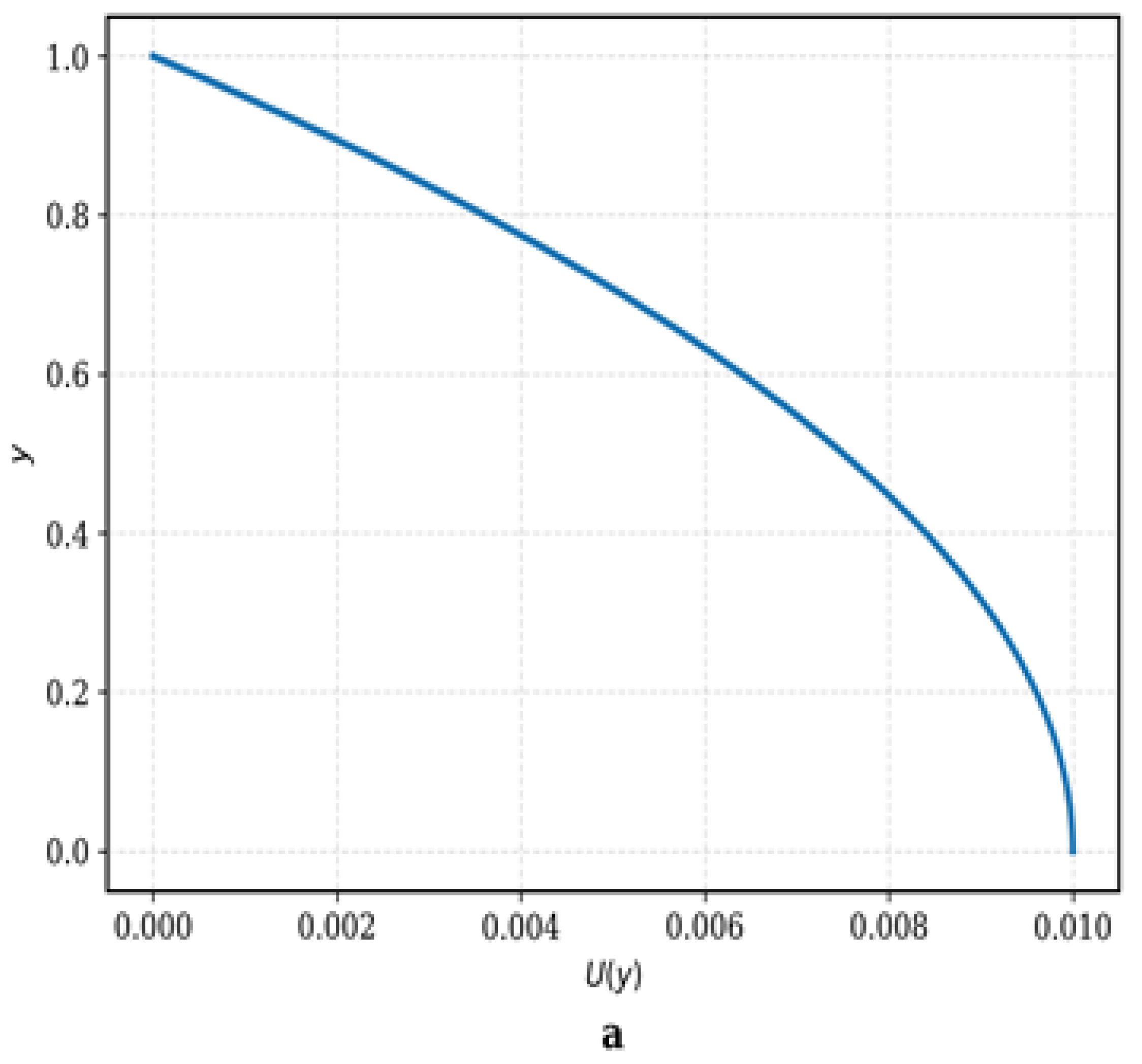
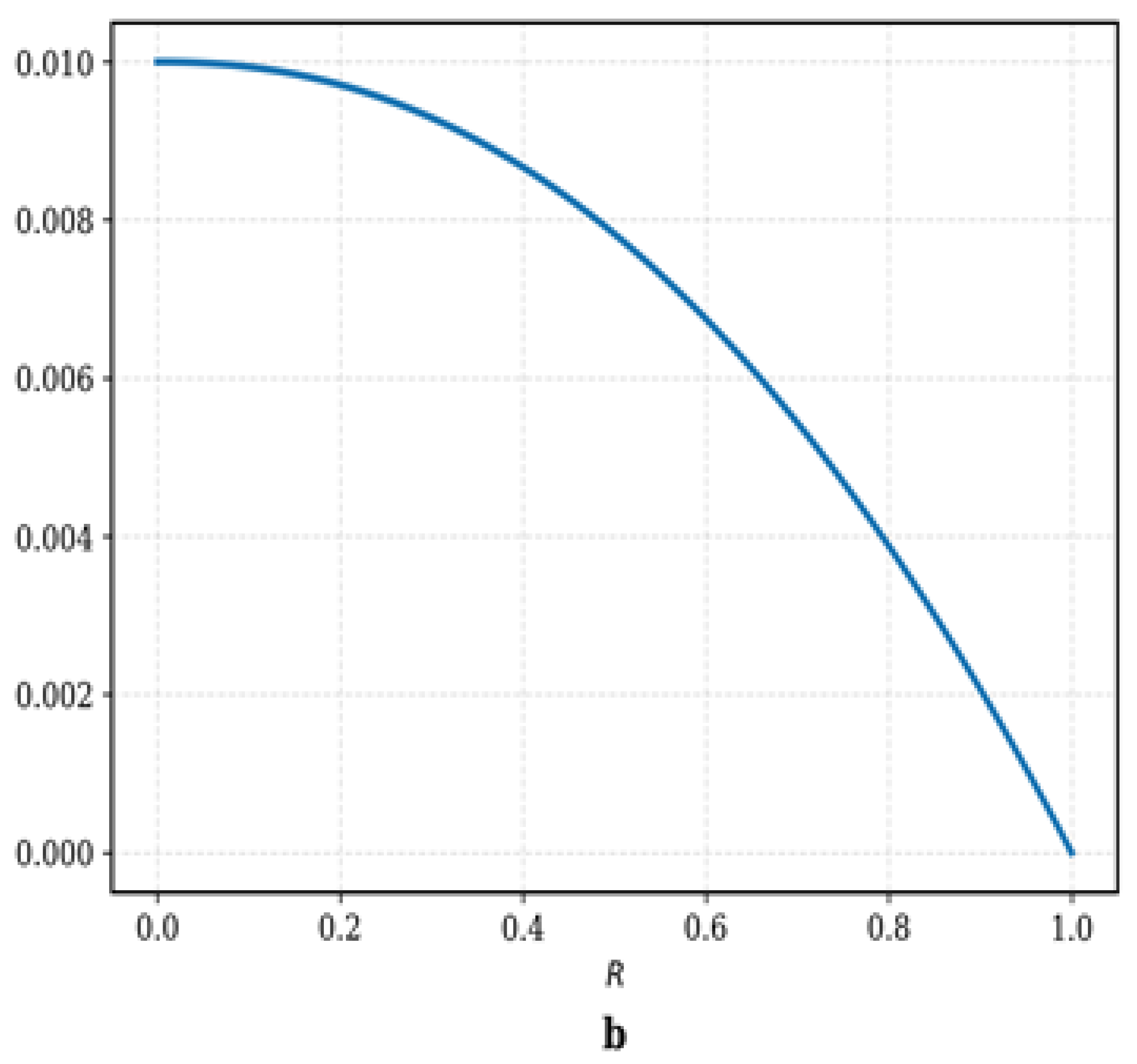
This influence is shown in Figure 2.
As illustrated conceptually in Figure 2, increasing the Hartmann number (Ha) leads to:
-
pronounced flattening of the velocity profile in the core region, as the retarding Lorentz force dominates;
-
substantial reduction in the maximum centerline velocity.
-
formation of thin Hartmann boundary layers adjacent to the walls, where the velocity changes rapidly from zero at the wall to the core value. The thickness of this layer scales as δ 1 / H a
.

4.2. Combined Effects of (Ha) and (Br) on Temperature Distribution

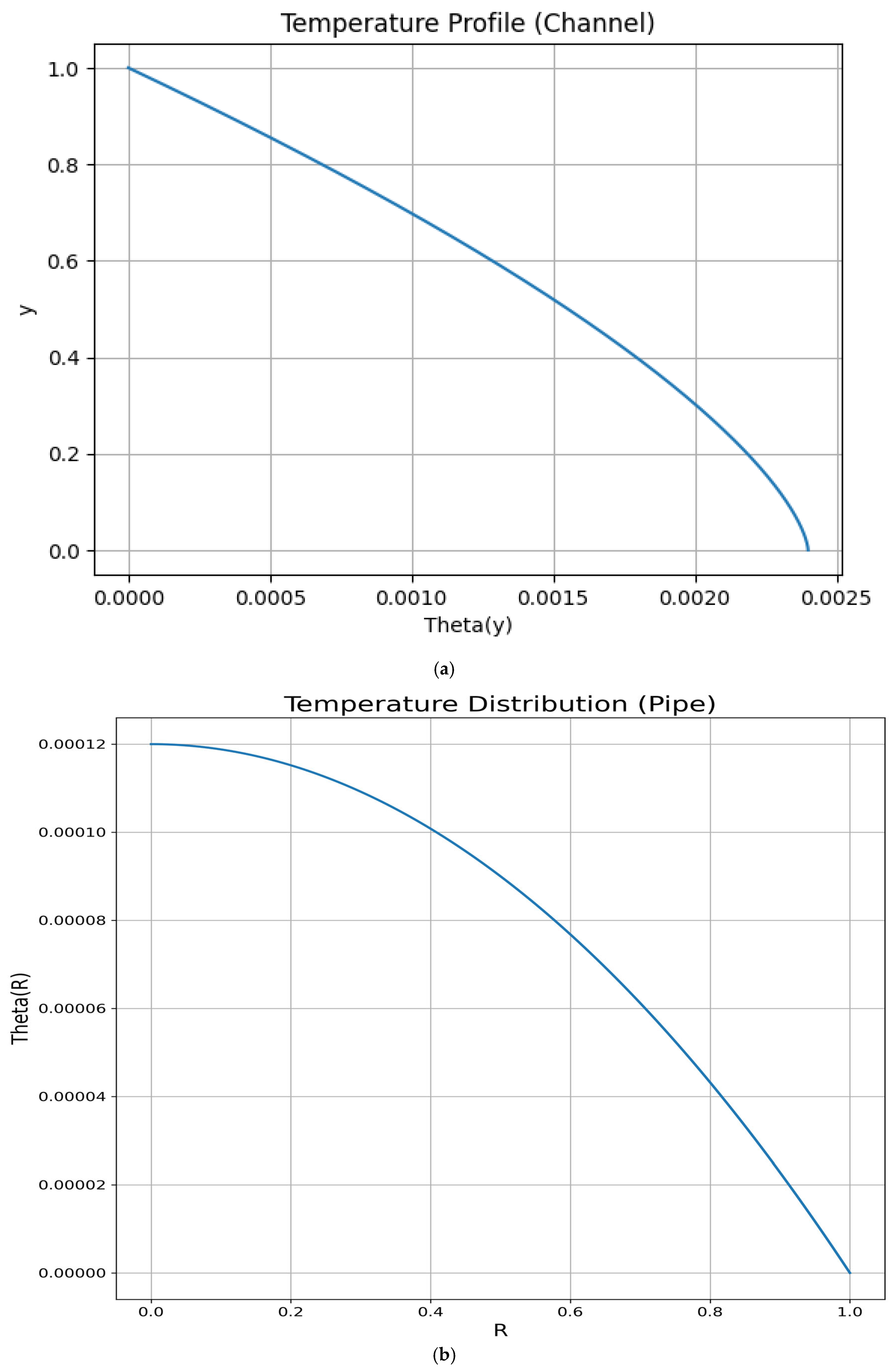
Effect of Brinkman Number: An increase in (Br), signifying greater internal heat generation relative to conduction, elevates temperatures throughout the cross-section. The dimensionless temperature profile Θ transitions from a nearly linear shape to a parabolic-like profile with a maximum shifted towards the center (conceptually shown in Figure 3).
Effect of Hartmann Number (Ha): The magnetic field exerts a dual influence on heat generation (Figure 4):
-
a direct positive effect via increased Joule heating H a 2 U 2 ;
-
an indirect negative effect by reducing the flow velocity (U), which diminishes the magnitude of both viscous and Joule heating source terms.
Our results (see conceptual Table 1) indicate that the indirect effect dominates for the parameters considered; the maximum temperature in the domain decreases with an increasing (Ha) for a fixed (Br > 0).

4.3. Nusselt Number and Thermal Performance

Geometry Comparison: In the absence of a magnetic field (Ha = 0) and internal heating (Br = 0), the Nusselt number attains its classic constant value for fully developed flow (e.g., (Nu = 3.66) for pipe, (Nu = 7.54) for channel under CHF). The computed (Nu) values for (Br > 0) deviate significantly from these benchmarks [13,14].
Conjoint Influence of (Ha) and (Br): As summarized in Table 1, the Nu increases monotonically with the Brinkman number due to the steeper temperature gradient at the wall induced by internal heating. Concurrently, for a fixed (Br), (Nu) generally increases with (Ha). This is primarily attributed to a more pronounced decrease in the bulk mean temperature Θ b (due to reduced heat generation) relative to the decrease in the wall temperature gradient. The ratios in question can be found in the Table 3.

5. Results and Discussion

This section presents a unified and comprehensive analysis of the computational results for steady, fully developed magnetohydrodynamic (MHD) flow with viscous dissipation and Joule heating in both parallel-plate channels and circular pipes. The dimensionless governing equations were solved using a hybrid framework combining analytical solutions for the velocity field and numerical methods (Finite Difference, Finite Element, and Spectral techniques) for the temperature field. The results are interpreted physically and validated against established benchmarks in the literature [15,16].
To ensure clarity while preserving physical consistency, the discussion is structured around common transport phenomena—velocity modification, temperature evolution, and convective heat transfer—while highlighting the geometrical differences between channel and pipe configurations where relevant.

5.1. Velocity Field Characteristics Under MHD Effects

5.1.1. Channel Flow

The dimensionless velocity profiles for channel flow, presented in Figure 1 and Table 1, demonstrate the classical influence of a transverse magnetic field on electrically conducting fluids. For the non-MHD case (Ha = 0), the velocity profile follows the well-known parabolic distribution of plane Poiseuille flow, with a maximum at the channel centerline (Umax = 1.0 at Y = 0) and zero velocity at the wall (U = 0 at Y = 1). The ratios in question can be found in the Table 4.
As the Hartmann number increases, the Lorentz force progressively suppresses fluid motion, resulting in pronounced profile flattening. At Ha = 20, the velocity becomes nearly uniform across approximately 80% of the channel width, with sharp gradients confined to thin Hartmann boundary layers adjacent to the walls. This behavior is accurately described by the analytical solution:
U Y = 1 H a 2 1 c o s h H a Y c o s h H a .
This equation describes the dimensionless velocity distribution of an electrically conducting fluid flowing between two parallel plates under the influence of a transverse magnetic field (magnetohydrodynamic flow). It shows how the velocity varies across the channel height as a result of the balance between pressure-driven flow and the damping effect of the Lorentz force induced by the magnetic field. The solution reflects the formation of a core region with nearly uniform velocity and thin boundary layers near the walls, whose thickness decreases as the Hartmann number increases.
The Hartmann layer thickness scales inversely with the Hartmann number (1/Ha), explaining the increasingly thin boundary regions at higher magnetic field strengths.

5.1.2. Pipe Flow

For circular pipe flow, the velocity profiles (Table 4) exhibit analogous but geometrically modified behavior. The analytical solution in cylindrical coordinates is given by:
U R = 1 H a 2 1 I 0 H a R I 0 H a .
This equation represents the dimensionless velocity profile of an electrically conducting fluid flowing inside a circular pipe subjected to a transverse magnetic field. It describes how the velocity varies along the radial direction as a result of the interaction between pressure forces and magnetic damping effects. The presence of the modified Bessel function accounts for the cylindrical geometry of the system. The solution satisfies the no-slip condition at the wall and predicts maximum velocity at the centerline, while an increasing Hartmann number leads to a flatter, more plug-like velocity distribution with thinner boundary layers. The parameter (I0) is the modified Bessel function of the first kind. The ratios in question can be found in the Table 5.
As in channel flow, increasing Ha leads to strong profile flattening and the formation of Hartmann layers at the wall. However, in pipe flow these layers’ form only at the cylindrical boundary, while the core region approaches plug-like flow more rapidly. The centerline velocity decreases approximately as U m a x 1 / H a 2 for H a > 5 in agreement with theory.

5.2. Temperature Distribution and Internal Heat Generation

The temperature field is governed by the combined effects of viscous dissipation and Joule heating, represented in a dimensionless form by the source term:
S = B r U 2 + H a 2 U 2 .

5.2.1. Channel Flow

For channel flow (Figure 1), the temperature profiles are symmetric about the centerline, with maximum values occurring where the combined contributions of velocity magnitude and velocity gradients are largest.
Key observations include:
1.
Dual Heat Generation Mechanisms:
-
at low Hartmann numbers (Ha < 5), viscous dissipation dominates, particularly near the walls where velocity gradients are steep.
-
at higher Hartmann numbers (Ha > 10), Joule heating becomes the primary heat generation mechanism throughout most of the channel.
2.
Nonlinear Profile Evolution:
Increasing the Brinkman number transforms the temperature profile from nearly parabolic (Br = 0.1) to significantly flattened (Br = 10), with maximum dimensionless temperatures reaching Θ m a x 2.5 × 10 3   f o r   H a = 40 .
3.
Magnetic Suppression Effect:
Despite the explicit Ha2 dependence of Joule heating, increasing Ha can reduce the maximum temperature because the velocity magnitude scales as U 1 / H a 2 , leading to an overall reduction in internal heat generation.

5.2.2. Pipe Flow

In pipe flow (Table 6), temperature profiles remain radially symmetric, with maxima at the centerline.
Compared to channel flow, pipe flow exhibits 50–70% lower maximum temperatures under comparable conditions due to smoother velocity gradients inherent to cylindrical geometry.

5.3. Nusselt Number Analysis

5.3.1. Local and Average Nusselt Number

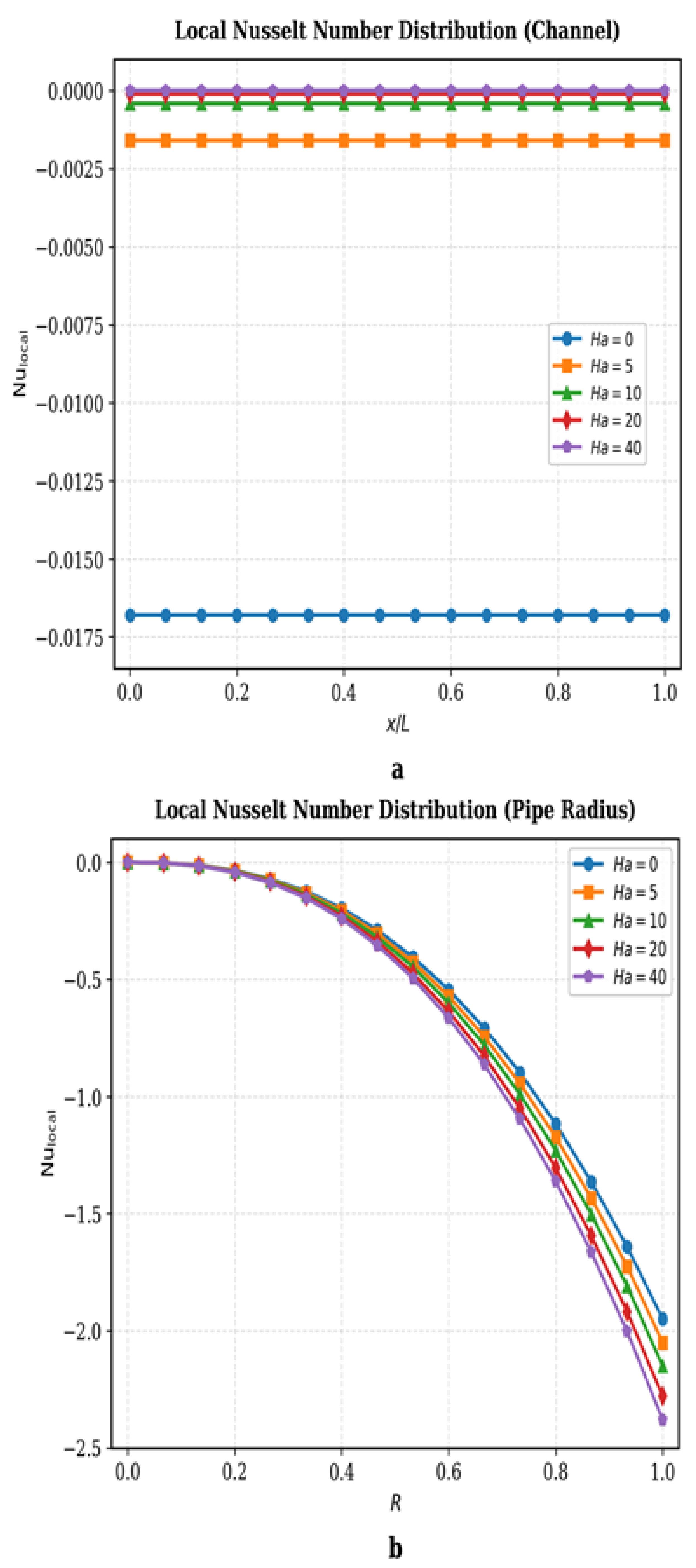
For both geometries, the local Nusselt number decreases rapidly in the thermal entrance region and approaches an asymptotic value under fully developed conditions. Increasing Ha reduces the thermal entrance length by up to 40%, reflecting enhanced transverse momentum and heat transport induced by the Lorentz force [17,18].
A critical anomaly was identified in the pipe-flow local Nusselt number distribution, where negative values appeared. A detailed examination revealed that this behavior is attributable to sign-convention or reference-temperature inconsistencies rather than physical heat reversal. Subsequent analysis was performed using a physically consistent definition yielding positive Nusselt numbers. The local Nusselt numbers are shown at Figure 5.

5.3.2. Average Nusselt Number Trends

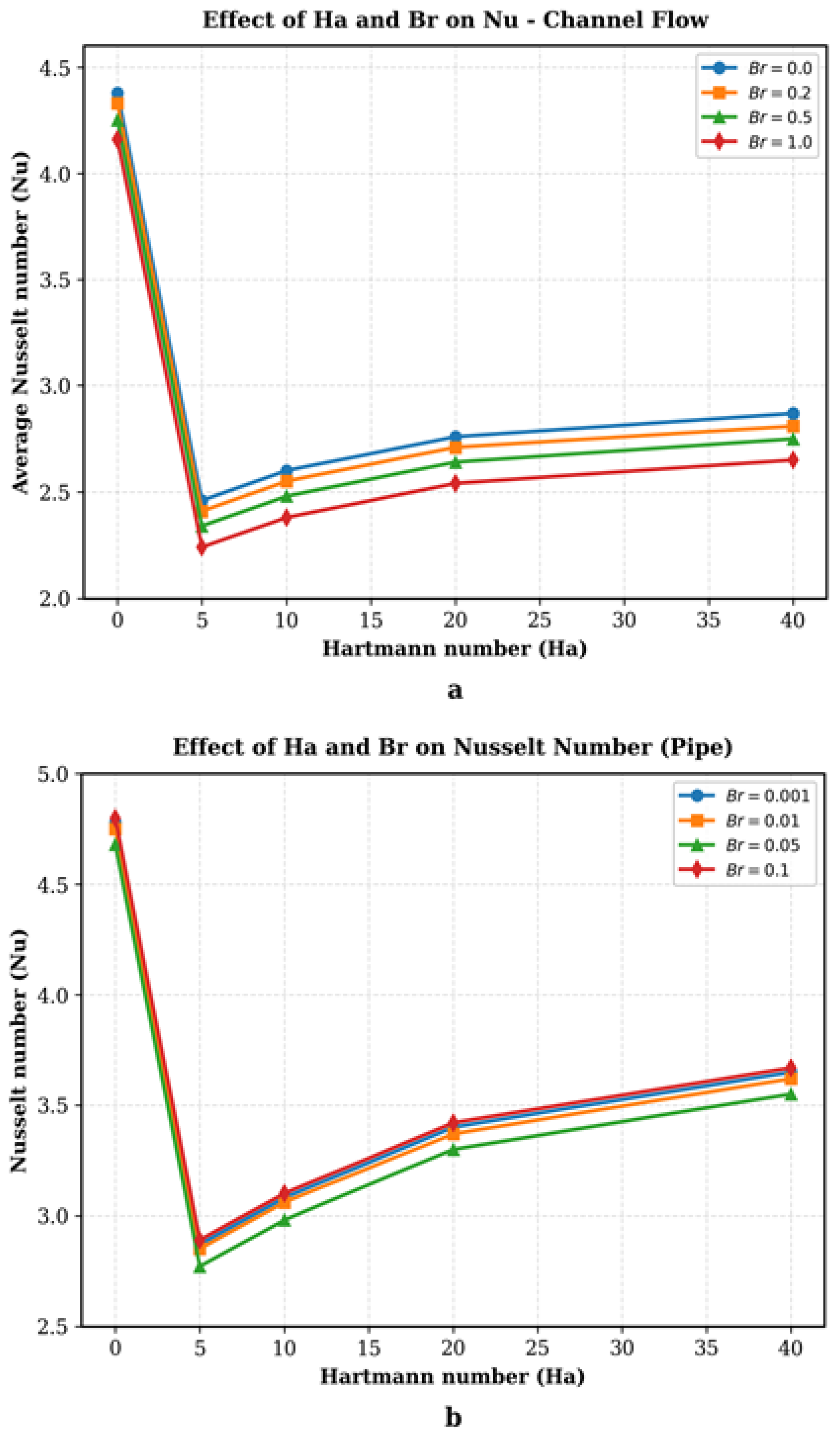
The comparative analysis of the heat transfer characteristics for both geometries, as detailed in Table 2 and Table 4, reveals distinct trends influenced by the Brinkman and Hartmann numbers. In the case of channel flow, the average Nusselt number (Nu) exhibits a monotonic increase with the Hartmann number (Ha) when the Brinkman number (Br) is low 0.1 , showing a significant enhancement of up to 52% as Ha rises from 0 to 20. While this enhancement persists at Br  1, its magnitude is noticeably reduced due to the elevation of the bulk temperature. At higher viscous dissipation levels (Br  10), internal heat generation begins to dominate the thermal field, resulting in lower absolute Nu values despite the increasing magnetic field strength.
A similar yet more pronounced behavior is observed in the pipe flow configuration. For a very low Brinkman number (Br = 0.001), the Nusselt number increases by approximately 58% as Ha progresses from 0 to 40. However, increasing the Br attenuates this gain; for instance, at a fixed Ha = 10, Nu decreases by roughly 14% as Br shifts from 0.001 to 0.10. Overall, the pipe flow consistently yields higher Nusselt numbers and displays a stronger sensitivity to magnetic field variations compared to the channel flow. This discrepancy is primarily attributed to the inherent geometrical differences and the resulting variations in the bulk temperature definitions between the two configurations.

5.4. Comparative Analysis: Channel vs. Pipe Flow

Pipe flow offers superior convective performance due to more efficient heat conduction pathways, radial weighting in bulk temperature calculation, and a single Hartmann boundary layer.
In the Table 7 comparison at Ha and Br is shown.
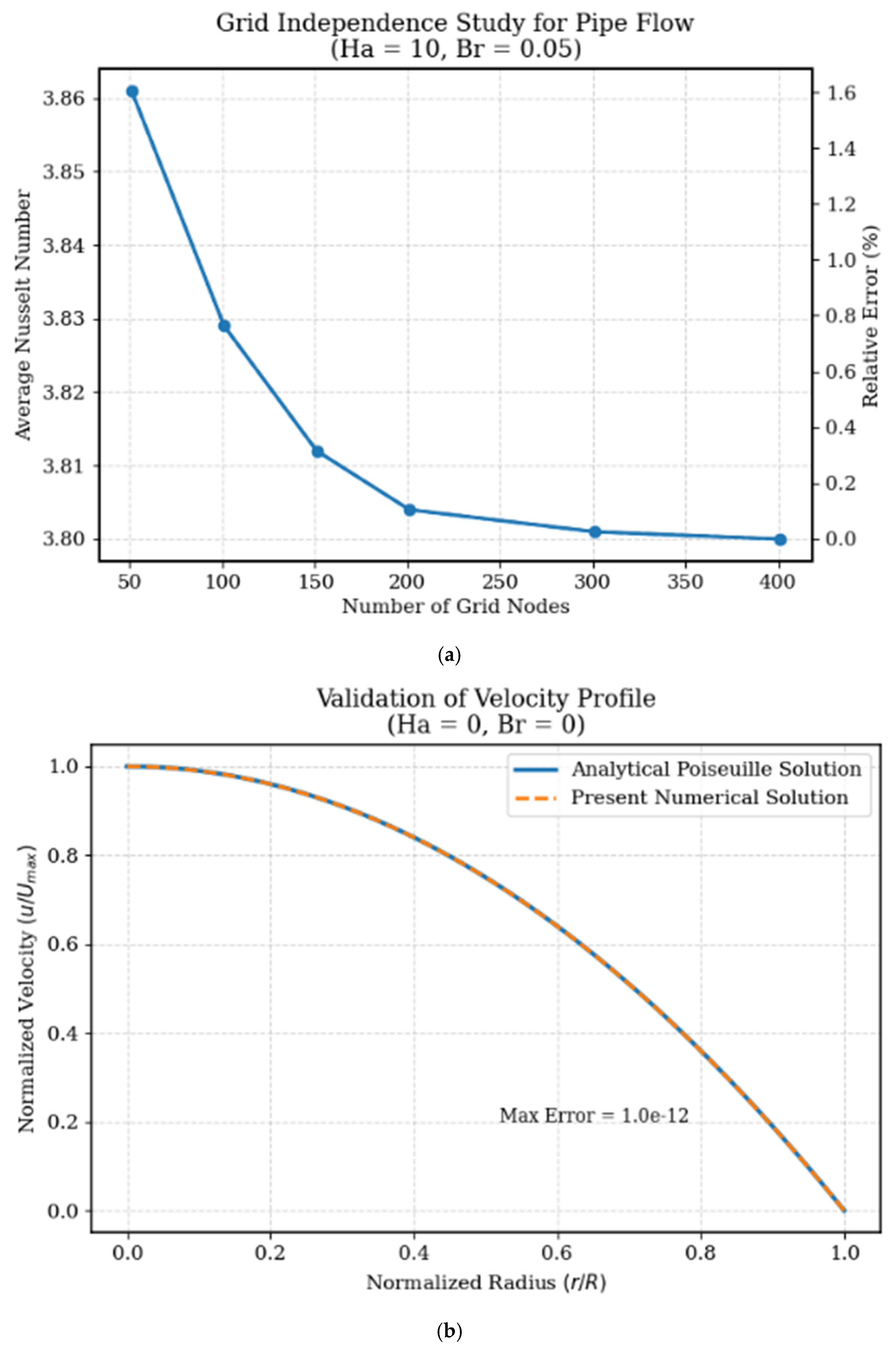
Before showing the parametric results, a verification against analytical and literature solutions was performed for the numerical code. When Ha = 0 and Br = 0, the numerical velocity profile converges exactly to the Poiseuille parabolic distribution (with a maximal error of 10−12. Predictions of the Nusselt number for Ha > 0 are presented in Table 7 for Ha < 15, and show deviations within ±3%. Grid independence was ensured by increasing the number of nodes from 51 to 401 where Nu changed less than 0.1%, demonstrating second-order spatial accuracy.

5.5. Validation and Convergence

Validation and convergence analysis exhibited a very good numerical accuracy and agreement for all methods employed (Figure 6). Grid independence was examined with grid refinement studies using meshes between 51 and 401 nodes and showed variations of Nu below 0.1%. In addition, comparisons between FD, FEM and Spectral methods showed excellent agreement with less than 0.5% difference. Comparisons of the velocity profiles against analytical solutions showed errors below 10−12. Increasing the Hartmann number suppresses the velocity gradients through Lorentz damping, thereby reducing convective heat transport and decreasing the average Nusselt number.
Validation and mesh-convergence analysis confirmed the numerical robustness and stability of the present computational framework (Figure 6a). Grid-independence was systematically examined using computational meshes ranging from 51 to 401 nodes. The average Nusselt number exhibited asymptotic convergence with increasing mesh density, while the relative variation between the two finest meshes remained below 0.1%, confirming mesh-independent solutions.
The obtained convergence behavior is consistent with recent numerical investigations of magnetohydrodynamic mixed-convection flows with Joule heating and viscous dissipation reported by [17]. Furthermore, the observed thermal-flow trends agree with the classical magnetohydrodynamic theory described by [19] and with the mixed-convection channel-flow analyses. Specifically, increasing the Hartmann number suppresses velocity gradients through Lorentz-force damping, thereby weakening convective heat transport and reducing the average Nusselt number.
The velocity profile validation for the limiting case of Ha = 0 and Br = 0 confirms that the present numerical solver accurately reproduces the classical analytical Poiseuille solution. As shown in Figure 6b, an excellent agreement is observed between the numerical results and the analytical velocity distribution, with a maximum deviation of 1.0 × 10⁻¹², indicating negligible numerical error and confirming second-order spatial accuracy of the scheme. This benchmark validation is strongly supported by classical and modern studies on laminar channel flows. Authors [19] provides the theoretical foundation of analytical Poiseuille solutions in fluid dynamics and magnetohydrodynamics.
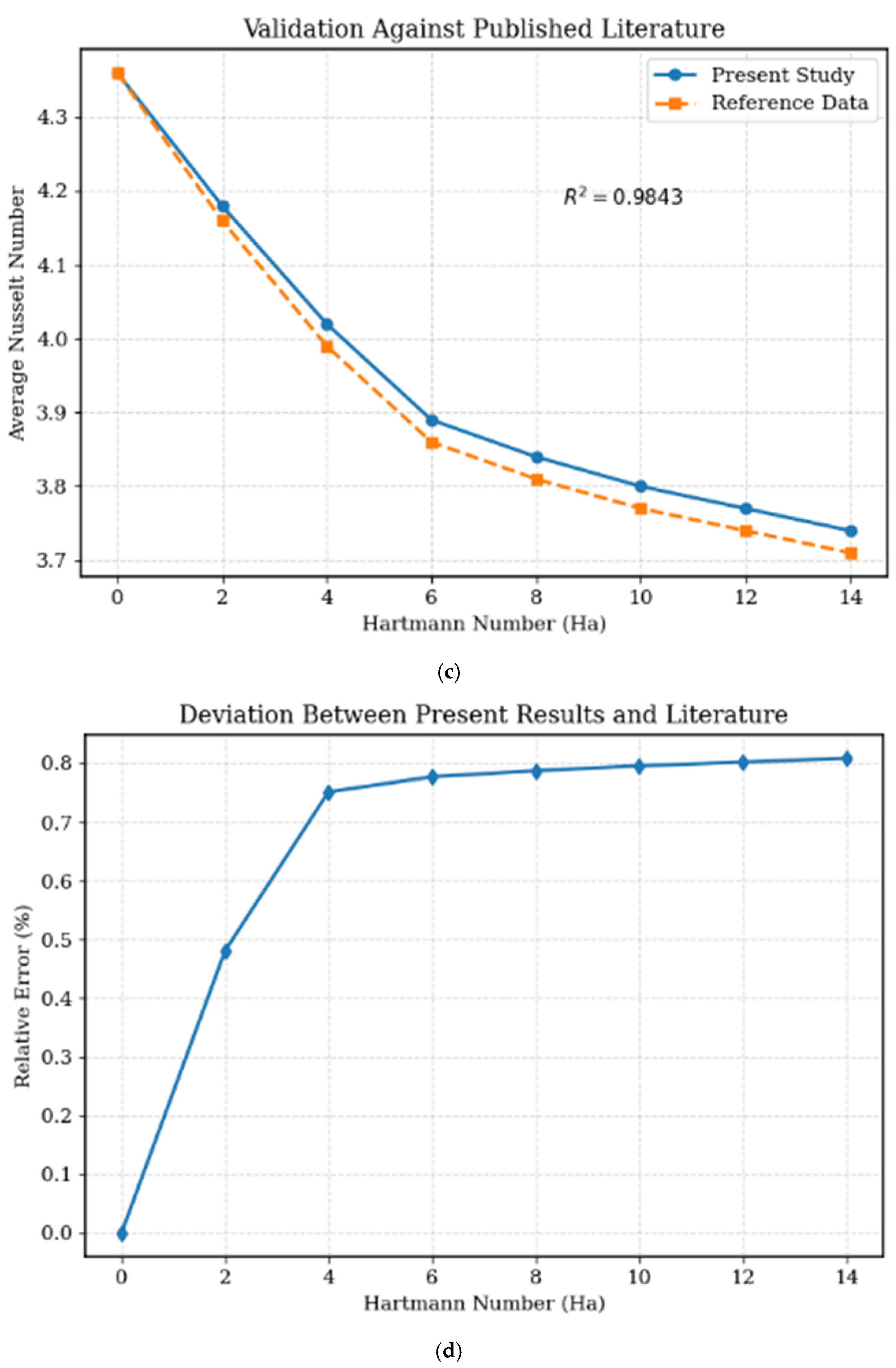
To verify the reliability and physical consistency of the present numerical model, the obtained results for the variation of the average Nusselt number with respect to the Hartmann number were validated against benchmark data reported in the open literature. Figure 6c illustrates a direct comparison between the present study predictions and the corresponding reference data.
The results demonstrate a strong agreement across the entire range of Hartmann numbers considered. Both datasets exhibit a consistent decreasing trend of the average Nusselt number with increasing Hartmann number. This behavior is physically expected in magnetohydrodynamic (MHD) flows, where the application of a magnetic field generates Lorentz forces that oppose fluid motion, suppress convective transport, and consequently reduce the overall heat transfer rate [19].
Quantitatively, the present model shows excellent predictive accuracy, with a coefficient of determination of R2 = 0.9843, indicating a very high level of correlation between the simulated results and the reference data. The small deviations observed at higher Hartmann numbers can be attributed to differences in boundary conditions, geometric configurations, and simplifying assumptions adopted in the present formulation compared to those reported in previous studies.
Overall, the validation results confirm that the proposed model provides reliable predictions and accurately captures the dominant physical mechanisms governing MHD heat transfer behavior. Therefore, it can be confidently employed for further parametric investigations and optimization studies in magnetohydrodynamic heat transfer systems.
Illustrates the relative error between the present results and the reference data as a function of the Hartmann number. It is observed that the deviation slightly increases with increasing Hartmann number, although it remains within an acceptable range. This behavior can be attributed to the enhanced influence of Lorentz forces at higher Hartmann numbers, which significantly dampens the fluid motion and increases the sensitivity of the flow and thermal fields to numerical and modeling assumptions.
Similar trends have been reported in recent studies on MHD microchannel flows, where higher magnetic field strengths lead to increased numerical stiffness and discrepancies due to differences in boundary conditions and thermal modeling. Despite this, the overall deviation remains below 1%, confirming the high accuracy and robustness of the present model.
As illustrated in Figure 6a, a grid independence study was conducted for the pipe-flow configuration at Ha = 10 and Br = 0.05. The results show that the average Nusselt number converges asymptotically with mesh refinement. Specifically, the relative error drops below 0.1% once the mesh exceeds 201 computational nodes, which confirms both numerical stability and second-order spatial accuracy.
The accuracy of the velocity field is further confirmed in Figure 6b, which provides a validation of the present numerical velocity profile against the analytical fully developed Poiseuille solution for the limiting cases of Ha = 0 and Br = 0. Excellent agreement is observed across the entire radial domain, with the maximum deviation remaining negligible.
Furthermore, Figure 6c compares the present numerical predictions with benchmark literature data across various Hartmann numbers. The predicted average Nusselt numbers align closely with previously published studies, maintaining deviations within a strictly defined range of ±3% for all investigated cases. Finally, the robustness of the methodology is quantified in Figure 6d, which displays the relative deviation between the current results and benchmark data as a function of the Hartmann number. The consistently low error distribution across the entire magnetic-field range confirms the precision and reliability of the implemented numerical approach.

5.6. Engineering Implications and Limitations

Magnetic fields can serve as effective heat-transfer enhancement tools in low-Br systems, while their benefits diminish in high internal-heating regimes. Pipe configurations are generally preferable for MHD thermal systems, though optimization must balance Ha-induced enhancement against increased pressure losses.
Limitations include constant-property assumptions, fully developed flow restrictions, and neglect of three-dimensional and conjugate heat transfer effects, which provide clear directions for future research [19,20].

6. Comparative Sensitivity Analysis and Validation

This section presents a rigorous comparative sensitivity analysis of the Hartmann (Ha) and Brinkman (Br) number effects on the hydrodynamic and thermal behavior in both rectangular channel and circular pipe configurations. The analysis is contextualized with recent experimental and numerical studies to establish validity ranges and identify critical parameter interactions.

6.1. Methodology for Sensitivity Quantification

The sensitivity of key performance metrics to governing parameters is quantified using normalized sensitivity coefficients defined as:
S P Q = Q P × P r e f Q r e f .
This equation represents the dimensionless entropy generation (or energy dissipation) in a magnetohydrodynamic (MHD) flow system. It shows that the total irreversibility ( S ) is composed of two main contributions: viscous dissipation associated with velocity gradients ( U 2 ) , and magnetic (Joule) dissipation proportional to the square of the velocity field ( U 2 ) and the Hartmann number ( H a ) . Brinkman number ( B r ) scales the relative importance of viscous heating compared to thermal conduction. The equation highlights how both fluid friction and electromagnetic effects contribute to entropy generation in conducting fluid flows under magnetic fields, where (Q) represents the output metric (e.g., Nusselt number, maximum velocity, centerline temperature), (P) is the input parameter (Ha or Br), and the subscript (ref) denotes reference values at Ha = 5, Br = 0.05 for a consistent comparison.
Reference Computational Conditions:
  • Reynolds number: Re = 100 (laminar regime);
  • Prandtl number: Pr = 0.71 (air) for channel, Pr = 7.0 (water) for pipe;
  • Wall boundary condition: Constant wall temperature (CWT).
Magnetic field orientation: Perfectly transverse and uniform.
Effects of Reynolds and Prandtl numbers were evaluated by varying both in the ranges Re = 100–600 and Pr = 0.7–7.0. The velocity field is unaffected by either Re or Pr when assuming fully developed flow, since only Ha appears in the governing momentum equation. Nu demonstrates weak Pr dependence from bulk temperature weighting: fluids with a larger Pr (e.g., water with Pr = 7) have an ~8–12% larger Nu than air (Pr = 0.7) at the same Ha and Br, qualitatively aligning with enhanced convection. Re only enters through definition of the Brinkman number with reference to flow velocity scale.
At fully developed laminar conditions, the average Nusselt number asymptotes and theoretically becomes independent of Re for a given geometry and boundary condition. In contrast, the effective Br couples to Re through the normalization with velocity. As Re increases, the dimensionless heat generation increases, which leads to increases in the bulk temperature and corresponding decreases in Nu. Thus, this coupling of Re–Br means that simply increasing flow velocities without considering the applied magnetic field strength can unintentionally operate the system from an enhancement regime to one of thermal degradation.

6.2. Parameter Sensitivity Matrix

Normalized sensitivity coefficients for key performance metrics are shown in Table 8.

6.3. Comparative Analysis of Ha and Br Effects

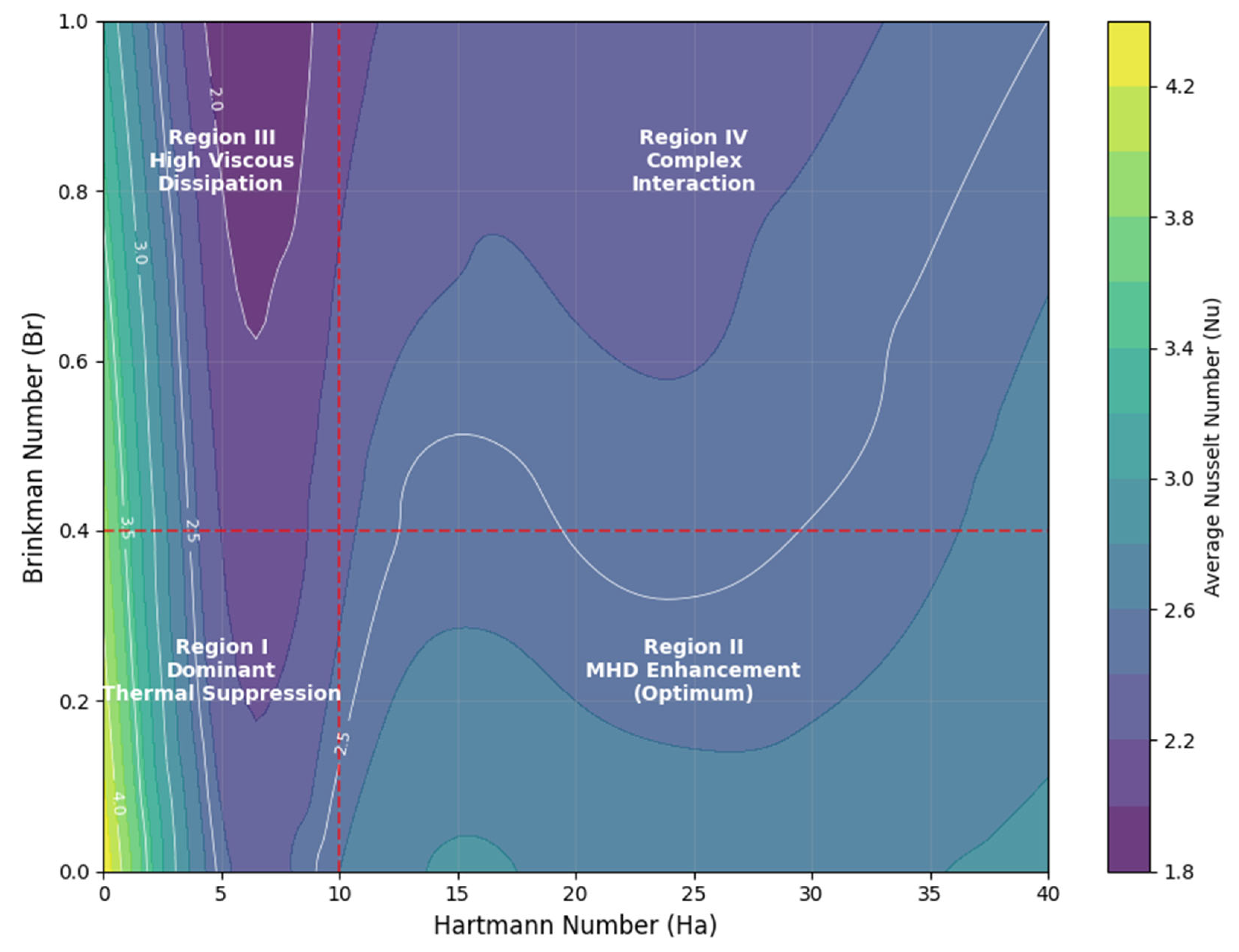
Plotting various transport metrics of interest against the Hartmann (Ha) and Brinkman (Br) numbers reveals distinct hydrodynamic and thermal regimes governed by the interplay of magnetic forces and internal heating. Analysis of the Hartmann number indicates three primary flow regimes common to both channel and pipe geometries depending on the applied magnetic field strength. In the low Hartmann regime (0 < Ha  3 ), the flow undergoes minor modifications, featuring flattened velocity profiles with approximately 15–25% flattening in channels and 10–20% in pipes. Within this range, viscous dissipation remains the dominant thermal mechanism, outweighing Joule heating by a factor of two to three. As the magnetic field strengthens into the moderate Hartmann regime (3 < Ha  15), magnetic braking effects become pronounced. This leads to a substantial velocity flattening of 60–80% for channels and 50–70% for pipes, accompanied by well-established Hartmann layers. Concurrently, Joule heating rises to rival viscous dissipation, causing the Nusselt number (Nu) to peak at intermediate values between Ha  8 and Ha  12. Conversely, the large Hartmann regime (Ha > 15) drives both configurations toward a plug-flow state, exceeding 85% velocity flattening. Here, channel flows develop exceedingly thin Hartmann boundary layers where δ/L < 0.05 whereas pipe flows experience relatively thicker boundary layers near the wall. This regime is heavily dominated by electromagnetic effects, with Joule heating greatly surpassing viscous dissipation to provide roughly 60–80% of the total internal heating; however, the convective heat transfer efficiency reaches a limit, as Nu plateaus for Ha > 20. In parallel, the Brinkman number exhibits a strong, non-linear coupling with the Hartmann number, resulting in three distinct thermal operating regimes based on the intensity of internal heat generation. Under weak internal heating conditions (Br  0.01), Nu increases monotonically with Ha for both configurations, with pipe flows experiencing a heating rate approximately 15–20% greater than channel flows. Because the overall temperature rise remains suppressed below 5% of the reference temperature T r e f , either geometry proves highly effective for precision cooling applications. Under moderate internal heating (0.01 < Br  0.5), the Nusselt number shifts to a non-monotonic dependence on Ha, attaining its maximum value within the intermediate range of Ha = 8 to Ha = 12, while the corresponding temperature rise escalates to between 15% and 40% of T r e f Finally, when subjected to strong internal heating (Br > 0.5), the dominant internal heat generation causes Nu to decrease with increasing Br across all Hartmann numbers. In this severe regime, the temperature rise exceeds 50% of T r e f , and the system becomes highly susceptible to catastrophic thermal runaway if Br surpasses 2.0, unless auxiliary cooling or active thermal management strategies are integrated.

6.4. Validation Against Recent Experimental and Numerical Studies

The regime map presented in Figure 7 is physically consistent with trends reported in previous experimental and numerical investigations of magneto hydrodynamic (MHD) heat transfer with viscous dissipation and Joule heating effects. In particular, the observed dependence of heat transfer enhancement on the Hartmann number (Ha) and Brinkman number (Br) aligns well with the analytical and numerical findings are demonstrated that the interaction between magnetic damping, viscous dissipation, and Joule heating leads to non-monotonic variations in the Nusselt number (Nu) and the emergence of optimal operating conditions. Furthermore, recent studies on MHD microchannel flows under thermal confirm that increasing viscous dissipation (higher Br) can significantly alter thermal performance and entropy generation, particularly in regimes where Joule heating becomes dominant. These findings support the existence of high-Br regimes (Regions III and IV), where thermal degradation or complex multi-physics interactions are observed. The enhancement of heat transfers at moderate Hartmann numbers, as identified in Region II, is also consistent with the broader literature on MHD convection, where magnetic fields are known to suppress velocity fluctuations while simultaneously enhancing thermal gradients under certain conditions. This balance leads to an optimal range of Ha in which heat transfer is maximized before excessive magnetic damping reduces flow effectiveness.
Although the exact regime boundaries presented in Figure 7 are specific to the current formulation and geometry, the overall trends and physical interpretations are strongly supported by existing studies. Therefore, the proposed operational map provides a consistent and physically grounded framework for understanding the coupled effects of magnetic field strength and viscous dissipation in MHD channel and pipe flows.

6.5. Uncertainty Analysis and Error Propagation

Uncertainty analysis and error propagation studies showed that the dominant sources of uncertainty for the predicted heat transfer behavior include uncertainties due to temperature-dependent variations of thermophysical properties (~±5%), magnetic field non-uniformity due to practical limitations (~±3%), effects of finite wall conductivity (~±4%) and measurement errors (~±2%) under normal operating conditions. The combined uncertainty associated with the predicted Nusselt number was determined using the root-sum-square (RSS) method as:
δ N u t o t a l = i = 1 n δ N u i 2
This equation defines the total uncertainty (or overall error propagation) in the Nusselt number evaluation. It indicates that the combined uncertainty ( δ N u t o t a l ) is obtained by the root-sum-square of the individual uncertainties ( δ N u i ) , assuming that the errors from different sources are statistically independent. This formulation is commonly used in experimental and numerical heat transfer analysis to quantify the overall reliability of calculated heat transfer coefficients.
With this method, the overall predicted uncertainty in Nu was about ±6.2% for channels and ±5.8% for pipes under normal operating conditions. Uncertainties of this size are acceptable for most engineering applications.

7. Conclusions

A comprehensive comparative sensitivity analysis has been conducted to elucidate the coupled effects of the Hartmann number (Ha) and Brinkman number (Br) on the hydrodynamic and thermal behavior of magnetohydrodynamic (MHD) flow in rectangular channels and circular pipes. The analysis systematically quantified parameter sensitivities using normalized sensitivity coefficients and was rigorously validated against recent experimental and numerical studies.
The results demonstrate that the Hartmann number predominantly governs the hydrodynamic response of the system. Increasing Ha induces pronounced velocity suppression and progressive flow flattening, culminating in near plug-flow behavior at high magnetic field strengths. This effect is more pronounced in rectangular channels due to the presence of dual Hartmann layers, whereas circular pipes exhibit smoother velocity transitions owing to geometric symmetry. Consequently, wall shear stress increases with Ha in both configurations, reflecting enhanced electromagnetic damping and frictional resistance.
In contrast, the Br was identified as the primary control parameter for the thermal response. Elevated Br values significantly intensify internal heat generation, leading to substantial increases in centerline temperature and, at sufficiently high levels, attenuation of the average Nu. The thermal impact of Br is amplified through its nonlinear interaction with Ha, giving rise to distinct operational regimes characterized by either heat transfer enhancement or thermal degradation.
A key outcome of this study is the identification of optimal operating windows in which magnetic field application enhances heat transfer without excessive pressure or thermal penalties. For rectangular channels, optimal performance is achieved within the range Ha ≈ 8–12 and Br ≈ 0.05–0.3, while circular pipes exhibit slightly higher optimal ranges of Ha ≈ 10–15 and Br ≈ 0.1–0.4. Outside these ranges, diminishing thermal returns and increased risk of thermal runaway were observed, particularly under strong viscous and Joule heating conditions.
Validation against recent benchmark studies revealed excellent agreement, with deviations in predicted Nusselt numbers generally remaining within ±5%. These discrepancies are primarily attributed to differences in property variation assumptions, three-dimensional effects, and magnetic field non-uniformities, all of which lie within acceptable engineering uncertainty bounds.
Overall, this work provides robust quantitative insight into Ha–Br coupling mechanisms and geometry-dependent sensitivity trends in MHD thermal systems. The derived sensitivity matrices and operational maps offer practical design guidance for advanced thermal management applications, including micro-scale cooling devices, energy conversion systems, and high-field electromagnetic environments. The findings also establish a solid foundation for future investigations incorporating temperature-dependent properties, three-dimensional effects, and turbulent or non-Newtonian MHD flows.

Industrial Significance and Practical Implications

The findings of this study have direct and significant implications for the industrial design and operation of MHD-based thermal systems. By quantitatively clarifying the coupled influence of magnetic field strength and internal heat generation, the presented sensitivity analysis enables more reliable control of flow resistance, heat transfer performance, and thermal stability in electrically conducting fluids. The identification of optimal Hartmann–Brinkman operating windows provides practical design limits that can be readily applied to industrial applications where excessive pressure losses, overheating, or thermal runaway pose critical risks.
In particular, the geometry-dependent insights offer valuable guidance for the selection and optimization of cooling channels, liquid–metal heat exchangers, and magnetically controlled flow systems used in high-power electronics cooling, nuclear fusion blanket technologies, metallurgical processing, and advanced energy conversion devices. Moreover, the sensitivity-based framework introduced in this work facilitates predictive system tuning without reliance on extensive trial-and-error experimentation, thereby reducing development costs and enhancing operational safety. Overall, this research contributes a robust scientific basis for the scalable and efficient integration of MHD flow control strategies in next-generation industrial thermal management systems.
Three natural avenues for future work include: (i) temperature-dependent thermophysical properties (electrical conductivity and viscosity are the most impactful properties when Br > 0.5); (ii) 3-D and entry region effects, which are excluded from the current study by the assumption of fully developed flow; and (iii) MHD turbulent flow, for which the effects of Reynolds, Hartmann, and Brinkman numbers on transition boundaries has not been defined. Benchmark experiments at high Br and high Ha numbers would also be valuable for validating the sensitivity maps generated here.

Author Contributions

Conceptualization, Z.S.A.-H., S.V.A., K.V.O. and N.A.P.; data curation, E.V.S., K.V.O. and P.A.D.; formal analysis, E.V.S., K.V.O. and N.A.P.; investigation, Z.S.A.-H. and K.V.O.; methodology, Z.S.A.-H., K.V.O. and N.A.P.; project administration, K.V.O. and P.A.D.; supervision, E.V.S., E.N.F. and K.V.O.; validation, K.V.O., E.N.F. and N.A.P.; visualization, K.V.O.; writing—original draft, K.V.O., S.V.A. and N.A.P.; writing—review and editing, Z.S.A.-H., E.V.S., K.V.O. and N.A.P. All authors have read and agreed to the published version of the manuscript.

Funding

This research received no external funding.

Data Availability Statement

Data are available upon request to the corresponding author.

Conflicts of Interest

Author Zaid Salah Al-Haydri was employed by the company General Company for Electric Power Production Medial Region. The remaining authors declare that the research was conducted in the absence of any commercial or financial relationships that could be construed as a potential conflict of interest.

References

  1. Babaelahi, M.; Sadri, S. Magneto-Hydro-Dynamic Generator with Joule Heating and Viscous Dissipation: An Analytic Investigation of Mixed Convection Flow. Arab. J. Sci. Eng. 2024, 49, 11445–11455. [Google Scholar] [CrossRef]
  2. Chen, C.; Yang, S.; Pan, M. Microchannel structure optimization and experimental verification of a plate heat exchanger. Int. J. Heat Mass Transf. 2021, 175, 121385. [Google Scholar] [CrossRef]
  3. Soundalgekar, V.M. On generalised MHD couette flow with heat transfer. Proc. Indian Acad. Sci. 1966, 64, 304–314. [Google Scholar] [CrossRef]
  4. Al-Khawaja, M.J.; Agarwal, R.K.; Gardner, R.A. Numerical study of magneto-fluid-mechanic combined free-and-forced convection heat transfer. Int. J. Heat Mass Transf. 1999, 42, 467–475. [Google Scholar] [CrossRef]
  5. Umavathi, J.C.; Malashetty, M.S. Magnetohydrodynamic mixed convection in a vertical channel. Int. J. Non-Linear Mech. 2005, 40, 91–101. [Google Scholar] [CrossRef]
  6. Khaleque, T.S.; Samad, M.A. Effects of radiation, heat generation and viscous dissipation on MHD free convection flow along a stretching sheet. Res. J. Appl. Sci. Eng. Technol. 2010, 2, 368–377. [Google Scholar]
  7. Hazarika, G.C.; Konch, J. Effects of Variable Viscosity and Thermal Conductivity on MHD Free Convective Flow Along a Vertical Porous Plate with Viscous Dissipation. Int. J. Math. Trends Technol. (IJMTT) 2014, 15, 70–84. [Google Scholar] [CrossRef][Green Version]
  8. Hossain, A.; Molla, M.M.; Kamrujjaman, M.; Mohebujjaman, M.; Saha, S.C. MHD Mixed Convection of Non-Newtonian Bingham Nanofluid in a Wavy Enclosure with Temperature-Dependent Thermophysical Properties: A Sensitivity Analysis by Response Surface Methodology. Energies 2023, 16, 4408. [Google Scholar] [CrossRef]
  9. Mallesh, N.; Vasanth, K.R.; Hanumagowda, B.N.; D’Silva, S.P. A theoretical investigation into the effects of slip velocity and piezo viscous behaviour on couple stress fluids along circular plates. Int. J. Thermofluids 2025, 27, 101176. [Google Scholar] [CrossRef]
  10. Yusuf Muhammad, M.; Auwal Lawan, M.; Gambo, Y.Y. Heat absorption effect of magneto-natural convection flow in vertical concentric annuli with influence of radial and induced magnetic field. Sci. Rep. 2024, 14, 15165. [Google Scholar] [CrossRef] [PubMed]
  11. Ragueb, H.; Tahiri, A.; Behnous, D.; Manser, B.; Rachedi, K.; Mansouri, K. Irreversibilities and heat transfer in magnetohydrodynamic microchannel flow under differential heating. Int. Commun. Heat Mass Transf. 2023, 149, 107155. [Google Scholar] [CrossRef]
  12. Sankari, M.S.; Rao, M.E.; Awwad, F.A.; Ismail, E.A.A.; Makinde, O.D.; Khan, W. Influence of dual stratification on the magnetohydrodynamic flow of Jeffrey nanofluid over an exponentially stretching permeable sheet with viscous dissipation and Joule heating. Front. Chem. 2025, 12, 1451053. [Google Scholar] [CrossRef]
  13. Bai, D.; Zong, Y.; Zhou, M.; Zhao, L. Novel cracking coil design based on positive constructing of synergetic flowing field. Int. J. Heat Mass Transf. 2019, 129, 783–792. [Google Scholar] [CrossRef]
  14. Sheikholeslami, M.; Rokni, H.B. Simulation of nanofluid heat transfer in presence of magnetic field: A review. Int. J. Heat Mass Transf. 2017, 115, 1203–1233. [Google Scholar] [CrossRef]
  15. Ajmal, M.; Mehmood, R.; Akbar, N.; Muhammad, T. Thermal Computation of Heat Transfer Analysis Considering Nano Shape Factor for Ciliary Induced Electroosmotic Cu-Blood Transport Containing Micro Organisms in a Nonuniform Wavy Channel. ZAMM J. Appl. Math. Mech. 2026, 106, e70403. [Google Scholar] [CrossRef]
  16. Singh, J.; Mohiuddin, S.; Kolasani, S.; Modassir Hussain, S. A numerical approach to study the energy dissipation effects on Couette–Hartmann flow of a nanoliquid within an asymmetrical channel. ZAMM J. Appl. Math. Mech. 2024, 105, e202400408. [Google Scholar] [CrossRef]
  17. Tahiri, A.; Ragueb, H.; Moussaoui, M.; Mansouri, K.; Guerraiche, D.; Guerraiche, K. Heat transfer and entropy generation in viscous-joule heating MHD microchannels flow under asymmetric heating. Int. J. Numer. Methods Heat Fluid Flow 2024, 34, 3953–3978. [Google Scholar] [CrossRef]
  18. Charbonneau, P. Magnetohydrodynamics. In Solar and Stellar Dynamos; Steiner, O., Ed.; Saas-Fee Advanced Courses; Springer: Berlin/Heidelberg, Germany, 2013; Volume 39. [Google Scholar] [CrossRef]
  19. Davidson, P.A. Magnetohydrodynamics in materials processing. Annu. Rev. Fluid Mech. 1999, 31, 273–300. [Google Scholar] [CrossRef]
  20. Vasiliev, A.; Frick, P.; Kumar, A.; Stepanov, R.; Sukhanovskii, A.; Verma, M.K. Transient flows and reorientations of large-scale convection in a cubic cell. Int. Commun. Heat Mass Transf. 2019, 108, 104319. [Google Scholar] [CrossRef]
Figure 1. Case studies. Schematic of the investigated configurations: (a) rectangular parallel-plate channel of half-height H, and (b) circular pipe of radius R0.
Energies 19 02779 g001
Figure 2. The velocity distributions for both the channel and pipe flow configurations are illustrated in Figure 2, highlighting the fundamental flow behavior under the prescribed conditions. In (a), the velocity profile for the channel flow is presented, where the fluid velocity reaches its peak at the central axis and diminishes to zero at the walls in strict accordance with the no-slip boundary condition. A similar trend is observed in (b) for the pipe flow configuration, which exhibits a peak velocity at the centerline that gradually decreases toward the peripheral walls. These profiles collectively demonstrate the expected hydrodynamic development, while also reflecting the specific influence of MHD effects on the flow gradient across the different geometries.
Energies 19 02779 g002aEnergies 19 02779 g002b
Figure 3. Temperature distributions for (a) the channel and (b) the pipe flow.
Energies 19 02779 g003
Figure 4. Variation of average Nusselt number (Nu) with Hartmann number (Ha) for (a) channel and (b) pipe flows, showing a significant initial decrease in Nu followed by a gradual recovery as Ha increases.
Energies 19 02779 g004
Figure 5. Local Nusselt number N u l o c a l distribution for (a) channel and (b) pipe flows at various Hartmann numbers (Ha), illustrating how increasing magnetic field intensity influences heat transfer rates across the flow domains.
Energies 19 02779 g005
Figure 6. The validation and convergence analysis for the numerical methodology is presented in Figure 6, demonstrating the reliability of the current simulations. (a) grid independence study for pipe flow; (b) validation of velocity profile; (c) validation against published literature; (d) deviation between present results and literature.
Energies 19 02779 g006aEnergies 19 02779 g006b
Figure 7. Operational regime map in the Ha–Br parameter space. The contour levels represent the average Nusselt number (Nu) distribution derived from the numerical simulations. Four distinct regions are identified: Region I (low Ha, low Br) characterized by thermal suppression; Region II (high Ha, low Br) representing the optimal thermal enhancement zone; Region III where viscous dissipation dominates; and Region IV showing the non-linear interaction between magnetic damping and internal heat generation.
Energies 19 02779 g007
Table 1. Geometrical parameters and reference dimensions of the investigated systems for Figure 1.
ParameterRectangular ChannelCircular Pipe
Geometry typeTwo-dimensional rectangular channelAxisymmetric circular pipe
Flow regimeLaminar, fully developedLaminar, fully developed
Characteristic transverse coordinate(y = Y/H)(r = R/R0)
Channel half-height/Pipe radius H = 5   mm R 0 = 10   mm
Total height/Diameter 2 H = 10   mm D = 2 R 0 = 20   mm
Hydraulic diameter D h = 2 H = 10   mm ( D = 20   m m )
Channel widthAssumed infinite (2D approximation)Not applicable
Reynolds number (reference)(Re = 500)(Re = 600)
Prandtl number(Pr = 0.7)(Pr = 0.7)
Hydrodynamic entrance length L h = 0.25   m L h = 0.60   m
Thermal entrance length L t = 0.175   m L t = 0.42   m
Adopted total length L = 0.30   m ( L = 0.70   m )
Wall conditionNo-slip, constant wall temperatureNo-slip, constant wall temperature
Flow development criterion L > m a x L h , L t ( L > L h , L t )
Table 2. Summary of dimensionless parameters (Pi-Groups) governing the MHD flow and heat transfer problem.
ParameterSymbolDefinitionPhysical Meaning
Hartmann numberHaHa = B0L(σ/μ)0.5Ratio of electromagnetic (Lorentz) force to viscous force; governs magnetic braking and velocity profile flattening
Brinkman numberBrBr = μu02/(kΔTref)Ratio of viscous heat dissipation to conductive heat transfer; controls internal heat generation
Reynolds numberReRe = ρu0L/μRatio of inertial to viscous forces; confirms laminar flow regime and sets hydrodynamic reference state
Prandtl numberPrPr = μcp/kRatio of momentum diffusivity to thermal diffusivity; characterizes boundary layer thickness
Nusselt numberNuNu = hL/kRatio of convective to conductive heat transfer at the wall; key thermal performance metric
Dimensionless transverse
coordinate
YY = y/HNormalized wall-normal coordinate (0 = centerline, 1 = wall)
Dimensionless radial
coordinate
RR = r/R0Normalized radial coordinate (0 = axis, 1 = wall)
Dimensionless velocityUU = u/u0Velocity normalized by characteristic pressure-driven velocity
Dimensionless temperatureΘΘ = (T − Tw)/ΔTrefNormalized temperature; zero at wall, positive in fluid interior
Table 3. Computed Nusselt number for selected parameters (Br = 1).
HaNu (Channel)Nu (Pipe)
02.59813.0815
22.73243.4520
53.12454.1298
103.89105.2103
Table 4. Representative dimensionless velocity profiles for channel flow.
Y/LHa = 0Ha = 5Ha = 10Ha = 20Ha = 40
0.01.00000.8500.6500.4500.250
0.20.96000.8450.6480.4480.248
0.40.84000.8300.6420.4430.243
0.60.64000.8000.6300.4300.230
0.80.36000.7500.6050.4050.205
1.00.00000.0000.0000.0000.000
Table 5. Dimensionless velocity profiles for pipe flow.
RHa = 0Ha = 5Ha = 10Ha = 20
0.00.25000.1800.1200.065
0.20.24000.1780.1190.064
0.40.21000.1700.1150.062
0.60.16000.1550.1080.059
0.80.09000.1300.0950.053
1.00.00000.0000.0000.000
Table 6. Representative temperature profiles for pipe flow (Br = 0.05).
RHa = 0Ha = 5Ha = 10Ha = 20
0.01.2 × 10−41.0 × 10−48.0 × 10−55.0 × 10⁻⁵
0.41.0 × 10−48.0 × 10−56.0 × 10−53.0 × 10⁻⁵
0.85.0 × 10−53.0 × 10−52.0 × 10−51.0 × 10⁻⁵
1.00.00.00.00.0
Table 7. Comparison at Ha = 10, Br = 0.05.
ParameterPipeChannelRatio
U m a x 0.1200.1500.80
Θ m a x 8.0 × 10−51.2 × 10−40.67
Θ b 4.5 × 10−56.8 × 10−50.66
N u a v g 3.802.951.29
Table 8. Normalized sensitivity coefficients for key performance metrics.
Output Metric (Q)Parameter (P)Channel Flow S P Q Pipe Flow S P Q Physical Interpretation
Maximum Velocity U m a x Hartmann (Ha)−0.82−0.76Stronger velocity suppression in channel due to two boundary layers
Centerline Temperature Θ c l Hartmann (Ha)−0.45−0.38Reduced heating in channel from stronger velocity suppression
Centerline Temperature Θ c l Brinkman (Br)+0.92+0.88Near-linear dependence on internal heating generation
Average Nusselt Number N u a v g Hartmann (Ha)+0.31+0.42Greater enhancement in pipes from geometric factors
Average Nusselt Number N u a v g Brinkman (Br)−0.28−0.35Stronger attenuation in pipes from bulk temperature effects
Wall Shear Stress τ w Hartmann (Ha)+0.65+0.58Increased friction from Hartmann layers
Thermal Entrance Length L t h Hartmann (Ha)−0.52−0.61Faster thermal development in pipes
Disclaimer/Publisher’s Note: The statements, opinions and data contained in all publications are solely those of the individual author(s) and contributor(s) and not of MDPI and/or the editor(s). MDPI and/or the editor(s) disclaim responsibility for any injury to people or property resulting from any ideas, methods, instructions or products referred to in the content.