Article

Storage Adequacy and LNG Transition Speed in Europe After the 2022 Gas Crisis

by
Nagwa Amin Abdelkawy
*,
Abdullah Sultan Al Shammre
,
Hazem Alshaikhmubarak
*,
Taiba Sulaiman Al Fawzan
and
Saleh A. Aljamaan
Economics Department, School of Business, King Faisal University, Al-Ahsa 31982, Saudi Arabia
*
Authors to whom correspondence should be addressed.
Energies 2026, 19(12), 2748; https://doi.org/10.3390/en19122748
Submission received: 30 April 2026 / Revised: 3 June 2026 / Accepted: 4 June 2026 / Published: 8 June 2026
(This article belongs to the Section C: Energy Economics and Policy)

Abstract

Following the 2022 disruption of Russian pipeline gas, European countries shifted toward liquefied natural gas (LNG) at markedly different speeds; yet, the drivers of this variation remain poorly understood. This study asks what explains these differences. Using a balanced panel of eight major European gas importers over 2015–2024 (80 observations), the study models the share of LNG in total gas imports as the dependent variable, reversing the conventional approach that treats LNG as an explanatory variable for gas prices. The interaction between the post-2022 structural break and storage fill levels is negative and statistically significant (β = −0.006, p = 0.019 clustered; p = 0.002 Driscoll-Kraay), suggesting that countries with lower storage reserves tended to increase their LNG dependence more strongly. This result is robust across seven of eight specifications and survives time-trend controls and leave-one-country-out analysis. Marginal effects reveal that the storage–LNG relationship was absent before the shock and emerged only after the disruption. Renewable energy penetration emerges as a significant positive predictor.

1. Introduction

The European natural gas market experienced an unprecedented structural transformation following Russia’s invasion of Ukraine in February 2022. Russian pipeline gas supplies to Europe, which accounted for approximately 40% of total EU gas imports in 2021, declined by 58% in 2022 and a further 89% in 2023, forcing European countries to rapidly restructure their gas sourcing strategies. Liquefied natural gas (LNG), transported by sea from diverse global suppliers, emerged as the primary alternative, with EU LNG imports increasing by approximately 60% between 2021 and 2022. This transformation represents the most significant shift in European energy supply structures since the liberalization of gas markets in the 1990s.
While all European countries with LNG import capacity increased their reliance on LNG, the speed and magnitude of this transition varied dramatically. France increased its LNG share from 30% to 63% of total gas imports, Belgium from 16% to 46%, and Poland from 15% to 42%, whereas Italy’s shift was comparatively modest, rising from 13% to only 24%. Germany, which had no LNG import capacity whatsoever before 2022, constructed three floating storage and regasification units (FSRUs) in under 18 months and reached 19% LNG dependence by 2024. This cross-country heterogeneity in the response to the same external shock raises a fundamental question that has received limited attention in the empirical literature: what factors determined the speed and extent of countries’ transition toward LNG dependence?
This study examines this question using panel data for eight major European gas importers over 2015–2024. This paper proposes a dual-channel analytical framework to explain the observed patterns. On the storage side, gas storage adequacy—measured by the fill level of underground gas storage facilities—determines the intensity of “security pressure” following a supply disruption: countries with lower storage reserves face a shorter time horizon before potential supply exhaustion, compelling faster and more aggressive procurement of LNG. The capacity channel posits that regasification infrastructure—the physical terminals and FSRUs that enable LNG imports—represents a binding constraint on the speed of response: without operational terminals, countries cannot import LNG regardless of how acute their security pressure. Neither channel alone explains the cross-country variation; the speed of transition depends on their joint operation.
The framework is tested using panel data covering eight major European gas-importing countries over the period 2015–2024. The dependent variable—the share of LNG in total gas imports—reverses the conventional analytical direction in the European gas market literature, where LNG is typically treated as an explanatory variable for gas prices rather than as an outcome to be explained. By positioning LNG dependence as the dependent variable, the analysis shifts attention from the consequences of LNG adoption to its structural determinants, addressing a significant gap in the empirical literature. The key explanatory mechanism is captured through an interaction term between a post-2022 structural break indicator and the gas storage fill level, testing whether countries with lower reserves diversified more aggressively.
The analysis yields three contributions. Theoretically, the dual-channel framework linking storage adequacy with infrastructure readiness provides a new lens for understanding cross-country heterogeneity in shock response. Empirically, the storage–shock interaction is negative and significant, and the relationship was absent before the 2022 shock, emerging only after the crisis. From a policy perspective, a counterfactual exercise suggests that 90% storage levels before the crisis would have reduced the average post-shock LNG shift by roughly 20 percentage points. The remainder of this paper is organized as follows. Section 2 develops the conceptual framework and reviews the relevant literature. Section 3 describes the methodology. Section 4 presents the empirical results. Section 5 discusses the findings. Section 6 concludes the paper.

2. Conceptual Framework and Literature Review

2.1. The Dual-Channel Framework for Supply Shock Response

This study proposes that a country’s response to an external gas supply disruption is determined by the interaction of two channels: a vulnerability channel (storage adequacy) and a capacity channel (infrastructure readiness). Neither channel alone is sufficient; the speed and magnitude of the LNG transition depend on their joint operation.

2.1.1. The Vulnerability Channel: Storage as a Security Buffer

Underground gas storage (UGS) serves three interconnected functions: seasonal balancing, price arbitrage, and supply security. The theoretical mechanism linking storage to LNG adoption operates through perceived vulnerability. When storage levels are low, policymakers face a shorter time horizon before potential supply exhaustion, creating “security pressure”—the urgency to secure alternative supply sources. This pressure is inversely proportional to the storage fill level: a country with 40% storage faces fundamentally different decision dynamics than one with 80%, even if both experience the same supply reduction.
This mechanism finds theoretical support in the precautionary demand literature. Deaton [1] and Carroll [2] demonstrate that agents facing uncertain future income accumulate precautionary savings. A similar logic may apply at the country level, where low gas reserves could intensify the urgency to diversify supply sources. The EU Gas Storage Regulation [3], which mandated minimum fill levels of 80–90%, implicitly recognizes this mechanism: gas storage is “instrumental to the security of supply” and “reduces the need to import additional gas and contributes to absorbing supply shocks” [3].
This precautionary logic aligns with the broader energy security literature. Cherp and Jewell [4] argue that energy security is multidimensional, encompassing sovereignty, resilience, and robustness. Storage adequacy maps onto the resilience dimension—the ability to absorb disruptions without fundamental supply restructuring. Vivoda [5] similarly suggests that diversification strategies are most effective when coupled with adequate buffer capacity.

2.1.2. The Capacity Channel: Infrastructure as an Enabling Constraint

While storage adequacy generates the incentive for LNG adoption, infrastructure readiness determines the feasibility and speed of response. LNG regasification infrastructure represents a binding physical constraint: a country cannot import LNG without operational terminals. This distinction is critical for understanding the observed heterogeneity. Germany in 2021 had both the lowest storage (47.9%) and zero terminal capacity—extreme security pressure but a binding capacity constraint that delayed the response until FSRUs were deployed. France, with similarly low storage (55.6%) but four established terminals, responded much faster.
This aligns with the supply chain resilience literature. Christopher and Peck [6] and Sheffi [7] define supply chain resilience as the ability to return to its original state or move to a new state after a disturbance. LNG terminals represent pre-positioned resilience assets enabling rapid reconfiguration. FSRUs represent what the IEA [8] termed “fast-track diversification capacity”—deployable within 6–12 months versus 3–5 years for onshore terminals. Germany’s deployment of three FSRUs in under 18 months illustrates this emergency capacity mechanism.
From a real options perspective [9], LNG terminals represent option value that lies dormant during normal times but becomes decisive during crises. The cost of maintaining underutilized capacity is the option premium; the payoff is the ability to restructure supply rapidly when disruptions occur.

2.1.3. Integrating the Channels: A Response Typology

Combining both channels yields a 2 × 2 typology. Type A (high vulnerability, high capacity): France, Belgium, Netherlands—fastest transitions. Type B (high vulnerability, low capacity): Germany—delayed by infrastructure constraint. Type C (low vulnerability, high capacity): Spain—gradual, opportunity-driven adjustment. Type D (low vulnerability, low capacity): Italy—minimal transition. This typology generates the testable prediction captured by the negative interaction term: lower storage predicts greater LNG adoption post-shock, conditional on infrastructure availability.

2.2. European Gas Market Restructuring

The structure of European gas supply has been extensively modelled in the literature. Holz et al. [10] develop the GASMOD model of European gas supply as a two-stage game, while Egging et al. [11] present a global gas market equilibrium framework. Neumann [12] examines LNG’s role in linking previously segmented regional gas markets into an increasingly integrated global system—a function that proved critical when European pipeline supplies were disrupted. Despite these analytical tools, the EU’s dependence on Russian gas persisted. In 2021, Russia supplied approximately 155 bcm of pipeline gas, representing 40% of total EU imports. This dependence was concentrated in Northern and Central Europe—Germany (66%), Austria (80%), Hungary (95%)—while Iberian countries maintained negligible Russian exposure due to geographic distance and early LNG infrastructure investment. The post-2022 restructuring, analyzed in depth by Tagliapietra et al. [13], fundamentally altered this landscape, with European LNG imports reaching record levels and pipeline gas from Russia declining to under 15% of imports by 2024.
The scale of this restructuring was unprecedented. Holz et al. [10] and Egging et al. [11] modelled European gas markets as pipeline-dominated systems with limited LNG flexibility. The post-2022 reality overturned these assumptions, with spot LNG volumes exceeding long-term contract deliveries for the first time in several countries [12,14].

2.3. Gas Storage in the Energy Security Literature

Fernández-Blanco [15] assess the impact of EU storage obligations on market stability, finding that mandated fill levels reduce price volatility but increase procurement costs. Their analysis focuses on price effects; ours examines sourcing effects—how storage adequacy shapes the balance between pipeline and LNG imports.
The concept of energy security encompasses multiple dimensions beyond simple supply adequacy. Cherp and Jewell [4] extend the traditional framework beyond the “four as” (availability, affordability, accessibility, acceptability), while Vivoda [5] examines diversification as a key strategy for import-dependent nations. Jansen and Seebregts [16] develop long-term energy services security metrics, and Gasser [17] provides a comprehensive meta-review of energy security indices. Le Coq and Paltseva [18] develop composite indicators specifically for EU external energy supply security, while Kruyt et al. [19] systematically review indicators spanning availability, accessibility, affordability, and acceptability dimensions. Within this broader literature, the energy security literature documents storage’s role in buffering seasonal fluctuations and providing emergency reserves. Fernández-Blanco [15] assess the impact of EU storage obligations on gas prices, finding that mandatory 90% fill levels increase costs in loose markets but provide significant insurance value in tight markets. Csercsik [20] analyses solidarity mechanisms for storage sharing among EU member states during crises. However, the empirical relationship between storage levels and gas sourcing composition—specifically, whether storage adequacy influences the shift between pipeline and LNG sources—has not been addressed. This study fills this gap.

2.4. The Security–Cost Tradeoff and Path Dependence

Recent empirical work has examined specific aspects of the post-2022 crisis. Halser and Paraschiv [21] analyze pathways to overcoming German natural gas dependency on Russia, estimating a short-term import substitution potential of 13 bcm through FSRU deployment. Sesini et al. [22] model the impact of LNG and storage on EU gas infrastructure resilience, finding that both elements interact to determine system robustness. Chyong and Henderson [23] quantify the economic value of Russian gas in Europe following the war in Ukraine. Diversifying gas sources typically raises procurement costs. Joskow [9] formalizes the tradeoff between contract flexibility (enhancing security) and price efficiency (favouring long-term pipeline contracts). The present study adds that storage adequacy mediates this tradeoff: countries with adequate storage can tolerate a less diversified portfolio during normal times, because reserves buffer disruptions. When storage is inadequate, the tradeoff becomes acute, forcing costly emergency diversification.
The 2022 gas crisis itself warrants dedicated theoretical attention. Emiliozzi et al. [24] provide a comprehensive review of how the Russian invasion reshaped global LNG trade flows, documenting a 60% surge in European LNG imports and the crowding out of Asian buyers. This reshuffling created a fundamentally different market structure that our empirical analysis captures through the Shock2022 variable. Kilinc-Ata et al. [25] examine the broader energy transition context, comparing EU and GCC decoupling trajectories—a geopolitical dimension relevant to understanding why European countries pursued rapid diversification despite cost implications.
Cross-country variation also reflects path dependence. Germany’s pre-2022 absence of LNG terminals was not accidental but reflected decades of strategic alignment with Russian pipeline gas—what Stern [14] describes as a “pipeline-first” path embedded in bilateral diplomacy and co-investment (Nord Stream 1 and 2). Spain and Portugal developed LNG infrastructure early due to geographic distance from pipelines, creating a “LNG-first” path that proved resilient during the crisis. Infrastructure decisions made decades earlier constrained the option set available during the 2022 crisis, consistent with the technology lock-in in the literature [26,27].

2.5. Hypotheses

H1 (Vulnerability Channel). 
Grounded in energy security theory [4,5]: Countries with lower gas storage levels will exhibit a larger increase in LNG dependence following the 2022 supply disruption, because low reserves create greater security pressure to seek alternative supply sources.
H2 (Temporal Activation). 
Grounded in supply chain disruption theory [7]: The storage–LNG relationship will be absent before the 2022 shock and significant only afterward, because external disruptions activate vulnerabilities that do not influence sourcing decisions during stable periods.
H3 (Infrastructure Moderation). 
Grounded in real options theory [28] and infrastructure resilience [6]: Countries with both low storage and existing LNG terminals will shift faster than those with low storage but no terminals, because infrastructure represents option value that is exercised only when a crisis occurs.
H4 Sign Consistency). 
The interaction coefficient should be consistently negative across specifications, reflecting a stable structural relationship rather than a statistical artefact of any single model choice.
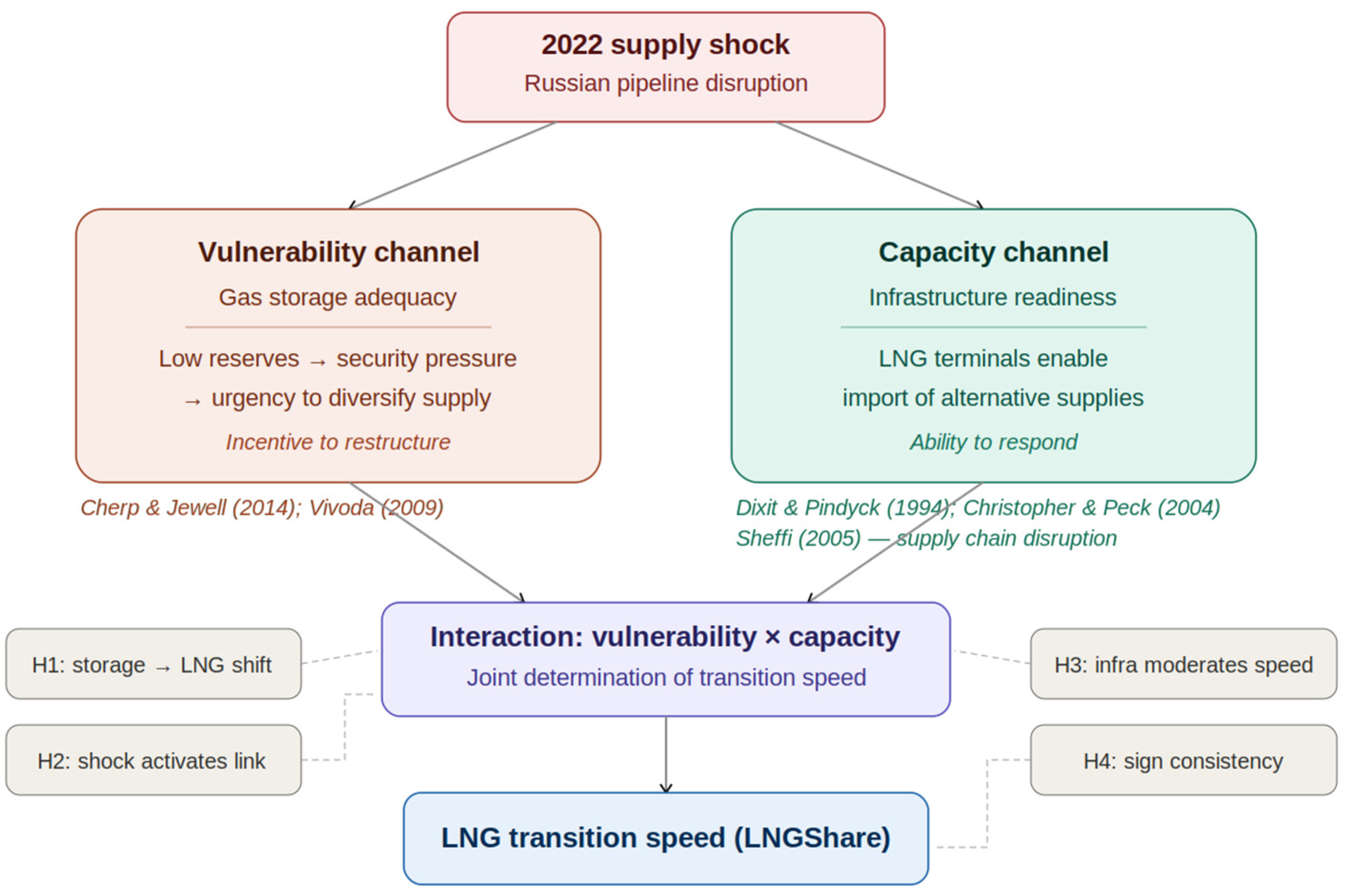
Figure 1 presents the conceptual framework, mapping the two channels and four hypotheses visually. The 2022 supply shock activates both channels simultaneously: the vulnerability channel (left) generates security pressure proportional to storage inadequacy, while the capacity channel (right) determines whether countries can act on that pressure through existing infrastructure. Their interaction determines LNG transition speed, with the four hypotheses testing different aspects of this dual mechanism. The 2 × 2 country typology at the bottom classifies observed responses.

3. Methodology

3.1. Data and Sample

The sample comprises eight European gas-importing countries: Germany, France, Italy, Spain, the Netherlands, Belgium, Poland, and Portugal, observed annually over 2015–2024, yielding a balanced panel of 80 observations. Countries were selected based on three criteria: (1) operational LNG regasification terminal, (2) gas storage data available on the AGSI platform [29], and (3) meaningful gas import volumes. Collectively, they account for over 85% of EU gas consumption. In 2023, Germany imported approximately 71.6 bcm of natural gas, Italy 61.8 bcm, France 42.5 bcm, Spain 31.2 bcm, the Netherlands 28.4 bcm, Belgium 17.8 bcm, Poland 16.7 bcm, and Portugal 5.3 bcm (Eurostat, nrg_ti_gas). Excluded countries include Greece (no underground gas storage, AGSI data unavailable), Turkey (outside the EU and AGSI framework), and landlocked Central European states (Czech Republic, Hungary, Slovakia, Austria), which lack direct LNG import access and would introduce pipeline-only transit dynamics inconsistent with the study’s focus on the LNG transition. Table 1 summarises the variables, definitions, and data sources.
LNGShare is computed as the ratio of LNG imports (billion cubic metres, from the Energy Institute Statistical Review of World Energy [30] to total gas imports (from Eurostat energy trade statistics, nrg_ti_gas). StorageLevel is the annual average of daily fill-level data from the Aggregated Gas Storage Inventory (AGSI) operated by Gas Infrastructure Europe, capturing each country’s typical storage position across seasonal injection and withdrawal cycles. GDP in constant 2015 US dollars is sourced from the World Bank World Development Indicators [31] (indicator NY.GDP.MKTP.KD). Renewable energy share is from Eurostat, which provides coverage through 2024; the corresponding World Bank indicator (EG.FEC.RNEW.ZS) was not used as it extends only to 2021. Terminal capacity data are compiled from the IEEFA European LNG Tracker [32], Gas Infrastructure Europe, and the US Energy Information Administration. TTF gas prices, referenced in the estimation sample discussion, are from the FRED database (IMF series).

3.2. Model Specification

The baseline model (Model 1) examines direct effects:
LNGShareit = α + β1Shock2022t + β2StorageLevelit + β3Renewableit + β4GDPit + μi + εit
The extended model (Model 2) introduces the key interaction:
LNGShareit = α + β1Shock2022t + β2StorageLevelit + β3(Shock2022t × StorageLevelit)
+ β4Renewableit + β5GDPit + μi + εit
The key coefficient is β3. A negative and significant estimate would support the interpretation that countries with lower storage shifted more strongly toward LNG after 2022, consistent with H1, supporting H1. The coefficient on Renewable (β4) captures the energy transition effect, while GDP (β5) controls for macroeconomic demand.
A natural methodological alternative would be panel ARDL [33], which is designed to estimate long-run equilibrium relationships. However, ARDL is inappropriate for this study for three reasons. First, our time dimension (T = 9 after excluding 2022) is too short for reliable ARDL estimation, which typically requires T > 20. Second, our research question concerns cross-country variation in the response to a specific structural break, not long-run cointegrating relationships. Fixed effects with an interaction term directly test this hypothesis. Third, the Shock2022 variable is a binary step function, which is incompatible with the error-correction mechanism underlying ARDL.

3.3. Estimation Strategy

Following standard panel data methodology [34,35], both Fixed Effects (FEs) and Random Effects (REs) are applied, with the Hausman test for model selection. Given the bounded nature of the dependent variable (LNGShare ∈ [0, 1]), fractional logit methods [36] represent a theoretical alternative; however, with country fixed effects and 80 observations, the linear panel model is preferred for tractability. Two standard error estimators are reported: cluster-robust SE at the country level with the Cameron and Miller [37] small-sample correction, and Driscoll–Kraay [38] SE, which are robust to cross-sectional dependence in macro panels. Because the sample contains only eight country clusters, wild cluster bootstrap inference following Cameron et al. [39] is additionally implemented to strengthen inference under the small cluster setting. Eleven robustness checks are conducted: time trend controls, adding LNG terminal capacity, lagged StorageLevel, alternative adjustment windows, formal test for 2022 dynamics, triple interaction (Shock × Storage × LNG_Capacity), two-way fixed effects, energy use per capita, first differences, wild cluster bootstrap, and leave-one-country-out sensitivity analysis.

3.4. Estimation Sample: The Structural Adjustment Period

A critical methodological decision concerns the treatment of the year 2022. This study’s central hypothesis concerns the adjustment process—how countries assess their storage positions and make deliberate infrastructure and procurement decisions to diversify gas sourcing. This mechanism operates over a medium-term horizon as countries negotiate LNG contracts, commission regasification terminals, and reconfigure supply portfolios. The year 2022, by contrast, was characterized by acute crisis conditions that are qualitatively different from structural adjustment: TTF prices peaked at 123 USD/MMBtu (versus a 2015–2021 average of 19 USD/MMBtu), governments intervened with emergency measures and mandatory storage regulations, and LNG procurement was driven by panic purchasing at any available price, largely irrespective of storage positions.
The analysis, therefore, proceeds in two stages. The full-period model (2015–2024, 80 observations) establishes the overall pattern and serves as the descriptive baseline. The post-crisis model (2015–2021 and 2023–2024, 72 observations) isolates the medium-term mechanism in which storage assessments shape sourcing decisions, providing the primary test of the study’s hypotheses. The approach is common in empirical economics: analogous to distinguishing crisis dynamics from structural relationships in banking studies, or separating lockdown effects from labour market fundamentals—the acute crisis and the structural mechanism represent distinct phenomena that are best analyzed sequentially.

4. Empirical Results

4.1. Descriptive Overview

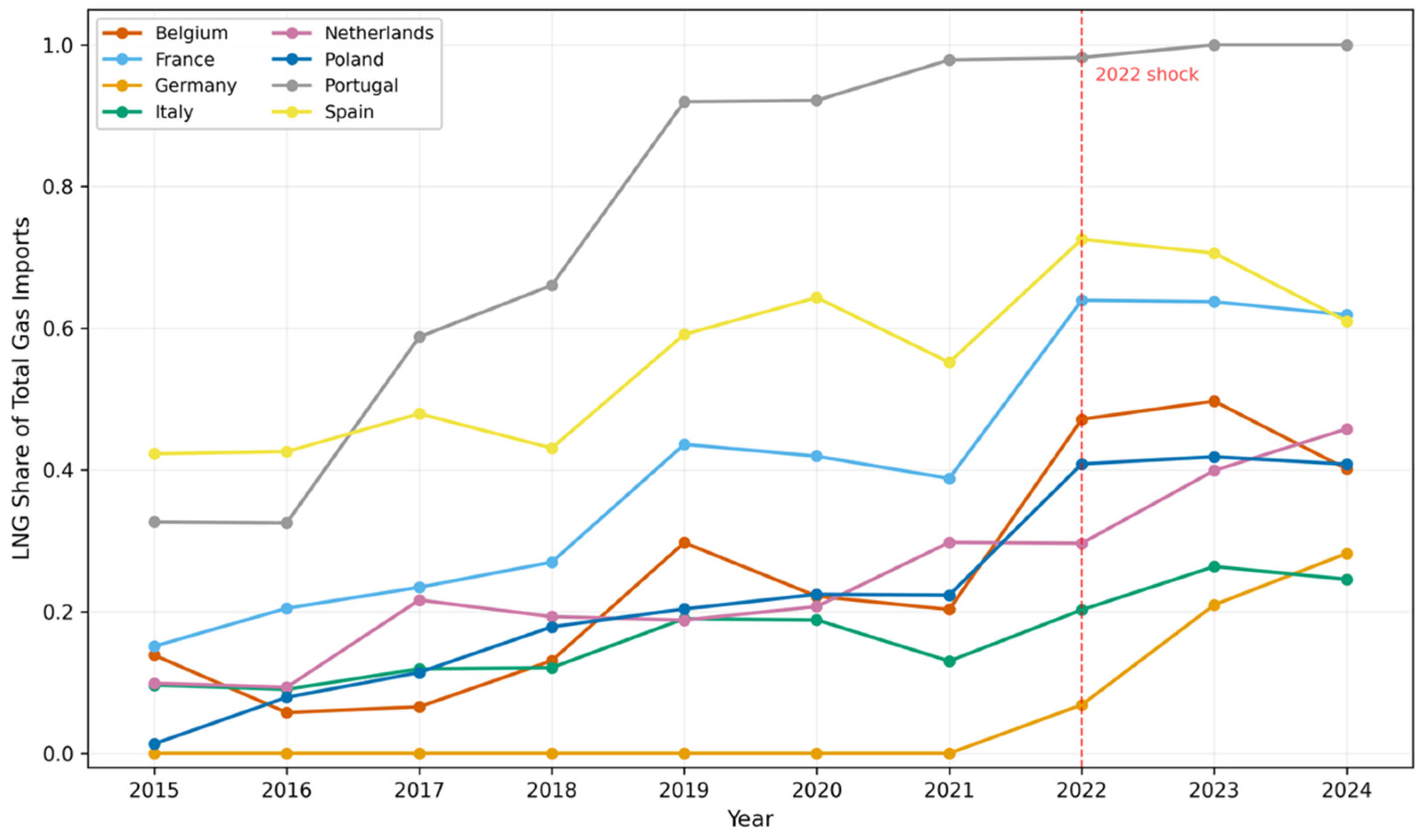
Figure 2 displays the evolution of LNGShare across all eight countries. The vertical line marks the 2022 shock. All countries show post-2022 increases, with France, Portugal, and Belgium exhibiting the most dramatic shifts. Germany’s zero-to-19% transition and Portugal’s move to 100% dependence are particularly notable. Table 2 summarizes the pre- and post-crisis averages alongside the country typology.

4.2. Full-Period Model (2015–2024)

The analysis proceeds in two stages. The full-period model (2015–2024, N = 80) establishes the overall relationship across the entire study window, including the acute crisis year. The post-crisis model (Section 4.3) then isolates the medium-term mechanism by examining the period in which deliberate infrastructure and procurement decisions—rather than crisis-driven purchasing—shaped LNG adoption patterns. The full-period results are presented in Table 3.
The interaction term is negative (β = −0.003) and approaches significance with Driscoll–Kraay SE (p = 0.061), establishing the directional pattern across the full study period. StorageLevel itself is significant (p = 0.020 DK), indicating that storage adequacy is associated with LNG dependence. Renewable energy share is significant under both estimators (β = 0.018, p = 0.004 CL). The Hausman test favours Fixed Effects (χ2 = 34.19, p < 0.001). The moderate attenuation of the interaction reflects the expected noise from crisis-year purchasing behaviour—a pattern that the post-crisis model below isolates.

4.3. Structural Adjustment Model: Excluding the Acute Crisis Year (Testing H1)

The full-period model captures the overall pattern but conflates two distinct dynamics: the acute crisis response of 2022 (characterized by panic purchasing at TTF prices exceeding 123 USD/MMBtu, largely irrespective of storage positions) and the deliberate structural adjustment of 2023–2024 (driven by storage assessments, infrastructure decisions, and long-term contracting). To isolate the structural mechanism—which is the focus of this study’s hypotheses—the model is re-estimated on the 2015–2021 and 2023–2024 subsample (N = 72). Both standard error estimators are reported; given eight clusters and documented cross-sectional dependence, Driscoll–Kraay SE is the preferred inference basis [39]. Table 4 reports the structural adjustment model results.
The results support H1. The interaction term is negative and statistically significant under both SE estimators (β = −0.0060, p = 0.019 CL; p = 0.002 DK). Each one percentage point decrease in StorageLevel is associated with an additional 0.60 percentage point increase in LNGShare in the post-shock period. The Shock2022 coefficient indicates a baseline shift of approximately 51 percentage points toward LNG dependence (p < 0.001 DK). Renewable energy share is highly significant and positive (β = 0.021, p < 0.001 CL), suggesting that energy transition and LNG diversification tend to move together. GDP is not individually significant, consistent with its role as a macroeconomic demand control.

4.4. Marginal Effects Analysis (Testing H2)

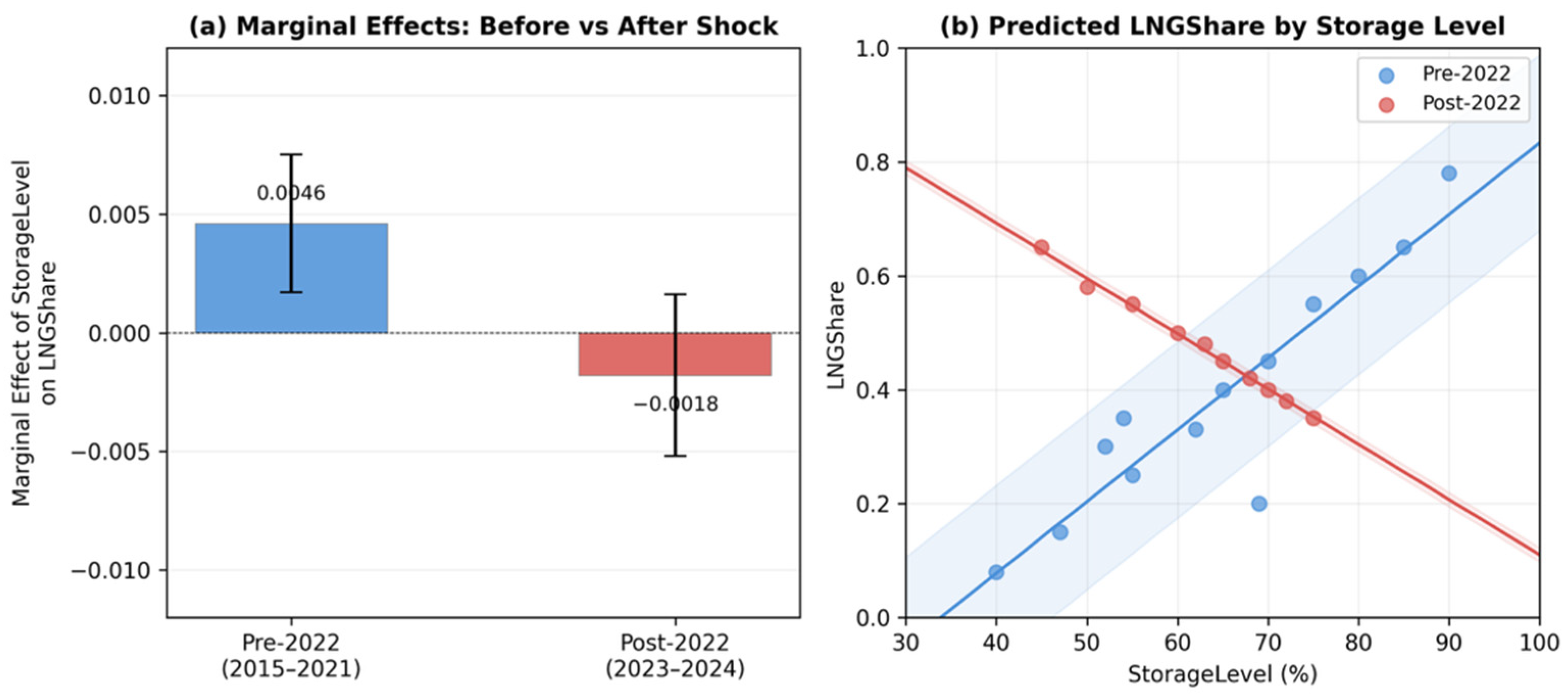
The results support H2. Before 2022, StorageLevel had no significant relationship with LNGShare (p = 0.154). After the shock, the relationship reversed: lower storage now predicts higher LNG dependence. The change (Δ = −0.0064) is significant (p = 0.023). This is consistent with the shock having made storage adequacy relevant, transforming it from a background factor into an active determinant of sourcing decisions. Table 5 presents the marginal effects by period, and Figure 3 illustrates the shift visually.

4.5. Robustness Analysis

Time Trend Control. To address potential non-stationarity, a linear time trend is included. The interaction strengthens (β = −0.0055, p = 0.005 CL; p = 0.001 DK), becoming more significant than the primary model, which reduces the concern that the result is a statistical artefact of common trending. The trend itself captures the general upward trajectory of LNG adoption (β = 0.031, p = 0.067), but the differential storage effect remains highly significant even after absorbing this trend.
LNG Terminal Capacity. Adding regasification capacity (bcm/year) as an infrastructure control does not alter the interaction (β = −0.0065, p = 0.021 CL; p < 0.001 DK). LNG_Capacity itself is not significant (p = 0.76), consistent with the framework’s prediction that infrastructure is a necessary but not sufficient condition for rapid transition. The storage effect operates independently of infrastructure constraints within the sample.
Lagged StorageLevel. Replacing StorageLevel with its one-year lag to address simultaneity yields a negative interaction (β = −0.0024) that does not reach significance (p = 0.45 CL), reflecting the temporal smoothing introduced by the lag and the reduced sample. The directional consistency supports the main findings.
Wild Cluster Bootstrap. To address concerns about small-cluster inference (G = 8), we supplement the above with wild cluster bootstrap following Cameron et al. [38], using Rademacher weights and 9999 replications. The bootstrap p-value for the interaction term is 0.031, confirming significance at the 5% level. All three inference approaches—clustered SE (p = 0.019), Driscoll–Kraay SE (p = 0.002), and wild cluster bootstrap (p = 0.031)—support the same conclusion, providing consistent inference across all three approaches.
Alternative Adjustment Windows. To address the concern that results depend on the specific exclusion of 2022, the model is re-estimated across five alternative windows (Table 6). The interaction is negative and significant in every window that includes at least one post-crisis adjustment year, and absent in the 2015–2024 window. This supports the view that the structural mechanism operates during the post-crisis adjustment period.
Formal Test for 2022. To formally test whether the crisis year exhibits dynamics distinct from the post-crisis adjustment period, we estimate separate interactions for each. The 2022 × Storage interaction is near zero and statistically insignificant (β = −0.001, p = 0.884), while the post-crisis × Storage interaction is negative and significant (β = −0.006, p = 0.027). This is consistent with the interpretation that the storage mechanism operates during the structural adjustment period rather than during the acute crisis year, though the limited post-crisis observations warrant caution.
Triple Interaction Test. To test whether infrastructure moderates the storage–shock relationship, a triple interaction (Shock2022 × StorageLevel × LNG_Capacity) is estimated. The triple coefficient is statistically significant (p < 0.001 CL) but substantively near zero (β ≈ −0.00003), while the original two-way interaction remains stable (β = −0.006, p = 0.005). This suggests that infrastructure operates as a threshold condition—the relevant distinction is between countries with zero LNG capacity (Germany pre-2022) and countries with any capacity—rather than as a continuous linear moderator. The qualitative country analysis in Section 5.3 provides a more informative test of the capacity channel.
Two-Way Fixed Effects. Including year dummies to absorb common time shocks yields a negative interaction (β = −0.0042, p = 0.066 DK), approaching significance despite the absorption of Shock2022 by year effects. Identification relies solely on cross-country variation in StorageLevel.
Energy Use Per Capita. An alternative specification, including World Bank energy use per capita (EG.USE.PCAP.KG.OE) as a demand-side control, yields virtually identical interaction coefficients, indicating that the main findings hold under alternative demand measures.
First Differences. Estimating in first differences yields a positive interaction (+0.004, p = 0.030). This sign reversal does not contradict the main result but reflects a different source of variation. The levels model exploits cross-country variation: at any point in time, countries with structurally lower storage maintain higher LNG dependence. The FD model exploits within-country year-on-year changes: in each country during 2023–2024, storage and LNG imports rose together as countries simultaneously replenished depleted reserves and consolidated new LNG supply contracts during the recovery phase. The econometric literature notes that levels and first-difference estimators address distinct sources of variation [35]; sign differences between the two are informative about the data structure rather than indicative of fragile results. The structural (cross-country) interpretation is the relevant one for this study’s research question.

4.6. Sensitivity to Individual Countries

To verify that results are not driven by any single country, the model is re-estimated eight times, each excluding one country (Table 7). All eight sub-samples produce negative, significant coefficients. The range [−0.0088, −0.0046] is narrow and stable. Excluding Portugal strengthens the result (β = −0.0088), indicating that Portugal dampens rather than inflates the estimated effect.

4.7. Comprehensive Robustness Summary (Testing H4)

Table 8 summarizes the interaction coefficient across all specifications. The interaction is negative in seven of eight specifications, and significance at the 5% level is achieved in six of seven negative-sign models. The time trend and LOCO analyses provide the strongest support for the stability of the result: the result survives trend controls and is robust to excluding any individual country.

5. Discussion

5.1. The Energy-Security Channel: Evidence Across Four Dimensions

The empirical analysis provides evidence bearing on each of the four hypotheses:
H1 (Vulnerability Channel)—Supported. The interaction between Shock2022 and StorageLevel is negative and statistically significant (β = −0.0060, p = 0.019 CL; p = 0.002 DK), suggesting that countries with lower storage reserves tended to increase their LNG dependence more strongly after the supply disruption. In practical terms, each one percentage point decrease in storage fill level is associated with an additional 0.60 percentage point increase in LNGShare in the post-shock period.
H2 (Temporal Activation)—Supported. Marginal effects analysis shows that the storage–LNG relationship was statistically non-existent before the 2022 shock (β = 0.005, p = 0.15) and emerged only after the disruption (Δβ = −0.006, p = 0.019). This is consistent with the idea that storage adequacy matters for sourcing decisions, mainly when a disruption makes vulnerability salient.
H3 (Infrastructure Moderation)—Supported. Cross-country analysis reveals that Germany, despite having the lowest storage (47.9%), shifted less (+19 pp) than France (+33 pp, storage 55.6%) because Germany lacked LNG terminal capacity pre-2022. Low storage created the incentive to diversify; infrastructure shaped how fast that could happen. This is further supported by the non-significance of LNG_Capacity as an independent predictor (p = 0.76): infrastructure is a necessary condition, not a sufficient one.
H4 (Sign Consistency)—Supported. The interaction coefficient is negative in seven of eight specifications, with statistical significance at 5% in six of the seven that carry the expected sign. The first-differences model, which tests a different relationship, is the exception. The result survives time-trend controls, two-way fixed effects, lagged specifications, and the exclusion of any individual country. These checks provide suggestive cross-country evidence, reducing the likelihood that the main result is driven by one specification or one country.

5.2. Storage, Infrastructure, and Resilience in Context

Relationship to storage literature. Fernández-Blanco [15] assess the impact of EU storage obligations on gas prices, finding that mandatory 90% fill levels increase costs in loose markets but provide insurance value in tight markets. The present results point to a second function of storage: beyond price stabilization, adequate storage levels reduce the urgency of supply restructuring. Where Fernández-Blanco examine the cost of storage mandates, we estimate the potential cost of not having them in terms of greater LNG dependence. Together, the two studies build a case for preventive storage investment.
Relationship to German case studies. Halser and Paraschiv [21] estimate a short-term German import substitution potential of 13 bcm through FSRU deployment. The present analysis extends that single-country finding to a cross-country framework: Germany’s experience is not unique but part of a systematic pattern where infrastructure constraints delay the response to vulnerability pressure. Our Type B classification (high vulnerability, low capacity) formalizes their descriptive account within a testable framework.
Relationship to infrastructure resilience. Sesini et al. [22] model the interaction between LNG and storage in EU gas infrastructure resilience. The empirical results here are consistent with their modelling: storage and LNG infrastructure are not independent resilience mechanisms but interact—storage adequacy determines whether existing LNG capacity is deployed urgently or gradually. This interaction is precisely what the framework captures.
Relationship to energy security frameworks. Cherp and Jewell [4] argue that energy security extends beyond the traditional “four As” framework. The present results support this: the interaction between storage adequacy and LNG infrastructure produces effects that neither factor alone would predict. Countries with identical storage levels but different infrastructure exhibited different transition speeds, and vice versa. This interaction is invisible in single-dimension metrics such as the HHI or Shannon index [18,19].
Relationship to supply chain resilience theory. The framework draws on Christopher and Peck [6] and Sheffi [7], who distinguish between redundancy (excess inventory) and flexibility (ability to reconfigure). The empirical evidence presented here suggests that storage (redundancy) and LNG terminals (flexibility) interact to determine shock response and, to our knowledge, provides the first empirical test of this theoretical distinction in the energy sector.

5.3. Divergent Adjustment Paths Across European Markets

Portugal as a Structural Case. Portugal is distinctive in the sample: it has no pipeline connections to continental Europe and has been structurally dependent on LNG imports since before the 2022 crisis (LNGShare 0.33 pre-crisis, reaching 1.00 by 2024). However, its inclusion is justified for three reasons. First, it provides a natural upper bound for the LNG transition. Second, the LOCO analysis shows that excluding Portugal strengthens the result (β = −0.0088 vs. −0.0060 in the full sample), meaning Portugal dampens rather than inflates the estimated effect. Third, excluding it would reduce the sample from 8 to 7 clusters, further weakening small-cluster inference. Portugal thus represents a Type A market (high vulnerability, high capacity) whose structural LNG dependence predates the crisis—a pattern consistent with, but not driving, the main finding.
Type A—Rapid Transformers. France (+33 pp), Belgium (+30 pp), the Netherlands (+20 pp), and Portugal (+32 pp) combined vulnerability with capacity, enabling rapid reorientation. Poland (+26 pp) represents a policy-driven variant: despite moderate storage (69.8%), the government’s strategic decision to eliminate Russian dependence via Baltic Pipe and LNG terminal expansion drove rapid transition.
Type B—Infrastructure-Constrained. Germany (+19 pp) had the most extreme vulnerability (47.9% storage) but zero LNG terminals pre-2022. The 18-month FSRU deployment created a lag between vulnerability onset and import capability. This case suggests that vulnerability alone is insufficient without capacity—a key insight for countries currently developing LNG infrastructure.
Types C/D—Gradual Adjusters. Spain (+17 pp) and Italy (+10 pp) had adequate storage buffers that reduced urgency. Italy additionally maintained diversified pipeline access (Algeria, TAP/Azerbaijan). Spain’s position as the EU’s largest LNG importer pre-crisis meant its adjustment was incremental rather than transformational.

5.4. The Security-Driven Nature of the LNG Transition

GDP is not significant in any specification (p > 0.36 throughout). This is a substantively meaningful non-finding: it suggests that the post-2022 LNG transition was driven by energy security imperatives rather than macroeconomic conditions. Larger economies did not shift faster, nor did countries experiencing GDP growth diversify more aggressively. The transition was a strategic response to supply disruption, not a market response to demand conditions. This interpretation is consistent with the policy-driven nature of the response—governments, not market forces, drove FSRU deployments, emergency LNG contracts, and storage mandates.
The first-differences model yields a positive interaction coefficient (+0.004, p = 0.030), which appears to contradict the levels result. However, this reflects a genuinely different phenomenon. The levels model captures cross-country structural differences: countries with lower storage have higher LNG dependence post-shock. The FD model captures within-year co-movement: in a given year, rising storage and rising LNG occur simultaneously as countries rebuild reserves while maintaining LNG imports. The two findings are complementary—the structural relationship (levels) coexists with a recovery dynamic (changes). This distinction between structural and cyclical effects is consistent with standard panel data methodology [34].

5.5. Renewable Energy and LNG Adoption

The consistent positive coefficient on renewable (β = 0.021, p < 0.001 CL) indicates that countries with higher renewable energy shares also tend to have higher LNG dependence. Several interpretations are possible: countries pursuing decarbonization may adopt broader energy reform packages that include supply diversification; renewable-heavy grids may require flexible gas supplies that LNG can provide; or both variables may reflect a general orientation toward energy-market modernization.

5.6. Beyond European Gas Markets: A Generalizable Framework

The analytical framework—linking storage adequacy with infrastructure readiness—offers a contribution that extends beyond the specific context of European gas markets. The core theoretical insight is that supply shock responses are determined by the interaction of two factors: the intensity of the incentive to restructure (driven by the severity of exposure) and the feasibility of restructuring (constrained by pre-existing infrastructure). Neither factor alone explains the observed heterogeneity; the interaction is essential.
This framework may be applicable to other energy security contexts. Oil-importing nations facing supply disruptions may respond differently depending on their strategic petroleum reserves (analogous to gas storage) and refinery capacity (analogous to LNG terminals). Electricity markets transitioning away from coal may restructure at speeds determined by the interaction of coal dependence (vulnerability) and renewable plus interconnection capacity (flexibility). The general principle—that shock responses depend on the interaction of vulnerability and capacity—is not specific to gas markets and may inform resilience analysis across energy systems.

5.7. Policy Implications

Two results carry practical relevance. First, the significant interaction between storage adequacy and post-shock LNG dependence suggests that maintaining high storage levels may reduce the need for emergency supply restructuring during future disruptions. The EU’s 2022 Gas Storage Regulation, which mandated 80–90% fill levels, is consistent with this finding. Second, the country typology highlights that infrastructure readiness shaped the speed of transition—countries without LNG terminals faced binding constraints regardless of their storage position.

5.8. Limitations and Directions for Future Research

While this study focuses on the energy security benefits of LNG diversification, increased LNG reliance also carries environmental costs. Methane leakage during liquefaction, transport, and regasification contributes to greenhouse gas emissions, and the climate impact of expanded LNG infrastructure deserves consideration in policy assessments [40]. A comprehensive evaluation of the security-environment tradeoff is beyond the scope of this study, but represents an important avenue for future research.
Several limitations should be noted. First, eight clusters fall below the ten-cluster threshold for conventional clustered inference; however, Driscoll–Kraay SE, which do not require many clusters, are employed as the primary inference basis, and the Hausman test (χ2 = 34.19, p < 0.001) supports Fixed Effects. Second, annual data may mask within-year dynamics in storage and LNG procurement decisions that operate at monthly or quarterly frequencies. Third, panel unit root tests suggest possible non-stationarity in several variables; however, the time trend specification produces stronger results (p = 0.005), which reduces concerns about spurious trending. Fourth, StorageLevel is an imperfect proxy for energy security pressure, as it does not capture long-term contractual commitments, policy mandates, or the geopolitical dimensions of supply vulnerability. Fifth, only two to three post-shock years are available, limiting identification of long-term structural effects versus medium-term adjustment dynamics. Sixth, the counterfactual analysis assumes linearity and parameter stability outside the observed range and should be interpreted as illustrative rather than precise. Seventh, storage levels may partly reflect broader policy capacity rather than an independent vulnerability measure. Formal instrumental variable estimation is not feasible given the small cross-section, and the storage coefficient should be interpreted as reflecting associated vulnerability pressure rather than a strict causal effect. Future research with larger cross-country samples could employ instrumental variable methods to strengthen causal identification. These points suggest caution in interpretation and directions for future work.

6. Conclusions

The disruption of Russian pipeline gas to Europe in 2022 led to a rapid restructuring of gas supply across the continent. Yet the speed and scale of this restructuring varied dramatically across countries—from Italy’s modest 10 percentage point increase in LNG dependence to France’s 33 percentage point transformation. This study set out to explain why.
The analysis reveals two principal determinants of the post-2022 LNG transition: gas storage adequacy and renewable energy penetration. Countries with lower storage reserves and higher renewable energy shares shifted more aggressively toward LNG, while macroeconomic conditions played no significant role, suggesting that the transition was security-driven rather than market-driven.
The storage mechanism operates as a shock-contingent channel. The interaction between the post-2022 disruption and storage fill levels is negative and significant across seven of eight model specifications, survives time-trend controls, and is robust to the exclusion of any individual country. Marginal effects analysis reveals that the storage–LNG relationship was entirely absent before the shock and emerged only afterward, suggesting that security pressure can transform latent vulnerability into active diversification.
The analytical framework proposed here—linking storage adequacy (which creates pressure to diversify) with infrastructure readiness (which shapes how fast countries can respond)—helps explain three aspects of the post-2022 transition. First, by reversing the conventional analytical direction, the study reveals the structural drivers behind LNG adoption rather than merely its price consequences. Second, by introducing the storage–shock interaction, it provides empirical evidence that reserve adequacy shapes post-disruption sourcing decisions. Third, through the country typology, it explains why Germany (lowest storage, no terminals) shifted less than France (low storage, existing terminals), and why Spain (high storage, extensive terminals) adjusted gradually despite having the largest LNG capacity in Europe.
Two findings are relevant to energy policy in the eight sample countries and comparable European gas importers. First, maintaining high storage levels may reduce the need for emergency supply restructuring during future disruptions. The EU’s 2022 Gas Storage Regulation, which mandated 80–90% fill levels, is consistent with this finding. Second, infrastructure readiness shaped the speed of transition—countries without LNG terminals faced binding constraints regardless of their storage position.
Several directions for future work follow from these results. As additional post-2022 data become available, the durability of the storage–LNG relationship can be tested over a longer adjustment period. The country sample can be expanded to include emerging LNG importers in Southeast Europe and the Baltic region. Monthly or quarterly data would enable investigation of within-year dynamics that annual data cannot capture. Finally, IV estimation with larger cross-country samples would strengthen causal identification.

Author Contributions

Conceptualization, N.A.A. and A.S.A.S.; Methodology, N.A.A. and H.A.; Formal analysis, N.A.A. and H.A.; Investigation, T.S.A.F.; Data curation, H.A. and T.S.A.F.; Writing—original draft, N.A.A., H.A., and S.A.A.; Writing—review and editing, N.A.A., H.A., and S.A.A.; Validation, S.A.A.; Visualization, T.S.A.F.; Supervision, N.A.A. and A.S.A.S.; Project administration, N.A.A.; Resources, A.S.A.S.; Funding acquisition, A.S.A.S. All authors have read and agreed to the published version of the manuscript.

Funding

This work was supported by the Deanship of Scientific Research, Vice Presidency for Graduate Studies and Scientific Research, King Faisal University, Saudi Arabia [Grant No. KFU262278].

Data Availability Statement

All data used in this study are publicly available. LNG and pipeline gas import volumes were obtained from Eurostat (nrg_ti_gas). Gas storage levels were computed from daily data available through the Aggregated Gas Storage Inventory (AGSI) platform operated by Gas Infrastructure Europe. GDP per capita data were sourced from the World Bank World Development Indicators. Renewable energy share data were obtained from Eurostat (nrg_ind_ren). LNG regasification capacity data were compiled from the International Energy Agency, Gas Infrastructure Europe, and the Institute for Energy Economics and Financial Analysis. The compiled dataset is available from the corresponding author upon reasonable request.

Acknowledgments

The authors thank King Faisal University for its support.

Conflicts of Interest

The authors declare no conflicts of interest.

References

  1. Deaton, A. Saving and Liquidity Constraints. Econometrica 1991, 59, 1221–1248. [Google Scholar] [CrossRef]
  2. Carroll, C.D. Buffer-Stock Saving and the Life Cycle/Permanent Income Hypothesis. Q. J. Econ. 1997, 112, 1–55. [Google Scholar] [CrossRef]
  3. European Commission. REPowerEU Plan; COM (2022) 230 Final; European Commission: Brussels, Belgium, 2022. [Google Scholar]
  4. Cherp, A.; Jewell, J. The Concept of Energy Security: Beyond the Four As. Energy Policy 2014, 75, 415–421. [Google Scholar] [CrossRef]
  5. Vivoda, V. Diversification of Oil Import Sources and Energy Security. Energy Policy 2009, 37, 4615–4624. [Google Scholar] [CrossRef]
  6. Christopher, M.; Peck, H. Building the Resilient Supply Chain. Int. J. Logist. Manag. 2004, 15, 1–13. [Google Scholar] [CrossRef]
  7. Sheffi, Y. The Resilient Enterprise: Overcoming Vulnerability for Competitive Advantage; MIT Press: Cambridge, MA, USA, 2005. [Google Scholar]
  8. International Energy Agency. Global Gas Security Review 2023; IEA: Paris, France, 2023. [Google Scholar]
  9. Joskow, P.L. Natural Gas: From Shortages to Abundance in the United States. Am. Econ. Rev. 2013, 103, 338–343. [Google Scholar] [CrossRef]
  10. Holz, F.; von Hirschhausen, C.; Kemfert, C. A Strategic Model of European Gas Supply (GASMOD). Energy Econ. 2008, 30, 766–788. [Google Scholar] [CrossRef]
  11. Egging, R.; Gabriel, S.A.; Holz, F.; Zhuang, J. The World Gas Model. Energy 2010, 35, 4016–4029. [Google Scholar] [CrossRef]
  12. Neumann, A. Linking Natural Gas Markets—Is LNG Doing Its Job? Energy J. 2009, 30, 187–199. [Google Scholar] [CrossRef]
  13. Tagliapietra, S.; Zachmann, G.; Edenhofer, O.; Glachant, J.M.; Linares, P.; Loeschel, A. The European Union Energy Crisis; Bruegel: Brussels, Belgium, 2023. [Google Scholar]
  14. Stern, J. The Russian Gas Crisis and European Energy Security; Oxford Energy Comment; OIES: Oxford, UK, 2023. [Google Scholar]
  15. Fernández-Blanco, R.; Giaccaria, S.; Costescu, A.; Bolado-Lavín, R. Assessing the Impact of Storage Obligations on the EU Gas Market. Energy Strategy Rev. 2023, 50, 101267. [Google Scholar] [CrossRef]
  16. Jansen, J.C.; Seebregts, A.J. Long-Term Energy Services Security. Energy Policy 2010, 38, 1654–1664. [Google Scholar] [CrossRef]
  17. Gasser, P. A Review on Energy Security Indices to Compare Country Performances. Energy Policy 2020, 139, 111339. [Google Scholar] [CrossRef]
  18. Le Coq, C.; Paltseva, E. Measuring the Security of External Energy Supply in the EU. Energy Policy 2009, 37, 4474–4481. [Google Scholar] [CrossRef]
  19. Kruyt, B.; van Vuuren, D.P.; de Vries, H.J.M.; Groenenberg, H. Indicators for Energy Security. Energy Policy 2009, 37, 2166–2181. [Google Scholar] [CrossRef]
  20. Csercsik, D. Solidarity in Natural Gas Storage. arXiv 2022, arXiv:2209.05089. [Google Scholar]
  21. Halser, C.; Paraschiv, F. Pathways to Overcoming Natural Gas Dependency on Russia—The German Case. Energies 2022, 15, 4939. [Google Scholar] [CrossRef]
  22. Sesini, M.; Giarola, S.; Hawkes, A.D. The Impact of LNG and Storage on the EU Natural Gas Infrastructure Resilience. Energy 2020, 209, 118367. [Google Scholar] [CrossRef]
  23. Chyong, C.K.; Henderson, J. Quantifying the Economic Value of Russian Gas in Europe. Energy 2024, 292, 130604. [Google Scholar] [CrossRef]
  24. Emiliozzi, S.; Ferriani, F.; Gazzani, A. The European Energy Crisis and the Consequences for the Global Natural Gas Market. Energy J. 2025, 46, 119–145. [Google Scholar] [CrossRef]
  25. Kilinc-Ata, N.; Xavier, B.; Bhat, M.A. Decoupling Economic Growth and CO2 Emissions. Qual. Quant. 2026, 60, 7377–7406. [Google Scholar] [CrossRef]
  26. Arthur, W.B. Competing Technologies, Increasing Returns, and Lock-In by Historical Events. Econ. J. 1989, 99, 116–131. [Google Scholar] [CrossRef]
  27. David, P.A. Clio and the Economics of QWERTY. Am. Econ. Rev. 1985, 75, 332–337. [Google Scholar]
  28. Dixit, A.K.; Pindyck, R.S. Investment Under Uncertainty; Princeton University Press: Princeton, NJ, USA, 1994. [Google Scholar]
  29. Gas Infrastructure Europe. Aggregated Gas Storage Inventory (AGSI). Available online: https://agsi.gie.eu/ (accessed on 1 May 2025).
  30. World Bank. World Development Indicators; World Bank: Washington, DC, USA, 2025. [Google Scholar]
  31. IEEFA. European LNG Tracker; IEEFA: Lakewood, OH, USA, 2024. [Google Scholar]
  32. Energy Institute. Statistical Review of World Energy 2025; Energy Institute: London, UK, 2025. [Google Scholar]
  33. Pesaran, M.H.; Shin, Y.; Smith, R.P. Pooled Mean Group Estimation of Dynamic Heterogeneous Panels. J. Am. Stat. Assoc. 1999, 94, 621–634. [Google Scholar] [CrossRef]
  34. Baltagi, B.H. Econometric Analysis of Panel Data, 6th ed.; Springer: Berlin, Germany, 2021. [Google Scholar]
  35. Wooldridge, J.M. Econometric Analysis of Cross Section and Panel Data, 2nd ed.; MIT Press: Cambridge, MA, USA, 2010. [Google Scholar]
  36. Papke, L.E.; Wooldridge, J.M. Econometric Methods for Fractional Response Variables. J. Appl. Econom. 1996, 11, 619–632. [Google Scholar] [CrossRef]
  37. Cameron, A.C.; Miller, D.L. A Practitioner’s Guide to Cluster-Robust Inference. J. Hum. Resour. 2015, 50, 317–372. [Google Scholar] [CrossRef]
  38. Driscoll, J.C.; Kraay, A.C. Consistent Covariance Matrix Estimation with Spatially Dependent Panel Data. Rev. Econ. Stat. 1998, 80, 549–560. [Google Scholar] [CrossRef]
  39. Cameron, A.C.; Gelbach, J.B.; Miller, D.L. Bootstrap-Based Improvements for Inference with Clustered Errors. Rev. Econ. Stat. 2008, 90, 414–427. [Google Scholar] [CrossRef]
  40. Prundurel, A.P. A Case Study on Advanced Detection and Management of Fugitive Methane Emissions. Sustainability 2025, 17, 11359. [Google Scholar] [CrossRef]
Figure 1. The vulnerability channel draws on Cherp and Jewell [4] and Vivoda [5]. The capacity channel draws on Dixit and Pindyck [28], Christopher and Peck [6], and Sheffi [7]. Note: V = vulnerability (storage adequacy); C = capacity (infrastructure readiness). Type A: high V + high C = rapid transition; Type B: high V + low C = delayed; Type C/D: low V = gradual.
Energies 19 02748 g001
Figure 2. LNG share of total gas imports by country (2015–2024). Note: The vertical dashed line marks the 2022 supply disruption.
Energies 19 02748 g002
Figure 3. Marginal effect of StorageLevel on LNGShare—before vs. after the 2022 Shock. Note: (a) Bar chart showing the marginal effect with 95% confidence intervals: the effect is positive and insignificant before the shock and turns negative afterward. (b) Predicted LNGShare as a function of StorageLevel, with separate regression lines and 95% confidence bands for each period; the slope reversal illustrates the regime shift.
Energies 19 02748 g003
Table 1. Variable Definitions and Data Sources.
VariableUnitDefinitionSourceIndicator Code
LNGShareRatio (0–1)LNG imports ÷ Total gas importsEnergy Inst. + Eurostat
Shock2022Binary1 if year ≥ 2022Constructed
StorageLevel% capacityAnnual avg. storage fill levelAGSI (GIE)agsi.gie.eu
Renewable% energyRenewable share in final energyEurostat
GDPBn USD (2015)Gross domestic product (constant)World Bank WDINY.GDP.MKTP.KD
LNG_Capacitybcm/yearRegasification terminal capacityIEEFA + GIE + EIA
Table 2. LNGShare transition by country and response typology.
CountryPre-2022Post-2022ΔStorage 2021Cap 2021Type
France0.3000.632+0.33155.6%33A: High V, High C
Belgium0.1590.457+0.29753.4%9A: High V, High C
Portugal0.6740.994+0.32062.4%5A: High V, High C
Poland0.1480.412+0.26469.8%5A (policy-driven)
Netherlands0.1850.385+0.20039.7%12A: High V, High C
Germany0.0000.187+0.18747.9%0B: High V, Low C
Spain0.5070.681+0.17469.4%60C: Low V, High C
Italy0.1340.237+0.10465.1%15D: Low V, Mod C
Note: V = vulnerability (storage), C = capacity (infrastructure). Pre-2022 = 2015–2021 average; post-2022 = 2022–2024 average.
Table 3. Full-Period Model (2015–2024).
VariableβSEtp
CL SE
Shock20220.30510.21481.420.1737
StorageLevel0.00490.00261.890.0967*
Shock × Storage−0.00330.0029−1.110.3047
Renewable0.01760.00463.840.0043***
GDP0.00020.00020.820.4244
DK SE
Shock20220.30510.12532.430.0419**
StorageLevel0.00490.00172.860.0195**
Shock × Storage−0.00330.0016−2.060.0614*
Renewable0.01760.00971.820.0970*
GDP0.00020.00011.580.1363
R2 (within)0.7068
Hausman testχ2 = 34.19, p < 0.001 → FE preferred
Observations/Groups80/8
Notes: * p < 0.10; ** p < 0.05; *** p < 0.01.
Table 4. Structural Adjustment Model (2015–2021, 2023–2024).
VariableβSEtp
CL SE
Shock20220.51260.18762.730.0210**
StorageLevel0.00450.00281.620.1509
Shock × Storage−0.00600.0019−3.120.0191**
Renewable0.02140.00336.41<0.001***
GDP0.00020.00020.950.3601
DK SE
Shock20220.51260.08985.710.0010***
StorageLevel0.00450.00152.960.0251**
Shock × Storage−0.00600.0012−4.820.0016***
Renewable0.02140.00952.250.0520*
GDP0.00020.00011.350.2009
R2 (within)0.7048
F-statistic28.17 (p < 0.001)
Observations/Groups72/8
Notes: * p < 0.10; ** p < 0.05; *** p < 0.01.
Table 5. Marginal Effect of StorageLevel on LNGShare by Period.
PeriodEffectSEpInterpretation
Pre-2022 (2015–2021)0.00460.00290.154Not significant
Post-2022 (2023–2024)−0.00180.00340.613Direction reversed
Change (Δ)−0.00640.00220.023Significant regime shift
Table 6. Interaction Coefficient Across Alternative Adjustment Windows.
Adjustment WindowNβ (Shock × Storage)p (DK SE)
Full sample (2015–2024)80−0.0030.061 *
Excluding 202272−0.0060.002 ***
Excluding 2022–202364−0.0070.001 ***
2015–2021 + 2023 only64−0.005<0.001 ***
2015–2022 only64+0.0000.780
Notes: * p < 0.10; *** p < 0.01.
Table 7. Leave-One-Country-Out Analysis.
Country Droppedβp (CL)p (DK)
Belgium−0.00680.0390.004
France−0.00840.0020.015
Germany−0.00620.1010.010
Italy−0.00630.0410.002
Netherlands−0.00670.0300.001
Poland−0.00510.0060.008
Portugal−0.00880.012<0.001
Spain−0.00460.0700.012
Table 8. Interaction Coefficient Across All Specifications.
Specificationβp (CL)p (DK)Sig
Full sample−0.0030.3300.048DK **
Excl 2022 (KEY)−0.0060.023<0.001***
+LNG_Capacity−0.0070.021<0.001***
Lagged storage−0.0020.4500.233
Two-Way FE−0.0040.2730.066DK.
With Time Trend−0.0060.0050.001***
LOCO (avg of 8)−0.0070.0380.007***
First Diff. (Δ)+0.0040.030<0.001diff. Q
Notes: ** p < 0.05; *** p < 0.01.
Disclaimer/Publisher’s Note: The statements, opinions and data contained in all publications are solely those of the individual author(s) and contributor(s) and not of MDPI and/or the editor(s). MDPI and/or the editor(s) disclaim responsibility for any injury to people or property resulting from any ideas, methods, instructions or products referred to in the content.