Cost-Optimal Decarbonization Pathways for Data Centers in Japan: A Bottom-Up Model Integrating Location, Energy Systems, and Carbon Pricing



Abstract
1. Introduction
Research Objectives and Academic Contributions
- RQ1.
- Under Japan’s NDC trajectory and the GX-ETS carbon price schedule, what is the cost-optimal mix of cooling technologies, regional siting, and renewable energy procurement that achieves the 2040 ICT carbon-neutrality target?
- RQ2.
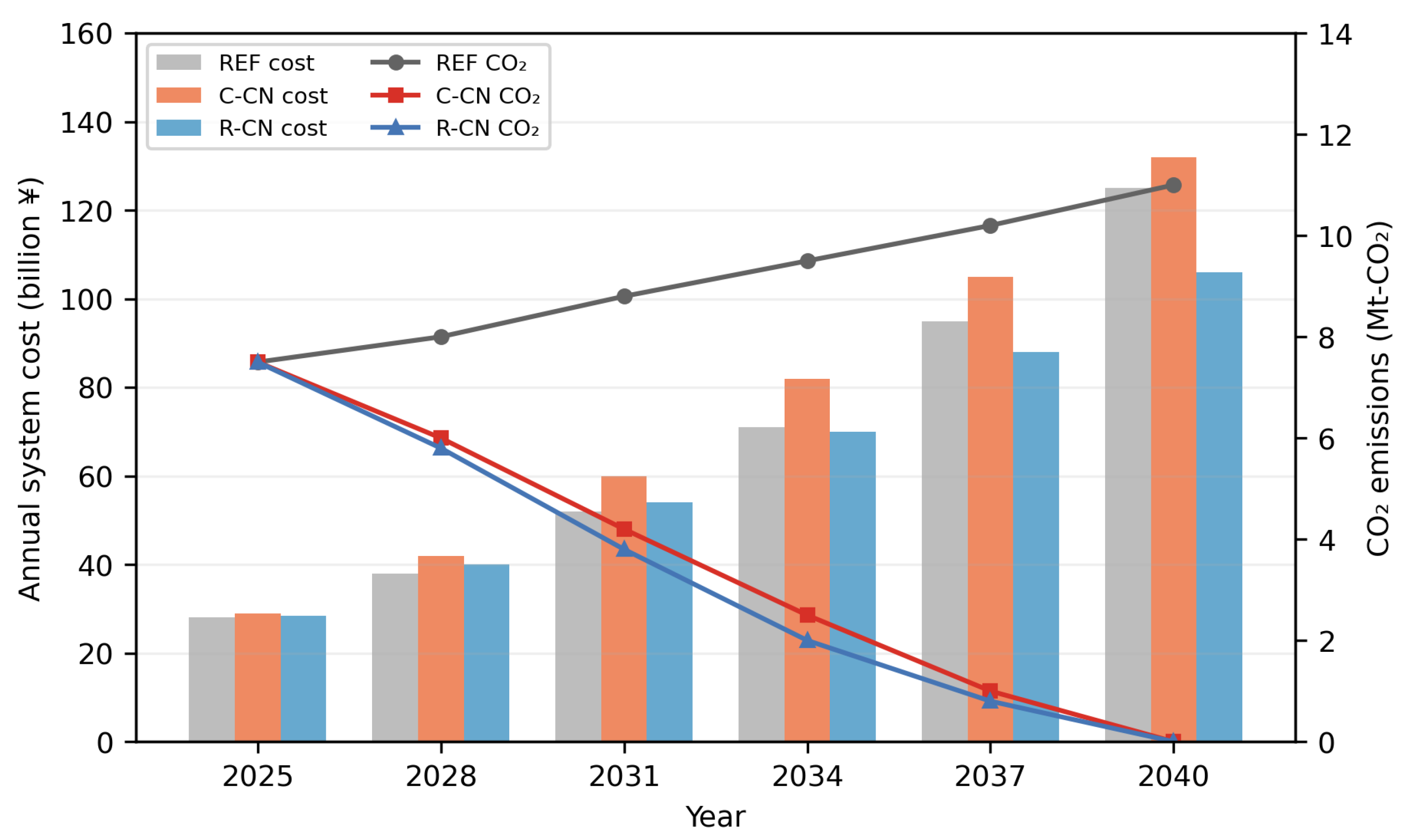
- How large is the system-cost advantage of geographic decentralization (R-CN) over a metropolitan-concentrated decarbonization strategy (C-CN) under identical carbon constraints, and through which channels (cooling efficiency, renewable energy access, grid carbon intensity) does this advantage arise?
- RQ3.
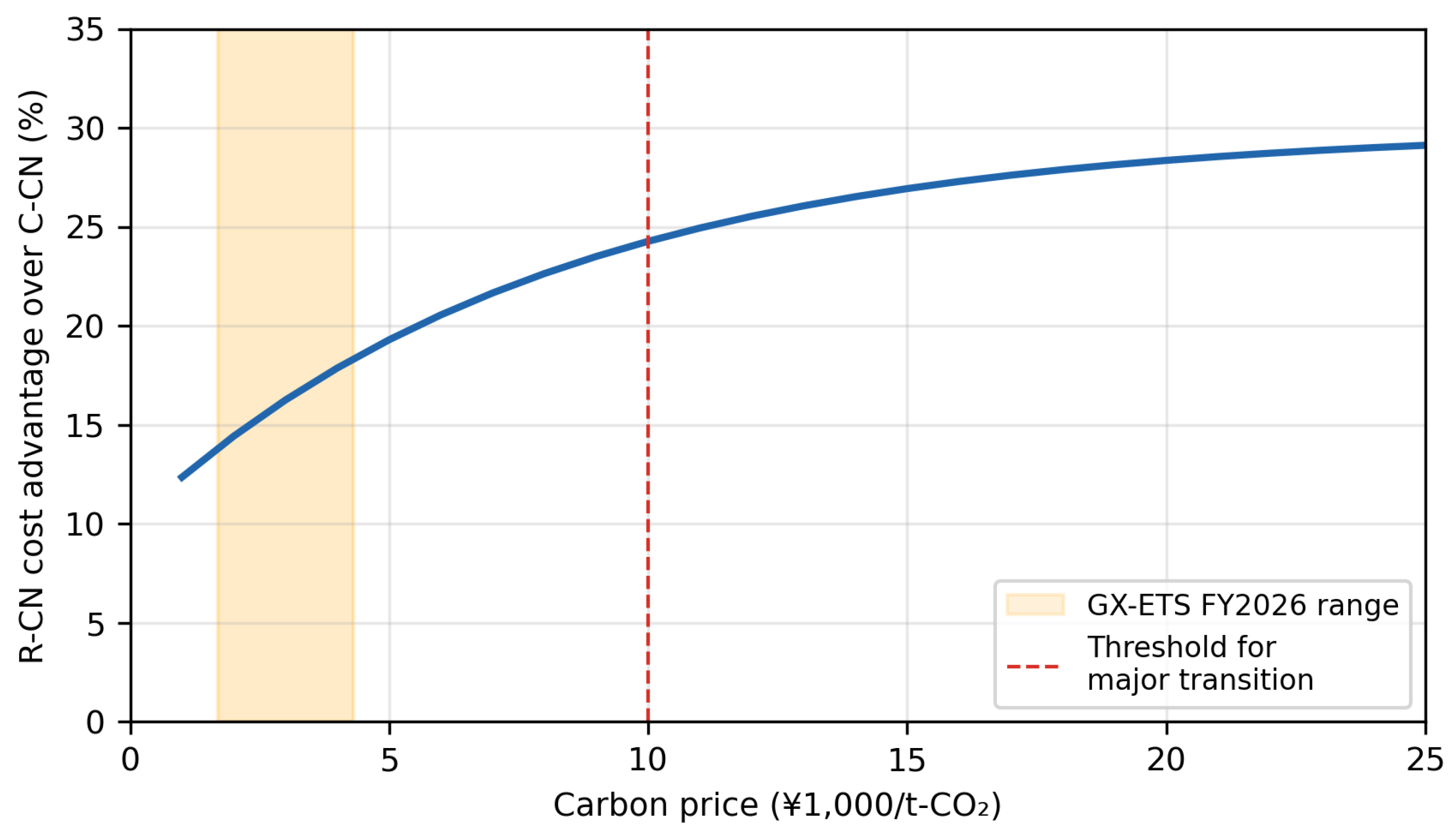
- What carbon-price threshold is required to make the cost-optimal decarbonization investments economically self-justifying for private-sector decision-makers, relative to the current GX-ETS price band?
- RQ4.
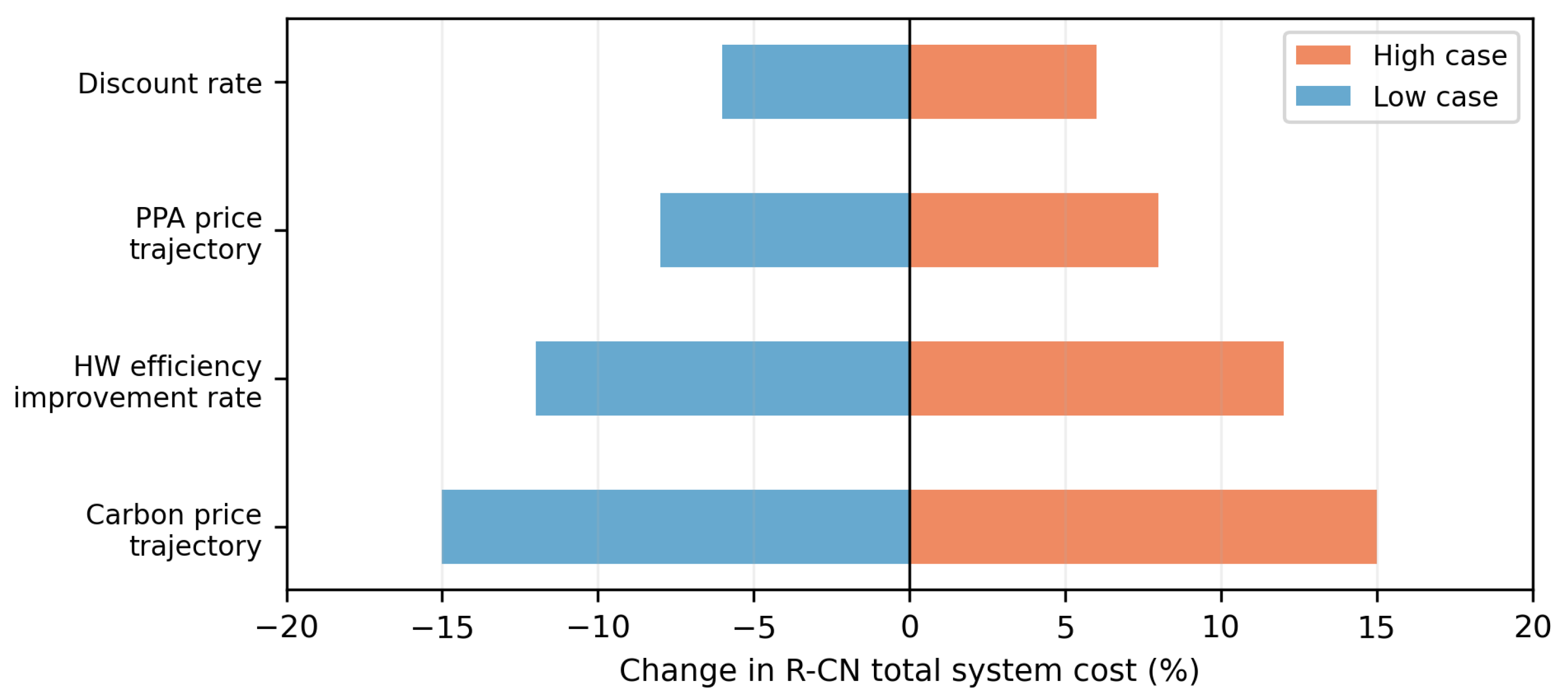
- How robust are the answers to RQ1–RQ3 to plausible variations in AI demand growth, hardware efficiency trajectory, PPA prices, and discount rate?
- Endogenous dynamic PUE: PUE is explicitly modeled as a function of ambient temperature and cooling technology, calibrated against published empirical data. This allows for the geographic cooling advantage of cold-climate regions to be quantified in cost terms.
- Integrated cost optimization: Technology investment (cooling, BESS, cogeneration), energy procurement (grid, PPA, on-site PV), and carbon cost (GX-ETS) are integrated within a single cost-minimization framework, enabling endogenous co-optimization of these interdependent decisions.
- Quantitative comparison of siting strategies: Centralized (C-CN) and decentralized (R-CN) siting strategies are compared under identical carbon constraints on both cost and emissions dimensions, providing the first quantitative assessment of geographic arbitrage in Japan’s data center context.
2. Policy and Technology Context
2.1. Japan’s Data Center Policy Framework
2.2. Carbon Pricing and the GX-ETS
2.3. Cooling Technology Landscape
2.4. Regional Energy Characteristics
3. Materials and Methods
3.1. Information Base
3.2. Model Structure and Rationale
3.3. Objective Function
3.4. Demand Module
3.5. Thermodynamic Cooling Module
3.6. Technology Portfolio and Cost Assumptions
3.7. Carbon Flow Module
3.8. Constraints
3.9. Scenario Design
3.10. Model Implementation
3.11. Data Preprocessing and Numerical Parameters
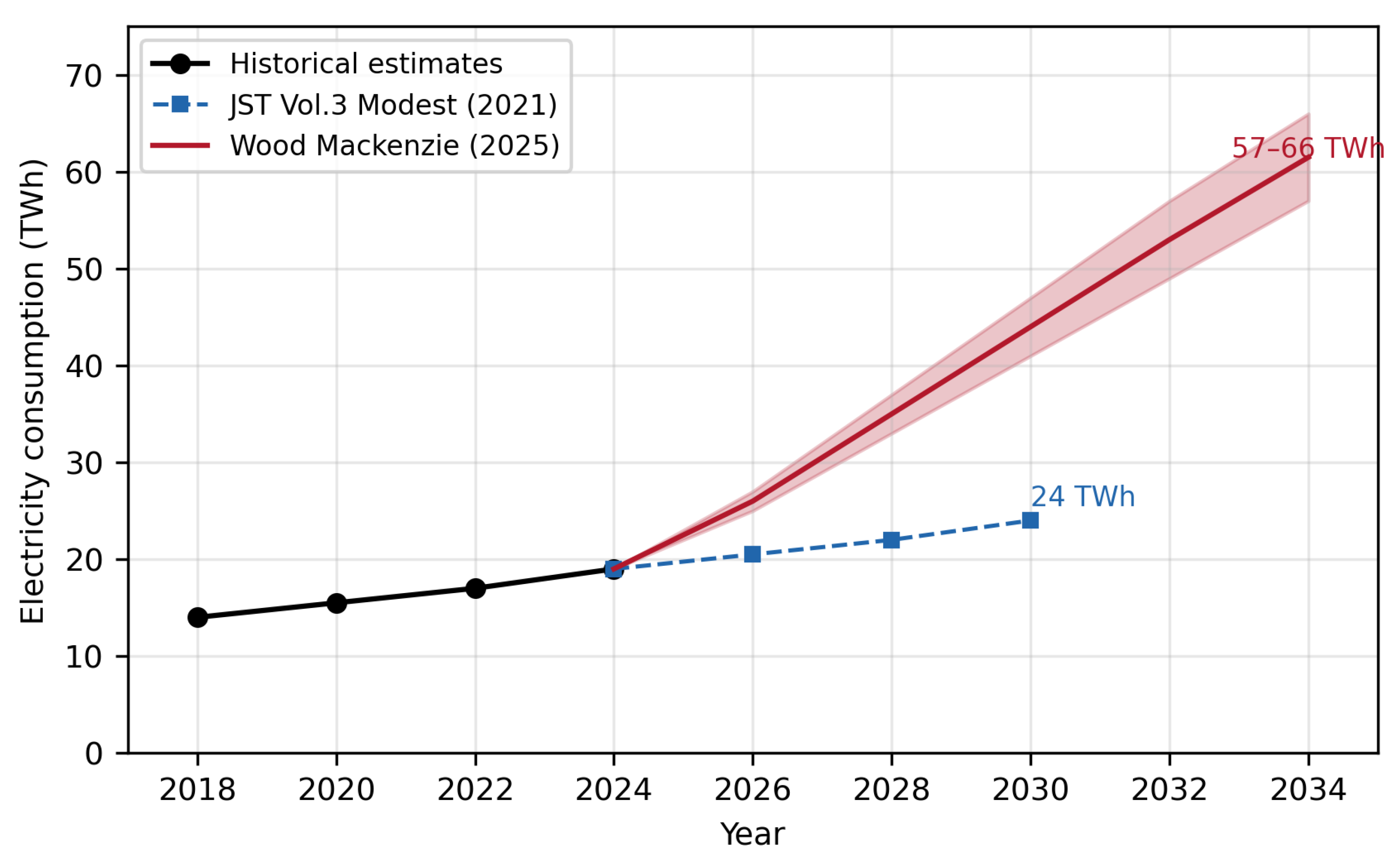
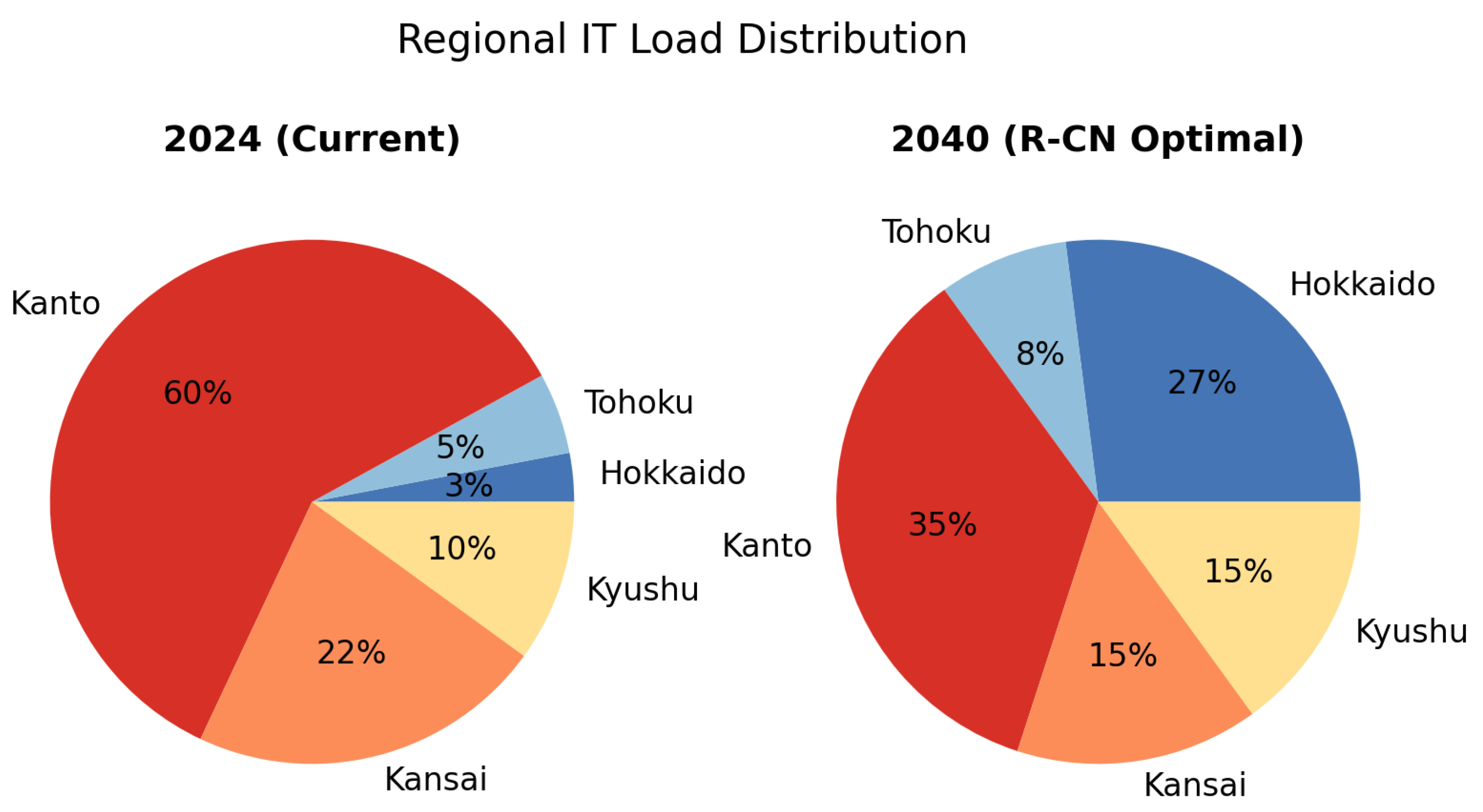
- Regional load disaggregation. The national 2024 IT load of 19 TWh [3] is allocated to the five regions in proportion to the existing data center capacity shares reported in MIC White Papers [10,12] (Hokkaido 3%, Tohoku 5%, Kanto 60%, Kansai 22%, Kyushu 10%), yielding regional base loads of TWh. Subsequent demand growth follows Equation (7) and is allocated using the same shares for REF and C-CN, while R-CN allocates the new growth via the optimization.
- Hourly profile generation. Hourly temperature observations (2020–2023) at the JMA stations of Sapporo, Sendai, Tokyo, Osaka, and Fukuoka are reduced to 96 representative hours per region (24 h × four seasons: DJF, MAM, JJA, SON) by computing the seasonal-diurnal mean. Each representative hour carries a weight equal to the number of actual hours it represents.
- Time-varying parameter interpolation. The grid emission factor declines linearly from the FY2022 base value [59] to the 7th Strategic Energy Plan target [62] (40–50% renewable share by 2040). The carbon price is piecewise-linear: ¥1700–4300/t-CO2 for FY2026 [17], escalating linearly to the MRI mid-2030s forecast (¥7000–15,000/t-CO2) [50]. Hardware-efficiency improvement compounds at 30%/yr (CPU) and 50%/yr (GPU) following JST Vol. 3 estimates [7].
- Currency normalization. All monetary values are expressed in 2024 constant yen; nominal values from cited sources are deflated by the IMF Japan CPI index. The social discount rate (Section 3.10) is applied to NPV computation.
4. Optimization Simulation Results
4.1. Demand Projections
4.2. Total System Cost and Emissions
4.3. Decomposition of Emission Reductions by Measure
4.4. Technology Portfolio Evolution
4.5. Geographic Load Redistribution
4.6. Sensitivity Analysis
5. Discussion
5.1. Robustness of Findings
- Sign-stability: The R-CN advantage remains strictly positive across all parameter variations reported in Figure 7. No single parameter excursion within the documented uncertainty bounds reverses the qualitative conclusion that geographic optimization reduces total system cost.
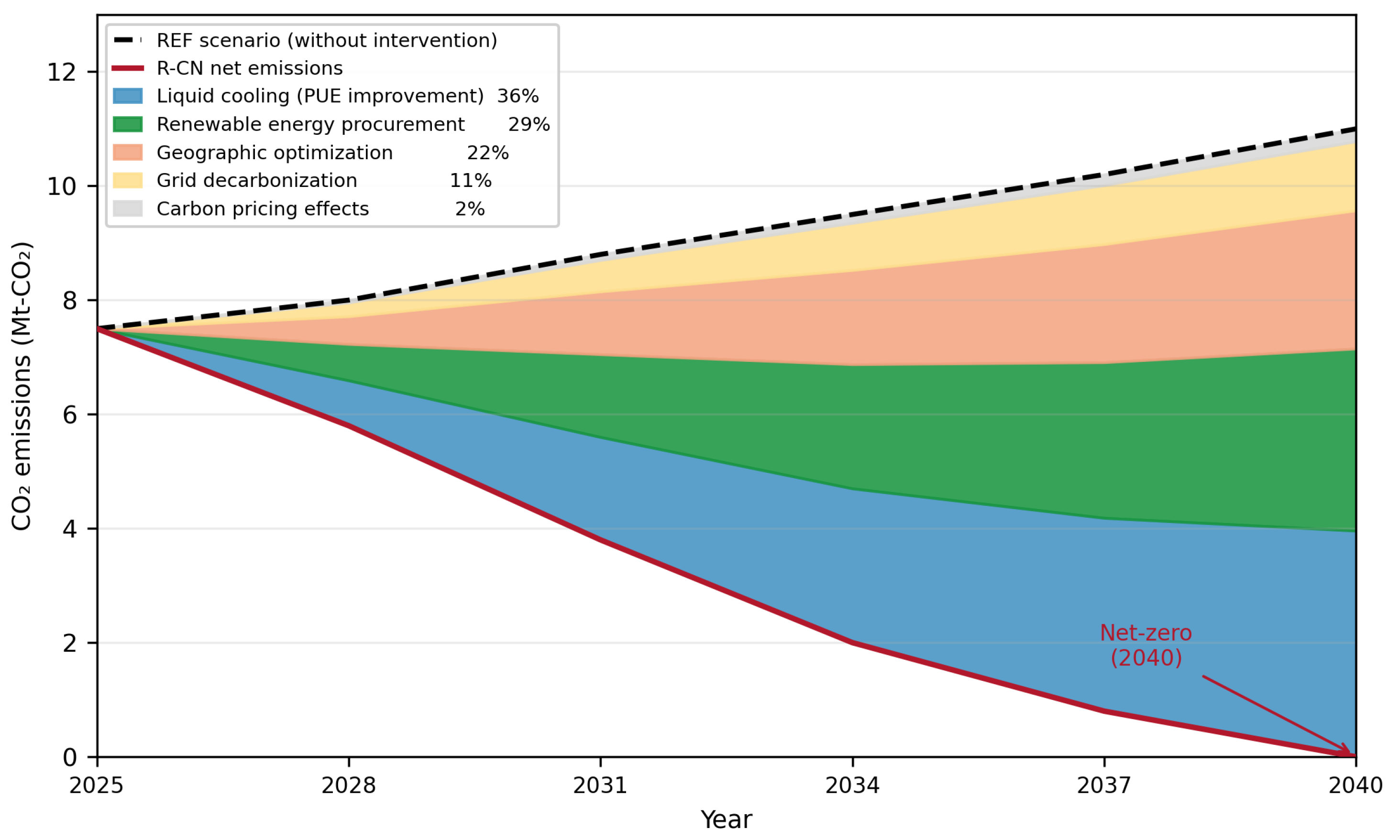
- Driver-decomposition: The advantage is decomposed into three structurally independent channels via Equation (11) (lower PUE, lower grid emission factor, higher renewable share). For the qualitative conclusion to be reversed, all three channels would have to be simultaneously and adversely mis-estimated; the multiplicative structure of the identity makes this jointly unlikely.
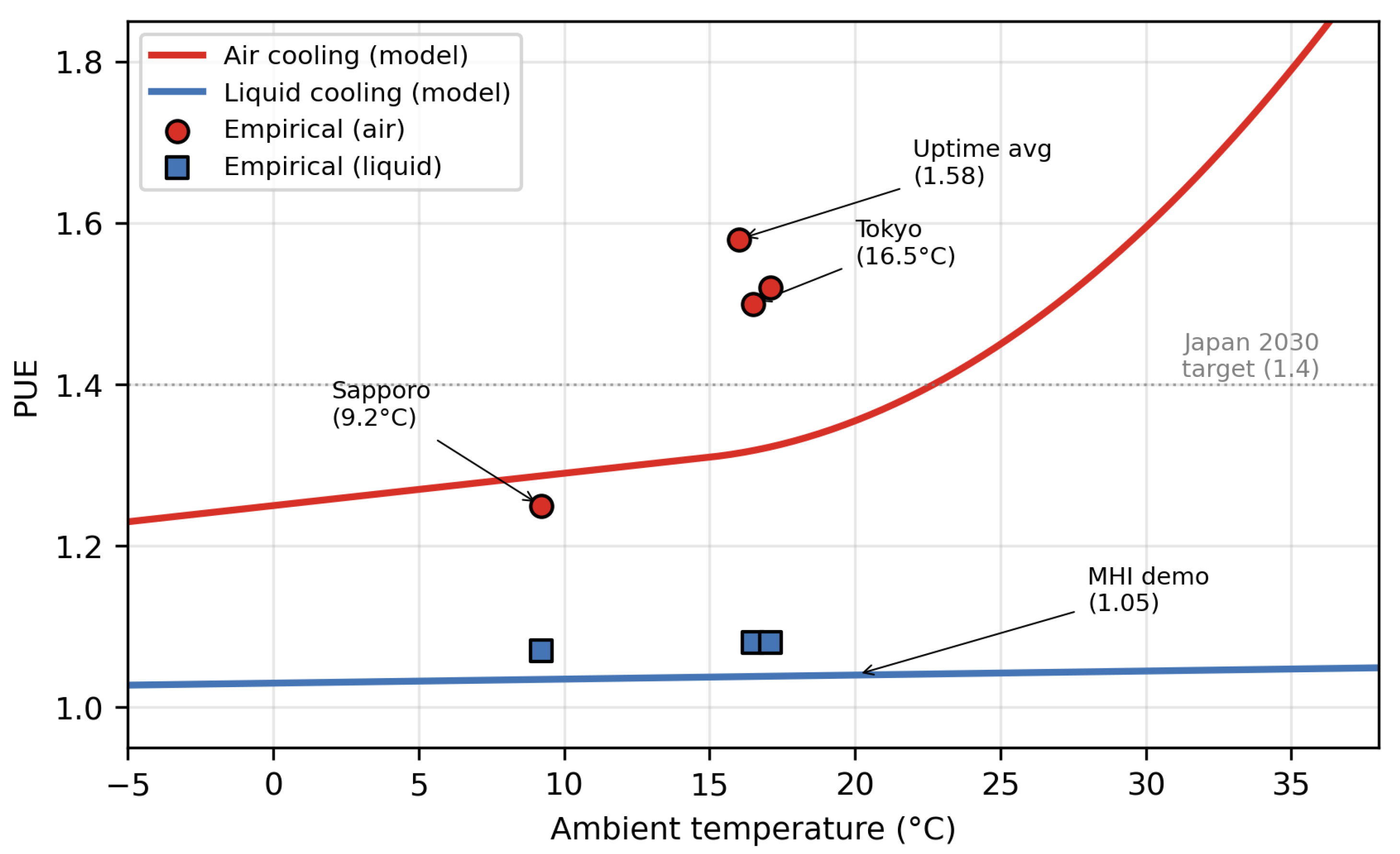
- Cross-validation against empirical PUE benchmarks: The dynamic PUE sub-model is corroborated against independent measurements from MHI [22], Haghshenas et al. [23], NTT Facilities [58], and the Uptime Institute [18] (Table 5); all five model outputs lie within the empirical range. This independent corroboration mitigates concern about overfitting on the limited five-point regression basis.
5.2. Policy Implications
- Workload-differentiated location subsidies: The 18–23% cost advantage of R-CN over C-CN, conditional on the model assumptions documented in Section 3 and Section 4, is consistent with the government’s geographic decentralization strategy [48] on economic grounds in addition to resilience grounds. The model further suggests that the cost-optimal decentralization pattern is workload-specific rather than uniform; we note, however, that workload-differentiated outcomes in DC-DECOM emerge from a binary latency-sensitive/latency-tolerant split (Section 4.5) rather than a richer workload taxonomy, so the strength of the workload-differentiation conclusion is correspondingly limited. The model results suggest that subsidies for regional data center construction would be most cost-effective if they prioritized facilities designed for latency-tolerant AI training workloads, where the geographic arbitrage is greatest. The SoftBank Tomakomai project [29] exemplifies this approach. This implies that, if the cost-optimal pathway is to be realized, policy incentives could usefully be differentiated: higher subsidy rates for AI training facilities in cold-climate, renewable-rich regions, and lower rates for general-purpose facilities that may need metropolitan proximity.
- Quantifying the carbon premium of AI infrastructure: The model quantifies the additional decarbonization cost attributable to AI-driven demand growth—the “carbon premium” of AI expansion. This directly addresses the policy tension between the Cloud Supply Security Plan [46], which subsidizes GPU deployment and thereby increases electricity demand, and the Green Growth Strategy [15], which targets ICT carbon neutrality by 2040. The JST reports [5,6,7,8,9] document the scale of this tension: without efficiency measures, IT-related electricity consumption could reach 1480 TWh by 2030 [5], far exceeding Japan’s total current electricity consumption. The carbon premium quantified by DC-DECOM can inform the allocation of AI infrastructure subsidies toward complementary renewable energy and efficiency investments, as proposed by Kobayashi et al. [74] in their analysis of carbon neutrality economics.
- Credible carbon price signals: The sensitivity of results to carbon price trajectories (Figure 8) highlights the importance of credible, predictable carbon pricing signals. The current GX-ETS price range of ¥1700–4300/t-CO2 [17] produces only a modest R-CN advantage of 12–15%. Carbon prices in the range of ¥10,000–20,000/t-CO2, consistent with the MRI forecast for the mid-2030s [50], would be required for the economic case for optimal decarbonization investments to be clear to private-sector decision-makers, conditional on the model’s other assumptions. This aligns with Green’s [52] analysis in Environmental Research Letters that low carbon prices have limited effectiveness in triggering zero-carbon investments, and with Ding’s [51] finding of heterogeneous carbon cost pass-through across Japan’s regional electricity markets.
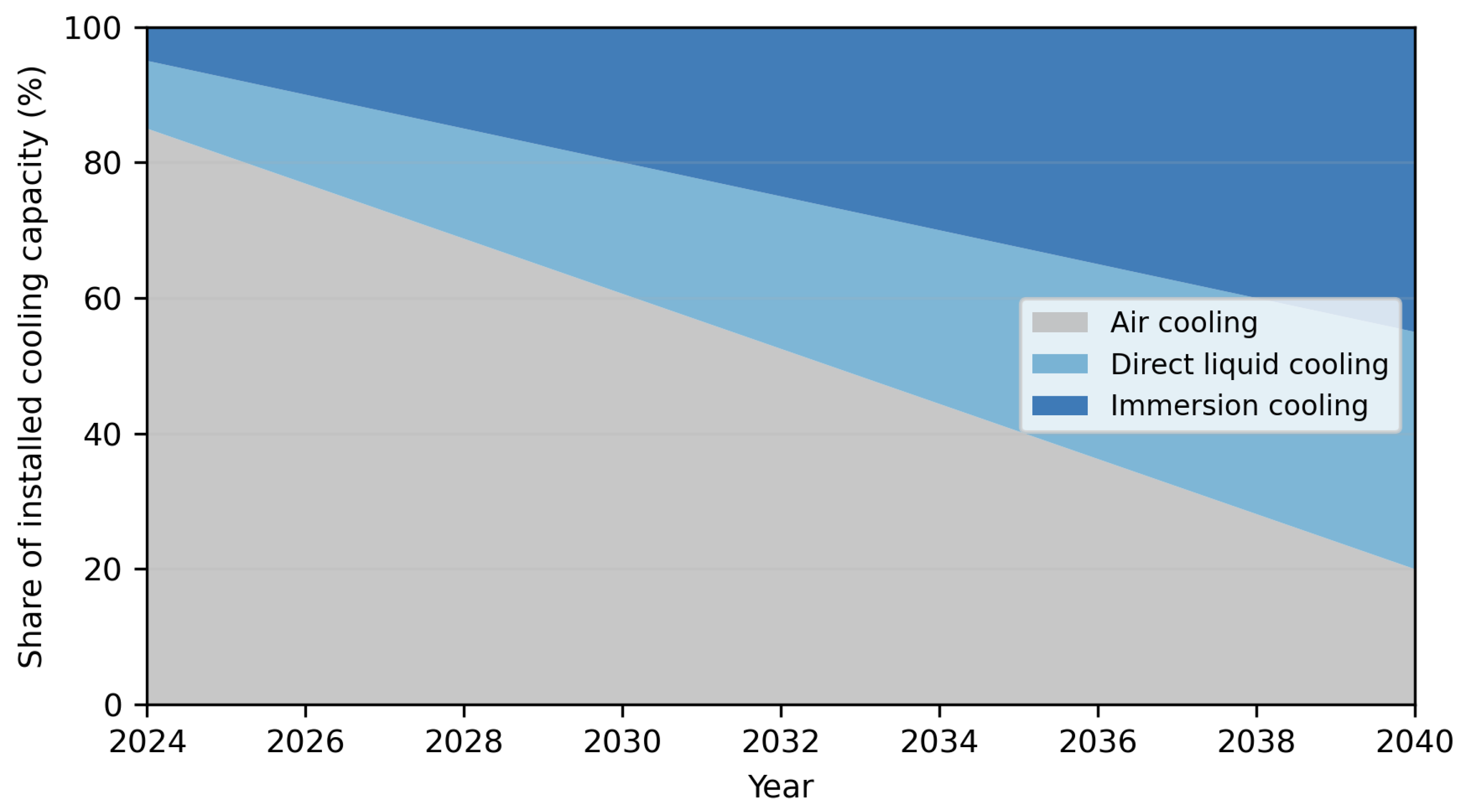
- The liquid cooling paradigm shift: The technology portfolio results (Figure 5) indicate that liquid cooling is not merely an efficiency improvement but a structural necessity for AI-era data centers. The Green Growth Strategy’s target of 30% energy efficiency improvement for new data centers by 2030 [15] and the benchmark system’s PUE target of 1.4 [20] are achievable only with widespread liquid cooling adoption. Policy support directed at accelerating liquid cooling deployment—through technology standards, workforce training, and CAPEX subsidies—is therefore likely to be more cost-effective than incremental improvements to air-cooling systems that have reached diminishing returns [18].
5.3. Model Validation
5.4. Academic Contributions and Novelty
5.5. Extensibility and Future Prospects
- Land availability and zoning. The R-CN scenario relocates approximately 25–30% of national IT load to Hokkaido and 15–20% to Kyushu by 2040. Hokkaido’s industrial-zone land is generally sufficient at this scale, but local zoning and grid-connection permitting may become binding for individual projects.
- Fiber connectivity and latency. Hokkaido–Kanto trunk lines have a one-way latency of approximately 8–10 ms, adequate for AI training and batch workloads but insufficient for sub-millisecond real-time inference; the model represents this only via the qualitative workload separation in Section 4.5.
- Skilled labor availability. Sapporo and Fukuoka have growing IT clusters but smaller talent pools than Kanto; this is a binding constraint for staffed operations and is not represented.
- Seismic and natural-disaster risk. Hokkaido is in seismic risk zone 3 (lower than Kanto/Tokai), which favors decentralization, but specific tsunami and volcanic-ash exposures are not modeled.
- Water availability. Liquid cooling reduces water use compared with evaporative cooling, but data centers remain non-trivial water consumers; regional water stress is not constrained.
- Workload categories beyond the binary latency split. The model distinguishes only “latency-sensitive” from “latency-tolerant” workloads; finer categories (regulatory data residency, sub-second inference, etc.) would require a richer workload representation.
6. Conclusions
Author Contributions
Funding
Institutional Review Board Statement
Informed Consent Statement
Data Availability Statement
Acknowledgments
Conflicts of Interest
Abbreviations
| ANRE | Agency for Natural Resources and Energy |
| BESS | Battery Energy Storage System |
| CAPEX | Capital Expenditure |
| CGS | Cogeneration System |
| DC | Data Center |
| DC-DECOM | Data Center Decarbonization Cost Optimization Model |
| DLC | Direct Liquid Cooling |
| GX-ETS | Green Transformation Emissions Trading System |
| ICT | Information and Communications Technology |
| IEA | International Energy Agency |
| JDCC | Japan Data Center Council |
| JST | Japan Science and Technology Agency |
| LCOE | Levelized Cost of Energy |
| LBNL | Lawrence Berkeley National Laboratory |
| MIC | Ministry of Internal Affairs and Communications |
| METI | Ministry of Economy, Trade and Industry |
| MOE | Ministry of the Environment |
| NDC | Nationally Determined Contribution |
| OPEX | Operational Expenditure |
| PPA | Power Purchase Agreement |
| PUE | Power Usage Effectiveness |
| PV | Photovoltaic |
| RE | Renewable Energy |
| REI | Renewable Energy Institute |
| REPOS | Renewable Energy Potential System |
| WUE | Water Usage Effectiveness |
References
- International Energy Agency. Energy and AI: World Energy Outlook Special Report; IEA: Paris, France, 2025; Available online: https://www.iea.org/reports/energy-and-ai (accessed on 1 March 2026).
- Shehabi, A.; Newkirk, A.; Smith, S.J.; Hubbard, A.; Lei, N.; Siddik, M.A.B.; Holecek, B.; Koomey, J.; Masanet, E.; Sartor, D. 2024 United States Data Center Energy Usage Report; LBNL-2024-0001; Lawrence Berkeley National Laboratory: Berkeley, CA, USA, 2024. Available online: https://eta-publications.lbl.gov/sites/default/files/2024-12/lbnl-2024-united-states-data-center-energy-usage-report.pdf (accessed on 1 March 2026).
- Wood Mackenzie. Japan Data Centers Power Demand; Wood Mackenzie: Edinburgh, UK, 2025; Available online: https://www.woodmac.com/press-releases/japan-data-centers-power-demand/ (accessed on 1 March 2026).
- Reuters. Japan Sees Rise in Power Demand on Data Centre and Chip Growth, Grid Monitor Says. Reuters. 2026. Available online: https://www.reuters.com/business/energy/japan-sees-rise-power-demand-data-centre-chip-growth-grid-monitor-says-2026-01-21/ (accessed on 1 March 2026).
- Japan Science and Technology Agency. Impact of Progress of Information Society on Energy Consumption (Vol. 1): Current Status and Future Prospects for Power Consumption of IT Equipment; LCS-FY2018-PP-15; JST: Tokyo, Japan, 2019. Available online: https://www.jst.go.jp/lcs/en/proposals/fy2018-pp-15.html (accessed on 1 March 2026).
- Japan Science and Technology Agency. Impact of Progress of Information Society on Energy Consumption (Vol. 2): Current Status and Future Forecast of Data Center Energy Consumption and Technical Issues; LCS-FY2020-PP-03; JST: Tokyo, Japan, 2021. Available online: https://www.jst.go.jp/lcs/en/proposals/fy2020-pp-03.html (accessed on 1 March 2026).
- Japan Science and Technology Agency. Impact of Progress of Information Society on Energy Consumption (Vol. 3): Current Status and Future Forecast of Network-Related Energy Consumption and Technical Issues; LCS-FY2020-PP-04; JST: Tokyo, Japan, 2021. Available online: https://www.jst.go.jp/lcs/en/proposals/fy2020-pp-04.html (accessed on 1 March 2026).
- Japan Science and Technology Agency. Impact of Progress of Information Society on Energy Consumption (Vol. 4): Feasibility Study of Technologies for Decreasing Energy Consumption of Data Centers; LCS-FY2021-PP-01; JST: Tokyo, Japan, 2022. Available online: https://www.jst.go.jp/lcs/en/proposals/fy2021-pp-01.html (accessed on 1 March 2026).
- Japan Science and Technology Agency. Impact of Progress of Information Society on Energy Consumption (Vol. 5): Feasibility Study of Technologies for Decreasing Energy Consumption of Network; LCS-FY2022-PP-05; JST: Tokyo, Japan, 2023. Available online: https://www.jst.go.jp/lcs/en/proposals/fy2022-pp-05.html (accessed on 1 March 2026).
- Ministry of Internal Affairs and Communications. White Paper on Information and Communications in Japan 2022; MIC: Tokyo, Japan, 2022. Available online: https://www.soumu.go.jp/johotsusintokei/whitepaper/eng/WP2022/2022-index.html (accessed on 1 March 2026).
- Ministry of Internal Affairs and Communications. White Paper on Information and Communications in Japan 2023; MIC: Tokyo, Japan, 2023. Available online: https://www.soumu.go.jp/johotsusintokei/whitepaper/eng/WP2023/2023-index.html (accessed on 1 March 2026).
- Ministry of Internal Affairs and Communications. White Paper on Information and Communications in Japan 2024; MIC: Tokyo, Japan, 2024. Available online: https://www.soumu.go.jp/johotsusintokei/whitepaper/eng/WP2024/2024-index.html (accessed on 1 March 2026).
- Ministry of Internal Affairs and Communications. White Paper on Information and Communications in Japan 2025; MIC: Tokyo, Japan, 2025. Available online: https://www.soumu.go.jp/johotsusintokei/whitepaper/eng/WP2025/2025-index.html (accessed on 1 March 2026).
- Ministry of the Environment. Japan’s Nationally Determined Contribution (NDC). Available online: https://www.env.go.jp/earth/earth/ondanka/ndc.html (accessed on 1 March 2026). (In Japanese)
- Cabinet Secretariat; Ministry of Economy, Trade and Industry. Green Growth Strategy Through Achieving Carbon Neutrality in 2050; METI: Tokyo, Japan, 2021. Available online: https://www.meti.go.jp/policy/energy_environment/global_warming/ggs/pdf/green_honbun.pdf (accessed on 1 March 2026). (In Japanese)
- Ministry of Economy, Trade and Industry. Emissions Trading System (GX-ETS). Available online: https://gx-league.go.jp/action/gxets/ (accessed on 1 March 2026). (In Japanese)
- SustainaCraft. GX-ETS: Proposed Price Caps & Floors, Mid-to-Long-Term Outlook. Available online: https://www.sustainacraft.com/gx-ets-proposed-price-caps-floors-mid-to-long-term-outlook/ (accessed on 1 March 2026).
- Uptime Institute. Uptime Institute Global Data Center Survey Results 2024; Uptime Institute: New York, NY, USA, 2024; Available online: https://uptimeinstitute.com/resources/research-and-reports/uptime-institute-global-data-center-survey-results-2024 (accessed on 1 March 2026).
- Uptime Institute. Japan Joins the Push for Data Center Regulation. Available online: https://intelligence.uptimeinstitute.com/resource/japan-joins-push-data-center-regulation (accessed on 1 March 2026).
- Agency for Natural Resources and Energy. Data Center Industry Benchmark System; METI: Tokyo, Japan, 2022. Available online: https://www.enecho.meti.go.jp/category/saving_and_new/saving/enterprise/factory/support-tools/data/2023_01benchmark.pdf (accessed on 1 March 2026). (In Japanese)
- Federal Government of Germany. Gesetz zur Steigerung der Energieeffizienz in Deutschland (Energieeffizienzgesetz–EnEfG); Bundesgesetzblatt: Berlin, Germany, 2023. Available online: https://www.gesetze-im-internet.de/enefg/EnEfG.pdf (accessed on 1 March 2026). (In German)
- Mitsubishi Heavy Industries. Demonstration Testing of Liquid Cooling System Achieves 94% Reduction in Energy Consumption to Cool Servers in Data Centers. Available online: https://www.mhi.com/news/230306.html (accessed on 1 March 2026).
- Haghshenas, K.; Setz, B.; Blosch, Y.; Aiello, M. Enough hot air: The role of immersion cooling. Energy Inform. 2023, 6, 14. [Google Scholar] [CrossRef]
- Liu, C.; Yu, H. Evaluation and Optimization of a Two-Phase Liquid-Immersion Cooling System for Data Centers. Energies 2021, 14, 1395. [Google Scholar] [CrossRef]
- Kheirabadi, A.C.; Groulx, D. Cooling of server electronics: A design review of existing technology. Appl. Therm. Eng. 2016, 105, 622–638. [Google Scholar] [CrossRef]
- ASHRAE. Liquid Cooling Guidelines for Datacom Equipment Centers; ASHRAE: Atlanta, GA, USA, 2021; Available online: https://www.scribd.com/document/634824644/Liquid-Cooling-Guidelines-for-Datacom-Equipment-Centers (accessed on 1 March 2026).
- NVIDIA Corporation. NVIDIA Blackwell Architecture Technical Brief; NVIDIA: Santa Clara, CA, USA, 2024; Available online: https://resources.nvidia.com/en-us-blackwell-architecture (accessed on 1 March 2026).
- Hokkaido Government. Portal Site for Information on Data Centers in Hokkaido. Available online: https://hokkaidodatacenter.jp/en/ (accessed on 1 March 2026).
- SoftBank Corp. Laying the Foundation for the AI Era: Construction Begins on “Hokkaido Tomakomai AI Data Center”. Available online: https://www.softbank.jp/en/sbnews/entry/20250501_01 (accessed on 1 March 2026).
- Google Cloud Blog. Our Clean Energy Progress in Japan. Available online: https://cloud.google.com/blog/topics/sustainability/new-agreements-bring-solar-energy-to-japans-electricity-grid (accessed on 1 March 2026).
- Masanet, E.; Shehabi, A.; Lei, N.; Smith, S.; Koomey, J. Recalibrating global data center energy-use estimates. Science 2020, 367, 984–986. [Google Scholar] [CrossRef]
- Shehabi, A.; Smith, S.; Sartor, D.; Brown, R.; Herrlin, M.; Koomey, J.; Masanet, E.; Horner, N.; Azevedo, I.; Lintner, W. United States Data Center Energy Usage Report; LBNL-1005775; Lawrence Berkeley National Laboratory: Berkeley, CA, USA, 2016. Available online: https://eta-publications.lbl.gov/sites/default/files/lbnl-1005775_v2.pdf (accessed on 1 March 2026).
- Koronen, C.; Åhman, M.; Nilsson, L.J. Data centres in future European energy systems—Energy efficiency, integration and policy. Energy Effic. 2020, 13, 129–144. [Google Scholar] [CrossRef]
- Hao, X.; Liu, P.; Deng, Y. Joint optimization of operational cost and carbon emission in multiple data center micro-grids. Front. Energy Res. 2024, 12, 1344837. [Google Scholar] [CrossRef]
- Imagawa, T.; Komiyama, R.; Fujii, Y. Analysis of Feasibility of Carbon Neutral Energy System in 2050 Using Technology Selection Model with Detailed Consideration of CCU. J. Jpn. Soc. Energy Resour. 2023, 44, 1–13. (In Japanese) [Google Scholar] [CrossRef]
- Nishikura, K.; Komiyama, R.; Fujii, Y. Quantitative Analysis on Resilience of Distributed Energy Systems with Approximate Stochastic Dynamic Programming Models Considering Disaster Predictability. J. Jpn. Soc. Energy Resour. 2023, 44, 74–86. (In Japanese) [Google Scholar] [CrossRef]
- Yi, Y.; Komiyama, R.; Fujii, Y. Development of Chinese Dynamic Optimal Power Expansion Planning Model Integrated with Hydrogen and Fuel Cell System. IEEJ Trans. Electr. Electron. Eng. 2023, 18, 834–848. [Google Scholar] [CrossRef]
- Akimoto, K. Analyses on the Scenarios for Achieving Carbon Neutrality by 2050 in Japan. IEEJ J. 2023, 143, 71–74. (In Japanese) [Google Scholar] [CrossRef]
- 451 Research. The Carbon Reduction Opportunity of Moving to the Cloud for APAC; 451 Research: New York, NY, USA, 2021; Available online: https://d1.awsstatic.com/institute/The%20carbon%20opportunity%20of%20moving%20to%20the%20cloud%20for%20APAC.pdf (accessed on 1 March 2026).
- Deloitte Tohmatsu. Realizing the Carbon Reduction Potential of the Cloud in Japan; Deloitte Tohmatsu: Tokyo, Japan, 2021; Available online: https://web.archive.org/web/20240617072628/https://www2.deloitte.com/content/dam/Deloitte/jp/Documents/about-deloitte/news-releases/jp-aws%20-%20cloud-is-Green-japanwhitepaper-en.pdf (accessed on 1 March 2026).
- Ozaki, T.; Iwatsuki, K. Towards the realization of super-smart society based on electric power and information and communication converged network infrastructure technologies. IEICE J. 2020, 103, 1213–1216. Available online: https://ndlsearch.ndl.go.jp/books/R000000004-I030803701 (accessed on 1 March 2026). (In Japanese)
- Nozaki, Y.; Masashiro, S.; Watanabe, S.; Sugita, S. Direction of Telecommunications Energy Technology to Meet Decarbonization Needs. IEICE Trans. B 2018, J101-B, 885–892. (In Japanese) [Google Scholar] [CrossRef]
- Hirose, K. Trends in ICT Systems Supporting Digital Society and Their Energy Efficiency. J. Jpn. Soc. Mech. Eng. 2022, 125, 21–24. (In Japanese) [Google Scholar] [CrossRef]
- Brady, G.A.; Kapur, N.; Summers, J.L.; Thompson, H.M. A case study and critical assessment in calculating power usage effectiveness for a data centre. Energy Convers. Manag. 2013, 76, 155–161. [Google Scholar] [CrossRef]
- Avgerinou, M.; Bertoldi, P.; Castellazzi, L. Trends in Data Centre Energy Consumption under the European Code of Conduct for Data Centre Energy Efficiency. Energies 2017, 10, 1470. [Google Scholar] [CrossRef]
- Ministry of Economy, Trade and Industry. Approval of Plans for Ensuring a Stable Supply of Cloud Programs Under the Economic Security Promotion Act. Available online: https://www.meti.go.jp/press/2024/04/20240419002/20240419002.html (accessed on 1 March 2026). (In Japanese)
- Microsoft. Microsoft Deepens Its Commitment to Japan with $10 Billion Investment in AI Infrastructure, Cybersecurity, and Workforce. Available online: https://news.microsoft.com/source/asia/2026/04/03/microsoft-deepens-its-commitment-to-japan-with-10-billion-investment-in-ai-infrastructure-cybersecurity-workforce/ (accessed on 10 April 2026).
- Ministry of Economy, Trade and Industry; Ministry of Internal Affairs and Communications. Interim Report 3.0 of the Expert Group on the Development of Digital Infrastructures (Data Centers, etc.); METI/MIC: Tokyo, Japan, 2024. Available online: https://www.meti.go.jp/press/2024/10/20241004004/20241004004.html (accessed on 1 March 2026). (In Japanese)
- Ministry of Internal Affairs and Communications. Results of the Communications Usage Trend Survey of 2022; MIC: Tokyo, Japan, 2023. Available online: https://www.soumu.go.jp/main_sosiki/joho_tsusin/eng/pressrelease/2023/5/29_1.html (accessed on 1 March 2026).
- Mitsubishi Research Institute. Business Strategy Following the Launch of GX-ETS (Part 2): Strategic Behavioral Changes and Carbon Price Outlook. Available online: https://www.mri.co.jp/knowledge/column/20251209_2.html (accessed on 1 March 2026). (In Japanese)
- Ding, D. The impacts of carbon pricing on the electricity market in Japan. Humanit. Soc. Sci. Commun. 2022, 9, 353. [Google Scholar] [CrossRef]
- Green, J.F. Does carbon pricing reduce emissions? A review of ex-post analyses. Environ. Res. Lett. 2021, 16, 043004. [Google Scholar] [CrossRef]
- Ni, J.; Bai, X. A review of air conditioning energy performance in data centers. Renew. Sustain. Energy Rev. 2017, 67, 625–640. [Google Scholar] [CrossRef]
- NVIDIA Corporation. NVIDIA Blackwell Ultra Datasheet. Available online: https://resources.nvidia.com/en-us-blackwell-architecture/blackwell-ultra-datasheet (accessed on 1 March 2026).
- Vertiv. Quantifying the Impact on PUE and Energy Consumption When Introducing Liquid Cooling into an Air-Cooled Data Center. Available online: https://www.vertiv.com/en-us/about/news-and-insights/articles/blog-posts/quantifying-data-center-pue-when-introducing-liquid-cooling/ (accessed on 1 March 2026).
- Henderson, P.; Hu, J.; Romoff, J.; Brunskill, E.; Jurafsky, D.; Pineau, J. Towards the Systematic Reporting of the Energy and Carbon Footprints of Machine Learning. J. Mach. Learn. Res. 2020, 21, 1–43. Available online: https://jmlr.org/papers/v21/20-312.html (accessed on 1 March 2026).
- Desislavov, R.; Martínez-Plumed, F.; Hernández-Orallo, J. Trends in AI inference energy consumption: Beyond the performance-vs-parameter laws of deep learning. Sustain. Comput. Inform. Syst. 2023, 38, 100857. [Google Scholar] [CrossRef]
- NTT Facilities. Consideration of Cooling and Heating Loads Under Recent Abnormal Temperatures; NTT Facilities: Tokyo, Japan, 2020; Available online: https://www.ntt-f.co.jp/rd/ehs_and_s/research/pdf/2020_07.pdf (accessed on 1 March 2026). (In Japanese)
- Ministry of the Environment. Emission Factors by Electric Power Utility; MOE: Tokyo, Japan, 2023. Available online: https://policies.env.go.jp/earth/ghg-santeikohyo/files/calc/r06_denki_coefficient_rev10.pdf (accessed on 1 March 2026). (In Japanese)
- Ministry of the Environment. Renewable Energy Information Provision System (REPOS). Available online: https://repos.env.go.jp/web/data/mounted_data (accessed on 1 March 2026). (In Japanese)
- Agency for Natural Resources and Energy. Annual Report on Energy (Energy White Paper 2024); METI: Tokyo, Japan, 2024. Available online: https://www.enecho.meti.go.jp/about/whitepaper/2024/pdf/whitepaper2024.pdf (accessed on 1 March 2026). (In Japanese)
- Ministry of Economy, Trade and Industry. 7th Strategic Energy Plan; METI: Tokyo, Japan, 2025. Available online: https://www.enecho.meti.go.jp/category/others/basic_plan/pdf/20250218_01.pdf (accessed on 1 March 2026). (In Japanese)
- Renewable Energy Institute. Corporate PPA: Latest Trends in Japan (2024 Edition); REI: Tokyo, Japan, 2024; Available online: https://www.renewable-ei.org/en/activities/reports/20240423.php (accessed on 1 March 2026).
- Pfenninger, S.; Hawkes, A.; Keirstead, J. Energy systems modeling for twenty-first century energy challenges. Renew. Sustain. Energy Rev. 2014, 33, 74–86. [Google Scholar] [CrossRef]
- Japan Meteorological Agency. Past Meteorological Data (Hourly Surface Observations). Available online: https://www.data.jma.go.jp/obd/stats/etrn/index.php (accessed on 1 March 2026). (In Japanese)
- METI Cost Verification Committee. Power Generation Cost Verification Report; METI: Tokyo, Japan, 2025. Available online: https://www.enecho.meti.go.jp/committee/council/basic_policy_subcommittee/mitoshi/cost_wg/pdf/cost_wg_20250206_01.pdf (accessed on 1 March 2026). (In Japanese)
- New Energy and Industrial Technology Development Organization. Developing Eco-Friendly Recycling Processes for LIBs; NEDO: Kawasaki, Japan, 2024; Available online: https://green-innovation.nedo.go.jp/resources/pdf/next-generation-storage-batteries-motors/item-001-2/vision-jera-003.pdf (accessed on 1 March 2026). (In Japanese)
- Agency for Natural Resources and Energy. Survey of Electric Power Statistics; METI: Tokyo, Japan, 2024. Available online: https://www.enecho.meti.go.jp/statistics/electric_power/ep002/results_archive.html (accessed on 1 March 2026). (In Japanese)
- Loulou, R.; Goldstein, G.; Kanudia, A.; Lettila, A.; Remme, U. Documentation for the TIMES Model; IEA-ETSAP: Paris, France, 2016; Available online: https://wiki.openmod-initiative.org/wiki/TIMES (accessed on 1 March 2026).
- Fishbone, L.G.; Abilock, H. Markal, a linear-programming model for energy systems analysis: Technical description of the bnl version. Int. J. Energy Res. 1981, 5, 353–375. [Google Scholar] [CrossRef]
- Heuberger, C.F.; Rubin, E.S.; Staffell, I.; Shah, N.; Mac Dowell, N. Power capacity expansion planning considering endogenous technology cost learning. Appl. Energy 2017, 204, 831–845. [Google Scholar] [CrossRef]
- Impress Research Institute. Data Center Survey Report 2025; Impress: Tokyo, Japan, 2025; Available online: https://research.impress.co.jp/report/list/dc/502096 (accessed on 1 March 2026). (In Japanese)
- Ministry of Economy; Trade and Industry. Working Group on Power Generation Cost Verification (Cogeneration and Fuel Cells); METI: Tokyo, Japan, 2024. Available online: https://www.enecho.meti.go.jp/committee/council/basic_policy_subcommittee/mitoshi/cost_wg/2024/data/02_06.pdf (accessed on 1 March 2026). (In Japanese)
- Kobayashi, H.; Iwata, K.; Japan Center for Economic Research. Achieving Net Zero Economy by DX; Nikkei Publishing: Tokyo, Japan, 2021; Available online: https://www.jcer.or.jp/publications/20211126-2.html (accessed on 1 March 2026). (In Japanese)
- Ristic, B.; Madani, K.; Makuch, Z. The Water Footprint of Data Centers. Sustainability 2015, 7, 11260–11284. [Google Scholar] [CrossRef]
- Wahlroos, M.; Pärssinen, M.; Manner, J.; Syri, S. Utilizing data center waste heat in district heating – Impacts on energy efficiency and prospects for low-temperature district heating networks. Energy 2017, 140, 1228–1238. [Google Scholar] [CrossRef]



| Feature | Masanet [31] | Shehabi [32] | Koronen [33] | Hao [34] | DC-DECOM |
|---|---|---|---|---|---|
| Dynamic PUE | No | No | No | No | Yes |
| Geographic optimization | No | No | No | Yes | Yes |
| Carbon pricing integration | No | No | No | No | Yes |
| Multi-year investment | No | No | No | No | Yes |
| Japan-specific | No | No | No | No | Yes |
| Policy | Ministry | Objective | Key Target |
|---|---|---|---|
| Green Growth Strategy [15] | METI | ICT carbon neutrality | 2040; 30% efficiency gain for new DCs by 2030 |
| Digital Infrastructure Resilience [48] | MIC | Geographic decentralization | 5 core + 10 regional hubs |
| GX-ETS mandatory phase [16] | Cabinet/METI | Carbon pricing | ¥1700–4300/t-CO2 (FY2026); auction from FY2033 |
| 7th Strategic Energy Plan [62] | METI | Energy mix | RE 36–38% by 2030, 40–50% by 2040 |
| Cloud Supply Security Plan [46] | METI | AI infrastructure | ¥90B+ for GPU capacity |
| NDC (updated 2025) [14] | Cabinet/MOE | GHG reduction | 73% by 2040 (vs. 2013) |
| DC Benchmark System [20] | ANRE | Energy efficiency | National avg. PUE 1.4 by 2030 (target) |
| Input Category | Primary Source | Granularity | Used in |
|---|---|---|---|
| IT demand projections | JST Vol. 2–5 [6,7,8,9]; Wood Mackenzie [3] | National annual, 2024–2040 | Section 3.4, Equation (7) |
| Hourly temperature | Japan Meteorological Agency (5 cities, 2020–2023 mean) [65] | 96 representative hours × five regions | Section 3.5, Equations (8) and (9) |
| Renewable potential | MOE REPOS [60] | Regional MW, by RE type | Section 3.8, Equation (15) |
| Technology cost & performance | METI Cost Verification WG [66]; NEDO [67]; REI [63]; Vertiv [55] | National annual | Section 3.6 |
| Grid emission factor | MOE Emission Factors by Utility [59] | Regional, declining 2024–2040 | Section 3.7, Equation (10) |
| Carbon price trajectory | GX-ETS [16,17]; MRI forecast [50] | Annual, 2024–2040 | Section 3.7, Equation (10) |
| Grid electricity tariff | ANRE Survey of Electric Power Statistics [68] | Regional, special-high-voltage rate | Section 3.6 and Section 3.7 |
| Variable | Indices | Unit | Range |
|---|---|---|---|
| new capacity | technology , region r, year t | MW | |
| cumulative capacity | MW | accounting state | |
| energy supply | source , | MWh | ≥0 |
| battery state-of-charge | MWh | ||
| battery charging energy | MWh | ||
| demand curtailment | MWh | ≥0 |
| Location | Mean T (°C) | Air PUE (Model) | Air PUE (Empirical) | Liquid PUE (Model) | Liquid PUE (Empirical) |
|---|---|---|---|---|---|
| Sapporo | 9.2 | 1.29 | 1.2–1.3 [58] | 1.07 | 1.05–1.10 [22] |
| Sendai | 12.8 | 1.35 | 1.3–1.4 [18] | 1.07 | 1.05–1.10 [23] |
| Tokyo | 16.5 | 1.44 | 1.4–1.6 [18] | 1.08 | 1.05–1.10 [23] |
| Osaka | 17.1 | 1.47 | 1.4–1.6 [18] | 1.08 | 1.05–1.10 [23] |
| Fukuoka | 17.3 | 1.48 | 1.4–1.6 [18] | 1.08 | 1.05–1.10 [23] |
| Technology | CAPEX | Key Performance | Source |
|---|---|---|---|
| Air cooling (conventional) | Baseline | PUE 1.4–1.6 | [18] |
| Direct liquid cooling (DLC) | +20–30% vs. air | PUE 1.10–1.20 | [55] |
| Immersion cooling | +40–60% vs. air | PUE 1.03–1.08 | [22,23] |
| Utility-scale PV | ¥9.9/kWh (LCOE) | CF 13–17% (regional) | [66] |
| BESS (Li-ion) | ¥60k/kWh (2025) → ¥30k/kWh (2035) | Round-trip eff. 90% | [67] |
| Gas CGS | ¥230k/kW | Total eff. 76.2% (elec. 42.3% + heat 33.9%) | [73] |
| Solar PPA | ¥13–16/kWh | 20-year contract term | [63] |
| Parameter | REF | C-CN | R-CN |
|---|---|---|---|
| CO2 constraint | None | Net-zero by 2040 (linear decline) | Net-zero by 2040 (linear decline) |
| Geographic constraint | Current trends continue | New large-scale DCs in Kanto/Kansai only | All five regions (model optimizes allocation) |
| Policy incentives | Current policies | Current policies | Regional DC subsidies included |
| AI demand CAGR | 30% (baseline) | 30% (baseline) | 30% (baseline) |
| HW efficiency improvement | 30%/yr (baseline) | 30%/yr (baseline) | 30%/yr (baseline) |
| Carbon price | GX-ETS trajectory | GX-ETS trajectory | GX-ETS trajectory |
| Component | Parameter | Value | Source/Notes |
|---|---|---|---|
| PUE module (Equations (8) and (9)) | |||
| 1.14 | calibrated; IT/UPS/lighting overhead | ||
| (linear coeff.) | 0.0167 °C−1 | calibrated; 95% CI [0.013, 0.020] | |
| (quadratic coeff.) | 0.0102 °C−2 | calibrated; 95% CI [0.008, 0.013] | |
| 15 °C | free-cooling threshold [58] | ||
| 0.055 | liquid cooling overhead [55] | ||
| (liquid temp. coeff.) | 0.0015 °C−1 | calibrated [23] | |
| Demand module (Equations (6) and (7)) | |||
| (2024 AI workload) | 1.5 GW | inferred from 19 TWh load & 80% utilization | |
| (AI demand CAGR) | 30%/yr | JST Vol. 3 Modest [7] | |
| (CPU efficiency CAGR) | 30%/yr | Moore-Hennessy [7] | |
| (architecture factor) | 1.05/yr | GPU-specific [27,54] | |
| Carbon module (Equation (10)) | |||
| (FY2022 national avg.) | 0.43 kg-CO2/kWh | MOE [59] | |
| (CGS, natural gas) | 0.49 kg-CO2/kWh | METI Cost Verification WG (Cogen) [73] | |
| ¥1700–4300/t-CO2 | GX-ETS [16,17] | ||
| ¥7000–15,000/t-CO2 | MRI [50] | ||
| Constraints (Equations (13)–(17)) | |||
| (base-year emissions) | 8.2 Mt-CO2/yr | computed from base-year load × EF | |
| (Hokkaido solar) | 337 GW | REPOS [60] | |
| N (resilience redundancy) | 1 | N+1 standard [36] | |
| 0.5 GW/yr/region | calibrated to SoftBank [29] | ||
| 1.0 GW/yr/region | FIT historical [63] | ||
| Objective function (Equations (1)–(5)) | |||
| d (social discount rate) | 0.03 | Imagawa et al. [35], IEA-ETSAP [69] | |
| (curtailment penalty) | ¥500/kWh | VOLL proxy | |
| planning horizon | 2024–2040 (17 years) | Green Growth Strategy [15] | |
| Representative hours/year | 96 (24 × 4 seasons) | JMA preprocessing | |
| Parameter | Hokkaido | Tohoku | Kanto | Kansai | Kyushu | Source |
|---|---|---|---|---|---|---|
| Annual mean T (°C) | 9.2 | 12.8 | 16.5 | 17.1 | 17.3 | JMA [65] |
| Base-year IT load share (%) | 3 | 5 | 60 | 22 | 10 | MIC [10,12] |
| Grid emission factor (kg-CO2/kWh) | 0.49 | 0.52 | 0.44 | 0.36 | 0.37 | MOE [59] |
| Solar potential (GW) | 337 | 142 | 99 | 73 | 115 | REPOS [60] |
| Grid tariff (¥/kWh) | 20.0 | 18.5 | 19.9 | 16.0 | 15.5 | ANRE [68] |
| PPA price (¥/kWh) | 12 | 13 | 16 | 15 | 13 | REI [63] |
| Cost-Driver Channel | Contribution | Mechanism |
|---|---|---|
| Cooling-energy reduction | ∼35% | Hokkaido/Tohoku PUE advantage [Equations (8) and (9)] reduces facility electricity consumption [Equation (6)] |
| Lower RE procurement cost | ∼30% | Hokkaido PPA price (¥12/kWh) below Kanto (¥16/kWh) for equivalent procurement volume [63] |
| Lower carbon cost | ∼25% | Regional grid emission factor differential reduces [Equation (10)] under the GX-ETS price trajectory |
| Lower siting-related cost | ∼10% | Reduced-form deployment-feasibility effect (regional land and infrastructure differentials), captured implicitly in the deployment-rate parameter rather than as a fully endogenous regional CAPEX coefficient |
Disclaimer/Publisher’s Note: The statements, opinions and data contained in all publications are solely those of the individual author(s) and contributor(s) and not of MDPI and/or the editor(s). MDPI and/or the editor(s) disclaim responsibility for any injury to people or property resulting from any ideas, methods, instructions or products referred to in the content. |
© 2026 by the authors. Licensee MDPI, Basel, Switzerland. This article is an open access article distributed under the terms and conditions of the Creative Commons Attribution (CC BY) license.
Share and Cite
Toyohara, J.; Zhou, W. Cost-Optimal Decarbonization Pathways for Data Centers in Japan: A Bottom-Up Model Integrating Location, Energy Systems, and Carbon Pricing. Energies 2026, 19, 2485. https://doi.org/10.3390/en19102485
Toyohara J, Zhou W. Cost-Optimal Decarbonization Pathways for Data Centers in Japan: A Bottom-Up Model Integrating Location, Energy Systems, and Carbon Pricing. Energies. 2026; 19(10):2485. https://doi.org/10.3390/en19102485
Chicago/Turabian StyleToyohara, Jin, and Weisheng Zhou. 2026. "Cost-Optimal Decarbonization Pathways for Data Centers in Japan: A Bottom-Up Model Integrating Location, Energy Systems, and Carbon Pricing" Energies 19, no. 10: 2485. https://doi.org/10.3390/en19102485
APA StyleToyohara, J., & Zhou, W. (2026). Cost-Optimal Decarbonization Pathways for Data Centers in Japan: A Bottom-Up Model Integrating Location, Energy Systems, and Carbon Pricing. Energies, 19(10), 2485. https://doi.org/10.3390/en19102485