The Influence of Heterogeneity of Polyolefin Waste and Alu-PEX Laminates on the Composition and Yield of Pyrolysis Gas: A Comparative Analysis with RDF


Abstract
1. Introduction
2. Materials and Methods
2.1. Materials
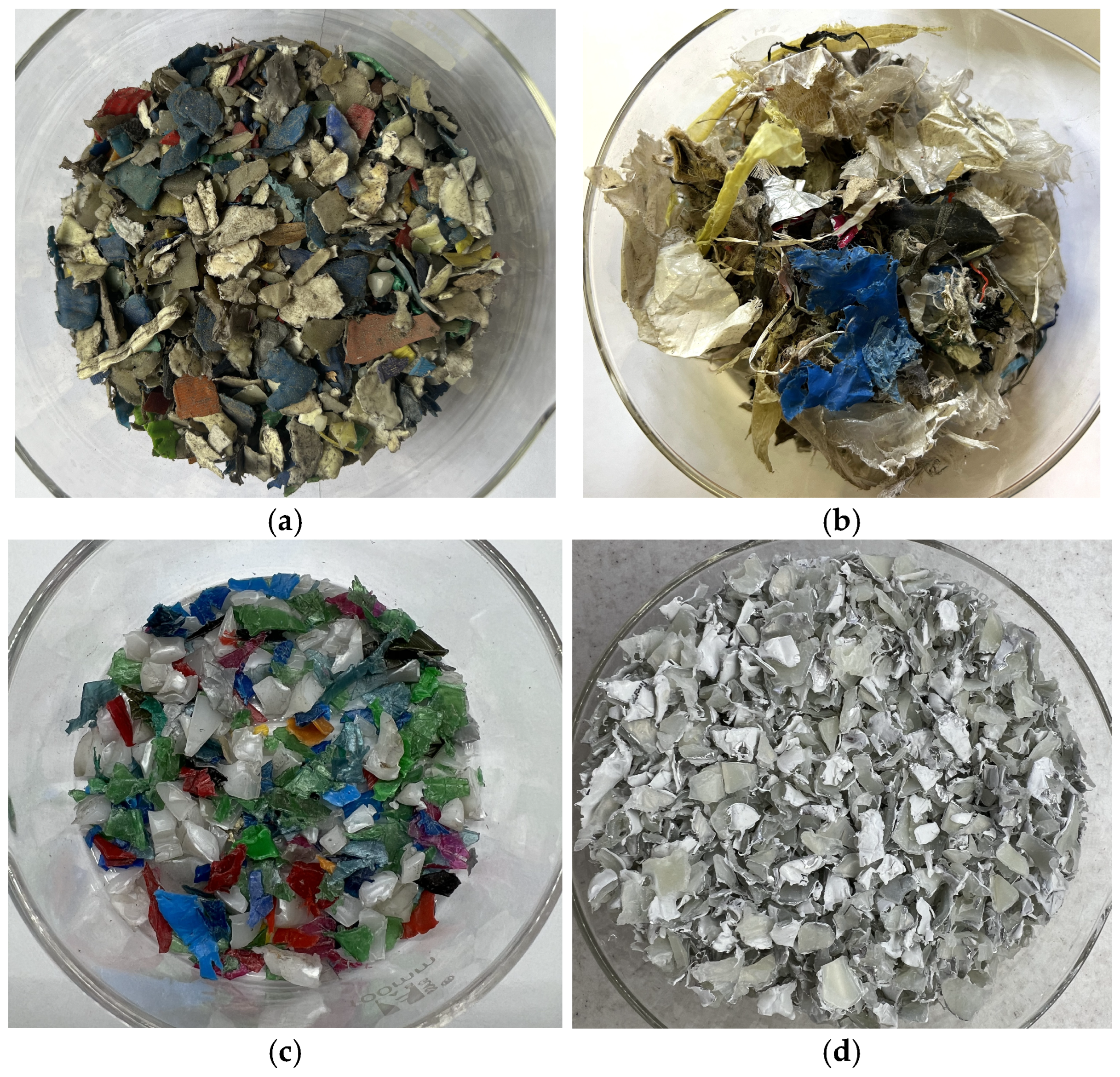
- mixed municipal plastic waste (MPW), containing polyolefin waste from the packaging fraction after waste sorting process—polyethylene (PE) (low-density polyethylene (LDPE) and high-density polyethylene (HDPE)) and polypropylene (PP), coded in Europe as 15 01 02 (Figure 1a);
- RDF (Refuse-Derived Fuel)—a coarse fraction of an alternative fuel (code 19 12 10) and the following morphological composition: plastics (approx. 45 wt%), paper and cardboard (approx. 20 wt%), biomass and wood (approx. 25 wt%), textiles and rubber (approx. 5 wt%) and other flammable components and impurities (<5 wt%) (Figure 1b);
- low-density polyethylene (LDPE) isolated as a homogeneous fraction from municipal waste—a polymer with a wide range of packaging applications (Figure 1c);
- cross-linked polyethylene with an aluminum layer (Alu-PEX), a post-industrial, multi-material waste with a high degree of structural complexity (Figure 1d).
2.2. Methods
2.2.1. Analyses of the Physicochemical Properties of Waste and Pyrolysis Gas
- True density (ρ) was determined in accordance with [34], using a liquid pycnometer placed in a thermostat for 30 min with a 2 g sample;
- Bulk density (ρn) was determined in accordance with [35], as the ratio of the sample mass to the volume it occupied in a 5 dm3 measuring container;
- Total moisture content (Wa) was determined in accordance with [36], by recording the sample’s mass loss during heating at 105 ± 2 °C for 60 min until a constant mass was reached;
- Volatile matter content (VMdaf) was determined according to [37] by calcining the sample in a porcelain crucible at 850 °C in the absence of air for 7 min;
- Ash content (Ashd) was determined according to [38] by calcining the sample in an FCF22S muffle furnace (CZYLOK, Jastrzębie-Zdrój, Poland), heated to 600 °C for 30 min;
- Elemental analysis (Cd, Hd, Nd) was performed according to [39], using a CHN 828 analyzer (Leco, St. Joseph, MI, USA); nitrogen content was determined using a thermal conductivity (TC) detector (Leco, St. Joseph, MI, USA);
- Total sulfur content (Sd) was determined according to [40]; sulfur was determined in an oxygen atmosphere using high-temperature combustion with IR detection on a CS 580 analyzer, Eltra, Bydgoszcz, Poland;
- Total chlorine content (Cld) was determined according to [40]; the determination involved high-temperature combustion of the sample in a HF-210 horizontal furnace (Mitsubishi Chemical Analytech, Tokyo, Japan) coupled to a Dionex Aquion ion chromatograph (Thermo Scientific, Waltham, MA, USA);
- The gross calorific value (, qv,gr, HHV—Higher Heating Value) and net calorific value (Wu, qp,net, LHV—Lower Heating Value) were determined in accordance with [41] using a Parr 6400 Calorimeter (Parr Instrument Company, Moline, IL, USA). The gross calorific value was measured under constant volume conditions and at a temperature of 25 °C. The calorimeter was calibrated using certified benzoic acid. The net calorific value was determined based on the gross calorific value, taking into account the heat of vaporization of water formed during combustion.
- The average molar mass (), density (ρ), and relative density of the gas () were calculated as the sum of the products of the component molar fractions and their molar masses. Based on this, the relative density was determined as the ratio of the mixture’s molar mass to the molar mass of air. The gas density was calculated under reference conditions in accordance with the standard.
- The gross calorific value () of the gas mixture was determined as the sum of the products of the component molar fractions and their molar heats of combustion:where —gross calorific value of the gas mixture,—molar gross calorific value of the component j, and —molar fraction of the component j. The reference heats of combustion of the individual components, as specified in the standard, were used for the calculations.
- The net calorific value () of the gas mixture was determined as the sum of the molar fractions of the individual components and their molar net calorific values. This value does not take into account the heat of condensation of water vapor generated during the combustion process:where —net calorific value of the gas mixture, —molar calorific value of the component , —molar fraction of the component, and —energy term related to water vapor condensation.
- The gross Wobbe index () was determined based on the gross calorific value of the gas and the relative density to air, according to the relationship used in the analysis of gaseous fuels. This parameter determines the energy capacity of the gas supplied to the burner at constant pressure and is commonly used to assess the interchangeability of gaseous fuels.where —gross Wobbe index, —gross calorific value, and —relative density.
- The compressibility factor () was determined based on the gas molar composition and reference conditions. This parameter accounts for the deviation of the real gas from the behavior of an ideal gas.
2.2.2. Low-Temperature Pyrolysis
2.2.3. Composition Analysis of Gas Mixtures
3. Results and Discussion
3.1. Material Characteristics
3.2. Pyrolysis
3.2.1. Process Efficiency
3.2.2. Characteristics of Pyrolysis Gas
Energy and Physical Properties
Chemical Composition
Sulfur Content
4. Conclusions
Author Contributions
Funding
Data Availability Statement
Acknowledgments
Conflicts of Interest
Abbreviations
| Alu-PEX | Cross-linked polyethylene with aluminum layer |
| HDPE | High Density Polyethylene |
| LDPE | Low Density Polyethylene |
| MPW | Municipal Polyolefin Waste |
| PE | Polyethylene |
| PET | Polyethylene terephthalate |
| PP | Polypropylene |
| PS | Polystyrene |
| PW | Plastic waste |
| RDF | Refuse-Derived Fuel |
References
- Plastics Europe. Tworzywa Sztuczne–Fakty 2019. Analiza Produkcji, Zapotrzebowania oraz Odzysku Tworzyw Sztucznych w Europie; Plastics Europe: Brussels, Belgium, 2019. [Google Scholar]
- Plastics Europe. The Circular Economy for Plastics—A European Analysis; Plastics Europe: Brussels, Belgium, 2024. [Google Scholar]
- Nichols, W.; Smith, N. Waste Generation and Recycling Indices 2019: Overview and Findings. Available online: https://www.circularonline.co.uk/wp-content/uploads/2019/07/Verisk_Maplecroft_Waste_Generation_Index_Overview_2019.pdf (accessed on 1 April 2026).
- Ilyas, M.; Ahmad, W.; Khan, H.; Yousaf, S.; Khan, K.; Nazir, S. Plastic waste as a significant threat to environment—A systematic literature review. Rev. Environ. Health 2018, 33, 383–406. [Google Scholar] [CrossRef]
- Jefferson, M. Whither plastics?—Petrochemicals, plastics and sustainability in a garbage-riddled world. Energy Res. Soc. Sci. 2019, 56, 101229. [Google Scholar] [CrossRef]
- Silvestre, C.; Cimmino, S. Ecosustainable Polymer Nanomaterials for Food Packaging: Innovative Solutions, Characterization Needs, Safety and Environmental Issues; CRC Press: Boca Raton, FL, USA, 2013. [Google Scholar]
- Chamas, A.; Moon, H.; Zheng, J.; Qiu, Y.; Tabassum, T.; Jang, J.H. Degradation rates of plastics in the environment. ACS Sustain. Chem. Eng. 2020, 8, 3494–3511. [Google Scholar] [CrossRef]
- Jehanno, C.; Alty, J.W.; Roosen, M.; De Meester, S.; Dove, A.P.; Chen, E.Y.-X.; Leibfarth, F.A. Critical advances and future opportunities in upcycling commodity polymers. Nature 2022, 603, 803–814. [Google Scholar] [CrossRef]
- Kartik, S.; Balsora, H.K.; Sharma, M.; Saptoro, A.; Jain, R.K.; Joshi, J.B.; Sharma, A. Valorization of plastic wastes for production of fuels and value-added chemicals through pyrolysis—A review. Therm. Sci. Eng. Prog. 2022, 32, 101316. [Google Scholar] [CrossRef]
- Hashemi, M.; Nguyen, K.T.Q.; Robert, D.J.; Zhang, G.K.; Hosseinnejad, T.; Marney, D. Advanced pyrolysis methods for mixed plastic waste management: Enhanced char and gas yields. J. Anal. Appl. Pyrolysis 2026, 193, 107360. [Google Scholar] [CrossRef]
- Nafiu, S.A.; Azeez, M.O.; AlAqad, K.M.; Olarewaju, T.A.; Yerima, E.A.; Tanimu, A. Waste plastic management: Recycling and the environmental health nexus. Clean. Mater. 2025, 15, 100291. [Google Scholar] [CrossRef]
- Miller, B. Flame retardants. Plast. World 1990, 48, 48–53. [Google Scholar]
- Li, X.; Qin, A.; Zhao, X.; Ma, B.; He, C. The plasticization mechanism of polyacrylonitrile/1-butyl-3-methylimidazolium chloride system. Polymer 2014, 55, 5773–5780. [Google Scholar] [CrossRef]
- Li, T.; Li, S.; Ma, T.; Zhong, Y.; Zhang, L.; Xu, H.; Wang, B.; Feng, X.; Sui, X.; Chen, Z.; et al. Novel organic-inorganic hybrid polyphosphazene modified manganese hypophosphite shuttles towards the fire retardance and anti-dripping of PET. Eur. Polym. J. 2019, 120, 109270. [Google Scholar] [CrossRef]
- Jabłońska, B.; Poznańska, G.; Jabłoński, P.; Zwolińska, J. Thermochemical valorization of plastic waste containing low density polyethylene, polyvinyl chloride and polyvinyl butyral into thermal and fuel energy. Energies 2024, 17, 3458. [Google Scholar] [CrossRef]
- Verma, A.; Budiyal, L.; Sanjay, M.R.; Siengchin, S. Processing and characterization analysis of pyrolyzed oil rubber (from waste tires)-epoxy polymer blend composite. Polym. Eng. Sci. 2019, 59, 2041–2051. [Google Scholar] [CrossRef]
- Butler, E.; Devlin, G.; McDonnell, K. Waste polyolefins to liquid fuels via pyrolysis: Review of commercial state-of-the-art and recent laboratory research. Waste Biomass Valorization 2011, 2, 227–255. [Google Scholar] [CrossRef]
- Peng, Y.; Wang, Y.; Ke, L.; Dai, L.; Wu, Q.; Cobb, K. A review on catalytic pyrolysis of plastic wastes to high-value products. Energy Convers. Manag. 2022, 254, 115243. [Google Scholar] [CrossRef]
- Maqsood, T.; Dai, J.; Zhang, Y.; Guang, M.; Li, B. Pyrolysis of plastic species: A review of resources and products. J. Anal. Appl. Pyrolysis 2021, 159, 105295. [Google Scholar] [CrossRef]
- Foong, S.Y.; Chan, Y.H.; Chin, B.L.F.; Lock, S.S.M.; Yee, C.Y.; Yiin, C.L.; Peng, W.; Lam, S.S. Production of biochar from rice straw and its application for wastewater remediation—An overview. Bioresour. Technol. 2022, 360, 127588. [Google Scholar] [CrossRef]
- Bushra, B.; Remya, N. Biochar from pyrolysis of rice husk biomass—Characteristics, modification and environmental application. Biomass Convers. Biorefin. 2020, 14, 5759–5770. [Google Scholar] [CrossRef]
- Yaqoob, H.; Ali, H.M.; Khalid, U. Pyrolysis of waste plastics for alternative fuel: A review of key factors. RSC Sustain. 2025, 3, 208–218. [Google Scholar] [CrossRef]
- Marchetti, L.; Guastaferro, M.; Annunzi, F.; Tognotti, L.; Nicolella, C.; Vaccari, M. Two-stage thermal pyrolysis of plastic solid waste: Set-up and operative conditions investigation for gaseous fuel production. Waste Manag. 2024, 179, 77–86. [Google Scholar] [CrossRef] [PubMed]
- Park, K.B.; Jeong, Y.S.; Guzelciftci, B.; Kim, J.S. Characteristics of a new type continuous two-stage pyrolysis of waste polyethylene. Energy 2019, 166, 343–351. [Google Scholar] [CrossRef]
- Aminu, I.; Nahil, M.A.; Williams, P.T. Hydrogen from waste plastics by two-stage pyrolysis/low-temperature plasma catalytic processing. Energy Fuels 2020, 34, 11679–11689. [Google Scholar] [CrossRef]
- Zhang, Y.; Huang, J.; Williams, P.T. Fe–Ni-MCM-41 catalysts for hydrogen-rich syngas production from waste plastics by pyrolysis-catalytic steam reforming. Energy Fuels 2017, 31, 8497–8504. [Google Scholar] [CrossRef]
- Singh, E.; Kumar, A.; Khapre, A.; Saikia, P.; Shukla, S.K.; Kumar, S. Efficient removal of arsenic using plastic waste char: Prevailing mechanism and sorption performance. J. Water Process. Eng. 2020, 33, 101095. [Google Scholar] [CrossRef]
- Zhao, D.; Wang, X.; Miller, J.B.; Huber, G.W. The chemistry and kinetics of polyethylene pyrolysis: A process to produce fuels and chemicals. ChemSusChem 2020, 13, 1764–1774. [Google Scholar] [CrossRef]
- Serrano, D.; Sánchez-Delgado, S.; Horvat, A.; Marugán-Cruz, C.; Batuecas, E.; Kelebopile, L.; Kwapinska, M. Non-recyclable municipal solid waste characterization and pyrolysis for energy recovery. Bioresour. Technol. 2025, 415, 131641. [Google Scholar] [CrossRef]
- Kordoghli, S.; Paraschiv, M.; Tazerout, M.; Khiari, B.; Zagrouba, F. Novel catalytic systems for waste tires pyrolysis: Optimization of gas fraction. J. Energy Resour. Technol. 2017, 139, 032203. [Google Scholar] [CrossRef]
- Irawan, C.; Jelita, R.; Nata, I.F. Recovery of aluminum from aluminum coated plastic waste using pyrolysis process. Reaktor 2018, 18, 38–44. [Google Scholar] [CrossRef]
- Riedewald, F.; Wilson, E.; Patel, Y.; Vogt, D.; Povey, I.; Barton, K.; Lewis, L.; Caris, T.; Santos, S.; O’Mahoney, M.; et al. Recycling of aluminium laminated pouches and Tetra Pak cartons by molten metal pyrolysis–Pilot-scale experiments and economic analysis. Waste Manag. 2022, 138, 172–179. [Google Scholar] [CrossRef]
- Fernández, Y.; Arenillas, A.; Menéndez, J.A. Thermal degradation of lignocellulosic biomass in pyrolysis: Influence of temperature and residence time on product distribution. J. Anal. Appl. Pyrolysis 2011, 92, 454–461. [Google Scholar]
- PN-EN ISO 1183-1:2019-05; Tworzywa Sztuczne—Metody Oznaczania Gęstości Tworzyw Sztucznych Nieporowatych—Część 1: Metoda Zanurzeniowa, Metoda Piknometru Cieczowego i Metoda Miareczkowa. Polski Komitet Normalizacyjny: Warszawa, Polska, 2019.
- PN-EN 15103:2010; Biopaliwa Stałe—Oznaczanie Gęstości Nasypowej. Polski Komitet Normalizacyjny: Warszawa, Polska, 2010.
- CEN/TS 15414-1:2010; Solid Recovered Fuels—Determination of Moisture Content Using the Oven Dry Method—Part 1: Determination of Total Moisture by a Reference Method. European Committee for Standardization: Brussels, Belgium, 2010.
- PN-G-04516:1998; Paliwa Stałe—Oznaczanie Zawartości Części Lotnych Metodą Wagową. Polski Komitet Normalizacyjny: Warszawa, Polska, 1998.
- PN-EN ISO 3451-1:2019-04; Tworzywa Sztuczne—Oznaczanie Popiołu—Część 1: Metody Ogólne. Polski Komitet Normalizacyjny: Warszawa, Polska, 2019.
- PN-EN ISO 21663:2021-06; Stałe Paliwa Wtórne—Metody Instrumentalne Oznaczania Zawartości Węgla (C), Wodoru (H), Azotu (N) i Siarki (S). Polski Komitet Normalizacyjny: Warszawa, Polska, 2021.
- PN-EN 15408:2011; Stałe Paliwa Wtórne—Metody Oznaczania Zawartości Siarki (S), Chloru (Cl), Fluoru (F) i Bromu (Br). Polski Komitet Normalizacyjny: Warszawa, Polska, 2011.
- PN-EN ISO 21654:2021-12; Stałe Paliwa Wtórne—Oznaczanie Wartości Opałowej. Polski Komitet Normalizacyjny: Warszawa, Polska, 2021.
- PN-EN ISO 6976:2016-11; Gaz Ziemny—Obliczanie Wartości Kalorycznych, Gęstości, Gęstości Względnej i Liczby Wobbego na Podstawie Składu. Polski Komitet Normalizacyjny: Warszawa, Polska, 2016.
- Al-Salem, S.M.; Antelava, A.; Constantinou, A.; Manos, G.; Dutta, A. A review on thermal and catalytic pyrolysis of plastic solid waste (PSW). J. Environ. Manag. 2017, 197, 177–198. [Google Scholar] [CrossRef] [PubMed]
- Lopez, G.; Artetxe, M.; Amutio, M.; Bilbao, J.; Olazar, M. Thermochemical routes for the valorization of waste polyolefinic plastics to produce fuels and chemicals. A review. Renew. Sustain. Energy Rev. 2017, 73, 346–368. [Google Scholar] [CrossRef]
- Jabłońska, B.; Poznańska, G.; Jabłoński, P.; Dziadas, M. Thermochemical conversion of mixed plastics from car dismantling by pyrolysis and distillation and potential applications of the products. Waste Manag. 2025, 206, 115089. [Google Scholar] [CrossRef]
- Mabood, F.; Jan, M.R.; Shah, J.; Jabeen, F.; Hussain, Z. Catalytic conversion of waste low-density polyethylene into fuel oil. J. Iran. Chem. Res. 2010, 3, 121–131. [Google Scholar]
- Aisiena, F.A.; Aisien, E.T. Production and characterization of liquid oil from the pyrolysis of waste high-density polyethylene plastics using spent fluid catalytic cracking catalyst. Sustain. Chem. Clim. Action 2023, 2, 100020. [Google Scholar] [CrossRef]
- PN-EN ISO 19739:2010; Gaz Ziemny—Oznaczanie Związków Siarki Metodą Chromatografii Gazowej. Polski Komitet Normalizacyjny: Warszawa, Polska, 2010.
- Onwudili, J.A.; Insura, N.; Williams, P.T. Composition of products from the pyrolysis of polyethylene and polystyrene in a closed batch reactor: Effects of temperature and residence time. J. Anal. Appl. Pyrolysis 2009, 86, 293–303. [Google Scholar] [CrossRef]
- Bashir, M.A.; Soong, Y.; Ji, T.; McMahan, G.; Weidman, J.; Shi, F.; Wang, P. Plastic waste gasification for low-carbon hydrogen production: A comprehensive review. Energy Adv. 2025, 4, 330–348. [Google Scholar] [CrossRef]
- Ishaq, M.; Dincer, I. A new system using refuse-derived fuel as a feedstock for hydrogen and power co-generation: A techno-environmental assessment. Process Saf. Environ. Prot. 2024, 192, 528–542. [Google Scholar] [CrossRef]
- Sanongraj, S.; Rattanaweerapan, T.; Dechapanya, W. Production and characteristics of refuse-derived fuel from open-dump solid waste. Bioresour. Technol. Rep. 2023, 22, 101448. [Google Scholar] [CrossRef]
- Lakshmi, B.M.; Mathew, M.; Kinol, A.M.J.; Vedagiri, B.; Perumal, S.B.; Madhu, P.; Dhanalakshmi, C.S. An integrated CRITIC-TOPSIS and Entropy-TOPSIS-based informative weighting and ranking approach for evaluating green energy sources and its experimental analysis on pyrolysis. Environ. Sci. Pollut. Res. 2022, 29, 61370–61382. [Google Scholar] [CrossRef]
- Rao, Y.K.; Dhanalakshmi, C.S.; Vairavel, D.K.; Surakasi, R.; Kaliappan, S.; Patil, P.P.; Lalvani, J.I.J.R. Investigation on forestry wood wastes: Pyrolysis and thermal characteristics of Ficus religiosa for energy recovery system. Adv. Mater. Sci. Eng. 2022, 2022, 3314606. [Google Scholar] [CrossRef]
- Hahladakis, J.N.; Velis, C.A.; Weber, R.; Iacovidou, E.; Purnell, P. An overview of chemical additives present in plastics: Migration, release, fate and environmental impact during their use, disposal and recycling. J. Hazard. Mater. 2018, 344, 179–199. [Google Scholar] [CrossRef]
- Karian, H.G. Handbook of Polyethylene: Structures, Properties, and Applications; Marcel Dekker: New York, NY, USA, 2003. [Google Scholar]
- Ragaert, K.; Delva, L.; Van Geem, K. Mechanical and chemical recycling of solid plastic waste. Waste Manag. 2017, 69, 24–58. [Google Scholar] [CrossRef]
- Callister, W.D.; Rethwisch, D.G. Materials Science and Engineering: An Introduction, 10th ed.; Wiley: New York, NY, USA, 2018. [Google Scholar]
- Ndiaye, N.K.; Derkyi, N.S.A.; Amankwah, E. Pyrolysis of plastic waste into diesel engine-grade oil. Sci. Afr. 2023, 21, e01836. [Google Scholar] [CrossRef]
- Roosen, M.; Mys, N.; Kusenberg, M.; Billen, P.; Dumoulin, A.; Dewulf, J.; Van Geem, K.M.; Ragaert, K.; De Meester, S. Detailed analysis of the composition of selected plastic packaging waste products and its implications for mechanical and thermochemical recycling. Environ. Sci. Technol. 2020, 54, 13282–13293. [Google Scholar] [CrossRef]
- Zajemska, M.; Magdziarz, A.; Iwaszko, J.; Skrzyniarz, M.; Poskart, A. Numerical and experimental analysis of pyrolysis process of RDF containing a high percentage of plastic waste. Fuel 2022, 320, 123981. [Google Scholar] [CrossRef]
- Scheirs, J.; Kaminsky, W. (Eds.) Feedstock Recycling and Pyrolysis of Waste Plastics: Converting Waste Plastics into Diesel and Other Fuels; Wiley: Chichester, UK, 2006. [Google Scholar] [CrossRef]
- López, A.; de Marco, I.; Caballero, B.M.; Laresgoiti, M.F.; Adrados, A. Influence of time and temperature on pyrolysis of plastic wastes in a semi-batch reactor. Chem. Eng. J. 2011, 173, 62–71. [Google Scholar] [CrossRef]
- Van Krevelen, D.W. Graphical-statistical method for the study of structure and reaction processes of coal. Fuel 1950, 29, 269–284. [Google Scholar]
- Williams, P.T.; Williams, E.A. Interaction of plastics in mixed-plastics pyrolysis. Energy Fuels 1999, 13, 188–196. [Google Scholar] [CrossRef]
- Hu, X.; Gholizadeh, M. Biomass pyrolysis: A review of the process development and challenges. J. Energy Chem. 2019, 39, 109–143. [Google Scholar] [CrossRef]
- Guizani, C.; Jeguirim, M.; Valin, S.; Limousy, L.; Salvador, S. Biomass chars: The effects of pyrolysis conditions on composition and properties. Energies 2017, 10, 796. [Google Scholar] [CrossRef]
- Shah, H.H.; Amin, M.; Iqbal, A.; Nadeem, I.; Kalin, M.; Soomar, A.M.; Galal, A.M. A review on gasification and pyrolysis of waste plastics. Front. Chem. 2023, 10, 960894. [Google Scholar] [CrossRef] [PubMed]
- Hasan, M.M.; Rasul, M.G.; Khan, M.M.K.; Ashwath, N.; Jahirul, M.I. Energy recovery from municipal solid waste using pyrolysis technology: A review on current status and developments. Renew. Sustain. Energy Rev. 2021, 145, 111073. [Google Scholar] [CrossRef]
- Palomar-Torres, A.; Lesnik, L.; Torres-Jiménez, E.; Bombek, G. Fast pyrolysis oil from plastics waste as a fuel for gas turbine power plants. Renew. Energy Power Qual. J. 2022, 20, 444–448. [Google Scholar] [CrossRef]
- Hegedüs, B.; Palotás, Á.B.; Muránszky, G.; Dobó, Z. Investigation of gasoline-like transportation fuel obtained by plastic waste pyrolysis and distillation. J. Clean. Prod. 2024, 447, 141500. [Google Scholar] [CrossRef]
- Quintero-Coronel, D.A.; Salazar, A.; Pupo-Roncallo, O.R.; Bula, A.; Corredor, L.; Amador, G.; Gonzalez-Quiroga, A. Assessment of the interchangeability of coal-biomass syngas with natural gas for atmospheric burners and high-pressure combustion applications. Energy 2023, 283, 128532. [Google Scholar] [CrossRef]
- Supriyanto; Ylitervo, P.; Richards, T. Gaseous products from primary reactions of fast plastic pyrolysis. J. Anal. Appl. Pyrolysis 2021, 158, 105248. [Google Scholar] [CrossRef]
- Kaminsky, W. Petrochemicals by thermolysis of plastics. In Proceedings of the International Meeting on Thermolysis, A Technology for Recycling and Depollution, Technological Days in Wallonia, Liege, Belgium, 24–25 March 1994. [Google Scholar] [CrossRef]
- Alfè, M.; Gargiulo, V.; Porto, M.; Migliaccio, R.; Le Pera, A.; Sellaro, M.; Pellegrino, C.; Abe, A.A.; Urciuolo, M.; Caputo, P.; et al. Pyrolysis and gasification of a real refuse-derived fuel (RDF): The potential use of the products under a circular economy vision. Molecules 2022, 27, 8114. [Google Scholar] [CrossRef]
- EN 16726:2015; Gas Infrastructure—Quality of Gas—Group H. European Committee for Standardization: Brussels, Belgium, 2015.
- Ścierski, W. Migration of sulfur and nitrogen in the pyrolysis products of waste and contaminated plastics. Appl. Sci. 2021, 11, 4374. [Google Scholar] [CrossRef]
- Rozporządzenie Ministra Środowiska z dnia 24 Sierpnia 2012 r. w Sprawie Poziomów Niektórych Substancji w Powietrzu (Dz.U. 2012 poz. 1031). Available online: https://isap.sejm.gov.pl/isap.nsf/DocDetails.xsp?id=WDU20120001031 (accessed on 10 May 2026).



| Parameter | Unit | LDPE | MPW | Alu-PEX | RDF |
|---|---|---|---|---|---|
| Wa | wt% | 0.11 ± 0.1 | 0.12 ± 0.1 | 0.99 ± 0.1 | 5.4 ± 0.1 |
| Ashd | wt% | 1.08 ± 0.1 | 0.99 ± 0.1 | 24.18 ± 0.1 | 11.50 ±0.1 |
| VMdaf | wt% | 98.92 | 99.01 | 75.82 | 88.50 |
| ρ or ρn * | kg/m3 | 910.0 | 940.0 | 1450.0 | 181.0 * |
| MJ/kg | 44.85 ± 1.64 | 45.96 ± 1.39 | 34.76 ± 1.57 | 17.61 ± 1.53 | |
| Wu | MJ/kg | 43.25 ± 1.72 | 43.12 ± 1.43 | 32.18 ± 1.59 | 16.42 ± 1.54 |
| C | wt% | 85.2 ± 2.5 | 84.4 ± 2.6 | 61.3 ± 2.5 | 51.6 ± 2.5 |
| H | wt% | 13.25 ± 0.61 | 12.85 ± 0.37 | 9.76 ± 0.56 | 6.50 ± 0.45 |
| N | wt% | 0.02 ± 0.01 | 0.01 ± 0.01 | 0.00 ± 0.07 | 0.95 ± 0.07 |
| S | wt% | 0.01 ± 0.01 | 0.01 ± 0.01 | 0.01 ± 0.01 | 0.30 ± 0.01 |
| O | wt% | 1.52 ± 0.01 | 2.73 ± 0.01 | 28.93 ± 0.01 | 40.65 ± 0.01 |
| Cl | wt% | 0.606 ± 0.015 | 0.124 ± 0.015 | 0.119 ± 0.071 | 0.805 ± 0.052 |
| H/C | - | 1.85 | 1.81 | 1.9 | 1.5 |
| O/C | - | 0.013 | 0.024 | 0.35 | 0.59 |
| Sample | Mass Share, g | ||
|---|---|---|---|
| Gas | Liquid | Char | |
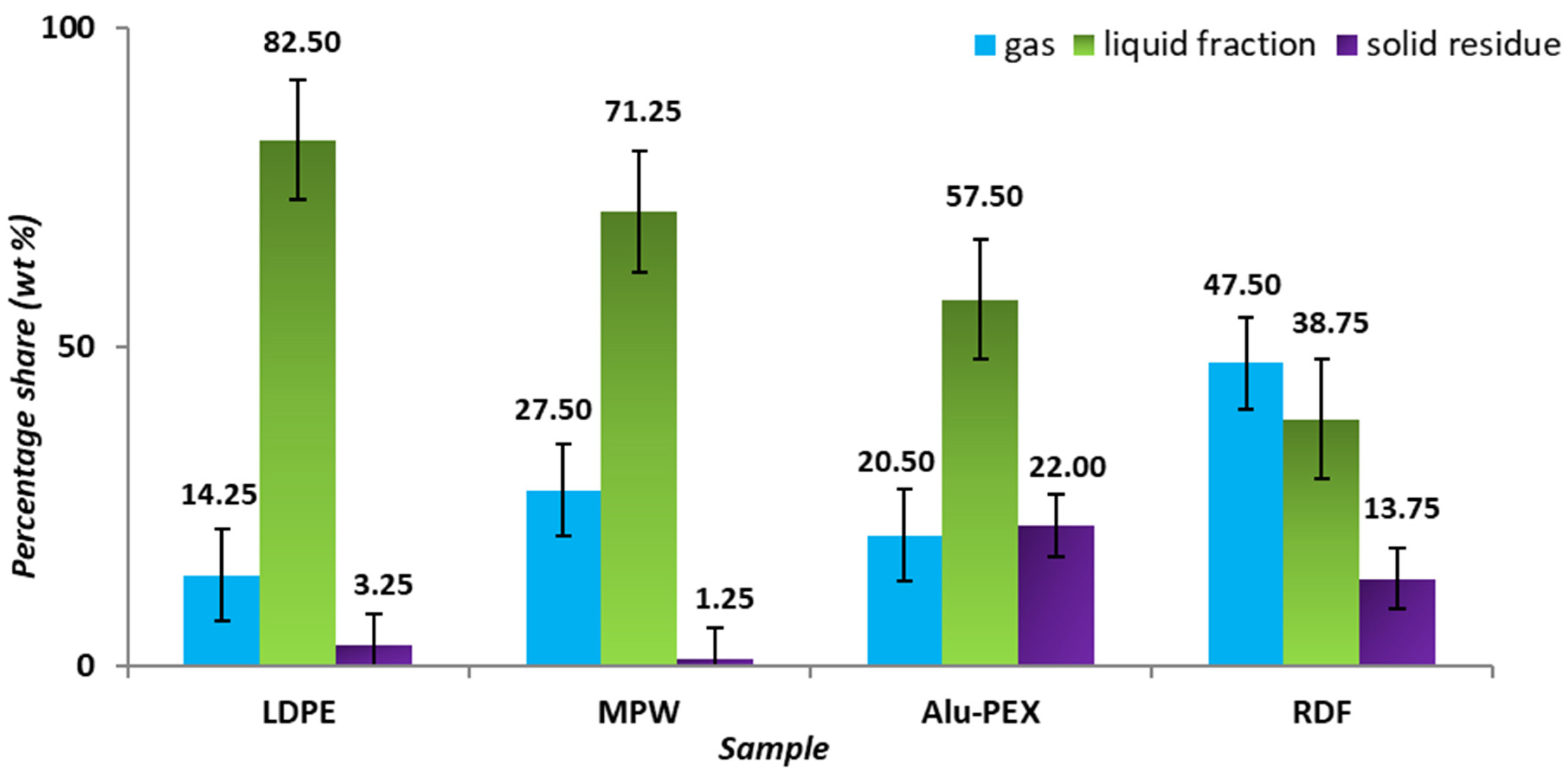
| LDPE | 1140 | 6600 | 260 |
| MPW | 2200 | 5700 | 100 |
| Alu-PEX | 1640 | 4600 | 1760 |
| RDF | 3800 | 3100 | 1100 |
| Quantity | Unit | LDPE | MPW | Alu-PEX | RDF |
|---|---|---|---|---|---|
| gross calorific value | MJ/m3 | 69.95 ± 2.86 | 81.16 ± 2.76 | 67.65 ± 1.19 | 24.68 ± 0.76 |
| net calorific value | MJ/m3 | 64.72 ± 2.60 | 75.32 ± 2.48 | 62.35 ± 1.10 | 22.76 ± 0.70 |
| gross Wobbe index | MJ/m3 | 60.38 ± 1.46 | 68.59 ± 1.28 | 62.56 ± 0.63 | 21.85 ± 0.58 |
| relative density | - | 1.342 ± 0.046 | 1.4 ± 0.044 | 1.169 ± 0.019 | 1.2756 ± 0.022 |
| density | kg/m3 | 1.735 ± 0.056 | 1.811 ± 0.057 | 1.512 ± 0.025 | 1.6494 ± 0.029 |
| compressibility coefficient | - | 0.988 ± 0.004 | 0.984 ± 0.004 | 0.989 ± 0.004 | 0.993 ± 0.004 |
| Group | Compound Name | Formula | Content, % mol/mol | |||
|---|---|---|---|---|---|---|
| LDPE | MPW | Alu-PEX | RDF | |||
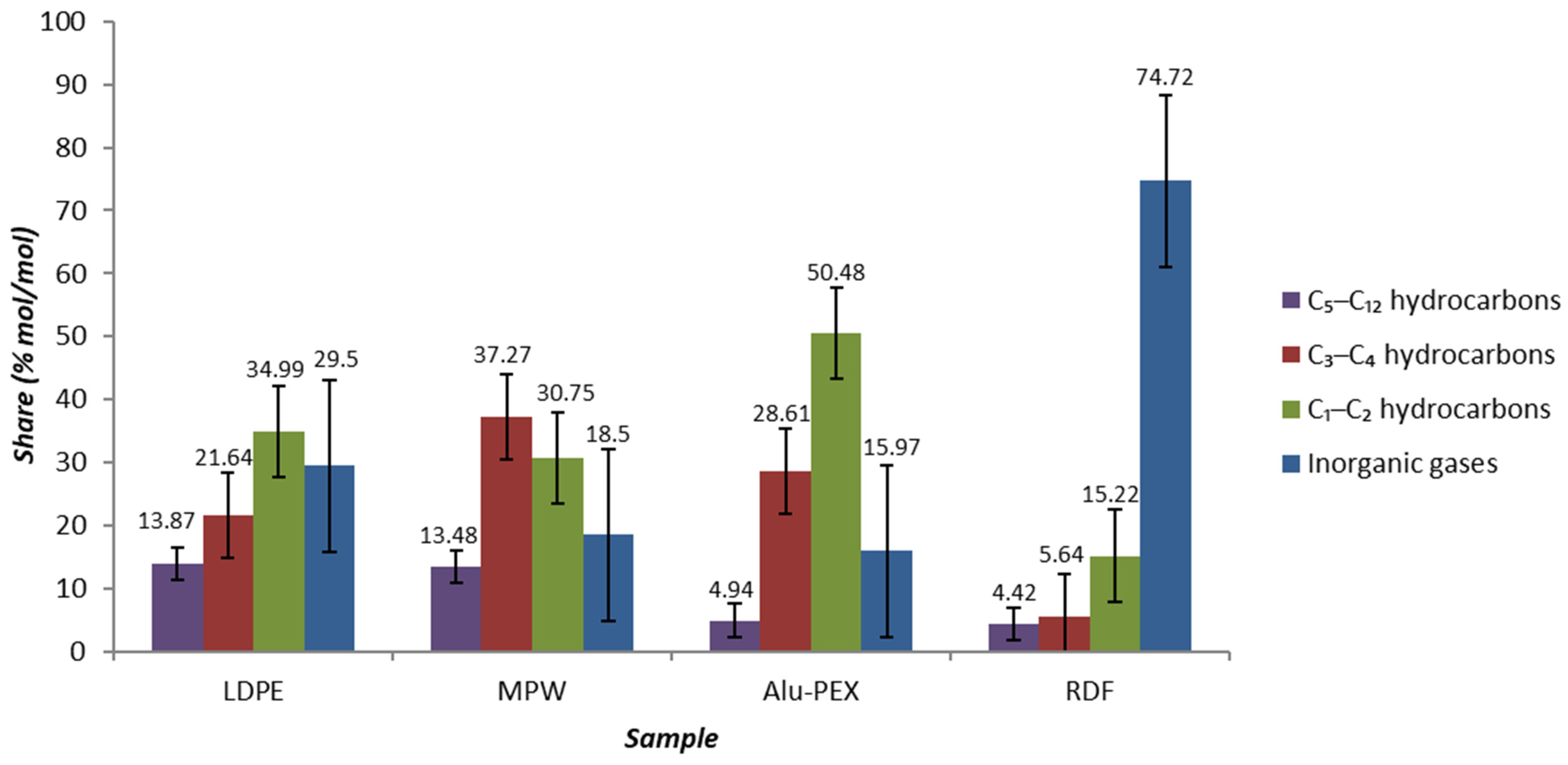
| Inorganic gases | hydrogen | H2 | 6.53 ± 0.096 | 6.88 ± 0.113 | 3.20 ± 0.192 | 11.45 ± 0.415 |
| carbon dioxide | CO2 | 7.67 ± 0.166 | 5.79 ± 0.140 | 2.21 ± 0.133 | 54.48 ± 1.011 | |
| oxygen | O2 | 0.63 ± 0.032 | 0.55 ± 0.031 | 0.34 ± 0.031 | 0.61 ± 0.032 | |
| nitrogen | N2 | 12.14 ± 0.211 | 2.54 ± 0.123 | 9.47 ± 0.473 | 2.87 ± 0.127 | |
| carbon monoxide | CO | 2.53 ± 0.018 | 2.74 ± 0.021 | 0.75 ± 0.060 | 5.31 ± 0.038 | |
| C1–C2 hydrocarbons | methane | CH4 | 7.67 ± 0.359 | 8.64 ± 0.451 | 18.34 ± 0.734 | 6.55 ± 0.313 |
| ethane | C2H6 | 10.56 ± 0.358 | 8.68 ± 0.318 | 14.51 ± 0.581 | 3.75 ± 0.126 | |
| ethene | C2H4 | 16.76 ± 0.567 | 13.43 ± 0.506 | 17.63 ± 0.7057 | 4.92 ± 0.165 | |
| C3–C4 hydrocarbons | propane | C3H8 | 9.00 ± 0.422 | 5.67 ± 0.295 | 21.32 ± 0.853 | 1.57 ± 0.075 |
| propene | C3H6 | <LOD | 20.06 ± 0.329 | <LOD | <LOD | |
| isobutane | C4H10 | 0.10 ± 0.003 | 0.21 ± 0.005 | 0.11 ± 0.011 | 0.11 ± 0.012 | |
| n-butane | C4H10 | 3.73 ± 0.175 | 2.27 ± 0.119 | 1.20 ± 0.072 | 0.47 ± 0.010 | |
| 1-butene | C4H8 | 5.65 ± 0.265 | 2.16 ± 0.113 | <LOD | 0.65 ± 0.013 | |
| 2-methylpropene | C4H8 | 0.71 ± 0.073 | <LOD | <LOD | <LOD | |
| isobutene | C4H8 | <LOD | 4.49 ± 0.234 | <LOD | 1.85 ± 0.088 | |
| trans-2-butene | C4H8 | 0.52 ± 0.053 | 0.64 ± 0.014 | 0.21 ± 0.022 | 0.31 ± 0.006 | |
| cis-2-butene | C4H8 | 1.93 ± 0.090 | 0.43 ± 0.010 | 0.11 ± 0.011 | 0.20 ± 0.004 | |
| 1,3-butadiene | C4H6 | <LOD | 1.34 ± 0.070 | 5.66 ± 0.281 | 0.48 ± 0.010 | |
| C5–C12 hydrocarbons | isopentane | C5H12 | 0.06 ±0.004 | 0.03 ± 0.001 | 0.03 ± 0.00 | 0.02 ± 0.002 |
| n-pentane | C5H12 | 3.39 ± 0.155 | 11.08 ± 0.481 | 4.36 ± 0.216 | 0.50 ± 0.010 | |
| neopentane | C5H12 | 9.75 ± 0.457 | <LOD | <LOD | 2.60 ± 0.126 | |
| n-hexane | C6H14 | 0.11 ± 0.005 | 0.63 ± 0.028 | 0.20 ± 0.020 | 0.80 ± 0.034 | |
| n-heptane | C7H16 | 0.07 ± 0.003 | 1.39 ± 0.064 | 0.03 ± 0.005 | 0.15 ± 0.007 | |
| n-octane | C8H18 | 0.03 ± 0.002 | 0.16 ± 0.010 | <LOD | <LOD | |
| n-nonane | C9H20 | 0.04 ± 0.007 | 0.13 ± 0.022 | 0.01 ± 0.003 | 0.04 ± 0.013 | |
| n-decane | C10H22 | 0.21 ± 0.047 | 0.06 ± 0.015 | 0.31 ± 0.031 | 0.31 ± 0.031 | |
| n-undecane | C11H24 | 0.18 ± 0.048 | 0.00 ± 0.001 | <LOD | <LOD | |
| n-dodecane | C12H26 | 0.03 ± 0.005 | <LOD | <LOD | <LOD | |
| Compound | Concentration, mg/dm3 | |||
|---|---|---|---|---|
| LDPE | MPW | Alu-PEX | RDF | |
| Hydrogen sulfide | <0.15 | 0.67 ± 0.12 | <0.15 | 599.1 ± 106.6 |
| Carbonyl sulfide | <0.27 | <0.27 | <0.27 | 330.2 ± 58.8 |
| Methyl mercaptan | <0.21 | 283.2 ± 50.4 | <0.21 | 628.4 ± 111.9 |
| Ethyl mercaptan | <0.28 | 6.03 ± 1.07 | <0.28 | 64.3 ± 11.5 |
| Dimethyl sulfide | 0.9 ± 0.16 | 58.4 ± 10.39 | <0.28 | 62.3 ± 11.1 |
| Carbon disulfide | 10.9 ± 1.93 | 3.1 ± 0.55 | 2.8 ± 0.49 | 29.9 ± 5.32 |
| i-Propyl mercaptan | <0.34 | 1.2 ± 0.21 | <0.34 | 1.8 ± 0.32 |
| tert-Butyl mercaptan | <0.40 | 0.9 ± 0.15 | <0.40 | 1.3 ± 0.23 |
| n-Propyl mercaptan | <0.34 | 0.99 ± 0.18 | <0.34 | 24.8 ± 4.41 |
| Methyl ethyl sulfide | <0.34 | <0.34 | <0.34 | <0.34 |
| s-Butyl mercaptan | 0.85 ± 0.15 | 4.58 ± 0.82 | 0.55 ± 0.1 | 59.6 ± 10.61 |
| i-Butyl mercaptan | <0.40 | 3.25 ± 0.58 | <0.40 | 21.6 ± 3.85 |
| Diethyl sulfide | <0.40 | <0.40 | <0.40 | <0.40 |
| n-Butyl mercaptan | <0.40 | <0.40 | <0.40 | 1.94 ± 0.35 |
| Dimethyl disulfide | 0.97 ± 0.17 | 48.1 ± 8.6 | <0.42 | <0.42 |
| Dipropyl sulfide | <0.53 | <0.53 | 0.54 ± 0.1 | <0.53 |
| Diethyl disulfide | <0.54 | <0.54 | <0.54 | <0.54 |
| Total sulfur | 10.6 | 261.9 | 2.7 | 1290.6 |
| Mercaptan sulfur | 0.3 | 195.9 | 0.2 | 493.3 |
Disclaimer/Publisher’s Note: The statements, opinions and data contained in all publications are solely those of the individual author(s) and contributor(s) and not of MDPI and/or the editor(s). MDPI and/or the editor(s) disclaim responsibility for any injury to people or property resulting from any ideas, methods, instructions or products referred to in the content. |
© 2026 by the authors. Licensee MDPI, Basel, Switzerland. This article is an open access article distributed under the terms and conditions of the Creative Commons Attribution (CC BY) license.
Share and Cite
Poznańska, G.; Jabłońska, B.; Jabłoński, P.; Piotrowski, T. The Influence of Heterogeneity of Polyolefin Waste and Alu-PEX Laminates on the Composition and Yield of Pyrolysis Gas: A Comparative Analysis with RDF. Energies 2026, 19, 2416. https://doi.org/10.3390/en19102416
Poznańska G, Jabłońska B, Jabłoński P, Piotrowski T. The Influence of Heterogeneity of Polyolefin Waste and Alu-PEX Laminates on the Composition and Yield of Pyrolysis Gas: A Comparative Analysis with RDF. Energies. 2026; 19(10):2416. https://doi.org/10.3390/en19102416
Chicago/Turabian StylePoznańska, Gabriela, Beata Jabłońska, Paweł Jabłoński, and Tomasz Piotrowski. 2026. "The Influence of Heterogeneity of Polyolefin Waste and Alu-PEX Laminates on the Composition and Yield of Pyrolysis Gas: A Comparative Analysis with RDF" Energies 19, no. 10: 2416. https://doi.org/10.3390/en19102416
APA StylePoznańska, G., Jabłońska, B., Jabłoński, P., & Piotrowski, T. (2026). The Influence of Heterogeneity of Polyolefin Waste and Alu-PEX Laminates on the Composition and Yield of Pyrolysis Gas: A Comparative Analysis with RDF. Energies, 19(10), 2416. https://doi.org/10.3390/en19102416