Review

CO2 Nanobubbles as an Emerging EOR–CCUS Technology: Comparative Review of Laboratory Studies, Underlying Mechanisms, and Preliminary Assessment of CO2 Storage Potential


by
Abdulrahman Shahin
1,*,
Elvin Hajiyev
1,
Hossameldeen Elnaggar
2,
Bassel Eissa
1,
Mahmoud Abdellatif
1,
Abdul Rehman Baig
1 and
Marshall Watson
1,*
1
Bob L. Herd Department of Petroleum Engineering, Texas Tech University, 807 Boston Avenue, Lubbock, TX 79409, USA
2
Department of Energy and Petroleum Engineering, University of Wyoming, 1000 E University Ave, Laramie, WY 82071, USA
*
Authors to whom correspondence should be addressed.
Energies 2026, 19(10), 2323; https://doi.org/10.3390/en19102323
Submission received: 2 April 2026 / Revised: 28 April 2026 / Accepted: 11 May 2026 / Published: 12 May 2026
(This article belongs to the Special Issue New Advances in Carbon Capture and Clean Energy Technologies)

Abstract

Nanobubbles (NBs) are emerging as a promising area of research across multiple scientific and industrial domains due to their unique physicochemical characteristics. NBs exhibit distinctive properties compared to normal bubbles, including high internal pressure, a large specific surface area, high interfacial activity, and long-term stability in liquids. Therefore, NBs have gained increasing attention as a novel enhanced oil recovery (EOR) technique, offering potential advantages over traditional gas flooding and chemical flooding. CO2-NB specifically represents a particularly promising approach as an intersection of EOR and carbon capture, utilization, and storage (CCUS), as CO2-NB enables hydrocarbon recovery and in situ CO2 utilization and storage at reservoir conditions. This paper presents a structured comparative discussion of currently identified experimental EOR studies that employ CO2-NBs. Based on the observations of these experiments, this paper discusses the proposed mechanisms in those experiments or other studies that could scientifically play a role in achieving incremental recovery. The main mechanisms discussed include interfacial tension reduction, wettability alteration, CO2 transfer from NBs into the oil liquid phase, and suppression of gravity segregation. Other possible contributors discussed in the literature include buoyancy-assisted mobilization, induced shock waves, and drag force reduction. These mechanisms are examined in relation to the distinctive properties of CO2-NBs, showing how these properties contribute to the occurrence of the proposed mechanisms, showcasing the potential of CO2-NBs as an emergent EOR–CCUS technology. A preliminary probabilistic assessment was performed to estimate CO2 storage potential during CO2-NBs EOR injection. The results suggest that the majority of the injected CO2 is dissolved in the saturated liquid phase, while the amount of free NBs is negligible, indicating that CO2-NB injection may provide secure storage through solubility trapping, but with lower storage capacity compared to conventional geological sequestration in saline aquifers.

1. Introduction

The climate change crisis intensified global intentions to minimize greenhouse gas (GHG) emissions across all industries. Greenhouse gases, primarily carbon dioxide (CO2), methane (CH4), nitrous oxide (N2O), and fluorinated gases, trap heat in the atmosphere, increasing the global average temperature and inducing climate change. Although all GHGs negatively influence the Earth’s climate, CO2 is the primary source of human-induced warming because of the substantial release from fossil fuel combustion, deforestation, and industrial processes [1]. In 2018, global CO2 emissions represented 67% of the total GHG emissions [2]. In 2024, global GHG emissions reached 53.2 gigatons (Gt) CO2 equivalent (CO2-eq) [3], and total CO2 emissions were 42.4 ± 3.2 GT CO2 [4]. Among all CO2 emission sources, energy combustion and industrial processes generated 37.6 Gt CO2 in 2024 [5].
With these rising trends in CO2 emissions, advanced techniques must be utilized to reduce the accumulation of CO2 in the atmosphere [6]. Among these approaches, carbon capture, utilization, and storage (CCUS) have been widely studied in the past few years as an approach to control CO2 emissions and create economic value by transforming CO2 into products like chemicals or storing it permanently underground through enhanced oil recovery (EOR) processes [2,6,7,8,9,10]. CCUS-EOR enables the extraction of low-carbon footprint hydrocarbons that serve the energy sector, as well as the petrochemical, pharmaceutical, and agricultural industries [11,12,13]. In CCUS-EOR, the captured CO2 is injected into the characterized reservoir so that it can displace the oil, improve recovery, and trap CO2 permanently in the subsurface [13,14].
Among the promising CCUS-EOR technologies, CO2 microbubbles (MBs) and nanobubbles (NBs) have been proven to be successful in laboratory experiments and field studies [15,16,17,18,19]. In core-flooding and cyclic injection experiments, CO2-NBs substantially increased oil recovery compared to conventional CO2 without NBs [15,16,20,21]. Additionally, CO2-MBs and NBs reduced channeling and gravity override, altered wettability, lowered interfacial tensions, and improved sweep efficiency [17,22,23]. Furthermore, pilot field studies showed superior CO2-MBs oil recovery and CO2 storage when compared with conventional CO2 injection [18,24].
Although CO2-MBs and NBs attracted growing attention as potential approaches to improve both oil recovery and CO2 storage, there is still limited understanding of the thermo-physicochemical processes involved in CO2-NBs’ interaction with hydrocarbons, the aqueous phase, and the rock interface, as well as the field-scale production and transport challenges [25,26]. The behavior of CO2-NBs, including NB size, distribution, number concentration, and stability, is poorly understood under reservoir conditions [17,27]. Recent studies are dominated by laboratory-scale studies that mainly investigated improvement in oil recovery and considered CO2 stored to be a secondary process [28]. This led to a narrow quantitative understanding of the amount of CO2 that could be stored or the scale of such operations during a CO2-NBs CCUS project.
In this study, we conducted a detailed review of the mechanisms of CO2-NBs in CCUS-EOR operations. A rigorous evaluation of studies employing CO2-NBs in EOR applications is essential to grasp the extent of improvement delivered by CO2-NBs compared with conventional CO2 injection. We performed detailed analyses of CO2-NBs EOR studies and identified the main mechanisms associated with recovery improvement. We also implemented a probabilistic framework to assess the quality in terms of the anticipated trapping mechanism and quantity of potential CO2 stored during in situ generated CO2-NBs EOR operations, and evaluate the application of CO2-NBs as a CCUS-EOR technique.

2. Methodology

This study provides a structured and qualitative framework with two primary objectives. The first objective is to evaluate the application of CO2-NBs in EOR within the context of CCUS, focusing on how CO2-NBs have been used in laboratory-scale EOR studies, their effects on recovery metrics, and the mechanisms proposed to be associated with CO2-NB injection. The second objective is to provide rough estimates of the amount of CO2 that can be used in EOR to obtain a deeper understanding of CO2 storage potential using this technique.

2.1. Review Framework for CO2-Nanobubble-Based EOR Studies

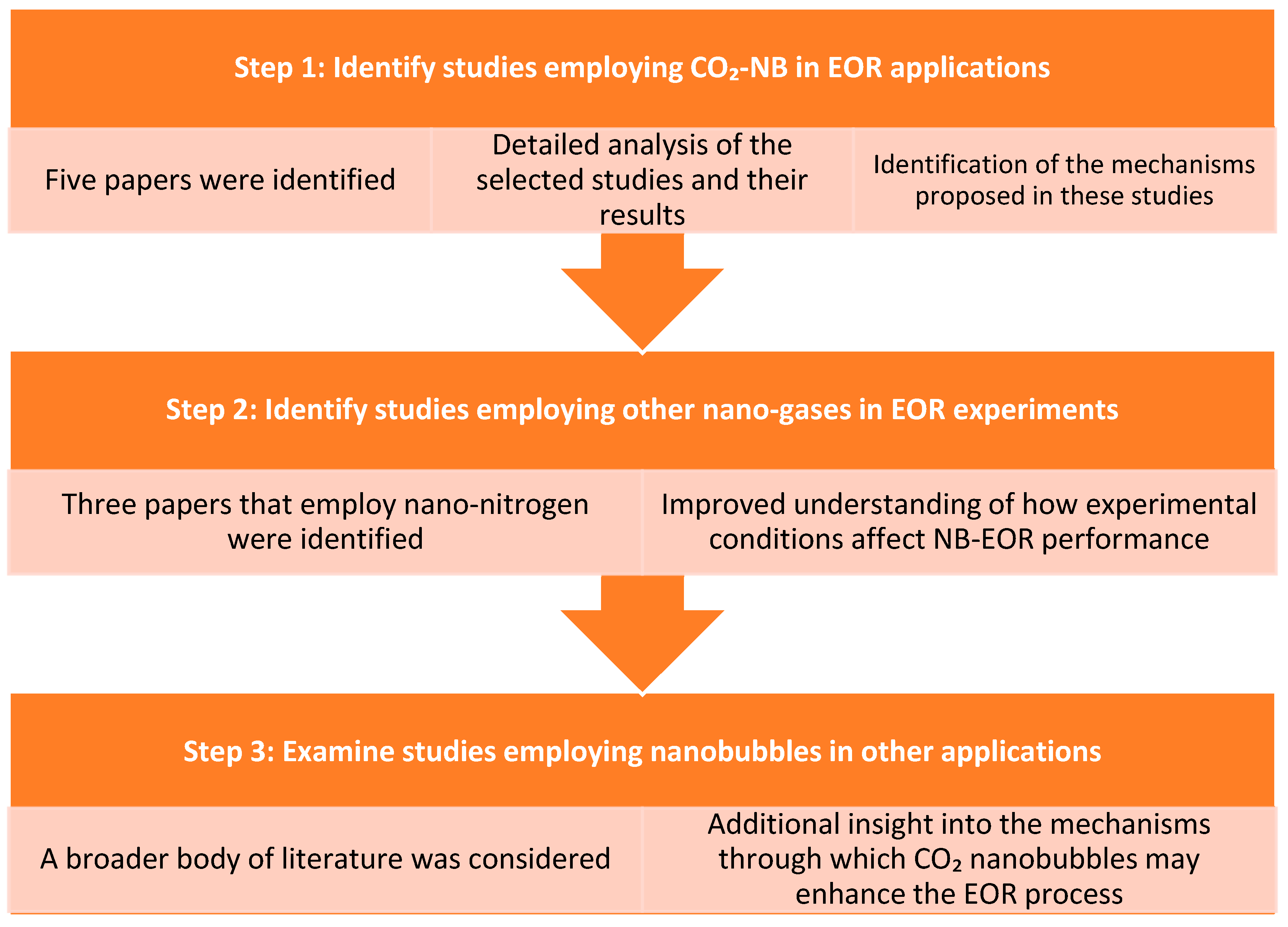
The conducted literature review followed three steps, as illustrated in Figure 1. The first step was to consider all experimental papers that employed CO2-NBs in EOR. A total of five core experimental studies employing CO2-NBs in EOR were identified [15,17,27,29,30], and their results are discussed in detail in Section 3. Because the number of first-step studies was limited for assessing the relationship between experimental conditions and EOR performance, in the second step, three additional studies that employed N2-NBs were added to address this limitation [31,32,33]. Lastly, broader literature of other NB applications was considered to strengthen the understanding of the mechanisms through which CO2-NBs may enhance the EOR process, along with the insights obtained from the earlier steps.

2.2. Framework for Quantifying CO2 Storage Potential in CO2-NB EOR Projects

In order to estimate the storage potential, the total volume of CO2 is assumed to be the sum of free CO2-NB and the CO2 dissolved in water that makes the fluid saturated at a specific pressure and temperature. To calculate the amount of free CO2-NBs, we used a simple approach that assumes the NB population is spherical and that their diameters follow a normal distribution, with a mean diameter of 400 nm and a standard deviation of 200 nm. The total NB volume is obtained by multiplying the average single-bubble volume by the assumed bubble concentration, and it is then converted to mass per kg of injected water using the density of CO2 at an assumed pressure and temperature. The resulting volume fraction was so low that, when the mass was compared to the corresponding dissolved CO2 mass in water under the same conditions, it showed that the free-bubble phase contributes less than 1% of the dissolved CO2; therefore, the free NB contribution is neglected in subsequent storage calculations. The assumptions regarding the diameter and bubble concentration are based on analogy with published literature, and an upper limit was used to show that the free NB contribution is minimal even at favorable parameters.
The dissolved CO2 concentration as moles per kg of water was estimated using an empirical correlation as a function of pressure and temperature. Then, it is converted to be represented as the mass of CO2 per volume of injected water. The result is then multiplied by the slug volume of CO2-NBs to obtain the results as mass of CO2 per pore volume of the reservoir. Taking salinity into consideration will decrease the estimation [34,35], but it was ignored for simplicity. In order to account for the uncertainty of reservoir conditions and obtain representative numbers for different employing conditions, a Monte Carlo simulation was utilized. The pressure was assumed to be uniformly distributed within a range of 800–4500 psi, while the temperature was assumed to be uniformly distributed within a range of 120–250 °F, and the slug volume was assumed to be uniformly distributed within a range of 0.05–0.30. As pressure and temperature are correlated under reservoir conditions, their dependence was represented using a Gaussian copula, which preserved the prescribed marginal distributions while introducing statistical correlation between the two variables. A total of 10,000 iterations was computed by sampling from the distributions and calculating the CO2 storage potential using the sequence described. Subsequently, the storage potential for the dissolved CO2 was used to develop a probability distribution for the storage capacity of the dissolved CO2 during the CO2-NB EOR injection. The detailed steps and results of this method are discussed in Section 5.

3. Comparative Analysis of Experimental Papers

In this paper, five experimental studies on CO2-NB-assisted EOR processes have been identified for further analysis. Overall, this range of research work encompasses a variety of reservoir types and conditions, which is necessary for obtaining a well-rounded understanding of CO2-NB EOR efficiency. A summary for each of the five research works, including the experimental conditions and recovery efficiency, is provided in Table 1.
In a study conducted by Lawal et al., they examined the generation of CO2-NBs through co-injection methods by using a combination of CO2 and NaCl brine solution at similar flow rates using a core holder with membranes [15]. The preparation pressure for CO2-NBs was maintained at 2015 psi while maintaining the pressure above this threshold throughout to avoid CO2 release from the fluid. Two distinct experimental configurations were employed: core flooding using dead-oil-saturated Berea sandstone under an outlet pressure of 2215 psi and 22 °C; and cyclic injection experiments using live-oil-saturated tight Kentucky sandstone conducted at a higher pressure. The injection pressure was reported as 3515 psi, a shut-in pressure of 4515 psi, and a temperature of 102 °C. During the core flood tests, the CO2-NBs solution was benchmarked against brine and supersaturated carbonated water. The CO2-NB solution delivered a 9% recovery increase relative to brine and was accompanied by a delayed breakthrough. The authors interpreted the higher recovery as resulting from CO2 accumulation near the displacement front, where the large surface area of the NBs enhanced CO2 transfer into the oil phase, thereby enhancing oil displacement. Additionally, both CO2-NBs and carbonated water promoted calcite dissolution, potentially contributing to a progressive post-breakthrough transition to greater water wetness, though the authors acknowledged that wettability alteration alone was insufficient to fully account for the recovery gains observed at breakthrough. For the HnP experiments, CO2-NBs were compared against a CO2–reservoir brine control (CO2-RB, without NBs) in three fracture-network configurations: annular-fracture, induced-fracture, and hybrid-fracture setups. CO2-NBs consistently outperformed CO2-RB in all three configurations, yielding an incremental cumulative oil recovery of 10–14% OOIP per cycle at the last cycle evaluated. The authors attributed these gains to several interconnected mechanisms. Prior to the soak phase, CO2-NBs introduced into the fracture system functioned as a CO2 reservoir, sustaining CO2 delivery at the fracture–matrix interface. During shut-in, CO2 was transferred from the CO2-rich region into the oil phase, resulting in oil expansion and a reduction in oil viscosity. These processes combined to enhance oil drainage from the matrix into the fracture, resulting in an increased amount of recovered oil.
Cai et al. designed a core flood setup to test CO2-NBs, which is intended for ultra-low permeability sandstone reservoirs at approximately 500 psi [17]. In their system, CO2 gas was dispersed, whereas the carrier phase was an aqueous brine with 1970 mg/L total dissolved salts, containing potassium, sodium, calcium, and magnesium ions supplemented with surfactants together with nanoparticles (NPs) additives. The NB dispersion was prepared with a micro-nanobubbles (MNBs) generation unit, and cores were saturated with synthetic oil prior to testing. A comparative post-waterflooding evaluation was performed, comparing CO2-NBs with CO2 gas flooding and CO2-water-alternating-gas (WAG) injection. The CO2-NB system yielded the highest recovery, reaching 66%, whereas continuous CO2 flooding and WAG recovered 49% and 62%, respectively. These results demonstrated a significant incremental recovery benefit over both injection strategies.
The study by Sun et al. examined a CO2-MNB injection into crude-oil-saturated tight shale [27]. Water-based fluids served as the carrier phase and the control. After preparing a solution containing MNBs, the solution was allowed to stabilize for 4–6 h until surface bubbles were no longer visible, confirming adequate stability for experimental use. The flooding results revealed that a reduced bubble size and increased bubble concentration positively influenced recovery performance, with total oil recovery ranging from 14% to 18%, depending on the average NB diameter and population density.
Saleh et al. investigated CO2-NBs using a potassium chloride brine of 5% concentration as a base-case brine, with additional tests comparing CO2-NB performance with surfactant-only and CO2-MB fluids [29]. The CO2-NB fluid was produced by initially preparing a CO2-loaded aqueous phase, followed by mixing with a surfactant-containing solution. A preliminary study determined that the highest NB concentration was obtained when sonication was combined with a CO2 flow through a porous plate, so this preparation method was used in the flood experiments. The core flood tests used water-wet Berea sandstone cores saturated with mineral oil, with pressure maintained at 200 psi. CO2-NBs yielded a recovery of 34%, compared to 25.4% for the surfactant baseline solution.
The study by Zhu et al. investigated both CO2-NBs and N2-NBs flooding in conglomerate rock [30]. A sodium chloride brine solution of 2% concentration was used as a base fluid. An in situ generation method of NBs via the use of a nanoporous disk at the inlet of the sample was utilized. Gas and water co-injection was also used in the formation process of NBs. The experiments were conducted at 2200 psi and 34 °C. Both CO2-NBs and N2-NBs yielded better performance than flooding with the base fluid alone. The incremental recovery was 9% and 4% for CO2-NBs and N2-NBs, respectively. Additionally, the breakthrough occurred 0.44 pore volumes later in the CO2-NB case than in the N2-NB case. The authors linked the higher recovery from CO2-NBs to the behavior of the supercritical CO2 during the experiment. They suggested that the supercritical behavior likely strengthened CO2 interaction with the aqueous phase and promoted greater CO2 dissolution into the oil, leading to stronger IFT reduction and lower oil viscosity. It is noteworthy that N2 under the same conditions also exists above its critical point; however, the supercritical properties of N2 and CO2 differ markedly. Under these conditions, the CO2 behaves as a dense, highly solvating fluid with strong water affinity, whereas supercritical N2 retains gas-like characteristics exhibiting reduced viscosity and density, along with greater compressibility, limited affinity for water, and substantially limited solubility in both water and oil phases, resulting in comparatively less pronounced IFT and viscosity reduction.
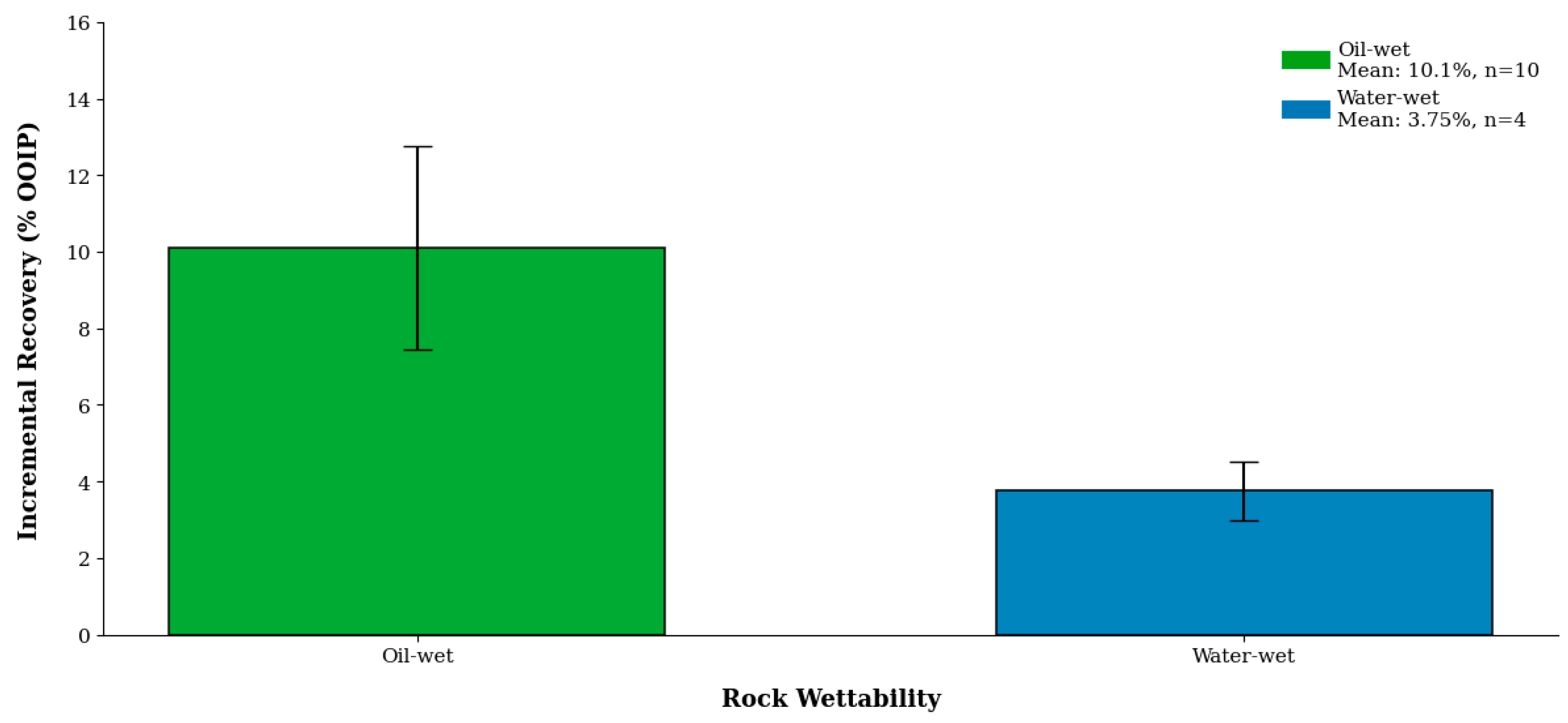
To broaden the basis for inferring the influence of key experimental parameters on NBs-assisted EOR performance, the following analysis extends beyond the five CO2-focused studies reviewed to encompass all experimental studies compiled in Table 1, including investigations utilizing N2-NBs. This deliberate inclusion of both CO2-NB and N2-NB datasets increases the statistical sample size and experimental diversity, thereby enabling more robust inferences regarding the role of rock wettability and experimental methodology on incremental oil recovery. However, the number of available results is not statistically significant. Therefore, the following results may require further investigation, and the observed trends may be associated with other experimental conditions. Figure 2 demonstrates the influence of the wettability of the rock on the incremental oil recovery obtained in the experiments with the NB-assisted EOR processes, where the results are summarized for all the experiments in the dataset in which the influence of the wettability was taken into account. The dataset used in the analysis contains the CO2 and N2-NB experiments (the number of experiments (n) = 14 for the oil-wet and n = 4 for the water-wet cases), and the mean values of the incremental oil recovery are presented along with the standard deviations. Within this limited dataset, the results fairly indicate that the oil-wet rock systems have a substantially higher mean incremental recovery of approximately 10.1% OOIP, whereas the water-wet systems showed approximately 3.8% OOIP.
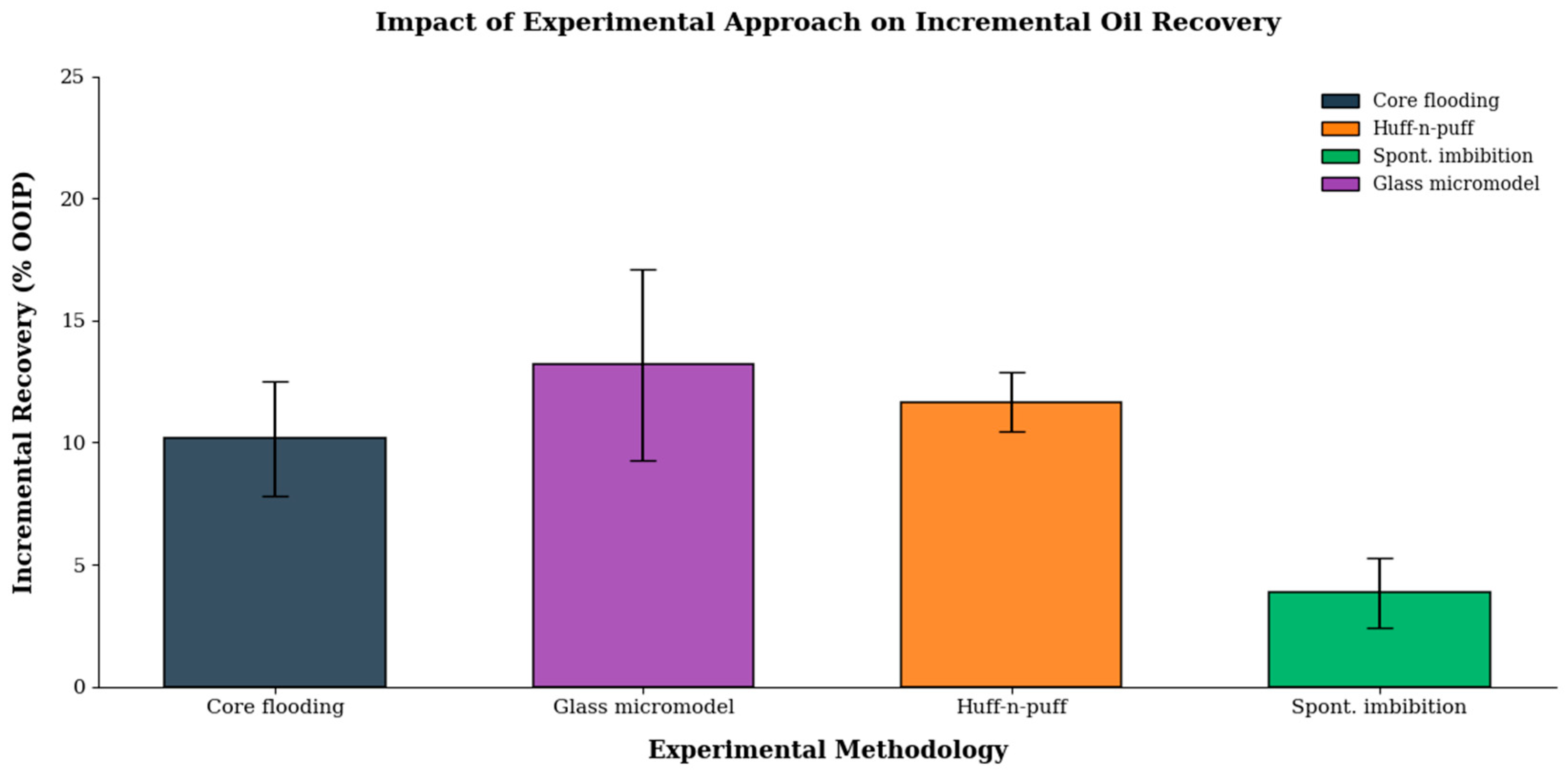
Figure 3 illustrates the mean incremental oil recovery (% OOIP) disaggregated by experimental methodology across the full compiled dataset, again incorporating both CO2 and N2-NB experiments to maximize the diversity of the sample. The experimental techniques are represented by core flooding, glass micromodel experiments, huff-n-puff, and spontaneous imbibition. In terms of mean incremental recovery, the experiments using a glass micromodel had the highest recovery at approximately 13.3% OOIP, followed by huff-n-puff at approximately 11.7% OOIP, core flooding at approximately 10.2% OOIP, and spontaneous imbibition at approximately 3%. However, these differences should be interpreted only as descriptive trends rather than statistically significant rankings, given the limited number of studies available in each category.

4. Proposed Mechanisms of CO2-NBs in Oil Reservoirs

The impact of CO2-NBs on metrics of the EOR process has been examined by various studies [15,29]. Various interpretations have been proposed to account for how CO2-NBs yield better recovery in the experimental studies [15,29,30]. In this section, we provide an overview of the proposed mechanisms that could explain the role of CO2-NBs in improving oil recovery. The mechanisms discussed in this section are categorized based on the relative strength and the source of evidence supporting the hypothesized mechanism. Section 4.1 focuses on mechanisms mainly supported by CO2-NB EOR experiments, while Section 4.2 discusses additional proposed mechanisms supported by broader NB/MB literature or indirect evidence.

4.1. Mechanisms Primarily Supported by CO2-NB EOR Experiments

This section discusses mechanisms that have relatively strong evidence from CO2-NB EOR experiments. These mechanisms are supported either by direct measurements, such as interfacial tension, contact angle, oil property changes, or effluent chemistry, or by strong experimental observations.

4.1.1. Oil Swelling and Viscosity Reduction

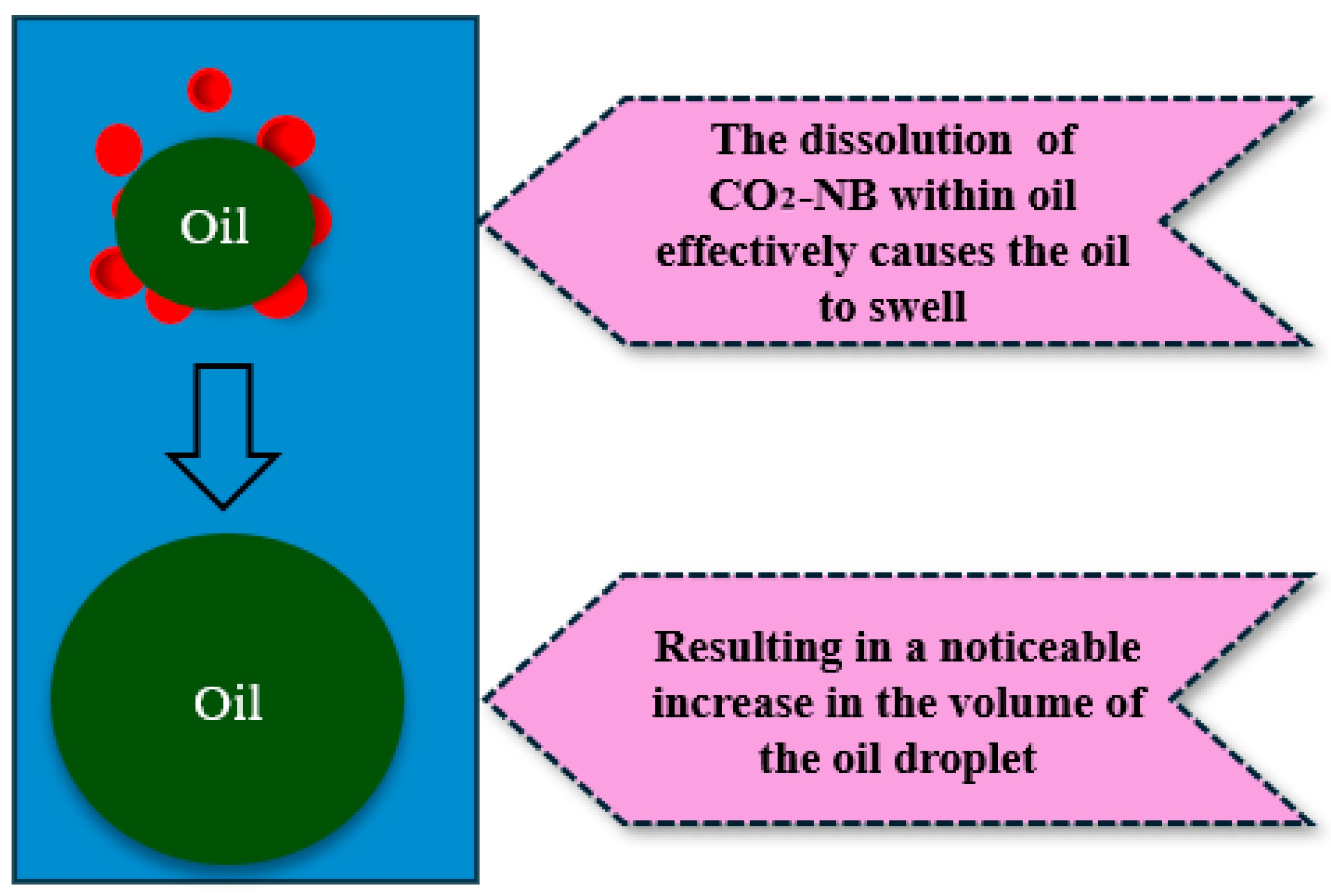
CO2-NBs are suggested to improve CO2 dissolution into oil due to the increased surface area of CO2 in contact with oil compared to CO2 gas flooding [18,36,37]. This increase in surface area results from the large numbers of very small CO2 bubbles, which eventually result in oil volumetric expansion and reduced oil viscosity, as demonstrated by (Equation (1)) [29]. CO2 dissolution into oil reduces oil density and viscosity, thereby altering oil properties and improving oil buoyancy. A lighter and less viscous oil phase can be formed by these alterations, which can make buoyancy effects more pronounced for the oil phase, as illustrated in Figure 4.
A flooding process is considered miscible when the injected gas and reservoir fluid combine into one phase. On the other hand, immiscible flooding happens when the oil and gas phases remain as separate phases, with an interface existing between them under reservoir conditions [38]. The mass transfer from the gas to the liquid phases is facilitated by miscibility, enhancing the capacity to mobilize residual oil [39]. Oil saturation increases when the oil volume increases, “oil swelling”, which enhances the relative permeability of the oil phase [40]. In this context, reductions in oil density and viscosity, along with enhancements in oil relative permeability, are achieved through a miscibility process. These changes lead to a reduction in the mobility ratio, which can enhance reservoir sweep efficiency and ultimately lead to more efficient displacement of oil in EOR processes (Equation (1)).
M = k r D × μ d k r d × μ D
where M denotes the mobility ratio, k r D and k r d represent the relative permeabilities of the displacing and displaced fluids, respectively, μ D and μ d are their corresponding viscosities. This mechanism should be distinguished from the oil flotation mechanism that will be discussed in Section 4.2.1, in which the oil droplets are attached to immiscible bubbles and/or bubbles still remaining at partial miscibility conditions. Under the latter conditions, the two mechanisms can operate simultaneously: the miscible gas dissolution into the oil and the immiscible gas bubble–droplet interactions, which could facilitate the flotation process.
Two different sets of experiments were performed on sandstone rocks [15]: core flooding in Berea sandstone to compare CO2-NBs with carbonated water, and huff-n-puff (HNP) in tight Kentucky sandstone to compare CO2-NBs with a CO2–brine mixture without NBs. This study did not discuss the oil swelling effect or the reduction of oil viscosity via NBs, even though these are well-known EOR mechanisms when CO2 is dissolved in carbonated water [41]. This study, however, demonstrated that the CO2-NB improvement in oil recovery compared to the base cases is correlated with CO2 accumulation near the advancing displacement front, as well as improving CO2 transport into the oil phase, which is related to the increased interfacial contact area of the CO2-NBs. Similarly, Saleh et al. conducted a flooding experiment on Berea sandstone comparing surfactant-stabilized CO2-NBs against a surfactant–brine system, pointing to the role of NBs in boosting recovery via oil swelling and reduced oil viscosity [29].
In conglomerates, Zhu et al. [30] carried out flooding experiments to compare the efficiency of gas flooding with NB flooding. The findings indicated that supercritical CO2 gas flooding was outperformed by CO2-NBs, and likewise, N2-NBs outperformed N2 gas flooding, with a better oil recovery performance of CO2-NBs compared to N2-NBs. The higher efficiency of CO2-NBs over N2-NBs was attributed to CO2’s greater miscibility with oil than N2, which facilitates CO2 transfer into the oil phase and lowers the viscosity of the oil.

4.1.2. Interfacial Tension Reduction and Wettability Alteration

One of the major factors that influences fluid flow in porous media is interfacial tension, especially in oil-wet media [42,43,44,45,46,47], as capillary forces are expected to dominate the flow. A viscous-dominated flow can be achieved by reducing interfacial tension, thereby reducing the capillary forces and increasing the capillary number expressed by Equation (2) [48]. The displacement efficiency increases by increasing the capillary number, thus decreasing the residual oil saturation [49,50,51].
N c = μ D × ν σ D d × cos θ × μ D μ d 0.4
In this expression, N c represents the capillary number, μ D and μ d denote the viscosities of the displacing and displaced phases, respectively, σ D d is their interfacial tension, and θ refers to the contact angle between the displacing phase and the rock surface [48]. Many chemical EOR techniques are based on interfacial tension reduction; however, these methods bring drawbacks such as increased handling, environmental risks, and economic challenges. These techniques include surfactant flooding, polymer flooding, alkaline surfactant polymer flooding, etc. [52].
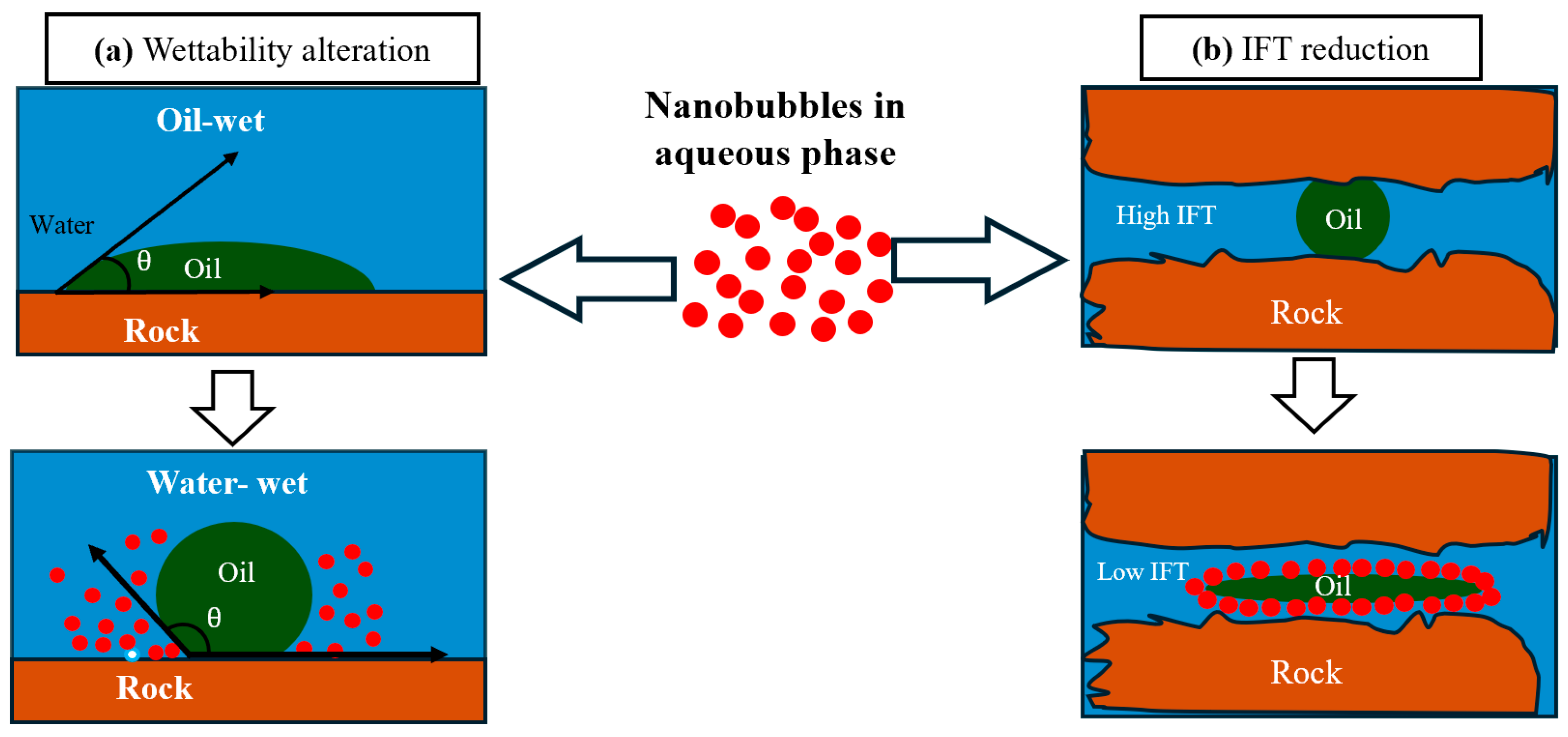
Oil–water interfacial tension reduction via N2-NB was tested in a study conducted by Taman et al. [32]. This study separated the impacts of viscous and gravitational forces. The researchers used mineral oil, crude oil, and decane in an experiment conducted using a glass micromodel exhibiting strong oil wettability. The analysis revealed a decrease in oil–water interfacial tension after NBs were introduced to the aqueous phase (Figure 5b). Enhanced recovery was achieved due to the reduction in capillary forces, and the results were further improved when utilizing oil with a higher initial interfacial tension alongside water. A further study that utilized mineral oil and water found that N2-NBs decreased the oil–water interfacial tension by 12% [31]. This reduction in IFT was associated with a decrease in capillary forces and the enhanced mobilization of oil. Conversely, Elnaggar et al. measured the interfacial tension between crude oil and water and N2-NB solutions, reporting that the oil–water interfacial tension almost did not change [33]. On the contrary, Saleh et al. highlighted interfacial tension reduction as a primary effect of NBs [29]. Their experiment involved mineral oil against an aqueous surfactant solution, tested with multiple variations, e.g., surfactant with carbonated water, air NBs, and surfactant with CO2-NBs. They concluded that oil mobilization during the flooding process can be enhanced by using CO2-NBs, as the experiment provided evidence that CO2-NBs can modify the IFT more effectively compared to surfactant-air NBs and the surfactant with carbonated water.
The impact of NBs on oil–water interfacial tension varies depending on the type of gas used in the experiment. There are also many factors that can affect interfacial tension, including oil type, NBs generation method, operating pressure and temperature, surfactant presence, and water chemistry, etc. [17,53,54].
In this regard, previous research has shown that CO2-NBs have a more significant impact than N2-NBs in reducing IFT. This is mainly because of the miscibility of CO2 and dissolution into oil, which alters its compositional and interfacial characteristics. On the other hand, research has suggested that N2-NBs have a limited influence. For example, Taman et al. showed that N2-NBs have some influence, less significant in crude oil and more significant in synthesized oils [32]. Another study, conducted by Elnaggar et al., showed that there was almost no reduction in the IFT when N2-NBs were introduced [33]. The findings are not necessarily conflicting when viewed alongside Saleh et al. (2025), who showed that air NBs “mainly consisting of N2” had a less significant influence than CO2-NBs on IFT reduction [29].
Another proposed mechanism is wettability alteration by NBs. NBs could locally displace oil films by aggregating at the oil–rock interface, which may enhance repulsive disjoining pressures of thin water films. This could stabilize water layers, which, in turn, facilitates lifting oil from rock surfaces, as well as reducing adhesion forces between oil and rock [55,56,57]. NBs are proposed to alter the surface electrostatic properties and the electrical double layer due to their tendency to aggregate on the rock surfaces with opposite charges; see Section 4.2.3 [57,58]. These factors help to decrease the adhesive forces between the oil and rock surfaces, thus adjusting the effective wettability to a more water-wet state [17]; see Figure 5a. The interactions between NBs and rock surfaces are further interpreted to be affected by the combined electrostatic properties of both rock surfaces and NBs, which are also understood to be affected by the chemical properties of the aqueous fluids. Salinity, salt type, and pH are critical factors in controlling the interactions between NBs and the rock surface [59,60,61,62].
Cai et al. studied wettability changes influenced by CO2-NBs in core slices [17]. Initially, these core slices were prepared to be oil-wet before testing. After immersing these slices in CO2-NB solution, the contact angle changed to become more hydrophilic. The interpretation was that CO2-NBs can aid crude oil removal by altering rock wettability.
Saleh et al. investigated mineral oil wettability on hydrophilic glass and found that introducing CO2-NBs into the surfactant-containing aqueous phase caused the contact angle to change with time compared with the baseline aqueous surfactant solution, which was linked to interfacial rearrangements or adsorption effects, as well as localized changes driven by pH variations resulting from the dissolution of CO2-NBs. The authors partly ascribed the observed improvement in oil recovery to this wettability alteration [29].
Elnaggar et al. carried out a series of spontaneous imbibition experiments on tight carbonates, with the results indicating that the rock’s original wettability strongly influences the performance of NBs compared to water [33]. Their interpretation was that N2-NBs create a dispersed gas phase exhibiting moderate wettability, enabling stronger bubble–oil interactions and facilitating oil release through mechanisms such as flotation; see Section 4.2.1. The intermediate wettability of gases has been proven in strongly oil-wet systems. Hence, they observed that N2-NBs were more effective in strongly oil-wet rock than in water-wet systems. Moreover, due to their nanoscale size and moderate wetting behavior, NBs can access smaller pore spaces compared with water, which is most likely the non-wetting phase in oil-wet systems [33,63].
Zhu et al. proposed that CO2 and N2-NBs could change the rock wettability, although this was not verified experimentally [30]. Lawal et al. presented evidence for rock dissolution in their experiments, which could enhance the wettability of the sandstone through exposure of new rock surfaces [15]. Conversely, in another study, N2-NBs showed minimal wettability alteration in micromodel experiments [31,32]. In this context, the studies showed that CO2-NBs consistently demonstrated a more pronounced ability to alter wettability, whereas N2-NBs generally showed minimal to negligible impact [30,31,32].
Wettability strongly influences the recovery process by controlling which fluid preferentially coats the rock surface [64]. It controls capillary pressure, relative permeability, and fluid adhesion—thus influencing residual oil saturation and recovery efficiency [65,66,67]. Water-wet rocks favor spontaneous imbibition and reduce oil adhesion, while oil-wet rocks behave oppositely [45].
NBs have been found to change the wettability state to a water-wet system or keep the initial state, which indicates the capability of NBs to change surface properties [17,29,30]. The change in wettability state is influenced by interactions between NBs and rocks, as well as the type of gas, brine, and pressure and temperature conditions [68,69,70]. Further experiments are needed to quantify these parameters and predict wettability changes during NBs injection.

4.2. Additional Proposed Mechanisms from Broader NB and MB Studies

This section discusses additional mechanisms that are supported mainly by broader literature, indirect evidence, or limited CO2-NB observations. These mechanisms are not always directly measured in CO2-NB EOR experiments, but they may still contribute to oil mobilization and enhance recovery performance. Therefore, they are addressed as proposed mechanisms that require further validation, especially under reservoir conditions.

4.2.1. Oil Flotation and Suppression of Gravity Segregation

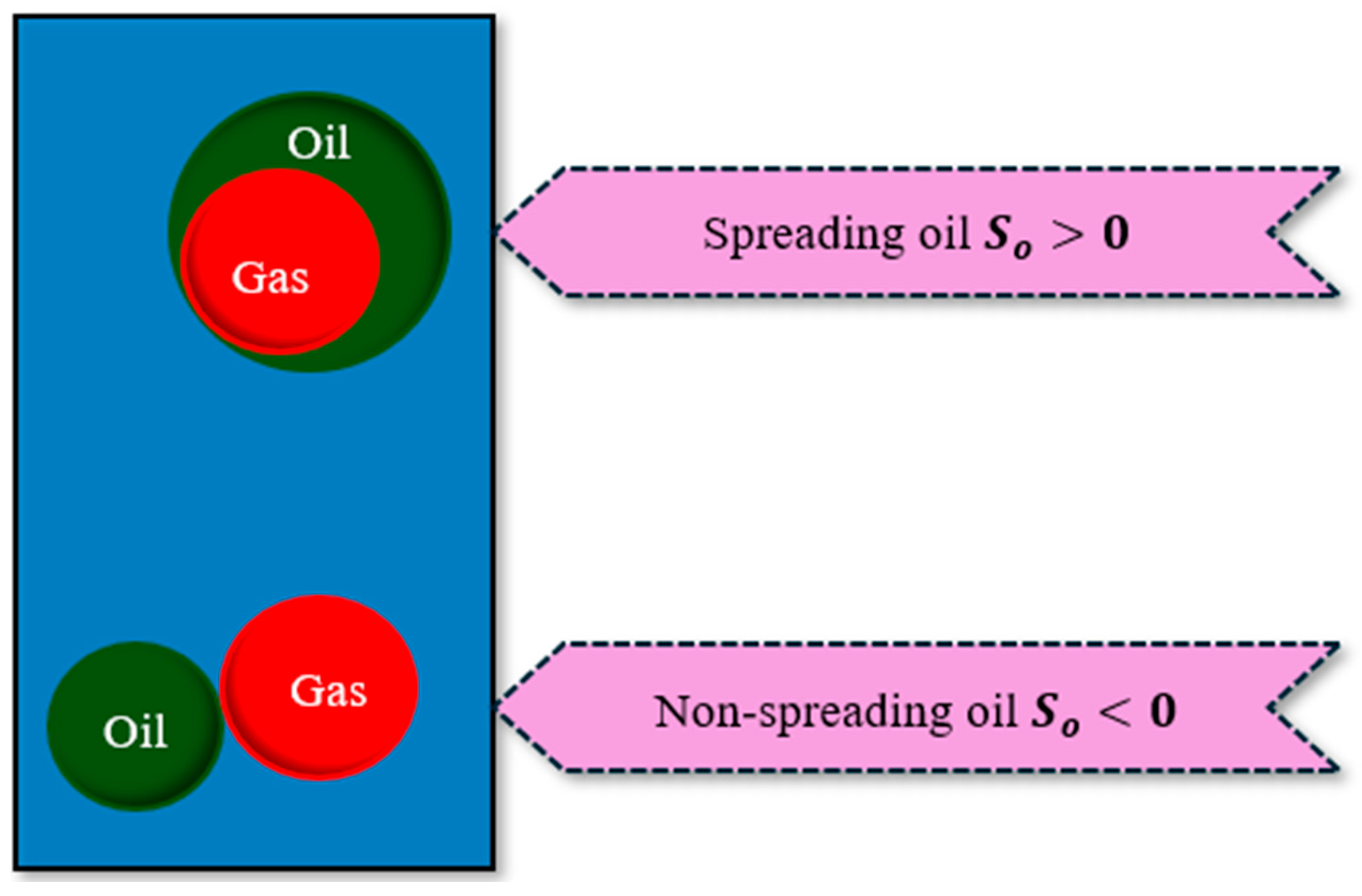
In their flooding tests on conglomerate samples, Zhu et al. separately examined the effect of introducing CO2-NBs and N2-NBs. From their findings, they suggested that bubble–oil interactions at the microscale can release residual oil [30]. They proposed that NBs can help detach residual oil films or oil droplets from the pore surface via direct bubble–droplet contact. NB-assisted surface oil–water separation is closely related to the well-established flotation process in the oil and gas industry. However, whether this flotation mechanism can operate effectively in porous media under downhole conditions is still not confirmed. Oil–bubble contact can be established via several mechanisms [71], but the bubble–droplet interaction mode is governed by the oil spreading coefficient, S o   (Equation (3)) [33,71,72]. The coefficient is defined as:
S o = γ w g γ o w γ o g
where S o represents the spreading coefficient, γ w g is the water surface tension, γ o g is the oil surface tension, and γ o w is the oil–water interfacial tension. When S o is negative, oil does not spread over the bubble surface but instead forms localized contact with the bubbles, resulting in a weak interaction that is prone to disruption under flowing conditions. On the other hand, when S o is positive, oil acts as the spreading phase and tends to coat the bubble surface, forming an oil encapsulation, which strengthens bubble–oil interaction [33,71,72]; see Figure 6 for the comparison between the two cases.
NBs may promote the flotation process in which oil is lifted by the formation of bubble–droplet clusters. These clusters are suggested to maintain a lower density than isolated oil droplets, giving them higher buoyancy [33]. Elnaggar et al. concluded that NBs may trigger a flotation process by creating bubble-oil aggregates that have the ability to migrate easily, as demonstrated in the spontaneous imbibition experiments on Minnesota North Cream carbonates and Berea sandstones [33]. The study reported that buoyancy stems from NBs coalescing into larger bubbles and not from the NBs themselves, as individual NBs do not exhibit strong flotation due to their small sizes [71,73,74,75,76].
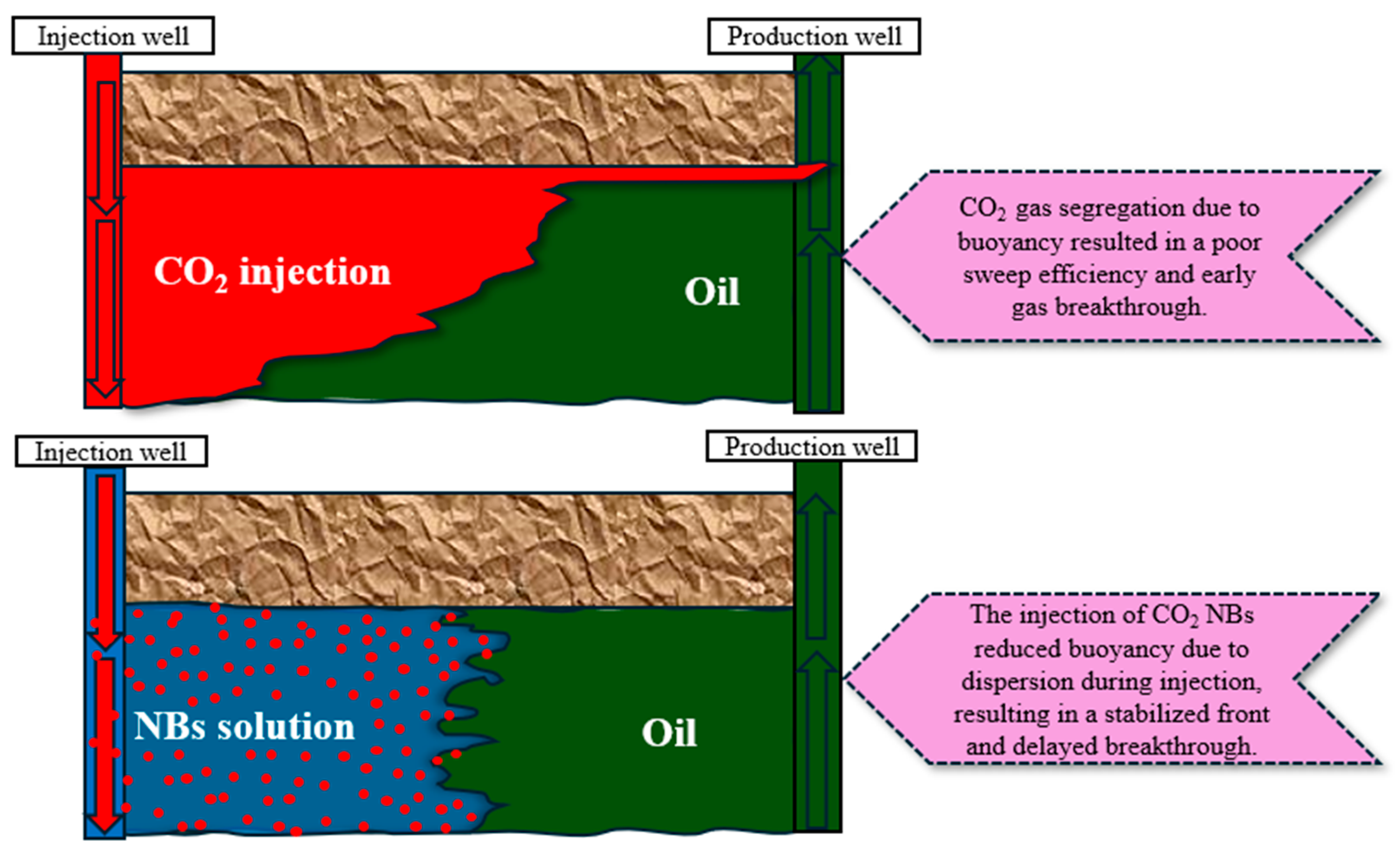
Another way microbubbles (MBs) and NBs may improve displacement is by mitigating gas segregation, which is commonly associated with conventional gas flooding. Gas segregation refers to the upward motion of injected gas under buoyancy forces, where gas occupies the upper layers and high-permeability zones, resulting in early breakthrough [77]. Segregation is more severe in heterogeneous rocks, as mobile free-gas phases exploit high-permeability pathways, decreasing sweep efficiency [78]. MBs and NBs suppress gravity segregation due to the reduced buoyancy forces on the bubbles, as illustrated in Figure 7, while still allowing for the benefits of injected gases, e.g., CO2 EOR and CO2 CCUS. The bubble rise velocity is described by Stokes’ Law [79]:
V r = Δ ρ g d 2 18 μ l
where V r is the bubble rising velocity, Δ ρ denotes the density contrast between the bubble and the surrounding liquid, g denotes gravitational acceleration, d represents the bubble diameter, and μ l denotes the liquid viscosity. Since NB’s diameter is extremely small, the rising velocity is negligible, as the rising velocity scales with   d 2 . Instead of a buoyant rise, the nanoscale size of NBs makes Brownian diffusion the dominant mode of movement [80].
Studies have proposed the ability of NBs to suppress gravity override compared to gas flooding and even MBs flooding [17,79]. Cai et al. tested CO2-NB flooding in extra-low-permeability sandstone and interpreted the results as evidence of limited gravity segregation [17]. This conclusion was based on flooding indicators rather than direct visualization of vertical gas distribution.
In water–oil systems, it should be noted that miscible gases may reduce the effectiveness of segregation suppression due to their dissolution into oil, which promotes miscibility as discussed in Section 4.1.1. This miscibility increases the density differences between the oil and the NB carrier fluid “water”, which may affect water segregation. However, this effect is unlikely to dominate in water–oil displacement, since gravity segregation is far stronger in gas–oil systems. In water–oil systems, density differences are usually less significant, and the reduction of oil density by miscible gases has limits.

4.2.2. Induced Waves

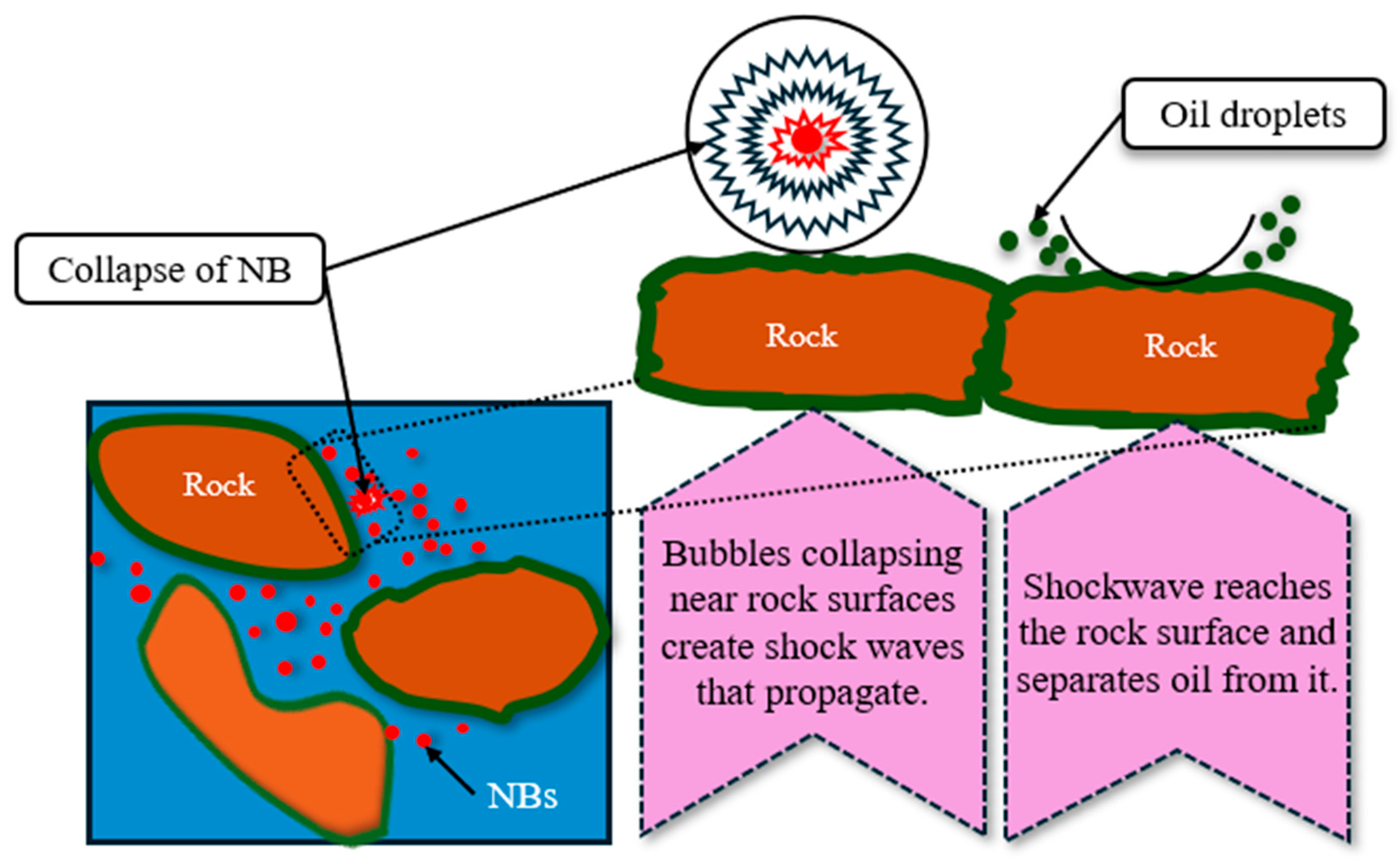
NBs have extremely small radii, which results in high Laplace pressure (Equation (5)):
Δ p = 2 γ R
where R is the bubble radius, γ is the bubble–water interfacial tension, and Δ p is the internal pressure relative to the surrounding liquid. Because of this elevated pressure, the collapse of NBs can generate shock waves resembling micro-explosive events [81]. Shock waves created during bubble collapse are well documented in the literature [82,83,84]. Studies have shown that these shock waves travel through the liquid and hit other surfaces, causing damage to solid surfaces, which is referred to as cavitation [82,83,84]. Collapse occurs because of local pressure changes, coalescing, or natural shrinking, causing a rapid change in volume and producing shock waves that travel through the liquid and hit other rock surfaces; see Figure 8. Those shock waves could potentially aid in releasing more oil that is sticking to the rock surface and, in extreme cases, can aid in reversing wettability and unconsolidated rock dissolution.

4.2.3. Rock Dissolution and Drag Force Reduction

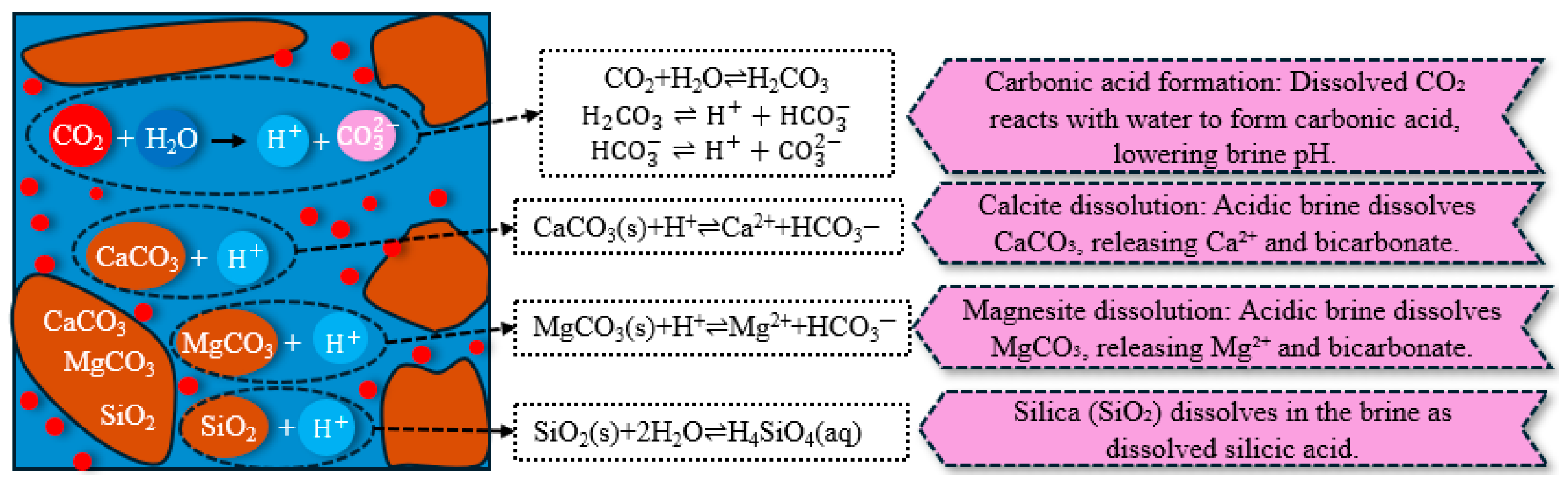
CO2-NBs are suggested to promote rock dissolution, particularly in unconsolidated formations and calcium carbonate deposits [15,85], through two proposed mechanisms: First, CO2-NBs can lower the local pH because CO2 is an acidic gas with high solubility in brine, which enhances the dissolution of cations such as Ca2+ and Mg2+ into the brine to reestablish equilibrium [15,85]. Second, NBs may bind to calcium carbonate nanoparticles (NPs), forming NB–NP clusters through bubble–particle interactions. Electrostatic forces play an important role in the latter, as dissolution is preferred when negatively charged NBs interact with positively charged carbonates; conversely, positively charged NBs, sometimes including CO2-NBs, may interact with negatively charged sandstones [56,85,86]; see Figure 9.
Oil recovery can be enhanced by rock dissolution through the alteration of pore geometry. Enlarged pores and throats reduce capillary entry pressure, mobilizing more trapped oil. In addition, dissolution may also clear carbonate scales. Furthermore, oil adhesion can be reduced by changes in surface texture, shifting the rock toward water wetness (see Section 4.1.2). These petrophysical phenomena are more expected in unconsolidated or weakly cemented carbonate rocks [85]. In contrast, well-cemented rocks have limited dissolution because of the low flow velocities.
Two experiments provide evidence of rock dissolution by NBs. In the first, NBs were shown to cluster with calcium carbonate NPs in water, potentially aiding the removal of carbonate deposits from pipe walls [85]. In the other study, a core flood test using Berea sandstone with CO2-NBs revealed higher Ca2+ concentrations in the effluent compared to carbonated water and brine. This excess Ca2+ was interpreted as evidence of calcite dissolution in the sandstone cores [15]. Additionally, Bui et al. observed enhanced oil separation when positively charged NBs were used, as sandstones are typically negatively charged [59].
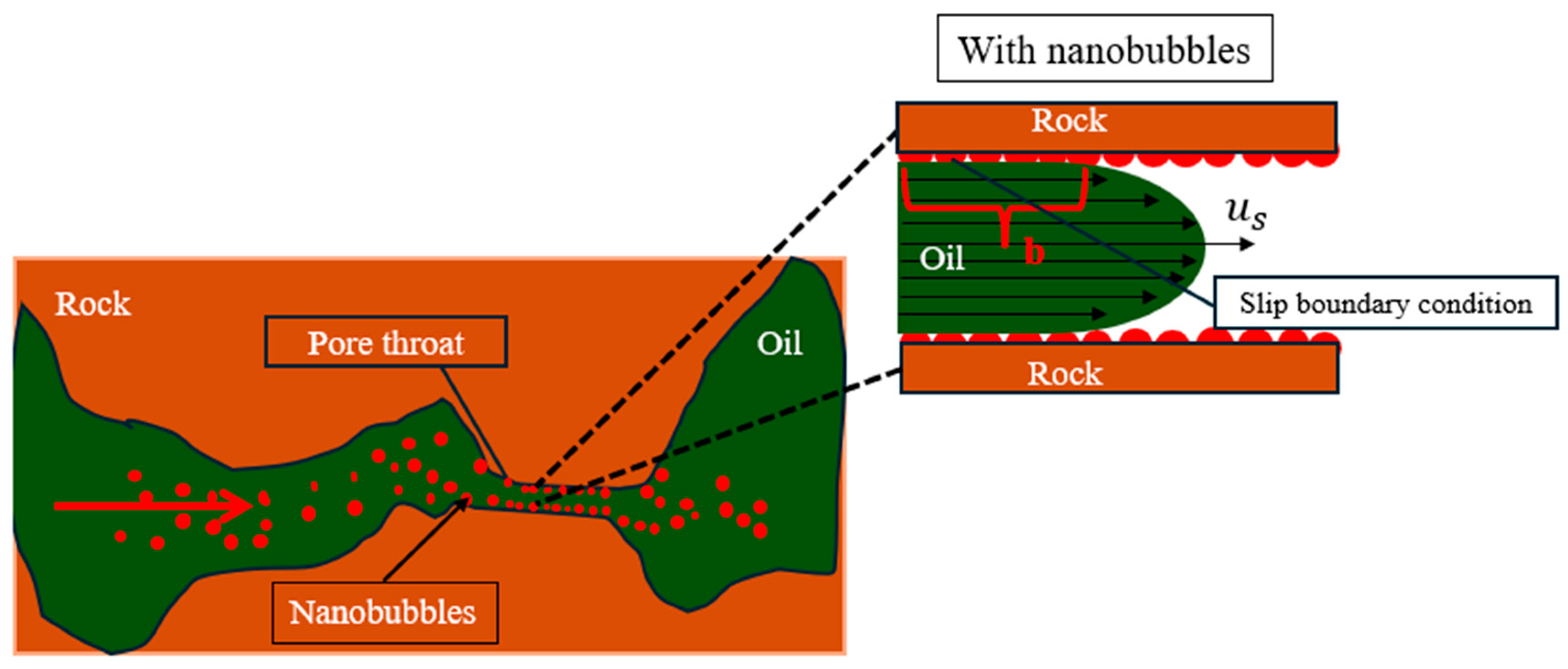
Slippage or drag force reduction is another proposed mechanism by which NBs contribute to EOR. Drag forces between rock surfaces and flowing fluids influence oil displacement efficiency [87,88]. Fluid velocity varies from zero at the rock–fluid interface to its maximum at the pore throat center, which lowers the average velocity of the fluid [89]. Drag forces at the solid–fluid boundary can be reduced by surface NBs (SNBs) [90]. Figure 10 illustrates the effect of SNBs, showing their ability to enhance flow efficiency.
NBs generally exhibit hydrophobic behavior and a negative surface charge, and this charge affects their interaction with other surfaces [91]. Therefore, NBs can promote stronger affinity for positively charged mineral surfaces, including carbonates [86]. However, most reservoir rocks, especially sandstones, tend to have a negative charge [92], which results in electrostatic repulsive forces that prevent the formation of negatively charged SNBs [93]. For NBs to interact effectively with sandstones, it is essential to engineer them to be positively charged. This charge control can be obtained through changes in brine chemistry, particularly pH adjustment, which affects the NB surface charge [94]. Under acidic conditions, CO2-NBs were observed to develop a positive surface charge [95].
Experiments reported higher apparent permeability during NB injection than during water injection, especially at low flow rates, suggesting a possible boundary-slip effect [31]. Darcy’s law assumes a no-slip condition at the solid surface and linear proportionality between flow velocity and pressure gradient [96,97]. Permeability becomes flow-rate dependent when slip occurs, causing a deviation from Darcy behavior. In this case, the pressure–flow relationship is hard to interpret and may make displacement behavior more difficult to predict [96,97]. Excessive slippage with NBs is expected to be minimal, as NB dispersions contain much less gas than conventional gas-flooding systems. In addition, the low velocities typical of porous-media flow are unlikely to amplify slippage, and extensive coverage of rock surfaces with SNBs is also quite unlikely.

5. Assessment of CO2 Storage Potential During NB-Based EOR Injection

A probabilistic framework to estimate the amount of CO2 that can be stored in formations that will undergo CO2-NB EOR is developed to accommodate the variation in deployment parameters and to build a preliminary storage-focused perspective about the feasibility of CO2-NB in CCUS-EOR. The approach primarily considers the amount of CO2 required to saturate the water injected. The main trapping mechanism that will be effective is solubility trapping, which is considered a secure trapping mechanism. Moreover, the amount of free NBs in solution was theoretically estimated but was neglected as it was shown to be insignificant.

5.1. Theoretical Assessment of the Free-NB Percentage to the Total CO2-NB Solution

Before performing the probabilistic analysis, a theoretical approach is used to evaluate whether the amount of free CO2-NB is significant relative to the dissolved CO2. NBs were assumed to be spherical, with diameters following a normal distribution N(400 nm, 200 nm). The NB concentration was assumed to be 10 10 bubbles/mL. These assumptions serve as an upper-bound estimate according to the numbers found in the literature, to ensure that even with favorable generation parameters, the amount of free CO2-NBs remains insignificant. The volume of a single nanobubble was calculated as the volume of a sphere as follows:
V b = π 6 D 3
where D is the bubble diameter. The expected nanobubble volume was therefore expressed as:
E [ V b ] = π 6 E [ D 3 ]
For the assumed normal diameter distribution, the third moment is expressed as:
E [ D 3 ] = μ 3 + 3 μ σ 2
where μ is the average bubble diameter, and σ is the standard deviation of the diameters of the bubbles. Substituting with μ = 400 nm and σ = 200 nm and Equation (8) into (7) yields an expected bubble volume of:
E V b = π 6 1.12 × 10 8 = 5.86 × 10 7   nm 3
The assumed CO2-NB concentration is then multiplied by the expected bubble volume to obtain its relative volume in solution as follows:
V N B , t o t a l = N b E V b = 10 10 × 5.86 × 10 14 = 5.86 × 10 4   mL   CO 2 / mL   water
Therefore, the volume percentage of the free bubbles is less than 0.06%. This aligns with stability theories of NBs that emphasize that the relative volume of free NBs must be relatively low to avoid coalescence and Ostwald ripening [98,99,100]. To compare it with dissolved CO2, the free NBs volume percentage was converted to mass per unit volume of injected water using a CO2 density of 610 kg/m3 at 175 °F and 3000 psi. The dissolved CO2 mass per unit volume of injected water at the same conditions is calculated using the method introduced in Section 5.2. It was found that the relative contribution of free NBs is less than 1% as mass per unit volume of injected water compared to the dissolved CO2. Therefore, the free NB percentage is neglected in the probabilistic approach explained in Section 5.2.

5.2. Probabilistic Monte Carlo Study to Assess Storage Capacity of CO2-NB

Based on the results of the previous section, the framework focused exclusively on dissolved-phase CO2. Dissolved CO2 concentration was estimated using an empirical correlation of Equation (11), introduced by Khoshraftar et al. [101], as a function of pressure and temperature. The effect of salinity is neglected for simplicity, as CO2-NB EOR is more suitable as an EOR candidate for low-salinity formations; therefore, it should be noted that the results would be relatively overestimated.
C s a t = 16.29767 0.006513 P 0.082006 T + 0.000097 P T 0.000089 P 2 + 0.000104 T 2
where C s a t is the dissolved CO2 saturation concentration in mol/kg water, P is pressure in MPa, and T is temperature in K. The calculated dissolved concentration was then converted from mol/kg water to kg CO2/ m 3 . To express storage potential normalized by reservoir pore volume, the dissolved CO2 concentration was multiplied by the slug volume of CO2-NB solution.
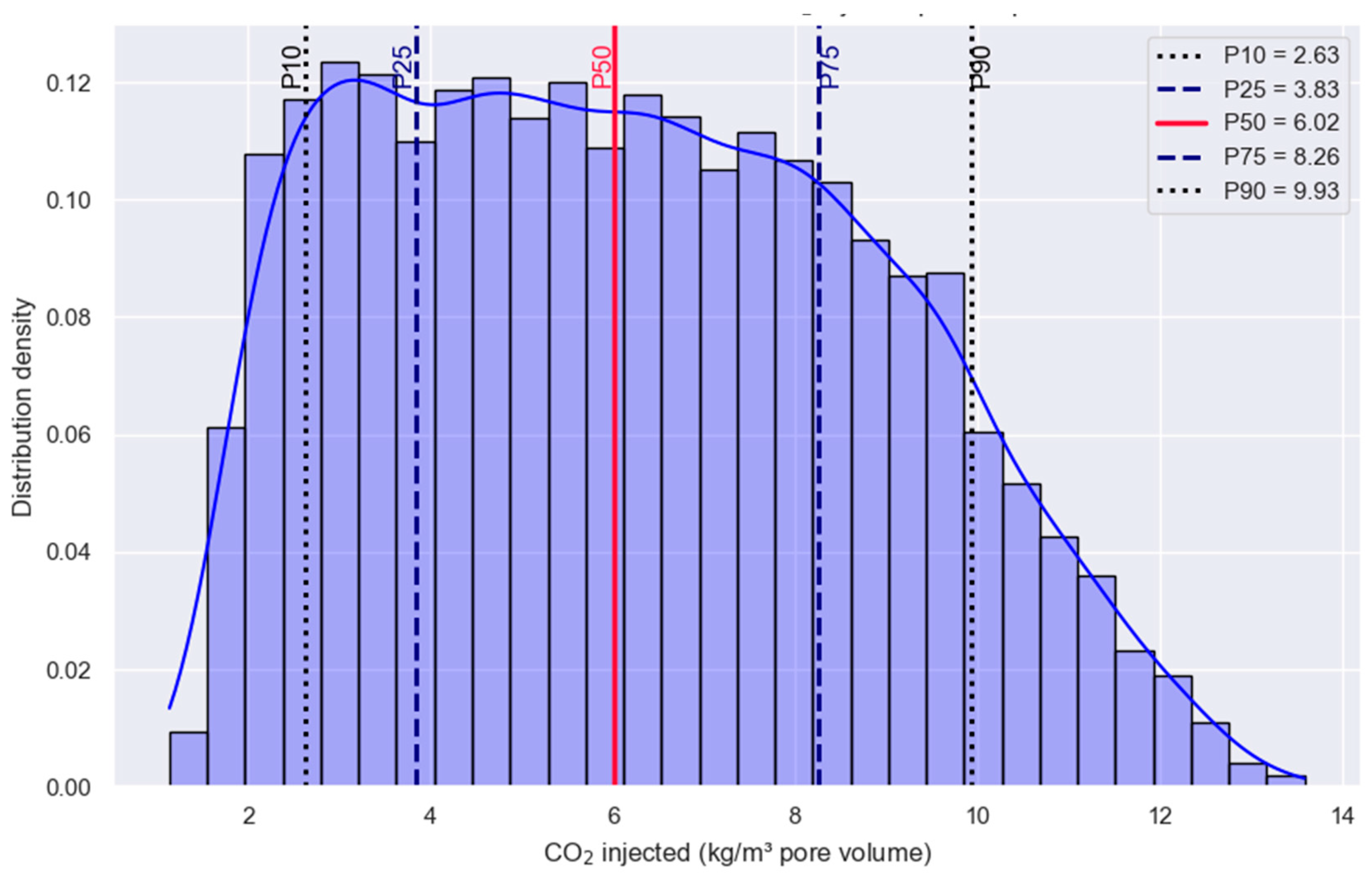
To account for variation in operating and reservoir conditions, a Monte Carlo simulation was implemented. Pressure was sampled from a uniform distribution between 800 and 4500 psi, temperature was sampled from a uniform distribution between 120 and 250 °F, and slug volume was sampled from a uniform distribution between 0.05 and 0.30. A Gaussian copula is added between the pressure and temperature to represent the statistical correlation between the two variables. A total of 10,000 trials were sampled to characterize the uncertainty in dissolved CO2 storage potential. For each trial, the dissolved CO2 storage potential was computed using the sequence described. The simulated results were summarized in percentile statistics, as shown in Figure 11.
Therefore, the amount of CO2 that can be stored in a 5-acre reservoir with a height of 50 ft and a porosity of 18%, using the obtained P50 from the simulation, is 334 metric tons. Even though the storage capacity is relatively small compared to the larger capacities usually considered in geological CCS projects, this does not diminish the importance of the technique. We note that our estimate is mainly intended to illustrate the order of magnitude of the potential storage benefit, as it involves simplified assumptions, including neglecting salinity, using an empirical CO2 solubility correlation, and applying broad uniform distributions for pressure, temperature, and slug volume. In the context of the NB-based EOR process, it is expected that a significant amount of the stored CO2 will remain in solution, which is favorable because solubility trapping is considered one of the safest trapping mechanisms, as it has a lower leakage potential than the mobile free-gas phase. In addition, the CO2-NBs injection technique could have broader applicability compared to conventional EOR techniques.

6. Conclusions

This paper reviewed CO2-NBs as an emerging EOR–CCUS technology, presenting a comparative analysis of existing studies and a storage-based assessment to quantify the amount of CO2 that can be stored during the operation. The overall laboratory evidence suggests that CO2-NBs could be employed for enhanced oil recovery, as they can work for various rocks, supporting their potential for CCUS applications.
From the comparative analysis, it is observed that the conducted experiments fairly suggest the effectiveness of CO2-NB-assisted injection in improving oil recovery for all rock types and configurations, although the degree of improvement varies significantly. The limited available dataset, along with experimental observations, suggests that reservoir wettability could be an important parameter for screening the best candidate formations, as oil-wet systems showed higher incremental recovery than water-wet systems.
The review of the mechanisms further indicates that the oil recovery process by CO2-NBs cannot be described by a single effect. Rather, it is indicated to result from the interaction of several mechanisms with different levels of experimental support, such as the swelling and reduction of oil viscosity, flotation and the associated oil buoyancy, the suppression of gravity segregation, interfacial tension reduction, wettability alteration, the generation of induced waves, the dissolution of the rock, and the reduction of drag forces. This suggests that the CO2-NBs should be regarded as a multiphysics displacement process, and it depends on the interaction between fluid properties, rock characteristics, and operating conditions.
From the storage perspective, it has been found through the assessment process that the contribution of the free NBs phase to the storage process is negligible in comparison to dissolved CO2, and the storage potential of CO2-NB injection is dominated by solubility trapping. The probabilistic analysis has found that, although the amount of CO2 storage is relatively low in comparison to large-scale projects, the storage mode is favorable because dissolved CO2 is more secure than a free phase. In this sense, CO2-NB injection may not replace a traditional saline aquifer injection, but it may represent a supplementary form of CCUS technology.
However, there are several operational issues regarding the feasibility of applying the CO2-NB EOR technique at a larger scale that require further studies to gain a deeper understanding and determine the most suitable characteristics of candidate reservoirs for this EOR technique, as our knowledge still mainly comes from lab tests, with limited field validation of the stability, transport, and efficiency of CO2-NB injection under reservoir conditions. Among the main challenges associated with field implementation of the CO2-NBs technique are maintaining their stability during injection, preventing dilution of the solution upon encountering formation water, which may affect the stability and concentration of the solution of NBs, and the thermodynamic behavior of CO2-NBs under reservoir conditions, especially the expected transition between the gaseous and supercritical phase. Also, reservoir characteristics such as brine salinity, ion type in brines, and the acidity of formation water may affect the efficiency of CO2-NBs in EOR applications. Therefore, future studies should prioritize characterizing CO2-NB solutions under reservoir pressure and temperature conditions, developing in situ CO2-NB generation strategies, conducting reservoir-specific screening, and performing preliminary techno-economic evaluations to enable large-scale field implementations.
Overall, this study supports the potential feasibility of CO2-NBs as a CCUS-EOR method, while the available literature is still limited in scope, indicating a few gaps in the existing research. To further extend the concept in the field scale, precise prediction of the thermodynamic behavior of CO2-NBs and direct verification of their stability under different conditions are required. Therefore, further research is needed to clarify the major challenges associated with CO2-NB injection, the optimum injection conditions and generation parameters, and to identify the most promising candidate reservoirs in terms of oil recovery and storage potential.

Limitations of the Study

This review focuses on the current literature on CO2-NB-assisted EOR and a preliminary assessment of its storage relevance within a CCUS-EOR context. Therefore, several topics were outside the scope of this paper, including reviewing field applications of NBs in EOR, operational economics, challenges associated with NBs injection, and the current gaps in experimental studies, particularly those related to identifying and addressing possible field implementation challenges and detailed CO2 storage simulation, accounting for salinity and thermodynamic effects. In addition, broader NB fundamentals, such as the classification of NBs, their existence and detection techniques, stability theories, and generation techniques, were not discussed, as the main objective of this study was to provide a focused comparative discussion of CO2-NB EOR experiments and their proposed recovery mechanisms. A detailed review of N2-NB experiments was beyond the main scope of this paper; such studies were included only to strengthen the mechanistic interpretation and to provide broader insight into how recovery performance may depend on injection conditions and experimental parameters. Furthermore, some of the mechanisms discussed are supported directly by CO2-NBs EOR studies, whereas others are interpreted with support from the broader nanobubble literature. Accordingly, this study is intended to provide a focused and evidence-based synthesis of the currently available knowledge, while recognizing that some aspects would benefit from further dedicated investigation.

Author Contributions

Conceptualization, A.S., H.E., and M.W.; methodology, A.S.; validation, A.S., A.R.B., and M.W.; writing—original draft preparation, A.S. and H.E.; writing—review and editing, B.E., M.A., and A.R.B.; visualization, E.H. and A.S.; supervision, M.W. and A.S. All authors have read and agreed to the published version of the manuscript.

Funding

This research received no external funding.

Data Availability Statement

The original contributions presented in this study are included in the article. Further inquiries can be directed to the corresponding authors.

Acknowledgments

The authors would like to thank the Bob L. Herd Department of Petroleum Engineering at Texas Tech University for providing the academic environment and resources that supported this effort.

Conflicts of Interest

The authors declare no conflicts of interest.

Abbreviations

The following abbreviations are used in this manuscript:
NB(s)Nanobubble(s)
MB(s)Microbubble(s)
MNBsMicro-nano bubbles
EOREnhanced oil recovery
IORImproved oil recovery
CCUSCarbon capture, utilization, and storage
HnPHuff-n-puff
GHG(s)Greenhouse gas(es)
GtGigatons
NPsNanoparticles
WAG Water-alternating-gas
CO2-eqCO2 equivalent
CO2-RBCO2–reservoir brine
IFTInterfacial tension
MNCMinnesota Northern Cream
SNB(s)Surface nanobubble(s)
OOIPOriginal oil in place

References

  1. Orr, F.M. Carbon Capture, Utilization, and Storage: An Update. SPE J. 2018, 23, 2444–2455. [Google Scholar] [CrossRef]
  2. Lin, Q.; Zhang, X.; Wang, T.; Zheng, C.; Gao, X. Technical Perspective of Carbon Capture, Utilization, and Storage. Engineering 2022, 14, 27–32. [Google Scholar] [CrossRef]
  3. European Commission, Joint Research Centre. GHG Emissions of All World Countries: 2025; Publications Office: Luxembourg, 2025.
  4. Friedlingstein, P.; O’Sullivan, M.; Jones, M.W.; Andrew, R.M.; Bakker, D.C.E.; Hauck, J.; Landschützer, P.; Le Quéré, C.; Li, H.; Luijkx, I.T.; et al. Global Carbon Budget 2025. Earth Syst. Sci. Data Discuss. 2025. [Google Scholar] [CrossRef]
  5. IEA. Global Energy Review 2025; IEA: Paris, France, 2025; p. 43. [Google Scholar]
  6. Wu, J.; Ansari, U. From CO2 Sequestration to Hydrogen Storage: Further Utilization of Depleted Gas Reservoirs. Reserv. Sci. 2025, 1, 19–35. [Google Scholar] [CrossRef]
  7. Dziejarski, B.; Krzyżyńska, R.; Andersson, K. Current Status of Carbon Capture, Utilization, and Storage Technologies in the Global Economy: A Survey of Technical Assessment. Fuel 2023, 342, 127776. [Google Scholar] [CrossRef]
  8. Asadi, A.; Asadi, M.; Siahmargoi, M.; Asadi, T.; Gholami Andarati, M. The Effect of Surfactant and Sonication Time on the Stability and Thermal Conductivity of Water-Based Nanofluid Containing Mg(OH)2 Nanoparticles: An Experimental Investigation. Int. J. Heat. Mass. Transf. 2017, 108, 191–198. [Google Scholar] [CrossRef]
  9. Taman, A.; Ali, R.; Youssif, M.; Elnaggar, H.; Shoukry, A.; Shahin, A. Opportunities for Carbon Capture and Storage Deployment in Existing Coal-Fired Power Plants in Texas. In Proceedings of the SPE Oklahoma City Oil and Gas Symposium; SPE: Oklahoma City, OK, USA, 2025. [Google Scholar]
  10. Elnaggar, H.; Elagab, O.; Arnob, M.S.H.; Eissa, B.; Shahin, A.; Collins, K.; Raslan, K. Evaluation of Decarbonizing Existing Coal-Fired Power Plants Via Carbon Capture and Storage (CCS) in Utah. In Proceedings of the SPE Energy Transition Symposium; SPE: Sugar Land, TX, USA, 2025; p. D031S014R002. [Google Scholar]
  11. Lu, Y.; Fan, Q.; Yang, M.; Ma, J.; Meng, L.; Wu, Z. Research and Prospect of CCUS-EOR Technology and Carbon Emission Reduction Accounting Evaluation. Greenh. Gases 2025, 15, 79–97. [Google Scholar] [CrossRef]
  12. Yan, L.; Hu, J.; Fang, Q.; Xia, X.; Lei, B.; Deng, Q. Eco-Development of Oil and Gas Industry: CCUS-EOR Technology. Front. Earth Sci. 2023, 10, 1063042. [Google Scholar] [CrossRef]
  13. Yuan, S.; Ma, D.; Li, J.; Zhou, T.; Ji, Z.; Han, H. Progress and Prospects of Carbon Dioxide Capture, EOR-Utilization and Storage Industrialization. Pet. Explor. Dev. 2022, 49, 955–962. [Google Scholar] [CrossRef]
  14. Baig, A.R.; Fentaw, J.; Hajiyev, E.; Watson, M.; Emadi, H.; Eissa, B.; Shahin, A. Comprehensive Insights into Carbon Capture and Storage: Geomechanical and Geochemical Aspects, Modeling, Risk Assessment, Monitoring, and Cost Analysis in Geological Storage. Sustainability 2025, 17, 8619. [Google Scholar] [CrossRef]
  15. Lawal, T.; Wang, H.; Mirzaei-Paiaman, A.; Okuno, R. Aqueous Nanobubble Dispersion of CO2 for Enhanced Oil Recovery—Coreflooding and Huff-n-Puff Experiments. In Proceedings of the SPE Improved Oil Recovery Conference; SPE: Tulsa, OK, USA, 2024; p. D021S012R002. [Google Scholar]
  16. Jia, H.-W.; Yu, H.-Y.; Ma, R.; Song, P.; Yuan, Z.; Zhang, J.-P.; Huang, T.; Lu, J.; Wang, Y. Experimental Study of EOR Mechanisms of Non-Chemical CO2 Microbubbles and Their Impact on Pore Structures. Pet. Sci. 2025, 22, 1214–1224. [Google Scholar] [CrossRef]
  17. Cai, L.; Wu, J.; Zhang, M.; Wang, K.; Li, B.; Yu, X.; Hou, Y.; Zhao, Y. Investigating the Potential of CO2 Nanobubble Systems for Enhanced Oil Recovery in Extra-Low-Permeability Reservoirs. Nanomaterials 2024, 14, 1280. [Google Scholar] [CrossRef] [PubMed]
  18. Xue, Z. Field Application of Microbubble CO2 Injection for Enhanced Storage Efficiency in a Tight Sandstone Reservoir. In Proceedings of the 15th Greenhouse Gas Control Technologies Conference; GHGT: Abu Dhabi, United Arab Emirates, 2021. [Google Scholar]
  19. Nano Gas Environmental. Nano Gas™ Environmental’s Proven Success in Enhanced Oil Recovery. Available online: https://nanogasenvironmental.com/success-in-eor/ (accessed on 10 May 2026).
  20. Hiramoto, H.; Kukuu, K.; Kurihara, M.; Akai, T.; Takakuwa, Y.; Sato, K.; Tsuchiya, Y.; Araki, N.; Shirai, S. Experiments of Micro-Bubble CO2 Eor Using Berea Sandstone Core Samples. In Proceedings of the 22nd Formation Evaluation Symposium of Japan 2016, Chiba, Japan, 29–30 September 2016. [Google Scholar]
  21. Natawijaya, M.A.; Sugai, Y.; Anggara, F. CO2 Microbubble Colloidal Gas Aphrons for EOR Application: The Generation Using Porous Filter, Diameter Size Analysis and Gas Blocking Impact on Sweep Efficiency. J. Pet. Explor. Prod. Technol. 2020, 10, 103–113. [Google Scholar] [CrossRef]
  22. Li, S.; Wang, X.; Wang, S.; Zhang, Y.; Chen, C.; Jiang, L.; Wang, L.; Liang, F.; Sun, H.; Song, Y. Optimizing Oil Recovery with CO2 Microbubbles: A Study of Gas Composition. Energy 2024, 302, 131836. [Google Scholar] [CrossRef]
  23. Tong, B.; Liu, D.; Xu, J.; Lv, P.; Jiang, L.; Song, Y. CO2 Microbubbles Enhanced Oil Recovery in Fractured Reservoirs. Geoenergy Sci. Eng. 2025, 253, 213976. [Google Scholar] [CrossRef]
  24. Zhang, Y.; Park, H.; Suekuni, J.; Fuchikami, S.; Nakanishi, K.; Sun, Y.; Miyoshi, T.; Kotani, M.; Nagata, T.; Amer, R.; et al. Research and Development on Geological CO2 Storage for Safe CCS Operation. In RITE Today; Research Institute of Innovative Technology for the Earth (RITE): Kizugawa, Japan, 2021. [Google Scholar]
  25. Li, M.; Liu, J.; Xia, Y. Risk Prediction of Gas Hydrate Formation in the Wellbore and Subsea Gathering System of Deep-Water Turbidite Reservoirs: Case Analysis from the South China Sea. Reserv. Sci. 2025, 1, 52–72. [Google Scholar] [CrossRef]
  26. Elnaggar, H.; Shahin, A.; Hajiyev, E.; Eissa, B.; Abdellatif, M.; Elagab, O.; Hardin, J.; Watson, M. Nanobubbles EOR: Basics, Mechanisms, and Challenges. In Proceedings of the SPE Improved Oil Recovery Conference; SPE: Tulsa, OK, USA, 2026; p. D011S012R002. [Google Scholar]
  27. Sun, H.; Gao, Y.; Yuan, W.; Wei, Y.; Yang, M.; Zhai, X.; Zhao, J. Mechanism of CO2 Micro-Nano Bubble-Driven Enhanced Oil Recovery in Tight Shale Oil Reservoirs. Energy 2025, 334, 137613. [Google Scholar] [CrossRef]
  28. Li, X.; Peng, B.; Liu, Q.; Liu, J.; Shang, L. Micro and Nanobubbles Technologies as a New Horizon for CO2-EOR and CO2 Geological Storage Techniques: A Review. Fuel 2023, 341, 127661. [Google Scholar] [CrossRef]
  29. Saleh, B.; Elmishrefy, M.; Lalaam, A.; Bazazi, P. Breaking the Limits of CO2 EOR: Why Nanobubbles Are Effective in Oil Mobilization. In Proceedings of the SPE Annual Technical Conference and Exhibition; SPE: Houston, TX, USA, 2025; p. D011S009R003. [Google Scholar]
  30. Zhu, D.; Lu, J.; Zhang, J.; Gao, Y.; Guo, S.; Yang, Y.; Zhang, T.; Tan, H. N2 and CO2 Nanobubble Enhanced Oil Recovery in Conglomerate Reservoirs Based on NMR Technology. Energy Fuels 2025, 39, 13378–13385. [Google Scholar] [CrossRef]
  31. Taman, A.; Kubelka, J.; Piri, M. The Role of Interfacial Tension in Nanobubble-Enhanced Oil Recovery; Society of Core Analysts: Hannover, Germany, 2025. [Google Scholar]
  32. Taman, A.; Shoukry, A.E.; Kubelka, J.; Piri, M. Oil Recovery Enhancement by Nanobubbles: Insights from High-Pressure Micromodel Studies. J. Colloid Interface Sci. 2025, 693, 137647. [Google Scholar] [CrossRef]
  33. Elnaggar, H.; Taman, A.; Ali, R.; Arshadi, M.; Joshi, D.; Joy, S.F.K.; Nagarajan, N.; Kubelka, J.; Goual, L.; Piri, M. Oil Recovery Enhancement by N2 Nanobubbles. Energy Fuels 2025, 39, 2482–2499. [Google Scholar] [CrossRef]
  34. Eissa, B.; Watson, M.; Arbad, N.; Emadi, H.; Thiyagarajan, S.; Baig, A.R.; Shahin, A.; Abdellatif, M. A Review of Key Challenges and Evaluation of Well Integrity in CO2 Storage: Insights from Texas Potential CCS Fields. Sustainability 2025, 17, 5911. [Google Scholar] [CrossRef]
  35. Fentaw, J.W.; Emadi, H.; Hussain, A.; Fernandez, D.M.; Thiyagarajan, S.R. Geochemistry in Geological CO2 Sequestration: A Comprehensive Review. Energies 2024, 17, 5000. [Google Scholar] [CrossRef]
  36. Xue, Z.; Nishio, S.; Hagiwara, N.; Matsuoka, T. Microbubble Carbon Dioxide Injection for Enhanced Dissolution in Geological Sequestration and Improved Oil Recovery. Energy Procedia 2014, 63, 7939–7946. [Google Scholar] [CrossRef]
  37. Xue, Z.; Yamada, T.; Matsuoka, T.; Kameyama, H.; Nishio, S. Carbon Dioxide Microbubble Injection–Enhanced Dissolution in Geological Sequestration. Energy Procedia 2011, 4, 4307–4313. [Google Scholar] [CrossRef]
  38. Green, D.W.; Willhite, G.P. Enhanced Oil Recovery, 2nd ed.; Society of Petroleum Engineers: Richardson, TX, USA, 2018; ISBN 978-1-61399-494-8. [Google Scholar]
  39. Chen, X.; Yang, Z.; Yu, H.; Niu, Z.; Li, W.; Jia, N.; Wang, W.; Zhang, Y.; Li, H.; Chang, Y. Enhancing Oil Recovery in Low Permeability Reservoirs through CO2 Miscible Flooding: Mechanisms and Dynamics. ACS Omega 2024, 9, 49336–49347. [Google Scholar] [CrossRef]
  40. Badawy, A.M.; Ganat, T.A.A.O. Relative Permeability. In Rock Properties and Reservoir Engineering: A Practical View; Petroleum Engineering; Springer International Publishing: Cham, Switzerland, 2022; pp. 117–190. ISBN 978-3-030-87461-2. [Google Scholar]
  41. Asadov, S.; Karacaer, C.; Onur, M. Production Optimization of CO2 Huff-n-Puff Process in Unconventional Oil Reservoirs With Effects of Gas Relative Permeability Hysteresis, Geomechanics, and Capillary Pressure. SPE J. 2025, 30, 4927–4950. [Google Scholar] [CrossRef]
  42. Al-Raoush, R.I.; Willson, C.S. A Pore-Scale Investigation of a Multiphase Porous Media System. J. Contam. Hydrol. 2005, 77, 67–89. [Google Scholar] [CrossRef] [PubMed]
  43. Blunt, M.J. Multiphase Flow in Permeable Media: A Pore-Scale Perspective; Cambridge University Press: Cambridge, UK, 2017; ISBN 978-1-107-09346-1. [Google Scholar]
  44. Chatzis, I.; Morrow, N.R.; Lim, H.T. Magnitude and Detailed Structure of Residual Oil Saturation. Soc. Pet. Eng. J. 1983, 23, 311–326. [Google Scholar] [CrossRef]
  45. Morrow, N.R. Wettability and Its Effect on Oil Recovery. J. Pet. Technol. 1990, 42, 1476–1484. [Google Scholar] [CrossRef]
  46. Dullien, F.A.L. Porous Media: Fluid Transport and Pore Structure; Academic Press: New York, NY, USA, 1979; ISBN 978-0-12-223650-1. [Google Scholar]
  47. Xu, W.; Ok, J.T.; Xiao, F.; Neeves, K.B.; Yin, X. Effect of Pore Geometry and Interfacial Tension on Water-Oil Displacement Efficiency in Oil-Wet Microfluidic Porous Media Analogs. Phys. Fluids 2014, 26, 093102. [Google Scholar] [CrossRef]
  48. Abrams, A. The Influence of Fluid Viscosity, Interfacial Tension, and Flow Velocity on Residual Oil Saturation Left by Waterflood. Soc. Pet. Eng. J. 1975, 15, 437–447. [Google Scholar] [CrossRef]
  49. Lake, L.; Johns, R.T.; Rossen, W.R.; Pope, G.A. Fundamentals of Enhanced Oil Recovery; Society of Petroleum Engineers: Richardson, TX, USA, 2014; ISBN 978-1-61399-328-6. [Google Scholar]
  50. Lenormand, R.; Touboul, E.; Zarcone, C. Numerical Models and Experiments on Immiscible Displacements in Porous Media. J. Fluid Mech. 1988, 189, 165–187. [Google Scholar] [CrossRef]
  51. Zhao, B.; MacMinn, C.W.; Primkulov, B.K.; Chen, Y.; Valocchi, A.J.; Zhao, J.; Kang, Q.; Bruning, K.; McClure, J.E.; Miller, C.T.; et al. Comprehensive Comparison of Pore-Scale Models for Multiphase Flow in Porous Media. Proc. Natl. Acad. Sci. USA 2019, 116, 13799–13806. [Google Scholar] [CrossRef]
  52. Gbadamosi, A.O.; Junin, R.; Manan, M.A.; Agi, A.; Yusuff, A.S. An Overview of Chemical Enhanced Oil Recovery: Recent Advances and Prospects. Int. Nano Lett. 2019, 9, 171–202. [Google Scholar] [CrossRef]
  53. Tuziuti, T.; Yasui, K.; Kanematsu, W. Decrease in the Surface Tension of Nanobubble Dispersion in Water: Results of Surface Excess of Bulk Nanobubbles at Interfaces. Langmuir 2023, 39, 5771–5778. [Google Scholar] [CrossRef] [PubMed]
  54. Zhang, F.; Gui, X.; Xing, Y.; Cao, Y.; Che, T. Study of Interactions between Interfacial Nanobubbles and Probes of Different Hydrophobicities. ACS Omega 2020, 5, 20363–20372. [Google Scholar] [CrossRef] [PubMed]
  55. Lohse, D.; Zhang, X. Pinning and Gas Oversaturation Imply Stable Single Surface Nanobubbles. Phys. Rev. E 2015, 91, 031003. [Google Scholar] [CrossRef] [PubMed]
  56. Svetovoy, V.B.; Dević, I.; Snoeijer, J.H.; Lohse, D. Effect of Disjoining Pressure on Surface Nanobubbles. Langmuir 2016, 32, 11188–11196. [Google Scholar] [CrossRef]
  57. Yan, S.; Fang, X.; Zhao, G.; Qiu, T.; Ding, K. Nanobubbles Adsorption and Its Role in Enhancing Fine Argentite Flotation. Molecules 2024, 30, 79. [Google Scholar] [CrossRef]
  58. Wu, M.; Yuan, S.; Song, H.; Li, X. Micro-Nano Bubbles Production Using a Swirling-Type Venturi Bubble Generator. Chem. Eng. Process. Process Intensif. 2022, 170, 108697. [Google Scholar] [CrossRef]
  59. Bui, T.T.; Nguyen, C.D.; Shim, N.; Han, M. Total Petroleum Hydrocarbon Removal from Oil-Sand by Injecting Charged Nanobubbles. Environ. Nanotechnol. Monit. Manag. 2022, 17, 100653. [Google Scholar] [CrossRef]
  60. Jin, F.; Li, J.; Ye, X.; Wu, C. Effects of pH and Ionic Strength on the Stability of Nanobubbles in Aqueous Solutions of α-Cyclodextrin. J. Phys. Chem. B 2007, 111, 11745–11749. [Google Scholar] [CrossRef]
  61. Khairy, M.; Kubelka, J.; Piri, M. The Effects of Ionic Strength and pH on Nanobubble Electrostatic Stability in Saline Solutions. Langmuir 2025, 41, 22116–22128. [Google Scholar] [CrossRef]
  62. Zhou, Y.; Han, Z.; He, C.; Feng, Q.; Wang, K.; Wang, Y.; Luo, N.; Dodbiba, G.; Wei, Y.; Otsuki, A.; et al. Long-Term Stability of Different Kinds of Gas Nanobubbles in Deionized and Salt Water. Materials 2021, 14, 1808. [Google Scholar] [CrossRef]
  63. Piri, M.; Blunt, M.J. Three-Dimensional Mixed-Wet Random Pore-Scale Network Modeling of Two- and Three-Phase Flow in Porous Media. I. Model Description. Phys. Rev. E 2005, 71, 026301. [Google Scholar] [CrossRef] [PubMed]
  64. Anderson, W.G. Wettability Literature Survey—Part 1: Rock/Oil/Brine Interactions and the Effects of Core Handling on Wettability. J. Pet. Technol. 1986, 38, 1125–1144. [Google Scholar] [CrossRef]
  65. Hirasakl, G.J. Wettability: Fundamentals and Surface Forces. SPE Form. Eval. 1991, 6, 217–226. [Google Scholar] [CrossRef]
  66. Anderson, W.G. Wettability Literature Survey Part 5: The Effects of Wettability on Relative Permeability. J. Pet. Technol. 1987, 39, 1453–1468. [Google Scholar] [CrossRef]
  67. Anderson, W.G. Wettability Literature Survey—Part 4: Effects of Wettability on Capillary Pressure. J. Pet. Technol. 1987, 39, 1283–1300. [Google Scholar] [CrossRef]
  68. Eyitayo, S.I.; Talal, G.; Kolawole, O.; Okere, C.J.; Ispas, I.; Arbad, N.; Emadibaladehi, H.; Watson, M.C.; Eyitayo, S.I.; Talal, G.; et al. Experimental Investigation of the Impact of CO2 Injection Strategies on Rock Wettability Alteration for CCS Applications. Energies 2024, 17, 2600. [Google Scholar] [CrossRef]
  69. Mahani, H.; Keya, A.L.; Berg, S.; Bartels, W.-B.; Nasralla, R.; Rossen, W.R. Insights into the Mechanism of Wettability Alteration by Low-Salinity Flooding (LSF) in Carbonates. Energy Fuels 2015, 29, 1352–1367. [Google Scholar] [CrossRef]
  70. Nasralla, R.A.; Bataweel, M.A.; Nasr-El-Din, H.A. Investigation of Wettability Alteration and Oil-Recovery Improvement by Low-Salinity Water in Sandstone Rock. J. Can. Pet. Technol. 2013, 52, 144–154. [Google Scholar] [CrossRef]
  71. Rawlins, C.H.; Ly, C. Mechanisms for Flotation of Fine Oil Droplets. In Proceedings of the 2011 SME Annual Meeting & Exhibit; SME: Denver, CO, USA, 2011. [Google Scholar]
  72. Shen, W.; Mukherjee, D.; Koirala, N.; Hu, G.; Lee, K.; Zhao, M.; Li, J. Microbubble and Nanobubble-Based Gas Flotation for Oily Wastewater Treatment: A Review. Environ. Rev. 2022, 30, 359–379. [Google Scholar] [CrossRef]
  73. Chen, C.; Gao, Y.; Zhang, X. The Existence and Stability Mechanism of Bulk Nanobubbles: A Review. Nanomaterials 2025, 15, 314. [Google Scholar] [CrossRef]
  74. Park, B.; Yoon, S.; Choi, Y.; Jang, J.; Park, S.; Choi, J. Stability of Engineered Micro or Nanobubbles for Biomedical Applications. Pharmaceutics 2020, 12, 1089. [Google Scholar] [CrossRef]
  75. Uematsu, Y. Ostwald Ripening of Buoyancy-Driven Microbubbles. J. Chem. Phys. 2025, 162, 161102. [Google Scholar] [CrossRef] [PubMed]
  76. Wen, B.; Pan, Y.; Zhang, L.; Wang, S.; Zhou, L.; Wang, C.; Hu, J. State Transition of Stable Nanobubbles to Unstable Microbubbles on Homogeneous Surfaces. Phys. Rev. Fluids 2022, 7, 103601. [Google Scholar] [CrossRef]
  77. Khan, M.Y.; Mandal, A. The Impact of Permeability Heterogeneity on Water-Alternating-Gas Displacement in Highly Stratified Heterogeneous Reservoirs. J. Pet. Explor. Prod. Technol. 2022, 12, 871–897. [Google Scholar] [CrossRef]
  78. Sun, H.; Li, Y.; Yu, Y.; Xia, Z.; Luo, Q.; Yang, Z.; Yang, C. A Quantitative Evaluation Method for Gravitational Override in Thick Carbonate Reservoirs under Water Alternating Gas Flooding. Results Eng. 2026, 29, 108652. [Google Scholar] [CrossRef]
  79. Stokes, G.G. On the Effect of the Internal Friction of Fluids on the Motion of Pendulums. Trans. Camb. Philos. Soc. 1851, 9, 8. [Google Scholar]
  80. Meegoda, J.N.; Aluthgun Hewage, S.; Batagoda, J.H. Stability of Nanobubbles. Environ. Eng. Sci. 2018, 35, 1216–1227. [Google Scholar] [CrossRef]
  81. Liu, H.; Cao, G. Effectiveness of the Young-Laplace Equation at Nanoscale. Sci. Rep. 2016, 6, 23936. [Google Scholar] [CrossRef]
  82. Hu, J.; Liu, Y.; Duan, J.; Yu, J.; Zhang, Y.; Gao, D.; Zhang, Y. Investigation of Mechanisms of Shock Wave Generation by Collapse of Cavitation Bubbles near Particles. Ultrason. Sonochem. 2024, 108, 106952. [Google Scholar] [CrossRef] [PubMed]
  83. Nguyen, V.-T.; Phan, T.-H.; Park, W.-G. Modeling of Shock Wave Produced by Collapse of Cavitation Bubble Using a Fully Conservative Multiphase Model. Phys. Fluids 2023, 35, 116102. [Google Scholar] [CrossRef]
  84. Supponen, O.; Obreschkow, D.; Kobel, P.; Tinguely, M.; Dorsaz, N.; Farhat, M. Shock Waves from Nonspherical Cavitation Bubbles. Phys. Rev. Fluids 2017, 2, 093601. [Google Scholar] [CrossRef]
  85. Quach, N.V.-Y.; Li, A.; Earthman, J.C. Interaction of Calcium Carbonate with Nanobubbles Produced in an Alternating Magnetic Field. ACS Appl. Mater. Interfaces 2020, 12, 43714–43719. [Google Scholar] [CrossRef]
  86. Song, J.; Zeng, Y.; Wang, L.; Duan, X.; Puerto, M.; Chapman, W.G.; Biswal, S.L.; Hirasaki, G.J. Surface Complexation Modeling of Calcite Zeta Potential Measurements in Brines with Mixed Potential Determining Ions (Ca2+, CO32−, Mg2+, SO42−) for Characterizing Carbonate Wettability. J. Colloid Interface Sci. 2017, 506, 169–179. [Google Scholar] [CrossRef]
  87. Bijeljic, B.; Muggeridge, A.H.; Blunt, M.J. Pore-scale Modeling of Longitudinal Dispersion. Water Resour. Res. 2004, 40, 2004WR003567. [Google Scholar] [CrossRef]
  88. Singh, K. How Boundary Slip Controls Emergent Darcy Flow of Liquids in Tortuous and in Capillary Pores. Phys. Rev. E 2020, 102, 013101. [Google Scholar] [CrossRef] [PubMed]
  89. Taylor, S.G. Dispersion of Soluble Matter in Solvent Flowing Slowly through a Tube. Proc. R. Soc. Lond. A 1953, 219, 186–203. [Google Scholar] [CrossRef]
  90. Maali, A.; Bhushan, B. Nanobubbles and Their Role in Slip and Drag. J. Phys. Condens. Matter 2013, 25, 184003. [Google Scholar] [CrossRef]
  91. Yang, S.; Dammer, S.M.; Bremond, N.; Zandvliet, H.J.W.; Kooij, E.S.; Lohse, D. Characterization of Nanobubbles on Hydrophobic Surfaces in Water. Langmuir 2007, 23, 7072–7077. [Google Scholar] [CrossRef]
  92. AlDhuhoori, M.; Belhaj, H.; AlHameli, F.; Aljaberi, F. Hydrogen Underground Storage Potential in Sandstone Formation: A Thorough Study Utilizing Surface Complexation Modelling. Fuel 2025, 383, 133902. [Google Scholar] [CrossRef]
  93. Hamamoto, S.; Sugimoto, T.; Takemura, T.; Nishimura, T.; Bradford, S.A. Nanobubble Retention in Saturated Porous Media under Repulsive van Der Waals and Electrostatic Conditions. Langmuir 2019, 35, 6853–6860. [Google Scholar] [CrossRef]
  94. Almeida da Costa, A.; Costa, G.; Embiruçu, M.; Soares, J.B.; Trivedi, J.J.; Rocha, P.S.; Souza, A.; Jaeger, P. The Influence of Rock Composition and pH on Reservoir Wettability for Low-Salinity Water-CO2 Enhanced Oil Recovery Applications in Brazilian Reservoirs. SPE Res. Eval. Eng. 2021, 24, 45–65. [Google Scholar] [CrossRef]
  95. Han, S.; Lee, S.; Joung, Y.S. Long-Term Effect of Nanobubbles Generated by Turbulent Flow through Diamond-Pattern Notches on Liquid Properties. Results Eng. 2022, 14, 100375. [Google Scholar] [CrossRef]
  96. Lasseux, D.; Valdés-Parada, F.J. Darcy’s Law Survival from No-Slip to Perfect-Slip Flow in Porous Media. J. Fluid Mech. 2024, 997, A65. [Google Scholar] [CrossRef]
  97. Whitaker, S. Flow in Porous Media I: A Theoretical Derivation of Darcy’s Law. Transp. Porous Med. 1986, 1, 3–25. [Google Scholar] [CrossRef]
  98. Ushikubo, F.Y.; Furukawa, T.; Nakagawa, R.; Enari, M.; Makino, Y.; Kawagoe, Y.; Shiina, T.; Oshita, S. Evidence of the Existence and the Stability of Nano-Bubbles in Water. Colloids Surf. A Physicochem. Eng. Asp. 2010, 361, 31–37. [Google Scholar] [CrossRef]
  99. Khan, A.; Khan, F.; Marapira, T.R.; Alafnan, S.; Raza, A.; Mahmoud, M.; Kamal, M.S. A Review on CO2 Mineralization in Saline Aquifers: Advances, Challenges, and Future Prospects for Sustainable Carbon Sequestration. J. Environ. Manag. 2026, 397, 128358. [Google Scholar] [CrossRef] [PubMed]
  100. Lee, J.I.; Huh, H.S.; Park, J.Y.; Han, J.-G.; Kim, J.-M. Coarsening Behavior of Bulk Nanobubbles in Water. Sci. Rep. 2021, 11, 19173. [Google Scholar] [CrossRef] [PubMed]
  101. Khoshraftar, Z.; Ghaemi, A. Prediction of CO2 Solubility in Water at High Pressure and Temperature via Deep Learning and Response Surface Methodology. Case Stud. Chem. Environ. Eng. 2023, 7, 100338. [Google Scholar] [CrossRef]
Figure 1. Schematic of the review framework, showing each literature category and its contribution to the overall analysis.
Energies 19 02323 g001
Figure 2. Effect of rock wettability on incremental oil recovery (% OOIP).
Energies 19 02323 g002
Figure 3. Impact of experimental approach on mean incremental oil recovery (% OOIP).
Energies 19 02323 g003
Figure 4. Oil swelling effect by miscible CO2-NBs.
Energies 19 02323 g004
Figure 5. Illustration of the impact of NBs on interfacial tension and wettability.
Energies 19 02323 g005
Figure 6. Impact of the spreading coefficient on gas–oil attachment mode [72].
Energies 19 02323 g006
Figure 7. Schematic comparison of gas segregation in conventional gas flooding and CO2-NBs flooding.
Energies 19 02323 g007
Figure 8. Illustration of the induced shock waves mechanism.
Energies 19 02323 g008
Figure 9. Rock dissolution mechanism by CO2-NB.
Energies 19 02323 g009
Figure 10. Drag force reduction by NBs.
Energies 19 02323 g010
Figure 11. Monte Carlo results for CO2 storable per unit pore volume in CO2-NB EOR.
Energies 19 02323 g011
Table 1. NB summary of CO2-NB EOR experimental studies.
ReferenceExperiment TypeGeneration Technique of NBsRock TypeOil TypePressure (psi)Temp. (°F)Additional Recovery (%)
Lawal et al. (2024) [15]Core FloodingPorous membrane co-injectionBerea SandstoneDead oil221572≈16
Lawal et al. (2024) [15]Huff-n-PuffPorous membrane co-injectionKentucky SandstoneLive oil3515–4515216≈10 (Annular)
≈14 (Artificial)
≈11 (Combined)
Cai et al. (2024) [17]Core FloodingNBs generatorSandstoneCrude oil≈500Not reported≈18 (vs. CO2)
≈5 (vs. WAG)
Zhu et al. (2025) [30]Core FloodingCo-injection by Porous diskConglomerate SandstoneCrude oil≈220093≈9
Sun et al. (2025) [27]Core FloodingMNB generatorShaleCrude oil≈300158Not reported
Saleh et al. (2025) [29]Core FloodingPorous plate and sonicationBerea SandstoneMineral oil200Not reported≈9
Disclaimer/Publisher’s Note: The statements, opinions and data contained in all publications are solely those of the individual author(s) and contributor(s) and not of MDPI and/or the editor(s). MDPI and/or the editor(s) disclaim responsibility for any injury to people or property resulting from any ideas, methods, instructions or products referred to in the content.