
Article

Prediction of DC Breakdown Strength for Polymer Nanocomposite Based on Energy Depth of Trap
by
Xiaohu Qi
1,
Jian Guan
1,
Xuri Xu
2,
Zhen Zhang
1,
Chuanyun Zhu
1,
Chenyi Guo
3,
Qifeng Shang
4 and
Yu Gao
4,*
1
Henan Pinggao Electric Co., Ltd., No. 22, Nanhuan East Road, Pingdingshan 467000, China
2
State Grid Yancheng Power Supply Company, Yancheng 224005, China
3
State Grid Nanjing Power Supply Company, No. 1 Aoti Street, Nanjing 210026, China
4
School of Electrical and Information Engineering, Tianjin University, 92 Weijin Road, Tianjin 300072, China
*
Author to whom correspondence should be addressed.
Energies 2026, 19(1), 44; https://doi.org/10.3390/en19010044 (registering DOI)
Submission received: 10 September 2025 / Revised: 6 November 2025 / Accepted: 17 December 2025 / Published: 21 December 2025

Abstract

Understanding the role of carrier traps in the determination of dielectric breakdown of polymer nanocomposite would yield a novel method for the estimation of breakdown strength of the material. In this study, we propose a novel approach to predict the DC breakdown strength of polyethylene (PE) and its nanocomposite at room temperature via the bipolar charge transport (BCT) model based on trap energy estimated from isothermal surface potential decay (ISPD). Test specimens of polyethylene (PE) and its nanocomposites, with a thickness of 110 μm, were fabricated using the hot-pressing method by incorporating 20 nm SiO2 particles as fillers. The distribution of carrier traps within these specimens was subsequently determined through ISPD measurements. The intrinsic breakdown strength of the sample was derived from the determined trap energy levels, by which the breakdown strength was predicted through the BCT model. Experimental DC breakdown tests were conducted on the specimens to validate the accuracy of the predictions. The results indicated that the DC breakdown strength predicted theoretically was in good agreement with that measured from the experiment. Such a prediction method provides a possible way to employ a non-destructive test to evaluate the DC breakdown strength of polymer nanocomposite.

1. Introduction

Polyethylene (PE) and its nanocomposite with superior insulating properties have great potential as an insulating material for cables installed in high voltage direct current (HVDC) power systems [1]. Dielectric breakdown of the material under DC voltage can cause irreversible cable failure, thereby jeopardizing the reliable and safe operation of the entire power system [2]. From the perspective of operational safety and reliability, it is crucial to gain a firm understanding of the breakdown behavior. Previous studies have revealed that DC dielectric breakdown in polymeric materials is strongly associated with the accumulation of space charge [3], because the local electric field can be intensified to a critical threshold level as a result of field distortion induced by the accumulated charge, even when the externally applied electric field remains below the inherent dielectric strength of the material itself [4]. Accordingly, understanding the role of space charge dynamics is an important issue for evaluating the breakdown strength of the material.
Researchers have given widespread attention to the phenomenon of space charge. Zhou et al. found that in the presence of accumulated space charge, sufficiently strong external electric fields enabled both homocharge and heterocharge injections to enhance the breakdown strength of low-density polyethylene (LDPE) [5]. Zhang et al. pointed out that space charge accumulation leads to severe local electric field distortion within dielectric materials, causing the maximum internal field intensity to reach as high as eight times the magnitude of the externally applied field [6]. Tian et al. investigated space charge behavior in LDPE/ZnO nanocomposites and showed that incorporating nanoparticles created deep trapping sites, which markedly inhibited space charge buildup within the material [7]. Chen et al. examined the influence of charge trapping and de-trapping processes on space charge formation in LDPE. Their findings indicated that the fast initial decay of space charge arose from shallow traps, whereas the prolonged, slower decay observed later was governed by deep traps [8]. It can be deduced that the trap distribution inside the insulation material has a significant influence on injection, transport, and decay processes of space charge [9], which in turn affects the breakdown characteristics of the material. Accordingly, the connection between trap energy levels and dielectric breakdown strength may be linked through space charge dynamics, which would provide new insight into the influence of space charge in governing the breakdown characteristics of polymeric insulating materials.
Carrier trap, known as the localized state in the forbidden band of polymer material, has been widely regarded as the primary factor responsible for the accumulation of space charge in polymeric dielectrics [5]. These traps, either for electron or hole, will be filled and then emptied with the carrier [5]. The trapping and de-trapping of the charge is responsible for the build-up of space charge [6], and is thereby a reason for the breakdown of the material. Recently, researchers have proposed various methods for measuring trap parameters in polymer insulation materials, such as the isothermal surface potential decay (ISPD) method [10,11], thermal stimulated current (TSC) method [12], pulsed electro-acoustic (PEA) method [13], and photo stimulated discharge (PSD) method [14]. Compared with the TSC method reported in most literature, the advantage of the ISPD method is that it can distinguish between traps associated with electrons and those associated with holes by changing the polarity of the power supply. A dielectric breakdown model based on charge dynamics has been proposed, through which the DC breakdown strength could be calculated with known trap parameters and externally applied electric field [4,7]. However, such a prediction is achieved by assuming that the intrinsic breakdown strength is known, which is, as a matter of fact, unknown for polymer insulating material, especially with the doping of nanoparticles [7].
This study introduces an innovative approach to predict the DC breakdown strength on the basis of a space charge modulated electrical breakdown (SCEB) model that has been proposed with the trap energy estimated from ISPD at room temperature. By using PE/SiO2 nanocomposite as a sample, DC breakdown test under various ramping rates of applied voltage has been performed to verify the theoretical prediction of the breakdown strength.

2. Prediction Model

2.1. Intrinsic DC Breakdown Strength

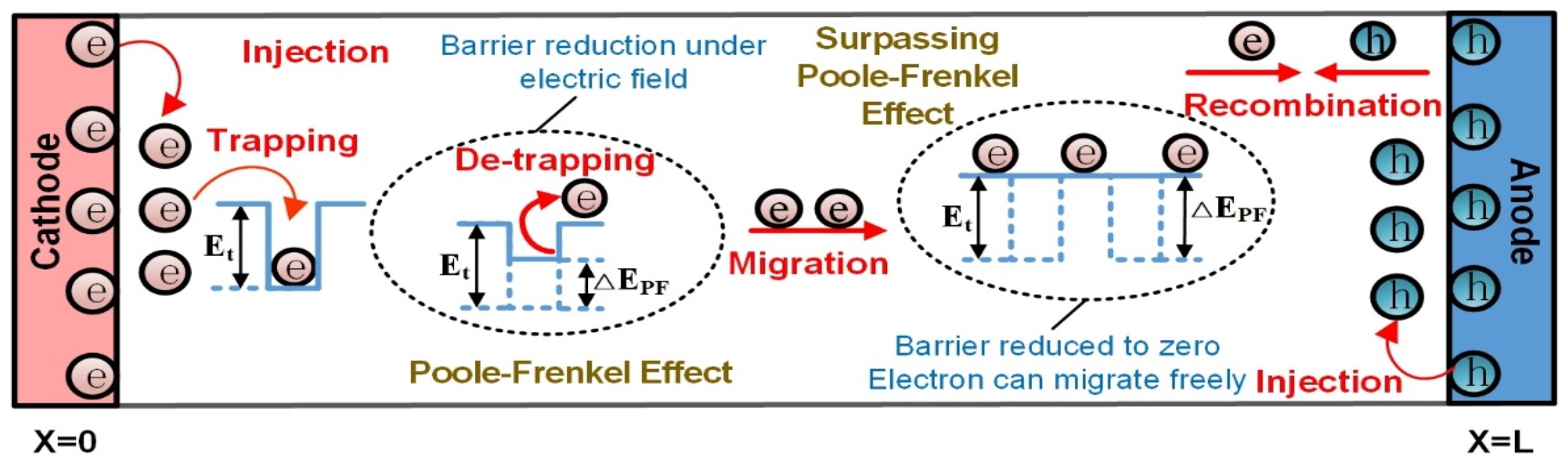
Figure 1 shows the distribution of trap energy levels within the band structure of polymeric dielectrics and the charge transport behavior considering the Poole–Frenkel (PF) effect. The trap distributed in the forbidden band can be filled with carrier; meanwhile, the carrier captured by the trap can de-trap, as shown in Figure 1a. It is known that a localized charge carrier in a solid dielectric can move by hopping from one occupied trap to a vacant neighboring trap, provided it obtains sufficient energy to surpass the energy barrier between them [5]. When thermal activation provides the primary energy source, charge carriers predominantly undergo hopping conduction [8]. With the increase in the applied electric field, the energy that the charge requires to de-trap is reduced, and this should be attributed to the PF effect as depicted in Figure 1b. The reduction in the potential barrier caused by the PF effect ∆EPF is [9], where βPF is the Poole–Frenkel effect coefficient, qe is the elementary charge in C, F is the electric field in the sample in V/m, ε0 is the vacuum dielectric constant in F/m, and εr is the relative permittivity. Equation (1) indicates that the energy barrier of a trap can be reduced to zero under a sufficiently strong electric field. Since traps in polymers exhibit a distribution of depths, different field intensities are needed to completely eliminate the de-trapping barrier for traps of varying energies.
Δ E P F = β P F F = q e 3 F / π ε 0 ε r
When the applied electric field reaches a sufficiently high magnitude to reduce all trapping barriers to zero, charge carriers are able to migrate freely throughout the entire volume of the material. The trap density for traps with different depths is different, and the trap energy center, which can be extracted from the ISPD method, is suggested to have the highest trap density. Since the trap density for the trap energy center is the highest, the trap energy is considered to be discrete with a single or dual energy depth center in this work. For the dual trap center, it is assumed that the carrier de-trapping from the shallower trap center could be captured again. If half densities of the deepest trap center (1 × 10²⁰ m−3) are filled with charges when the electric field is high enough to eliminate the barrier to zero, these charges could migrate freely with a conservative speed of 10−5 ms−1, which would result in the current with a value of 10−4 Am−2. This critical field strength corresponds to a current density that is several orders of magnitude greater than the typical conduction current observed under normal operating conditions. In fact, the value of the current caused by the de-trapping of charge captured by the deepest trap center is higher than the mentioned value due to higher speed and trap density. Hence, if the de-trapping barrier for charges held in the deepest trap centers is reduced to zero, a sudden surge in carrier mobility occurs, which can trigger irreversible dielectric breakdown through rapid current multiplication. This particular condition is termed Surpassing Poole–Frenkel (SPF) conduction in the present work. In short, dielectric breakdown is proposed to occur when charges trapped at the deepest energy levels fully overcome their potential barriers through SPF conduction. The electric field intensity FBD required to achieve this SPF condition is therefore defined as the intrinsic DC breakdown strength. When the Poole–Frenkel effect lowers the potential barrier by an amount equal to the depth of the deepest trap level, the breakdown field FBD can be determined using the following expression.
F B D = E t 2 π ε 0 ε r / q e 3
where Et is the deepest trap center in the polymer in eV. If we measure the Et properly, it is possible to speculate on the dielectric breakdown strength of the material. Such a method was first proposed by K. Wu et al. in [10,11]; the threshold breakdown value could be evaluated through the barrier when the fraction of samples with a percolation path reached 100% in their study. As for our work, the corresponding breakdown strength is calculated when the charge trapped by the deepest trap can migrate freely, which is the difference between these two methods.

2.2. Prediction Method Through Bipolar Charge Transport (BCT) Model

In order to describe charge transport behavior in the polymer during DC stress in detail and predict the DC breakdown strength of the material, the bipolar charge transport (BCT) model was employed. Figure 2 shows the BCT model considering the PF and SPF conduction. A one-dimensional coordinate system has been defined across the thickness of the material, x = 0 corresponds to the cathode, and x = L refers to the anode. This model consists of charge injection, migration, trapping/de-trapping, and the recombination process.

2.2.1. Charge Injection Mechanism

Electrons and holes are injected into the dielectric from the cathode and anode, respectively, by Schottky thermionic emission [12]. The current density for each type of charge carrier can be expressed using the equations below:
j ine ( 0 , t ) = A T 2 exp ( E ine Δ E she k B T )
j inh ( L , t ) = A T 2 exp ( E inh Δ E sch k B T )
where jine(0,t) and jinh(0,t) are the current densities introduced into the bulk of the dielectric from the cathode and anode, Eine and Einh are electron and hole injection barriers, A is the Richardson constant, T is the temperature, kB is the Boltzmann constant. ΔEsce and ΔEsch can be calculated by the following equations:
Δ E sce = q e F ( 0 , t ) 4 π ε 0 ε r
Δ E sch = q e F ( L , t ) 4 π ε 0 ε r
where F(0,t) is the electric field intensity at the cathode, and F(L,t) is the electric field strength at the anode.

2.2.2. Self-Consistent Equation System for Charge Transport

Under direct current voltage, the charge transport process in polymer materials satisfies the following equations:
(1)
Charge continuity equation:
q free ( x , t ) t + j c ( x , t ) x = S free ( x , t )
q t r a p i ( x , t ) t = S t r a p i ( x , t ) , i = 1 , 2
(2)
Charge transport equation:
j c ( x , t ) = q free ( x , t ) μ 0 F ( x , t )
(3)
Poisson’s equation:
2 ϕ ( x , t ) x 2 = q free ( x , t ) + i = 1 2 q trap i ( x , t ) ε 0 ε r
where qfree(x,t) is the free charge in the material; qtrapi(x,t) is charge density, jc(x,t) is the conduction current density in the material; μ0 is the carrier mobility, F(x,t) is the electric field strength, Sfree(x,t) and Strap(x,t) represent the free charge reaction term and trap charge reaction term in the medium. Subscripts 1 and 2 represent the shallow trap charge and deep trap charge reaction terms.
The behavior of charge carriers within the material is described by a set of coupled self-consistent equations, comprising the charge continuity equation, the transport equation, and Poisson’s equation [13]. Trapping and de-trapping of charges are depicted by considering traps with different energy levels [14]. The recombination will occur when electrons and holes come into contact. The mentioned processes above are referred to as the first-order charge dynamics, which can be described by the source terms of electrons and holes. The detailed equations describing the BCT model can be found in [13]. As mentioned above and shown in Figure 2, the Poole–Frenkel effect lowers the energy barrier for charge de-trapping, and dielectric breakdown is deemed to initiate once charges confined in the deepest traps exhibit SPF conduction characteristics. This condition thereby allows estimation of the intrinsic DC breakdown strength.
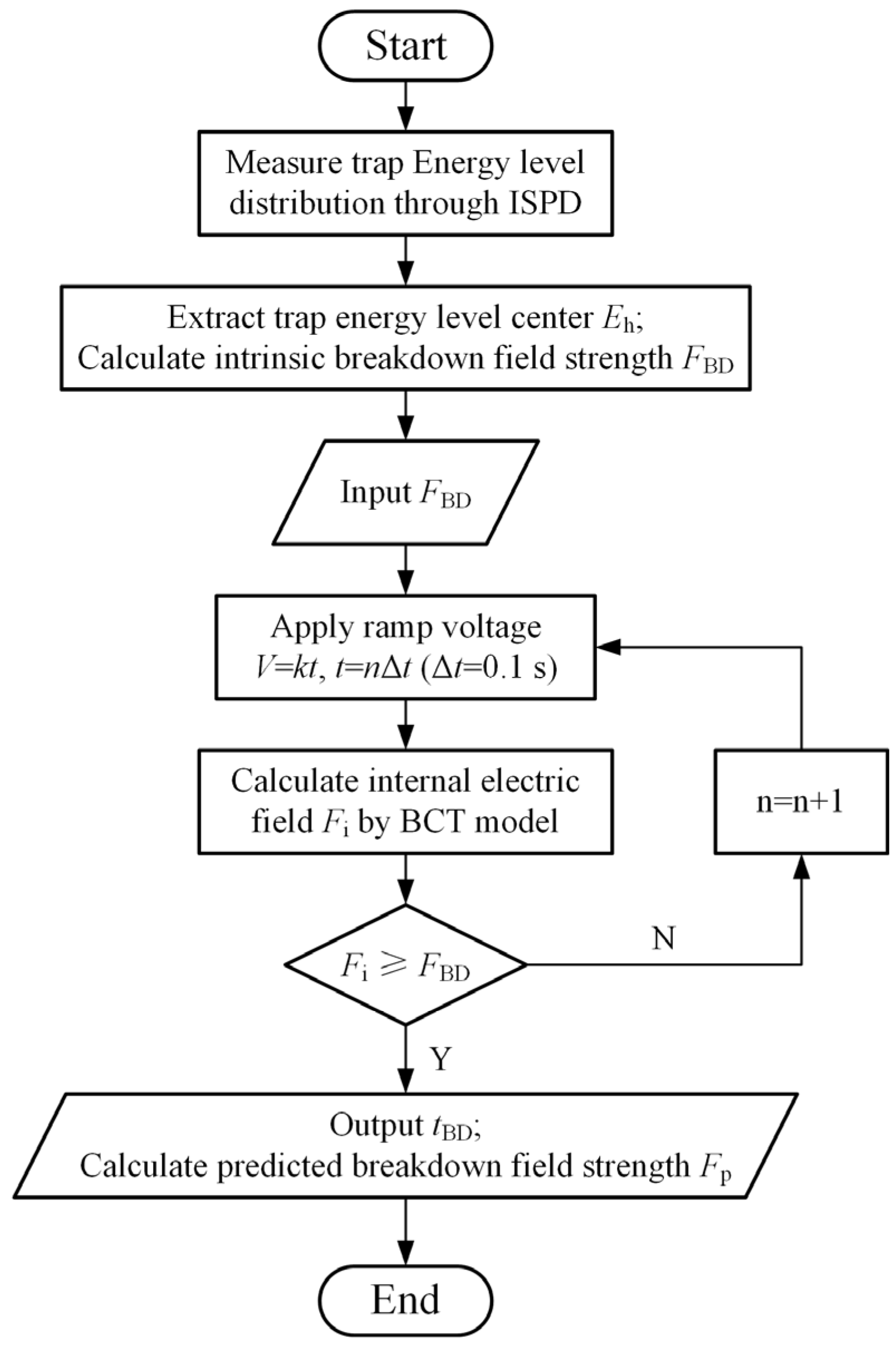
The flowchart of predicting DC breakdown strength is shown in Figure 3. Firstly, the distribution characteristics of trap energy levels within the material are obtained via ISPD measurements, and the deepest trap energy level within the material is identified. The intrinsic breakdown field strength of the material is calculated by Equation (2). As mentioned above, owing to the buildup of space charge within the sample, the internal electric field is inconsistent with the intensity of the electric field applied to the sample. To determine the internal electric field distribution within the specimen, the BCT model was employed to simulate the charge transport behavior in the sample throughout the voltage application period. When the local electric field inside the material exceeds the threshold field intensity, it is considered that the material undergoes breakdown, and the simulation stops running and outputs the corresponding time. Finally, the predicted breakdown field strength Fp is calculated by Equation (11),
F p = t BD g radu L
where gradu is the voltage boost rate, tBD is the breakdown time of the simulation output, and L is the thickness of the test sample.

3. Experimental Setup

In this work, the ISPD method was employed to extract the trap distribution so as to predict the DC breakdown strength by using PE/SiO2 nanocomposite with various nano-filler contents as the sample. Commercially available PE (LD100AC, Sinopec Beijing Yanshan Company, Beijing, China) served as the base material. The nano-sized SiO2 particle with a grain diameter of 20 nm (High Technology Nano Company, Nanjing, China) was used, and the weight ratio of nano-filler was set to be 1, 3, and 5 wt%, respectively. The selection of nano-SiO2 is based on our previous research results that the PE/SiO2 has superior properties and is suitable to be used as cable insulation [15,16]. Pure PE samples without any filler were also prepared as a control group. The thickness of the sample was 110 μm for the ISPD measurement and DC breakdown verification test. Detailed descriptions of the sample preparation procedure and the ISPD measurement are provided in our earlier published works [15,16]. The trap energy was calculated following Equation (12),
Δ E = k T ln ( ν t d )
where △E is the trap energy, k = 1.38 × 10⁻²³ J/K is the Boltzmann constant, T is the Kelvin temperature in K, ν is the attempt to escape frequency, and td is the decay time in s. The trap density was calculated by Equation (13),
N ( Δ E ) = 4 ε 0 ε r q k T L 2 t d U s d t
where N(ΔE) is the trap density occupied by carriers at trap level ΔE, ε0 = 8.85 × 10⁻¹² F/m is the permittivity of vacuum, εr is the relative permittivity of the material, q = 1.60 × 10⁻¹⁹ C is the elementary charge, Us is the surface potential in V. Accordingly, the relationship between N(ΔE) and ΔE could be employed to characterize the carrier trap distribution of the sample [16].
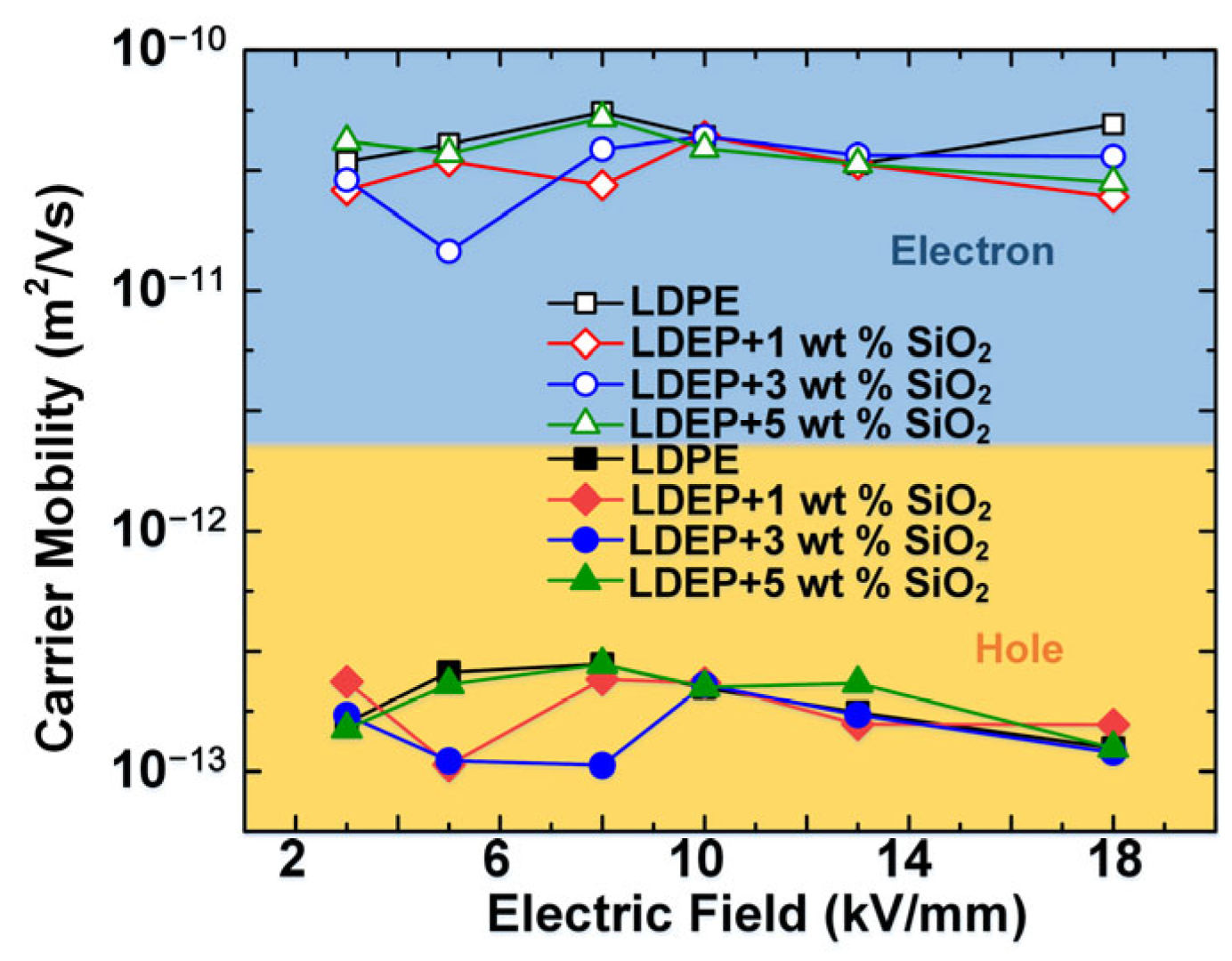
The carrier mobility was calculated by isothermal current decay measurement, in which a three-electrode system was employed. The temperature was controlled at 25 °C, and the electric field was 3, 5, 8, 10, 13, and 18 kV/mm. The carrier mobility μ could be calculated based on Equation (14),
μ = J n q F σ
where J is the average current density in A/m2, n is the charge density in m−3, and Fσ is the test electric field in V/m.
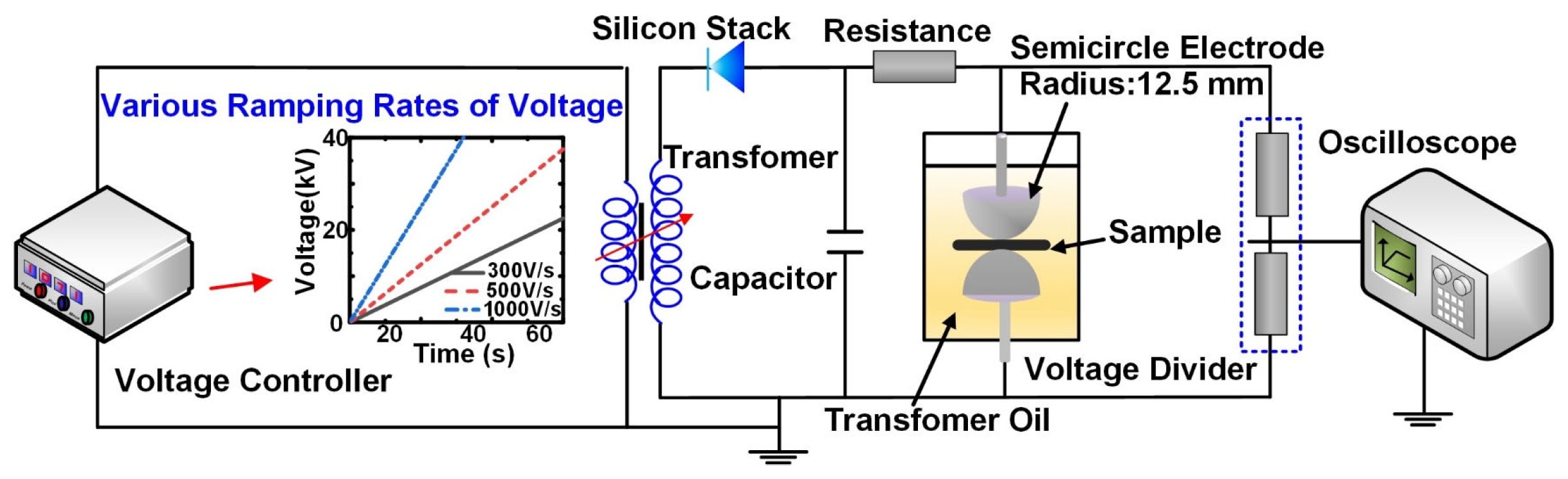
A positive or a negative bias voltage was applied between the electrodes so as to obtain the carrier mobility of hole or electron. Figure 4 shows the schematic diagram of the test circuit for DC breakdown. The sample was sandwiched by a pair of semicircular electrodes on which the DC voltage was applied with ramping rates of 300, 500, and 1000 V/s, respectively. The DC breakdown test was carried out at least 10 times for each sample, and then the average breakdown strength could be obtained. The maximum data scatter was obtained at less than 5% of the breakdown strength. Since the breakdown test was performed within a very short time period (tens of seconds), the aging that usually occurred under long-term stressing was not taken into consideration.

4. Results and Discussion

4.1. Relative Permittivity

The influence of nano-filler concentration on the relative permittivity of the specimens was evaluated using an LCR meter (TH2826A) at 25 °C, with results obtained at 200 Hz presented in Table 1. The relative permittivity increases with nanoparticle loading, a trend attributable to the significantly higher permittivity of the inorganic SiO2 fillers compared with that of unfilled PE [17].

4.2. Carrier Mobility

Figure 5 shows the hole and electron mobility of the samples under various electric fields measured in the test. It is obvious that as the electric field intensity increases, the mobility changes slightly. For the effect of nano loading on the carrier mobility, it can also be neglected. Since the mobility of the hole for different samples is in the range of 1 × 10⁻¹³–3 × 10⁻¹³ m2/Vs, the values assigned to carrier mobility in the BCT simulation are considered to be a constant. Such treatment is also applied to the mobility of electron in the material used in BCT simulation. Another notable observation from Figure 5 is that electron mobility consistently exceeds hole mobility across the examined conditions.

4.3. Trap Distribution

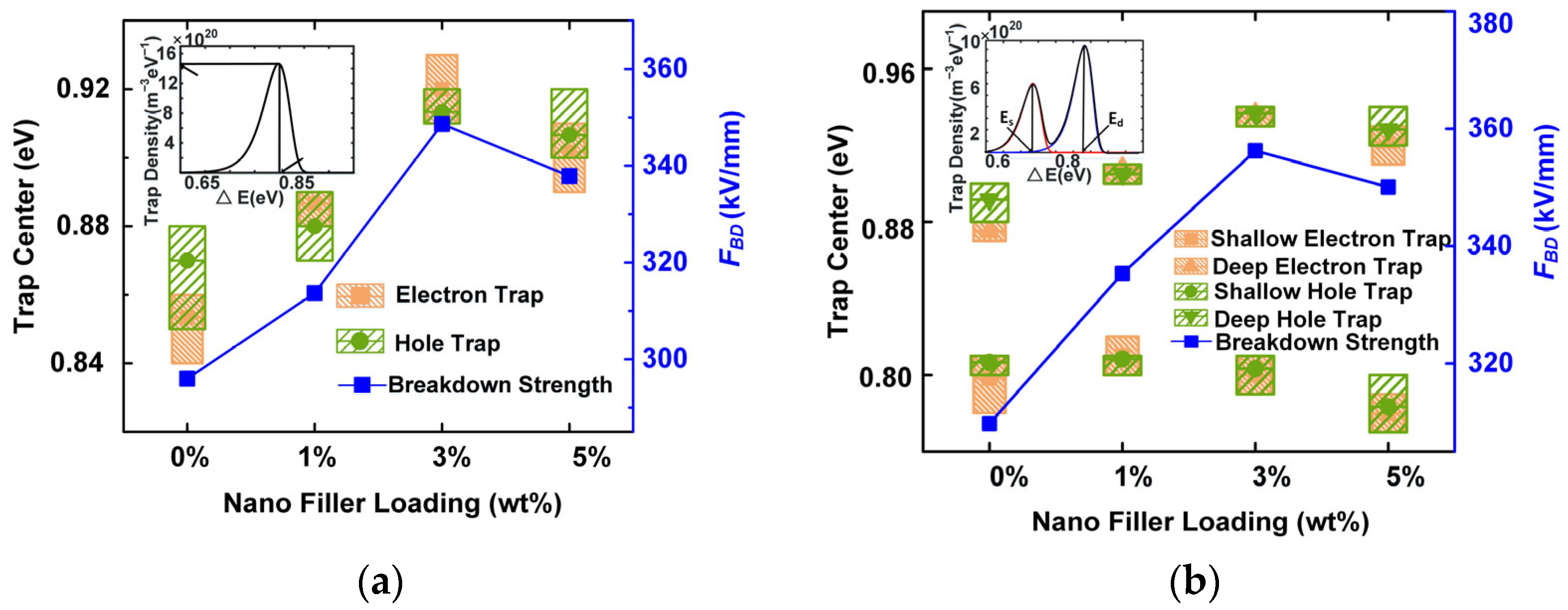
The trap energy estimated from ISPD measurement is used to calculate the intrinsic DC breakdown strength FBD, and the influence of nano-filler content on the trap energy, as well as the intrinsic breakdown strength of PE/SiO2 nanocomposite, is depicted in Figure 6.
The traps are considered to be originated from both chemical and physical defects like impurities, side chain, unsaturated bond, interface between crystal and amorphous regions. In particular, as nano-sized inorganic particles are added into PE, the interface between the particle and the matrix yields new traps, usually with a deep energy level to locate the charge carrier [5,7]. We use two methods to extract the trap center, i.e., the single-trap-center and the dual-trap-center methods [18,19]. For the dual-trap-center method, the deep trap center is utilized to speculate the intrinsic DC breakdown strength. The electron and the hole trap energy derived from the single-trap-center method exhibit a rise-then-fall tendency with the nano-filler loading, as shown in Figure 6a. Such a tendency holds with that derived from the deep trap energy as the dual-trap-center method is adopted, as demonstrated in Figure 6b. Our previous studies have demonstrated that [16] incorporating nano-sized particles generates deep traps at the interfacial regions between the polymer matrix and the nanoparticles [20]. However, when the nano-filler concentration surpasses a critical threshold, the interfacial regions begin to overlap and create interconnected interaction zones that facilitate easier charge migration, resulting in shallower trap energies [20]. In addition, the intrinsic breakdown strength predicted by the dual-trap-center method is higher than that obtained from the single-trap-center method. This behavior can be explained by the deeper trap energies obtained through the dual-trap-center analysis method. It should be brought to mind that the predicted intrinsic breakdown strength FBD is proportional to the square of the deepest trap center ET.
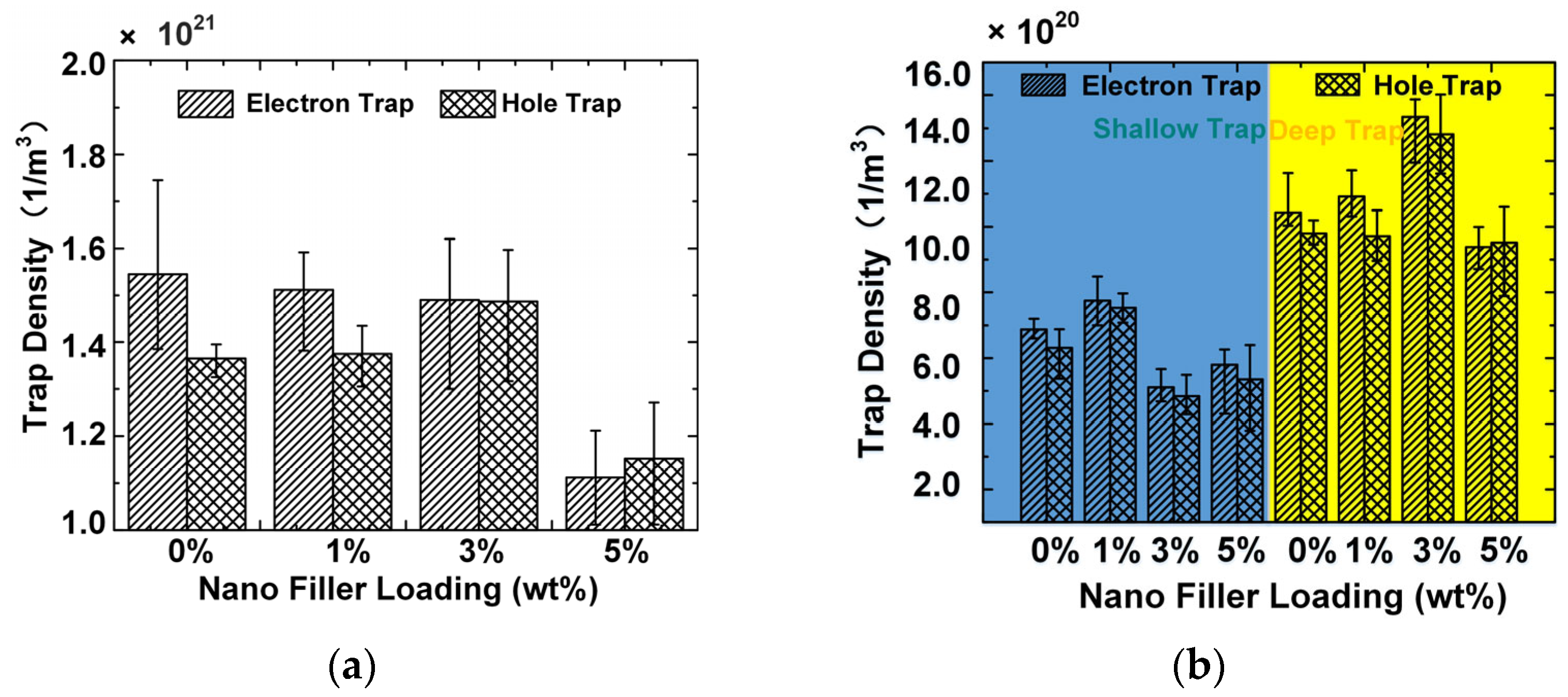
Figure 7 demonstrates the trap density of samples with various nano-filler loadings extracted from different methods. For the single-trap-center method, the variation in the trap density for electron and hole traps is slight when the nano loading increases from 0 wt% to 3 wt%, and the sample with 5 wt% SiO2 has the lowest electron and hole trap density, as shown in Figure 7a. It can be noticed from Figure 7b that the deep trap density extracted from the dual-trap-center method increases and then falls with the growth of nano-filler loading for both electron and hole. Except for the composite adding with 1 wt% nano-filler, the shallow trap density of electron and hole is reduced. The higher density of deep traps observed in the nanocomposite arises from the extensive interfacial regions created by nanoparticle incorporation [21]. As for the sample with 5 wt% nano-SiO2, when nano-filler content becomes excessive, overlapping interfaces create percolation-like interaction zones that promote easier charge transport. It is suggested to be the reason why the deep trap density of the sample doped with 5 wt% nano-filler is lower than other nanocomposites. It has been reported that deep traps are recognized to play a critical role in governing both charge transport dynamics and the DC breakdown characteristics of the nanocomposite [7]. The difference in deep trap distribution may result in different charge transport and DC breakdown features of the composite.

4.4. DC Breakdown Strength

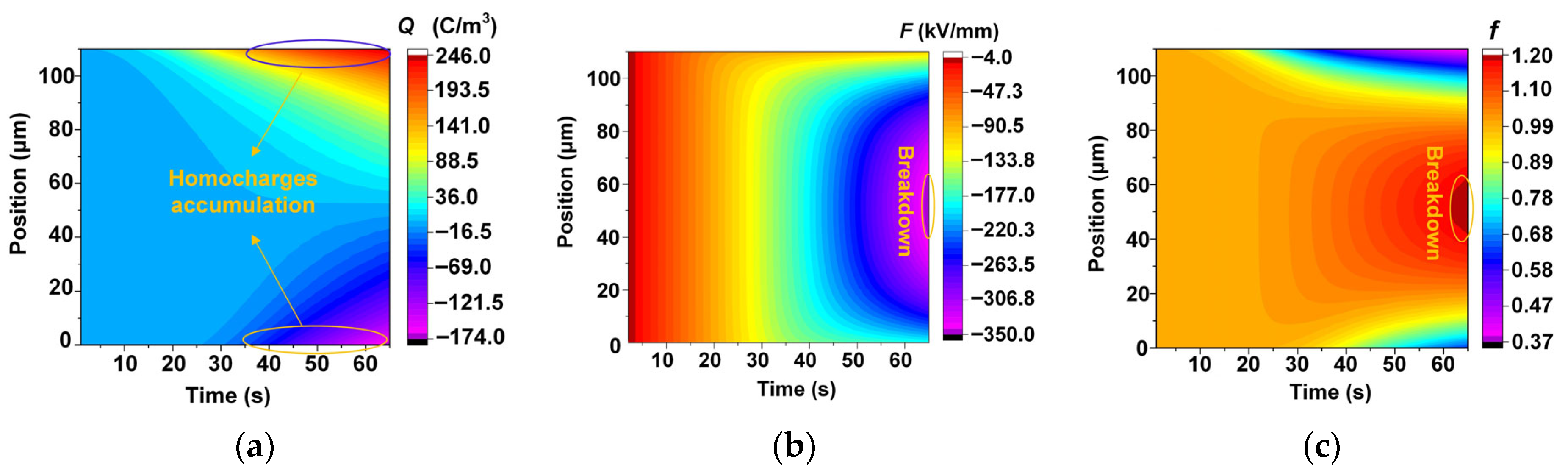
The DC breakdown process modulated by space charge in the PE/SiO2 nanocomposite with various ramping rates of applied voltage is numerically calculated according to the obtained intrinsic breakdown strength via the BCT model; the parameters used in the calculation are listed in Table 2. The parameters of the materials used in these works are PE or PE-based nanocomposites that are similar to the case in our work, which have been recognized as reasonable values to indicate the electrical property of PE. Since the Poole–Frenkel traps are neutral when a carrier is attached to them, they do not contribute to the space charge until the field is high enough to empty them. As mentioned above, a range of fields is required to eliminate the de-trapping barrier to zero, hence the space charge tends to appear, although the electric field is low. Taking the sample with 3 wt%-SiO2 applied by a ramping rate of 500 V/s using the single-trap-center method as an example, as illustrated in Figure 8a, homocharges are accumulated in the sample. Since the space charge density at each position of the material bulk could be calculated at any time during voltage application, we draw a map of charge density distribution along the position at various times until the breakdown occurs. Similar maps are drawn to show the distributions of the electric field and distortion factor in Figure 8b,c. The accumulation of space charge can significantly distort the electric field distribution throughout the polymer [20]. Figure 8b shows the distorted electric field in the sample. Because homocharges accumulate adjacent to the electrodes, the electric field generated by these charges opposes the applied external field, thereby reducing the field intensity in the vicinity of the electrodes. It is the reason why the electric field in the sample bulk is higher than that at the electrode, as shown in Figure 8b. Figure 8c exhibits the electric field distortion factor f, which is defined as the ratio of the superimposed electric field to the applied electric field calculated from the applied voltage and the sample thickness. The f reaches its peak value of 1.20 when the time of voltage application is 65 s. According to the SCEB model [4], as the maximum electric field in the sample is higher than the intrinsic breakdown strength, the breakdown is assumed to happen. As for the sample discussed in Figure 8, the breakdown occurs at 65 s as the maximum field in the sample (350 kV/mm) is over the FBD of 348.6 kV/mm; the position at which the breakdown initiates is marked with the yellow circle in Figure 8b. Meanwhile, the apparent breakdown strength, Fapp of 295.5 kV/mm, could be calculated based on the ramping rate of 500 V/s and the time 65 s, which is regarded as the predicted DC breakdown strength of the sample in this work.
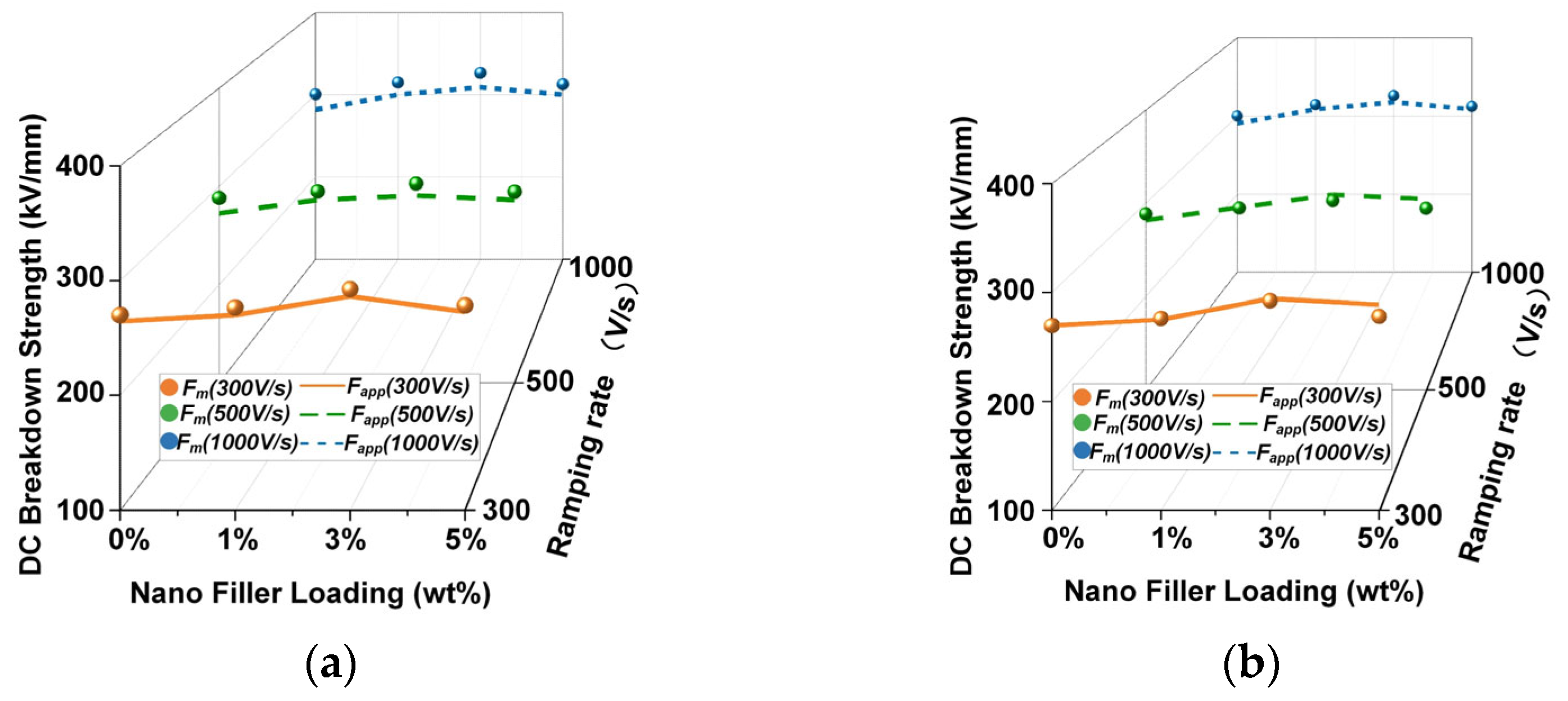
In order to verify the numerically calculated DC breakdown strength Fapp, the breakdown test has been performed. Comparisons between the predicted and the measured DC breakdown strengths of PE/SiO2 nanocomposite at various ramping rates of the applied voltage are demonstrated in Figure 9. As shown in the figure, regardless of the trap center extraction method, the predicted DC breakdown strength Fapp is in good agreement with the test result Fm, which indicates that the de-trapping of electron, overcoming the potential barrier reduced by the SPF effect, could be recognized as the origin of the bulk breakdown within the PE/SiO2 nanocomposite sample. From Figure 9, it can be inferred that DC breakdown strength Fm increases with the growth of the ramping rate, and it shows a rise-and-fall tendency with the maximum value appearing in the sample containing the nano-filler of 3 wt%. It is mainly because at a lower ramping rate the space charges have sufficient time to migrate into the sample, thereby the electric field distortion can be more serious, and the breakdown strength decreases. Furthermore, the dependence of the breakdown strength upon the filler content can be explained by the fact that the addition of SiO2 brings deep carrier traps into PE, which restricts charge injection and migration, thereby decreasing the electric field within the material. Accordingly, the breakdown strength increased. However, as the content reaches 5 wt%, the boundary area between the particle and the PE matrix tends to be overlapped to facilitate the migration of the carrier, thereby the carrier trap becomes shallower, and the breakdown strength is reduced [7]. These manners are the same as the predicted breakdown strengths, Fapp. As for different trap center extraction methods, it can be observed that the predicted breakdown field Fapp using the dual-trap-center method is higher than that derived from the single-trap-center method, which is due to the deeper trap energy extracted from ISPD, as shown in Figure 9a,b. In general, the DC breakdown strength Fapp calculated with the dual-trap-center method is closer to the measured data Fm. Another interesting feature shown in Figure 9 is that the accuracy of the predicted breakdown field with the single-trap-center method decreases with the increase in ramping rate, which is not observed with the dual-trap-center model. It is thereby proposed that the dual-trap-center method is more accurate for the prediction of DC breakdown strength.
It has to be mentioned that the breakdown behavior of dielectric material is very complicated. Accordingly, a model to predict the breakdown voltage should be based on reasonable assumptions and simplification. In this work, an attempt has been made to understand the breakdown phenomenon from the viewpoint of the electric field-induced reduction in the barrier height of the charge carrier, which suggests a prediction method based on the trap energy level that can be measured by means of the ISPD method. It is found that the prediction results agree well with the measured data, which supports the model. Furthermore, such a model establishes the relationship between the carrier trap and the breakdown strength of the materials, which would inspire more research in this field to gain a better understanding of the breakdown behavior.

5. Conclusions

The method to predict the DC breakdown strength of PE-based nanocomposite at room temperature via the BCT model by trap energy estimated from ISPD has been proposed. The intrinsic breakdown strength of the polymer is first calculated through the measured trap energy, then the BCT model is employed to calculate the maximum internal electric field in considering the ramping rate. The predicted breakdown strength is obtained as the maximum field is over the intrinsic strength, which is in good agreement with the measured strength. The usage of the dual-trap-center model is helpful to gain a more accurate prediction result. This study proposes a straightforward method for estimating the DC breakdown strength of polymer nanocomposites using the non-destructive ISPD test.

Author Contributions

Conceptualization, X.Q. and J.G.; methodology, X.X. and Y.G.; software, C.G.; validation, X.Q. and Z.Z.; formal analysis, Y.G.; investigation, C.Z. and Q.S.; resources, X.Q.; data curation, X.X. and C.G.; writing—original draft preparation, X.Q. and X.X.; writing—review and editing, Q.S. and Y.G.; visualization, Z.Z.; supervision, C.Z.; project administration, Y.G.; funding acquisition, C.Z. All authors have read and agreed to the published version of the manuscript.

Funding

This work is financially supported by China Electrical Equipment Group Co., Ltd. (CEE-2023-B-01-01-008-XD).

Data Availability Statement

The original contributions presented in this study are included in the article. Further inquiries can be directed to the corresponding author.

Conflicts of Interest

Author Xiaohu Qi, Jian Guan, Zhen Zhang, and Chuanyun Zhu are employed by the company Henan Pinggao Electric Co., Ltd. Author Xuri Xu is employed by State Grid Yancheng Power Supply Company. Author Chenyi Guo is employed by State Grid Nanjing Power Supply Company. The remaining authors declare that the research was conducted in the absence of any commercial or financial relationships that could be constructed as a potential conflict of interest. The authors declare that this study received funding from China Electrical Equipment Group Co., Ltd. (CEE-2023-B-01-01-008-XD). The funder was not involved in the study design, collection, analysis, interpretation of data, the writing of this article, or the decision to submit it for publication.

References

  1. Ciuprina, F.; Plesa, I. DC and AC conductivity of LDPE nanocomposites. In Proceedings of the 2011 7TH International Symposium on Advanced Topics in Electrical Engineering (ATEE), Bucharest, Romania, 12–14 May 2011; pp. 1–6. [Google Scholar]
  2. Montanari, G. The electrical degradation threshold of polyethylene investigated by space charge and conduction current measurements. IEEE Trans. Dielectr. Electr. Insul. 2002, 7, 309–315. [Google Scholar] [CrossRef]
  3. Wu, J.; Miao, L.; Zhou, G.; Che, L.; Yin, Y. Space charge observation under periodic stress—Part 2: Signal improvement and corresponding procedure. IEEE Trans. Dielectr. Electr. Insul. 2020, 27, 1195–1203. [Google Scholar] [CrossRef]
  4. Li, S.; Zhu, Y.; Min, D.; Chen, G. Space charge modulated electrical breakdown. Sci. Rep. 2016, 6, 32588. [Google Scholar] [CrossRef] [PubMed]
  5. Kao, K.C. Dielectric Phenomena in Solids; Elsevier: Amsterdam, The Netherlands, 2004. [Google Scholar]
  6. Chen, G.; Xu, Z. Charge trapping and detrapping in polymeric materials. J. Appl. Phys. 2009, 106, 123707. [Google Scholar] [CrossRef]
  7. Li, S.; Min, D.; Wang, W.; Chen, G. Linking traps to dielectric breakdown through charge dynamics for polymer nanocomposites. IEEE Trans. Dielectr. Electr. Insul. 2016, 23, 2777–2785. [Google Scholar] [CrossRef]
  8. Montanari, G.; Laurent, C.; Teyssedre, G.; Campus, A.; Nilsson, U. From LDPE to XLPE: Investigating the change of electrical properties. Part I. space charge, conduction and lifetime. IEEE Trans. Dielectr. Electr. Insul. 2005, 12, 438–446. [Google Scholar] [CrossRef]
  9. Frenkel, J. On pre-breakdown phenomena in insulators and electronic semi-conductors. Phys. Rev. 1938, 54, 647. [Google Scholar] [CrossRef]
  10. Wu, K.; Dissado, L.A.; Okamoto, T. Percolation model for electrical breakdown in insulating polymers. Appl. Phys. Lett. 2004, 85, 4454–4456. [Google Scholar] [CrossRef]
  11. Wu, K.; Dissado, L.A. Percolation model for electrical breakdown in insulating polymers. In Proceedings of the 17th Annual Meeting of the IEEE Lasers and Electro-Optics Society, 2004. LEOS 2004, Rio Grande, PR, USA, 11 November 2004; pp. 514–518. [Google Scholar]
  12. Laurent, C.; Teyssedre, G.; Le Roy, S.; Baudoin, F. Charge dynamics and its energetic features in polymeric materials. IEEE Trans. Dielectr. Electr. Insul. 2013, 20, 357–381. [Google Scholar] [CrossRef]
  13. Li, S.; Min, D.; Wang, W.; Chen, G. Modelling of dielectric breakdown through charge dynamics for polymer nanocomposites. IEEE Trans. Dielectr. Electr. Insul. 2017, 23, 3476–3485. [Google Scholar] [CrossRef]
  14. Xing, Z.; Zhang, C.; Cui, H.; Hai, Y.; Wu, Q.; Min, D. Space charge accumulation and decay in dielectric materials with dual discrete traps. Appl. Sci. 2019, 9, 4253. [Google Scholar] [CrossRef]
  15. Gao, Y.; Li, J.; Yuan, Y.; Huang, S.; Du, B. Trap distribution and dielectric breakdown of isotactic polypropylene/propylene based elastomer with improved flexibility for DC cable insulation. IEEE Access 2018, 6, 58645–58661. [Google Scholar] [CrossRef]
  16. Gao, Y.; Xu, B.; Wang, X.; Jia, T. Charge transport in low density polyethylene based micro/nano-composite with improved thermal conductivity. J. Phys. D Appl. Phys. 2019, 52, 285302. [Google Scholar] [CrossRef]
  17. Gao, Y.; Liu, F.; Wang, J.; Wang, X.; Du, B. Improvement on partial discharge resistance of epoxy/Al2O3 nanocomposites by irradiation with 7.5 MeV electron beam. IEEE Access 2018, 6, 25121–25129. [Google Scholar] [CrossRef]
  18. Li, J.; Zhou, F.; Min, D.; Li, S.; Xia, R. The energy distribution of trapped charges in polymers based on isothermal surface potential decay model. IEEE Trans. Dielectr. Electr. Insul. 2015, 22, 1723–1732. [Google Scholar] [CrossRef]
  19. Zhou, T.-C.; Chen, G.; Liao, R.-J.; Xu, Z. Charge trapping and detrapping in polymeric materials: Trapping parameters. J. Appl. Phys. 2011, 110, 043724. [Google Scholar] [CrossRef]
  20. Min, D.; Wang, W.; Li, S. Numerical analysis of space charge accumulation and conduction properties in LDPE nanodielectrics. IEEE Trans. Dielectr. Electr. Insul. 2015, 22, 1483–1491. [Google Scholar] [CrossRef]
  21. Wang, W.; Min, D.; Li, S. Understanding the conduction and breakdown properties of polyethylene nanodielectrics: Effect of deep traps. IEEE Trans. Dielectr. Electr. Insul. 2016, 23, 564–572. [Google Scholar] [CrossRef]
  22. Min, D.; Li, S. Simulation on the influence of bipolar charge injection and trapping on surface potential decay of polyethylene. IEEE Trans. Dielectr. Electr. Insul. 2014, 21, 1627–1636. [Google Scholar] [CrossRef]
  23. Min, D.; Cui, H.; Wang, W.; Wu, Q.; Xing, Z.; Li, S. The coupling effect of interfacial traps and molecular motion on the electrical breakdown in polyethylene nanocomposites. Compos. Sci. Technol. 2019, 184, 107873. [Google Scholar] [CrossRef]
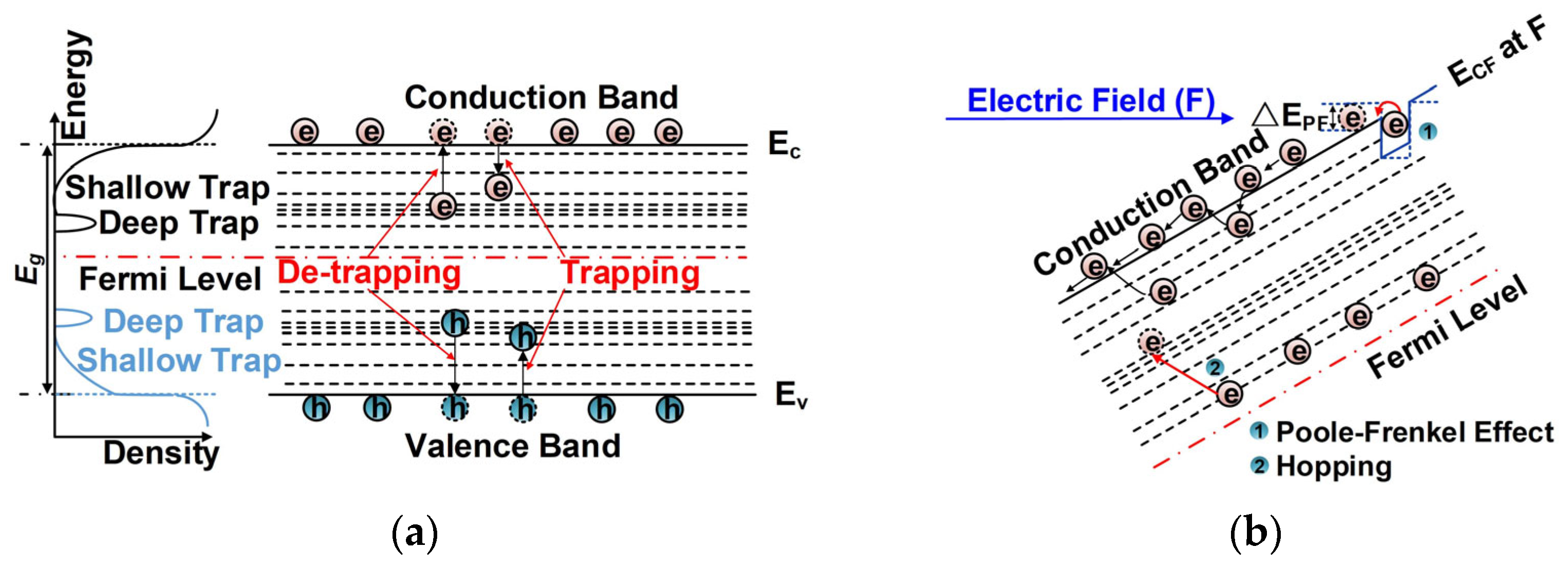
Figure 1. Trap characteristics and charge transport behavior: (a) trap distribution in the energy band of polymeric material. (b) Charge transport considering PF effect. EC and EV are the bottom and the top of the conduction band and the valence band, F represents the electric field under which the PF effect occurs, and ECF is the bottom of the conduction band at F.
Energies 19 00044 g001
Figure 2. Bipolar charge transport model considering PF and SPF conduction.
Energies 19 00044 g002
Figure 3. Flowchart of DC breakdown strength prediction.
Energies 19 00044 g003
Figure 4. Schematic diagram of the test circuit for DC breakdown.
Energies 19 00044 g004
Figure 5. Carrier mobility of the test samples for hole and electron under various electric fields (the ordinate is the logarithm of carrier mobility).
Energies 19 00044 g005
Figure 6. Trap center and predicted intrinsic breakdown strength of samples with different nano-filler loading by the single-trap-center method (a) and the dual-trap-center method (b).
Energies 19 00044 g006
Figure 7. Trap density of samples with different nano-filler loading by the single-trap-center method (a) and dual-trap-center method (b).
Energies 19 00044 g007
Figure 8. Calculation results of the sample with 5 wt%-SiO2 applied by a ramping rate of 500 V/s using the single-trap-center method. (a) Space charge accumulation in C/m3; (b) electric field in kV/mm; (c) the electric field distortion factor f.
Energies 19 00044 g008
Figure 9. Comparisons between the predicted results Fapp (solid circles) and the measured DC breakdown fields Fm (lines) of PE/SiO2 nanocomposite under various ramping rates of the DC voltage using the single-trap-center method (a) and dual-trap-center method (b), respectively.
Energies 19 00044 g009
Table 1. Relative permittivity of test samples.
Nano Loading (wt%)Value
0%2.27
1%2.33
3%2.37
5%2.40
Table 2. The values of the parameters used in the BCT model [20,21,22,23].
ParameterValue
Effective injection barrier Ein (eV)
Ein(e) (for electrons)1–1.5
Ein(h) (for holes)1–1.5
Carrier mobility μ0 × 10−13 (m2V−1s−1)
μ0(e) (of electrons)0.01–0.02
μ0(h) (of holes)1–2
Density of traps NT × 1021 (m−3)
NT(e) (for electrons)0.5–2
NT(h) (for holes)0.5–2
Energy of traps ET (eV)
ET(e) (for electrons)0.8–1.0
ET(h) (for holes)0.8–1.0
Disclaimer/Publisher’s Note: The statements, opinions and data contained in all publications are solely those of the individual author(s) and contributor(s) and not of MDPI and/or the editor(s). MDPI and/or the editor(s) disclaim responsibility for any injury to people or property resulting from any ideas, methods, instructions or products referred to in the content.