Article

Adaptive Rolling-Horizon Optimization for Low-Carbon Operation of Coupled Transportation–Power Systems


1
Xiong’an New Area Power Supply Company, State Grid Hebei Electric Power Co., Ltd., Xiong’an 071600, China
2
Department of Electrical Engineering, North China Electric Power University (Baoding Campus), Baoding 071003, China
*
Author to whom correspondence should be addressed.
Energies 2026, 19(1), 227; https://doi.org/10.3390/en19010227
Submission received: 28 November 2025 / Revised: 17 December 2025 / Accepted: 26 December 2025 / Published: 31 December 2025

Abstract

The rapid growth of electric vehicles (EVs) has created new challenges for the coordinated low-carbon operation of transportation and power systems. To address this issue, this paper proposes an adaptive rolling-horizon dynamic user equilibrium (DUE) optimization framework for the low-carbon operation of coupled transportation–power systems. The framework integrates transportation, power, and environmental dimensions into a unified objective. On the transportation side, a DUE-based traffic assignment formulation captures both road travel times and station-level queuing dynamics, providing a realistic representation of EV user behavior. This DUE-based traffic assignment model is coupled with an optimal AC power flow formulation to ensure grid feasibility and quantify network losses. To internalize environmental costs, a carbon emission flow module propagates generator-specific carbon intensities to charging stations, aligning charging decisions with their true emission sources. These components are coordinated within a rolling-horizon method in which the prediction window adapts its length to the variability of demand and renewable forecasts. The proposed method allows longer horizons to improve foresight in stable conditions and shorter ones to maintain robustness under volatility. Numerical case studies demonstrate the effectiveness and robustness of the proposed framework and its potential to support low-carbon, high-efficiency operation of coupled transportation–power systems.

1. Introduction

Urban infrastructures are undergoing a profound transformation toward sustainability, where transportation and power systems are increasingly interwoven. Electric vehicles (EVs) embody this convergence by acting simultaneously as transportation assets and mobile electricity loads. Their rapid deployment not only reshapes travel demand but also introduces dynamic and spatially concentrated loads into power systems. Such dual impacts intensify the interdependence between the two domains, offering opportunities for efficiency gains and emission reductions while at the same time creating new layers of operational complexity. These intertwined challenges underscore the need for integrated approaches that can capture cross-domain interactions and support the sustainable operation of coupled transportation–power systems (CTPSs).

1.1. Motivation

In CTPSs, EV charging demand exhibits strong spatiotemporal variability. On the transportation side, this variability not only alters travel times but also significantly influences waiting times and service reliability at charging stations. On the power side, aggregated charging loads reshape power flow distributions, disrupt nodal balance, and increase system losses and carbon emissions, thereby influencing both system economics and environmental performance. While such bidirectional interactions create opportunities for cross-domain coordination, they also make CTPSs highly sensitive to demand fluctuations and forecast uncertainty [1,2].
Most existing approaches rely on fixed prediction horizons [3]. When the horizon is extended, forecast errors inevitably accumulate over time, whereas when the horizon is shortened, the optimization lacks sufficient foresight [4]. This mismatch restricts the ability to balance long-term benefits with short-term robustness, often leading to suboptimal routing decisions and inefficient charging behaviors that raise overall operating costs. To address these challenges, this paper proposes an adaptive rolling-horizon optimization framework with a DUE-based traffic assignment module, AC-OPF constraints, and carbon emission flow coupling. The proposed framework integrates traffic equilibrium, power system constraints, and carbon emission flows into a unified paradigm. By dynamically adjusting the prediction window according to forecast variability, it achieves a balance between foresight and robustness, thereby providing a practical pathway toward resilient, low-carbon, and efficient operation of CTPSs.

1.2. Related Literature

Research on CTPSs was initially driven by charging infrastructure planning and coordinated operation. Early studies focused on site selection, station sizing, and service levels under traffic demand and distribution system constraints, aiming to mitigate congestion and reduce grid losses [5]. Over time, this stream of work evolved into operational co-optimization, where station choices on the transportation side and power flow feasibility on the grid side were solved jointly. To manage computational complexity, many contributions relied on simplified grid models, such as linear relaxations, second-order cone relaxations, or DC power flow. With the advancement of data availability and computing resources, AC optimal power flow (AC-OPF) has been increasingly adopted to represent voltages, reactive power, and real-power losses more accurately, thereby enabling feasible and economically meaningful operations [6]. However, many of these studies optimized only a single domain, either minimizing travel time [7,8] or grid operating costs [9,10], while environmental costs were often appended via average emission factors [11]. This separation prevented travel time, grid losses, and carbon emissions from being valued on a comparable basis. As a result, cross-domain externalities, such as traffic-induced charging spikes that stress the grid, were frequently underestimated.
From a behavioral perspective, Wardrop’s user equilibrium (UE) provides the foundation for static traffic assignment, where travelers select routes such that all used paths between an origin and destination (OD) pair have equal travel times [12,13,14]. Extending this concept to the temporal domain leads to dynamic user equilibrium (DUE), which enforces consistency over time by capturing flow conservation, inflow–outflow relations, and congestion propagation along bottleneck links. In the context of EVs, charging stations are commonly modeled as “charging arcs”, so that route choice simultaneously determines whether to visit a station and whether to charge there [15]. This formulation enables the joint evaluation of travel times and charging-related delays within a unified equilibrium framework. However, many existing studies adopt simplified assumptions for station-level service performance, which may overlook the complex interactions between charging demand and system-level constraints. Consequently, there remains a need for equilibrium-based models that capture EV users’ charging decisions in a manner consistent with both transportation dynamics and power system operations [16].
On the power system side, modeling of flows and losses forms another essential thread of CTPS research [17]. While DC power flow has often been employed for its scalability, AC-OPF provides a more faithful representation by explicitly capturing voltages, reactive power, and system losses, which are critical under high EV penetration. In parallel, environmental considerations have progressed from coarse average emission factors to the carbon emission flow (CEF) framework. CEF traces generator-specific carbon intensities through network topology and allocates them to buses according to power flow distributions, allowing the carbon cost of EV charging at each station to be aligned with its true upstream generation sources. This coupling ensures that charging decisions reflect both operational and environmental costs, avoiding the spatial and temporal biases inherent in average emission factors [18]. Despite these advances, systematic approaches that integrate CEF with DUE-based traffic assignment and AC-OPF constraints remain limited, and few studies have embedded such a coupling into a rolling multi-period framework, which highlights the need for unified cross-domain models.
Uncertainty introduces another critical challenge for CTPS operations, as both travel demand and renewable generation exhibit strong temporal variability. Rolling optimization, or model predictive control (MPC), provides a general paradigm to balance foresight and robustness by solving finite-horizon subproblems with forecasts and updating them as new information arrives [19]. While this idea has been successfully applied to congestion management in transportation systems [20] and renewable integration in power systems [21], its application to CTPSs remains limited. Existing studies [22] typically employ fixed prediction windows, which can reduce multi-period costs under stable conditions but struggle when demand or renewable outputs become volatile. Short horizons lack foresight, whereas long horizons amplify forecast errors across domains [23,24]. These limitations motivate adaptive strategies that adjust the window length according to forecast variability, using longer horizons in stable periods to extend foresight and shorter ones in volatile periods to limit error propagation [25]. However, systematic approaches that incorporate such adaptive horizons into CTPS optimization remain scarce. In particular, there is a lack of methods that can jointly capture travel behavior, power system feasibility, and carbon impacts within a unified rolling framework, which leaves a key gap that this paper seeks to address [26,27].

1.3. Main Contributions

To address the above gaps, this paper develops an adaptive rolling-horizon optimization framework for CTPSs, in which the transportation subsystem is modeled using a DUE-based assignment formulation. The framework simultaneously unifies behavioral, physical, and environmental dimensions and incorporates adaptive rolling-horizon decision-making. The main contributions of this work are summarized as follows:
  • Unified cross-domain objective for the CTPS: A single monetary objective that consistently values transportation and power-side impacts is established, including travel and queuing delays, distribution system losses, and charging-related carbon emissions. This integration enables a balanced assessment of system-wide operating costs and ensures that behavioral, physical, and environmental factors are jointly optimized;
  • Adaptive rolling-horizon optimization: A receding-horizon scheme is developed, in which the prediction window dynamically adjusts to the variability of travel demand and renewable power forecasts. The method extends foresight under stable conditions and mitigates error propagation under volatile conditions, thereby achieving robust multi-period performance, particularly in congestion-intensive scenarios.
The remainder of this paper is organized as follows. Section 2 presents the mathematical formulation of the proposed adaptive rolling-horizon framework. Section 3 presents numerical results and demonstrates the effectiveness of the proposed framework. Section 4 concludes this work.

2. Materials and Methods

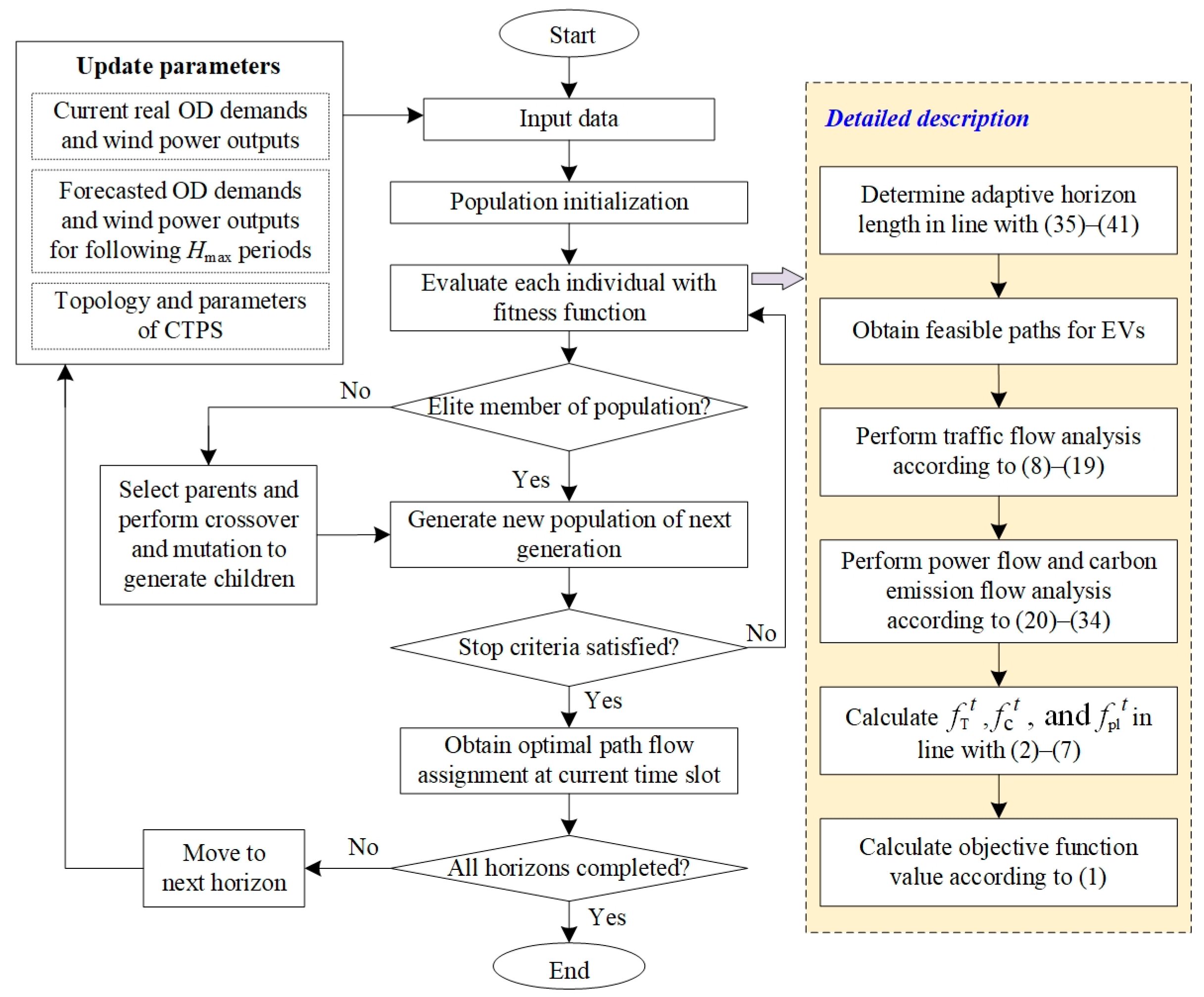
This section develops a rolling-horizon optimization framework for coupled transportation–power systems. The system is represented as an integrated model of road traffic flows, power system operations, and charging stations located at traffic nodes, all formulated in discrete time. The framework adopts a receding-horizon scheme to capture multi-period interactions under uncertainty, as shown in Figure 1.

2.1. Objective Function and Cost Decomposition

The overall objective of the rolling-horizon optimization is to minimize the total system cost across the coupled transportation–power system over the prediction horizon. At time step t, the objective function is expressed as
min F t = h = 0 H t ρ h f T t + h + f pl t + h + f c t + h
where ρ 0 , 1 is a discount factor; H t denotes the prediction window length; and f T t + h , f pl t + h , and f c t + h denote the travel time cost in the transportation system, the power-loss cost in the power system, and carbon emission cost of the EV charging stations at time t + h, respectively.
The transportation cost is defined as the sum of on-road driving time cost f drive t and the queuing delay cost f station t at charging stations, shown as follows:
f T t = f drive t + f station t
The driving time component is given by
f drive t = a A N 0 d a t c time t a ( ω ) d ω
where A N denotes the set of road arcs, d a t denotes the traffic flow on arc a at time t, ctime is the monetary value of time, and t a ( ω ) is the travel time on arc a as a function of flow level ω, which captures the flow-dependent congestion effect. The station waiting time cost is modeled as
f station t = a A C 0 υ a d a t c time t a chg ( ω ) d ω
where A C is the set of charging arcs, υ a is the proportion of vehicles choosing to charge on arc a , and t a chg ( ω ) is the expected waiting time under charging demand ω.
The power-side cost is represented by active power losses in the power system, valued through a monetary coefficient:
f pl t = c pl ( i , j ) D A G i j V i t 2 + V j t 2 2 V i t V j t cos θ i j t
where D A is the set of branches in power system; G i j is the conductance of branch (i,j); V i t and V j t are voltage magnitudes of bus i and j, respectively; θ i j t is the voltage angle difference between buses i and j; and c pl is the unit cost of power loss.
The carbon cost is derived from generator-specific emission intensities, propagated through the CEF module:
f c t = a A C ζ a , t e a , t c carb
where ζ a , t is the carbon intensity allocated to charging arc a at time t, c carb is the unit cost of carbon emissions, and e a , t is the energy consumption of charging arc a at time t, which can be calculated as follows:
e a , t = P a , t ch Δ t
where P a , t ch denotes the charging power on arc a at time t, and Δt represents the length of the time interval.
In summary, the above formulation decomposes the objective into transportation, power, and carbon emission components, which are valued on a unified monetary basis. This structure ensures that routing decisions, power system operations, and environmental impacts are jointly considered within the rolling-horizon optimization framework.

2.2. Traffic System Constraints

The transportation system determines both travel delays on roads and queuing delays at charging stations, which together shape the spatiotemporal distribution of EV charging demand. To capture these dynamics in a consistent and tractable manner, we adopt a graph-based representation of the road network combined with an M/M/c queuing model (Erlang-C formula) for charging stations. This approach ensures that route choices, station arrivals, and service delays are coherently linked within the optimization framework.
The travel time on each road arc a A N is modeled by the classical Bureau of Public Roads (BPR) function [5,28]:
t a ( d a t ) = t a 0 1 + 0.15 d a t c a 4 ,   a A N
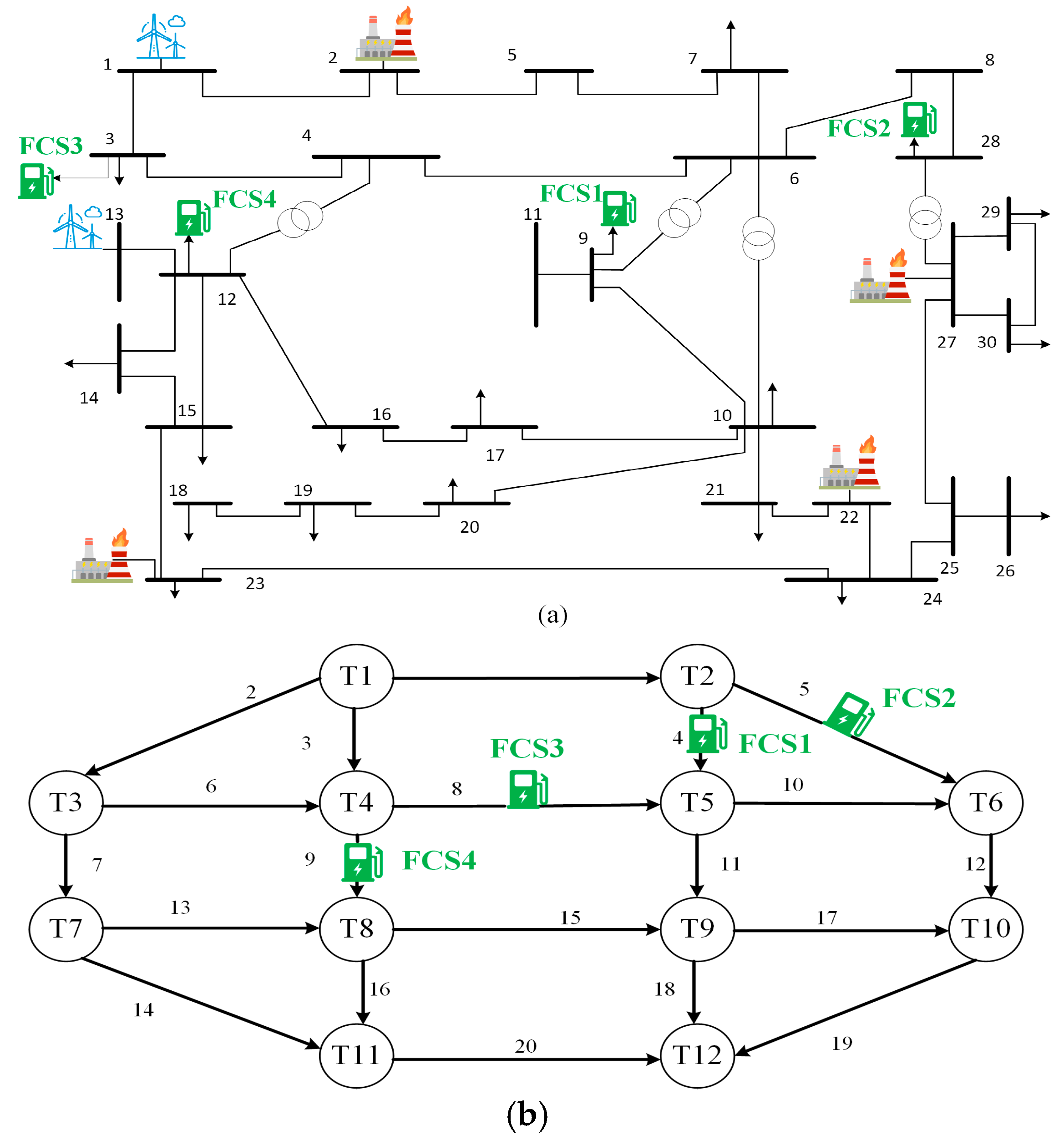
where t a 0 is the free-flow travel time of road arc a , and c a denotes road capacity of arc a . This nonlinear function captures the congestion effect as flows approach capacity. The transportation network topology considered in this work is illustrated in Figure 2b, and the corresponding link-specific parameters used in the BPR function, including the free-flow travel time t a 0 and road capacity c a , are summarized in Table 1.
For each charging arc a A C , the arrival rate is obtained as
λ a t = x a t Δ t , a A C
where x a t is the number of vehicles arriving at charging arc a in time slot t. The charging station utilization factor is defined as
ψ a t = λ a t c a CF μ a , a A C
where c a CF denotes the number of chargers at charging station a, and μ a is the service rate of each charger. To ensure stability, the following condition must be held, which means that the arrival rate cannot exceed the aggregate service capacity.
0 ψ a t < 1 , a A C
Queueing at a charging station is captured by the multi-server Erlang-C formula. The empty-system probability of the M/M/c queue is given by
P 0 , a t = n = 0 c a CF 1 c a CF ψ a t n n ! + c a CF ψ a t c a CF c a CF ! 1 ψ a t 1 , a A C
where P 0 , a t denotes the probability that charging station a is empty at the beginning of slot t. This term also serves as the normalization constant for the steady-state distribution of the M/M/c queue. Based on the Erlang-C model, the expected waiting time per arriving EV at charging station a is given by
W a t = P 0 , a t λ a t μ a c a CF ψ a t c a CF ! 1 ψ a t 2 λ a t ,             a A C
Accordingly, the expected service delay on charging arc a is given by
t a chg ( d a t ) = 1 μ a + W a t , a A C
where 1 / μ a is the average charging time per vehicle, and the second term accounts for additional waiting due to congestion at the station.
Because vehicles continue along their chosen paths once they reach a node, the available departures for OD (r, s) in slot t equal the exogenous demand plus the outflows from all incoming links to the origin node:
k K r s f k r s , t = q r s t + a A ex r O a s , t , r , s , t
where K r s denotes the set of all feasible paths between origin r and destination s, and let k K r s index a specific feasible path. Let f k r s , t denote the flow on path k for OD pair (r, s) at time t, and q r s t the travel demand of OD pair (r, s) at time t. A ex ( r ) is the set of arcs with an exit node r, O a s , t is the outflow on link a in slot t bound for destination s, and total outflow constraints are imposed in (16).
O a t = s S O a s , t , a , t
This aggregates destination-wise outflows into the total outflow from link a. Path–link incidence is given as follows:
x a t = r R s S k K r s f k r s , t δ k , a r s , a , t
where R and S denote the sets of origins and destinations, respectively, and δ k , a r s 0 , 1 indicates whether link a lies on path k, which maps path flows to link arrivals x a t . It denotes the flow newly assigned to this arc at time t from the OD demands under the user-equilibrium model; accordingly, the traffic flow on this arc at time t is expressed as
d a t = d a t 1 + x a t O a t , a , t 1
d a 0 = 0 , a , t
It is worth noting that the DUE formulation adopted in this study is based on the standard assumption of fully rational and fully informed EV users, who select routes and charging stations to minimize their perceived generalized travel cost. This assumption is widely used in equilibrium-based traffic modeling and enables a tractable representation of collective user behavior. However, it may not fully capture bounded rationality, preference heterogeneity, or information imperfections that can arise in real-world EV routing and charging decisions.

2.3. Power System Constraints and Carbon-Intensity Mapping

We model the power system as a directed graph D N , D A , where D N is the set of buses, and D A is the set of branches. In time slot t, the active and reactive net injections at bus j are given as
P j t = P g , j t P l , j t P ch , j t , j D N
Q j t = Q g , j t Q l , j t , j D N
where P g , j t and Q g , j t are the active and reactive outputs of generators, respectively; P l , j t and Q l , j t are the active and reactive power demands, respectively; and P ch , j t is the aggregate EV charging power at bus j. The latter is obtained from the charging arcs connected to bus j:
P ch , j t = a A C j υ a d a t P EV , j D N
where A C j A C is the set of charging stations electrically connected to bus j, and each station corresponds to a charging arc on the traffic side; P EV is the per vehicle charging power.
To represent active and reactive power conservation in the power system, we employ branch-level balance equations. For each branch ( i ,   j ) D A , the sending-end power equals the sum of the nodal injection at bus j, the power flows dispatched to its downstream branches, and the power losses on branch (i, j). This formulation captures both power losses and flow redistribution, ensuring that the system representation remains consistent with AC power flow physics:
P i j t = P j t + R i j l i j t + k : ( j , k ) D A P j k t , ( i , j ) D A
Q i j t = Q j t + X i j l i j t + k : ( j , k ) D A Q j k t , ( i , j ) D A
with voltage drop and current–power coupling
V j t 2 = V i t 2 2 ( R i j P i j t + X i j Q i j t ) + ( R i j 2 + X i j 2 ) l i j t
where P i j t and Q i j t are the active and reactive branch flows, respectively; Rij and Xij are branch resistance and reactance, respectively; and l i j t is the squared current magnitude on branch (i, j).
In addition, the thermal rating of each branch and voltage magnitude at each node must be maintained within the allowable range, given as follows:
( P i j t ) 2 + ( Q i j t ) 2 S i j max , ( i , j ) D A
V i min V i t V i max ,             i D N
where V i min , V i max are voltage magnitude limits, and S i j max is the thermal rating of branch (i, j). The active and reactive power outputs of each generator must satisfy their respective operating limits. These constraints are formulated as follows:
P g , i min P g , i t P g , i max ,         i D N
    Q g , i min Q g , i t Q g , i max ,         i D N
where P g , i min , P g , i max and     Q g , i min , Q g , i max represent the active and reactive generation bounds, respectively.
To discourage excessive voltage excursions, we introduce an auxiliary variable χ i t that measures the per unit voltage deviation at bus i. The deviation is constrained within an admissible tolerance:
χ i t = V i t V i , ref V i , ref ,         i D N
χ i t χ max ,         i D N
where V i , ref denotes the nominal reference voltage at bus i, typically set to the rated value (e.g., 1.0 p.u.), and χ max is the admissible tolerance for per unit voltage deviations, ensuring that bus voltages remain within an acceptable fluctuation band.
To prevent transformer overloading and ensure that the apparent power at each bus remains within the rated capacity, we define a loading factor α i t . This constraint not only guarantees operational security but also promotes a more balanced utilization of charging stations across the system.
α i t = P l , i t + P ch , i t 2 + Q l , i t 2 S i TR , i D N
α i t α max , i D N
where S i TR denotes the rated transformer capacity at node i, α i t represents the loading factor at node i in time slot t, and αmax specifies the admissible maximum loading factor.
We adopt a CEF mapping to propagate generator-specific carbon intensities through the system to the consumption points (charging buses). Let ζ a , t denote the carbon intensity allocated to charging arc a at time t. The carbon intensity that feeds the charging station located at bus i is computed as the ratio of carbon-attributed supply to total supply at that bus:
ζ i , t = h Ω i coal P h , t coal ζ h coal + i j Ω i L P i j t ζ i j , t line h Ω i coal P h , t coal + y Ω i wind P y , t wind + i j Ω i L P i j t
where Ω i coal , Ω i wind , and Ω i L denote the sets of coal units, wind power units, and branches that directly inject active power into bus i, respectively; P h , t coal and P y , t wind are the outputs of thermal and wind power units, respectively; ζ h coal and ζ i j , t line are the carbon emission intensities of coal unit h and branch ij, respectively; and P i j t is the active power on branch ij.

2.4. Determination of Adaptive Horizon Length

To allow longer horizons that enhance foresight under stable conditions and shorter ones that preserve robustness under volatile conditions, the rolling-horizon length is adaptively adjusted according to the variability of traffic demand and wind power generation forecasts. Two stability indices are therefore introduced to quantify the temporal fluctuations of OD demand and wind power output, respectively. These indices serve as quantitative signals for shrinking or extending the optimization horizon, ensuring that the framework dynamically adapts to different levels of forecast uncertainty.
For each OD pair rs, the current real demand at time t, denoted by q r s t , and the forecasted values for the following Hmax periods q r s t + 1 , , q r s t + H max are collected. The maximum among these values is given as
q r s max = max q r s t ,   q r s t + 1 ,   ,   q r s t + H max
Each value is normalized as follows:
q ˜ r s τ = q r s τ q r s max + ε ,                     τ t ,       t + 1 ,       ,       t + H max
where ε is a sufficiently small positive constant to avoid division by zero.
  • The normalized sequence { q ˜ r s τ } lies within [0, 1], and its standard deviation is denoted as σ r s t . Since the maximum possible standard deviation of values in [0, 1] is 0.5, the OD demand stability index is defined as follows:
    U OD t = 1 N OD r s 1 2 σ r s t
    where NOD is the number of OD pairs.
For each wind power unit i, the current real output P i , t wind and the forecasts P i , t + 1 wind , , P i , t + H max wind are normalized by the rated capacity P rate ,   i wind .
P ˜ i , τ wind = P i , τ wind P rate ,   i wind ,                     τ t ,       t + 1 ,       ,       t + H max
The standard deviation of normalized outputs is denoted as σ wind , i t , and the wind power stability index is given as
U wind t = 1 N wind i 1 2 σ wind , i t
where Nwind is the number of wind power units.
The OD and wind stability indices are combined as
U t = β U OD t + 1 β U wind t
where the parameter β 0 , 1 controls the relative importance between traffic demand variability and renewable generation variability in determining the adaptive horizon length. A larger β places more emphasis on OD demand fluctuations, leading to a horizon that responds more strongly to traffic congestion dynamics, whereas a smaller β increases the influence of wind power variability and makes the horizon more sensitive to renewable uncertainty. In this study, β is set to 0.5 to balance these two sources of uncertainty, and moderate variations of β were observed to affect the horizon length smoothly without altering the qualitative behavior of the adaptive strategy. Finally, the adaptive horizon length is computed as
H t = H min + H max H min U t + 0.5
where Hmin and Hmax are the lower and upper bounds of the horizon length, and denotes the floor operator, which effectively performs rounding when adding 0.5. This ensures that the horizon length shrinks when variability is high (low stability) and extends when conditions are stable, achieving a balance between robustness and foresight.

2.5. Solution Method

The overall solution process of the proposed adaptive rolling-horizon DUE optimization framework is illustrated in Figure 1. At each decision period, the solution method begins with the collection of input data, including current OD demands and wind power outputs together with their multi-step forecasts, as well as the topology and parameters of the CTPS. Based on these inputs, two stability indices are computed to quantify the variability of traffic demand and renewable generation. According to (35)–(41), the adaptive prediction window length is then determined, ensuring that a longer horizon is selected under stable conditions to improve foresight, while a shorter horizon is adopted when variability is high to limit the influence of forecast errors.
Given the prediction window, the feasible path set for EVs is generated, and an initial population of candidate path-flow vectors is established. The optimization follows an elitist genetic algorithm framework, where each individual in the population is evaluated through a fitness function representing the total operating cost of the system. Specifically, for each candidate solution, the inner evaluation pipeline involves solving the dynamic user equilibrium problem with the SQP method to assign traffic flows and capture in-station queuing dynamics, followed by AC power flow and carbon emission flow analysis to evaluate grid feasibility, system losses, and nodal carbon intensities. The corresponding transportation cost, power loss cost, and carbon cost are calculated according to Equations (2)–(7) and aggregated into the objective function (1) over the prediction horizon using the discount factor.
The genetic algorithm iteratively selects elite members of population, applies crossover and mutation to generate offspring, and updates the population until the stopping criteria are satisfied. Once convergence is reached, the optimal path-flow assignments in current horizon can be obtained. Only the first-period decision is implemented in practice, after which the horizon is rolled forward with updated real-time information and new forecasts. This receding-horizon procedure continues until all horizons have been processed, thereby producing a dynamic sequence of path-flow assignments that jointly balance foresight and robustness across transportation and power domains.
It is worth clarifying that the proposed rolling-horizon optimization framework is not itself a DUE model. Instead, the dynamic user equilibrium is embedded as the traffic assignment component within each rolling-horizon decision step, while the rolling-horizon mechanism serves as an outer-layer framework to coordinate multi-period decisions under forecast uncertainty.
Although the case study considers a medium-scale coupled transportation–power system, the proposed rolling-horizon framework is inherently scalable. The computational burden mainly depends on the number of traffic nodes and candidate paths in the DUE problem, the number of buses and branches in the AC power flow, and the length of the rolling horizon. At each decision step, the dominant computational cost arises from repeatedly solving the embedded traffic assignment and power system evaluation problems. In large-scale applications, the computational efficiency can be further improved through parallel evaluation of candidate solutions, path set reduction, and decomposition techniques, which makes the proposed framework applicable to larger systems.

2.6. Experimental Settings

As shown in Figure 2, the test system integrates a transportation system and a power system to form a tested CTPS. The power system contains 30 buses (T1–T30) and a portfolio of generating units, including four coal-fired plants and two wind power units with distinct output limits and emission factors. It is worth noting that the type of generation unit plays a critical role in the proposed framework, as different generation technologies are associated with distinct carbon emission intensities. These generator-specific emission factors are explicitly considered in the CEF module and directly affect the carbon cost component in the objective function. There are four nodes (T3, T9, T12, and T28) that host fast-charging stations labeled FCS1–FCS4. The transportation system is represented by 12 nodes and 20 directed links. Each charging station is modeled as a charging arc in the transportation system and electrically mapped to its associated bus in the power system, such that charging flows determined by EV route choices translate into active power injections at the corresponding buses. This formulation ensures traffic-induced charging demand is consistently reflected in nodal loads, system losses, and carbon intensities, thereby establishing a realistic physical coupling between two infrastructures.
All simulations were conducted on a standard workstation equipped with an Intel Core i7 processor (2.9 GHz) and 32 GB RAM. For the tested coupled transportation–power system, the average computation time per rolling-horizon step was on the order of tens of seconds. Specifically, the dominant computational cost arises from the repeated solution of the embedded DUE assignment and AC power flow within the GA evaluation process, while the outer-loop GA convergence typically requires a limited number of generations. These results indicate that the proposed framework is computationally tractable for medium-scale systems and suitable for near-real-time operational studies.
Table 1 presents the fundamental parameters of the transportation system, detailing the 20 directed road segments that connect the 12 nodes. For each segment, the table reports the road capacity and the corresponding free-flow travel time, thereby providing the basis for modeling congestion dynamics under varying traffic conditions. Table 2 specifies the configuration of the power system and generation portfolio, including the bus locations of the generating units, their types, and the associated lower and upper operating limits. In addition, the table differentiates the carbon emission factors across coal-fired and renewable units, which enables a consistent mapping of generator-specific emission intensities to nodal carbon costs in the coupled analysis.
As presented in Table 3 and Table 4, the dataset specifies, for each time period, the realized OD pair demands in the transportation system and the actual wind power outputs in the power system, respectively. The economic parameters are set as follows: the monetary value of travel time is 1 $/h, the carbon price is 20 $/tonCO2, and the penalty on active power losses is 25 $/MW. The rated charging power of each EV is assumed to be 200 kW.

3. Results

3.1. Effectiveness of Adaptive Horizon Strategy

To validate the effectiveness of the proposed rolling-horizon optimization, we benchmark three strategies for path-flow assignment: (i) a no-forecast strategy, (ii) a fixed-horizon strategy, and (iii) the proposed adaptive horizon strategy. These three settings differ in how far ahead the optimizer “looks” when computing the operation cost of CTPS. In the no-forecast strategy, the optimizer only considers realized OD demands and wind generation in the current period, without anticipating future conditions. In the fixed-horizon strategy, the optimizer always looks ahead two additional periods, so that decisions for the current period are based on the realized values plus forecasts for the following two periods. To mitigate the effect of forecast error accumulation, later periods are assigned smaller weights in the aggregated objective. Finally, in the adaptive horizon strategy, the prediction horizon length is determined dynamically from the realized and forecasted values: when demand and generation are volatile, the horizon shortens to avoid relying on unreliable long-term forecasts; when conditions are stable, the horizon extends to capture more foresight. This adaptive rule allows the optimization framework to balance robustness and proactivity in real time.
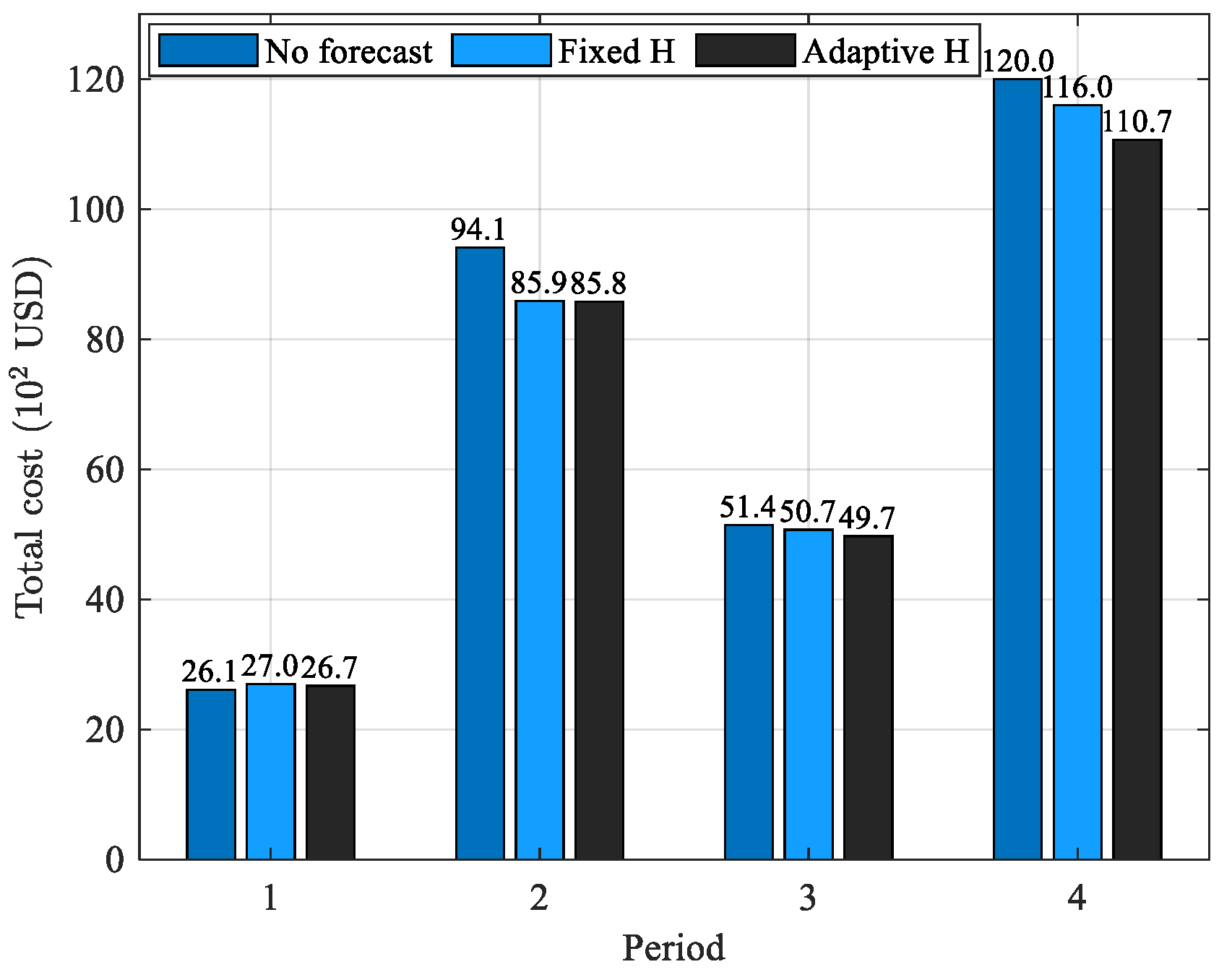
Figure 3 shows the per period total costs obtained under the three horizon strategies. In period 1, all three strategies yield relatively low costs, with only marginal differences across strategies. Starting from period 2, however, the gaps widen significantly. The no-forecast strategy incurs the highest cost of USD 9410, whereas the fixed-horizon and adaptive horizon strategies reduce it to USD 8590 and USD 8580, respectively. In period 3, the difference between the three strategies narrows again, with total costs of USD 5140, USD 5070, and USD 4970. The most pronounced contrast appears in period 4: the no-forecast strategy reaches USD 12,000, the fixed-horizon strategy reduces this to USD 11,600, and the adaptive horizon strategy achieves the lowest value of USD 11,070. These trajectories highlight two important phenomena. First, although forecasting-based strategies may slightly increase cost in the first period compared with the no-forecast baseline, they deliver consistent savings in subsequent periods by anticipating congestion and reallocating flows in advance. Second, the adaptive horizon achieves the lowest cost overall, particularly in the most congested period (period 4), where its dynamic adjustment mechanism provides a clear advantage. Summed across all periods, the cumulative total cost of the no-forecast strategy is about USD 29,160, compared with USD 27,960 under the fixed horizon and USD 27,290 under the adaptive horizon, corresponding to reductions of approximately 4.1% and 6.4%, respectively.
To examine the sources of these savings, Table 5 reports the per period cost breakdown into traffic, grid loss, and carbon emission components. The traffic time cost dominates the total in all strategies, accounting for more than 70% of the overall expenditure. Accordingly, the most substantial reductions are observed in the traffic component, especially in periods 2 and 4 when OD demand is highest. Compared with the no-forecast baseline, the fixed-horizon strategy reduces traffic costs by 12.8%, 1.5%, and 2.1% in periods 2–4, while the adaptive horizon strategy achieves reductions of 9.8%, 4.1%, and 7.3%, respectively. These results confirm that the anticipatory “peak-shaving” effect of forecasting-based strategies effectively suppresses downstream congestion.
Beyond the traffic component, the table also reveals two additional insights. First, the power loss costs remain relatively stable across both periods and strategies, fluctuating within a narrow band between USD 4.6 × 10² and USD 5.9 × 10². This stability suggests that transmission losses are less sensitive to horizon design, as they are mainly governed by physical grid constraints. Nonetheless, the no-forecast case shows a slight spike in period 3 (USD 5.83 × 10²), while the forecasting-based strategies avoid such increases, indicating that improved flow allocation indirectly stabilizes system operation. Second, carbon emission costs exhibit clearer divergence across strategies in later periods. While differences are negligible in the first period, the adaptive horizon attains the lowest carbon cost in period 4 (USD 8.43 × 10²), compared with USD 8.56 × 10² under no-forecast and USD 9.34 × 10² under the fixed horizon. Although the contribution of carbon cost to the total remains modest (below 10%), this consistent downward trend highlights the environmental co-benefits of anticipatory allocation: by guiding EV charging toward less carbon-intensive supply conditions, forecasting strategies reduce not only congestion but also system-wide emissions.
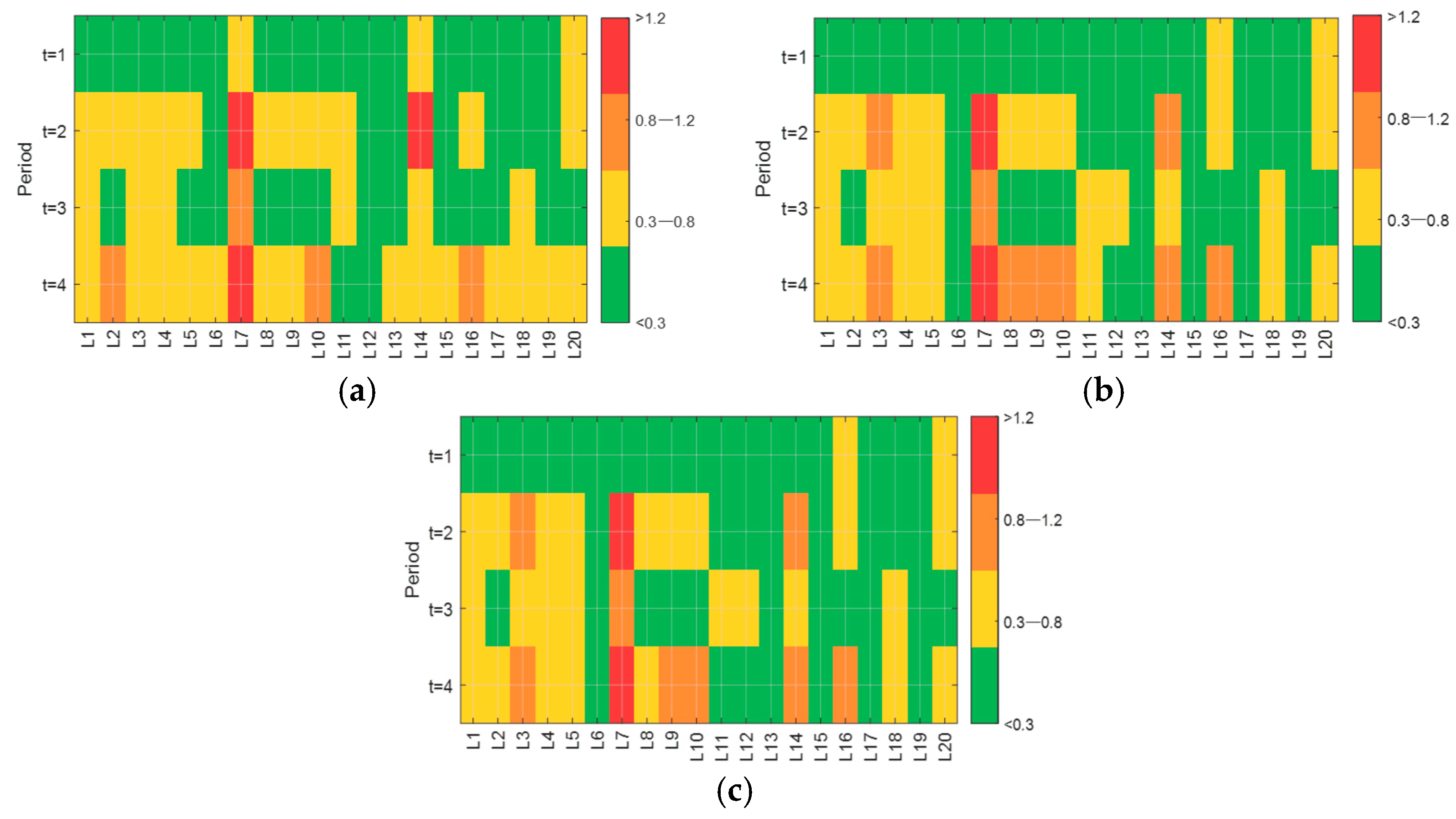
The congestion patterns underlying these results are illustrated in Figure 4, which shows the spatiotemporal evolution of link flow-to-capacity ratios under the three horizon strategies. Green denotes uncongested links (ratio < 0.3), yellow and orange represent moderate congestion (0.3–1.2), and red indicates severe congestion (ratio > 1.2).
Congestion intensity varies considerably across periods. Periods 1 and 3 remain largely uncongested, whereas widespread congestion arises in periods 2 and 4, coinciding with the peak OD demands reported in Table 3. This temporal correspondence highlights how traffic fluctuations drive system stress and underscores the importance of horizon design in managing demand surges to avoid cumulative spillovers. The spatial distribution of congestion reveals that only a few bottleneck links, notably L6, L7, L8, and L13, experience recurrent overload across strategies. Their limited capacity and structural role in connecting major OD pairs make them particularly vulnerable. The forecasting-based strategies relieve these bottlenecks by diverting flows to alternative paths, spreading traffic more evenly across the system. In contrast, the no-forecast baseline allows residual flows to accumulate, producing persistent bottlenecks and a proliferation of red links, especially in periods 2 and 4.
When comparing the two forecasting strategies, the adaptive horizon displays a distinct advantage in the later stages. Although its patterns appear broadly similar to the fixed horizon in periods 1–3, the adaptive horizon results in fewer severely congested links and lower flow magnitudes in period 4. This outcome reflects the benefit of dynamically adjusting horizon length, which suppresses long-run spillovers more effectively than a fixed look ahead.

3.2. Sensitivity Analysis of the Discount Factor

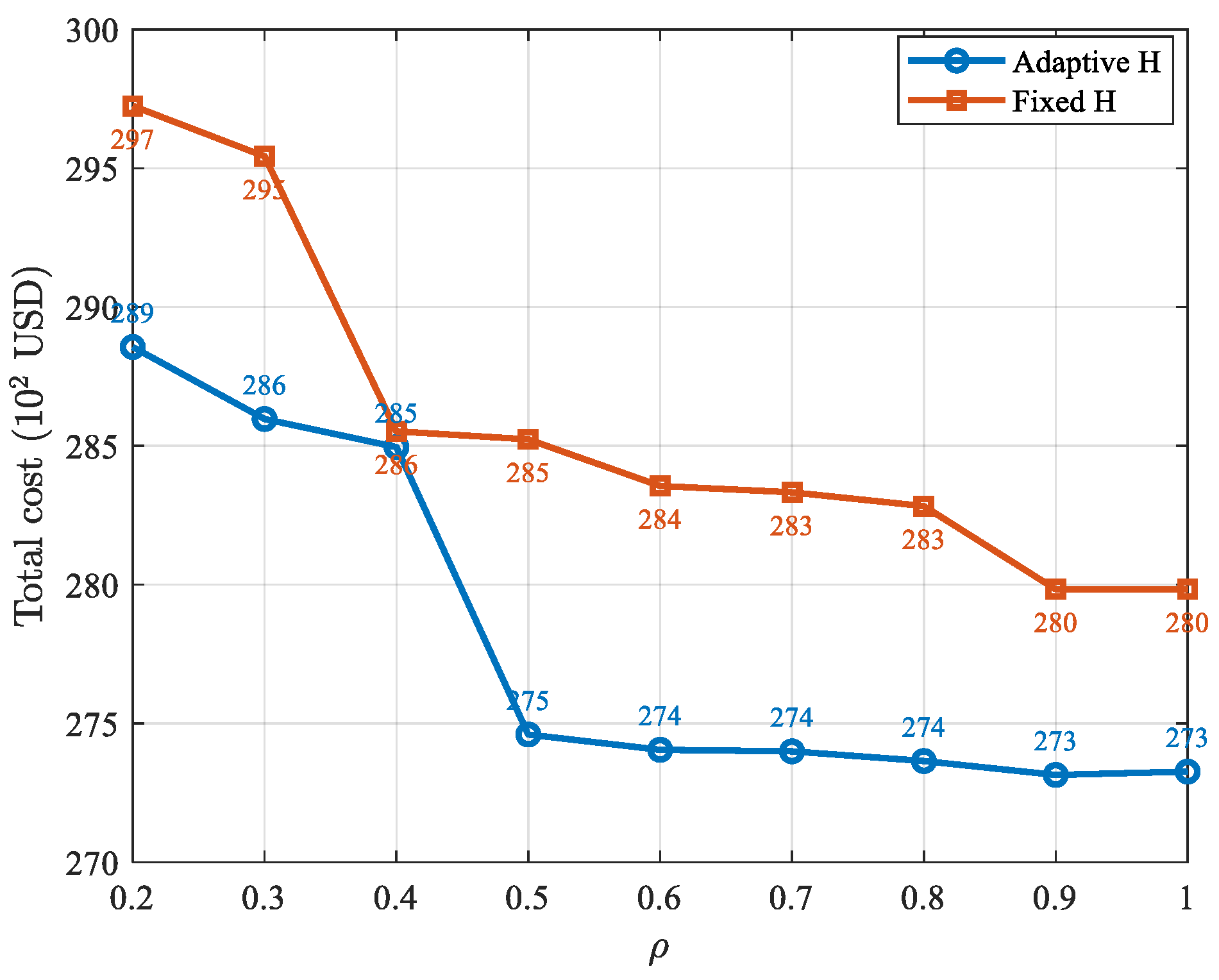
Figure 5 depicts the four-period cumulative total cost as a function of the discount factor ρ under the Fixed-H and Adaptive-H strategies. Both curves display a broadly similar shape: the cost decreases as ρ increases and stabilizes into a plateau from around ρ ≈ 0.5 onward. At this near-optimal region, the cumulative cost converges to approximately 2730 (×102 USD) for Adaptive H and 2798 (×102 USD) for Fixed H. Further raising ρ toward unity produces negligible additional savings, and the Adaptive H curve remains almost flat with only minor fluctuations. In contrast, when ρ drops below 0.5, the total cost increases rapidly, with especially sharp rises at ρ = 0.4 and below. This pattern suggests that small ρ values overweight immediate-period outcomes, undermining anticipatory adjustments and inducing myopic assignments that push congestion and charging costs into later periods. By comparison, larger ρ values enhance foresight, but beyond about ρ ≈ 0.5–0.6, the marginal benefits diminish due to forecast-error noise, leading to a robust plateau.
Across the entire range of ρ, the Adaptive H curve consistently lies below the Fixed H curve, confirming the efficiency advantage of dynamically tuning horizon length to volatility. Quantitatively, at ρ = 0.9, Adaptive H reduces the cumulative cost by about 2.3% relative to Fixed H; at ρ = 0.6, the reduction is approximately 3.3%. Even under the unfavorable low-ρ case (ρ = 0.2), Adaptive H still maintains an advantage of around 2.9%, demonstrating robustness against the choice of discount factor. Mechanistically, the effect of ρ operates through two main channels: (i) adjusting the intertemporal weights in the objective, thereby promoting earlier peak shaving and upstream flow diversion to reduce downstream congestion, and (ii) influencing the temporal allocation of EV charging load, which indirectly affects power losses and carbon emissions, though these remain smaller in magnitude. Overall, selecting ρ ≈ 0.6–0.9 provides a balance between foresight and robustness and, when combined with the Adaptive H policy, delivers the lowest cumulative costs observed in the case study.

4. Conclusions

This study proposes an adaptive rolling-horizon optimization framework for coupled transportation and power systems, in which the prediction window is dynamically adjusted in response to the volatility of OD demand and renewable generation. By explicitly balancing the benefits of foresight against the risks of forecast errors, the framework provides a more resilient and adaptive mechanism for multi-period cross-domain operation. In contrast to conventional fixed-horizon or no-forecast approaches, the proposed method is able to regulate the prediction window online, thereby enhancing the system’s capability to cope with uncertainty. The numerical experiments further demonstrate that forecasting-based strategies can substantially alleviate downstream congestion and reduce the overall system operating cost, considering both travel time on the transportation side and system losses and carbon emissions on the power side. Moreover, the adaptive horizon consistently outperforms the fixed horizon by maintaining robustness under volatile conditions, confirming the effectiveness and resilience of the approach. These findings suggest that adaptive horizon control provides a practical pathway for managing the intertwined uncertainties of future low-carbon transportation and power systems.
Future research will extend the proposed framework to larger-scale coupled transportation-power systems and investigate advanced computational strategies to further enhance scalability and efficiency. In addition, future work will relax the perfect-rationality assumption by incorporating stochastic user equilibrium or bounded rationality behavior models to better capture realistic EV routing and charging decisions.

Author Contributions

Conceptualization, Methodology, Writing—Original Draft, and Funding Acquisition, Z.Z.; Formal Analysis, Resources, Project Administration, and Writing—Review and Editing, S.L.; Investigation, Data Curation, and Writing—Review and Editing, Y.W.; Funding Acquisition, Conceptualization, and Writing—Review and Editing, F.T.; Visualization, Investigation, and Writing—Original Draft, H.L.; Software, Investigation, and Writing—Original Draft, P.S.; Supervision, Conceptualization, and Writing—Review and Editing, C.Y. All authors have read and agreed to the published version of the manuscript.

Funding

This work was funded by the Science and Technology Project of State Grid Hebei Electric Power Co., Ltd., with the project title “Research and Application of Integrated Transmission and Distribution Low-Carbon Dispatching Technology for Urban Power Grids Considering Vehicle-Grid Integration” (kj2024-061).

Data Availability Statement

No external data were used in this study. All data presented in this manuscript can be fully reproduced based on the models, parameters, and algorithms described in the paper.

Conflicts of Interest

Authors Zhe Zhang, Shiyan Luan, Yingli Wei, Fan Tang, and Haosen Li were employed by the Xiong’an New Area Power Supply Company, State Grid Hebei Electric Power Co., Ltd. The remaining authors declare that the research was conducted in the absence of any commercial or financial relationships that could be construed as a potential conflict of interest. The authors declare that this study received funding from the Science and Technology Project of State Grid Hebei Electric Power Co., Ltd. (kj2024-061). The funder was not involved in the study design, collection, analysis, interpretation of data, the writing of this article, or the decision to submit it for publication.

References

  1. Wu, T.; Zhuang, H.; Huang, Q.; Xia, S.; Zhou, Y.; Gan, W.; Terzić, J.S. Routing and scheduling of mobile energy storage systems in active distribution networks based on probabilistic voltage sensitivity analysis and Hall’s theorem. Appl. Energy 2025, 386, 125535. [Google Scholar] [CrossRef]
  2. Wu, T.; Li, Z.Y.; Wang, G.B.; Zhang, X.; Qiu, J. Low-carbon charging facilities planning for electric vehicles based on a novel travel route choice model. IEEE Trans. Intell. Transp. Syst. 2023, 24, 5908–5922. [Google Scholar] [CrossRef]
  3. Wang, C.; Liu, C.; Chen, J.; Zhang, G. Cooperative planning of renewable energy generation and multi-timescale flexible resources in active distribution networks. Appl. Energy 2024, 356, 122429. [Google Scholar] [CrossRef]
  4. Pham, V.H.; Ahn, H.-S. Distributed stochastic model predictive control for an urban traffic network. IEEE Trans. Intell. Transp. Syst. 2023. early access. [Google Scholar]
  5. Wu, T.; Yu, H.; Bu, S.; Xia, S.; Wang, H. An improved dynamic user equilibrium model-based planning strategy of fast-charging stations for electric vehicles. IEEE Trans. Transp. Electrif. 2025, 11, 1555–1569. [Google Scholar] [CrossRef]
  6. Cao, Y.; Zhao, H.; Liang, G.; Zhao, J.; Liao, H.; Yang, C. Fast and explainable warm-start point learning for AC Optimal Power Flow using decision tree. Int. J. Electr. Power Energy Syst. 2023, 153, 109369. [Google Scholar] [CrossRef]
  7. Zhang, H.; Moura, S.J.; Hu, Z.; Song, Y. PEV fast-charging station siting and sizing on coupled transportation and power networks. IEEE Trans. Smart Grid 2018, 9, 2595–2605. [Google Scholar] [CrossRef]
  8. Wang, G.; Zhang, X.; Wang, H.; Peng, J.-C.; Jiang, H.; Liu, Y.; Wu, C.; Xu, Z.; Liu, W. Robust planning of electric vehicle charging facilities with an advanced evaluation method. IEEE Trans. Ind. Inform. 2018, 14, 866–876. [Google Scholar] [CrossRef]
  9. Crozier, C.; Deakin, M.; Morstyn, T.; McCulloch, M. Coordinated electric vehicle charging to reduce losses without network impedances. IET Smart Grid 2020, 3, 677–685. [Google Scholar] [CrossRef]
  10. Sortomme, E.; Hindi, M.M.; MacPherson, S.D.J.; Venkata, S.S. Coordinated charging of plug-in hybrid electric vehicles to minimize distribution system losses. IEEE Trans. Smart Grid 2011, 2, 198–205. [Google Scholar] [CrossRef]
  11. Yang, C.; Liang, G.; Liu, J.; Liu, G.; Yang, H.; Zhao, J.; Dong, Z. A non-intrusive carbon emission accounting method for industrial corporations from the perspective of modern power systems. Appl. Energy 2023, 350, 121712. [Google Scholar] [CrossRef]
  12. Wei, W.; Wu, L.; Wang, J.; Mei, S. Expansion planning of urban electrified transportation networks: A mixed-integer convex programming approach. IEEE Trans. Transp. Electrif. 2017, 3, 210–224. [Google Scholar] [CrossRef]
  13. Gan, W.; Shahidehpour, M.; Yan, M.; Guo, J.; Yao, W.; Paaso, A.; Zhang, L.; Wen, J. Coordinated planning of transportation and electric power networks with the proliferation of electric vehicles. IEEE Trans. Smart Grid 2020, 11, 4005–4016. [Google Scholar] [CrossRef]
  14. Duan, X.; Hu, Z.; Song, Y.; Strunz, K.; Cui, Y.; Liu, L. Planning strategy for an electric vehicle fast charging service provider in a competitive environment. IEEE Trans. Transp. Electrif. 2022, 8, 3056–3067. [Google Scholar] [CrossRef]
  15. Fan, V.H.; Dong, Z.; Meng, K. Integrated distribution expansion planning considering stochastic renewable energy resources and electric vehicles. Appl. Energy 2020, 278, 115720. [Google Scholar] [CrossRef]
  16. Xi, W.; Chen, Q.; Xu, H.; Xu, Q. A Bi-Level Demand Response Framework Based on Customer Directrix Load for Power Systems with High Renewable Integration. Energies 2025, 18, 3652. [Google Scholar] [CrossRef]
  17. Alaraj, M.; Radi, M.; Alsisi, E.; Majdalawieh, M.; Darwish, M. Machine Learning-Based Electric Vehicle Charging Demand Forecasting: A Systematized Literature Review. Energies 2025, 18, 4779. [Google Scholar] [CrossRef]
  18. Yang, C.; Liu, J.; Liao, H.; Liang, G.; Zhao, J. An improved carbon emission flow method for the power grid with prosumers. Energy Rep. 2023, 9, 114–121. [Google Scholar] [CrossRef]
  19. Wang, H.; Ye, Y.; Wang, Q.; Tang, Y.; Strbac, G. An efficient LP-based approach for spatial–temporal coordination of electric vehicles in electricity–transportation nexus. IEEE Trans. Power Syst. 2023, 38, 2914–2925. [Google Scholar] [CrossRef]
  20. Xie, S.; Xu, Y.; Zheng, X. On dynamic network equilibrium of a coupled power and transportation network. IEEE Trans. Smart Grid 2022, 13, 1398–1411. [Google Scholar] [CrossRef]
  21. Wang, X.; Shahidehpour, M.; Jiang, C.; Li, Z. Resilience enhancement strategies for power distribution network coupled with urban transportation system. IEEE Trans. Smart Grid 2019, 10, 4068–4079. [Google Scholar] [CrossRef]
  22. Zielińska, A.; Jankowski, R. Forecasting Installation Demand Using Machine Learning: Evidence from a Large PV Installer in Poland. Energies 2025, 18, 4998. [Google Scholar] [CrossRef]
  23. Dörfler, F.; Simpson-Porco, J.W.; Bullo, F. Breaking the hierarchy: Distributed control and economic MPC of AC power systems. IEEE Trans. Control Netw. Syst. 2016, 3, 241–253. [Google Scholar] [CrossRef]
  24. Stanojev, O.; Markovic, U.; Aristidou, P.; Hug, G.; Callaway, D.; Vrettos, E. MPC-based fast frequency control of voltage source converters in low-inertia power systems. IEEE Trans. Power Syst. 2022, 37, 3209–3220. [Google Scholar] [CrossRef]
  25. An, Z.; Liu, X.; Xiao, G.; Zhang, M.; Pan, Z.; Kang, Y.; Jenkins, N. Learning-based tube MPC for multi-area interconnected power systems with wind power and HESS: A set identification strategy. IEEE Trans. Autom. Sci. Eng. 2025, 22, 20458–20468. [Google Scholar] [CrossRef]
  26. Huang, W.; Gao, C.; Li, R.; Bhakar, R.; Tai, N.; Yu, M. A model predictive control-based voltage optimization method for highway transportation power supply networks with soft open points. IEEE Trans. Ind. Appl. 2024, 60, 1141–1150. [Google Scholar] [CrossRef]
  27. Naseri, F.; Farjah, E.; Kazemi, Z.; Schaltz, E.; Ghanbari, T.; Schanen, J.-L. Dynamic stabilization of DC traction systems using a supercapacitor-based active stabilizer with model predictive control. IEEE Trans. Transp. Electrif. 2020, 6, 228–240. [Google Scholar] [CrossRef]
  28. United States Bureau of Public Roads. Traffic Assignment Manual for Application with a Large, High Speed Computer; U.S. Department of Commerce, Bureau of Public Roads, Office of Planning, Urban Planning Division: Washington, DC, USA, 1964. [Google Scholar]
Figure 1. Flowchart of the solution method.
Energies 19 00227 g001
Figure 2. Network topology of the test coupled transportation–power systems. (a) Power system network. (b) Transportation system network.
Energies 19 00227 g002
Figure 3. Per period total cost under three horizon strategies.
Energies 19 00227 g003
Figure 4. Spatiotemporal road congestion under three horizon strategies. (a) No forecast. (b) Fixed horizon. (c) Adaptive horizon.
Energies 19 00227 g004
Figure 5. Sensitivity of total cost to the discount factor ρ.
Energies 19 00227 g005
Table 1. Transportation system parameters.
Roadca (p.u.) t a 0 (h)Roadca (p.u.) t a 0 (h)Roadca (p.u.) t a 0 (h)
T1–T216.80.60T4–T512.60.75T7–T1114.70.30
T1–T314.00.30T4–T814.00.66T8–T1111.20.24
T1–T312.60.30T5–T613.30.45T9–T1013.30.30
T2–T512.60.30T5–T914.00.75T9–T1211.20.24
T2–T613.30.54T7–T814.00.30T6–T1013.30.60
T3–T411.20.30T8–T914.00.66T10–T1210.50.30
T3–T714.00.30 T11–T1215.40.54
Table 2. Power system and generation portfolio.
Gen IDBusTypePmin (MW)Pmax (MW) ζ (kgCO2/kWh)
11wind0800
22coal0800.85
313wind0400
422coal0500.85
523coal0300.85
627coal0550.85
Table 3. Realized wind power output across time periods.
Gen IDPmin (MW)
t = 1t = 2t = 3t = 4t = 5t = 6
110010204040
310300204040
Table 4. Realized OD demand across time periods.
OD (rs)qrs (p.u.)
t = 1t = 2t = 3t = 4t = 5t = 6
(1–6)1012010150120100
(1–10)0040000
(1–11)30600805060
(1–12)01000906090
(2–12)8205010100
(3–6)300411010
(3–10)000121212
(3–11)010060404040
(3–12)2500202020
(4–10)0300303030
(4–12)2007604060
Table 5. Per period cost breakdown under three horizon strategies.
StrategyItem (102 USD)t = 1t = 2t = 3t = 4
No forecastTraffic cost18.7478.0138.74103.62
Power loss5.144.645.835.15
Carbon cost2.2211.446.838.56
Total cost26.1194.1051.41120.04
Fixed HTraffic cost19.1867.9838.17101.49
Power loss5.184.715.825.22
Carbon cost2.7111.426.769.34
Total cost27.0885.9150.76116.07
Adaptive HTraffic cost18.9370.3937.1696.09
Power loss5.174.695.825.23
Carbon cost2.6310.796.778.43
Total cost26.7485.8849.75109.76
Disclaimer/Publisher’s Note: The statements, opinions and data contained in all publications are solely those of the individual author(s) and contributor(s) and not of MDPI and/or the editor(s). MDPI and/or the editor(s) disclaim responsibility for any injury to people or property resulting from any ideas, methods, instructions or products referred to in the content.