Article

Data-Driven Model-Free Predictive Control for Zero-Sequence Circulating Current Suppression in Parallel NPC Converters

by
Lan Cheng
1,
Shiyu Liu
1,*,
Jianye Rao
1,
Songling Huang
2,
Junjie Chen
1,
Lin Qiu
3,
Yishuang Hu
4 and
Youtong Fang
3
1
China Electric Power Planning & Engineering Institute, Beijing 100120, China
2
Department of Electrical Engineering, Tsinghua University, Beijing 100084, China
3
College of Electrical Engineering, Zhejiang University, Hangzhou 310000, China
4
School of Information & Electrical Engineering, Hangzhou City University, Hangzhou 310000, China
*
Author to whom correspondence should be addressed.
Energies 2026, 19(1), 189; https://doi.org/10.3390/en19010189 (registering DOI)
Submission received: 26 September 2025 / Revised: 15 November 2025 / Accepted: 22 November 2025 / Published: 30 December 2025

Abstract

This paper proposes a data-driven model-free robust predictive control strategy for parallel three-level NPC inverters based on finite control set model predictive control (FCS-MPC), focusing on the zero-sequence circulating current (ZSCC) problem under parameter mismatch conditions. A set of virtual voltage vectors with zero average common-mode voltage (CMV) is introduced to effectively suppress ZSCC without adding additional constraints to the cost function. Meanwhile, an Integral Sliding Mode Observer (ISMO) is integrated into the predictive control framework to enhance robustness and enable reliable control using only input–output data. Unlike existing studies that primarily consider ZSCC suppression under an ideal system, this work specifically addresses the practical scenario in which system parameters deviate from their nominal values. Even when ZSCC suppression strategies are employed, parameter mismatch can still lead to noticeable circulating currents, motivating the need for a more robust solution. Simulation and experimental results validate that the proposed approach achieves excellent current tracking, neutral-point voltage balance, and effective ZSCC suppression under parameter variations, demonstrating strong robustness and feasibility for practical applications.

1. Introduction

As the global community advances toward sustainable energy transitions, optimizing the utilization of distributed renewable energy resources is vital for achieving carbon neutrality and mitigating greenhouse gas emissions. Improving energy conversion and management efficiency is essential across all power levels [1]. In renewable energy systems, emerging power sources such as photovoltaic arrays inherently generate direct current (DC), whereas most electrical loads require alternating current (AC). This fundamental discrepancy necessitates the critical role of inverters in achieving energy compatibility through DC-AC power conversion. The three-level neutral-point-clamped (3L-NPC) inverter, known for its low switching losses, high power quality, and reduced voltage stress, has broad application potential [2]. As power systems scale up, the voltage and current limits of semiconductor switches constrain the output power of a single inverter. To meet high-power demands and improve redundancy, parallel inverter configurations are commonly used.
In parallel 3L-NPC inverter systems, discrepancies in hardware parameters and control dynamics among converters can lead to interaction effects, which further result in zero-sequence circulating current (ZSCC). Such circulating currents will increase system losses, reduce the lifespan of components, cause distortion in the output current waveform, and may even trigger overcurrent protection, leading to system shutdown [3,4,5]. Hence, the formulation of efficient suppression strategies for ZSCC is essential to ensure the reliable and stable operation of parallel inverters.
Among various advanced control methodologies, finite-control-set model predictive control (FCS-MPC) exhibits substantial benefits in parallel inverter applications, particularly in achieving fast dynamic performance and design flexibility. These features make it a promising tool for achieving comprehensive optimization in multi-objective systems [6,7,8]. FCS-MPC method has now been extended to address the suppression of ZSCC suppression in inverter systems. Refs. [5,9] both demonstrated that controlling the common-mode voltage (CMV) generated by converters can effectively suppress ZSCC, prompting the inclusion of CMV within the cost function as a means to address ZSCC. Similarly, Ref. [10] also introduced the predicted circulating current as an additional term in the cost function. However, these approaches compromise the weight allocation for other objectives. An alternative approach was proposed in [11], where an FCS-MPC strategy employing only seven zero-CMV voltage vectors was designed to eliminate ZSCC, but this method causes a substantial reduction in the diversity of selectable voltage vectors, resulting in degraded output current performance. In [12,13], small voltage vectors influencing neutral-point voltage were selected to achieve both ZSCC suppression and neutral-point voltage balancing. However, under high output current conditions, medium or large voltage vectors are typically required to ensure accurate current tracking, making it difficult to maintain effective capacitor voltage balancing control and ultimately affecting system performance. Ref. [14] proposed a virtual voltage vector method, which constructs virtual voltage vectors using the medium vector and zero vector with a CMV of zero to suppress ZSCC. However, this approach completely excludes the large and medium vectors from the inverter’s candidate vectors exhibiting reduced voltage utilization.
Nevertheless, these FCS-MPC-based methods inherently assume accurate system modeling and parameter knowledge. In practice, parameters such as filter inductance, inevitably vary due to temperature fluctuation, component aging, or manufacturing tolerances [15,16]. Such variations introduce parameter mismatch between the predictive model and the actual system, leading to prediction errors and degraded control performance. These prediction errors further deteriorate current tracking accuracy and diminish the effectiveness of ZSCC suppression. Consequently, the robustness of these methods becomes limited under parameter uncertainties. Therefore, even with the ZSCC suppression strategy, significant circulation will still occur under parameter mismatch conditions, and it is necessary to further improve the robustness of the control algorithm.
To address both ZSCC suppression and robustness problems under parameter mismatch condition, this paper proposes an enhanced control framework based on FCS-MPC. First, a zero-average CMV virtual voltage vector mechanism is developed to suppress ZSCC while maintaining high-quality output current. Then, considering the adverse effects of model inaccuracy on predictive control, a robust model-free predictive control (MFPC) strategy utilizing an integral sliding mode observer (ISMO) is introduced. By doing so, the reliance on accurate system parameters and precise mathematical models is removed, while the rapid dynamic response inherent to predictive control is preserved. The proposed method achieves simultaneous ZSCC suppression, current tracking, and neutral-point voltage balancing with strong robustness against parameter uncertainties, thereby ensuring the stability and efficiency of parallel inverter systems.
The organization of this paper is outlined as follows. Section 2 provides an introduction to the conventional FCS-MPC method applied to 3L-NPC inverters in parallel and an analysis of the ZSCC issue. Section 3 elaborates on a novel robust MFPC strategy employing virtual voltage vectors with zero-average CMV. Section 4 presents the performance evaluation to confirm the feasibility and effectiveness of the proposed control strategy. Finally, Section 5 concludes the paper.

2. Conventional FCS-MPC Approach for 3L-NPC Inverter

2.1. Mathematical Model of 3L-NPC Inverter

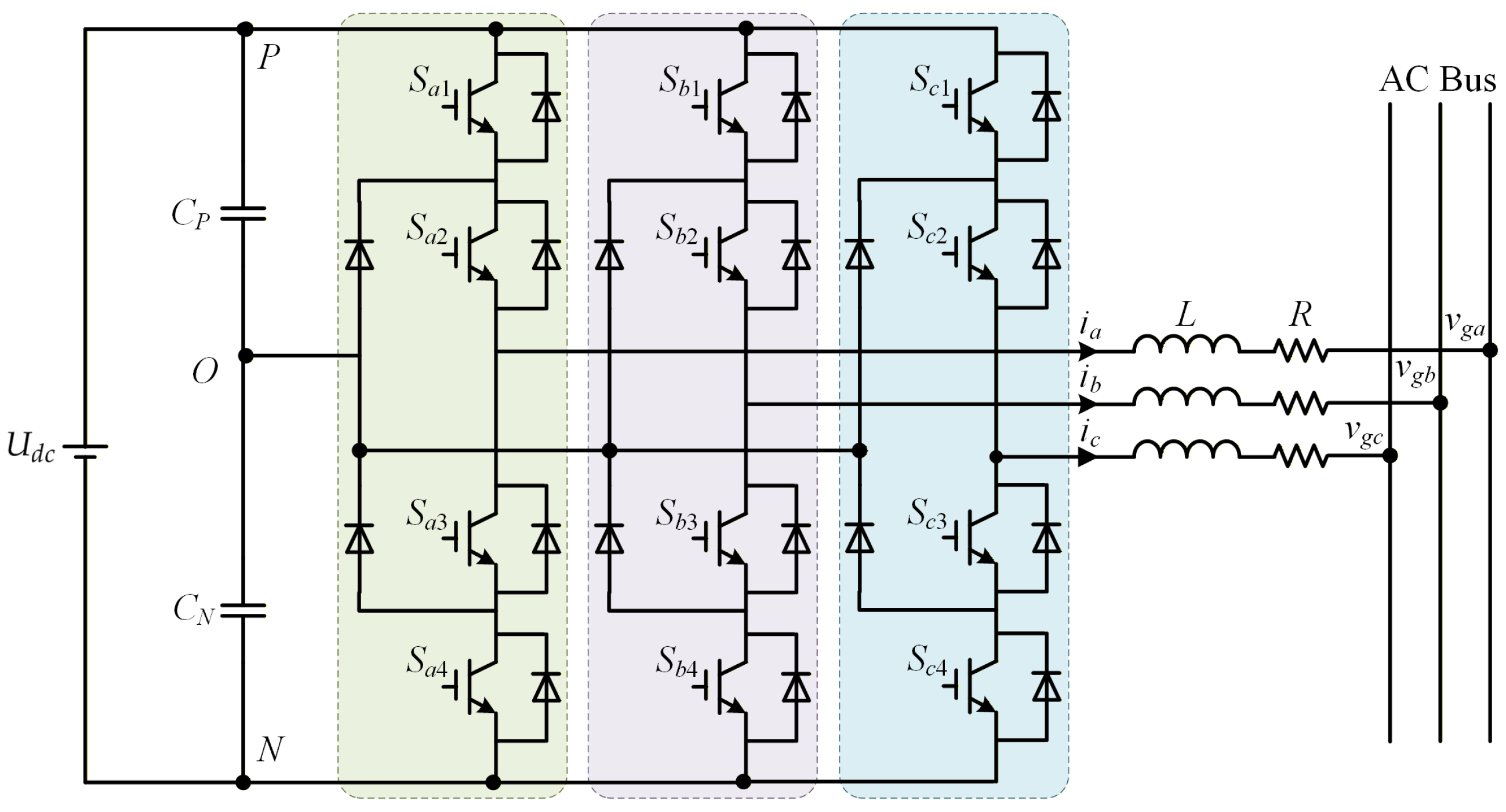
Figure 1 shows the configuration of 3L-NPC inverter. U d c denotes the DC voltage source. C P and C N are capacitors with the same parameters. L and R represent the filter impedance. Each phase can take three kinds of switching states S x { 1 , 0 , 1 } , which are associated with the output voltage v x = S x U d c / 2 , where x { a , b , c } .
The state-space equations of the 3L-NPC inverter can be derived by modeling the system dynamics based on the circuit diagram:
v x = L d d t i x + R i x + v g x
where i x denotes the output current; v x denotes the output voltage; v g x represents the load voltage.
By applying the Clarke transformation to Equation (1) and discretizing the system, the discrete model of the system is obtained as follows:
i α ( k + 1 ) i β ( k + 1 ) = T s L v α ( k ) v g α ( k ) v β ( k ) v g β ( k ) + 1 R T s L i α ( k ) i β ( k )
where T s represents the system sampling step size. The variables i α ( k ) and i β ( k ) , v α ( k ) and v β ( k ) , as well as v g α ( k ) and v g β ( k ) , denote the inverter output currents, output voltages, and load voltages at the kth sampling instant, respectively. i α ( k + 1 ) and i β ( k + 1 ) correspond to the predicted current values for the subsequent sampling period.
The expression for DC side neutral-point voltage v o is given as:
d v o d t = 1 2 C i o
where C P = C N = C . i o is the current flow through neutral point.
By discretizing Equation (3), the predictive model of neutral point voltage can be characterized as
v o ( k + 1 ) = v o ( k ) T s 2 C i o ( k )
where v o ( k ) = ( v C N ( k ) v C P ( k ) ) / 2 . i o ( k ) can be calculated according to the switching combination, as given by
i o ( k ) = x = a , b , c ( 1 S x ) i x ( k ) .

2.2. FCS-MPC Method for 3L-NPC Inverter

As an advanced control technique, FCS-MPC is widely employed in the control of power electronic converters. By exploiting the finite number of inverter switching states, it predicts the system behavior through a discrete mathematical model that incorporates real-time measurements of system variables. The control performance is assessed using a cost function designed based on the control objectives. At each sampling instant, all potential switching states are evaluated according to this cost function, and the state that minimizes the cost is chosen as the optimal control action for the inverter.
For the 3L-NPC inverter, the control objectives typically include accurate reference current tracking and regulation of the neutral-point voltage balance. To achieve these targets, a cost function is formulated accordingly.
g = λ 1 i α * ( k + 1 ) i α ( k + 1 ) + i β * ( k + 1 ) i β ( k + 1 ) + λ 2 v o ( k + 1 )
where i α * ( k + 1 ) and i β * ( k + 1 ) denote the reference current. λ 1 and λ 2 are the weighting factors of two control objectives.
In the 3L-NPC inverter, there are 27 switching states correspond to 19 distinct space voltage vectors. The optimal voltage vector v o p t is chosen by evaluating the cost of each candidate and selecting the one that yields the minimum value.

2.3. FCS-MPC for ZSCC Suppression in Parallel NPC Inverters System

In large-scale systems or those requiring high reliability, inverters are typically operated in parallel to enhance power output and improve system redundancy. However, in parallel inverter systems, each inverter is susceptible to mutual influence with each other, particularly in the presence of imbalance or parameter inconsistencies among them. ZSCC problem is one of the critical challenges that requires urgent attention.
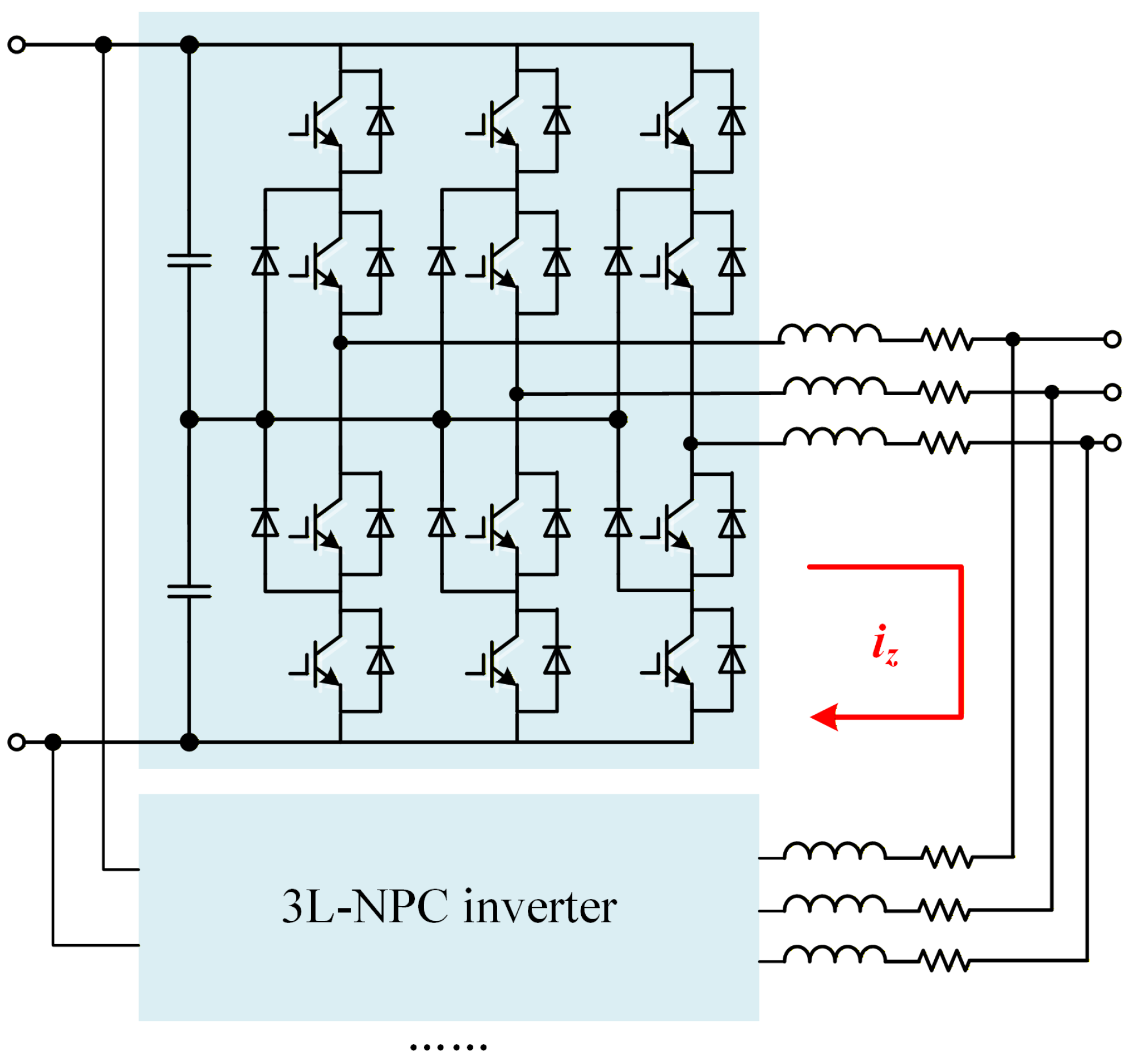
Figure 2 illustrates the circuit configuration of parallel 3L-NPC inverters. By applying Kirchhoff’s Voltage Law, the corresponding loop voltage relationship for the parallel configuration is formulated as:
U d c 2 v o 1 + v x 1 O 1 L 1 d i x 1 d t R 1 i x 1 = U d c 2 v o 2 + v x 2 O 2 L 2 d i x 2 d t R 2 i x 2
where i x j corresponds to the output current of the j th inverter, while v x j O j denotes the voltage between the output terminal of the j th inverter and the DC-side neutral point.
ZSCC refers to the aggregate of the three-phase currents of each inverter measured at the shared AC-side connection point [17].
i z j = i a j + i b j + i c j .
CMV is one of the excitation sources of ZSCC, which is defined as follows:
v c m v j = v a j O j + v b j O j + v c j O j 3 .
By synthesizing Equations (7)–(9), the ZSCC can be expressed in the following form:
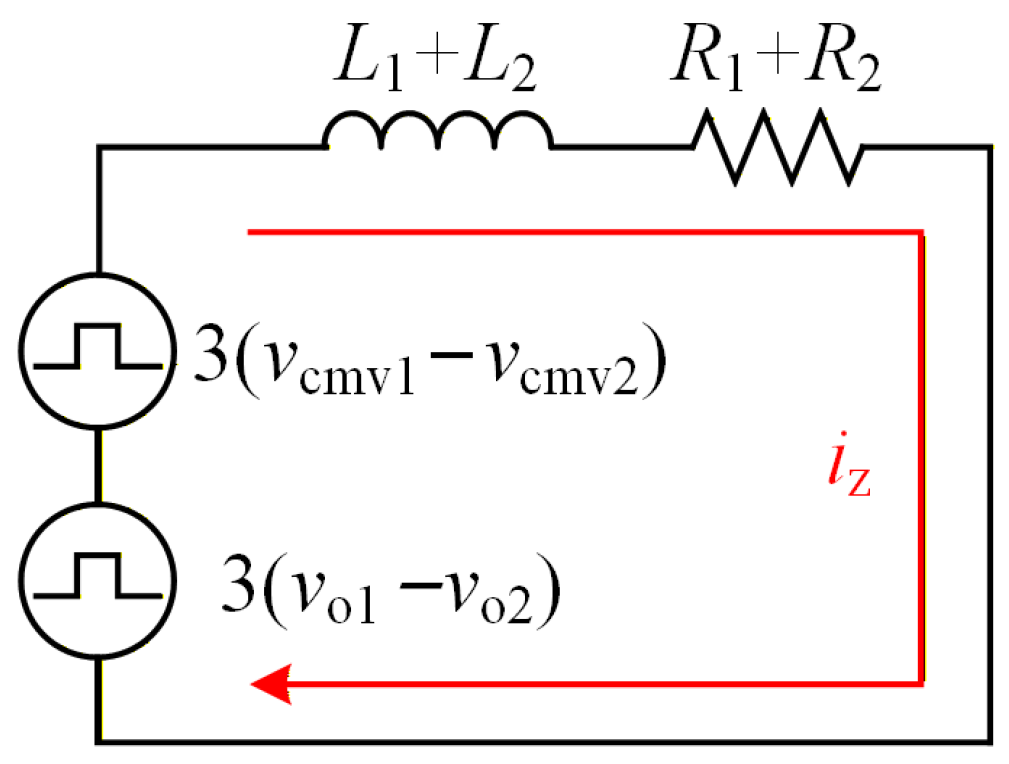
L 1 + L 2 d i z d t + R 1 + R 2 i z = 3 v o 1 v o 2 + 3 v cmv 2 v cmv 1 .
According to the derived ZSCC model, the equivalent circuit is shown in Figure 3. The analysis indicates that CMV difference and neutral point voltage difference between parallel inverters are the main factors causing ZSCC. Meanwhile, the ZSCC is also related to the impedance of the zero-sequence loop. Although increasing the impedance can effectively mitigate the ZSCC, it also leads to higher system volume and power losses. Therefore, this paper mainly considers achieving the suppression of ZSCC by reducing the CMV difference and neutral point voltage difference between parallel inverters.
In the FCS-MPC regulated 3L-NPC inverter system, the floating capacitor voltage can be well balanced by the cost function Equation (6). Consequently, the influence of the neutral point voltage deviation on ZSCC becomes relatively minor, and the CMV difference emerges as the dominant cause of ZSCC. From this viewpoint, reducing the CMV of each inverter as much as possible serves as a viable solution for ZSCC suppression.
An attractive feature of FCS-MPC is its flexibility to include additional constraints within the cost function, thereby enabling multi-objective control ability. Hence, incorporating the CMV of each inverter as a constraint allows the suppression of the ZSCC in parallel configurations [9]. The new cost function is formulated as follows:
g = λ 1 i α * ( k + 1 ) i α ( k + 1 ) + i β * ( k + 1 ) i β ( k + 1 ) + λ 2 v o ( k + 1 ) + λ 3 v c m v
where λ 3 represents the weighting factor for the CMV elimination.

3. Proposed Method

3.1. Zero Average CMV-Based Virtual Voltage Vector Method

The existing FCS-MPC method proposed in [9] incorporates an additional CMV reduction term into the cost function, not only compromises the other control objectives, but also complicates the selection of corresponding weighting factor. To overcome these challenges, a virtual voltage vector-based strategy for suppressing ZSCC is proposed in this study.
As mentioned above, the 3L-NPC inverter can generate 27 switching states, corresponding to 19 unique voltage vectors. The CMV generated by each switching state are listed in Table 1. Based on the CMV values and the associated voltage vector characteristics, the switching states are categorized into six distinct groups.
From the table, it can be seen that the CMV generated by the zero vector of group 1 and the middle vector of group 5 is zero, while the switching states of all the other groups generate common mode voltage. Therefore, by employing only the voltage vectors that produce zero CMV, the CMV difference between the parallel inverters can be completely eliminated, effectively mitigating the circulating current. Nevertheless, this approach reduces the number of available voltage vectors from 19 to 7, which will seriously reduce the range of the candidate set, causing large tracking errors and affecting the accuracy of current tracking. To suppress the ZSCC while ensuring the current tracking, this paper proposes a virtual voltage vector method.
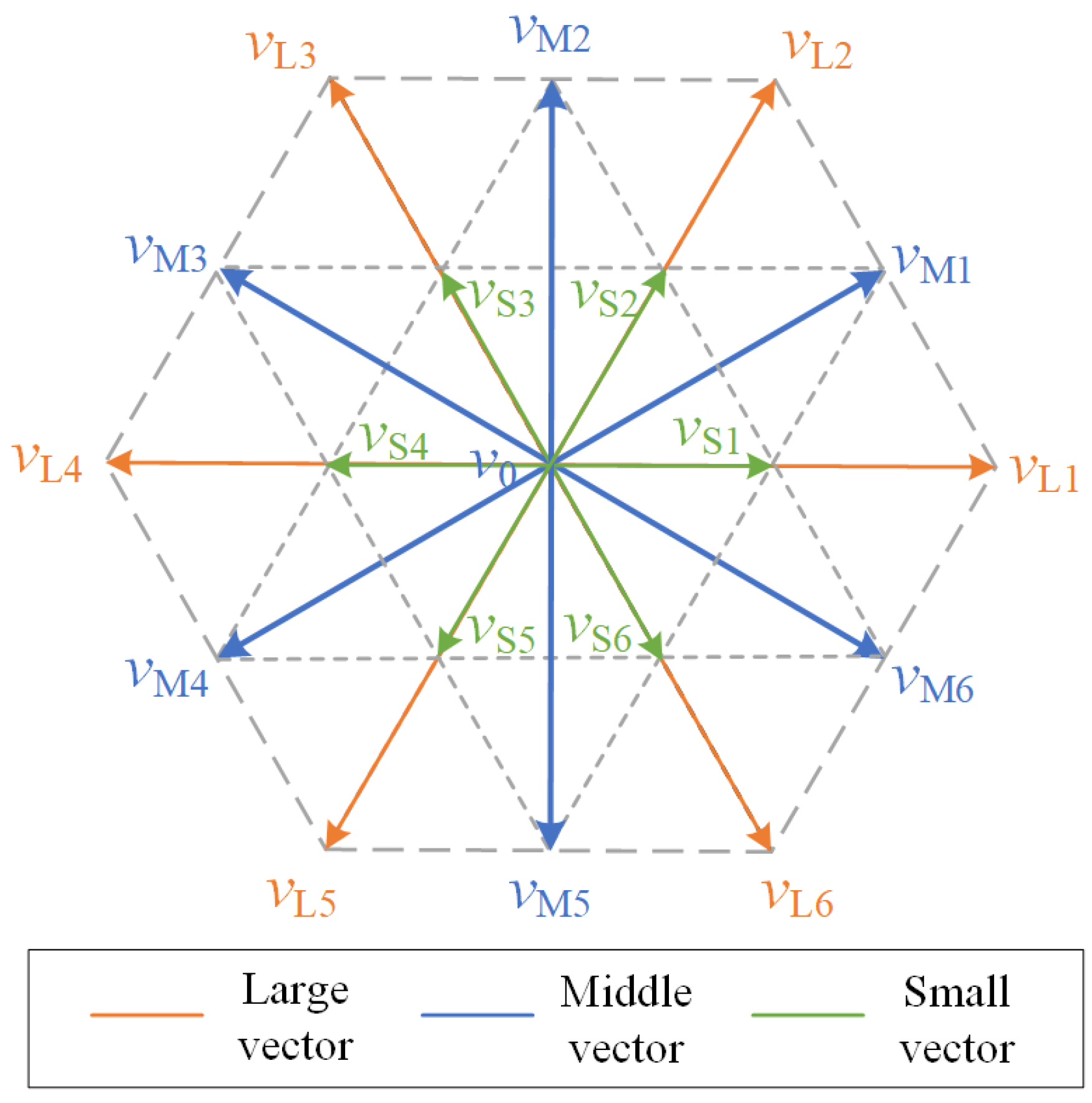
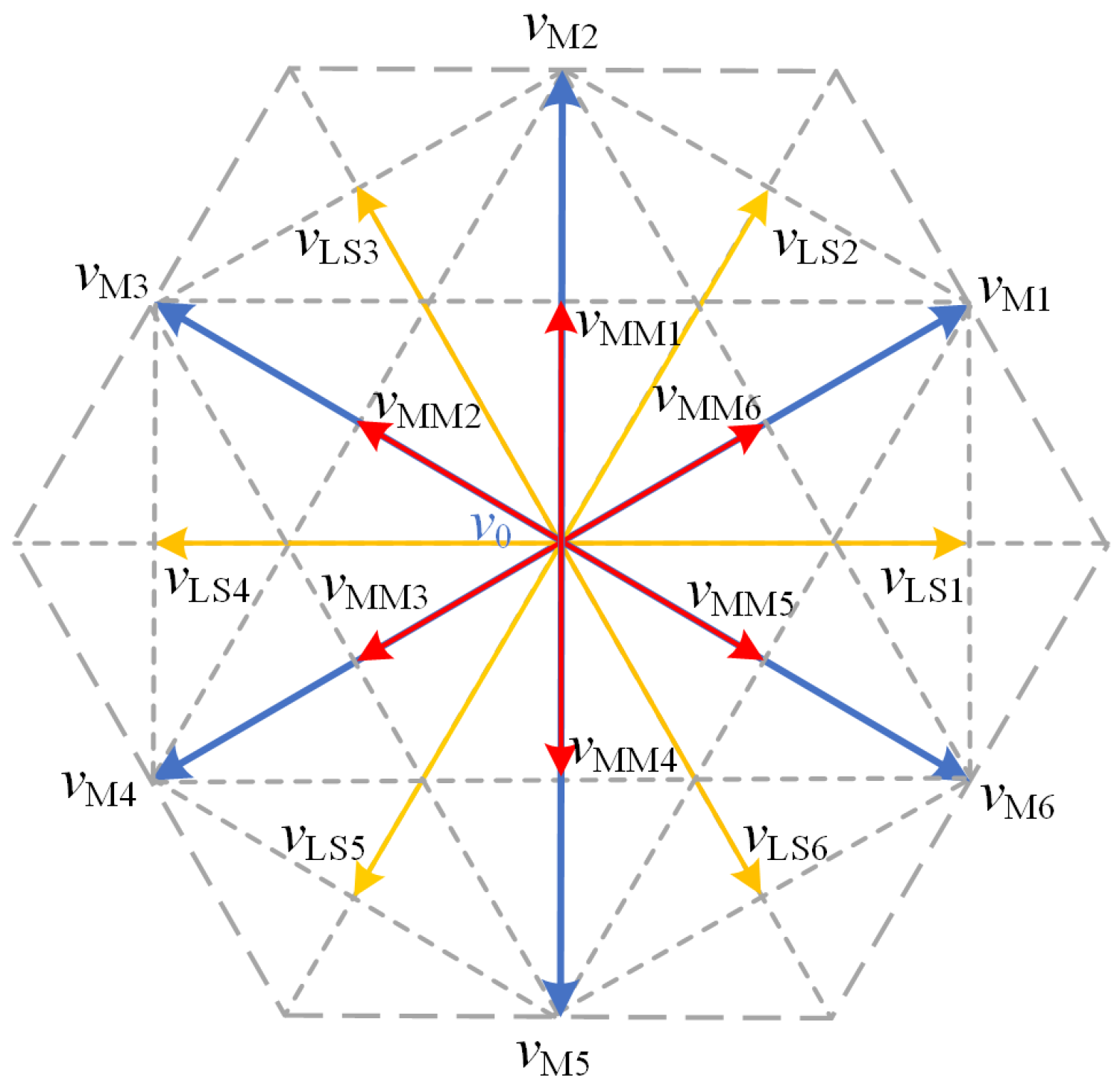
Low-CMV vectors effectively mitigate ZSCC without degrading other control objectives. Accordingly, three groups voltage vectors that generate small CMV are considered as the candidate control set in this design, as shown in Table 2. The distribution of these voltage vectors is shown in Figure 4.
The conventional FCS-MPC strategy only use a single voltage vector in T s . The proposed method combines two voltage vectors to a new virtual voltage vector within T s . From the volt–second balance theory, the virtual vectors can be constructed by the following equation.
v s = 0.5 v I + 0.5 v I I .
where v I and v I I denote basic voltage vectors, and v I v I I . The acting time of both basic voltage vectors are fixed to T s / 2 .
As a result, the virtual voltage vectors can be synthesized by the low CMV vectors, as shown in Table 2. The corresponding relationships are shown in Table 3 and Table 4.
Virtual voltage vectors in Table 3 are synthesized from large and small vectors that generate low CMVs, with the two basic voltage vectors producing + U d c / 6 and U d c / 6 , respectively, each applied for half of the sampling period, which are represented in yellow in Figure 5. The average CMV of the synthesized virtual vector can be expressed as
v cmv , avg = 1 2 v cmv , I + v cmv , I I = 0 .
This structural property ensures zero-average CMV within each sampling period, which inherently suppresses the ZSCC between parallel inverters, without requiring any explicit CMV-related weighting factor in the cost function.
Virtual voltage vectors in Table 4 are synthesized by the middle vectors which have zero CMV, which are represented in red in Figure 5. Therefore, the CMV of the synthesized virtual voltage vectors is also 0, which is also beneficial for suppressing the ZSCC between parallel inverters. The 12 newly synthesized virtual voltage vectors together with the zero-CMV in Group 3 of Table 2 form a new candidate voltage vector set, which contains a total of 19 voltage vectors. Figure 5 shows the spatial distribution. As a result, the number of candidate voltage vectors is the same as the original method, which can ensure the performance of output current while reducing the common mode voltage of candidate voltage vectors.
This method divides a sampling period into two equal parts, with the first half of the period acting on the first voltage vector v I and the second half acting on the second voltage vector v I I . Accordingly, the prediction of the neutral voltage on the DC side also needs to be adjusted. Assuming that the sampling period T s is sufficiently small, it can be approximated that the output current remains constant during a sampling period. Based on Equations (4) and (5), the prediction of the neutral voltage at the midpoint of the sampling period ( k + 1 / 2 instant) can be formulated as follows
i o ( k + 1 2 ) = x = a , b , c ( 1 S I x ) i x ( k ) v o ( k + 1 2 ) = v o ( k ) T s 4 C i o ( k ) .
Furthermore, the prediction of the neutral voltage during the latter half of the sampling period ( k + 1 instant) can be formulated as
i o ( k + 1 ) = x = a , b , c ( 1 S I I x ) i x ( k ) v o ( k + 1 ) = v o ( k + 1 2 ) T s 4 C i o ( k + 1 2 ) .
where S I and S I I are the switching states of the former and latter half of the sampling period, respectively.
By substituting 19 virtual voltage vectors into the current prediction Equation (2), the output currents under the action of a corresponding virtual voltage vector can be predicted. Meanwhile, the DC-side neutral voltage can be predicted by Equations (13) and (14). Since the average CMVs generated by the 19 new candidate voltage vectors are zero, it becomes unnecessary to impose constraints on CMV within the cost function. Consequently, multi-objective predictive control of the NPC inverter can be achieved by integrating both current prediction and DC midpoint potential prediction into the cost function via appropriate weighting factors. Considering the computational burden introduced by the process of enumerating voltage vectors for current prediction, this paper adopts a cost function based on voltage prediction error as follows.
g = λ 1 u ( k + 1 ) v s i + λ 2 v o ( k + 1 )
where v s i are the new candidate voltage vectors. u ( k + 1 ) denotes the reference voltage vector obtained by the deadbeat predictive control. Based on Equation (2), it can be deduced as
u α ( k + 1 ) u β ( k + 1 ) = L T s i α * i α ( k ) i β * i β ( k ) + R i α ( k ) i β ( k ) + v g α ( k ) v g β ( k ) .
Compared with the cost function (11), the proposed zero-average CMV-based virtual voltage vector method reduces the constraints imposed by the CMV, thereby simplifies the cost function. This approach retains the inherent advantage of FCS-MPC method in addressing multi-objective optimization problems, which facilitates improved reference current tracking and effective suppression of zero-sequence circulation in parallel inverters.

3.2. ISMO-Based Model-Free Robust Prediction Control

The zero average CMV-based virtual voltage vector method proposed in the previous section can achieve significant results in suppressing the ZSCC between parallel inverters. However, the possible existence of unmodeled dynamics in the system and the mismatch between the actual parameters and the controller parameters remain an inescapable problem. In particular, the leakage inductance of the AC-side transformer is often utilized as the filter inductor in some current inverter designs, which simplifies the circuit structure but is prone to causing a mismatch of system parameters. Since the conventional FCS-MPC method heavily depends on the precision of the system model and parameters, such discrepancies can markedly degrade the inverter performance. To overcome this limitation, this section presents a robust MFPC scheme. This control strategy differs from traditional methods that rely on accurate system models and parameters by using only input/output data as the main control resource. It can achieve precise control of the inverter under the condition of unknown models or parameter mismatch, and significantly improve the robustness and control performance of the system. Consequently, the strategy is expected to deliver improved reliability and effectiveness under conditions of parameter variations and system disturbances.
ISMO integrates the robustness of sliding mode control with the efficiency of integral control, making it particularly well-suited for addressing uncertainties and external disturbances in power electronic systems, thereby enhancing the stability and performance of the system. ISMO can be used to estimate state variables that are difficult to measure directly, such as inductor current or capacitor voltage. This is achieved by designing a sliding surface that combines the current state and the desired state of the system. Once the state reaches this sliding mode surface, it remains on the surface, thus achieving stable state estimation. The key advantage of this observer lies in its high insensitivity to changes in system parameters and external disturbances. Even when system parameters change significantly or suffer from external disturbances, the ISMO can provide accurate state estimation, ensuring the effectiveness and stability of converter control.
For a single-input single-output (SISO) system, the ultra-local model can be formulated as:
y ˙ = F + b u
where u and y denote the control and output variables, respectively; b is a proportional factor; and F represents the lumped disturbance that encapsulates the system’s internal dynamics and external perturbations.
Based on this ultra-local formulation, the control law can be derived as
u = F ^ + y ˙ * + K p e b
where F ^ is the estimated value of F, y * denotes the desired output, K p stands for the proportional gain, and e = y * y represents the tracking error.
Accordingly, for the 3L-NPC inverter, the ultra-local model in α β stationary coordinate frame can be formulated as [18]
d i α β d t = F + b u α β
where b denotes the input gain of the system. In this paper, b = 1 / L . The disturbance term F is estimated in real time using an ISMO, which enables robust compensation for parameter variations and external disturbances.
Based on the ultralocal model, the ISMO can be designed as follows [19]
d i ^ α β d t = F ^ + b u α β + u d F ^ d t = ϱ E ( t )
where ϱ is the positive gain of the ISMO. u is the input signal of the ISMO, which needs to be designed based on the stability analysis of the observer. E ( t ) is the error function of the integral sliding mode. Considering the estimation error as e = e ( t ) = i ( t ) i ^ ( t ) , E ( t ) can be defined as
E ( t ) = e ( t ) + ξ e ( t )
where ξ is the parameter of the observer, e ( t ) = 0 t sgn ( e ) d τ . The integrator is initialized with the condition e ( 0 ) = e ( 0 ) / ξ . It is worth noting that ϱ and ξ are the proportion coefficient and integration coefficient of ISMO, respectively.
Applying first-order Euler discretization to Equation (19), and taking one-step delay into account, the reference input voltage can be obtained
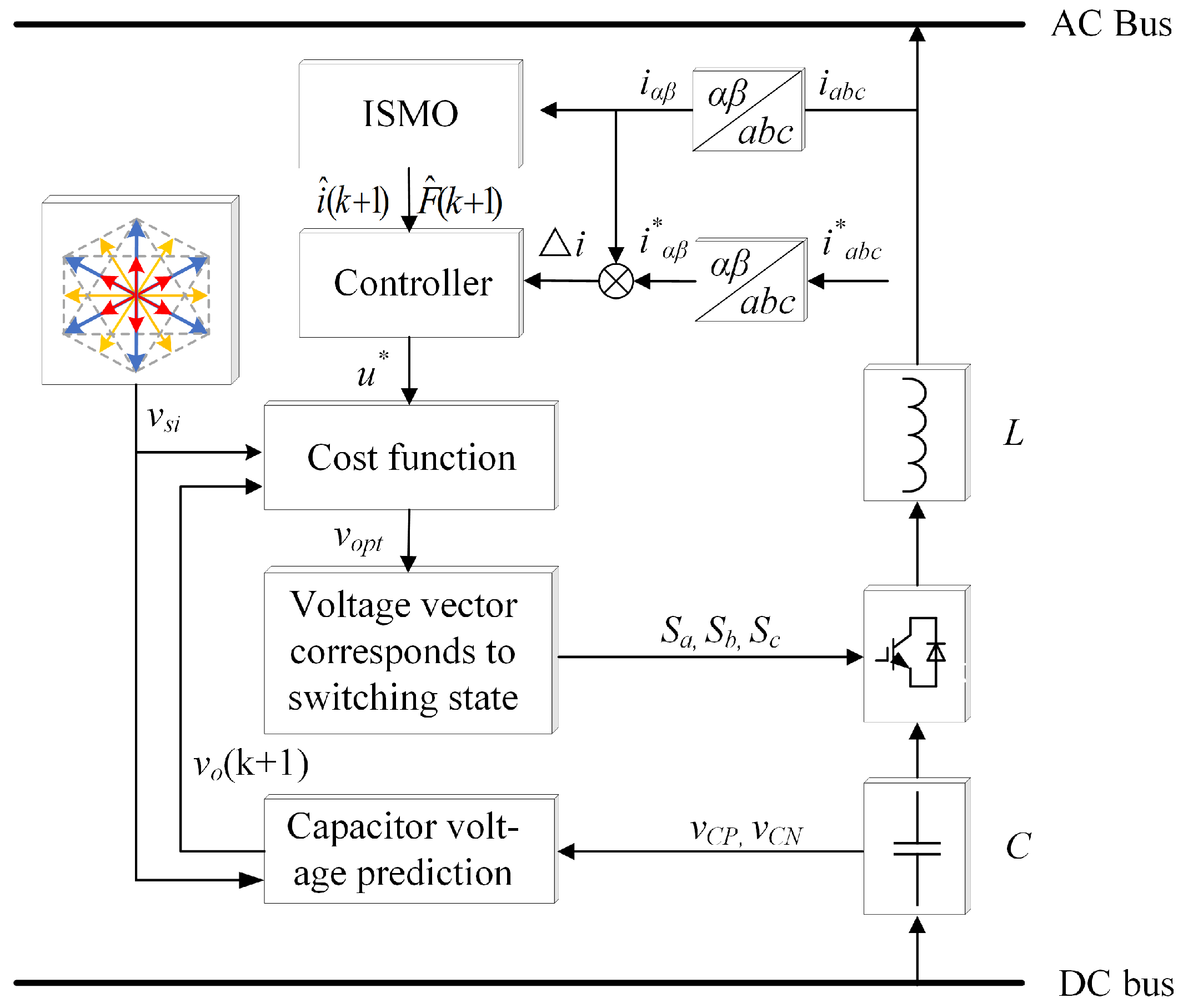
u * = i α β * ( k + 2 ) i α β ( k + 1 ) b T s F ^ ( k + 1 ) b
where F k cannot be obtained directly, so we replace it with F ^ k .
It is worth emphasizing that the designed controller Equation (22) is obtained based on the ultra-local model and solely depends on measured and historical data. This approach effectively removes the reliance on precise models and system parameter information, as seen in conventional FCS-MPC methods.
In the preceding subsection, the virtual voltage vectors were introduced as candidate vectors, and the optimal switching state is determined by traversing the possible states and minimizing the following cost function.
g = λ 1 u * v s i + λ 2 v o ( k + 1 )
The block diagram of ISMO-based robust MFPC is shown in Figure 6.
In summary, the ISMO-based MFPC strategy integrates the robustness of sliding mode control with the error integration property of integral control. This approach enables state estimation even without knowledge of system parameters or an explicit system model. ISMO can effectively estimate the changes of the internal state in the system, such as unknown disturbances in voltage or current, thus enhancing the predictive control scheme’s robustness to maintain stability despite variations in system parameters.

4. Performance Evaluation

The main problem investigated in this study is the suppression of ZSCC in parallel 3L-NPC inverters under parameter mismatch conditions. When discrepancies exist between the controller parameters and the actual system parameters, the control performance of conventional FCS-MPC deteriorates, leading to increased circulating current and degraded current tracking accuracy. To evaluate the feasibility and effectiveness of the proposed approach, this paper establishes both simulation and experimental models for a parallel 3L-NPC inverters system, with the existing FCS-MPC method proposed in [9] as a benchmark for comparison. The key parameters used in the performance evaluation are summarized in Table 5.
In the simulations and experimental verifications presented in this paper, the following assumptions are made: (1) All inverter units share identical circuit structures and operate with the same sampling frequency; (2) The parameter mismatch considered in this work mainly arises from variations in the inverter filter inductance, while the proposed method is also applicable to mismatch in other parameters such as DC-link voltage or switching delay.
Based on these assumptions, the proposed control framework is evaluated through both simulation and experimental tests to validate its capability for robust ZSCC suppression and accurate current tracking under parameter uncertainties.

4.1. Simulation Results

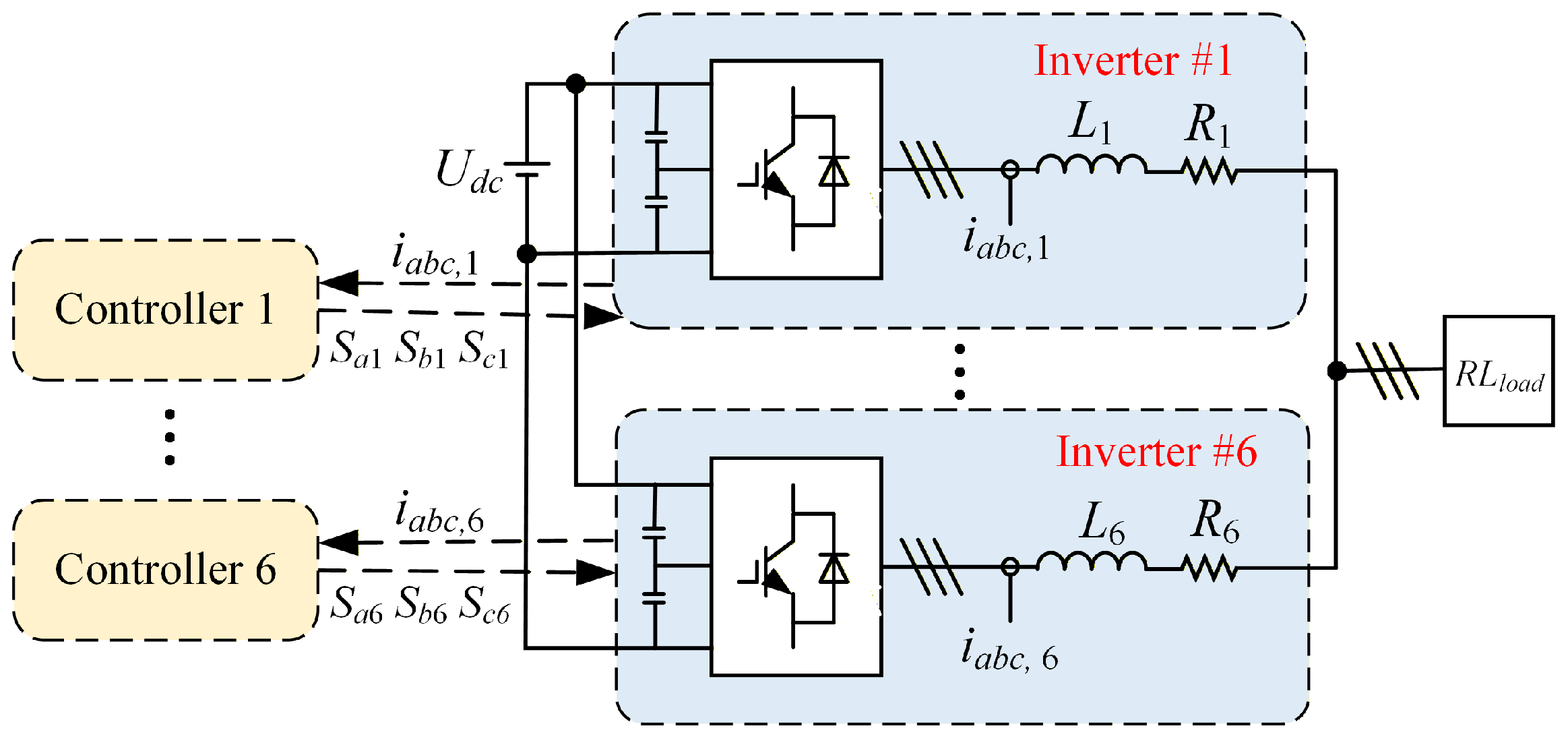
Simulation models are built in MATLAB/Simulink R2024a, with the solver set to fixed-step size and solver selection set to automatic. The model consists of six parallel inverters sharing a common DC voltage source and connected to an AC-side load, as shown in Figure 7. The performance of output current tracking, ZSCC suppression and neutral point voltage balancing are verified by simulating each paralleled inverter with inconsistent reference current and different filter inductance, respectively.
For the convenience of observation, the average value of the ZSCC in simulation waveform can be calculated, which is defined as follows:
i z j a v g = 1 n k = 0 n i z j ( k )
In the context of filter inductance mismatch in parallel inverters, the actual inductance of inverters #1 and #2 are 20% and 10% lower than the control parameters, while the actual inductance of inverters #4 and #5 are 10% and 20% higher than the control parameters (i.e., L 1 = 8 mH , L 2 = 9 mH , L 3 = 10 mH , L 4 = 10 mH , L 5 = 11 mH , L 6 = 12 mH ).
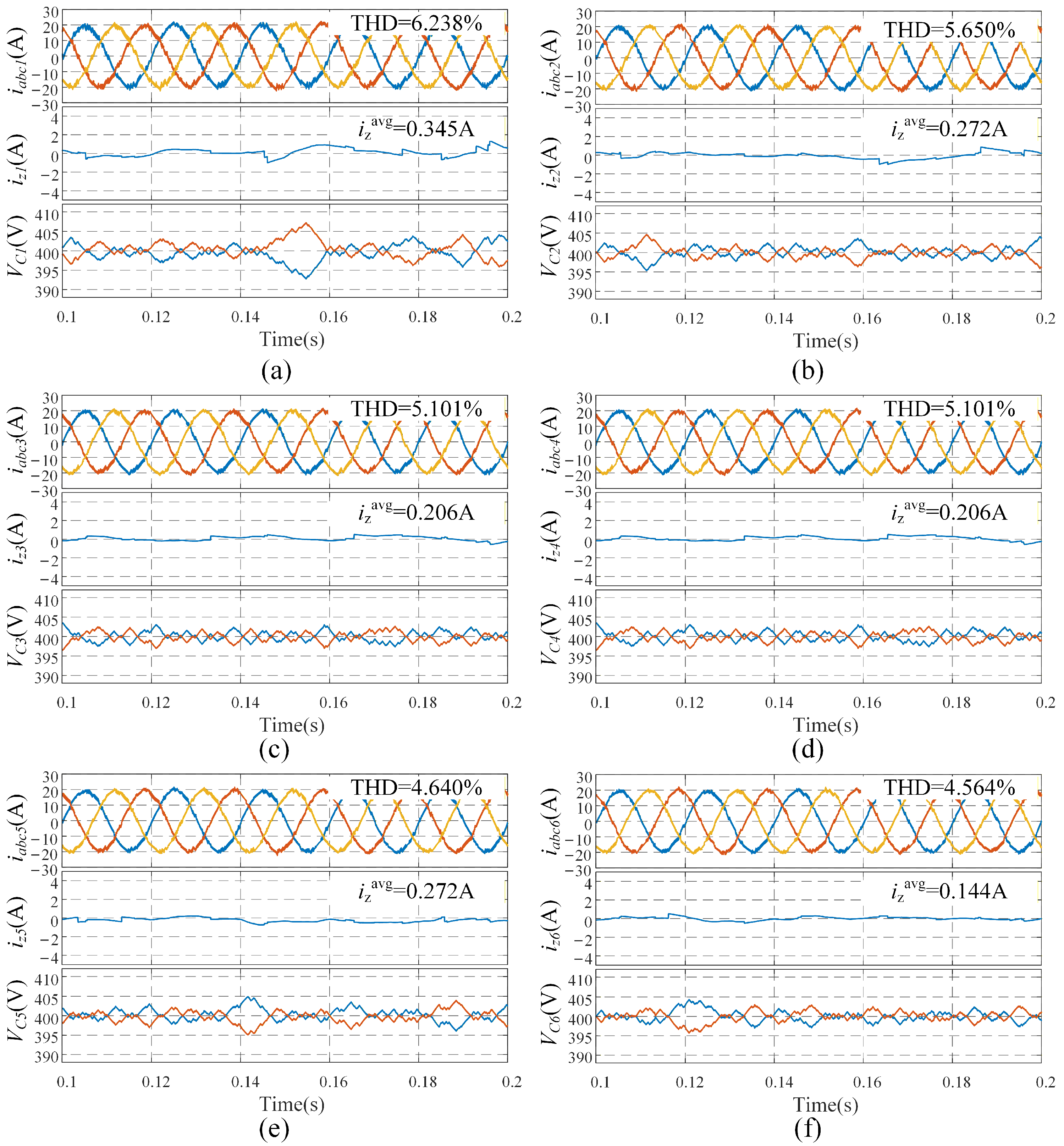
The simulation results controlled by the existing FCS-MPC method proposed in [9] taking CMV suppression into account are presented in Figure 8, including the inverter output current, ZSCC and neutral-point voltage. The average total harmonic distortion (THD) of the output currents from the six inverters is observed to be 5.216%, and the average ZSCC is 0.241 A. When the filter inductance is mismatched, ZSCCs are generated among the inverters, which in turn affects the overall output performance of the system.
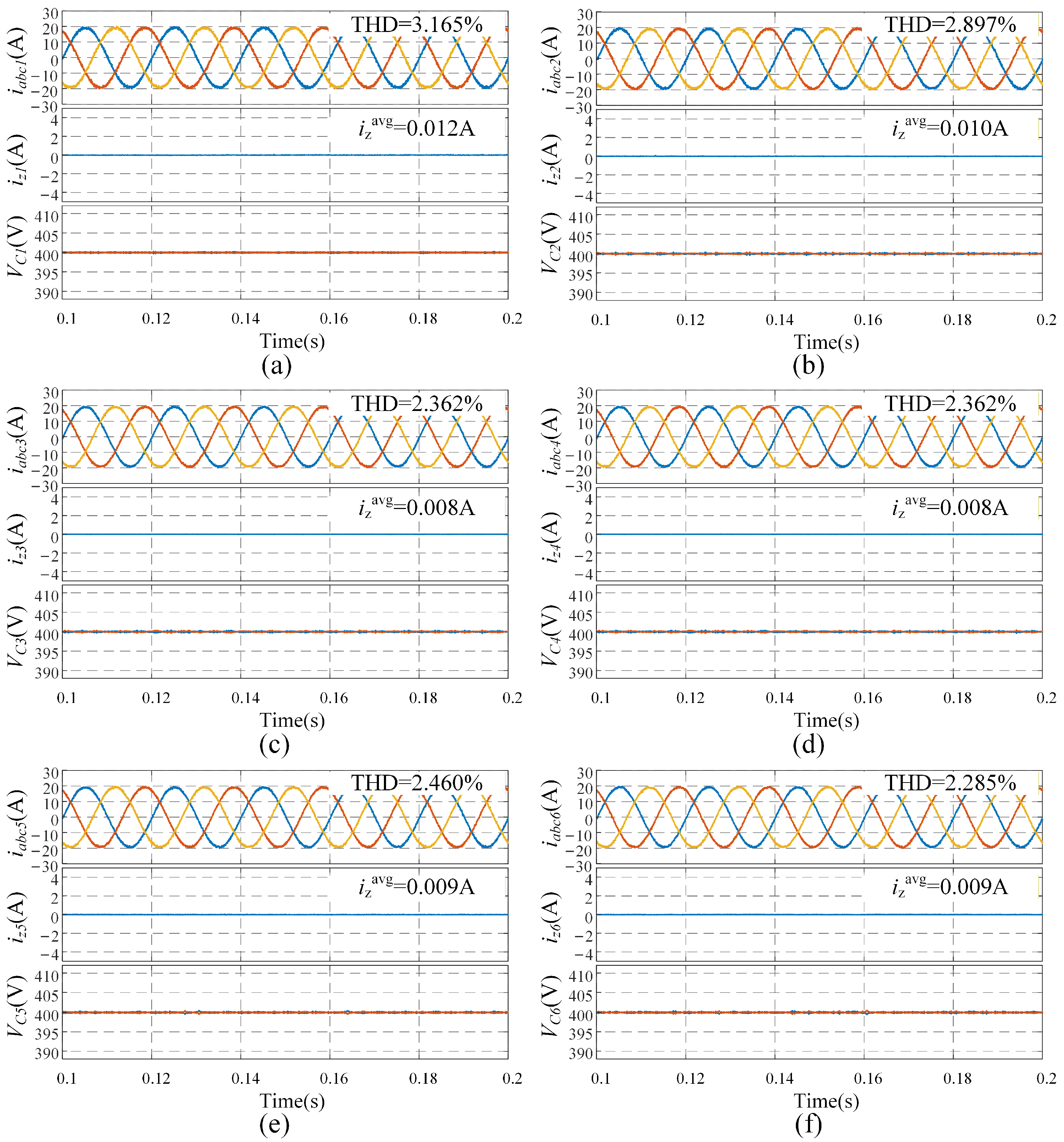
The simulation results for the system controlled by the proposed method are presented in Figure 9. By utilizing virtual voltage vectors derived from zero-average CMV vectors, it can effectively eliminate the CMV differences among parallel inverters, thereby achieving good circulating current suppression. Moreover, the ISMO-based MFPC strategy relies solely on the measured and historical data and is insensitive to system parameters. As a result, the method is resilient to inductance parameter mismatches, thus enhancing control performance. Under the proposed strategy, the average THD of the output currents from the six inverters decreases to 2.588%, while the average ZSCC decreases to 0.009 A. This demonstrates the approach’s capability to not only mitigate ZSCC but also enhance the system’s overall robustness.

4.2. Experiment Results

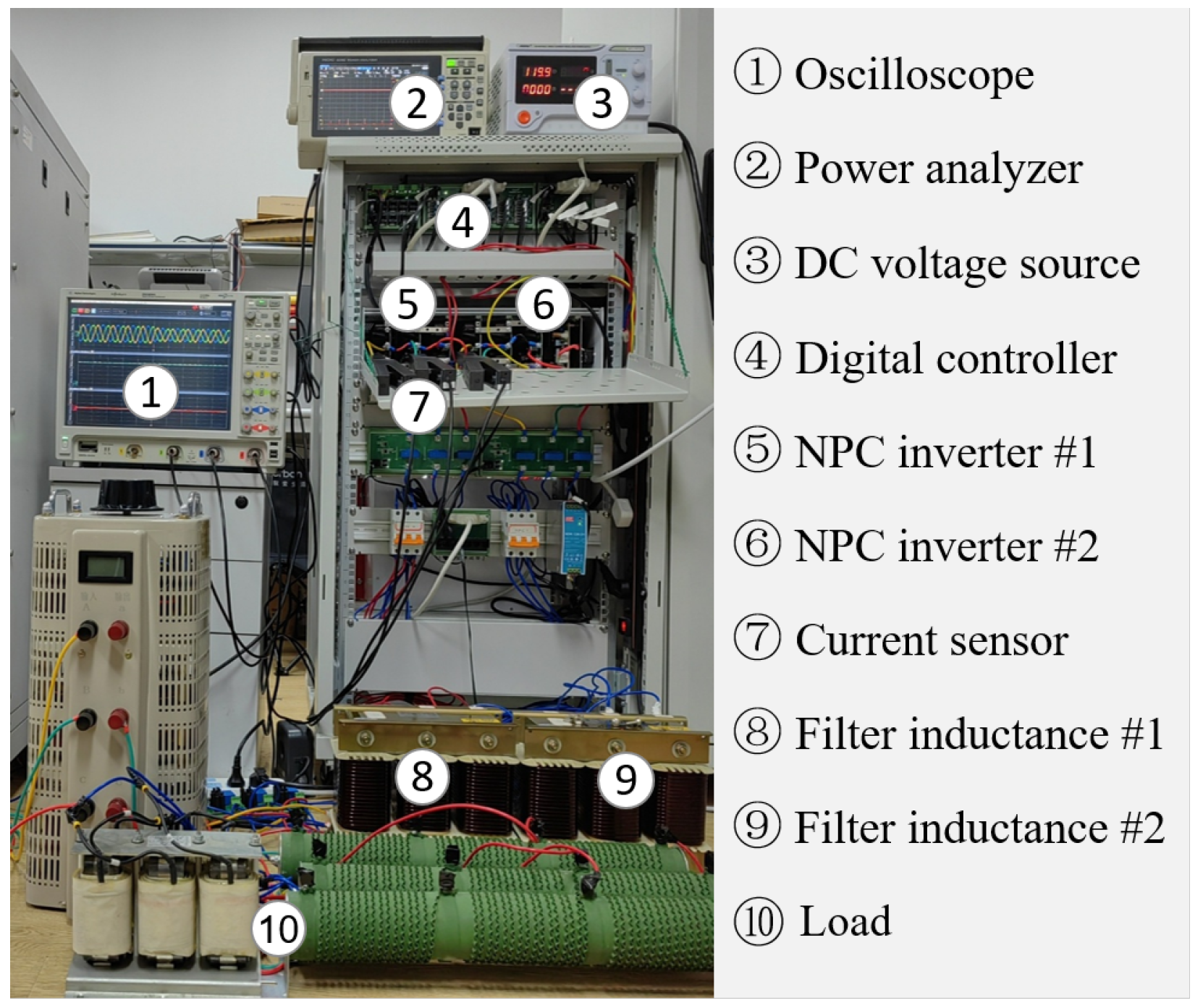
To further evaluate the performance, this study establishes an experimental platform for 3L-NPC inverters in parallel.The experimental platform photo is illustrated in Figure 10. The platform comprises two 3L-NPC inverters, which are controlled by a Real-Time Box (RT-Box), with the main processor being a 32-bit floating-point Delfino processor TMS320F28377D.
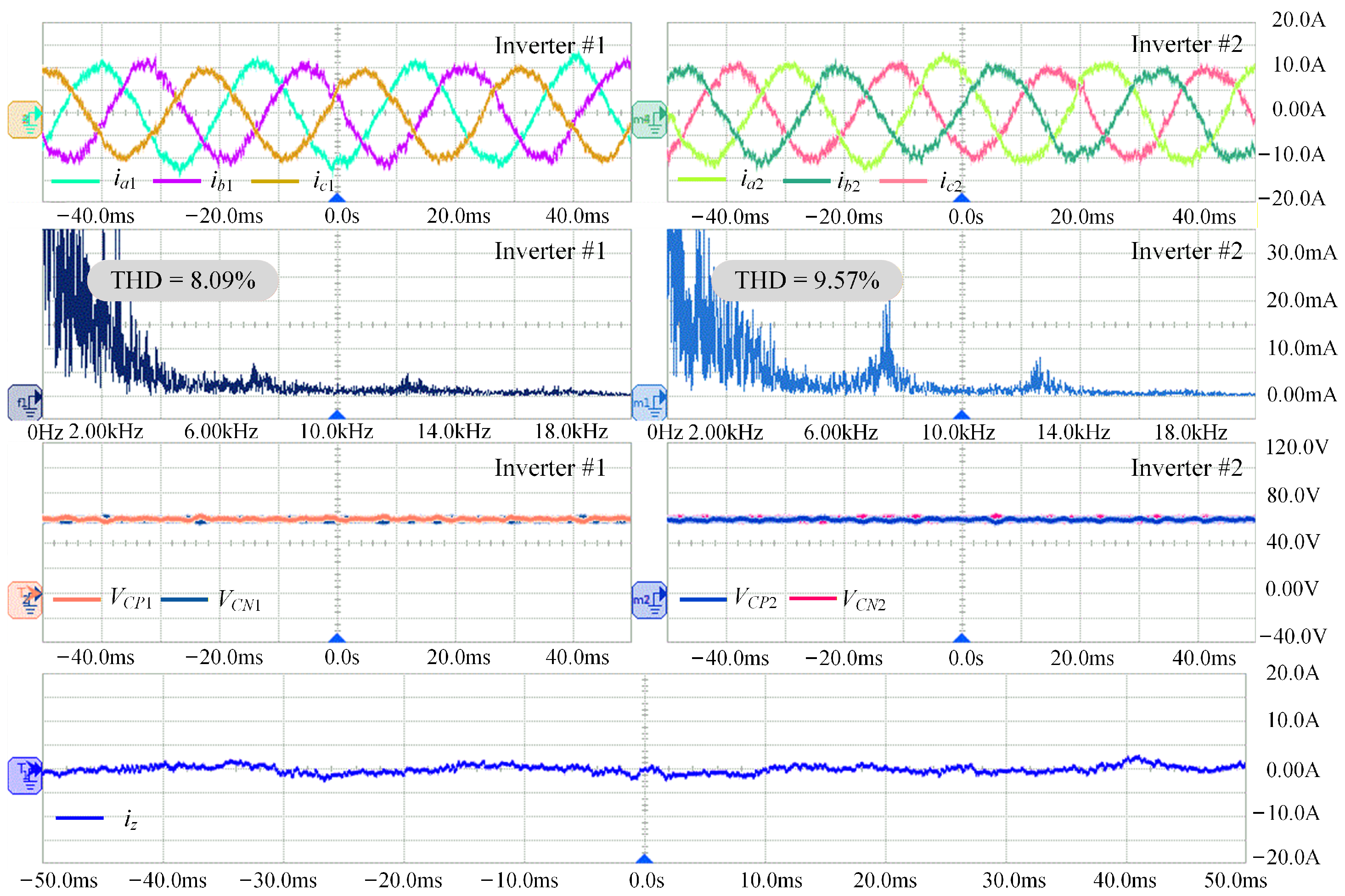
The existing FCS-MPC approach proposed in [9] is initially tested under conditions of mismatched filter inductance parameters between the two parallel inverters. Specifically, the filter inductance of inverter #2 is reduced by 20% compared to inverter #1 (i.e., L 1 = 10 mH and L 2 = 8 mH). The experimental results controlled by the existing FCS-MPC approach are shown in Figure 11, including the output currents of both inverters, spectral analysis, neutral-point voltage, and ZSCC waveforms. When the parameters of the controller do not align with the actual system characteristics, a significant ZSCC problem will arise. Moreover, this mismatch prevents the deviation-based cost function from selecting the optimal candidate action, leading to noticeable tracking errors and a decline in the inverter current performance.
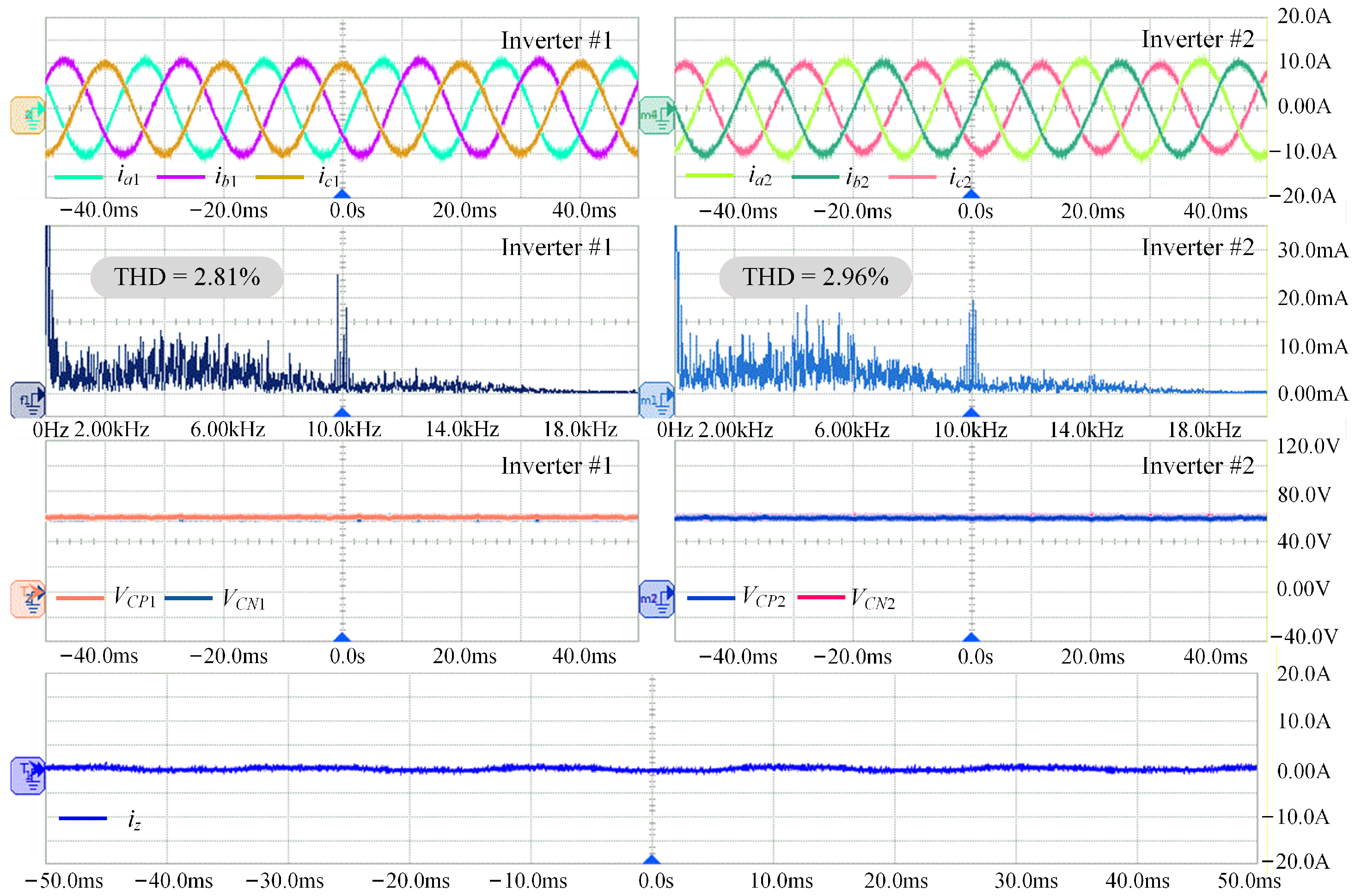
Figure 12 shows the experimental results of the proposed ISMO-based zero-averaged CMV virtual voltage vector ZSCC suppression strategy. As can be seen, under the condition of mismatched inductor parameters between the two inverters, the proposed strategy significantly enhances the output current tracking performance compared to existing FCS-MPC method in [9] presented in Figure 11, and the THD of inverter #1 and #2 are decreased by 65.26% and 69.07%, with the resulting THD values of 2.81% and 2.96%, respectively.
It demonstrates that after applying the proposed ISMO-based virtual voltage vector MFPC strategy, the THD of each inverter’s output current complies with the IEEE Std. 519 standard, with a THD below 5% [20]. Additionally, ZSCC is effectively suppressed, and capacitor voltage balancing is well maintained.
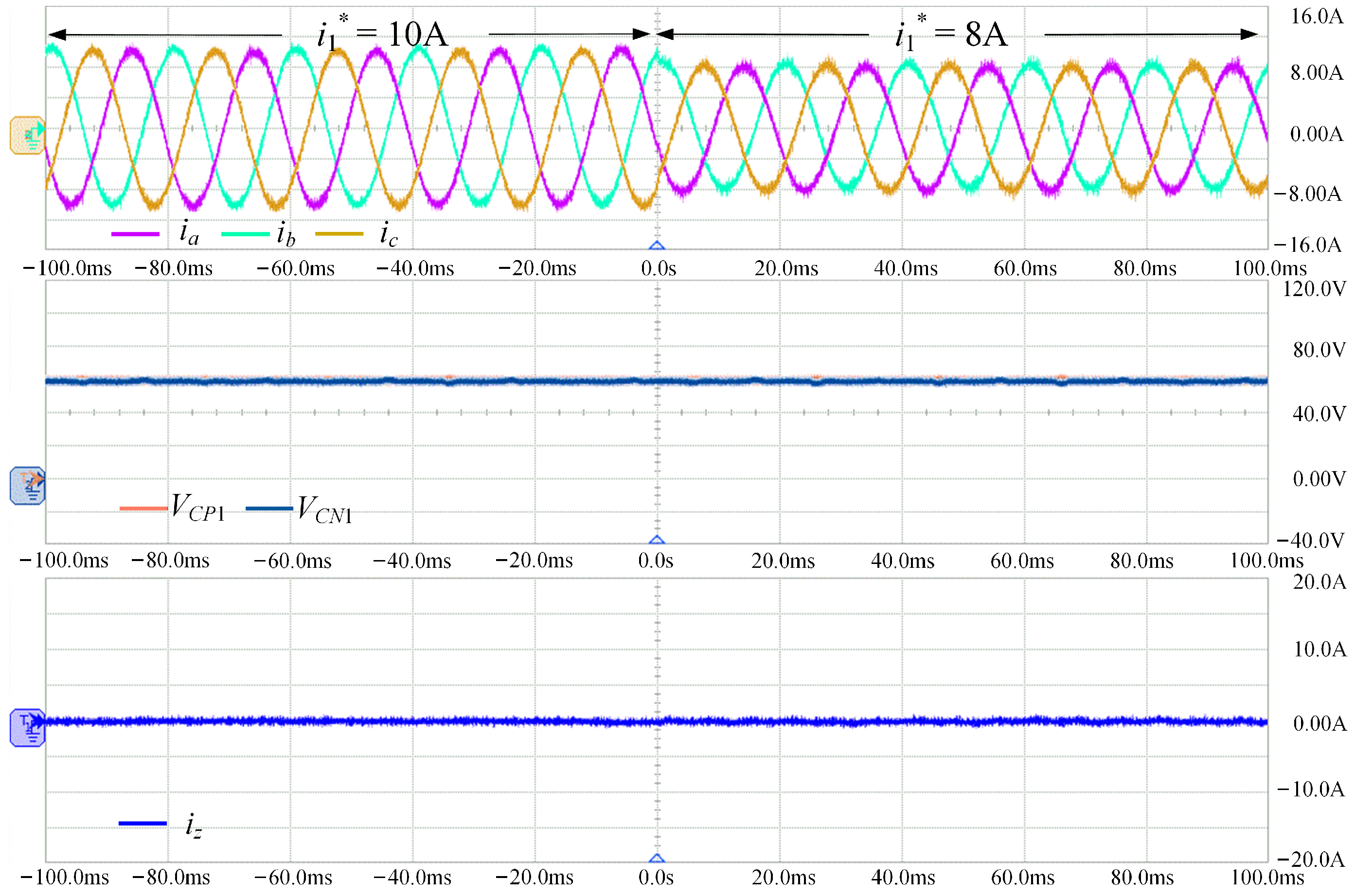
Fast transient response is among the key merits of FCS-MPC. The transient characteristic of the proposed control strategy is examined through a dynamic test, where the reference current amplitude of inverter #1 decreases from 10 A to 8 A at t = 0 s. The experimental waveforms of the output current and neutral-point voltage are illustrated in Figure 13. The results indicate that the proposed control can promptly respond to reference current variations.
Although the experimental platform includes only two parallel 3L-NPC inverters due to hardware limitations, the same control algorithm and observer structure as used in the six-inverter simulation were directly applied. This ensures that the experimental results serve as an equivalent validation of the proposed theoretical concept rather than a simplified case. The experimental results demonstrate excellent control performance, successfully achieving parallel inverter output current tracking, neutral-point voltage balancing, and ZSCC suppression. Moreover, the observed suppression of circulating currents and improvement in output current quality are consistent with the theoretical analysis and simulation results, thereby confirming the generality, scalability, and practical effectiveness of the proposed approach.

5. Conclusions

This work investigates the challenges of ZSCC suppression under parameter mismatch conditions in parallel 3L-NPC inverters. A novel ISMO-based virtual voltage vector MFPC strategy has been proposed as an improvement over conventional FCS-MPC. By constructing zero-average CMV virtual voltage vectors, the proposed strategy effectively suppresses ZSCC without introducing additional constraints into the cost function. Meanwhile, the incorporation of the ISMO enables the controller to operate based solely on measured and historical data, significantly enhancing robustness against parameter variations and modeling uncertainties. The validity of the proposed method is further confirmed by simulation and experiment, which demonstrate its outstanding current-tracking accuracy, neutral-point voltage balance, and fast dynamic response, while maintaining effective ZSCC suppression even under parameter mismatches. Such results demonstrate that the proposed strategy possesses strong potential for practical deployment in industrial inverter systems, as it reduces dependence on accurate parameter identification and enhances system reliability under practical operating conditions. Further investigations can explore the extension of the MFPC framework to other converter typologies and explore adaptive observer designs to further improve robustness and adaptability under complex and time-varying environments.

Author Contributions

Conceptualization, L.Q. and L.C.; methodology, L.C.; software, L.C.; validation, L.C.; formal analysis, L.C.; investigation, L.C.; resources, L.Q. and Y.F.; data curation, Y.H.; writing—original draft preparation, L.C.; writing—review and editing, S.H.; visualization, L.C.; supervision, Y.F.; project administration, J.R. and J.C.; funding acquisition, Y.H. and S.L. All authors have read and agreed to the published version of the manuscript.

Funding

This research was funded by National Natural Science Foundation of China under Grant No. 72301237, and by the Science and technology project of the China Electric Power Planning & Engineering Institute under Grant No. K202411.

Data Availability Statement

The original contributions presented in this study are included in the article material. Further inquiries can be directed to the corresponding author.

Conflicts of Interest

The authors declare no conflicts of interest.

References

  1. Citroni, R.; Mangini, F.; Frezza, F. Efficient Integration of Ultra-low Power Techniques and Energy Harvesting in Self-Sufficient Devices: A Comprehensive Overview of Current Progress and Future Directions. Sensors 2024, 24, 4471. [Google Scholar] [CrossRef] [PubMed]
  2. Chen, C.L.; Wang, Y.; Lai, J.S.; Lee, Y.S.; Martin, D. Design of Parallel Inverters for Smooth Mode Transfer Microgrid Applications. IEEE Trans. Power Electron. 2010, 25, 6–15. [Google Scholar] [CrossRef]
  3. Tcai, A.; Kwon, Y.; Pugliese, S.; Liserre, M. Reduction of the Circulating Current Among Parallel NPC Inverters. IEEE Trans. Power Electron. 2021, 36, 12504–12514. [Google Scholar] [CrossRef]
  4. Lee, S.Y.; Jung, J.J. The Circulating Current Reduction Control Method for Asynchronous Carrier Phases of Parallel Connected Inverters. Energies 2022, 15, 1949. [Google Scholar] [CrossRef]
  5. Oliveira, T.; Caseiro, L.; Mendes, A.; Cruz, S. Finite Control Set Model Predictive Control for Paralleled Uninterruptible Power Supplies. Energies 2020, 13, 3453. [Google Scholar] [CrossRef]
  6. Cuzmar, R.H.; Mora, A.; Pereda, J.; Poblete, P.; Aguilera, R.P. Long-Horizon Sequential FCS-MPC Approaches for Modular Multilevel Matrix Converters. IEEE Trans. Ind. Electron. 2024, 71, 5137–5147. [Google Scholar] [CrossRef]
  7. Simonetti, F.; D’Innocenzo, A.; Cecati, C. Simple Explicit Solution of Finite Control Set Model Predictive Control for Cascaded H-Bridge Inverters. IEEE Trans. Ind. Electron. 2024, 71, 9620–9630. [Google Scholar] [CrossRef]
  8. Zafra, E.; Vazquez, S.; Dragičević, T.; Alcaide, A.M.; Leon, J.I.; Franquelo, L.G. Prediction Window Selection in FCS-MPC for Two-Level VSI Applications. IEEE Trans. Power Electron. 2024, 39, 3135–3143. [Google Scholar] [CrossRef]
  9. Wang, X.; Zou, J.; Peng, Y.; Xie, C.; Li, K.; Guerrero Zapata, J.M. Elimination of zero sequence circulating currents in paralleled three-level T-type inverters with a model predictive control strategy. IET Power Electron. 2018, 11, 2573–2581. [Google Scholar] [CrossRef]
  10. Lu, X.; Chen, M.; Zhang, Q. Research on Mixed Logic Dynamic Modeling and Finite Control Set Model Predictive Control of Multi-Inverter Parallel System. Energy Eng. 2023, 120, 649–664. [Google Scholar] [CrossRef]
  11. Wang, X.; Zou, J.; Zhao, J.; Xie, C.; Li, K.; Munir, H.M.; Guerrero, J.M. A novel model predictive control strategy to eliminate zero-sequence circulating current in paralleled three-level inverters. IEEE J. Emerg. Sel. Top. Power Electron. 2018, 7, 309–320. [Google Scholar] [CrossRef]
  12. Wang, F.; Li, Z.; Tong, X.; Chen, L. Modeling, analysis and evaluation of modified model predictive control method for parallel three-level simplified neutral point clamped inverters. IEEE Access 2019, 7, 185349–185359. [Google Scholar] [CrossRef]
  13. Xing, X.; Zhang, C.; He, J.; Chen, A.; Zhang, Z. Model predictive control for parallel three-level T-type grid-connected inverters in renewable power generations. IET Renew. Power Gener. 2017, 11, 1353–1363. [Google Scholar] [CrossRef]
  14. Jin, T.; Huang, Y.; Lin, Y.; Daniel Legrand, M.N. Model Predictive Current Control Based on Virtual Voltage Vector Method for Parallel Three-Level Inverters. IEEE J. Emerg. Sel. Top. Power Electron. 2021, 9, 6049–6058. [Google Scholar] [CrossRef]
  15. Li, C.; Liu, Z.; Wu, X.; He, F.; Lv, Z.; Li, J.; Tan, G. Analysis and Robustness Improvement of Finite-Control-Set Model Predictive Current Control for IPMSM With Model Parameter Mismatches. IEEE Access 2022, 10, 93381–93394. [Google Scholar] [CrossRef]
  16. Long, B.; Zhu, Z.; Yang, W.; Chong, K.T.; Rodríguez, J.; Guerrero, J.M. Gradient Descent Optimization Based Parameter Identification for FCS-MPC Control of LCL-Type Grid Connected Converter. IEEE Trans. Ind. Electron. 2022, 69, 2631–2643. [Google Scholar] [CrossRef]
  17. Alhosaini, W.; Wu, Y.; Zhao, Y. An enhanced model predictive control using virtual space vectors for grid-connected three-level neutral-point clamped inverters. IEEE Trans. Energy Convers. 2019, 34, 1963–1972. [Google Scholar] [CrossRef]
  18. Zhang, Y.; Jin, J.; Huang, L. Model-free predictive current control of PMSM drives based on extended state observer using ultralocal model. IEEE Trans. Ind. Electron. 2021, 68, 993–1003. [Google Scholar] [CrossRef]
  19. Mousavi, M.S.; Davari, S.A.; Nekoukar, V.; Garcia, C.; Rodriguez, J. Integral Sliding Mode Observer-Based Ultralocal Model for Finite-Set Model Predictive Current Control of Induction Motor. IEEE J. Emerg. Sel. Top. Power Electron. 2022, 10, 2912–2922. [Google Scholar] [CrossRef]
  20. IEEE Std 519-2022 (Revision of IEEE Std 519-2014); IEEE Standard for Harmonic Control in Electric Power Systems. IEEE: New York, NY, USA, 2022; pp. 1–31.
Figure 1. The configuration diagram of 3L-NPC inverter.
Energies 19 00189 g001
Figure 2. Topology diagram of three-level NPC inverter parallel system.
Energies 19 00189 g002
Figure 3. Zero sequence circulation equivalent circuit diagram.
Energies 19 00189 g003
Figure 4. Low CMV vectors of 3L-NPC inverter.
Energies 19 00189 g004
Figure 5. Zero average CMV virtual voltage vector distribution.
Energies 19 00189 g005
Figure 6. Block diagram of ISMO-based model-free robust predictive control.
Energies 19 00189 g006
Figure 7. Simulation schematic diagram.
Energies 19 00189 g007
Figure 8. Simulation waveform controlled by the existing FCS-MPC method proposed in [9]: (af) Inverter #1–#6.
Energies 19 00189 g008
Figure 9. Simulation waveform controlled by the proposed approach: (af) Inverter #1–#6.
Energies 19 00189 g009
Figure 10. Parallel 3L-NPC inverters experimental platform.
Energies 19 00189 g010
Figure 11. Experimental results controlled by the existing FCS-MPC method proposed in [9].
Energies 19 00189 g011
Figure 12. Experimental results controlled by the proposed approach.
Energies 19 00189 g012
Figure 13. Transient experimental results controlled by the proposed ISMO virtual voltage vectors approach.
Energies 19 00189 g013
Table 1. Group of voltage vector and CMV in 3L-NPC inverter.
GroupSwitching StateCMV AmplitudeType of Voltage Vector
10,0,00Zero vector
21,1,1   −1,−1,−1 U d c / 2 Zero vector
31,0,0  0,0,−1  0,1,0  −1,0,0  0,0,1  0,−1,0 U d c / 6 Small vector
40,−1,−1  1,1,0  −1,0,−1  0,1,1  −1,−1,0  1,0,1 U d c / 3 Small vector
51,0,−1  0,1,−1  −1,1,0  −1,0,1  0,−1,1  1,−1,00Middle vector
61,−1,−1  1,1,−1  −1,1,−1  −1,1,1  −1,−1,1  1,−1,1 U d c / 6 Large vector
Table 2. Group of low CMV vectors.
GroupVoltage VectorCMVType of Vectors
1 v L 2 (1,1,−1) v L 4 (−1,1,1) v L 6 (1,−1,1)
v S 1 (1,0,0)  v S 3 (0,1,0)  v S 5 (0,0,1)
U d c 6 Large & Small vector
2 v L 1 (1,−1,−1) v L 3 (−1,1,−1) v L 5 (−1,−1,1)
v S 2 (0,0,−1)   v S 4 (−1,0,0)  v S 6 (0,−1,0)
U d c 6 Large & Small vector
3 v M 1 (1,0,−1) v M 2 (0,1,−1) v M 3 (−1,1,0)
v M 4 (−1,0,1) v M 5 (0,−1,1) v M 6 (1,−1,0)
v 0 (0,0,0)
0Middle & Zero vector
Table 3. Zero average CMV virtual voltage vectors I.
v s v LS 1 v LS 2 v LS 3 v LS 4 v LS 5 v LS 6
v I v L 1 v L 2 v L 3 v L 4 v L 5 v L 6
v I I v S 1 v S 2 v S 3 v S 4 v S 5 v S 6
Table 4. Zero average CMV virtual voltage vectors II.
v s v MM 1 v MM 2 v MM 3 v MM 4 v MM 5 v MM 6
v I v M 1 v M 2 v M 3 v M 4 v M 5 v M 6
v I I v M 3 v M 4 v M 5 v M 6 v M 1 v M 2
Table 5. System Parameters.
ParameterSymbolSimulationExperiment
DC voltage source U d c 800 V120 V
Sample cycle T s 50 μs100 μs
Filter inductanceL10 mH10 mH
Resistance of lineR0.5  Ω 0.5  Ω
DC capacitorC2.7 mF2.7 mF
AC resistive load R g Ω Ω
AC inductive load L g 3 mH3 mH
Frequency of AC sidef50 Hz50 Hz
Reference current amplitude i * 20 A10 A
Disclaimer/Publisher’s Note: The statements, opinions and data contained in all publications are solely those of the individual author(s) and contributor(s) and not of MDPI and/or the editor(s). MDPI and/or the editor(s) disclaim responsibility for any injury to people or property resulting from any ideas, methods, instructions or products referred to in the content.