1. Introduction
The rapid shift towards renewable energy has become a crucial objective in a world that is realizing the consequences of human-induced climate change. Many countries have initiated their transition to renewables as a key strategy for improving public health, lowering the cost of energy, growing a green energy economy, reducing greenhouse gas emissions, and meeting other climate goals such as those outlined in the Paris Agreement [
1]. In Canada, federal, provincial, and municipal governments have begun to implement policies that support a renewable energy transition, many of which are in line with a federal goal of achieving net-zero emissions by 2050 [
2]. The small maritime province of Nova Scotia—historically heavily dependent on fossil fuels—has been a key player in this transition, having reduced greenhouse gas emissions by 35% since 2005 [
3]. Nova Scotia also has an ambitious policy goal of achieving 80% renewable energy in its electricity system by 2050 [
4].
As the largest municipality by both land area and population in Nova Scotia, the Halifax Regional Municipality (HRM) is also playing an important role and has long been a Canadian leader in environment and climate initiatives. This includes being the second local government in Canada to declare a climate emergency. In 2020, Halifax also developed a comprehensive local climate plan, HalifACT (Halifax Acting on Climate Together), which they claim is ‘one of the most ambitious climate action movements in Canada’ [
5].
One way that the HRM and other governments in Canada have been supporting their climate goals is through support for solar energy development. In addition to the climate-related benefits [
6] solar energy can offer a range of local socioeconomic benefits including job creation and energy cost savings. In Canada, numerous programs have been put forward to help residents develop solar. This includes the federal government’s Greener Homes Grant, which provides low-interest loans [
7,
8], Nova Scotia’s Solar Homes Program, which offers financial incentives [
9], and Ontario’s successful, yet controversial, feed-in tariff program [
10,
11]. Despite the range of provincial support programs and policies, municipal support for solar energy in Canada is, however, relatively rare. A recent study looking at municipal programs [
12] highlighted that across Canada, there were only six: Toronto’s Home Energy Loan Program (ON), Switch Charlottetown (PEI), Switch Stratford (PEI), Solar Colchester (NS), Switch Wolfville (NS), and the HRM’s Solar City.
In the context of assessing levels of participation, our research evaluates how participating in municipal financing programs may impact equity in residential solar adoption. In particular, we are interested in the HRM’s Solar City program, which began operations in 2013 to first provide low-interest loans for solar hot water adoption. The program operates as a user pay, financially self-sustaining model designed to cover its own delivery costs, without impacting the municipality’s general tax base. Since inception, the program has significantly expanded, with over 20 million CAD in financing.
The limited amount of published research looking at municipal financing programs and municipal-scale solar energy in general has focused on success in terms of total installations, cost-savings, and greenhouse gas mitigation. For example, one study focused on Canadian solar incentive programs found that programs are specifically designed to have annual energy savings or incomes that outweigh loan repayments [
13]. This can also be seen in the above-mentioned research that found that Halifax’s Solar City program led to 747 installations, reduced GHG emissions by 5800 tonnes, and helped to grow a local solar energy industry [
12]. We can find no research in Canada that goes beyond these themes to study questions of participation, inclusivity, and equity (i.e., PIE) at the local level. This is in stark contrast to research from countries such as the US and the UK, where recent studies have found emerging, but clear inequities in the adoption of residential solar [
6,
14]. Such research set within local geographies or communities of place [
15] has found that the adoption of solar energy can be highly unequal, with solar energy adoption overlapping with existing socio-spatial inequalities such as poverty and racial discrimination [
16]. Research from the US found that households earning more than 200,000 USD/year were more than four times more likely to adopt solar compared with those earning less than 50,000 USD/year [
17]. Additionally, because of the need for infrastructural (e.g., distribution system) upgrades, increased solar energy generation can lead to higher electricity costs for those left out [
18]. These findings emphasize the need for a just [solar energy] transition, which aims to ensure the fair distribution of the benefits and burdens of renewable energy across society [
6,
19].
Despite the growing interest in residential solar, adoption is not equally accessible to all. Numerous studies have shown that socioeconomic barriers such as household finances, housing conditions, and gaps in knowledge can limit participation [
6,
17]. Understanding the types of barriers to adoption is therefore central to assessing equity in the solar energy transition. In this study, identifying and analyzing the barriers reported by participants is a major component of the analysis, allowing us to explore how different sociodemographic traits may shape the experience and challenge of adopting rooftop solar.
Given the lack of equity-centered solar energy research in the Canadian context, the pilot study presented here shares an analysis of participation via the adoption of residential rooftop solar energy in Halifax, Nova Scotia. In addition to uncovering overall participation trends, we also examine the role of the HRM’s Solar City Program in promoting equity. Shaped by the context of this work, including a brief literature review provided below, we developed one very simple research question that helped to guide this study:
To answer this question, we identified 1350 homes with rooftop solar using geocoding (discussed in our method) and surveyed their residents on their sociodemographic traits (e.g., age, gender, education; full survey in
Appendix A). We then compared the responses with HRM’s census profile from Statistics Canada and analyzed which demographics are experiencing barriers in their process of adoption or the continued ownership of rooftop solar. Note that without collated statistics on the sociodemographic profile of solar adopters in the HRM, we are unable to ensure that our sampling procedure would have resulted in a fully representative ‘solar population’.
This study is part of a larger project (entitled ‘[Em]powering Communities: An analysis of Participation, Inclusivity, Equity, and Support for Solar Energy in Halifax’) that is examining solar equity and participation across the HRM, including further quantitative analyses and in-depth interviews with residents and organizations. Other topics of focus will be the role of (i) energy poverty; (ii) inadequate housing characteristics; (iii) neighbors and social capital.
The remainder of this paper is structured as follows. The brief Literature Review provides an overview of residential rooftop solar as a concept and the global trends in terms of demographics and inequities that have been explored in recent studies. We then outline the Methodology that was used to collect and analyze our survey data. Next, we share our Findings from statistical frequencies and bivariate analyses. Finally, in the Discussion and Conclusion, we discuss these findings as they relate to the literature and provide policy recommendations that should be utilized by the HRM and other municipalities aiming to enhance levels of equity in residential solar energy.
2. Literature Review
Decades of established research has shown that solar energy development has substantial and wide-ranging environmental, economic, and social benefits for communities and individuals [
20]. These benefits are only becoming more obvious with the decreased costs of rooftop solar equipment, alongside the clear and present danger associated with climate change. Yet, and mirroring more general trends in the study of clean/renewable energy transitions [
21,
22,
23], conventional approaches to analyzing solar energy development have primarily focused on techno-economic feasibility and outcomes rather than social considerations [
16] such as participation, inclusivity, and equity. Thankfully this is changing, and as solar installations continue to grow, social scientific researchers are increasingly turning their focus to questions of energy justice, equity, and the understanding that energy transitions are shaped not only by sociotechnical factors, but also deeply by sociopolitical considerations [
24].
The longstanding focus on providing energy that is cheap, clean, and reliable must be complemented with considerations of equity and justice to ensure that energy transitions are both socially inclusive and supported. Trends in the literature have shown that socioeconomic barriers, such as low income and education, may inhibit participation in solar uptake. Much of this research comes from the US, including a recent analysis that revealed disparities in rooftop solar adoption across different sociodemographic groups, with rural communities, renter-occupied, low-income, and communities of color participating at much lower rates [
14,
25]. Also in the US, Barbose et al. [
26] found that solar owners tend to live in predominantly white neighborhoods, are more educated, are older, and are more securely employed. One US study conducted in the state of Georgia argued that solar adoption is not simply a matter of technology dispersion but is entangled with social identity and place-based characteristics—and supported the need for aligning policies with values and the demographic contexts in which solar adoption occurs [
14]. A study that assessed two communities in the United Kingdom found that patriarchal gender roles were observed as being reinforced within the solar energy transition as men were the primary decision-makers in household solar adoption [
6]. Interview-based research from India found that despite the availability of incentive programs, the unaffordability of solar energy is often cited as a main barrier to adoption, requiring large upfront costs among other eligibility requirements [
20]. Notably, we can find no studies from Canada that assess equity in solar energy in the ways that the above studies do. The most relevant studies in Canada within this realm of research look at the development of a more just energy policy in Saskatchewan [
27], the effect of renewable energy development on educational outcomes [
28], and multiple studies surrounding Indigenous ownership and participation [
29,
30,
31,
32,
33]. However, the present study is the first known to examine individual or household characteristics of solar adopters in Canada—what we see as an essential first step in the study of equity or a just transition.
Another clear gap in the literature concerns the relationship between different solar incentive programs and equity-based outcomes. Most of the research cited above situates such programs in the background of their work and/or fails to differentiate the roles that competing programs (i.e., at municipal vs. regional/national levels) may have in terms of citizen participation and equity [
34]. Additionally, most existing research excludes the extent to which concerns and suggestions from the public are considered in solar energy policy [
27,
35]. In the broader context of advancing a just solar energy transition, the HRM presents a compelling case of assessing patterns of participation at the local scale in which other municipalities may learn from.
3. Materials and Methods
The research presented here used a mail-out, quantitative survey shared with HRM residents with rooftop solar, with the overall goal of assessing participation, inclusivity, and (in)equity in the municipality. To do so, we first aimed to determine general demographic patterns of solar adopters (by program; i.e., Solar City) and then compare these trends to the general population.
The initial phase of this research sought to identify homes with rooftop solar in the HRM. For this, from May to June 2024, we used geocoding [
36]—utilizing publicly available aerial imagery to locate and mark the addresses of 1350 homes with rooftop solar in the HRM. This process began in April 2024 with HRM staff providing us with access to documents containing all community and street names within the municipality. Due to the large number of communities (
n = 201) and streets (
n = 6395) within the HRM, we utilized a random sampling technique where we only fully sampled communities containing 20 or less streets. For communities with 20 or more streets (e.g., Halifax and Dartmouth), we calculated the number of streets we needed to randomly sample to have a representative population (assuming a 95% confidence interval and margin of error of 5%). For example, in Halifax we sampled 291/1193 streets, while in Hubbards, we sampled 28/30 streets. Even with this ‘under-sampling’, the larger communities of Dartmouth and Halifax contained the most homes with rooftop solar—representing 24.5% and 18.7% of our sample, respectively. This was followed by Middle Sackville (6%) and Upper Tantallon (4.7%). Community-level data were not weighted to reflect the relative sizes of different communities within the HRM. As a result, some communities may be overrepresented or underrepresented in the dataset, which should be considered when interpreting these results.
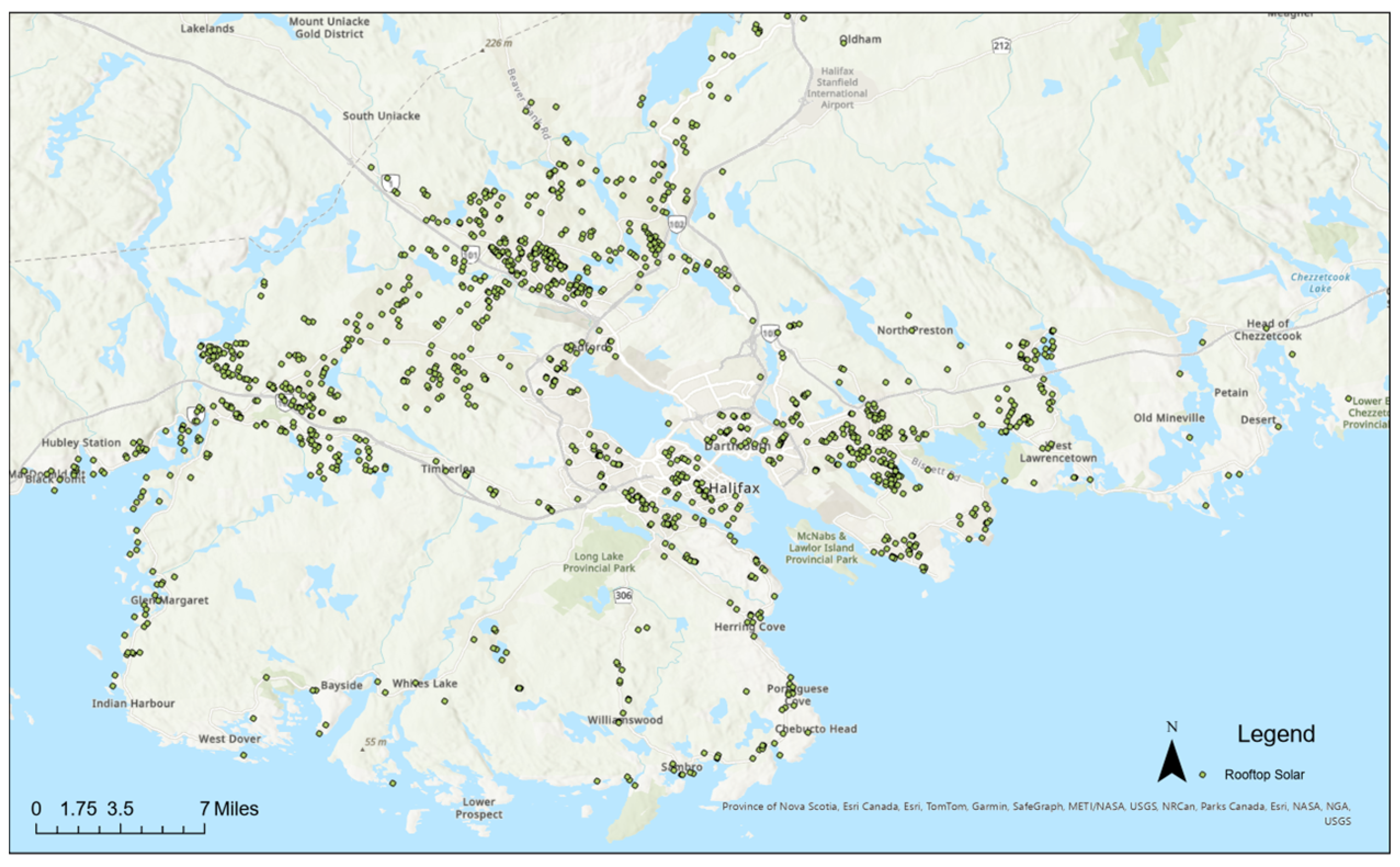
While not rigorous enough to form part of our formal analysis, we were interested to see a spatial visualization of solar energy clustering in the HRM, based on the geocoding process described above. We found an uneven geographic representation of solar, particularly in the clustering of rooftop solar within certain communities (see
Figure 1). A study conducted in 2014 by Graziano and Gillingham [
37] explored this phenomenon known as solar clustering and found that the residential adoption of solar panels tends to center within a geographic area—occurring due to factors including the increased visibility of solar panels, word of mouth, social influence, and the ability to learn about the benefits of solar from neighbors.
Of the 1350 surveys sent out, delivery was unsuccessful for 35, leaving us with 1315 valid addresses (
Figure 1). Potential participants had the option to complete the survey by returning them by mail, online, or over the phone.
The variables we included in the survey were mostly based on those found within the 2021 Canada census (see
Table 1 and the full survey,
Appendix A). In addition to these 19 variables, we also asked participants if they identified as a part of the 2SLGBTQIA+ community—a variable we had not seen assessed in the research literature to date. In this research, our analysis excludes some variables such as household energy costs.
At the time of analysis, a total of 156 surveys were returned and completed, resulting in an 11.8% response rate. All responses were stored within (for online responses) or inputted into (for mail and phone responses) Opinio software and later extracted into SPSS 29 software for analysis. Quantitative statistical analysis then took place, including frequency analyses that revealed the rates of each variable, followed by bivariate analysis, which compared the rates of barriers to certain demographic variables. For this study, barriers were recognized as any experience that posed an obstacle to the adoption of solar technology or the continued ownership and use of an existing solar system. Though not presented in the work here, we organized the barriers into categories (e.g., finances, complexity in the application process, government policies, shortage of labor, morphological factors, process delays, technical literacy, and uncertainty) through qualitative coding analysis in NVIVO. Upcoming companion papers are likely to feature the relative importance of these categories of barriers. Here, we also conducted a series of independent sample t-tests and one one-way ANOVA. Independent sample t-tests were used to compare mean differences in barriers between groups (e.g., male vs. female) and the one-way ANOVA was applied to variables with more than two categories (e.g., household size). While most results were not statistically significant, this work is still valuable as it highlights areas where inequities may exist and helps to guide future research with larger or more targeted sampling.
4. Results
Although the survey examined a total of 21 characteristics, this analysis reports on 16, as some traits, such as household energy costs, are not included in census data, preventing us from conducting meaningful comparative analyses (see
Table 1 for more information). By comparing the outcomes of the survey respondents (N = 156) to that of Halifax’s general population, we observe clear inequities among differing sociodemographic characteristics.
4.1. Gender Binary
There is a notable gender binary imbalance among respondents. Our survey asked for all members holding a decision-making position in the household to fill in a survey. Many participants stated that their counterparts (typically wives) had no knowledge of their rooftop solar or that they were not interested in participating, which resulted in men participating more than women, with 62% identifying as male and only 35.7% identifying as female. This contrasts with Halifax’s population, with 47.8% being male and 51.3% being female, suggesting that men may be participating or making decisions about solar more than women are. Men also identified as having a higher rate of barriers than women, with 59% of men experiencing barriers in contrast to 46% of women (
Table 2). While men were overrepresented in the survey, they also appeared to face slightly more difficulties in adopting solar.
4.2. 2SLGBTQIA+ Representation
While the 2021 census does not include statistics on sexual orientation at the municipal level, 7 of 156 respondents (4.5%) identified as being a part of the 2SLGBTQIA+ community. This information is broadly consistent with national data: 4.4% of the Canadian population aged 15-years and older have reported being a part of the 2SLGBTQIA+ community, with Nova Scotia having the highest concentration of gender-diverse and non-binary people in the country [
38]. Overall, 83% of 2SLGBTQIA+ respondents reported experiencing barriers compared with 53% of non-identifying respondents. Although a small sample size prevents a robust statistical analysis, this finding suggests that this demographic faced disproportionately higher rates of barriers in the adoption process.
4.3. Disability
The results showed that 6.4% of survey respondents identified as having a disability in our study, which is significantly lower than the municipal rate of 35%. This suggests that individuals with disabilities may be underrepresented among solar adopters; however, we suggest further research into this demographic considering the small sample size. We also found that disabled participants experienced a higher rate of barriers (62%) in their process of adopting solar than participants who were able-bodied (54%) (
Table 3).
4.4. Indigenous Identity
The results showed that 3.2% of survey respondents identified as Indigenous, which is slightly less than the municipality’s Indigenous population of 3.8%. While the rate of participation was slightly comparable, Indigenous participants experienced significantly more barriers in adoption compared with non-Indigenous participants (
Table 4).
4.5. Age
The respondents’ age distribution was on average, older, with 25.2% being 65 years and over in contrast to 17.3% in the HRM’s general population. This finding may be attributed to the fact that we did not survey anyone under the age of 18 and the youngest respondent was in the 25 to 29-year-old age range, skewing the age of our population to be older. We found that those above the age of 65 experienced a much lower rate of barriers compared with the younger demographic (
Table 5).
4.6. Personal and Household Income
We found our sample to be more financially affluent overall compared with the general population. The personal income levels of respondents were reported to be higher, with 31% of participants having annual personal incomes over CAD 100,000, compared with only 9.6% in the general population. This gap is also noticeable in terms of household income, where 23.3% of respondents reported household incomes above CAD 200,000, far surpassing the general population’s 7.9%. In terms of barriers,
Table 6 shows an even split between households with an income below CAD 100,000. However, households with a CAD 100,000 annual income or greater experienced a slightly higher rate of barriers (56%).
4.7. Household Size
Our sample had a lower rate of single-person household sizes (10% vs. 30% in the census) and exhibited a higher rate of three-person, four-person, and five-or-more-person households. As shown in
Table 7, the bivariate frequency analysis tells us that barrier rates incrementally increase as household sizes do, with one-person households experiencing the least number of barriers (40%) and households with five-or-more-persons experiencing the most (71.4%). It is worth noting that one-person households were substantially underrepresented in the sample relative to five-person households, potentially limiting the extent to which the findings reflect the barriers experienced by single-person households.
4.8. Marital Status
Married or common-law respondents made up 83.5% of the survey sample, compared with 56% of the general population. These respondents also reported more barriers than their unmarried counterparts; however, as with the gender overrepresentation, this may reflect broader participation, rather than unequal access to solar. The higher share of married or common-law participants indicates that they are more likely to adopt solar, potentially due to shared financial resources and joint decision-making, which can make long-term investments like solar more feasible.
4.9. Visible Minority Status
The majority of the HRM’s residents do not identify as visible minorities and this aligns with the majority of the survey’s respondents. Though there was a clear underrepresentation of visible minorities in our sample compared with the general population, with our sample comprising 6.6% and 16.8% of the general population.
4.10. Core Housing Need
Solar respondents in core housing need were only slightly underrepresented in this study, with 10% of respondents falling under this category in comparison to 12% of the HRM’s population. Participants in the core housing need category reported higher barriers (71.1%) compared with those who were not (53%) (
Table 8).
4.11. Education Levels
Respondents were more educated, with 43% of respondents holding a bachelor’s degree, compared with 22% of Halifax’s general population. An overrepresentation in our sample was observed with both master’s and doctoral degrees, possessing 18% and 8.9% higher rates than the general population.
4.12. Solar City Participation
We asked participants if they received assistance from the municipal solar financing program, Solar City. We observe a near-even split between Solar City program participants (49%) and non-participants (51%). Both participants and non-participants reported a similar distribution of barriers; 54.1% for participants and 53.3% for non-participants (
Table 9). This suggests that although the Solar City program may help with financing, it may not necessarily address the other challenges homeowners face that may be associated with technical or social constraints.
4.13. Practical Significance
Although our pilot study’s use of descriptive statistics, t-tests, and one-way ANOVA did not yield many statistically significant results, the patterns observed across the different sociodemographic groups still show meaningful trends. Several bivariate frequencies produced p-values approaching significance such as gender and barriers (p = 0.072) and core housing need and barriers (p = 0.091) which suggests that effect sizes may exist but could not be detected given our small sample size. Across groups such as disabled respondents, Indigenous participants, and larger households, there were consistent trends in which these marginalized or vulnerable demographics reported higher rates of barriers. These patterns align with the broader scholarship on equity and solar transitions and as such, these findings should be interpreted as early signals of uneven access to rooftop solar within the HRM.
5. Discussion
The urgency of addressing climate change and reducing greenhouse gas emissions from fossil fuel energy production emphasizes the need for alternative, renewable energy sources such as residential rooftop solar. In this initial, pilot study conducted under the wider [Em]powering Communities project, we explored the overall trends in participation via the adoption of residential rooftop solar energy in Halifax, Nova Scotia, Canada. In the context of the need for a just energy transition for Halifax, this work has aimed to determine how the process of adopting residential solar energy has been equitable or inequitable with particular attention to how sociodemographic factors shape participation, access, and barriers. Our findings on participation, inclusivity, and equity (i.e., PIE) in the adoption of rooftop solar are derived from comparative frequency and bivariate analyses, including t-tests of means. In our case study of the HRM, these analyses offer implications for existing research, the literature, policy, planning, and development.
This section of the paper discusses how the sociodemographic traits of survey participants relate to the barriers they experienced in adopting solar. Overall, our respondents tended to be male, white (largely of European descent), Canadian citizens, living in multi-person households, employed, highly educated, financially affluent, heterosexual, and married. These traits are consistent with the demographics of solar adopters reported in studies across the US and Europe.
This Discussion also addresses our research question by providing an overview of the participation and inclusion of the sociodemographic traits we assessed in this study. We organize this section into several subsections. Firstly, we examine patterns of significant underrepresentation among specific groups, including women (
Section 5.1), 2SLGBTQIA+ respondents (
Section 5.2), people with disabilities (
Section 5.3), and Indigenous peoples (
Section 5.4). Next, we discuss the socioeconomic factors affecting respondents including financial affluence (
Section 5.5), household size (
Section 5.6), visible minority status (
Section 5.7), core housing need (
Section 5.8), and government policies and municipal solar financing programs (
Section 5.9). We draw together our findings with a set of recommendations (
Section 5.10) and outline the limitations of this study and opportunities for future research (
Section 5.11).
5.1. Female Underrepresentation
One notable disparity found in our study was the overrepresentation of male-identifying participants. This overrepresentation may point to gender roles being perpetuated in the solar energy transition. Traditional, patriarchal gender roles in Western and European society tend to view men as primary decision-makers within households, therefore making them likely to have control over decision-making when adopting solar. One study that was conducted in the United Kingdom suggests that solar adoption may be strongly mandated by gender roles as men tend to participate in making decisions about rooftop solar more than women do [
6]. We found a similar outcome in our study, where, even though there is an equal distribution of men and women within the HRM, women may not be learning, making decisions, and/or participating at a representational rate. Despite efforts to be inclusive of female participation in this research, some male respondents stated that their wives or other adult women in their household did not want to participate, or that they had an inadequate amount of knowledge of their solar system to contribute to our study.
Female underrepresentation in Halifax’s solar energy transition can potentially have negative implications on the process of a just energy transition if the benefits of solar are not being equally distributed across society. Less female participation in residential solar energy can lead to biased policies that favor male perspectives as decision-making processes may be informed primarily by male experiences, priorities, and access to resources, thereby overlooking barriers and needs that may be more prevalent among women.
5.2. 2SLGBTQIA+ Representation
Despite our small sample of 2SLGBTQIA+ participants, the higher rate of barriers reported for this group points to potential inequities and raises questions about whether systemic barriers may be contributing to inequities in solar participation. For example, this demographic is less likely to have higher incomes or obtain professional development at similar rates to their cis–heterosexual counterparts [
39]. Since financial security and stable employment are strongly associated with solar adoption [
26], this disparity may help explain the underrepresentation in solar adoption as well as the higher rate of barriers. The inclusion of this variable is a novel contribution to the Canadian solar equity literature and highlights the need for further research into the participation and inclusion of 2SLGBTQIA+ access to solar energy.
5.3. Disability
In our study, people with disabilities participated at much lower rates than their able-bodied counterparts. This underrepresentation may stem from multiple factors. In Canada, individuals with disabilities are less likely to experience financial security [
40], a prerequisite often necessary for solar adoption [
26]. Beyond financial barriers, the design of renewable energy technologies such as residential solar may not adequately account for the needs of people with disabilities. For example, user experience design typically does not account for those with visual impairments or mobility challenges which further limits participation [
41].
5.4. Indigenous Identity
The 3.2% of respondents who identified as Indigenous closely aligns with the proportion of Indigenous residents in the HRM (3.8%). However, Indigenous respondents reported experiencing barriers at a higher rate (66%) than non-Indigenous respondents (54%), pointing to potential inequities. This aligns with the broader literature documenting how systemic barriers, including socioeconomic inequities and regulatory frameworks, have historically constrained Indigenous participation in renewable energy transitions [
29,
42]. While we caution our interpretation with such a small sample size, this finding suggests that Indigenous participation in solar adoption may be occurring at a representational rate as Indigenous engagement in Canada’s renewable energy transition has been increasing in recent years—especially as a pathway towards reconciliation [
33,
42]. Equity ownership in renewable energy projects has grown over time as a mechanism for advancing Indigenous self-determination and ensuring that these communities share the benefits of a renewable energy transition [
42]. A systematic review of the Canadian literature on Indigenous involvement in renewable energy found that the motivations and desires to participate can often revolve around breaking free of colonial dependencies, increasing energy autonomy, and reaping the efficiency and sustainable benefits of renewable energy [
33] highlighting the importance of Indigenous participation in renewable energy.
5.5. Financial Affluence and Barriers to Solar Adoption
Consistent with our findings, recent studies in the U.S. have shown that residential solar adopters tend to have higher than average incomes and more secure employment [
26]. Solar adoption is closely tied to household income due to substantial upfront and maintenance costs. Although installation prices have declined, high initial investment continues to be a major barrier, particularly for low- and moderate-income households [
17]. This likely explains the higher average wealth observed among our respondents, consistent with other studies showing that solar adopters tend to be more affluent [
16]. Many high-income households also received subsidies from Solar City or other regional financing programs and therefore may be disproportionately advantaged in having the means to adopt and access financial resources. Even with financial incentive programs, as shown in a study from India, financial barriers persist as the most frequently cited obstacle to widespread adoption [
20].
While financial constraints are often a major barrier to adoption, our analysis revealed an unexpected pattern—that higher income did not necessarily reduce the frequency of barriers experienced. Comparing participants with annual household incomes above and below CAD 100,000, the barrier rates were nearly identical (see
Table 6). Although a two-sided
t-test found no significant relationship between income and barriers, this financing has practical importance, aligning with Mathew & Pandian [
20], who note that many adoption challenges extend beyond finances. Thus, financial resources alone, such as grants, loans, or higher incomes, may not fully mitigate the obstacles to solar adoption.
5.6. Household Size
Those who participated in our study had higher rates of three-, four-, and five-person household sizes. Single-person household sizes were significantly underrepresented in our sample, which may be related to the fact that we had a high proportion of married and common-law participants. We expected larger households to be more represented, as they may have greater financial resources and roof space to support installations. De Groot et al. (2016) found that larger households are more likely to adopt rooftop solar, given that their share of income spent on electricity is expected to be more compared with smaller households, providing a larger return on one’s investment in adopting solar [
43].
When comparing household sizes to the rate of barriers experienced, we found that barrier rates increase incrementally as household sizes do. This might suggest that while these demographics are more represented in solar adoption, larger household sizes have more complex logistical constraints when installing solar.
5.7. Visible Minorities
The rate of respondents who identified as visible minorities (6.6%) was much lower compared with Halifax’s general population (16.8%). One reason for this lack of participation could be tied to the structural and financial barriers that disproportionately impact racialized communities. Sunter et al. [
44] found that solar adoption in the US was significantly lower in communities of color, even when accounting for income and homeownership rates, suggesting that racial disparities in adoption extend beyond financial barriers [
44].
5.8. Core Housing Need
While only 10% of our respondents experienced a core housing need, 71.1% of these respondents experienced barriers to adoption. Given that that variable tends to amplify broader systemic inequities, such as intensifying poverty, destabilizing families, and limiting access to other determinants of well-being [
45], it was anticipated that these households would face greater barriers to rooftop solar adoption. Our findings did not reveal a significant relationship between the income levels of participants with a core housing need and the rate at which they reported barriers. Among those with low-to-moderate incomes, participants in the core housing need category reported barriers at similar rates to others in the same income category, suggesting that this variable did not independently influence barriers. This suggests that, in our sample, core housing need may not be directly shaping the perceptions of barriers to solar adoption. However, it may also reflect limitations in data collection or how barriers were reported, or the possibility that other factors such as tenure status may have had a stronger influence on barriers than core housing need alone.
5.9. Government Policies and Municipal Solar Financing Programs
Regulatory frameworks at the federal, provincial, and municipal governance levels play an impactful role in shaping the uptake of rooftop solar across HRM that influences markets and consumer rights. For instance, Nova Scotians must obtain approval from the provincial energy regulator to install systems larger than 27 kW [
46]. In recent years, government programs such as the provincial
SolarHomes initiative have further supported residential adoption through grants, rebates, and loans. At the municipal level, HRM’s Solar City program has increased total solar installations in recent years. Since 2022, the program has committed CAD 20.1 million to financing solar energy systems and as of 2023, the program holds a total of 859 participant agreements, a stark increase from only 200 agreements in 2018 [
47].
One of the objectives of this study was to examine the potential role that solar support programs, particularly the HRM’s Solar City program, may be playing in promoting equity within the process of residential solar adoption. We found similar barrier rates among Solar City participants and non-participants, suggesting that many challenges to solar adoption extend beyond financial constraints. Several respondents also received support from a combination of programs, indicating that financial assistance might not fully address issues in adoption. While our results show that the overall rate of barriers does not necessarily decrease with financial support, these programs still appear to contribute positively to the broader productivity of a solar energy transition, as evidenced by the substantial growth in applications over the last six years. Similarly to this research, one study conducted in Pakistan found that solar financing programs do increase solar uptake overall but also highlight the interconnectedness of different types of barriers to solar adoption [
48]. To ensure that solar adoption is both productive and equitable, policymakers and government assistance programs could explore complementary strategies aimed at alleviating non-financial barriers in the adoption process.
5.10. Recommendations
Halifax, Nova Scotia, Canada has achieved commendable progress in advancing solar energy, contributing to municipal and national climate goals. Yet, ensuring that this transition is equitable requires deliberate policy design that addresses systemic inequities and expands access to rooftop solar for underrepresented populations. Drawing on our analyses and the current literature, we offer the following recommendations to strengthen equity in the adoption process.
First, targeted engagement strategies can help close the gap in participation rates among populations that remain underrepresented. In particular, our study found that these demographics include women, members of the 2SLGBTQIA+ community, those with disabilities, single-person households, visible minorities, and low-income households. Engagement should not only focus on raising awareness of the financial assistance programs that exist, but also communicate the broader, social, economic, and environmental benefits of solar energy. Deliberate, local outreach efforts in Halifax could increase adoption rates and better inform solar policies to address the needs of marginalized groups.
Second, while financial programs have supported Halifax’s solar transition, our findings suggest that inequities in adoption extend beyond affordability. Policies must move beyond the focus of alleviating financial barriers to directly addressing disparities in participation rates across demographic groups. Program design should consider social, geographic, and demographic contexts. For example, rural communities may need distinct support from urban communities, and some groups may prioritize other renewable technologies. As Montañés et al. [
24] highlight, limited access to renewable energy among marginalized groups is not merely an energy system issue, but a deeply systemic problem. Even within a program designed to assist a more diverse population of local residents, research from Si & Stephens [
35] found procedural inequities and structural bias in how a solar financing program in Massachusetts (USA) was designed. Solar policies and programs must therefore be situated within a broader framework that addresses structural barriers. In the USA, such policies and programs may be considered forms of affirmative action.
Finally, reducing administrative complexity is necessary for lowering barriers in adoption, including for those purchasing systems outright, without financial support. Standardizing the application process and creating greater procedural consistency across municipal and provincial jurisdictions would enhance efficiency and transparency. We recommend development towards a publicly accessible framework that clearly outlines the regulatory, legal, and procedural requirements for rooftop solar adoption. Jurisdictions outside of Canada have already demonstrated this, such as Germany’s Energiewende policies that reduce bureaucratic hurdles by standardizing solar permitting at the federal level [
49]. Such a tool would not only simplify navigation for prospective adopters but also improve confidence in the process by minimizing uncertainty and delays.
5.11. Limitations and Calls for Future Research
Like all research, the pilot study presented here has several limitations, some of which may provide opportunities for future research. First, due to time and resource constraints, our sample is relatively small. We fully sampled from communities with fewer than 20 streets, meaning that we likely missed a portion of households in larger communities such as Halifax and Dartmouth. Even though it is unlikely, it is entirely possible for our results to be inaccurately representing the population given the potential for sampling errors. Still, due to our random sampling procedure, we do not expect the omitted households to differ significantly from their demographic profiles. Another shortcoming was that some groups of people may be underrepresented in our sample due to individuals choosing not to participate in this study. This underrepresentation can be referred to as self-selection bias, a common bias found in studies that involve surveys and occurs when people voluntarily choose to participate [
50].
There are several areas where we call for future research into assessing the levels of participation and equity of solar adoption at regional levels. Due to time constraints, this study excluded certain variables and methods, including large-scale solar adopters such as community solar gardens. We also omitted renters and non-homeowners, a notable limitation given their exclusion from rooftop solar access. Future quantitative and qualitative research comparing adopters and non-adopters across these groups could reveal additional inequities within regional solar energy transitions.
Future research on assessing participation and equity in solar energy adoption should also prioritize a more nuanced understanding of intersectionality and how it may shape inequities. This could include interview work with respondents to capture deeper perspectives and contextual understanding. For example, understanding how gender roles may affect decision-making dynamics within households could help explain the higher representation of men participating in solar adoption. This is important since our study did not assess how different aspects of a respondents’ social, political, and economic identity may combine with one another in a way that creates unique barriers to solar adoption. Additionally, future research could investigate the overrepresentation of men in solar adoption to better understand how gender roles, decision-making dynamics, and access to financial or technical resources influence participation.
Finally, future research should be conducted at larger geographic levels such as the provincial level to assess how solar adoption has been equitable and may vary by place. Studies could compare the levels of equity in solar adoption between municipalities and how provincial governance systems affect solar adoption at municipal or more regional levels.
6. Conclusions
This study analyzed the participation, inclusion, and equity of residential solar energy adoption by owners within the Halifax Regional Municipality. Quantitative data analysis found a higher participation rate of men, people who were financially affluent, securely employed, highly educated, married, and white. By comparing our participants to the HRM’s census data, we found an underrepresentation of participants with demographic traits typically associated with socioeconomic marginalization. This underrepresentation of certain communities and traits in residential solar adoption shows that there are inequities present in the development of solar uptake—that participation is both unequal and possesses barriers to adoption. These inequities found in the participants of this research also align with those of recent studies that have been conducted in North America, Europe, and Asia. We argue that this reflects the prevalence of broader, systemic inequities that influence residential solar uptake patterns.
We call on future research that investigates solar equity to include non-solar owners to participate in such work. This would further the understanding of barriers that inhibit access to rooftop solar for residents at both local and regional levels. We also encourage future studies to undertake a more nuanced understanding of incorporating intersectionality into similar research. Assessing how different aspects of participants’ social, political, economic, and lived experiences combine to create different types of access to solar adoption would capture a deeper understanding of how inequities may be forming in the process of adopting solar.