1. Introduction
The advancement of renewable energy sources (RES) has become a strategic imperative for the European Union and its partner countries, particularly in the wake of evolving climate objectives and growing geopolitical risks.
Ukraine’s energy system has traditionally been dominated by fossil fuels and nuclear power. According to the International Energy Agency, prior to the full-scale conflict, natural gas, coal, oil, and nuclear energy together constituted the overwhelming majority of Ukraine’s primary energy supply, while renewable energy sources played a supplementary role in electricity generation [
1]. In 2021, renewable electricity generation in Ukraine was driven mainly by solar and wind power, whose installed capacity expanded rapidly following the introduction of feed-in tariffs, although their overall contribution remained modest relative to conventional sources. After the full-scale conflict, in February 2022, Russia’s systematic attacks caused severe damage to Ukraine’s energy infrastructure, including power plants, substations, and transmission networks, leading to the loss or temporary unavailability of a substantial share of generation capacity and major disruptions to grid stability. International Energy Agency assessments indicate that decentralized renewable energy installations, particularly solar PV and wind facilities, demonstrated comparatively higher resilience and faster recovery potential than large centralized thermal assets, underscoring the strategic relevance of accelerating decentralized renewable deployment under wartime conditions [
2,
3].
The EU’s energy and climate policy, driven by the European Green Deal and the REPowerEU plan, sets increasingly ambitious targets for the share of renewables, aiming to achieve climate neutrality by 2050 and reduce dependence on fossil fuel imports. The Russia-Ukraine war in 2022 significantly accelerated the urgency of this transition.
As stated in the REPowerEU Communication: “The EU must become independent from Russian fossil fuels well before 2030. REPowerEU is about rapidly reducing our dependence on Russian fossil fuels by fast forwarding the clean energy transition” [
4].
For Ukraine, the deployment of renewables is not only an environmental commitment but also a cornerstone of national resilience, food security, and post-war recovery. At the microeconomic level, enterprises’ transition to renewable energy is closely linked with investing in resource-saving and energy efficiency measures, which not only reduce operational costs but also strengthen financial stability in crisis conditions [
5,
6].
The country has declared alignment with EU climate goals through updated Nationally Determined Contributions (NDCs) and national energy strategies. However, Ukraine’s progress is hindered by several systemic barriers: regulatory uncertainty, limited investment incentives, war-related infrastructure damage, and institutional fragility [
7].
Despite these challenges, Ukraine’s renewable energy transition is advancing. The share of renewables in Ukraine’s electricity mix increased significantly between 2015 and 2021, primarily due to the introduction of green tariffs and foreign investments in solar and wind power [
1,
8].
However, beyond installed capacity, the question remains: how effective is the management of this transition?
Based on the research question, the study proposes the following hypothesis:
H1: The effectiveness of managing the energy transition is positively associated with governance quality, regulatory stability, and the level of alignment with European Union standards. This hypothesis is tested using an index-based comparative model.
Evaluating the managerial effectiveness of Ukraine’s energy transition requires a multidimensional approach. This includes analyzing institutional capacity, policy consistency, investment climate, and alignment with EU standards. As highlighted by the Energy Transition Index (ETI), Worldwide Governance Indicators (WGI), and other global benchmarking tools, countries that succeed in the renewable transition tend to combine clear strategy, transparent governance, and supportive regulatory frameworks [
9].
Comparative analysis with selected EU member states—such as Poland, Romania, and Slovakia offers an opportunity to identify both best practices and systemic gaps in Ukraine’s approach. These countries were selected due to their post-socialist legacies, EU integration experiences, and ongoing efforts to balance energy security with climate ambition. In addition, Poland, Romania, and Slovakia initiated structured renewable energy development earlier than Ukraine, introducing national RES strategies and support schemes in the early 2000s as part of EU accession requirements [
10]. They have implemented feed-in tariffs, auction systems, and grid modernization policies aligned with EU climate and energy directives, making them relevant benchmarks for comparative analysis.
2. Literature Review
The existing literature on renewable energy transition can be broadly grouped into four thematic strands: governance and institutional mechanisms, policy instruments and regulatory design, structural and political barriers to transition, and post-crisis or post-conflict energy transformation pathways. Despite extensive research within these strands, the empirical assessment of energy transition management efficiency in post-war and transitional governance contexts remains limited.
The transition to renewable energy is widely recognized not only as a technical and economic challenge, but also as an institutional and managerial one. Scholarly research underscores that the success of renewable energy transitions depends heavily on the quality of governance, the consistency of policy frameworks, and the capacity of institutions to implement complex reforms [
11,
12].
These dimensions are particularly relevant for countries undergoing structural transformation, such as Ukraine.
According to the World Bank [
13], strong governance correlates positively with effective deployment of renewable energy. Countries with stable regulatory environments, low levels of corruption, and efficient public institutions tend to attract more sustainable energy investments [
8].
As Midttun argues, energy transitions are shaped by the interplay between political will, institutional capacity, and stakeholder coordination. In this regard, governance acts not only as an enabler but also as a bottleneck when weak or fragmented [
14].
In post-socialist contexts, such as Central and Eastern Europe, legacy institutional frameworks and administrative inertia can delay renewable energy reforms [
15]. Petri and Biedenkopf demonstrate that although EU membership provides a strong external incentive for environmental policy convergence, domestic capacity remains a determining factor in actual implementation. Ukraine, not yet an EU member, has faced similar governance-related constraints [
16].
A range of policy instruments such as feed-in tariffs, auctions, green certificates, and investment guarantees has been applied across Europe to incentivize RES deployment. Feed-in tariffs, introduced in Ukraine in 2009, were effective in triggering rapid growth in solar and wind energy [
17].
However, as researchers note these mechanisms require predictability and trust in long-term enforcement to maintain investor confidence [
18,
19].
In Ukraine, frequent changes to the support scheme, tariff cuts, and delayed payments to RES producers have undermined investor trust and raised concerns about retroactive policy-making. As Wang et al., suggest, policy instability in the energy sector significantly increases financial risks, particularly in emerging economies with fragile institutions [
20].
Several global indices have been developed to track progress in energy governance and transition readiness: The Energy Transition Index by the World Economic Forum assesses countries across two dimensions: system performance (e.g., security, environmental sustainability, economic growth) and transition readiness (e.g., regulation, human capital, innovation) [
9].
ETI rankings consistently show that high performers have stable institutions and coherent long-term strategies.
The WGI by the World Bank evaluate six governance dimensions. For energy-related reforms, government effectiveness and regulatory quality are most relevant. Ukraine’s low percentile scores on these dimensions suggest institutional fragility and a need for reform-oriented public administration.
The Bertelsmann Transformation Index (BTI) provides additional insight into transformation management, including the quality of governance, the rule of law, and the strategic capacity of decision-makers. BTI 2024 classifies Ukraine as a state with high reform ambition but moderate implementation capacity—especially in sectors vulnerable to rent-seeking behavior and political interference [
21].
Evidence from Central and Eastern European countries highlights that EU integration acts as a governance accelerator, fostering legal harmonization, market liberalization, and access to EU funding [
22,
23,
24].
Slovakia and Poland, for example, have implemented structured energy roadmaps aligned with EU directives, while Romania has leveraged EU funds for grid modernization and RES capacity building.
Ukraine’s transitional status and hybrid governance environment pose unique challenges. As noted by Malyarenko and Wolff, the country operates under conditions of «competitive hybrid governance», where formal reforms coexist with informal practices and inconsistent enforcement [
25].
Conceptualizing Energy Transition Management Efficiency
In this study, energy transition management efficiency is conceptualized as the capacity of public governance systems to design, implement, and sustain renewable energy policies that translate strategic objectives into measurable transition outcomes. Unlike purely technical or economic interpretations of energy transitions, this concept emphasizes governance performance as a decisive factor shaping the pace, stability, and effectiveness of renewable energy deployment [
14].
Drawing on transition governance theory and public management literature, managerial efficiency in the energy transition context is understood as the ability of institutions to reduce policy uncertainty, coordinate multiple stakeholders, ensure regulatory credibility, and maintain continuity of implementation over time. From this perspective, governance quality functions not merely as an external condition, but as a core mechanism through which energy transition goals are operationalized [
12].
This conceptualization provides the theoretical basis for integrating composite indicators such as the ETI, the WGI, and the BTI. While the ETI captures system performance and transition readiness, the WGI reflects institutional effectiveness and regulatory quality, and the BTI assesses strategic governance capacity and policy implementation. Together, these indices enable a multidimensional assessment of energy transition management efficiency, linking institutional capacity, regulatory stability, and European integration alignment with observable renewable energy outcomes.
3. Materials and Methods
This study employs a comparative, index-based methodology to assess the managerial effectiveness of Ukraine’s renewable energy transition, emphasizing governance quality, institutional capacity, and policy implementation. The study covers the period 2015–2023, reflecting the post-2014 restructuring of Ukraine’s energy policy and allowing the analysis to capture both the pre-war expansion of renewable energy and the initial impact of the full-scale war on energy transition governance. Recognizing that energy transitions are not merely technical transformations but complex governance-driven processes, the research integrates quantitative benchmarking through global indices with contextual interpretation.
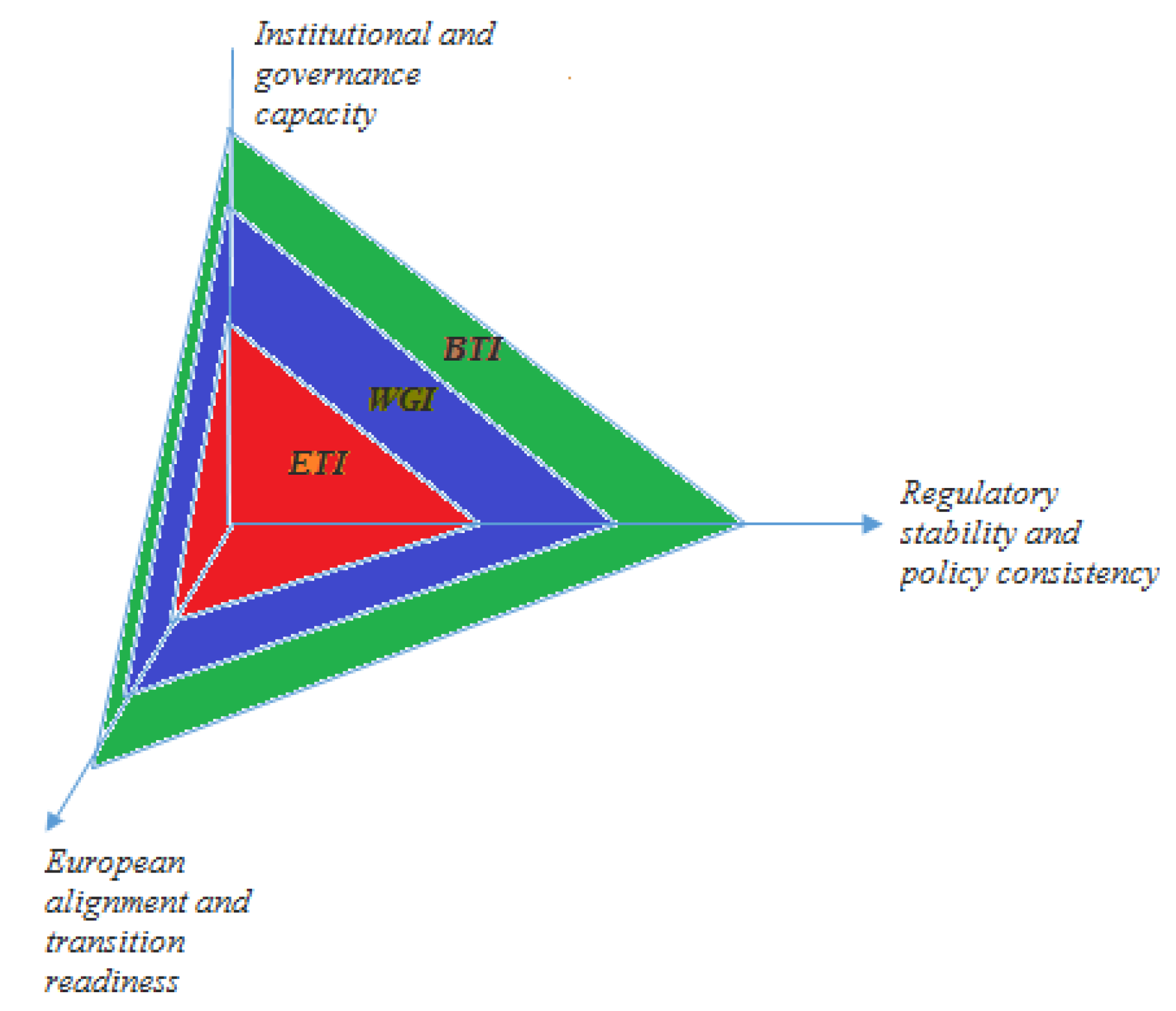
The conceptual framework focuses on three key dimensions: Institutional and governance capacity (evaluating policy formulation and coordination); regulatory stability and policy consistency (assessing the credibility of tools like green tariffs); and European alignment and transition readiness (measuring the degree of convergence with EU standards).
These dimensions are operationalized through data from the ETI, WGI, and the BTI, which together enable a multidimensional understanding of governance as both a catalyst and a constraint in the renewable energy sector (
Figure 1).
To build an economic and mathematical model based on a 3D-matrix for assessing the managerial efficiency of the country’s transition to renewable energy, including institutional and managerial capacity, regulatory stability, and European compliance, the study created an index model or structural equation that will allow quantifying the impact of governance on the development of the renewable energy sector (to assess the managerial efficiency of the country’s transition to renewable energy) (
Table 1).
The general form of the model is as follows:
REGrowth is a composite indicator reflecting the managerial efficiency of the renewable energy transition. It is calculated as a normalized index that combines three components:
the growth rate of installed renewable energy capacity (in %);
the share of renewable energy sources in total electricity generation (in %);
renewable energy investment dynamics, measured as investment volume per capita (in USD).
Data for these components were obtained from the International Energy Agency, national energy statistics, and system performance indicators reported in the Energy Transition Index. To ensure cross-country comparability, all components were normalized using min–max scaling prior to aggregation. The resulting index captures both the quantitative expansion of renewable energy and the effectiveness of governance mechanisms that enable sustained deployment under varying institutional conditions.
Independent variables:
InstitutionalCapacity—institutional and governance capacity (based on WGI: Voice and Accountability, Government Effectiveness, Rule of Law).
RegulatoryStability—policy stability and coherence (based on ETI: Regulatory Framework, Market Design).
EUAlignment—compliance with EU standards (based on BTI: International Cooperation, Policy Learning, EU Integration Efforts).
The model demonstrates high explanatory power (R2 = 0.782), indicating that 78.2% of the variation in renewable energy development is explained by the three governance-related factors. All independent variables are statistically significant (p < 0.001).
To ensure meaningful comparison, the study includes Poland, Romania, and Slovakia—countries with shared post-socialist legacies, EU integration trajectories, and comparable renewable energy conditions.
Data were drawn from reputable sources including the World Economic Forum, World Bank, Bertelsmann Stiftung, the International Energy Agency, and Ukraine’s Ministry of Energy, complemented by open-source energy platforms.
The analysis followed four steps: data normalization, visual comparison, correlation with national energy indicators, and interpretive contextualization considering war-related disruptions and Ukraine’s EU integration agenda.
To assess the robustness of the empirical model, sensitivity analysis was conducted by re-estimating the regression using alternative specifications of the dependent variable, excluding individual components of the REGrowth index in turn. In addition, multicollinearity diagnostics were applied, confirming that variance inflation factor (VIF) values remained below commonly accepted thresholds. The stability of coefficient signs and statistical significance across alternative specifications supports the robustness and internal consistency of the model results.
Ethical considerations were central: the study avoids punitive comparisons and instead seeks to highlight strategic opportunities and governance improvements to support a resilient, secure, and European-aligned renewable energy future for Ukraine.
4. Results
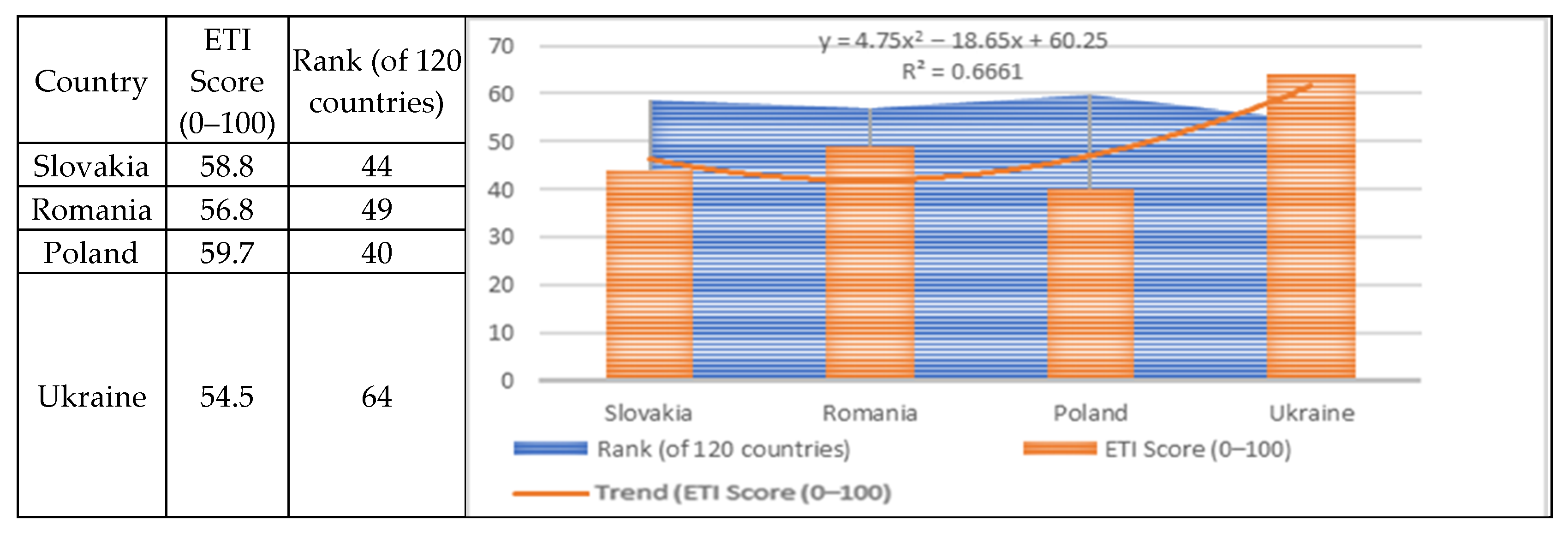
Figure 2 presents the results of an index-based assessment of Ukraine’s managerial effectiveness in the renewable energy transition, based on three key indices: the ETI, the WGI, and the BTI. For comparative context, Ukraine’s scores are contrasted with those of Poland, Romania, and Slovakia—EU member states that share similar historical backgrounds but exhibit different levels of progress in the renewable energy sector.
The trend line illustrates the relationship between a country’s ETI score and its relative rank, where the regression equation and R2 value indicate the strength and direction of this association.
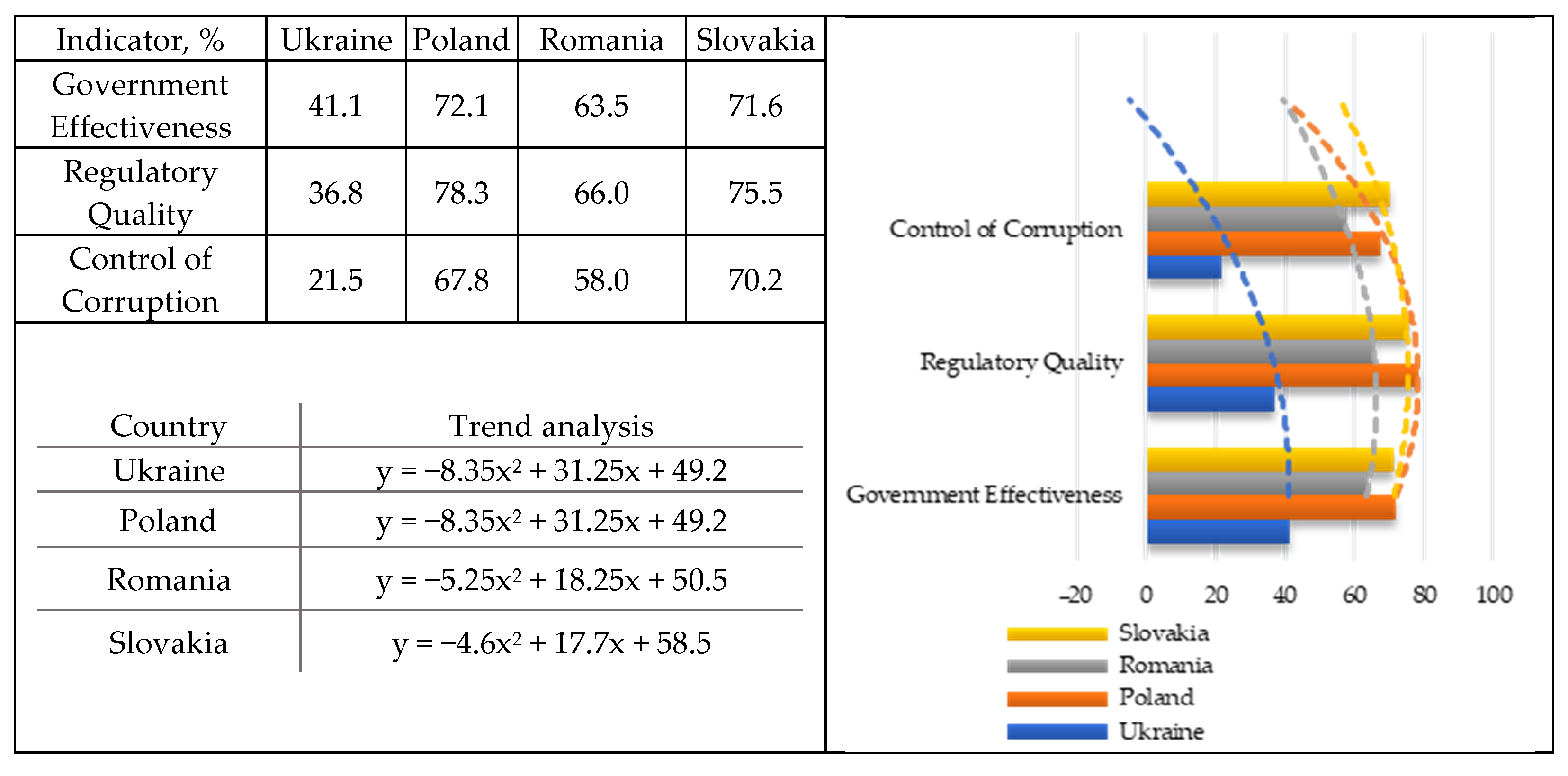
Ukraine lags behind its regional peers in both system performance (e.g., energy access, reliability, sustainability) and transition readiness (e.g., governance, capital investment, innovation) (
Figure 3).
Particularly, the country’s lower performance is associated with infrastructure vulnerability due to war damage and regulatory instability, which impairs investor confidence.
Ukraine scores notably lower across all three governance indicators. This reflects weaknesses in administrative capacity, unpredictable policymaking, and the persistence of informal influence in energy sector governance. In contrast, EU countries benefit from more stable institutional architectures and functioning regulatory enforcement, which are critical for long-term RES development.
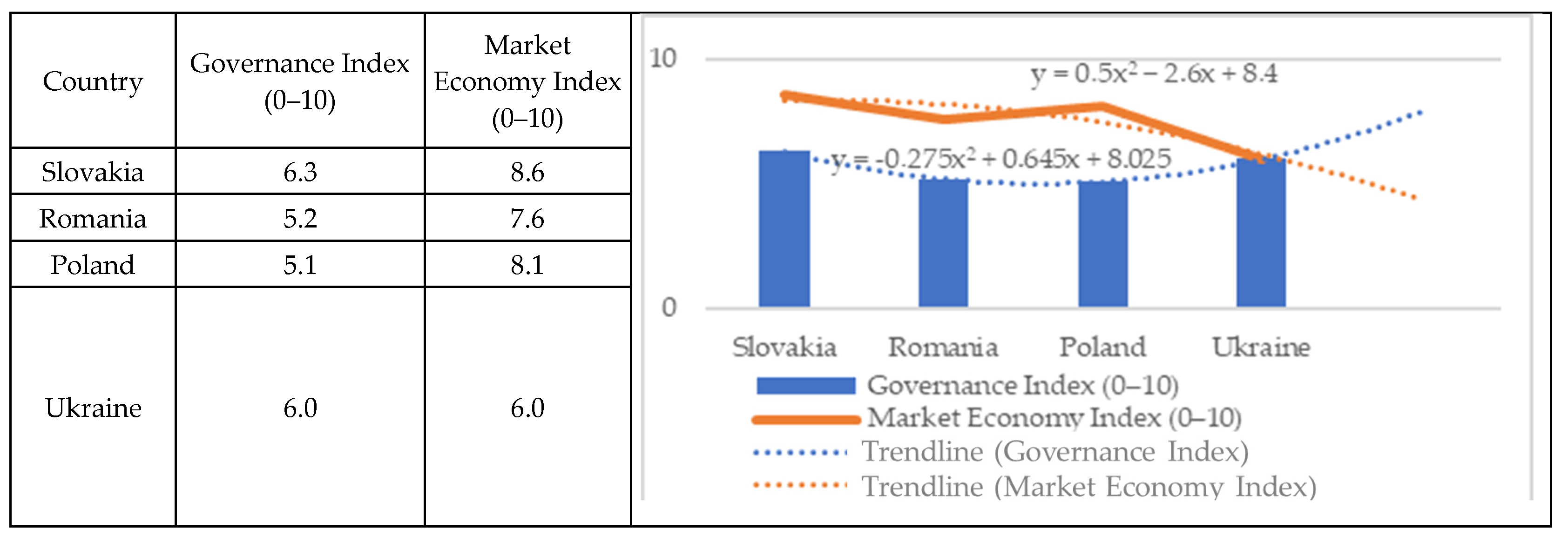
BTI scores confirm that Ukraine remains in a transitional governance category, characterized by limited strategic implementation capacity and ongoing risks of policy reversals (
Figure 4). While formal democratic institutions exist, energy policy remains vulnerable to political volatility and bureaucratic inefficiencies.
Although Ukraine’s overall BTI governance score (6.0) is comparable to Poland’s (5.1), the BTI report emphasizes that Ukraine’s governance challenges are concentrated in policy implementation and regulatory stability, particularly in the energy sector. In contrast, Poland benefits from stronger enforcement capacity and institutional continuity, which translates into more predictable energy policy outcomes.
In contrast, EU countries score higher in both governance and market economy indices, benefiting from more predictable institutions and consistent regulatory enforcement key enablers of long-term renewable energy development.
Despite weaker governance indicators, Ukraine has made notable progress in renewable energy deployment. As of 2023 [
3]:
Solar: ≈7.6 GW installed capacity;
Wind: ≈2.4 GW installed capacity4
RES share in electricity mix: ≈12–14% (down from ≈15% pre-conflict).
The pace of new RES installations has slowed significantly since 2022 due to security risks, damage to infrastructure, and policy uncertainty (e.g., disputes over green tariff payments and limited auction mechanisms). In contrast, Romania and Slovakia have accelerated RES expansion via EU-supported investment programs and structured auction schemes.
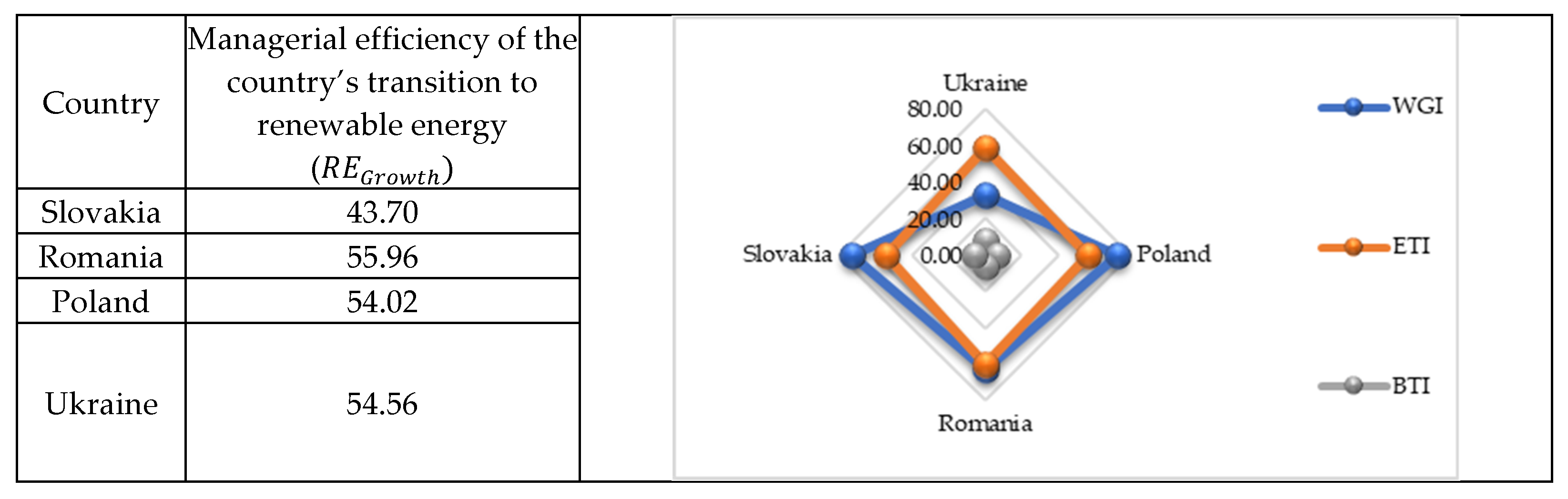
Based on the comparative analysis of Ukraine’s data in comparison with Poland, Romania, and Slovakia (see
Figure 5), it can be concluded that despite its high transformation potential and relatively good energy transition score, Ukraine lags far behind in the efficiency of managing the transition to renewable energy.
This analysis reveals persistent systemic challenges in Ukraine’s institutional capacity, regulatory quality, and anti-corruption mechanisms. To unlock the full potential of renewable energy development, it is essential to enhance strategic planning and coordination of RES policy, improve the regulatory environment, attract international investment, implement digital transparency tools, and promote public awareness and education.
The obtained results support the proposed hypothesis, demonstrating that governance quality and regulatory stability play a decisive role in the effectiveness of energy transition management.
Despite the current challenges, Ukraine demonstrates relatively strong managerial efficiency in its renewable energy transition (REGrowth = 54.56%), particularly in terms of integration into the national energy mix. This suggests that the country possesses significant untapped potential, which could be more effectively realized through improved governance and policy execution.
While Ukraine shows notable deployment capacity given the wartime context, its progress is undermined by institutional instability, fragmented regulations, and limited investor confidence. In contrast, peer countries such as Romania, Slovakia, and Poland benefit from EU-aligned governance structures and coherent policy frameworks, leading to higher ETI scores and more stable growth in renewable energy deployment.
Overall, the findings support the hypothesis that managerial effectiveness—understood as the interplay of governance quality, regulatory design, and implementation capacityis a critical driver of success in the renewable energy transition, often outweighing purely financial or technical considerations.
Case Insight: The Staryi Sambir Wind Power Plant as a Local Governance Success
The Staryi Sambir Wind Power Plant in Lviv Oblast exemplifies the positive synergy between local governance and renewable energy development in Ukraine. Commissioned in two stages (2015 and 2017) with a total capacity of 20.7 MW, it stands as one of the country’s pioneering grid-connected wind farms.
Its success is attributed to strong collaboration between local authorities and private investors, characterized by transparent permitting processes and active community engagement.
The project also benefited significantly from green tariff incentives, which ensured financial viability under the national support scheme. Moreover, Lviv Oblast’s commitment to regional energy planning—aligned with national priorities and EU integration frameworks provided a strategic foundation for this initiative. Importantly, public acceptance was high, reflecting the visible economic and environmental advantages the project brought to the local community.
This case underscores how empowered subnational governance and local ownership, supported by clear regulatory frameworks and financial mechanisms, can accelerate renewable energy deployment even amid broader national challenges. Furthermore, it highlights western Ukraine’s potential as a testing ground for decentralized energy solutions and post-conflict recovery models.
Lessons from Staryi Sambir suggest the need to strengthen regional and local government capacities in energy planning and permitting, leveraging digital tools and fostering public-private partnerships to diversify Ukraine’s energy portfolio and enhance its resilience. In sum, the Staryi Sambir Wind Power Plant demonstrates that focused local governance combined with strategic investment can effectively advance Ukraine’s green transition from theory into practice [
29,
30].
Although this study focuses on a single case, the Staryi Sambir wind power plant provides valuable insight into how local governance capacity can facilitate renewable energy deployment even in the presence of broader national-level regulatory instability. Rather than serving as a statistically representative example, the case illustrates a governance mechanism in practice, highlighting the role of municipal leadership, transparent permitting procedures, and community acceptance in sustaining renewable energy investments under conditions of systemic uncertainty.
5. Discussion
The findings present a complex but telling picture of Ukraine’s renewable energy transition. Despite making substantial progress in the deployment of solar and wind capacities over the past decade, Ukraine’s governance and institutional environment remain significantly weaker than that of comparable EU countries. This discrepancy highlights the importance of not only technological capacity but also robust, transparent, and adaptive management structures.
The analysis reveals that countries with higher ETI scores—such as Slovakia and Romania also rank higher in the WGI and BTI. This correlation affirms existing literature (e.g., [
3,
9]) which stresses that governance quality is a core enabler of energy transformation.
Ukraine’s relatively low ETI score (49.1/100) and WGI percentile ranks (e.g., 41.1% for Government Effectiveness and 36.8% for Regulatory Quality) [
3]) point to persistent structural barriers:
inconsistent and reactive policymaking;
delays in legislative reforms (e.g., auction systems);
limited investor protections and confidence;
administrative fragmentation between national and local energy authorities.
While the war has justifiably disrupted many institutional processes, some of these governance limitations predate the Russia–Ukraine war and are rooted in a longer history of institutional volatility and interference in the energy sector.
Despite these challenges, Ukraine has demonstrated several critical assets that could serve as pillars for a more resilient energy future:
accelerated RES deployment pre-war through green tariffs, when the share of renewables in the electricity mix reached approximately 12–15% prior to 2022, attracted significant FDI, particularly in solar PV;
clear strategic orientation toward EU integration, as evidenced by alignment with EU Green Deal and updated NDCs;
emerging regional leadership in some sectors, such as biogas and local community energy projects, particularly in western Ukraine;
digital governance infrastructure (e.g., Diia) that can be expanded to energy permitting and monitoring systems.
These elements show that Ukraine possesses not only technical capacity but also strategic ambition to accelerate its green energy transition—if matched with deeper regulatory and managerial reform.
European integration is a powerful incentive and guiding framework for improving Ukraine’s energy governance. Peer countries like Romania and Slovakia have benefited from EU cohesion policy, structural funding, and technical assistance to align their energy systems with Union standards. Ukraine can benefit from similar tools, provided that legal harmonization and institutional capacity-building are prioritized.
While the comparative analysis in this study focuses on Poland, Romania, and Slovakia due to their post-socialist background and relevance for Ukraine’s EU integration trajectory, the governance-related patterns identified are consistent with broader European experience, including countries with more mature renewable energy markets, where regulatory stability, institutional capacity, and policy coherence have proven decisive for successful energy transitions.
Furthermore, EU support must go beyond infrastructure finance and include targeted assistance for rule of law, anti-corruption mechanisms, and energy market liberalization, all of which are prerequisites for investor trust and stable RES growth.
It is essential to contextualize all findings within the ongoing war and its toll on Ukraine’s energy infrastructure, state capacity, and planning horizons. The impact of the war on Ukraine’s energy transition is inherently dynamic rather than static. In the short term, large-scale destruction of generation and transmission infrastructure has constrained renewable energy deployment and disrupted investment activity. In the medium term, however, the war has accelerated structural shifts toward decentralization, distributed generation, and energy autonomy at the local level. In the long run, post-war reconstruction may act as a catalyst for leapfrogging toward a more resilient and low-carbon energy system, as obsolete fossil-based infrastructure is replaced rather than restored. While the present study captures governance-related effects at an aggregated level, a fully dynamic assessment of war impacts over time remains beyond its scope and represents an important direction for future research. The destruction of transmission lines, occupation of power-generating assets, and general uncertainty all reduce the bandwidth of public institutions to engage in long-term strategic management.
6. Conclusions
However, even under these conditions, the country’s energy actors—public and private have shown remarkable adaptability. The reconstruction phase offers a unique opportunity to «build back greener», embedding resilience, decentralization, and clean technology into the core of Ukraine’s future energy system, while strengthening national food security through stable energy supply for agriculture and logistics.
Ukraine’s renewable energy transition thus stands at a crossroads. On the one hand, persistent governance weaknesses, pre-existing institutional volatility, and the impact of war create substantial barriers to investor confidence and long-term planning.
On the other, the country has already accumulated valuable assets: a strong record of pre-war RES deployment, growing expertise in decentralized energy solutions, digital infrastructure for governance, and a clear trajectory of alignment with the EU Green Deal.
To transform these assets into sustainable progress, Ukraine must prioritize reforms that strengthen rule of law, regulatory stability, and transparency. At the same time, European integration offers not only a normative benchmark but also practical instruments—funding, technical assistance, and policy frameworks that can accelerate the country’s energy transformation.
Given the analytical and comparative scope of this study, the proposed policy implications are formulated at a strategic level rather than as detailed implementation roadmaps. The primary objective is to identify governance-related leverage points that influence energy transition performance, while the design of specific policy instruments and implementation mechanisms remains beyond the scope of the present analysis and constitutes a promising direction for further applied research.
Ultimately, the resilience demonstrated during wartime disruption suggests that Ukraine has the capacity to emerge from the crisis with a more robust, diversified, and future-oriented energy system. If regulatory reform and institutional strengthening are synchronized with reconstruction, Ukraine’s green transition could become not just a recovery strategy, but a foundation for long-term economic modernization and integration into the European energy community.
In direct response to the research question, the comparative index-based analysis demonstrates that Ukraine’s management of the renewable energy transition is less effective than that of its regional peers (Poland, Romania, Slovakia), primarily due to weaker governance, institutional volatility, and regulatory inconsistency. However, the country shows moderate managerial efficiency (REGrowth = 54.56%) and notable resilience in renewable deployment even under wartime conditions, which suggests that with targeted reforms and EU-aligned capacity building, Ukraine can close the performance gap and accelerate convergence with European standards in the medium to long term.




 ,
,