A Study on Excitation Inrush Current and Overvoltage Mitigation Strategies Utilizing Phase Selection Control


Abstract
1. Introduction
2. Introduction to Excitation Inrush Current and Operating Overvoltage
2.1. Mechanism Analysis of Transformer Excitation Inrush Current Generation
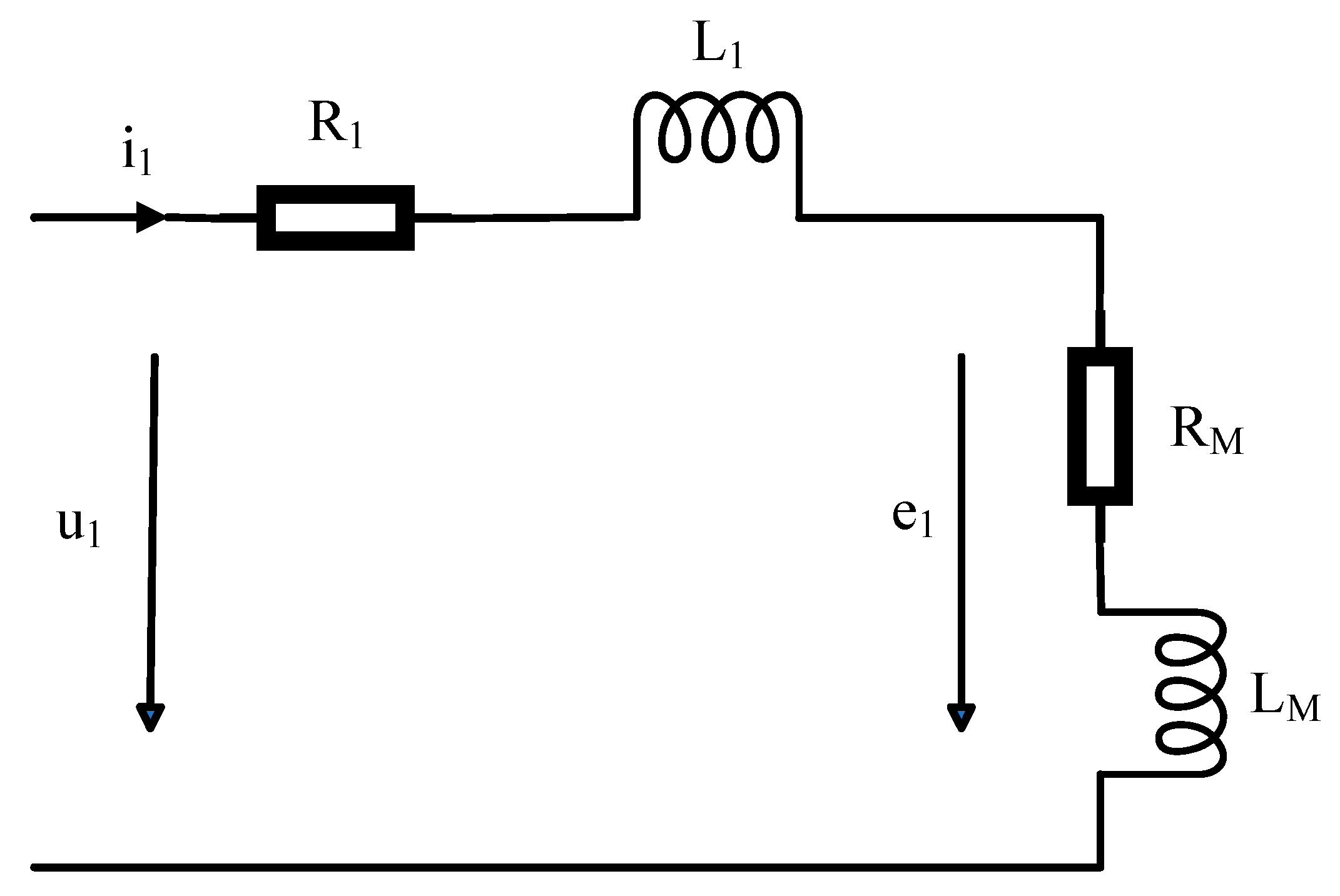
- where —excitation current on the transformer primary side;
- —equivalent resistance of the transformer primary winding.
- By substituting with the magnetic flux , the equation becomeswhere —self-inductance of the primary winding in a transformer.
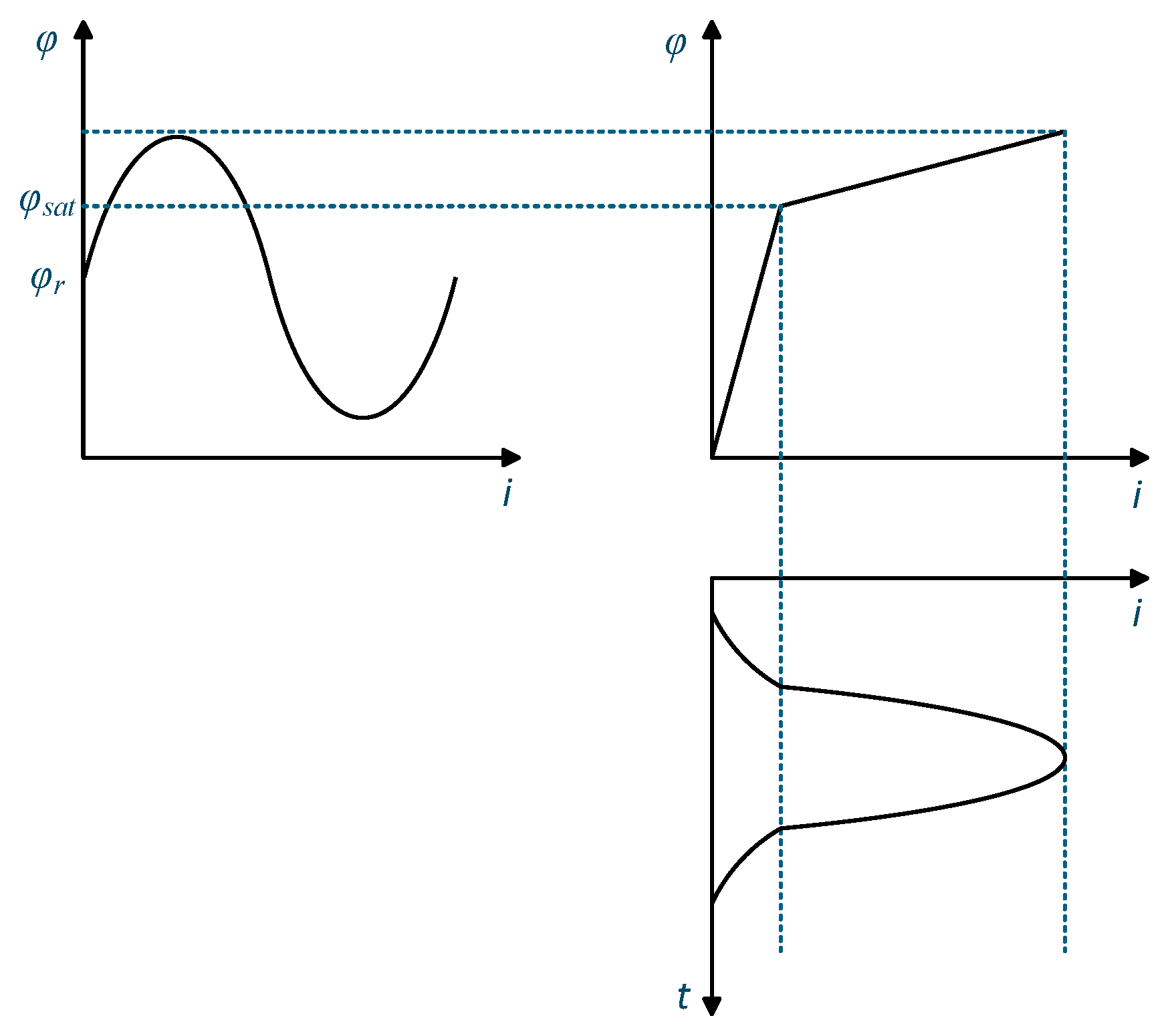
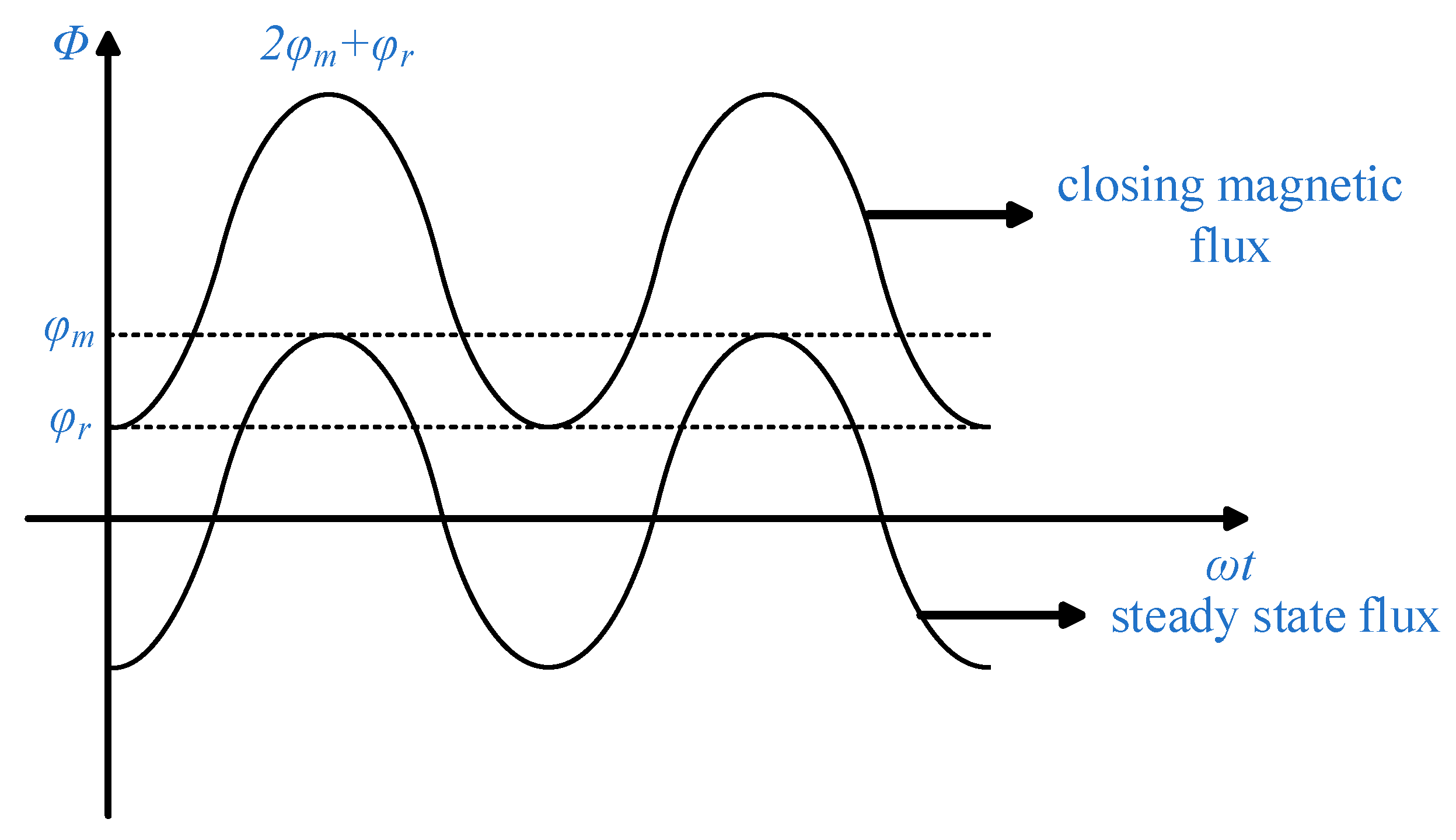
- where —the residual magnetism of the transformer core before closing;
- —transient flux time decay coefficient.
2.2. Mechanism Analysis of Operating Overvoltage Generation
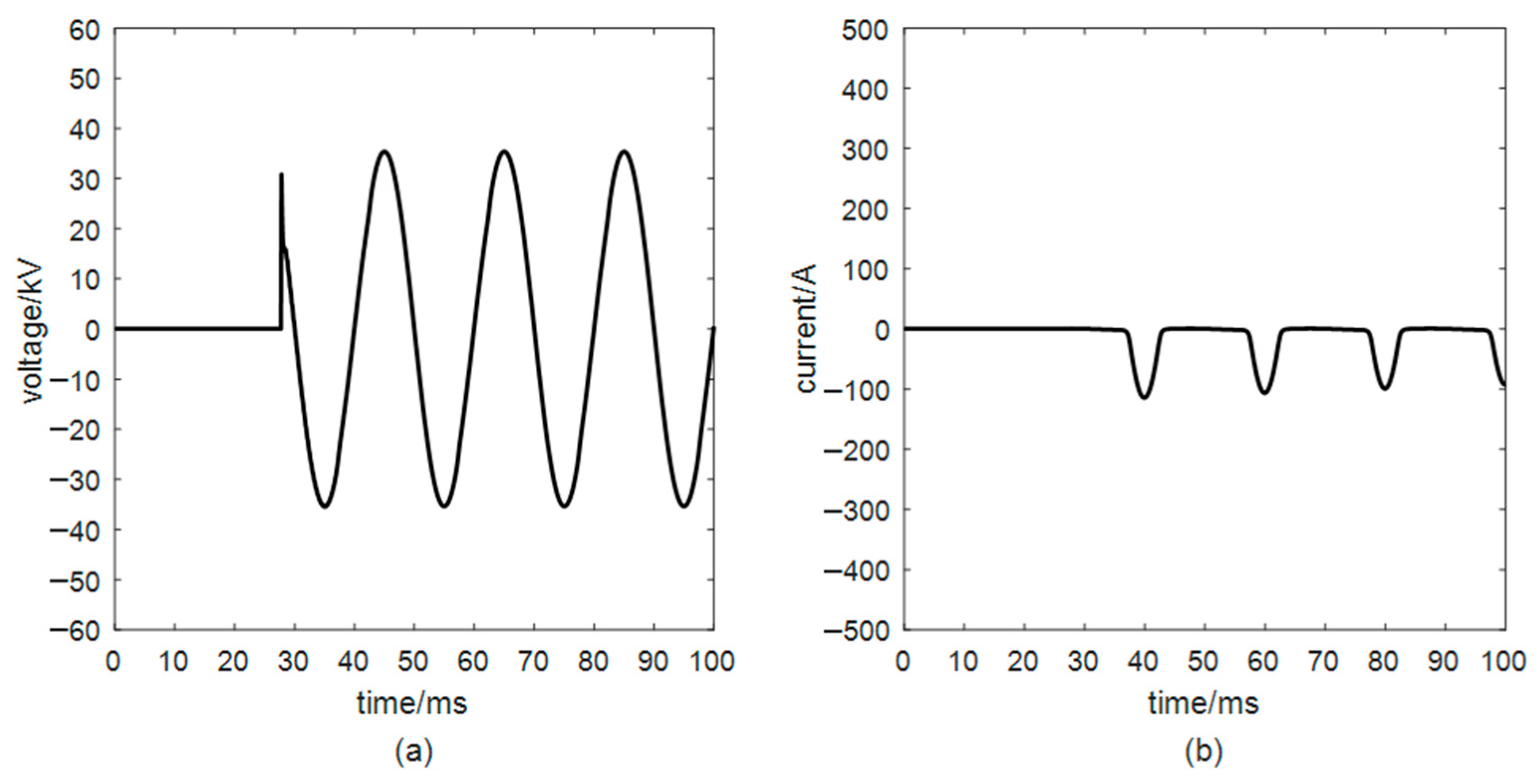
3. Simulation Study
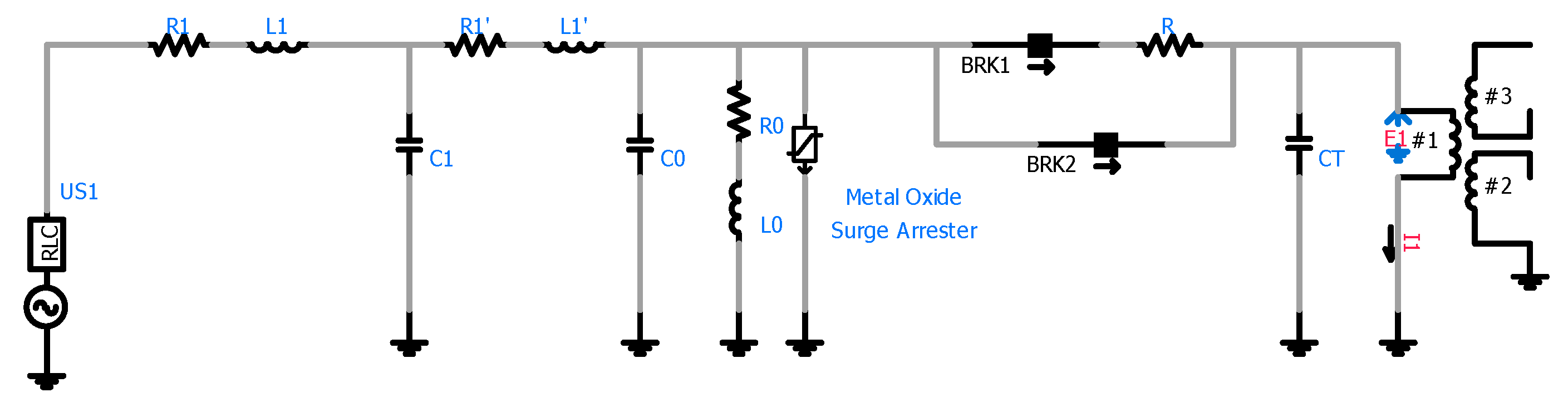
3.1. Simulation Model
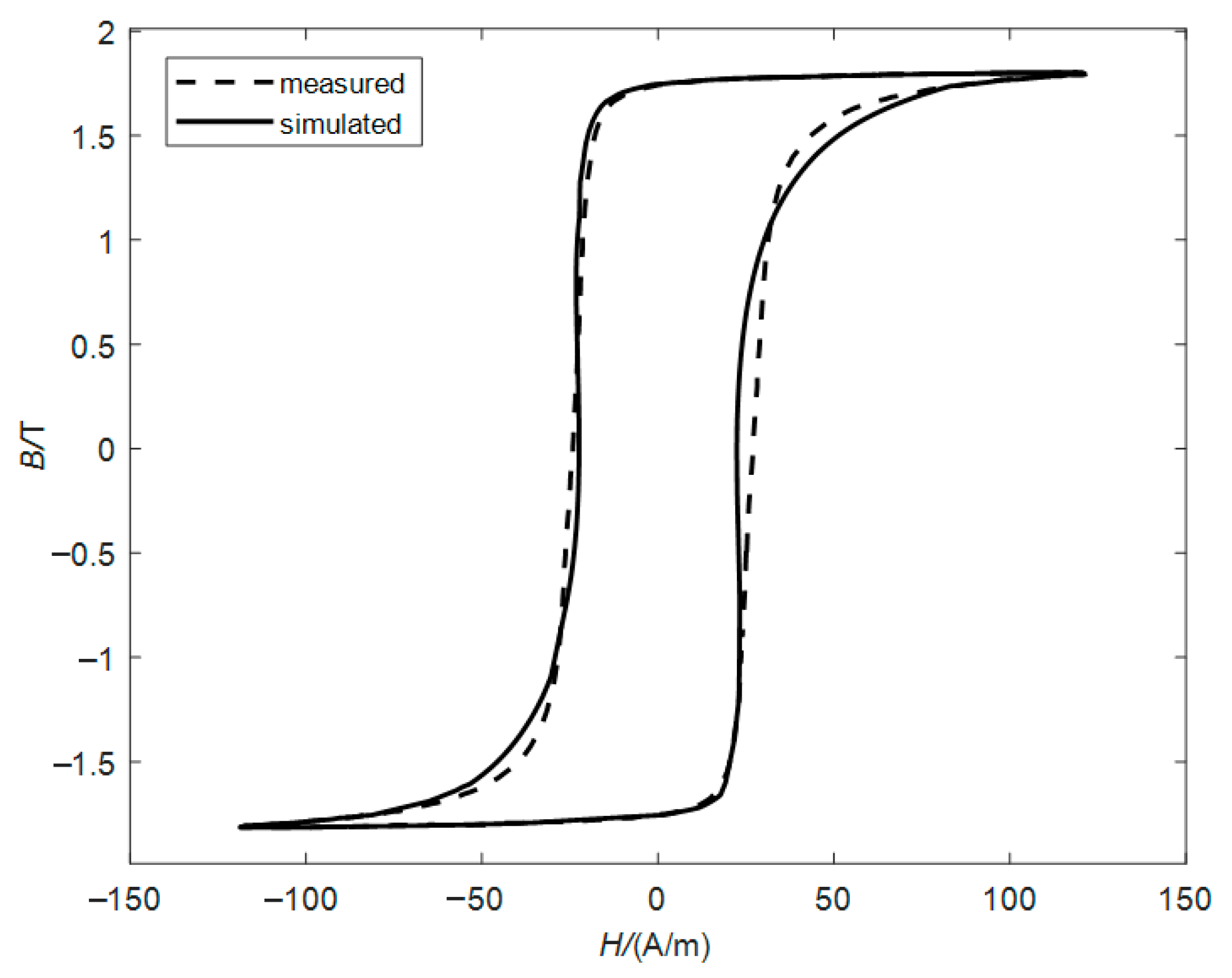
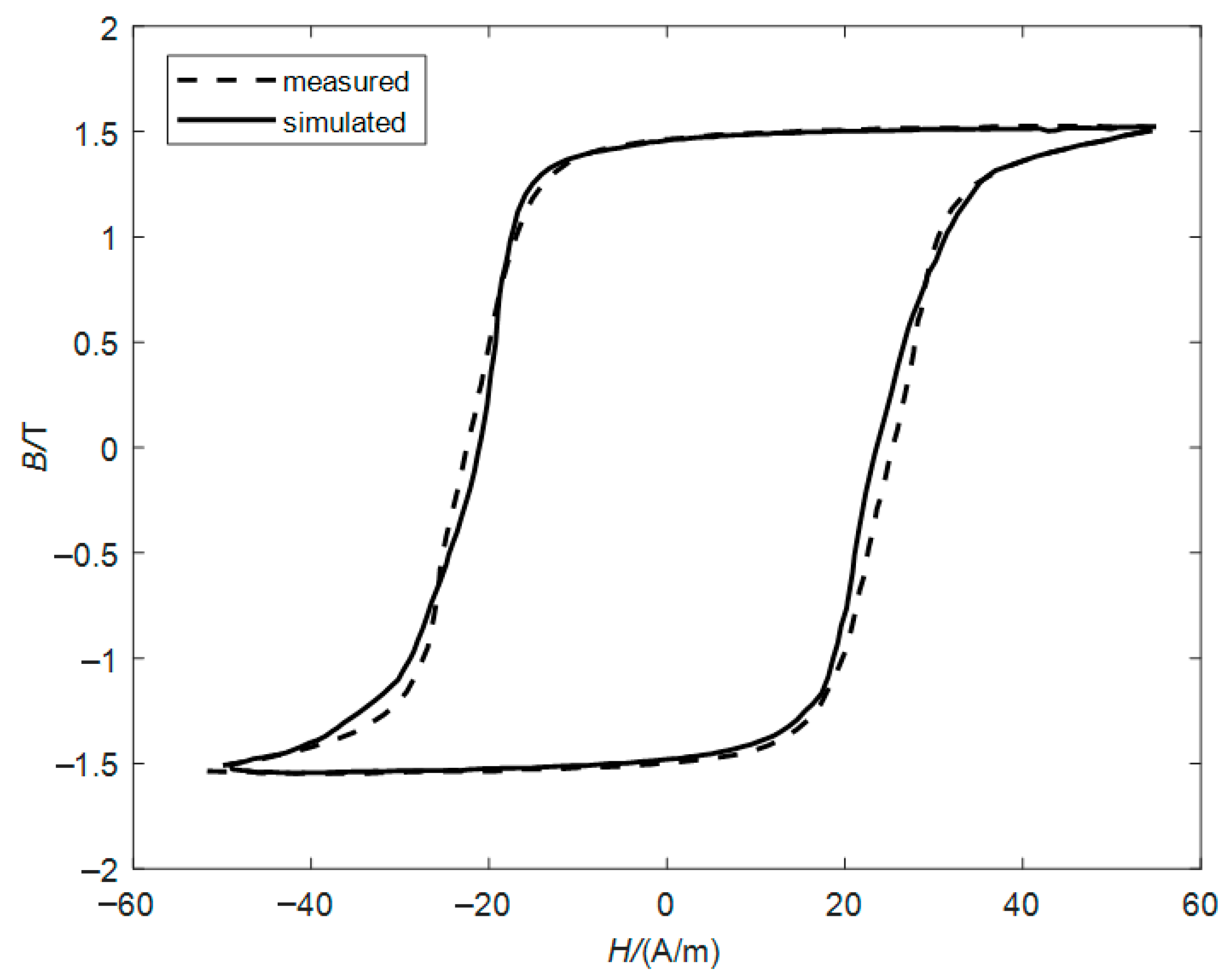
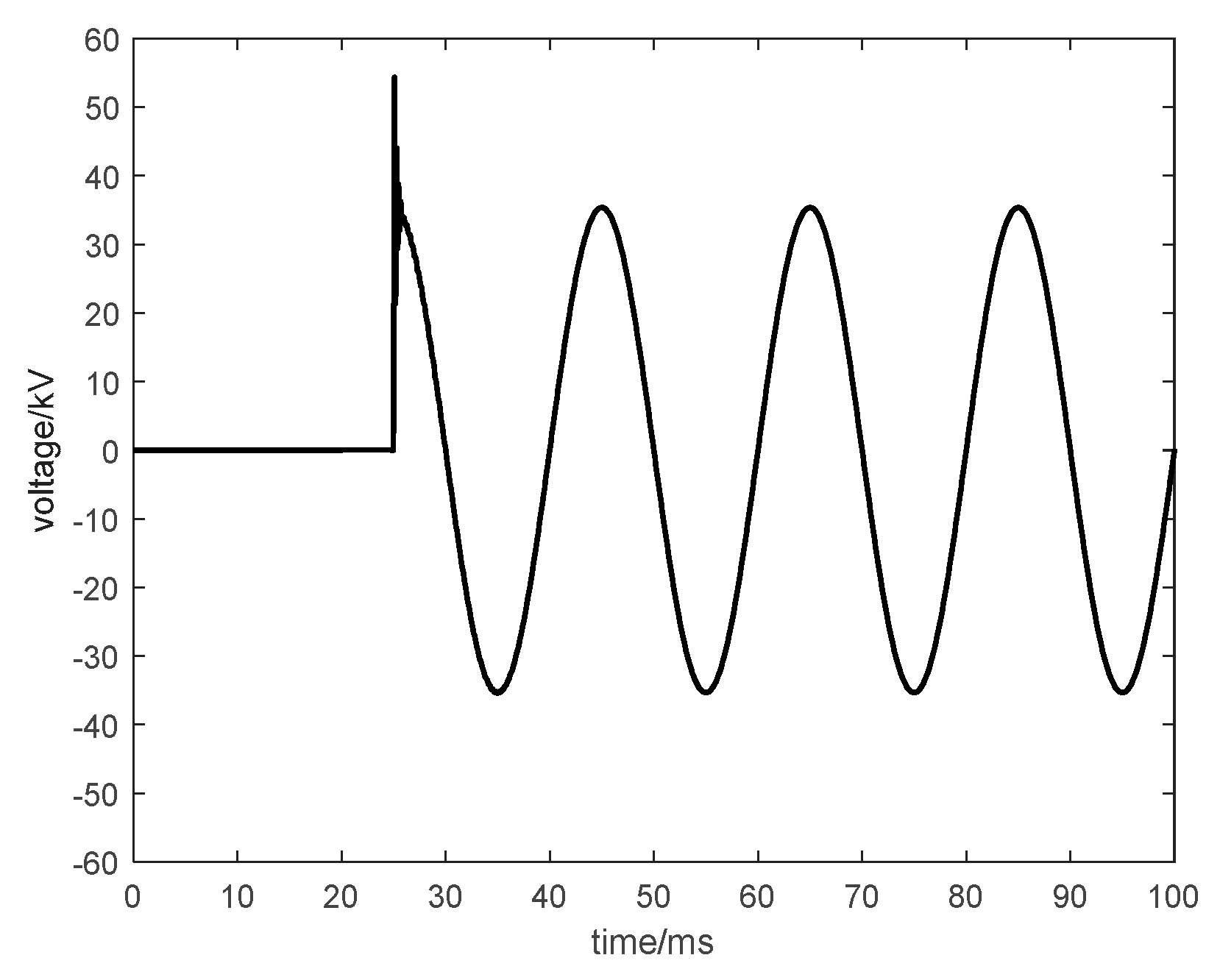
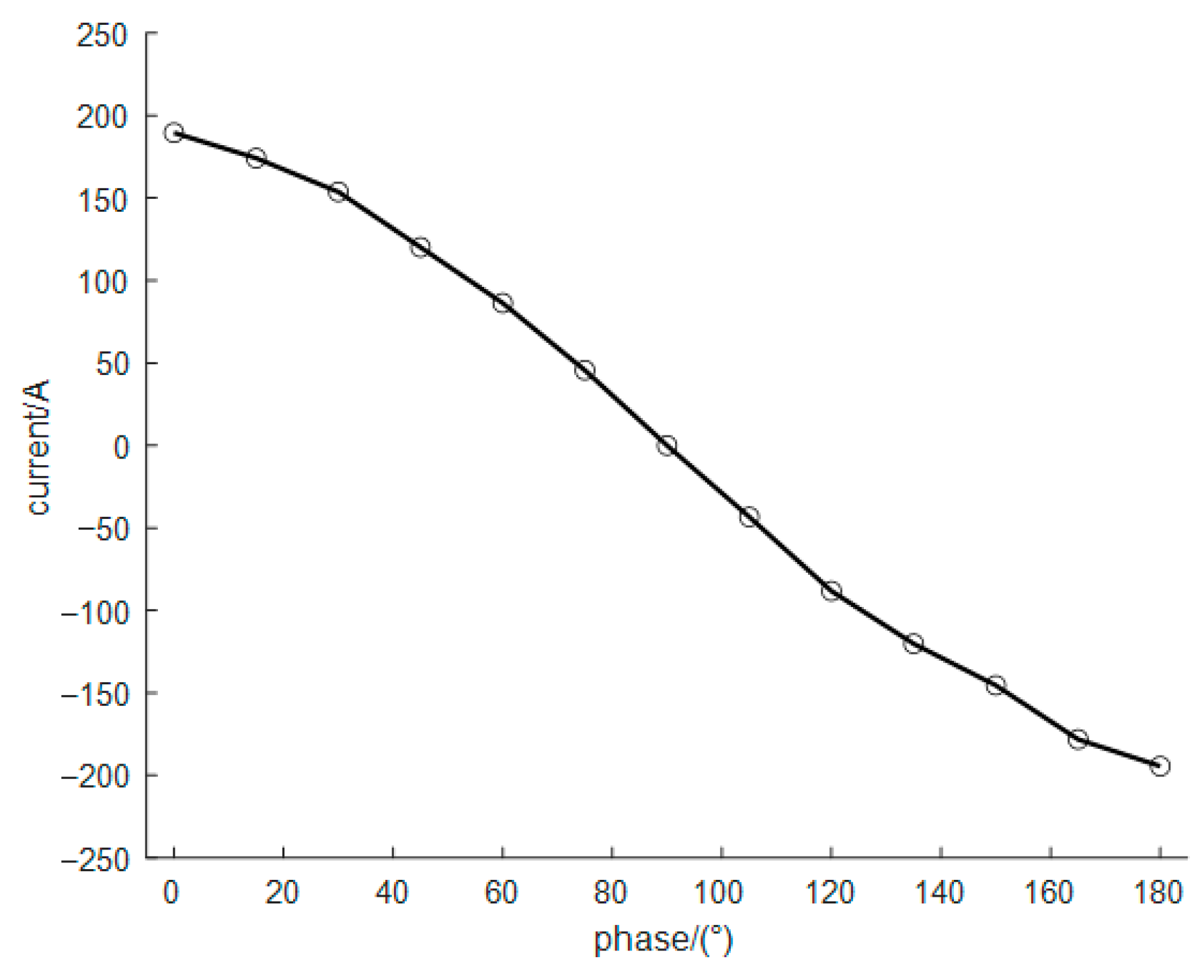
3.2. Model Verification
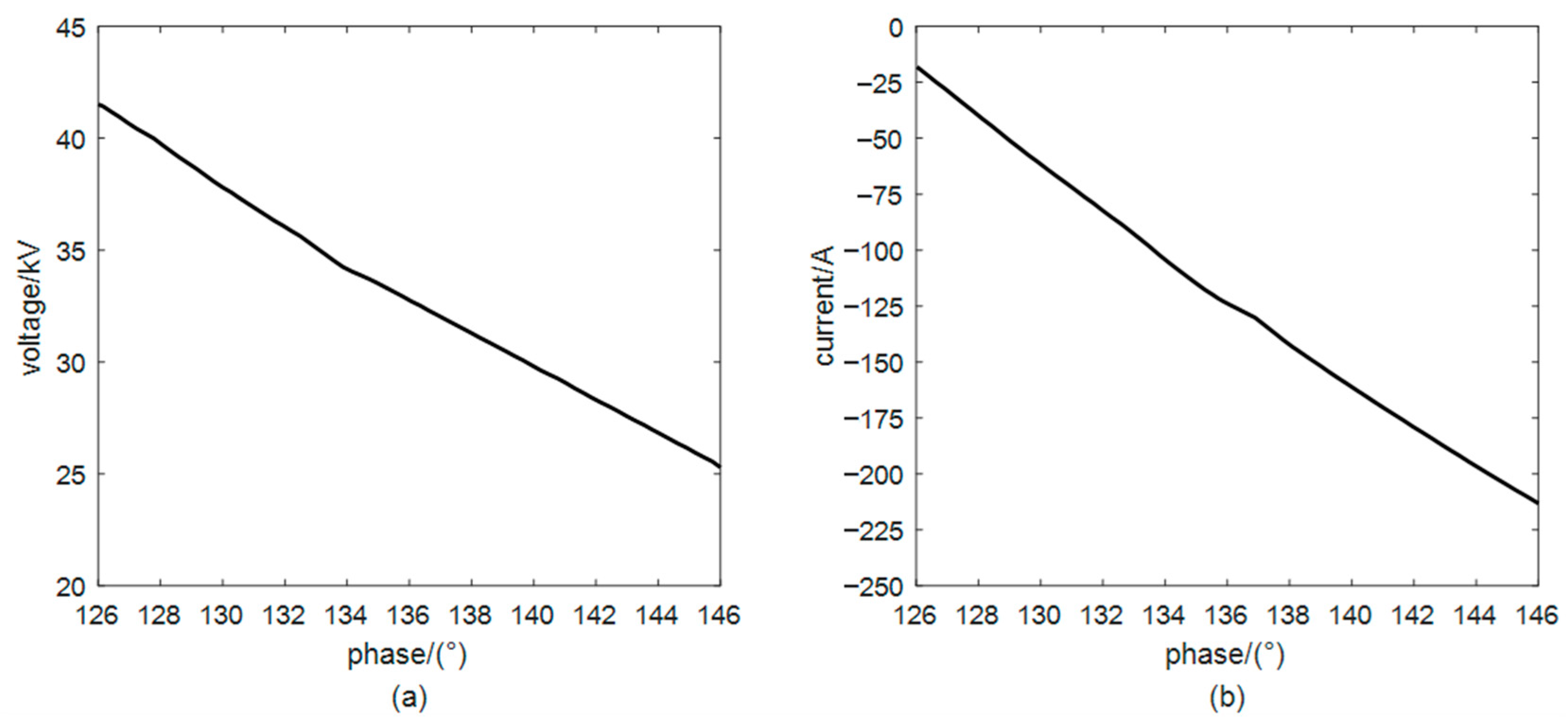
4. Research on Phase Selection Control Strategy
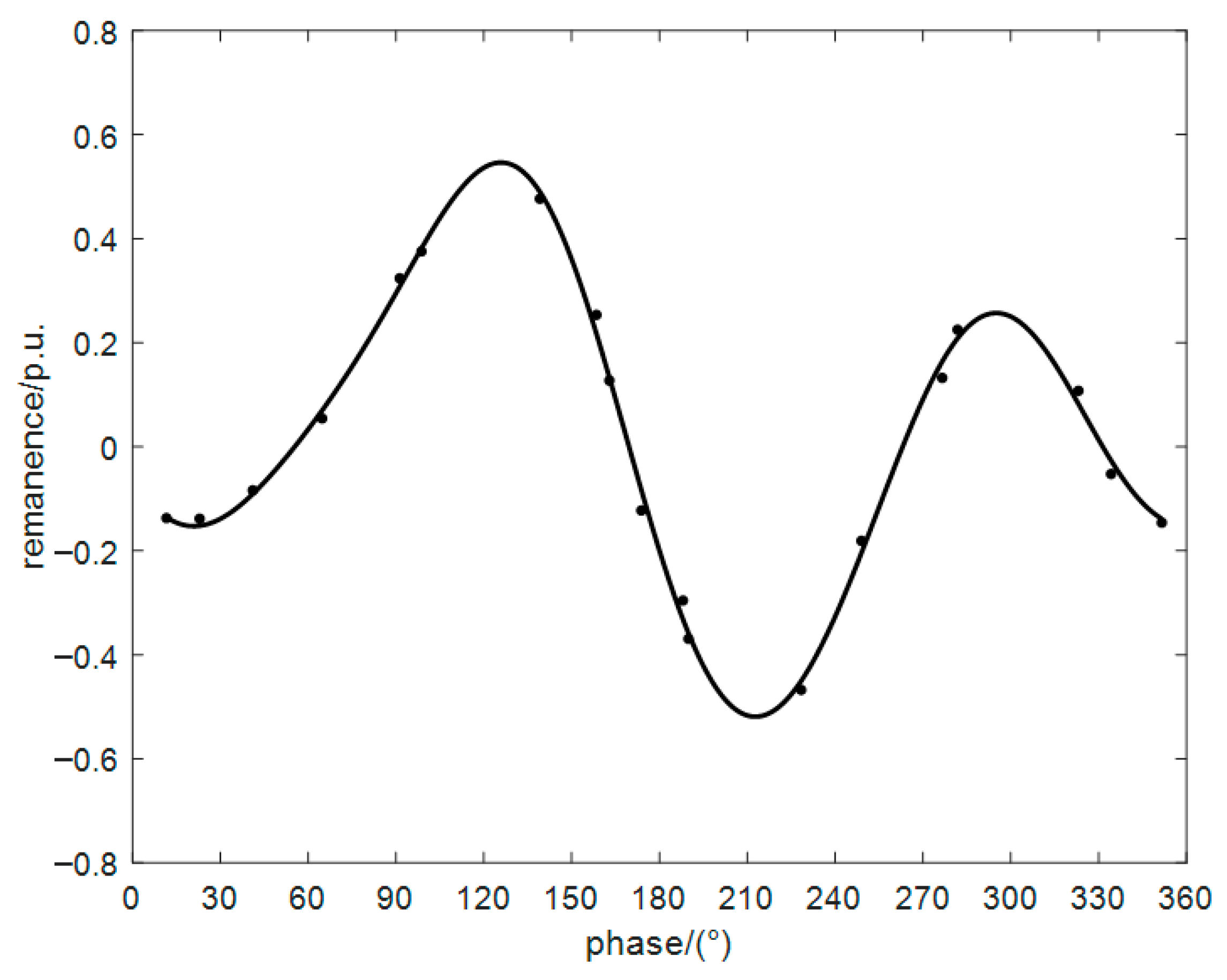
5. Transformer Core Residual Magnetism Calculation
5.1. Jiles–Atherton Hysteresis Model
5.2. Measurement Results
- where —operating overvoltage amplitude;
- —excitation inrush current magnitude;
- , —constraint upper limits for overvoltage and inrush current;
- , —the adaptive weighting factor, which satisfies .
5.3. MOA Combined with Closing Resistor Method Analysis
6. Conclusions
Author Contributions
Funding
Data Availability Statement
Conflicts of Interest
References
- Bak, C.L.; Borghetti, A.; Glasdam, J.; Hjerrild, J.; Napolitano, F.; Nucci, C.A.; Paolone, M. Vacuum circuit breaker modelling for the assessment of transient recovery voltages: Application to various network configurations. Electr. Power Syst. Res. 2018, 156, 35–43. [Google Scholar] [CrossRef] [Scilit]
- Zhang, L.; Jiang, L.; Gao, G.; Jiang, Q.; Huang, Y.; Yang, Y. The optimization design for suppression of craft TF magnet power converter switching overvoltage. IEEE Trans. Plasma Sci. 2022, 50, 4375–4380. [Google Scholar] [CrossRef] [Scilit]
- Xiao, S.; Wang, Z.; Wu, G.; Guo, Y.; Gao, G.; Zhang, X.; Cao, Y.; Zhang, Y.; Yu, J.; Liu, P.; et al. The impact analysis of operational overvoltage on traction transformers for high-speed trains based on the improved capacitor network methodology. IEEE Trans. Transp. Electrif. 2023, 10, 364–378. [Google Scholar] [CrossRef] [Scilit]
- Zhao, X.D.; Lv, F.P. Improved phase selection closing strategy based on DC magnetizing circuit. High Volt. Electr. Appar. 2024, 60, 18–26. [Google Scholar] [CrossRef]
- Han, X.; Chen, H.; Zhou, J.; Chen, W.; Chen, D. Research on the impact of transformer switching-off on core residual magnetism. Zhejiang Electr. Power 2025, 44, 103–109. [Google Scholar] [CrossRef]
- Qi, X.; Yin, X.; Zhang, Z.; Chen, D.; Wang, Y.; Cai, F. Study on the unusual misoperation of differential protection during transformer energisation and its countermeasure. IEEE Trans. Power Deliv. 2016, 31, 1998–2007. [Google Scholar] [CrossRef] [Scilit]
- Wu, S.; Ren, Y.; Wang, Y.; Huo, C.; Liu, C. Residual flux measurement of power transformer based on transient current difference. IEEE Trans. Magn. 2022, 58, 1–5. [Google Scholar] [CrossRef] [Scilit]
- Batista, Y.N.; de Souza, H.E.P.; Neves, F.d.A.d.S.; Filho, R.F.D. A GDSC-based technique to distinguish transformer magnetising from fault currents. IEEE Trans. Power Deliv. 2018, 33, 589–599. [Google Scholar] [CrossRef] [Scilit]
- Shah, A.M.; Bhalja, B.R.; Patel, R.M.; Bhalja, H.; Agarwal, P.; Makwana, Y.M.; Malik, O.P. Quartile based differential protection of power transformer. IEEE Trans. Power Deliv. 2020, 35, 2447–2458. [Google Scholar] [CrossRef] [Scilit]
- Guo, W.; Huang, Z.; Zhou, M.; Wang, D. Prediction of Excitation Inrush Current in No-Load Transformers Based on CatBoost Algorithm. Electr. Drive 2025. [Google Scholar] [CrossRef]
- Li, C. Analysis of transformer excitation inrush current and its identification method. Electr. World 2025, 66, 15–18. [Google Scholar] [CrossRef]
- Li, C.; Zhou, N.; Wang, Q.; Liao, J.; Wei, N. A method to eliminate transformer inrush currents using soft-starter-based controlled energization. J. Electrotechnol. 2020, 35, 3640–3651. [Google Scholar] [CrossRef]
- Wu, Z.; Quan, H.; Du, Y.; Zhao, L.; Liu, Z. Study on excitation inrush current suppression strategy of transformer with series closing resistance. Electr. Appl. 2011, 30, 56–60. [Google Scholar]
- Liu, T.; Yan, T.; Bu, X.; Duan, X.Y.; Liao, M.F. Research on phase-controlled technology of inrush current based on closing resistance. High Volt. Electr. Appar. 2018, 54, 109–114. [Google Scholar] [CrossRef]
- Sobrinho, A.M.; Camacho, J.R.; A Malagoli, J.; Mamede, A.C.F. Analysis of the maximum inrush current in the otimal design of a single phase transformer. IEEE Lat. Am. Trans. 2016, 14, 4706–4713. [Google Scholar] [CrossRef]
- Chen, Z.; Li, H.; Dong, X.; He, Y.; Zhou, Q.; Zhang, Y.; Zhang, Y. Magnetizing inrush current elimination strategy based on a parallel type asynchronous closing hybrid transformer. IEEE Trans. Power Electron. 2023, 38, 931–943. [Google Scholar] [CrossRef] [Scilit]
- Han, P.; Tong, Q.; Wang, Y.; Chen, Z.; Yang, W.; Hu, D. Inrush Current Suppression Strategy of Converter Transformer Phase Selection Closing Based on Magnetic Bias Simulation. High Volt. Eng. 2022, 48, 4977–4985. [Google Scholar] [CrossRef]
- Florkowski, M.; Furgal, J.; Kuniewski, M.; Pajak, P. Comparison of transformer winding responses to standard lightning impulses and operational overvoltages. IEEE Trans. Dielectr. Electr. Insul. 2018, 25, 965–974. [Google Scholar] [CrossRef] [Scilit]
- Feng, X.; Jiao, H. Exploration of strategies for improving the reliability of electrical systems by phase controlled circuit breakers. Power Equip. Manag. 2024, 7, 263–265. [Google Scholar]
- Guo, Z. Research on overvoltage of ultra high voltage transmission lines and its suppression strategies. Power Equip. Manag. 2024, 3, 29–31. [Google Scholar]
- Sun, W.; Li, Y.; Xin, D.; Peng, Z.; Li, W. Measures for Suppressing High Frequency Transient Overvoltage in Offshore Wind Farms. J. Mech. Electr. Eng. Technol. 2023, 52, 241–245+251. [Google Scholar] [CrossRef]
- Li, J. Research on Key Technologies of Phase Selection Closing for Onboard Circuit Breakers of High-Speed EMUs. Master’s Thesis, Beijing Jiaotong University, Beijing, China, 2020. [Google Scholar] [CrossRef]
- Wang, B.; Liu, J.; Xu, H.; Yuan, R.; Lian, X. Application of excitation inrush suppressor on aluminium electrolytic transformer. Electr. Technol. Econ. 2025, 3, 130–132, 136. [Google Scholar] [CrossRef]
- Feng, Z.L.; Liao, Y.H.; Fan, H.J.; Li, P. Study on the suppression of inrush current and overvoltage by phase-controlled switching circuit breakers. Electrified Railw. 2022, 33, 84–90. [Google Scholar] [CrossRef]
- Mitra, J.; Xu, X.; Benidris, M. Reduction of three-phase transformer inrush currents using controlled switching. IEEE Trans. Ind. Appl. 2020, 56, 890–897. [Google Scholar] [CrossRef]
- Jiles, D.C.; Atherton, D.L. Theory of ferromagnetic hysteresis. J. Appl. Phys. 1984, 55, 2115–2120. [Google Scholar] [CrossRef] [Scilit]
- Wang, Y. Research on the Prediction of Residual Magnetism of Transformer Core. Master’s Thesis, Shandong University, Jinan, China, 2017. [Google Scholar]
- Yang, C. Research and Application of Field Test Method for Opening and Closing Speed of High Voltage Circuit Breaker. Master’s Thesis, North China Electric Power University, Beijing, China, 2018. [Google Scholar]
- GB/T 311.1-2012; Insulation Coordination—Part 1: Definitions, Principles and Rules. Standardization Administration of China: Beijing, China, 2012.
- DL/T 572-2021; Operating Code for Power Transformers. National Energy Administration: Beijing, China, 2021.
- Li, R.; Wang, Q.; Zhang, J.; Li, X. Prediction Method of Closing Action Time of Vehicle Pneumatic Main Circuit Breaker Based on PCA and GBDT Algorithm. World Electr. Veh. J. 2025, 16, 664. [Google Scholar] [CrossRef] [Scilit]



| Winding | Net Side Winding (Primary Coil) | Traction Winding (Secondary Coil) |
|---|---|---|
| Rated capacity/kVA | 2100 | 2 × 1050 |
| Rated voltage/V | 25,000 | 2 × 970 |
| Rated current/A | 84 | 2 × 1082.4 |
| Short-circuit impedance (%) HV-traction leakage inductance/mH | 1.36 (1 ± 10%) | |
| Frequency/Hz | 50 | |
| Load loss/kW | 67 | |
| No-load loss/kW | 15 | |
| Parameter | Value |
|---|---|
| / | 1,432,244 |
| / | 10.414 |
| 3.128 | |
| / | 33.918 |
| c | 0.1608 |
| Split Phase/(°) | Closing Phase/(°) | Overvoltage Amplitude/kV | Excitation Inrush Current Amplitude/A |
|---|---|---|---|
| 105 | 128 | 37.9766 | −128.0567 |
| 110 | 131 | 35.7813 | −131.2287 |
| 115 | 134 | 33.6287 | −132.1741 |
| 120 | 135 | 33.1412 | −131.7983 |
| 125 | 136 | 32.5732 | −129.0383 |
| 130 | 135 | 33.1412 | −121.6727 |
| 135 | 133 | 34.3809 | −124.2538 |
| 140 | 130 | 36.4904 | −125.0408 |
| 200 | 310 | −35.8854 | 122.2541 |
| 205 | 313 | −34.1095 | 125.8901 |
| 210 | 315 | −34.0121 | 123.2456 |
| 215 | 314 | −34.0627 | 129.5134 |
| 220 | 313 | −34.1095 | 132.2451 |
| 225 | 310 | −35.8854 | 124.2135 |
| 230 | 307 | −36.0187 | 127.4356 |
| System Nominal Voltage/kV | Rated Voltage RMS/kV | Continuous Operating Voltage/kV | DC 1 mA Reference Voltage/kV | Current Carrying Capacity of a 2 ms/A Square Wave |
|---|---|---|---|---|
| 27.5 | 42.0 | 34.0 | 65.0 | 400 |
Disclaimer/Publisher’s Note: The statements, opinions and data contained in all publications are solely those of the individual author(s) and contributor(s) and not of MDPI and/or the editor(s). MDPI and/or the editor(s) disclaim responsibility for any injury to people or property resulting from any ideas, methods, instructions or products referred to in the content. |
© 2025 by the authors. Licensee MDPI, Basel, Switzerland. This article is an open access article distributed under the terms and conditions of the Creative Commons Attribution (CC BY) license.
Share and Cite
Yan, J.; Wang, Q.; Zhang, J.; Li, X. A Study on Excitation Inrush Current and Overvoltage Mitigation Strategies Utilizing Phase Selection Control. Energies 2026, 19, 121. https://doi.org/10.3390/en19010121
Yan J, Wang Q, Zhang J, Li X. A Study on Excitation Inrush Current and Overvoltage Mitigation Strategies Utilizing Phase Selection Control. Energies. 2026; 19(1):121. https://doi.org/10.3390/en19010121
Chicago/Turabian StyleYan, Junting, Qingfeng Wang, Jianqiong Zhang, and Xiangqiang Li. 2026. "A Study on Excitation Inrush Current and Overvoltage Mitigation Strategies Utilizing Phase Selection Control" Energies 19, no. 1: 121. https://doi.org/10.3390/en19010121
APA StyleYan, J., Wang, Q., Zhang, J., & Li, X. (2026). A Study on Excitation Inrush Current and Overvoltage Mitigation Strategies Utilizing Phase Selection Control. Energies, 19(1), 121. https://doi.org/10.3390/en19010121