Ensemble Surrogates and NSGA-II with Active Learning for Multi-Objective Optimization of WAG Injection in CO2-EOR


Abstract
1. Introduction
2. Methodology
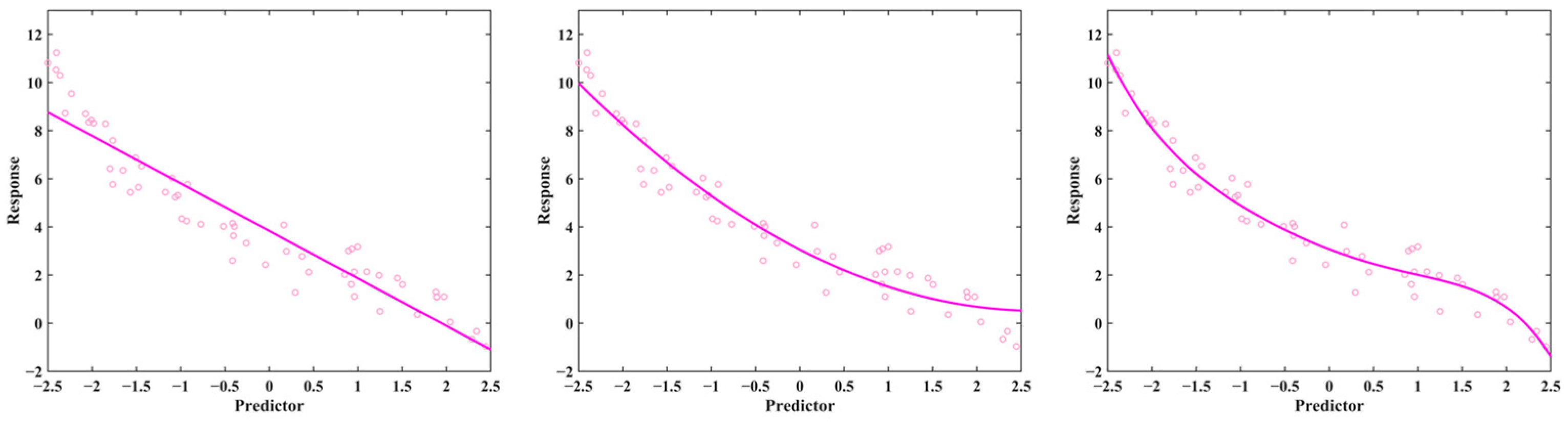
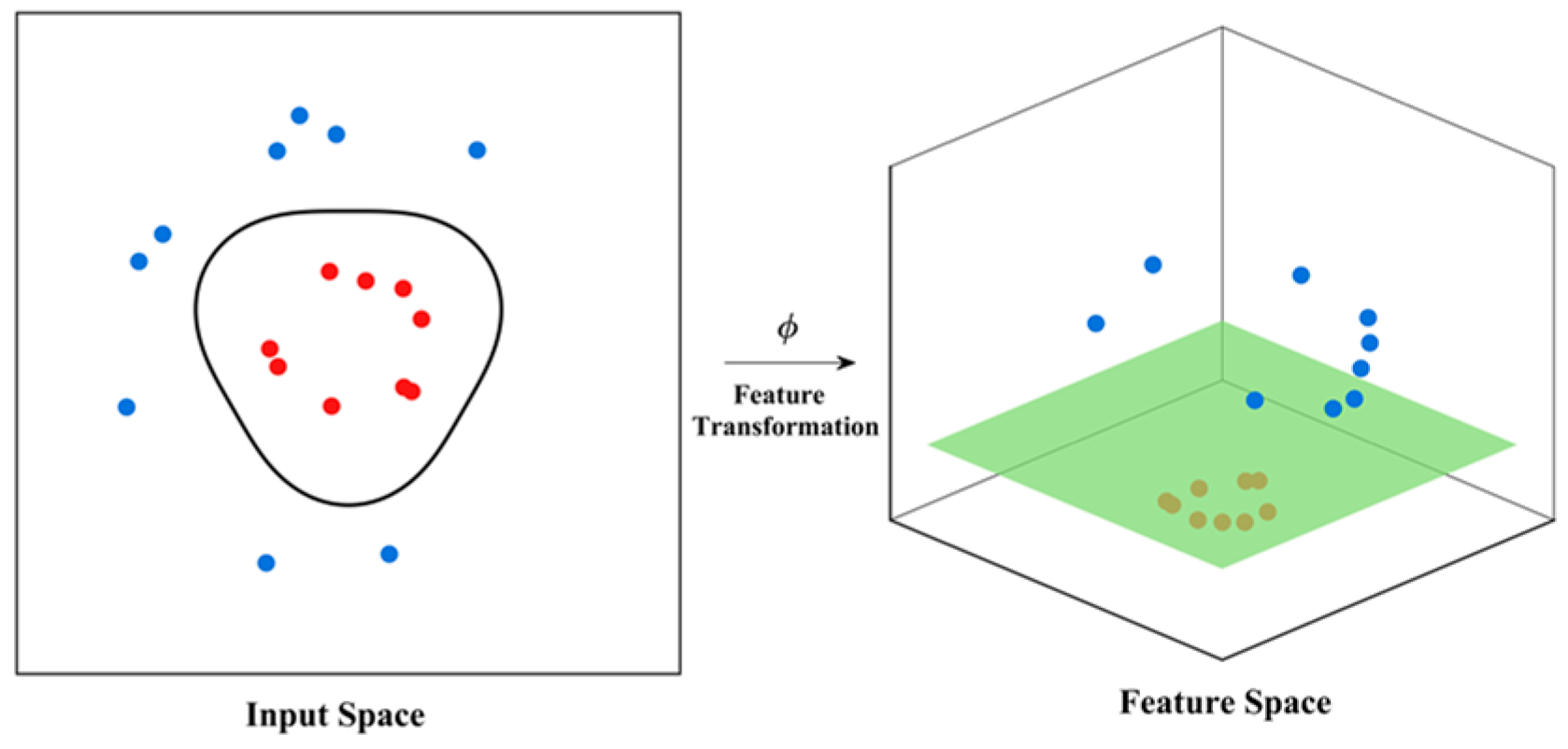
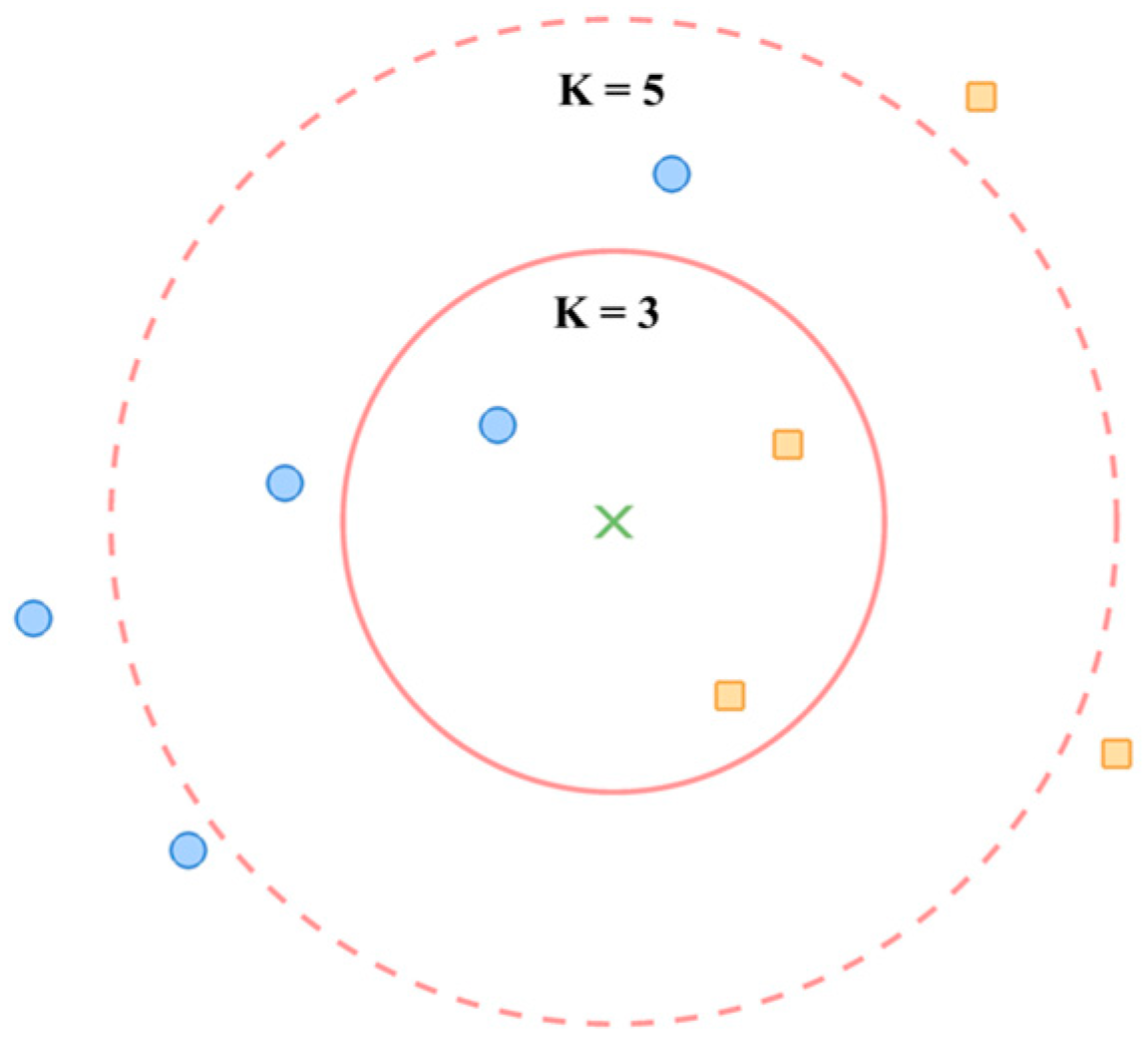
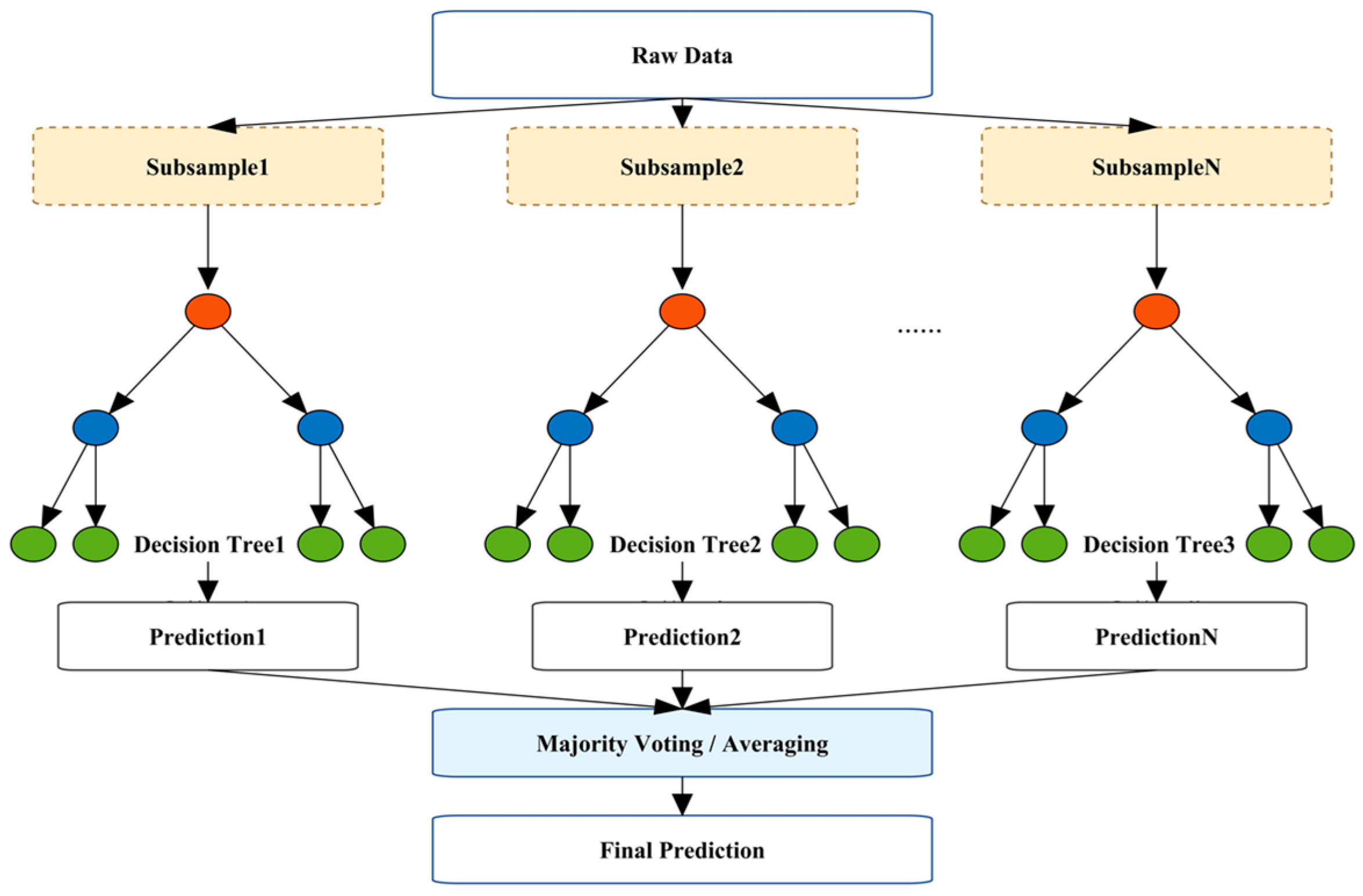
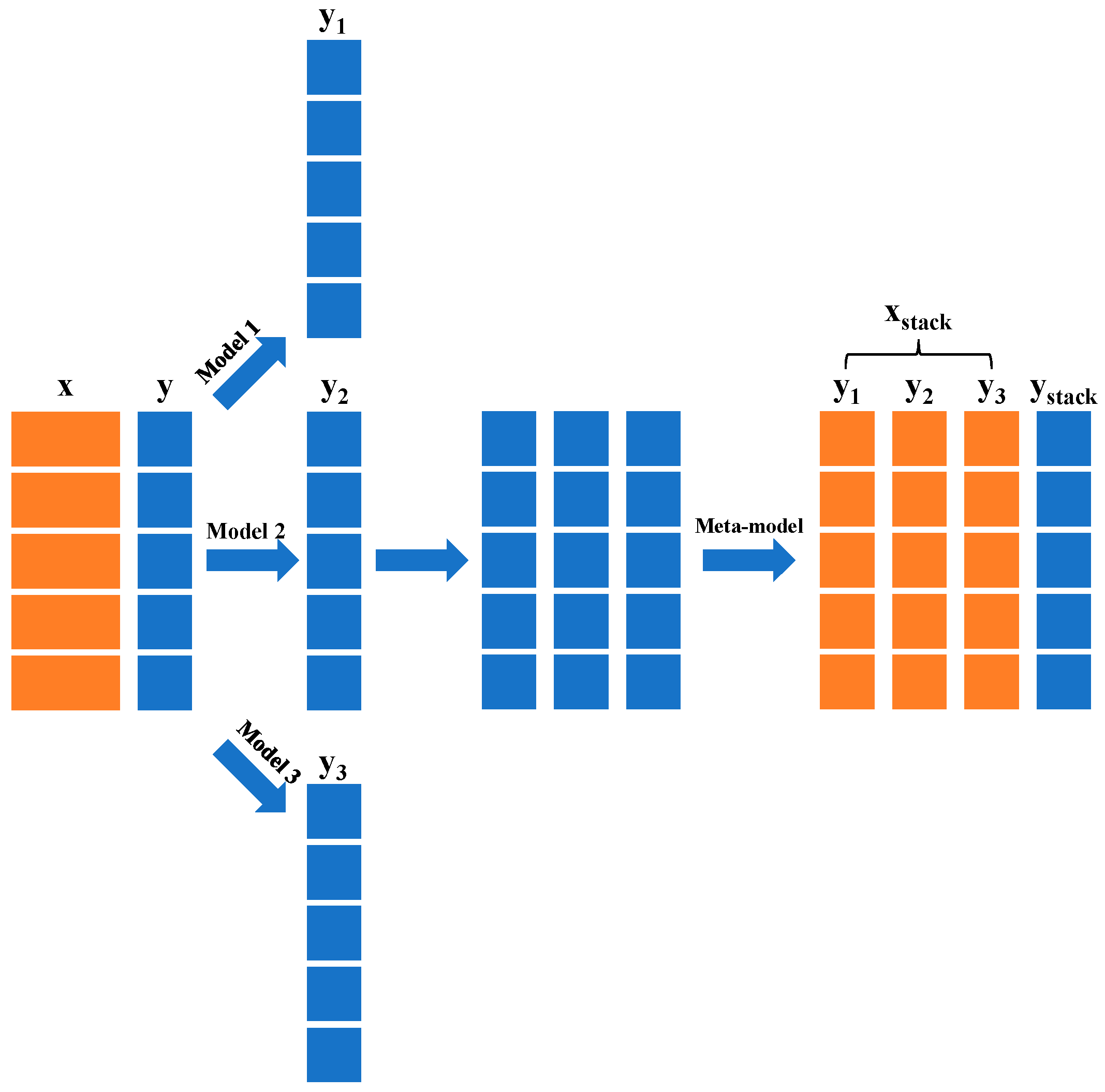
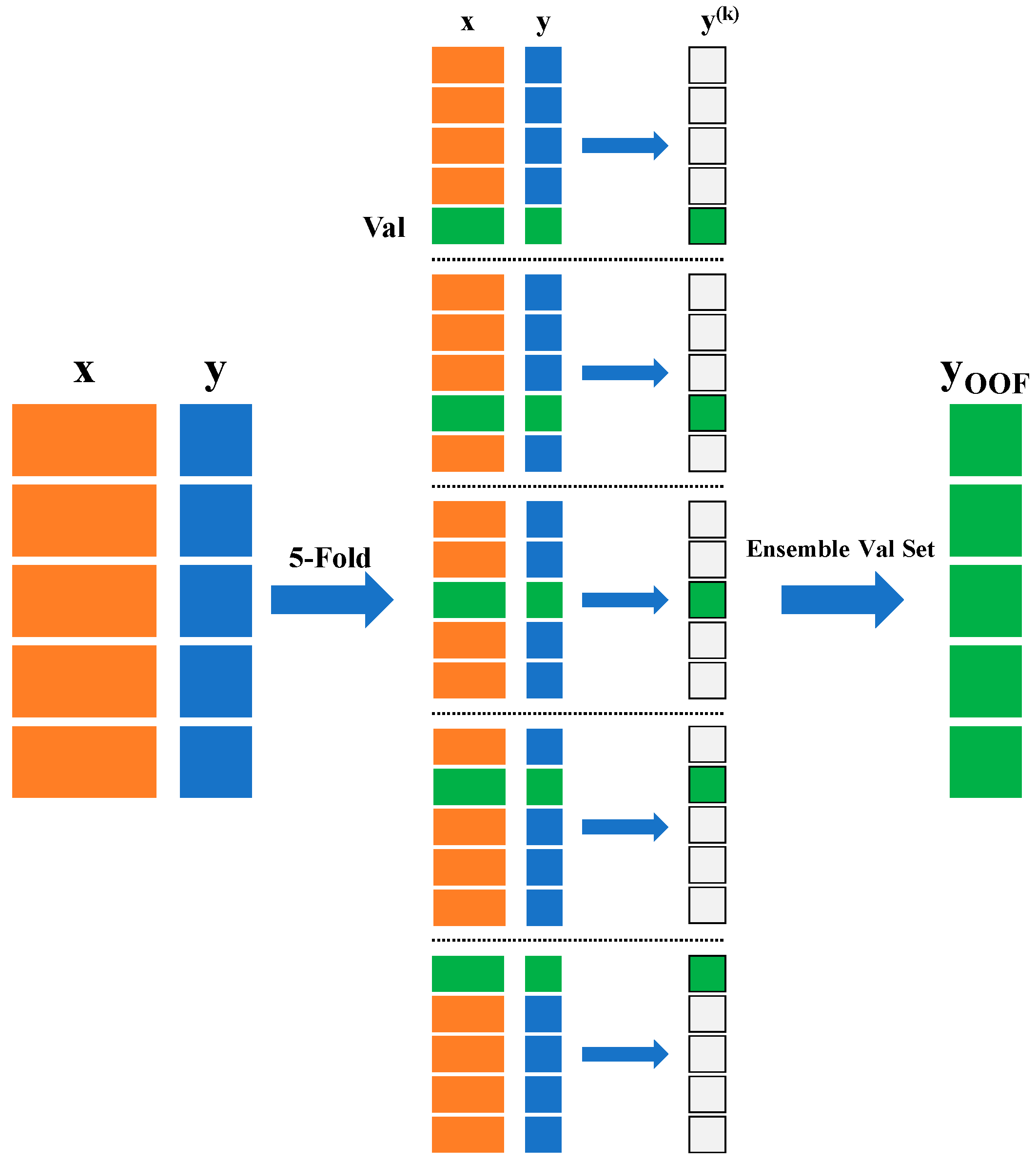
2.1. Stacking Ensemble Surrogate Modeling
2.2. Multi-Objective Optimization Algorithm (NSGA-II)
2.3. Diversity-Controlled Active Sampling in Decision Space
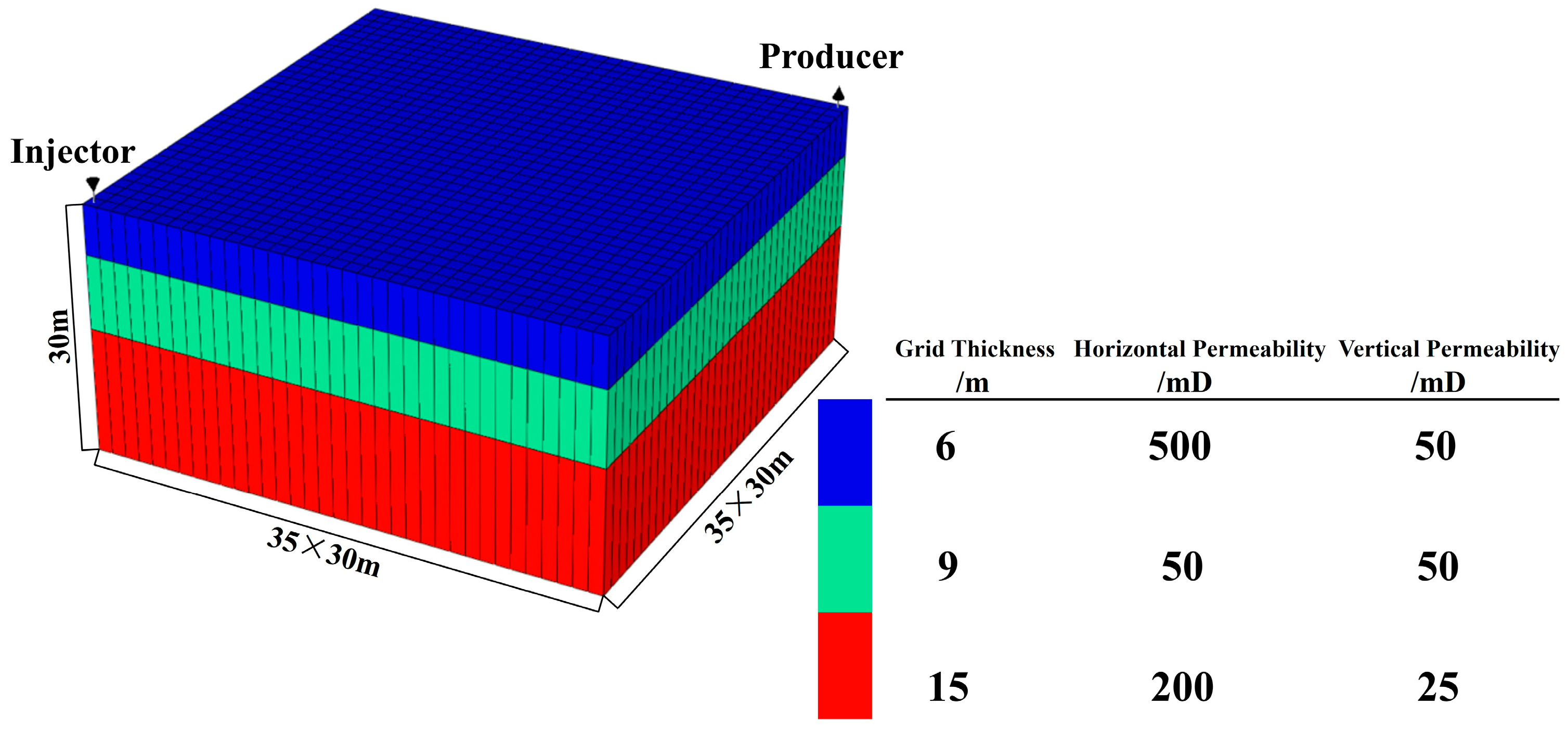
2.4. Experimental Design and Evaluation Metrics
3. Results and Discussion
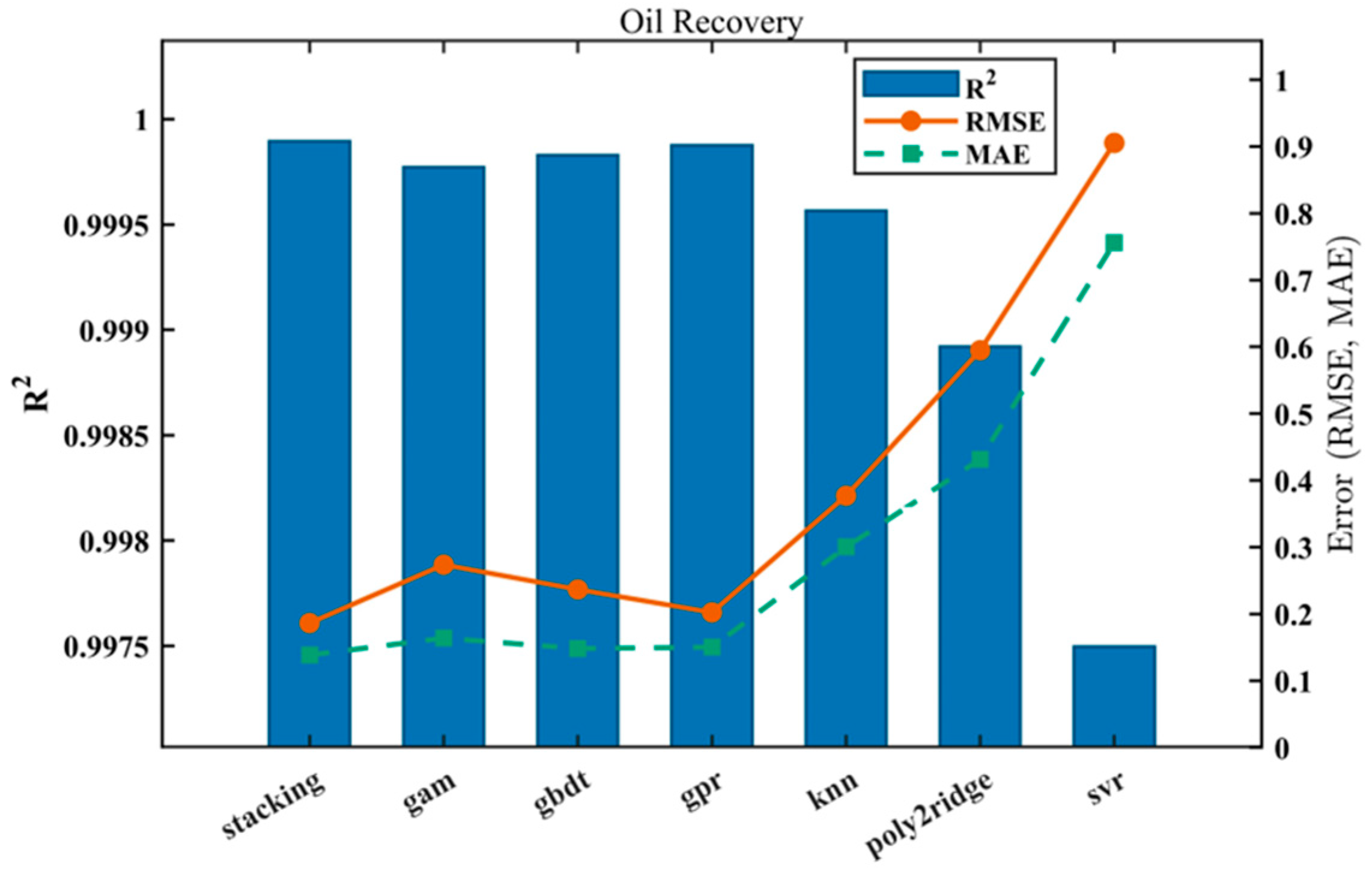
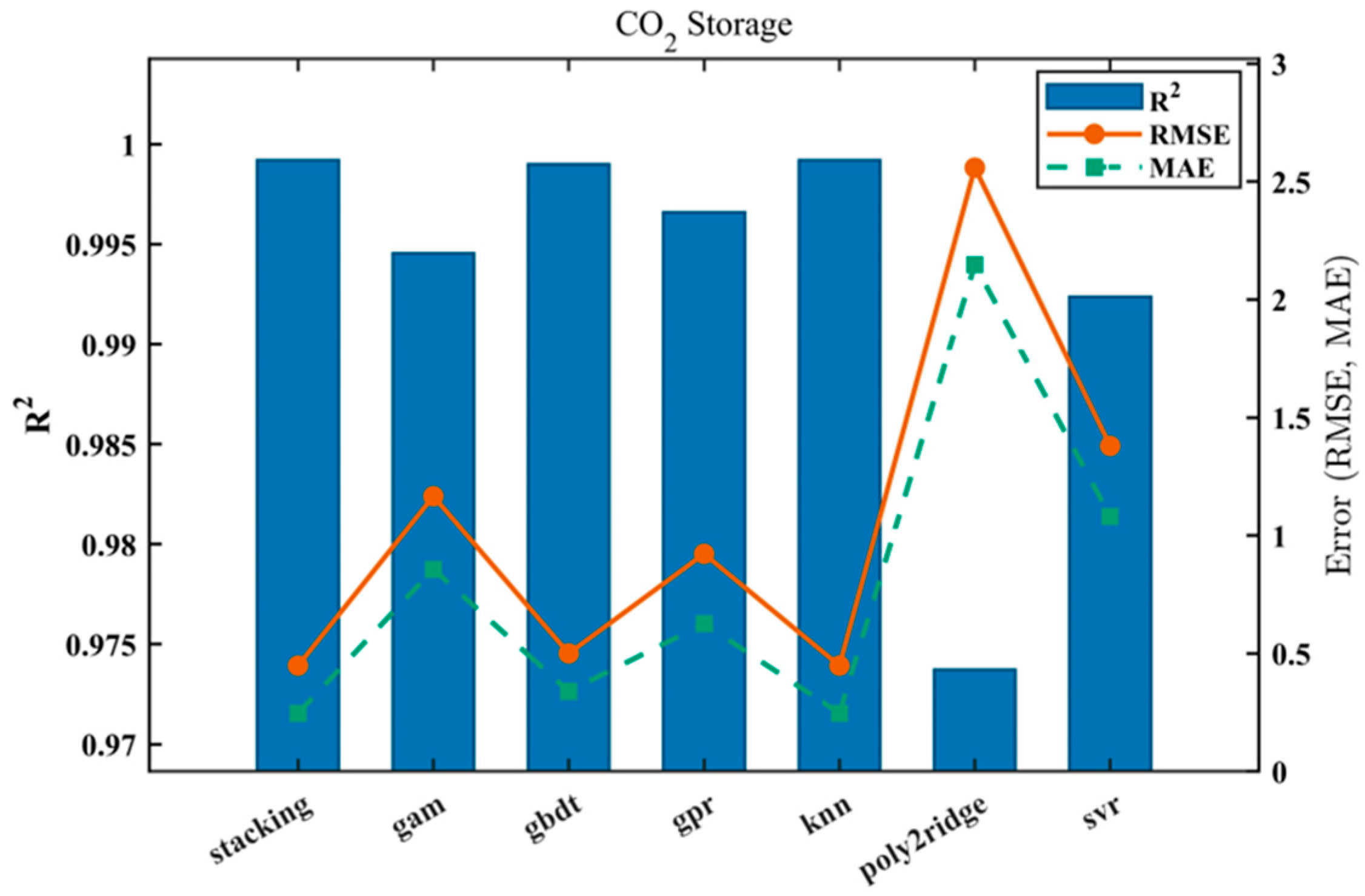
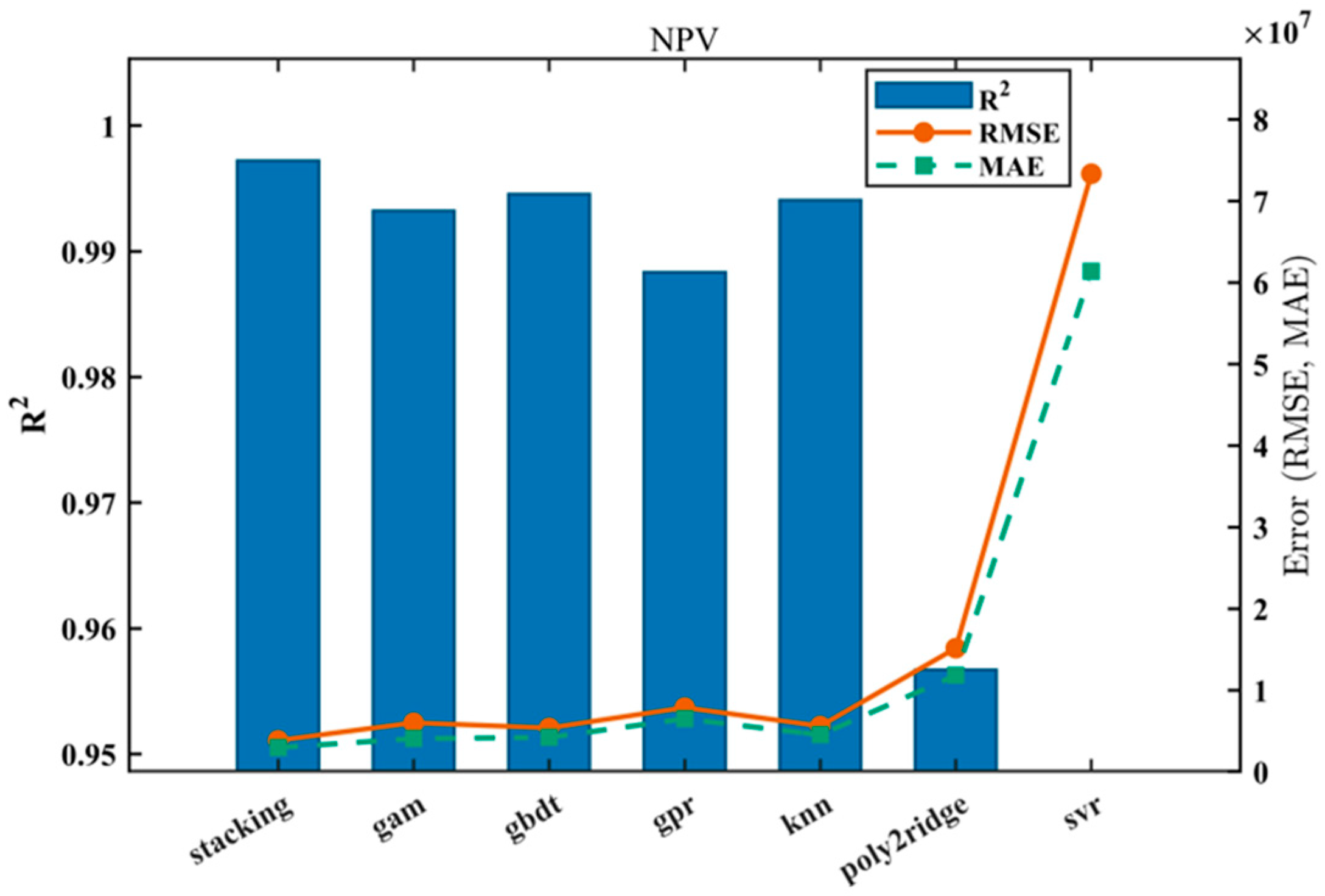
3.1. Comparison of Prediction Accuracy of the Surrogate Models
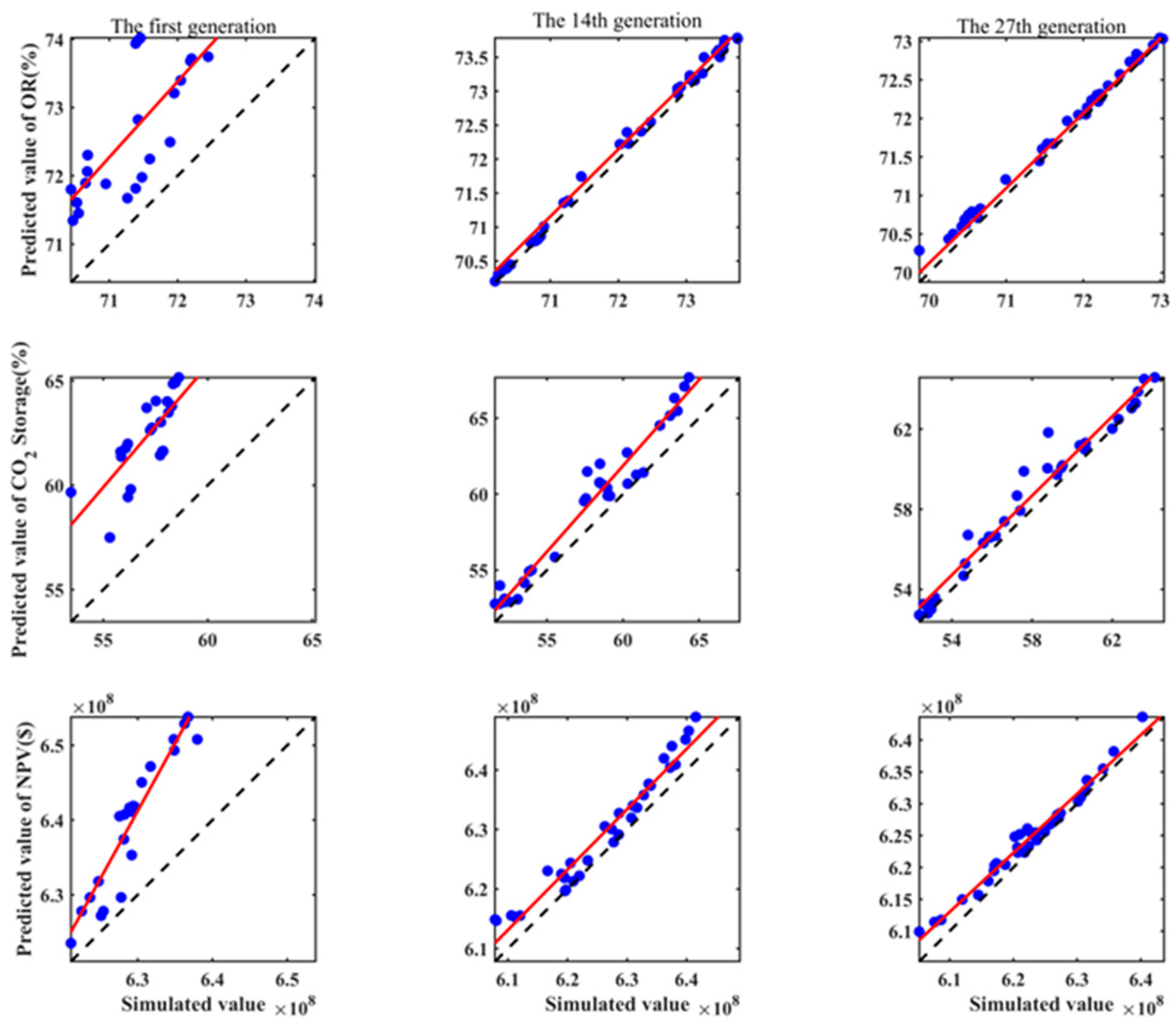
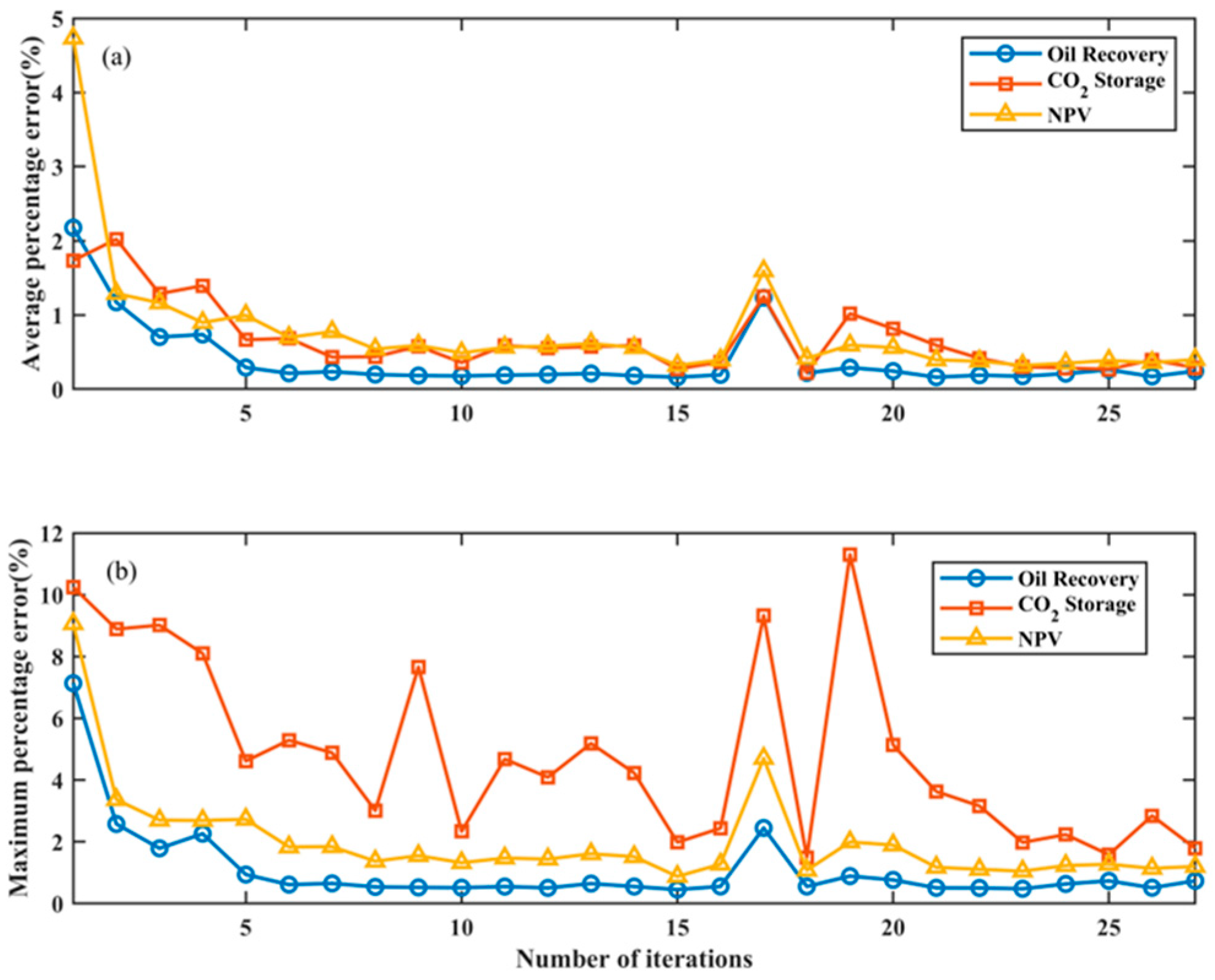
3.2. Optimization Convergence and Evolution of Model Error
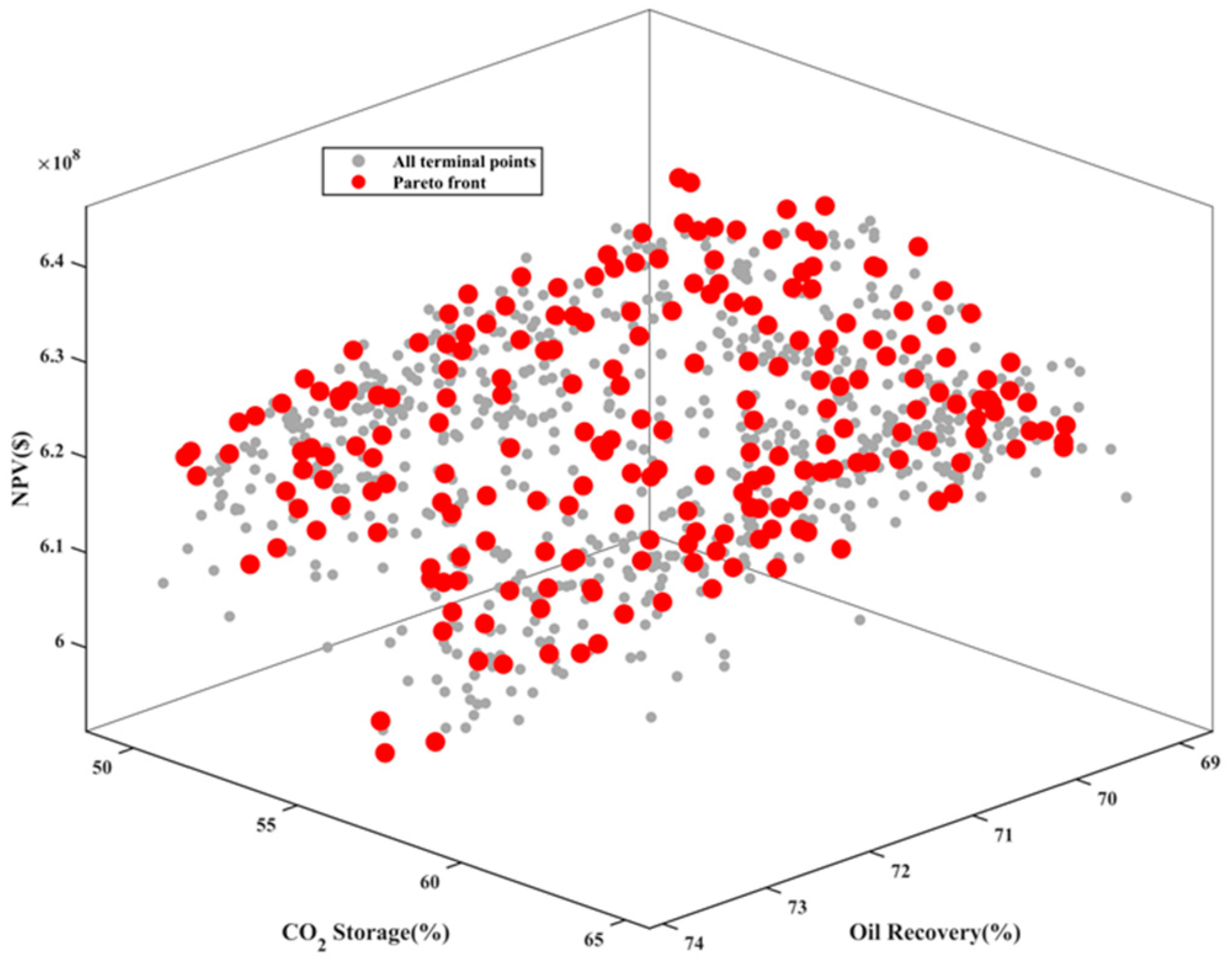
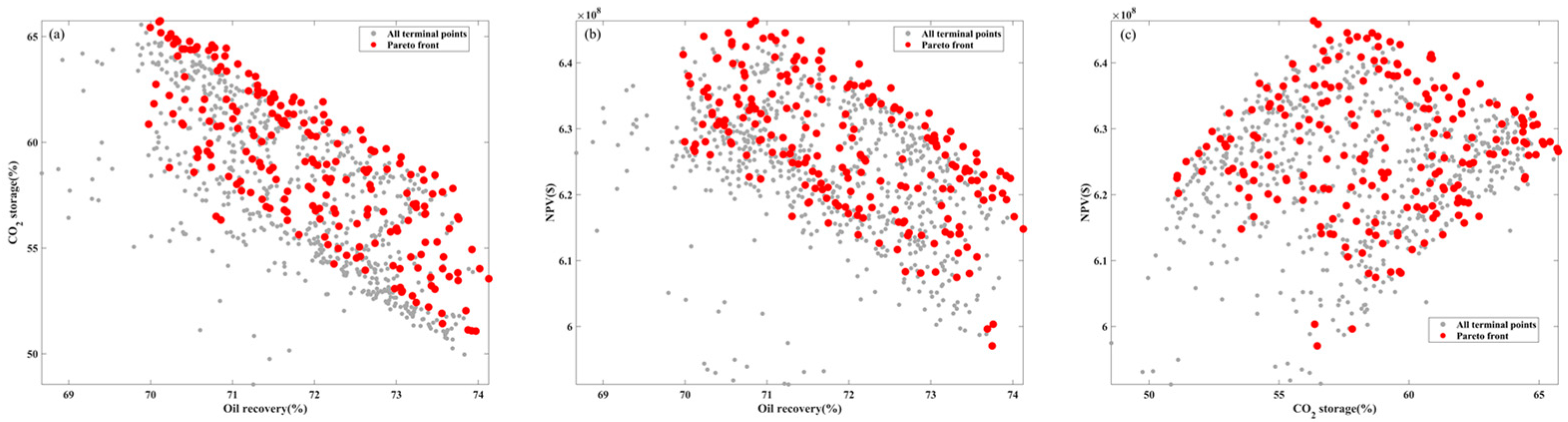
3.3. Pareto Solution Set and Multi-Objective Trade-Off Analysis
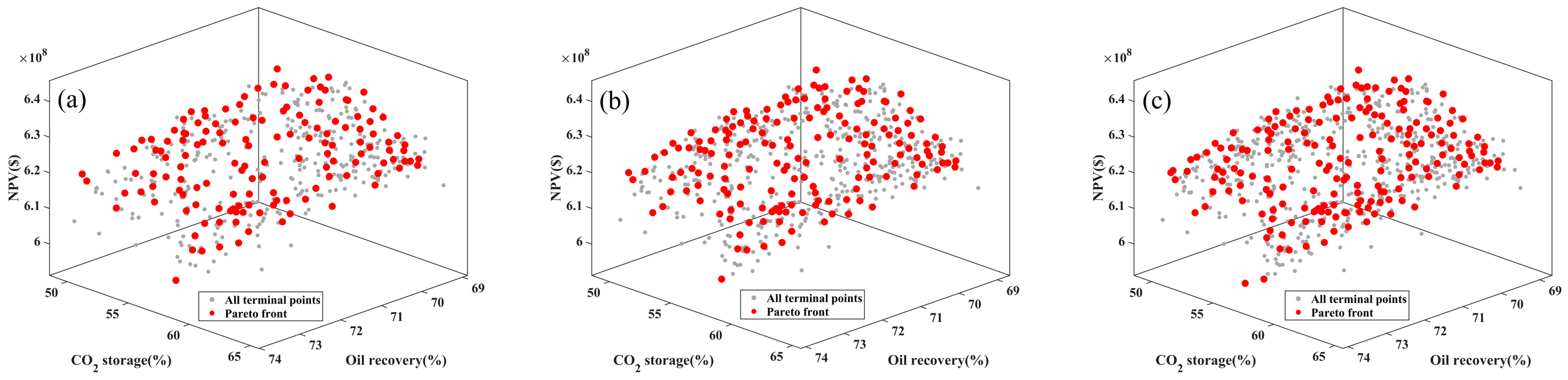
3.4. Validation of the Effectiveness of the DCAF Sampling Strategy
4. Conclusions
Author Contributions
Funding
Data Availability Statement
Conflicts of Interest
References
- Zhao, Z.-Y.; Yao, S.; Yang, S.-P.; Wang, X.-L. Under Goals of Carbon Peaking and Carbon Neutrality: Status, Problems, and Suggestions of CCUS in China. Environ. Sci. 2023, 44, 1128–1138. [Google Scholar]
- Yang, Y. Technology progress and development direction of carbon capture, oil-flooding and storage in China. Acta Perolei Sin. 2024, 45, 325–338. [Google Scholar]
- Wang, P.-T.; Wu, X.; Ge, G.; Wang, X.; Xu, M.; Wang, F.; Zhang, Y.; Wang, H.; Zheng, Y.J.S.; Transition, T.F.E. Evaluation of CO2 enhanced oil recovery and CO2 storage potential in oil reservoirs of petroliferous sedimentary basin, China. Sci. Technol. Energy Transit. (STET) 2023, 78, 3. [Google Scholar] [CrossRef]
- Middleton, R.S.; Levine, J.S.; Bielicki, J.M.; Viswanathan, H.S.; Carey, J.W.; Stauffer, P.H. Jumpstarting commercial-scale CO2 capture and storage with ethylene production and enhanced oil recovery in the US Gulf. Greenh. Gases Sci. Technol. 2015, 5, 241–253. [Google Scholar] [CrossRef]
- Kulkarni, M.M.; Rao, D.N. Experimental investigation of miscible and immiscible Water-Alternating-Gas (WAG) process performance. J. Pet. Sci. Eng. 2005, 48, 1–20. [Google Scholar] [CrossRef]
- Bocoum, A.O.; Rasaei, M.R. Multi-objective optimization of WAG injection using machine learning and data-driven Proxy models. Appl. Energy 2023, 349, 121593. [Google Scholar] [CrossRef]
- Ding, S.; Wen, F.; Wang, N.; Zhang, Y.; Lu, R.; Gao, Y.; Yu, H. Multi-objective optimization of CO2 enhanced oil recovery and storage processes in low permeability reservoirs. Int. J. Greenh. Gas Control 2022, 121, 103802. [Google Scholar] [CrossRef]
- Li, Y. Technical advancement and prospect for CO2 flooding enhanced oil recovery in low permeability reservoirs. Pet. Geol. Recovery Effic. 2020, 27, 1–10. [Google Scholar]
- Wu, G.; Zhao, Z.; Wu, B. CO2 flooding development models and economic benefit evaluation of dfferent types of reservoirs in subei basin. Pet. Reserv. Eval. Dev. 2021, 11, 864–870. [Google Scholar]
- Du, X.; Salasakar, S.; Thakur, G. A comprehensive summary of the application of machine learning techniques for CO2-enhanced oil recovery projects. Mach. Learn. Knowl. Extr. 2024, 6, 917–943. [Google Scholar] [CrossRef]
- Wang, L.; Yao, Y.; Luo, X.; Adenutsi, C.D.; Zhao, G.; Lai, F. A critical review on intelligent optimization algorithms and surrogate models for conventional and unconventional reservoir production optimization. Fuel 2023, 350, 128826. [Google Scholar] [CrossRef]
- Zhao, Y.; Luo, R.; Li, L.; Zhang, R.; Zhang, D.; Zhang, T.; Xie, Z.; Luo, S.; Zhang, L. A review on optimization algorithms and surrogate models for reservoir automatic history matching. Geoenergy Sci. Eng. 2024, 233, 212554. [Google Scholar] [CrossRef]
- Rostamian, A.; de Moraes, M.B.; Schiozer, D.J.; Coelho, G.P. A survey on multi-objective, model-based, oil and gas field development optimization: Current status and future directions. Pet. Sci. 2025, 22, 508–526. [Google Scholar] [CrossRef]
- Nguyen, Q.M.; Onur, M.; Alpak, F.O. Multi-objective optimization of subsurface CO2 capture, utilization, and storage using sequential quadratic programming with stochastic gradients. Comput. Geosci. 2024, 28, 195–210. [Google Scholar] [CrossRef]
- Fonseca, R.M.; Reynolds, A.C.; Jansen, J.D. Generation of a Pareto front for a bi-objective water flooding optimization problem using approximate ensemble gradients. J. Pet. Sci. Eng. 2016, 147, 249–260. [Google Scholar] [CrossRef]
- Fu, J.; Wen, X.-H. Model-based multiobjective optimization methods for efficient management of subsurface flow. SPE J. 2017, 22, 1984–1998. [Google Scholar] [CrossRef]
- Safarzadeh, M.A.; Motahhari, S.M. Co-optimization of carbon dioxide storage and enhanced oil recovery in oil reservoirs using a multi-objective genetic algorithm (NSGA-II). Pet. Sci. 2014, 11, 460–468. [Google Scholar] [CrossRef]
- Isebor, O.J.; Durlofsky, L.J. Biobjective optimization for general oil field development. J. Pet. Sci. Eng. 2014, 119, 123–138. [Google Scholar] [CrossRef]
- Kashkooli, S.B.; Gandomkar, A.; Riazi, M.; Tavallali, M.S. Coupled optimization of carbon dioxide sequestration and CO2 enhanced oil recovery. J. Pet. Sci. Eng. 2022, 208, 109257. [Google Scholar] [CrossRef]
- Liu, J.; Meng, F.; Zhao, H.; Xu, Y.; Wang, K.; Shi, C.; Chen, Z. Optimization of CO2 EOR and geological sequestration in high-water cut oil reservoirs. J. Pet. Explor. Prod. Technol. 2024, 14, 1491–1504. [Google Scholar] [CrossRef]
- Rodrigues, H.W.; Mackay, E.J.; Arnold, D.P. Multi-objective optimization of CO2 recycling operations for CCUS in pre-salt carbonate reservoirs. Int. J. Greenh. Gas Control 2022, 119, 103719. [Google Scholar] [CrossRef]
- Wang, L.; Zhang, L.; Deng, R.; Qu, J.; Wang, H.; Zhang, L.; Zhao, X.; Xu, B.; Lv, X.; Adenutsi, C.D. Active learning based surrogate ensemble assisted multi-objective optimization framework for reservoir water-flooding optimization. J. Pet. Explor. Prod. Technol. 2025, 15, 40. [Google Scholar] [CrossRef]
- You, J.; Ampomah, W.; Sun, Q. Development and application of a machine learning based multi-objective optimization workflow for CO2-EOR projects. Fuel 2020, 264, 116758. [Google Scholar] [CrossRef]
- Amar, M.N.; Zeraibi, N.; Jahanbani Ghahfarokhi, A.J. Applying hybrid support vector regression and genetic algorithm to water alternating CO2 gas EOR. Greenh. Gases: Sci. Technol. 2020, 10, 613–630. [Google Scholar] [CrossRef]
- Shahkarami, A.; Mohaghegh, S. Applications of smart proxies for subsurface modeling. Pet. Explor. Dev. 2020, 47, 372–382. [Google Scholar] [CrossRef]
- Wang, L.; Yao, Y.; Zhang, L.; Adenutsi, C.D.; Zhao, G.; Lai, F. An intelligent multi-fidelity surrogate-assisted multi-objective reservoir production optimization method based on transfer stacking. Comput. Geosci. 2022, 26, 1279–1295. [Google Scholar] [CrossRef]
- Jiang, S.; Durlofsky, L.J. Use of multifidelity training data and transfer learning for efficient construction of subsurface flow surrogate models. J. Comput. Phys. 2023, 474, 111800. [Google Scholar] [CrossRef]
- Kanaani, M.; Sedaghat Kameholiya, A.; Amarzadeh, A.; Sedaee, B. Stacking Learning for Smart Proxy Modeling in CO2–WAG Optimization: A Techno-Economic Approach to Sustainable Enhanced Oil Recovery. ACS Omega 2025, 10, 9563–9582. [Google Scholar] [CrossRef]
- Wang, L.; Deng, R.; Zhang, L.; Qu, J.; Wang, H.; Zhang, L.; Zhao, X.; Xu, B.; Lv, X.; Adenutsi, C.D. A Novel Surrogate-Assisted Multi-Objective Well Control Parameter Optimization Method Based on Selective Ensembles. Processes 2024, 12, 2140. [Google Scholar] [CrossRef]
- Salehian, M.; Sefat, M.H.; Muradov, K. Multi-solution well placement optimization using ensemble learning of surrogate models. J. Pet. Sci. Eng. 2022, 210, 110076. [Google Scholar] [CrossRef]
- Zhuang, X.-Y.; Wang, W.-D.; Su, Y.-L.; Dai, Z.-X.; Yan, B.-C. Deep learning-assisted optimization for enhanced oil recovery and CO2 sequestration considering gas channeling constraints. Pet. Sci. 2025, 22, 3397–3417. [Google Scholar] [CrossRef]
- Tang, H.; Durlofsky, L.J. Graph network surrogate model for optimizing the placement of horizontal injection wells for CO2 storage. Int. J. Greenh. Gas Control 2025, 145, 104404. [Google Scholar] [CrossRef]
- Kazemi, A.; Esmaeili, M. Reservoir Surrogate Modeling Using U-Net with Vision Transformer and Time Embedding. Processes 2025, 13, 958. [Google Scholar] [CrossRef]
- Borisut, P.; Nuchitprasittichai, A. Adaptive Latin hypercube sampling for a surrogate-based optimization with artificial neural network. Processes 2023, 11, 3232. [Google Scholar] [CrossRef]
- Yu, J.; Jafarpour, B. Active learning for well control optimization with surrogate models. SPE J. 2022, 27, 2668–2688. [Google Scholar] [CrossRef]
- Lye, K.O.; Mishra, S.; Ray, D.; Chandrashekar, P. Iterative surrogate model optimization (ISMO): An active learning algorithm for PDE constrained optimization with deep neural networks. Comput. Methods Appl. Mech. Eng. 2021, 374, 113575. [Google Scholar] [CrossRef]
- Li, Z.-L.; Peng, S.-S.; Wang, T. A surrogate-based optimization design method based on hybrid infill sampling criterion. Eng. Mech. 2022, 39, 27–33. [Google Scholar]
- Wang, X.; van’t Veld, K.; Marcy, P.; Huzurbazar, S.; Alvarado, V. Economic co-optimization of oil recovery and CO2 sequestration. Appl. Energy 2018, 222, 132–147. [Google Scholar] [CrossRef]
- Gao, M.; Liu, Z.; Qian, S.; Liu, W.; Li, W.; Yin, H.; Cao, J. Machine-learning-based approach to optimize CO2-WAG flooding in low permeability oil reservoirs. Energies 2023, 16, 6149. [Google Scholar] [CrossRef]
- Yang, R.-F.; Zhang, W.; Liu, S.-C.; Yuan, B.; Wang, W.-D. Multi-objective optimization workflow for CO2 water-alternating-gas injection assisted by single-objective pre-search. Pet. Sci. 2025, 22, 2967–2976. [Google Scholar] [CrossRef]
- Wolpert, D.H. Stacked generalization. Neural Netw. 1992, 5, 241–259. [Google Scholar] [CrossRef]
- Barton, M.; Lennox, B. Model stacking to improve prediction and variable importance robustness for soft sensor development. Digit. Chem. Eng. 2022, 3, 100034. [Google Scholar] [CrossRef]
- Karpatne, A.; Atluri, G.; Faghmous, J.H.; Steinbach, M.; Banerjee, A.; Ganguly, A.; Shekhar, S.; Samatova, N.; Kumar, V. Theory-guided data science: A new paradigm for scientific discovery from data. IEEE Trans. Knowl. Data Eng. 2017, 29, 2318–2331. [Google Scholar] [CrossRef]
- Deb, K.; Pratap, A.; Agarwal, S.; Meyarivan, T. A fast and elitist multiobjective genetic algorithm: NSGA-II. IEEE Trans. Evol. Comput. 2002, 6, 182–197. [Google Scholar] [CrossRef]
- Zhou, J.; Wang, H.; Xiao, C.; Zhang, S. Hierarchical surrogate-assisted evolutionary algorithm for integrated multi-objective optimization of well placement and hydraulic fracture parameters in unconventional shale gas reservoir. Energies 2022, 16, 303. [Google Scholar] [CrossRef]
- Li, H.; Xu, Z.; Wei, W. Bi-objective scheduling optimization for discrete time/cost trade-off in projects. Sustainability 2018, 10, 2802. [Google Scholar] [CrossRef]
- Wang, Q.; Wang, L.; Huang, W.; Wang, Z.; Liu, S.; Savić, D.A. Parameterization of NSGA-II for the optimal design of water distribution systems. Water 2019, 11, 971. [Google Scholar] [CrossRef]
- Killough, J.; Kossack, C. Fifth comparative solution project: Evaluation of miscible flood simulators. In Proceedings of the SPE Reservoir Simulation Conference, San Antonio, TX, USA, 1–4 February 1987; p. SPE–16000–MS. [Google Scholar]
- Sandve, T.H.; Sævareid, O.; Aavatsmark, I. Dynamic PVT model for CO2-EOR black-oil simulations. Comput. Geosci. 2022, 26, 1029–1043. [Google Scholar] [CrossRef]
- Ampomah, W.; Balch, R.; Cather, M.; Will, R.; Gunda, D.; Dai, Z.; Soltanian, M. Optimum design of CO2 storage and oil recovery under geological uncertainty. Appl. Energy 2017, 195, 80–92. [Google Scholar] [CrossRef]



| Approach Family | Typical Workflow | Pros | Limits/Gaps | Best for |
|---|---|---|---|---|
| Full-physics, model-based opt. | Full-physics, model-based opt. | Full-physics, model-based opt. | Full-physics, model-based opt. | Full-physics, model-based opt. |
| Direct sim-based MOEA | NSGA-II/MOPSO evaluates simulator per candidate | Handles nonconvexity; diverse Pareto set | Very high eval budget (esp. 3D) | Benchmarks/big compute |
| Static SA-MOEA (single surrogate) | Offline DOE → train 1 proxy → MOEA on proxy | Large speed-up | Proxy drift near opt.; OOD errors; false Pareto risk | Early screening/simple cases |
| Ensemble/MF SA-MOEA | Multi-proxy or MF (stack/select/transfer) + MOEA | More robust; better bias–variance | Still coverage-limited; ensemble diversity often not explicit | Strong nonlinearity; multi-output objs |
| Closed-loop surrogate + AL | Proxy opt. → infill → simulate → update | Data-efficient; accuracy near Pareto | Infill clustering; weak decision-space coverage | Tight sim budgets/expensive sims |
| Techno-economic/low-carbon tri-obj. | Joint: recovery–storage–NPV/(emissions) | Decision-relevant; avoids uneconomic “optima” | Econ uncertainty; often simplified/post hoc | Field planning/CCUS investments |
| Parameter | Numerical Value | Unit |
|---|---|---|
| Reservoir area | 1.1 | km2 |
| Reservoir depth | 2540 | m |
| Reservoir thickness | (6, 9, 15) | m |
| Reservoir temperature | 72 | °C |
| Original formation pressure | 27.5 | MPa |
| Average porosity | 30 | % |
| Horizontal permeability | (500, 50, 200) | mD |
| Vertical permeability | (50, 50, 25) | mD |
| Rock compressibility | 7.25 × 10⁻³ | MPa−1 |
| The compressibility of water | 4.8 × 10⁻³ | MPa−1 |
| Initial water saturation | 20 | % |
| Number of grids | 35 × 35 × 3 | / |
| Grid size | 30 × 30 | m |
| Composition | Reservoir Fluid Mole Fraction (%) | Injected Gas Mole Fraction (%) |
|---|---|---|
| CO2 | 0 | 100 |
| C1 | 50 | 0 |
| C3 | 3 | 0 |
| C6 | 7 | 0 |
| C10 | 20 | 0 |
| C15 | 15 | 0 |
| C20 | 5 | 0 |
| Parameter | Unit | Minimum Value | Median Value | Maximum Value |
|---|---|---|---|---|
| Water injection rate | STB/D | 4000 | 12,000 | 20,000 |
| Gas injection rate | MCF/D | 12,000 | 16,000 | 20,000 |
| WAG half-cycle | day | 60 | 210 | 360 |
| WAG duration | year | 4 | 6 | 8 |
| Sampling Strategy | Sampling Quantity | Average Error of ORF (%) | Average Error of CSR (%) | Average Error of NPV (%) |
|---|---|---|---|---|
| baseline | 945 | 0.395 | 2.90 | 0.691 |
| distance-loss thresholds β = 5% | 698 | 0.317 | 2.69 | 0.675 |
| distance-loss thresholds β = 10% | 599 | 0.347 | 2.84 | 0.692 |
| distance-loss thresholds β = 20% | 461 | 0.323 | 2.98 | 0.689 |
Disclaimer/Publisher’s Note: The statements, opinions and data contained in all publications are solely those of the individual author(s) and contributor(s) and not of MDPI and/or the editor(s). MDPI and/or the editor(s) disclaim responsibility for any injury to people or property resulting from any ideas, methods, instructions or products referred to in the content. |
© 2025 by the authors. Licensee MDPI, Basel, Switzerland. This article is an open access article distributed under the terms and conditions of the Creative Commons Attribution (CC BY) license (https://creativecommons.org/licenses/by/4.0/).
Share and Cite
Zhu, Y.; Li, H.; Zheng, Y.; Li, C.; Guo, C.; Wang, X. Ensemble Surrogates and NSGA-II with Active Learning for Multi-Objective Optimization of WAG Injection in CO2-EOR. Energies 2025, 18, 6575. https://doi.org/10.3390/en18246575
Zhu Y, Li H, Zheng Y, Li C, Guo C, Wang X. Ensemble Surrogates and NSGA-II with Active Learning for Multi-Objective Optimization of WAG Injection in CO2-EOR. Energies. 2025; 18(24):6575. https://doi.org/10.3390/en18246575
Chicago/Turabian StyleZhu, Yutong, Hao Li, Yan Zheng, Cai Li, Chaobin Guo, and Xinwen Wang. 2025. "Ensemble Surrogates and NSGA-II with Active Learning for Multi-Objective Optimization of WAG Injection in CO2-EOR" Energies 18, no. 24: 6575. https://doi.org/10.3390/en18246575
APA StyleZhu, Y., Li, H., Zheng, Y., Li, C., Guo, C., & Wang, X. (2025). Ensemble Surrogates and NSGA-II with Active Learning for Multi-Objective Optimization of WAG Injection in CO2-EOR. Energies, 18(24), 6575. https://doi.org/10.3390/en18246575