Perspective

A Perspective on Hydrogen Storage in the Energetic Transition Scenario

by
Mattia Bartoli
1,2,3,*,
Candido Fabrizio Pirri
1,3 and
Sergio Bocchini
1,2,3
1
Center for Sustainable Future Technologies—CSFT@POLITO, Via Livorno 60, 10144 Turin, Italy
2
Consorzio Interuniversitario Nazionale per la Scienza e Tecnologia dei Materiali (INSTM), Via G. Giusti 9, 50121 Florence, Italy
3
Materials and Processes for Micro and Nano Technologies Research Group (MP4MNT), Department of Applied Science and Technology, Politecnico di Torino, C.so Duca degli Abruzzi 24, 10129 Turin, Italy
*
Author to whom correspondence should be addressed.
Energies 2025, 18(24), 6564; https://doi.org/10.3390/en18246564
Submission received: 17 November 2025 / Revised: 9 December 2025 / Accepted: 11 December 2025 / Published: 16 December 2025
(This article belongs to the Section A5: Hydrogen Energy)

Abstract

Hydrogen is key player in the energetic transition towards a more sustainable society as a very versatile energy carrier. Nevertheless, hydrogen storage represents the main limitation to the spread of a hydrogen driven economy on a small and medium scale. Clearly, achieving this requires a balance among material engineering, system optimization, and techno-economic assessments to optimize performance, safety, and scalability. In this work we briefly and critically discuss the progress in hydrogen storage focusing on the necessity to create a bridge to overcome the actual limitations. We explore the most recent advancement in the field drawing a picture of the complex scenario of hydrogen storage in the framework to the transition to a net zero or carbon negative society providing an updated opinion on the challenges addressed and those still to be solved.

1. Introduction

Energy is the cornerstone of mankind’s daily life; it grants the operativity and integrity of a wide range of productive ecosystems and infrastructures. Access to clean and sustainable energetic resources is a strategic security issue for the European Union (EU) and is one that must be faced to fulfil the ambition of realizing the Green Deal in Europe. As if this challenge were not enough, the COVID-19 pandemic and war crisis in eastern Europe revealed how quickly and profoundly the supply chains of the world can be disrupted, affecting the energetic transition. The European Commission (EC) has faced this new world scenario by proposing an ambitious COVID-19 recovery plan to increase resilience and open strategic autonomy, by fostering the transition towards a digital and green economical model. Nonetheless, energy resources are an increasingly scarce commodity, which is having a growing impact on the quality and health of the environment. In order to mitigate this process, the EU has developed the ambitious challenge of achieving the total abandonment of fossil fuels. The new industrial European strategy focuses on strengthening energetic autonomy in Europe, replacing the current dependence on fossil fuels with a carbon neutral or carbon negative energetic supply chain [1]. This ambitious project envisages a transition period, during which various environmentally friendly energy sources will lead the change in the current energetic paradigm. In this context, hydrogen will play a key role considering its possible production from fully renewable sources [2]. The transition toward a hydrogen based energy system is increasingly framed by the challenges of economics, legislation, and cost-effectiveness [3]. Despite rapid technological progress, hydrogen remains significantly more expensive than conventional fossil-derived alternatives when production, storage, distribution, and end-use technologies are considered as a whole field [4,5]. This cost gap persists largely due to regulatory frameworks and market mechanisms that are not yet fully aligned with long-term hydrogen strategic value. In many jurisdictions, legislation still lacks clear definitions, robust certification schemes for low-carbon hydrogen and coherent incentives to mitigate investment risks for producers, distributors, and consumers. As a result, uncertainty in policy direction slows capital flows and limits economies of scale, which are essential for driving down costs [6].
The safety issues surrounding and the perception of hydrogen are other key issues that slowed down its use on a daily life base. Furthermore, a technology gap overview shows clear performance deficits across existing hydrogen storage systems with unbalanced performances between gravimetric and volumetric hydrogen storage effectiveness as reported by the U.S. Department of Energy in a recent report [7]. As mentioned, the critical issue in hydrogen storage for mobility remained the autonomy of at least 350 km before refuelling, meaning at least up to 6 wt.% of hydrogen gravimetric efficiency and at least 0.045 kg/L for a tank. Additionally, an operation temperature between −30 and 80 °C is required together with a durability up to 1000 cycles. Storage technologies cannot match all these specifications at the same time with several routes; take for example, compressed hydrogen that failed in gravimetric capacity while physiosorbed and chemical storage that failed in cyclability. The critical point is that tanks show limitations that can be overcome easily and material-oriented approaches show room for improvement.
From this perspective, we discuss hydrogen storage issues; in particular, we highlight one aspect as one of the more critical issues—the spread of hydrogen as an energetic vector. We briefly present the picture of hydrogen production and the key features of each technology for hydrogen storage, providing a critical point of view about each one.

2. The Colours of Hydrogen: Production and Sustainability

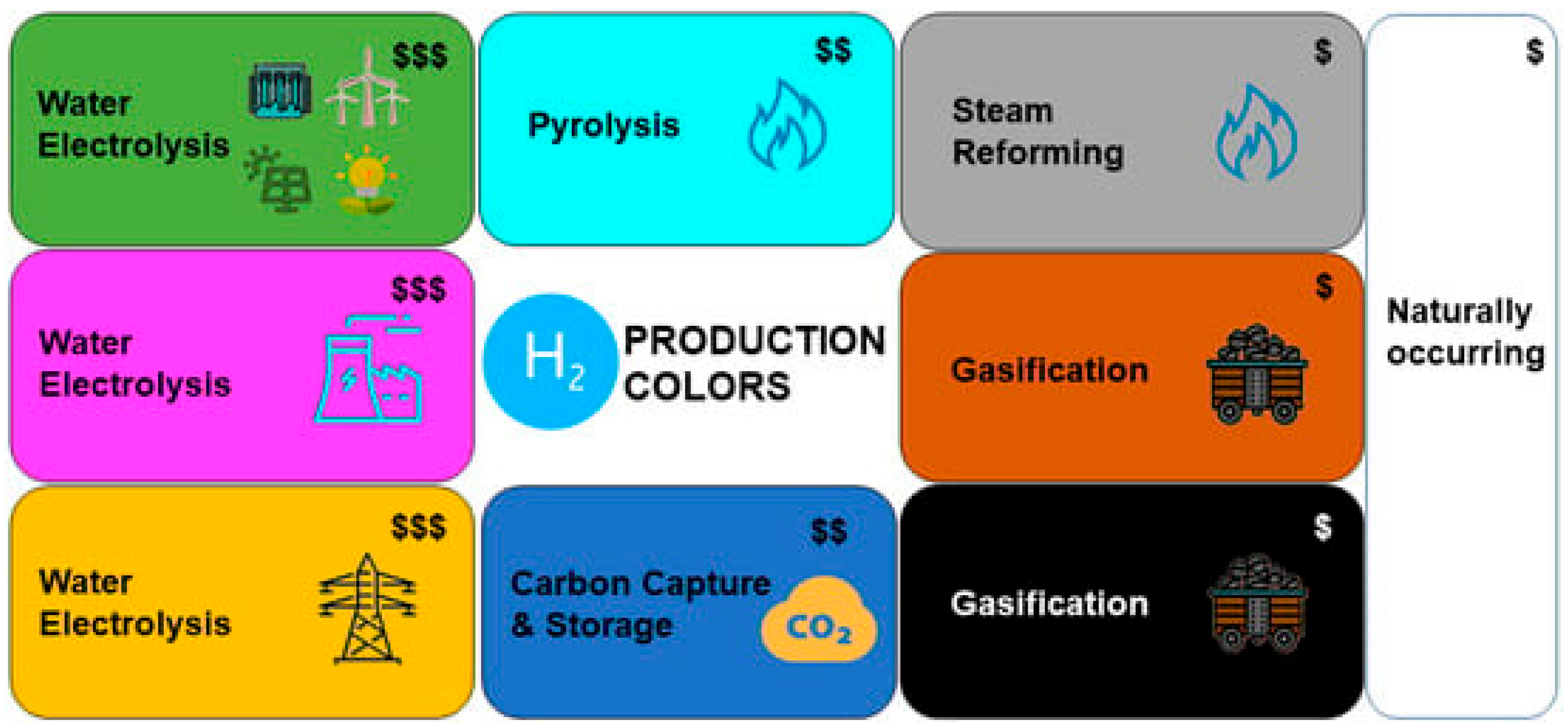
A fully hydrogen-based economy is a multicomponent sector which starts from hydrogen production. To achieve a non-impacting energy system by 2050, it is of capital importance to ensure a nearly zero carbon emission route for hydrogen production. Based on the source used for its production, hydrogen is classified by colour codes (grey, brown, black, turquois, white, purple, yellow and green and blue) as shown in Figure 1.
Even if a classification is required, we believe that a naïve approach can mislead those who are approaching the field, making it hard to distinguish black from grey and yellow from green. So, let us make some brief clarifications about this.
White hydrogen represents the hydrogen that naturally occurs in soil deposits and that is released through fracking, but no strategies have been deployed yet for its profitable utilization [9].
Grey hydrogen is already produced in large quantities from fossil fuel resources using steam methane reforming, autothermal reforming of natural gas, and by partial oxidation of heavy oil [10]. Brown and black hydrogen are less environmentally friendly and they are produced through the gasification of coal [11]. On an industrial scale, grey, brown, and black hydrogen production has been long established, and its further expansion is not affected by any technological limitation, except for the limitations of fossil fuels.
Nevertheless, grey, brown, and black hydrogen production involves the release of a large amount of carbon dioxide as by-product; it is generally vented directly into the atmosphere and significantly contributes to global warming. Alternatively, steam reforming can be replaced by pyrolysis which produces turquoise hydrogen [12]. Blue hydrogen is the hydrogen that shows a negative carbon footprint which is achieved by capturing and converting the greenhouse gases emitted during its production, such as methane and carbon dioxide, using other integrated multifunctional processes [13]. Accordingly, blue hydrogen is defined based on the platforms in which it is integrated and not only by considering the energy source and raw materials used for its production. Blue hydrogen is the most ineffable one and it is the only carbon negative hydrogen. The production of hydrogen represents a critical sector that has reached considerable achievements that have gained solidity and trustworthiness in front of both academic and private players [14].
Green hydrogen represents the more solid alternative to the highly environmentally impactful ones [15,16]. Green hydrogen is also known as renewable hydrogen, and it is produced using electrolysers fed with renewable electricity. These productive strategies ensure near-zero greenhouse gas emissions and represent the most mature hydrogen production technologies useful for guiding the energy transition. Also in this case, the energy source matter and the use of the electric grid reduced the positive impact of production leading to yellow hydrogen while the coupling with nuclear plant led to purple one [8].
Cost competitiveness between the types of hydrogen is highly related to when and where they are produced. Key factors (e.g., feedstock, natural gas price, electricity price, capital expenditure of electrolyser and CO2 capture, and storage cost) must be simultaneously considered for a rational and balanced choice. Nevertheless, we believe, in accordance with the latest report of International Energy Agency, that single point hydrogen prices are misleading and a geographical insight on the economical conditions must be enforced [17]. Nevertheless, we agree that the cost of black and grey hydrogen is still the most affordable (ranging around 1.0–1.5 $/kg) while the green will run up higher costs of up to 3 $/kg [18] with similar costs for purple hydrogen [19]. We should point out that blue hydrogen represents an exception due to the definition that is related not to the production route but to the platform and CO2 emissions policies [20]. In this specific case, we assume that the cost of around 1.5–4 $/kg can be balanced by the CO2 capture marketplace [21,22] and by the reputational cost associated with the decarbonization commitment, at least for small and medium enterprises [23,24].
It is clear that the emerging hydrogen economy has been challenging from its start but it can be worse, still, when it comes to storage and distribution.

3. Hydrogen Drawback: Security and Storage Issues and Technologies

Nowadays, hydrogen distribution into energetic grids and its storage are critical issues that need to be solved. The production of hydrogen has been the subject of intense research efforts aimed at improving the efficiency of production systems, reaching significant advances in the field of water electrolysers and both blue and green hydrogen generation. On the contrary, hydrogen storage remains the great unsolved issue in this field. After the hydrogen gas is transmitted through pipelines, the need exists for its bulk storage in local distribution centres, with different specific requirements. Commonly, large volumes of hydrogen are stored as liquid hydrogen in expensive insulated vessels—that can undergo product losses due to evaporation—this, therefore, causes limitations for applications that requires large volumes of pure gas such as chemical, steel, and aerospace industries. At thermodynamical standard conditions, hydrogen is a colourless and odourless gas, that is lighter than air and is able to form combustible and explosive mixtures with air in a wide range of concentrations with a high diffusivity through several metal alloys. This represents the first limitation that the automotive sector has faced during the development of hydrogen-based vehicles, as hydrogen us induces embrittlement and crack formation with leaks [25]. Hydrogen release represents a serious hazard due to its violent reactivity with oxidizing agents. The other issue in storing hydrogen for energetic application is related to its energy content. Hydrogen energy content per kg reaches 120 MJ compared to only 43.5 MJ for common petrol and 50 MJ for methane but under standard temperature and pressure conditions, hydrogen energy content is comparable to that of methane and is four orders of magnitude lower than liquid fuels. Accordingly, the combination of these issues drastically limits the use of hydrogen technologies in mobility, preventing major automotive manufacturers from marketing vehicles based on technologies which are using hydrogen as a fuel, due to their safety limitations [26]. However, as reported by Meng et al. [27], the durability of the systems such as direct hydrogen fuel cell can be modelled, evaluated, and used as solid bases for the design of vehicles. Various approaches, based on systems in which hydrogen is simply physisorbed or chemically bonded, have been studied trying to overcome these limitations.
Additionally, hydrogen storage safety is a cornerstone of modern hydrogen energy deployment in urban environments [28]. Hydrogen storage can involve several technologies (e.g., gas tanks, liquefied hydrogen, physiosorbed or chemical bonded species) and the implementation of regulatory frameworks, through systematic hazard identification tools such as Hazard and Operability Study (HAZOP) based on National Fire Protection Association criteria (NFPA 2), is mandatory as reported by Mohammadfam et al. [29]. The production of reference protocols is a key step due to the risk associated with hydrogen release in enclosed spaces that can rapidly create conditions for flash fires or explosions. The landscape of such protocols should face both indoor and outdoor scenarios trying to provide the highest safety guarantees in complex scenarios considering ventilation, ignition sources, mobility, close activity, and the volume of hydrogen that is stored [30,31]. Accordingly, HAZOP findings can provide key information for driving refinements of NFPA 2 together with quantitative risk assessment [32]. Nonetheless, we believe that the real risk represents only one part of the issue and that the perception of hydrogen as a risky material should also be mitigated through dedicated and informative campaigns [33].

4. The Realm of Hydrogen Storage Systems

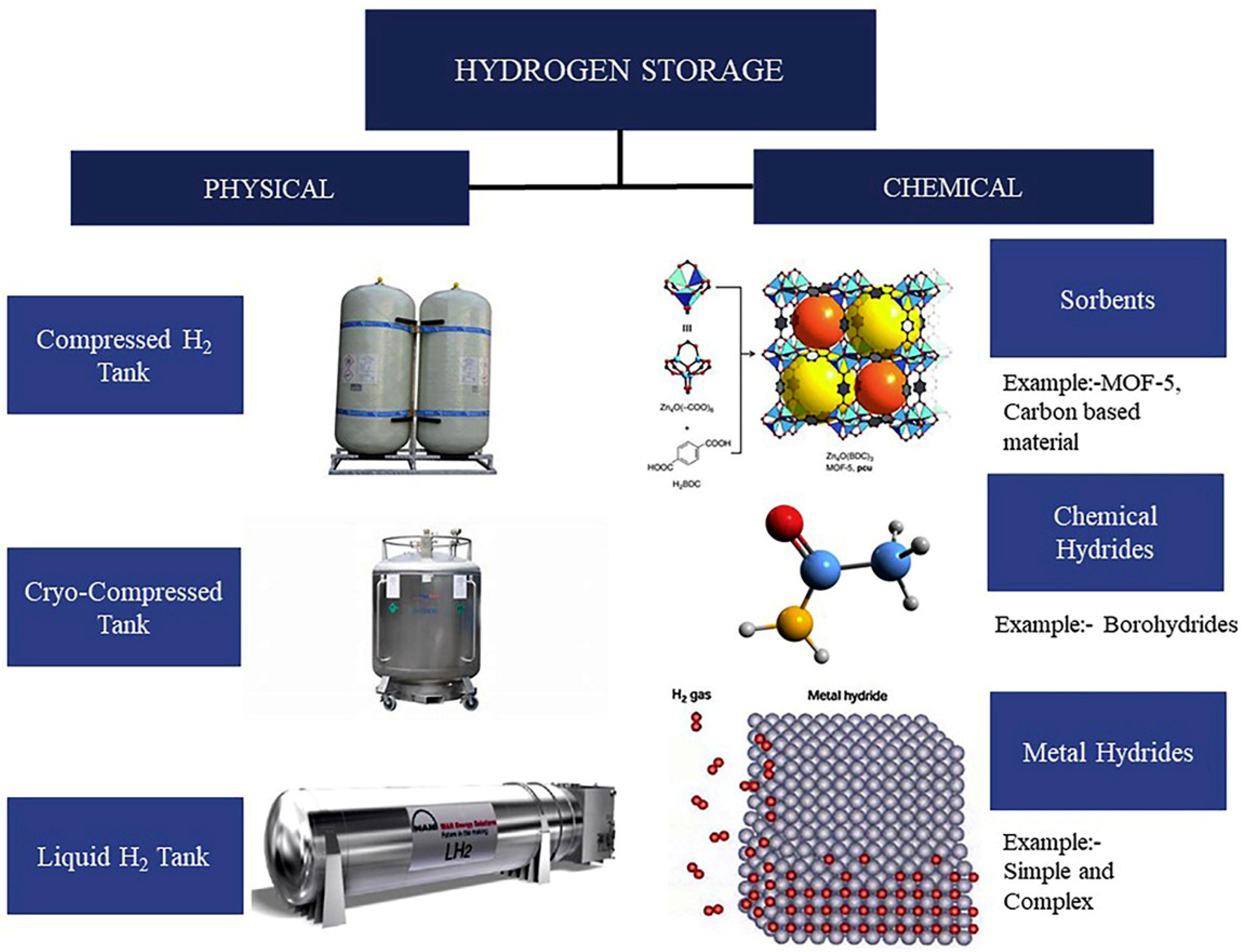
Hydrogen storage represents the fundamental pillar for the use of hydrogen as fuel, but the approach to storage must be as efficient and as safe as possible. There are plenty of different technologies available with both strong and weak points, as is discussed in the following sections and shown in Figure 2.

4.1. Compressed Hydrogen

Compressed gas is the most used hydrogen storage technology as it is proved by the definition of a standard SAE J2600 on Compressed Hydrogen Surface Vehicle Fueling Connection Devices by the Society of Automotive Engineers [35]. In 2011, the cost and performance of hydrogen storage tank systems was assessed for the automotive sector by comparing the hydrogen tanks designed for operating at 350 bar and 700 bar and able to store 5.6 kg of hydrogen. The conclusion of this study proved that no tanks met any of the automotive system targets for volumetric capacity or cost. Since that time, compressed hydrogen has not yet reached a real breakthrough. In fact, in the automotive sector, a maximum volumetric energy density of up to 4.9 MJ/L was reported by Toyota Motor Corporation for the 700 L Mirai tank [36]. Furthermore, compressed hydrogen tanks showed several issues during the refilling, losing up to 4 wt.% of the gas [37]. Finally, the materials used for the production of compressed hydrogen tanks must meet the mechanical requirements of avoiding embrittlement, cracks, and leaks and have a geometry and a weight that does not compromise the performance of the vehicle.

4.2. Liquid Hydrogen

The storage of liquid hydrogen is a consolidated technology, and it is the key to the existing industrial infrastructure network for delivery and storage. The technical requirement for maintain hydrogen in the liquid phase is a tank with a set temperature of up to −253 °C—the boiling point of hydrogen [38]. Liquid hydrogen tanks are not designed to withstand internal pressure but they must be properly insulated to reduce heat transfer from the environment to the liquid [39]. Since liquid hydrogen tanks are not designed to hold high pressure, hydrogen is generally allowed to escape through a relief valve that is named “boil-off”. Large cryogenic hydrogen tanks are generally sphere-shaped and they are built in order to minimize the proportion of insulation mass and volume with respect to the volume of hydrogen being stored. Furthermore, liquid hydrogen tanks have very thick walls to grant the appropriate insulation. This combination of technical issues increases the cost of this technology up to 1 €/kg of stored hydrogen with an efficiency of up to 70% for large tanks [40]. Costs for liquid hydrogen tanks in the automotive sector are even more elevated, reaching 386 €/kg for a 100 L internal volume reservoir [41], excluding their use for any transport utilization, even if it is possible to merge fuel cell systems with refrigerating systems that operate at a low, but not cryogenic, temperature as reported by Song et al. [42].

4.3. Cold-Cryo Compressed Hydrogen

A solution lying between pressurized and liquid storage is cryo-compression; [43] it is based on cryogenic temperatures in the range from −233 °C up to −193 °C in a pressure range from 250 up to 300 bar. The storage cost related to this route remains particularly high reaching over to 395 €/kg [44] but cryo-compression can retain the total hydrogen content for over 7 days without any appreciable loss when tanks are filled over 85% of maximum capacity [45].

4.4. Physisorbed Hydrogen

Neat hydrogen can also be stored by physisorbing it into several classes of materials. Due to its properties, hydrogen’s interactions with adsorbing materials is mainly due to Van der Waals forces as reported Brzhezinskaya et al. [46] through a calculation based on the density functional theory. As reported by Pakhira et al. [47], the empirical average interaction energy between hydrogen molecules and porous organometallic is below 10 kJ/mol, while Zhao et al. [48] reported experimental values ranging from 3 to 5 kJ/mol for carbonaceous materials.
The first class of used materials is represented by carbonaceous ones such as carbon nanotubes (CNTs) [49]. The mechanism of hydrogen sorption on carbon materials has been widely investigated by proving that the hydrogen adsorbed is arranged on the carbon surface monolayerly [50]. Accordingly, the hydrogen storage capacity depends only on the specific surface area of the carbon, following the Chahine rule that limits to 1 wt.% of adsorbed hydrogen for every 500 m2/g of specific surface area [51]. This rule is valid for both organic and inorganic materials if the interaction between the surface of solids and the hydrogen remains dominated by Van der Waals force.
Accordingly, CNTs show a maximum hydrogen uptake of up to 1.85 wt.% at −193 °C under a hydrogen pressure of up to 35 bar [52] while ultra micropore activated carbon could reach up to 2.94 wt.% at −193 °C at atmospheric pressure [53]. Interestingly, carbon replicas produced by using zeolite as template could achieved a 7.3 wt.% of hydrogen uptake at 20 bar and −193 °C. supporting this route as quite promising due to the wide range of inorganic templates with tuneable pore size and distribution [54,55]. For the same reason, inorganic scaffolds could also be a solid choice for the physisorption of hydrogen. Hydrogen uptake by inorganic materials is ruled by pore size and a very large one is required to achieve interestingly hydrogen adsorption, and this represent a problem. It was reported a decrement of the isosteric heats of adsorption suggesting the saturation of strong adsorption sites. This behaviour is characteristic of materials with high pore volumes because low pressure H2 adsorption at −193 °C is more favourable in small pockets or corrugated surfaces than in flat surfaces or edges [56]. Another alternative is represented by metal–organic frameworks (MOFs) that work quite well at −193 °C and with considerably inferior performances at room temperature under moderate pressure [57]. The mechanism of hydrogen storage into the MOFs is the diffusivity of hydrogen in the MOF structure, depending on the size of the crystals [58]. All physisorption techniques show a high cost and together with the use of cryogenic temperatures, low efficiency due to high costs and high energy consumption is implied.

4.5. Chemical Hydrogen Storage

Hydrogen can be bonded into stable species, achieving the so called chemically bonded hydrogen storage. This approach is based both on inorganic, metalorganic, and organic compounds. The first and simple route is represented by the hydrogen chemically bonded into small molecules (i.e., ammonia or methane) but its release is not as easy in these cases. Hydrogen production from methane cracking is quite expensive and requires temperature higher than 500 °C. Furthermore, carbon is produced as a side product due to the thermodynamic aspect of the process [59]. Methane steam reforming is an alternative route for hydrogen production but it presents the same issue related to the high temperature and pressure required, avoiding its spread outside refinery plants [60].
Alternatively to methane, ammonia is another possible chemical hydrogen storing molecule but it is similar in its drawbacks for hydrogen release [61]; however, an alternative and easy chemical hydrogen route is based on organic species such as ammino boranes. Amino boranes, particularly ammonia borane, have been widely used both for releasing hydrogen through hydrolytic and thermochemical routes [62] with a gravimetric hydrogen storage capacity that reaches up to 19.6 wt.%. Nevertheless, the mechanism of hydrogen release is quite complex, involving the production of several borazane and boron based species [63] and representing a considerable drawback due to the high hydrogen purity required for applications in fuel cells and their scarce regenerability [64,65,66,67,68,69]. Alternatively, liquid organic hydrogen carriers are compounds, such as ethylcarbazole species [70], with high regenerability and high GHS of up to 22.1 wt.% [71,72] but they need the use of noble and scarce metals to release/incorporate hydrogen [73]; they are also quite risky for human health [74]. Hydrogen is also combined with metal and stored into inorganic hydrides (i.e., LiBH4 [75], MgH2 [76]). These species can reach gravimetric densities ranging from 14.9 wt.% up to 18.5 wt.% with a volumetric energy density that can reach up to 17.6 MJ/L [77]. Despite these interesting properties, inorganic hydrides are difficult to regenerate and very sensitive to water. In fact, all the chemical hydrogen storing routes are still quite expensive but they are the most promising for small scale applications in mobility and daily life.

5. Crunching the Numbers of the Hydrogen Storage Issue in the Pervasive Hydrogen Based Scenario

In our experience, hydrogen storage is not a monolithic field and, up to now, there is not “one-size-fits-all” solution. Each technology (compressed gas, liquid hydrogen, cryo-compressed, physisorption/adsorption, and chemical/solid-state storage) match in terms of distinct trade-off among volumetric and gravimetric density, cost per stored kg, thermal and mechanical efficiency (compression/insulation costs, energy losses), and long-term reversibility required for different applications. Compressed hydrogen storage still remains the most mature and widely deployed technology with a tank 700 bar able to store up to 25–30 kg H2/m3 [78] with a cost of 500–1000 $/kg-H2 stored. Nevertheless, its relatively low gravimetric and volumetric densities limit the use of long-range logistics or stationary bulk storage. As far as we know, all big automotive producers have failed until now to deploy a car fleet based on compressed hydrogen due to the risk and lack of refuel infrastructure [79]. Similar consideration can be taken for liquid hydrogen storage that shows a higher volumetric density of up to 70–80 kg H2/m3 but a low gravimetric density combined with the cryogenic conditions that are required are far from acceptable beyond few industrial applications. We strongly disagree with the current approach for estimating the cost of liquid hydrogen up to 200–270 $/kg H2 [80] because we found it to be an enthusiastic approach on cost reduction on compression process and tank design. The very same consideration can be taken for cryo-compressed hydrogen and it is far more evident for physiosorption in which the gravimetric density is dropping down. We should spend focus of this discussion on chemical hydrogen storage due to our involvement in the very same research activity. Our experience has led us to consider this solution; in particular, the use of amino borane species is both interesting and valuable but we recognize that a lot of work still needs to be performed. We highlighted ammonia borane over other materials due to the simple synthesis and good balance of properties [81,82,83] even if we knew that a lot of work was required to tune the reactivity for hydrogen release under thermal stimuli [67] and the regenerability [84]. Nevertheless, we found the use of ammonia borne hydrolysis combined with wastewater sources for a single release of hydrogen very intriguing, due to the possibility of it being used in emergency situations as a simple store and release approach.
As reported in Table 1, we can report that no hydrogen storage approach currently achieves simultaneously high gravimetric and volumetric energy density, low cost per stored kg H2, high round-trip or use efficiency, fast kinetics (for rapid fill/discharge), long cycle life, and safety.
The intrinsic difficulty of hydrogen storage has slowed down the spread of a hydrogen as an energetic vector even if it has been strongly incentivised by European Community policies [96,97]. We believe that hydrogen will be consolidated for at least stationary power and industrial uses while the transportation applications are still far from being breached.
In this context, we reached the conclusion that the strong nudge of policy makers could represent the only real solution to push forward hydrogen use and hydrogen storage consolidation. Rather than selecting a single dominant technology, we would like for policymakers to aim to create an interoperable regulatory framework where storage solutions can evolve according to sector-specific needs, economic performance, and technological progress.

6. Conclusions and Future Outlook

Hydrogen shows a promising combination of features as energetic vectors and it has attracted great attention for its applications for decarbonizing mobility and the energy grid. Nonetheless, real-world applications have not yet reached a groundbreaking event due to the constraints of current storage technologies. High-pressure compressed tanks are mature and widely deployed but suffer from low volumetric density, high cost, and stringent safety requirements while liquid and cryo-compressed tanks are too risky and costly; the other technologies are still ageing in the labs. This represents a great loss considering that fuel cell technology is quite mature and only requires a hydrogen tank that is ready to be used to be installed on our vehicle fleet. Our effort was driven by the final goal to merge the expectations of policy makers and industry with technology, promoting an actual change in our use of hydrogen on a daily base. The embracement of diversified and application-tailored storage strategies can reshape our society starting from automotive redesign, energy grid updates, and the decarbonization of plenty of high energy demand sectors.
In conclusion, hydrogen storage technologies should be simple, safe, and easy to integrate with energy conversion systems in order to contribute to the spread of hydrogen use. Ultimately, hydrogen storage technologies have advanced significantly over the past decade but a gap remains between laboratory-scale promise and real-world deployment.

Author Contributions

Conceptualization M.B.; investigation, M.B., C.F.P. and S.B.; resources, C.F.P. and S.B.; data curation, M.B.; writing—original draft preparation M.B., C.F.P. and S.B.; writing—review and editing, M.B., C.F.P. and S.B.; visualization, M.B.; supervision, M.B.; funding acquisition, C.F.P. and S.B. All authors have read and agreed to the published version of the manuscript.

Funding

This research was partially funded under the National Recovery and Resilience Plan (NRRP), Mission 4 “Education and Research”—Component 2 “From research to business”—Investment 3.1 “Fund for the realization of an integrated system of research and innovation infrastructures”—Call for tender No. n. 3264 of 28/12/2021 of Italian Ministry of Research funded by the European Union—NextGenerationEU—Project code: IR0000027, Concession Decree No. 128 of 21/06/2022 adopted by the Italian Ministry of Research, CUP: B33C22000710006, Project title: iENTRANCE. This study was carried out within the Agritech National Research Center and received funding from the European Union Next-GenerationEU (PIANO NAZIONALE DI RIPRESA E RESILIENZA (PNRR)—MISSIONE 4 COMPONENTE 2, INVESTIMENTO 1.4—D.D. 1032 17 June 2022, CN00000022). Furthermore, authors wish to thank European Union for the financial support through the Next Generation EU-projects “Nord Ovest Digitale E Sostenibile-NODES” (PNRR, D.D. n.1054 23 June 2022), NEST “Network for Energy Sustainable Transition-NEST” (PE0000021, D.D. n.341 15 March 2022). Authors also acknowledge Ministero dello Sviluppo Economico (MISE) and Ministero della Transizione Ecologica (MITE) for financial support. This manuscript reflects only the authors’ views and opinions, neither the European Union nor the European Commission can be considered responsible for them.

Data Availability Statement

Data will be available upon request.

Conflicts of Interest

The authors declare no conflicts of interest.

References

  1. Wolf, S.; Teitge, J.; Mielke, J.; Schütze, F.; Jaeger, C. The European Green Deal—More than climate neutrality. Intereconomics 2021, 56, 99–107. [Google Scholar] [CrossRef]
  2. Mokrzycki, E.; Gawlik, L. The development of a green hydrogen economy. Energies 2024, 17, 3165. [Google Scholar] [CrossRef]
  3. Migliavacca, G.; Carlini, C.; Domenighini, P.; Zagano, C. Hydrogen: Prospects and criticalities for future development and analysis of present EU and national regulation. Energies 2024, 17, 4827. [Google Scholar] [CrossRef]
  4. Vancoillie, J.; Demuynck, J.; Sileghem, L.; Van De Ginste, M.; Verhelst, S. Comparison of the renewable transportation fuels, hydrogen and methanol formed from hydrogen, with gasoline–Engine efficiency study. Int. J. Hydrogen Energy 2012, 37, 9914–9924. [Google Scholar] [CrossRef]
  5. Jesus, B.; Ferreira, I.A.; Carreira, A.; Erikstad, S.O.; Godina, R. Economic framework for green shipping corridors: Evaluating cost-effective transition from fossil fuels towards hydrogen. Int. J. Hydrogen Energy 2024, 83, 1429–1447. [Google Scholar] [CrossRef]
  6. Bleischwitz, R.; Bader, N. Policies for the transition towards a hydrogen economy: The EU case. Energy Policy 2010, 38, 5388–5398. [Google Scholar] [CrossRef]
  7. Satyapal, S.; Petrovic, J.; Read, C.; Thomas, G.; Ordaz, G. The US Department of Energy’s National Hydrogen Storage Project: Progress towards meeting hydrogen-powered vehicle requirements. Catal. Today 2007, 120, 246–256. [Google Scholar] [CrossRef]
  8. Arcos, J.M.M.; Santos, D.M.F. The Hydrogen Color Spectrum: Techno-Economic Analysis of the Available Technologies for Hydrogen Production. Gases 2023, 3, 25–46. [Google Scholar] [CrossRef]
  9. Boretti, A. There are hydrogen production pathways with better than green hydrogen economic and environmental costs. Int. J. Hydrogen Energy 2021, 46, 23988–23995. [Google Scholar] [CrossRef]
  10. Nakkeeran, K.; Victor, K. Grey and blue hydrogen: Insights into production technologies and outlook on CO2-free alternatives. Sustain. Energy Technol. Assess. 2025, 75, 104222. [Google Scholar] [CrossRef]
  11. Incer-Valverde, J.; Korayem, A.; Tsatsaronis, G.; Morosuk, T. “Colors” of hydrogen: Definitions and carbon intensity. Energy Convers. Manag. 2023, 291, 117294. [Google Scholar] [CrossRef]
  12. Sanyal, A.; Malalasekera, W.; Bandulasena, H.; Wijayantha, K. Review of the production of turquoise hydrogen from methane catalytic decomposition: Optimising reactors for Sustainable Hydrogen production. Int. J. Hydrogen Energy 2024, 72, 694–715. [Google Scholar] [CrossRef]
  13. Howarth, R.W.; Jacobson, M.Z. How green is blue hydrogen? Energy Sci. Eng. 2021, 9, 1676–1687. [Google Scholar] [CrossRef]
  14. Dawood, F.; Anda, M.; Shafiullah, G. Hydrogen production for energy: An overview. Int. J. Hydrogen Energy 2020, 45, 3847–3869. [Google Scholar] [CrossRef]
  15. de León, C.M.; Molina, P.; Ríos, C.; Brey, J. Green hydrogen production’s impact on sustainable development goals. Int. J. Hydrogen Energy 2025, 142, 642–653. [Google Scholar] [CrossRef]
  16. Serik, A.; Kuspanov, Z.; Daulbayev, C. Cost-effective strategies and technologies for green hydrogen production. Renew. Sustain. Energy Rev. 2026, 226, 116242. [Google Scholar] [CrossRef]
  17. International Energy Agency. Executive Summary. Available online: https://www.iea.org/reports/global-hydrogen-review-2024/executive-summary?utm_source=chatgpt.com (accessed on 5 December 2025).
  18. European Hydrogen Observatory. Cost of Hydrogen Production. Available online: https://observatory.clean-hydrogen.europa.eu/index.php/hydrogen-landscape/production-trade-and-cost/cost-hydrogen-production?utm_source=chatgpt.com (accessed on 5 December 2025).
  19. Singla, M.K.; Gupta, J.; Beryozkina, S.; Safaraliev, M.; Singh, M. The colorful economics of hydrogen: Assessing the costs and viability of different hydrogen production methods-A review. Int. J. Hydrogen Energy 2024, 61, 664–677. [Google Scholar] [CrossRef]
  20. Béres, R.; Junginger, M.; van den Broek, M. Assessing the feasibility of CO2 removal strategies in achieving climate-neutral power systems: Insights from biomass, CO2 capture, and direct air capture in Europe. Adv. Appl. Energy 2024, 14, 100166. [Google Scholar] [CrossRef]
  21. Ueckerdt, F.; Verpoort, P.C.; Anantharaman, R.; Bauer, C.; Beck, F.; Longden, T.; Roussanaly, S. On the cost competitiveness of blue and green hydrogen. Joule 2024, 8, 104–128. [Google Scholar] [CrossRef]
  22. Li, Y.; Hao, J.-S.; Zhou, Y. Economic analysis of different hydrogen production routes under a CO2 pricing mechanism—A levelized cost of hydrogen based study. Int. J. Hydrogen Energy 2025, 128, 47–67. [Google Scholar] [CrossRef]
  23. Shammah, N.; Favour, C.; Precious, N.; Emeka, N. Towards a Low-Carbon Energy Industry: Financial and Reputational Resilience Strategies of Integrated Energy Companies. In Proceedings of the SPE Nigeria Annual International Conference and Exhibition, Lagos, Nigeria, 4–6 August 2025; p. D021S011R006. [Google Scholar]
  24. Li, J.; Peng, X.; Gao, J.; Tang, Q. Detecting Greenwashing Behaviour in Decarbonization Performance. Account. Financ. 2025, early view. [Google Scholar] [CrossRef]
  25. Ma, M.-T.; Li, K.-J.; Si, Y.; Cao, P.-J.; Lu, H.-Z.; Guo, A.-M.; Wang, G.-D. Hydrogen embrittlement of advanced high-strength steel for automobile application: A review. Acta Metall. Sin. Engl. Lett. 2023, 36, 1144–1158. [Google Scholar] [CrossRef]
  26. Kurc, B.; Gross, X.; Szymlet, N.; Rymaniak, Ł.; Woźniak, K.; Pigłowska, M. Hydrogen-Powered Vehicles: A Paradigm Shift in Sustainable Transportation. Energies 2024, 17, 4768. [Google Scholar] [CrossRef]
  27. Meng, X.; Sun, C.; Mei, J.; Tang, X.; Hasanien, H.M.; Jiang, J.; Fan, F.; Song, K. Fuel cell life prediction considering the recovery phenomenon of reversible voltage loss. J. Power Sources 2025, 625, 235634. [Google Scholar] [CrossRef]
  28. Yazdi, M.; Moradi, R.; Pirbalouti, R.G.; Zarei, E.; Li, H. Enabling safe and sustainable hydrogen mobility: Circular economy-driven management of hydrogen vehicle safety. Processes 2023, 11, 2730. [Google Scholar] [CrossRef]
  29. Mohammadfam, I.; Zarei, E. Safety risk modeling and major accidents analysis of hydrogen and natural gas releases: A comprehensive risk analysis framework. Int. J. Hydrogen Energy 2015, 40, 13653–13663. [Google Scholar] [CrossRef]
  30. Cekerevac, Z.; Cekerevac, D. Hydrogen hazards, risks, and protection: An in-depth review. FBIM Trans. 2025, 13, 23–48. [Google Scholar] [CrossRef]
  31. Sakib, A.N.; Islam, T.; Resnick, P.M.; Habib, A.A.; Chowdhury, S.R. Comprehensive Safety Assessment of Hydrogen: From Production to Application in Energy Systems. Int. J. Energy Res. 2025, 2025, 8857513. [Google Scholar] [CrossRef]
  32. Carluccio, L.M.; Gritti, A.; Pellegrini, L. Beyond HazOp: Modelling of HILP (High Intensity Low Probability) Scenarios in Hydrogen Production and Storage Plants. CET J. Chem. Eng. Trans. 2024, 111, 397. [Google Scholar]
  33. Montijn-Dorgelo, F.N.; Midden, C.J. The role of negative associations and trust in risk perception of new hydrogen systems. J. Risk Res. 2008, 11, 659–671. [Google Scholar] [CrossRef]
  34. Mulky, L.; Srivastava, S.; Lakshmi, T.; Sandadi, E.R.; Gour, S.; Thomas, N.A.; Shanmuga Priya, S.; Sudhakar, K. An overview of hydrogen storage technologies—Key challenges and opportunities. Mater. Chem. Phys. 2024, 325, 129710. [Google Scholar] [CrossRef]
  35. Service-Oriented Architecture (SOA) Engineers. SAE International. SAE J2600 Compressed Hydrogen Surface Vehicle Fueling Connection Devices. Available online: https://www.sae.org/standards/content/j2600_201211/ (accessed on 25 August 2025).
  36. Toyota Motor Corporation. Mirai Product Information. Available online: https://www.toyota.it/gamma/nuova-mirai?utm_campaign=OEM-IT-IT-Brand-Model-Mirai-Conv&gclsrc=aw.ds&gad_source=1&gad_campaignid=21021732207&gbraid=0AAAAADtL0njoB_3O4EhAxpMVzM2geUDV5&gclid=CjwKCAiAl-_JBhBjEiwAn3rN7T_obZLkD6jdw8AnY8pDfG-KIZcNsHPKU9zJ3qYG5SRvhWqNa63e7hoCCqoQAvD_BwE (accessed on 10 December 2025).
  37. Barreto, L.; Makihira, A.; Riahi, K. The hydrogen economy in the 21st century: A sustainable development scenario. Int. J. Hydrogen Energy 2003, 28, 267–284. [Google Scholar] [CrossRef]
  38. Rossini, F.D. Report on International Practical Temperature Scale of 1968. J. Chem. Thermodyn. 1970, 2, 447–459. [Google Scholar] [CrossRef]
  39. Babac, G.; Sisman, A.; Cimen, T. Two-dimensional thermal analysis of liquid hydrogen tank insulation. Int. J. Hydrogen Energy 2009, 34, 6357–6363. [Google Scholar] [CrossRef]
  40. Krasae-in, S.; Stang, J.H.; Neksa, P. Development of large-scale hydrogen liquefaction processes from 1898 to 2009. Int. J. Hydrogen Energy 2010, 35, 4524–4533. [Google Scholar] [CrossRef]
  41. Meneghelli, B.; Tamburello, D.; Fesmire, J.; Swanger, A. Integrated Insulation System for Automotive Cryogenic. Available online: https://www.hydrogen.energy.gov/docs/hydrogenprogramlibraries/pdfs/review17/st141_meneghelli_2017_o.pdf?Status=Master (accessed on 10 December 2025).
  42. Song, K.; Hou, T.; Jiang, J.; Grigoriev, S.A.; Fan, F.; Qin, J.; Wang, Z.; Sun, C. Thermal management of liquid-cooled proton exchange membrane fuel cell: A review. J. Power Sources 2025, 648, 237227. [Google Scholar] [CrossRef]
  43. Brunner, T.; Kampitsch, M.; Kircher, O. Cryo-compressed hydrogen storage. In Fuel Cells: Data, Facts and Figures; Wiley-VCH: Weinheim, Germany, 2016; pp. 162–172. [Google Scholar]
  44. Argonne National Laboratory. Technical Assessment of Cryo-Compressed Hydrogen Storage Tank Systems for Automotive Applications; Argonne National Laborator: Oak Ridge, TN, USA, 2009. [Google Scholar]
  45. Ahluwalia, R.K.; Peng, J.K.; Roh, H.S.; Hua, T.Q.; Houchins, C.; James, B.D. Supercritical cryo-compressed hydrogen storage for fuel cell electric buses. Int. J. Hydrogen Energy 2018, 43, 10215–10231. [Google Scholar] [CrossRef]
  46. Brzhezinskaya, M.; Belenkov, E.; Greshnyakov, V.; Yalovega, G.; Bashkin, I. New aspects in the study of carbon-hydrogen interaction in hydrogenated carbon nanotubes for energy storage applications. J. Alloys Compd. 2019, 792, 713–720. [Google Scholar] [CrossRef]
  47. Pakhira, S.; Mendoza-Cortes, J.L. Quantum nature in the interaction of molecular hydrogen with porous materials: Implications for practical hydrogen storage. J. Phys. Chem. C 2020, 124, 6454–6460. [Google Scholar] [CrossRef]
  48. Zhao, X.; Xiao, B.; Fletcher, A.; Thomas, K. Hydrogen adsorption on functionalized nanoporous activated carbons. J. Phys. Chem. B 2005, 109, 8880–8888. [Google Scholar] [CrossRef]
  49. Pinjari, S.; Bera, T.; Kapur, G.; Kjeang, E. The mechanism and sorption kinetic analysis of hydrogen storage at room temperature using acid functionalized carbon nanotubes. Int. J. Hydrogen Energy 2023, 48, 1930–1942. [Google Scholar] [CrossRef]
  50. Elyasi, S.; Saha, S.; Hameed, N.; Mahon, P.J.; Juodkazis, S.; Salim, N. Emerging trends in biomass-derived porous carbon materials for hydrogen storage. Int. J. Hydrogen Energy 2024, 62, 272–306. [Google Scholar] [CrossRef]
  51. Bénard, P.; Chahine, R. Storage of hydrogen by physisorption on carbon and nanostructured materials. Scr. Mater. 2007, 56, 803–808. [Google Scholar] [CrossRef]
  52. Bianco, S.; Giorcelli, M.; Musso, S.; Castellino, M.; Agresti, F.; Khandelwal, A.; Lo Russo, S.; Kumar, M.; Ando, Y.; Tagliaferro, A. Hydrogen adsorption in several types of carbon nanotubes. J. Nanosci. Nanotechnol. 2009, 9, 6806–6812. [Google Scholar] [CrossRef] [PubMed]
  53. Sethia, G.; Sayari, A. Activated carbon with optimum pore size distribution for hydrogen storage. Carbon 2016, 99, 289–294. [Google Scholar] [CrossRef]
  54. Yang, S.J.; Jung, H.; Kim, T.; Park, C.R. Recent advances in hydrogen storage technologies based on nanoporous carbon materials. Prog. Nat. Sci. Mater. Int. 2012, 22, 631–638. [Google Scholar] [CrossRef]
  55. Meduri, S.; Nandanavanam, J. Materials for hydrogen storage at room temperature–An overview. Mater. Today Proc. 2022, 72, 1–8. [Google Scholar] [CrossRef]
  56. Le, T.H.; Kim, M.P.; Park, C.H.; Tran, Q.N. Recent developments in materials for physical hydrogen storage: A review. Materials 2024, 17, 666. [Google Scholar] [CrossRef]
  57. Zhang, X.; Liu, P.; Zhang, Y. The application of MOFs for hydrogen storage. Inorganica Chim. Acta 2023, 557, 121683. [Google Scholar] [CrossRef]
  58. Yuvaraj, A.; Jayarama, A.; Sharma, D.; Nagarkar, S.S.; Duttagupta, S.P.; Pinto, R. Role of metal-organic framework in hydrogen gas storage: A critical review. Int. J. Hydrogen Energy 2024, 59, 1434–1458. [Google Scholar] [CrossRef]
  59. Amin, A.M.; Croiset, E.; Epling, W. Review of methane catalytic cracking for hydrogen production. Int. J. Hydrogen Energy 2011, 36, 2904–2935. [Google Scholar] [CrossRef]
  60. Ganguli, A.; Bhatt, V. Hydrogen production using advanced reactors by steam methane reforming: A review. Front. Therm. Eng. 2023, 3, 1143987. [Google Scholar] [CrossRef]
  61. Negro, V.; Noussan, M.; Chiaramonti, D. The potential role of ammonia for hydrogen storage and transport: A critical review of challenges and opportunities. Energies 2023, 16, 6192. [Google Scholar] [CrossRef]
  62. Demirci, U.B. Ammonia borane, a material with exceptional properties for chemical hydrogen storage. Int. J. Hydrogen Energy 2017, 42, 9978–10013. [Google Scholar] [CrossRef]
  63. Zhao, W.; Li, H.; Zhang, H.; Yang, S.; Riisager, A. Ammonia borane-enabled hydrogen transfer processes: Insights into catalytic strategies and mechanisms. Green Energy Environ. 2022, 8, 948–971. [Google Scholar] [CrossRef]
  64. Bartoli, M.; Etzi, M.; Lettieri, S.; Ferraro, G.; Pirri, C.F.; Chiodoni, A.M.; Bocchini, S. Complex Waste Stream Utilization for Hydrogen Evolution: Ammonia Borane Hydrolysis Over Red Mud Catalyst Under Mild Conditions. Catal. Lett. 2025, 155, 273. [Google Scholar] [CrossRef]
  65. Gianola, G.; Bartoli, M.; Pirri, C.F.; Bocchini, S. Hydrogen evolution through ammonia borane hydrolysis over iron tailored pig manure catalyst. Int. J. Hydrogen Energy 2024, 51, 21–28. [Google Scholar] [CrossRef]
  66. Astorino, C.; De Nardo, E.; Lettieri, S.; Ferraro, G.; Bartoli, M.; Etzi, M.; Chiodoni, A.M.; Pirri, C.F.; Bocchini, S. Investigation of Solid-State Thermal Decomposition of Ammonia Borane Mix with Sulphonated Poly(ellagic Acid) for Hydrogen Release. Polymers 2024, 16, 3471. [Google Scholar] [CrossRef] [PubMed]
  67. Bartoli, M.; Ferraro, G.; Etzi, M.; Lettieri, S.; Pirri, C.F.; Bocchini, S. Tuning the Solid-State Hydrogen Release of Ammonia Borane by Entrapping the Intermediates: The Role of High-Boiling-Point Amines. Molecules 2025, 30, 4057. [Google Scholar] [CrossRef] [PubMed]
  68. Bartoli, M.; Etzi, M.; Lettieri, S.; Ferraro, G.; Pirri, C.F.; Bocchini, S. Ultrasound induced hydrogen release from ammonia borane mediated by oxidized multiwalled carbon nanotube under hydrolytic conditions. Appl. Surf. Sci. 2025, 717, 164800. [Google Scholar] [CrossRef]
  69. Bartoli, M.; Pirri, C.F.; Bocchini, S. Unraveling the Effect of Carbon Nanotube Oxidation on Solid-State Decomposition of Ammonia Borane/Carbon Nanotube Composites. J. Phys. Chem. C 2022, 126, 16587–16594. [Google Scholar] [CrossRef]
  70. Uijthof, E.; Chavan, B.; Sluijer, M.; Komath, V.; van der Ham, A.; van den Berg, H.; Lange, J.P.; Higler, A.; Wijnans, S. Liquid organic hydrogen carriers: Process design and economic analysis for manufacturing N-ethylcarbazole. J. Adv. Manuf. Process. 2024, 6, e10173. [Google Scholar] [CrossRef]
  71. Amende, M.; Gleichweit, C.; Werner, K.; Schernich, S.; Zhao, W.; Lorenz, M.P.; Höfert, O.; Papp, C.; Koch, M.; Wasserscheid, P. Model catalytic studies of liquid organic hydrogen carriers: Dehydrogenation and decomposition mechanisms of dodecahydro-N-ethylcarbazole on Pt (111). ACS Catal. 2014, 4, 657–665. [Google Scholar] [CrossRef]
  72. Yu, H.; Zhang, Z.; Jin, X.; Zhang, X.; Jin, R.; Lin, Y.; Xie, Z.; Huang, Y.; Liu, T.; Li, X. Promoting Catalytic Performance of Metal Hydrides for Reversible Hydrogen Storage in N-ethylcarbazole by Electronic Structure and Hydrogen Chemical Potential Tuning. ACS Catal. 2024, 14, 10519–10528. [Google Scholar] [CrossRef]
  73. Li, Y.; Ye, J.; Xu, T.; Xia, G.; Yu, X. Boosting dehydrogenation of dodecahydro-N-ethylcarbazole over Pd nanoclusters with tailored electronic structures loaded on nitrogen-doped carbon. Int. J. Hydrogen Energy 2024, 65, 769–778. [Google Scholar] [CrossRef]
  74. Kim, H.-Y.; Kang, M.-G.; Kim, T.-G.; Kang, C.-W. Toxicity of methylcyclohexane and its effect on the reproductive system in SD rats. Saf. Health Work 2011, 2, 290–300. [Google Scholar] [CrossRef]
  75. Yin, D.; Wang, X.; Wu, F.; Shang, D.; Li, H.; Huang, P.; Zhang, L. A mini review on the state-of-the-art progress of LiBH4 for hydrogen storage: Challenges and perspectives. J. Alloys Compd. 2025, 1041, 183883. [Google Scholar] [CrossRef]
  76. Liu, C.; Yuan, Z.; Li, X.; Sun, Y.; Zhai, T.; Han, Z.; Zhang, L.; Li, T. Review on improved hydrogen storage properties of MgH2 by adding new catalyst. J. Energy Storage 2024, 97, 112786. [Google Scholar] [CrossRef]
  77. Nemukula, E.; Mtshali, C.; Nemangwele, F. Metal hydrides for sustainable hydrogen storage: A review. Int. J. Energy Res. 2025, 2025, 6300225. [Google Scholar] [CrossRef]
  78. Mekonnin, A.S.; Wacławiak, K.; Humayun, M.; Zhang, S.; Ullah, H. Hydrogen Storage Technology, and Its Challenges: A Review. Catalysts 2025, 15, 260. [Google Scholar] [CrossRef]
  79. Bakker, S. The car industry and the blow-out of the hydrogen hype. Energy Policy 2010, 38, 6540–6544. [Google Scholar] [CrossRef]
  80. Fang, L.; Dong, X.; Wang, H.; Gong, M. Economic analysis of compressed gaseous hydrogen, liquid hydrogen, and cryo-compressed hydrogen storage methods for large-scale storage and transportation. Int. J. Hydrogen Energy 2025, 162, 150725. [Google Scholar] [CrossRef]
  81. Heldebrant, D.J.; Karkamkar, A.; Linehan, J.C.; Autrey, T. Synthesis of ammonia borane for hydrogen storage applications. Energy Environ. Sci. 2008, 1, 156–160. [Google Scholar] [CrossRef]
  82. Li, H.; Yang, Q.; Chen, X.; Shore, S.G. Ammonia borane, past as prolog. J. Organomet. Chem. 2014, 751, 60–66. [Google Scholar] [CrossRef]
  83. Ramachandran, P.V.; Gagare, P.D. Preparation of ammonia borane in high yield and purity, methanolysis, and regeneration. Inorg. Chem. 2007, 46, 7810–7817. [Google Scholar] [CrossRef]
  84. Smythe, N.C.; Gordon, J.C. Ammonia borane as a hydrogen carrier: Dehydrogenation and regeneration. Eur. J. Inorg. Chem. 2010, 2010, 509–521. [Google Scholar] [CrossRef]
  85. Azzouz, A. Achievement in hydrogen storage on adsorbents with high surface-to-bulk ratio—Prospects for Si-containing matrices. Int. J. Hydrogen Energy 2012, 37, 5032–5049. [Google Scholar] [CrossRef]
  86. Zheng, J.; Zhou, H.; Wang, C.-G.; Ye, E.; Xu, J.W.; Loh, X.J.; Li, Z. Current research progress and perspectives on liquid hydrogen rich molecules in sustainable hydrogen storage. Energy Storage Mater. 2021, 35, 695–722. [Google Scholar] [CrossRef]
  87. Younas, M.; Rezakazemi, M.; Arbab, M.S.; Shah, J.; Rehman, W.U. Green hydrogen storage and delivery: Utilizing highly active homogeneous and heterogeneous catalysts for formic acid dehydrogenation. Int. J. Hydrogen Energy 2022, 47, 11694–11724. [Google Scholar] [CrossRef]
  88. Pukazhselvan, D.; Kumar, V.; Singh, S.K. High capacity hydrogen storage: Basic aspects, new developments and milestones. Nano Energy 2012, 1, 566–589. [Google Scholar] [CrossRef]
  89. Abe, J.O.; Popoola, A.; Ajenifuja, E.; Popoola, O.M. Hydrogen energy, economy and storage: Review and recommendation. Int. J. Hydrogen Energy 2019, 44, 15072–15086. [Google Scholar] [CrossRef]
  90. Moradi, R.; Groth, K.M. Hydrogen storage and delivery: Review of the state of the art technologies and risk and reliability analysis. Int. J. Hydrogen Energy 2019, 44, 12254–12269. [Google Scholar] [CrossRef]
  91. Rivard, E.; Trudeau, M.; Zaghib, K. Hydrogen storage for mobility: A review. Materials 2019, 12, 1973. [Google Scholar] [CrossRef] [PubMed]
  92. Mohan, M.; Sharma, V.K.; Kumar, E.A.; Gayathri, V. Hydrogen storage in carbon materials—A review. Energy Storage 2019, 1, e35. [Google Scholar] [CrossRef]
  93. Usman, M.R. Hydrogen storage methods: Review and current status. Renew. Sustain. Energy Rev. 2022, 167, 112743. [Google Scholar] [CrossRef]
  94. Hassan, I.; Ramadan, H.S.; Saleh, M.A.; Hissel, D. Hydrogen storage technologies for stationary and mobile applications: Review, analysis and perspectives. Renew. Sustain. Energy Rev. 2021, 149, 111311. [Google Scholar] [CrossRef]
  95. Niaz, S.; Manzoor, T.; Pandith, A.H. Hydrogen storage: Materials, methods and perspectives. Renew. Sustain. Energy Rev. 2015, 50, 457–469. [Google Scholar] [CrossRef]
  96. Fetting, C. The European green deal. ESDN Rep. 2020, 2, 53. [Google Scholar]
  97. Leonard, M.; Pisani-Ferry, J.; Shapiro, J.; Tagliapietra, S.; Wolff, G.B. The Geopolitics of the European Green Deal; Bruegel policy contribution: Brussels, Belgium, 2021. [Google Scholar]
Figure 1. The colour scale of hydrogen as reported by Arcos et al. [8] (reprinted under CC BY 4.0).
Energies 18 06564 g001
Figure 2. Summary of different hydrogen storage technologies. Reprinted from Mulky et al. [34] under CC BY 4.0.
Energies 18 06564 g002
Table 1. Summary of main features of hydrogen storage technologies [78,85,86,87,88,89,90,91,92,93,94,95].
TechnologyGravimetric Density
(wt.% kg H2)
Volumetric Density
(kg H2/m3)
Cost
($/kg-H2)
IssuesReversibility
Compressed H24–520–30500–1000
High energy content
High amount of hydrogen storage
Excellent cycle life: >10,000 refill cycles; minimal degradation of the tank
Liquid H26–7~70–80200–270
Simple refilling
High amount of hydrogen storage
High reversibility; embrittlement of the tanks
Cryo-Compressed H25–640–5018 (questionable)
High energy content
High amount of hydrogen storage
Good reversibility but lack of consolidated data
Physiosorbed H2<3 wt.%<20>1000
Easily regenerable
Safety
Poor
Chemically bound2050–100200–800
High gravimetric energy content
High volumetric energy content
Poor
Disclaimer/Publisher’s Note: The statements, opinions and data contained in all publications are solely those of the individual author(s) and contributor(s) and not of MDPI and/or the editor(s). MDPI and/or the editor(s) disclaim responsibility for any injury to people or property resulting from any ideas, methods, instructions or products referred to in the content.