Review

Strategies for Solar Energy Utilization in Businesses: A Business Model Canvas Approach

Faculty of Management, Czestochowa University of Technology, al. Armii Krajowej 19b, 42-200 Czestochowa, Poland
*
Author to whom correspondence should be addressed.
Energies 2025, 18(24), 6533; https://doi.org/10.3390/en18246533
Submission received: 20 October 2025 / Revised: 5 December 2025 / Accepted: 11 December 2025 / Published: 13 December 2025

Abstract

This article examines the growing relevance of photovoltaic (PV) energy amid rising electricity demand, sustainability goals, and the need for flexible energy management in households and enterprises. It analyzes six PV business models, ownership, leasing, Power Purchase Agreement (PPA), energy communities/peer-to-peer (P2P), crowdfunding, and subscription-based Solar-as-a-Service, using the Business Model Canvas (BMC) framework. A systematic literature review was combined with a unified BMC for each model, enabling structured comparison of value propositions, customer segments, cost structures, revenue streams, and risk allocation. The results show that no single universal model exists; each addresses different financial capacities, risk preferences, and strategic needs of households, SMEs, large enterprises, and energy communities. Significant differences were found in investment requirements, operational involvement, scalability, and potential for energy independence. The study’s novelty lies in providing a coherent, cross-model comparison using a standardized BMC approach, offering insights not systematically explored in previous research. These findings support informed decision-making for organizations considering PV adoption and provide a basis for further research on innovative energy management strategies. The topic is highly relevant in the context of the accelerating global energy transition, technological advances, regulatory changes, and increasingly diverse customer profiles, highlighting the need for comprehensive comparative analyses to guide flexible photovoltaic deployment.

1. Introduction

The global transition toward low-carbon energy systems has accelerated the adoption of photovoltaic (PV) technologies, supported by declining installation costs, rapid technological progress, and favorable regulatory frameworks. As PV systems become increasingly accessible, both enterprises and households face a growing variety of options for obtaining solar energy. These differ not only in technological features but also in financial, organizational, and strategic implications, requiring customers to select business models that match their investment capacity, risk tolerance, and operational involvement [1]. Existing research increasingly examines individual PV business models, such as ownership, leasing, Power Purchase Agreements (PPA), subscription-based services, energy communities/peer-to-peer (P2P) models, and crowdfunding, yet these studies typically analyze each model in isolation. As a result, there is a lack of structured, cross-model comparisons that would support evidence-based decision-making across diverse customer groups and regulatory contexts [2,3]. This research gap is particularly important given the rapid evolution of PV markets and the growing demand for flexible, low-risk, and financially accessible solutions.
The topicality of this research stems from the rapid transformation of global energy markets, in which photovoltaic technologies have become central to national and corporate decarbonization strategies. Simultaneously, customers increasingly require flexible, low-risk, and financially accessible business models that can be adapted to diverse economic and regulatory environments. Despite the expansion of PV solutions, there remains a lack of structured comparative studies that systematically examine how different models allocate risk, costs, and operational responsibilities. Addressing this gap is crucial for supporting evidence-based decision-making in both private and institutional contexts.
The aim of this article is to analyze different business models for utilizing photovoltaic (PV) energy in enterprises and to assess their potential from a business perspective using the Business Model Canvas (BMC) framework. The study focuses on identifying key elements of each model—including partners, activities, value propositions, customer relationships, customer segments, resources, distribution channels, cost structure, and revenue streams—as well as highlighting their advantages and limitations in business practice. The article provides insights into how various approaches to PV energy address the specific needs of households, small and medium-sized enterprises, large corporations, and energy communities.
This article contributes by addressing a gap in existing research, which often examines PV business models separately without a coherent cross-model comparison. By applying the Business Model Canvas across six approaches, the study reveals structural differences, strategic trade-offs, and value creation patterns. A comparative table and a graphical risk–capital matrix provide an integrated framework showing investment allocation, operational responsibilities, and long-term customer benefits. These insights offer a foundation for further research on innovative business strategies and energy management in the renewable energy sector.

2. Literature Review

2.1. Development of PV Technologies and Market Trends

The concept of energy management in enterprises is most commonly perceived as a complex and multidimensional process encompassing various energy carriers. Therefore, a comprehensive analysis of fuel and energy utilization within the organizational structure of a company constitutes the foundation for the implementation of an effective energy management system. The collection and systematic analysis of energy-related data enable an increase in energy awareness and provide a basis for developing a rational and efficiency-oriented approach to energy consumption within enterprises. Each enterprise, as a distinct organization composed of unique internal elements, requires an individualized approach to energy efficiency assessment. This evaluation typically includes the analysis of production processes, machinery and equipment (often characterized by high energy intensity), as well as building infrastructure conditions, including lighting and auxiliary systems. All these components collectively determine the overall level of energy efficiency in the enterprise. Such an assessment makes it possible to verify the technical, technological, and financial capabilities necessary for the implementation of measures aligned with the principles of sustainable energy development. The primary objective of this approach is to introduce optimization strategies in production process management, promote the rational use of energy resources, and support investments in modern equipment and infrastructure, enabling enterprises to achieve estimated energy savings ranging from 15% to 30% [4].
Energy efficiency improvement measures aim to introduce changes or enhancements to buildings, technical equipment, or installations in order to achieve measurable energy savings. The decision to implement such actions, as well as the actions themselves, is typically the outcome of energy efficiency audits, which provide answers to the question of where and how energy savings can be achieved within an energy management system. The result of an energy efficiency audit is the development of a comprehensive analysis of energy consumption and the formulation of recommendations for energy efficiency improvement projects within a given facility or organization. These recommendations form the basis for creating modernization plans and for making strategic decisions regarding their implementation [5].
Within the organizational structures of an enterprise, the concept of energy management emerges as a process-oriented approach to planning, monitoring, and controlling energy consumption, as well as to implementing optimization measures. The primary objectives of this approach include reducing energy costs in the company’s balance structure, improving energy efficiency, and minimizing CO2 emissions along with other pollutants. Analyzing this process-based approach reveals clear guidelines for achieving sustainable development goals, while simultaneously enhancing competitiveness and increasing resource efficiency within enterprises. Due to the process-oriented nature of energy management, the initial stage involves a diagnosis of the current energy consumption. This step requires identifying the main sources of energy losses, followed by monitoring and data analysis, often supported by a comprehensive Energy Management System (EMS). The data collected serves as a foundation for implementing technical and organizational measures aimed at reducing overall energy consumption. A broader extension of this approach also includes supplier and tariff management, achieved through the selection of favorable energy tariffs and negotiation of long-term energy purchase agreements. Another essential component of a systematic energy management approach is employee training, aimed at increasing awareness and promoting a culture of energy efficiency within the organization. The formalized outcome of energy management practices is the implementation of recognized standards and norms, particularly the ISO 50001 standard [6]. According to current European Union regulations, enterprises whose average annual energy consumption over the past three years exceeds 85 TJ (23,611 MWh) are required to implement a certified Energy Management System compliant with ISO 50001. Organizations with lower consumption levels, above 10 TJ but below 85 TJ, are obliged to conduct regular energy audits every four years. One possible alternative is the implementation and certification of an energy management system in accordance with ISO 50001:2018 “Energy management systems—Requirements with guidance for use”, which provides an exemption from the obligation to perform periodic energy audits [7].
The origins of energy management in business can be traced back to traditional energy-saving practices that primarily focused on cost reduction. However, the advancement of technology and the growing environmental awareness have transformed energy management into a strategic approach, encompassing the use of smart technologies, automation, and data-driven decision-making. The modern EMS represents an integrated network of Internet of Things (IoT) devices, supported by artificial intelligence (AI) and cloud computing technologies. These systems enable real-time monitoring of energy consumption and predictive analysis of energy demand, facilitating informed business decision-making. As a result, operators can identify inefficiencies within production and operational processes and eliminate them proactively, contributing to improved energy performance and overall operational sustainability [8].
Modern enterprises and households are consuming increasing amounts of electricity due to widespread automation, digitalization, and the use of numerous electrical devices in daily life. This trend highlights the growing need to implement effective energy reduction strategies, driven by both economic and environmental considerations [9].
Building on the increasing role of automation and energy-intensive technologies in both industrial and commercial sectors, the residential sector also contributes significantly to overall electricity consumption. Energy efficiency and behavioral changes are therefore crucial, as households increasingly adopt modern appliances and systems that raise energy demand. Improving residential energy efficiency not only mitigates environmental impacts but also supports a balanced approach to sustainable development and decarbonization [10].
The rapid and voluminous development of renewable energy generation, combined with its stochastic and intermittent nature, poses significant challenges for maintaining frequency stability and power balance in modern electricity systems. This paper provides a detailed discussion of demand response management and the underlying principles of demand response as a key flexibility resource. Moreover, the potential role of prosumers, consumers who also produce energy, in supporting system balancing and enhancing grid stability is thoroughly examined. By integrating prosumer-driven flexibility with demand response strategies, the study highlights opportunities to mitigate the variability of renewable generation while ensuring reliable and efficient operation of the power system [11].
Building on this, energy cooperatives represent a significant driver for the expansion of renewable energy deployment. By enabling local communities, including citizens, businesses, and authorities, to collectively invest in and manage renewable energy resources, they accelerate the adoption of solar, wind, and biomass technologies. This decentralized, community-driven approach not only increases the share of renewables in the local energy mix but also creates scalable models for broader integration of sustainable energy solutions, supporting both national and regional energy transition goals [12].

2.2. Existing Photovoltaic Business Models in the Literature

In the literature on solar energy, various models for utilizing photovoltaic (PV) technologies in enterprises and households are distinguished. These models differ in terms of ownership structure, financing methods, operational responsibilities, customer relationships, and value creation mechanisms. The wide range of available solutions allows energy strategies to be tailored to the specific needs and capabilities of different actors [13,14].
Analyzing these models from a business perspective is crucial not only for optimizing energy use but also for making informed investment decisions, managing risks, and planning for the long term. In this context, the Business Model Canvas provides a systematic tool for comparing different approaches, identifying their operational structure, value propositions, customer relationships, and potential benefits and limitations. The following sections of the article present six selected PV models, illustrating their characteristics and strategic implications for various user groups.
Understanding these models is crucial not only for optimizing energy use but also for supporting informed decision-making regarding capital investment, risk management, and long-term energy planning. Understanding these models is crucial not only for optimizing energy use but also for supporting informed decision-making regarding capital investment, risk management, and long-term energy planning, as it enables stakeholders to evaluate trade-offs between investment requirements, operational responsibilities, and expected benefits. Additionally, the feasibility and attractiveness of each model often depend on national and regional regulatory frameworks, market conditions, and policy incentives, which can significantly influence their practical adoption and performance [15,16].
By analyzing the characteristics, value propositions, and operational structures of each approach, organizations can align their energy strategies with their unique objectives, available resources, and sustainability ambitions. This comprehensive perspective provides the foundation for evaluating how different business models can be leveraged to achieve cost savings, energy independence, and environmental benefits, while also highlighting potential trade-offs and practical challenges. By analyzing the characteristics, value propositions, and operational structures of each approach, organizations can align their energy strategies with their unique objectives, available resources, and sustainability ambitions. This comprehensive perspective provides the foundation for evaluating how different business models can be leveraged to achieve cost savings, energy independence, and environmental benefits, while also highlighting potential trade-offs and practical challenges. Furthermore, understanding these differences in the context of national and regional regulations, market conditions, and policy incentives allows organizations to select models that are not only technically feasible but also strategically and economically optimal for their specific circumstances [3,17].
In line with the growing emphasis on energy security and sustainable development, it should be highlighted the importance of adopting diverse photovoltaic (PV) business models at the enterprise level. Just as countries like Poland and Slovakia strive to balance energy independence, efficiency, and the integration of renewables, businesses can benefit from flexible PV solutions, such as ownership, leasing, PPA, P2P, crowdfunding, and subscription models, that address their specific energy needs, financial capacities, and sustainability goals. By analyzing these models, the study illustrates how tailored approaches to PV adoption can support both operational efficiency and the broader transition to a low-carbon energy system [18].
The requirements related to energy efficiency and sustainable development are subject to continuous evolution and increasingly strict enforcement by regulatory institutions. Enterprises seeking to comply with legal obligations must adopt EMS that supports organizational efforts to meet current regulatory standards. A key element of this process is the strategic and purposeful use of energy aimed at generating higher economic returns while simultaneously protecting the natural environment. This reflects the essence of sustainable business practices and represents an eco-oriented approach to energy management. By adopting this perspective, organizations can identify areas for operational and production optimization, as well as reduce or eliminate the reliance on non-renewable energy sources wherever feasible.
The development of the photovoltaic (PV) market in Poland has significantly influenced the requirements imposed on EMS, both in terms of regulatory compliance and practical energy management within enterprises. Alongside the dynamic growth of renewable energy sources (RES), particularly photovoltaics, the importance of monitoring and reporting energy consumption and generation has increased, these are fundamental elements of any effective EMS. The introduction of the business prosumer concept in 2022 has transformed the role of many enterprises equipped with PV installations, turning them from mere energy consumers into active energy producers. This shift requires EMS to effectively manage energy balancing, consumption versus generation, and to minimize losses associated with feeding energy surpluses back into the grid. As a result, the significance of intelligent energy management systems is growing, as they enable the optimization of PV operations, energy storage, and real-time consumption control. A key aspect of this transformation is the increasing role of automation and analytics within EMS. Photovoltaic installations generate large volumes of data related to energy production, self-consumption, export, and efficiency, all of which must be analyzed and integrated within EMS frameworks. This necessitates the use of advanced computational tools based on IoT technologies, artificial intelligence (AI), and cloud computing. Such an approach aligns with the broader trend toward automation and real-time monitoring, aimed at enhancing supervision and the efficient utilization of energy resources.
An effective energy strategy plays a key role, particularly in the selection of energy sources that best support system stability and operational efficiency. In the context of photovoltaic generation, it is essential to consider the various technological approaches and configurations, as these choices significantly influence the integration with demand response schemes and the overall flexibility of the power system [19].
This growing complexity in managing photovoltaic energy within enterprises highlights the need not only for advanced energy management systems but also for appropriate business models that can support investment, operation, and value creation. Understanding the range of available PV business models is therefore essential for organizations seeking to align their technological choices with strategic, financial, and operational objectives.
The literature indicates that multiple business models have emerged to support the adoption and use of photovoltaic (PV) energy, reflecting different financial, organizational, and technological approaches. Prior studies describe a variety of structures through which enterprises and households can access solar energy, each offering specific benefits, limitations, and levels of user involvement. In the course of the market analysis, six distinct models of PV energy utilization were identified. The detailed descriptions of each PV business model are intentional and necessary for comparative analysis, in line with the methodology of the Business Model Canvas. These include:
  • The ownership model, based on the direct purchase and installation of a photovoltaic (PV) system, represents an approach that provides the investor with full control over energy production and utilization. Although the investor bears the entire installation cost, in the long term this model offers significant savings on energy bills as well as environmental benefits. The integration of PV systems with modern energy storage technologies enables more efficient management of the energy generated. Owing to advancements in storage technologies, it is possible to accumulate energy and use it at optimal times, thereby maximizing the benefits of solar panels. As a result, system owners not only reduce their energy costs but also gain greater independence from the power grid. Owning a PV installation thus constitutes both an investment in environmental sustainability and a source of long-term financial benefits, providing complete control over one’s own energy source. This model is particularly advantageous for small and medium-sized enterprises (SMEs) investing in PV systems to optimize energy costs, as well as for owners of single- and multi-family residential buildings. Overall, the ownership model is best suited for users who prioritize long-term returns and full autonomy over their energy system. Its capital-intensive nature, however, distinguishes it clearly from alternative models designed to reduce upfront investment barriers [20,21].
  • The leasing model offers an attractive solution for individuals and enterprises seeking to benefit from solar energy without incurring substantial upfront investment costs. In this model, the user does not purchase the PV system outright but leases it from an energy provider for a specified period, typically under a leasing agreement. This arrangement allows users to take advantage of modern photovoltaic technologies and reduce electricity expenses while paying only monthly leasing installments. As a hybrid financing approach, leasing positions itself between full ownership and service-based models, providing users with both technological access and financial flexibility. Throughout the leasing term, the leasing provider often ensures system maintenance and servicing, thereby minimizing operational risks and additional costs. Leasing also provides an effective opportunity to evaluate the practical and economic viability of PV investments before making a full purchase decision. At the end of the leasing period, the user may choose to buy out the system, extend the contract, or invest in a proprietary installation, basing the decision on real operational experience. Thanks to flexible financing conditions, PV leasing becomes accessible to a broader range of users and businesses, enabling the adoption of clean and renewable energy without significant capital expenditure. This model is particularly advantageous for manufacturing companies and logistics centers aiming to avoid large-scale investment costs while still benefiting from renewable energy integration. Overall, the leasing model bridges the gap between full ownership and complete outsourcing, offering a flexible pathway to PV adoption. Its versatility makes it a popular intermediate solution for users who seek financial predictability while gradually transitioning toward long-term energy investments [22,23].
  • The Power Purchase Agreement (PPA) model enables the use of solar energy without requiring the user to bear capital investment costs. In this approach, an external investor or PV system provider installs and manages the PV system on the client’s rooftop or premises and subsequently sells the generated electricity to the client at a pre-agreed rate. Through a PPA, building owners can access lower-cost electricity without purchasing or maintaining the PV panels themselves. The agreement specifies both the energy price and the contract duration, allowing for stable and predictable energy costs over the long term. This model is particularly attractive for companies and institutions seeking to mitigate financial risk and avoid upfront expenditure. The external investor assumes all installation, operation, and maintenance costs, while the client pays only for the electricity consumed, often at a rate lower than standard utility tariffs. By adopting the PPA model, users can benefit from renewable energy, minimize investment risk, and simultaneously reduce operational costs and the carbon footprint of their operations. This model is especially valuable for large industrial facilities and public institutions aiming to stabilize long-term energy expenses while maintaining full operational continuity. Additionally, a PPA enables organizations to accelerate their transition toward sustainable energy practices without the need for capital-intensive investments [23,24].
  • Energy communities are initiatives in which groups of prosumers, individuals who both produce and consume energy, collaborate to optimize the utilization of renewable energy sources. In this model, energy surpluses can be shared among community members or sold directly to other users through a peer-to-peer (P2P) system. This approach enables the decentralization of the energy market and increases the independence of participants from traditional electricity suppliers. Community members can access cheaper and more sustainable energy, while simultaneously maximizing the benefits of their own PV installations. Typical applications of this model include residential neighborhoods where residents collectively manage energy production, companies and enterprises establishing local energy-sharing networks, and rural and urban communities investing in local PV installations to reduce their carbon footprint. Such energy-sharing frameworks also strengthen local resilience by distributing energy production across multiple sources, which reduces vulnerability to grid instabilities. Moreover, they foster greater social engagement around sustainability, encouraging communities to co-create long-term strategies for efficient and responsible energy management [3,25].
  • Crowdfunding is an innovative financing model that enables the implementation of photovoltaic (PV) projects without the involvement of large investors. Funding for PV installations is collected from numerous smaller investors, including both individuals and companies, who wish to support the development of green energy and benefit from their participation. In return for their investment, participants may receive shares in the project, regular returns from the energy produced, or access to lower-cost electricity. Crowdfunding enhances the accessibility of renewable energy projects and allows even large-scale initiatives to be realized without requiring substantial capital contributions from a single investor. This model accelerates the energy transition and provides a mechanism for broad participation in building a sustainable energy future. It is particularly popular among local communities jointly financing PV farms and among companies offering clients the opportunity to invest in their PV projects and share in the profits. Crowdfunding funds dedicated to green energy aggregate capital for innovative renewable energy projects, facilitating wider adoption of sustainable technologies. As a result, crowdfunding not only democratizes access to renewable energy investments but also stimulates innovation by directing capital toward emerging technologies and unconventional business concepts. This model further strengthens public engagement in the energy transition, fostering a sense of ownership and shared responsibility for sustainable development [14,26].
  • The subscription model, also referred to as Solar-as-a-Service, is a modern solution that allows users to access solar energy without incurring significant capital investment costs. In this model, the client does not purchase a PV system but pays a monthly subscription for access to the energy generated by panels installed and maintained by the service provider. This arrangement enables users to benefit from renewable energy without concerns related to purchase, installation, or maintenance of the PV system, the service provider assumes full responsibility for system operation. It is an ideal solution for those who wish to utilize renewable energy but are not ready for large investments or long-term financial commitments. The Solar-as-a-Service model provides a convenient and flexible option for accessing green energy without financial risk or the obligations associated with owning a PV installation. It is frequently chosen by single-family households, small and medium-sized enterprises (SMEs), and tenants of commercial or residential buildings. In this way, the subscription model significantly lowers the entry barrier to renewable energy adoption, offering a predictable and user-friendly alternative to traditional investment-based approaches. Its flexibility and minimal risk contribute to the broader diffusion of PV technologies, particularly among users seeking simplicity, stability, and immediate access to sustainable energy [2,27].
The six photovoltaic business models described above, each offer distinct approaches to accessing and utilizing solar energy. The ownership model provides full control and long-term financial benefits but requires significant upfront investment and operational engagement. Leasing, PPA, and subscription models lower the entry barrier and minimize operational risks, making them particularly suitable for risk-averse customers, small and medium-sized enterprises, and households with limited capital. Energy communities and P2P arrangements foster collaboration and energy sharing, offering autonomy and potential cost savings, while crowdfunding allows broader participation in renewable energy projects but introduces investment-related uncertainty.
It should be emphasized, however, that the attractiveness and feasibility of these models are highly context-dependent. Regulatory frameworks, national policies, and economic conditions play a critical role in determining which approaches are viable in practice. For example, certain models may benefit from subsidies, feed-in tariffs, or supportive legal structures, whereas others may face barriers related to grid access, permitting, or contractual constraints. Despite the growing number of studies describing these models, there is still no systematic comparison across countries, no detailed examination of regulatory obstacles, and no clear linkage between specific policy regimes and the practical adoption of each model [21].
This underscores the need for further research to analyze how local legislation, energy market structures, and technological readiness affect the implementation and performance of each PV business model. Meanwhile, the structured description of the six models provides a foundation for comparative analysis, enabling stakeholders to evaluate their investment requirements, risk profiles, operational involvement, and potential value creation. By integrating these insights with tools such as the Business Model Canvas or risk–capital matrices, enterprises, policymakers, and communities can make more informed decisions tailored to their financial capacities, strategic objectives, and desired level of energy independence.
Franco and Groesser (2021) [28] conducted a systematic literature review of the solar photovoltaic (PV) value chain in the context of a circular economy. They identified three main business model categories in the literature: home-owned systems, third-party ownership (TPO), and community solar systems. The study highlighted that the adoption and profitability of these models strongly depend on contextual factors such as market conditions, incentives, and regulatory frameworks. Furthermore, the authors noted a lack of research on models supporting PV system reuse or recycling, pointing to opportunities for innovative business strategies [28]. These studies relate directly to the six PV models analyzed in this article: ownership aligns with home-owned/self-consumption systems, leasing and PPA correspond to TPO approaches, and energy communities/P2P networks map to community solar. Crowdfunding and subscription-based Solar-as-a-Service further extend TPO and service-oriented models, illustrating the strategic diversity of PV adoption and supporting the use of the Business Model Canvas to systematically compare them.
Yu et al. (2022) [1] developed a fuzzy decision-making framework to evaluate PV business models under integrated energy services, focusing on economic, investment, supply, and social benefit criteria. Their analysis showed that self-consumption models, analogous to direct ownership, offer the highest overall value for stakeholders compared to feed-in tariff or net metering models [1]. These studies relate directly to the six PV models analyzed in this article: ownership aligns with home-owned/self-consumption systems, leasing and PPA correspond to TPO approaches, and energy communities/P2P networks map to community solar. Crowdfunding and subscription-based Solar-as-a-Service further extend TPO and service-oriented models, illustrating the strategic diversity of PV adoption and supporting the use of the Business Model Canvas to systematically compare them.
Strupeit et al. (2024) [29] apply an action-based case study approach involving five demonstrator projects to test a “Circular Business Model Innovation (CBMI)” framework within the PV sector. They show how firms move through the phases of ideation, design, experimentation and scaling of circular business models, emphasizing the need for iterative, co-creative processes and multiple tools (e.g., prototyping, customer-journey mapping, lifecycle assessment) to assess viability, desirability and feasibility [29].
This work relates to your six photovoltaic business models by highlighting that beyond pure ownership or leasing models, there is a growing need for innovative, circular value propositions. Your models such as subscription (Solar-as-a-Service), crowdfunding, and energy communities can be seen as part of this shift toward service- and circular-oriented business models. The article supports the idea that business model choice is not just about ownership vs. finance, but also about resource loops, value creation and value capture mechanisms.
Shakeel and colleagues conducted a qualitative study based on twenty semi-structured interviews with sales and installation companies in the solar PV sector. They explored how these companies design and communicate their business models, not just in terms of ownership/financing, but also regarding customer interaction and engagement practices. The research highlights that transforming customer engagement (e.g., information dissemination, simplified processes, trust building) is critical for broadening adoption of PV [30]. This work underlines the importance of customer engagement and service-orientation, which is particularly relevant for your subscription/Solar-as-a-Service and leasing models, where the provider retains responsibility and the customer experience is central. It also complements your crowdfunding and energy communities/P2P models because these rely heavily on participation, trust, community engagement, and communication strategies rather than purely on technical or ownership aspects. The findings support your broader argument that business model choice in PV goes beyond technology and financing, it includes organizational behaviors, customer relationships, and strategic fit.
In this study, Radl et al. analyzed the profitability of photovoltaic (PV) electricity sharing within renewable energy communities (RECs) across several European countries. They evaluated investment costs, battery storage implications and shared PV-generation models under different regulatory regimes, revealing that community-based PV models have varying economic viability depending on local support mechanisms and grid conditions [31]. This is directly relevant to your model of energy communities/P2P networks, since it shows how sharing arrangements can generate value and how their feasibility depends heavily on context. It also supports your argument that business model selection in the PV sector must be sensitive to regulatory, financial and operational contexts rather than assuming a one-size-fits-all approach.
Taken together, these studies demonstrate that photovoltaic business models vary not only in ownership and financing structures but also in their strategic orientation, customer engagement practices, and sensitivity to regulatory and market contexts. This underscores the importance of systematically analyzing PV models and provides a solid rationale for applying the Business Model Canvas to the six approaches examined in this article. By structuring the comparison, it becomes possible to highlight differences in operational characteristics, value propositions, and stakeholder implications, while also taking into account contextual factors such as policy incentives, market conditions, and regulatory frameworks.
In summary, the six identified in the article photovoltaic business models represent a wide spectrum of approaches that differ in ownership structure, financing mechanisms, distribution of responsibilities, and levels of customer engagement. Together, they illustrate the diversity of pathways through which enterprises and households can access solar energy, ranging from fully capital-intensive investments to low-risk service-based solutions and community-driven initiatives. Each model balances investment requirements, operational involvement, and potential financial and environmental benefits in a distinct way, catering to different customer profiles, from risk-averse households and SMEs seeking predictable costs to larger organizations and energy communities pursuing autonomy and long-term economic gains.
It should be noted, however, that the feasibility and attractiveness of these models are influenced by national and regional contexts, including regulatory frameworks, policy incentives, and market conditions. While some models may benefit from subsidies, supportive legislation, or streamlined permitting processes, others may encounter barriers related to grid access, contractual arrangements, or upfront capital demands. Despite extensive descriptions in the literature, there is still a lack of systematic cross-country comparisons and detailed analyses linking specific policy regimes to model performance.
Overall, this comparative overview provides a foundation for further analysis using structured tools such as the Business Model Canvas or risk–capital matrices, enabling stakeholders to evaluate the suitability of each model for their financial capacity, strategic objectives, and desired level of energy independence.

2.3. Gaps in Current Research

Despite the growing interest in photovoltaic (PV) business models, existing research remains fragmented and often limited in scope. Most studies examine individual models, such as ownership, leasing, or Power Purchase Agreements (PPA), in isolation, without providing a unified comparative perspective that would allow stakeholders to understand how these models differ in terms of investment structure, risk allocation, customer engagement, and long-term economic implications. As a result, the literature lacks a consistent framework that systematically compares multiple PV business models using common analytical criteria.
Another gap concerns the treatment of emerging models, including subscription-based Solar-as-a-Service, crowdfunding, and peer-to-peer (P2P) energy communities. These approaches are increasingly relevant in practice, yet they are rarely evaluated alongside traditional models, and their strategic implications remain insufficiently explored. Existing studies typically do not integrate financial, operational, and organizational dimensions in a single comparative framework, nor do they assess how these models perform under varying regulatory, market, and technological conditions.
Furthermore, prior literature seldom applies structured analytical tools, such as the Business Model Canvas or risk–capital matrices, in a coherent and comparable way across different models. This limits the ability to identify cross-model patterns, strategic trade-offs, and contextual determinants of model suitability.
Overall, the current body of research lacks a comprehensive, multi-model comparison grounded in standardized evaluation criteria. This gap underscores the need for an integrative analysis that compares diverse PV business models within a unified framework, an approach undertaken in this study.

3. Materials and Methods

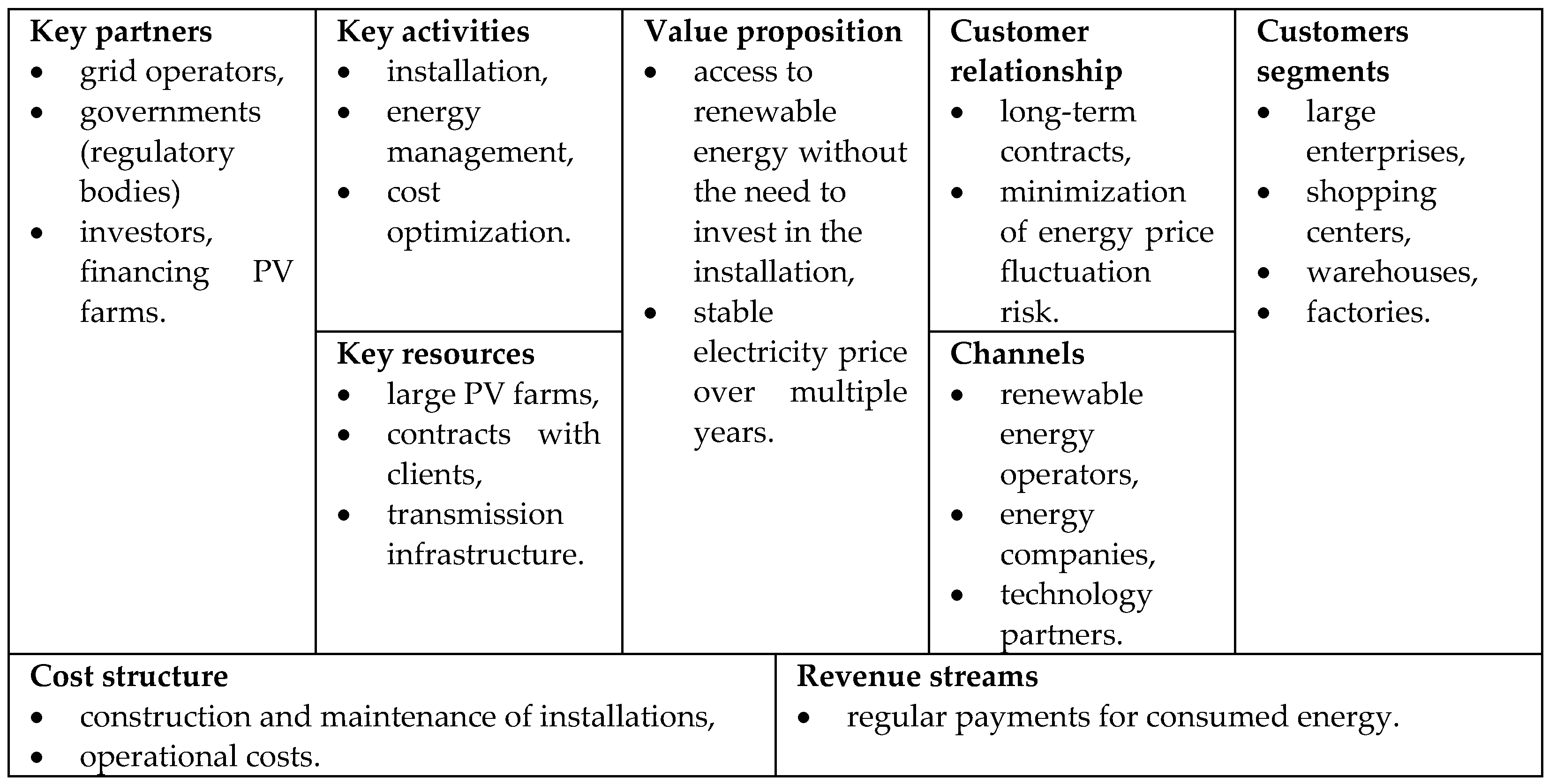
For each model of photovoltaic energy utilization, a Business Model Canvas was developed to enable a detailed analysis. The Business Model Canvas is a tool designed to facilitate discussion and generate innovative business models, and it was created by Osterwalder and Pigneur [32]. The BMC serves as a strategic instrument for visualizing, analyzing, and designing business models. It allows for the visual representation of various components of a business model and their interrelationships, which is conducted collaboratively with stakeholders during the early stages of prototyping and feedback collection, taking into account necessary adjustments (iterations) [33]. The BMC enables entrepreneurs and project teams to intuitively understand the relationships between these elements, supporting effective prototyping, iterative development, and informed business decision-making. Due to its clarity and flexibility, it is widely applied in both startups and large organizations.
The BMC defines nine components and the relationships between them. The General Business Model Canvas consists of seven key elements: Key Partners, Key Activities, Value Proposition, Customer Relationships, Customer Segments, Key Resources, and Channels, complemented by two financial components, Cost Structure and Revenue Streams. The visual template is designed to facilitate intuitive recognition of the connections among the individual elements [34]. The elements are arranged around the center of the template, with the value proposition positioned at its core [35]. On the left side of the template, the business model components related to activities, resources, partners, and costs are located, whereas on the right side, the elements concerning customer relationships, channels, customer segments, and revenues are placed. Additionally, the model includes guiding questions that support its development process. The model was developed by Osterwalder and Pigneur, whose framework has become one of the most widely adopted tools for visualizing, analyzing, and innovating business models across various industries [36].
BMC facilitates a structured yet flexible approach to business model development, enabling stakeholders to identify synergies, optimize resource allocation, and evaluate potential trade-offs. It is widely used both in academic research and in practice, supporting iterative design, prototyping, and strategic decision-making. Its visual and collaborative nature allows teams to co-create innovative solutions and adapt their models to changing market conditions, technological advancements, and regulatory environments [37].
Presenting each model through the Business Model Canvas framework ensures a consistent analytical structure, enabling clear identification of its key components and facilitating a systematic comparison in the subsequent part of the study. This methodological approach provides a solid foundation for examining how these models respond to different organizational needs, financial capacities, and strategic objectives in the context of PV adoption.
In the context of this study, BMC serves as a framework for systematically comparing different photovoltaic (PV) energy business models, highlighting their value propositions, cost structures, customer segments, and revenue mechanisms. In this study, the Business Model Canvas was developed for each PV energy utilization model based on data collected from the literature. This allowed for the systematic synthesis of available knowledge, highlighting the structural, financial, and operational characteristics of each model, and providing a clear basis for comparison.
It should be emphasized that individual models of utilizing photovoltaic energy are implemented in various countries around the world, reflecting differences in regulatory frameworks, economic conditions, and technological adoption. Comprehensive descriptions and analyses of these models can be found extensively in the existing literature, which provides insights into their practical applications and contextual adaptations.
The systematic analysis of these photovoltaic energy utilization models, combined with the development of corresponding BMC, enabled a deeper understanding of the structural and operational characteristics of each model. This approach allowed for the identification of both strengths and limitations associated with the different solutions, including aspects such as investment requirements, scalability, risk distribution, cost-effectiveness, and environmental impact. By applying the BMC framework to each model, the analysis revealed patterns in value creation, resource allocation, and risk distribution, as well as potential trade-offs between investment requirements, scalability, and environmental impact. These insights provide practical guidance for stakeholders evaluating PV adoption strategies.
Moreover, the BMC methodology facilitated the visualization of key relationships between value propositions, customer segments, resources, activities, and revenue mechanisms, highlighting potential areas for optimization and innovation. Overall, this process not only provided a structured framework for evaluating each model but also offered practical insights for stakeholders considering the adoption or adaptation of photovoltaic energy solutions in diverse business and national contexts. This methodological approach not only facilitates a structured comparison of different PV business models but also supports informed decision-making for enterprises, policymakers, and energy communities considering investment or adaptation of PV solutions in diverse contexts.
Although the introduction refers to the Polish context and European Union requirements, the six discussed models are presented in a generalized manner, allowing their analysis independently of local regulations, while still preserving the possibility of later relating the results to national specifics and EU requirements. Although the models are analyzed in a generalized manner, the results can be later contextualized to specific regulatory, economic, or technological conditions in Poland and across the EU, enhancing their practical applicability.

4. Results

The presented photovoltaic energy usage models were developed based on an extensive review of the available literature, encompassing studies, case analyses, and reports from various countries. By synthesizing this information, six distinct business approaches were identified, reflecting the diversity of market practices and consumer preferences. Each model was further analyzed using the BMC framework, allowing a structured visualization of key components, relationships, and value propositions. This approach enabled a comprehensive assessment of the advantages, disadvantages, and potential applications of each model in real-world contexts.
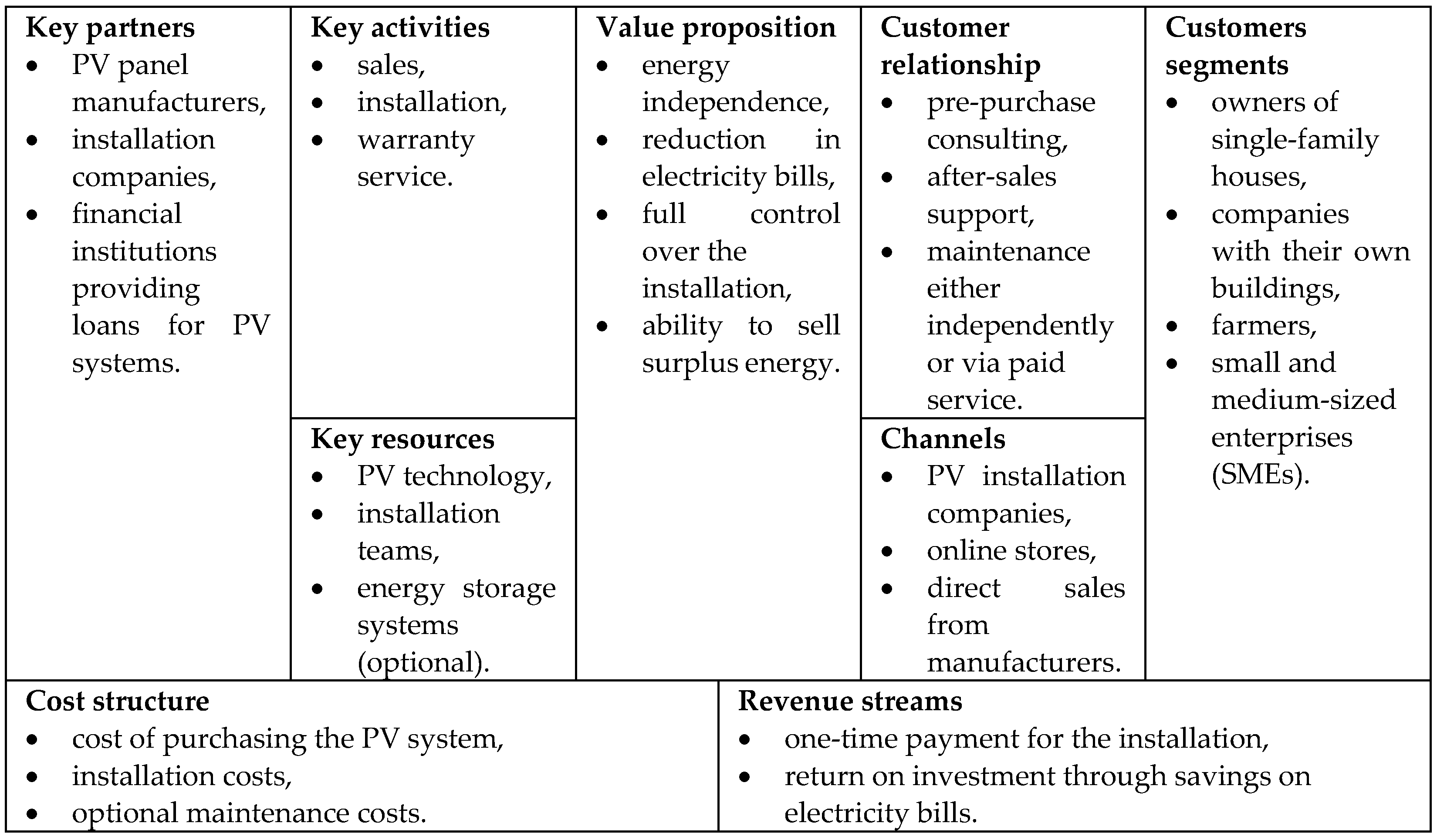
The first analyzed model is the ownership model, representing the traditional purchase of a photovoltaic (PV) system. In this model, the client purchases the PV system outright and bears the full installation costs. The client gains complete control over the system and all the energy generated. The Business Model Canvas for this approach is presented in Figure 1.
Advantages of the ownership model:
  • no long-term obligations,
  • full control over the installation,
  • no subscription fees,
  • return on investment after several years,
  • highest profitability in the long term,
  • direct ability to optimize and upgrade the system according to technological advances,
  • full independence from third-party providers, allowing for flexible energy strategies.
Disadvantages of the Ownership Model:
  • high initial cost,
  • requirement for self-maintenance,
  • exposure to technical risks, such as panel degradation or unforeseen repair costs,
  • investment attractiveness may depend on regulatory incentives or subsidies,
  • potential challenges in scaling for larger operations or multi-site enterprises.
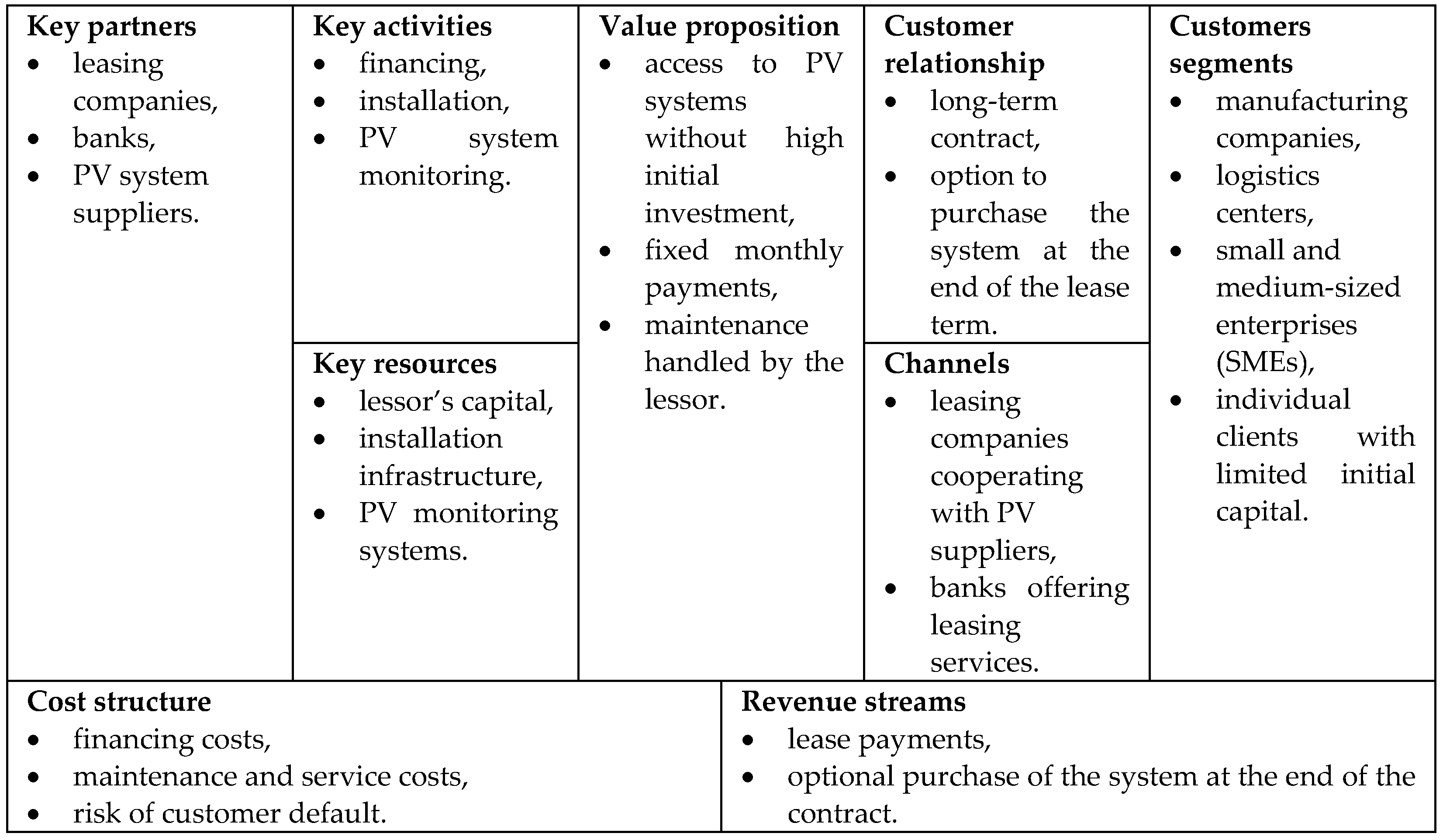
The second model discussed in this article is the leasing model for photovoltaic installations. In this model, the client does not purchase the system but pays a monthly lease fee, while the ownership of the installation remains with the lessor. The Business Model Canvas for this approach is presented in Figure 2.
Advantages of the Leasing Model:
  • no need for a large initial investment,
  • maintenance is the responsibility of the lessor,
  • the system can either become the property of the lessee or return to the leasing company at the end of the contract,
  • predictable monthly costs, which simplify budgeting for companies and households,
  • lower risk exposure to technical failures or unexpected repair costs,
  • flexibility to upgrade the PV system with new technology during or at the end of the lease term.
Disadvantages of the Leasing Model:
  • the total cost of the system is higher than in the ownership model,
  • lower profitability compared to the ownership model,
  • long-term obligations,
  • lower cost-effectiveness in the long term,
  • limited control over system customization or operational decisions,
  • dependency on the lessor for maintenance quality and response times.
The next analyzed model is the PPA (Power Purchase Agreement), in which the client does not own the installation but purchases the energy at a predetermined price from the provider who installed the PV system on their premises. The Business Model Canvas for this case is presented in Figure 3.
Advantages of the PPA Model:
  • stable energy price,
  • no need to invest in own infrastructure,
  • no initial costs,
  • predictable energy expenses,
  • flexibility,
  • access to large-scale PV installations that may be otherwise unaffordable,
  • reduced operational and maintenance responsibility, as these are handled by the provider,
  • potential for sustainability certification or reporting benefits for the client.
Disadvantages of the PPA Model:
  • long-term commitments (e.g., 15–25 years),
  • no ownership of the PV system,
  • dependence on the energy provider,
  • limited control over system upgrades or technology choices,
  • potential exposure to provider financial instability or contract renegotiation risks.
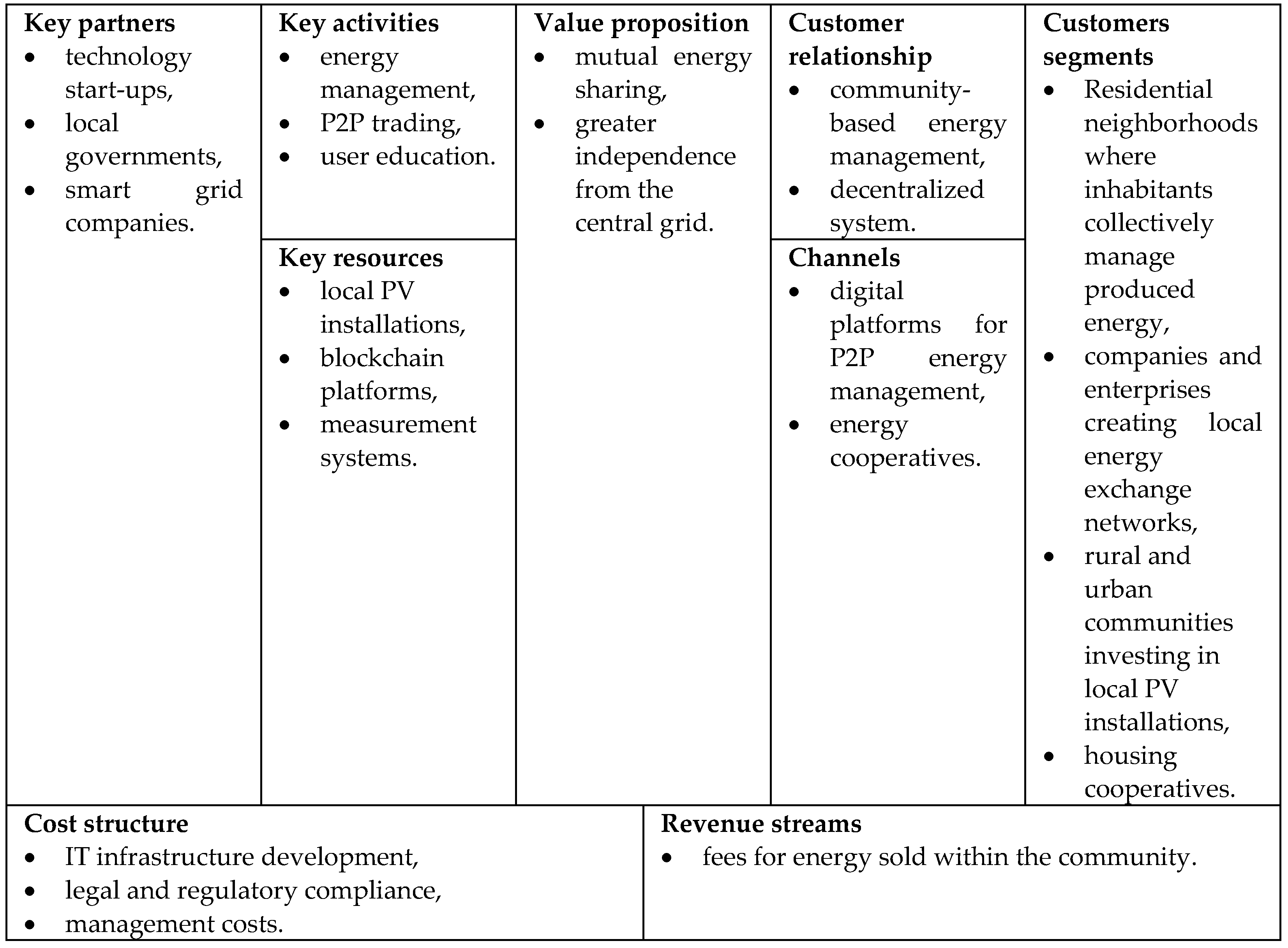
The next model discussed in the article is energy communities and the peer-to-peer (P2P) model. Local groups of PV users exchange energy by selling and purchasing it within their own network. The Business Model Canvas for this approach is presented in Figure 4.
Advantages of the P2P Model:
  • reduction in energy costs,
  • independence from large energy corporations,
  • democratization of the energy market,
  • promotion of sustainable development,
  • stronger community engagement and social cohesion,
  • opportunity to optimize energy locally and reduce grid losses,
  • flexibility in scaling and integrating new participants.
Disadvantages of the P2P Model:
  • legal and technical challenges,
  • lack of uniform regulations across countries,
  • requirement for extensive digital infrastructure,
  • reliance on active participation and trust among community members,
  • potential complexity in accounting and billing energy exchanges,
  • vulnerability to regulatory changes or local policy restrictions.
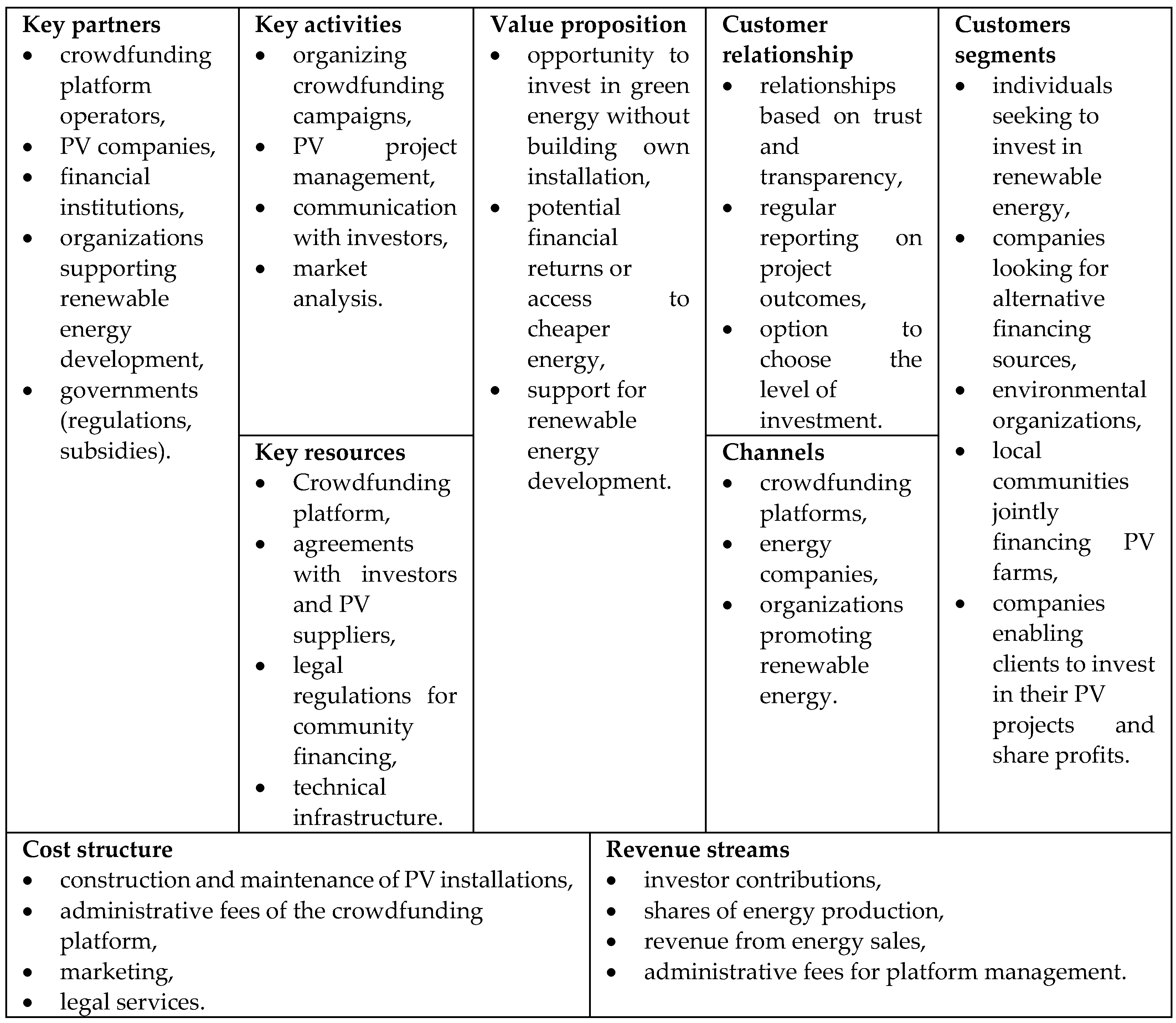
The next analyzed model is crowdfunding. In the photovoltaic sector, the crowdfunding model is based on collective financing of PV projects by multiple small investors, who in return receive financial benefits or access to cheaper energy. The Business Model Canvas for this approach is presented in Figure 5.
Advantages of the Crowdfunding Model:
  • accessibility for a wide range of investors,
  • support for renewable energy development without large capital expenditures,
  • democratization of access to renewable energy investments,
  • no need to commit substantial own funds,
  • long-term financial benefits,
  • promotion of sustainable development,
  • encourages community participation and awareness of renewable energy,
  • enables financing of larger projects that individual investors could not support alone,
  • flexibility in choosing investment level.
Disadvantages of the Crowdfunding Model:
  • investment risk,
  • dependence on the number of investors,
  • dependence on participant numbers and energy production outcomes,
  • risk of return on investment,
  • dependence on legal regulations,
  • requires strong project management and communication with investors,
  • potential delays or underperformance due to technical or operational challenges,
  • limited control for individual investors over project decisions.
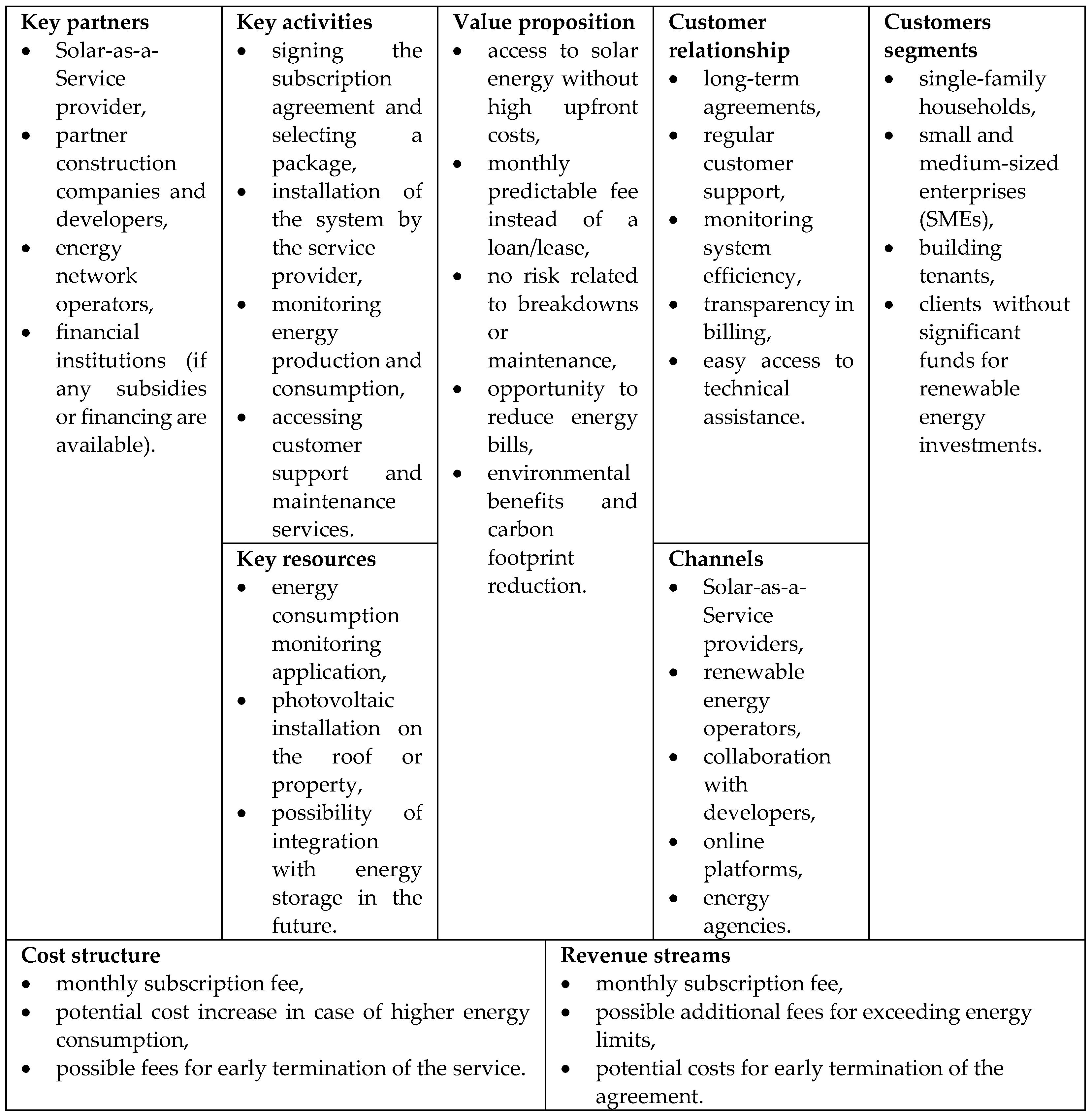
The final model is the subscription model (Solar-as-a-Service). In this model, the client pays a monthly subscription for access to solar energy without the need to invest in a photovoltaic installation. The entire installation and system maintenance are managed by the service provider. The Business Model Canvas for this approach is presented in Figure 6.
Advantages of the Subscription Model (Solar-as-a-Service):
  • No need for significant upfront investment;
  • Minimal risk;
  • Low entry threshold;
  • Flexibility;
  • No financial risk associated with system ownership;
  • Predictable costs;
  • Full technical service provided by the supplier;
  • Easy access to renewable energy;
  • Quick deployment without installation concerns for the client;
  • Suitable for tenants or clients unable to modify property;
  • Allows integration with future storage or energy management solutions.
Disadvantages of the Subscription Model (Solar-as-a-Service):
  • Long-term financial commitments in the form of monthly payments.
  • No ownership of the PV system.
  • Total energy cost may be higher over the long term.
  • Dependence on provider reliability and service quality.
  • Limited control over energy production or system upgrades.
  • Potential constraints in contract terms or package options.
Each of the presented business models addresses different customer needs:
  • Households tend to prefer the ownership or subscription model if they lack the capital for a full investment.
  • Companies often opt for leasing or PPA models to avoid high upfront costs.
  • Industry and large enterprises utilize PPAs to secure stable energy costs.
  • Energy communities choose P2P and cooperative models, as well as crowdfunding, to increase independence from large energy providers.
By incorporating real-world examples of companies, it becomes evident that all six business models are actively functioning in the market and have their respective leaders. There is no single “best” model—the choice depends on the customer profile and their financial needs.
The diversity of these business models highlights the flexibility and adaptability of the photovoltaic market to different user segments and financial capabilities. It also demonstrates that the choice of model is influenced not only by cost considerations but also by strategic goals, such as energy independence, sustainability, and risk management. Furthermore, the coexistence of multiple models fosters competition and innovation within the renewable energy sector, encouraging suppliers to offer tailored solutions that meet the evolving needs of both individual and corporate clients. Future research could explore the long-term performance, customer satisfaction, and environmental impact of each model to provide deeper insights into their comparative advantages.

5. Discussion

5.1. Comparison of All Models

To provide a clear overview of similarities and differences between the analyzed models, a comparative table was developed. Table 1 summarizes the six photovoltaic business models across key analytical dimensions, including investment requirements, long-term cost structure, ownership, financial risk, level of energy independence, customer profile, scalability, and main advantages and limitations. This structured comparison enables a more comprehensive understanding of how each model distributes value, risk, and responsibilities between stakeholders, supporting informed decision-making regarding their practical applicability in different organizational and market contexts.
A comparative assessment of the six models reveals fundamental differences in investment structure, customer involvement, and risk allocation. The ownership model provides the highest long-term profitability but requires the largest upfront capital, making it suitable for financially stable households and SMEs. Leasing and subscription models reduce the entry barrier by eliminating initial investment, yet both generate higher cumulative costs and do not grant system ownership. Power Purchase Agreements (PPA) shift financial and operational risk to an external investor, offering stable and predictable energy prices, an approach highly attractive for large enterprises with long planning cycles.
In contrast, energy community and P2P models emphasize decentralization and local energy sharing, increasing autonomy from grid suppliers but facing regulatory and technological constraints. Crowdfunding, meanwhile, democratizes access to renewable energy projects by enabling many small investors to finance installations; however, it introduces financial risks linked to energy production performance and market conditions.
Overall, each model optimizes a different configuration of value proposition, cost structure, and customer engagement, confirming that no universal approach exists. The optimal choice depends on customer capital availability, willingness to assume risk, planning horizon, and desired level of energy independence.
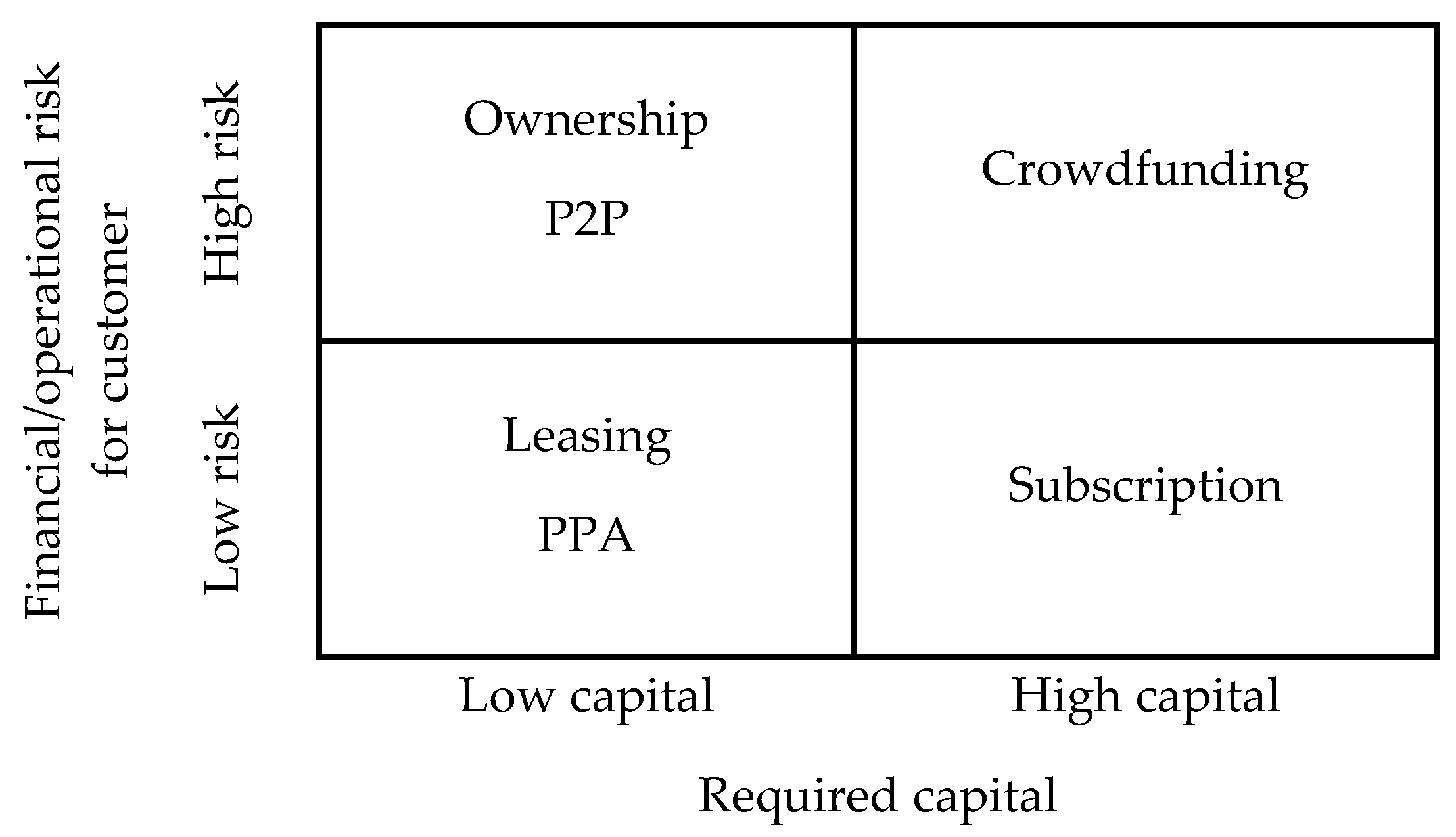
To complement the tabular comparison, Figure 7 presents a visual matrix positioning the six business models according to two critical dimensions: initial capital requirement (horizontal axis) and customer financial and operational risk (vertical axis). This graphical representation allows for an intuitive assessment of the strategic trade-offs between investment intensity and risk exposure, highlighting the relative positioning of the models within the broader landscape of photovoltaic solutions.
Figure 7 illustrates that models such as subscription (Solar-as-a-Service), leasing, and PPA cluster in the low-risk and low-capital quadrant, making them particularly attractive to households, SMEs, and risk-averse customers. In contrast, ownership and P2P/community models require higher upfront resources and greater operational involvement, resulting in elevated risk but potentially higher long-term benefits. Crowdfunding, positioned between these categories, offers low entry capital yet introduces investment-related uncertainty. Overall, the matrix underscores that each model occupies a distinct strategic niche, reinforcing the conclusion that no universal solution exists and that the optimal choice depends on customer resources, risk tolerance, and long-term energy objectives.
After presenting Table 1 and Figure 7, the following discussion highlights the strategic implications of the comparative analysis. In the comparative matrix and descriptive discussion, it is worth emphasizing that the Subscription/Solar-as-a-Service model not only occupies the low-risk and low-capital quadrant but also provides minimal operational involvement for customers. Users gain access to solar energy without concerns related to installation, maintenance, or technical management, which makes it particularly attractive for households, SMEs, or tenants with limited resources.
Similarly, Crowdfunding and P2P/community models require specific attention to participant engagement, digital infrastructure, and regulatory frameworks, as these factors strongly influence financial performance and feasibility. Crowdfunding introduces uncertainties related to energy production outcomes and the number of participating investors, while P2P/community models demand adequate technological platforms and compliance with varying local regulations.
Overall, this structured comparison confirms that each PV business model serves a distinct strategic niche. Decision-making should be guided by the customer’s capital availability, willingness to assume risk, operational capacity, and long-term energy objectives.
The comparative analysis of the six photovoltaic business models demonstrates that each approach represents a distinct balance of investment requirements, risk allocation, and value creation mechanisms. Models with low entry barriers, such as leasing, PPA, and subscription, prioritize accessibility and financial stability, making them suitable for risk-averse customers and entities with limited capital. In contrast, ownership and P2P/community models offer greater autonomy and long-term economic benefits but require higher upfront investment and greater operational engagement. Crowdfunding occupies an intermediate position, expanding participation in renewable energy projects while introducing uncertainty related to project performance. Overall, the comparison confirms that the choice of an optimal PV business model is highly context-dependent and should be aligned with customer resources, strategic objectives, and the desired level of energy independence.
In summary, the analysis highlights that each PV business model is tailored to specific customer profiles, balancing investment requirements, risk exposure, and operational involvement. The combined insights from the Business Model Canvas and the risk–capital matrix provide a clear framework for stakeholders to evaluate which model best aligns with their financial capacity, risk tolerance, and long-term energy goals, emphasizing the importance of a context-sensitive approach in adopting photovoltaic solutions.
Taken together, the six PV business models provide a spectrum of strategic options, illustrating how different combinations of capital, risk, and operational involvement can meet diverse customer needs and market contexts.

5.2. Limitations and Future Directions of Research

Despite the insights provided, several limitations remain. Most studies focus on theoretical frameworks or isolated case studies, limiting the generalizability of findings across diverse markets and regions. The impact of regulatory changes, technological advances in energy storage, and the integration of smart grids and AI-enabled energy management systems are still underexplored.
Although numerous studies describe individual photovoltaic business models, existing research rarely provides a structured, cross-model comparison using a unified analytical framework. Prior works typically analyze single models in isolation, without examining how they differ in terms of risk allocation, customer engagement, scalability, or long-term economic impact.
Moreover, most models do not incorporate emerging factors such as the role of digitalization (AI-based energy management, data-driven optimization), dynamic regulatory changes, the evolution of energy communities, or the increasing importance of flexible financing mechanisms tailored to different customer groups. They also seldom address how these models perform under varying market conditions or how they respond to fluctuations in energy prices and technological advancements.
The scientific novelty of this study lies in the development of a coherent, comparative framework for six distinct PV business models, integrating both a detailed tabular comparison and a graphical matrix of capital requirements and risk. By applying the Business Model Canvas uniformly across all models, the article reveals structural differences and uncovers strategic patterns that have not been sufficiently explored in prior literature. This approach enables a clearer understanding of the interdependencies between value propositions, customer segments, revenue mechanisms, and operational responsibilities. The findings contribute to the research gap by offering a holistic perspective on PV business model selection and by identifying the critical variables that should guide decision-making in enterprises and energy communities.
Future research should investigate the dynamic interplay between customer preferences, financing options, and technological innovations, as well as the long-term economic and environmental impacts of each business model. Comparative studies across countries and industrial sectors could provide deeper understanding of which models are most effective under varying regulatory and market conditions. Moreover, integrating real-time data from smart PV installations could enhance predictive modeling and optimization of energy consumption, further supporting the design of innovative and sustainable energy business strategies.

6. Conclusions

This study provides a structured comparison of six photovoltaic (PV) business models using a unified analytical framework based on the Business Model Canvas, a comparative table, and a risk–capital matrix. The results demonstrate that the selection of an appropriate PV adoption model depends strongly on how each approach distributes investment burdens, operational responsibilities, and financial risks. This finding confirms that there is no universal solution for PV deployment and that the optimal strategy must be aligned with the customer’s financial capacity, risk tolerance, and long-term energy objectives.
The analysis reveals clear strategic differences among the models. Ownership offers full control and long-term financial benefits but requires substantial initial capital. Leasing and Power Purchase Agreements (PPA) reduce investment risk and improve affordability, yet they impose contractual constraints and may offer lower long-term returns. Energy communities and peer-to-peer (P2P) models increase energy autonomy and support decentralized energy management, although their implementation is affected by regulatory and technological limitations. Crowdfunding expands participation in PV projects but introduces performance-related and regulatory uncertainties. Subscription-based Solar-as-a-Service minimizes financial and operational risks but does not provide system ownership and may lead to higher cumulative costs over time.
The novelty and contribution of this study lie in providing a coherent, cross-model comparison that clarifies the structural characteristics and strategic trade-offs of six distinct PV approaches, an aspect largely missing from previous literature. The integrative framework applied here enhances clarity in evaluating value creation mechanisms and risk allocation patterns across models. These insights can support enterprises, households, and energy communities in making informed decisions and designing adoption strategies that reflect both economic constraints and sustainability goals.

Author Contributions

Conceptualization, M.I.; methodology, M.I.; validation, M.M.; formal analysis, M.I. and M.M.; investigation, M.I. and M.M.; resources, M.I. and M.M.; writing—original draft preparation, M.I. and M.M.; writing—review and editing, M.I. and M.M.; visualization, M.I.; supervision, M.M. All authors have read and agreed to the published version of the manuscript.

Funding

Research and publication were financed by the statutory research fund of the Czestochowa University of Technology.

Data Availability Statement

No new data were created or analyzed in this study.

Conflicts of Interest

The authors declare no conflicts of interest.

References

  1. Yu, G.; Chen, W.; Wang, J.; Hu, Y. Research on Decision-Making for a Photovoltaic Power Generation Business Model under Integrated Energy Services. Energies 2022, 15, 5665. [Google Scholar] [CrossRef]
  2. Nyffenegger, R.; Boukhatmi, Ä.; Bocken, N.; Grösser, S. Product-service-system business models in the photovoltaic industry—A comprehensive analysis. J. Clean. Prod. 2025, 505, 145428. [Google Scholar] [CrossRef]
  3. Bankel, A.; Mignon, I. Solar business models from a firm perspective—An empirical study of the Swedish market. Energy Policy 2022, 166, 113013. [Google Scholar] [CrossRef]
  4. Matejun, M. Zarządzanie innowacjami ekologicznymi we współczesnym przedsiębiorstwie [Managing ecological innovations in a modern enterprise]. In Rozwój Zrównoważony—Zarządzanie Innowacjami Ekologicznymi [Sustainable Development—Managing Ecological Innovations]; Matejun, M., Grądzki, R., Eds.; Wydawnictwo Media Press: Warszawa, Poland, 2009; pp. 19–30. [Google Scholar]
  5. Robakiewicz, M. Audyty Efektywności Energetycznej i Audyty Energetyczne Przedsiębiorstw [Energy Efficiency Audits and Corporate Energy Audits], 2nd ed.; Fundacji Poszanowania Energii: Warszawa, Poland, 2022; pp. 147–159. [Google Scholar]
  6. ISO 50001:2018/Amd 1:2024; Energy Management Systems — Requirements with Guidance for Use — Amendment 1: Climate Action Changes. International Organization for Standardization: Geneva, Switzerland, 2024.
  7. Singh, R.K.; Kumar Mangla, S.; Bhatia, M.S.; Luthra, S. Integration of green and lean practices for sustainable business management. Bus. Strategy Environ. 2022, 31, 353–370. [Google Scholar] [CrossRef]
  8. Li, W.; Mohanta, A. Energy Management Systems in the Context of Sustainable Business Practices. J. Lifestyle SDGs Rev. 2025, 5, e06600. [Google Scholar] [CrossRef]
  9. Britel, Z.; Cherkaoui, A. Development of a readiness for change maturity model: An energy management system implementation case study. Prod. Eng. Arch. 2022, 28, 93–109. Available online: https://reference-global.com/article/10.30657/pea.2022.28.11?tab=preview (accessed on 15 April 2025). [CrossRef]
  10. Gabrielyan, B.; Markosyan, A.; Almastyan, N.; Madoyan, D. Energy efficiency in household sector. Prod. Eng. Arch. 2024, 30, 136–144. Available online: https://reference-global.com/article/10.30657/pea.2024.30.13 (accessed on 20 April 2025). [CrossRef]
  11. Mazur, M.; Fedorchuk, S.; Kulapin, O.; Ivakhnov, A.; Danylchenko, D.; Miroshnyk, O.; Shchur, T.; Halko, S.; Idzikowski, A. Analysis of the required energy storage capacity for balancing the load schedule and managing the electric energy demand of an apartment building. Syst. Saf. Hum. Tech. Facil. Environ. 2023, 5, 342–349. [Google Scholar] [CrossRef]
  12. Orłowska, J.; Suchacka, M.; Trembaczowski, Ł.; Ulewicz, R. Social Aspects of Establishing Energy Cooperatives. Energies 2024, 17, 5709. [Google Scholar] [CrossRef]
  13. Marques, L.; da Silva, H.B.; Thakur, J.; Uturbey, W.; Thakur, P. Categorizing shared photovoltaic business models in renewable markets: An approach based on CANVAS and transaction costs. Energy Rep. 2023, 10, 1602–1617. [Google Scholar] [CrossRef]
  14. Lu, Y.; Chang, R.; Lim, S. Crowdfunding for solar photovoltaics development: A review and forecast. Renew. Sustain. Energy Rev. 2018, 93, 439–450. [Google Scholar] [CrossRef]
  15. Kita, P.; Čvirik, M.; Maciejewski, G.; Žambochová, M.; Kitová Mazalánová, V. Activities of retail units as an element of business model creation. Pol. J. Manag. Stud. 2023, 27, 133–147. [Google Scholar] [CrossRef]
  16. Huijben, J.C.C.M. Mainstreaming Solar: PV Business Model Design Under Shifting Regulatory Regimes. Ph.D. Thesis, Technische Universiteit Eindhoven, Eindhoven, The Netherlands, 2015. Available online: https://pure.tue.nl/ws/portalfiles/portal/87285414/20171201_Huijben.pdf (accessed on 20 April 2025).
  17. Zhang, S. Innovative business models and financing mechanisms for distributed solar PV (DSPV) deployment in China. Energy Policy 2016, 95, 458–467. [Google Scholar] [CrossRef]
  18. Czerwińska, K.; Pacana, A. Analysis of Energy Security Based on Level of Alignment with the Goals of Agenda 2030. Energies 2024, 17, 2813. [Google Scholar] [CrossRef]
  19. Widyanti, R.; Włodarczyk, A. Environmental strategies of energy companies during the COVID-19 pandemic. Pol. J. Manag. Stud. 2023, 28, 380–396. [Google Scholar] [CrossRef]
  20. Filipiak, M.; Nawrowski, R.; Kurz, D.; Pierzchała, R. Analiza opłacalności stosowania instalacji fotowoltaicznej we współpracy z magazynem energii dla domu jednorodzinnego. [Analysis of the profitability of using a photovoltaic installation in cooperation with an energy storage for a single-family home]. Przegląd Elektrotechniczny 2022, 98, 253–258. [Google Scholar]
  21. Znajdek, K.; Sibiński, M. Postępy w Fotowoltaice. Struktura i Wytwarzanie Ogniw PV. Projektowanie i Zastosowania Systemów Fotowoltaicznych. Klasyczne i Nowatorskie Ogniwa w Praktyce; Polskie Wydawnictwo Naukowe PWN: Warszawa, Poland, 2022. [Google Scholar]
  22. Mittler, C.; Bucksteeg, M.; Staudt, P. Review and morphological analysis of renewable power purchasing agreement types. Renew. Sustain. Energy Rev. 2025, 211, 115293. [Google Scholar] [CrossRef]
  23. Miller, L.; Carriveau, R.; Harper, S.; Singh, S. Evaluating the link between LCOE and PPA elements and structure for wind energy. Energy Strategy Rev. 2017, 16, 33–42. [Google Scholar] [CrossRef]
  24. Jain, S. Exploring structures of power purchase agreements towards supplying 24x7 variable renewable electricity. Energy 2022, 244, 122609. [Google Scholar] [CrossRef]
  25. Bourcet, C.; Bovari, E. Exploring citizens’ decision to crowdfund renewable energy projects: Quantitative evidence from France. Energy Econ. 2020, 88, 104754. [Google Scholar] [CrossRef]
  26. Menyeh, B.O.; Acheampong, T. Crowdfunding renewable energy investments: Investor perceptions and decision-making factors in an emerging market. Energy Res. Soc. Sci. 2024, 114, 103602. [Google Scholar] [CrossRef]
  27. Santos-Rojo, C.; Gallego-Nicholls, J.F.; Rey-Martí, A. Understanding investor behavior in crowdfunding for sustainability: An FsQCA study. Environ. Dev. Sustain. 2025. [Google Scholar] [CrossRef]
  28. Franco, M.A.; Groesser, S.N. A Systematic Literature Review of the Solar Photovoltaic Value Chain for a Circular Economy. Sustainability 2021, 13, 9615. [Google Scholar] [CrossRef]
  29. Strupeit, L.; Bocken, N.; Van Opstal, W. Towards a Circular Solar Power Sector: Experience with a Support Framework for Business Model Innovation. Circ. Econ. Sustain. 2024, 4, 2093–2118. [Google Scholar] [CrossRef]
  30. Shakeel, S.R.; Juntunen, J.K.; Rajala, A. Business models for enhanced solar photovoltaic (PV) adoption: Transforming customer interaction and engagement practices. Sol. Energy 2024, 268, 112324. [Google Scholar] [CrossRef]
  31. Radl, J.; Fleischhacker, A.; Revheim, F.H.; Lettner, G.; Auer, H. Comparison of Profitability of PV Electricity Sharing in Renewable Energy Communities in Selected European Countries. Energies 2020, 13, 5007. [Google Scholar] [CrossRef]
  32. Osterwalder, A.; Pigneur, Y. Business Model Generation: A Handbook for Visionaries, Game Changers, and Challengers; John Wiley & Sons: Hoboken, NJ, USA, 2010. [Google Scholar]
  33. Trimi, S.; Berbegal-Mirabent, J. Business model innovation in entrepreneurship. Int. Entrep. Manag. J. 2012, 8, 449–465. [Google Scholar] [CrossRef]
  34. LEAN Foundry; Maurya, A. Why Lean Canvas vs Business Model Canvas? Practice Trumps Theory. Available online: https://www.atlassian.com/work-management/project-management/business-model-canvas (accessed on 20 April 2025).
  35. Avdiji, H.; Elikan, D.; Missonier, S.; Pigneur, Y. Designing tools for collectively solving III-structured problems. In Proceedings of the 51st Hawaii International Conference on System Sciences, Hawaii, HI, USA, 3–6 January 2018. [Google Scholar]
  36. Osterwalder, A.; Pigneur, Y. Generaci’ on de Modelos de Negocios; DEUSTO: Barcelona, Spain, 2011. [Google Scholar]
  37. Ingaldi, M.; Ulewicz, R. The Business Model of a Circular Economy in the Innovation and Improvement of Metal Processing. Sustainability 2024, 16, 5513. [Google Scholar] [CrossRef]
Figure 1. Business Model Canvas Diagram for the ownership model [own study].
Energies 18 06533 g001
Figure 2. Business model canvas diagram for leasing model [own study].
Energies 18 06533 g002
Figure 3. Business model canvas diagram for PPA model [own study].
Energies 18 06533 g003
Figure 4. Business model canvas diagram for P2P model [own study].
Energies 18 06533 g004
Figure 5. Business model canvas diagram for crowdfunding model [own study].
Energies 18 06533 g005
Figure 6. Business Model Canvas Diagram for subscription model [own study].
Energies 18 06533 g006
Figure 7. Comparative matrix of six PV business models based on capital requirements and customer risk [own study].
Energies 18 06533 g007
Table 1. Comparative analysis of six photovoltaic business models (own study).
CriterionModel
OwnershipLeasingPPAP2PCrowdfundingSubscription
Initial investmentVery highLowNoneMedium (shared)None/smallNone
Long-term costsLowestMediumMediumLow–mediumDepends on projectHigher (subscription)
Financial riskHigh (investment, maintenance)Low–mediumLowMedium (market/regulatory, platform)High (investment risk, production uncertainty)Very low
Ownership of installationYesNo (possible buyout)NoCollective/sharedNoNo
Energy price stabilityMedium (market tariffs)MediumHigh (fixed PPA tariff)MediumDepends on projectMedium
Independence from gridMedium–highMediumLow–mediumHighLowLow
Customer profileHouseholds, SMEsSMEs, logistics, households with limited capitalLarge companies, industryLocal communities, cooperatives, neighborhoodsInvestors, communitiesHouseholds, SMEs, tenants
ScalabilityLimitedGoodVery highMediumHigh (many small investors)High
AdvantagesFull control, long-term savingsNo upfront cost, service includedPredictable costs, no investmentEnergy sharing, prosumer empowerment, decentralizationDemocratization of financing, low entry threshold, long-term financial benefitsFlexibility, zero investment, low risk, minimal operational involvement, technical service included, easy integration with energy storage
LimitationsHigh initial costsHigher total costLong-term contractsRegulatory/technical barriers, digital infrastructure requiredInvestment risk, dependent on number of participants and production outcomes, legal/regulatory uncertaintyNo ownership, long-term payment obligation, dependent on service provider quality
Disclaimer/Publisher’s Note: The statements, opinions and data contained in all publications are solely those of the individual author(s) and contributor(s) and not of MDPI and/or the editor(s). MDPI and/or the editor(s) disclaim responsibility for any injury to people or property resulting from any ideas, methods, instructions or products referred to in the content.