

Charting Smarter Skies—A Review of Computational Strategies for Energy-Saving Flights in Electric UAVs


 ,
,  , and
, and
Abstract
1. Introduction
2. Solar-Powered UAV’s: Design and Engineering Innovations
2.1. Overview of Solar-Powered UAVS
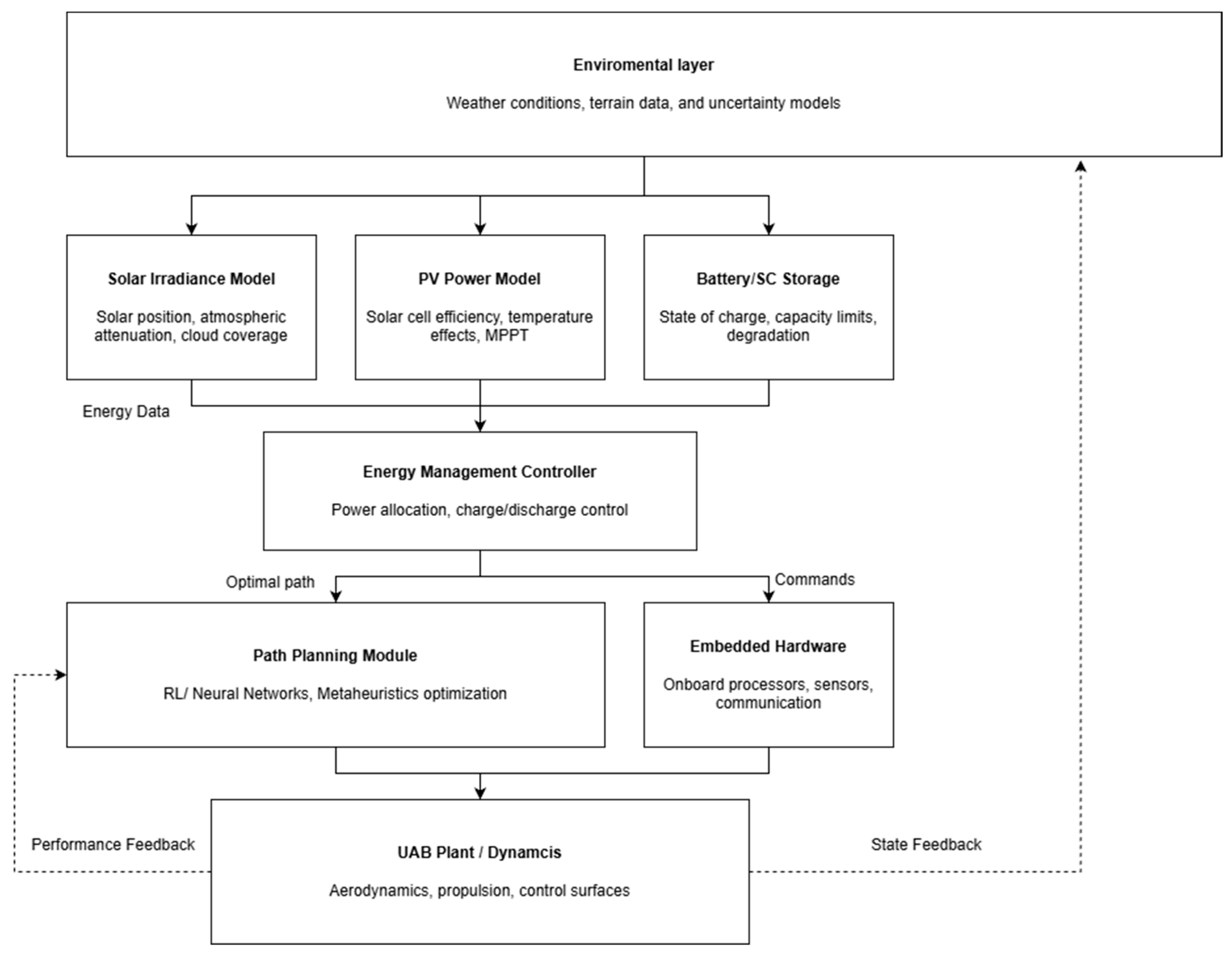
2.2. Energy Management Strategies
3. Neural Networks in UAV Path Planning
3.1. Neural Networks & Hybrid Metaheuristic Integration for Energy-Aware Path Planning
3.2. Neural Network Architectures for Path Planning

| Title | Authors | Year | Neural Network Approach | Application |
|---|---|---|---|---|
| Energy-Optimal Trajectory Planning for Near-Space Solar-Powered UAV Based on Hierarchical Reinforcement Learning [33] | Tichao Xu; Di Wu; Wenyue Meng; Wenjun Ni; Zijian Zhang | 2024 | Hierarchical Deep RL (option-based RL algorithm) | Energy-optimal trajectory planning for high-altitude solar-powered UAV (maximize net energy gain for near-space flight) |
| Energy-Optimal Flight Strategy for Solar-Powered Aircraft Using Reinforcement Learning with Discrete Actions [34] | Wenjun Ni; Di Wu; Xiaoping Ma | 2021 | Deep Reinforcement Learning (discrete action space controller) | Energy management for HALE solar-powered UAV (extended endurance via optimized 24-h flight trajectory) |
| Deep Reinforcement Learning-Driven UAV Data Collection Path Planning: A Study on Minimizing AoI [23] | Hesong Huang; Yang Li; Ge Song; Wendong Gai | 2024 | Multi-Agent Deep RL (Twin Delayed DDPG variant, MATD3 with PSO) | Multi-UAV collaborative path planning to minimize Age of Information (freshness of IoT sensor data) |
| Path Planning of Multi-UAVs Based on Deep Q-Network for Energy-Efficient Data Collection in UAVs-Assisted IoT [35] | Xiumin Zhu; Lingling Wang; Yumei Li; Shudian Song; et al. | 2022 | Multi-Agent Deep Q-Network (HAS-DQN algorithm combining hexagonal search + DQN) | Energy-efficient multi-UAV data collection (maximize wireless sensor data gathered while avoiding coverage overlap) |
| Multi-UAV Autonomous Path Planning in Reconnaissance Missions Considering Incomplete Information: A Reinforcement Learning Method [36] | Yu Chen; Qi Dong; Xiaozhou Shang; Zhenyu Wu; Jinyu Wang | 2023 | Multi-Agent RL (PPO)-centralized training & decentralized execution (with recurrent neural network state) | Coordinated multi-UAV path planning for reconnaissance in dynamic, partially observed environments (robust to incomplete info) |
| A Novel Reinforcement Learning Based Grey Wolf Optimizer Algorithm for Unmanned Aerial Vehicles (UAVs) Path Planning [37] | Qu; Gai; Zhong; Zhang | 2020 | Hybrid RL + Metaheuristic (RLGWO: RL-guided Grey Wolf Optimizer) | Global 3D path optimization with obstacle avoidance (computes collision-free and shortest routes in complex terrain) |
| 6-DOF UAV Path Planning and Tracking Control for Obstacle Avoidance: A Deep Learning-Based Integrated Approach [38] | Yanxiang Wang; Honglun Wang; Yiheng Liu; Jianfa Wu; Yuebin Lun | 2024 | LSTM Network (offline-trained LSTM for fast online path generation) | Real-time 3D path planning with obstacle avoidance for fixed-wing UAV (integrated path planning & trajectory tracking control) |
3.3. Reinforcement Learning in Path Optimization
3.3.1. Deep Q-Networks (DQN)
- “Deep Reinforcement Learning-Based Adaptive Real-Time Path Planning for UAV” Jiankang Li and Yang Liu (2021) [39]: This research presents an adaptive real-time path planning method for fixed-wing UAVs using Deep Q-Networks (DQN). The approach considers kinematic constraints and emphasizes path smoothness, achieving efficient obstacle avoidance and energy conservation in unknown environments.
- “Deep Reinforcement Learning-Based UAV Path Planning Algorithm in Agricultural Time-Constrained Data Collection” by M. Cai, S. Fan, G. Xiao, and K. Hu (2023) [31]: This study introduces a UAV path planning algorithm based on Deep Reinforcement Learning (DRL) for agricultural data collection. The algorithm optimizes location, energy, and time constraints to maximize data collection efficiency, demonstrating the adaptability of DRL in dynamic environments.
3.3.2. Proximal Policy Optimization (PPO)
3.3.3. Multi-Agent and Cooperative RL Approaches
3.3.4. Case Studies and Applications
- Response Time: Quick response times enable UAVs to react promptly to dynamic environments, essential for real-time obstacle avoidance and decision-making. Enhanced response times contribute to safer and more reliable operations.
- Energy Consumption: Minimizing energy consumption directly impacts flight endurance, especially for solar-powered UAVs with limited energy resources. Efficient energy use allows for longer missions and reduces reliance on energy-harvesting intervals.
- Adaptability Under Changing Conditions: The ability to adapt to environmental changes, such as wind variations or unexpected obstacles, ensures consistent UAV performance. Adaptive algorithms enhance reliability and increase mission success rates.
4. Optimization Algorithms in UAV Applications
4.1. Importance of Optimization in UAVs
4.2. Classical Optimization Techniques
4.3. Evolutionary Algorithms
- Genetic Algorithms (GA)
- 2.
- Differential Evolution (DE)
- 3.
- Hybrid GA-A* Approaches
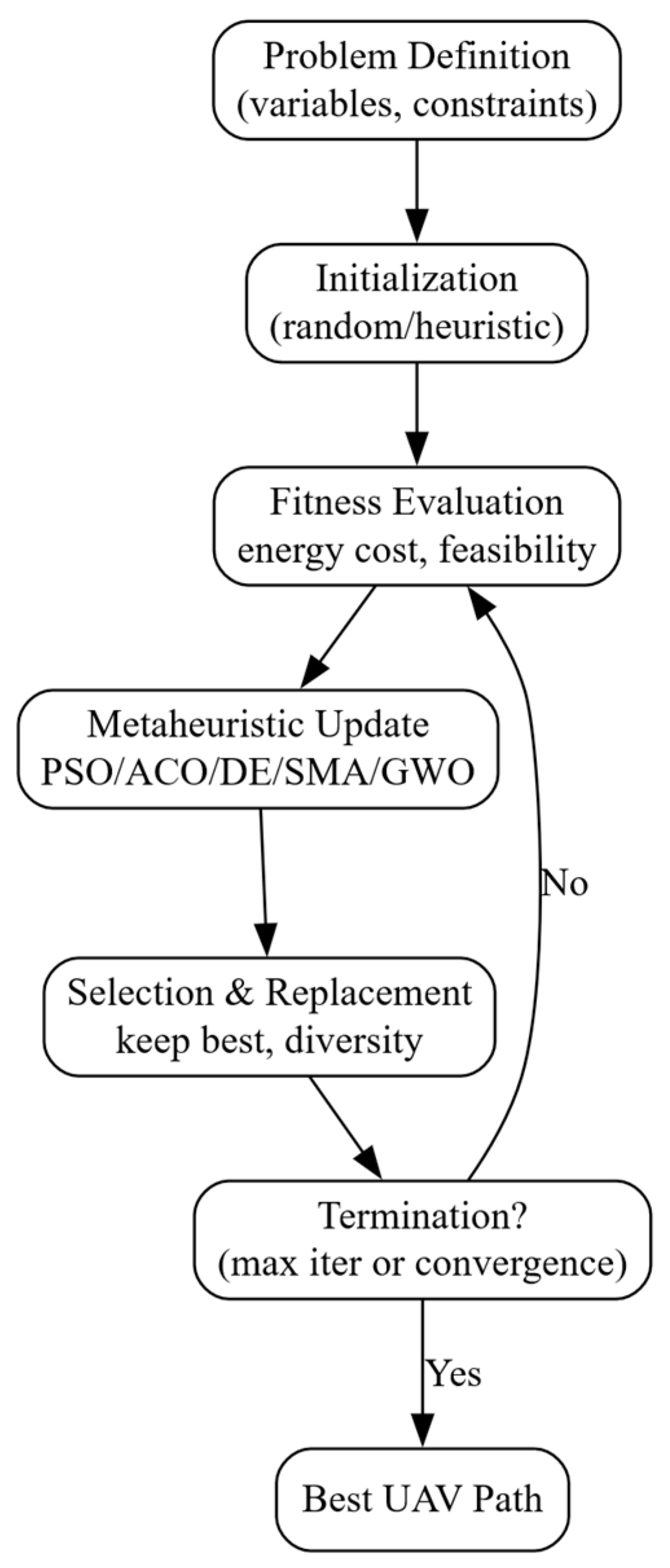
4.4. Swarm Intelligence Algorithms
- Particle Swarm Optimization (PSO):
- 2.
- Ant Colony Optimization (ACO):
4.5. Bio-Inspired Optimization
- Slime Mould Algorithm (SMA):
- 2.
- Grey Wolf Optimizer (GWO):
4.6. Hybrid Optimization Techniques
- Neural Network with Evolutionary Algorithms:
- 2.
- PSO and GA Integration:
4.7. Comparative Analysis of Algorithm Categories
5. Challenges and Future Directions
5.1. Challenges in Neural Network Implementation
5.2. Environmental Uncertainties
5.3. Computational Limitations
5.4. Regulatory and Safety Concerns
5.5. Energy-Harvesting Efficiency
5.6. Swarm Coordination
5.7. Integration of Emerging Technologies
5.8. Research Gaps
6. Conclusions
- (1)
- Hybrid approaches outperform single-method algorithms, especially combinations such as PSO-GA, DRL-PSO, or NN-GWO, which leverage complementary strengths in exploration, prediction, and policy adaptation.
- (2)
- Successful real-world UAV software implementations almost always integrate perception, control, and optimization jointly rather than treating path planning as an isolated module.
- (i)
- Hybrid algorithm architectures that combine global and local search capabilities;
- (ii)
- Energy-aware DRL models that incorporate full UAV power-budget dynamics;
- (iii)
- Unified benchmark environments to allow performance comparison across studies.
Author Contributions
Funding
Data Availability Statement
Acknowledgments
Conflicts of Interest
Abbreviations
| ACO | Ant Colony Optimization |
| ADS-B | Automatic Dependent Surveillance-Broadcast |
| AI | Artificial Intelligence |
| APF | Artificial Potential Field |
| ASIC | Application-Specific Integrated Circuit |
| BINN | Bio-Inspired Neural Network |
| B-APFDQN | An algorithm combining DQN and APF |
| CNN | Convolutional Neural Network |
| DCBA | Distributed Consensus-Based Algorithm |
| DE | Differential Evolution |
| DEAP | Distributed Evolutionary Algorithms in Python |
| DNN | Deep Neural Network |
| DQN | Deep Q-Network |
| DRL | Deep Reinforcement Learning |
| EA | Evolutionary Algorithm |
| ESMOML-RAA | Enhanced Slime Mould Optimization with Deep-Learning-Based Resource Allocation Approach |
| FL | Federated Learning |
| FPGA | Field-Programmable Gate Array |
| GA | Genetic Algorithm |
| GPS | Global Positioning System |
| GPU | Graphics Processing Unit |
| GWO | Grey Wolf Optimizer |
| HALE | High-Altitude Long-Endurance |
| HAPS | High-Altitude Pseudo-Satellite |
| HAS-DQN | Hexagonal Search and Deep Q-Network algorithm |
| HDGWO | Hybrid Discrete Grey Wolf Optimizer |
| HHO | Harris Hawks Optimization |
| HP-LSTM | Highly Parallelized Long Short-Term Memory |
| IoT | Internet of Things |
| LiDAR | Light Detection and Ranging |
| LP | Linear Programming |
| LSTM | Long Short-Term Memory |
| MADDPG | Multi-Agent Deep Deterministic Policy Gradient |
| MATD3 | Multi-Agent Twin Delayed Deep Deterministic Policy Gradient |
| MPC | Model Predictive Control |
| MPPT | Maximum Power Point Tracking |
| NLP | Nonlinear Programming |
| PID | Proportional-Integral-Derivative (controller) |
| PPO | Proximal Policy Optimization |
| PSO | Particle Swarm Optimization |
| PV | Photovoltaic |
| RL | Reinforcement Learning |
| RLGWO | Reinforcement Learning-based Grey Wolf Optimizer |
| RNN | Recurrent Neural Network |
| ROS | Robot Operating System |
| RRT | Rapidly-exploring Random Tree |
| SMA | Slime Mould Algorithm |
| SLAM | Simultaneous Localization and Mapping |
| SPSO | Spherical Vector Particle Swarm Optimization |
| SUAV | Solar-Powered Unmanned Aerial Vehicle |
| TEG | Thermoelectric Generator |
| UAV | Unmanned Aerial Vehicle |
References
- Molina, A.A.; Huang, Y.; Jiang, Y. A Review of Unmanned Aerial Vehicle Applications in Construction Management: 2016–2021. Standards 2023, 3, 95–109. [Google Scholar] [CrossRef]
- Wu, J.; Wang, H.; Huang, Y.; Su, Z.; Zhang, M. Energy Management Strategy for Solar-Powered UAV Long-Endurance Target Tracking. IEEE Trans. Aerosp. Electron. Syst. 2019, 55, 1878–1891. [Google Scholar] [CrossRef]
- Aggarwal, S.; Kumar, N. Path Planning Techniques for Unmanned Aerial Vehicles: A Review, Solutions, and Challenges. Comput. Commun. 2020, 149, 270–279. [Google Scholar] [CrossRef]
- Nowakowski, M.; Berger, G.S.; Braun, J.; Mendes, J.A.; Bonzatto Junior, L.; Lima, J. Advance Reconnaissance of UGV Path Planning Using Unmanned Aerial Vehicle to Carry Out Mission in Unknown Environment. In Robot 2023: Sixth Iberian Robotics Conference; Marques, L., Santos, C., Lima, J.L., Tardioli, D., Ferre, M., Eds.; Lecture Notes in Networks and Systems; Springer: Cham, Switzerland, 2024; Volume 978. [Google Scholar] [CrossRef]
- Faizah, M.I.; Mir, I.; Abualigah, L.; Putra, S.; Forestiero, A. A Consolidated Review of Path Planning and Optimization Techniques: Technical Perspectives and Future Directions. Electronics 2021, 10, 2250. [Google Scholar] [CrossRef]
- Gómez Arnaldo, C.; Zamarreño Suárez, M.; Pérez Moreno, F.; Delgado-Aguilera Jurado, R. Path Planning for Unmanned Aerial Vehicles in Complex Environments. Drones 2024, 8, 288. [Google Scholar] [CrossRef]
- LeCun, Y.; Bengio, Y.; Hinton, G. Deep Learning. Nature 2015, 521, 436–444. [Google Scholar] [CrossRef]
- Ahuja, H.; Kuhar, V.; Miny, R.I. Object Detection and Classification for Autonomous Drones. Int. J. Comput. Appl. 2020, 175, 3162–3165. [Google Scholar] [CrossRef]
- Poudel, S.; Arafat, M.Y.; Moh, S. Bio-Inspired Optimization-Based Path Planning Algorithms in Unmanned Aerial Vehicles: A Survey. Sensors 2019, 23, 3051. [Google Scholar] [CrossRef]
- Yu, Z.; Si, Z.; Li, X.; Wang, D.; Song, H. A Novel Hybrid Particle Swarm Optimization Algorithm for Path Planning of UAVs. IEEE Internet Things J. 2022, 9, 22547–22558. [Google Scholar] [CrossRef]
- Cao, P.; Lei, L.; Cai, S.; Shen, G.; Liu, X.; Wang, X.; Zhang, L.; Zhou, L.; Guizani, M. Computational Intelligence Algorithms for UAV Swarm Networking and Collaboration: A Comprehensive Survey and Future Directions. IEEE Commun. Surv. Tutor. 2024, 26, 2684–2728. [Google Scholar] [CrossRef]
- Saravanakumar, Y.N.; Sultan, M.T.H.; Shahar, F.S.; Giernacki, W.; Łukaszewicz, A.; Nowakowski, M.; Holovatyy, A.; Stępień, S. Power Sources for Unmanned Aerial Vehicles: A State-of-the-Art. Appl. Sci. 2023, 13, 11932. [Google Scholar] [CrossRef]
- Airbus Defence and Space. Zephyr High Altitude Pseudo-Satellite (HAPS). Available online: https://www.airbus.com/en/products-services/defence/uas/zephyr (accessed on 29 June 2025).
- Narimanov, J. Analysis of Solar Cells Can Be Used in the Design of Solar-Powered UAV. Vestn. Transp. Transp. 2024, 1, 30–34. [Google Scholar]
- Arafat, M.Y.; Moh, S. Bio-Inspired Approaches for Energy-Efficient Localization and Clustering in UAV Networks for Monitoring Wildfires in Remote Areas. IEEE Access 2021, 9, 18649–18669. [Google Scholar] [CrossRef]
- Elkerdany, M.S.; Safwat, I.M.; Youssef, A.M.M.; Elkhatib, M.M. An Intelligent Energy Management System for Enhanced Performance in Electric UAVs. Aerosp. Syst. 2025, 8, 701–716. [Google Scholar] [CrossRef]
- Sener, E.; Turk, I.; Yazar, I.; Karakoç, T.H. Solar Powered UAV Model on MATLAB/Simulink Using Incremental Conductance MPPT Technique. Aircr. Eng. Aerosp. Technol. 2020, 92, 93–100. [Google Scholar] [CrossRef]
- Fares, A.M.; Klumpner, C.; Sumner, M. A Novel Multiport DC-DC Converter for Enhancing the Design and Performance of Battery-Supercapacitor Hybrid Energy Storage Systems for Unmanned Aerial Vehicles. Appl. Sci. 2022, 12, 2767. [Google Scholar] [CrossRef]
- Al-Haddad, L.A.; Łukaszewicz, A.; Majdi, H.S.; Holovatyy, A.; Jaber, A.A.; Al-Karkhi, M.I.; Giernacki, W. Energy Consumption and Efficiency Degradation Predictive Analysis in Unmanned Aerial Vehicle Batteries Using Deep Neural Networks. Adv. Sci. Technol. Res. J. 2025, 19, 21–30. [Google Scholar] [CrossRef]
- Mikołajczyk, T.; Mikołajewski, D.; Kłodowski, A.; Łukaszewicz, A.; Mikołajewska, E.; Paczkowski, T.; Macko, M.; Skornia, M. Energy Sources of Mobile Robot Power Systems: A Systematic Review and Comparison of Efficiency. Appl. Sci. 2023, 13, 7547. [Google Scholar] [CrossRef]
- Zhang, J.; Lou, M.; Xiang, L.; Hu, L. Power Cognition: Enabling Intelligent Energy Harvesting and Resource Allocation for Solar-Powered UAVs. Future Gener. Comput. Syst. 2020, 110, 658–664. [Google Scholar] [CrossRef]
- Hu, D.; Dong, W.; Xie, W.; He, L. Proximal Policy Optimization for Multi-Rotor UAV Autonomous Guidance, Tracking, and Obstacle Avoidance. Int. J. Aeronaut. Space Sci. 2022, 23, 339–353. [Google Scholar] [CrossRef]
- Huang, H.; Li, Y.; Song, G.; Gai, W. Deep Reinforcement Learning-Driven UAV Data Collection Path Planning: A Study on Minimizing AoI. Electronics 2024, 13, 1871. [Google Scholar] [CrossRef]
- Li, S.; Zhang, R.; Ding, Y.; Qin, X.; Han, Y.; Zhang, H. Multi-UAV Path Planning Algorithm Based on BINN-HHO. Sensors 2022, 22, 9786. [Google Scholar] [CrossRef]
- Hooshyar, M.; Huang, Y.-M. Meta-Heuristic Algorithms in UAV Path Planning Optimization: A Systematic Review (2018–2022). Drones 2023, 7, 687. [Google Scholar] [CrossRef]
- Kong, F.; Wang, Q.; Gao, S.; Yu, H. B-APFDQN: A UAV Path Planning Algorithm Based on Deep Q-Network and Artificial Potential Field. IEEE Access 2023, 11, 44051–44064. [Google Scholar] [CrossRef]
- Huang, G.; Cai, Y.; Liu, J.; Qi, Y.; Liu, X. A Novel Hybrid Discrete Grey Wolf Optimizer Algorithm for Multi-UAV Path Planning. J. Intell. Robot. Syst. 2021, 103, 49. [Google Scholar] [CrossRef]
- Han, S.; Pool, J.; Tran, J.; Dally, W. Learning Both Weights and Connections for Efficient Neural Network. In Proceedings of the NIPS’15: Proceedings of the 29th International Conference on Neural Information Processing Systems—Volume 1, Montreal, QC, Canada, 7–12 December 2015; pp. 1135–1143. [Google Scholar]
- Unlu, E.; Zenou, E.; Riviere, N.; Dupouy, P.-E. Deep Learning-Based Strategies for the Detection and Tracking of Drones Using Several Cameras. IPSJ Trans. Comput. Vis. Appl. 2019, 11, 7. [Google Scholar] [CrossRef]
- Behera, D.K.; Bazil Raj, A. Drone Detection and Classification Using Deep Learning. In Proceedings of the 2020 4th International Conference on Intelligent Computing and Control Systems (ICICCS), Madurai, India, 13–15 May 2020; IEEE: Piscataway, NJ, USA, 2020; pp. 1012–1016. [Google Scholar] [CrossRef]
- Cai, M.; Fan, S.; Xiao, G.; Hu, K. Deep Reinforcement Learning-Based UAV Path Planning Algorithm in Agricultural Time-Constrained Data Collection. Adv. Electr. Comput. Eng. 2023, 23, 101–108. [Google Scholar] [CrossRef]
- Dembla, S.; Dolas, N.; Karigar, A.; Sonavane, S. Machine Learning-Based Object Detection and Classification Using Drone. Int. Res. J. Eng. Technol. 2021, 8, 2546–2555. [Google Scholar]
- Xu, T.; Wu, D.; Meng, W.; Ni, W.; Zhang, Z. Energy-Optimal Trajectory Planning for Near-Space Solar-Powered UAV Based on Hierarchical Reinforcement Learning. IEEE Access 2024, 12, 21420–21436. [Google Scholar] [CrossRef]
- Ni, W.; Wu, D.; Ma, X. Energy-Optimal Flight Strategy for Solar-Powered Aircraft Using Reinforcement Learning with Discrete Actions. IEEE Access 2021, 9, 95317–95334. [Google Scholar] [CrossRef]
- Zhu, X.; Wang, L.; Li, Y.; Song, S.; Ma, S.; Yang, F.; Zhai, L. Path Planning of Multi-UAVs Based on Deep Q-Network for Energy-Efficient Data Collection in UAV-Assisted IoT. Veh. Commun. 2022, 36, 100491. [Google Scholar] [CrossRef]
- Chen, Y.; Dong, Q.; Shang, X.; Wu, Z.; Wang, J. Multi-UAV Autonomous Path Planning in Reconnaissance Missions Considering Incomplete Information: A Reinforcement Learning Method. Drones 2023, 7, 10. [Google Scholar] [CrossRef]
- Qu, C.; Gai, W.; Zhong, M.; Zhang, J. A Novel Reinforcement Learning-Based Grey Wolf Optimizer Algorithm for Unmanned Aerial Vehicles (UAVs) Path Planning. Appl. Soft Comput. 2020, 89, 106099. [Google Scholar] [CrossRef]
- Wang, Y.; Wang, H.; Liu, Y.; Wu, J.; Lun, Y. 6-DOF UAV Path Planning and Tracking Control for Obstacle Avoidance: A Deep Learning-Based Integrated Approach. Aerosp. Sci. Technol. 2024, 151, 109320. [Google Scholar] [CrossRef]
- Li, J.; Liu, Y. Deep Reinforcement Learning-Based Adaptive Real-Time Path Planning for UAV. In Proceedings of the 2021 8th International Conference on Dependable Systems and Their Applications (DSA), Yinchuan, China, 5–6 August 2021; pp. 522–530. [Google Scholar] [CrossRef]
- Westheider, J.; Rückin, J.; Popović, M. Multi-UAV Adaptive Path Planning Using Deep Reinforcement Learning. arXiv 2023, arXiv:2303.01150. [Google Scholar] [CrossRef]
- Khalatbarisoltani, A.; Boulon, L.; Hu, X. Integrating Model Predictive Control with Federated Reinforcement Learning for Decentralized Energy Management of Fuel Cell Vehicles. IEEE Trans. Intell. Transp. Syst. 2023, 24, 13639–13653. [Google Scholar] [CrossRef]
- Wang, C.; Zhang, L.; Gao, Y.; Zheng, X.; Wang, Q. A Cooperative Game Hybrid Optimization Algorithm Applied to UAV Inspection Path Planning in Urban Pipe Corridors. Mathematics 2023, 11, 3620. [Google Scholar] [CrossRef]
- Lee, M.H.; Moon, J. Deep Reinforcement Learning-Based UAV Navigation and Control: A Soft Actor-Critic with Hindsight Experience Replay Approach. arXiv 2021, arXiv:2106.01016. [Google Scholar]
- Konatowski, S.; Pawłowski, P. Ant Colony Optimization Algorithm for UAV Path Planning. In Proceedings of the 2018 14th International Conference on Advanced Trends in Radioelectronics, Telecommunications and Computer Engineering (TCSET), Lviv-Slavske, Ukraine, 20–24 February 2018; IEEE: Piscataway, NJ, USA, 2018; pp. 177–182. [Google Scholar]
- Slowik, A.; Kwasnicka, H. Evolutionary Algorithms and Their Applications to Engineering Problems. Neural Comput. Appl. 2020, 32, 12363–12379. [Google Scholar] [CrossRef]
- Wang, B.; Zhao, Z.; Hu, B.; Liu, Y.; Ru, X.; Tong, Z.; Jia, Q. An ACO-Based Path Planning Algorithm for UAV in Urban Airspace. In Proceedings of the SAE 2024 Intelligent Urban Air Mobility Symposium, Hangzhou, China, 6–7 September 2024. [Google Scholar]
- Phung, Q.; Ha, D. Safety-Enhanced UAV Path Planning with Spherical Vector-Based Particle Swarm Optimization. arXiv 2021, arXiv:2104.10033. [Google Scholar] [CrossRef]
- Sonmez, A.; Kocyigit, E.; Kugu, E. Optimal Path Planning for UAVs Using Genetic Algorithm. In Proceedings of the 2015 International Conference on Unmanned Aircraft Systems (ICUAS), Denver, CO, USA, 9–12 June 2015; IEEE: Piscataway, NJ, USA, 2015; pp. 50–55. [Google Scholar]
- Zhang, B.; Sun, X.; Liu, S.; Deng, X. Adaptive Differential Evolution-Based Receding Horizon Control Design for Multi-UAV Formation Reconfiguration. Int. J. Control Autom. Syst. 2019, 17, 3009–3020. [Google Scholar] [CrossRef]
- Kok, K.Y.; Rajendran, P. Differential-Evolution Control Parameter Optimization for Unmanned Aerial Vehicle Path Planning. PLoS ONE 2016, 11, e0150558. [Google Scholar] [CrossRef]
- Ramirez-Atencia, C.; Bello-Orgaz, G.; Moreno, M.D.R.; Camacho, D. Solving Complex Multi-UAV Mission Planning Problems Using Multi-Objective Genetic Algorithms. Soft Comput. 2017, 21, 4883–4900. [Google Scholar] [CrossRef]
- Dewangan, R.K.; Shukla, A.; Godfrey, W.W. Three Dimensional Path Planning Using Grey Wolf Optimizer for UAVs. Appl. Intell. 2019, 49, 2201–2217. [Google Scholar] [CrossRef]
- Bui, D.N.; Duong, T.N.; Phung, M.D. Ant Colony Optimization for Cooperative Inspection Path Planning Using Multiple Unmanned Aerial Vehicles. In Proceedings of the 2024 IEEE/SICE International Symposium on System Integration (SII), Ha Long, Vietnam, 8–11 January 2024; IEEE: Piscataway, NJ, USA, 2024; pp. 675–680. [Google Scholar]
- Xiong, A.H.; Ge, B.B.; Liu, C.J. An Improved Slime Mold Algorithm for Cooperative Path Planning of Multi-UAVs. In Proceedings of the 2023 IEEE International Conference on Robotics and Biomimetics (ROBIO), Koh Samui, Thailand, 4–9 December 2023; IEEE: Piscataway, NJ, USA, 2023; pp. 1–6. [Google Scholar] [CrossRef]
- Chen, H.; Li, C.; Mafarja, M.; Heidari, A.A.; Chen, Y.; Cai, Z. Slime Mould Algorithm: A Comprehensive Review of Recent Variants and Applications. Int. J. Syst. Sci. 2023, 54, 204–235. [Google Scholar] [CrossRef]
- Tanaka, S.; Asignacion, A.; Nakata, T.; Suzuki, S.; Liu, H. Review of Biomimetic Approaches for Drones. Drones 2022, 6, 320. [Google Scholar] [CrossRef]
- Ahmed, G.; Sheltami, T.; Ghaleb, M.; Hamdan, M.; Mahmoud, A.; Yasar, A. Energy-Efficient Internet of Drones Path-Planning Study Using Meta-Heuristic Algorithms. Appl. Sci. 2024, 14, 2418. [Google Scholar] [CrossRef]
- Alkanhel, R.; Rafiq, A.; Mokrov, E.; Khakimov, A.; Muthanna, M.S.A.; Muthanna, A. Enhanced Slime Mould Optimization with Deep-Learning-Based Resource Allocation in UAV-Enabled Wireless Networks. Sensors 2023, 23, 7083. [Google Scholar] [CrossRef]
- Si, P.; Qian, L.; Zhao, J.; Lam, K.-Y. A Hybrid Framework of Reinforcement Learning and Convex Optimization for UAV-Based Autonomous Metaverse Data Collection. arXiv 2023, arXiv:2305.18481. [Google Scholar] [CrossRef]
- Zeng, Y.; Zhang, R.; Lim, T.J. Throughput Maximization for UAV-Enabled Mobile Relaying Systems. IEEE Trans. Commun. 2016, 64, 4983–4996. [Google Scholar] [CrossRef]
- Jacob, B.; Kligys, S.; Chen, B.; Zhu, M.; Tang, M.; Howard, A.; Adam, H.; Kalenichenko, D. Quantization and Training of Neural Networks for Efficient Integer-Arithmetic-Only Inference. In Proceedings of the IEEE Conference on Computer Vision and Pattern Recognition, Salt Lake City, UT, USA, 18–23 June 2018; pp. 2704–2713. [Google Scholar]
- Palossi, D.; Conti, F.; Benini, L. An Open Source and Open Hardware Deep Learning-Powered Visual Navigation Engine for Autonomous Nano-UAVs. In Proceedings of the 2019 15th International Conference on Distributed Computing in Sensor Systems (DCOSS), Santorini, Greece, 29–31 May 2019; IEEE: Piscataway, NJ, USA, 2019; pp. 604–611. [Google Scholar]
- Liu, X.; Xu, W.; Wang, Q.; Zhang, M. Energy-Efficient Computing Acceleration of Unmanned Aerial Vehicles Based on a CPU/FPGA/NPU Heterogeneous System. IEEE Internet Things J. 2024, 11, 27126–27138. [Google Scholar] [CrossRef]
- Ullrich, K.; Meeds, E.; Welling, M. Soft Weight-Sharing for Neural Network Compression. arXiv 2017, arXiv:1702.04008. [Google Scholar] [CrossRef]
- Wang, X.; Yang, Y.; Wang, D. Mission-Oriented Cooperative 3D Path Planning for Modular Solar-Powered Aircraft with Energy Optimization. Chin. J. Aeronaut. 2022, 35, 98–109. [Google Scholar] [CrossRef]
- Khatoon, S.; Yadav, S.K.; Chakravorty, V.; Singh, J.; Singh, R.B.; Hasnain, S.; Hasnain, S.M. Perovskite Solar Cell’s Efficiency, Stability and Scalability: A Review. Mater. Sci. Energy Technol. 2023, 6, 437–459. [Google Scholar] [CrossRef]
- Gao, D.; Li, B.; Sun, X.; Liu, Q.; Zhang, C.; Qian, L.; Yu, Z.; Li, X.; Wu, X.; Liu, B.; et al. High-Efficiency Perovskite Solar Cells Enabled by Suppressing Intermolecular Aggregation in Hole-Selective Contacts. Nat. Photon. 2025, 19, 1070–1077. [Google Scholar] [CrossRef]


| Authors/Source | Aim of Research | Energy Management Strategy | Outcome |
|---|---|---|---|
| Zhang et al., 2020 [21] | To enable intelligent energy harvesting and resource allocation for solar-powered UAVs. | Introduced a power cognition framework integrating learning-based decision-making for energy harvesting. | Improved resource allocation efficiency and UAV sustainability under variable solar input. |
| Arafat & Moh, 2021 [15] | To enhance energy-efficient localization and clustering in UAV networks during wildfire monitoring. | Applied bio-inspired clustering (e.g., ant colony, bee colony) for efficient energy use in swarm networks. | Reduced energy consumption and extended network coverage in remote areas. |
| Fares et al., 2022 [18] | To improve energy storage system performance using hybrid designs. | Developed a multiport DC-DC converter for a battery-supercapacitor hybrid system in UAVs. | Enhanced energy density and fast response time; minimized losses during peak loads. |
| Elkerdany et al., 2025 [16] | To implement an intelligent energy management system in electric UAVs. | Integrated adaptive real-time control with predictive analytics for energy-aware decisions. | Improved flight stability, endurance, and autonomous energy allocation. |
| Sener et al., 2020 [17] | To simulate a solar-powered UAV using MPPT for optimal energy extraction. | Used MATLAB/Simulink with Incremental Conductance MPPT technique. | Increased solar energy-harvesting efficiency, particularly during rapid irradiance changes. |
| Hu et al., 2022 [22] | To guide autonomous UAV flight with energy and obstacle awareness. | Used Proximal Policy Optimization (PPO) with LSTM networks for dynamic control. | Enabled energy-aware navigation with obstacle avoidance and smoother paths. |
| Study | Aim (Application Context) | Algorithms Used | Outcome |
|---|---|---|---|
| “Deep Reinforcement Learning-Driven UAV Data Collection Path Planning: A Study on Minimizing AoI” [23] | To optimize UAV flight trajectories for data collection, reducing the Age of Information (latency) in an IoT network. | Multi-Agent Twin Delayed Deep Deterministic Policy Gradient (MATD3) combined with Particle Swarm Optimization (PSO). | Achieved intelligent multi-UAV decision-making, minimizing AoI through optimized flight paths (more timely data delivery). |
| “Multi-UAV Path Planning Algorithm Based on BINN-HHO” [24] | To improve multi-UAV path planning in a complex 3D mountain environment. | Bio-Inspired Neural Network (BINN) combined with improved Harris Hawks Optimization (HHO). | Improved route stability and efficiency in dynamic obstacle avoidance for multiple UAVs operating in challenging terrain. |
| “Meta-Heuristic Algorithms in UAV Path Planning Optimization: A Systematic Review (2018–2022)” [25] | To survey the application of meta-heuristic algorithms in UAV path planning. | Various meta-heuristic algorithms, including Genetic Algorithms (GA), PSO, etc. | Provided insights into the effectiveness of different algorithms, guiding future research on optimal UAV path planning strategies. |
| “B-APFDQN: A UAV Path Planning Algorithm Based on Deep Q-Network and Artificial Potential Field” [26] | To develop a UAV path planning method integrating deep Q-learning with artificial potential field techniques. | Deep Q-Network (DQN) combined with Artificial Potential Field (APF). | Enhanced training convergence and obstacle avoidance capabilities in UAV path planning, outperforming standalone DQN or APF in complex environments. |
| “Hybrid Discrete Grey Wolf Optimizer Algorithm for Multi-UAV Path Planning” [27] | To minimize mission time in multi-UAV surveillance missions under stringent energy constraints. | Hybrid Discrete Grey Wolf Optimizer (HDGWO) with discrete update operators and two-opt local search enhancements. | Effectively solved the multi-UAV energy-constrained routing problem, with improved convergence and solution quality over the standard GWO approach A Novel Hybrid Discrete Grey Wolf Optimizer Algorithm for Multi-UAV Path Planning |
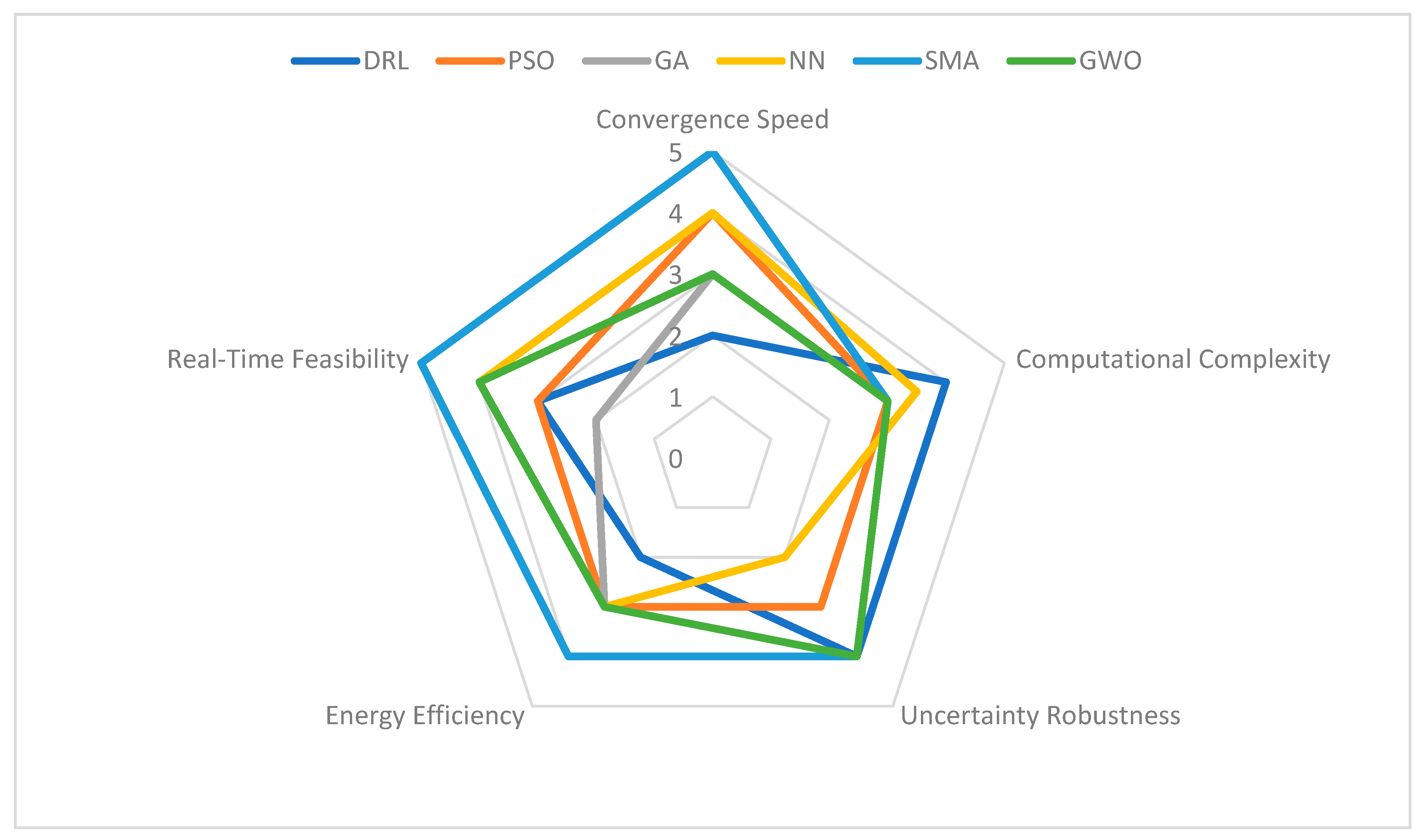
| Algorithm | Convergence Speed | Computational Complexity | Real-Time Suitability | Robustness to Environmental Uncertainty | Strengths/Ideal Use Cases (Summary) |
|---|---|---|---|---|---|
| Genetic Algorithms (GA) | 3 (Moderate) | 4 (High) | 2 (Limited) | 3 (Moderate) | Good for offline global optimization; useful when multi-objective constraints exist. Less suitable onboard due to high computational cost. |
| Particle Swarm Optimization (PSO) | 4 (High) | 3 (Moderate) | 4 (Good) | 4 (High) | Fast convergence, low computation; suitable for real-time replanning, formation control, and dynamic environments. |
| Slime Mould Algorithm (SMA) | 5 (Very High) | 3 (Moderate) | 5 (Excellent) | 4 (High) | Strong adaptability; excels in dynamic, uncertain solar/wind conditions; effective for long-horizon energy-aware routing. |
| Grey Wolf Optimizer (GWO) | 3 (Moderate) | 3 (Moderate) | 4 (Good) | 4 (High) | Balanced exploration-exploitation; appropriate for 3D terrain navigation, obstacle-rich environments, and cooperative tasks. |
| Neural Networks (NN) | 4 (High) | 5 (Very High) | 2 (Limited) | 3 (Moderate) | Strong for solar prediction, perception, and modeling; limited onboard unless quantized/pruned. |
| Deep Reinforcement Learning (DRL) | 4 (High) | 5 (Very High) | 4 (Good with proper hardware) | 5 (Excellent) | Best for highly dynamic, nonstationary environments; excellent long-horizon adaptability. |
| Area of Research | Current Status | Identified Gaps | References |
|---|---|---|---|
| Flight Path Optimization | Heuristic algorithms and neural networks are used for flight path optimization, considering factors like energy efficiency and obstacle avoidance. Techniques like Genetic Algorithms (GA), Particle Swarm Optimization (PSO), and Reinforcement Learning (RL) are prevalent. Some systems perform offline planning with limited adaptability to real-time changes. | Limited integration of real-time environmental data (e.g., weather, solar irradiance) into flight path optimization. Need for more adaptive and robust optimization techniques that can handle dynamic environments and uncertainties in real-time. Current algorithms may not adequately consider the stochastic nature of the environment or may lack the computational efficiency required for real-time adjustments. There is also a need for multi-objective optimization considering factors like energy consumption, time efficiency, and safety simultaneously. | [3,5,6,10,31,47] |
| Neural Network Optimization Techniques | Neural networks are used for control systems and optimization, with training methods like backpropagation and gradient descent. Deep learning techniques are applied to UAV control for tasks like navigation and object recognition. Some studies explore hybrid models combining neural networks with traditional control algorithms. | Existing training methods can be computationally intensive and may not converge to optimal solutions in non-convex optimization problems. There is a need for more efficient optimization techniques for neural networks, especially those that can operate in real-time and adapt to changing conditions. Algorithms like Slime Mould Optimization (SMO) are underexplored in this context. Additionally, neural networks often require large datasets for training, which may not be feasible in all UAV applications. Developing methods for online learning and adaptation with limited data is a significant gap. Ensuring the robustness and reliability of neural network-based control systems in safety-critical UAV operations is also a concern. | [7,19,28,42,60,61,62,64] |
| Integration of Biomimicry Principles | Initial exploration of bio-inspired algorithms, such as Ant Colony Optimization and PSO, has been conducted. Slime moulds algorithms are being investigated for optimization problems in various fields. Biomimicry in aerodynamics, like mimicking bird flight patterns, has been studied to improve efficiency. | Underutilization of biomimicry in optimizing both energy efficiency and control systems for UAVs. The potential of slime moulds-inspired neural networks is not fully explored, especially in UAV control systems for real-time adaptation and learning. There is a gap in integrating biomimetic algorithms with UAV systems to achieve adaptive, efficient, and robust control. Research is needed on how principles from nature can be translated into algorithms that improve UAV performance, particularly in dynamic and uncertain environments. Combining multiple biomimetic approaches may yield synergistic benefits that are not yet fully understood. | [9,14,39,52,53,55] |
| Energy Management Systems | Adaptive energy management systems have been developed to optimize energy usage, including battery management and power distribution. Some systems adjust to predictable environmental changes and have basic strategies for energy allocation between propulsion and onboard systems. | Current systems insufficiently handle rapid and unpredictable environmental changes. There is a need for systems that can dynamically adjust to fluctuations in solar energy availability, such as sudden cloud cover or shading. Integration with predictive algorithms for energy availability is lacking. Moreover, holistic energy management that considers all energy sources and sinks is underdeveloped. Systems need to optimize energy usage without compromising mission objectives or safety. | [2,15,16,17,21] |
| Real-time Environmental Data Integration | Some UAV systems use onboard sensors to collect environmental data, but integration into control systems is limited. Real-time adjustments are often simplistic, reacting to immediate sensor readings without predictive capabilities. Data processing is sometimes offloaded to ground stations due to onboard computational limitations. | Limited ability to process and integrate real-time environmental data into decision-making processes onboard the UAV. Advanced algorithms that can handle large volumes of data and make complex decisions rapidly are needed. There is a gap in predictive analytics that can anticipate environmental changes and adjust control strategies proactively. Additionally, managing the trade-off between computational load and real-time performance is a challenge. Developing lightweight, efficient algorithms suitable for onboard processing remains a significant gap. | [18,23,24,26,27,34] |
| Aerodynamic Design | Advancements have been made in minimizing drag through aerodynamic shaping and the use of lightweight materials like composites. Some designs incorporate solar panels into the structure, but often at the expense of aerodynamic efficiency. Morphing wings and adaptive surfaces are being researched for improved performance. | Challenges remain in integrating solar panels without compromising aerodynamics. There is a need for novel design solutions that seamlessly integrate photovoltaic cells while maintaining or enhancing aerodynamic performance. Research is required on flexible, lightweight solar cells that conform to aerodynamic surfaces. Additionally, methods for dynamically adjusting aerodynamic surfaces (e.g., morphing wings) for optimal performance under varying flight conditions are needed. The impact of these design changes on structural integrity and control systems also requires investigation. | [12,13,16,20,59] |
| Solar Energy Capture Efficiency | High-efficiency photovoltaic (PV) cells are being developed, with efficiencies exceeding 26% for silicon-based cells. Lightweight, flexible PV cells are explored for UAV applications to reduce weight and enhance aerodynamics. Perovskite and multi-junction cells offer promising efficiency improvements. | Limitations exist in PV efficiency under varying environmental conditions, such as temperature fluctuations, partial shading, and angle of incidence variations during flight. There is a need for materials with higher efficiency and lower weight, as well as improved integration methods for PV cells that do not compromise aerodynamic performance. Research is needed on adaptive solar panels that can adjust to optimal angles relative to the sun during flight. | [13,16,21,67] |
Disclaimer/Publisher’s Note: The statements, opinions and data contained in all publications are solely those of the individual author(s) and contributor(s) and not of MDPI and/or the editor(s). MDPI and/or the editor(s) disclaim responsibility for any injury to people or property resulting from any ideas, methods, instructions or products referred to in the content. |
© 2025 by the authors. Licensee MDPI, Basel, Switzerland. This article is an open access article distributed under the terms and conditions of the Creative Commons Attribution (CC BY) license (https://creativecommons.org/licenses/by/4.0/).
Share and Cite
Hazare, G.; Sultan, M.T.H.; Łukaszewicz, A.; Nowakowski, M.; Shahar, F.S. Charting Smarter Skies—A Review of Computational Strategies for Energy-Saving Flights in Electric UAVs. Energies 2025, 18, 6521. https://doi.org/10.3390/en18246521
Hazare G, Sultan MTH, Łukaszewicz A, Nowakowski M, Shahar FS. Charting Smarter Skies—A Review of Computational Strategies for Energy-Saving Flights in Electric UAVs. Energies. 2025; 18(24):6521. https://doi.org/10.3390/en18246521
Chicago/Turabian StyleHazare, Graheeth, Mohamed Thariq Hameed Sultan, Andrzej Łukaszewicz, Marek Nowakowski, and Farah Syazwani Shahar. 2025. "Charting Smarter Skies—A Review of Computational Strategies for Energy-Saving Flights in Electric UAVs" Energies 18, no. 24: 6521. https://doi.org/10.3390/en18246521
APA StyleHazare, G., Sultan, M. T. H., Łukaszewicz, A., Nowakowski, M., & Shahar, F. S. (2025). Charting Smarter Skies—A Review of Computational Strategies for Energy-Saving Flights in Electric UAVs. Energies, 18(24), 6521. https://doi.org/10.3390/en18246521