Article

Research on the Mechanical Behavior of Interlayer-Salt Rock Interface in Salt Cavern Gas Storage Under Storage-Release Cycle

1
School of Engineering and Technology, China University of Geosciences (Beijing), Xueyuan Road 29, Beijing 100083, China
2
Engineering and Technology Innovation Center for Risk Prevention and Control of Major Project Geosafety, Ministry of Natural Resources, Beijing 100083, China
3
Department of Civil Engineering, Tianjin University, Tianjin 300354, China
*
Author to whom correspondence should be addressed.
Energies 2025, 18(24), 6497; https://doi.org/10.3390/en18246497
Submission received: 19 November 2025 / Revised: 6 December 2025 / Accepted: 10 December 2025 / Published: 11 December 2025
(This article belongs to the Topic Exploitation and Underground Storage of Oil and Gas)

Abstract

The interlayer-salt rock interface in the surrounding rock of salt caverns is the main channel for gas leakage during long-term operation of salt cavern gas storage (SCGS). To ensure the long-term safe operation of SCGS containing interlayered salt caverns, this study establishes a standard pear-shaped cavity numerical model and uses interface elements to simulate the interlayer-salt rock interface. Through a 30-year operating cycle simulation, the effects of key parameters such as minimum operating pressure, interlayer dip angle, and interlayer thickness on cavity deformation, plastic zone distribution, interface shear stress, and interface fracture development were studied, clarifying the mechanical behavior of the interlayer-salt rock interface in salt cavern gas storage facilities under storage-release cycles. The research results show that a lower minimum operating pressure significantly enhances the creep and interface slip of salt rock, leading to an increase in interface shear stress, fracture propagation, and cavity shrinkage. An increase in the dip angle of the interlayer raises the proportion of tangential stress at the interface, inducing intense shear concentration and an increase in the volume of shear failure. However, thickening the interlayer can improve the interface compliance, significantly weaken the shear effect, and suppress interface fracture. Moreover, the overall stability of the cavity is jointly controlled by three factors. Higher operating pressure, moderate dip angle, and reasonable interlayer thickness all contribute to reducing the volume of the plastic zone, decreasing the contraction rate, and enhancing long-term safety. This study reveals the mechanical influence of the interface between the interlayer and salt rock during the storage and release cycle of the cavity and its impact on the stability of the cavity and interlayer. It provides a theoretical basis for the design optimization and operation management of salt cavern gas storage facilities with interlayers.

1. Introduction

Energy is the foundation of modern social development. With the continuous growth of global energy demand and the transformation of energy structure, large-scale energy storage technology has become the key to ensuring energy security and achieving sustainable development [1,2]. Salt rock has excellent properties such as extremely low permeability, strong self-healing ability and high compressive strength, making it an ideal underground storage medium [3,4,5,6,7]. China is rich in salt rock resources, mainly distributed in Jiangsu, Hubei, Chongqing and Sichuan, with a total reserve of more than 10 trillion cubic meters, providing good geological conditions for the construction of salt cavern gas storage. However, due to the difference in mechanical properties between the interlayer and salt rock, the stress state generated at the interlayer-salt rock interface is quite complex. In addition, during the long-term operation of UCGS, the alternating cyclic load can easily cause slippage or material strength failure at the interlayer interface of the surrounding rock and the top of the cavity, leading to major engineering accidents such as the collapse of the surrounding rock, gas storage leakage and ground subsidence, causing economic damage [8,9]. Therefore, it is of great significance to analyze the stability of SCGS and the mechanical behavior of the interlayer interface to ensure its long-term stable operation.
Numerous scholars have conducted research on the surrounding rock stability of SCGS. Yan et al. [10] analyzed the creep effect of salt rock during long-term operation through numerical simulation, and the results indicated that creep leads to a gradual reduction of the cavern volume, continuous inward deformation of the cavity wall, and a significant redistribution of the stress field, thereby causing the progressive expansion of the plastic zone. Zhao et al. [11] further investigated the creep–fatigue coupling effect under cyclic injection–withdrawal pressure, and found that frequent pressure fluctuations accelerate creep deformation and damage accumulation, resulting in a gradual degradation of the surrounding rock strength and a substantial decrease in the long-term stability of the storage cavern. Liu et al. [12] compared the shrinkage ratio and plastic zone distribution of SCGS with different shapes through numerical simulation and concluded that the ellipsoidal cavern exhibits better stability than other geometries. Wang et al. [13] established a three-dimensional geological model to investigate the influence of the distance between new and existing caverns on cavern stability, and determined a reasonable pillar width by comparing factors such as cavern shrinkage ratio and plastic zone volume. Zhang et al. [14], Zhao et al. [15], and He et al. [16] reported through numerical analyses that a thinner caprock leads to greater deformation, stress concentration, and damage risk in the roof and shaft regions, especially under cyclic injection–withdrawal conditions or when interlayers are present. Proper control of caprock thickness, optimization of cavern geometry, and regulation of operating pressure are therefore essential for ensuring the safe and stable operation of SCGS. In addition to these factors, injection–withdrawal frequency also has a significant impact on cavern stability. Zhang et al. [17] focused on the influence of operational parameters on the stability of SCGS, and the results showed that short residence times and high cycling frequencies exert considerable adverse effects on cavern stability. Zhang et al. [18] examined the influence of different interlayer contents on the stability of cavern surrounding rock and found that cavern stability increases with higher interlayer content; they further proposed enlarging the cavern bottom to increase the effective storage volume. Li et al. [19] investigated the effect of insoluble materials on cavern stability through numerical simulation, and the results indicated that the presence of insoluble sediments at the cavern floor is beneficial to maintaining the stability of the surrounding rock. Li et al. [20] showed that in deepwater wellbore–pipeline systems, long-term production–induced thermal–pressure evolution can trigger natural-gas-hydrate formation and blockage risks. Similarly, in salt-cavern gas storage, long-term injection–withdrawal cycles can drive damage accumulation and fracture evolution along interlayer–salt interfaces. Ge et al. [21] investigated the influence of different interlayer dip angles on the stability of the surrounding rock of SCGS, and the results showed that an increase in dip angle reduces the cavern shrinkage ratio while also affecting the symmetry of the stress distribution in the surrounding rock. Li et al. [22] and Wang et al. [23] simulated the construction process of horizontal salt caverns and further analyzed the feasibility of replacing vertically oriented caverns with horizontal ones. The above scholars have conducted extensive research on the stability of cavern surrounding rock, with most studies focusing on the effects of salt creep, cavern geometry, operating pressure, caprock thickness, and interlayer dip angle on the stability of SCGS. However, there is limited research on the impact of the interface between salt rock and interlayers on the overall stability of underground salt cavern gas storage facilities, as well as the microscopic damage evolution process of the salt rock-interlayer interface under cyclic operating pressure, and the stress response mechanisms at the salt–interlayer interface during cavern operation have not yet been fully clarified.
Salt rock is typically formed by the evaporation and concentration of seawater or brine from salt lakes. Unlike the marine evaporite sequences that form salt domes in other countries, China’s salt mines are mainly bedded salt rock from lacustrine sedimentation. Due to periodic variations in the depositional environment during diagenesis, non-salt interlayers such as mudstone, gypsum, and anhydrite are commonly embedded within the salt strata [24,25]. The contact zones between these interlayers and the salt rock constitute a heterogeneous and anisotropic composite medium composed of salt crystals and interlayer materials, whose mechanical responses differ significantly from those of the adjacent host rocks [26]. This composite interface serves as the primary shear stress transfer surface within the salt–interlayer system [27] and represents a key structural plane that governs deformation compatibility between the two lithologies. Owing to the substantial differences in strength, stiffness, and creep properties between salt rock and interlayers, complex local stress concentrations frequently develop at the interface. When the shear or normal stress acting on the interface exceeds its ultimate bearing capacity, the interface is prone to damage, weakening, and the initiation of fracture [10,28], which may compromise the sealing performance of the storage cavern and threaten the safe and stable operation of the SCGS. The impact of interlayers on SCGS is unavoidable; therefore, it is necessary to conduct research on the stability of SCGS and interlayers during the storage-release cycle.
Previous numerical simulations have largely employed contact models to address the interlayer-salt interface problem, which struggles to accurately reflect interface cracking and its subsequent development. This paper proposes a novel numerical simulation method for interlayer-salt interfaces using FLAC3D software 5.0. This paper uses FLAC3D software and its built-in interface elements to simulate the interface between interlayers and salt rock. Through calculations of SCGS under different working conditions, we compare the surrounding rock displacement, cavern shrinkage ratio, and stress distribution along the interface. The study reveals the damage evolution mechanism of the salt rock and interlayer under cyclic loading and clarifies the mechanical response characteristics of the interlayer interface, thereby providing a theoretical basis for evaluating the long-term stability of underground salt-rock energy storage.

2. Simulation Method

2.1. Simulation Approach

FLAC3D provides dedicated interface elements for simulating contact, slip, and separation behavior between different media. This element consists of a series of interface elements attached to the mesh surface, used to capture stress and displacement at material interfaces. This interface is a one-sided interface, meaning it is attached to a specified mesh surface as a virtual thin layer. When other faces of adjacent elements come into contact with this interface, the interface nodes automatically calculate the normal and shear contact forces according to the defined mechanical constitutive relations, thus describing the mechanical response of the two media during stress transfer, relative slip, and cracking.
In this study, the internal failure of salt rock and mudstone manifests as damage to the mesh within the model. Damage at the interface is controlled by the bond interface to determine whether separation or slippage occurs. If the stress remains below the bond strength, the interface remains elastic. If the shear stress exceeds the shear strength, or the effective tensile normal stress exceeds the normal strength, the bond will fracture. The normal strength is set by the tension parameter. The shear strength is shown in Equation (4). Once the interface exceeds the bond strength, it no longer bears any load. Load calculations are performed only at the interface nodes. After the calculation, the load is weighted and distributed to each element. When an interface no longer bears a load, the load is distributed to other elements at that node, thereby changing the stress at other nodes and achieving crack propagation.
Within the elastic range, the calculation of the normal and tangential stresses of the nodes is shown in Equations (1) and (2).
F n ( t + t ) = k n u n A + σ n A
F s i ( t + t ) = F s i ( t ) + k s u s i ( t + ( 1 / 2 ) t ) A + σ s i A
where F n   ( t + t ) is the normal force at time (t + Δt), s; F s i   ( t + t ) is the shear force vector at time (t + Δt); u n is the absolute normal penetration of the interface node into the target face; u s i is the incremental relative shear displacement vector; σn is the additional normal stress added due to interface stress initialization; kn is the normal stiffness; ks is the shear stiffness; σsi is the additional shear stress vector due to interface stress initialization; A is the representative area associated with the interface node.
When the interfacial stress exceeds the elastic stage and is about to slide or separate, its strength is determined by Equation (3).
F s max = c A + tan ϕ ( F n p A )
where c is the cohesion along the interface; Ф is the friction angle of the interface surface; p is pore pressure.
When fractures appear on the interface, the gas pressure inside the cavity will act on the fracture surface along the normal direction of the crack, causing the fracture to open further and potentially promoting the continuous expansion of interface damage; under excessive pressure, it may even induce local instability or collapse of the interlayer (Figure 1).
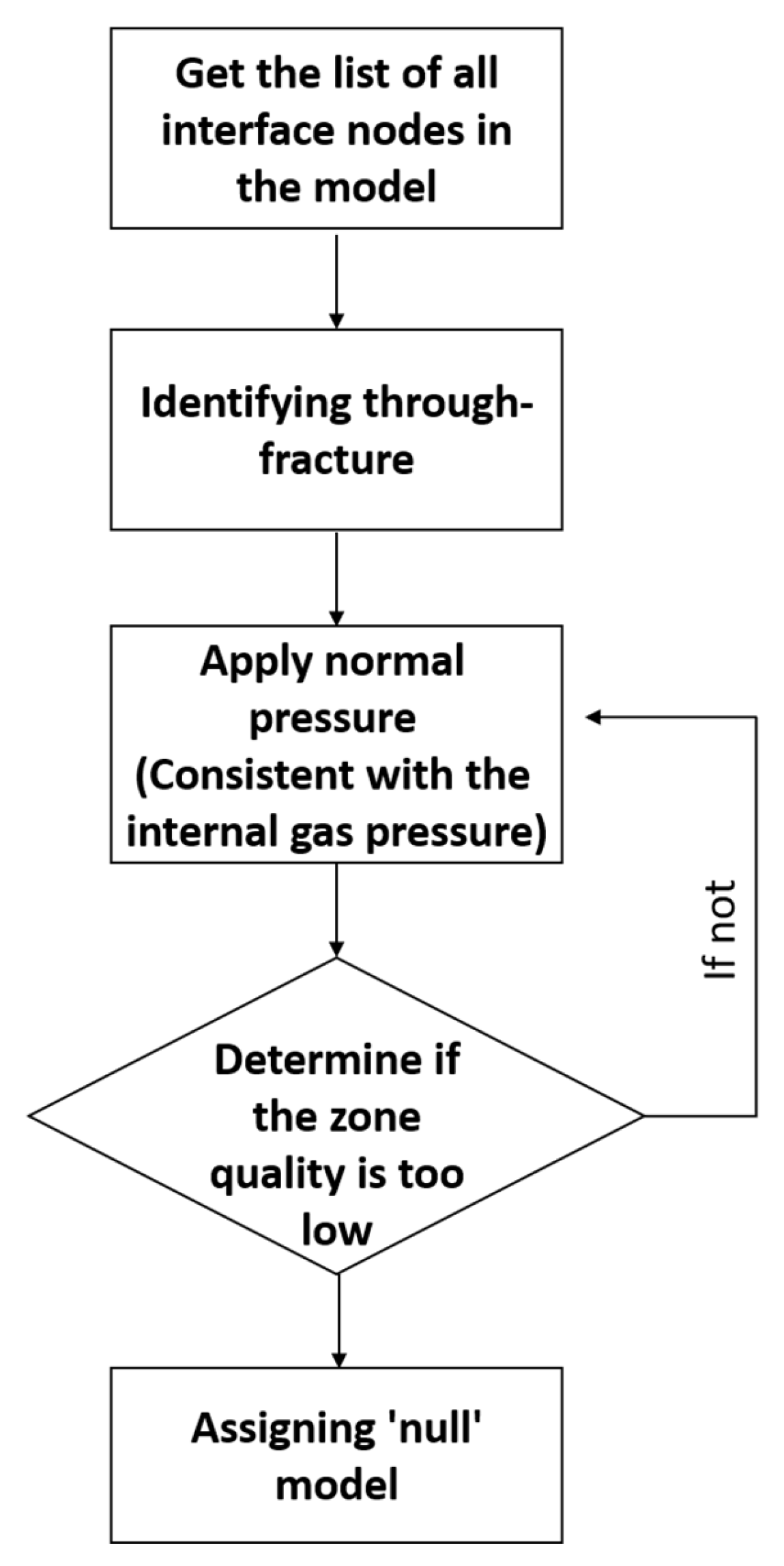
Therefore, to accurately simulate this process, this paper implements crack compression loading in FLAC3D using the FISH language: by traversing all nodes of the interface, the cracked elements that have been penetrated are identified, and an equivalent normal load consistent with the gas pressure inside the cavity is applied in their normal direction, thus realistically reflecting the influence of gas on crack propagation and interlayer stability. To simulate the possible collapse behavior of the interlayer, this paper uses the built-in function z.condition (p,n) in FLAC3D to judge the element quality index in real time. When the mass or geometric mass of a certain element falls below a set threshold due to excessive deformation, it is considered to have lost its engineering mechanical significance and load-bearing capacity. Such elements are assigned a null model in the calculation to achieve “collapse” treatment, thereby numerically reproducing the process of the interlayer material breaking, peeling, or collapsing under extreme stress (Figure 2). In general, this simulation method involves acquiring information about the interface elements after the cavity begins operation to determine whether interface element separation has occurred. If interface separation occurs and the crack connects to the inner wall of the cavity, a load along the interface normal is applied to the upper and lower zones connected to the crack. Simultaneously, the mesh quality of each zone is checked; if the quality is too low, the area is considered to have lost its load-bearing capacity and is ‘voided’ to simulate the collapse and detachment of the interlayer and inner wall. (Figure 2)
The interface elements used in this study are applied solely to describe the contact, sliding, and opening behavior at the interlayer–salt interface. They do not represent the elastoplastic–creep properties of mudstone or salt rock. Instead, the elastoplastic–creep mechanical behavior of mudstone and salt rock is independently defined and governed by their respective constitutive models. The interface elements are responsible only for capturing the relative displacement and damage evolution between the two materials. Therefore, the interface elements and the material constitutive models together form a complete “material deformation–interface damage” mechanical framework, which adequately satisfies the requirements of this study.

2.2. Geological Model

The geological model used in this study is based on the actual engineering geological background of salt caverns in Jintan, Jiangsu Province. The key parameters such as stratigraphic distribution, salt rock thickness, interlayer type and burial depth are all from relevant references [29]. On this basis, we have made appropriate simplifications to the model in order to improve the computability of numerical simulation and the focus of research, but all the main structural layers and mechanical properties that affect the mechanical behavior of the cavity have been accurately preserved.
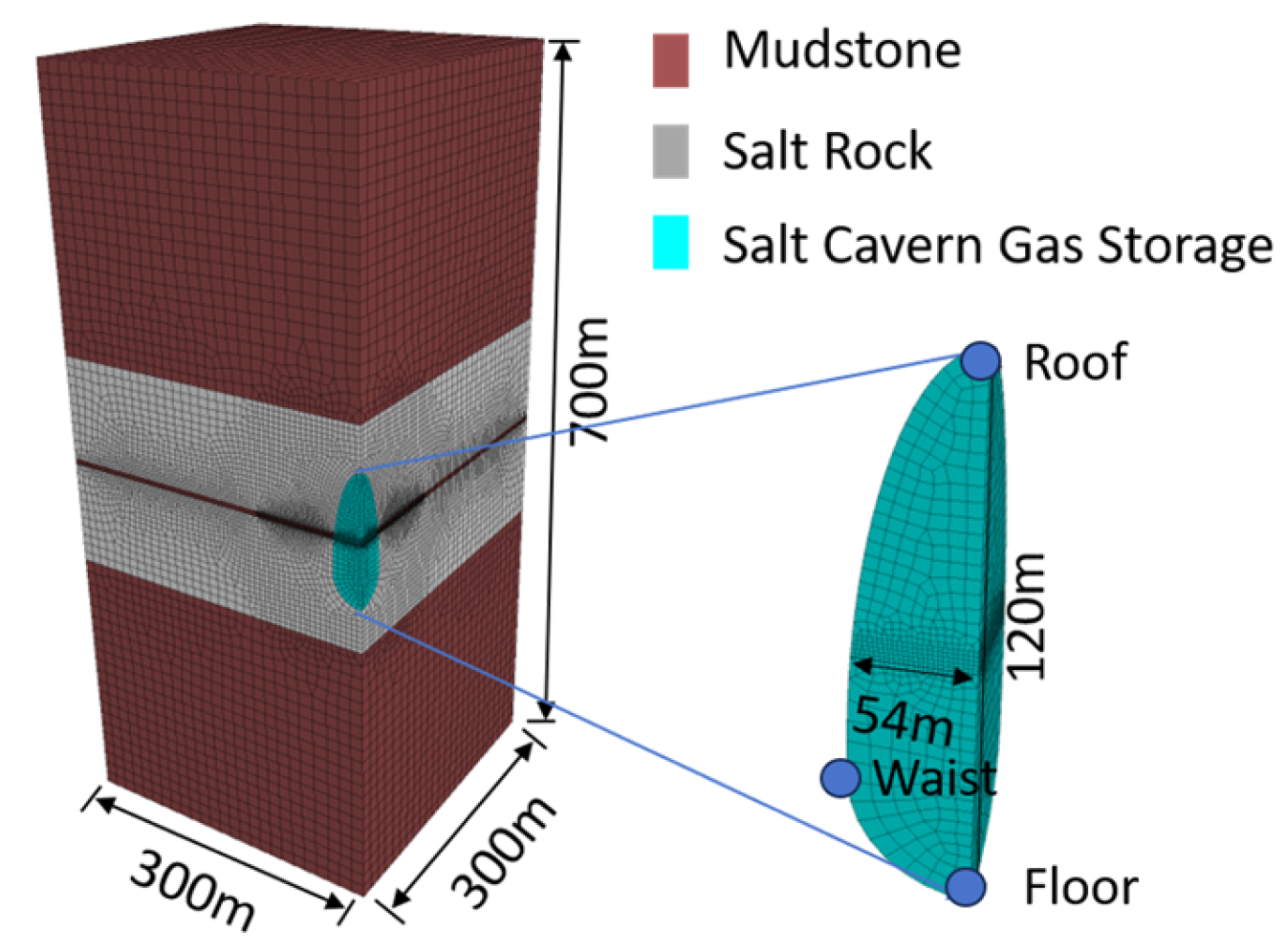
The proposed SCGS is located within a rock salt stratum with a thickness of approximately 200 m, which is overlain and underlain by mudstone layers each about 250 m thick. The designed burial depth of the cavern is 1000 m. Based on previous multi-condition comparative numerical simulations, the pear-shaped cavern exhibits the best performance in deformation control and surrounding rock stability; therefore, a standard pear-shaped cavern with a total height of 120 m and a maximum diameter of 54 m is selected as the design prototype in this study. Considering the geometric symmetry of the cavern and the strata, a 1/4 symmetric numerical model is adopted to improve computational efficiency and reduce the number of elements (Figure 3). The resulting three-dimensional geological model has overall dimensions of 300 m × 300 m × 700 m, which sufficiently covers the major mechanical influence range surrounding the salt cavern. Related studies indicate that the distance to the outer boundary should be 6–10 times the radius of the cavern to reduce the influence of boundary effects on the principal stress field and displacement field near the cavity. The maximum radius of the model is 27 m, and the model boundary exceeds 10 times the radius, which can effectively eliminate the boundary effect.
Zhang et al. [29] conducted a series of experiments on the salt rock in the Jintan area, measured its mechanical parameters, and used these parameters for numerical simulation studies. This study uses the experimental parameters of Zhang et al. and compares the simulation results with their experimental results. The results show that the simulation results are in good agreement with the reference data, indicating that the model can be reliably used to analyze the stability of the surrounding rock in the construction and operation stages of the salt cavern gas storage. The relevant parameters are listed in Table 1.
To accurately represent the initial stress state of the deep strata, a uniform vertical pressure of 14 MPa is applied to the upper boundary of the model to simulate the self-weight of the overlying rock mass of approximately 1000 m. Normal displacement constraints are applied to the remaining boundaries to prevent non-physical deformation. In addition, to facilitate the systematic analysis of cavern deformation and mechanical responses, monitoring points—Roof, Waist, and Floor—are arranged along the cavern wall and serve as key locations for displacement and stress observations. The model is first constructed and meshed using Midas GTS NX 2024, after which the node and element information is exported and converted into the FLAC3D format for subsequent computational analysis.

2.3. Selection of Constitutive Model and Calculation Parameters

An appropriate constitutive model is essential for numerical simulation. The Power creep constitutive model built into FLAC3D can effectively simulate the long-term creep behavior of salt rock and is widely used in studies on the stability of SCGS. Since the influence of temperature on the surrounding rock is not considered in this paper, the Power constitutive model is selected for the calculation, and its standard exponential form is given in Equation (4).
ε cr ¯ = A σ n ¯
where, ε ¯ cr is the creep rate, 1/day; A, n represent the rheological parameters of the rock; σ ¯ represents the Von Mises stress, MPa.
After the initial in-situ stress calculation is completed, the model displacement is reset to zero, and the subsequent cavern leaching simulation is carried out. Since the leaching process occurs over a relatively short period, a static analysis is adopted for this stage. The Mohr–Coulomb criterion can clearly indicate whether instability, collapse, or inter-layer sliding will occur after dissolution [30] and the Mohr–Coulomb constitutive model is selected.
1 2 ( σ 1 σ 3 ) = c cos φ 1 2 ( σ 1 + σ 3 ) sin φ
where, σ1 and σ3 represent the first and third principal normal stresses, MPa; c represents the cohesion, MPa; and φ represents the internal friction angle, °.
The C-Power model in FLAC3D couples the Mohr–Coulomb elastoplastic model with the Norton Power creep model. It can simulate not only the creep behavior of rock salt but also shear failure. Although the creep rate of the interbedded mudstone is much lower than that of salt, its stress-relaxation behavior under long-term cyclic loading of the gas cavern can still affect interface stability. The C-Power model can accurately capture such small deformations. For mudstone interlayers, the mechanical response is governed by yield strength; in the simulations, the Mohr–Coulomb component ensures that when high deviatoric stresses induced by cavern operation exceed the interlayer strength, the material exhibits appropriate plastic shear or brittle failure. Therefore, the model is well suited for capturing the coordinated deformation of alternating “soft–hard” strata in salt-cavern gas storage [31].

2.4. Operation Condition Design

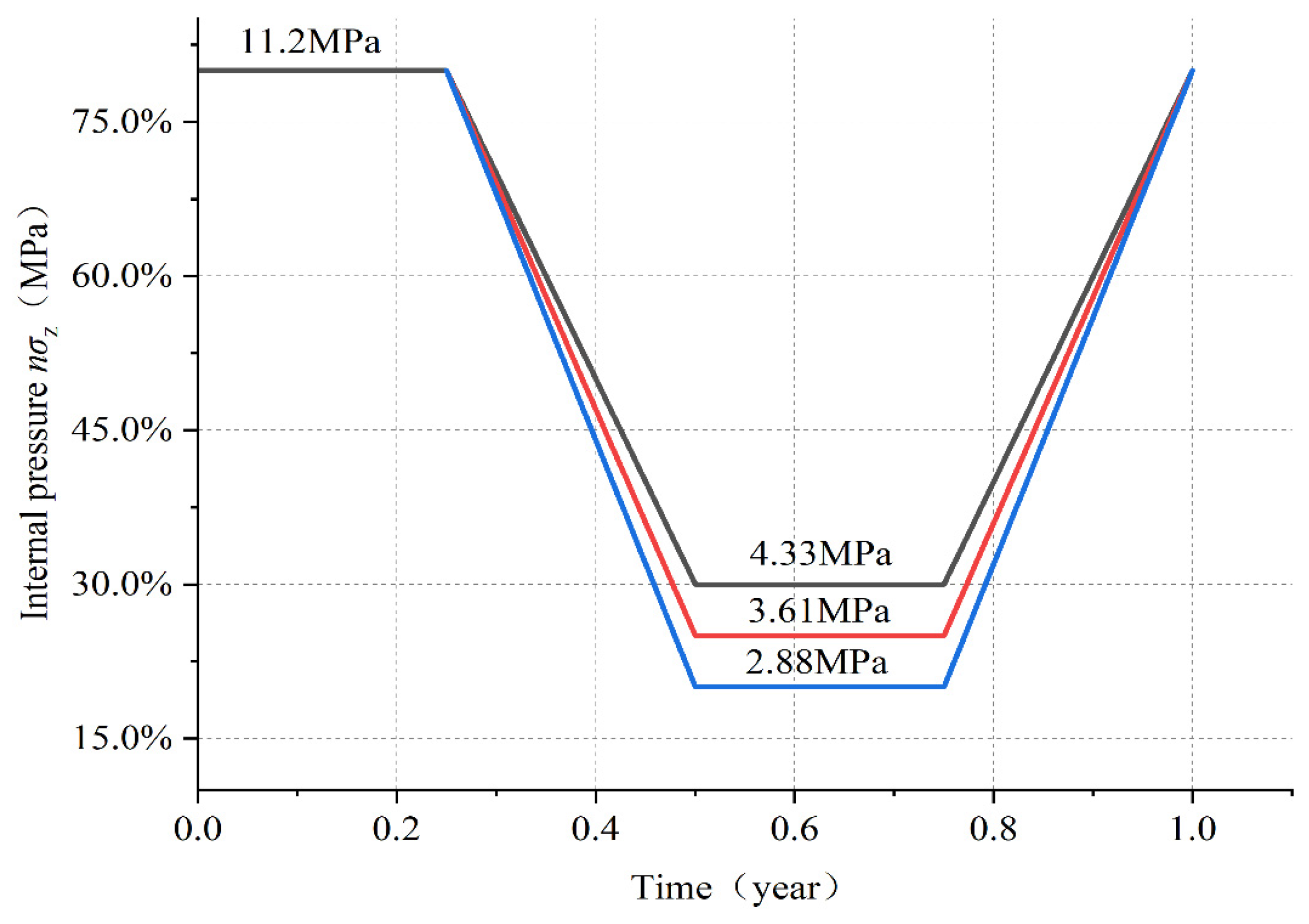
A large number of existing studies indicate that the stability of salt cavern gas storage is not only related to the strength of the interlayer but also influenced by factors such as interlayer dip angle, interlayer thickness, and operating pressure. To investigate the effect of the interlayer interface on the stability of salt cavern gas storage, numerical simulations are conducted using the interface elements in FLAC3D to model the interface between the interlayer and the salt rock, while both the salt rock and mudstone are modeled using the C-Power constitutive model. The interface elements are introduced during the initial in-situ stress calculation stage. The cavern excavation is performed in a single step using the built-in null elements in FLAC3D, and after equilibrium is achieved, cyclic loading is applied to the cavern wall to simulate long-term creep behavior. The operating pressure within the cavern is shown in Figure 4. The operation conditions are shown in Table 2.

3. Results and Discussion

The design service life of an SCGS is typically 30 years; therefore, a 30-year operational period is adopted as the simulation duration in this study. Key indicators, including cavern displacement, plastic zone volume, and cavern shrinkage ratio, are selected to systematically evaluate the long-term stability of the cavern and interlayer. These indicators are widely used in relevant engineering studies and allow a comprehensive characterization of operational safety from multiple perspectives, including deformation behavior, failure patterns, and structural response [11]. To further clarify the stability of the interlayer under long-term operating conditions, this study places particular emphasis on the interface no contact area and interface shear stress as criteria for assessing interlayer stability. These two indicators directly reflect the degree of relative displacement between the interlayer and the salt rock as well as the intensity of shear interaction at the interface, and thus serve as important parameters for evaluating potential interlayer instability. The integrated use of these multidimensional indicators enables a thorough depiction of the mechanical behavior of SCGS under complex geological conditions and provides a reliable theoretical basis for engineering design and operational management.

3.1. Volume Shrinkage Rate

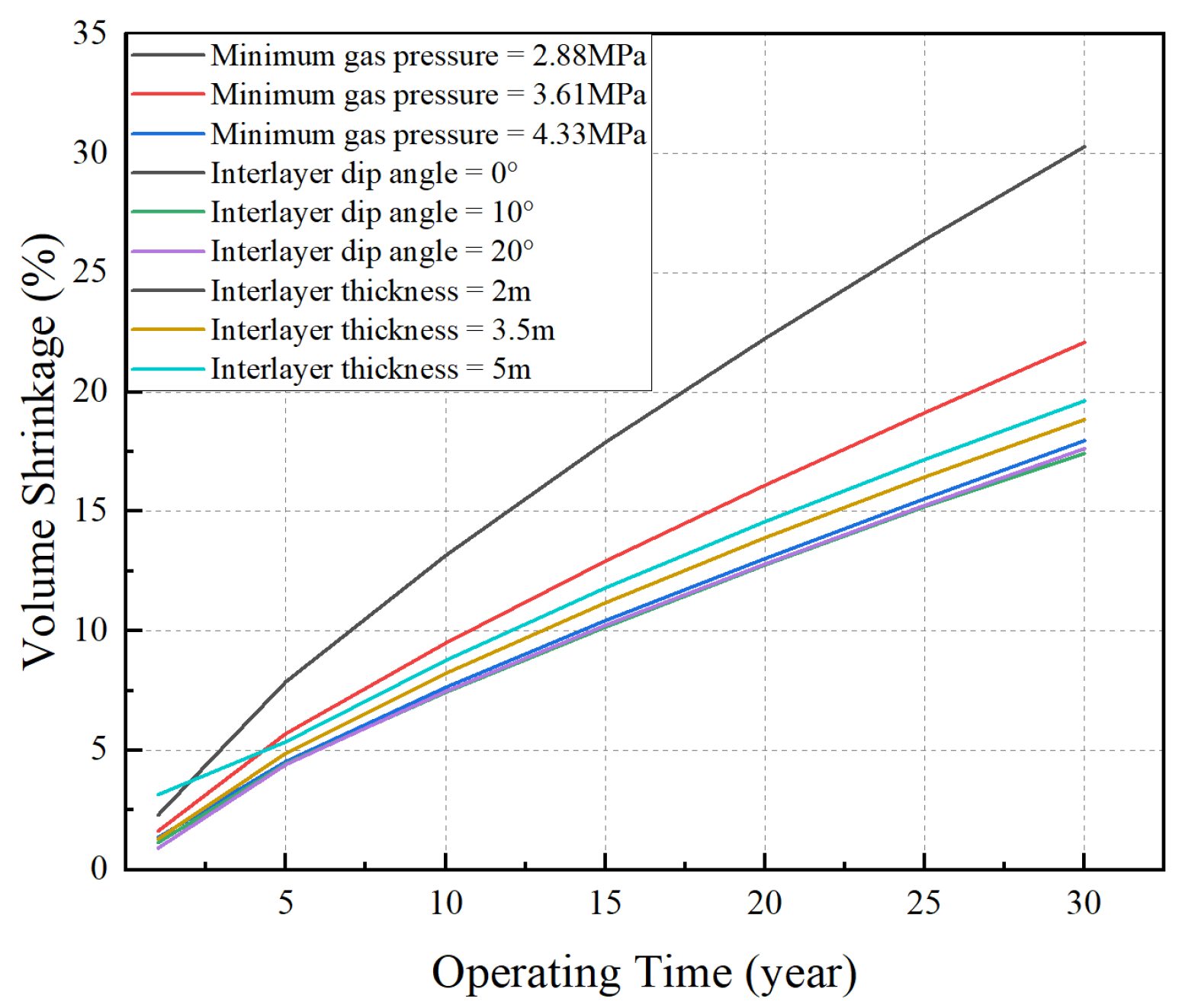
The volume shrinkage ratio is an important indicator for evaluating the long-term stability of SCGS and is typically defined as the ratio of the reduction in cavern volume to the initial volume. In engineering practice, it is generally considered that the annual shrinkage ratio of a salt cavern should be controlled within 1%. As shown in Figure 5, the cavern shrinkage ratio exhibits a continuous increasing trend with operating time. When the minimum operating pressures are 4.33 MPa, 3.61 MPa, and 2.88 MPa, the corresponding cavern shrinkage ratios reach 30.28%, 22.08%, and 17.97%, respectively. The results indicate that a lower minimum operating pressure leads to a larger volume shrinkage ratio; when the minimum operating pressure falls below 20% of the formation pressure (approximately 2.88 MPa), the shrinkage ratio exceeds the acceptable engineering limit. On the other hand, when the interlayer dip angles are 0°, 10°, and 20°, the volume shrinkage ratios are 17.97%, 16.99%, and 15.87%, respectively, indicating that an increase in interlayer dip angle helps reduce the volume shrinkage ratio. The variation trend suggests that for every 10° increase in dip angle, the volume shrinkage ratio decreases by approximately 1%. In addition, when the interlayer thicknesses are 2 m, 3.5 m, and 5 m, the corresponding volume shrinkage ratios are 17.97%, 18.84%, and 19.62%, showing that cavern shrinkage increases with greater interlayer thickness, with each 1.5 m increase in thickness resulting in an approximate 1% increase in shrinkage ratio.

3.2. Volume of the Plastic Zone

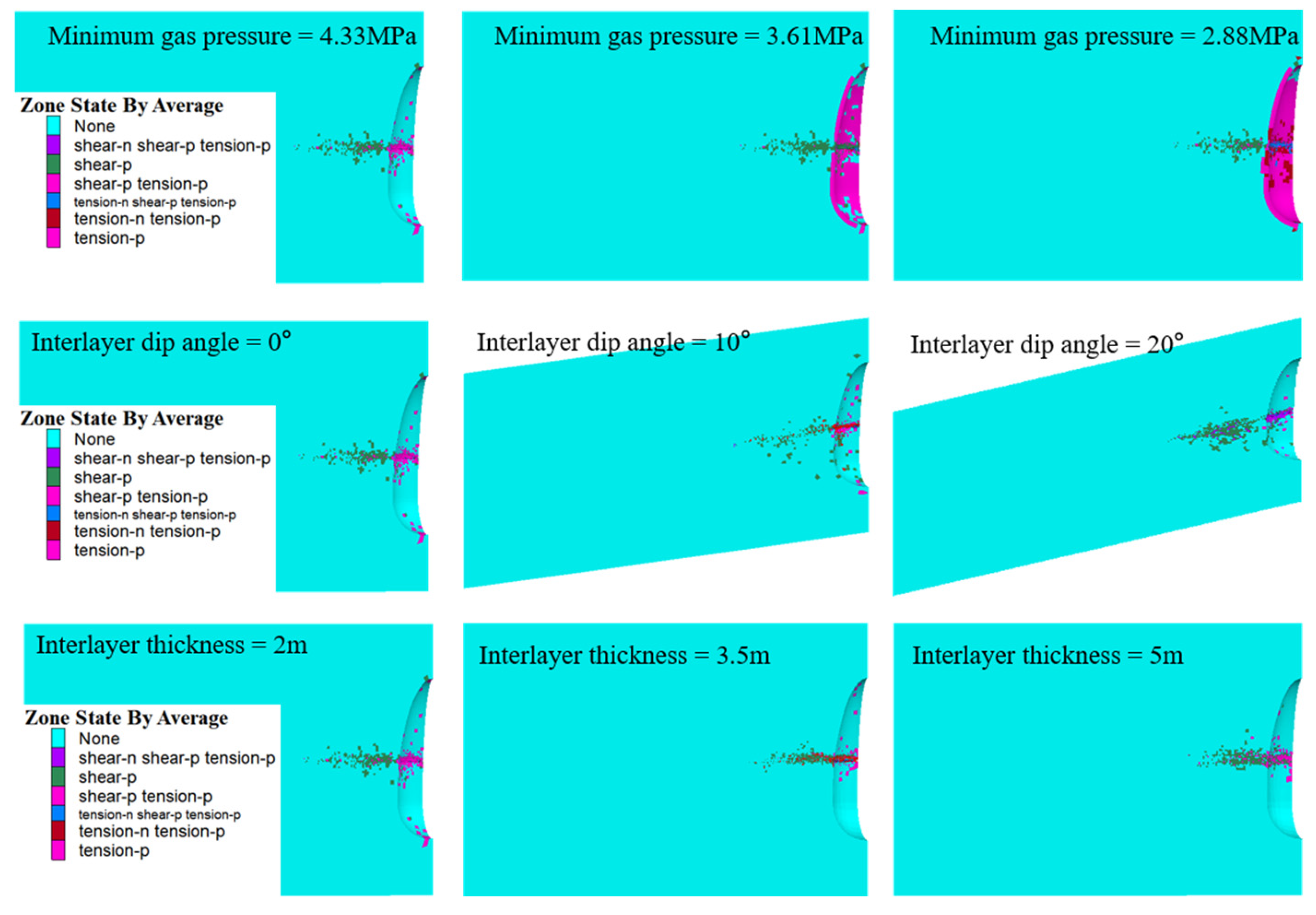
The Mohr–Coulomb criterion, as one of the most widely used shear strength theories in geotechnical engineering, is applicable to both brittle and ductile rocks and has been validated in numerous engineering applications. Based on this criterion, the plastic zones of the cavern surrounding rock under different operating conditions are calculated. In Figure 6, different colors represent various failure modes, including tensile failure (tension-n, tension-p), shear failure (shear-n, shear-p), and the intact zone without failure (None). As shown in Figure 6, shear failure is more likely to occur within the interlayer and its adjacent salt rock, whereas tensile failure predominantly appears in the surrounding rock near the cavern boundary. The minimum operating pressure exhibits a significant influence on the distribution of the plastic zones. When the minimum operating pressure increases from 2.88 MPa to 4.33 MPa, the tensile failure volume around the cavern decreases by approximately 13,499 m3, indicating that a higher operating pressure effectively reduces the tensile stress level and suppresses tensile failure in the near-cavern region, while its influence on shear failure within the interlayer is relatively limited. Under different interlayer dip angles, when the angles are 0°, 10°, and 20°, the shear failure volume within the interlayer increases from 68,241 m3 to 93,860 m3, whereas the tensile failure volume in the cavern surrounding rock first decreases and then increases. This indicates that an excessive dip angle leads to stress redistribution along the interface, enhancing shear concentration while potentially promoting the extension of tensile failure around the cavern. By comparing the overall failure volumes, it is found that the smallest total failure occurs at a dip angle of 10°, suggesting that cavern stability is optimal under this condition. For interlayers of different thicknesses—2 m, 3.5 m, and 5 m—the shear failure volume increases with thickness, while the tensile failure volume in the cavern surrounding rock shows a decreasing-then-increasing trend. This suggests that a moderately thick interlayer helps disperse surrounding rock stresses and improves cavern stability, but an excessively thick interlayer increases stiffness and intensifies stress concentration along the interface, ultimately reducing stability. Overall, the operating pressure, interlayer dip angle, and interlayer thickness all exert significant influence on the distribution of the plastic zones. Proper control of these parameters is crucial for enhancing the long-term stability of SCGS.

3.3. Maximum Displacement of the Cavity

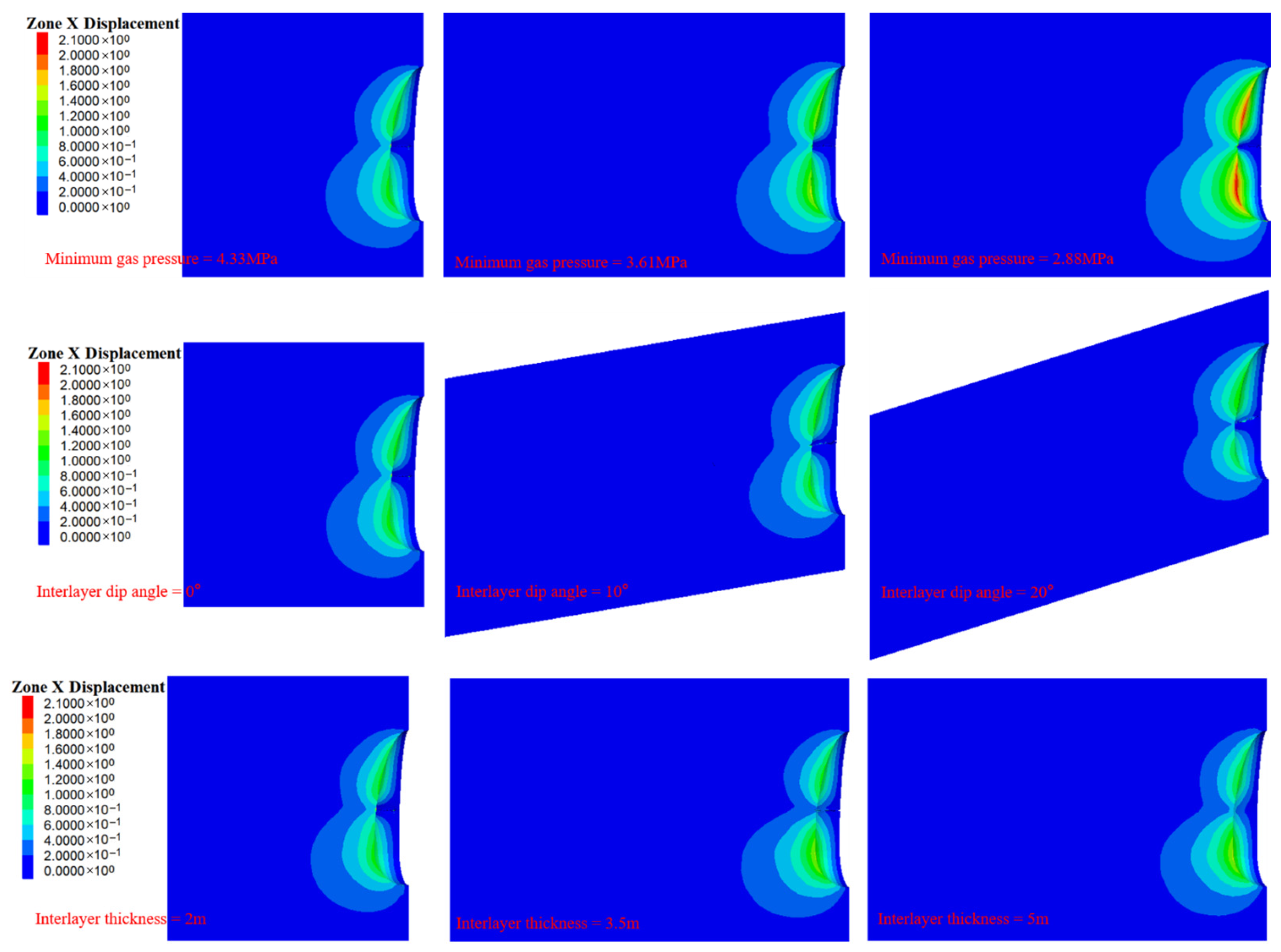
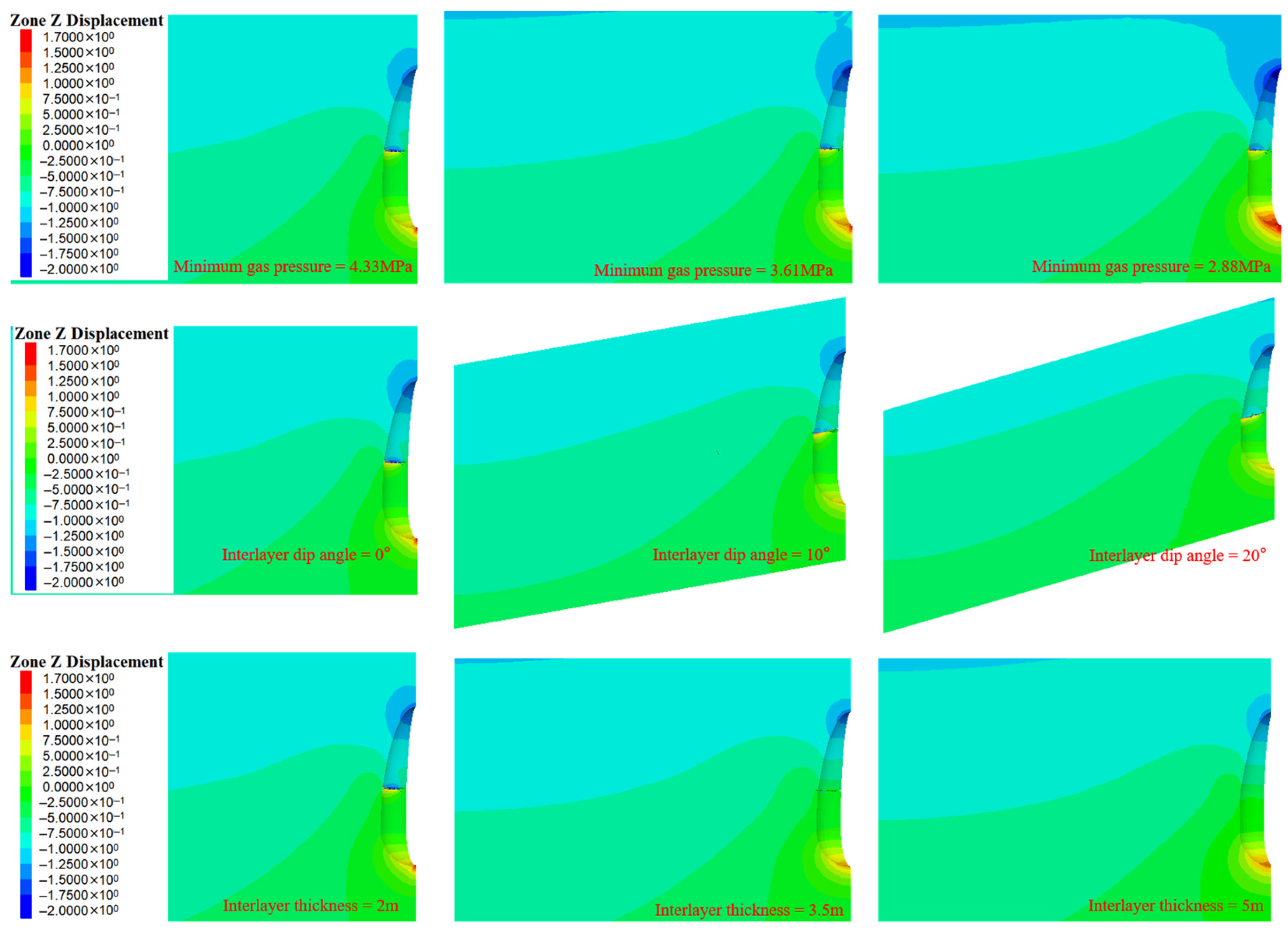
Figure 7 and Figure 8 present the cavern displacement after 30 years of operation. The cavern roof undergoes downward settlement due to self-weight and salt creep, the floor experiences upward heave caused by unloading, and the waist shows inward convergence under lateral compression. When the minimum internal pressure is 4.33 MPa, the cavern displacements are 1.44 m, 1.11 m and 1.06 m, respectively, with the maximum occurring at the roof. As the minimum internal pressure decreases to 3.61 MPa and 2.88 MPa, the displacements increase to 1.63 m, 1.40 m and 1.21 m, and to 1.90 m, 2.06 m and 1.65 m, with the location of maximum displacement shifting from the roof to the cavern waist. These results indicate that cavern displacement increases with decreasing minimum internal pressure, accompanied by a change in the position of the maximum displacement. Under formation dip angles of 0°, 10° and 20°, the cavern displacements are 1.44 m, 1.11 m and 1.06 m; 1.42 m, 1.07 m and 0.78 m; and 1.38 m, 1.14 m and 0.93 m, respectively. The roof displacement decreases slightly with increasing dip angle, whereas the waist and floor displacements first decrease and then increase. Figure 7 further shows that the distribution of x-direction displacement varies with dip angle: the maximum displacement appears on the lower side of the interlayer at 0°, becomes more uniform at 10°, and shifts to the upper side at 20°. For interlayer thicknesses of 2 m, 3.5 m and 5 m, the cavern displacements are 1.44 m, 1.11 m and 1.06 m; 1.44 m, 1.26 m and 1.06 m; and 1.44 m, 1.34 m and 1.06 m, respectively. The interlayer thickness mainly affects the waist displacement, which increases with increasing thickness, while the roof and floor displacements remain essentially unchanged.

3.4. Shear Stress at the Interlayer-Salt Interface

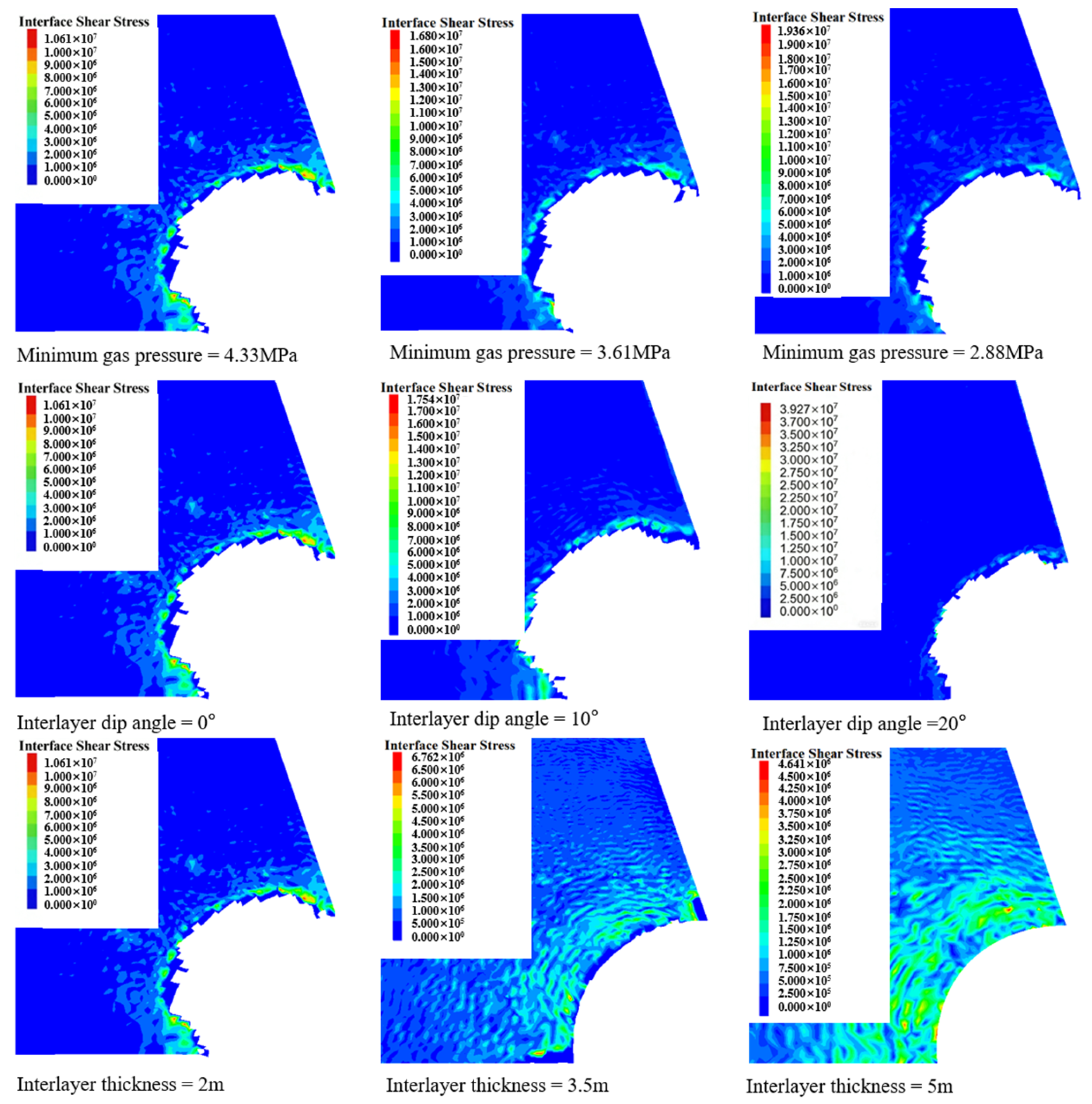
The shear stress along the interlayer–salt interface directly reflects the mechanical response of the interlayer and its overall stability. Figure 7 presents the spatial distribution of the interface shear stress. It can be observed that the shear stress is mainly concentrated around the cavern boundary, with the maximum value occurring near the cavern wall. As the distance from the cavern surface increases, the shear stress exhibits a clear attenuation trend. Under different minimum internal pressures of 2.88 MPa, 3.61 MPa and 4.33 MPa, the maximum interface shear stresses are 10.6 MPa, 16.8 MPa and 19.3 MPa, respectively. As the minimum internal pressure decreases, the maximum interface shear stress increases significantly. This is primarily because the reduction in cavern pressure leads to a higher effective stress difference acting on the surrounding rock, which accelerates salt creep and consequently strengthens the shear interaction between the salt rock and the interlayer. Under higher minimum internal pressure, the intracavity pressure provides significant structural support to the top plate, effectively reducing radial compressive stress concentration in the cavity waist and making the top plate the primary deformation region. When the minimum internal pressure decreases, the top plate experiences significant unloading, while the principal compressive stress in the cavity waist increases, leading to a greater concentration of radial compression and shear deformation at the cavity waist, thus shifting the maximum displacement from the cavity top to the cavity waist.
As can be seen from Figure 9. Under different formation dip angles, when the dip angles are 0°, 10° and 20°, the maximum interface shear stresses reach 10.6 MPa, 17.5 MPa and 39.2 MPa, respectively, showing a pronounced increasing trend with dip angle. The difference in shear stress reaches as high as 28.6 MPa between dip angles of 0° and 20°. A larger dip angle alters the decomposition of stresses along the interlayer, redistributing the normal and tangential components, and thereby inducing stronger shear concentration along the interface. When the interlayer thicknesses are 2 m, 3.5 m and 5 m, the shear stresses along the interlayer–salt interface are 10.6 MPa, 6.76 MPa and 4.64 MPa, respectively. As the interlayer thickness increases, the interface shear stress shows a decreasing trend, indicating that a thicker interlayer reduces the degree of shear concentration along the interface.

3.5. Interlayer-Salt Rock Interface Contact Condition

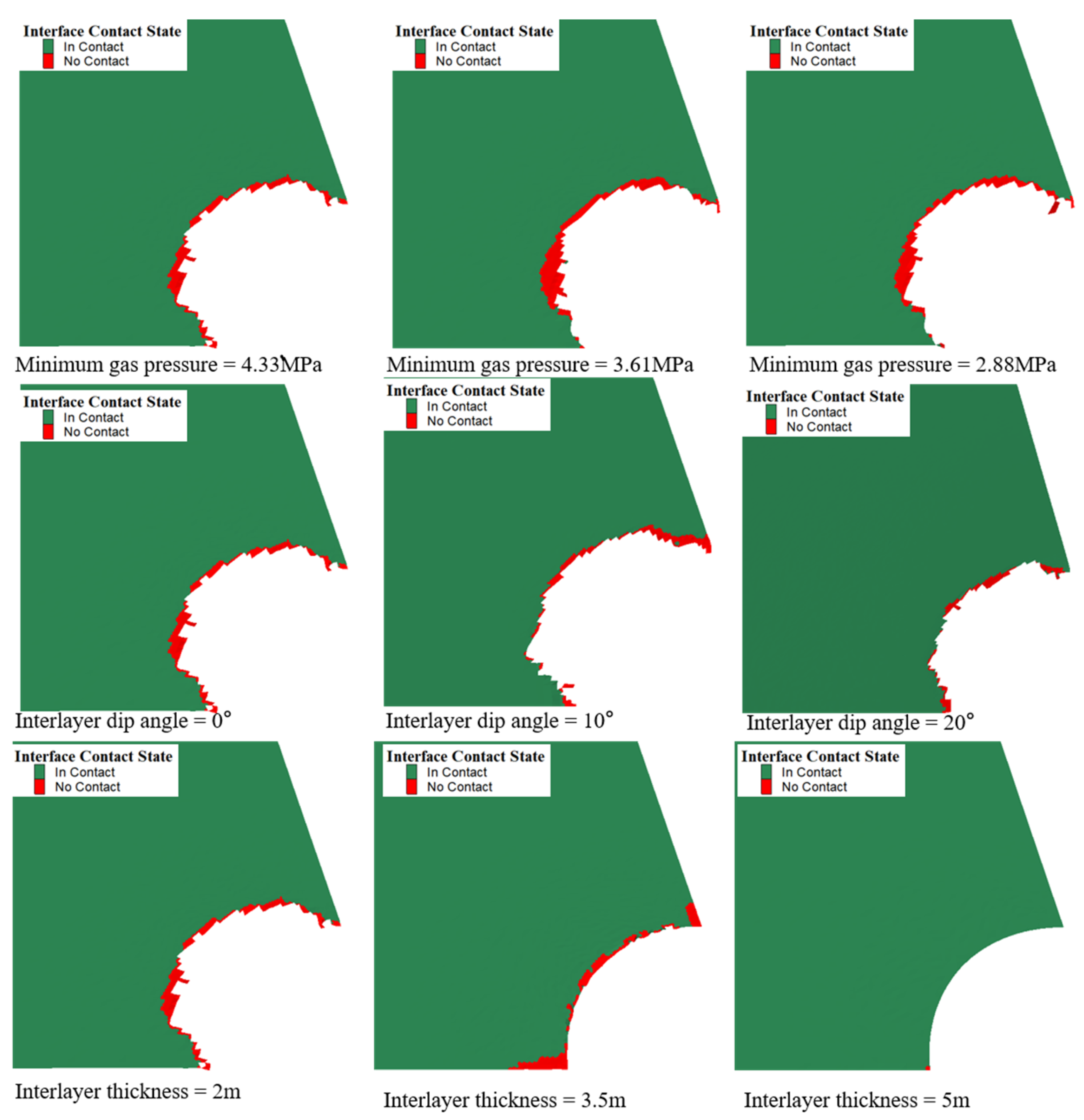
The contact state of the interface elements intuitively reflects the length and spatial distribution of fractures. Figure 10 illustrates the fracture distribution along the cavern boundary interface after interlayer collapse, in which the red region denotes the fractured area and the green region represents the area where contact is maintained. As shown in the figure, after 30 years of operation, fractures are mainly concentrated near the interlayer, indicating that this zone is the most vulnerable to interface separation. Under different minimum internal pressures of 4.33 MPa, 3.61 MPa and 2.88 MPa, the interface fracture area increases progressively to 30.27 m2, 37.33 m2 and 41.33 m2, respectively, demonstrating that a lower internal pressure enlarges the effective stress difference and promotes interface opening. Regarding the influence of formation dip angle, when the dip angles are 0°, 10° and 20°, the fracture areas decrease to 30.27 m2, 24.20 m2 and 22.95 m2, respectively. This indicates that a larger dip angle improves the force-transfer mechanism and weakens the local tensile effect along the interface. In terms of interlayer thickness, when the thicknesses are 2 m, 3.5 m and 5 m, the interface fracture areas further decrease to 22.95 m2, 21.68 m2 and 0.77 m2, respectively, suggesting that a thicker interlayer provides stronger structural confinement and effectively suppresses fracture development. In summary, the operating pressure, formation dip angle and interlayer thickness all exert significant influences on the fracture distribution along the interface. Their respective variation trends reflect the differentiated mechanical responses of the interface structure under different operational conditions.
From the perspective of minimum internal pressure, it strongly influences salt creep rate, cavern deformation, and interface stress. Liu et al. [32] pointed out that lower internal pressure would exacerbate salt rock creep, making cavity deformation and volume reduction more pronounced. This is consistent with the results of this study. Low internal pressure increases the pressure difference between the cavern interior and surrounding rock, accelerating radial creep, increasing cavern contraction and wall displacement, and enhancing shear on the interlayer. It also reduces confining stress on the cavern walls, promoting tensile relaxation and enlarging the surrounding tensile failure zone. The interface experiences reduced normal stress, increased relative slip, larger slip area, and stronger shear concentration, resulting in higher interface shear stress and more extensive fracturing. In contrast, higher internal pressure increases wall confining stress, suppresses creep and tensile failure, and enhances normal compression on the interface, reducing shear concentration and stabilizing the interface, but Chen et al. [33] also pointed out that excessive operating pressure in the cavity can cause an increase in the seepage zone of the surrounding rock. As the operating pressure decreases, the gas storage capacity of the cavity also decreases, affecting the economic benefits of the gas storage facility. Therefore, considering both the stability of the surrounding rock and the economic benefits of the storage facility, the minimum operating pressure of the cavity should not be too low and should be kept within a reasonable range.
Regarding the formation dip angle, increasing the dip angle alters stress decomposition along the salt–interlayer interface. Larger dip angles increase tangential stress while reducing normal stress, promoting shear slip. As a result, interface shear stress rises rapidly, shear failure volume expands, and fracture area decreases. The dip angle also affects the relative deformation between the surrounding rock and the interlayer, redistributing stress and displacement within the cavern. A moderate dip of 10° partially relieves wall stress and reduces contraction and tensile failure, whereas excessive dip amplifies shear dominance, enlarging the plastic zone near the interlayer and potentially triggering new wall tensile failure. Thus, interface stability is highly sensitive to dip angle. This is consistent with the existence of the optimal tilt angle range shown by Peng et al. [34].
Concerning interlayer thickness, thicker interlayers improve compliance and compatibility with salt deformation. Thin interlayers contribute little stiffness, leading to higher shear stress concentration and interface slip, promoting fracturing. Simulation results from Zhao et al. [15] indicate that thick interlayers improve lateral constraint and reduce cavity top subsidence; thin interlayers are more prone to delamination slip and shear band penetration. As thickness increases, the interlayer absorbs more deformation from surrounding rock displacement, differential salt creep, and pressure variations, dispersing local shear concentration, lowering shear stress per unit thickness, and delaying fracture opening and shear-slip failure at the interface.
The interlayers and salt rock in this paper are ideally homogeneous materials. However, the mechanical parameters of rock masses in actual strata may exhibit spatial variability. This spatial variability may lead to uneven stiffness distribution in the rock mass, with softer areas experiencing greater deformation and harder areas bearing more stress. The shear behavior of the interface is jointly controlled by material properties and external loading conditions [35]. The spatial variability of rock-mass parameters can generate weak zones within the surrounding rock, promoting the preferential initiation of fractures along these zones.
The stress distribution in this paper is considered ideally uniform. However, uneven vertical or horizontal stress can significantly impact cave stability. If there are significant differences in vertical or horizontal stress in the strata, the stress distribution around the cave will shift, potentially leading to increased asymmetry in cavity deformation, enhanced local stress concentration, and reduced long-term stability. Furthermore, uneven stress can also cause a weak-surface effect at the interlayer-salt rock interface. Uneven stress distribution leads to a greater difference in creep rates on both sides of the interface, making the interface more prone to fracture formation. Therefore, future work could further consider extending the model to non-uniform stress conditions to verify its applicability in more complex environments.

4. Conclusions

This study conducted a systematic stability evaluation of SCGS with different interlayer occurrence conditions. Based on three-dimensional numerical simulation, the influence of minimum operating pressure, interlayer dip angle, and interlayer thickness on the mechanical behavior of the interlayer-salt rock interface and the overall stability of the cavity was systematically analyzed. Furthermore, the long-term operating status was comprehensively evaluated based on multi-dimensional indicators such as cavity shrinkage rate, plastic zone volume, interface shear stress, and interface fractures. The main conclusions are as follows:
(1)
In the interface stability evaluation, as the minimum operating pressure decreases, the maximum shear stress at the interface shows a significant upward trend, and the interface fracture area also expands accordingly, exacerbating the risk of gas leakage within the cavity. Therefore, it is recommended to control the minimum operating pressure at more than 20% of the formation pressure to ensure the stable operation of the gas storage facility.
(2)
As the dip angle increases from 0° to 20°, the maximum shear stress at the interface increases, while the fracture area decreases. The area of the plastic damage zone at the interlayer increases, increasing the risk of gas leakage within the cavity. When the dip angle is 10°, the distribution of the plastic zone volume of the surrounding rock and the interface fracture area is most reasonable, resulting in the best overall stability of the cavity.
(3)
The interlayer thickness mainly regulates the flexibility and deformation coordination of the interface. The interlayer thickness can effectively weaken the maximum shear stress at the interface, and as the thickness increases, the fracture area decreases significantly. When the interlayer thickness is 3.5 m, it has a good inhibitory effect on fractures without increasing gas leakage, which is most beneficial to the sealing and stability of the gas storage facility.
(4)
From the perspective of overall cavity stability, operating pressure, interlayer inclination angle, and thickness jointly determine the long-term deformation and failure mode of the cavity, making their comprehensive control crucial. A higher minimum operating pressure can effectively reduce the cavity shrinkage rate (from 30.28% to 17.97%), reduce the tensile failure volume, and inhibit creep deformation; an appropriate inclination angle can optimize the stress on the surrounding rock, minimizing the volume of the plastic zone; and an appropriate interlayer thickness helps to disperse interfacial stress and stabilize the cavity structure. Therefore, in engineering design, the internal pressure level, interlayer geometric parameters, and operating regime should be rationally matched to achieve controllable cavity deformation, controllable interfacial stress, and long-term safe operation of the overall structure.

Author Contributions

Conceptualization, X.Y. and Y.Q.; methodology, X.Y., N.X. and Y.Q.; software, X.Y.; validation, X.Y.; formal analysis, X.Y.; investigation, X.Y., Y.Q., N.X., B.Z., S.F. and J.Q.; Resources, Y.Q. and N.X.; data curation, X.Y.; writing—original draft preparation, X.Y.; writing—review and editing, X.Y., Y.Q., B.Z. and N.X.; visualization, X.Y. and Y.Q.; supervision, Y.Q., N.X., B.Z., S.F. and J.Q.; project administration, Y.Q., N.X., B.Z., J.Q. and S.F.; funding acquisition, Y.Q. All authors have read and agreed to the published version of the manuscript.

Funding

This research was funded by the National Key R&D Program of China, grant number 2023YFB4005500.

Informed Consent Statement

Not applicable.

Data Availability Statement

Dataset available on request from the authors.

Acknowledgments

We sincerely thank the editors and all reviewers for their constructive and excellent reviews that helped improve the manuscript.

Conflicts of Interest

The authors declare no conflict of interest.

References

  1. Omri, A. An international literature survey on energy-economic growth nexus: Evidence from country-specific studies. Renew. Sustain. Energy Rev. 2014, 38, 951–959. [Google Scholar] [CrossRef]
  2. Wu, J.; Ansari, U. From CO2 Sequestration to Hydrogen Storage: Further Utilization of Depleted Gas Reservoirs. Reserv. Sci. 2025, 1, 19–35. [Google Scholar] [CrossRef]
  3. Ma, X.; Xu, Z.; Chen, L.; Shi, X. Creep deformation analysis of gas storage in salt caverns. Int. J. Rock Mech. Min. Sci. 2021, 139, 104635. [Google Scholar] [CrossRef]
  4. Yang, C.; Wang, T.; Chen, H. Theoretical and Technological Challenges of Deep Underground Energy Storage in China. Engineering 2023, 25, 168–181. [Google Scholar] [CrossRef]
  5. Grgic, D.; Al Sahyouni, F.; Golfier, F.; Moumni, M.; Schoumacker, L. Evolution of Gas Permeability of Rock Salt Under Different Loading Conditions and Implications on the Underground Hydrogen Storage in Salt Caverns. Rock Mech. Rock Eng. 2022, 55, 691–714. [Google Scholar] [CrossRef]
  6. Thiyagarajan, S.R.; Emadi, H.; Hussain, A.; Patange, P.; Watson, M. A comprehensive review of the mechanisms and efficiency of underground hydrogen storage. J. Energy Storage 2022, 51, 104490. [Google Scholar] [CrossRef]
  7. Liu, W.; Zhang, X.; Fan, J.; Li, Y.; Wang, L. Evaluation of Potential for Salt Cavern Gas Storage and Integration of Brine Extraction: Cavern Utilization, Yangtze River Delta Region. Nat. Resour. Res. 2020, 29, 3275–3290. [Google Scholar] [CrossRef]
  8. Taheri, S.R.; Pak, A.; Shad, S.; Mehrgini, B.; Razifar, M. Investigation of rock salt layer creep and its effects on casing collapse. Int. J. Min. Sci. Technol. 2020, 30, 357–365. [Google Scholar] [CrossRef]
  9. Wang, T.T.; Ma, H.L.; Shi, X.L.; Yang, C.H.; Zhang, N.; Li, J.L.; Ding, S.; Daemen, J. Salt cavern gas storage in an ultra-deep formation in Hubei, China. Int. J. Rock Mech. Min. Sci. 2018, 102, 57–70. [Google Scholar] [CrossRef]
  10. Yan, Z.; Wang, Z.; Wu, F.; Lyu, C. Stability analysis of Pingdingshan pear-shaped multi-mudstone interbedded salt cavern gas storage. J. Energy Storage 2022, 56, 105963. [Google Scholar] [CrossRef]
  11. Zhao, K.; Ma, H.; Li, H.; Yang, C.; Li, P.; Liu, Y.; Li, H.; Zeng, Z.; Wang, X. Stability analysis of CAES salt caverns using a creep-fatigue model in Yunying salt district, China. J. Energy Storage 2023, 62, 106856. [Google Scholar] [CrossRef]
  12. Liu, W.; Zhang, Z.; Fan, J.; Jiang, D.; Daemen, J.J.K. Research on the Stability and Treatments of Natural Gas Storage Caverns with Different Shapes in Bedded Salt Rocks. IEEE Access 2020, 8, 18995–19007. [Google Scholar] [CrossRef]
  13. Wang, T.; Yang, C.; Ma, H.; Li, Y.; Shi, X.; Li, J.; Daemen, J. Safety evaluation of salt cavern gas storage close to an old cavern. Int. J. Rock Mech. Min. Sci. 2016, 83, 95–106. [Google Scholar] [CrossRef]
  14. Zhang, H.; Li, Q.; Yue, X.; Ba, J.; Ding, S. Study on the deformation and failure laws of surrounding rock under reduced roof thickness in Salt Cavern Gas Storage. Sci. Rep. 2024, 14, 22529. [Google Scholar] [CrossRef]
  15. Zhao, K.; Ma, H.; Li, Y.; Liu, Y.; Cai, R.; Liang, X.; Huang, S.; Zeng, Z.; Wang, X.; Li, H. Stability Evaluation of Horizontal Salt Caverns for Gas Storage in Two Mining Layers: A Case Study in China. Energies 2023, 16, 7288. [Google Scholar] [CrossRef]
  16. He, T.; Wang, T.; Wang, D.; Xie, D.; Dong, Z.; Zhang, H.; Ma, T.; Daemen, J. Integrity analysis of wellbores in the bedded salt cavern for energy storage. Energy 2023, 263, 125841. [Google Scholar] [CrossRef]
  17. Zhang, H.; Wang, P.; Wanyan, Q.; Li, K.; Gao, K.; Yue, X. Sensitivity analysis of operation parameters of the salt cavern under long-term gas injection-production. Sci. Rep. 2023, 13, 20012. [Google Scholar] [CrossRef]
  18. Zhang, X.; Liu, W.; Jiang, D.; Qiao, W.; Liu, E.; Zhang, N.; Fan, J. Investigation on the influences of interlayer contents on stability and usability of energy storage caverns in bedded rock salt. Energy 2021, 231, 120968. [Google Scholar] [CrossRef]
  19. Li, P.; Li, Y.; Shi, X.; Zhao, K.; Liang, X.; Ma, H.; Yang, C.; Liu, K. Compaction and restraining effects of insoluble sediments in underground energy storage salt caverns. Energy 2022, 249, 123752. [Google Scholar] [CrossRef]
  20. Li, M.; Liu, J.; Xia, Y. Risk prediction of gas hydrate formation in the wellbore and subsea gathering system of deep-water turbidite reservoirs: Case analysis from the south China Sea. Reserv. Sci. 2025, 1, 52–72. [Google Scholar] [CrossRef]
  21. Ge, X.; Huang, J.; Zhou, K.; Su, K.; Wang, W.; Li, Y.; Shi, X. Research of interlayer dip angle effect on stability of salt cavern energy and carbon storages in bedded salt rock. Geoenergy Sci. Eng. 2024, 243, 213291. [Google Scholar] [CrossRef]
  22. Li, J.; Yang, C.; Shi, X.; Xu, W.; Li, Y.; Daemen, J.J.K. Construction modeling and shape prediction of horizontal salt caverns for gas/oil storage in bedded salt. J. Pet. Sci. Eng. 2020, 190, 107058. [Google Scholar] [CrossRef]
  23. Wang, T.; Ding, Z.; He, T.; Xie, D.; Liao, Y.; Chen, J.; Zhu, K. Stability of the horizontal salt cavern used for different energy storage under varying geological conditions. J. Energy Storage 2024, 84, 110817. [Google Scholar] [CrossRef]
  24. Liu, W.; Zhang, Z.; Chen, J.; Fan, J.; Jiang, D.; Jjk, D.; Li, Y. Physical simulation of construction and control of two butted-well horizontal cavern energy storage using large molded rock salt specimens. Energy 2019, 185, 682–694. [Google Scholar] [CrossRef]
  25. Yang, J.; Li, H.; Yang, C.; Li, Y.; Wang, T.; Shi, X.; Han, Y. Physical simulation of flow field and construction process of horizontal salt cavern for natural gas storage. J. Nat. Gas Sci. Eng. 2020, 82, 103527. [Google Scholar] [CrossRef]
  26. Wang, C.; Kou, H.; Han, W. Mechanical properties and failure mechanism of sandstone with mudstone interlayer. EDP Sci. 2019, 136, 04048. [Google Scholar] [CrossRef]
  27. Ma, X.; Yang, C.; Shi, X. Effects of interlayer on stress and failure of horizontal salt cavern. Chin. J. Rock Mech. Eng. 2017, 36, 3314–3320. [Google Scholar]
  28. Zhang, G.; Wang, L.; Wu, Y.; Li, Y.; Yu, S. Failure mechanism of bedded salt formations surrounding salt caverns for underground gas storage. Bull. Eng. Geol. Environ. 2017, 76, 1609–1625. [Google Scholar] [CrossRef]
  29. Zhang, N.; Shi, X.; Wang, T.; Yang, C.; Liu, W.; Ma, H.; Daemen, J. Stability and availability evaluation of underground strategic petroleum reserve (SPR) caverns in bedded rock salt of Jintan, China. Energy 2017, 134, 504–514. [Google Scholar] [CrossRef]
  30. Li, H.; Deng, J.; Wanyan, Q.; Feng, Y.; Lenwoue, A.R.K.; Luo, C.; Hui, C. Numerical investigation on shape optimization of small-spacing twin-well for salt cavern gas storage in ultra-deep formation. Energies 2021, 14, 2859. [Google Scholar] [CrossRef]
  31. Ma, H.; Wei, X.; Shi, X.; Liang, X.; Bai, W.; Ge, L. Evaluation methods of salt pillar stability of salt cavern energy storage. Energies 2022, 15, 7570. [Google Scholar] [CrossRef]
  32. Liu, J.; Xiao, Q. The influence of operation pressure on the long-term stability of salt-cavern gas storage. Adv. Mech. Eng. 2014, 6, 537679. [Google Scholar] [CrossRef]
  33. Chen, X.; Li, Y.; Shi, Y.; Yu, Y.; Jiang, Y.; Liu, Y.; Dong, J. Tightness and stability evaluation of salt cavern underground storage with a new fluid–solid coupling seepage model. J. Pet. Sci. Eng. 2021, 202, 108475. [Google Scholar] [CrossRef]
  34. Peng, J.; Zhou, J.; Liang, G.; Peng, C.; Hu, C.; Guo, D. Investigation on the long-term stability of multiple salt caverns underground gas storage with interlayers. J. Energy Resour. Technol. 2023, 145, 081202. [Google Scholar] [CrossRef]
  35. Cao, L.; Lv, M.; Li, C.; Sun, Q.; Wu, M.; Xu, C.; Dou, J. Effects of crosslinking agents and reservoir conditions on the propagation of fractures in coal reservoirs during hydraulic fracturing. Reserv. Sci. 2025, 1, 36–51. [Google Scholar] [CrossRef]
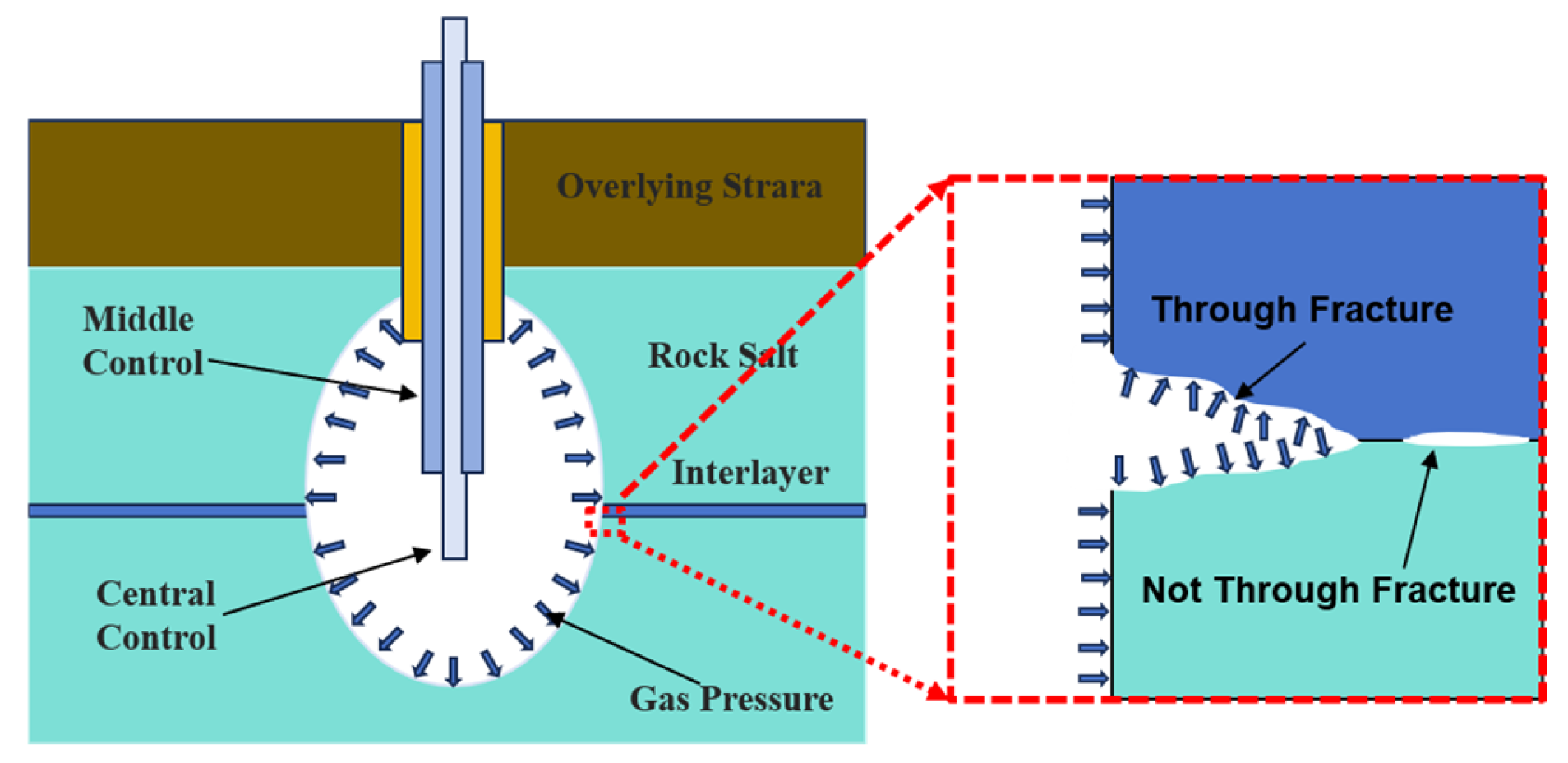
Figure 1. Fracture distribution.
Energies 18 06497 g001
Figure 2. Simulation Method Process.
Energies 18 06497 g002
Figure 3. Three-dimensional numerical geological model of salt cavern gas storage.
Energies 18 06497 g003
Figure 4. Change process of the internal pressure of salt cavern gas storage.
Energies 18 06497 g004
Figure 5. Change of volume shrinkage.
Energies 18 06497 g005
Figure 6. Change of the plastic zone distribution range.
Energies 18 06497 g006
Figure 7. Contour of surrounding rock deformation (Horizontal displacement).
Energies 18 06497 g007
Figure 8. Contour of surrounding rock deformation (Vertical displacement).
Energies 18 06497 g008
Figure 9. Shear stress distribution on the interface.
Energies 18 06497 g009
Figure 10. Distribution of contact states on the interface.
Energies 18 06497 g010
Table 1. Mechanical Parameters of Surrounding Rock [29].
Density
(kg/m3)
Elasticity Modulus (GPa)PoissonInternal Friction Angle (◦)Cohesion (MPa)Tension
(MPa)
A
(Pa−n·s−1)
n
Mudstone24505.480.26339.578.191.672.06 × 10−354.35
Salt Rock22003.990.24030.515.701.041.56 × 10−343.52
Interlayer23003.800.27730.435.451.081.63 × 10−403.50
Interface---45.182.621.20--
Table 2. Operation Condition Design.
Interlayer Thickness (m)Dip Angle
(°)
Minimum Operating Pressure (MPa)
Case 1203.61 (26% σz)
Case 23.503.61 (26% σz)
Case 3503.61 (26% σz)
Case 4203.61 (26% σz)
Case 52103.61 (26% σz)
Case 62203.61 (26% σz)
Case 7202.88 (20% σz)
Case 8203.61 (20% σz)
Case 9204.33 (20% σz)
Disclaimer/Publisher’s Note: The statements, opinions and data contained in all publications are solely those of the individual author(s) and contributor(s) and not of MDPI and/or the editor(s). MDPI and/or the editor(s) disclaim responsibility for any injury to people or property resulting from any ideas, methods, instructions or products referred to in the content.