Mitigating Load Shedding in South Africa Through Optimized Hybrid Solar–Battery Deployment: A Techno-Economic Assessment



Abstract
1. Introduction
- Assess grid connection capacity: Identify regions with sufficient network hosting capacity to support PV installations capable of offsetting MLR events, based on Eskom’s 2023 load-shedding records and national grid-capacity reports (e.g., GCCA 2025).
- Optimize hybrid system configuration: Develop a techno-economic optimization framework to determine cost-effective sizing and spatial allocation of PV systems and BESSs. A Particle Swarm Optimization (PSO) algorithm is employed to minimize the Levelized Cost of Energy (LCOE) while satisfying reliability criteria. The framework includes an Energy Management System (EMS) to coordinate PV generation and battery operation under realistic technical constraints.
- Incorporate regulatory and infrastructure limitations: Analyze grid bottlenecks, land-use restrictions, and policy barriers that influence regional deployment potential.
- Evaluate economic feasibility: Conduct a comparative assessment of system-wide costs, land-use trade-offs, and energy not supplied (ENS) across three deployment scenarios—(i) regionally constrained, (ii) flexible redistribution, and (iii) national-scale unconstrained deployment—to determine financial viability and alignment with national energy policy targets.
- Section 2—Literature Review: Summarizes the current state of South Africa’s electricity sector, the causes and impacts of load shedding, and previous efforts to integrate renewable generation.
- Section 3—Methodology: Describes the modeling framework, datasets, and optimization algorithm used to simulate PV–BESS deployment scenarios.
- Section 4—Results and Discussion: Presents and interprets the simulation outcomes, emphasizing spatial deployment trade-offs, cost implications, and grid-constraint effects.
- Section 5—Conclusions: Highlights the main findings, policy implications, and directions for future research on renewable integration and grid resilience.
2. Literature Review
2.1. South African Energy Context
2.2. Load Shedding: Causes, Trends, and Implications
2.3. Policy and Grid Integration Framework
2.4. Literature Review
3. Models and Methods
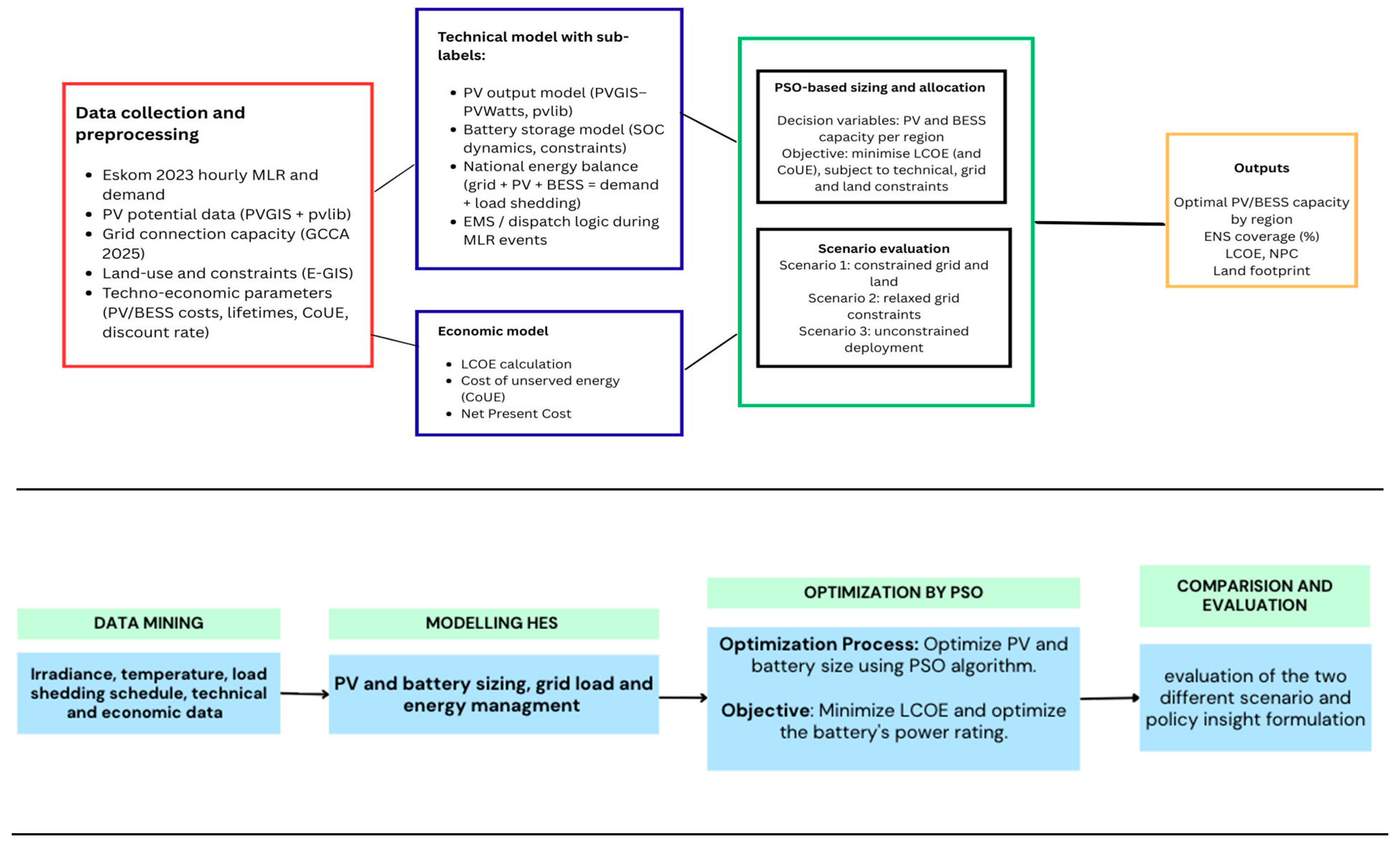
3.1. Overview of the Methodology
- Scenario 1—Constrained Grid and Land Availability: Enforces all grid and land-use limits, reflecting current conditions.
- Scenario 2—Relaxed Grid Constraints: Maintains land restrictions but allows greater inter-regional energy transfers.
- Scenario 3—Unconstrained Deployment: Removes all spatial limitations, representing a theoretical upper bound for performance and cost minimization.
3.2. Data Collection
3.2.1. Load Profile
3.2.2. Regional Available Capacity
3.3. Technical Model
3.3.1. PV Output Model
3.3.2. Battery Energy Storage Model
3.3.3. National Energy Balance
3.4. Economic Model
3.4.1. Levelized Cost of Electricity (LCOE)
3.4.2. Load Shedding Cost
3.4.3. HRES Component Characteristics
3.4.4. Sensitivity to Cost Assumption
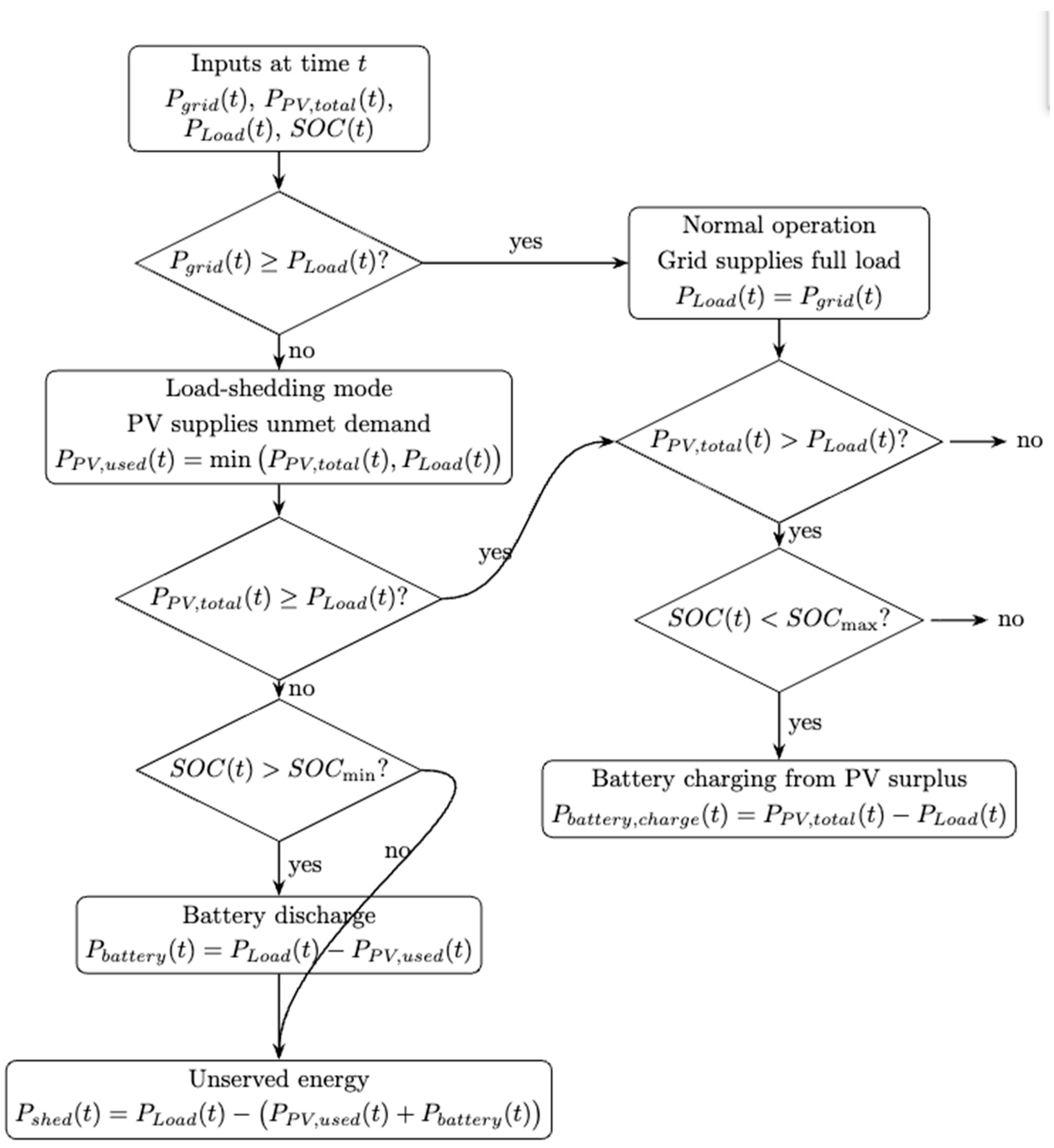
3.5. Integrated National Energy Management Flow
3.5.1. Hierarchy-Based Flow
3.5.2. Optimization Formulation
- Total installed PV capacity in each region (in kW). This capacity is adjusted based on the solar potential of each region.
- Total installed battery storage capacity in each region (in kWh). This determines the energy storage available to balance the PV output and load demand.
- Total power output from the PV systems (in kW), which depends on both the installed capacity and the solar irradiance.
- Power charged to or discharged from the battery (in kW). This controls how the battery storage is used to balance supply and demand.
- State of charge of the battery (in kWh), which evolves dynamically during charging and discharging and must remain within specified limits.
3.5.3. Implementation of the PSO Algorithm
3.6. Validation/Model Robustness
4. Results and Discussion
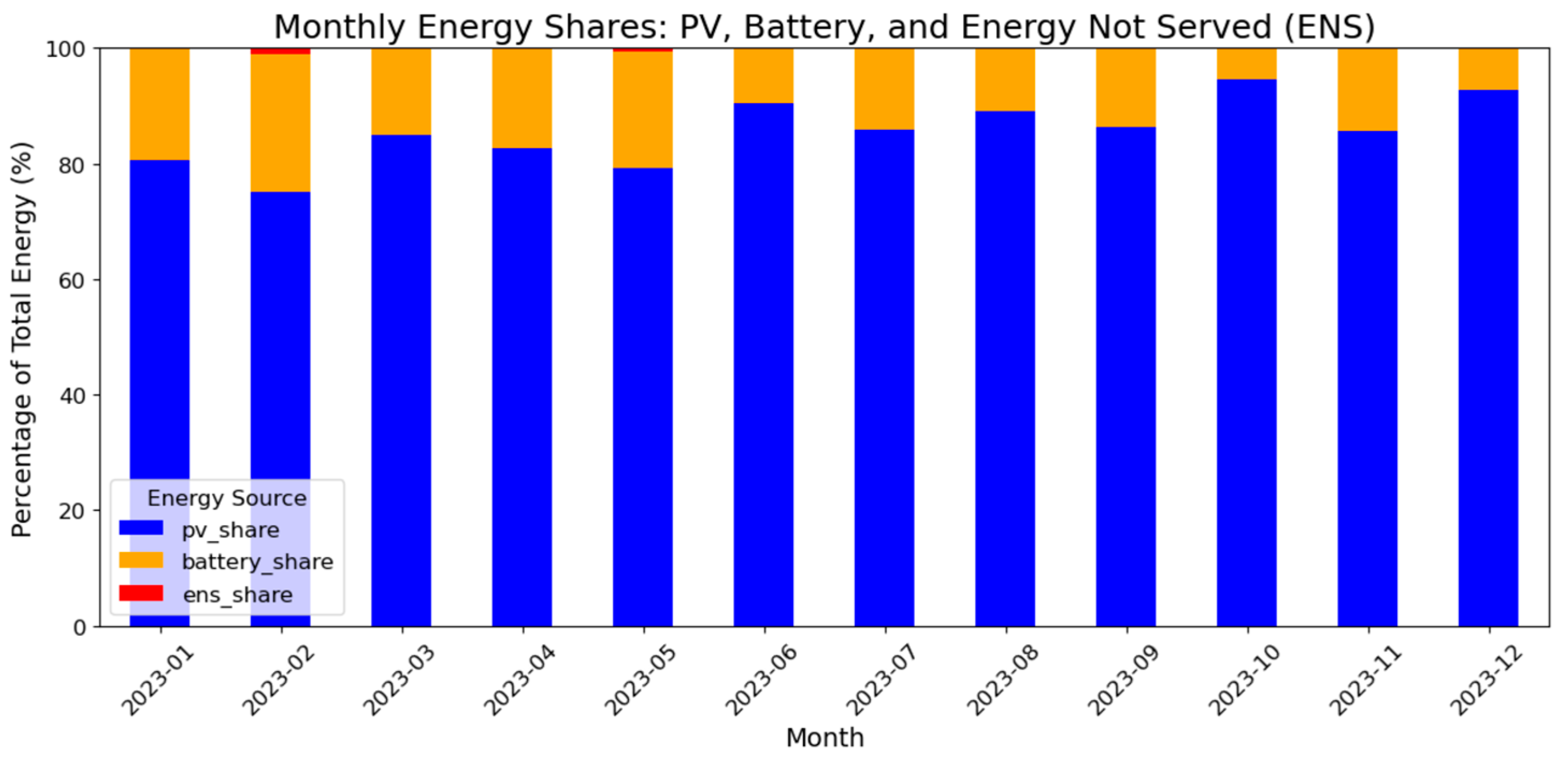
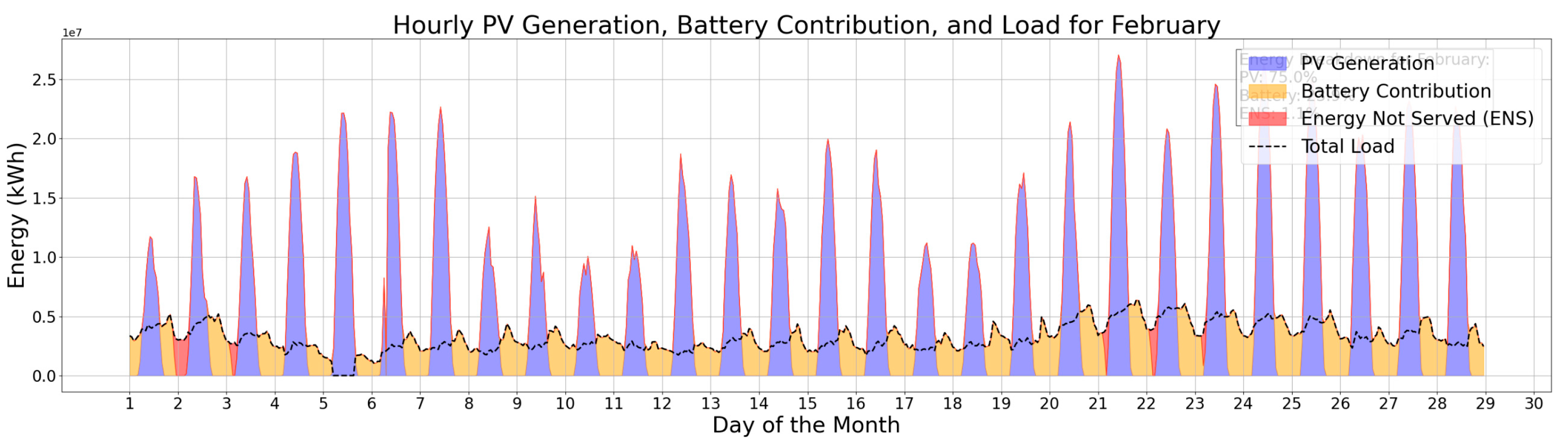
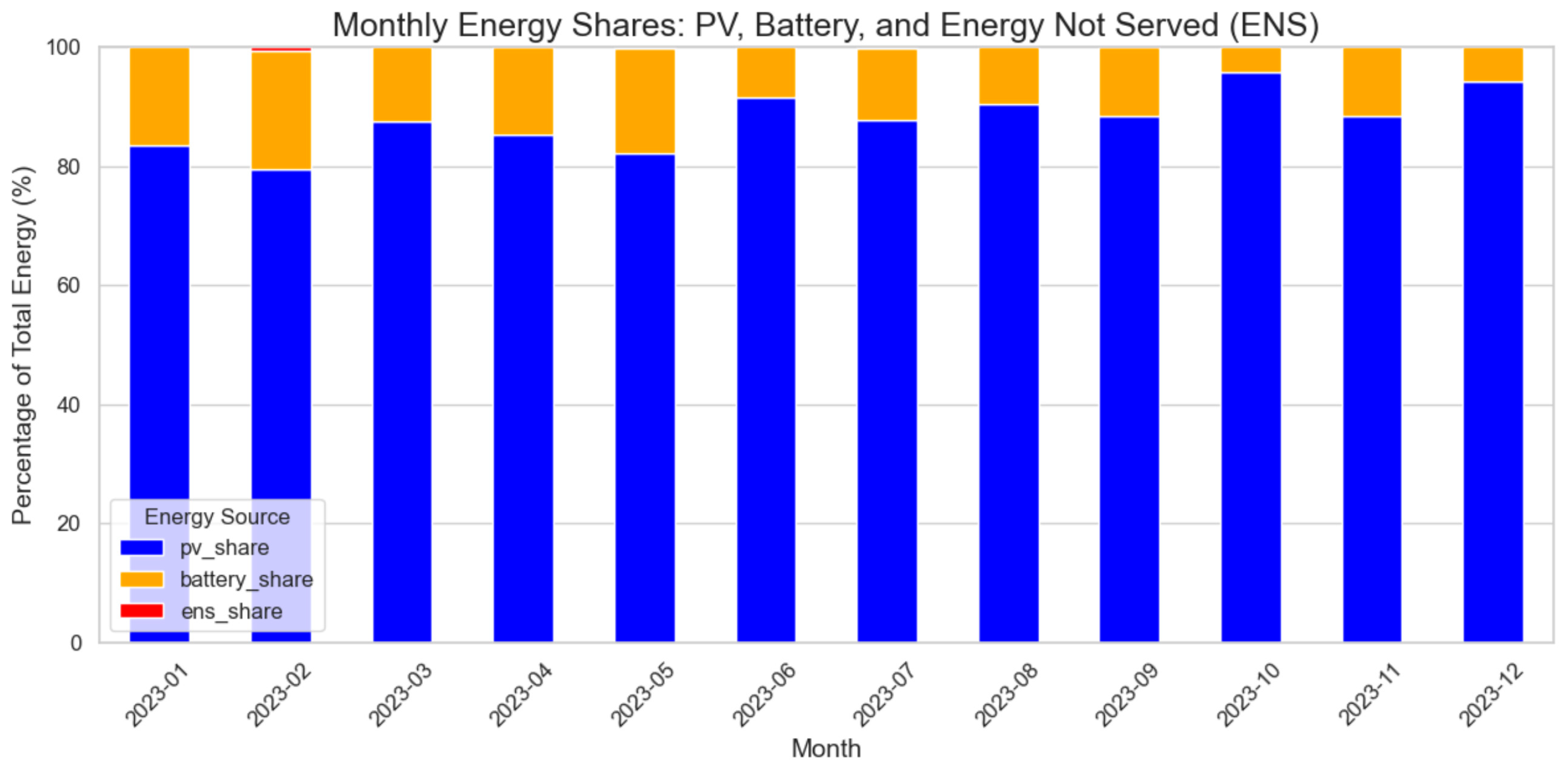
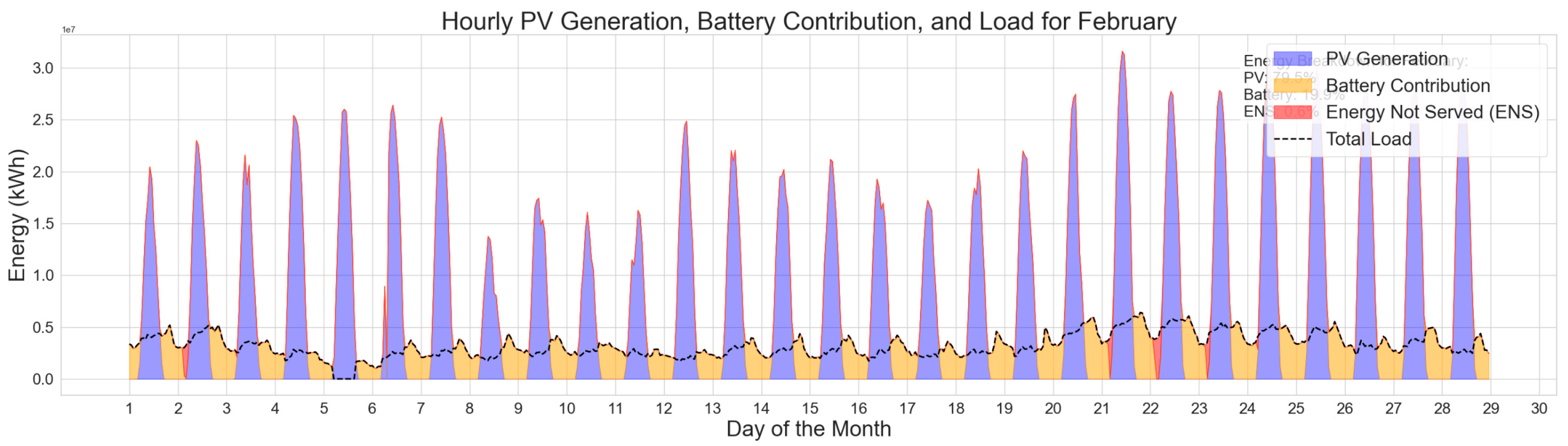
- Scenario 1—Constrained grid: Represents current national conditions, where generation connection capacity follows the GCCA 2025 limits. The scenario tests how effectively PV and BESS technology can alleviate load shedding within existing grid constraints.
- Scenario 2—Partially relaxed grid: Assumes unlimited grid connection capacity for the six identified constrained supply areas but maintains realistic land-use limits for PV deployment.
- Scenario 3—Fully unconstrained grid: Extends the unlimited-capacity assumption nationwide, allowing unrestricted PV installations across South Africa to reveal the theoretical upper bound of renewable integration for mitigating load shedding.
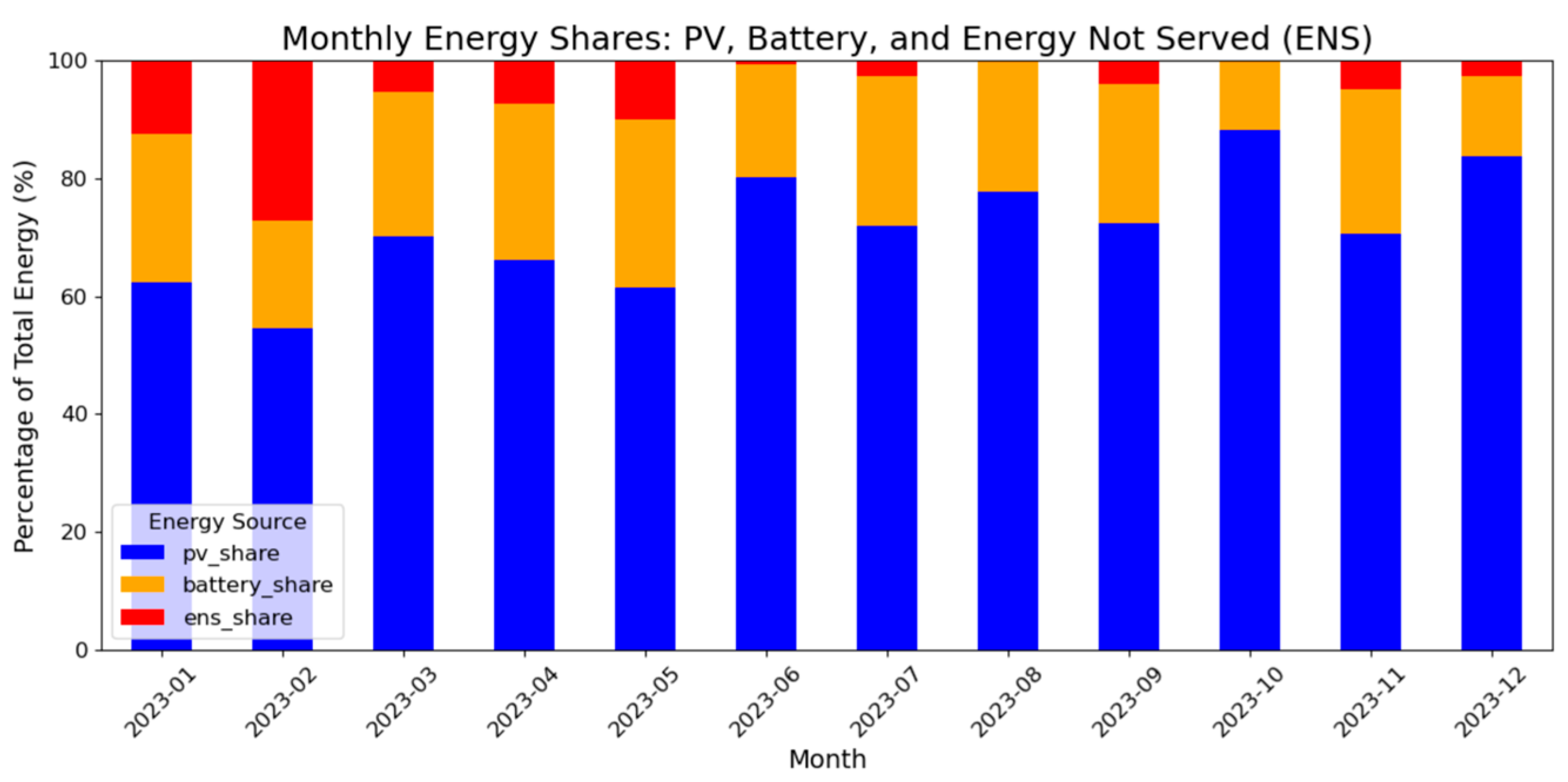
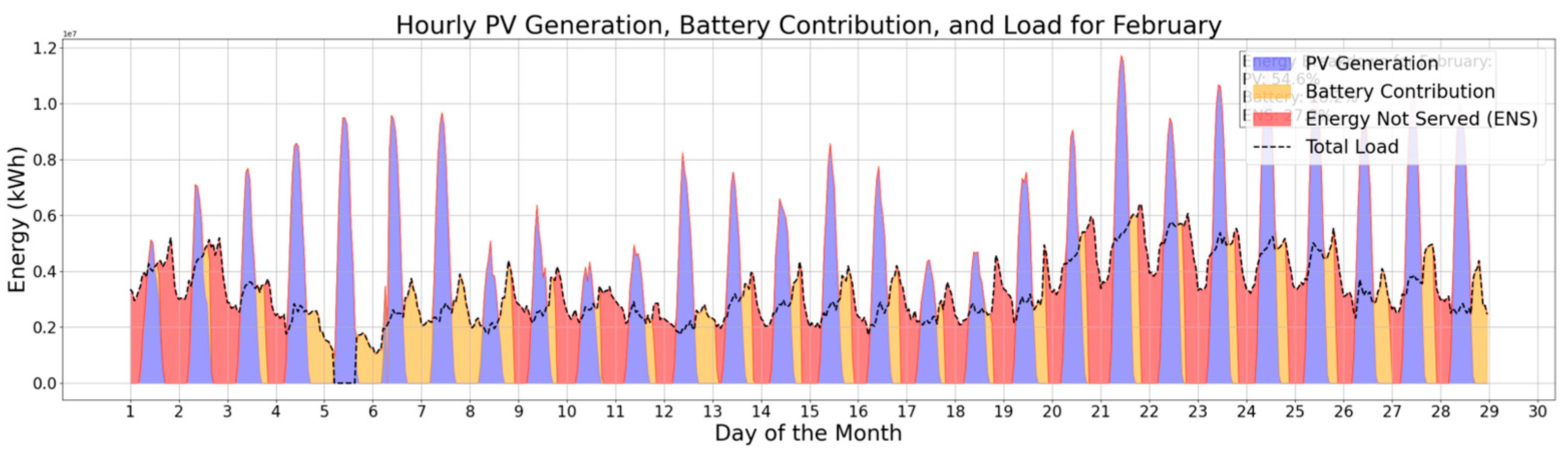
4.1. Scenario 1: Constrained Grid Conditions
4.2. Scenario 2: Relaxed Grid Constraints
4.3. Scenario 3: Unconstrained National Deployment
4.4. Sensitivity to Cost Assumptions
4.5. Comparative Analysis of Scenarios
4.6. Discussion
4.6.1. Cost–Reliability Trade-Offs
4.6.2. Policy, System, and Non-Technical Barriers
- Strategic grid reinforcement in high-irradiance and high-demand provinces (Limpopo, Gauteng, Mpumalanga, Northern and Western Cape).
- Accelerated deployment of large-scale battery storage, which is critical for mitigating evening shortfalls.
- Institutional reforms and stable regulatory conditions that reduce approval times and enhance investment certainty.
- Integration of reliability valuation into tariff and procurement frameworks, recognizing the substantial socio-economic cost of load shedding.
4.6.3. Concluding Remarks
5. Conclusions
Author Contributions
Funding
Data Availability Statement
Conflicts of Interest
References
- Eskom. Company Information. Available online: https://www.eskom.co.za/about-eskom/company-information/ (accessed on 19 November 2024).
- Eskom. What Is Load Shedding? Available online: https://loadshedding.eskom.co.za/LoadShedding/Description (accessed on 19 November 2024).
- Council for Scientific and Industrial Research (CSIR). Utility-Scale Power Generation Statistics in South Africa 2024, March 2025. (CSIR), Technical Report, March 2025. Available online: https://www.csir.co.za/sites/default/files/2025-09/Utility%20Statistics%20Report_Jan%202025_Final.pdf (accessed on 16 July 2025).
- IndustriALL. South African State Utility Hit Hard by Strikes. Available online: https://www.industriall-union.org/south-african-state-utility-hit-hard-by-strikes (accessed on 14 March 2013).
- Ginindza, B. Load Shedding Crisis Costs Economy R2.8 Trillion in 2023. IOL Cape Times. Available online: https://iol.co.za/business-report/2025-03-18-south-africas-load-shedding-crisis-costs-economy-r2-8-trillion-in-2023/ (accessed on 22 July 2025).
- Adams, R. Eskom: Are Brighter Days Ahead; Allan Gray: Cape Town, South Africa, 2024; Available online: https://www.allangray.co.za/latest-insights/markets-and-economy/eskom-are-brighter-days-ahead/ (accessed on 15 July 2025).
- Apata, O.; Adebayo, A.V.; Awodele, K. Grid integration of wind energy: The South African challenge. In Proceedings of the 2020 IEEE PES/IAS PowerAfrica, Nairobi, Kenya, 25–28 August 2020. [Google Scholar] [CrossRef]
- Power-Technology. Top Five Hydro Power Plants in Operation in South Africa. 2024. Available online: https://www.power-technology.com/data-insights/top-five-hydro-power-plants-in-operation-in-south-africa/ (accessed on 16 July 2025).
- World Nuclear News (WNN). Second Koeberg Unit Returns to Service. Available online: https://www.world-nuclear-news.org/articles/second-koeberg-unit-returns-to-service (accessed on 16 July 2025).
- Ngamlana, N.B.; Malherbe, W.; Gericke, G.; Coetzer, R.L.J. The effect of coal-fired power plants on ambient air quality in Mpumalanga province, South Africa, 2014–2018. Int. J. Environ. Health Res. 2025, 35, 220–232. [Google Scholar] [CrossRef] [PubMed]
- National Transmission Company of South Africa (NTCSA). Grid Capacity and Connection Assessment (GCCA). Available online: https://www.ntcsa.co.za/gcca/ (accessed on 11 November 2024).
- Eskom. Grid Capacity and Connection Assessment Report: Generation Connection Capacity Assessment (GCCA) 2025. Transmission Grid Planning and Development. Available online: https://www.ntcsa.co.za/wp-content/uploads/2024/07/Generation_Connection_Capacity_AssessmentGCCA-2025.pdf (accessed on 16 November 2024).
- Nova Economics. Estimating the Economic Cost of Load Shedding in South Africa. Available online: https://www.nersa.org.za/wp-content/uploads/2021/09/Appendix-C_Estimating-the-Economic-Cost-of-Load-Shedding-in-South-Africa-Report.pdf (accessed on 16 November 2024).
- Duvenage, W. South African Electricity Prices Have Doubled Since COVID. Available online: https://techcentral.co.za/south-african-electricity-prices-doubled/258600/ (accessed on 17 April 2025).
- South African Government. National Development Plan 2030: Our Future—Make It Work. Available online: https://www.gov.za/documents/national-development-plan-2030-our-future-make-it-work (accessed on 16 November 2024).
- Department of Mineral Resources and Energy (DMRE). Integrated Resource Plan (IRP) 2019. Available online: https://www.dmre.gov.za/Portals/0/Energy_Website/IRP/2019/IRP-2019.pdf (accessed on 16 November 2024).
- Department of Mineral Resources and Energy (DMRE). Independent Power Producers Procurement Programme (IPPPP): An Overview. Available online: https://www.dmre.gov.za/Portals/0/Resources/Publications/Reports/IPPPP/IPPPP-Quarter4-Report-as-at-31March2024.pdf.pdf?ver=5GTn78y10qvjb_jky7_0XA%3d%3d (accessed on 16 November 2024).
- Smith, T. Renewable Energy from IPPs Slowly Reaching SA Power Grid. Available online: https://www.esi-africa.com/renewable-energy/renewable-energy-from-ipps-slowly-reaching-sa-power-grid/ (accessed on 16 November 2024).
- Republic of South Africa. Energy Action Plan 18-Month Progress Report: March 2024. Available online: https://www.gov.za/sites/default/files/progress_on_EAP.pdf.pdf (accessed on 18 July 2025).
- Roelf, W. World Bank Group Considers $500 Million Boost for South Africa’s Transmission Expansion; Reuters: Singapore, 2025; Available online: https://www.reuters.com/sustainability/boards-policy-regulation/world-bank-group-considers-500-million-boost-south-africas-transmission-2025-06-20 (accessed on 18 July 2025).
- Falama, R.Z.; Welaji, F.N.; Dadjé, A.; Dumbrava, V.; Djongyang, N.; Salah, C.B.; Doka, S.Y. A Solution to the Problem of Electrical Load Shedding Using Hybrid PV/Battery/Grid-Connected System: The Case of Households’ Energy Supply of the Northern Part of Cameroon. Energies 2021, 14, 2836. [Google Scholar] [CrossRef]
- Ghayoor, F.; Swanson, A.; Sibanda, H. Optimal sizing of grid-connected hybrid renewable energy systems: A case study of the residential sector in Durban, South Africa. J. Energy South. Afr. 2021, 32, 11–27. [Google Scholar] [CrossRef]
- Frank, T. Basics: Energy Management Systems According to ISO 50001. 2013. Available online: https://www.thai-german-cooperation.info/download/20130517_pdp_day1_part%201_basics.pdf (accessed on 19 November 2024).
- Bakht, M.P.; Salam, Z.; Gul, M.; Anjum, W.; Kamaruddin, M.A.; Khan, N.; Bukar, A.L. The potential role of hybrid renewable energy system for grid intermittency problem: A techno-economic optimisation and comparative analysis. Sustainability 2022, 14, 14045. [Google Scholar] [CrossRef]
- Allwyn, R.G.; Al-Hinai, A.; Al-Abri, R.; Malik, A. Optimization and techno-economic analysis of PV/Battery system for street lighting using genetic algorithm—A case study in Oman. Clean. Eng. Technol. 2022, 8, 100475. [Google Scholar] [CrossRef]
- Maleki, A.; Ameri, M.; Keynia, F. Scrutiny of Multifarious Particle Swarm Optimization for Finding the Optimal Size of a PV/Wind/Battery Hybrid System. Renew. Energy 2015, 80, 552–563. [Google Scholar] [CrossRef]
- Wali, S.B.; Hannan, M.A.; Ker, P.J.; Kiong, T.S. Optimal Sizing of PV-Battery based Hybrid Renewable System using Particle Swarm Optimization for Economic Sustainability. In Proceedings of the 2023 IEEE International Conference on Energy Technologies for Future Grids (ETFG), Wollongong, Australia, 3–6 December 2023. [Google Scholar] [CrossRef]
- Kefale, H.A.; Getie, E.M.; Eshetie, K.G. Optimal Design of Grid-Connected Solar Photovoltaic System Using Selective Particle Swarm Optimization. Int. J. Photoenergy 2021, 2021, 6632859. [Google Scholar] [CrossRef]
- Jindal, A.; Shrimali, G. At scale adoption of battery storage technology in indian power industry: Enablers, frameworks and policies. Technol. Forecast. Soc. Chang. 2022, 176, 1255–1265. [Google Scholar] [CrossRef]
- Hassan, Q. Evaluation and optimization of off-grid and on-grid photovoltaic power system for typical household electrification. Renew. Energy 2021, 164, 375–390. [Google Scholar] [CrossRef]
- Thango, B.; Bokoro, B. Battery Energy Storage for Photovoltaic Application in South Africa: A Review. Energies 2022, 61, 5962. [Google Scholar] [CrossRef]
- Harrucksteiner, A.; Thakur, J.; Franke, K.; Sensfuß, F. A geospatial assessment of the techno-economic wind and solar potential of Mongolia. Sustain. Energy Technol. Assess. 2023, 55, 102889. [Google Scholar] [CrossRef]
- Kassab, F.A.; Celik, B.; Locment, F.; Sechilariu, M.; Liaquat, S.; Hansen, T.M. Optimal Sizing and Energy Management of a Microgrid: A Joint MILP Approach for Minimization of Energy Cost and Carbon Emission. Renew. Energy 2024, 224, 120186. [Google Scholar] [CrossRef]
- Department of Forestry, Fisheries and the Environment (DFFE). Environmental Geographic Information Systems (EGIS). Available online: https://www.dffe.gov.za/egis (accessed on 23 November 2024).
- European Commission Joint Research Centre. Photovoltaic Geographical Information System (PVGIS). Available online: https://re.jrc.ec.europa.eu/pvg_tools/en/#HR (accessed on 20 December 2024).
- Asowata, O.; Swart, A.; Pienaar, C. Optimum Tilt Angles for Photovoltaic Panels during Winter Months in the Vaal Triangle, South Africa. Smart Grid Renew. Energy 2012, 3, 119–125. [Google Scholar] [CrossRef]
- National Energy Regulator of South Africa (NERSA). Eskom Cost of Unserved Energy (CoUE) 2021 and 2022 Update Report. Available online: https://www.nersa.org.za/files/files/2025/03/Eskom-COUE-2021-and-2022-Update-Report.pdf (accessed on 2 December 2024).
- Statista. Global Solar PV Installed Cost 2010–2023. Available online: https://www.statista.com/statistics/809796/global-solar-power-installation-cost-per-kilowatt/ (accessed on 3 March 2025).
- Walker, A.; Lockhart, E.; Desai, J.; Ardani, K.; Klise, G.; Lavrova, O.; Tansy, T.; Deot, J.; Fox, B.; Pochiraju, A. Model of Operation-And-Maintenance Costs for Photovoltaic Systems. National Renewable Energy Laboratory; Tech. Rep. NREL/TP-5C00-74840; 2020. Available online: https://www.nrel.gov/docs/fy20osti/74840.pdf#page=1.00&gsr=0 (accessed on 3 March 2025).
- Rix, A.; Kritzinger, K.; Meyer, I.; van Niekerk, J.L. Potential for Distributed Solar Photovoltaic Systems in the Western Cape Province; Western Cape Government: Cape Town, South Africa, 2015. Available online: https://www.crses.sun.ac.za/files/research/publications/technical-reports/WCG%20PV%20Report%20Final[1].pdf (accessed on 3 March 2025).
- National Renewable Energy Laboratory. 2024 ATB: Utility-Scale Battery Storage. 2024. Available online: https://atb.nrel.gov/electricity/2024/utility-scale_battery_storage#MIKY3RBI (accessed on 3 March 2025).
- Grant Thornton. Renewable Energy Discount Rate Survey Results—2018. 2019. Available online: https://www.bgt-grantthornton.it/globalassets/1.-member-firms/italy-bernoni/articoli/2019/grant-thornton-renewable-energy-discount-rate-survey--2018.pdf (accessed on 3 March 2025).
- Lo, W.-L.; Chung, H.S.-H.; Hsung, R.T.-C.; Fu, H.; Shen, T.-W. PV panel model parameter estimation by using particle swarm optimization and artificial neural network. Energies 2024, 24, 3006. [Google Scholar] [CrossRef] [PubMed]



| Region | PV Capacity (MW) | Battery Capacity (MWh) | PV Cost (M$) | Battery Cost (M$) | Total Cost (M$) |
|---|---|---|---|---|---|
| Free State | 14 | 525 | 11 | 251 | 262 |
| Gauteng | 4680 | 29,566 | 3547 | 14,095 | 17,643 |
| KwaZulu Natal | 55 | 158 | 42 | 75 | 117 |
| Limpopo | 3360 | 19,975 | 2547 | 9523 | 12,070 |
| Mpumalanga | 3320 | 26,376 | 2517 | 12,575 | 15,091 |
| North West | 1659 | 11,293 | 1259 | 5384 | 6642 |
| Total | 13,089 | 87,893 | 9921 | 41,802 | 51,723 |
| Region | PV Capacity (MW) | Battery Capacity (MWh) | PV Cost (M$) | Battery Cost (M$) | Total Cost (M$) |
|---|---|---|---|---|---|
| Free State | 100 | 0 | 76 | 0 | 76 |
| Gauteng | 10,000 | 23,097 | 7580 | 11,011 | 18,591 |
| KwaZulu Natal | 100 | 0 | 76 | 0 | 76 |
| Limpopo | 10,000 | 20,013 | 7580 | 9541 | 17,121 |
| Mpumalanga | 10,000 | 22,975 | 7580 | 10,953 | 18,533 |
| North West | 100 | 2 | 76 | 1 | 77 |
| Total | 30,300 | 66,087 | 22,967.11 | 31,506.39 | 54,474 |
| Region | Optimized PV Capacity (MW) | Optimized Battery Capacity (MWh) | PV Cost (M$) | Battery Cost (M$) | Total Cost (M$) |
|---|---|---|---|---|---|
| Eastern Cape | 100 | 0 | 76 | 0 | 76 |
| Free State | 10,000 | 0 | 7580 | 0 | 7580 |
| Gauteng | 10,000 | 20,550 | 7580 | 9797 | 17,377 |
| Hydra Central | 100 | 0 | 76 | 0 | 76 |
| KwaZulu Natal | 100 | 0 | 76 | 0 | 76 |
| Limpopo | 10,000 | 24,938 | 7580 | 11,889 | 19,469 |
| Mpumalanga | 100 | 0 | 76 | 0 | 76 |
| North West | 100 | 0 | 76 | 0 | 76 |
| Northern Cape | 4679 | 18,864 | 3547 | 8993 | 12,540 |
| Western Cape | 100 | 0 | 76 | 0 | 76 |
| Total | 35,279 | 64,352 | 26,742 | 30,677 | 57,419 |
Disclaimer/Publisher’s Note: The statements, opinions and data contained in all publications are solely those of the individual author(s) and contributor(s) and not of MDPI and/or the editor(s). MDPI and/or the editor(s) disclaim responsibility for any injury to people or property resulting from any ideas, methods, instructions or products referred to in the content. |
© 2025 by the authors. Licensee MDPI, Basel, Switzerland. This article is an open access article distributed under the terms and conditions of the Creative Commons Attribution (CC BY) license (https://creativecommons.org/licenses/by/4.0/).
Share and Cite
Vittoria, G.; Castro, R. Mitigating Load Shedding in South Africa Through Optimized Hybrid Solar–Battery Deployment: A Techno-Economic Assessment. Energies 2025, 18, 6480. https://doi.org/10.3390/en18246480
Vittoria G, Castro R. Mitigating Load Shedding in South Africa Through Optimized Hybrid Solar–Battery Deployment: A Techno-Economic Assessment. Energies. 2025; 18(24):6480. https://doi.org/10.3390/en18246480
Chicago/Turabian StyleVittoria, Ginevra, and Rui Castro. 2025. "Mitigating Load Shedding in South Africa Through Optimized Hybrid Solar–Battery Deployment: A Techno-Economic Assessment" Energies 18, no. 24: 6480. https://doi.org/10.3390/en18246480
APA StyleVittoria, G., & Castro, R. (2025). Mitigating Load Shedding in South Africa Through Optimized Hybrid Solar–Battery Deployment: A Techno-Economic Assessment. Energies, 18(24), 6480. https://doi.org/10.3390/en18246480