1. Introduction
High temperature rise and low emissions at the gas turbine combustion chamber outlet both necessitate a significant increase in the combustion air ratio. Consequently, reducing the cooling air ratio has become an inevitable outcome in the development of high-performance combustion chambers [
1,
2,
3], posing immense challenges to the chamber’s heat resistance. Currently, two primary methods exist to enhance combustion chamber heat resistance: First, substantially increasing the permissible temperature of the combustion chamber wall material. However, this approach faces limitations due to the current constraints on the heat resistance of high-temperature alloy materials. Second, developing highly efficient combustion chamber cooling technologies. Current cooling approaches have evolved from single-mode gas film cooling to composite cooling systems integrating multiple methods such as impact cooling, finned cooling, divergent cooling, liquid film cooling, and laminar cooling. Correspondingly, cooling structures have progressed from primitive single-wall designs to diverse configurations including double-wall, multi-wall, and floating-wall structures [
4,
5]. For most combustion chamber cooling structures, heat transfer efficiency decreases as cooling air mass flow rate is reduced. In combustion chambers designed for high temperature rise and low emissions, the cooling air volume constitutes a small proportion of the total air volume, typically resulting in low pressure drop. This imposes limitations on the adoption of certain enhanced heat transfer structures and high-flow-resistance cooling configurations. Consequently, designing laminar plate composite cooling structures with high cooling efficiency under constrained conditions of limited pressure differential and cooling air flow has remained a key challenge and focus in the development of gas turbine combustion chambers [
6,
7,
8].
Driven by the demand for reduced coolant consumption, research on shaped film cooling holes has advanced rapidly. Shaped holes can mitigate jet penetration and the intensity of fluid interactions, offering superior coolant coverage compared to cylindrical holes. Bunker [
9] summarized and categorized four primary types of shaped holes, providing a valuable framework for subsequent studies. Early research primarily focused on performance comparisons between different hole geometries. Goldstein [
10] observed that fan-shaped holes exhibit better cooling effectiveness than cylindrical holes. Michael et al. [
11] compared the heat transfer coefficients of three hole types under high blowing ratios, finding that holes with diffuser-shaped exits promote lateral spreading and yield higher overall cooling performance than traditional cylindrical holes. Jiang et al. [
12] compared the adiabatic effectiveness and Net Heat Flux Reduction (NHFR) of four shaped holes located on the pressure side, leading edge, and suction side of a guide vane. They identified that the laid-back fan-shaped hole, conical hole, and fan-shaped hole performed best on the three surfaces, respectively. Compared to cylindrical holes, shaped holes involve more geometric parameters, prompting investigations into their specific influences. Gritsch et al. [
13] compared five hole configurations with varying inclination and compound angles on a single flat plate. They reported that the flow on the lee side of the hole exit is relatively insensitive to changes in these angles; however, larger angles can induce jet lift-off, thereby strengthening the interaction between the coolant jet and the crossflow. Tao et al. [
14] investigated the influence of geometric parameters, specifically forward expansion angle, lateral expansion angle, and diffuser length, on the cooling performance of laid-back fan-shaped holes across five blowing ratios. Their results indicated that medium forward and lateral expansion angles combined with a long diffuser are optimal at high blowing ratios, whereas minimum or maximum expansion angles with a medium diffuser length perform best at low blowing ratios. Zamiri [
15] employed Large Eddy Simulation (LES) to elucidate the flow and thermal characteristics of laid-back fan-shaped holes. Schroeder [
16] studied the effect of internal hole surface roughness on the cooling performance of shaped holes, finding that increased roughness leads to a degradation in adiabatic effectiveness.
However, manufacturing complex-shaped holes on thin walls is challenging. Bunker [
17] observed that trench-like features may form when blades are coated with a thermal barrier coating (TBC), and their performance may differ from that of standard flush cylindrical holes. Lu et al. [
18] used infrared thermography to study the cooling characteristics of trenched holes and found that film cooling effectiveness is higher when cooling holes are embedded within trenches. Dorrington et al. [
19] investigated the influence of trench depth parameters on film cooling performance and demonstrated that the best heat transfer performance occurs near the trench edge closest to the hole exit. Lu et al. [
20] examined the effect of trench width and concluded that a relatively narrow trench width results in higher cooling effectiveness. Schreivogel et al. [
21] proposed a “W”-shaped trench film cooling configuration and compared it with a transverse trench, reporting an increase in cooling effectiveness by a factor of more than 1.5. Hou et al. [
22] conducted a numerical study on rounded trenches and found that variable-radius trenches can enhance downstream cooling effectiveness. Zhang et al. [
23] improved upon this concept by introducing a double-curvature trench. Through comparisons with traditional cylindrical holes and conventional transverse trenches, they found that the double-curvature trench performs better at low blowing ratios, while conventional trenches are more suitable for high blowing ratios. Zhang et al. [
24] investigated a cooling configuration featuring grooves on both the inlet and outlet sides of the film cooling holes, observing improved cooling performance but also a higher discharge coefficient.
Anand [
25] summarized that geometric modifications to gas turbine wall surfaces employing TBCs may include not only trenches but also depressions or protrusions. Crater film cooling falls under the depression type. Lu et al. [
26] experimentally demonstrated that crater film cooling can increase film effectiveness by approximately 50% compared to the conventional non-trenched configuration. Fu et al. [
27] studied the flow field and cooling performance of crater film cooling embedded with cylindrical film cooling holes, identifying optimal cooling effectiveness when the crater depth equals the hole diameter. Kalghatgi P [
28] proposed a novel film cooling model integrating both craters and trenches, which exhibited a 100% improvement in cooling effectiveness compared to the non-crater configuration. A typical protrusion type is the forward-facing step film cooling. Na and Shih [
29] suggested placing a step upstream of the hole to alter the incoming boundary layer flow, thereby enhancing film cooling efficiency. Zhang et al. [
30] analyzed the effect of spanwise-height non-uniform upstream steps on film cooling from rectangular holes, finding that film cooling effectiveness decreases as the midspan step height increases. Zheng et al. [
31,
32] introduced steps upstream of transverse trenches to improve film cooling performance, determining that optimal lateral spreading of the coolant occurs when the step-to-trench distance is 0 mm. They also investigated segmented steps, observing a significant enhancement in cooling performance when gaps were present between the step segments. Nauman et al. [
33] combined these two approaches, further analyzing the impact of various upstream step dimensions and the step-to-trench distance on film cooling performance. Song [
34] investigated the effects of trench height, the distance from the hole exit to the downstream sidewall, and the curvature radius of the downstream sidewall on the film cooling performance of fan-shaped film cooling holes. Chokhar [
35] used infrared thermography to measure the film cooling effectiveness of a gas jet injected through an inclined cylindrical hole into a transverse trench on a wall, comparing the results with a conventional non-trenched configuration. The study concluded that the thermal effectiveness of the jet from the trenched inclined hole was significantly higher than that from the non-trenched inclined hole. Hou et al. [
36] performed large eddy simulations (LES) to study the thermal and flow fields of cylindrical and trenched holes, revealing that trenched holes promote better lateral spreading of the coolant downstream and provide improved wall attachment. Furthermore, the transverse trench increases turbulent fluctuations and adds complexity to the vortex structures.
A review of the existing literature reveals that there has been limited research on the flow and heat transfer characteristics of double-sided cooling configurations—with cold and hot fluids on opposing sides—specifically for layered plates with trenched inclined holes under gas turbine combustor operating conditions. Therefore, this paper employs numerical simulation methods to analyze the influence mechanisms of various structural parameters of the trenched inclined hole layered plate on its flow and heat transfer characteristics at a coolant-side Reynolds number of 100,000. The findings aim to establish a theoretical foundation for developing novel high-efficiency cooling configurations for gas turbine combustors.
2. CFD Numerical Methods and Validation
2.1. Physical Model
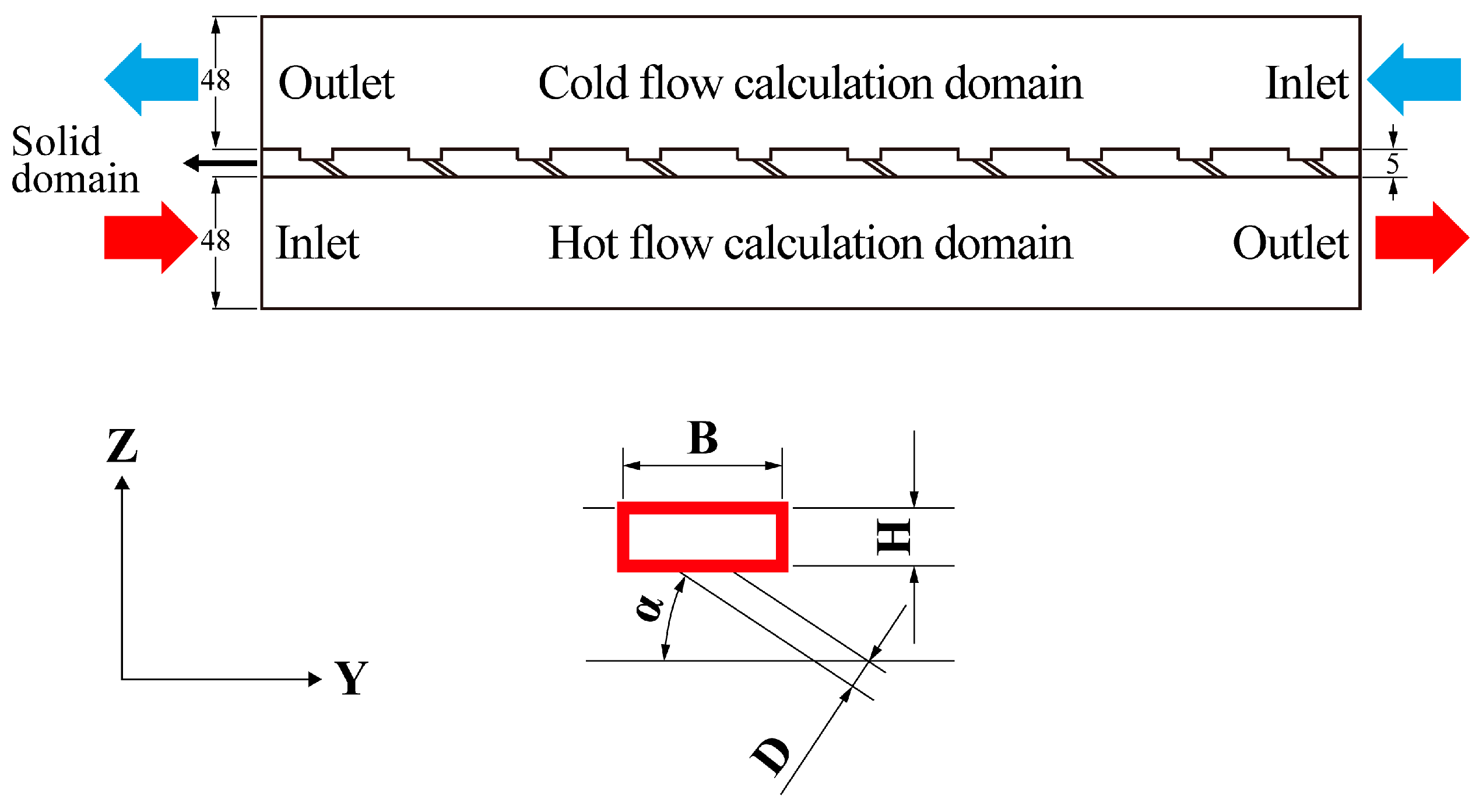
Figure 1 presents the YZ sectional view of the physical model for the rectangular trench with inclined holes, a localized enlargement of the inclined holes within the rectangular trench, and the computational domain. The solid plate has a thickness of 5 mm and a length of 200 mm, with an extended distance of 16 mm. The cold flow and hot flow regions measure 48 mm in height and 200 mm in length. The rectangular groove depth and width are denoted as
H and
B, respectively, whilst the inclined hole angle, diameter, and flow-through distance are represented as
α,
D, and
Y, respectively. The computational domain encompasses the cold flow, hot flow domains, and the solid domain. To investigate the influence of rectangular trench depth, width, inclined hole angle, diameter, and flow-through distance on flow and heat transfer characteristics, the parameters for each case study are set as shown in
Table 1.
2.2. Calculation Methods and Boundary Conditions
This study employs the ANSYS-CFX (V19.5, ANSYS Inc., Pittsburgh, PA, USA) commercial software, utilizing the Reynolds-averaged Navier–Stokes (RANS) equations for solution. The turbulence model selected is the SST k-ω model, with the solution mode set to the upwind high-order scheme and a convergence scale of 10−5. The governing equations are as follows:
Mass Conservation Equation:
Momentum Conservation Equation:
where
= Convective term
= Momentum source term in the x-direction
= Momentum source term in the y-direction
= Momentum source term in the z-direction
= Viscous term of the u-momentum equation
= Viscous term of the v-momentum equation
= Viscous term of the w-momentum equation
Energy Conservation Equation:
The boundary conditions are set as follows: the Reynolds number at the cold flow inlet is 100,000; the velocity at the hot flow inlet is 75 m/s; both the cold and hot flow outlets are static pressure outlets; the cold and hot flows form a fluid–solid coupled interface with the solid; and both the cold and hot flows and the solid are assigned a moving periodic boundary condition on the side walls.
2.3. Parameter Definition
The Reynolds number (
Re) is defined as:
where
= Coolant density (kg/m3)
= Coolant-side velocity (m/s)
= inlet equivalent diameter (m)
= dynamic viscosity of air
The blowing ratio (
BR) is defined as:
where
= Coolant density (kg/m3)
= Coolant-side velocity (m/s)
= Hot-gas density (kg/m3)
= Hot-gas side velocity (m/s)
The friction factor (
f) is defined as:
where
= Inlet equivalent diameter (m)
= Pressure difference across the layered plate between the coolant and hot-gas sides (Pa)
= Projected area normal to the plate surface (m2)
= Test section length (m)
= Average velocity at the test section outlet (m/s)
= Coolant mass flow rate at the inlet (kg/s)
The average Nusselt number (
Nuave) is defined as:
where
= Average wall heat flux (W/m2)
= Inlet equivalent diameter (m)
= Thermal conductivity of air (W/(m·K))
= Wall surface temperature (K)
= Coolant inlet temperature (K)
The cooling effectiveness (
η) is defined as:
where
= inlet temperature of hot gas/K;
= average temperature of the solid wall surface on the hot gas side/K;
= inlet temperature of coolant/K.
2.4. Mesh Generation
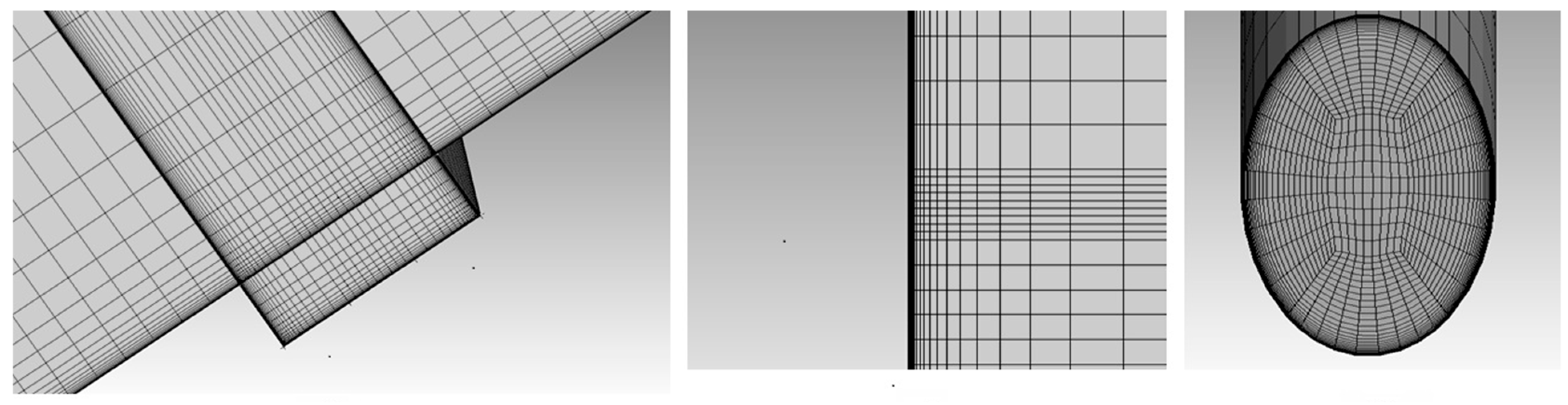
Structured grids are employed for the computational domains of the coolant flow, main flow, and solid regions. Grid refinement is implemented in the near-wall regions of both the coolant and main flow computational domains to ensure a Y+ value of less than 1, with a grid growth ratio of 1.2. A detailed view of the local grid refinement is presented in
Figure 2.
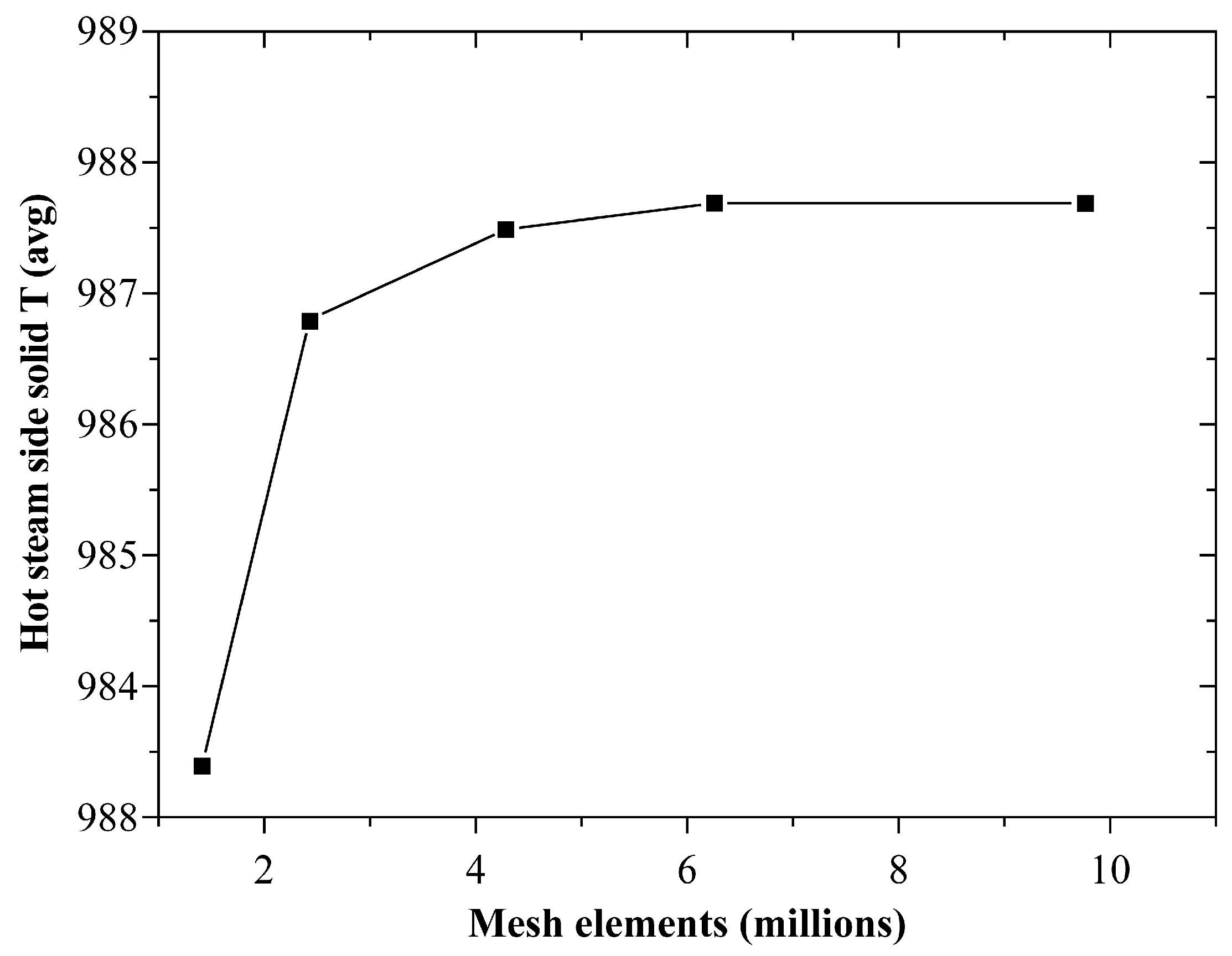
For the grid independence study, five mesh systems with approximately 1.4 million, 2.42 million, 4.27 million, 6.24 million, and 9.75 million elements were selected.
Figure 3 presents the average temperature data at the hot-gas-side solid wall for these different grid sizes. The results indicate that once the grid count exceeds 4 million, the average wall temperature remains nearly constant. To maintain computational efficiency, a mesh system with approximately 6 million elements was adopted for the final simulations.
2.5. Numerical Validation Method
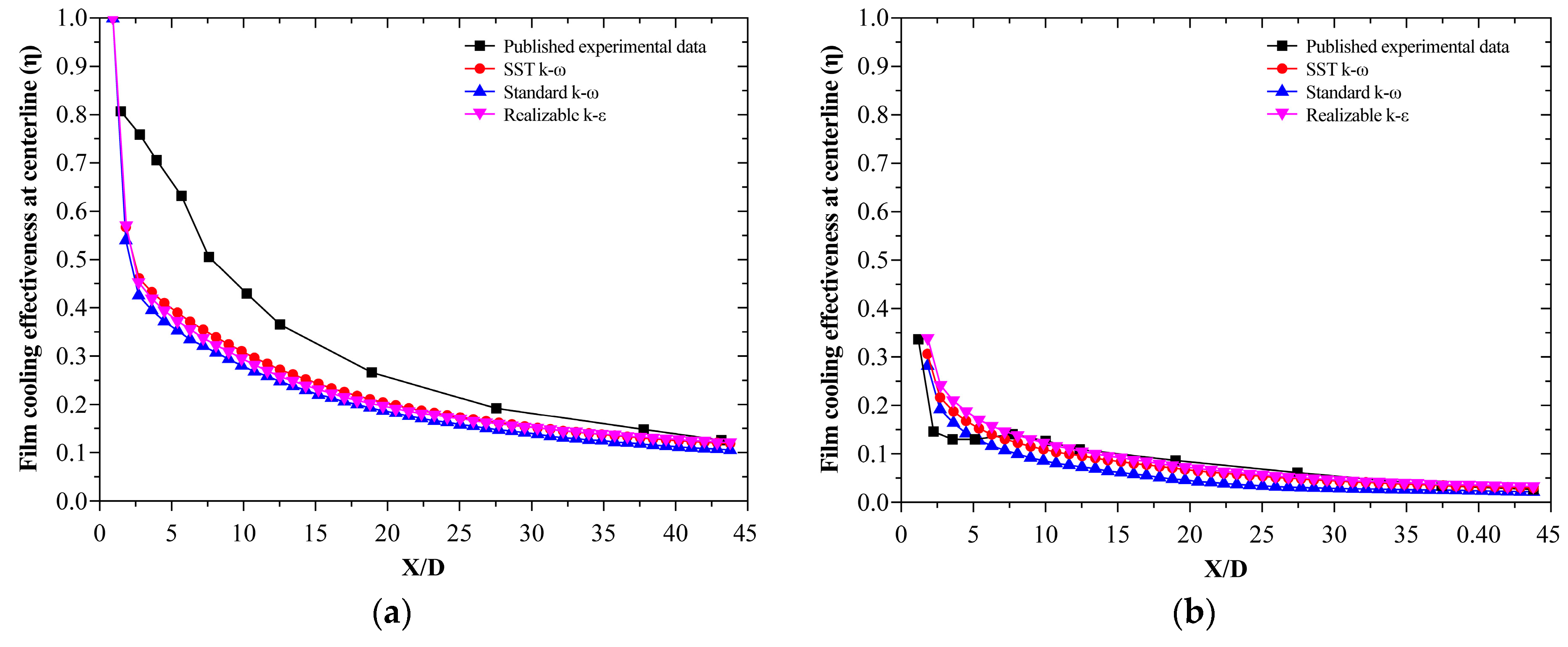
To validate the reliability of the computational results in this study, experimental data from the literature (Sinha et al. [
37]) were used for comparison. Based on the benchmark model described in the reference, the mainflow velocity was set to 20 m/s with a temperature of 300 K, while the coolant temperature was set to 250 K. Two mass flux ratios (
M),
M = 0.5 and 1.0, were considered. As shown in
Figure 4, different turbulence models have a minimal impact on the film cooling effectiveness along the centerline of the cooling hole for both blowing ratios. At low
M, the simulation errors of each model relative to the experimental results are 27.1%, 29.3%, and 30.1%, respectively. At high
M, the errors are 13.2%, 13.8%, and 14.3%, respectively. Overall, the SST k-ω model demonstrates higher computational accuracy than the other models under both low and high
M. The discrepancy between the simulation and experimental results can be attributed to several factors: the mainstream velocity uncertainty of ±1% in the experiment, the temperature measurement accuracy of ±0.1 K, as well as the numerical errors may also be introduced during the simulation process.
3. Results and Discussion
3.1. Comparative Performance: Rectangular Trench Configurations vs. Baseline Single Inclined Hole Configurations
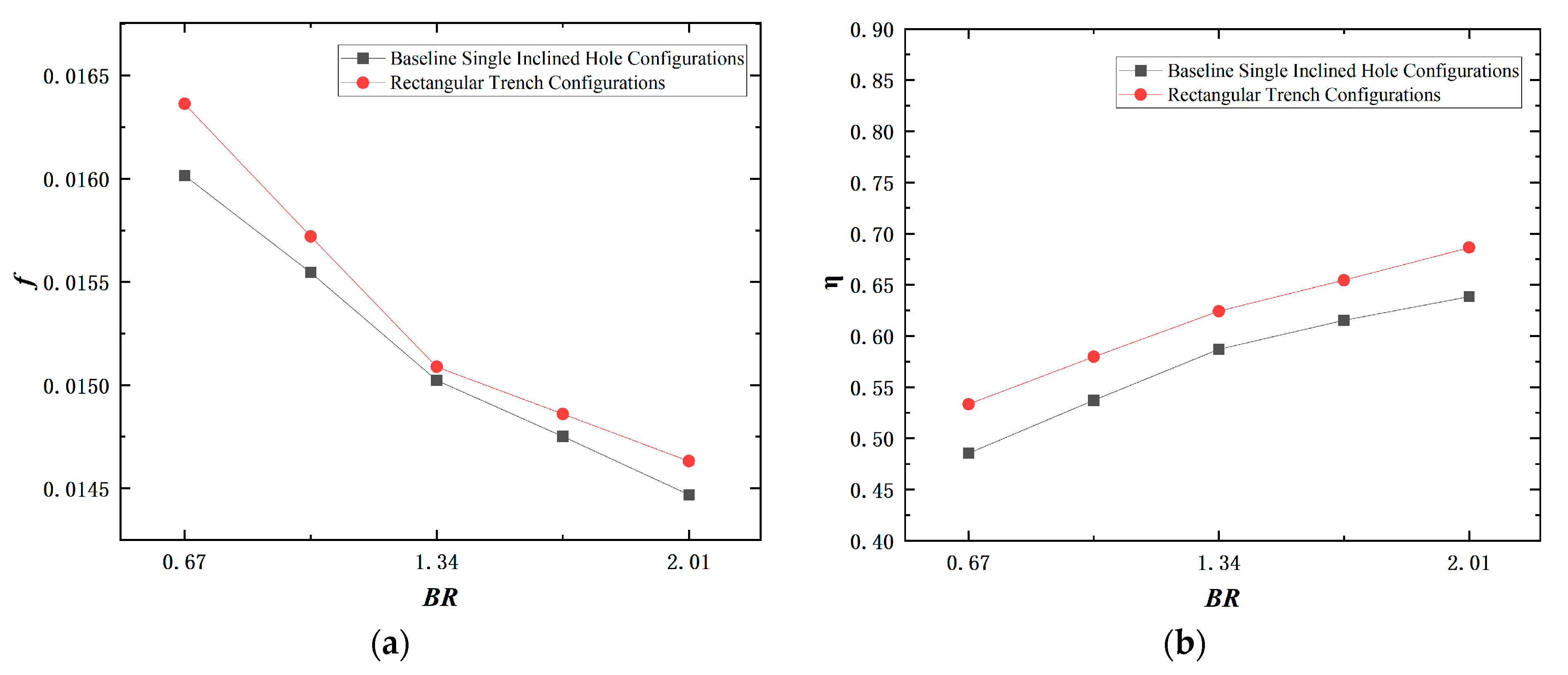
As can be observed from
Figure 5, the friction factor (
f) of the rectangular trench configuration is slightly higher than that of the baseline single inclined hole configuration at both low and high blowing ratios (
BR). At medium
BR, the
f of the rectangular trench configuration is nearly identical to that of the baseline single inclined hole structure. As the
BR increases, the
f of both the trenched configuration and the baseline single inclined hole structure gradually decreases, with the rate of reduction gradually diminishing. At
BR = 0.67, the
f of the rectangular trench configuration increases by 2.1% compared to the baseline single inclined hole structure. At
BR = 2.01, the
f of the rectangular trench configuration shows an increase of 1.1% compared to the baseline structure.
At the same BR, the cooling effectiveness (η) of the rectangular trench configuration is significantly superior to that of the single inclined hole structure. As the BR increases, the η of all configurations improves notably, indicating higher heat transfer intensity, although the rate of improvement in η slightly decreases. At BR = 0.67, the η of the rectangular trench configuration is 9.8% higher than that of the baseline single inclined hole structure. At BR = 1.33, the η of the rectangular trench configuration shows a 6.3% improvement over the baseline structure. At BR = 2.01, the η of the rectangular trench configuration demonstrates a 7.5% enhancement compared to the baseline structure. Therefore, the rectangular trench configuration exhibits superior flow and heat transfer performance compared to the baseline single inclined hole structure across different BR.
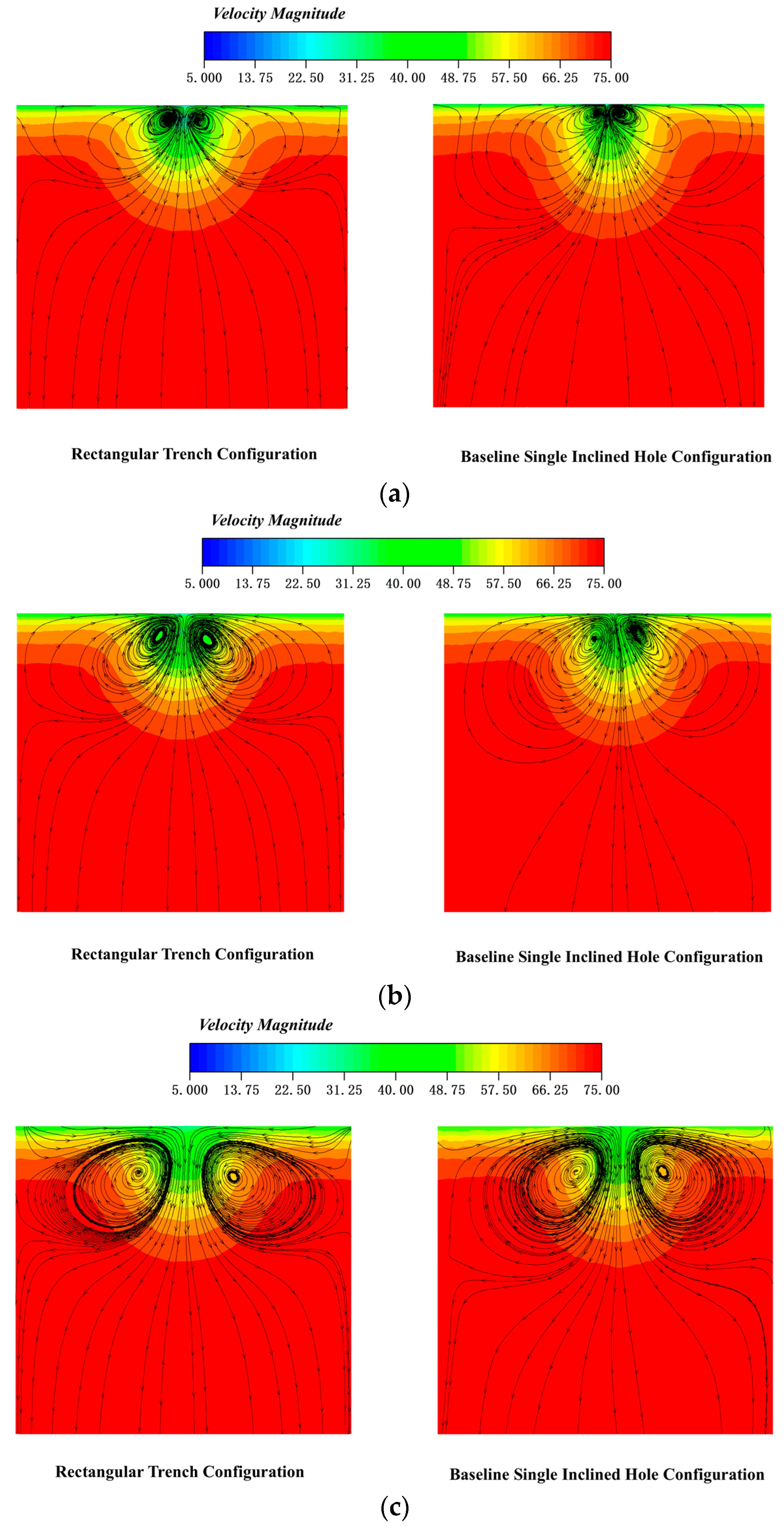
After being ejected through the inclined hole, the cooling flow undergoes intense entrainment and mixing with the high-temperature mainstream, forming a complex vortex system in the flow field. Within this system, the kidney-shaped vortex pair plays a dominant role. The
Figure 6 illustrates the vortex structure distribution on the outflow side for both the rectangular trench configuration and the non-trench configuration at a
BR of 2.01. As shown, the size of the kidney vortex gradually increases in the streamwise direction, while its intensity progressively decays. Under the influence of the kidney vortex pair, the cooling flow provides a certain degree of coverage over the hot-gas-side surface near the film-cooling hole exit. Compared with the non-trench configuration, the rectangular trench configuration exhibits a smaller size and weaker intensity of the kidney vortex pair, along with an increased spacing between the two vortex cores. Consequently, the entrainment and mixing between the cooling flow and the mainstream are relatively reduced. This allows the cooling flow to adhere more closely to the solid hot-gas-side surface, promotes wider lateral spreading of the coolant, significantly lowers the temperature of the hot-gas-side surface, and ultimately enhances the overall cooling performance.
3.2. Effect of Rectangular Trench Depth on Flow and Heat Transfer Characteristics
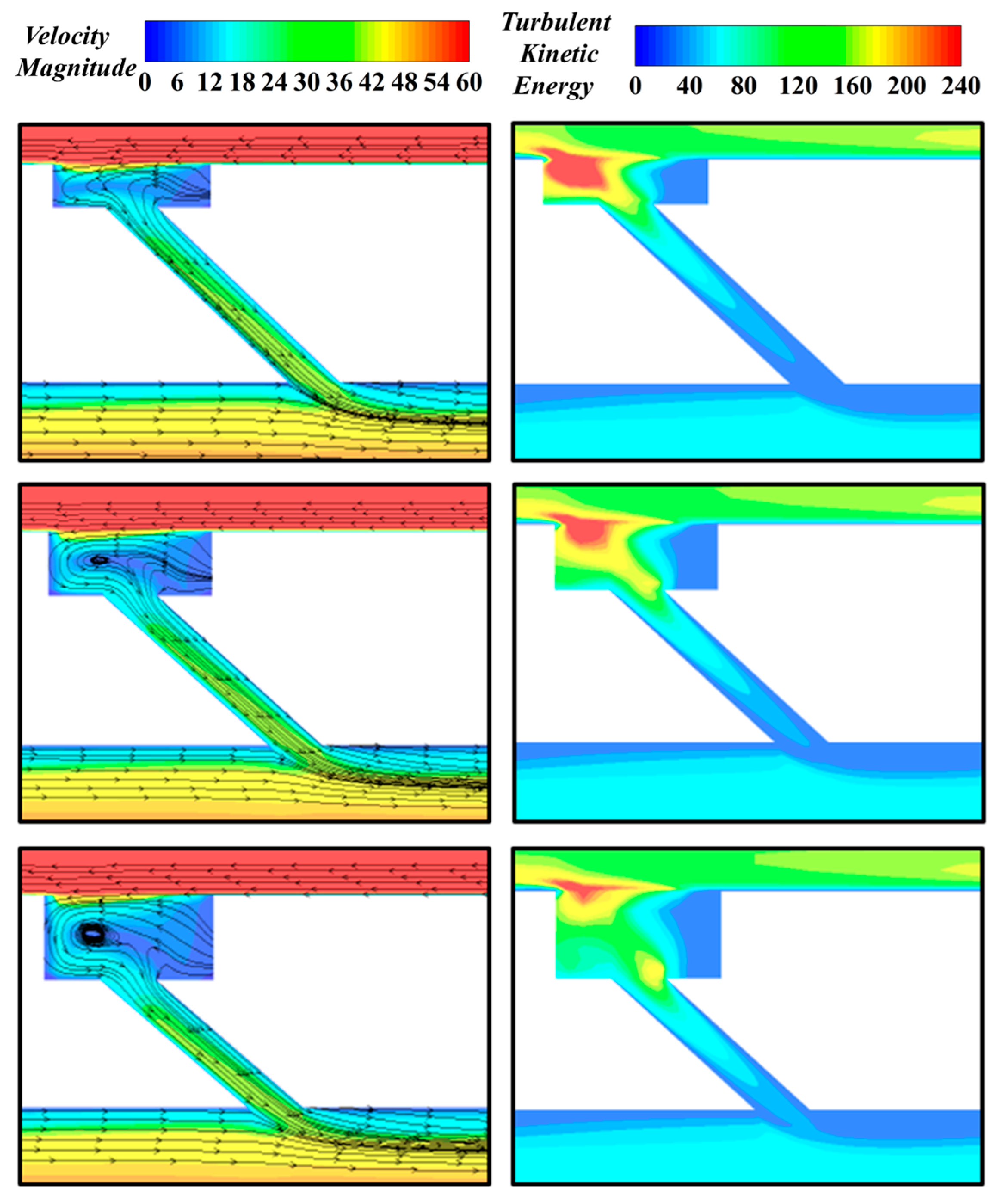
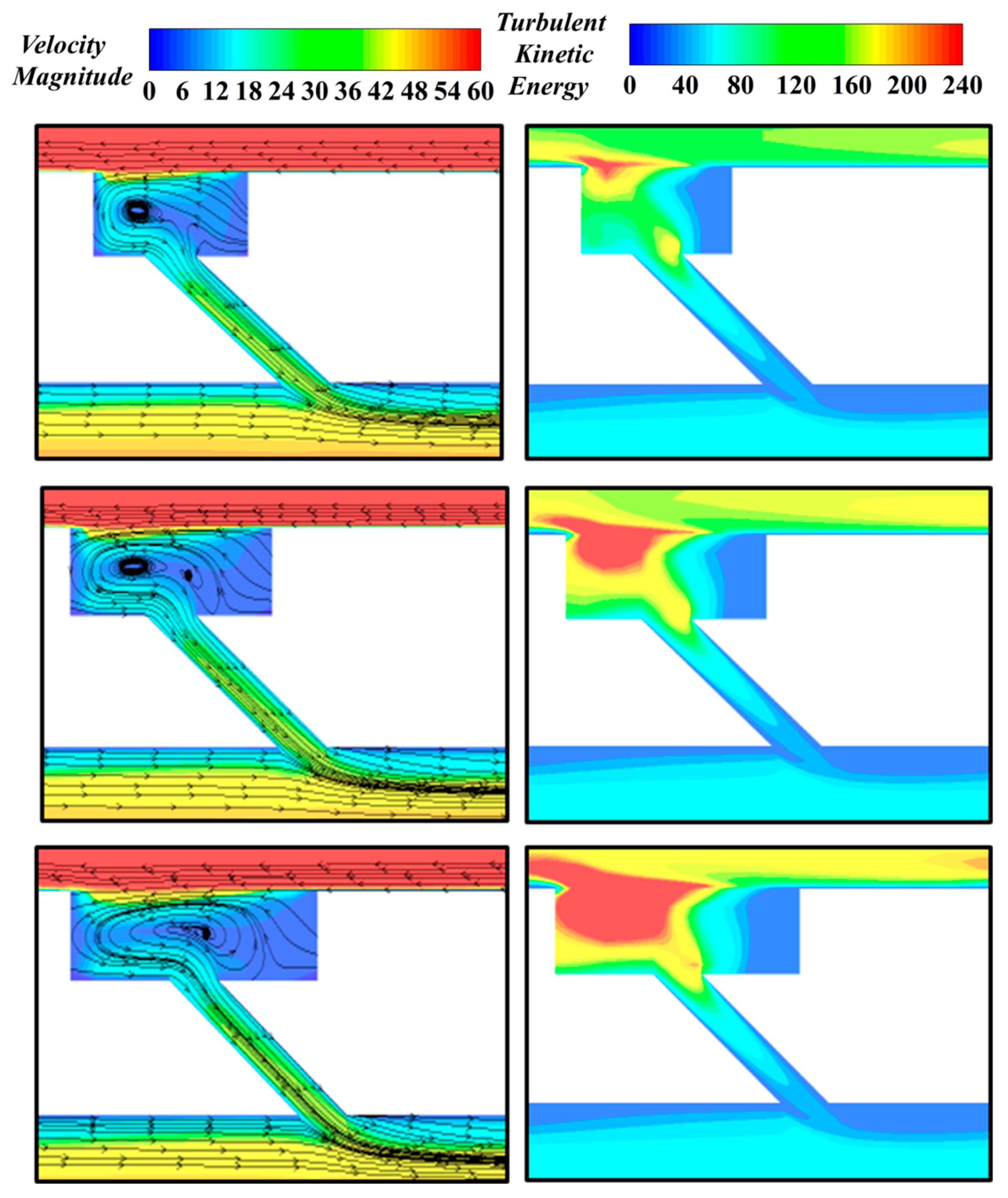
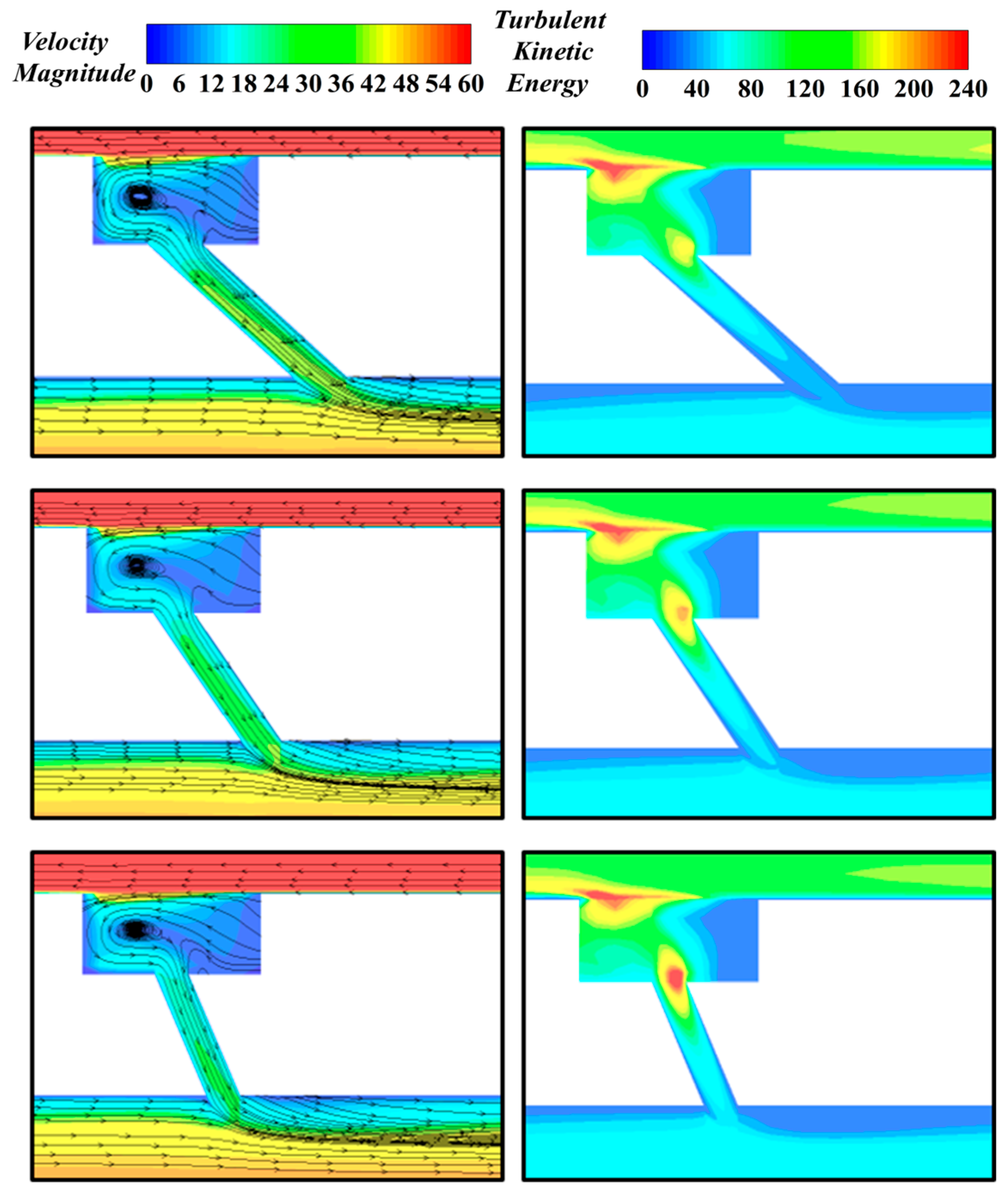
Figure 7 presents the contour plots of streamlines, velocity, and turbulent kinetic energy (
TKE) on the cross-section of a single inclined hole with a rectangular trench at a coolant-side Reynolds number of
Re = 100,000 for
H/
D ratios of 1.0, 1.5, and 2.0.
At H/D = 1.0, no vortex is formed within the trench. As the H/D ratio increases, a vortex develops inside the trench. The vortex intensity gradually strengthens at its core, while its position remains nearly unchanged. Due to the influence of the trench, the coolant boundary layer separates, resulting in a localized region of high TKE near the far end of the trench (relative to the coolant inlet). With increasing H/D, this high-TKE region gradually diminishes. Under the suction effect of the inclined hole, another localized high-TKE zone forms at the interface between the trench and the inclined hole. As H/D increases, this high-TKE region progressively shifts toward the end of the trench closer to the coolant inlet. Furthermore, the flow velocity at the exit of the inclined hole increases with higher H/D, which helps prevent hot gases from adhering closely to the solid wall. The f for H/D = 1.0, 1.5, and 2.0 are 1.429 × 10⁻², 1.421 × 10⁻², and 1.418 × 10⁻², respectively. These results indicate that the f gradually decreases as H/D increases, corresponding to a reduction in flow resistance.
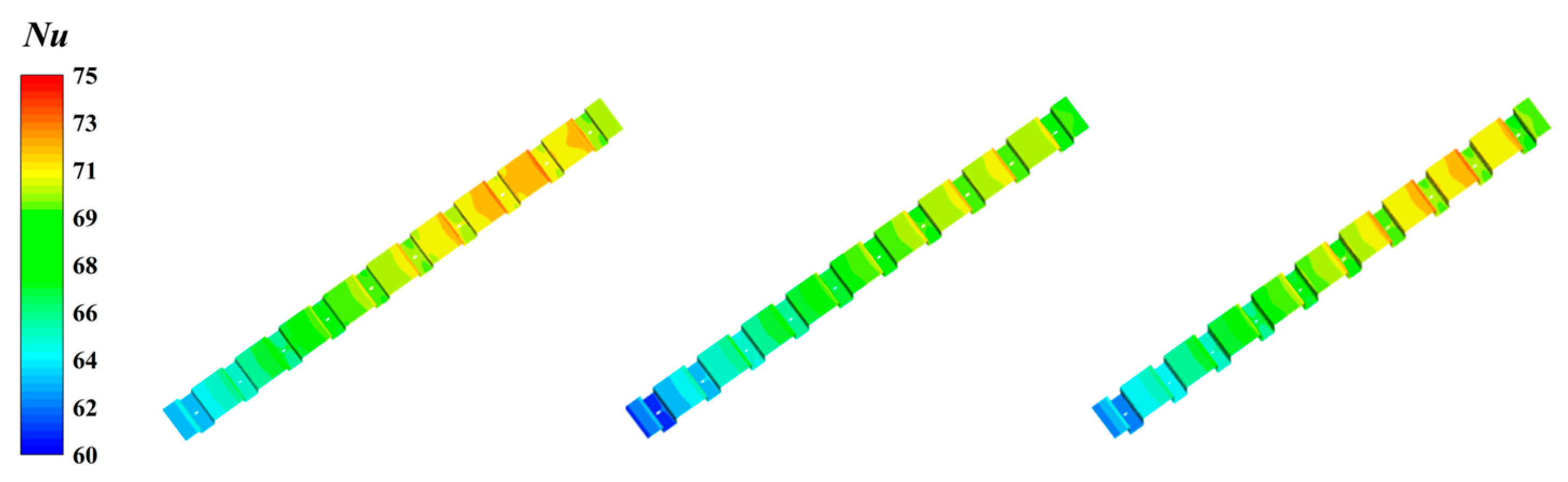
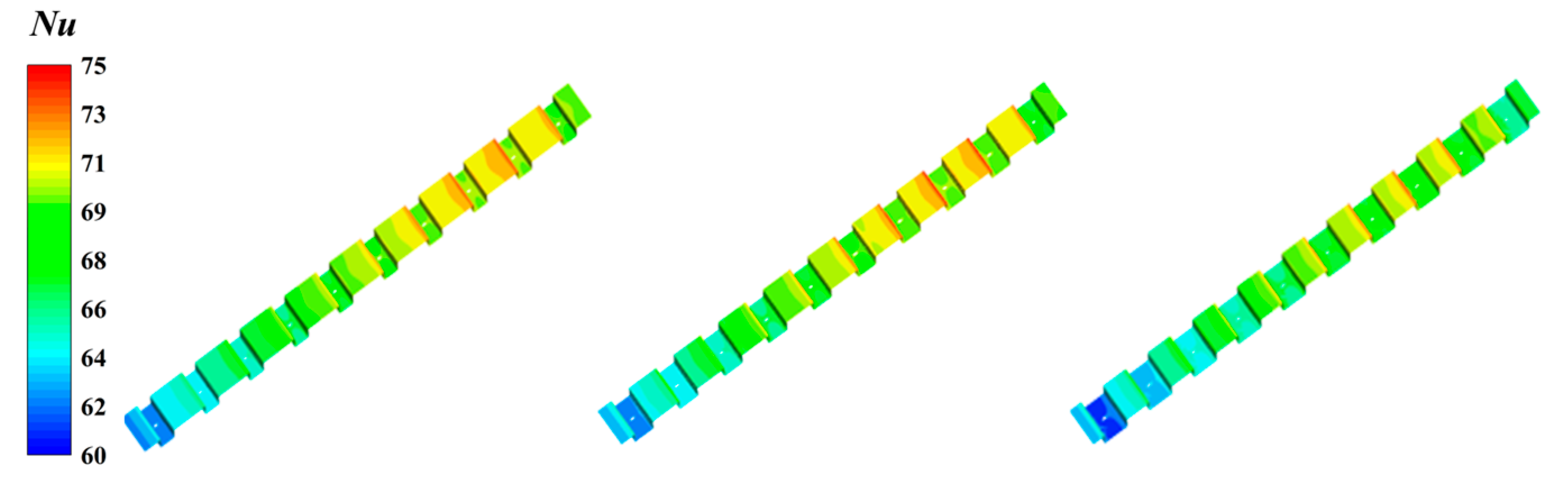
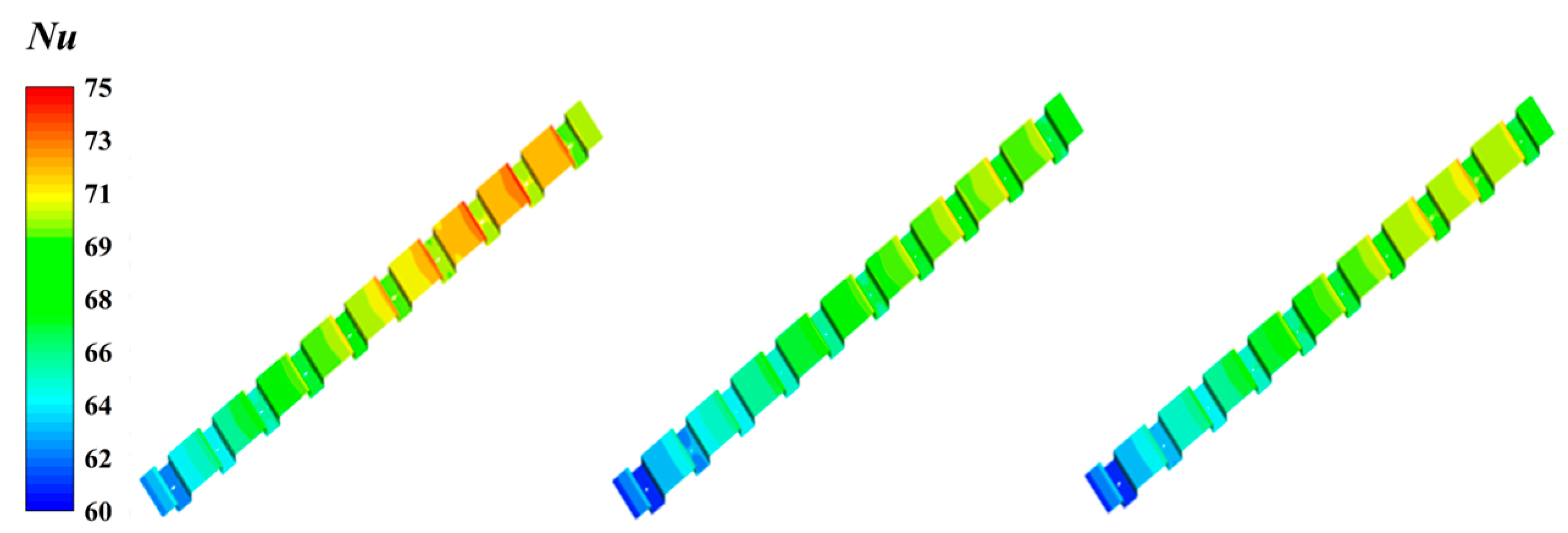
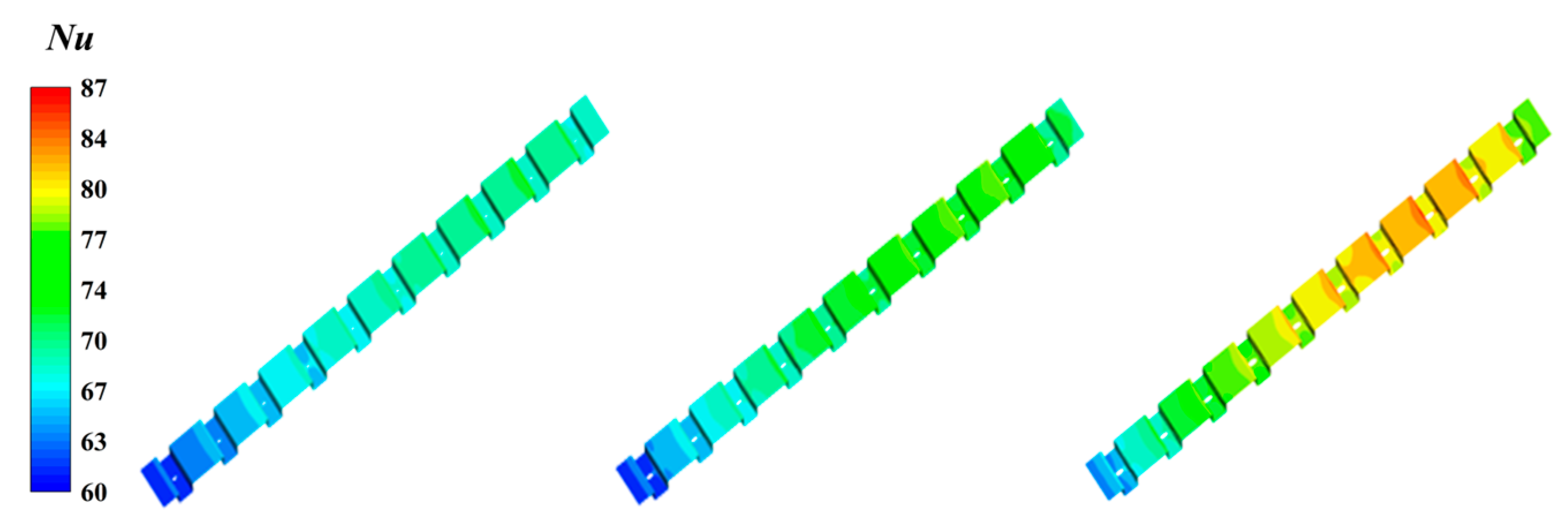
Figure 8 presents the three-dimensional Nusselt number (
Nu) contours on the cold-side solid surface of the layered plate with an inclined hole and a rectangular trench at
H/
D ratios of 1.0, 1.5, and 2.0. It can be observed that a region of high Nu appears along the top of the trench in the direction of coolant flow. This is attributed to the formation of a large-scale vortex at the trench, which disrupts the thermal boundary layer and enhances heat transfer.
At H/D = 1.0, the high-Nu zone is localized at the trench top. As the H/D ratio increases, the extent of the high-Nu region, both within and atop the trench, initially decreases and then increases. Nuave for H/D = 1.0, 1.5, and 2.0 are 69.1371, 67.4871, and 68.5198, respectively. These results indicate that Nuave first decreases and then rises with increasing H/D.
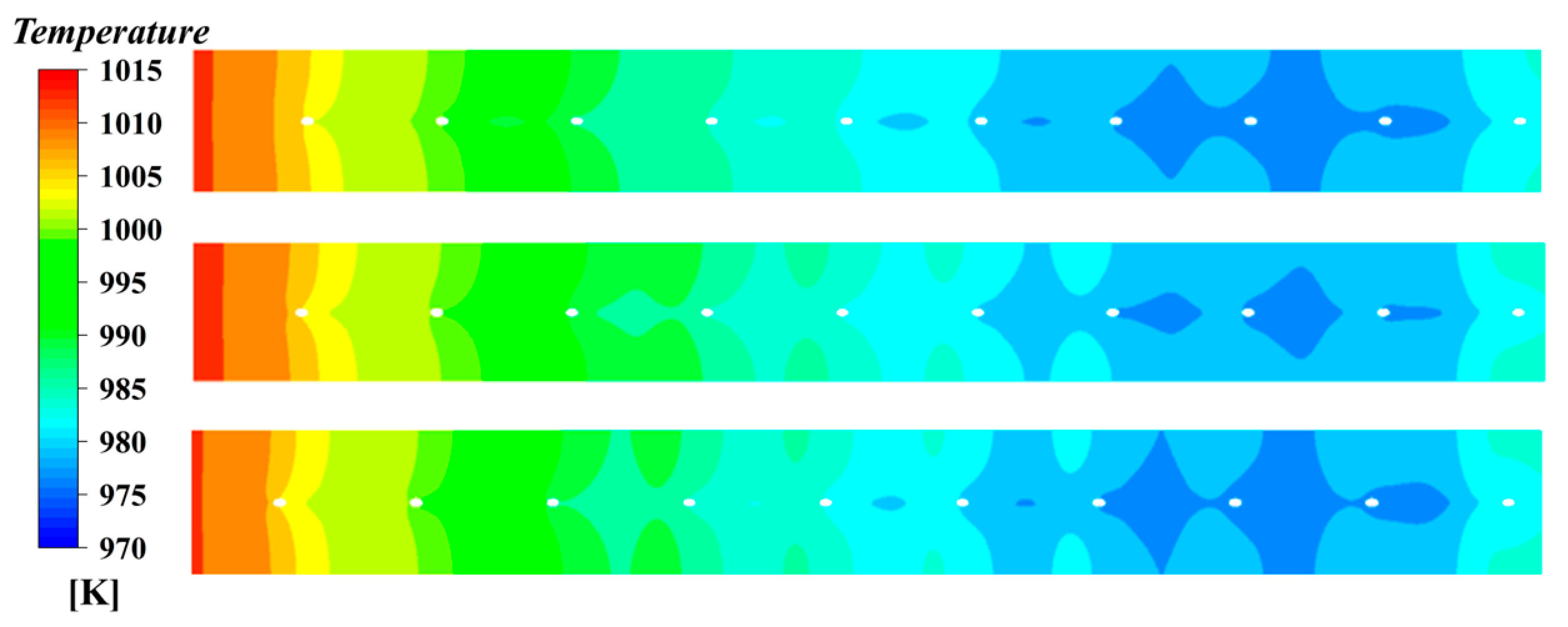
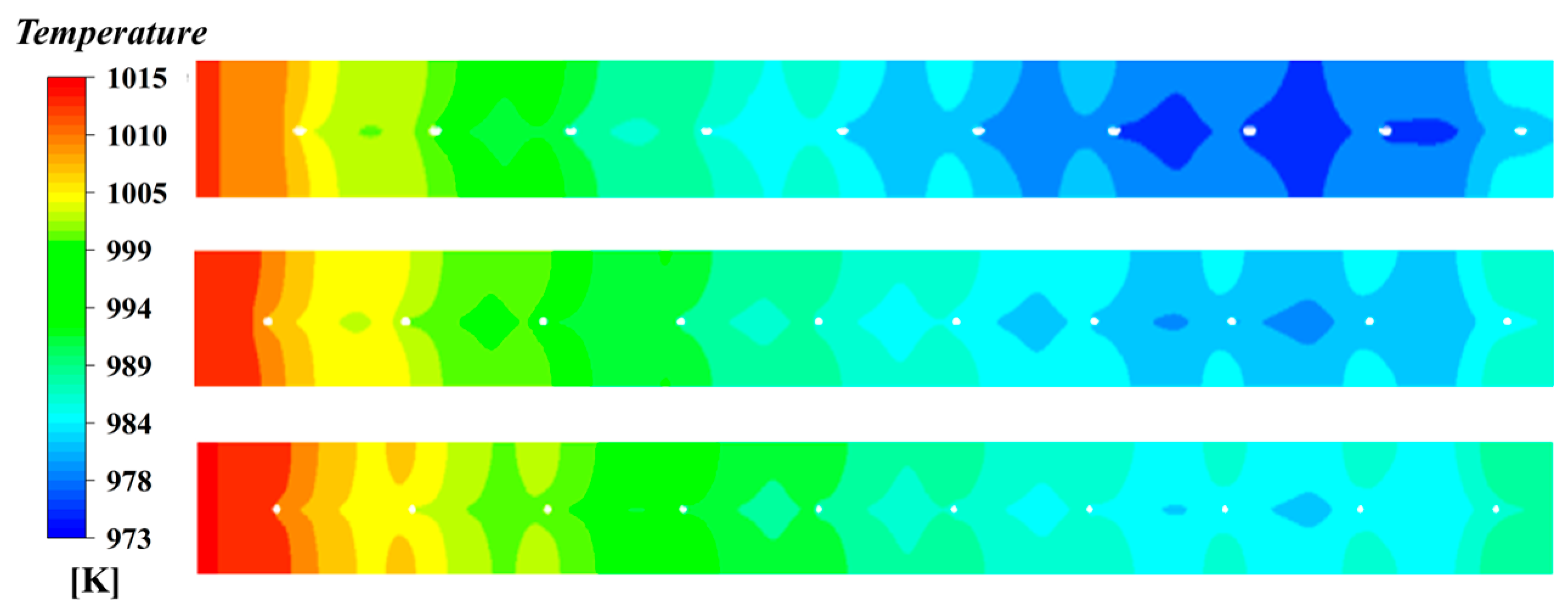
Figure 9 presents the temperature contours on the hot-gas side solid surface of the layered plate with an inclined hole and a rectangular trench at
H/
D ratios of 1.0, 1.5, and 2.0. The results indicate that the overall temperature is lower in the region farther from the hot-gas inlet. As the
H/
D ratio decreases, the temperature distribution across the hot-gas side solid region becomes more uniform.
The calculated average temperatures on the hot-gas side solid surface (TaveA) are 985.966 K, 987.043 K, and 986.379 K for H/D = 1.0, 1.5, and 2.0, respectively. η are 76.686%, 76.584%, and 76.647%. These results show that as the H/D ratio increases, η first decreases and then increases. The highest cooling effectiveness and the most uniform temperature distribution are achieved at H/D = 1.0.
3.3. Effect of Trench Width on Flow and Heat Transfer Characteristics
Figure 10 presents the distributions of streamlines, velocity contours, and
TKE contours on the cross-section of a single inclined hole with a rectangular trench at a coolant-side Reynolds number of 100,000 for
B/
D ratios of 6.0, 8.0, and 10.0.
As the B/D ratio increases, the vortex core within the trench gradually shifts toward the coolant inlet, and its scale progressively enlarges. Notably, at B/D = 8.0, two counter-rotating vortices of unequal size form inside the trench. The presence of the trench induces separation of the coolant boundary layer, resulting in a localized high-TKE region near the trench end farther from the coolant inlet. The extent of this high-TKE region expands with increasing B/D ratio. Additionally, due to the suction effect of the inclined hole, another localized high-TKE zone emerges at the interface between the trench and the hole. The f for B/D = 6.0, 8.0, and 10.0 are 0.01429, 0.01421, and 0.01418, respectively. This indicates a gradual decrease in the f with increasing B/D, corresponding to a reduction in flow resistance.
Figure 11 presents the three-dimensional
Nu contours on the cold-side solid surface of the layered plate with an inclined hole and a rectangular trench at
B/
D ratios of 6.0, 8.0, and 10.0. A region of high
Nu is observed along the top surface of the trench in the flow direction, which is attributed to the large-scale vortex generated within the trench. This vortex disrupts the thermal boundary layer, thereby enhancing heat transfer.
At B/D = 6.0 and 8.0, the Nu values remain nearly constant both within and on top of the trench. However, at B/D = 10.0, while the Nu inside the trench shows little change, the Nu at the trench top decreases sharply. Nuave for B/D = 6.0, 8.0, and 10.0 are 68.5198, 68.5412, and 67.4667, respectively. These results indicate that Nuave remains relatively constant initially and then decreases as the B/D ratio increases.
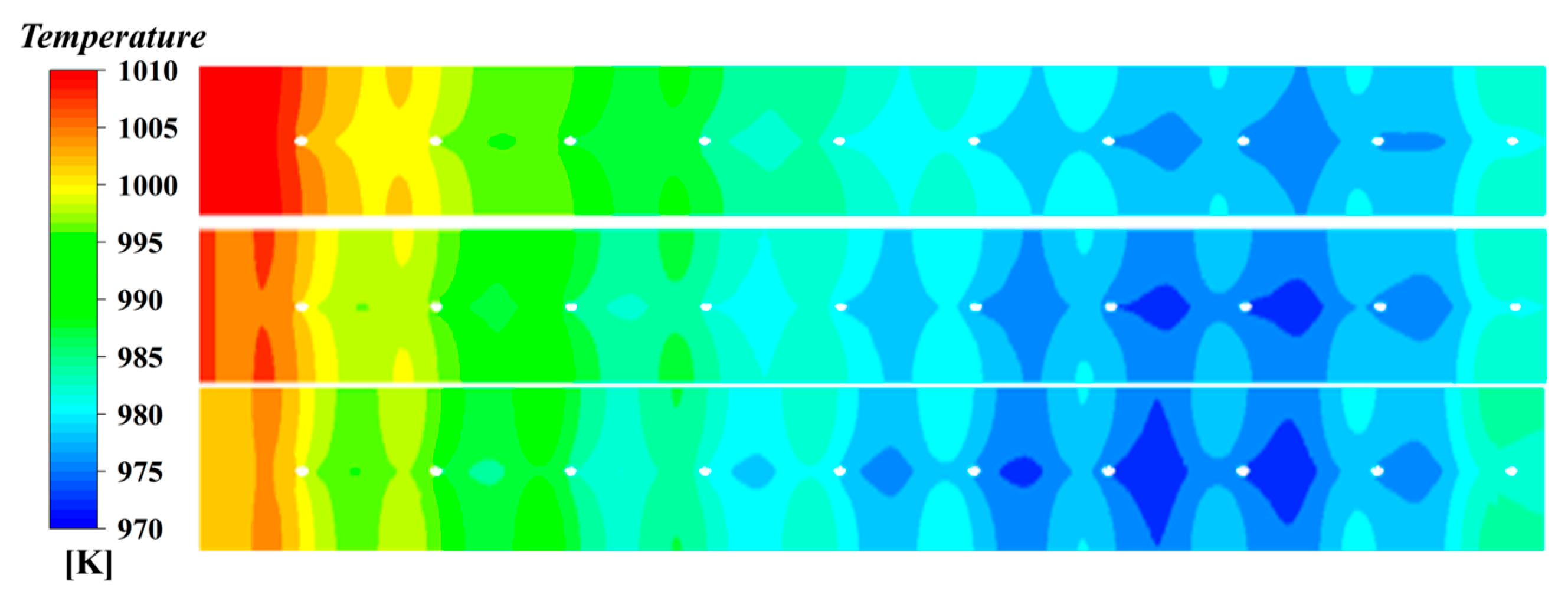
Figure 12 presents the temperature contours on the hot-gas side solid surface of the layered plate with an inclined hole and a rectangular trench at
B/
D ratios of 6.0, 8.0, and 10.0. As shown in the figure, the overall temperature is lower in the region farther from the hot-gas inlet. The temperature of the layered plate gradually decreases with increasing
B/
D ratio.
The calculated TaveA are 986.379 K, 983.72 K, and 983.137 K for B/D = 6.0, 8.0, and 10.0, respectively. η are 76.647%, 76.899%, and 76.953%. These results demonstrate that η gradually increases with the increase in B/D ratio.
3.4. Effect of Inclination Angle on Flow and Heat Transfer Characteristics
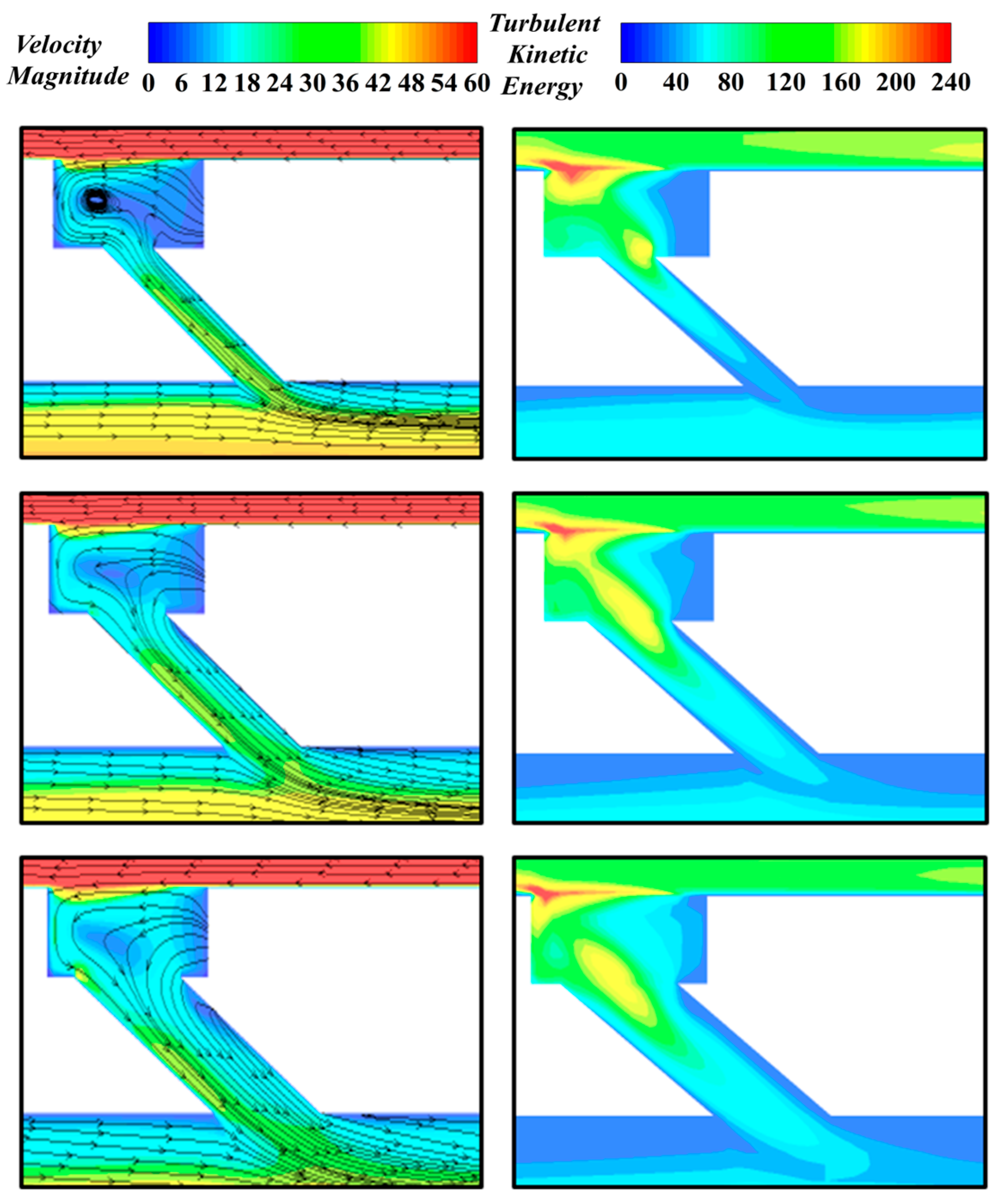
Figure 13 presents the distributions of streamlines, velocity contours, and
TKE contours on the cross-section of a single trenched inclined hole at a coolant-side
Re of 100,000 for inclination angles (
α) of 30°, 45°, and 60°.
A vortex is generated within the trench across all investigated inclination angles, with its scale and position remaining nearly constant. The flow through the inclined hole induces a suction effect, resulting in a localized high-TKE zone at the interface between the trench and the hole. As the inclination angle α increases, the peak value of the TKE in this localized region gradually intensifies. The f for α = 30°, 45°, and 60° are 0.01418, 0.01418, and 0.01419, respectively, indicating that the f remains nearly constant with increasing inclination angle.
Figure 14 presents the three-dimensional
Nu contours on the cold-side solid surface of the layered plate with a trenched inclined hole at inclination angles (
α) of 30°, 45°, and 60°. It can be observed that a region of high
Nu appears along the top surface of the trench in the direction of coolant flow. This phenomenon is attributed to the large-scale vortex generated within the trench, which disrupts the thermal boundary layer and consequently enhances heat transfer.
At α = 30°, a high-Nu zone is present at the trench top. As the inclination angle α increases, the extent of the high-Nu region, both within and atop the trench, initially decreases and then remains largely unchanged. Nuave for α = 30°, 45°, and 60° are 68.5198, 66.7735, and 66.2739, respectively. These results indicate that Nuave first decreases and then stabilizes with increasing inclination angle.
Figure 15 presents the temperature contours on the hot-gas side solid surface of the layered plate with a trenched inclined hole at inclination angles (
α) of 30°, 45°, and 60°. The results indicate that the region farther from the hot-gas inlet exhibits lower overall temperatures. As the inclination angle α increases, the temperature of the layered plate gradually rises.
The calculated TaveA are 986.379 K, 990.073 K, and 992.915 K for α = 30°, 45°, and 60°, respectively. η are 76.647%, 76.296%, and 76.027%. These results demonstrate that η gradually decreases with increasing inclination angle α.
3.5. Effect of Hole Diameter on Flow and Heat Transfer Characteristics
Figure 16 presents the cross-sectional distributions of streamlines, velocity contours, and
TKE for a single trenched inclined hole at a coolant-side
Re of 100,000 and hole diameters (
D) of 1 mm, 1.5 mm, and 2 mm.
At a hole diameter of D = 1 mm, a vortex is generated within the trench. However, no vortex forms at the larger diameters of D = 1.5 mm and 2 mm. This absence is attributed to the stronger suction effect produced by the larger holes, which creates a localized high-TKE zone at the trench-hole interface, thereby preventing vortex formation. As the hole diameter D increases, this localized high-TKE region progressively expands. The f for D = 1 mm, 1.5 mm, and 2 mm are 0.01418, 0.01361, and 0.01297, respectively, indicating a gradual decrease in f with increasing hole diameter.
Figure 17 presents the three-dimensional
Nu contours on the cold-side solid surface of the layered plate with a trenched inclined hole at diameters (
D) of 1 mm, 1.5 mm, and 2 mm. A region of high
Nu is observed along the top surface of the trench in the coolant flow direction, resulting from the disruption of the thermal boundary layer by the trench, which enhances heat transfer.
A high-Nu zone appears at the trench top. As the hole diameter D increases, the high-Nu regions both within and atop the trench progressively expand. Nuave for D = 1 mm, 1.5 mm, and 2 mm are 68.5198, 71.7463, and 77.6216, respectively. Compared to the baseline diameter of 1 mm, Nuave on the cold side increases by approximately 5% and 13% with the enlargement of the inclined hole diameter, demonstrating a significant heat transfer enhancement.
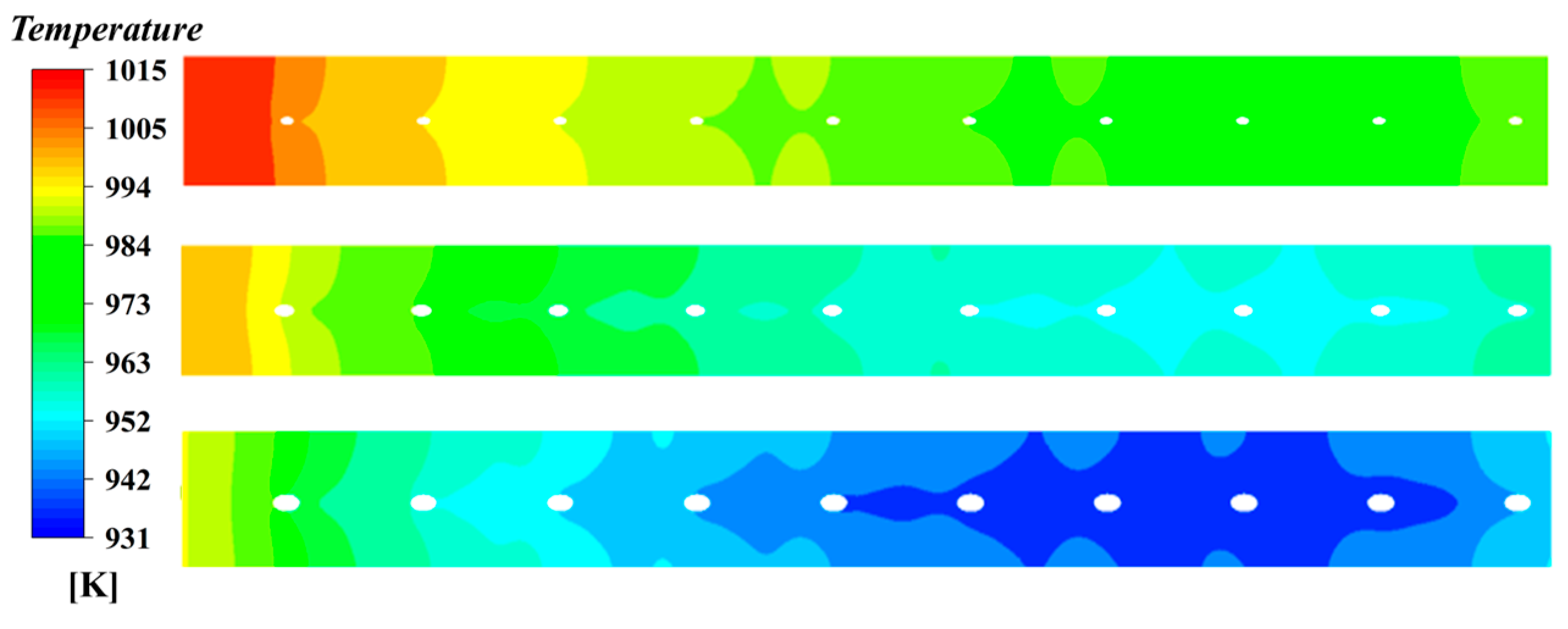
Figure 18 presents the temperature contours on the hot-gas side solid surface of the layered plate with a trenched inclined hole at diameters (
D) of 1 mm, 1.5 mm, and 2 mm. The results demonstrate that the region farther from the hot-gas inlet exhibits lower overall temperatures. As the hole diameter
D increases, the temperature of the layered plate decreases significantly.
The calculated TaveA are 986.379 K, 965.925 K, and 946.882 K for D = 1 mm, 1.5 mm, and 2 mm, respectively. η are 76.647%, 75.858%, and 80.390%. With the increase in hole diameter, TaveA decreases by approximately 21 K and 42 K, respectively, while η is enhanced by 2% and 4%.
3.6. Effect of Streamwise Hole Spacing on Flow and Heat Transfer Characteristics
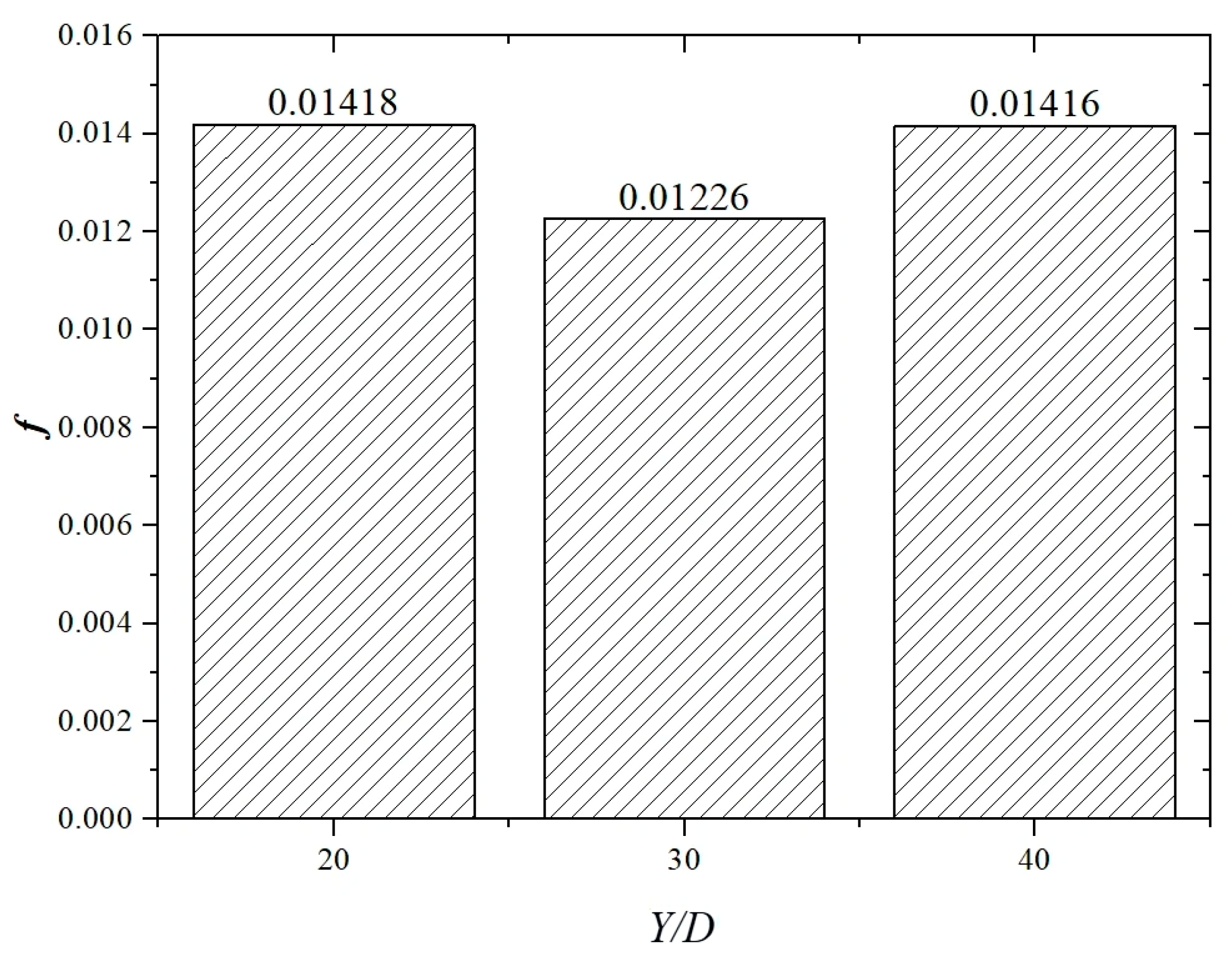
Figure 19 presents the bar chart of friction factors at a coolant-side Re of 100,000 for Y/D ratios of 20, 30, and 40. The
f for
Y/
D = 20, 30, and 40 are 0.01418, 0.01226, and 0.01416, respectively. These results indicate that the
f initially decreases and then increases with increasing
Y/
D ratio.
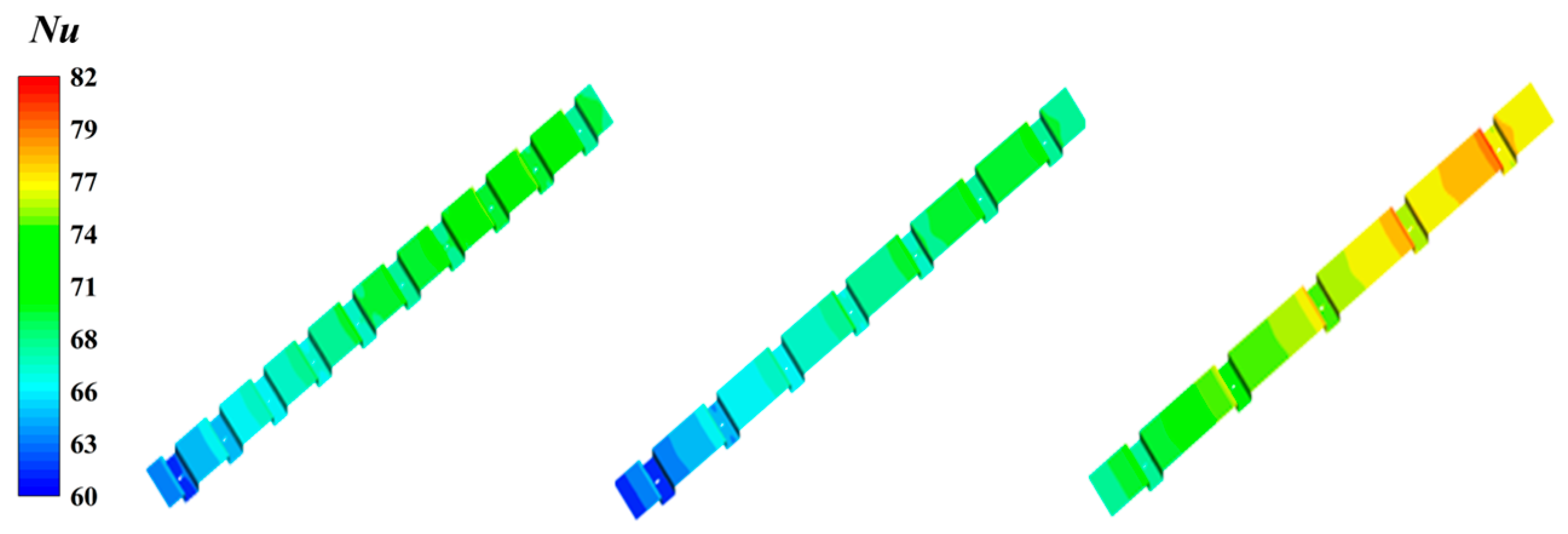
Figure 20 presents the three-dimensional
Nu contours on the cold-side solid surface of the layered plate with a trenched inclined hole. A region of high
Nu is observed along the top surface of the trench in the coolant flow direction, which is attributed to the disruption of the thermal boundary layer by the trench flow, thereby enhancing heat transfer.
As the streamwise spacing Y/D increases, the high-Nu regions both within and atop the trench progressively expand. The calculated average Nu for Y/D = 20, 30, and 40 are 68.5198, 67.2592, and 74.5958, respectively. Compared to the configurations at Y/D = 20 and 30, the average Nu on the cold side at Y/D = 40 increases by approximately 9% and 11%, respectively.
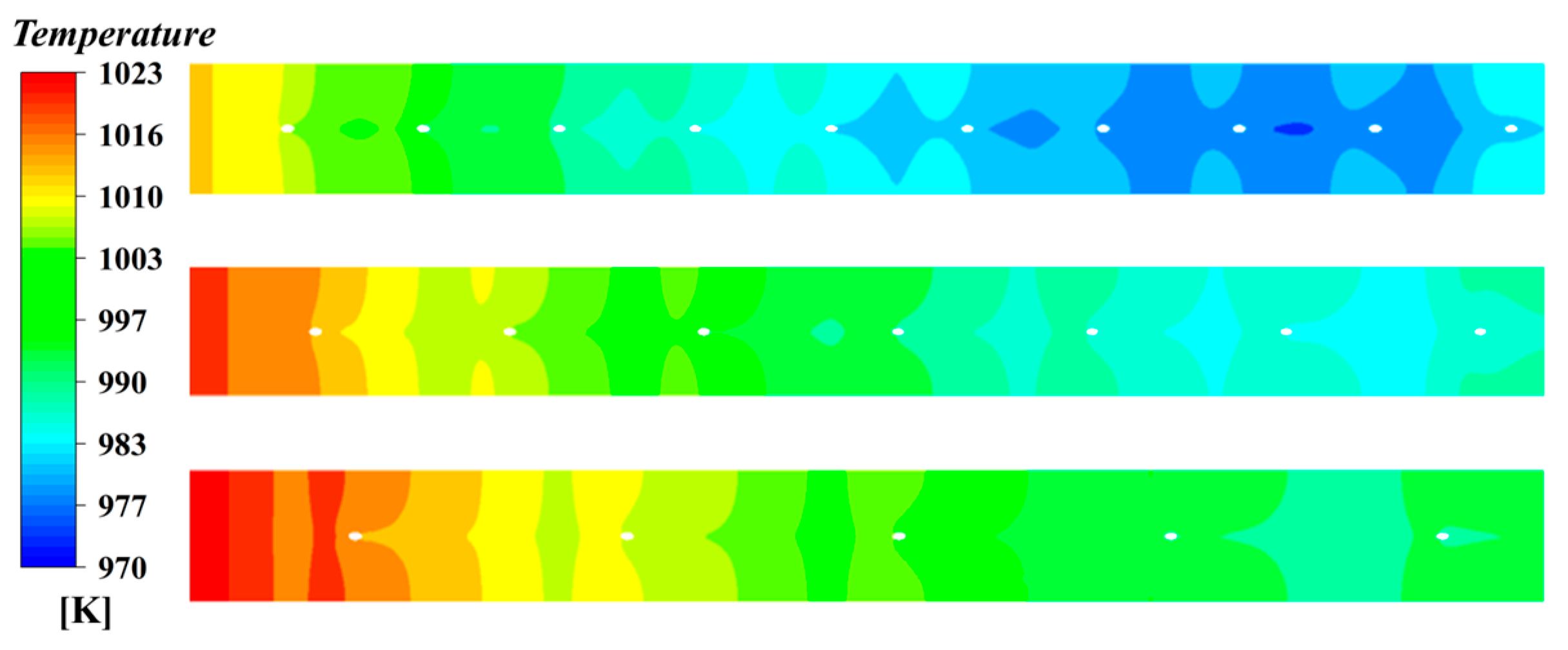
Figure 21 presents the temperature contours on the hot-gas side solid surface of the layered plate with a trenched inclined hole at
Y/
D ratios of 20, 30, and 40. As shown in the figure, regions farther from the hot-gas inlet generally exhibit lower temperatures. With decreasing streamwise spacing
Y/
D, the temperature of the layered plate structure decreases.
The calculated TaveA are 986.379 K, 996.551 K, and 1002.760 K for Y/D = 20, 30, and 40, respectively. η are 76.647%, 75.682%, and 75.094%. As the streamwise spacing decreases, TaveA is reduced by approximately 8 K and 16 K, respectively, while η is improved by 0.6% and 1.6%.
4. Conclusions
The flow and heat transfer performance of the baseline single inclined hole configuration and the rectangular trench configuration were investigated under low, medium, and high blowing ratios. It was found that the rectangular trench configuration exhibits superior cooling performance compared to the baseline single inclined hole structure. To further investigate the trenched configuration, numerical simulations were employed to analyze the effects of various structural parameters of the trenched inclined hole layered plate on flow and heat transfer characteristics at a coolant-side Re of 100,000 in a gas turbine combustor cooling structure. The main conclusions are as follows:
(1) Compared to conventional inclined round-hole configurations, the introduction of rectangular grooves reduces the size and intensity of the kidney vortex pair, promoting attached flow of the coolant along the hot-end wall. This results in superior flow characteristics and enhanced heat transfer performance.
(2) As the width of the trench increases, the vortex core within the trench shifts toward the coolant inlet, its scale expands, and flow resistance rises, leading to a gradual increase in the coolant-side f. Conversely, with an increase in the inclined hole diameter, vortex formation within the rectangular trench is suppressed, flow resistance decreases, and the coolant-side f reduces.
(3) As the inclined hole diameter increases, the suction efficiency is enhanced, allowing for more extensive lateral spreading of the coolant within the rectangular trench. This results in improved continuity of the film cooling coverage at the exit. Consequently, Nuave on the coolant side increases by 5% and 13%, TaveA decreases by approximately 21 K and 42 K, respectively, and the η improves by 2% and 4%. These changes demonstrate a significant enhancement in heat transfer performance.
(4) At a streamwise distance of Y/D = 40, Nuave on the coolant side is 9% and 11% higher than at Y/D = 20 and 30, respectively. As the streamwise distance decreases, the more densely distributed film-cooling holes enhance heat transfer capability. Consequently, TaveA decreases by about 8 K and 16 K, respectively, and the η improves by 0.6% and 1.6%.